
Sustainable Economic Dynamics in Europe: Confirming the Role of Structural Intellectual Capital Using PCA, Panel ARDL, PSTR and SEM-PLS Models


Abstract
1. Introduction
2. Literature Review
2.1. Theoretical Background
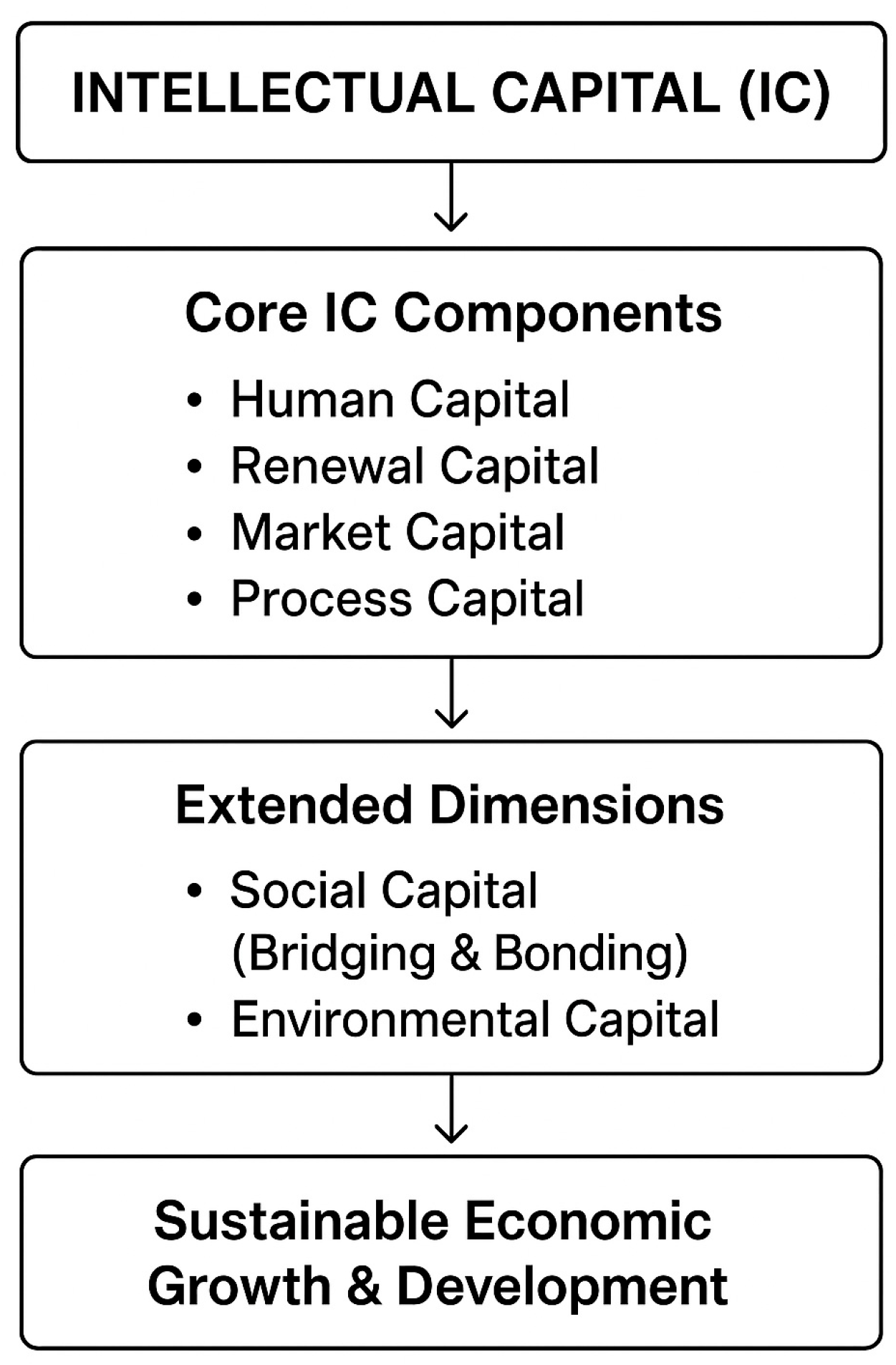
2.2. Intellectual Capital Index
3. Methodology
3.1. Data Selection
3.2. Principal Component Analysis (PCA)
PCm = am1x1 + am2x2 + …+ amnxn
IC = (σi2)·(PC1)+(σi2)·(PC2) + (σi2)·(PC3)
IC = (σi2)·(HC) + (σi2)·(PC)+(σi2)·(MC) + (σi2)·(RC)
3.3. Panel Autoregressive Distributed Lag (Ardl) Model
+ ∑jγj ΔXi,t−j + μi + εit
3.4. Empirical Results and Discussion
3.4.1. Factor Analysis

| Variable Name | MR1 | MR4 | MR2 | MR3 | Source |
|---|---|---|---|---|---|
| Gross Enrollment Ratio, Tertiary (%) | 0.283 | −0.409 | 0.469 | World Bank | |
| Gross Enrollment Ratio, Secondary (%) | 0.737 | 0.141 | World Bank | ||
| Gross Enrollment Ratio, Primary (%) | 0.472 | 0.218 | 0.115 | 0.258 | World Bank |
| Government Expenditure on Education (% of GDP) | 0.636 | −0.154 | −0.102 | World Bank | |
| Current Health Expenditure (% of GDP) | 0.675 | −0.191 | 0.452 | −0.175 | World Bank |
| Life Expectancy at Birth (years) | 0.716 | −0.318 | 0.223 | 0.170 | World Bank |
| Gross Domestic Expenditure on R&D (% of GDP) | 0.814 | 0.289 | −0.128 | World Bank | |
| Researchers in R&D (per million people) | 0.871 | −0.156 | World Bank | ||
| Alcohol Consumption (liters per capita) | −0.147 | −0.708 | World Bank | ||
| Physicians (per million people) | 0.321 | −0.567 | 0.181 | World Bank | |
| Hospital Beds (per 1000 people) | −0.360 | 0.342 | −0.515 | World Bank | |
| Income Share of Top 10% | −0.366 | 0.150 | 0.199 | 0.454 | World Bank |
| Creative Goods Exports (% of total exports) | −0.107 | 0.220 | 0.318 | 0.601 | EuroStat |
| Individuals Using the Internet (%) | 0.680 | −0.143 | −0.242 | World Bank | |
| Trade (% of GDP) | −0.491 | −0.468 | World Bank | ||
| Net Outward Foreign Direct Investment (% of GDP) | −0.171 | World Bank | |||
| Book Imports (per capita) | 0.111 | −0.238 | −0.464 | −0.359 | Eurostat |
| Scientific and Technical Journal Articles (per million people) | 0.185 | 0.935 | Eurostat | ||
| Pupil-Teacher Ratio, Primary | −0.181 | 0.746 | World Bank | ||
| Pupil-Teacher Ratio, Secondary | 0.881 | 0.252 | 0.345 | World Bank | |
| Pupil-Teacher Ratio, Tertiary | −0.264 | 0.763 | World Bank | ||
| Pupil-Teacher Ratio, upper secondary | 0.172 | 0.777 | 0.233 | 0.237 | World Bank |
| Infant Mortality Rate (per 1000 live births) | −0.578 | 0.570 | 0.339 | World Bank | |
| Patent Applications by Residents (per million people) | 0.116 | 0.862 | −0.164 | World Bank | |
| High-Technology Exports (% of total exports) | 0.101 | 0.946 | World Bank | ||
| Age Dependency Ratio (%) | 0.324 | −0.423 | 0.377 | −0.229 | World Bank |
| % of Primary Teachers with Required Qualifications | −0.181 | 0.746 | World Bank | ||
| % of Secondary Teachers with Required Qualifications | 0.881 | 0.252 | 0.345 | World Bank | |
| % of Tertiary Teachers with Required Qualifications | −0.264 | 0.763 | World Bank |
3.4.2. Model Identification
3.4.3. Panel Estimation
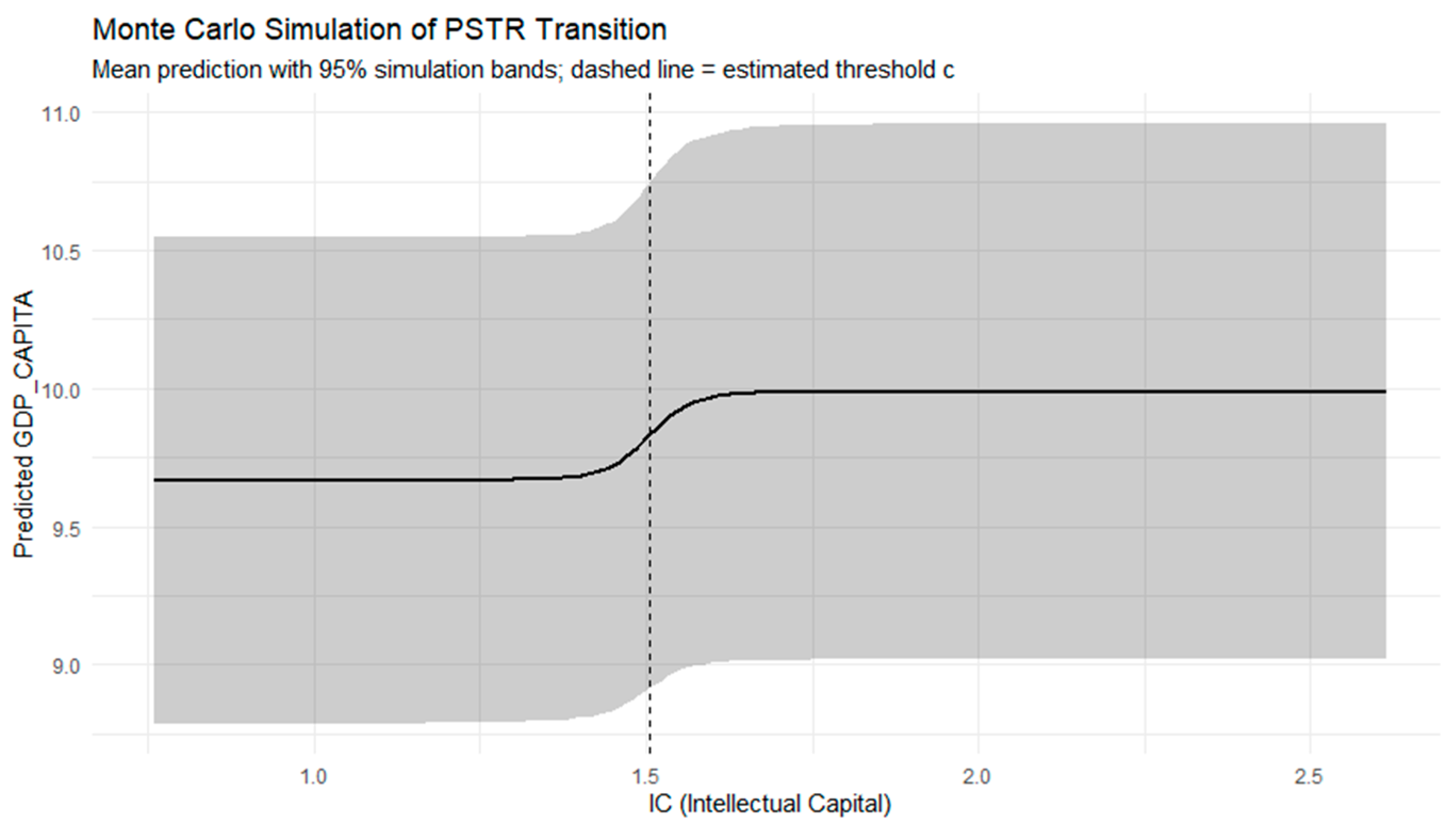
3.4.4. Model Validation and Threshold Simulation (Non-Linear Tests)
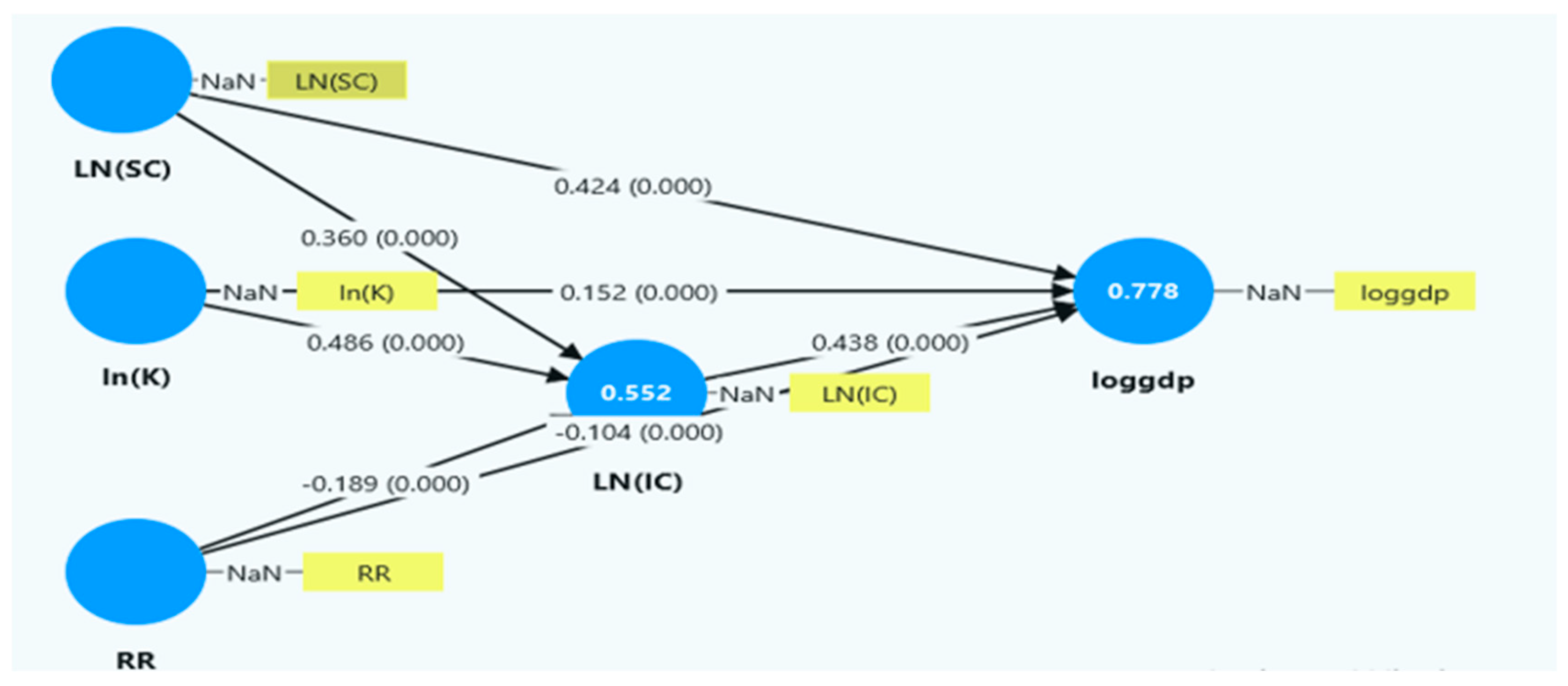
SEM-Model
4. Conclusions
Author Contributions
Funding
Institutional Review Board Statement
Informed Consent Statement
Data Availability Statement
Conflicts of Interest
Appendix A

| Component | Conceptual | Operational | Source |
|---|---|---|---|
| Human Capital | Education and culture |
| World bank and Eurostat |
| Culture |
| World bank and Eurostat | |
| Health |
| World bank and Eurostat | |
| Income inequality |
| World bank and Eurostat | |
| Renewal capital (innovation) | innovation |
| World bank and Eurostat |
| Market Capital | External and internal image, global networks and business attractiveness |
| World bank and Eurostat |
| Process Capital | Information and technology (communication). Addressing technological skills and capabilities. |
| World bank and Eurostat |
| Social Capital | Trust, religion, networks (bridging), voluntary associations and other type of associations (bonding capital) |
| EVS and WVS |

References
- Abdallah, A. S., Amin, H., Abdelghany, M., & Elamer, A. A. (2025). Antecedents and consequences of intellectual capital: A systematic review, integrated framework, and agenda for future research. Management Review Quarterly, 75, 3067–3118. [Google Scholar] [CrossRef]
- Ahmed, Z., Asghar, M. M., Malik, M. N., & Nawaz, K. (2020). Moving towards a sustainable environment: The dynamic linkage between natural resources, human capital, urbanization, economic growth, and ecological footprint in China. Resources Policy, 67, 101677. [Google Scholar] [CrossRef]
- Archibugi, D., & Coco, A. (2005). Measuring technological capabilities at the country level: A survey and a menu for choice. Research Policy, 34(2), 175–194. [Google Scholar] [CrossRef]
- Asiaei, K., & Jusoh, R. (2015). A multidimensional view of intellectual capital: The impact on organizational performance. Management Decision, 53(3), 668–697. [Google Scholar] [CrossRef]
- Baily, M. N., Bosworth, B. P., & Kennedy, K. (2021). The contribution of human capital to economic growth. A cross-country comparison of Germany, Japan, and the United States. Economic Studies at Brookings. Available online: https://www.brookings.edu/research/the-contribution-of-human-capital-to-economic-growth/ (accessed on 24 April 2023).
- Balart, P., Oosterveen, M., & Webbink, D. (2018). Test scores, noncognitive skills and economic growth. Economics of Education Review, 63, 134–153. [Google Scholar] [CrossRef]
- Barajas-Gonzalez, R. G., Ursache, A., Kamboukos, D., Huang, K. Y., Linares Torres, H., Cheng, S., & Dawson-McClure, S. (2024). Latinx parent engagement and school readiness. Journal of Early Childhood Research, 22(3), 488–499. [Google Scholar] [CrossRef] [PubMed]
- Barro, R. J. (1991). Economic growth in a cross section of countries. The Quarterly Journal of Economics, 106(2), 407–443. [Google Scholar] [CrossRef]
- Bellucci, M., Marzi, G., Orlando, B., & Ciampi, F. (2021). A review of emerging themes and future trends. Journal of Intellectual Capital, 22(4), 744–767. [Google Scholar] [CrossRef]
- Benhabib, J., & Spiegel, M. M. (1994). The role of human capital in economic development evidence from aggregate cross-country data. Journal of Monetary Economics, 34(2), 143–173. [Google Scholar] [CrossRef]
- Benhabib, J., & Spiegel, M. M. (2005). Human capital and technology diffusion. Handbook of Economic Growth, 1, 935–966. [Google Scholar] [CrossRef]
- Bentour, E. M., & Fund, A. M. (2020). The effects of human capital on economic growth in the Arab countries compared to some Asian and OECD countries. Arab Monetary Fund. Available online: https://www.researchgate.net/profile/El-Mostafa-Bentour/publication/342335430_The_effects_of_human_capital_on_economic_growth_in_the_Arab_countries_compared_to_some_Asian_and_OECD_countries/links/5eee19f7458515814a6ee405/The-effects-of-human-capital-on-economic-growth-in-the-Arab-countries-compared-to-some-Asian-and-OECD-countries.pdf (accessed on 24 August 2023).
- Birtchnell, T., Böhme, T., & Gorkin, R. (2017). 3D printing and the third mission: The university in the materialization of intellectual capital. Technological Forecasting and Social Change, 123, 240–249. [Google Scholar] [CrossRef]
- Bofota, Y. B., Boucekkine, R., & Bala, A. P. (2016). Social capital as an engine of growth: Multisectoral modeling and implications. Macroeconomic Dynamics, 20(8), 2093–2122. [Google Scholar] [CrossRef]
- Bontis, N. (2004). National intellectual capital index: A United Nations initiative for the Arab region. Journal of Intellectual Capital, 5(1), 13–39. [Google Scholar] [CrossRef]
- Bosma, N., Van Praag, M., Thurik, R., & De Wit, G. (2004). The value of human and social capital investments for the business performance of startups. Small Business Economics, 23(3), 227–236. [Google Scholar] [CrossRef]
- Bowlus, A. J., Park, Y., & Robinson, C. (2022). Contribution of human capital accumulation to Canadian economic growth (Staff Discussion Paper 2022-7). Bank of Canada. [Google Scholar] [CrossRef]
- Cao, L., Wang, Y., Yu, J., Zhang, Y., & Yin, X. (2024). The impact of digital economy on low-carbon transition: What is the role of human capital? Finance Research Letters, 69, 106246. [Google Scholar] [CrossRef]
- Cassiman, B., & Veugelers, R. (2006). In search of complementarity in innovation strategy: Internal R&D and external knowledge acquisition. Management Science, 52(1), 68–82. [Google Scholar] [CrossRef]
- Castelló-Climent, A. (2010). Inequality and growth in advanced economies: An empirical investigation. The Journal of Economic Inequality, 8(3), 293–321. [Google Scholar] [CrossRef]
- Chaudhary, S., Dhir, A., Farronato, N., Nicotra, M., & Pironti, M. (2023). Nexus between entrepreneurial orientation and intellectual capital. Journal of Intellectual Capital, 24(1), 70–114. [Google Scholar] [CrossRef]
- Christopoulos, D., Smyrnakis, D., & Tzavalis, E. (2024). Human capital threshold effects in economic development: A panel data approach with endogenous threshold. SSRN Electronic Journal. [Google Scholar] [CrossRef]
- Comin, D., & Hobijn, B. (2004). Cross-country technology adoption: Making the theories face the facts. Journal of Monetary Economics, 51(1), 39–83. [Google Scholar] [CrossRef]
- Comin, D., & Hobijn, B. (2010). An exploration of technology diffusion. American Economic Review, 100(5), 2031–2059. [Google Scholar] [CrossRef]
- Danish, & Hassan, S. T. (2023). Investigating the interaction effect of urbanization and natural resources on environmental sustainability in Pakistan. International Journal of Environmental Science and Technology, 20(8), 8477–8484. [Google Scholar] [CrossRef]
- Dasci Sonmez, E., & Cemaloglu, N. (2021). The effect of education as a component of human capital on economic growth: A panel VAR analysis. Eurasian Journal of Educational Research, 93, 135–164. Available online: https://eric.ed.gov/?id=EJ1300254 (accessed on 1 April 2023). [CrossRef]
- Edvinsson, L. (2013). IC 21: Reflections from 21 years of IC practice and theory. Journal of intellectual Capital, 14(1), 163–172. [Google Scholar] [CrossRef]
- Edvinsson, L., Hofman-Bang, P., & Jacobsen, K. (2005). Intellectual capital in waiting—A strategic IC challenge. Handbook of Business Strategy, 6(10), 133–140. [Google Scholar] [CrossRef]
- Edvinsson, L., & Malone, M. S. (1997). Intellectual capital: Realizing your company’s true value by finding its hidden brainpower. HarperBusiness. [Google Scholar]
- Ehrlich, I., & Kim, J. (2007). The evolution of income and fertility inequalities over the course of economic development: A human capital perspective. Journal of Human Capital, 1(10), 137–174. [Google Scholar] [CrossRef]
- Ehrlich, I., & Pei, Y. (2020). Human capital as engine of growth: The role of knowledge transfers in promoting balanced growth within and across countries. Asian Development Review, 37(2), 225–263. [Google Scholar] [CrossRef]
- Furman, J. L., Porter, M. E., & Stern, S. (2002). The determinants of national innovative capacity. Research Policy, 31(6), 899–933. [Google Scholar] [CrossRef]
- Gashe, K., Sime, Z., & Mada, M. (2024). Intellectual capital and economic growth: Evidence from some selected countries. Cogent Economics & Finance, 12(1), 2330429. [Google Scholar] [CrossRef]
- Guadagnoli, E., & Velicer, W. F. (1988). Relation of sample size to the stability of component patterns. Psychological Bulletin, 103(2), 265–275. [Google Scholar] [CrossRef]
- Hanushek, E. A., & Woessmann, L. (2012). Do better schools lead to more growth? Cognitive skills, economic outcomes, and causation. Journal of Economic Growth, 17(4), 267–321. [Google Scholar] [CrossRef]
- Hauser, C., Tappeiner, G., & Walde, J. (2007). The learning region: The impact of social capital and weak ties on innovation. Regional Studies, 41(1), 75–88. [Google Scholar] [CrossRef]
- Im, K. S., Pesaran, M. H., & Shin, Y. (2003). Testing for unit roots in heterogeneous panels. Journal of Econometrics, 115(1), 53–74. [Google Scholar] [CrossRef]
- Jie, Y., & Lan, J. (2024). Dynamic linkages between human capital, natural resources, and economic growth–Impact on achieving sustainable development goals. Heliyon, 10(14), e33536. [Google Scholar] [CrossRef]
- Jolliffe, I. T. (2002). Principal component analysis (2nd ed.). Springer. [Google Scholar] [CrossRef]
- Jones, C. I. (2022). The past and future of economic growth: A semi-endogenous perspective. Annual Review of Economics, 14(1), 125–152. [Google Scholar] [CrossRef]
- Kao, C., Chiang, M. H., & Chen, B. (1999). International R&D spillovers: An application of estimation and inference in panel cointegration. Oxford Bulletin of Economics and Statistics, 61(S1), 691–709. [Google Scholar] [CrossRef]
- Kianto, A., Ritala, P., Spender, J. C., & Vanhala, M. (2014). The interaction of intellectual capital assets and knowledge management practices in organizational value creation. Journal of Intellectual Capital, 15(3), 362–375. [Google Scholar] [CrossRef]
- Knapińska, M., & Siński, W. (2022). The analysis of human capital in the context of local economic development. Ekonomia i Prawo. Economics and Law, 21(1), 121–143. [Google Scholar] [CrossRef]
- Kuzkin, Y., Cherkashyna, T., Nebaba, N., & Kuchmacz, B. (2019). Economic growth of the country and national intellectual capital (evidence from the post-socialist countries of the central and Eastern Europe). Problems and Perspectives in Management, 17(1), 348–359. [Google Scholar] [CrossRef]
- Lagakos, D., Moll, B., Porzio, T., Qian, N., & Schoellman, T. (2018). Life-cycle human capital accumulation across countries: Lessons from US Immigrants. Journal of Human Capital, 12(2), 305–342. Available online: https://www.journals.uchicago.edu/doi/abs/10.1086/697245 (accessed on 1 April 2023). [CrossRef]
- Leamer, E. E., Maul, H., Rodriguez, S., & Schott, P. K. (1999). Does natural resource abundance increase Latin American income inequality? Journal of Development Economics, 59(1), 3–42. [Google Scholar] [CrossRef]
- Lee, I. C., Lin, C. Y., & Lin, T. Y. (2017). The creation of national intellectual capital from the perspective of Hofstede’s national culture. Journal of Intellectual Capital, 18(4), 807–831. [Google Scholar] [CrossRef]
- Levin, A., Lin, C. F., & Chu, C. S. J. (2002). Unit root tests in panel data: Asymptotic and finite-sample properties. Journal of Econometrics, 108(1), 1–24. [Google Scholar] [CrossRef]
- Li, J., Li, Y., & Shapiro, D. (2012). Knowledge seeking and outward FDI of emerging market firms: The moderating effect of inward FDI. Global Strategy Journal, 2(4), 277–295. [Google Scholar] [CrossRef]
- Lin, T. Y., Užienė, L., & Lin, C. Y. Y. (2023). Renewal capital matters: Comparison between Lithuania and Taiwan. In ECKM 2023: Proceedings of the 24th European Conference on Knowledge Management (pp. 1704–1708). Academic Conferences and Publishing International. [Google Scholar] [CrossRef]
- Liu, Y., Dong, F., Yu, J., & Liu, A. (2024). Examining the impact of digital economy on environmental sustainability in China: Insights into carbon emissions and green growth. Journal of the Knowledge Economy, 15(4). [Google Scholar] [CrossRef]
- Lucas, R. E., Jr. (1988). On the mechanics of economic development. Journal of Monetary Economics, 22(1), 3–42. [Google Scholar] [CrossRef]
- Marchese, C., Marsiglio, S., Privileggi, F., & Ramello, G. B. (2019). Endogenous recombinant growth and intellectual property rights. Macroeconomic Dynamics, 23(5), 2035–2067. [Google Scholar] [CrossRef]
- Marchese, C., & Privileggi, F. (2018). Endogenous economic growth with disembodied knowledge. Journal of Public Economic Theory, 20(3), 437–449. [Google Scholar] [CrossRef]
- Marcin, K. (2013). Intellectual capital as a key factor of socio-economic development of regions and countries. Procedia Economics and Finance, 6, 288–295. [Google Scholar] [CrossRef]
- Morris, S. S., Alvarez, S. A., Barney, J. B., & Molloy, J. C. (2017). Firm-specific human capital investments as a signal of general value: Revisiting assumptions about human capital and how it is managed. Strategic Management Journal, 38(4), 912–919. [Google Scholar] [CrossRef]
- Muringani, J., Fitjar, R. D., & Rodríguez-Pose, A. (2021). Social capital and economic growth in the regions of Europe. Environment and Planning A: Economy and Space, 53(6), 1412–1434. [Google Scholar] [CrossRef]
- Ngepah, N., Saba, C. S., & Mabindisa, N. G. (2021). Human capital and economic growth in South Africa: A cross-municipality panel data analysis. South African Journal of Economic and Management Sciences, 24(1), 1–11. [Google Scholar] [CrossRef]
- Nitkiewicz, T., Pachura, P., & Reid, N. (2014). An appraisal of regional intellectual capital performance using Data Envelopment Analysis. Applied Geography, 53, 246–257. [Google Scholar] [CrossRef]
- Olopade, B. C., Okodua, H., Oladosun, M., & Asaleye, A. J. (2019). Human capital and poverty reduction in OPEC member-countries. Heliyon, 5(8), e02279. [Google Scholar] [CrossRef] [PubMed]
- Pedro, E. M., Secundo, G., & Ndou, V. (2018). Bridging intellectual capital, sustainable development and quality of life in higher education institutions. Sustainability, 12(2), 479. [Google Scholar] [CrossRef]
- Phusavat, K., Comepa, N., Sitko-Lutek, A., & Ooi, K. B. (2011). Interrelationships between intellectual capital and performance: Empirical examination. Industrial Management & Data Systems, 111(6), 810–829. [Google Scholar] [CrossRef]
- Popkova, E. G., Yurev, V., Stepicheva, O., & Denisov, N. (2015). Transformation and concentration of intellectual capital as a factor of economic growth in the modern economy. Regional and Sectoral Economic Studies, 15(1), 53–60. Available online: https://www.usc.es/economet/reviews/eers1515.pdf (accessed on 1 April 2023).
- Putra, A. D. H. (2021). Analysis of the influence of human capital on economic growth in ASEAN countries. Jurnal Ilmiah Mahasiswa FEB, 10(1), 1–11. Available online: https://jimfeb.ub.ac.id/index.php/jimfeb/article/view/7828 (accessed on 1 April 2023).
- Radenovic, T., Zivkovic, S., & Todorovic, M. (2021). The role of intellectual capital in the economic growth: The case of the EU countries. In Economic and social development: Book of proceedings (pp. 146–155). Varazdin Development and Entrepreneurship Agency and Heriot-Watt University. [Google Scholar]
- Rahim, S., Murshed, M., Umarbeyli, S., Kirikkaleli, D., Ahmad, M., Tufail, M., & Wahab, S. (2021). Do natural resources abundance and human capital development promote economic growth? A study on the resource curse hypothesis in Next Eleven countries. Resources, Environment and Sustainability, 4, 100018. [Google Scholar] [CrossRef]
- Rahman, M. M., Nepal, R., & Alam, K. (2021). Impacts of human capital, exports, economic growth and energy consumption on CO2 emissions of a cross-sectionally dependent panel: Evidence from the newly industrialized countries (NICs). Environmental Science & Policy, 121, 24–36. [Google Scholar] [CrossRef]
- Romer, P. M. (1990). Endogenous technological change. Journal of Political Economy, 98(5), S71–S102. [Google Scholar] [CrossRef]
- Rossi, F. (2020). Human capital and macroeconomic development: A review of the evidence. The World Bank Research Observer, 35(2), 227–262. [Google Scholar] [CrossRef]
- Rossi, F. (2022). The relative efficiency of skilled labor across countries: Measurement and interpretation. American Economic Review, 112(1), 235–266. [Google Scholar] [CrossRef]
- Roze, N. (2021). Measurement of the intellectual capital of Russian regions. R-Economy, 7(2), 72–87. [Google Scholar] [CrossRef]
- Ruiz, V. R. L., Peña, D. N., Navarro, J. L. A., Badea, L., Grigorescu, A., & Voinea, L. (2011). Measurement of national non-visible wealth through intellectual capital. Romanian Journal of Economic Forecasting, 14(3), 200–213. [Google Scholar]
- Sachs, J. D., & Warner, A. M. (1999). The big push, natural resource booms and growth. Journal of Development Economics, 59(1), 43–76. [Google Scholar] [CrossRef]
- Sachs, J. D., & Warner, A. M. (2001). The curse of natural resources. European Economic Review, 45(4–6), 827–838. [Google Scholar] [CrossRef]
- Saini, N., & Singhania, M. (2018). Corporate governance, globalization and firm performance in emerging economies: Evidence from India. International Journal of Productivity and Performance Management, 67(8), 1310–1333. [Google Scholar] [CrossRef]
- Saud, S., Haseeb, A., Zafar, M. W., & Li, H. (2023). Articulating natural resource abundance, economic complexity, education and environmental sustainability in MENA countries: Evidence from advanced panel estimation. Resources Policy, 80, 103261. [Google Scholar] [CrossRef]
- Sazonets, O., Nykonchuk, V., & Kozakevych, A. (2021). The influence of intellectual capital and innovations on the economic development of the world and national economy. Economic Annals–XXI, 190(5–6), 23–32. [Google Scholar] [CrossRef]
- Secundo, G., Ndou, V., Del Vecchio, P., & De Pascale, G. (2020). Sustainable development, intellectual capital and technology policies: A structured literature review and future research agenda. Technological Forecasting and Social Change, 153, 119917. [Google Scholar] [CrossRef]
- Skandia, A. F. S. (1994). Visualizing intellectual capital in Skandia. Supplement to Skandia’s Annual Report. Stockholm. [Google Scholar]
- Smith, L. I. (2002). A tutorial on principal components analysis (Technical Report OUCS-2002-12). University of Otago. Available online: http://www.cs.otago.ac.nz/research/publications/OUCS-2002-12.pdf (accessed on 12 August 2024).
- Solow, R. M. (1956). A contribution to the theory of economic growth. Quarterly Journal of Economics, 70(1), 65–94. [Google Scholar] [CrossRef]
- Ståhle, P., Ståhle, S., & Lin, C. Y. (2015). Intangibles and national economic wealth—A new perspective on how they are linked. Journal of Intellectual Capital, 16(1), 20–57. [Google Scholar] [CrossRef]
- Stevanović, T., Ivanović-Đukić, M., Rađenović, T., & Radović, O. (2018). The impact of national intellectual capital on the economic growth in the South-Eastern European Countries. Zbornik Radova Ekonomskog Fakulteta u Rijeci: Časopis za Ekonomsku Teoriju i Praksu, 36(2), 777–800. [Google Scholar] [CrossRef]
- Stijns, J. P. C. (2005). Natural resource abundance and economic growth revisited. Resources Policy, 30(2), 107–130. [Google Scholar] [CrossRef]
- Suciu, M. C., & Năsulea, D. F. (2019). Intellectual capital and creative economy as key drivers for competitiveness towards a smart and sustainable development: Challenges and opportunities for cultural and creative communities. In Intellectual capital management as a driver of sustainability: Perspectives for organizations and society (pp. 67–97). Springer. [Google Scholar] [CrossRef]
- Sun, Y., Wang, S., & Xing, Z. (2023). Do international trade diversification, intellectual capital, and renewable energy transition ensure effective natural resources management in BRICST region. Resources Policy, 81, 103429. [Google Scholar] [CrossRef]
- Szafran, J., & Curie-Skłodowska, M. (2015). The role of intellectual capital in the development of the Lubelskie region. In Management, knowledge and learning JPINT international conference. ToKnowPress. Available online: http://www.toknowpress.net/ISBN/978-961-6914-13-0/papers/ML15-265.pdf (accessed on 26 April 2024).
- Tran, T. P. K., Nguyen, P. V., Nguyen, Q. L. H. T. T., Tran, N. P., & Vo, D. H. (2022). Does national intellectual capital matter for the shadow economy in Southeast Asian countries? PLoS ONE, 17(5), e0267328. [Google Scholar] [CrossRef]
- Verma, R. (2007). Savings, investment and growth in India: An application of the ARDL bounds testing approach. South Asia Economic Journal, 8(1), 87–98. [Google Scholar] [CrossRef]
- Vyas, S., & Kumaranayake, L. (2006). Constructing socio-economic status indices: How to use principal components analysis. Health Policy and Planning, 21(6), 459–468. [Google Scholar] [CrossRef]
- Wang, P. P., Zhang, R., & Zhang, Q. (2024). The effect of intellectual capital and venture capital on enterprise values: Evidence from China. China Accounting and Finance Review, 26(5), 626–644. [Google Scholar] [CrossRef]
- Xie, R. (2025). Enhancing green economic transition: Unveiling the impact and mechanisms of integrated human capital on green total factor productivity. SAGE Open, 15(3), 21582440251363313. [Google Scholar] [CrossRef]
- Xue, X., Reed, W. R., & van Aert, R. C. (2025). Social capital and economic growth: A meta-analysis. Journal of Economic Surveys, 39(4), 1395–1432. [Google Scholar] [CrossRef]
- Yao, Y., Ivanovski, K., Inekwe, J., & Smyth, R. (2020). Human capital and CO2 emissions in the long run. Energy Economics, 91, 104907. [Google Scholar] [CrossRef]
- Yu, X., & Liu, M. (2021). Relationship between human capital and technological innovation growth of regional economy and psychology of new entrepreneurs in Northeast China. Frontiers in Psychology, 12, 731284. [Google Scholar] [CrossRef] [PubMed]
- Zhang, L., Godil, D. I., Bibi, M., Khan, M. K., Sarwat, S., & Anser, M. K. (2021). Caring for the environment: How human capital, natural resources, and economic growth interact with environmental degradation in Pakistan? A dynamic ARDL approach. Science of the Total Environment, 774, 145553. [Google Scholar] [CrossRef]

| Social Capital |
|
| Test | Level p-Value | First-Difference p-Value |
|---|---|---|
| Levin, Lin & Chu | 0.136 | 0.000 *** |
| Variable | Pooled Estimate | Pooled p Value | FE Estimate | FE p Value | RE Estimate | RE p Value |
|---|---|---|---|---|---|---|
| Intercept | 2.758 | 0.000 *** | — | — | 0.61 | 0.000 *** |
| Ln(IC) | 0.274 | 0.000 *** | 0.168 | 0.000 *** | 0.171 | 0.000 *** |
| Ln(SC) | 0.247 | 0.000 *** | 0.007 | 0.173 | 0.011 | 0.063 * |
| RR | −0.023 | 0.000 *** | −0.004 | 0.16 | −0.005 | 0.111 |
| Ln(K) | 0.026 | 0.000 *** | 0.155 | 0.000 *** | 0.138 | 0.000 *** |
| Hausman Test | Chi-Square | df | p-Value |
|---|---|---|---|
| Hausman | 69.775 | 4 | 0.000 * |
| Cross-sectional dependence test: | z-statistic | p-value | Conclusion |
| Pesaran CD | 5.811 | 0.000 *** | Cross-sectional dependence present |
| Test Statistic | Value | p-Value |
|---|---|---|
| ADF (t-statistic) | −3.025 | 0.001 *** |
| Variable | Coefficient | Std. Error | t-Statistic | p-Value |
|---|---|---|---|---|
| Δ(ln(IC)) | 0.223 | 0.029 | 7.761 | 0.000 *** |
| Δ(ln(SC)) | 0.047 | 0.011 | 4.103 | 0.000 *** |
| Δ(ln(RR)) | −0.025 | 0.006 | −4.456 | 0.000 *** |
| Δ(ln(RR(−1))) | −0.011 | 0.006 | −1.915 | 0.057 * |
| Δ(ln(K)) | 0.017 | 0.01 | 1.759 | 0.080 * |
| CointEq(−1) | −0.143 | 0.027 | −5.254 | 0.000 *** |
| ln(IC) | 0.256 | 0.084 | 3.07 | 0.002 *** |
| ln(SC) | 0.327 | 0.068 | 4.822 | 0.000 *** |
| ln(RR) | −0.019 | 0.019 | −0.984 | 0.326 |
| ln(K) | 0.011 | 0.02 | 0.552 | 0.581 |
| C | 3.049 | 0.443 | 6.89 | 0.000 *** |
| Variable | Regime | Coefficient | t-Statistic | p-Value |
|---|---|---|---|---|
| Ln(K) | Low-IC | 0.0207 | 1.18 | 0.238 |
| Ln(SC) | Low-IC | 0.2356 | 4.18 | <0.001 *** |
| RR | Low-IC | −0.10740 | −2.54 | 0.011 ** |
| Ln(K) × g(ln(IC)) | Transitional effect | 0.02553 | 3.79 | <0.001 *** |
| Ln(SC) × g(ln(IC)) | Transitional effect | −0.23710 | −2.73 | 0.006 *** |
| RR × g(ln(IC)) | Transitional effect | 0.081 | 1.88 | 0.060 * |
| Ln(K) | High-IC | 0.04623 | 2.66 | 0.008 *** |
| Ln(SC) | High-IC | −0.00143 | −0.02 | 0.984 |
| RR | High-IC | −0.02639 | −2.39 | 0.017 ** |
| γ (transition speed) | Threshold effect | 33.32 | 3.39 | <0.001 *** |
| c1 (ln(IC)) (threshold) | Threshold effect | 1.504 | 84.7 | <0.001 *** |
| Path | Original Sample (O) | t Statistic | p Value |
|---|---|---|---|
| ln(K) → ln(GDP) | 0.213 | 5.997 | 0.000 *** |
| Ln(SC) → ln(GDP) | 0.158 | 7.014 | 0.000 *** |
| RR → ln(GDP) | −0.083 | 4.173 | 0.000 *** |
| Ln(SC) → (IC)→ ln(GDP) | 0.158 | 7.014 | 0.000 *** |
| RR → (IC)→ ln(GDP) | −0.083 | 4.173 | 0.000 *** |
| ln(K) → (IC)→ ln(GDP) | 0.213 | 5.997 | 0.000 *** |
| Ln(IC) → ln(GDP) | 0.438 | 8.871 | 0.000 *** |
| ln(K) → (IC) | 0.486 | 11.513 | 0.000 *** |
| ln(K) → ln(GDP) (total) | 0.365 | 15.735 | 0.000 *** |
| Ln(SC) → LN(IC) | 0.36 | 7.176 | 0.000 *** |
| Ln(SC) → ln(GDP) (total) | 0.582 | 20.499 | 0.000 *** |
| RR → LN(IC) | −0.189 | 4.799 | 0.000 *** |
| RR → ln(GDP) (total) | −0.186 | 6.317 | 0.000 *** |
Disclaimer/Publisher’s Note: The statements, opinions and data contained in all publications are solely those of the individual author(s) and contributor(s) and not of MDPI and/or the editor(s). MDPI and/or the editor(s) disclaim responsibility for any injury to people or property resulting from any ideas, methods, instructions or products referred to in the content. |
© 2026 by the authors. Licensee MDPI, Basel, Switzerland. This article is an open access article distributed under the terms and conditions of the Creative Commons Attribution (CC BY) license.
Share and Cite
Fakhreddine, N.; Taher, H.; Mourad, A. Sustainable Economic Dynamics in Europe: Confirming the Role of Structural Intellectual Capital Using PCA, Panel ARDL, PSTR and SEM-PLS Models. Economies 2026, 14, 27. https://doi.org/10.3390/economies14010027
Fakhreddine N, Taher H, Mourad A. Sustainable Economic Dynamics in Europe: Confirming the Role of Structural Intellectual Capital Using PCA, Panel ARDL, PSTR and SEM-PLS Models. Economies. 2026; 14(1):27. https://doi.org/10.3390/economies14010027
Chicago/Turabian StyleFakhreddine, Nour, Hanadi Taher, and Abbas Mourad. 2026. "Sustainable Economic Dynamics in Europe: Confirming the Role of Structural Intellectual Capital Using PCA, Panel ARDL, PSTR and SEM-PLS Models" Economies 14, no. 1: 27. https://doi.org/10.3390/economies14010027
APA StyleFakhreddine, N., Taher, H., & Mourad, A. (2026). Sustainable Economic Dynamics in Europe: Confirming the Role of Structural Intellectual Capital Using PCA, Panel ARDL, PSTR and SEM-PLS Models. Economies, 14(1), 27. https://doi.org/10.3390/economies14010027