1. Introduction
The pessimistic predictions concerning climate change have placed this topic among the most relevant issues of the current century (
Stern et al., 1996). There is widespread recognition that the environmental conditions of domestic economies generate persistent externalities that can harm the entire planet (
Tirole, 2017).
Glennerster and Jayachandran (
2023) argue in their survey that many of the most cost-effective opportunities for mitigation activities, such as lowering atmospheric CO
2 levels, are likely to be found in low- and middle-income countries. Brazil receives international attention due to the perceived mismanagement of the world’s largest rainforest, the Amazon, which makes the country a major contributor to climate change.
This paper makes three contributions to the literature: (1) we analyze the relationship between domestic monetary policy and CO2 emissions in Brazil; (2) we assess the effects of U.S. monetary policy shocks on CO2 emissions in Brazil, exploring how these shocks spread and reach domestic segments of the Brazilian economy; and (3) we employ a Global VAR (GVAR) framework, which allows us to model domestic dynamics in each economy and use them to construct proxies for the international economy.
The literature has shown that monetary policy can help mitigate rising CO
2 emissions (e.g.,
Faria, 1998;
Chishti et al., 2021;
Xin et al., 2022;
O. Afonso, 2023;
Attílio et al., 2023). Our goal in this paper is to investigate how Brazilian monetary policy affects CO
2 emissions by highlighting the relevant transmission channels, and to verify the correspondence between the endogenous response of Brazilian monetary policy to U.S. shocks and domestic greenhouse gas emissions. This latter objective is feasible because our approach explicitly models the world economy and incorporates spillover effects. Building on studies that identify spillovers to developing economies (
López & Yadav, 2010;
Liu & Wang, 2022), our research extends this analysis to Brazil by examining the impact of U.S. monetary policy shocks on Brazilian carbon emissions.
The theoretical dynamic model presented in this paper describes a small open economy in which total CO2 emissions depend on total output, which in turn depends on domestic and foreign absorption. Pollution is therefore affected by domestic absorption and the net trade balance. These components, however, influence pollution differently due to cross-country differences in technology and environmental regulation. Among several features, the model shows that a real depreciation of the domestic currency increases exports and reduces imports, while also altering the degree of openness and the composition of total output, leading to higher domestic pollution.
Our empirical strategy consists of estimating a GVAR with 21 countries over the period 1996M2–2018M12, using bilateral trade as a proxy for economic integration to link all regions in the system. This setup allows us to trace how monetary shocks propagate throughout the global economy. The GVAR framework highlights the transmission channels of these shocks, with particular attention to stock market and exchange rate fluctuations. Through these channels, monetary shocks affect GDP and, consequently, CO2 emissions, measured as per capita CO2 emissions, which we refer to as emission intensity. In addition to analyzing Brazilian monetary shocks, we also examine how Brazilian monetary policy responds endogenously to U.S. monetary shocks.
Our estimates show that contractionary monetary policy in Brazil generates fluctuations in domestic financial markets. We find evidence that such shocks depress the stock market and lead to an appreciation of the exchange rate, although these effects dissipate over time.
Impulse response functions suggest that the exchange rate is the dominant financial transmission channel, displaying a statistically significant response approximately five months after a contractionary monetary policy shock in Brazil and throughout the two-year horizon following a contractionary U.S. monetary policy shock. The exchange rate response therefore varies from a short-run appreciation following a Brazilian contractionary shock to a more pronounced and persistent depreciation following a contractionary U.S. monetary policy shock. These dynamics help explain the observed decline in GDP and, consequently, the reduction in CO2 emissions. Overall, our econometric results indicate that Brazilian monetary policy can act as a tool to counterbalance CO2 emission levels.
The next step is to evaluate how a U.S. monetary policy shock affects CO
2 emissions in Brazil. Similar to a Brazilian monetary shock, a U.S. shock generates strong fluctuations in Brazilian financial markets, though with some differences in their effects. The stock market exhibits a negative and statistically significant response lasting approximately eight months, after which the effect dissipates. The primary financial transmission channel is again the exchange rate, which depreciates following the shock, reflecting the well-known “flight to quality” phenomenon (
Eickmeier & Ng, 2015), whereby capital flows toward safer assets, such as those in the United States. As a result, Brazilian output declines, leading to lower CO
2 emissions.
The remainder of the paper is organized as follows.
Section 2 presents a brief literature review.
Section 3 introduces the theoretical model.
Section 4 describes the GVAR framework and the data.
Section 5 reports the econometric results.
Section 6 concludes.
2. Literature Review
Due to climate change discussions and international agreements, governments have realized that climate objectives can only be achieved through specific macroeconomic policies, which inevitably involve monetary policy (e.g.,
Gillingham & Stock, 2018;
Olovsson, 2018;
Rudebusch, 2019). As a result, increasing attention has been paid to whether monetary policy can affect the environment.
The difficulty is twofold: first, there is a need to integrate canonical monetary models with environmental variables; second, it is necessary to examine whether monetary policy affects the environment in the long run.
Faria et al. (
2023) provide a pioneering effort in this direction by studying the
Sidrauski (
1967) model augmented with the “Green Golden Rule” (GGR) (e.g.,
Beltratti et al., 1994;
Chichilnisky et al., 1995). They show that money is environmentally neutral; only under an unbalanced budget, in which deficits are monetized, does money become environmentally non-neutral in the long run.
Although there are empirical studies on environmental issues in Brazil and the effects of economic policies (
Binswanger, 1991;
Mendonça et al., 2003;
Su et al., 2021), there is a scarcity of papers analyzing the relationship between domestic monetary policy and CO
2 emissions. The literature has shown that monetary policy can help mitigate increasing levels of CO
2 emissions (e.g.,
Faria, 1998;
Chishti et al., 2021;
Xin et al., 2022;
O. Afonso, 2023). A recent paper by
Attílio et al. (
2023), focusing on the U.S., the UK, Japan, and the Eurozone, shows that a monetary contraction in a country is associated with lower domestic emissions in both the short and long run.
Our application of the Global VAR (GVAR) framework to study this topic allows us to consider the domestic dynamics of each economy and use them to construct proxies for the international economy. This approach is more realistic than structural VAR (SVAR) models, in which the international environment is proxied using a limited set of variables, typically those determined abroad and appearing as the first structural shock. An example is
Huang and Mollick (
2020), who investigate how shocks to global oil supply, global demand, and real WTI prices affect U.S. stock returns using a SVAR model.
Other methodologies have also been used in this literature, such as Fractional Integration, Vector Error Correction Models (VECM), Autoregressive Distributed Lag (ARDL) models with cointegration, and Wavelet Coherence (WC). For instance,
Gil-Alana et al. (
2017) find permanent effects of shocks on CO
2 emissions in BRICS and industrial countries, though not for all.
Karagiannopoulou et al. (
2022) use a VECM and show that stock returns of companies listed on the Dow Jones Sustainability World Index exert significant negative (positive) effects on global CO
2 emissions in the short and long run.
Ahmad et al. (
2022) investigate the dynamic links among the balance of trade, aggregate economic output, real exchange rates, and CO
2 emissions in Pakistan using ARDL and cointegration techniques.
Adebayo et al. (
2023) employ Wavelet Coherence to study the nexus between CO
2 emissions, economic growth, and both non-renewable (i.e., coal, natural gas, and oil) and renewable (i.e., hydro and geothermal) energy consumption.
A stylized fact in the business cycle literature is that external shocks can generate pronounced fluctuations in emerging market economies (
S. Kim, 2001;
Bowman et al., 2015;
Rey, 2016). We extend this finding by relating U.S. monetary policy shocks to CO
2 emissions in Brazil, exploring how these shocks spread and reach domestic segments of the Brazilian economy. The GVAR methodology is particularly suitable for this analysis, as it consists of a system of economies connected through bilateral trade.
An additional benefit of the GVAR framework is the ability to investigate how shocks propagate through the system until they affect CO
2 emissions. In this paper, we focus on three financial transmission channels—short-term interest rates, stock markets, and exchange rates—which makes the analysis richer than simpler econometric approaches. This strategy, however, requires a theoretical model capable of linking these variables coherently. Our theoretical framework combines a small open economy model featuring goods and services demand, the Fisher equation, the Phillips curve, adaptive expectations, and a monetary policy rule, with a trade sector that depends on Global Value Chains (e.g.,
Antràs & Chor, 2022).
3. The Model
Total output depends on domestic and foreign absorption:
where
Y is total output,
NX is net trade balance that depends on Global Value Chains (GVC) (see
Bruno et al., 2018;
K.-G. Kim & Park, 2021),
n is the length of supply chain,
s is the number of production stages that are offshored, the bar over a variable denotes it is constant. The variable
R denotes real exchange rate, defined as:
where
is the nominal exchange rate,
P is domestic price level and
p is foreign price level. A dynamic version of (2), assuming a constant p, is:
where
and
are, respectively, the instantaneous growth rate of real and nominal exchange rate and
is domestic inflation.
Total emissions of CO
2 in the home country, denoted
E, depend on total output. Therefore, it depends on internal and external absorption:
Note that in (4) the pollution impact of domestic absorption, given by the constant is different from the pollution impact of net trade balance, given by the function . A real depreciation of the domestic currency increases exports and reduces imports as well as changing the economy’s openness and its total output composition, leading to more (domestic) pollution, via two terms, and . The dissimilarities between these two terms, and are due to differences in technology and regulations among countries.
In the Results section we report the responses of the economy (and CO
2 emissions per capita) to the policy interest rate. This is more meaningful since interest rates are the actual monetary policy variable. Since the reaction function of central banks has interest rates depending on inflation gap, output gap and other factors, we present the responses of series due to positive shocks to interest rates in Brazil and in the U.S., a contractionary monetary policy.
1The following equations are the demand for goods and services, the Fisher equation, the Phillips curve, adaptive expectations, and the monetary policy rule, respectively:
where
is the natural level of output,
is the responsiveness of the demand for goods and services to the real interest rate r,
is the marginal efficiency of capital,
i is the nominal interest rate,
is the inflation rate,
is the expected inflation rate,
is the Central Bank target inflation rate,
v and
are, respectively, supply and demand shocks.
θπ is responsiveness of the central bank to inflation, and
θy is the responsiveness of the central bank to output.
The dynamic aggregate demand is derived by inserting (6), (8) and (9) into (5):
The dynamic aggregate supply is derived by inserting (6) and (8) into (7):
The short run equilibrium is found as following: From Equations (10) and (11) we solve for
:
then using either equation we solve for
, we have:
From (12) we find the growth rate of the real exchange rate:
Given
we find
through Equation (1):
Finally given
we solve for
:
Equation (16) tells us that monetary policy impacts CO2 emissions through the nominal interest rate and past inflation. Note that from Equation (6) we have: . This means that inflation acting by the differential increase pollution. This is in accordance with our previous assessment, any contractionary monetary policy in the short run by decreasing inflation, reduces the emission of CO2 and pollution.
Note also that a real depreciation of the domestic currency increases CO2 emissions. This leads us to an alternative channel through which monetary policy impacts the environment, namely the growth rate of the real exchange rate. It is easy to see that, by substituting inflation with the differential between the growth rates of the real and nominal exchange rates (see Equation (3)), the same effect is obtained, since an increase in inflation corresponds to a widening gap between the growth rates of the real and nominal exchange rates.
The Long Run Equilibrium
The long run equilibrium is given by the steady state of system (3), (5)–(9)
Assuming that in the long run the nominal exchange rate is fixed
so as that
, therefore we rewrite (21) as:
Using (2) and the definition of inflation rate yields the long run real exchange rate:
From (17), (23) and (19) we derive the long run equilibrium value of
s:
Finally, from (21) and (4) we derive the long run equilibrium value of the CO
2 emissions:
Equation (25) suggests that in this model there is only one way for the monetary policy to impact the emission of CO
2 in the long run. It should be through the pollution impact of net trade balance
, this implies that the channel that monetary policy can act is through domestic versus external absorption that can change as a function of the real exchange rate:
As seen by (26) there are two terms through which the real exchange rate affects the environment in the long run, namely, through the derivative of the function , and through the derivative of the trade balance: .
4. Methodology and Data
The model used in the econometric analysis is the Global Vector Autoregressive (GVAR). This framework brings together a collection of regions into a unified system in which an economic variable links them. This feature is particularly relevant to our objective, as it allows us to test how a shock originating in the U.S. affects the Brazilian economy. In other words, the GVAR explicitly incorporates international spillover effects. The VARX
model for each region is presented in Equation (27):
In the VARX (p, q), the term p denotes the lags of domestic variables and q is related to the lags of foreign variables. In Equation (27), the vector represents the domestic variables of region i in time t.
Our model is , where is the short-term interest rate (monetary policy), is the real stock market, is the real exchange rate, is the real GDP index, is the price index, and is the CO2 emission per capita (intensity). As we focus the analysis on Brazil and apply a monetary shock to the US, we include the emission intensity variable as domestic variable only in these two regions.
The right side of Equation (27) shows the constant, , the trend term, , the foreign variables vector, , and the vector of idiosyncratic shocks, .
We construct the international economy through foreign variables,
. We use Equation (28) to achieve this:
In Equation (28), the term is the shares of bilateral trade between regions i and j. We use this term to obtain the foreign variables. The foreign variables picture the vulnerability of regions to external events. In our case, we are interested in the influence of the US on the financial markets, real sector, and CO2 emissions of Brazil.
Our foreign variable vector is
. The foreign variable vector proxies the international economy. Hence, when we implement a shock in the region i, this shock affects the variables of this region and the variables of other regions through the foreign variables and bilateral trade. Considering the dissemination of monetary shocks, our vector of foreign variables shows that we have at least two potential channels for the diffusion of these shocks: credit markets and stock markets. Therefore, Equation (29) presents the structure of domestic and foreign variables:
Equation (29) shows that, in the GVAR framework, we use time series directly taken from databases as domestic variables. Regarding the foreign variables of region i, as presented in Equation (28), we construct them by weighting the domestic variables of the other regions by bilateral trade shares. In this way, we simulate an international environment in which regions interact through an economic integration variable while preserving the domestic dynamics of each economy.
The GVAR allows us to treat some economies as small open economies and others as internationally relevant (
Attílio et al., 2023). As stated by
Dees et al. (
2007), this feature allows domestic variables to affect foreign variables in the short run. In the long run, however, this feedback effect disappears; that is, domestic variables do not influence the fluctuations in foreign variables. This mechanism helps the model achieve long-run equilibrium.
For internationally relevant economies, such as the U.S., the small open economy assumption is too restrictive. Therefore, we adjust the vector of foreign variables for the U.S. to mitigate this limitation. Following
Pesaran et al. (
2004) and
Dees et al. (
2007), we reduce the set of variables included in the U.S. foreign-variable vector:
Compared to the configuration in Equation (29), Equation (30) presents two differences. First, following
Dees et al. (
2007), we do not include the exchange rate as a domestic variable for the U.S. Second, unlike the other economies, we treat the exchange rate as a foreign variable. The justification is that the exchange rate is defined as the ratio of the domestic currency to the U.S. dollar.
Based on the equations described above, we can construct the GVAR. A more complete and comprehensive presentation of the GVAR framework is provided in
Pesaran et al. (
2004) and
Dees et al. (
2007). For our purposes, we estimate the GVAR in its error correction form when some series are nonstationary. We determine the appropriate specification using unit root and cointegration tests (results are available upon request).
The error correction form of the GVAR is well suited to our research, as it allows us to investigate long-run relationships among the variables. In particular, we can analyze how a monetary shock is related to CO2 emissions. Hence, one of the main predictions of the theoretical model is tested: monetary policy affects the supply curve not only in the short run but also in the long run. By inducing fluctuations in financial markets, a monetary shock may alter the pattern of CO2 emissions. For brevity, we do not discuss the adjustment tests, which consistently indicate that the GVAR should be estimated in its error correction form. Consequently, we are able to interpret long-run relationships within our model.
Following the GVAR literature, we aggregate the Euro Area using average real GDP (PPP) over the period 2015–2017 for eight economies: Austria, Belgium, Finland, France, Germany, Italy, Spain, and the Netherlands.
Table 1 summarizes the variables, definitions, and data sources. We deflate and seasonally adjust the time series when necessary. Due to the availability of CO
2 emission data, our sample ends in 2018. The data frequency is monthly, spanning from 1996M2 to 2018M12. As Brazil is our region of interest, we rely on national databases to complement its data, namely the Central Bank of Brazil (BACEN) and the Instituto de Pesquisa Econômica Aplicada (IPEA). All variables in
Table 1 are transformed into logarithms. According to the definition of the exchange rate, an increase indicates a real depreciation of the local currency (the Brazilian real against the U.S. dollar), whereas a decrease reflects a real appreciation.
Contrary to the variables in
Table 1, the CO
2 emissions series is annual. We follow
Denton (
1971) to convert the frequency from annual to monthly
2. For the solution and estimation of the GVAR, we use bilateral trade data for the period 2014–2016 from
Mohaddes and Raissi (
2020). Our final sample consists of 21 countries over the period 1996M2 to 2018M12. After aggregating the Euro Area, the model comprises 14 regions.
The selection of the 21 economies is driven by data availability. Initially, we sought to represent the global economy using as many countries as possible. However, several emerging market economies exhibit missing observations that could compromise the estimation. We therefore restrict the sample to 21 countries.
We link the economies through bilateral trade, which is standard in the GVAR literature (
Pesaran et al., 2004;
Dees et al., 2007;
Attílio et al., 2023) and reflects one of the main channels of economic interdependence across countries. In particular, as our analysis focuses on the transmission of monetary shocks to the real sector (GDP and CO
2 emissions), trade provides a natural mechanism connecting these macroeconomic variables
3. Moreover, the limited availability of bilateral financial data remains a challenge in large-country GVAR applications, further motivating the use of trade-based weights.
5. Results
In this section, we analyze how Brazilian monetary policy contributes to reducing CO2 emissions. We explore the transmission channels of this shock. Similarly, we examine how U.S. monetary policy affects the financial and real sectors of Brazil, leading to changes in Brazilian CO2 emissions. Thus, following a U.S. monetary shock, we present the endogenous responses of Brazilian variables to an external monetary disturbance. Our strategy is to analyze positive monetary shocks and examine the responses of the variables using the Generalized Impulse Response Functions (GIRFs).
GIRFs focus on illustrating the transmission channels of shocks. As argued by
Dees et al. (
2007, p. 27), GIRFs do not require explicit shock identification, since GVAR studies typically involve large systems, making identification a “formidable undertaking.” We therefore concentrate on the fluctuations in the system generated by monetary shocks.
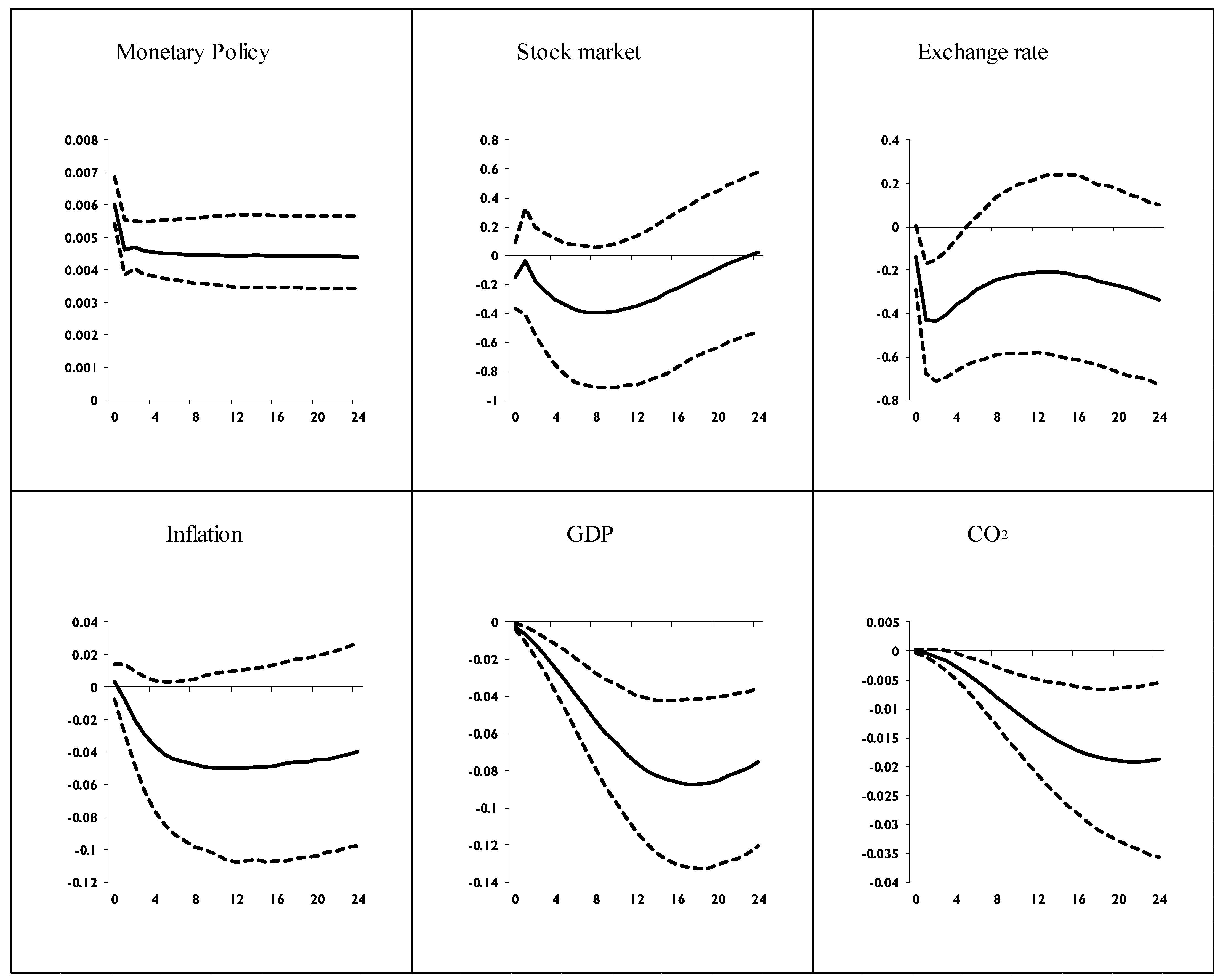
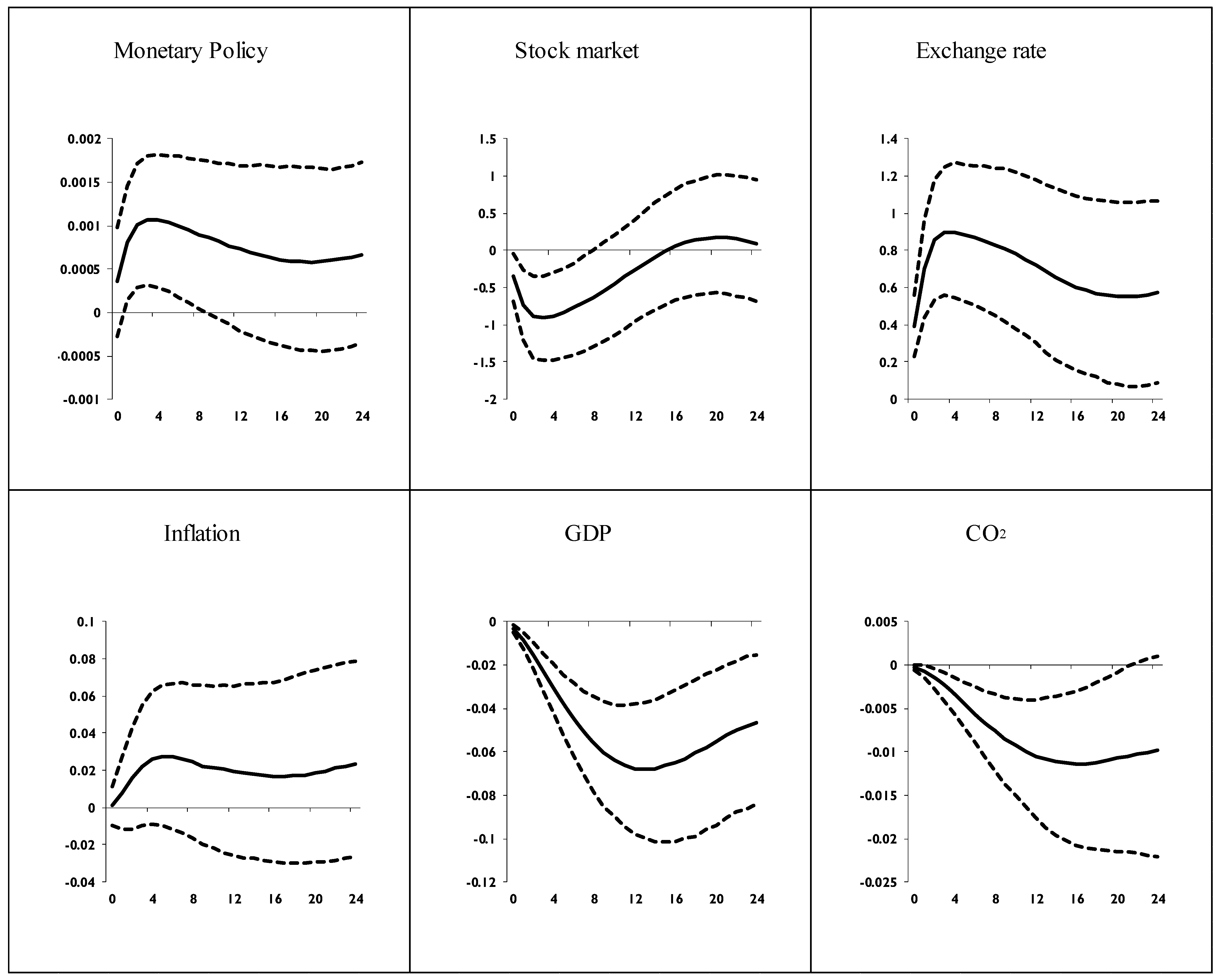
Figure 1 and
Figure 2 report 90% bootstrap confidence intervals, shown by dashed lines, with all responses expressed in percentage terms.
According to
Figure 1, contractionary monetary policy does not affect the stock market, as stock market responses to monetary policy shocks are not statistically significant. In the exchange rate market, during the first four months, we observe an appreciation of the domestic currency of about 0.4%, peaking at approximately two months. After five months, the impulse responses are no longer statistically significant. Positive shocks to the Brazilian policy interest rate increase the attractiveness of domestic assets, leading to a real appreciation of the Brazilian currency against the U.S. dollar.
Dees et al. (
2007) and
Mumtaz and Theodoridis (
2020) show that monetary shocks generate fluctuations in the financial sector.
Figure 1 confirms this mechanism for the Brazilian exchange rate.
The monetary shock does not generate a price puzzle. Following the shock, CPI declines as interest rates increase, although the responses are not statistically significant. Brazilian GDP decreases throughout the entire horizon of the shock, ending with a reduction of approximately 0.07%. Higher interest rates slow down or reduce incentives for consumption and investment (
Wright, 2011), as households and firms may postpone purchases and investment plans. These mechanisms, in turn, contribute to lower GDP.
Several studies attribute a relevant role to stock markets in shaping economic activity (
Diebold & Yilmaz, 2008). In this context, a decline in stock prices may reflect pessimistic expectations—or confirmation of adverse outlooks—regarding firms’ revenues and profits. Such assessments can induce defensive behavior by managers, including lower investment or cost reductions, which move closely with GDP dynamics (
Diebold & Yilmaz, 2008). Nevertheless,
Figure 1 shows that the Brazilian stock market does not respond in a statistically significant manner to a positive interest rate shock.
Currency appreciation can reduce exports, thereby negatively affecting GDP (
Marca, 2012;
Gevorkyan, 2018). However, in
Figure 1 the appreciation of the Brazilian currency is short-lived. Thus, among Brazilian financial markets, only the exchange rate exhibits a statistically significant response to the monetary shock.
The main result of
Figure 1 concerns CO
2 emissions. CO
2 emissions per capita decline over time, closely mirroring the response of GDP. This finding suggests that monetary policy may be an effective tool for reducing CO
2 emissions, consistent with previous studies that document this relationship using a production–function framework (
Chishti et al., 2021;
Xin et al., 2022).
Our theoretical model predicts that monetary shocks can affect the aggregate supply curve in the long run.
Figure 1 illustrates this mechanism by showing how monetary shock propagates through the system, generating fluctuations in financial markets and ultimately affecting the real sector and CO
2 emissions.
Overall,
Figure 1 indicates that Brazilian monetary policy affects the exchange rate, GDP, and CO
2 emissions. A contractionary monetary policy can attract foreign capital through higher interest rates (
Joyce & Kamas, 2003;
Kalemli-Özcan, 2019), contributing to currency appreciation (
J. Kim et al., 2020;
Miranda-Agrippino & Nenova, 2022). Regarding the negative relationship between monetary policy and GDP, higher interest rates raise credit costs, influencing consumption and investment decisions (
Auclert et al., 2020). As aggregate demand weakens, investment and production decline (
Vicondoa, 2019;
Cheng & Yang, 2020;
Jordà et al., 2020). Moreover, as predicted by the theoretical model and supported by empirical evidence (
Khan et al., 2019;
Gozgor et al., 2019), economic slowdowns are associated with lower CO
2 emissions. Although GIRFs do not identify shocks, these mechanisms provide plausible interpretations of the results shown in
Figure 1.
After analyzing the impact of Brazilian monetary policy on domestic CO
2 emissions, we turn to the effects of U.S. monetary policy on Brazil. A large body of literature shows that U.S. monetary shocks generate substantial spillovers to emerging market economies (
S. Kim, 2001;
Bowman et al., 2015;
Rey, 2016). We assess whether these spillovers also affect CO
2 emissions in Brazil by examining a positive monetary shock in the United States and the resulting responses of Brazilian variables.
Figure 2 addresses this issue.
The U.S. monetary shock generates oscillations across all Brazilian financial markets (
Cuadros et al., 2004).
Leo et al. (
2022) argue that monetary policy in emerging economies has been countercyclical over the last three decades.
Figure 2, however, presents a different picture. The response of Brazilian monetary policy to a foreign interest rate shock is positive for approximately eight months, after which it loses statistical significance. While in
Figure 1 the stock market does not respond to domestic monetary shocks,
Figure 2 shows a decline in the stock market over the same period observed in the credit market.
We also observe a depreciation of the domestic currency along its trajectory, a phenomenon known as “flight to capital” (
Eickmeier & Ng, 2015). In periods of heightened uncertainty, investors tend to reallocate resources toward safer assets, such as those in the U.S. economy. The exchange rate response suggests that this mechanism is activated. The transmission of this movement to the real economy occurs through reduced capital inflows, which lower investment and weaken GDP (
Eickmeier & Ng, 2015).
Following positive shocks to the U.S. policy interest rate, the attractiveness of U.S. dollar–denominated assets increases, and the Brazilian currency depreciates in real terms against the U.S. dollar. Two additional findings are noteworthy. First, in contrast to
Figure 1, the peak response of the exchange rate is larger (+0.8 in
Figure 2 versus −0.4 in
Figure 1). Second, the exchange rate response remains statistically significant throughout the entire forecast horizon (24 months).
As in
Figure 1, inflation does not respond significantly to the U.S. monetary shock. GDP exhibits a pattern similar to that observed under domestic monetary tightening, declining over the entire duration of the shock. CO
2 emissions decrease accordingly, following the contraction in economic activity; only toward the end of the horizon do the estimates lose statistical significance. These results indicate that the endogenous responses of Brazilian financial markets to U.S. monetary shocks are associated with lower emission levels, suggesting that U.S. monetary policy is relevant for CO
2 emissions in Brazil. Overall, the estimates in
Figure 2 reinforce the theoretical model’s conclusion that monetary policy can affect CO
2 emissions through its diffusion across financial markets. Our econometric results further show that both domestic and external monetary policies influence CO
2 emissions in Brazil.
From an economic perspective, contractionary U.S. monetary policy constitutes a negative external shock for emerging market economies. Financial markets may react with stress responses, such as domestic currency depreciation, stock market declines, and higher credit costs (
Morais et al., 2019;
Miranda-Agrippino & Rey, 2020;
Husted et al., 2020). These reactions reflect heightened uncertainty and increased investor caution (
Gupta et al., 2020;
Abid & Rault, 2021). Through these channels, external shocks are transmitted to the domestic real sector, leading to a slowdown in GDP (
Bhattarai et al., 2020). As economic activity contracts, CO
2 emissions tend to decline.
Table 2 complements this analysis by presenting the cointegrating coefficients. We normalize the CO
2 variable to unity, allowing us to assess the long-run effects of each variable on emissions. The table reports the long-term relationships between Brazilian domestic variables and CO
2 emissions. Consistent with
Figure 1 and
Figure 2, the coefficient on monetary policy is negative and statistically significant, indicating that contractionary monetary policy is associated with lower CO
2 emissions. GDP and prices are not statistically significant, while the exchange rate and stock market exhibit significant effects. Overall,
Table 2 provides evidence of a long-run relationship between domestic monetary policy and CO
2 emissions, supporting a role for the Brazilian central bank in mitigating greenhouse gas emissions.
Our final investigation analyzes the decomposition of Brazilian carbon emissions.
Figure 2 indicates that U.S. monetary policy affects CO
2 emissions in Brazil. Here, we evaluate the contribution of all U.S. variables to the level of CO
2 emissions in Brazil. In other words, we examine whether the U.S. economy as a whole—not only its monetary policy—influences gas emissions in Brazil. Within the GVAR framework, we employ the Generalized Forecast Error Variance Decomposition (GFEVD) to conduct this analysis.
Table 3 reports the decomposition of Brazilian CO
2 emissions, with rows normalized to sum to 100%.
We begin by examining the domestic variables. CO2 emissions are largely explained by their own shocks, accounting for 86% of the variance in the first period, although this share declines over time. GDP and monetary policy gradually fill this space. In the final period, monetary policy shocks explain about 11% of the variance of CO2 emissions. The remaining domestic variables contribute only marginally.
The influence of the U.S. economy on Brazilian CO
2 emissions ranges from 9.36% to 20.24% after 12 months and converges to approximately 15% after 24 months. Thus, our estimates reinforce the relevance of the U.S. economy for Brazilian CO
2 emissions. Moreover, this result indicates that the international dimension is essential for understanding CO
2 emissions in Brazil. This finding challenges studies that analyze Brazilian CO
2 emissions by modeling the economy as a closed economy (
Freitas & Kaneko, 2011;
Branco et al., 2013;
Calili et al., 2014).
To summarize, we provide evidence that Brazilian monetary policy affects CO2 emissions through financial channels. These dynamics influence the country’s supply curve in the long run. We obtain similar results when considering U.S. monetary policy. Cointegrating relationships further reinforce the link between Brazilian monetary policy and CO2 emissions. Finally, we show that international interactions, as captured by the GVAR framework, play a crucial role in explaining CO2 emissions in Brazil.
6. Concluding Remarks
The theoretical model developed in this paper illustrates how monetary policy can affect the domestic economy through the exchange rate channel. The GVAR model applied to the Brazilian economy over the period 1996–2018 examines the effects of both domestic and foreign (U.S.) monetary policy on CO2 emissions. The evidence suggests that these channels operate differently: output declines in response to contractionary monetary policy, but the adjustment paths vary depending on whether the initial shock originates from interest rate decisions by the Central Bank of Brazil or by the Federal Open Market Committee (FOMC) of the U.S. Federal Reserve.
Time-series studies document that CO
2 emissions respond differently across economies. Given the permanent effects of CO
2 emission shocks observed in BRICS countries and some industrial economies,
Gil-Alana et al. (
2017) recommend stronger policy interventions in these countries than in advanced economies such as the United States, the United Kingdom, and Germany. In addition, sectoral studies—for example,
Pinto et al. (
2018) for the Brazilian iron and steel industry—identify the provision of a reliable and sustainable supply of charcoal as an effective option for mitigating CO
2 emissions. However, energy efficiency measures based on best available technologies (BAT) face challenges, as firms’ decisions are often driven by prices rather than carbon emissions.
At the aggregate level, evidence on how monetary policy innovations affect CO
2 emissions remains limited. This article contributes to filling this gap and offers policy-relevant insights. To place our findings in perspective,
Mohaddes and Raissi (
2019) employ a GVAR model to examine the global effects of the U.S. oil supply revolution
4. Their results show heterogeneous responses across countries: real GDP rises in both advanced and emerging oil-importing economies, while output declines in commodity exporters, including Latin America. They also find that equity markets respond positively in advanced economies but decline in Latin America following U.S. oil supply shocks.
Future research could explore alternative frameworks in which monetary policy operates within a dynamic game between private agents and the government. If agents anticipate contractionary monetary policy, they may partially offset its effectiveness in accelerating the transition from fossil fuels to clean energy (e.g.,
T. Afonso et al., 2021). Further work could also examine how coordinated fiscal and monetary policies influence environmental dynamics without compromising economic stability (e.g.,
Faria et al., 2023).