1. Introduction
In a globalized and interconnected world economy, financial literacy is an essential lever for economic inclusion and resilience. Aware of this challenge, the Organization for Economic Co-operation and Development (OECD) has launched an initiative to promote financial education as a worldwide priority (
Vidovićová, 2021).
The aim of this initiative is to ensure that citizens have the skills required to make optimal financial decisions throughout their economic lives (
Sherry & Zeaiter, 2024). Beyond simple budget management, financial literacy is closely linked to major macroeconomic challenges such as economic resilience, reducing vulnerability to economic shocks, and efficient resource allocation (
Aprea et al., 2016). The integration of financial education into national strategies is therefore not only a social imperative, but also a macroeconomic necessity for building more equitable and sustainable economies (
Joudar & El Ghmari, 2025).
In Morocco, the National Strategy for Financial Inclusion (NSFI), launched in 2019, has evolved in a context marked by major national reforms in line with responding to the ambitions set out in the New Development Model (NDM) for 2035 (
Bank Al-Maghrib, 2020). The present national strategy (NSFI) is structured around five key areas, the fifth of which focuses on financial literacy. This is seen as a fundamental lever for promoting access to and effective use of financial services and consequently for accelerating progress towards financial inclusion (
Bank Al-Maghrib, 2020).
However, despite this institutional momentum, scientific research on financial literacy in Morocco remains limited. Existing studies largely adopt descriptive or qualitative approaches, rarely exploring the structural conditions that enable financial literacy diffusion (
Huston, 2010). This lack of empirical evidence constitutes a significant gap, particularly given the country’s socioeconomic transformations and persistent disparities in human capital and labor market outcomes (
Ourahou et al., 2024).
The international literature has examined the determinants of financial literacy, yet findings remain fragmented and often context-specific (
Lusardi & Mitchell, 2014;
Laxmi & Maheshwary, 2018;
Firli, 2017;
Iacovoiu, 2018). Prior research highlights the importance of education, income level, and labor market participation (
Potrich et al., 2015), but results vary considerably across countries, and evidence from developing economies remains insufficient. Moreover, most studies rely on cross-sectional descriptive analyses, with limited use of econometric models capable of capturing long- and short-run dynamics or the structural relationships between financial literacy and its key determinants. These limitations underline the need for a more rigorous analytical framework to better understand the enabling environment for financial literacy diffusion within Morocco.
To address these gaps, this study aims to empirically examine the structural conditions that support financial literacy diffusion in Morocco: educational attainment, employment status, and income level. It seeks to answer the following central research question: to what extent do education, employment, and income influence the enabling environment for financial literacy diffusion in Morocco, both in the short and long run?
Methodologically, the study adopts a mixed-methods design combining qualitative elements with an econometric approach based on ARDL models. This framework allows us to capture both short- and long-run interactions, test for cointegration, and identify potential asymmetries in the effects of education, employment, and income. Bank branch density is used as an indirect proxy for financial infrastructure, reflecting access to formal financial services in the absence of time-series literacy data. To our knowledge, this constitutes the first structural empirical assessment of financial literacy determinants in the Moroccan context.
The present study is structured as detailed. After
Section 1,
Section 2 presents an analysis of the existing literature related to financial literacy at the international and national level.
Section 3 presents the Moroccan context of education, financial literacy, the labor force, and income, highlighting the national policies deployed on this concern.
Section 4 presents the empirical approach used in this research and explains the database.
Section 5 presents the empirical findings. Lastly,
Section 6 includes some concluding results and recommendations for futures perspectives.
2. Literature Review
Understanding the macroeconomic impact of financial literacy requires a global and interdisciplinary approach, especially in the context of developing economies where socioeconomic challenges persist regarding access to quality education, productive employment, reducing income inequality, and the availability of financial services.
This literature review synthesizes the background of financial literacy and its structural foundations, with a specific focus on four interrelated variables: education, the labor market, income, and banking infrastructure. The review is structured thematically, and international and national findings highlight both global and local literature reviews.
The following section presents an overview of (1) the theoretical framework, (2) conceptual definitions of financial literacy, and (3) structural determinants of financial literacy.
2.1. Theoretical Framework of Financial Literacy
The theoretical foundations of this research emanate from the microeconomic approach to saving and consumption, according to which a fully rational and informed individual consumes less than their income during periods of high earnings, thereby building up savings intended to maintain their consumption when their income declines, particularly during retirement. Since the major contributions of
Modigliani and Brumberg (
1954) and
Friedman (
1975), consumers have been assumed to optimize their savings and decumulation behavior in order to smooth their marginal utility throughout their lives. Numerous studies show that financial needs and behaviors evolve with age, employment status, and income stability, which are central variables in this study (
Modigliani & Brumberg, 1954).
There is a wealth of theoretical and empirical literature aiming to analyze the decision to invest in financial knowledge and the links between financial literacy, savings, and investment behavior (
Delavande et al., 2008;
Jappelli & Padula, 2013;
Raut, 2020). However, recent studies have begun to investigate the factors that determinate financial literacy (
Firli, 2017;
Lusardi & Mitchell, 2014;
Laxmi & Maheshwary, 2018;
Iacovoiu, 2018;
Riitsalu & Põder, 2016).
By integrating these theoretical strands, the framework offers a comprehensive lens to analyze how socioeconomic factors interact with institutional strategies to shape financial literacy and inclusion in Morocco.
2.2. Conceptual Definitions of Financial Literacy
The beginning of the 21st century saw the emergence of financial education as a major political issue. In the 2000s, institutions such as the Organization for Economic Co-operation and Development (OECD) initiated intergovernmental projects aimed at establishing common principles and raising standards for financial education. According to the
OECD (
2012), financial literacy is defined as “a combination of awareness, knowledge, skills, attitudes and behaviors needed to make sound financial decisions and, ultimately, achieve individual financial well-being”.
The financial literacy (FL) concept has attracted the attention of many researchers.
Lusardi and Mitchell (
2014), based on a survey method, conceive it as the ability to analyze economic transactions and take financial decisions related to budget management, savings, debt and retirement.
Mason and Wilson (
2000) criticize this approach, arguing that many definitions overlook the distinction between knowledge and application, highlighting that financial literacy is not only technical but also relational, shaped by how individuals interact with financial systems.
Clark (
2018), for his part, stressed that financial literacy is an individual process of meaning-making, enabling the navigation of risks and uncertainties inherent in a complex financial environment, something
Mason (
2003) had already highlighted.
Other scholars stress behavioral dimensions.
Rath and Patra (
2023), using regression modelling, point out that financial literacy is not limited to technical skills: it also encompasses behavioral skills that contribute to improved financial economic welfare. In the same vein,
Vörös et al. (
2021) and
Chu et al. (
2016) have explored the links between financial literacy and well-being, arguing that both influence the ways in which individuals engage with financial systems, as well as their decision-making processes.
Allgood and Walstad (
2012) adopt a survey to demonstrate that employment and income affect both actual and perceived financial literacy for United States adults and households.
From this perspective, financial education generally revolves around three fundamental dimensions identified by
Ahamed (
2025): knowledge, behaviors, and attitudes.
However, as
Huston (
2010) argues, a major obstacle in financial literacy research is the absence of a standardized measurement instrument. After reviewing 71 studies, they found that nearly three quarters do not even define what they mean by “financial literacy,” and many treat it interchangeably with “financial knowledge.”
This lack of conceptual clarity and standardized measurement represent a critical limitation especially for research in developing economies like Morocco, where structural conditions (education, employment, income) vary widely.
By adopting an integrated definition and operationalizing financial literacy within a structural framework using the ARDL model, this study helps address measurement inconsistencies and provides a more robust understanding of its determinants.
2.3. Structural Determinants of Financial Literacy
While financial literacy is often conceptualized through individual knowledge, attitudes, and behaviors, its development does not occur in isolation. It is shaped by structural conditions that create an environment in which financial capabilities can be exercised and expanded. Among these conditions, education, income, and employment play a pivotal role not only at the individual level but also from a macroeconomic perspective: education enhances human capital and fosters financial capability across society, income reflects overall economic well-being and purchasing power that shapes financial behaviors, and employment contributes to labor market stability and social inclusion, creating systemic conditions for financial literacy to diffuse within the economy.
International research has examined the central role of formal education in the development of financial literacy. Studies by
Lusardi and Mitchell (
2014) and
Cole et al. (
2011) show that individuals who have attained higher levels of education are generally more likely to make financial decisions that integrate both their general cognitive abilities and their financial management performance. This evidence confirms the relevance of education as a determinant, but most of these studies remain micro-level and descriptive.
Similarly,
Anwar et al. (
2024), through a survey involving 121 millennials, found that financial education impacted positively on millennial financial decisions and recommended that a financial program targeted for them would enable them to make financial decisions and investments. Meanwhile,
Jerrim et al. (
2022), based on 2015 national data, analyzed the relation between financial literacy among youth across 15 countries. They found that financial education was still basic and did not improve financial ability and mature financial behavior adapted to reality and everyday life situations. These findings highlight inconsistencies in the effectiveness of education programs, reinforcing the need for structural analysis at a broader level.
However, there is still a significant relation between financial education and financial literacy. According to
Wagner (
2019), who analyzed the National Financial Capability Study, people who receive a financial education are likely to have higher financial literacy scores compared to those without a financial education. In the same context,
Urefe et al. (
2024), adopting a descriptive approach, show the essential role of financial education in the success of small business and startups, helping in cash flow management, effective tax planification, and making optimal SI decisions. While these studies confirm the importance of education, they do not explore its dynamic interaction with other structural factors such as income and employment over time, which is the gap addressed by our research.
Recent national research on Morocco highlights important insights into the relationship between education and financial literacy.
Chetioui et al. (
2024), using survey data from 848 respondents, find no significant impact of formal education on financial literacy, suggesting that national education programs have yet to embed financial competencies as a key dimension of students’ career readiness and financial well-being. Similarly,
Ourahou et al. (
2024), based on a sample of 1000 participants, show that financial literacy levels in Morocco remain low and below the OECD average.
However, despite these contributions, existing studies on both global and national levels rely primarily on descriptive or surveys assessments and offer limited econometric evidence regarding the causal impact of education on financial literacy. This gap underscores the need for more rigorous empirical analysis, precisely the contribution of our study, which aims to address this deficiency through econometric investigation.
The international evidence related to financial literacy and its impact on labor market was studied by
Preston and Wright (
2023); they found a positive correlation relating financial literacy to self-employment in Australia.
Dudaitė and Daciulyte (
2022) argue that literacy and particularly financial literacy affect employment status in the Central European region.
Furthermore,
Xie (
2023) and
Chen et al. (
2024) used surveys to explore the link between financial literacy and creating job opportunities by the acquisition of financial risk perception. Meanwhile,
Williams et al. (
2023) adopt an ARDL model to investigate the causality between illiteracy, unemployment, and financial inclusion in Nigeria. The results of this study argue that higher illiteracy and unemployment in rural areas are associated with financial inclusion.
Nationally, a study based on a survey method, conducted by
Machmoume et al. (
2023) on individuals living in Rabat and Fez, found that financial literacy impacted positively on social inclusion in Morocco. Despite these insights, Moroccan research remains fragmented and descriptive, lacking time-series econometric models that capture long-run and short-run dynamics.
Despite these contributions, existing studies, both globally and nationally, rely primarily on descriptive or survey-based assessments and offer limited econometric evidence regarding the structural determinants of financial literacy. This gap underscores the need for macro-level time-series analysis to understand how education, income, and employment shape the enabling environment for financial literacy diffusion. Our study addresses this gap by applying an ARDL model to examine these structural conditions in Morocco.
3. Overview of the Moroccan Context
Over the past decades, Morocco has made significant progress in economic growth, accompanied by notable advancements in sustainability. These socioeconomic achievements have been largely driven by comprehensive national strategic reforms across key sectors, including social protection and healthcare, education and skills development, employment and labor markets, and financial inclusion.
This section aims to provide an overview of the Moroccan context in terms of education and financial literacy, labor market dynamics, and income distribution, with a particular focus on the main national policies implemented in these areas.
3.1. Financial Literacy in Morocco
Morocco has deployed several strategies to strengthen its socioeconomic performance, in line with the Sustainable Development Goals (SDGs), particularly SDG 4 on quality education. However, despite the efforts made, the country has recorded a worrying decline in the Global Knowledge Index (GKI) rankings over the past decade, dropping from 83rd position out of 143 countries to 97th out of 141 countries in 2024 (
UNDP & MBRF, 2024). This decline reflects a relative weakening of national momentum in knowledge-based development, which could also compromise advances in financial literacy. Yet the latter is an essential lever for sustainable financial inclusion, insofar as it conditions citizens’ ability to understand, use, and benefit from financial services in an informed and responsible manner.
The analysis of
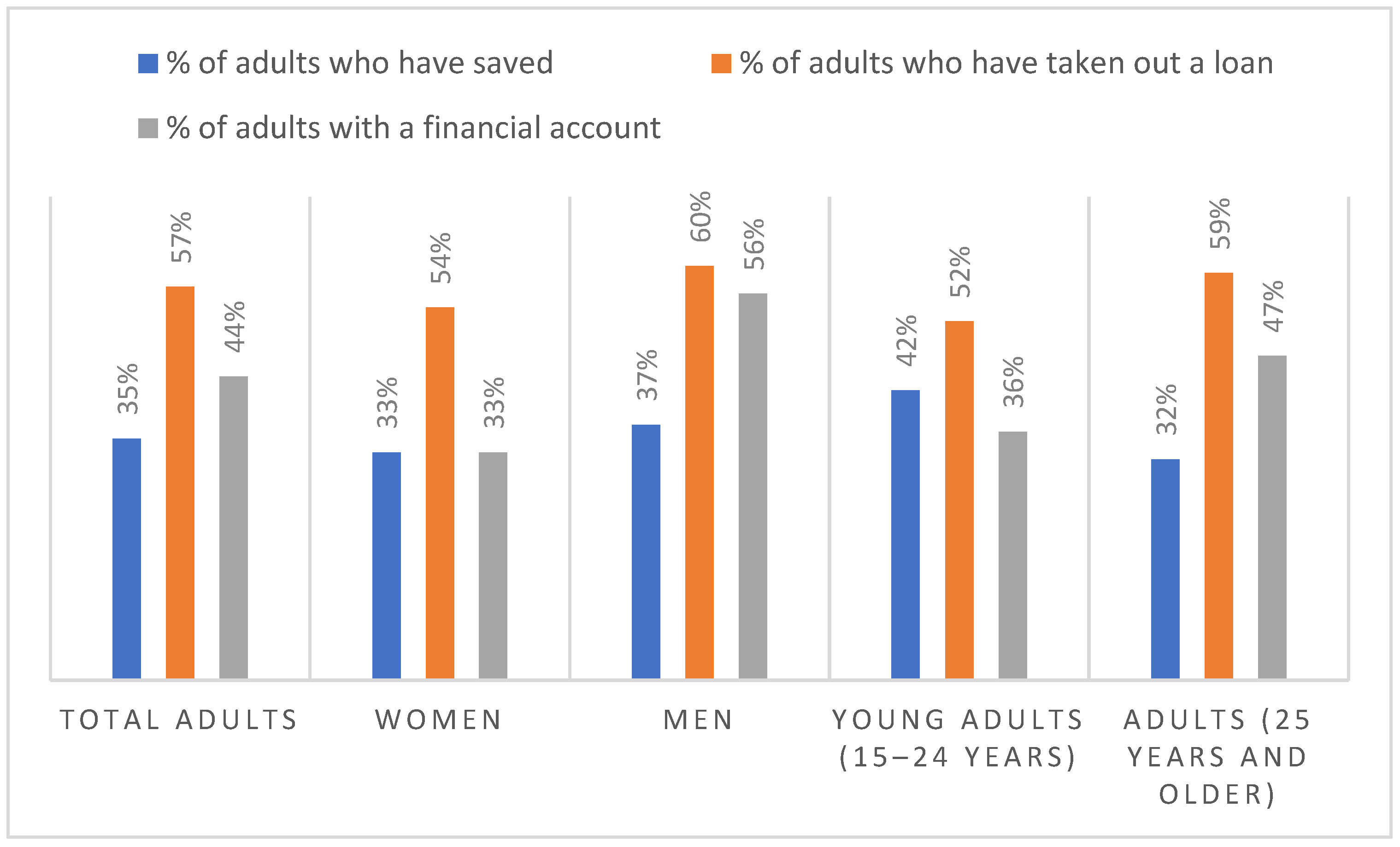
Figure 1 shows that 44% of adults have a financial account, while 35% save and 57% have taken out a loan.
This shows that access to credit services exceeds savings or having a bank account, probably due to a prioritized use of finance as a necessity or constraint, rather than real financial inclusion. A gender disparity is observed; women are under-represented in financial account ownership (23-point gap with men).
Young people save more than adults (+10 points), which could be explained by targeted financial education programs or a generational preference for savings practices, even if informal. Despite this, young people are less likely to be banked (36% versus 47% for adults), reflecting barriers to access to formal services (
Bourdane & Bounou, 2024).
However, as part of the implementation of the National Strategy for Financial Inclusion (NFIS), Bank Al-Maghrib has launched a series of structuring projects aimed at strengthening the financial education of citizens, particularly in the context of the development of mobile payment services. One of the key areas of this initiative, Project 5, “Targeted communication and financial education”, aims to support the adoption of mobile payment solutions through appropriate awareness-raising and training initiatives.
By the end of 2022, of the 109 actions set out in the national financial inclusion strategy roadmap, 38% had been fully implemented, while a further 38% were underway (
Bank Al-Maghrib, 2020). The remaining 24% of actions have not yet begun, mainly due to dependence on the adoption of the legislative and regulatory texts required for their launch (
Bank Al-Maghrib, 2020).
However, according to the latest Bank Al-Maghrib report (2020), 30% is the estimated state of progress in achieving the objectives of NSFI’s Project component N °5 related to financial education. Among the achievements is the implementation of a communication campaign to raise awareness of the importance of financial education, accompanied by the design of a national financial education plan aimed at facilitating Moroccans’ understanding and adoption of financial instruments.
According to the same report (
Bank Al-Maghrib, 2020), the next steps identified for the continuation of this work, related to financial literacy, include
- -
The integration of mobile payment into the educational programs of the Moroccan Foundation for Financial Education (MFFE);
- -
Defining target segments and adapting content to the needs and financial literacy levels of each category;
- -
Renewing the radio awareness campaign.
These initiatives fall within the broader mission of the Moroccan Foundation for Financial Education (MFFE), which plays a pivotal role in promoting financial literacy nationwide. Created in 2013 on the initiative of Bank Al-Maghrib, the Foundation coordinates the efforts of public and private actors to design appropriate educational programs, raise awareness of responsible financial management, and promote best practices in line with international standards. Through its strategy, it specifically targets children and young people, women, micro-enterprises, and rural populations, thereby helping to strengthen financial inclusion and support the country’s economic development (
Fondation Marocaine Pour l’Éducation Financière [FMEF], 2023).
This approach is in line with the logic of strengthening financial literacy, seen as a fundamental lever for sustainable financial inclusion. The approach adopted by Morocco aims to invest in technological innovation while offering targeted educational support, in line with international standards for financial inclusion (
Ourahou et al., 2024).
3.2. Income and Labor Force in Morocco
Morocco is classified, by the World Bank, as a lower-middle-income country based on the gross national income index (GNI). This classification affects Morocco’s eligibility for aid and development programs (
World Bank, 2025).
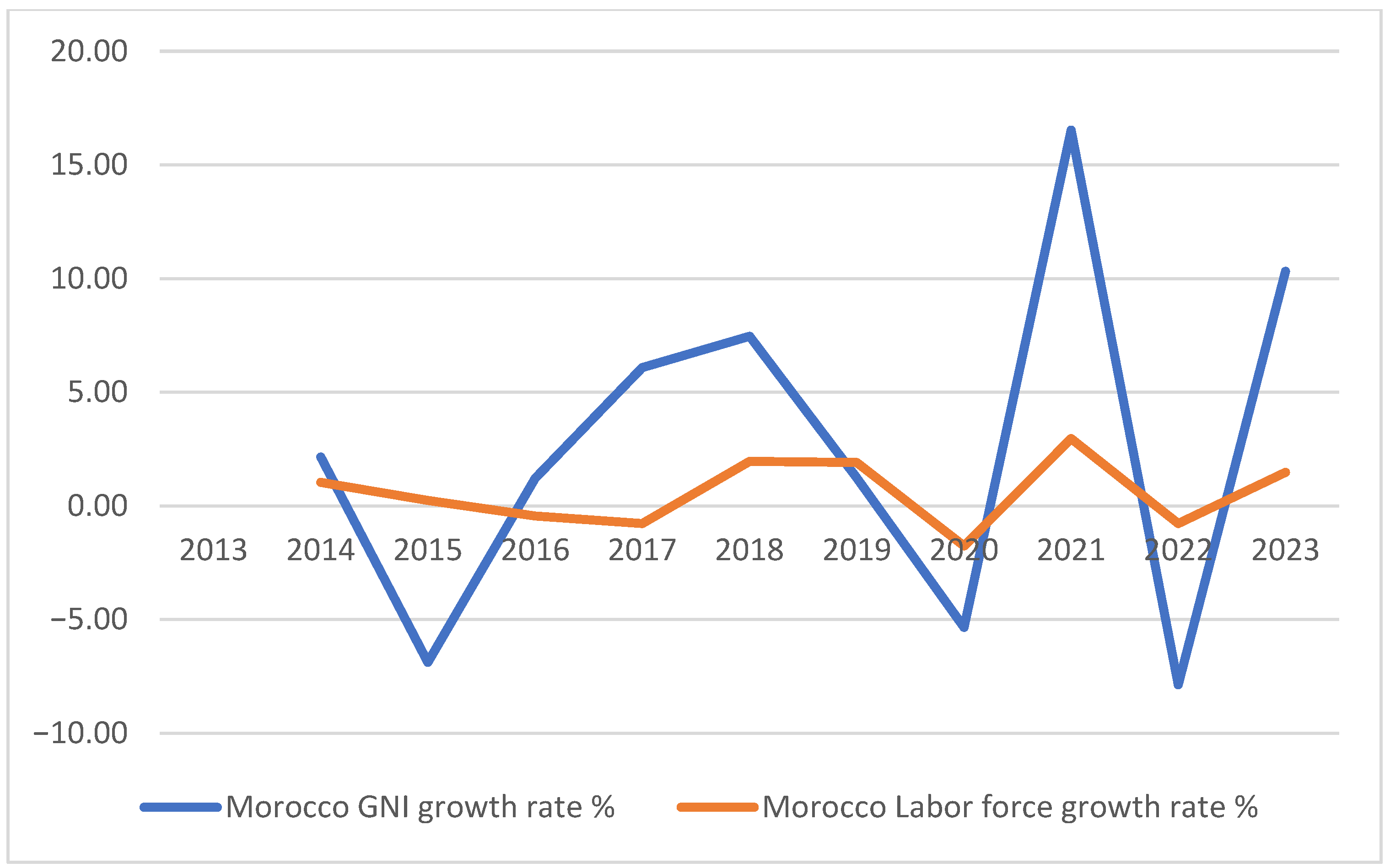
Figure 2 shows that, in the last decades, the GNI growth in Morocco has been marked by high volatility, influenced by external shocks such as the COVID-19 pandemic, droughts and fluctuations in world markets (
Ammari et al., 2022).
The analysis of
Figure 2 reveals that labor force growth remains weak and volatile, reflecting structural challenges such as the persistence of an informal economy and low female labor force participation (
Lopez-Acevedo et al., 2021).
The weak link between the GNI and labor force suggests a lack of inclusive economic growth, unable to generate sufficient quality jobs (
Pinto Moreira, 2024).
However, to achieve its socioeconomic objectives, Morocco adopted a National Employment Strategy (NES) with the primary goal of creating conditions for more job opportunities and improved living standards for its citizens (
ILO, 2015). The strategy, spanning from 2015 to 2025, aims to increase the labor force from 11.7 million in 2013 to 13.7 million by 2025 (
ILO, 2015).
Moreover, Morocco recently launched a Roadmap for Employment 2025.This strategy aims to reduce unemployment to 9% by 2030 by creating one million jobs. It provides for a budget of MAD 2 billion (≈EUR 186 million/≈USD 221 million) to strengthen employment policies and support very small, small, and medium-sized enterprises (SMEs) (
Ibourk & Ghazi, 2025).
4. Methodology and Model Specification
This section presents the methodological framework adopted to analyze the relationship between banking density, used as an institutional proxy for financial literacy conditions, and a set of macroeconomic variables in Morocco. Given the nature of the available data and the objectives of the study, the methodology is designed to capture both short-run dynamics and long-run adjustment processes. The section details the data sources, the justification of the study period, the selection and measurement of variables, and the econometric approach employed.
4.1. Data Type and Resources
This study relies on annual time-series data for Morocco covering the period 2004–2023. The choice of this period is primarily driven by data availability and consistency across all variables included in the model. Earlier years were excluded due to incomplete or inconsistent observations, particularly for banking infrastructure and education indicators. The selected period is also economically relevant, as it encompasses significant transformations in Morocco’s financial sector, including the expansion of banking networks and the implementation of financial inclusion policies.
Because no direct time-series indicator of financial literacy is available, this study uses the number of bank branches as an indirect contextual proxy that reflects the enabling environment in which financial literacy can be exercised, rather than financial literacy itself. This choice follows the empirical literature, where bank branch density is widely adopted as a measure of access to formal financial services, including
Ismail and Laidin’s (
2023) studies on the determinants of financial access in emerging economies (
Gardezi et al., 2024), and research linking financial service availability to economic outcomes (
Musa et al., 2024;
Bhowmik & Islam, 2024). While bank branches do not measure financial literacy directly, they capture the structural accessibility of financial services that typically co-evolves with financial behaviors and education. Therefore, this proxy allows us to model the environment that supports or constrains financial literacy in the absence of direct literacy data, while clearly distinguishing between the two concepts.
All data were collected from official and internationally harmonized sources, primarily the World Bank’s World Development Indicators (WDIs), ensuring comparability and reliability. Only observations with complete information across all variables were retained in the final sample.
The selection of explanatory variables in
Table 1 is grounded in the economic literature on financial literacy and financial inclusion in emerging economies, as well as in their empirical relevance and data availability (
Atkinson & Messy, 2013;
Grohmann et al., 2018).
Gross national income per capita (GNI) is used as a synthetic indicator of economic development and purchasing power, which is often associated with increased demand for financial services and improved financial behavior (
Klapper et al., 2015). The labor force (POP_ACT) captures the segment of the population most likely to interact with the formal financial system through employment-related financial transactions. Primary education enrollment (PRIM_ED) is employed as a proxy for basic human capital, as primary education constitutes a foundational element for understanding basic financial concepts and numeracy skills (
L. Xu & Zia, 2012;
OECD, 2020).
Table 2 presents the descriptive statistics for the main variables selected. There has been a change in the number of bank branches per 100,000 inhabitants, reflecting changes in the Moroccan banking landscape over the last two decades. The other variables also show a general trend, in line with structural trends in the country’s socioeconomic development.
4.2. Preliminary Data Analysis
4.2.1. Stationarity
The first step in the econometric analysis of time series is to check the stationarity of the variables selected. The presence or absence of a unit root determines the specification of the ARDL model and the validity of the cointegration tests. Therefore, we applied the Augmented Dickey–Fuller (ADF) test with a constant and linear trend, as recommended for long-period macroeconomic data (
Dickey & Fuller, 1979;
Hamilton, 1994).
The results of the ADF test, summarized in
Table 3, indicate that all the variables—number of bank branches per 100,000 inhabitants (BRANCH), gross national income per capita (GNI), labor force (POP_ACT), and primary school enrolment (PRIM_ED)—are not stationary in level, as shown by t-statistics below (in absolute value) the 5% critical thresholds. However, after first differentiation, all the series become stationary, which suggests that they are integrated of order one, I(1). These results make it possible to apply the ARDL-Bounds Testing methodology, which authorizes the combination of I(0) and I(1) series but excludes I(2) variables (
Pesaran et al., 2001).
This diagnosis is consistent with the literature on macroeconomic series in emerging countries, where level non-stationarity is the rule, stationarity generally being observed after a first difference transformation.
4.2.2. Optimum Number of Lag
To identify the lag structure most appropriate for the ARDL model, several alternative specifications were estimated and compared using the Akaike (AIC), Schwarz (BIC), and Hannan–Quinn (HQ) information criteria. These criteria allow for a balance between goodness of fit and model parsimony, which is particularly important given the relatively small sample size.
The results reported in
Table 4 indicate that the ARDL (3,2,0,0) specification yields the lowest AIC value, suggesting three lags for the dependent variable and two lags for the main explanatory variable. This structure captures dynamic adjustment processes while limiting the risk of over-parameterization, in line with standard recommendations in the ARDL literature (
Pesaran & Shin, 1999;
Lütkepohl, 2005).
Lagged values are included to reflect the fact that changes in income, labor market conditions, and educational attainment may affect financial literacy conditions with a delay rather than instantaneously. For robustness purposes and to ensure comparability across specifications, an ARDL(3,2,2,2) model was also estimated and retained for the main analysis, while giving priority to parsimonious interpretations of the results.
Overall, the selection of the lag structure is guided by information criteria, statistical significance, and economic interpretability, ensuring a robust representation of short-run dynamics and adjustment mechanisms (
Table 4).
4.3. ARDL Model Specification
To analyze the dynamics of financial literacy in Morocco, the ARDL (Autoregressive Distributed Lag) approach proves to be particularly relevant, as it makes it possible to estimate both short- and long-run relationships between variables, while accommodating a moderate sample size and a mixture of I(0) and I(1) series (
Pesaran et al., 2001). This methodological choice is frequently recommended in studies of emerging economies where complete stationarity of variables is not guaranteed and flexibility of lags proves valuable (
Nkoro & Uko, 2016).
The ARDL model used in this study takes the following form:
: first-difference operator;
: optimal lag orders for each variable, determined empirically based on information criteria;
: constant term;
: error term.
The model thus makes it possible to test for the existence of a long-term relationship (via the Bound test), while assessing short-term dynamics through the first differences of the variables.
This framework is in line with the methodological recommendations for the analysis of time series in applied economics (
Pesaran et al., 2001).
5. Results and Discussion
The estimation of the ARDL model allows us to examinate the impact of GNI, active population, and primary education on financial literacy in Morocco.
5.1. ARDL Model Results
Estimation of the ARDL model over the 2007–2023 period in
Table 5 shows an overall satisfactory fit, with an adjusted R
2 of 0.91. None of the individual coefficients of the explanatory variables, nor of the lags of the dependent variable, are significant at the conventional 5% level. This result can be explained by the relatively small size of the sample and the high structural inertia of the Moroccan banking sector over the period considered. The GNI coefficient is negative but insignificant, while the labor force and primary school enrolment do not have an effect that is statistically distinct from zero. Nevertheless, the model remains significant overall (F-stat = 14.3;
p < 0.05) and satisfies the main diagnoses (Durbin–Watson test ≈ 2.25).
These results highlight the importance of analyzing long-term dynamics via the Bound test and the error correction model (ECM), in order to better identify the structural relationships between financial literacy and its determinants in Morocco, in line with the recent literature (
Demirgüç-Kunt et al., 2018;
Grohmann et al., 2018).
5.2. ECM from (Short-Run) Estimation
The estimation of the ECM model, summarized in
Table 6, highlights a significant adjustment mechanism for the dependent variable towards its long-term equilibrium. The coefficient of the error correction term (CointEqt-1)(CointEq_{t-1})(CointEqt-1) is negative (−0.83) and highly significant (
p = 0.0125), which confirms that imbalances are corrected rapidly: around 83% of the difference is absorbed each year. This result validates the existence of a long-term relationship between bank branch density and its macroeconomic determinants, in line with the standards of the literature (
Banerjee et al., 1993;
Pesaran et al., 2001).
In terms of short-term dynamics, only gross national income per capita (D(GNI)) is significant at the 5% level; its effect is negative in the short term, which may reflect cyclical adjustments in the banking sector in response to economic fluctuations. The other variables show no significant effect in the instantaneous adjustment of the number of bank branches.
However, the F-Bounds test indicates that the statistic (1.86) remains below the usual critical thresholds, which limits the strength of the statistical evidence in favor of cointegration, but the sign and significance of the error term nevertheless argue in favor of a long-run adjustment (
Nkoro & Uko, 2016).
5.3. ARDL from Long-Run and Bound Test
By estimating the long-run form of the ARDL model and applying the Bound test, we can assess the existence of a long-run equilibrium relationship between the number of bank branches and its macroeconomic determinants. The results are summarized in
Table 7.
The long-run coefficients indicate that gross national income per capita (GNI) and working population (POP_ACT) have positive effects on bank branch density, while primary school enrolment (PRIM_ED) exerts a negative effect. However, none of these coefficients is significant at the 5% level, although the PRIM_ED coefficient approaches the 10% level. This result suggests that, over the period considered, the long-term dynamics of banking density in Morocco are not very sensitive to these macroeconomic variables, which could reflect the inertia of the banking sector or the impact of unobserved institutional factors.
The Bound test shows an F statistic of 1.86, below the critical thresholds at 5% and 10% (
Pesaran et al., 2001), which implies an inability to reject the null hypothesis of no cointegration. In other words, there is no robust statistical evidence of a long-term relationship between the dependent variable and the explanatory variables, despite the presence of a significant error correction term in the ECM. This divergence can be attributed to the small size of the sample and the particular structure of the Moroccan banking market over the period.
The diagnosis of autocorrelation gave contrasting results depending on the statistic used: the F statistic from the Breusch–Godfrey test (
p = 0.1158) suggests an absence of autocorrelation in the residuals, while the chi-squared statistic (
p = 0.0005) points to residual autocorrelation. This discrepancy is common in small samples and for models with a high lag structure (
Stock & Watson, 2015).
5.4. Robustness Tests
To assess the validity and robustness of the estimated ARDL/ECM model, a set of standard diagnostic and stability tests was conducted (
Table 8). These tests examine the normality of residuals, serial correlation, heteroskedasticity, and multicollinearity, in line with established econometric practice (
Gujarati & Porter, 2009;
Wooldridge, 2016).
The Jarque–Bera test confirms that the residuals are normally distributed, supporting the validity of statistical inference (
Stock & Watson, 2015). The Breusch–Pagan–Godfrey test does not detect heteroskedasticity, indicating constant variance in the error term over the sample period (
White, 1980).
Regarding serial correlation, the Breusch–Godfrey LM test provides mixed evidence, with a non-significant F-statistic but a significant chi-squared statistic. Such discrepancies are commonly observed in small samples and call for cautious interpretation of the results (
Gujarati & Porter, 2009;
Wooldridge, 2016).
Finally, the VIF results reveal a high degree of multicollinearity between some explanatory variables. While this does not invalidate the overall consistency of the ARDL estimates, it may inflate standard errors and requires cautious interpretation of individual coefficients, as commonly discussed in the time-series literature (
Lütkepohl, 2005).
5.5. CUSUM and CUSUM of Squares Test
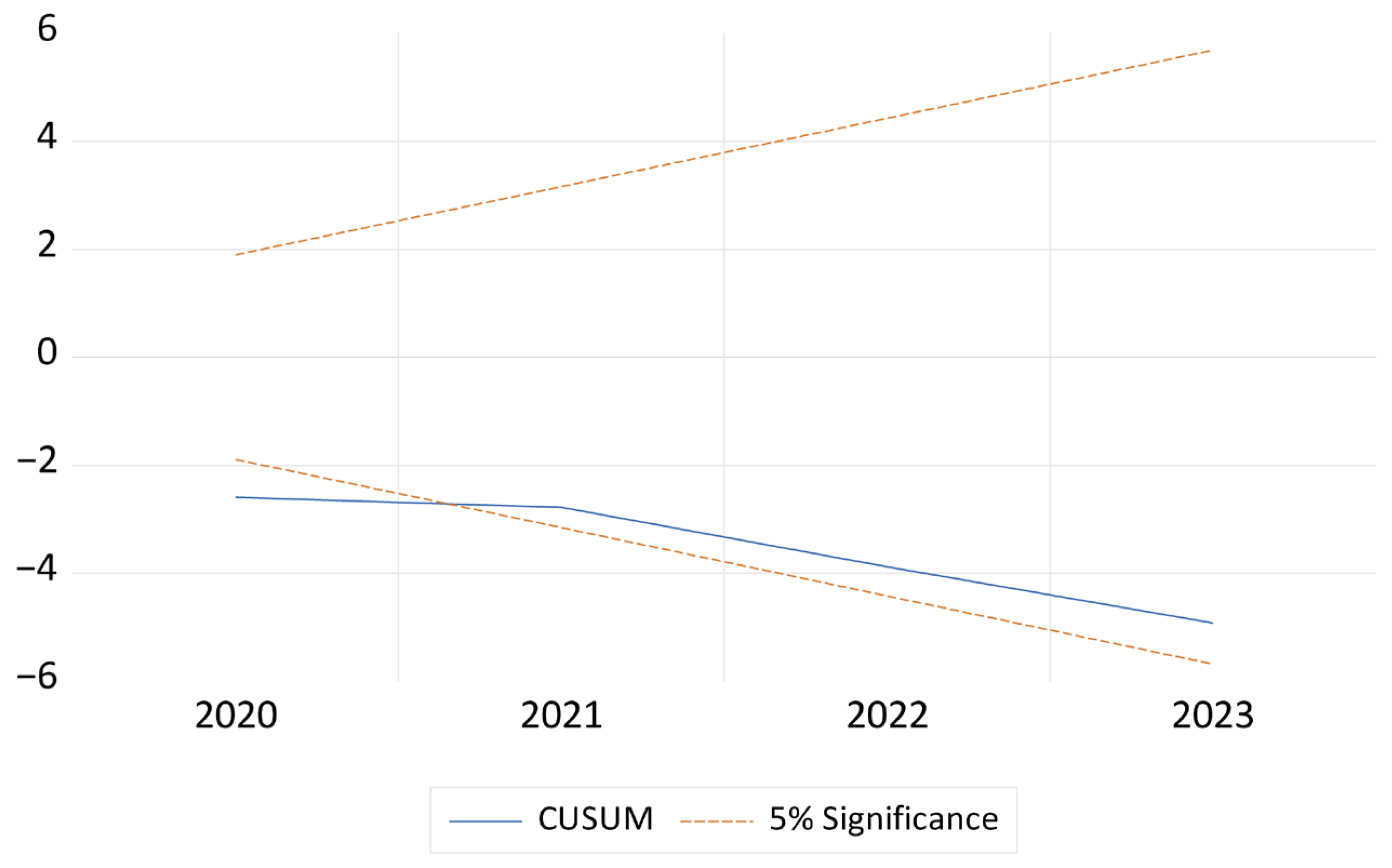
Analysis of the Cumulative Sum test (CUSUM) test in
Figure 3 shows a slight overshoot of the CUSUM curve at the very beginning of the period (2020), followed by a rapid return to within the 5% confidence intervals for the rest of the sample. This one-off instability could reflect a transitory shock or a cyclical specificity at the start of the period but does not affect the overall stability of the model. This result confirms the robustness of the estimated coefficients, while inviting caution when interpreting the results for the year 2020 (
Brown et al., 1975;
Stock & Watson, 2015).
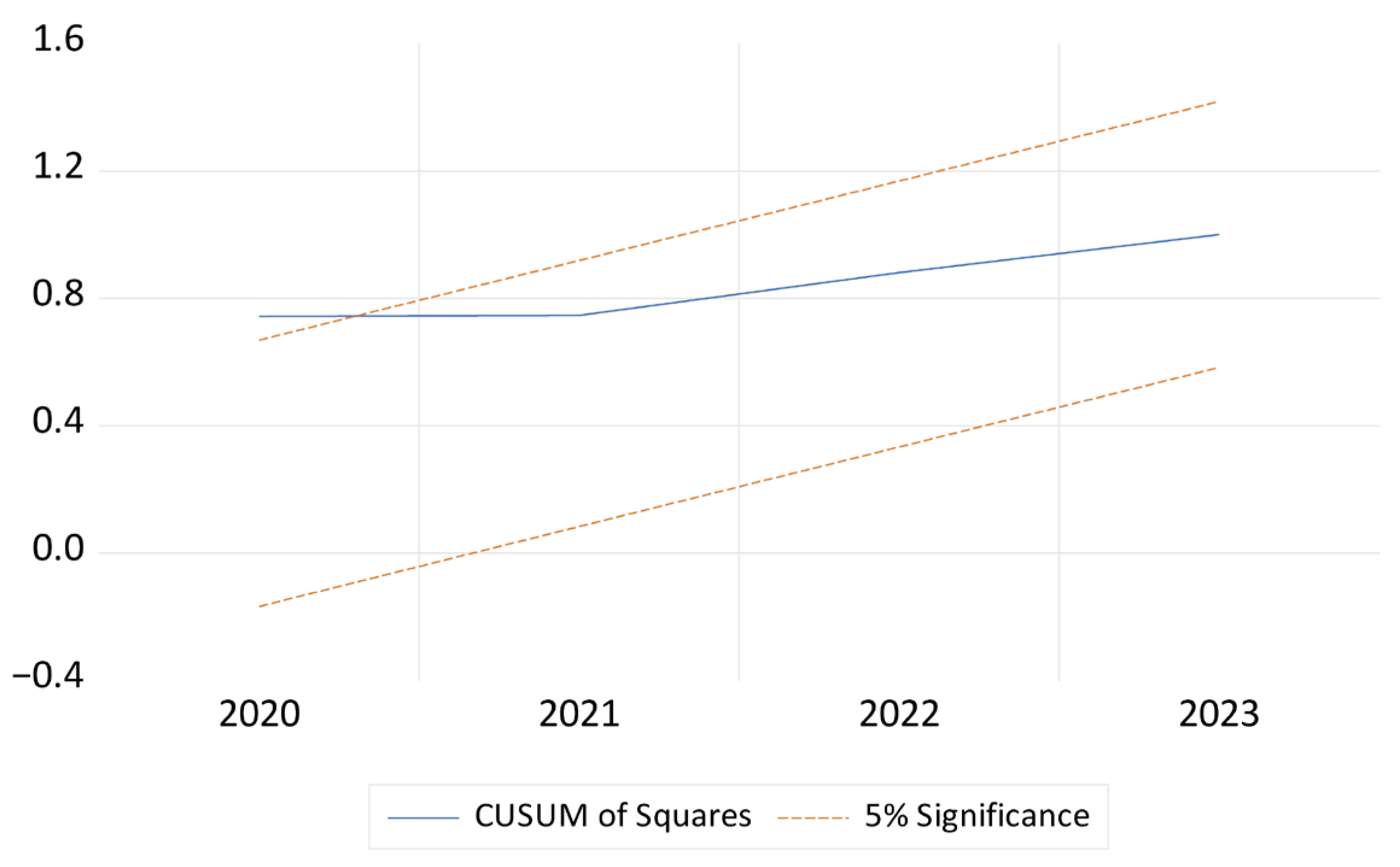
Analysis of the CUSUMQ test in
Figure 4 shows that, over the entire 2020–2023 period, the CUSUMQ curve remains within the 5% confidence bands, with the exception of a slight overshoot at the very beginning of the period (2020). This one-off breach of the lower bound could reflect an initial adjustment or a transitory effect linked to the specific nature of 2020 (in particular the context of the COVID-19 crisis). However, stability is regained immediately afterwards, and no lasting structural break is observed thereafter.
Overall, the variance of the residuals remains stable for most of the period, reinforcing the robustness of the results. This slight deviation at the start of the sample simply suggests that the results for 2020 should be interpreted with caution (
Brown et al., 1975).
5.6. Discussion
The empirical results obtained from the ARDL model provide important insights into the macroeconomic and institutional conditions associated with financial literacy diffusion in Morocco, proxied by bank branch density, over the period 2004–2023. In line with the theoretical and empirical literature reviewed, this section discusses the findings through the lenses of the human capital framework, financial inclusion theory, and the specific institutional context of a developing economy.
The long-run estimates indicate that conventional macroeconomic variables—gross national income per capita, labor force participation, and primary education enrollment—do not exert statistically significant effects on banking density. The absence of robust cointegration suggests that improvements in income, education, or employment levels alone are insufficient to generate persistent changes in financial literacy conditions. This result is consistent with the conceptual arguments advanced by
Huston (
2010) and
Lusardi and Mitchell (
2014), who emphasize that financial literacy is a multidimensional construct that cannot be fully explained by structural socioeconomic variables. It also aligns with empirical evidence from emerging economies showing unstable or weak long-run relationships between financial inclusion indicators and traditional macroeconomic aggregates (
Demirgüç-Kunt et al., 2018;
Grohmann et al., 2018).
Short-run dynamics, however, reveal a temporary effect of income variations on banking density, suggesting that changes in purchasing power may influence access to formal financial services in the short term. This finding supports the life cycle and human capital perspectives introduced by
Modigliani and Brumberg (
1954) and
Friedman (
1975), according to which income fluctuations affect saving and financial behavior over time. Nonetheless, the lack of persistence of this effect reinforces the view that income growth alone does not lead to sustained improvements in financial literacy without complementary institutional and educational mechanisms.
The results also resonate with the literature emphasizing the role of institutional and policy-driven factors in shaping financial literacy and inclusion. As highlighted by
Burgess and Pande (
2005) and
Allen et al. (
2016), access to financial services depends critically on regulatory frameworks, targeted programs, and the design of financial infrastructure. In the Moroccan context, the expansion of the banking network reflects broader institutional reforms rather than the direct outcome of education or labor market dynamics. This helps explain why education variables, particularly primary education enrollment, do not show significant long-run effects, a result consistent with recent survey-based studies in Morocco that report weak links between formal education and financial literacy outcomes (
Chetioui et al., 2024;
Ourahou et al., 2024).
From a methodological standpoint, the presence of multicollinearity between education and labor market variables, as well as residual serial correlation, indicates that macroeconomic time-series models face inherent limitations when applied to complex social phenomena such as financial literacy. These issues, widely documented in the econometric literature (
Gujarati & Porter, 2009;
Wooldridge, 2016), do not invalidate the overall findings but call for cautious interpretation of individual coefficients. The stability of the model over time, confirmed by CUSUM and CUSUMSQ tests, nevertheless supports the robustness of the estimated relationships.
Overall, the discussion confirms the central argument emerging from the literature: financial literacy diffusion in developing economies is shaped by a combination of economic conditions, institutional structures, and policy interventions that extend beyond standard macroeconomic variables. The Moroccan case illustrates that banking infrastructure expansion reflects broader institutional dynamics, while sustained improvements in financial literacy require targeted educational and regulatory efforts.
5.7. Limitations
Despite its contributions, this study has limitations that should be interpreted considering measurement constraints and data availability.
First, financial literacy is widely recognized as a multidimensional concept involving knowledge, attitudes, and behaviors, and the literature highlights persistent challenges related to the lack of standardized measurement and the heterogeneity of proxies used across studies. This measurement issue is extensively discussed in the financial literacy literature and is particularly binding in developing economy settings where consistent longitudinal indicators are scarce (
Huston, 2010;
Lusardi & Mitchell, 2014).
Second, due to the absence of repeated nationally representative financial literacy surveys over a long horizon for Morocco, the empirical analysis does not directly observe individual financial knowledge or participation in financial education programs. Instead, the study adopts a macro-institutional perspective and uses bank branch density as an indicator of the financial access environment within which financial capability may evolve. This approach should be interpreted as capturing financial access conditions rather than individual-level financial literacy, consistent with the broader financial inclusion measurement tradition (
Demirgüç-Kunt et al., 2018).
Third, the selected macro variables (income, labor market conditions, and education) reflect structural socioeconomic conditions rather than direct exposure to financial education initiatives. This is consistent with the literature showing that literacy and inclusion are related but distinct: literacy can support inclusion, yet macro indicators alone may be insufficient to explain literacy outcomes without micro-level behavioral measures (
Grohmann et al., 2018;
Klapper & Lusardi, 2020).
Finally, the use of annual time-series data over a relatively limited sample size may reduce the statistical power to detect long-run relationships and fully capture complex dynamic adjustments. Therefore, long-run inferences should be interpreted with caution, and future research should prioritize micro-level survey data, higher-frequency observations when feasible, and mixed-methods designs to better connect financial literacy mechanisms to institutional and policy channels.
6. Conclusions
This study examined the macroeconomic and institutional conditions associated with financial literacy diffusion in Morocco using an ARDL framework applied to bank branch density over the period 2004–2023. The results reveal the absence of robust long-run relationships between banking density and conventional macroeconomic variables, alongside the presence of short-run adjustment effects driven primarily by income dynamics. These findings underscore the complexity of financial literacy diffusion in developing economies and confirm that macroeconomic development alone is insufficient to ensure sustained improvements.
In the Moroccan context, the expansion of the banking sector over the past two decades reflects significant institutional reforms, financial inclusion strategies, and gradual technological modernization. However, persistent regional disparities and unequal access across socioeconomic groups suggest that physical expansion of banking infrastructure does not automatically translate into higher levels of financial literacy or effective use of financial services. This observation is consistent with both international and national evidence highlighting the limited impact of formal education and income growth on financial literacy outcomes in the absence of targeted interventions.
From a policy perspective, the results emphasize the need for a multidimensional approach to financial literacy promotion. Expanding banking infrastructure should be complemented by targeted financial education programs, stronger integration of financial literacy into the education system, and the development of inclusive digital financial services. Policymakers should also focus on strengthening institutional coordination between financial regulators, educational authorities, and financial institutions to improve the effectiveness of financial inclusion strategies.
Future research should build on this study by incorporating micro-level survey data to directly measure financial literacy and participation in financial education programs. The use of higher-frequency data and mixed-methods approaches combining quantitative and qualitative analysis would provide deeper insights into behavioral and institutional mechanisms shaping financial literacy. Comparative studies across countries with similar socioeconomic and institutional structures could further enhance the understanding of financial literacy dynamics in emerging economies.