Systematic Review

Agentic Artificial Intelligence in Agriculture: A Systematic Mapping Review of Reported Architectures, Applications, Challenges, and Future Directions


by
Khadija Meghraoui
1,* and
Abdellatif Moussaid
2,*
1
Research Unit of Geospatial Technologies for a Smart Decision, IAV Hassan II, Rabat 10101, Morocco
2
Center for Sustainable Soil Sciences (C3S), College of Agriculture and Environmental Sciences (CAES), University Mohammed VI Polytechnic (UM6P), 660 Lot, Ben Guerir 43150, Morocco
*
Authors to whom correspondence should be addressed.
Technologies 2026, 14(9), 591; https://doi.org/10.3390/technologies14090591 (registering DOI)
Submission received: 10 August 2026 / Revised: 10 September 2026 / Accepted: 13 September 2026 / Published: 19 September 2026
(This article belongs to the Section Information and Communication Technologies)

Abstract

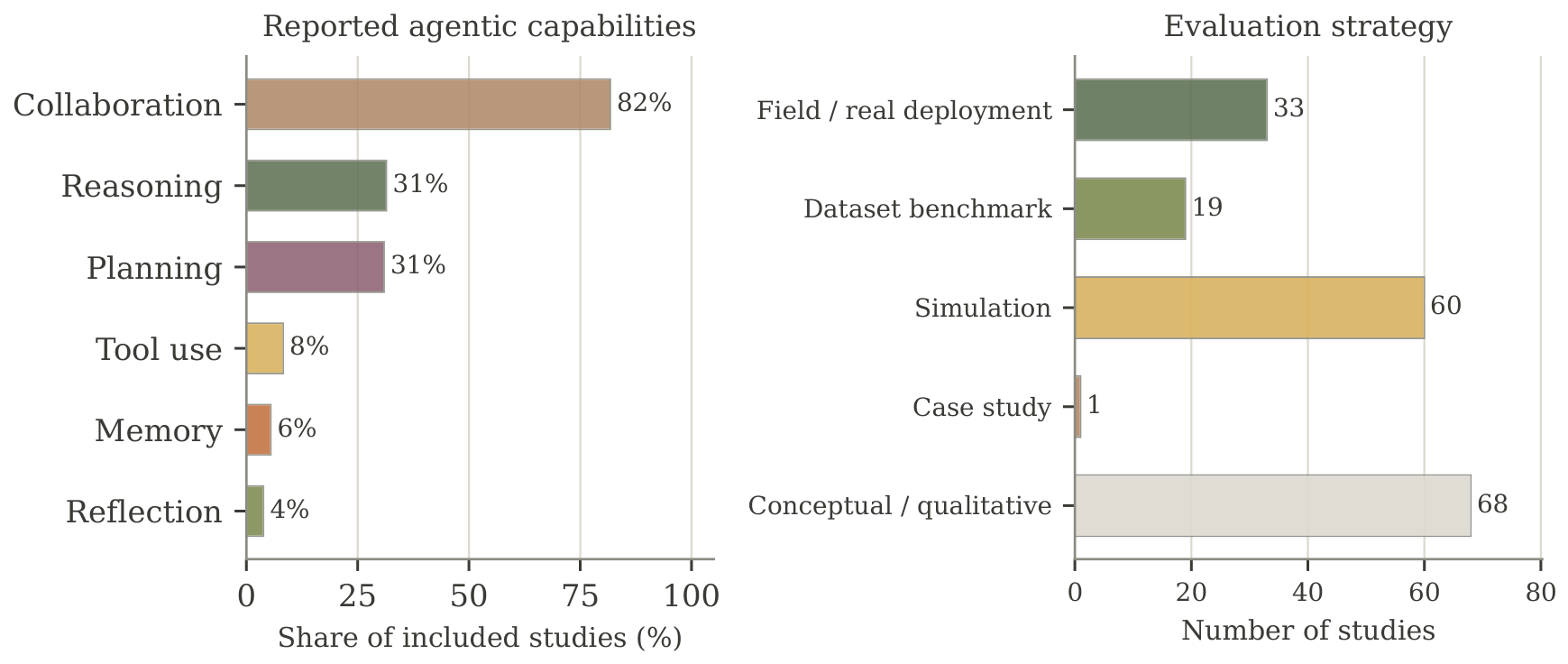
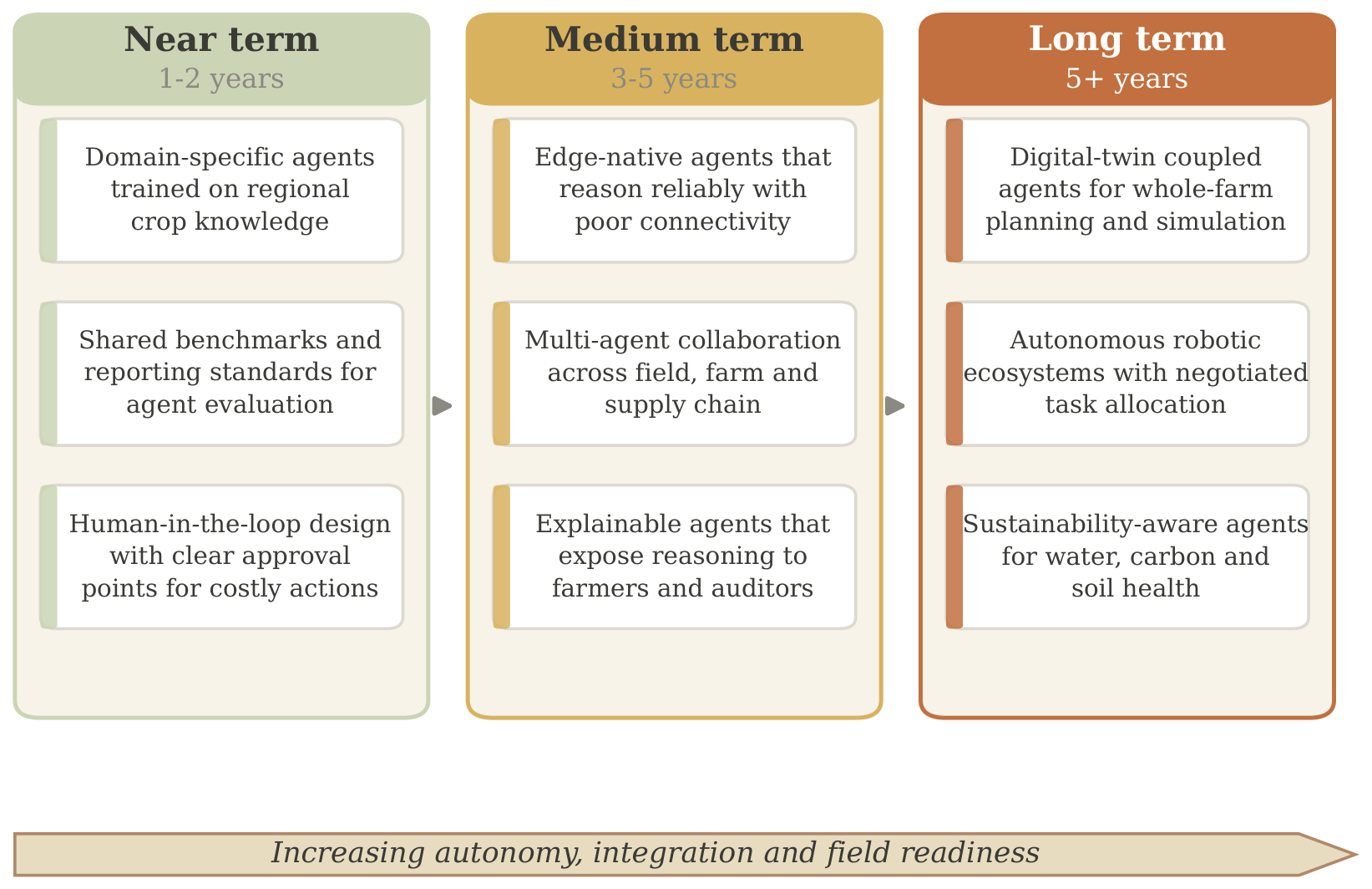
Agriculture is under pressure from climate variability, labour shortages and the need to use water, fertiliser and pesticide more carefully. Artificial intelligence, and agents and multi-agent systems in particular, have been applied to these problems since the 1990s, but a new wave of systems built on large language models has appeared in the last two years. We use the term agentic artificial intelligence, defined operationally in this paper, for software that perceives part of its environment, decides what to do based on that perception, and then acts or advises, where the sequence of steps is determined by the system itself rather than fixed in advance; this covers both the classical agent tradition and the recent language-model wave, and we distinguish the two throughout. This review asks how far agentic approaches, in both traditions, have travelled into agriculture. We searched Scopus for work published between 2020 and 2026 and screened 4111 records against a protocol based on PRISMA 2020. After removing duplicates, off-topic domains and studies that did not report enough method or result detail, 181 studies remained. We coded each one along six dimensions, agricultural domain, agent organisational pattern, artificial intelligence backbone, data source, deployment setting and level of autonomy, and assessed the consistency of the coding through a blinded manual re-coding of 30 randomly selected records. This quality-control exercise assessed the reproducibility of the record-level classification; it was not intended as a full-text validation of every implemented mechanism. Three findings stand out. First, the field as a whole spans more than three decades, but the large-language-model subset is very young: such studies appear only from 2024, and 46 of the 47 of them were published in 2025 or 2026. Second, the capabilities that define agentic behaviour are unevenly reported. Collaboration is reported by 82 percent of studies, while planning and reasoning each appear in 31 percent, and memory and reflection in 6 and 4 percent; these figures describe what abstracts report rather than confirmed implementations, a distinction we treat carefully throughout. Third, tested evidence is thin. Only 33 studies report a field or real deployment, 68 remain conceptual, and just 11 report evaluation across more than one season or period. We contribute a taxonomy that separates classical and contemporary agentic approaches, a direct comparison between the two, a reported-capability matrix reported with raw counts as well as percentages, and a roadmap for future work that we label clearly as our own synthesis rather than a direct empirical finding. The picture that emerges is of a field with real momentum in its newest part and thin evidence overall, where the main task ahead is to move from architecture proposals to systems that are tested on real farms over more than one season.

1. Introduction

1.1. Background

Farming has changed a great deal in the last thirty years, and most of that change has come from better information rather than better machines. The idea usually called Agriculture 4.0 brought sensors into the field, connected them over wireless networks, and used the resulting data to guide when to irrigate, how much fertiliser to apply, and where to look for pests. Yield maps, soil moisture probes, weather stations and drone imagery are now common on commercial farms in many countries. The promise was simple. If a farmer can see what is happening in each part of a field, the farmer can treat each part differently, and both yields and input costs improve.
That promise has been only partly met. Sensors produce a great deal of data, but turning data into a decision still takes expertise that many farms do not have. A soil moisture reading does not tell anyone how long to run a pump. A photograph of a diseased leaf does not say which product to spray, at what rate, or whether spraying is even allowed under local rules this week. The gap between measurement and action is where most digital agriculture projects have struggled.
More recently the discussion has moved towards what several authors call Agriculture 5.0. The shift is less about new hardware and more about the role of the human being. Where Agriculture 4.0 aimed at optimising single variables, Agriculture 5.0 is described as a move towards systems that handle trade-offs between production, environment and the people who work the land. Parra-López and colleagues frame this as a change from smart farming to what they call wise agricultural systems, and argue that this shift needs governance mechanisms in which humans and machines share decisions rather than one replacing the other [1]. That framing matters for this review, because it sets the standard against which any new technology should be judged.
Artificial intelligence has been part of agriculture throughout this period, and, as we set out fully in Section 4.1, agents and multi-agent systems specifically have been studied since well before the period this review covers. Early work used expert systems that encoded agronomic rules by hand. Machine learning followed, giving better yield forecasts and risk models. Deep learning then made image-based tasks practical, so that disease detection, weed identification and fruit counting moved from research papers into working products. Multi-agent systems research, going back to the 1990s, gave agriculture a way to coordinate several specialised pieces of software or hardware, sensing agents, planning agents, control agents, without one central program trying to do everything at once. Each of these steps improved a specific task or a specific kind of coordination problem. None of them, on its own, changed the basic pattern in which a model or an agent produces an output and a person decides what to do with it next.

1.2. From Artificial Intelligence to Agentic Artificial Intelligence

The most recent step narrows that gap rather than removing the underlying agent concept, which, as Section 4.1 explains in more detail, has existed in computer science since the early 1990s. Large language models made it possible to ask open questions in ordinary language and receive an answer that reads like advice. Soon after, researchers began wrapping these models in software that lets them do more than answer. An agent can break a goal into steps, decide which step comes next, call an external tool such as a weather service or a database, look at the result, and decide what to do after that. When several such agents divide the work and talk to each other, or when a single agent combines these behaviours, the system is often described, in the recent literature, as agentic. We use that same word throughout this paper because it is now the common term. The underlying idea of an agent that perceives, decides and acts is not new, and much of what we review belongs to the older tradition rather than the newest one.
Figure 1 shows this progression as we have synthesised it for this paper, rather than as a sequence directly measured from the corpus. The important point is not that each stage is better than the last in every way. Deep learning is still the right tool for reading a leaf image, and a controller based on model predictive control is still the right tool for a pump. What changes with the most recent systems is more often the interface and, in some designs, who decides the sequence of steps at run time, though as Section 4.1 discusses, dynamic sequencing of this kind is not exclusive to language-model systems either.
This is not only an agricultural story. Agentic systems have moved quickly into medicine, where a recent system for rare disease diagnosis produces a traceable chain of reasoning rather than a single label [2], and a broad survey has already been written on the opportunities and risks of agentic artificial intelligence in healthcare [3]. Similar systems have appeared in food science [4] and in remote sensing, where multi-agent copilots assemble geospatial workflows on request [5]. Agriculture shares many features with these fields. It is data-rich; it involves several specialised sub-problems that must be combined, and the cost of a wrong decision is real.

1.3. Motivation

Where they go beyond earlier systems, agentic approaches differ from earlier artificial intelligence in agriculture in five ways that matter in practice. We state these as properties a system can have, not as a definition of agency itself, since Section 4.1 treats none of them as strictly necessary for a system to count as an agent.
  • Autonomous planning. The system decides the order of its own steps. A pest advisory agent may choose to check the weather forecast before recommending a spray, without being told to do so in advance.
  • Reasoning. The system draws a conclusion from evidence in a way that can, in some designs, be inspected afterwards. Cai and colleagues build this into a plant health system so that a diagnosis is grounded in structured knowledge rather than produced by an opaque classifier [6].
  • Memory. The system keeps a record of earlier interactions and earlier field states, so advice in July can depend on what happened in May.
  • Tool use. The system calls external services. Mandiga and colleagues give a poultry nutrition agent a set of expert-designed tools for feed calculations, so the language model never has to invent a number [7].
  • Multi-step decision making. The system carries a task through several stages, checking its own work along the way rather than producing one output and stopping.
These properties suit agriculture well. Farm decisions are rarely single questions. Deciding whether to irrigate involves soil, weather, crop stage, electricity prices and water rights at the same time. A system that can gather these pieces itself is closer to what a farm adviser actually does.

1.4. Related Reviews and the Gap This Review Addresses

Reviews of artificial intelligence in agriculture are plentiful, and it is worth placing this review against a few representative examples rather than asserting the gap without evidence. Wang and colleagues reviewed deep learning methods for plant disease and pest detection, covering image classification, object detection and segmentation approaches [8]. Miller and colleagues conducted a PRISMA-based systematic review of Internet of Things and artificial intelligence in smart sensing for arable crops and grassland, and, like this review, found a sharp rise in publication activity in the most recent years covered [9]. Liu and colleagues reviewed the current status and common technologies of agricultural field robots, screening 678 records to cover navigation, perception and task-specific operation [10]. Awais and colleagues reviewed digital twins and smart farming technologies across 167 studies, focusing on the architectures used to couple a virtual and a physical farm system [11].
Each of these reviews is thorough within its own technology. None of them asks the question this review asks, namely which of these technologies, and which combinations of them, are being organised into agents that plan, remember, reason, use tools, reflect or collaborate, and how much of the literature that calls itself agentic actually reports any of those properties. A reader who wants to know the state of deep learning for disease detection, of the Internet of Things in precision farming, of robotics, or of digital twins, is well served by the reviews above. What is missing, and what this review supplies, is a systematic account that treats agency itself, in both its classical and its contemporary forms, as the organising question, and that checks the claim of agency against what the underlying studies report rather than against the title each study gives itself.
This matters for three further reasons. First, the term agentic is used loosely. Papers describe systems as agentic when they mean a chatbot, a multi-agent controller, or, occasionally, a simulation of farmer behaviour, and these are different things, which is why Section 4.1 spends some time separating them before the rest of the paper proceeds. Second, because the recent wave is new, nobody has established which agricultural problems it is being pointed at and which are being left to the older tradition or to no agentic approach at all. Third, and most directly, no one has checked, across a large screened corpus rather than a handful of examples, whether the capabilities that give agentic systems their name are actually present in the published work, and whether that differs between the classical and the contemporary parts of the literature.
Our review addresses this gap. We synthesise the literature from architectural, technological and application perspectives, we distinguish the classical and contemporary traditions described in Section 4.1 wherever the distinction affects a finding, and we test the claim of agency against what the studies themselves report, with the methodological caveats set out in Section 2.6.

1.5. Objectives

The review has five objectives:
  • To identify and characterise the body of work that applies agent based and agentic artificial intelligence to agricultural problems between 2020 and 2026, using a transparent and repeatable protocol.
  • To build a taxonomy that organises this work along several dimensions at once, rather than by application alone, and that distinguishes classical agent and multi-agent approaches from contemporary language-model based-ones where the distinction matters.
  • To compare studies on a common set of criteria so that trends become visible instead of remaining hidden in individual papers.
  • To produce a reported-capability matrix showing which combinations of agricultural domain and agentic capability are well covered and which are thin, stated with appropriate caution about what abstract-level coding can and cannot establish.
  • To set out a research roadmap that reflects what the evidence supports rather than what the technology promises, clearly separated from our own expert judgement where the two differ.

1.6. Research Questions

Six research questions guide the work. They are listed in Table 1 together with the section that answers each one.
The rest of the paper is organised as follows. Section 2 describes the review method. Section 3 presents a bibliometric picture of the field. Section 4 explains the concepts needed to read the rest of the paper, including the classical and contemporary traditions this review draws on. Section 5 presents the taxonomy. Section 6 reviews applications area by area. Section 7 compares studies across dimensions, including a direct comparison between language-model and classical systems. Section 8 sets out the open challenges, Section 9 the research roadmap, and Section 10 concludes.

2. Review Methodology

2.1. Review Protocol

The review follows the PRISMA 2020 statement for reporting systematic reviews. The PRISMA checklist is in the Supplementary Material. We wrote the protocol before screening began and did not change the inclusion rules once screening had started. The protocol was not registered on a public platform such as PROSPERO or the Open Science Framework before the review began, which we note here as a limitation and return to in Section 10.3. The protocol covers four things: which database to search, when to search it, what query to use, and how to decide whether a record belongs in the review.
We used Scopus as the single source. Scopus indexes both journals and conference proceedings, which matters here because a large part of the agentic literature appears first at conferences. It also provides structured metadata including abstract, author keywords, index keywords, affiliation and digital object identifier, and all of these were needed for the coding described in Section 2.6. A single database is a real limitation for a topic that spans agricultural engineering, computer science, robotics and conference proceedings, and we discuss what it may have missed in Section 10.3.
The search was run on 5 August 2026, and the publication year used throughout this paper is the year Scopus assigns to each record at the time of export, which for very recent conference papers can be the year of the conference rather than a later indexing date. The result set was exported in full, including abstracts, and all later screening was performed on that export so that the process can be repeated exactly.

2.2. Search Strategy

The query combines two blocks with a Boolean AND. The first block covers the many names used for agent-based and agentic systems. The second covers agricultural terms. Table 2 gives the query exactly as it was submitted to Scopus, in a form that can be copied directly into the Scopus search interface.
The full query string, exactly as submitted, is also provided in Table A1 so that it can be copied without retyping. The agriculture block is deliberately broad. Terms such as Soil, Disease and Crop were included so that relevant work would not be missed because the authors never wrote the word agriculture. The cost of that choice is a large number of irrelevant records, since Disease matches medical papers and Soil matches geotechnical engineering. The screening stage was designed to handle this.

2.3. Inclusion Criteria

A record was included if it met all of the criteria in the upper half of Table 3. The central requirement is the third one. The study must present an artificial agent that perceives something, decides something and acts or advises, and it must do so for an agricultural problem, using the operational definition of an agentic system given in Section 4.1.
  • Central to the study means the agentic system and the agricultural problem are both part of the paper’s own stated contribution, not a background detail. A networking paper that mentions a farm once, as one example use case among several unrelated ones, does not meet this bar even if the word agriculture appears in the abstract.
  • Working artefact means the paper describes a system that was built, simulated or at minimum specified in enough detail to be built, as opposed to a purely narrative discussion of what agents might one day do for a domain, with no described architecture of its own.
  • Peripheral is the negation of central to the study: the agentic or the agricultural aspect is mentioned but is not what the paper is about.
  • Some form of result or evaluation means the abstract reports at least one of a quantitative outcome, a qualitative case description, or a described architecture with a stated contribution, as opposed to an abstract that is too short or too generic to support coding any of the extraction fields in Section 2.6.

2.4. Exclusion Criteria

The lower half of Table 3 lists the exclusion criteria. Two of them deserve explanation.
The first concerns the phrase agent-based modelling. A large body of work in agricultural economics and socio-hydrology uses simulated agents to represent farmers, and studies how those simulated farmers respond to a policy, a water price or a drought. This work is valuable, and it uses the word agent, but the agents are models of people rather than artificial intelligence systems that do agricultural work, and including it would have doubled the size of the review while changing its subject towards social simulation rather than artificial intelligence engineering. We therefore excluded socio-economic and ecological agent-based simulation studies unless they also presented an artificial intelligence agent as a working artefact in the sense defined above. This rule removed 131 records. To guard against removing genuinely relevant work, we applied an automatic rescue rule: any record mentioning agentic systems, artificial intelligence agents, large language models, retrieval-augmented generation or copilots was returned to the pool regardless of the simulation rule. Two records were recovered this way and both were then included after manual reading confirmed they met the inclusion criteria.
The second concerns the word farm. The query matched wind farms, server farms, render farms and offshore turbine arrays. These were excluded unless the study also concerned agriculture.

2.5. Screening Process

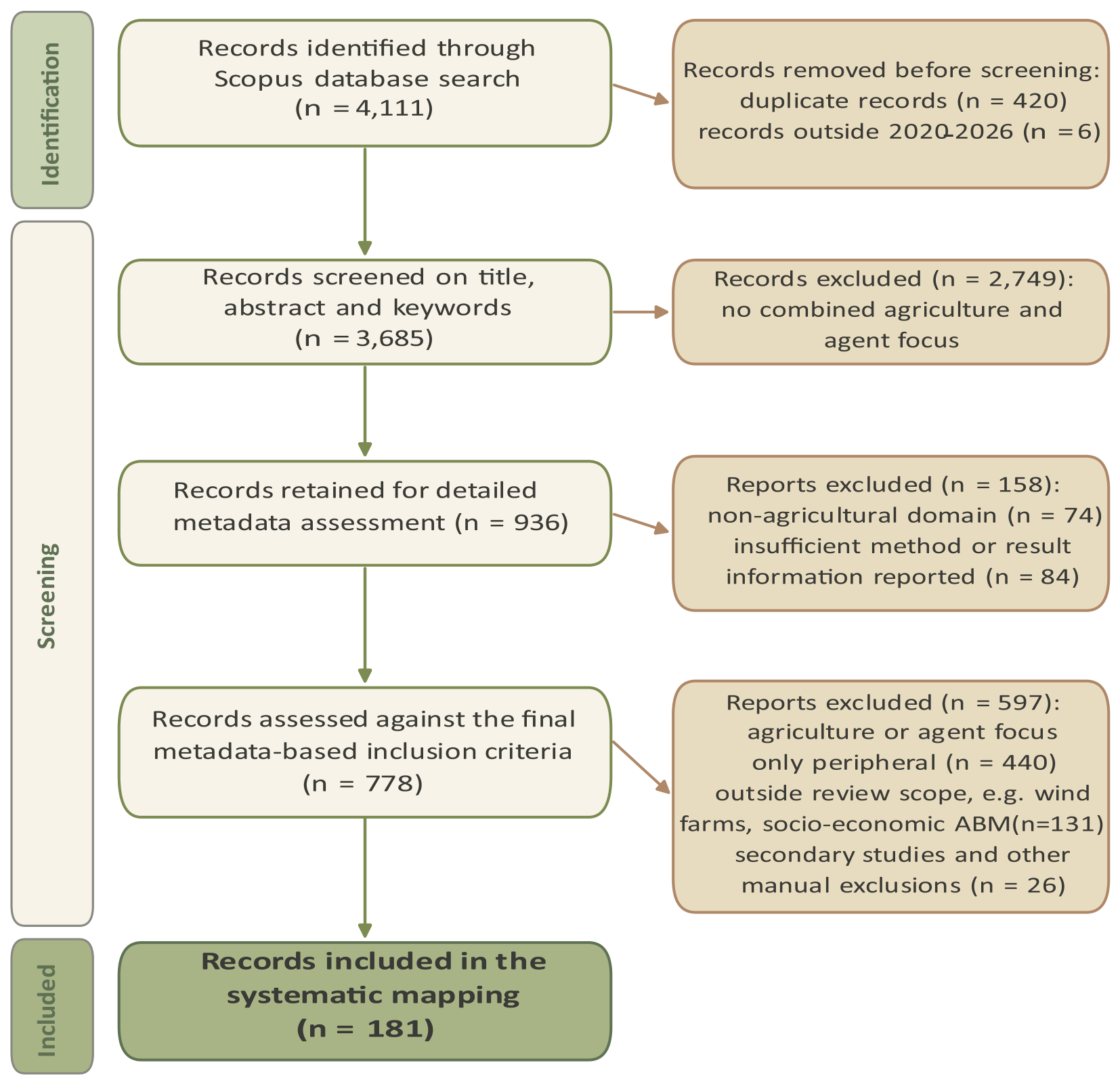
Screening proceeded in five stages, as shown in Figure 2. All screening and eligibility decisions were based on the titles, abstracts and keywords available in Scopus. Full texts were consulted for selected included publications when needed to verify contextual details and support the narrative synthesis presented in Section 6.
The 4111 exported records were first checked for duplicates on normalised title, comparing titles after lower-casing and stripping punctuation, and on digital object identifier where one was present, which removed 420 records. This method catches exact republished titles and identical DOIs but would not catch a conference paper later extended into a journal article under a different title, or a preprint duplicated under a different title on a separate platform; we did not attempt a fuzzy title match beyond this normalisation, and any such duplicates that slipped through would very slightly inflate the 181 figure rather than distort the patterns reported across it. Six records with a publication year of 2027 were removed as outside the window, leaving 3685 records for screening.
Title, abstract and keyword screening then removed 2749 records that did not combine an agricultural focus with an agent focus. This is where the medical and telecommunications literature left the pool. The 936 remaining records were assessed more closely. Seventy-four were removed because the application was not agricultural despite the vocabulary, and eighty-four were removed because the abstract did not report enough about method or results to be coded, using the reporting definition given above. We flag this second group as a possible source of selection bias, since it means the included corpus is drawn somewhat towards studies with more informative abstracts, which need not be the same thing as the most substantively important studies; we discuss this further in Section 10.3.
The 778 records that survived were assessed for eligibility. Four hundred and forty were removed because either the agricultural aspect or the agent aspect was peripheral, for example, a networking paper that mentions a farm as a use case in one sentence. A further 131 were removed under the scope and word sense rules described above. Twenty-six were removed by hand after reading, either because they were secondary studies or because coding revealed that no agent was present. That leaves 181 studies in the review.
Screening was carried out with a scripted, rule-based procedure applied to the exported metadata, followed by manual reading of all records that reached the eligibility stage. Using a script for the early stages makes the process repeatable, which is difficult to achieve when several thousand records are screened by hand, and it was applied by a single research team rather than by independent coders working in parallel, so we cannot report an inter-rater reliability statistic in the usual sense. Instead, as described in Section 2.6, we ran a separate manual validation check against a random subsample of the coded studies and report the level of agreement we found. The rules and thresholds are reported above so that another team can reproduce the same counts from the same export, and the full coding is available as described in the Data Availability Statement.

2.6. Data Extraction

For each included publication, we recorded the fields listed below. To ensure a uniform source of information across the complete corpus, the corpus-wide extraction and classification used the bibliographic information available in Scopus, principally the title, abstract, and keywords. A category was assigned only when it was explicitly reported or could be identified unambiguously from these fields; otherwise, it was coded as not reported rather than inferred. Accordingly, “not reported” refers to the available publication record and should not be interpreted as evidence that the corresponding feature was absent from the complete implementation. Selected full texts were also consulted to support the contextual interpretation and narrative discussion, but they were not used as a uniform source for the corpus-wide classification.
  • Bibliographic data: Authors, year, source, document type, citation count, digital object identifier and country of the first listed affiliation. Where a paper lists several affiliations, we used the country of the first author’s first listed affiliation only; this is a standard simplification in bibliometric reviews, but it understates genuine international collaboration, and we note it as a limitation.
  • Agricultural domain: The primary application area, assigned to one of nine categories described in Section 5.
  • Agent organisational pattern: Single agent, multi-agent, hierarchical or swarm, defined and assigned according to the priority rule in Section 4.3.
  • Artificial intelligence backbone: The primary computational paradigm, ranging from classical agent middleware to large language models, assigned as a single label per publication, together with a separate multi-label list of the specific named tools and frameworks reported.
  • Data sources: Which of eight source types the publication reports. This field allows several values.
  • Deployment setting: Cloud, edge, hybrid, simulation only or not reported in the available publication record.
  • Level of autonomy: Advisory, semi-autonomous or autonomous.
  • Evaluation strategy: Field deployment, dataset benchmark, simulation, case study or conceptual, as supported by the available publication record and defined precisely in Section 7.5. Two additional quality markers were also recorded: whether a baseline or comparative evaluation was reported and whether a multi-period or longitudinal evaluation was reported.
  • Agentic capabilities: Whether the publication record reports planning, memory, reasoning, tool use, reflection or collaboration, using the broadened definitions in Section 4.3 that cover both classical and language-model mechanisms.
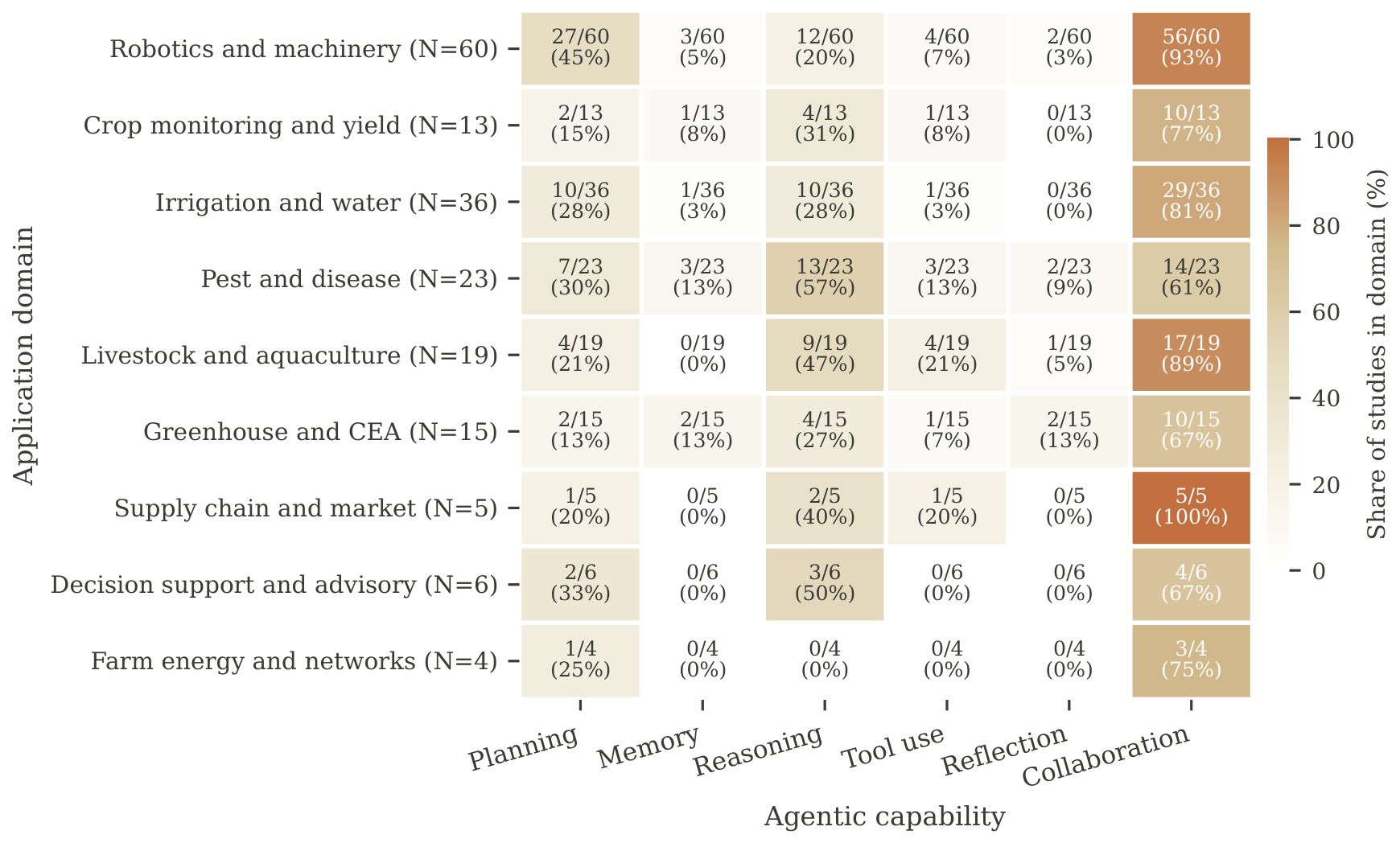
The capability variables require careful interpretation because they are particularly sensitive to differences in reporting detail. A capability was coded as reported when it was explicitly described in the title, abstract or keywords according to the operational definitions presented in Section 4.3. This rule can operate in both directions. A broadly stated capability may be counted even when its technical implementation is relatively simple; for example, a publication reporting memory may use only a database table. Conversely, a mechanism described in the full text but omitted from the abstract may be coded as not reported. The resulting frequencies therefore characterise how capabilities are reported across the publication records. They are neither an upper nor a lower bound on implementation prevalence and should not be interpreted as full-text verification of the underlying systems. In particular, low or zero values in Section 7.4 indicate limited explicit reporting in the analysed records rather than confirmed absence of the corresponding capability.
Coding consistency check: To assess the reproducibility of the record-level classification, we randomly selected 30 of the 181 included records. One author re-coded five principal fields while blinded to their original assignments, and the resulting classifications were subsequently compared with the initial rule-based coding. Exact agreement was obtained for 25 of 30 records (83.3%) for agricultural domain, 29 of 30 (96.7%) for organisational pattern, 28 of 30 (93.3%) for artificial intelligence backbone, 29 of 30 (96.7%) for level of autonomy, and 22 of 30 (73.3%) for evaluation strategy. Evaluation strategy showed the lowest agreement, mainly because some abstracts provided limited or ambiguous descriptions of the evaluation setting. For example, one publication explicitly described a multi-month field deployment in its abstract but had initially been classified as conceptual. Capability tags were not included in this quantitative agreement assessment because distinctions between concepts such as reasoning and routine control decisions were not always sufficiently explicit in the available descriptions. On qualitative re-reading, no capability assignment was directly contradicted by the corresponding record, although some assignments remained open to broader or narrower interpretation. This exercise evaluates the consistency of the classification procedure rather than validating the architectural mechanisms implemented in the full texts. The resulting frequencies are therefore treated as descriptive record-level patterns, and the implications of this limitation are discussed further in Section 10.3.

3. Bibliometric Analysis

This section answers RQ1 by describing the shape of the field: when the work was published, where it came from, where it appeared and what it talks about. Table 4 gives the descriptive profile of the 181 included studies.

3.1. Publications by Year

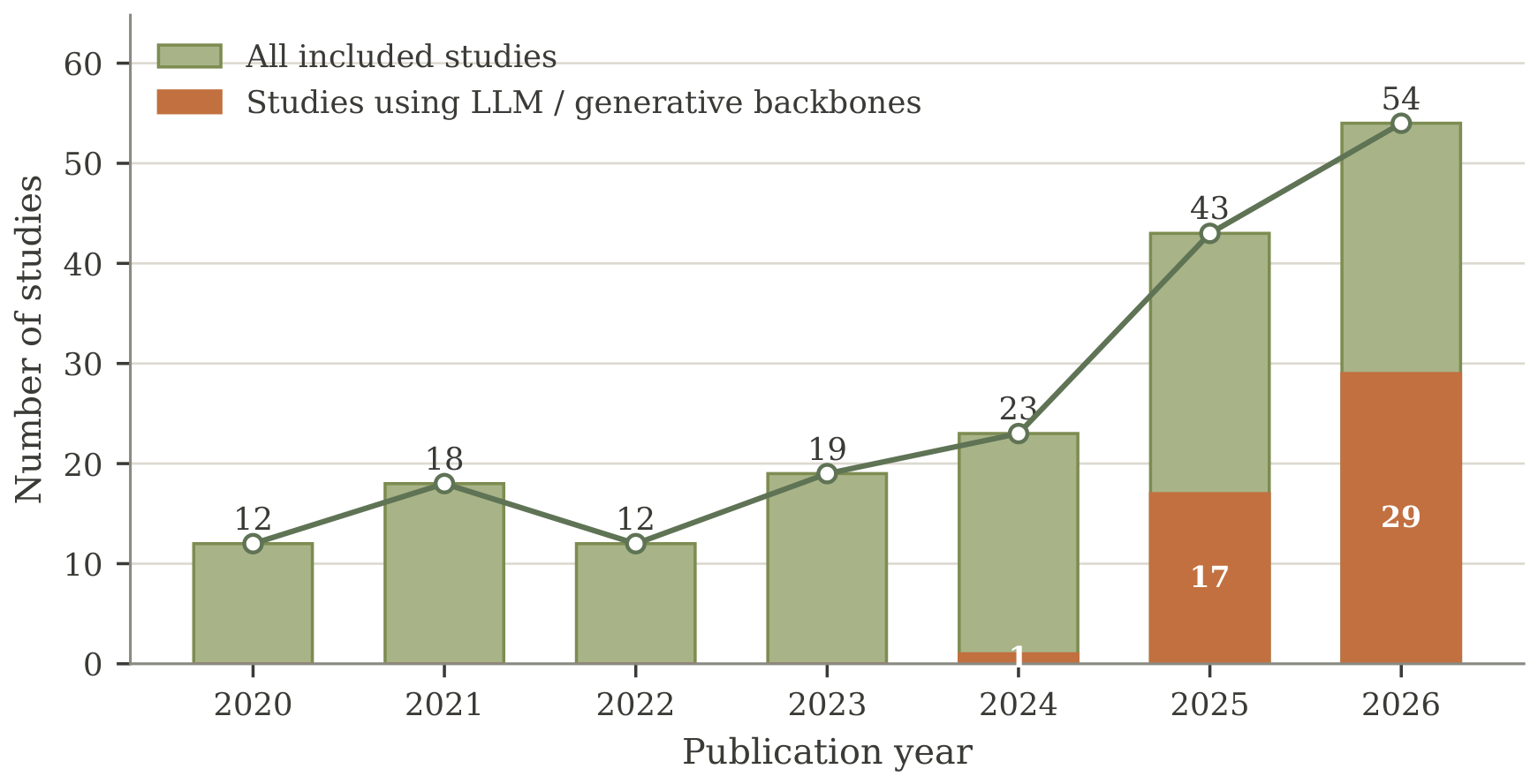
Figure 3 shows the annual output. Two things are visible. The first is steady but modest activity from 2020 to 2024, between 12 and 23 studies a year. This is the older tradition of multi-agent systems in agriculture, which has existed since well before the current wave. The second is a sharp rise in 2025 and 2026, to 43 and 54 studies. Since the search was run in August 2026, the 2026 figure is a partial count, and the real total for that year will be higher.
The orange bars are a subset of the green total for each year, not an addition to it, and tell a more specific story. Studies using large language models or other generative backbones are absent until 2024, when a single study appears. There are 17 in 2025 and 29 in 2026. In other words, 46 of the 47 studies in this group were published in the last two years of the window. Within the corpus as a whole, which spans the much longer history described in Section 4.1, this recent language-model wave is roughly twenty-four months old at the time of writing.
This has a practical consequence for how the rest of this review should be read. When we report that a certain approach dominates the literature, that statement is often a statement about the older multi-agent tradition rather than about agentic systems as currently understood. We flag this distinction wherever it matters.

3.2. Most Productive Countries

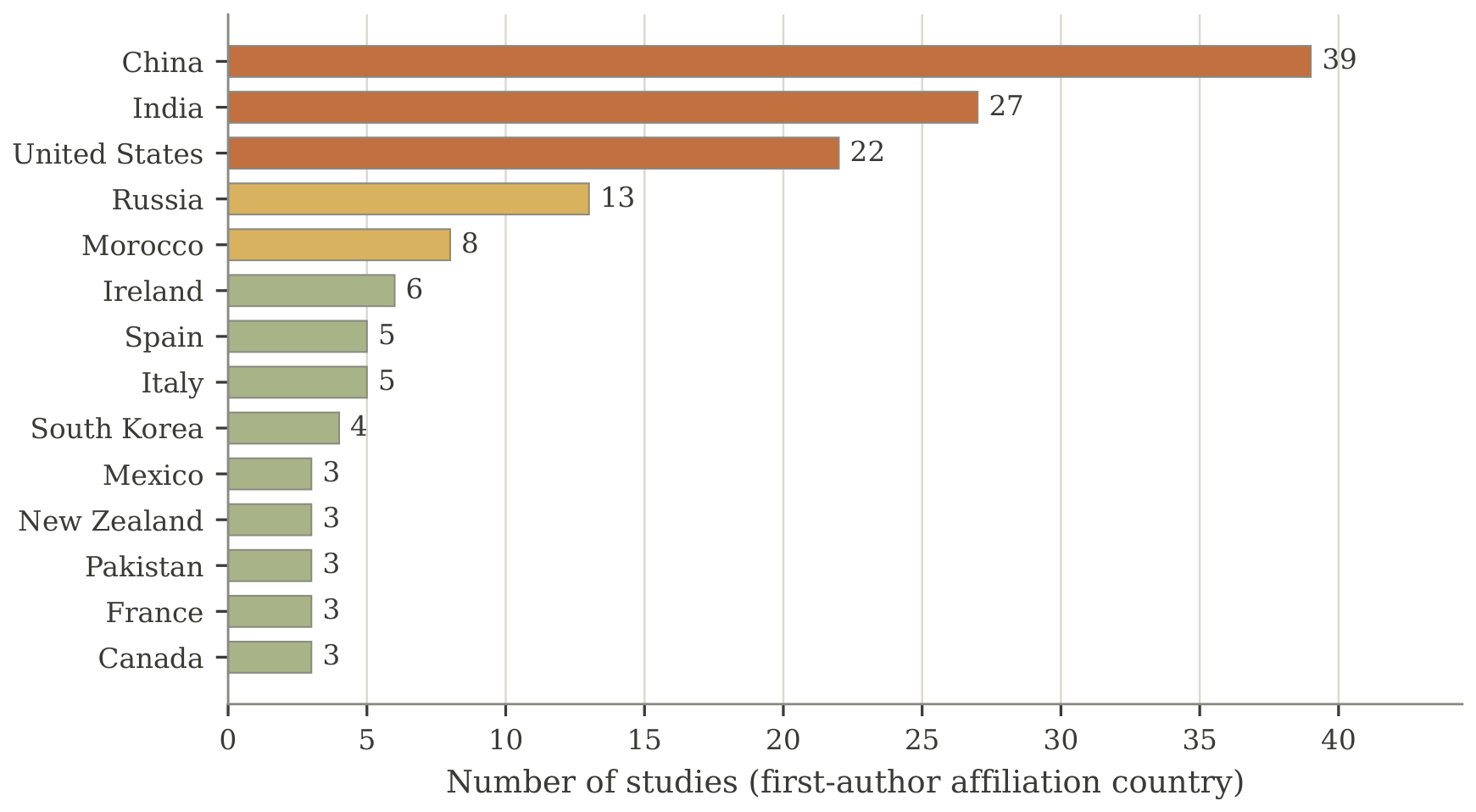
Figure 4 shows the country of the first author’s affiliation. China leads with 39 studies, followed by India with 27 and the United States with 22. Together these three account for roughly half the corpus.
The composition of each national output differs, though we note this as a descriptive impression from the coded domains rather than a formally tested association. Fifteen of China’s 39 studies are in agricultural robotics, the largest single share, consistent with a lean towards robotics and machinery control. Eight of India’s 27 studies are in pest and disease management, the largest single share there, and several of these, including the multilingual scheme assistant described by Pandit and colleagues, are aimed at smallholders and address language barriers directly [12]. Work from the United States is spread more evenly across domains. Russia contributes 13 studies, almost all from a single sustained line of research on digital twins of plants [13,14,15]. Ireland’s six studies are almost entirely about peer-to-peer energy trading on dairy farms [16,17]. Small national totals in this field often mean one active group rather than a broad research base.

3.3. Leading Publication Venues

The corpus is fragmented. Ninety-nine of the 181 studies are conference papers and 82 are journal articles, and no venue publishes more than seven of them. Computers and Electronics in Agriculture is the most frequent outlet with seven studies, followed by AgriEngineering, IEEE Access, Lecture Notes in Networks and Systems and Smart Innovation, Systems and Technologies with four each. Figure 5 shows the distribution.
This fragmentation is worth noting. A field with a clear identity usually develops a handful of home venues. Here the work is scattered between agricultural engineering journals, general computing venues, robotics conferences and networking proceedings. We read this as suggestive rather than demonstrated, since we did not run a citation-network or co-citation analysis to confirm it, but a literature this scattered across communities plausibly makes it harder for researchers to find and build on each other’s work, and duplicated effort becomes more likely than it would be around a smaller number of shared venues.

3.4. Keyword Co-Occurrence

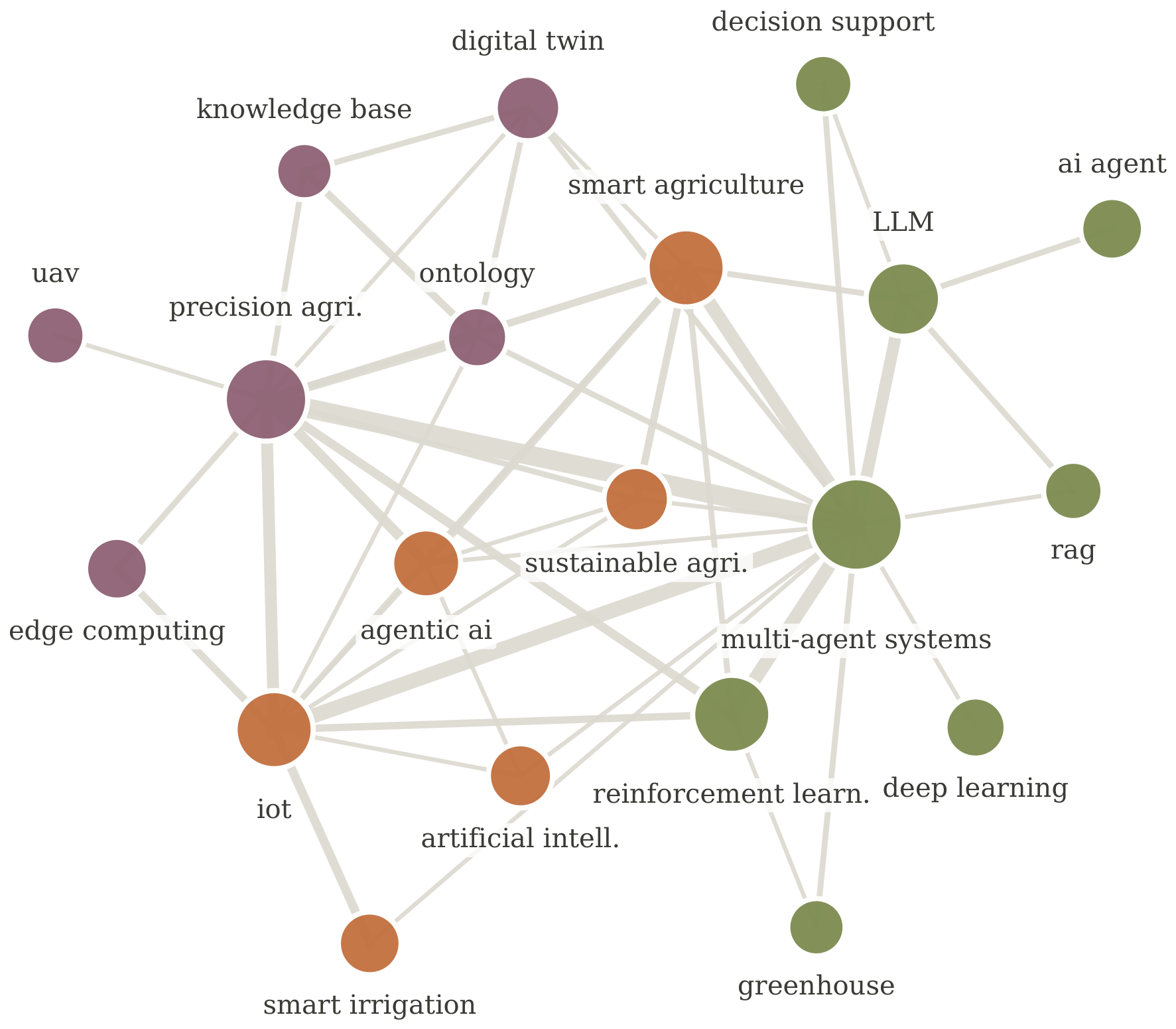
Figure 6 shows how author keywords occur together. We built this network from the author keyword field, lower-cased and lightly normalised to merge close variants such as multi-agent system and multi-agent systems, keeping keywords that occur in at least two studies and edges between keyword pairs that co-occur in at least two studies together. Node size reflects how often a keyword appears, edge thickness reflects how often two keywords appear in the same paper, and colour marks clusters found with greedy modularity maximisation using the NetworkX implementation; isolated keywords with no qualifying co-occurrence were omitted from the layout.
Four groups emerge, and we name them here since the figure caption alone could not carry the labels legibly. A control and coordination cluster is built around multi-agent systems and reinforcement learning, and represents the established tradition described in Section 4.1. A sensing and infrastructure cluster surrounds precision agriculture, the Internet of Things and edge computing. A smaller and newer agentic and language-model cluster links agentic artificial intelligence, large language models, retrieval-augmented generation and artificial intelligence agents. A knowledge and simulation cluster links digital twins, ontologies and knowledge bases.
The feature we think is most informative is how weakly the agentic and language-model cluster connects to the other three. Those terms sit at the edge of the map rather than in the middle. This is consistent with a topic that arrived recently and has not yet been absorbed into the established vocabulary of the wider field, though a keyword network on its own cannot rule out other explanations, such as authors in the newer cluster simply choosing a more self-contained set of keywords.

3.5. Citation Analysis

The 181 studies have attracted 1445 citations in total, an average of 8.0 each. That average hides a very skewed distribution, which is normal for a young field. The most cited study, on resource allocation in agricultural sensor networks, has 106 citations [18]. Multi-agent area coverage control follows with 91 [19], then energy management in networked greenhouses with 77 [20], multi-agent precision irrigation with 70 [21], and unmanned aerial vehicle swarms in smart agriculture with 60 [22].
Every study in the top ten was published between 2020 and 2024, and none of them uses a large language model. Citation counts in this corpus therefore measure the older tradition rather than the newer one. This is a timing effect rather than a judgement on quality. The agentic studies are too recent to have accumulated citations, and any ranking by citation count in the next few years will look very different.

4. Fundamentals of Agentic Artificial Intelligence

Agents and multi-agent systems are not a new idea. They have been studied since the early 1990s, and a large part of the corpus we review belongs to that older tradition rather than to the recent one. This section sets out both traditions, explains how they relate, and then defines the capabilities and technologies used later in the paper in a way that covers both.

4.1. Two Traditions, One Word

The word agent has a long history in artificial intelligence. Wooldridge and Jennings gave one of the standard early definitions: an agent is a computer system situated in an environment that acts autonomously to meet its design objectives [23]. Franklin and Graesser sharpened this into a formal test that separates an agent from an ordinary program, based on properties such as reactivity, autonomy and persistence over time [24]. Out of this line of work came several architectural families that are still active today. Reactive architectures, associated with Brooks, build behaviour out of simple perception-action rules without an internal model of the world [25]. Deliberative architectures, of which the belief-desire-intention or BDI model is the best known, give an agent explicit beliefs about the world, desires it wants to satisfy, and intentions it commits to acting on [26]. Hybrid architectures combine both layers. Multi-agent systems, where several such agents coordinate through message passing, negotiation or shared plans, have their own textbook treatment going back decades [27].
A large share of our corpus, roughly three quarters of it once large language model systems are set aside, belongs to this older tradition. Studies that build a multi-agent controller for irrigation scheduling, a BDI-style knowledge base for a digital twin of a plant, or a swarm of reactive robots covering a field are all agentic in the classical sense, whether or not their authors use that word.
What has changed recently is narrower than it might first appear. Large language models gave agents a new way to interface with the world in ordinary language, and made it cheap to wrap a model in software that calls external tools, retrieves documents, and revises its own plan mid task. This is sometimes called agentic AI to distinguish it from either a plain language model that only answers a prompt, or from the classical agents described above. The label is useful but easy to overstate. Nothing about using a large language model automatically confers planning, memory or reflection, and nothing about being built on classical middleware rules those capabilities out. What differs between the two traditions is typically the interface and the vocabulary authors use to describe their system, not necessarily what the system can do.
Because both traditions appear throughout our corpus and both are relevant to agriculture, we keep the broad inclusion criterion described in Section 2.6 for the main review, so that the reader can see how the field as a whole has developed. At the same time, wherever a finding could be driven mainly by one tradition rather than the other, we say so explicitly and, where it adds something useful, we report the two groups side by side. Section 7.1 does this directly for the six agentic capabilities, autonomy, evaluation and deployment.

4.2. What Do We Mean by Agentic in This Review?

For the purpose of coding 181 studies consistently, we needed a working definition that could be applied from a title and abstract rather than a philosophical definition that would need the full architecture of every system to apply. We used this rule: a study counts as presenting an agentic system if it describes an artificial component that perceives some part of its environment, makes a decision based on that perception, and then acts or advises, where the sequence of what happens is determined by the system itself rather than fixed in advance by the person running it.
This operational rule is deliberately narrower than some definitions in the literature and broader than others. It does not require a large language model. It does not require full autonomy, since an agent that stops and asks a human before acting still meets the rule. It does not require several agents, since one agent with a perceive, decide, act loop qualifies on its own, and it does not require deliberation: a reactive swarm of simple robots that senses field conditions and moves accordingly satisfies the rule just as a planning-heavy language model agent does, since both perceive, decide and act without a person choosing each step. We do not treat planning, memory, tool use or communication with other agents as necessary conditions for something to count as an agent, since classical agent theory is clear that a purely reactive agent can be a perfectly good agent without an explicit plan [25]. We do use those properties, alongside reasoning and reflection, as a separate set of capability tags that we record for each study, precisely so that the review can ask which of them are present rather than assuming they all come bundled together under the word agentic.
This operational rule has both a benefit and a cost. It lets us screen several thousand records consistently, which a richer philosophical definition would not have allowed. It also means that a handful of borderline cases, mainly around whether a control loop counts as a decision made by the system rather than by its designer, were resolved by convention rather than by a sharp theoretical line. We do not think a sharper line exists that would have changed the overall picture much, but we flag the judgement call here rather than hide it.
An illustration helps make the working definition concrete. When Munasinghe and colleagues built a plant disease advisory system, the agents do not simply classify a leaf. They check the diagnosis against current field conditions and against the rules on which chemicals may legally be applied, and they suppress a recommendation that would be unsafe or non-compliant [28]. The classification is one step inside a longer process that the system manages itself, which is exactly the pattern our rule is meant to capture.

4.3. Capabilities: Classical and Contemporary Forms

Six capabilities recur in the literature and form our coding categories. For each one we describe both how it appears in the classical agent literature and how it typically appears in recent large language model-based systems. The capabilities appear again in the gap matrix in Section 7.4.
Autonomy. The degree to which the system acts without waiting for human instruction. This is a spectrum rather than a binary and it is not specific to either tradition. In our corpus we distinguish advisory systems, which only recommend, semi-autonomous systems, which act within limits set by a person, and autonomous systems, which close the loop themselves.
Planning. Breaking a goal into ordered steps and deciding what to do next. Classical planning covers symbolic task planners, hierarchical task networks and BDI plan libraries, as well as spatial planning such as coverage routes for a robot fleet. In recent systems the same function is often performed by a language model reasoning step by step about what tool to call next. We coded planning as present whenever the abstract describes either form.
Memory. Retaining information across time. Long before vector databases, agent systems retained state through belief bases, world models, interaction histories and case libraries. In our coding, memory covers any of these mechanisms, not only the retrieval-augmented memory associated with large language models. Short-term memory holds the current task context. Long-term memory holds field history, past treatments and previous outcomes, whatever the underlying data structure.
Reasoning. Drawing conclusions from evidence. Classical agents reason through logical inference, rule firing, constraint solving or explicit decision-theoretic calculation, none of which produces a natural language explanation. Agents based on large language models often reason using chains of generated text, which involves a different mechanism. In reality, a generated explanation does not, by itself, prove that the underlying computation was faithful to it. We coded reasoning as present when a study describes any of these mechanisms driving a conclusion that a human or a downstream process can act on, and we do not treat the presence of natural language explanation as a stronger or weaker form of reasoning than symbolic inference. Cai and colleagues illustrate one contemporary version, combining vision-language modelling with structured knowledge so a diagnosis rests on explicit relationships between the two rather than on pattern matching alone [6].
Tool use. An agent acting on its environment through something external to its own core reasoning step. In classical agent systems this is ordinarily called effecting or acting through effectors, and covers anything from a robot arm to a database write. In recent systems the same idea is usually described as calling an external tool, function or model. We coded tool use as present under either description, but in practice this definition and our coding of it pull in different directions. The near-zero tool use figure for the classical group reported later in this review does not mean classical systems rarely act on their environment; robotic and control systems act on their environment constantly. It means that classical abstracts almost never describe that acting in the vocabulary our coding rule searched for—control, actuate, regulate, dispatch—rather than tool, function or API call. We see this as a terminology gap in what abstracts choose to say, not as evidence that effector-based action is absent from the classical literature, and we would expect a full-text coding pass to close most of this gap. The poultry nutrition agent of Mandiga and colleagues is a contemporary example, pairing a reasoning framework with expert-designed tools for the numerical work so the language model itself never has to invent a number [7].
Reflection. An agent checking its own output and revising it before the output is used. The test we applied is whether the check involves an adaptive judgement, by the same agent or by a second agent, rather than a fixed rule with no judgement in it. A second agent that reviews a first agent’s proposal and can decide, case by case, whether to accept, revise or block it counts as reflection under this rule, which is why the compliance layer built by Munasinghe and colleagues, where one agent’s output is assessed against current conditions rather than a static checklist, counts, even though the assessment is not done by the same agent that produced the recommendation [28]. A fixed safety interlock that always blocks a specific input pattern, with no case-by-case assessment, does not count, and neither does a human reviewing output outside the system. This is the rarest capability in our corpus under either tradition. Work outside agriculture on agentic self-awareness gives a sense of how far this kind of self-checking can be taken when it is built in deliberately rather than added as an afterthought [29]. We were conservative here: a system that is merely checked by a human, or that includes a fixed safety interlock with no adaptive self-assessment, was not coded as reflective under our rule, even though such mechanisms are valuable in their own right.
Collaboration. Several agents working together through messages, negotiation, auctions or shared plans. This is the capability with the longest history in the field, going back to the earliest multi-agent systems work, and it is by far the most common capability in our corpus, mainly because the older multi-agent literature is built on it.

4.4. Agent Organisation: Single, Multi-Agent, and Coordination Patterns

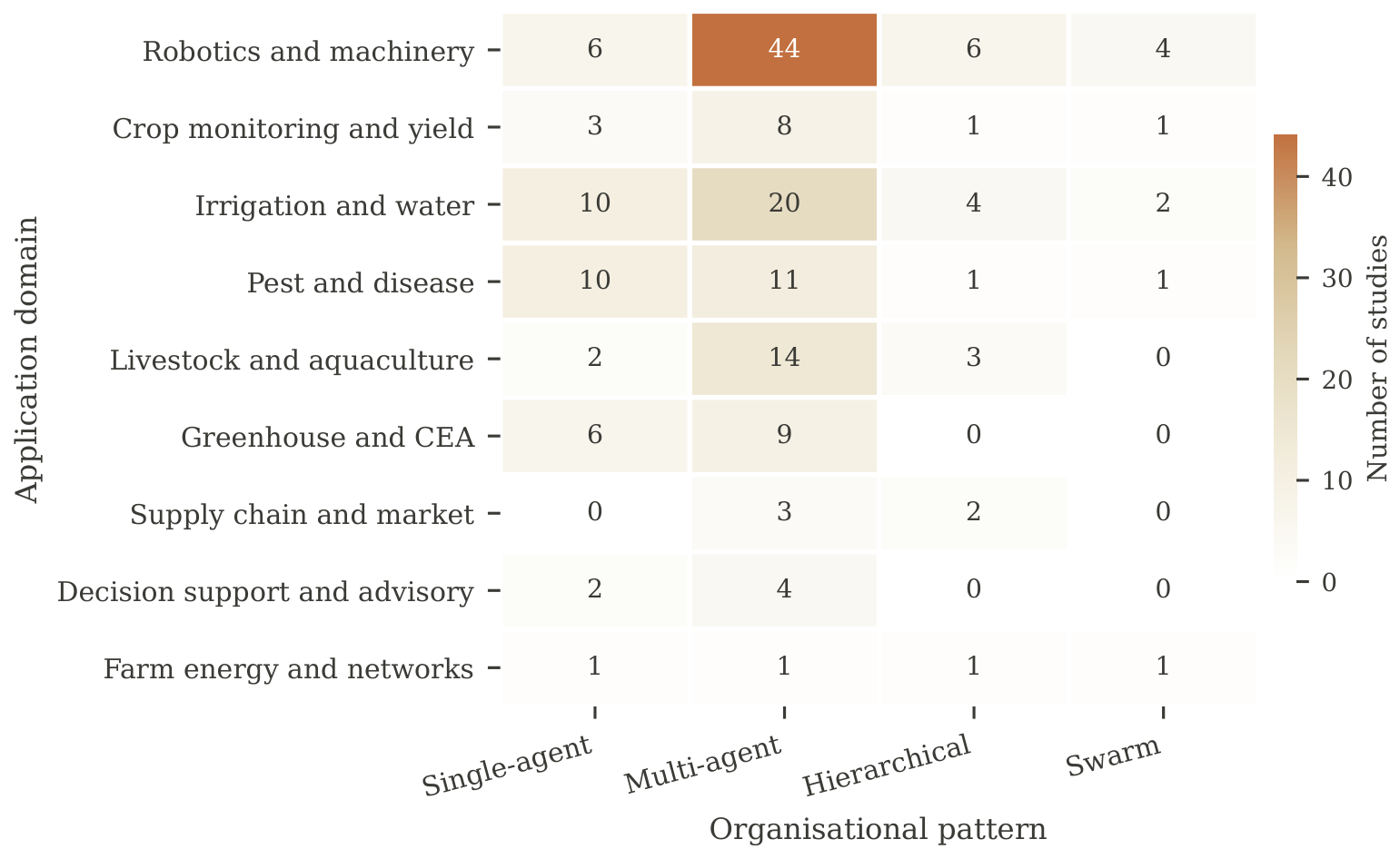
We coded each study by its dominant organisational pattern: single-agent, multi-agent, hierarchical or swarm. Hierarchical and swarm systems are themselves multi-agent systems, organised in a particular way, so the four labels describe organisational topology rather than internal agent design, and they sit alongside the reactive, deliberative and hybrid distinction from Section 4.1 rather than replacing it. We kept this scheme because it captures a distinction that matters a great deal in practice, namely how many agents a system deploys and how they are arranged, and because coding a single label per study kept the extraction tractable across 181 papers. We applied a simple priority rule to keep the categories mutually exclusive for coding purposes: a study was labelled hierarchical if it describes an explicit supervisor or orchestrator layer, swarm if it describes a large homogeneous population with no such layer, multi-agent if it describes several specialised agents without either of those patterns, and single-agent otherwise. Table 5 reports the resulting counts and a qualitative account of each pattern’s use and weaknesses in agriculture.
Single-agent. One agent handles the whole task. This suits bounded problems such as irrigation scheduling for one field [30] or answering questions about plant gene function [31]. It is simple to build and easy to debug, but it struggles when a task spans several farm subsystems.
Multi-agent. Several agents specialise and exchange messages. This is the most common pattern in our corpus, with 114 studies. Zhang and colleagues use it for plant disease diagnosis by combining convolutional and transformer models under agent coordination [32], while Song and colleagues use it to turn field scene understanding into work orders for farm staff [33]. The strength is modularity. The weakness is that joint behaviour becomes hard to predict and validate.
Hierarchical. A supervisor assigns subtasks to lower-level agents. This suits fleet management and network resource allocation, where a global view is needed. Sun and colleagues apply it to task offloading across ground, air and space networks for remote farms [34], and Jiménez and colleagues use a hierarchical arrangement for irrigation at both farm and district scale [21]. The orchestrator gives coherence but also becomes a single point of failure.
Swarm. Many simple agents produce collective behaviour without central control. This appears mainly in robotics and monitoring, for example in multi-agent reinforcement learning deployed at the edge for digital agriculture [35]. Swarms scale well and tolerate individual failures, but it is hard to steer them towards a specific agronomic outcome.
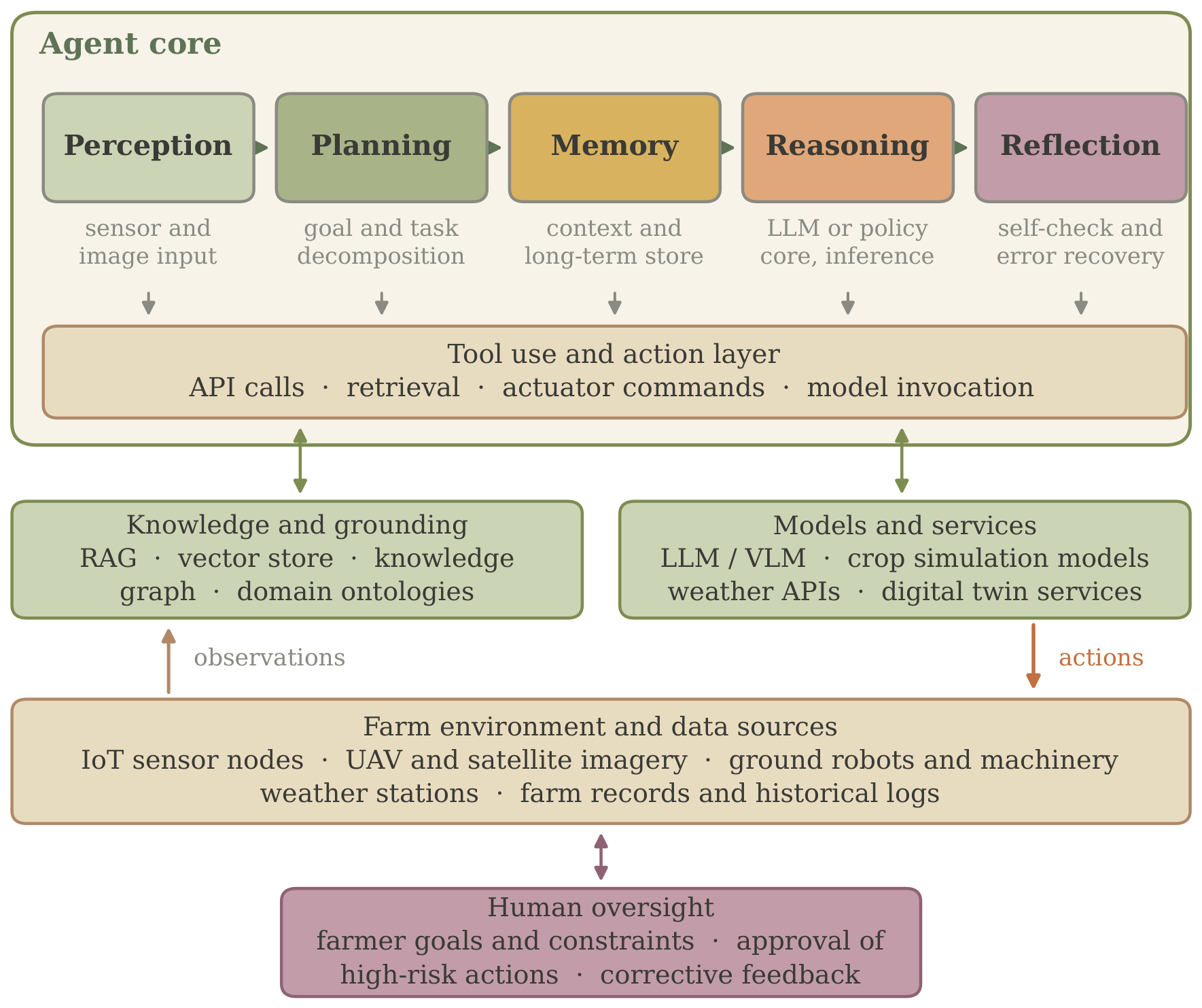
Figure 7 sets out, as an author-constructed reference diagram rather than an architecture we observed directly in every study, the layered structure that agentic systems in the corpus tend to share in some form, independent of which of the four organisational patterns above they use. Not every study includes every layer shown, and studies with a purely classical backbone typically implement the reasoning layer through rules or optimisation rather than through a language model.

4.5. Enabling Technologies

Several technologies recur across the corpus. Section 5 reports the primary computational paradigm assigned to each study as a single, mutually exclusive label in Table 6, together with the specific named technologies studies report, grouped by which layer of Figure 7 they belong to. We separate these two views because a paradigm such as reinforcement learning and a specific tool such as a vector database sit at different levels of description and a study typically reports one paradigm alongside several specific tools, so they should not be read as competing counts of the same thing. The narrative below introduces each technology; the counts are collected together in Table 6 rather than repeated here.
Large language models. These provide a language interface and, in recent systems, much of the reasoning step. Their weakness, which several studies address explicitly, is that they produce fluent text that may be wrong. Zhang and colleagues note this directly when building a plant genomics agent and design around it [31].
Retrieval-augmented generation. Grounding a model’s answers in retrieved documents is the standard mitigation for the previous problem, and it appears in 11 studies in the final corpus. Ngo and colleagues use it for shrimp health advice [36], Girardi and colleagues for interpreting agricultural regulation [37], and Kandamali and colleagues for cotton farming and irrigation advice [38].
Knowledge graphs and ontologies. These appear in 15 studies and remain important in both traditions. Zhang and colleagues use a multi-agent framework to build livestock health knowledge graphs automatically [39]. The older digital twin work also rests on ontological knowledge bases [13,14], and this is a case where a mechanism with a long history in classical agent systems is being reused, rather than reinvented, inside newer pipelines.
Vector databases. Only five studies mention them explicitly. Given that vector storage is one mechanism, but not the only one, for long-term agent memory, this count should be read together with the broader memory capability discussed in Section 4.3, which also captures belief bases and interaction histories that do not use vector storage at all.
Internet of Things and edge computing. Sixty-three studies use Internet of Things sensor data. Edge deployment matters in agriculture because connectivity is often poor. Tariq and colleagues make this the central design constraint, running lightweight models on device to avoid cloud dependence [40].
Digital twins. Fourteen studies use a digital twin as the environment in which an agent reasons or is tested. The Russian line of work on plant digital twins is the clearest sustained example [13,15], and Kalyani and colleagues connect twins to cloud, fog and edge layers [41].
Robotics. Robots give agents a body. This spans unmanned aerial vehicles [22], ground vehicles, and underwater vehicles for aquaculture inspection [42].

5. A Multi-Dimensional Taxonomy of Agentic AI in Agriculture

Most reviews of artificial intelligence in agriculture organise the literature by application. That is useful for a reader who wants to know what has been done about pests, but it hides the patterns that matter for system design. Two irrigation papers can be far more different from each other than an irrigation paper and a livestock paper, if one runs a language model in the cloud and the other runs a controller on a microcontroller in the field.
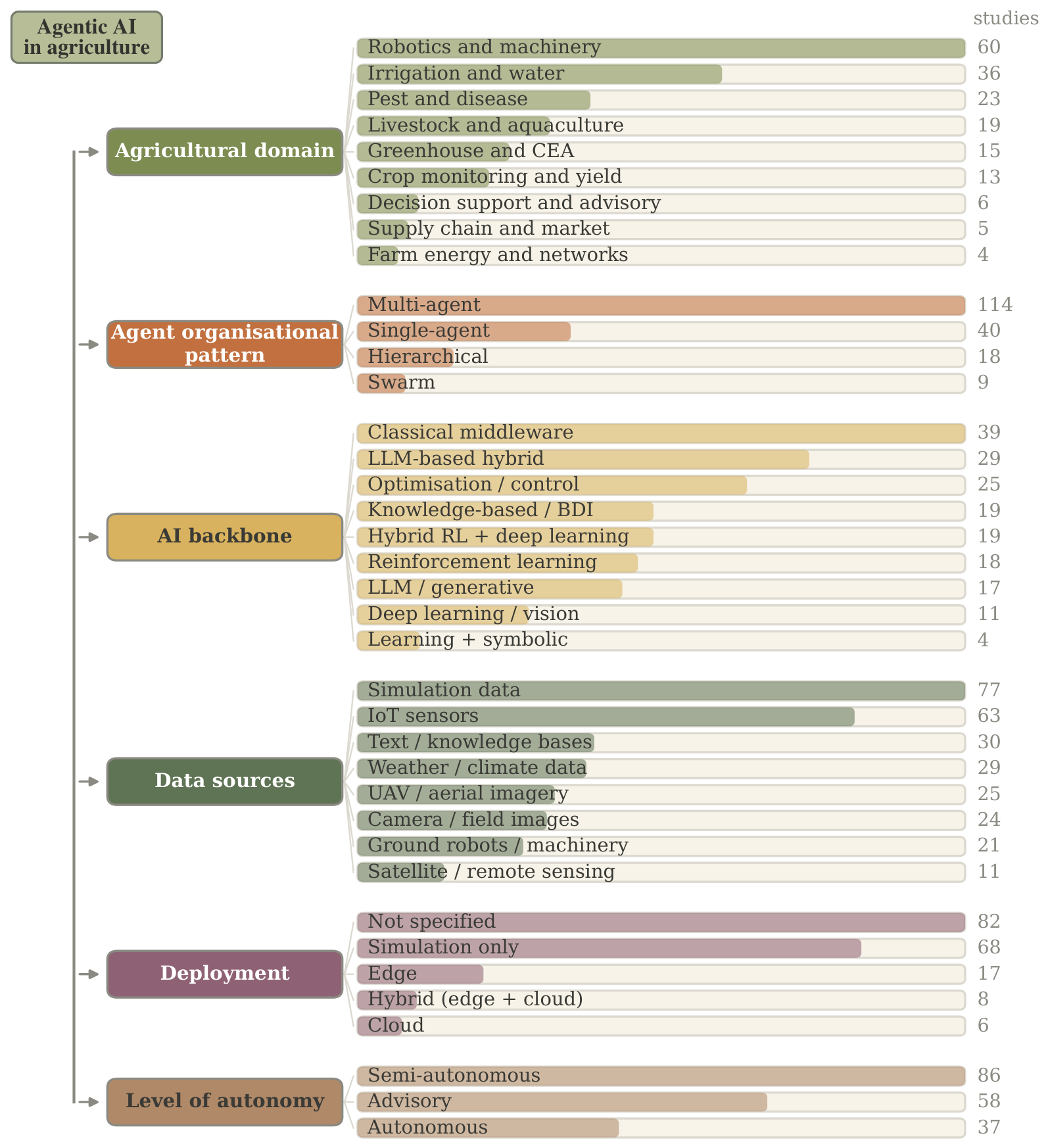
We therefore classify each study along six dimensions at the same time. Each dimension was coded as a single label per study, chosen by the priority rules described in Section 2.6 and Section 4.3 where a study could plausibly fit more than one category, except for data sources, which allows several values because studies commonly draw on more than one kind of data at once. The dimensions are shown in Figure 8 with the number of studies in each category.

5.1. Dimension 1: Agricultural Domain

Nine categories cover the corpus. Robotics and machinery is the largest with 60 studies, followed by irrigation and water with 36, pest and disease with 23, livestock and aquaculture with 19, greenhouse and controlled environment with 15, crop monitoring and yield with 13, decision support and advisory with 6, supply chain and market with 5, and farm energy and networks with 4.
The distribution reflects where the older multi-agent tradition was strongest. Coordinating a fleet of machines is a natural multi-agent problem, so robotics dominates. The small counts for advisory and supply chain work are misleading if read as a measure of importance, because many advisory systems are coded under the domain they advise about. A cotton advisory agent is coded under pest and disease if that is what it diagnoses. As with every dimension in this section, domain assignment is a judgement call for studies that straddle two areas, and we resolved these by asking which problem the system’s own stated contribution was primarily aimed at solving.

5.2. Dimension 2: Agent Organisational Pattern

Multi-agent designs account for 114 studies, single-agent for 40, hierarchical for 18 and swarm for 9. As explained in Section 4.1, hierarchical and swarm systems are themselves multi-agent systems arranged in a particular way rather than a separate family sitting alongside multi-agent as an equal alternative; we kept them as distinct rows because the coordination pattern, not simply the presence of more than one agent, is what a system designer usually needs to decide on next, and because the priority rule in Section 2.6 makes the assignment reproducible. Table 5 compares the four patterns.
There is a visible shift over time. The older studies are mostly multi-agent by construction, because that was the framework being used. Several of the newest language-model systems are single-agent designs that gain their power from tools rather than from other agents [7,31]. Evaluation-strategy table in Section 7.1 shows this gap in numbers: 47 percent of language-model studies are single-agent against 13 percent of the corpus once that subset is set aside. We read this as capability moving, in at least part of the recent literature, from the topology of the system into the individual agent’s own tool use and reasoning, though we would need studies that vary architecture while holding the task fixed to say how much of the difference is really about capability rather than about which kind of problem each tradition has tended to tackle so far.

5.3. Dimension 3: Artificial Intelligence Backbone

Table 6 lists the primary computational paradigm assigned to each study, together with the specific named technologies and frameworks studies report, grouped by architectural layer. We treat the top block as a single, mutually exclusive label per study and the bottom block as a multi-label list, since a study frequently reports a paradigm such as reinforcement learning alongside several specific tools such as a simulator or a communication protocol, and forcing those onto one axis would either lose information or double count. The median publication year column in the top block is the most informative part of the table. Classical agent middleware and knowledge-based approaches have early median years, while the two language-model categories both have a median of 2026. The backbone dimension is, in effect, also a rough timeline of the field.

5.4. Dimension 4: Data Sources

Table 7 shows which data the systems consume. Simulation data is the most common source, appearing in 77 studies, followed by Internet of Things sensors in 63. Satellite and remote sensing data appears in only 11. One distinction is worth flagging clearly: simulation as a data source, coded here, is a separate question from simulation as an evaluation setting, coded in evaluation-strategy tablein Section 7.5. A study can use simulated data to train or test a system that is then deployed and evaluated on a real farm, and a handful of studies in this corpus do exactly that, so the two counts should not be read as describing the same thing twice.
The prominence of simulation as a data source is still an important number in its own right, and we return to what it implies for evidence strength in Section 7.5.

5.5. Dimension 5: Deployment

Eighty-two studies do not specify where the system runs, 68 report simulation only, 17 report edge deployment, 8 a hybrid edge and cloud arrangement, and 6 cloud deployment.
The 82 unspecified studies show what they show and no more. They show that deployment setting is often left out of the abstract, which is itself worth knowing since a reader cannot judge from the abstract alone whether a system could run on a typical farm. They do not show that those 82 systems have no plausible deployment path; that would need information from the full text, or from the authors, that an abstract-level review cannot supply. Deployment is not a minor detail in agriculture. A system that needs a continuous cloud connection is unusable on many farms, and a system that must run a large language model locally faces hardware limits that shape the whole design. The studies that do address it directly, such as the edge-first framework of Tariq and colleagues [40] and the energy-constrained architecture of Manwatkar and colleagues [43], are notably more concrete about their trade-offs, and we would encourage more of the literature to report this even when the answer is unglamorous.

5.6. Dimension 6: Level of Autonomy

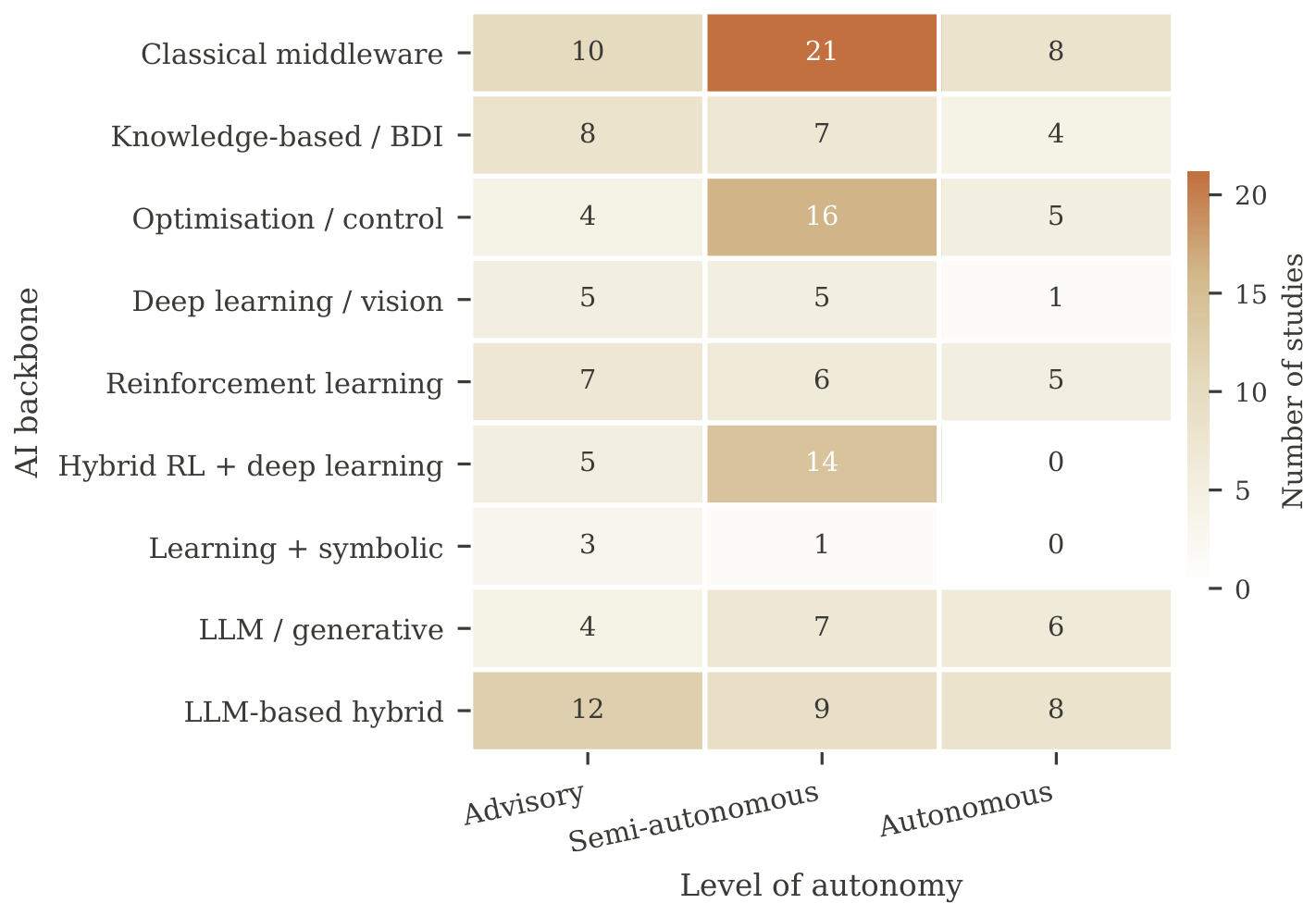
Eighty-six studies present semi-autonomous systems, 58 advisory systems and 37 autonomous systems. Autonomy correlates with domain in the expected direction. Robotics work tends towards the autonomous end because a machine in a field must act. Advisory and diagnostic work tends towards the advisory end because the consequence of a wrong answer is borne by a farmer who can refuse it. As Section 7.1 shows in more detail, autonomy also correlates with backbone, though as a tendency rather than a strict rule, since both traditions contain studies at every autonomy level.
This correlation is sensible, but it also reveals a gap. Very few studies are designed explicitly for the middle ground, where an agent acts on low-risk decisions and escalates high-risk ones. Parra-López and colleagues argue for exactly this kind of shared control as the defining feature of Agriculture 5.0 [1], yet it is more often stated as a principle than built into a system.

5.7. Using the Taxonomy

The six dimensions are largely, though not perfectly, independent of one another, which is what makes the taxonomy useful as an organising device. Knowing that a study is about irrigation tells you comparatively little on its own about its architecture, its backbone or its autonomy level. Section 7 uses the taxonomy to compare studies directly, including a direct comparison between the language-model and classical subsets of the corpus, and Section 7.4 crosses the domain dimension with the capability list from Section 4 to show where reported capability is thin.

6. Applications of Agentic AI in Agriculture

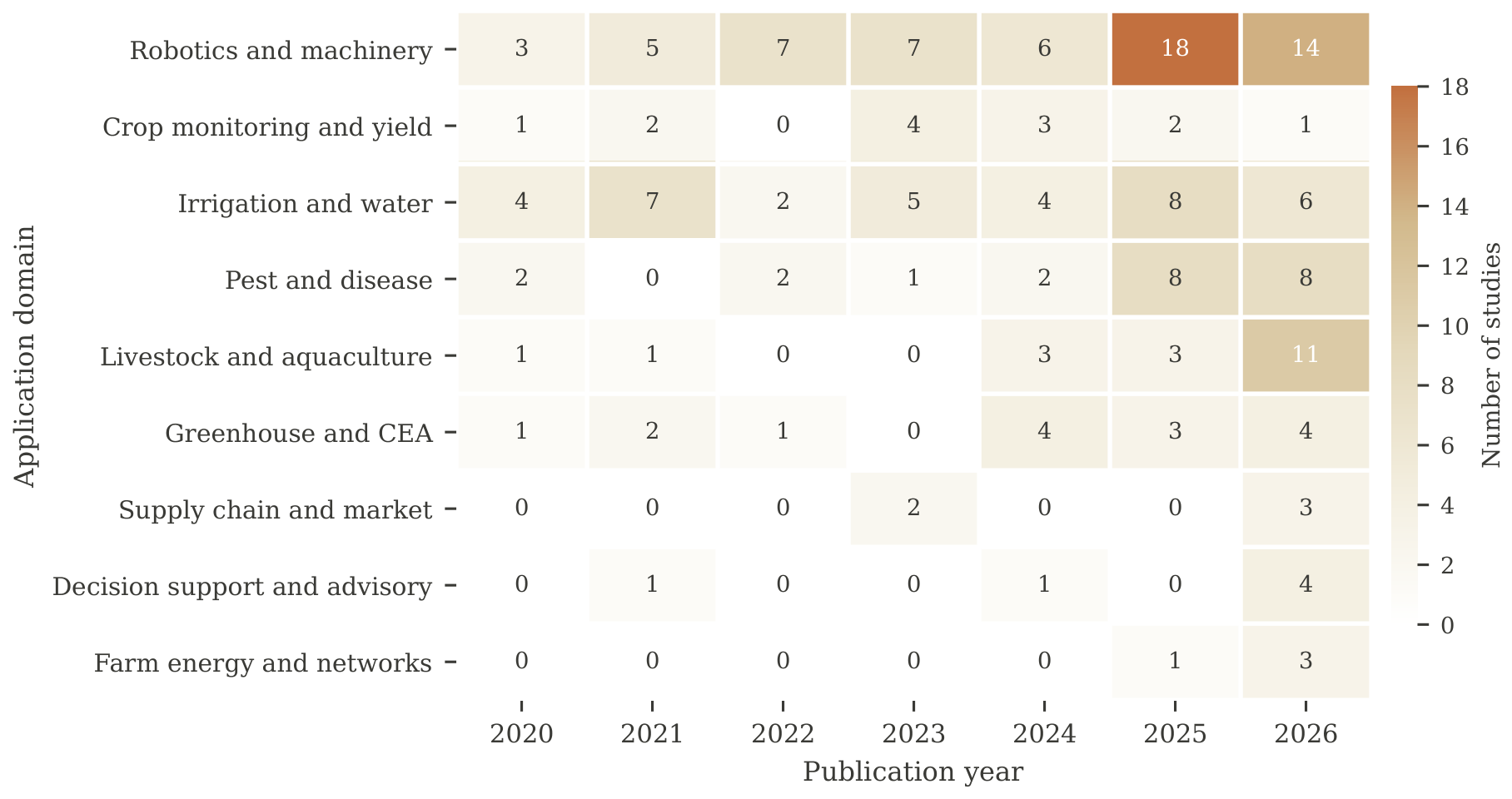
This section answers RQ2. It is organised by application area rather than by paper, so that the reader can see what the literature collectively says about each problem. Table 8 summarises the areas, and Figure 9 shows how each has developed over time.

6.1. Precision Crop Management

Ten studies address crop monitoring and yield management directly. The oldest strand is the digital twin of a plant, developed over several years by Skobelev and colleagues, which simulates crop state from environmental data using an ontology-based knowledge base and provides decisions as a service [13,14,15]. This work has been extended from rice to winter wheat with variety-specific models. It is one of the few lines in the corpus with sustained field evaluation over multiple seasons.
A second strand uses multi-agent systems to handle heterogeneous data. Sinha and colleagues combine big data analysis with agent coordination for yield prediction [44], while Cavaliere and colleagues use agents to combine satellite vegetation indices with ground observation for agroforestry decision support [45]. Huo and colleagues address a problem that most studies ignore, which is that farm data distributions shift over time, and build anomaly detection that accounts for concept drift [46].
The newest strand applies language models to crop knowledge. Zhang and colleagues built PlantGPT, an agent that answers questions about plant functional genomics in Arabidopsis, and designed it specifically to reduce fabricated answers [31]. Raihauti and colleagues use language models to extract semantic metadata from crop model components so that models written on different platforms can be reused together [47]. This second example is interesting because the agent is not advising a farmer at all. It is doing scientific software engineering, which suggests the technology may reach agricultural research infrastructure before it reaches fields.
Common methods. Ontology-driven simulation, multi-agent data fusion, and more recently retrieval-grounded language models.
Advantages. Agents handle the heterogeneity of agricultural data well, since each agent can specialise in one source.
Limitations and gaps. Yield prediction remains largely a supervised learning problem, and it is not obvious that agency adds much to it. The strongest contributions here are in knowledge integration rather than prediction.

6.2. Smart Irrigation

Irrigation is the second largest area with 36 studies and the one with the longest continuous history. It is a natural fit for agent methods because water allocation involves several parties with competing interests.
Early work established the pattern. Jiménez and colleagues built a cyber-physical intelligent agent for irrigation scheduling in horticultural crops [30], then extended it into a hierarchical Internet-of-Things multi-agent system operating at both farm and district scale, reporting improvements in water use efficiency [21]. Bahri and colleagues combined fuzzy cognitive maps with multi-agent systems to handle the uncertainty in irrigation and fertiliser recommendations [48].
Control-theoretic approaches form a second strand. Agyeman and colleagues integrate learning with multi-agent model predictive control to produce a unified irrigation scheduler [49]. Kumar and colleagues push this further with safe multi-agent deep reinforcement learning for combined irrigation and nutrient control, where the safety constraint matters because an unconstrained policy can damage a crop while it explores [50].
A third strand treats water as a shared resource to be negotiated rather than a quantity to be optimised. Several studies use auctions, negotiation protocols and game-theoretic allocation to distribute water among users in a collective irrigation system.
Language model agents have begun to appear here too. Kandamali and colleagues built CottonBot, which combines retrieval-augmented generation with agentic tools to give cotton farmers both general advice and specific irrigation recommendations [38].
Common methods. Hierarchical multi-agent control, reinforcement learning, model predictive control, negotiation and auction mechanisms.
Advantages. Irrigation has five field or real deployment studies out of 36, a share somewhat below the corpus-wide rate, and several of those report concrete efficiency numbers rather than architecture proposals alone, which is why we treat this as a reasonably well-evidenced area rather than a purely proposed one, without claiming it is the strongest in the corpus.
Limitations and gaps. Most systems optimise water alone. Few consider water, energy price and labour together, even though farmers do. Integration with the newer reasoning capabilities is still rare.

6.3. Pest and Disease Management

This area has grown fastest. Of its 23 studies, most were published in 2025 and 2026, and it is where language model agents are most concentrated.
The pattern is consistent across recent work. A vision model detects the problem, and an agent layer decides what to do about it. Zhang and colleagues built Chat Demeter, a multi-agent system that integrates convolutional and transformer models for plant disease diagnosis behind a conversational interface [32]. Qin and colleagues built PDD-AGENT around a multimodal large language model for the same purpose [51]. Abbas and colleagues apply vision transformers to cotton crop stress and frame the contribution explicitly as moving from detection to decision [52].
Two studies stand out for addressing the failure modes rather than the happy path. Munasinghe and colleagues built Safelora specifically because existing advisory systems rely on static knowledge and single-agent reasoning, which means they cannot adapt to real-time field conditions and cannot prevent unsafe recommendations. Their multi-agent design checks recommendations against current conditions and regulatory compliance before issuing them [28]. Cai and colleagues attack interpretability, combining vision-language modelling with environmental sensing and structured knowledge reasoning so that a diagnosis can be traced [6].
Practical deployment concerns appear as well. Radhakrishnan and colleagues target vegetable cowpea in tropical regions and note that current monitoring depends on manual scouting, which is slow and labour-intensive [53]. Tariq and colleagues address connectivity-limited environments by running lightweight models on device with a rule-based agentic layer, avoiding cloud dependence [40].
Common methods. Convolutional or transformer vision models for detection, language model agents for interpretation and advice, retrieval for grounding.
Advantages. The pairing is natural. Vision handles perception well and language models handle explanation and context well.
Limitations and gaps. Most studies are evaluated on image benchmarks rather than in fields, so the reported accuracy describes the detector rather than the agent. Whether the advice is agronomically sound is rarely tested. Safety checking of the kind Munasinghe and colleagues implement remains the exception.

6.4. Livestock Monitoring and Aquaculture

Nineteen studies cover animals. The area splits into monitoring, advice and farm energy.
Monitoring work is mostly sensor-based. Da Rocha Balthazar and colleagues use multi-agent systems with Internet-of-Things sensing to monitor the microclimate in commercial broiler houses, where thermal conditions determine both welfare and productivity [54]. Arul and colleagues combine localisation with proactive disease forecasting in cattle wireless sensor networks [55]. Shanteer and colleagues take a different angle with CowNet-AI, using social network structure within a dairy herd to generate welfare insights [56].
Advisory work has adopted language models quickly. Mandiga and colleagues built NutriCHAT for poultry nutrition using a reasoning and acting framework combined with retrieval and expert-designed tools, so numerical feed calculations are handled by dedicated tools rather than by the language model [7]. Ngo and colleagues built SHREADS for shrimp health diagnosis using agentic retrieval augmented generation [36]. Lee and colleagues use language model orchestration to forecast individual dairy cow milk yield [57], and Zhang and colleagues use a multi-agent framework to build multi-species livestock health knowledge graphs automatically [39].
A distinct and well-developed strand concerns farm energy. Shah and colleagues have worked on peer-to-peer energy trading between dairy farms, first with multi-agent systems [16] and then with multi-agent reinforcement learning [17]. Dairy farming is energy intensive and increasingly generates its own renewable power, which makes trading a genuine multi-agent problem.
Aquaculture appears through robotics. Saad and colleagues built AquaChat++, in which a language model assists coordination of multiple remotely operated vehicles inspecting fish net pens, with battery management and thruster fault tolerance built in [42].
Common methods. Sensor networks with agent-based aggregation, language model advisers with domain tools, reinforcement learning for energy trading.
Advantages. Animals are monitored continuously, which suits agents that must maintain state over time.
Limitations and gaps. Welfare outcomes are seldom measured directly. Most studies measure sensing accuracy or economic return and assume welfare follows.

6.5. Greenhouse Automation

Fifteen studies address greenhouses and controlled environments, where the agent has more control over conditions than anywhere else in agriculture.
Energy is the dominant theme. Ajagekar and colleagues use multi-agent deep reinforcement learning for demand response across a network of greenhouses, noting that climate control and artificial lighting make greenhouses heavy energy users [20]. Zhukovskii and colleagues optimise energy consumption in vertical farming by balancing operation against electricity price peaks while respecting growing constraints [58]. Liu and colleagues extend this to rural power systems where farm demand and grid planning interact [59].
Environmental control and communication form a second theme. Wang and colleagues address the practical problem that greenhouse devices use incompatible protocols, and design an agent-based communication mechanism [60]. Toskov and colleagues present AgroNova, an autonomous platform for greenhouse climate control [61]. Howard and colleagues apply digital twins to greenhouse horticulture production flow, arguing that the long learning cycle in horticulture makes simulation particularly valuable [62].
Common methods. Multi-agent reinforcement learning for control, digital twins for planning, agent middleware for device integration.
Advantages. The closed environment allows genuine closed-loop autonomy, which is rare elsewhere in this corpus.
Limitations and gaps. Crop quality is rarely part of the objective. Systems optimise energy and climate stability, and treat the plant as a constraint rather than a goal.

6.6. Agricultural Robotics

With 60 studies this is the largest area, and it is also the least changed by recent developments. Most of this work is about coordination.
Coverage and path planning dominate. Din and colleagues use deep reinforcement learning for multi-agent area coverage [19]. Davoodi and colleagues address deployment of heterogeneous robot teams in partially known environments using graph partitioning [63]. Many studies address multi-robot coverage, formation control and task allocation for field operations.
Aerial systems form a large subgroup. Qu and colleagues survey experience with unmanned aerial vehicle swarms in smart agriculture [22]. Several studies address spraying mission assignment across heterogeneous farmland where pesticide requirements vary spatially.
Edge computing appears repeatedly because robots cannot rely on connectivity. Boubin and colleagues place multi-agent reinforcement learning at the edge specifically because autonomous in-field agents have computational needs that cannot wait for a round trip to the cloud [35]. Akbari and colleagues use constrained federated learning for service function chaining in drone-aided edge computing [64], and Zhu and colleagues use game-theoretic multi-agent learning to decide what a robot should offload and what it should compute itself [65].
A few recent studies bring language models into robotics. Kode and colleagues demonstrate voice-controlled drone autonomy that scales from a single edge-deployed agent to distributed swarm simulations with a human in the loop [66]. Liu and colleagues combine control methods for robot herding of livestock [67].
Common methods. Multi-agent reinforcement learning, graph-based partitioning, model predictive control, task allocation and auction mechanisms.
Advantages. Robotics has 11 field or real deployment studies, more than any other domain in absolute terms, and a strong quantitative tradition of formal guarantees drawn from the control and multi-agent systems literature, though at 20 percent of its 60 studies its field-tested share is close to the corpus average rather than clearly ahead of it.
Limitations and gaps. Most of it is agentic in the classical sense described in Section 4.1 rather than in the language-model sense: the agents coordinate reliably, but few reason over open-ended information or explain a decision in a way a non-specialist could follow. The opportunity to combine this reliable low-level coordination with the higher-level reasoning more common in the language-model subset of the corpus is largely unexplored, and is one of the directions we return to in Section 9.

6.7. Supply Chain and Logistics

Seven studies address movement of product after the farm gate. Wang and colleagues optimise allocation of sorting resources in rural cold chain warehouses, where sorting quality determines post-harvest loss [68]. Winter and colleagues use a multi-agent value chain model to assess seed and breeding interventions for organic farming [69]. Feng and colleagues design a language model agent-driven online auction mechanism for agricultural products [70], and Wang and colleagues apply an artificial intelligence agent to agricultural futures trading using multiscale candlestick analysis [71].
Limitations and gaps. This area is thin relative to its economic importance. Traceability, food safety and post-harvest loss are large problems that agentic systems appear well suited to, and they are barely represented.

6.8. Farm Decision Support and Advisory

Five studies are coded primarily as advisory, though advisory functions appear throughout the corpus. These are the studies where the agent’s job is the conversation itself.
Cantonjos and colleagues built AgroAskAI, a multi-agent framework designed to answer smallholder farmer enquiries globally, motivated by climate-related risks such as drought and shifting rainfall [72]. Pandit and colleagues built Saajhedar, a multilingual voice-first assistant that helps rural Indian farmers access government schemes despite language and literacy barriers, combining speech recognition, language understanding and agentic dialogue management [12]. This last example is one of the more convincing arguments for the technology, because the barrier being removed is real, well documented and not solvable by better sensors.
Other advisory work includes automated soil classification and fertiliser recommendation [73], knowledge management for farming communities [74], agricultural knowledge dissemination for new farmers [75], and interactive training agents for tomato growers [76]. Pan and colleagues built a multi-agent copilot for agricultural data management and analysis, aimed at researchers rather than farmers [77].
Advantages. Language and literacy barriers are genuine obstacles to agricultural extension, and conversational agents address them directly.
Limitations and gaps. Almost none of these studies report whether farmers actually used the system, whether the advice was correct, or whether anything changed as a result. Usability and agronomic validity are both assumed.

7. Comparative Analysis

Section 6 described what each area contains. This section compares studies across areas and across the two traditions introduced in Section 4.1, using the coding scheme from Section 2.6. Table 9 gives the detailed comparison for every study that uses a large language model or generative backbone, together with the most cited study built on a classical backbone in each application area, so that all nine areas are represented. The reference numbers in the table can be checked directly against author, year and DOI in Table A1.

7.1. Contemporary Systems Against the Classical Corpus

Before looking at cross-cutting patterns within the whole corpus, it is worth asking a more direct question: how different are the 47 studies built on a large language model or generative backbone from the 134 studies built on a classical agent, control or machine learning backbone. Table 10 answers this directly.
A few contrasts stand out. Large language model systems are more often single-agent, 47 percent against 13 percent classical-wide, which fits the account in Section 4.1 that recent systems often get their power from tools attached to one agent rather than from dividing work across several agents. Reasoning and tool use are reported far more often in the language model group, 55 percent and 32 percent against 23 percent and 0 percent, which is close to a defining difference between the groups rather than a small one. Collaboration runs the other way, 62 percent against 89 percent, because the classical group is dominated by the multi-agent coordination tradition.
One contrast is easy to miscount if read carelessly. Language model systems report field or real deployment somewhat more often than classical systems, 26 percent against 16 percent, despite being on average two years younger. This does not mean recent systems are better tested in an absolute sense: both figures are low, and the language model group also reports no specified deployment setting for two-thirds of its studies, compared to just over one-third for the classical group, so the newer systems are not obviously more transparent about where they would run. This does not mean language model systems are worse tested than the classical literature. On the evidence in this table, they are not; both traditions are lightly tested, in different ways.

7.2. Architecture and Application Domain

Figure 10 crosses application domain with organisational pattern. Multi-agent designs are common across most domains, and swarm designs are concentrated in robotics. Reading this cross-tabulation on its own would suggest that architecture tracks domain convention, robotics tends towards multi-agent and swarm designs, advisory work tends towards single agents, but a cross-tabulation of this kind cannot establish why that pattern holds. It is consistent with architecture being chosen by convention, and it is equally consistent with architecture being chosen because the task’s own structure, its safety requirements, its data sources and its available compute favour one pattern over another, which is how architecture is usually justified in the wider software engineering literature.
What we can say with more confidence is narrower. We found no study in the corpus that implemented the same agricultural task under two different organisational patterns and reported a head-to-head comparison. That is a real gap in the evidence base regardless of how architecture choices are currently being made, because it means a future designer has little published, controlled evidence to draw on when choosing between patterns for a new task.

7.3. Backbone and Level of Autonomy

Figure 11 crosses backbone with autonomy level. Optimisation, control-theoretic and reinforcement learning backbones have more studies in the semi-autonomous and autonomous columns. Language model backbones are individually most common in the advisory column, 17 of 47, but not by a wide margin: when semi-autonomous and autonomous studies are combined, 30 of 47 language model studies, a majority, sit outside the purely advisory category. As Table 10 shows, control-related categories include a substantial share of advisory studies too, so neither backbone family maps cleanly onto a single autonomy level.
This observed relationship should be interpreted as a tendency rather than a categorical divide. Whether a system can be trusted to act depends on verification and safety engineering, not simply on whether its backbone is symbolic, statistical or generative. Systems whose outputs are easier to bound and verify, which in this corpus tend to be control and optimisation systems, are more often given direct authority over actuators. By contrast, systems whose outputs are harder to bound in advance, which in this corpus tend to be language-model systems, are more often kept in an advisory role. A handful of studies work directly on this boundary rather than accepting it. Kumar and colleagues add explicit safety constraints to multi-agent reinforcement learning for irrigation and nutrient control [50]. Mandiga and colleagues delegate all numerical work from the language model to verified tools [7]. Munasinghe and colleagues add a compliance layer that blocks unsafe advice [28]. We see these as three different routes towards the same design problem, giving a system that can both reason in an open-ended way and act with bounded, checkable consequences, and as the part of the corpus most worth building on.

7.4. Abstract-Reported Capability Patterns

The most direct comparison in this review is between what agentic systems are often assumed to do and what the studies themselves report doing. Table 11 and Figure 12 give the reported-capability matrix, crossing application domain with the six capabilities from Section 4, reported as raw counts against each domain’s own total alongside the percentage, since several domains have few studies and a percentage alone can overstate how solid a pattern is. Supply chain, advisory and farm energy each have fewer than ten studies, so a single study moves their percentages by ten points or more, and we treat the percentages in those three rows as illustrative rather than as a stable estimate of the domain.
Across the whole corpus, collaboration is reported by 148 of 181 studies, 82 percent. Planning and reasoning each appear in 56 and 57 studies, 31 percent. Tool use appears in 15 studies, 8 percent; memory in 10 studies, 6 percent; and reflection in 7 studies, 4 percent.
Figure 13 shows the same numbers as a ranking. Part of this shape follows directly from Section 7.1: collaboration is high mainly because the older, larger multi-agent tradition reports it almost by construction, while memory, tool use and reflection sit close to zero across the whole corpus and somewhat higher, though still a minority, within the language model subset alone.
These results require careful interpretation. We coded a capability as present when the abstract describes it. An abstract is a compressed summary, and authors often leave out mechanisms that a reader would consider standard or that are described only in the method section of the full text. A study whose full text implements memory through a case library or an interaction log, but whose abstract does not use any of the words our coding rule looked for, would be coded as not reporting memory. This means the counts in Table 11 measure what studies report in their abstracts, not directly what their systems implement, and the gap between those two things could in principle run in either direction: generous coding of vague claims could inflate a count, and terse abstracts that omit real mechanisms could deflate one. We do not have a reliable way to say which effect dominates overall from abstract text alone. What we did to check this is described in Section 2.6 and Section 10.3: a manual re-reading of a random subsample of 30 studies against their coded fields. That check agreed with the automated coding on 25 of 30 records for agricultural domain, 29 of 30 for organisational pattern, 28 of 30 for backbone, 29 of 30 for level of autonomy, and 22 of 30 for evaluation strategy, the weakest of the five, giving us reasonable but not complete confidence in the pattern reported here. Capability tags themselves were not part of this quantitative check, for the reasons given in Section 2.6.
The matrix is therefore interpreted as a map of reporting patterns rather than as direct evidence of implemented or missing capabilities. Low or zero values identify combinations for which the abstracts provide little explicit information and where targeted full-text investigation would be particularly useful. They should not, by themselves, be treated as demonstrated technological or research gaps.

7.5. Evaluation Evidence Reported in the Publication Records

Table 12 reports evaluation strategy, deployment setting, and two further quality markers: whether a study reports a baseline or comparative evaluation, and whether it reports a multi-period or longitudinal evaluation. We define the five evaluation categories as follows and treat them as mutually exclusive, assigning each study to the strongest form of evidence it reports: field or real deployment means the system or a working prototype of it was run outside a simulator, against real farm conditions or real operational data; dataset benchmark means performance is reported against a held-out dataset without a real deployment; simulation means results come from a simulator, digital twin or numerical model without real-world data; case study means a single real-world instance is described narratively without a quantitative benchmark; and conceptual or qualitative means the study proposes an architecture or framework without reporting a quantitative evaluation of any kind. A study that reports both a simulation and a field trial is coded under field or real deployment, its strongest form of evidence, which is why the categories do not double count a study across rows.
Sixty-eight studies, 38 percent of the corpus, are conceptual under this definition. A further 60 are evaluated only in simulation. Nineteen use a dataset benchmark, which usually measures a component such as a disease classifier rather than the agent as a whole. Thirty-three studies, 18 percent, report a field or real deployment. One reports a case study.
The two additional markers add some texture. Sixty-seven studies, 37 percent, report a baseline or comparative evaluation of some kind, which is encouraging and higher than the field or real deployment figure on its own would suggest, since a study can compare against a baseline in simulation without ever leaving it. Only eleven studies, 6 percent, report a multi-period or longitudinal evaluation, and this holds even among the 33 field-tested studies, where only one of 33 reports this explicitly. Most deployments in this literature, in other words, are short trials rather than sustained operation across a season, even when they do reach a real farm.
The deployment column reinforces the evaluation picture without being identical to it. Sixty-eight studies are simulation-only and 82 do not specify a deployment setting at all. Only 31 studies name a concrete setting of edge, cloud or hybrid. The 82 unspecified studies show that deployment setting is under-reported in this literature, not that those systems have no plausible path to deployment; a study can have a perfectly sound deployment story that its abstract simply does not mention. The finding we are confident in is about reporting practice, and we have edited the rest of this paper to keep that distinction visible wherever we discuss deployment.
Combining these observations gives one of the central findings of this review. The literature contains many architectures and comparatively few tested systems, and few of the tested systems are tested for long. That pattern is not unusual for a young sub-field and is not unique to agentic systems, but it does mean that claims about what agentic systems can deliver in agriculture currently rest more on design argument than on demonstrated outcomes, and we think readers, including funding bodies and technology providers, should weigh performance claims from this literature with that in mind until field evaluation catches up.
There are exceptions worth naming, because they show what stronger evidence looks like within this corpus. The digital twin of plant work reports multi-season field use across several crop varieties [14,15]. The edge-enabled framework of Tariq and colleagues reports on-device performance under realistic connectivity constraints [40]. The irrigation work of Jiménez and colleagues reports water use efficiency measured at farm and district scale [21]. Toskov and colleagues report a seven-month deployment of a greenhouse climate platform with over 380,000 environmental measurements collected, one of the most sustained field evaluations of a language-model-assisted system in the corpus [61].

7.6. Trends Across the Corpus

We draw five observations from the comparison above. We have tried to state each one at the level of confidence the underlying data actually supports.
  • Two traditions with different strengths coexist in this corpus. An older, larger, control and optimisation oriented tradition and a newer, smaller, language model-oriented tradition report different profiles of capability, autonomy and data source, summarised directly in Table 10. Very few studies combine both in one system.
  • Reported capability is uneven across the corpus, and the newer tradition accounts for most of what memory, tool use and reflection there is. This should be read as a description of reporting practice in the literature we screened, not as a claim that we verified each system’s internal implementation.
  • No study in the corpus compares two organisational patterns on the same agricultural task. We can describe which patterns are common in which domains; we cannot, from this evidence, say why.
  • Evaluation lags behind proposal, and long-running evaluation lags further still. Eighteen percent of the corpus reports field or real deployment, and only one study of 33 reports a multi-period evaluation.
  • Deployment setting is under-reported. Nearly half the corpus does not say where the system would run, which we read as a reporting gap rather than evidence about deployability one way or the other.

8. Challenges and Open Issues

This section answers RQ5. We group the challenges into eight categories and summarise what the literature says about each. Unlike the six agentic capabilities in Section 4.3, these eight categories were not coded as a formal yes or no variable for all 181 studies; they are a narrative synthesis built from close reading of the studies most relevant to each theme, generally the ones already discussed in Section 6, together with a small number of representative examples cited by name. Where we describe how well a challenge is being addressed, that judgement should be read as the authors’ qualitative assessment of the literature we read closely, not as a quantitative count across the whole corpus in the way the capability and evaluation figures elsewhere in this paper are. Table 13 gives the summary in the same spirit, as a structured narrative rather than coded counts.

8.1. Technical Robustness and Hallucination

The best-known weakness of language models is that they produce confident wrong answers. In agriculture this is not a cosmetic problem. A wrong chemical, a wrong dose or a wrong application window can destroy a crop or breach regulation.
Several studies name this directly and design against it. Zhang and colleagues built PlantGPT with explicit attention to inaccurate output [31]. Mandiga and colleagues remove numerical reasoning from the language model entirely and delegate it to expert-designed tools [7]. Munasinghe and colleagues add a compliance and safety layer that can suppress a recommendation [28].
These are good responses, but they are a small minority. Most studies that use a language model do not discuss failure modes at all.

8.2. Data Quality and Interoperability

Agricultural data is messy, sparse and non-standard. Sensors fail, calibration drifts and formats differ between vendors. Two studies address this structurally. Wang and colleagues design an agent-based communication mechanism precisely because greenhouse devices use incompatible acquisition and control protocols [60]. Raihauti and colleagues use language models to extract metadata from crop model components so that models written for different platforms can interoperate [47].
Huo and colleagues raise a subtler issue, which is concept drift. Farm data distributions change with season, weather and management, so a model that was accurate last year may not be this year [46]. Only that study addresses it in our corpus, which is a notable gap for systems intended to run continuously.

8.3. Computational Cost

Running a large language model is expensive in both money and energy, and farm margins are thin. Very few studies report cost. Where compute is discussed it is usually in the context of edge constraints rather than economics. Manwatkar and colleagues design explicitly under energy and latency constraints [43], and Boubin and colleagues place learning at the edge because in-field agents cannot afford round trips to the cloud [35]. The absence of cost analysis across the rest of the corpus makes it hard to judge whether any of these systems would be economically viable.

8.4. Connectivity and Edge Deployment

Many farms have poor or intermittent connectivity, and this is a hard constraint rather than an inconvenience. Tariq and colleagues build their whole framework around it, running lightweight perception and rule-based agentic decision-making on device [40]. Desai and colleagues address the network side, proposing spectrum-aware architectures for rural agriculture [89], and Sun and colleagues consider integrated ground, air and space networks for remote farms [34].
The tension is structural. The capabilities that make agents useful, especially large models and retrieval over big knowledge bases, are the capabilities that are hardest to run at the edge. This is one of the defining engineering problems of the field and it is currently addressed by a handful of studies.

8.5. Security and Privacy

Farm data is commercially sensitive, and connected agricultural systems have a large attack surface. Only a few studies in our corpus treat security as a first-class concern. Some address secure network protocols for agricultural Internet of Things, and one strand uses federated learning so that data does not leave the farm [64]. Agentic systems raise new questions that the corpus does not yet address at all, such as what happens when an agent with actuator access is manipulated through its text inputs.

8.6. Explainability

Farmers need to understand advice before acting on it, and in some jurisdictions regulators require it. Cai and colleagues address this directly by grounding plant health diagnosis in structured knowledge so that the reasoning is inspectable [6]. The rare disease work in medicine shows the same idea taken further, with traceable reasoning chains as an explicit design goal [2], and trust-aware orchestration has been proposed as a general mechanism for agentic systems [101].
In agriculture this remains rare. Most systems present a conclusion without a path to it.

8.7. Ethical and Regulatory Issues

Pesticide application, water abstraction and animal welfare are all regulated, and rules differ by region and change over time. Two studies engage with this. Girardi and colleagues build an assistant for legal framing in agricultural oversight using retrieval over regulatory documents [37]. Munasinghe and colleagues embed regulatory compliance in the advisory loop [28].
Beyond compliance sit questions of responsibility. If an autonomous agent applies the wrong treatment, who is accountable? Parra-López and colleagues raise governance as the central question of Agriculture 5.0 [1], but the corpus contains no study that works through liability in practical terms.

8.8. Farmer Acceptance and Usability

This is the largest gap of all. A handful of studies are designed around real user constraints. Pandit and colleagues target language and literacy barriers directly with a voice-first multilingual assistant [12]. Cantonjos and colleagues design for smallholder enquiries [72]. Gangadhar and colleagues build an interactive training agent for tomato farmers [76].
But almost no study in the corpus reports user testing with actual farmers, adoption rates, or whether advice changed behaviour. Given that the entire justification for these systems is that they help farmers, the absence of evidence that farmers find them helpful is striking.

9. Future Research Directions

This section addresses RQ6 by presenting a forward-looking synthesis based on the patterns reported across the included publication records, the examples discussed in the preceding sections, and priorities established in related literature. None of the directions below is a new idea in artificial intelligence, agent research or robotics generally; every one of them has been proposed somewhere in that wider literature before this review. What Table 14’s final column distinguishes is not novelty but motivation: whether the case for prioritising a direction in agriculture specifically comes from a pattern we observed in this corpus, or whether it simply restates a priority already well established elsewhere that this review’s evidence neither confirms nor challenges in any agriculture-specific way. Neither column should be read as claiming the direction itself originates here. These directions represent author-proposed priorities rather than empirical forecasts or confirmation that particular capabilities are absent from the underlying systems. Figure 14 organises the proposed directions by approximate time horizon, while Table 14 summarises the record-level observations and broader considerations that motivate them.

9.1. Domain-Specific Agricultural Agents

General-purpose language models may not provide the specialised regional and crop-specific knowledge required for reliable agricultural decisions. Selected systems in the corpus demonstrate the value of narrow, expert-grounded applications in poultry nutrition [7], shrimp health [36], cotton [38], and vegetable cowpea [53]. Future research should therefore prioritise curated regional knowledge bases and tools validated by agricultural experts.

9.2. Multi-Agent Collaboration Across Scales

The included records mainly describe coordination within a single operational scale, such as robot fleets or irrigation networks. Greater value may come from connecting decisions across plants, fields, farms, cooperatives, and supply chains. The multi-agent value-chain model of Winter and colleagues [69] and the territorial governance perspective of Parra-López and colleagues [1] provide useful foundations for investigating such cross-scale coordination.

9.3. Explainable Agentic Systems

Agricultural agents should provide explanations that identify the observations, agronomic knowledge, and regulatory constraints supporting their recommendations. However, a generated explanation is not necessarily a faithful representation of the system’s decision process, as discussed in Section 4.3. Knowledge-grounded relationships [6] and traceable reasoning chains from adjacent fields [2] offer promising approaches, although their reliability must be evaluated independently.

9.4. Edge-Native Agents

Agricultural agents operating under limited rural connectivity require small models, local knowledge storage, offline functionality, and clear rules governing which decisions can be executed without network access. Among the analysed records, 68 report simulation as the only setting and 82 do not report a deployment setting. These values indicate limited deployment information in the available records rather than confirmed technical infeasibility. The approaches of Tariq and colleagues [40] and Manwatkar and colleagues [43], together with broader cloud–edge collaboration patterns [102], provide useful foundations for edge-native agricultural agents.

9.5. Integration with Digital Twins

Digital twins can provide controlled environments in which an agent evaluates a plan before applying it to a real agricultural system. This combination is already recognised in the wider digital-twin literature [11]. Plant-level digital twins [13,15] and the cloud–fog–edge architecture proposed by Kalyani and colleagues [41] illustrate relevant foundations. Future studies could extend these systems from monitoring and visualisation towards planning, simulation, and risk-aware decision support.

9.6. Autonomous Robotic Ecosystems

The reported profiles in Section 7.1 suggest complementary strengths. Classical robotic systems commonly emphasise coordination and direct control, whereas language-model systems more often report reasoning and tool use while remaining advisory. Combining these approaches could place a reasoning layer above a verified control stack, with safety constraints preventing commands outside an accepted operational envelope. The safety mechanisms presented by Kumar and colleagues [50] and Munasinghe and colleagues [28], together with the voice-controlled drone system of Kode and colleagues [66], illustrate possible components of this architecture.

9.7. Standardised Benchmarks and More Consistent Reporting

Comparison across agricultural agents remains difficult because studies use different tasks, datasets, evaluation settings, and performance measures. Shared benchmarks should therefore evaluate complete multi-step tasks rather than isolated classification components. A minimum reporting standard should also specify deployment conditions, connectivity assumptions, autonomy boundaries, and how each capability defined in Section 4.3 is implemented and evaluated. Clear reporting would allow architectural claims to be examined without relying on broad labels such as “agent” or “agentic.”

9.8. Sustainability-Aware Agent Design

The analysed publication records predominantly report objectives related to yield, cost, and water use, while soil health, biodiversity, emissions, and their interactions receive less explicit attention. These broader trade-offs are central to Agriculture 5.0 [1] and are well suited to the planning and reasoning capabilities discussed in Section 4.3. Sustainability-aware agents should therefore evaluate multiple environmental, economic, and production objectives rather than optimise a single outcome.

9.9. Field Evaluation as a Priority

Field evaluation is a cross-cutting priority. Based on the available publication records, 68 studies were classified as conceptual or qualitative, 33 explicitly reported field or real-world deployment, and 11 reported a multi-period or longitudinal evaluation. Because these classifications rely on consistently available record-level information, they indicate how evaluation is reported rather than proving that unreported evaluation is absent from the full texts. Nevertheless, the limited explicit reporting of long-term field evidence supports greater emphasis on transparent evaluations conducted under real farming conditions, with real users and across more than one production period.

10. Conclusions

This review examined how agentic artificial intelligence, in both its classical and its contemporary forms, is being applied to agriculture. From 4111 Scopus records published between 2020 and 2026, we screened down to 181 studies using a PRISMA 2020 protocol, coded each one along six dimensions and six agentic capabilities, and checked a random subsample of that coding by hand.

10.1. Major Findings

The research tradition represented by the corpus spans more than three decades, whereas the language-model subset is very young. Agent-based and multi-agent work in agriculture predates the window this review covers by some thirty years, as Section 4.1 sets out. Within that longer history, studies using large language models appear only from 2024. Forty-six of the 47 such studies were published in 2025 or 2026, and annual output in this subset nearly doubled between 2024 and 2025.
The corpus contains two traditions with different, complementary profiles rather than a strict opposition. An older, larger tradition built on multi-agent systems, reinforcement learning and optimisation reports more collaboration and more direct action on the physical world. A newer, smaller tradition built on language models reports more reasoning and tool use and is more often kept in an advisory role. Backbone correlates with autonomy level as a tendency, not a categorical rule, and only a handful of studies attempt to combine the strengths of both.
Agentic capabilities are unevenly reported. Collaboration is reported by 82 percent of studies, while planning and reasoning each appear in 31 percent, tool use in 8 percent, memory in 6 percent and reflection in 4 percent. Memory is reported by no studies at all in five of the nine application domains, and reflection likewise in five. We coded these fields from abstracts using broadened definitions that cover both classical and language-model mechanisms, described in Section 4.3, and a manual check against a random subsample agreed with the automated coding on the large majority of fields, though evaluation strategy was the weakest of the five single-label fields we checked, at 73 percent agreement. We present these figures as a description of what the literature reports, not as a directly verified account of what every underlying system implements.
Tested evidence lags well behind proposed architecture, and long-running evidence lags further still. Thirty-nine percent of studies are conceptual, 33 percent are evaluated only in simulation, and 18 percent report a field or real deployment. Of those field-tested studies, only one in 33 also reports a multi-period or longitudinal evaluation. Sixty-eight studies use simulation as their only setting and 82 do not state where the system would run, which we read as a reporting gap rather than as direct evidence that those systems have no deployment path.
Applications are concentrated where the older tradition was strong. Robotics and irrigation together account for more than half the corpus, while supply chain, post-harvest and advisory work are thin relative to their economic importance. Pest and disease management is the area growing fastest under the influence of language model agents.

10.2. Practical Implications

For researchers, we think the most valuable contribution now is not another architecture proposal. It is a system tested on a real farm over more than one season, with reported deployment constraints and cost, and with a clear statement of which of the six capabilities in Section 4.3 the system actually implements. The reporting matrix identifies areas in which capabilities such as memory, reflection, and tool use are seldom mentioned in abstracts. These patterns motivate targeted full-text studies to determine whether they represent implementation gaps, reporting gaps, or a combination of both. For technology providers and funders, the practical message is caution about performance claims taken from this literature at face value. A system described as agentic may implement few of the capabilities the word suggests, and few systems in this literature have been tested outside simulation or for more than a single trial period.
For policymakers and extension services, the most credible near-term value we found lies in language and knowledge access rather than autonomous action. Systems that remove language and literacy barriers to agricultural advice, such as the multilingual assistant of Pandit and colleagues [12], address a real and documented problem with technology that is mature enough to deploy now, independent of how the harder open questions about autonomy and reasoning are eventually resolved.

10.3. Limitations of This Review

The following limitations mainly concern the completeness of the corpus and the interpretation of individual classifications, rather than the broad patterns identified across the 181 included publications.
Database coverage and temporal scope. The search was conducted in Scopus only. Scopus provides broad coverage of peer-reviewed journals and conference proceedings, indexes most IEEE publications, and substantially overlaps with Web of Science and other major bibliographic databases. Additional databases could nevertheless contribute some records, particularly recent, selectively indexed, or preprint publications, as illustrated by [103]. Such omissions are more likely to affect marginal counts and emerging topics than the main distributions observed in the corpus, although this was not directly tested through a second database. Moreover, because the search was conducted in August 2026, the 2026 count is necessarily partial, most visibly in Figure 3.
Protocol and coding scope. A fixed review protocol was followed, although it was not publicly pre-registered. Corpus-wide classification was based on titles, abstracts and keywords to ensure a consistent information source across all included records. Consequently, mechanisms described only in the full text may be coded as not reported. The manual consistency check described in Section 2.6 nevertheless showed substantial agreement for the principal fields. The resulting percentages should therefore be interpreted as indicative patterns in the information reported by the publications rather than exact measurements of every implemented system feature.
Classification choices. Some taxonomy boundaries required transparent methodological judgement, including the mutually exclusive organisational-pattern categories and the boundary applied to socio-economic agent-based modelling. Alternative classification rules could change a small number of assignments. Similarly, recording the country of the first author’s first listed affiliation simplifies the geographical analysis and may underrepresent international collaboration. These choices principally affect category-level detail and should be considered when interpreting individual counts.

10.4. Closing Remark

Agentic artificial intelligence in agriculture combines a long-established tradition of agent-based systems with a rapidly developing generation of language-model-based approaches. The mapped literature indicates strong growth and a close relationship between agent capabilities and agricultural decision-making, while sustained field and multi-period evaluation is reported less frequently. Future progress will therefore depend on translating promising architectures into transparently evaluated systems tested under real agricultural conditions and reported in sufficient detail to support comparison and replication.

Supplementary Materials

The following supporting information can be downloaded at https://www.mdpi.com/article/10.3390/technologies14090591/s1.

Author Contributions

Conceptualization, K.M. and A.M.; methodology, K.M.; software, K.M.; validation, K.M. and A.M.; formal analysis, K.M.; investigation, K.M. and A.M.; resources, A.M.; data curation, K.M.; writing—original draft preparation, K.M.; writing—review and editing, K.M. and A.M.; visualization, K.M.; supervision, A.M.; project administration, A.M. All authors have read and agreed to the published version of the manuscript.

Funding

This research received no external funding.

Data Availability Statement

The Scopus export used for screening and the coded extraction table are available from the corresponding author on request and are summarised in Appendix A.

Conflicts of Interest

The authors declare no conflicts of interest.

Appendix A. Characteristics of All Included Studies

Table A1 lists all 181 studies included in the review together with the coding applied to each one, matching the supplementary spreadsheet described in the Data Availability Statement. Studies are grouped by application domain and ordered by year within each group. Abbreviations follow Table 9.
Table A1. Coding of all 181 included studies.
StudyYearDomainArch.BackboneAutonomyEvaluation
[104]2026RoboticsMultiMiddlewareAdvisoryConceptual
[105]2026RoboticsMultiRLSemiConceptual
[106]2026RoboticsMultiMiddlewareAuton.Benchmark
[78]2026RoboticsMultiLLMAuton.Field
[79]2026RoboticsMultiLLMAuton.Field
[37]2026RoboticsMultiLLM hybridSemiField
[80]2026RoboticsHier.LLMSemiBenchmark
[66]2026RoboticsSwarmMiddlewareAuton.Field
[75]2026RoboticsSingleLLMAuton.Conceptual
[107]2026RoboticsMultiRL + DLSemiConceptual
[108]2026RoboticsHier.RLAuton.Simulation
[109]2026RoboticsMultiRL + DLAdvisorySimulation
[110]2026RoboticsMultiRL + DLSemiConceptual
[81]2026RoboticsMultiLLMSemiConceptual
[82]2025RoboticsSingleLLM hybridAdvisoryConceptual
[83]2025RoboticsMultiLLM hybridSemiField
[111]2025RoboticsMultiOptim.SemiConceptual
[70]2025RoboticsSingleLLM hybridAdvisoryBenchmark
[112]2025RoboticsSwarmRL + DLSemiSimulation
[113]2025RoboticsMultiMiddlewareSemiSimulation
[114]2025RoboticsMultiMiddlewareSemiSimulation
[115]2025RoboticsMultiMiddlewareSemiSimulation
[116]2025RoboticsMultiMiddlewareSemiSimulation
[84]2025RoboticsMultiLLM hybridSemiField
[117]2025RoboticsMultiOptim.Auton.Simulation
[118]2025RoboticsMultiRL + DLSemiConceptual
[119]2025RoboticsMultiRLSemiSimulation
[85]2025RoboticsSingleLLM hybridAuton.Conceptual
[120]2025RoboticsMultiMiddlewareAdvisorySimulation
[71]2025RoboticsSingleLLMSemiConceptual
[121]2025RoboticsMultiRL + DLSemiField
[122]2025RoboticsMultiRLSemiConceptual
[123]2024RoboticsMultiDLSemiConceptual
[124]2024RoboticsMultiMiddlewareSemiField
[125]2024RoboticsSingleMiddlewareAuton.Simulation
[126]2024RoboticsMultiKB/BDIAdvisoryConceptual
[77]2024RoboticsHier.LLMSemiConceptual
[127]2024RoboticsMultiDLSemiConceptual
[64]2023RoboticsHier.RLAdvisorySimulation
[128]2023RoboticsMultiMiddlewareSemiSimulation
[129]2023RoboticsSwarmMiddlewareAdvisorySimulation
[130]2023RoboticsMultiOptim.SemiSimulation
[131]2023RoboticsMultiOptim.SemiSimulation
[132]2023RoboticsMultiOptim.SemiConceptual
[65]2023RoboticsMultiRLSemiSimulation
[35]2022RoboticsSwarmRLAuton.Field
[19]2022RoboticsMultiRL + DLSemiConceptual
[133]2022RoboticsMultiOptim.SemiBenchmark
[134]2022RoboticsMultiOptim.SemiSimulation
[22]2022RoboticsHier.RL + DLSemiConceptual
[135]2022RoboticsMultiKB/BDIAuton.Conceptual
[136]2022RoboticsMultiKB/BDIAdvisoryField
[63]2021RoboticsMultiOptim.Auton.Simulation
[137]2021RoboticsMultiRL + DLSemiConceptual
[14]2021RoboticsMultiKB/BDISemiField
[138]2021RoboticsMultiKB/BDISemiSimulation
[139]2021RoboticsMultiKB/BDISemiSimulation
[140]2020RoboticsMultiKB/BDISemiSimulation
[141]2020RoboticsHier.KB/BDIAdvisoryConceptual
[142]2020RoboticsMultiOptim.SemiField
[86]2026Crop/yieldHier.LLM hybridAdvisoryBenchmark
[143]2025Crop/yieldSingleOptim.Auton.Simulation
[31]2025Crop/yieldSingleLLM hybridAdvisoryConceptual
[144]2024Crop/yieldMultiRL + DLAdvisoryBenchmark
[145]2024Crop/yieldMultiMiddlewareAdvisorySimulation
[15]2024Crop/yieldMultiKB/BDIAdvisoryField
[46]2023Crop/yieldSingleMiddlewareAdvisoryConceptual
[146]2023Crop/yieldMultiKB/BDIAdvisoryConceptual
[147]2023Crop/yieldMultiMiddlewareAdvisoryConceptual
[44]2023Crop/yieldMultiDLAdvisoryConceptual
[45]2021Crop/yieldMultiMiddlewareSemiConceptual
[148]2021Crop/yieldSwarmDL + sym.AdvisorySimulation
[13]2020Crop/yieldMultiKB/BDIAdvisoryField
[72]2026AdvisoryMultiLLMAuton.Conceptual
[12]2026AdvisorySingleMiddlewareAdvisoryField
[47]2026AdvisoryMultiLLMAdvisoryBenchmark
[73]2026AdvisorySingleLLM hybridAdvisoryBenchmark
[149]2024AdvisoryMultiRLAdvisoryConceptual
[87]2021AdvisoryMultiKB/BDISemiSimulation
[43]2026EnergySwarmLLM hybridAuton.Field
[88]2026EnergySingleLLM hybridSemiConceptual
[90]2026EnergyMultiRL + DLAdvisoryConceptual
[89]2025EnergyHier.MiddlewareAdvisoryConceptual
[91]2026GreenhouseSingleLLM hybridSemiConceptual
[150]2026GreenhouseSingleDLAdvisoryConceptual
[151]2026GreenhouseMultiRLSemiBenchmark
[61]2026GreenhouseSingleLLM hybridAuton.Field
[92]2025GreenhouseMultiLLM hybridSemiBenchmark
[152]2025GreenhouseMultiMiddlewareAuton.Simulation
[153]2025GreenhouseSingleOptim.Auton.Simulation
[20]2024GreenhouseMultiRL + DLSemiConceptual
[154]2024GreenhouseMultiRL + DLSemiSimulation
[59]2024GreenhouseMultiOptim.Auton.Simulation
[58]2024GreenhouseMultiOptim.SemiConceptual
[62]2022GreenhouseMultiMiddlewareAdvisorySimulation
[155]2021GreenhouseSingleMiddlewareAuton.Simulation
[156]2021GreenhouseSingleDLSemiConceptual
[60]2020GreenhouseMultiDL + sym.SemiConceptual
[157]2026IrrigationMultiRLAuton.Simulation
[158]2026IrrigationSingleRLSemiSimulation
[50]2026IrrigationMultiRL + DLSemiSimulation
[93]2026IrrigationSingleLLM hybridSemiConceptual
[159]2026IrrigationMultiRL + DLSemiSimulation
[160]2026IrrigationMultiRL + DLSemiBenchmark
[161]2025IrrigationSingleMiddlewareSemiConceptual
[162]2025IrrigationMultiKB/BDIAuton.Simulation
[163]2025IrrigationSingleRLAdvisorySimulation
[164]2025IrrigationMultiRLAuton.Simulation
[165]2025IrrigationSingleMiddlewareAdvisoryConceptual
[166]2025IrrigationMultiRLAdvisoryConceptual
[167]2025IrrigationMultiRLAuton.Simulation
[94]2025IrrigationSingleLLMSemiConceptual
[49]2024IrrigationMultiRL + DLSemiConceptual
[168]2024IrrigationMultiOptim.SemiSimulation
[41]2024IrrigationMultiKB/BDISemiConceptual
[169]2024IrrigationHier.MiddlewareSemiConceptual
[170]2023IrrigationMultiOptim.AdvisoryConceptual
[171]2023IrrigationMultiMiddlewareSemiConceptual
[172]2023IrrigationMultiMiddlewareSemiField
[173]2023IrrigationSingleMiddlewareAuton.Field
[174]2023IrrigationMultiDL + sym.AdvisoryField
[21]2022IrrigationHier.MiddlewareAuton.Simulation
[175]2022IrrigationSingleKB/BDIAuton.Conceptual
[176]2021IrrigationMultiOptim.AdvisoryConceptual
[177]2021IrrigationSingleMiddlewareSemiSimulation
[178]2021IrrigationMultiMiddlewareSemiField
[179]2021IrrigationHier.Optim.SemiConceptual
[180]2021IrrigationHier.Optim.SemiSimulation
[181]2021IrrigationSwarmDL + sym.AdvisoryConceptual
[18]2021IrrigationSwarmDLSemiSimulation
[48]2020IrrigationMultiKB/BDIAdvisorySimulation
[182]2020IrrigationMultiOptim.AdvisoryConceptual
[30]2020IrrigationSingleMiddlewareSemiConceptual
[183]2020IrrigationMultiMiddlewareSemiField
[184]2026LivestockMultiOptim.AdvisoryConceptual
[57]2026LivestockHier.LLMAdvisoryBenchmark
[95]2026LivestockSingleLLMSemiConceptual
[67]2026LivestockMultiOptim.SemiField
[7]2026LivestockSingleLLM hybridAdvisoryConceptual
[185]2026LivestockMultiMiddlewareSemiSimulation
[42]2026LivestockMultiLLMAuton.Simulation
[186]2026LivestockMultiRL + DLAdvisoryConceptual
[56]2026LivestockMultiLLM hybridAuton.Simulation
[33]2026LivestockMultiLLM hybridAuton.Field
[39]2026LivestockHier.LLM hybridAdvisoryBenchmark
[55]2025LivestockMultiRLAdvisoryConceptual
[36]2025LivestockMultiLLM hybridAdvisoryBenchmark
[17]2025LivestockMultiRLAdvisorySimulation
[187]2024LivestockMultiMiddlewareSemiSimulation
[16]2024LivestockMultiOptim.SemiSimulation
[54]2024LivestockHier.KB/BDIAdvisoryConceptual
[188]2021LivestockMultiMiddlewareSemiField
[189]2020LivestockMultiMiddlewareSemiCase study
[52]2026Pest/diseaseSingleLLM hybridAdvisoryConceptual
[6]2026Pest/diseaseMultiLLMAuton.Benchmark
[74]2026Pest/diseaseSingleLLM hybridAdvisoryConceptual
[28]2026Pest/diseaseMultiLLM hybridSemiConceptual
[53]2026Pest/diseaseMultiDLAdvisoryConceptual
[96]2026Pest/diseaseSingleLLM hybridAdvisoryField
[97]2026Pest/diseaseSingleLLM hybridAdvisoryConceptual
[32]2026Pest/diseaseMultiDLSemiBenchmark
[98]2025Pest/diseaseMultiLLM hybridAuton.Simulation
[99]2025Pest/diseaseSingleLLM hybridAuton.Field
[76]2025Pest/diseaseSingleLLMAdvisoryBenchmark
[38]2025Pest/diseaseSingleLLMSemiField
[190]2025Pest/diseaseMultiKB/BDIAuton.Field
[51]2025Pest/diseaseHier.LLMAdvisoryConceptual
[191]2025Pest/diseaseSingleDLAdvisoryField
[40]2025Pest/diseaseSingleLLM hybridAuton.Field
[192]2024Pest/diseaseSingleDLAdvisoryBenchmark
[193]2024Pest/diseaseMultiOptim.SemiSimulation
[194]2023Pest/diseaseMultiMiddlewareAuton.Conceptual
[100]2022Pest/diseaseSwarmOptim.SemiSimulation
[195]2022Pest/diseaseMultiMiddlewareSemiSimulation
[196]2020Pest/diseaseMultiOptim.SemiSimulation
[197]2020Pest/diseaseMultiKB/BDISemiField
[198]2026Supply chainHier.DLAuton.Field
[1]2026Supply chainMultiLLM hybridSemiSimulation
[34]2026Supply chainHier.RL + DLAdvisorySimulation
[68]2023Supply chainMultiRLAdvisorySimulation
[69]2023Supply chainMultiMiddlewareSemiBenchmark

References

  1. Parra-Lopez, C.; Carmona-Torres, C. Agentic agriculture 5.0: A conceptual framework for human-artificial intelligence co-governance in wise agricultural systems. Agric. Syst. 2026, 238, 104893. [Google Scholar] [CrossRef] [Scilit]
  2. Zhao, W.; Wu, C.; Fan, Y.; Qiu, P.; Zhang, X.; Sun, Y.; Zhou, X.; Zhang, S.; Peng, Y.; Wang, Y.; et al. An agentic system for rare disease diagnosis with traceable reasoning. Nature 2026, 651, 775–784. [Google Scholar] [CrossRef] [Scilit] [PubMed]
  3. Gridach, M.; Nanavati, J.; Zine El Abidine, K.; Yacoubian, C.; Mack, C. Agentic AI in healthcare: Opportunities, challenges, and future directions. ACM Comput. Surv. 2026, 58, 328. [Google Scholar] [CrossRef] [Scilit]
  4. Gavai, A.; Heringa, J. Agentic artificial intelligence in food science: From automation to adaptation. Food Humanit. 2026, 6, 101132. [Google Scholar] [CrossRef] [Scilit]
  5. Lee, C.; Paramanayakam, V.; Karatzas, A.; Jian, Y.; Fore, M.; Liao, H.; Yu, F.; Li, R.; Anagnostopoulos, I.; Stamoulis, D. Multi-agent geospatial copilots for remote sensing workflows. In Proceedings of the International Geoscience and Remote Sensing Symposium (IGARSS), Brisbane, Australia, 3–8 August 2025. [Google Scholar] [CrossRef] [Scilit]
  6. Cai, C.; Xia, X.; Tan, Y.; Wu, Y.; Xiang, J.; Sun, L.; Wang, M.; Zhu, S. Towards knowledge-guided multimodal agents for interpretable plant health diagnostics. In Proceedings of the 2025 International Conference on Artificial Intelligence and Sustainable Development, ICAISD 2025; Association for Computing Machinery, Inc.: New York, NY, USA, 2026; pp. 8–12. [Google Scholar] [CrossRef] [Scilit]
  7. Mandiga, A.; Yoon, J.; Kasireddy, B.; Olukosi, O.; Li, G. NutriCHAT: A reasoning-driven large language model agent with expert-designed tools for knowledge-grounded poultry nutrition assistance. Comput. Electron. Agric. 2026, 245, 111564. [Google Scholar] [CrossRef] [Scilit]
  8. Wang, S.; Xu, D.; Liang, H.; Bai, Y.; Li, X.; Zhou, J.; Su, C.; Wei, W. Advances in deep learning applications for plant disease and pest detection: A review. Remote Sens. 2025, 17, 698. [Google Scholar] [CrossRef] [Scilit]
  9. Miller, T.; Mikiciuk, G.; Durlik, I.; Mikiciuk, M.; Lobodzinska, A.; Snieg, M. The IoT and AI in agriculture: The time is now, a systematic review of smart sensing technologies. Sensors 2025, 25, 3583. [Google Scholar] [CrossRef] [Scilit] [PubMed]
  10. Liu, L.; Yang, F.; Liu, X.; Du, Y.; Li, X.; Li, G.; Chen, D.; Zhu, Z.; Song, Z. A review of the current status and common key technologies for agricultural field robots. Comput. Electron. Agric. 2024, 227, 109630. [Google Scholar] [CrossRef] [Scilit]
  11. Awais, M.; Wang, X.; Hussain, S.; Aziz, F.; Mahmood, M. Advancing precision agriculture through digital twins and smart farming technologies: A review. AgriEngineering 2025, 7, 137. [Google Scholar] [CrossRef] [Scilit]
  12. Pandit, P.; Jangle, A.; Attar, A.; Gawande, P.; More, M.; Yenkikar, A. Saajhedar: Multilingual agricultural AI scheme assistant. In Proceedings of the 2026 2nd International Conference on Computing, Sciences and Communications, ICCSC 2026; Institute of Electrical and Electronics Engineers Inc.: Piscataway, NJ, USA, 2026. [Google Scholar] [CrossRef] [Scilit]
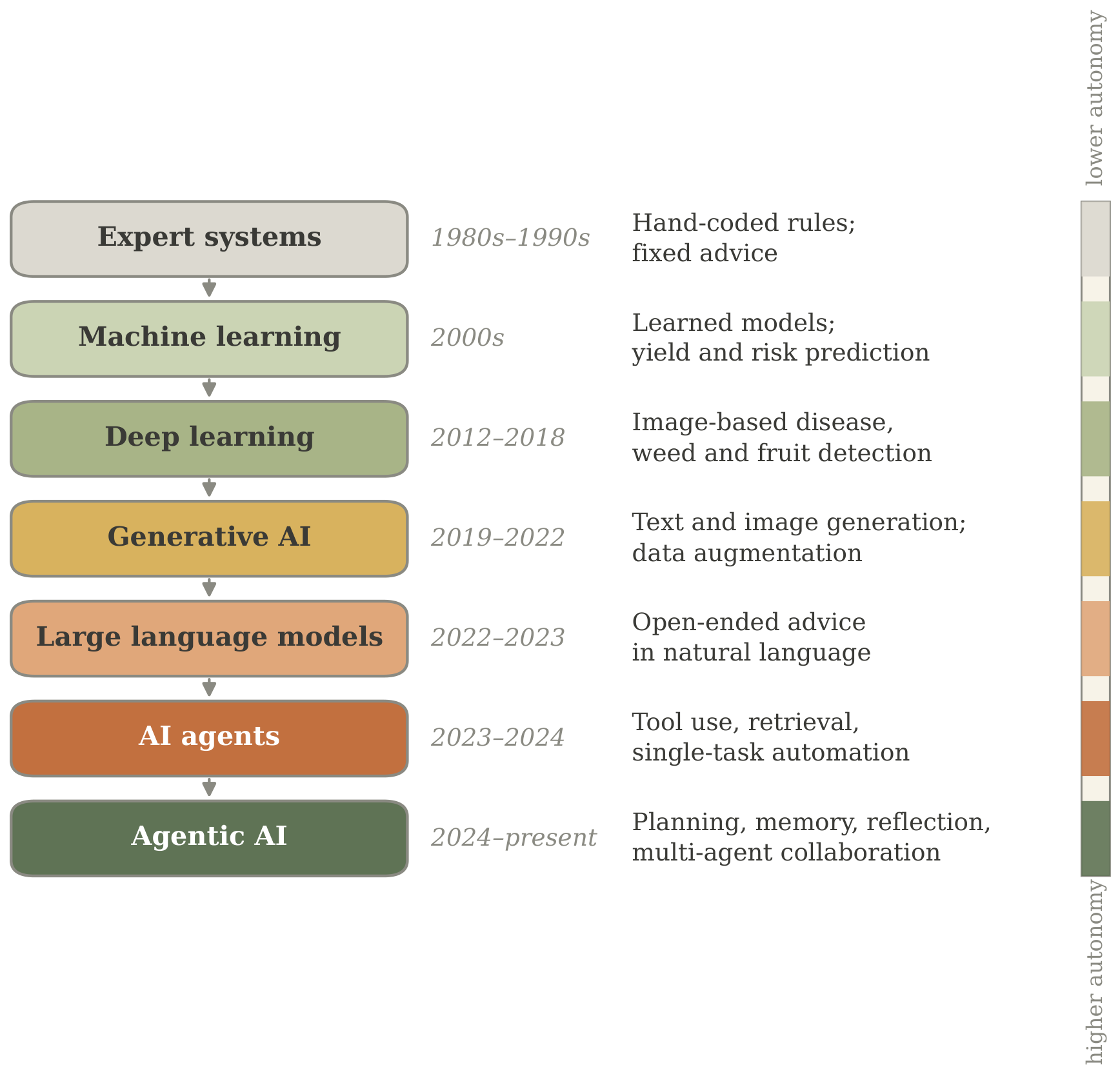
  13. Skobelev, P.; Mayorov, I.; Simonova, E.; Goryanin, O.; Zhilyaev, A.; Tabachinskiy, A.; Yalovenko, V. Development of models and methods for creating a digital twin of plant within the cyber-physical system for precision farming management. In Proceedings of the Journal of Physics: Conference Series; IOP Publishing Ltd.: Bristol, UK, 2020; p. 012022. [Google Scholar] [CrossRef] [Scilit]
  14. Skobelev, P.; Tabachinskiy, A.; Simonova, E.; Lee, T.R.; Zhilyaev, A.; Laryukhin, V. Digital twin of rice as a decision-making service for precise farming, based on environmental datasets from the fields. In Proceedings of the ITNT 2021—7th IEEE International Conference on Information Technology and Nanotechnology; Institute of Electrical and Electronics Engineers Inc.: Piscataway, NJ, USA, 2021. [Google Scholar] [CrossRef] [Scilit]
  15. Skobelev, P.; Tabachinskiy, A.; Simonova, E.; Strizhakov, A.; Kudryakov, E.; Lee, T.R.; Chan, Y.K. Multiparametric variety models in digital twin of plant for winter wheat. In Proceedings of the 2024 10th International Conference on Information Technology and Nanotechnology, ITNT 2024; Institute of Electrical and Electronics Engineers Inc.: Piscataway, NJ, USA, 2024. [Google Scholar] [CrossRef] [Scilit]
  16. Shah, M.; Wahid, A.; Barrett, E.; Mason, K. Peer-to-peer energy trading in dairy farms using multi-agent systems. Comput. Electr. Eng. 2024, 118, 109437. [Google Scholar] [CrossRef] [Scilit]
  17. Shah, M.; Barrett, E.; Mason, K. Reinforcement learning enabled peer-to-peer energy trading for dairy farms. In Proceedings of the Lecture Notes in Computer Science (Including Subseries Lecture Notes in Artificial Intelligence and Lecture Notes in Bioinformatics); Springer Science and Business Media Deutschland GmbH: Berlin/Heidelberg, Germany, 2025; pp. 27–38. [Google Scholar] [CrossRef] [Scilit]
  18. Sah Tyagi, S.; Mukherjee, A.; Pokhrel, S.; Hiran, K. An intelligent and optimal resource allocation approach in sensor networks for smart Agri-IoT. IEEE Sens. J. 2021, 21, 17439–17446. [Google Scholar] [CrossRef] [Scilit]
  19. Din, A.; Ismail, M.; Shah, B.; Babar, M.; Ali, F.; Baig, S. A deep reinforcement learning-based multi-agent area coverage control for smart agriculture. Comput. Electr. Eng. 2022, 101, 108089. [Google Scholar] [CrossRef] [Scilit]
  20. Ajagekar, A.; Decardi-Nelson, B.; You, F. Energy management for demand response in networked greenhouses with multi-agent deep reinforcement learning. Appl. Energy 2024, 355, 122349. [Google Scholar] [CrossRef] [Scilit]
  21. Jimenez, A.F.; Cardenas, P.F.; Jimenez, F. Intelligent IoT-multiagent precision irrigation approach for improving water use efficiency in irrigation systems at farm and district scales. Comput. Electron. Agric. 2022, 192, 106635. [Google Scholar] [CrossRef] [Scilit]
  22. Qu, C.; Boubin, J.; Gafurov, D.; Zhou, J.; Aloysius, N.; Nguyen, H.; Calyam, P. UAV swarms in smart agriculture: Experiences and opportunities. In Proceedings of the 2022 IEEE 18th International Conference on E-Science, eScience 2022; Institute of Electrical and Electronics Engineers Inc.: Piscataway, NJ, USA, 2022; pp. 148–158. [Google Scholar] [CrossRef] [Scilit]
  23. Wooldridge, M.; Jennings, N. Intelligent agents: Theory and practice. Knowl. Eng. Rev. 1995, 10, 115–152. [Google Scholar] [CrossRef] [Scilit]
  24. Franklin, S.; Graesser, A. Is it an agent, or just a program? A taxonomy for autonomous agents. In Intelligent Agents III: Agent Theories, Architectures, and Languages; Springer: Berlin/Heidelberg, Germany, 1997; pp. 21–35. [Google Scholar] [CrossRef] [Scilit]
  25. Brooks, R. Intelligence without representation. Artif. Intell. 1991, 47, 139–159. [Google Scholar] [CrossRef] [Scilit]
  26. Rao, A.; Georgeff, M. BDI agents: From theory to practice. In Proceedings of the First International Conference on Multiagent Systems (ICMAS-95); AAAI Press: Palo Alto, CA, USA, 1995; pp. 312–319. [Google Scholar]
  27. Wooldridge, M. An Introduction to MultiAgent Systems, 2nd ed.; John Wiley and Sons: Chichester, UK, 2009. [Google Scholar]
  28. Munasinghe, C.; Athuraliya, B. Safelora: A real-time multimodal multi-agent advisory system for context-aware and safety-compliant plant diseases management. In Proceedings of the 2026 6th International Conference on Advanced Research in Computing: Responsible AGI: Balancing Intelligence, Responsibility and Sustainability, ICARC 2026– Conference Proceedings; Institute of Electrical and Electronics Engineers Inc.: Piscataway, NJ, USA, 2026. [Google Scholar] [CrossRef] [Scilit]
  29. Qiao, S.; Qiu, Z.; Ren, B.; Wang, X.; Ru, X.; Zhang, N.; Chen, X.; Jiang, Y.; Xie, P.; Huang, F.; et al. Agentic knowledgeable self-awareness. In Proceedings of the Annual Meeting; Association for Computational Linguistics: Stroudsburg, PA, USA, 2025; Volume 1. [Google Scholar] [CrossRef] [Scilit]
  30. Jimenez, A.F.; Cardenas, P.F.; Jimenez, F.; Canales, A.; Lopez, A. A cyber-physical intelligent agent for irrigation scheduling in horticultural crops. Comput. Electron. Agric. 2020, 178, 105777. [Google Scholar] [CrossRef] [Scilit]
  31. Zhang, R.; Wang, Y.; Yang, W.; Wen, J.; Liu, W.; Zhi, S.; Li, G.; Chai, N.; Huang, J.; Xie, Y.; et al. PlantGPT: An arabidopsis-based intelligent agent that answers questions about plant functional genomics. Adv. Sci. 2025, 12, e03926. [Google Scholar] [CrossRef] [Scilit] [PubMed]
  32. Zhang, S. Chat Demeter: A multi-agent system for plant disease diagnosis integrating CNN-transformer models. Front. Plant Sci. 2026, 16, 1695227. [Google Scholar] [CrossRef] [Scilit] [PubMed]
  33. Song, Z.; Li, Q. A multi-agent collaboration framework for scene understanding and work order generation in smart farms. In Proceedings of the 2026 International Conference on Generative Artificial Intelligence and Information Security; Institute of Electrical and Electronics Engineers Inc.: Piscataway, NJ, USA, 2026; pp. 499–502. [Google Scholar] [CrossRef] [Scilit]
  34. Sun, C.; Liu, Y.; Deng, J.; Chen, T.; Yang, H. Hybrid-action task offloading in integrated ground-air-space networks for smart farming: A cooperative reinforcement learning approach. In Proceedings of the 2026 IEEE Wireless Communications and Networking Conference Workshops, WCNCW 2026; Institute of Electrical and Electronics Engineers Inc.: Piscataway, NJ, USA, 2026. [Google Scholar] [CrossRef] [Scilit]
  35. Boubin, J.; Burley, C.; Han, P.; Li, B.; Porter, B.; Stewart, C. MARbLE: Multi-agent reinforcement learning at the edge for digital agriculture. In Proceedings of the Proceedings—2022 IEEE/ACM 7th Symposium on Edge Computing, SEC 2022; Institute of Electrical and Electronics Engineers Inc.: Piscataway, NJ, USA, 2022; pp. 68–81. [Google Scholar] [CrossRef] [Scilit]
  36. Ngo, T.; Thai, P.A.; Vo, T.; Chau, T.K.; Ma, T.; Truong, M.T. SHREADS: A shrimp health diagnosis and advisory system using agentic RAG. In Proceedings of the Proceedings—International Conference on Knowledge and Systems Engineering, KSE; Institute of Electrical and Electronics Engineers Inc.: Piscataway, NJ, USA, 2025. [Google Scholar] [CrossRef] [Scilit]
  37. Girardi, F.; Both, T.; Montero, P.; da Silva, G.; Krum, F.; Casarin, L.; Machado, A.; Maran, V. Towards an assistant for legal framing in agricultural oversight: A RAG and LLM chain approach. In Proceedings of the International Conference on Enterprise Information Systems, ICEIS—Proceedings; Science and Technology Publications, Lda: Setubal, Portugal, 2026; pp. 990–997. [Google Scholar] [CrossRef] [Scilit]
  38. Kandamali, D.; Porter, W.; Porter, E.; McLemore, A.; Rains, G. CottonBot: An AI-driven cotton farming assistant and irrigation advisor using LLM-RAG and agentic AI tools. Smart Agric. Technol. 2025, 12, 101640. [Google Scholar] [CrossRef] [Scilit]
  39. Zhang, S.; Cao, S.; Ma, N.; Sun, W.; Kong, F. FARM: A multi-agent framework for automated construction of multi-species livestock health knowledge graphs. Agriculture 2026, 16, 356. [Google Scholar] [CrossRef] [Scilit]
  40. Tariq, M.; Saqib, S.; Mazhar, T.; Khan, M.; Shahzad, T.; Hamam, H. Edge-enabled smart agriculture framework: Integrating IoT, lightweight deep learning, and agentic AI for context-aware farming. Results Eng. 2025, 28, 107342. [Google Scholar] [CrossRef] [Scilit]
  41. Kalyani, Y.; Vorster, L.; Whetton, R.; Collier, R. Application scenarios of digital twins for smart crop farming through cloud–fog–edge infrastructure. Future Internet 2024, 16, 100. [Google Scholar] [CrossRef] [Scilit]
  42. Saad, A.; Akram, W.; Hussain, I. AquaChat++: LLM-assisted multi-ROV inspection for aquaculture net pens with integrated battery management and thruster fault tolerance. Ocean Eng. 2026, 343, 123223. [Google Scholar] [CrossRef] [Scilit]
  43. Manwatkar, A.; Kamble, S.; Kudande, D.; Singh Senger, P.; Surnar, A.; Vanakudre, S. Autonomous multi-agent architecture for intelligent precision farming. In Proceedings of the IEEE International Conference on AI Engineering and Innovations, AIEI 2026; Institute of Electrical and Electronics Engineers Inc.: Piscataway, NJ, USA, 2026. [Google Scholar] [CrossRef] [Scilit]
  44. Sinha, J.; Kant, S.; Saini, M. Modelling big data analysis approach with multi-agent system for crop-yield prediction. Int. J. Inf. Decis. Sci. 2023, 15, 27–45. [Google Scholar] [CrossRef] [Scilit]
  45. Cavaliere, D.; Senatore, S. A multi-agent knowledge-enhanced model for decision-supporting agroforestry systems. In Proceedings of the 2021 IEEE Symposium Series on Computational Intelligence, SSCI 2021—Proceedings; Institute of Electrical and Electronics Engineers Inc.: Piscataway, NJ, USA, 2021. [Google Scholar] [CrossRef] [Scilit]
  46. Huo, D.; Malik, A.; Ravana, S.; Ur Rahman, A.; Ahmedy, I. Enhancing anomaly detection in agriculture by considering the impact of concept drift: An exploratory study using digital replica. In Proceedings of the ACM International Conference Proceeding Series; Association for Computing Machinery: New York, NY, USA, 2023; pp. 87–91. [Google Scholar] [CrossRef] [Scilit]
  47. Raihauti, T.; Midingoyi, C.; Adam, M.; Berg-Mohnicke, M.; Brown, H.; Cichota, R.; Enders, A.; Ferreira, T.; Fumagalli, D.; Holzworth, D.; et al. Semantic metadata extraction from crop model components with large language models to facilitate platform interoperability. Comput. Electron. Agric. 2026, 251, 111996. [Google Scholar] [CrossRef] [Scilit]
  48. Bahri, O.; Mourhir, A.; Papageorgiou, E. Integrating fuzzy cognitive maps and multi-agent systems for sustainable agriculture. Euro-Mediterr. J. Environ. Integr. 2020, 5, 7. [Google Scholar] [CrossRef] [Scilit]
  49. Agyeman, B.; Nouri, M.; Appels, W.; Liu, J.; Shah, S. Learning-based multi-agent MPC for irrigation scheduling. Control Eng. Pract. 2024, 147, 105908. [Google Scholar] [CrossRef] [Scilit]
  50. Kumar, U.; Narayanan, T.; Kumar, B. PhenoMARL-fert: Safe multi-agent DRL for real-time irrigation and nutrient control. In Proceedings of the Proceeding—2026 IEEE 6th International Conference on Computing, Power, and Communication Technologies, IC2PCT 2026; Institute of Electrical and Electronics Engineers Inc.: Piscataway, NJ, USA, 2026; pp. 70–76. [Google Scholar] [CrossRef] [Scilit]
  51. Qin, L.; Wu, X.; Dong, X.; Wang, H.; Yang, T.; Wang, Q. PPdd-agent: Multimodal large language model-driven ai agent for enhanced plant disease diagnosis. In Proceedings of the Proceedings - International Conference on Image Processing, ICIP; IEEE Computer Society: Washington, DC, USA, 2025; pp. 1271–1276. [Google Scholar] [CrossRef] [Scilit]
  52. Abbas, H.; Shahid, M.; Siddiqui, S.; Misbah, S.; Tanveer, M. From detection to decision: An agentic AI approach using vision transformers for cotton crop stress diagnosis. In Proceedings of the 2026 7th International Conference on Advancements in Computational Sciences, ICACS 2026; Institute of Electrical and Electronics Engineers Inc.: Piscataway, NJ, USA, 2026. [Google Scholar] [CrossRef] [Scilit]
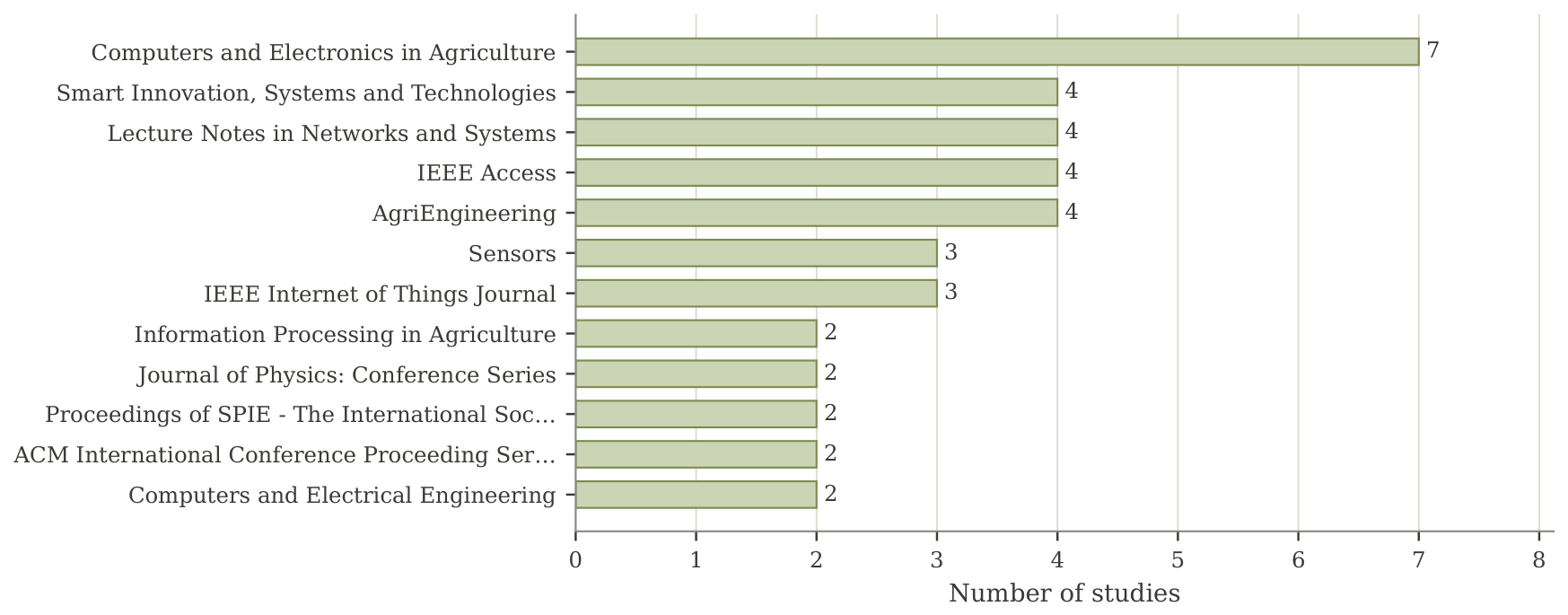
  53. Radhakrishnan, G.; Ansar, A.; Kumar, S.; Rakhi, R.; Chitra, M. A hybrid AI-agent architecture for pest detection and digital crop advisory in vegetable cowpea. Plant Sci. Today 2026, 13, 1–8. [Google Scholar] [CrossRef] [Scilit]
  54. da Rocha Balthazar, G.; Silveira, R.; da Silva, I. Use of multi-agent systems and the Internet of Things to monitor the environment of commercial broiler poultry houses through specific air enthalpy. J. Anim. Behav. Biometeorol. 2024, 12, e2024012. [Google Scholar] [CrossRef] [Scilit]
  55. Arul, S.; Anbarasi Jebaselvi, G. An integrated localization and proactive disease forecasting system for cattle farming environments in wireless sensor networks. Prog. Artif. Intell. 2025, 14, 231–252. [Google Scholar] [CrossRef] [Scilit]
  56. Shanteer, T.; Sailunaz, K.; Neethirajan, S. CowNet-AI: A multi-agent decision support framework for social network-driven welfare insights in dairy cattle. IEEE Access 2026, 14, 64882–64897. [Google Scholar] [CrossRef] [Scilit]
  57. Lee, S.; Jung, W.; Cho, S.; Kim, M.K.; Park, D.; Choi, W.; Park, H.H.; Park, J. Forecasting individual dairy cow milk yield via large language model orchestration. AgriEngineering 2026, 8, 295. [Google Scholar] [CrossRef] [Scilit]
  58. Zhukovskii, K.; Ovsiannikova, P.; Jhunjhunwala, P.; Scarabaggio, P.; Carli, R.; Dotoli, M.; Vyatkin, V. Energy consumption optimisation for horticultural facilities. In Proceedings of the IEEE International Conference on Emerging Technologies and Factory Automation, ETFA; Institute of Electrical and Electronics Engineers Inc.: Piscataway, NJ, USA, 2024. [Google Scholar] [CrossRef] [Scilit]
  59. Liu, Y.; Xu, X.; Liu, Y.; Liu, J.; Hu, W.; Yang, N.; Jawad, S.; Wei, Z. A multi-agent decision-making framework for planning and operating human-factor-based rural community. J. Clean. Prod. 2024, 440, 140888. [Google Scholar] [CrossRef] [Scilit]
  60. Wang, J.; Chen, M.; Zhou, J.; Li, P. Data communication mechanism for greenhouse environment monitoring and control: An agent-based IoT system. Inf. Process. Agric. 2020, 7, 444–455. [Google Scholar] [CrossRef] [Scilit]
  61. Toskov, B.; Toskova, A. AgroNova: An autonomous IoT platform for greenhouse climate control. Sensors 2026, 26, 1861. [Google Scholar] [CrossRef] [Scilit] [PubMed]
  62. Howard, D.; Ma, Z.; Jorgensen, B. A case study of digital twin for greenhouse horticulture production flow. In Proceedings of the 2022 IEEE 2nd International Conference on Digital Twins and Parallel Intelligence, DTPI 2022; Institute of Electrical and Electronics Engineers Inc.: Piscataway, NJ, USA, 2022. [Google Scholar] [CrossRef] [Scilit]
  63. Davoodi, M.; Faryadi, S.; Velni, J. A graph theoretic-based approach for deploying heterogeneous multi-agent systems with application in precision agriculture. J. Intell. Robot. Syst. Theory Appl. 2021, 101, 10. [Google Scholar] [CrossRef] [Scilit]
  64. Akbari, M.; Syed, A.; Kennedy, W.; Erol-Kantarci, M. Constrained federated learning for AoI-limited SFC in UAV-aided MEC for smart agriculture. IEEE Trans. Mach. Learn. Commun. Netw. 2023, 1, 277–295. [Google Scholar] [CrossRef] [Scilit]
  65. Zhu, A.; Zeng, Z.; Guo, S.; Lu, H.; Ma, M.; Zhou, Z. Game-theoretic robotic offloading via multi-agent learning for agricultural applications in heterogeneous networks. Comput. Electron. Agric. 2023, 211, 108017. [Google Scholar] [CrossRef] [Scilit]
  66. Kode, A.; Manjunatha, H.; Borah, S.; Torbert, H.; Sundaravadivel, P. Scalable voice-controlled drone autonomy: From edge-deployed single agents to distributed HITL swarm simulations. In Proceedings of the IEEE Dallas Circuits and Systems Conference, DCAS; Institute of Electrical and Electronics Engineers Inc.: Piscataway, NJ, USA, 2026. [Google Scholar] [CrossRef] [Scilit]
  67. Liu, H.; Song, P.; Liu, G.; Xin, X.; Rong, Y.; Ding, L.; Gao, J.; Wang, Z.; Zhang, Y.; Li, P. A robot herding strategy combining CMFF and MPC for shepherding. Comput. Electron. Agric. 2026, 252, 112114. [Google Scholar] [CrossRef] [Scilit]
  68. Wang, D.; Shi, H.; Sun, L.; Du, Y. A collaborative allocation approach for sorting resources in rural cold chain warehouses. Int. J. Innov. Comput. Inf. Control 2023, 19, 1221–1238. [Google Scholar] [CrossRef]
  69. Winter, E.; Grovermann, C.; Messmer, M.; Aurbacher, J. Assessing seed and breeding interventions for organic farming using a multiagent value chain approach. Agric. Food Econ. 2023, 11, 22. [Google Scholar] [CrossRef] [Scilit]
  70. Feng, Y.; Wang, Z.; Chen, Y.; Zhao, H. LLM agent driven online auction mechanism for agricultural products. Kybernetes 2025, 1–21. [Google Scholar] [CrossRef] [Scilit]
  71. Wang, J.; Wu, J.; Zhang, G.; Tan, M.; Chen, S.; Lin, Z. Agricultural futures trading decision using AI agent with multiscale candlestick analysis. IEEE Trans. Comput. Soc. Syst. 2025, 12, 5318–5329. [Google Scholar] [CrossRef] [Scilit]
  72. Cantonjos, N.; Biswas, A. AgroAskAI: A multi-agentic AI framework for supporting smallholder farmers’ enquiries globally. In Proceedings of the AAAI Conference on Artificial Intelligence; Association for the Advancement of Artificial Intelligence: Palo Alto, CA, USA, 2026; pp. 40217–40223. [Google Scholar] [CrossRef] [Scilit]
  73. Swati, N.; Gupta, S.; Duddela, N.; Parvathy, L. Agentic AI-driven autonomous decision support system for smart agriculture. Sci. Rep. 2026, 16, 9972. [Google Scholar] [CrossRef] [Scilit] [PubMed]
  74. Ismail, S.; Fauzi, N.; Shaikh Ali, S.; Hitam, N.; Morcos, J. Agentic AI for knowledge management in the agriculture community. J. Soft Comput. Data Min. 2026, 7, 141–151. [Google Scholar] [CrossRef] [Scilit]
  75. Liu, R.; Thienmongkol, R.; Weeranakin, N. Transforming agricultural knowledge dissemination: A SMART platform powered by agentic AI for new farmers. In Proceedings of the 2026 15th International Conference on Educational and Information Technology, ICEIT 2026; Institute of Electrical and Electronics Engineers Inc.: Piscataway, NJ, USA, 2026; pp. 172–178. [Google Scholar] [CrossRef] [Scilit]
  76. Gangadhar, S.; Pramod, T. Interactive AI training agent for tomato farmers: A GenAI and LLM driven approach to agriculture 4.0. In Proceedings of the 3rd International Conference on Emerging Computation and Information Technologies, ICECIT 2025—Book of Abstracts; Institute of Electrical and Electronics Engineers Inc.: Piscataway, NJ, USA, 2025. [Google Scholar] [CrossRef] [Scilit]
  77. Pan, Y.; Sun, J.; Yu, H.; Luck, J.; Bai, G.; Chamara, N.; Ge, Y.; Awada, T. Building multi-agent copilot towards autonomous agricultural data management and analysis. In Proceedings of the Proceedings—2024 IEEE International Conference on Big Data, BigData 2024; Institute of Electrical and Electronics Engineers Inc.: Piscataway, NJ, USA, 2024; pp. 4384–4393. [Google Scholar] [CrossRef] [Scilit]
  78. Chojka, A.; Adao, T.; Pascoal, D.; Silva, N.; Peres, E.; Morais, R. AI agent-based sensor monitoring for IoT-enabled precision agriculture: A case study in workflow automation. In Proceedings of the Procedia Computer Science; Elsevier B.V.: Amsterdam, The Netherlands, 2026; pp. 700–708. [Google Scholar] [CrossRef] [Scilit]
  79. Davcev, D.; Kalajdziski, S.; Dimitrovski, I.; Kitanovski, I.; Mitreski, K. Agentic AI-Based IoT Precision agriculture framework: Our vision and challenges. AgriEngineering 2026, 8, 147. [Google Scholar] [CrossRef] [Scilit]
  80. Ke, Y.; Yu, X.; Du, H.; Chapman, S.; Huang, H. Dynamic orchestration of multi-agent system for Real-world multi-image agricultural VQA. In Proceedings of the Lecture Notes in Computer Science; Springer Science and Business Media Deutschland GmbH: Berlin/Heidelberg, Germany, 2026; pp. 153–165. [Google Scholar] [CrossRef] [Scilit] [PubMed]
  81. Zhou, Q.; Shen, Y.; Sun, Y.; Hou, Y.; Zhao, C.; Shao, W.; Chen, J.; Xue, H. A multi-agent collaborative method for agricultural decision-making. In Proceedings of the 2026 5th International Conference on Electronic Information Engineering, Big Data and Computer Technology, EIBDCT 2026; Institute of Electrical and Electronics Engineers Inc.: Piscataway, NJ, USA, 2026; pp. 553–557. [Google Scholar] [CrossRef] [Scilit]
  82. Basir, M.S.; Pai, A.; Loo, L.; Castiblanco, F.; Bailey, J.; Balmos, A.; Buckmaster, D.; Krogmeier, J. Meta ag 2.0: A framework for AI-infused contextual agricultural recordkeeping. In Proceedings of the 2025 ASABE Annual International Meeting; American Society of Agricultural and Biological Engineers: St. Joseph, MI, USA, 2025. [Google Scholar] [CrossRef] [Scilit]
  83. Charanya, P.; Kalaivani, V.; Kumar, D.; Akila, S.; Praveena, A.; Dhurgadevi, M. Optimizing artificial pollination in indian agriculture through multi-agent reinforcement learning and generative AI for precision pollen distribution. In Proceedings of the 2025 International Conference on Artificial Intelligence and Quantum Computation-Based Sensor Application, ICAIQSA 2025—Proceedings; Institute of Electrical and Electronics Engineers Inc.: Piscataway, NJ, USA, 2025. [Google Scholar] [CrossRef] [Scilit]
  84. Kale, V.; Rao, J. Multi agent approach for climate resilient fertilizer recommendations. In Proceedings of the 2025 International Conference on Future Technologies; Institute of Electrical and Electronics Engineers Inc.: Piscataway, NJ, USA, 2025. [Google Scholar] [CrossRef] [Scilit]
  85. Shentsov, Y.; Chernysheva, T.; Glukhikh, I.; Glukhikh, D. Development and use of LLM-agents to automate business processes of a smart farm. In Proceedings of the Lecture Notes in Networks and Systems; Springer Science and Business Media Deutschland GmbH: Berlin/Heidelberg, Germany, 2025; pp. 69–81. [Google Scholar] [CrossRef] [Scilit]
  86. Murad, M.; Ahmed, M.; Din, N.; Shahid, M.; Siddiqui, S.; Byers, D.; Tanveer, M.; Voicu, R. Agentic AI framework to automate traditional farming for smart agriculture. AgriEngineering 2026, 8, 8. [Google Scholar] [CrossRef] [Scilit]
  87. Egger, G.; Sacco, P.; Chaltsev, D.; Mazzetto, F. FarMAS: Multi-Agent based farm activity planning and execution system. In Proceedings of the 2021 IEEE International Workshop on Metrology for Agriculture and Forestry, MetroAgriFor 2021 - Proceedings; Institute of Electrical and Electronics Engineers Inc.: Piscataway, NJ, USA, 2021; pp. 411–415. [Google Scholar] [CrossRef] [Scilit]
  88. Naeem, M.; ELAttar, E.K.M.; Aboul-Dahab, H. Utilizing AIoT to achieve sustainable agricultural systems in a climate-change-affected environment. Future Internet 2026, 18, 68. [Google Scholar] [CrossRef] [Scilit]
  89. Desai, A.; Rallabandi, B.; Gattupalli, K.; Medarametla, M. Agentic AI for rural connectivity and spectrum-aware networks to power smart agriculture ecosystems. In Proceedings of the ICRTEECT 2025—2nd International Conference on Recent Trends in Electrical, Electronics and Computing Technologies; Institute of Electrical and Electronics Engineers Inc.: Piscataway, NJ, USA, 2025. [Google Scholar] [CrossRef] [Scilit]
  90. Wu, K.; Li, Y.; Nie, J.; Zhao, J.; Ercisli, S. A multi-agent deep reinforcement learning framework for resource allocation optimization in agricultural heterogeneous network. IEEE Trans. Consum. Electron. 2026, 72, 6831–6843. [Google Scholar] [CrossRef] [Scilit]
  91. Gavai, A.; Meuwissen, M. Agentic AI as a coordination paradigm in digital health and agri-food systems. Patterns 2026, 7, 101496. [Google Scholar] [CrossRef] [Scilit] [PubMed]
  92. Ajina, A.; Nithin, V.; Devika, P.; Chinmaya, B.; Prithviraj, B. An integrated system for real-time greenhouse environmental forecasting and adaptive crop management. In Proceedings of the 3rd International Conference on Sustainable Computing and Data Communication Systems, ICSCDS 2025; Institute of Electrical and Electronics Engineers Inc.: Piscataway, NJ, USA, 2025; pp. 1923–1930. [Google Scholar] [CrossRef] [Scilit]
  93. Li, Y.; Chen, Z.; Hu, M.; Li, X.; Han, Y.; Ren, D.; Xu, X.; Xiong, Y.; Huang, Q.; Huang, G. A novel hybrid modeling-based artificial intelligence agent for water-food-ecology-environment-economy system trade-offs. J. Hydrol. 2026, 677, 135763. [Google Scholar] [CrossRef] [Scilit]
  94. Sinuraya, E.; Ramadhan, I.; Santoso, I.; Aji, A.; Winardi, B.; Setiyono, B. Development of an AI-assisted lora-based monitoring and control system with rag-enabled chatbot for sacha inchi cultivation. In Proceedings of the International Conference on Computer, Control, Informatics and Its Applications, IC3INA; Institute of Electrical and Electronics Engineers Inc.: Piscataway, NJ, USA, 2025; pp. 334–339. [Google Scholar] [CrossRef] [Scilit]
  95. Leite, M.; Abe, J.; Naas, I.; Souza, M. A decision support ai-copilot for poultry farming: Leveraging retrieval-augmented llms and paraconsistent annotated evidential logic Eτ to enhance operational decisions. AgriEngineering 2026, 8, 114. [Google Scholar] [CrossRef] [Scilit]
  96. Srinivasu, P.; Pavate, A.; JayaLakshmi, G.; Shafi, J.; Choi, J.; Ijaz, M. Agentic AI for smart and sustainable precision agriculture. Front. Plant Sci. 2026, 16, 1706428. [Google Scholar] [CrossRef] [Scilit] [PubMed]
  97. Tiruvikraman, V.; Akilesh, J.; Sharvesh, K.; Santhosh, C.; Lokesh, S.; Selvakumar, D. Precision agriculture through IoT and AI: A real-time framework for disease and pest intervention. In Proceedings of the 2026 2nd International Conference on Intelligent Systems for Communication, IoT and Security, ICISCoIS 2026; Institute of Electrical and Electronics Engineers Inc.: Piscataway, NJ, USA, 2026. [Google Scholar] [CrossRef] [Scilit]
  98. Alzu’Bi, S.; Mughaid, A. The digital farmer agents in precise and sustainable agricultural ecosystems. In Proceedings of the 2025 3rd International Conference on Foundation and Large Language Models, FLLM 2025; Institute of Electrical and Electronics Engineers Inc.: Piscataway, NJ, USA, 2025; pp. 202–209. [Google Scholar] [CrossRef] [Scilit]
  99. Asha Rani, K.; Gowrishankar, S. Agentic AI for pathogen-based plant disease detection. In Proceedings of the 2025 6th International Conference on Artificial Intelligence, Robotics, and Control, AIRC 2025; Institute of Electrical and Electronics Engineers Inc.: Piscataway, NJ, USA, 2025; pp. 323–328. [Google Scholar] [CrossRef] [Scilit]
  100. Li, Y.; Xu, Y.; Xue, X.; Liu, X.; Liu, X. Optimal spraying task assignment problem in crop protection with multi-UAV systems and its order irrelevant enumeration solution. Biosyst. Eng. 2022, 214, 177–192. [Google Scholar] [CrossRef] [Scilit]
  101. Roumeliotis, K.; Sapkota, R.; Karkee, M.; Tselikas, N. Agentic AI with orchestrator-agent trust: A modular visual classification framework with trust-aware orchestration and rag-based reasoning. IEEE Access 2026, 14, 26965–26982. [Google Scholar] [CrossRef] [Scilit]
  102. Gu, H.; Zhao, L.; Han, Z.; Zheng, G.; Song, S. AI-enhanced cloud-edge-terminal collaborative network: Survey, applications, and future directions. IEEE Commun. Surv. Tutor. 2024, 26, 1322–1385. [Google Scholar] [CrossRef] [Scilit]
  103. Gadekallu, T.; Xia, Y.; Cai, J. Agentic AI in agriculture: Autonomous systems for a sustainable future. TechRxiv 2026. [Google Scholar] [CrossRef] [Scilit] [PubMed]
  104. Bounajra, A.; El Guemmat, K.; Mansouri, K. Towards sustainable agriculture in morocco through multi-agent systems and digital governance. In Proceedings of the 2026 6th International Conference on Innovative Research in Applied Science, Engineering and Technology, IRASET 2026; Institute of Electrical and Electronics Engineers Inc.: Piscataway, NJ, USA, 2026. [Google Scholar] [CrossRef] [Scilit]
  105. Carvalho, J.; Aguiar, A. Multi-agent reinforcement learning for zero-shot coverage path planning with dynamic UAV networks. Robot. Auton. Syst. 2026, 195, 105163. [Google Scholar] [CrossRef] [Scilit]
  106. Chen, H.; Hou, G.; Hua, C.; Wang, S.; Chen, Z.; Zhang, Y. Agricultural autonomous decision-making system “Fuxi Brain” Based on generative large model fusion internet of things. Comput. Electron. Agric. 2026, 244, 111454. [Google Scholar] [CrossRef] [Scilit]
  107. Qian, Z.; Feng, Y.; Liu, N.; Qian, Q. CLMPO-EC: A Lightweight multi-UAV multiarea coverage path planning method using deep reinforcement learning. IEEE Internet Things J. 2026, 13, 16535–16549. [Google Scholar] [CrossRef] [Scilit]
  108. Wei, X.; Su, J.; Song, C.; Xia, Y. Towards sustainable smart agriculture: Autonomous UAV deployment and task scheduling in a cloud-Fog-Edge synergy. Comput. Netw. 2026, 281, 112201. [Google Scholar] [CrossRef] [Scilit]
  109. Zhang, X.; Zhang, R.; Cui, Y.; Gao, M.; Yuan, W.; Jing, X. AGI-enabled networked sensing data aggregation for heterogeneous uav-ugv coalition in low-altitude ISAC systems. IEEE Trans. Cogn. Commun. Netw. 2026, 12, 4307–4318. [Google Scholar] [CrossRef] [Scilit]
  110. Zhang, X.; Jia, L.; Kang, X.; Kong, B.; Liu, Y.; Liu, S. TopoAttn-MultiAgent: A deep reinforcement learning approach for optimizing collaborative agricultural machinery scheduling. In Proceedings of the International Conference on Computer Supported Cooperative Work in Design, CSCWD; Institute of Electrical and Electronics Engineers Inc.: Piscataway, NJ, USA, 2026; pp. 4214–4219. [Google Scholar] [CrossRef] [Scilit]
  111. Chen, Y.; Zhu, K.; Chen, Z.; Feng, C.; Zhuang, Z. Intelligent multi-agent systems for UAV-robot path optimization via reflective evolution. In Proceedings of the Lecture Notes in Computer Science; Springer Science and Business Media Deutschland GmbH: Berlin/Heidelberg, Germany, 2025; pp. 566–577. [Google Scholar] [CrossRef] [Scilit]
  112. Ge, G.; Sun, M.; Xue, Y.; Pavlova, S. Transformer-based soft actor–critic for UAV path planning in precision agriculture IoT networks. Sensors 2025, 25, 7463. [Google Scholar] [CrossRef] [Scilit] [PubMed]
  113. Grosse, M.; Honda, K.; Thies, P.; Specht, C. Discrete event simulation based on a multi-agent system for japanese rice harvesting operations. Agriculture 2025, 15, 1745. [Google Scholar] [CrossRef] [Scilit]
  114. Gutierrez-Cejudo, J.; Andres, F.; Lujak, M.; Casamayor, C.; Lopez, L.; Rebollo, M.; Fernandez, A. Demo of the agri-ro5 architecture for agrirobot fleet simulation. In Proceedings of the Lecture Notes in Computer Science (Including Subseries Lecture Notes in Artificial Intelligence and Lecture Notes in Bioinformatics); Springer Science and Business Media Deutschland GmbH: Berlin/Heidelberg, Germany, 2025; pp. 337–342. [Google Scholar] [CrossRef] [Scilit]
  115. Jo, Y.; Son, H. CBS-HT: Prioritized safe interval path-planning algorithm for heterogeneous agricultural robot team. IEEE Access 2025, 13, 146630–146648. [Google Scholar] [CrossRef] [Scilit]
  116. Jogeshwar, B.; Sevil, H.; Haghshenas-Jaryani, M. Multi-agent coverage planning for agricultural soil and crop monitoring. In Proceedings of the ASME International Mechanical Engineering Congress and Exposition, Proceedings (IMECE); American Society of Mechanical Engineers (ASME): New York, NY, USA, 2025; p. v005t08a046. [Google Scholar] [CrossRef] [Scilit]
  117. Lee, K.; Brook, E. Connectivity-preserving multi-agent area coverage via density-driven optimal control (d2oc). IEEE Control Syst. Lett. 2025, 9, 2723–2728. [Google Scholar] [CrossRef] [Scilit]
  118. Liu, G.; Cai, Z.; Liang, Z.; Cheng, L. Malware Suppressing strategies for smart agricultural UAV-wsn in unknown environment: A reinforcement learning framework. IEEE Internet Things J. 2025. [Google Scholar] [CrossRef] [Scilit]
  119. Mowla, M.N.; Asadi, D.; Rabie, K.; Li, X. Energy-efficient multi-agent UAV path planning for green IoT systems. In Proceedings of the IEEE International Symposium on Personal, Indoor and Mobile Radio Communications, PIMRC; Institute of Electrical and Electronics Engineers Inc.: Piscataway, NJ, USA, 2025. [Google Scholar] [CrossRef] [Scilit]
  120. Tuncel, Y.; Oztoprak, K.; Hassanpour, R. Securing agricultural IoT networks: Adapting SAFE-CAST framework for LoRa-Based smart farming applications. In Proceedings of the IEEE International Conference on Big Data, BigData; Institute of Electrical and Electronics Engineers Inc.: Piscataway, NJ, USA, 2025; pp. 3896–3905. [Google Scholar] [CrossRef] [Scilit]
  121. Wen, N.; Liu, H.; Li, Y.; Chen, Y.; Dong, H.; Wang, K. Large-area farmland semantic segmentation for crop health and intrusion monitoring via multi-agent cooperative unmanned-aerial-vehicles. In Proceedings of the Proceedings—2025 China Automation Congress, CAC 2025; Institute of Electrical and Electronics Engineers Inc.: Piscataway, NJ, USA, 2025; pp. 2306–2311. [Google Scholar] [CrossRef] [Scilit]
  122. Xiong, G.; Guo, J.; Parsons, K.; Nagai, Y.; Sumi, T.; Orlik, P.; Li, J. UAV Aided smart agriculture networks: A multi-agent reinforcement learning approach. In Proceedings of the IEEE International Conference on Communications; Institute of Electrical and Electronics Engineers Inc.: Piscataway, NJ, USA, 2025; pp. 3075–3081. [Google Scholar] [CrossRef] [Scilit]
  123. Ait Ben Mouh, L.; Baslam, M.; Ouhda, M.; Zennou, H. Ant trajectory planning with multi-agents collaboration and computer vision. In Proceedings of the Lecture Notes in Networks and Systems; Springer Science and Business Media Deutschland GmbH: Berlin/Heidelberg, Germany, 2024; pp. 83–91. [Google Scholar] [CrossRef] [Scilit]
  124. Jo, Y.; Son, H. Field evaluation of a prioritized path-planning algorithm for heterogeneous agricultural tasks of multi-UGVs. In Proceedings of the Proceedings—IEEE International Conference on Robotics and Automation; Institute of Electrical and Electronics Engineers Inc.: Piscataway, NJ, USA, 2024; pp. 11891–11897. [Google Scholar] [CrossRef] [Scilit]
  125. Kotsenko, A.; Varlamov, O.; Denisov, A.; Matsnev, A.; Goryachkin, B. Mivar-based route planning simulation model for obstacle-aware autonomous agricultural machinery. In Proceedings of the BIO Web of Conferences; EDP Sciences: Les Ulis, France, 2024; p. 08031. [Google Scholar] [CrossRef] [Scilit]
  126. Obeidat, M.; Abdallah, J.; Hamadneh, T.; Qawaqneh, H.; Mansour, A. Enhancing agricultural operations through ai-driven agent communication in smart farming systems. Ing. Des. Syst. d’Information 2024, 29, 917–928. [Google Scholar] [CrossRef] [Scilit]
  127. Wang, Y.; Wang, G.; Zhou, Z.; Sun, J. Formation Planning with multi-agent trajectory prediction. In Proceedings of the Proceedings—2024 4th International Conference on Industrial Automation, Robotics and Control Engineering, IARCE 2024; Institute of Electrical and Electronics Engineers Inc.: Piscataway, NJ, USA, 2024; pp. 98–102. [Google Scholar] [CrossRef] [Scilit]
  128. Arturovich, S.; Alekseevich, M.; Anatolievich, V. Development of the elements of a control system for a mobile agricultural robot operating in a group. In Proceedings of the AIP Conference Proceedings; American Institute of Physics Inc.: College Park, MD, USA, 2023; p. 030007. [Google Scholar] [CrossRef] [Scilit]
  129. De Carolis, G.; Williams, R.; Gasparri, A. A swarm-based distributed algorithm for target encirclement with application to monitoring tasks in precision agriculture scenarios. In Proceedings of the 2023 31st Mediterranean Conference on Control and Automation, MED 2023; Institute of Electrical and Electronics Engineers Inc.: Piscataway, NJ, USA, 2023; pp. 275–280. [Google Scholar] [CrossRef] [Scilit]
  130. Gutierrez-Cejudo, J.; Lujak, M.; Fernandez, A. Agrobots architecture and agrobots-sim simulator for dynamic agri-robot coordination. In Proceedings of the Communications in Computer and Information Science; Springer Science and Business Media Deutschland GmbH: Berlin/Heidelberg, Germany, 2023; pp. 5–17. [Google Scholar] [CrossRef] [Scilit]
  131. Hua, W.; Heinemann, P.; He, L. Multi-agent path planning in apple orchard with tight tree rows based on improved a-star algorithm for frost protection. In Proceedings of the 2023 ASABE Annual International Meeting; American Society of Agricultural and Biological Engineers: St. Joseph, MI, USA, 2023. [Google Scholar] [CrossRef] [Scilit]
  132. Sarkar, S.; Biswas, T.; Curado Malta, M.; Meira, D.; Dutta, A. A coalition formation framework of smallholder farmers in an agricultural cooperative. Expert Syst. With Appl. 2023, 221, 119781. [Google Scholar] [CrossRef] [Scilit]
  133. Liang, Y.; Zhou, K.; Wu, C. Dynamic task allocation method for heterogenous multiagent system in uncertain scenarios of agricultural field operation. In Proceedings of the Journal of Physics: Conference Series; Institute of Physics; IOP Publishing: Bristol, UK, 2022; p. 012049. [Google Scholar] [CrossRef] [Scilit]
  134. Mazar, M.; Sahnoun, M.; Bettayeb, B.; Klement, N.; Louis, A. Simulation and optimization of robotic tasks for UV treatment of diseases in horticulture. Oper. Res. 2022, 22, 49–75. [Google Scholar] [CrossRef] [Scilit]
  135. Ramanathan, G.; Vachtsevanou, D.; Garcia, K.; Lemee, J.; Burattini, S.; Bektas, K.; Mayer, S. Semantic knowledge for autonomous smart farming. In Proceedings of the IFAC-PapersOnLine; Elsevier B.V.: Amsterdam, The Netherlands, 2022; pp. 217–222. [Google Scholar] [CrossRef] [Scilit]
  136. Skobelev, P.; Tabachinskiy, A.; Simonova, E.; Ermakov, V.; Goryanin, O.; Strizhakov, A. Further advances in models and methods for digital twins of plants. In Proceedings of the 16th International Conference on INnovations in Intelligent SysTems and Applications, INISTA 2022; Institute of Electrical and Electronics Engineers Inc.: Piscataway, NJ, USA, 2022. [Google Scholar] [CrossRef] [Scilit]
  137. Perez-Pons, M.; Alonso, R.; Garcia, O.; Marreiros, G.; Corchado, J. Deep q-learning and preference based multi-agent system for sustainable agricultural market. Sensors 2021, 21, 5276. [Google Scholar] [CrossRef] [Scilit] [PubMed]
  138. Smirnov, A.; Teslya, N. Modeling of robot interaction in coalition through smart space and blockchain: Precision agriculture scenario. In Proceedings of the Lecture Notes in Business Information Processing; Springer Science and Business Media Deutschland GmbH: Berlin/Heidelberg, Germany, 2021; pp. 481–497. [Google Scholar] [CrossRef] [Scilit]
  139. Teslya, N.; Smirnov, A.; Ionov, A.; Kudrov, A. Multi-robot coalition formation for precision agriculture scenario based on gazebo simulator. In Proceedings of the Smart Innovation, Systems and Technologies; Springer Science and Business Media Deutschland GmbH: Berlin/Heidelberg, Germany, 2021; pp. 329–341. [Google Scholar] [CrossRef] [Scilit]
  140. Baena, B.; Cobian, C.; Larios, V.; Orizaga, J.; MacIel, R.; Cisneros, M.; Beltran-Ramirez, J. Adapting food supply chains in Smart Cities to address the impacts of COVID19 a case study from Guadalajara metropolitan area. In Proceedings of the 2020 IEEE International Smart Cities Conference, ISC2 2020; Institute of Electrical and Electronics Engineers Inc.: Piscataway, NJ, USA, 2020; p. 9239076. [Google Scholar] [CrossRef] [Scilit]
  141. Cavaliere, D.; Loia, V.; Senatore, S. Towards a layered agent-modeling of IoT devices to precision agriculture. In Proceedings of the IEEE International Conference on Fuzzy Systems; Institute of Electrical and Electronics Engineers Inc.: Piscataway, NJ, USA, 2020; p. 9177771. [Google Scholar] [CrossRef] [Scilit]
  142. Liu, J.; Williams, R. Coupled temporal and spatial environment monitoring for multi-agent teams in precision farming. In Proceedings of the CCTA 2020—4th IEEE Conference on Control Technology and Applications; Institute of Electrical and Electronics Engineers Inc.: Piscataway, NJ, USA, 2020; pp. 273–278. [Google Scholar] [CrossRef] [Scilit]
  143. Rysz, M.; Pardalos, P.; Mehta, S. A simplicial homology approach for assessing and rectifying coverage of sensor networks for improved crop management. Eur. J. Oper. Res. 2025, 325, 204–218. [Google Scholar] [CrossRef] [Scilit]
  144. Jamalabadi, M. Optimal design of drying process of the potatoes with multi-agent reinforced deep learning. Front. Heat Mass Transf. 2024, 22, 511–536. [Google Scholar] [CrossRef] [Scilit]
  145. Saint-Bois, A.; Boix, M.; Therond, O.; Montastruc, L.; Villerd, J.; Touche, I. Multi-actor approach to manage the water-energy-food nexus at territory scale. Comput. Chem. Eng. 2024, 189, 108773. [Google Scholar] [CrossRef] [Scilit]
  146. Kalyani, Y.; Collier, R. Hypermedia multi-agents, semantic web, and microservices to enhance smart agriculture digital twin*. In Proceedings of the 2023 IEEE International Conference on Pervasive Computing and Communications Workshops and Other Affiliated Events, PerCom Workshops 2023; Institute of Electrical and Electronics Engineers Inc.: Piscataway, NJ, USA, 2023; pp. 170–171. [Google Scholar] [CrossRef] [Scilit]
  147. Seireg, H.; Omar, Y.; Elmahalawy, A. Multi-agent system based on stacking technique for rice yield prediction. In Proceedings of the ICEEM 2023—3rd IEEE International Conference on Electronic Engineering; Institute of Electrical and Electronics Engineers Inc.: Piscataway, NJ, USA, 2023. [Google Scholar] [CrossRef] [Scilit]
  148. Serino, V.; Cavaliere, D.; Senatore, S. Sensing multi-agent system for anomaly detection on crop fields exploiting the phenological and historical context. In Proceedings of the 2021 International Conference on Emerging Techniques in Computational Intelligence, ICETCI 2021; Institute of Electrical and Electronics Engineers Inc.: Piscataway, NJ, USA, 2021; pp. 43–48. [Google Scholar] [CrossRef] [Scilit]
  149. Zhang, M.; Wang, H.; Wang, X.; Hua, J.; Kang, M. Multi-agent reinforcement learning for crop planning model with interactive multi-stakeholder. In Proceedings of the Proceedings—2024 China Automation Congress, CAC 2024; Institute of Electrical and Electronics Engineers Inc.: Piscataway, NJ, USA, 2024; pp. 5696–5701. [Google Scholar] [CrossRef] [Scilit]
  150. Kheir, A.; Bakhtiary, N.; Assou, J.; Langhof, M.; Strassemeyer, J.; Shawon, A.; Kephe, P.; Feike, T. Developing AI-powered microclimate models and yield forecasting tools for climate-smart agroforestry in Germany. Agric. For. Meteorol. 2026, 384, 111157. [Google Scholar] [CrossRef] [Scilit]
  151. Syauqi, A.; Ramdani, A.; Lim, H.; Andika, R. Sustainable distributed microalgae cultivation for food production through artificial intelligence-driven photobioreactor control. Bioresour. Technol. 2026, 459, 135201. [Google Scholar] [CrossRef] [Scilit] [PubMed]
  152. Lishchuk, A.; Dubovoi, V.; Yukhymchuk, M. Multi-agent system for forecasting and controlling the microclimate in grain storage facilities with diverse crops. In Proceedings of the IEEE International Conference on Intelligent Data Acquisition and Advanced Computing Systems: Technology and Applications, IDAACS; Institute of Electrical and Electronics Engineers Inc.: Piscataway, NJ, USA, 2025; pp. 710–716. [Google Scholar] [CrossRef] [Scilit]
  153. Wu, S. Greenhouse 3-d UAV coverage path planning based on a dt-driven dbo-ga hybrid framework. IEEE Access 2025, 13, 214079–214089. [Google Scholar] [CrossRef] [Scilit]
  154. Gorantla, S.; Veluchamy, S. Reinforcement empowered deep network enabled optimal controlled environment for crop yield. In Proceedings of the 2024 15th International Conference on Computing Communication and Networking Technologies, ICCCNT 2024; Institute of Electrical and Electronics Engineers Inc.: Piscataway, NJ, USA, 2024. [Google Scholar] [CrossRef] [Scilit]
  155. Vallejo, M.; Larios, V.; Magallanes, V.; Cobian, C.; De la luz Guzman Castaneda, M.; Tellez, G. Creating resilience for climate change in smart cities based on the local food supply chain. In Proceedings of the 2021 IEEE International Smart Cities Conference, ISC2 2021; Institute of Electrical and Electronics Engineers Inc.: Piscataway, NJ, USA, 2021. [Google Scholar] [CrossRef] [Scilit]
  156. Vanipriya, C.; Maruyi; Malladi, S.; Gupta, G. Artificial intelligence enabled plant emotion xpresser in the development hydroponics system. In Proceedings of the Materials Today: Proceedings; Elsevier Ltd.: Amsterdam, The Netherlands, 2021; pp. 5034–5040. [Google Scholar] [CrossRef] [Scilit]
  157. Anas, A.; Mouna, E.; Abdellatif, K.; Hamidou, T.; Anis, L.; Cedric, A. Adaptive control in multiagent digital twins for sustainable smart farming: Game theory-driven optimization. IEEE Internet Things J. 2026, 13, 31838–31851. [Google Scholar] [CrossRef] [Scilit]
  158. Khusainov, R.; Sinitskiy, S.; Gali, B.; Nafikov, I.; Agieva, G.; Tatiana, G. Reinforcement learning-based optimization of fertigation scheduling in smart greenhouses for tomato cultivation. In Proceedings of the 2026 International Conference on Artificial Intelligence for Sustainable Engineering and Innovation, AISEI 2026; Institute of Electrical and Electronics Engineers Inc.: Piscataway, NJ, USA, 2026; pp. 1315–1321. [Google Scholar] [CrossRef] [Scilit]
  159. Prasanthi, B.; Manchikalapudi, S. Quantum machine learning-enhanced multiagent reinforcement learning for intelligent crop resource allocation in iot-enabled smart agriculture. J. Wirel. Mob. Netw. Ubiquitous Comput. Dependable Appl. 2026, 17, 592–611. [Google Scholar] [CrossRef] [Scilit]
  160. Sheetal, V.; Vikranth, B.; Adarsha Sagar, H. AI-driven multi-agent framework for smart irrigation and crop health monitoring in Indian rice and sugarcane farming. Plant Sci. Today 2026, 13. [Google Scholar] [CrossRef] [Scilit]
  161. Bounajra, A.; El Guemmat, K.; Mansouri, K. Towards a new data transmission model for smart farms. In Proceedings of the 2025 5th International Conference on Innovative Research in Applied Science, Engineering and Technology, IRASET 2025; Institute of Electrical and Electronics Engineers Inc.: Piscataway, NJ, USA, 2025. [Google Scholar] [CrossRef] [Scilit]
  162. Chen, Y.; Li, Z. Human-in-the-loop tracking control for nonlinear agricultural multi-agent systems: A fully distributed fuzzy adaptive method. In Proceedings of the Chinese Control Conference, CCC; IEEE Computer Society: Los Alamitos, CA, USA, 2025; pp. 880–885. [Google Scholar] [CrossRef] [Scilit]
  163. El Hachimi, C.; Belaqziz, S.; Khabba, S.; Karjoun, H.; Kharrou, M.; Hssaine, B.A.; Daccache, E.R.S.; Chehbouni, A.; Weng, A. Towards collective intelligence in agriculture: Deep reinforcement learning and digital twins for efficient management of collective irrigation water distribution systems. Energy Nexus 2025, 20, 100599. [Google Scholar] [CrossRef] [Scilit]
  164. Harris, C. Multi-agent RL for coordinated irrigation under grid and water constraints. In Proceedings of the 2025 10th International Conference on Energy Efficiency and Agricultural Engineering, EE and AE 2025—Conference Proceedings; Institute of Electrical and Electronics Engineers Inc.: Piscataway, NJ, USA, 2025. [Google Scholar] [CrossRef] [Scilit]
  165. Lekha, D.; Valarmathie, P. Integrating intelligent agents in smart irrigation systems for sustainable paddy cultivation. In Proceedings of the 2025 2nd International Conference on Computing and Data Science, ICCDS 2025; Institute of Electrical and Electronics Engineers Inc.: Piscataway, NJ, USA, 2025. [Google Scholar] [CrossRef] [Scilit]
  166. Li, Z.; Liu, J. Distributed orchard precision irrigation decision system based on federated reinforcement learning. In Proceedings of the Proceedings - 2025 International Conference on Power, Electrical Engineering, Electronics and Control, PEEEC 2025; Institute of Electrical and Electronics Engineers Inc.: Piscataway, NJ, USA, 2025; pp. 619–623. [Google Scholar] [CrossRef] [Scilit]
  167. Nivi, V.; Senthil, G.; Geerthik, S.; Venu Aravind, M.; Tarun, S. Reinforcement learning based decentralized approach for precision agriculture and environment monitoring. In Proceedings of the 3rd International Conference on Augmented Intelligence and Sustainable Systems, ICAISS 2025; Institute of Electrical and Electronics Engineers Inc.: Piscataway, NJ, USA, 2025; pp. 360–365. [Google Scholar] [CrossRef] [Scilit]
  168. Benmessaoud, L.; Tair, K.; Boukhedouma, S. Dynamic resource allocation for sustainable smart agriculture based on IoT. In Proceedings of the Lecture Notes in Networks and Systems; Springer Science and Business Media Deutschland GmbH: Berlin/Heidelberg, Germany, 2024; pp. 290–303. [Google Scholar] [CrossRef] [Scilit]
  169. Sang, J.; Ma, D.; Xie, X.; Hu, X. Group-aggregation of hierarchical containment control for homogeneous multi-agent systems in precision agriculture. Int. J. Control Autom. Syst. 2024, 22, 1400–1408. [Google Scholar] [CrossRef] [Scilit]
  170. Chiewchan, K.; Anthony, P.; Kc., B.; Samarasinghe, S. Water distribution in community irrigation using a multi-agent system. J. R. Soc. N. Z. 2023, 53, 6–26. [Google Scholar] [CrossRef] [Scilit] [PubMed]
  171. Humoud, T.; Alrushoud, M.; Almutairi, F.; Almutairi, W.; Almarri, F.; Kanj, H. Smart agriculture monitoring and controlling system using multi-agents model. In Proceedings of the BioSMART 2023—Proceedings: 5th International Conference on Bio-Engineering for Smart Technologies; Institute of Electrical and Electronics Engineers Inc.: Piscataway, NJ, USA, 2023. [Google Scholar] [CrossRef] [Scilit]
  172. Ikidid, A.; El Fazziki, A.; Sadgal, M. Internet of things and agent-based system to improve water use efficiency in collective irrigation. Comput. Sci. Inf. Syst. 2023, 29, 405–421. [Google Scholar] [CrossRef] [Scilit]
  173. Lin, C.Y.; Yang, Y.; Kumar Chaudhary, A. Pay-for-practice or pay-for-performance? A coupled agent-based evaluation tool for assessing sediment management incentive policies. J. Hydrol. 2023, 624, 129959. [Google Scholar] [CrossRef] [Scilit]
  174. Sakthivel, S.; Vivekanandhan, V.; Manikandan, M. Automated Irrigation system using improved fuzzy neural network in wireless sensor networks. Intell. Autom. Soft Comput. 2023, 35, 853–866. [Google Scholar] [CrossRef] [Scilit]
  175. Wahaishi, A.; Aburukba, R. Wireless sensor network smart environment for precision agriculture: An agent-based architecture. In Proceedings of the Lecture Notes in Networks and Systems; Springer Science and Business Media Deutschland GmbH: Berlin/Heidelberg, Germany, 2022; pp. 556–572. [Google Scholar] [CrossRef] [Scilit]
  176. Chiewchan, K.; Anthony, P.; Birendra, K.; Samarasinghe, S. Improving water distribution in a multi-agent system using fixed multiunit first-price sealed-bid auction. In Proceedings of the Smart Innovation, Systems and Technologies; Springer Science and Business Media Deutschland GmbH: Berlin/Heidelberg, Germany, 2021; pp. 465–475. [Google Scholar] [CrossRef] [Scilit]
  177. Glushkova, T.; Stoyanov, S.; Doukovska, L.; Todorov, J.; Stoyanov, I. Modeling of an irrigation system in a virtual physical space. Math. Biosci. Eng. 2021, 18, 6841–6856. [Google Scholar] [CrossRef] [Scilit] [PubMed]
  178. Ikidid, A.; Fazziki, A.; Sadgal, M. Smart collective irrigation: Agent and internet of things based system. In Proceedings of the ACM International Conference Proceeding Series; Association for Computing Machinery: New York, NY, USA, 2021; pp. 100–106. [Google Scholar] [CrossRef] [Scilit]
  179. Lee, S.; Yang, Y.; Ibrahim, M.; Jun, C.; Lim, E.; Zhai, Y. Design on smart grid and irrigation management: Based on information sharing. In Proceedings of the Proceedings—International SoC Design Conference 2021, ISOCC 2021; Institute of Electrical and Electronics Engineers Inc.: Piscataway, NJ, USA, 2021; pp. 191–192. [Google Scholar] [CrossRef] [Scilit]
  180. Lee, S.; Yang, Y.; Nayel, M.; Zhai, Y. Leader-follower irrigation system management with Shapley value. In Proceedings of the Proceedings of SPIE—The International Society for Optical Engineering; SPIE: Bellingham, WA, USA, 2021; p. 1192903. [Google Scholar] [CrossRef] [Scilit]
  181. Rohmat, F.; Gates, T.; Labadie, J. Enabling improved water and environmental management in an irrigated river basin using multi-agent optimization of reservoir operations. Environ. Model. Softw. 2021, 135, 104909. [Google Scholar] [CrossRef] [Scilit]
  182. Chiewchan, K.; Anthony, P.; Birendra, K.; Samarasinghe, S. Improving water allocation using multi-agent negotiation mechanisms. In Proceedings of the Smart Innovation, Systems and Technologies; Springer Science and Business Media Deutschland GmbH: Berlin/Heidelberg, Germany, 2020; pp. 105–115. [Google Scholar] [CrossRef] [Scilit]
  183. Zaryouli, M.; Fathi, M.; Ezziyyani, M. Data collection based on multi-agent modeling for intelligent and precision farming in lokoss region morocco. In Proceedings of the 2020 1st International Conference on Innovative Research in Applied Science, Engineering and Technology, IRASET 2020; Institute of Electrical and Electronics Engineers Inc.: Piscataway, NJ, USA, 2020; p. 9092214. [Google Scholar] [CrossRef] [Scilit]
  184. Hernandez-Calderon, O.; Guzman-Campana, A.; Lopez-Flores, F.; Gonzalez-Llanes, M.; Ortiz-del Castillo, J.; Laguna-Martinez, M. A circular economy framework for waste valorization in integrated agriculture–aquaculture systems: A multi-agent game-theoretic optimization approach. Comput. Chem. Eng. 2026, 210, 109613. [Google Scholar] [CrossRef] [Scilit]
  185. Nguyen, X.T.; Pham, L.; Bui, Q. A Cloud-based distributed system for scalable multi-agent simulation of pig health monitoring models. IEEE Access 2026, 14, 93560–93575. [Google Scholar] [CrossRef] [Scilit]
  186. Shah, M.; Cruz Victorio, M.; Duffy, M.; Barrett, E.; Mason, K. Peer-to-peer energy trading in dairy farms using multi-agent reinforcement learning. Appl. Energy 2026, 402, 127041. [Google Scholar] [CrossRef] [Scilit]
  187. Shah, M.; Wahid, A.; Barrett, E.; Mason, K. A multi-agent systems approach for peer-to-peer energy trading in dairy farming. In Proceedings of the Communications in Computer and Information Science; Springer Science and Business Media Deutschland GmbH: Berlin/Heidelberg, Germany, 2024; pp. 254–261. [Google Scholar] [CrossRef] [Scilit]
  188. Mukherjee, S.; Ouyang, B.; Namuduri, K.; Wills, P. Multi-Agent Systems (MAS) related data analytics in the Hybrid Aerial Underwater Robotic System (HAUCS). In Proceedings of the Proceedings of SPIE—The International Society for Optical Engineering; SPIE: Bellingham, WA, USA, 2021; p. 117300E. [Google Scholar] [CrossRef] [Scilit]
  189. Gonzalez-Briones, A.; Casado-Vara, R.; Marquez, S.; Prieto, J.; Corchado, J. Intelligent livestock feeding system by means of silos with IoT technology. In Proceedings of the Advances in Intelligent Systems and Computing; Springer: Berlin/Heidelberg, Germany, 2020; pp. 38–48. [Google Scholar] [CrossRef] [Scilit]
  190. Mikhailov, V.; Zhitkov, R.; Svyatov, K. Methods of group interaction of HAVs in agricultural field processing tasks. In Proceedings of the RusAutoCon—Proceedings of the International Russian Automation Conference; Institute of Electrical and Electronics Engineers Inc.: Piscataway, NJ, USA, 2025; pp. 921–925. [Google Scholar] [CrossRef] [Scilit]
  191. Sreelatha, B.; Rajamohanan, R.; Kalaiarasi, G.; Praveen, R.; Bugge, B.; John, T. A novel decision tree and lstm powered intelligent agent system for early detection of vegetable plant diseases. In Proceedings of the 6th International Conference on Electronics and Sustainable Communication Systems, ICESC 2025; Institute of Electrical and Electronics Engineers Inc.: Piscataway, NJ, USA, 2025; pp. 1617–1622. [Google Scholar] [CrossRef] [Scilit]
  192. Chaturvedi, A.; Nadgaundi, S.; Raja, M.; Dubey, V.; Singhal, A.; Gupta, V. Intelligent agents system for vegetable plant disease detection using MDTW-LSTM model. In Proceedings of the 2024 3rd International Conference for Innovation in Technology, INOCON 2024; Institute of Electrical and Electronics Engineers Inc.: Piscataway, NJ, USA, 2024. [Google Scholar] [CrossRef] [Scilit]
  193. Li, Y.; Wu, Y.; Xue, X.; Liu, X.; Xu, Y.; Liu, X. Efficiency-first spraying mission arrangement optimization with multiple UAVs in heterogeneous farmland with varying pesticide requirements. Inf. Process. Agric. 2024, 11, 237–248. [Google Scholar] [CrossRef] [Scilit]
  194. Bzhikhatlov, K.; Pshenokova, I. Intelligent spraying system of autonomous mobile agricultural robot. In Proceedings of the Smart Innovation, Systems and Technologies; Springer Science and Business Media Deutschland GmbH: Berlin/Heidelberg, Germany, 2023; pp. 269–278. [Google Scholar] [CrossRef] [Scilit]
  195. McAllister, W.; Whitman, J.; Varghese, J.; Davis, A.; Chowdhary, G. Agbots 3.0: Adaptive weed growth prediction for mechanical weeding agbots. IEEE Trans. Robot. 2022, 38, 556–568. [Google Scholar] [CrossRef] [Scilit]
  196. Hegde, A.; Ghose, D. Multi-UAV distributed control for load transportation in precision agriculture. In Proceedings of the AIAA Scitech 2020 Forum; AIAA; American Institute of Aeronautics and Astronautics Inc.: Reston, VA, USA, 2020; pp. 1–25. [Google Scholar] [CrossRef] [Scilit]
  197. Skobelev, P.; Laryukhin, V.; Simonova, E.; Goryanin, O.; Yalovenko, V.; Yalovenko, O. Developing a smart cyber-physical system based on digital twins of plants. In Proceedings of the World Conference on Smart Trends in Systems, Security and Sustainability, WS4 2020; Institute of Electrical and Electronics Engineers Inc.: Piscataway, NJ, USA, 2020; pp. 522–527. [Google Scholar] [CrossRef] [Scilit]
  198. Naveen, M.; Ramesh, T. Relative benefits of a multi-agent system framework for waste reduction in precision agriculture. In International Conference on AI-Driven Innovations and Applications, IC-AIDA 2026—Conference Proceedings; Institute of Electrical and Electronics Engineers Inc.: Piscataway, NJ, USA, 2026. [Google Scholar] [CrossRef] [Scilit]
Figure 1. Author-proposed synthesis of how artificial intelligence in agriculture has developed, from hand-coded expert systems to agentic systems that plan and act. This is a simplified narrative for orientation rather than a timeline measured from the included studies, and the stages overlap in practice rather than replacing one another cleanly. The bar on the right indicates the general tendency towards higher operational autonomy in more recent approaches. Dates refer to when each approach became widely used in agricultural research rather than when it was first invented.
Technologies 14 00591 g001
Figure 2. PRISMA-informed flow diagram documenting the identification and metadata-based selection of records. All screening and inclusion decisions were based on Scopus titles, abstracts, and keywords; the diagram does not represent a systematic full-text eligibility assessment.
Technologies 14 00591 g002
Figure 3. Included studies by publication year. The orange segment is the subset of each year’s bar that uses a large language model or generative backbone, not an additional count on top of it. The 2026 total is partial because the search was run in August 2026, so the true 2026 count is higher than shown.
Technologies 14 00591 g003
Figure 4. Countries contributing the most studies, based on the affiliation country of the first listed author.
Technologies 14 00591 g004
Figure 5. Publication venues contributing at least two studies.
Technologies 14 00591 g005
Figure 6. Co-occurrence network of author keywords appearing in at least two studies together, with edges shown for keyword pairs co-occurring in at least two studies. Node size is keyword frequency, edge thickness is co-occurrence count, and colour indicates clusters detected by greedy modularity maximisation. The four clusters are, informally: control and coordination, sensing and infrastructure, agentic and language model, and knowledge and simulation.
Technologies 14 00591 g006
Figure 7. Author-proposed reference architecture summarising the layers that recur across agentic systems in agriculture. The agent core carries out perception, planning, memory, reasoning and reflection, implemented through either classical or language-model-based mechanisms depending on the study. The tool layer connects it to knowledge sources, models and services. Observations flow up from the farm environment and actions flow back down. Human oversight sits alongside rather than above the loop. This is a synthesis for orientation, not a structure that every reviewed study implements in full.
Technologies 14 00591 g007
Figure 8. Multi-dimensional taxonomy of agentic artificial intelligence in agriculture. Bar length is proportional to the number of studies within each dimension. Data source counts exceed the number of studies because a study may use several sources; the other five dimensions are single-label and sum to 181.
Technologies 14 00591 g008
Figure 9. Application areas by publication year. Darker cells indicate more studies. Robotics and irrigation carry the field through the early years, while pest and disease work grows sharply in 2025 and 2026 as language model agents arrive.
Technologies 14 00591 g009
Figure 10. Organisational pattern by application domain. Multi-agent designs are common across most domains, with swarm designs concentrated in robotics.
Technologies 14 00591 g010
Figure 11. Artificial intelligence backbone against level of autonomy, read here as a tendency observed in a heterogeneous sample rather than a strict rule: most backbones appear in more than one autonomy column.
Technologies 14 00591 g011
Figure 12. Reported-capability matrix showing, for each application domain, the number of records whose abstracts explicitly mention each capability, the domain total, and the resulting percentage, all given directly in each cell as n/N (%) and tabulated in full in Table 11. Zero values represent non-reporting in the abstract rather than verified absence from the underlying implementation.
Technologies 14 00591 g012
Figure 13. (Left) share of studies reporting each agentic capability. (Right) evaluation strategy across the corpus.
Technologies 14 00591 g013
Figure 14. Author-proposed roadmap for agentic artificial intelligence in agriculture, arranged by approximate time horizon. The roadmap is informed by patterns reported in the analysed publication records and priorities identified in related literature; it is not an empirical forecast, and the horizons indicate a suggested sequence rather than precise implementation times.
Technologies 14 00591 g014
Table 1. Research questions and where each is addressed.
IDResearch QuestionSection
RQ1What are the current research trends in agentic artificial intelligence for agriculture?Section 3
RQ2Which agricultural applications are being addressed, and which
are neglected?
Section 6
RQ3Which agent organisational patterns are most commonly used, and how do they differ in practice?Section 4 and Section 5
RQ4Which technologies enable these systems, and how mature are they?Section 4 and Section 7
RQ5What are the main challenges reported in the literature?Section 8
RQ6Which future research directions follow from the evidence?Section 9
Table 2. Search strategy submitted to Scopus on 5 August 2026.
ElementValue
DatabaseScopus
Fields searchedTitle, abstract, keywords (TITLE-ABS-KEY)
Agent block “Agentic AI” OR “Agentic Artificial Intelligence” OR “AI Agent*” OR “Autonomous Agent*” OR “Intelligent Agent*” OR “Multi-Agent System*” OR “Multi Agent System*” OR “LLM Agent*” OR “Large Language Model Agent*” OR “Autonomous AI” OR “Generative AI Agent*” OR “AI Copilot*” OR “AI Assistant*” OR “Reasoning Agent*” OR “Planning Agent*”
Agriculture blockAgriculture OR “Precision Agriculture” OR Farming OR “Smart Farming” OR “Digital Agriculture” OR “Agriculture 4.0” OR “Agriculture 5.0” OR Crop* OR Livestock OR Greenhouse* OR Irrigation OR Soil OR Pest* OR Disease* OR Harvest* OR Fertilizer* OR “Agricultural Robot*” OR AgriFood OR “Food Production”
Year filterPUBYEAR > 2019
Language filterEnglish
Document type filterArticle (ar) or Conference paper (cp)
Records returned4111
The asterisk (*) is a truncation symbol used in the Scopus search query. It retrieves all terms sharing the same root (e.g., ‘Agent’ returns Agent, Agents, and Agentic).
Table 3. Inclusion and exclusion criteria.
TypeCriterionDescription
InclusionLanguagePublished in English
YearsPublished between 2020 and 2026
TopicPresents an artificial agent that perceives, decides and acts or advises on an agricultural problem, with both aspects central to the study
Document typePeer-reviewed journal article or conference paper
DatabaseIndexed in Scopus
ReportingAbstract describes both the approach taken and some form of result or evaluation
ExclusionDuplicatesRepeated title or repeated digital object identifier
DomainPrimary application outside agriculture, for example, healthcare, vehicular networks, telecommunications or finance
ScopeSocio-economic or ecological agent-based simulation with no artificial intelligence agent as a working artefact
Word senseNon-agricultural use of the word farm, such as wind farm or server farm
Study typeSecondary studies, that is reviews and surveys, since these are discussed rather than coded
ReportingAbstract too short or too vague to code the extraction fields
Table 4. Descriptive characteristics of the 181 included studies.
AttributeCategoryStudiesShare (%)
Publication year2020126.6
2021189.9
2022126.6
20231910.5
20242312.7
20254323.8
20265429.8
Document typeConference paper9954.7
Article8245.3
Country of first affiliationChina3921.5
India2714.9
United States2212.2
Russia137.2
Morocco84.4
Ireland63.3
Italy52.8
Spain52.8
Other countries5630.9
Open accessOpen access6334.8
Subscription11865.2
Table 5. Comparison of agent organisational patterns observed in the reviewed literature.
Organisational PatternStudiesShare (%)Typical Use in AgricultureMain Reported Limitation
Single-agent4022.1One agent perceives, decides and acts for a bounded task such as irrigation scheduling or disease diagnosis.Limited ability to handle tasks that span several farm subsystems.
Multi-agent11463.0Several specialised agents divide a problem and exchange messages, for example, sensing, diagnosis and actuation agents.Communication overhead and difficulty of validating emergent joint behaviour.
Hierarchical189.9A supervisor or orchestrator assigns subtasks to lower-level agents, common in fleet and network management.Single point of failure at the orchestrator and higher design complexity.
Swarm95.0Many simple homogeneous agents produce collective coverage or monitoring behaviour without
central control.
Weak guarantees on task completion and hard to steer towards specific agronomic goals.
Table 6. Artificial intelligence backbones and the specific models, frameworks and tools that implement them across the included studies. The upper block reports the primary computational paradigm assigned to each study (mutually exclusive by construction, see Section 5.5); the lower block reports specific named technologies mentioned in the text, grouped by the layer of the architecture in Figure 7 they belong to. A study can report technologies from more than one layer, so the lower block does not sum to 181.
Primary AI Backbone (Single Label per Study)StudiesShare (%)Median Year
LLM-based hybrid2916.02026
LLM/generative179.42026
Hybrid (RL + deep learning)1910.52025
Reinforcement learning189.92025
Deep learning/computer vision116.12024
Hybrid (learning + symbolic)42.22021
Knowledge-based/BDI1910.52022
Optimisation/control theory2513.82023
Classical agent middleware3921.52023
Named technologies reported (a study may report several; grouped by architectural layer)
Language model layer
 Retrieval-augmented generation (RAG)116.1
 Vision-language/multimodal models84.4
 Gemini/PaLM models42.2
 GPT family models31.7
 LLaMA and derivatives31.7
 ReAct/reasoning frameworks10.6
Knowledge and retrieval layer
 Knowledge graphs/ontologies158.3
 Vector stores/embeddings52.8
Agent orchestration layer
 Deep RL libraries/algorithms137.2
 JADE/classical agent platforms52.8
Robotics and deployment layer
 Digital twin platforms147.7
 ROS/robot simulators42.2
Table 7. Data sources reported by the included studies. Studies may report more than one source.
Data SourceStudiesShare of Studies (%)
IoT sensors6334.8
UAV/aerial imagery2513.8
Ground robots/machinery2111.6
Satellite/remote sensing116.1
Weather/climate data2916.0
Camera/field images2413.3
Text/knowledge bases3016.6
Simulation data7742.5
Table 8. Agricultural application areas addressed by the included studies, with the dominant organisational pattern and autonomy profile of each area. Advisory, semi-autonomous and autonomous columns report count/total (percentage), with the percentage computed within each row’s own total, so domains of very different size can be compared on the same footing.
Application AreaStudiesShare %Common PatternAdvisorySemi-Auton.AutonomousLLM Studies
Robotics and machinery6033.1Multi-agent10/60 (17%)38/60 (63%)12/60 (20%)13
Crop monitoring and yield137.2Multi-agent11/13 (85%)1/13 (8%)1/13 (8%)2
Irrigation and water3619.9Multi-agent9/36 (25%)20/36 (56%)7/36 (19%)2
Pest and disease2312.7Multi-agent9/23 (39%)8/23 (35%)6/23 (26%)12
Livestock and aquaculture1910.5Multi-agent9/19 (47%)7/19 (37%)3/19 (16%)8
Greenhouse and CEA158.3Multi-agent2/15 (13%)8/15 (53%)5/15 (33%)3
Supply chain and market52.8Multi-agent2/5 (40%)2/5 (40%)1/5 (20%)1
Decision support and advisory63.3Multi-agent4/6 (67%)1/6 (17%)1/6 (17%)3
Farm energy and networks42.2Mixed (n = 4)2/4 (50%)1/4 (25%)1/4 (25%)3
Total181100.0Multi-agent58/181 (32%)86/181 (48%)37/181 (20%)47
Table 9. Comparativeanalysis of representative studies across the review dimensions. The table lists every study that uses a large language model or generative backbone (47 studies), together with the most cited non-LLM study in each application area so that all nine areas are represented. Abbreviations: KB, knowledge-based; BDI, belief–desire–intention; DL, deep learning; RL, reinforcement learning; n.r., not reported.
StudyDomainArch.BackboneData SourcesAutonomyEvaluation
[78]RoboticsMultiLLMIoTAuton.Field
[79]RoboticsMultiLLMIoTAuton.Field
[37]RoboticsMultiLLM hybridn.r.SemiField
[80]RoboticsHier.LLMRobot, Image, TextSemiBenchmark
[75]RoboticsSingleLLMIoTAuton.Conceptual
[81]RoboticsMultiLLMn.r.SemiConceptual
[82]RoboticsSingleLLM hybridTextAdvisoryConceptual
[83]RoboticsMultiLLM hybridSim.SemiField
[70]RoboticsSingleLLM hybridRobot, Sim.AdvisoryBenchmark
[84]RoboticsMultiLLM hybridWeatherSemiField
[85]RoboticsSingleLLM hybridRobot, Image, TextAuton.Conceptual
[71]RoboticsSingleLLMImageSemiConceptual
[77]RoboticsHier.LLMIoTSemiConceptual
[19]RoboticsMultiRL + DLn.r.SemiConceptual
[86]Crop/yieldHier.LLM hybridRobot, WeatherAdvisoryBenchmark
[31]Crop/yieldSingleLLM hybridTextAdvisoryConceptual
[13]Crop/yieldMultiKB/BDIWeather, Text, Sim.AdvisoryField
[72]AdvisoryMultiLLMWeatherAuton.Conceptual
[47]AdvisoryMultiLLMTextAdvisoryBenchmark
[73]AdvisorySingleLLM hybridWeather, ImageAdvisoryBenchmark
[87]AdvisoryMultiKB/BDIWeather, Text, Sim.SemiSimulation
[43]EnergySwarmLLM hybridIoT, Sim.Auton.Field
[88]EnergySingleLLM hybridIoTSemiConceptual
[89]EnergyHier.MiddlewareIoTAdvisoryConceptual
[90]EnergyMultiRL + DLIoTAdvisoryConceptual
[91]GreenhouseSingleLLM hybridRobotSemiConceptual
[61]GreenhouseSingleLLM hybridIoT, WeatherAuton.Field
[92]GreenhouseMultiLLM hybridWeatherSemiBenchmark
[20]GreenhouseMultiRL + DLn.r.SemiConceptual
[93]IrrigationSingleLLM hybridRobotSemiConceptual
[94]IrrigationSingleLLMIoT, TextSemiConceptual
[18]IrrigationSwarmDLIoT, Sim.SemiSimulation
[57]LivestockHier.LLMn.r.AdvisoryBenchmark
[95]LivestockSingleLLMTextSemiConceptual
[7]LivestockSingleLLM hybridTextAdvisoryConceptual
[42]LivestockMultiLLMSim.Auton.Simulation
[56]LivestockMultiLLM hybridIoT, Sim.Auton.Simulation
[33]LivestockMultiLLM hybridImageAuton.Field
[39]LivestockHier.LLM hybridImage, TextAdvisoryBenchmark
[36]LivestockMultiLLM hybridImageAdvisoryBenchmark
[16]LivestockMultiOptim.Sim.SemiSimulation
[52]Pest/diseaseSingleLLM hybridImageAdvisoryConceptual
[6]Pest/diseaseMultiLLMn.r.Auton.Benchmark
[74]Pest/diseaseSingleLLM hybridImage, TextAdvisoryConceptual
[28]Pest/diseaseMultiLLM hybridIoT, Weather, ImageSemiConceptual
[96]Pest/diseaseSingleLLM hybridn.r.AdvisoryField
[97]Pest/diseaseSingleLLM hybridIoT, ImageAdvisoryConceptual
[98]Pest/diseaseMultiLLM hybridIoT, Sat., Weather, Sim.Auton.Simulation
[99]Pest/diseaseSingleLLM hybridn.r.Auton.Field
[76]Pest/diseaseSingleLLMImageAdvisoryBenchmark
[38]Pest/diseaseSingleLLMIoT, Weather, TextSemiField
[51]Pest/diseaseHier.LLMTextAdvisoryConceptual
[40]Pest/diseaseSingleLLM hybridIoT, UAV, Weather, ImageAuton.Field
[100]Pest/diseaseSwarmOptim.UAV, Sim.SemiSimulation
[1]Supply chainMultiLLM hybridText, Sim.SemiSimulation
[69]Supply chainMultiMiddlewareSim.SemiBenchmark
Table 10. Comparison between the 47 studies that use a large language model or other generative backbone and the 134 studies built on classical agent, control or machine learning backbones. Every entry is given as count/total (percentage), with the percentage computed within each column’s own total, so LLM and classical figures are never compared against the wrong denominator.
DimensionLLM/Generative Backbone (n = 47)Classical Backbone (n = 134)
Most common application domainAgricultural robotics and machinery
(13/47 (28%))
Agricultural robotics and machinery
(47/134 (35%))
Most common architectureSingle-agent (22/47 (47%))Multi-agent (97/134 (72%))
Level of autonomyAdvisory 17/47 (36%), Semi 16/47 (34%), Auton. 14/47 (30%)Advisory 41/134 (31%), Semi 70/134 (52%), Auton. 23/134 (17%)
Field or real deployment evidence12/47 (26%) field-tested21/134 (16%) field-tested
Deployment setting not reported31/47 (66%) not specified51/134 (38%) not specified
Planning reported9/47 (19%)47/134 (35%)
Memory reported4/47 (9%)6/134 (4%)
Reasoning reported26/47 (55%)31/134 (23%)
Tool use reported15/47 (32%)0/134 (0%)
Reflection reported4/47 (9%)3/134 (2%)
Collaboration reported29/47 (62%)119/134 (89%)
Reports simulation data as a source7/47 (15%)70/134 (52%)
Reports IoT sensor data as a source15/47 (32%)48/134 (36%)
Median publication year20262024
Median citations to date03
Table 11. Number and percentage of included records whose abstracts explicitly report each agentic capability, stratified by application domain. Non-reporting in an abstract should not be interpreted as confirmation that the capability is absent from the implemented system.
Application Area (N)PlanningMemoryReasoningTool UseReflectionCollaboration
Robotics and machinery (60)27/60 (45%)3/60 (5%)12/60 (20%)4/60 (7%)2/60 (3%)56/60 (93%)
Crop monitoring and yield (13)2/13 (15%)1/13 (8%)4/13 (31%)1/13 (8%)0/13 (0%)10/13 (77%)
Irrigation and water (36)10/36 (28%)1/36 (3%)10/36 (28%)1/36 (3%)0/36 (0%)29/36 (81%)
Pest and disease (23)7/23 (30%)3/23 (13%)13/23 (57%)3/23 (13%)2/23 (9%)14/23 (61%)
Livestock and aquaculture (19)4/19 (21%)0/19 (0%)9/19 (47%)4/19 (21%)1/19 (5%)17/19 (89%)
Greenhouse and CEA (15)2/15 (13%)2/15 (13%)4/15 (27%)1/15 (7%)2/15 (13%)10/15 (67%)
Supply chain and market (5)1/5 (20%)0/5 (0%)2/5 (40%)1/5 (20%)0/5 (0%)5/5 (100%)
Decision support and advisory (6)2/6 (33%)0/6 (0%)3/6 (50%)0/6 (0%)0/6 (0%)4/6 (67%)
Farm energy and networks (4)1/4 (25%)0/4 (0%)0/4 (0%)0/4 (0%)0/4 (0%)3/4 (75%)
All studies (181)56/181 (31%)10/181 (6%)57/181 (31%)15/181 (8%)7/181 (4%)148/181 (82%)
Table 12. Evaluation strategy, deployment setting, and two additional quality markers for the included studies. Baseline comparison and longitudinal reporting are detected from explicit language in the abstract and should be read as a lower bound, since an abstract may omit a comparison or duration that the full text reports.
Evaluation Strategyn%
Field/real deployment3318.2
Dataset benchmark1910.5
Simulation6033.1
Case study10.6
Conceptual/qualitative6837.6
Deployment setting
Not specified8245.3
Simulation only6837.6
Edge179.4
Hybrid (edge + cloud)84.4
Cloud63.3
Additional quality markers (not mutually exclusive with the above)
Reports a baseline or comparative evaluation6737.0
Reports a multi-period or longitudinal evaluation116.1
Table 13. Challenges and open research issues, with how well the current literature addresses each.
CategoryIssue and Current State of the LiteratureCoverage
Technical robustnessLanguage models produce fluent but incorrect output. Mitigations exist through tool delegation, retrieval grounding and safety layers, but most studies do not discuss failure modes.Partly addressed
Data quality and interoperabilitySensor data is noisy and formats differ between vendors. Agent middleware and metadata extraction help. Concept drift over seasons is addressed by one study only.Partly addressed
Computational costLarge models are expensive to run. Almost no study reports cost or energy figures, making economic viability impossible to assess.Barely addressed
Connectivity and edge deploymentRural connectivity is poor, yet the most useful capabilities are the hardest to run on device. A small number of studies designed for this constraint.Partly addressed
Security and privacyFarm data is sensitive and connected systems are exposed. Federated approaches help. Manipulation of agents with actuator access is not studied.Barely addressed
ExplainabilityFarmers and regulators need to see reasoning. Knowledge-grounded diagnosis provides one route. Most systems still output conclusions without justification.Barely addressed
Ethical and regulatoryAgricultural practice is regulated and rules vary by region. Two studies embed compliance. Liability for autonomous action is unexamined.Barely addressed
Farmer acceptanceLanguage, literacy and trust are real barriers. A few systems designed for them. Almost none report user testing, adoption or behavioural change.Not addressed
Table 14. Proposed future research directions and the record-level observations or broader priorities that motivate them. None of these directions is novel in the wider AI, agent or robotics literature; the final column instead distinguishes whether the case for prioritising a direction in agriculture rests on a pattern observed specifically in this corpus, or whether it simply carries over a priority already established elsewhere without agriculture-specific evidence either way. The directions are author proposals and should not be interpreted as confirmed gaps in the implemented systems.
DirectionMotivationHorizonMotivation Source
Domain-specific agentsSelected records demonstrate the value of narrow and expert-grounded applications, while general systems are frequently described at a conceptual level.Near termPattern in this corpus
Standardised benchmarks and reportingNo included record explicitly reports a controlled comparison of different architectures on the same agricultural task, and capability claims are not reported consistently.Near termPattern in this corpus
Field evaluation over more than one seasonSixty-eight records were classified as conceptual or qualitative, 33 explicitly report field or real deployment, and 11 report a multi-period evaluation.Near termPattern in this corpus
Human-in-the-loop designEighty-six records were classified as semi-autonomous, but explicit escalation and human-approval rules are seldom reported in the available records.Near termPattern in this corpus
Edge-native agentsSixty-eight records report simulation as the only setting and 82 do not report a deployment setting; edge-first design is also an established priority in the wider literature.Medium termGeneral priority elsewhere
Cross-scale collaborationCollaboration is reported by 82% of the included records, but explicit coordination across operational scales is reported less frequently.Medium termPattern in this corpus
Explainable agentsExplicit explainability mechanisms are reported by a limited portion of the records despite their importance for trust, auditing, and regulation.Medium termPattern in this corpus
Digital twin integrationFourteen records report digital twins, with monitoring described more frequently than their use as planning environments for agents; digital twins are also an established research direction.Long termGeneral priority elsewhere
Autonomous robotic ecosystemsRobotics records emphasise coordination more frequently than reasoning or tool use, while language-model records show the opposite reporting pattern; their integration is seldom described.Long termPattern in this corpus
Sustainability-aware designYield, cost, and water are reported more frequently than objectives involving soil health, biodiversity, emissions, and their trade-offs.Long termPattern in this corpus
Disclaimer/Publisher’s Note: The statements, opinions and data contained in all publications are solely those of the individual author(s) and contributor(s) and not of MDPI and/or the editor(s). MDPI and/or the editor(s) disclaim responsibility for any injury to people or property resulting from any ideas, methods, instructions or products referred to in the content.