Article

Nonlinear Optical Material for Generating and Converting Laser Radiation: Structure and Optical Properties of LiNbO3:Mg:Er Single Crystals

1
Tananaev Institute of Chemistry—Subdivision of the Federal Research Centre «Kola Science Centre of the Russian Academy of Sciences», 194209 Apatity, Russia
2
Solid State Physics Department, Petrozavodsk State University, 185910 Petrozavodsk, Russia
*
Author to whom correspondence should be addressed.
Technologies 2026, 14(6), 348; https://doi.org/10.3390/technologies14060348 (registering DOI)
Submission received: 11 May 2026 / Revised: 5 June 2026 / Accepted: 6 June 2026 / Published: 10 June 2026
(This article belongs to the Section Innovations in Materials Science and Materials Processing)

Abstract

A series of co-doped LiNbO3:Mg:Er crystals were grown in a single technological cycle and under the same technological conditions by Czochralski. In each subsequent step of the growth cycle, the content of Mg and Er dopants decreased. The initial concentration of dopants in the melt was [Mg] = 4.0 mol% and [Er] = 0.78 mol%. The melt was obtained from a homogeneously doped batch. The batch included the Nb2O5:Mg:Er precursor synthesized by the liquid-phase method. The physicochemical features of crystallization were studied. The optical properties of the crystals were investigated using laser conoscopy and photoinduced light scattering. Macro- and microdefect structures were studied by optical microscopy. Quantitative phase analysis was performed for single-crystal samples. The defect structures of powdered LiNbO3:Mg:Er samples were determined by refining XRD patterns by Rietveld. The optical quality of doubly doped crystals corresponds to that of singly doped LiNbO3:Er crystals. Mg significantly reduces the transparency of LiNbO3:Mg:Er crystals in the ultraviolet and violet spectral ranges. The optimal dopant concentration in the melt was [Er] = 0.63 mol% and [Mg] = 3.0 mol%, and [Er] = 0.47 mol% and [Mg] = 3.07 mol% in crystal. The optical properties of LiNbO3:Mg:Er crystals make them promising active nonlinear optical materials for generating and converting laser radiation.

1. Introduction

Lithium niobate (LN, LiNbO3) crystals of various compositions (nominal pure with varying Li/Nb ratios) and doped with a wide range of metals have been intensively studied since the mid-1960s. This material is, without exaggeration, one of the most sought-after and widely used ferroelectric materials in modern electronics. It has hundreds of practical applications, the list of which is constantly expanding [1,2,3,4,5,6,7,8,9,10,11].
Thus, the operation of equipment implementing modern communication technologies is largely associated with filters and delay lines on surface acoustic waves (SAWs), made, in most cases, from LN crystals. At the same time, LN crystals are crucial for the rapidly growing optical applications market, where ultra-fast internet devices are rapidly replacing cell phones. LN crystals are widely used in integrated optics and have a wide range of purely optical applications: optical harmonic generation, parametric generation, laser generation, frequency conversion of laser and broadband radiation, and electro-optics. The largest consumers of LN optical crystals are companies producing components for telecommunications equipment. Manufacturers of such equipment require advanced optical materials with controlled properties. Moreover, market demands for the physical characteristics and structural and optical perfection of functional optical elements based on LN single crystals are constantly increasing. This necessitates comprehensive studies of the defective structure of crystals of varying compositions and their production technologies to optimize their physical characteristics. In addition to high compositional and optical homogeneity, modern optical materials must be highly resistant to optical damage. Increased resistance to optical damage in LN crystals is achieved by doping them with non-photorefractive metal cations (Mg, Zn, etc.). Such dopants do not change their charge state when exposed to laser radiation, but they displace NbLi point defects from the crystal, which are deep electron traps responsible for the photorefraction effect [4,9,11]. In addition, such non-photorefractive dopants partially neutralize in the crystal the effect of uncontrolled “photorefractive” metal cations with variable valence (Cu, Co, Fe, Cr, Rh, etc.); such impurities even in small concentrations strongly reduce the optical stability of LN crystals [9]. This occurs due to a change in the localization of photorefractive cations at sufficiently high concentrations of non-photorefractive dopants [9]. Of the above-mentioned non-photorefractive metal cations, magnesium cations are the most important for obtaining compositionally homogeneous and optically perfect doped LN single crystals with the highest possible resistance to optical damage. At the same time, simultaneous doping with Mg and Er makes it possible to significantly increase the optical stability of the LN crystal and to implement simultaneous generation and nonlinear optical frequency conversion of laser radiation in a single crystal. This combination is especially important for the development of fiber-optic data transmission technologies that use optical modulators made of LN crystals, providing information transmission at speeds exceeding ~300 Gbit/s.
In addition, LN is an important ferroelectric, nonlinear optical, pyroelectric, and piezoelectric material. LN single crystals are usually doped with Er ions to achieve several purposes. The Er ion in LN is a very efficient source of emission in the visible–infrared region [12,13]. Er has ideal luminescent properties, and using LN as a host has its own advantages. Er-doped LN crystals can increase the absorption cross section and fluorescence efficiency, thereby significantly improving the optical gain; they can also realize green luminescence through upconversion using near-infrared excitation [1,14,15]. The incorporation of Er into LN thin film (TFLN) may enable photonic and quantum technologies operating in the telecommunication C-band [1,16,17]. LN:Er crystals combine the nonlinear optical properties of a formally pure LN matrix and the laser characteristics of the Er cation [12,13]. The energy level structure of erbium ions in crystals allows the creation of lasers of various ranges, including those based on LN [1,13,18]. This material is often considered as the basis for lithium-niobate-on-insulator (LNOI) technologies [19,20,21]. LNOI based on LN:Er can even be applied as lasers and amplifiers [22]. Er-doped LN nanocrystals can be used as single-photon sources for information transmission and quantum information processing [23].
Li and Er gradient-doped LN nanocrystals exhibit enhanced ferroelectric behavior and increased sensitivity to mechanical force in the upconversion radiation response [24]. Erbium-doped LN with 1, 2, and 4 mol% dopant was synthesized in [25], and the thermoluminescent properties were evaluated after gamma irradiation. Electron paramagnetic resonance (EPR) and double electron nuclear resonance (ENDOR) structural studies of a number of doped LNs, including LN:Er single crystals, are reported in [17]. EPR studies of Er:LN were performed in [26,27].
Also, new technologies are constantly being developed to control various properties of Er-doped and Er:Mg-doped LN materials. For example, in [28], single-crystal LN:Mg,Er rods were prepared by micropulling. High-energy ball milling was used in [23] to activate Er-doped LN nanoparticles. In [29], it was proposed to skip the high-temperature post-ion implantation step; an optimized approach performs implantation at elevated but low temperatures using dynamic annealing of defects. In [20], a technique for equilibrating high-Li vapor transport after growth was proposed to obtain near-stoichiometric Er-doped TFLN. A robust molten salt topochemical method for the synthesis of Li-gradient LN:Yb:Er nanocrystals was developed in [24]. Erbium-doped LN was synthesized by a solid-state method in [25]. Zinc diffuse channel waveguides on Er:Yb-doped LN were used in [30] to create a better waveguide. Electron cyclotron resonance plasma deposition, UV photolithography, and reactive ion etching were used to define the SiO2 mask for pattern transfer. Co-doping LN with Er:Yb was also considered in [31], where created nanocrystals were optimized for the green and red up-conversion excited at 980 nm, and the underlying mechanisms from excitation spectra were analyzed. Thus, the search for new technologies for producing single crystals co-doped with LN:Er:Mg is currently highly relevant. For this reason, research aimed at optimizing the photorefractive properties of LN crystals is crucial for creating materials with tailored characteristics. We therefore decided to investigate how doping and growth technology influences the target properties of a single crystal.
Single crystals with the composition LiNbO3:Mg:Er (LN:Mg:Er) have previously been studied in a number of works, including [32,33,34,35,36,37,38,39,40,41]. Authors of [32] established that two crystals of the composition LN:Mg:Er, grown from a congruent melt containing 0.5 mol% Er2O3 and 5.8 to 8 mol% MgO, contain a doping rare earth (REE) ion in lithium octahedra. Paper [33] studies congruent crystals of the composition LN:Mg:Er, grown from melts with a fixed erbium oxide content of 0.5 mol% and a varying MgO concentration (from 0.0 to 7.0 mol%). When changing the concentration of magnesium in crystals, there are two concentration thresholds for optical damage: 1.2–2.0 mol% MgO and 4.5–5.0 mol% Er2O3. A series of 11 LN:Mg:Er crystals were grown from a melt with a fixed Er2O3 content (0.5 mol%) and a MgO concentration from 0 to 8.0 mol%, in [34]. The Er content in crystals decreases with increasing Mg concentration. At the same time, the lines corresponding to the stretching vibrations of hydrogen atoms of hydroxyl groups OH in the IR spectra shift toward longer wavelengths. The authors explained this fact by the presence of a concentration threshold at ≈5.0 mol% MgO. Studies of a LN:Mg:Er crystal, grown from a melt of a congruent composition containing 5.0 mol% MgO and 2.5 mol% Er2O3, showed that clustering and pairing of Er ions can be effectively prevented by additional introduction of magnesium into the crystal [35]. The crystal was optical damage resistant. Optical damage resistant was also LN:Mg:Er crystal grown from a melt of congruent composition containing 5.0 mol% MgO and 2.0 mol% Er; the crystal exhibits characteristic luminescence of Er ions at ~1540 nm [36]. The concentration of bound pairs of Er cations in the studied crystal was effectively reduced by doping with magnesium. Authors of [37] noted that LN:Mg:Er crystals are more resistant to optical damage than LN:Er crystals. Double-doped crystals combine higher quantum efficiency with a longer lifetime and can be used as a material for creating solid-state lasers. In this work, two double-doped crystals of LN:Mg:Er grown from a melt with an Er2O3 content of 0.5 mol% and MgO of 4 to 6 mol% were investigated. A series of five LN:Mg:Er crystals of congruent composition were grown from melts with a constant erbium concentration (1 mol%) and an increasing magnesium concentration (from 0 to 8 mol%) in [38]. Co-doping with high magnesium concentrations promotes the formation of cluster regions in LN:Mg:Er crystals, unlike crystals co-doped with low magnesium concentrations. This allows for control over the spectroscopic properties of erbium in such crystals. A fixed concentration of erbium (1 mol%) and increasing concentration of magnesium (from 0 to 8 mol%) were used to synthesize a series of five LN:Mg:Er crystals in the work [39]. In LN:Mg:Er crystals, where the Mg concentration exceeds the threshold value, the content of point structural defects NbLi4+, MgLi+ and ErLi2+ decreases and defect centers localized in niobium sites appear–MgNb3− and ErNb2−. This work and the authors of [34] showed a decrease in the degree of Er incorporation into LN:Mg:Er crystals with an increase in magnesium content. In the work [40], single-crystal fibers LN:Mg (1.0 mol%):Er (0.6 mol%) and LN:Mg (3.0 mol%):Er (0.6 mol%) were grown using the micropulling method. The unit cell parameters (a and c) of the fibers were 5.1570 and 13.8595 Å and 5.1587 and 13.8578 Å, respectively. The LN:Mg (3.0 mol%):Er (0.6 mol%) crystal, as expected, exhibited greater optical damage resistance.
A study of the spectroscopic properties of these crystals showed that magnesium doping has little effect on the spectroscopic parameters of erbium. The spectroscopic and photoluminescent properties of the LN:Mg (1.0 mol%):Er (0.5 mol%) crystal of stoichiometric composition were investigated in the work [41]. Thus, for the stoichiometric crystal LN:Mg (1.0 mol%):Er (0.5 mol%), the maximum intensity of the photoluminescence peak in the green range of the spectrum was recorded at about 550 nm, which may be useful for using a crystal of this composition in devices operating in the specified spectral range. The above works are mostly devoted to LN:Mg:Er crystals of congruent composition. There are significantly fewer works devoted to LN:Mg:Er crystals of stoichiometric or close to stoichiometric composition. Thus, LN:Mg:Er crystals close in composition to stoichiometric, grown from a melt of stoichiometric composition ([Li2O]:[Nb2O5] = 1:1) with a content of 9 mol% K2O, additives of Er2O3 = 0.5 mol%, and magnesium oxide from 0 to 1.0 mol%, were studied in the work [34].
Our previous work [42] presents a technological approach for obtaining a compositionally uniform LN:Mg:Er crystal (4.0 mol% Mg, 0.6 mol% Er) by the Czochralski from a homogeneously doped batch with a congruent Li/Nb ratio. The batch composition is multi-component and contains a high content of doping metals. Therefore, it is important to evaluate the effect of small changes in Mg and Er concentrations in the melt on crystal quality and, based on this, determine the most stable Mg/Er ratio in the melt for the stable growth of uniform crystals with practically important optical properties.
This paper presents the results of a comparative study of the optical and photorefractive properties, structural features, and micro- and macrostructures of double-doped LN:Mg:Er crystals with varying Mg and Er contents. The crystals were grown by the Czochralski method from a homogeneously doped batch obtained using the Nb2O5:Mg:Er precursor. The precursor was synthesized using a liquid-phase method. The goal of this study is to obtain compositionally and optically homogeneous LN:Mg:Er crystals characterized by low optical damage and absence of photoinduced light scattering (PILS).

2. Materials and Methods

A series of LN:Mg:Er crystals with different magnesium and erbium contents were grown by the Czochralski method [43]. A single-phase homogeneously doped batch was used ([Mg] = 0.67 wt% = 4.0 mol%) and [Er] = 0.9 wt% = 0.78 mol%). The batch was synthesized from a mixture of Nb2O5:Mg:Er precursor and lithium carbonate Li2CO3 (99.99%, Khimkraft LLC, Kaliningrad, Russia). The precursor of the Nb2O5:Mg:Er composition was obtained in 2 stages. In the first stage, magnesium in the form of MgO was introduced into a hydrofluoric acid solution of niobium and dissolved in it. Next, nanodispersed niobium and magnesium hydroxides were co-precipitated with ammonia. In the second stage, erbium in the form of Er(NO3)3 was introduced into the hydroxide mixture during the sorption stage. The method is described in detail in the paper [42]. LN:Mg:Er single crystals were grown in the [001] direction in an air atmosphere from a platinum crucible ≥ 80 mm in diameter using a Kristall-2 (Voroshilovgradsky zavod electronnogo mashinostroeniya, Voroshilovgrad, USSR) induction growth system equipped with an automatic crystal diameter control system. The seed, made from a high optical quality LN single crystal, was oriented in the [001] direction, with an accuracy of 30 arcminutes. The design of the heating unit ensured a low temperature gradient at the phase boundary (1 deg/mm). This gradient determined the choice of a low crystal drawing rate (0.8 mm/h). This avoided concentration-induced supercooling of single crystals during growth from a highly doped LN:Mg:Er melt. The rotation speed was selected experimentally based on the need to obtain a flat, morphologically stable crystallization front [44]. The pulling rate of LN:Mg:Er crystals was ~0.8 mm/h, with the rod rotation speed being ~8 rpm.
To obtain a series of single crystals with a smooth decrease in the concentration of dopants, the method of diluting the initial melt described in the work [45] was used. The mass of the full crucible charge with homogeneously doped charge was 1550 g. The first grown LN:Mg:Er crystal was weighing 210.0 g [42]. Before growing each subsequent crystal, a batch of nominally pure LN of congruent composition was added to the remaining melt in the crucible in an amount equal to the mass of the previous crystal. In this way, magnesium and erbium concentrations were gradually reduced. These technological approaches achieved the required degree of melt homogenization during the growth of a series of LN:Mg:Er single crystals. The degree and duration of superheating of the doped melt were experimentally determined. Before seeding, the melt was held for 12 h at a temperature 200 °C above its melting point, and then rapidly cooled to the seeding temperature. The single crystal was separated from the melt without changing the extraction rate by gradually increasing the power of the high-frequency heater until complete spontaneous crystal separation. After the crystal was separated from the melt, it was held for 2 h at a constant generator power. Programmed cooling of the single crystal was carried out at a rate of 100 °C/h until the generator was turned off.
Only a small portion of the melt of no more than 14% was used to grow each LN:Mg:Er single crystal. This eliminated any change in the axial temperature gradient during single-crystal growth. A change in the gradient typically occurs with significant crystallization volumes due to additional shielding of the melt from the crucible walls.
During growth and post-growth annealing, the risk of thermoelastic stress increases. We mitigated this risk with additional heat treatment in an annealing furnace PVK-1.4–25 (Teplopribor, Moscow, Russia) at 1235 °C for 15 h. The heating and cooling rates were 50 °C/h.
After the thermal treatment, the dopant concentration was determined. For this purpose, 0.8 mm thick plates were cut from the cone (Ccone) and bottom (Cbottom) parts of the single crystals to prepare powder samples. The dopant concentrations in the charge and LN:Mg:Er crystals were determined using inductively coupled plasma atomic emission spectroscopy (ICP-AES) on a spectrometer ICPE-9000 (Shimadzu, Japan, Kyoto, 2011) (4% accuracy).
The phase composition of LN:Mg:Er single crystals was determined using a multifunctional X-ray diffractometer Rigaku MiniFlex 600 (RIGAKU, Tokyo, Japan) in scanning mode, with a 0.01° step and a 150 ms exposure. The diffractometer was equipped with a Cu anode tube, a Ni-Kβ filter, and a D/Tex Ultra multichannel detector.
The remaining part of the single-crystal boule was converted to a single-domain state by high-temperature electrodiffusion annealing (HTEA). A high-temperature furnace with lanthanum chromide heaters LANTAN (Voroshilovgradsky zavod electronnogo mashinostroeniya, Voroshilovgrad, USSR) was used for this. The procedure was as follows: the samples were cooled at a rate of 20 °C/h in the temperature range from 1233 to 732 °C under a constant electric field [42]. For the single-domain formation of LN:Mg:Er crystals, the HTEA mode was used, which was previously developed for LN:Mg crystals and allows achieving a sufficiently high degree of unipolarity [46].
The degree of unipolarity of LN:Mg:Er single crystals was monitored using a static piezoelectric effect study. The method for determining the piezoelectric modulus (d333) of a crystalline sample is presented in the paper [47].
The term “degree of unipolarity” applies to polar crystals that have a polar vector as one of their symmetry elements. Ferroelectric crystals, upon transition from a centrosymmetric to a non-centrosymmetric state, are broken up into domains, i.e., regions with different polarization directions. For example, in LN, these are 180 degree domains with opposite directions of spontaneous polarization. Pyroelectrics also possess polar vector symmetry. However, in these crystals, no breakup into regions with different polarization directions, namely domains, occurs over the entire temperature range of their existence.
The degree of unipolarity ξ of ferroelectric crystals is defined as:
ξ = V + V V + + V = V + V V 0
where V+ is the volume of the crystal filled with conditionally positive domains, V is the volume of the crystal filled with conditionally negative domains, and V0 is the total volume of the crystal [48].
The degree of unipolarity of ferroelectric crystal samples can be estimated using pyroelectric or piezoelectric measurements. Obviously, if the value of the primary pyroelectric coefficient γ1 at a fixed temperature for a completely unipolar crystal is (γ1)m, then for a polydomain crystal, this value will be (γ1)p = ξ * (γ1)m [49].
This is also true for the piezoelectric effect, where if the value of the piezoelectric modulus d333 for a completely unipolar crystal at a fixed temperature is equal to (d333)m, then for a not completely unipolar crystal, this value will be (d333)p = ξ * (d333)m [47].
The optical purity of the material was assessed by the number of scattering centers per unit volume of a single-crystal boule, according to the method given in [50]. A He-Ne laser module KLM-D635-2.5-5 (LLC “FTI-Optronic”, Saint-Petersburg, Russia), with a wavelength of 632.8 nm and a beam diameter of 0.05 cm, was used. The detection limit of defects using laser beam scattering is determined by their size. They must be at least larger than the wavelength of the light used, preferably even slightly larger. In this case, defects larger than ~1.0–2 µm are visually detected reliably in a darkened room. They appear as individual luminous dots in the laser beam. Unlike, for example, laser conoscopy, which provides an integrated characterization of the sample’s optical homogeneity along the entire path of the light beam, laser beam scattering allows for the characterization of a specific region of the crystal. By sequentially moving the crystal relative to the laser beam using a stage, its entire volume is ultimately examined.
The microstructure of LN:Mg:Er crystals was studied using optical microscopy with a Thixomet image analysis system. The system includes Axio Observer.D1m (Carl Zeiss, Oberkochen, Germany) connected to a digital camera PixeLink PL-B774U (PixeLink, Ottawa, ON, Canada) and, through the camera, to a computer equipped with the program “ThixometPRO” (Thixomet, St. Petersburg, Russia) in brightfield mode. Prior to the study, the crystalline samples were etched with a mixture of mineral acids (HF + HNO3, 293 K, 20 h).
Optical transmission spectra in the visible region were recorded using a spectrophotometer UVI-256 (LOMO, Saint Petersburg, Russia). This type of study was performed on polished Z-cut LN:Mg:Er plates of 1 mm thickness.
The optical uniformity of LN:Mg:Er single crystals was studied using two methods: laser conoscopy and PILS. A Nd:YAG (MLL-100, Changchun New Industries Optoelectronics Tech. Co., Ltd., Changchun, China) laser, with a radiation wavelength of λ = 532.0 nm and a power of P = 90 and P = 160 mW, was used. In our PILS experiments, the laser beam is directed along the Y-axis, and the electric field strength vector E of the laser radiation is parallel to the crystal’s polar Z-axis. This geometry yields the most pronounced photorefractive effect and the greatest PILS pattern indicatrix opening. To conduct these studies, oriented polished samples were prepared from LN:Mg:Er single crystals with 3 mm thick Z-cut plates to obtain conoscopic images and parallelepipeds, whose edges coincided in direction with the crystallographic axes X × Y × Z (8 × 6 × 10 mm) for conducting PILS experiments. A description of the setup and research methodology is given in the paper [51].
For more accurate diagnostics of laser beam destruction with circular light scattering and PILS, an image processing algorithm was used on a graphic editor platform Gimp v.2.8.0 (GNU Image Manipulation Program, GNU Project, USA). The PILS and circular scattering pattern is initially monochrome since it is excited by a laser beam. However, the color rendition characteristics of a digital camera may introduce noise into this pattern. Therefore, in the first stage, the original polychrome image is converted to grayscale mode to remove such noise and leave only the illumination distribution. In the second stage, “posterization” was performed, separating the laser beam itself from the scattered radiation with an additional division of the PILS pattern into 6 illumination levels. This division of the PILS pattern turned out to be optimal, as each level would contain its own individual response of the crystal structure to laser irradiation. Level 1 includes the brightest shades of gray and corresponds to the crystal region occupied by the laser beam; level 2 covers the region of the crystal where the refractive index has changed completely; level 3 is located in the crystal region where individual static laser-induced defects are excited; level 4 corresponds to the region where only fluctuating laser-induced defects are excited; level 5 shows the illuminated region of the crystal where laser-induced defects are no longer excited; and level 6, with the darkest shades of gray, corresponds to the volume of the unilluminated edge of the crystal.
The brightest internal illumination level, level 1 (white pixels), shows the precise shape of the laser beam. Laser beam shapes were evaluated using the Thixomet program, calculating individual beam shape characteristics. Of the wide range of metric parameters available in Thixomet, the shape factor “F2” is most suitable for our purposes. F2 is calculated using the simple ratio of F2 = Selement/Smax, where Selement is the area of the element and Smax is the area of the circle calculated using this parameter. This parameter shows how much the shape of the element being studied differs from the circle circumscribed around the element at its most convex point. Therefore, the closer the F2 value is to 1, the more regular the shape of the element being studied. This allows us to assess how the composition of the LN crystal influences laser beam degradation in both the PILS pattern and circular light scattering.
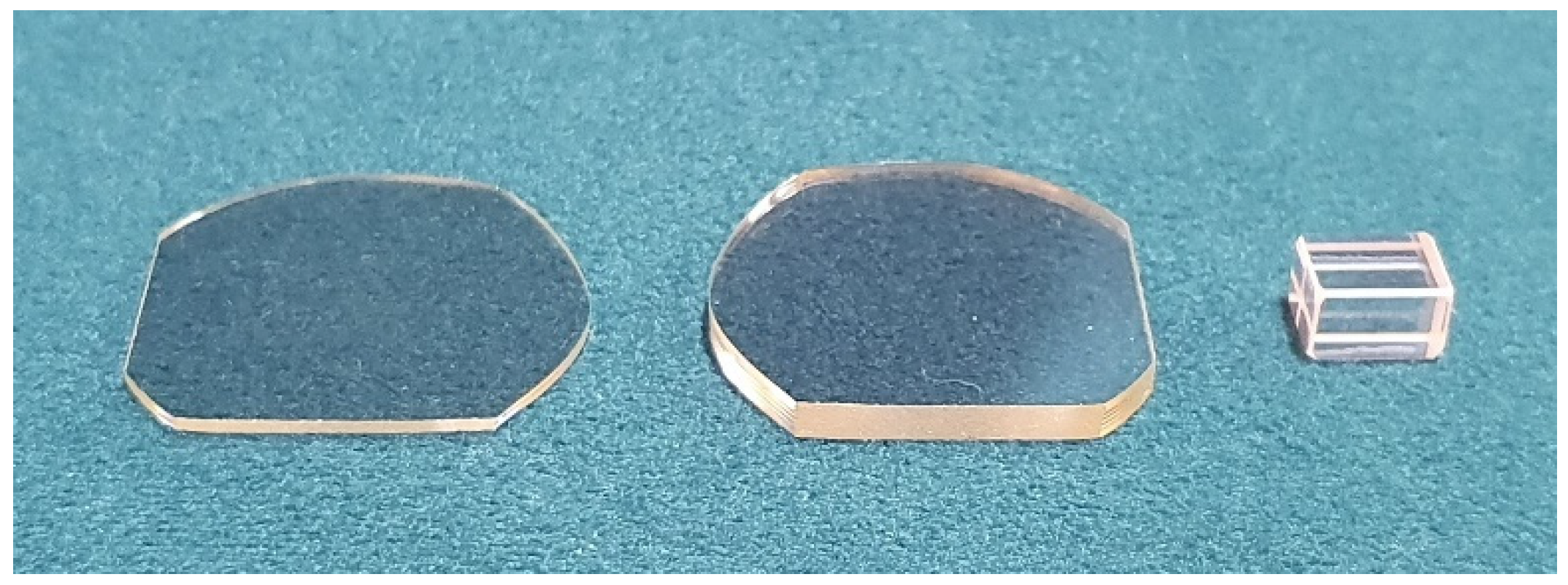
The XRD patterns of powdered samples were registered using a DRON-6 diffractometer (NPP Burevestnik, Saint Petersburg, Russian Federation) in monochromatic CuKα radiation in the 2θ scattering angle range from 5° to 145°, with a step of Δ2θ = 0.02° in the Bragg reflection region and 0.2° in the background region. The profile and structural parameters were refined using the MRIA program, which implements the method of full-profile analysis of X-ray diffraction (XRD) patterns (Rietveld refinement) [52]. The Rietveld method was used to refine the following: the unit cell parameters, the location of Mg and Er in the crystal structure, and the type of intrinsic defects and their concentration (G is the site occupancy). The atom coordinates of the starting model corresponded to those of the ferroelectric phase of lithium niobate (R3c) [53]. The concentration of intrinsic niobium defects in the lithium site (NbLi) and niobium in the empty octahedron (NbV) in the starting model was ≈0.01. The site occupancies of dopants were determined taking into account the data obtained using ICPS-9000 atomic emission spectrometry (Shimadzu, Japan, Kyoto, 2011). The site occupancies of lithium and niobium in regular positions were calculated taking into account the concentration of dopants and intrinsic defects. For each sample, all possible models for the location of both intrinsic [54,55,56] and extrinsic defects in the structure were checked. The agreement R-factors (profile Rp and weighted profile Rwp factors) are among the main criteria for selecting probable models describing the structure of doped crystals. These factors indicate the degree of agreement between the experimental and theoretically calculated XRD profiles for the corresponding model. However, low values of the corresponding factors do not always indicate the correctness of the selected model. Electroneutrality values calculated from the refined site occupancies and the stability of structural characteristics during the refinement process were used as additional selection criteria. The refinement method is described in detail in [57]. Samples for complex studies are presented in Figure 1.
Data for double-doped LN:Mg:Er crystals were controlled by comparison with single-doped LN:Mg and LN:Er crystals. Some studies of LN:Mg and preparation techniques are given in [58]. Preparation technology and main characterization data for LN:Er are presented in our previous work [59].

3. Results

3.1. Physicochemical Properties of the Crystal–Melt System During LN:Mg:Er Crystal Growth

A series of LN:Mg:Er crystals (samples 1–4) were obtained by the Czochralski method in a single technological cycle and identical technological growth modes. The first LN:Mg:Er crystal in the series, studied in the work [42], is designated as LN:Mg:Er(1) in this work. The single-crystal boules had a diameter of 35–36 mm and a cylindrical part length of 43–45 mm; the weights of samples 2, 3, and 4 were 201.1, 194.5, and 192.5 g, respectively; and the samples had different dopant contents.
As-grown LN:Mg:Er(2 and 4) crystals had a pink tint. This tint is typical of erbium-doped single crystals. The LN:Mg:Er(3) crystal was intensely dark gray and faintly pink. After HTEA, the intensity of the dark gray color of the LN:Mg:Er(3) crystal significantly decreased, and pink became the predominant color.
We wanted to compare the distribution of dopants in the melt–crystal system. To do this, we took into account the actual dopant concentrations in the crystals and determined the estimated effective dopant distribution coefficients KD. An example calculation for the dilution case is presented in the paper [45].
Table 1 shows the actual concentrations of Mg and Er in the cone (Ccone) and bottom parts (Cbottom), the calculated dopant concentrations in the initial melt ([Er]L, [Mg]L), and the values of the estimated effective distribution coefficients (KDMg, KDEr). For a more complete understanding of the system under study, we included data on the first LN:Mg:Er(1) crystal of this series from the work [42].
Dilution of the LN:Mg:Er melt with a nominally pure lithium niobate charge sequentially reduces the magnesium concentration in the melt with a step of ~0.5 mol% (from 4.0 to 2.5 mol%). The step of changing the erbium concentration was ~0.1 mol% (from 0.78 to 0.57 mol%). In the melt–crystal system of double doping of LN:Mg:Er, for all grown single crystals, KDMg is close to 1; KDMg also tends to increase with decreasing Mg concentration. This corresponds to the nature of the magnesium distribution during single doping of LN:Mg crystals in the same concentration range [60]. For erbium in double-doped LN crystals, the KDEr value is on average 0.76 (Table 1); this is almost two times less than in the case of single doping, with KDEr = 1.43 in the same concentration range [61]. This difference can be explained by the order of introduction of doping cations during synthesis of the Nb2O5:Mg:Er precursor, the structure of which is largely inherited by the LN:Mg:Er crystal. Paper [62] demonstrates the fundamental importance of the order of introducing dopants during the synthesis of homogeneously double-doped batch. The article revealed that when magnesium was introduced into the Nb2O5 precursor as the first element, a magnesium niobate protostructure formed, not lithium niobate. This homogeneity region is absent in the Nb2O5-MgO system at temperatures below 1100 °C and in thermodynamic equilibrium conditions [63]. This leads to a lower solubility of the second dopant, erbium, compared to LN. This, in turn, is the reason for the lower distribution coefficient of erbium. In this study, magnesium was the first element introduced, and the precursor composition contained magnesium niobate together with Nb2O5 [42].
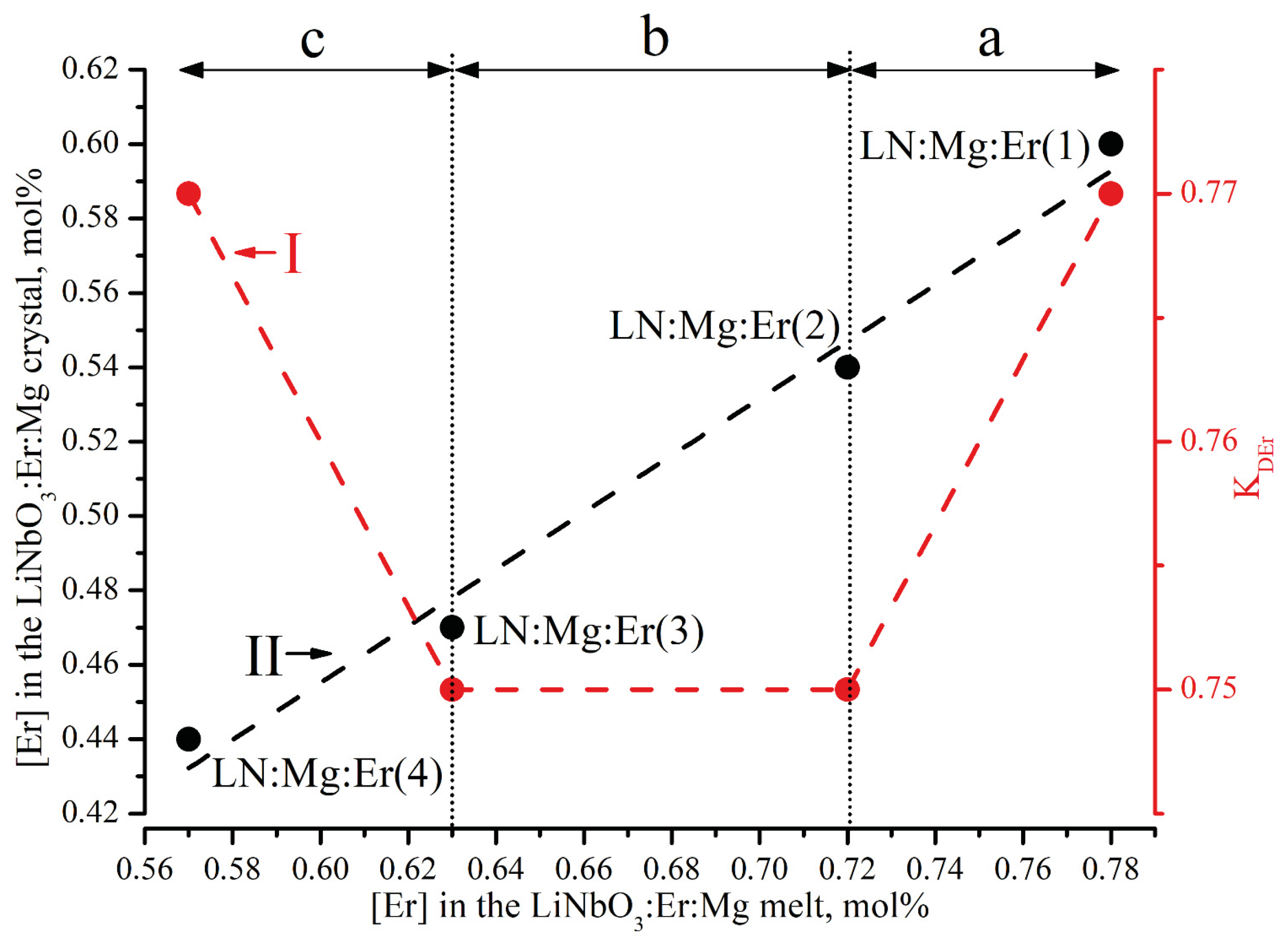
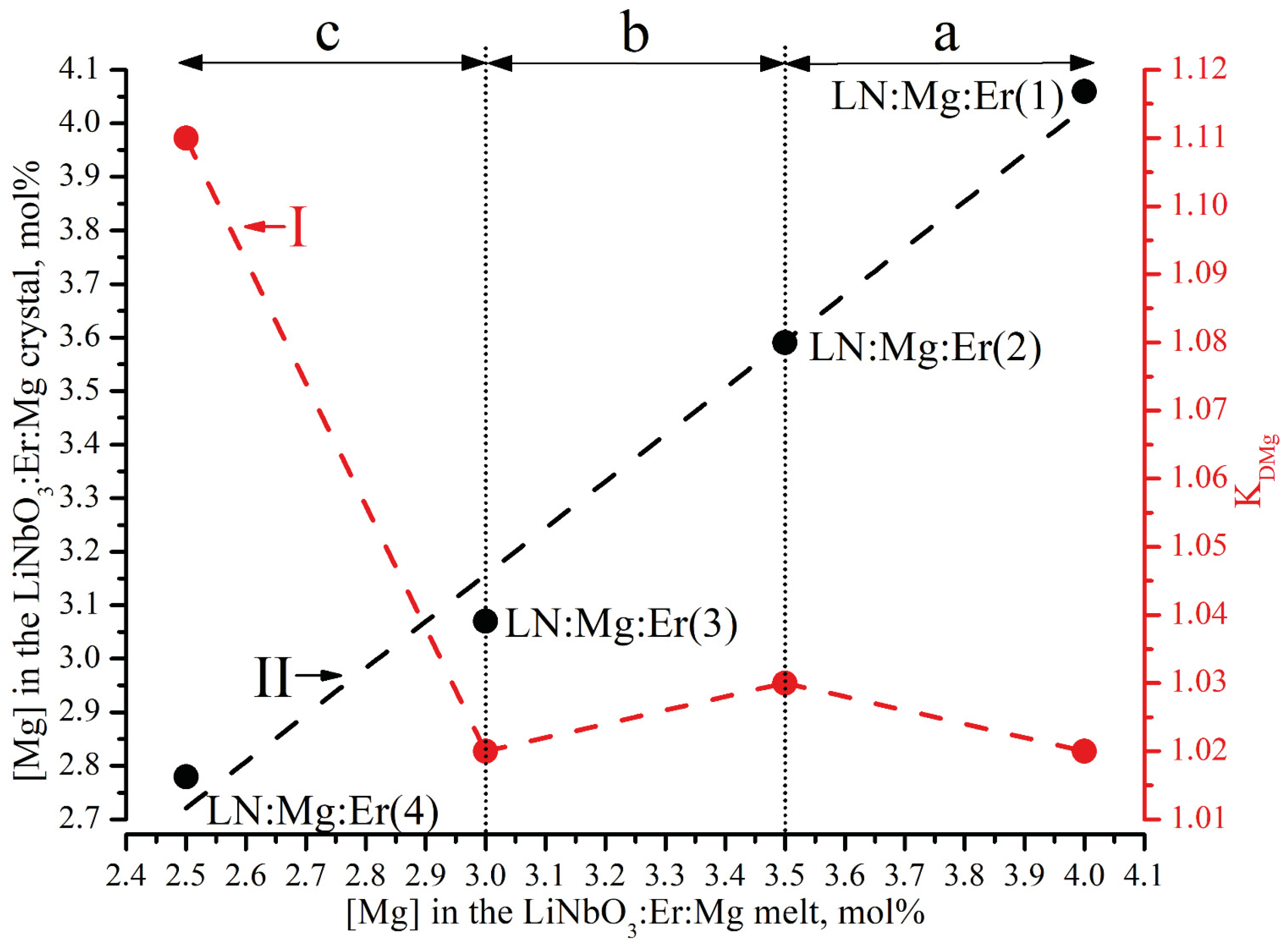
Figure 2 and Figure 3 show the dependences of Er and Mg concentrations in LN:Mg:Er(1–4) crystals and the distribution coefficients KDEr and KDMg on the dopant concentration in the melt of the LN:Mg:Er system. The KDMg and KDEr dependences are approximated by straight-line functions (y = 0.87 × [Mg] + 0.54; y = 0.76 × [Er] − 0.004) with correlation coefficients of 0.98 in both cases (rounded to two decimal places). The slopes of the straight lines are also similar as 0.87 (KDMg) and 0.76 (KDEr), which makes the compositional change in the impurity in the crystals easily predictable in this system and in the given concentration range.
The dependences [Mg]S = f([Mg]L) and [Er]S = f([Er]L) cannot be approximated by any functions due to the randomness of the arrangement and the small sample. Since each point reflects the behavior of the melt–crystal system, even this number of experimental points provides the basis for identifying three concentration regions; they are marked as a, b, and c in Figure 2 and Figure 3. At the beginning of the study (region a), the dependences have opposite directions: descending for erbium and ascending for magnesium. In regions b and c, magnesium and erbium behave similarly with the manifestation of a plateau. In region c, there is a mutual increase in the coefficients, which is not significant given the absolute values, for which the differences are 3% (KDEr) and 8% (KDMg).
The concentration dependences (Figure 2 and Figure 3) reflect the complex structure of the melt. The studied melt contains complexes with similar parameters of chemical activity and elemental composition. The most promising concentration range for obtaining crystals of high optical perfection is [Mg]L = 3.5 ÷ 3.0 mol% and [Er]L = 0.72 ÷ 0.63 mol%. Within the specified limits, the distribution coefficients remain virtually unchanged, and the LN:Mg:Er(2–4) single crystals are compositionally homogeneous along the growth axis, despite the fact that KDEr (<1) and KDMg (≈1), as shown in Table 1. We note that the difference in Mg and Er concentrations in the conical and end parts of the boules is within the measurement error of the ICP-AES method.

3.2. Study of Optical Purity and Degree of Unipolarity of LN:Mg:Er Crystals

The optical purity of a material is assessed by the number of scattering centers per unit volume of a single-crystal boule. This is one of the primary parameters determining the optical quality of a single crystal. Scattering centers in crystals are detected when a laser beam passes through the crystal, which are caused by growth defects. These defects appear in the laser beam as individual luminous points or clusters of them. According to the express assessment, the grown crystals are classified as optically pure materials, as a single scattering center was not detected.
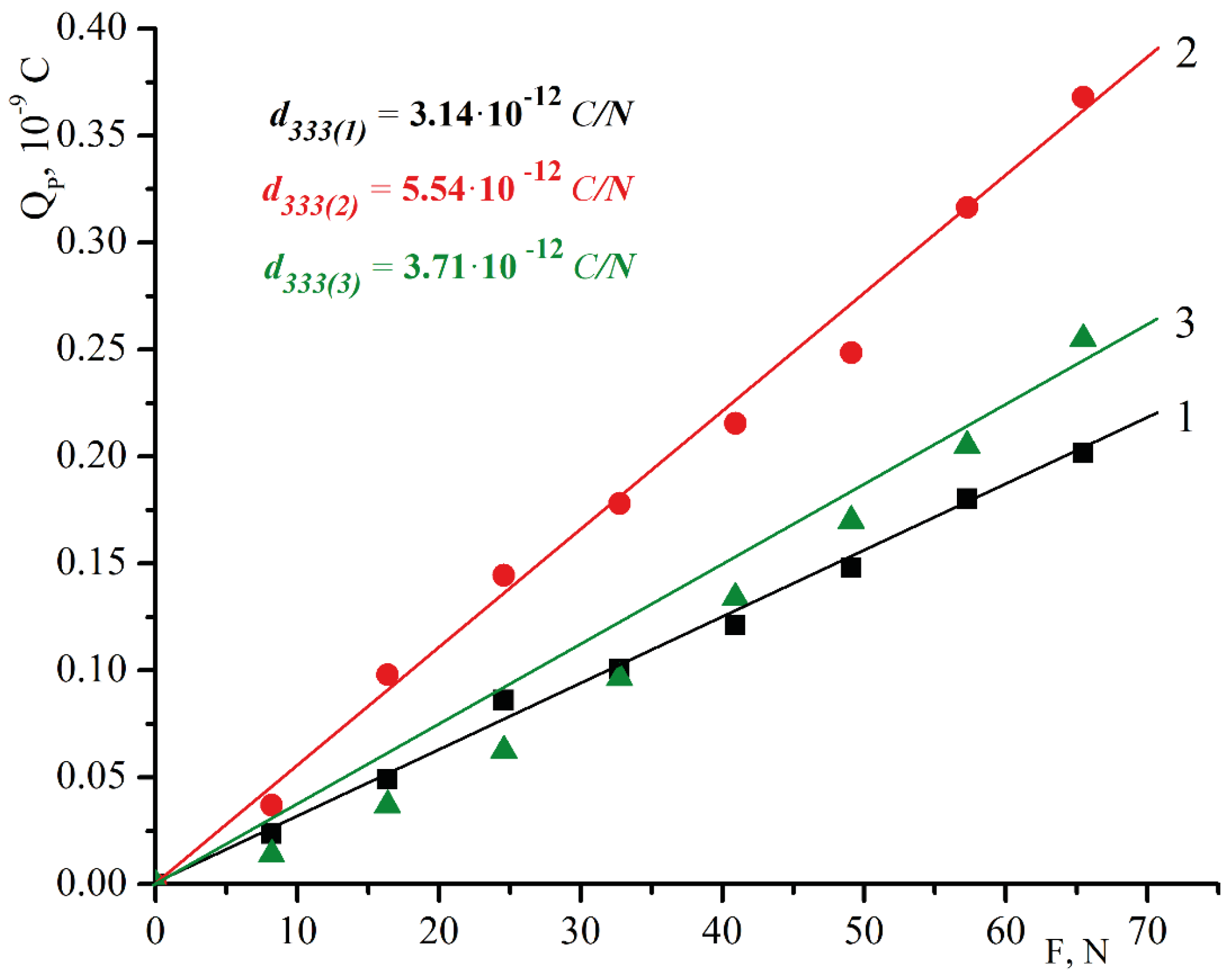
Figure 4 shows the results of measurements of the polarization charge Q from the force F. The values of the piezoelectric modulus d333 calculated on the basis of these measurements were 3.14 · 10−12, 5.54 · 10−12 и 3.71 · 10−12 C/N for samples LN:Mg:Er (2–4) correspondingly. Typically, the as-grown ferroelectric single crystal is polydomain, and its piezoelectric modulus is d333 ≈ 0. During the HTEA, a homogeneous domain structure with a preferred polarization vector orientation is formed, and the piezoelectric modulus d333 increases. Based on this, the LN:Mg:Er(3) crystal exhibited the highest degree of unipolarity ((2) in Figure 4) [64].

3.3. Comparative Studies of the Macro- and Microstructures of Crystals LN:Mg:Er, LN:Mg, and LN:Er by Optical Microscopy and Transmission Spectra

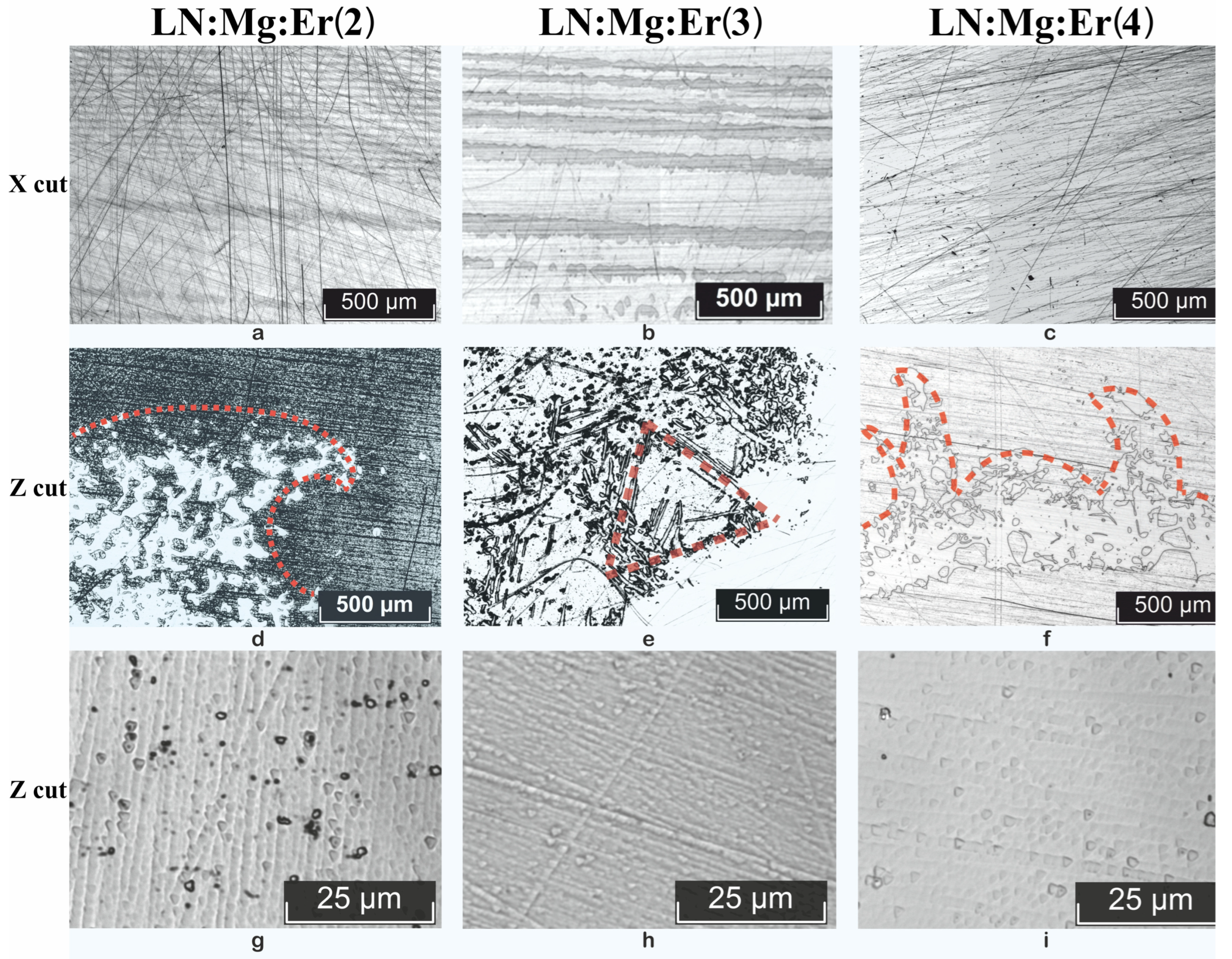
Etching revealed small growth rings at the crystal ends. Growth bands of varying periodicity and width were detected on X-sections using optical microscopy (oblique illumination). This method directs light at a wide angle and focuses it deep into the crystal. Even this method failed to detect any bands in the LN:Mg:Er(4) boule (Figure 5a–c). Figure 5 demonstrates the dependence of the growth band structure type on the dopant content, including blocks with uniform periodicity in the LN:Mg:Er(2) crystal, variable-sized periodicity in the LN:Mg:Er(3) crystal, and a complete absence of bands in the LN:Mg:Er(4) crystal.
To compare the microstructure of the Z-cut LN:Mg:Er crystals, regions with a growth ring structure were selected. A decrease in the dopant concentration also affected the microstructure of the Z-cut samples under study, as seen in Figure 5d–f. In the LN:Mg:Er(2) crystal, it is contrasting with easily distinguishable domains. The domains self-organize into one of the complex “curl”-type structures. Such a structure is very typical for a LN crystal doped with REEs. A fragment with the described structure is shown in Figure 5d. The red dotted line shows the curl formed by two domains of opposite signs. The image of the LN:Mg:Er(3) crystal no longer has such a strong contrast, but it contains elements of self-organization in the form of triangles (Figure 5e). One of the triangles is highlighted with a red dotted line. This type of self-organization in the form of fractal Sierpinski triangles was most clearly discovered in the work [65]. The Sierpinski carpet was recorded on the Z-cut surface of the LN:Cu:Gd crystal. The LN:Mg:Er(3) crystal exhibits a weaker manifestation of this type of self-organization. The microstructure of the LN:Mg:Er(4) crystal exhibits low contrast and a structure with barely visible self-organizing structures. The potential forms of these structures are also indicated by the red dotted line (Figure 5f). These processes are caused by the presence of the REE Er in the crystal [66]. Despite the fact that the concentration of erbium is significantly lower than that of Mg, its presence promotes the formation of this type of structure.
The basic cellular structure provides additional information about the equilibrium of the entire crystal. Analysis of the shape, size, and cell arrangement, as well as the presence of micron-scale defects, allows for a qualitative assessment of the degree of defects at a scale of <10 µm and, consequently, the crystal’s stress state. According to the microstructures shown in Figure 5g–i, the LN:Mg:Er(3) crystal (Figure 5h) is the least defective: neither defects with sizes smaller than 1 µm nor dislocation lines were detected in its structure. Weakly expressed cells are ordered in arrangement, uniform in shape and similar in size. The LN:Mg:Er(4) crystal is the least stressed due to the greater presence of cells with somewhat larger sizes, as well as the preservation of the order of their arrangement and the absence of gross defects.
In this series of crystals, the LN:Mg:Er(3) crystal has the most uniform microstructure at a level of 1 μm or less, while LN:Mg:Er(4) has the most uniform macrostructure. Growth rings are almost absent on polished Z-sections of the LN:Mg:Er(3) crystal boule, while growth bands are present on the X-section of LN:Mg:Er(4). The cells of the basic structure are uniform in both crystals, but in LN:Mg:Er(3), their size does not exceed 1.5 μm. This is the minimum size in the studied series of crystals and is an indication of a more stressed state than in the LN:Mg:Er(4) crystal. According to these data and the piezoelectric modulus d333 (Figure 4), the contribution of low-angle boundaries and growth striations to the crystal’s degree of unipolarity is insignificant. Otherwise, the d333 value of the LN:Mg:Er(3) crystal would not have the highest values among the crystals studied. Low-angle boundaries are cell boundaries. Growth striations are visible albeit weakly.
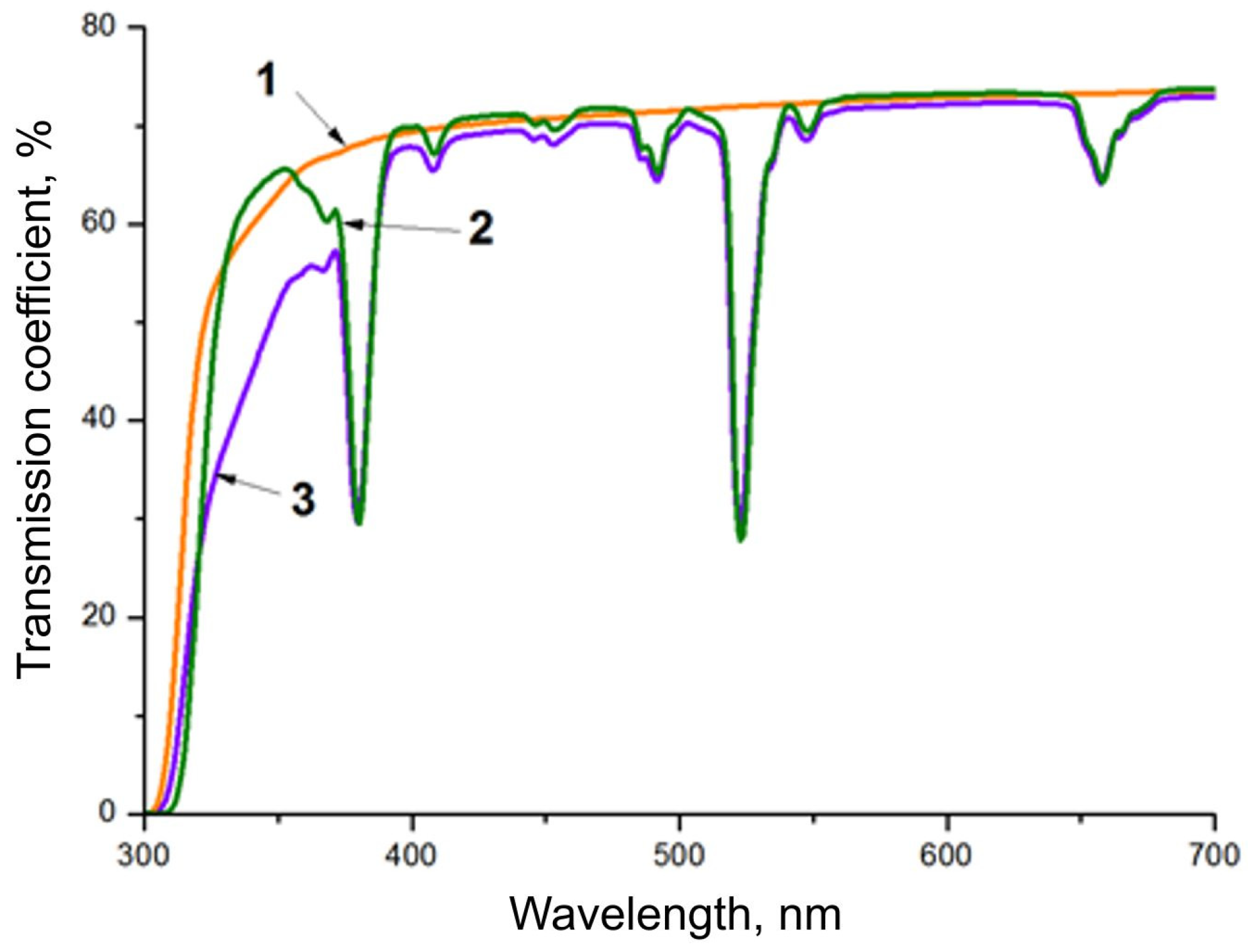
We studied the transparency of LN:Mg:Er(2–4) crystals in the visible range. Changing the dopant concentration in the crystals in increments of 0.4 mol% for magnesium and 0.05 mol% for erbium (Table 1) does not change the shape or position of the spectra. The spectra are very close and partially overlap. Therefore, to avoid clutter, we present data only for the LN:Mg:Er(2) crystal in Figure 6.
We evaluated the effect of double metal doping on the transmission spectra of LN:Mg:Er crystals in comparison with single-doped crystals. LN:Mg and LN:Er crystals were studied in [58] and [59], respectively. Figure 6 shows that the transmission spectra of LN:Mg (1) and LN:Er (2) crystals have fundamental differences determined by the electronic structure of the dopant. In the LN:Mg:Er(2) crystal, the Mg concentration exceeds the Er concentration by almost 6.5 times. The LN:Mg:Er(2) spectrum optically behaves like an erbium spectrum, not a magnesium spectrum. That is, the influence of erbium on both the transmission spectra and the formation of the domain structure is decisive. Co-doping of Mg and Er in LN:Mg:Er(2–4) crystals reduced transparency in the ultraviolet and violet spectral ranges compared to single-doped LN:Mg and LN:Er crystals.

3.4. Study of LN:Mg:Er Crystals by PILS and Laser Conoscopy Methods

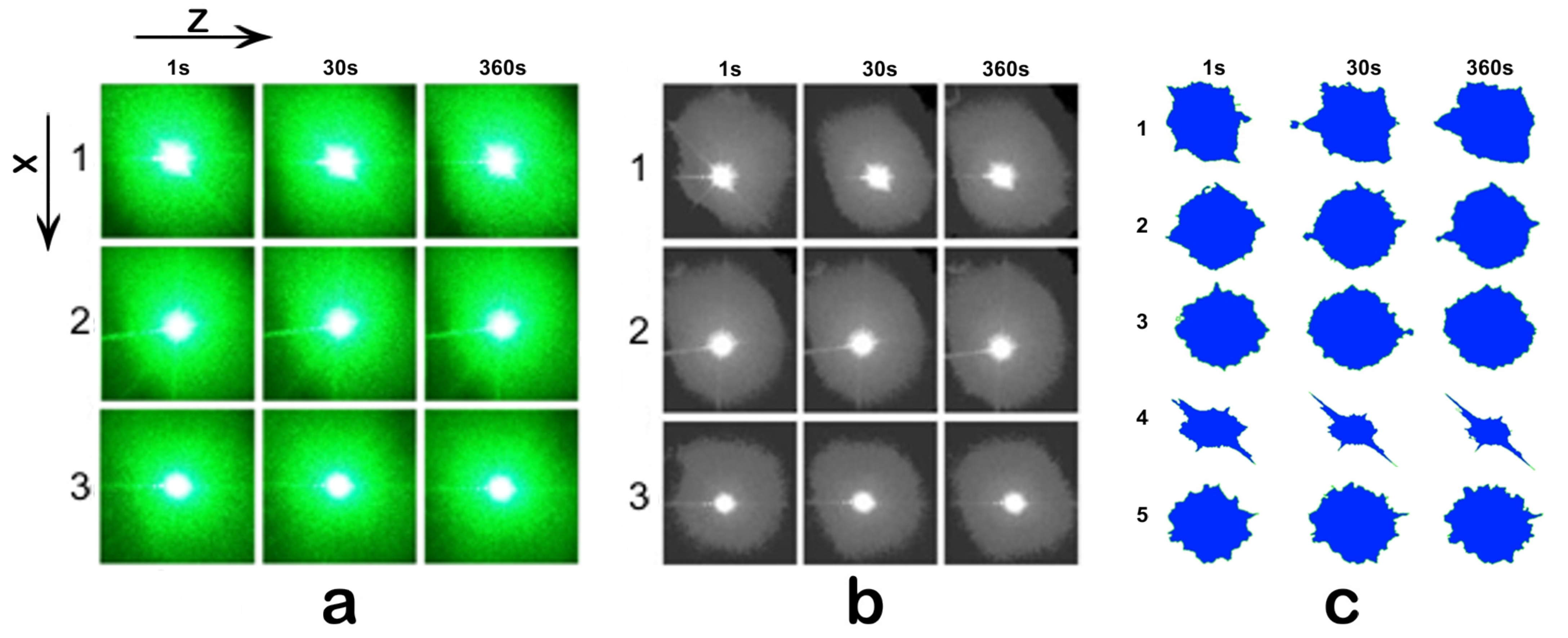
Figure 7a shows the results of irradiating crystals with 160 mW laser radiation for 1, 30, and 360 s. The PILS indicatrix does not open up, and only circular scattering by static structural defects is observed. Additional processing of the original image (Figure 7a) with division into six illumination levels also did not record the indicatrix opening (Figure 7b). The laser beam shape (light spot) and the scattered radiation shape (darker shades of gray) change insignificantly over time for LN:Mg:Er(2–4) crystals (Figure 7b).
The Thixomet program made it possible to isolate the beam shape based on the greatest brightness (Figure 7c) and numerically evaluate these changes (Table 2). Paper [58] has established that individual doping of LN with magnesium or erbium does not result in the opening of the PILS indicatrix, but no beam shape analysis was performed. Figure 7c (samples 4 and 5) shows the beam shapes recorded on the output faces of LN:Er and LN:Mg crystals irradiated with laser radiation at a power of 160 mW for 1, 30, and 360 s. Visually, the beam shapes are fundamentally different, and, while the LN:Mg crystal is closer to a circle, the LN:Er shape is so distorted that this fact can be identified as a weak disclosure of the indicatrix, which was not detected in the work [58] at [Er] = 0.14–2.8 mol%. Numerically, F2 of the LN:Er crystal (F2 = 0.25 at t = 1 s) is several times smaller than that of LN:Mg (F2 = 0.64 at t = 1 s of irradiation). F2 further decreased by two times under long-term irradiation (F2 = 0.25–0.11 at t = 360 s), while the beam shape of the LN:Mg crystal remained at the same level (F2= 0.64/0.61/0.64 at t = 1/30/360 s). Co-doping with erbium and magnesium at low concentrations of LN:Mg:Er(4) increased F2 by an average of 0.1 while maintaining the stability characteristic of the LN:Mg crystal with increasing irradiation time. An increase in the dopant content reduced the beam shape regularity as F2 = 0.72 for LN:Mg:Er(4) at t = 1 s and F2 = 0.53 for LN:Mg:Er(2) at t = 1 s. And starting with [Er]S = 0.47 mol%, the LN:Mg:Er(3) crystal showed a tendency to open the indicatrix, which was slightly more pronounced in the LN:Mg:Er(2) crystal with [Er]S = 0.54 mol%.
An analysis of Figure 7c and the results in Table 2 revealed that low erbium concentrations (0.44 mol%) improve and stabilize the beam shape during laser irradiation of the “magnesium” crystal, while the addition of magnesium suppresses the latent unfolding of the PILS pattern of the “erbium” LN:Er crystal. It is worth noting that the beam shape of the doubly doped crystal during laser irradiation is determined by the predominant magnesium content. At the same time, transmission spectra and microstructural characteristics of LN:Mg:Er crystals are determined by the presence of erbium, although its concentration is much lower than that of magnesium.
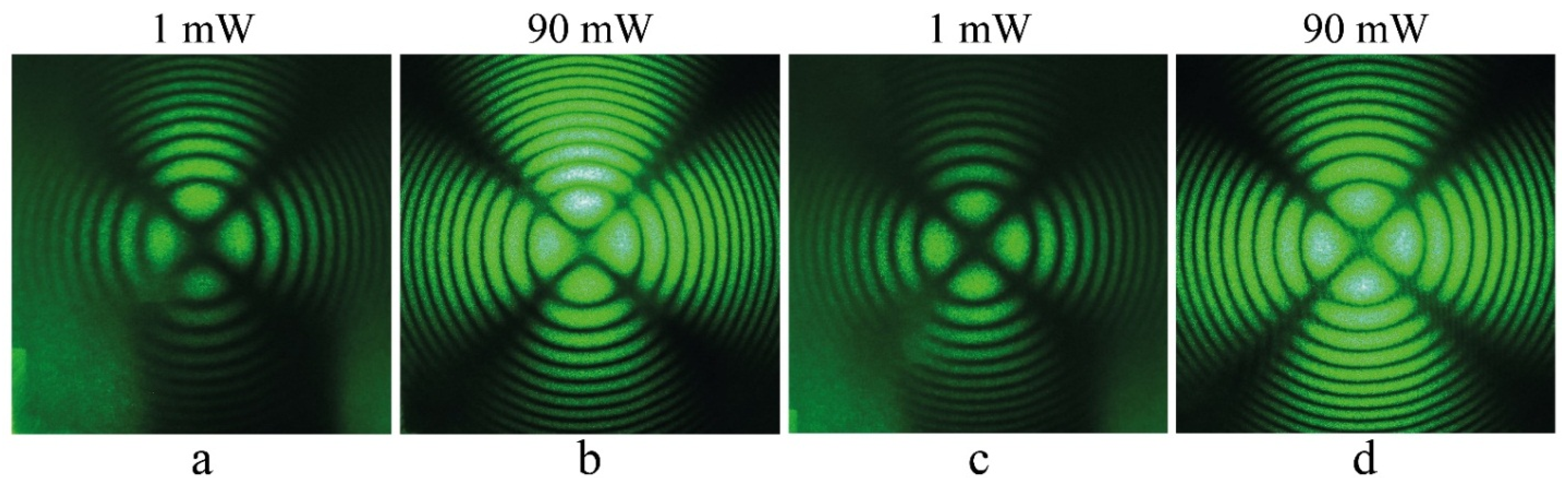
The optical quality of LN:Mg:Er(2–4) crystals was monitored using laser conoscopy. This method allows one to evaluate the crystal’s orientation, its optical homogeneity, and the presence of various types of defects [67]. In general, crystal defects are determined by their composition and growth conditions. However, some defects arise in response to laser radiation. Conoscopic patterns are capable of revealing precisely these laser-induced defects. To do this, it is necessary to compare the patterns in the absence of the photorefraction effect (recorded at a laser power of P = 1 mW) and in the presence of the photorefraction effect (at a laser power of 90 mW). Figure 8 shows the conoscopic patterns of LN:Mg:Er(2 and 3) crystals. The conoscopic patterns of the LN:Mg:Er(1) crystal are presented in [42]. The conoscopic patterns of the LN:Mg:Er(4) crystal coincide with the patterns of LN:Mg:Er(2) Figure 8.
A slight deformation of the “Maltese cross” center in the vertical direction indicates the manifestation of weak optical biaxiality in the LN:Mg:Er(2) crystal, as shown in Figure 8a,b. At the same time, deformations in the form of pairwise closure of adjacent isochromes, which acquire weak ellipticity, are present on the branches of the “Maltese cross” shown in Figure 8a,b. Distortions in the conoscopic patterns of the LN:Mg:Er(4) crystal are similar to the corresponding distortions of the LN:Mg:Er(2) crystal, but are expressed to a much lesser extent. In the conoscopic patterns of the LN:Mg:Er(3) crystal, the isochromes have a regular circular shape. However, in the LN:Mg:Er(3) crystal, a slight deformation of the “Maltese cross” center in the vertical direction is also observed. The deformation indicates the presence of very weak optical biaxiality, which may be due to residual mechanical stresses, as shown in Figure 8c,d. The weak induced optical biaxiality cannot be due to the photorefractive effect, as it is suppressed in LN:Mg:Er crystals. It is most likely caused by photoelastic phenomena caused by mechanical stress, the piezo-optic effect, dopant segregation, and the like. Residual mechanical stresses may result from insufficient post-growth thermal treatment or local segregation of dopants. It should be noted that conoscopic patterns for all studied samples were recorded in several regions of the crystals to assess their optical homogeneity. According to the obtained data, the maximum similarity of the conoscopic patterns obtained in different regions of each sample is observed for the LN:Mg:Er(3) crystal. This indicates that it has the highest optical homogeneity in the series of studied LN:Mg:Er(2–4) crystals. It should be noted that at a laser radiation power of 90 mW, no additional distortions were detected in the conoscopic patterns of LN:Mg:Er(2–4) crystals. This is consistent with the PILS study data, which prove only round light scattering in these crystals at a laser radiation power of 160 mW (Figure 7). Thus, the LN:Mg:Er(1–4) samples, even after HTEA, have insignificant internal stresses. The crystals differ in the level of optical homogeneity and defects, with optical quality increasing in the series: LN:Mg:Er(2) → LN:Mg:Er(4) → LN:Mg:Er(3) → LN:Mg:Er(1).

3.5. XRD Studies of Crystals LN:Mg:Er Crystals

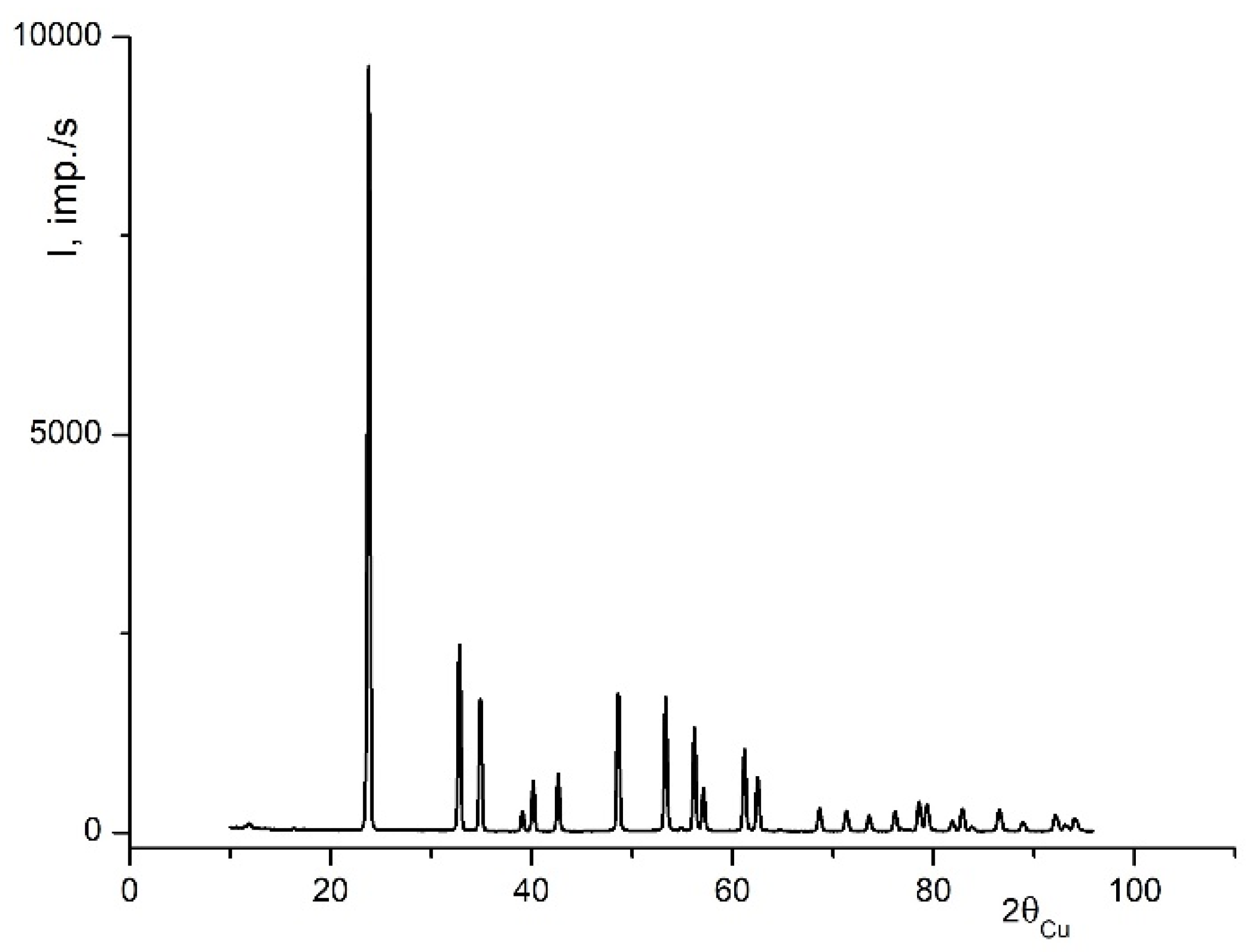
The XRD patterns of LN:Mg:Er crystals correspond to those of lithium niobate with the R3c space group. The most intense reflection in the XRD patterns of the crystals under study is observed at a scattering angle of 23.7°. Figure 9 shows an example of an XRD pattern of an LN:Mg:Er(1) crystal. Patterns of other crystals are almost identical. We note that very weak additional reflections forbidden by the R3c space group are observed in the scattering angle range from 11 to 22° and from 25.3 to 31°. The low-intensity reflections are associated with the presence of extended ordered defects in the LN structure [68].
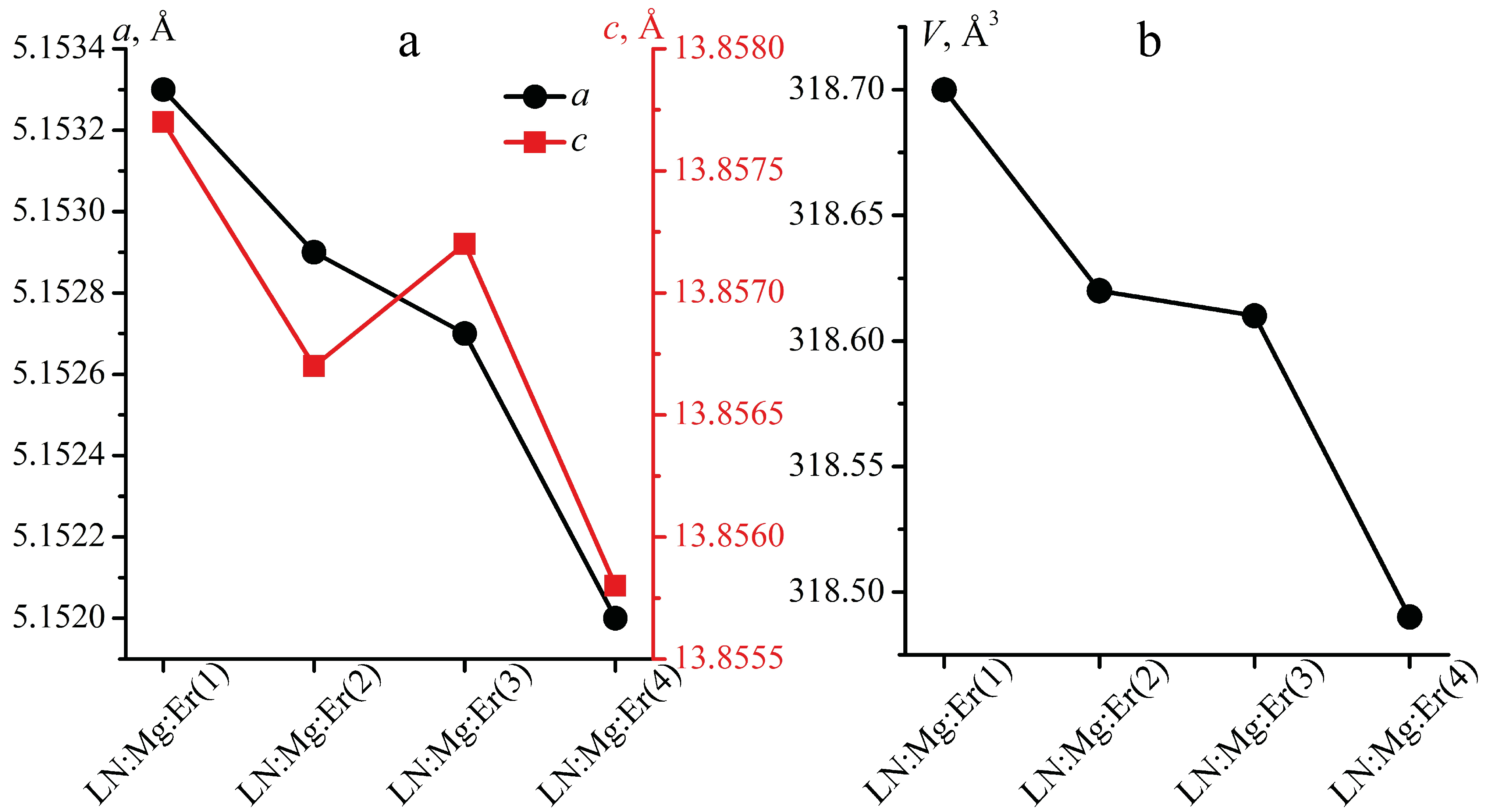
Figure 10 shows the concentration dependences of the refined parameters and volume of the unit cells of LN:Mg:Er(1–4) crystals. The values of the parameters and volume of the unit cells for LN:Mg:Er(1–4) crystals are, in general, close (Figure 10). From the LN:Mg:Er(1) sample to the LN:Mg:Er(4) sample, there is an insignificant decrease in the parameters and volume of the unit cells. For the LN:Mg:Er(3) crystal, an insignificant (by 0.0005 Å) increase in the unit cell c parameter is observed compared to the corresponding one of the LN:Mg:Er(2) crystal, Figure 10a. The unit cell volume of the previously studied crystal doped only with magnesium LN:Mg ([Mg] = 4.78 mol%) is equal to 318.3 Å3 [62]. The unit cell volume of the LN:Er ([Er] = 0.8 mol%) is 318.3 Å3 [61]. This is lower than the values for LN:Mg:Er(1–4) samples. Thus, co-doping with erbium and magnesium leads to a predictable increase in the unit cell volume.
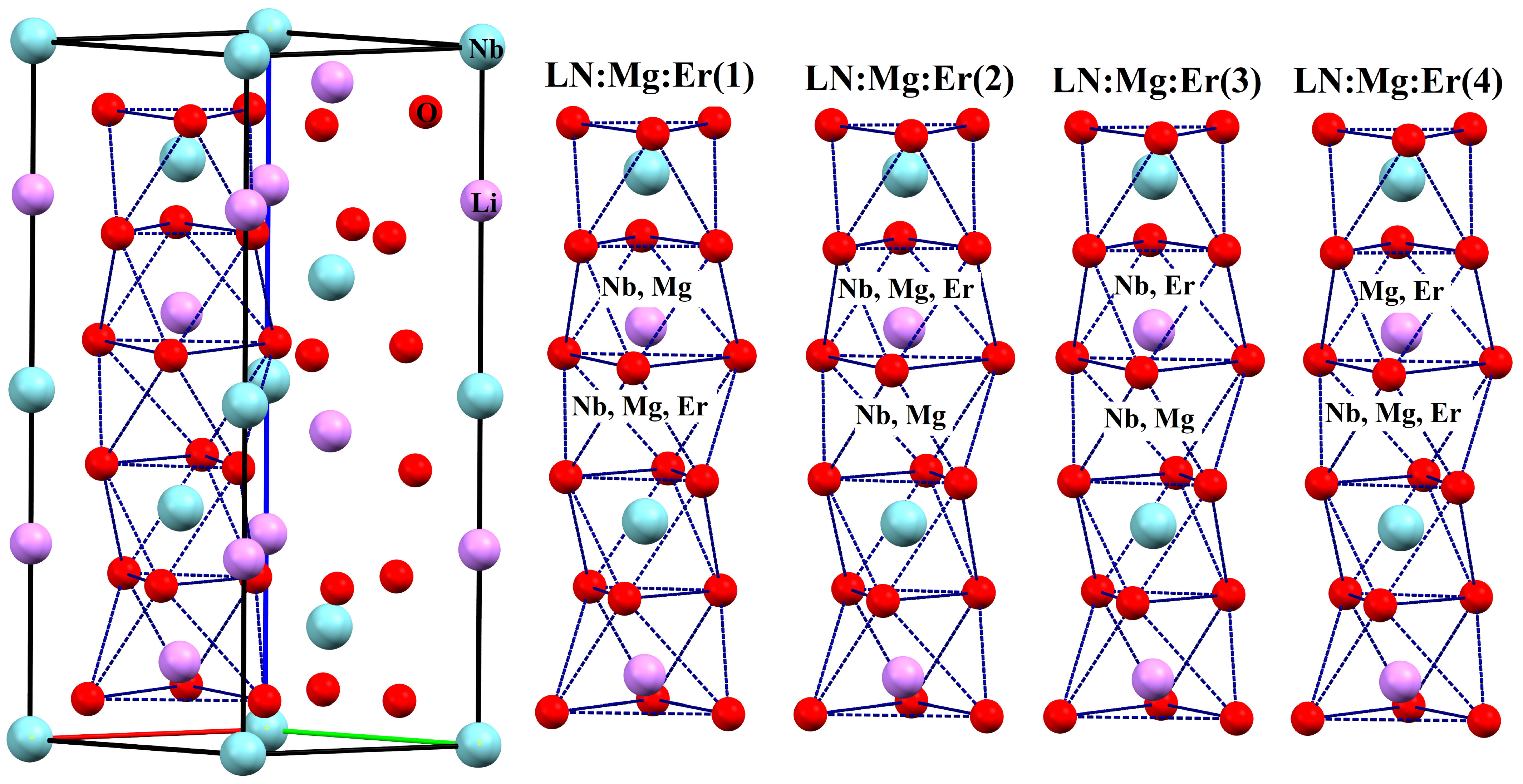
Figure 11 and Table 3 show the final models of the positions of intrinsic and doping defects in the studied crystals.
Table 4 shows the site occupancies of the intrinsic and doping defects sites, as well as the number of vacancies in lithium (VLi) and niobium (VNb5−) sites.
Analysis of Table 3 showed that magnesium occupies lithium (MgLi) and vacant (MgV) octahedra in LN:Mg:Er(1, 2, and 4) crystals, and only vacant ones in LN:Mg:Er(3) crystal. The distribution of erbium in the structure of LN:Mg:Er(1–4) crystals is fundamentally different. Erbium is incorporated into vacant (ErV) octahedra in the LN:Mg:Er(1) crystal; this crystal has the highest erbium concentration. Erbium is incorporated into lithium (ErLi) octahedra in LN:Mg:Er(2 and 3) crystals. Erbium is incorporated simultaneously into lithium and vacant octahedra in the LN:Mg:Er(4) crystal; this crystal has the lowest erbium concentration (Figure 11, Table 3). The magnesium distribution in the LN:Mg:Er(1) crystal structure is the same as for the LN:Mg crystal ([Mg] = 4.78 mol%), as magnesium is located in the LiO6 and VO6 octahedra. There is only one difference: in the single-doped crystal, the Mg concentration in these positions is the same. In LN:Er crystals obtained by direct doping, up to a concentration of 2.19 mol%, erbium is located in the lithium site, and, with increasing concentrations, it occupies the empty octahedron [61].
For all samples, the concentration of VNb point defects is higher than the concentration of VLi defects. Consequently, charge compensation during the formation of intrinsic and dopant defects occurs mostly due to the formation of VNb defects. We note that the total number of VLi and VNb vacancies is at a maximum for the LN:Mg:Er(2) crystal. This is approximately 1.4–1.8 times greater than the total number of vacancies at the lithium and niobium sites in LN:Mg:Er(1, 3, and 4) crystals. This fact is explained by the maximum total content of intrinsic and dopant defects in the LN:Mg:Er(2) crystal (Table 4).
Table 4 shows that the total number of defects in the vacant oxygen octahedron in the LN:Mg:Er(4) sample is lower than in the LN:Mg:Er(1–3) crystals. In all samples, except for the LN:Mg:Er(2) crystal, the total number of defects in the vacant octahedron exceeds the number of defects in the lithium site. Moreover, the LN:Mg:Er(2) crystal has the highest total concentration of vacancies and defects in the series of studied LN:Mg:Er crystals, as shown in Table 4. In the LN:Mg:Er(1) sample, the total concentration of defects in the lithium site is noticeably lower than in the LN:Mg sample (∑MeLi = 0.036), and the total concentration of defects in the empty octahedron is noticeably higher (for LN:Mg, ∑MeV = 0.047) [62].
It should be noted that in the previously studied homogeneously doped LN crystals [69], a tendency to introduce a metallic dopant into a vacant oxygen octahedron was observed. The introduction of ions into an empty octahedron changes the alternation of cations along the polar axis. This increases the degree of defectiveness of the LN crystal structure. With such incorporation, the probability of formation of complex defects (MeLi or MeV + VLi or VNb) increases, as the distance between metal cations must be greater than the sum of their ionic radii. At the same time, the presence of niobium cations in lithium sites and niobium vacancies 4(NbLi+4 VNb−5) may indicate the formation of cluster regions with alternating cations different from those in the lithium niobate matrix with space group R3c [70].
The highest total number of VLi and VNb vacancies and the total content of intrinsic and dopant defects are observed in the LN:Mg:Er(2) crystal. This may be due to the fact that the melt of the homogeneously doped batch is diluted with a nominally pure batch obtained by solid-phase synthesis. LN:Mg:Er(2–4) crystals were grown from a melt diluted with a batch of nominally pure LN of congruent composition. Such a batch is lithium-deficient (R = Li/Nb = 0.946). The stoichiometry of the LN:Mg:Er crystals was calculated based on the occupancies G(Li, Nb, NbLi, and NbV) given in Table 4. The calculation showed that the R value from the LN:Mg:Er(1) to the LN:Mg:Er(4) crystal equals 1.003, 0.954, 1.032, and 1.031. The lowest R value is thus characteristic of the crystal grown after the first addition of the batch of congruent composition to the remaining melt after growing the LN:Mg:Er(1) crystal. This increased the diversity of ionic complexes in the melt during growth of the LN:Mg:Er(2) crystal, increasing the content of point defects and the total number of vacancies in this crystal, as seen in Table 4.
In the LN:Mg:Er(1) crystal, most of the point structural defects are concentrated in vacant octahedra. Replenishment of the melt to the initial value with the solid-phase synthesis batch caused a redistribution of point structural defects in the LN:Mg:Er(2) crystal. In this crystal, the maximum defect content is found in the lithium sites, which naturally leads to a decrease in the R value. It can be concluded that during the melt preparation and crystal growth of the LN:Mg:Er(2), a partial “transition” of Nb, Mg, and Er ions into lithium octahedra occurs due to the fact that lithium octahedra are larger in size compared to the NbO6 and VO6 octahedra. At the same time, for LN:Mg:Er(3 and 4) crystals, the tendency of Nb, Mg, and Er incorporation into vacant oxygen octahedra is preserved. This was also characteristic of the LN:Mg:Er(1) crystal, as seen in Table 4. This reduces the number of defects in the Li position and, accordingly, increases the R values for LN:Mg:Er(3 and 4) crystals.

4. Conclusions

A series of LN:Mg:Er crystals with varying dopant metal contents were grown from a homogeneously doped batch using the Czochralski method. The magnesium distribution coefficients for doubly doped LN:Mg:Er crystals are close to those for singly doped LN:Mg crystals. The erbium distribution coefficient for doubly doped (LN:Mg:Er) crystals is almost half that for singly doped LN:Er. This is due to the order of dopants introduction during the liquid-phase synthesis of the Nb2O5:Mg:Er precursor.
The erbium content in LN:Mg:Er crystals is almost 6.5 times lower than that of magnesium, yet it is erbium that determines the domain structure type and optical transmission spectrum characteristics.
PILS studies have shown that LN:Mg:Er(1–4) crystals exhibit no opening of PILS. A study of the laser beam spot shape revealed that an increase in the dopant concentration in LN:Mg:Er(1–4) crystals in the concentration ranges [Mg]S = 2.78–3.59 mol% and [Er]S = 0.44–0.54 mol% increases the beam shape distortion.
It was shown that the optical transmission spectra of doubly doped LN:Mg:Er(1–4) crystals generally correspond to those of singly doped LN:Er crystals. However, the presence of Mg in LN:Mg:Er(1–4) crystals significantly reduces their transparency in the ultraviolet and violet wavelength ranges.
Studies using Rietveld refinement of XRD patterns revealed a monotonic decrease in the parameters and volumes of the unit cells and a non-monotonic increase in R = Li/Nb: 1.003, 0.954, 1.032, and 1.031 in the series of LN:Mg:Er(1→2→3→4) crystals. Moreover, intrinsic and doping point structural defects are formed in the structure of LN:Mg:Er(1–4) crystals, localized both in lithium (NbLi, MgLi, ErLi) and in vacant (NbV, MgV, ErV) oxygen octahedra. It was confirmed that the presence of dopant cations in vacant oxygen octahedra is characteristic of crystals obtained by homogeneous doping. Contrary to the generally accepted model of lithium vacancies, vacancies in the niobium sites (VNb5−) act as the main compensators for the excess positive charge in the studied LN:Mg:Er crystals. Vacancies in the lithium sites (VLi) are present in small quantities in LN:Mg:Er(1, 2, and 4) crystals and are completely absent in the LN:Mg:Er(3) crystal. In the series studied, the LN:Mg:Er(2) crystal has the highest total concentration of vacancies (∑VMe = 0.124) and defects (∑MeLi + MeV = 0.094).
No threshold effects were detected in LN:Mg:Er crystals in the studied concentration range. The linear dependence of the Mg/Er content in the crystal on the Mg/Er concentration in the melt confirms the absence of thresholds.
Optical microscopy revealed a monotonic change in the nature of the defect structure. This change is reflected in a decrease in the degree of self-organization against a background of a general reduction in macro-, meso-, and microdefects with decreasing Mg/Er dopant concentration. A similar smooth change was observed in the transformation of the laser beam shapes on the output face of the LN:Mg:Er crystals.
XRD analysis revealed different combinations and concentrations of structural defects in each LN:Mg:Er crystal in the studied series. This is due to the fact that LN:Mg:Er crystals grow from a melt with a complex structure, which contains a variety of ionic complexes with similar electrochemical and kinetic parameters. However, for a given melt composition, only one type of defect complex crystallizes out of the entire spectrum of complexes present. This type of complex is typically the most favorable according to crystallization criteria under given thermodynamic conditions. A change in the melt composition caused by dilution with a nominally pure lithium niobate batch leads to minor melt restructuring. This causes another type of complex to become favorable. Therefore, even with a small concentration step of magnesium and erbium impurities in the melt (~0.5 and 0.07 mol%, respectively), crystals grow with a slightly different type of point defect structure.
The melt composition was found to be most favorable for the growth of compositionally and optically homogeneous LN:Mg:Er crystals with high resistance to optical damage and a high degree of unipolarity (the highest piezoelectric modulus d333). This is a melt containing [Mg] = 3.0 mol% and [Er] = 0.63 mol%, from which the LN:Mg:Er(3) crystal was grown, containing [Mg] = 3.07 mol% and [Er] = 0.47 mol%. The LN:Mg:Er(3) crystal stands out among the crystals of the studied series. In the LN:Mg:Er(3) crystal, lithium vacancies VLi are absent, and magnesium is incorporated only into vacant MgV octahedra, while ErV defects are completely absent.

Author Contributions

Conceptualization, I.B., R.T., A.K., O.P. and M.P.; methodology, I.B., R.T., A.K., O.P., D.M., N.T., I.E., S.M. and O.T.; software, O.P., D.M. and R.T.; validation, M.P., N.S., O.P. and D.M.; investigation, I.B., R.T., S.M. and A.K. (Petrozavodsk), O.P., D.M., N.T., I.E. and O.T.; resources, M.P., D.M. and A.K.; writing—original draft preparation, I.B., R.T., A.K., O.P., D.M., S.M., N.T., I.E., O.T., M.P. and N.S.; writing—review and editing, R.T., O.P., D.M. and M.P.; visualization, R.T., A.K. (Petrozavodsk), O.P., D.M., N.T. and I.E.; supervision, R.T.; project administration, M.P. and N.S.; funding acquisition, M.P. and A.K. All authors have read and agreed to the published version of the manuscript.

Funding

This work was financially supported by the Russian Science Foundation, grant 24-13-20004. Reference to the grant page can be found here: https://rscf.ru/en/project/24-13-20004/ (accessed on 13 May 2024).

Institutional Review Board Statement

Not applicable, as the study did not involve humans or animals.

Informed Consent Statement

Not applicable, as the study did not involve humans or animals.

Data Availability Statement

Data are contained within the article.

Conflicts of Interest

The authors declare no conflicts of interest.

Abbreviations

The following abbreviations are used in this manuscript:
XRDX-ray diffraction
LNLithium niobate (LiNbO3)
TFLNLithium niobate thin film
LNOILithium-niobate-on-insulator
REERare earth element
ICP-AESInductively coupled plasma atomic emission spectroscopy
HTEAHigh-temperature electrodiffusion annealing
PILSPhotoinduced light scattering

References

  1. Chen, G.; Li, N.; Da Ng, J.; Lin, H.-L.; Zhou, Y.; Fu, Y.H.; Lee, L.Y.T.; Yu, Y.; Liu, A.-Q.; Danner, A.J. Advances in lithium niobate photonics: Development status and perspectives. Adv. Photonics 2022, 4, 034003. [Google Scholar] [CrossRef]
  2. Abrahams, S.C.; Levinstein, H.J.; Reddy, J.M. Ferroelectric lithium niobate polycrystal x-ray diffraction study between 24 and 1200 °C. J. Phys. Chem. Solids 1966, 27, 1019–1026. [Google Scholar] [CrossRef]
  3. Rauber, A.; Kaldis, E. (Eds.) Current Topics in Material Sciences; North-Holland: Amsterdam, The Netherland, 1978. [Google Scholar]
  4. Prokhorov, A.M.; Kuzminov, Y.S. Physics and Chemistry of Crystalline Lithium, Niobate; Hilger: New York, NY, USA, 1990. [Google Scholar]
  5. Wong, K.K. (Ed.) Properties of Lithium Niobate; IEE: London, UK, 2004. [Google Scholar]
  6. Schirmer, O.F.; Thiemann, O.; Wohlecke, M.J. Defects in LiNbO3—I. experimental aspects. Phys. Chem. Solids 1991, 52, 185. [Google Scholar] [CrossRef]
  7. Kratzig, E.; Schirmer, O.F. Photorefractive Materials and Their Applications I; Gunter, P., Huignard, J.P., Eds.; Springer: Berlin/Heidelberg, Germany, 1998; Volume 131. [Google Scholar]
  8. Abrahams, S.C. Properties of Lithium Niobate; Institution of Electrical Engineers: New York, NY, USA, 1989; 234p. [Google Scholar]
  9. Volk, T.; Wohlecke, M. Lithium Niobate. In Defects, Photorefraction, and Ferroelectric Switching; Springer: Berlin/Heidelberg, Germany, 2008; 250p. [Google Scholar]
  10. Abrahams, S.C.; March, P. Defect Structure Dependence on Composition in Lithium Niobate. Acta Cryst. B 1986, 42, 61–68. [Google Scholar] [CrossRef]
  11. Lines, M.E.; Glass, A.M. Principles and Application of Ferroelectrics and Related Materials; Clarendon Press: Oxford, UK, 1977; p. 680. [Google Scholar]
  12. Stroganova, E.V.; Galutskiy, V.V.; Nalbantov, N.N.; Kozin, A.S. Spectral-luminescent properties of gradient-activated LiNbO3 crystals with concentration profiles of Yb3+ and Er3+ ions. Optoelectron. Instrum. Data Process. 2017, 53, 77–81. [Google Scholar] [CrossRef]
  13. Babenko, I.D.; Galutskiy, V.V.; Ivashko, S.S.; Stroganova, E.V. Temperature dependence of Er3+, Yb3+ kinetic spectra in the gradient crystals of lithium niobate. Opt. Mater. 2020, 102, 109818. [Google Scholar] [CrossRef]
  14. Stoffel, M.; Rinnert, H.; Kokanyan, E.; Demirkhanyan, G.; Demirkhanyan, H.; Aillerie, M. Green up-converted luminescence in (Er3+-Yb3+) co-doped LiNbO3 crystals. Opt. Mater. 2016, 57, 79–84. [Google Scholar] [CrossRef]
  15. Lv, J.; Li, G.; Duan, Y.; Zheng, X.; Ma, Y.; Chen, F. High-performance femtosecond-laser microfabricated lattice-like-cladding waveguides in Er3+ and MgO co-doped LiNbO3 crystals for multi-wavelength guidance and luminescence. Res. Phys. 2024, 61, 107776. [Google Scholar] [CrossRef]
  16. Kaloyeros, A.; Dutta, S.; Gallis, S. Engineering and polarization properties of erbium-implanted lithium niobate films for integrated quantum applications. APL Mater. 2024, 12, 111122. [Google Scholar] [CrossRef]
  17. Grachev, V.G.; Malovichko, G.I. Structures of Impurity Defects in Lithium Niobate and Tantalate Derived from Electron Paramagnetic and Electron Nuclear Double Resonance Data. Crystals 2021, 11, 339. [Google Scholar] [CrossRef]
  18. Bhatt, R.; Bhaumik, I.; Ganesamoorthy, S.; Bright, R.; Soharab, M.; Karnal, A.K.; Gupta, P.K. Control of intrinsic defects in lithium niobate single crystal for optoelectronic applications. Crystals 2017, 7, 23. [Google Scholar] [CrossRef]
  19. Chen, F.; Xu, Q.; Chen, Z.-X.; Zhang, D.-L. 2.7 μm mid-infrared Er-doped thin-film LiNbO3-on-insulator photonic wire laser. Opt. Mater. 2023, 140, 113844. [Google Scholar] [CrossRef]
  20. Xue, S.-D.; Zhang, D.-L. Near-stoichiometric Er3+ doped LiNbO3 thin films prepared by vapor transport equilibration treatment. Opt. Mater. 2023, 136, 113476. [Google Scholar] [CrossRef]
  21. Xue, X.; Qiu, J.; Ding, T.; Ding, W.; Wang, J.; Tang, Y.; Zhang, Y.; Li, H.; Liu, S.; Zheng, Y.; et al. Integrated erbium-doped waveguide amplifier on lithium niobate on insulator. Opt. Mater. Express 2024, 14, 1985–1994. [Google Scholar] [CrossRef]
  22. Zhang, Z.; Wu, H.; Zhang, Y.; Liu, S.; Liu, H.; Zheng, D.; Kong, Y.; Xu, J. The Doping Concentration Optimization of Er-Doped LiNbO3 Crystals for LNOI Lasers and Amplifiers. Cryst. Growth Des. 2024, 24, 6838–6844. [Google Scholar] [CrossRef]
  23. Dravecz, G.; Kocsor, L.; Péter, L.; Temleitner, L.; Gál, D.; Lengyel, K. Rare-Earth Ion Loss of Er- or Yb-Doped LiNbO3 Crystals Due to Mechanical Destructive Effect of High-Energy Ball Milling. Crystals 2024, 14, 223. [Google Scholar] [CrossRef]
  24. Cheng, F.; Wang, Y.; Su, S.; Song, E.; Gan, J.; Ye, S. A robust strategy for preparing Li-gradient LiNbO3:Yb/Er nanocrystals with improved dynamic force-optical response. Chem. Eng. J. 2025, 503, 158351. [Google Scholar] [CrossRef]
  25. Munoz, I.C.; Landavazo, M.A.; Brown, F.; Cruz-Zaragoz, E.; Alvarez-Montaño, V.E.; Meléndrez-Amavizca, R.; Gil-Tolano, I.; Tánori-Córdova, J. Synthesis and thermoluminescence of erbium-activated lithium niobate. Appl. Radiat. Isot. 2018, 142, 64–70. [Google Scholar] [CrossRef]
  26. Nolte, T.; Pawlik, T.; Spaeth, J.M. EPR study of Er3+ in congruent LiNbO3. Sol. St. Comm. 1997, 104, 535–539. [Google Scholar] [CrossRef]
  27. Bodziony, T. Erbium trivalent centers with axial symmetry in lithium niobate single crystals. J. Lumin. 2025, 280, 121134. [Google Scholar] [CrossRef]
  28. Yang, W.S.; Suh, S.J.; Yoon, D.H. Growth and characterization of MgO:Er:LiNbO3 single crystal fibers. J. Mater. Sci. Lett. 2002, 21, 1227–1229. [Google Scholar] [CrossRef]
  29. Slusar, T.; Azarov, A.; Galeckas, A.; Hallén, A.; Ju, J.J.; Moon, K.; Kuznetsov, A. Er:LiNbO3 Quantum Memory Platform Optimized with Dynamic Defect Annealing. Adv. Opt. Mater. 2024, 12, 2401374. [Google Scholar] [CrossRef]
  30. Pernas, P.L.; Hernandez, M.J.; Ruız, E.; Cantelar, E.; Nevado, R.; Morant, C.; Lifante, G.; Cusso, F. Zn-Vapor Diffused Er:Yb:LiNbO3 Channel Waveguides Fabricated by Means of SiO Electron Cyclotron Resonance Plasma Deposition. Appl. Surf. Sci. 2000, 161, 123–134. [Google Scholar] [CrossRef]
  31. Bredillet, K.; Riporto, F.; Guo, T.; Dhouib, A.; Multian, V.; Monnier, V.; Figueras Llussà, P.; Beauquis, S.; Bonacina, L.; Mugnier, Y.; et al. Dual second harmonic generation and up-conversion photoluminescence emission in highly-optimized LiNbO3 nanocrystals doped and co-doped with Er3+ and Yb3+. Nanoscale 2024, 16, 6739–6747. [Google Scholar] [CrossRef]
  32. Kovacs, L.; Rebouta, L.; Soares, J.C.; Da Silva, M.F. Lattice site of Er in LiNbO3:Mg, Er crystals Radiat. Eff. Def. Sol. 1991, 119–121, 445–450. [Google Scholar] [CrossRef]
  33. Du, W.-Y.; Zhang, Z.-B.; Ren, S.; Wong, W.H.; Yu, D.Y.; Pun, E.; Zhang, D.-L. Electro-optic property of Mg2+/Er3+—Codoped LiNbO3 crystal: Mg2+ concentration thereshold effect. J. Am. Ceram. Soc. 2017, 100, 286–292. [Google Scholar] [CrossRef]
  34. Zhang, D.-L.; Zhang, L.-Z.; Xu, C.; Sun, L.; Xu, Y.-H.; Pun, E.Y.-B. Influence of MgO codoping on Er concentration in congruent LiNbO3 crystal: Mg threshold concentration effect. J. Mater. Res. 2010, 25, 235–239. [Google Scholar] [CrossRef]
  35. Zhang, H.X.; Kam, C.H.; Zhou, Y.; Xiang, Q.; Pita, K.; Buddhudu, S.; Lam, Y.L.; Chan, Y.C. Spectroscopic and photoluminescent studies of magnesium and erbium codoped lithium niobate crystal. Inorg. Opt. Mater. II Proc. SPIE 2000, 4102, 340–347. [Google Scholar] [CrossRef]
  36. Qiang, L.; Zhang, H.; Xu, C. Photoluminescence of heavily magnesium and erbium codoped lithium niobate. Mater. Chem. 2002, 77, 6–9. [Google Scholar] [CrossRef]
  37. Li, A.; Sun, L.; Zheng, Z.; Wu, W.; Liu, W.; Yang, Y.; Lu, T.; Su, W. Spectroscopic analysis of Er3+ transition in Mg/Er-codoped LiNbO3 crystal. J. Lumin. 2008, 128, 239–244. [Google Scholar] [CrossRef]
  38. Li, A.; Zheng, Z.; Sun, L.; Lü, Q.; Liu, W.; Wu, W.; Yang, Y.; Lü, T. MgO-codoping effects on the spectroscopic properties of Er3+-doped LiNbO3. J. Appl. Phys. 2008, 104, 033511. [Google Scholar] [CrossRef]
  39. Sun, L.; Yu, H.; Lv, Q.; Guo, F.; Li, H.; Cai, W.; Xu, Y.; Zhao, L. Influence of Mg/Er co-doping on the principal laser parameters of LiNbO3 crystals. Cryst. Res. Technol. 2007, 42, 730–736. [Google Scholar] [CrossRef]
  40. Yang, W.; Lee, H.; Yoon, D. Segregation and laser properties of Er/Mg co-doped LiNbO3 single crystal. J. Cryst. Growth 2002, 244, 49–52. [Google Scholar] [CrossRef]
  41. Lee, S.M.; Shin, T.I.; Kima, Y.T.; Habu, M.; Ito, T.; Natori, M.; Yoon, D.H. Effect of optical properties of Er2O3 doped stoichiometric LiNbO3 single crystals and co-doped with MgO. Mater. Sci. Eng. B 2003, 105, 34–36. [Google Scholar] [CrossRef]
  42. Masloboeva, S.M.; Biryukova, I.V.; Efremov, I.N.; Palatnikova, O.V.; Teplyakova, N.A.; Palatnikov, M.N. Production of a lithium niobate single crystal doped with magnesium and erbium. Inorg. Mater. 2025, 61, 430–439. (In Russian) [Google Scholar]
  43. Czochralski, J. Ein neues Verfahren zur Messung der Kristallisationsgeschwindigkeit der Metalle [A new method for the measurement of the crystallization rate of metals]. Z. Phys. Chem. 1918, 92, 219–221. (In German) [Google Scholar] [CrossRef]
  44. Müller, G. Convection and inhomogeneities in crystal growth from the melt. In Crystals, Properties, and Applications; Freyhardt, H.C., Ed.; Springer: Berlin/Heidelberg, Germany; New York, NY, USA; London, UK; Paris, France; Tokyo, Japan, 1988; Volume 12, 138p. [Google Scholar]
  45. Masloboeva, S.M.; Efremov, I.N.; Biryukova, I.V.; Palatnikov, M.N. Preparation and Characterization of Lithium Niobate Single Crystals Activated with Magnesium and Boron. Inorg. Mater. 2021, 57, 1271–1278. [Google Scholar] [CrossRef]
  46. Palatnikov, M.N.; Masloboeva, S.M.; Biryukova, I.V.; Makarova, O.V.; Sidorov, N.V.; Efremov, V.V. Effect of the Method Used to Prepare Solid Precursors Nb2O5:Mg on the Characteristics of LiNbO3:Mg Crystals Produced on Their Basis. Russ. J. Inorg. Chem. 2014, 59, 178–182. [Google Scholar] [CrossRef]
  47. Palatnikov, M.N.; Sandler, V.A.; Sidorov, N.V.; Efremov, I.N.; Makarova, O.V. Methods for controlling the degree of unipolarity of large LiNbO3 crystals. Instrum. Exp. Tech. 2020, 63, 383–387. [Google Scholar] [CrossRef]
  48. Palatnikov, M.N.; Sandler, V.A.; Sidorov, N.V.; Biryukova, I.V.; Makarova, O.B. Physicochemical, dielectric, and piezoelectric properties and conductivity of LiNbO3:ZnO crystals (4.02–8.91) mol%). Tech. Phys. 2017, 62, 82–89. [Google Scholar] [CrossRef]
  49. Yatsenko, A.V.; Evdokimov, S.V.; Palatnikov, M.N.; Sidorov, N.V. Analysis of the conductivityand current-voltage characterictics nonlinearity in LiNbO3 crystals of various compositions at temperatures 300–450 K. Solid State Ion. 2021, 365, 115651. [Google Scholar] [CrossRef]
  50. Masloboeva, S.M.; Efremov, I.N.; Biryukova, I.V. Palatnikov Growth and Characterization of a Boron-Doped Lithium Niobate Single Crystal. Inorg. Mater. 2020, 56, 1147–1152. [Google Scholar] [CrossRef]
  51. Pikoul, O.Y.; Sidorov, N.V.; Palatnikov, M.N.; Antonycheva, E.A. Laser Conoscopy and Photoinduced Light Scattering in a Lithium Niobate Crystal Doped with Y(0.24 wt %):Mg(0.63 wt %). Bull. Russ. Acad. Sci. Phys. 2022, 86, S171–S174. [Google Scholar] [CrossRef]
  52. Zlokazov, B.; Chernyshev, V. MRIA—A program for a full profile analysis of powder multiphase neutron-diffraction time-of-flight (direct and Fourier) spectra. J. Appl. Cryst. 1992, 25, 447–451. [Google Scholar] [CrossRef]
  53. Fedorova, E.P.; Aleshina, L.A.; Sidorov, N.V.; Chufyrev, P.G.; Yanichev, A.A.; Palatnikov, M.N.; Voskresenskii, V.M.; Kalinnikov, V.T. Stoichiometry and doping effects on cation ordering in LiNbO3 crystals. Inorg. Mater. 2010, 46, 206–211. [Google Scholar] [CrossRef]
  54. Lerner, P.; Legras, C.; Dumas, J.P. The growth and growth mechanism of lithium tetraborate. J. Cryst. Growth 1968, 3, 231. [Google Scholar] [CrossRef]
  55. Peterson, C.E.; Carnevale, A. 93Nb NMR linewidths in nonstoichiometric lithium niobate. J. Chem. Phys. 1972, 56, 4848. [Google Scholar] [CrossRef]
  56. Zotov, N.; Boysen, H.; Frey, F.; Metzger, T.; Born, E. Cation substitution models of congruent LiNbO3 investigated by X-ray and neutron powder diffraction. J. Phys. Chem. Solids 1994, 55, 145. [Google Scholar] [CrossRef]
  57. Tokko, O.; Kadetova, A.V.; Prusskii, A.I.; Smirnov, M.V.; Palatnikov, M.N.; Sidorov, N.V. Structure and Luminescent Properties of Double-Doped LiNbO3:Zn:Mg Crystal. Phys. Status Solidi A 2024, 221, 2300796. [Google Scholar] [CrossRef]
  58. Palatnikov, M.N.; Biryukova, I.V.; Makarova, O.V.; Sidorov, N.V.; Teplyakova, N.A.; Masloboeva, S.M.; Efremov, V.V. Effect of charge mixture preparation technology on the physicochemical and optical properties of LiNbO3:Mg crystals. Inorg. Mater. Appl. Res. 2016, 7, 691–697. [Google Scholar] [CrossRef]
  59. Biryukova, I.V.; Titov, R.A.; Teplyakova, N.A.; Efremov, I.N.; Palatnikov, M.N. Study of the Effect of Dopant Concentration on the Optical Uniformity and Photorefractive Properties of LiNbO3:Er:Zn Single Crystals. Tech. Phys. 2024, 69, 1912–1920. [Google Scholar] [CrossRef]
  60. Kimura, H.; Taniuchi, T.; Iida, S.; Uda, S. Bulk crystal growth of congruent MgO-doped LiNbO3 crystal with stoichiometric structure and its second-harmonic-generation properties. J. Cryst. Growth. 2010, 312, 3425–3427. [Google Scholar] [CrossRef]
  61. Palatnikov, M.N.; Kadetova, A.V.; Aleshina, L.; Sidorova, O.; Sidorov, N.; Biryukova, I.V.; Makarova, O.V. Growth, structure, physical and chemical characteristics in a series of LiNbO3:Er crystals of different composition grown in one technological cycle. Opt. Las. Technol. 2022, 147, 107671. [Google Scholar] [CrossRef]
  62. Palatnikov, M.; Makarova, O.; Kadetova, A.; Sidorov, N.; Teplyakova, N.; Biryukova, I.; Tokko, O. Structure, optical properties and physicochemical features of LiNbO3:Mg,B crystals grown in a single technological cycle: An optical material for converting laser radiation. Materials 2023, 16, 4541. [Google Scholar] [CrossRef] [PubMed]
  63. Galakhov, F.Y. (Ed.) Diagrams of the State of Systems of Refractory Oxides; Directory. Issue 5. Double Systems. Part 2; Nauka: Leningrad, Russia, 1986; 807p. (In Russian) [Google Scholar]
  64. Blistanov, A.A.; Bondarenko, V.S.; Perelomova, N.V.; Shaskolskaya, M.P. Acoustic crystals. In Handbook; Shaskolskaya, M.P., Ed.; Nauka: Moscow, Russia, 1982; 632p. (In Russian) [Google Scholar]
  65. Palatnikov, M.; Sidorov, N.; Pyatyshev, A.; Sverbil, P.; Teplyakova, N.; Makarova, O. Growing, microstructure and optical characteristics of single crystals of lithium niobate doped with gadolinium and co-doped with copper and gadolinium. Opt. Mater. 2023, 135, 113241. [Google Scholar] [CrossRef]
  66. Sidorov, N.V.; Palatnikov, M.N.; Bobreva, L.A.; Palatnikova, O.V.; Sverbil, P.P.; Pyatyshev, A.Y.; Tarabrin, M.K.; Teslenko, A.A. Defect structures in active nonlinear LiNbO3:Tb3+ single crystals with subthreshold terbium doping. J. Mater. Sci. Mater. Electron. 2025, 36, 803. [Google Scholar] [CrossRef]
  67. Pikoul, O. Determination of optical sign of a crystal by conoscopic method. J. Appl. Cryst. 2010, 43, 949–954. [Google Scholar] [CrossRef]
  68. Kadetova, A.V.; Tokko, O.V.; Prusskii, A.I.; Palatnikov, M.N.; Sidorov, N.V.; Teplyakova, N.A. Intrinsic stacking fault of the ilmenite type in the structure of lithium niobate crystals of various compositions. Materialia 2023, 28, 101770. [Google Scholar] [CrossRef]
  69. Titov, R.A.; Kadetova, A.V.; Manukovskaya, D.V.; Smirnov, M.V.; Tokko, O.V.; Sidorov, N.V.; Biryukova, I.V.; Masloboeva, S.M.; Palatnikov, M.N. Features of the Defect Structure of LiNbO3:Mg:B Crystals of Different Composition and Genesis. Materials 2025, 18, 436. [Google Scholar] [CrossRef]
  70. Maaider, K.; Masaif, N.; Khalil, A. Stoichiometry-related defect structure in lithium niobate and lithium tantalite. Ind. J. Phys. 2020, 95, 275–280. [Google Scholar] [CrossRef]
Figure 1. Samples of LN:Mg:Er single crystals; 1 and 3 mm thick plates and a 6 × 8 × 10 mm parallelepiped.
Technologies 14 00348 g001
Figure 2. Dependence of distribution coefficients KDEr (I) on the Er concentration in the melt of the LN:Mg:Er system and Er concentrations in LN:Mg:Er(1–4) crystals (II). a, b, c—regions, explained in the text.
Technologies 14 00348 g002
Figure 3. Dependence of distribution coefficients KDMg on the Mg concentration in the melt (I) of the LN:Mg:Er system and Mg concentrations in LN:Mg:Er(1–4) crystals (II). a, b, c—regions, explained in the text.
Technologies 14 00348 g003
Figure 4. Dependence Qp(F) for crystals: LN:Mg:Er(2)—1; LN:Mg:Er(3)—2; and LN:Mg:Er(4)—3. The d333 values were calculated from the Qp(F) slope (shown in the figure).
Technologies 14 00348 g004
Figure 5. Macrostructure of an X-cut (a) LN:Mg:Er(2), (b) LN:Mg:Er(3), and (c) LN:Mg:Er(4); microstructure of a Z-cut (d) LN:Mg:Er(2), (e) LN:Mg:Er(3), and (f) LN:Mg:Er(4); and cellular structure of crystals (g) LN:Mg:Er(2), (h) LN:Mg:Er(3), and (i) LN:Mg:Er(4).
Technologies 14 00348 g005
Figure 6. Transmission spectra of crystals of different compositions: LN:Mg (4.77 mol%)—1 (reproduced from [58], with the permission of a copyright holder); LN:Er (0.86 mol%)—2; and LN:Mg:Er(2)—3.
Technologies 14 00348 g006
Figure 7. Circular light scattering patterns of (a) original and (b) processed (in shades of gray), with (c) laser beam shapes. Crystal samples: LN:Mg:Er(2)—1, LN:Mg:Er(3)—2, LN:Mg:Er(4)—3, LN:Er—4, and LN:Mg—5. λ = 532 nm. P = 160 mW.
Technologies 14 00348 g007
Figure 8. Conoscopic patterns of crystals (a,b) LN:Mg:Er(2) and (c,d) LN:Mg:Er(3). Laser beam power P is indicated on the top of each section.
Technologies 14 00348 g008
Figure 9. XRD pattern of LN:Mg:Er(1).
Technologies 14 00348 g009
Figure 10. (a) Unit cell parameters (a and c, Å) and (b) unit cell volume (V, Å3) for LN:Mg:Er(1–4) crystals.
Technologies 14 00348 g010
Figure 11. LN unit cell with oxygen octahedra arrangement motif; the most probable models for the arrangement of intrinsic and doping defects in the crystal structure LN:Mg:Er(1–4).
Technologies 14 00348 g011
Table 1. Dopant concentrations in LN:Mg:Er single crystals and calculated values of the melt–crystal system LN:Mg:Er ([Er]L, [Mg]L, [Er]S, [Mg]S, KDMg, KDEr).
SampleConcentration, mol% ΔC = CconeCbottomKDMe
In the MeltIn the Crystal
[Mg]L[Er]LCconeCbottomΔCMgΔCErKDMgKDEr
[Mg]S[Er]S[Mg]S[Er]S
LN:Mg:Er(1)4.00.784.060.604.00.600.0601.020.77
LN:Mg:Er(2)3.50.723.590.543.540.540.0501.030.75
LN:Mg:Er(3)3.00.633.070.473.070.4600.011.020.75
LN:Mg:Er(4)2.50.572.780.442.780.460−0.021.110.77
Table 2. F2 of the studied crystals LN:Mg:Er, LN:Er, and LN:Mg.
SampleF2
t = 1 st = 30 st = 360 s
LN:Mg:Er(2)0.530.540.68
LN:Mg:Er(3)0.640.610.59
LN:Mg:Er(4)0.720.630.76
LN:Er0.250.130.11
LN:Mg0.640.610.64
Table 3. Refined atomic coordinates in the final models of the location of intrinsic and impurity defects in the LN:Mg:Er(1–4) crystals, R-factors (profile Rp, weighted profile Rwp), and goodness-of-fit (χ2).
LN:Mg:Er(1)
Rp(%) = 6.03, Rwp(%) = 5.02, χ2 = 0.92
LN:Mg:Er(2)
Rp(%) = 7.83, Rwp(%) = 10.53, χ2 =1.3
 x/ay/bz/c x/ay/bz/c
Nb000Nb000
O0.064(2)0.342(0)0.065(7)O0.055(0)0.327(1)0.063(3)
Li000.279(8)Li000.288(3)
NbLi000.263(4)NbLi000.288(3)
NbV000.110(0)NbV000.117(4)
ErV000.110(0)ErLi000.276(7)
MgLi000.292(7)MgLi000.278(9)
MgV000.106(3)MgV000.162(7)
LN:Mg:Er(3)
Rp(%) = 7.63, Rwp(%) = 6.40, χ2 =1.5
LN:Mg:Er(4)
Rp(%) = 6.26, Rwp(%) = 5.11, χ2 =0.9
 x/ay/bz/c x/ay/bz/c
Nb000Nb000
O0.062(2)0.335(3)0.064(4)O0.058(1)0.340(3)0.064(1)
Li000.279(7)Li000.279(2)
NbLi000.300(9)NbV000.103(1)
NbV000.101(3)ErLi000.275(1)
ErLi000.277(3)ErV000.110(0)
MgV000.106(4)MgLi000.300(6)
----MgV000.162(6)
Table 4. The number of vacancies (V) and defects in crystals LN:Mg:Er(1–4).
DefectsG, Site Occupancies
LN:Mg:Er(1)LN:Mg:Er(2)LN:Mg:Er(3)LN:Mg:Er(4)
VLi0.0190.034-0.014
VNb0.0500.0900.0750.072
∑VMe 0.069 0.1240.0750.086
NbLi0.0030.0230.009-
MgLi0.0050.027-0.0167
ErLi-0.0050.0060.001
∑MeLi0.0080.0550.0150.018
NbV0.0170.0220.0200.010
MgV0.0360.0170.030.015
ErV0.007--0.003
∑MeV0.060.0390.050.028
∑MeLi + MeV0.0680.0940.0650.0457
Disclaimer/Publisher’s Note: The statements, opinions and data contained in all publications are solely those of the individual author(s) and contributor(s) and not of MDPI and/or the editor(s). MDPI and/or the editor(s) disclaim responsibility for any injury to people or property resulting from any ideas, methods, instructions or products referred to in the content.