
Experimental Evaluation of a VANET Prototype Using ESP-NOW for Collision Avoidance: Latency, Packet Loss, and Statistical Performance in Urban Environments

 ,
,  and
and
Abstract
1. Introduction
2. Materials and Methods
2.1. Hardware Used
2.2. Prototype Design
2.3. Network Architecture
2.3.1. Communication Vehicle-to-Vehicle (V2V)
- nodeID: identifier of the sending node (char);
- seqNumber: message sequence number (uint16_t);
- timestamp: timestamp in milliseconds (unsigned long).
2.3.2. Communication V2I (Vehicle-to-Infrastructure)
- SSID: CELERITY-JEDRICK;
- Password: 123456777;
- Application protocol: Message Queuing Telemetry Transport (MQTT);
- MQTT port: 1883;
- Credentials: francis_project/abcde12345;
- Topics: vanet/sensor_data (distance data), vanet/status (node status).
2.4. Software Configuration
- WiFi.h: Wi-Fi connectivity management;
- esp_now.h: ESP-NOW protocol implementation;
- esp_camera.h: OV2640 camera control;
- ESP32WebServer.h: web server for the user interface;
- SD_MMC.h: microSD card storage.
- MQTT client for receiving sensor data;
- OpenCV for capturing and processing video streams;
- SQLite3 for local storage of measurements;
- Tkinter for the graphical monitoring interface;
- Wireshark for analyzing network traffic and packet loss.
2.5. Test Environment
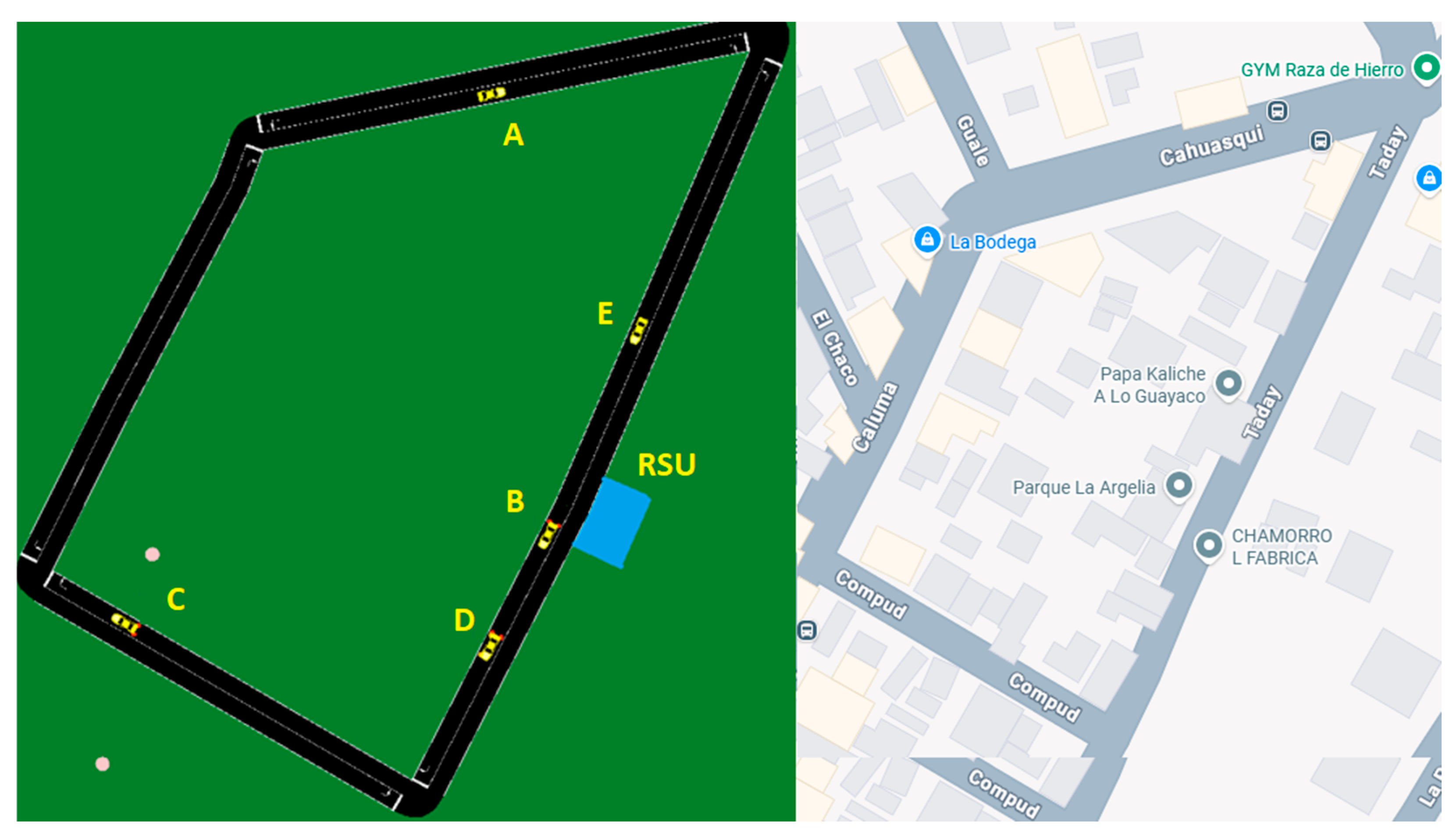
- Two-lane roads (average width 8 m);
- One to two-story buildings (height 3–6 m) on both sides of the street;
- Trees, streetlights, and parked vehicles;
- Low to moderate traffic during the tests (conducted at night).
2.6. Experimental Procedure
- Lap 1: 10 km/h;
- Lap 2: 20 km/h;
- Lap 3: 30 km/h;
- Lap 4: 40 km/h;
- Lap 5: 50 km/h;
- Lap 6: 60 km/h;
- Lap 7: 70 km/h;
- Lap 8: 100 km/h (stress test).
2.7. Metrics Evaluated
2.7.1. Latency
2.7.2. Packet Loss
2.7.3. Received Signal Strength Indicator (RSSI)
2.8. Mathematical Modeling
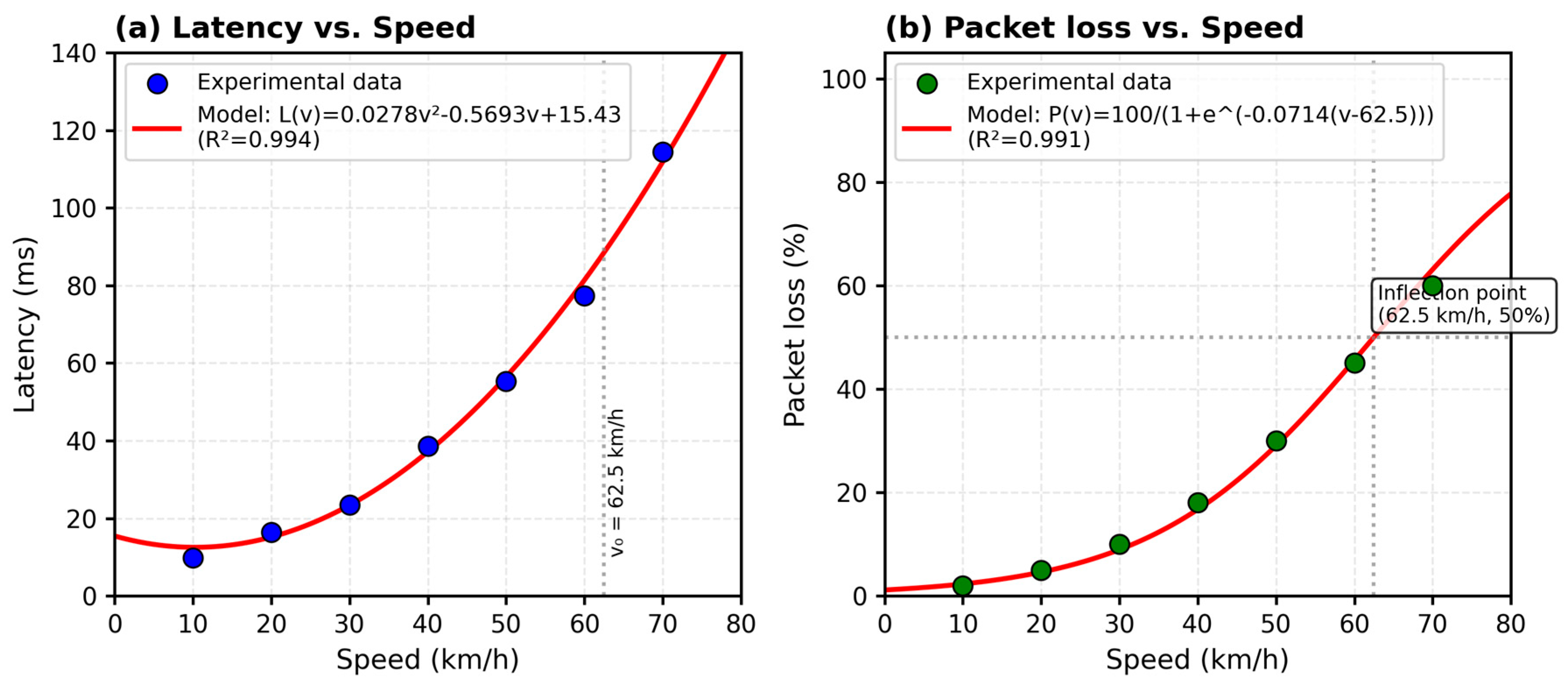
- v is the speed in km/h;
- a, b, and c are coefficients to be determined by quadratic regression.
- k controls the rate of growth;
- vo is the speed at which the loss reaches 50%.
2.9. Statistical Analysis
3. Results
3.1. Characterization of the Propagation Channel
3.2. V2V Communication Performance
3.3. Packet Loss and Video Quality
3.4. Mathematical Models
3.5. Comparison with Human Reaction Time
4. Discussion
4.1. Propagation Performance in Urban Environments
4.2. Latency and Packet Loss in Vehicle-to-Vehicle Communications
4.3. Implications for Road Safety Systems
4.3.1. Effective Speed Range
4.3.2. Margin Relative to Human Reaction Time
4.3.3. Low-Cost Architecture
4.3.4. Latin American Context
4.3.5. Limitations of the Study
- Small number of nodes: Five vehicles constitute a small sample size for generalizing to high-traffic-density scenarios. Studies with higher vehicle density are needed to evaluate performance degradation caused by interference among multiple nodes [24].
- Limited maximum speed: The practical limit for reliable operation is set at 60 km/h, which restricts its application on highways and high-speed roads.
- Controlled environmental conditions: The tests were conducted at night under good weather conditions. The impact of rain, fog, or extreme temperatures—factors that in real-world environments can significantly affect signal propagation in the 2.4 GHz band—was not evaluated [21].
- Sampling time: Measurements were taken for 2–3 min per speed. Longer periods would be desirable to evaluate the link’s temporal stability and capture variations due to changes in network topology.
- Safety compliance: The prototype is a proof-of-concept (TRL 3-4) and has not been designed or certified to meet automotive safety standards (e.g., ISO 26262). It lacks a redundant fail-safe mechanism, which would be essential for any real-world deployment. This limitation is acknowledged and will be addressed in future engineering developments.
4.3.6. Future Work
5. Conclusions
Author Contributions
Funding
Institutional Review Board Statement
Informed Consent Statement
Data Availability Statement
Acknowledgments
Conflicts of Interest
References
- Boualouache, A.; Engel, T. A Survey on Machine Learning-based Misbehavior Detection Systems for 5G and Beyond Vehicular Networks. IEEE Commun. Surv. Tutor. 2023, 25, 1128–1172. [Google Scholar] [CrossRef]
- World Health Organization. Global Status Report on Road Safety 2023; WHO: Geneva, Switzerland, 2023. [Google Scholar]
- National Institute of Statistics and Censuses (INEC). Transport Statistics Yearbook 2023; INEC: Abuja, Nigeria, 2024. [Google Scholar]
- van der Heijden, R.W.; Dietzel, S.; Leinmüller, T.; Kargl, F. Survey on Misbehavior Detection in Cooperative Intelligent Transportation Systems. IEEE Commun. Surv. Tutor. 2019, 21, 779–811. [Google Scholar] [CrossRef]
- Mutiara, A.B.; Kusuma, H.A.; Suhendra, T. Field Testing and QoS Analysis of ESP-NOW Communication on ESP32. In Proceedings of the 2024 FORTEI-International Conference on Electrical Engineering (FORTEI-ICEE); IEEE: New York City, NY, USA, 2024. [Google Scholar]
- Eridani, D.; Rochim, A.F.; Cesara, F.N. Comparative Performance Study of ESP-NOW, Wi-Fi, Bluetooth Protocols based on Range, Transmission Speed, Latency, Energy Usage and Barrier Resistance. In Proceedings of the 2021 International Seminar on Application for Technology of Information and Communication (iSemantic); IEEE: New York City, NY, USA, 2021; pp. 322–328. [Google Scholar] [CrossRef]
- Noh, S.K.; Kim, P.J.; Yoon, J.H. Doppler Effect on V2I Path Loss and V2V Channel Models. In Proceedings of the 2016 International Conference on Information and Communication Technology Convergence (ICTC); IEEE: New York City, NY, USA, 2016; pp. 898–902. [Google Scholar] [CrossRef]
- Turner, J.S.C.; Shahriman, A.B.; Harun, A.; Murad, S.A.Z.; Isa, M.N.; Ismail, R.C.; Ndzi, D.L.; Hashim, M.S.M.; Razlan, Z.M.; Wan, W.K.; et al. Modelling on Impact of Building Obstruction for V2I Communication Link in Micro Cellular Environment. J. Phys. Conf. Ser. 2021, 1755, 012031. [Google Scholar] [CrossRef]
- Green, M. How Long Does It Take to Stop? Methodological Analysis of Driver Perception-Brake Times. Transp. Hum. Factors 2000, 2, 195–216. [Google Scholar] [CrossRef] [PubMed]
- Espressif Systems. ESP32-CAM Datasheet; Espressif Systems: Shanghai, China, 2021. [Google Scholar]
- MaxBotix Inc. MaxSonar EZ4 Series Datasheet; MaxBotix Inc.: Brainerd, MN, USA, 2014. [Google Scholar]
- Raspberry Pi Foundation. Raspberry Pi 5 Product Brief; Raspberry Pi Foundation: Cambridge, UK, 2023. [Google Scholar]
- Monolithic Power Systems. MP2307DN Step-Down Converter Datasheet; Monolithic Power Systems: Washington, DC, USA, 2005. [Google Scholar]
- Turnigy. Nano-Tech Plus LiPo Battery Specifications; HobbyKing: Hong Kong, China, 2020. [Google Scholar]
- Qin, X.; Li, Z.; Li, Z.; Xue, Y.; Chang, X. Spatio-Temporal Coordinated Operation Strategy of Data Centers Considering Virtual Storage System via Two-Stage Optimization. IEEE Trans. Netw. Sci. Eng. 2026; ahead of print. [CrossRef]
- Li, Z.; Sun, H.; Xue, Y.; Li, Z.; Jin, X.; Wang, P. Resilience-Oriented Asynchronous Decentralized Restoration Considering Building and E-Bus Co-Response in Electricity-Transportation Networks. IEEE Trans. Transp. Electrif. 2025, 11, 11701–11713. [Google Scholar] [CrossRef]
- Jiang, X.; Yu, F.R.; Song, T.; Leung, V.C.M. Resource Allocation of Video Streaming Over Vehicular Networks: A Survey, Some Research Issues and Challenges. IEEE Trans. Intell. Transp. Syst. 2021, 22, 6237–6254. [Google Scholar] [CrossRef]
- Wang, Y.; Shi, J.; Chen, L. Performance Analysis of IEEE 802.11p MAC with Considering Capture Effect under Nakagami-m Fading Channel in VANETs. Entropy 2023, 25, 218. [Google Scholar] [CrossRef] [PubMed]
- Tahir, N.; Parasuraman, R.; Sun, H. Communication-Aware Consistent Edge Selection for Mobile Users and Autonomous Vehicles. In Proceedings of the 2024 IEEE Vehicular Technology Conference (VTC Fall); IEEE: New York City, NY, USA, 2024. [Google Scholar]
- Tahir, M.N.; Katz, M. Performance Evaluation of IEEE 802.11p, LTE and 5G in Connected Vehicles for Cooperative Awareness. Eng. Rep. 2022, 4, e12467. [Google Scholar] [CrossRef]
- Torres, A.P.A.; da Silva, C.B.; Tertuliano Filho, H. An Experimental Study on the Use of LoRa Technology in Vehicle Communication. IEEE Access 2021, 9, 26633–26640. [Google Scholar] [CrossRef]
- Di Renzone, G.; Parrino, S.; Peruzzi, G.; Pozzebon, A.; Vangelista, L. LoRaWAN for Vehicular Networking: Field Tests for Vehicle-to-Roadside Communication. Sensors 2024, 24, 1801. [Google Scholar] [CrossRef] [PubMed]
- Gorospe, J.; Garcia, D.; Mozo, E.; Hasan, S.; Alonso Gómez, A.; Uhlemann, E. Performance Comparison of IEEE 802.11p and LTE-V2X Through Field-Tests and Simulations. In Proceedings of the 2024 IEEE Vehicular Networking Conference (VNC); IEEE: New York, NY, USA, 2024; pp. 81–88. [Google Scholar]
- Xue, S.; Gong, S.; Li, X. A Comparative Study of IEEE 802.11bd and IEEE 802.11p on the Data Dissemination Properties in Dynamic Traffic Scenarios. Appl. Sci. 2024, 14, 2099. [Google Scholar] [CrossRef]
- Ortiz, F.M.; de Almeida, T.T.; Ferreira, A.E.; Costa, L.H.M.K. Experimental vs. Simulation Analysis of LoRa for Vehicular Communications. Comput. Commun. 2020, 160, 299–310. [Google Scholar] [CrossRef]
- Cheng, X.; Huang, Z.; Bai, L. Channel Characterization and Modeling for Vehicular Communications; Springer: Berlin/Heidelberg, Germany, 2024. [Google Scholar] [CrossRef]
- Rappaport, T.S. Wireless Communications: Principles and Practice, 2nd ed.; Prentice Hall: Hoboken, NJ, USA, 2002. [Google Scholar]



| Component | System Function |
|---|---|
| ESP32-CAM | Vehicle node: V2V communication, video capture, local processing |
| MaxSonar EZ4 Ultrasonic Sensor | Proximity distance measurement between vehicles |
| Raspberry Pi 5 Model B | RSU (Road Side Unit): central server, V2I storage |
| MP2307DN Step-Down Regulator | Power stabilization for ESP32-CAM and sensor |
| Turnigy 7.4 V LiPo Battery | Autonomous power supply for the prototype in each vehicle |
| 1N4007 SMD Diode | Reverse polarity protection |
| 110 Ω SMD Resistor | Current limiting for indicator LED |
| 0805 SMD Red LED | Power indicator and visual alert |
| microSD Card | Local storage of latency data on nodes D and E |
| microHDMI to HDMI Adapter | Connection of Raspberry Pi to monitor for monitoring |
| Parameter | Value |
|---|---|
| SSID per node | VANET_NODE_[A,B,C,D,E] |
| Password | 12345678[A,B,C,D,E] |
| IP addresses | 192.168.4.x (x = 1 for A, 2 for B, etc.) |
| Subnet mask | 255.255.255.0 |
| Wi-Fi channel | 6 |
| Ref. | Year | Technology | Scenario | Latency (ms) | Main Contribution |
|---|---|---|---|---|---|
| [5] | 2024 | ESP-NOW | Static, variable distance | 5.13–46 | Characterization of ESP-NOW in an open field; optimal range <150 m |
| [6] | 2021 | ESP-NOW, Wi-Fi, BT | Statistical Comparison of Protocols | No report | ESP-NOW: longer range (220 m), shorter latency (1 ms), higher power consumption |
| [7] | 2016 | V2I, V2V | Simulation, 60–150 km/h | — | Quantification of Doppler shift and channel models |
| [8] | 2021 | 802.15.4 | Urban static, RSSI measurement | — | Validation of the PL Urban Model (RMSE 12.5 dB) |
| [9] | 2000 | — | Meta-analysis of reaction times | 700–1500 | Human reaction times: expected 0.70–0.75 s, surprise 1.5 s |
| [17] | 2021 | Video streaming | Optimization Survey | — | Classification of optimization resources and tools |
| [18] | 2023 | IEEE 802.11p | 2D Markov model, simulation | — | Capture Effect improves throughput and reduces latency |
| [19] | 2024 | DDPG | Simulation in Gazebo/ROS2 | — | Reduces handovers and latency; improves SNR and load balancing |
| [20] | 2022 | IEEE 802.11p, LTE, 5G | Field tests (pista 1.7 km) | 5G: 10 | 5G outperforms in latency (0.01 s), packet loss (4.07%), and throughput (3.12 Mbps) |
| [21] | 2021 | LoRa | Field test, SF7/SF12, 60 km/h | — | SF7 is more robust with Doppler; SF12 has greater range but is less reliable |
| [22] | 2024 | LoRaWAN | Field tests at the velodrome and on the road | — | Mobility and Doppler have a marginal effect; PL < 10% for SF9–12 |
| [23] | accepted | IEEE 802.11p, LTE-V2X | Field tests + simulations | 802.11p: <10 | LTE-V2X: longer range; 802.11p: lower latency; 802.11p: degraded coexistence |
| [24] | 2024 | IEEE 802.11bd, 802.11p | Veins Simulations | — | 802.11bd doubles data rate, reduces latency by more than 50%, and improves reliability by 20% |
| [25] | in the press | LoRa | Field test + NS-3 | — | Strong correlation between experiments and simulation |
| This work | 2026 | ESP-NOW + Wi-Fi | Urban vehicle (10–70 km/h), Quito, Ecuador | 9.9–114.5 | Characterization of ESP-NOW with mobility; mathematical models (R2 = 0.994, R2 = 0.991); practical limit up to 60 km/h |
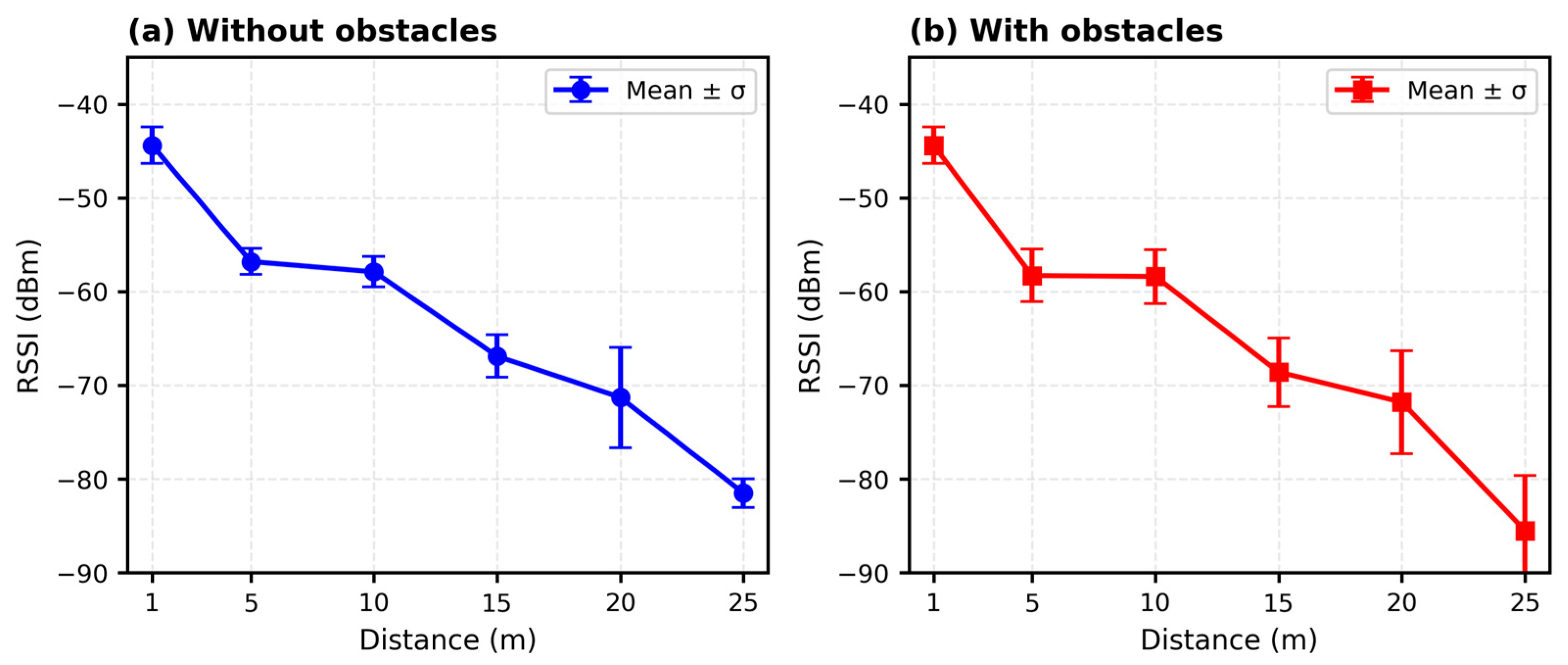
| Distance (m) | RSSI Without Obstacles (dBm) | RSSI with Obstacles (dBm) | Difference (dB) | p-Value | Significant? |
|---|---|---|---|---|---|
| 1 | −44.4 ± 1.96 | −44.4 ± 1.96 | 0.0 | 1.000 | No |
| 5 | −56.8 ± 1.40 | −58.3 ± 2.79 | −1.5 | 0.154 | No |
| 10 | −57.9 ± 1.64 | −58.4 ± 2.88 | −0.5 | 0.643 | No |
| 15 | −66.9 ± 2.26 | −68.6 ± 3.66 | −1.7 | 0.238 | No |
| 20 | −71.3 ± 5.36 | −71.8 ± 5.47 | −0.5 | 0.841 | No |
| 25 | −81.5 ± 1.51 | −85.5 ± 5.85 | −4.0 | 0.051 1 | Limit |
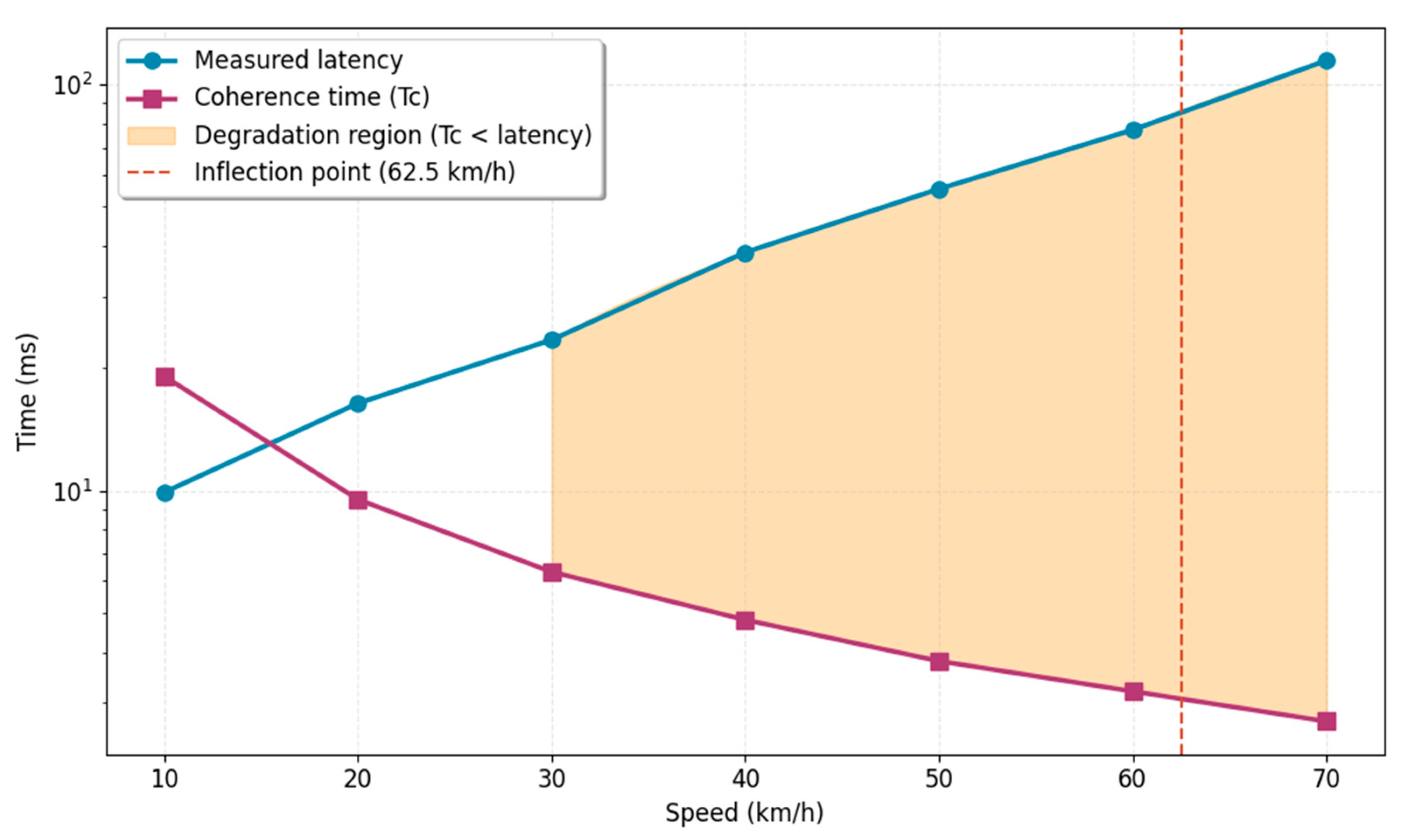
| Speed (km/h) | Average Latency (ms) | Standard Deviation (ms) | Minim. (ms) | Maxim. (ms) | Lower 95% CI | Upper 95% CI |
|---|---|---|---|---|---|---|
| 10 | 9.9 | ±1.37 | 8 | 12 | 8.92 | 10.88 |
| 20 | 16.4 | ±1.96 | 14 | 20 | 15.00 | 17.80 |
| 30 | 23.5 | ±2.32 | 20 | 27 | 21.84 | 25.16 |
| 40 | 38.6 | ±2.17 | 35 | 42 | 37.05 | 40.15 |
| 50 | 55.3 | ±3.13 | 50 | 60 | 53.06 | 57.54 |
| 60 | 77.3 | ±4.62 | 70 | 85 | 74.00 | 80.60 |
| 70 | 114.5 | ±9.65 | 100 | 130 | 107.60 | 121.40 |
| Speed (km/h) | Packet Loss (%) | Video Latency (ms) | Observed Video Quality |
|---|---|---|---|
| 10 | 2 | 100 | High |
| 20 | 5 | 150 | Good |
| 30 | 10 | 200 | Fair |
| 40 | 18 | 350 | Poor |
| 50 | 30 | 500 | Low |
| 60 | 45 | 700 | Very low |
| 70 | 60 | 1000 | Almost none |
| 100 | 100 | — | No connection |
| Speed (km/h) | System Latency (ms) | Human Response Time (ms) | Improvement (×times) |
|---|---|---|---|
| 10 | 9.9 | 1500 | 151× |
| 20 | 16.4 | 1500 | 91× |
| 30 | 23.5 | 1500 | 64× |
| 40 | 38.6 | 1500 | 39× |
| 50 | 55.3 | 1500 | 27× |
| 60 | 77.3 | 1500 | 19× |
| 70 | 114.5 | 1500 | 13× |
| Speed (km/h) | Relative Speed (m/s) | f_d Max (Hz) | f_d/Symbol Bandwidth (%) 1 |
|---|---|---|---|
| 10 | 2.78 | 22.2 | 0.022% |
| 20 | 5.56 | 44.5 | 0.045% |
| 30 | 8.33 | 66.7 | 0.067% |
| 40 | 11.11 | 88.9 | 0.089% |
| 50 | 13.89 | 111.1 | 0.111% |
| 60 | 16.67 | 133.4 | 0.133% |
| 70 | 19.44 | 155.6 | 0.156% |
| 100 | 27.78 | 222.2 | 0.222% |
| Speed (km/h) | f_d (Hz) | Time of Coherence (ms) 1 | Relation with Table 4 (Latencia) |
|---|---|---|---|
| 10 | 22.2 | 19.1 | Tc > latency (9.9 ms) → stable |
| 20 | 44.5 | 9.5 | Tc ≈ latency (16.4 ms) → lower limit |
| 30 | 66.7 | 6.3 | Tc < latency (23.5 ms) → incipient degradation |
| 40 | 88.9 | 4.8 | Tc << latency (38.6 ms) → noticeable degradation |
| 50 | 111.1 | 3.8 | Tc << latency (55.3 ms) → severe degradation |
| 60 | 133.4 | 3.2 | Tc << latency (77.3 ms) → unstable channel |
| 70 | 155.6 | 2.7 | Tc << latency (114.5 ms) → very unstable channel |
| 100 | 222.2 | 1.9 | Tc << latency (no connection) → extremely unstable channel |
Disclaimer/Publisher’s Note: The statements, opinions and data contained in all publications are solely those of the individual author(s) and contributor(s) and not of MDPI and/or the editor(s). MDPI and/or the editor(s) disclaim responsibility for any injury to people or property resulting from any ideas, methods, instructions or products referred to in the content. |
© 2026 by the authors. Licensee MDPI, Basel, Switzerland. This article is an open access article distributed under the terms and conditions of the Creative Commons Attribution (CC BY) license.
Share and Cite
Morales, F.; Rodríguez, F.; Angel, L.-N.M.; Quintana, A.A. Experimental Evaluation of a VANET Prototype Using ESP-NOW for Collision Avoidance: Latency, Packet Loss, and Statistical Performance in Urban Environments. Technologies 2026, 14, 344. https://doi.org/10.3390/technologies14060344
Morales F, Rodríguez F, Angel L-NM, Quintana AA. Experimental Evaluation of a VANET Prototype Using ESP-NOW for Collision Avoidance: Latency, Packet Loss, and Statistical Performance in Urban Environments. Technologies. 2026; 14(6):344. https://doi.org/10.3390/technologies14060344
Chicago/Turabian StyleMorales, Flavio, Francis Rodríguez, Luque-Nieto Miguel Angel, and Alfonso Ariza Quintana. 2026. "Experimental Evaluation of a VANET Prototype Using ESP-NOW for Collision Avoidance: Latency, Packet Loss, and Statistical Performance in Urban Environments" Technologies 14, no. 6: 344. https://doi.org/10.3390/technologies14060344
APA StyleMorales, F., Rodríguez, F., Angel, L.-N. M., & Quintana, A. A. (2026). Experimental Evaluation of a VANET Prototype Using ESP-NOW for Collision Avoidance: Latency, Packet Loss, and Statistical Performance in Urban Environments. Technologies, 14(6), 344. https://doi.org/10.3390/technologies14060344