This is an early access version, the complete PDF, HTML, and XML versions will be available soon.
Article

Machine Learning Assessment of Parkinson’s Disease Using a Novel Free-Living Egg-Beating Motor Task


by
Carlos Polvorinos-Fernández
1,*,
Luis Sigcha
2,
Mayca Marín Valero
3,
Miriam Grande
3,
Guillermo de Arcas
1 and
Ignacio Pavón
1
1
Department of Mechanical Engineering, Instrumentation and Applied Acoustics Research Group (I2A2), Escuela Técnica Superior de Ingenieros Industriales, Universidad Politécnica de Madrid, 28006 Madrid, Spain
2
ALGORITMI Research Center, School of Engineering, University of Minho, 4800-058 Guimaraes, Portugal
3
Asociación Párkinson Madrid, 28014 Madrid, Spain
*
Author to whom correspondence should be addressed.
Technologies 2026, 14(6), 345; https://doi.org/10.3390/technologies14060345 (registering DOI)

Submission received: 10 April 2026 / Revised: 29 May 2026 / Accepted: 8 June 2026 / Published: 9 June 2026

Abstract

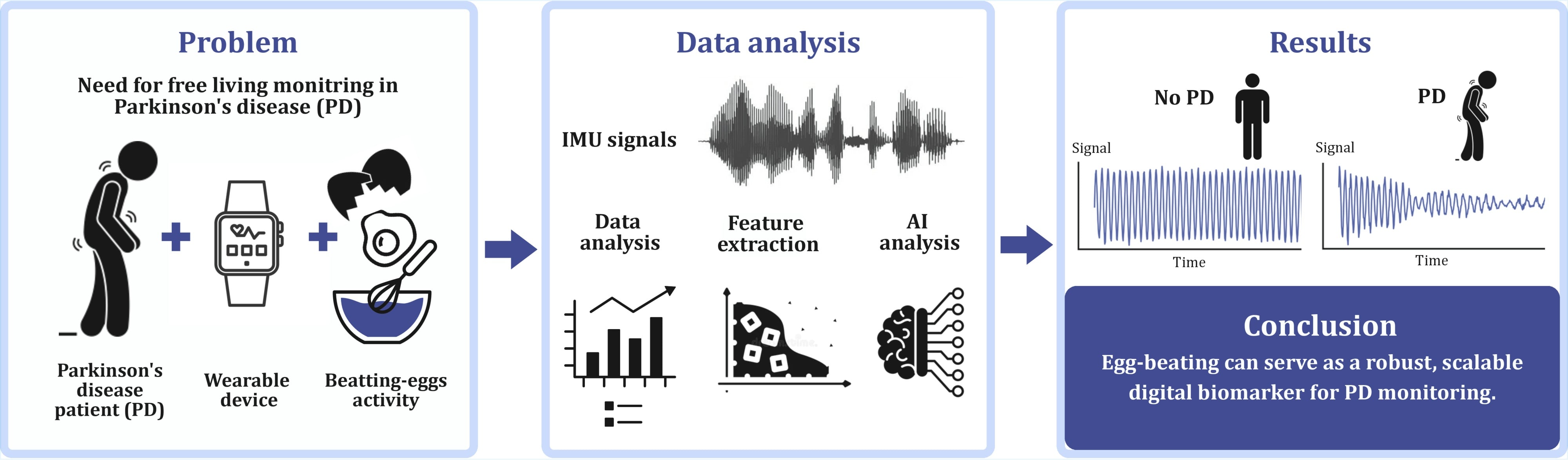
Assessing motor symptoms in Parkinson’s disease (PD) is challenging due to the progressive evolution of the condition and the variability of symptoms, which are not fully captured by periodic clinical visits. In this context, wearable sensors and machine learning (ML) have emerged as a viable path toward objective and continuous monitoring, although achieving robust generalization to free-living conditions remains a challenge. This work explores the egg-beating task, a simple everyday activity, as a digital approach for PD motor assessment using smartwatch-based inertial measurements and ML techniques. Twenty-two individuals with PD and sixteen healthy controls (HC) completed a one-minute egg-beating task while wearing a smartwatch equipped with tri-axial accelerometer and gyroscope sensors. Data were recorded both under supervised clinical conditions and during unsupervised home sessions. Time- and frequency-domain features were extracted from the inertial signals, and models trained exclusively on supervised recordings were then tested on supervised, unsupervised, and combined data. PD participants showed systematically lower movement amplitude, slower oscillation frequency, and a progressive drop in signal energy over the course of the task, all of which align with the characteristic features of bradykinesia. The support vector machine achieved the best overall performance, reaching 90% accuracy in distinguishing PD from healthy controls under supervised conditions, with a reduction of less than 4% when applied to unsupervised data. These results support the egg-beating task as a practical and ecologically valid method for real-world motor assessment, with potential for future use in remote monitoring and longitudinal assessment.
Keywords: Parkinson’s disease; wearable devices; machine learning; diagnosis; inertial sensors Parkinson’s disease; wearable devices; machine learning; diagnosis; inertial sensors
Graphical Abstract