Article

Experimental Evaluation of a VANET Prototype Using ESP-NOW for Collision Avoidance: Latency, Packet Loss, and Statistical Performance in Urban Environments


by
Flavio Morales
1,2,*,
Francis Rodríguez
1,
Luque-Nieto Miguel Angel
2 and
Alfonso Ariza Quintana
2
1
Department of Engineering Sciences, Universidad Tecnológica Israel, Quito 170516, Ecuador
2
E.T.S. Telecommunications Engineering, University of Malaga, 29010 Malaga, Spain
*
Author to whom correspondence should be addressed.
Technologies 2026, 14(6), 344; https://doi.org/10.3390/technologies14060344 (registering DOI)
Submission received: 13 May 2026 / Accepted: 4 June 2026 / Published: 9 June 2026

Abstract

Vehicle ad hoc networks (VANETs) can help prevent traffic accidents through wireless communication; however, most studies are based on simulations or static evaluations. This research paper presents the design, implementation, and experimental evaluation of a prototype early-warning system for vehicle proximity based on VANETs using ESP-NOW. The prototype utilizes five ESP32-CAM nodes equipped with MaxSonar sensors installed in vehicles and an RSU unit with a Raspberry Pi for vehicle-to-infrastructure (V2I) communication. Field tests were conducted in Quito, Ecuador, at speeds ranging from 10 to 70 km/h, measuring latency, packet loss, and received signal strength (RSSI). The results show average latencies of 9.9 ms at 10 km/h and 114.5 ms at 70 km/h, with packet loss rates of 2% and 60%, respectively. Statistical analysis reveals 95% confidence intervals for latency ranging from ±0.98 ms to ±6.90 ms, while obstacles introduce marginal attenuation (p = 0.051) with significant dispersion (σ = 5.85 dB). The Doppler shift is negligible (155.6 Hz), but the channel coherence time (2.7 ms) explains the observed degradation. Models were obtained that relate speed to latency (R2 = 0.994) and packet loss (R2 = 0.991). The prototype is viable for early collision warning at urban speeds (up to 60 km/h), outperforming human reaction time (1.5 s).

1. Introduction

Vehicle ad hoc networks (VANETs) have emerged as a key enabling technology for intelligent transportation systems, facilitating communication between vehicles (V2V) and between vehicles and infrastructure (V2I) with the aim of improving road safety and traffic efficiency [1]. According to the World Health Organization, traffic accidents cause approximately 1.3 million deaths annually worldwide, with insufficient following distance and human reaction time being determining factors in most accidents [2]. In Ecuador, particularly in Quito, statistics from the National Traffic Agency reveal that in 2023, 501 traffic incidents were recorded in the capital alone, with 1156 victims nationwide. These figures highlight the urgent need to implement technological systems that complement drivers’ response capabilities [3]. This issue aligns directly with the United Nations Sustainable Development Goal (SDG) 3, “Ensure healthy lives and promote well-being for all at all ages,” specifically Target 3.6, which aims to halve traffic-related deaths and injuries.
Despite advances in vehicle-to-vehicle communications, significant challenges remain for the effective implementation of early warning systems in real-world environments. Most existing research has been conducted using computer simulations or under controlled laboratory conditions, without considering the complexity of dynamic urban environments [4]. Specifically, previous studies on the ESP-NOW protocol have evaluated its performance in terms of latency and packet loss under static conditions, with fixed devices at different distances [5,6]. Mutiara et al. [5] reported latencies between 5.13 ms and 46 ms in field tests with ESP32, while Eridani et al. [6] compared the performance of ESP-NOW against Wi-Fi and Bluetooth, demonstrating its energy efficiency and low latency for short-range communications. However, these studies did not consider the effect of vehicle mobility, a relevant factor in VANET applications where nodes move at variable speeds and the Doppler effect causes degradation in link quality [7].
Characterizing the propagation channel in urban environments adds another layer of complexity. Turner et al. [8] demonstrated that the presence of buildings and structures in residential environments significantly affects the received signal strength (RSSI) in 2.4 GHz V2I communications, confirming that the PL Urban model is the most suitable for predicting path loss under these conditions. However, their study was limited to static scenarios and did not consider the influence of moving vehicles or the impact of speed on link stability.
The novelty of this work lies in the fact that it is the first experimental study, to the best of our knowledge, to evaluate the impact of vehicular mobility on the performance of the ESP-NOW protocol for early collision warning systems in real urban environments in Latin America. While the existing literature is limited to simulations or static conditions, this research implements a functional prototype with five nodes in vehicles traveling at controlled speeds (10–70 km/h) in the San Bartolo district of Quito, Ecuador, characterizing for the first time the behavior of latency, packet loss, and RSSI under mobility conditions.
The importance of addressing these limitations lies in the fact that early collision warning systems require response times shorter than the average human reaction time of 1.5 s [9]. To be effective, they must provide reliable information with latencies on the order of milliseconds and high availability even under mobile conditions. Boualouache and Engel [1], in their review of anomaly detection systems in V2X networks, note that most studies are based on datasets generated through simulation, with a significant gap in real-world implementations using low-cost hardware that validate performance under field conditions, especially in Latin American contexts where imported technological solutions rarely account for the specific characteristics of the region’s roads and vehicle fleet.
In this context, this research addresses the following question: Is it feasible to implement a prototype early-warning system for vehicle proximity based on VANETs using ESP-NOW that operates with latencies shorter than human reaction time in Latin American urban environments with variable speeds? Derived secondary questions include: How does vehicle speed affect latency and packet loss in V2V and V2I communications? Are existing propagation models for static urban environments applicable when mobility is introduced? What speed limitations does the ESP-NOW protocol present for road safety applications in the context of Latin American cities?
The scope of this research is limited to the design, implementation, and experimental evaluation of a prototype consisting of five ESP32-CAM nodes equipped with MaxSonar ultrasonic sensors, deployed in a residential urban area in southern Quito (San Bartolo neighborhood). Tests were conducted at controlled speeds ranging from 10 to 70 km/h, including a stress test at 100 km/h, in scenarios with and without vehicle obstacles. Integration with autonomous braking systems and evaluation under adverse weather conditions or on high-speed roads such as highways are not considered.
The purpose of this paper is to present the experimental evaluation of a low-cost VANET prototype for early collision warning, characterizing for the first time the impact of mobility on quality of service metrics (latency, packet loss, RSSI) for the ESP-NOW protocol in real urban environments. Based on the data obtained, mathematical models are proposed that relate speed to communication performance, establishing a practical operational limit for road safety applications. The results aim to contribute to the state of the art by providing empirical data from real-world scenarios in Latin America, complementing existing static studies and offering a foundation for future implementations of technologically and economically accessible road safety systems in the region, in line with the United Nations Sustainable Development Goals (SDG 3: Good Health and Well-being).

2. Materials and Methods

2.1. Hardware Used

The developed prototype uses the following hardware components, selected for their low cost, availability on the Ecuadorian market, and technical capabilities suitable for vehicle communications: ESP32-CAM (Ai-Thinker, Shenzhen, China) [10], MaxSonar EZ4 (MaxBotix Inc., Brainerd, MN, USA) ultrasonic sensor [11], Raspberry Pi 5 (Raspberry Pi Foundation, Cambridge, UK) Model B [12], MP2307DN (Monolithic Power Systems, San Jose, CA, USA) step-down regulator [13], Turnigy 7.4 V LiPo battery (Turnigy, Hong Kong, China) [14], diodes, resistors, indicator LED, micro HDMI adapter, and microSD card. This is detailed in Table 1.
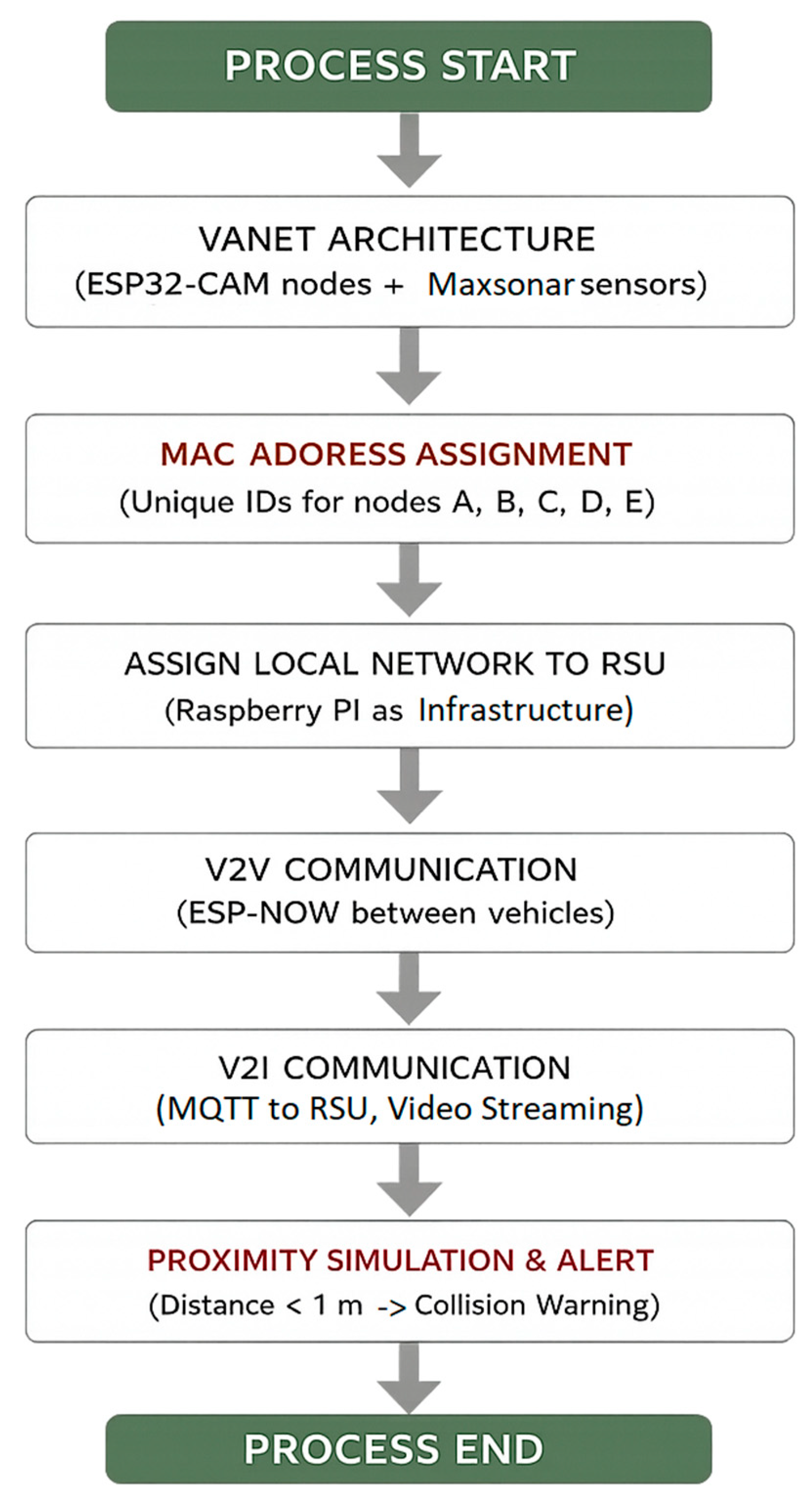
Figure 1 shows the block diagram of the integration of these components in each vehicle node.

2.2. Prototype Design

The electronic circuit was designed using Proteus 8.0 software, considering the calculations for the LED’s protective resistor, the diode’s power dissipation, and battery life. Equation (1) shows the calculation for the protective resistor:
R   = V F V L I Led   = 3.3   V 2.1   V 0.02   A =   60   Ω
The power dissipated by the diode was calculated using:
  P   =   V D   ×   I   =   0.7   V * 1   A   =   0.7   W  
The total current of the prototype and the battery life were determined using:
I T   =   I MC   +     I S   +     I L =   250   mA   +   30   mA   +   20   mA   =   300   mA        
D BH     I B   I TP   = 650   mAh 300   mA = 2.17   h      
Once the circuit had been validated in simulation, the printed circuit board (PCB) design was generated using the PCB Layout tool in Proteus (Proteus 8.13). The boards were manufactured using CNC machining with 1-ounce copper traces, measuring 80 mm × 50 mm, and screen-printed labels for component identification.
The assembly process involved soldering SMD components (diode, resistor, LED) and connecting through-hole modules (ESP32-CAM, regulator, sensor) using solder and flux. Each prototype was housed in a 3D-printed case made of PLA filament, with openings for the ultrasonic sensor, the camera, the indicator LED, and the power switch.

2.3. Network Architecture

The implemented VANET network combines two communication modes: (1) V2V (Vehicle-to-Vehicle) and (2) V2I (Vehicle-to-Infrastructure).

2.3.1. Communication Vehicle-to-Vehicle (V2V)

Each ESP32-CAM node operates in Wi-Fi AP + STA (Access Point + Station) mode, configured on channel 6 (2.437 GHz) to avoid interference with nearby home networks. The network parameters are detailed in Table 2.
The ESP-NOW protocol was used for direct communication between nodes, which allows data transmission without the need for prior handshaking, thereby reducing latency and power consumption [6]. The PMK security key was set to “vanet-secure-key123” for peer-to-peer authentication. The MAC addresses of the five nodes were explicitly programmed into each device. The data structure exchanged between nodes via ESP-NOW includes:
  • nodeID: identifier of the sending node (char);
  • seqNumber: message sequence number (uint16_t);
  • timestamp: timestamp in milliseconds (unsigned long).

2.3.2. Communication V2I (Vehicle-to-Infrastructure)

The RSU unit, built using a Raspberry Pi 5, operates as a central server with the following parameters:
  • SSID: CELERITY-JEDRICK;
  • Password: 123456777;
  • Application protocol: Message Queuing Telemetry Transport (MQTT);
  • MQTT port: 1883;
  • Credentials: francis_project/abcde12345;
  • Topics: vanet/sensor_data (distance data), vanet/status (node status).
When vehicles enter the RSU’s coverage area (approximately 100 m in radius), the ESP32-CAM nodes connect to the Wi-Fi network and transmit data via MQTT, as well as stream video via HTTP on port 81.
The proposed RSU-based infrastructure can be seen as a centralized coordination point. However, recent studies have explored more advanced spatio-temporal coordinated operation strategies using two-stage distributionally robust optimization [15], as well as asynchronous decentralized restoration approaches that enhance resilience and scalability [16]. These methods could be integrated into future versions of our system to improve handover mechanisms and distributed coordination across multiple RSUs.

2.4. Software Configuration

The node firmware was developed in Arduino IDE 2.3.2, using the following libraries:
  • WiFi.h: Wi-Fi connectivity management;
  • esp_now.h: ESP-NOW protocol implementation;
  • esp_camera.h: OV2640 camera control;
  • ESP32WebServer.h: web server for the user interface;
  • SD_MMC.h: microSD card storage.
The refresh rate of the distance sensor was set to 10 Hz, while video streaming was configured at 10 fps to strike a balance between smoothness and bandwidth consumption. This configuration was based on recommendations from the literature regarding video transmission in vehicular networks, which suggest that 10 fps is an acceptable threshold for real-time monitoring applications [17]. A Python 3.11 script was implemented on the Raspberry Pi 5 that integrates:
  • MQTT client for receiving sensor data;
  • OpenCV for capturing and processing video streams;
  • SQLite3 for local storage of measurements;
  • Tkinter for the graphical monitoring interface;
  • Wireshark for analyzing network traffic and packet loss.

2.5. Test Environment

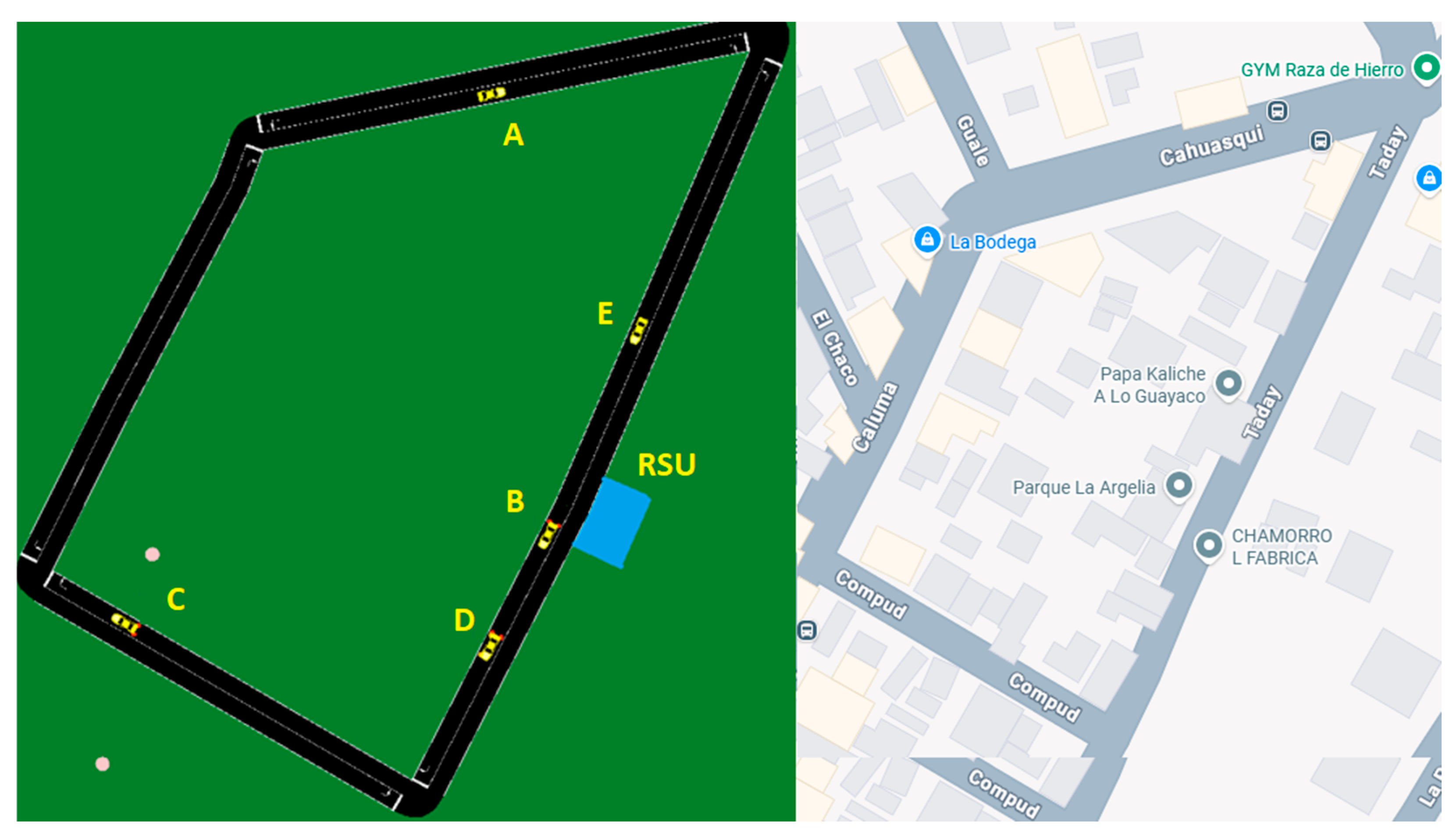
The experimental tests were conducted in the San Bartolo neighborhood, south of Quito, Ecuador (coordinates: 0°14′28″ S 78°30′42″ W). A 414.37 m perimeter bounded by Compud, Caluma, and Taday streets was selected, representing a typical residential urban setting with the following characteristics:
  • Two-lane roads (average width 8 m);
  • One to two-story buildings (height 3–6 m) on both sides of the street;
  • Trees, streetlights, and parked vehicles;
  • Low to moderate traffic during the tests (conducted at night).
Figure 2 shows the map of the test area generated using the Urban Mobility Simulation (SUMO) tool (SUMO 1.19.0), which displays the location of the RSU and the vehicle routes (where A, B, C, D, and E represent the vehicle nodes, and RSU stands for Road Side Unit).
The RSU unit was installed in a house located on higher ground than street level, with the Raspberry Pi antenna pointed toward the test area.

2.6. Experimental Procedure

Five passenger vehicles (sedans and SUVs) were used to house the prototypes, which were mounted in the front of the vehicles using magnetic mounts and suction cups at a height of 0.8 m above the ground. Each vehicle was assigned to a specific node (A, B, C, D, E), and the drivers were briefed on the testing protocol.
The experiment consisted of 8 laps of continuous driving around the designated perimeter, each at a different target speed:
  • Lap 1: 10 km/h;
  • Lap 2: 20 km/h;
  • Lap 3: 30 km/h;
  • Lap 4: 40 km/h;
  • Lap 5: 50 km/h;
  • Lap 6: 60 km/h;
  • Lap 7: 70 km/h;
  • Lap 8: 100 km/h (stress test).
Speeds were maintained through radio instructions and verification via GPS on the drivers’ mobile devices. Each lap lasted approximately 2–3 min, depending on the speed, with data collected continuously.
For each target speed, ten independent latency measurements were recorded. The order of speeds was sequential (from 10 km/h up to 100 km/h) to prioritize safety, but each measurement was taken on a different lap to ensure independence.
When the distance measured by the ultrasonic sensor falls below the preset threshold of 1 m, the system triggers an alert: a loud beep is emitted through the embedded buzzer of the ESP32-CAM, and the mobile application displays a full-screen red message with the text ‘DANGER–COLLISION RISK’. The visual alert remains active until the distance exceeds the safe threshold. No autonomous braking is performed; the system is designed solely to assist the driver by providing timely warnings.

2.7. Metrics Evaluated

2.7.1. Latency

This latency refers to the time it takes to send a message from one ESP32-CAM to another using the ESP-NOW protocol. An ASK (acknowledgment) is added to reduce Wi-Fi interference. The 2.4 GHz band is used, following the methodology of previous field studies with ESP-NOW [5]. The ESP-NOW protocol includes a built-in acknowledgement (ACK) mechanism; we used its default configuration (timeout of 500 ms and up to 3 retransmission attempts if needed).

2.7.2. Packet Loss

To assess packet loss during data transmission, Wireshark (4.2.4) software was used, enabling the analysis of the number of packets sent and received, as well as any potential losses or delays in communication—a methodology similar to that used in QoS analysis in wireless networks [5].

2.7.3. Received Signal Strength Indicator (RSSI)

To analyze the performance of the ESP32-CAM’s built-in antenna within a VANET network, propagation measurements were conducted; tests were conducted by measuring the RSSI (Received Signal Strength Indicator) at various distances (1 m, 5 m, 10 m, 15 m, 20 m, 25 m) to determine signal loss based on obstacles and environmental configuration, following the channel characterization methodology for urban environments [8].
Calibration algorithms were implemented to minimize interference and improve data interpretation. Additionally, the relative antenna gain was compared to understand its bidirectional radiation pattern and optimize the placement of devices within the vehicle.
To record and process the obtained data, tools such as WiFiInfoView (2.91) and Python (3.10) scripts were used, which enabled the analysis of network traffic and the plotting of radiation patterns.

2.8. Mathematical Modeling

It was proposed to model the average latency (L(v)) as a second-degree polynomial function, given that the relationship with speed is not strictly linear:
  L v   =   a v 2   +     bv     +   c  
where
  • v is the speed in km/h;
  • a, b, and c are coefficients to be determined by quadratic regression.
Packet loss (P(v)), which increases rapidly with speed, was modeled using a logistic function:
P v   = 100 1   +   e k ( v v o )  
where:
  • k controls the rate of growth;
  • vo is the speed at which the loss reaches 50%.

2.9. Statistical Analysis

To process the collected data, descriptive statistics (mean, standard deviation) were calculated for each metric and experimental condition using tools such as Python and Excel, a standard methodology in experimental studies of communication networks [5].
Mean and standard deviation values were initially calculated by the authors from the experimental data using standard tools (Excel, Python). The 95% confidence intervals and Student’s t-test were added during manuscript preparation with the assistance of a large language model (DeepSeek), which helped structure the calculations and present the results in the final table format. The Python script used to generate Figure 3 (coherence time vs. latency) was developed with the assistance of DeepSeek as a coding tool. Table 3 (comparison with previous studies) was developed with the assistance of DeepSeek to identify and organize relevant references. The authors reviewed and validated all results and assume full responsibility for the content of this paper.

3. Results

3.1. Characterization of the Propagation Channel

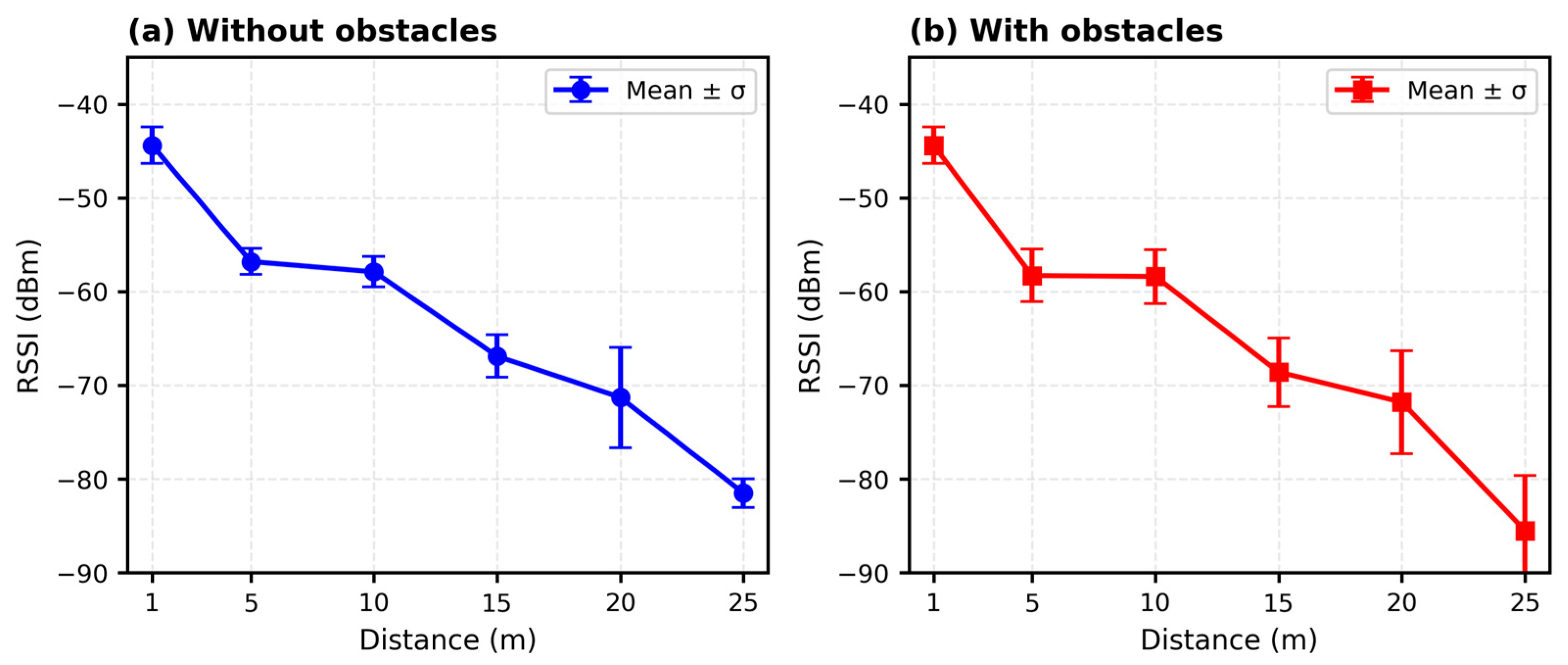
RSSI measurements were taken in a residential urban environment (San Bartolo, Quito) at distances ranging from 1 to 25 m, under two scenarios: without obstacles and in the presence of vehicular traffic and buildings. Table 4 presents the RSSI measurements for both scenarios, along with the results of Student’s t-test. Although additional attenuation is observed in the presence of obstacles (up to 4 dB at 25 m), this difference only reaches statistical significance at the margin (p = 0.051), suggesting that the main effect of obstacles is not so much on the mean value but on the stability of the link, reflected in the higher standard deviations in Scenario II (up to 5.85 dB vs. 1.51 dB in Scenario I). This behavior is consistent with what has been reported in propagation studies in urban environments [8].
Figure 4 shows the RSSI measurements for both scenarios. In the absence of obstacles (a), the attenuation follows a gradual trend, reaching −81.5 dBm at 25 m. In the presence of obstacles (b), an additional attenuation of 4 dB is observed at 25 m (−85.5 dBm) and a marked dispersion (σ = 5.85 dB), reflecting the impact of the obstacles and multipath fading on the signal propagation in urban environments.

3.2. V2V Communication Performance

Table 5 presents the average latencies obtained for each speed, along with their 95% confidence intervals. The width of the intervals increases with speed, ranging from ±0.98 ms at 10 km/h to ±6.90 ms at 70 km/h, indicating greater variability in the link at high speeds, consistent with the Doppler effect and the reduction in association time [7].
In addition, latency measurements were taken for vehicle-to-infrastructure (V2I) communication under the same speed conditions. The results obtained were consistent with those presented in Table 5, with differences of less than 5% for speeds above 30 km/h and exact agreement at speeds of 40 km/h and above. This behavior suggests that the main bottleneck in the system is the ESP-NOW wireless interface, regardless of the final destination of the data.

3.3. Packet Loss and Video Quality

Table 6 shows the trends in packet loss, video streaming latency, and observed quality of service as a function of vehicle speed. It can be seen that packet loss remains below 10% up to 30 km/h, but increases significantly starting at 50 km/h, reaching 60% at 70 km/h. Video latency follows a similar trend, increasing from 100 ms at 10 km/h to 1000 ms at 70 km/h. Video quality degrades progressively, going from “high” at low urban speeds to “almost zero” at 70 km/h, at which point the stream becomes practically unusable for real-time monitoring applications.

3.4. Mathematical Models

Based on the experimental data, models were developed that describe how latency and packet loss vary with speed.
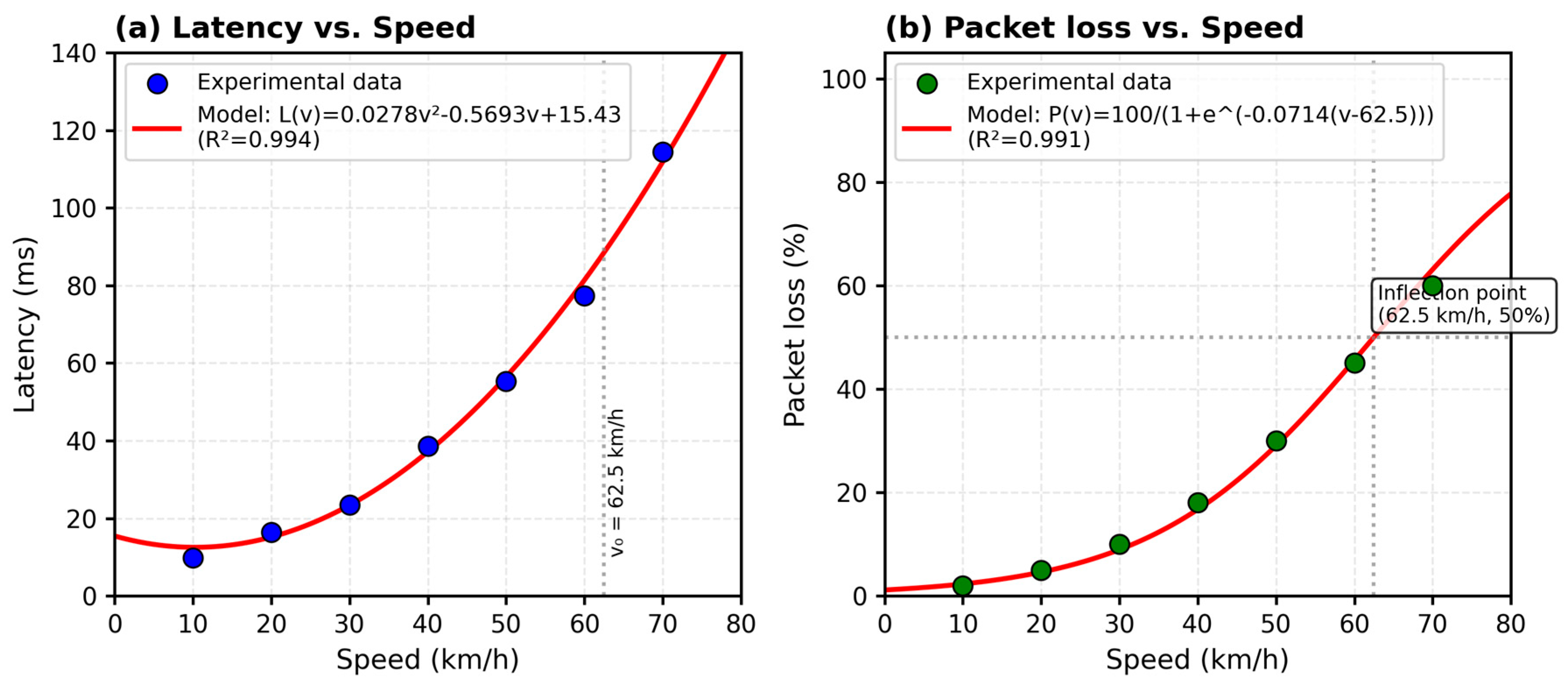
L v = 0.0278 v 2     0.5693 v + 15.4286 R 2 = 0.994  
P v = 100 1 + e 0.0714 v 62.5 R 2 = 0.991
It is important to note that these models are empirically derived and are validated only for the tested speed range (10–70 km/h). Extrapolation beyond this range is not recommended without additional experimental validation.
Figure 5 presents the mathematical models obtained along with the experimental data: (a) a quadratic fit for latency (R2 = 0.994) and (b) a logistic fit for packet loss (R2 = 0.991). The inflection point of the logistic model at 62.5 km/h indicates the speed at which packet loss exceeds 50%, establishing a practical limit for reliable operation up to 60 km/h.

3.5. Comparison with Human Reaction Time

Table 7 compares system latencies with the average human reaction time (1.5 s = 1500 ms) [9].
The system far exceeds human reaction times across the entire range of speeds tested, including at 70 km/h, where latency is 13 times lower.

4. Discussion

4.1. Propagation Performance in Urban Environments

The RSSI measurements obtained in Scenario I (obstacle-free) showed a gradual attenuation with distance, with values of −44.4 dBm at 1 m and −81.5 dBm at 25 m. These results are consistent with those reported by Turner et al. [8] in a similar residential environment, where they obtained values ranging from −41 dBm to −85 dBm for distances from 1 to 80 m at 2.4 GHz. The calculated path loss exponent (n = 2.34) is close to the theoretical value of 2 for free space, but slightly higher due to the presence of the ground and nearby structures. This behavior is consistent with vehicular channel models reported in recent literature, which demonstrate that the presence of buildings and the urban environment significantly affect the path loss exponent in V2I communications at 2.4 GHz [26].
In Scenario II (with obstacles and traffic), an increase in signal attenuation and dispersion was observed, particularly at distances greater than 15 m (down to −85.5 dBm at 25 m, with a standard deviation of 5.7 dB). This behavior is attributable to three factors identified by Turner et al. [8]: (i) corner loss at street intersections, (ii) partial obstruction of the first Fresnel zone by parked vehicles, and (iii) diffraction and reflection off building facades. The presence of metal vehicles near the line of sight induces significant additional losses that explain the observed fluctuations.
A particularly noteworthy finding is the p-value of 0.051 obtained when comparing the RSSI at 25 m between the two scenarios. Although this value falls within the conventional threshold for statistical significance (p < 0.05), it should be interpreted with caution. Rather than indicating a statistically significant average attenuation, the evidence suggests that the main effect of urban obstacles is on link stability, reflected in the increase in standard deviation (σ = 5.85 dB) in Scenario II versus 1.51 dB in Scenario I. This result is consistent with recent studies on channel characterization in dense urban environments, which report that the temporal variability of the RSSI is a more sensitive indicator of link quality than its mean value [21,22].

4.2. Latency and Packet Loss in Vehicle-to-Vehicle Communications

The latency values obtained in V2V communication (9.9 ms at 10 km/h, 114.5 ms at 70 km/h) fall within the range reported by Mutiara et al. [5] for ESP-NOW under static conditions (5.13 ms to 46 ms), but they show a progressive, nonlinear increase with speed. This behavior highlights a critical limitation of static studies, which underestimate the degradation of the link under dynamic conditions.
Analysis of the Doppler effect reveals that the frequency shift (155.6 Hz at 70 km/h) is three orders of magnitude smaller than the Wi-Fi channel bandwidth (20 MHz) and accounts for only 0.156% of the estimated symbol bandwidth for ESP-NOW (100 kHz) (Table 8). Consequently, pure Doppler shift is not the primary mechanism of degradation, partially contradicting initial intuition and studies that emphasize this effect in other technologies [7,23].
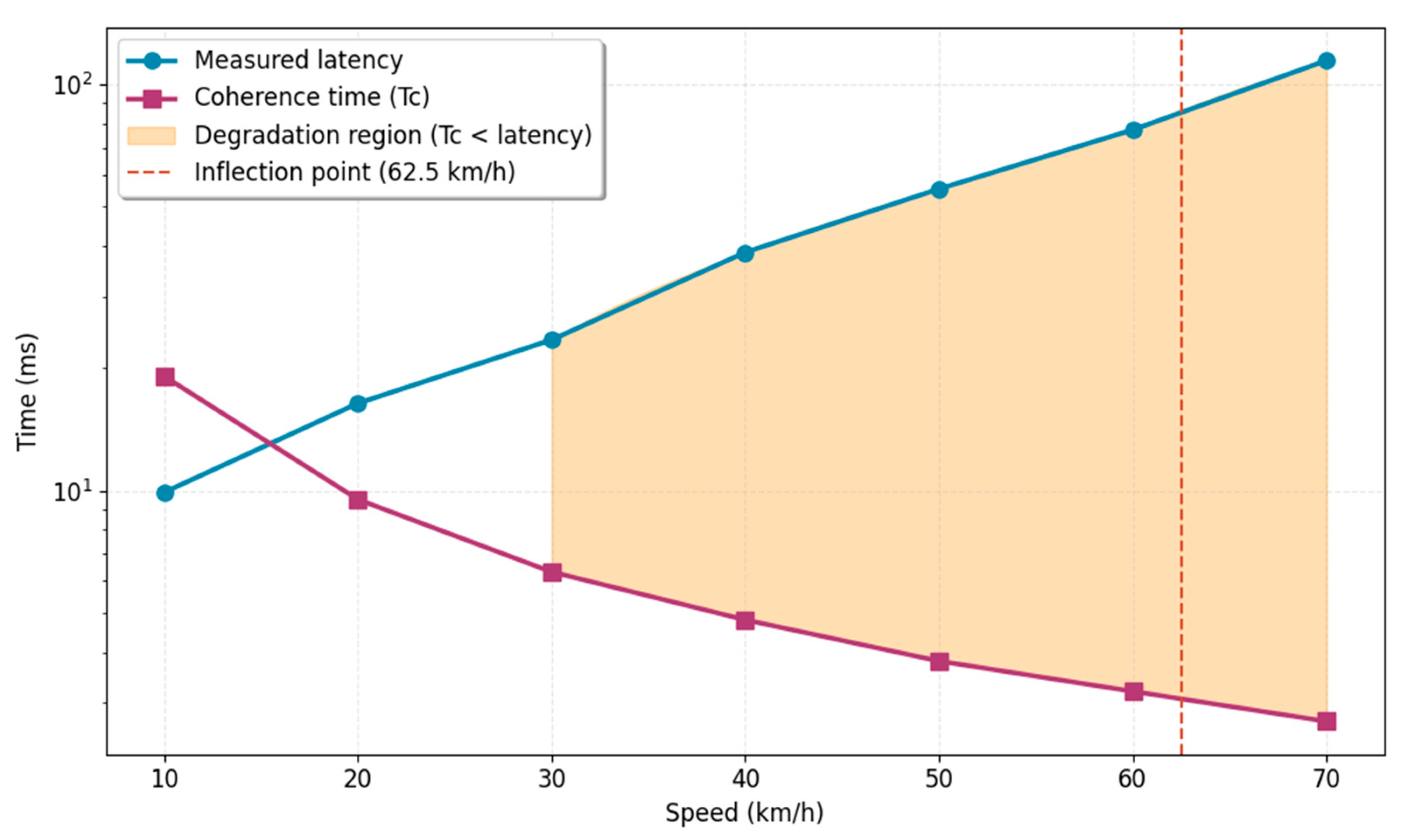
To illustrate the relationship between vehicle mobility and link stability, Figure 3 compares the channel coherence time (Tc) with the latency measured as a function of speed. The shaded region indicates the speed range where Tc is less than the latency, a condition associated with a significant degradation in performance due to rapid fading.
The decisive parameter turns out to be the channel coherence time (Tc). As shown in Table 7 at 70 km/h, Tc is only 2.7 ms, a value comparable to the transmission time of a typical ESP-NOW frame (1–2 ms). This relationship explains the observed behavior: when Tc is greater than the latency (9.9 ms at 10 km/h), the channel remains stable throughout the transmission. Conversely, when Tc is less than the latency (starting at 30 km/h, Tc = 6.3 ms vs. latency = 23.5 ms), the channel changes multiple times during the transmission of a single packet, hindering coherent demodulation and necessitating retransmissions. This phenomenon, known as fast fading, is the true cause of performance degradation at high speeds and explains both the quadratic trend in latency (Equation (5)) and the logistic inflection point in packet loss (Equation (6)). These findings align with those reported by Gorospe et al. [23] in their comparisons between IEEE 802.11p and LTE-V2X, where link stability under mobility is identified as a determining factor.
It is important to note that the mathematical models obtained (R2 = 0.994 for latency, R2 = 0.991 for packet loss) offer superior predictive power compared to simple linear models, providing a useful tool for designing early warning systems in urban environments. The logistic function, in particular, allows for the precise identification of the transition speed (62.5 km/h) at which packet loss exceeds 50%, establishing a practical operational threshold.

4.3. Implications for Road Safety Systems

Table 9 compares the main results obtained in this study with relevant previous research in the field of vehicular communications and low-latency protocols. Included are studies on ESP-NOW under static conditions [5,6], vehicular channel models [7,8], human reaction times [9], and emerging technologies such as 5G-V2X [20], IEEE 802.11bd [24], and LoRaWAN [21,22]. It can be observed that this work offers the first experimental characterization of the ESP-NOW protocol under vehicular mobility conditions in a real urban environment in Latin America, addressing a gap identified in previous studies that were limited to static scenarios or simulations [1,4]. The results have direct implications for the design of low-cost early warning systems.

4.3.1. Effective Speed Range

The prototype is reliable up to 60 km/h (packet loss < 45%, latency < 80 ms). This threshold is consistent with recommendations in the literature for non-critical safety applications [1], although it falls below the operational limits reported for more recent technologies such as IEEE 802.11bd [24] or 5G-V2X [20], which reach speeds of up to 100 km/h with lower latencies. The competitive advantage of ESP-NOW lies in its simplicity and lower implementation cost.

4.3.2. Margin Relative to Human Reaction Time

Even in the worst-case scenario (70 km/h, 114.5 ms), the system issues an alert 13 times faster than a human driver (1500 ms). This margin is more than sufficient to implement mitigation strategies, such as early audible and visual alerts, which have been shown to reduce effective reaction times in emergency conditions [9].

4.3.3. Low-Cost Architecture

The total cost of the system for 5 nodes (730 USD) is significantly lower than that of commercial solutions based on cellular or DSRC technologies, making driver-assistance technology more accessible in middle-income countries. This cost advantage is particularly relevant in contexts where telecommunications infrastructure is limited or expensive [21,22].

4.3.4. Latin American Context

The tests conducted in Quito, Ecuador, demonstrate the feasibility of implementing these solutions in urban environments in the region. Unlike studies carried out in laboratory conditions or controlled environments in developed countries [5,6], this work provides empirical evidence in a real-world scenario with the topographical, traffic, and infrastructure particularities characteristic of Latin American cities. This aspect is crucial for technology transfer and scalability of solutions in the region, contributing to UN SDG 3 for the reduction in traffic accidents.

4.3.5. Limitations of the Study

It is important to acknowledge the limitations of this research:
  • Small number of nodes: Five vehicles constitute a small sample size for generalizing to high-traffic-density scenarios. Studies with higher vehicle density are needed to evaluate performance degradation caused by interference among multiple nodes [24].
  • Limited maximum speed: The practical limit for reliable operation is set at 60 km/h, which restricts its application on highways and high-speed roads.
  • Controlled environmental conditions: The tests were conducted at night under good weather conditions. The impact of rain, fog, or extreme temperatures—factors that in real-world environments can significantly affect signal propagation in the 2.4 GHz band—was not evaluated [21].
  • Sampling time: Measurements were taken for 2–3 min per speed. Longer periods would be desirable to evaluate the link’s temporal stability and capture variations due to changes in network topology.
  • Safety compliance: The prototype is a proof-of-concept (TRL 3-4) and has not been designed or certified to meet automotive safety standards (e.g., ISO 26262). It lacks a redundant fail-safe mechanism, which would be essential for any real-world deployment. This limitation is acknowledged and will be addressed in future engineering developments.

4.3.6. Future Work

Based on these limitations, the following areas for future work have been identified:
  • Evaluate the system on highways using specific high-speed protocols (802.11p, C-V2X) [1] or explore compatibility with emerging standards such as IEEE 802.11bd, which offer improved robustness against the Doppler effect [24].
  • Implement handover mechanisms between RSUs to maintain connectivity over large areas [19].
  • Conduct tests under adverse weather conditions to characterize the system’s robustness, incorporating models of rain-induced signal loss and atmospheric attenuation [22].
  • Integrate collision prediction algorithms based on historical data and machine learning [1], as well as federated learning techniques to improve the detection of anomalous behavior in the network [1,4].
  • Scale the network to a larger number of nodes to evaluate the impact of vehicle density on packet loss and latency, a critical aspect for its deployment in high-congestion scenarios [20,24].
  • Integrate asynchronous decentralized coordination mechanisms [16] and spatio-temporal robust optimization strategies [15] to enhance network resilience, privacy preservation, and scalability when operating across multiple RSUs or in dense urban environments.

5. Conclusions

This study presented an experimental evaluation of the impact of vehicular mobility on the ESP-NOW protocol for early collision warning systems in urban environments in Quito, Ecuador. The results demonstrate that the prototype is reliable up to 60 km/h, with latencies ranging from 9.9 ms at 10 km/h to 114.5 ms at 70 km/h and a packet loss rate increasing from 2% to 60% over the same range, far exceeding the human reaction time of 1.5 s.
The mathematical models obtained—a quadratic fit for latency (R2 = 0.994) and a logistic fit for packet loss (R2 = 0.991)—provide predictive tools for the design of ESP-NOW-based road safety systems. The inflection point of the logistic model at 62.5 km/h establishes a practical operational limit, identifying the speed at which the link reaches its stability limit.
This research provides an experimental characterization of the ESP-NOW protocol under real-world vehicular mobility conditions in a Latin American urban environment, filling a gap identified in previous studies that were limited to static scenarios. The results validate the technical and economic feasibility of implementing low-cost solutions in middle-income contexts, directly contributing to the United Nations Sustainable Development Goal 3 (Good Health and Well-being) by reducing traffic accidents.

Author Contributions

Conceptualization, F.M. and F.R.; methodology, F.M. and F.R.; software, F.R.; validation, F.M. and F.R.; formal analysis, F.M.; investigation, F.R.; resources, F.R.; data curation, F.R.; writing—original draft preparation, F.M.; writing—review and editing, F.M.; visualization, F.M.; supervision, L.-N.M.A. and A.A.Q.; project administration, F.R. All authors have read and agreed to the published version of the manuscript.

Funding

This research received no external funding.

Institutional Review Board Statement

Not applicable.

Informed Consent Statement

Not applicable.

Data Availability Statement

The original contributions presented in this study are included in the article. Further inquiries can be directed to the corresponding author.

Acknowledgments

The authors thank the residents of San Bartolo, Quito, for facilitating the testing environment and supporting the field trials. Special thanks to Emanuel Gonzales for his thoughtful review and valuable suggestions during the preparation of the manuscript. We also acknowledge the academic guidance provided by Miguel Luque and Alfonso Ariza throughout this research. During the preparation of this manuscript, the authors used DeepSeek (V3) for language polishing, grammar checking, and as a coding assistant for the generation of Figure 3. DeepSeek (V3)also helped structure the discussion and create the comparative table with previous studies (Table 9). The authors have reviewed and edited all AI-generated content and take full responsibility for the final version of this manuscript.

Conflicts of Interest

The authors declare no conflicts of interest.

References

  1. Boualouache, A.; Engel, T. A Survey on Machine Learning-based Misbehavior Detection Systems for 5G and Beyond Vehicular Networks. IEEE Commun. Surv. Tutor. 2023, 25, 1128–1172. [Google Scholar] [CrossRef]
  2. World Health Organization. Global Status Report on Road Safety 2023; WHO: Geneva, Switzerland, 2023. [Google Scholar]
  3. National Institute of Statistics and Censuses (INEC). Transport Statistics Yearbook 2023; INEC: Abuja, Nigeria, 2024. [Google Scholar]
  4. van der Heijden, R.W.; Dietzel, S.; Leinmüller, T.; Kargl, F. Survey on Misbehavior Detection in Cooperative Intelligent Transportation Systems. IEEE Commun. Surv. Tutor. 2019, 21, 779–811. [Google Scholar] [CrossRef]
  5. Mutiara, A.B.; Kusuma, H.A.; Suhendra, T. Field Testing and QoS Analysis of ESP-NOW Communication on ESP32. In Proceedings of the 2024 FORTEI-International Conference on Electrical Engineering (FORTEI-ICEE); IEEE: New York City, NY, USA, 2024. [Google Scholar]
  6. Eridani, D.; Rochim, A.F.; Cesara, F.N. Comparative Performance Study of ESP-NOW, Wi-Fi, Bluetooth Protocols based on Range, Transmission Speed, Latency, Energy Usage and Barrier Resistance. In Proceedings of the 2021 International Seminar on Application for Technology of Information and Communication (iSemantic); IEEE: New York City, NY, USA, 2021; pp. 322–328. [Google Scholar] [CrossRef]
  7. Noh, S.K.; Kim, P.J.; Yoon, J.H. Doppler Effect on V2I Path Loss and V2V Channel Models. In Proceedings of the 2016 International Conference on Information and Communication Technology Convergence (ICTC); IEEE: New York City, NY, USA, 2016; pp. 898–902. [Google Scholar] [CrossRef]
  8. Turner, J.S.C.; Shahriman, A.B.; Harun, A.; Murad, S.A.Z.; Isa, M.N.; Ismail, R.C.; Ndzi, D.L.; Hashim, M.S.M.; Razlan, Z.M.; Wan, W.K.; et al. Modelling on Impact of Building Obstruction for V2I Communication Link in Micro Cellular Environment. J. Phys. Conf. Ser. 2021, 1755, 012031. [Google Scholar] [CrossRef]
  9. Green, M. How Long Does It Take to Stop? Methodological Analysis of Driver Perception-Brake Times. Transp. Hum. Factors 2000, 2, 195–216. [Google Scholar] [CrossRef] [PubMed]
  10. Espressif Systems. ESP32-CAM Datasheet; Espressif Systems: Shanghai, China, 2021. [Google Scholar]
  11. MaxBotix Inc. MaxSonar EZ4 Series Datasheet; MaxBotix Inc.: Brainerd, MN, USA, 2014. [Google Scholar]
  12. Raspberry Pi Foundation. Raspberry Pi 5 Product Brief; Raspberry Pi Foundation: Cambridge, UK, 2023. [Google Scholar]
  13. Monolithic Power Systems. MP2307DN Step-Down Converter Datasheet; Monolithic Power Systems: Washington, DC, USA, 2005. [Google Scholar]
  14. Turnigy. Nano-Tech Plus LiPo Battery Specifications; HobbyKing: Hong Kong, China, 2020. [Google Scholar]
  15. Qin, X.; Li, Z.; Li, Z.; Xue, Y.; Chang, X. Spatio-Temporal Coordinated Operation Strategy of Data Centers Considering Virtual Storage System via Two-Stage Optimization. IEEE Trans. Netw. Sci. Eng. 2026; ahead of print. [CrossRef]
  16. Li, Z.; Sun, H.; Xue, Y.; Li, Z.; Jin, X.; Wang, P. Resilience-Oriented Asynchronous Decentralized Restoration Considering Building and E-Bus Co-Response in Electricity-Transportation Networks. IEEE Trans. Transp. Electrif. 2025, 11, 11701–11713. [Google Scholar] [CrossRef]
  17. Jiang, X.; Yu, F.R.; Song, T.; Leung, V.C.M. Resource Allocation of Video Streaming Over Vehicular Networks: A Survey, Some Research Issues and Challenges. IEEE Trans. Intell. Transp. Syst. 2021, 22, 6237–6254. [Google Scholar] [CrossRef]
  18. Wang, Y.; Shi, J.; Chen, L. Performance Analysis of IEEE 802.11p MAC with Considering Capture Effect under Nakagami-m Fading Channel in VANETs. Entropy 2023, 25, 218. [Google Scholar] [CrossRef] [PubMed]
  19. Tahir, N.; Parasuraman, R.; Sun, H. Communication-Aware Consistent Edge Selection for Mobile Users and Autonomous Vehicles. In Proceedings of the 2024 IEEE Vehicular Technology Conference (VTC Fall); IEEE: New York City, NY, USA, 2024. [Google Scholar]
  20. Tahir, M.N.; Katz, M. Performance Evaluation of IEEE 802.11p, LTE and 5G in Connected Vehicles for Cooperative Awareness. Eng. Rep. 2022, 4, e12467. [Google Scholar] [CrossRef]
  21. Torres, A.P.A.; da Silva, C.B.; Tertuliano Filho, H. An Experimental Study on the Use of LoRa Technology in Vehicle Communication. IEEE Access 2021, 9, 26633–26640. [Google Scholar] [CrossRef]
  22. Di Renzone, G.; Parrino, S.; Peruzzi, G.; Pozzebon, A.; Vangelista, L. LoRaWAN for Vehicular Networking: Field Tests for Vehicle-to-Roadside Communication. Sensors 2024, 24, 1801. [Google Scholar] [CrossRef] [PubMed]
  23. Gorospe, J.; Garcia, D.; Mozo, E.; Hasan, S.; Alonso Gómez, A.; Uhlemann, E. Performance Comparison of IEEE 802.11p and LTE-V2X Through Field-Tests and Simulations. In Proceedings of the 2024 IEEE Vehicular Networking Conference (VNC); IEEE: New York, NY, USA, 2024; pp. 81–88. [Google Scholar]
  24. Xue, S.; Gong, S.; Li, X. A Comparative Study of IEEE 802.11bd and IEEE 802.11p on the Data Dissemination Properties in Dynamic Traffic Scenarios. Appl. Sci. 2024, 14, 2099. [Google Scholar] [CrossRef]
  25. Ortiz, F.M.; de Almeida, T.T.; Ferreira, A.E.; Costa, L.H.M.K. Experimental vs. Simulation Analysis of LoRa for Vehicular Communications. Comput. Commun. 2020, 160, 299–310. [Google Scholar] [CrossRef]
  26. Cheng, X.; Huang, Z.; Bai, L. Channel Characterization and Modeling for Vehicular Communications; Springer: Berlin/Heidelberg, Germany, 2024. [Google Scholar] [CrossRef]
  27. Rappaport, T.S. Wireless Communications: Principles and Practice, 2nd ed.; Prentice Hall: Hoboken, NJ, USA, 2002. [Google Scholar]
Figure 1. VANET prototype architecture: integration of the ESP32-CAM, MaxSonar sensor, and Raspberry Pi RSU in each vehicle node.
Technologies 14 00344 g001
Figure 2. Test site in San Bartolo, Quito: 414.37 m perimeter generated using SUMO, showing the location of the RSU and the vehicle routes.
Technologies 14 00344 g002
Figure 3. Comparison between channel coherence time (Tc) and measured latency as a function of vehicle speed. The shaded area indicates the region where Tc < latency, corresponding to significant performance degradation (DeepSeek (V3) is used as a coding assistant for the generation of this figure).
Technologies 14 00344 g003
Figure 4. RSSI measurements in an urban environment: (a) obstacle-free scenario, (b) scenario with vehicle obstacles and buildings. The error bars represent ±1 standard deviation (n = 10). Greater attenuation and dispersion are observed in (b), with a difference of 4 dB at 25 m (σ = 5.85 dB).
Technologies 14 00344 g004
Figure 5. Mathematical models obtained: (a) quadratic fit for latency (R2 = 0.994) and (b) logistic fit for packet loss (R2 = 0.991). The dotted vertical line at 62.5 km/h indicates the inflection point of the logistic model, where packet loss reaches 50% (the dotted lines represent the simulated RSSI data under the presence of obstacles).
Technologies 14 00344 g005
Table 1. Specifications of the prototype’s hardware components.
ComponentSystem Function
ESP32-CAMVehicle node: V2V communication, video capture, local processing
MaxSonar EZ4 Ultrasonic SensorProximity distance measurement between vehicles
Raspberry Pi 5 Model BRSU (Road Side Unit): central server, V2I storage
MP2307DN Step-Down RegulatorPower stabilization for ESP32-CAM and sensor
Turnigy 7.4 V LiPo BatteryAutonomous power supply for the prototype in each vehicle
1N4007 SMD DiodeReverse polarity protection
110 Ω SMD ResistorCurrent limiting for indicator LED
0805 SMD Red LEDPower indicator and visual alert
microSD CardLocal storage of latency data on nodes D and E
microHDMI to HDMI AdapterConnection of Raspberry Pi to monitor for monitoring
Table 2. Network configuration for V2V communication with ESP-NOW.
ParameterValue
SSID per nodeVANET_NODE_[A,B,C,D,E]
Password12345678[A,B,C,D,E]
IP addresses192.168.4.x (x = 1 for A, 2 for B, etc.)
Subnet mask255.255.255.0
Wi-Fi channel6
Table 3. Comparison with previous studies on vehicular communications and low-latency protocols (this table was developed with the assistance of DeepSeek).
Ref.YearTechnologyScenarioLatency (ms)Main Contribution
[5]2024ESP-NOWStatic, variable distance5.13–46Characterization of ESP-NOW in an open field; optimal range <150 m
[6]2021ESP-NOW, Wi-Fi, BTStatistical Comparison of ProtocolsNo reportESP-NOW: longer range (220 m), shorter latency (1 ms), higher power consumption
[7]2016V2I, V2VSimulation, 60–150 km/hQuantification of Doppler shift and channel models
[8]2021802.15.4Urban static, RSSI measurementValidation of the PL Urban Model (RMSE 12.5 dB)
[9]2000Meta-analysis of reaction times700–1500Human reaction times: expected 0.70–0.75 s, surprise 1.5 s
[17]2021Video streamingOptimization SurveyClassification of optimization resources and tools
[18]2023IEEE 802.11p2D Markov model, simulationCapture Effect improves throughput and reduces latency
[19]2024DDPGSimulation in Gazebo/ROS2Reduces handovers and latency; improves SNR and load balancing
[20]2022IEEE 802.11p, LTE, 5GField tests (pista 1.7 km)5G: 10 5G outperforms in latency (0.01 s), packet loss (4.07%), and throughput (3.12 Mbps)
[21]2021LoRaField test, SF7/SF12, 60 km/hSF7 is more robust with Doppler; SF12 has greater range but is less reliable
[22]2024LoRaWANField tests at the velodrome and on the roadMobility and Doppler have a marginal effect; PL < 10% for SF9–12
[23]acceptedIEEE 802.11p, LTE-V2XField tests + simulations802.11p: <10LTE-V2X: longer range; 802.11p: lower latency; 802.11p: degraded coexistence
[24]2024IEEE 802.11bd, 802.11pVeins Simulations802.11bd doubles data rate, reduces latency by more than 50%, and improves reliability by 20%
[25]in the pressLoRaField test + NS-3Strong correlation between experiments and simulation
This work2026ESP-NOW + Wi-FiUrban vehicle (10–70 km/h), Quito, Ecuador9.9–114.5Characterization of ESP-NOW with mobility; mathematical models (R2 = 0.994, R2 = 0.991); practical limit up to 60 km/h
Table 4. RSSI measurements in scenarios with and without urban obstacles.
Distance
(m)
RSSI Without
Obstacles (dBm)
RSSI with
Obstacles (dBm)
Difference (dB)p-ValueSignificant?
1−44.4 ± 1.96−44.4 ± 1.960.01.000No
5−56.8 ± 1.40−58.3 ± 2.79−1.50.154No
10−57.9 ± 1.64−58.4 ± 2.88−0.50.643No
15−66.9 ± 2.26−68.6 ± 3.66−1.70.238No
20−71.3 ± 5.36−71.8 ± 5.47−0.50.841No
25−81.5 ± 1.51−85.5 ± 5.85−4.00.051 1Limit
1 p-value calculated using independent samples t-test. Values are presented as mean ± standard deviation (n = 10).
Table 5. Average latency in V2V communication with confidence intervals (95% CI).
Speed (km/h)Average Latency (ms)Standard Deviation (ms)Minim. (ms)Maxim. (ms)Lower 95% CIUpper 95% CI
109.9±1.378128.9210.88
2016.4±1.96142015.0017.80
3023.5±2.32202721.8425.16
4038.6±2.17354237.0540.15
5055.3±3.13506053.0657.54
6077.3±4.62708574.0080.60
70114.5±9.65100130107.60121.40
Table 6. Packet loss, video latency, and quality of service based on speed.
Speed (km/h)Packet Loss (%)Video Latency (ms)Observed Video Quality
102100High
205150Good
3010200Fair
4018350Poor
5030500Low
6045700Very low
70601000Almost none
100100No connection
Table 7. Comparison of the system with human reaction time (1500 ms).
Speed (km/h)System Latency (ms)Human Response Time (ms)Improvement (×times)
109.91500151×
2016.4150091×
3023.5150064×
4038.6150039×
5055.3150027×
6077.3150019×
70114.5150013×
Table 8. Maximum Doppler shift as a function of speed (f_c = 2.4 GHz).
Speed (km/h)Relative Speed (m/s)f_d Max (Hz)f_d/Symbol Bandwidth (%) 1
102.7822.20.022%
205.5644.50.045%
308.3366.70.067%
4011.1188.90.089%
5013.89111.10.111%
6016.67133.40.133%
7019.44155.60.156%
10027.78222.20.222%
1 Assuming a typical symbol bandwidth of 100 kHz for ESP-NOW (estimated).
Table 9. Channel coherence time as a function of speed.
Speed (km/h)f_d (Hz)Time of Coherence (ms) 1Relation with Table 4 (Latencia)
1022.219.1Tc > latency (9.9 ms) → stable
2044.59.5Tc ≈ latency (16.4 ms) → lower limit
3066.76.3Tc < latency (23.5 ms) → incipient degradation
4088.94.8Tc << latency (38.6 ms) → noticeable degradation
50111.13.8Tc << latency (55.3 ms) → severe degradation
60133.43.2Tc << latency (77.3 ms) → unstable channel
70155.62.7Tc << latency (114.5 ms) → very unstable channel
100222.21.9Tc << latency (no connection) → extremely unstable channel
1 Coherence time calculated as Tc ≈ 0.423/f_d [27].
Disclaimer/Publisher’s Note: The statements, opinions and data contained in all publications are solely those of the individual author(s) and contributor(s) and not of MDPI and/or the editor(s). MDPI and/or the editor(s) disclaim responsibility for any injury to people or property resulting from any ideas, methods, instructions or products referred to in the content.