1. Introduction
Currently, natural gas processing technologies are actively developing. Hydrogen, as one of the main products, plays an important role in this process [
1]. Methane pyrolysis using microwave radiation is a promising method for producing hydrogen with low greenhouse gas emissions [
2]. However, traditional production through natural gas reforming, which requires high energy costs and results in carbon losses, indicates the need to seek more environmentally friendly solutions. This study presents a new improved concept combining plasma–chemical methane processing with an additional sorption separation technology. Carbon obtained during the pyrolysis process was used as the sorbent material. Therefore, the development of an efficient and non-thermal adsorption separation method for extracting C
2H
6 from natural gas offers significant economic and social benefits [
3]. Thus, complete natural gas processing occurs at temperatures below 500 °C with conversion degrees approaching 100%. Increasing CO
2 emissions is a global, growing, and unresolved problem. Therefore, increasing conversion and reducing CO
2 emissions is an urgent task [
4,
5,
6]. In Germany, since 2021, a system has been in operation where the price per ton for burning fossil fuels has been increasing, reaching 25–55 euros by 2025, with further increases to 55–65 euros by 2026. Therefore, the possible introduction of a carbon tax of
$120 per ton of CO
2 could lead to an increase in traditional reforming costs of more than 35%, while for our process this indicator would remain practically unchanged. Overall, the demonstrated plasma–chemical conversion technology opens up possibilities for scalable, cost-effective, and profitable low-carbon production of hydrogen, ethane, acetylene, and carbon, while highlighting the potential of process intensification technologies and full-cycle processing. For industrial applications of microwave plasma, devices with a capacity of several megawatts, operating in continuous mode, have already been developed and tested [
7].
Currently, natural gas conversion is being actively developed to obtain turquoise hydrogen [
8,
9], valuable organic products [
10], and carbon [
11]. The relevance of plasma methane conversion extends far beyond film synthesis. Plasma–chemical methane cracking represents an energy-efficient alternative to traditional steam reforming for producing hydrogen and valuable carbon nanomaterials (soot, carbon nanotubes, graphene) [
9,
12,
13]. Against the backdrop of growing interest in green energy and the mitigation of greenhouse gases, plasma-based approaches—particularly those employing high-frequency and ultra-high-frequency discharges, such as radio frequency and microwave [
14]—enable methane conversion at low temperatures. This reduces energy consumption and prevents unwanted thermal side reactions [
15].
In addition to MPCVD, other plasma generation techniques are being actively investigated for this purpose. These include arc discharge, which offers high productivity but suffers from a broad particle energy distribution; pulsed corona discharge, known for its energy efficiency in gas conversion; dielectric barrier discharge, which is simple to implement but often produces inhomogeneous plasma; and inductively coupled plasma (ICP) [
16], which provides high plasma density but poses challenges for integration with deposition processes [
13,
17].
Among the various plasma sources, microwave plasma (MPCVD) is particularly notable for its ability to generate a volumetric, high-density, and nearly electrodeless discharge with a high concentration of active species. This simultaneously enables high deposition rates and superior film quality [
18]. Plasma-enhanced chemical vapor deposition (PECVD), and specifically the configuration employing microwave discharge (MPCVD), represents one of the most efficient and controllable techniques for synthesizing carbon films. It covers a broad microstructural range—from amorphous carbon (a-C) to diamond-like carbon (DLC) [
19]. Such films exhibit a unique combination of properties, including high hardness, chemical inertness, optical transparency, and tunable electrophysical characteristics. Consequently, they are in high demand for applications in microelectronics, optoelectronics, and the fabrication of protective and tribological coatings.
The main process in synthesizing films from hydrocarbons is the controlled dissociation of the feed gas (most commonly methane, CH
4) in plasma with the formation of active radicals (CH
3, CH
2, CH, C
2), atomic hydrogen, and ions [
20], which, upon depositing on the substrate, form a carbon film. It is worth noting that in addition to plasma-chemical methods, other approaches are widely used for obtaining carbon coatings. Physical vapor deposition (PVD) [
21,
22], including magnetron sputtering, ensures high purity and control of stress in the film. However, it often requires high vacuum and provides lower growth rates. Classical chemical vapor deposition (CVD) [
23,
24], where precursor decomposition occurs through substrate heating, is also used but with limitations on the choice of temperature-sensitive materials [
23]. The arc discharge method [
17] allows obtaining films with high sp
3-phase carbon content but is accompanied by the formation of macroparticles. PECVD, and especially MPCVD, occupies an intermediate position. It provides relatively high growth rates. It also enables deposition on thermally sensitive substrates because of low plasma and substrate temperatures. Moreover, it offers excellent control over film structure and properties via plasma parameters.
The key task of this work is to investigate the natural gas pyrolysis process and control the composition and energetics of the active gas phase to develop an energy-efficient process and synthesize carbon films with specified structural and morphological characteristics. One effective method for controlling plasma parameters and, consequently, the properties of the deposited material is the use of inert buffer gases, among which argon (Ar) is particularly important. Being chemically inert, argon exerts significant physical effects on the plasma: due to its high ionization potential and the presence of metastable states, it increases electron temperature and plasma density and effectively participates in the excitation and dissociative ionization of reactive gas molecules. This, in turn, can intensify methane fragmentation and promote the formation of active species that favor the growth of higher-quality and more structurally ordered films.
This work investigates the effect of argon flow (0, 50, and 100 mL/h) on the characteristics of MW plasma (700 W, 0.1 Torr) of methane (constant flow of 100 mL/h) and on the properties of synthesized carbon films at reduced pressure on c-oriented Al
2O
3 substrates, chosen because of the possible optical applications of the material [
24]. A comprehensive diagnostic approach was used, including in situ plasma diagnostics by optical emission spectroscopy (OES) and Langmuir double probe methods to determine the concentration of active species and main discharge parameters (electron temperature and concentration). The characteristics of the obtained films were investigated using X-ray diffraction (XRD) [
25], scanning electron microscopy (SEM), and inductively coupled plasma mass spectrometry (ICP-MS). The sorption measurements are of a preliminary, evaluative nature. To understand changes in the process, analysis of gas-phase byproducts was performed using gas chromatography–mass spectrometry (GC-MS).
The aim of this work is to establish a correlation between the amount of added argon, methane–argon plasma parameters, and the structural–functional properties of deposited carbon films, identifying optimal conditions for their synthesis in the context of fundamental mechanisms of plasma–chemical methane decomposition.
2. Experimental Section
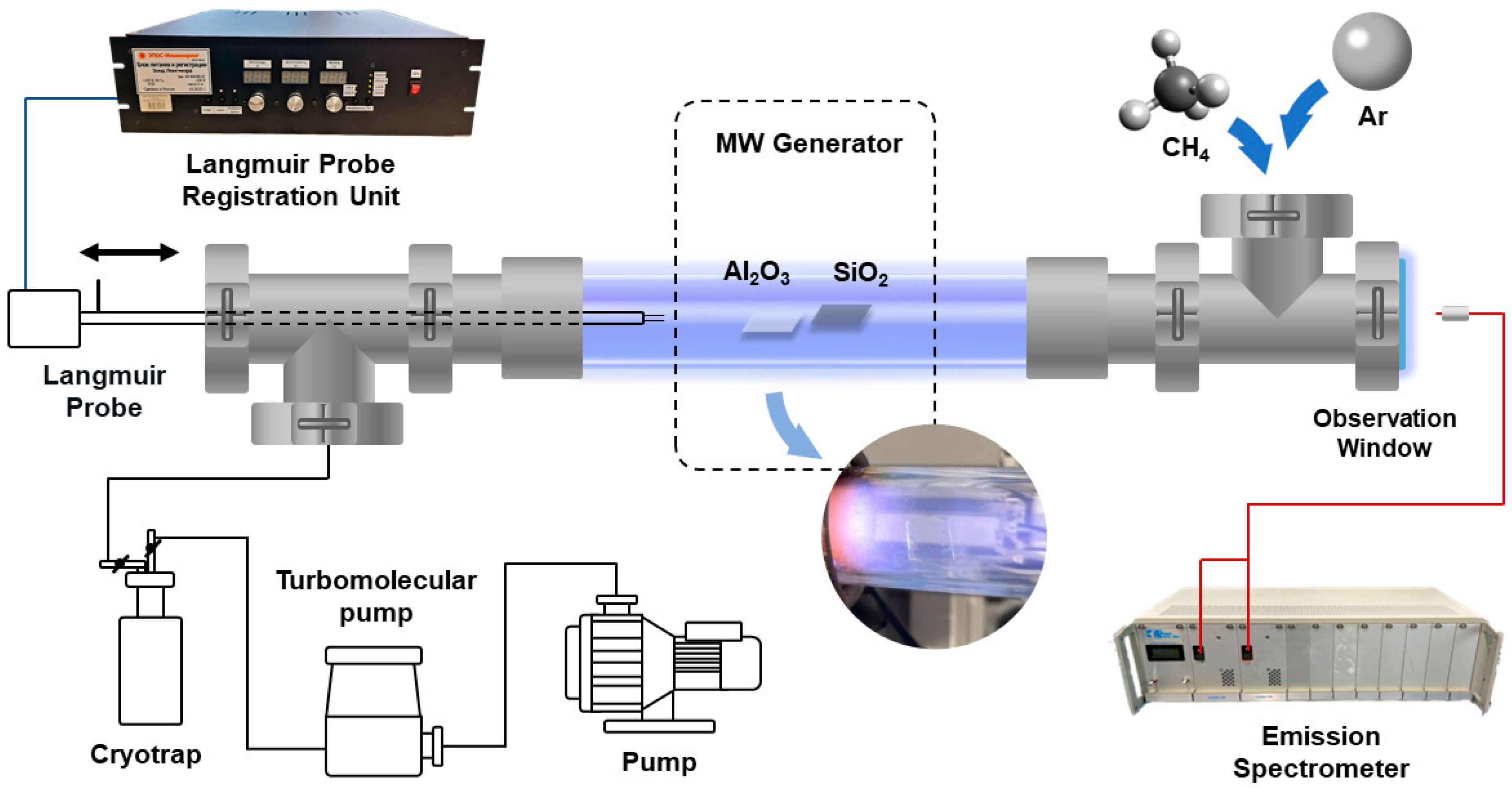
To investigate the effect of argon on the process of plasma–chemical deposition of carbon films from methane, the experimental setup shown in
Figure 1 was used.
High-purity quartz was used as the material for the tubular plasma–chemical reactor with a diameter of 40 mm. The quartz reactor was connected to the flanged part of the system by crimped fittings with fluoropolymer seals. A household microwave oven with inverter control was used to initiate the MW discharge for precise power control.
Vacuum was maintained by an ERSTVAK ESVP 300 oil-free scroll pump with an ultimate residual pressure of 0.026 mbar. Before the thin film deposition process, the system was preliminarily evacuated to a pressure of 5 × 10⁻⁴ Pa using a KYKY FF100/300 turbomolecular pump (Zhongke Keyi Co., Ltd. Beijing, China) for complete system degassing and removal of residual moisture traces over a period of 4 h.
The gas supply system consisted of chemically polished Hy-lok 1/4″ tubes, Hy-lok shut-off valves, and RRG 12 (Eltochpribor, Moscow, Russia) gas flow regulators with a range of 0–900 mL/h. As the natural gas source, special purity grade 6.0 methane (99.9999%) manufactured by S-Gas LLC (Moscow, Russia) was used. High-purity argon grade 6.0 (99.9999%) manufactured by KM Research Institute (Moscow, Russia) (oxygen volume fraction not exceeding 0.00003%) served as the plasma-forming gas source.
For optical emission spectroscopy, an Ocean Optics S2000-TR spectrometer (UV + VIS + NIR spectrometer in the range of 180–1100 nm, Orlando, FL, USA) was used to determine excited species in the discharge zone. Probe diagnostics using the Langmuir double probe method were performed with a movable probe with a KF40 seal manufactured by EPOS-Engineering LLC (Novosibirsk, Russia).
Gas phase sampling was performed by condensing products in a nitrogen trap made of stainless steel installed after the reactor. Further sample analysis was conducted using a chromatograph coupled with a mass spectrometer (Shimadzu GCMS-QP2020 NX, Kyoto, Japan, HP PLOT Q column 30 m × 0.53 mm × 40 μm 19095-Q04E, Agilent, Santa Clara, CA, USA) equipped with a vacuum inlet device.
X-ray diffraction (XRD) analysis was performed on a Shimadzu XRD-7000 powder diffractometer (Kyoto, Japan) in the 2θ range from 20 to 70° with a scanning speed of 1°/min. To study the surface morphology of the deposited film, a JSM IT-300LV (JEOL, Tokyo, Japan) scanning electron microscope with an Oxford Instruments X-MaxN 20 energy-dispersive detector (High Wycombe, Buckinghamshire, UK) was used for elemental analysis under high-vacuum conditions and at an accelerating voltage of 20 kV.
The impurity composition of the obtained thin films was investigated by ICP-MS. For this purpose, the film was deposited on a SiO2 substrate for subsequent dissolution in 45% aqueous HF solution, followed by washing in deionized water and sample drying. The film was dissolved in 60% nitric acid with a metallic impurity content less than 10 parts per billion in an Anton Paar Multiwave 3000 microwave sample preparation system with a 16-position HF-100 rotor (Graz, Austria). To 50 mg of carbon obtained from plasma–chemical deposition, 20 mL of nitric acid solution was added, and the sample was processed in the microwave sample preparation system for complete dissolution. Then, multi-element standards of different concentrations were prepared for constructing calibration curves for the deter-mined impurities.
Autosorb iQ (Anton Paar, Graz, Austria) was used to study the sorption properties of deposited carbon. The Autosorb iQ allows measurements with CH4 (methane) and C2H6 (ethane).
3. Results and Discussion
3.1. Optical Emission Spectroscopy
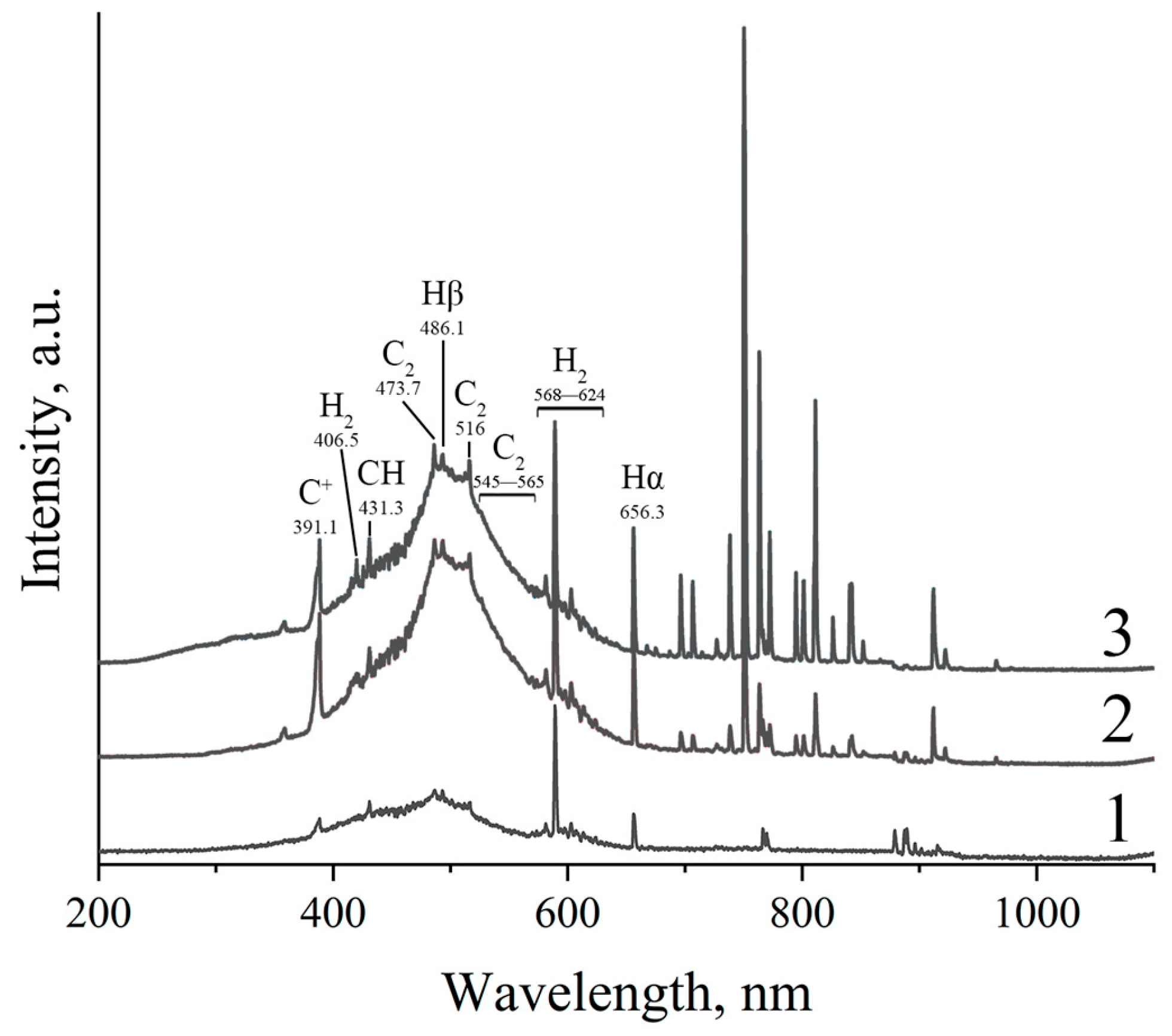
Figure 2 shows the emission spectra of methane plasma discharge excited by an electromagnetic field with a frequency of 2450 MHz at various argon flow rates. In the methane plasma emission spectrum, emission lines of atomic hydrogen Hα at 656.3 nm and Hβ at 486.1 nm are observed [
26,
27,
28]. In addition, weak intense bands of molecular CH fragments are present in the region of 431.3 nm [
26]. Upon argon addition, an increase in the intensity of molecular hydrogen bands around 406 nm and in the 568–624 nm region is observed in the plasma spectrum, as well as a significant increase in the intensity of the atomic hydrogen Hα line. This is associated with an increase in the methane conversion degree and an increase in hydrogen radical concentration in the plasma discharge, as well as the growing role of two-body recombination processes with molecular hydrogen formation. Dissipation of excited states of hydrogen molecules occurs with light quantum emission. Simultaneously, an increase in the concentration of carbon molecular species such as C
2 in the plasma discharge is observed, as evidenced by the increase in emission band intensities in the plasma spectrum around 473 nm, in the 500–516 nm region, and in the 560–600 nm region [
26,
29,
30]. Moreover, an intense line appears around 392 nm, which we attributed to C
+ ionic species [
29,
30]. The increase in argon content in the plasma-forming mixture is accompanied by growth in the emission intensity of lines and bands from hydrogen molecules and molecular fragments C
2 and CH and is also accompanied by an increase in the relative intensity of lines from excited molecular species C
2 around 473 nm and in the 500–516 nm region [
31].
3.2. Probe Diagnostics
The use of contact plasma diagnostics methods allows for the measurement of local values of electron temperature and concentration. However, the use of these methods is significantly limited due to the deposition of reaction products on the surface of the Langmuir double probe [
30].
To investigate plasma parameters, the probe was introduced into the substrate location region for 45 s to register parameters. To obtain reliable results and exclude random errors, measurements were performed 15 times for each selected plasma discharge parameter value. The probe curve was recorded at an applied signal amplitude of 100 V, duration of 1 ms, and frequency of 100 Hz. The results are presented in
Table 1. In CH
4 discharge, electrons can lose energy through various processes: dissociation, excitation of vibrational and rotational levels of molecules.
Argon is a monoatomic gas with high excitation (11.5 eV) and ionization (15.76 eV) thresholds; therefore, collisions with argon atoms (especially elastic collisions) are ineffective for electron cooling [
32]. Argon addition reduces the average energy losses of electrons, leading to an increase in their temperature. With increasing argon quantity, an increase in T
e is observed, which in turn increases the ionization rate constants for both methane and argon [
33]. Argon also acts as an additional source of ions. The decrease in methane fraction reduces power losses for dissociation and excitation; therefore, most of the MW field energy is expended on ionization, leading to an increase in electron concentration. According to experimental results, this effect intensifies with increasing argon quantity.
Thus, Ar addition to MW discharge plasma leads to an increase in electron temperature and concentration at constant pressure and radiation source power.
3.3. GC-MS of Gas Phase
For vapor phase composition analysis, a stainless steel nitrogen trap equipped with shut-off valves was installed before the scroll pump. Throughout the deposition process, the receiving vessel temperature was maintained constant by liquid nitrogen cooling. After the experiment, the air outlet was connected to the GC-MS vacuum inlet by attaching a Hy-lok fitting for sample introduction. The analysis results are presented in
Table 2. Upon argon addition, an increase in acetylene and ethane content occurs. When the argon flow is increased to 100 mL/h, selectivity toward acetylene and ethane content is maintained, but the overall conversion degree decreases due to increased plasma density, which leads to an increase in the number of collisions and can “cool” the low-energy part of the electron distribution. Thus, selectivity toward valuable organic products is clearly evident and depends on plasma discharge parameters.
3.4. XRD of Deposited Films
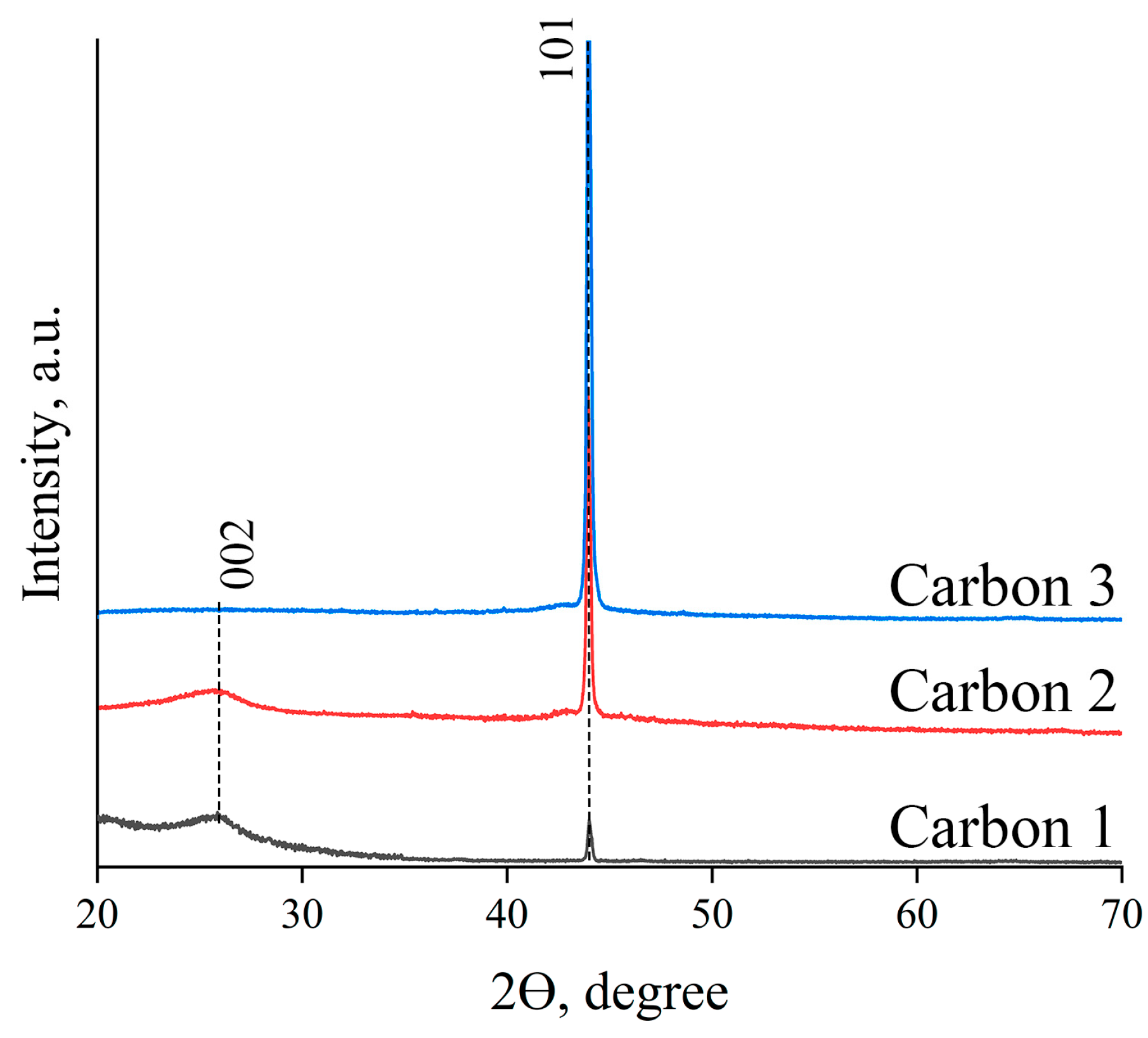
Figure 3 shows the diffractograms of the obtained thin films. The carbon sample deposited in pure methane atmosphere is denoted as “Carbon 1.” When argon was added at a rate of 50 and 100 mL/H, the names “Carbon 2” and “Carbon 3” were assigned, respectively. The deposition process was continued for 1 h to produce films with a thickness of at least 5 microns. When depositing a film in CH
4 flow, an amorphous halo is observed in the region of 25°, which is a characteristic feature of amorphous carbon with predominant sp
2 hybridization [
34]. The decrease in this halo occurring with increasing argon flow confirms that the number and size of disordered sp
2 clusters are reduced. Argon addition to the gas phase promotes changes in plasma catalytic activity, which undoubtedly affects CH
4 plasmolysis and leads to increased sample crystallinity, as confirmed by the appearance and further enhancement of the reflection in the region of 43.5°, which relates to the diamond structural type [
35], as well as the smoothing of the halo in the 25° region. This phenomenon can be explained by the enhanced role of the etching process, which smooths the surface during deposition and removes large particles from the surface formed during the gas-phase reaction. Argon, being a noble gas, effectively transfers energy through collisions of the second kind to methane molecules, promoting their dissociation. Increasing the Ar amount to a 1:1 ratio with CH
4 leads to complete smoothing of the diffractogram, except for the increasing intensity peak around 43.5°.
3.5. SEM
Scanning electron microscopy was used to study the surface morphology.
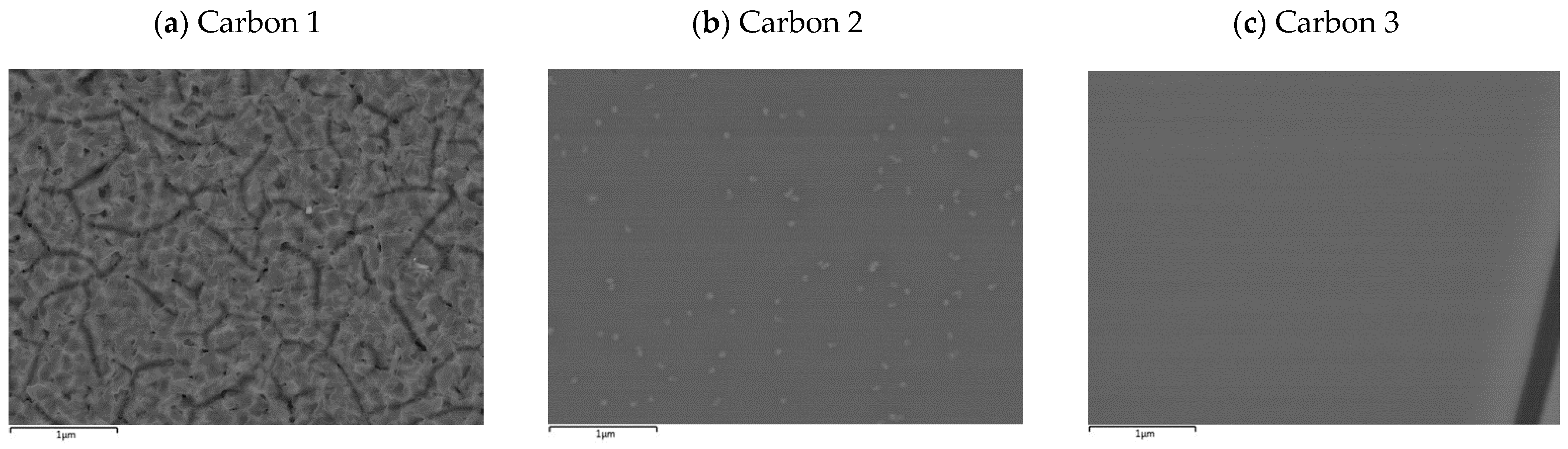
Figure 4 shows micrographs of samples Carbon 1, Carbon 2, and Carbon 3. The film deposited in methane flow is characterized by a rough, developed surface with flake-like features typical of amorphous carbon with mixed hybridization and predominant sp
2 bonding. In regions of defects, bends, and between layer fragments, bonds characteristic of sp
3 hybridization can form. Increasing argon flow leads to growth of the (101) reflection and an increase in the sp
3 hybridization fraction in the film, which acquires diamond-like carbon (DLC) properties [
36,
37]. The formation of sp
3 bonds requires higher energies of depositing particles/radicals through substrate biasing to negative potential in plasma processes. High-energy particles striking the surface cause local heating and increase surface mobility of adatoms. This phenomenon allows them to find the most energetically favorable positions and fill valleys instead of random sticking, which leads to surface smoothing along with competing etching/deposition processes.
3.6. ICP-MS
In order to reliably confirm the purity of the obtained material, the samples analyzed using the ICP-MS method.
According to the analysis results, the deposited carbon has 6N purity for main metallic impurities (
Table 3).
Table 3.
ICP-MS analysis results.
Table 3.
ICP-MS analysis results.
| Element | Unit | Concentration |
|---|
| Ba | ppb | ≤0.8 |
| Ca | ppb | ≤0.9 |
| Cd | ppb | ≤0.06 |
| Cr | ppb | ≤0.07 |
| Cu | ppb | ≤0.08 |
| Fe | ppb | ≤0.04 |
| Mg | ppb | ≤0.09 |
| Mn | ppb | ≤0.08 |
| Ni | ppb | ≤0.05 |
| Pb | ppb | ≤0.02 |
| Si | ppb | 950 |
According to the analysis results, the deposited carbon has 6N purity for main metallic impurities. Thus, this material, given its purity, can be used in various microelectronic, sorption, and other applications.
3.7. Investigation of Sorption Properties
To evaluate the effect of argon on the properties and selectivity of gas separation, adsorption isotherms of ethane (C2H6) and methane (CH4) were measured at a temperature of 298 K. The carbon powder was transferred from the substrates to a special vessel of the measuring instrument.
As shown in
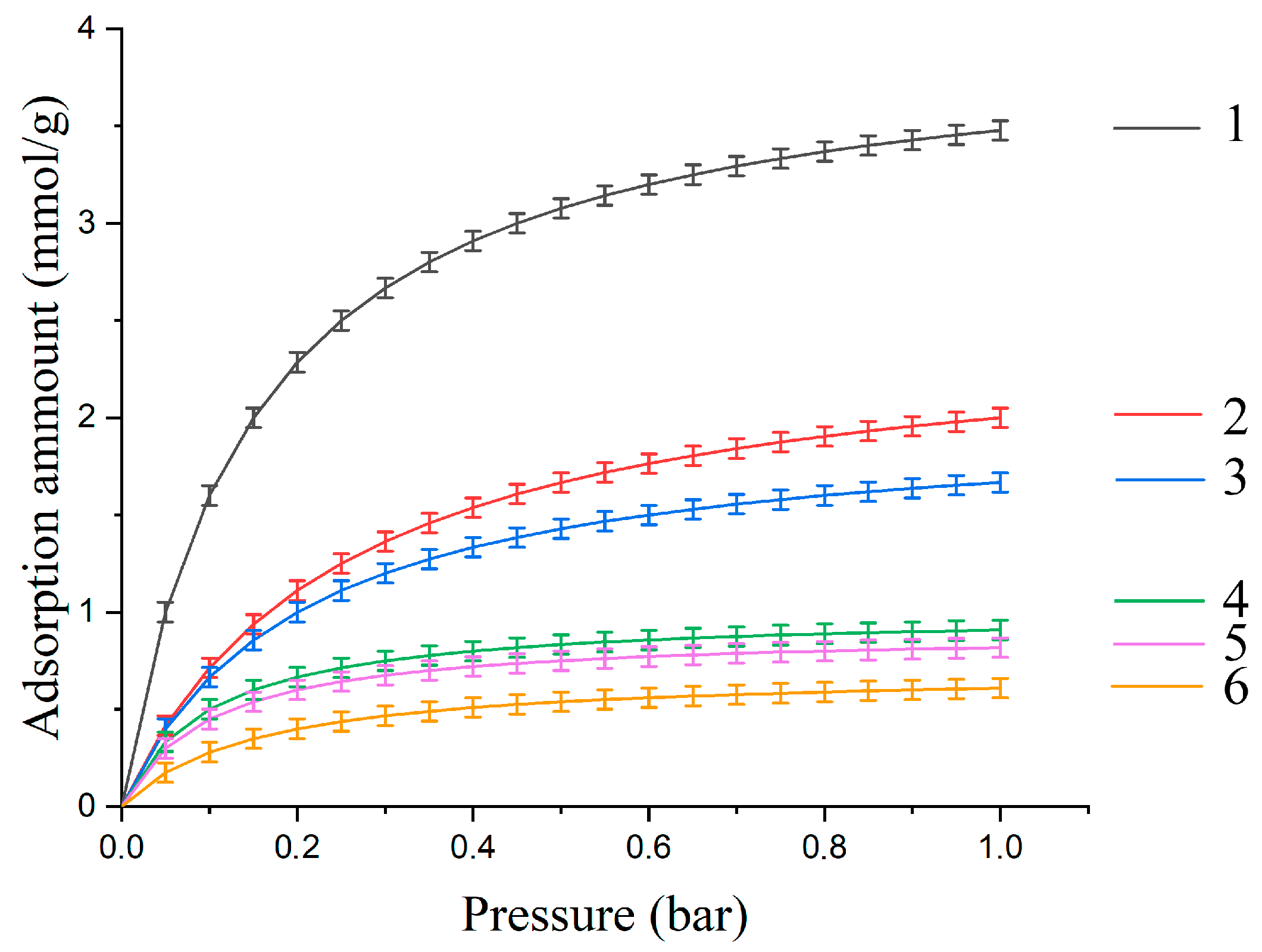
Figure 5, and consistent with SEM studies, Ar addition significantly affects porosity and, consequently, adsorption properties. A key observation is that samples obtained with Ar addition demonstrate practically identical adsorption isotherms for both C
2H
6 and CH
4. This indicates that increasing the Ar fraction above a 1:2 ratio is excessive and leads to further structure smoothing and, consequently, decreased porosity.
Figure 5 also shows the adsorption isotherms for this series of samples. Analysis of the isotherms allows two key conclusions. First, all studied samples exhibit significantly greater affinity for ethane than for methane. C
2H
6 uptake substantially exceeds CH
4 uptake over the entire pressure range. This behavior is explained by the physicochemical properties of the molecules, as the polarizability of ethane is higher than that of methane. Molecules with greater polarizability experience stronger dispersion interactions with the surface of carbon pores, which ensures preferential adsorption [
2].
Thus, porous carbon obtained from methane plasma is a promising candidate for industrial application in C2H6/CH4 gas separation, which contributes to increasing the absolute value of natural gas conversion.
Analysis of the adsorption isotherms shows that all studied samples exhibit higher single-component uptake of ethane than methane over the investigated pressure range. This behavior suggests a stronger affinity of the carbon surface toward C2H6, which can be attributed to the higher polarizability of ethane compared with methane and, consequently, to stronger dispersion interactions with the carbon pore surface. Based on the adsorption isotherms of individual components (C2H6, CH4), an assumption was made about the ethane preferential adsorption. However, it should be noted that ideal selectivity calculated from pure-gas adsorption data does not fully represent competitive adsorption under dynamic gas-mixture conditions. Therefore, breakthrough experiments using C2H6/CH4 mixtures are required in future work to directly confirm the separation performance under practically relevant conditions. Accordingly, the present results should be considered as an initial assessment of the potential of plasma-derived porous carbon materials for C2H6/CH4 separation rather than a complete demonstration of industrial separation efficiency. To definitively confirm selectivity, dynamic experiments with a binary C2H6/CH4 mixture are necessary.
Thus, porous carbon obtained from methane plasma demonstrates promising preliminary adsorption characteristics for C2H6/CH4 separation; however, dynamic mixed-gas breakthrough experiments are required to confirm its practical separation performance. A more precise determination of the adsorption mechanisms would require data on the specific surface area and pore size distribution, which were beyond the scope of this work. A final conclusion regarding the selectivity of the material under real conditions can only be drawn after experiments with gas mixtures.
4. Conclusions
To accelerate the transition to sustainable energy, efficient methods for hydrogen production and carbon utilization without CO2 emissions are needed. This study presents a new environmentally friendly approach to the simultaneous production of “green” hydrogen, valuable hydrocarbons, and functional carbon materials by converting methane in low-pressure microwave plasma. The crucial role of argon in this process was studied in detail. The effect of argon addition on plasma parameters, product distribution, and material properties was systematically investigated. Optical emission spectroscopy and probe diagnostics showed that argon presence significantly changes plasma characteristics, increasing the concentration and average electron temperature. This, in turn, affects both gaseous and solid products. Analysis of outlet gases by GC-MS showed that argon addition increases selectivity toward valuable C2 hydrocarbons (acetylene, ethylene, and especially ethane), as well as the overall methane conversion efficiency. Furthermore, we demonstrated that argon concentration significantly affects the morphology and structure of carbon films formed during plasmolysis, as confirmed by electron microscopy and XRD.
A key innovation in this work was the study of the synergistic relationship between the plasma process and its byproduct—solid carbon. We demonstrated that carbon films formed during plasmolysis possess significant adsorption capacity and, most importantly, selectivity toward ethane. This unique property provides an additional separation effect and more complete feedstock processing. The selective carbon material preferentially ad-sorbs C2H6 from the product stream, effectively enriching the residual gas mixture with hydrocarbons, particularly ethane. This effect, arising from in situ adsorption and controlled by initial argon concentration, significantly increases the overall methane conversion efficiency and increases the yield of valuable products without additional post-treatment or energy costs.
Methane was converted into three valuable products. First, environmentally friendly hydrogen for fuel cells and energy storage systems. Second, a range of valuable organic products (C2H2, C2H4, C2H6). Third, functional carbon films with tunable properties and unique sorption and catalytic characteristics. This closed-loop cycle, in which the process byproduct enhances the main reaction and argon serves as a tunable parameter for opti-mizing both the physical properties of the plasma and the chemical properties of the mate-rials, represents a fundamentally new approach to decentralized low-carbon hydrogen production and methane utilization, which is ideally aligned with the principles of green chemistry and the circular economy. Thus, the use of carbon deposited from natural gas as a selective sorbent will increase natural gas conversion, which will significantly reduce soot and CO2 emissions, since this process has virtually no unused byproducts.



 ,
,