
A Comparative Framework for Formal Representation Strategies in Sign Language Avatar Systems

 ,
, 
 , ,
, ,  and
and
Abstract
1. Introduction
2. Materials and Methods
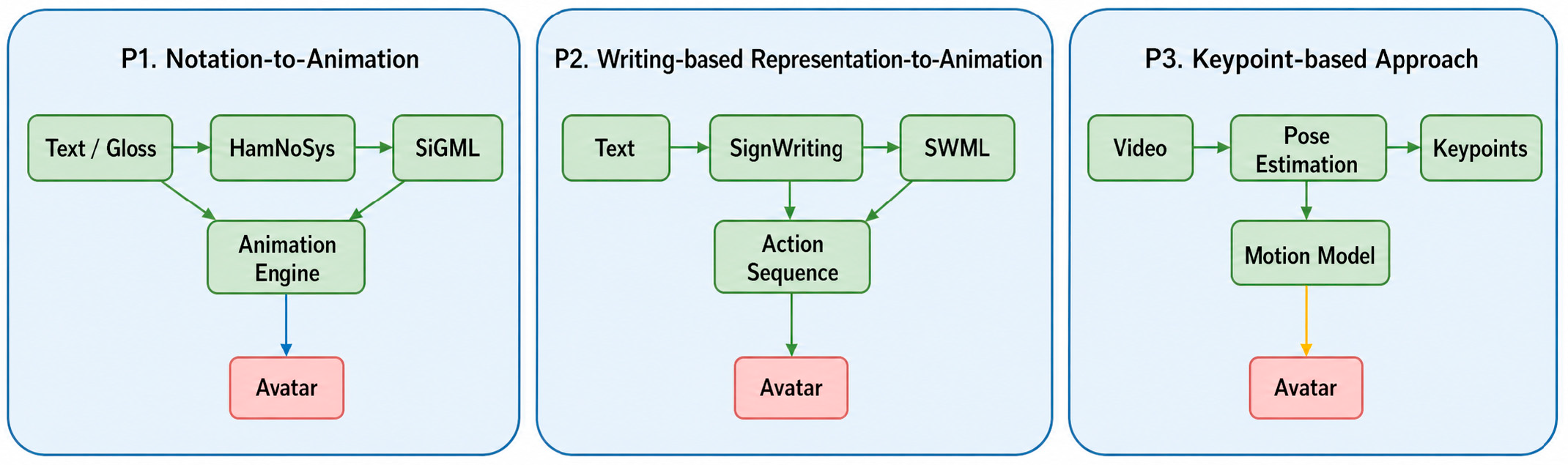
2.1. Analytical Framework
2.1.1. P1 Notation-to-Animation Systems
2.1.2. P2 Writing-to-Animation Systems
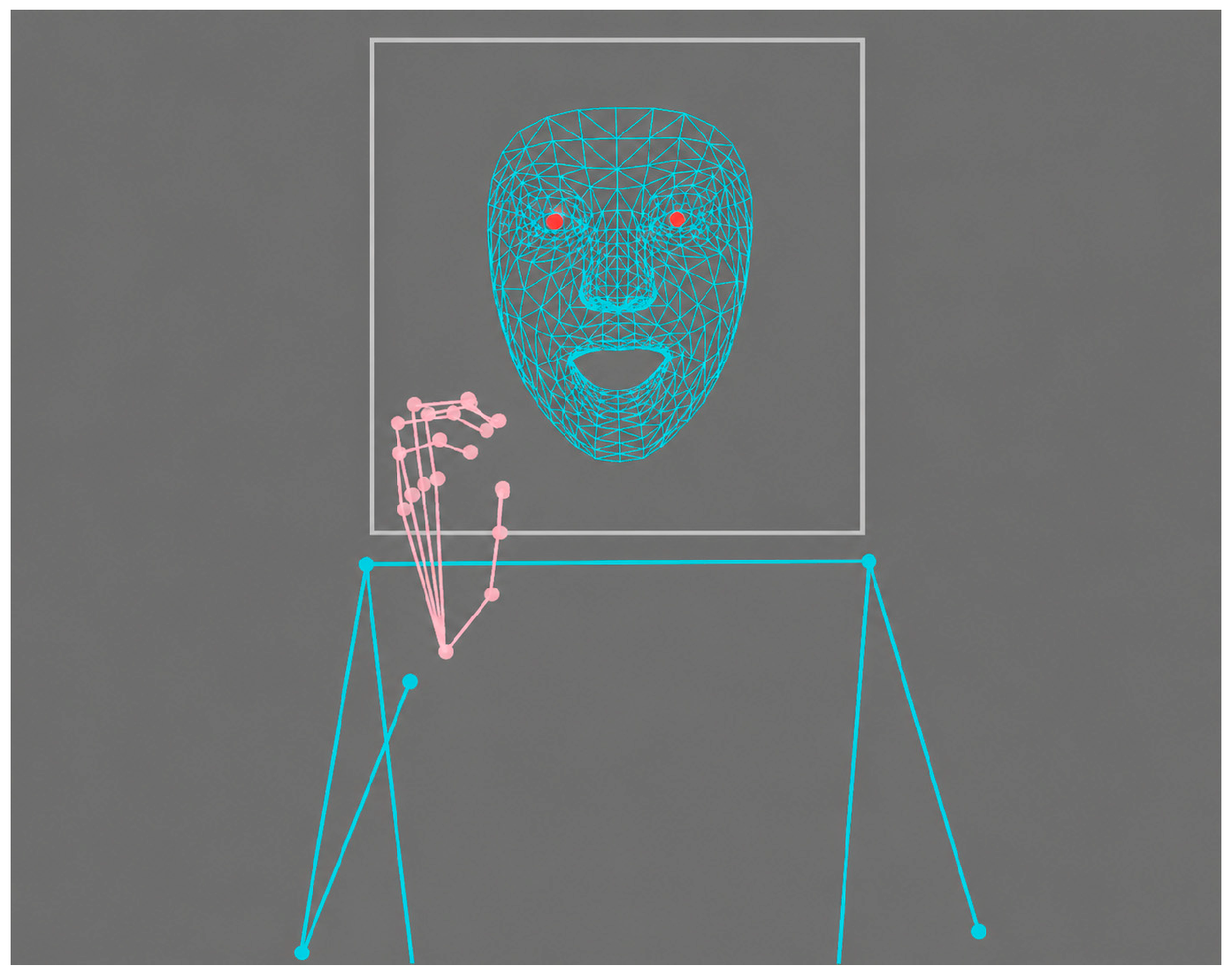
2.1.3. P3 Keypoint-Based Animation Systems
2.2. Case Study Systems Overview
3. Results
4. Discussion
5. Conclusions
Author Contributions
Funding
Institutional Review Board Statement
Informed Consent Statement
Data Availability Statement
Conflicts of Interest
References
- FAQs|World Federation of the Deaf. Available online: https://wfdeaf.org/contact/faqs/ (accessed on 4 January 2026).
- Deaf History—Europe—Access to Sign Language: A Human Right. Available online: https://deafhistory.eu/index.php/component/zoo/item/human-rights (accessed on 4 January 2026).
- Six Difficulties We Faced When Thinking About a Sign Language Avatar. Available online: https://innovation.dw.com/articles/six-difficulties-sign-language-avatar (accessed on 4 January 2026).
- Caselli, N.K.; Sehyr, Z.S.; Cohen-Goldberg, A.M.; Emmorey, K. ASL-LEX: A Lexical Database of American Sign Language. Behav. Res. 2017, 49, 784–801. [Google Scholar] [CrossRef]
- Zou, Y.; Lin, H. A Basic General Service List for Chinese Sign Language. J. Deaf Stud. Deaf Educ. 2025, 30, 405–418. [Google Scholar] [CrossRef]
- Perlman, M.; Little, H.; Thompson, B.; Thompson, R.L. Iconicity in Signed and Spoken Vocabulary: A Comparison Between American Sign Language, British Sign Language, English, and Spanish. Front. Psychol. 2018, 9, 1433. [Google Scholar] [CrossRef]
- Zhao, Y.; Wu, X.; Sun, P.; Chen, H. Relationship Between Vocabulary Knowledge and Reading Comprehension in Deaf and Hard of Hearing Students. J. Deaf Stud. Deaf Educ. 2021, 26, 546–555. [Google Scholar] [CrossRef]
- Convertino, C.; Borgna, G.; Marschark, M.; Durkin, A. Word and World Knowledge Among Deaf Learners With and Without Cochlear Implants. J. Deaf Stud. Deaf Educ. 2014, 19, 471–483. [Google Scholar] [CrossRef]
- Hall, W.C. What You Don’t Know Can Hurt You: The Risk of Language Deprivation by Impairing Sign Language Development in Deaf Children. Matern. Child Health J. 2017, 21, 961–965. [Google Scholar] [CrossRef] [PubMed]
- For the Deaf Community, Sign Language Equals Rights|Human Rights Watch. Available online: https://www.hrw.org/news/2022/09/23/deaf-community-sign-language-equals-rights (accessed on 17 January 2026).
- AI and Machine Translation: A Threat to the Deaf Community?—Deaf Journalism Europe. Available online: https://www.deafjournalism.eu/ai-and-machine-translation-a-threat-to-the-deaf-community/ (accessed on 17 January 2026).
- BOBSL. Available online: https://www.robots.ox.ac.uk/~vgg/data/bobsl/?utm_source=chatgpt.com (accessed on 5 January 2026).
- Duarte, A.; Palaskar, S.; Ventura, L.; Ghadiyaram, D.; DeHaan, K.; Metze, F.; Torres, J.; Giro-i-Nieto, X. How2Sign: A Large-Scale Multimodal Dataset for Continuous American Sign Language. In Proceedings of the 2021 IEEE/CVF Conference on Computer Vision and Pattern Recognition (CVPR); IEEE: Nashville, TN, USA, 2021; pp. 2734–2743. [Google Scholar]
- Li, D.; Opazo, C.R.; Yu, X.; Li, H. Word-Level Deep Sign Language Recognition from Video: A New Large-Scale Dataset and Methods Comparison. In Proceedings of the 2020 IEEE Winter Conference on Applications of Computer Vision (WACV); IEEE: Snowmass Village, CO, USA, 2020; pp. 1448–1458. [Google Scholar]
- Belissen, V.; Braffort, A.; Gouiffès, M. Dicta-Sign-LSF-v2: Remake of a Continuous French Sign Language Dialogue Corpus and a First Baseline for Automatic Sign Language Processing. In Proceedings of the Twelfth Language Resources and Evaluation Conference; Calzolari, N., Béchet, F., Blache, P., Choukri, K., Cieri, C., Declerck, T., Goggi, S., Isahara, H., Maegaard, B., Mariani, J., et al., Eds.; European Language Resources Association: Marseille, France, 2020; pp. 6040–6048. [Google Scholar]
- Camgoz, N.C.; Hadfield, S.; Koller, O.; Ney, H.; Bowden, R. Neural Sign Language Translation. In Proceedings of the 2018 IEEE/CVF Conference on Computer Vision and Pattern Recognition; IEEE: Salt Lake City, UT, USA, 2018; pp. 7784–7793. [Google Scholar]
- Corpus: British Sign Language Corpus|SL Data Compendium. Available online: https://www.sign-lang.uni-hamburg.de/lr/compendium/corpus/bslcorpus.html (accessed on 17 January 2026).
- Konrad, R.; Hanke, T.; Langer, G.; Blanck, D.; Bleicken, J.; Hofmann, I.; Jeziorski, O.; König, L.; König, S.; Nishio, R.; et al. MY DGS—Annotated. Public Corpus of German Sign Language, 3rd Release; Institute of German Sign Language and Communication of the Deaf (IDGS): Hamburg, Germany, 2020. [Google Scholar]
- GitHub—ChelseaGH/KSL-Guide: KSL-Guide: A Large-Scale Korean Sign Language Dataset Including Interrogative Sentences for Guiding the Deaf and Hard-of-Hearing, FG, 2021. Available online: https://github.com/ChelseaGH/KSL-Guide (accessed on 17 January 2026).
- CSL-Daily Dataset. Available online: https://ustc-slr.github.io/datasets/2021_csl_daily/ (accessed on 5 January 2026).
- Aziz, M.; Othman, A. Evolution and Trends in Sign Language Avatar Systems: Unveiling a 40-Year Journey via Systematic Review. Multimodal Technol. Interact. 2023, 7, 97. [Google Scholar] [CrossRef]
- Naert, L.; Larboulette, C.; Gibet, S. A Survey on the Animation of Signing Avatars: From Sign Representation to Utterance Synthesis. Comput. Graph. 2020, 92, 76–98. [Google Scholar] [CrossRef]
- Rastgoo, R.; Kiani, K.; Escalera, S.; Athitsos, V.; Sabokrou, M. A Survey on Recent Advances in Sign Language Production. Expert Syst. Appl. 2024, 243, 122846. [Google Scholar] [CrossRef]
- Tuveri, F. A Comprehensive Review of Sign Language Production. J. Comput. Assist. Linguist. Res. 2024, 8, 1–22. [Google Scholar] [CrossRef]
- Bragg, D.; Koller, O.; Bellard, M.; Berke, L.; Boudrealt, P.; Braffort, A.; Caselli, N.; Huenerfauth, M.; Kacorri, H.; Verhoef, T.; et al. Sign Language Recognition, Generation, and Translation: An Interdisciplinary Perspective; Association for Computing Machinery (ACM): New York, NY, USA, 2019. [Google Scholar]
- Al-Qurishi, M.; Khalid, T.; Souissi, R. Deep Learning for Sign Language Recognition: Current Techniques, Benchmarks, and Open Issues. IEEE Access 2021, 9, 126917–126951. [Google Scholar] [CrossRef]
- Al Abdullah, B.A.; Amoudi, G.A.; Alghamdi, H.S. Advancements in Sign Language Recognition: A Comprehensive Review and Future Prospects. IEEE Access 2024, 12, 128871–128895. [Google Scholar] [CrossRef]
- Torrado Mora, L.D.; Alberto Collazos, C.; Rico Bautista, D. Traducción de Lenguaje de Signos a Texto Mediante Python Con Redes Neuronales LSTM. RCTA 2025, 2, 150–159. [Google Scholar] [CrossRef]
- Wolfe, R.; McDonald, J.C.; Hanke, T.; Ebling, S.; Van Landuyt, D.; Picron, F.; Krausneker, V.; Efthimiou, E.; Fotinea, E.; Braffort, A. Sign Language Avatars: A Question of Representation. Information 2022, 13, 206. [Google Scholar] [CrossRef]
- Izaguirre, E.D.P.; Abásolo, M.J.; Collazos, C.A. BlipBla Mobile and Collaborative App to Teach Lip Reading to Children Who Are Deaf. IEEE R. Iberoam. Tecnol. Aprendiz. 2025, 20, 182–190. [Google Scholar] [CrossRef]
- Naert, L.; Larboulette, C.; Gibet, S. Motion Synthesis and Editing for the Generation of New Sign Language Content: Building New Signs with Phonological Recombination. Mach. Transl. 2021, 35, 405–430. [Google Scholar] [CrossRef]
- Dimou, A.-L.; Papavassiliou, V.; Goulas, T.; Vasilaki, K.; Vacalopoulou, A.; Fotinea, S.-E.; Efthimiou, E. What about Synthetic Signing? A Methodology for Signer Involvement in the Development of Avatar Technology with Generative Capacity. Front. Commun. 2022, 7, 798644. [Google Scholar] [CrossRef]
- Atasoy, M.; Şılbır, L.; Erümit, S.F.; Bahçekapılı, E.; Yıldız, A.; Karal, H. Visual Appearance Features of Sign Language Avatars. Kastamonu Educ. J. 2023, 31, 386–403. [Google Scholar] [CrossRef]
- De Almeida Freitas, F.; Peres, S.M.; De Paula Albuquerque, O.; Fantinato, M. Leveraging Sign Language Processing with Formal SignWriting and Deep Learning Architectures. In Intelligent Systems; Naldi, M.C., Bianchi, R.A.C., Eds.; Lecture Notes in Computer Science; Springer Nature: Cham, Switzerland, 2023; Volume 14197, pp. 299–314. [Google Scholar]
- Hand Talk: Your Website Accessible in ASL. Available online: https://www.handtalk.me/en/ (accessed on 10 January 2026).
- Home—Sign Bridge. Available online: https://signbridge.kz/ (accessed on 10 January 2026).
- JASigning Vhg.2020. Available online: https://vhg.cmp.uea.ac.uk/tech/jas/vhg2020/ (accessed on 10 January 2026).
- Sevilla, A.F.G.; Lahoz-Bengoechea, J.M.; Conde González, S.; Diaz Esteban, A.; Folgueira Galán, P.; De La Calle Pérez, J. Combining the User Friendliness of SignWriting with the Precision of Linguistic Parameters. In Adjunct Proceedings of the 25th ACM International Conference on Intelligent Virtual Agents; ACM: Berlin Germany, 2025; pp. 1–6. [Google Scholar]
- Lalitha, S.; Adavi, V. Beyond Words: Speech to Sign Language Interpreter. In Proceedings of the 2024 15th International Conference on Computing Communication and Networking Technologies (ICCCNT); IEEE: Kamand, India, 2024; pp. 1–6. [Google Scholar]
- Varghese, M.; Nambiar, S.K. English To SiGML Conversion For Sign Language Generation. In Proceedings of the 2018 International Conference on Circuits and Systems in Digital Enterprise Technology (ICCSDET); IEEE: Kottayam, India, 2018; pp. 1–6. [Google Scholar]
- Aasofwala, N.; Verma, S.; Patel, K. Conversion of Gujarati Alphabet to Gujarati Sign Language Using Synthetic Animation. In ICT Analysis and Applications; Fong, S., Dey, N., Joshi, A., Eds.; Lecture Notes in Networks and Systems; Springer Nature: Singapore, 2023; Volume 782, pp. 49–61. [Google Scholar]
- Aliwy, H.A.; Ahmed, A.A. Development of Arabic Sign Language Dictionary Using 3D Avatar Technologies. Indones. J. Electr. Eng. Comput. Sci. (IJEECS) 2021, 21, 609. [Google Scholar] [CrossRef]
- Goyal, D.; Goyal, V.; Goyal, L. Automatic Translation of Complex English Sentences to Indian Sign Language Synthetic Video Animations. In Proceedings of the 17th International Conference on Natural Language Processing (ICON): System Demonstrations; Goyal, V., Ekbal, A., Eds.; NLP Association of India (NLPAI): Patna, India, 2020; pp. 43–45. [Google Scholar]
- Joshi, R.B.; Desale, S.; Gaikwad, H.; Gunje, S.; Londhe, A. A Survey on Sign Language Translation Systems. Int. J. Res. Appl. Sci. Eng. Technol. (IJRASET) 2022, 10, 519–525. [Google Scholar] [CrossRef]
- Kaur, K.; Kumar, P. HamNoSys to SiGML Conversion System for Sign Language Automation. Procedia Comput. Sci. 2016, 89, 794–803. [Google Scholar] [CrossRef]
- Kumar Attar, R.; Goyal, V.; Goyal, L. State of the Art of Automation in Sign Language: A Systematic Review. ACM Trans. Asian Low-Resour. Lang. Inf. Process. 2023, 22, 1–80. [Google Scholar] [CrossRef]
- Jha, A.; Choudhary, K.; Shetty, S. Deep Learning Based Text Translation and Summarization Tool for Hearing Impaired Using Indian Sign Language. In Proceedings of the 12th International Conference on Pattern Recognition Applications and Methods; SCITEPRESS—Science and Technology Publications: Lisbon, Portugal, 2023; pp. 426–434. [Google Scholar]
- Ubieto, V.; Pozo, J.; Valls, E.; Cabrero-Daniel, B.; Blat, J. Sign Language Synthesis: Current Signing Avatar Systems and Representation. In Sign Language Machine Translation; Way, A., Leeson, L., Shterionov, D., Eds.; Machine Translation: Technologies and Applications; Springer Nature: Cham, Switzerland, 2024; Volume 5, pp. 247–266. [Google Scholar]
- Johnson, R.; Wolfe, R. A Survey of Shading Techniques for Facial Deformations on Sign Language Avatars. In Proceedings of the LREC2020 9th Workshop on the Representation and Processing of Sign Languages: Sign Language Resources in the Service of the Language Community, Technological Challenges and Application Perspectives; Efthimiou, E., Fotinea, S.-E., Hanke, T., Hochgesang, J.A., Kristoffersen, J., Mesch, J., Eds.; European Language Resources Association (ELRA): Marseille, France, 2020; pp. 107–112. [Google Scholar]
- Zerrouki, T.; Slimani, M.F.; Mami, A.; Mazari, R. 3DZSignDB: 3D Avatar SigML Data for Algerian Sign Language. Data Brief 2025, 60, 111568. [Google Scholar] [CrossRef] [PubMed]
- Singh, H.; Mishra, A.; Dubey, R.; Tiwari, V. Generating Avatar Using HamNoSys and SiGML for British Sign Language. In Proceedings of the 2025 10th International Conference on Signal Processing and Communication (ICSC); IEEE: Noida, India, 2025; pp. 427–433. [Google Scholar]
- Bouzid, Y.; Khenissi, M.A.; Jemni, M. The Effect of Avatar Technology on Sign Writing Vocabularies Acquisition for Deaf Learners. In Proceedings of the 2016 IEEE 16th International Conference on Advanced Learning Technologies (ICALT); IEEE: Austin, TX, USA, 2016; pp. 441–445. [Google Scholar]
- Barros, R.O.; Vieira, S.Z. The Relationship between Text and Image on Literary Productions in Libras. Sign Lang. Stud. 2020, 20, 392–410. [Google Scholar] [CrossRef]
- Moe, S.Z.; Thu, Y.K.; Nwe, H.M.; Hlaing, H.W.W.; Aung, N.H.; Wai, K.H.; Thant, H.A.; Min, N.W. Development of Natural Language Processing Based Communication and Educational Assisted Systems for the People with Hearing Disability in Myanmar. Línguas Let. 2019, 20, 32–55. [Google Scholar] [CrossRef]
- Bouzid, Y.; Jemni, M. An Avatar Based Approach for Automatically Interpreting a Sign Language Notation. In Proceedings of the 2013 IEEE 13th International Conference on Advanced Learning Technologies; IEEE: Beijing, China, 2013; pp. 92–94. [Google Scholar]
- Sevilla, A.F.G.; Díaz Esteban, A.; Lahoz-Bengoechea, J.M. Building the VisSE Corpus of Spanish SignWriting. Lang. Resour. Eval. 2024, 58, 585–607. [Google Scholar] [CrossRef]
- Shabina, B.; Sony, S.; Rajeev, R.R. An Approach for Malayalam Sentence to Indian Sign Language Generation Using Synthetic Animations. AIP Conf. Proc. 2024, 3134, 020002. [Google Scholar] [CrossRef]
- Panagi, P.; Yeratziotis, A.; Fotiadis, T.; Mettouris, C.; Papadopoulos, G.A. “Signifier” Video Sharing Platform and Accessible Media Player for Deaf Users. In Proceedings of the 2024 International Conference on Information Technology for Social Good; ACM: Bremen, Germany, 2024; pp. 151–157. [Google Scholar]
- Myasoedova, M.A.; Myasoedova, Z.P.; Farkhadov, M.P. Multimedia Technologies to Teach Sign Language in a Written Form. In Proceedings of the 2020 IEEE 14th International Conference on Application of Information and Communication Technologies (AICT); IEEE: Tashkent, Uzbekistan, 2020; pp. 1–4. [Google Scholar]
- Boyes-Braem, P. A Multimedia Bilingual Database for the Lexicon of Swiss German Sign Language. Sign Lang. Linguist. 2001, 4, 133–143. [Google Scholar] [CrossRef]
- Jiang, Z.; Moryossef, A.; Müller, M.; Ebling, S. Machine Translation between Spoken Languages and Signed Languages Represented in SignWriting. In Proceedings of the Findings of the Association for Computational Linguistics: EACL 2023; Association for Computational Linguistics: Dubrovnik, Croatia, 2023; pp. 1706–1724. [Google Scholar]
- Hoffmann-Dilloway, E. Feeling Your Own (or Someone Else’s) Face: Writing Signs from the Expressive Viewpoint. Lang. Commun. 2018, 61, 88–101. [Google Scholar] [CrossRef]
- De Monte, M.T. Writing Sign Languages: In Search of a Definition. Int. J. Linguist. 2025, 17, 221. [Google Scholar] [CrossRef]
- Dhanjal, A.S.; Singh, W. Comparative Analysis of Sign Language Notation Systems for Indian Sign Language. In Proceedings of the 2019 Second International Conference on Advanced Computational and Communication Paradigms (ICACCP); IEEE: Gangtok, India, 2019; pp. 1–6. [Google Scholar]
- Singh, G.; Goyal, V.; Goyal, L. Notation Systems Applied on Indian Sign Language: A Review. In Recent Innovations in Computing; Singh, P.K., Singh, Y., Kolekar, M.H., Kar, A.K., Gonçalves, P.J.S., Eds.; Lecture Notes in Electrical Engineering; Springer: Singapore, 2022; Volume 832, pp. 71–79. [Google Scholar]
- Bouzid, Y.; Khenissi, M.A.; Jemni, M. Designing a Game Generator as an Educational Technology for the Deaf Learners. In Proceedings of the 2015 5th International Conference on Information & Communication Technology and Accessibility (ICTA); IEEE: Marrakech, Morocco, 2015; pp. 1–6. [Google Scholar]
- Ghaziasgar, M.; Bagula, A.; Thron, C. Automatic Sign Language Manual Parameter Recognition (II): Comprehensive System Design. In Implementations and Applications of Machine Learning; Subair, S., Thron, C., Eds.; Studies in Computational Intelligence; Springer International Publishing: Cham, Switzerland, 2020; Volume 782, pp. 93–118. [Google Scholar]
- Goodwin, A. Signwriting: Ornament as Visual Language—Communicative Decoration. J. Illus. 2019, 6, 119–136. [Google Scholar] [CrossRef]
- Hoffmann-Dilloway, E. Writing the Smile: Language Ideologies in, and through, Sign Language Scripts. Lang. Commun. 2011, 31, 345–355. [Google Scholar] [CrossRef]
- Lobo-Neto, V.C.; Pedrini, H. LSWH100: A Handshape Dataset for Brazilian Sign Language (Libras) Using SignWriting. Data Brief 2024, 56, 110780. [Google Scholar] [CrossRef] [PubMed]
- Maher Ring, D. Typ.Ologies: Reframing Ireland’s Vernacular Letterform through the Lens of Heritage. InfoDesign 2023, 20, 2. [Google Scholar] [CrossRef]
- Faisal, M.; Alsulaiman, M.; Mekhtiche, M.; Abdelkader, B.M.; Algabri, M.; Alrayes, T.B.S.; Muhammad, G.; Mathkour, H.; Abdul, W.; Alohali, Y.; et al. Enabling Two-Way Communication of Deaf Using Saudi Sign Language. IEEE Access 2023, 11, 135423–135434. [Google Scholar] [CrossRef]
- Natarajan, B.; Rajalakshmi, E.; Elakkiya, R.; Kotecha, K.; Abraham, A.; Gabralla, L.A.; Subramaniyaswamy, V. Development of an End-to-End Deep Learning Framework for Sign Language Recognition, Translation, and Video Generation. IEEE Access 2022, 10, 104358–104374. [Google Scholar] [CrossRef]
- Dimou, A.-L.; Papavassiliou, V.; Mcdonald, J.; Goulas, T.; Vasilaki, K.; Vacalopoulou, A.; Fotinea, S.-E.; Efthimiou, E.; Wolfe, R. Signing Avatar Performance Evaluation within the EASIER Project; European Language Resources Association: Paris, France, 2022. [Google Scholar]
- Gajic, D.; Gojic, G.; Dragan, D.; Petrovic, V. Comparative Evaluation of Keypoint Detectors for 3d Digital Avatar Reconstruction. Facta Univ. Ser. Electron. Energetics 2020, 33, 379–394. [Google Scholar] [CrossRef]
- Berrezueta-Guzman, S.; Daya, R.; Wagner, S. Virtual Reality in Sign Language Education: Opportunities, Challenges, and the Road Ahead. Front. Virtual Real. 2025, 6, 1625910. [Google Scholar] [CrossRef]
- Rochow, A.; Schwarz, M.; Schreiber, M.; Behnke, S. VR Facial Animation for Immersive Telepresence Avatars. In Proceedings of the 2022 IEEE/RSJ International Conference on Intelligent Robots and Systems (IROS); IEEE: Kyoto, Japan, 2022; pp. 2167–2174. [Google Scholar]
- Rochow, A.; Schwarz, M.; Behnke, S. Attention-Based VR Facial Animation with Visual Mouth Camera Guidance for Immersive Telepresence Avatars. In Proceedings of the 2023 IEEE/RSJ International Conference on Intelligent Robots and Systems (IROS); IEEE: Detroit, MI, USA, 2023; pp. 1276–1283. [Google Scholar]
- DAI—ASLLVD. Available online: https://www.bu.edu/asllrp/av/dai-asllvd.html?utm_source=chatgpt.com (accessed on 5 January 2026).
- Sign-Language Datasets at Scale: A Comprehensive Survey on Resources, Benchmarks, and Annotation Standards. 30 July 2025. Available online: https://openreview.net/forum?id=B3ruHnLnEw#discussion (accessed on 10 May 2026).
- Joksimoski, B.; Zdravevski, E.; Lameski, P.; Pires, I.M.; Melero, F.J.; Martinez, T.P.; Garcia, N.M.; Mihajlov, M.; Chorbev, I.; Trajkovik, V. Technological Solutions for Sign Language Recognition: A Scoping Review of Research Trends, Challenges, and Opportunities. IEEE Access 2022, 10, 40979–40998. [Google Scholar] [CrossRef]



| System | Paradigm | Input | Output | Source |
|---|---|---|---|---|
| Speech-to-Sign Language Interpreter | P1 | Speech | Avatar animation | [42] |
| Automatic Translation of Complex English Sentences to ISL | P1 | Text | Synthetic sign video | [45] |
| SW-based Machine Translation | P2 | Spoken language | SW/sign sequence | [61] |
| SW + Deep Learning Architecture | P2 | SW notation | Avatar animation | [35] |
| End-to-End Deep Learning Framework | P3 | Video | Generated sign video | [73] |
| Two-Way AI Communication System | P3 | Speech/sign video | Avatar communication | [72] |
| Criterion | Scoring Interpretation (0–2) | P1 | P2 | P3 |
|---|---|---|---|---|
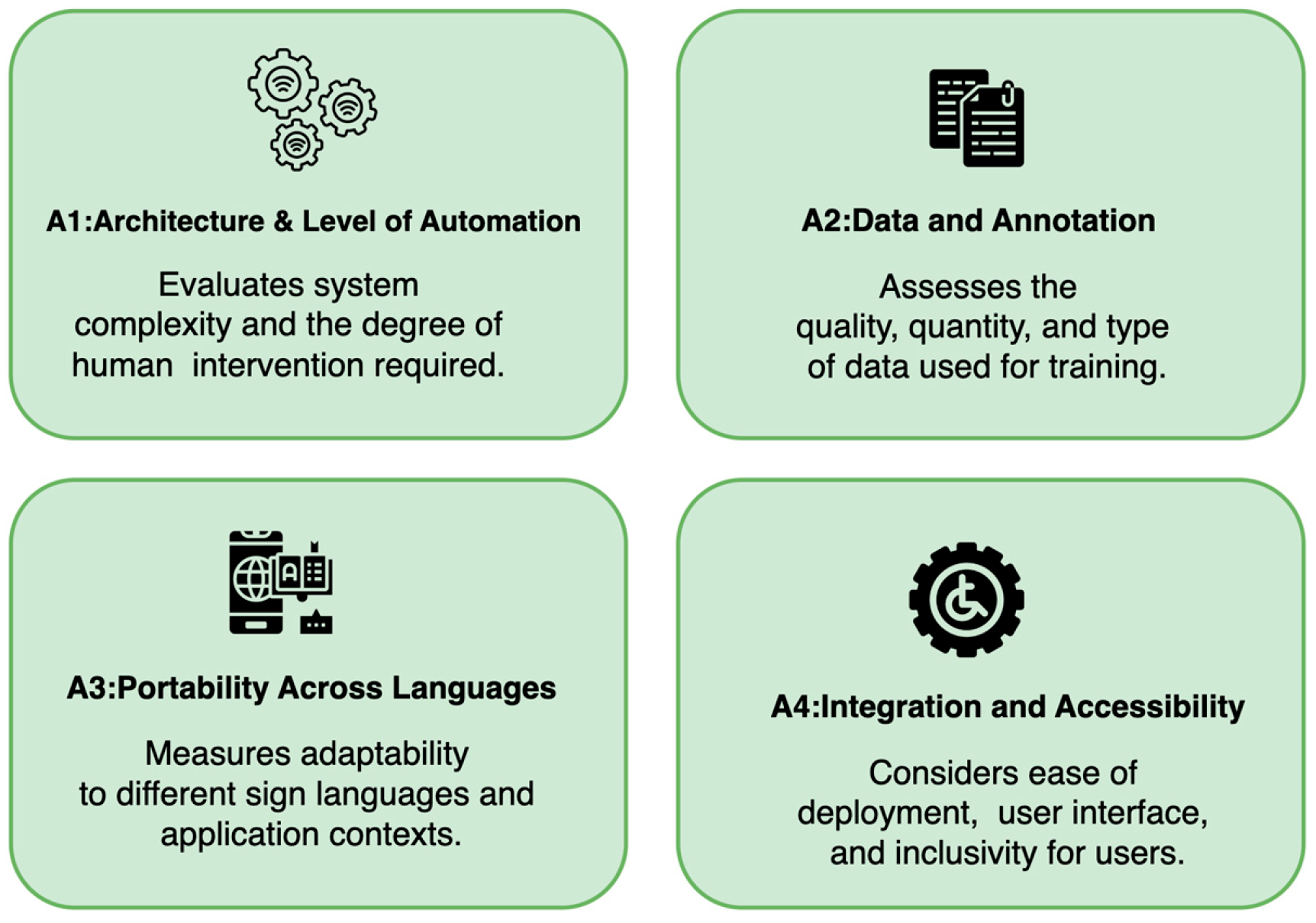
| A1: Architecture | 0—manual, no end-to-end pipeline; 1—partial automation with manual or complex steps; 2—fully or predominantly automated pipeline | 2 | 1 | 2 |
| A2: Data Requirements | 0—high reliance on expert/manual annotation; 1—mixed manual and automated data; 2—minimal annotation, data-driven learning | 0 | 0 | 2 |
| A3: Portability | 0—low, requires full redesign; 1—moderate with adaptation; 2—high with minimal changes | 1 | 0 | 2 |
| A4: Integration | 0—complex, requires specialized knowledge; 1—moderate integration effort; 2—easy integration, accessible to non-experts | 1 | 2 | 2 |
| Paradigm | A1: Architecture | A2: Data Requirements | A3: Portability | A4: Integration | Advantages | Limitations |
|---|---|---|---|---|---|---|
| P1—Notation-to-animation | Rule-based; HamNoSys/SiGML; fully automated. | Expert annotation; slow but structured. | Moderate; language-independent notation, but new lexicons needed. | Lightweight; real-time; limited for daily users. | Precise; modular; efficient on basic hardware. | Requires HamNoSys expertise; manual vocabulary expansion; rigid motion. |
| P2—Writing-to-animation | Rule-based parsing of SignWriting into SWML. | Community-driven; accessible; complex parsing. | Low; uneven global adoption of SignWriting. | Useful for education; difficult full software integration. | Intuitive; Deaf-user participation; community data creation. | Requires learning a special script; limited adoption; difficult 2D-to-3D conversion. |
| P3—Keypoint-based/AI | Data-driven; pose estimation; generative models. | Large video corpora; fewer linguistic annotations; error-sensitive. | High; keypoint representation is mostly language-independent. | Strong potential for web, VR, and telepresence. | Automated; scalable; natural motion; non-expert friendly. | Limited linguistic structure; high computing needs; corpus bias. |
Disclaimer/Publisher’s Note: The statements, opinions and data contained in all publications are solely those of the individual author(s) and contributor(s) and not of MDPI and/or the editor(s). MDPI and/or the editor(s) disclaim responsibility for any injury to people or property resulting from any ideas, methods, instructions or products referred to in the content. |
© 2026 by the authors. Licensee MDPI, Basel, Switzerland. This article is an open access article distributed under the terms and conditions of the Creative Commons Attribution (CC BY) license.
Share and Cite
Amangeldy, N.; Yerimbetova, A.; Milosz, M.; Kassymova, A.; Daiyrbayeva, E.; Tursynova, N. A Comparative Framework for Formal Representation Strategies in Sign Language Avatar Systems. Technologies 2026, 14, 303. https://doi.org/10.3390/technologies14050303
Amangeldy N, Yerimbetova A, Milosz M, Kassymova A, Daiyrbayeva E, Tursynova N. A Comparative Framework for Formal Representation Strategies in Sign Language Avatar Systems. Technologies. 2026; 14(5):303. https://doi.org/10.3390/technologies14050303
Chicago/Turabian StyleAmangeldy, Nurzada, Aigerim Yerimbetova, Marek Milosz, Akmaral Kassymova, Elmira Daiyrbayeva, and Nazira Tursynova. 2026. "A Comparative Framework for Formal Representation Strategies in Sign Language Avatar Systems" Technologies 14, no. 5: 303. https://doi.org/10.3390/technologies14050303
APA StyleAmangeldy, N., Yerimbetova, A., Milosz, M., Kassymova, A., Daiyrbayeva, E., & Tursynova, N. (2026). A Comparative Framework for Formal Representation Strategies in Sign Language Avatar Systems. Technologies, 14(5), 303. https://doi.org/10.3390/technologies14050303