
Non-Prosthetic Assistive Technologies for Persons with Hearing Losses: A Survey

 , , and
Abstract
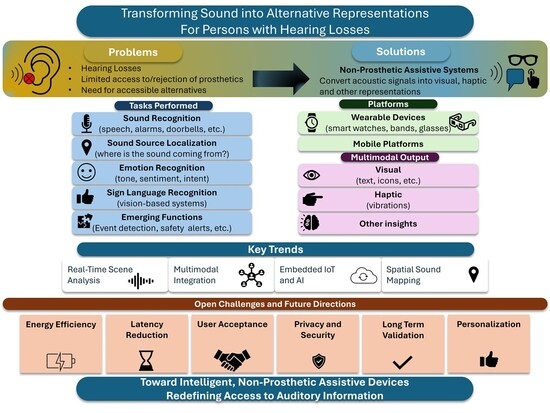
1. Introduction
2. Tasks
2.1. Sound Recognition
2.1.1. Speech Sounds
- Comparative Analysis:
2.1.2. Non-Speech Sounds
- Comparative Analysis:
2.2. Sound Source Localization
- Comparative Analysis:
2.3. Emotion Recognition
- Comparative Analysis:
2.4. Sign Language Recognition
- Comparative Analysis:
2.5. Other Tasks
- Telepresence and telehealth: telepresence allows to move from video calls to immersive audio-visual communications, with recent advances in different aspects, notably robotics (Youssef et al. [98] and AlMutairi et al. [99]). Telehealth can be used to provide healthcare for patients in rural areas (Santomauro et al. [52]) for example. While not designed for them, telehealth has been used with deaf and hard-of-hearing (DHH) patients and was shown in Liu et al. [53] to come with certain barriers in this context, showing the importance of improving its accessibility and support. Similar findings were reported in Moreland et al. [100] and Bhamjee et al. [101].
- Virtual and augmented reality: several work have been proposed for the incorporation of virtual and augmented reality technologies into the assistance of hearing impaired persons. Virtual reality has the potential of being integrated in training and rehabilitation for persons with hearing impairments Serafin et al. [54]. In Mehra et al. [55], it was suggested that augmented reality technologies can be used to augment auditory objects based on the user wants to attend. Also, mixed reality (MR) technologies can be used in avatar-based remote collaboration systems for persons with auditory disabilities, integrating automatic speech recognition (Waldow and Fuhrmann [102]).
3. Platforms
3.1. Wearable Devices
- Comparative Analysis:
3.2. Mobile Platforms
- Comparative Analysis:
3.3. Overall Comparison
3.4. Linking Tasks and Platforms
4. Discussion
4.1. From Amplification to Information Transformation
4.2. From Speech Recognition to Auditory Scene Understanding
4.3. Wearable and Multimodal Architectures
4.4. Artificial Intelligence and Open Challenges
4.5. Evaluation and User Acceptance
4.6. Future Research Directions
5. Conclusions
Author Contributions
Funding
Institutional Review Board Statement
Informed Consent Statement
Data Availability Statement
Conflicts of Interest
References
- Deafness and Hearing Loss. Available online: https://www.who.int/news-room/fact-sheets/detail/deafness-and-hearing-loss (accessed on 25 January 2026).
- Zahnert, T. The Differential Diagnosis of Hearing Loss. Dtsch. Ärzteblatt Int. 2011, 108, 433–444. [Google Scholar] [CrossRef]
- Aldè, M.; Ambrosetti, U.; Aldè, S. The Ongoing Challenges of Hearing Loss: Stigma, Socio-Cultural Differences, and Accessibility Barriers. Audiol. Res. 2025, 15, 46. [Google Scholar] [CrossRef]
- Anastasiadou, S.; Al Khalili, Y. Hearing Loss. Available online: https://www.ncbi.nlm.nih.gov/books/NBK542323/ (accessed on 25 January 2026).
- Hearing Loss: A Common Problem for Older Adults. Available online: https://www.nia.nih.gov/health/hearing-and-hearing-loss/hearing-loss-common-problem-older-adults (accessed on 25 January 2026).
- Treatment for Hearing Loss—Hearing Health Foundation. Available online: https://hearinghealthfoundation.org/treating-hearing-loss (accessed on 25 January 2026).
- Portelli, D.; Lombardo, C.; Loteta, S.; Galletti, C.; Azielli, C.; Ciodaro, F.; Mento, C.; Aguennouz, M.; Rosa, G.D.; Alibrandi, A.; et al. Exploring the Hearing Improvement and Parental Stress in Children with Hearing Loss Using Hearing Aids or Cochlear Implants. J. Clin. Med. 2025, 14, 2. [Google Scholar] [CrossRef] [PubMed]
- Haynes, D.; Young, J.; Wanna, G.; Glasscock, M. Middle Ear Implantable Hearing Devices: An Overview. Trends Amplif. 2009, 13, 206–214. [Google Scholar] [CrossRef] [PubMed]
- Deep, N.; Choudhury, B.; Roland, J. Auditory Brainstem Implantation: An Overview. J. Neurol. Surg. Part B Skull Base 2019, 80, 203–208. [Google Scholar] [CrossRef]
- Hearing Aids—Styles/Types & How They Work|NIDCD. Available online: https://www.nidcd.nih.gov/health/hearing-aids (accessed on 25 January 2026).
- Sutton, A.E.; Krogmann, R.J.; Al Khalili, Y. Cochlear Implants—StatPearls—NCBI Bookshelf. Available online: https://www.ncbi.nlm.nih.gov/books/NBK544280/ (accessed on 25 January 2026).
- Shawkey, E.C.; Johns, J.D.; Kocharyan, A.; Corle, B.; Woolf, E.; Parks, A.; Briggs, S.E. Recent Advances in Cochlear Implantation. J. Otorhinolaryngol. Hear. Balance Med. 2025, 6, 9. [Google Scholar] [CrossRef]
- Lu, Q.; Husein, M.; Jeyakumar, A. Review of Reported Adverse Events Associated with Prescription Hearing Aids in the Manufacturer and User Facility Device Experience (MAUDE) Database. Cureus 2025, 17, e76737. [Google Scholar] [CrossRef]
- Hearing Aid Benefits and Limitations|FDA. Available online: https://www.fda.gov/medical-devices/hearing-aids/hearing-aid-benefits-and-limitations (accessed on 25 January 2026).
- Marcos-Alonso, S.; Almeida-Ayerve, C.N.; Monopoli-Roca, C.; Coronel-Touma, G.S.; Pacheco-López, S.; Peña-Navarro, P.; Serradilla-López, J.M.; Sánchez-Gómez, H.; Pardal-Refoyo, J.L.; Batuecas-Caletrío, Á. Factors Impacting the Use or Rejection of Hearing Aids—A Systematic Review and Meta-Analysis. J. Clin. Med. 2023, 12, 4030. [Google Scholar] [CrossRef]
- Neagoș, C.; Nenec, B.; Neagos, A.; Sin, A. Complications in cochlear implant surgery: A comprehensive review. J. Med. Life 2025, 18, 939–945. [Google Scholar] [CrossRef]
- Huber, M. Cochlear implant-specific risks should be considered, when assessing the quality of life of children and adolescents with hearing loss and cochlear implants–not just cochlear implant-specific benefits–Perspective. Front. Neurosci. 2022, 16, 985230. [Google Scholar] [CrossRef]
- Calvino, M.; Sánchez-Cuadrado, I.; Gavilán, J.; Lassaletta, L. Long-Term Non-Users of Transcutaneous Auditory Implants: Thirty Years of Experience at a Single Institution. Int. J. Environ. Res. Public Health 2023, 20, 6201. [Google Scholar] [CrossRef]
- Kushalnagar, P.; Paludneviciene, R.; Kushalnagar, R. Video Remote Interpreting Technology in Health Care: Cross-Sectional Study of Deaf Patients’ Experiences. JMIR Rehabil. Assist. Technol. 2019, 6, e13233. [Google Scholar] [CrossRef]
- Yabe, M. Healthcare providers’ and deaf patients’ interpreting preferences for critical care and non-critical care: Video remote interpreting. Disabil. Health J. 2020, 13, 100870. [Google Scholar] [CrossRef]
- Kim, J.; Kim, C. A Review of Assistive Listening Device and Digital Wireless Technology for Hearing Instruments. Korean J. Audiol. 2014, 18, 105–111. [Google Scholar] [CrossRef]
- Fastelli, A.; Clignon, G.; Corasaniti, D.; Orzan, E. Speech-to-Text Captioning and Subtitling in Schools: The Results of a SWOT Analysis. Audiol. Res. 2025, 15, 105. [Google Scholar] [CrossRef]
- Shezi, M.; Ade-Ibijola, A. Deaf Chat: A Speech-to-Text Communication Aid for Hearing Deficiency. Adv. Sci. Technol. Eng. Syst. J. 2020, 5, 826–833. [Google Scholar] [CrossRef]
- Ramones, A.; del Rio, M. Recent Developments in Haptic Devices Designed for Hearing-Impaired People: A Literature Review. Sensors 2023, 23, 2968. [Google Scholar] [CrossRef]
- Orzech, G.; Luo, Y.; Huang, G. Haptic Technology for Hearing Loss: A Systematic Review of Technical Feasibility, Usability, and User Experience. Proc. Hum. Factors Ergon. Soc. Annu. Meet. 2024, 68, 1537–1539. [Google Scholar] [CrossRef]
- Snir, A.; Cieśla, K.; Vekslar, R.; Amedi, A. Highly compromised auditory spatial perception in aided congenitally hearing-impaired and rapid improvement with tactile technology. iScience 2024, 27, 110808. [Google Scholar] [CrossRef] [PubMed]
- Pavlidou, A.; Lo, B. Artificial ear—A wearable device for the hearing impaired. In Proceedings of the 2021 IEEE 17th International Conference on Wearable and Implantable Body Sensor Networks (BSN); IEEE: Piscataway, NJ, USA, 2021; pp. 1–4. [Google Scholar] [CrossRef]
- Abi Sen, A.A.; S Aljohani, A.A.; Bahbouh, N.M.; Alhaboob, O. Designing a Smart Bracelet based on Arduino for Deaf Parents to Interact with their Children. In Proceedings of the 2021 8th International Conference on Computing for Sustainable Global Development (INDIACom), New Delhi, India, 17–19 March 2021; pp. 380–384. [Google Scholar]
- Yamamoto, K.; Suzuki, I.; Shitara, A.; Ochiai, Y. See-Through Captions: Real-Time Captioning on Transparent Display for Deaf and Hard-of-Hearing People. In Proceedings of the 23rd International ACM SIGACCESS Conference on Computers and Accessibility, New York, NY, USA, 18–22 October 2021. [Google Scholar] [CrossRef]
- Yağanoğlu, M. Real time wearable speech recognition system for deaf persons. Comput. Electr. Eng. 2021, 91, 107026. [Google Scholar] [CrossRef]
- Tharwat, M.; Wardak, Y.; Balbaid, S.; Radin, E. Wearable Device with Speech and Voice Recognition for Hearing-Impaired People. In Proceedings of the 2024 21st Learning and Technology Conference (L&T), Jeddah, Saudi Arabia, 15 January 2024; pp. 221–226. [Google Scholar] [CrossRef]
- Gupta, M.; Vishwakarma, V. Development of a Speech-to-Text Emotion and Speaker Recognition System for Individuals with Hearing Impairments. In Proceedings of the 2025 6th International Conference on Electronics and Sustainable Communication Systems (ICESC), Putrajaya, Malaysia, 29 October 2025; pp. 2012–2020. [Google Scholar] [CrossRef]
- Peddi, M.; Vardhan, S.H.V.H.; Peddi, G.; Ponnam, S.; Rani, C.; Rajesh Kumar, M. Real-time Audio Recognition for Hearing Impaired. In Proceedings of the 2024 3rd International Conference on Artificial Intelligence For Internet of Things (AIIoT), Wuhan, China, 13–15 September 2024; pp. 1–6. [Google Scholar] [CrossRef]
- Adnan Habib, M.; Raiyan Arefeen, Z.; Hussain, A.; Rownak Shahriyer, S.; Islam, T.; Rahman, R.; Zavid Parvez, M. Sound Classification using Deep Learning for Hard of Hearing and Deaf People. In Proceedings of the 2022 International Conference on Inventive Computation Technologies (ICICT), Lalitpur, Nepal, 20–22 July 2022; pp. 184–190. [Google Scholar] [CrossRef]
- Jain, D.; Huynh Anh Nguyen, K.; M. Goodman, S.; Grossman-Kahn, R.; Ngo, H.; Kusupati, A.; Du, R.; Olwal, A.; Findlater, L.; E. Froehlich, J. Protosound: A personalized and scalable sound recognition system for deaf and hard-of-hearing users. In Proceedings of the 2022 CHI Conference on Human Factors in Computing Systems, New Orleans, LA, USA, 30 April–5 May 2022; pp. 1–16. [Google Scholar]
- Chin, C.L.; Lin, C.C.; Wang, J.W.; Chin, W.C.; Chen, Y.H.; Chang, S.W.; Huang, P.C.; Zhu, X.; Hsu, Y.L.; Liu, S.H. A Wearable Assistant Device for the Hearing Impaired to Recognize Emergency Vehicle Sirens with Edge Computing. Sensors 2023, 23, 7454. [Google Scholar] [CrossRef]
- Buhat, R.G.A.; Capuno, C.B.; De Guzman, R.A.D.; Pascua, M.D.; Tan, D.J.S.; Gallego, M.P.; Noriega, M.E.A. AICanHear: Assistive Alerting Device for Deaf and Hard-of-Hearing People (DHH). In Proceedings of the 2023 IEEE 8th International Conference on Recent Advances and Innovations in Engineering (ICRAIE); IEEE: Piscataway, NJ, USA, 2023; pp. 1–6. [Google Scholar] [CrossRef]
- Salem, O.; Mehaoua, A.; Boutaba, R. Vehicle Sound Recognition Assistance in IoT Systems for Hearing-Impaired Drivers. IEEE Internet Things Mag. 2025, 8, 14–21. [Google Scholar] [CrossRef]
- Munasinghe, T.; Dulanjani, Y. AI Powered Context Aware Emergency Sound Recognition System for Enhancing Situational Awareness in Hearing Impaired Individuals. In Proceedings of the 2025 7th International Conference on Advancements in Computing (ICAC), Sri Jayawardenepura Kotte, Sri Lanka, 9–10 December 2025; pp. 1–6. [Google Scholar] [CrossRef]
- Gurrala, V.K.; Talasila, S.; Kumar, C.K. Deaf Guard: Wristband Innovation For Hearing Impaired. In Proceedings of the 2025 6th International Conference for Emerging Technology (INCET), Belagavi, India, 22–24 May 2025; pp. 1–5. [Google Scholar] [CrossRef]
- Choe, J.; Sood, S.; Park, R. EchoVest: Real-Time Sound Classification and Depth Perception Expressed through Transcutaneous Electrical Nerve Stimulation. arXiv 2023, arXiv:2307.04604. [Google Scholar]
- Tang, W.; Zhang, B. Sound Source Analysis for a Hearing Assistance Robot. In Proceedings of the 2025 9th International Conference on Robotics and Automation Sciences (ICRAS), Osaka, Japan, 27–29 June 2025; pp. 407–411. [Google Scholar] [CrossRef]
- Matsuo, A.; Itami, T.; Yoneyama, J. 360° Sound Localization Support System for Deaf and Hard-of-Hearing People Using Smartglasses Equipped with Two Microphone. In Proceedings of the 2024 IEEE/SICE International Symposium on System Integration (SII), Ha Long, Vietnam, 8–11 January 2024; pp. 295–300. [Google Scholar] [CrossRef]
- Lim, V.Y.; Chua, H.S.; Mohmad, S.; Lau, K.B.; Tan, S.J. Emergency Sound Recognition and Direction Indication Using Machine Learning for Individuals with Hearing Loss. J. Kejuruter. 2025, 37, 3035–3043. [Google Scholar] [CrossRef]
- Ridha, A.M.; Shehieb, W. Assistive Technology for Hearing-Impaired and Deaf Students Utilizing Augmented Reality. In Proceedings of the 2021 IEEE Canadian Conference on Electrical and Computer Engineering (CCECE); IEEE: Piscataway, NJ, USA, 2021; pp. 1–5. [Google Scholar] [CrossRef]
- Fukui, H.; Kim, J.E.; Bessho, M. Supporting Deaf and Hard-of-Hearing People to Watch Sports by Detecting Excitement using Mobile and Wearable Devices. In Proceedings of the 2022 IEEE 11th Global Conference on Consumer Electronics (GCCE); IEEE: Piscataway, NJ, USA, 2022; pp. 716–718. [Google Scholar] [CrossRef]
- Alexander, R.; Sinduja, R. Deaf and Mute Communication Transformation: A Unified Framework for Real-Time Scribing and Emotion Recognition. In Proceedings of the 2024 International Conference on Sustainable Communication Networks and Application (ICSCNA), Theni, India, 11–13 December 2024; pp. 1724–1729. [Google Scholar] [CrossRef]
- Fu, Q.; Fu, J.; Zhang, S.; Li, X.; Guo, J.; Guo, S. Design of Intelligent Human-Computer Interaction System for Hard of Hearing and Non-Disabled People. IEEE Sens. J. 2021, 21, 23471–23479. [Google Scholar] [CrossRef]
- Prasath, A.; Panaiyappan, A. Design of an integrated learning approach to assist real-time deaf application using voice recognition system. Comput. Electr. Eng. 2022, 102, 108145. [Google Scholar] [CrossRef]
- Talaat, F.M.; El-Shafai, W.; Soliman, N.F.; Algarni, A.D.; Abd El-Samie, F.E.; Siam, A.I. Real-time Arabic avatar for deaf-mute communication enabled by deep learning sign language translation. Comput. Electr. Eng. 2024, 119, 109475. [Google Scholar] [CrossRef]
- Tyagi, A.; Prasanth, V.S.; Lunawat, P.; Ashok, S. Real-Time Sign Language Gesture Recognition for Women’s Safety Using Dynamic Time Warping and Voting Algorithms. Frankl. Open 2025, 13, 100428. [Google Scholar] [CrossRef]
- Santomauro, C.; Best, D.; Wray, B.; Burgmann, F.; Pilotto, T.; Pearce, S.; McLanders, M. A new reality for telehealth: A simulation-based comparison of wearable mixed reality with videoconferencing for clinician-to-clinician telehealth. Digit. Health 2025, 11, 20552076251388404. [Google Scholar] [CrossRef]
- Liu, A.W.; Yi, S.J.; Chari, D.A. Telehealth utilization and perceptions among deaf or hard of hearing adults: A cross-sectional analysis of the HINTS6 national dataset. Am. J. Otolaryngol. 2025, 46, 104716. [Google Scholar] [CrossRef]
- Serafin, S.; Adjorlu, A.; Percy-Smith, L.M. A Review of Virtual Reality for Individuals with Hearing Impairments. Multimodal Technol. Interact. 2023, 7, 36. [Google Scholar] [CrossRef]
- Mehra, R.; Brimijoin, O.; Robinson, P.; Lunner, T. Potential of Augmented Reality Platforms to Improve Individual Hearing Aids and to Support More Ecologically Valid Research. Ear Hear. 2020, 41, 140S–146S. [Google Scholar] [CrossRef]
- Salamon, J.; Jacoby, C.; Bello, J.P. A Dataset and Taxonomy for Urban Sound Research. In Proceedings of the 22nd ACM International Conference on Multimedia; ACM: New York, NY, USA, 2014. [Google Scholar] [CrossRef]
- Anwaar, T.; Arun Srinivasan, V.K.; Nandha Kizor, V.; Rajiv, N. Design of an Assistive Technology Wearable Vest for persons with Hearing Disability. In Proceedings of the 2022 10th RSI International Conference on Robotics and Mechatronics (ICRoM), Tehran, Iran, 15–18 November 2022; pp. 347–352. [Google Scholar] [CrossRef]
- Youssef, K.; Argentieri, S.; Zarader, J.L. Binaural speaker recognition for humanoid robots. In Proceedings of the 2010 11th International Conference on Control Automation Robotics & Vision, Singapore, 7–10 December 2010; pp. 2295–2300. [Google Scholar] [CrossRef]
- Youssef, K.; Breteau, B.; Argentieri, S.; Zarader, J.L.; Wang, Z. Approaches for Automatic Speaker Recognition in a Binaural Humanoid Context. In Proceedings of the European Symposium on Artificial Neural Networks 2011, Bruges, Belgium, 27–29 April 2011. [Google Scholar]
- Senthil, K.R.; Jayaram, B.; Srimathi, B.; Narmatha, T. A Novel System For Blind, Deaf And Dumb People Assistant Using Raspberry Pi. In Proceedings of the 2022 IEEE North Karnataka Subsection Flagship International Conference (NKCon); IEEE: Piscataway, NJ, USA, 2022; pp. 1–6. [Google Scholar]
- Staš, J.; Juhár, J.; Lojka, M.; Durkáč, M.; Hudzik, F. Hear IT—A Mobile Assistive Technology for Hearing Impaired People in Slovak. In Proceedings of the 2023 13th International Conference on Advanced Computer Information Technologies (ACIT), Wrocław, Poland, 21–23 September 2023; pp. 426–431. [Google Scholar] [CrossRef]
- Povey, D.; Ghoshal, A.; Boulianne, G.; Burget, L.; Glembek, O.; Goel, N.; Hannemann, M.; Motlicek, P.; Qian, Y.; Schwarz, P.; et al. The Kaldi speech recognition toolkit. In Proceedings of the IEEE 2011 Workshop on Automatic Speech Recognition and Understanding; IEEE Signal Processing Society: Piscataway, NJ, USA, 2011. [Google Scholar]
- Bao, M.; Li, S.; Jin, N.; Zhang, Q. Visual-Based Hearing-Dog Robots For Users with Hearing Impairment. In Proceedings of the 2023 International Conference on Cyber-Enabled Distributed Computing and Knowledge Discovery (CyberC), Suzhou, China, 2–4 November 2023; pp. 136–145. [Google Scholar] [CrossRef]
- Errattahi, R.; El Hannani, A.; Ouahmane, H. Automatic Speech Recognition Errors Detection and Correction: A Review. Procedia Comput. Sci. 2018, 128, 32–37. [Google Scholar] [CrossRef]
- Rathna, R.; Maria Anu, V.; Mishra, S. Real-time Smart Auditory Assistive Wearable (RESAAW) for People with Different Degrees of Hearing Loss. Rev. D’Intelligence Artif. 2024, 38, 1319–1325. [Google Scholar] [CrossRef]
- Xavier, A.; Mubarak, H.; Ashfaq, K.K.; Abdulla, S.M. Ear Assist for Hearing Impaired. In Proceedings of the 2024 International Conference on Futuristic Technologies in Control Systems & Renewable Energy (ICFCR), Kuttippuram, India, 25–26 September 2024; pp. 1–6. [Google Scholar] [CrossRef]
- Yadava, T.; Nagaraja, B.G.; Reddy, S.; Rohan, K.; Mohamed, L.M. Advancements in Speech-to-Text Systems for the Hearing Impaired. In Proceedings of the 2024 IEEE North Karnataka Subsection Flagship International Conference (NKCon); IEEE: Piscataway, NJ, USA, 2024; pp. 1–6. [Google Scholar] [CrossRef]
- Coban, E.B.; Syed, A.R.; Pir, D.; Mandel, M.I. Towards large scale ecoacoustic monitoring with small amounts of labeled data. In Proceedings of the 2021 IEEE Workshop on Applications of Signal Processing to Audio and Acoustics (WASPAA); IEEE: Piscataway, NJ, USA, 2021; pp. 181–185. [Google Scholar]
- Belmadoui, S. Arabic Sign Language (Unaugmented) Dataset. 2024. Available online: https://www.kaggle.com/datasets/sabribelmadoui/arabic-sign-language-unaugmented-dataset (accessed on 15 February 2024).
- Ubur, S.D. Augmenting Captions with Emotional Cues: An AR Interface for Real-Time Accessible Communication. arXiv 2025, arXiv:2504.17171. [Google Scholar] [CrossRef]
- Senaha, T.; Midorikawa, R.; Baba, T.; Asaka, T. Bridging the Auditory Gap: AR Smart Glasses for Real-Time Speech-To-Text and Directional Audio Visualization for the Hearing-Impaired. IEICE Commun. Express 2025, 14, 279–282. [Google Scholar] [CrossRef]
- Chandrashekar, H.M.; Anushree, T.R.; Chaitra, T.P.; Meghana, K.; Monisha, T.U. Automatic Recognition of Hearing-Impaired Children’s Kannada Speech with Limited Vocabulary. In Proceedings of the 2025 3rd International Conference on Smart Systems for applications in Electrical Sciences (ICSSES), Tumakuru, India, 21–22 March 2025; pp. 1–5. [Google Scholar] [CrossRef]
- Rusmitha, J.; Srihari, G. Deep Learning and Computer Vision based Smart Intercom Device for the Deaf and Mute People. In Proceedings of the 2025 International Conference on Visual Analytics and Data Visualization (ICVADV), Tirunelveli, India, 4–6 March 2025; pp. 1227–1232. [Google Scholar] [CrossRef]
- Gawli, P.; Patil, P.; Palse, V.; Parsewar, P.; Amilkanthwar, P. IOT Based Smart Glasses with Real-Time Speech to Text. In Proceedings of the 2025 IEEE 5th International Conference on ICT in Business Industry & Government (ICTBIG); IEEE: Piscataway, NJ, USA, 2025; pp. 1–4. [Google Scholar] [CrossRef]
- Hughes, S.E.; Wu, L.Y.; Ma, L.J.; Jain, D.; McKee, M.M. Assessing the Role of Medical Caption Technology to Support Physician-Patient Communication for Patients with Hearing Loss: Mixed Methods Pilot Study. JMIR Rehabil. Assist. Technol. 2026, 13, e79073. [Google Scholar] [CrossRef] [PubMed]
- Yu, H.; Lee, H.; Bae, J.; Kim, M.; Choi, S.; Hwang, J. The Development of a Social Robot Accessible to the Deaf. In Proceedings of the Companion of the 2021 ACM/IEEE International Conference on Human-Robot Interaction, New York, NY, USA, 8–11 March 2021; pp. 634–635. [Google Scholar] [CrossRef]
- Goodman, S.M.; Liu, P.; Jain, D.; McDonnell, E.J.; Froehlich, J.E.; Findlater, L. Toward User-Driven Sound Recognizer Personalization with People Who Are d/Deaf or Hard of Hearing. Proc. ACM Interact. Mob. Wearable Ubiquitous Technol. 2021, 5, 63. [Google Scholar] [CrossRef]
- Carney, M.; Webster, B.; Alvarado, I.; Phillips, K.; Howell, N.; Griffith, J.; Jongejan, J.; Pitaru, A.; Chen, A. Teachable Machine: Approachable Web-Based Tool for Exploring Machine Learning Classification. In Proceedings of the Extended Abstracts of the 2020 CHI Conference on Human Factors in Computing Systems, New York, NY, USA, 25–30 April 2020; pp. 1–8. [Google Scholar] [CrossRef]
- Snell, J.; Swersky, K.; Zemel, R. Prototypical networks for few-shot learning. Adv. Neural Inf. Process. Syst. 2017, 30, 4080–4090. [Google Scholar]
- Raghu, A.; Raghu, M.; Bengio, S.; Vinyals, O. Rapid learning or feature reuse? towards understanding the effectiveness of maml. arXiv 2019, arXiv:1909.09157. [Google Scholar]
- Hershey, S.; Chaudhuri, S.; Ellis, D.P.; Gemmeke, J.F.; Jansen, A.; Moore, R.C.; Plakal, M.; Platt, D.; Saurous, R.A.; Seybold, B.; et al. CNN architectures for large-scale audio classification. In Proceedings of the 2017 IEEE International Conference on Acoustics, Speech and Signal Processing (ICASSP); IEEE: Piscataway, NJ, USA, 2017; pp. 131–135. [Google Scholar]
- An, J.H.; Koo, N.K.; Son, J.H.; Joo, H.M.; Jeong, S. Development on Deaf Support Application Based on Daily Sound Classification Using Image-based Deep Learning. JOIV Int. J. Inform. Vis. 2022, 6, 250–255. [Google Scholar] [CrossRef]
- Thenmozhi, T.; Monisha, P.; Anusha, G.; Tharish, K.; Seshadhri, V.; Madeshwaren, G. Hearing Aiding System for Impaired. In Proceedings of the 2023 International Conference on Recent Advances in Science and Engineering Technology (ICRASET), Bangkok, Thailand, 21–22 January 2023; pp. 1–3. [Google Scholar] [CrossRef]
- Sun, P.; Luo, J.; Wang, C.; Wu, D. An Improved Smart Helmet for Safe Travel of Deaf People Based on Embedded System. In Proceedings of the 2024 IEEE 4th International Conference on Electronic Technology, Communication and Information (ICETCI); IEEE: Piscataway, NJ, USA, 2024; pp. 183–188. [Google Scholar] [CrossRef]
- Abhiram, S.P.; Umamaheswari, S.; Shybin, M.; Campbell, A.S.; Sreena, V.G.; Raji, N.R. SI-LERT (Assistive Device For Hearing Impaired Drivers). In Proceedings of the 2024 7th International Conference on Circuit Power and Computing Technologies (ICCPCT), Kollam, India, 8–9 August 2024; Volume 1, pp. 1516–1521. [Google Scholar] [CrossRef]
- Karroum, R.B.; Safadi, S.; Boudargham, N.; Hamad, M. SoniWear: A Wearable Device For The Hearing-Impaired. In Proceedings of the 2025 Sixth International Conference on Advances in Computational Tools for Engineering Applications (ACTEA), Zouk Mosbeh, Lebanon, 24–26 September 2025; pp. 1–6. [Google Scholar] [CrossRef]
- UrbanSound8K. Urban Sound Datasets. Available online: https://urbansounddataset.weebly.com/urbansound8k.html (accessed on 2 March 2026).
- Garg, C. Generating Spatial Binaural Environmental Audio Alert on a Personal Audio Device. In Proceedings of the 2024 4th International Conference on Robotics, Automation and Artificial Intelligence (RAAI), Singapore, 19–21 December 2024; pp. 191–196. [Google Scholar] [CrossRef]
- Grondin, F.; Michaud, F. Lightweight and optimized sound source localization and tracking methods for open and closed microphone array configurations. Robot. Auton. Syst. 2019, 113, 63–80. [Google Scholar] [CrossRef]
- Jolliffe, I.T.; Cadima, J. Principal component analysis: A review and recent developments. Philos. Trans. R. Soc. Math. Phys. Eng. Sci. 2016, 374, 20150202. [Google Scholar] [CrossRef]
- Wang, Y.X.; Zhang, Y.J. Nonnegative Matrix Factorization: A Comprehensive Review. IEEE Trans. Knowl. Data Eng. 2013, 25, 1336–1353. [Google Scholar] [CrossRef]
- Núñez-Marcos, A.; Pérez-de Viñaspre, O.; Labaka, G. A Survey on Sign Language Machine Translation. Expert Syst. Appl. 2023, 213, 118993. [Google Scholar] [CrossRef]
- Rastgoo, R.; Kiani, K.; Escalera, S. Sign Language Recognition: A Deep Survey. Expert Syst. Appl. 2021, 164, 113794. [Google Scholar] [CrossRef]
- Alabdullah, B.; Alneil, A. Revolutionizing sign language recognition for hearing-impaired persons using ensemble of deep learning techniques with fine tuning model. J. King Saud. Univ. Comput. Inf. Sci. 2025, 38, 41. [Google Scholar] [CrossRef]
- Assiri, M.; Selim, M. Gesture recognition for hearing impaired people using an ensemble of deep learning models with improving beluga whale optimization-based hyperparameter tuning. Sci. Rep. 2025, 15, 21441. [Google Scholar] [CrossRef]
- Arularasan, R.; Balaji, D.; Garugu, S.; Jallepalli, V.R.; Nithyanandh, S.; Singaram, G. Enhancing Sign Language Recognition for Hearing-Impaired Individuals Using Deep Learning. In Proceedings of the 2024 International Conference on Data Science and Network Security (ICDSNS), Tiptur, India, 26–27 July 2024; pp. 1–6. [Google Scholar] [CrossRef]
- Alotaibi, N.; Al-Dayil, R.; Aljehane, N.O.; Rizwanullah, M. Enhanced feature fusion with hand gesture recognition system for sign language accessibility to aid hearing and speech impaired individuals. Sci. Rep. 2026, 16. [Google Scholar] [CrossRef] [PubMed]
- Youssef, K.; Said, S.; Al Kork, S.; Beyrouthy, T. Telepresence in the Recent Literature with a Focus on Robotic Platforms, Applications and Challenges. Robotics 2023, 12, 111. [Google Scholar] [CrossRef]
- AlMutairi, S.; AlHajri, A.; Youssef, K.; Said, S.; Al Kork, S. An Immersive Telepresence System with User and Automatic Motion Control. In Proceedings of the 2025 6th International Conference on Bio-engineering for Smart Technologies (BioSMART), Paris, France, 14–16 May 2025; pp. 1–4. [Google Scholar] [CrossRef]
- Moreland, C.J.; Rao, S.R.; Jacobs, K.; Kushalnagar, P. Equitable Access to Telehealth and Other Services for Deaf People During the COVID-19 Pandemic. Health Equity 2023, 7, heq.2022.0115. [Google Scholar] [CrossRef] [PubMed]
- Bhamjee, A.; le Roux, T.; Swanepoel, D.W.; Graham, M.A.; Schlemmer, K.; Mahomed-Asmail, F. Perceptions of Telehealth Services for Hearing Loss in South Africa’s Public Healthcare System. Int. J. Environ. Res. Public Health 2022, 19, 7780. [Google Scholar] [CrossRef] [PubMed]
- Waldow, K.; Fuhrmann, A. Addressing Deaf or Hard-of-Hearing People in Avatar-Based Mixed Reality Collaboration Systems. In Proceedings of the 2020 IEEE Conference on Virtual Reality and 3D User Interfaces Abstracts and Workshops (VRW), Los Alamitos, CA, USA, 22–26 March 2020; pp. 594–595. [Google Scholar] [CrossRef]
- Goyal, M.; Basavarajappa, G. A Wearable IoT Based Assistive Device to Aid Communication with Hearing Impaired. In Proceedings of the 2023 IEEE Microwaves, Antennas, and Propagation Conference (MAPCON); IEEE: Piscataway, NJ, USA, 2023; pp. 1–4. [Google Scholar] [CrossRef]
- Ezhilarasi, P.; Rajagopalan, V.G.; Ramakrishnan, H. Integrated AI Based Smart Wearable Assistive Device for Visually and Hearing-Impaired People. In Proceedings of the 2023 International Conference on Recent Trends in Electronics and Communication (ICRTEC), Online, 10–11 February 2023; pp. 1–6. [Google Scholar] [CrossRef]
- de la Banda, S.S.Z.; Mamulang, C.J.T.; Garcia, E.R.G. Development of the SENSE—A Smart Wearable Device for Hazard Sound Detection and Vibration Feedback for Deaf Individuals. In Proceedings of the 2025 8th International Conference on Electronics Technology (ICET), Chengdu, China, 17–20 May 2025; pp. 766–773. [Google Scholar] [CrossRef]
- Du, Y.C.; Yu, H.C.; Ciou, W.S.; Li, Y.L. A Wearable Assistive Listening Device with Immersive Function Using Sensors Fusion Method for the 3-D Space Perception. IEEE Sens. J. 2024, 24, 2108–2117. [Google Scholar] [CrossRef]
- Mahmud, M.; Kolivand, H.; Al-Jumeily, D.; Khan, W. New Multipurpose Assistive Technology to Support Physically Disabled Adults. In Proceedings of the 2023 16th International Conference on Developments in eSystems Engineering (DeSE), Istanbul, Turkey, 18–20 December 2023; pp. 564–568. [Google Scholar] [CrossRef]
- Garg, A.; Sharma, A.; Binjola, A.; Smriti; Bhatia, A.; Mehto, A.; Bajaj, A. Enhancing Communication for the Hearing Impaired Through Innovative Smart Glove Technology: The GloveLingo. In Proceedings of the 2025 12th International Conference on Reliability, Infocom Technologies and Optimization (Trends and Future Directions) (ICRITO), Noida, India, 18–19 September 2025; pp. 1–6. [Google Scholar] [CrossRef]
- Anitha, A.; Rajput, B.S.; Madarkhandi, A.; Naik, M.; Kumar, N.; Nishanth, V.K. Smart Gloves for Communication: A Survey on Technology for the Hearing and Speech Impaired. In Proceedings of the 2025 4th International Conference on Sentiment Analysis and Deep Learning (ICSADL), Bhimdatta, Nepal, 18–20 February 2025; pp. 424–429. [Google Scholar] [CrossRef]
- Asakura, T. Augmented-Reality Presentation of Household Sounds for Deaf and Hard-of-Hearing People. Sensors 2023, 23, 7616. [Google Scholar] [CrossRef] [PubMed]
- Fletcher, M.; Akis, E.; Verschuur, C.; Perry, S. Improved tactile speech perception using audio-to-tactile sensory substitution with formant frequency focusing. Sci. Rep. 2024, 14, 4889. [Google Scholar] [CrossRef]
- de Lacerda Pataca, C.a.; Hassan, S.; May, L.; Olson, M.M.; D’aurio, T.; Peiris, R.L.; Huenerfauth, M. Tactile Emotions: Multimodal Affective Captioning with Haptics Improves Narrative Engagement for d/Deaf and Hard-of-Hearing Viewers. In Proceedings of the 2025 CHI Conference on Human Factors in Computing Systems, New York, NY, USA, 26 April–1 May 2025. [Google Scholar] [CrossRef]
- Trivedi, U.; Alqasemi, R.; Dubey, R. Wearable musical haptic sleeves for people with hearing impairment. In Proceedings of the 12th ACM International Conference on PErvasive Technologies Related to Assistive Environments, New York, NY, USA, 5–7 June 2019; pp. 146–151. [Google Scholar] [CrossRef]
- Cavdir, D. Development of embodied listening studies with multimodal and wearable haptic interfaces for hearing accessibility in music. Front. Comput. Sci. 2024, 5, 1162758. [Google Scholar] [CrossRef]
- Young, F.; Zhang, L.; Jiang, R.; Liu, H.; Wall, C. A Deep Learning Based Wearable Healthcare Iot Device for AI-Enabled Hearing Assistance Automation. In Proceedings of the 2020 International Conference on Machine Learning and Cybernetics (ICMLC), Adelaide, Australia, 12–15 July 2020; pp. 235–240. [Google Scholar] [CrossRef]
- Maashi, M.; Iskandar, H.; Rizwanullah, M. IoT-driven smart assistive communication system for the hearing impaired with hybrid deep learning models for sign language recognition. Sci. Rep. 2025, 15, 6192. [Google Scholar] [CrossRef]
- Soares, C.; Silva Zendron, L.; Fernandes, A.; Villarrubia, G.; Leithardt, V.; Parreira, W. Intelligent sensors in assistive systems for deaf people: A comprehensive review. PeerJ Comput. Sci. 2024, 10, e2411. [Google Scholar] [CrossRef]
- Zaineldin, H.; Adel Gamel, S.; M. Talaat, F.; Aljohani, M.; Baghdadi, N.A.; Malki, A.; Badawy, M.; Elhosseini, M. Silent no more: A comprehensive review of artificial intelligence, deep learning, and machine learning in facilitating deaf and mute communication. Artif. Intell. Rev. 2024, 57, 188. [Google Scholar] [CrossRef]
- Ramirez, A.E.; Donati, E.; Chousidis, C. A siren identification system using deep learning to aid hearing-impaired people. Eng. Appl. Artif. Intell. 2022, 114, 105000. [Google Scholar] [CrossRef]
- Andersen, A.; Santurette, S.; Pedersen, M.; Alickovic, E.; Fiedler, L.; Jensen, J.; Behrens, T. Creating Clarity in Noisy Environments by Using Deep Learning in Hearing Aids. Semin. Hear. 2021, 42, 260–281. [Google Scholar] [CrossRef] [PubMed]
- Ashkanichenarlogh, V.; Folkeard, P.; Scollie, S.; Kuehnel, V.; Parsa, V. Objective Evaluation of a Deep Learning-Based Noise Reduction Algorithm for Hearing Aids Under Diverse Fitting and Listening Conditions. Trends Hear. 2025, 29, 23312165251396644. [Google Scholar] [CrossRef] [PubMed]
- Park, G.; Cho, W.; Kim, K.S.; Lee, S. Speech Enhancement for Hearing Aids with Deep Learning on Environmental Noises. Appl. Sci. 2020, 10, 6077. [Google Scholar] [CrossRef]



| Category | Work | Task | Method |
|---|---|---|---|
| Speech | Pavlidou and Lo [27] | Speech → vibration | Phoneme encoding; RNN; haptic |
| Abi Sen et al. [28] | Keyword alerts | Google STT; vibration | |
| Yamamoto et al. [29] | Captioning | ASR | |
| Yağanoğlu [30] | Speech recognition | MFCC + DTW | |
| Tharwat et al. [31] | Speech + speaker ID | Whisper; RF | |
| Gupta and Vishwakarma [32] | Speech | Google STT | |
| Peddi et al. [33] | Speech + classification | MFCC; CNN | |
| Non-speech | Adnan Habib et al. [34] | Multi-class classification | CNN/RNN |
| Jain et al. [35] | Few-shot recognition | ProtoNet | |
| Chin et al. [36] | Siren detection | CNN | |
| Buhat et al. [37] | Environmental sounds | YAMNet | |
| Salem et al. [38] | Road sounds | CNN; RF; KNN; DT | |
| Munasinghe and Dulanjani [39] | Emergency sounds | CNN; SVM; KNN; RF | |
| Gurrala et al. [40] | Sudden sounds | Threshold-based | |
| Localization | Choe et al. [41] | Localization + classification | GCC-PHAT; BSS |
| Tang and Zhang [42] | Tracking + localization | ODAS; Kalman | |
| Matsuo et al. [43] | Direction estimation | ITD/ILD | |
| Lim et al. [44] | Localization + detection | MFCC; NN; ILD | |
| Emotion | Ridha and Shehieb [45] | Speech emotion | CNN |
| Fukui et al. [46] | Crowd emotion | VGGish | |
| Alexander et al. [47] | Multimodal emotion | Transformers | |
| Gupta and Vishwakarma [32] | Emotion analysis | Wav2Vec2 | |
| SLR | Fu et al. [48] | Gesture recognition | Sensor glove |
| Prasath and Panaiyappan [49] | Speech → sign | CNN + RNN | |
| Talaat et al. [50] | Translation | YOLOv8 | |
| Tyagi et al. [51] | Real-time gestures | MediaPipe | |
| Extended | Santomauro et al. [52] | Telehealth | Remote healthcare |
| Liu et al. [53] | Telehealth usability | Evaluation | |
| Serafin et al. [54] | VR rehab | Virtual reality | |
| Mehra et al. [55] | AR audio | Augmented audio |
| Category | Work | Platform Used | Output |
|---|---|---|---|
| Wearable | Pavlidou and Lo [27] | Arduino + computer | Vibration outputs (BLDC motors) |
| Ridha and Shehieb [45] | AR glasses + mic array | Subtitles, sound events, emotions | |
| Abi Sen et al. [28] | Mobile app + Arduino bracelet | Vibration alerts | |
| Yağanoğlu [30] | Raspberry Pi wearable | Vibration feedback | |
| Fu et al. [48] | Data glove + Arduino | Gesture animation + voice | |
| Anwaar et al. [57] | Wearable vest + sensors | Directional vibration alerts | |
| Fukui et al. [46] | Smartwatch | Haptic notifications | |
| An et al. [82] | Bracelet + mobile app | Visual + vibration alerts | |
| Goyal and Basavarajappa [103] | BLE wearable device | Haptic communication signals | |
| Thenmozhi et al. [83] | Arduino watch | Controlled vibration | |
| Buhat et al. [37] | Headband + wristwatch | LCD, LEDs, vibration | |
| S et al. [104] | Wearable vest + sensors | Audio + GPS + alerts | |
| Choe et al. [41] | Mesh vest + mic array | Directional LED alerts | |
| Matsuo et al. [43] | Smart glasses | Localization angles | |
| Xavier et al. [66] | Smart glasses + Raspberry Pi | Speech-to-text display | |
| Sun et al. [84] | Smart helmet | Visual + vibration alerts | |
| Rathna et al. [65] | Wearable mic array | Spatial awareness feedback | |
| Abhiram et al. [85] | Wearable glove | OLED + vibration alerts | |
| Senaha et al. [71] | AR glasses | Direction + transcription | |
| de la Banda et al. [105] | Watch + belt | Hazard vibration alerts | |
| Mobile | Tharwat et al. [31] | Raspberry Pi platform | Speech + speaker recognition |
| Du et al. [106] | Standalone Raspberry Pi | Navigation + object detection | |
| Karroum et al. [86] | ESP32 + cloud CNN | Visual + haptic alerts | |
| Ubur [70] | AR mobile application | Visual annotations | |
| Gawli et al. [74] | Smart glasses + ESP32 | Caption display | |
| Yu et al. [76] | Robot (BADA) | LED + movement alerts | |
| Jain et al. [35] | Smartphone | Sound recognition results | |
| Bao et al. [63] | Robot + camera | Motion + LED alerts | |
| Mahmud et al. [107] | Mobile platform | Integrated assistive services | |
| Talaat et al. [50] | Mobile app | 3D avatar output | |
| Salem et al. [38] | Vehicle system (Raspberry Pi) | Dashboard display | |
| Tang and Zhang [42] | Robot + LiDAR | Mapping + navigation |
Disclaimer/Publisher’s Note: The statements, opinions and data contained in all publications are solely those of the individual author(s) and contributor(s) and not of MDPI and/or the editor(s). MDPI and/or the editor(s) disclaim responsibility for any injury to people or property resulting from any ideas, methods, instructions or products referred to in the content. |
© 2026 by the authors. Licensee MDPI, Basel, Switzerland. This article is an open access article distributed under the terms and conditions of the Creative Commons Attribution (CC BY) license.
Share and Cite
Alsubaiei, R.; AlHayek, F.; Alsahhaf, M.; Alajmi, G.; Almutairi, A.; Youssef, K.; El Mir, G.; Said, S.; Beyrouthy, T.; Al Kork, S. Non-Prosthetic Assistive Technologies for Persons with Hearing Losses: A Survey. Technologies 2026, 14, 302. https://doi.org/10.3390/technologies14050302
Alsubaiei R, AlHayek F, Alsahhaf M, Alajmi G, Almutairi A, Youssef K, El Mir G, Said S, Beyrouthy T, Al Kork S. Non-Prosthetic Assistive Technologies for Persons with Hearing Losses: A Survey. Technologies. 2026; 14(5):302. https://doi.org/10.3390/technologies14050302
Chicago/Turabian StyleAlsubaiei, Reemas, Farah AlHayek, Mariam Alsahhaf, Ghadah Alajmi, Aliah Almutairi, Karim Youssef, Ghina El Mir, Sherif Said, Taha Beyrouthy, and Samer Al Kork. 2026. "Non-Prosthetic Assistive Technologies for Persons with Hearing Losses: A Survey" Technologies 14, no. 5: 302. https://doi.org/10.3390/technologies14050302
APA StyleAlsubaiei, R., AlHayek, F., Alsahhaf, M., Alajmi, G., Almutairi, A., Youssef, K., El Mir, G., Said, S., Beyrouthy, T., & Al Kork, S. (2026). Non-Prosthetic Assistive Technologies for Persons with Hearing Losses: A Survey. Technologies, 14(5), 302. https://doi.org/10.3390/technologies14050302