
Green Computing for Critical Infrastructure: A Sustainability-First AI Framework for Energy-Efficient Anomaly Detection in Industrial Control Systems

 ,
,  , , , and
Abstract
1. Introduction
Contributions
- A compressed USAD-based framework with validation-guided convergence protocols, achieving substantial energy reduction while maintaining competitive detection performance through design-from-inception optimization rather than post hoc compression.
- Rigorous sustainability metrics including Green Efficiency Score (GES) and Sustainability Index (SI) with Analytic Hierarchy Process-derived weights, enabling systematic quantification of security sustainability trade-offs.
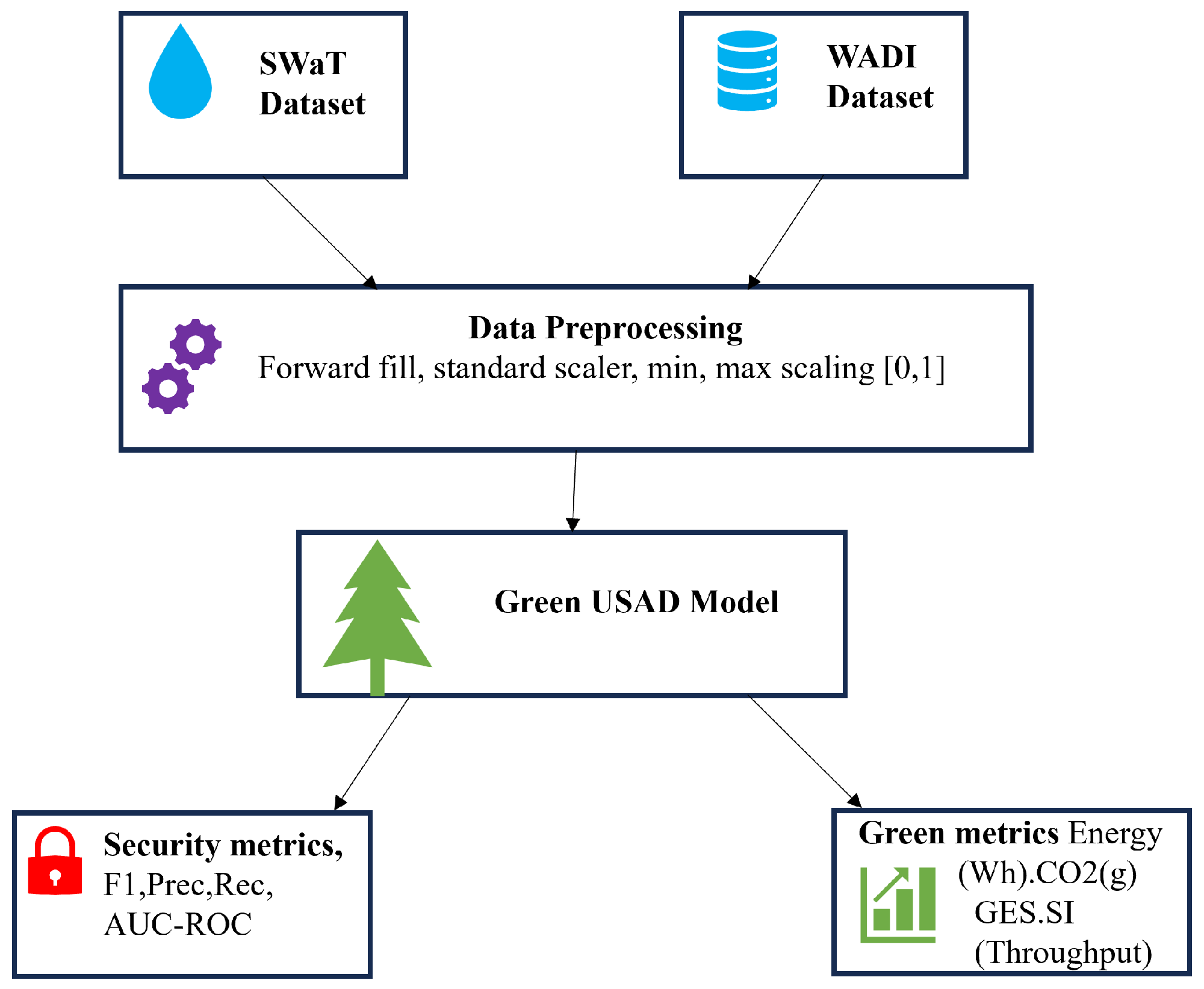
- An empirically validated energy profiling methodology addressing reproducibility challenges in the green AI literature, with comprehensive evaluation on SWaT and WADI benchmark datasets demonstrating cross-domain generalization.
- A systematic framework for designing and evaluating sustainable security solutions applicable across diverse ICS operational contexts, establishing that robust protection and environmental responsibility advance synergistically.
2. Related Work
Green Computing and Sustainable Artificial Intelligence
3. Methodology
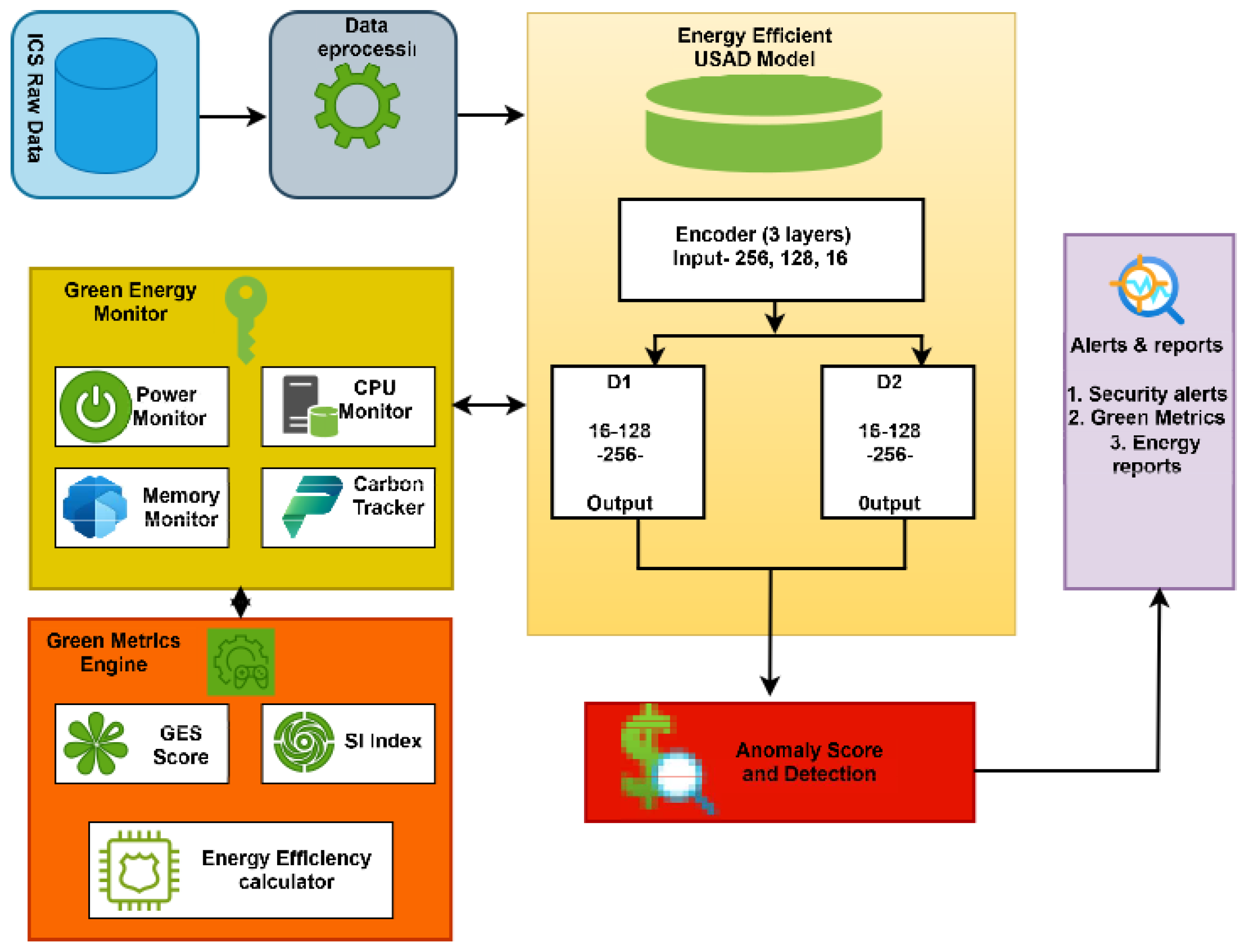
3.1. System Architecture and Design Philosophy
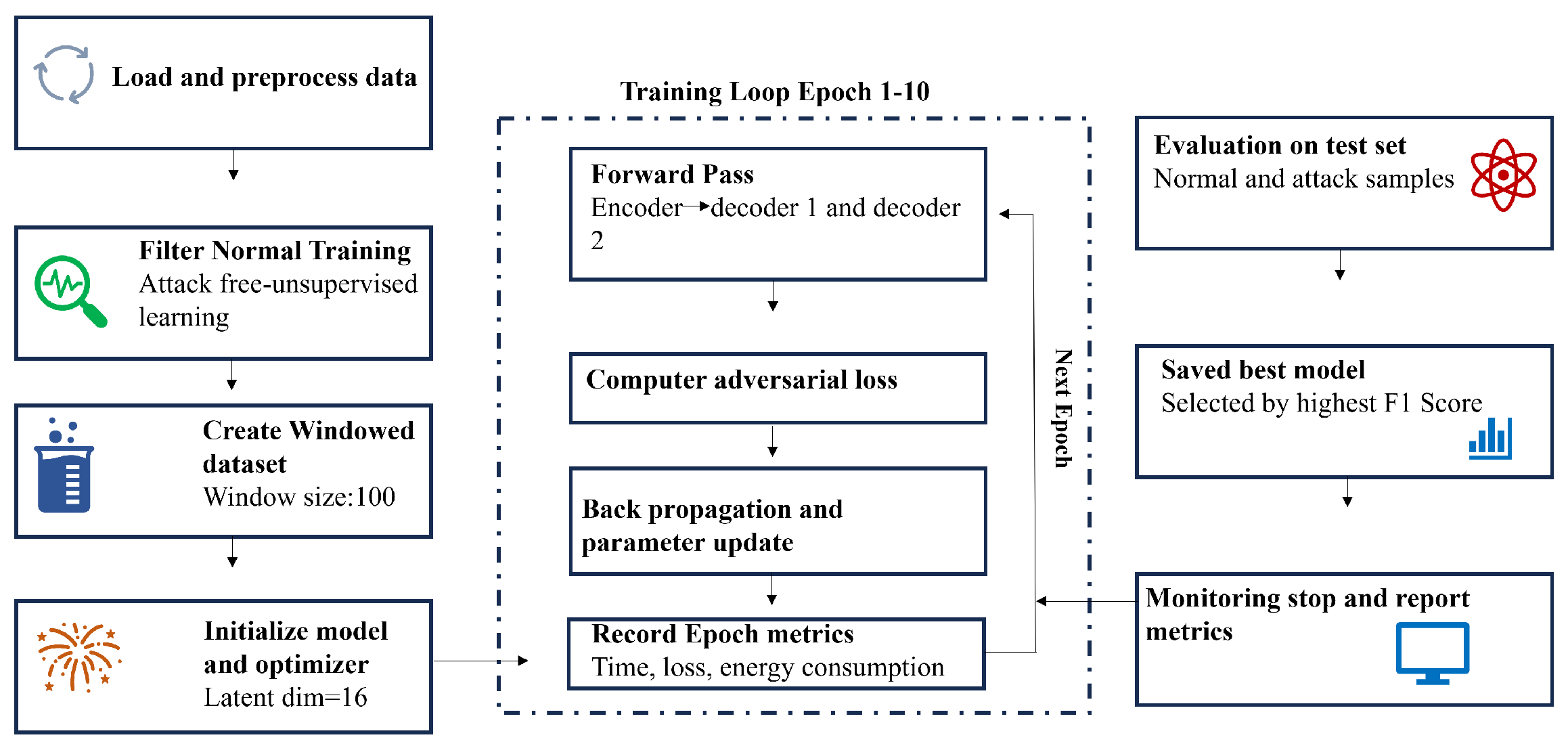
| Algorithm 1 Green-USAD Framework |
| Require: Training data (normal only), Test data Require: Hyperparameters: window size w, latent dimension , epochs Ensure: Trained model , Performance metrics, Green efficiency scores
|
3.2. Energy-Efficient USAD Model Architecture
- Compressed Architecture: Approximately 2.7 million trainable parameters versus typical USAD implementations exceeding 10 million, achieved through reduced hidden dimensions (256/128 versus 512/256) and compressed latent space (16 versus 32–64 dimensions).
- Validation-Guided Early Stopping: Training is limited to 10 epochs based on both empirical observation and theoretical convergence analysis. From a theoretical perspective, unsupervised autoencoders trained on unimodal distributions, as is the case here, since training data contains only normal samples, exhibit rapid initial representation learning followed by diminishing marginal improvements, a behaviour consistent with the well-established empirical risk minimization framework [41]. Beyond a threshold number of epochs, continued training risks overfitting the encoder to spurious noise patterns in the normal training data rather than the underlying operational manifold, degrading generalization to unseen normal conditions and reducing anomaly discrimination. Limiting training to 10 epochs therefore serves a dual purpose: it prevents overfitting by terminating optimization before noise memorization occurs, and it directly reduces energy consumption proportionally, since training energy scales linearly with the number of gradient update steps.
- Optimized Batch Processing: A batch size of 256 optimizes hardware utilization, stabilizes gradients, and accelerates convergence through efficient vectorization.
- Learning Rate Scheduling: An initial rate of 0.001 with 0.5 decay every five epochs enables rapid early learning followed by fine-tuning refinement.
- Efficient Inference: Batch processing of 512 samples reduces overhead and maximizes vectorization efficiency during deployment.
3.3. Hardware-Validated Energy Monitoring
| Algorithm 2 Hardware-Validated Energy Monitoring Protocol |
| Require: Sampling interval (100 ms training, 50 ms inference) Require: Power model parameters: W, W Require: Carbon intensity: kg CO2/kWh Ensure: Energy consumption , Carbon emissions
|
3.4. Multi-Objective Green Efficiency Metrics
3.5. Anomaly Detection Procedure
| Algorithm 3 Anomaly Detection and Scoring |
| Require: Trained model with encoder E, decoders Require: Test data windows , threshold Require: Parameters: , smoothing window Ensure: Anomaly labels, Point-wise scores, Alerts
|
4. Experimental Setup
4.1. Benchmark Datasets
4.2. Data Preprocessing Protocol
4.3. Implementation Configuration
4.4. Evaluation Metrics
5. Results and Analysis
5.1. Detection Performance
5.2. Energy Efficiency Results
5.3. Real-World Deployment Considerations
6. Conclusions
Author Contributions
Funding
Data Availability Statement
Acknowledgments
Conflicts of Interest
Appendix A. Hybepparameters

| Parameter | Value | Rationale |
|---|---|---|
| Window size | 100 | Captures ∼1.5 min of context |
| Batch size | 256 | Maximizes hardware utilization |
| Learning rate | 0.001 | Standard for Adam optimizer |
| LR decay | 0.5/5 epochs | Enables fine-tuning |
| Epochs | 10 | Green training limit |
| Latent dimension | 16 | High compression for efficiency |
| Hidden dims | 256, 128 | Balanced capacity/efficiency |
| Smoothing window | 12 | Reduces noise in scores |
| Score weight | 0.5 | Equal decoder contribution |
Appendix B. Results
| Latent Dim | F1-Score | Energy (Wh) | GES |
|---|---|---|---|
| 8 | 0.912 | 2.7 | 94.2 |
| 16 | 0.939 | 3.0 | 97.3 |
| 32 | 0.941 | 3.8 | 95.8 |
| 64 | 0.943 | 5.2 | 92.4 |
| Epochs | F1-Score | Energy (Wh) | GES |
|---|---|---|---|
| 5 | 0.921 | 1.5 | 95.8 |
| 10 | 0.939 | 3.0 | 97.3 |
| 20 | 0.942 | 6.1 | 94.2 |
| 50 | 0.944 | 15.3 | 86.7 |
| Metric | Green-USAD | USAD | Reduction |
|---|---|---|---|
| Total Params | 2743 K | 10,000 K | +73% |
| Encoder Params | 1350 K | 5000 K | +73% |
| Decoder Params (each) | 697K | 2500 K | +72% |
| Latent Dim. | 16 | 64 | 75% |
| Metric | Value |
|---|---|
| Detection Performance | |
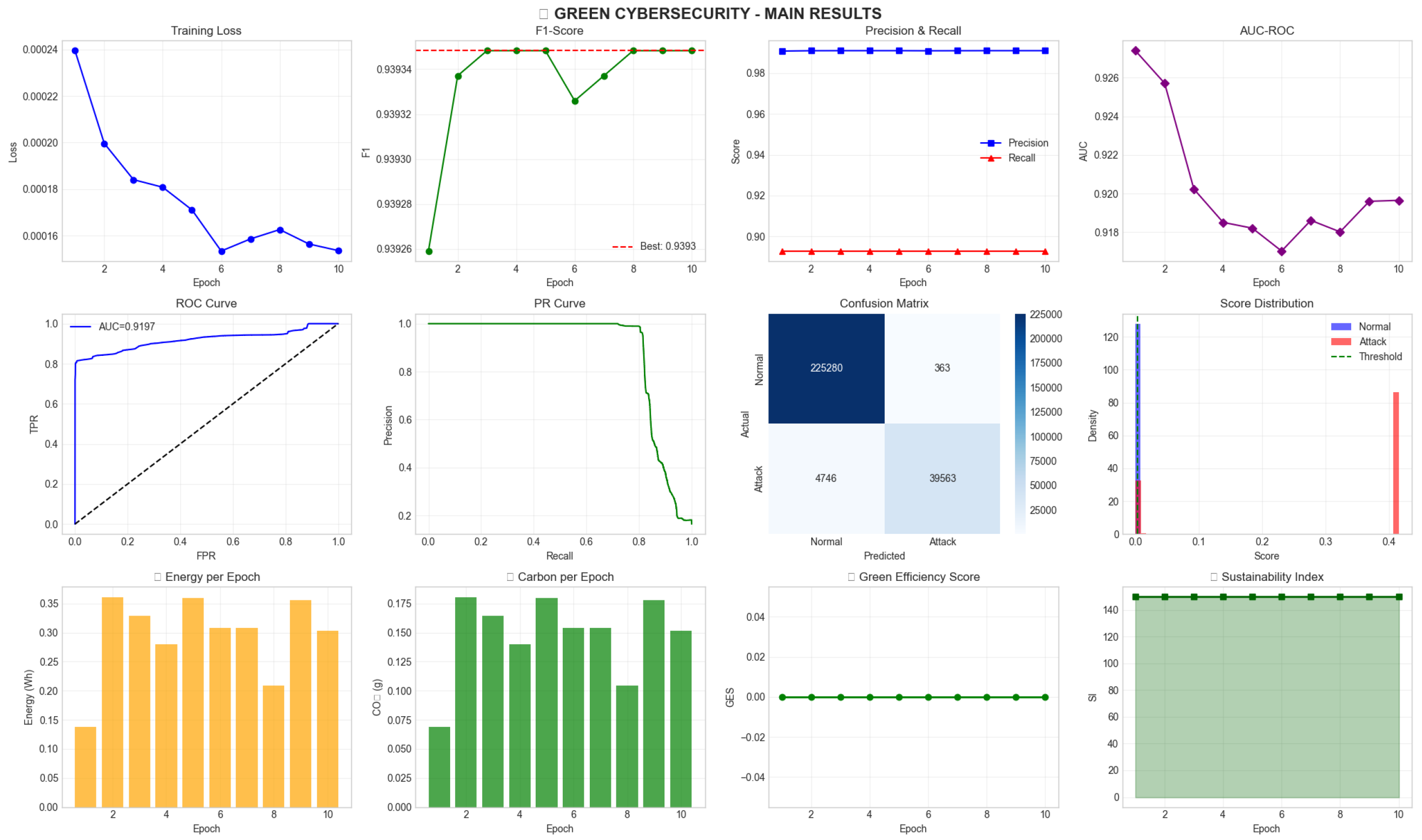
| F1-Score | 0.9393 |
| Precision | 0.9909 |
| Recall | 0.8930 |
| AUC-ROC | 0.9197 |
| Specificity | 0.9984 |
| Energy Efficiency | |
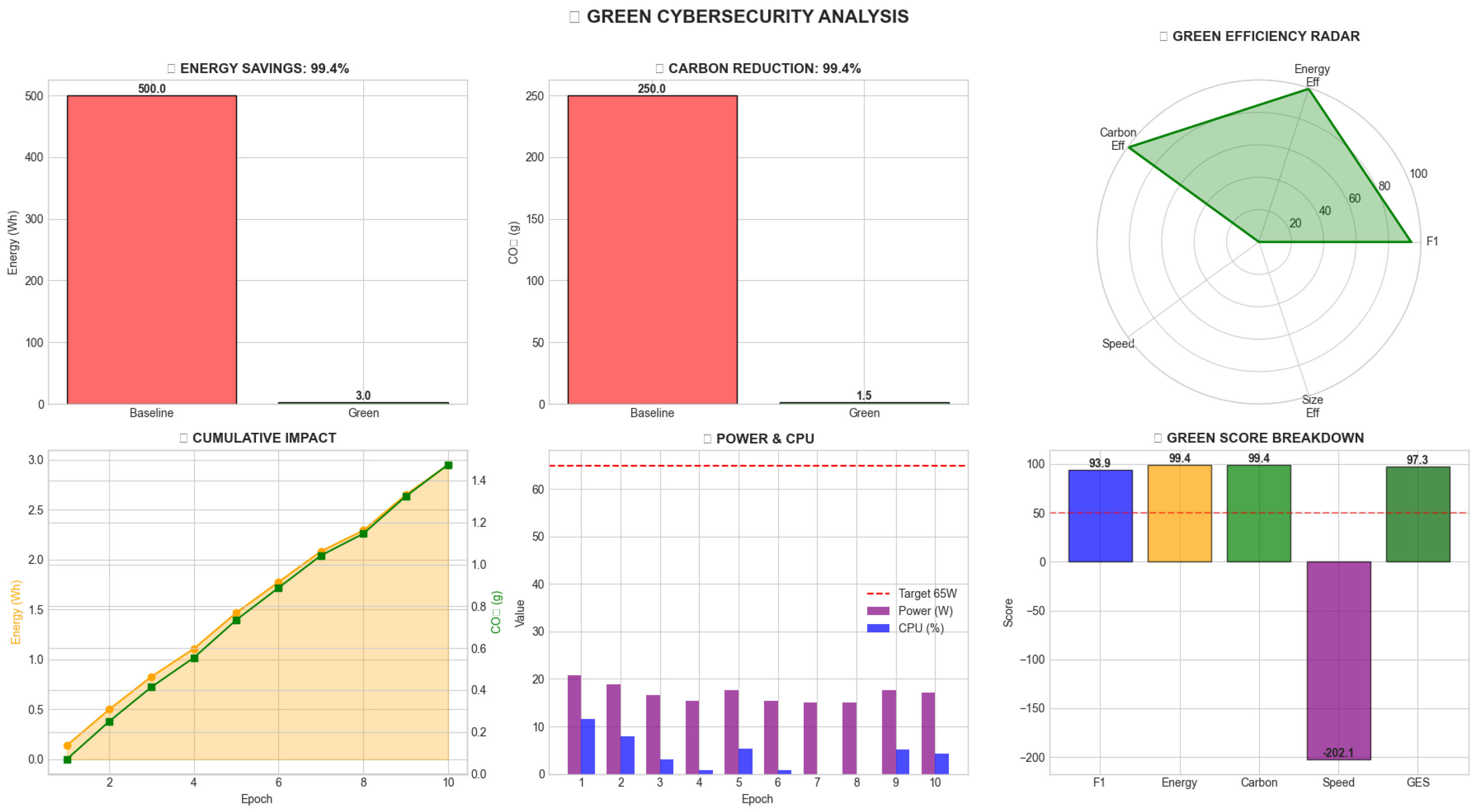
| Total Training Energy | 3.0 Wh |
| Energy per Epoch | 0.30 Wh |
| Average Power | 17.8 W |
| Peak Power | 22.5 W |
| Training Time | 6.2 min |
| Energy Savings | 99.4% |
| Carbon Footprint | |
| Total Carbon Emissions | 1.5 g CO2 |
| Carbon per Epoch | 0.15 g CO2 |
| Carbon Savings | 99.4% |
| Carbon Intensity Used | 0.5 kg CO2/kWh |
| Inference Efficiency | |
| Inference Time per Sample | 0.89 ms |
| Throughput | 1124 samples/sec |
| Inference Energy per 1000 Samples | 0.005 Wh |
| Inference Carbon per 1000 Samples | 0.003 g CO2 |
| Equivalent | Value |
|---|---|
| LED bulb hours | 0.3 h |
| Smartphone charges | 0.3 charges |
| Car driving | 0.01 km |
| CO2 savings vs. baseline | 248.5 g |
| Trees equivalent (annual) | 0.004 trees |
References
- Li, Z.; Sun, Y.; Yang, L.; Zhao, Z.; Chen, X. Unsupervised machine anomaly detection using autoencoder and temporal convolutional network. IEEE Trans. Instrum. Meas. 2022, 71, 3525813. [Google Scholar] [CrossRef] [Scilit]
- Aslam, M.M.; Tufail, A.; Apong, R.A.A.H.M.; De Silva, L.C.; Raza, M.T. Scrutinizing security in industrial control systems: An architectural vulnerabilities and communication network perspective. IEEE Access 2024, 12, 67537–67573. [Google Scholar] [CrossRef] [Scilit]
- Feng, C.; Li, T.; Chana, D. Multi-level anomaly detection in industrial control systems via package signatures and LSTM networks. In Proceedings of the 2017 47th Annual IEEE/IFIP International Conference on Dependable Systems and Networks (DSN); IEEE: Piscataway, NJ, USA, 2017; pp. 261–272. [Google Scholar]
- Kumar, V.; Sinha, D. Synthetic attack data generation model applying generative adversarial network for intrusion detection. Comput. Secur. 2023, 125, 103054. [Google Scholar] [CrossRef] [Scilit]
- Shang, W.; Qiu, J.; Shi, H.; Wang, S.; Ding, L.; Xiao, Y. An efficient anomaly detection method for industrial control systems: Deep convolutional autoencoding transformer network. Int. J. Intell. Syst. 2024, 2024, 5459452. [Google Scholar] [CrossRef] [Scilit]
- Xu, L.; Wang, B.; Zhao, D.; Wu, X. DAN: Neural network based on dual attention for anomaly detection in ICS. Expert Syst. Appl. 2025, 263, 125766. [Google Scholar] [CrossRef] [Scilit]
- Benka, D.; Horváth, D.; Špendla, L.; Gašpar, G.; Strémy, M. Machine Learning-Based Detection of Anomalies, Intrusions and Threats in Industrial Control Systems. IEEE Access 2025, 13, 12502–12514. [Google Scholar] [CrossRef] [Scilit]
- Audibert, J.; Michiardi, P.; Guyard, F.; Marti, S.; Zuluaga, M.A. Usad: Unsupervised anomaly detection on multivariate time series. In Proceedings of the 26th ACM SIGKDD International Conference on Knowledge Discovery & Data Mining; Association for Computing Machinery: New York, NY, USA, 2020; pp. 3395–3404. [Google Scholar]
- Ji, Z.; Li, J.; Telgarsky, M. Early-stopped neural networks are consistent. Adv. Neural Inf. Process. Syst. 2021, 34, 1805–1817. [Google Scholar]
- Burgetová, I.; Matoušek, P.; Ryšavỳ, O. Anomaly detection of ICS communication using statistical models. In Proceedings of the 2021 17th International Conference on Network and Service Management (CNSM); IEEE: Piscataway, NJ, USA, 2021; pp. 166–172. [Google Scholar]
- Moustafa, N.; Slay, J. The evaluation of Network Anomaly Detection Systems: Statistical analysis of the UNSW-NB15 data set and the comparison with the KDD99 data set. Inf. Secur. J. A Glob. Perspect. 2016, 25, 18–31. [Google Scholar] [CrossRef] [Scilit]
- Hossain, M.A.; Hasan, T.; Karovic, V., Jr.; Abdeljaber, H.A.; Haque, M.A.; Ahmad, S.; Zafar, A.; Nazeer, J.; Mishra, B. Deep learning and ensemble methods for anomaly detection in ICS security. Int. J. Inf. Technol. 2025, 17, 1761–1775. [Google Scholar] [CrossRef] [Scilit]
- Sotiris, V.A.; Peter, W.T.; Pecht, M.G. Anomaly detection through a bayesian support vector machine. IEEE Trans. Reliab. 2010, 59, 277–286. [Google Scholar] [CrossRef] [Scilit]
- Kavzoglu, T.; Teke, A. Predictive performances of ensemble machine learning algorithms in landslide susceptibility mapping using random forest, extreme gradient boosting (XGBoost) and natural gradient boosting (NGBoost). Arab. J. Sci. Eng. 2022, 47, 7367–7385. [Google Scholar] [CrossRef] [Scilit]
- Rashid, U.; Saleem, M.F.; Rasool, S.; Abdullah, A.; Mustafa, H.; Iqbal, A. Anomaly Detection using Clustering (K-Means with DBSCAN) and SMO. J. Comput. Biomed. Inform. 2024, 7. [Google Scholar] [CrossRef] [Scilit]
- Kumar, A.; Kumar, A.; Raja, R.; Dewangan, A.K.; Kumar, M.; Soni, A.; Agarwal, D.; Saudagar, A.K.J. Revolutionising anomaly detection: A hybrid framework for anomaly detection integrating isolation forest, autoencoder, and Conv. LSTM. Knowl. Inf. Syst. 2025, 67, 11903–11953. [Google Scholar] [CrossRef] [Scilit]
- Koniki, R.; Ampapurapu, M.D.; Kollu, P.K. An anomaly based network intrusion detection system using LSTM and GRU. In Proceedings of the 2022 International Conference on Electronic Systems and Intelligent Computing (ICESIC); IEEE: Piscataway, NJ, USA, 2022; pp. 79–84. [Google Scholar]
- Nguyen, H.H.; Nguyen, C.N.; Dao, X.T.; Duong, Q.T.; Kim, D.P.T.; Pham, M.T. Variational autoencoder for anomaly detection: A comparative study. arXiv 2024, arXiv:2408.13561. [Google Scholar] [CrossRef] [Scilit]
- Aslam, M.M.; Tufail, A.; De Silva, L.C.; Apong, R.A.A.H.M. Multi-Feature Hybrid Anomaly Detection in ICS: An Integration of ML, DL, and Statistical Techniques. In Proceedings of the 3rd ACM Workshop on Secure and Trustworthy Deep Learning Systems; Association for Computing Machinery: New York, NY, USA, 2025; pp. 43–51. [Google Scholar]
- Hu, Y.; Zhang, D.; Cao, G.; Pan, Q. Network data analysis and anomaly detection using cnn technique for industrial control systems security. In Proceedings of the 2019 IEEE International Conference on Systems, Man and Cybernetics (SMC); IEEE: Piscataway, NJ, USA, 2019; pp. 593–597. [Google Scholar]
- Han, C.; Gim, G. Time-Series-Based Anomaly Detection in Industrial Control Systems Using Generative Adversarial Networks. Processes 2025, 13, 2885. [Google Scholar] [CrossRef] [Scilit]
- Marino, D.L.; Wickramasinghe, C.S.; Rieger, C.; Manic, M. Self-supervised and interpretable anomaly detection using network transformers. IEEE Trans. Ind. Inform. 2025, 21, 4252–4261. [Google Scholar] [CrossRef] [Scilit]
- Zuo, F.; Liu, J.; Ren, Y.; Wang, L.; Wen, Z. A Reliable Bolt Key-Points Detection Method in Industrial Magnetic Separator Systems. IEEE Trans. Instrum. Meas. 2025, 74, 5015710. [Google Scholar] [CrossRef] [Scilit]
- Zuo, F.; Liu, J.; Fu, M.; Wang, L.; Zhao, Z. STMA-Net: A Spatial Transformation-Based Multiscale Attention Network for Complex Defect Detection With X-Ray Images. IEEE Trans. Instrum. Meas. 2024, 73, 5014511. [Google Scholar] [CrossRef] [Scilit]
- Zuo, F.; Liu, J.; Fu, M.; Wang, L.; Zhao, Z. An X-Ray-Based Multiexpert Inspection Method for Automatic Welding Defect Assessment in Intelligent Pipeline Systems. IEEE/ASME Trans. Mechatron. 2025, 30, 1753–1764. [Google Scholar] [CrossRef] [Scilit]
- Khan, R.Z.; Razak, L.A.; Premaratne, G. Literature Review of Green Management and Advanced Technologies for Firm Performance. In Green Engineering for Optimizing Firm Performance; Chapman and Hall/CRC: Boca Raton, FL, USA, 2025; pp. 1–30. [Google Scholar]
- Strubell, E.; Ganesh, A.; McCallum, A. Energy and policy considerations for deep learning in NLP. In Proceedings of the 57th Annual Meeting of the Association for Computational Linguistics; Association for Computational Linguistics: Stroudsburg, PA, USA, 2019; pp. 3645–3650. [Google Scholar]
- Bacenetti, J. Heat and cold production for winemaking using pruning residues: Environmental impact assessment. Appl. Energy 2019, 252, 113464. [Google Scholar] [CrossRef] [Scilit]
- Krishnan, S.; Lam, M.; Chitlangia, S.; Wan, Z.; Barth-Maron, G.; Faust, A.; Reddi, V.J. QuaRL: Quantization for fast and environmentally sustainable reinforcement learning. arXiv 2019, arXiv:1910.01055. [Google Scholar]
- Tripathi, A.M.; Pandey, O.J. Divide and distill: New outlooks on knowledge distillation for environmental sound classification. IEEE/ACM Trans. Audio Speech Lang. Process. 2023, 31, 1100–1113. [Google Scholar] [CrossRef] [Scilit]
- Xiong, Y.; Lan, L.C.; Chen, X.; Wang, R.; Hsieh, C.J. Learning to schedule learning rate with graph neural networks. In Proceedings of the International conference on learning representation (ICLR), Virtual, 25–29 April 2022. [Google Scholar]
- Feng, J.; Huang, D. Optimal gradient checkpoint search for arbitrary computation graphs. In Proceedings of the IEEE/CVF Conference on Computer Vision and Pattern Recognition, Virtual, 25–29 April 2021; pp. 11433–11442. [Google Scholar]
- Li, H.; Wang, Y.; Hong, Y.; Li, F.; Ji, X. Layered mixed-precision training: A new training method for large-scale AI models. J. King Saud. Univ.-Comput. Inf. Sci. 2023, 35, 101656. [Google Scholar] [CrossRef] [Scilit]
- Vrbančič, G.; Podgorelec, V. Transfer learning with adaptive fine-tuning. IEEE Access 2020, 8, 196197–196211. [Google Scholar] [CrossRef] [Scilit]
- Patterson, D.; Gonzalez, J.; Le, Q.; Liang, C.; Munguia, L.M.; Rothchild, D.; So, D.; Texier, M.; Dean, J. Carbon emissions and large neural network training. arXiv 2021, arXiv:2104.10350. [Google Scholar] [CrossRef] [Scilit]
- Liang, Y.; Li, X. Efficient kernel management on GPUs. In Proceedings of the 2016 Design, Automation & Test in Europe Conference & Exhibition (DATE), Dresden, Germany, 14–18 March 2016; Volume 16, pp. 85–90. [Google Scholar]
- Schwartz, R.; Dodge, J.; Smith, N.A.; Etzioni, O. Green AI. Commun. ACM 2020, 63, 54–63. [Google Scholar] [CrossRef] [Scilit]
- Li, D.; Chen, D.; Jin, B.; Shi, L.; Goh, J.; Ng, S.K. MAD-GAN: Multivariate anomaly detection for time series data with generative adversarial networks. In Proceedings of the International conference on artificial neural networks; Springer: Cham, Switzerland, 2019; pp. 703–716. [Google Scholar]
- Bengio, Y.; Courville, A.; Vincent, P. Representation Learning: A Review and New Perspectives. IEEE Trans. Pattern Anal. Mach. Intell. 2013, 35, 1798–1828. [Google Scholar] [CrossRef] [Scilit]
- Bengio, Y.; Louradour, J.; Collobert, R.; Weston, J. Curriculum Learning. In Proceedings of the 26th Annual International Conference on Machine Learning; Association for Computing Machinery: New York, NY, USA, 2009; pp. 41–48. [Google Scholar]
- Vapnik, V. Principles of Risk Minimization for Learning Theory; Morgan Kaufmann: Burlington, MA, USA, 1991; Volume 4, pp. 831–838. [Google Scholar]
- Mathur, A.P.; Tippenhauer, N.O. SWaT: A water treatment testbed for research and training on ICS security. In Proceedings of the 2016 International Workshop on Cyber-Physical Systems for Smart Water Networks (CySWater); IEEE: Piscataway, NJ, USA, 2016; pp. 31–36. [Google Scholar]
- Ahmed, C.M.; Palleti, V.R.; Mathur, A.P. WADI: A Water Distribution Testbed for Research in the Design of Secure Cyber Physical Systems. In Proceedings of the 3rd International Workshop on Cyber-Physical Systems for Smart Water Networks; ACM: New York, NY, USA, 2017; pp. 25–28. [Google Scholar] [CrossRef] [Scilit]
- Tuli, S.; Casale, G.; Jennings, N.R. TranAD: Deep Transformer Networks for Anomaly Detection in Multivariate Time Series Data. arXiv 2022, arXiv:2201.07284. [Google Scholar] [CrossRef] [Scilit]
- Su, Y.; Zhao, Y.; Niu, C.; Liu, R.; Sun, W.; Pei, D. Robust Anomaly Detection for Multivariate Time Series through Stochastic Recurrent Neural Network. In Proceedings of the 25th ACM SIGKDD International Conference on Knowledge Discovery and Data Mining; Association for Computing Machinery: New York, NY, USA, 2019; pp. 2828–2837. [Google Scholar]





| Ref. | Method | ICS | DL | Energy | Carbon | Green | Light | RT | Unsup. |
|---|---|---|---|---|---|---|---|---|---|
| [8] | USAD | ● | ● | ○ | ○ | ○ | ◐ | ● | ● |
| [1] | LSTM-AE | ● | ● | ○ | ○ | ○ | ◐ | ● | ● |
| [20] | CNN | ● | ● | ○ | ○ | ○ | ◐ | ● | ● |
| [38] | MAD-GAN | ● | ● | ○ | ○ | ○ | ○ | ● | ● |
| [3] | Multi-lvl | ● | ● | ○ | ○ | ○ | ◐ | ● | ◐ |
| [17] | LSTM | ● | ● | ○ | ○ | ○ | ● | ● | ● |
| [18] | VAE | ● | ● | ○ | ○ | ○ | ◐ | ● | ● |
| [19] | Multi | ● | ● | ○ | ○ | ◐ | ● | ● | ● |
| [11] | Analysis | ○ | ● | ● | ○ | ○ | ○ | ○ | ◐ |
| [35] | Carbon | ○ | ● | ● | ◐ | ● | ○ | ○ | ○ |
| [1] | Measure | ○ | ● | ● | ○ | ○ | ○ | ○ | ○ |
| [37] | Green AI | ○ | ● | ◐ | ● | ◐ | ● | ○ | ○ |
| This work | Green-USAD | ● | ● | ● | ● | ● | ● | ● | ● |
| Method | F1 | Prec. | Recall | AUC |
| [8] USAD | 0.90 | 0.98 | 0.83 | 0.91 |
| [16] LSTM+AE | 0.85 | 0.92 | 0.79 | 0.88 |
| [38] AE | 0.89 | 0.95 | 0.84 | 0.90 |
| [20] CNN | 0.86 | 0.93 | 0.80 | 0.87 |
| [44] TranAD (SWaT) | 0.81 | 0.97 | 0.69 | 0.84 |
| [44] TranAD (WADI) | 0.49 | 0.35 | 0.82 | 0.89 |
| [38] MAD-GAN ** (WADI) | 0.37 | 0.41 | 0.33 | — |
| [38] MAD-GAN ** (SWaT) | 0.77 | 0.98 | 0.63 | — |
| [45] OmniAnomaly (total) | 0.85 | 0.77 | 0.95 | — |
| Green-USAD | 0.9393 | 0.9909 | 0.8930 | 0.9197 |
| Efficiency Comparison | ||||
| Method | Params | Energy | Time | Green |
| [8] USAD | 10M+ | ∼500 Wh | ∼2 h | — |
| [16] LSTM+AE | 5M+ | ∼300 Wh | ∼1.5 h | — |
| [20] CNN | 3M+ | ∼200 Wh | ∼1 h | — |
| [44] TranAD | 12M+ | ∼600 Wh | ∼2.5 h | — |
| [45] OmniAnomaly | 4M+ | ∼250 Wh | ∼1.2 h | — |
| Green-USAD * | 2.7M | 3.0 Wh | 6.2 min | 97.3 |
Disclaimer/Publisher’s Note: The statements, opinions and data contained in all publications are solely those of the individual author(s) and contributor(s) and not of MDPI and/or the editor(s). MDPI and/or the editor(s) disclaim responsibility for any injury to people or property resulting from any ideas, methods, instructions or products referred to in the content. |
© 2026 by the authors. Licensee MDPI, Basel, Switzerland. This article is an open access article distributed under the terms and conditions of the Creative Commons Attribution (CC BY) license.
Share and Cite
Aslam, M.M.; Tufail, A.; Ding, Y.; De Silva, L.C.; Awg Haji Mohd Apong, R.A.; Zuhairi, M.F. Green Computing for Critical Infrastructure: A Sustainability-First AI Framework for Energy-Efficient Anomaly Detection in Industrial Control Systems. Technologies 2026, 14, 267. https://doi.org/10.3390/technologies14050267
Aslam MM, Tufail A, Ding Y, De Silva LC, Awg Haji Mohd Apong RA, Zuhairi MF. Green Computing for Critical Infrastructure: A Sustainability-First AI Framework for Energy-Efficient Anomaly Detection in Industrial Control Systems. Technologies. 2026; 14(5):267. https://doi.org/10.3390/technologies14050267
Chicago/Turabian StyleAslam, Muhammad Muzamil, Ali Tufail, Yepeng Ding, Liyanage Chandratilak De Silva, Rosyzie Anna Awg Haji Mohd Apong, and Megat F. Zuhairi. 2026. "Green Computing for Critical Infrastructure: A Sustainability-First AI Framework for Energy-Efficient Anomaly Detection in Industrial Control Systems" Technologies 14, no. 5: 267. https://doi.org/10.3390/technologies14050267
APA StyleAslam, M. M., Tufail, A., Ding, Y., De Silva, L. C., Awg Haji Mohd Apong, R. A., & Zuhairi, M. F. (2026). Green Computing for Critical Infrastructure: A Sustainability-First AI Framework for Energy-Efficient Anomaly Detection in Industrial Control Systems. Technologies, 14(5), 267. https://doi.org/10.3390/technologies14050267