
Voltage Regulation of a DC–DC Boost Converter Using a Vertex-Based Convex PI Controller
 , , , ,
Abstract
1. Introduction
- Full-state feedback (inductor current, output voltage and integral error).
- Tuning of multiple vertex-specific gains (proportional voltage, proportional current, and integral terms).
- Significant online computation for weight updates.
- Complex implementation on resource-constrained hardware.
- A simplified convex PI controller that
- Eliminates current-error feedback gains entirely.
- Reduces per-vertex tuning parameters from three to two (proportional voltage and integral gains only).
- Maintains current measurement solely for convex weight computation.
- Integrates a disturbance compensator that estimates input voltage via duty cycle and output voltage measurement.
- Genetic optimization of vertex gains sharing a common matrix P, ensuring stability via LMIs.
- Hardware-efficient implementation through
- Reduced flash memory requirements for gain storage.
- Elimination of current-control loop computations.
2. Convex Modeling via Sector Nonlinearity
2.1. Nonlinear Control Based on the Sector Nonlinearity Method
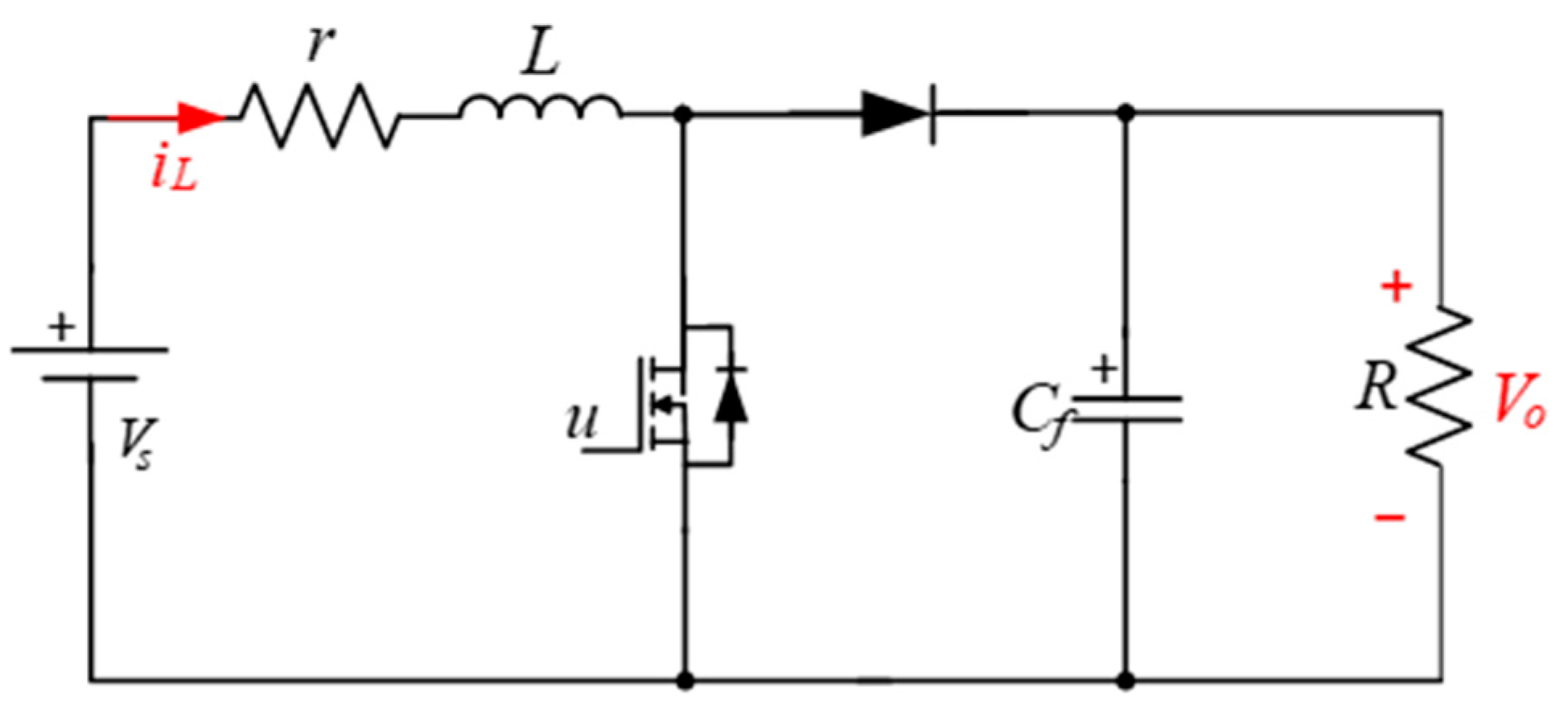
2.2. The Boost Converter Convex Model
3. Proposed Control Strategy
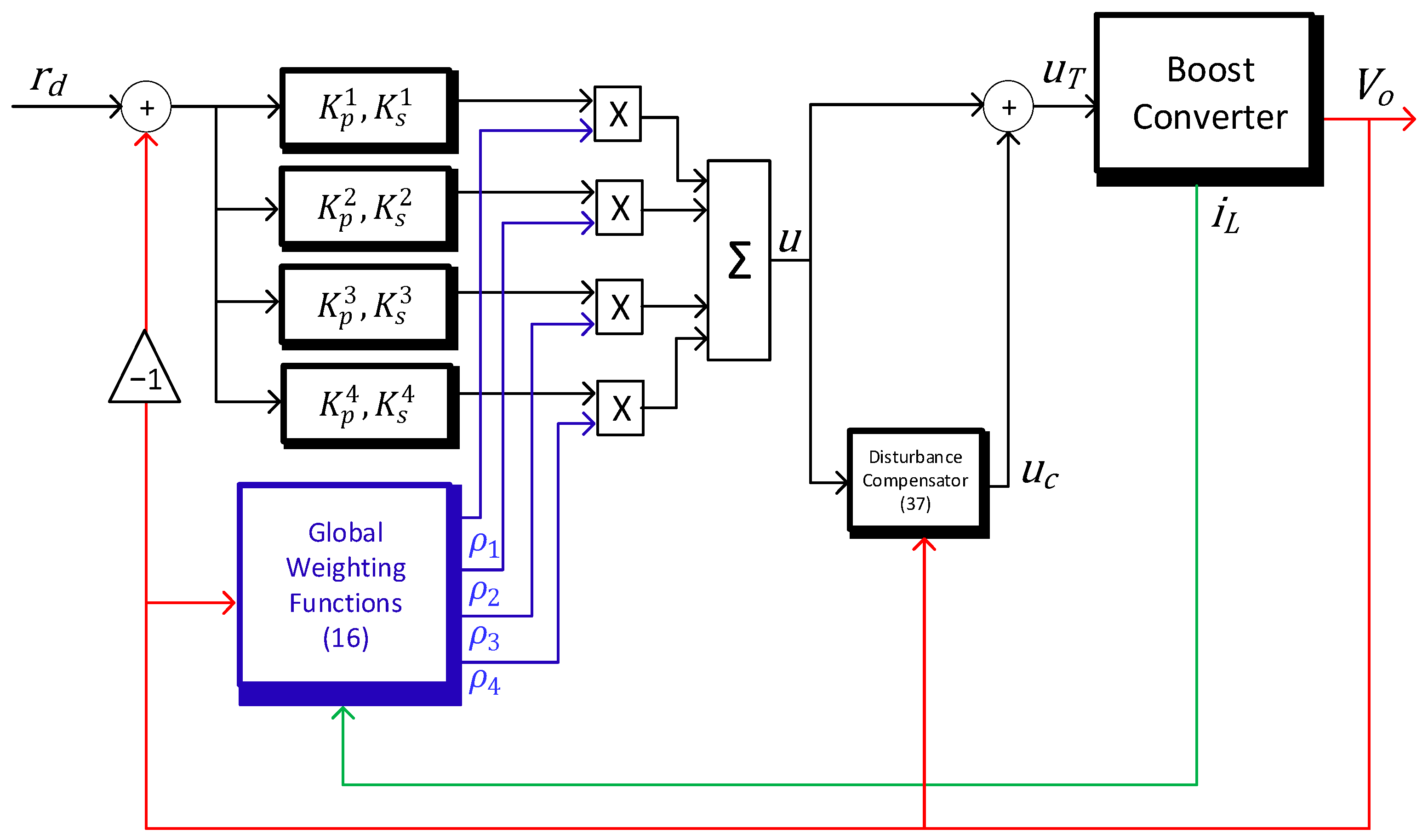
3.1. Convex PI Controller Structure
3.2. Stability Analysis
3.3. PI Controller Tuning via Genetic Algorithm
- Attempt to solve the LMIs for a common with margins and ;
- If is feasible, compute the associated metrics , , , , and ISE;
- Form the cost function using the predefined coefficients , , and ;
- If no feasible is found, assign a large penalty to discard the individual.
| Algorithm 1. GA-based Gain Tuning Procedure |
| 1: Initialize the population of candidate gains (34) |
| 2: while termination criterion is not satisfied, do |
| 3: for all individuals in population (in parallel) do |
| 4: Solve LMIs |
| 5: if and (29) then |
| 6: Compute |
| 7: Simulate system response and compute ISE |
| 8: Evaluate (33) |
| 9: else |
| 10: Assign large penalty cost |
| 11: end if |
| 12: end for |
| 13: Apply selection, crossover, and mutation operations |
| 14: end while |
| 15: Output optimal vertex-dependent gains , |
3.4. Disturbance Compensator
4. Simulation Results and Discussion
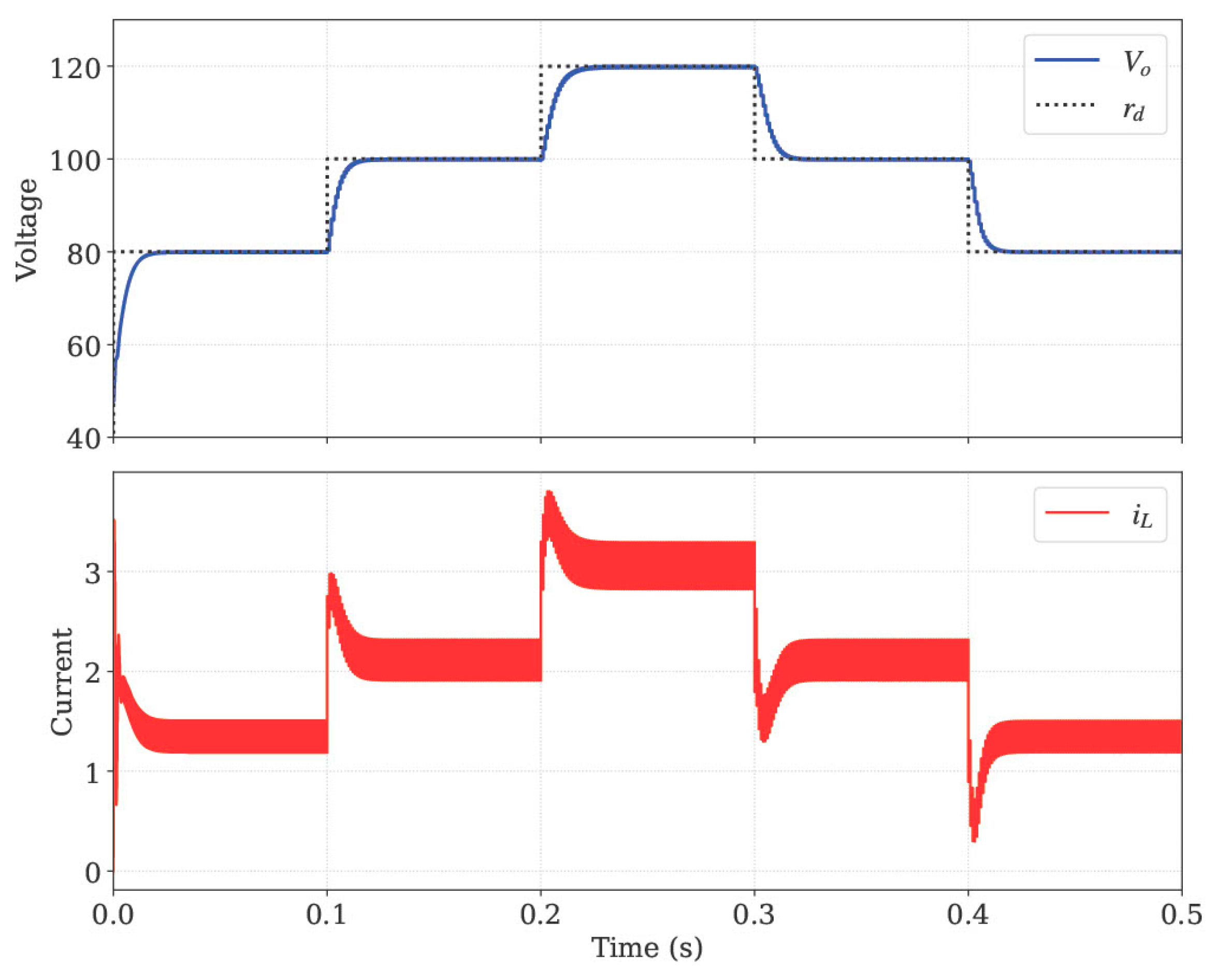
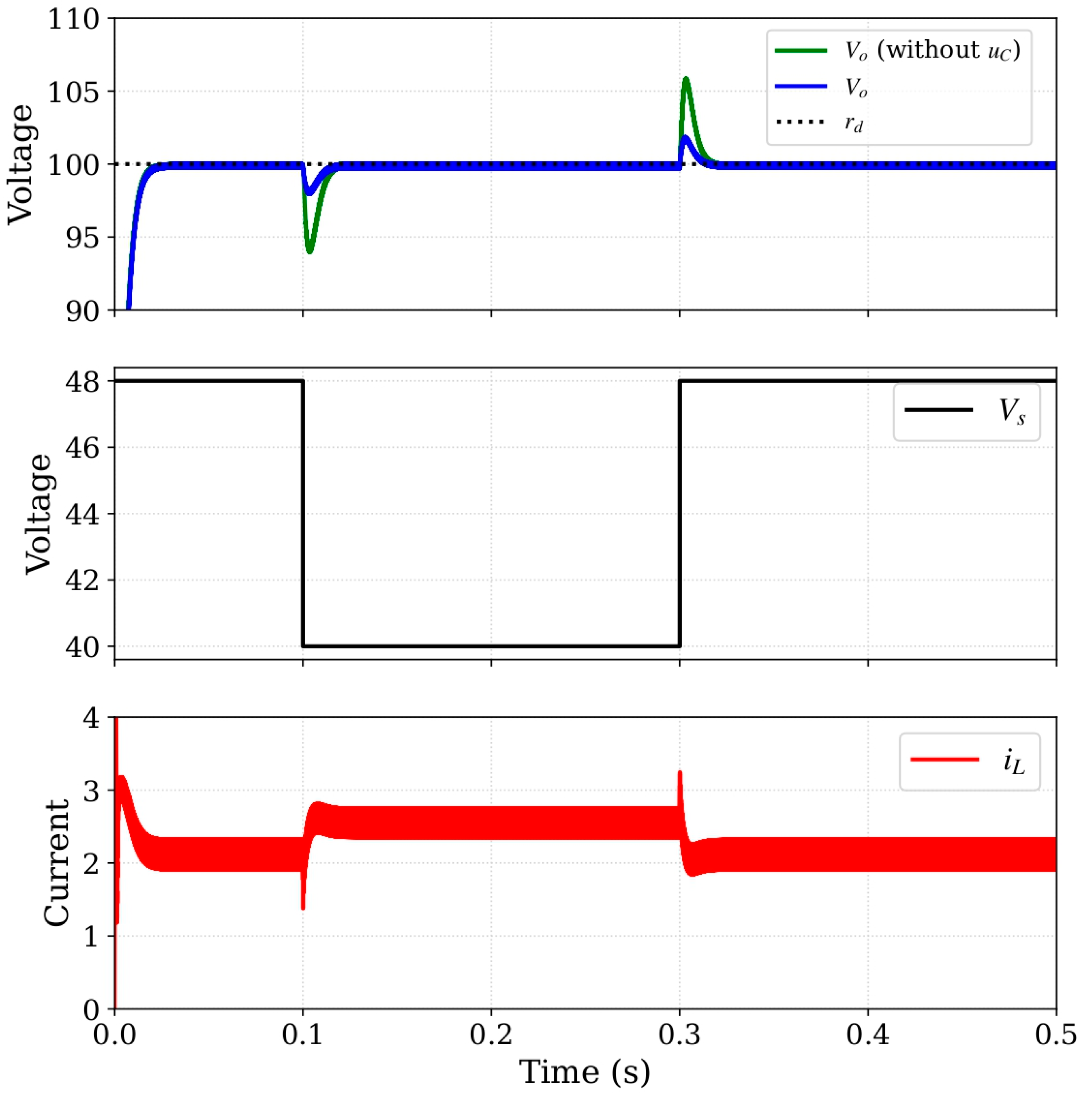
4.1. Offline Simulation
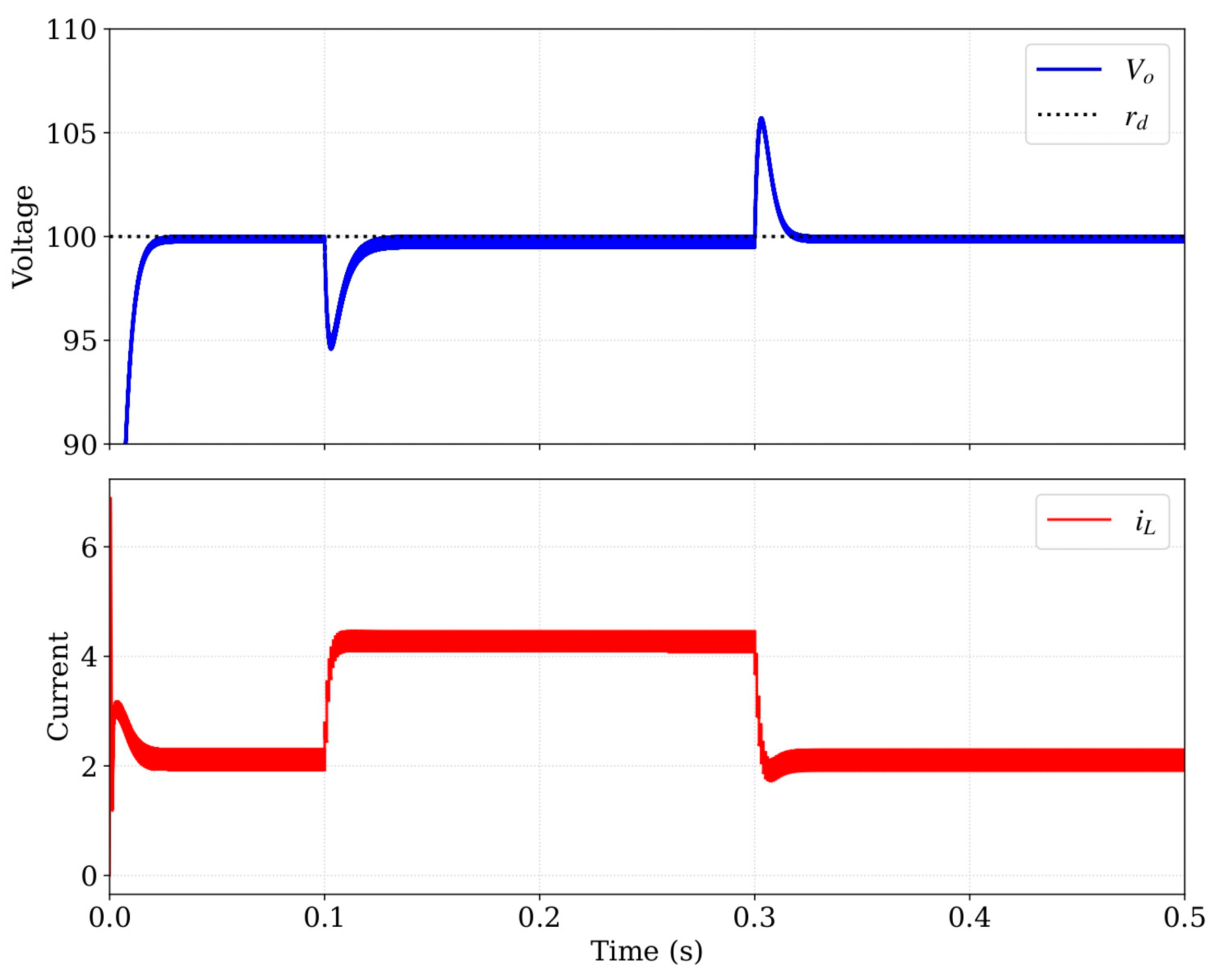
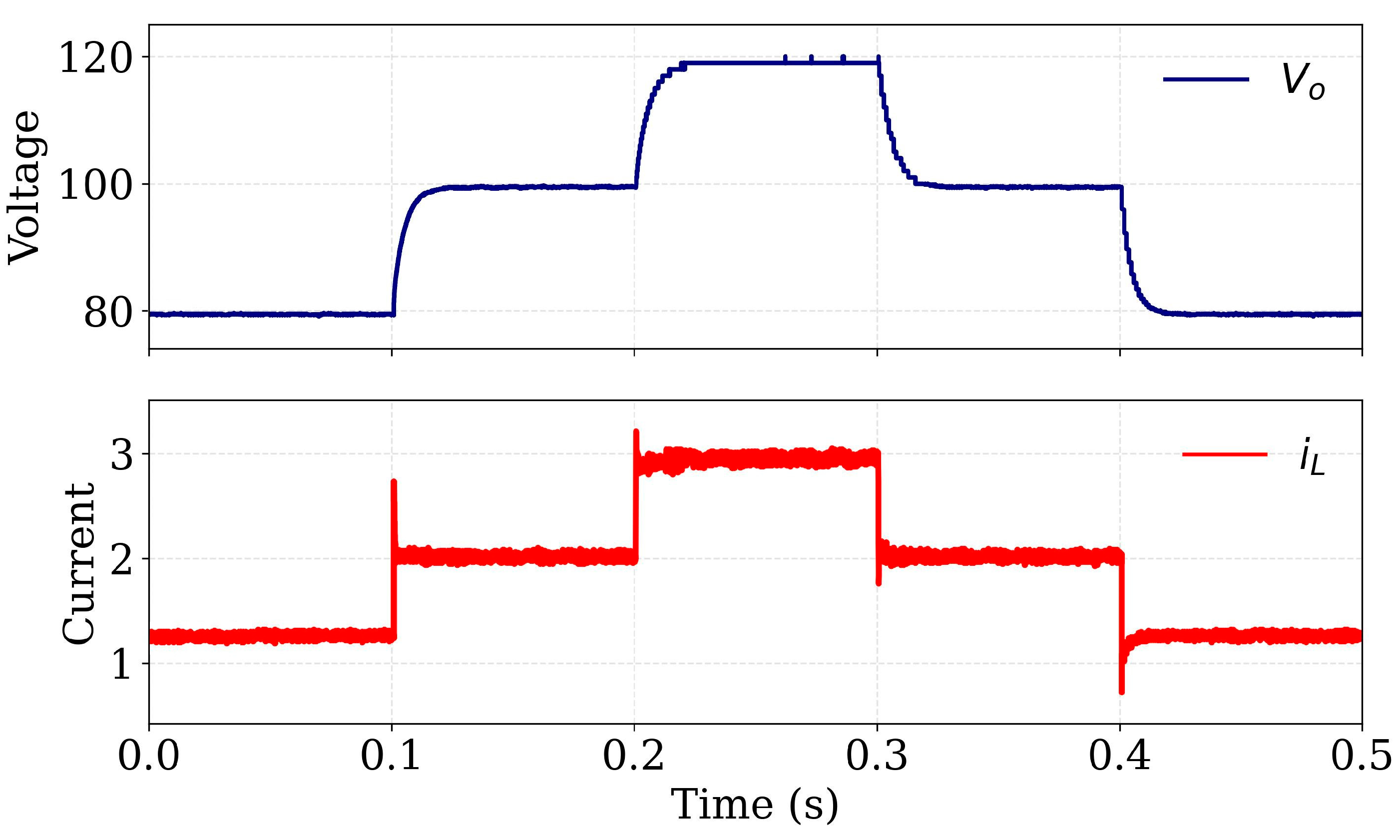
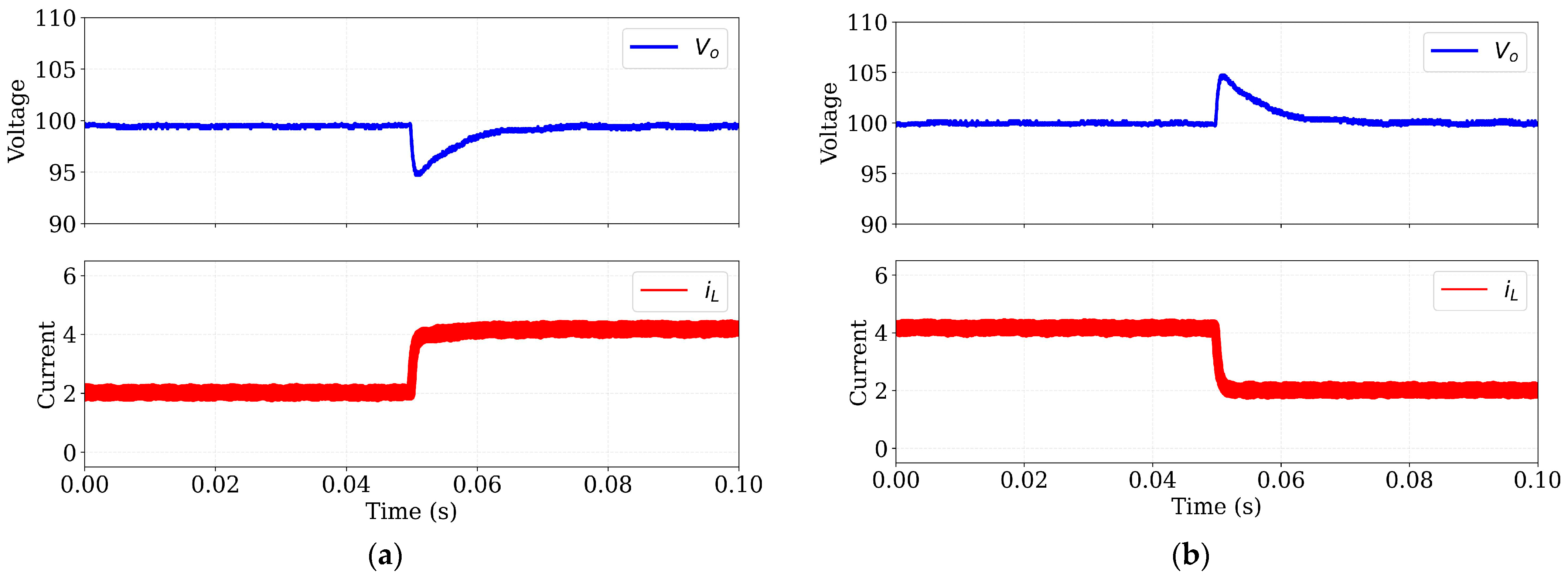
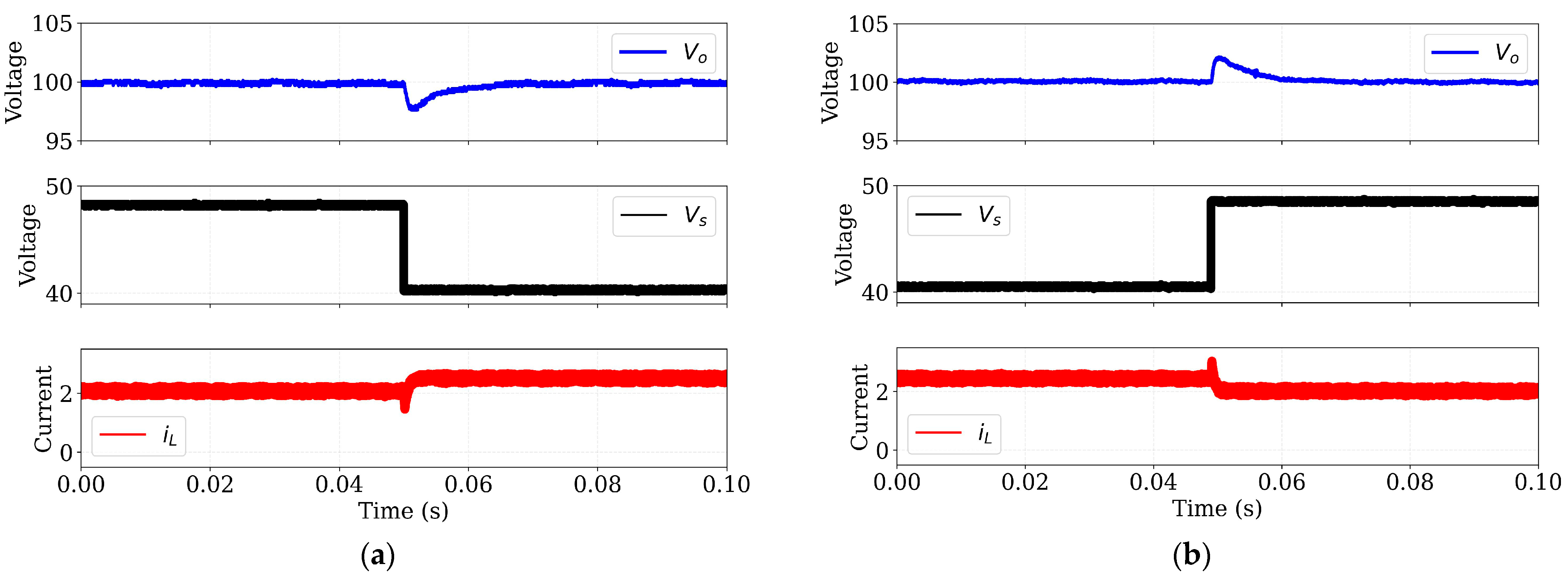
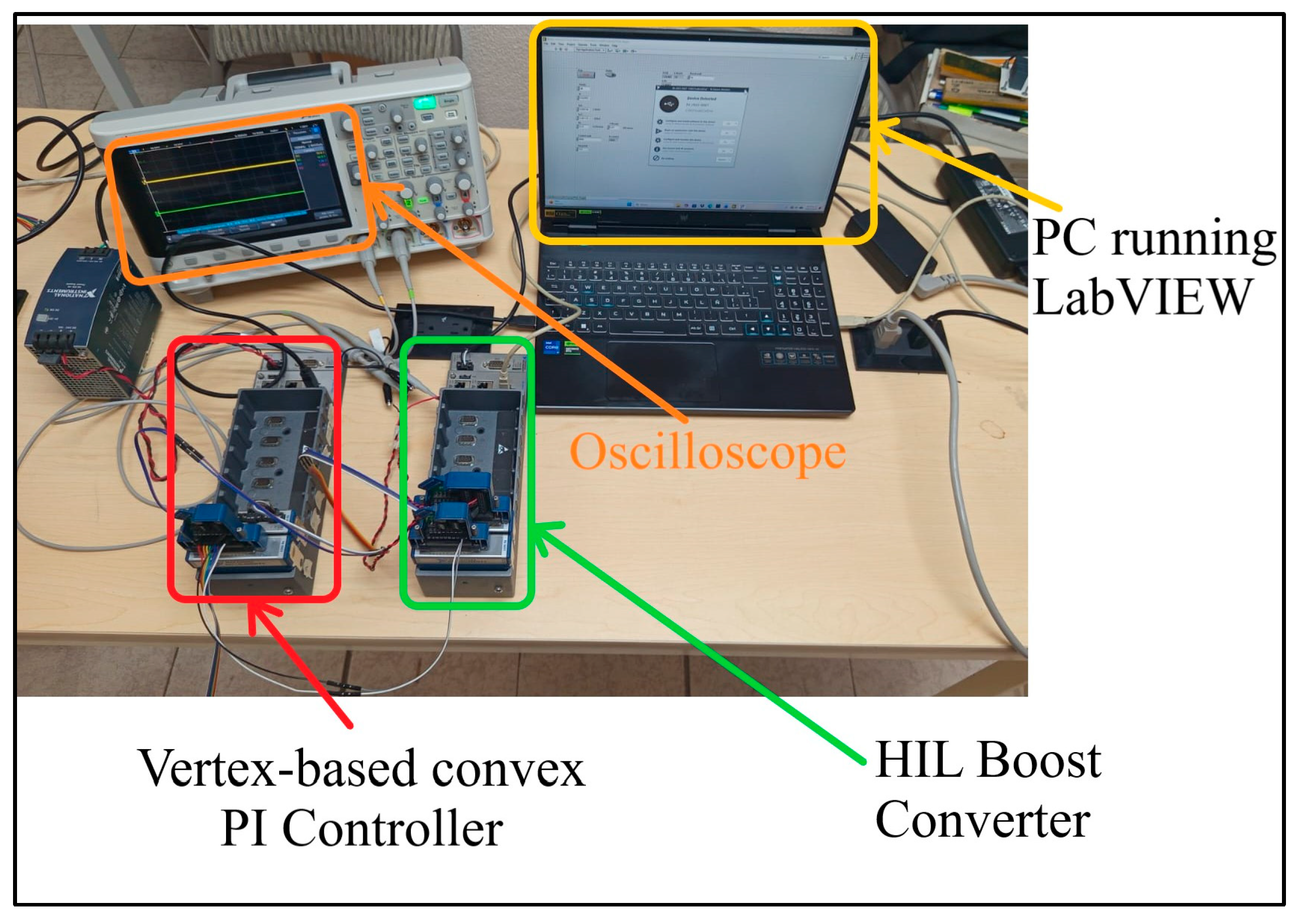
4.2. Controller Hardware in the Loop Simulation
5. Conclusions
Author Contributions
Funding
Data Availability Statement
Conflicts of Interest
References
- Ebrahimi, R.; Madadi Kojabadi, H.; Chang, L.; Blaabjerg, F. Coupled-inductor-based High Step-up DC–DC Converter. IET Power Electron. 2019, 12, 3093–3104. [Google Scholar] [CrossRef]
- Ghaffarpour, M.; Ebrahimi, R.; Kojabadi, H.M.; Chang, L.; Guerrero, J.M. Novel High Voltage Gain Dc–Dc Converter with Dynamic Analysis. IET Power Electron. 2021, 14, 562–583. [Google Scholar] [CrossRef]
- Olalla, C.; Leyva, R.; Queinnec, I.; Maksimovic, D. Robust Gain-Scheduled Control of Switched-Mode DC–DC Converters. IEEE Trans. Power Electron. 2012, 27, 3006–3019. [Google Scholar] [CrossRef]
- Aghdam, F.H.; Abapour, M. Reliability and Cost Analysis of Multistage Boost Converters Connected to PV Panels. IEEE J. Photovolt. 2016, 6, 981–989. [Google Scholar] [CrossRef]
- Chen, Z. PI and Sliding Mode Control of a Cuk Converter. IEEE Trans. Power Electron. 2012, 27, 3695–3703. [Google Scholar] [CrossRef]
- Kapat, S.; Krein, P.T. Formulation of PID Control for DC–DC Converters Based on Capacitor Current: A Geometric Context. IEEE Trans. Power Electron. 2012, 27, 1424–1432. [Google Scholar] [CrossRef]
- Utkin, V. Sliding Mode Control of DC/DC Converters. J. Frankl. Inst. 2013, 350, 2146–2165. [Google Scholar] [CrossRef]
- Klaučo, M.; Kalúz, M.; Kvasnica, M. Real-Time Implementation of an Explicit MPC-Based Reference Governor for Control of a Magnetic Levitation System. Control Eng. Pract. 2017, 60, 99–105. [Google Scholar] [CrossRef]
- Stellato, B.; Goulart, P.J. Real-Time FPGA Implementation of Direct MPC for Power Electronics. In Proceedings of the 2016 IEEE 55th Conference on Decision and Control (CDC), Las Vegas, NV, USA, 12–14 December 2016; IEEE: New York, NY, USA, 2016; pp. 1471–1476. [Google Scholar]
- Pang, S.; Nahid-Mobarakeh, B.; Pierfederici, S.; Phattanasak, M.; Huangfu, Y.; Luo, G.; Gao, F. Interconnection and Damping Assignment Passivity-Based Control Applied to On-Board DC–DC Power Converter System Supplying Constant Power Load. IEEE Trans. Ind. Appl. 2019, 55, 6476–6485. [Google Scholar] [CrossRef]
- Arora, S.; Balsara, P.; Bhatia, D. Input–Output Linearization of a Boost Converter with Mixed Load (Constant Voltage Load and Constant Power Load). IEEE Trans. Power Electron. 2019, 34, 815–825. [Google Scholar] [CrossRef]
- Patyra, M.J.; Grantner, J.L. Hardware Implementations of Digital Fuzzy Logic Controllers. Inf. Sci. N. Y. 1999, 113, 19–54. [Google Scholar] [CrossRef]
- Baždarić, R.; Matko, D.; Leban, A.; Vončina, D.; Škrjanc, I. Fuzzy Model Predictive Control of a DC-DC Boost Converter Based on Non-Linear Model Identification. Math. Comput. Model. Dyn. Syst. 2017, 23, 116–134. [Google Scholar] [CrossRef]
- Rubaai, A.; Ofoli, A.R.; Burge, L.; Garuba, M. Hardware Implementation of an Adaptive Network-Based Fuzzy Controller for DC–DC Converters. IEEE Trans. Ind. Appl. 2005, 41, 1557–1565. [Google Scholar] [CrossRef]
- Maddalena, E.T.; Specq, M.W.F.; Wisniewski, V.L.; Jones, C.N. Embedded PWM Predictive Control of DC-DC Power Converters Via Piecewise-Affine Neural Networks. IEEE Open J. Ind. Electron. Soc. 2021, 2, 199–206. [Google Scholar] [CrossRef]
- Ohtake, H.; Tanaka, K.; Wang, H.O. Fuzzy Modeling via Sector Nonlinearity Concept. In Proceedings of the Joint 9th IFSA World Congress and 20th NAFIPS International Conference (Cat. No. 01TH8569), Vancouver, BC, Canada, 25–28 July 2001; IEEE: New York, NY, USA, 2001; pp. 127–132. [Google Scholar]
- Tanaka, K.; Wang, H.O. Takagi-Sugeno Fuzzy Model and Parallel Distributed Compensation. In Fuzzy Control Systems Design and Analysis; Wiley: Hoboken, NJ, USA, 2001; pp. 5–48. [Google Scholar]
- Taniguchi, T.; Tanaka, K.; Ohtake, H.; Wang, H.O. Model Construction, Rule Reduction, and Robust Compensation for Generalized Form of Takagi-Sugeno Fuzzy Systems. IEEE Trans. Fuzzy Syst. 2001, 9, 525–538. [Google Scholar] [CrossRef] [PubMed]
- Li, H.; Xu, J.; Yu, J. Discrete Event-Triggered Fault-Tolerant Control of Underwater Vehicles Based on Takagi–Sugeno Fuzzy Model. IEEE Trans. Syst. Man. Cybern. Syst. 2023, 53, 1841–1851. [Google Scholar] [CrossRef]
- Nguyen, Q.D.; Giap, V.N.; Pham, D.-H.; Huang, S.-C. Fast Speed Convergent Stability of T-S Fuzzy Sliding-Mode Control and Disturbance Observer for a Secure Communication of Chaos-Based System. IEEE Access 2022, 10, 95781–95790. [Google Scholar] [CrossRef]
- Veysi, M.; Aghaei, J.; Shasadeghi, M.; Razzaghi, R.; Bahrani, B.; Ryan, D.J. Energy-Efficient Speed Control of Electric Vehicles: Linear Matrix Inequality Approach. IEEE Trans. Veh. Technol. 2020, 69, 10469–10483. [Google Scholar] [CrossRef]
- Wei, L.; Wang, X.; Li, L.; Fan, Z.; Dou, R.; Lin, J. T-S Fuzzy Model Predictive Control for Vehicle Yaw Stability in Nonlinear Region. IEEE Trans. Veh. Technol. 2021, 70, 7536–7546. [Google Scholar] [CrossRef]
- Li, L.; Gu, T.; Pan, H.; Hu, J.; Yu, X. Sensor and Actuator Fault Estimations and Self-Healing Control of Discrete-Time T-S Fuzzy Model with Double Observers and Its Application to Wastewater Treatment Process. IEEE Trans. Fuzzy Syst. 2024, 32, 2428–2437. [Google Scholar] [CrossRef]
- da Silva Moreira, T.B.; Silvério Costa, M.V.; Gonzalez Nogueira, F. Output Feedback T-S Fuzzy RMPC Applied to 3SSC Boost Converter. IEEE Lat. Am. Trans. 2021, 19, 1520–1527. [Google Scholar] [CrossRef]
- Torres-Pinzón, C.A.; Paredes-Madrid, L.; Flores-Bahamonde, F.; Ramirez-Murillo, H. LMI-Fuzzy Control Design for Non-Minimum-Phase DC-DC Converters: An Application for Output Regulation. Appl. Sci. 2021, 11, 2286. [Google Scholar] [CrossRef]
- Tasiu, I.A.; Liu, Z.; Yan, Q.; Chen, H.; Hu, K.; Wu, S. Fuzzy Observer-Based Control for the Traction Dual Rectifiers in High-Speed Train. IEEE Trans. Veh. Technol. 2021, 70, 303–318. [Google Scholar] [CrossRef]
- Duan, Z.; Meng, Y.; Duan, Y.; Zhang, H.; Wang, X.; Wang, X. Large-Signal Stability Analysis and Enhancement of Modular Multilevel Matrix Converter Under Power Fluctuation Based on T-S Fuzzy Model Theory. IEEE Trans. Power Electron. 2023, 38, 14601–14613. [Google Scholar] [CrossRef]
- Frances, A.; Asensi, R.; Uceda, J. Blackbox Polytopic Model with Dynamic Weighting Functions for DC-DC Converters. IEEE Access 2019, 7, 160263–160273. [Google Scholar] [CrossRef]
- Zhang, Y.; Zheng, H.; Zhang, C.; Yuan, X.; Xiong, W.; Cai, Y. T-S Fuzzy Model Based Large-Signal Stability Analysis of DC Microgrid with Various Loads. IEEE Access 2023, 11, 88087–88098. [Google Scholar] [CrossRef]
- Liu, S.; Li, X.; Xia, M.; Qin, Q.; Liu, X. Takagi-Sugeno Multimodeling-Based Large Signal Stability Analysis of DC Microgrid Clusters. IEEE Trans. Power Electron. 2021, 36, 12670–12684. [Google Scholar] [CrossRef]
- Qiao, L.; Li, L.; Lu, Y. Parallel and Nonparallel Distributed Compensation Controller Design for T-S Fuzzy Discrete Singular Systems with Distinct Difference Item Matrices. IEEE Access 2021, 9, 87475–87483. [Google Scholar] [CrossRef]
- Delprat, S.; Alvarez, J.; Sanchez, M.; Bernal, M. A Tighter Exact Convex Modeling for Improved LMI-Based Nonlinear System Analysis and Design. IEEE Trans. Fuzzy Syst. 2021, 29, 2819–2824. [Google Scholar] [CrossRef]
- Zhang, J.; Wang, X.; Shao, X. Design and Real-Time Implementation of Takagi–Sugeno Fuzzy Controller for Magnetic Levitation Ball System. IEEE Access 2020, 8, 38221–38228. [Google Scholar] [CrossRef]
- Errouissi, R.; Al-Durra, A.; Muyeen, S.M. A Robust Continuous-Time MPC of a DC–DC Boost Converter Interfaced with a Grid-Connected Photovoltaic System. IEEE J. Photovolt. 2016, 6, 1619–1629. [Google Scholar] [CrossRef]
- Estrada, L.; Vázquez, N.; Vaquero, J.; de Castro, Á.; Arau, J. Real-Time Hardware in the Loop Simulation Methodology for Power Converters Using LabVIEW FPGA. Energies 2020, 13, 373. [Google Scholar] [CrossRef]





| Parameter | Description | Value |
|---|---|---|
| Input voltage | 48 V | |
| Inductance | 1.5 mH | |
| Capacitance | 220 F | |
| Nominal load resistance | ||
| Inductor series resistance | ||
| Inductor current range | 0.42–4.5 A | |
| Output voltage range | 48–150 V | |
| Nominal power output | 200 W |
| Controller | State Used Online | Gains Stored | Matrix–Vector Products | Multiplications | Additions |
|---|---|---|---|---|---|
| Full-State Feedback LMI/PDC | 12 (3 per vertex) | Yes | 16 | 11 | |
| Proposal | 8 (2 per vertex) | No | 12 | 7 |
Disclaimer/Publisher’s Note: The statements, opinions and data contained in all publications are solely those of the individual author(s) and contributor(s) and not of MDPI and/or the editor(s). MDPI and/or the editor(s) disclaim responsibility for any injury to people or property resulting from any ideas, methods, instructions or products referred to in the content. |
© 2026 by the authors. Licensee MDPI, Basel, Switzerland. This article is an open access article distributed under the terms and conditions of the Creative Commons Attribution (CC BY) license.
Share and Cite
Hidalgo, H.; Estrada, L.; Vázquez, N.; Mejia, D.; Huerta, H.; González-Durán, J.E.E. Voltage Regulation of a DC–DC Boost Converter Using a Vertex-Based Convex PI Controller. Technologies 2026, 14, 30. https://doi.org/10.3390/technologies14010030
Hidalgo H, Estrada L, Vázquez N, Mejia D, Huerta H, González-Durán JEE. Voltage Regulation of a DC–DC Boost Converter Using a Vertex-Based Convex PI Controller. Technologies. 2026; 14(1):30. https://doi.org/10.3390/technologies14010030
Chicago/Turabian StyleHidalgo, Hector, Leonel Estrada, Nimrod Vázquez, Daniel Mejia, Héctor Huerta, and José Eli Eduardo González-Durán. 2026. "Voltage Regulation of a DC–DC Boost Converter Using a Vertex-Based Convex PI Controller" Technologies 14, no. 1: 30. https://doi.org/10.3390/technologies14010030
APA StyleHidalgo, H., Estrada, L., Vázquez, N., Mejia, D., Huerta, H., & González-Durán, J. E. E. (2026). Voltage Regulation of a DC–DC Boost Converter Using a Vertex-Based Convex PI Controller. Technologies, 14(1), 30. https://doi.org/10.3390/technologies14010030