Article

Stable Multipoint Flux Approximation (MPFA) Saturation Solution for Two-Phase Flow on Non-K-Orthogonal Anisotropic Porous Media

Department of Mathematical Modeling, Kaunas University of Technology, K. Donelaičio g. 73, LT-44249 Kaunas, Lithuania
*
Author to whom correspondence should be addressed.
Technologies 2025, 13(5), 193; https://doi.org/10.3390/technologies13050193

Submission received: 15 April 2025 / Revised: 6 May 2025 / Accepted: 7 May 2025 / Published: 9 May 2025
(This article belongs to the Section Construction Technologies)

Abstract

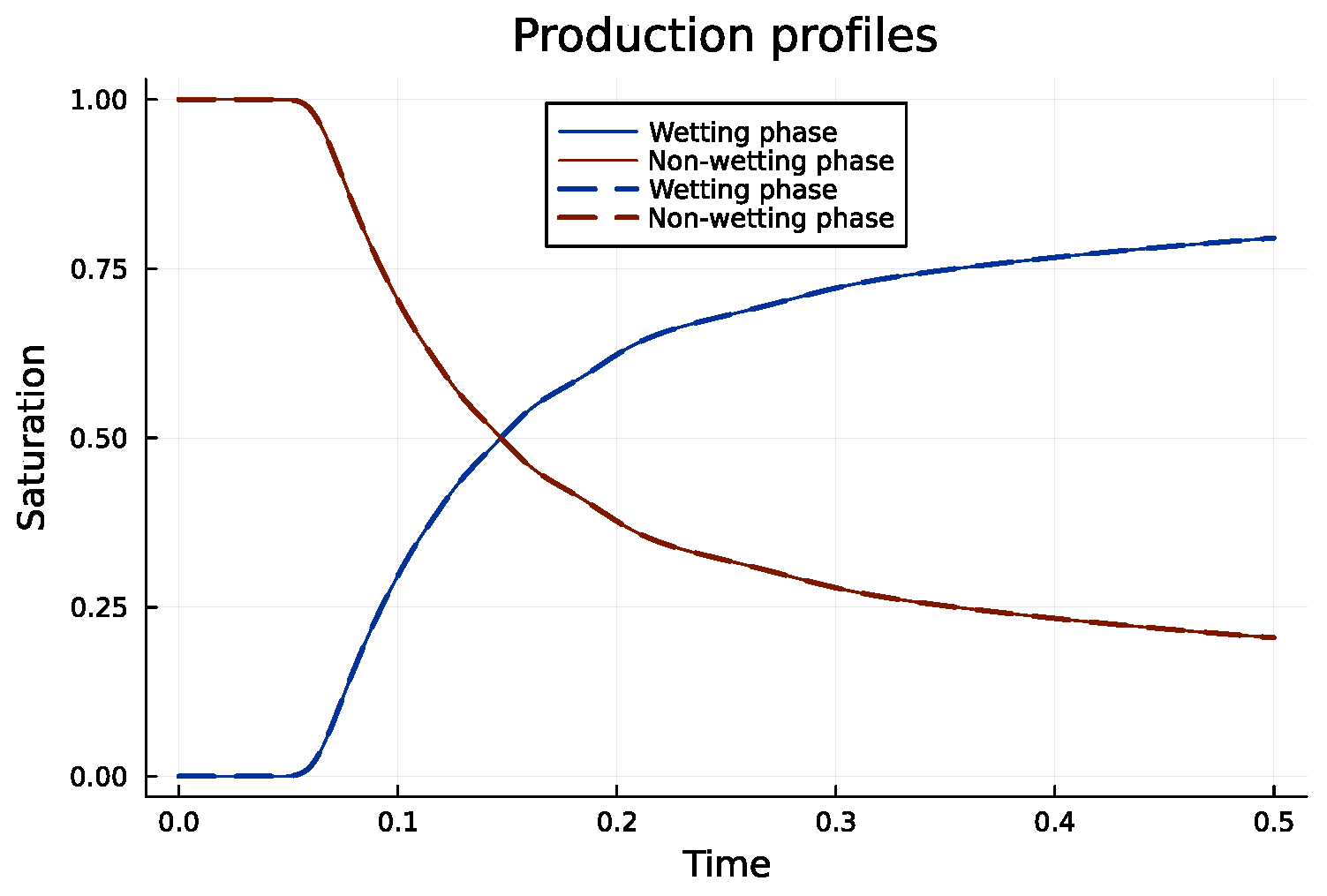
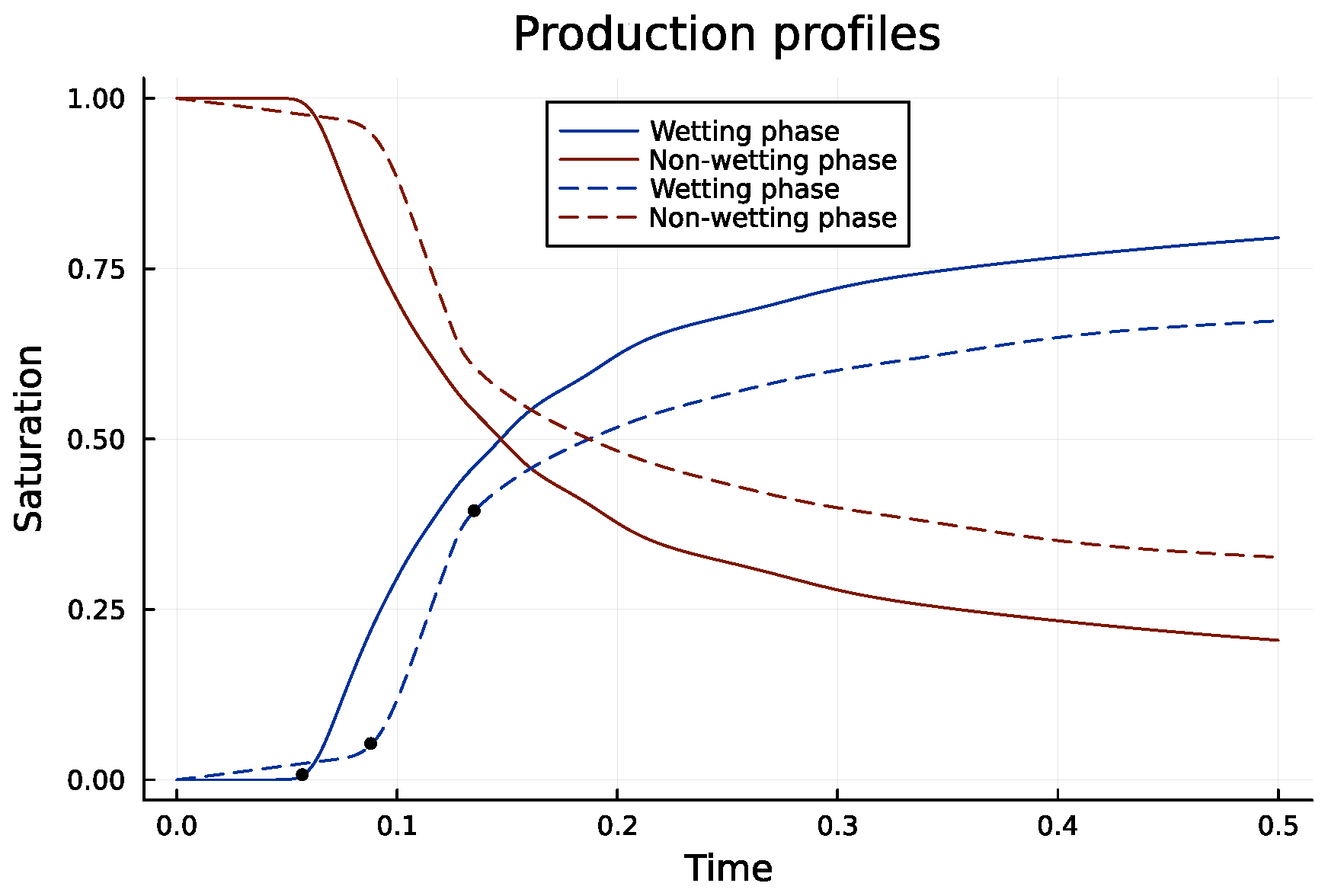
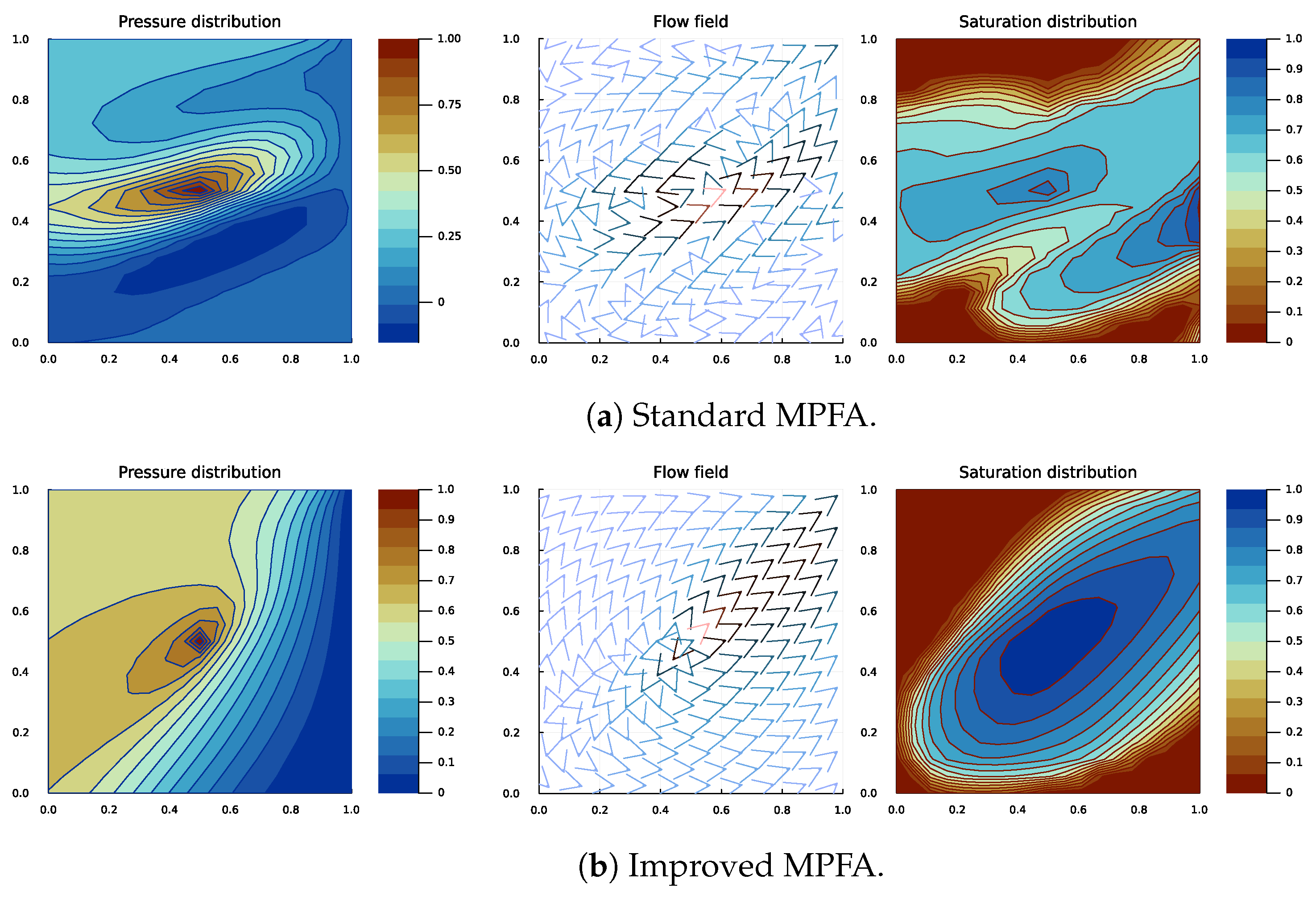
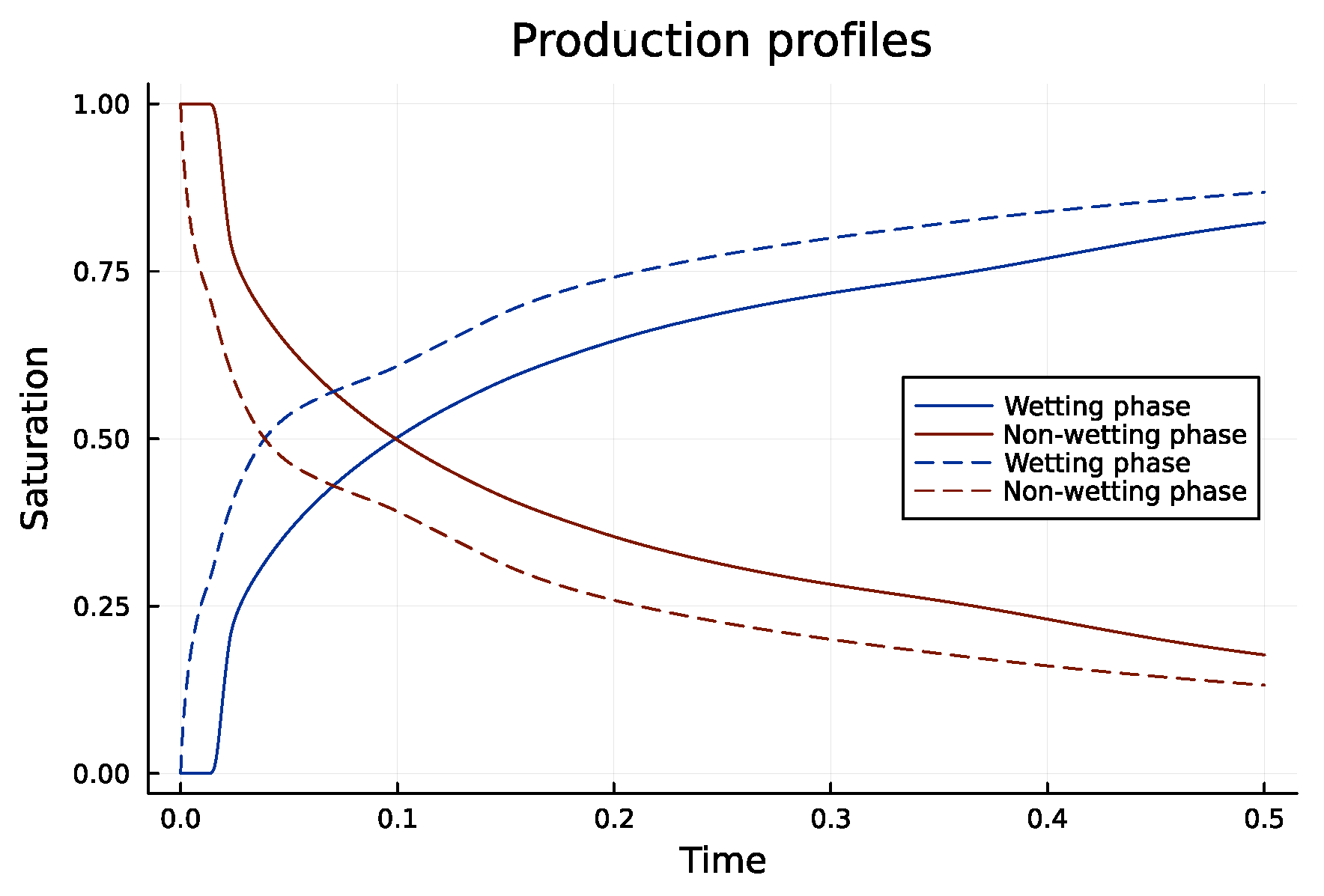
This paper extends the multipoint flux approximation (MPFA-O) method to model coupled pressure and saturation dynamics in subsurface reservoirs with heterogeneous anisotropic permeability and non-K-orthogonal grids. The MPFA method is widely used for reservoir simulation to address the limitations of the two-point flux approximation (TPFA), particularly in scenarios involving full-tensor permeability and strong anisotropy. However, the MPFA-O method is known to suffer from spurious oscillations and numerical instability, especially in high-anisotropy scenarios. Existing stability-enhancing techniques, such as optimal quadrature schemes and flux-splitting methods, mitigate these issues but are computationally expensive and do not always ensure monotonicity or oscillation-free solutions. Building upon prior advancements in the MPFA-O method for pressure equations, this work incorporates the saturation equation to enable the simulation of a coupled multiphase flow in porous media. A unified framework is developed to address stability challenges associated with the tight coupling of pressure and saturation fields while ensuring local conservation and accuracy in the presence of full-tensor permeability. The proposed method introduces stability-enhancing modifications, including a local rotation transformation, to mitigate spurious oscillations and preserve physical principles such as monotonicity and the maximum principle. Numerical experiments on heterogeneous, anisotropic domains with non-K-orthogonal grids validate the robustness and accuracy of the extended MPFA-O method. The results demonstrate improved stability and performance in capturing the complex interactions between pressure and saturation fields, offering a significant advancement in subsurface reservoir modeling. This work provides a reliable and efficient tool for simulating coupled flow and transport processes, with applications in CO2 storage, hydrogen storage, geothermal energy, and hydrocarbon recovery.
Keywords: multipoint flux approximation; saturation equation; non-k-orthogonal grid; anisotropy multipoint flux approximation; saturation equation; non-k-orthogonal grid; anisotropy