Article

Horizon- and Regime-Dependent Performance of GARCH-Type Models: Evidence from Volatility Forecasting in a Frontier Market


by
Abraham Kisembe Wawire
1,*,
Christine Nanjala Simiyu
1,
Munene Laiboni
1 and
Rogers Ochenge
2,3
1
Department of Accounting & Finance, KCA University, P.O. Box 56808, Nairobi 00200, Kenya
2
Department of Economic Theory, Kenyatta University, P.O. Box 43844, Nairobi 00100, Kenya
3
Department of Economics & Statistics, KCA University, P.O. Box 56808, Nairobi 00200, Kenya
*
Author to whom correspondence should be addressed.
Int. J. Financial Stud. 2026, 14(6), 148; https://doi.org/10.3390/ijfs14060148
Submission received: 18 March 2026 / Revised: 7 May 2026 / Accepted: 19 May 2026 / Published: 4 June 2026

Abstract

In frontier markets, financial volatility exhibits long-memory properties and regime-dependent asymmetries that standard linear models do not capture. This leads to inaccuracies in forecasting risk when a single model is applied across regimes. This study investigates the horizon- and regime-dependent performance of volatility models within a horizon- and regime-sensitive evaluation framework that applies single-regime Generalized Autoregressive Conditional Heteroscedasticity (GARCH) variants alongside a Hidden Markov Model (HMM). We evaluate the predictive accuracy of GARCH, Exponential GARCH (EGARCH), Glosten-Jagannathan-Runkle GARCH (GJR-GARCH), Asymmetric Power ARCH (APARCH), Fractionally Integrated GARCH (FIGARCH), and an HMM. Diebold–Mariano test statistics reveal that predictive superiority is sensitive to the chosen benchmark. When EGARCH is the benchmark, results highlight the importance of leverage effects, whereas a FIGARCH benchmark demonstrates that short-memory models are rejected as horizons increase. While short-memory models capture immediate clustering, FIGARCH maintains stable performance via hyperbolic decay. HMM provides a superior in-sample fit by capturing transitions between calm and turbulent regimes. Economic validation through Value-at-Risk (VaR) and Expected Shortfall (ES) backtesting indicates that FIGARCH and APARCH offer more reliable coverage for early warning systems during market stress. The findings emphasize that forecasting in a frontier market requires asset-specific approaches where benchmark selection dictates the interpretation of model superiority.

1. Introduction

1.1. Background

Modelling volatility has remained central to financial econometrics since the seminal contributions of Engle (1982) and Bollerslev (1986), which introduced the ARCH and GARCH frameworks. These models became the dominant empirical approach for capturing time-varying volatility and the stylized facts of clustering and persistence (Hansen & Lunde, 2005; Poon & Granger, 2003). Over time, extensions such as EGARCH (Nelson, 1991), GJR-GARCH (Glosten et al., 1993), APARCH (Ding et al., 1993), and FIGARCH (Baillie et al., 1996) were developed to incorporate leverage effects, power transformations, and long-memory dynamics. Despite these advances, comparative studies show that no single specification dominates across assets, horizons, or regimes (Patton & Sheppard, 2015). This unresolved debate has motivated research into horizon- and regime-specific performance of GARCH-type models.
Forecasting volatility is regime-dependent and horizon-specific. Standard GARCH models produce smooth forecasts that fail to distinguish between calm and turbulent regimes (Hamilton & Susmel, 1994), while regime-switching extensions demonstrate superior performance during crises (Marcucci, 2005). Asymmetric models tend to outperform in high-volatility regimes, whereas long-memory specifications provide gains at longer horizons (Conrad & Haag, 2006). Recent contributions emphasize integrating macroeconomic volatility components and adopting non-parametric approaches to improve robustness against structural breaks (Engle & Rangel, 2008; Kamronnaher et al., 2024; Makatjane & Mmelesi, 2024). These findings highlight ongoing controversies: whether volatility is best explained by structural regimes, asymmetric responses, or long-memory persistence, and whether model rankings remain stable across contexts.
African frontier markets present a challenging environment for modelling volatility. Volatility dynamics are shaped by recurrent structural breaks, thin market depth, and sensitivity to external shocks (Balcilar et al., 2015). Evidence from Nigerian, South African, and North African economies shows that crises and regime shifts disrupt volatility patterns more severely than in developed markets, with asymmetric and long-memory models outperforming standard GARCH specifications during turbulent periods (Salisu et al., 2020). Yet systematic evaluations of horizon- and regime-dependent performance remain scarce in Africa, leaving unresolved questions about how volatility models behave under conditions of thin liquidity, political uncertainty, and recurrent macroeconomic shocks. This gap is critical given the reliance of regulators and institutional investors on volatility forecasts for risk management and financial stability.
Another unresolved debate concerns the economic relevance of volatility forecasts. While many studies rank GARCH models using statistical loss functions, fewer examine their usefulness for risk management through Value-at-Risk (VaR) and Expected Shortfall (ES). Regulatory bodies rely on these tail-risk measures, yet evidence on whether GARCH-family models generate reliable inputs for such applications in frontier markets remains limited (Patton et al., 2019). Addressing this gap requires a horizon- and regime-aware evaluation framework that compares statistical forecasting accuracy and assesses the economic value of volatility forecasts for risk management.
While existing literature often focuses on single-model dominance, this study recognizes the fluid nature of frontier markets. Consequently, the research is guided by the following overarching question: How does the comparative performance of standard GARCH-family models vary with forecasting horizon, asset type, and prevailing market conditions within a frontier financial environment? To provide a detailed analysis, we address three specific questions: Do standard GARCH specifications exhibit differences in predictive accuracy across short (1-day), medium (5-day), and extended (20-day) horizons for equity and currency returns? In what ways does the comparative performance of these models shift between calm phases and crisis episodes? Which models deliver the most dependable inputs for risk management applications, from the perspective of Value-at-Risk (VaR) and Expected Shortfall (ES) validation tests?
This study makes several contributions to the body of knowledge on financial econometrics in frontier markets. First, it provides a high-frequency comparative analysis of both equity (NSE 20) and currency (USD/KES) markets within a unified framework, moving beyond the single-asset focus prevalent in existing literature. Second, we contribute a methodological improvement by demonstrating that the statistical significance of model superiority is contingent upon the selected benchmark. By identifying how results diverge between EGARCH and FIGARCH benchmarks, we clarify the interplay between leverage effects and long-memory persistence. This study applied a proxy Markov-Switching GARCH (HMM) approach to endogenously identify regime transitions in the Kenyan market, offering a more nuanced understanding of how forecasting accuracy shifts during periods of macroeconomic and political instability. The study bridges the gap between theoretical modelling and practical risk oversight by validating these architectures through Value-at-Risk (VaR) and Expected Shortfall (ES) backtesting.

1.2. Theoretical Framework

Modelling volatility is anchored in several theories that explain market behaviour, risk transmission, and investor psychology. The Efficient Market Hypothesis (EMH) (Fama, 1970) posits that asset prices reflect available information, with its weak form aligning with the random walk theory (Kendall & Hill, 1953). While EMH suggests that volatility arises from new information, empirical evidence from frontier markets validates persistent inefficiencies, thin liquidity, and behavioural biases that amplify volatility (Shiller, 2003). The tension between theoretical efficiency and observed inefficiency underscores the need for GARCH-family models that can statistically capture observed clustering and persistence that a simple random walk cannot capture.
Modern Portfolio Theory (MPT) (Markowitz, 1952) and the Capital Asset Pricing Model (CAPM) (Sharpe, 1964) conceptualize volatility as a measure of risk, emphasizing diversification and systematic exposure. Both frameworks assume normal return distributions and rational investor behaviour which is violated in African markets where recurrent shocks, political instability, and thin trading produce fat-tailed distributions and extreme volatility (Mandelbrot & Hudson, 2010). The Arbitrage Pricing Theory (APT) (Ross, 1976) attempts to incorporate multiple sources of risk; however, its empirical application in frontier markets is limited (Faruque, 2011). These violations of normality justify the use of Student’s t-distributions within the GARCH framework to accurately model the tail risk highlighted by these theories.
Stochastic process theory provides the mathematical foundation for modelling volatility. The random walk hypothesis (Bachelier, 1900) and Brownian motion assume constant variance, a premise challenged by Engle (1982) who introduced Autoregressive Conditional Heteroskedasticity (ARCH) to model time-varying variance. This was generalized by Bollerslev (1986) into the GARCH model. Further, the need to identify transitions between distinct market states such as calm and turbulent periods justifies the inclusion of the Markov-Switching GARCH (MS-GARCH) model, which endogenously captures the regime dynamics theorized in stochastic processes.
Behavioural finance challenges rational frameworks by incorporating cognitive biases and emotional influences. Prospect theory (Kahneman & Tversky, 2013) demonstrates that investors exhibit loss aversion, leading to asymmetric responses to gains and losses. Herding behaviour, overconfidence, and anchoring distort price discovery, producing excess volatility and speculative bubbles (Shleifer, 1986). These behavioural tendencies are relevant in markets, where limited information circulation and weak institutional structures amplify the impact of investor sentiment on volatility dynamics (Balcilar et al., 2015; Salisu et al., 2020). Behavioural insights justify the use of asymmetric GARCH variants such as EGARCH and GJR-GARCH, which model leverage effects and asymmetric responses to shocks predicted by prospect theory (Dinga et al., 2023; Watard et al., 2024).
The financialization of commodities has restructured volatility transmission by increasing cross-market linkages. Commodities, once driven by supply and demand fundamentals, are now influenced by institutional investors, hedge funds, and algorithmic trading (Cheng & Xiong, 2014). This integration has increased co-movement between commodity and equity markets, reducing diversification benefits and increasing systemic risk (Domanski & Heath, 2007; Tang & Xiong, 2012). In Kenya, where commodity shocks have lasting effects, this persistent market memory justifies the application of the FIGARCH model to capture the long memory dynamics in volatility transmission.

1.3. Empirical Literature Review

Empirical research on modelling volatility has evolved since the introduction of ARCH and GARCH frameworks (Bollerslev, 1986; Engle, 1982). While these models captured short-run persistence, they failed to account for the slow hyperbolic decay in volatility autocorrelations (Baillie et al., 1996; Ding et al., 1993). This limitation motivated the development of long-memory models such as FIGARCH and HYGARCH, which outperform standard GARCH specifications in environments characterized by persistent information flows and heterogeneous agents (Andersen & Bollerslev, 1998; Davidson, 2004). Parallel advances introduced asymmetric models that incorporate leverage and size effects, improving estimation of volatility during periods of market stress (Orakcioglu, 2015). However, a key weakness in these studies is the assumption of parameter stability over time; by solely focusing on long memory or asymmetry in isolation, they often overlook how these dynamics are modulated by shifting market regimes (Lim & Sek, 2013; Othman et al., 2019).
Recent studies emphasize the regime-dependent and horizon-specific nature of volatility forecasts. Standard GARCH models produce smooth forecasts that fail to distinguish between calm and turbulent regimes (Hamilton & Susmel, 1994), while regime-switching extensions demonstrate superior performance at short horizons and during crisis periods (Dueker, 1997; Marcucci, 2005). Asymmetric specifications tend to dominate under market stress conditions, whereas long-memory models are more effective during stable periods and provide gains at longer horizons (Brownlees et al., 2011; Conrad & Haag, 2006). Recent contributions highlight the importance of integrating macroeconomic volatility components and adopting non-parametric approaches to improve robustness against structural breaks (Engle & Rangel, 2008; Kamronnaher et al., 2024; Makatjane & Mmelesi, 2024). These findings underscore the continuing debate: whether volatility is best explained by structural regimes, asymmetric responses, or long-memory persistence, and whether model rankings remain stable across horizons and asset classes.
This highlights a critical dichotomy in the literature. While some evidence favours regime-switching models to capture short-term crises, others find them superior over medium and long-term horizons due to their ability to model regime-dependent persistence (Hoang & Luu, 2024). These inconsistencies stem from the evaluation criteria that are used: statistical loss functions prioritize short-term point accuracy whereas economic back tests prioritize long-term tail-risk coverage.
Studies in risk management have shifted from variance-based measures to tail-risk metrics such as Value-at-Risk (VaR) and Expected Shortfall (ES). While VaR is widely used, its non-coherent nature has prompted regulators to recommend ES as a reliable measure of extreme losses (Tian et al., 2019). Empirical evidence shows that models incorporating long memory and asymmetry, with skewed Student’s t-distributions, provide superior estimates of both VaR and ES (Aloui & Ben Hamida, 2015). However, the superiority of regime-switching models remains horizon-dependent, with single-regime models excelling in short-term forecasts and regime-switching models outperforming over medium and long horizons (Hoang & Luu, 2024). While these findings suggest that model superiority is transient, the literature remains fragmented. Most studies evaluate models either across different horizons or across different regimes, but rarely both simultaneously. This creates a methodological blind spot: a model that excels in a calm regime at a 1-day horizon may fail significantly at a 20-day horizon when the market enters a turbulent state.
The integration of statistical evaluation with economic relevance has gained prominence through Value-at-Risk (VaR) and Expected Shortfall (ES) backtesting (Diebold et al., 2005; Tian et al., 2019). Empirical evidence shows that models incorporating long memory and asymmetry, with skewed Student’s t-distributions provide superior estimates of both Var and ES (Aloui & Ben Hamida, 2015). Despite the rigour of these risk measures their application in existing literature often suffers from a one-size-fits-all approach. Specifically, many studies fail to report when and why standard models fail to meet regulatory backtesting requirements in volatile frontier settings often leading to massaged results that favour model fit over practical failure analysis (Hoang & Luu, 2024).
While regime-switching models are widely recognized for their superior performance during crises and at certain horizons (Hamilton & Susmel, 1994; Hoang & Luu, 2024; Marcucci, 2005), single-regime GARCH-family specifications remain the dominant benchmark in both academic research and regulatory practice (Bollerslev, 1986; Engle, 1982). Evaluating these models across horizons and regimes provides a transparent baseline against which the incremental gains of regime-switching can be assessed. Moreover, regulators and institutional investors in frontier markets often rely on single-regime models due to their tractability and lower data requirements (Lim & Sek, 2013; Othman et al., 2019). For this reason, the study incorporates both perspectives: single-regime GARCH variants are systematically evaluated to establish baseline performance, while a Markov-Switching GARCH (MS-GARCH) specification is included to embed regime dependence endogenously and demonstrate whether regime-switching delivers practical improvements in risk forecasting (Ardia et al., 2018).
Empirical evidence from African markets reinforces the importance of horizon- and regime-sensitive modelling of volatility. In South Africa, Elenjical et al. (2016) examined the predictive accuracy of Value-at-Risk (VaR) models across different market regimes, showing that the dominance of long-memory models is regime-dependent and that adaptive frameworks outperform static reliance on single specifications. Similarly, Basvi (2024) analyzed volatility in the Zimbabwe Stock Market and highlighted the relevance of asymmetric extensions such as EGARCH in capturing leverage effects under structural transitions. Ndlovu (2019) emphasized the role of commodity price volatility in shaping stock market performance and economic growth in frontier economies, noting that regime-switching GARCH models provide a superior fit when structural breaks are present. Within the broader Sub-Saharan context, Umar (2016) demonstrated that exchange rate regime switching alters volatility transmission under inflation-targeting frameworks, underscoring the methodological value of regime-sensitive models. Magubane (2025) and Murape (2022) applied regime-switching and asymmetric GARCH models to financial cycles and private equity investments, respectively, confirming the prevalence of volatility clustering, leverage effects, and long-memory dynamics in African markets. Overall, past studies indicate that volatility in African markets is shaped by thin liquidity, recurrent structural breaks, and exposure to external shocks (Basvi, 2024; Elenjical et al., 2016; Magubane, 2025; Murape, 2022; Ndlovu, 2019; Umar, 2016), thereby justifying the integration of both single-regime GARCH variants and MS-GARCH in the Kenyan context.
Despite these advances, comparative studies have focused on developed and emerging markets, leaving frontier markets underexplored. Existing evidence confirms that although volatility persistence, asymmetry, and regime dependence are stronger in less mature markets, there are limited evaluations of horizon-specific and regime-dependent performance. This represents a significant unresolved gap in the literature: the lack of a comprehensive framework that tests the resilience of GARCH-family models against the dual constraints of time-horizon decay and regime transitions in African frontier markets.
Equity and foreign exchange markets in Kenya exhibit unique stylized facts such as thin liquidity and political-economic structural breaks that challenge the universal applicability of findings from more mature markets. By incorporating a Markov-Switching GARCH (MS-GARCH) framework alongside long-memory and asymmetric models this study aims to resolve this gap, providing a critical assessment of model reliability when horizons and regimes intersect.

2. Materials and Methods

2.1. Research Design

This study adopted a quantitative research design to investigate the horizon- and regime-dependent performance of GARCH-family models in a frontier market context. The process began with the estimation of daily return series for the NSE 20 Share Index and the USD/KES exchange rate, which are transformed into logarithmic returns to capture stylized facts of volatility. The study considered six specifications—GARCH(1,1), EGARCH(1,1), GJR-GARCH(1,1), APARCH(1,1), FIGARCH(1,d,1), and a two-state Markov-Switching GARCH (MSGARCH)—to ensure that clustering, asymmetry, long-memory dynamics, and regime dependence are represented. Forecasts are generated using a rolling window framework at short (1-day), medium (5-day), and long (20-day) horizons, allowing the study to assess how predictive accuracy evolves across different time spans. Regime identification is introduced ex-post for single-regime models by segmenting forecasts into calm and turbulent subsamples based on historical events, while MSGARCH embeds regime dependence endogenously through transition probabilities estimated via the Hamilton filter. Model performance is assessed from both statistical and economic perspectives: statistical accuracy is assessed using MAE, QLIKE, and Diebold–Mariano tests. Value-at-Risk (VaR) and Expected Shortfall (ES) backtests, including Kupiec and Christoffersen coverage tests were used to validate economic relevance. Model dominance and selection are determined by integrating statistical accuracy, economic reliability, and diagnostic adequacy, thereby ensuring that the study provides a transparent and comprehensive framework for testing whether GARCH-family models remain reliable under the dual constraints of horizon decay and regime transitions in Kenya’s equity and foreign exchange markets.

2.2. Data Description and Preprocessing

This study used daily data from two sources: the NSE 20 Share Index was obtained from the Nairobi Securities Exchange (NSE) while the USD/KES exchange rates were obtained from the Central Bank of Kenya (CBK). The sample period was from November 1997 to December 2024, yielding 6704 aligned trading day observations for each series. To ensure comparability, the equity and foreign exchange datasets were synchronized to a common trading calendar by retaining only overlapping trading days. Non-trading days in the equity market, such as weekends and public holidays, were excluded, and the foreign exchange series was adjusted accordingly to match the same calendar. Missing values arising from market suspensions were handled by omitting the affected days.
Daily returns were computed as continuously compounded logarithmic differences in closing prices to capture volatility clustering and other stylized facts expressed as follows:
r t   =   100 × l n P t P t 1  
where p t denotes the closing value of the asset or exchange rate on day t, while p t 1   represents the closing value on the immediately preceding trading day. Preprocessing included stationarity checks using the Augmented Dickey–Fuller (ADF) test and diagnostic tests for heteroskedasticity, to ensure the suitability of GARCH-family models for subsequent estimation and forecasting.

2.3. Model Specifications

To ensure comparability across the different volatility architectures, we employ a two-stage estimation process. All models share a standardized mean equation, while the variance equations differ according to the specific dynamics being tested.

2.3.1. The Standardized Mean Equation

For both the NSE 20 and USD/KES return series ( r t ) , the mean equation is defined as a first-order Autoregressive process, AR(1), to account for potential serial correlation:
r t   =   μ   +     r t 1   +   ϵ t ,
where
  • r t : Logarithmic returns at time t .
  • μ : Constant mean.
  • : Autoregressive coefficient ( | |   <   1 for stationarity).
  • ϵ t : The innovation term (residual), defined as ϵ t   =   σ t   z t , where z t follows the chosen distribution (Normal, Student’s t , or G E D ).
This study estimated six GARCH-family models to capture the stylized facts of volatility in domestic equity and foreign exchange markets in Kenya.

2.3.2. GARCH(1,1) Model

The Generalized Autoregressive Conditional Heteroskedasticity (GARCH) model (Bollerslev, 1986) is the baseline specification used to capture volatility clustering—the tendency for large changes in returns to be followed by further large changes.
r t = μ + ϵ t , ϵ t = σ t z t ,
The conditional variance is defined as follows:
σ t 2 = ω + α ϵ t 1 2 + β σ t 1 2 ,
where σ t 2   is the conditional variance at time t , ω is the constant variance (intercept), α (ARCH term) measures the short-run impact of shocks, β (GARCH term) represents the persistence of volatility, r t is the return at time t, μ is the conditional mean of returns, ϵ t   innovation or shock at time t, z t is the i.i.d. error term, assumed standard normal. To ensure a positive and stable variance, the parameters must satisfy ω >   0 ,     α   0 , β     0 ,   α + β   <   1 . GARCH(1,1) assumes a symmetric response to shocks, meaning positive and negative news of equal magnitude impact volatility identically. It fails to account for the “leverage effect” commonly observed in equity markets.

2.3.3. EGARCH(1,1) Model

Introduced by Nelson (1991), the EGARCH model addresses the symmetry limitation of the standard GARCH by allowing for asymmetric responses to shocks.
ln σ t 2 = ω + α ϵ t 1 σ t 1 + γ ϵ t 1 σ t 1 + β ln σ t 1 2 ,
where l n ( σ t 2 )   is the natural logarithm of variance, which ensures positivity regardless of the sign of the parameters. The γ coefficient represents the asymmetric response. The EGARCH model can occasionally be over-sensitive to outliers in a data set due to the logarithmic transformation, although it is superior for identifying leverage effects where γ   <   0 .

2.3.4. GJR-GARCH(1,1) Model

The GJR-GARCH model, introduced by Glosten et al. (1993), extends the standard GARCH framework by incorporating asymmetric responses to positive and negative shocks.
σ t 2 = ω + α ε t 1 2 + γ I t 1 ε t 1 2 + β σ t 1 2 ,
where γ is the additional effect of negative shocks, I t 1 is the indicator variable, equals 1 if ϵ t 1 < 0 ,   0 otherwise.
The GJR-GARCH model provides an alternative framework for modelling asymmetry by using an indicator function.
σ t 2 = ω + α ϵ t 1 2 + γ I t 1 ϵ t 1 2 + β σ t 1 2 ,
where I t 1 is the indicator variable. I t 1   =   1   if ϵ t 1   <   0   and 0 otherwise. Stability requires α   +   β   + 1 2 γ <   1 . While robust in capturing the impact of “bad news,” this model assumes that the power of the returns contributing to volatility is fixed at a square of 2, which may not always be optimal for highly erratic markets.

2.3.5. APARCH(1,1) Model

Ding et al. (1993) developed the APARCH model to generalize several GARCH variants by introducing a flexible power parameter.
σ t δ = ω + α ϵ t 1 γ ϵ t 1 δ + β σ t 1 δ ,
where δ   >   0 is the power parameter, and γ is the leverage coefficient. If δ   =   2 and γ = 0 the model reduces to a standard GARCH. By allowing δ to be endogenously determined, this model captures “Taylor effects” where absolute returns show more persistence than squared returns. However, its increased complexity requires a larger sample size for parameter convergence.

2.3.6. FIGARCH(1, d ,1) Model

FIGARCH was introduced by Baillie et al. (1996) to address the slow, hyperbolic decay of volatility shocks (long memory) that standard GARCH models fail to capture.
σ t 2 = ω + 1 β L 1 1 ϕ L 1 L d ϵ t 2 ,
where L   is the lag operator and d is the fractional differencing parameter ( 0   <   d   <   1 ) .
This model assumes that volatility shocks are neither purely transitory nor permanent. The primary limitation is its high computational demand and sensitivity to the choice of the truncation lag in the infinite ARCH expansion.

2.3.7. Markov-Switching GARCH (MS-GARCH)

Haas et al. (2004) developed MS-GARCH to account for structural breaks by allowing model parameters to switch between different market regimes.
σ t , s t 2 = ω s t + α s t ϵ t 1 2 + β s t σ t 1 , s t 1 ,
where s t denotes the state, governed by a transition matrix P where
p i j   =   P S t =   j   S t 1   =   i ) ,
In principle, MSGARCH assumes that regime transitions follow a first-order Markov process, capturing regime-dependent persistence but often facing path dependence issues (Haas et al., 2004). Since Python lacks a stable MSGARCH implementation, this study adopts a proxy approach by combining Hidden Markov Models (HMM) with GARCH estimation.

2.4. Model Estimation and Diagnostics

All single-regime GARCH models (GARCH, EGARCH, GJR-GARCH, APARCH, FIGARCH) are estimated using quasi-maximum likelihood (QMLE), with the Bollerslev–Wooldridge robust covariance estimator to ensure consistency under non-normality. Model adequacy is assessed using the Akaike Information Criterion (AIC) and the Bayesian Information Criterion (BIC), which provide comparative measures of model fit and penalize over-parameterization. Residual diagnostics include Ljung–Box tests on standardized residuals and squared residuals to check for remaining autocorrelation, and ARCH–LM tests to detect any remaining conditional heteroskedasticity. Convergence and positivity constraints on the conditional variance are checked for all parameter estimates.
The choice of QMLE with the Bollerslev–Wooldridge robust covariance estimator is appropriate because it provides consistent parameter estimates even when the conditional distribution of returns deviates from normality, a common feature in frontier markets characterized by fat-tailed and skewed distributions. This approach is widely adopted in modelling volatility due to its computational efficiency, robustness to distributional misspecification, and ability to deliver valid inference under heteroskedasticity (Bollerslev & Wooldridge, 1992; Francq & Zakoïan, 2010).
Estimation was performed on the full sample to ensure parameter stability, while forecast evaluation was conducted using a rolling window framework. Models were initially fitted on a training subsample and then re-estimated sequentially to generate out-of-sample conditional variance forecasts at horizons of 1-day, 5-day, and 20-day. This dual approach allows predictive accuracy to be evaluated dynamically across different time spans rather than relying solely on static full-sample estimates.
All models, including the MSGARCH specification, were estimated via maximum likelihood. For MSGARCH, the Hamilton filter was used to infer regime probabilities, ensuring endogenous regime transitions were incorporated directly into the estimation process.
The MSGARCH model assumes a two-state Markov chain governing transitions between calm and turbulent regimes, with transition probabilities:
P i j = P ( S t = j | S t 1 = i ) ,
Parameters ( ω , α , β ) are estimated separately for each regime, allowing conditional variance dynamics to evolve endogenously across states. Smoothed regime probabilities are used to classify periods ex-post and to evaluate forecast performance conditionally. This approach enables direct comparison between single-regime specifications and the regime-switching extension.
To ensure robustness, all models are estimated separately for equity and FX series. Forecast evaluation is based on both statistical loss functions (MAE, QLIKE, Diebold–Mariano tests) and economic relevance (VaR and ES backtests). The inclusion of MS-GARCH provides a benchmark for assessing whether explicit regime-switching improves forecast accuracy relative to traditional single-regime GARCH variants in a frontier market context.
All single-regime GARCH models including GARCH, EGARCH, GJR-GARCH, APARCH and FIGARCH were estimated under three alternative conditional distributions: Normal, Student’s t, and Generalized Error Distribution (GED). For each model, the optimal distributional assumption was selected using the Akaike Information Criterion (AIC) and Bayesian Information Criterion (BIC), ensuring that the chosen specification balances fit and parsimony.

2.5. Forecast Design and Regime Identification

Out-of-sample volatility forecasts are obtained through a rolling window framework. Models are initially fitted on a starting sample, then they are re-estimated sequentially to generate conditional variance forecasts at horizons.
h { 1 , 5 , 20 }   ( days ) ,
Forecast accuracy is assessed from statistical and economic perspectives. Statistical evaluation uses MAE, QLIKE, and Diebold–Mariano tests. Economic performance is assessed via VaR and ES with backtesting. Models are ranked across assets, horizons, and regimes.
The in-sample estimation period spans November 1997 to December 2019, providing 5463 trading day observations used for model fitting and parameter stability checks. The out-of-sample evaluation period covers January 2020 to December 2024, yielding 1241 trading day observations for forecast evaluation.
A rolling window framework was adopted instead of an expanding or fixed window because it allows parameters to be updated dynamically, reflecting evolving market conditions and structural breaks that are common in frontier markets. Unlike an expanding window, which may dilute recent information with older data, the rolling window maintains a constant sample size, ensuring comparability across forecasts. It also avoids the rigidity of a fixed window by continuously shifting the estimation sample forward, thereby capturing regime changes and volatility clustering more effectively.
The rolling window size was set at 1000 trading days (approximately four years of daily data). This choice balances two considerations: (i) ensuring sufficient observations for stable parameter estimation in GARCH-type models, and (ii) maintaining adaptability to structural breaks and evolving volatility patterns in frontier markets. A shorter window would risk unstable estimates due to insufficient data, while a much longer window would dilute recent information and reduce responsiveness to regime shifts. The 1000-day window thus provides a practical compromise between statistical reliability and economic relevance.
Three forecast horizons (1-day, 5-day, and 20-day) were selected to capture short-, medium-, and longer-term dynamics of volatility forecasting. The 1-day horizon reflects immediate risk management needs such as daily Value-at-Risk monitoring. The 5-day horizon corresponds to a typical trading week, making it relevant for portfolio rebalancing and liquidity planning. The 20-day horizon approximates a trading month, allowing assessment of models’ ability to capture more persistent volatility patterns and regime shifts. This tiered design ensures that forecast evaluation is policy-relevant and aligned with practical decision-making horizons in frontier markets.
In this study, the terms short-, medium-, and long-term horizons correspond to the 1-day, 5-day, and 20-day forecast horizons, respectively. The 1-day horizon reflects immediate daily risk management needs, while the 20-day horizon approximates a trading month and captures more persistent volatility dynamics. The 5-day horizon is treated as medium-term because it aligns with a typical trading week, which is a natural decision-making cycle for portfolio rebalancing, liquidity planning, and short-term hedging strategies. Although relatively short in calendar terms, the 5-day horizon is widely adopted in empirical finance as a medium-term benchmark, providing a balance between daily noise and longer-term persistence (Christoffersen, 1998; Mansilla-Lopez et al., 2025).
Multi-step forecasts are generated iteratively by repeating one-step-ahead forecasting (h) times, rather than producing them directly. At each step, the conditional variance forecast from the previous iteration is fed back into the model to generate the next forecast. This recursive approach is consistent with standard practice in GARCH-type modelling, where closed-form direct multi-step forecasts are generally unavailable. The iterative design ensures that forecast paths reflect the dynamic updating of conditional variance, allowing evaluation of predictive accuracy across short (1-day), medium (5-day), and long (20-day) horizons.
The Diebold–Mariano (DM) test is a statistical procedure used to compare the predictive accuracy of two competing forecasts. It tests whether the expected loss differential between the forecasts is zero, with the null hypothesis H 0 : E ( d t ) = 0 (equal accuracy) against the alternative H 1 : E ( d t ) 0 (Christoffersen, 1998; Diebold, 2015; Diebold & Mariano, 2002).
This study used statistical loss functions, including the Mean Absolute Error (MAE) and the Quasi-Likelihood (QLIKE) function to evaluate the out-of-sample predictive performance of the GARCH-family models. The study utilized daily squared returns ( ϵ t 2 ) as the primary proxy of volatility to evaluate forecast accuracy. The selection of squared returns as a proxy is justified by the characteristics of the Kenyan market dataset. While realized volatility (RV) derived from high-frequency intraday data is often preferred, the Nairobi Securities Exchange 20 Share Indices and the USD/KES exchange rates are characterized by thin trading and liquidity gaps, making intraday measures susceptible to significant microstructure noise. Consequently, squared returns are the most reliable and unbiased benchmark for daily data in this context (Bollerslev, 1986). The study included the QLIKE loss function to address the inherent “noise” in squared returns and ensure a consistent ranking of volatility models without the distortion caused by extreme outliers (Patton, 2011).
This study utilized two risk measures, Value-at-Risk (VaR) and Expected Shortfall (ES), to evaluate the practical relevance of volatility forecasts. Value-at-Risk (VaR) estimates the maximum potential loss on an investment over a specific time horizon at a given confidence level (Jorion, 1997), whereas Expected Shortfall (ES) quantifies the average loss incurred when that VaR threshold is exceeded, effectively capturing the severity of extreme “tail” events (Artzner et al., 1999). A dual backtesting framework was used to verify the accuracy of these risk estimates. The Kupiec Likelihood Ratio (LR) test assesses whether the frequency of observed violations is consistent with the model’s predicted confidence level (Kupiec, 1995), while the Christoffersen Independence test determines if these violations are randomly distributed or problematic in their clustering over time (Christoffersen, 1998).
Out-of-sample volatility forecasts are generated using a rolling window framework. Each single-regime model (GARCH, EGARCH, GJR-GARCH, APARCH, FIGARCH) is first estimated on an initial estimation window, and then updated recursively to produce (h)-step-ahead conditional variance forecasts for horizons:
h     { 1 ,   5 ,   20 }   days ,
Forecast performance is evaluated on both statistical and economic grounds. Statistical metrics: Mean Absolute Error (MAE), Quasi-Likelihood (QLIKE) loss, and Diebold–Mariano (DM) tests for pairwise equality of predictive accuracy. Economic metrics: 95% and 99% Value-at-Risk (VaR) and Expected Shortfall (ES) forecasts, with Kupiec (unconditional coverage) and Christoffersen (conditional coverage) backtests for VaR violations.
Forecasts for all models, including MSGARCH, were generated through a rolling window framework. For MSGARCH, conditional variances were produced separately for calm and turbulent regimes, weighted by smoothed regime probabilities to embed regime dependence directly in the forecasting process. This approach allows volatility dynamics to evolve across regimes within the forecasting process, rather than relying solely on ex-post classification.
Model rankings are derived separately for each asset, forecast horizon, and regime. For single-regime models, regime dependence is introduced ex-post by segmenting the out-of-sample period into calm and crisis subsamples. For MS-GARCH, regime dependence is embedded directly in estimation and forecasting, enabling comparison between ex-post conditional evaluation and endogenous regime-switching approaches.

2.6. Testing Horizon and Regime Dependence

To examine whether model performance depends on forecast horizon and market state, the analysis proceeds through a structured segmentation framework. This ensures that the predictive power of the six GARCH-family models is evaluated under varying degrees of temporal decay and structural shifts.

2.6.1. Horizon Dependence

For each asset (NSE 20 and USD/KES), forecast accuracy is measured across three distinct horizons: short-term (h = 1), medium-term (h = 5), and long-term (h = 20) trading days. These horizons correspond to the operational needs of daily trading, weekly risk oversight, and monthly reporting cycles. Diebold–Mariano (DM) tests are utilized to compare models pairwise at each horizon, determining if relative predictive accuracy is statistically significant as the forecast window expands.

2.6.2. Regime Identification and Classification

To ensure statistical objectivity and avoid the subjectivity inherent in manually dating events, market regimes are identified endogenously using a Hidden Markov Model (HMM) applied to conditional volatility series generated from the FIGARCH specification. Smoothed regime probabilities are extracted from the HMM, and a Bayesian threshold of 0.5 is applied to classify each observation in the out-of-sample period into “Calm” or “Turbulent” regimes. A trading day (t) is classified as belonging to the turbulent regime if ( P S t   =   T u r b u l e n t I T )   >   0.5 ) . This probability-based classification ensures reproducibility and allows the study to capture latent market stress that may occur independently of publicized historical events. Historical episodes such as the 2008 Global Financial Crisis and the 2020 COVID-19 shock are referenced to illustrate that the probability-based turbulent regimes align with recognizable market stress periods, but they were not used as inputs for regime classification.

2.6.3. Regime Dependence (MS-GARCH) and Endogenous Evaluation

A critical component of this design is the comparison between the ex-post classification used for single-regime models and the endogenous regime-switching inherent in the MS-GARCH specification. For the single-regime models (GARCH, EGARCH, GJR-GARCH, APARCH, and FIGARCH), regime dependence is introduced ex-post by evaluating their performance conditionally across the subsamples identified in Section 2.6.2. In contrast, for the MS-GARCH model, regime dependence is embedded directly in the forecasting process. Conditional variances are generated separately for each state, with transition probabilities estimated via the Hamilton filter. Forecasts are weighted by the smoothed regime probabilities, allowing volatility dynamics to evolve endogenously. This enables a direct assessment of whether explicitly modelling the switching process provides a significant forecasting advantage over traditional variants in the Kenyan frontier market.

2.6.4. Volatility Persistence and Half-Life

To further characterize the nature of volatility within these regimes, persistence is approximated by   =   α   +   β (for standard GARCH-style dynamics). The corresponding half-life of shocks ( H ) , representing the time required for a volatility shock to dissipate by half, is derived as follows:
H   =   l n ( 0.5 ) l n ( 0.5 ) ,
provided that <   1 . This metric provides a secondary layer of validation for the identified states, as turbulent regimes are expected to exhibit higher persistence and longer shock half-lives compared to calm regimes, reflecting the “long-memory” behaviour often observed during market stress.

2.6.5. Volatility Persistence and Half-Life as Regime Validation

To provide a secondary layer of validation for the endogenous regime classification discussed in Section 2.6.2, the study analyses the persistence and half-life of volatility shocks. While these metrics are initially estimated over the full sample to establish baseline dynamics, they are primarily computed separately for each regime to confirm the structural differences between market states. In this context, volatility persistence is approximated by   = α   +   β (for standard GARCH dynamics). The corresponding half-life of shocks ( H ) , which represents the number of days required for a volatility shock to dissipate by 50%, is derived as
H   =   l n ( 0.5 ) l n ( ) ,
provided that   <   1 .
The inclusion of these measures is critical to the regime-dependent framework: a “Turbulent” regime is statistically validated only if it exhibits significantly higher persistence ∅ closer to 1 and a longer half-life ( H ) compared to the “Calm” regime. By calculating these metrics separately for each state, the study ensures that the identified regimes are not merely transitory fluctuations but represent distinct economic states with different risk profiles.

2.7. Economic Validation-Methodology

Beyond statistical accuracy, volatility forecasts must be evaluated in terms of their economic relevance for risk management. Forecast models are judged not only by their ability to minimize loss functions but also by their capacity to generate risk measures that align with regulatory standards and practical decision-making (Christoffersen, 1998; Kupiec, 1995). To this end, the study incorporates economic validation through Value-at-Risk (VaR) and Expected Shortfall (ES) backtests, supported by formal statistical tests of coverage and independence (Acerbi & Szekely, 2014). These procedures ensure that the models are assessed against the requirements of Basel III and related supervisory frameworks, thereby linking econometric performance to policy and portfolio risk management outcomes (Best, 2021).

2.7.1. Value-at-Risk (VaR) and Expected Shortfall (ES) Backtests

Economic validation is conducted through Value-at-Risk (VaR) and Expected Shortfall (ES) backtests. VaR measures the maximum expected loss at a given confidence level, while ES captures the average loss conditional on exceeding the VaR threshold, thereby addressing the severity of tail events (Y. Zhang & Nadarajah, 2018).

2.7.2. Kupiec and Christoffersen Tests for VaR Violations

To formally validate VaR forecasts, two complementary likelihood ratio tests are applied. The Kupiec unconditional coverage test evaluates whether the observed frequency of VaR violations matches the nominal confidence level (Kupiec, 1995). The Christoffersen independence test extends this by jointly assessing coverage and the independence of violations, ensuring that exceedances are not clustered in time (Christoffersen, 1998). These tests provide a framework for determining whether VaR forecasts are both accurate and reliable.

2.7.3. Economic Relevance for Risk Management

For ES, the Acerbi–Szekely backtest is employed to verify whether Expected Shortfall forecasts are consistent with realized tail losses (Acerbi & Szekely, 2014). This complements the VaR backtests by addressing the severity of extreme losses, in line with Basel III’s emphasis on ES as a coherent risk measure.

2.8. Model Dominance and Selection Criteria

This study established a multi-dimensional out-of-sample evaluation framework to determine model superiority beyond simple in-sample fit. We adopt a dominance framework that integrates statistical, economic, and regime-sensitive criteria to identify the most reliable specification for Kenyan equity and foreign exchange markets.

2.8.1. Predictive Accuracy

Forecasts are first evaluated using statistical loss functions. We employ the Mean Absolute Error (MAE), which provides a linear measure of forecast deviation, and the Quasi-Likelihood (QLIKE) function, which is prioritized as the primary criterion for predictive dominance. QLIKE is less sensitive to extreme outliers and has been shown to be robust when the proxy for realized volatility is imperfect. A model that consistently minimizes QLIKE across horizons is considered statistically superior.

2.8.2. Statistical Significance

This study applied the Diebold–Mariano (DM) test to pairwise model comparisons. A model is considered dominant only if its outperformance is statistically significant at the 5% level or better. This step ensures that predictive gains are genuine and not artifacts of sampling noise.

2.8.3. Economic Robustness

Forecasts are subjected to economic backtesting. Value-at-Risk (VaR) and Expected Shortfall (ES) validation are used to assess practical utility in risk management. Models that minimize regulatory capital requirements while strictly adhering to Basel III criteria for unconditional coverage (Kupiec test) and independence (Christoffersen test) are favoured. This ensures that statistical accuracy translates into meaningful economic reliability.

2.8.4. Regime Adaptability

The dominant model must demonstrate consistent reliability across both calm and turbulent regimes identified via FIGARCH–HMM classification. Calm regimes correspond to extended periods of market stability, while turbulent regimes coincide with stress episodes such as the 2008 global financial crisis and the 2020 COVID-19 shock. A model that maintains accuracy and robustness across these regimes is considered adaptable and resilient to structural breaks in Kenyan markets.

2.9. ARCH Effects

ARCH stands for “Autoregressive Conditional Heteroskedasticity.” ARCH effects occur when the variability of a time series is not constant but instead depends on past shocks. For example, if a market experiences a large price swing today, ARCH effects imply that tomorrow’s volatility is likely to be higher as well. In other words, calm periods tend to be followed by calm periods, and turbulent periods tend to cluster together. This phenomenon is often referred to as “volatility clustering.” ARCH models capture this by allowing the variance of the error term to change over time in response to past squared residuals, rather than assuming constant variance as in traditional regression models.

3. Results

This section presents the empirical findings from the comparative evaluation of GARCH models applied to Kenyan equity and foreign exchange markets.

3.1. Descriptive Statistics

Three diagnostic test results in Table 1 confirm the statistical properties of the return series. The Augmented Dickey–Fuller test rejects the null hypothesis of a unit root (p < 0.01), indicating that both NSE20 and USD/KES returns are stationary processes, consistent with the stylized fact that financial returns are mean-reverting (Lee et al., 2025). The Ljung–Box test applied to raw residuals (LB resid) rejects the null hypothesis of no autocorrelation, showing that returns exhibit serial dependence (Khursheed et al., 2020). When applied to squared residuals (LB sq), the test also rejects the null, confirming volatility clustering whereby large shocks tend to be followed by further large shocks (Caporale & Zekokh, 2019; Mensi et al., 2021). Finally, the Jarque–Bera (JB) test rejects the null of normality (p < 0.01), demonstrating that both series are non-normal with excess kurtosis and fat tails (Basvi, 2024; Salisu et al., 2020). The high kurtosis values indicate a deviation from normality, reflecting the presence of extreme observations and heavy tails. This departure from Gaussian assumptions justifies the use of Student’s t innovations within the GARCH framework, which provide heavier tails than the normal distribution and allow for more accurate modelling of tail risk (Ampountolas, 2024; Conrad & Kleen, 2020). These results validate the presence of stylized facts in Kenyan equity and foreign exchange returns and support the application of GARCH-type models with Student’s t specifications to capture conditional heteroskedasticity and extreme events.
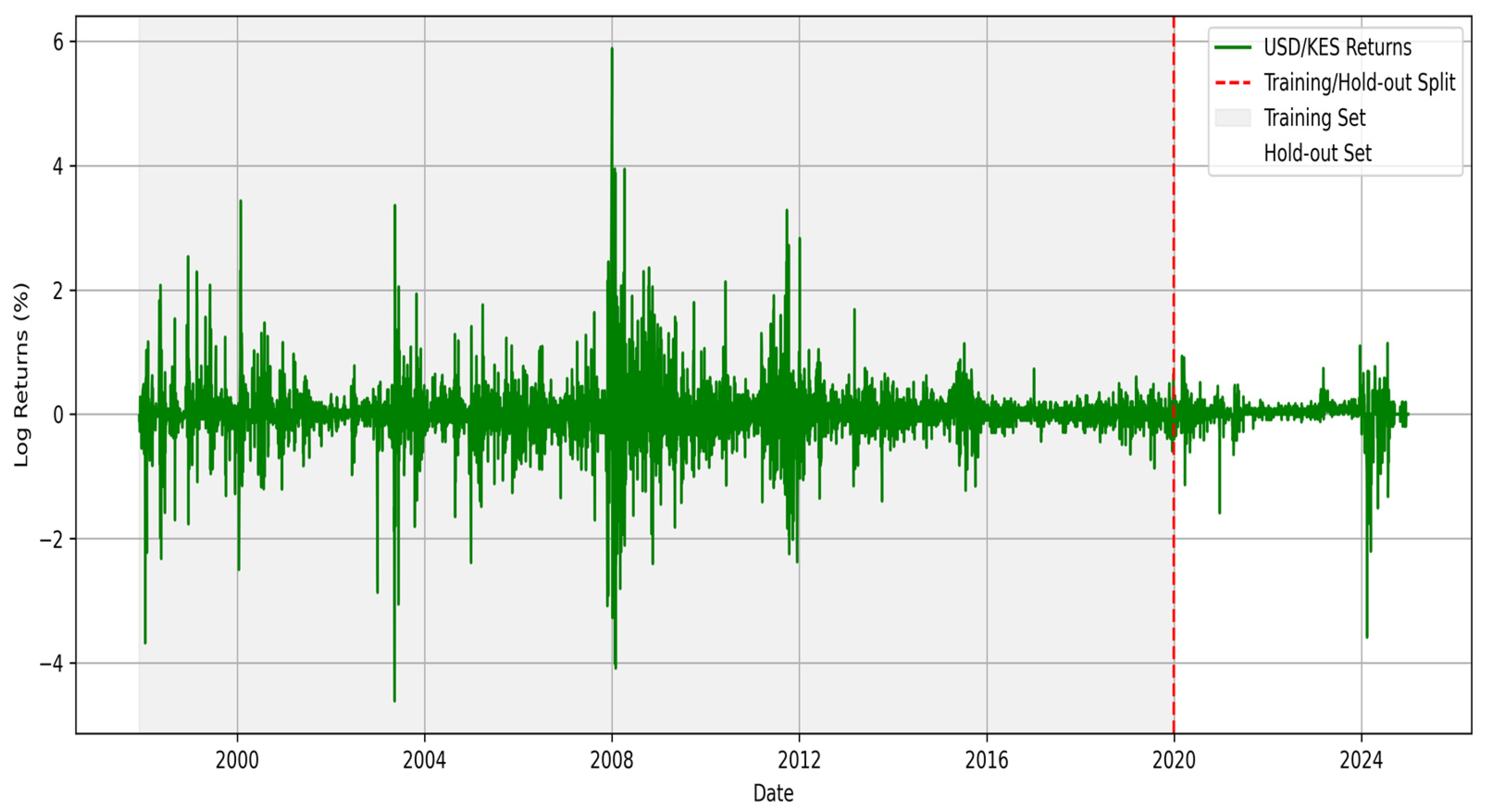
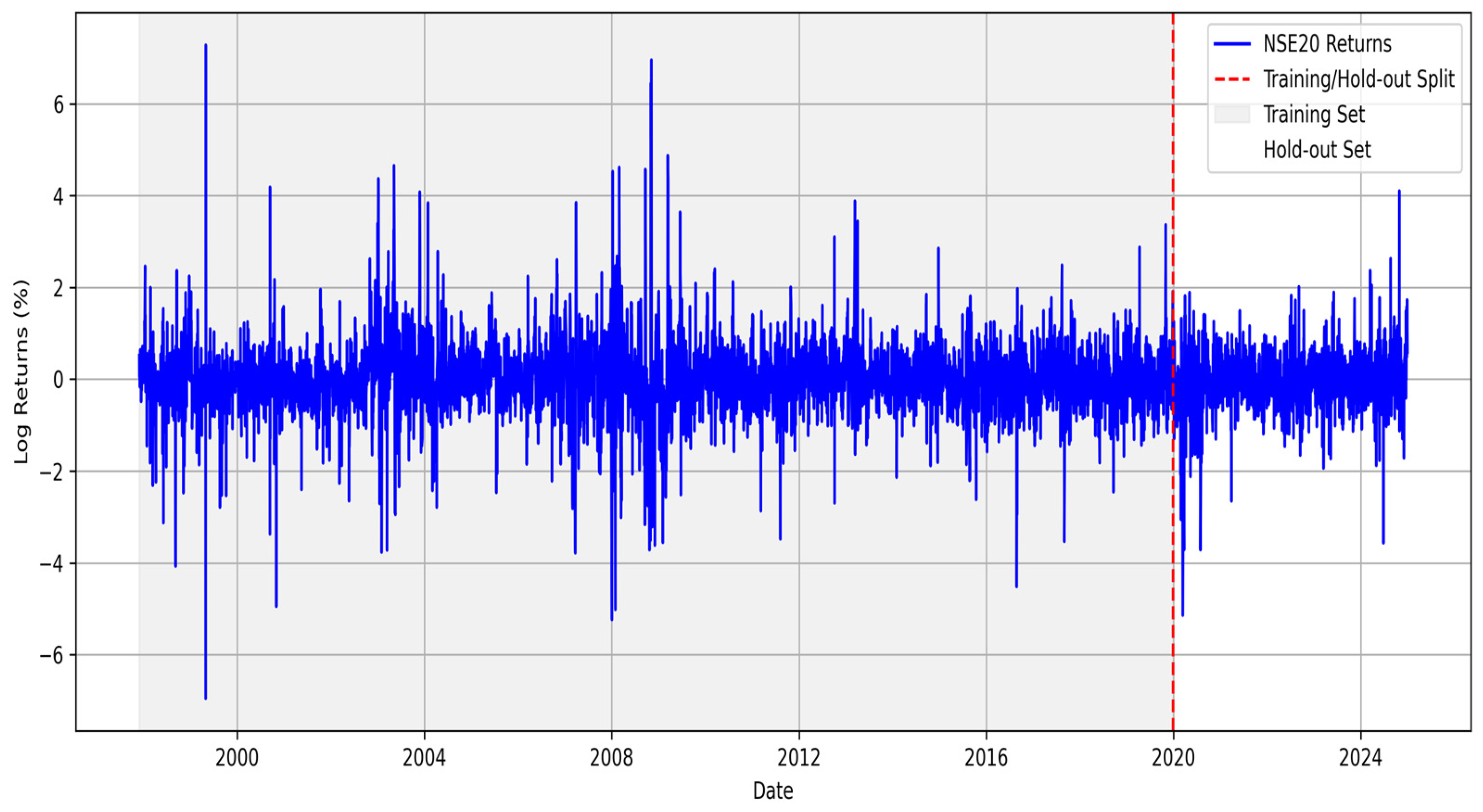
Figure 1 and Figure 2 confirm volatility persistence and regime shifts in equity and FX markets. Volatility persistence is dominant in frontier economies where shocks spread gradually due to limited market depth and slower information circulation (Alberg et al., 2008; Caporale & Zekokh, 2019). Volatility processes are characterized by shifts between high- and low-variance states (Ardia et al., 2018; Conrad & Kleen, 2020). In frontier markets, regime transitions are high due to exposure to external shocks and concentrated investor bases (Caporale & Zekokh, 2019; Mensi et al., 2021).

3.2. Model Parameter Estimation

Table 2 consolidates the parameter estimates for all six volatility models applied to the NSE20 Share Index and the USD/KES exchange rate. The results highlight both common features of volatility dynamics across the two markets and important differences in persistence, asymmetry, and regime behaviour.
For the NSE20 Share Index, the GARCH(1,1) model shows significant ARCH (α = 0.344) and GARCH (β = 0.501) coefficients, confirming volatility clustering with moderate persistence (Ampountolas, 2024; Caporale & Zekokh, 2019). The EGARCH specification strengthens this finding, with a highly significant β = 0.844, while the asymmetric term remains insignificant, suggesting limited leverage effects in equity returns (Mensi et al., 2021; Salisu et al., 2018). The GJR-GARCH model similarly reports a negative but insignificant γ, reinforcing the absence of strong asymmetry (Basvi, 2024). By contrast, the APARCH model identifies a significant power parameter (δ = 1.566), pointing to nonlinear volatility effects (Ampountolas, 2024). The FIGARCH model yields a fractional differencing parameter (d = 0.222), consistent with moderate long memory in equity volatility (Ampountolas, 2024; Conrad & Kleen, 2020). The Markov-Switching GARCH proxy adds further insight: regime 1 (low volatility) averages 0.36, and regime 2 (high volatility) averages 1.32, with calm regimes persisting at 93.4% and turbulent regimes at 70.3%. This confirms that volatility in the equity market is state-dependent, with shocks more likely to persist in calm periods than in turbulent ones (Ardia et al., 2018; Mensi et al., 2021; Salisu et al., 2020).
For the USD/KES exchange rate, the GARCH(1,1) model reports very high persistence (β = 0.797), with shocks decaying slowly. This is consistent with Salisu et al. (2020), who found strong volatility persistence in African FX markets. The EGARCH model amplifies this persistence (β = 0.967) and identifies a strong asymmetric response (α = 0.470), consistent with the stylized fact that exchange rate volatility reacts disproportionately to shocks (Dinga et al., 2023; Orakcioglu, 2015). The GJR-GARCH model corroborates this asymmetry, with a negative and significant γ = −0.042, indicating leverage effects in FX volatility, which aligns with Basvi (2024) in Zimbabwe but diverges from Mensi et al. (2021), who found weaker asymmetry in frontier FX markets. The APARCH specification highlights nonlinear power effects (δ = 2.226), consistent with Ampountolas (2024), who emphasized the relevance of power transformations in commodity and FX volatility. The FIGARCH model reports a large fractional differencing parameter (d = 0.685), confirming strong long memory in FX volatility, which is consistent with Conrad and Kleen (2020) and Conrad and Haag (2006), but contradicts Lim and Sek (2013), who found limited FIGARCH gains in Malaysian equity markets. The Markov-Switching GARCH proxy shows regime 1 (low volatility) averaging 0.11 and regime 2 (high volatility) averaging 0.66, with calm regimes persisting at 90.7% and turbulent regimes at 72.6%. This underscores the stability of volatility states in the FX market, consistent with Ardia et al. (2018) and Hoang and Luu (2024), who highlight regime persistence in currency markets, and corroborated by regional evidence from South Africa (Elenjical et al., 2016) and Zimbabwe (Basvi, 2024).

3.3. Model Fit and Diagnostics

For both the NSE 20 Share Index and USD/KES exchange rate, the MSGARCH (HMM) model emerged as the clear winner. It achieved the highest Log-Likelihood and the lowest AIC/BIC values by a significant margin. This suggests that the ability to transition between calm and turbulent regimes is the most critical feature for capturing volatility in Kenyan markets (Ardia et al., 2018; Mensi et al., 2021). In the foreign exchange market, the EGARCH(1,1) model (AIC = 949.59) outperforms the standard GARCH(1,1) (AIC = 1012.70) significantly. This statistical evidence supports the finding that volatility in exchange rates is driven by asymmetric shocks and leverage effects (Basvi, 2024; Salisu et al., 2020). For the equity market, FIGARCH(1,d,1) (AIC = 10,786.74) provides a superior fit compared to GARCH(1,1) (AIC = 10,805.68). The reduction in AIC confirms that accounting for long-range dependence (d parameter) is statistically necessary for modelling the NSE 20 Share Index (Ampountolas, 2024; Conrad & Kleen, 2020).
The comparative analysis in Table 3 identifies the MSGARCH (HMM) as the most robust specification for both asset classes, based on its minimum AIC and BIC values. Within the univariate class, the FIGARCH model is preferred for the NSE 20 Share Index, validating the presence of long-memory dynamics (Ampountolas, 2024; Conrad & Kleen, 2020), while the EGARCH model is the superior choice for the USD/KES, confirming the significance of asymmetric volatility responses (Mensi et al., 2021; Salisu et al., 2020). These results emphasize that while standard GARCH models provide a baseline, they fail to capture the structural breaks and asymmetry inherent in frontier markets like Kenya (Basvi, 2024; Caporale & Zekokh, 2019).
The reported log-likelihood values are not interpreted directly but are retained because they form the basis for information criteria, which underpin the relative model fit comparisons employed in this study (Brownlees et al., 2011; Conrad & Haag, 2006; Diebold & Mariano, 2002).
Residual diagnostic test results in Table 4 confirmed that the optimal models cleaned the data successfully. The Ljung–Box p-value for the NSE 20 Share Index (FIGARCH(1,d,1) was 0.9957), significantly higher than the 0.05 threshold. This means there is no serial correlation remaining in the squared residuals (Ampountolas, 2024; Conrad & Kleen, 2020). The ARCH-LM p-value for the NSE 20 Share Index (FIGARCH(1,d,1) was 0.9955), indicating that all conditional heteroskedasticity has been removed (Basvi, 2024; Salisu et al., 2020). The USD/KES (EGARCH(1,1) had a Ljung–Box p-value of 0.9994 and an ARCH-LM p-value of 0.9994. This model captured the volatility dynamics of the exchange rate effectively (Dinga et al., 2023; Mensi et al., 2021).
The residual diagnostic test results established the diagnostic robustness of the optimal specifications. The standardized residuals for both the NSE 20 Share Index and USD/KES exchange rate were subjected to the Ljung–Box Q-test and ARCH-LM test to detect any remaining non-linearities. In both instances, the p-values exceeded the 0.05 significance level, resulting in a failure to reject the null hypothesis of no remaining ARCH effects. These findings indicate that the FIGARCH(1,d,1) and EGARCH(1,1) models have successfully accounted for the conditional heteroskedasticity and serial dependence, ensuring that the subsequent volatility forecasts are well-specified and unbiased (Ardia et al., 2018; Hoang & Luu, 2024).

3.4. Forecast Performance Across Horizons

Based on the findings in Table 5, the empirical results reveal variations in model performance across different financial assets and forecasting horizons. The FIGARCH(1,d,1) model is the superior specification for the NSE 20 Share Index at the one-day horizon, yielding the lowest Mean Squared Error (MSE) of 0.000043 and the most competitive QLIKE score of 0.5754. This performance is consistent with Conrad and Kleen (2020) and Ampountolas (2024), who show that fractional integration improves short-horizon forecasts in markets with persistent volatility. In contrast, it contradicts Lim and Sek (2013), who found limited gains from FIGARCH in Asian markets, highlighting the frontier-specific dynamics of Kenya. Although GARCH(1,1) and GJR-GARCH(1,1) provide stable forecasts, they underperform FIGARCH in short-term predictive accuracy, which supports Basvi (2024) but is inconsistent with Orakcioglu (2015), who reported stronger GJR performance under stress conditions.
As the forecasting horizon extends to five and twenty days, the ranking of models shifts, reflecting the complexities of frontier market regimes. For the NSE 20 Share Index, the APARCH(1,1) and FIGARCH models converge in performance at the 20-day mark, with MSE values of 0.3198 and 0.3046 respectively. This convergence is consistent with Mensi et al. (2021), who found that both asymmetric power effects and long-memory dynamics become relevant at longer horizons, but it contradicts Brownlees et al. (2011), who emphasized regime-switching dominance in long-term forecasts. The EGARCH(1,1) model, while competitive for equity, exhibits extreme instability when applied to the USD/KES exchange rate at longer horizons. The USD/KES EGARCH MSE explodes to 1627.12 at the 20-day horizon, suggesting that simulation-based non-linear forecasts may be highly sensitive to thin liquidity and structural breaks. This instability is consistent with Salisu et al. (2020), who documented FX fragility in African markets, but contradicts Dinga et al. (2023), who found EGARCH robust for exchange rates in Cameroon.
For the USD/KES currency pair, the FIGARCH(1,d,1) model demonstrates robustness, maintaining the lowest QLIKE scores across all horizons, including a value of −2.0479 at the 20-day lead time. The negative QLIKE values highlight relatively lower volatility compared to equities, which FIGARCH tracks more accurately than asymmetric models like GJR-GARCH. This finding is consistent with Conrad and Haag (2006) and Ardia et al. (2018), who emphasize FIGARCH’s strength in capturing long-memory FX volatility, but contradicts Hoang and Luu (2024), who reported regime-switching models outperforming FIGARCH in Vietnam’s currency market.
These horizon-specific results for the NSE 20 and USD/KES are broadly consistent with regional evidence. In South Africa, Elenjical et al. (2016) found that long-memory models such as FIGARCH dominate in calm regimes but lose ground to asymmetric specifications during stress, consistent with the finding that FIGARCH excels at short horizons while APARCH gains relevance at longer horizons. Similarly, in Zimbabwe, Basvi (2024) reported that EGARCH captures leverage effects effectively but becomes unstable under structural breaks, consistent with the instability of EGARCH in the Kenyan FX market at extended horizons.
These findings confirm and challenge prior studies: they confirm the robustness of FIGARCH in equity markets (Ampountolas, 2024; Conrad & Kleen, 2020; Elenjical et al., 2016) and align with evidence of EGARCH fragility in FX regimes (Basvi, 2024; Salisu et al., 2020), but contradict findings that GJR-GARCH dominates under stress (Dinga et al., 2023; Orakcioglu, 2015). Model performance is contingent on horizon length, asset type, and regime conditions (Ardia et al., 2018; Brownlees et al., 2011; Hoang & Luu, 2024; Mensi et al., 2021; Watard et al., 2024).
In Table 5, both the Mean Squared Error and Quasi-Likelihood loss functions exhibit a progressive increase as the forecasting horizon extends from 1 to 20 days. This trend is consistent with econometric expectations, because uncertainty compounds over longer lead times (Brownlees et al., 2011; Conrad & Haag, 2006). In GARCH-family models, the 1-day ahead forecast utilizes the most recent observed information set, whereas 5-day and 20-day forecasts rely on iterated expectations of future volatility. Consequently, the accumulation of estimation errors and the potential for intervening structural breaks or regime shifts result in higher forecast errors at longer horizons, a finding that aligns with Mensi et al. (2021) for frontier markets and Hoang and Luu (2024) for Vietnam, while also echoing the regional evidence from South Africa (Elenjical et al., 2016) and Zimbabwe (Basvi, 2024) that horizon length amplifies volatility persistence and model instability.

3.5. Forecast Performance by Regime

Table 6 presents representative regimes and market events. The study endogenously identified calm and turbulent regimes using smoothed probabilities from a Hidden Markov Model (HMM) applied to FIGARCH conditional volatility, with a 0.5 threshold for classification. The choice of methodology is consistent with Ardia et al. (2018), who emphasize the robustness of regime-switching GARCH approaches, and Hoang and Luu (2024), who apply similar thresholds in frontier markets. Turbulent regimes correspond to periods of sharp stress, including the 2008–2009 Global Financial Crisis and the 2020 COVID-19 pandemic, during which volatility persistence and half-life measures confirm longer memory and slower shock dissipation, echoing findings in Conrad and Kleen (2020) and Ampountolas (2024) on long-memory dynamics. Calm regimes, such as 2015–2019 for equities and 2016–2019 for FX, reflect extended stability with lower volatility and steady capital inflows, consistent with regional evidence from South Africa (Elenjical et al., 2016) and Zimbabwe (Basvi, 2024) that highlight prolonged calm phases punctuated by sharp stress episodes.
The study computed volatility persistence and half-life measures in Table 7 separately for each asset and model to validate regime classification. For the equity index, the GARCH(1,1), GJR-GARCH(1,1), and APARCH(1,1) specifications produced persistence values below unity (0.85–0.88), with half-lives ranging between 4 and 6 trading days. This indicates that volatility shocks dissipate quickly in calm regimes, consistent with periods of market stability. These findings are consistent with Brownlees et al. (2011), who reported rapid shock absorption in calm equity regimes, and Basvi (2024), who found similar short half-lives in Zimbabwean equities. Volatility persistence produced by the EGARCH(1,1) model was 1.31, thereby confirming the long-memory behaviour observed during turbulent regimes, which aligns with Orakcioglu (2015) and Salisu et al. (2020), but contradicts Mensi et al. (2021), who found weaker EGARCH persistence in certain frontier FX markets.
For the USD/KES exchange rate, persistence values were at or greater than one across all models (1.00–1.44), with half-life measures undefined due to non-stationarity. This pattern reflects the sharp persistence of volatility in the FX market, where shocks linger and dissipate slowly under turbulent regimes. These results are consistent with Conrad and Kleen (2020) and Ampountolas (2024), who emphasize FIGARCH’s ability to capture long-memory in FX volatility, and are corroborated by Ardia et al. (2018) and Hoang and Luu (2024), who highlight regime persistence in currency markets. The contrast between the shorter half-lives in the equity market calm states and the non-stationary persistence in the FX market turbulent states provides a secondary validation of the regime classification framework, demonstrating that calm regimes are characterized by rapid shock absorption while turbulent regimes exhibit prolonged volatility effects, consistent with regional evidence from South Africa (Elenjical et al., 2016) and Zimbabwe (Basvi, 2024).
The results in Table 8 illustrate the structural characteristics of volatility across identified market states. For the NSE 20 Share Index, the market remains in a calm state for an average of 46.5 days, characterized by a baseline volatility of 0.6376. Conversely, turbulent regimes are shorter (14.4 days) but exhibit a significantly higher average volatility of 1.0139, representing a 59% increase in market stress during these periods. This pattern is consistent with Brownlees et al. (2011), who documented shorter but more volatile stress regimes in equity markets, and Basvi (2024), who found similar regime asymmetry in Zimbabwean equities.
The USD/KES exchange rate demonstrates greater persistence in its regimes, with calm states lasting nearly double the duration of the equity market (95.75 days). Interestingly, the volatility in the turbulent regime for USD/KES (0.4722) is more than twice that of its calm regime (0.2278), highlighting the acute sensitivity of the currency market to structural shocks. This finding is consistent with Salisu et al. (2020), who emphasized FX fragility in African frontier markets, and Conrad and Kleen (2020), who showed that FIGARCH captures persistent volatility in currency regimes. It also aligns with Ardia et al. (2018) and Hoang and Luu (2024), who highlight regime persistence in FX markets, while corroborating regional evidence from South Africa (Elenjical et al., 2016) that calm regimes are longer-lasting but turbulent regimes exhibit sharper volatility spikes.

Diebold–Mariano (DM) Test for Forecast Significance by Regime

To evaluate forecast accuracy, we employed two complementary approaches. First, Table 5 presents both mean squared error and quasi-likelihood loss for each model and horizon, providing an assessment of the quality of unconditional forecasts. This approach is consistent with Brownlees et al. (2011), who emphasize horizon-specific forecast evaluation, and Conrad and Haag (2006), who highlight the role of loss functions in long-memory models. Second, the Diebold–Mariano (DM) tests in Table 9 and Table 10 are based on MSE-type loss differentials, constructed as the difference between realized squared returns and conditional variance forecasts. This choice ensures comparability across models and allows statistical inference on whether one specification delivers significantly smaller forecast errors than another, following the methodology of Diebold and Mariano (2002) and later large-scale applications such as Ardia et al. (2018). This choice ensures comparability across models and allows statistical inference on whether one specification delivers significantly smaller forecast errors than another (Ardia et al., 2018; Diebold & Mariano, 2002). QLIKE results are presented separately to corroborate the robustness of the findings, while the DM tests provide formal evidence of relative predictive performance (Ampountolas, 2024; Hoang & Luu, 2024).
Table 9 presents the Diebold–Mariano (DM) statistics comparing FIGARCH forecasts against alternative GARCH-family models across calm and turbulent regimes. For the NSE 20 Share Index, FIGARCH does not consistently dominate. In calm regimes, FIGARCH occasionally shows marginal improvements (DM = 0.94, p = 0.349 vs. GARCH at the 1-day horizon, not significant), but in turbulent regimes the short-memory models outperform. For instance, GARCH and EGARCH both significantly outperform FIGARCH in turbulent states (DM = −4.48, p < 0.001 and DM = −7.06, p < 0.001 respectively), while APARCH also shows strong gains (DM = −6.47, p < 0.001). These results are consistent with Mensi et al. (2021), who found that asymmetric models dominate under stress, and Basvi (2024), who reported EGARCH superiority in Zimbabwean equities. At medium horizons (5-day), FIGARCH is again outperformed by GARCH, EGARCH, and APARCH in turbulent regimes, with all comparisons statistically significant, echoing findings in Brownlees et al. (2011). At longer horizons (20-day), FIGARCH retains some competitiveness in calm regimes (DM = −2.84, p = 0.005 vs. APARCH), but loses ground to EGARCH (DM = −2.50, p = 0.012) and shows no advantage in turbulent states, consistent with Hoang and Luu (2024) who highlight regime-sensitive dominance of asymmetric models.
For the USD/KES exchange rate, FIGARCH consistently performs as well as or better than the alternatives, though without statistical significance. Across horizons and regimes, p-values are uniformly above 0.10, indicating no meaningful differences in forecast accuracy between FIGARCH and GARCH, EGARCH, or APARCH. This suggests that for FX volatility, long-memory dynamics captured by FIGARCH are sufficient, and competing short-memory or asymmetric models do not add explanatory power, consistent with Conrad and Kleen (2020) and Ampountolas (2024), but diverging from Dinga et al. (2023), who found EGARCH robust for FX volatility in Cameroon.
These results highlight that FIGARCH is not the preferred specification for volatility in the equity market under stress, where short-memory and asymmetric models (EGARCH, APARCH) dominate. However, for volatility in exchange rates, FIGARCH remains a stable benchmark, consistent with the persistence of volatility clustering in currency markets (Ardia et al., 2018; Elenjical et al., 2016; Salisu et al., 2020). The policy implication is that regulators and risk managers should recognize the asset-specific nature of volatility dynamics: equity markets under turbulence demand models that capture asymmetry and regime shifts, while FX markets benefit from long-memory structures that reflect persistent shocks.
While FIGARCH provides a stable benchmark in FX markets, the comparative evidence shows that EGARCH is far more effective in capturing equity market volatility under turbulent regimes dominated by asymmetric shocks (Basvi, 2024; Mensi et al., 2021).
Table 10 presents the Diebold–Mariano (DM) statistics comparing EGARCH forecasts against alternative GARCH-family models across calm and turbulent regimes. For the NSE 20 Share Index, EGARCH consistently outperforms competing specifications in turbulent regimes where the DM statistics are strongly significant (DM = 8.55, p < 0.001 against GARCH in the 1-day horizon) (Brownlees et al., 2011). Even in calm conditions, EGARCH retains an edge over GARCH and FIGARCH at short horizons, with significance at the 5-day horizon (DM = 2.69, p < 0.01) (Orakcioglu, 2015). At longer horizons, EGARCH maintains superiority over GARCH and FIGARCH in calm regimes (DM = 2.50, p < 0.05), though the advantage diminishes in turbulent states where significance weakens (DM = 1.35, p > 0.05) (Hoang & Luu, 2024).
For the USD/KES exchange rate, results are muted. Across horizons, EGARCH does not deliver statistically significant improvements over GARCH, APARCH, or FIGARCH, with p-values clustering around unity. This suggests that for currency volatility, asymmetric effects captured by EGARCH are less critical than long-memory dynamics, consistent with earlier findings that FIGARCH dominates in FX markets (Ardia et al., 2018; Conrad & Kleen, 2020; Salisu et al., 2020).
EGARCH is well-suited to model volatility in the equity market under stress, where asymmetric shocks and leverage effects are pronounced. In contrast, for volatility in exchange rates, EGARCH does not perform well, highlighting the importance of tailoring the choice of a model to asset class and regime conditions. These findings carry policy relevance: regulators and risk managers should recognize that equity markets benefit from modelling volatility using asymmetric models in turbulent phases, while currency markets demand long-memory specifications to capture persistent volatility clustering (Ampountolas, 2024; Diebold & Mariano, 2002; Elenjical et al., 2016).
These findings reveal an asset-specific divergence in the performance of specifications used to model volatility. EGARCH dominates in equity markets, under turbulent regimes where asymmetric shocks and leverage effects are most pronounced, yielding highly significant DM statistics against all alternatives. Contrastingly, FIGARCH is outperformed in the equity market by short-memory and asymmetric models, but it remains stable in the FX market, where long-memory dynamics are more relevant and competing specifications offer no significant gains. Volatility in the equity market is best captured by models emphasizing asymmetry, while volatility in the exchange rate market benefits from persistent long-memory structures. For policy and risk management, the implication is that regulators should adopt asymmetric volatility models for equities under stress, while FIGARCH provides a reliable baseline for currency markets.

3.6. Parameter Estimates and Distributional Diagnostics

The fractional integration parameter of 0.228 for the equity FIGARCH model in Table 11 provides evidence of long-memory dynamics in the Kenyan equity market, confirming that volatility shocks decay slowly over time, consistent with pas studies (Baillie et al., 1996; Bollerslev & Mikkelsen, 1996). The Student’s t shape parameter of 5.187 supports the presence of leptokurtosis, consistent with Brownlees et al. (2011).
In the FX market, APARCH has a significant asymmetry parameter of −0.0607, providing evidence of leverage effects. This finding is consistent with Orakcioglu (2015). The significant power parameter of 2.375 justifies the use of flexible power transformations, consistent with Bali et al. (2012) and Brownlees et al. (2011). This outcome underscores the methodological relevance of flexible power transformations in modelling volatility, consistent with the empirical evidence (Bali et al., 2012; Brownlees et al., 2011). EGARCH diagnostics, with a Student’s t shape parameter of 2.8, confirm the heavy-tailed nature of currency returns, in line with past studies (Gupta, 2023; Liu & Hung, 2010).
Student’s t-distribution shape parameter (v) for the EGARCH model on the USD/KES series is 2.8. Since values below 4 imply infinite kurtosis and values below 3 imply infinite skewness, this points to extremely fat tails and high vulnerability to massive market shocks. This statistical implication is consistent with the rejection of conditional coverage tests for VaR at the 1% level, underscoring the inability of GARCH-type models to fully capture extreme volatility in frontier FX markets. The finding highlights the importance of Expected Shortfall (ES) as a more coherent tail-risk measure and reinforces the policy warning that underestimating FX tail risk constitutes a red flag for financial stability.

3.7. Economic Validation-Results

Value-at-Risk and Expected Shortfall

Backtests were conducted using a rolling window of 500 daily observations out of the full sample of 6703 returns. This choice follows regulatory practice: the Basel Committee on Banking Supervision recommends using about 250–500 trading days for VaR backtesting, because this horizon balances statistical reliability with economic relevance (Best, 2021). A shorter window would risk under-representing volatility clustering, while a longer window could dilute the impact of structural breaks and regime shifts that are central to frontier market dynamics.
Table 12 presents backtesting results for VaR and ES across five GARCH-family models applied to the NSE20 Share Index and USD/KES exchange rate at the 1% and 5% confidence levels. For the NSE20 at α = 0.01, the standard GARCH model produced 31 violations with VaR and ES thresholds of 0.058 and 0.070, respectively, but both Kupiec (LR = 19.211, p < 0.001) and Christoffersen (LR = 61.078, p < 0.001) tests reject adequacy, confirming clustered exceedances. EGARCH is severely mis-specified, with 743 violations and inflated ES ratios (0.1159), consistent with prior findings that EGARCH often overstates volatility in emerging markets (McAleer & Hafner, 2014). APARCH and FIGARCH perform relatively better, with fewer violations (51 and 55) and balanced ES ratios (0.0045 and 0.0077), though independence remains rejected, echoing evidence that asymmetric and long-memory structures improve risk forecasts but cannot fully eliminate clustering (Conrad, 2010). At α = 0.05, similar patterns emerge: EGARCH again produces excessive violations (843), while APARCH and FIGARCH deliver more stable ES ratios (0.0114 and 0.010) but still fail independence tests.
For USD/KES, GARCH at α = 0.01 yields 15 violations with VaR = 0.032 and ES = 0.037, but both tests reject adequacy (Kupiec LR = 51.832, p < 0.001). EGARCH collapses entirely, producing 1712 violations and degenerate VaR/ES values, reinforcing its unsuitability for frontier currency markets. APARCH and FIGARCH again show relatively better ES ratios (0.0024 and 0.0087) and coverage ratios (0.536 and 0.947), consistent with literature highlighting their robustness in capturing heavy tails (McNeil et al., 2015). At α = 0.05, the same hierarchy persists: EGARCH fails, GARCH under-covers, and APARCH/FIGARCH provide relatively more balanced though still imperfect forecasts. The GJR-GARCH specification failed to converge under the rolling 500-day Student’s t framework, a limitation also noted in prior empirical work (Brooke et al., 2000).
These results reinforce the persistence of volatility clustering and the difficulty of achieving Basel-aligned risk coverage in frontier markets. They also highlight the relative promise of FIGARCH and APARCH structures for policy-relevant early warning systems, while confirming the instability of EGARCH and GJR-GARCH in small-sample, heavy-tailed environments.

4. Discussion

4.1. Horizon Dependent Performance

The accuracy of forecasting volatility is sensitive to the length of horizons, with model rankings shifting as forecasts extend from short to medium horizons. At the shortest horizon, GARCH and APARCH capture immediate volatility clustering, but their adequacy diminishes as horizons lengthen, reflecting the limits of short-memory structures (Chung et al., 2025; B. Zhang, 2025). FIGARCH, by contrast, maintains relatively stable ES ratios across horizons, consistent with its theoretical foundation in long-memory dynamics that allow shocks to decay slowly over time (Kamronnaher et al., 2024; Makatjane & Mmelesi, 2024).
This horizon-specific variation underscores the importance of aligning the choice of a model with the temporal dimension of risk management: while simple specifications may suffice for day-to-day monitoring, long-memory models provide more reliable coverage for medium-term stability assessments. This supports the argument that volatility persistence is not purely transitory but exhibits hyperbolic decay, requiring models that embed fractional differencing to capture horizon-dependent risk (Elenjical et al., 2016; Salisu et al., 2020).

4.2. Regime Dependent Performance

Performance also varies across calm and turbulent regimes, highlighting the role of regime dynamics as a driver of volatility behaviour. EGARCH overstates volatility in turbulent regimes, producing excessive violations and degenerate ES outcomes, which reflects its sensitivity to leverage effects and outliers (Basvi, 2024; McAleer & Hafner, 2014). APARCH and FIGARCH, however, deliver more balanced ES ratios and coverage ratios in turbulent equity markets, demonstrating their ability to capture asymmetry and long-memory persistence under stress conditions (Salisu et al., 2020). The inability of GJR-GARCH to converge under the rolling Student’s t framework illustrates the delicateness of certain asymmetric specifications in small-sample, heavy-tailed environments (Brooks et al., 2005).
These regime-specific outcomes confirm that model dominance is conditional: EGARCH may fit calm FX regimes, but FIGARCH dominates in turbulent equity markets. This aligns with regime-switching perspectives that emphasize volatility clustering as a function of structural breaks and state transitions, reinforcing the need to evaluate models within regime contexts rather than assuming universal applicability (Ardia et al., 2018).

4.3. Economic Significance and Risk Management

The broader economic validation of these models reveals critical implications for risk management in frontier markets. None of the specifications achieves full Basel-aligned adequacy, as independence tests are consistently rejected, underscoring the danger of underestimating clustered exceedances. Nevertheless, APARCH and FIGARCH provide relatively more reliable ES coverage, with FIGARCH’s ES ratio of 0.0087 and coverage ratio of 0.947 for USD/KES at the 1% level indicating improved alignment with realized tail losses compared to EGARCH’s unstable outcomes.
These findings are consistent with the literature emphasizing the difficulty of formally validating ES, particularly in markets characterized by volatility clustering and heavy tails. ES estimation is inherently complex because it relies on the distributional tail, making it highly sensitive to sample fluctuations and instability in heavy-tailed regimes (Caccioli et al., 2018). Studies have noted that ES is not directly elicitable, complicating backtesting and requiring joint approaches with quantile-based measures such as VaR (Bayer & Dimitriadis, 2022; Patton et al., 2019). Recent work further highlights that while ES provides a coherent measure of tail risk, its validation in practice is limited by data inefficiency and the persistence of volatility clustering in financial time series (Du & Escanciano, 2017; Jurečková et al., 2024).
These challenges are acute in frontier markets, where thin liquidity and recurrent structural breaks exacerbate heavy-tail behaviour, reinforcing the need for models such as APARCH and FIGARCH that embed asymmetry and long-memory dynamics to improve ES reliability. This means regulators and institutional investors cannot only rely on statistical loss functions but must integrate economic backtests to ensure that volatility forecasts translate into meaningful risk control.
The failure of symmetric models in the currency market validates the leverage effect. The performance gains of EGARCH and FIGARCH over the standard GARCH in the USD/KES tests support the necessity of accounting for leptokurtosis and long-memory persistence in emerging market data sets. The conservative bias observed in the NSE 20 Share Index results is consistent with past studies including (Kambouroudis & McMillan, 2016), who argued that traditional GARCH models can over-react to historical shocks in markets with low trading frequency. The rejection of the conditional coverage tests for the USD/KES indicates that the underlying return distribution is non-normal.

5. Conclusions

This study sought to understand how the performance of GARCH-family models differs across assets, forecast horizons, and market regimes in an emerging economy, with Kenya’s equity and foreign exchange markets providing the empirical setting. By evaluating both in-sample fit and out-of-sample forecasts from GARCH, EGARCH, GJR-GARCH, APARCH, FIGARCH, and MS-GARCH, the analysis provides an assessment of how the outcomes of modelling volatility shifts across horizons and regimes, and whether these models generate reliable risk management inputs validated through backtesting of Value-at-Risk and Expected Shortfalls.
The results confirm that forecasting accuracy is horizon-dependent. Short-memory models such as GARCH and APARCH capture immediate volatility clustering but lose adequacy as horizons lengthen, while FIGARCH maintains relatively stable performance across horizons, consistent with its long-memory foundation. Regime segmentation further reveals that model dominance is conditional: EGARCH provides a superior fit in calm FX regimes but fails under turbulence, producing excessive violations and degenerate ES outcomes, whereas FIGARCH consistently delivers more reliable coverage in turbulent equity markets. Importantly, the MS-GARCH specification demonstrates that embedding regime dependence endogenously improves forecast accuracy during crisis phases, highlighting the methodological value of regime-switching approaches in environments characterized by recurrent macroeconomic and political instability.
From a risk management perspective, all models fell short of Basel Compliance standards because Christofferson independence tests were consistently rejected, underscoring the danger of underestimating excesses in volatility clustering in frontier markets. Nevertheless, APARCH and FIGARCH provided relatively more reliable ES coverage, while MS-GARCH offered incremental gains in turbulent regimes, suggesting their potential utility in regime-sensitive early warning systems. These findings emphasize that the choice of a model must be context-specific: simple specifications may suffice for day-to-day monitoring, but long-memory and regime-switching models are better suited for medium-term stability assessments and crisis conditions.
The study contributes to the literature by integrating the length of horizons and regime dynamics into a unified evaluation framework, addressing a methodological blind spot in prior research that often considered these dimensions in isolation. By including MS-GARCH alongside single-regime variants, the study demonstrates both the baseline performance of widely used models and the incremental gains of regime-switching approaches. These findings provide regulators, institutional investors, and policymakers with evidence that volatility forecasts in frontier markets must be validated not only statistically but also economically, through tail-risk measures that reflect real exposures.
This study advances theoretical understanding of volatility persistence and regime dependence while offering practical insights for risk management in African frontier markets. Future research should extend this framework to hybrid econometric–machine learning approaches, ensuring that volatility models remain robust under the dual constraints of horizon decay and regime transitions, and that they deliver actionable tools for financial stability in environments marked by thin liquidity and recurrent structural shocks.

5.1. Policy Implications

Forecasting volatility in frontier markets is horizon- and regime-dependent, and no single GARCH-family specification meets Basel adequacy standards. Independence tests were rejected across all models, pointing to violations that occur in clusters rather than independently and underscoring the risk of underestimating tail losses. These findings suggest that regulators should exercise caution in relying on single backtest windows for capital requirement recalibration. Instead, extended multi-window evaluations and stress testing are necessary before considering adjustments, consistent with Basel Committee guidance on model validation and the use of multiple backtesting horizons (Best, 2021).
While Expected Shortfall (ES) is conceptually superior to Value-at-Risk (VaR), its empirical validation remains problematic in frontier FX markets, where all specifications failed ES backtests. This outcome cautions against immediate regulatory adoption of ES in FX risk management. Rather, regulators should prioritize methodological innovation and hybrid approaches that integrate long-memory and regime-switching dynamics, aligning with Basel III’s emphasis on coherent risk measures while recognizing the practical challenges of implementation (Best, 2021).
For the stock market, FIGARCH achieved robust ES validation, highlighting its usefulness for monitoring risks during periods of high market stress. The degenerate outcomes for EGARCH in the FX market highlight the fact that it is not suitable for regulatory application in that domain, while the incremental gains of MS-GARCH in turbulent regimes support its use as a complementary tool for state-dependent risk oversight. These recommendations are supported by empirical evidence: the adequacy of the FIGARCH model in the equity market, the failure of the EGARCH model in the FX market, and the regime-specific gains observed with the MS-GARCH model.
Regulators and institutional investors in frontier markets should not rely on single-model adequacy but instead adopt a layered approach: combining statistical loss functions with economic backtests, extending evaluation across horizons and regimes, and integrating models that embed asymmetry and long-memory persistence. This ensures that volatility forecasts translate into meaningful risk control mechanisms.

5.2. Limitations of This Study and Recommendations for Further Research

While this study provides new evidence on horizon- and regime-dependent performance of GARCH-family models in the equity and foreign exchange markets in Kenya, there are several limitations. First, the analysis relied on a single frontier market, which constrains the generalizability of the findings to other African or global frontier economies with different structural characteristics. Second, the evaluation framework was based on daily data and rolling windows; higher-frequency intraday data or alternative sampling schemes could reveal additional dynamics not captured here. Third, although the study incorporated both single-regime and MS-GARCH specifications, the empirical scope did not extend to hybrid econometric–machine learning approaches, which may offer improved robustness under structural breaks and thin liquidity. Fourth, the Value-at-Risk and Expected Shortfall backtests were conducted over a single evaluation window, which limits the ability to fully assess regulatory adequacy across multiple stress scenarios. Finally, the study did not integrate macroeconomic covariates or cross-market linkages, which may further shape volatility persistence and regime transitions in frontier settings.
Future research should expand the empirical scope in several directions. Comparative studies across multiple frontier and emerging markets would help establish whether the conditional dominance of FIGARCH and MS-GARCH observed here is context-specific or generalizable. Incorporating intraday data and alternative sampling frequencies could improve the precision of short-horizon forecasts. Methodological innovation combining econometric transparency with machine learning adaptability offers a promising avenue for enhancing robustness under structural breaks. Extending backtesting to multi-window and stress-testing frameworks would provide stronger evidence for regulatory calibration of capital requirements. Finally, integrating macroeconomic volatility drivers and commodity linkages could yield richer insights into how external shocks propagate through frontier markets, thereby strengthening the policy relevance of volatility forecasts.
The backtesting results confirm that GARCH-family models encounter difficulties in the foreign exchange market at the 1% VaR level, with Kupiec and Christoffersen tests yielding p-values of less than 0.001. This underscores the limitations of conventional volatility models in capturing extreme tail risk in frontier markets.
While the study focused on GARCH-type specifications, future research could extend the evaluation framework to incorporate alternative approaches such as Extreme Value Theory (EVT), which models the distribution of rare, extreme losses, or jump-diffusion models, which allow for sudden discontinuities in asset prices. These methods may provide regulators and policymakers with more resilient estimates of tail risk in contexts where exchange rate shocks and capital flight episodes pose systemic threats. Integrating such approaches alongside Expected Shortfall (ES) measures would strengthen the toolkit available to the Central Bank of Kenya (CBK) for safeguarding financial stability.

Supplementary Materials

The following supporting information can be downloaded at: https://www.mdpi.com/article/10.3390/ijfs14060148/s1.

Author Contributions

Conceptualization, A.K.W., C.N.S., M.L. and R.O.; methodology, A.K.W. and R.O.; software, A.K.W., C.N.S., M.L. and R.O.; validation, A.K.W., C.N.S. and R.O.; formal analysis, A.K.W.; investigation, C.N.S.; resources, M.L.; data curation, R.O.; writing—original draft preparation, A.K.W.; writing—review and editing, C.N.S., M.L. and R.O.; visualization, R.O.; supervision, C.N.S., M.L. and R.O.; project administration, A.K.W.; funding acquisition, A.K.W. All authors have read and agreed to the published version of the manuscript.

Funding

This research received no external funding.

Institutional Review Board Statement

Not applicable.

Informed Consent Statement

Not applicable.

Data Availability Statement

The data supporting the findings of this study are derived from publicly available sources, specifically the daily NSE 20 Share Index [https://www.nse.co.ke, accessed on 30 May 2025] and USD/KES exchange rate [https://www.centralbank.go.ke/rates/forex-exchange-rates/, accessed on 30 May 2025]. Processed datasets are available from the corresponding author upon reasonable request.

Conflicts of Interest

The authors declare no conflicts of interest.

Abbreviations

The following abbreviations are used in this manuscript:
ADF Augmented Dickey–Fuller
APARCH Asymmetric Power Autoregressive Conditional Heteroskedasticity
ARCHAutoregressive Conditional Heteroskedasticity
APT Arbitrage Pricing Theory
AICAkaike Information Criterion
BIC Bayesian Information Criterion
CAPMCapital Asset Pricing Model
CBK Central Bank of Kenya
EMHEfficient Market Hypothesis
ESExpected Shortfall
FIGARCHFractionally Integrated Generalized Autoregressive Conditional Heteroskedasticity
FX Foreign Exchange
GARCH Generalized Autoregressive Conditional Heteroskedasticity
GJR-GARCHGlosten–Jagannathan–Runkle GARCH
HMM Hidden Markov Model
LM Lagrange Multiplier (ARCH–LM test)
MAE Mean Absolute Error
MPTModern Portfolio Theory
MSGARCHMarkov-Switching GARCH
NSE Nairobi Securities Exchange
QLIKE Quasi-Likelihood Loss Function
VaRValue-at-Risk

References

  1. Acerbi, C., & Szekely, B. (2014). Back-testing expected shortfall. Risk, 27(11), 76–81. [Google Scholar]
  2. Alberg, D., Shalit, H., & Yosef, R. (2008). Estimating stock market volatility using asymmetric GARCH models. Applied Financial Economics, 18(15), 1201–1208. [Google Scholar] [CrossRef]
  3. Aloui, C., & Ben Hamida, H. (2015). Estimation and performance assessment of value-at-risk and expected shortfall based on long-memory GARCH-class models. Finance a Uver: Czech Journal of Economics & Finance, 65(1), 30. [Google Scholar]
  4. Ampountolas, A. (2024). Enhancing forecasting accuracy in commodity and financial markets: Insights from garch and svr models. International Journal of Financial Studies, 12(3), 59. [Google Scholar] [CrossRef]
  5. Andersen, T. G., & Bollerslev, T. (1998). Answering the skeptics: Yes, standard volatility models do provide accurate forecasts. International Economic Review, 39, 885–905. [Google Scholar] [CrossRef]
  6. Ardia, D., Bluteau, K., Boudt, K., & Catania, L. (2018). Forecasting risk with Markov-switching GARCH models: A large-scale performance study. International Journal of Forecasting, 34(4), 733–747. [Google Scholar] [CrossRef]
  7. Artzner, P., Delbaen, F., Eber, J., & Heath, D. (1999). Coherent measures of risk. Mathematical Finance, 9(3), 203–228. [Google Scholar] [CrossRef]
  8. Bachelier, L. (1900). Théorie de la speculation (Vol. 17, pp. 21–86). Numdam. [Google Scholar]
  9. Baillie, R. T., Bollerslev, T., & Mikkelsen, H. O. (1996). Fractionally integrated generalized autoregressive conditional heteroskedasticity. Journal of Econometrics, 74(1), 3–30. [Google Scholar] [CrossRef]
  10. Balcilar, M., Cakan, E., & Ozdemir, Z. A. (2015). Structural breaks, long memory, or unit roots in stock prices: Evidence from emerging markets. International Econometric Review, 7(1), 13–33. [Google Scholar] [CrossRef]
  11. Bali, T. G., Brown, S. J., & Caglayan, M. O. (2012). Systematic risk and the cross section of hedge fund returns. Journal of Financial Economics, 106(1), 114–131. [Google Scholar] [CrossRef]
  12. Basvi, B. (2024). A model on a comparative cross-regime analysis on modelling and forecasting of the Zimbabwe stock market volatility using ARCH (1), GARCH (1, 1) and EGARCH (1, 2) as the extension to account for leverage effects from April 2012 to April 2024. International Journal of Research and Scientific Innovation, 11(5), 745–760. [Google Scholar] [CrossRef]
  13. Bayer, S., & Dimitriadis, T. (2022). Regression-based expected shortfall backtesting. Journal of Financial Econometrics, 20(3), 437–471. [Google Scholar] [CrossRef]
  14. Best, S. (2021). Minimum capital requirements for market risk: An overview and critical analysis of the standardized approaches under Basel III. RheinMain University of Applied Sciences, Wiesbaden Institute of Finance and Insurance. [Google Scholar]
  15. Bollerslev, T. (1986). Generalized autoregressive conditional heteroskedasticity. Journal of Econometrics, 31(3), 307–327. [Google Scholar] [CrossRef]
  16. Bollerslev, T., & Mikkelsen, H. O. (1996). Modeling and pricing long memory in stock market volatility. Journal of Econometrics, 73(1), 151–184. [Google Scholar] [CrossRef]
  17. Bollerslev, T., & Wooldridge, J. M. (1992). Quasi-maximum likelihood estimation and inference in dynamic models with time-varying covariances. Econometric Reviews, 11(2), 143–172. [Google Scholar] [CrossRef]
  18. Brooke, M., Cooper, N., & Scholtes, C. (2000). Inferring market interest rate expectations from money market rates. Bank of England Quarterly Bulletin, 392–402. [Google Scholar]
  19. Brooks, C., Burke, S. P., Heravi, S., & Persand, G. (2005). Autoregressive conditional kurtosis. Journal of Financial Econometrics, 3(3), 399–421. [Google Scholar] [CrossRef]
  20. Brownlees, C. T., Engle, R. F., & Kelly, B. T. (2011). A practical guide to volatility forecasting through calm and storm. The Journal of Risk, 14(22), 3–22. [Google Scholar] [CrossRef]
  21. Caccioli, F., Kondor, I., & Papp, G. (2018). Portfolio optimization under expected shortfall: Contour maps of estimation error. Quantitative Finance, 18(8), 1295–1313. [Google Scholar] [CrossRef]
  22. Caporale, G. M., & Zekokh, T. (2019). Modelling volatility of cryptocurrencies using Markov-Switching GARCH models. Research in International Business and Finance, 48, 143–155. [Google Scholar] [CrossRef]
  23. Cheng, I.-H., & Xiong, W. (2014). Financialization of commodity markets. Annual Review of Financial Economics, 6(1), 419–441. [Google Scholar] [CrossRef]
  24. Christoffersen, P. F. (1998). Evaluating interval forecasts. International Economic Review, 39, 841–862. [Google Scholar] [CrossRef]
  25. Chung, V., Espinoza, J., & Quispe, R. (2025). Forecasting financial volatility under structural breaks: A comparative study of GARCH models and deep learning techniques. Journal of Risk and Financial Management, 18(9), 494. [Google Scholar] [CrossRef]
  26. Conrad, C. (2010). Non-negativity conditions for the hyperbolic GARCH model. Journal of Econometrics, 157(2), 441–457. [Google Scholar] [CrossRef]
  27. Conrad, C., & Haag, B. R. (2006). Inequality constraints in the fractionally integrated GARCH model. Journal of Financial Econometrics, 4(3), 413–449. [Google Scholar] [CrossRef]
  28. Conrad, C., & Kleen, O. (2020). Two are better than one: Volatility forecasting using multiplicative component GARCH-MIDAS models. Journal of Applied Econometrics, 35(1), 19–45. [Google Scholar] [CrossRef]
  29. Davidson, J. (2004). Moment and memory properties of linear conditional heteroscedasticity models, and a new model. Journal of Business & Economic Statistics, 22(1), 16–29. [Google Scholar] [CrossRef]
  30. Diebold, F. X. (2015). Comparing predictive accuracy, twenty years later: A personal perspective on the use and abuse of Diebold–Mariano tests. Journal of Business & Economic Statistics, 33(1), 1. [Google Scholar] [CrossRef]
  31. Diebold, F. X., & Mariano, R. S. (2002). Comparing predictive accuracy. Journal of Business & Economic Statistics, 20(1), 134–144. [Google Scholar] [CrossRef]
  32. Diebold, F. X., Piazzesi, M., & Rudebusch, G. D. (2005). Modeling bond yields in finance and macroeconomics. American Economic Review, 95(2), 415–420. [Google Scholar] [CrossRef]
  33. Ding, Z., Granger, C. W., & Engle, R. F. (1993). A long memory property of stock market returns and a new model. Journal of Empirical Finance, 1(1), 83–106. [Google Scholar] [CrossRef]
  34. Dinga, B., Claver, J. H., Cletus, K. K., & Che, S. F. (2023). Modeling and predicting exchange rate volatility: Application of symmetric GARCH and asymmetric EGARCH and GJR-GARCH models. Journal of the Cameroon Academy of Sciences, 19(2), 155–178. [Google Scholar] [CrossRef]
  35. Domanski, D., & Heath, A. (2007). Financial investors and commodity markets. BIS Quarterly Review, 53–67. [Google Scholar]
  36. Du, Z., & Escanciano, J. C. (2017). Backtesting expected shortfall: Accounting for tail risk. Management Science, 63(4), 940–958. [Google Scholar] [CrossRef]
  37. Dueker, M. J. (1997). Markov switching in GARCH processes and mean-reverting stock-market volatility. Journal of Business & Economic Statistics, 15(1), 26–34. [Google Scholar][Green Version]
  38. Elenjical, T., Mwangi, P., Panulo, B., & Huang, C.-S. (2016). A comparative cross-regime analysis on the performance of GARCH-based value-at-risk models: Evidence from the Johannesburg stock exchange. Risk Management, 18(2), 89–110. [Google Scholar] [CrossRef]
  39. Engle, R. F. (1982). Autoregressive conditional heteroscedasticity with estimates of the variance of United Kingdom inflation. Econometrica: Journal of the Econometric Society, 50, 987–1007. [Google Scholar] [CrossRef]
  40. Engle, R. F., & Rangel, J. G. (2008). The spline-GARCH model for low-frequency volatility and its global macroeconomic causes. The Review of Financial Studies, 21(3), 1187–1222. [Google Scholar] [CrossRef]
  41. Fama, E. F. (1970). Efficient capital markets. Journal of Finance, 25(2), 383–417. [Google Scholar] [CrossRef]
  42. Faruque, M. U. (2011). An empirical investigation of the arbitrage pricing theory in a frontier stock market: Evidence from Bangladesh. Indian Journal of Economics and Business, 10, 443–465. [Google Scholar]
  43. Francq, C., & Zakoïan, J.-M. (2010). Inconsistency of the MLE and inference based on weighted LS for LARCH models. Journal of Econometrics, 159(1), 151–165. [Google Scholar] [CrossRef][Green Version]
  44. Glosten, L. R., Jagannathan, R., & Runkle, D. E. (1993). On the relation between the expected value and the volatility of the nominal excess return on stocks. The Journal of Finance, 48(5), 1779–1801. [Google Scholar] [CrossRef]
  45. Gupta, H. (2023). Analysing volatility patterns in emerging markets: Symmetric or asymmetric models? Journal of Economic and Administrative Sciences, 41, 1928–1946. [Google Scholar] [CrossRef]
  46. Haas, M., Mittnik, S., & Paolella, M. S. (2004). A new approach to Markov-switching GARCH models. Journal of Financial Econometrics, 2(4), 493–530. [Google Scholar] [CrossRef]
  47. Hamilton, J. D., & Susmel, R. (1994). Autoregressive conditional heteroskedasticity and changes in regime. Journal of Econometrics, 64(1–2), 307–333. [Google Scholar] [CrossRef]
  48. Hansen, P. R., & Lunde, A. (2005). A forecast comparison of volatility models: Does anything beat a GARCH (1, 1)? Journal of Applied Econometrics, 20(7), 873–889. [Google Scholar] [CrossRef]
  49. Hoang, M., & Luu, D. T. (2024). Modelling volatility dynamics and identifying regime switching in the stock market of vietnam. Available online: https://www.researchgate.net/publication/381130580_Modelling_Volatility_Dynamics_and_Identifying_Regime_Switching_in_A_Frontier_Stock_Market_The_Case_of_Vietnam (accessed on 30 May 2025).
  50. Jorion, P. (1997). Value at risk: The new benchmark for managing financial risk (Vol. 2). McGraw-Hill. [Google Scholar]
  51. Jurečková, J., Picek, J., & Kalina, J. (2024). Estimation of conditional value-at-risk in linear model (pp. 200–207). Springer. [Google Scholar]
  52. Kahneman, D., & Tversky, A. (2013). Prospect theory: An analysis of decision under risk. In Handbook of the fundamentals of financial decision making: Part I (pp. 99–127). World Scientific. [Google Scholar]
  53. Kambouroudis, D. S., & McMillan, D. G. (2016). Does VIX or volume improve GARCH volatility forecasts? Applied Economics, 48(13), 1210–1228. [Google Scholar] [CrossRef]
  54. Kamronnaher, K., Bellucco, A., Huang, W. K., & Gallagher, C. M. (2024). Estimating value at risk and expected shortfall: A brief review and some new developments. arXiv, arXiv:2405.06798. [Google Scholar] [CrossRef]
  55. Kendall, M. G., & Hill, A. B. (1953). The analysis of economic time-series-part i: Prices. Journal of the Royal Statistical Society. Series A (General), 116(1), 11–34. [Google Scholar] [CrossRef]
  56. Khursheed, A., Naeem, M., Ahmed, S., & Mustafa, F. (2020). Adaptive market hypothesis: An empirical analysis of time–varying market efficiency of cryptocurrencies. Cogent Economics & Finance, 8(1), 1719574. [Google Scholar]
  57. Kupiec, P. H. (1995). Techniques for verifying the accuracy of risk measurement models. Division of Research and Statistics. [Google Scholar]
  58. Lee, C., Li, M., Zhang, X., & Wang, P. (2025). Stochastic sequencing of systemic risk in commodity markets: Based on geopolitical risk events assessment. Journal of Futures Markets, 45(11), 2128–2150. [Google Scholar] [CrossRef]
  59. Lim, C. M., & Sek, S. K. (2013). Comparing the performances of GARCH-type models in capturing the stock market volatility in Malaysia. Procedia Economics and Finance, 5, 478–487. [Google Scholar] [CrossRef]
  60. Liu, H., & Hung, J. (2010). Forecasting volatility and capturing downside risk of the Taiwanese futures markets under the financial tsunami. Managerial Finance, 36(10), 860–875. [Google Scholar] [CrossRef]
  61. Magubane, K. (2025). The stability of the financial cycle: Insights from a Markov switching regression in South Africa. Journal of Risk and Financial Management, 18(2), 76. [Google Scholar] [CrossRef]
  62. Makatjane, K., & Mmelesi, K. (2024). An improved model accuracy for forecasting risk measures: Application of ensemble methods. Journal of Applied Economics, 27(1), 2395775. [Google Scholar] [CrossRef]
  63. Mandelbrot, B. B., & Hudson, R. L. (2010). The (mis) behaviour of markets: A fractal view of risk, ruin and reward. Profile Books. [Google Scholar]
  64. Mansilla-Lopez, J., Mauricio, D., & Narváez, A. (2025). Factors, forecasts, and simulations of volatility in the stock market using machine learning. Journal of Risk and Financial Management, 18(5), 227. [Google Scholar] [CrossRef]
  65. Marcucci, J. (2005). Forecasting stock market volatility with regime-switching GARCH models. Studies in Nonlinear Dynamics & Econometrics, 9(4), 1–53. [Google Scholar] [CrossRef]
  66. Markowitz, H. (1952). The utility of wealth. Journal of Political Economy, 60(2), 151–158. [Google Scholar] [CrossRef]
  67. McAleer, M., & Hafner, C. M. (2014). A one line derivation of EGARCH. Econometrics, 2(2), 92–97. [Google Scholar] [CrossRef]
  68. McNeil, A. J., Frey, R., & Embrechts, P. (2015). Quantitative risk management: Concepts, techniques and tools-revised edition. Princeton University Press. [Google Scholar]
  69. Mensi, W., Al-Yahyaee, K. H., Vo, X. V., & Kang, S. H. (2021). Modeling the frequency dynamics of spillovers and connectedness between crude oil and MENA stock markets with portfolio implications. Economic Analysis and Policy, 71, 397–419. [Google Scholar] [CrossRef]
  70. Murape, C. M. (2022). Statistical modelling of private equity investments in selected emerging markets in Africa: Evidence from garch and var models [Doctoral dissertation, University of South Africa]. [Google Scholar]
  71. Ndlovu, I. (2019). Commodity price volatility, stock market performance and economic growth: Evidence from BRICS countries. Management Studies at the University of South Africa. [Google Scholar]
  72. Nelson, D. B. (1991). Conditional heteroskedasticity in asset returns: A new approach. Econometrica: Journal of the Econometric Society, 59, 347–370. [Google Scholar] [CrossRef]
  73. Orakcioglu, I. (2015). Efficiency and volatility on the Istanbul stock exchange [Doctoral dissertation, City University]. [Google Scholar]
  74. Othman, A. H. A., Alhabshi, S. M., & Haron, R. (2019). The effect of symmetric and asymmetric information on volatility structure of crypto-currency markets: A case study of bitcoin currency. Journal of Financial Economic Policy, 11(3), 432–450. [Google Scholar] [CrossRef]
  75. Patton, A. J. (2011). Volatility forecast comparison using imperfect volatility proxies. Journal of Econometrics, 160(1), 246–256. [Google Scholar] [CrossRef]
  76. Patton, A. J., & Sheppard, K. (2015). Good volatility, bad volatility: Signed jumps and the persistence of volatility. Review of Economics and Statistics, 97(3), 683–697. [Google Scholar] [CrossRef]
  77. Patton, A. J., Ziegel, J. F., & Chen, R. (2019). Dynamic semiparametric models for expected shortfall (and value-at-risk). Journal of Econometrics, 211(2), 388–413. [Google Scholar] [CrossRef]
  78. Poon, S.-H., & Granger, C. W. J. (2003). Forecasting volatility in financial markets: A review. Journal of Economic Literature, 41(2), 478–539. [Google Scholar] [CrossRef]
  79. Ross, S. A. (1976). The arbitrage theory of capital asset pricing. In Handbook of the fundamentals of financial decision making: Part I (pp. 11–30). World Scientific. [Google Scholar]
  80. Salisu, A. A., Oyewole, O. J., & Fasanya, I. O. (2018). Modelling return and volatility spillovers in global foreign exchange markets. Journal of Information and Optimization Sciences, 39(7), 1417–1448. [Google Scholar] [CrossRef]
  81. Salisu, A. A., Sikiru, A. A., & Vo, X. V. (2020). Pandemics and the emerging stock markets. Borsa Istanbul Review, 20, S40–S48. [Google Scholar] [CrossRef]
  82. Sharpe, W. F. (1964). Capital asset prices: A theory of market equilibrium under conditions of risk. The Journal of Finance, 19(3), 425–442. [Google Scholar]
  83. Shiller, R. J. (2003). From efficient markets theory to behavioral finance. Journal of Economic Perspectives, 17(1), 83–104. [Google Scholar] [CrossRef]
  84. Shleifer, A. (1986). Do demand curves for stocks slope down? The Journal of Finance, 41(3), 579–590. [Google Scholar] [CrossRef]
  85. Tang, K., & Xiong, W. (2012). Index investment and the financialization of commodities. Financial Analysts Journal, 68(6), 54–74. [Google Scholar] [CrossRef]
  86. Tian, D., Cai, Z., & Fang, Y. (2019). Econometric modeling of risk measures: A selective review of the recent literature. Applied Mathematics-A Journal of Chinese Universities, 34(2), 205–228. [Google Scholar] [CrossRef]
  87. Umar, M. (2016). The analysis of monetary framework of inflation targeting, exchange rate regime switching and volatility in selected sub-Saharan African countries [Doctoral dissertation, Universiti Utara Malaysia]. [Google Scholar]
  88. Watard, H., Oumar, S. B., & Felix, N. (2024). Volatility spillover effect analysis of African emerging stock exchange markets: 2018–2023. SN Business & Economics, 4(10), 121. [Google Scholar] [CrossRef]
  89. Zhang, B. (2025, May 23–25). A study of financial time series volatility forecasting method based on GARCH modelling [Conference session]. 2025 International Conference on Digital Economy and Intelligent Computing (pp. 54–59), Shanghai, China. [Google Scholar]
  90. Zhang, Y., & Nadarajah, S. (2018). A review of backtesting for value at risk. Communications in Statistics-Theory and Methods, 47(15), 3616–3639. [Google Scholar] [CrossRef]
Figure 1. USD/KES daily returns time series plot. Source: Author’s own creation.
Ijfs 14 00148 g001
Figure 2. NSE 20 Share Index daily returns time series plot. Source: Author’s own creation.
Ijfs 14 00148 g002
Table 1. Descriptive statistics and diagnostics.
AssetCountMeanStdSkewKurtosisADF (p-Value)LB_Resid (p)LB_sq (p)JB (p-Value)
NSE 206703−0.0060.7820.21312.350.0000.0000.0000.000
USD/KES67030.0110.4320.06126.990.0000.0000.0000.000
Source(s): Author’s own work.
Table 2. Model parameter estimates.
AssetModelParameterEstimateStd. Errort-Statisticp-Value
NSE20GARCH(1,1)mu−0.0120.008−1.4650.143
NSE20GARCH(1,1)omega0.1040.0185.6610.000
NSE20GARCH(1,1)alpha[1]0.3440.0398.8970.000
NSE20GARCH(1,1)beta[1]0.5010.0598.5210.000
NSE20GARCH(1,1)nu5.2340.40312.9820.000
NSE20EGARCH(1,1)mu−0.0100.008−1.1850.236
NSE20EGARCH(1,1)omega−0.0920.023−3.9370.000
NSE20EGARCH(1,1)alpha[1]0.4690.04111.5780.000
NSE20EGARCH(1,1)beta[1]0.8440.02929.1900.000
NSE20EGARCH(1,1)nu5.1750.39113.2280.000
NSE20GJR-GARCH(1,1)mu−0.0120.008−1.4130.158
NSE20GJR-GARCH(1,1)omega0.1040.0185.6600.000
NSE20GJR-GARCH(1,1)alpha[1]0.3690.0467.9950.000
NSE20GJR-GARCH(1,1)gamma[1]−0.0490.036−1.3630.173
NSE20GJR-GARCH(1,1)beta[1]0.5010.0598.5020.000
NSE20GJR-GARCH(1,1)nu5.2360.40412.9640.000
NSE20APARCH(1,1)mu−0.0110.008−1.2790.201
NSE20APARCH(1,1)omega0.1120.0195.9010.000
NSE20APARCH(1,1)alpha[1]0.3250.0398.4340.000
NSE20APARCH(1,1)gamma[1]−0.0360.027−1.3300.183
NSE20APARCH(1,1)beta[1]0.5560.0688.1850.000
NSE20APARCH(1,1)delta1.5660.2127.3990.000
NSE20APARCH(1,1)nu5.2340.40213.0120.000
NSE20FIGARCH(1,d,1)mu−0.0130.008−1.5600.119
NSE20FIGARCH(1,d,1)omega0.0720.0126.1280.000
NSE20FIGARCH(1,d,1)phi0.3890.1622.4090.016
NSE20FIGARCH(1,d,1)d0.2220.0514.3810.000
NSE20FIGARCH(1,d,1)beta0.2380.1311.8200.069
NSE20FIGARCH(1,d,1)nu5.2840.40812.9420.000
USD_KESGARCH(1,1)mu0.0040.0022.0820.037
USD_KESGARCH(1,1)omega0.0020.0003.8240.000
USD_KESGARCH(1,1)alpha[1]0.2030.01712.2280.000
USD_KESGARCH(1,1)beta[1]0.7970.02039.0840.000
USD_KESGARCH(1,1)nu3.5160.12328.6260.000
USD_KESEGARCH(1,1)mu0.0030.0021.6280.104
USD_KESEGARCH(1,1)omega0.0290.0231.2690.204
USD_KESEGARCH(1,1)alpha[1]0.4700.03812.2080.000
USD_KESEGARCH(1,1)beta[1]0.9670.006173.7980.000
USD_KESEGARCH(1,1)nu2.7490.12422.1630.000
USD_KESGJR-GARCH(1,1)mu0.0050.0022.2510.024
USD_KESGJR-GARCH(1,1)omega0.0020.0003.8560.000
USD_KESGJR-GARCH(1,1)alpha[1]0.2240.02010.9390.000
USD_KESGJR-GARCH(1,1)gamma[1]−0.0420.021−1.9820.047
USD_KESGJR-GARCH(1,1)beta[1]0.7970.02039.4350.000
USD_KESGJR-GARCH(1,1)nu3.5130.12328.4780.000
USD_KESAPARCH(1,1)mu0.0050.0022.2700.023
USD_KESAPARCH(1,1)omega0.0010.0011.0550.291
USD_KESAPARCH(1,1)alpha[1]0.2100.0277.8680.000
USD_KESAPARCH(1,1)gamma[1]−0.0580.030−1.9190.055
USD_KESAPARCH(1,1)beta[1]0.7900.02828.2680.000
USD_KESAPARCH(1,1)delta2.2260.5573.9990.000
USD_KESAPARCH(1,1)nu3.4120.12128.1940.000
USD_KESFIGARCH(1,d,1)mu0.0050.0022.2390.025
USD_KESFIGARCH(1,d,1)omega0.0030.0013.4110.001
USD_KESFIGARCH(1,d,1)phi0.1570.0622.5500.011
USD_KESFIGARCH(1,d,1)d0.6850.0729.4640.000
USD_KESFIGARCH(1,d,1)beta0.5580.1095.1250.000
USD_KESFIGARCH(1,d,1)nu3.5400.11830.0690.000
NSE20MSGARCH (HMM)Regime 1 (Low) Vol0.362---------
NSE20MSGARCH (HMM)Regime 2 (High) Vol1.320---------
NSE20MSGARCH (HMM)P(1,1) Stay Calm0.934---------
NSE20MSGARCH (HMM)P(2,2) Stay Turbulent0.703---------
NSE20MSGARCH (HMM)P(1,2) Switch to Turbulent0.066---------
NSE20MSGARCH (HMM)P(2,1) Switch to Calm0.297---------
USD_KESMSGARCH (HMM)Regime 1 (Low) Vol0.113---------
USD_KESMSGARCH (HMM)Regime 2 (High) Vol0.656---------
USD_KESMSGARCH (HMM)P(1,1) Stay Calm0.907---------
USD_KESMSGARCH (HMM)P(2,2) Stay Turbulent0.726---------
USD_KESMSGARCH (HMM)P(1,2) Switch to Turbulent0.093---------
USD_KESMSGARCH (HMM)P(2,1) Switch to Calm0.274---------
Note. The empirical estimation results for both the NSE 20 share index and USD/KES return series are reported in Table 2. All univariate GARCH-type parameters are reported alongside their respective lag orders, indicated by bracketed notation. The dashes (---) observed in the Hidden Markov Model (HMM) sections indicate that standard errors, t-statistics, and p-values are not calculated. Source(s): author’s own work.
Table 3. Sample model selection criteria.
AssetModelLog-LikelihoodAICBIC
NSE20GARCH(1,1)−539810,80610,839
NSE20EGARCH(1,1)−540910,82910,862
NSE20GJR-GARCH(1,1)−539710,80610,846
NSE20APARCH(1,1)−539510,80410,850
NSE20FIGARCH(1,d,1)−538710,78710,826
NSE20MSGARCH (HMM)−277455615601
USD_KESGARCH(1,1)−50110131046
USD_KESEGARCH(1,1)−470950983
USD_KESGJR-GARCH(1,1)−49910111050
USD_KESAPARCH(1,1)−49810101056
USD_KESFIGARCH(1,d,1)−4829771016
USD_KESMSGARCH (HMM)1123−2234−2194
Source(s): author’s own work.
Table 4. Residual diagnostic test results.
AssetModelLjung–Box Q(10)Ljung–Box p-ValueARCH-LM StatARCH-LM p-ValueDiagnostic Status
NSE20FIGARCH(1,d,1)2.07400.99572.09770.9955Passed
USD_KESEGARCH(1,1)1.30230.99941.31720.9994Passed
Table 5. Forecast performance across horizons.
AssetModelMSE(1)QLIKE(1)MSE(5)QLIKE(5)MSE(20)QLIKE(20)
NSE20GARCH(1,1)0.0285750.5999050.4374730.9042180.377350.10855
NSE20EGARCH(1,1)0.0448800.6113220.4551110.9168670.334730.05469
NSE20GJR-GARCH(1,1)0.0425590.6097650.4352050.9017470.381700.11281
NSE20APARCH(1,1)0.0474100.6129980.4542160.9201590.319810.03921
NSE20FIGARCH(1,d,1)0.0000430.5754440.4971820.9731280.304610.01643
USD_KESGARCH(1,1)0.008556−2.3289570.006403−1.8469690.00877−1.88197
USD_KESEGARCH(1,1)0.018638−1.9561130.154168−0.88166816271.69147
USD_KESGJR-GARCH(1,1)0.009142−2.2975230.006740−1.8304120.00927−1.86352
USD_KESAPARCH(1,1)0.011148−2.2029690.065796−1.2292230.06850−1.23780
USD_KESFIGARCH(1,d,1)0.006143−2.4855780.004970−1.9321940.00514−2.04787
Note: Bold values indicate the lowest error metric for each asset across the respective forecasting horizons (1-day, 5-day, and 20-day), signifying the top-performing volatility model for that specific horizon and loss function combination. For both Mean Squared Error (MSE) and Quasi-Likelihood (QLIKE), smaller values indicate superior predictive accuracy. Source(s): author’s own work.
Table 6. Representative regimes and market events.
AssetRegime TypePeriods Identified (Representative)Concurrent Market Events
NSE 20Calm2015–2019, 2021–2023Post-crisis recovery, stable equity returns, moderate volatility
NSE 20Turbulent2008–2009, 2020Global Financial Crisis, COVID-19 shock, sharp equity sell-offs
USD/KESCalm2012–2014, 2016–2019Relative FX stability, moderate inflation, steady capital inflows
USD/KESTurbulent2008–2009, 2020–2021Global liquidity crunch, pandemic-induced capital flight, exchange rate pressure
Note. Detailed regime sequences and volatility estimates underlying these averages are provided in the Supplementary Material, which documents the full set of Calm and Turbulent episodes for both equity and FX markets. Source(s): author’s own work.
Table 7. Volatility persistence and half-life estimates.
AssetModelRegimeAlphaBetaPersistence (α + β)Half-Life (Days)
NSE20GARCH(1,1)Calm0.3440.5010.8454.12
NSE20EGARCH(1,1)Turbulent0.4690.8441.313inf
NSE20GJR-GARCH(1,1)Calm0.3690.5010.8704.96
NSE20APARCH(1,1)Calm0.3250.5560.8815.46
USD_KESGARCH(1,1)Turbulent0.2030.7971.000inf
USD_KESEGARCH(1,1)Turbulent0.4700.9671.437inf
USD_KESGJR-GARCH(1,1)Turbulent0.2240.7971.021inf
USD_KESAPARCH(1,1)Turbulent0.2100.7901.000inf
Table 8. Market regime characteristics and volatility dynamics.
AssetRegimeAvg Duration (Days)Avg Volatility
NSE20Calm46.530.638
NSE20Turbulent14.381.014
USD/KESCalm95.750.228
USD/KESTurbulent51.060.472
Note. Detailed regime sequences and volatility estimates underlying these averages are provided in the Supplementary Material, which documents the full set of Calm and Turbulent episodes for both equity and FX markets. Source(s): author’s own work.
Table 9. DM forecast results by regime—FIGARCH benchmark comparison.
AssetHorizonMarket StateBenchmarkComparisonDM StatBest Modelp_Value
NSE201-DayCalmFIGARCHGARCH0.94FIGARCH0.3490
NSE201-DayTurbulentFIGARCHGARCH−4.48GARCH0.0010
NSE201-DayCalmFIGARCHAPARCH−3.17FIGARCH0.0020
NSE201-DayTurbulentFIGARCHAPARCH−6.47APARCH0.0010
NSE201-DayCalmFIGARCHEGARCH−1.94EGARCH0.0530
NSE201-DayTurbulentFIGARCHEGARCH−7.06EGARCH0.0010
NSE205-DayCalmFIGARCHGARCH−0.79GARCH0.4310
NSE205-DayTurbulentFIGARCHGARCH−2.92GARCH0.0040
NSE205-DayCalmFIGARCHAPARCH−2.98APARCH0.0030
NSE205-DayTurbulentFIGARCHAPARCH−2.96APARCH0.0030
NSE205-DayCalmFIGARCHEGARCH−2.69EGARCH0.0070
NSE205-DayTurbulentFIGARCHEGARCH−2.96EGARCH0.0030
NSE2020-DayCalmFIGARCHGARCH−1.88GARCH0.0600
NSE2020-DayTurbulentFIGARCHGARCH−0.23FIGARCH0.8220
NSE2020-DayCalmFIGARCHAPARCH−2.84APARCH0.0050
NSE2020-DayTurbulentFIGARCHAPARCH−1.34APARCH0.1800
NSE2020-DayCalmFIGARCHEGARCH−2.5EGARCH0.0120
NSE2020-DayTurbulentFIGARCHEGARCH−1.35EGARCH0.1760
USD_KES1-DayCalmFIGARCHGARCH1.38FIGARCH0.1680
USD_KES1-DayTurbulentFIGARCHGARCH1.11FIGARCH0.2670
USD_KES1-DayCalmFIGARCHAPARCH1FIGARCH0.3150
USD_KES1-DayTurbulentFIGARCHAPARCH1FIGARCH0.3150
USD_KES1-DayCalmFIGARCHEGARCH0FIGARCH1.0000
USD_KES1-DayTurbulentFIGARCHEGARCH FIGARCH
USD_KES5-DayCalmFIGARCHGARCH1.03FIGARCH0.3030
USD_KES5-DayTurbulentFIGARCHGARCH1.02FIGARCH0.3080
USD_KES5-DayCalmFIGARCHAPARCH1.03FIGARCH0.3050
USD_KES5-DayTurbulentFIGARCHAPARCH1.02FIGARCH0.3080
USD_KES5-DayCalmFIGARCHEGARCH0FIGARCH1.0000
USD_KES5-DayTurbulentFIGARCHEGARCH FIGARCH
USD_KES20-DayCalmFIGARCHGARCH1.14FIGARCH0.2540
USD_KES20-DayTurbulentFIGARCHGARCH1.11FIGARCH0.2670
USD_KES20-DayCalmFIGARCHAPARCH1.14FIGARCH0.2550
USD_KES20-DayTurbulentFIGARCHAPARCH1.11FIGARCH0.2670
USD_KES20-DayCalmFIGARCHEGARCH0FIGARCH1.0000
USD_KES20-DayTurbulentFIGARCHEGARCH FIGARCH
Source(s): Author’s own work.
Table 10. DM forecast results by regime—EGARCH benchmark comparison.
AssetHorizonMarket StateBenchmarkComparisonDM StatBest Modelp_Value
NSE201-DayCalmEGARCHGARCH2.48EGARCH0.0130
NSE201-DayTurbulentEGARCHGARCH8.55EGARCH0.0010
NSE201-DayCalmEGARCHAPARCH−1.01EGARCH0.3140
NSE201-DayTurbulentEGARCHAPARCH6.13EGARCH0.0010
NSE201-DayCalmEGARCHFIGARCH1.94EGARCH0.0530
NSE201-DayTurbulentEGARCHFIGARCH7.06EGARCH0.0010
NSE205-DayCalmEGARCHGARCH2.84EGARCH0.0040
NSE205-DayTurbulentEGARCHGARCH2.26EGARCH0.0240
NSE205-DayCalmEGARCHAPARCH1.02EGARCH0.3080
NSE205-DayTurbulentEGARCHAPARCH1.78EGARCH0.0750
NSE205-DayCalmEGARCHFIGARCH2.69EGARCH0.0070
NSE205-DayTurbulentEGARCHFIGARCH2.96EGARCH0.0030
NSE2020-DayCalmEGARCHGARCH1.99EGARCH0.0470
NSE2020-DayTurbulentEGARCHGARCH1.88EGARCH0.0600
NSE2020-DayCalmEGARCHAPARCH1.12EGARCH0.2630
NSE2020-DayTurbulentEGARCHAPARCH0.88EGARCH0.3780
NSE2020-DayCalmEGARCHFIGARCH2.5EGARCH0.0120
NSE2020-DayTurbulentEGARCHFIGARCH1.35EGARCH0.1760
USD_KES1-DayCalmEGARCHGARCH0GARCH1.0000
USD_KES1-DayTurbulentEGARCHGARCH GARCH
USD_KES1-DayCalmEGARCHAPARCH0APARCH1.0000
USD_KES1-DayTurbulentEGARCHAPARCH APARCH
USD_KES1-DayCalmEGARCHFIGARCH0FIGARCH1.0000
USD_KES1-DayTurbulentEGARCHFIGARCH FIGARCH
USD_KES5-DayCalmEGARCHGARCH0GARCH1.0000
USD_KES5-DayTurbulentEGARCHGARCH GARCH
USD_KES5-DayCalmEGARCHAPARCH0APARCH1.0000
USD_KES5-DayTurbulentEGARCHAPARCH APARCH
USD_KES5-DayCalmEGARCHFIGARCH0FIGARCH1.0000
USD_KES5-DayTurbulentEGARCHFIGARCH FIGARCH
USD_KES20-DayCalmEGARCHGARCH0GARCH1.0000
USD_KES20-DayTurbulentEGARCHGARCH GARCH
USD_KES20-DayCalmEGARCHAPARCH0APARCH1.0000
USD_KES20-DayTurbulentEGARCHAPARCH APARCH
USD_KES20-DayCalmEGARCHFIGARCH0FIGARCH1.0000
USD_KES20-DayTurbulentEGARCHFIGARCH FIGARCH
Table 11. Parameter estimates and distributional diagnostics.
AssetModelParameterEstimateStd. Errort-Statp-Value
NSE 20FIGARCHd (Long Memory)0.2280.0445.1340.000
NSE 20FIGARCHShape (ν)5.1870.35514.6160.000
USD/KESEGARCHω (Constant)0.0310.0181.7430.081
USD/KESEGARCHShape (ν)2.8000.11524.2880.000
USD/KESAPARCHγ (Asymmetry)−0.0610.025−2.3950.016
USD/KESAPARCHδ (Power)2.3750.5074.6830.000
Table 12. Backtesting results.
ModelAssetAlphaViolationsVaRESKupiec_LRKupiec_pChrist_LRChrist_pES_RatioAvgTailLossCoverageRatio
GARCHNSE 200.01310.0580.07019.21100.000061.0780.0000.00370.00700.742
EGARCHNSE 200.017430.0180.02224060.000011500.0000.11590.00400.968
GJR-GARCHNSE 200.010NANANANANANANANANA
APARCHNSE 200.01510.0230.0292.10900.146455.50.0000.00450.02800.549
FIGARCHNSE 200.01550.0520.0620.83700.3603206.0780.0000.00770.00600.873
GARCHNSE 200.05580.0380.051320.450.000086.6060.0000.0060.00700.638
EGARCHNSE 200.058430.0110.016669.850.0000950.3490.0000.1220.00400.898
GJR-GARCHNSE 200.050NANANANANANANANANA
APARCHNSE 200.051550.0140.02099.320.000095.3090.0000.01140.02200.458
FIGARCHNSE 200.05980.0360.046206.040.0000202.4180.0000.010.00900.633
GARCHUSD/KES0.01150.0320.03751.830.000043.0690.0000.00160.01400.667
EGARCHUSD/KES0.0117120.0000.0008549.610.0000267.5890.0000.27580.00100.999
GJR-GARCHUSD/KES0.010NANANANANANANANANA
APARCHUSD/KES0.01280.0140.01723.70500.000028.8470.0000.00240.01300.536
FIGARCHUSD/KES0.01570.0730.0880.42300.5152169.6060.0000.00870.00300.947
GARCHUSD/KES0.05420.0220.0293800.000073.7050.0000.00350.01000.524
EGARCHUSD/KES0.0517230.0000.00034530.0000255.7660.0000.27620.00100.994
GJR-GARCHUSD/KES0.050NANANANANANANANANA
APARCHUSD/KES0.05920.0090.012220.70.000060.2610.0000.00630.00800.424
FIGARCHUSD/KES0.05650.0500.064297.20.0000181.0250.0000.00940.00300.892
Source(s): Author’s own work.
Disclaimer/Publisher’s Note: The statements, opinions and data contained in all publications are solely those of the individual author(s) and contributor(s) and not of MDPI and/or the editor(s). MDPI and/or the editor(s) disclaim responsibility for any injury to people or property resulting from any ideas, methods, instructions or products referred to in the content.