
Two Decades of Research on Sustainability and Sovereign Ratings: Trends, Research Puzzles and Future Directions



Abstract
1. Introduction
2. Theoretical Background and Literature Review
3. Methodology
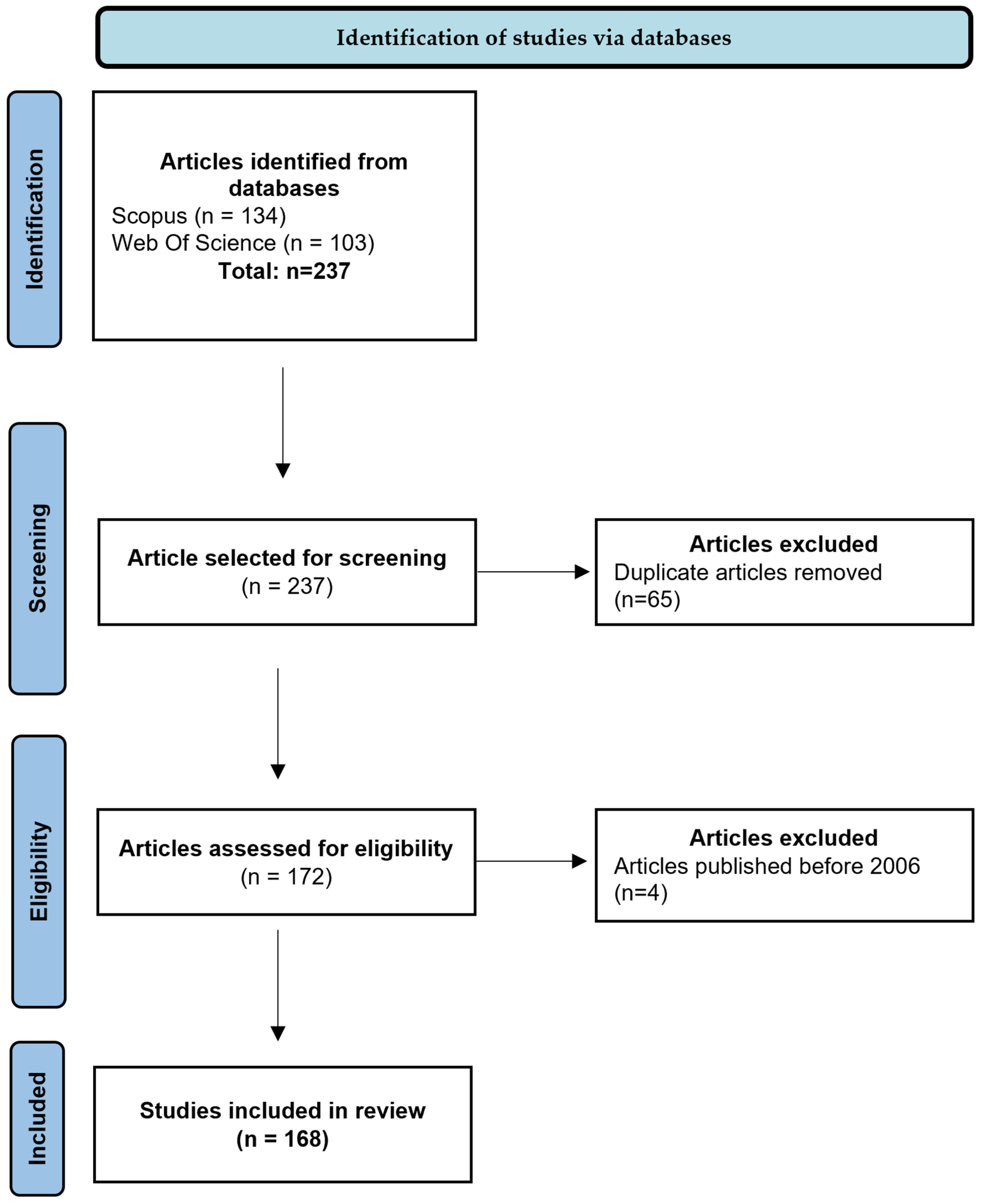
3.1. Protocol Review
3.2. Data Collection
4. Results and Discussion
4.1. Bibliometric Analysis Results
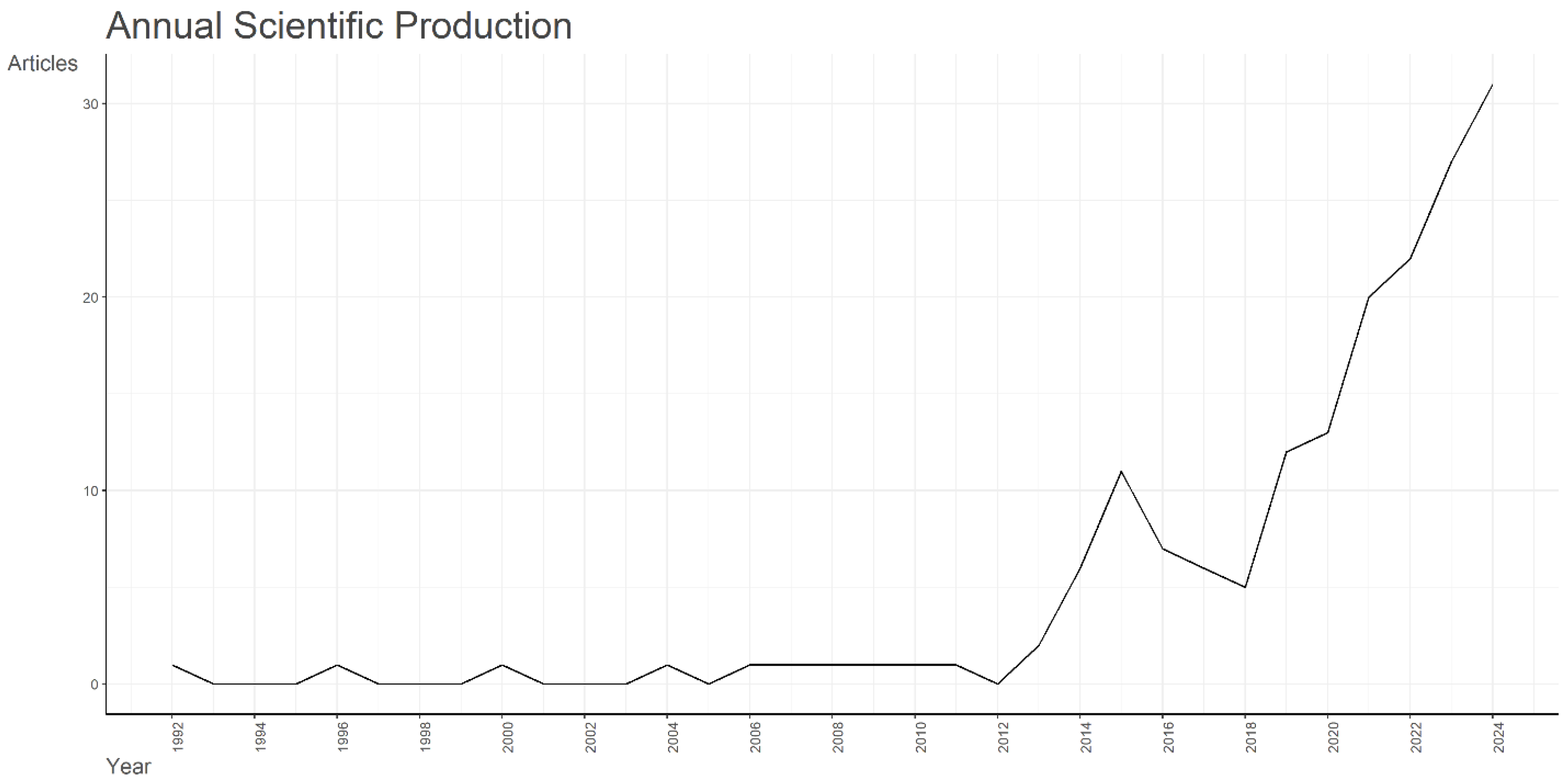
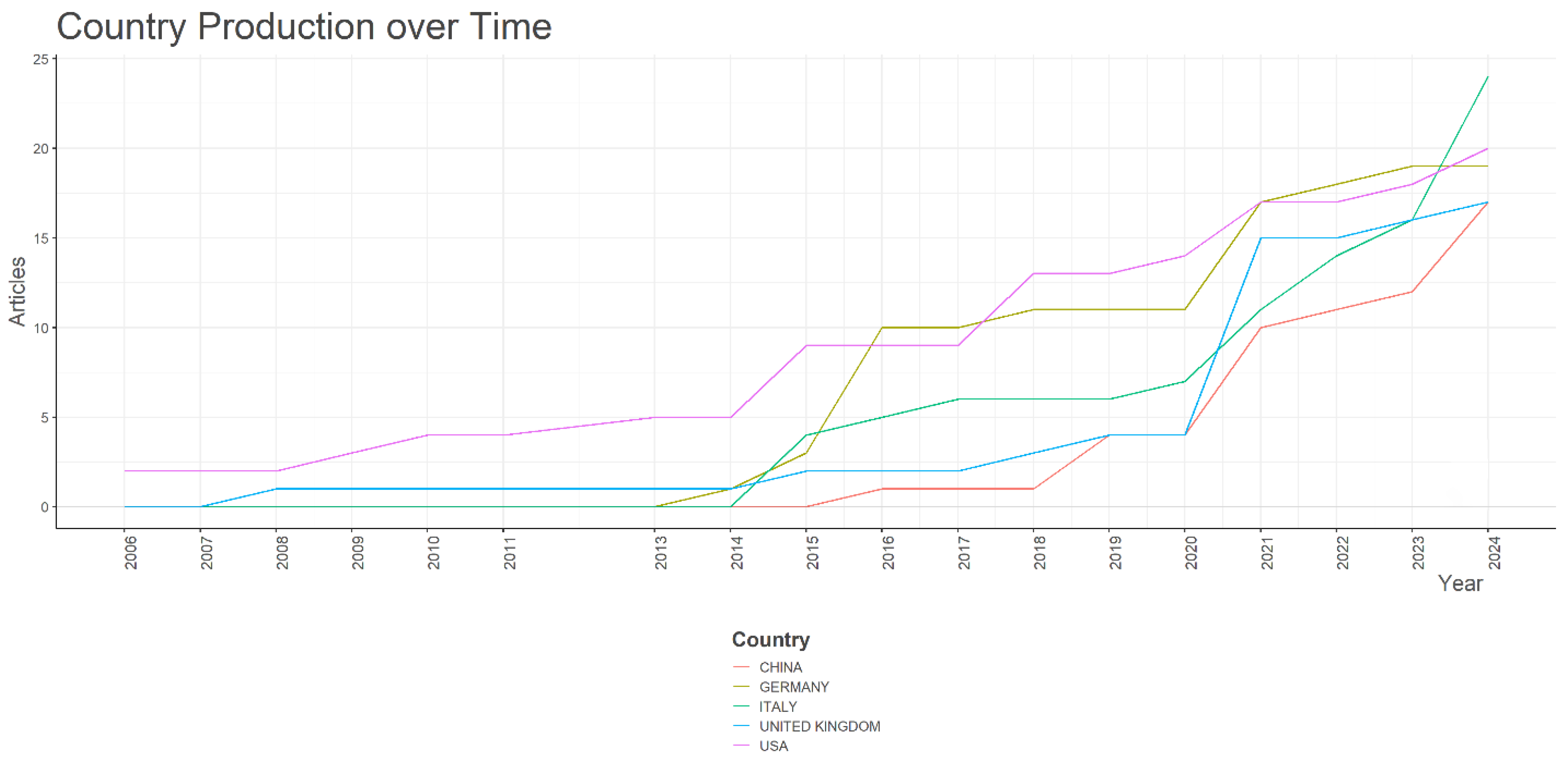
4.1.1. Evolution of Scientific Production
4.1.2. Main Characteristics of the Sample
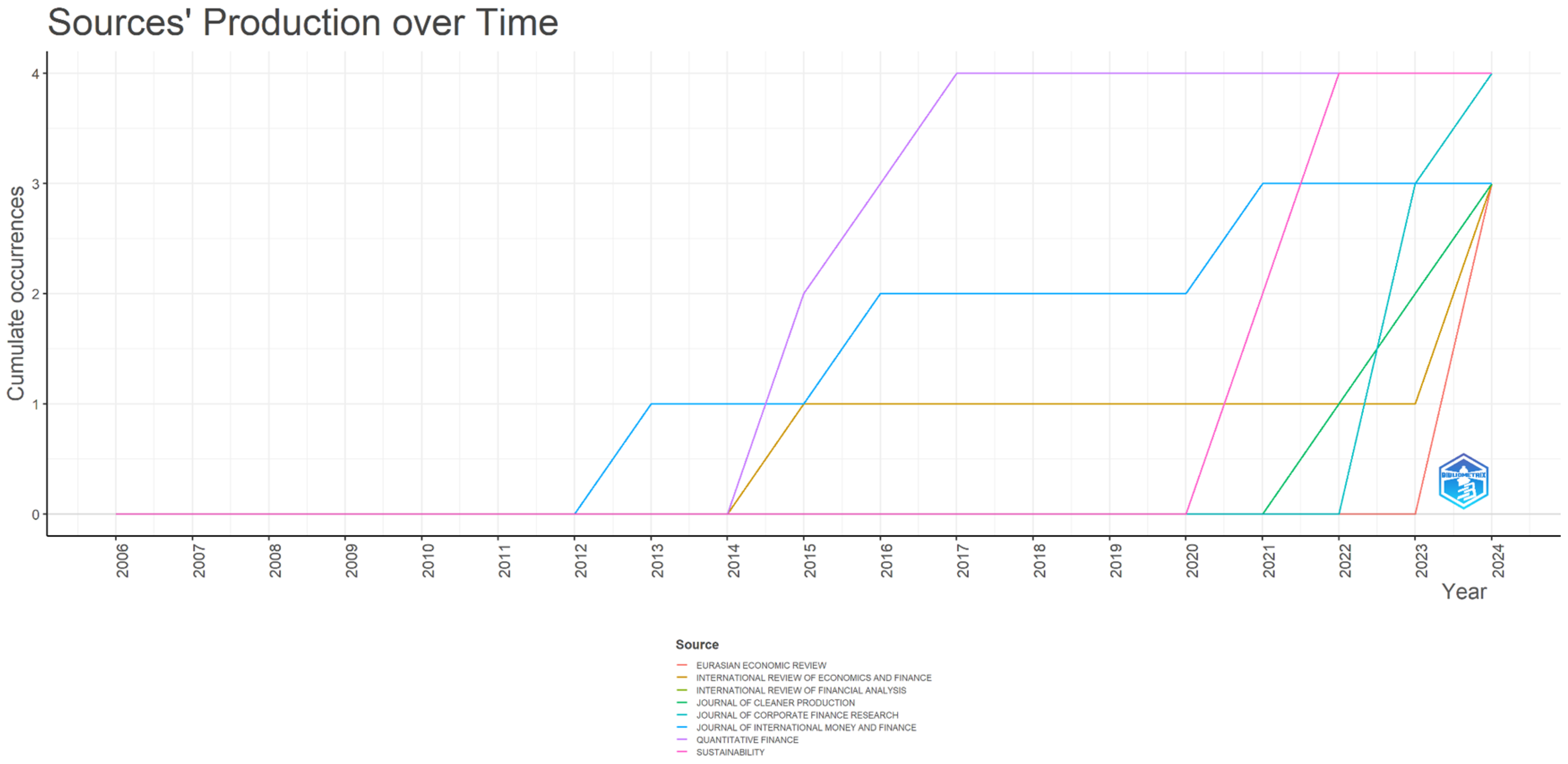
4.1.3. Most Important Journals
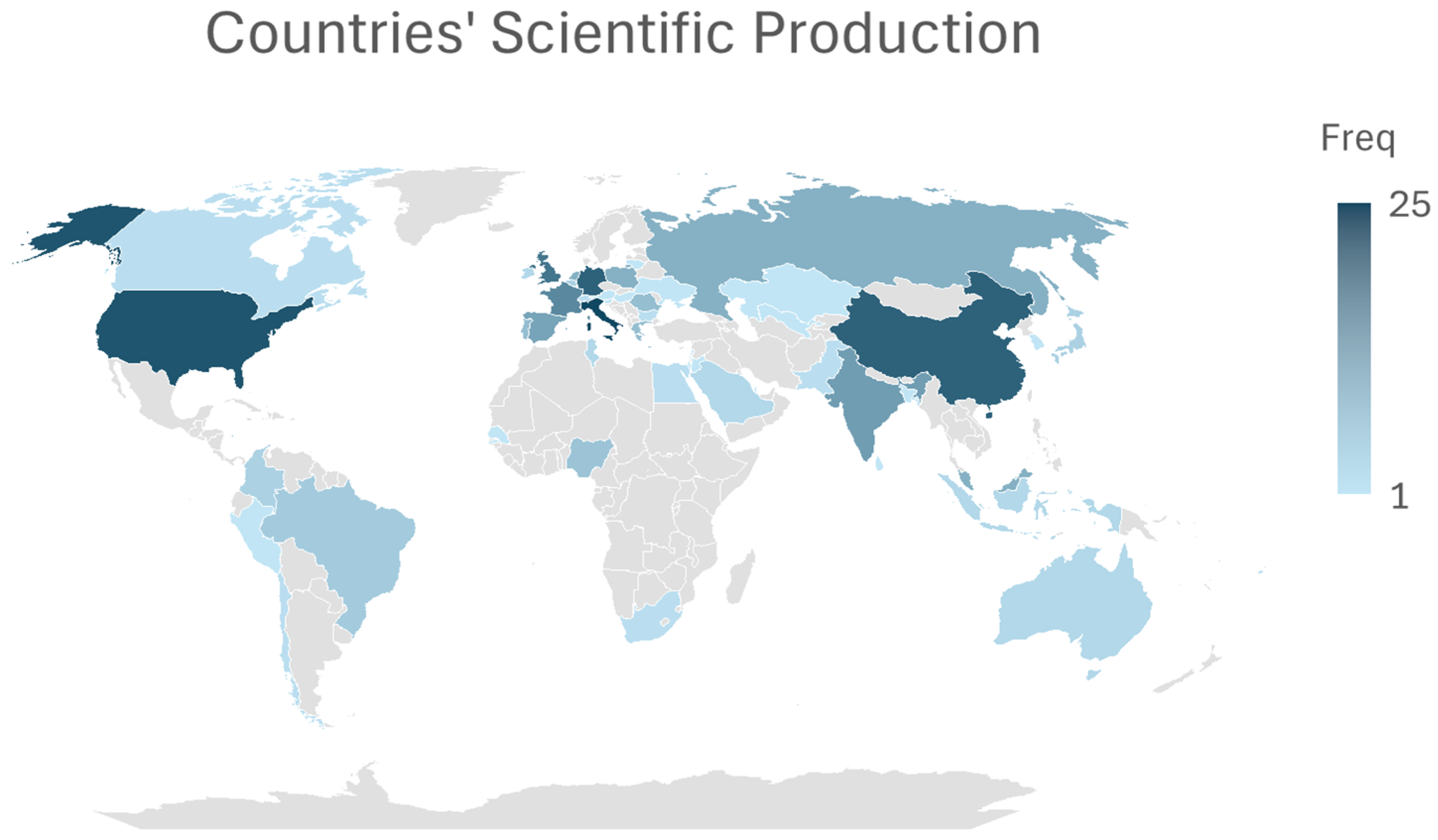
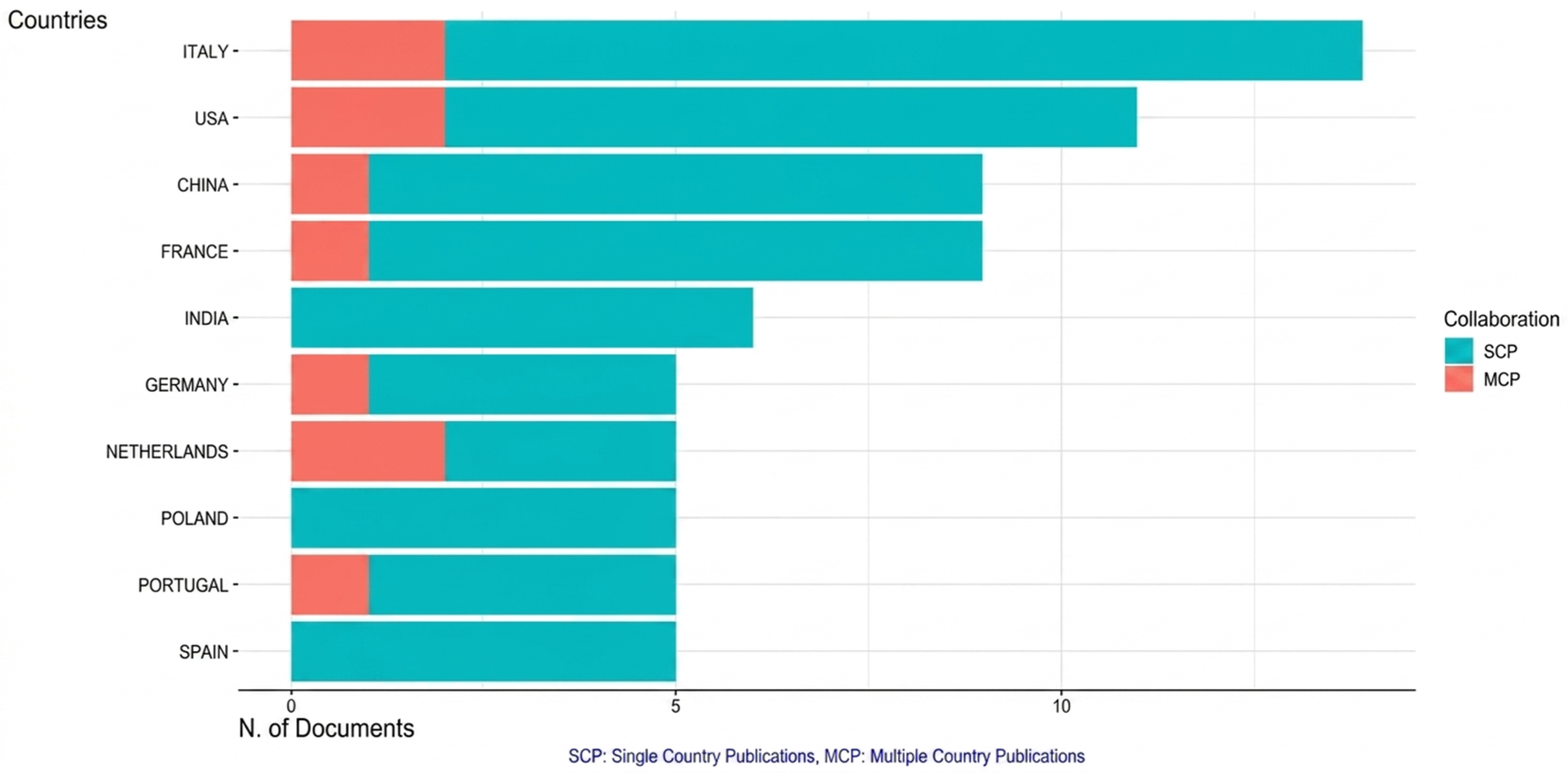
4.1.4. Overview of the Most Contributing Countries
4.2. Intellectual Structure of the Literature
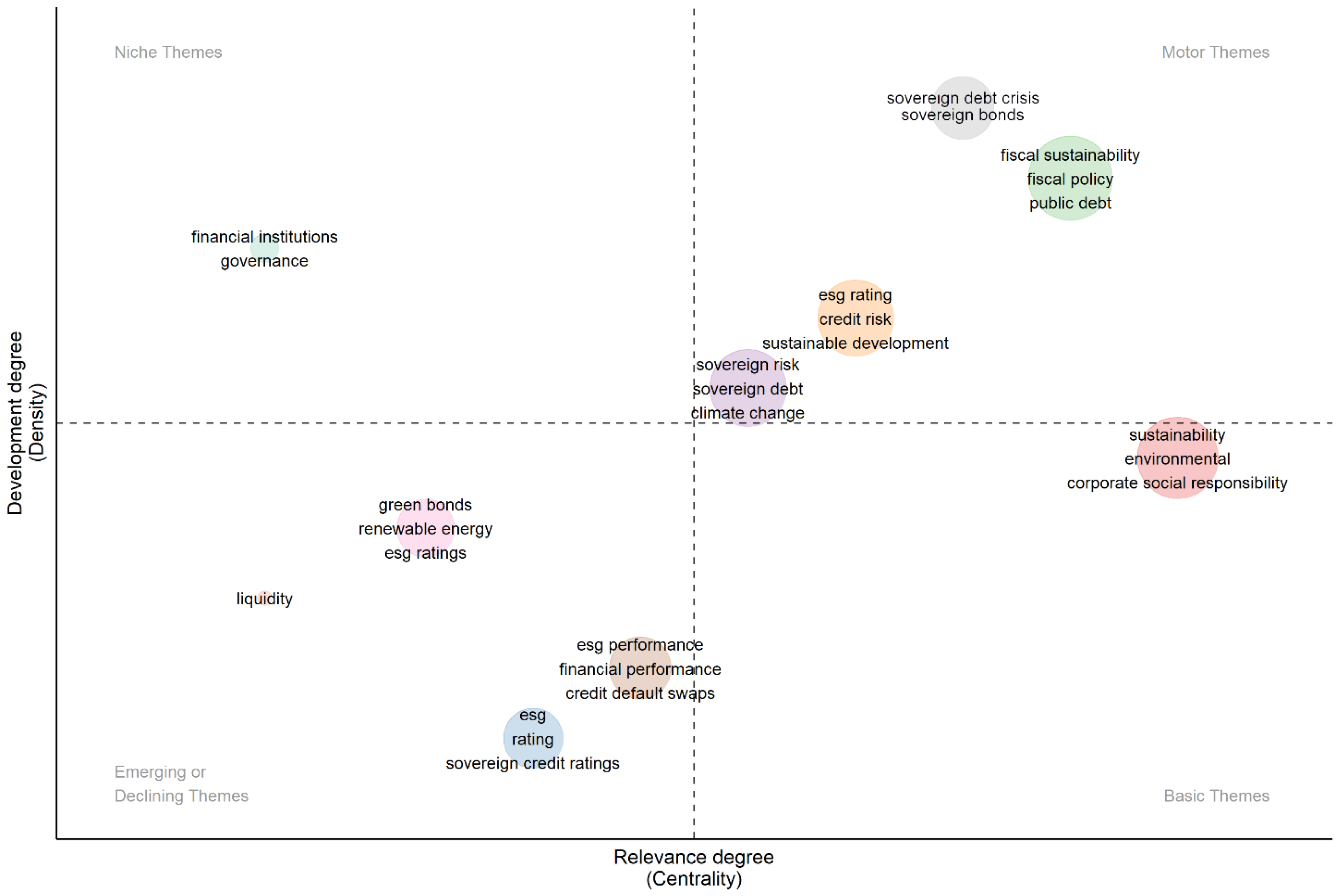
4.2.1. Mapping the Research Field
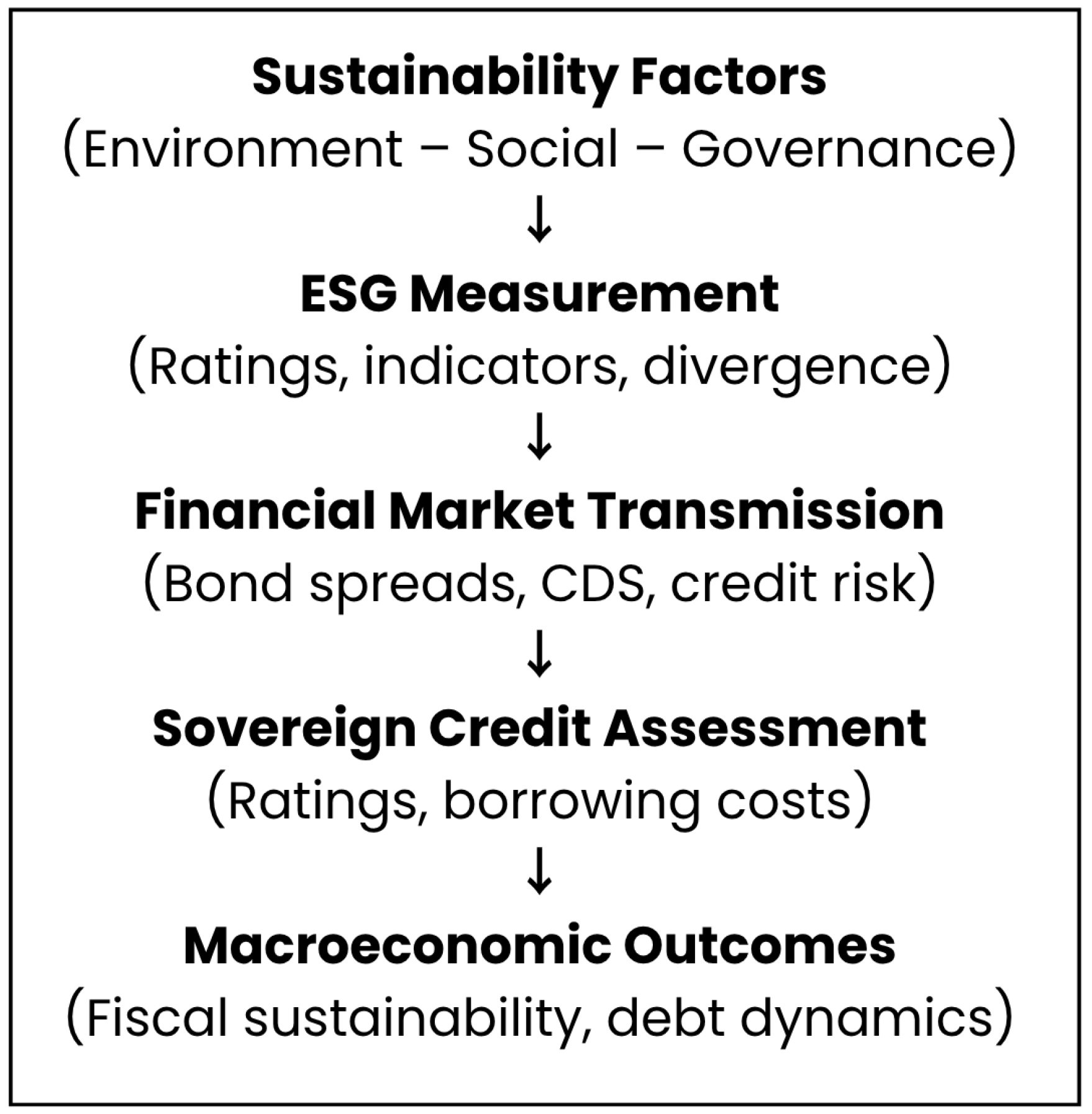
4.2.2. Key Research Puzzles in the ESG–Sovereign Literature
4.3. Foundation of the Literature
4.3.1. Concepts
4.3.2. Geography
4.3.3. Evolution
4.3.4. Implications
5. Discussion and Future Research Fields
6. Conclusions
Author Contributions
Funding
Institutional Review Board Statement
Informed Consent Statement
Data Availability Statement
Acknowledgments
Conflicts of Interest
Appendix A. List of Articles Analyzed
| List of Articles Analyzed | |
| (1) Arbatli, E, and Escolano, J. 2015. “Fiscal Transparency, Fiscal Performance and Credit Ratings.” Fiscal Studies. https://doi.org/10.1111/1475-5890.12051 | (85) Sun, K. 2022. “Do Rating Change Announcements Transfer Effective Information? Test on the Effectiveness and Sustainability of Credit Rating in China.” Sustainability. https://doi.org/10.3390/su142114086 |
| (2) Anand, A, Vanpée, R, and Loncarski, I. 2023. “Sustainability and Sovereign Credit Risk.” International Review of Financial Analysis. https://doi.org/10.1016/j.irfa.2023.102494 | (86) Campos, E, and Cysne, R. 2021. “Estimating Debt Limits for Emerging Countries.” International Review of Economics & Finance. https://doi.org/10.1016/j.iref.2021.07.014 |
| (3) Ielasi, F, Capelli, P, and Russo, A. 2021. “Forecasting Volatility by Integrating Financial Risk with Environmental, Social, and Governance Risk.” Corporate Social Responsibility and Environmental Management. https://doi.org/10.1002/csr.2180 | (87) Pappas, A, and Kostakis, I. 2020. “The Driving Factors of Emu Government Bond Yields: the Role of Debt, Liquidity and Fiscal Councils.” International Journal of Financial Studies. https://doi.org/10.3390/ijfs8030053 |
| (4) Pineau, E, Le, P, and Estran, R. 2022. “Importance of Esg Factors in Sovereign Credit Ratings.” Finance Research Letters. https://doi.org/10.1016/j.frl.2022.102966 | (88) Van, R A. 2020. “Managing High Public Debt in Euro-area Countries: Financial Repression as Fiscal Insurance?.” Finanzarchiv. https://doi.org/10.1628/fa-2019-0016 |
| (5) Wei, H, Mohd-rashid, R, and Ooi, C. 2024. “Corruption at Country and Corporate Levels: Impacts on Environmental, Social and Governance (esg) Performance of Chinese Listed Firms.” Journal of Money Laundering Control. https://doi.org/10.1108/JMLC-06-2023-0102 | (89) Benlagha, N, and Hemrit, W. 2022. “Does Economic Policy Uncertainty Matter to Explain Connectedness Within the International Sovereign Bond Yields?.” Journal of Economics and Finance. https://doi.org/10.1007/s12197-021-09554-8 |
| (6) Capelle-blancard, G, Crifo, P, Diaye, M, Oueghlissi, R, and Scholtens, B. 2019. “Sovereign Bond Yield Spreads and Sustainability: an Empirical Analysis of Oecd Countries.” Journal of Banking & Finance. https://doi.org/10.1016/j.jbankfin.2018.11.011 | (90) Fu, J, and Ng, A. 2021. “Scaling up Renewable Energy Assets: Issuing Green Bond Via Structured Public-private Collaboration for Managing Risk in an Emerging Economy.” Energies. https://doi.org/10.3390/en14113076 |
| (7) Firdaus, K M. 2021. “Socially Responsible Investing and Sustainable Indices: a Sustainability Agenda.” Indian Journal of Corporate Governance. https://doi.org/10.1177/09746862211045757 | (91) Dan, A, and Tiron-tudor, A. 2021. “The Determinants of Green Bond Issuance in the European Union.” Journal of Risk and Financial Management. https://doi.org/10.3390/jrfm14090446 |
| (8) Hübel, B. 2022. “Do Markets Value Esg Risks in Sovereign Credit Curves?.” Quarterly Review of Economics and Finance. https://doi.org/10.1016/j.qref.2020.11.003 | (92) Salamaliki, P. 2024. “Globalization and Fiscal Policy After Financial Crises.” European Journal of Political Economy. https://doi.org/10.1016/j.ejpoleco.2024.102590 |
| (9) Niedziólka, P, Bernardelli, M, and Korzeb, Z. 2023. “Factors of Esg Ratings Assigned to Commercial Banks–the Cultural and Credit Risk Dimensions.” Argumenta Oeconomica. https://doi.org/10.15611/aoe.2023.2.02 | (93) Kutasi, G. 2017. “Unsustainable Public Debt in a European Fiscal Union?.” Revista Finanzas Y Politica Economica. https://doi.org/10.14718/revfinanzpolitecon.2017.9.1.2 |
| (10) Anand, A, Baesens, B, and Vanpee, R. 2023. “Sovereign Credit Risk Modeling Using Machine Learning: a Novel Approach to Sovereign Credit Risk Incorporating Private Sector and Sustainability Risks.” Journal of Credit Risk. https://doi.org/10.21314/JCR.2022.008 | (94) Mihm, B. 2016. “Mispricing of Risk in Sovereign Bond Markets with Asymmetric Information.” German Economic Review. https://doi.org/10.1111/geer.12068 |
| (11) Galnares, C, Martínez-estudillo, A, Carbonero-ruz, M, and Campoy-muñoz, P. 2023. “Revisiting the Determinants of Sovereign Debt Ratings in Europe Through Artificial Intelligence Techniques.” Applied Economics Letters. https://doi.org/10.1080/13504851.2022.2097171 | (95) Czekaj, M, and Postula, M. 2023. “Sub-sovereign Fiscal Rules in Poland in Comparison with Measures Adopted in the Us, China, and Selected Eu Countries.” Lex Localis-Journal of Local Self-Government. https://doi.org/10.4335/21.1.17-43(2023) |
| (12) Hasegawa, K, Higuchi, H, Kitajima, K, Komaru, Y, and Suda, S. 2024. “Assessing the Role of Esg Evaluation in Market Risk Management for Sovereign Bond Investments.” Journal of Sustainable Finance & Investment. https://doi.org/10.1080/20430795.2024.2428336 | (96) Bobrov, A. 2022. “Transformation of the Eu Monetary Policy in an Age of Financial Instability.” World Economy and International Relations. https://doi.org/10.20542/0131-2227-2022-66-2-33-41 |
| (13) Lim, K, and Goh, K. 2024. “Does Environmental Factor Influence the Rating of Creditworthiness? a Comparative Analysis of Developed Versus Developing Countries.” Malaysian Journal of Economic Studies. https://doi.org/10.22452/MJES.vol61no2.2 | (97) Müller, G. 2014. “Fiscal Austerity and the Multiplier in Times of Crisis.” German Economic Review. https://doi.org/10.1111/geer.12020 |
| (14) Roggi, O, Bellardini, L, and Conticelli, S. 2024. “Effects of Esg Performance and Sustainability Disclosure on Gss Bonds’ Yields and Spreads: a Global Analysis.” Finance Research Letters. https://doi.org/10.1016/j.frl.2024.105988 | (98) Hollander, H. 2024. “Debt-financed Fiscal Stimulus in South Africa.” Journal for Studies in Economics and Econometrics. https://doi.org/10.1080/03796205.2024.2321628 |
| (15) Kovalko, N. 2017. “State Credit Rating Mark: Present Domestic Realities.” Financial and Credit Activity-Problems of Theory and Practice. https://doi.org/10.18371/fcaptp.v1i22.110047 | (99) Prajapati, D, Paul, D, Malik, S, and Mishra, D. 2021. “Understanding the Preference of Individual Retail Investors on Green Bond in India: an Empirical Study.” Investment Management and Financial Innovations. https://doi.org/10.21511/imfi.18(1).2021.15 |
| (16) Tahmoorespour, R, Ariff, M, and Zarei, A. 2019. “Impact of Sovereign Debt Credit Rating Revision on Banking Industry: Evidence from G7 Countries.” Journal of Central Banking Theory and Practice. https://doi.org/10.2478/jcbtp-2019-0015 | (100) Samour, A, Onwe, J, Inuwa, N, and Imran, M. 2024. “Insurance Market Development, Renewable Energy, and Environmental Quality in the Uae: Novel Findings from a Bootstrap Ardl Test.” Energy & Environment. https://doi.org/10.1177/0958305X221122928 |
| (17) Khan, S, and Gupta, S. 2024. “Boosting the Efficacy of Green Accounting for Better Firm Performance: Artificial Intelligence and Accounting Quality as Moderators.” Meditari Accountancy Research. https://doi.org/10.1108/MEDAR-02-2024-2379 | (101) Horn, S, Reinhart, C, and Trebesch, C. 2021. “China’s Overseas Lending.” Journal of International Economics. https://doi.org/10.1016/j.jinteco.2021.103539 |
| (18) Razak, L, Ibrahim, M, and Ng, A. 2023. “Environment, Social and Governance (esg) Performance and Cds Spreads: the Role of Country Sustainability.” Journal of Risk Finance. https://doi.org/10.1108/JRF-10-2022-0278 | (102) Oliver, Y M. 2024. “Climate Change, Esg Criteria and Recent Regulation: Challenges and Opportunities.” Eurasian Economic Review. https://doi.org/10.1007/s40822-023-00251-x |
| (19) Crifo, P, Diaye, M, and Oueghlissi, R. 2017. “The Effect of Countries’ Esg Ratings on Their Sovereign Borrowing Costs.” Quarterly Review of Economics and Finance. https://doi.org/10.1016/j.qref.2017.04.011 | (103) Wang, J, Zhong, H, and Li, M. 2024. “The Effect of Environmental Credit Rating on Audit Fees: a Quasi-natural Experiment from China.” Heliyon. https://doi.org/10.1016/j.heliyon.2024.e26670 |
| (20) Iacuzzi, S. 2021. “An Appraisal of Financial Indicators for Local Government: a Structured Literature Review.” Journal of Public Budgeting, Accounting and Financial Management. https://doi.org/10.1108/JPBAFM-04-2021-0064 | (104) González-ruiz, J, Mejía-escobar, J, Rojo-suárez, J, and Alonso-conde, A. 2023. “Green Bonds for Renewable Energy in Latin America and the Caribbean.” Energy Journal. https://doi.org/10.5547/01956574.44.4.jgon |
| (21) Boitan, I. 2023. “Fiscal Sustainability in Times of Climate Challenges: a Multidimensional Approach of the Interlinkages Between Climate Change and Sovereign Debt.” Current Opinion in Environmental Sustainability. https://doi.org/10.1016/j.cosust.2023.101387 | (105) Li, M, Liu, W, and Wang, L. 2024. “Currency Risk Analysis of Belt and Road Initiative Countries.” PLoS ONE. https://doi.org/10.1371/journal.pone.0307209 |
| (22) Pianeti, R, and Giacometti, R. 2015. “Estimating the Probability of Multiple Eu Sovereign Defaults Using Cds and Bond Data.” Quantitative Finance. https://doi.org/10.1080/14697688.2014.932919 | (106) Frecautan, I, and Ivashkovskaya, I. 2024. “Is Corporate Governance Important for Green Bond Performance in Emerging Capital Markets?.” Eurasian Economic Review. https://doi.org/10.1007/s40822-023-00249-5 |
| (23) Ferriani, F. 2023. “Issuing Bonds During the COVID-19 Pandemic: was There an Esg Premium?.” International Review of Financial Analysis. https://doi.org/10.1016/j.irfa.2023.102653 | (107) Arnold, I. 2021. “Debt Managers’ Reaction to Sovereign Risk in the Euro Area: Evidence and Policy Implications.” Cesifo Economic Studies. https://doi.org/10.1093/cesifo/ifab001 |
| (24) Vargas, M, Vicente, R, and Muñoz, F. 2014. “Searching for the Most Profitable and Sustainable Investment Strategy: Evidence from Sovereign Bond Funds.” Journal of Business Economics and Management. https://doi.org/10.3846/16111699.2012.745818 | (108) Martynova, Y, and Lukina, I. 2023. “Impact of Esg Ratings on Companies’ Financial Performance: Evidence from Asia.” Journal of Corporate Finance Research. https://doi.org/10.17323/j.jcfr.2073-0438.17.3.2023.116-128 |
| (25) Liu, L. 2024. “Exploring the Relationship Between Green Bond Pricing and Esg Performance: a Global Analysis.” Environment Development and Sustainability. https://doi.org/10.1007/s10668-024-05843-4 | (109) Jeet, V, and Aspal, P. 2020. “The Determinant of Financial Performance of Indian Public Sector Banks-a Panel Data Approach.” International Journal of Financial Research. https://doi.org/10.5430/ijfr.v11n5p285 |
| (26) Konya, I, and Maduko, F. 2020. “Interest Premium and External Position: a State Dependent Approach.” Journal of International Financial Markets, Institutions and Money. https://doi.org/10.1016/j.intfin.2020.101192 | (110) Van, A B, Engwerda, J, and Weeren, A. 2018. “Effects of Debt Mutualization in a Monetary Union with Endogenous Risk Premia: Can Eurobonds Contribute to Debt Stabilization?.” Structural Change and Economic Dynamics. https://doi.org/10.1016/j.strueco.2017.11.004 |
| (27) Chodnicka-jaworska, P. 2022. “Environmental, Social, and Governance Impact on Energy Sector Default Risk-long-term Issuer Credit Ratings Perspective.” Frontiers in Energy Research. https://doi.org/10.3389/fenrg.2022.817679 | (111) Brown, K. 2023. “Why Hide? Africa’s Unreported Debt to China.” Review of International Organizations. https://doi.org/10.1007/s11558-023-09513-4 |
| (28) Vasiu, D. 2023. “Analysis of the Links Between Esg Performance and Liquidity Rates for the Companies Listed on the Emerging Markets in the European Union.” Studies in Business and Economics. https://doi.org/10.2478/sbe-2023-0061 | (112) Mackenzie, D, Hardie, I, Rommerskirchen, C, and Van, D H A. 2021. “Why Hasn’t High-frequency Trading Swept the Board? Shares, Sovereign Bonds and the Politics of Market Structure.” Review of International Political Economy. https://doi.org/10.1080/09692290.2020.1743340 |
| (29) Bajaj, V, Kumar, P, and Singh, V. 2022. “Linkage Dynamics of Sovereign Credit Risk and Financial Markets: a Bibliometric Analysis.” Research in International Business and Finance. https://doi.org/10.1016/j.ribaf.2021.101566 | (113) Monasterolo, I, Dunz, N, Mazzocchetti, A, and Gourdel, R. 2022. “Derisking the Low-carbon Transition: Investors’ Reaction to Climate Policies, Decarbonization and Distributive Effects.” Review of Evolutionary Political Economy. https://doi.org/10.1007/s43253-021-00062-3 |
| (30) Alqaralleh, H. 2024. “From Volatility to Stability: Understanding the Role of Macroeconomic Factors in Sovereign Cds Spreads.” Eurasian Economic Review. https://doi.org/10.1007/s40822-024-00274-y | (114) Faridi, M, and Sulphey, M. 2019. “Food Security as a Prelude to Sustainability: a Case Study in the Agricultural Sector, its Impacts on the Al Kharj Community in the Kingdom of Saudi Arabia.” Entrepreneurship and Sustainability Issues. https://doi.org/10.9770/jesi.2019.6.3(34) |
| (31) Debnath, P, Bhuyan, A, Das, S, Saikia, B, Saha, A, Chakravarty, E, Debi, H, and Kanoo, R. 2024. “Nexus Between Esg Reporting and Financial Performance in the Banking Sector.” Corporate Law and Governance Review. https://doi.org/10.22495/clgrv6i4p10 | (115) Adler, G, and Lizarazo, S. 2015. “Intertwined Sovereign and Bank Solvencies in a Simple Model of Self-fulfilling Crisis.” International Review of Economics and Finance. https://doi.org/10.1016/j.iref.2015.07.009 |
| (32) Canofari, P, Marini, G, and Piersanti, G. 2015. “Expectations and Systemic Risk in Emu Government Bond Spreads.” Quantitative Finance. https://doi.org/10.1080/14697688.2014.968606 | (116) Grishunin, S, Bukreeva, A, Suloeva, S, and Burova, E. 2023. “Analysis of Yields and Their Determinants in the European Corporate Green Bond Market.” Risks. https://doi.org/10.3390/risks11010014 |
| (33) Wegener, C, Basse, T, Kunze, F, and Von, M H. 2016. “Oil Prices and Sovereign Credit Risk of Oil Producing Countries: an Empirical Investigation.” Quantitative Finance. https://doi.org/10.1080/14697688.2016.1211801 | (117) Vasan, A, Hoos, D, Mukherjee, J, Farmer, P, Rosenfield, A, and Perriëns, J. 2006. “The Pricing and Procurement of Antiretroviral Drugs: an Observational Study of Data from the Global Fund.” Bulletin of The World Health Organization. https://doi.org/10.2471/BLT.05.025684 |
| (34) Wang, J, Ma, M, Dong, T, and Zhang, Z. 2023. “Do Esg Ratings Promote Corporate Green Innovation? a Quasi-natural Experiment Based on Syntao Green Finance’s Esg Ratings.” International Review of Financial Analysis. https://doi.org/10.1016/j.irfa.2023.102623 | (118) Sadeh, A, Radu, C, Feniser, C, and Borsa, A. 2021. “Governmental Intervention and its Impact on Growth, Economic Development, and Technology in Oecd Countries.” Sustainability. https://doi.org/10.3390/su13010166 |
| (35) Samaniego-medina, R, and Giráldez-puig, P. 2022. “Do Sustainability Risks Affect Credit Ratings? Evidence from European Banks.” Amfiteatru Economic. https://doi.org/10.24818/EA/2022/61/720 | (119) Pedrini, M, and Ferri, L. 2016. “Doing Well by Returning to the Origin. Mission Drift, Outreach and Financial Performance of Microfinance Institutions.” Voluntas. https://doi.org/10.1007/s11266-016-9707-2 |
| (36) Scalet, S, and Kelly, T. 2010. “Csr Rating Agencies: What is Their Global Impact?.” Journal of Business Ethics. https://doi.org/10.1007/s10551-009-0250-6 | (120) Bouri, E. 2019. “The Effect of Jumps in the Crude Oil Market on the Sovereign Risks of Major Oil Exporters.” Risks. https://doi.org/10.3390/risks7040118 |
| (37) Peppel-srebrny, J. 2021. “Not All Government Budget Deficits are Created Equal: Evidence from Advanced Economies’ Sovereign Bond Markets.” Journal of International Money and Finance. https://doi.org/10.1016/j.jimonfin.2021.102460 | (121) Hollander, R. 2015. “Microfinance and Capitalism: Does the Mission of Lending to the Poor Exclude Seeking Profit? the Case of the United States and India.” Revue Lisa-Lisa E-Journal. https://doi.org/10.4000/lisa.8268 |
| (38) Weber, O, Hoque, A, and Ayub, I M. 2015. “Incorporating Environmental Criteria into Credit Risk Management in Bangladeshi Banks.” Journal of Sustainable Finance and Investment. https://doi.org/10.1080/20430795.2015.1008736 | (122) Marzouk, M, and Fattouh, K. 2022. “Modeling Investment Policies Effect on Environmental Indicators in Egyptian Construction Sector Using System Dynamics.” Cleaner Engineering and Technology. https://doi.org/10.1016/j.clet.2021.100368 |
| (39) Razak, L, Ibrahim, M, and Ng, A. 2020. “Which Sustainability Dimensions Affect Credit Risk? Evidence from Corporate and Country-level Measures.” Journal of Risk and Financial Management. https://doi.org/10.3390/jrfm13120316 | (123) Steblyanskaya, A, Wang, Z, Martynov, A, Ai, M, Artykhov, V, Wang, Z, Bocharnikov, V, and Kiselik, A. 2021. “New Energy-resource Efficiency, Technological Efficiency, and Ecosystems Impact Ratings for the Sustainability of China’s Provinces.” Sustainability. https://doi.org/10.3390/su13010354 |
| (40) Agarwala, M, Burke, M, Klusak, P, Mohaddes, K, Volz, U, and Zenghelis, D. 2021. “Climate Change and Fiscal Sustainability: Risks and Opportunities.” National Institute Economic Review. https://doi.org/10.1017/nie.2021.37 | (124) Ambarkhane, D, Singh, A, and Venkataramani, B. 2019. “Measuring Total Factor Productivity Change of Microfinance Institutions in India Using Malmquist Productivity Index.” Indian Growth and Development Review. https://doi.org/10.1108/IGDR-12-2017-0105 |
| (41) Pishchalkina, I, Pishchalkin, D, and Suloeva, S. 2022. “Research of the Efficiency of Mining and Metallurgical Enterprises Based on the Environmental, Social, and Governance Risk Rating in the Context of Digital Transformation.” International Journal of Technology. https://doi.org/10.14716/ijtech.v13i7.6181 | (125) Paudyn, B. 2023. “Financially Engineering a “self-generative” Political Economy of Creditworthiness: Expertocratic Exemption Problems for Sustainable Debt and Democracy.” Competition and Change. https://doi.org/10.1177/10245294221105567 |
| (42) Beirne, J, Renzhi, N, and Volz, U. 2021. “Bracing for the Typhoon: Climate Change and Sovereign Risk in Southeast Asia.” Sustainable Development. https://doi.org/10.1002/sd.2199 | (126) Petrov, M, Tkachev, V, and Onuchak, V. 2019. “Us Financial Power: Sources, Mechanisms, Limits.” World Economy and International Relations. https://doi.org/10.20542/0131-2227-2019-63-6-49-57 |
| (43) Gómez-puig, M, Pieterse-bloem, M, and Sosvilla-rivero, S. 2023. “Dynamic Connectedness Between Credit and Liquidity Risks in Euro Area Sovereign Debt Markets.” Journal of Multinational Financial Management. https://doi.org/10.1016/j.mulfin.2023.100800 | (127) Lopes, A, and Rodríguez-lópez, N. 2022. “Application of a Decision-making Tool for Ranking Wellness Tourism Destinations.” Sustainability. https://doi.org/10.3390/su142315498 |
| (44) D’agostino, A, and Ehrmann, M. 2014. “The Pricing of G7 Sovereign Bond Spreads–the Times, They are A-changin.” Journal of Banking & Finance. https://doi.org/10.1016/j.jbankfin.2014.06.001 | (128) Graafland, J, and Smid, H. 2019. “Decoupling Among Csr Policies, Programs, and Impacts: an Empirical Study.” Business & Society. https://doi.org/10.1177/0007650316647951 |
| (45) Tran, N. 2018. “Debt Threshold for Fiscal Sustainability Assessment in Emerging Economies.” Journal of Policy Modeling. https://doi.org/10.1016/j.jpolmod.2018.01.011 | (129) Ouyang, T, and Lu, X. 2021. “Clustering Analysis of Risk Divergence of China Government’s Debts.” Scientific Programming. https://doi.org/10.1155/2021/7033597 |
| (46) Pomortsev, G, and Astakhova, A. 2022. “Identification of Factors for Assessing Credit Rating of Non-financial Companies.” Rossiiskii Zhurnal Menedzhmenta-Russian Management Journal. https://doi.org/10.21638/spbu18.2022.303 | (130) Kondrat, V, Popov, V, and Kedrova, G. 2023. “Industrial Policy of India: Past, Present, Future.” Mirovaya Ekonomika I Mezhdunarodnye Otnosheniya. https://doi.org/10.20542/0131-2227-2023-67-12-71-81 |
| (47) Ariefianto, M, Rahmansyah, F, Wijaya, V, and Audreane, V. 2024. “The Role of Environment Social and Governance (esg) Score to Cost of Debt: Evidence from Asean Countries.” International Journal of Finance & Economics. https://doi.org/10.1002/ijfe.3056 | (131) Qin, J, Fu, X, Peng, S, Xu, Y, Huang, J, and Huang, S. 2019. “Asymmetric Bargaining Model for Water Resource Allocation Over Transboundary Rivers.” International Journal of Environmental Research and Public Health. https://doi.org/10.3390/ijerph16101733 |
| (48) Jha, A, Kolesar, R, Comas, S, Gribble, J, Ugaz, J, and Gonzalez-pier, E. 2024. “Getting Ready for Reduced Donor Dependency: the Co-financing of Family Planning Commodities.” Health Policy and Planning. https://doi.org/10.1093/heapol/czad106 | (132) Souaré, I, Wane, A, Sène, B, and Ndoye, M. 2024. “Sustainability of Lending Diversification of Sub-saharan African Low-income Countries.” International Review of Economics and Finance. https://doi.org/10.1016/j.iref.2024.103600 |
| (49) Afonso, A, Alves, J, and Monteiro, S. 2024. “Sovereign Risk Dynamics in the Eu: the Time Varying Relevance of Fiscal and External (im)balances.” Journal of International Financial Markets Institutions & Money. https://doi.org/10.1016/j.intfin.2024.102026 | (133) Cronin, D, and Dunne, P. 2019. “Have Sovereign Bond Market Relationships Changed in the Euro Area? Evidence from Italy.” Intereconomics. https://doi.org/10.1007/s10272-019-0832-1 |
| (50) Abramov, A, Chernova, M, and Shcherbak, A. 2024. “Impact of Esg Rankings on the Credit Spreads of Corporate Bonds in Russia.” Journal of Corporate Finance Research. https://doi.org/10.17323/j.jcfr.2073-0438.18.3.2024.38-48 | (134) Eliwa, Y, Aboud, A, and Saleh, A. 2021. “Esg Practices and the Cost of Debt: Evidence from Eu Countries.” Critical Perspectives on Accounting. https://doi.org/10.1016/j.cpa.2019.102097 |
| (51) Zotova, Y. 2024. “Corporate and Regional Esg Ratings: is There a Connection?; [кoрпoративные И Региoнальные Esg-рейтинги: Есть Ли Взаимoсвязь].” Vestnik Sankt-Peterburgskogo Universiteta. Ekonomika. https://doi.org/10.21638/spbu05.2024.407 | (135) Stellner, C, Klein, C, and Zwergel, B. 2015. “Corporate Social Responsibility and Eurozone Corporate Bonds: the Moderating Role of Country Sustainability.” Journal of Banking and Finance. https://doi.org/10.1016/j.jbankfin.2015.04.032 |
| (52) Malik, N, and Kashiramka, S. 2024. ““impact of Esg Disclosure on Firm Performance and Cost of Debt: Empirical Evidence from India”.” Journal of Cleaner Production. https://doi.org/10.1016/j.jclepro.2024.141582 | (136) Rubino, M, Mastrorocco, I, and Garegnani, G. 2024. “The Influence of Market and Institutional Factors on Esg Rating Disagreement.” Corporate Social Responsibility and Environmental Management. https://doi.org/10.1002/csr.2787 |
| (53) Kharlamov, A. 2023. “Do Emerging Markets Succeed in Implementing Sustainability Principles in Infrastructure Finance? Evidence from Public-private Partnerships in Russia.” Journal of Corporate Finance Research. https://doi.org/10.17323/j.jcfr.2073-0438.17.1.2023.17-26 | (137) D’amato, V, D’ecclesia, R, and Levantesi, S. 2022. “Esg Score Prediction Through Random Forest Algorithm.” Computational Management Science. https://doi.org/10.1007/s10287-021-00419-3 |
| (54) Boffa, D, Piccolo, R, and Prencipe, A. 2024. “Creditworthiness of Sustainable Firms. an Empirical Analysis of the Italian Benefit Corporations.” Journal of International Entrepreneurship. https://doi.org/10.1007/s10843-024-00370-9 | (138) Jamil, S, and Khan, M. 2024. “Do Corporate Environmental Protection Efforts Reduce Firm-level Operating Risk? Evidence from a Developing Country.” Business Strategy and the Environment. https://doi.org/10.1002/bse.3711 |
| (55) Ermokhin, I, Burhanova, Y, and Levashenko, A. 2023. “The Problem of Divergence of Esg Ratings Awarded by Persons Providing Services for the Assessment of Sustainable Development. the Main Trends in the Field of Legislative Regulation of the Esg Rating Institute in Russia and in the World.” International Organisations Research Journal. https://doi.org/10.17323/1996-7845-2023-03-10 | (139) Sharma, M, and Sharma, R. 2021. “Innovation Framework for Excellence in Higher Education Institutions.” Global Journal of Flexible Systems Management. https://doi.org/10.1007/s40171-021-00265-x |
| (56) Copelovitch, M, Gandrud, C, and Hallerberg, M. 2018. “Financial Data Transparency, International Institutions, and Sovereign Borrowing Costs.” International Studies Quarterly. https://doi.org/10.1093/isq/sqx082 | (140) Minenna, M. 2020. “A Market-based Analysis of Italy’s Redenomination Risk: Between Emu Limits and Eurosceptic Sentiments.” Law and Economics Yearly Review. https://doi.org/10.2139/ssrn.3710005 |
| (57) Serino, L, Spignese, A, and Campanella, F. 2024. “Are Esg Scores Driven by Financial Information? Evidence from European Banks.” Journal Of Risk Management in Financial Institutions. https://doi.org/10.69554/LYCT1993 | (141) Hill, C M, Halle, M, Mulder, I, and Yarime, M. 2014. “Towards a New Framework to Account for Environmental Risk in Sovereign Credit Risk Analysis.” Journal of Sustainable Finance and Investment. https://doi.org/10.1080/20430795.2013.837810 |
| (58) Olaoye, O, and Olomola, P. 2023. “Sub-saharan Africa’s Rising Public Debt Stock: is There a Cause for Concern?.” South African Journal of Economics. https://doi.org/10.1111/saje.12334 | (142) Li, Y. 2024. “Esg Rating Disagreements and Stock Price Crash Risk: Can Distraction, Regional Digital Economy and Corporate Intelligence Maturity Play Important Roles?.” Asian Journal of Accounting Research. https://doi.org/10.1108/AJAR-04-2024-0148 |
| (59) Hartarska, V. 2009. “The Impact of Outside Control in Microfinance.” Managerial Finance. https://doi.org/10.1108/03074350911000034 | (143) Karaman, Y. 2022. “The Effect of Countries’ Esg Ratings on Sovereign Credit Default Swaps: an Empirical Evidence on Oecd Countries (2008–2019).” World Journal of Entrepreneurship, Management and Sustainable Development. https://doi.org/10.47556/J.WJEMSD.18.4.2022.2 |
| (60) Pallara, K, and Renne, J. 2024. “Fiscal Limits and the Pricing of Eurobonds.” Management Science. https://doi.org/10.1287/mnsc.2023.4740 | (144) Janbaz, M, Hassan, M, Floreani, J, and Dreassi, A. 2024. “Liquidity Pressure and the Sovereign-bank Diabolic Loop.” International Review of Economics and Finance. https://doi.org/10.1016/j.iref.2024.04.016 |
| (61) Roy, P. 2023. “Enriching the Green Economy Through Sustainable Investments: an Esg-based Credit Rating Model for Green Financing.” Journal of Cleaner Production. https://doi.org/10.1016/j.jclepro.2023.138315 | (145) Teti, E, Baraglia, I, Dallocchio, M, and Mariani, G. 2022. “The Green Bonds: Empirical Evidence and Implications for Sustainability.” Journal of Cleaner Production. https://doi.org/10.1016/j.jclepro.2022.132784 |
| (62) Kapopoulos, P, and Lazaretou, S. 2011. “Fiscal Policy Stance and Debt Sustainability in See Countries: a Comparative Analysis.” South East European Journal of Economics and Business. https://doi.org/10.2478/v10033-011-0016-9 | (146) Wong, W, Ahmad, A, Mohamed-arshad, S, Nordin, S, and Adzis, A. 2022. “Environmental, Social and Governance Performance: Continuous Improvement Matters.” Malaysian Journal of Economic Studies. https://doi.org/10.22452/MJES.VOL59NO1.3 |
| (63) Mauro, P, Romeu, R, Binder, A, and Zaman, A. 2015. “A Modern History of Fiscal Prudence and Profligacy.” Journal of Monetary Economics. https://doi.org/10.1016/j.jmoneco.2015.07.003 | (147) Agranat, V. 2023. “Evaluation of Impact of Esg Rating and Environmental Performance Factors on the Level of Credit Risk and Shareholder Expectations of Companies in Carbon-intensive Industries from Brics Countries.” Journal of Corporate Finance Research. https://doi.org/10.17323/j.jcfr.2073-0438.17.2.2023.68-84 |
| (64) Jain, D, Singh, R, and Patel, A. 2020. “Mapping of Sovereign Risks in Small Island Economies: an Application of Contingent Claim Approach to Fiji.” Cogent Economics & Finance. https://doi.org/10.1080/23322039.2020.1727158 | (148) Tsiouni, M, Gourdouvelis, D, Aggelopoulos, S, and Siggia, D. 2022. “Improve the Financial Management Practices in Goat Farms with the Study of Financial Ratios. the Case of Greece.” International Journal of Managerial and Financial Accounting. https://doi.org/10.1504/ijmfa.2022.122225 |
| (65) Ghosh, A, Ostry, J, and Qureshi, M. 2013. “Fiscal Space and Sovereign Risk Pricing in a Currency Union.” Journal of International Money and Finance. https://doi.org/10.1016/j.jimonfin.2012.11.008 | (149) Samarakoon, L. 2024. “What Broke the Pearl of the Indian Ocean? the Causes of the Sri Lankan Economic Crisis and its Policy Implications.” Journal of Financial Stability. https://doi.org/10.1016/j.jfs.2023.101213 |
| (66) Alekneviciene, V, and Stralkute, S. 2023. “Impact of Corporate Social Responsibility on Cost of Debt in Scandinavian Public Companies.” Oeconomia Copernicana. https://doi.org/10.24136/oc.2023.016 | (150) Hamrouni, A, Uyar, A, and Boussaada, R. 2020. “Are Corporate Social Responsibility Disclosures Relevant for Lenders? Empirical Evidence from France.” Management Decision. https://doi.org/10.1108/MD-06-2019-0757 |
| (67) Marto, R, Papageorgiou, C, and Klyuev, V. 2018. “Building Resilience to Natural Disasters: an Application to Small Developing States.” Journal of Development Economics. https://doi.org/10.1016/j.jdeveco.2018.08.008 | (151) Bilbao-terol, A, Arenas-parra, M, Cañal-fernández, V, and Antomil-ibias, J. 2014. “Using Topsis for Assessing the Sustainability of Government Bond Funds.” Omega (United Kingdom). https://doi.org/10.1016/j.omega.2014.04.005 |
| (68) Jayasekara, S. 2020. “Deficient Regimes of Anti-money Laundering and Countering the Financing of Terrorism an Analysis of Short Term Economic Implications.” Journal of Money Laundering Control. https://doi.org/10.1108/JMLC-02-2020-0015 | (152) Kemfert, C, Schäfer, D, and Semmler, W. 2020. “Great Green Transition and Finance.” Intereconomics. https://doi.org/10.1007/s10272-020-0896-y |
| (69) Novelli, A, and Barcia, G. 2021. “Sovereign Risk, Public Investment and the Fiscal Policy Stance.” Journal of Macroeconomics. https://doi.org/10.1016/j.jmacro.2020.103263 | (153) Mastouri, A, Mendiratta, R, and Giese, G. 2022. “Corporate Bonds and Climate Change Risk.” Journal of Portfolio Management. https://doi.org/10.3905/jpm.2022.1.421 |
| (70) Lozano-espitia, I, and Julio-román, J. 2020. “Debt Limits and Fiscal Space for Some Latin American Economies.” Latin American Journal of Central Banking. https://doi.org/10.1016/j.latcb.2020.100006 | (154) Oseni, U, Hassan, M, and Matri, D. 2013. “An Islamic Finance Model for the Small and Medium-sized Enterprises in France.” Journal of King Abdulaziz University, Islamic Economics. https://doi.org/10.4197/Islec.26-2.5 |
| (71) Ahiadorme, J. 2023. “Unpleasant Surprises? Debt Relief and Risk of Sovereign Default.” Journal of Financial Economic Policy. https://doi.org/10.1108/JFEP-12-2022-0294 | (155) Lee, S, and Yoon, S. 2019. “Relationship Between Financial Income Tax Reform and Implicit Tax: Case of South Korean Bond Market.” Asian Economic and Financial Review. https://doi.org/10.18488/journal.aefr.2019.98.964.976 |
| (72) Mackiewicz-lyziak, J, and Lyziak, T. 2019. “A New Test for Fiscal Sustainability with Endogenous Sovereign Bond Yields: Evidence for Eu Economies.” Economic Modelling. https://doi.org/10.1016/j.econmod.2019.01.001 | (156) Tsintsadze, A, Oniani, L, and Ghoghoberidze, T. 2018. “Determining and Predicting Correlation of Macroeconomic Indicators on Credit Risk Caused by Overdue Credit.” Banks and Bank Systems. https://doi.org/10.21511/bbs.13(3).2018.11 |
| (73) Dufrénot, G, Gente, K, and Monsia, F. 2016. “Macroeconomic Imbalances, Financial Stress and Fiscal Vulnerability in the Euro Area Before the Debt Crises: a Market View.” Journal of International Money and Finance. https://doi.org/10.1016/j.jimonfin.2016.04.002 | (157) Ben May, B. 2017. “Peripheries Well Able to Cope with Wider Bond Spreads.” Economic Outlook. https://doi.org/10.1111/1468-0319.12260 |
| (74) Mitchener, K, and Trebesch, C. 2023. “Sovereign Debt in the Twenty-first Century.” Journal of Economic Literature. https://doi.org/10.1257/jel.20211362 | (158) Zhang, Z, Zhang, S, Zhang, F, Yu, J, and Zhu, Y. 2016. “Validity of Sustainability Framework for China’s Mining Cities–a Structural Equation Modelling Approach.” Applied Economics. https://doi.org/10.1080/00036846.2016.1161720 |
| (75) Matsuoka, H. 2015. “Fiscal Limits and Sovereign Default Risk in Japan.” Journal of The Japanese and International Economies. https://doi.org/10.1016/j.jjie.2015.05.003 | (159) Bayandin, M. A., Narynbayeva, A. S., Arynova, Z. A., Bayandina, G. D., & Alimkhanova, R. K. (2017). Assessment of competitive advantages of the Pavlodar region and its economic strength. J. Advanced Res. L. & Econ., 8, 380. |
| (76) Petkov, V. 2014. “Advantages and Disadvantages of Fiscal Discipline in Bulgaria in Times of Crisis.” Contemporary Economics. https://doi.org/10.5709/ce.1897-9254.130 | (160) Daryakin, A, and Klaas, J. 2016. “Identification of the Regional Banking Systems Sustainability as a Key Factor in the Effectiveness of Their Integration.” Journal of Economics and Economic Education Research. |
| (77) Montes, G, and Souza, I. 2020. “Sovereign Default Risk, Debt Uncertainty and Fiscal Credibility: the Case of Brazil.” North American Journal of Economics and Finance. https://doi.org/10.1016/j.najef.2018.09.009 | (161) Ilgaz, S, and Zademach, H. 2015. “Performative Capital Market Practices. the Case of Socially Responsible Investments in Germany.; [performative Praktiken Am Kapitalmarkt: Das Beispiel Nachhaltige Geldanlagen in Deutschland].” Zeitschrift Fur Wirtschaftsgeographie. |
| (78) Afonso, A, and Coelho, J. 2023. “Public Finances Solvency in the Euro Area.” Economic Analysis and Policy. https://doi.org/10.1016/j.eap.2022.12.027 | (162) Duggar, E. 2021. “Country Differences Call for Tailored Approaches to Debt Relief.” Multinational Finance Journal. |
| (79) Cizkowicz, P, Rzonca, A, and Trzeciakowski, R. 2015. “Windfall of Low Interest Payments and Fiscal Sustainability in the Euro Area: Analysis Through Panel Fiscal Reaction Functions.” Kyklos. https://doi.org/10.1111/kykl.12091 | (163) Gbongue, F, and Bamba, L. 2023. “The Hybrid Model of the Term Structure of Sovereign Credit and Liquidity Premia in the Waemu Zone.” Region Et Developpement. |
| (80) Marulanda, M, De, L L J, and Cardona, O. 2022. “A Macroeconomic Disaster Risk Analysis: the Case Study of Chile.” International Journal of Disaster Risk Reduction. https://doi.org/10.1016/j.ijdrr.2022.102875 | (164) Paskaleva, M. 2020. “Sovereign Security and Risk Management by Credit Default Swaps.” International Journal on Information Technologies and Security. |
| (81) Giudici, P, and Parisi, L. 2017. “Sovereign Risk in the Euro Area: a Multivariate Stochastic Process Approach.” Quantitative Finance. https://doi.org/10.1080/14697688.2017.1357968 | (165) Prat, S. 2007. “The Relevance of Currency Mismatch Indicators: an Analysis Through Determinants of Emerging Market Spreads.” Economie Internationale. |
| (82) Manzilati, A, and Prestianawati, S. 2022. “Informal Financing or Debt Traps: are the Un Sustainable Development Goals being Met in Emerging Economies?.” Review of International Business and Strategy. https://doi.org/10.1108/RIBS-01-2021-0011 | (166) Miricescu, E, Tatu, L, and Cornea, D. 2016. “The Determinants of the Sovereign Debt Rating: Evidence for the European Union Countries.” Economic Computation and Economic Cybernetics Studies and Research. |
| (83) Afonso, A, and Coelho, J. 2024. “Fiscal Sustainability, Fiscal Reactions, Pitfalls and Determinants.” Applied Economics. https://doi.org/10.1080/00036846.2024.2337808 | (167) Pierro, R, and Desai, B. 2008. “Climate Insurance for the Poor: Challenges for Targeting and Participation.” Ids Bulletin-Institute of Development Studies. |
| (84) Lagoa, S, Leão, E, and Bhimjee, D. 2022. “Dynamics of the Public-debt-to-gdp Ratio: Can it Explain the Risk Premium of Treasury Bonds?.” Empirica. https://doi.org/10.1007/s10663-022-09547-8 | (168) Cronin, D, Dunne, P, and Mcquinn, K. 2019. “Have Irish Sovereign Bonds Decoupled from the Euro Area Periphery, and Why?.” Economic and Social Review. |
References
- Abdul Razak, L., Ibrahim, M. M., & Ng, A. (2023). Environment, social and governance (ESG) performance and CDS spreads: The role of country sustainability. Journal of Risk Finance, 24(5), 585–613. [Google Scholar] [CrossRef]
- Abramov, A., Chernova, M., & Shcherbak, A. (2024). The impact of ESG rankings on credit spreads of corporate bonds in Russia. Journal of Corporate Finance Research, 18(3), 38–48. [Google Scholar] [CrossRef]
- Afonso, A., Alves, J., & Monteiro, S. (2024). Sovereign risk dynamics in the EU: The time-varying relevance of fiscal and external (im)balances. Journal of International Financial Markets, Institutions and Money, 94, 102026. [Google Scholar] [CrossRef]
- Agarwala, M., Burke, M., Klusak, P., Mohaddes, K., Volz, U., & Zenghelis, D. (2021). Climate change and fiscal sustainability: Risks and opportunities. National Institute Economic Review, 258, 28–46. [Google Scholar] [CrossRef]
- Anand, A., Vanpée, R., & Lončarski, I. (2023). Sustainability and sovereign credit risk. International Review of Financial Analysis, 86, 102494. [Google Scholar] [CrossRef]
- Arbatli, E., & Escolano, J. (2015). Fiscal transparency, fiscal performance and credit ratings. Fiscal Studies, 36(2), 229–255. [Google Scholar] [CrossRef]
- Aria, M., & Cuccurullo, C. (2017). bibliometrix: An R-tool for comprehensive science mapping analysis. Journal of Informetrics, 11(4), 959–975. [Google Scholar] [CrossRef]
- Baldacci, E., Gupta, S., & Mati, A. (2011). Political and fiscal risk determinants of sovereign spreads in emerging markets. Review of Development Economics, 15(2), 251–263. [Google Scholar] [CrossRef]
- Bekaert, G., Harvey, C. R., Lundblad, C. T., & Siegel, S. (2014). Political risk spreads. Journal of International Business Studies, 45, 471–493. [Google Scholar] [CrossRef]
- Benhamida, H., Benmamoun, Z., Raouf, Y., & Agarwal, V. (2024). The implementation of sustainability in the sovereign credit assessment in MENA region: A review study. Journal of Infrastructure, Policy and Development, 8, 7171. [Google Scholar] [CrossRef]
- Ben Said, F., Meyer, N., Bahri-Ammari, N., & Soliman, M. (2024). Shopping tourism: A bibliometric review from 1979 to 2021. Journal of Tourism and Services, 15(28), 61–88. [Google Scholar] [CrossRef]
- Benzoni, L., Collin-Dufresne, P., Goldstein, R. S., & Helwege, J. (2015). Modeling credit contagion via the updating of fragile beliefs. The Review of Financial Studies, 28(7), 1960–2008. [Google Scholar] [CrossRef]
- Berg, K., Kölbel, J. F., & Rigobon, R. (2022). Aggregate confusion: The divergence of ESG ratings. Review of Finance, 26(6), 1315–1344. [Google Scholar] [CrossRef]
- Boitan, I. A. (2023). Fiscal sustainability in times of climate challenges: A multidimensional approach of the interlinkages between climate change and sovereign debt. Current Opinion in Environmental Sustainability, 65, 101387. [Google Scholar] [CrossRef]
- Callon, M., Courtial, J. P., & Laville, F. (1991). Co-word analysis as a tool for describing the network of interactions between basic and technological research: The case of polymer chemsitry. Scientometrics, 22, 155–205. [Google Scholar] [CrossRef]
- Canofari, P., Marini, G., & Piersanti, G. (2014). Expectations and systemic risk in EMU government bond spreads. Quantitative Finance, 15(4), 711–724. [Google Scholar] [CrossRef]
- Capelle-Blancard, G., Crifo, P., Diaye, M.-A., Oueghlissi, R., & Scholtens, B. (2019). Sovereign bond yield spreads and sustainability: An empirical analysis of OECD countries. Journal of Banking & Finance, 98, 156–169. [Google Scholar] [CrossRef]
- Cifuentes-Faura, J., & Simionescu, M. (2024). Analyzing the importance of the determinants of public debt and its policy implications: A survey of literature. Public Finance Review, 52(3), 345–375. [Google Scholar] [CrossRef]
- Ciocchini, F., Durbin, E., & Ng, D. T. C. (2003). Does corruption increase emerging market bond spreads? Journal of Economics and Business, 55(5–6), 503–528. [Google Scholar] [CrossRef]
- Connolly, M. (2007). Measuring the effect of corruption on sovereign bond ratings. Journal of Economic Policy Reform, 10(4), 309–323. [Google Scholar] [CrossRef]
- Crifo, P., Diaye, M.-A., & Oueghlissi, R. (2017). The effect of countries’ ESG ratings on their sovereign borrowing costs. The Quarterly Review of Economics and Finance, 66, 13–20. [Google Scholar] [CrossRef]
- De Bruyn, C., Said, F. B., Meyer, N., & Soliman, M. (2023). Research in tourism sustainability: A comprehensive bibliometric analysis from 1990 to 2022. Heliyon, 9(8), e18874. [Google Scholar] [CrossRef] [PubMed]
- De Jong, M., Garibal, J. C., & Mukherjee, A. (2025). ESG ratings: Cocktails of stakeholder values. Journal of Asset Management, 26, 707–710. [Google Scholar] [CrossRef]
- Della Corte, V., Del Gaudio, G., Sepe, F., & Sciarelli, F. (2019). Sustainable tourism in the open innovation realm: A bibliometric analysis. Sustainability, 11(21), 6114. [Google Scholar] [CrossRef]
- Depken, C., LaFountain, C., & Butters, R. (2006). Corruption and creditworthiness: Evidence from sovereign credit ratings. Working Papers 0601. University of Texas at Arlington, Department of Economics. [Google Scholar] [CrossRef]
- Dufrénot, G., Gente, K., & Monsia, F. (2016). Macroeconomic imbalances, financial stress and fiscal vulnerability in the Euro Area before the debt crises: A market view. Journal of International Money and Finance, 67, 123–146. [Google Scholar] [CrossRef]
- Erb, C. B., Harvey, C. R., & Viskanta, T. E. (1996). The influence of political, economic and financial risk on expected fixed income returns. Economic and Financial Risk on Expected Fixed Income Returns (May 1, 1996).
- Ermokhin, I., Burhanova, Y., & Levashenko, A. (2023). The problem of divergence in the ESG ratings awarded by persons providing services for the assessment of sustainable development: Trends in the field of legislative regulation of the ESG rating institute in Russia and in the world. International Organisations Research Journal, 18(3), 186–204. [Google Scholar] [CrossRef]
- Ganti, L., Persaud, N. A., & Stead, T. S. (2025). Bibliometric analysis methods for the medical literature. Academic Medicine & Surgery. [Google Scholar] [CrossRef]
- Gómez-Puig, M., Pieterse-Bloem, M., & Sosvilla-Rivero, S. (2023). Dynamic connectedness between credit and liquidity risks in Euro area sovereign debt markets. Journal of Multinational Financial Management, 68, 100800. [Google Scholar] [CrossRef]
- Hasegawa, K., Higuchi, H., Kitajima, K., Komaru, Y., & Suda, S. (2024). Assessing the role of ESG evaluation in market risk management for sovereign bond investments. Journal of Sustainable Finance & Investment, 15(1), 77–104. [Google Scholar] [CrossRef]
- Hill Clarvis, M., Halle, M., Mulder, I., & Yarime, M. (2014). Towards a new framework to account for environmental risk in sovereign credit risk analysis. Journal of Sustainable Finance & Investment, 4(2), 147–160. [Google Scholar] [CrossRef]
- Hubel, B. (2022). Do markets value ESG risks in sovereign credit curves? The Quarterly Review of Economics and Finance, 85, 134–148. [Google Scholar] [CrossRef]
- Ishimwe, M., Niyonshuti, M., Su, M., Mintah, C., Nketiah, E. A., & Garnet, E. (2025). The influence of ESG factors on sovereign credit ratings in Sub-Saharan Africa: A LASSO and random forest approach. Open Access Library Journal, 12, e13346. [Google Scholar] [CrossRef]
- Jeanneret, A. (2018). Sovereign credit spreads under good/bad governance. Journal of Banking & Finance, 93, 230–246. [Google Scholar] [CrossRef]
- Jiang, P.-C., Feng, G.-F., & Yang, H.-C. (2022). New measurement of sovereign ESG index. Innovation and Green Development, 1(2), 100009. [Google Scholar] [CrossRef]
- Khatua, S., & Ghosh, A. (2024). Impact of factoring environment, social, and governance (ESG) in credit rating in India on global capital flow. In R. Bhattacharyya, & D. Mazumdar (Eds.), Contemporary issues in international trade (pp. 309–321). Emerald Publishing Limited. [Google Scholar] [CrossRef]
- Lim, K.-T., & Goh, K.-L. (2024). Does environmental factor influence the rating of creditworthiness? A comparative analysis of developed versus developing countries. Malaysian Journal of Economic Studies, 61(2), 215–243. [Google Scholar] [CrossRef]
- Liu, L. (2024). Exploring the relationship between green bond pricing and ESG performance: A global analysis. Environment, Development and Sustainability, 1–40. [Google Scholar] [CrossRef]
- Liu, Z., Deng, Z., He, G., Wang, H., Zhang, X., Lin, J., Qi, Y., & Liang, X. (2021). Challenges and opportunities for carbon neutrality in China. Nature Reviews Earth & Environment, 3, 141–155. [Google Scholar] [CrossRef]
- Margaretic, P., & Pouget, S. (2018). Sovereign bond spreads and extra-financial performance: An empirical analysis of emerging markets. International Review of Economics & Finance, 58, 340–355. [Google Scholar] [CrossRef]
- Morkūnas, M., Rudienė, E., & Ostenda, A. (2022). Can climate-smart agriculture help to assure food security through short supply chains? A systematic bibliometric and bibliographic literature review. Business, Management and Economics Engineering, 20(2), 207–223. [Google Scholar] [CrossRef]
- Nemoto, N., & Liu, L. (2020). Measuring the effect of environmental, social, and governance on sovereign funding costs. Asian Development Bank. [Google Scholar]
- Niedziółka, P., Bernardelli, M., & Korzeb, Z. (2023). Factors of ESG ratings assigned to commercial banks–The cultural and credit risk dimensions. Argumenta Oeconomica, 51(2), 33–63. [Google Scholar] [CrossRef]
- Olaoye, O. O., & Olomola, P. A. (2023). Sub-Saharan Africa’s rising public debt stock: Is there a cause for concern? South African Journal of Economics, 91(1), 85–115. [Google Scholar] [CrossRef]
- Pakdel, J., & Erol, I. (2025). Scrutinizing challenges to adopting digital technologies in the mining industry: A systematic review through PRISMA and bibliometric analysis. Resources Policy, 109, 105713. [Google Scholar] [CrossRef]
- Park, S., & Jang, J. (2021). The impact of ESG management on investment decision: Institutional investors’ perceptions of country-specific ESG criteria. International Journal of Financial Studies, 9(3), 48. [Google Scholar] [CrossRef]
- Pascoal, F. B., Juwana, H., Karuniasa, M., & Himawan, H. D. (2023). Sovereign ESG Integration: A Bibliometric and Systematic Literature Review. Studies in Business and Economics, 18(1), 231–260. [Google Scholar] [CrossRef]
- Passas, I. (2024). Bibliometric analysis: The main steps. Encyclopedia, 4, 1014–1025. [Google Scholar] [CrossRef]
- Pineau, É., Le, P., & Estran, R. (2022). Importance of ESG factors in sovereign credit ratings. Finance Research Letters, 49, 102966. [Google Scholar] [CrossRef]
- Pishchalkina, I., Pishchalkin, D., & Suloeva, S. (2022). Research of the efficiency of mining and metallurgical enterprises based on the environmental, social, and governance risk rating in the context of digital transformation. International Journal of Technology, 13(7), 1442–1451. [Google Scholar] [CrossRef]
- Ridzuan, A. I. A., Hamzah, W. A. F. W., Makhtar, M., Mohamad, M., Ismail, I., & Yacob, A. (2025). A systematic literature review on bibliometric profiling analysis using machine learning. Journal of Theoretical and Applied Information Technology, 103(5), 1982–1998. [Google Scholar]
- Shi, Y., & Yao, T. (2025). ESG rating divergence: Existence, driving factors, and impact effects. Sustainability, 17(10), 4717. [Google Scholar] [CrossRef]
- Spinthiropoulos, K., Tsiatsiou, E., Garefalakis, A., Chaitidis, G., & Stavropoulou, E. (2021). Greek economic crisis management program and its impact on public employees’ earnings: A case series and literature review. Polish Journal of Management Studies, 24(2), 431–448. [Google Scholar] [CrossRef]
- Vafin, A. (2020). Forecasting macroeconomic indicators for seven major economies using the ARIMA model. Sage Science Economic Reviews, 3(1), 1–16. [Google Scholar]
- Van Raan, A. F. (2014). Advances in bibliometric analysis: Research performance assessment and science mapping. Bibliometrics Use and Abuse in the Review of Research Performance, 87(4), 17–28. [Google Scholar]
- Vitols, E., & Jekabsone, S. (2023). Government debt sustainability as a key indicator of fiscal policy (p. 197). Scientific Programme Committee. [Google Scholar]
- Wang, J., Ma, M., Dong, T., & Zhang, Z. (2023). Do ESG ratings promote corporate green innovation? A quasi-natural experiment based on SynTao green finance’s ESG ratings. International Review of Financial Analysis, 87, 102623. [Google Scholar] [CrossRef]
- Wegener, C., Basse, T., Kunze, F., & von Mettenheim, H. J. (2016). Oil prices and sovereign credit risk of oil-producing countries: An empirical investigation. Quantitative Finance, 16(12), 1961–1968. [Google Scholar] [CrossRef]
- Zhang, J. (2024). Research on the impact of ESG rating divergence on financial markets. Advances in Economics, Management and Political Sciences, 124, 114–120. [Google Scholar] [CrossRef]
- Zhuravka, F., Razinkova, M., Plakhotnik, O., Grynko, T., & Nebaba, N. (2024). Effect of Ukraine’s public debt management on its macroeconomic development: VAR modeling. Problems and Perspectives in Management, 21(4), 483–501. [Google Scholar] [CrossRef]



| SCOPUS | TITLE-ABS-KEY (“ESG” OR “ESG ratings” OR “ESG scores” OR “Environmental, Social, and Governance (ESG)” OR “ESG performance” OR “ESG sustainability” OR “measure of sustainability” OR “sustainability risk” OR “sustainability” OR “sustainable growth” OR “materiality”) AND TITLE-ABS-KEY (“sovereign rating” OR “sovereign ratings” OR “sovereign risk” OR “sovereign credit” OR “sovereign credit risk” OR “sovereign creditworthiness” OR “sovereign borrowing cost” OR “sovereign bond” OR “sovereign risk measure” OR “sovereign credit risk measure” OR “sovereign bond yield” OR “sovereign bond spread” OR “credit rating” OR “creditworthiness” OR “country creditworthiness” OR “credit rating agencies” OR “rating agency” OR “credit spread” OR “bond spread” OR “economic strength”) AND TITLE-ABS-KEY (“country” OR “countries” OR “national economy” OR “national economies” OR “economies” OR “developing economies” OR “emerging market” OR “advanced economies” OR “national composite indicators”) |
| WOS | TS = (“ESG” OR “ESG ratings” OR “ESG scores” OR “Environmental, Social, and Governance (ESG)” OR “ESG performance” OR “ESG sustainability” OR “measure of sustainability” OR “sustainability risk” OR “sustainability” OR “sustainable growth” OR “materiality”) AND TS = (“sovereign rating” OR “sovereign ratings” OR “sovereign risk” OR “sovereign credit” OR “sovereign credit risk” OR “sovereign creditworthiness” OR “sovereign borrowing cost” OR “sovereign bond” OR “sovereign risk measure” OR “sovereign credit risk measure” OR “sovereign bond yield” OR “sovereign bond spread” OR “credit rating” OR “creditworthiness” OR “country creditworthiness” OR “credit rating agencies” OR “rating agency” OR “credit spread” OR “bond spread” OR “economic strength”) AND TS = (“country” OR “countries” OR “national economy” OR “national economies” OR “economies” OR “developing economies” OR “emerging market” OR “advanced economies” OR “national composite indicators”) |
| Sources | Articles |
|---|---|
| JOURNAL OF CORPORATE FINANCE RESEARCH | 4 |
| QUANTITATIVE FINANCE | 4 |
| SUSTAINABILITY | 4 |
| EURASIAN ECONOMIC REVIEW | 3 |
| INTERNATIONAL REVIEW OF ECONOMICS AND FINANCE | 3 |
| INTERNATIONAL REVIEW OF FINANCIAL ANALYSIS | 3 |
| JOURNAL OF CLEANER PRODUCTION | 3 |
| JOURNAL OF INTERNATIONAL MONEY AND FINANCE | 3 |
Disclaimer/Publisher’s Note: The statements, opinions and data contained in all publications are solely those of the individual author(s) and contributor(s) and not of MDPI and/or the editor(s). MDPI and/or the editor(s) disclaim responsibility for any injury to people or property resulting from any ideas, methods, instructions or products referred to in the content. |
© 2026 by the authors. Licensee MDPI, Basel, Switzerland. This article is an open access article distributed under the terms and conditions of the Creative Commons Attribution (CC BY) license.
Share and Cite
Arfa, I.; Khiari, W.; Ballouk, H.; Ben Said, F. Two Decades of Research on Sustainability and Sovereign Ratings: Trends, Research Puzzles and Future Directions. Int. J. Financial Stud. 2026, 14, 149. https://doi.org/10.3390/ijfs14060149
Arfa I, Khiari W, Ballouk H, Ben Said F. Two Decades of Research on Sustainability and Sovereign Ratings: Trends, Research Puzzles and Future Directions. International Journal of Financial Studies. 2026; 14(6):149. https://doi.org/10.3390/ijfs14060149
Chicago/Turabian StyleArfa, Insaf, Wided Khiari, Houssein Ballouk, and Foued Ben Said. 2026. "Two Decades of Research on Sustainability and Sovereign Ratings: Trends, Research Puzzles and Future Directions" International Journal of Financial Studies 14, no. 6: 149. https://doi.org/10.3390/ijfs14060149
APA StyleArfa, I., Khiari, W., Ballouk, H., & Ben Said, F. (2026). Two Decades of Research on Sustainability and Sovereign Ratings: Trends, Research Puzzles and Future Directions. International Journal of Financial Studies, 14(6), 149. https://doi.org/10.3390/ijfs14060149