1. Introduction
In the evolving discourse on corporate finance and risk governance, ESG factors have emerged as integral to enterprise valuation, investment analysis, and long-term strategic planning. ESG frameworks are no longer regarded merely as voluntary disclosures or corporate social responsibility tools; instead, they are now positioned at the intersection of financial performance, stakeholder accountability, and risk-adjusted decision-making. As firms increasingly face investor scrutiny, regulatory shifts, and climate-related financial risks, the ability to internalize ESG considerations into capital expenditure, reporting, and operational models is becoming a decisive element of financial management (
Al-Kubaisi & Abu Khalaf, 2025).
Within this broader financial landscape, the hospitality industry presents a particularly compelling context for examining ESG implementation. Hotels are capital-intensive enterprises that operate under high reputational exposure, resource dependency, and seasonally volatile demand structures. These characteristics render the sector acutely sensitive to ESG-related risks, including environmental regulation, social license to operate, and governance failures (
Abul et al., 2024;
Yoo, 2025). Despite growing interest from institutional investors and policy actors in sustainable tourism, there remains limited empirical research that evaluates ESG adoption in the hospitality sector from a financial and risk management perspective (
Matsali et al., 2025;
Tang, 2023).
While some studies have explored aspects of ESG in tourism, often focusing on marketing, brand perception, or isolated sustainability practices, relatively few studies have examined the cost structures, measurable financial outcomes, and internal governance shifts that accompany ESG integration at the firm level. Additionally, there is a notable gap in the literature concerning regional economies where firms operate under financial constraints and limited access to ESG-aligned capital or institutional support. This limits both academic insight and practical guidance for tourism enterprises operating outside major global markets.
To address this gap, the present study investigates the financial costs, perceived benefits, and strategic outcomes of ESG adoption within the hotel industry, focusing on the Greek tourism economy as a representative case. Greece was selected due to its status as one of Europe’s most tourism-dependent economies, where hospitality enterprises face both environmental pressure and financial volatility. Despite this relevance, the country remains underrepresented in ESG-related hospitality literature, making it a critical case for exploration.
This research contributes to the field by combining quantitative data from structured questionnaires with qualitative insights from a detailed case study of Phāea Resorts. In doing so, it examines ESG implementation through the lens of cost–benefit and key performance indicators, offering a practical framework for understanding how sustainability can be embedded into financial governance. The study provides new evidence on how ESG integration can support long-term financial resilience and stakeholder engagement, particularly in high-risk, service-driven economies.
This study is grounded in two complementary theoretical perspectives: stakeholder theory and the resource-based view, RBV. Stakeholder theory emphasises the role of an organization in uncovering the expectations of key stakeholders such as customers, employees, regulators and investors especially in the context of sustainability (
Freeman & McVea, 1984). In parallel, the RBV views ESG-related capabilities, such as environmental efficiency, ethical governance, and social responsibility, as strategic resources that can lead to long-term competitive advantage. Together, these frameworks support the positioning of ESG as both a governance mechanism and the driver of financial reliance in the hospitality sector.
The remainder of the paper is organized as follows:
Section 2 presents a review of relevant literature on ESG integration in the hospitality sector, with an emphasis on cost structures, governance frameworks, and financial implications.
Section 3 describes the methodology and research design.
Section 4 outlines the results of the empirical investigation.
Section 5 provides a critical discussion of the findings in light of risk and financial management theory.
Section 6 offers concluding remarks, and
Section 7 discusses the study’s limitations and future research opportunities.
2. Literature Review
2.1. ESG Integration in the Hotel Industry
The integration of ESG frameworks into the strategic operations of hotel enterprises has become an increasingly prominent subject in both academic discourse and industry practice. Within the tourism sector—particularly hospitality—ESG has evolved from a peripheral concern to a central organizing principle for responsible management, stakeholder engagement, and long-term competitiveness (
Alamillos & de Mariz, 2022;
Krueger et al., 2024).
Several driving forces underpin this evolution. First, the hospitality industry’s intensive resource use and environmental externalities make it highly visible in global sustainability debates (
Lunkes et al., 2025;
Yu et al., 2025). Second, the sector is characterized by a high degree of stakeholder sensitivity—employees, customers, communities, and regulators all exert influence, increasing the reputational stakes of ESG non-compliance (
Cardillo & Basso, 2025;
Yun et al., 2019). In response, hotel chains and independent operators alike are seeking to operationalize ESG through concrete programs, measurable indicators, and reporting standards that align with global frameworks such as GRI, CDP, and ISO.
ESG in hotels is increasingly framed not only as a matter of ethical obligation but as a form of strategic asset management (
Lopez et al., 2022;
Thanh Tuong, 2025;
Lu et al., 2025). The concept of “shared value” is particularly relevant here—suggesting that hotels can simultaneously address societal and environmental issues while enhancing their own competitiveness. Empirical studies have shown that ESG-aligned hospitality firms experience greater customer loyalty, improved staff retention, and reduced operational risk (
Tripopsakul, 2025). Furthermore, in a post-COVID tourism landscape shaped by uncertainty and digital transparency, the ESG orientation of a brand can influence investor confidence and consumer decision-making (
Petropoulou et al., 2024).
Despite these trends, ESG integration remains inconsistent across the sector. Large international groups often lead the way, leveraging economies of scale, centralized reporting systems, and access to capital to invest in certifications and sustainability innovation. In contrast, small and medium-sized hotels—especially in seasonal or regional markets such as Southern Europe—struggle to maintain comprehensive ESG structures due to financial constraints, knowledge gaps, and limited regulatory enforcement (
Alamillos & de Mariz, 2022;
Al-Kubaisi & Abu Khalaf, 2025;
De Lucia et al., 2020). This has created an uneven ESG landscape, where best practices coexist with token compliance, and where the depth of ESG adoption often reflects structural inequalities in the industry itself.
Moreover, the operationalization of ESG in hospitality is not yet fully institutionalized. Many hotel firms implement selective ESG initiatives—such as energy-saving lighting or local sourcing—without integrating them into a holistic governance model. There remains a tension between the ambition of sustainability goals and the practicalities of day-to-day hotel operations, especially where ESG reporting is still voluntary or externally driven rather than internally strategic (
Bae, 2022;
Baena & Cerviño, 2024). As such, understanding how ESG is translated into actionable, measurable, and cost-effective strategies in real hotel contexts remains a critical area of empirical inquiry.
This study positions itself within this ongoing conversation by examining ESG integration through the lens of cost–benefit analysis and measurable KPIs, with a particular focus on hotels operating in Crete, Greece. It responds to the need for granular, context-sensitive assessments of ESG in practice—bridging the gap between theoretical commitments to sustainability and the economic and managerial realities of ESG implementation in the tourism industry.
While the growing body of literature supports a positive association between ESG practises and firm performance, findings across empirical studies are not universally consistent. Some research has highlighted mixed or non-significant effects, particularly when easy activities are not strategically integrated or metrics lack standardisation (
Dauerer, 2025;
Shmelev & Gilardi, 2025). Concerns around low measurement quality, data comparability, and the potential for greenwashing have also been raised in both academic and industry settings. Various perspectives have emphasised the importance of evaluating ESG outcomes within specific organisational and contextual parameters, rather than assuming uniform benefits.
2.2. Theoretical Backround
The integration of ESG into financial governance and improvements in performance assessment require a theoretical foundation that explains how firms respond to stakeholders’ pressure while building internal capabilities (
Lunawat et al., 2025;
Zhou et al., 2025). Stakeholder theory offers a lens to understand how external demands for sustainability and accountability influence tragic decisions. Simultaneously, the risk-based view explains how ESG practises can evolve into valuable organisational resources that support financial resilience in differentiated firms. These theories have been applied in recent hospitality research to interpret sustainability strategies, governance innovation, and ESG as a driver for transport transformation, making them appropriate for the present study.
While ESG adoption has become a strategic imperative for hotel enterprises, its implementation is accompanied by considerable financial, operational, and structural challenges. Empirical research consistently highlights that the initial costs of adopting ESG practices—particularly those related to infrastructure upgrades, technology integration, certification processes, and staff training—pose significant barriers to widespread uptake, especially among small and medium-sized hotel operators (
Lunkes et al., 2025).
One of the most substantial cost components is related to capital investment in environmental systems. Hotels seeking to reduce their environmental footprint are often required to install high-efficiency HVAC systems, photovoltaic panels, water recycling technologies, and waste separation infrastructure—all of which entail substantial upfront expenditures with long payback periods (
Velaoras et al., 2025;
Lu et al., 2025). These environmental investments, though beneficial in the long term, are often financially inaccessible for smaller enterprises, especially in tourism-dependent regions with seasonal fluctuations in revenue.
Staff training and human capital development represent another critical cost factor. ESG implementation is not merely technical; it requires a cultural shift within the organization. Employees at all levels must be equipped with the knowledge and skills necessary to embed sustainability into operational processes, customer service, procurement, and managerial decision-making. However, training programs incur direct costs and, more importantly, require time, leadership support, and behavioral change—factors that are not easily measured or budgeted (
Khalufi et al., 2025;
Parvin et al., 2025). In many hotels, particularly family-owned or resource-constrained ones, ESG-related training is either sporadic or entirely absent, weakening the institutionalization of sustainability goals.
Certification and governance-related expenditures also constitute a non-trivial burden. Hotels pursuing ISO 14001 (
International Organization for Standardization, 2015), ISO 50001 (
Kahlenborn et al., 2012), or eco-labels such as Green Key and Travel Life must navigate complex audit procedures, documentation requirements, and external verification processes (
Velaoras et al., 2025). These certifications, while valuable for branding and stakeholder assurance, involve consultancy fees, system adjustments, and administrative restructuring—factors that can be disincentivizing for enterprises with limited technical capacity (
Lunawat et al., 2025).
In addition to direct financial costs, ESG adoption presents structural and psychological challenges. One common issue is the perceived trade-off between short-term profitability and long-term sustainability. Despite increasing evidence that ESG contributes to long-term value creation, many hotel managers remain skeptical about its immediate return on investment, especially when profitability margins are tight (
Glova & Panko, 2025). This skepticism often leads to “greenwashing” practices—superficial ESG activities that prioritize marketing over substance.
Furthermore, the complexity of ESG reporting standards and indicator systems introduces cognitive and bureaucratic burdens. Many hotel managers lack familiarity with ESG frameworks, KPIs, or reporting platforms, leading to inconsistencies in data collection, monitoring, and communication (
Matsali et al., 2025). This information asymmetry, coupled with the absence of regulatory enforcement in many jurisdictions, contributes to a fragmented landscape where ESG practices are underdeveloped, underreported, or poorly aligned with actual sustainability outcomes.
In contexts like Greece—where tourism is a key economic sector but the regulatory environment for ESG remains relatively weak—these challenges are magnified. Hotels may be motivated by competitive pressure or stakeholder expectations to demonstrate ESG performance, but they often lack the tools, training, and financial leverage to pursue full-scale integration. This study engages directly with these barriers by quantifying the costs and analyzing the managerial perceptions of ESG implementation, offering insight into the structural conditions that shape sustainability transitions in the hotel industry.
Beyond reputational value, ESG practices contribute to operational improvement. Efficiency gains, particularly in energy and water consumption, have been observed in hotels that adopt structured environmental management systems. These improvements not only reduce overhead costs but also enable firms to hedge against future regulatory tightening or resource scarcity (
Xue et al., 2022;
Y. Zhang et al., 2025). Additionally, aligning procurement, waste management, and building maintenance with ESG priorities supports more predictable cost structures and long-term resource optimization.
Socially, investment in workforce development and ethical labor practices has been linked to greater organizational stability. Staff retention and engagement tend to increase when employees perceive alignment between corporate values and sustainability efforts (
Presbitero et al., 2025). This internal coherence strengthens service quality and reinforces the brand identity that ESG-oriented firms often cultivate. In parallel, community-based initiatives and local sourcing strengthen stakeholder relationships and provide reputational resilience in times of sectoral disruption.
At the governance level, enhanced transparency and reporting procedures contribute to stronger internal controls and decision-making. The use of structured ESG metrics allows firms to monitor non-financial performance systematically, providing a more comprehensive understanding of operational risk and opportunity (
Martiny et al., 2024). This is particularly relevant as ESG data become increasingly central to investor assessments and financial due diligence processes.
While the direct financial returns of ESG vary across contexts, there is evidence to suggest that consistently applied ESG frameworks correlate with improved access to capital, reduced volatility, and more favorable long-term valuation (
Martiny et al., 2024;
J. Zhang & Liu, 2023). In hospitality, this often materializes through access to premium markets, increased customer willingness to pay, and eligibility for certifications that open doors to green financing instruments or responsible tourism programs.
Importantly, the realization of these benefits is contingent on the depth and consistency of implementation. Superficial engagement with ESG—motivated purely by marketing or compliance—rarely delivers sustained advantages. Instead, firms that integrate ESG into strategic planning and daily operations are more likely to unlock its transformative potential. This study investigates this premise empirically by assessing both the reported and observable outcomes of ESG implementation in hotel enterprises, with particular attention to performance indicators and contextual dynamics.
2.3. Research Question Development
Although ESG has received increasing attention in hospitality literature, much of the existing research tends to examine its components in isolation—primarily focusing on environmental practices or consumer-driven sustainability trends—rather than adopting a holistic, enterprise-level approach. Studies that do explore ESG integration often rely on self-reported qualitative data, with limited attention to quantifiable financial impacts or structured performance metrics. Moreover, there remains a lack of focus on ESG adoption within regional tourism markets, where firms typically operate under resource constraints and with limited institutional support for sustainability reporting and certification.
Additionally, while the strategic value of ESG in brand positioning and consumer trust is well acknowledged, the financial implications—particularly the cost structures, return horizons, and risk-adjusted performance outcomes—are less systematically examined. This is especially true for mid-sized and independent hotels in Southern Europe, which constitute a substantial portion of the sector but are underrepresented in empirical ESG research. The scarcity of integrated, data-driven studies limits our understanding of how ESG practices influence managerial decision-making from a financial perspective.
This study seeks to address these gaps through a mixed-method research design that combines quantitative data from structured questionnaires with qualitative insights drawn from an in-depth case study of Phāea Resorts in Crete. The empirical design allows for both macro-level pattern identification and micro-level contextual interpretation, thereby contributing to the operational understanding of ESG strategies in the hotel industry.
The research is guided by three interrelated questions:
RQ1: What are the direct and indirect financial costs associated with implementing ESG policies in the hospitality sector?
RQ2: How does the integration of ESG strategies influence financial performance, stakeholder engagement, and long-term risk management in hotel enterprises?
RQ3: To what extent do the benefits of ESG adoption outweigh the implementation costs, and what is the implied cost–benefit ratio from a managerial finance perspective?
3. Methodology
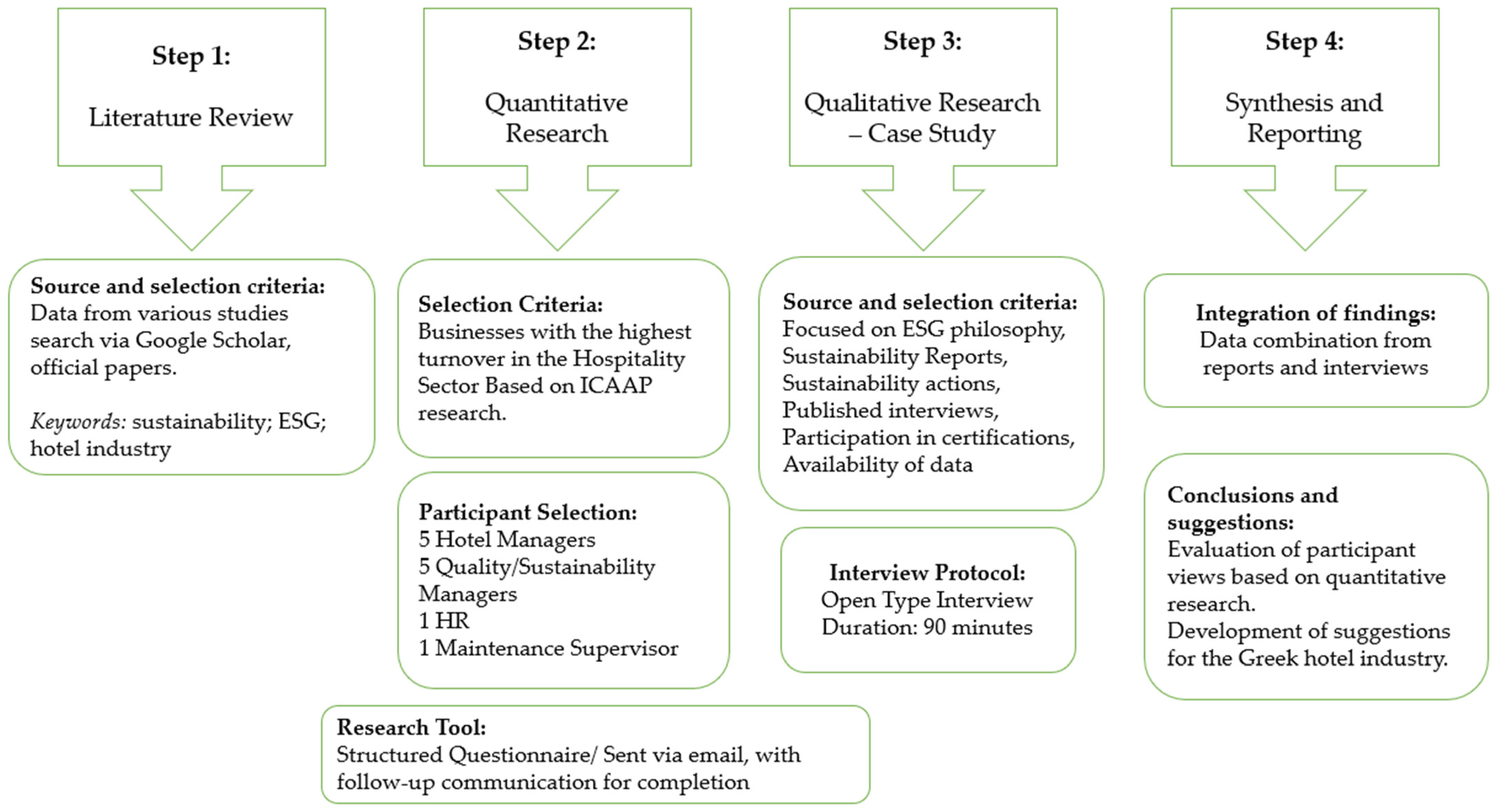
This study adopted a mixed-methods approach that combined a structured survey instrument with a case study of Phāea Resorts. This design enabled both breadth and depth in exploring ESG implementation across sectors in Crete (see
Appendix A).
Figure 1 presents the initial phase of the research, which involved an extensive literature review conducted using the Google Scholar electronic database. The search process employed algorithmically constructed search strings derived from standardized ESG terminology. This step helped establish the theoretical foundation of the study and guided the development of research instruments and the framing of key research questions.
Quantitative data collection was structured around a closed-ended questionnaire distributed to twelve hotel units operating in Crete. These hotels were selected from ICAP’s 2023 national survey, which identified the most profitable tourism businesses. However, the inclusion criteria were not limited to profitability. The survey questionnaire was designed to collect data on key ESG-related practices, perceived impacts, and strategic outcomes from hotel enterprises. The instrument consisted of five sections covering (1) firm profile, (2) environmental practices, (3) social engagement, (4) governance mechanisms, and (5) perceived financial and strategic outcomes.
Items in the questionnaire were adopted from previous validated ESG and sustainability frameworks used in the hospitality and tourism sector (
Alsayegh et al., 2020;
Lu et al., 2025). The design incorporated insights from the GRI and SASB metrics, adjusted for the operational realities of tourism businesses. Each item was measured using a five-point Likert scale (1 = Strongly disagree to 5 = Strongly agree), assessing both the implementation level and perceived relevance of ESG practices.
To ensure content validity, the questionnaire was reviewed by three academic experts in sustainability and tourism, as well as two hotel industry professionals familiar with ESG implementation. A pilot test was conducted with a sample of ten hotel managers from Crete, which led to minor refinements in wording and item clarity. Reliability testing using Cronbach’s alpha showed acceptable internal consistency across the three ESG dimensions (Environmental α = 0.82; Social α = 0.79; Governance α = 0.84).
The second phase of the study focused on an in-depth qualitative case study of Phāea Cretan Malia, selected due to its extensive engagement with sustainability practices and participation in relevant certification schemes (e.g., ISO 14001, ISO 50001, Green Key and EMAS). A total of 103 responses were collected between April and June 2023, of which 96 were deemed valid for analysis after quality control checks and semi-structured interviews conducted with senior personnel responsible for ESG implementation, including sustainability and quality managers. These interviews aimed to provide contextual depth on the operational, financial, and reputational impacts of ESG strategies.
Quantitative responses were analyzed using IBM SPSS Statistics version 26, employing descriptive and correlational techniques to identify patterns linking ESG practices to performance metrics. Qualitative data were examined through thematic content analysis using NVivo, allowing for the systematic extraction of themes and the integration of stakeholder perspectives into the study’s evaluative framework.
The study maintained strict adherence to research ethics, including informed consent, data confidentiality, and the anonymization of participant responses. Ethical approval was obtained from the appropriate academic committee prior to fieldwork.
While the study’s findings are grounded in a single geographical and institutional context, its methodological rigor and data triangulation offer strong internal validity. The results contribute valuable evidence to ongoing discussions about the financial viability of ESG strategies in hospitality and serve as a model for similar analyses in other high-impact service industries.
4. Results
4.1. Quantitative Results from Surveyed Hotel Enterprises
The survey data were analyzed using SPSS Statistics version 26. Descriptive statistics were generated to assess the level of ESG awareness, policy implementation, perceived benefits, and barriers across the participating hotel enterprises in Crete. The results provide a snapshot of how ESG practices are currently applied within the sector.
Respondents reported a high level of perceived importance of ESG practices, with 75% rating them as “very important” and an additional 16.7% rating them as “important” (
Table 1).
Regarding implementation scope, 75% of participants stated that ESG was integrated into both the strategy and philosophy of their hotel, and half reported that more than 50% of ESG measures had been implemented (
Table 2).
The analysis revealed that only a minority of hotels had adopted formal ESG reporting practices. For instance, only 8.3% of participants had adopted ISO 21401 (
International Organization for Standardization, 2018), and just 8.3% used GRI sustainability reporting standards (
Table 3). This indicates a limited formalization of ESG frameworks despite widespread awareness.
The analysis of the reported infrastructure and resource allocations showed that 66.7% of hotels had appropriate facilities and staff partnerships in place for ESG execution. However, only 33.3% offered dedicated staff training programs, and a similar percentage reported efforts toward cultural change within the organization (
Table 4). The most commonly accepted cost ratio for ESG implementation was 25%, reported by 50% of respondents, with only one enterprise indicating a 50% threshold.
Regarding financial impact, 75% of hotels noted a reduction in energy costs after implementing ESG policies, with 16.7% assessing it as “very good” and 41.7% as “good.” Satisfaction outcomes were positive but cautious—33.3% of respondents reported that customers were “very satisfied,” while 66.7% selected “moderately satisfied”.
4.2. Perceived Benefits and Challenges of ESG Implementation
Responses related to the perceived benefits of ESG policy implementation revealed several recurring themes among hotel enterprises. As shown in
Table 5, the most frequently reported benefit was enhanced corporate reputation, identified by 83.3% of respondents. This suggests that hoteliers view ESG practices as closely tied to their public image and brand differentiation in a competitive market (
Kim & Li, 2021;
Tripopsakul, 2025). A similarly high proportion of respondents (75%) cited avoidance of fines and legal compliance as a benefit, highlighting the role ESG plays in regulatory risk mitigation.
The strengthening of internal corporate culture was recognized by 58.3% of the participants, indicating that ESG initiatives may positively influence employee alignment, cohesion, and organizational values. Better relationships with the local community were noted by 58.3%, reflecting the perceived social capital derived from community-based initiatives or responsible sourcing practices. Notably, enhanced innovation capabilities were mentioned by 50% of hotels, while competitive advantages and crisis management preparedness each garnered recognition from 41.7% of respondents.
However, only 25% of hotels reported a direct increase in profitability as a result of ESG adoption. This finding suggests that respondents view financial benefits as potentially indirect long term or dependent on contextual factors such as firm size, customer base, or ESG maturity level. It also underscores that, at present, ESG may be seen more as a strategic or reputational asset than as a short-term financial gain (
Jiang et al., 2023).
In terms of challenges, the most prominent barrier identified was lack of staff training, selected by 58.3% of respondents. This indicates that many hotels may lack the human capital infrastructure needed to support comprehensive ESG integration, including the technical knowledge and soft skills necessary to embed sustainability into daily operations. High implementation costs were cited by 33.3%, reinforcing the view that ESG, particularly environmental initiatives—require substantial financial outlay, which can be difficult to justify without immediate returns. Only 8.3% of respondents identified staff resistance as a challenge, suggesting that internal opposition is less of a concern compared to resource and capability gaps.
When asked about the future trajectory of ESG policy development in the hospitality sector, 91.7% of participants indicated that ESG practices would either “increase” or “increase significantly.” This reflects a strong consensus that ESG is not a passing trend but a growing component of operational and strategic planning. Only one respondent expected ESG activity to remain stable, and none foresaw a decline, further emphasizing the sector’s forward-looking stance on sustainability.
Finally, participants were asked whether they would be willing to share financial data for future research. Only one respondent agreed to do so. This limited willingness suggests that while ESG is seen as important, financial disclosure related to it remains sensitive and may require stronger trust frameworks or incentives in future studies.
4.3. Cost–Benefit Analysis of Phāea Resorts Case Study
To complement the broader survey results, a cost benefit analysis was conducted based on financial and operational data collected from Phāea Resorts Group, which has implemented ESG practices extensively over recent years. This case study allows for a deeper understanding of the real world over economic implications of ESG integration in the hospitality sector.
The environmental investment data (
Table 6) show that from 2019 to 2023, the organization allocated more than 654,000 € toward environmental upgrades. These included capital expenditures on solar panel installations, HVAC system replacements, water-saving infrastructure, and energy-efficient lighting systems (LED). These initiatives were not only high in upfront cost, but also demanded operational adjustments and staff retraining. However, the environmental outcomes justify the expenditures (
Sharbaf & Schneider-Marin, 2025;
Alexakis et al., 2025). The resort achieved a reduction in energy consumption per guest night by 18.4%, along with a waste recycling rate of 85% by 2023, indicating a strong return in environmental performance and resource efficiency.
In terms of the social dimension (
Table 7), the total investment was approximately 145.000 €. This covered programs for employee training, workplace enhancements, and community engagement. Notably, resources were allocated to support local suppliers and promote inclusive employment. Although the costs were lower than environmental investments, the initiatives contributed to key qualitative outcomes, such as improved employee morale and strengthened ties with the surrounding community (
Ragazou et al., 2024).
The governance-related expenditures (
Table 8) were significantly lower, totaling 33.770 €. These costs were linked to professional ESG certifications, policy documentation, consultancy fees, and specialized staff roles focused on governance and compliance. While governance initiatives are often perceived as administrative, their indirect impact was evident through enhanced brand credibility, reduced reputational risk, and improved stakeholder transparency.
When examining performance outcomes relative to these investments (
Table 9), the results suggest a positive trend. Employee retention rates improved, guest satisfaction score increased, and the resort received external recognition through certifications and sustainability awards. These outcomes imply that ESG practices contributed to both internal operational stability and external reputational benefits. Taken together, the case study reveals a disproportionate investment-to-benefit ratio across the ESG pillars. Environmental costs were highest but yielded measurable operational gains. Social costs, though moderate, resulted in qualitative improvements in human capital and community goodwill. Governance investments, while minimal in monetary terms, appear to offer strategic value through improved institutional practices and stakeholder trust (
Gong et al., 2025).
This case provides indicative evidence that ESG implementation may be associated with tangible, and intangible benefits as perceived by management. The data demonstrate that the long-term gains—in energy efficiency, brand value, and employee engagement—may outweigh initial expenditures, particularly when ESG strategy is holistically integrated across environmental, social, and governance domains.
5. Discussion
The findings of this study contribute to the expanding discourse on ESG implementation within the hospitality sector by providing empirically grounded insights from a tourism-dependent regional economy. Overall, the results suggest that hotel enterprises increasingly recognize ESG not merely as a compliance requirement but as a strategic orientation capable of supporting organizational resilience. At the same time, the evidence indicates that the depth and formalization of ESG adoption remain heterogeneous, reflecting structural constraints commonly observed in service-based industries (
Y. Zhang et al., 2025).
Consistent with stakeholder theory, the strong perceived importance attributed to ESG practices signals growing responsiveness to stakeholder expectations, particularly those of customers, regulators, and local communities (
Du et al., 2026;
Garefalakis & Dimitras, 2020). The fact that 75% of respondents classified ESG as “very important” suggests that sustainability considerations are progressively entering managerial decision frameworks rather than remaining peripheral reputational tools. However, perceived importance should not be conflated with implementation maturity; instead, it may reflect an anticipatory strategic posture shaped by regulatory trends and evolving market norms.
The results further reveal an asymmetric pattern of ESG adoption across dimensions. Environmental initiatives appear to function as the primary entry point for sustainability integration, largely due to their measurability and clearer operational payoffs (
Ragazou et al., 2024). Reported reductions in energy consumption and improvements in recycling practices indicate tangible efficiency gains, suggesting that environmental investments may enhance cost predictability and resource optimization. From a resource-based perspective, such capabilities can gradually evolve into strategic assets by strengthening operational stability rather than generating immediate competitive advantage.
Importantly, these outcomes should be interpreted as observable operational improvements rather than direct financial returns (
Khan et al., 2025). While efficiency gains may indirectly support profitability over time, the present findings do not support deterministic claims regarding short-term financial performance. This distinction is critical for maintaining analytical precision, particularly in exploratory studies where managerial perceptions may precede measurable financial outcomes.
The social dimension presents a more complex picture. Although respondents acknowledged the value of employee development and community engagement, the limited prevalence of structured training programs suggests that human capital investments remain secondary to environmental priorities (
Passas et al., 2022;
Zopounidis et al., 2020). This imbalance aligns with prior hospitality research indicating that socially oriented ESG initiatives often require deeper organizational transformation and cultural alignment. Institutional theory offers a useful lens here, as the internalization of sustainability practices typically depends on the gradual diffusion of norms rather than rapid procedural change.
Similarly, the relatively modest adoption of formal reporting frameworks points to an early stage of ESG institutionalization across the sample. Rather than signaling resistance, this pattern may reflect capability gaps, informational barriers, and the administrative burden associated with certification processes—constraints that are particularly salient for hotels operating in financially volatile, seasonally dependent markets.
Governance practices exhibited the lowest level of formal investment, yet their strategic implications should not be underestimated. Even limited governance mechanisms can enhance transparency, strengthen internal controls, and reduce reputational exposure. Prior literature associates such structures with improved risk oversight, suggesting that their value lies less in immediate financial contribution and more in reinforcing organizational credibility. In this sense, governance may function as a stabilizing infrastructure that enables more effective deployment of environmental and social initiatives.
The divergence between perceived benefits and reported profitability further underscores the importance of interpretive caution. While reputational enhancement and regulatory alignment were widely recognized, only a minority of respondents associated ESG adoption with direct profit increases. This finding suggests that financial value creation is likely mediated through intermediate mechanisms—such as efficiency improvements, brand differentiation, and stakeholder trust—rather than realized through immediate revenue expansion. Consequently, ESG should be conceptualized as a long-term strategic investment rather than a short-term financial lever.
The Phāea Resorts case study deepens this interpretation by illustrating how sustained ESG engagement can translate into measurable operational outcomes within a mature organizational setting. Significant environmental investments were accompanied by improvements in energy performance, while social initiatives correlated with higher employee retention and guest satisfaction. Although these outcomes cannot be interpreted causally, they provide indicative evidence that integrated ESG strategies may support organizational stability and service quality—both of which are foundational to long-term financial viability.
Notably, the case also highlights the role of strategic planning and governance structuring in enabling ESG maturation. These elements were less visible across the broader survey sample, suggesting that ESG progression may follow a capability-based trajectory in which firms gradually transition from awareness to structured implementation. The complementarity between the survey and case findings therefore strengthens interpretive confidence while remaining consistent with the exploratory scope of the study.
Taken together, the results suggest that ESG adoption in hospitality is best understood as an incremental organizational process rather than a discrete strategic shift. Hotels appear to prioritize initiatives that deliver operational clarity, while more complex social and governance transformations evolve at a slower pace. This sequencing does not necessarily indicate strategic imbalance; rather, it may reflect rational resource allocation under conditions of financial constraint.
From a theoretical standpoint, the findings support the view that stakeholder pressures and internal capabilities jointly shape ESG trajectories. Stakeholder theory explains the growing strategic salience of sustainability, whereas the resource-based view helps interpret how ESG-related practices may gradually develop into firm-specific competencies. Crucially, the study extends existing literature by demonstrating how these dynamics unfold within a regional tourism economy, where structural limitations moderate the speed and depth of sustainability transitions.
Overall, the evidence suggests that ESG integration may be associated with enhanced operational robustness and reputational positioning, yet its financial implications remain largely indirect and temporally contingent. Future research employing longitudinal designs would be particularly valuable in clarifying whether the operational advantages observed here ultimately translate into sustained financial performance.
6. Conclusions
This study examined the implementation of ESG practices in hotel enterprises by combining quantitative survey evidence with a case-based cost–benefit analysis. The findings indicate that ESG is increasingly perceived as strategically relevant within the hospitality sector; however, its level of institutionalization remains uneven across environmental, social, and governance dimensions. While many hotels have initiated sustainability-oriented actions—particularly in environmental infrastructure and resource management—the adoption of formal frameworks, structured reporting mechanisms, and consistent governance investments appears comparatively limited.
The evidence suggests that environmental initiatives are currently the most operationalized component of ESG, as energy-efficiency upgrades and resource management practices were associated with observable improvements in cost control and operational performance. Social initiatives, including employee development and community engagement, were less systematically implemented but nonetheless recognized as organizationally valuable. Governance mechanisms, although requiring relatively modest financial investment, were perceived to strengthen transparency, reputational positioning, and institutional alignment. Importantly, these outcomes should be interpreted as indicators of operational and strategic progression rather than as direct evidence of short-term financial returns.
6.1. Theoretical Contributions
From a theoretical perspective, this study advances the sustainability and hospitality literature by demonstrating how ESG adoption is shaped by the interaction between stakeholder pressures and firm-specific capabilities. The findings lend support to stakeholder theory by illustrating the growing influence of external expectations on managerial priorities, while the resource-based view helps explain how sustainability-related practices may gradually evolve into organizational competencies that support long-term resilience. Additionally, the uneven maturity observed across ESG dimensions aligns with institutional arguments suggesting that sustainability transitions typically occur incrementally as norms, routines, and governance structures become embedded within organizations.
By providing empirical evidence from a tourism-dependent regional economy, the study extends existing research beyond large multinational contexts and highlights the structural constraints that may moderate the pace of ESG integration. In doing so, it contributes to a more context-sensitive understanding of how sustainability strategies emerge within service-oriented enterprises operating under financial and operational volatility.
6.2. Practical Implications
The findings offer several implications for managers, policymakers, and industry stakeholders. For hotel executives, the results underscore the importance of approaching ESG as a phased strategic process rather than a discrete investment decision. Prioritizing initiatives that enhance operational efficiency may create the organizational stability necessary to support more complex social and governance transformations over time. The identification of training deficits and resource constraints further suggests that human capital development should be treated as a critical enabler of sustainability integration rather than a secondary consideration.
For policymakers and tourism associations, the results highlight the potential value of targeted incentives, certification support mechanisms, and sector-specific training programs aimed at reducing capability gaps among hospitality firms. Facilitating access to ESG knowledge infrastructures may accelerate institutionalization and promote more consistent sustainability practices across the sector.
The Phāea Resorts case study reinforces these implications by illustrating how long-term planning and structured governance can support the gradual translation of ESG investments into operational improvements and reputational benefits. Although such outcomes should not be generalized without caution, they provide indicative evidence that strategically embedded sustainability practices may contribute to organizational robustness.
Overall, the study suggests that ESG integration within hospitality is best understood as an evolutionary process characterized by incremental capability building rather than immediate financial transformation. Future research employing longitudinal designs and broader samples would be particularly valuable in clarifying the temporal relationship between ESG adoption, operational performance, and financial outcomes.
7. Limitations and Future Research
While this study provides empirically grounded insights into ESG implementation within the hospitality sector, several limitations should be acknowledged to ensure analytical transparency and interpretive balance.
First, the study is based on a relatively small sample that is geographically concentrated in Crete. Although the region represents a highly tourism-dependent economy and therefore offers a relevant context for examining sustainability transitions, this bounded setting may limit the broader generalizability of the findings. ESG adoption is often shaped by regulatory frameworks, market maturity, and cultural expectations; consequently, future research could benefit from multi-regional or cross-country designs that allow for comparative analysis across institutional environments.
Second, the study relies primarily on self-reported managerial data collected through structured questionnaires. Such data may be subject to response biases, including social desirability or the potential overstatement of sustainability practices. Although perceptual data remain valuable for understanding managerial priorities and strategic orientation, future research could strengthen measurement robustness by incorporating third-party audits, archival sustainability reports, or observational indicators capable of validating reported practices.
Third, the cross-sectional design constrains the ability to evaluate the temporal dynamics of ESG adoption. Sustainability investments frequently generate outcomes over extended time horizons, and their financial implications may not be immediately observable. Longitudinal research tracking firms over multiple periods would therefore be particularly valuable in clarifying whether operational improvements associated with ESG integration ultimately translate into sustained financial performance, enhanced customer loyalty, or stronger workforce stability.
Additionally, while the Phāea Resorts case study enriches the analysis by providing contextual depth, it reflects the trajectory of a single organization characterized by relatively advanced ESG maturity. As such, caution is warranted in extrapolating these insights across the broader hospitality population. Future case-based research encompassing hotels of varying size, ownership structure, and resource capacity could reveal alternative pathways to ESG implementation, particularly among smaller or independently operated firms facing tighter financial constraints.
Finally, the cost–benefit assessment presented in the case study is primarily grounded in managerial estimations and reported operational outcomes rather than in formal financial valuation techniques. The absence of a clearly defined investment horizon and advanced financial modelling—such as discounted cash flow or net present value analysis—limits the precision with which the economic returns of ESG initiatives can be quantified. Subsequent research employing scenario-based modelling and financial forecasting approaches could provide a more rigorous evaluation of the long-term investment logic underlying sustainability strategies.



 ,
,