Article

Managerial Myopia, Willingness for Proactive Risk-Taking, and Digital Transformation in Commercial Banks: Evidence from China


International Business School, Shaanxi Normal University, No. 620, West Chang’an Street, Xi’an 710119, China
*
Author to whom correspondence should be addressed.
Int. J. Financial Stud. 2026, 14(3), 56; https://doi.org/10.3390/ijfs14030056
Submission received: 16 January 2026 / Revised: 11 February 2026 / Accepted: 14 February 2026 / Published: 2 March 2026

Abstract

Digital transformation in commercial banks is a critical enabler of modern financial development. While technological advancement and resource allocation are key drivers, managerial attributes also play a decisive role in shaping transformation trajectories. Managerial myopia—often arising from short-term performance pressures, evolving regulatory expectations, and cyclical macroeconomic conditions—warrants particular attention. This study examines how managerial myopia constrains banks’ digital transformation by analyzing its direct impact, underlying behavioral mechanisms, and contingent boundary conditions. Using panel data from 55 Chinese listed commercial banks from 2010 to 2021, we construct a text-based measure of managerial myopia through linguistic analysis of annual reports and employ fixed-effects models for estimation. The results show that a short-term managerial orientation significantly impedes digital transformation, primarily by reducing banks’ propensity for proactive risk-taking. However, this inhibitory effect weakens when managers anticipate longer tenures, management teams exhibit greater diversity in overseas experience and functional expertise, or the average educational level is higher. Moreover, the adverse effects are less pronounced in larger banks and those with stronger corporate governance. Increased external scrutiny and intensified market competition further mitigate this negative influence. These findings offer actionable insights for banking stakeholders aiming to strengthen governance, extend managerial time horizons, and foster an innovation-oriented culture conducive to sustained digital advancement.

1. Introduction

As the cornerstone of the financial system, the digital transformation of commercial banks represents an inevitable trend and a foundational component of modern finance. In 2023, the Big Six state-owned banks of China invested a total of CNY 122.8 billion in fintech, while 25 listed banks collectively reported fintech (or information technology) investments amounting to CNY 197 billion. Notably, 22 of these banks have consistently increased their fintech expenditure as a share of operating income—rising from 3.11% in 2021 to 3.50% in 2022 and reaching 3.76% in 2023. Despite this progress, the digital transformation of commercial banks faces significant challenges, including limited experience and inadequate resource allocation.
The transformation process is further hindered by multiple structural obstacles: underutilized digital assets, high product homogenization, excessive focus on hardware upgrades, and insufficient investment in digital technologies for middle- and back-office operations (António et al., 2024; Wang et al., 2024). Moreover, digital maturity varies significantly across bank types. State-owned banks (SOBs) and joint-stock commercial banks (JSCBs) exhibit relatively advanced digital capabilities, whereas city commercial banks (CCBs) and rural commercial banks (RCBs) lag behind. Crucially, the gap in strategic and managerial digitization between these groups has widened annually, with large banks (LBs) progressing toward intelligent digitalization, while many small and medium-sized banks (SMBs) remain at the electronic stage. Disparities also exist within the SMB category: although RCBs trail CCBs in fintech adoption (C. Zhang et al., 2025), they demonstrate more focused digital business operations. In terms of business-technology alignment, some SMBs have established mature collaboration mechanisms that enable deep integration of technology with core business functions, while others lack such frameworks or are still in nascent stages.
These differences stem not only from variations in digital strategy, technology investment, and management systems but also from divergent internal cultures, organizational structures, and employee competencies—even among institutions with similar profiles.
Externally, the success of digital transformation is influenced by market competition, government policy guidance, and shifts in economic regulations (Ding & He, 2023; Shang & Niu, 2023; Z. Zhang & Sun, 2025). Internally, key constraints include technological innovation capacity, levels of IT investment, digital strategy formulation, and leadership’s understanding of digital imperatives (Park & Mithas, 2020; Guo et al., 2023). Among these, managerial decision-making plays a pivotal strategic role—it shapes the overall direction of digitalization, ensures efficient resource allocation during transitions, and maintains operational stability (Lin et al., 2019). Therefore, this study emphasizes the critical influence of managers in driving digital transformation. However, driven by career concerns and external performance pressures, managers may display myopic behavior that undermines long-term development. First, managerial myopia leads to reduced R&D spending and diminished long-term investment, which constrains innovation and weakens dynamic competitive advantages (Yu et al., 2024b). Second, myopic managers often prioritize short-term profit maximization at the expense of long-term risk considerations, thereby eroding the institution’s risk culture (Hribar et al., 2017). Given that digital transformation requires sustained strategic commitment and proactive risk management, the adverse effects of managerial myopia warrant deeper investigation.
At the same time, given that bank managers may be subject to heightened pressures related to market performance, operate within a stringent regulatory environment, and experience tenure periods that coincide with financial cycles, their tendency toward short-termism becomes particularly pronounced, potentially resulting in the delay of or a reduction in meaningful digital transformation initiatives in banks.
The current research still fails to provide an analysis of the direct consequences and influencing mechanisms of managers’ myopic behavior for the digital transformation of banks. Specifically, there is a dearth of in-depth research on the impact, influencing path, and other factors of managerial myopia on the digital transformation process. Based on this, this paper takes managerial myopia as the starting point to analyze its influencing mechanism in the digital transformation process of commercial banks. Meanwhile, from multiple dimensions such as the characteristics of the management team and the internal and external environment of the bank, it comprehensively examines the influence of different factors on the relationship between managerial myopia and the digital transformation of commercial banks. To further clarify the negative effects of managerial myopic behavior on the digital transformation and development of commercial banks, which are the most important financial institutions, this paper aims to further explore how to mitigate this negative impact through the analysis of the influencing mechanism and influencing factors.
This study makes three primary contributions. First, it examines the impact of managerial myopia on commercial banks’ digital transformation through the lens of managerial psychological cognition, thereby enriching theoretical insights into how short-term orientation affects long-term strategic planning in banking. Second, it identifies the underlying mechanism—proactive risk-taking—that mediates the relationship between managerial myopia and digital transformation outcomes. Third, it explores how contextual factors, including management team composition, corporate governance quality, market competition intensity, and external oversight mechanisms, moderate the negative impact of managerial myopia.

2. Literature Review and Hypothesis Development

2.1. Managerial Myopia and Its Motivations

Managerial myopia refers to managers’ strong preference for the present, which leads to a narrowed decision-making horizon. As a result, they tend to prioritize immediate short-term gains over strategic decisions that could yield long-term returns (Feng et al., 2025). Grounded in Temporal Orientation Theory, managers demonstrate subjective temporal inclinations—toward the past, present, or future—during the strategic decision-making process (Laverty, 1996; Lumpkin & Brigham, 2011; Stein, 1989). Managerial myopia occurs when managers place disproportionate emphasis on immediate gratification rather than on sustained value creation (Lin et al., 2019). Internally, various pressures contribute to myopic behavior. As corporate agents, managers face principal-agent conflicts in which maximizing shareholder value may not always be their primary objective. According to Remuneration Distortion Theory, managers often prioritize enhancing their reputation in the labor market to secure future career opportunities and higher compensation (Narayanan, 1985; Konadu et al., 2020). Managerial Entrenchment Theory further suggests that this behavior leads to an overemphasis on short-term performance and stock prices, often at the expense of long-term growth (Morck et al., 1988). Externally, pressures from stakeholders also play a critical role in encouraging short-termism. Stakeholders, especially those focused on immediate profitability and stock performance, often demand quick results (Nguyen et al., 2020). Stakeholder Theory posits that managers may compromise long-term strategic interests to meet short-term expectations, thereby boosting near-term performance and share prices (Chintrakarn et al., 2016; Cremers et al., 2019). For example, controlling shareholders can significantly influence managerial decisions through their voting power and investment horizons. When these shareholders act as short-term investors with brief holding periods, they primarily focus on immediate financial outcomes.

2.2. Impact of Managerial Myopia on Bank Digital Transformation

Drawing upon Upper Echelons Theory, managerial cognition plays a central role in determining strategic choices, thereby shaping organizational behavior and outcomes (Hambrick & Mason, 1984). Within this theoretical framework, managerial myopia emerges as a critical barrier to the digital transformation of banks.
From the perspectives of high investment and long-term orientation, digital transformation requires sustained and large-scale resource allocation during its initial phase, subjecting banks to dual pressures of profit margin compression and risk accumulation. This reality fundamentally conflicts with the short-term performance expectations of myopic managers within their tenure. Specifically, first, continuous substantial investments divert financial resources from daily operations and business expansion, potentially leading to short-term efficiency declines and impairing overall organizational performance. Second, prolonged capital occupation diminishes decision-making flexibility, limiting banks’ ability to dynamically reallocate resources. This constraint weakens their responsiveness to emerging opportunities or sudden challenges, thereby increasing exposure to uncertainty. Third, returns on digital transformation investments typically materialize over the long term, making it difficult to translate them into immediate performance improvements. In contrast, rising expenditures on technology upgrades, system maintenance, and employee training may suppress short-term profitability. Consequently, short-sighted managers—motivated to avoid accountability for deteriorating financial performance and to preserve personal reputation and market evaluation—are inclined to curtail investments in digital transformation (Zona & Zamarian, 2022).
From a high-risk perspective, digital transformation, as a process of disruptive innovation, involves significant financial and operational risks. Firstly, financial risks stem from substantial investments in digital technology R&D, revenue fluctuations due to market uncertainty, and sunk costs resulting from potential transformation failures. Secondly, digital transformation requires the dismantling of traditional operational and structural boundaries within banking institutions to facilitate the deep integration of existing resources, business frameworks, and operational models with emerging digital technologies (Rodrigues et al., 2022). As new business ventures and innovative models are explored, this transformation process inherently introduces operational risks. Managers who exhibit risk-averse tendencies and prioritize short-term stability are more likely to resist high-risk transformation initiatives, thereby impeding the progress of digital transformation.
Thus, we propose Hypothesis 1:
Hypothesis 1. 
Managerial myopia inhibits the digital transformation of commercial banks.

2.3. Mechanism of Managerial Myopia on Bank Digital Transformation

The essence of digital transformation lies in harnessing digital technologies to drive business process reengineering, organizational restructuring, and innovation in business models, thereby reshaping value creation (Bharadwaj et al., 2013). At its core, digital transformation entails a strategic shift from passive risk avoidance to proactive risk restructuring—transforming traditional risks into distinctive competitive advantages through deliberate risk-taking (Luo et al., 2024). Proactive risk-taking refers to banks deliberately engaging in high-uncertainty domains with long-term strategic value, guided by their operational strategies, risk appetite, and resource endowments. However, managerial myopia impedes proactive risk-taking through a tripartite mechanism, ultimately hindering digital transformation progress (Xu et al., 2025).
First, at the strategic decision-making level, myopic managers’ biased perceptions of risk significantly impede banks’ willingness to engage in proactive risk-taking. This phenomenon is characterized by dual cognitive distortions: an underestimation of the long-term strategic value of digital transformation in enhancing core competitiveness, customer experience, and profitability, and an overemphasis on short-term risks such as technological failures and reputational damage. These cognitive biases directly diminish the willingness to embrace digitalization-related risks, resulting in a resource allocation bias toward legacy operations and causing banks to forgo critical opportunities for technological innovation (Wen et al., 2025). Furthermore, even when digital transformation is initiated under regulatory or policy pressure, risk-averse managers often develop path dependencies by indiscriminately replicating existing models, leading to solutions that are incongruent with the bank’s unique operational profile. This superficial approach not only diverges from market demands and institutional positioning but also exacerbates digital homogenization across the banking industry.
Second, at the implementation level, the diminished willingness for proactive risk-taking resulting from managerial myopia directly leads to weak strategic commitment and risk-averse behavior during execution. Digital transformation is fundamentally a process through which banks attain long-term competitive advantages by embracing strategic risks. It requires sustained investment in research and development, system modernization, and talent cultivation. However, short-sighted managers, excessively focused on short-term financial performance, are inclined to avoid high-sunk-cost, high-risk, and long-horizon initiatives, thereby limiting investment in digital transformation. Even when initial resources are allocated, myopic managers often reduce or withdraw funding prematurely when short-term returns or key milestones fail to meet expectations. This tendency highlights their reluctance to engage in proactive risk-taking in transformative endeavors. Consequently, such behavior results in insufficient resources for digitalization initiatives and delays in technological upgrades, which may give rise to risks such as technological obsolescence and data security vulnerabilities, ultimately hindering the continuous progress of digital transformation.
Third, at the organizational culture level, a risk-avoidant culture undermines the endogenous motivation for proactive risk-taking. Grounded in Signaling Theory (Beecher, 1989), short-sighted managerial practices convey risk-averse signals through strategic planning, resource allocation, and performance evaluation systems. These signals discourage employee innovation and reduce risk tolerance, thereby weakening the organization’s intrinsic drive for proactive risk engagement. This risk-avoidant culture pervades all levels of banking operations, constraining organizational learning and adaptability. As a result, banks lack key components essential for digital transformation—innovation-supportive environments and error-tolerant mechanisms. Consequently, the exploration of new business models and the adoption of emerging technologies are hindered, fundamentally eroding the internal impetus for digitalization.
Therefore, we propose Hypothesis 2:
Hypothesis 2. 
Managerial myopia inhibits commercial banks’ digital transformation by reducing proactive risk-taking willingness.

2.4. Factors Influencing Managerial Myopia in Bank Digital Transformation

Building on the analytical framework of “managerial myopia, willingness to take proactive risks, and digital transformation of banks,” this study further examines additional factors influencing the effectiveness of this transmission mechanism, thereby uncovering the full pathway through which managerial myopia constrains the digital transformation of banks.

2.4.1. Influencing Factors Related to Managers and Their Team Characteristics

Management teams play a critical role in shaping corporate decisions and behaviors, with their effectiveness influenced by members’ demographic characteristics and team heterogeneity (Hambrick & Mason, 1984). Key factors such as expected tenure, overseas experience, diversity in functional expertise, and the average educational level of team members affect managers’ engagement in digital transformation initiatives within banks (Sahaym et al., 2016).
Expected tenure. Expected tenure refers to the estimated or anticipated duration of a manager’s future tenure. It is a forward-looking concept directly linked to a manager’s risk preferences, strategic priorities, and decision-making horizon (Hambrick & Gregory, 1991). Managers with shorter expected tenure tend to display more short-term orientation and demonstrate lower commitment to digital transformation. As their tenure decreases, their personal career and financial interests become less aligned with the firm’s long-term performance, leading to reduced investment in long-cycle, high-risk digital projects and hindering the progress of digital transformation (Z. Gao et al., 2023).
Management team heterogeneity refers to the diversity in members’ cognitive frameworks, expertise, and values, which enhances decision-making quality through complementary knowledge and multidimensional perspectives (Cui et al., 2019), while also expanding external resource networks.
Overseas experience heterogeneity. Overseas experience heterogeneity contributes to management teams in multiple ways. First, diverse overseas backgrounds enhance innovation receptiveness and risk tolerance, optimize corporate governance, reduce managerial myopia, and strengthen the focus on long-term digital strategies (Gu, 2022; Xiang & Yi, 2022). Second, significant differences in overseas experiences among team members enrich the bank’s international relationship networks, facilitating partnerships with global financial institutions. This not only broadens the bank’s access to external resources but also introduces overseas digital transformation practices, offering valuable references for advancing digital transformation (G. Li & Shao, 2023).
Functional expertise diversity. First, functional expertise diversity stimulates the clash and integration of diverse knowledge, skills, and cognitive styles. This dynamic reduces decision-making parochialism and fosters innovative thinking, thereby enhancing the comprehensiveness of digital strategies. Second, management teams characterized by high functional expertise heterogeneity can establish extensive social and external resource networks, broadening access to critical resources and mitigating scarcity-induced myopia.
Average educational level. First, management teams with higher educational attainment demonstrate broader strategic perspectives and employ more rigorous decision-making methodologies. These attributes help curb self-interest-driven decisions and prioritize sustainable digital strategies (He et al., 2021). Second, their enhanced capabilities in information acquisition and processing enable them to swiftly identify digital opportunities, accurately formulate digital transformation strategies, and systematically implement them (Clemente-Almendros et al., 2024; Yang & Xiao, 2024; D. Gao & Li, 2025).
Based on this, the following Hypothesis 3 is proposed:
Hypothesis 3. 
Longer manager expected tenure, greater management team heterogeneity, and higher managerial education levels jointly mitigate the inhibitory effect of managerial myopia on bank digital transformation.

2.4.2. Factors at the Bank Level

(1)
Bank size. The inhibitory effect of managerial myopia on digital transformation varies significantly by bank size, with a more pronounced suppression effect observed in small and medium-sized banks (SMBs) compared to larger institutions. This divergence can be attributed to two key factors. First, large banks benefit from economies of scale, enabling them to spread substantial R&D expenditures across diversified asset portfolios, thereby lowering per-unit technology acquisition costs. These advantages facilitate their access to digital transformation technologies and encourage proactive investment in digital innovation. In contrast, SMBs, with their limited operational scale, cannot absorb such initial costs, which imposes significant financial pressure during the early stages of transformation. This exacerbates managerial myopia and restricts investment in digital capabilities (Xiang & Jiang, 2023). Furthermore, SMBs often face competitive disadvantages that drive them toward short-term goals such as market share and profitability. At the same time, their relatively weaker data governance frameworks, lower risk resilience, and limited resource reserves hinder the development of long-term digital capacities.
(2)
Corporate governance. Corporate governance plays a critical role in mitigating the negative effects of myopia through three key mechanisms. First, improved decision-making transparency reduces information asymmetry, curbing self-interested short-term behavior and aligning strategic decisions with long-term objectives (D. Y. Zhang, 2013). Second, banks with strong governance frameworks have robust risk assessment and response systems. These enable them to promptly identify risks during digital transformation (Boubakri et al., 2013) and implement targeted mitigation strategies. Furthermore, by leveraging their competitive advantages and market positions, these institutions can establish clear strategic directions and transformation pathways, thereby avoiding operational risks stemming from poor decision-making or blind trend-following. Third, enhanced governance standards lead to more scientifically designed incentive mechanisms. These mechanisms motivate managers to prioritize long-term value creation over short-term financial performance (Yi, 2023), encouraging greater investment of time and resources into strategic initiatives such as digital transformation. Importantly, the presence of multiple large and monitoring shareholders enhances governance effectiveness. Through active oversight and ownership checks and balances, they help optimize equity structures, reduce managerial myopia, and create an environment conducive to successful digital transformation.
Hypothesis 4 is proposed:
Hypothesis 4. 
Greater bank scale and improved corporate governance weaken the negative impact of managerial myopia on digital transformation.

2.4.3. External Factors

External factors such as media and public attention, as well as market competition, primarily mitigate the inhibitory effect of managers’ short-sighted behavior by increasing their opportunistic costs and fostering a market environment with broad development prospects. Heightened external attention raises banks’ opportunistic costs, curbing myopic behaviors while encouraging greater resource allocation to digital transformation for brand enhancement and competitive positioning. Crucially, public attention—a core component of market scrutiny—enables stakeholders to rapidly access corporate information through search engines, news platforms, and social media, thereby reducing information asymmetry and distortion. This creates pervasive social oversight that diminishes the constraining impact of myopia and supports sustained digital advancement (Q. Wu et al., 2024).
Simultaneously, intensified market competition driven by fintech firms provides banks with external technological resources while exerting crowding-out effects on traditional services (L. Li et al., 2023). This pressure compels managers to accelerate digital technology R&D and application, counteracting the negative influence of myopia. Moreover, to maintain intra-industry competitiveness, managers continuously expand digital applications across business models, customer experiences, and risk management capabilities. This progressive technological innovation enhances operational efficiency and mitigates myopia’s detrimental impact on digital transformation (Coskun-Setirek & Tanrikulu, 2021).
Finally, Hypothesis 5 is proposed:
Hypothesis 5. 
From an external perspective, the inhibitory effect of managerial myopia on the digital transformation of commercial banks becomes more pronounced in environments characterized by low public scrutiny and limited market competition.

3. Research Design

3.1. Sample Selection and Data Sources

The data on the digital transformation of commercial banks used in this study were obtained from the Institute of Digital Finance at Peking University (Xie & Wang, 2023). Given that the dataset is compiled up to 2021, the sample period of this study is set from 2010 to 2021. Initially, all commercial banks covered by the dataset were selected as potential research subjects. However, banks with missing financial indicators were excluded from the sample, and only listed commercial banks were ultimately included in the analysis. The final sample comprises 55 banks, resulting in a total of 432 observations1. The specific composition of the sample banks is presented in Appendix A Table A1, and the asset details of the sample banks are presented in Appendix A Table A2. The financial data of these banks is primarily sourced from the CNRDS and CSMAR databases. Regional control variables are constructed based on data from the City Statistical Yearbook, the National Bureau of Statistics, and the CSMAR database. To mitigate the influence of extreme values on the empirical results, all continuous variables are winsorized at the 1% and 99% percentiles.

3.2. Main Variables

3.2.1. Independent Variable

The core independent variable in this study is managerial myopia (Myopia). Existing research frequently employs proxy variables to indirectly assess the degree of managerial myopia, including reductions in R&D expenditures, CEO age, stock turnover rate, the proportion of short-term investments, expected tenure, and shareholder equity ratio (Antia et al., 2010; Jain et al., 2016; Lundstrum, 2002). These indicators primarily capture the external manifestations or potential antecedents of managerial myopia, rather than directly reflecting the underlying psychological tendency of managers to prioritize short-term gains over long-term organizational development.
The Management Discussion and Analysis (MD&A) is a critical component of annual reports, offering an overview of the firm’s operational performance and strategic outlook (Mayew et al., 2015). It constitutes a critical section of a company’s annual report. It provides management’s authoritative assessment of the firm’s operational performance, financial condition, and strategic outlook. As a mandatory disclosure under securities regulations, the MD&A is formally prepared and jointly signed by senior executives, thereby reflecting both institutional accountability and collective managerial judgment. Given its origin in direct managerial communication and its substantive, language patterns in this section can reveal individual differences in cognitive depth, preferences, and personality. Therefore, by examining the types and frequencies of words used in the MD&A, we can infer and illuminate the psychological traits of corporate management. To accurately measure Myopia from their psychological level, this study refers to the method proposed by Hu et al. (2021). It uses a set of “myopia-related words,” including 10 seed words such as “in the next few days,” “within the month,” “immediately,” and “right away,” as well as 33 extended words like “opportunity,” “moment,” “pressure,” and “challenge,” and calculates the frequency of these words within the MD&A section relative to the total word count. This frequency is then multiplied by 100 to represent the managerial myopia index. A higher index indicates a greater degree of managerial myopia.
To construct Myopia, the following steps were taken in processing the annual report text data:
Step 1: PDF files were converted to TXT format using Python (version 3.12 within the PyCharm IDE 2024.3.4.). For encrypted and image-based PDFs, OCR technology was applied to extract the text.
Step 2: In Python, two methods were used to extract the MD&A section: First, the directory of each annual report was located to identify the page numbers of the MD&A section, which were then used to extract the relevant content. Second, for reports without a directory, regular expressions were applied to directly match the “Management Discussion and Analysis” in the full TXT document.
Step 3: Punctuation, English letters, and stop words were removed, and all traditional Chinese characters were converted to simplified Chinese.
Step 4: Use the Jieba package in Python (version 3.12 within the PyCharm IDE 2024.3.4.) to divide Chinese text into meaningful words, and then calculate the frequency of words corresponding to the myopia-related word list.

3.2.2. Dependent Variable

The dependent variable in this study is the digital transformation of commercial banks (Digital). To measure this variable, the study adopts the index published by Peking University, which encompasses three core dimensions—strategic digitalization (CDI), business digitalization (PDI), and management digitalization (ODI),—along with eight secondary indicators (Xie & Wang, 2023)2. Compared to earlier approaches that relied on analyzing keyword frequencies in textual data, this index effectively mitigates the bias associated with focusing exclusively on digital technologies. It therefore offers a more comprehensive, systematic, and scientifically grounded evaluation of the level of digital transformation.

3.2.3. Control Variables

This study controls for several factors that may influence the relationship between managerial myopia and the digital transformation of banks: (1) Bank assets (Size), return on assets (ROA), non-performing loan ratio (NPA), and financial leverage (Lev), which reflect the financial condition, resource reserves, and risk management capability of the bank, and thus influence its capacity and willingness to pursue digitalization. (2) Bank age (Age): In the early stages of a bank’s establishment, greater emphasis is placed on stable operations and business continuity, resulting in a relatively lower willingness to adopt digital transformation. As the bank matures and accumulates resources, its inclination toward digital transformation tends to increase. (3) Bank organizational structure, represented by the proportion of independent directors (Indep) and board size (Bn), which reflects corporate governance characteristics and affects the quality of strategic decisions regarding digital transformation. (4) Whether the bank has implemented a deferred compensation system (Delay), which aligns managerial economic incentives with the bank’s long-term development, thereby encouraging a strategic focus on digital transformation. (5) Text length (Allwords): This variable is controlled to mitigate potential distortions in the managerial myopia index caused by variations in text length, ensuring the reliability of regression results. (6) Managerial tenure (Tenure). Tenure refers to the actual length of service, meaning the years that management has completed in their positions. It is an objective metric. (7) Regional characteristics, including per capita GDP (Lgdp) and internet penetration rate (Internet), which represent the economic development level and digital infrastructure in a region, influencing the external environment for digital transformation in banks. The definitions of the main variables are shown in Table 1.

3.3. Empirical Model

The study employs the two-way fixed effect regression model of panel data to examine the impact of managerial myopia on the digital transformation of banks.
D i g i t a l i , t = β 0 + β 1 Myopia i , t + β x C o n t r o l i , t + δ i + η t + ε i , t
In Model (1), Digitali,t is the dependent variable, capturing the extent of digital transformation for the i-th commercial bank in year t. Myopiai,t serves as the core explanatory variable, measuring the level of short-sighted behavior exhibited by the same bank in year t. Controli,t denotes the vector of control variables included in the model; δi represents bank-specific fixed effects; ηt captures time fixed effects; and εi,t denotes the random error term.

3.4. Descriptive Statistics

Table 2 presents the descriptive statistics of the main variables used in this study. The digital transformation index of banks (Digital) has a standard deviation of 41.94, with a minimum value of 3 and a maximum value of 163.8, indicating substantial variation in the pace of digital transformation across banks. Managerial myopia (Myopia) has a mean of 0.117 and a standard deviation of 0.0640, with values ranging from 0 to 0.326, suggesting notable differences in the degree of myopia among bank managers. These descriptive results lay the groundwork for investigating the underlying factors contributing to such variations. This study seeks to conduct an in-depth examination of the determinants behind these differences, providing both theoretical insights and practical implications for promoting digital transformation in the banking industry and enhancing the quality of managerial decision-making.

4. Empirical Results

4.1. Baseline Results

Table 3 presents the baseline regression results examining the relationship between Myopia and the Digital in column (1); where only bank and time fixed effects are controlled, the estimation of Myopia indicates that managerial myopia has a negative influence on the digital transformation of banks. After including control variables, this negative association remains statistically significant at the 5% level, as shown in Column (2). In terms of economic significance, a one standard deviation increase in Myopia (0.0643) corresponds to a 0.0605 standard deviation decrease in Digital, suggesting a practically meaningful effect. These findings support Hypothesis 1. Furthermore, we examine the specific impact of Myopia on Digital across three dimensions: strategic digitalization (CDI), business digitalization (PDI), and operational digitalization (ODI). The regression results in Columns (3) to (5) show that the coefficients for CDI and PDI are significantly negative at the 5% level, while the coefficient for ODI is not statistically significant. These results suggest that managerial myopia primarily constrains banks’ digital transformation by affecting strategic cognition and business service. On one hand, such myopia may lead to an insufficient understanding of digital technologies, preventing managers from identifying digital transformation opportunities and formulating long-term strategic plans that align with market dynamics and the bank’s unique operational characteristics. On the other hand, it may also hinder the integration and innovation of digital technologies in service channels and product development, thereby slowing the progress of digital transformation in banking operations.

4.2. Endogeneity and Robustness Tests

To address potential endogeneity issues stemming from reverse causality and unobserved confounding factors, this study employs two-stage residual inclusion (2SRI) regression and propensity score matching (PSM) techniques to test for endogeneity. Furthermore, the robustness of the findings is verified through alternative measures of bank digital transformation, an expanded sample scope, and the inclusion of controls for managerial strategic disclosure behaviors.

4.2.1. 2SRI

This study uses the two-stage residual inclusion (2SRI) method as a robustness check. Although this method does not directly introduce instrumental variables for causal identification, it can still effectively address the endogeneity issue of the model through the introduction of residual terms. Following Chen et al. (2013), we include the first-stage residual—capturing the part of managerial myopia unexplained by observable variables—as a control in the main regression. This residual absorbs correlation between myopia and unobserved confounders, thereby purging Myopia of its endogenous component. The resulting coefficient on Myopia thus reflects its net effect on bank digital transformation, controlling for bias from unmeasured drivers of myopia.
As shown in Column (2) of Table 4, the coefficient on incremental managerial myopia remains negative and statistically significant, consistent with prior findings. This confirms that the inhibitory effect of managerial myopia persists after accounting for potential endogeneity, thereby reinforcing the robustness of the baseline regression results.
M y o p i a i , t = η 0 + η x C o n t r o l i , t + δ i + η t + ε i , t

4.2.2. PSM

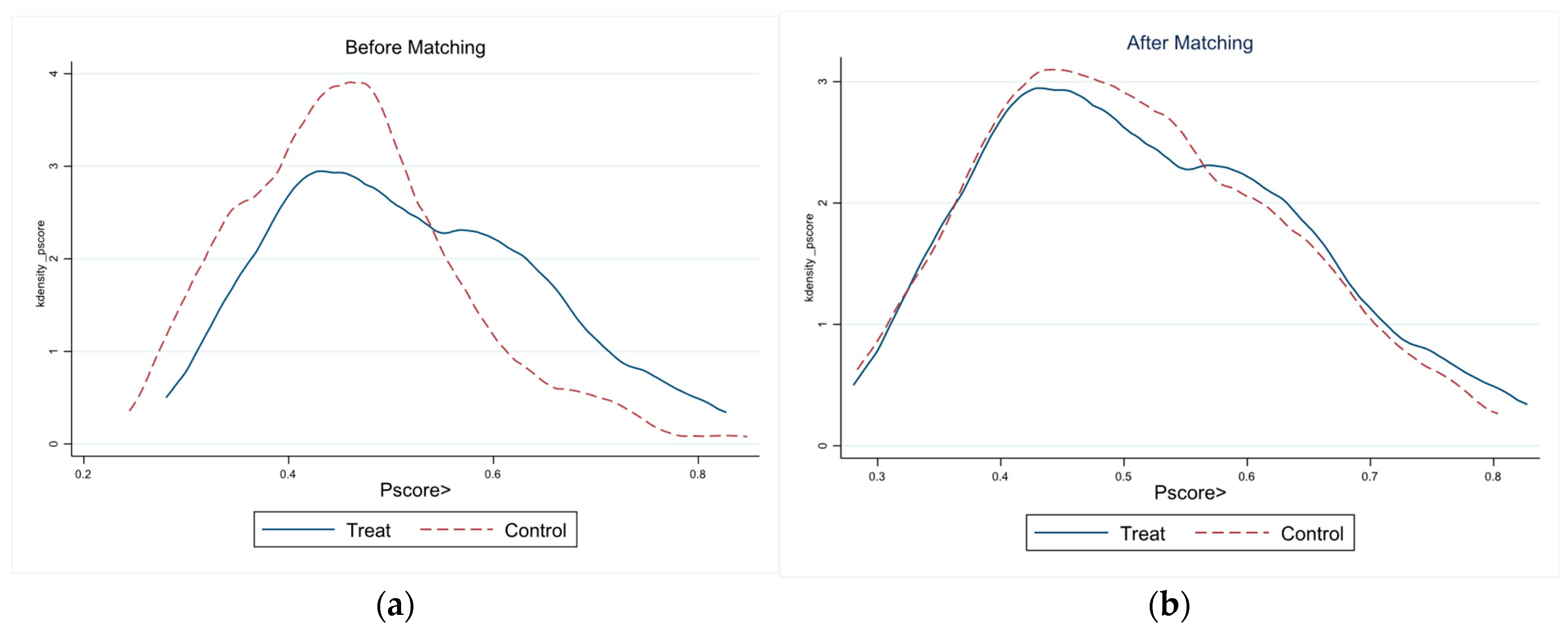
This study utilizes PSM to mitigate potential omitted variable bias and sample selection bias associated with both Myopia and Digital. Initially, the sample is stratified into two groups according to the median value of Myopia, where individuals with high Myopia are designated as the treatment group and those with low Myopia as the control group. Covariates for the matching process are derived from the baseline regression control variables. A 1:1 nearest-neighbor matching algorithm is employed to pair each treated unit with a control unit exhibiting similar observable characteristics. Subsequently, the matched sample is used to conduct regression analysis.
Second, we conduct the common support assumption assessment and balance tests. To evaluate the common support assumption, kernel density plots are utilized. As shown in Figure 1, the overlap between the two groups increases substantially after matching, and their distributions become more similar. This indicates that the matching procedure has effectively minimized potential confounding factors, thereby satisfying the common support assumption. Next, we perform the balance test, which requires that there be no statistically significant differences in the mean values between the treatment and control groups after matching. The results, presented in Table 5, show that the mean differences for all variables are no longer statistically significant after matching, suggesting that the matching process has largely improved the balance between the groups.
Finally, the baseline model is re-estimated using the after-matching sample, with the results presented in column (3) of Table 4. The coefficient of Myopia remains significantly negative, proving the robustness and reliability of the baseline regression results.

4.2.3. Robustness Tests

The core explained variable is replaced. To further enhance the robustness of the results, this study employs a textual analysis approach to offer an alternative measure of Digital. Specifically, we construct a keyword database related to digital transformation and apply tokenization and filtering to the Management’s Discussion and Analysis (MD&A) section of bank annual reports. The frequency of the selected keywords is calculated to operationalize the Digital variable. Two approaches are employed to construct the feature word dictionary. First, following F. Wu et al. (2021), keywords closely associated with digital transformation are identified and aggregated based on content from seminal academic literature, policy documents, and research reports, yielding a digital transformation indicator labeled Digital1. Second, drawing on Yuan et al. (2021), a dictionary is constructed using 30 national-level policy documents related to the digital economy, resulting in an alternative indicator labeled Digital2. The regression results are summarized in Table 6. Columns (1) and (2) indicate that the coefficient of Myopia remains significantly negative, suggesting that the core findings hold even after substituting the measurement of the dependent variable.
We narrow the sample range. To mitigate the potential confounding effects of public health events on bank digitalization and managerial decision-making, this study excludes the 2020–2021 sample periods and re-estimates the model using data from 2010 to 2019. As shown in column (3) of Table 6, the coefficient on managerial myopia remains statistically significant and negative at the 10% level, with a magnitude comparable to that of the baseline regression. This suggests that the inhibitory effect of managerial myopia on digital transformation is robust under normal economic conditions.
We control for managers’ strategic disclosure behavior. Textual information in the annual report is a significant part of the document and serves as the primary channel through which managers communicate with shareholders and external stakeholders. However, this information may be subject to manipulation by managers for self-interested purposes, such as securing higher compensation, boosting market valuation, concealing negative behaviors, attracting investment, or obtaining policy support (F. Li, 2008; Huang et al., 2014). Such manipulation could reduce the readability of the annual report and, in turn, compromise the accuracy of the managerial myopia indicator. To ensure that the indicator reflects managers’ true psychological tendencies, rather than exaggerated or concealed results, we control strategic disclosure behavior by adding relevant control variables. These include the tone of the annual report (Tone) and measures of textual complexity, such as the proportion of adverbs and conjunctions (FuLianCi_Density), and the frequency of common and less common words per 1000 words (Often_Worddensity and Sub_Worddensity). The tone data is sourced from the CSMAR database, while the textual complexity metrics are drawn from the CNRDS database. The results in Table 6, column (4), show that the Myopia coefficient is significantly negative at the 1% level, suggesting that strategic disclosure behavior has minimal impact on the findings.
We examine the lagged explanatory variable. Given the potential time-lagged effect of managerial myopia on digital transformation, this study re-estimates the regression model using a one-period lagged version of the core explanatory variable, managerial myopia (L.Myopia). As shown in column (5) of Table 6, the lagged measure remains statistically significant and negatively associated with current bank digital transformation, indicating a persistent inhibitory effect. This finding underscores the robustness of the baseline results and further supports the theoretical prediction that managerial myopia constrains banks’ digital transformation.

4.3. Impact Mechanism

Based on the preceding theoretical analysis, managerial myopia inhibits banks’ proactive risk-taking willingness, thereby impeding digital transformation. To substantiate this mechanism, we empirically examine myopia’s impact on proactive risk-taking. We use Model (3) and Model (4) to test this mechanism.
M i , t = β 0 + β 1 Myopia i , t + β x C o n t r o l i , t + δ i + η t + ε i , t
D i g i t a l i , t = γ 0 + γ 1 Myopia i , t + γ 2 M i , t + γ x C o n t r o l i , t + δ i + η t + ε i , t
Mi,t denotes banks’ proactive risk-taking willingness. As a primary metric for commercial banks’ risk asset allocation scale, risk-weighted assets reflect strategic adjustments in risk exposure, whereby banks proactively recalibrate their risk asset portfolios based on operational strategies and risk-taking inclinations.
We assess banks’ willingness to proactively take on risk (Mi,t) using two complementary indicators: (1) the Risk-Weighted Asset Ratio (RWA), calculated as risk-weighted assets divided by total assets, which reflects banks’ relative preference for risky assets in portfolio allocation, and (2) the natural logarithm of net risk-weighted assets (RWAL), an absolute-scale measure that captures trends in the expansion or contraction of risk-oriented business activities (Fang et al., 2012; Jiang et al., 2021). The mechanism test results are presented in Table 7. As shown in Columns (1) and (3), the coefficients for Myopia are negative and statistically significant at the 5% level across both metrics. This indicates that managerial short-term orientation significantly dampens banks’ willingness to take risks, leading to a measurable reduction in risk-taking behavior, a contraction in the allocation and intensity of risk assets, and a weakened capacity to bear portfolio risk. In Columns (2) and (4), the coefficients for RWA and RWAL are both significantly positive at the 5% level, indicating that increased risk-taking levels contribute to banks’ digital transformation. It can thus be concluded that Managerial Myopia leads to a reduction in their willingness to take proactive risks, causing banks to significantly cut investments in digital transformation initiatives—such as fintech R&D and online business expansion—thereby hindering the overall progress of digital transformation. Therefore, Hypothesis 2 is supported.

4.4. The Influencing Factors

This study examines the differentiated impact of managerial myopia on the digital transformation of banks under various internal and external factors, focusing on three levels: management team characteristics, bank-level factors, and external factors.

4.4.1. Management Team Characteristics

(1)
Expected Tenure (ETenure). Following Antia et al. (2010), this study estimates expected tenure using Equation (5). Tenurei,t denotes the tenure of the management team in bank i in year t, while Tenureind,t represents the industry-average level of tenure for banks of the same type. The difference between these two values captures the deviation in managerial tenure relative to peers, reflecting expected tenure along the tenure dimension. Similarly, Mnlind,t refers to the average age of the management team in bank i in year t, and Mnlind,t denotes the corresponding peer-group mean. The difference between these two measures captures the age-related deviation from the norm, representing expected tenure along the age dimension. The overall expected tenure of a bank’s management team is computed as the sum of these two components—tenure-based and age-based expected tenure.
E T e n u r e i , t = ( T e n u r e i n d , t T e n u r e i , t ) + ( M n l i n d , t M n l i , t )
To rigorously examine the impact of the expected tenure of managers (ETenure) in the relationship between managerial myopia and bank digital transformation, this study divides the sample into two groups—long and short expected tenure—based on the mean value of ETenure. As shown in Columns (1) and (2) of Table 8, the inhibitory effect of managerial myopia is significantly negative only in the short-ETenure group. This indicates that a longer expected tenure of managers partially mitigates the adverse impact of myopic behavior on banks’ digital transformation process.
(2)
Management team heterogeneity. The Herfindahl index is employed to quantify the heterogeneity of the management team (Yu et al., 2024a), as presented in Equation (6). In this formulation, Pi denotes the proportion of the i-th category of overseas experience (Hoverseas) or functional expertise (Hcareer) relative to the total number of such experiences or backgrounds within the team, and N represents the total number of distinct overseas experience or functional expertise types. The index ranges between 0 and 1, with higher values indicating greater levels of team heterogeneity3.
H c a r e e r / H o v e r s e a s = 1 I = 1 N P I 2
We categorize the sample into high- and low-Hoverseas groups based on its mean value, and grouped regressions are performed. As presented in Columns (3) and (4) of Table 8, the coefficient for Myopia remains significantly negative within the low-Hoverseas subgroup. This suggests that, in banks where the management team exhibits lower heterogeneity in overseas backgrounds, the negative influence of managerial myopia on digital transformation is more pronounced. In other words, greater diversity in the overseas experiences of management teams may partially mitigate the adverse effects of managerial myopia on the digital transformation of banks.
We look at functional expertise heterogeneity (Hcareer). The sample is divided into banks with high and low functional expertise heterogeneity based on the median of Hcareer. Group regression tests are then conducted. The regression results, reported in Table 8 columns (5) and (6), show significant negative correlations for both groups. However, the absolute value of the regression coefficient of the low occupational status group was larger, and the difference between the two groups was statistically significant and passed the Chow test.
(3)
Average education level (Edu). Different educational levels are assigned specific scores as follows (Liu & Guo, 2017): postdoc = 6; doctor = 5; master = 4; undergraduate = 3; college = 2; and technical secondary school and below = 1. The weighted average education level of the managerial team is then calculated based on these scores. Subsequently, banks are classified into high- and low-education level groups based on the sample mean of Edu. Grouped regression analysis is then conducted, as shown in Table 8, columns (7) and (8). The results indicate that the inhibitory effect of managerial myopia on digital transformation is more pronounced in banks with lower average education levels among their managerial teams. Thus, Hypothesis 3 is confirmed.

4.4.2. Bank-Level Influencing Factors

(1)
Bank size. To examine whether the impact of managerial myopia on bank digital transformation varies significantly across different size, this study computes the annual arithmetic mean of asset sizes for each category of sample banks. The results show that, over the sample period, state-owned banks and joint-stock banks consistently exhibit asset sizes above the industry average, whereas urban commercial banks and rural commercial banks generally fall below this benchmark. Based on this observation, the former two categories are classified as large banks, and the latter as small and medium-sized banks (SMBs). A subgroup regression analysis is then conducted to assess the moderating role of bank size. As shown in columns (1) and (2) of Table 9, bank size exerts a significant moderating effect on the negative relationship between managerial myopia and digital transformation. Specifically, the inhibitory effect of managerial myopia is more pronounced in small and medium-sized banks, indicating heterogeneous progress in digital transformation across banks of different size.
(2)
Corporate governance. Number of large shareholders (Bsh). The coexistence of multiple large shareholders may provide checks and balances on managerial power. In this study, shareholders holding more than 5% of a bank’s shares are defined as large shareholders. The number of large shareholders among the top ten shareholders (Bsh) is counted annually, and the sample is divided into two groups based on the mean value of Bsh. As shown in columns (3) and (4) of Table 9, the presence of multiple large shareholders enhances corporate governance. Their effective oversight mitigates the negative impact of managerial myopia and facilitates digital transformation.
Proportion of oversight shareholders (Suphold). Private and individual shareholders, who are primarily motivated by profit, have a stronger incentive to monitor corporate management. Accordingly, private enterprise shareholders and individual shareholders among the top ten shareholders are categorized as supervisory shareholders (Suphold). The total shareholding proportions of supervisory shareholders across banks are calculated annually, and the sample is subsequently divided based on the mean value. Grouped regression analysis is then conducted, as presented in Table 9, columns (5) and (6). The findings indicate that in banks with a higher proportion of supervisory shareholders, the coefficient for Myopia is significantly negative. This implies that the presence of supervisory shareholders contributes positively to corporate governance. Through effective monitoring of management, supervisory shareholders help alleviate the adverse effects of managerial myopia on the digital transformation of commercial banks. Therefore, Hypothesis 4 is supported.

4.4.3. External Factors Influencing Banks

(1)
Public Attention (Attention). To quantify the impact of public attention on managerial myopia and digital transformation in banks, this study employs the Web Search Volume Index of Chinese Listed Companies (WSVI), obtained from the CNRDS database, as a proxy for public attention (Cheng & Liu, 2018). Based on Baidu platform data, the WSVI captures online search activities conducted by internet users using stock codes, full company names, or abbreviations as keywords. This index reflects both the intensity of public searches and the level of public sentiment toward listed companies. A higher WSVI indicates greater public attention directed toward a specific company. Banks are divided into high- and low-attention groups according to the mean value of Attention. According to the results in Table 10, columns (1) and (2), the inhibitory effect of managerial myopia is only significant in the group with lower attention. These findings suggest that in an environment with high public attention, external oversight can effectively mitigate the negative impact of managerial myopia on digital transformation.
(2)
Bank competition (HHI). Bank competition, as a direct manifestation of market competition, exerts a significant influence on banks’ motivation to innovate and the urgency of their digital transformation. In this study, drawing on financial license information provided by the National Financial Regulatory Administration, we calculated the number of branches for each bank in the respective city of the sample for each year. Subsequently, we computed the Herfindahl–Hirschman Index (HHI) of branch distribution in each city and year to measure the level of competition within the local banking sector, as presented in Equation (7).
H H I = I = 1 N P i 2
Pi represents the proportion of bank i’s branches to the total branches of local banks in a city. This index is an inverse measure of market competition intensity. A higher HHI value indicates a lower degree of competition. This is because a high degree of market concentration often implies that a small number of banks possess significant market power, thus lacking the pressure of sufficient competition. Conversely, a lower index indicates a fragmented market structure, where banks generally face more intense competition. Using the mean HHI as a threshold, the sample was divided into two groups. As presented in Table 10, columns (3) and (4), the results show that when market competition is intense, the negative impact of managerial myopia on digital transformation is significantly weakened. This suggests that a highly competitive market environment creates favorable external conditions that support banks’ digital transformation efforts. Therefore, Hypothesis 5 is supported.

4.5. Moderating Role of Regulatory Oversight

Banks operating within stringent regulatory environments exhibit significantly stronger inhibitory effects of managerial myopia on digital transformation compared to those in more permissive settings. This amplification stems from dual regulatory mechanisms: stringent regulatory frameworks substantially elevate compliance costs and increase operational risk uncertainty, thereby triggering managerial risk aversion. Driven by this aversion, myopic managers proactively reduce resource allocation to digital transformation initiatives. Concurrently, constrained business activities under tight regulation incentivize managers to adopt conservative operational strategies aimed at avoiding regulatory penalties and reputational damage. This results in a systematic reallocation of resources from high-risk digital innovation to conventional business lines, further impeding the bank’s digital transformation trajectory.
This study employs regional financial supervision expenditure (Supervision) as a proxy indicator to assess the regional financial regulatory environment. To account for differences in regional economic scale, the supervision expenditure is further standardized by the regional added value of the financial sector. Subsequently, banks are categorized into groups based on the median values of Supervision, respectively, and regression analyses are conducted. Consistent with theoretical predictions, the results in Table 11 reveal significantly negative coefficients for Myopia exclusively in the groups characterized by stringent regulatory environment.

5. Conclusions

5.1. Main Conclusions

The digital transformation pathways of commercial banks vary significantly. To uncover the underlying causes, this study integrates Temporal Orientation Theory and Upper Echelons Theory, using panel data from 55 Chinese listed banks between 2010 and 2021. We systematically examine how managerial myopia hinders digital transformation and identify the conditions that weaken or strengthen this effect. Our findings offer the following integrated theoretical insights:
First, the key contribution of this paper lies in uncovering a sequential linkage from “cognition to behavior to outcome.” Managerial myopia—a cognitive bias that prioritizes short-term gains over long-term value—is associated with a lower willingness among banks to take proactive risks, which in turn correlates with a reduced capacity to advance digital transformation. This suggests that, in an environment of high technological uncertainty, managerial patience and risk appetite may serve as important behavioral foundations for sustained digital progress.
Second, we identify boundary conditions at three levels that influence this relationship. At the team level, longer expected tenure, greater diversity in background and expertise, and higher overall education help teams recognize the long-term value of digital transformation, enabling collective decisions that offset individual short-term tendencies. At the organizational level, larger banks show more resilience due to greater resources and stronger governance structures, which buffer against myopic behavior. Additionally, governance improvements—such as having multiple major shareholders or active supervisory shareholders—enhance oversight and accountability, curbing managerial short-termism. At the external level, public scrutiny acts as a monitoring mechanism, while market competition creates performance pressure, both pushing banks toward digital responsiveness. Importantly, we find that strict regulatory oversight does not alleviate but actually strengthens the inhibitory effect of managerial myopia on digital transformation. This is because high compliance burdens and associated risk aversion narrow managerial focus and discourage exploratory investment, showing that regulation can cognitively reinforce short-termism rather than merely constrain behavior.
In summary, this study goes beyond documenting a simple negative relationship. It theorizes and empirically demonstrates how managerial myopia obstructs digital transformation through a specific behavioral mechanism, and explains when and why this obstruction varies across different institutional layers. By integrating micro-level cognition, meso-level governance, and macro-level environmental factors into a coherent framework, our work advances a multi-level, context-aware theory of strategic adaptation in financial institutions facing technological disruption.

5.2. Policy Recommendations

Based on the research findings, this study proposes practical implications for commercial banks to mitigate managerial myopia and advance digital transformation.
In terms of management, implement long-term performance metrics tied to equity incentives to align leadership with digital goals. Build diverse leadership teams with cross-functional and international expertise to improve strategic foresight.
Regarding governance, strengthen board oversight by engaging tech-savvy long-term investors. Encourage small and medium-sized banks pursue focused digital strategies supported by dedicated transformation funds.
For external collaboration, regularly publish transformation progress to leverage public accountability. Partner with fintech firms through joint initiatives to share costs and accelerate innovation.
On regulation, integrate tangible digital outcomes into supervisory assessments. Reward high performers with pilot privileges while curbing superficial compliance.
Through aligned incentives, balanced governance, open collaboration, and smart regulation, managerial short-termism can be reduced to enable sustainable digital transformation.

6. Limitations and Future Research

Despite its contributions, this study has several limitations that point to avenues for future research. First, the sample is confined to listed commercial banks in China. While this provides a controlled setting, it limits the generalizability of the findings to non-listed, smaller, or non-Chinese financial institutions. Future studies could expand the sample to include a wider array of banks and cross-country contexts to enhance external validity. Second, while we employ established textual analysis methods to measure managerial myopia, these proxies may not capture all nuances of the constructs. Alternative measurement approaches, such as survey-based measures of managerial cognition, could be used to validate and extend our findings. Finally, the digital transformation process is dynamic. A fruitful direction for future research would be to employ longitudinal or case-study methodologies to trace how the relationship between managerial cognition, risk-taking, and digital outcomes evolves over time, especially through different phases of the economic or technological cycle.

Author Contributions

Conceptualization, Y.H. and S.W.; Methodology, S.W.; Software, S.W.; Validation, Y.H. and S.W.; Formal analysis, Y.H.; Investigation, S.W.; Resources, W.M.; Data curation, W.M.; Writing—original draft preparation, Y.H. and S.W.; Writing—review and editing, Y.H. and S.W.; Visualization, Y.H.; Supervision, W.M.; Project administration, Y.H.; Funding acquisition, Y.H. and W.M. All authors have read and agreed to the published version of the manuscript.

Funding

This work was supported by the Ministry of education of Humanities and Social Science project of China [grant numbers 23YJA790032], the Key Project of National Social Science Foundation of China [grant numbers 23FJYA004], and the Innovation Capability Support Program of Shaanxi [grant numbers 2025KG-YBXM-028].

Institutional Review Board Statement

Not applicable.

Informed Consent Statement

Not applicable.

Data Availability Statement

The original contributions presented in this study are included in the article. Further inquiries can be directed to the corresponding author.

Conflicts of Interest

The authors declare no conflicts of interest.

Abbreviations

The following abbreviations are used in this manuscript:
SOBsState-owned banks
JSCBsJoint-stock commercial banks
CCBsCity commercial banks
RCBsRural commercial banks
LBsLarge banks
SMBsSmall and medium-sized banks
RWARisk-Weighted Asset Ratio
RWALThe natural logarithm of net risk-weighted assets
ETenureExpected Tenure
HoverseasOverseas experience heterogeneity
HcareerFunctional expertise heterogeneity
EduAverage education level
BshNumber of large shareholders
SupholdProportion of oversight shareholders
HHIBank competition
AttentionPublic Attention
SupervisionRegional financial supervision expenditure
AIArtificial intelligence

Appendix A

Table A1. Sample composition.
Bank TypeNBank Name
State-owned Commercial Banks6Agricultural Bank of China, Industrial and Commercial Bank of China, China Construction Bank, Postal Savings Bank of China, Bank of China, Bank of Communications
Joint-stock Commercial Banks10Shanghai Pudong Development Bank, China CITIC Bank, China Everbright Bank, China Minsheng Bank, Industrial Bank, Huaxia Bank, Ping An Bank, China Merchants Bank, China Zheshang Bank, Bohai Bank
City Commercial Banks28Bank of Shanghai, Zhongyuan Bank, Bank of Jiujiang, Bank of Lanzhou, Bank of Beijing, Bank of Nanjing, Bank of Xiamen, Bank of Harbin, Bank of Tianjin, Weihai City Commercial Bank, Bank of Ningbo, Huishang Bank, Bank of Chengdu, Jinshang Bank, Bank of Hangzhou, Bank of Jiangsu, Bank of Jiangxi, Bank of Gansu, Shengjing Bank, Bank of Suzhou, Bank of Xi’an, Bank of Guiyang, Bank of Zhengzhou, Bank of Chongqing, Bank of Jinzhou, Bank of Changsha, Bank of Qingdao, Qilu Bank
Rural Commercial Banks11Shanghai Rural Commercial Bank, Guangzhou Rural Commercial Bank, Wuxi Rural Commercial Bank, Jiangsu Changshu Rural Commercial Bank, Jiangsu Zhangjiagang Rural Commercial Bank, Jiangsu Jiangyin Rural Commercial Bank, Jiangsu Zijin Rural Commercial Bank, Zhejiang Shaoxing Ruifeng Rural Commercial Bank, Qingdao Rural Commercial Bank, Chongqing Rural Commercial Bank, Jiangsu Suzhou Rural Commercial Bank
Table A2. The Proportion of the total assets of the sample banks in the total assets of China’s banking industry.
YearSample Bank Assets (Trillion)Total Banking Assets (Trillion)Proportion
201066.094.2670.02%
201176.9111.568.97%
201291.3133.668.34%
2013101.0151.3566.73%
2014114.0172.366.16%
2015132.0199.366.23%
2016159.023268.53%
2017171.025267.86%
2018181.0261.469.24%
2019198.029068.28%
2020218.0319.768.19%
2021235.0344.7668.16%
Notes: The data for “Sample Bank Assets” is sourced from the CSMAR database, while the data for “Total Banking Assets” is manually compiled from the People’s Bank of China and the National Financial Regulatory Administration; proportion = Sample Bank Assets/Total Banking Assets.

Notes

1
To ensure the reliability and validity of the text analysis–based “managerial myopia” index, sample selection adheres to two criteria: publicly accessible annual reports and standardized, detailed MD&A disclosures. Accordingly, 55 domestic commercial banks are selected as the benchmark sample. These banks, according to data from the People’s Bank of China and the National Financial Regulatory Administration, collectively account for approximately 70% of total banking assets in China, reflecting substantial industry representation and enabling a robust characterization of the sector. Sample composition and annual asset share are provided in Appendix A Table A1 and Table A2.
2
Secondary indicators include: digital technology keywords, digital channels, digital products, digital R&D, digital architecture, IT directors, IT executives, and digital partnerships.
3
The overseas experiences within the sample are categorized into four distinct types: prior overseas work experience, prior overseas study experience, a combination of both overseas work and study experiences, and no overseas background, corresponding to N = 4. Functional backgrounds are classified into nine categories: production, research and development, design, human resources, management, marketing, finance, accounting, and law, corresponding to N = 9.

References

  1. Antia, M., Pantzalis, C., & Park, J. C. (2010). CEO decision horizon and firm performance: An empirical investigation. Journal of Corporate Finance, 16(3), 288–301. [Google Scholar] [CrossRef]
  2. António, J. A., Augusto, J. A., & Carrilho, T. (2024). Factors affecting digital transformation in banking. Journal of Business Research, 171, 114393. [Google Scholar] [CrossRef]
  3. Beecher, M. D. (1989). Signalling systems for individual recognition: An information theory approach. Animal Behaviour, 38(2), 248–261. [Google Scholar] [CrossRef]
  4. Bharadwaj, A., Sawy, O. A. E., Pavlou, P. A., & Venkatraman, N. (2013). Digital business strategy: Toward a next generation of insights. MIS Quarterly, 37(2), 471–482. [Google Scholar] [CrossRef]
  5. Boubakri, N., Cosset, J., & Saffar, W. (2013). The role of state and foreign owners in corporate risk-taking: Evidence from privatization. Journal of Financial Economics, 108(3), 641–658. [Google Scholar] [CrossRef]
  6. Chen, J., Hong, H., Jiang, W., & Kubik, J. D. (2013). Outsourcing mutual fund management: Firm boundaries, incentives, and performance. The Journal of Finance, 68(2), 523–558. [Google Scholar] [CrossRef]
  7. Cheng, J., & Liu, Y. (2018). The effects of public attention on the environmental performance of high-polluting firms: Based on big data from web search in China. Journal of Cleaner Production, 186, 335–341. [Google Scholar] [CrossRef]
  8. Chintrakarn, P., Jiraporn, P., Sakr, S., & Lee, S. M. (2016). Do co-opted directors mitigate managerial myopia? Evidence from R&D investments. Finance Research Letters, 17, 285–289. [Google Scholar] [CrossRef]
  9. Clemente-Almendros, J. A., Nicoara-Popescu, D., & Pastor-Sanz, I. (2024). Digital transformation in SMEs: Understanding its determinants and size heterogeneity. Technology in Society, 77, 102483. [Google Scholar] [CrossRef]
  10. Coskun-Setirek, A., & Tanrikulu, Z. (2021). Digital innovations-driven business model regeneration: A process model. Technology in Society, 64, 101461. [Google Scholar] [CrossRef]
  11. Cremers, M., Pareek, A., & Sautner, Z. (2019). Short-term investors, long-term investments, and firm value: Evidence from Russell 2000 index inclusions. Management Science, 66(10), 4535–4551. [Google Scholar] [CrossRef]
  12. Cui, Y., Zhang, Y., Guo, J., Hu, H., & Meng, H. (2019). Top management team knowledge heterogeneity, ownership structure and financial performance: Evidence from Chinese IT listed companies. Technological Forecasting and Social Change, 140, 14–21. [Google Scholar] [CrossRef]
  13. Ding, Q., & He, W. (2023). Digital transformation, monetary policy and risk-taking of banks. Finance Research Letters, 55, 103986. [Google Scholar] [CrossRef]
  14. Fang, Y., Zhao, S., & Xie, X. (2012). An analysis of bearing bank risks in monetary policies: On the coordination between the monetary policy and the macro-prudential policy. Management World, 2012(11), 9–19+56+187. [Google Scholar] [CrossRef]
  15. Feng, Y., Zhang, Z., Zhang, J., & Zhou, W. (2025). More authentic data asset disclosure by myopic managers: Evidence from China. International Review of Financial Analysis, 105, 104444. [Google Scholar] [CrossRef]
  16. Gao, D., & Li, S. (2025). Top management team biographical similarity and persistent green innovation: Evidence from Chinese listed companies. Research in International Business and Finance, 77, 103001. [Google Scholar] [CrossRef]
  17. Gao, Z., Hua, M., Liu, H., & Yan, C. (2023). News sentiment and CEO retirement: The impact on firm performance and risk. Research in International Business and Finance, 66, 102031. [Google Scholar] [CrossRef]
  18. Gu, J. (2022). Do at home as Romans do? CEO overseas experience and financial misconduct risk of emerging market firms. Research in International Business and Finance, 60, 101624. [Google Scholar] [CrossRef]
  19. Guo, X., Li, M., Wang, Y., & Mardani, A. (2023). Does digital transformation improve the firm’s performance? From the perspective of digitalization paradox and managerial myopia. Journal of Business Research, 163, 113868. [Google Scholar] [CrossRef]
  20. Hambrick, D. C., & Gregory, D. S. F. (1991). The seasons of CEO’s tenure. Academy of Management Review, 16(4), 719–742. [Google Scholar] [CrossRef] [PubMed]
  21. Hambrick, D. C., & Mason, P. A. (1984). Upper echelons: The organization as a reflection of its top managers. Academy of Management Review, 9(2), 193–206. [Google Scholar] [CrossRef]
  22. He, K., Chen, W., & Zhang, L. (2021). Senior management’s academic experience and corporate green innovation. Technological Forecasting and Social Change, 166, 120664. [Google Scholar] [CrossRef]
  23. Hribar, P., Melessa, S. J., Small, R. C., & Wilde, J. H. (2017). Does managerial sentiment affect accrual estimates? Evidence from the banking industry. Journal of Accounting and Economics, 63(1), 26–50. [Google Scholar] [CrossRef]
  24. Hu, N., Xue, F., & Wang, H. (2021). Does managerial myopia affect long-term investment? Based on text analysis and machine learning. Management World, 37(5), 139–156. [Google Scholar] [CrossRef]
  25. Huang, X., Teoh, S. H., & Zhang, Y. (2014). Tone management. The Accounting Review, 89(3), 1083–1113. [Google Scholar] [CrossRef]
  26. Jain, P., Jiang, C., & Mekhaimer, M. (2016). Executives’ horizon, internal governance and stock market liquidity. Journal of Corporate Finance, 40, 1–23. [Google Scholar] [CrossRef]
  27. Jiang, H., Zhang, X., Tang, S., & Chen, C. (2021). Monetary policy, liquidity and bank risk-taking. Economic Research Journal, 56(8), 56–73. [Google Scholar]
  28. Konadu, R., Agyei, S. O., Lartey, T. A., Danso, A., Adomako, S., & Amoah, J. A. (2020). CEOs’ reputation, quality management and environmental innovation: The roles of stakeholder pressure and resource commitment. Business Strategy and the Environment, 29(6), 2310–2323. [Google Scholar] [CrossRef]
  29. Laverty, K. J. (1996). Economic ‘short-termism’: The debate, the unresolved issues, and the implications for management practice and research. Academy of Management Review, 21(3), 825–860. [Google Scholar] [CrossRef]
  30. Li, F. (2008). Annual report readability, current earnings, and earnings persistence. Journal of Accounting and Economics, 45(2-3), 221–247. [Google Scholar] [CrossRef]
  31. Li, G., & Shao, Y. (2023). How do top management team characteristics affect digital orientation? Exploring the internal driving forces of firm digitalization. Technology in Society, 74, 102293. [Google Scholar] [CrossRef]
  32. Li, L., Gao, W., & Gu, W. (2023). Fintech, bank concentration and commercial bank profitability: Evidence from Chinese urban commercial banks. Finance Research Letters, 57, 104234. [Google Scholar] [CrossRef]
  33. Lin, Y. L., Shi, W., Prescott, J. E., & Yang, H. (2019). In the eye of the beholder: Top managers’ long-term orientation, industry context, and decision-making processes. Journal of Management, 45(8), 3114–3145. [Google Scholar] [CrossRef]
  34. Liu, B., & Guo, S. (2017). An empirical research on the relationship between the human capital and heterogeneity of the board and firm performance. Journal of Management Sciences, 30(3), 23–34. [Google Scholar]
  35. Lumpkin, G. T., & Brigham, K. H. (2011). Long-term orientation and intertemporal choice in family firms. Entrepreneurship Theory and Practice, 35(6), 1149–1169. [Google Scholar] [CrossRef]
  36. Lundstrum, L. L. (2002). Corporate investment myopia: A horserace of the theories. Journal of Corporate Finance, 8(4), 353–371. [Google Scholar] [CrossRef]
  37. Luo, W., Yu, Y., & Deng, M. (2024). The impact of enterprise digital transformation on risk-taking: Evidence from China. Research in International Business and Finance, 69, 102285. [Google Scholar] [CrossRef]
  38. Mayew, W. J., Sethuraman, M., & Venkatachalam, M. (2015). MD&A disclosure and the firm’s ability to continue as a going concern. The Accounting Review, 90(4), 1621–1651. [Google Scholar] [CrossRef]
  39. Morck, R., Shleifer, A., & Vishny, R. W. (1988). Management ownership and market valuation: An empirical analysis. Journal of Financial Economics, 20, 293–315. [Google Scholar] [CrossRef]
  40. Narayanan, M. P. (1985). Managerial incentives for short-term results. The Journal of Finance, 40(5), 1469–1484. [Google Scholar] [CrossRef]
  41. Nguyen, L., Vu, L., & Yin, X. (2020). The undesirable effect of audit quality: Evidence from firm innovation. The British Accounting Review, 52(6), 100938. [Google Scholar] [CrossRef]
  42. Park, Y., & Mithas, S. (2020). Organized complexity of digital business strategy: A configurational perspective. MIS Quarterly, 44(1), 85–127. [Google Scholar] [CrossRef]
  43. Rodrigues, A. R. D., Ferreira, F. A. F., Teixeira, F. J. C. S., & Zopounidis, C. (2022). Artificial intelligence, digital transformation and cybersecurity in the banking sector: A multi-stakeholder cognition-driven framework. Research in International Business and Finance, 60, 101616. [Google Scholar] [CrossRef]
  44. Sahaym, A., Cho, S. Y., Kim, S. K., & Mousa, F. (2016). Mixed blessings: How top management team heterogeneity and governance structure influence the use of corporate venture capital by post-IPO firms. Journal of Business Research, 69(3), 1208–1218. [Google Scholar] [CrossRef]
  45. Shang, X., & Niu, H. (2023). Does the digital transformation of banks affect green credit? Finance Research Letters, 58, 104394. [Google Scholar] [CrossRef]
  46. Stein, J. C. (1989). Efficient capital markets, inefficient firms: A model of myopic corporate behavior. The Quarterly Journal of Economics, 104(4), 655–669. [Google Scholar] [CrossRef]
  47. Wang, S., Asif, M., Shahzad, M. F., & Ashfaq, M. (2024). Data privacy and cybersecurity challenges in the digital transformation of the banking sector. Computers & Security, 147, 104051. [Google Scholar] [CrossRef]
  48. Wen, B., You, W., & Yuan, M. (2025). The impact of commercial banks’ ESG performance: Difference between provocative and passive risk-taking—Evidence from China. Research in International Business and Finance, 76, 102859. [Google Scholar] [CrossRef]
  49. Wu, F., Hu, H., Lin, H., & Ren, X. (2021). Enterprise digital transformation and capital market performance: Empirical evidence from stock liquidity. Management World, 37(7), 130–144. [Google Scholar] [CrossRef]
  50. Wu, Q., Zhuang, Q., Liu, Y., & Han, L. (2024). Technology shock of ChatGPT, social attention and firm value: Evidence from China. Technology in Society, 79, 102756. [Google Scholar] [CrossRef]
  51. Xiang, X., & Jiang, L. (2023). Digitalization and commercial bank performance: A test of heterogeneity from Chinese commercial banks. Finance Research Letters, 58, 104303. [Google Scholar] [CrossRef]
  52. Xiang, X., & Yi, B. (2022). Directors’ foreign experience and firm innovation. Emerging Markets Finance and Trade, 58(11), 3248–3264. [Google Scholar] [CrossRef]
  53. Xie, X., & Wang, S. (2023). Digital transformation of commercial banks in China: Measurement, progress and impact. China Economic Quarterly International, 3(1), 35–45. [Google Scholar] [CrossRef]
  54. Xu, M., Yu, R., Chen, H., & Zhang, X. (2025). Top managers’ decisions to implement or impede green supply chain management practices: A behavioral agency theory perspective. Finance Research Letters, 85, 107904. [Google Scholar] [CrossRef]
  55. Yang, Y., & Xiao, Z. (2024). Examining the interaction effect of digitalization and highly educated employees on ambidextrous innovation in Chinese publicly listed SMEs: A knowledge-based view. Technology in Society, 78, 102656. [Google Scholar] [CrossRef]
  56. Yi, E. (2023). Corporate governance, information disclosure and investment—Cash flow sensitivity. Finance Research Letters, 55, 103942. [Google Scholar] [CrossRef]
  57. Yu, Y., Wang, X., & Mao, J. (2024a). Complementarity of digital investment and cognition: From the Upper Echelons Theory perspective. Journal of Management Sciences in China, 27(4), 41–64. [Google Scholar] [CrossRef]
  58. Yu, Y., Xie, B., Dou, Z., & Fu, Q. (2024b). Managerial myopia and corporate innovation strategy. Finance Research Letters, 67, 105733. [Google Scholar] [CrossRef]
  59. Yuan, C., Xiao, T., Geng, C., & Sheng, Y. (2021). Digital transformation and division of labor between enterprises: Vertical specialization or vertical integration. China Industrial Economics, 9(1), 137–155. [Google Scholar] [CrossRef]
  60. Zhang, C., Wang, Y., & Zhang, Y. (2025). Can digital transformation improve commercial banks’ performance? The Journal of Technology Transfer, 50(4), 1341–1362. [Google Scholar] [CrossRef]
  61. Zhang, D. Y. (2013). Does investment efficiency improve after the disclosure of material weaknesses in internal control over financial reporting? Journal of Accounting and Economics, 56(1), 1–18. [Google Scholar] [CrossRef]
  62. Zhang, Z., & Sun, B. (2025). Firms’ perceived trade policy uncertainty and management’s disclosure strategies: Evidence from financial statement comparability. Research in International Business and Finance, 75, 102716. [Google Scholar] [CrossRef]
  63. Zona, F., & Zamarian, M. (2022). The behavioral agency model and innovation investment: Examining the combined effects of CEO and board ownership. Group & Organization Management, 47(3), 647–678. [Google Scholar] [CrossRef]
Figure 1. Sample kernel density function before and after matching. (a) Before Matching. (b) After Matching.
Ijfs 14 00056 g001
Table 1. Variable definitions.
Variable NameSymbolDefinition
Bank Digital TransformationDigitalPeking University’s Overall Index of Bank Digital Transformation
Managerial MyopiaMyopiaThe ratio of short-sighted terms in the annual report to the total word count
Bank SizeSizeThe natural logarithm of the bank’s total assets
Bank AgeAgeThe number of years since the bank’s establishment, plus 1
Return on AssetsROANet profit/Total assets
Non-performing Loan RatioNPA(Non-performing loan balance/Total loan balance) * 100
Financial LeverageLevTotal liabilities/Total assets
Independent Director RatioIndepThe number of independent directors/Total board members
Board SizeBnTotal number of board members
Implementation of Deferred CompensationDelayA dummy variable that equals “1” if deferred compensation is implemented in the given year, and “0” otherwise
Text LengthAllwordsThe logarithm of the total word count of the “Management Discussion and Analysis” section after text segmentation using Jieba
Managerial TenureTenureThe average tenure of the management team
Per Capita GDPLgdpThe natural logarithm of the city’s per capita GDP
Internet Penetration RateInternetThe number of internet broadband users per 100 residents in the city
Table 2. Descriptive statistics.
VariableObs.MeanStd. Dev.Minp50Max
Digital43281.813541.93543.000282.0398163.8000
Myopia4320.11690.06430.00000.10930.3260
Size43227.71931.662725.006727.520230.8500
Age43219.60197.62180.000020.000038.0000
ROA4320.00910.00220.00260.00900.0142
NPA4321.27520.43440.38001.27002.4700
Lev4320.93050.01210.90320.93140.9570
Indep4320.34980.06220.11110.35710.4670
Bn43214.28472.34109.000014.000020.0000
Delay4320.77310.41930.00001.00001.0000
Allwords4323.89050.24793.11933.92304.2740
Tenure4322.73321.78530.00002.67427.2500
Lgdp43211.59430.392010.364511.649712.1400
Internet43251.337128.39249.978645.84188.1000
Table 3. The impact of managerial myopia on bank digital transformation.
Variable(1)(2)(3)(4)(5)
DigitalDigitalCDIPDIODI
Myopia−30.099 *−39.476 **−123.956 **−39.265 **−14.809
(−1.93)(−2.35)(−2.36)(−2.08)(−0.77)
Size 6.40011.48233.905 ***−9.801
(0.97)(0.51)(4.40)(−0.91)
Age −7.104 **−16.027−6.661−5.123 **
(−2.64)(−1.37)(−1.18)(−2.44)
ROA −554.5172098.419−542.163−1312.058
(−0.52)(0.58)(−0.34)(−1.12)
NPA 5.510−3.398−0.90311.626 **
(1.32)(−0.28)(−0.19)(2.22)
Lev −436.763 *−630.210−592.150 **−279.174
(−1.99)(−1.05)(−2.45)(−1.42)
Indep 7.440−174.096 ***45.36033.564
(0.36)(−2.94)(1.60)(1.56)
Bn 1.0570.9231.588 **0.875
(1.51)(0.47)(2.36)(1.05)
Delay −2.7528.378−5.149−4.161
(−0.76)(0.76)(−1.04)(−1.02)
Allwords 1.16121.008−3.324−1.960
(0.17)(1.01)(−0.37)(−0.29)
Tenure 0.602−2.6432.013 **0.680
(0.71)(−0.84)(2.06)(0.71)
Lgdp 18.383 **82.795 **9.4772.433
(2.14)(2.15)(1.01)(0.17)
Internet −0.257 ***−0.910 ***−0.273 ***−0.099
(−5.06)(−3.30)(−4.88)(−1.00)
Constant17.968 ***140.938−401.588−345.656570.317 *
(5.70)(0.76)(−0.45)(−1.38)(1.84)
Observations525432432432432
R-squared0.8480.8800.7540.8230.740
Bank FEYYYYY
Year FEYYYYY
Notes: Clustered robust standard error in parentheses. The symbols ***, **, and * indicate statistical significance at the 1%, 5%, and 10% levels, respectively. Column (1) reports results without control variables, with 525 observations, while columns (2)–(5) include control variables, and the number of observations decreases to 432 due to missing values in some variables.
Table 4. Endogeneity.
2SRIPSM
Variable(1)(2)(3)
First StageSecond Stage
MyopiaDigitalDigital
Myopia −40.463 **
(−2.02)
residual −39.476 **
(−2.35)
Size−0.10010.3601.505
(−1.55)(1.53)(0.23)
Age0.005−7.296 ***−8.010 ***
(0.48)(−2.73)(−2.91)
ROA0.550−576.245−170.741
(0.16)(−0.54)(−0.13)
Npa−0.0035.6158.105
(−0.15)(1.35)(1.51)
Lev1.384 *−491.387 **−319.092
(1.71)(−2.25)(−1.44)
Indep0.0206.666−9.829
(0.23)(0.32)(−0.42)
Bn−0.0021.1250.675
(−0.57)(1.60)(0.81)
Delay−0.038 **−1.235−4.133
(−2.01)(−0.35)(−1.10)
Allwords0.098 ***−2.6965.258
(2.77)(−0.40)(0.72)
Tenure0.0070.3351.441
(1.50)(0.38)(1.48)
Lgdp−0.03119.608 **18.870 *
(−0.47)(2.26)(1.89)
Internet0.000−0.261 ***−0.289 ***
(0.49)(−5.13)(−4.28)
Constant1.44883.773154.352
(0.82)(0.43)(0.65)
Observations432432318
R-squared0.1310.8800.878
Bank FEYYY
Year FEYYY
Notes: Clustered robust standard error in parentheses. The symbols ***, **, and * indicate statistical significance at the 1%, 5%, and 10% levels, respectively.
Table 5. Balance Test.
Panel A: Before Matching
VariablesG1 (0)Mean1G2 (1)Mean2MeanDiffp-Value
Size26327.6826227.440.2390.0828 *
Age26320.0426218.641.3930.0261 **
ROA2630.008502620.00900−0.0005000.0253 **
Npa2631.3612621.2910.07050.0969 *
Lev2630.9302620.930−0.0007000.520
Indep2630.3512620.3500.001500.780
Bn26314.0426214.25−0.2100.295
Delay2630.8372620.7180.1190.0010 ***
Allwords2633.8822623.898−0.01580.451
Tenure2212.7742112.6900.08420.625
Lgdp26311.5826211.500.08290.0206 **
Internet26350.3026248.052.2510.343
Panel B: After Matching
VariablesG1 (0)Mean1G2 (1)Mean2MeanDiffp-Value
Size10827.6221027.580.03750.846
Age10819.1621018.880.2770.748
ROA1080.009202100.0093000.903
Npa1081.2822101.2550.02660.619
Lev1080.9302100.931−0.0005000.734
Indep1080.3402100.349−0.009600.204
Bn10814.4821014.330.1530.578
Delay1080.7782100.7050.07300.166
Allwords1083.8832103.902−0.01860.507
Tenure1082.6872102.694−0.006800.975
Lgdp10811.5821011.560.02690.571
Internet10850.6521050.76−0.1140.973
Notes: G1 (0) represents the sample size of the control group, and G2 (1) represents the sample size of the experimental group; The symbols ***, **, and * indicate statistical significance at the 1%, 5%, and 10% levels, respectively.
Table 6. Robustness.
Variable(1)(2)(3)(4)(5)
Replacing the Core Explained VariableNarrow the Sample RangeControlling for Managers’ Strategic Disclosure BehaviorLagged Explanatory Variable
Digital1Digital2DigitalDigitalDigital
Myopia−25.849 **−83.826 ***−32.575 *−43.144 **
(−2.46)(−3.48)(−1.82)(−2.60)
L.Myopia −48.970 **
(−2.30)
Size10.402−52.306 ***9.4086.6414.130
(1.68)(−5.15)(1.15)(1.03)(0.53)
Age−13.622−6.772−9.630 ***−7.794 **−7.082 *
(−1.66)(−0.51)(−3.30)(−2.56)(−1.78)
ROA−1828.251264.333−565.682−465.669−1100.834
(−1.38)(0.11)(−0.51)(−0.40)(−0.87)
Npa9.717 ***2.6584.7323.4965.584
(3.74)(0.31)(1.00)(0.77)(1.02)
Lev−318.177 **−230.137−482.400 **−400.217 *−435.565 *
(−2.38)(−0.87)(−2.15)(−1.91)(−1.73)
Indep15.421−102.990 ***9.6822.2393.401
(1.04)(−2.70)(0.40)(0.09)(0.15)
Bn0.0622.348 *1.0410.4091.241
(0.15)(1.86)(1.37)(0.53)(1.65)
Delay1.604−9.175 *−2.593−2.716−2.178
(0.48)(−1.69)(−0.62)(−0.74)(−0.55)
Allwords0.51785.495 ***−1.605−12.195−5.424
(0.15)(5.35)(−0.21)(−1.40)(−0.73)
Tenure1.453−2.685 *0.1850.7000.313
(1.40)(−1.98)(0.19)(0.83)(0.32)
Lgdp15.3144.47127.486 **15.420 *13.924
(1.34)(0.18)(2.28)(1.71)(1.56)
Internet−0.026−0.715 ***−0.270 ***−0.231 ***−0.267 ***
(−0.63)(−6.11)(−5.14)(−3.85)(−4.44)
FuLianCi_Density 0.856
(0.24)
Often_Worddensity 0.016
(1.28)
Sub_Worddensity −0.421
(−0.76)
Tone 0.010 **
(2.47)
Constant49.3371402.922 ***48.164188.557300.044
(0.22)(3.52)(0.24)(0.96)(1.32)
Observations245422354401370
R-squared0.4520.7710.8440.8850.869
Bank FEYYYYY
Year FEYYYYY
Notes: Clustered robust standard error in parentheses. The symbols ***, **, and * indicate statistical significance at the 1%, 5%, and 10% levels, respectively.
Table 7. Impact mechanism analysis.
Variable(1)(2)(3)(4)
RWADigitalRWALDigital
Myopia−0.137 **−31.593−0.226 **−30.180
(−2.48)(−1.54)(−2.53)(−1.47)
RWA 75.149 **
(2.29)
RWAL 49.419 **
(2.44)
Size0.0029.412 ***1.009 ***−39.948 **
(0.06)(3.23)(19.23)(−2.03)
Age−0.0072.265 ***−0.0072.254 ***
(−0.63)(3.38)(−0.45)(3.36)
ROA3.910−3357.775 ***6.784−3437.610 ***
(1.53)(−3.84)(1.60)(−3.88)
Npa0.0211.0160.0270.862
(1.56)(0.27)(1.15)(0.23)
Lev−2.111 ***−732.760 ***−3.536 ***−725.861 ***
(−4.79)(−3.94)(−4.62)(−3.94)
Indep0.088−21.9230.164 *−23.260
(1.54)(−0.97)(1.80)(−1.03)
Bn−0.001−0.871−0.002−0.869
(−0.92)(−1.00)(−0.83)(−1.00)
Delay−0.0055.112−0.0044.920
(−0.38)(1.18)(−0.19)(1.13)
Allwords−0.02612.925−0.04213.073
(−1.22)(1.47)(−1.20)(1.48)
Tenure0.009 ***0.1810.014 ***0.134
(2.90)(0.19)(2.80)(0.14)
Lgdp0.06944.692 ***0.11044.503 ***
(1.45)(5.90)(1.32)(5.84)
Internet0.000−0.242 ***0.001−0.245 ***
(1.20)(−3.35)(1.32)(−3.41)
Constant1.844−94.6721.390−28.836
(1.65)(−0.48)(0.80)(−0.15)
Observations379379379379
R-squared0.6520.8370.9890.838
Bank FEYYYY
Year FEYYYY
Notes: Clustered robust standard error in parentheses. The symbols ***, **, and * indicate statistical significance at the 1%, 5%, and 10% levels, respectively.
Table 8. Testing the impact of management team characteristics.
(1)(2)(3)(4)(5)(6)(7)(8)
Long ETenureShort ETenureHigh HoverseasLow HoverseasHigh HcareerLow HcareerHigh EduLow Edu
VariableDigitalDigitalDigitalDigitalDigitalDigitalDigitalDigital
Myopia−29.463−95.556 ***−11.828−57.674 **−44.498 ***−50.514 *−27.127−48.966 *
(−1.39)(−4.01)(−0.38)(−2.65)(−2.79)(−1.99)(−1.63)(−1.95)
Size25.683 *1.320−5.39114.881 *15.4029.27220.308−14.270
(1.96)(0.15)(−0.43)(1.85)(0.99)(0.91)(1.56)(−0.74)
age−3.562 *−8.053−10.396 **−4.674 *−20.840 ***−5.267−6.938 ***−7.362 **
(−1.79)(−0.84)(−2.14)(−1.72)(−3.94)(−1.39)(−2.86)(−2.50)
ROA−479.633−31.726901.556−567.3002573.306 *−3999.921 ***−97.803−1431.076
(−0.32)(−0.02)(0.43)(−0.54)(1.93)(−3.28)(−0.09)(−0.83)
Npa0.7927.10420.647 **2.99814.883 **−1.5803.8795.229
(0.14)(1.18)(2.12)(0.83)(2.02)(−0.29)(0.44)(0.85)
Lev−482.888 *−157.316111.896−558.711 **−255.118−1010.803 ***−575.919 **−410.497
(−1.75)(−0.87)(0.19)(−2.31)(−1.48)(−2.71)(−2.19)(−1.17)
Indep−16.76160.577 **−20.50632.755−1.281−1.522−10.52641.069 *
(−0.57)(2.30)(−0.45)(1.63)(−0.04)(−0.05)(−0.43)(1.79)
Bn0.6182.183 *0.1501.924 **1.4330.6360.3121.516 **
(0.60)(1.96)(0.17)(2.47)(1.22)(0.85)(0.36)(2.18)
Delay4.457−10.323 *−0.043−6.112−2.1170.7221.003−9.558
(0.98)(−1.81)(−0.00)(−1.45)(−0.54)(0.12)(0.23)(−1.10)
Allwords−8.3156.45611.0750.368−4.282−0.4752.364−3.626
(−1.13)(0.44)(1.02)(0.04)(−0.47)(−0.03)(0.25)(−0.40)
Tenure−0.643−1.4432.037−0.4080.6032.122 **0.3500.542
(−0.40)(−0.97)(1.39)(−0.42)(0.56)(2.11)(0.31)(0.34)
Lgdp3.59523.173 *10.82914.561 *11.91316.80410.56516.204
(0.32)(1.76)(0.36)(1.81)(1.23)(0.82)(0.72)(1.49)
Internet−0.152−0.326 ***−0.177−0.378 ***−0.164 ***−0.398 ***−0.135 ***−0.681 **
(−1.64)(−4.13)(−1.58)(−5.17)(−2.87)(−2.82)(−3.16)(−2.33)
Constant−164.261−74.36455.16131.372−9.759642.946−4.274666.594 *
(−0.44)(−0.25)(0.08)(0.17)(−0.02)(1.40)(−0.01)(1.81)
Observations217215136296240192253179
R-squared0.8920.8960.8970.9010.8800.8740.9040.860
Bank FEYYYYYYYY
Year FEYYYYYYYY
Notes: The difference between the high and low hcareer groups is tested using the Chow test, with a statistically significant result. Clustered robust standard errors are in parentheses. The symbols ***, **, and * indicate statistical significance at the 1%, 5%, and 10% levels, respectively.
Table 9. Examination of influencing factors: bank size, major shareholders, and supervisory shareholders.
Variable(1)(2)(3)(4)(5)(6)
Large BanksSMBsMore BshFewer BshHigh SupholdLow Suphold
DigitalDigitalDigitalDigitalDigitalDigital
Myopia−13.446−44.128 **−29.061−72.668 ***−12.263−62.168 **
(−0.56)(−2.39)(−1.26)(−3.19)(−0.59)(−2.38)
Size5.54313.508−0.2174.54716.66728.890 **
(0.57)(1.00)(−0.02)(0.59)(1.38)(2.38)
Age−5.385 ***−8.275 **−9.899 ***−3.916 **−4.849−12.793 ***
(−2.99)(−2.12)(−2.82)(−2.16)(−1.64)(−4.31)
ROA2688.165−1323.535−432.665−209.337−721.7982448.174 *
(1.70)(−0.94)(−0.24)(−0.15)(−0.59)(1.77)
NPA0.4275.8277.817 *−0.2754.43019.895 **
(0.06)(1.09)(1.76)(−0.05)(0.94)(2.65)
Lev307.318−643.509 **−599.863 **−242.861−626.071 **−656.627 **
(0.76)(−2.56)(−2.10)(−1.09)(−2.58)(−2.51)
Indep−57.535 **24.35932.2177.48217.413−42.948
(−2.42)(0.98)(1.06)(0.25)(0.68)(−1.14)
Bn−0.1261.628 *1.960 *0.9651.3410.978
(−0.13)(1.75)(1.74)(1.00)(1.46)(1.04)
Delay−4.756−1.3440.693−7.6671.2710.853
(−1.42)(−0.27)(0.11)(−1.68)(0.28)(0.16)
Allwords13.054−3.352−3.37313.722−4.3197.724
(1.38)(−0.47)(−0.28)(1.36)(−0.43)(0.57)
Tenure−0.0870.8963.148 ***−1.1410.1481.549
(−0.07)(0.74)(3.41)(−1.12)(0.15)(1.24)
Lgdp35.251 **9.6550.06828.504 **39.582 ***20.319
(2.90)(1.10)(0.01)(2.33)(2.97)(1.62)
Internet−0.208 ***−0.484 **−0.346 ***−0.271 ***−0.329 ***−0.243 *
(−3.32)(−2.54)(−3.24)(−4.69)(−5.64)(−2.02)
Constant−748.763243.902701.501 **−180.841−214.638−240.754
(−1.23)(1.06)(2.40)(−0.80)(−0.63)(−1.00)
Observations174258180252253179
R-squared0.9270.8640.8810.8910.8980.890
Bank FEYYYYYY
Year FEYYYYYY
Notes: Clustered robust standard error in parentheses. The symbols ***, **, and * indicate statistical significance at the 1%, 5%, and 10% levels, respectively.
Table 10. Examination of influencing factors—external factors.
Variable(1)(2)(3)(4)
High AttentionLow AttentionHigh CompetitionLow Competition
DigitalDigitalDigitalDigital
Myopia−18.011−65.356 **−23.466−50.747 *
(−0.89)(−2.06)(−1.43)(−1.76)
Size6.669−3.06512.081−14.400 *
(0.57)(−0.10)(0.73)(−1.87)
Age−5.348 **7.0936.866 **11.779 ***
(−2.04)(1.01)(2.16)(5.70)
ROA−1226.305−420.4321267.643−749.318
(−0.90)(−0.18)(0.99)(−0.65)
NPA3.9452.02421.655 ***−2.860
(0.68)(0.18)(3.10)(−0.69)
Lev−427.022−419.688−433.251−238.018
(−1.38)(−1.10)(−1.31)(−1.07)
Indep34.871−2.470−13.44529.096
(1.49)(−0.05)(−0.35)(1.23)
Bn−0.1651.1751.798 **0.962
(−0.21)(0.79)(2.07)(0.90)
Delay3.0360.9833.749−3.695
(0.55)(0.15)(0.76)(−0.53)
Allwords−6.258−4.165−1.481−0.897
(−0.62)(−0.30)(−0.13)(−0.08)
Tenure0.4013.2281.381−0.021
(0.42)(1.29)(1.15)(−0.02)
Lgdp10.29749.880 *9.52423.019 *
(0.99)(1.72)(0.98)(1.75)
Internet−0.243 ***−0.406−0.213 ***−0.285
(−3.75)(−1.25)(−3.04)(−1.12)
Constant246.663−141.614−143.521218.268
(0.87)(−0.18)(−0.62)(0.88)
Observations282150242190
R-squared0.8450.8610.8720.889
Bank FEYYYY
Year FEYYYY
Notes: Clustered robust standard error in parentheses. The symbols ***, **, and * indicate statistical significance at the 1%, 5%, and 10% levels, respectively.
Table 11. The moderating effect of the regulatory environment.
Variable(1)(2)
Stringent Regulatory EnvironmentsPermissive Regulatory Environment
DigitalDigital
Myopia−47.483 **−40.996
(−2.17)(−1.43)
Size−2.7949.106
(−0.18)(1.26)
Age−8.817 ***−6.672 **
(−2.96)(−2.67)
ROA−1482.6351860.053
(−1.37)(1.29)
Npa6.1899.802
(1.07)(1.28)
Lev−527.249 **−432.548
(−2.23)(−0.96)
Indep23.245−12.149
(1.04)(−0.35)
Bn−0.2541.302
(−0.35)(1.32)
Delay−2.402−2.164
(−0.36)(−0.53)
Allwords8.289−0.891
(0.85)(−0.09)
Tenure1.2100.044
(1.41)(0.04)
Lgdp16.16018.688
(0.80)(1.45)
Internet−0.369 ***−0.474 *
(−7.90)(−1.92)
Constant479.31066.023
(1.21)(0.14)
Observations194238
R-squared0.8840.891
Bank FEYY
Year FEYY
Notes: Clustered robust standard error in parentheses. The symbols ***, **, and * indicate statistical significance at the 1%, 5%, and 10% levels, respectively.
Disclaimer/Publisher’s Note: The statements, opinions and data contained in all publications are solely those of the individual author(s) and contributor(s) and not of MDPI and/or the editor(s). MDPI and/or the editor(s) disclaim responsibility for any injury to people or property resulting from any ideas, methods, instructions or products referred to in the content.