
Heparin-Induced Hyperkalemia Assessment Utilizing the Naranjo Adverse Drug Reaction Probability Scale: A 40-Year Systematic Review

Abstract
1. Introduction
2. Aim
3. Materials and Methods
3.1. Ethical Approval
3.2. Search Strategy
3.3. Study Selection
4. Results
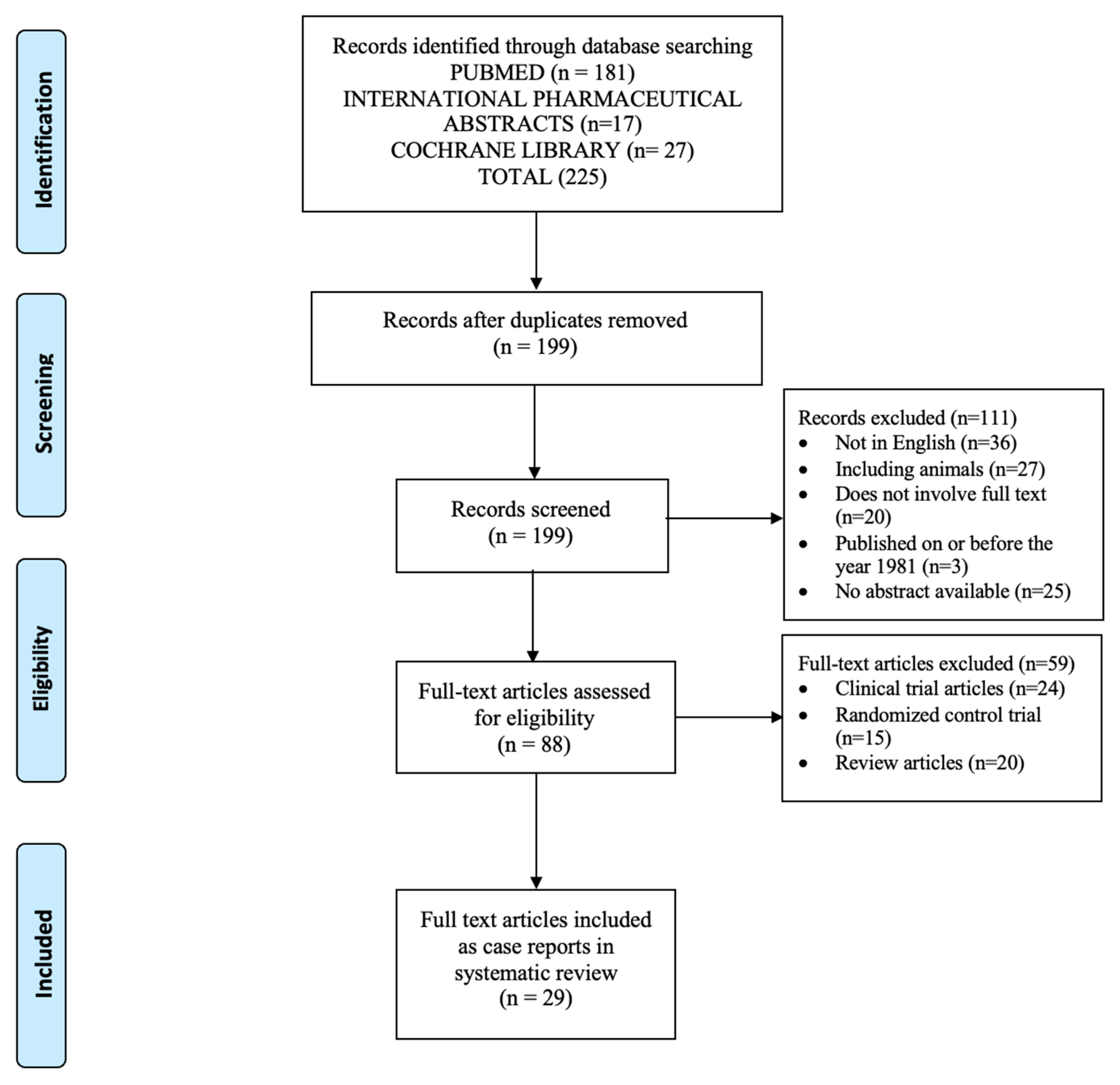
4.1. Literature Review
4.2. Unfractionated Heparin
4.3. Low-Molecular-Weight Heparin
5. Discussion
5.1. Statement of Key Findings
5.2. Weaknesses
5.3. Further Research
6. Conclusions
Supplementary Materials
Author Contributions
Funding
Institutional Review Board Statement
Informed Consent Statement
Data Availability Statement
Conflicts of Interest
References
- Barrowcliffe, T.W. History of Heparin. In Handbook of Experimental Pharmacology; Springer: Berlin/Heidelberg, Germany, 2012; pp. 3–22. [Google Scholar] [CrossRef] [Scilit]
- Mclean, J. The discovery of heparin. Circulation 1959, 19, 75–78. [Google Scholar] [CrossRef] [Scilit] [PubMed]
- Linhardt, R.J.; Gunay, N.S. Production and chemical processing of low molecular weight heparins. Semin. Thromb. Hemost. 1999, 25 (Suppl. S3), 5–16. [Google Scholar]
- Gómez-Outes, A.; Suárez-Gea, M.L.; Lecumberri, R.; Rocha, E.; Pozo-Hernández, C.; Vargas-Castrillón, E. New parenteral anticoagulants in development. Ther. Adv. Cardiovasc. Dis. 2011, 5, 33–59. [Google Scholar] [CrossRef] [Scilit]
- Oster, J.R.; Singer, I.; Fishman, L.M. Heparin-induced aldosterone suppression and hyperkalemia. Am. J. Med. 1995, 98, 575–586. [Google Scholar] [CrossRef] [Scilit]
- Truhlář, A.; Deakin, C.D.; Soar, J.; Khalifa, G.E.A.; Alfonzo, A.; Bierens, J.J.; Brattebø, G.; Brugger, H.; Dunning, J.; Hunyadi-Antičević, S.; et al. European Resuscitation Council Guidelines for Resuscitation 2015: Section 4. Cardiac arrest in special circumstances. Resuscitation. 2015, 95, 148–201. [Google Scholar] [CrossRef] [Scilit]
- Srinivasan, R.; Ramya, G. Adverse drug reaction—Causality assessment. Int. J. Res. Pharm. Chem. 2011, 1, 606–612. [Google Scholar]
- World Health Organization (WHO)—Uppsala Monitoring Centre. The Use of the WHO-UMC System for Standardized Case Causality Assessment. Available online: http://www.who-umc.org/Graphics/24734.pdf (accessed on 16 June 2024).
- Théophile, H.; Dutertre, J.P.; Gérardin, M.; Valnet-Rabier, M.-B.; Bidault, I.; Guy, C.; Haramburu, F.; Hillaire-Buys, D.; Méglio, C.; Arimone, Y. Validation and Reproducibility of the Updated French Causality Assessment Method: An Evaluation by Pharmacovigilance Centres & Pharmaceutical Companies. Therapies 2015, 70, 465–476. [Google Scholar] [CrossRef] [Scilit]
- Bracken, L.E.; Nunn, A.J.; Kirkham, J.J.; Peak, M.; Arnott, J.; Smyth, R.L.; Pirmohamed, M.; Turner, M.A. Development of the Liverpool Adverse Drug Reaction Avoidability Assessment Tool. PLoS ONE 2017, 12, e0169393. [Google Scholar] [CrossRef] [Scilit]
- Naranjo, C.A.; Busto, U.; Sellers, E.M.; Sandor, P.; Ruiz, I.; Roberts, E.A.; Janecek, E.; Domecq, C.; Greenblatt, D.J. A method for estimating the probability of adverse drug reactions. Clin. Pharmacol. Ther. 1981, 30, 239–245. [Google Scholar] [CrossRef] [Scilit]
- Rehan, H.S.; Chopra, D.; Kakkar, A.K. Causality assessment of spontaneously reported adverse drug events: Comparison of WHO-UMC criteria and Naranjo probability scale. Int. J. Risk Saf. Med. 2007, 19, 223–227. [Google Scholar] [CrossRef] [Scilit]
- Mittal, N.; Gupta, M.C. Comparison of agreement and rational uses of the WHO and Naranjo adverse event causality assessment tools. J. Pharmacol. Pharmacother. 2015, 6, 91–93. [Google Scholar] [CrossRef] [Scilit] [PubMed]
- Moher, D.; Liberati, A.; Tetzlaff, J.; Altman, D.G.; PRISMA Group. Reprint—Preferred reporting items for systematic reviews and meta-analyses: The PRISMA statement. Phys. Ther. 2009, 89, 873–880. [Google Scholar] [CrossRef] [Scilit]
- Brohee, D.; Neve, P. Heparin side effects. Arch. Intern. Med. 1984, 144, 1693. [Google Scholar] [CrossRef] [Scilit]
- Edes, T.E.; Sunderrajan, E.V. Heparin-induced hyperkalemia. Arch. Intern. Med. 1985, 145, 1070–1072. [Google Scholar] [CrossRef] [Scilit] [PubMed]
- Busch, E.H.; Ventura, H.O.; Lavie, C.J. Heparin-induced hyperkalemia. South. Med. J. 1987, 80, 1450–1451. [Google Scholar] [CrossRef] [Scilit]
- Aull, L.; Chao, H.; Coy, K. Heparin-induced hyperkalemia. DICP 1990, 24, 244–246. [Google Scholar] [CrossRef] [Scilit] [PubMed]
- Mitchell, S.; Bayliff, C.D.; McCormack, D.G. Heparin induced hyperkalemia. Can. J. Hosp. Pharm. 1993, 46, 125–127. [Google Scholar]
- Bacon, N.C. Hospital-acquired hyperkalaemia. Postgrad. Med. J. 1997, 73, 433–434. [Google Scholar] [CrossRef] [Scilit]
- Preston, R.A.; Hirsh, M.J.; Oster, M.J.; Oster, H.R. University of Miami Division of Clinical Pharmacology therapeutic rounds: Drug-induced hyperkalemia. Am. J. Ther. 1998, 5, 125–132. [Google Scholar] [CrossRef] [Scilit]
- Orlando, M.P.; Dillon, M.E.; O’Dell, M.W. Heparin-induced hyperkalemia confirmed by drug rechallenge. Am. J. Phys. Med. Rehabil. 2000, 79, 93–96. [Google Scholar] [CrossRef] [Scilit] [PubMed]
- Sherman, D.S.; Kass, C.L.; Fish, D.N. Fludrocortisone for the treatment of heparin-induced hyperkalemia. Ann. Pharmacother. 2000, 34, 606–610. [Google Scholar] [CrossRef] [PubMed]
- Day, J.R.; Chaudhry, A.N.; Hunt, I.; Taylor, K.M. Heparin-induced hyperkalemia after cardiac surgery. Ann. Thorac. Surg. 2002, 74, 1698–1700. [Google Scholar] [CrossRef] [Scilit] [PubMed]
- Su, H.M.; Voon, W.C.; Chu, C.S.; Lin, T.H.; Lai, W.T.; Sheu, S.H. Heparin-induced cardiac tamponade and life-threatening hyperkalema in a patient with chronic hemodialysis. Kaohsiung J. Med. Sci. 2005, 21, 128–133. [Google Scholar] [CrossRef] [Scilit]
- Thomas, C.M.; Thomas, J.; Smeeton, F.; Leatherdale, B.A. Heparin-induced hyperkalemia. Diabetes Res. Clin. Pract. 2008, 80, e7–e8. [Google Scholar] [CrossRef] [Scilit]
- Liu, A.A.; Bui, T.; Nguyen, H.V.; O’Rourke, F. Subcutaneous unfractionated heparin-induced hyperkalaemia in an elderly patient. Australas. J. Ageing. 2009, 28, 97. [Google Scholar] [CrossRef] [Scilit]
- Brown, G. Fludrocortisone for heparin-induced hyperkalemia. Can. J. Hosp. Pharm. 2011, 64, 463–464. [Google Scholar] [CrossRef] [Scilit]
- Bhaskar, B.; Fraser, J.F.; Mullaney, D. Lest we forget: Heparin-induced hyperkalemia. J. Cardiothorac. Vasc. Anesth. 2012, 26, 106–109. [Google Scholar] [CrossRef] [Scilit]
- Cho, R.; Leclaire, M.; Kempainen, R. Heparin-induced hyperkalemia in a patient diagnosed with thyroid storm. Ann. Pharmacother. 2013, 47, 1213–1217. [Google Scholar] [CrossRef] [Scilit]
- Sodhi, K.; Garg, S.; Singh, B.; Shrivastava, A.; Singla, M.K. Refractory hyperkalemia related to heparin abuse. Indian J. Crit. Care Med. 2013, 17, 388–391. [Google Scholar] [CrossRef] [Scilit]
- Shimokaze, T.; Akaba, K.; Saito, E. Heparin-induced hyperkalemia in an extremely-low-birth-weight infant: A case report. J. Clin. Res. Pediatr. Endocrinol. 2014, 6, 125–128. [Google Scholar] [CrossRef] [Scilit] [PubMed]
- Zhou, B.; Ge, J. Hyperkalemia in an intravenous catheter direct thrombolysis patient: A case report. Int. J. Clin. Exp. Pathol. 2016, 9, 12025–12027. [Google Scholar]
- Custodio, M.; Thompson, E.C. Hyperkalemia Secondary to Prophylactic Heparin Use in a Trauma Patient: Case Report. Marshall J. Med. 2020, 6, 50. [Google Scholar] [CrossRef] [Scilit]
- Baleguli, V.; Mahmood, R.; Herrera, M.; Raybon-Rojas, E. Heparin-Induced Renal Tubular Acidosis Masquerading as Hyperkalemia in a SARS-CoV-2 (COVID-19) Patient: A Case Report. Cureus 2021, 13, e20312. [Google Scholar] [CrossRef] [Scilit]
- Nlandu, Y.M.; Engole, Y.M.; Mboliassa, M.I.; Sakaji, T.-J.M.; Kobo, P.U.; Boloko, P.M.; Mafuta, P.K.; Tsangu, J.P.; Van Echkout, K.; Kanku, J.-P.M.; et al. Ineffectiveness of Intermittent Hemodialysis in a Critically Ill COVID-19 Patient: A Case of Persistent Heparin-Induced Hyperkalemia. Case Rep. Nephrol. 2022, 2022, 8613656. [Google Scholar] [CrossRef] [Scilit]
- Kovacs, J.; Talib, S.; Khashan, A.; Garsondiya, B.; Carson, M.P. A 77-Year-Old Man with Heparin-Induced Aldosterone Suppression Causing Hyperkalemia. Am. J. Case Rep. 2022, 23, e937017. [Google Scholar] [CrossRef] [Scilit] [PubMed]
- Kargar, F.; Zahedmehr, A.; Shafii, Z.; Babaee, T.; Banar, S.; Rezaei, Y.; Hosseini, S. Heparin-Induced Hyperkalemia Following Heart Surgery: A Case Report. Iran. Heart J. 2023, 24, 104–107. [Google Scholar]
- Wiggam, M.I.; Beringer, T.R. Effect of low-molecular-weight heparin on serum concentrations of potassium. Lancet 1997, 350, 292–293. [Google Scholar] [CrossRef] [Scilit] [PubMed]
- Rippin, J.D.; Hado, H.S.; Green, N.; Elhadd, T.A. Serious hyperkalaemia after short use of low molecular weight heparin in a diabetic patient. Clin. Med. 2003, 3, 87. [Google Scholar] [CrossRef] [Scilit]
- Danguy, C.; Biston, P.; Carlier, E.; Defrance, P.; Piagnerelli, M. Severe hyperkalemia in critically ill patients treated with prophylactic doses of enoxaparin. Intensive Care Med. 2012, 38, 1904–1905. [Google Scholar] [CrossRef] [Scilit]
- Scalese, M.J. Profound hyperkalemia associated with thromboprophylactic enoxaparin. Ther. Adv. Drug Saf. 2016, 7, 120–121. [Google Scholar] [CrossRef] [Scilit] [PubMed]
- Landolfo, M.; Di Rosa, M.V.; Gasparotto, L.; Marchese, A.; Biolo, G. Hyperkalemia: Do you forget something? Intern. Emerg. Med. 2023, 18, 193–196. [Google Scholar] [CrossRef] [Scilit]
- González-Martin, G.; Díaz-Molinas, M.S.; Martínez, A.M.; Ortiz, M. Heparin-induced hyperkalemia: A prospective study. Int. J. Clin. Pharmacol. Ther. Toxicol. 1991, 29, 446–450. [Google Scholar] [PubMed]
- Gheno, G.; Cinetto, L.; Savarino, C.; Vellar, S.; Carraro, M.; Randon, M. Variations of serum potassium level and risk of hyperkalemia in inpatients receiving low-molecular-weight heparin. Eur. J. Clin. Pharmacol. 2003, 59, 373–377. [Google Scholar] [CrossRef] [Scilit] [PubMed]
- Phelps, K.R.; Oh, M.S.; Carroll, H.J. Heparin-induced hyperkalemia: Report of a case. Nephron 1980, 25, 254–258. [Google Scholar] [CrossRef] [Scilit]
- Michel, D.J.; Knodel, L.C. Comparison of three algorithms used to evaluate adverse drug reactions. Am. J. Hosp. Pharm. 1986, 43, 1709–1714. [Google Scholar]
- Long, H.A.; French, D.P.; Brooks, J.M. Optimising the value of the critical appraisal skills programme (CASP) tool for quality appraisal in qualitative evidence syntheses. Res. Methods Med. Health Sci. 2020, 1, 31–42. [Google Scholar]
- Critical Appraisal Skills Programme. CASP (Case-Control Study Checklist). 2025. Available online: https://casp-uk.net/ (accessed on 18 March 2025).
- Page, M.J.; McKenzie, J.E.; Bossuyt, P.M.; Boutron, I.; Hoffmann, T.C.; Mulrow, C.D.; Shamseer, L.; Tetzlaff, J.M.; Akl, E.A.; Brennan, S.E.; et al. The PRISMA 2020 statement: An updated guideline for reporting systematic reviews. BMJ 2021, 372, n71. [Google Scholar] [CrossRef] [Scilit]


| Author | Year | Age/Sex | Full Patient History | UFH Dosing | Duration of Therapy (Days) | Highest Concentration of Potassium (mEq/L) | Time in Days Until K Normalized (<5.5) | Relevant Concurrent Medications and Substances Used During UFH Dosing | Naranjo Scale (Yes/No) Score | Calculated Naranjo Total Score | Naranjo Score Interpretation |
|---|---|---|---|---|---|---|---|---|---|---|---|
| Brohee D [15] | 1984 | 92 years old/female | Unknown | 5000 U IV q 4 hr | 4 | 6.4 | Unknown | Unknown | No | NA | NA |
| 12,500 U SC BID | 6 | NA | NA | ||||||||
| 5000 U SC TID | Unknown | NA | NA | ||||||||
| Edes TE [16] | 1985 | 58 years old/male | Paraparesis | 5000 U SC TID | 27 | 7.5 | 3 | Unknown | No | NA | NA |
| 51 years old/male | DM | 5000 U SC TID | 7 | 6.8 | 5 | Unknown | No | NA | NA | ||
| 87 years old/male | CAD | 5000 U SC TID | 7 | 6.5 | 5 | Unknown | No | NA | NA | ||
| 63 years old/female | DM2, HTN, and CHF | 5000 U SC BID | 10 | 6.3 | 5 | Furosemide 40 mg IV every morning, changed to PO after 3 days. Potassium chloride 20 mEq BID for 3 days, then potassium containing salt for 3 days, and then discontinued | No | NA | NA | ||
| Busch EH [17] | 1987 | 77 years old/male | DM and HTN | 5000 U SC BID | 14 | 8.3 | Unknown | Unknown | No | NA | NA |
| 35 years old/male | DM and HTN | 7500 U IV followed by 1000 U/hr | 10 | 7.6 | Unknown | No | NA | NA | |||
| 57 years old/female | DM | 5000 U SC BID | 5 | 6.1 | Unknown | IV antibiotics | No | NA | NA | ||
| Aull L [18] | 1990 | 49 years old/male | Morbid obesity; jejunoileal bypass, followed by conversion to a vertical banded gastric partitioning and a gastric bypass; and, eventually, enterolysis and herniorrhaphy | 5000 U SC BID | 52 | 6.7 | 1 | Cefotetan 1 g IV for two doses, ranitidine 50 mg IV q8 h, patient-controlled morphine, amphotericin B 325 mg, mycostatin 500,000 U swish and swallow q8 h, albuterol inhaler 2 puffs q4 h, ranitidine 200 mg/day, and potassium 20 mEq/day | No | NA | NA |
| 41 years old/female | DM; hysterectomy; and right-sided, below-knee amputation | 5000 U SC BID | 51 | 6.2 | 1 | Patient-controlled morphine, sliding-scale insulin, gentamicin, clindamycin, and ampicillin | No | NA | NA | ||
| Mitchell S [19] | 1993 | 65 years old/male | COPD, CABG, CHF, stroke, BPH, renal calculus, and a non-functioning left kidney | 5000 U IV, followed by 1400 U/hr, stopped on day 24, then resumed on day 27 with increased dose | 50 | 5.8 | Unknown | Acetylcysteine 650 mg po daily; nitroglycerin 0.3 mg SL every evening; salbutamol and ipratropium metered-dose inhalers 2 puffs QID; diltiazem 90 mg po BID; cotrimoxazole po BID; prednisone 15 mg po daily, decreased by 5 mg every 2 days and discontinued; and magnesium hydroxide, docusate sodium, and aluminum hydroxide and magnesium hydroxide suspension prn | No | NA | NA |
| Unknown | 2 | 5.3 | NA | Unknown | No | NA | NA | ||||
| Bacon NC [20] | 1997 | 56 years old/male | HTN and CKD | 5000 U IV, then 1000 U/hr | 10 | 6.4 | Unknown | Erythropoietin, alfacalcidol, calcium carbonate, isosorbide mononitrate, aspirin, and atenolol | No | NA | NA |
| Preston RA [21] | 1998 | 42 years old/male | AIDS | 5000 U IV, then 1000 U/hr | 5 | 8.1 | 1 | Sulfamethoxazole-trimethoprim 5 mg/kg every 8 h | No | NA | NA |
| Orlando MP [22] | 2000 | 68 years old/female | HTN, tobacco use, and alcohol abuse | 5000 U SC BID | 6 | 5.3 | NA | Sucralfate 1 g, ticlopidine hydrochloride 250 mg, and nifedipine 30 mg daily | No | NA | NA |
| 5000 U SC TID | 7 | 6.4 | 2 | Sulfamethoxazole-trimethoprim for 7 days at a renally adjusted dose | No | NA | NA | ||||
| 5000 U SC TID | 8 | 6.4 | 2 | Sulfamethoxazole-trimethoprim BID | No | NA | NA | ||||
| 5000 U SC BID | 5 | 5.4 | NA | Unknown | No | NA | NA | ||||
| 70 years old/male | DM and curative rectal cancer surgery | 5000 U SC BID | 18 | 6.5 | 3 | Sulfamethoxazole-trimethoprim BID, sodium polystyrene sulfonate, glucose, and IV fluids | No | NA | NA | ||
| 5000 U SC BID | 4 | 5.7 | 2 | Unknown | No | NA | NA | ||||
| Sherman DS [23] | 2000 | 34 years old/male | No significant history | 7000 U IV, followed by 1600 U/hr; decreased to 1200 U/hr | 37 | 6.4 | 1 | Total parenteral nutrition containing potassium 42 mEq/d, insulin drip, and intermittent fludrocortisone use | Yes | Not provided | Probable |
| Day JR [24] | 2002 | 55 years old/female | MI, HTN, and hypercholesterolemia | Unknown | 1.5 | 7.1 | 2 | Unknown | No | NA | NA |
| Su HM [25] | 2005 | 40 years old/male | ESRD, DM, and HTN | Unknown | 10 | 9.2 | Unknown | Unknown | No | NA | NA |
| Thomas CM [26] | 2008 | 85 years old/female | DM2 and peripheral neuropathy | 5000 U SC BID | 4 | 6.1 | 1 | Benzylpencillin 1.2 g q6h for 2 days and then amoxycillin 500 mg PO TID for 8 days | No | NA | NA |
| Liu AA [27] | 2009 | 75 years old/female | CHF, dyslipidemia, and DM2 | 5000 U SC BID | 8 | 6.9 | 2 | Aspirin 100 mg, atorvastatin 20 mg, carvedilol 12.5 mg BID, and insulin aspart protamine and insulin aspart (30/70) 26 units and 8 units | No | NA | NA |
| Brown G [28] | 2011 | Unknown | Unknown | 10,000 SC TID | 15 | 6.2 | 1 | Potassium included in enteral nutrition solution; sodium polystyrene sulfonate 30 g rectally on day 13; then, PO on days 14 and 15 and fludrocortisone 0.1 mg PO daily on days 15, 16, and 17 | Yes | 6 | Probable |
| Bhaskar B [29] | 2012 | 68 years old/male | DM2, ARD, and hypercholesterolemia | 200 U/kg IV, followed by a second dose of 50 U/kg | 1 hr | 6.8 | 1 | Unknown | No | NA | NA |
| Cho R [30] | 2013 | 52 years old/male | No significant history | 4700 U IV, followed by 18 U/kg/hr | 3 hrs | 5.8 | 2 | Furosemide 20 mg, metoprolol tartrate 10 mg IV q4 h, hydrocortisone 100 mg IV q8 h, and methimazole 20 mg PO q6 h | Yes | Not provided | Probable |
| Sodhi K [31] | 2013 | 26 years old/male | Asthma and addiction (tramadol, diclofenac, heparin pheniramine, and dexamethasone) | Unknown | Unknown | 9.1 | NA—deceased | Ceftriaxone, followed by meropenem, teicoplanin, and ampicillin | No | NA | NA |
| Shimokaze T [32] | 2014 | Newborn infant, 28-week gestation/female | No significant history | 55 IV U/kg/day | 12 | 7.9 | 1 | Breast milk, indomethacin IV, and Lactobacillus casei PO | No | NA | NA |
| Zhou B [33] | 2016 | 68 years old/female | HTN, nephrolithotomy in both sides, and DM | 43,750 U IV | 3 | 6.66 | 1 | Telmisartan 80 mg daily, lacidipine 4 mg daily, gliclazide 30 mg, and metformin 500 mg BID | No | NA | NA |
| Custodio M [34] | 2021 | 47 years old/male | HTN, stroke, and DM | 5000 U SC TID | 8 | 6 | 2 | Piperacillin–tazobactam and linezolid, insulin, albuterol, and furosemide | Yes | 6 | Probable |
| Baleguli V [35] | 2021 | 72 years old/male | CKD and leukemia | Unknown | 6 | 6.7 | 1 | Unknown | No | NA | NA |
| Nlandu YM [36] | 2022 | 72 years old/male | DM2, HTN, and unspecific arrhythmia | Unknown | 7 | 6.6 | NA—deceased | Insulin, dextrose, β2 agonist, and sodium polystyrene sulfonate | No | NA | NA |
| Kovacs J [37] | 2022 | 77 years old/male | MI, DM2, BPH, CKD, and nephrectomy | Unknown | 4 | 6.2 | 1 | Unknown | No | NA | NA |
| Unknown | 2 | 6 | 1 | No | NA | NA | |||||
| Kargar F [38] | 2023 | 69 years old/female | CAD, ischemic heart disease, HTN, DM, dyslipidemia, and AF | Unknown | 6 hrs | 5.8 | NA—deceased | Unknown | No | NA | NA |
| Author | Year | Age/Sex | Full Patient History | LMWH Dosing | Duration of Therapy (Days) | Highest Concentration of Potassium (mEq/L) | Time in Days Until K Normalized (<5.5) | Relevant Concurrent Medications and Substances Used During LMWH Dosing | Naranjo Scale Mentioned (Yes/No) | Calculated Naranjo Total Score | Naranjo Score Interpretation |
|---|---|---|---|---|---|---|---|---|---|---|---|
| Wiggam MI [39] | 1997 | 86 years old/female | Chronic pyelonephritis | Enoxaparin 20 mg SC daily | 58 | 6.7 | Unknown | Inhaled salbutamol 400 mcg daily | No | NA | NA |
| Rippin JD [40] | 2003 | 45 years old/female | DM1, HTN, previous recurrent DVT, and seronegative RA | Dalteparin (dose unknown) | 5 | 7.1 | 7 | Warfarin, human insulin, colchicine, lansoprazole, and lisinopril | No | NA | NA |
| Danguy C [41] | 2012 | 71 years old/male | DM | Enoxaparin 40 mg SC daily | 6 | 6.1 | 4 | Unknown | No | NA | NA |
| Enoxaparin 20 mg SC daily | 3 | 5.2 | NA | NA | NA | ||||||
| 63 years old/female | DM | Enoxaparin 20 mg SC daily, increased to 40 mg after 4 days | 14 | 6.1 | 2 | Unknown | No | NA | NA | ||
| Enoxaparin 40 mg SC daily | 4 | 5.3 | NA | NA | NA | ||||||
| 71 years old/female | Arterial HTN | Enoxaparin 40 mg SC daily | 17 | 6.2 | 2 | Unknown | No | NA | NA | ||
| Enoxaparin 20 mg SC daily | 3 | 5.4 | NA | NA | NA | ||||||
| Scalese MJ [42] | 2016 | 74 years old/male | Intellectual disability; right-sided, above-the-knee amputation; burn injury covering 27% of his body surface area; ileostomy; and PEG tube | Enoxaparin 40 mg SC daily | 8 | 7 | 2 | Ertapenem 1 g daily; metoprolol succinate 200 mg daily; lactulose 20 g daily; pantoprazole 40 mg daily; nutritional supplements; meal replacements—1 can three times daily (28.5 mEq potassium per day); and calorically dense, fiber-fortified therapeutic nutrition—1.2 L can three times daily | Yes | 6 | Probable |
| Landolfo M [43] | 2023 | 80+ years old/male | Surgically treated bladder and prostate cancer | Enoxaparin (dose unknown) | 10 | 7.1 | 2 | IV corticosteroids, antibiotics, proton-pump inhibitor, and furosemide | No | NA | NA |
| NA | NA |
Disclaimer/Publisher’s Note: The statements, opinions and data contained in all publications are solely those of the individual author(s) and contributor(s) and not of MDPI and/or the editor(s). MDPI and/or the editor(s) disclaim responsibility for any injury to people or property resulting from any ideas, methods, instructions or products referred to in the content. |
© 2025 by the authors. Licensee MDPI, Basel, Switzerland. This article is an open access article distributed under the terms and conditions of the Creative Commons Attribution (CC BY) license (https://creativecommons.org/licenses/by/4.0/).
Share and Cite
Singh, D.; Mesalhy, O.A.E.A.; Cawley, M.J. Heparin-Induced Hyperkalemia Assessment Utilizing the Naranjo Adverse Drug Reaction Probability Scale: A 40-Year Systematic Review. Pharmacy 2025, 13, 55. https://doi.org/10.3390/pharmacy13020055
Singh D, Mesalhy OAEA, Cawley MJ. Heparin-Induced Hyperkalemia Assessment Utilizing the Naranjo Adverse Drug Reaction Probability Scale: A 40-Year Systematic Review. Pharmacy. 2025; 13(2):55. https://doi.org/10.3390/pharmacy13020055
Chicago/Turabian StyleSingh, Divita, Omnia A. E. A. Mesalhy, and Michael J. Cawley. 2025. "Heparin-Induced Hyperkalemia Assessment Utilizing the Naranjo Adverse Drug Reaction Probability Scale: A 40-Year Systematic Review" Pharmacy 13, no. 2: 55. https://doi.org/10.3390/pharmacy13020055
APA StyleSingh, D., Mesalhy, O. A. E. A., & Cawley, M. J. (2025). Heparin-Induced Hyperkalemia Assessment Utilizing the Naranjo Adverse Drug Reaction Probability Scale: A 40-Year Systematic Review. Pharmacy, 13(2), 55. https://doi.org/10.3390/pharmacy13020055