1. Introduction
As a Loloish (Tibeto-Burman) population of over two million, the modern Liangshan Yi people, mainly living in Liangshan, Sichuan, and adjacent mountainous regions of Yunnan, Southwest China, practice ethnic endogamy, clan exogamy, and rank-based endogamy as their marriage conventions.
Firstly, ethnic endogamy of the Liangshan Yi speakers requires individuals to marry within the Yi ethnic group. While most marriages occur within the Liangshan Yi community, marriages with ethnic Yi from Yunnan and Guizhou are also acceptable, although Yi speakers in Yunnan and Guizhou speak different Loloish languages. In traditional Yi society, marrying individuals of other ethnic groups, who often constituted the slave caste, was nearly impossible, but in modern society, such marriages are possible, though still generally not preferred (
Z. Wang & Zhang, 2018). Next, as a patrilineal society, the Liangshan Yi community practices clan exogamy to prohibit marriage within the same patrilineal clan. This practice serves to prevent consanguineous marriages and ensure lineage continuity, and functions as a defensive measure to expand and strengthen the clan’s influence and power. This practice is still strictly observed in Liangshan as an important moral law.
Furthermore, the above two marriage rules are reinforced by strict rank-based endogamy. The traditional Yi society is broadly divided into four hereditary castes, namely ndzɨ33xo21 (lord:caste) ‘the ruling class’, nɔ33xo21 (black:caste) ‘the noble class’, tɕhu33xo44 (white:caste) ‘the commoner’, and dʑi33 ‘slave’ (also meaning ‘enemy’). Rank-based endogamy mandates marriage within one’s social stratum, and cross-caste marriage is thus prohibited. Nowadays, some exceptions to this rule are occasionally observed in more developed and open Yi communities.
Due to the social conventions and sensitive nature of information involved, such as familial background and caste, the matchmaker in the Liangshan Yi society is entrusted, as a crucial intermediary, with collecting and verifying these essential details for satisfactory marriage arrangements. Consequently, the matchmaker’s involvement is integral throughout the Yi marriage process, which typically unfolds across four interrelated stages: the proposal stage, the bridewealth negotiation, the engagement phase, and the final wedding ceremony (see
Luobian & Mose, 2014;
Qubi, 2017).
Scholars, as well as ethnic Yi people, consistently describe the matchmaker as a longstanding marital component in the Liangshan Yi society (e.g.,
Feng & Yuan, 2019;
J. Zhang, 2019). This view is further reinforced by the presence of “matchmaker” in the Yi genesis epic
hnɯ33ɣo33thɯ21ʑi33 (see
Zhu, 2017, p. 305;
Hu, 2020, p. 390).
However,
hnɯ33ɣo33thɯ21ʑi33 should not be considered as a reliable source for inferring the presence or absence of the concept of “matchmaker”. As the Liangshan Yi society has been primarily oral, with the ethnic language transmitted and used orally among its speakers, the epic, although believed to have a long history, was only written down recently. The first Chinese translation was produced in the 1960s, and the Yi-language version in the 1970s after the initial standardization of the Nuosu scripts. In the epic, lexicons of different historical layers, as well as different dialects, co-exist, showing that the extant epic is not homogeneous and not entirely archaic. For example, va
33, as an earlier form of Proto-Liangshan Yi (PLS)
*ɣa1 ‘chicken’, co-occurs with ʑɛ
33, a later form, in the epic; another case is the co-occurrence of two functionally identical negators a
21 and ma
21 (PLS
*ma3). Additionally, recent Chinese loanwords appear in the epic, such as hɛ
33ŋga
55 ‘ethnic Han Chinese or 汉家’ and ma
33pɛ
33 ‘Mabian as a place name or 马边’. The latter, as a place, was only established around 1764 during the Qing Dynasty as a sub-prefecture in Sichuan. The native Liangshan Yi word for Mabian is mo
21xo
33la
33da
33. According to
Zhu (
2017, p. i), the content of
hnɯ33ɣo33thɯ21ʑi33 consists of both ancient events and modern events, suggesting continuous revisions and additions made by later generations during its long process of oral transmission and eventual codification.
Instead, we use
Manshu (also historically known as
Book of Southern Barbarians, from a Han-centric perspective) as a historical source to evaluate the presence or absence of “matchmaker” among the ancestral populations of what is now Liangshan Yi society.
Manshu, written in 863 by the Han Chinese official Fanchuo, is a comprehensive Tang Dynasty text detailing the social structures and customs of early southwestern ethnic groups. It classified many Loloish tribal groups in southwestern China as Wuman (literally “Black Barbarians”), and others as Baiman (literally “White Barbarians”, meaning more Siniticized). The Liangshan Yi ancestors belonged to the group of “Black Barbarians”, known for their preference for the color black and resistance to Han assimilation, contrasted with the more Siniticized Baiman. Chapter 8 of
Manshu, titled
Customs and Manners of the Barbarian Peoples, describes the marriage customs of both the Wuman and the Baiman. However, it contains no mention of “matchmaker” or any descriptive expressions related to a matchmaking role, likely suggesting the absence of the concept by that time
1.
Furthermore, linguistically, the Liangshan Yi word ‘matchmaker’ hɔ
44ka
33 (Niesu dialect) or f
u44ka
33 (Nuosu dialect) is not transparently analyzable (see
Section 4), and the combined meaning of their constituents fails to yield a relevant semantic match. The morphological opacity suggests a non-native etymology as it aligns with the cross-linguistic criterion for identifying potential loanwords through analyzability (
Haspelmath & Tadmor, 2009). Namely, if a word is analyzable in one language but not in another, it was likely borrowed from the former (see
Section 4.1).
Consequently, the present study aims to prove that “matchmaker” is a Chinese loanword into the Liangshan Yi language: hɔ44ka33 (Niesu dialect) or fu44ka33 (Nuosu dialect). At the same time, ho33 (Niesu dialect) or fu33 (Nuosu dialect) as a standalone verb meaning ‘to marry (generally)’ was also borrowed from Chinese, which makes the first syllable of “matchmaker” identifiable in Liangshan Yi. The source words are 伐柯 (fákē or fa35kʰɤ55 in modern Standard Mandarin) ‘to cut wood to make an axe handle; matchmaker, matchmaking’ and 伐 (fá or fa35 in modern Standard Mandarin) ‘to hew, to chop, to matchmake, or arrange the marriage for someone’, from Middle Chinese as the donor language. Accordingly, the first research question of the present study is:
- (1)
Is “matchmaker” in the Liangshan Yi language a loanword of 伐柯 (fákē) from Chinese? How did the Liangshan Yi language adapt the word phonologically and semantically?
Next, lexical borrowing often occurs under conditions of language contact and cultural diffusion, particularly when new social institutions or practices from the donor culture, which are previously unfamiliar or substantially different from endogenous traditions, are introduced into the recipient community (e.g.,
Sayahi, 2014, p. 124). Thus, if “matchmaker” was borrowed, the practice itself may not be as “traditional” as was commonly believed by the ethnic Yi, which challenges the assumption of its indigenous origin and leads to the second research question:
- (2)
When did the term for “matchmaker” enter the Liangshan Yi lexicon, and hence when did the associated cultural practice likely emerge?
2. The Language of the Liangshan Yi People
The Liangshan Yi language is spoken by approximately 2.5 million people, which are officially recognized in China as the ethnic Yi group (彝族). According to
Bradley (
1997,
2007), the Liangshan Yi language belongs to the Northern Loloish (or Northern Ngwi) branch. It distinguishes itself from other Loloish languages in Yunnan and Guizhou by two features: (1) retention of the proto-feature of prenasalization; and (2) post-nasal voicing of the following oral obstruents (
F. Wang, 2013). In contrast, other major Loloish languages, including Weishan Yi (aka Lalo, Central Loloish in Yunnan), Nanhua Yi (aka Lolopho, Central Loloish in Yunnan), and Phula (Southeastern Loloish in Yunnan), have largely lost the prenasalization. Meanwhile, Northern Loloish varieties, such as Luquan Yi (aka Nasu, Yunnan) and Bijie Yi (aka Nyisu, Guizhou), retain prenasalization but do not consistently exhibit post-nasal voicing, with the following oral obstruents being either completely or partially voiceless (see
Zhai, 2011;
Pu, 2016).
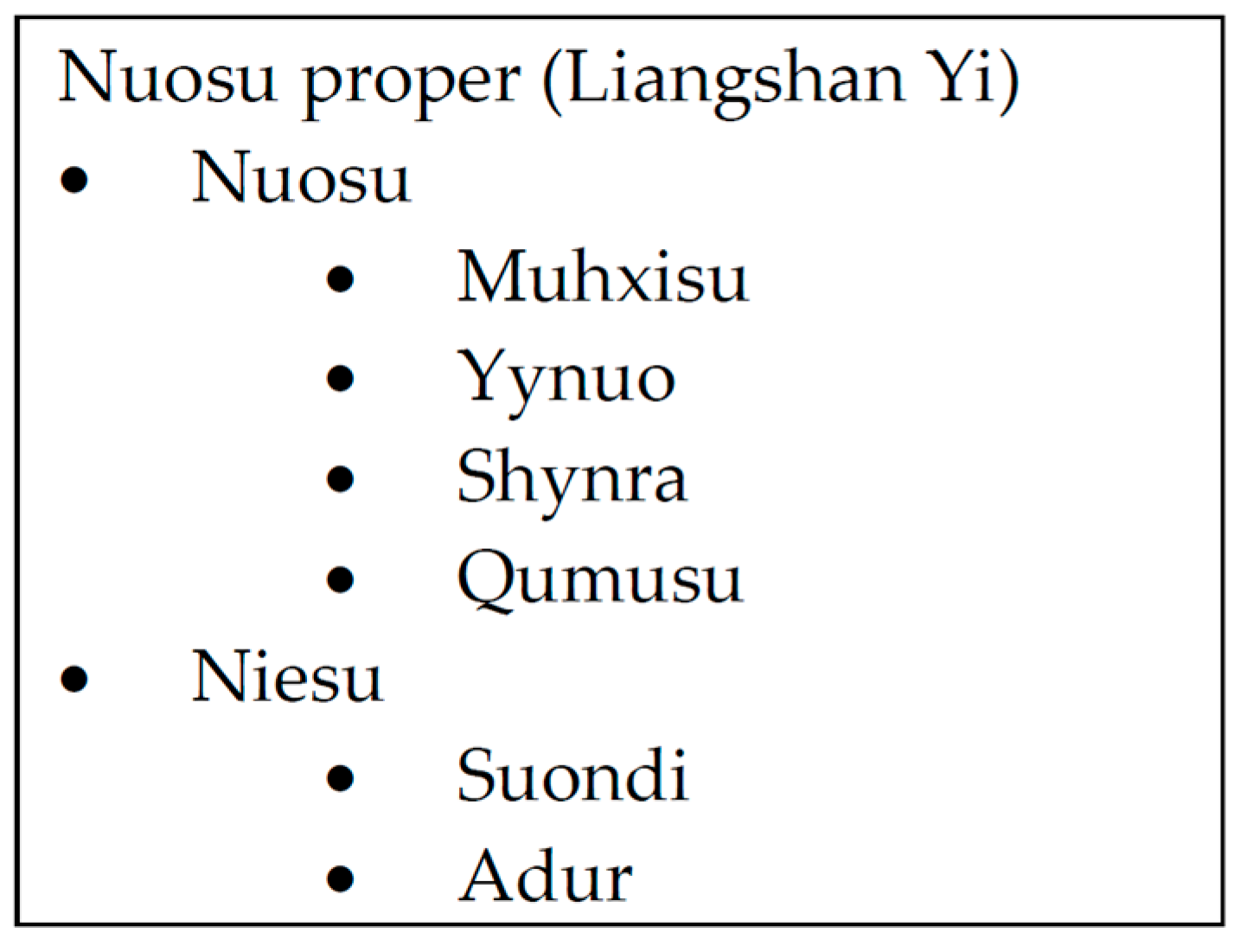
Nuosu proper is a term used by
Lama (
2012) to denote the Liangshan Yi language. Two principal dialects are identified, Nuosu and Niesu, as illustrated in
Figure 1 below. Both Nuosu and Niesu serve as autonyms for the Yi people in Sichuan, meaning ‘black(-worshipping) people’. Liangshan Yi is a verb-final, analytic tonal language with limited inflectional morphology. Grammatical functions are expressed primarily through clitics and postpositions, often employing a topic–comment structure. According to the 2010 census of Liangshan Prefecture and the research conducted by
S. Chen et al. (
1985) and
Gerner (
2013), approximately 1.5 million Yi in Sichuan speak the Nuosu dialect, while around 1 million use the Niesu dialect.
Moreover, the mutual intelligibility of the Nuosu and Niesu dialects is not high (
Bradley, 2001), with notable differences in lexicon, phonology, and structure (
Z. Pan, 2001;
Matisoff, 2006;
Hajek, 2006;
Lama, 2012;
Mahai, 2015;
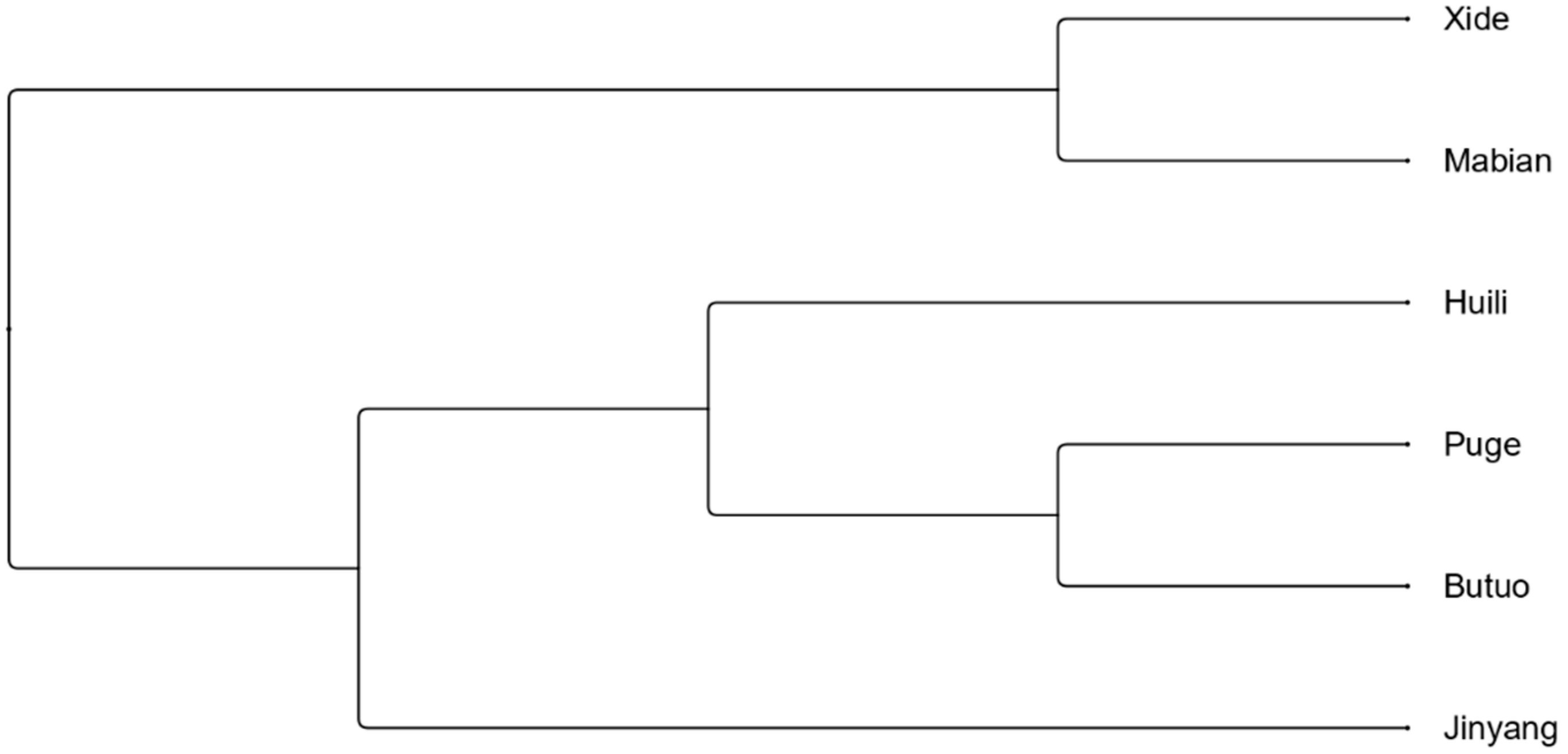
Ding & Lama, 2021). However, their phylogenetic relationship is well-established. Based on shared innovations, the Liangshan Yi language can be subgrouped into the Northwestern branch (Xide and Mabian) and the Southeastern branch (Huili, Puge, Butuo, and Jinyang); see
Figure 2. Notably, speakers of the Northwestern branch dialects consistently employ the autonym Nuosu, while most Southeastern branch dialects use Niesu, except for Jinyang where the term Nuosu is used. Jinyang, a region situated along the border between Sichuan and Yunnan immediately adjacent to the Jinsha River, is likely a key dispersal center for Liangshan Yi speakers, as indicated by the presence of mixed patterns of shared innovations in the area.
From a historical perspective, dialects from the Northwestern branch tend to exhibit palatalization of the consonant clusters in the Proto-Liangshan Yi consonantal inventory, while those from the Southeastern branch tend to show retroflexion of these clusters. For example, the initial of ‘star’ is reconstructed as
*kr- in Proto-Liangshan Yi (also see
Lama, 2012). In modern Northwestern branch dialects, the main reflex is mu
33tɕi
33 (sky:star) ‘star’. In contrast, Butuo Jizhi uses mu
33kʂɨ
33 (sky:star) ‘star’, and Butuo Tuojue and Puge use mu
33tʂɨ
33. The Huili Niesu dialect likely underwent further development by shifting the place of articulation from retroflex to alveolar, resulting in mu
33tsɨ
33 (sky:star) ‘star’. The consonantal development of ‘star’ is summarized as
*kr > kʂ > tʂ > ts in the Southeastern branch and
*kr (>k) > tɕ in the Northwestern branch with a possible intermediate stage of
*k before it became palatalized.
Moreover, dialects in the Northwestern branch are characterized by vowel raising, whereas those in the Southeastern branch display vowel fronting. For instance, the two autonyms Nuosu and Niesu are transcribed as nɔ33su33 and nɛ33su33, both deriving from the Proto-Liangshan Yi *nɑ1, meaning ‘black’. Other similar examples include dɔ33 vs. dɛ33, meaning ‘the first half of the month’, and tɕhɔ33 vs. tɕhɛ33, meaning ‘to take apart’. In all these cases, the Northwestern branch underwent the vowel raising *ɑ > ɔ, whereas the Southeastern branch experienced vowel fronting *ɑ > ɛ.
4. “Matchmaker” in Liangshan Yi as a Chinese Loanword
This section examines the historical origin of the Liangshan Yi term for “matchmaker” through three lines of evidence: morphological analyzability (
Section 4.1), cognate comparison within Sino-Tibetan languages (
Section 4.2), and phonological adaptation (
Section 4.3). The semantic shift between donor and recipient languages is discussed in
Section 4.4. The two lexical forms under discussion are presented in
Table 3.
4.1. The Morphological Analyzability of “Matchmaker” in Liangshan Yi
The disyllabic term hɔ44ka33 (Niesu) or fu44ka33 (Nuosu) is morphologically opaque in Liangshan Yi. The first syllable hɔ33- or fu33- is identifiable, not because it is a productive formative in Liangshan Yi, but because another semantically related verb, ho33 or fu33 ‘to marry (generally)’, was also borrowed (see the discussion below).
To start with, the first syllable of “matchmaker” hɔ
33- or f
u33- does not participate in any derivational processes to form semantically related words in Liangshan Yi. Similarly, -ka
33 cannot be analyzed as a productive morpheme either. In Liangshan Yi, the productive agentive derivation (‘one who does something’) is realized by the nominalizer -su
33, not by -ka
33, such as nɔ
33su
33 (black-nominalizer) ‘autonym, Nuosu Yi ethnic group’ and mo
21su
33 (old-nominalizer) ‘old person’. Moreover, attested meanings for native homophones of -ka
33 include the verb ka
33 ‘to hit’ (e.g., ʥi
44ka
33, mutually + hit, ‘to fight’) and ‘to exhaust’ (e.g., ɣɯ
33ka
33, strength + exhaust, ‘to make great efforts’), causative verb, and nouns (e.g., ‘staple foods’, ‘steel’, ‘firepit’), none of which yields a plausible compositional interpretation for “matchmaker”. These facts indicate that neither constituent has a recognizable morphological role, and the meaning of the whole cannot be derived from its parts under Liangshan Yi morphological rules. Such internal opacity indicates that the term was not a native Liangshan Yi word (see also
B. Chen, 1996).
Since “matchmaker” is borrowed as a whole word into Liangshan Yi, the word itself is productive in forming new expressions in the language, such as the verb phrase hɔ44ka33 mu33 (Niesu) or fu44ka33 mu33 (Nuosu) (matchmaker + do) ‘to do matchmaking’ and the compound noun hɔ44ka33 dʐɯ33 (Niesu) or fu44ka33 dʐɯ33 (Nuosu) (matchmaker + money) ‘the remuneration for a matchmaker’.
The source of “matchmaker” (hɔ
44ka
33 or f
u44ka
33) in Liangshan Yi is the Chinese verb 伐柯 (
fákē or fa
35kʰɤ
55 in modern Standard Mandarin) ‘to cut wood to make an axe handle; matchmaker, matchmaking’, which is fully morphologically analyzable in Chinese (伐 or
fá: ‘to cut’; 柯 or
kē: ‘axe handle’). The term first appeared in the poem
fákē (伐柯) from the
Odes of Bin in
Shījīng, see sentence (1), the oldest existing collection of Chinese poetry, comprising 305 works dating from the 11th to 7th century BC.
| (1) | 伐柯 | 如何, | 匪 | 斧 | 不 | 克 |
| | cut: axe handle | how | not | axe | not | done |
| | 取妻 | 如何, | 匪 | 媒 | 不 | 得 |
| | marry: wife | how | not | matchmaker | not | able |
| | ‘In hewing the wood for an axe-handle, how do you proceed? Without an axe it cannot be done. In taking a wife, how do you proceed? Without a go-between it cannot be done.’ |
伐柯 (fákē) in Chinese is a verb–object compound, with fá as the action and kē as the patient. See below for the productivity of 伐 fá as a Chinese verb. The second morpheme 柯 kē can also occur productively as a formative of different compound verbs in Chinese (e.g., 执柯 zhíkē ‘to hold the axe handle’). The literal act of cutting wood to make an axe handle first functioned as a metaphor for doing matchmaking, then underwent semantic extension and became lexicalized in Chinese.
As was mentioned above, an additional lexeme meaning ‘to marry (generally)’ exists in Liangshan Yi: ho
33 (Niesu) and f
u33 (Nuosu). Its existence does not indicate any morphological transparency of the word “matchmaker”; rather, it suggests that besides “matchmaker”, another Chinese word 伐
fá ‘to hew, to chop, to matchmake’ was borrowed as a standalone verb ho
33/f
u33 ‘to marry’ in Liangshan Yi (see
Section 4.3 for phonological adaptation). It can be observed that following this borrowing, the original Chinese meaning ‘to matchmake’ shifted to denote ‘to marry’ in Liangshan Yi (see
Section 4.4). Moreover, this verb is productive in Liangshan Yi and occurs in both derivatives, such as f
u33dʑu
44 (marry-
nmlz, ‘the status of marriage’), and compounds, such as f
u33tɕ
ho
44 (marry:friend, ‘marital affinity’) and f
u44p
hu
33 (marry:price, ‘the value of the bride’)
.In sum, this morphological analysis, namely transparent analyzability in the donor language but opacity in the recipient language, supports a non-native origin of “matchmaker” in Liangshan Yi.
4.2. The Cognacy of “Matchmaker” in Sino-Tibetan Languages
To verify whether the Liangshan Yi “matchmaker” is a native inheritance or a loanword, the Explicability Principle is adopted. There are two steps of employing the Explicability Principle: to conduct cognate comparison with sister languages (the present section), and to examine the phonological adaptation between the donor language and the recipient language (see
Section 4.3).
Cognates are compared according to phylogenetic closeness, namely first within the Loloish languages, then with other Lolo-Burmese languages, and finally with available Tibeto-Burman languages. Under this framework, if neither cognate morphemes nor comparable morphological patterns are attested in the nearer branches, this absence is taken as evidence against inheritance and in favor of borrowing (also see
Table 1).
4.2.1. Phonetic Resemblance Without Regular Correspondence
First,
*fu3ʔgra2 is considered as the reconstructed Proto-Loloish compound for “matchmaker”
2, where
*fu3 means ‘to send for marriage’ and
*ʔgra2 ‘between’.
Regarding the first syllable, although hɔ
44ka
33/f
u44ka
33 was borrowed from Chinese 伐柯
fákē into Liangshan Yi as a whole and thus should not be analyzable (see analyzability in
Section 4.1), a related element ho
33 or f
u33 can be used as a free verb in Liangshan Yi, meaning ‘to marry (generally)’ (i.e., 结婚). As was stated previously in the paper, the analyzability of ho
33/f
u33 does not arise from it being a free morpheme within hɔ
44ka
33/f
u44ka
33, but rather because ho
33/f
u33 was also borrowed independently, from Chinese 伐
fá.
Although many similar forms with related meanings, such as Luquan Yi fv̩
33(t
hv̩
33) ‘to marry’, Weishan Yi fu
55(tsɿ
55) ‘to marry’, and Azha xʌ
33 ‘to marry a female’, are found in Loloish languages, they are not cognates. Initially, Azha xʌ
33 has a different origin, meaning ‘(man) to marry a female’, similar to Chinese 娶. Sound correspondence regarding the initials can be found among Azha, Luquan, and Bijie; see
Table 4.
Next, after removing Azha xʌ
33 from the comparison due to its different origin, if
*fu3 ‘to send for marriage’ is considered as the Proto-Loloish form, the above-mentioned words, i.e., Nuosu f
u33 ‘to marry’, Luquan Yi fv̩
33(t
hv̩
33) ‘to marry’, Weishan Yi fu
55(tsɿ
55) ‘to marry’, should be native and more importantly, sound correspondence should be established. However, this is not the case. Just by examining the correspondence pattern of the initials, let alone the finals and tones, the expected f:f:f correspondence is not found. Instead, the only attested pattern involving an f-sound is v:f:v; see
Table 5. Being attested means that the correspondence is supported by at least two examples, so as to exclude accidental correspondence. If the “pattern” is only found with one morpheme, it may not be qualified to be called a pattern. If we also include Lisu fu
33 ‘to marry off’, which is another suspected cognate, into the comparison, the expected f:f:f:f is not found; instead, v:f:v:ɣ is the only pattern attested, as seen in
Table 5. The Lisu data is from
ECTBPL (
1991).
Therefore, regarding the forms in question, namely Liangshan Yi ho
33/f
u33 ‘to marry’, Luquan Yi fv̩
33(t
hv̩
33) ‘to marry’, Bijie Yi fʊ
33(m
33) ‘to marry’, Weishan Yi fu
55(tsɿ
55) ‘to marry’, Azha xʌ
33 ‘to marry a female’, as well as Lisu fu
33 ‘to marry off’, their phonetic resemblance to one another does not suggest that they are cognate, given the lack of regular sound correspondences and the different origin of Azha xʌ
33.
J. Wang (
1962) observes that old loanwords, borrowed before the divergence of the compared varieties, exhibit sound correspondences, though their phonetic forms may differ significantly. In contrast, words borrowed after the divergence typically show phonetic similarities but lack consistent phonological correspondence. Their phonetic similarity indicates that, apart from Azha, these words likely share the same Chinese origin (i.e., Chinese伐
fá), but their lack of sound correspondence suggests that when these words entered the Loloish languages, the Loloish languages had already split. Therefore, for all related words to be called cognates, they must be able to pass the test of sound correspondence, but not merely based on surface phonetic similarity.
Regarding the second syllable, the reflex of *ʔgra2 (also Matisoff’s Proto-Lolo-Burmese: ʔ-gla2 ‘between/have a space between/interval’) in Liangshan Yi is ka55, not ka33 in the word “matchmaker”, such as ka55tsɨ33 ‘middle’, ka55tsɨ33tsho33 ‘mediator, witness’ (literally: middle man), na33ka55 ‘forehead’ (literally: the middle areas above the nose), and a33ka55 ‘the second younger brother of the father’ (literally: middle uncle). This reflex differs in tone from the syllable ka33 in hɔ44ka33/fu44ka33 (depending on dialect).
Since Weishan Yi (dzɿ
31mu
31) and Azha (mo
33lɛ
55nɔ
44kə
33po
33) use different etyma for “matchmaker” and thus cannot provide comparable segments, if ka
33 in f
u44ka
33 (Nuosu)/hɔ
33(44)ka
33 (Niesu), and tɕo
55 in fu
33tɕo
55 (Luquan) are true reflexes of Proto-Loloish
*ʔgra2, the correspondence of the initials (i.e., k:tɕ) should be able to be verifiable across a broader range of Loloish languages or dialects, like the above-mentioned pattern v:f:v being able to be extended to a genuine Loloish pattern (v:f:v:ɣ). Nevertheless, when a Central Loloish language with a comparable segment—namely Limi (tsu
55 in fu
33tsu
55p
ho
21 ‘matchmaker’, p
ho
21: ‘man’)—is considered, the correspondence k:tɕ:ts is not found. Instead, the likely Loloish pattern is k:tɕ:tʂ, as supported by the following two morphemes in
Table 6.
Therefore, this suggests that ka33 in fu44ka33 (Nuosu)/hɔ33(44)ka33 (Niesu), and tɕo55 in fu33tɕo55 (Luquan) are not reflexes of Proto-Loloish *ʔgra2. The impression that Liangshan Yi ka33 (as in fu44ka33) and Luquan tɕo55 (as in fu33tɕo55) are cognate is probably due to their phonetic similarity to the Northern Loloish words meaning “middle”, such as Nuosu ka55 ‘middle’ vs. ka33; in many Northern Loloish languages, the two words are coincidentally homophones, such as Luquan Nasu fu33tɕo55 ‘matchmaker’ vs. tɕo55 ‘middle’, and Bijie Nyisu fʊ33tɕu55 ‘matchmaker’ vs. tɕu55 ‘middle’.
4.2.2. Different Etyma in Other Loloish and Tibeto-Burman Languages
Lisu, a Central Loloish (or Ngwi) language (
Bradley, 1997), uses dzi
21mu
21 (also dzi
21mu
33) for ‘matchmaker, middleman’ (
Bradley, 1994, also see STEDT), which is transparently analyzable: dzi
21 means ‘to mediate, to matchmake’, while mu
21(33) is the augmentative morpheme. The morphological makeup differs from Liangshan Yi hɔ
44ka
33/f
u44ka
33. Moreover, neither of the Lisu morphemes in “matchmaker” is cognate with those in Liangshan Yi. Instead, the Weishan Yi or Lalo, another Central Loloish language, uses dzɿ
31mu
31 (matchmake:augmentative) for ‘matchmaker’, reflecting a two-syllable etymon with clear cognates in Lisu.
Lahu (another Central Loloish language) and Hani (Southern Loloish) also use etymologically distinct words for “matchmaker/matchmaking”. Examples include tsɿ33ka31pa31 in Lahu (Nanduan), and ʑɛ55tɕho31 in Hani (Baihong). Etymologically, none of these forms can be linked to Chinese fákē.
Luquan Yi and Bijie Yi, two Northern Loloish languages, exhibit forms that phonetically resemble the Liangshan Yi word “matchmaker”, fu
33tɕo
55 and fʊ
33tɕu
55, respectively (see
Table 7), where the initial syllable fu
33/fʊ
33 resembles Nuosu f
u- in f
u44ka
33, and tɕo
55/tɕu
55 is likely the palatalized form of -ka
33. Despite the phonetic similarity, systematic sound correspondence cannot be established among Liangshan Yi, Luquan Yi and Bijie Yi (see
Section 4.2.1).
However, the sound correspondences, regarding not just initials, but also finals and tones, among Liangshan Yi dialects can be well established, showing their close phylogenetic relationship (see
Table 8). Note that in Liangshan Yi, h- changes to f- if followed by u or
u, namely f > h/_ u or
u, which explains the correspondence in Mabian, Jinyang and Xide (also see
Section 4.3).
Azha, a Southeastern Loloish language (
Pelkey, 2011a,
2011b), presents an even more divergent form (mo
33lɛ
55nɔ
44kə
33po
33), whose complex structure and etymology do not align with either the Central Loloish forms or the Northern Loloish forms.
Taken together, the Loloish forms for “matchmaker” show diverse origins and morphological patterns, and no coherent cognate set can be identified or reconstructed. Therefore, the hypothesis of “matchmaker” as a native word of Loloish languages is not supported.
Next, we extend the search for cognates beyond Loloish to the more distant branches of Tibeto-Burman (
Table 9).
In Burmese, which belongs to the Lolo-Burmese branch—a higher-level node than Loloish—the term for ‘matchmaker’ is aʊ̀̃ θwè. This term is a transparent compound formed by native Burmese morphemes, with the first syllable (aʊ̀̃) meaning ‘go-between’ or ‘matchmaker,’ and θwè meaning ‘connect’ or ‘join’. In Lianghe Achang, another Burmish language, ‘matchmaker’ is referred to as mɑŋ
31 (
Shi, 2009). Neither of the Burmish forms show any connection with the Loloish forms.
When compared with other Tibeto-Burman languages beyond Lolo-Burmese, none of them exhibit any signs of cognacy or morphological similarity to hɔ
44ka
33 or f
u44ka
33 in Liangshan Yi (as summarized in
Table 9).
Furthermore, no possible cognates are found in other Tibeto-Burman languages regarding ‘to marry’ (see
Table 10). They also display different morphological patterns from the Liangshan Yi forms. For example, in Tujia, tso
55ɣɑ
21 consists of two morphemes meaning ‘relative’ and ‘to marry’, respectively (
K. Chen, 2006); similarly, in Amdo Tibetan (Xiahe), the expression literally means ‘to be a couple’: za wa ‘couple’ and jə ‘do’ (
B. Huang, 1992).
Therefore, the additional Tibeto-Burman data do not support any cognate relation with “matchmaker” in Liangshan Yi, as well as the verb “to marry (generally)”, suggesting that the Liangshan Yi terms are loanwords, rather than inherited Tibeto-Burman etyma.
4.3. The Phonological Adaptation Between the Donor and Recipient Languages
The second step of the Explicable Principle is to examine the phonological adaptation between the donor language and the recipient language.
The analysis begins with the first syllable 伐 (
fá). The initials of hɔ
33- (Niesu) and f
u33 (Nuosu) provide information on the process of labiodentalization from Middle Chinese to Early Mandarin. By the time when the borrowing occurred, the initial of the Chinese form can be reconstructed as
*fɦ-, with reference to the Late Middle Chinese 伐 (LMC:
*fɦ-, in contrast to
*b- of Early Middle Chinese) in
Pulleyblank (
1983). This reconstruction suggests that the borrowing took place close to the completion of labiodentalization.
Moreover, the initial is reconstructed as
*fɦ- with voiced aspiration to reflect the distinction between h- and x- in modern Liangshan Yi. Specifically, h- corresponds to voiced Chinese fricatives, while x- aligns with voiceless ones at the time of borrowing. For instance, the MC form
*hwɰa for 華 ‘China’, with its voiceless initial, is borrowed into Liangshan Yi as xɔ
33 ‘Han Chinese’. In contrast, the MC form
*ɦʷɯa for 滑 ‘slippery’, with its voiced initial, is borrowed as hɔ
33 ‘slippery’. The Middle Chinese forms are drawn from
W. Pan (
2000).
Labiodentalization is a major phonological change in Chinese, which began during the Tang Dynasty, ca. 8th century (
C. B. Huang, 2010), when bilabial consonants (p-, pʰ-, b-, m-) started changing to labiodental fricatives (f-, v-, ɱ-) in Middle Chinese before the palatal glide -j-. Early evidence appears in Huì Lín’s (736–820)
Yīqiè Jīng Yīnyì, a collection of glosses of the Buddhist canon. By the Northern Song Dynasty (960 to 1127 CE), labiodentalization was more pronounced and largely completed, at least in many Mandarin-like Sinitic varieties, as evidenced in the
Shēngyīn Chànghè Tú (between 1011 and 1077 CE), which categorizes labiodental fricatives as distinct initials in Middle Chinese (
Shen, 2020, p. 173). By the time of
Zhōngyuán Yīnyùn (1324 CE), labiodentalization was completed (see
Shen, 2011).
Regarding the process of vowel adaptation, the Middle Chinese final is reconstructed as *-uɑC, featuring a back vowel as the nucleus and a stop coda, with the full proto-form reconstructed as *fɦuɑC. Since we have not yet obtained systematic evidence to determine the exact value of the coda of the donor Chinese, C is used to represent the final stop.
Consequently, the Liangshan Yi dialects initially employed
*h- to correspond with the
*fɦ- onset of
*fɦuɑC, resulting in an intermediate form
*huɑC. Since no Loloish languages keep any stop coda, including the reconstructed Proto-Lalo (
Yang, 2010), our reconstruction suggests that Proto-Liangshan Yi used
*o to adapt the Chinese final
*-
uɑC. This inference is based on differing correspondence patterns between Nuosu and Niesu: Nuosu
u corresponds to Niesu o in some cases, and to Niesu ɔ in others. These two patterns reflect two distinct Proto-Liangshan Yi finals, which are reconstructed as
*o (for Nuosu
u ≡ Niesu o) and
*ɔ (for Nuosu
u ≡ Niesu ɔ). The two finals have merged in Nuosu, whereas in Niesu they remain distinct, though decayed, as illustrated by the words ‘to patch’ and ‘be full’: Nuosu d
u55 and mb
u33, respectively, vs. Niesu do
55 and mbɔ
33.
Therefore,
*ho4 is the reconstructed localized form
4. The assignment of Tone 4 to
*ho4 is supported by parallel examples such as (Proto-Loloish
*s-nökH >) PLS
*nɔ4 ‘bean’ > n
u33 (Nuosu) and nɔ
33 (Niesu), and (Proto-Loloish
*(sə)-grokH >) PLS
*kɔ4 ‘to frighten’ > k
u33 (Nuosu) and kɔ
33 (Niesu). Proto-Liangshan Yi Tone 4 represents an inheritance of Proto-Loloish checked Tone H. The Proto-Loloish forms are taken from
Bradley (
1979).
Subsequently, in the Northwestern branch of Liangshan Yi, the vowel underwent raising
5, transforming the syllable into an intermediate form
*hu4. However, in Liangshan Yi, h- changes to f- if followed by u or
u, which eventually results in f
u33 in the Northwestern branch. Moreover, the tense phonation was lost in Southeastern branch as ho
33. The phonological adaptation of the Chinese word 伐
fá is summarized below in
Figure 3.
Moreover, besides the adaptation shown in
Figure 3, the phonological adaptation of 伐柯
fákē involves two additional processes. First, vowel lowering occurs under the influence of an adjacent non-high vowel, specifically the low vowel (i.e., a) in the second syllable. This changes ho
33ka
33 (the underlying form in the Southeastern branch dialects) into hɔ
44ka
33 (the surface form). This phenomenon is commonly observed within both the Southeastern branch and the Northwestern branch, such as mu
33 ‘horse’ vs m
u33ve
33 ‘steed’, m
u33ɣa
55 ‘horse saddle’, and ŋɡɯ
33 ‘buckwheat’ vs ŋɡa
33va
55 ‘buckwheat pie’ (see more examples in
S. Chen et al., 1985). Since the vowel in f
u33 is already the lower counterpart of u, no such change applies to f
u44- in f
u44ka
33 in the Northwestern branch dialects.
Secondly, in Liangshan Yi, tone 33 will change to 44 when followed by another 33 tone, namely 33 > 44/_33; other examples include su44ʐɨ33 (Niesu) and su44ʑi33 (Nuosu) ‘elder, influential figure’ and bu44dzɯ33 (Niesu) and bo44dzɯ33 (Nuosu) ‘hero, brave man’. It should be noted that the sandhi rule 33 > 44/_33 is more pervasive in the Northwestern branch; in the Southeastern branch, the tone sandhi is more frequently observed during isolated word reading and occurs less commonly in naturalistic speech. However, according to my consultants from Butuo, a dialect of the Southeastern branch, the pronunciation of the words remains natural and acceptable in everyday communication regardless of whether the sandhi is applied.
Moreover, the second syllable 柯
kē is consistent across the Liangshan Yi dialects, preserving the low vowel as in the Middle Chinese form
*kɑ, but adapted as PLS
*ka1. By the Yuan Dynasty, Middle Chinese
*kɑ had undergone vowel raising to
*ko, as evidenced in
Zhōngyuán Yīnyùn (1324 CE) (
Shen, 2020). This suggests that the second syllable was borrowed during the same period as the first syllable, entering the language together as a word (see borrowability of the linguistic unit in
B. Chen, 1996).
Overall, the surface form is derived as shown below in
Figure 4:
4.4. The Semantic Adaptation Between the Donor and Recipient Languages
While the semantic match of “matchmaker” between Chinese 伐柯
fákē and Liangshan Yi hɔ
44ka
33/f
u44ka
33 is straightforward, a semantic skew exists between Chinese 伐
fá ‘to matchmake’ and Liangshan Yi ho
33/f
u33 ‘to marry (generally)’, as well as ‘to marry off a female’ in other Loloish languages (highlighted cells in
Table 11).
This semantic link is built upon the functional meaning of “to matchmake”, namely, “to arrange the marriage for someone”. The semantic developments are thus proposed as: (1) “to matchmake, or to arrange the marriage for someone” → “to marry”; and (2) “to matchmake, or to arrange the marriage for someone” → “to marry off a female”. Whether the two development paths can be merged into one is uncertain, due to the lack of sequential evidence about the meanings of “to marry” and “to marry off a female”.
The semantic evolution of the English verb
marry provides a clear case of how a term can shift from denoting the actions of a marriage-arranging third party to describing the union of the couple themselves, namely “to matchmake, or to arrange the marriage for someone” → “to marry”. When borrowed from Old French
marier in the early 14th century, the Middle English verb
marīen primarily carried the sense of a parent or superior giving a subordinate in marriage. As documented in the
Middle English Compendium, a publication of the University of Michigan (
https://quod.lib.umich.edu/m/middle-english-dictionary/dictionary, accessed on 8 April 2026), one sense of
marīen is explicitly defined as “of parents or superiors: to give (offspring, subordinates) in marriage; give (sb.) in marriage (to sb.); cause (sb.) to unite (with another) in marriage”. A representative quotation from c. 1325 illustrates this agentive, third-party perspective:
Ich þe wole marie wel,
mid þe þriddedel of mi londe,
To þe nobloste bacheler… (“I will marry you well, with a third of my land, to the noblest bachelor…”), spoken by a father or lord arranging a match for his daughter. In modern English, the verb
marry can function as an intransitive verb meaning “to take a spouse, to wed”, such as
He first married at forty. See “marry (generally)” in
Table 11.
Next, once a verb meaning “of parents or superiors: to give (offspring, subordinates) in marriage; give (sb.) in marriage (to sb.); cause (sb.) to unite (with another) in marriage” exists, sociocultural factors (e.g., patrilocal residence, patrilineal descent) will bias its use toward female objects. For example, based on my fieldwork observations, child marriage, which was still prevalent in eastern Liangshan in the 1990s, predominantly affected females. The biased use of the verbs in Central, Northern and Southeastern Loloish languages to denote the female-specific meaning, namely ‘to marry off a female’, is highly likely due to the patrilineal society of the Loloish people (see “marry a female off” in
Table 11).
It is noted that all instances of borrowing involving Chinese terms 伐柯 (
fákē) and 伐 (
fá), highlighted in
Table 11, fill the semantic gaps (i.e., “matchmaker”, “to marry (generally), “to marry a female off”) in the Loloish languages, leaving the native concept (i.e., “(man) to marry a wife” or 娶) unaffected.
Based on
Koch (
2012), the shift from “to arrange the marriage for someone” to “to marry” and to “to marry off a female” can be explained as a contiguous change, specifically a metonymic figure–ground effect within the same conceptual frame of MARRIAGE. In the donor language, the verb highlights a specific, contiguous element of the marriage frame: the arranging/match-making step. Since this step is contiguously related to the overall marriage outcome via a cause–effect or part-whole type of contiguity, speakers of the recipient languages can perform a figure–ground shift. Instead of highlighting the arranging element, the same lexical item is used to highlight the contiguous central outcome of that frame, i.e., the act of marriage. This results in a metonymic change from “to arrange the marriage for someone” to “to marry”. The semantic shift to “marry off a female” is another similar metonymic change. Within the marriage frame, a salient participant role often involves a female as the most affected figure. Through a figure–ground shift, the word becomes conventionally interpreted as foregrounding the female’s placement in the marriage. See similar theories about the motivations of semantic changes in
Bloomfield (
1933),
Ullmann (
1962) and
Blank (
1999).
Therefore, the semantic shift of the Loloish lexical forms from the source meaning (Chinese 伐 fá ‘to matchmake, to arrange the marriage for someone’) to ‘marry’ and to ‘marry off a female’ is both empirically attested (e.g., with English marry) and theoretically well-motivated.
5. Borrowing Time of “Matchmaker”
The term
fákē (伐柯 ‘matchmaker, matchmaking’) and the related morpheme
fá (伐 ‘to hew, to attack, to matchmake’) originated in
Shījīng (or
Book of Odes, 11th–7th century BCE). However, phonological adaptation suggests the two terms were borrowed into the Liangshan Yi language after the Chinese labials changed to labiodentals but before the completion of labiodentalization, i.e., around the time of Late Middle Chinese (ca. late Tang to Song period, or 9th to 13th century; see
Baxter, 1992). The lower limit can be set as 1324 CE when
Zhōngyuán Yīnyùn was written and documented the completion of labiodentalization.
To reconcile this mismatch between the term’s ancient literary origin and its borrowing timeframe, we examine periodized frequencies of
fákē and
fá using the large-scale annotated corpus of classical Chinese (
http://ccl.pku.edu.cn:8080/ccl_corpus/index.jsp, accessed on 13 November 2025), also known as CCL corpus, developed by Center for Chinese Linguistics, Peking University (
Zhan et al., 2003).
We aggregated the data into four primary periods, following established historical linguistic periodization (
L. Wang, 2004;
Pulleyblank, 1983,
1991;
Baxter, 1992;
Shen, 2020): Old Chinese (Zhou–Han, ca. 11th century BCE–220 CE; the classical formative era), Early Middle Chinese (Six Dynasties–Early Tang, 220–ca. 8th century, anchored by the
Qièyùn system), Late Middle Chinese (Late-Tang–Song, ca. 9th century-1279 CE), and Early Mandarin (late Yuan–Qing, 1324–1911 CE; marked by vernacular resurgence following the ca. 1324 CE phonological benchmark).
The analysis begins with a periodized CCL query for the string 伐柯
fákē. For each period
t, two frequency counts are extracted from the search results:
meaning total number of retrieved occurrences of 伐柯
fákē (all senses), and
(matchmaking) meaning the number of occurrences of “matchmaker, matchmaking”. The measure is the
Matchmaking Share for period
t, defined as:
An occurrence is coded as matchmaking sense if and only if it satisfies both conditions (a) and (b) below:
(a) Marriage-context condition: The concordance window contains at least one of the marriage/mediation cues, e.g., 媒 ‘to matchmake’, 婚 ‘to marry (general)’, 嫁 ‘to marry a man’, 娶 ‘to marry a woman’, 妻 ‘wife’, 夫 ‘husband’, 亲/姻 ‘marriage, in-laws’, 婿 ‘son-in-law’, 男 ‘male’, 女 ‘female’, etc.
(b) Exclusion condition: The token should not be the use of the poem’s title, e.g., “《伐柯》曰…” meaning ‘The poem Cutting the Axe Handle says…’, “诗云伐柯…”meaning ‘the Shijing says “Cutting the Axe Handle” …’, and the context should not be the use of its literal sense, namely containing woodworking cues such as 斧 ‘axe’, 斤’ adze’, 斫 ‘to chop’, 薪 ‘firewood’, 木 ‘wood’, 材 ‘timber/material’, 削 ‘to shave/carve’, etc.
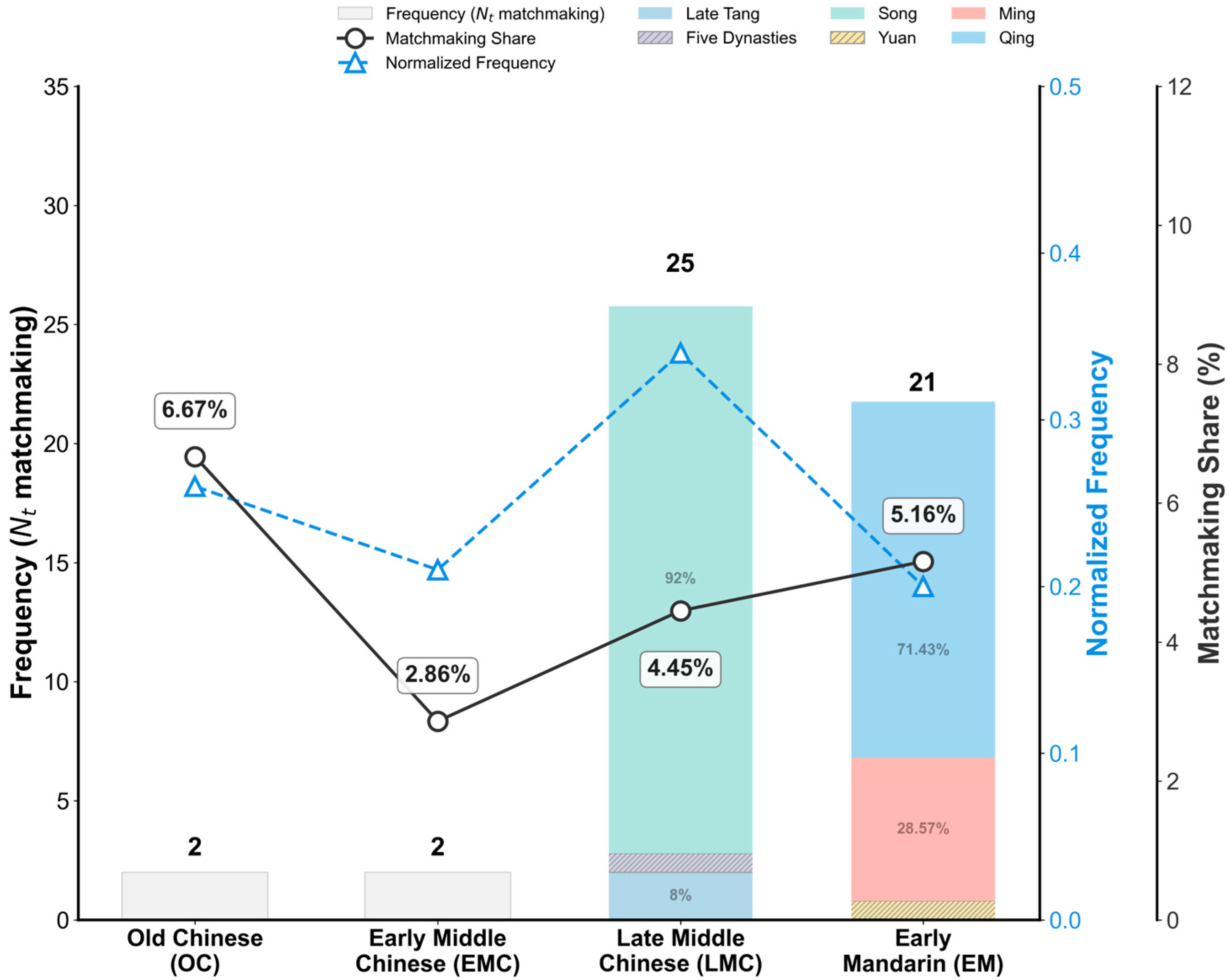
The results are summarized in
Table 12 and visualized in
Figure 5, which plots the matchmaking share of
fákē across different linguistic periods.
The data reveals a U-shaped pattern regarding using the matchmaking sense of
fákē. Although it emerged in the Old Chinese period with a normalized frequency of 0.26 and 6.67% of matchmaking share, the use of
fákē declined significantly throughout the Middle Chinese era, dropping to 2.86% in Early Middle Chinese (see
Figure 5). Because of the low frequency and exposure, it was unlikely for
fákē to reach the communicative currency for interlingual borrowing.
However, from Late Middle Chinese, the matchmaking sense of
fákē displays a significant rise, with 4.45% of matchmaking share, and continues to grow in Early Mandarin (i.e., 5.16%) (see
Figure 5). It should be noted that the highest increase during the Late Middle Chinese period is primarily contributed by the increasing use of
fákē as matchmaking in the Song Dynasty, namely 92% (23 out of 25 attestations) and the higher exposure made the borrowing of the matchmaking sense possible. See example (2) of using
fákē as free words in the Song Dynasty.
| (2) | 不 | 疑 | 何 | 卜, | 自 | 諧 | 鳴 | 鳳 | 之 | 和; |
| | not | doubt | how | divine, | self | harmonize | sing | phoenix | gen | harmony; |
| | ‘Without doubt, what need is there for divination (of our fates)? We shall naturally harmonize in the harmony of singing phoenixes;’ |
| | 無 | 言 | 弗 | 酬, | 願 | 守 | 伐柯 | 之 | 則。 |
| | no | word | not | reply, | wish | keep | matchmaker | gen | rule. |
| | ‘with no word left unanswered; I vow to abide by the rule of the matchmaker.’ (Liao Xingzhi, Letter in Response to the Liu Family’s Marriage Proposal, Shěngzhāi jí, Song Dynasty, 12th century) |
The term
fákē, used as formative in compounding—such as
fákē-rén (matchmaking:person) ‘matchmaker’—is also attested. See sentence (3).
| (3) | 其 | 伐柯人 | 两 | 家 | 通报, | 择 | 日 | 过 | 帖 |
| |
3sg.poss | matchmaking:person | two | family | inform | select | day | deliver | post |
| | ‘Once the two families, through the matchmaker, communicate and exchange proposal cards on an auspicious day, |
| | 各 | 以 | 色彩 | 衬 | 盘, | 安 | 定帖 | 送 | 过 |
| | each | with | color | decorate | tray | place | engagement letter | send | over |
| | ‘and each side sends decorated trays and engagement letters,’ |
| | 方 | 为 | 定 | 论。 |
| | then | become | final | decision |
| | ‘then the marriage matter is considered settled.’ (Wu Zimu, Jiaqu, Mengliang Lu, Song Dynasty, c.1274) |
The timing of the texts thus aligns with the phonological evidence situating the borrowing around Late Middle Chinese and no later than 1324 CE, the compilation year of
Zhōngyuán Yīnyùn. Borrowing therefore was triggered not by
fákē’s ancient origin from
Shījīng, but by its subsequent rise in later dynasties. Although the usage frequency of
fákē for ‘matchmaker’ is high in the Ming and Qing dynasties, our phonological evidence does not support Chinese borrowing later than Early Mandarin, namely after 1324 CE. Instead, the high frequency is the result of lexical archaization during the Ming and Qing dynasties, a social phenomenon of reviving the elegance of classic Chinese words and stratifying literary and colloquial registers (
F. Wang, 2020).
The timeframe for
fákē can be further corroborated through a parallel investigation of the morpheme
fá (伐). Given the term’s high polysemy (‘to cut’, ’to attack’ and other meanings), we employed bidirectional proximity queries pairing
fá with semantic markers including ‘matchmaker’ (媒), ‘marriage’ (婚, 姻), ‘to marry’ (嫁, 娶), ‘spouse’ (妻, 夫, 婿), ‘kinship’ (亲), and ‘gender’ (男, 女). The queries utilized the syntax X
$100Y and Y
$100X (e.g., 伐
$100婚 and 婚
$100伐), targeting co-occurrences within a maximum interval of 100 characters regardless of word order. The 100-character window was selected as an exhaustive range to ensure maximum recall, accommodating varied syntactic structures where
fá and its contextual markers (e.g., ‘matchmaker’ or ‘marriage’) are not immediately adjacent. To ensure statistical integrity, all overlapping results from the queries were subsequently manually screened to confirm that the sense of each token was matchmaking-related. See
Table 13.
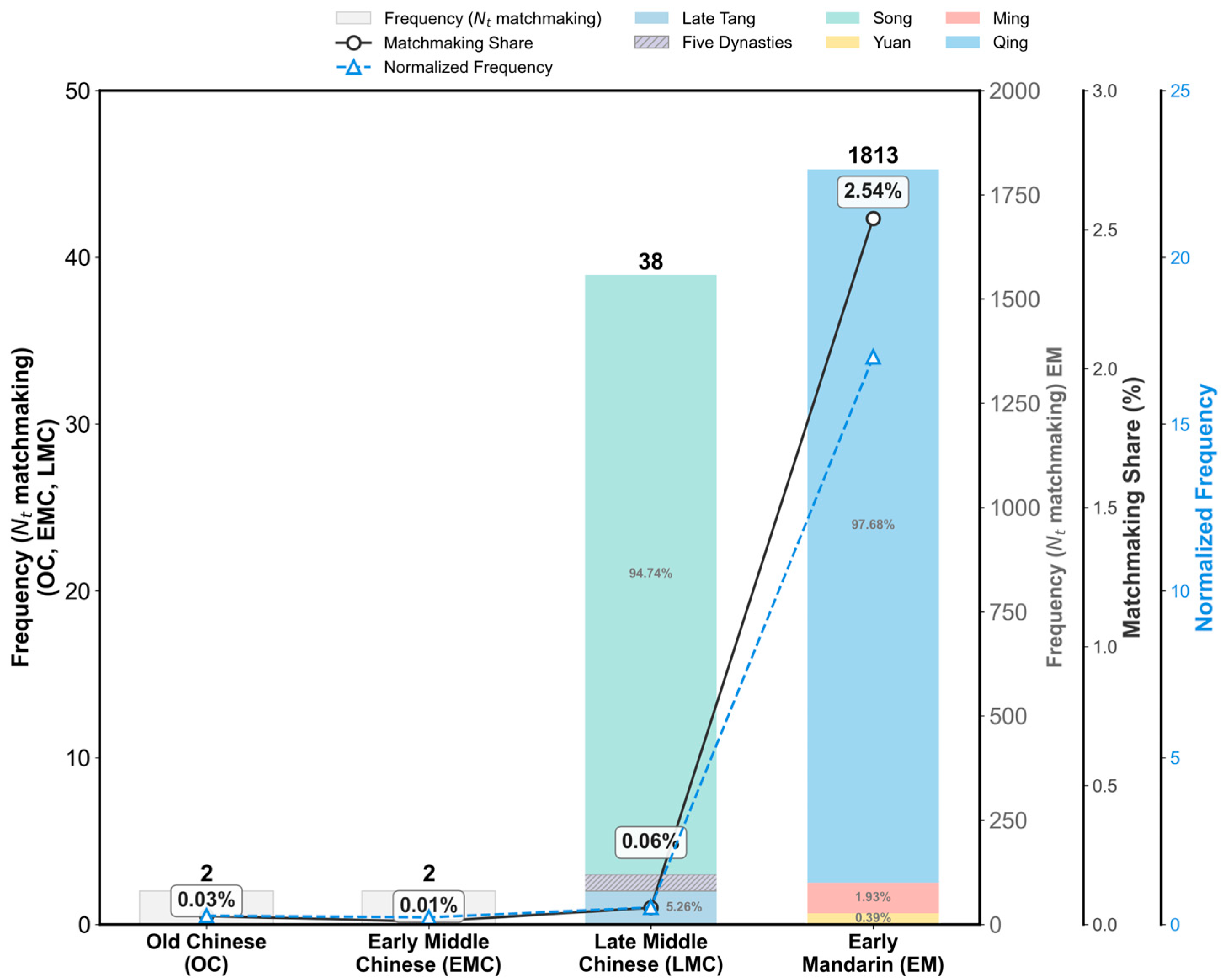
As illustrated in
Table 13 and
Figure 6, similar to
fákē, the morpheme
fá (伐) meaning ‘to matchmake’ appeared in the Old Chinese period; but the frequency and exposure remained low during the Early Middle Chinese period, with 0.01% of matchmaking share and a normalized frequency of 0.21 (see
Figure 6).
From Late Middle Chinese onward, the matchmaking sense of
fá exhibits a clear upward trend, reaching 0.06%. It should be noted that this increase is similarly overwhelmingly driven by its usage in the Song Dynasty, which accounts for 94.74% of Late Middle Chinese attestations (36 out of 38), indicating a marked rise in frequency and exposure to support borrowing. The trend continues into Early Mandarin, where the matchmaking sense of
fá shows a substantial expansion, reaching 2.54% of the share (see
Figure 6). Although the frequency of this usage peaks in the Qing Dynasty, this later prominence should not be interpreted as evidence for a later-than-EM borrowing event, as discussed above. See example (4) and (5) of using
fá as free morpheme in word formation in Song Dynasty.
| (4) | 適 | 見 | 其 | 婢 | 自 | 外 | 來, |
| | happen to | see |
3sg.poss | maid | from | outside | come |
| | 云 | 與 | 小 | 娘子 | 作伐。 | | |
| | say | for | young | lady | do:matchmake |
| | ‘(We) happen to see those maids come in from outside, who said they would act as a matchmaker for the young lady.’ (Guo Tuan, Kuiche Zhi, Song Dynasty, mid-12th century) |
| (5) | 逵 | 为 | 其 | 子 | 叶寮 | 执伐, | 娶 | 赵氏。 |
| | Name | for |
3sg.poss | son | Name | execute:matchmake | marry | Ms Zhao |
| | ‘Kui acted as matchmaker for his son Yeliao to marry a young lady of the Zhao clan.’ (Chen Hu, Qi Jiu Xu Wen, Song Dynasty, mid-12th century) |
Once again, this timeline supports the timing of the borrowing based on our phonological evidence. The continuing high percentage of using fá (伐) meaning ‘to matchmake’ in Ming and Qing dynasties is similarly due to the above-mentioned process of lexical archaization because our phonological evidence does not support borrowing later than Early Mandarin.
In sum, the quantitative evidence of using fákē 伐柯 and fá 伐 in the CCL corpus resolves the timing mismatch concerning the origins of the Chinese words and their phonological adaptation into Liangshan Yi. The textual resurgence of the two Chinese words by Late Middle Chinese and before Early Mandarin not only corroborates the phonological findings, confirming that the borrowing took place around the Late Middle Chinese period and no later than 1324 CE, but also suggests a narrower timeframe for the borrowing: namely, from the mid-10th century (since Song Dynasty) to the early 14th century.
6. Matchmaker Beyond Liangshan Yi Societies
As was discussed above, many Loloish languages borrowed Chinese 伐柯
fákē and/or 伐
fá (see
Section 4.2).
Table 11 in
Section 4.4 displays that the borrowing of
fákē, as well as
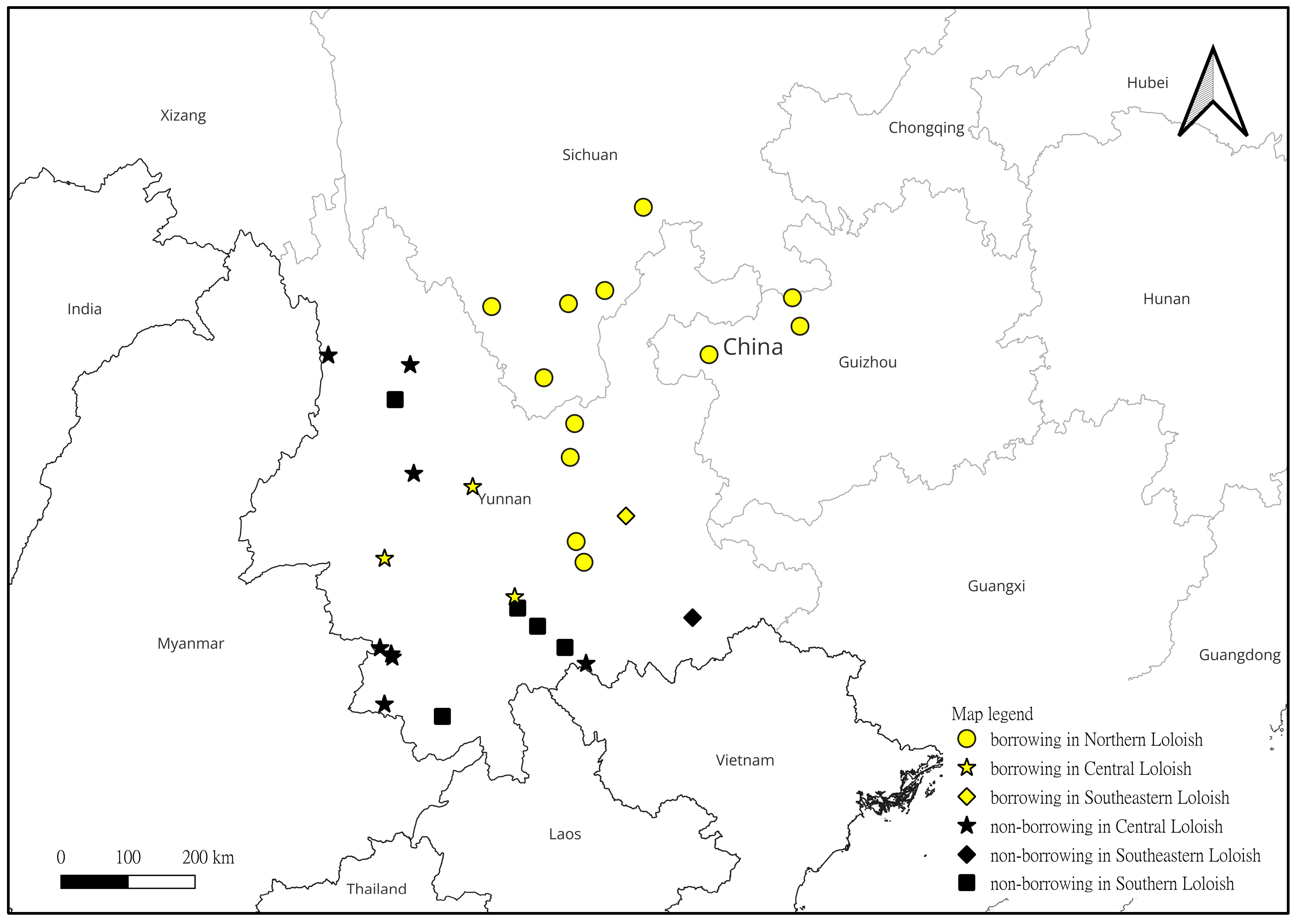
fá, occurs primarily in Northern Loloish varieties
6, with a few instances in Central and Southeastern Loloish varieties, and no occurrences in Southern Loloish. See the distribution of the borrowing in
Figure 7.
This diffusion is historically rooted. Historical records indicate that Loloish-speaking elites were part of the ruling class in both the Cuan Kingdom (225–602 CE)
7 of eastern Yunnan and the Nanzhao Kingdom (738–902 CE) of western Yunnan. The Northern Loloish languages are thought to derive from the Cuan (爨) Kingdom and its dispersal. For Central Loloish, it can be linked with the Nanzhao Kingdom and its expansion (
Bradley, 2025). These rulers were heavily Sinicized and had closer relation with Chinese people than many other Tibeto-Burman speakers, and the close contact started as early as Jin-Northern and Southern dynasties-Sui, ca. 339 to 618 CE (
Bradley, 2025).
Originally Han Chinese military settlers, the Cuan family assisted Zhuge Liang’s Southern Campaign, also known as the War of Pacification in the Nanzhong region, which took place in 225 CE (
Fang, 1982). They then consolidated control over Nanzhong, encompassing modern Yunnan, southern Sichuan, and western Guizhou, around 339 CE and ruled for nearly four centuries. As the Loloish population, along with other smaller non-Chinese tribes, was dominant in the Nanzhong region, they were impacted by the warfare. However, due to their demographic predominance, through intermarriage and cultural assimilation, the Cuan people gradually adopted non-Chinese customs and languages, becoming what historical texts describe as “Cuan Barbarians”. At the same time, there were also the Loloish people embracing Cuan customs. Therefore, during the period from the Northern and Southern Dynasties to the Early Tang Dynasty (approximately 420–618 CE), the ethnic Yi people were also referred to as “Cuan people”. Moreover, Nanzhao’s aristocracy modeled its government on Tang China, creating Chinese-style ministries and civil-service exams, and explicitly invoked Confucian ideology (
Daniels, 2021). Genetically, the ethnic Yi, along with the Qiang and Bai peoples, share a closer connection with the Han than do other Tibeto-Burman groups. This is evidenced by genetic studies of populations in the Tibeto-Yi Corridor—a region spanning Gansu, Sichuan, and Yunnan provinces along the eastern edge of the Tibetan Plateau (
Z. Zhang et al., 2022). Therefore, such a Sinicized environment created the cultural context for Chinese marriage institutions and their terminology to diffuse among Loloish communities.
However, Nanzhao’s governance, as well as its succeeding reign Dali Kingdom (937 to 1253 CE), was weak in the south. Nationwide, because Chinese capitals have always been located to the north, the control of frontier lands throughout Chinese history has consistently spread from northern China following a north-to-south penetration pattern, beginning as early as the Qin State. Consequently, the more northern regions have always been better controlled than the southern regions, correlated with the distance from the central government. As
Giersch (
2006, p. 25) points out, Han Chinese migration and military settlements consistently struggled to reach the deep south, even as late as the Ming Dynasty; their progress was largely hindered by rugged terrain, endemic tropical ecology, and diseases. This enabled southern local societies to preserve their autonomous political and sociocultural institutions.
Regionally, the Nanzhao and Dali kingdoms, parallel non-Chinese states in Yunnan during the Chinese-governed Tang–Song period, functioned as early Southeast Asian “mandala” states which prioritizes influence over territory, personal loyalty over institutions, and the center over the periphery (
Daniels, 2021,
2023). Nanzhao’s power center was located in the Erhai Lake basin (around present-day Dali). As the kingdom expanded southward, its direct governing capacity progressively weakened; in the southern periphery, Nanzhao relied mainly on indirect governance by recognizing existing local leaders as agents (
Daniels, 2021).
The administrative structure of the Dali Kingdom, founded by Duan Siping (ca. 937–944 CE), resembled that of the expansive and vigorous Nanzhao Kingdom (ca. 738–902) (
Daniels, 2023). Dali’s southern control was similarly weak. According to the
Imperial Gazetteer of the Great Qing (vol. 389), Dali’s southern control had even shrunk. For example, the Yinsheng Military Command (modern Jingdong, Yunnan), established by Nanzhao, was captured by southern non-Chinese tribes and relocated north to Weichu (modern Chuxiong, Yunnan). The
History of the Yuan Dynasty confirms that after Yinsheng fell, the land to the south was occupied by non-Chinese tribes, and the Dali rulers were never able to reconquer it.
Therefore, while the northern cultural groups of the Nanzhao and Dali kingdoms absorbed Han Chinese governance, they held only loose alliances with southern tribes and lacked the capacity for cultural assimilation. In other words, southern groups were more likely to maintain indigenous sociocultural practices and had little motivation to borrow the institutionalized practice of matchmaking or the word associated with that concept.
Finally, according to
Haspelmath and Tadmor (
2009), culturally motivated borrowing involves the importation of a cultural concept together with its lexical label. For example, Imbabura Quechua borrowed the Spanish words
arrusa ‘rice’,
riluju ‘clock’, and
simana ‘week’, all terms for items that did not exist in the Americas prior to the European invasions. Chinese marriage customs traditionally involve a professional matchmaker; Loloish people, probably starting from the elites, emulating these rites, would naturally borrow both the institution and its name. Once introduced, the term and the practice could rapidly permeate through sister clans. In modern Loloish societies, besides the whole Liangshan Yi community in Sichuan, matchmakers play important cultural roles in other Loloish communities, such as Sani (fu
33kɑ
55, Southeastern Loloish in Kunming, Yunnan) (See matchmaking practice of Sani in
X. Ma, 1951, p. 280), Nasu (fu
33tɕo
55, Northern Loloish in Luquan and Wuding, Yunnan)
8, and Lolo (fu
33tɕo
55, Central Loloish in Nanhua, Yunnan)
9.
7. Conclusions and Limitations
This study has demonstrated that the Liangshan Yi term hɔ44ka33 (Niesu) or fu44ka33 (Nuosu) for ‘matchmaker’, and ho33 (Niesu) or fu33 (Nuosu) for ‘to marry (generally)’, are both borrowed words from Chinese rather than as inherited lexical items. The argument rests on the convergence of morphological, phonological and lexical evidence, each of which independently disfavors an internal origin while jointly supporting a contact-based explanation.
The Liangshan Yi “matchmaker” is morphologically opaque: its formative morphemes cannot be decomposed into productive and meaningful units in the language. By contrast, the Chinese form 伐柯 (fákē), as the donor word, is morphologically analyzable: 伐 or fá: ‘to cut, to matchmake’, and 柯 or kē: ‘axe handle’, and exhibits clear semantic development into the meaning of “matchmaker”. This asymmetry in morphological transparency provides the first indication that the Liangshan Yi form was borrowed as a whole word from outside the language rather than created internally. Moreover, since another semantically related Chinese verb, 伐 or fá ‘to axe, to matchmake’, was also borrowed, the first morpheme of Liangshan Yi “matchmaker” becomes identifiable. However, after the borrowing, the original meaning of “to matchmake, to arrange marriage for someone” changed to “to marry” in Liangshan Yi: ho33 or fu33 ‘to marry (generally)’.
Lexical evidence, specifically through cognate comparison with other Sino-Tibetan languages, further supports this finding. No cognate set and comparable word formation for “matchmaker” are found, hence lacking the foundation for a reconstructed form across both Loloish and more distant Tibeto-Burman branches. Although phonetically similar forms appear in Northern, Central and Southeastern Loloish languages, such as Luquan Yi, Bijie Yi, Weishan Yi (Lalo), and Sani, no sound correspondence can be established. This suggests that the borrowing was likely from a common source, but that these Loloish languages had already split from one another by the time when the borrowing occurred. The absence of systematic correspondence and comparable morphology across genetically related branches constitutes strong evidence against the inheritance hypothesis.
Phonological evidence allows the borrowing to be situated within a specific historical interval. The adaptation of Chinese labiodental fricatives into Liangshan Yi, together with the treatment of vowel nucleus, points to a borrowing event that took place close to the completion of labiodentalization in Chinese but precedes its stabilization, or no later than 1324 CE, namely around the time of Late Middle Chinese to Early Mandarin (ca. 9th century to early 14th century). This timeframe is corroborated by the Chinese historical textual evidence from CCL corpus, which shows that the matchmaking-related senses of fá and fákē only become salient in Late Middle Chinese. The alignment of phonological adaptation and semantic resurgence strengthens the inference that the words and the concepts entered Liangshan Yi during the same period.
Beyond clarifying the origin of the lexical items, this paper has broader implications for the study of language and cultural contact. The linguistic form of 伐柯
fákē, as well as 伐
fá, serves as direct evidence that the associated marriage practice was borrowed from Han Chinese, a pattern in line with culture-motivated borrowing (
Haspelmath & Tadmor, 2009). That is, matchmaking is not a traditional practice among Liangshan Yi community, nor in many other Northern Loloish groups and some Central and Southeastern ones; rather, it was introduced under the influence of Han Chinese marital customs between the 9th to 14th centuries, most likely from the mid-10th century (since Song Dynasty) to 1324 CE.
However, it remains unclear whether “matchmaker” in Liangshan Yi was borrowed through direct Yi-Chinese contact or indirectly via another Loloish language. So far, since we lack evidence to distinguish direct versus indirect borrowing, the present study can only rely on phonological evidence to infer the timing of the borrowing. Another limitation of the present study is that we lack systematic evidence to pinpoint the exact local Chinese dialect as the donor language. This is also one of our future goals of collecting more Chinese loanwords of greater historical depth, observing their phonological adaptation in Liangshan Yi, and reconstructing the phonological systems of the local Chinese dialect(s).
Finally, from a methodological perspective, this study highlights the potential value of drawing on linguistic evidence to investigate the intangible cultural practices of past peoples, a notable strength relative to archeology and genetics.