Article

Languages on the Periphery: Historical, Geographic, and Contact Factors in the Formation of Hunan’s Linguistic Ecosystem


by
Robert Marcelo Sevilla
Department of Linguistics, The University of Hong Kong, Hong Kong
Languages 2026, 11(6), 115; https://doi.org/10.3390/languages11060115
Submission received: 24 March 2026 / Revised: 18 May 2026 / Accepted: 19 May 2026 / Published: 3 June 2026
(This article belongs to the Special Issue Chinese Languages and Their Neighbours in Southeast Asia)

Abstract

The region today corresponding to modern Hunan province has been a site of stable language contact for over 2500 years, with the intensification of that contact occurring in particular between the 17th and 21st centuries. Major political developments during this time led to massive population movements which reshaped the demographics and linguistic ecology of Hunan. The region has considerable language and phylogenetic diversity, being home to three top-level groupings (Sino-Tibetan, Kra-Dai, and Hmong-Mien) and representing at least 17 different language varieties within a condensed area of around 211,800 km2; it is therefore the ideal setting to explore long-term language contact as mediated by degrees of relatedness. Structural diversity, in terms of morphological and phonological typology, is relatively low, owing to convergence over several thousand years. All language varieties in the province converge towards the MSEA typological profile; however, those that entered the region latest, such as varieties of Tujia, still retain features from outside the region (SOV, multisyllabic roots, etc.). In this paper the case is made that Hunan, with its geography, history of settlement, and contact between related and unrelated language families, represents a microcosm of linguistic contact situations which have taken place in other periods and regions of China. This is attributed to a combination of geographic and demographic patterns, historical patterns of settlement and ethnic conflict, and a complex sociolinguistic situation. Taken together, these lead to the formation of a unique linguistic niche where stable near-relative contact, distant-relative contact, and non-relative contact take place. The case is made that instances of near-relative contact between Xiang varieties and Mandarin (Standard and Southwestern) represent instances of koineization. This is evidenced by the formation of regional koines, such as Plastic Mandarin in Changsha, which present a degree of local prestige and show evidence of regional standard formation. Meanwhile distant- and non-relative contact between Southwestern/Standard Mandarin and Tujia and Waxiang, and Xiangxi Miao and Kam-Dong, respectively, are seen to result in extensive grammatical hybridization.

1. Introduction

Hunan has been a border region between Sinitic and non-Sinitic languages for its entire recorded history, despite being in the modern heart of the Sinitic-speaking area. Unlike many other nearby areas further north and east which are entirely Sinitic-speaking, Hunan has resisted this process despite early Sinitic-speaking settlement of the region by the 8th century BCE, which is far earlier than the Han settlement of more fully acculturated provinces, such as Guangdong (3rd c. BCE), Zhejiang (6th c. BCE), and Jiangxi (post 3rd c. BCE) (LaPolla, 2022). Sinitic and non-Sinitic languages have been in contact in the region for over 2500 years, with shifting borders and extensive structural convergence (Chamberlain, 2016; Chappell, 2017; Ratliff, 2021). This relatively unique borderland situation has resulted in contact between near- and distant-relatives, by way of sister Sinitic and Tibeto-Burman languages, in addition to contact between non-relatives by way of Hmong-Mien and Kra-Dai languages. These have slowly converged towards a single structural profile, most clearly captured in Xong (Xiangxi Miao) and least clearly observed in Tujia, which is still undergoing restructuring as the newest arrival in the region.
How have geographical, historical, and language contact factors shaped the present linguistic ecosystem of Hunan? In answering this question, the present piece explores three main hypotheses, one geographical, one historical, and one linguistic.
(1)
Hunan is a geographical reality, not just a political one. The linguistic niche of the province is bounded by major geographical barriers, such as mountain ranges and water systems, forming a compact region (Perdue, 1987, p. 28). Unlike many other provinces in China, Hunan can be defined solely with reference to these features. This is significant since movement of human groups and the resulting language contact is rarely sensitive to political boundaries, but is sensitive to factors of terrain, such as impassability.
(2)
Hunan represents a microcosm of contact dynamics in historical China. The history of migration from north to south and the Sinification of the Chinese south is ongoing in Hunan at present, whereas it has been largely completed in other provinces to the east and north. This was particularly highlighted during the period of the Ming and Qing (Sutton, 2003).
(3)
Hunan represents a unique linguistic ecosystem, with language contact between near-relatives, distant-relatives, and non-relatives, resulting in different structural outcomes including koineization and hybridization. The region displays high language and genetic diversity relative to other regions of China, but low structural diversity due to convergence between these languages over more than 2500 years. Time in the region is related to the degree of structural convergence, which is why non-Sinitic languages differ as to their relative convergence to the MSEA profile.
Each of these hypotheses will be presented and evaluated independently in the following sections. First, however, the following section gives an overview of the present linguistic ecosystem.

2. The Contemporary Linguistic Ecosystem of Hunan

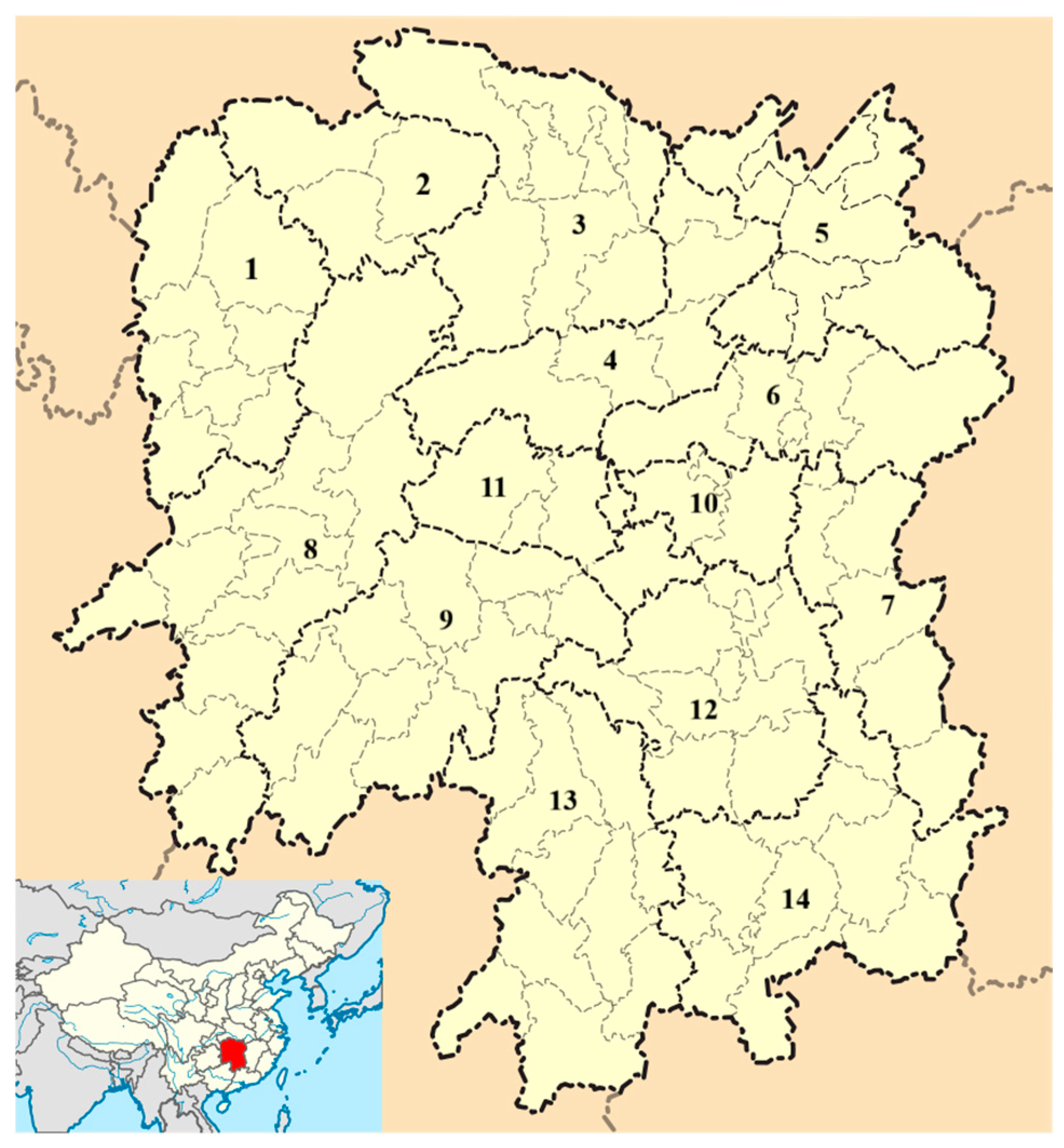
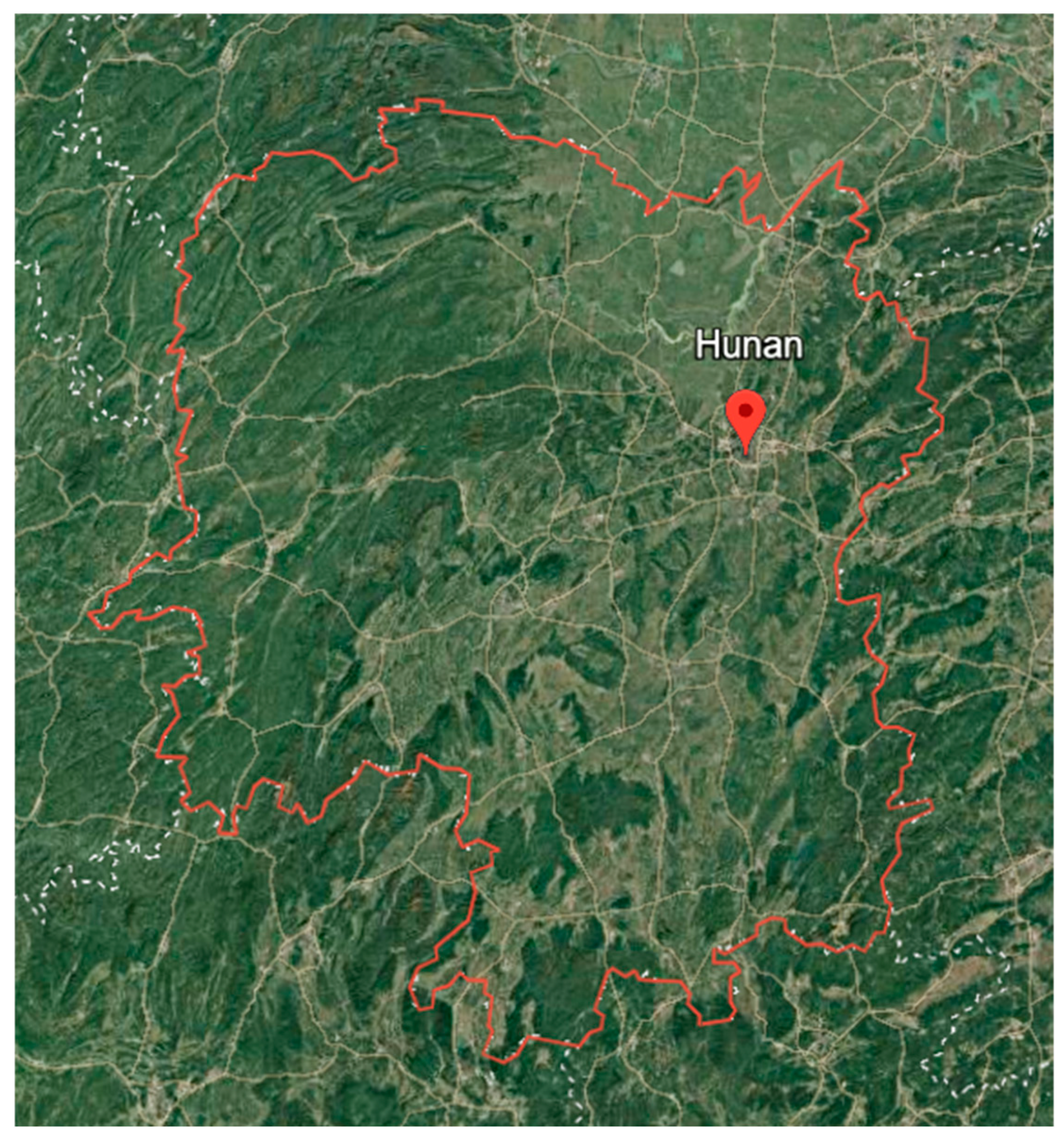
Hunan is a province in south central China of around 211,800 km2 and home to around 66 million people (Hunan Provincial Bureau of Statistics, 2025), of which about 10% identify as ethnic minorities, with the rest identifying as Han Chinese. It borders Hubei to the north, Jiangxi to the east, Chongqing and Guizhou to the west, and Guangdong and Guangxi to the south, and lies directly south of the Yangtze River, which forms its northern border. It is divided into 14 prefecture-level divisions, and 122 counties (see Chart 1 and Table 1; original here: https://commons.wikimedia.org/wiki/File:Location_map_China_Hunan_EN.svg, accessed on 10 March 2025)1.
The prefectures can be divided into four regions representing different geographic areas and population distributions (see Table 1)2. The West is the largest region, at around 34.6% of total landmass, while the Central region has the largest population at 33% of the total. The South is the smallest on both metrics (14.5% of landmass and 19.6% of population), and the East is between the two (29.5% and 17.9%, respectively).
Hunan is home to 17–20 language varieties representing three top-level language families, including Sino-Tibetan, Hmong-Mien, and Kra-Dai (Eberhard et al., 2025; see Table 2). The largest, both in terms of the number of speakers and number of languages, is undoubtedly the Sino-Tibetan family, due to the many varieties of Sinitic spoken in the area. The most widely represented indigenous variety of Sinitic, Xiang Chinese (hsn), has upwards of 38 million speakers. The best-represented non-Sinitic languages are Xiangxi Miao or Xong (Hmong-Mien; mmr) with around 800,000 speakers, Northern Tujia (Tibeto-Burman3; tji) with around 70,000 speakers, (Southern) Kam-Dong (Kra-Dai; kmc) with approximately 200,000 speakers in the province, and Iu Mien (Hmong-Mien; ium) with around 100,000 speakers in the province4. Based on data from the 28th edition of Ethnologue (Eberhard et al., 2025), supplemented with data from ‘The Languages of China’ (Sun et al., 2007) and the Chinese Academy of Social Sciences (2012), Table 1 gives an overview of the languages currently spoken in Hunan, by speaker population, classification, relevant prefectures, and population concentration5.
Speaker number data and locations from Ethnologue (Eberhard et al., 2025).
Some languages, such as Northern Tujia, Southern Tujia, and Waxiang, are indigenous to Hunan and spoken nowhere else (although historically Tujia varieties were spoken more widely), while others, such as Xiangxi Miao and Xiang, are indigenous to Hunan but spill over into Guizhou and Guangxi respectively (Chinese Academy of Social Sciences, 2012). Other languages such as Iu Mien and Gan, which are well-represented in the province both demographically and historically, have a majority of their speakers distributed in Guangxi and Jiangxi, respectively. Certain languages cover several provinces and may serve as lingua francae; for Hunan we can identify two, namely Southwestern Mandarin (SWM) and Putonghua or Standard Mandarin (PTH) (both under ‘Mandarin’ in Table 2). The traditional lingua franca of the region is SWM (Chappell, 2017), although nowadays PTH increasingly fills this role.
Hunan is home to several ‘peripheral’ varieties, spoken far from most members of their respective families. These include the easternmost Tibeto-Burman languages (Northern and Southern Tujia) in Xiangxi prefecture; the northernmost Hmong and Mien languages (Xiangxi Miao and Biao Jiao Mien) in Xiangxi prefecture and in Ningyuan, Daoxian, and Lanshan counties; and the northwesternmost Kra-Dai language (Kam-Dong) in Tongdao and Xinhuang counties. Each of these are spoken far from the regions where the majority of speakers and the greatest degree of internal diversity of these families is concentrated; the greatest concentration of subgroups in Kra-Dai is found in Guangxi, Guizhou, and Hainan, for Hmong-Mien in Guizhou and Guangxi, and for Tibeto-Burman in Sichuan and Yunnan (Chinese Academy of Social Sciences, 2012)6. Despite the shift in population concentration and the locus of diversity, the hypothesized homelands of these language families tend to be closer to Hunan (Chamberlain, 2016; Ratliff, 2021; see Section 4).
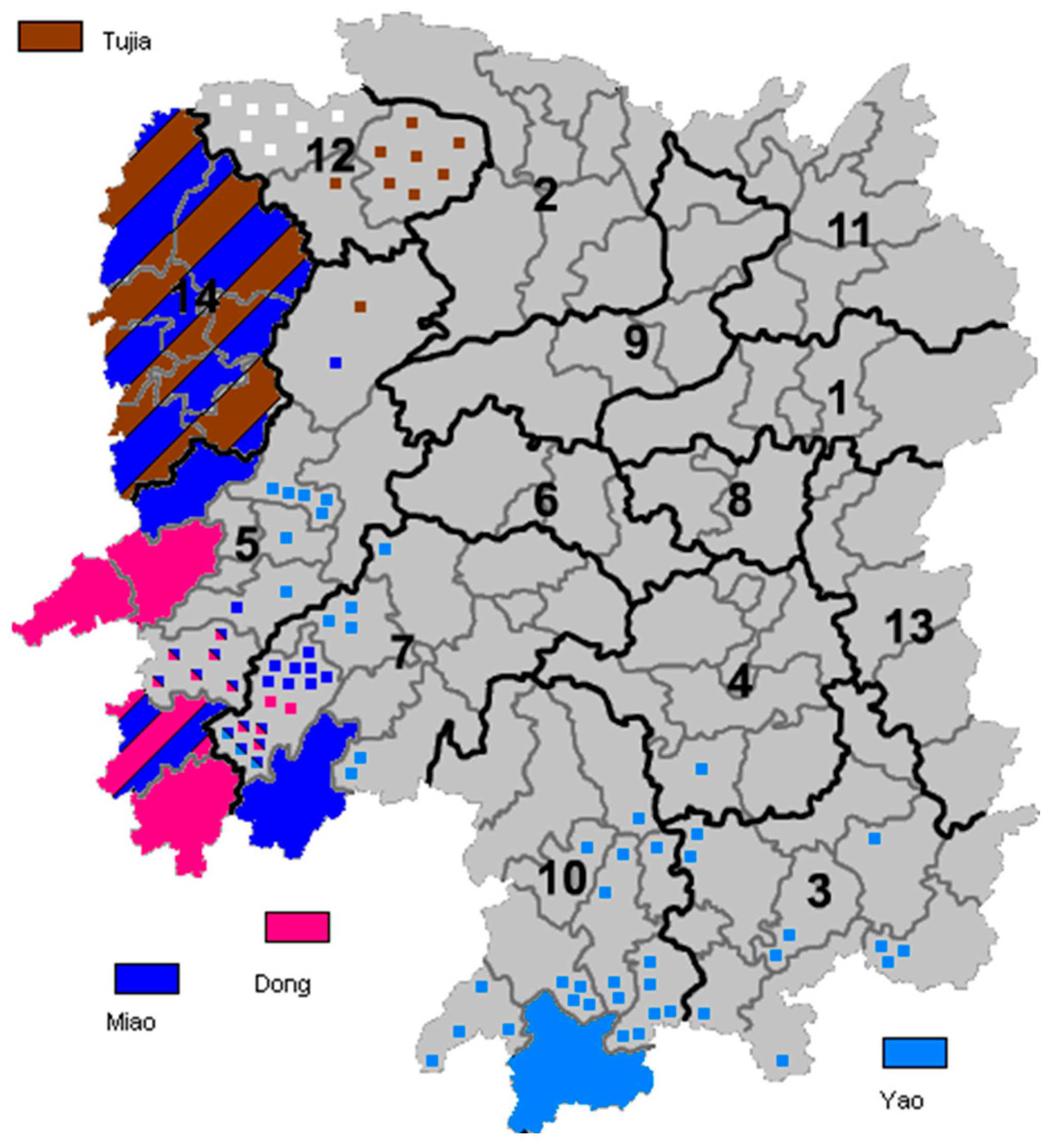
The location of modern ‘autonomous regions’ or zizhiqu 自治区 (areas set aside for non-Han minority groups) reflect a historical process of Sinicization concentrated in central and eastern regions (see Section 4). In Hunan, autonomous regions are provided to the Tujia 土家族 (Tibeto-Burman), Miao 苗族 (Hmong-Mien), Dong 侗族 (Kra-Dai), and Yao 瑶族 (Hmong-Mien) ethnic groups. One can see that the autonomous regions are concentrated in the extreme west and south of the province (see Chart 2). As we will see in Section 3, this distribution is significant, both geographically and historically.

2.1. Language and Phylogenetic Diversity

In comparison to other provinces of Mainland China, Hunan has relatively high language diversity, or the number of discrete languages that can be identified for a region (Nettle, 1999), which can be calculated through language density (LD) by dividing the ratio of languages in an area (l) and the number of world languages (L), by the ratio of the area of a region (a) and the total land area of the Earth (A), with the formula:
LD = (l/L)/(a/A)
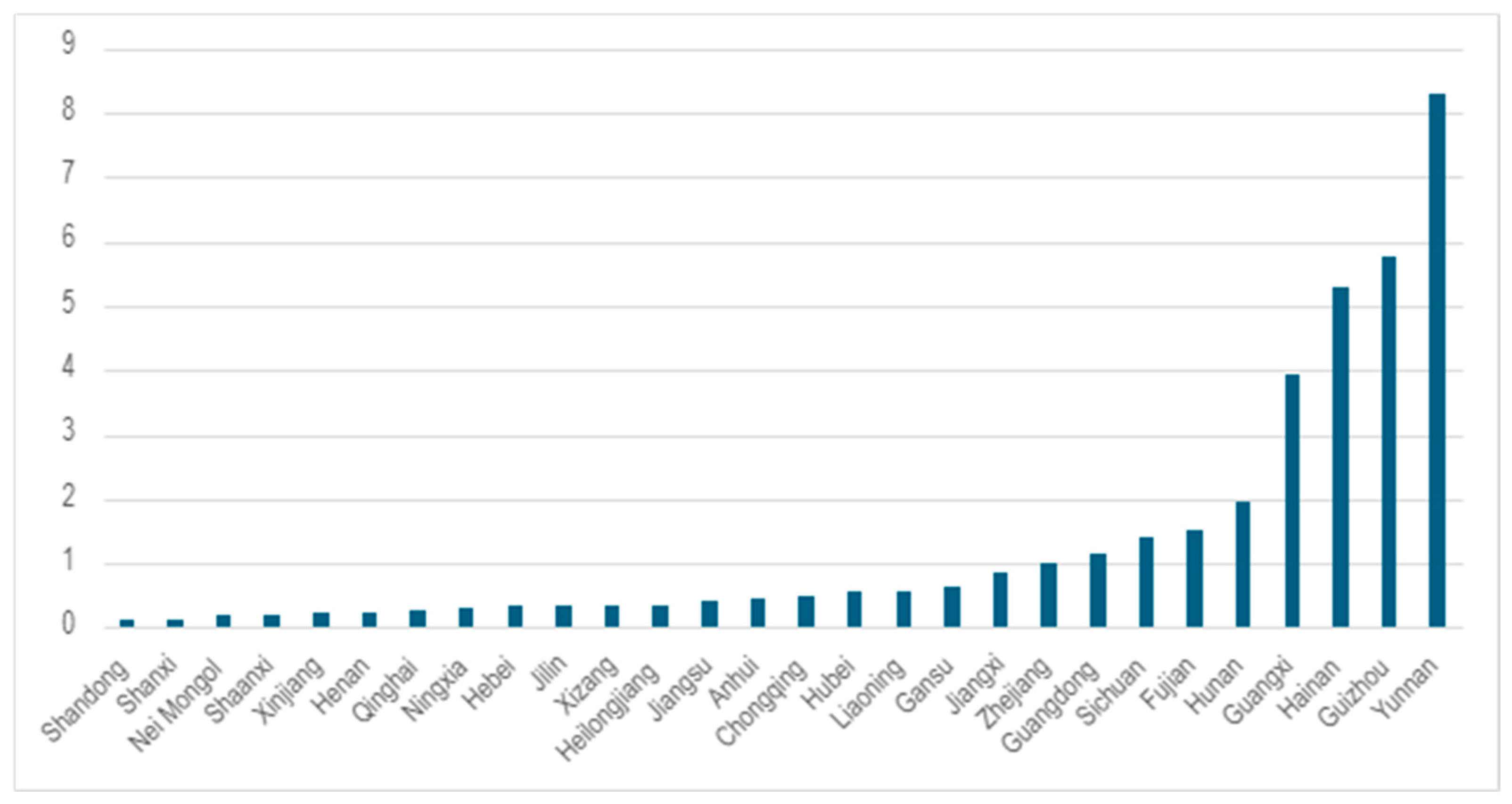
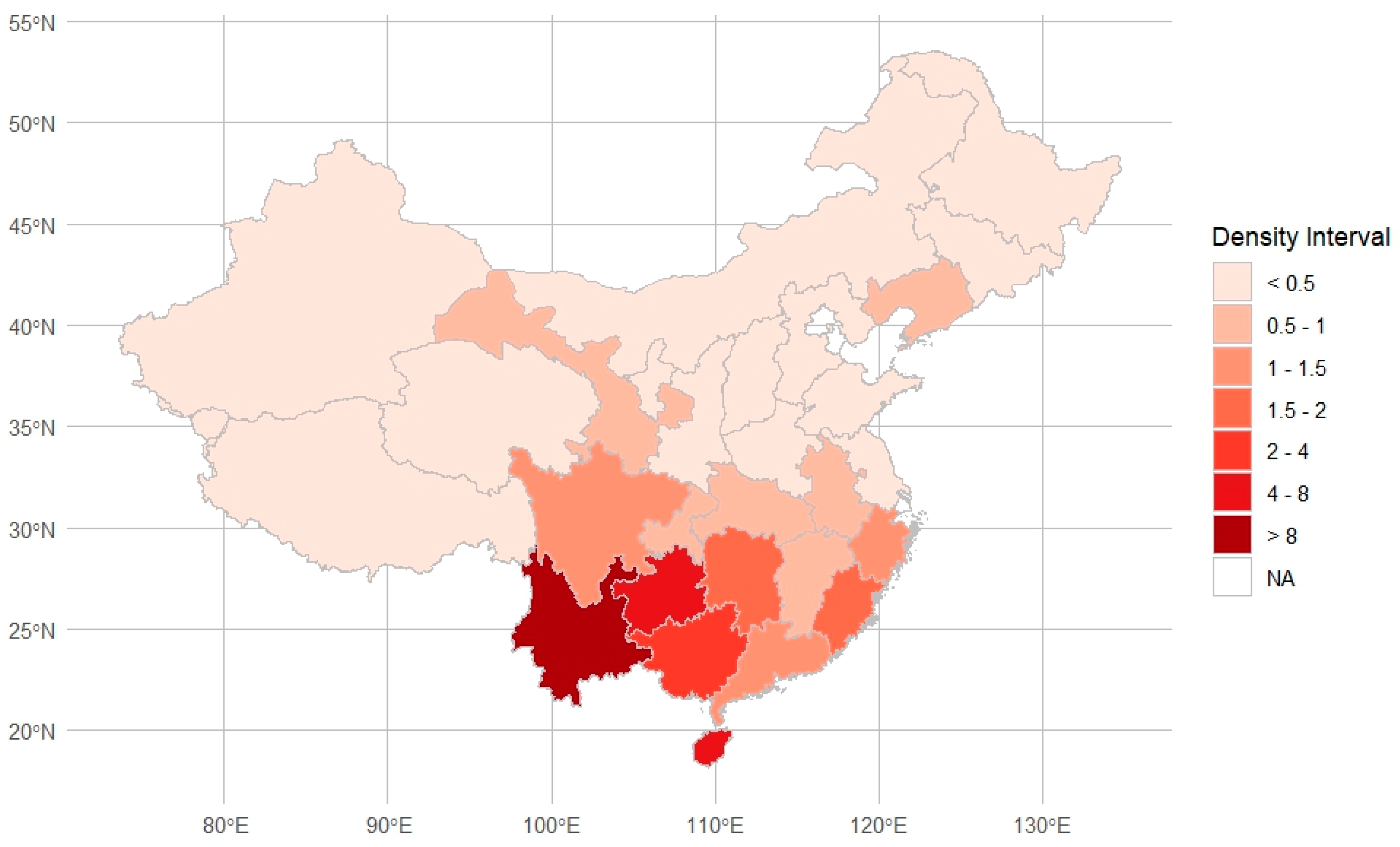
The count of world languages is given by Ethnologue as L = 7159, and Earth’s total landmass is calculated as A = 148,326,000 km2. We can calculate this value for each of the 28 provinces of Mainland China, using raw language counts found in Ethnologue; results are summarized in Figure 18.
In terms of world language diversity, Yunnan is a heavy-weight: 2.2% of world languages are spoken here (l = 158), but it covers only 0.2% of the Earth’s landmass (a = 394,100 km2), resulting in [LD = 8.3] (followed closely by Guizhou and Hainan, both [LD > 5]). Hunan meanwhile covers 0.14% of the Earth’s land area (a = 211,800), but 0.2% of the world’s languages are spoken there (l = 20), resulting in an LD of 1.96. Hunan ranks fifth in terms of LD, higher than Sichuan (l = 33, a = 486,100 km2, LD = 1.41) and Fujian (l = 9, a = 123,900 km2, LD = 1.5).
Around 7% of the indigenous languages of Mainland China (L = 284) are spoken in Hunan, while the province covers only 2% of its land area (A = 9,596,960 km2). This concentration of language diversity in southern border regions in Mainland China, much like the present distribution of non-Han ethnic groups in Hunan (see Chart 2), is a product of centuries of Han migration and Sinicization proceeding from the north to the south (LaPolla, 2010, 2022) (see Section 3). This can be observed in Chart 3, where language density is concentrated in the southwest and radiates from Yunnan outward (Chart 3 and Chart 4 created with R using the ‘ggplot2’ and ‘geodata’ packages (R Core Team, 2026).
Based on Nichols (1992), we can calculate phylogenetic density by using a variable g representing the number of top-level phylogenetic groupings and a variable a representing area; however, we measure a in units of 100,000 km2:
GD = g/a
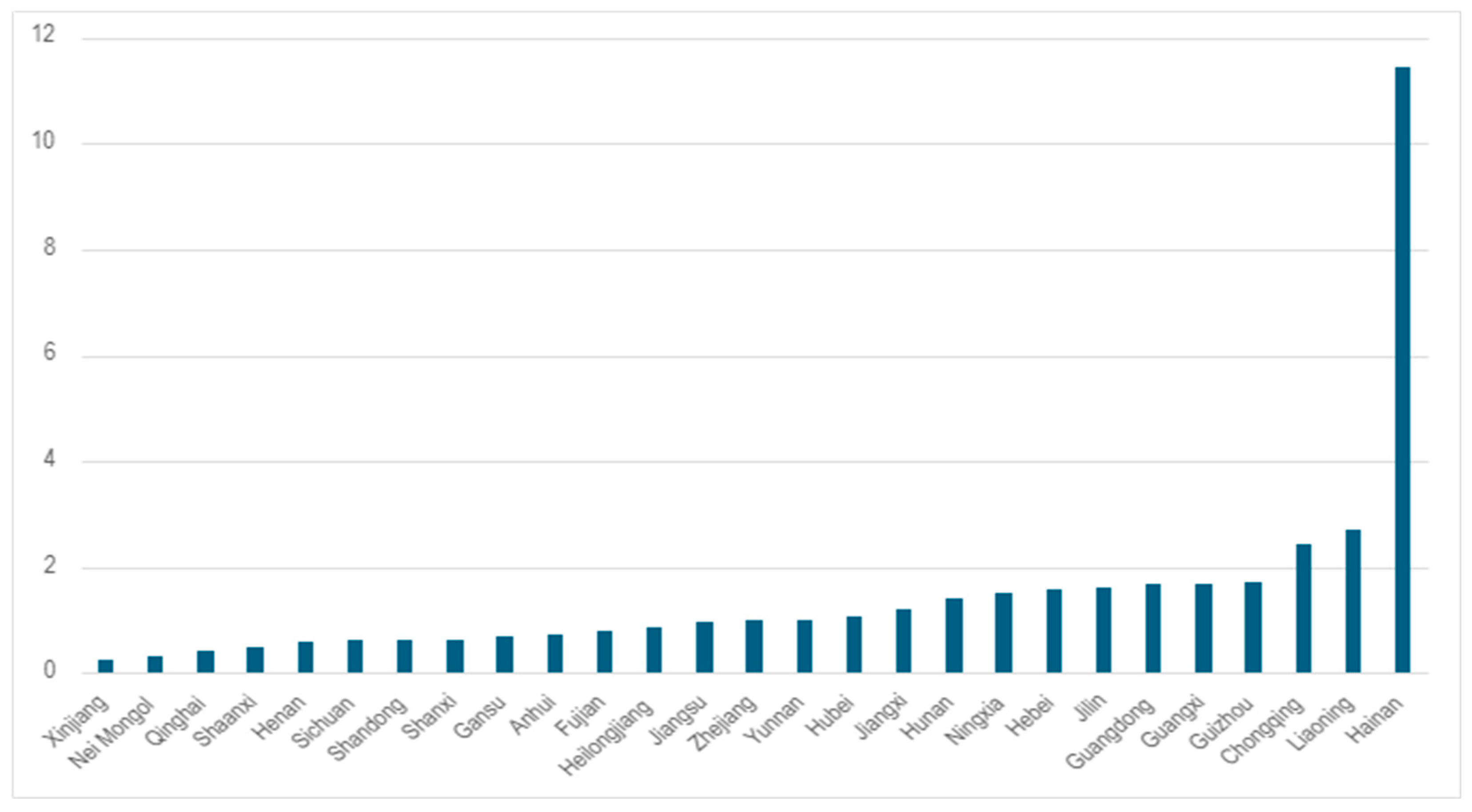
Following Ethnologue, China has 10 top-level families represented within its borders (not counting mixed and Sign languages), with no province having more than four represented. These are: (1) Sino-Tibetan (including all varieties of Tibeto-Burman and Chinese), (2) Kra-Dai, (3) Hmong-Mien, (4) Turkic, (5) Mongolic, (6) Tungusic, (7) Koreanic, (8) Austroasiatic, (9) Indo-European, and (10) Austronesian9. We can calculate Genetic Density (GD) in the same way as we have for the LD (see Figure 2).
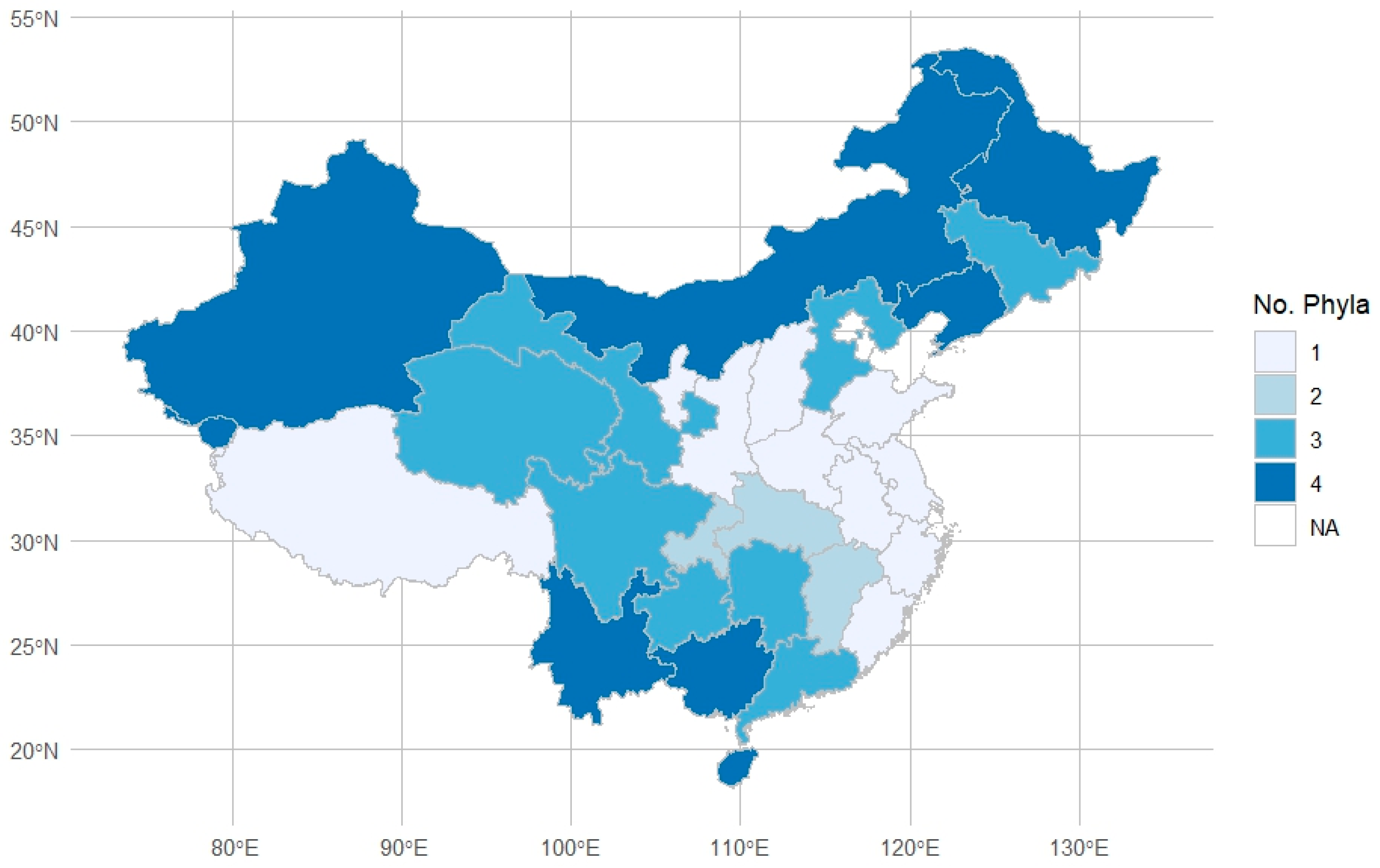
Comparing Figure 1 and Figure 2 shows us that there is not necessarily a correlation between language and phylogenetic diversity. Hainan is by far the most genetically diverse, with four families (Sino-Tibetan, Hmong-Mien, Kra-Dai, and Austronesian) found in a mere 35,000 km2, resulting in [GD = 11.42]. In this case, Hunan [GD = 1.42] is more genetically diverse than Yunnan [GD = 1.01], given its smaller size and three phyla (Sino-Tibetan, Kra-Dai, and Hmong-Mien) to Yunnan’s four (Sino-Tibetan, Kra-Dai, Hmong-Mien, and Austroasiatic). Given how sensitive the GD is to area, it is more illustrative to map the number of phyla (see Chart 4).
In Chart 4, the values indicated run from a high of 4 to a low of 1. The distribution of phylogenetic diversity in Mainland China is a product of population pressures stemming from expansion from the Yellow River valley outward, with lower values the further from Henan, Shandong, and Shanxi one gets. Unlike Chart 3, however, we can also see the increase in genetic diversity in the north of China, which also contains historically non-Sinitic languages.
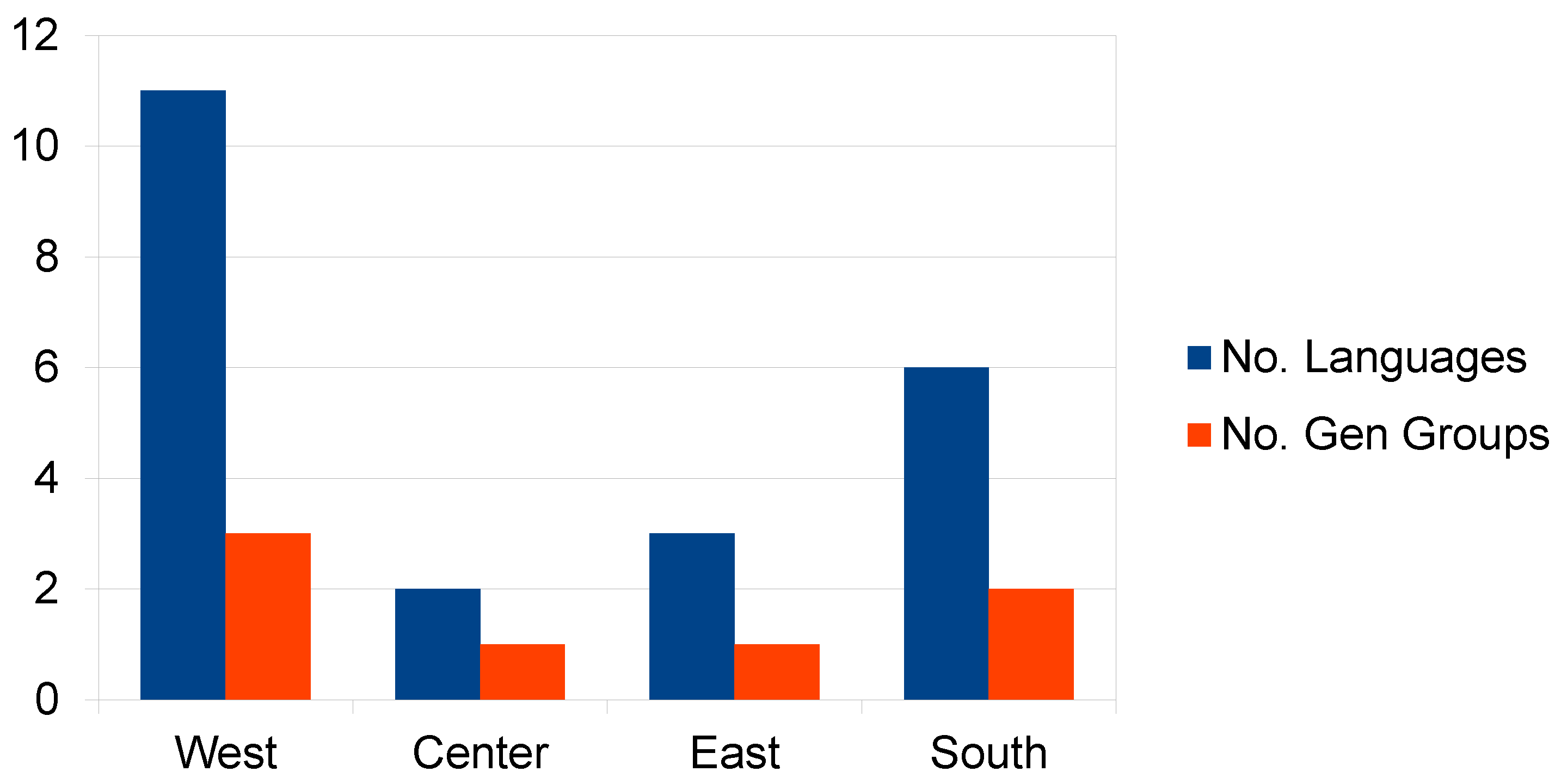
Within Hunan, regions differ as far as their concentration of languages and phylogenetic groups (see Figure 3). The West has a particularly dense concentration, followed by the South and East; this appears to be negatively correlated with population, which is primarily concentrated in the Central region (33%), as compared to the West (23%) (see Table 1).
Phylogenetic diversity is also concentrated in areas with the highest language diversity. LD values come out to the following (with A = 148,326,000 and L = 7159): West = 3.09; Center = 0.703; East = 1.63; South = 2.97. This indicates a strong concentration of diversity in the West and South. Language and phylogenetic density are therefore highest in the West, lowest in the Center, and moderately high in the South and East, in that order. As we will see in Section 3, these facts correlate with the terrain type found in each region.

2.2. Structural Diversity

Overall, Hunan is a relatively diverse region, both in terms of the number of languages and number of top-level lineages. In terms of structural diversity, however, the province is quite homogeneous, in that languages tend to converge towards a particular typological profile: all languages are tonal, lack most forms of inflectional morphology, have a large number of monosyllabic words, have obligatory numeral classifiers (which also often have reference-marking functions), are SVO (with one notable exception), and tend to have restricted syllable structure, with few contrasts available in the coda position. Languages also tend to use serial verb constructions, have sizable inventories of sentence final particles indicating a range of discursive and modal functions, and use de-lexicalized verbs to indicate argument grammatical functions (Y. Wu, 2005; Sposato, 2015; C. Brassett et al., 2006; Long, 2003). This is in line with Hunan’s inclusion at the extreme north and east of the MSEA or Mainland Southeast Asia linguistic area (Sidwell & Jenny, 2021; Arcodia & Lu, 2026). The variety that most clearly fits all these criteria is Xong (Sposato, 2015, p. 1; ‘Xiangxi Miao’), while the variety that fits this characterization the least is Tujia (C. Brassett et al., 2006). We can define a ‘type’ using six features which most languages adhere to:
(1)
Lack of Inflectional Morphology (+ preference for Monosyllabic Morphemes)
(2)
For example, Tujia (C. Brassett et al., 2006, pp. 27–33):
Affixation is limited to five prefixes and 12 suffixes marking derivational categories such as nominalization, verbalization, and the diminutive, with compounding and reduplication commonly used to form new words. The only inflectional category marked at the word level is pluralization with -die1; e.g., biu2-die1 ‘daughters’, ze4-bi2-die1 ‘grandchildren’ (33). Incidentally, native Tujia words are about 1/3 monosyllabic and 1/2 bisyllabic.
(3)
Complex Lexical Tone Systems (range of 4–10 tones)
(4)
For example, the 10 tones of Kam-Dong (Long, 2003):
(a) [55]/[˥] sau1 ‘twist’; (2) [35]/[˧˥] sau2 ‘grass’; (3) [212]/[˨˩˨] sau3
‘raise’; (4) [323]/[˧˨˧] sau4 ‘steam’; (5) [13]/[˩˧] sau5 ‘carp’; (6) [31]/[˧˩] sau6
‘husband’; (7) [53]/[˥˧] sau7 ‘soup’; (8) [453]/[˦˥˧] sau8 ‘egret’; (9) [33]/[˧]
sau9 ‘produce’; (10) [21C]/[˨˩C] tok10 ‘kneel’.
The six tones of Hengyang Xiang (Li, 1986):
(b) [45]/[˦˥] fu1 ‘husband’; (2) [11]/[˩] fu2 ‘hold’; (3) [33]/[˧] fu3 ‘office’; (4) [24]/[˨˦] fu4
‘pay’; (5) [213]/[˨˩˧] fu5 ‘father’; (6) [22]/[˨] fu6 ‘good fortune’.
(5)
Restrictive Syllable Structure
For example, Tujia allows only nasal consonants in the coda position and has no onset clusters, with maximal syllable structure: (C)V(N)T. Xong is even more restrictive, with no final consonants: (C)VT.
(6)
Numeral classifiers with a variety of non-classificatory functions
For example, numeral classifiers in Xong (Sposato, 2015, pp. 2, 5):
(a) boub naond [aod-ndaut aub] neind
1pl ATT [one-CL.river water] PROX
‘this river of ours’.
(b) manx [oub-zheinb beub] dox
2pl.POSS [two-CL.tool quilt] DIST
‘those two quilts of yours (pl)’.
(7)
Serial Verb Constructions
For example, multi-verb constructions in Xong (Sposato, 2015, p. 5):
(a) aod-ngonl naus beux [daos geud giab nonx]
one-CL.animate bird [hit die hold stir.fry eat]
‘I killed the bird and cooked it (to eat).’
(b) beul dad-kit [monl ncot nqif meb shok] zhel
3sg not-until go wash.clothing clean take dry sun
‘She took (them), washed (them), and put (them outside) to dry in the sun.’
(8)
SVO word order and Head-Initial Constructions
For example simple transitive constructions in Kam-Dong (M. Wu, 2015, p. 191)10:
(a) jau23 ʨan52 kwaŋ35 qəu212
1sg eat CL rice
‘I eat a bowl of rice.’
(b) mau33 ʨan52 tui212 nɐm212
3sg eat CL water
‘She drinks a cup of water.’
Most varieties fit this basic structural outline, regardless of affiliation. However, Tujia retains certain Tibeto-Burman features, such as basic SOV word order, Head-Finality, and postpositions indicating certain case distinctions, in line with other TB languages (C. Brassett et al., 2006; Arcodia & Lu, 2026). In addition, as seen in the examples in (1) above, while Tujia lacks most forms of inflection, it has more bisyllabic morphemes than other varieties (about half of its native vocabulary). Tujia retains certain conservative features, potentially due to its late arrival in the region (see Section 3.2). Most languages of Hunan converge towards this type; exceptions like Tujia’s are rare.
Having given an account of the linguistic diversity of the province, the question of how it got to be this way will be tackled in the following three sections. Section 3 will cover geographical and historical factors, and Section 4 will cover the structural outcomes of contact for the languages of the region.

3. Geographical and Historical Factors

3.1. Physical Barriers, Settlement and Food Production Patterns, and Terrain Variability

Geography and linguistic diversity are intrinsically linked (Nettle, 1999; Michalopoulos, 2012; Gao, 2017; Urban, 2025). In terms of physical geography, Hunan is a ‘compact, well-defined region’ (Perdue, 1987, p. 28), being bounded on all sides by clearly definable geographical barriers, including sizable mountain ranges and water systems. In the south, the Nanling 南岭 range defines the border with Guangdong and Guangxi; the Luoxiao 罗霄 range to the east defines the border with Jiangxi; and the Wuling 武陵 and Xuefeng 雪峰 ranges to the west and northwest, respectively, define the border with Chongqing and Guizhou. All these ranges rise to above 1500 m, with most rising to above 2000 m, contrasting sharply with the center of the province, which tends to lie between 200 m and sea level.
Lake Dongting 洞庭, the second largest lake in China covering 2800 km2, defines the northern border with Hubei, and connects the province to the historical trade systems of the Yangtze and Northern China. The fertile center of the province is dominated by four major rivers, the Xiang 湘江, the Zi 资水, the Yuan 沅江, and the Li 丽水, the most important of which is the Xiang river system, which flows through the largest urban centers, including Changsha (the provincial capital), Xiangtan, Zhuzhou, and Hengyang, which collectively contain almost 30% of the province’s population (Hunan Provincial Bureau of Statistics, 2025). The mountain and river systems define a corridor running diagonal northeast to southwest into Guangxi, essentially a central plain fully bounded to the east and west and partially bounded to the north and south (see Chart 5), which corresponds to the densest area of settlement and the historical region occupied by Xiang varieties of Sinitic. This region has been attractive to migrant settlement from the north and east, while retaining a distinctive identity thanks to its natural barriers. This has established a corridor of settlement running through Lake Dongting and the Yangtze, down the Xiang River, and into the southwest and northern Guangxi.
Hunan has three traditional regions defined in terms of agricultural practice and types of human settlement (Perdue, 1987): (1) the area around Lake Dongting, devoted to paddy-based rice cultivation, (2) the four river basins devoted to wet-land rice cultivation, and (3) the mountainous periphery devoted to dry-land farming of miscellaneous grains (including sweet potatoes and corn). In essence, rice is cultivated in the lowlands, other grains are cultivated in the highlands.
Historically the population distribution was concentrated in region (1), with a ranking of (1) > (2) > (3), but recently owing to the importance of cities and commerce, it is now primarily concentrated in region (2), with a distribution of (2) > (1) > (3). The overall picture is that mountainous regions, particularly in the west and south, have remained marginal in terms of population and agricultural production, while wet-land regions in the north and center have been dominant. Mountainous regions are also the most vulnerable to droughts, floods, and soil erosion, and therefore present risks for food production. Taken together, the general pattern is one of “underpopulated periphery [and] densely settled core” (Perdue, 1987: 93). These peripheral regions have historically been associated with non-Han peoples and non-Sinitic languages, up to the present day.
One will recall from Chart 2 (Section 2) that autonomous regions are concentrated in the west and south, the most mountainous and rugged areas, areas which can only be devoted to the least productive and riskiest ‘dry land’ agriculture type (Perdue, 1987). Meanwhile, the fertile floodplains in the center of the province are inhabited by Sinitic-speaking communities representing the most densely populated parts of the province (see Table 1, Section 2).
Areas with the highest food production and the least diverse terrain tend to have the lowest linguistic diversity (LDCenter = 0.703; 1 Gen. group), while areas with the least secure food production and the most diverse terrain tend to have the highest (LDWest = 3.38; 3 Gen. groups). Note that the West is the region with the most rugged terrain and the highest altitude on average, followed by the South (LDSouth = 2.97; 2 Gen. groups) and East (LDEast= 1.63; 1 Gen. group). Linguistic diversity in Hunan seems to be correlated primarily with terrain variability (Michalopoulos, 2012; Urban, 2025) rather than ecological risk (Nettle, 1999); Nettle’s model of ecological risk would predict that lower diversity should be present in areas where food sources are harder to obtain securely. This distribution is emblematic of the increasingly marginal land ethnic minorities have shifted to occupying, a process outlined in the following section.

3.2. Population Movements, Demographic Changes, and Ming–Qing Government Policies

Hunan has been a border region for its entire recorded history, between the Sinitic-speaking world and the Tibeto-Burman, Hmong-Mien, and Kra-Dai-speaking world. This remarkable constancy is unique compared to other regions which have acculturated much more rapidly to Sinitic (LaPolla, 2022). At the same time, Hunan represents a microcosm of similar situations which have previously taken place in other provinces, with non-Sinitic peoples occupying increasingly marginal lands. The present sociolinguistic situation in Hunan is a result of processes that have been ongoing in other parts of south and central China over the past 2500 years, since the beginning of Han migrations southward from the Yellow River valley (F. Wu & Huang, 2022). The primary difference is that the process has been slower in Hunan, only reaching its apogee in modern times beginning in the Ming and Qing (Perdue, 1987; Sutton, 2003), and continuing into the present, although now in the form of mass tourism into minority areas (Poa & LaPolla, 2007; LaPolla, 2022).
The first Sinitic-speaking peoples to establish themselves in the region, at least in Chinese records, would be the ruling class of the Chu 楚 state, one of the major players of the Warring States period, beginning in the 8th c. BCE. The exact time frame is open to interpretation: some authors (M. Zhou, 1998), based on early mentions of the state of Chu, claim a much earlier date in the 11th c. BCE, but there is doubt that the earliest language of Chu was Sinitic (Z. Zhou & You, 1988, p. 94). It therefore seems safest to assume that at least the ruling class was linguistically and culturally Sinicized by the Spring and Autumn Period (8th c.), when Chu definitively enters the Chinese orbit. In any case, the Xiang River valley was definitely ruled by a Sinicized Chu aristocracy by the Warring States (5th c. BCE), as evidenced by the existence of poetry composed in Chu (the 4th c. BCE ‘Songs of Chu’ 楚辞), which shows characteristic dialectal features (Z. Zhou & You, 1988, p. 96; Künstler, 2019, p. 103). This state ruled over a vast territory centered on Hunan and Hubei and primarily consisting of non-Han peoples, historically known as the ‘Man’ 蛮 or ‘Yue’ 越, who are believed to have been originally Kra-Dai or Hmong-Mien-speaking (Ballard, 1981, 1985; Yan, 1983; Sagart, 1999; Chamberlain, 2016; LaPolla, 2022). This southward expansion ushered in a period of acculturation and integration of these peoples into the Sinosphere.
Evidence suggests that Proto-Hmong-Mien and Proto-Kra-Dai both originated in or near the area of modern Hunan, somewhere in the middle reaches of the Yangtze around 500 BCE and the 12th century BCE, respectively (Ratliff, 2021; Sidwell, 2014; Chamberlain, 2016). This is supported by evidence of early contact between Hmongic languages ancestral to modern Xong and Sinitic languages ancestral language to modern Xiang. Ballard (1985) provides examples of phonological parallels between modern Xiang and modern Hmong: preservation of a three-way laryngeal contrast in obstruents, the collapse of nasal codas to one or two outcomes, complete disappearance of final stop codas, and shared tonal developments, among others.
Movement for both Hmong-Mien and Kra-Dai groups is supposed to have then proceeded south and eastward, following early population or assimilative pressures from the east and north, most likely due to the expansion of the state of Chu and successive waves of Han migrants. The Xiang river valley seems to have been a particularly powerful draw for Han migrants moving south in successive centuries (Coblin, 2011). These combined pressures seem to be at the heart of the present distribution of these peoples, resulting in the locus of genetic diversity and population density for these families shifting south11.
Tujia represents an exception to the pattern outlined above, in that Proto-Tibeto-Burman is believed to have an origin much further north in Gansu at about 7000ya after having split from Proto-Sinitic (Sagart et al., 2019). Proto-Tujia would have been spoken around 500 BCE in Eastern Sichuan (it is hypothesized that the ancient State of Ba 巴 may represent the ancestors of the Tujia), and speakers of Tujia are believed to have reached their present homelands by the 7th to 9th centuries CE (P. Brassett & Brassett, 2005)12. The ethnic group was historically distributed widely in the confluence between Chongqing, Guizhou, Hubei, and Hunan, with Hunan being on the periphery of the Tujia-inhabited region. However, linguistic assimilation over the last 300 years has resulted in Northern Tujia being restricted to only four counties in Xiangxi, while Southern Tujia is restricted to a few villages in a single county (C. Brassett et al., 2006, p. 7), with the highest estimate placing their combined speakers at no more than 71,500 (Eberhard et al., 2025) (despite the ethnic Tujia population numbering upwards of 9 million). It seems therefore that the present distribution of Tujia-speaking communities is the result of pressures from the west and north rather than from the east, unlike the Hmong-Mien and Kra-Dai groups. At the same time, the restriction of Tujia speakers to Hunan is a recent phenomenon, with comparatively shallow time depth compared with other non-Sinitic languages.
Sinitic-speaking political dominance was established in the region at an early date, with the most fertile parts of the province eventually either acculturated to or inhabited by Sinitic-speaking Han peoples, resulting in a sort of stasis emerging between a Sinitic-speaking nucleus and non-Sinitic speaking periphery. Most succeeding dynasties gave non-Han peoples a considerable degree of local autonomy; for instance, during the 唐 Tang (7th to 10th centuries), the 土司 tusi or ‘local headman’ system was put into place, which accorded certain rights to local communities as long as they submitted to the Tang (P. Brassett & Brassett, 2005). This system was hereditary, and was respected largely without change for the next 700 years.
Between 1644 and 1679, however, the establishment of the Qing dynasty and the removal of pockets of Ming loyalists, including several major rebellions in Hunan, resulted in massive depopulation (Perdue, 1987, p. 72; Coblin, 2011), with some prefectures reporting a loss of 60% to 90% of their population and vast tracts of land lying fallow. This prompted the Qing to encourage settlement to Hunan from surrounding regions to bring the province back under cultivation. While all regions received Han migrants, the Eastern region experienced the most long-lasting linguistic effects: waves of migrants from neighboring Jiangxi brought varieties of Kejia and Gan to Hunan (Coblin, 2011), which are today found primarily in the prefectures of Zhuzhou, Changsha, and Yueyang. This contributed to the higher language diversity that we see in this region today.
The Qing state played an ‘important, if limited, role’ (Perdue, 1987, p. 234) in the settlement history of Hunan. Tax exemptions, investment in waterworks, land clearance and immigration, and promotion of new crops all encouraged migration to repopulate the province following the chaotic 17th century. Ecological exhaustion and competition for land as populations increased dramatically by the end of the 18th century led to conflict, including expulsion and exploitation of non-Han peoples, who increasingly inhabited even more marginal land. In tandem with these demographic pressures, efforts were made to bring non-Han regions into a more centralized system by doing away with the tusi system of hereditary chieftains, replacing it with ‘administrative incorporation’ (改土归流 gai tu gui liu) which did away with local autonomy (P. Brassett & Brassett, 2005).
There are three major factors, each stemming from adopted policies or events in the Qing, which directly resulted in the present linguistic situation in Hunan: (1) increased migration into non-Han-occupied regions by Han peoples, owing to overpopulation and land scarcity following the Ming–Qing transition (Perdue, 1987); (2) ‘administrative incorporation’ (改土归流 gai tu gui liu) of the previously independent local chieftains or tusi (Sutton, 2003; P. Brassett & Brassett, 2005); and (3) the ‘Great Miao Revolt’ of 1795, a general uprising of non-Han peoples of Western Hunan, which raged across Xiangxi and resulted in thousands of deaths and additional loss of land (Sutton, 2003).
This last factor was perhaps the most important, and is held to be a direct result of the previous two factors (Sutton, 2003). Diamond (1995) points out that the term ‘Miao’ 苗 is used loosely in Qing records, referring to a variety of non-Han groups, and even to Han who had adopted non-Han cultural practices. Therefore, we should interpret the Great ‘Miao’ Rebellion of 1795 as a general uprising in Western Hunan characterized primarily by non-Han cultural elements (be they Han, Miao, Yao, Tujia, Dong, or some other unidentified group), but not exclusive to speakers of Xiangxi Miao. The leaders of the revolt were defeated and executed in 1796, but inter-ethnic violence continued for the next 10 years. While exact numbers of casualties are unknown, the revolt and continuing sporadic violence along ethnic lines would define the following centuries in the cities of Xiangxi, including Baojing and Guzhang, and result in displacement of primarily non-Han peoples to the countryside.
The final stage in the creation of the present ecosystem is the use of Sinitic varieties in the most productive areas of the province (i.e., the Central and Eastern regions), with Xong, Kam-Dong, Tujia, and Iu-Mien spoken in peripheral autonomous regions (i.e., the Western and Southern regions). Recently, these areas have attracted large-scale domestic tourism due to stunning physical geography and ancient towns, in particular places like Zhangjiajie 张家界 and Fenghuang 凤凰, both of which are in the Western region. The final marginalization of non-Han peoples manifests as the commodification of their culture for mass domestic consumption (LaPolla, 2022; Bei et al., 2024), which provides some degree of investment in local economies, although with no guarantees as far as economic relief (Lumsden, 2008).
We can therefore see that geography and history have effectively conspired to create the modern distribution of diversity in the province, with high phylogenetic and language diversity concentrated in the mountainous west and south. Likewise, the ring-shaped geography of the province and consistent demographic overlays of Sinitic speakers can be connected to the low structural diversity, as speakers converge to a common MSEA-oriented isolating–analytic type over several thousand years. In the synchronic domain, the combined results of this are the stable interaction of closely related, distantly related, and unrelated languages up to the present day.

4. Language Contact: Degrees of Relatedness, Koineization, and Hybridization

All languages of Hunan are in contact with varieties of Mandarin (cmn), either regional varieties such as Hunan Southwestern Mandarin, spoken for instance in Changde 常德 or Hanshou 汉寿, or supraregional varieties such as Putonghua or Standard Mandarin (LaPolla, 2010). Since education is conducted in PTH, all individuals with basic literacy will be familiar with it. The traditional lingua franca of the region is SWM or SWM-accented PTH (Chappell, 2017), which are used for economic exchange and for communication with outsiders. Owing to relatively recent (post 17th c.) migrations into the southwest (Chappell, 2017; LaPolla, 2022), the non-Sinitic languages of Hunan are primarily in contact with SWM varieties, rather than with Xiang (despite its demographic dominance in Hunan). The populations of Zhangjiajie, Xiangxi, and Huaihua primarily speak SWM as a mother tongue.
One presumes that there must have been different stages of contact between Sinitic and non-Sinitic varieties: one ancient (with the arrival of the ancestor of modern Xiang), one pre-modern (with the arrival of SWM), and one modern (with the arrival of PTH)13. In fact, one can observe this in the lexical strata of Tujia, for instance, which distinguishes ancient loans (Tang dynasty or 800+ years ago), recent loans (up to 700 years ago), and modern loans (up to 100 years ago) (C. Brassett et al., 2006). Similar, though older, lexical strata are also held to exist for Hmong-Mien (Ratliff, 2021). These stages are presumed to manifest as overlaying of structural strata, though distinguishing them systematically in the following sections is beyond the scope of the present piece.
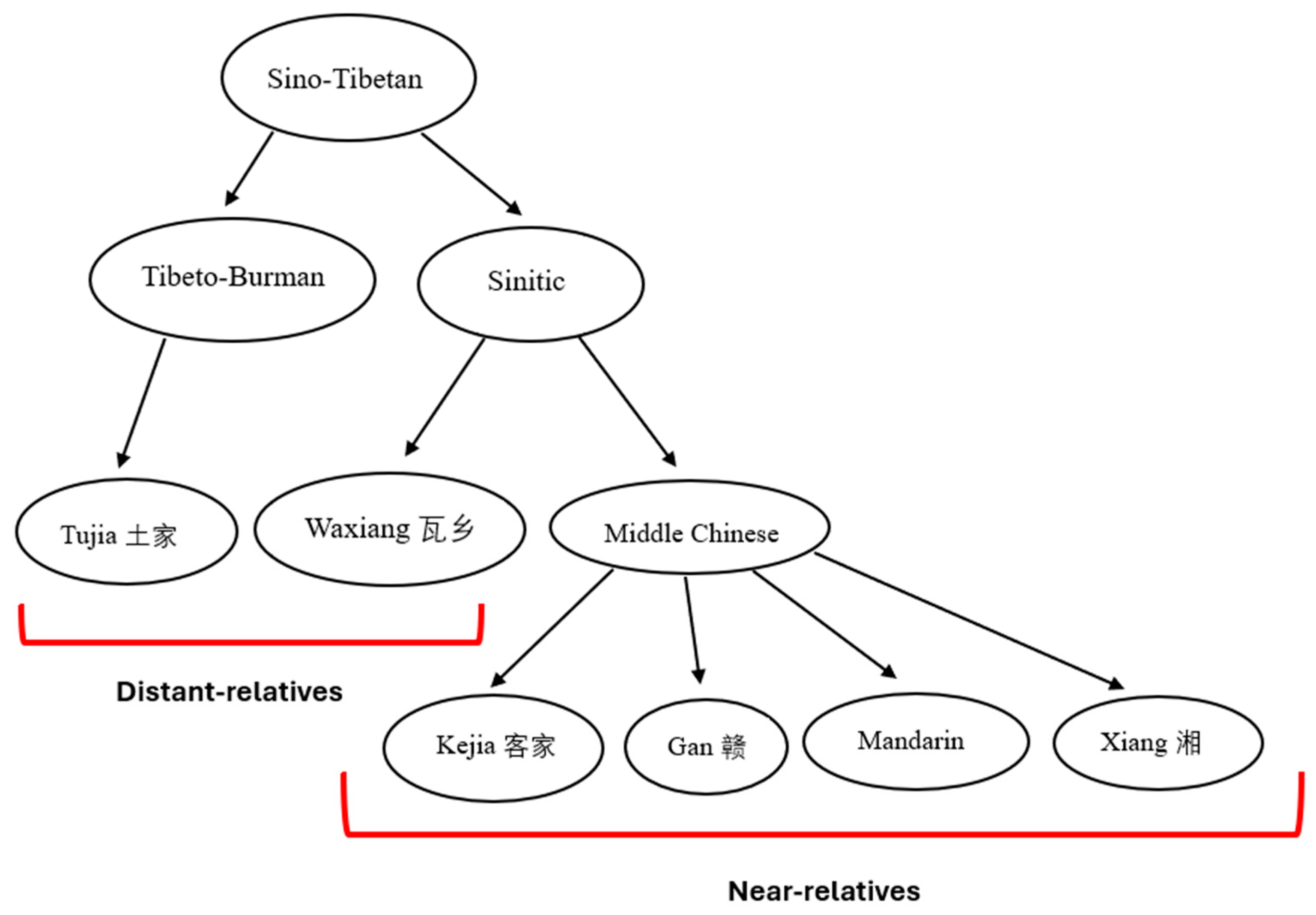
The languages of Hunan can be differentiated in terms of degrees of historical ‘relatedness’ (see Figure 4); that is, between relatives and non-relatives, and between near- and distant-relatives.
Degrees of relatedness can be defined by the hypothesized date of separation from the most recent common ancestor (MRCA), graphically represented on a family tree: ‘sisters’ on the tree are near-relatives (up to 1500 ya), and ‘cousins’ on the tree are distant-relatives (more than 1500 ya). All Hunanese varieties of Sinitic (minus Waxiang) share an MRCA at around ~1400 ya by way of Middle Chinese (Sagart, 2011). Distant-relatives of the MCDs in Hunan include Waxiang (MRCA at ~2000–2500 ya) and Northern Tujia (MRCA at more than ~3000 ya). While not indicated in Figure 3, non-relatives of the Sinitic languages of Hunan include all Hmong-Mien and Kra-Dai varieties, including Xong (muq) and Kam-Dong (kmc, doc). Iu Mien (ium) is also a non-relative, though a lack of work on Iu Mien contact complicates discussing this in any depth. Note that all ‘near-relatives’ in Figure 3 are descended from Middle Chinese; they are therefore referred to as MCDs or ‘Middle Chinese-derived’.
Following arguments raised in Millar (2016), the effects of near-relative contact are held to result in different structural outcomes (depending on preexisting similarity), compared to contact between non- and distant-relatives, resulting in a form of koineization (Millar, 2016), and the latter grammatical hybridization (Matthews, 1996, 2010; Chappell, 2001). Following Siegel (2001) ‘koineization’ is defined as the creation of a new compromise variety through a process of structural convergence, with some degree of local acceptance by the speech community, which includes the convergence of many closely related varieties.
Following Chappell (2001), grammatical hybridization is here defined as the simultaneous co-occurrence of native and borrowed functional morphemes in the same construction, and does not result in the emergence of compromise varieties. In contrast to Chappell’s definition, however, here it will be expanded to cover apparent optionality between constructions with native or borrowed morphemes; that is, isomorphic constructions with no change in meaning, differing only in the origin of a single functional morpheme.
Not all MCDs are equal. Xiang is more structurally similar (Y. Wu, 2005) than Gan or Hakka is to MD. While not ‘dialects’ of Mandarin per se, many Xiang varieties share a closer relationship with Mandarin than other Sinitic languages do (Norman, 1988; Y. Wu, 2005; Sagart, 2011). It has been noted that varieties of Sinitic such as Yue and Min show evidence of grammatical hybridization with Mandarin (Chappell, 2001; Matthews, 2010). The degree of structural similarity, rather than only relatedness, is likely at the heart of whether we see hybridization or koineization, following Dixon (1997, p. 9) though relatedness and similarity are often difficult to disentangle.
Across all contact scenarios the main trend is towards general convergence of grammatical form. In what follows we will introduce examples of contact effects between Sinitic (Waxiang, Xiang) and non-Sinitic (Tujia, Xong-Miao, Kam-Dong) languages of Hunan with Mandarin, the lingua franca of the region. It is often not possible to determine whether something was borrowed from SWM or from PTH, owing to their similar lexicons and syntax; therefore, the term ‘Mandarin’ is used to refer to both if a distinction cannot be reliably made.

4.1. Near-Relative Contact

Koineization is evident in Xiang varieties, where we see the emergence of external compromise varieties (koines) as well as internal restructuring at the level of functional morphemes and phonological structure, as speakers consciously or unconsciously adapt their speech to that of language varieties with local prestige.
Xiang is a Sinitic language (one of the traditional seven ‘dialects’ of Chinese) closely related to Mandarin; if we adopt Sagart (2011)’s subgrouping approach, Xiang and Mandarin were the last two Sinitic groups to split from the main branch. Given this, it is often difficult to determine whether a ‘Xiang feature’ is retained or borrowed from Mandarin. For example, Xiang varieties can be equally divided among those having a third-person pronoun cognate with MD 他 (Northern) or one cognate with Cantonese keoi5 渠 (Non-Northern) (Sevilla, 2023, p. 118). It remains unknown whether (1) the Non-Northern pronoun is borrowed and the Northern pronoun is retained; (2) the Northern pronoun is borrowed and the Non-Northern pronoun is retained; or (3) both pronouns are borrowed and the native pronoun has been lost.
Option (2) is usually assumed (Norman, 1988, p. 208; Y. Wu, 2005, p. 123), with non-Mandarin features held to be reflective of a stage before radical restructuring took place under the influence of northern varieties14. This is reflective of areal trends in Xiang, where Non-Northern features are concentrated in areas furthest from SWM-speaking areas (Sevilla, 2023, pp. 139–140). We will expand this claim to encompass all structural features deemed Northern (i.e., ‘Mandarin-like’): if we assume all Northern features are borrowed, we can see radical restructuring of Xiang varieties at the phonological, lexico-morphological, and syntactic levels.
Contact with Standard Mandarin (Putonghua, PTH) has resulted in the emergence of compromise varieties of Xiang, in particular, the well-known ‘Plastic’ Mandarin of Changsha (塑料普通话) (Y. Wu, 2005; X. Xu et al., 2012; C. Xu, 2025). There is a complex diglossic situation in the city, with at least four different competing dialectal strata, including the Changsha dialect of Xiang, Standard Mandarin, ‘Hunan Mandarin’, and Plastic PTH (C. Xu, 2025). The differences between the varieties are primarily phonological and lexical, rather than grammatical. Plastic PTH is known to overlay the more complex tonal system of Changsha on the lexical items and segments of Standard Mandarin; C. Xu (2025) provides a very clear exposition of how the three former varieties converge to produce Plastic PTH pronunciation:
师生 ‘teachers and students’读书 ‘read books’
[ʂʐ̩˥ ʂəŋ˥][tu˦˥ ʂu˥]Standard PTH
[sz̩˧ sən˧][təʊ˨˦ ɕy˧]Changsha Xiang
[sz̩˥ sən˥][tu˦˥ ɕy˥]Hunan Mandarin
[ʂʐ̩˧ ʂəŋ˧][tu˩˧ ʂu˧]Plastic PTH
Changsha Xiang is characterized by the lack of retroflex sibilants and final velar nasals, and a lower tonal register, including a low-falling, low-rising and mid-level tone. Plastic PTH sets itself apart from Hunan Mandarin by its preservation of Standard PTH sibilant consonants and nasal consonants, with Changsha tonal contours such as the mid-level tone. This pronunciation is interpreted as segmentally educated while supra-segmentally local (C. Xu, 2025). Unlike Hunan Mandarin, which is generally considered an ‘incorrect’ or low form of PTH, Plastic PTH has a degree of local prestige born from its association with the urban culture of Changsha, fitting the definition of ‘koine’ in Siegel (2001).
This seems to have not been the case as recently as 20 years ago; for instance, Y. Wu (2005, p. 28) reports that Plastic PTH ‘has no fixed form’ and possesses a ‘PTH-like tonal system with Changsha segmental phonology’, which is essentially the opposite of what Xu reports. For example, Wu has the forms [sz̩˥ sən˥] 师生 as Plastic PTH for target [ʂʐ̩˥ ʂən˥], and [xuŋ˧˥ yn˥˩ liau˨˩˦] 缝纫鸟 for target [fəŋ˧˥ ʐən˥˩ niau˨˩˦] (2005, p. 29). These indicate some degree of overlap with Hunan Mandarin, which appears to give prominence to standard PTH tonal patterns at the expense of segmental ones. However, it is clear that since then (X. Xu et al., 2012; C. Xu, 2025) Plastic PTH has become an established variety with its own recognizable features distinct from Hunan Mandarin, more local prestige, and an increasing number of speakers.
Meanwhile, across Xiang, data in Y. Wu (2005) shows considerable borrowing, including incorporation of northern phonological features and functional morphemes, such as the loss of voiced obstruent initials, and the presence of the MD 3sg pronoun, attributive marker, passive marker, and distal demonstrative (to name just a few). In her survey, Wu covers 36 Xiang varieties (including Changsha). The results can be observed in Table 3, which shows the percentage of dialects with a Mandarin equivalent for each functional morpheme.
As the above table shows, there is a good degree of convergence with PTH or SWM, though this is of course not consistent across features; there is a general ‘cline of mandarinization’ that increases as one moves north from the center of the province, e.g., Loudi and Xiangtan prefectures (Sevilla, 2023). This degree of convergence, on top of preexisting structural similarity given their close relationship, may facilitate the emergence of koine compromise varieties throughout Xiang-speaking areas, such as what we see with Plastic PTH, or else encourage the adoption of Plastic PTH as a more widely used lingua franca with local prestige.

4.2. Distant-Relative Contact

Waxiang is an archaic variety of Sinitic (Chappell, 2024) or a mixed language given extensive contact with Hmong-Mien and Tujia (Y. Wu & Shen, 2010; F. Wu & Huang, 2022). In either case, the language possesses an archaic lexicon going back to Old Chinese, including taŋ13 鼎 ‘pot’, mɤŋ22 望 ‘see’, lie13 啼 ‘cry’, compare PTH guō 锅 ‘pot’, kàn 看 ‘see’, 哭 ‘cry’ (Y. Wu & Shen, 2010, pp. 31–33), indicating a distant relationship.
Waxiang demonstrates examples of extensive contact with local SWM varieties, most clearly observed in its negators (Chappell, 2024). There is optionality between a Waxiang negator ba13, and an SWM-derived negator pu25, including simultaneous co-occurrence as in example (2) below:
(1) u25 ba13/pu25 fi13
1SG NEG/NEG fat
‘I am not fat’ (35).
(2) ba13 tsi25 ŋ55 ȵi25 tɕi41-ta ti pu25 kan41 ʑiəɯ13
NEG worth person 2SG home-LOC ATT NEG dare eat
‘You are not worth anything, your family won’t dare to eat’ (30)
As Chappell (2024) points out, the two forms are not entirely interchangeable; there are instances where only the native form can be used, where only the borrowed form can be used, and where both are interchangeable. In the negation of past predicates and noun phrases, only the native form can be used, while in the negation of modal verbs and generic statements, only the borrowed form can appear. Negation of conditional statements, adjectives, and cognition verbs are all contexts where either form can appear. Negation therefore shows a three-way stratification in Waxiang; other examples with similar layering include competition between disposal markers (kai55 and pa41), and competition between imported and native comparative constructions.
Likewise, Northern Tujia shows evidence of considerable structural convergence with Sinitic, across several levels including the phonological, lexical, and of course grammatical (C. Brassett et al., 2006; S. Xu et al., 2017). For instance, Tujia seems to have borrowed certain idiosyncrasies of MD grammar. There is also a curious isomorphism between Mandarin morphological perfective and sentential perfect le15, and the perfective lie1 and perfect liao1 of Northern Tujia (S. Xu et al., 2017)16.
(3) guo2 nga2 la2 don1 pa4 lie1
3sg 1sg one CL look PFV
‘He took a look at me.’
(4) bo4li3 on1 se1 ton1 liao1
child five year old PRF
‘The child is five years old now.’
There is also considerable grammatical hybridization, particularly evident in comparative constructions, copular constructions, interrogative sentences, and conjunction usage. Northern Tujia possesses four different ways to mark the comparative, three native and one borrowed (Lu et al., 2024). Native comparatives are formed either with case markers (either ergative ko2 or ablative lie1; example 5 below) or with the topic marker me, but all must be accompanied by a final comparative marker nie4 (example 6 below); all examples from Lu et al. (2024):
(5) a3da4 nga2 lie1 ze4 nie4
elder.sister 1sg ABL beautiful COMP
‘My elder sister is more beautiful than I.’
(6) nga21 a2da1 ze4 nie4
1sg TOP elder.sister beautiful COMP
‘(My) elder sister is more beautiful than I.’
An additional construction with bi1 borrowed from SWM bi 比 is also found. In addition to being an optional variant with either of the previous constructions, it also demonstrates hybridization by co-occurring with the native comparative marker nie4, and by optionally co-occurring with one or more of the case markers (examples from Lu et al., 2024).
(7) ni2 nie4 bi1 guo2 nie4 ca2 nie4
2sg GEN COMP 3sg GEN good COMP
‘Yours is better than his.’
(8) nga2 xi1ca4 xi3 bi1 ni2 lie1 kuai2ta1 nie4
1sg run NMLZ COMP 2sg ABL fast COMP
‘I run faster than you.’
Likewise, in negative copular constructions, two isomorphic constructions exist side by side, one built with the native negative copula gao4ta3, and another built with a borrowed form from northern Sinitic bù shì 不是 (S. Xu et al., 2017):
(9) tu3su1guan4 xu3pa3 ta3 gao4ta3
library lake LOC is.not
‘The library is not by the lake’.
(10) lao2zi1 ci4ka1 bu2si1
tomorrow CNY IS.NOT
‘Tomorrow is not New Year.’
Conjunctions have also been extensively borrowed from Sinitic into Tujia and often occur simultaneously with native equivalents. For instance, C. Brassett et al. (2006, p. 71) provide the following example from spontaneous speech:
(11) nga2 zu2 liao1, ce3 lian1 tong1 di1di4, ai1lie1 jiu1 xie1pong1 la2 dong2 wo1
1sg get.up PFV, water two bucket carry, then THEN pan one CL wash
‘After getting up, I fetch two buckets of water, then I give the cooking pot a rinse.’
The first form ai1lie1 is native, and the second form jiu1 is borrowed (cf. jiù 就). Additionally, in yes–no interrogatives, speakers make use of either a native form man1 or borrowed form ma1 (S. Xu et al., 2017, p. 991):
(12) gai2 ni2 nie1 si1ba1 ma1/man1
DEM 2sg ATT coat Q
‘Is this your coat?’
Hybridization and structural stratification by way of imported SWM structures is extensive in both Waxiang and Tujia, and is found at different levels of description.

4.3. Non-Relative Contact

Sposato (2012) comments on the optionality of relative clauses in Xong, a rigidly SVO language, where we see both head-initial [N-Rel] and head-final [Rel-N] relative clauses. The typological rarity of having SVO word order along with [Rel-N] ordering has been remarked on in the literature (Dryer, 2011), yet it is the basic order found in most Sinitic languages. This rarity means that when found in non-Sinitic languages, it is generally treated as evidence of Sinitic influence. Xong relatives come in two formats, both marked with the relative marker max (all examples from Sposato, 2012; AN = ‘animal prefix’):
(1) miex [max mex bib]
person [REL exist hair]
‘people who have hair’.
(2) [max beut.ngguaib] dab-yul
[REL sleep] AN-cow
‘the cow that is sleeping’
Other than max seen in examples (1) and (2), there are three other relative clause markers, which are restricted in where they can occur: naon and nangd (both only in pre-head position) and zero-marked clauses (only post-head position). There is an additional construction where max and naon/nangd co-occur.
(3) [bib gueb naond] miex
[hair black REL] person
‘the person whose hair is black’.
(4) monx nis miex [Ø jix zhok]
2SG COP person [Ø NEG laugh]
‘You’re a person who doesn’t laugh.’
Like Xong, Kam allows two orderings of relative clause and head (albeit with fewer markers), a native construction using a classifier which is head-initial [N-Rel] (zero-marked) and a borrowed head-final [Rel-N] construction (Li, 2019):
(5) a. tu2 [pen3]
CL.bird [fly]
‘the one [bird] that flies’
b. muŋ4 [phja1 ma4]
CL.human [feed horse]
‘the one [person] who feeds horses’.
(6) a. [pen3 tji6] mok8
[fly REL] bird
‘the bird that is flying’
b. [soŋ5 ȵaːu6 wu1 ɕaːŋ2 tji6] uk9
[put on up bed REL] clothes
‘the clothes that had been put on bed’.
Northern dialects of Kam-Dong incorporate a variety of Mandarin-origin function words to indicate the function of nominal arguments and chain clauses together, in addition to native function words co-opted from content words (Long, 2003, p. 14). For instance, the function word 为 wei ‘for (benefactive, purposive)’ has been borrowed wholesale as wi33 fulfilling the same functions (Long, 2003, p. 138):
(7) wi33 na212 heu35 jau212, wi33 jau212 heu35 na212
WEI 2sg hit 1sg, WEI 1sg hit 2sg
‘For hitting me, I will hit you.’
Similarly, the Mandarin clause chaining words 虽然 suiran ‘although, even though’, 但是 danshi ‘but, still’, 因为 yinwei ‘because’, and 所以 suoyi ‘therefore’ have similarly been borrowed and in some cases are in complementary distribution with native clause-chainers (Long, 2003, p. 142):
(8) səi33lan212 kʰwan35 kai55 lu33 jai323, tan55si35 mau33 mɐn31sai323 pai55 nu53 mau212
SUIRAN road far road long, DANSHI 3sg determined go see 3sg
‘Even though the road is long, she is determined to go see him.’
Unlike most Kra-Dai languages, Kam has switched the order of V-Adv to Adv-V and has borrowed the degree adverb from Mandarin 很 hen, e.g., hen4 ka:i1 [very far] ‘very far’; hen4 ni5 [very small] ‘very small’ (Li, 2019, p. 212). This can be contrasted with the regular head-initial ordering of N-Adj and N-Gen: ja:n2 mei5 [house new] ‘new house’; nam4 lu1 [water clear] ‘clear water’; neŋ4 jaːu2 [brother 1sg] ‘my younger brother’; nan1 maːu6 [one 3sg] ‘his that one’ (Li, 2019, pp. 215, 218).
Long-term interaction of these unrelated languages has resulted in extensive grammatical hybridization with native and northern Sinitic patterns. Further research into this topic from a specifically Hunanese perspective is necessary, given the paucity of materials on Hunanese Kam-Dong and Iu-Mien in particular.

4.4. Discussion

Focus on structural outcomes of contact as mediated by degrees of relatedness (as illustrated for the Hunanese context) raises two general questions for contact linguistics: (1) Can degrees of relatedness be distinguished by analyzing the structural outcomes of contact? And (2) what are the implications of extensive grammatical hybridization on the shape of Hunan’s languages? A definitive answer to these questions will have to await further research, but we can attempt a preliminary answer below.
The outcomes of near-relative contact are clearly distinct from other types of contact, given the emergence of new standards/prestigious linguistic codes (such as the example of Plastic PTH). Millar (2016) claims that the end-result of near-relative contact is inevitably koineization, and it seems likely that the close relationship between Changsha Xiang and Mandarin is at the heart of this process. It therefore seems likely that near-relative contact can be distinguished from distant-relative contact at least. However, it is unclear whether this would apply to all MCDs or even to all Xiang varieties; for instance, Xiang varieties in central Hunan retain a variety of Non-Northern features, and may therefore be more likely to demonstrate hybridization—for instance, Lianyuan or Hengyang, which primarily employ non-cognate functional morphemes, e.g., Hengyang [tɕi˧] 其 (Peng, 2005) for Changsha [thɑ˧] 他. Therefore, existing structural similarity (following claims in Dixon, 1997, p. 9), by way of shared functional morphemes, is probably a greater predictor of koineization vs. hybridization, and determining degrees of relatedness would most likely have to be done dialect by dialect. Meanwhile, regarding distant- and non-relative contact, it is likely that both cannot be structurally distinguished, as hybridization is likely to result from both.
One serious limitation in this regard is the treatment of Tujia and Waxiang as equally comparable: not all distant-relatives are equal. Clearly Tujia with its Tibeto-Burman profile is more distinct from SWM than Waxiang, which displays Sinitic typological features such as primarily mono-morphemic roots. On the other hand, the results of contact for both are largely the same, with extensive hybridization; to what extent Tujia has been reshaped by its time in the Hunanese contact zone remains to be seen.
To what extent have the languages discussed been reshaped by their time in Hunan and the extensive structural convergence believed to have taken place? The claim made here is that time in the Hunanese linguistic region is positively correlated with convergence to MSEA typological features. This explains why Tujia, while heavily impacted by Sinitic, is less prototypically MSEA in character. It has been observed (S. Xu, 2011) that Tujia has an early influence from Yi varieties further west in the Tibeto-Burman typological region, which is then supplanted by Sinitic influence. This is believed to have contributed to the mixed character of Tujia.

5. Conclusions

This has been an attempt to elucidate the linguistic ecosystem of Hunan through its geography, history, and contact between its languages; as we can see, Hunan represents a unique linguistic ecosystem which provides novel opportunities to study contact as mediated by degrees of relatedness across an extensive time depth. The geographic cohesiveness of the region, its relative linguistic stability over 2500 years, and its high language and phylogenetic diversity compared to the rest of China are of particular interest. Long-term contact has created a considerable degree of structural convergence among languages of Hunan, and it is held that the typological profile of Hmong-Mien and (more controversially) Kra-Dai languages was forged through contact in Hunan over this 2500 year period, before their expansion into Guizhou, Guangxi, and beyond into the rest of the MSEA. Furthermore, time in Hunan is correlated with the degree of convergence toward east Asian typological features, which explains Tujia’s divergent profile, as speakers of this language arrived in the region in the Tang from the Tibeto-Burman area further west.
The present linguistic situation can be attributed to a combination of the previously discussed factors, including impassability of terrain and ease of food production, conflict between communities inhabiting the nucleus and periphery of the province, and contact between supraregional languages like Mandarin and local Sinitic (Waxiang, Xiang) and non-Sinitic languages (Tujia, Xong, Kam-Dong). Taken together, Hunan represents a rich linguistic ecosystem deserving further study within and outside the field of linguistics.

Funding

This research received no external funding

Institutional Review Board Statement

Not applicable.

Informed Consent Statement

Not applicable.

Data Availability Statement

Data associated with this project can be found at the University of Hong Kong Datahub, at the following DOI: 10.25442/hku.32505909.

Conflicts of Interest

The author declares no conflict of interest.

Notes

1
“Location Map China Hunan EN” by Philg88 under: (https://creativecommons.org/licenses/by/4.0/) accessed 23 September 2025. Modified from the original.
2
The elongated shape of the prefectures, encompassing one large metropolis and extensive rural areas, leads to a skewing of population and area figures. For example, arguably prefecture 9 (Shaoyang 邵阳) should be included in the Center region given that its largest city (Shaoyang) is closer both geographically and culturally to Central urban centers like Xiangtan, Loudi, and Hengyang. The same could be said for Changsha city. However, this would put the majority of the prefecture’s landmass outside of the Western region, including the Chengbu Miao autonomous region, which has clear connections to the West. The present approach is therefore somewhat of a balancing act. For reasons of convenience the system of prefectures is retained, but a more fine-grained approach would divide them accordingly.
3
The precise classification of Tujia within Sino-Tibetan is uncertain; it is usually referred to as ‘unclassified Sino-Tibetan’, possibly because its relationship to Sinitic has been blurred by extensive contact (S. Xu et al., 2017).
4
The speaker population estimates for Southern Kam and Iu Mien are inferred based on data in the Chinese Academy of Social Sciences (2012), since most sources do not provide a breakdown by province; they should therefore be regarded with some caution.
5
Ethnologue gives a total count of 20, but Table 2 includes only 17; Bunao [bwx], Guibei Zhuang [zgb], and Yue Chinese [yue] are not included since their presence in Hunan appears to be minimal. However, calculations in the following section use Ethnologue’s number. Population data should be taken with caution.
6
This applies to varieties of Tibeto-Burman spoken in China; the actual locus of diversity for the grouping is in Nepal and Northeast India (Thurgood, 2017).
7
“Ethnic minorities areas in Hunan” by Kayr under: (https://creativecommons.org/licenses/by/4.0/) accessed 23 September 2025. Modified from the original. Original: https://commons.wikimedia.org/wiki/File:Ethnic_minorities_areas_in_Hunan.png.
8
Only provinces on the Chinese mainland are considered; the calculation does not include city-level political divisions such as Beijing, Shanghai, or Tianjin, though it does include Chongqing given its size is comparable to other provinces; nor does it include any special regions or overseas territories. Numbers from Ethnologue should be treated with a healthy degree of skepticism, given disagreement on what is considered a ‘language’ (note disagreements with Glottolog), and the fact that language counts can differ (e.g., 17 or 20?).
9
There are many disagreements with this classificatory scheme, but this represents the most common consensus as far as what linguists can agree on (following Campbell, 2018). Within China, it is common to group Sino-Tibetan, Hmong-Mien, and Kra-dai into a single family (e.g., Sun et al., 2007; Chinese Academy of Social Sciences, 2012), and Koreanic, Mongolic, Turkic, and Tungusic have been claimed to form an expanded version of ‘Altaic’ (see Janhunen, 2023 for discussion). The present piece agrees with Campbell (2018) that these groupings are areal in nature. A more plausible grouping is ‘Austro-Tai’ (Austronesian + Kra-Dai), whose member languages appear to share a considerable amount of basic vocabulary (see Ostapirat, 2013).
10
This data is from the Sanjiang variety of Kam, spoken in neighboring Guizhou, as described in M. Wu (2015).
11
In fact, Iu Mien and certain other Mien languages have more speakers outside China than inside it (Sposato, 2015, p. 22); the family is in any case believed to have originated somewhere in northern Hunan or elsewhere on the Yangtze (Ratliff, 2021), and to then have spread south and west.
12
An anonymous reviewer points out that though this is the view held by linguists, it is not necessarily held by all scholars. Notably, Pan (2000) and Wei (2014) present archeological and historical evidence that the Tujia were in northwestern Hunan as far back as the Eastern Han (late 1st c. CE). A lack of linguistic evidence from the period forces us to rely only on the ethnic classification of these people as ‘Northern Wuling Man’, which does not tell us about linguistic affiliation, but may very well reflect an ethnic distinction of some kind. In any case, even if they had been in the region, the majority of speakers would have been further west in Guizhou, with the center of gravity shifting later.
13
An anonymous reviewer further points out that the contact ecosystem would have been very different before the advent of SWM, with little contact or intermarriage between Waxiang, Xong, or Tujia groups in Xiangxi. SWM as a lingua franca seems to have had a radical impact on these languages, and encouraged intergroup exchange. A paucity of records however forces us to focus solely on contact effects following the advent of SWM; it becomes particularly difficult to distinguish pre-modern contact with SWM and modern contact with PTH given their close affinity.
14
This is far from being a trivial assumption, although the tradition has been to assume that these varieties all share some sort of intermediate ancestor (e.g., Norman, 1988; Y. Wu, 2005; Chen & Bao, 2007, etc.). This is, however, far from being proven with any certainty, as Coblin (2011) clearly points out. For the purposes of this piece, however, it serves to make the point that intense contact is and has been ongoing to the point of radical restructuring.
15
In MD, both markers are toneless and homophonous (and homographic), but can co-occur in the same construction. The perfective marker immediately follows the verb and is often treated as an affix. The perfect marker meanwhile is often considered a sentence final particle and can follow any word class. Given Tujia’s basic SOV word order, both aspect markers end up in the final position.
16
Examples from Tujia are presented in the orthography found in C. Brassett et al. (2006).

References

  1. Arcodia, G. F., & Lu, W. (2026). Typology of sinitic (Chinese). Encyclopedia, 6, 52. [Google Scholar] [CrossRef]
  2. Ballard, W. (1981). Aspects of the linguistic history of South China. Asian Perspectives, 24(2), 163–185. [Google Scholar]
  3. Ballard, W. (1985). The linguistic history of South China: Miao-Yao and southern dialects. In G. Thurgood, J. A. Matisoff, & D. Bradley (Eds.), Linguistics of the Sino-Tibetan area: The state of the art. Papers presented to Paul K. Benedict for his 71st birthday (pp. 58–84). Pacific Linguistics, The Australian National University. [Google Scholar]
  4. Bei, T., Stoffelen, A., & Vanclay, F. (2024). Understanding resilience in ethnic tourism communities: The experiences of Miao villages in Hunan Province, China. Journal of Sustainable Tourism, 32(7), 1433–1452. [Google Scholar] [CrossRef]
  5. Brassett, C., Brassett, P., & Lu, M. (2006). The Tujia language. Lincom Europa. [Google Scholar]
  6. Brassett, P., & Brassett, C. (2005). Diachronic and synchronic overview of the Tujia language of Central South China. International Journal of the Sociology of Language, 2005, 173. [Google Scholar] [CrossRef]
  7. Campbell, L. (2018). How many language families are there in the world? Anuario del Seminario de Filología Vasca Julio de Urquijo, 52(1/2). [Google Scholar] [CrossRef]
  8. Chamberlain, J. (2016). Kra-Dai and the proto-history of South China and Vietnam. Journal of the Siam Society, 104, 27–77. [Google Scholar]
  9. Chappell, H. (2001). Language contact and areal diffusion in Sinitic languages. In A. Y. Aikhenvald, & R. M. W. Dixon (Eds.), Areal diffusion and genetic inheritance: Problems in comparative linguistics (pp. 328–357). Oxford University Press. [Google Scholar]
  10. Chappell, H. (2017). Languages of China in their east and South-East Asian context. In R. Hickey (Ed.), The Cambridge handbook of areal linguistics (pp. 651–676). Cambridge University Press. [Google Scholar]
  11. Chappell, H. (2024, March 28). Superstrate effects of negation in Waxiang: A case study of language contact in northwestern Hunan, China [Paper presentation]. Symposium on Language and Cultural Contacts Along the Borders of China, Ancient and Modern, Hong Kong, China. [Google Scholar]
  12. Chen, H., & Bao, H. (2007). Hunansheng de Hanyu fangyan [Chinese dialects of Hunan province]. Fangyan, 3, 250–259. [Google Scholar]
  13. Chinese Academy of Social Sciences & City University of Hong Kong. (2012). Language atlas of China (2nd ed.). The Commercial Press. [Google Scholar]
  14. Coblin, W. S. (2011). Comparative phonology of the central Xiang dialects (language and linguistics monograph series No. 45). Institute of Linguistics, Academia Sinica. [Google Scholar]
  15. Diamond, N. (1995). Defining the Miao: Ming, Qing, and contemporary views. In S. Harrell (Ed.), Cultural encounters on China’s ethnic frontiers. University of Washington Press. [Google Scholar]
  16. Dixon, R. M. W. (1997). The rise and fall of languages. Cambridge University Press. [Google Scholar]
  17. Dryer, M. S. (2011). Relationship between the order of object and verb and the order of relative clause and noun. In The world atlas of language structures online (WALS). Max Planck Digital Library. [Google Scholar]
  18. Eberhard, D. M., Simons, G. F., & Fennig, C. D. (Eds.). (2025). Ethnologue: Languages of the world (28th ed.). SIL International. Available online: http://www.ethnologue.com.eproxy.lib.hku.hk (accessed on 16 March 2025).
  19. Gao, K. B. (2017). Dynamics of language contact in China: Ethnolinguistic diversity and variation in Yunnan [Doctoral dissertation, University of Hawai‘i at Manoa]. [Google Scholar]
  20. Hammarström, H., Forkel, R., Haspelmath, M., & Bank, S. (2026). Glottolog 5.3. Max Planck Institute for Evolutionary Anthropology. [Google Scholar] [CrossRef]
  21. Huang, X. (1988). Hunan Jiangyong fangyan yinxi [The phonology of the Jiangyong dialect of Hunan]. Fangyan, 3, 161–176. [Google Scholar]
  22. Hunan Provincial Bureau of Statistics. (2025). Population and nationalities. The Official Website of the People’s Government of Hunan Province. Available online: https://www.enghunan.gov.cn/hneng/AboutHunan/HunanFacts/PAN/201507/t20150707_1792243.html (accessed on 10 March 2025).
  23. Janhunen, J. A. (2023). The unity and diversity of Altaic. Annual Review of Linguistics, 9(1), 135–154. [Google Scholar] [CrossRef]
  24. Künstler, M. (2019). The Sinitic languages: A contribution to sinological linguistics. Routledge. [Google Scholar]
  25. LaPolla, R. (2010). Language contact and language change in the history of the Sinitic languages. Procedia-Social and Behavioral Sciences, 2(5), 6858–6868. [Google Scholar] [CrossRef]
  26. LaPolla, R. (2022). The Chinese expansion and language coexistence in modern China. In S. S. Mufwene, & A. M. Escobar (Eds.), The Cambridge handbook of language contact: Volume 1: Population movement and language change (pp. 64–83). Cambridge University Press. [Google Scholar]
  27. Li, Y. (1986). Hengyang fangyan [The Hengyang Dialect]. Hunan People’s Publishing House. [Google Scholar]
  28. Li, Y. (2019). The influence of language contact on word order of some minority languages in Southern China. In G. Cao, & H. Yu (Eds.), Language contact and change in Chinese (Vol. 1, pp. 205–237). Walter de Gruyter GmbH. [Google Scholar]
  29. Long, Y. (2003). A study of Kam. Guizhou Nationalities Press. [Google Scholar]
  30. Lu, M., Ma, Y., van de Weijer, J., & Yi, Z. (2024). Waning and waxing: The case of comparative marking in Tujia. Language and Linguistics, 25(4), 644–672. [Google Scholar] [CrossRef]
  31. Lumsden, D. (2008). Blossoms, bodies, and authentic reproduction: The Tujia and tourism in Youyang and the Shennong, PRC. Asian Anthropology, 7(1), 99–119. [Google Scholar] [CrossRef]
  32. Matthews, S. (1996). Ditaxia and hybridization in Chinese dialect grammar. In Pan-Asiatic linguistics: Proceedings of the fourth international symposium on language and linguistics (pp. 1274–1283). Mahidol University. [Google Scholar]
  33. Matthews, S. (2010). Language contact and Chinese. In The handbook of language contact (pp. 757–769). Wiley. [Google Scholar]
  34. Michalopoulos, S. (2012). The origins of ethnolinguistic diversity. The American Economic Review, 102(4), 1508–1539. [Google Scholar] [CrossRef] [PubMed]
  35. Millar, R. M. (2016). Contact: The interaction of closely related linguistic varieties and the history of English. Edinburgh University Press. [Google Scholar]
  36. Nettle, D. (1999). Linguistic diversity. Oxford University Press. [Google Scholar]
  37. Nichols, J. (1992). Linguistic diversity in space and time. University of Chicago Press. [Google Scholar]
  38. Norman, J. (1988). Chinese. Cambridge University Press. [Google Scholar]
  39. Ostapirat, W. (2013). Austro-Tai revisited. In 23rd annual meeting of the southeast Asian linguistic society (Vol. 29). Chulalongkorn University. [Google Scholar]
  40. Pan, G. (2000). Xiang xibei de “Tujia” yu gudai de Ba ren [The Tujia of Northwestern Hunan and the ancient Ba people]. In Collected works of pan Guangdan (Vol. 7, pp. 415–590). Beijing University Press. [Google Scholar]
  41. Peng, L. (2005). Hengyang fangyan yufa yanjiu [A study of the grammar of the Hengyang dialect]. China Social Sciences Press. [Google Scholar]
  42. Perdue, P. C. (1987). Exhausting the earth: State and peasant in Hunan, 1500–1850. Harvard University Asia Center. [Google Scholar]
  43. Poa, D., & LaPolla, R. J. (2007). Minority languages of China. In O. Miyaoka, & M. Krauss (Eds.), The vanishing languages of the Pacific Rim (pp. 337–354). Oxford University Press. [Google Scholar]
  44. Ratliff, M. (2021). Classification and historical overview of Hmong-Mien languages. In P. Sidwell, & M. Jenny (Eds.), The languages and linguistics of Mainland Southeast Asia: A comprehensive guide (Vol. 8, pp. 247–260). Walter de Gruyter. [Google Scholar]
  45. R Core Team. (2026). R: A language and environment for statistical computing [Computer program]. R Foundation for Statistical Computing. Available online: https://www.R-project.org/ (accessed on 10 May 2026).
  46. Sagart, L. (1999). The roots of old Chinese. John Benjamins. [Google Scholar]
  47. Sagart, L. (2011, March 28). Classifying Chinese dialects/Sinitic languages on shared innovations [Paper presentation]. Séminaire Sino-Tibétain du CRLAO, Nogent-sur-Marne, France. [Google Scholar]
  48. Sagart, L., Jacques, G., Lai, Y., Ryder, R. J., Thouzeau, V., Greenhill, S. J., & List, J.-M. (2019). Dated language phylogenies shed light on the ancestry of Sino-Tibetan. Proceedings of the National Academy of Sciences of the United States of America, 116(21), 10317–10322. [Google Scholar] [CrossRef] [PubMed]
  49. Sevilla, R. M. (2023). Studies on the Xiang dialects: Typology and transitional grammar. The University of Hong Kong. [Google Scholar]
  50. Sidwell, P. (2014). Southeast Asian Mainland: Linguistic history. In P. Bellwood (Ed.), The global prehistory of human migration (pp. 259–268). Wiley. [Google Scholar]
  51. Sidwell, P., & Jenny, M. (2021). Introduction. In P. Sidwell, & M. Jenny (Eds.), The languages and linguistics of Mainland Southeast Asia: A comprehensive guide (Vol. 8, pp. 1–21). Walter de Gruyter. [Google Scholar]
  52. Siegel, J. (2001). Koine formation and creole genesis. In Creolization and contact (pp. 175–198). John Benjamins Publishing Company. [Google Scholar]
  53. Sposato, A. M. (2012). Relative clauses in Xong (Miao-Yao). Journal of the Southeast Asian Linguistics Society, 5, 49–66. [Google Scholar]
  54. Sposato, A. M. (2015). A grammar of Xong. State University of New York at Buffalo. [Google Scholar]
  55. Sun, H., Hu, Z., & Huang, X. (Eds.). (2007). Zhongguo de Yuyan [The languages of China]. The Commercial Press. [Google Scholar]
  56. Sutton, D. S. (2003). Ethnic revolt in the Qing Empire: The “Miao Uprising” of 1795–1797 reexamined. Asia Major, 16, 105–152. [Google Scholar]
  57. Thurgood, G. (2017). Sino-Tibetan: Genetic and areal subgroups. In G. Thurgood, & R. J. LaPolla (Eds.), The Sino-Tibetan languages (pp. 3–39). Routledge. [Google Scholar]
  58. Urban, M. (2025). Global language geography and language history: Challenges and opportunities. Open Research Europe, 4, 213. [Google Scholar] [CrossRef] [PubMed]
  59. Wei, B. (2014). Gu ren di jian du yu Dong Han Wuling Man [Ancient bamboo slips and the Wuling Man of the Eastern Han Dynasty]. Journal of the Institute of History and Philology, 85, 61–103. [Google Scholar]
  60. Wu, F., & Huang, Y. (2022). Contact-induced change in the languages of Southern China. In The Palgrave handbook of Chinese language studies (pp. 303–331). Springer Nature. [Google Scholar]
  61. Wu, M. (2015). A grammar of Sanjiang Kam. HKU Theses Online (HKUTO). [Google Scholar]
  62. Wu, Y. (2005). A synchronic and diachronic study of the grammar of the Chinese Xiang dialects. Mouton de Gruyter. [Google Scholar]
  63. Wu, Y., & Shen, R. (2010). An investigative report on the Waxiang speech of Guzhang, Xiangxi (Vol. 1). Shanghai Education Press. [Google Scholar]
  64. Xu, C. (2025). Plastic Mandarin tones: Regional identity in prosody. Phonetica, 82(5), 331–362. [Google Scholar] [CrossRef] [PubMed]
  65. Xu, S. (2011, September 16–18). Tujia zuqu he yuyan de liubian [The Tujia ethnic group and the development of the Tujia language] [Paper presentation]. The Second International Meeting of Linguistic Evolution and Genetic Evolution, Shanghai, China. [Google Scholar]
  66. Xu, S., Lu, M., & Hu, H. (2017). Tujia. In G. Thurgood, & R. J. LaPolla (Eds.), The Sino-Tibetan languages (pp. 974–993). Routledge. [Google Scholar]
  67. Xu, X., Chen, Z., & Peng, X. (2012). 普通话普及过程中新方言的 “登 (enregisterment)”-长沙塑料普通话的社会语言学调查研宄 [Dialect enregisterment during the popularization process of Putonghua—A sociolinguistic study on Changsha “plastic” Putonghua]. In Beijingshi yuyan wenzi gongzuoyanjiu luncong 北京市语言文字工作研究论丛 [Collection of linguistic studies in Beijing]. Shoudu Shifan Daxue Chubanshe. [Google Scholar]
  68. Yan, X. (1983). On the Chu nationality, Chu dialect and Chu sound. CAAAL, 21, 131–137. [Google Scholar]
  69. Zhou, M. (1998). Tense/aspect markers in Mandarin and Xiang dialects. In Sino-Platonic papers (No. 83). University of Pennsylvania, Department of Asian and Middle Eastern Studies. [Google Scholar]
  70. Zhou, Z., & You, R. (1988). Fangyan yu Zhongguo wenhua [Dialects and Chinese culture]. Nantian Shuju. [Google Scholar]
Chart 1. Administrative divisions of Hunan, with 14 Prefectures: (1) Xiangxi 湘西; (2) Zhangjiajie 张家界; (3) Changde 常德; (4) Yiyang 益阳; (5) Yueyang 岳阳; (6) Changsha 长沙; (7) Zhuzhou 株洲; (8) Huaihua 怀化; (9) Shaoyang 邵阳; (10) Xiangtan 湘潭; (11) Loudi 娄底; (12) Hengyang 衡阳; (13) Yongzhou 永州; (14) Chenzhou 郴州.
Languages 11 00115 ch001
Chart 2. Autonomous regions in Hunan; colors other than gray are autonomous regions7.
Languages 11 00115 ch002
Figure 1. Provinces of Mainland China by Language Density (Ethnologue).
Languages 11 00115 g001
Chart 3. Provinces of Mainland China by language density.
Languages 11 00115 ch003
Figure 2. Provinces of Mainland China by genetic density.
Languages 11 00115 g002
Chart 4. Provinces of Mainland China by number of top-level phyla.
Languages 11 00115 ch004
Figure 3. Regions of Hunan by number of languages and phylogenetic groups.
Languages 11 00115 g003
Chart 5. Satellite image of Hunan, showing mountainous terrain in the west, east, and south, and fertile plains in the center (created with Google Earth).
Languages 11 00115 ch005
Figure 4. Relationships of the Sino-Tibetan family.
Languages 11 00115 g004
Table 1. Regions of Hunan by population and area (Hunan Provincial Bureau of Statistics, 2025).
PopulationPopulation ShareArea (km2)Area SharePrefectures
West15,103,9000.22973,6160.3461, 2, 8, 9
Center21,758,0000.3358,9520.2773, 4, 10, 11, 12
East19,441,8000.29538,1000.1795, 6, 7
South9,596,3000.145641,8000.19613, 14
Table 2. Languages and language families of Hunan (Eberhard et al., 2025).
Relevant Prefecture(s)ISO-CodeMajority of PopulationSpeaker Population (Total)LanguageFamily
Xiangxi (1)tjiHunan70,000Northern TujiaTibeto-Burman (Unclassified)
Xiangxi (1)tjsHunan1500Southern Tujia
Xiangxi (1),
Huaihua (8)
mmrHunan820,000Western Xiangxi MiaoHmong-Mien
(Hmongic)
Xiangxi (1)muqHunan80,000Eastern Xiangxi Miao
Shaoyang (9), Huaihua (8)bwnHunan20,000Wunai (Bunu)
Yongzhou (13), Chenzhou (14)iumGuangxi, Guangdong, Yunnan383,000Iu MienHmong-Mien
(Mienic)
Chenzhou (14)bpnGuangdong60,000Dzao Min
Yongzhou (13)bjeHunan43,000Biao Jiao Mien
Huaihua (8)kmcGuangxi, Guizhou1,000,000Southern Dong 1Kra-Dai (Kam-Sui)
Huaihua (8)docGuizhou463,000Northern Dong
Huaihua (8)covGuangxi, Guizhou63,600Cao Miao
Zhangjiajie (2), Changde (3), Huaihua (8), Xiangxi (1), Yongzhou (13), Chenzhou (14) cmnSichuan, Hubei, Yunnan, Guizhou260,000,000Mandarin
(Southwestern)
Sinitic
Yueyang (5), Yiyang (4), Changsha (6), Zhuzhou (7), Xiangtan (10), Loudi (11), Shaoyang (9), Hengyang (12), Yongzhou (13)hsnHunan38,100,000Xiang
Changsha (6)hakGuangdong36,300,000Hakka
Zhuzhou (7)ganJiangxi22,600,000Gan
Yongzhou (13), Chenzhou (14)cnpGuangdong1,760,000Northern Pinghua 2
Xiangxi (1)wxaHunan300,000Waxiang
1 There is some disagreement about exactly what varieties of Kam-Dong are spoken in Hunan. All that is known with certainty is that varieties are spoken in the west of the province, in Xinhuang and Tongdao Dong Autonomous counties in Huaihua (Sun et al., 2007, p. 1194). Glottolog (Hammarström et al., 2026) has different Kam-Sui languages: instead of Northern and Southern Dong, it has Nuoxi Yao and Lianmin Yao, which are treated as dialects of the former two by Ethnologue. Lacking a consensus, the default is to Ethnologue. 2 The label ‘Northern Pinghua’ in Hunan refers to what is more commonly known as ‘Tuhua’, a poorly documented group of Sinitic varieties spoken in southern Hunan in Yongzhou and Chenzhou prefectures (Huang, 1988). Ethnologue does not have a separate entry for this variety.
Table 3. Mandarin features in Y. Wu (2005)’s survey of Xiang varieties.
Devoicingta 他 3sg de 的 ATT bei 被 PAS na 那 DIST
Count14 2511623
Percentage38.8%69.4%30.5%16.6%63.8%
Disclaimer/Publisher’s Note: The statements, opinions and data contained in all publications are solely those of the individual author(s) and contributor(s) and not of MDPI and/or the editor(s). MDPI and/or the editor(s) disclaim responsibility for any injury to people or property resulting from any ideas, methods, instructions or products referred to in the content.