
How Studying Varied Input Contexts Can Further Our Understanding of L1 Grammatical Attrition: Insights from Studies of Bidialectal Speakers



Abstract
1. Introduction
- (1)
- What can bidialectal attrition tell us about the role of cross-linguistic similarity in grammatical attrition? Specifically, to what extent does similarity on multiple linguistic levels (i.e., phonetic, phonological, lexical, semantic, and morphosyntactic) facilitate grammatical attrition? How does this similarity modulate the perceptual encoding of input to intake?
- (2)
- What can bidialectal attrition tell us about the underlying structure of multilingual and multilectal speakers’ attrited grammars? Can an L1b variety or closely related L2 modify an existing L1(a) grammar directly, or is it first acquired as part of a separate grammar?
- (3)
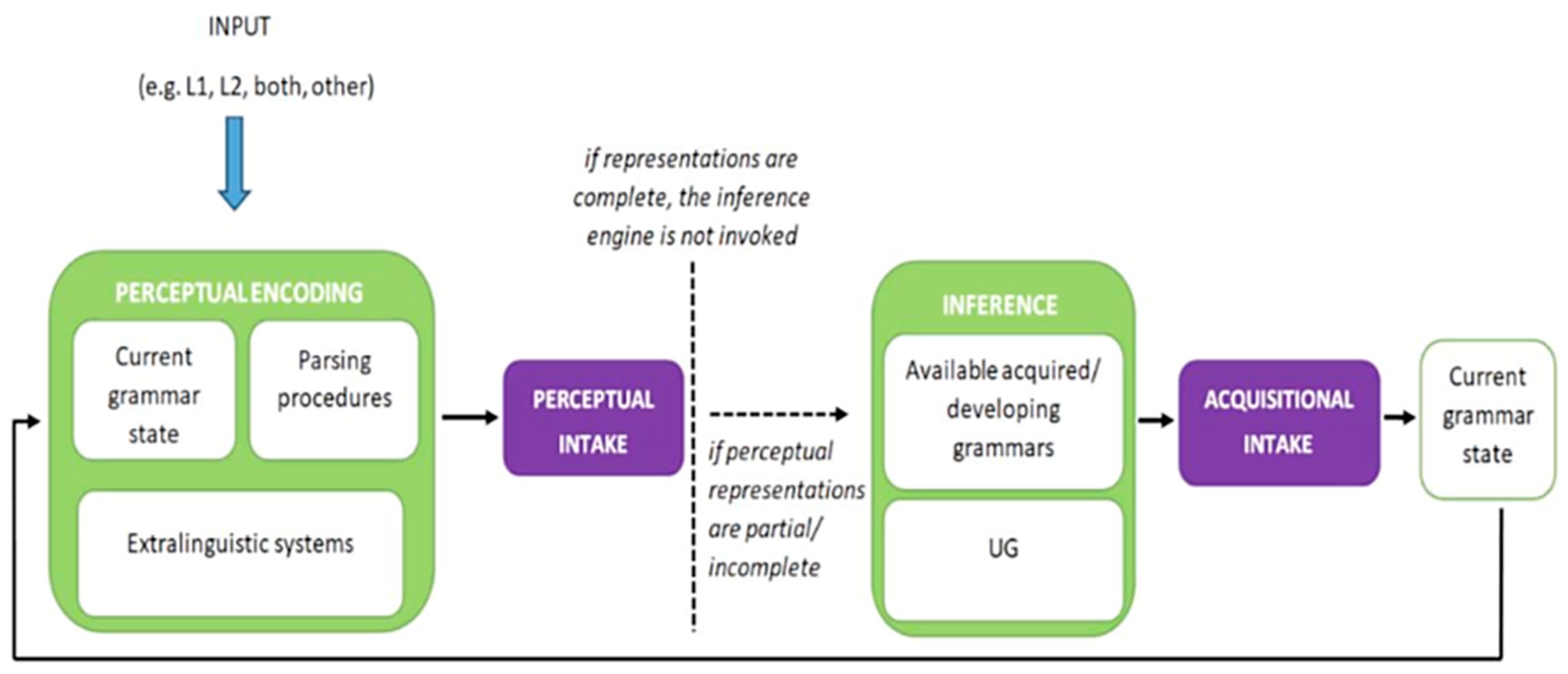
- What are the implications of the answers to the questions posed in (1) and (2) for attempts to comprehensively model grammatical attrition across a range of input contexts? How can insights from both psycholinguistic and sociolinguistic research inform current models of grammatical attrition?
2. Background
2.1. Bilingual and Bidialectal Grammatical Attrition—A Psycholinguistic Perspective
2.2. Bidialectal Accommodation and Attrition—A Variationist Sociolinguistic Perspective
2.3. Summary: Uniting the Perspectives
3. Bidialectal Grammatical Attrition—Key Studies
3.1. L1 Attrition Studies
3.1.1. Domínguez (2013) and Domínguez and Hicks (2016)
3.1.2. Castro et al. (2017, 2020)
3.1.3. Jamieson et al. (2024)
3.2. Variationist Studies
3.2.1. Bortoni-Ricardo (1985)
3.2.2. Ivars (1994)
3.2.3. Kerswill (1994)
3.2.4. Omdal (1994)
3.2.5. The Otheguy-Zentella Corpus of Spanish in NYC
3.3. Summary: Bidialectal Attrition Studies
4. Discussion: Major Questions in the Study of Bidialectal Attrition
- (1)
- What can bidialectal attrition tell us about the role of cross-linguistic similarity in grammatical attrition? Specifically, to what extent does similarity on multiple linguistic levels (i.e., phonetic, phonological, lexical, semantic, and morphosyntactic) facilitate grammatical attrition? How does this similarity modulate the perceptual encoding of input to intake?
- (2)
- What can bidialectal attrition tell us about the underlying structure of multilingual and multilectal speakers’ attrited grammars? Can an L1b variety or closely related L2 modify an existing L1(a) grammar directly, or is it first acquired as part of a separate grammar?
- (3)
- What are the implications of the answers to the questions posed in (1) and (2) for attempts to comprehensively model grammatical attrition across a range of input contexts? How can insights from both psycholinguistic and sociolinguistic research inform current models of grammatical attrition?
4.1. The Role of Cross-Linguistic Similarity in Grammatical Attrition
4.1.1. Cross-Linguistic Similarity as a Facilitator
4.1.2. Cross-Linguistic Similarity as an Inhibitor
4.1.3. Cross-Linguistic Similarity: Evidence from Bidialectal Attrition Studies
4.2. The Structure of Attrited Grammars
4.2.1. Competing Perspectives on Multilingual and Multilectal Grammars and the Need for Evidence
4.2.2. Dialect Modes and ‘Segregation of Variants’: Evidence from Bidialectal Attrition Studies
4.2.3. Developmental Trajectories: Evidence from Bidialectal Attrition Studies
4.3. Modelling Bidialectal and Bilingual Grammatical Attrition
4.3.1. Cross-Linguistic Similarity: Implications for Perceptual Intake and Activation
4.3.2. Modelling Bidialectal Attrition: Direct Update of an L1a, or Initial Acquisition of an L1b?
4.3.3. Summary: Key Questions
4.4. Methodological Considerations and Future Directions
5. Conclusions
Author Contributions
Funding
Institutional Review Board Statement
Informed Consent Statement
Data Availability Statement
Conflicts of Interest
| 1 | The assumption that mature L1 grammatical representations are vulnerable to change is by no means uncontroversial. Space restrictions prevent elaboration of this debate here, but see Baker (2024) and Smeets (2026) for recent discussions and arguments in support of representational change in mature L1 grammars. |
| 2 | Note that the term ‘attrition’ is sometimes used in the sociolinguistic literature. However, in this context, the term refers to (community) dialect death and inter-generational erosion of traditional dialect features (e.g., Britain, 2009, p. 128). We do not discuss this change in this paper. |
| 3 | |
| 4 | For a recent overview of psycholinguistic approaches to L1 attrition in adulthood, see Schmid et al. (2023). |
| 5 | In the context of the AvA model, we are referring to features in the Minimalist sense (i.e., syntactic ‘building blocks’) as opposed to how we use ‘feature’ elsewhere in this paper to describe a linguistic property, structure or characteristic. |
| 6 | Pereira (2025) and Pereira et al. (2026) are recent studies that investigate the same grammatical properties and bidialectals (Brazilian Portuguese–European Portuguese bidialectals) as Castro et al. (2017, 2020), which we discuss in Section 3.1.2, though in a wider range of discourse and syntactic contexts. Due to space constraints, we do not discuss these studies here. For an extensive overview of long-term accommodation studies across age groups, social groups, and linguistic domains, in a variety of dialect combinations, see Siegel (2010). |
| 7 | |
| 8 | There are four speakers who use almost entirely L1b features (only 0.9–2.2% Strilelandet features). However, all four of these speakers moved to Bergen before the age of 16, and so we set them aside here. |
| 9 | The remainder had migrated as children or were born and raised second-generation migrants. We do not discuss the results of this group here. |
| 10 | In response to an anonymous reviewer’s comment, we note here that regardless of whether variation is understood as multiple (sub)grammars or as variation within a single grammar, coactivation of variants is expected. In the case of multiple grammars, this is coactivation across different, yet interconnected grammars; in the case of a single grammar, this is coactivation of competing variants within a single grammar. |
| 11 | This can be contrasted with code-switching, where, though there is language mixing, the L1 and L2 forms are used in accordance with the syntactic rules of the language to which they belong (e.g., MacSwan, 2013). |
References
- Adger, D., & Smith, J. (2010). Variation in agreement: A lexical feature-based approach. Lingua, 120(5), 1109–1134. [Google Scholar] [CrossRef] [Scilit]
- Altenberg, E. (1991). Assessing first language vulnerability to attrition. In H. Seeliger, & R. Vago (Eds.), First language attrition (pp. 189–206). Cambridge University Press. [Google Scholar]
- Amaral, L., & Roeper, T. (2014). Multiple grammars and second language representation. Second Language Research, 30(1), 3–36. [Google Scholar] [CrossRef] [Scilit]
- Auer, P., & Hinskens, F. (2005). The role of interpersonal accommodation in a theory of language change. In P. Auer, F. Hinskens, & P. Kerswill (Eds.), Dialect change: Convergence and divergence in European languages (pp. 335–357). Cambridge University Press. [Google Scholar]
- Baker, L. (2024). The role of linguistic input in adult grammars: Modelling L1 morphosyntactic attrition [Ph.D. thesis, University of Southampton]. [Google Scholar]
- Beaman, K. (2021). Identity and mobility in linguistic change across the lifespan: The case of Swabian German. In A. Ziegler, S. Edler, & G. Oberdorfer (Eds.), Urban matters: Current approaches in variationist sociolinguistics (pp. 27–60). John Benjamins. [Google Scholar]
- Beebe, L., & Giles, H. (1984). Speech-accommodation theories: A discussion in terms of second-language acquisition. International Journal of the Sociology of Language, 46, 5–32. [Google Scholar]
- Bickerton, D. (1975). Dynamics of a creole system. Cambridge University Press. [Google Scholar]
- Borer, H. (1984). Parametric syntax: Case studies in Semitic and Romance languages. Foris. [Google Scholar]
- Bortoni-Ricardo, S. (1985). The urbanization of rural dialect speakers: A sociolinguistic study in Brazil. Cambridge University Press. [Google Scholar]
- Britain, D. (2009). One foot in the grave? Dialect death, dialect contact and dialect birth in England. International Journal of the Sociology of Language, 196/197, 121–155. [Google Scholar] [CrossRef] [Scilit]
- Byland, E. (2009). Maturational constraints and first language attrition. Language Learning, 59(3), 687–716. [Google Scholar] [CrossRef] [Scilit]
- Carroll, S. (1999). Putting ‘input’ in its proper place. Second Language Research, 15(4), 337–388. [Google Scholar] [CrossRef] [Scilit]
- Carroll, S. (2001). Input and evidence: The raw material of second language acquisition. John Benjamins. [Google Scholar]
- Castro, T., Rothman, J., & Westergaard, M. (2017). Comparing anaphora resolution in early and late Brazilian Portuguese-European Portuguese bidialectal bilinguals. Revista Española de Lingüística Aplicada/Spanish Journal of Applied Linguistics, 29(2), 429–461. [Google Scholar]
- Castro, T., Rothman, J., & Westergaard, M. (2020). Syntactic contrasts in early and late Brazilian Portuguese-European Portuguese bidialectal bilinguals: Data from production. In K. Molsing, C. Becker Lopes Perna, & A. Tramunt Ibaños (Eds.), Issues in Hispanic and Lusophone linguistics (pp. 35–59). John Benjamins. [Google Scholar]
- Cedergren, H., & Sankoff, D. (1974). Variable rules: Performance as a statistical reflection of competence. Language, 50(2), 333–355. [Google Scholar] [CrossRef] [Scilit]
- Chambers, J. K. (1992). Dialect acquisition. Language, 68(4), 673–705. [Google Scholar] [CrossRef] [Scilit]
- Chevrot, J. P., & Ghimenton, A. (2018). Bilingualism and bidialectalism. In A. De Houwer, & L. Ortega (Eds.), The Cambridge handbook of bilingualism (pp. 510–523). Cambridge University Press. [Google Scholar]
- Chomsky, N. (1995). The minimalist program. MIT Press. [Google Scholar]
- Chomsky, N. (2001). Derivation by phase. In M. Kenstowicz (Ed.), Ken Hale: A life in language (pp. 1–51). MIT Press. [Google Scholar]
- Corder, S. (1967). The significance of learner’s errors. IRAL: International Review of Applied Linguistics in Language Teaching, 5(4), 161–170. [Google Scholar] [CrossRef] [Scilit]
- Cornips, L., & Poletto, C. (2005). On standardizing syntactic elicitation techniques. Lingua, 115(7), 939–957. [Google Scholar] [CrossRef] [Scilit]
- Domínguez, L. (2013). Understanding interfaces: Second language acquisition and first language attrition of Spanish subject realisation and word order variation. John Benjamins. [Google Scholar]
- Domínguez, L., Arche, M., & Myles, F. (2011). Testing the predictions of the feature assembly hypothesis: Evidence from the L2 acquisition of Spanish aspect morphology. In N. Danis, K. Mesh, & H. Sung (Eds.), BUCLD 35: Proceedings of the 35th annual Boston University conference on language development (pp. 183–196). Cascadilla Press. [Google Scholar]
- Domínguez, L., & Hicks, G. (2016). Synchronic change in a multidialectal community: Evidence from Spanish null and postverbal subjects. In A. Cuza, L. Czerwionka, & D. Olson (Eds.), Inquiries in Hispanic linguistics: From theory to empirical evidence (pp. 53–72). John Benjamins. [Google Scholar]
- Eide, K., & Åfarli, T. (2020). Dialects, registers and intraindividual variation: Outside the scope of generative frameworks? Nordic Journal of Linguistics, 43(3), 233–248. [Google Scholar] [CrossRef] [Scilit]
- Erker, D. (2025). On the (non-)uniformity of contact outcomes: A comparison of Spanish in New York City and Boston. In V. Fernández-Mallat, & J. Nycz (Eds.), Dialect contact: From speaker to community-based perspectives (pp. 137–160). John Benjamins. [Google Scholar]
- Erker, D., & Otheguy, R. (2016). Contact and coherence: Dialectal leveling and structural convergence in NYC Spanish. Lingua, 172/173, 131–146. [Google Scholar] [CrossRef] [Scilit]
- Escure, G. (1997). Creole and dialect continua: Standard acquisition processes in Belize and China. John Benjamins. [Google Scholar]
- Fernández-Mallat, V., & Nycz, J. (2025). Dialect contact: From speaker to community-based perspectives. Georgetown University Press. [Google Scholar]
- Gallego, A. (2011). Parameters. In C. Boeckx (Ed.), Oxford handbook of linguistic Minimalism (pp. 523–550). Oxford University Press. [Google Scholar]
- Giles, H., Taylor, D., & Bourhis, R. (1973). Towards a theory of interpersonal accommodation through language: Some Canadian data. Language in Society, 2(2), 177–192. [Google Scholar] [CrossRef] [Scilit]
- Grohmann, K. K., Kambanaros, M., Leivada, E., & Rowe, C. (2016). A developmental approach to diglossia: Bilectalism on a gradient scale of linguality. Poznan Studies in Contemporary Linguistics, 52, 629–662. [Google Scholar] [CrossRef] [Scilit]
- Grosjean, F. (1998). Studying bilinguals: Methodological and conceptual issues. Bilingualism: Language and Cognition, 1(2), 131–149. [Google Scholar] [CrossRef] [Scilit]
- Gürel, A. (2004a). Selectivity in L2 induced attrition: A psycholinguistic account. Journal of Neurolinguistics, 17(1), 53–78. [Google Scholar] [CrossRef] [Scilit]
- Gürel, A. (2004b). Attrition in L1 competence: The case of Turkish. In M. S. Schmid, M. Keijzer, & L. Weilemar (Eds.), First language attrition: Interdisciplinary perspectives on methodological issues (pp. 225–242). John Benjamins. [Google Scholar]
- Gürel, A. (2008). Research on first language attrition of morphosyntax in adult bilinguals. Second Language Research, 24(3), 431–449. [Google Scholar] [CrossRef] [Scilit]
- Gürel, A., & Yılmaz, G. (2011). Restructuring in the L1 Turkish grammar: Effects of L2 English and L2 Dutch. Language, Interaction and Acquisition, 22(2), 221–250. [Google Scholar] [CrossRef] [Scilit]
- Hazen, K. (2001). An introductory investigation into bidialectalism. University of Pennsylvania Working Papers in Linguistics, 7(3), 85–99. [Google Scholar]
- Haznedar, B., & Schwartz, B. (1997). Are there optional infinitives in child L2 acquisition? In E. Hughes, M. Hughes, & A. Greenhill (Eds.), Proceedings of the 21st annual Boston University conference on language development (pp. 257–268). Cascadilla Press. [Google Scholar]
- Henry, A. (1995). Belfast English and standard English: Dialect variation and parameter setting. Oxford University Press. [Google Scholar]
- Hicks, G., & Domínguez, L. (2020a). A model for L1 grammatical attrition. Second Language Research, 36(2), 143–165. [Google Scholar] [CrossRef] [Scilit]
- Hicks, G., & Domínguez, L. (2020b). Modelling L1 grammatical attrition through language acquisition: A reply to comments. Second Language Research, 36(2), 231–239. [Google Scholar] [CrossRef] [Scilit]
- Hinskens, F., Auer, P., & Kerswill, P. (2005). Dialect change: Convergence and divergence in European languages. Cambridge University Press. [Google Scholar]
- Hirano, K. (2025). A directional shift in linguistic change: A longitudinal study on English-speaking expatriates in Japan. In S. Wagner, & U. Stange-Hundsdörfer (Eds.), (Dia)Lects in the 21st century (pp. 107–121). Language Science Press. [Google Scholar]
- Ivars, A. M. (1994). Bidialectalism and identity. In B. Nordberg (Ed.), The sociolinguistics of urbanization: The case of the Nordic countries (pp. 203–222). Walter de Grutyer. [Google Scholar]
- Iverson, M. (2012). Advanced language attrition of Spanish in contact with Brazilian Portuguese [PhD thesis, University of Iowa]. [Google Scholar]
- Iverson, M. (2020). Unbridled attrition? Second Language Research, 36(2), 183–186. [Google Scholar]
- Iverson, M., & Miller, M. (2017). Language attrition and maintenance Two sides of the same coin? Linguistic Approaches to Bilingualism, 7(6), 704–708. [Google Scholar] [CrossRef] [Scilit]
- Jamieson, E., Hicks, G., Domínguez, L., & Schmid, M. (2024). Accommodation, acquisition, attrition? The (un)changing grammars of standard Southern British English speakers in Belfast [Under review]. Available online: https://lingbuzz.net/lingbuzz/010072 (accessed on 1 June 2025).
- Kerswill, P. (1994). Dialects converging: Rural speech in urban Norway. Clarendon. [Google Scholar]
- Kerswill, P., & Williams, A. (2000). Creating a new town koiné: Children and language change in Milton Keynes. Language in Society, 29(1), 65–115. [Google Scholar] [CrossRef] [Scilit]
- Kerswill, P., & Williams, A. (2002). ‘Salience’ as an explanatory factor in language change: Evidence from dialect levelling in urban England. In M. Jones, E. Esch, & V. Herman (Eds.), Language change: The interplay of internal, external and extra-linguistic factors (pp. 81–110). Mouton de Grutyer. [Google Scholar]
- Kirk, N., Declerck, M., Kemp, R., & Kempe, V. (2022). Language control in regional dialect speakers—Monolingual by name, bilingual by nature? Bilingualism: Language and Cognition, 25, 511–520. [Google Scholar]
- Kirk, N., Kempe, V., Scott-Brown, K. C., Philipp, A., & Declerck, M. (2018). Can monolinguals be like bilinguals? Evidence from dialect switching. Cognition, 170, 164–178. [Google Scholar] [CrossRef] [Scilit] [PubMed]
- Köpke, B. (2007). Language attrition at the crossroads of brain, mind, and society. In B. Köpke, M. S. Schmid, M. Keijzer, & S. Dostert (Eds.), Language attrition: Theoretical perspectives (pp. 9–37). John Benjamins. [Google Scholar]
- Kroch, A. (1989). Reflexes of grammar in patterns of language change. Language Variation and Change, 1, 199–244. [Google Scholar] [CrossRef] [Scilit]
- Kubota, M., González Alonso, J., Anderssen, M., Jensen, I., Luque, A., Pereira Soares, S., Prystauka, Y., Vangsnes, O., Sandstedt, J., & Rothman, J. (2024). Bilectal exposure modulates neural signatures to conflicting grammatical properties: Norway as a natural laboratory. Language Learning, 74(2), 436–467. [Google Scholar]
- Labov, W. (1969). Contraction, deletion and inherent variabilty of the English copula. Language, 45(4), 715–762. [Google Scholar] [CrossRef] [Scilit]
- Labov, W. (1998). Co-existent systems in African-American vernacular English. In S. Mufwene, J. Rickford, G. Bailey, & J. Baugh (Eds.), African-American English: Structure, history and use (pp. 85–109). Routledge. [Google Scholar]
- Lardiere, D. (2009). Some thoughts on the contrastive analysis of features in second language acquisition. Second Language Research, 25(2), 173–227. [Google Scholar] [CrossRef] [Scilit]
- Lidz, J., & Gagliardi, A. (2015). How nature meets nurture: Universal Grammar and statistical learning. Annual Review of Linguistics, 1, 333–353. [Google Scholar] [CrossRef] [Scilit]
- Livert, D., & Otheguy, R. (2010). A multilevel statistical analysis of changes in language use among first-generation immigrants in a bilingual setting. International Journal of the Sociology of Language, 203, 83–99. [Google Scholar] [CrossRef] [Scilit]
- Lundquist, B., & Vangsnes, O. (2018). Language separation in bidialectal speakers: Evidence from eye tracking. Frontiers in Psychology, 9, 1394. [Google Scholar] [CrossRef] [Scilit] [PubMed]
- Lundquist, B., Westendorp, M., & Strand, B. M. (2020). Code-switching alone cannot explain intraspeaker syntactic variability: Evidence from a spoken elicitation experiment. Nordic Journal of Linguistics, 43(3), 249–287. [Google Scholar] [CrossRef] [Scilit]
- MacSwan, J. (2013). Code switching and linguistic theory. In T. Bhatia, & W. Ritchie (Eds.), Handbook of bilingualism and multilingualism (2nd ed., pp. 223–350). Blackwell. [Google Scholar]
- McCloskey, J. (2006). Questions and questioning in a local English. In R. Zanuttini, H. Campos, E. Herburger, & P. Portner (Eds.), Crosslinguistic research in syntax and semantics: Negation, tense and clausal architecture (pp. 87–126). Georgetown University Press. [Google Scholar]
- Melinger, A. (2018). Distinguishing languages from dialects. Cognition, 172, 73–88. [Google Scholar] [CrossRef] [Scilit] [PubMed]
- Nagy, N. (2017). The relevance of first language attrition to sociolinguistics, and vice versa. Linguistic Approaches to Bilingualism, 7(6), 744–749. [Google Scholar] [CrossRef] [Scilit]
- Nevins, A., & Parrott, J. (2010). Variable rules meet Impoverishment theory: Patterns of agreement levelling in English varieties. Lingua, 120, 1135–1159. [Google Scholar] [CrossRef] [Scilit]
- Omdal, H. (1994). From the valley to the city: Language modification and language attitudes. In B. Nordberg (Ed.), The sociolinguistics of urbanization: The case of the Nordic countries (pp. 116–148). Walter de Grutyer. [Google Scholar]
- Otheguy, R., & Zentella, A. (2012). Spanish in New York: Language contact, dialectal leveling, and structural continuity. Oxford University Press. [Google Scholar]
- Otheguy, R., Zentella, A., & Livert, D. (2007). Language and dialect contact in Spanish in New York: Toward the formation of a speech community. Language, 83(4), 770–802. [Google Scholar] [CrossRef] [Scilit]
- Paradis, M. (2000). An integrated neurolinguistic theory of bilingualism. LACUS, 27, 5–15. [Google Scholar]
- Paradis, M. (2007). L1 attrition features predicted by a neurolinguistic theory of bilingualism. In B. Köpke, M. S. Schmid, M. Keijzer, & S. Dostert (Eds.), Language attrition: Theoretical perspectives (pp. 121–133). John Benjamins. [Google Scholar]
- Pereira, R. (2025). Aquisição de segundo dialeto e erosão linguística: Os pronomes objeto nas gramáticas dos imigrantes adultos nativos do português brasileiro em Portugal [Second dialect acquisition and linguistic attrition: The object pronouns in the grammar of native Brazilian Portuguese adult immigrants in Portugal] [Unpublished Ph.D. dissertation]. Department of Linguistics, NOVA University of Lisbon.
- Pereira, R., Rosa, C., & Silva, M. (2026). Tracking pragmatic contexts of pronominal subjects: Acquisition and attrition in Brazilian–European Portuguese late-sequential bidialectals. Languages, 11(4), 72. [Google Scholar] [CrossRef] [Scilit]
- Polinsky, M. (2025). Multiple grammars within linguistic populations: Distributions and theoretical implications. Linguistic Approaches to Bilingualism, 16, 101–128. [Google Scholar] [CrossRef] [Scilit]
- Prévost, P., & White, L. (2000). Missing surface inflection or impairment in second language? Evidence from tense and agreement. Second Language Research, 16(2), 103–133. [Google Scholar] [CrossRef] [Scilit]
- Roeper, T. (1999). Universal bilingualism. Bilingualism, Language and Cognition, 2, 169–186. [Google Scholar] [CrossRef] [Scilit]
- Sandstedt, J., Kubota, M., Anderssen, M., Derby, J., Helset, S., Tavakoli, E., Vangsnes, O., & Rothman, J. (2025). Bidialectal language representation and processing: Evidence from Norwegian ERPs. Journal of Memory and Language, 140, 104557. [Google Scholar] [CrossRef] [Scilit]
- Schmid, M. S. (2019). The impact of frequency of use and length of residence on L1 attrition. In M. S. Schmid, & B. Köpke (Eds.), The Oxford handbook of language attrition (pp. 288–303). Oxford University Press. [Google Scholar]
- Schmid, M. S., & Cherciov, M. (2019). Introduction to extralinguistic factors in language attrition. In M. S. Schmid, & B. Köpke (Eds.), The Oxford handbook of language attrition (pp. 505–522). Oxford University Press. [Google Scholar]
- Schmid, M. S., & De Leeuw, E. (2019). Introduction to linguistic factors in language acquisition. In M. S. Schmid, & B. Köpke (Eds.), The Oxford handbook of language attrition (pp. 181–190). Oxford University Press. [Google Scholar]
- Schmid, M. S., & Köpke, B. (2017). The relevance of first language attrition to theories of bilingual development. Linguistic Approaches to Bilingualism, 7(6), 637–667. [Google Scholar] [CrossRef] [Scilit]
- Schmid, M. S., & Köpke, B. (2019). The Oxford handbook of language attrition. Oxford University Press. [Google Scholar]
- Schmid, M. S., Soto, C., & Heimann, J. (2023). The psycholinguistics of first language attrition. In A. Godfroid, & H. Hopp (Eds.), The Routledge handbook of second language acquisition and psycholinguistics (pp. 61–72). Routledge. [Google Scholar]
- Schmidt, R. (1990). The role of consciousness in second language learning. Applied Linguistics, 11(2), 129–158. [Google Scholar] [CrossRef] [Scilit]
- Sharma, D. (2011). Style repertoire and social change in British Asian English. Journal of Sociolinguistics, 15(4), 464–492. [Google Scholar] [CrossRef] [Scilit]
- Sharwood-Smith, M. (1983). On first language loss in the second language acquirer: Problems of transfer. In S. Gass, & L. Selinker (Eds.), Language transfer in language learning (pp. 222–231). Newbury House. [Google Scholar]
- Sharwood-Smith, M. (1989). Crosslinguistic influence in language loss. In K. Hyltenstam, & L. Obler (Eds.), Bilingualism across the lifespan (pp. 185–201). Cambridge University Press. [Google Scholar]
- Shin, N., & Otheguy, R. (2013). Social class and gender impacting change in bilingual settings: Spanish subject pronoun use in New York. Language in Society, 42(4), 429–452. [Google Scholar] [CrossRef] [Scilit]
- Siegel, J. (2010). Second dialect acquisition. Cambridge University Press. [Google Scholar]
- Smeets, L. (2024). L1 grammatical attrition through the acquisition of competing L2 discourse features. Frontiers in Psychology, 15, 1399870. [Google Scholar] [CrossRef] [Scilit]
- Smeets, L. (2026). Using L2 properties in native grammars: What constitutes as evidence for representational change? Languages, 11(5), 96. [Google Scholar] [CrossRef] [Scilit]
- Smith, J. (2021). Child language acquisition and sociolinguistic variation. In A. Ghimenton, A. Nardy, & J. P. Chevrot (Eds.), Sociolinguistic variation and language acquisition across the lifespan (pp. 12–19). John Benjamins. [Google Scholar]
- Smith, J., & Durham, M. (2012). Bidialectalism or dialect death: Explaining generation change in the Shetland Islands, Scotland. American Speech, 87(1), 57–88. [Google Scholar] [CrossRef] [Scilit]
- Tortora, C., & den Dikken, M. (2010). Subject agreement variation: Support for the configurational approach. Lingua, 120, 1089–1108. [Google Scholar] [CrossRef] [Scilit]
- Trudgill, P. (1986). Dialects in contact. Blackwell. [Google Scholar]
- Tsimpli, I. (2017). Crosslinguistic influence is not necessarily attrition. Linguistic Approaches to Bilingualism, 7(6), 759–762. [Google Scholar] [CrossRef] [Scilit]
- Vorwerg, C., Suntharam, S., & Morand, M. (2019). Language control and lexical access in diglossic speech production: Evidence from variety switching in speakers of Swiss German. Journal of Memory and Language, 107, 40–53. [Google Scholar] [CrossRef] [Scilit]
- Weener, P. (1969). Social dialect differences and the recall of verbal messages. Journal of Educational Psychology, 60(3), 194–199. [Google Scholar] [CrossRef] [Scilit]
- Yang, C. (2002). Knowledge and learning in natural language. Oxford University Press. [Google Scholar]
- Zingaretti, M., Chondrogianni, V., Ladd, D. R., & Sorace, A. (2025). L1 Attrition vis-à-vis L2 Acquisition: Lexicon, Syntax–Pragmatics Interface, and Prosody in L1-English L2-Italian Late Bilinguals. Languages, 10(9), 224. [Google Scholar] [CrossRef] [Scilit]

Disclaimer/Publisher’s Note: The statements, opinions and data contained in all publications are solely those of the individual author(s) and contributor(s) and not of MDPI and/or the editor(s). MDPI and/or the editor(s) disclaim responsibility for any injury to people or property resulting from any ideas, methods, instructions or products referred to in the content. |
© 2026 by the authors. Licensee MDPI, Basel, Switzerland. This article is an open access article distributed under the terms and conditions of the Creative Commons Attribution (CC BY) license.
Share and Cite
Baker, L.; Jamieson, E. How Studying Varied Input Contexts Can Further Our Understanding of L1 Grammatical Attrition: Insights from Studies of Bidialectal Speakers. Languages 2026, 11, 147. https://doi.org/10.3390/languages11070147
Baker L, Jamieson E. How Studying Varied Input Contexts Can Further Our Understanding of L1 Grammatical Attrition: Insights from Studies of Bidialectal Speakers. Languages. 2026; 11(7):147. https://doi.org/10.3390/languages11070147
Chicago/Turabian StyleBaker, Lewis, and E Jamieson. 2026. "How Studying Varied Input Contexts Can Further Our Understanding of L1 Grammatical Attrition: Insights from Studies of Bidialectal Speakers" Languages 11, no. 7: 147. https://doi.org/10.3390/languages11070147
APA StyleBaker, L., & Jamieson, E. (2026). How Studying Varied Input Contexts Can Further Our Understanding of L1 Grammatical Attrition: Insights from Studies of Bidialectal Speakers. Languages, 11(7), 147. https://doi.org/10.3390/languages11070147