
Does Variation in Lexical Sentiment Scores Reflect Emotional Polysemy and Ambivalence?

Abstract
1. Introduction
2. Materials and Methods
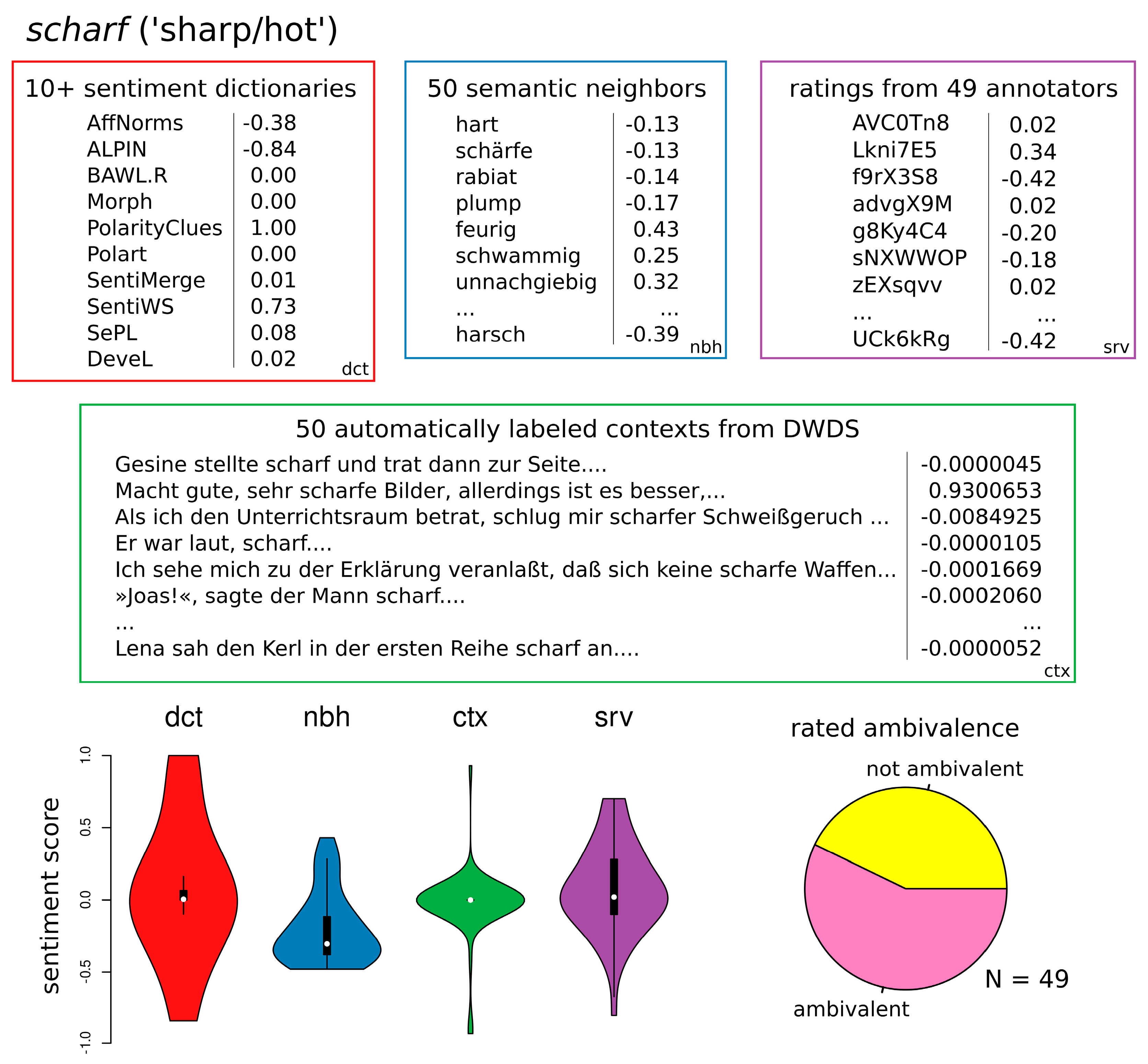
2.1. Dictionary-Based Polysemy and Ambivalence
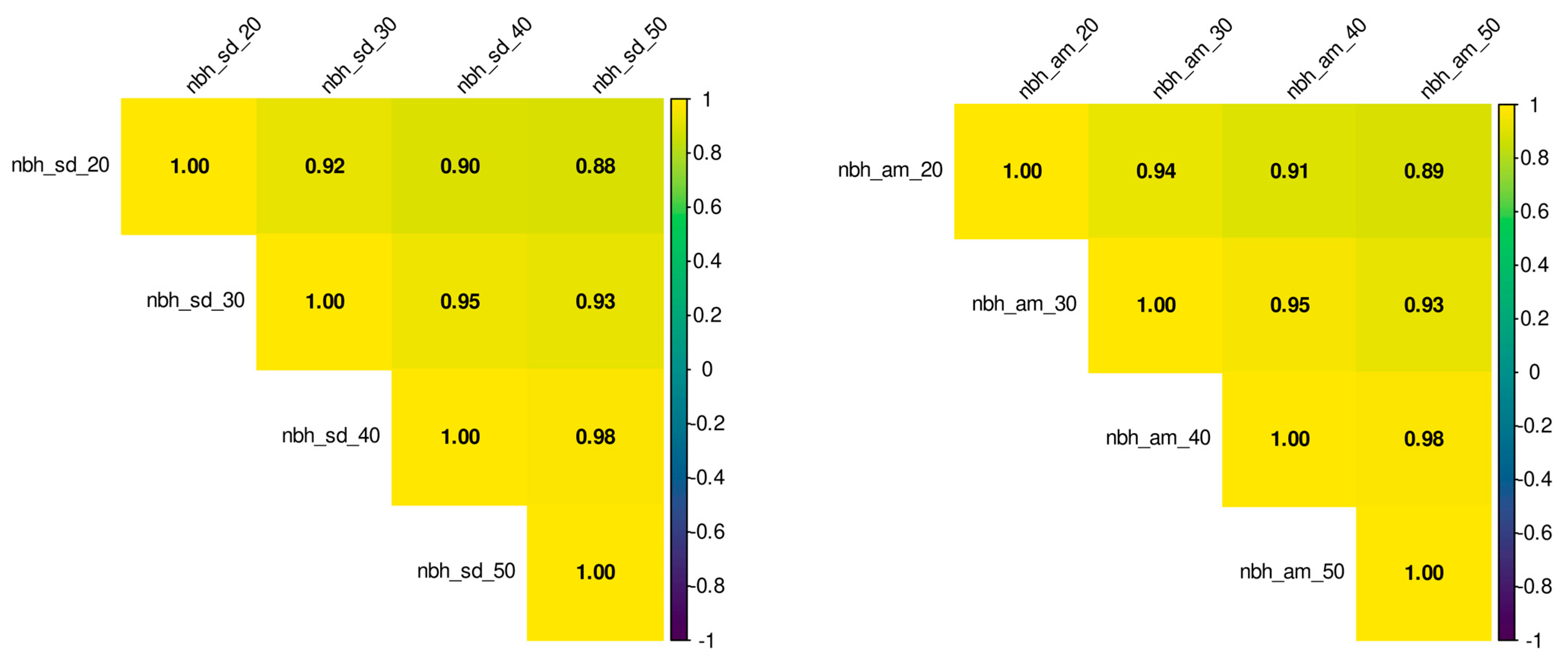
2.2. Neighborhood-Based Polysemy and Ambivalence
2.3. Context-Based Polysemy and Ambivalence
2.4. Survey-Based Polysemy and Ambivalence
2.5. Covariates and Modeling Procedure
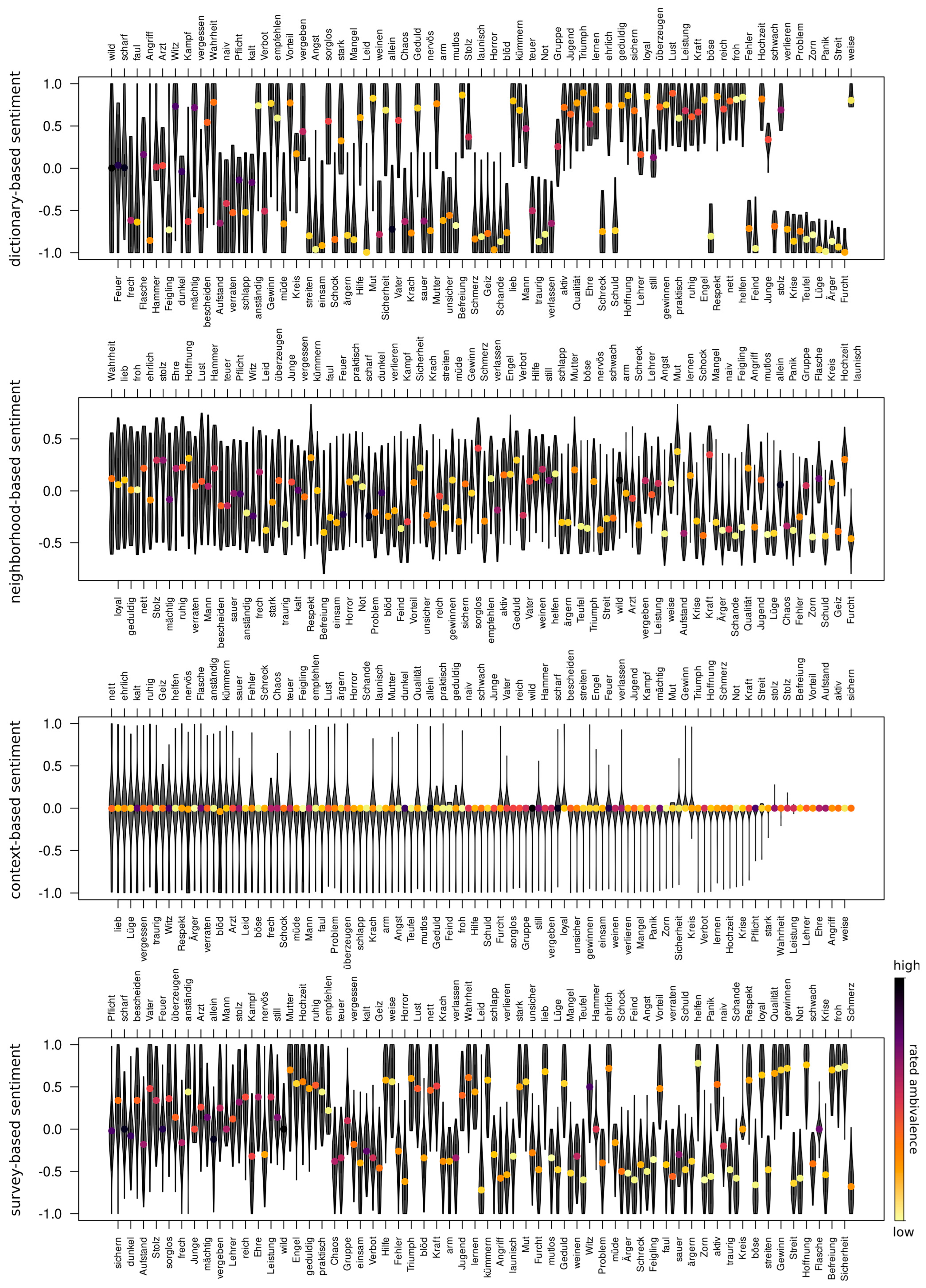
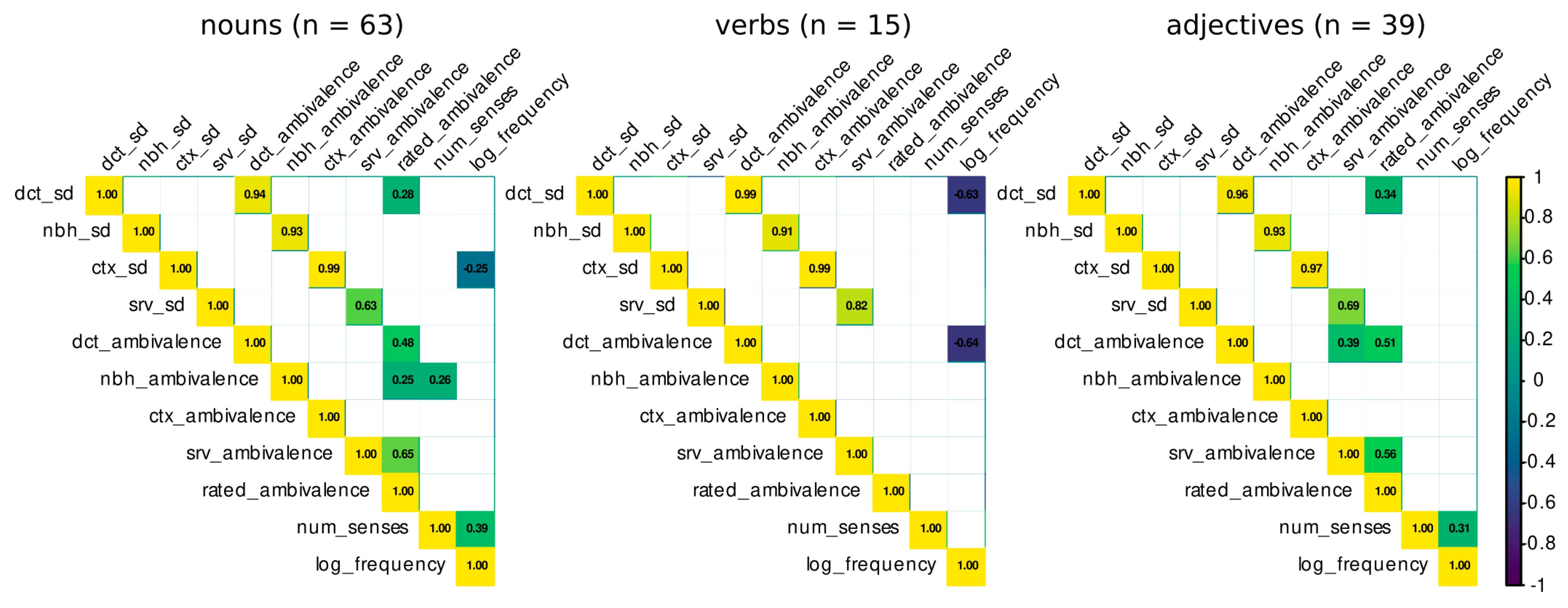
3. Results
4. Discussion
4.1. Emotional Polysemy and Ambivalence
4.2. Limitations
5. Conclusions
Supplementary Materials
Funding
Informed Consent Statement
Data Availability Statement
Acknowledgments
Conflicts of Interest
Abbreviations
| DWDS | Digitales Wörterbuch der deutschen Sprache |
| dct | dictionary (cf. Section 2.1) |
| nbh | neighborhood (cf. Section 2.2) |
| ctx | context (cf. Section 2.3) |
| srv | survey (cf. Section 2.4) |
Appendix A

| Method | Median Emotional Polysemy | SE (ME in 95% CI) |
|---|---|---|
| dct | 0.33 | 0.078 (±0.153) |
| nbh | 0.23 | 0.023 (±0.045) |
| ctx | 0.25 | 0.025 (±0.049) |
| srv | 0.29 | 0.030 (±0.059) |


| 1 | Abbreviations of sentiment dictionaries are aligned with Kern et al. (2021). |
| 2 | https://www.dwds.de/d/korpora/kern21 (accessed on 29 April 2026). |
References
- Acerbi, A., Lampos, V., Garnett, P., & Bentley, R. A. (2013). The expression of emotions in 20th century books. PLoS ONE, 8, e59030. [Google Scholar] [CrossRef]
- Almatarneh, S., & Gamallo, P. (2018). Automatic construction of domain-specific sentiment lexicons for polarity classification. In F. De la Prieta, Z. Vale, L. Antunes, T. Pinto, A. T. Campbell, V. Julián, A. J. R. Neves, & M. N. Moreno (Eds.), Trends in cyber-physical multi-agent systems: The PAAMS collection—15th international conference, PAAMS 2017 (pp. 175–182). Springer. [Google Scholar]
- Ambrasat, J., von Scheve, C., Conrad, M., Schauenburg, G., & Schröder, T. (2014). Consensus and stratification in the affective meaning of human sociality. Proceedings of the National Academy of Sciences of the United States of America, 111(22), 8001–8006. [Google Scholar] [CrossRef] [PubMed]
- Bakker, I., van der Voordt, T., Vink, P., & de Boon, J. (2014). Pleasure, arousal, dominance: Mehrabian and Russell revisited. Current Psychology, 33(3), 405–421. [Google Scholar] [CrossRef]
- Blank, A. (1993). Zwei phantome der historischen Semantik: Bedeutungsverbesserung und bedeutungsverschlechterung. Romanistisches Jahrbuch, 44, 57–85. [Google Scholar] [CrossRef]
- Buechel, S., Hellrich, J., & Hahn, U. (2016). Feelings from the past—Adapting affective lexicons for historical emotion analysis. In Proceedings of the workshop on language technology resources and tools for digital humanities (LT4DH) (pp. 54–61). The COLING 2016 Organizing Committee. [Google Scholar]
- Buechel, S., Rücker, S., & Hahn, U. (2020). Learning and evaluating emotion lexicons for 91 languages. In Proceedings of the 58th annual meeting of the association for computational linguistics (pp. 1202–1217). Association for Computational Linguistics (ACL). [Google Scholar]
- Bybee, J. (2006). Frequency of use and the organization of language. Oxford University Press. [Google Scholar]
- Cacioppo, J. T., Berntson, G. G., Norris, C. J., & Gollan, J. K. (2011). The evaluative space model. In P. A. M. Van Lange, A. W. Kruglanski, & E. T. Higgins (Eds.), Handbook of theories of social psychology (Vol. 1). SAGE. [Google Scholar]
- Cook, P., & Stevenson, S. (2010). Automatically identifying changes in the semantic orientation of words. In Proceedings of LREC 2010. European Language Resources Association (ELRA). [Google Scholar]
- Deza, M. M., & Deza, E. (2009). Encyclopedia of distances. Springer. [Google Scholar]
- Divjak, D., & Caldwell-Harris, C. L. (2019). Frequency and entrenchment. In Cognitive linguistics: Foundations of language (pp. 61–86). De Gruyter Mouton. [Google Scholar]
- Emerson, G., & Declerck, T. (2014). Sentimerge: Combining sentiment lexicons in a Bayesian framework. In Proceedings of the workshop on lexical and grammatical resources for language processing (pp. 30–38). Association for Computational Linguistics (ACL). [Google Scholar]
- Fares, M., Kutuzov, A., Oepen, S., & Velldal, E. (2017). Word vectors, reuse, and replicability: Towards a community repository of large-text resources. In Proceedings of the 21st Nordic conference on computational linguistics (pp. 271–276). Association for Computational Linguistics (ACL). [Google Scholar]
- Ferré, P., Fraga, I., & Hinojosa, J. A. (2025). The interplay between language and emotion: Introduction to the special issue. Cognition and Emotion, 39(7), 1405–1417. [Google Scholar] [CrossRef]
- Geeraerts, D. (2005). Lectal variation and empirical data in cognitive linguistics. In Cognitive linguistics: Internal dynamics and interdisciplinary interaction (Vol. 32, pp. 163–189). De Gruyter Mouton. [Google Scholar]
- Guhr, O., Schumann, A. K., Bahrmann, F., & Böhme, H. J. (2020). Training a broad-coverage German sentiment classification model for dialog systems. In Proceedings of the twelfth language resources and evaluation conference (pp. 1627–1632). European Language Resources Association (ELRA). [Google Scholar]
- Hamilton, W. L., Clark, K., Leskovec, J., & Jurafsky, D. (2016a). Inducing domain-specific sentiment lexicons from unlabeled corpora. In Proceedings of the conference on empirical methods in natural language processing (p. 595). Association for Computational Linguistics (ACL). [Google Scholar] [CrossRef]
- Hamilton, W. L., Leskovec, J., & Jurafsky, D. (2016b). Cultural shift or linguistic drift? comparing two computational measures of semantic change. In Proceedings of the 2016 conference on empirical methods in natural language processing (pp. 2116–2121). Association for Computational Linguistics (ACL). [Google Scholar]
- Hilpert, M. (2019). Historical linguistics. In E. Dąbrowska, & D. Divjak (Eds.), Cognitive linguistics (Chapter 5). De Gruyter. [Google Scholar] [CrossRef]
- Kanske, P., & Kotz, S. A. (2010). Leipzig affective norms for German: A reliability study. Behavior Research Methods, 42(4), 987–991. [Google Scholar] [CrossRef]
- Kauschke, C., Bahn, D., Vesker, M., & Schwarzer, G. (2019). The role of emotional valence for the processing of facial and verbal stimuli: Positivity or negativity bias? Frontiers in Psychology, 10, 1654. [Google Scholar] [CrossRef]
- Keller, R. (1994). On language change: The invisible hand in language. Routledge. [Google Scholar]
- Kern, B. M., Baumann, A., Kolb, T. E., Sekanina, K., Hofmann, K., Wissik, T., & Neidhardt, J. (2021). A review and cluster analysis of German polarity resources for sentiment analysis. In 3rd conference on language, data and knowledge (LDK 2021) (pp. 37:1–37:17). Schloss Dagstuhl–Leibniz-Zentrum für Informatik. [Google Scholar]
- Kiritchenko, S., & Mohammad, S. (2016). Capturing reliable fine-grained sentiment associations by crowdsourcing and best–worst scaling. In Proceedings of NAACL-HLT 2016 (pp. 811–817). Association for Computational Linguistics (ACL). [Google Scholar]
- Kissler, J., & Herbert, C. (2013). Emotion, etmnooi, or emitoon? Faster lexical access to emotional than to neutral words during reading. Biological Psychology, 92(3), 464–479. [Google Scholar] [CrossRef] [PubMed]
- Klenner, M., Fahrni, A., & Petrakis, S. (2009). POLART: A robust tool for sentiment analysis. In Proceedings of the 17th Nordic conference of computational linguistics (NODALIDA 2009) (pp. 235–238). Northern European Association for Language Technology (NEALT). [Google Scholar]
- Klinger, R., Suliya, S. S., & Reiter, N. (2016). Automatic emotion detection for quantitative literary studies: A case study based on Franz Kafka’s Das Schloss and Amerika. In Proceedings of the digital humanities 2016. Alliance of Digital Humanities Organizations (ADHO). [Google Scholar]
- Knupleš, U., Frassinelli, D., & im Walde, S. S. (2023). Investigating the nature of disagreements on mid-scale ratings: A case study on the abstractness-concreteness continuum. In Proceedings of the 27th conference on computational natural language learning (CoNLL) (pp. 70–86). Association for Computational Linguistics (ACL). [Google Scholar]
- Kolb, T., Katharina, S., Kern, B. M. J., Neidhardt, J., Wissik, T., & Baumann, A. (2022). The ALPIN sentiment dictionary: Austrian language polarity in newspapers. In Proceedings of LREC 2022 (pp. 4708–4716). European Language Resources Association (ELRA). [Google Scholar]
- Kousta, S. T., Vinson, D. P., & Vigliocco, G. (2009). Emotion words, regardless of polarity, have a processing advantage over neutral words. Cognition, 112, 473–481. [Google Scholar] [CrossRef] [PubMed]
- Köper, M., & Schulte im Walde, S. (2016). Automatically generated affective norms of abstractness, arousal, imageability and valence for 350,000 German lemmas. In Proceedings of LREC 2016 (pp. 2595–2598). European Language Resources Association (ELRA). [Google Scholar]
- Kuhlmann, M., Hofmann, M. J., & Jacobs, A. M. (2017). If you don’t have valence, ask your neighbor: Evaluation of neutral words as a function of affective semantic associates. Frontiers in Psychology, 8, 343. [Google Scholar] [CrossRef]
- Lahl, O., Göritz, A. S., Pietrowsky, R., & Rosenberg, J. (2009). Using the world-wide web to obtain large-scale word norms: 190,212 ratings on 2654 German nouns. Behavior Research Methods, 41(1), 13–19. [Google Scholar] [CrossRef]
- Li, M., Lu, Q., Long, Y., & Gui, L. (2017). Inferring affective meanings of words from word embedding. IEEE Transactions on Affective Computing, 8(4), 443–456. [Google Scholar] [CrossRef]
- Martínez-Huertas, J. Á., Jorge-Botana, G., Martínez-Mingo, A., Iglesias, D., & Olmos, R. (2025). Are valence and arousal related to the development of amodal representations of words? A computational study. Cognition and Emotion, 39(7), 1465–1473. [Google Scholar] [CrossRef]
- Mikolov, T., Chen, K., Corrado, G., & Dean, J. (2013). Efficient estimation of word representations in vector space. arXiv, arXiv:1301.3781. [Google Scholar] [CrossRef]
- Paisios, D., Huet, N., & Labeye, E. (2023). Addressing the elephant in the middle: Implications of the midscale disagreement problem through the lens of body-object interaction ratings. Collabra: Psychology, 9(1), 84564. [Google Scholar] [CrossRef]
- Plank, B. (2022, December). The “problem” of human label variation: On ground truth in data, modeling and evaluation. In Proceedings of the 2022 conference on empirical methods in natural language processing (pp. 10671–10682). Association for Computational Linguistics (ACL). [Google Scholar]
- Poesio, M., & Artstein, R. (2005). The reliability of anaphoric annotation, reconsidered: Taking ambiguity into account. In Proceedings of the workshop on frontiers in corpus annotations II: Pie in the sky (pp. 76–83). Association for Computational Linguistics (ACL). [Google Scholar]
- Pollock, L. (2018). Statistical and methodological problems with concreteness and other semantic variables: A list memory experiment case study. Behavior Research Methods, 50(3), 1198–1216. [Google Scholar] [CrossRef] [PubMed]
- Ponari, M., Norbury, C. F., & Vigliocco, G. (2018). Acquisition of abstract concepts is influenced by emotional valence. Developmental Science, 21(2), e12549. [Google Scholar] [CrossRef]
- Reijnierse, W. G., Burgers, C., Bolognesi, M., & Krennmayr, T. (2019). How polysemy affects concreteness ratings: The case of metaphor. Cognitive Science, 43(8), e12779. [Google Scholar] [CrossRef]
- Remus, R., Quasthoff, U., & Heyer, G. (2010). SentiWS: A publicly available German-language resource for sentiment analysis. In Proceedings of LREC 2010. European Language Resources Association (ELRA). [Google Scholar]
- Rill, S., Adolph, S., Drescher, J., Reinel, D., Scheidt, J., Schütz, O., Wogenstein, F., Zicari, R. V., & Korfiatis, N. (2012). A phrase-based opinion list for the German language. In Proceedings of KONVENS (pp. 305–313). Österreichische Gesellschaft für Artificial Intelligence (ÖGAI). [Google Scholar]
- Ruette, T., Speelman, D., & Geeraerts, D. (2014). Lexical variation in aggregate perspective. In Pluricentricity: Language variation and sociocognitive dimensions (pp. 103–126). de Gruyter Berlin. [Google Scholar]
- Ruppenhofer, J., Steiner, P., & Wiegand, M. (2017). Evaluating the morphological compositionality of polarity. In Proceedings of the 11th international conference on recent advances in natural language processing, RANLP 2017, Varna, Bulgaria, September 2–8 (pp. 625–633). Incoma Ltd. [Google Scholar]
- Russell, J. A. (1980). A circumplex model of affect. Journal of Personality and Social Psychology, 39(6), 1161–1178. [Google Scholar] [CrossRef]
- Scarantino, A. (2017). How to do things with emotional expressions: The theory of affective pragmatics. Psychological Inquiry, 28(2–3), 165–185. [Google Scholar] [CrossRef]
- Schmid, H. J. (2010). Does frequency in text instantiate entrenchment in the cognitive system? In Quantitative methods in cognitive semantics: Corpus-driven approaches (pp. 101–133). De Gruyter Mouton. [Google Scholar]
- Schmidtke, D. S., Schröder, T., Jacobs, A. M., & Conrad, M. (2014). ANGST: Affective norms for German sentiment terms, derived from the affective norms for English words. Behavior Research Methods, 46(4), 1108–1118. [Google Scholar] [CrossRef]
- Schröder, T. (2011). A model of language-based impression formation and attribution among Germans. Journal of Language and Social Psychology, 30(1), 82–102. [Google Scholar] [CrossRef]
- Schröter, P., & Schroeder, S. (2017). The developmental lexicon project: A behavioral database to investigate visual word recognition across the lifespan. Behavior Research Methods, 49(6), 2183–2203. [Google Scholar] [CrossRef]
- Snefjella, B., & Kuperman, V. (2016). It’s all in the delivery: Effects of context valence, arousal, and concreteness on visual word processing. Cognition, 156, 135–146. [Google Scholar] [CrossRef]
- Taboada, M., Brooke, J., Tofiloski, M., Voll, K., & Stede, M. (2011). Lexicon-based methods for sentiment analysis. Computational Linguistics, 37(2), 267–307. [Google Scholar] [CrossRef]
- Tagliamonte, S. A. (2011). Variationist sociolinguistics: Change, observation, interpretation. Wiley-Blackwell. [Google Scholar]
- Tiessler, M., Motger, Q., Piroi, F., & Baumann, A. (2025). EmoTracker—A framework for modeling and forecasting diachronic emotion dynamics. Anthology of Computers and the Humanities, 3, 795–819. [Google Scholar]
- Uma, A. N., Fornaciari, T., Hovy, D., Paun, S., Plank, B., & Poesio, M. (2021). Learning from disagreement: A survey. Journal of Artificial Intelligence Research, 72, 1385–1470. [Google Scholar] [CrossRef]
- van Atteveldt, W., van der Velden, M. A. C. G., & Boukes, M. (2021). The validity of sentiment analysis: Comparing manual annotation, crowd-coding, dictionary approaches, and machine learning algorithms. Communication Methods and Measures, 15(2), 121–140. [Google Scholar] [CrossRef]
- Võ, M. L. H., Conrad, M., Kuchinke, L., Urton, K., Hofmann, M. J., & Jacobs, A. M. (2009). The Berlin affective word list reloaded (BAWL–R). Behavior Research Methods, 41(2), 534–538. [Google Scholar] [CrossRef]
- Waltinger, U. (2010). German polarity clues: A lexical resource for German sentiment analysis. In Proceedings of LREC 2010 (pp. 1638–1642). European Language Resources Association (ELRA). [Google Scholar]
- Warriner, A. B., Kuperman, V., & Brysbaert, M. (2013). Norms of valence, arousal, and dominance for 13,915 English lemmas. Behavior Research Methods, 45(4), 1191–1207. [Google Scholar] [CrossRef] [PubMed]
- Wielgopolan, A., & Imbir, K. K. (2023). Affective norms for emotional ambiguity in valence, origin, and activation spaces. Behavior Research Methods, 55(3), 1141–1156. [Google Scholar] [CrossRef] [PubMed]
- Zgusta, L. (2010). Manual of lexicography (Vol. 39). De Gruyter. [Google Scholar]



Disclaimer/Publisher’s Note: The statements, opinions and data contained in all publications are solely those of the individual author(s) and contributor(s) and not of MDPI and/or the editor(s). MDPI and/or the editor(s) disclaim responsibility for any injury to people or property resulting from any ideas, methods, instructions or products referred to in the content. |
© 2026 by the author. Licensee MDPI, Basel, Switzerland. This article is an open access article distributed under the terms and conditions of the Creative Commons Attribution (CC BY) license.
Share and Cite
Baumann, A. Does Variation in Lexical Sentiment Scores Reflect Emotional Polysemy and Ambivalence? Languages 2026, 11, 118. https://doi.org/10.3390/languages11060118
Baumann A. Does Variation in Lexical Sentiment Scores Reflect Emotional Polysemy and Ambivalence? Languages. 2026; 11(6):118. https://doi.org/10.3390/languages11060118
Chicago/Turabian StyleBaumann, Andreas. 2026. "Does Variation in Lexical Sentiment Scores Reflect Emotional Polysemy and Ambivalence?" Languages 11, no. 6: 118. https://doi.org/10.3390/languages11060118
APA StyleBaumann, A. (2026). Does Variation in Lexical Sentiment Scores Reflect Emotional Polysemy and Ambivalence? Languages, 11(6), 118. https://doi.org/10.3390/languages11060118