
Effects of Syntactic Structures on Intonational Pitch Movement in Mandarin Chinese

Abstract
1. Introduction
2. Experiment 1: Syntactic Position and Relative Clause Type
2.1. Experimental Design
- (1)
- Subject Position, Subject-Relative Clause (SPSR):
| [qīngxīn | Jīn Xīn]RC | de | Dīng Xīng | gēnzōng | le | Yīnxīn. |
| [adore | (name)] | attributive particle | (name) | track | aspect marker | (name) |
| The Ding Xing who adores Jin Xin tracked Yinxin | ||||||
- (2)
- Subject Position, Object-Relative Clause (SPOR):
| [Jīn Xīn | qīngxīn]RC | de | Dīng Xīng | gēnzōng | le | Yīn Xīn. |
| [(name) | adore] | attributive particle | (name) | track | aspect marker | (name) |
| The Ding Xing whom Jin Xin adores tracked Yin Xin. | ||||||
- (3)
- Object Position, Subject-Relative Clause (OPSR):
| Yīn Xīn | gēnzōng | le | [qīngxīn | Jīn Xīn]RC | de | Dīng Xīng. |
| (name) | track | aspect marker | adore | (name) | attributive particle | (name) |
| Yin Xin tracked the Ding Xing who adores Jin Xin. | ||||||
- (4)
- Object Position, Object-Relative Clause (OPOR):
| Yīn Xīn | gēnzōng | le | [Jīn Xīn | qīngxīn]RC | de | Dīng Xīng. |
| (name) | track | aspect marker | (name) | adore | attributive particle | (name) |
| Yin Xin tracked the Ding Xing whom Jin Xin adores. | ||||||
2.2. Participants and Procedure
2.3. Results
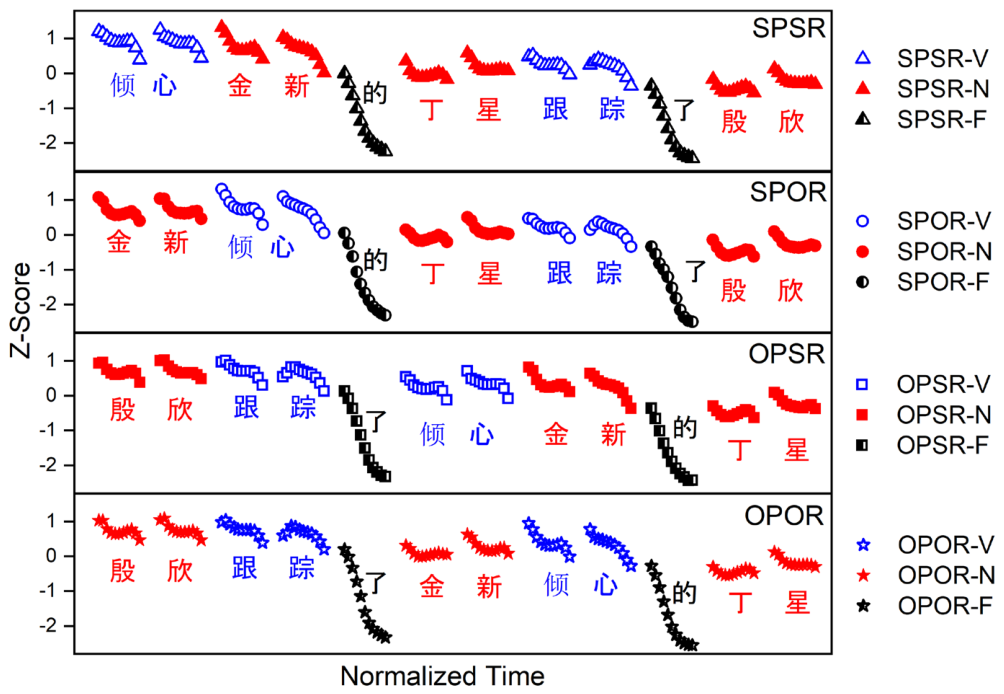
2.3.1. Global Intonational Contours and Declination
2.3.2. Effects of Clause Type and Word Class
- (1)
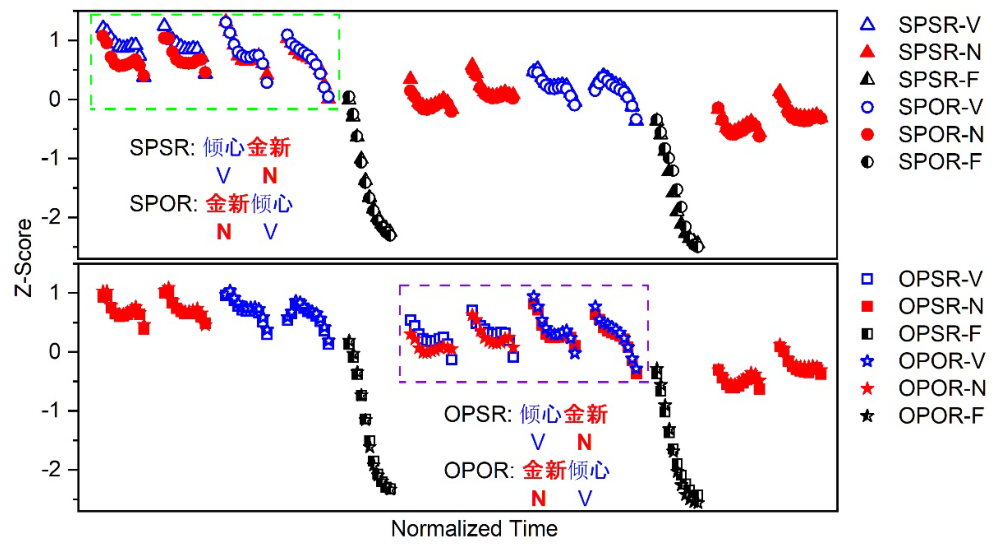
- V-N pitch differential: When comparing nouns and verbs in identical linear positions within the sentence, verbs (V) consistently exhibit higher pitch than nouns (N). This is visually represented by the blue V-curves tracking above the red N-curves in the target regions.
- (2)
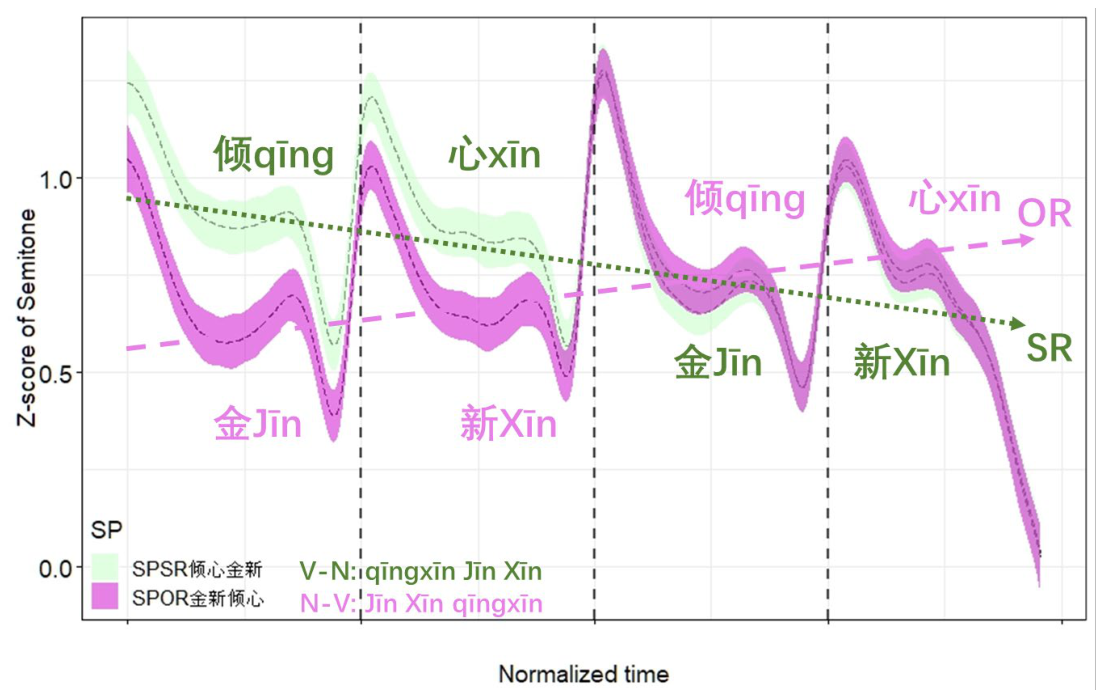
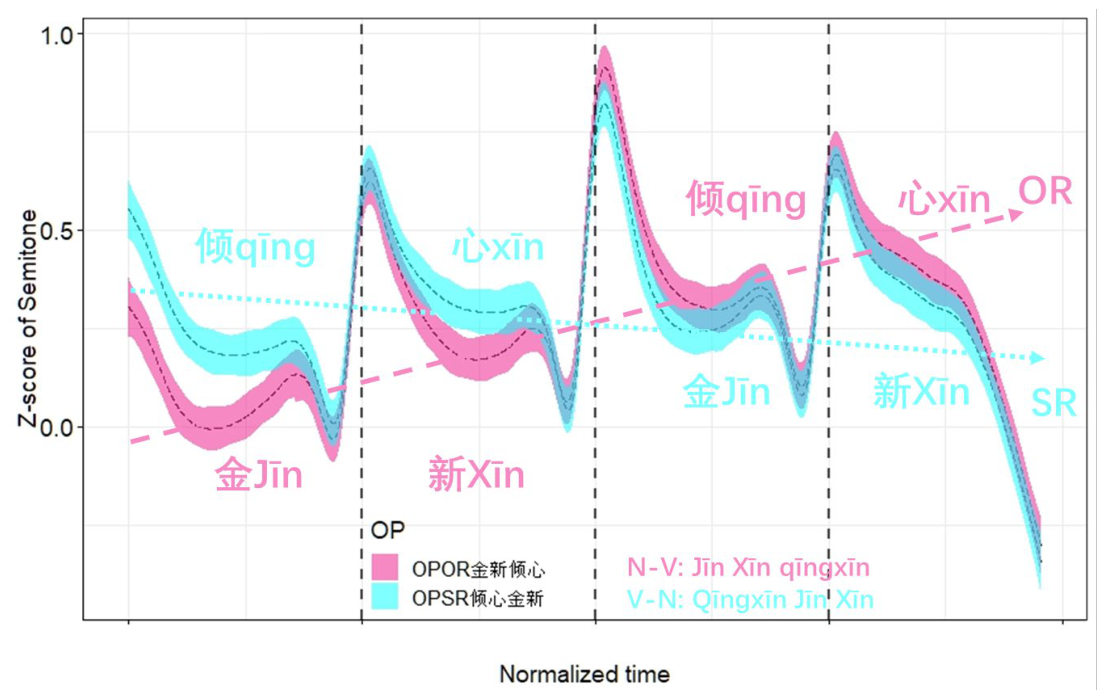
- Structural contours (SR vs. OR): Subject-relative (SR) and object-relative (OR) clauses demonstrate contrasting directional trends regardless of their sentential position. SR clauses follow a falling trajectory (V-high to N-low), whereas OR clauses follow a rising trajectory (N-low to V-high). This structural crossover results in a wider pitch gap at the first disyllabic word compared to the second.
2.3.3. Smoothing Spline Analysis of Variance (SSANOVA)
2.3.4. Concluding Remarks for Experiment 1
3. Experiment 2: Word Class and Information Structure
3.1. Motivation and Theoretical Background
3.2. Stimuli Design and Experimental Procedure
- (1)
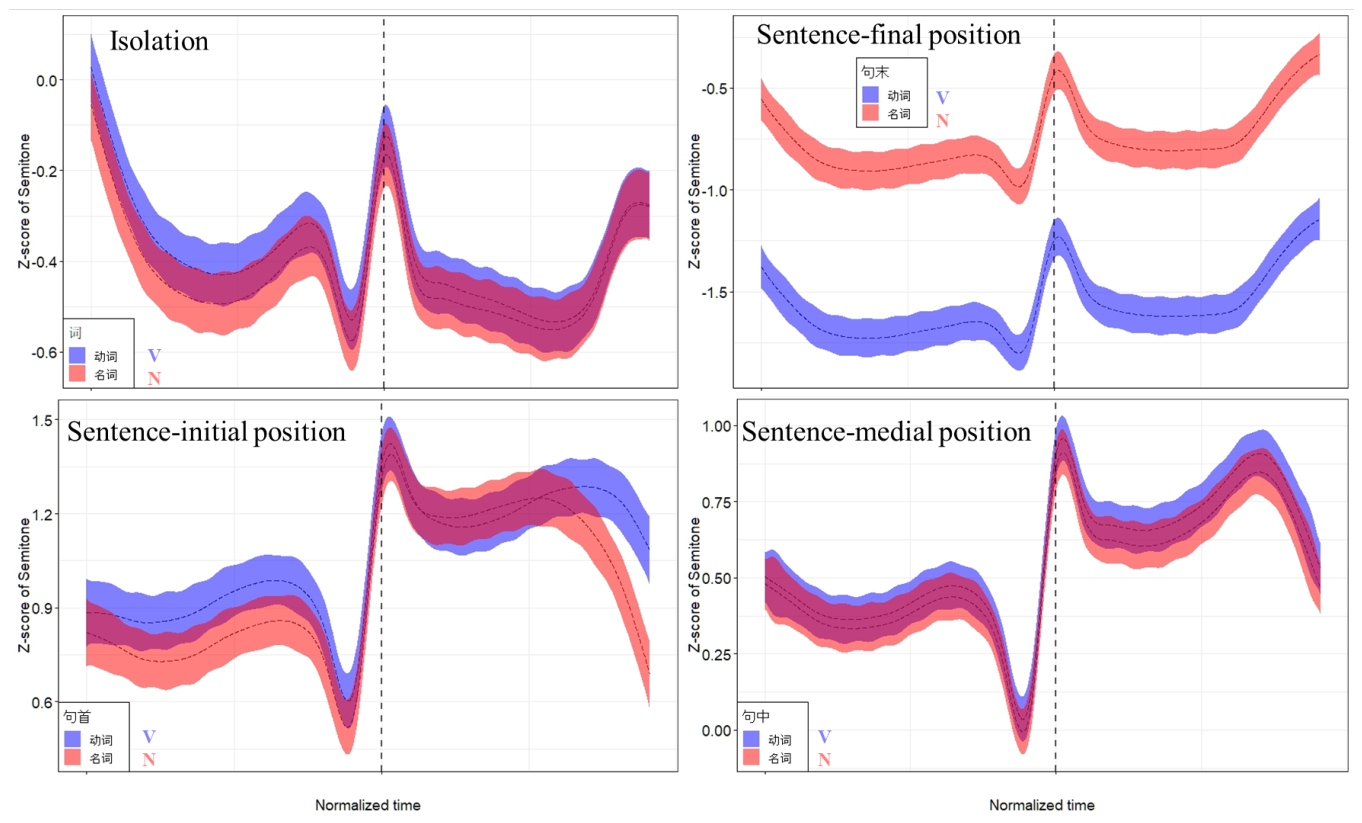
- Isolation (ISO): The target word was read as a standalone item.
- (2)
- Sentence-final position (FIN): “I also [V]” (Wǒ yě V) vs. “I have [N]” (Wǒ yǒu N).
- (3)
- Sentence-initial position (INI): “[V]-ing the leaves is much better” (V le shùyè hǎoduō le) vs. “The leaves of [N] are much better” (N de shùyè hǎoduō le).
- (4)
- Sentence-medial position (MED): “He wants to [V] leaves” (Tā yào V shùyè) vs. “He wants [N] leaves” (Tā yào N shùyè). In this condition, the verb and noun conditions were presented as separate blocks, with written instructions explicitly indicating the intended interpretation. For the verb condition, the instruction read: ‘He wants to PERFORM AN ACTION on leaves’; for the noun condition, ‘He wants the TYPE OF leaves named ‘pseudo−word’. Additionally, the distinct orthographic forms of the pseudo-words provided visual disambiguation. In a post-experiment debriefing, all participants confirmed that they understood the intended distinction.
3.3. Results and Discussion
- V > N: As observed in the relative clause structures of Experiment 1.
- V ≈ N: As demonstrated in the isolation, initial, and medial contexts of Experiment 2.
4. General Discussions
- (1)
- The verb phrase level (NSR core stress): Within a verb phrase (VP), the “Nuclear Stress Rule” (NSR) typically applies. In our study, the V + O combination in SR clauses (e.g., qīngxīn Jīn Xīn ‘adore Jin Xin’) functions as a standard verb phrase. This domain follows the universal phonological default of pitch declination, resulting in a clear downward-sloping “big wave” from the verb to the noun.
- (2)
- The tense phrase level (focus/information stress): Conversely, the connection between a Subject and a Verb in an OR clause (e.g., Jīn Xīn qīngxīn ‘Jin Xin adores’) represents a higher-level syntactic boundary (the tense phrase or TP level). At this level, information structure becomes the dominant factor. The subject is often treated as “given” information, while the verb acts as the informational focus. This triggers a prosodic pitch reset, where the speaker raises the pitch on the verb to emphasize it, resulting in the characteristic rising trajectory observed in our OR data.
- (3)
- The sentential level (intonational stress): Finally, the entire sentence is governed by the “intonational trunk”. Our experiments show that local word-class distinctions (lexical register) are always subordinate to these higher-level sentential and phrasal registers.
5. Conclusions
- (1)
- SR clauses (verb + object structure) follow the Nuclear Stress Rule (NSR) within the verb phrase, adhering to the default downward pressure of declination.
- (2)
- OR clauses (subject + verb structure) involve higher-level sentential boundaries (the Tense Phrase level) where the verb often serves as the informational focus, triggering a prosodic pitch reset and an upward-sloping contour.
Funding
Institutional Review Board Statement
Informed Consent Statement
Data Availability Statement
Acknowledgments
Conflicts of Interest
Appendix A. Stimuli for Experiment 1
| No. | Chinese Stimuliji | Pinyin and English Translation |
| 1 | 倾心金新的丁星跟踪了殷欣。 | [Qīngxīn Jīn Xīn] de Dīng Xīng gēnzōng le Yīn Xīn. |
| (The Ding Xing who adores Jin Xin tracked Yinxin.) | ||
| 2 | 金新倾心的丁星跟踪了殷欣。 | [Jīn Xīn qīngxīn] de Dīng Xīng gēnzōng le Yīn Xīn. |
| (The Ding Xing whom Jin Xin adores tracked Yinxin.) | ||
| 3 | 殷欣跟踪了金新倾心的丁星。 | Yīn Xīn gēnzōng le [Jīn Xīn qīngxīn] de Dīng Xīng. |
| (Yinxin tracked the Ding Xing whom Jin Xin adores.) | ||
| 4 | 殷欣跟踪了倾心金新的丁星。 | Yīn Xīn gēnzōng le [Qīngxīn Jīn Xīn] de Dīng Xīng. |
| (Yinxin tracked the Ding Xing who adores Jin Xin.) | ||
| 5 | 倾心金新的殷欣跟踪了丁星。 | Qīngxīn Jīn Xīn de Yīn Xīn gēnzōng le Dīng Xīng. |
| 6 | 金新倾心的殷欣跟踪了丁星。 | Jīn Xīn qīngxīn de Yīn Xīn gēnzōng le Dīng Xīng. |
| 7 | 丁星跟踪了金新倾心的殷欣。 | Dīng Xīng gēnzōng le Jīn Xīn qīngxīn de Yīn Xīn. |
| 8 | 丁星跟踪了倾心金新的殷欣。 | Dīng Xīng gēnzōng le Qīngxīn Jīn Xīn de Yīn Xīn. |
| 9 | 倾心丁星的金新跟踪了殷欣。 | Qīngxīn Dīng Xīng de Jīn Xīn gēnzōng le Yīn Xīn. |
| 10 | 丁星倾心的金新跟踪了殷欣。 | Dīng Xīng qīngxīn de Jīn Xīn gēnzōng le Yīn Xīn. |
| 11 | 殷欣跟踪了丁星倾心的金新。 | Yīn Xīn gēnzōng le Dīng Xīng qīngxīn de Jīn Xīn. |
| 12 | 殷欣跟踪了倾心丁星的金新。 | Yīn Xīn gēnzōng le Qīngxīn Dīng Xīng de Jīn Xīn. |
| 13 | 倾心丁星的殷欣跟踪了金新。 | Qīngxīn Dīng Xīng de Yīn Xīn gēnzōng le Jīn Xīn. |
| 14 | 丁星倾心的殷欣跟踪了金新。 | Dīng Xīng qīngxīn de Yīn Xīn gēnzōng le Jīn Xīn. |
| 15 | 金新跟踪了丁星倾心的殷欣。 | Jīn Xīn gēnzōng le Dīng Xīng qīngxīn de Yīn Xīn. |
| 16 | 金新跟踪了倾心丁星的殷欣。 | Jīn Xīn gēnzōng le Qīngxīn Dīng Xīng de Yīn Xīn. |
| 17 | 倾心殷欣的丁星跟踪了金新。 | Qīngxīn Yīn Xīn de Dīng Xīng gēnzōng le Jīn Xīn. |
| 18 | 殷欣倾心的丁星跟踪了金新。 | Yīn Xīn qīngxīn de Dīng Xīng gēnzōng le Jīn Xīn. |
| 19 | 金新跟踪了殷欣倾心的丁星。 | Jīn Xīn gēnzōng le Yīn Xīn qīngxīn de Dīng Xīng. |
| 20 | 金新跟踪了倾心殷欣的丁星。 | Jīn Xīn gēnzōng le Qīngxīn Yīn Xīn de Dīng Xīng. |
| 21 | 倾心殷欣的金新跟踪了丁星。 | Qīngxīn Yīn Xīn de Jīn Xīn gēnzōng le Dīng Xīng. |
| 22 | 殷欣倾心的金新跟踪了丁星。 | Yīn Xīn qīngxīn de Jīn Xīn gēnzōng le Dīng Xīng. |
| 23 | 丁星跟踪了殷欣倾心的金新。 | Dīng Xīng gēnzōng le Yīn Xīn qīngxīn de Jīn Xīn. |
| 24 | 丁星跟踪了倾心殷欣的金新。 | Dīng Xīng gēnzōng le Qīngxīn Yīn Xīn de Jīn Xīn. |
| No. | Chinese Stimuli | Pinyin and English Translation |
| 1 | 妈妈今天做了红烧鱼。 | Māma jīntiān zuò le hóngshāo yú. |
| (Mom made braised fish today.) | ||
| 2 | 弟弟喜欢喝冰可乐。 | Dìdi xǐhuān hē bīng kělè. |
| (Little brother likes to drink iced cola.) | ||
| 3 | 外面下雨了,快收衣服。 | Wàimiàn xiàyǔ le, kuài shōu yīfu. |
| (It’s raining outside; quickly bring in the clothes.) | ||
| 4 | 老师让我们明天交作业。 | Lǎoshī ràng wǒmen míngtiān jiāo zuòyè. |
| (The teacher asked us to hand in homework tomorrow.) | ||
| 5 | 这个苹果又大又红。 | Zhège píngguǒ yòu dà yòu hóng. |
| (This apple is big and red.) | ||
| 6 | 他昨天买了一本新书。 | Tā zuótiān mǎi le yī běn xīn shū. |
| (He bought a new book yesterday.) | ||
| 7 | 小狗在院子里跑来跑去。 | Xiǎo gǒu zài yuànzi lǐ pǎo lái pǎo qù. |
| (The little dog runs around in the yard.) | ||
| 8 | 姐姐唱歌非常好听。 | Jiějie chànggē fēicháng hǎotīng. |
| (Older sister sings very beautifully.) | ||
| 9 | 我们一起去公园散步吧。 | Wǒmen yīqǐ qù gōngyuán sànbù ba. |
| (Let’s go for a walk in the park together.) | ||
| 10 | 冰箱里没有鸡蛋了。 | Bīngxiāng lǐ méiyǒu jīdàn le. |
| (There are no eggs left in the fridge.) | ||
| 11 | 晚上十点以后要安静。 | Wǎnshang shí diǎn yǐhòu yào ānjìng. |
| (After 10 p.m., please be quiet.) | ||
| 12 | 她戴了一顶漂亮的帽子。 | Tā dài le yī dǐng piàoliang de màozi. |
| (She wore a beautiful hat.) | ||
| 13 | 请把窗户打开通通风。 | Qǐng bǎ chuānghu dǎkāi tōng tōng fēng. |
| (Please open the window to let some air in.) | ||
| 14 | 这个电影太感人了。 | Zhège diànyǐng tài gǎnrén le. |
| (This movie is too touching.) | ||
| 15 | 他们正在吃午饭。 | Tāmen zhèngzài chī wǔfàn. |
| (They are having lunch.) | ||
| 16 | 周末我们去爬山吧。 | Zhōumò wǒmen qù páshān ba. |
| (Let’s go hiking this weekend.) | ||
| 17 | 桌子上放着一杯热茶。 | Zhuōzi shàng fàng zhe yī bēi rè chá. |
| (There is a cup of hot tea on the table.) | ||
| 18 | 他每天都坚持跑步。 | Tā měitiān dōu jiānchí pǎobù. |
| (He insists on running every day.) | ||
| 19 | 这个房间需要打扫一下。 | Zhège fángjiān xūyào dǎsǎo yīxià. |
| (This room needs to be cleaned.) | ||
| 20 | 小鸟在树上叽叽喳喳。 | Xiǎo niǎo zài shù shàng jījizhāzhā. |
| (Little birds are chirping in the tree.) | ||
| 21 | 你应该多喝温水。 | Nǐ yīnggāi duō hē wēn shuǐ. |
| (You should drink more warm water.) | ||
| 22 | 爷爷喜欢看报纸。 | Yéye xǐhuān kàn bàozhǐ. |
| (Grandpa likes to read the newspaper.) | ||
| 23 | 外面风很大,别出门了。 | Wàimiàn fēng hěn dà, bié chūmén le. |
| (It’s very windy outside; don’t go out.) | ||
| 24 | 她把房间收拾得干干净净。 | Tā bǎ fángjiān shōushi dé gān gān jìng jìng. |
| (She cleaned the room spotlessly.) | ||
Appendix B. Questionnaire for Experiment 2
References
- Arnold, J. E., Kaiser, E., Kahn, J. M., & Kim, L. K. (2013). Information structure: Linguistic, cognitive, and processing approaches. Wiley Interdisciplinary Reviews: Cognitive Science, 4(4), 403–413. [Google Scholar] [CrossRef] [PubMed]
- Boersma, P., & Weenink, D. (2018). Praat: Doing phonetics by computer (Version 6.0.37) [Computer program]. Blackwell Publishers Ltd. Available online: http://www.praat.org/ (accessed on 1 December 2018).
- Cao, J. (2002). Hanyu shengdiao yu yudiao de guanxi [The relationship between Mandarin tones and intonation]. Zhongguo Yuwen [Studies of the Chinese Language], 3, 195–202. [Google Scholar]
- Chao, Y. R. (1968). A grammar of spoken Chinese. University of California Press. [Google Scholar]
- Chao, Y. R. (2006). Tone, intonation, singsong, chanting, recitative, tonal composition, and atonal composition in Chinese. In Z. Wu, & X. Chao (Eds.), Linguistic essays by Yuenren Chao (pp. 596–611). Commercial Press. (Original work published 1956). [Google Scholar]
- Cruttenden, A. (1986). Intonation. Cambridge University Press. [Google Scholar]
- Davidson, L. (2006). Comparing tongue shapes from ultrasound imaging using smoothing spline analysis of variance. Journal of the Acoustical Society of America, 120(1), 407–415. [Google Scholar] [CrossRef] [PubMed]
- Feng, S. (2015). Shengdiao, yudiao yu hanyu de ju mo yuqi [Tone, intonation, and sentence-final mood in Chinese]. Yuyanxue Luncong [Essays on Linguistics], 51, 52–79. [Google Scholar]
- Feng, S. (2016). Beijinghua shi yige zhongyin yuyan [Beijing Mandarin is a stress language]. Yuyan Kexue [Linguistic Sciences], 5, 449–473. [Google Scholar]
- Féry, C., & Ishihara, S. (2016). Introduction. In C. Féry, & S. Ishihara (Eds.), The Oxford handbook of information structure (pp. 1–10). Oxford University Press. [Google Scholar][Green Version]
- Fox, A., Luke, K. K., & Nancarrow, O. (2008). Aspects of intonation in Cantonese. Journal of Chinese Linguistics, 36, 321–367. [Google Scholar]
- Hart, J., Collier, R., & Cohen, A. (1990). A perceptual study of intonation: An experimental-phonetic approach to speech melody. Cambridge University Press. [Google Scholar]
- Jassem, W. (1971). Pitch and compass of speaking voice. Journal of the International Phonetic Association, 1(2), 59–68. [Google Scholar] [CrossRef]
- Ladd, R. (1984). Declination: A review and some hypotheses. Phonology Yearbook, 1, 53–74. [Google Scholar] [CrossRef]
- Li, A., Shi, R., & Zhang, Z. (2011). Putonghua ying-you’er shuru yuyan zhong dongci he mingci de yunlü tezheng [Prosodic features of verbs and nouns in child-directed speech in Mandarin]. Zhongguo Yuwen [Studies of the Chinese Language], 5, 387–396. [Google Scholar]
- Liu, L. (2005). Hanyu shengdiao de qugong tezheng he jiangshi yin-gao [Tonal contour features and pitch declination in Chinese]. Zhongguo Yuwen [Studies of the Chinese Language], 3, 255–268. [Google Scholar]
- Ma, J. K. Y. (2007). The interaction between intonation and tone in Cantonese [Unpublished doctoral dissertation]. The University of Hong Kong.
- Nespor, M., & Vogel, I. (1986). Prosodic phonology. Foris. [Google Scholar]
- Ohala, J. J. (1978). Production of tone. In V. A. Fromkin (Ed.), Tone: A linguistic survey (pp. 5–39). Academic Press. [Google Scholar]
- Selkirk, E. O. (1984). Phonology and syntax: The relation between sound and structure. MIT Press. [Google Scholar]
- Shen, J. (1994). Hanyu yudiao gouzao he yudiao leixing [Structure and types of Chinese intonation]. Fangyan [Dialect], 3, 221–228. [Google Scholar]
- Vance, T. J. (1976). An experimental investigation of tone and intonation in Cantonese. Phonetica, 33, 368–392. [Google Scholar] [CrossRef]
- Wang, P., Shi, L., & Shi, F. (2013). Putonghua yudiao jiben moxing zhong judiaoyu, cidiaoyu de tonggouxing [Isomorphism of sentence and word register in the basic intonation model of Mandarin]. Yuyan Kexue [Linguistic Sciences], 5, 548–560. [Google Scholar]
- Xu, B. R., & Mok, P. P. K. (2011, August 17–21). Final rising and global raising in Cantonese intonation. 17th International Congress of Phonetic Sciences (ICPhS XVII) (pp. 2173–2176), Hong Kong, China. [Google Scholar]
- Xu, Y. (1997). Contextual tonal variations in Mandarin. Journal of Phonetics, 25, 61–83. [Google Scholar] [CrossRef]
- Zhang, L. (2014). Segmentless sentence-final particles in Cantonese: An experimental study. Studies in Chinese Linguistics, 35(2), 47–60. [Google Scholar]
- Zhang, L. (2016). Intonation effects on Cantonese lexical tones in speaking and singing. Lincom Academic Publishers. [Google Scholar]
- Zhang, L. (2017). Yueyu shengdiao yu jiangshi yin-gao [Cantonese tones and pitch declination]. Yuyan Kexue [Linguistic Sciences], 2, 182–192. [Google Scholar]
- Zhang, L., & Shi, L. (2020). Acoustic analysis of Chinese tone production by Thai-speaking learners of L2 Chinese. Journal of Second Language Studies, 3(2), 180–204. [Google Scholar] [CrossRef]


Disclaimer/Publisher’s Note: The statements, opinions and data contained in all publications are solely those of the individual author(s) and contributor(s) and not of MDPI and/or the editor(s). MDPI and/or the editor(s) disclaim responsibility for any injury to people or property resulting from any ideas, methods, instructions or products referred to in the content. |
© 2026 by the author. Licensee MDPI, Basel, Switzerland. This article is an open access article distributed under the terms and conditions of the Creative Commons Attribution (CC BY) license.
Share and Cite
Zhang, L. Effects of Syntactic Structures on Intonational Pitch Movement in Mandarin Chinese. Languages 2026, 11, 119. https://doi.org/10.3390/languages11060119
Zhang L. Effects of Syntactic Structures on Intonational Pitch Movement in Mandarin Chinese. Languages. 2026; 11(6):119. https://doi.org/10.3390/languages11060119
Chicago/Turabian StyleZhang, Ling. 2026. "Effects of Syntactic Structures on Intonational Pitch Movement in Mandarin Chinese" Languages 11, no. 6: 119. https://doi.org/10.3390/languages11060119
APA StyleZhang, L. (2026). Effects of Syntactic Structures on Intonational Pitch Movement in Mandarin Chinese. Languages, 11(6), 119. https://doi.org/10.3390/languages11060119