Review

Using L2 Properties in Native Grammars: What Constitutes Evidence for Representational Change?

Department of Languages, Literatures & Linguistics, York University, North York, ON M3J 1P3, Canada
Languages 2026, 11(5), 96; https://doi.org/10.3390/languages11050096
Submission received: 25 February 2025 / Revised: 13 April 2026 / Accepted: 15 April 2026 / Published: 9 May 2026

Abstract

A major question in L1 attrition research is whether cross-linguistic influence from a speaker’s second language onto their first constitutes only a temporary, superficial effect or whether it can also lead to a structural change, often discussed as a distinction between effects on language processing as opposed to changes to the mental representation of grammatical properties. Some have argued that L1 grammars of adult L2 speakers are entirely impervious to change, while others stated that some of the available findings can be interpreted as grammatical representations themselves being vulnerable. This paper contributes to the question of how we can distinguish between these two types of attrition. I argue that it is challenging to use behavioral differences across tasks as well as experimental results showing optionality between L1 and L2 options to distinguish between a superficial and a structural change. Instead, situations where properties of an attriter’s L1 grammar converge on the L2 constitute the clearest case of structural change as these cannot be explained as temporary effects of L2 influence. Using data from an earlier study on attrition found in Romanian native speakers living in Italy, I furthermore challenge the claim that L2 convergence only occurs in rare situations where attriters lose contact with the L1. To better understand the contexts in which attrition at the level of representation may be possible, I suggest that future studies focus on (1) a variety of linguistic properties where the L1 allows a grammatical construction or interpretation also in situations where it is not used in the L2, (2) properties where options from both the L1 and the L2 are less likely to co-exist in an attritred grammar and (3) consistently include analyses of individual response patterns.

1. Introduction

This paper focuses on non-pathological cases of first language (L1) attrition as observed in individuals who become bilingual post-childhood after moving to another country where a different societal language is spoken. A well-supported finding in language attrition research is that attrition and language acquisition are related (Jakobson, 1941) and that cross-linguistic influence from an L2 can affect use of L1 grammatical properties. The specific focus of this paper is on how the L2 can affect the L1 and the distinction between what has been referred to by Domínguez et al. (2024) as superficial attrition (attrition at the level of processing) and deep attrition (attrition at the level of L1 mental representation) and whether and how it is possible to distinguish between superficial and deep attrition. Some researchers have argued that attrition in L1 grammars of adult L2 speakers is limited and entirely impervious to change, while others have argued that some of the available findings in the attrition literature can be interpreted as grammatical representations themselves being vulnerable (Domínguez & Hicks, 2016; Gürel, 2004; Iverson, 2012; Tsimpli et al., 2004), while acknowledging that it is difficult to conclude whether a change is only at the level of processing or could also indicate a representational change (Schmid & De Leeuw, 2019).
Studying whether attrition can affect mental representations is important to gain a better understanding of the limits of attrition and the linguistic and social conditions under which changes to L1 mental representations may occur. This paper discusses how we might be able to better examine whether all observed L2 effects on L1 language use are best described as superficial and almost exclusively due to more transient changes or difficulties with processing L1 grammatical properties or whether L2-to-L1 transfer can, in some cases, also affect one’s L1 mental representation.
Section 2 discusses the gradient nature of attrition (from superficial attrition on one end to deep attrition as a more advanced stage of attrition) and how L2 competing options can affect access to L1 options depending on the activation levels of the features of each language. In Section 3 the focus turns to whether and how differences across experimental tasks can help determine whether non-native-like L1 processing is the only manifestation of attrition or whether attrition can reach a state where it affects mental representation. Section 4 discusses how situations where attriters use options from both L1 and L2 grammars (i.e., optionality) can be explained under both processing and representational approaches. I furthermore argue that situations where the attriters’ L1 grammar converges on the behaviour of the corresponding L2 property constitute the clearest form of representational change. Although L2 convergence has been argued to be extremely rare, something that may only happen to some speakers after prolonged exposure to the L2 and limited exposure to their L1 (e.g., Schmid and Köpke (2017)), I argue that this may not be as rare as currently assumed. To reveal potential patterns of L2 convergence, I argue that future attrition studies should include more linguistic phenomena and L1–L2 pairings where a specific linguistic structure is available in both the L1 and L2 but its distribution differs across the two languages. The investigation of a greater variety of linguistic phenomena will furthermore help us to better understand the conditions where L2 properties may be more likely to replace those of the L1 (i.e., L2 convergence) or where both options are more likely to co-exist in an attrited grammar (i.e., L1–L2 optionality). Additionally, as previously argued by Baker (2024), future studies should examine individual response patterns to gain a more accurate understanding of the structure of attrited grammars. The importance of these last two points are illustrated in more detail using the findings from Smeets (2024) in Section 6.

2. L2 Induced L1 Inhibition: From Superficial to Deep Attrition

2.1. Changes in Activation Levels and Attrition

Native language attrition is selective in that it has been shown to be more likely when there exists influence from a competing form of another language or dialect, in combination with reduced or absent stimulation of the first language of a bilingual speaker (Paradis, 2004). L1 attrition should therefore not be viewed as a complete loss of the L1, but rather, a shift that may occur over time towards the use of structures or interpretations that approximate those of the L2 (Pavlenko, 2000) for those properties where a competing structure exists in the L2 (Altenberg, 1991; Gürel, 2004, 2007; Köpke, 1999, 2002; Paradis, 2007; Pelc, 2001; Smeets, 2024; Tsimpli, 2007). Linguistic properties that are resistant to attrition (stable part of grammars) are typically those that are not affected by influence from a competing form from the L2 grammar.
The Activation Threshold Hypothesis (ATH) as applied to attrition (Paradis, 1993, 2007) is a neurolinguistic explanation that has been used to explain the selective nature of attrition as shaped by L2 influence. The ATH argues that the ease of accessing a linguistic item is directly related to the activation threshold of that item in the brain of a speaker. The activation of a linguistic item in one language is argued to result in the inhibition of the corresponding item in the other language. Consequently, inhibited items have a lower activation (and a higher activation threshold) and this reduced accessibility to the L1 grammar can lead to interference from a similar option from a more accessible L2 grammar for which there is a lower activation threshold. Crucially, structures with a greater L1–L2 overlap likely cause greater coactivation of both languages and therefore more competition and higher inhibition of the weaker item. Consequently, different linguistic items within the same language require various degrees of stimulation in order to become activated (Paradis, 1993) and the activation threshold level is higher for linguistic properties that have a corresponding L2 property they compete with (Gürel, 2004). This argument is supported by attrition research, which has shown that linguistic properties that are used in both the L1 and the L2, but with slight differences in their distribution, are most vulnerable to attrition (e.g., Gürel, 2007; Gürel & Yilmaz, 2011; Hicks & Domínguez, 2020; Smeets, 2024).

2.2. The Gradient Nature of Attrition

How do differing levels of activation and the inhibition of L1 options relate to our discussion of deep versus superficial attrition? Superficial (i.e., attrition at the level of processing, including activation and inhibition of competing options) and deep effects (i.e., attrition at the level of representation) of the L2 onto the L1 are argued to exist on a continuum for which processing approaches and representational approaches demarcate two ends of a spectrum (Schmid & Köpke, 2017). Cross-linguistic transfer at the level of processing can in principle take place right after the onset of L2 acquisition (Schmid & Köpke, 2017). Changes to grammatical representation can be seen as a more advanced stage of attrition that may happen later in the attrition process, to some speakers and for some linguistic properties, after prolonged L2 induced L1 inhibition (see Iverson (2012) for the clearest example of attritrion having affected mental representation). Superficial attrition would be a prerequisite for restructuring of grammatical representations and superficial attrition is therefore more common than attrition at the level of representation. Viewing superficial attrition as a precedent of deep attrition furthermore predicts that if a speaker has attrited L1 representations, they necessarily also process their L1 differently from non-attriters as their grammar differs.1
The question addressed in this paper is whether and how we can distinguish between attrition at the level of processing and the level of representation given the gradient nature of attrition. Surface level attrition can be viewed as temporary interference, resulting from co-activation of both languages. At this stage, both L1 and L2 options are active, resulting in optional use of forms from both languages, as discussed in more detail in Section 4. Over time, repetitive inhibition of L1 forms can lead to weakened access to the L1 features to an extent that they can no longer easily be accessed or activated. The L1 item can then only be parsed using the features from the more strongly activated L2. In this situation, the behavior of the attrited structure has converged on the behavior of the corresponding L2 property. Admittedly, there is a large grey area in between the initial stages of L2 interference and inactivity or even a loss of L1 forms. In other words, it would be impossible to predict where in the developmental trajectory of an individual surface level attrition develops into deep attrition. However, the relevant debate this paper contributes to is whether non-native like L1 processing is the only manifestation of attrition or whether non-native like L1 representations are possible as well. This paper therefore focuses on how we can better isolate cases of representational attrition. Section 3 discusses to what extent differences across various experimental tasks can inform us about superficial versus deep attrition.

3. Task Differences to Explain the Nature of Attrition

It has been proposed that we can tease apart changes to L1 representation from temporary effects of processing by comparing the same participant’s performance across tasks. This section reviews how previous research has used differences across tasks to better understand whether attrition has occurred at the level of representation or processing and discusses some of the limitations of what such studies can tell us.

3.1. Judgment Tasks Versus Spontaneous Production

One across-task comparison that has been proposed is between results from a grammaticality/acceptability judgment tasks and spontaneous production. The reasoning behind this is that in judgment tasks, speakers have time to reflect on their judgment, whereas the performance pressure associated with spontaneous production (or other time-pressured tasks) may increase interference errors. When the behavior of attriters deviates from that of non-attriters in a spontaneous production task but not in an acceptability judgment task, the attrition effects are considered to be superficial and the underlying grammar (i.e., the linguistic competence) of the two groups of speakers is nevertheless argued to be the same, as speakers still make a distinction between grammatical and ungrammatical structures. For example, Schmid (2009), testing the L1 German of L2 English and L2 Dutch speakers on various morpho-syntactic aspects like the use of grammatical gender, word order, NP-agreement and VP-agreement found that the attriter groups performed like the monolingual controls on a grammaticality judgment task but made errors in a free speech story telling task. The author concludes that their mental grammar is not any different from that of monolingual German speakers, but attriters occasionally experience interference from the L2 as the result of an increased cognitive load associated with processing a lesser-used language. Similarly, Domínguez et al. (2024) found significant differences between attriters and non-attriters in whether their spontaneous speech was perceived as nativelike. However, no attitrion was found at the group level in either an acceptability judgment task or a self-paced reading task (although some differences were attested at the individual level, see Section 5.2. for more details on the importance of examining individual results). Crucially, studies which find attrition in spontaneous production but not in acceptability judgment tasks show that surface level attrition (affecting performance) and deeper grammatical attrition (affecting mental representation) are two separate stages of attrition. Since deep attrition can occur in a more advanced attrition stage and because it is arguably more selective, results from studies reporting differing results across tasks simply show that deep attrition did not happen for the linguistic phenomenon or participants under investigation. These results do not entail that representational attrition is not possible. As discussed in more detail in Section 5 and Section 7, we need to examine a greater variety of linguistic phenomena and individual response patterns before we can make any definitive claims about the extent of attrition.

3.2. Online Versus Offline Tasks

It has also been proposed that comparing participants’ performance in an online (e.g., self-paced reading or eye tracking task) to an offline task (e.g., naturalness or acceptability judgment) can help to better understand the nature of the attrition effect. Under the assumption that any sort of representational effect of the L2 on the L1 is preceded by a purely online/processing effect, behavioral differences between attriters and control groups in tasks that tap into processing (e.g., online measures of accuracy and reaction times) can be indicative of an earlier stage where there was an online effect only (Montrul, 2017), but no representational effect. To illustrate with an example, Chamorro et al. (2016) examined antecedent selection for Spanish overt and null pronouns using both an offline naturalness judgment task and an online eye-tracking task. In line with the authors’ predictions, the results only showed differences between monolinguals and attriters in the reaction times for the eye-tracking task but not for the offline naturalness ratings. Chamorro et al. (2016) argued that because effects were only found in the online task, the differences between the two groups must have been at the level of processing, not at the level of representation2. It is, however, not clear why differences in reaction time, by definition, indicate differences at the level of processing alone. Differences in reaction time might equally well indicate differences at the level of representation and it may simply be that reaction time measurements can detect more fine-grained differences between groups that other tasks (like the naturalness ratings used here) may not. Whether the results of an experiment indicate a difference in processing or representation depends on the exact experimental design used and the conditions and contrasts that are tested for a particular linguistic phenomenon. To illustrate, assume that the results of an attrition study show that reaction times are shorter for a construction that is grammatical in the L2 but ungrammatical in the L1 compared to a construction that is ungrammatical in the L2 but grammatical in the L1. Since these attriters make the same contrast between grammatical and ungrammatical sentences as native speakers of the L2 (i.e., parsing as ungrammatical structures that are ungrammatical in the L2 but grammatical in the L1), the results could indicate attrition at the level of representation, as measured by differences in reaction time.
In summary, while online measures could potentially reveal small differences between groups of speakers that offline measurements cannot, it is important to emphasize that the mental representation of a speaker’s linguistic competence is an abstract notion and we can therefore not view it directly, rather it can only be inferred from looking at patterns in linguistic performance (White, 2023). Results from online experiments do not necessarily only reflect an effect of temporary online processing but can also inform about underlying mental representations. The differences between online and offline tasks therefore does not seem sufficient to distinguish between representational versus processing effects. Additionally, differences across tasks can be used to show that superficial attrition occurs in tasks where performance pressure is higher (e.g., in spontaneous production vs. grammaticality judgment) and support the idea that superficial attrition can occur without mental representations necessarily being affected. However, differences across tasks cannot, by definition, inform us about whether attrition affects processing or mental representation.

3.3. Examining Performance Across Tasks and Items in Future Attrition Studies

How could future research use differences across tasks to distinguish between deep and superficial attrition? The clearest evidence for attrition at the level of mental representation would be when attriters behave differently from L1 control groups and when there is consistency and systematicity in the non-native response patterns across tasks and across items within the same experiment. If there is a great degree of variability in the response patterns, we cannot conclude that attrition has affected mental representation. It would be important to analyze each individual speaker’s behavior across experimental tasks and across items within each task to determine if there is consistency in the response pattern. Variability can show up consistently and systematically, and this type of L1–L2 optionality provides evidence of representational change. However, if speakers alternate between the grammatical options from the L1 and L2 in an inconsistent way, this can be interpreted as superficial attrition due to temporary interference from the other language, interference that sometimes occurs and sometimes not, causing variability in the response patterns.
Due to the gradient nature of attrition, however, there is no clear cut off rate to decide how much variability could be best categorized as momentary cross-linguistic interference or as grammatical attrition. As will be elaborated on in Section 4, an approach one could take is to include native speakers of the L2 as a comparison group, as this allows for testing how much variability is ‘normal’ or whether the grammar of an attriter has converged towards properties of the L2. To date, however, studies on L1 attrition typically do not include a native monolingual control group of the L2. An exception to this is Iverson (2012) and more recent work by Baker (2024), López Otero (2022) and Smeets (2024) who compare the behavior of the experimental attrition group to that of native speakers of both the L1 and the L2. This comparison allows for examining whether attriters’ judgments are in a similar range to that of native speakers of the L2.

3.4. Permanent Versus Temporary Effects

Attrition at the level of mental representation is often described as a permanent effect and attrition at the level of processing as a temporary effect. Therefore, if we see a “reversal” of attrition effects after limited re-exposure, the attested attrition affects are likely not at the level of representation. This approach was taken by Chamorro et al. (2016) who compared speakers who returned to their home country for only one week to speakers who did not recently return and found attrition effects only in the latter group.
Importantly, however, I would challenge the idea that attrition at the level of mental representation is by definition permanent. If we start off with the assumption that L2 input can change L1 grammars and that L1 grammars are malleable, it naturally follows that any change does not have to be permanent. Re-exposure to (sufficient) L1 input can in principle reactivate the “lost” aspects of an L1 grammar that were previously inhibited by the L2. More generally, if grammars are not fixed systems, any new property can be reactivated or even (re-)acquired. I would argue that grammar change is possible in any situation where the mental grammar of a speaker does not match the properties of the input. More recent research on returnees has aimed to shed light on the effects of re-exposure, but this research has mostly focused on heritage speakers (e.g., Coşkun Kunduz & Montrul, 2025; Flores & Snape, 2021). Although this is an empirical question, I would speculate that for speakers whose L1 has undergone changes to mental representation, a significant amount of L1 input would be needed for the L1 grammar to take on the “original” form. In future research, effects of re-exposure can also be tested experimentally by exposing participants to the L1 structures for a certain amount of time and examining whether there are any differences between these speakers and those did not receive the extensive exposure to L1 structures. Earlier attrition effects in participants who again perform within the L1 range after only a limited amount of re-exposure to L1 dominant input are likely best analyzed as superficial attrition while changes to mental representation are expected to take more time to change back.

4. Optionality in Attrition: What It Can(Not) Tell Us

This section elaborates on optionality in L1 attrition and argues that situations where speakers alternate between the options from the L1 and the L2 can typically be explained by both processing and representational approaches. I furthermore argue that for linguistic phenomena where the options in the L1 are a proper subset of the options available in the L2, the reported optionality can often also be interpreted as L2 convergence.

4.1. Optionality in Attrition Explained as Deep or Superficial Attrition

Section 3.3. mentioned that if attrition is superficial, we expect a speaker to be less consistent in their response patterns, showing behavior that is a mix of options from the L1 and the L2 for properties that are vulnerable to L2 interference. This section elaborates on this statement. In particular, I argue that for some linguistic phenomena tested in the literature, “optionality”, whereby the patterns of behavior of attriters seem to fluctuate between the L1 and L2 patterns for a given property in their L1, cannot easily be used to distinguish between superficial and deep attrition as the same results can fit both an explanation that attrition affects processing as well as knowledge representation.
Let us illustrate this point using a linguistic phenomenon amply discussed in the literature: the use and interpretation of overt pronouns in L1 pro-drop languages (e.g., Spanish, Italian, Greek) by speakers who have acquired a non pro-drop language (e.g., English, Swedish) as their L2 in adulthood (e.g., Chamorro et al., 2016; Domínguez, 2013; Kaltsa et al., 2015; Tsimpli et al., 2004). These studies generally focus on the resolution of intra-sentential anaphora where participants are asked to identify the antecedents of third person null and overt subject pronouns, illustrated for Italian in (1). Monolingual speakers of a pro-drop language tend to interpret an overt pronoun in the embedded clause to refer to the object of the main clause (la ragazza), while null pronouns refer to subject antecedents (l’anziana signora). Overt and null pronouns in pro-drop languages therefore have a different discourse function: null pronouns are used for topic continuity (usually subjects) while overt pronouns are used to indicate a topic shift. In no pro-drop languages, overt pronouns do not have a discourse function and pronouns in sentences like (1) are ambiguous between a subject and object interpretation.
(1)L’anzianasignoraisalutalaragazzakquandoleik/proiattraversalastrada.
the oldwomangreetsthegirl whenshecrosses thestreet
‘The old woman greets the girl when she/pro crosses the street.’
Tsimpli et al. (2004), ex. 10b
A common attrition effect found in these studies is that speakers with a non-null-subject language as their L2 interpret the overt pronoun as referring to the subject to a significantly higher degree than monolinguals, while for null pronouns they consistently pattern with monolinguals in choosing subject antecedents. The function of the form that exists in both the L1 and the L2, overt pronouns, is transferred onto the L1. Relevant to the discussion in this paper is the fact that the over-acceptance of overt pronouns with subject antecedents can be explained by both processing approaches and representational approaches, albeit differently.
The processing approach most commonly applied to the example at hand is the Interface Hypothesis (IH), which explains variability to not reflect changes to the grammar itself but rather how the grammar is accessed (Chamorro et al., 2016; Sorace, 2016, 2020). Specifically, the IH explains attrition to be due to difficulty with calculating interpretations at the discourse-syntax interface, which is exacerbated under the pressures of bilingual processing and leads to optionality, which in the case discussed here leads to two different interpretations of the overt pronoun. Although the IH focuses only on discourse phenomena, other processing accounts are not limited to interface structures. The Activation Threshold Hypothesis (discussed in Section 2) focuses on how differing levels of activation of the L1 and the L2 affect access to each of a speaker’s languages. Due to coactivation of both grammars in the mind of a bilingual, the option from the L2 can be activated in the processing of the L1 instead of the option from the L1. Consequently, access to both language systems can lead to more variability in the responses of bilingual speakers. Thus, when attriters choose or accept subject referents for overt pronouns, this is argued to be due to temporary interference from the competing L2 option. How much interference from the L2 there would be depends on which form was most easily accessible at that moment.
Representational approaches can account for both L2 convergence and L1-L2 optionality. Broadly speaking, with L2 convergence the options from the L2 have replaced the options from the L1 while fluctuations between L1 and L2 options are explained as two options existing in the mental grammars of attriters. Within minimalist approaches to first language attrition, optionality in grammars has been accounted for in various ways. Tsimpli et al. (2004), in an earlier version of the IH, accounted for optionality of overt pronoun interpretations in the Italian of native speakers living in the UK by assuming that the [+topic shift] feature on Italian overt pronouns could become optionally unspecified. In consequence, overt pronouns in the grammars of attriters function between the interpretations of the L1 and L2. Later, Domínguez and Hicks (2016) proposed a more general account of optionality in attrited grammars. They assume optionality to be the result of the L1 and L2 grammatical options co-existing in the attrited grammar. The L1 grammar has two copies of the functional lexical item, one with the feature specifications of the L1 and one with the feature specifications of the L2. In the case of overt pronouns for attrited pro-drop languages, the pronoun in the L1 has two versions, one with the original L1 feature [+topic shift] and without such a feature as found in the L2. Attriters can then fluctuate between L1 and L2-based grammatical options leading to variation in the options speakers select. The L2 option is added to the L1 grammar using the mechanisms from the Feature Reassembly hypothesis (Lardiere, 2009), a theory originally proposed to describe L2 acquisition. Hicks and Domínguez (2020) further elaborated on this mechanism, as well as mechanism related to the processing of input to intake in their model of grammatical attrition, the Attrition via Acquisition model.
Section 2.1 discussed the idea that the ease of accessing a linguistic item is directly related to their activation threshold level. Although the AvA model does not make reference to this cognitive process directly, the notion of activation and activation thresholds have more recently been incorporated into this model (see Baker, 2024; Glodstaf & Montrul, 2025). When competing L2 features inhibit the L1 features, the L1 features could become less active or even inactive and consequently not reliably accessible for retrieval. When L1 options cannot be accessed, the resulting attrition effect is L2 convergence. Alternatively, if L2 options are added to those already existing in the L1, both L1 and L2 options are accessible for retrieval.
In sum, optionality, where attriters alternate between the options taken from either their L1 or L2, can typically be explained by both processing and representational approaches. Sorace (2020), in a response paper to the Attrition via Acquisition model, asked why Hicks and Domínguez (2020) are trying to account for the behavioral patterns in attriters in formal grammatical terms when the same can be explained without assuming changes to the attriter’s grammatical representation. Crucially, however, explaining all forms of attrition as performance effects seems to dismiss the observation that there are clear cases of grammatical attrition. Furthermore, the focus of language acquisition research within the generative approach more generally is, of course, to investigate the nature of a speaker’s linguistic competence, their mental representation, and how this may change over time in response to new input.

4.2. L2 Superset-L1 Subset: Optionality or L2 Convergence?

Attrition research typically looks at situations where the L1 and the L2 use the same linguistic construction in slightly different contexts. The reason for this is that L1 forms that are in competition with L2 forms are more vulnerable for attrition compared to L1 forms that have no analogous forms in the L2 (Altenberg, 1991; Gürel, 2004, 2007; Köpke, 1999, 2002; Paradis, 2007; Tsimpli, 2007). More specifically, research that has focused on situations where the L2 allows a superset of the options available in the L1 has shown that the additional option available in the L2 is added to the option already available in the L1 (and the L2). The main point I will make in this section is that the observed optionality in situations where the L2 is a proper superset of the L1 can often also be interpreted as L2 convergence. I argue for testing native speakers of the L2 as a control group to distinguish between optionality and L2 convergence in these studies.
Gürel (2002, 2007) proposed and tested the Set-Theoretic Language Acquisition Model (the ‘Subset/Superset model’), which predicts that attrition is not possible when the grammatical options of the L2 are more restricted than those of the L1. Instead, the L2 has to be a superset of the L1 because, according to this model, L2 to L1 transfer is only possible when the L2 is a superset of the L1 and options from the L2 can only be added to the L1, but L1 options cannot be removed. To illustrate this, Gürel (2002, 2004, 2007) examined the interpretation of Turkish and English embedded subject pronouns.
As shown in (2), the Turkish pronoun o functions differently from English pronouns him/her/they: while English allows bound interpretations (he can refer to Burak in (2)), this reading is not possible for the Turkish pronoun o (as Turkish does not allow pronouns to be bound within the DP and Turkish embedded clauses are DPs (Aygen, 2002, 2011; Gürel, 2003; Kornfilt, 2003)).
(2)Buraki[o*i/k-nunzeki ol-duğ-u]-nudüşün-üyor.
Buraks/he-GENintelligentbe-NOM-3SGPOSS-ACCthink-PRG
‘Buraki thinks that s/hei/k is smart.’
Since English is the superset language and Turkish the subset language, she predicted that the Turkish of Turkish immigrants to North America could undergo attrition under the influence of English, but that the English of immigrants to Turkey would not be affected. This bidirectional comparison is discussed in Gürel (2007). As predicted, the results showed that the Turkish expats chose a bound interpretation of o significantly more often than the Turkish monolingual control group. Additionally, the English of the immigrants to Turkey was not affected under the influence of Turkish. In other words, the unavailability of bound pronouns in Turkish did not lead English native speakers to stop allowing this interpretation in English.
Similar to the predictions from the Set-Theoretic Language Acquisition Model, the AvA model argues that “the change undergone by the L1 grammar in late sequential bidialectal contexts3 is less likely to involve the ‘loss’ of existing options since the L1 grammar itself remains active in processing for both production and comprehension. The changes required are likely to supplement–rather than replace–the existing grammar.” Hicks and Domínguez (2020, p. 156). The additional option from the L2 becomes available in the attrited speaker’s L1. The data from the previously discussed example on the use of overt pronouns in L1 null subject languages supports this claim. In non-pro-drop languages, overt pronouns are acceptable in contexts with and without topic shift while overt pronouns in pro-drop languages are only acceptable in topic shift contexts. Overt pronouns in non-pro-drop languages therefore allow a superset of the interpretations available in pro-drop languages. In attrition, the additional option from the L2 becomes available in the L1 of attrited speakers.
Another reason for why L1 options are unlikely to be lost could be that losing an L1-option would require the unlearning of a previously acquired structure or feature. It is well known from the L2 acquisition literature that unlearning previously acquired or transferred features is difficult and negative evidence may be required for such phenomena to be acquired successfully, if at all (e.g., White, 1991a, 1991b). Following the same reasoning, it may be uncommon to lose a property of the L1.
Note, however, that in situations where the L1 allows only option A (subset) and the L2 allows both option A and option B (superset) for the corresponding grammatical property, the addition of option B onto the L1 grammar results in the attrited individual to allow the same options as available in the L2 grammar. Consequently, what looks like L1–L2 optionality can also be interpreted as L2 convergence. Since optionality can be explained by both processing and representational approaches, it would be difficult to understand whether the attested attrition effects are superficial or deep. One approach to better understand the type of attrition would be to include native speakers of the L2 in the study. Since in the L2 both option A and B are possible, there is most likely a range at which native speakers choose one over the other. If attriters behave within a similar range as native speakers of the L2, we can be more certain that attrition has occurred at the level of representation. If not, we cannot distinguish between deep and superficial attrition.
Another approach to test for L2 convergence would be to look at more linguistic properties where the L1 has options or interpretations not available in the L2. A possible candidate for attrition along these lines is the use of DOM in two typologically close languages, Spanish and Romanian, as studied in López Otero (2022). Romanian and Spanish both use DOM but differ in the features that guide its use: DOM in Romanian is mainly determined by referential stability (Ciovârnache & Avram, 2013; Farkas & von Heusinger, 2003; Mardale, 2008, 2010; Ticio & Avram, 2015) while DOM in Spanish is mainly driven by animacy (Leonetti, 2008). López Otero (2022) investigated the acquisition of DOM in both Spanish and Romanian among highly proficient native Romanian speakers who had been living in Spain for around a decade. There is ample overlap in the situations where Romanian and Spanish use DOM, but the relevant difference for the purpose of the argument made here is the fact that Romanian DOM appears before inanimate demonstratives, as shown in (7), whereas this would be ungrammatical in Spanish.
(3)Acelecămășisuntfoarte greudegăsitdarMihaiagăsit* (-o pe)aceea.
Theseshirts-F.NOMareverydifficulttofindbutMihaihasfound(CL. ACC.F.SG DOM)this one
“These shirts are difficult to find, but Mihai has found that one.”
López Otero (2022), example 4b
Since the L2 allows options not available in the L1, L2 convergence could be found if Romanians in Spain allow Romanian sentences like (7) with the absence of DOM marking due to the acquisition of the animacy requirement of Spanish. The results to this study did not support L2 convergence (but see Section 7.2. for the suggestion to include an individual result analysis). The results showed that Romanian monolinguals were quite categorical in their acceptability judgments, as grammatical sentences with Pe were rated at 5 and ungrammatical ones without Pe at around 1.75. However, the average rating for Pe-marked and non-Pe marked sentences was less categorical in the attriter group where grammatical sentences had an average rating of 4 and ungrammatical sentences an average rating of around 2.5. These group results show that DOM marking was used less deterministically in the context where Romanian and Spanish differ. The author concludes that the fact that attriters still made a clear distinction between grammatical and ungrammatical structures shows that the reported effects are not the result of representational differences but that the bilinguals in this study may be at an incipient stage of L1 attrition.
The next section discusses some additional approaches future attrition research might take to gain a better understanding of what the limitations of attrition are and to determine under what conditions attrition at the level of representation is possible.


5. Looking for L2 Convergence to Understand Grammatical Attrition

Hitherto we discussed the observation that findings where attriters use a combination of options from the L1 and L2 can often be explained by both representational and processing approaches. I therefore argued that the most evident cases of grammatical attrition would be those of so-called L2 convergence, where features or options (e.g., word orders or interpretations) from the L2 have substituted the L1 counterpart. Such cases of attrition cannot be explained as surface level attrition as the L1 competitive option would not be available and therefore speakers would not alternate between the options from both languages.
L2 convergence is argued to be rare and seems to be associated with speakers who have lost (almost) all access to the L1 input and for whom L1 features are therefore no longer (or rarely) activated. This was the case for the individual studied in Iverson (2012), Pablo, a native speaker of Chilean Spanish who moved to Brazil in adulthood and rarely had any exposure to his native Spanish. In his performance on a variety of linguistic properties, such as verbal agreement marking, word order, the use of overt subject pronouns, the use of object clitics and null objects and relative clause attachment preferences, all areas where Chilean Spanish and Brazilian Portuguese (BP) differ, Pablo patterned with the BP monolingual control group and diverged from the monolingual Spanish speakers.
Since most adult immigrants usually do have exposure to their L1 language, through contact with friends and family in the home country and/or with other immigrants of the same L1 background, losing L1 options is argued to be rare. Using the argumentation from the Activation Threshold Hypothesis, options from the L1 typically remain accessible for activation through continued L1 use and the level of activation and inhibition of each of the options differ across speakers depending on relative L1 and L2 use, but, as I argue below, also depending on the relative compatibility of L1 and L2 options. Furthermore, Section 2 discussed the gradient nature of attrition where deep attrition is seen as a later stage of superficial attrition where L1 options are rarely or no longer accessed. I believe that, at that point, attrition is best explained as a representational change. Another reason for why losing L1 options is less likely is already discussed in Section 4.2.: even when a speaker is not exposed to (much) L1 input (anymore), losing an L1-option is less likely as this would require the unlearning of a previously acquired structure or feature.
Although it is expected that L2 convergence is much less common than the addition of L2 options to already existing L1 options, I would also like to suggest that L2 convergence may be more common than is currently assumed. This section discusses additional factors that may have contributed to the disproportionally few examples in the literature reporting instances where attriters converge with the L2. Firstly, it may be the case that for some linguistic phenomena the co-existence of both L1 and L2 options is compatible while for other phenomena the acquisition of an L2 option is more likely to lead to the loss of the L1 option. Secondly, group results can be misleading if the optionality attested represents variability between participants rather than within participants. This motivates the importance of examining individual response patterns. Section 6 then illustrates these two factors in more detail using a study on Clitic Left Dislocation in native Romanian speaking expats in Italy, as reported in Smeets (2024).

5.1. Testing the “Right” Linguistic Phenomena

Iverson and Miller (2017) argued that part of the reason why attrition at the level of representation is rarely attested is because attrition research has not sufficiently examined the right populations. They specifically argued for more research on individuals who represent the most extreme cases of attrition, like Pablo as discussed Iverson (2012). “The mere fact that aggregate groups of attriters with reduced, but still some or even much, access to their L1 tend to not show attrition effects in core syntax does not entail that attrition in this domain is impossible. Without testing extreme situations, group trends can only corroborate that syntax is less vulnerable or particularly resistant to attrition. Only in the case that attrition within core syntax is not seen in linguistic isolates, too, can we deduce that syntax is truly spared from attrition.” (Iverson & Miller, 2017, p. 706). I would like to elaborate on this statement by adding that attrition at the level of representation is not exclusive to situations where speakers lack access to the L1 but that attrition research has not yet sufficiently examined a broad enough variety of linguistic phenomena and L1-L2 comparisons to draw any conclusions about the limitations of attrition.
A question worth addressing in future research is whether L2 convergence is more likely in situations where the options from the L1 and the L2 would not be compatible if they were to co-exist in the same grammar, for example if such optionality is unlikely to be attested in natural languages. Returning to our example on overt pronouns in pro-drop languages, allowing both subject/topic and object/non-topic antecedents for overt pronouns may be more likely as there are languages that allow both options (i.e., overt subject languages). Similarly, there are languages that allow both bound and unbound interpretations of embedded object pronouns (e.g., English) and it is therefore unsurprising that both options can exist for the same speaker (e.g., an attrited speaker of Turkish). The same point can be illustrated using studies on Differential Object Marking (DOM). For some languages that use DOM, this marking is optional (e.g., in Kannada (Lidz, 2006)) and in attrition research, optionality in use of obligatory DOM marking has also been attested. In fact, Montrul et al. (2015), Montrul and Sánchez-Walker (2013) and Montrul (2014) examined the use of DOM in native Spanish speakers who immigrated to the US in adulthood. These studies used different tests (an oral and written production task, an oral and written comprehension task and a bimodal acceptability task) and in all tasks the immigrated group showed (acceptance of) omission of obligatory DOM marking whereas monolingual Spanish controls did not.
Importantly, however, for some linguistic properties, it may be less likely for two options to exist in the same mental grammar. To illustrate this with an example from lexical attrition, one can imagine that the same lexical item cannot have two different φ-features, as this would be contradictory. For example, for two languages where the same word has different gender features (e.g., ‘the salt’, le sel (masculine in French) and la sal (feminine in Spanish)), the prediction would be that an attrited speaker of French with Spanish as L2 would not allow both the masculine (L1) and feminine (L2) forms for the same words, unless there are duplicate copies of every lexical item where the gender differs between Spanish in French, which seems unlikely. This is, of course, highly speculative and would have to be supported with empirical evidence. Section 5 discusses this same idea using the grammatical property of Clitic Left Dislocation (CLLD) and its differences across Italian and Romanian. Crucially, the clitic in left dislocation is obligatory in certain discourse contexts and is disallowed in other contexts. In other words, left dislocation with and without a clitic is never allowed under the same linguistic conditions (i.e., there is no optional use of the clitic). In this situation, L2 options may eventually be more likely to replace L1 options (as opposed to co-exist) in stages of attrition where attrition has affected knowledge representation. As will be explained in detail in Section 6, competing L1–L2 options could have contributed to why L2 convergence was attested in Smeets (2024) on the use of clitics in sentences with object left dislocation. Since the same language does not allow both clitic and no-clitic sentences in the same context, it is likely that this would not be allowed in an attrited grammar either, making L2 convergence more likely to occur. The co-existence of two options in the same mental grammar may be more compatible for some phenomena.

5.2. Individual Results

Despite the well-acknowledged finding that attrition affects one speaker but not the other (for a review of factors that contribute to this variation, see Schmid and Köpke (2017)), attrition studies often do not analyze individual response patterns. As also pointed out by Baker (2024), group results, which report averages across speakers, can be misleading when discussing the nature of L1 attrition, as some speakers may be accepting the same structures that other participants in the group reject. In Section 6, we illustrate how group results hid L2 converge in individual speakers also for the use of clitic left dislocation in Romanian native speakers.

6. Clitic Left Dislocation in Romanian Expats in Italy

This section reviews the linguistic property and results discussed in Smeets (2024), which examined use of Clitic Left Dislocation (CLLD) in the L1 Romanian of L2 Italian speakers. For this phenomenon, there are situations where the L1 requires a clitic where the L2 does not allow one. The reverse holds as well. In other words, the L1 allows for options not available in the L2 and we can test whether the L2 option can replace the L1 option in attrited grammars. An analysis of individual response patterns shows that this is indeed the case for a subset of the participants.

6.1. Properties of CLLD in Romanian and Italian

In both Romanian and Italian a dislocated object (the couch in (4)) is doubled by a clitic. However, different conditions underlie the use of clitics with left dislocation in Italian and Romanian, as different features are involved. The two relevant features are specificity ([± specific]) and discourse anaphoricity ([± anaphor]).
(4)[+specific, +anaphor]
Q: What did you do with the couch and the table?
a.[Canapeaua]iampus-*(o)însufragerie,darmasas-aruptîntimpultransportului.
Couch.DEFhaveput-CL.ACC.F.SGinliving-roombuttable.DEFREFL-isbrokenintimetransportation
‘The couch I put in the living room, but the table broke during transportation.’
b.[Il divano]i*(l’)homessoinsoggiorno,mailtavolosièrottoduranteiltrasporto.
The couchCL.ACC.M.SGhaveputinliving-roombutthetableREFLisbrokenduringthetransportation
‘The couch I put in the living room, but the table broke during transportation.’
As shown in (5), Romanian CLLD is constrained by specificity while Italian is not. In (4), the speaker has a specific couch in mind and clitics are required in both languages. In (5), on the other hand, the speaker is not referring to a particular red skirt and we observe that the clitic is not allowed in Romanian but still required in Italian.
(5)[-specific, +anaphor]
Q: Did you find a red skirt and a pair of boots?
a.Ofustăroșie(*o)cautdejadedouălunidaramgăsitoperechedeghetenegre.
askirtredCL.ACC.F.3SGsearchalreadyfortwomonthsbuthave.1SGfoundapairofbootsblack
‘I’ve been looking for a red skirt for two months, but I did find a pair of black boots.’
b.Unagonnarossa*(la)cercogiàdaduemesiperòhotrovatounpaiodistivalineri.
askirtredCL.ACC.F.SGsearch.1SGalreadysincetwomonthsbuthave.1SGfoundapairofbootsblack
‘I’ve been looking for a red skirt for two months, but I did find a pair of black boots.’
Italian CLLD is used as a topicalization strategy and resumptive clitics are therefore not allowed with focus fronting, as illustrated in (6). Romanian uses clitics with both topic fronting (when the dislocate is [+anaphor], a feature introduced by López (2009)) and with focus fronting (when the dislocate is [-anaphor]).
(6)[+specific, -anaphor]
Q: You put the table in the living room, right?
a.CANAPEAUAampus-*(o)însufragerienumasa.Masas-aruptîntimpul
couch-DEFhave.1SGput-CL.ACC.F.3SGinliving-roomnottable-DEFtable-DEFREFL-hasbrokenintime
 transportului.
transportation
‘The couch I put in the living room, not the table. The table broke during the transportation.’
b.Il DIVANO(*l’)ho messoinsoggiornononiltavolo.Iltavolosièrottoduranteil
The couchCL.ACC.M.SGhave.1SGputinliving-roomnotthetablethetableREFLisbrokenduringthe
 trasporto.
transportation
‘The couch I put in the living room, not the table. The table broke during the transportation.’
In the discourse in (7), the clitic is not used in Romanian because the dislocate is [-specific] and it is not used in Italian because it is [-anaphor].
(7)[-specific, -anaphor]
Q: Weren’t you looking for a red sweater? I saw some nice ones at H&M.
a.OFUSTĂroșie(*o)caut,nuocămașăroșie.
ASKIRTredCL.ACC.F.3SGseek-for.1SGnotasweaterred
‘I am looking for a red skirt, not a red sweater.’
b.UnaGONNArossa(*la)cerco,nonunamagliettarossa.
AskirtredCL.ACC.F.3SGlook-for.1SGnotasweaterred
‘I am looking for a red skirt, not a red sweater.’
Smeets (2023), examples 5–8
The distribution of CLLD in Romanian is summarized in Table 1. For every situation with a checkmark, a clitic would be required while a clitic leads to ungrammaticality in situations with a crossmark.
Crucially, this study uses a linguistic phenomenon where the L1 and the L2 allow the same syntactic construction but where the L2 allows this construction in a context where it would not be used in the L1 as well as the reverse. This allows us to examine whether an option from the L1 can be removed due to competition from an incompatible L2 option. Note that there are two types of contexts where Italian and Romanian differ: with non-specific topics Italian does and Romanian does not use clitics, while the opposite holds for left dislocation of specific foci. For each of these conditions, there is an L1 option that is not allowed in the L2. Note furthermore that the use of CLLD is never optional but required in certain semantic or discourse contexts.

6.2. Optionality and L2 Convergence with CLLD

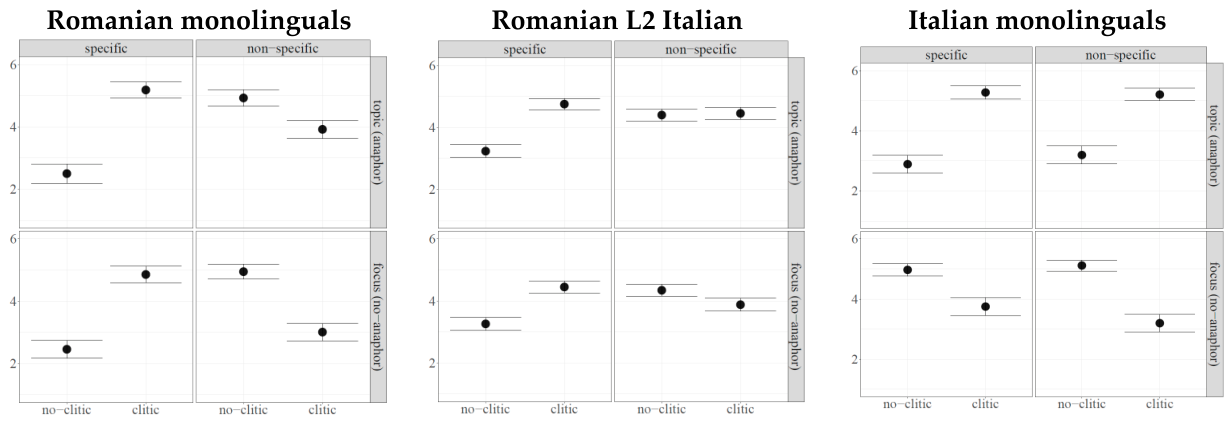
Smeets (2024) used a context dependent acceptability judgment task, presented in aural and written form, where participants were asked to rate the naturalness of clitic and no-clitic sentences presented in one of the four different conditions shown in Table 1 (varying specificity and discourse anaphoricity) on a scale from 1–6. The results reported in Figure 1 showed that Romanians living in Italy (the Romanian L2 Italian group) rated clitic and no-clitic sentences as equally acceptable in the non-specific topic condition. This is the discourse context where Italian monolinguals rate clitic sentences as more acceptable than no-clitic sentences and Romanian monolinguals rate no-clitic sentences higher than clitic sentences). For the specific focus condition, the Romanian L2 Italian group patterned with the Romanian monolinguals.
In other words, this shows that the additional option of using CLLD with non-specific topics, which they acquired from the L2 input4, was added to the options already available in their L1 Romanian while the use of CLLD with specific foci was not lost under the influence of Italian, in line with the predictions made by Hicks & Domínguez (2020). However, I would like to point out that for this linguistic phenomenon, this does not necessarily mean that attriters alternate between L1 and L2 options. To clarify, Romanian and Italian differ in what they allow when the left dislocate is a non-specific topic: in Romanian sentences without a clitic are acceptable and in Italian sentences with a clitic are acceptable. Instead, this finding informs us about the kind of information attriters can take in from the L2 input to transfer onto their L1. Specifically, the results suggest that the presence of a clitic in the L2 in a context where it is not used in the L1 is more salient than the absence of a clitic in a context where the L1 would not use one. In other words, the absence of clitics with specific foci constructions in the Italian input seems to have no influence on their L1 Romanian. In order to establish whether participants’ performances constitute L1-L2 optionality or L2 convergence, we would have to zoom into the participants’ behavior within the non-specific topic condition more closely.
Since clitics are required in Italian with non-specific topics, the presence of clitics in Italian causes competition with the no-clitic counterpart in Romanian. Evidence for optionality in attriters would be found if both clitic and no-clitic sentences would be equally acceptable. Evidence for L2 convergence would be found if an attriter rates an option from the L2 grammar (clitic-sentence) as more acceptable than the L1 counterpart (no-clitic-sentence). The group results for the Romanian L2 Italian group shown in Figure 1 suggest that clitic and no-clitic sentences are rated as equally acceptable in the non-specific topic condition. Based on these group results we would thus conclude that options from the L2 grammar (clitic sentences) are added to the existing L1 options (no-clitic sentences). However, if we have a closer look into the individual response patterns, we find evidence for L2 convergence as well.
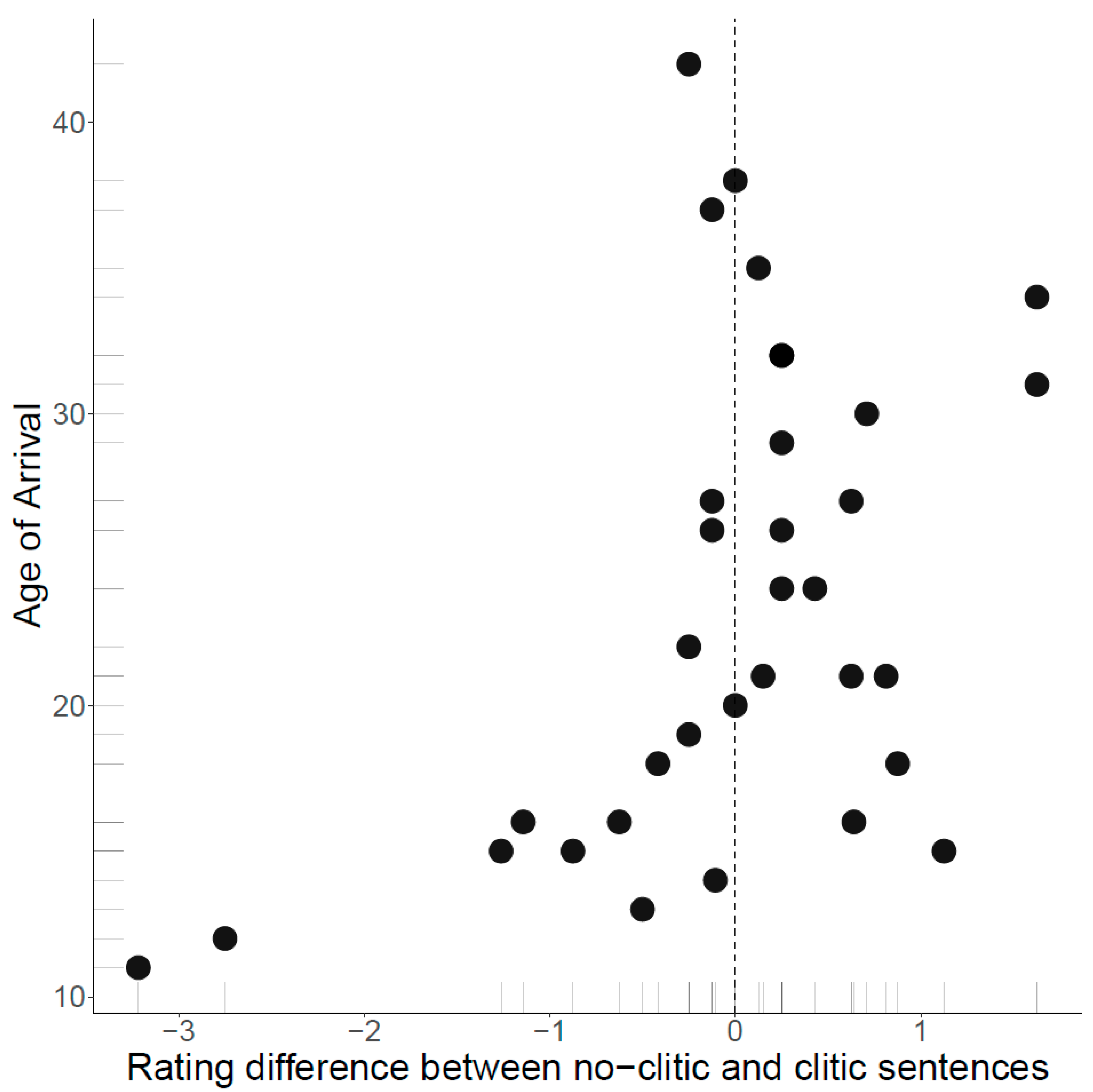
Let us elaborate by looking at the ways participants can respond in an acceptability judgment task. One possibility is that speakers accept all sentences that can be parsed by using either one of their two grammars. If attriters have two copies of the clitic in their L1 grammar, one with the feature specifications of the L1 and one with the feature specifications of the L2, or when the L2 parse becomes temporarily available due to L2 interference, we would predict that attriters accept both clitic sentences (by accessing the option grammatical in the L2) and no-clitic sentences (by accessing the option grammatical in the L1). Alternatively, optionality may be shown within a single condition for which the same participant sometimes rejects and sometimes accepts a sentence within that condition. In both cases, we expect both clitic and no clitic sentences to be acceptable. L2 convergence, on the other hand, would predict that attriters make the same distinction between grammatical and ungrammatical sentences as monolingual speakers of the L2. For the case at hand, L2 convergence predicts higher acceptability ratings for ungrammatical (clitic) sentences than for grammatical (no-clitic) sentences for a particular condition. Smeets (2024) found both patterns of L1-L2 optionality and patterns of L2 convergence. Figure 2 plots the individual results for the acceptability ratings in the non-specific topic condition, calculated as a difference between each individual’s average rating to no-clitic and clitic sentences.
Figure 2 shows how the acceptability of clitic versus no-clitic sentences differs from one participant to another. Individuals with a datapoint around the 0 dashed line accept clitic and no-clitic sentences equally and the type of attrition here is consistent with L1–L2 optionality. For these speakers, it would be difficult to distinguish between processing and restructuring effects as options from both the L1 and the L2 are accessible. Individuals with a score above 0 rate no-clitic sentences as more acceptable, in line with Romanian monolinguals, and therefore do not show signs of attrition. Those participants with a score below 0 rate clitic sentences as more acceptable, in line with L2 convergence, which is the case for at least 85 out of 33 participants (which, as discussed in Smeets (2024), correlates with an earlier age of arrival in Italy). Such response patterns unambiguously provide evidence for restructuring at the level of grammatical representation. The reported mean average in Figure 1 is therefore rather misleading as not all participants allow both clitic and no-clitic sentence. The fact that some speakers rate no-clitic sentences as more acceptable (the non-attriters) and others rate clitic sentences as more acceptable (the attriters) also contributed to this mean average.
To conclude, Smeets (2024) showed that L2 convergence, which is found in one of the experimental conditions and for some speakers, should not be dismissed as a phenomenon that occurs only in situations where the attriter ceases to have access to L1 input. In fact, the participants of this study reside in large and quite enclosed Romanian communities and all participants used their L1 on a daily basis.

7. Concluding Remarks

This paper focused on changes to the mental representation of L1 grammars that may occur after prolonged L2 induced inhibition of an L1 competitive item. When a speaker predominantly processes input from the L2 in combination with a reduction in input from the L1, grammatical attrition may occur. The main question addressed in this paper was how we can tease apart the earlier stages of superficial attrition at the level of processing from deep attrition at the level of representation. I argued that patterns of convergence onto the L2 grammar constitute the clearest examples of grammatical attrition. Although it is clear from existing attrition research that attrition at the level of grammatical representation is less common than L2 to L1 interference at the level of processing, I argued that it is possibly more common than is currently assumed. The paper discussed three ways future research may be able to reveal patterns of L2 convergence, which in turn help us better understand the extent at which grammatical attrition is possible.

7.1. Comparison to Native Speakers of the L2

The paper discussed the well-attested finding that attrition is more likely to occur when the L2 provides options representing a superset of the options available in the L1 for the corresponding grammatical property. I argued that for linguistic phenomena where the L2 allows a proper superset of the grammatical options or interpretations available in the L1, it is often difficult to determine whether attriters make the same grammatical distinctions as native speakers of the L2 language or whether they are alternating between L1 and L2 options because all structures/ interpretations that are grammatical in the L1 are grammatical in the L2. To provide evidence for L2 convergence, it is important to include a comparison group of native speakers of the L2. This allows for examining whether the behavior of attriters is within the range of the L2 (indicating L2 convergence) or is better interpreted as occasional interference at the level of processing. Additionally, researchers would be encouraged to look at more linguistic properties and L1–L2 combinations where L1 and L2 properties align but where also the L1 uses the relevant construction in situations not used in the L2.

7.2. Analysis of Individual Response Patterns

An analysis of individual response patterns should become standard practice in future attrition studies, as it is well known that attrition does not affect all speakers equally, as is also supported by the CLLD results from Section 6. Individual analyses are crucial to increase our understanding of when and how grammatical restructuring of adult L1 grammars can occur. The results from López Otero (2022) discussed in Section 4.2, provide an excellent candidate for such an analysis, in particular because the participants’ L2 Spanish allows structures not available in their L1 Romanian and we can therefore investigate whether some speakers rated L2 options as more acceptable than L1 options. The author concludes that there is no evidence for a representational change as the attriter group still made a clear distinction between grammatical and ungrammatical structures. While this is of course a very reasonable interpretation of the data, the results do not exclude the possibility that the non-deterministic behavior of the experimental group is driven by the behavior of a couple of speakers. We can, however, only find out when looking at individual differences. Speakers who reject DOM marking in the inanimate Pronoun DP condition and who tend to not use it in production may have converged their grammar to the Spanish animacy feature.

7.3. Final Remarks

To end this paper, I discuss two additional yet-to-be-explored factors that might play a role in why some phenomena are more vulnerable, namely phonological similarities and markedness.
The phonological similarities between the L1 and L2 forms might have played a role in the attested attrition effects discussed in Smeets (2024), as accusative clitic forms are almost identical in Italian (il, la, l’, i, le) and Romanian (îl, o, l, i, le), except for the feminine singular clitic, and therefore have a high degree of overlap. However, phonological similarity (in addition to overlap and differences in use) did not lead to attrition in the use of reflexive forms Sich/zich in L1 German L2 Dutch speakers reported in Baker (2024).
Additionally, attrition research may look into the role of markedness. The previously discussed research on the attrition of differential case marking of the object under the influence of an L2 which does not use DOM supports the idea that marked structures seem to be more likely to become inactive under the influence of a less marked option from another language. This idea can be tested for other linguistic phenomena. For example, one of the properties examined in the L1 Spanish and L2 Brazilian Portuguese of the participant tested in Iverson (2012) was the use of the non-canonical verb-subject (VS) word order. In Spanish, the VS word order is preferred with interrogatives and can be used with unaccusatives, unergatives and transitive verbs. In BP, on the other hand, the use of VS orders is more restricted as it is only allowed with unaccusative verbs. It would be interesting to examine the acceptance of VS orders with a larger group of native Spanish speakers in Brazil, including those who still use Spanish on a regular basis, to examine if the VS order can become unacceptable with unergatives and transitive verbs under the influence of L2 Portuguese. The fact that Portuguese uses a canonical subject-verb order in contexts where Spanish allows a more marked verb-subject order could facilitate attrition on the use of verb-subject orders in those contexts.
To summarize, there are ample research questions to be addressed in future attrition research to better understand the combination of factors that could lead to L1 restructuring. To date, we have not yet sufficiently studied these factors to conclude that grammatical restructuring of L1 grammars is not possible.

Funding

This research received no external funding.

Data Availability Statement

No new data was created for this paper.

Acknowledgments

I would like to thank the anonymous reviewers and the editors, Lewis Baker, Laura Domínguez and Glyn Hicks for they very valuable feedback and guidance in shaping the argumentation of this manuscript.

Conflicts of Interest

The author declares no conflicts of interest.

Notes

1
Iverson (2012) reports that although his participant, Pablo, shows judgments on both speeded and non-speeded judgment tasks that are different from controls, there is no difference in the reaction times on the speeded tasks. Iverson argues this to be evidence of representational change without processing difficulties, challenging the idea that representational effects imply processing effects. However, the lack of processing difficulties might be due to the fact that Pablo’s attrited L1 grammar has reached a stable point and therefore L1 and L2 options are no longer in competition.
2
Note that attrition effects in the interpretation of overt pronouns have been found in studies using offline tasks (Domínguez, 2013; Kaltsa et al., 2015; Tsimpli et al., 2004). Following the reasoning that offline tasks would tap into mental representation, these findings would suggest attrition at the representational level. We would then need to explain why similar groups tested on the same linguistic phenomenon sometime do and sometimes do not show signs of attrition.
3
This prediction has been extended to bilingual contexts more generally in Hicks et al. (2024).
4
We know that native Romanian speakers can acquire CLLD with non-specific topics in L2 Italian. In fact, in an earlier study testing the same linguistic phenomenon as in Smeets (2024), Smeets (2023) found L1 pre-emption effects in the L2 acquisition of Italian by Romanian native speakers, where L2 learners were able to acquire the use of clitics with non-specific topics in Italian (a new option that was added to the options Romanian L2 Italian speakers transferred from their L1) but did not unlearn the use of clitics with specific foci which they transferred from the L1 in earlier stages of L2 acquisition.
5
Admittedly, this number is an arbitrary cut-off point to distinguish between superficial and deep attrition, which can better be seen as gradient, as discussed throughout this paper.

References

  1. Altenberg, E. P. (1991). Assessing first language vulnerability to attrition. In H. W. Seliger, & R. M. Vago (Eds.), First language attrition (1st ed., pp. 189–206). Cambridge University Press. [Google Scholar] [CrossRef]
  2. Aygen, G. (2002). T-to-C: Extractable subjects and EPP in Turkish. In V. Samiian (Ed.), The proceedings of the western conference on linguistics 2000 (Vol. 12, pp. 65–80). [Google Scholar]
  3. Aygen, G. (2011). Reduced relatives and the location of agreement. California Linguistic Notes, 31(1), 1–30. [Google Scholar]
  4. Baker, L. (2024). The role of linguistic input in adult grammars: Modelling L1 morphosyntactic attrition [Ph.D. thesis, University of Southampton]. Available online: https://eprints.soton.ac.uk/487888/ (accessed on 4 December 2025).
  5. Chamorro, G., Sorace, A., & Sturt, P. (2016). What is the source of L1 attrition? The effect of recent L1 re-exposure on Spanish speakers under L1 attrition. Bilingualism: Language and Cognition, 19(3), 520–532. [Google Scholar] [CrossRef]
  6. Ciovârnache, C., & Avram, L. (2013). Specificity and animacy in the acquisition of differential object marking in Persian as L2. Revue Roumaine de Linguistique/Romanian Review of Linguistics, 58(4), 419–438. [Google Scholar]
  7. Coşkun Kunduz, A., & Montrul, S. (2025). How flexible are grammars past puberty? The case of relative clauses in Turkish-American returnees. Language Learning, lang.70003. [Google Scholar] [CrossRef]
  8. Domínguez, L. (2013). Understanding interfaces: Second language acquisition and first language attrition of Spanish subject realization and word order variation (Vol. 55). John Benjamins Publishing Company. [Google Scholar] [CrossRef]
  9. Domínguez, L., & Hicks, G. (2016). Synchronic change in a multidialectal Spanish community: Evidence from null and postverbal subjects. In A. Cuza, L. Czerwionka, & D. Olson (Eds.), Issues in Hispanic and Lusophone linguistics (Vol. 12, pp. 53–72). John Benjamins Publishing Company. [Google Scholar] [CrossRef]
  10. Domínguez, L., Jamieson, E., Hicks, G., & Schmid, M. S. (2024, September 12). Differentiating between superficial and grammatical attrition: Evidence from native speakers of German, Spanish and Southern British English in bilingual/bidialectal contexts. Generative Approaches to Language Acquisition. [Google Scholar]
  11. Farkas, D., & von Heusinger, K. (2003, August 18–29). Stability of reference and object marking in Romanian. Workshop on Direct Reference and Specificity, ESSLLI, Vienna, Austria. [Google Scholar]
  12. Flores, C., & Snape, N. (2021). Language attrition and heritage language reversal in returnees. In The Cambridge handbook of heritage languages and linguistics. Cambridge handbooks in language and linguistics (pp. 351–372). Cambridge University Press. [Google Scholar]
  13. Glodstaf, W., & Montrul, S. (2025). Activating L1-attrition: A priming experiment. Second Language Research, 41(4), 769–803. [Google Scholar] [CrossRef]
  14. Gürel, A. (2002). Linguistic characteristics of second language acquisition and first language attrition: Turkish overt versus null pronouns [Ph.D. thesis, McGill University]. [Google Scholar]
  15. Gürel, A. (2003). Is the overt pronoun constraint universal? Evidence from L2 Turkish. In J. M. Liceras, H. Zobl, & H. Goodluck (Eds.), Proceedings of the 6th generative approaches to second language acquisition conference (pp. 130–139). Cascadilla Press. [Google Scholar]
  16. Gürel, A. (2004). Selectivity in L2-induced L1 attrition: A psycholinguistic account. Journal of Neurolinguistics, 17(1), 53–78. [Google Scholar] [CrossRef]
  17. Gürel, A. (2007). (Psycho)linguistic determinants of L1 attrition. In B. Köpke, M. S. Schmid, M. Keijzer, & S. Dostert (Eds.), Studies in bilingualism (Vol. 33, pp. 99–119). John Benjamins Publishing Company. [Google Scholar] [CrossRef]
  18. Gürel, A., & Yilmaz, G. (2011). Restructuring in the L1 Turkish grammar: Effects of L2 English and L2 Dutch. Language, Interaction and Acquisition, 2(2), 221–250. [Google Scholar] [CrossRef]
  19. Hicks, G., & Domínguez, L. (2020). A model for L1 grammatical attrition. Second Language Research, 36(2), 143–165. [Google Scholar] [CrossRef]
  20. Hicks, G., Domínguez, L., Jamieson, E., & Schmid, M. S. (2024). L1 grammatical attrition in late Spanish-English bilinguals in the UK: Aspectual interpretations of present tense in Spanish. The Language Learning Journal, 52(2), 145–158. [Google Scholar] [CrossRef]
  21. Iverson, M. B. (2012). Advanced language attrition of Spanish in contact with Brazilian Portuguese [Ph.D. thesis, University of Iowa]. [Google Scholar] [CrossRef]
  22. Iverson, M., & Miller, D. (2017). Language attrition and maintenance: Two sides of the same coin? Linguistic Approaches to Bilingualism, 7(6), 704–708. [Google Scholar] [CrossRef]
  23. Jakobson, R. (1941). Kindersprache, aphasie und allgemeine lautgesetze. Almqvist. [Google Scholar]
  24. Kaltsa, M., Tsimpli, I. M., & Rothman, J. (2015). Exploring the source of differences and similarities in L1 attrition and heritage speaker competence: Evidence from pronominal resolution. Lingua, 164, 266–288. [Google Scholar] [CrossRef]
  25. Kornfilt, J. (2003). Subject case in Turkish nominalized clauses. In U. Junghanns, & L. Szucsich (Eds.), Syntactic structures and morphological information (pp. 129–216). DE GRUYTER. [Google Scholar] [CrossRef]
  26. Köpke, B. (1999). L’attrition de la première langue chez le bilingue tardif: Implications pour l’étude psycholinguistique du bilinguisme [first language attrition in late bilinguals: Implications for the psycholinguistic research of bilingualism [Ph.D. thesis, University of Toulouse]. [Google Scholar]
  27. Köpke, B. (2002). Activation thresholds and non-pathological first language attrition. In F. Fabbro (Ed.), Advances in the neurolinguistics of bilingualism. Essays in honor of Michel paradis (pp. 119–142). Forum. [Google Scholar]
  28. Lardiere, D. (2009). Some thoughts on the contrastive analysis of features in second language acquisition. Second Language Research, 25(2), 173–227. [Google Scholar] [CrossRef]
  29. Leonetti, M. (2008). Specificity in clitic doubling and in differential object marking. Probus, 20(1), 33–66. [Google Scholar] [CrossRef]
  30. Lidz, J. (2006). The grammar of accusative case in Kannada. Language, 82(1), 10–32. [Google Scholar] [CrossRef]
  31. López, L. (2009). A derivational syntax for information structure. Oxford University Press. [Google Scholar] [CrossRef]
  32. López Otero, J. C. (2022). Bidirectional cross-linguistic influence on DOM in Romanian-Spanish bilinguals. International Journal of Bilingualism, 26(6), 710–731. [Google Scholar] [CrossRef]
  33. Mardale, A. (2008). Microvariation within differential object marking: Data from Romance. Revue Roumaine de Linguistique/Romanian Review of Linguistics, 53(4), 449–467. [Google Scholar]
  34. Mardale, A. (2010). Éléments d’analyse du marquage différentiel de l’objet dans les langues romanes. Faits de Langues—Les Cahiers, 2, 161–197. [Google Scholar] [CrossRef]
  35. Montrul, S. (2014). Structural changes in Spanish in the United States: Differential object marking in Spanish heritage speakers across generations. Lingua, 151, 177–196. [Google Scholar] [CrossRef]
  36. Montrul, S. (2017). Developmental continuity in morphosyntactic attrition. Linguistic Approaches to Bilingualism, 7(6), 739–743. [Google Scholar] [CrossRef]
  37. Montrul, S., Bhatt, R., & Girju, R. (2015). Differential object marking in Spanish, Hindi, and Romanian as heritage languages. Language, 91(3), 564–610. [Google Scholar] [CrossRef]
  38. Montrul, S., & Sánchez-Walker, N. (2013). Differential object marking in child and adult Spanish heritage speakers. Language Acquisition, 20(2), 109–132. [Google Scholar] [CrossRef]
  39. Paradis, M. (1993). Linguistic, psycholinguistic, and neurolinguistic aspects of “interference” in bilingual speakers: The activation threshold hypothesis. International Journal of Psycholinguistics, 9(2), 133–145. [Google Scholar]
  40. Paradis, M. (2004). A neurolinguistic theory of bilingualism (Vol. 18). John Benjamins Publishing Company. [Google Scholar] [CrossRef]
  41. Paradis, M. (2007). L1 attrition features predicted by a neurolinguistic theory of bilingualism. In B. Köpke, M. S. Schmid, M. Keijzer, & S. Dostert (Eds.), Studies in bilingualism (Vol. 33, pp. 121–133). John Benjamins Publishing Company. [Google Scholar] [CrossRef]
  42. Pavlenko, A. (2000). L2 influence on L1 in late bilingualism. Issues of Applied Linguistics, 11, 17–205. [Google Scholar] [CrossRef]
  43. Pelc, L. A. (2001). L1 lexical, morphological and morphosyntactic attrition in Greek-English bilinguals [Ph.D. thesis, City University of New York]. [Google Scholar]
  44. Schmid, M. S. (2009). On L1 attrition and the linguistic system. EUROSLA Yearbook, 9, 212–244. [Google Scholar] [CrossRef]
  45. Schmid, M. S., & De Leeuw, E. (2019). Introduction to linguistic factors in language attrition. In M. S. Schmid, & E. De Leeuw (Eds.), The Oxford handbook of language attrition (pp. 179–190). Oxford University Press. [Google Scholar] [CrossRef]
  46. Schmid, M. S., & Köpke, B. (2017). The relevance of first language attrition to theories of bilingual development. Linguistic Approaches to Bilingualism, 7(6), 637–667. [Google Scholar] [CrossRef]
  47. Smeets, L. (2023). Feature reassembly and L1 preemption: Acquiring CLLD in L2 Italian and L2 Romanian. Second Language Research, 40(3), 559–589. [Google Scholar] [CrossRef]
  48. Smeets, L. (2024). L1 grammatical attrition through the acquisition of competing L2 discourse features. Frontiers in Psychology, 15, 1399870. [Google Scholar] [CrossRef]
  49. Sorace, A. (2016). Language and cognition in bilingual production: The real work still lies ahead. Bilingualism: Language and Cognition, 19(5), 895–896. [Google Scholar] [CrossRef]
  50. Sorace, A. (2020). L1 attrition in a wider perspective. Second Language Research, 36(2), 203–206. [Google Scholar] [CrossRef]
  51. Ticio, E., & Avram, L. (2015). The acquisition of differential object marking in Spanish and Romanian: Semantic scales or semantic features? Revue Roumaine de Linguistique/Romanian Review of Linguistics, 60(4), 383–401. [Google Scholar]
  52. Tsimpli, I. M. (2007). First language attrition from a minimalist perspective: Interface vulnerability and processing effects. In B. Köpke, M. S. Schmid, M. Keijzer, & S. Dostert (Eds.), Studies in bilingualism (Vol. 33, pp. 83–98). John Benjamins Publishing Company. [Google Scholar] [CrossRef]
  53. Tsimpli, I., Sorace, A., Heycock, C., & Filiaci, F. (2004). First language attrition and syntactic subjects: A study of Greek and Italian near-native speakers of English. International Journal of Bilingualism, 8(3), 257–277. [Google Scholar] [CrossRef]
  54. White, L. (1991a). Adverb placement in second language acquisition: Some effects of positive and negative evidence in the classroom. Second Language Research, 7, 133–161. [Google Scholar] [CrossRef]
  55. White, L. (1991b). The verb-movement parameter in second language acquisition. Language Acquisition, 1, 337–360. [Google Scholar] [CrossRef] [PubMed]
  56. White, L. (2023). Assessing adult linguistic competence. In S. Zufferey, & P. Gygax (Eds.), The Routledge handbook of experimental linguistics (1st ed.). Routledge. [Google Scholar] [CrossRef]
Figure 1. Mean acceptability judgments per condition for Romanian monolinguals (left), Romanian expats in Italy (middle) and Italian monolinguals (right).
Languages 11 00096 g001
Figure 2. Rating difference between no-clitic and clitic sentences in the non-specific topic condition. Showing one data point per participant in the attriter group.
Languages 11 00096 g002
Table 1. Distribution of resumptive clitics in Italian and Romanian.
[+ anaphor][− anaphor]Property
[+ specific][− specific][+ specific][− specific]
1RomanianSpecificity
2ItalianAnaphoricity
Disclaimer/Publisher’s Note: The statements, opinions and data contained in all publications are solely those of the individual author(s) and contributor(s) and not of MDPI and/or the editor(s). MDPI and/or the editor(s) disclaim responsibility for any injury to people or property resulting from any ideas, methods, instructions or products referred to in the content.