
Again on the Existence of Causative Periphrases in Spanish: The Case of “enviar/mandar a + Infinitive”

Abstract
1. Introduction
| (1) | a. | Señor […], | el | infante | Roboán | te | embía | a | ||||||||||||||||||||||||||||
| lord | the | prince | Roboán | you | send.prs.3sg | to | ||||||||||||||||||||||||||||||
| rogar | que […] | no | quieras | hazer | mal | en | el | |||||||||||||||||||||||||||||
| beg.inf | that | not | want | do | wrong | in | the | |||||||||||||||||||||||||||||
| reino | de | Pandulfa | ||||||||||||||||||||||||||||||||||
| kingdom | of | Pandulfa | ||||||||||||||||||||||||||||||||||
| ‘Lord, Prince Roboán asks you to plan no wrong in the kingdom of Pandulfa’ (Anonymous, Libro del cavallero Cifar, 1300–1305 [last third of the 15th c.], Spain [RAE, 2015]) | ||||||||||||||||||||||||||||||||||||
| b. | & | fizo=les | matar | muchos | daquellos | monges | ||||||||||||||||||||||||||||||
| and | make.pret.3sg=them | kill.inf | many | of.those | monks | |||||||||||||||||||||||||||||||
| ‘And he made them kill many of those monks’ (Alfonso X, Estoria de Espanna, ca. 1270 [last fourth of the 13th c.], Spain [RAE, 2015]) | ||||||||||||||||||||||||||||||||||||
| c. | Estonçe | el | rey | mandó | llamar | todos | los | grandes | ||||||||||||||||||||||||||||
| then | the | king | order.pret.3sg | call.inf | all | the | great | |||||||||||||||||||||||||||||
| honbres | de | su | corte | |||||||||||||||||||||||||||||||||
| men | of | his | court | |||||||||||||||||||||||||||||||||
| ‘Then the king sent for all the great men in his court’ (Gutierre Díaz de Games, El Victorial, 1431–1449 [late 15th c. or early 16th c.], Spain [RAE, 2015]) | ||||||||||||||||||||||||||||||||||||
| d. | assi | como | te | leuantares | manda | a | ||||||||||||||||||||||||||||||
| thus | as | yourself | rise | order/send.imp.sg | to | |||||||||||||||||||||||||||||||
| limpiar | todas | las | plaças | & | las | calles | de | |||||||||||||||||||||||||||||
| clean.inf | all | the | public.squares | and | the | streets | of | |||||||||||||||||||||||||||||
| la | cibdad | |||||||||||||||||||||||||||||||||||
| the | city | |||||||||||||||||||||||||||||||||||
| ‘as soon as you rise have all the public squares and streets of the city cleaned’ (Alfonso X, General Estoria. Cuarta parte, ca. 1280 [1280], Spain [RAE, 2015]) | ||||||||||||||||||||||||||||||||||||
| (2) | a. | Incluso | había | enviado | a | decir | a | sus | |||||||||||||||||
| even | have.impf.3sg | send.ptcp.m.sg | to | say.inf | to | his | |||||||||||||||||||
| visitantes | que | la | perdonaran | ||||||||||||||||||||||
| visitors | that | her | forgive | ||||||||||||||||||||||
| ‘She had even sent word to her visitors asking them to forgive her’ (Pablo Simonetti, La soberbia juventud, 2014, Chile [RAE, 2025]) | |||||||||||||||||||||||||
| b. | Este | frío | me | hace | dormir | abrazado | a | ti | |||||||||||||||||
| this | cold | me | make.prs.3sg | sleep.inf | embraced | to | you | ||||||||||||||||||
| ‘The cold makes me sleep hugging you’ (Vicente Molina Foix, El abrecartas, 2006, Spain [RAE, 2025]) | |||||||||||||||||||||||||
| c. | Uno | de | los | hijos | mandó | construir | un | ||||||||||||||||||
| one | of | the | children | order.pret.3sg | build.inf | a | |||||||||||||||||||
| mausoleo | pomposo | ||||||||||||||||||||||||
| mausoleum | pompous | ||||||||||||||||||||||||
| ‘One of his children had a pompous mausoleum built’ (Daniel Sada, Casi nunca, 2008, Mexico [RAE, 2025]) | |||||||||||||||||||||||||
| d. | Dicen | que | mandó | a | matar | a | su | padre | |||||||||||||||||
| say | that | order/send.pret.3sg | to | kill.inf | to | his | father | ||||||||||||||||||
| ‘They say he had his father killed’ (Fernan Espinosa, Mi vida por un libro, 2001, Colombia [RAE, 2025]) | |||||||||||||||||||||||||
2. Spanish Infinitive Causatives and the Concept of Verbal Periphrasis: Findings and Problems
| (3) | a. | Nos | hizo | condenar=te | ||||||||||||||||||
| us | make.pret.3sg | sentence.inf=you | ||||||||||||||||||||
| ‘He made us sentence you’ (Fernández de Castro, 1999, p. 28) | ||||||||||||||||||||||
| b. | reafirmar | las | pazes | y | confederaciones | antiguas | que | |||||||||||||||
| confirm | the | peaces | and | confederations | old | that | ||||||||||||||||
| perpetuamente | fueron | juradas | por | los | reyes | pasados | de | |||||||||||||||
| perpetually | were | sworn | by | the | kings | previous | of | |||||||||||||||
| Francia […] | que | espresamente | obligauan | a | mantener | |||||||||||||||||
| France | that | expressedly | obligate.impf.3pl | to | keep.inf | |||||||||||||||||
| y | guardar | a | sus | subcesores | ||||||||||||||||||
| and | save.inf | to | their | successors | ||||||||||||||||||
| ‘ratify the old pacts and confederations that were sworn by the former kings of France, which their successors were expressly obligated to uphold and preserve’ (Hernando del Pulgar, Crónica de los Reyes Católicos, prob. 1480–1484, Spain [Alfonso Vega, 1998, p. 40]) | ||||||||||||||||||||||
| (4) | a. | Juan | le | hizo | escribir=la | ||||||||||||
| Juan | him | make.pret.3sg | write.inf=it | ||||||||||||||
| ‘Juan made him write it’ (Fábregas, 2019, p. 71) | |||||||||||||||||
| b. | tienen | los | omnes | que | el | faze | a | ellos | |||||||||
| consider | the | men | that | he | make.prs.3sg | to | them | ||||||||||
| despreciar=le | |||||||||||||||||
| despise.inf=him | |||||||||||||||||
| ‘men hold that he makes them despise him’ (Pero López de Ayala, Crónica de Pedro I, ca. 1400, Spain [Alfonso Vega, 1998, p. 37]) | |||||||||||||||||
| c. | Macarena | hizo | { jugar | a | Luis | / | que | Luis | |||||||||
| Macarena | make. pret.3sg | play.inf | to | Luis | that | Luis | |||||||||||
| jugara } | |||||||||||||||||
| play.3sg.impf.sbjv | |||||||||||||||||
| ‘Macarena made Luis play’ (Vivanco, 2019, p. 46) | |||||||||||||||||
| (5) | a. | Este | disco | lo | deseaba | hacer | desde | hacía | diez | |||
| this | album | it | wish.impf.1sg | make.inf | since | made | ten | |||||
| años | ||||||||||||
| years | ||||||||||||
| ‘I had been wanting to make this album for ten years’ (La Vanguardia, 13/07/2021, Spain [RAE, 2025]) | ||||||||||||
| b. | Tenemos | que | hacer=lo | así | ||||||||
| have.prs.1pl | that | do.inf=it | thus | |||||||||
| ‘We have to do it like this’ (Paloma Pedrero, El pasamanos, 2019, Spain [RAE, 2025]) | ||||||||||||
| (6) | a. | El | general | mandó | a | un | emisario | a | |||||||||||
| the | general | order/send.pret.3sg | to | an | emissary | to | |||||||||||||
| negociar | la | paz | |||||||||||||||||
| negotiate.inf | the | peace | |||||||||||||||||
| ‘The general sent an emissary to negotiate peace’ | |||||||||||||||||||
| b. | Óscar | mandó | (a | alguien) | a | pedir=le | |||||||||||||
| Óscar | order/send.pret.3sg | to | someone | to | ask.inf=him | ||||||||||||||
| consejo | a | Joaquín | |||||||||||||||||
| advice | to | Joaquín | |||||||||||||||||
| ‘Óscar sent for Joaquín’s advice’ | |||||||||||||||||||
| c. | Miguel | envió | su | bicicleta | a | arreglar | |||||||||||||
| Miguel | send.pret.3sg | his | bicycle | to | fix.inf | ||||||||||||||
| ‘Miguel sent his bicycle to have it fixed’ | |||||||||||||||||||
| (Porto Dapena, 1977, pp. 28, 35, 30) | |||||||||||||||||||
| (7) | a. | Andrés | envió | a | decir | esto | a | su | hijo | { por | / | ||||||||
| Andrés | send.pret.3sg | to | say.inf | this | to | his | son | by | |||||||||||
| con } | un | amigo | |||||||||||||||||
| with | a | friend | |||||||||||||||||
| ‘Andrés had a friend say this to his son’ | |||||||||||||||||||
| b. | Óscar | mandó | a | pedir=le | consejo | a | |||||||||||||
| Óscar | order/send.pret.3sg | to | ask.inf=him | advice | to | ||||||||||||||
| Joaquín | |||||||||||||||||||
| Joaquín | |||||||||||||||||||
| ‘Óscar sent for Joaquín’s advice’ | |||||||||||||||||||
| c. | Mandé | a | llamar=lo | en | una | carta | |||||||||||||
| order/send.pret.1sg | to | call.inf=him | in | a | letter | ||||||||||||||
| ‘I summoned him by letter’ | |||||||||||||||||||
| (Porto Dapena, 1977, pp. 35–36) | |||||||||||||||||||
| (8) | a. | le | hicieron | comer | el | pastel | |||
| 3sg.dat | make.pret.3pl | eat.inf | the | cake | |||||
| b. | la | hicieron | comer | el | pastel | ||||
| 3sg.f.acc | make.pret.3pl | eat.inf | the | cake | |||||
| ‘they made her eat the cake’ (Davies, 1995, p. 59) | |||||||||
| (9) | a. | me | lo | dejaron | comer | |
| me | it | let.pret.3pl | eat.inf | |||
| b. | me | dejaron | comer=lo | |||
| me | let.pret.3pl | eat.inf=it | ||||
| ‘they let me eat it’ (Davies, 1995, p. 63) | ||||||
| (10) | a. | lo | dejaron | sentar |
| him | let.pret.3pl | sit.inf | ||
| b. | lo | dejaron | sentar=se | |
| him | let.pret.3pl | sit.inf=refl | ||
| ‘they let him sit’ (Davies, 1995, p. 59) | ||||
| (11) | a. | le | hicieron | comer | el | pastel | a | Pedro | |||
| to.him | make.pret.3pl | eat.inf | the | cake | to | Pedro | |||||
| b. | le | hicieron | a | Pedro | comer | el | pastel | ||||
| to.him | make.pret.3pl | to | Pedro | eat.inf | the | cake | |||||
| ‘they made Pedro eat the cake’ (Davies, 1995, p. 59) | |||||||||||
3. Porto Dapena’s Data and Arguments Revisited
| (12) | a. | Óscar | mandó | (a | alguien) | a | pedir=le | |||
| Óscar | order/send.pret.3sg | to | someone | to | ask.inf=him | |||||
| consejo | a | Joaquín | ||||||||
| advice | to | Joaquín | ||||||||
| b. | Óscar | mandó | a | pedir=le | consejo | a | ||||
| Óscar | order/send.pret.3sg | to | ask.inf=him | advice | to | |||||
| Joaquín | ||||||||||
| Joaquín | ||||||||||
| ‘Óscar sent for Joaquín’s advice’ | ||||||||||
| (Porto Dapena, 1977, p. 35) | ||||||||||
| (13) | a. | Andrés | envió | a | decir | esto | a | su | hijo | { por | / | |||||||
| Andrés | send.pret.3sg | to | say.inf | this | to | his | son | by | ||||||||||
| con } | un | amigo | ||||||||||||||||
| with | a | friend | ||||||||||||||||
| ‘Andrés had a friend say this to his son’ | ||||||||||||||||||
| b. | Andrés | envió | esto | a | decir | a | su | hijo | ||||||||||
| Andrés | send.pret.3sg | this | to | say.inf | to | his | son | |||||||||||
| c. | *Andrés | envió | que | viniera | a | decir | ||||||||||||
| Andrés | send.pret.3sg | that | come.3sg.impf.sbjv | to | say.inf | |||||||||||||
| a | su | hijo | ||||||||||||||||
| to | his | son | ||||||||||||||||
| (Porto Dapena, 1977, pp. 36–37) | ||||||||||||||||||
| (14) | a. | E | maguer | que | don | Joan | le | enbiaua | esto | |||||
| and | although | that | Don | Juan | to.him | send.IMPF.3sg | this | |||||||
| a | dezir | |||||||||||||
| to | say.inf | |||||||||||||
| ‘And although Don Juan sent this to be said to him’ (Anonymous, Gran crónica de Alfonso XI, ca. 1348–1379 [15th/16th c.], Spain [RAE, 2015]) | ||||||||||||||
| b. | A | la | hora | de | cenar | envió | que | |||||||
| to | the | time | of | dine | send.pret.3sg | that | ||||||||
| viniesen | ||||||||||||||
| come.3pl.impf.sbjv | ||||||||||||||
| ‘At dinnertime he sent for them to come’ (El Universal.com.mx, 20/12/2020, Mexico [RAE, 2025]) | ||||||||||||||
| (15) | Mendieta | compareció | el | pasado | domingo | ante | los | medios | de | |||||||
| Mendieta | appeared | the | past | Sunday | before | the | media | of | ||||||||
| comunicación | con | la | intención | de | enviarle | un | mensaje | |||||||||
| communication | with | the | intention | of | send | a | message | |||||||||
| al | Valencia | |||||||||||||||
| to.the | Valencia | |||||||||||||||
| ‘Mendieta appeared before the media last Sunday with the intention of sending a message to Valencia’ (El País, 17/07/2001, Spain [RAE, 2025]) | ||||||||||||||||
| (16) | Mandé | a | llamar=lo | en | una | carta |
| order/send.pret.1sg | to | call.inf=him | in | a | letter | |
| ‘I summoned him by letter’ | ||||||
| (Porto Dapena, 1977, p. 36) | ||||||
| (17) | a. | Pasé | con | este | trabajo | hasta | la | tarde, | que | |||||||||||||||||||||
| passed | with | this | trouble | until | the | evening | that | |||||||||||||||||||||||
| envió | el | Retor | de | la | Compañía | a | ver=me | |||||||||||||||||||||||
| send.pret.3sg | the | rector | of | the | society | to | see.inf=me | |||||||||||||||||||||||
| con | un | padre | que | me | animó | y | consoló | |||||||||||||||||||||||
| with | a | father | that | me | encouraged | and | consoled | |||||||||||||||||||||||
| mucho | ||||||||||||||||||||||||||||||
| much | ||||||||||||||||||||||||||||||
| ‘I spent the entire day dealing with this trouble, until the rector of the society sent a father to visit me, and he encouraged and consoled me a great deal’ (Santa Teresa de Jesús, Libro de las fundaciones, 1573–1582, Spain [Cuervo & ICC, 1978/1998a, p. 714]) | ||||||||||||||||||||||||||||||
| b. | Muchos | señores | con | embaxadas | se | enviaron | a | |||||||||||||||||||||||
| many | lords | with | missives | refl | send.pret.3pl | to | ||||||||||||||||||||||||
| encomendar | en | sus | oraciones | |||||||||||||||||||||||||||
| commend.inf | in | his | prayers | |||||||||||||||||||||||||||
| ‘Many lords commended themselves to his prayers by missive’ (Antonio de Fuenmayor, Vida y hechos de Pío V, 1595, Spain [Cuervo & ICC, 1978/1998a, p. 714; Porto Dapena, 1977, p. 38, fn. 9]) | ||||||||||||||||||||||||||||||
| c. | Sabiendo | quién | era | el | escribano | de | la | causa, | ||||||||||||||||||||||
| knowing | who | was | the | clerk | of | the | cause | |||||||||||||||||||||||
| envié=le | a | llamar | con | un | picarillo | |||||||||||||||||||||||||
| send.pret.1sg=him | to | call.inf | with | a | little.scoundrel | |||||||||||||||||||||||||
| ‘Knowing who the clerk of the cause was, I sent a little scoundrel to fetch him’ (Francisco de Quevedo y Villegas, La vida del Buscón llamado don Pablos, 1626, Spain [Cuervo & ICC, 1978/1998a, p. 714]) | ||||||||||||||||||||||||||||||
4. Searching for Periphrastic Cases of “enviar/mandar a + Infinitive” in the History of Spanish
| (18) | a. | & | desque | vido | que | no | venía, | embio=la | a | ||||||||||||||||||||||||||||
| and | after | saw | that | not | came | send.pret.3sg=her | to | ||||||||||||||||||||||||||||||
| llamar | con | un | portero | ||||||||||||||||||||||||||||||||||
| call.inf | with | a | guard | ||||||||||||||||||||||||||||||||||
| ‘And after she realized that she was not coming, she sent a guard to fetch her’ (Anonymous, Libro del cavallero Cifar, 1300–1305 [last third of the 15th c.], Spain [RAE, 2015]) | |||||||||||||||||||||||||||||||||||||
| b. | Et | sabet | que | por | este | tuerto | tan | grand | que | el | |||||||||||||||||||||||||||
| and | know | that | for | this | wrong | so | great | that | the | ||||||||||||||||||||||||||||
| Rey | me | ha | fecho | que | me | enbio | a | ||||||||||||||||||||||||||||||
| king | me | has | done | that | refl | send.prs.1sg | to | ||||||||||||||||||||||||||||||
| despedir | e | a | desnaturar | del | |||||||||||||||||||||||||||||||||
| take.leave.inf | and | to | forswear.inf | of.him | |||||||||||||||||||||||||||||||||
| ‘And know that on account of so great a wrong that the king has done me I hereby take my leave of him and forswear him’ (Anonymous, “Cartas de Don Juan Manuel y vasallos suyos enviados al Rey de Granada y concejos de Murcia,” 1327, Spain [RAE, 2015]) | |||||||||||||||||||||||||||||||||||||
| c. | et | que | don | Iohan | no | y | auie | quesido | venir, | ||||||||||||||||||||||||||||
| and | that | Don | Juan | not | there | had | wanted | come | |||||||||||||||||||||||||||||
| enuiando=se | a | escusar | por | tales | razones | que | el | ||||||||||||||||||||||||||||||
| send.ger=refl | to | excuse.inf | for | such | reasons | that | he | ||||||||||||||||||||||||||||||
| et | los | de | su | cort | pudieron | bien | conoscer | que | no | ||||||||||||||||||||||||||||
| and | the | of | his | court | could | well | know | that | not | ||||||||||||||||||||||||||||
| auie | uolumtat | de | venir | a | su | seruicio | |||||||||||||||||||||||||||||||
| had | will | of | come | to | his | service | |||||||||||||||||||||||||||||||
| ‘and that Don Juan had not wished to come, sending such excuses that he and everyone in his court could clearly recognize that he had no intention of coming in his service’ (Juan Fernández de Heredia, Gran crónica de España, III, 1376 – a. 1391, Spain [RAE, 2015]) | |||||||||||||||||||||||||||||||||||||
| d. | el | rrey, | por | sus | cartas, | enbió | a | llamar | a | ||||||||||||||||||||||||||||
| the | king | by | his | letters | send.pret.3sg | to | call.inf | to | |||||||||||||||||||||||||||||
| don | Alonso | Carrillo, | arçobispo | de | Toledo, | y | a | ||||||||||||||||||||||||||||||
| Don | Alonso | Carrillo | bishop | of | Toledo | and | to | ||||||||||||||||||||||||||||||
| don | Pero | Fernández | de | Velasco, | conde | de | Haro | ||||||||||||||||||||||||||||||
| Don | Pedro | Fernández | de | Velasco | count | of | Haro | ||||||||||||||||||||||||||||||
| ‘the king, through his letters, summoned Don Alonso Carrillo, bishop of Toledo, and Don Pedro Fernández de Velasco, count of Haro’ (Diego Enríquez del Castillo, Crónica de Enrique IV, ca. 1481–1502, Spain [RAE, 2015]) | |||||||||||||||||||||||||||||||||||||
| (19) | a. | e | mandamos | que […] | le | recabden | e | nos | lo | ||||||||||||||||||||||||||||||
| and | order | that | him | detain | and | us | it | ||||||||||||||||||||||||||||||||
| embíen | a | decir | |||||||||||||||||||||||||||||||||||||
| send.prs.sbjv.3pl | to | say.inf | |||||||||||||||||||||||||||||||||||||
| ‘and we order that they detain him and send us word of it’ (Anonymous, “Alfonso X amplia y matiza exenciones y privilegios,” 1264, Spain [RAE, 2015]) | |||||||||||||||||||||||||||||||||||||||
| b. | Señor […], | el | infante | Roboán | te | embía | a | ||||||||||||||||||||||||||||||||
| lord | the | prince | Roboán | you | send.prs.3sg | to | |||||||||||||||||||||||||||||||||
| rogar | que […] | no | quieras | hazer | mal | en | el | ||||||||||||||||||||||||||||||||
| beg.inf | that | not | want | do | wrong | in | the | ||||||||||||||||||||||||||||||||
| reino | de | Pandulfa | |||||||||||||||||||||||||||||||||||||
| kingdom | of | Pandulfa | |||||||||||||||||||||||||||||||||||||
| ‘Lord, Prince Roboán asks you to plan no wrong in the kingdom of Pandulfa’ (Anonymous, Libro del cavallero Cifar, 1300–1305 [last third of the 15th c.], Spain [RAE, 2015]) | |||||||||||||||||||||||||||||||||||||||
| c. | E | el | prior | e | el | conçejo | de | Çamora | |||||||||||||||||||||||||||||||
| and | the | prior | and | the | council | of | Zamora | ||||||||||||||||||||||||||||||||
| enbiaron=le | a | rresponder | que | lo | fazian | por | su | ||||||||||||||||||||||||||||||||
| send.pret.3pl=to.him | to | answer.inf | that | it | did | for | his | ||||||||||||||||||||||||||||||||
| serviçio | |||||||||||||||||||||||||||||||||||||||
| service | |||||||||||||||||||||||||||||||||||||||
| ‘And the prior and the council of Zamora sent him word in reply that they were doing it in his service’ (Anonymous, Gran crónica de Alfonso XI, ca. 1348–1379 [late 15th c. or early 16th c.], Spain [RAE, 2015]) | |||||||||||||||||||||||||||||||||||||||
| d. | & | nabuchodonosor | rey | embio / | a | ayuntar | los | ||||||||||||||||||||||||||||||||
| and | Nebuchadnezzar | king | send.pret.3sg | to | gather.inf | the | |||||||||||||||||||||||||||||||||
| duques | & | los | condes | ||||||||||||||||||||||||||||||||||||
| dukes | and | the | counts | ||||||||||||||||||||||||||||||||||||
| ‘And King Nebuchadnezzar ordered to gather the dukes and the counts’ (Anonymous, Biblia romanceada, ca. 1400, Spain [RAE, 2015]) | |||||||||||||||||||||||||||||||||||||||
| (20) | a. | & | si | al | juyz | fuere | prouado, | o | al | obispo, | ||||||||||||||||||||||||||
| and | if | to.the | judge | were | proven | or | to.the | bishop | ||||||||||||||||||||||||||||
| que | julgó | tuerto | lo | que | mandó | a | ||||||||||||||||||||||||||||||
| that | judged | wrong | the | that | order/send.pret.3sg | to | ||||||||||||||||||||||||||||||
| tomar | a | aquel | a | que | lo | julgaron | ||||||||||||||||||||||||||||||
| take.inf | to | that | to | that | him | judged | ||||||||||||||||||||||||||||||
| ‘And if it be proven to the judge, or to the bishop, that he judged wrongly what he ordered to be taken from him against whom the judgment was rendered’ (Anonymous, Fuero Juzgo, ca. 1250–1260, Spain [RAE, 2015]) | ||||||||||||||||||||||||||||||||||||
| b. | assi | como | te | leuantares | manda | a | ||||||||||||||||||||||||||||||
| thus | as | yourself | rise | order/send.imp.sg | to | |||||||||||||||||||||||||||||||
| limpiar | todas | las | plaças | & | las | calles | de | |||||||||||||||||||||||||||||
| clean.inf | all | the | public.squares | and | the | streets | of | |||||||||||||||||||||||||||||
| la | cibdad | |||||||||||||||||||||||||||||||||||
| the | city | |||||||||||||||||||||||||||||||||||
| ‘as soon as you rise have all the public squares and streets of the city cleaned’ (Alfonso X, General Estoria. Cuarta parte, ca. 1280 [1280], Spain, [RAE, 2015]) | ||||||||||||||||||||||||||||||||||||
| c. | e | mando | a | juntar | alli | a | todos | los | ||||||||||||||||||||||||||||
| and | order/send.pret.3sg | to | gather.inf | there | to | all | the | |||||||||||||||||||||||||||||
| hombres | buenos | del | su | reyno | ||||||||||||||||||||||||||||||||
| men | good | of.the | his | kingdom | ||||||||||||||||||||||||||||||||
| ‘and he ordered that all the worthy men of his kingdom be gathered there’ (Anonymous, Gran crónica de Alfonso XI, ca. 1348–1379 [late 15th c. or early 16th c.], Spain [RAE, 2015]) | ||||||||||||||||||||||||||||||||||||
| d. | E | en | aquell | caso | mandamos | a | poner | en | el | |||||||||||||||||||||||||||
| and | in | that | case | order/send.prs.1pl | to | put.inf | in | the | ||||||||||||||||||||||||||||
| dito | officio | otra | persona | |||||||||||||||||||||||||||||||||
| said | office | another | person | |||||||||||||||||||||||||||||||||
| ‘And in that case we order that another person be appointed to the said office’ (Anonymous, Ordinación dada a la ciudad de Zaragoza por el rey don Fernando I (el de Antequera), 1414, Spain [RAE, 2015]) | ||||||||||||||||||||||||||||||||||||
| (21) | a. | y | la | noche | del | día | primero | le | |||||||||||||||||||||||||
| and | the | night | of.the | day | first | him | |||||||||||||||||||||||||||
| mandó | a | llamar | con | su | Capitán | de | la | ||||||||||||||||||||||||||
| order/send.pret.3sg | to | call.inf | with | his | captain | of | the | ||||||||||||||||||||||||||
| Guardia | |||||||||||||||||||||||||||||||||
| guard | |||||||||||||||||||||||||||||||||
| ‘and on the night of the first day, he had his captain of the guard summon him’ (Antonio Díaz del Real, “Declaración de Don Antonio Díaz del Real,” 1763, Philippines [RAE, 2015]) | |||||||||||||||||||||||||||||||||
| b. | ni | la | sumisión | con | que | se | envió | a | |||||||||||||||||||||||||
| nor | the | submission | with | that | refl | send.pret.3sg | to | ||||||||||||||||||||||||||
| disculpar | de | la | imputación | que | se | le | hacía | ||||||||||||||||||||||||||
| excuse.inf | of | the | accusation | that | him | it | made | ||||||||||||||||||||||||||
| ‘nor the submission with which he excused himself from the accusation brought against him’ (Manuel José Quintana, “Vidas de Vasco Núñez de Balboa, Francisco Pizarro, Álvaro de Luna y Bartolomé de las Casas,” 1832, Spain [RAE, 2015]) | |||||||||||||||||||||||||||||||||
| c. | Con | más | mensajeros | te | envío | a | llamar | ||||||||||||||||||||||||||
| with | more | messengers | you | send.prs.1sg | to | call.inf | |||||||||||||||||||||||||||
| ‘I send for you with more messengers’ (Domingo Miras, Las brujas de Barahona, 1978, Spain [RAE, 2015]) | |||||||||||||||||||||||||||||||||
| d. | se | mandó | a | hacer | el | uniforme | |||||||||||||||||||||||||||
| refl | order/send.pret.3sg | to | make.inf | the | uniform | ||||||||||||||||||||||||||||
| amarillo | que | lo | hizo | conocido | de | por | vida | ||||||||||||||||||||||||||
| yellow | ofthat | him | made | known | of | by | life | ||||||||||||||||||||||||||
| ‘he commissioned the yellow uniform that made him famous for the rest of his life‘ (Ignacio Pérez Tuesta, Hombres de blanco, 2006, Chile [RAE, 2025]) | |||||||||||||||||||||||||||||||||
| (22) | a. | y | entre | sus | excentricidades | se | manda | a | |||||||||||||||||||||||||
| and | among | her | eccentricities | refl | order/send.prs.3sg | to | |||||||||||||||||||||||||||
| hacer | decenas | del | mismo | vestido | de | lino | con | ||||||||||||||||||||||||||
| make.inf | dozens | of.the | same | dress | of | linen | with | ||||||||||||||||||||||||||
| un | modista | de | Roma | ||||||||||||||||||||||||||||||
| a | dressmaker | of | Rome | ||||||||||||||||||||||||||||||
| ‘and among her eccentricities she is commissioning dozens of the same linen dress to a dressmaker from Rome’ (Página/12, 23/03/2001, Argentina [RAE, 2025]) | |||||||||||||||||||||||||||||||||
| b. | y | fue | a | la | comisaría | para | cerciorarse | antes | |||||||||||||||||||||||||
| and | went | to | the | police.station | to | make.sure | before | ||||||||||||||||||||||||||
| de | partir | de | que | su | padre | no | lo | hubiera | |||||||||||||||||||||||||
| of | leave | of | that | his | father | not | him | have.3sg.impf.sbjv | |||||||||||||||||||||||||
| mandado | a | buscar | con | Carabineros | |||||||||||||||||||||||||||||
| order/send.ptcp.m.sg | to | search | with | Carabineros | |||||||||||||||||||||||||||||
| ‘And he went to the police station to make sure, before leaving, that his father had not sent local police looking for him’ (María José Poblete, El desvelo, 2012, Chile [RAE, 2025]) | |||||||||||||||||||||||||||||||||
| c. | le | fue | tan | bien | importando | telas | chinas | que | |||||||||||||||||||||||||
| to.her | went | so | well | importing | fabrics | Chinese | that | ||||||||||||||||||||||||||
| se | mandó | a | hacer | un | cholet | ||||||||||||||||||||||||||||
| refl | order/send.pret.3sg | to | make.inf | a | chalet | ||||||||||||||||||||||||||||
| ‘she did so well importing Chinese fabrics that she had a chalet built for herself’ (Liliana Colanzi, Ustedes brillan en lo oscuro, 2022, Bolivia [RAE, 2025]) | |||||||||||||||||||||||||||||||||
| d. | Matta | me | mandó | a | llamar | con | un | ||||||||||||||||||||||||||
| Matta | me | order/send.pret.3sg | to | call.inf | with | a | |||||||||||||||||||||||||||
| amigo | |||||||||||||||||||||||||||||||||
| friend | |||||||||||||||||||||||||||||||||
| ‘Matta reached out to me through a friend’ (Gerardo Chávez, Antes del olvido, 2022, Peru [RAE, 2025]) | |||||||||||||||||||||||||||||||||
| (23) | a. | Mandé | a | llamar=lo | en | una | carta | |||||||
| order/send.pret.1sg | to | call.inf=him | in | a | letter | |||||||||
| ‘I summoned him by letter’ | ||||||||||||||
| (Porto Dapena, 1977, p. 36) | ||||||||||||||
| b. | Muchos | señores | con | embaxadas | se | enviaron | a | |||||||
| many | lords | with | missives | refl | send.pret.3pl | to | ||||||||
| encomendar | en | sus | oraciones | |||||||||||
| commend.inf | in | his | prayers | |||||||||||
| ‘Many lords commended themselves to his prayers by missive’ (Antonio de Fuenmayor, Vida y hechos de Pío V, 1595, Spain [Cuervo & ICC, 1978/1998a, p. 714; Porto Dapena, 1977, p. 38, fn. 9]) | ||||||||||||||
| (24) | Rodrigo | { envió | / | mandó} | a | llamar | a | la | |||
| Rodrigo | send.pret.3sg | order/send.pret.3sg | to | call.inf | to | the | |||||
| mesera | con | un | gesto | sutil | |||||||
| waitress | with | a | gesture | subtle | |||||||
| ‘Rodrigo called the waitress over with a subtle gesture’ | |||||||||||
| (25) | a. | El | general | mandó | a | un | emisario | a | |||||||||||
| the | general | order/send.pret.3sg | to | an | emissary | to | |||||||||||||
| negociar | la | paz | |||||||||||||||||
| negotiate.inf | the | peace | |||||||||||||||||
| ‘The general sent an emissary to negotiate peace’ | |||||||||||||||||||
| b. | Óscar | mandó | (a | alguien) | a | pedir=le | |||||||||||||
| Óscar | order/send.pret.3sg | to | someone | to | ask.inf=him | ||||||||||||||
| consejo | a | Joaquín | |||||||||||||||||
| advice | to | Joaquín | |||||||||||||||||
| ‘Óscar sent for Joaquín’s advice’ | |||||||||||||||||||
| c. | Miguel | envió | su | bicicleta | a | arreglar | |||||||||||||
| Miguel | send.pret.3sg | his | bicycle | to | fix.inf | ||||||||||||||
| ‘Miguel sent his bicycle to have it fixed’ | |||||||||||||||||||
| (Porto Dapena, 1977, pp. 28, 35, 30) | |||||||||||||||||||
5. A Quantitative Diachronic Approach to “enviar/mandar a + Infinitive”
6. Conclusions
Funding
Data Availability Statement
Acknowledgments
Conflicts of Interest
Abbreviations
| GER | Gerund |
| IMPF | Imperfect |
| PRET | Preterit |
| 1 | I use the term construction in the sense of early construction grammar, to refer to “any syntactic pattern which is assigned one or more conventional functions in a language” (Fillmore, 1988, p. 36). When emphasizing the material (i.e., “formal”) aspects of a construction or set of constructions, I will use schema. For specific instances of a construction or schema, I will use the neutral term structure. |
| 2 | Here I will make no claims as to whether verbal periphrases actually occur as verbal heads or merely exhibit some of the properties associated with these elements, although the definition provided in Section 2 is more straightforwardly compatible with the first option. |
| 3 | The examples in (1–2) are not intended as an exhaustive list of Spanish causative constructions. It should also be noted that not all such constructions involve infinitive forms (see Lapesa, 1979/2000). When applicable, examples taken from CDH (RAE, 2015) are accompanied by the date of the base textual witness in brackets. On the distinction between text and witness (in Spanish, texto and testimonio), particularly as it pertains to historical Hispanic linguistics, see Rodríguez Molina & Octavio de Toledo y Huerta (2017). |
| 4 | As Gómez Torrego (1999, pp. 3345, 3347) notes, and contrary to what some definitions might suggest, there are contexts in which the auxiliary verb is non-finite (e.g., No me gustaría tener que reñirte ‘I would not want to have to scold you’). |
| 5 | haber is still used as an autonomous sign in present-day Spanish, but primarily as an impersonal existential verb. Additionally, in this sense, the verb is morphologically defective, occurring almost exclusively in 3rd-person singular form (but see RAE & ASALE, 2009, pp. 3063–3065). |
| 6 | The sentences in (6) do not constitute a perfectly homogeneous constructional class. In (6a) and (6b), the object of the finite verb form refers to the intermediary (i.e., the ultimate agent) of the action signified by the infinitive. In (6c), by contrast, it refers to the (intended) patient (see Cano Aguilar, 1977b, pp. 329–330; Davies, 1995, pp. 72–73; Porto Dapena, 1977, pp. 30–34). |
| 7 | Similar subsequent studies include those by Enghels and Comer (2020), Soares da Silva (2012), and Torres Soler and Enghels (2023). |
| 8 | Whether Davies takes the properties of (8–11) to be usable as unambiguous syntactic tests is not entirely clear. Although he uncritically cites generativist scholars who use them in this manner, he writes that reduced and non-reduced structures “naturally lead” (p. 71) to the respective sets of properties—a phrasing that can be interpreted as referring to a tendency rather than to a clear-cut syntactic divide. Additionally, in a later study (Davies, 2000, pp. 119–121), he speaks of “intermediate” (i.e., syntactically ambiguous) structures, lending further support to this interpretation. In any case, the use of the properties studied by Davies as quantitative indicators of syntactic shift or grammaticalization is compatible with both views; what changes are the implications for individual examples. |
| 9 | According to Alfonso Vega (1998, pp. 215, 221–231), who from the outset assumes that all Spanish causatives are non-periphrastic, the presence of a preposition is in itself a sign of reduced syntactic and semantic cohesion. However, this is debatable. For example, Fernández de Castro (1999, pp. 336–337), one of the most conservative scholars when it comes to determining the inventory of Spanish verbal periphrases, lists more infinitive periphrases with a linking element (in most cases a preposition) than without one. |
| 10 | Given the controversial nature of (13b) and (13c) and the apparent incompleteness of the latter, I have not attempted to provide an idiomatic translation for these examples. |
| 11 | Examples such as (13a) might turn out to be periphrastic. In fact, given how unusual cases of the types in (14) are historically, I would argue that a periphrastic interpretation is the most plausible option. The point is simply that a non-periphrastic interpretation is not completely ruled out. |
| 12 | This meaning is clearly illustrated in (1c) and (2c). |
| 13 | According to Sanaphre Villanueva (2010, p. 152), the ‘to send’ acceptation of mandar developed sometime between the 13th and 14th centuries. In the Diccionario de autoridades (RAE, 1734/2002, p. 474), for example, it is described as a regionalism attested mainly in Extremadura and Andalusia. On the other hand, enviar has always been, in essence, a verb of movement or direction, having derived from Late Latin inviāre, itself derived from via ‘path, road.’ |
| 14 | Such a semantic feature would be perfectly compatible with a + infinitive. In this connection, consider the construction “obligar a + infinitive,” which also appears to have followed the model of “enviar a + infinitive” (see Sanaphre Villanueva, 2010, p. 209) but has little to do with the concept of sending. |
| 15 | Naturally, the disambiguating role of the reflexive clitic loses its relevance if embaxadas is interpreted as ‘embassies, delegations.’ Porto Dapena also offers the following DCR example to illustrate this diagnostic: Darinto siguió su camino enviando a disculparse con Timbrio del haberse partido sin despedirse dellos ‘Darinto went on his way, sending an apology to Timbrio for having left without taking leave of them’ (Miguel de Cervantes Saavedra, La Galatea, 1585, Spain [Cuervo & ICC, 1978/1998a, p. 714; Porto Dapena, 1977, p. 38, fn. 9]). However, whether the reflexive clitic in this example refers to the initiator of the action is not entirely clear, since disculparse can also be used to refer to an apology on behalf of others, as in the following sentence: En estos casos, un facultativo debe disculparse en nombre del grupo ‘In these cases, a physician must apologize on behalf of the group’ (Valentín Fuster & Luis Rojas Marcos, Corazón y mente, 2008, Spain [RAE, 2025]). The position of the clitic is a relevant factor here, since, had it been placed next to enviando, interpreting it as referring to the intermediary of the action would have been less plausible. |
| 16 | Interestingly, no comparable examples are provided in the DCR entry on mandar (Cuervo & ICC, 1993/1998b), although the following “absolute” instance of “mandar a + infinitive” is cited: ¿Entonces para qué mandaste a averiguar? ‘Then why did you order/send to find out?’ (p. 302). |
| 17 | Indeed, a clause like el rrey, por sus cartas, enbió a sus mensajeros a llamar a don Alonso Carrillo y a don Pero Fernández ‘the king, through his letters, sent his messengers to summon Don Alonso Carrillo and Don Pedro Fernández de Velasco’ would be nonsensical, as it would imply that the letters were the instrument by which the messengers were sent. The situation would be different with con ‘with,’ which could be taken to indicate mere copresence (see Coseriu, 1989, pp. 9–10; RAE, 2014, s.v. con). |
| 18 | Some Chilean examples illustrate what appears to be a hybrid between a periphrastic and a non-periphrastic construction. For instance: mi esposa se mandó a hacer el traje de luto a Miami ‘my wife had her mourning suit made in Miami‘ (Darío Oses, La música de las esperas y otros cuentos, 2002, Chile [RAE, 2025]). In this case, although there is a clitic referring to the initiator of the action and the suit in question could not have existed when the action was initiated, the locative phrase a Miami ‘to Miami’ seems to imply movement, as though the suit had been sent to Miami before it was made. |
| 19 | |
| 20 | Neither enviar nor mandar are attested in CDH before the 12th century. |
| 21 | |
| 22 | The historical link shared by periphrastic and non-periphrastic structures becomes particularly important when using frequency as a predictor (rather than as a mere indicator) of grammaticalization. From this perspective, the frequency of a non-periphrastic construction at a given point in time tells us about its likelihood of being recast as a periphrasis in the future. |
| 23 | Cases falling outside the constructional class of interest could not be completely avoided in either corpus. Such cases include non-causative instances of “enviar/mandar a + infinitive,” such as ¿No querías mandarte a cambiar? ‘Didn’t you want to leave?’ (Lucía de la Maza, Color de hormiga, 2004, Chile [RAE, 2025]), as well as cases that did not match the morphosyntactic parameters of the query, such as Luego mandó a Olyver […] que los cryase y dotrynase como sy propyos hijos suyos fuesen ‘Then she ordered Oliver to raise and educate them as if they were his own children’ (Anonymous, La corónica de Adramón, ca. 1492, Spain [RAE, 2015]). Nevertheless, a cursory examination of the concordances suggests that the number of such examples is sufficiently low and stable not to significantly affect the analyses. |
| 24 | If we exclude all cases of “mandarse a cambiar,” which is a common idiom meaning ‘to leave’ in present-day Chilean Spanish (see n. 23), we are still left with a frequency of 10.88 cases per million words in CORPES XXI, for example. The use of “mandar a + infinitive” in the Americas is a topic that deserves further study. Looking only at the normalized frequency of this schema in CORPES XXI, one finds that the region where it is most frequent is the Antilles, followed by the Caribbean and then the Chilean zone. Thus, the first two regions are of particular interest in this respect. |
| 25 | Given the morphological structure of the term—which Collins (2023, s.v. analysability) suitably defines as “the capacity of something or someone to be analysed”—a more adequate definition would arguably have been the recognizability of the contribution that each component makes to the composite conceptualization. |
References
- Aissen, J. (1979). The syntax of causative constructions. Garland. [Google Scholar]
- Alarcos Llorach, E. (1999). Gramática de la lengua española. Espasa. (Original work published 1994). [Google Scholar]
- Alfonso Vega, M. (1998). Construcciones causativas con infinitivo en el español medieval: Estructura y evolución. UNAM/El Colegio de México. [Google Scholar]
- Álvarez, A. (2006). Las construcciones causativas de infinitivo en el español. Revista de Lengua y Literatura, 34, 127–141. [Google Scholar]
- Bello, A. (1891). Gramática de la lengua castellana, destinada al uso de los americanos. Librería de Leocadio López. (Original work published 1847). [Google Scholar]
- Bybee, J. (2003). Mechanisms of change in grammaticalization: The role of frequency. In B. D. Joseph, & R. D. Janda (Eds.), The handbook of historical linguistics (pp. 602–623). Blackwell. [Google Scholar]
- Bybee, J. (2006). From usage to grammar: The mind’s response to repetition. Language, 82(4), 711–733. [Google Scholar] [CrossRef] [Scilit]
- Bybee, J. (2010). Language, usage and cognition. Cambridge University Press. [Google Scholar]
- Campión, A. (1884). Gramática de los cuatro dialectos literarios de la lengua euskara. Casa Editorial de Eusebio Lopez. [Google Scholar]
- Cano Aguilar, R. (1977a). Las construcciones causativas en español. Boletín de la Real Academia Española, LVII(CCXI), 221–258. [Google Scholar]
- Cano Aguilar, R. (1977b). Las construcciones causativas en español (continuación). Boletín de la Real Academia Española, LVII(CCXII), 323–351. [Google Scholar]
- Collins. (2023). Collins English Dictionary. HarperCollins. [Google Scholar]
- Comrie, B., & Haspelmath, M. (2015). Leipzig Glossing Rules: Conventions for interlinear morpheme-by-morpheme glosses. Available online: https://www.eva.mpg.de/lingua/resources/glossing-rules.php (accessed on 28 September 2025).
- Corominas, J., & Pascual, J. A. (1980). Diccionario crítico etimológico castellano e hispánico. Gredos. [Google Scholar]
- Coseriu, E. (1962). Sobre las llamadas “construcciones con verbos de movimiento”: Un problema hispánico. Revista de la Facultad de Humanidades y Ciencias, XX, 121–125, (Original work published 1960). [Google Scholar]
- Coseriu, E. (1981). Los conceptos de «dialecto», «nivel» y «estilo de lengua» y el sentido propio de la dialectología. Lingüística Española Actual, III, 1–32. [Google Scholar]
- Coseriu, E. (1989). Principes de syntaxe fonctionnelle. Travaux de linguistique et de philologie, XXVII, 5–46. [Google Scholar]
- Coseriu, E. (1992). Competencia lingüística (F. Meno Blanco, Trans.). Gredos. (Original work published 1988). [Google Scholar]
- Coseriu, E. (1996). El sistema verbal románico. Siglo Veintiuno. (Original work published 1976). [Google Scholar]
- Cuervo, R. J., & Instituto Caro y Cuervo. (1998a). Enviar. In Diccionario de construcción y régimen de la lengua española (Vol. III, pp. 707–717). Herder. (Original work published 1978). [Google Scholar]
- Cuervo, R. J., & Instituto Caro y Cuervo. (1998b). Mandar. In Diccionario de construcción y régimen de la lengua española (Vol. VI, pp. 300–309). Herder. (Original work published 1993). [Google Scholar]
- Davies, M. E. (1995). The evolution of the Spanish causative construction. Hispanic Review, 63(1), 57–77. [Google Scholar] [CrossRef] [Scilit]
- Davies, M. E. (1996). The diachronic interplay of finite and non-finite verbal complements in Spanish and Portuguese. Bulletin of Hispanic Studies, LXXIII(2), 137–158. [Google Scholar] [CrossRef] [Scilit]
- Davies, M. E. (2000). Syntactic diffusion in Spanish and Portuguese infinitival complements. In S. Dworkin, & D. Wanner (Eds.), New approaches to old problems: Issues in Romance historical linguistics (pp. 109–127). John Benjamins. [Google Scholar]
- de Saussure, F. (1959). Course in general linguistics (W. Baskin, Trans.). Philosophical Library. (Original work published 1916). [Google Scholar]
- Donovan, J. (1922). Theory of advanced Greek prose composition with digest of Greek idioms (Vol. 2, Pt. I). Basil Blackwell. [Google Scholar]
- Echeverría, C. I. (2018, October 17). Can infinitival causative constructions be periphrastic? A diachronic look at the use of mandar a + inf in Spanish and Chilean texts [Conference presentation]. 2018 Hispanic Linguistics Symposium, Austin, TX, USA. [Google Scholar]
- Enghels, R., & Comer, M. (2020). La red construccional de perífrasis causativas: Definición, comparación sincrónica y evolución diacrónica. In M. Garachana (Ed.), La evolución de las perífrasis verbales en español. Una aproximación desde la gramática de construcciones diacrónica y la gramaticalización. Peter Lang. [Google Scholar]
- Fábregas, A. (2019). Periphrases in Spanish: Properties, diagnostics and research questions. Borealis, 8(2), 1–82. [Google Scholar] [CrossRef] [Scilit]
- Fernández de Castro, F. (1999). Las perífrasis verbales en el español actual. Gredos. [Google Scholar]
- Fernández Martín, P. (2018). Perífrasis verbales de infinitivo en el español áureo: Entre las unidades fraseológicas y las estructuras disjuntas. Centro Virtual Cervantes, Instituto Cervantes. Available online: https://cvc.cervantes.es/lengua/biblioteca_fraseologica/n7_fernandez/ (accessed on 19 September 2025).
- Fillmore, C. J. (1988). The mechanisms of “construction grammar”. In S. Axmaker, A. Jaisser, & H. Singmaster (Eds.), Proceedings of the Fourteenth Annual Meeting of the Berkeley Linguistics Society (pp. 35–55). Berkeley Linguistics Society. [Google Scholar]
- García Fernández, L., Carrasco Gutiérrez, Á., Camus Bergareche, B., Martínez-Atienza, M., & García García-Serrano, M. Á. (2006). Diccionario de perífrasis verbales. Gredos. [Google Scholar]
- Goodall, G. T. (1987). Parallel structures in syntax. Cambridge University Press. [Google Scholar]
- Gougenheim, G. (1929). Etude sur les périphrases verbales de la langue française. Les Belles Lettres. [Google Scholar]
- Gómez Torrego, L. (1999). Los verbos auxiliares. Las perífrasis verbales de infinitivo. In I. Bosque, & V. Demonte (Eds.), Gramática descriptiva de la lengua española (Vol. 2, pp. 3323–3390). Espasa. [Google Scholar]
- Haiman, J. (1994). Ritualization and the development of language. In W. Pagliuca (Ed.), Perspectives on grammaticalization (pp. 3–28). John Benjamins. [Google Scholar]
- Haspelmath, M. (2000). Periphrasis. In G. Booij, C. Lehmann, & J. Mugdan (Eds.), Morphology: An international handbook on inflection and word formation (Vol. 1, pp. 654–664). Mouton de Gruyter. [Google Scholar]
- Haspelmath, M. (2004). Directionality in language change, with special reference to unidirectionality in grammaticalization. In O. Fischer, M. Norde, & H. Perridon (Eds.), Up and down the cline—The nature of grammaticalization (pp. 17–44). John Benjamins. [Google Scholar]
- Juge, M. L. (2002). Tense and aspect in periphrastic pasts: Evidence from Iberian Romance [Ph.D. dissertation, University of California]. [Google Scholar]
- Keniston, H. (1936). Verbal aspect in Spanish. Hispania, 19(2), 163–176. [Google Scholar] [CrossRef] [Scilit]
- Kuteva, T., Heine, B., Hong, B., Long, H., Narrog, H., & Rhee, S. (2019). World lexicon of grammaticalization. Cambridge University Press. (Original work published 2002). [Google Scholar]
- Laca, B. (2002). Gramaticalización y variabilidad: Propiedades inherentes y factores contextuales en la evolución del acusativo preposicional en español. In A. Wesch, W. Weidenbusch, R. Kailuweit, & B. Laca (Eds.), Sprachgeschichte als Varietätengeschichte / Historia de las variedades lingüística (pp. 195–203). Stauffenburg. [Google Scholar]
- Lanchetas, R. (1897). Morfología del verbo castellano ó explicación del verbo castellano actual según los principios y el método de la gramática comparada é histórica. Librería Editorial de Bailly-Bailliere é Hijos. [Google Scholar]
- Langacker, R. W. (1987). Foundations of cognitive grammar (Vol. 1). Stanford University Press. [Google Scholar]
- Lapesa, R. (2000). Sobre perífrasis causativas con participio. In Estudios de morfosintaxis histórica del español (pp. 698–704). Gredos. (Original work published 1979). [Google Scholar]
- Lehmann, C. (2007). Linguistic competence: Theory and empiry. Folia Linguistica, 41(3–4), 223–278. [Google Scholar] [CrossRef] [Scilit]
- Lenz, R. (1920). La oración y sus partes. Publicaciones de la Revista de «Filología Española». [Google Scholar]
- Lüdtke, J. (1990). Observaciones sobre el alcance del concepto de auxiliaridad en español. In G. Wotjak, & A. Veiga (Eds.), La descripción del verbo español (pp. 199–206). Universidad de Santiago de Compostela. [Google Scholar]
- Lyons, J. (1968). Introduction to theoretical linguistics. Cambridge University Press. [Google Scholar]
- Mair, C. (2004). Corpus linguistics and grammaticalisation theory: Statistics, frequencies, and beyond. In H. Lindquist, & C. Mair (Eds.), Corpus approaches to grammaticalization in English (pp. 121–151). John Benjamins. [Google Scholar]
- Martins, A. M. (2006). Aspects of infinitival constructions in the history of Portuguese. In R. S. Gess, & D. Arteaga (Eds.), Historical Romance linguistics: Retrospective and perspectives (pp. 327–355). John Benjamins. [Google Scholar]
- Menéndez Pidal, R. (1908). Cantar de mío Cid: Texto, gramática y vocabulario (Vol. I). Imprenta de Bailly-Baillière é Hijos. [Google Scholar]
- Morera, M. (1991). Diccionario crítico de las perífrasis verbales del español. Servicio de Publicaciones del Excmo. Cabildo Insular de Fuerteventura. [Google Scholar]
- Mourelle de Lema, M. (1981). Los verbos causativos en español. Thesaurus, XXXVI(1), 14–22. [Google Scholar]
- Myhill, J. (1988). The grammaticalization of auxiliaries: Spanish clitic climbing. In S. Axmaker, A. Jaisser, & H. Singmaster (Eds.), Proceedings of the Fourteenth Annual Meeting of the Berkeley Linguistics Society (pp. 352–363). Berkeley Linguistics Society. [Google Scholar]
- Norde, M. (2009). Degrammaticalization. Oxford University Press. [Google Scholar]
- Olbertz, H. (1998). Verbal periphrases in a functional grammar of Spanish. Mouton de Gruyter. [Google Scholar]
- Pearce, E. (1990). Parameters in Old French syntax: Infinitival complements. Kluwer. [Google Scholar]
- Porto Dapena, J.-Á. (1977). Notas de sintaxis: «Enviar» y «mandar» + infinitivo con «a». Thesaurus, XXXII(1), 26–39. [Google Scholar]
- Pottier, B. (1961). Sobre el concepto de verbo auxiliar. Nueva Revista de Filología Hispánica, 3–4, 325–331. [Google Scholar] [CrossRef] [Scilit]
- Real Academia Española. (2002). Mandar. In Diccionario de autoridades, D-Ñ. Gredos. (Original work published 1734). [Google Scholar]
- Real Academia Española. (2014). Diccionario de la lengua española. Espasa. [Google Scholar]
- Real Academia Española. (2015). Corpus del Diccionario histórico de la lengua española (CDH). (ver. 3.1). Available online: https://www.rae.es/banco-de-datos/cdh (accessed on 15 December 2025).
- Real Academia Española. (2025). Corpus del español del siglo XXI (CORPES XXI). (ver. 1.3). Available online: https://www.rae.es/banco-de-datos/corpes-xxi (accessed on 15 December 2025).
- Real Academia Española & Asociación de Academias de la Lengua Española. (2009). Nueva gramática de la lengua española. Espasa. [Google Scholar]
- Roca Pons, J. (1958). Estudios sobre perífrasis verbales del español. Consejo Superior de Investigaciones Científicas. [Google Scholar]
- Rodríguez Molina, J., & Octavio de Toledo y Huerta, Á. (2017). La imprescindible distinción entre texto y testimonio: El CORDE y los criterios de fiabilidad lingüística. Scriptum Digital, 6, 5–68. [Google Scholar] [CrossRef] [Scilit]
- Rosemeyer, M. (2016). The development of iterative verbal periphrases in Romance. Linguistics, 54(2), 235–272. [Google Scholar] [CrossRef] [Scilit]
- Sanaphre Villanueva, M. (2010). Analytic causative constructions in medieval Spanish: The origins of a construction [Ph.D. dissertation, Rice University]. [Google Scholar]
- Sankoff, D., & Thibault, P. (1981). Weak complementarity: Tense and aspect in Montreal French. In B. B. Johns, & D. R. Strong (Eds.), Syntactic change (pp. 205–216). University of Michigan Press. [Google Scholar]
- Schwenter, S. A., & Torres Cacoullos, R. (2010). Grammaticalization paths as variable contexts in weak complementarity in Spanish. In J. W. Walker (Ed.), Aspects in grammatical variation (pp. 13–26). John Benjamins. [Google Scholar]
- Soares da Silva, A. (2012). Stages of grammaticalization of causative verbs and constructions in Portuguese, Spanish, French and Italian. Folia Linguistica, 46(2), 513–552. [Google Scholar] [CrossRef] [Scilit]
- Sousa Fernández, X. (2002). Graos de gramaticalización de dúas construccións con infinitivo na lingua medieval: Enviar + infinitivo e mandar + infinitivo. In R. Lorenzo (Ed.), Homenaxe a Fernando R. Tato Plaza (pp. 291–301). Universidade de Santiago de Compostela. [Google Scholar]
- Torres Cacoullos, R. (1999). Construction frequency and reductive change: Diachronic and register variation in Spanish clitic climbing. Language Variation and Change, 11(2), 143–170. [Google Scholar] [CrossRef] [Scilit]
- Torres Soler, J., & Enghels, R. (2023). From motion to causation: The diachrony of the Spanish causative constructions with traer (‘bring’) and llevar (‘take’). Languages, 8, 122. [Google Scholar] [CrossRef] [Scilit]
- Traugott, E. C. (2011). Grammaticalization and mechanisms of change. In B. Heine, & H. Narrog (Eds.), The Oxford handbook of grammaticalization (pp. 19–30). Oxford University Press. [Google Scholar]
- van Pottelberge, J. (2007). Defining grammatical constructions as a linguistic sign: The case of periphrastic progressives in the Germanic languages. Folia Linguistica, 41(1–2), 99–134. [Google Scholar] [CrossRef] [Scilit]
- Vivanco, M. (2019). To be or not to be an auxiliary verb: The case of Spanish poner(se) a + infinitive. Borealis, 8(1), 35–54. [Google Scholar] [CrossRef] [Scilit]
- Willis, D. (2007). Syntactic lexicalization as a new type of degrammaticalization. Linguistics, 45(2), 271–310. [Google Scholar] [CrossRef] [Scilit]
- Zubizarreta, M. L. (1985). The relation between morphophonology and morphosyntax: The case of Romance causatives. Linguistic Inquiry, 16(2), 247–289. [Google Scholar]
- Zumpt, K. G. (1850). Lateinische Grammatik. Ferd. Dümmler’s Buchhandlung. (Original work published 1818). [Google Scholar]



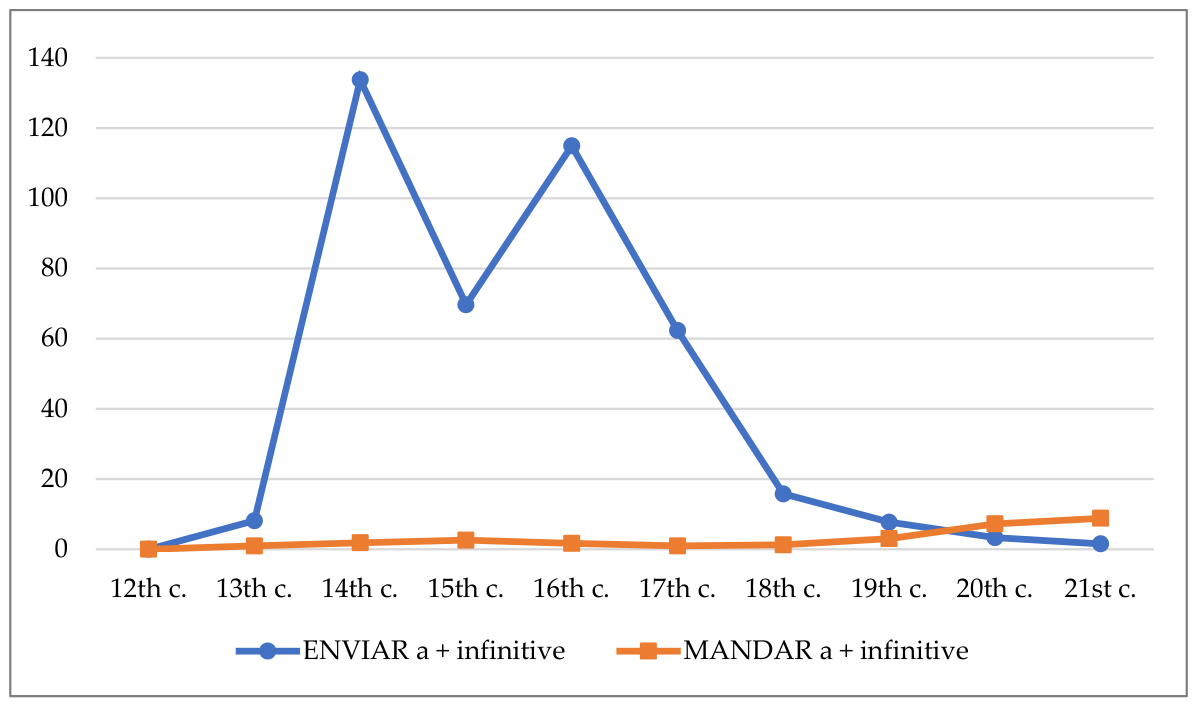
| Century | enviar a + Infinitive | mandar a + Infinitive | ||
|---|---|---|---|---|
| Normalized Frequency | % of Cases of enviar | Normalized Frequency | % of Cases of mandar | |
| 12th | 0 | 0 | 0 | 0 |
| 13th | 8.13 | 1.04 | 0.93 | 0.04 |
| 14th | 133.77 | 8.79 | 1.83 | 0.08 |
| 15th | 69.67 | 8.76 | 2.59 | 0.13 |
| 16th | 114.93 | 14.56 | 1.66 | 0.11 |
| 17th | 62.30 | 12.04 | 0.95 | 0.10 |
| 18th | 15.77 | 6.16 | 1.25 | 0.16 |
| 19th | 7.72 | 4.03 | 3.02 | 0.63 |
| 20th | 3.29 | 2.27 | 7.21 | 4.13 |
| 21st | 1.53 | 1.19 | 8.82 | 9.25 |
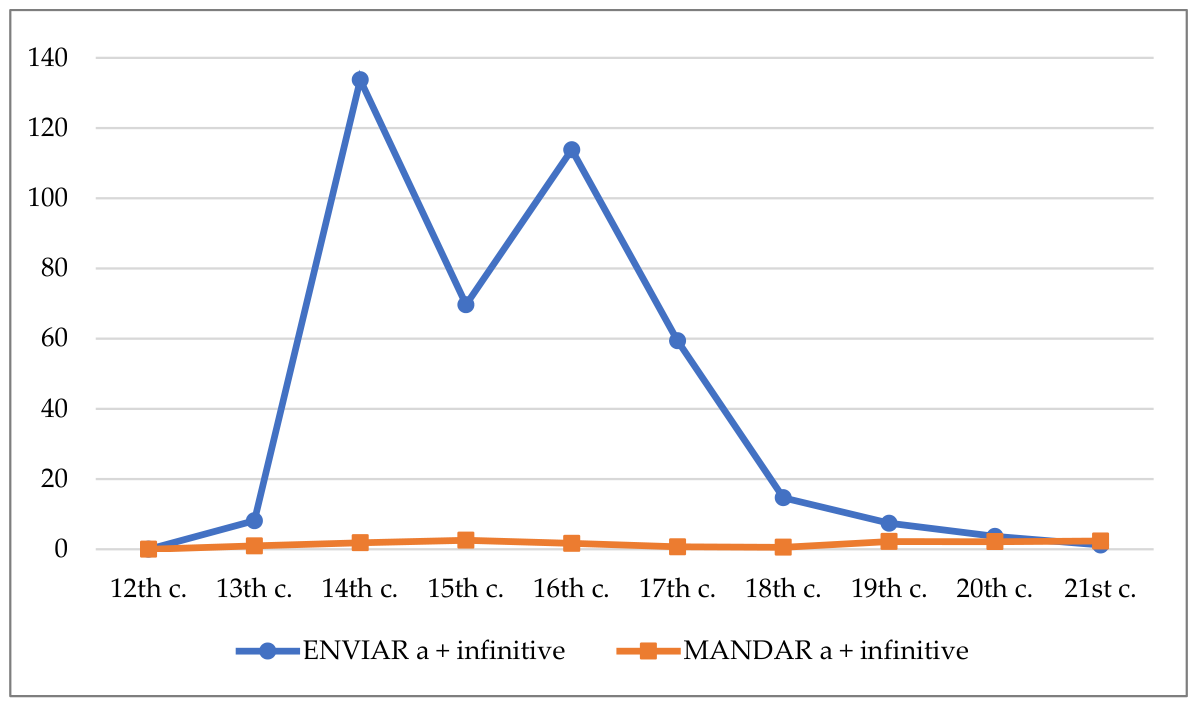
| Century | enviar a + Infinitive | mandar a + Infinitive | ||
|---|---|---|---|---|
| Normalized Frequency | % of Cases of enviar | Normalized Frequency | % of Cases of mandar | |
| 12th | 0 | 0 | 0 | 0 |
| 13th | 8.13 | 1.04 | 0.93 | 0.04 |
| 14th | 133.77 | 8.79 | 1.83 | 0.08 |
| 15th | 69.67 | 8.76 | 2.59 | 0.13 |
| 16th | 113.82 | 14.90 | 1.67 | 0.11 |
| 17th | 59.37 | 11.67 | 0.68 | 0.08 |
| 18th | 14.66 | 6.37 | 0.56 | 0.08 |
| 19th | 7.41 | 4.18 | 2.20 | 0.51 |
| 20th | 3.65 | 2.54 | 2.15 | 1.23 |
| 21st | 1.2 | 1.05 | 2.33 | 2.64 |
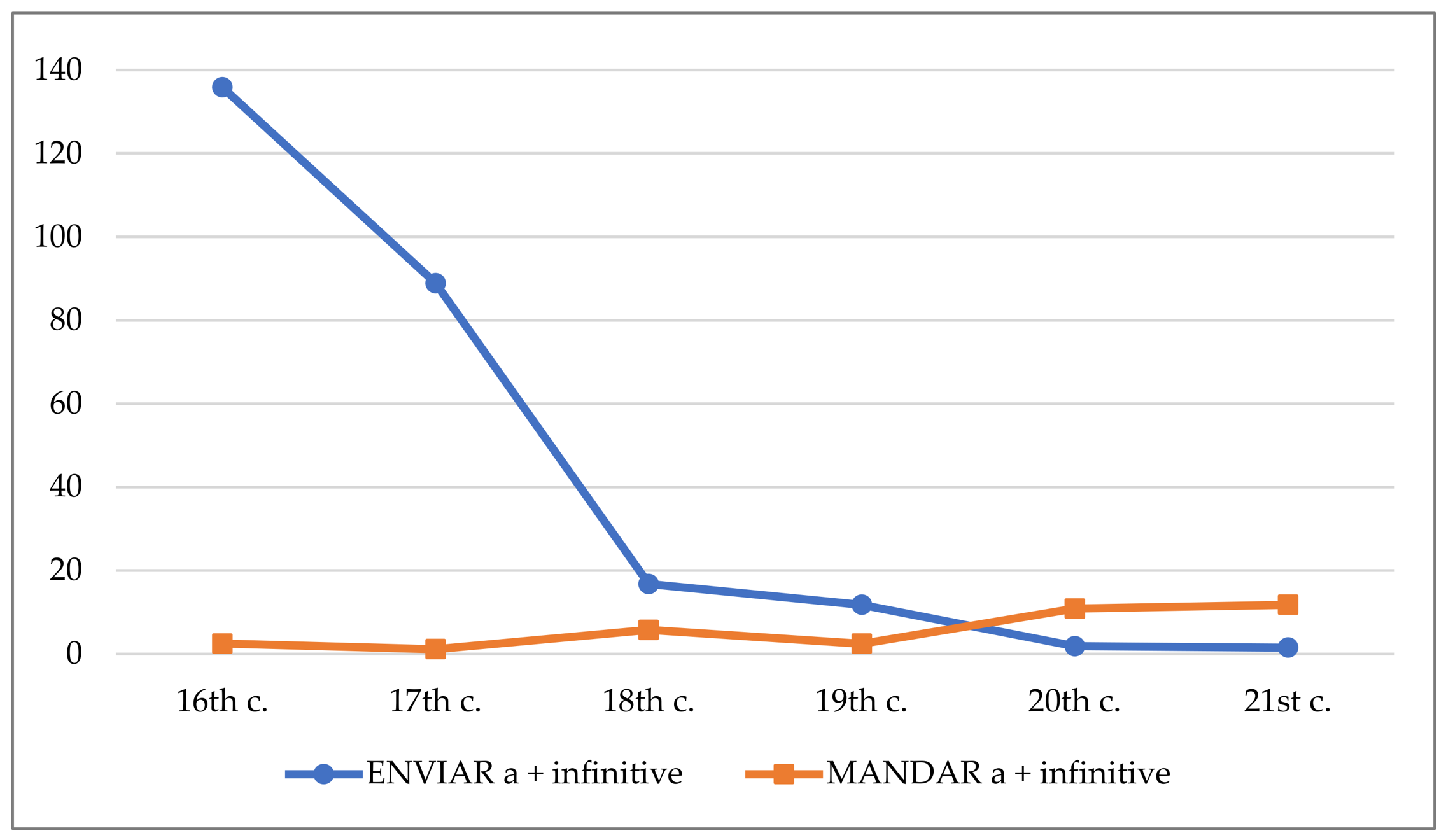
| Century | enviar a + Infinitive | mandar a + Infinitive | ||
|---|---|---|---|---|
| Normalized Frequency | % of Cases of enviar | Normalized Frequency | % of Cases of mandar | |
| 16th | 136.82 | 11.64 | 2.47 | 0.08 |
| 17th | 89.64 | 12.75 | 1.14 | 0.08 |
| 18th | 16.76 | 6.20 | 5.76 | 0.48 |
| 19th | 11.80 | 3.39 | 3.19 | 0.36 |
| 20th | 1.92 | 1.59 | 11.10 | 6.63 |
| 21st | 1.53 | 1.28 | 11.78 | 11.20 |
Disclaimer/Publisher’s Note: The statements, opinions and data contained in all publications are solely those of the individual author(s) and contributor(s) and not of MDPI and/or the editor(s). MDPI and/or the editor(s) disclaim responsibility for any injury to people or property resulting from any ideas, methods, instructions or products referred to in the content. |
© 2026 by the author. Licensee MDPI, Basel, Switzerland. This article is an open access article distributed under the terms and conditions of the Creative Commons Attribution (CC BY) license.
Share and Cite
Echeverría, C.I. Again on the Existence of Causative Periphrases in Spanish: The Case of “enviar/mandar a + Infinitive”. Languages 2026, 11, 90. https://doi.org/10.3390/languages11050090
Echeverría CI. Again on the Existence of Causative Periphrases in Spanish: The Case of “enviar/mandar a + Infinitive”. Languages. 2026; 11(5):90. https://doi.org/10.3390/languages11050090
Chicago/Turabian StyleEcheverría, Carlos I. 2026. "Again on the Existence of Causative Periphrases in Spanish: The Case of “enviar/mandar a + Infinitive”" Languages 11, no. 5: 90. https://doi.org/10.3390/languages11050090
APA StyleEcheverría, C. I. (2026). Again on the Existence of Causative Periphrases in Spanish: The Case of “enviar/mandar a + Infinitive”. Languages, 11(5), 90. https://doi.org/10.3390/languages11050090