
Lexical Frequency and the Realization of Italian Dental Affricates



Abstract
1. Introduction
2. Theoretical Remarks
2.1. Phonetic Variation and the Lexicon
2.2. Italian Phonology and Dental Affricates Variability
3. Methods and Materials
3.1. Research Questions
- (1)
- Does lexical frequency predict systematic differences in affricate realisation?
- (2)
- How does speech style (read vs. dialogue) shape affricate production, and how does this interact with lexical frequency?
- (3)
- Do other sociolinguistic factors contribute to explaining dental affricate variability?
3.2. Research Design
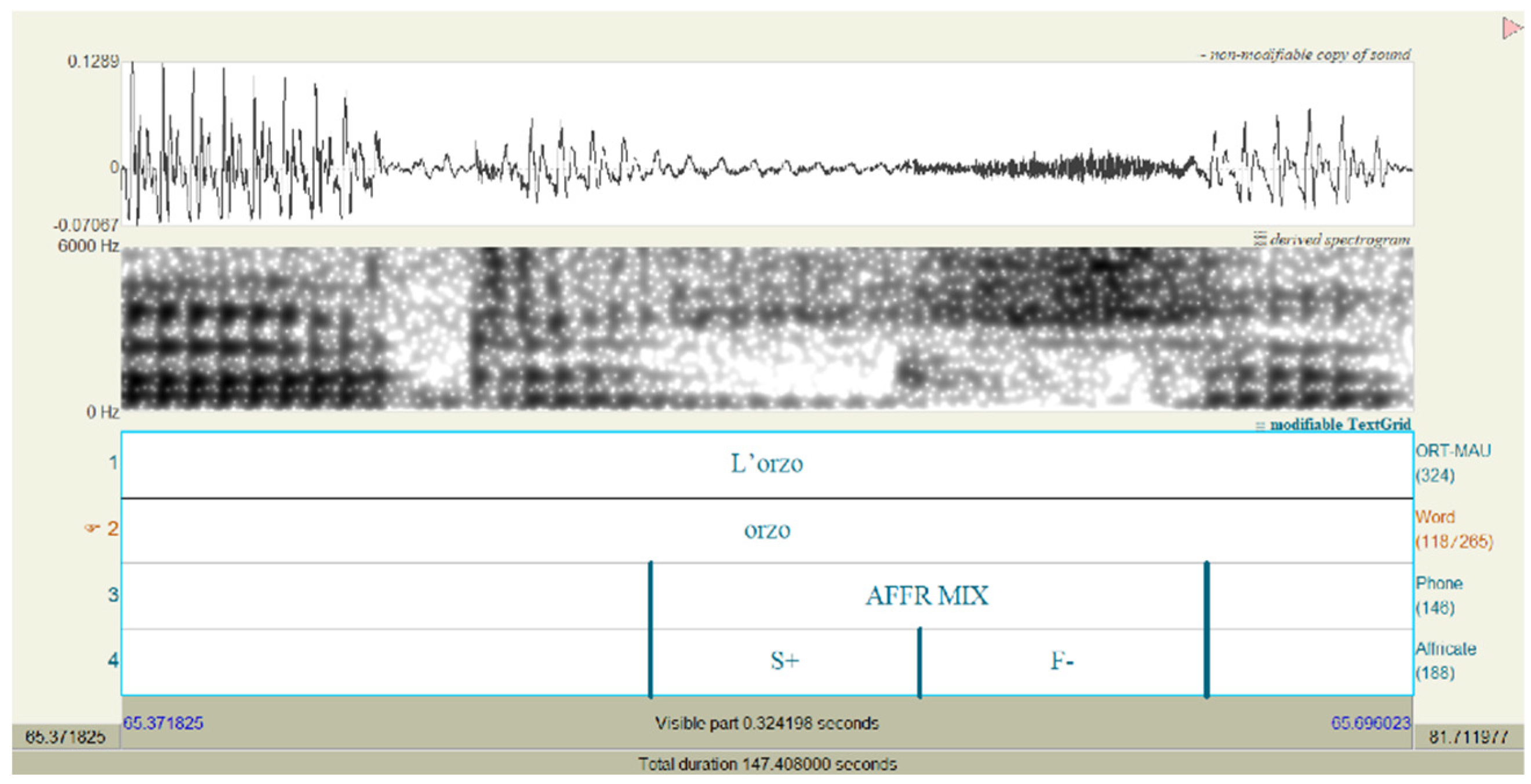
3.3. Data Collection and Annotation
- ○
- “AFFR+” (voiced): voice bar present for ≥75% of the total affricate duration;
- ○
- “AFFR−” (voiceless): voice bar present for <25% of the total affricate duration;
- ○
- “AFFR_MIX” (intermediate voicing): voice bar present for 25–75% of the total affricate duration.
4. Analysis
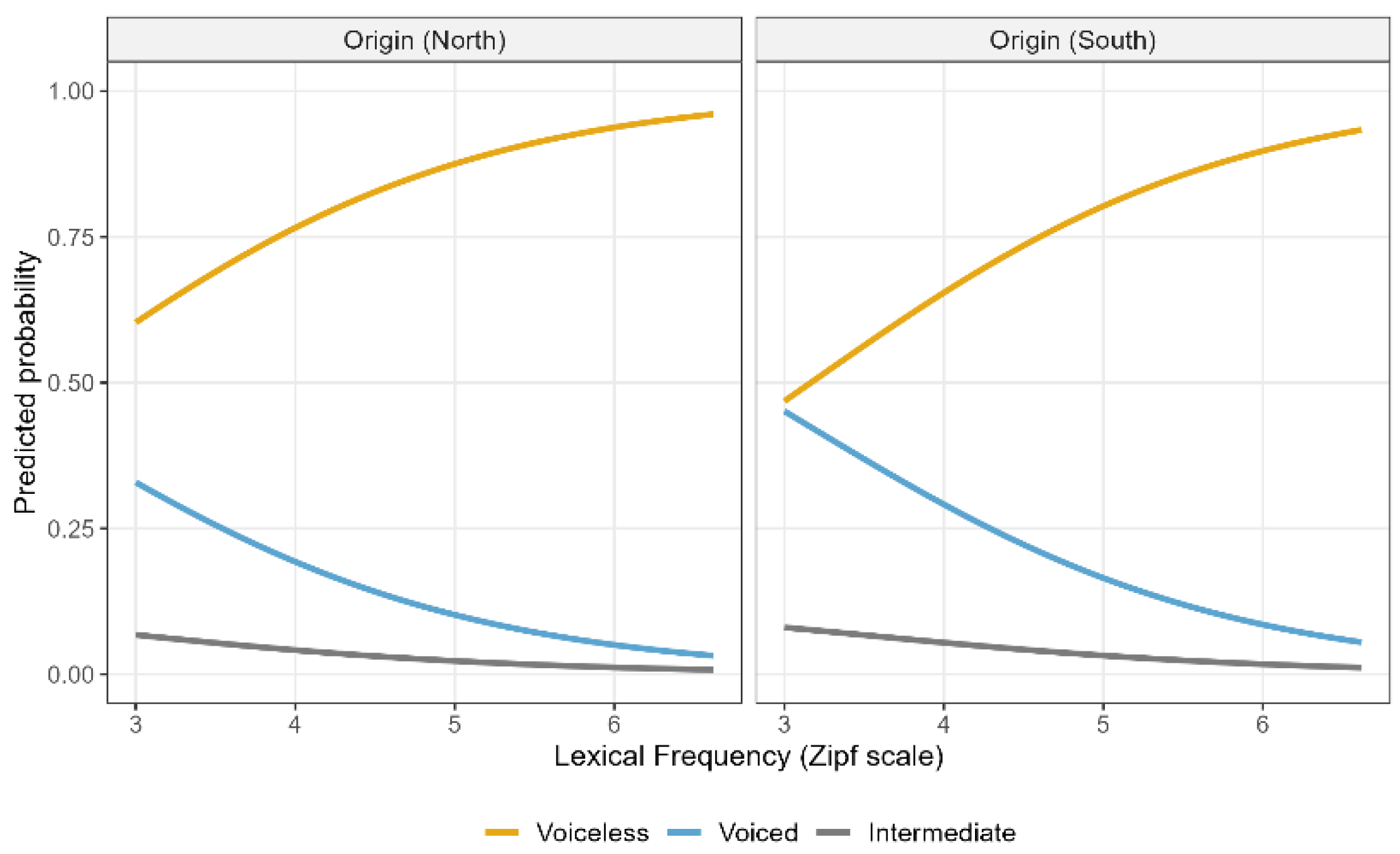
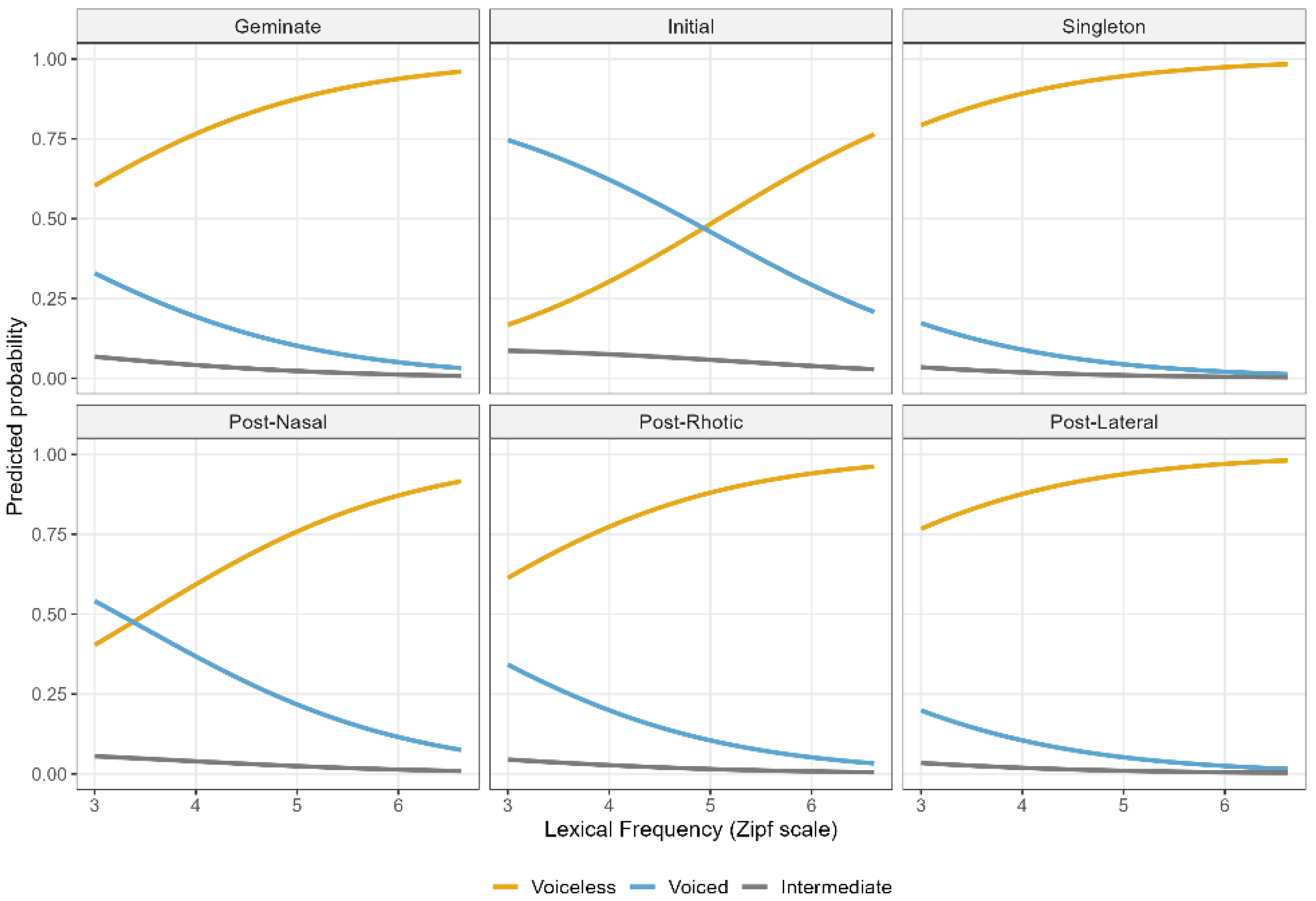
4.1. Voicing Degree
4.2. Duration
4.2.1. Model Specification and Comparison
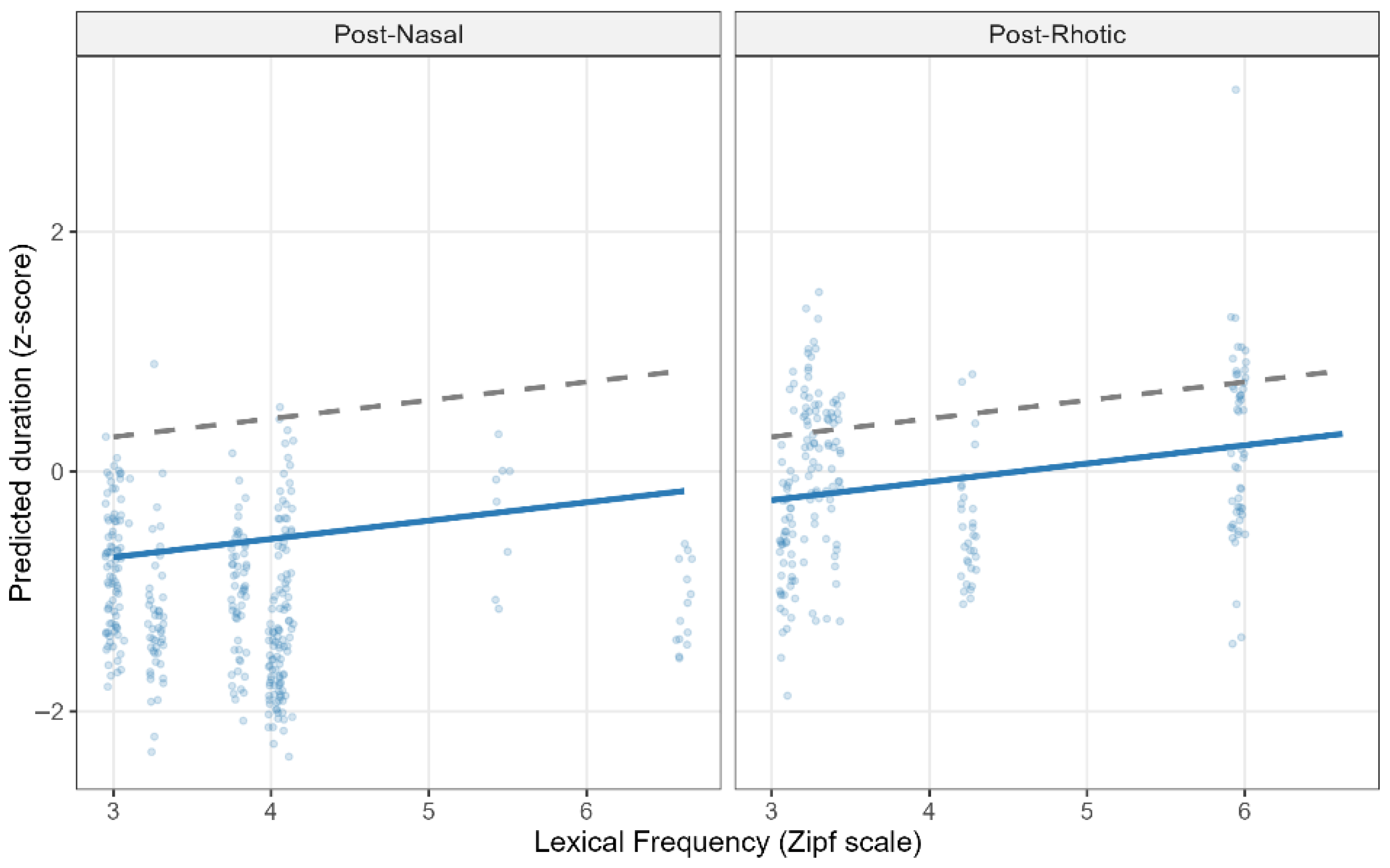
4.2.2. Results
5. Discussion
5.1. Lexical Frequency Effects Between Categorical and Gradient Levels
5.2. Theoretical Implications
6. Conclusions and Further Perspectives
Supplementary Materials
Author Contributions
Funding
Institutional Review Board Statement
Informed Consent Statement
Data Availability Statement
Acknowledgments
Conflicts of Interest
References
- Adda-Decker, M., de Mareüil, P. B., Adda, G., & Lamel, L. (2005). Investigating syllabic structures and their variation in spontaneous French. Speech Communication, 46(2), 119–139. [Google Scholar] [CrossRef] [Scilit]
- Aylett, M., & Turk, A. (2004). The smooth signal redundancy hypothesis: A functional explanation for relationships between redundancy, prosodic prominence, and duration in spontaneous speech. Language and Speech, 47(1), 31–56. [Google Scholar] [CrossRef] [Scilit] [PubMed]
- Bates, D., Mächler, M., Bolker, B., & Walker, S. (2015). Fitting linear mixed-effects models using lme4. Journal of Statistical Software, 67, 1–48. [Google Scholar] [CrossRef] [Scilit]
- Bell, A., Brenier, J. M., Gregory, M., Girand, C., & Jurafsky, D. (2009). Predictability effects on durations of content and function words in conversational English. Journal of Memory and Language, 60(1), 92–111. [Google Scholar] [CrossRef] [Scilit]
- Bellocchi, S., Bonifaci, P., & Burani, C. (2016). Lexicality, frequency and stress assignment effects in bilingual children reading Italian as a second language. Bilingualism: Language and Cognition, 19(1), 89–105. [Google Scholar] [CrossRef] [Scilit]
- Bi, Y., & Chen, Y. (2022). The effects of lexical frequency and homophone neighborhood density on incomplete tonal neutralization. Frontiers in Psychology, 13, 867353. [Google Scholar] [CrossRef] [Scilit] [PubMed]
- Bybee, J. (2001). Phonology and language use. Cambridge University Press. [Google Scholar]
- Bybee, J. (2007). Frequency of use and the organization of language. Cambridge University Press. [Google Scholar]
- Canepari, L. (1980). Italiano standard e pronunce regionali. Cluep. [Google Scholar]
- Canepari, L. (1997). Introduzione alla fonetica. Einaudi. [Google Scholar]
- Celata, C. (2004). Acquisizione e mutamento di categorie fonologiche: Le affricate in italiano. FrancoAngeli. [Google Scholar]
- Crocco, C. (2001). I corpora AVIP e CLIPS: Il problema della codifica e della rappresentazione degli italiani regionali. In F. Fusco, & C. Marcato (Eds.), Plurilinguismo. Contatti e culture (pp. 151–164). Forum Editore. [Google Scholar]
- Dediu, D., Lin, J., Moisik, S. R., & Moran, S. (2024). Dental fricatives: Patterning, evolution, and factors affecting a rare class of speech sounds. In F. A. Karakostis, & G. Jäger (Eds.), Biocultural evolution: An agenda for integrative approaches (pp. 143–178). Kerns Verlag. [Google Scholar] [CrossRef] [Scilit]
- De Dominicis, A. (1999). Fonologia comparata delle principali lingue europee moderne. Clueb. [Google Scholar]
- Elff, M. (2022). mclogit: Multinomial logit models, with or without random effects or overdispersion (R package version 0.9, 6(10.32614)). Available online: http://melff.github.io/mclogit/ (accessed on 2 April 2026).
- Foulkes, P., Docherty, G., & Jones, M. (2011). Analyzing stops. In M. Di Paolo, & M. Yaeger-Dror (Eds.), Sociophonetics: A student’s guide (pp. 58–71). Routledge. [Google Scholar]
- Gahl, S. (2008). “Time” and “Thyme” are not homophones: The effect of lemma frequency on word durations in spontaneous speech. Language, 84, 474–496. [Google Scholar] [CrossRef] [Scilit]
- Gahl, S., & Strand, J. (2016). Many neighborhoods: Phonological and perceptual neighborhood density in lexical production and perception. Journal of Memory and Language, 89, 162–178. [Google Scholar] [CrossRef] [Scilit]
- Hashimoto, D. (2021). Probabilistic reduction and mental accumulation in Japanese: Frequency, contextual predictability, and average predictability. Journal of Phonetics, 87, 101061. [Google Scholar] [CrossRef] [Scilit]
- Hashimoto, D. (2023). The effect of verbal conjugation predictability on speech signal. Morphology, 33(1), 41–63. [Google Scholar] [CrossRef] [Scilit]
- Jacewicz, E., Fox, R. A., O’Neill, C., & Salmons, J. (2009). Articulation rate across dialect, age, and gender. Language Variation and Change, 21(2), 233–256. [Google Scholar] [CrossRef] [Scilit]
- Jakubíček, M., Kilgarriff, A., Kovář, V., Rychlý, P., & Suchomel, V. (2013, July 23–26). The TenTen corpus family. 7th International Corpus Linguistics Conference CL (pp. 125–127), Lancaster University, Lancaster, UK. [Google Scholar]
- Johnson, K. (1997). Speech perception without speaker normalization: An exemplar model. In K. Johnson, & J. W. Mullennix (Eds.), Talker variability in speech processing (pp. 145–165). Academic Press. [Google Scholar]
- Johnson, K. (2006). Resonance in an exemplar-based lexicon: The emergence of social identity and phonology. Journal of Phonetics, 34(4), 485–499. [Google Scholar] [CrossRef] [Scilit]
- Jurafsky, D., Bell, A., Gregory, M., & Raymond, W. D. (2001, May 7–11). The effect of language model probability on pronunciation reduction. 2001 IEEE International Conference on Acoustics, Speech, and Signal Processing (Vol. 2, pp. 801–804), Salt Lake City, UT, USA. [Google Scholar]
- Kuznetsova, A., Brockhoff, P. B., & Christensen, R. H. (2017). lmerTest package: Tests in linear mixed effects models. Journal of Statistical Software, 82, 1–26. [Google Scholar] [CrossRef] [Scilit]
- Ladefoged, P., & Maddieson, I. (1996). The sounds of the world’s languages. Blackwell. [Google Scholar]
- Lindblom, B. (1990). Explaining phonetic variation: A sketch of the H&H theory. In W. J. Hardcastle, & A. Marchal (Eds.), Speech production and speech modelling (pp. 403–439). Springer Netherlands. [Google Scholar]
- Mairano, P., Nodari, R., Ardolino, F., De Iacovo, V., & Mereu, D. (2025). Inherently long consonants in contemporary Italian varieties: Regional variation and orthographic effects. Languages, 10(6), 118. [Google Scholar] [CrossRef] [Scilit]
- Martinuzzi, C., & Schertz, J. (2022). Sorry, not sorry: The independent role of multiple phonetic cues in signaling the difference between two word meanings. Language and Speech, 65(1), 143–172. [Google Scholar] [CrossRef] [Scilit] [PubMed]
- Meluzzi, C. (2016). A New Sonority Degree in the Realization of Dental Affricates /ts dz/ in Italian. In M. J. Ball, & N. Müller (Eds.), Challenging sonority-cross-linguistic evidence (pp. 252–275). Equinox Publishing. [Google Scholar]
- Meluzzi, C. (2020). Sociofonetica di una varietà di koinè: Le affricate dentali nell’italiano di Bolzano. FrancoAngeli. [Google Scholar]
- Meluzzi, C. (2021). Dental affricates loss and maintenance in Romance languages: A (socio)-phonetic perspective on sound change. In L. Biondi, F. Dedè, & A. Scala (Eds.), Change in grammar: Triggers, paths, and outcomes, quaderni del sodalizio glottologico milanese (Vol. 1, pp. 95–116). Edizioni dell’Orso. [Google Scholar]
- Meunier, C., & Espesser, R. (2011). Vowel reduction in conversational speech in French: The role of lexical factors. Journal of Phonetics, 39(3), 271–278. [Google Scholar] [CrossRef] [Scilit]
- Munson, B., & Solomon, N. P. (2004). The effect of phonological neighborhood density on vowel articulation. Journal of Speech, Language, and Hearing Research, 47(5), 1048–1058. [Google Scholar] [CrossRef] [Scilit]
- Nese, N. (2023). Variazione linguistica in un collegio universitario pavese: Uno studio in real time. In M. Castagneto, & M. Ravetto (Eds.), La comunicazione parlata (pp. 149–170). Aracne. [Google Scholar]
- Nese, N., & Meluzzi, C. (2017). Accomodamento ed emergenza di varianti fonetiche: Le affricate dentali intermedie a Pavia e Bolzano. In C. Bertini, C. Celata, G. Lenoci, C. Meluzzi, & I. Ricci (Eds.), Fattori sociali e biologici nella variazione fonetica/Social and biological factors in speech variation (pp. 67–82). Officinaventuno. [Google Scholar]
- Paizi, D., Burani, C., & Zoccolotti, P. (2010). List context effects in reading Italian nonwords: Can the word frequency effect be eliminated? European Journal of Cognitive Psychology, 22, 1039–1065. [Google Scholar] [CrossRef] [Scilit]
- Phillips, B. S. (2006). Word frequency and lexical diffusion. Palgrave McMillan. [Google Scholar]
- Pierrehumbert, J. B. (2002). Word-specific phonetics. In C. Gussenhoven, & N. Warner (Eds.), Laboratory phonology VII (pp. 101–139). De Gruyter. [Google Scholar]
- Pierrehumbert, J. B. (2016). Phonological representation: Beyond abstract versus episodic. Annual Review of Linguistics, 2, 33–52. [Google Scholar] [CrossRef]
- Pluymaekers, M., Ernestus, M., & Baayen, R. H. (2005). Lexical frequency and acoustic reduction in spoken Dutch. The Journal of the Acoustical Society of America, 118(4), 2561–2569. [Google Scholar] [CrossRef] [Scilit]
- Raymond, W. D., Dautricourt, R., & Hume, E. (2006). Word-internal /t,d/ deletion in spontaneous speech: Modeling the effects of extra-linguistic, lexical, and phonological factors. Language Variation and Change, 18, 55–97. [Google Scholar] [CrossRef] [Scilit]
- Recasens, D., & Espinosa, A. (2007). An electropalatographic and acoustic study of affricates and fricatives in two Catalan dialects. Journal of the International Phonetic Association, 37, 143–172. [Google Scholar] [CrossRef] [Scilit]
- Rossi, M., Tramutoli, L., Nese, N., Celata, C., Corona, L., & Meluzzi, C. (forthcoming). Phonetic detail in Italian homophonic simplex and complex words. In E. Bedussi, C. Celata, L. Corona, M. Frontera, C. Meluzzi, N. Nese, D. Piccardi, M. Rossi, & L. Tramutoli (Eds.), La voce della grammatica/The sound of grammar. Officinaventuno. [Google Scholar]
- Savy, R. (1999). Riduzioni foniche nella morfologia del sintagma nominale nel parlato spontaneo: Indagine quantitativa e aspetti strutturali. In P. Benincà, L. Vanelli, & A. Mioni (Eds.), Fonologia e morfologia dell’italiano e dei dialetti d’Italia (pp. 1000–1021). Bulzoni. [Google Scholar]
- Sbacco, L., & Meluzzi, C. (2023). Inter-speaker accommodation and within-dialect variability. Dental affricates and fricative realisation in Marchigiano. Lingue e Linguaggi, 56, 345–359. [Google Scholar]
- Schettino, L., & Cotugno, F. (2025). Quantifying and characterizing phonetic reduction in Italian natural speech. Languages, 10(1), 14. [Google Scholar] [CrossRef] [Scilit]
- Schmitz, D., & Baer-Henney, D. (2024, July 2–5). Morphology renders homophonous segments phonetically different: Word-final /s/ in German. Proceedings of Speech Prosody (pp. 587–591), Leiden, The Netherlands. [Google Scholar]
- Solé, M.-J. (2015, August 10–14). Acoustic evidence of articulatory adjustments to sustain voicing during voiced stops. 18th International Congress of Phonetic Sciences (pp. 1–20), University of Glasgow, Glasgow, UK. [Google Scholar]
- Stevens, M., & Hajek, J. (2007, August 6–10). Towards a phonetic conspectus of preaspiration: Acoustic evidence from Sienese Italian. 16th International Congress of Phonetic Sciences (ICPhS16) (pp. 429–432), Saarbrücken, Germany. [Google Scholar]
- Stevens, M., & Hajek, J. (2010, December 14–16). Preaspirated /pp tt kk/ in standard Italian: A sociophonetic vs. phonetic analysis. 13th Australasian International Conference of Speech Science and Technology (pp. 1–4), Melbourne, Australia. [Google Scholar]
- Tang, K., & Shaw, J. A. (2021). Prosody leaks into the memories of words. Cognition, 210, 104601. [Google Scholar] [CrossRef] [Scilit]
- Telmon, T. (2003). Varietà regionali. In A. A. Sobrero (Ed.), Introduzione all’italiano contemporaneo (pp. 93–149). Laterza. [Google Scholar]
- Torreira, F., & Ernestus, M. (2011). Realization of voiceless stops and vowels in conversational French and Spanish. Laboratory Phonology, 2(3), 331–353. [Google Scholar] [CrossRef] [Scilit]
- van Heuven, W. J., Mandera, P., Keuleers, E., & Brysbaert, M. (2014). SUBTLEX-UK: A new and improved word frequency database for British English. Quarterly Journal of Experimental Psychology, 67(6), 1176–1190. [Google Scholar] [CrossRef] [Scilit] [PubMed]
- Wang, S. F. (2022). The interaction between predictability and pre-boundary lengthening on syllable duration in Taiwan Southern Min. Phonetica, 79(4), 31352. [Google Scholar] [CrossRef] [Scilit] [PubMed]
- Wheeler, M. W. (2005). The phonology of Catalan. Oxford University Press. [Google Scholar]
- Żygis, M. (2008). On the avoidance of voiced sibilant affricates. ZAS Papers in Linguistics, 49, 23–45. [Google Scholar] [CrossRef] [Scilit]
- Żygis, M., Fuchs, S., & Koening, L. (2012). Phonetic explanations for the infrequency of voiced sibilant affricates across languages. Laboratory Phonology, 3(2), 299–336. [Google Scholar] [CrossRef] [Scilit]



| Initial | Intervocalic Geminate | Intervocalic Singleton | Post-Lateral | Post-Rhotic | Post-Nasal | |
|---|---|---|---|---|---|---|
| Voiceless | 7 (1.5%) | 457 (77.5%) | 117 (62.7%) | 60 (84.5%) | 105 (59.3%) | 100 (40.7%) |
| Voiced | 446 (96.1%) | 123 (20.8%) | 67 (35.8%) | 8 (11.3%) | 70 (39.5%) | 138 (56.1%) |
| Intermediate | 11 (2.4%) | 10 (1.7%) | 3 (1.6%) | 3 (4.2%) | 2 (1.1%) | 8 (3.3%) |
| Total | 464 (100%) | 590 (100%) | 187 (100%) | 71 (100%) | 177 (100%) | 246 (100%) |
| Initial | Intervocalic Geminate | Intervocalic Singleton | Post- Lateral | Post- Rhotic | Post- Nasal | ||
|---|---|---|---|---|---|---|---|
| Northern Speakers | Voiceless | 12.2% | 80.9% | 44.2% | 96.6% | 49.3% | 31.9% |
| Voiced | 85.1% | 17.4% | 55.2% | 1.7% | 50.0% | 56.2% | |
| Intermediate | 2.7% | 1.7% | 0.6% | 1.7% | 0.7% | 11.9% | |
| Southern Speakers | Voiceless | 25.7% | 84.2% | 46.3% | 75.7% | 46.3% | 29.9% |
| Voiced | 73.7% | 15.0% | 51.6% | 18.9% | 52.5% | 65.0% | |
| Intermediate | 0.6% | 0.8% | 2.1% | 5.4% | 1.3% | 5.1% |
| GRADIT Classification | ||||||||
|---|---|---|---|---|---|---|---|---|
| AD (High Availability) | AU (High Use) | CO (Common Use) | FO (Fundamental) | NC (City Name) | NO (Personal Name) | RE (Regional Use) | TS (Specialised Technical) | |
| Voiceless | 28.4% | 57.9% | 58.2% | 61.8% | 35.0% | 32.5% | 54.2% | 39.7% |
| Voiced | 69.7% | 40.5% | 38.0% | 38.2% | 63.1% | 65.0% | 39.6% | 60.3% |
| Intermediate | 1.8% | 1.7% | 3.8% | 0.0% | 1.9% | 2.5% | 6.3% | 0.0% |
| Etymology | |||||||||
|---|---|---|---|---|---|---|---|---|---|
| Uncertain | Arabic | French | Germanic | Japanese | Greek | Latin | Dutch | Polish | |
| Voiceless | 57.8% | 29.7% | 88.1% | 21.3% | 7.3% | 37.7% | 59.6% | 100.0% | 0.0% |
| Voiced | 41.0% | 67.0% | 4.8% | 77.5% | 92.7% | 62.3% | 37.6% | 0.0% | 96.6% |
| Intermediate | 1.1% | 3.3% | 7.1% | 1.3% | 0.0% | 0.0% | 2.7% | 0.0% | 3.4% |
| Predictor | Comparison | β | SE | OR | 95% CI | p |
|---|---|---|---|---|---|---|
| Lexical Frequency (Zipf) | Voiced vs. Voiceless | −0.772 | 0.592 | 0.462 | [0.145, 1.475] | 0.192 |
| Intermediate vs. Voiceless | −0.727 | 0.406 | 0.483 | [0.218, 1.072] | 0.073 | |
| Geographical Origin (South) | Voiced vs. Voiceless | +0.569 | 0.231 | 1.766 | [1.124, 2.775] | 0.014 * |
| Intermediate vs. Voiceless | +0.426 | 0.388 | 1.531 | [0.716, 3.278] | 0.272 | |
| Phonological Context (ref. = Geminate) | ||||||
| Initial | Voiced vs. Voiceless | +2.099 | 0.958 | 8.154 | [1.248, 53.295] | 0.028 * |
| Intermediate vs. Voiceless | +1.523 | 0.725 | 4.585 | [1.108, 18.973] | 0.036 * | |
| Singleton | Voiced vs. Voiceless | −0.917 | 1.476 | 0.400 | [0.022, 7.219] | 0.535 |
| Intermediate vs. Voiceless | −0.940 | 1.020 | 0.391 | [0.053, 2.888] | 0.357 | |
| Post-Nasal | Voiced vs. Voiceless | +0.900 | 1.318 | 2.458 | [0.186, 32.578] | 0.495 |
| Intermediate vs. Voiceless | +0.198 | 0.874 | 1.219 | [0.220, 6.758] | 0.821 | |
| Post-Rhotic | Voiced vs. Voiceless | +0.022 | 1.882 | 1.022 | [0.026, 40.919] | 0.991 |
| Intermediate vs. Voiceless | −0.431 | 1.235 | 0.650 | [0.058, 7.315] | 0.727 | |
| Post-Lateral | Voiced vs. Voiceless | −0.745 | 1.807 | 0.475 | [0.014, 16.385] | 0.680 |
| Intermediate vs. Voiceless | −0.923 | 1.206 | 0.397 | [0.037, 4.227] | 0.444 | |
| Speech Style (Reading) | Voiced vs. Voiceless | −0.462 | 0.292 | 0.630 | [0.355, 1.118] | 0.114 |
| Intermediate vs. Voiceless | +0.573 | 0.343 | 1.774 | [0.905, 3.474] | 0.095 |
| Step | Model Specification | k | AIC | −2LL | χ2 | df | p |
|---|---|---|---|---|---|---|---|
| 1 | Main effects only | 12 | 4476.8 | 4452.8 | — | — | — |
| 2 | +Word_Dur_z | 13 | 3304.2 | 3278.2 | 1174.6 | 1 | <0.001 *** |
| 3 | +Voicing | 15 | 3199.7 | 3169.7 | 108.5 | 2 | <0.001 *** |
| 4a | +Freq × GeoOrigin | 16 | 3201.5 | 3169.5 | 0.2 | 1 | 0.679 |
| 4b | +Freq × PHON | 20 | 3203.7 | 3163.7 | 6.0 | 5 | 0.309 |
| Predictor | β | SE | t | p |
|---|---|---|---|---|
| Lexical Frequency (Zipf) | +0.153 | 0.076 | 2.018 | 0.050 * |
| Geographical Origin (South) | −0.091 | 0.045 | −2.004 | 0.088 |
| Word Duration (z-score) | +0.588 | 0.015 | 39.925 | <0.001 *** |
| Voicing | ||||
| Voiced vs. Voiceless | −0.484 | 0.047 | −10.334 | <0.001 *** |
| Intermediate vs. Voiceless | −0.099 | 0.069 | −1.427 | 0.154 |
| Phonological Context | ||||
| Initial | −0.184 | 0.118 | −1.555 | 0.121 |
| Singleton | +0.197 | 0.181 | 1.088 | 0.282 |
| Post-Nasal | −1.003 | 0.130 | −7.715 | <0.001 *** |
| Post-Rhotic | −0.527 | 0.243 | −2.166 | 0.036 * |
| Post-Lateral | −0.187 | 0.159 | −1.176 | 0.241 |
| Speech Style (Reading) | +0.135 | 0.031 | 4.383 | <0.001 *** |
| Random Effects | Variance | SD | ||
| Word (Intercept) | 0.246 | 0.496 | ||
| Speaker (Intercept) | 0.003 | 0.056 | ||
| Residual | 0.227 | 0.477 |
Disclaimer/Publisher’s Note: The statements, opinions and data contained in all publications are solely those of the individual author(s) and contributor(s) and not of MDPI and/or the editor(s). MDPI and/or the editor(s) disclaim responsibility for any injury to people or property resulting from any ideas, methods, instructions or products referred to in the content. |
© 2026 by the authors. Licensee MDPI, Basel, Switzerland. This article is an open access article distributed under the terms and conditions of the Creative Commons Attribution (CC BY) license.
Share and Cite
Meluzzi, C.; Nese, N. Lexical Frequency and the Realization of Italian Dental Affricates. Languages 2026, 11, 87. https://doi.org/10.3390/languages11050087
Meluzzi C, Nese N. Lexical Frequency and the Realization of Italian Dental Affricates. Languages. 2026; 11(5):87. https://doi.org/10.3390/languages11050087
Chicago/Turabian StyleMeluzzi, Chiara, and Nicholas Nese. 2026. "Lexical Frequency and the Realization of Italian Dental Affricates" Languages 11, no. 5: 87. https://doi.org/10.3390/languages11050087
APA StyleMeluzzi, C., & Nese, N. (2026). Lexical Frequency and the Realization of Italian Dental Affricates. Languages, 11(5), 87. https://doi.org/10.3390/languages11050087