
Article

The Geography of Meaning: Investigating Semantic Differences Across German Dialects

Research Center Deutscher Sprachatlas, Marburg University, 35032 Marburg, Germany
*
Author to whom correspondence should be addressed.
Languages 2026, 11(3), 56; https://doi.org/10.3390/languages11030056
Submission received: 14 December 2025 / Revised: 26 February 2026 / Accepted: 11 March 2026 / Published: 16 March 2026

Abstract

This study reconstructs the geography of meaning of the German perception verb schmecken on the basis of 30 major dialect dictionaries, treating them as a distributed semantic corpus and coding attestations as binary variables reflecting the presence or absence of semantic options. Combining a construal-based framework with spatial modeling, the analysis shows that the polysemy of schmecken is structured by three mutually reinforcing forces: embodied sensory organization, construal-based perspectivization, and regionally patterned areal dynamics. The gustatory–olfactory axis forms the semantic core of the verb, from which tactile, visual, affective, and epistemic extensions emerge. These extensions align with systematic pathways constrained by agentive, experiential, emissive, and evaluative construals, demonstrating that semantic extension is channeled through specific construal modes—notably emissive and agentive—rather than determined by sensory modality alone. A detailed areal analysis reveals a pronounced north–south divide. While Low German dialects conform to the cross-linguistically more common tendency to avoid colexifying taste and smekk—itself the outcome of historical change rather than uninterrupted differentiation—Upper German varieties preserve a typologically rare gustatory–olfactory cluster and exhibit the richest range of cross-modal and abstract extensions. The resulting semantic graph formalizes how regional varieties activate different subsets of a lexeme’s semantic potential and demonstrates that semantic networks themselves display spatial organization. The study thus provides an empirically grounded reconstruction of a German geography of meaning and illustrates how dialect data illuminate the interplay between embodied cognition, construal-based lexical architecture, and areal dynamics.

1. Introduction

Word meanings are not just cognitive phenomena, they also have a geography. Understanding how meanings vary across dialects provides unique insights into the cognitive, cultural, and historical dynamics of language. While German dialect lexicography has produced a wealth of regional dictionaries (Lenz & Stöckle, 2020; Moulin, 2010), these resources have rarely been examined for their potential to reveal broader semantic structures (exceptions are, e.g., Post, 2019; Ruge & Schröder, 2019). Traditionally, dialect dictionaries follow a semasiological approach, that is, they take a word as their starting point and document the range of meanings associated with it. This perspective is well suited to capturing polysemy and the distribution of lexical items across regions. However, because it is form-driven rather than concept-driven, it does not directly reveal how particular semantic domains are structured or vary geographically. This raises the question of how meaning itself varies across dialect space (e.g., Harras, 1972; Lötscher, 2017). This question has not yet been systematically addressed, neither with respect to the internal organization of dialectal meaning networks nor with respect to their spatial patterning across the German-speaking area.
This gap becomes particularly visible in the domain of sensory semantics. Sensory verbs such as see, hear, or taste1 frequently exhibit rich polysemy, extending from physical perception to evaluation, cognition, and emotion (Sweetser, 1990; Whitt, 2011; Winter, 2019). Typological studies (Viberg, 1983) and cognitive-linguistic approaches (Geeraerts et al., 1994) have shown that these extensions follow systematic pathways grounded in embodied experience and sensory hierarchies. However, little is known about how such polysemous pathways are structured geographically within the German-speaking area and how regional patterns align with cross-linguistic tendencies described in semantic maps and typological databases. The present study addresses this gap by examining the dialectal meanings of the German perception verb schmecken across 30 major dialect dictionaries. Following Reichmann (2022), these dictionaries are not treated as isolated lexical repositories but as a distributed semantic corpus that allows for reconstructing spatially patterned meaning relations and colexification, understood as the systematic use of a single lexical form to express multiple, conceptually related meanings across languages or varieties.
The main aim of this study is to identify which construals and semantic extensions of schmecken are attested across dialect regions and how these attested meanings relate to one another when modeled within a construal-based framework informed by typology and cognitive semantics. On this basis, the study constructs a directed semantic graph that formalizes the internal organization of schmecken as it emerges from the dialect evidence. By integrating lexical attestations, semantic structure, typological constraints, and spatial distribution, the analysis shows how embodied cognition, semantic pathways, and regional linguistic communities jointly shape the semantic landscape of sensory perception in German. The remainder of the paper is as follows: Section 2 develops the theoretical background and introduces the analytical schema. Section 3 defines the research questions and hypotheses and outlines the data and methods. Section 4 presents the empirical findings, which are discussed in Section 5. Section 6 concludes.

2. Background

2.1. Sensory Semantics and the Case of schmecken

Research on gustatory vocabulary has consistently shown that taste-related expressions exhibit extensive polysemy, evaluative loading, and context sensitivity (Winter, 2019). In German, everyday taste descriptors display vagueness, metaphorical expansion, and socio-cultural conditioning (Ayabe-Kanamura et al., 1998; Bieler & Runte, 2010; Zurbuchen & Vainik, 2024). From a cognitive-linguistic perspective, such patterns are understood as emerging from embodied experience and culturally entrenched practices (Bagli, 2021; Johnson, 1987; Sweetser, 1990; Winter, 2019). However, these mechanisms are not restricted to the gustatory domain. Cross-linguistically, perception verbs frequently develop polysemous networks that transcend their primary modality, for example, verbs of tasting may acquire olfactory or more general experiential readings. Such extensions reflect the interaction of embodied mappings with language-specific conventions of sensory categorization (Enghels & Jansegers, 2013; Majid & Levinson, 2011). A paradigmatic case is provided by the Romance verb sentire. Historically, sentire and its cognates encoded a remarkably broad range of sensory meanings, including gustatory, auditory, olfactory, and tactile readings (Viberg, 2001, p. 1304). Yet modern Romance languages have systematically differentiated these meanings into distinct lexical items, thereby eliminating smell–taste colexification and carving out highly specialized sensory lexicons (Enghels & Jansegers, 2013). In Italian, for example, sentire covers the meanings ‘to feel’ and ‘to hear’, thus spanning both proximal and distal perception. The Romance evidence thus illustrates two key tendencies: the potential for far-reaching cross-modal polysemy, and the equally robust pressure towards lexical differentiation among closely interacting sensory modalities.
Recent typological research reveals that this pressure is not accidental. While the olfactory domain is frequently under-differentiated internally (Majid et al., 2018), languages nonetheless exhibit a strong, cross-linguistic bias against colexifying smell and taste. In a large-scale quantitative study, Norcliffe and Majid (2024) show that smell–taste colexification is exceedingly rare and statistically disfavored relative to other cross-modal combinations. Crucially, among their 100-language sample, only two languages—Middle High German and Northern Yukaghir (an almost extinct language in northeastern Siberia)—display robust lexical items that genuinely colexify gustatory and olfactory meanings2. Middle High German thus represents a historically exceptional European case, further underscoring how resistant languages typically are to conflating these two modalities. Norcliffe and Majid (2024) argue that communicative need and conceptual distinctiveness jointly constrain lexicalization: although smell and taste are perceptually intertwined, merging them lexically risks obscuring functionally relevant contrasts.
Against this typological background, the German case becomes particularly intriguing. The reference to Middle High German suggests that earlier stages and thus certain regional varieties of German once tolerated precisely the kind of colexification that is globally dis-preferred. Even in the 18th century, Leibniz (1717) reports that southern German speakers used schmecken to mean ‘to smell’. This usage was so pervasive that those speakers were said “to have only four senses because of this” (Leibniz, 1717, p. 300), and even in current German dictionaries, under the lemma schmecken, there is a rather casual reference to the meaning ‘to smell’ with the note “Southern German, Austrian, Swiss”.3 This points to a significant divergence between the trans-regional German written language—where schmecken is strictly gustatory—and dialects in which gustatory and olfactory meanings were, and in some cases still are, colexified. The dialectal data in example (1) and example (2) illustrate these contrasts. In Alsatian, schmecken encompasses both a gustatory and an olfactory reading, whereas in Westphalian the verb retains solely its gustatory function.
  • Alsatian
    (a)
    Gustatory:
    Der Win schmeckt sür. (elsWb 2:481)
    ‘The wine tastes sour.’
    (b)
    Olfactory:
    Schmeck emol an die Bluemen. (elsWb 2:481)
    ‘Smell the flowers.’
  • Westphalian
    • Gustatory:
      Bi anner Lü schmeckt ’t ümmer am besten. (wfälWb 5:127)
      ‘With other people, it always tastes best.’
The Alsatian example (1) clearly shows a violation of the widely attested global constraint and resonates with the historically unusual Middle High German pattern. Such dialectal configurations may reflect contingent trajectories of sensory categorization, shaped by regional communicative habits and shifting aesthetic or perceptual norms (Majid & Levinson, 2011). More broadly, the German data underscore that the semantics of perception verbs is not only shaped by universal pressures towards conceptual differentiation but also remains responsive to culturally specific configurations of sensory experience (Ayabe-Kanamura et al., 1998). As such, the case of schmecken provides a micro-typological window into the dynamics of sensory semantics. It demonstrates how globally robust tendencies—here, the avoidance of smell–taste colexification—may nonetheless be challenged within particular linguistic communities, thereby revealing the interaction of universal cognitive constraints with local cultural histories.

2.2. Theoretical Orientation

The typological and historical considerations outlined above highlight that gustatory–olfactory colexification in German represents a highly unusual configuration in the cross-linguistic landscape. To investigate how such patterns are structured regionally, and how they may reflect broader dynamics of sensory categorization, the present study draws on the typology of perception verbs proposed by Viberg (1983). Viberg identifies three basic event types for the sensory verbs he examined—activity, experience, and source-based (i.e., renamed as “phenomenon-based” in Viberg, 2001, p. 1295)—which differ primarily in the degree of perceptual control and the conceptual prominence of the perceiver (Viberg, 1983, p. 123; see also Viberg, 2008; Gisborne, 2010). Subsequent work re-frames these contrasts as subject-oriented versus object-oriented (Galac, 2020; Harm, 2000; Whitt, 2011), each associated with characteristic functional modes of perception. Note that “subject” and “object” refer to perception here. The object of perception is usually the grammatical subject of a given statement. In the following, we prefer to use “experiencer” instead of “subject” and “stimulus” instead of “object”.
This perspectival distinction interacts systematically with the embodied organization of perception. taste and feel are senses that operate within or directly on the body and are therefore inherently contact-based and proximally oriented. This is illustrated by Figure 1, which is essentially based on Enghels (2007). hear and see, by contrast, span a wider range along the proximal–distal axis. smell occupies an intermediate position, combining bodily anchoring non-contact perception and a medium perceptual reach (Ibarretxe-Antunano, 1999, p. 165; Enghels, 2007, p. 26; Shen & Aisenman, 2008, p. 112). Within this organization, taste and smell are closely related as chemical senses that rely on material interaction with substances (see Derby & Caprio, 2024 from an evolutionary perspective). They differ mainly in the degree of physical contact involved, which places smell between contact-based gustation and more distance-oriented perception.
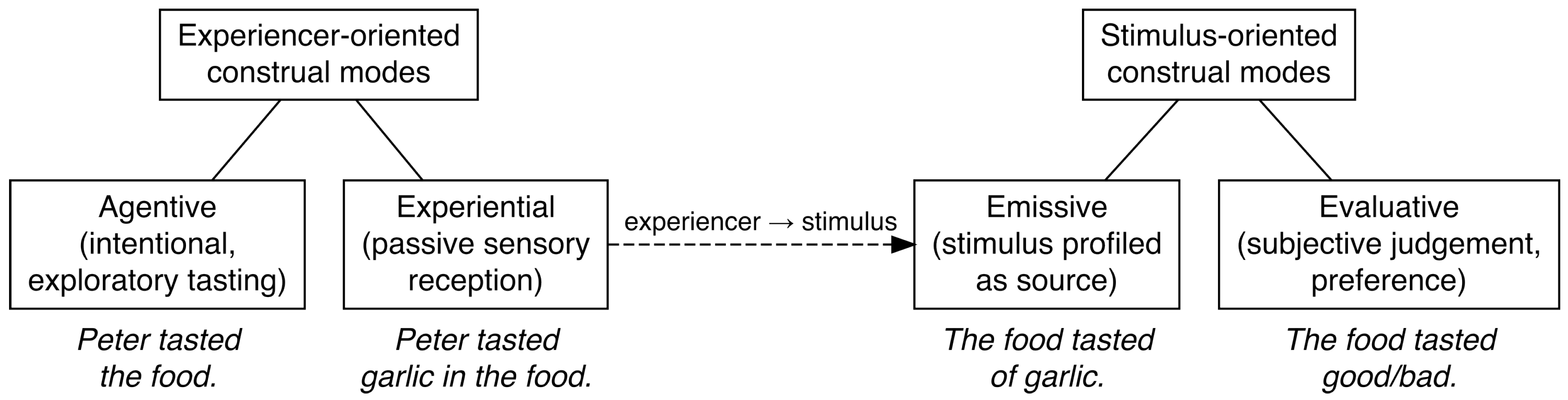
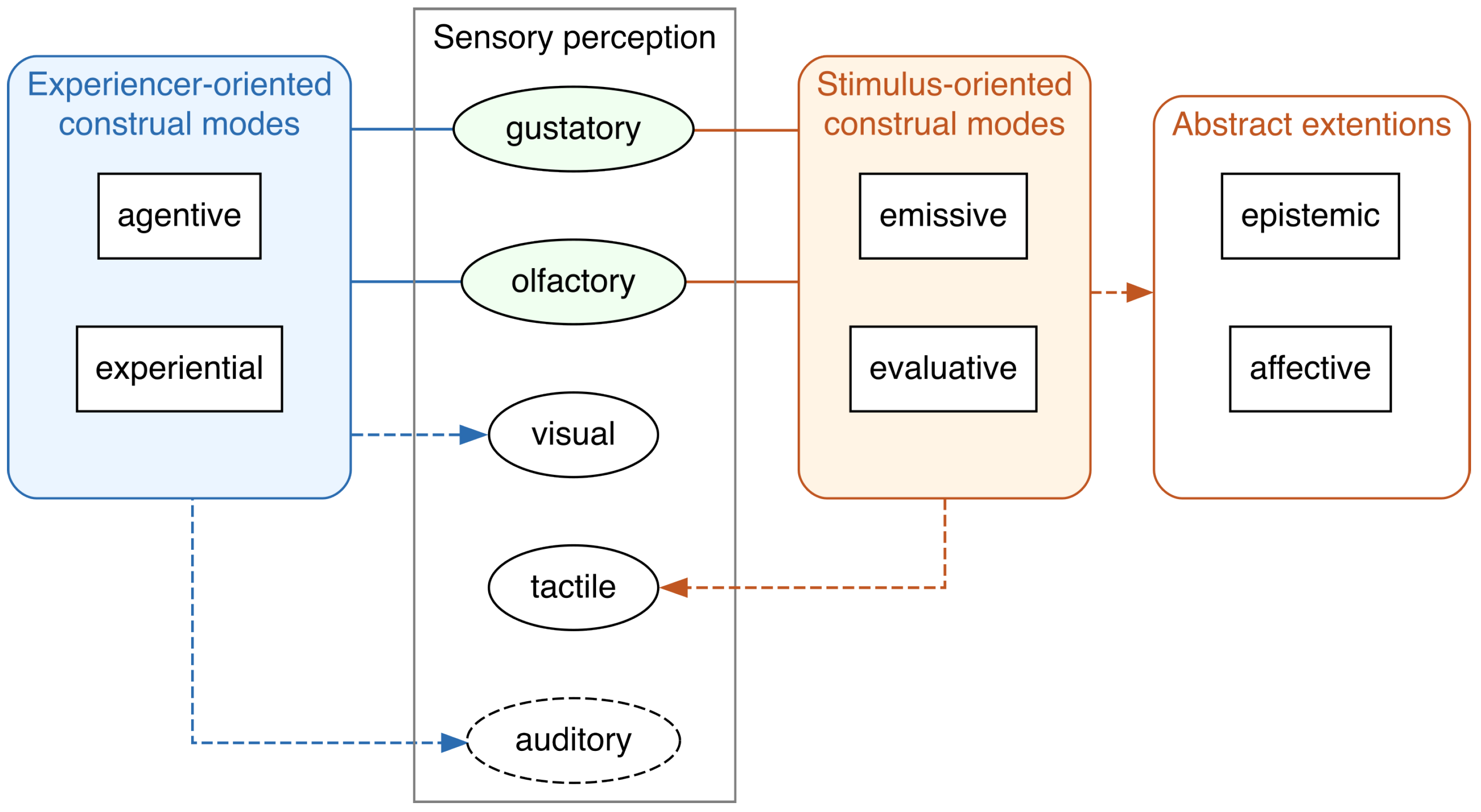
Building on this research, the present study adopts a four-way analytical schema based on construal modes. The structure outlined in Figure 2 can be illustrated using examples (3) and (4), which are taken from Viberg (1983, p. 125) (see also Viberg, 2001, p. 1295). Two dimensions are relevant: experiencer-oriented vs. stimulus-oriented construals. Experiencer-oriented construals foreground the perceiver and occur in two modes. The agentive mode involves intentional, exploratory tasting under the control of the experiencer (3a). The experiential mode represents passive sensory reception, in which gustatory input is merely registered by the perceiver (3b). In both cases, perception is anchored in the experiencer’s bodily engagement and differs only in degree of intentionality.
Stimulus-oriented construals shift the conceptual focus to what triggers perception. Viberg (1983) splits the phenomenon-based event type into two subcategories for the gustatory domain. In the emissive mode, taste is profiled as an inherent property of the stimulus, construed as emitting the sensory impression (4a). Also phenomenon-based in Viberg’s terminology is the evaluative mode, which refers to subjective judgment (4b). Here, gustatory perception provides the basis for assessment of desirability or aversion.
3.
Experiencer-oriented
a
Agentive:
Peter tasted the food (to see if he could eat it).
→ active, intentional perception under the control of the perceiver
b
Experiential:
Peter tasted garlic in the food.
→ passive reception of gustatory input by the experiencer
4.
Stimulus-oriented
a
Emissive:
The food tasted of garlic.
→ profiling of the stimulus as the source of the sensory impression
b
Evaluative:
The food tasted good/bad.
→ perspectival framing of the stimulus as evoking a positive or negative reaction
A critical clarification is necessary. The evaluative construal mode should not be conflated with evaluative meaning as a semantic extension. Evaluative construal denotes a perspectival framing in which the stimulus is profiled as evoking a positive or negative reaction (The food tastes good). This contrasts with the experiential mode, where the experiencer is profiled (Peter tasted garlic in the food). Both (3b) and (4b) describe gustatory perception; they differ only in which participant is foregrounded. As Viberg (2001, p. 1300) notes, there “is also a tendency for verbal roots meaning ‘smell’ and ‘taste’ to have a default evaluation”. The evaluative construction is thus not a semantic extension but a basic mode of construing gustatory and olfactory experience.
This schema predicts where cross-modal and abstract extensions should emerge; for abstract meanings, the framework incorporates insights from Sweetser (1990) and Winter (2019). Sweetser (1990, pp. 32–37) demonstrates that perception verbs systematically extend to cognition, with vision as the prototypical source domain. However, smell occupies a distinctive position. Unlike taste, which requires direct contact, smell operates at a distance and serves as an indirect cue to hidden or remote sources. This inferential structure makes smell verbs particularly apt for epistemic extensions involving detection or suspicion (e.g., English I smell a traitor; see Sweetser, 1990, pp. 36–37). For affective extensions, Winter (2019, pp. 276–277) documents that smell terms carry exceptionally strong emotional associations, grounded in the neurological coupling of olfaction and affect. This enables interpersonal evaluation cross-linguistically (e.g., French ne pas pouvoir sentir quelqu’un or German jemanden nicht riechen können ‘to dislike someone’). Together, these pathways—epistemic via inferential structure, affective via the encoding of attraction and aversion—account for the abstract extensions of schmecken documented in what follows. Crucially, both extensions presuppose emissive construal. Only when perception foregrounds the stimulus as the source of an impression—that is, under emissive construal—do the requisite semantic properties become available for metaphorical transfer.

2.3. Historical Reflection

Historical evidence shows that the close association between gustation and olfaction is deeply rooted in German—and even Indo-European—semantics (Sweetser, 1990, p. 36). In Old High German, however, smecken appears to have been restricted to the domain of tasting, while olfactory perception was encoded by stincan, which occurred in both experiencer-oriented and stimulus-oriented uses (Harm, 2000, p. 174).4 A notable structural shift emerges in Middle High German: stinken becomes confined to stimulus-oriented odor emission, whereas smeken develops a parallel olfactory function. This reorganization is not limited to the High German area. The Middle Low German dictionary by Lübben and Walther (1980) also records an olfactory reading of smeken as a regular lexical item, indicating that the gustatory–olfactory colexification was historically widespread across German dialect regions. Comparing this with the Italian example mentioned above (Section 2.1), it is striking that here too, a proximal and a distal dimension of meaning are combined. Unlike in Italian, however, it is the chemical senses that are used to capture proximal and distal areas of perception. Taking Figure 1 into account, the differentiation in Italian is one step further toward the distal pole, while it is identical on the contact–non-contact axis.
At the same time, riechen gains prominence as an increasingly specialized verb of olfactory perception, attested in both experiencer-oriented and stimulus-oriented uses in Middle High and Middle Low German. The diachronic constellation thus points to an earlier semantic configuration in which gustation and olfaction formed a common perceptual domain encoded by a single lexical item. From the Early Modern Period onward, however, riechen becomes firmly established in the emerging supra-regional written language as the default verb for olfactory perception, while the olfactory meaning of schmecken gradually retreats and eventually disappears from the standard language (see also Salzmann, 2014, p. 126 in terms of synesthetic connections).
This historical linkage between taste and smell aligns with what Levinson and Majid (2014) describe as the relative lexical ineffability of odors: in many Indo-European languages, including German, odor qualities lack dedicated lexemes, forcing speakers to rely on cross-modal descriptors. Under these conditions, gustatory vocabulary such as schmecken expands naturally into the olfactory domain: mapping “from a more accessible concept onto a less accessible one is more natural than its inverse” (Shen & Cohen, 1998, p. 128; see also the asymmetric difference between source (taste) and target (smell) roles in Winter & Strik-Lievers, 2025, pp. 39–46). However, as seen above, Middle High German itself figures among the very small set of languages that exhibit a robust historical colexification of gustatory and olfactory meanings in the Study of Norcliffe and Majid (2024). The German evidence thus provides a rare European example of a pattern that is typologically unusual but diachronically attested: the transition from an initially fused perceptual domain to a lexically differentiated system. In this sense, German mirrors broader cross-linguistic cycles of colexification and subsequent lexical differentiation. What becomes evident is that the gustatory–olfactory distinction in German is historically contingent rather than structurally fixed. Its restructuring during the Middle High and Middle Low German periods unfolded gradually and unevenly across dialect regions. Such developments exemplify intrafield change (Evans & Wilkins, 2000; Matisoff, 1978; Wilkins, 1996), that is, semantic reorganization within a perceptual domain in which modality boundaries remain permeable. These relationships reflect the embodied integration of gustation and olfaction rather than metaphorical extension alone (Winter, 2019). From this point of view, the modern dialect landscape becomes a promising terrain for examining how semantic differentiation progresses, whether through the diffusion of innovations, the retention of older configurations, or the interplay of both. This motivates a spatially informed investigation of the meanings of schmecken, which the following sections pursue empirically.

2.4. Research Questions

Based on the theoretical framework outlined in Section 2.2, the present study addresses three research questions:
  • RQ1: Which sensory, cross-modal, and evaluative meanings of schmecken are attested across the German dialect landscape?
  • RQ2: How are these meanings organized in relation to one another, and what directional patterns emerge when they are examined within a construal-based framework informed by cognitive and typological semantics?
  • RQ3: How are these meanings geographically distributed, and what do these distributions reveal about regionally patterned configurations of semantic extension?
These questions give rise to three working hypotheses. H1: The attested colexifications instantiate configurations that are compatible with cognitively motivated extensions emerging from a shared gustatory–olfactory domain embedded in the proximal–distal organization of perception (Figure 1). H2: The attested meanings arise through systematic construal shifts between agentive, experiential, emissive, and evaluative modes, which govern the availability of cross-modal and abstract readings. H3: These semantic developments are areally patterned and are expected to produce a north–south difference (Low German vs. High German areas) in semantic complexity. Each hypothesis corresponds to specific observable patterns in the dialect data: H1 predicts the frequency and co-occurrence of gustatory and olfactory readings, H2 predicts systematic patterns of alignment and transition between construal modes, and H3 predicts systematic spatial differentiation.

3. Material and Methods

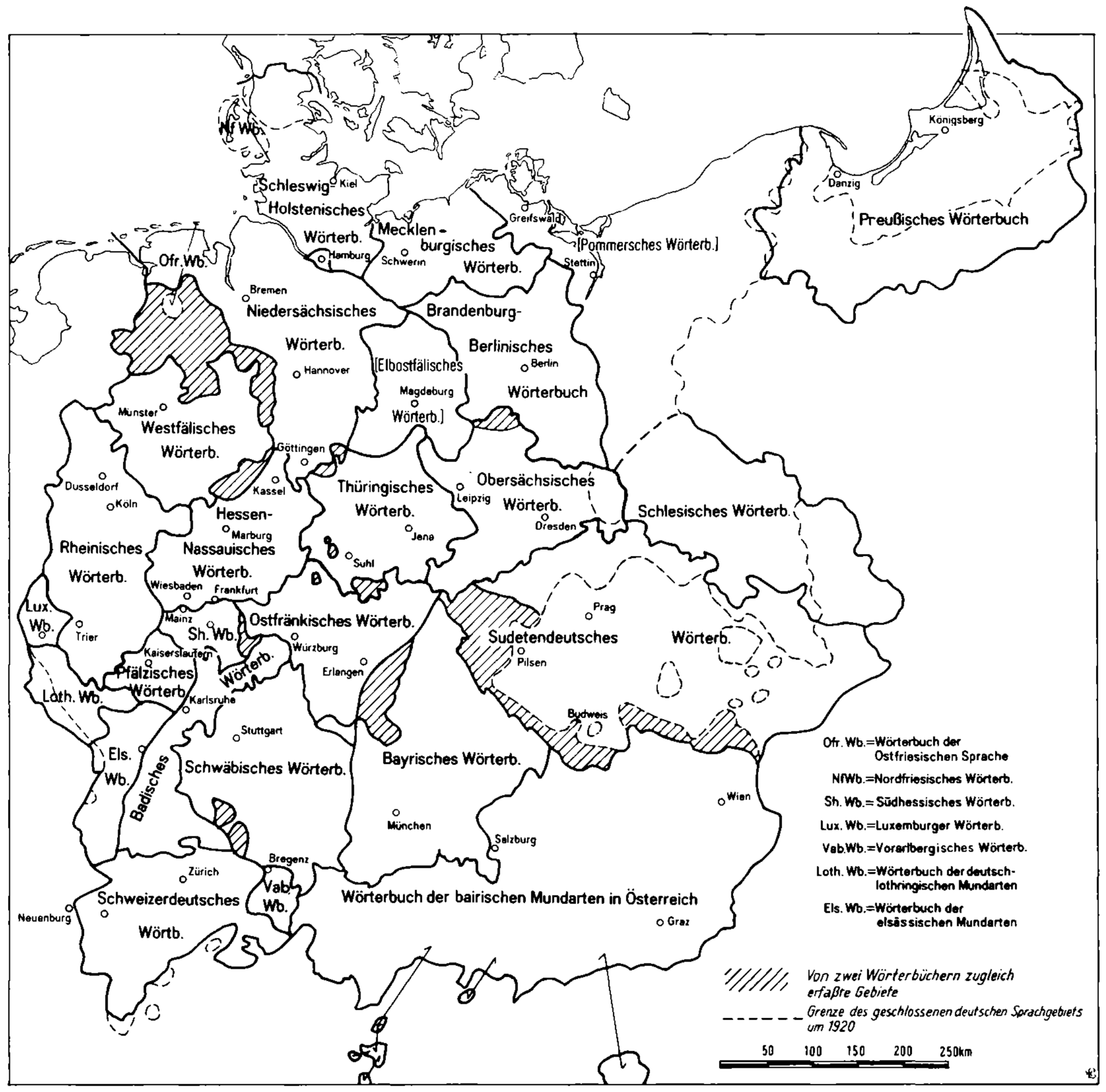
The materials used to address the research questions consisted of lexical data drawn from 30 major dictionaries of German dialects (see the list of abbreviations). These large-scale regional dictionaries (Großraumwörterbücher) constitute the most comprehensive lexicographic documentation of regional German available, covering the principal dialect areas across Germany, Austria, Luxembourg, Switzerland, France, and northern Italy, as well as former German-speaking regions in present-day Poland, Czechia, and the Baltic states (see Figure 3). Collectively, they provide a dense, historically grounded representation of regional lexical semantics, reflecting—at least in broad contour—the linguistic situation of the late nineteenth and early twentieth centuries.
Although the dictionaries differ to some extent in editorial principles, temporal depth, and degree of semantic elaboration, they share a comparable methodological foundation. All of them are material-based in the sense that they draw on dialect documentations and direct or indirect surveys of dialect speakers (see the contributions in Lenz & Stöckle, 2020). Most dictionaries were developed within coordinated frameworks of German dialect lexicography—the so-called Wörterbuchkartell ‘dictionary cartel’—and explicitly oriented themselves toward one another in structure and descriptive conventions (Lameli, 2021). As a result, they form a sufficiently coherent and inter-comparable empirical basis for analyzing dialectal variation in lexical semantics.
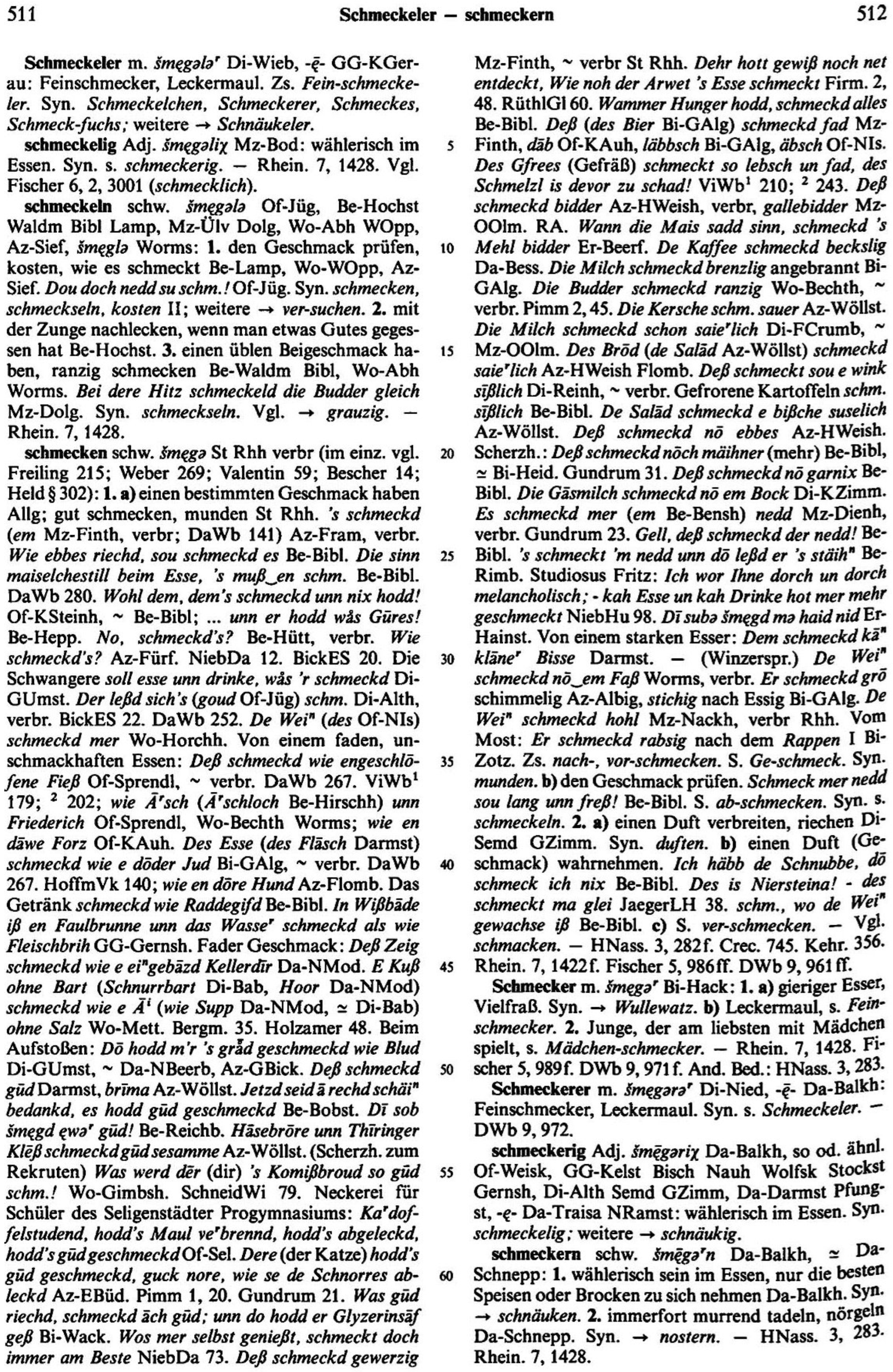
For each dictionary, all entries listed under the lemma schmecken were systematically extracted and analyzed. Figure A1 illustrates a representative entry from the sHessWb. As the example shows, the meaning specifications themselves are generally straightforward to identify. However, the density and explicitness of usage attestations vary considerably within individual entries and even more so across dictionaries, reflecting differences in editorial practice rather than differences in semantic richness. The analysis therefore treats attestation as a binary variable, interpreting spatial patterns in terms of the presence or absence of semantic options rather than their relative productivity. In total, the analysis is based on approximately 400 usage attestations. To ensure comparability, derived forms such as abschmecken or verschmecken were excluded from the analysis.
Within each entry, all distinct meaning specifications as well as all syntagmatic attestations of the particular lemma were classified according to the four-way semantic framework outlined in Section 2.2. Attestations (e.g., citations, idioms, and definitional paraphrases) were analyzed with regard to their syntactic and semantic properties following the criteria illustrated in Examples (3) and (4) and in Figure 2. Meanings were treated as distinct only when dictionaries explicitly differentiated them either through separate sense labels, definitional paraphrases, or contrastive examples. Ambiguous cases were resolved conservatively, i.e., they were accepted only when supported by contextual cues such as experiencer vs. stimulus orientation, evaluative morphology, or syntactic valency. Cases in which schmecken was extended toward an adjacent domain without constituting an independently lexicalized meaning were treated as transfer contexts. Bridging contexts represent a special case of this, in which both the established and the emerging interpretation are simultaneously licensed within a single utterance.
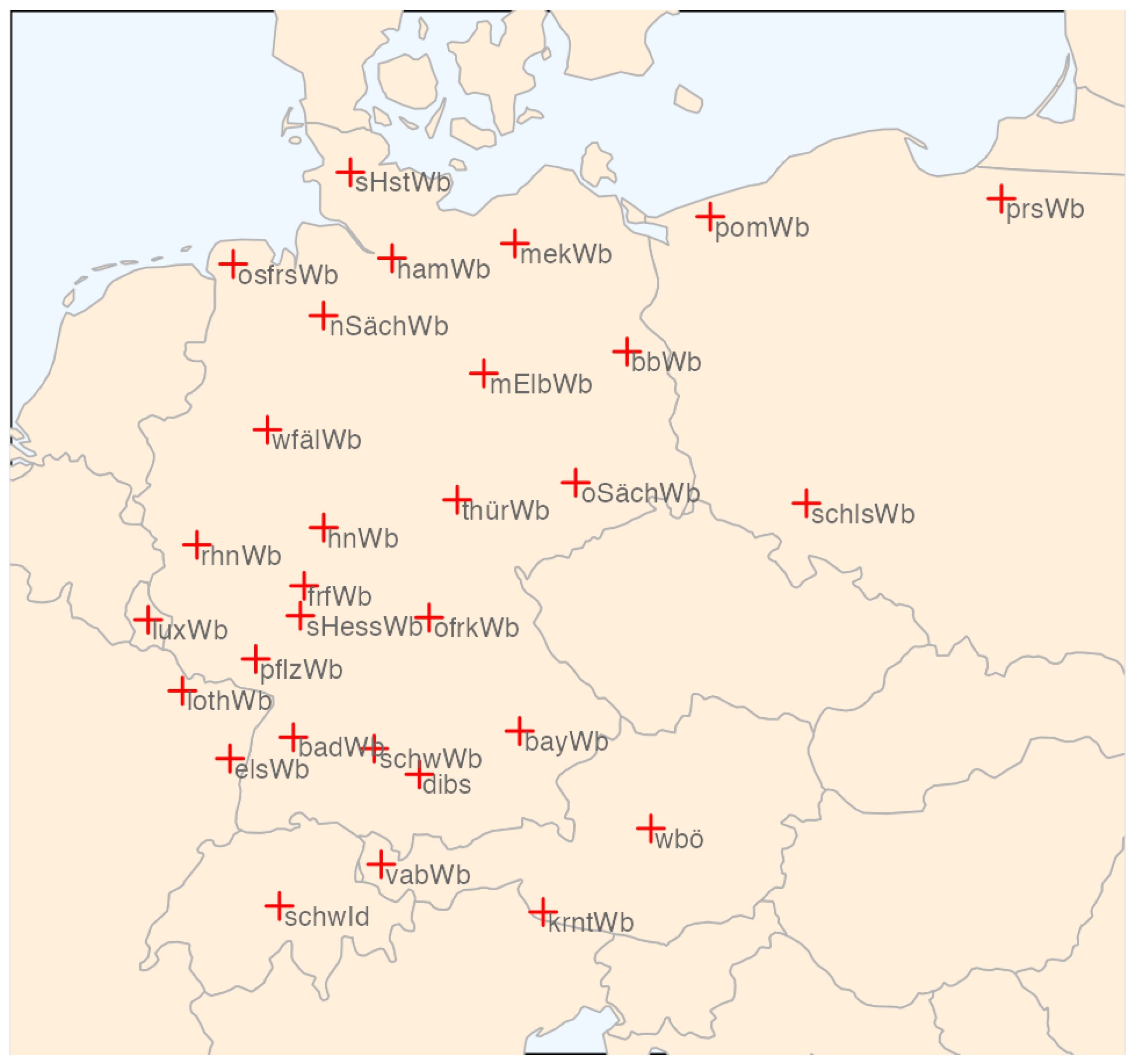
To investigate the spatial dimension of semantic variation, a base map was created that represents the geographical extent of each dictionary by means of the centroid of the areas covered (Figure 4). This abstraction allows regional patterns to be compared on a shared spatial grid, while avoiding distortions introduced by uneven documentation density (abbreviations are explained at the end of the paper).
The study used a directed-graph approach to model the internal organization of the attested meanings. Each meaning category was treated as a node, and relations such as co-occurrence patterns and construal-based dependencies were encoded as directed edges. Importantly, directionality does not represent attested diachronic change but models synchronically inferable asymmetries grounded in construal and sensory organization. This formalism enables the semantic structure of schmecken to be represented in terms of construal orientation, construal mode, and extension pathways, reflecting both typological predictions and dialect-specific outcomes. The resulting graph serves as an analytical bridge between the spatial distribution of meanings and their conceptual interrelations, thereby allowing a unified reconstruction of the geography of meaning.

4. Results

The following section presents the empirical findings in four steps. We first examine the distribution of sensory domains, then analyze their spatial organization, before turning to evaluative and epistemic extensions and finally, to the internal construal profiles that structure the polysemy of schmecken. The results reveal a coherent network of meanings, formally a directed graph, whose internal structure aligns closely with the construal-based framework developed in this study.

4.1. Sensory Domains: Gustatory, Olfactory, and Cross-Modal Extensions

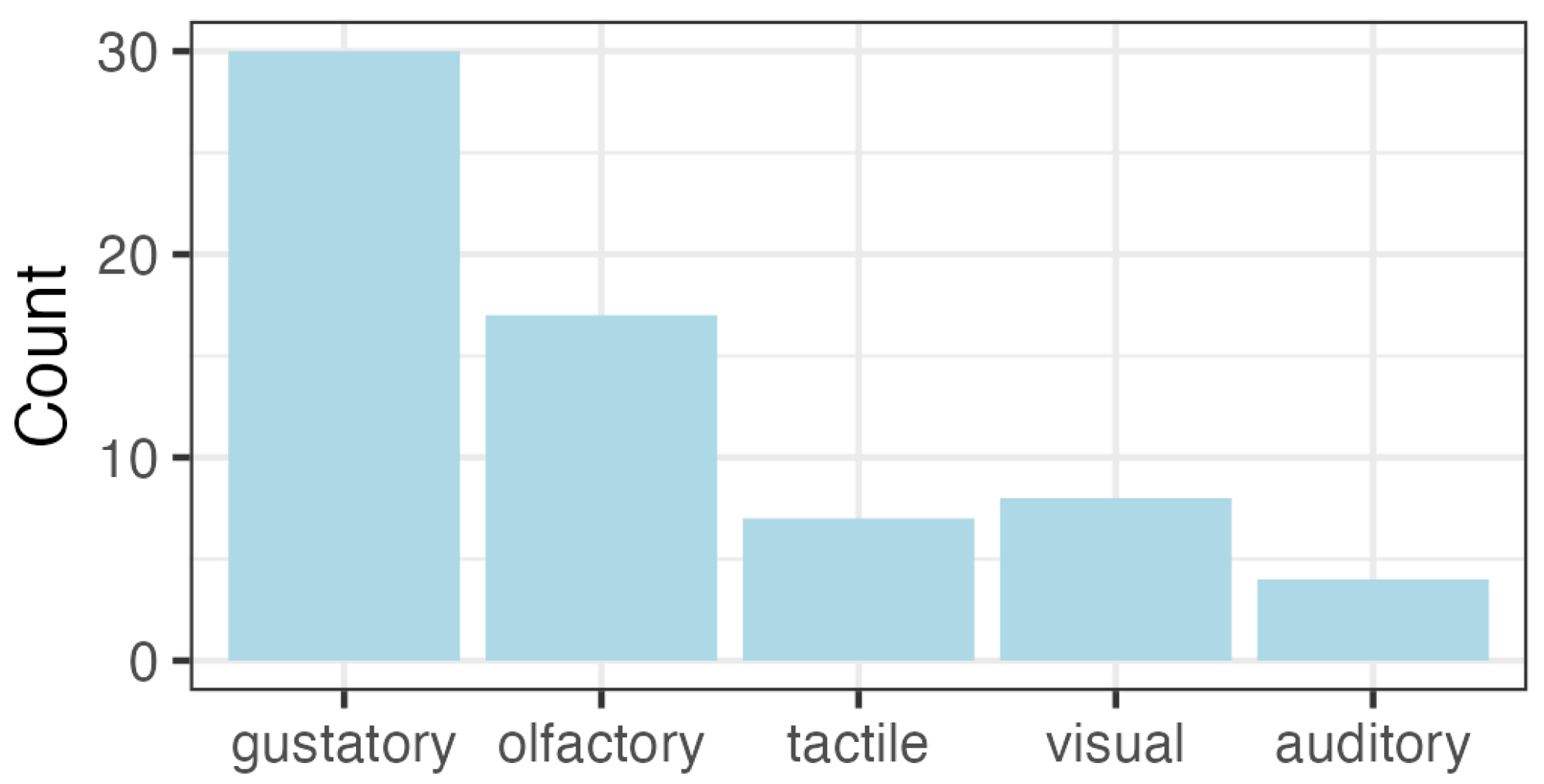
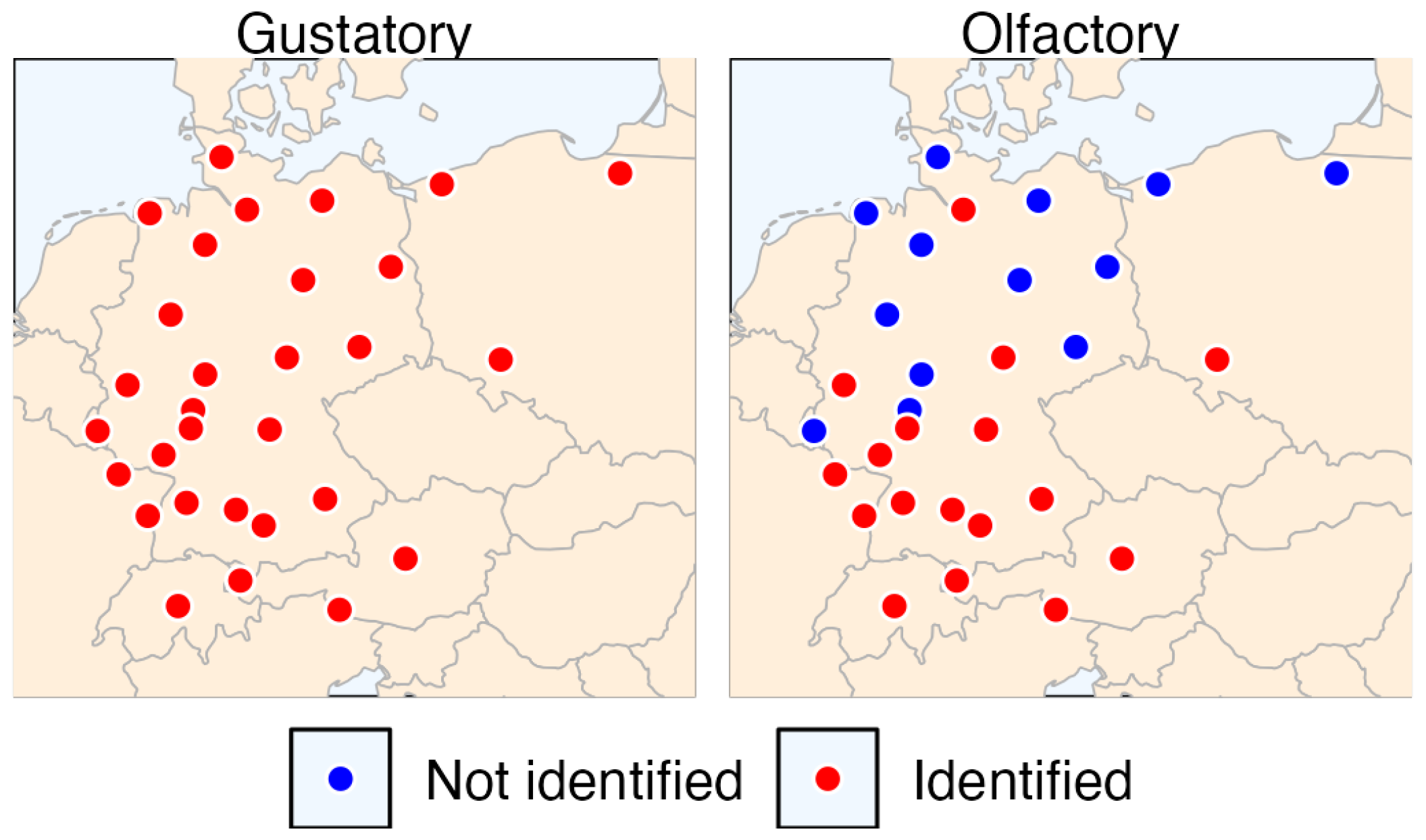
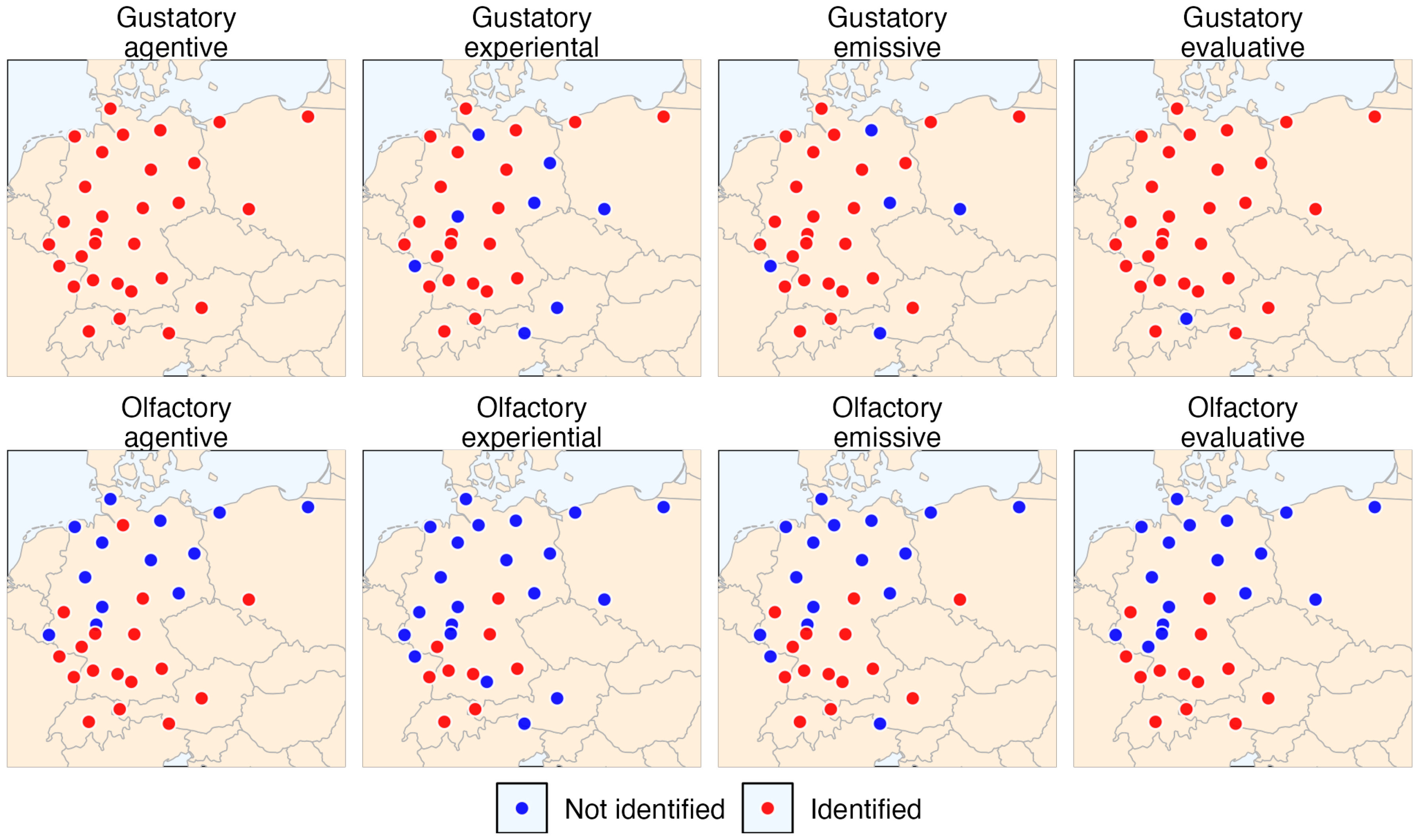
Applying the analytical schema introduced in Section 2.2 to the dialect attestations, we first examine the distribution of sensory domains. All dictionaries document gustatory meanings, while only 17 have olfactory meanings (Figure 5). These proportions reveal that the polysemy of schmecken is anchored in a gustatory–olfactory axis, forming a stable semantic core. Examples (1) and (2) illustrate the expected contrast, demonstrating both coexistence and regional differentiation.
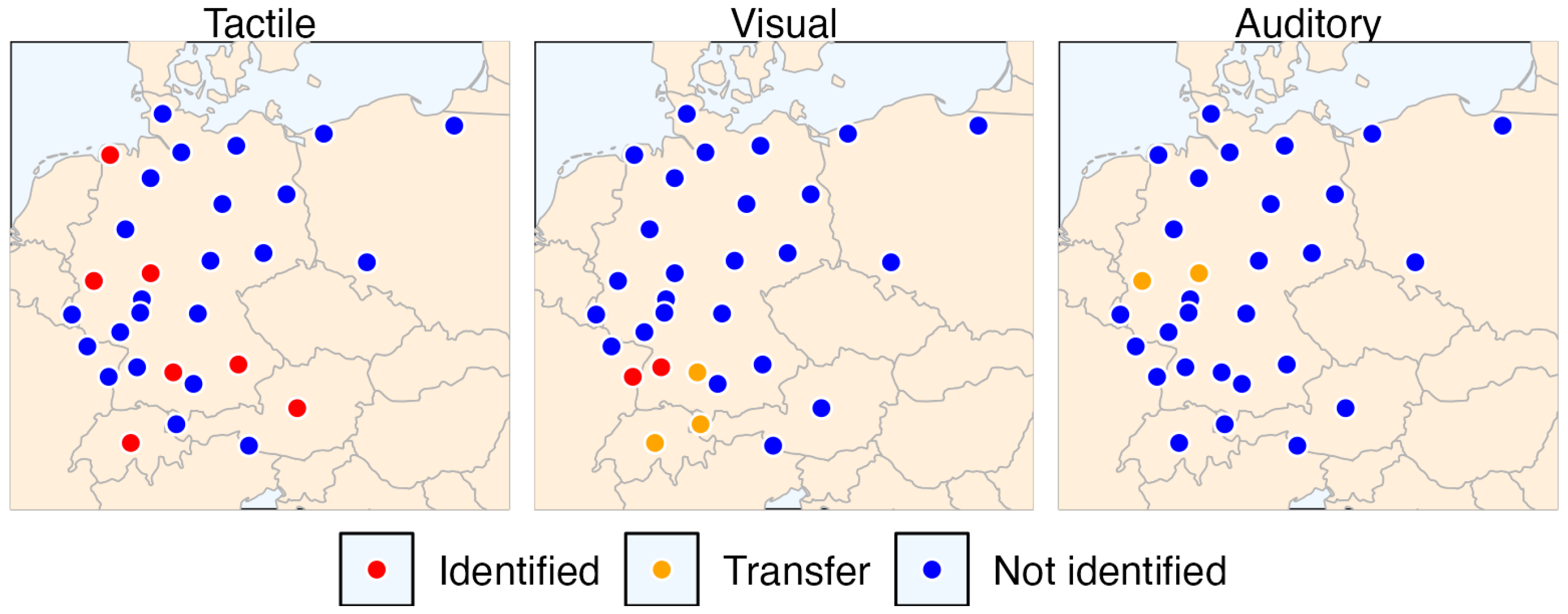
In addition to these two major domains, the data include a small but systematically recurrent set of cross-modal extensions: seven dictionaries have tactile readings, eight dictionaries visual ones, and four dictionaries show auditory re-interpretation. Although numerically marginal, these uses are relevant, as they show how schmecken can be extended beyond the gustatory base while retaining key aspects of its embodied experiential profile.
Tactile readings arise in contexts that reanalyze physical impact as an intense, proximal experience analogous to tasting. They are an emissive reinterpretation in which the stimulus is profiled as the source of a forceful impression, as in (5).
5.
Tactile:
Gleich kreste de Gaasel mal z’schmacke. (hnWb 3:282)
‘In a moment, you’ll get a taste of the whip.’
Visual readings also appear sporadically but instantiate a consistent construal pattern, namely an agentive reading grounded in exploratory behavior. Particularly noteworthy is the directional accusative in (6)—ins ‘into the’—, since Standard German schmecken does not usually govern a directional complement. The syntactic pattern and the semantics jointly suggest that schmecken is re-analyzed as ‘to probe visually’, analogous to verbs of glancing or inspecting, which denote active, exploratory engagement with the environment (see Gisborne, 2010). These uses do not involve an abstract metaphorical leap but an extension of gustatory probing into visual exploration, preserving the verb’s characteristic semantics of active assessment.
6.
Visual:
hesch ins Brune Lade geschmeckt (badWb 4:637)
‘(You) looked into the Brune’s store’ (Brun(e) is a family name)
The Hesse-Nassau dictionary (hnWb) records a further usage referring to the act of eating with an audible sound (“mit hörbarem Geräusch essen”, hnWb 3:282; see English smack, German schmatzen).5 Conceptually, this reading foregrounds the acoustic dimension of the eating event rather than auditory perception itself and is therefore best analyzed as a metonymic extension of the agentive construal mode. What is profiled is not passive auditory reception but the active, bodily engagement of eating, of which the sound is merely a by-product. It thus constitutes a secondary reorganization within the gustatory domain rather than a full sensory extension into the auditory domain, and differs in this respect from the olfactory and visual uses, which involve a genuine relaxation of physical contact along the proximal–distal axis.
Such cases represent potential transfer contexts in which schmecken extends from the gustatory into other sensory modalities, thereby illustrating the verb’s cross-modal potential and its integration into a broader network of embodied perception. This is particularly evident in (7), which exemplifies a bridging context between olfactory and visual sensory interpretations under a shared stimulus-oriented construal, where the boundaries between sensory domains become blurred.
7.
Bridging between olfactory and visual:
in alle Häfen schmecken (vabWb 2:982)
‘look (/smell) in all pots’
These findings provide the empirical basis for answering RQ1 and verifying H1, showing that gustatory and olfactory meanings dominate the dialect landscape while systematically giving rise to cross-modal extensions. At the same time, these extensions demonstrate that schmecken’s sensory semantics is not rigidly anchored in gustation but forms an organization aligned with the proximal–distal gradient of perception (Figure 1), from which extensions into adjacent perceptual domains arise in ways consistent with their degree of perceptual distance from bodily contact.

4.2. Geographical Organization of Sensory Meanings

The spatial distribution of sensory readings reveals a striking north–south divide. Gustatory readings occur throughout the German-speaking area (Figure 6, left), whereas olfactory readings are confined to Upper German and southern Central German (Figure 6, right), including Silesia. Northern dialects, in contrast, show almost exclusively the gustatory sense, thereby confirming H3. The two attestations from Hamburg—(8) and (9), with (9) representing a transfer context6—are notable exceptions but do not challenge the overall pattern. Importantly, as discussed in Section 2.3, olfactory readings are historically attested in Middle Low German. The absence of such readings in modern northern dictionaries therefore reflects language change.
8.
in de Köök, wo ik al lang de Rüük vun Speck … smeckt harr (hamWb 4:348)
‘in the kitchen, where I kept smelling the aroma of bacon’
9.
de Buur rüükt nich de Luft, he smeckt eer (hamWb 4:348)
‘the farmer does not smell the air, he tastes it instead.’
The extent of the olfactory domain raises the question of whether it once reached further north. The Hesse-Nassau dictionary is particularly informative in this respect because it borders directly on the area where olfactory readings are attested. Although it contains no olfactory meaning for schmecken, its predecessor documents “nach Fäulnis schmecken und riechen” (‘to taste and smell like rot’; Kehrein, 1891, p. 356). The Upper Hessian dictionary similarly notes that schmecken was used for smell in earlier stages (Crecelius, 1899, p. 745). These observations suggest that the olfactory reading was historically more widespread and contracted northwards during the period in which the major dialect dictionaries were compiled. The evidence therefore supports the hypothesis of a relatively recent retraction of this semantic type.7
Tactile readings, in contrast, occur sporadically in the western Central German and Upper German areas (Figure 7, left). No systematic spatial pattern emerges here; these uses appear as localized metaphorical innovations. Visual readings are restricted to the Alsatian and Baden dictionaries (Figure 7, center) and thus in those regions in which olfactory meanings are also attested. This overlap is significant: both readings share a distal orientation and represent exploratory perception rather than contact-based experience (Figure 1). That is, only when schmecken is already licensed to denote non-contact-based perception does a visual reinterpretation become semantically conceivable. The fact that visual readings never occur independently of olfactory ones strengthens the interpretation of schmecken as following a principled proximal–intermediate–distal organization.
Auditory reinterpretations occur on the northern boundary of the olfactory domain (Figure 7, right). Although too sparse to form a robust spatial pattern, their distribution is revealing: they occupy precisely the transitional zones where the semantic profile of schmecken reflects the historically attested retraction of the olfactory reading discussed above. Their localization therefore supports the broader hypothesis that cross-modal reinterpretation emerges in areas of semantic instability, where olfactory meanings have begun to retract geographically.
Overall, the geographical distribution confirms the structural predictions of the analytical model. Semantically richer and more cross-modally extended uses occur in the southern dialects, whereas northern regions retain a more conservative semantic profile. This north–south division directly addresses RQ3 by demonstrating that semantic density and extension pathways are regionally patterned in a consistent and typologically predictable manner.

4.3. Affective and Epistemic Extensions

Beyond sensory perception, schmecken also develops affective and epistemic extensions in Upper German and some Central German dialects. In this regard, a preliminary clarification is necessary. As discussed in Section 2.2, the evaluative construal mode is a basic perspectival framing, not an extension. Gustatory and olfactory perception, when construed in evaluative mode, inherently encode assessment along a positive–negative dimension (4b). These uses are stimulus-oriented and express preference or aversion but remain sensorially anchored: the stimulus is a substance, and the assessment refers to its taste or smell. Affective and epistemic extensions, by contrast, involve metaphorical transfer beyond the sensory domain. The stimulus is no longer something tasted or smelled but a person or a situation, and the verb no longer denotes sensory perception but interpersonal stance or cognitive awareness.
Affective extensions (10) arise through metaphorical mapping from olfactory experience to interpersonal stance. As Winter (2019, pp. 276–277) outlines, the chemical senses are immediate, proximal, and intimately tied to bodily experience, which is why they automatically trigger reactions of attraction or repulsion (see Herz, 2009; Bagli, 2021; Winter, 2016, p. 982).
10.
Affective evaluation:
Ich kann en net schmecke (sHessWb 5:511)
‘I can’t stand him.’
Epistemic extensions (11) exploit the inferential structure of olfactory perception. While vision is the prototypical source domain for epistemic meanings (Sweetser, 1990, p. 39), smell verbs have frequently developed extensions expressing detection or suspicion rather than understanding. This distinction reflects different informational structures: vision reveals objects directly, while smell provides indirect evidence of sources which are not visible. Example (11) follows this pattern. The verb no longer denotes sensory perception but intuitive cognitive appraisal.
11.
Epistemic:
Schmeckst eppes!? (bayWb 2:543)
‘Do you notice anything?’
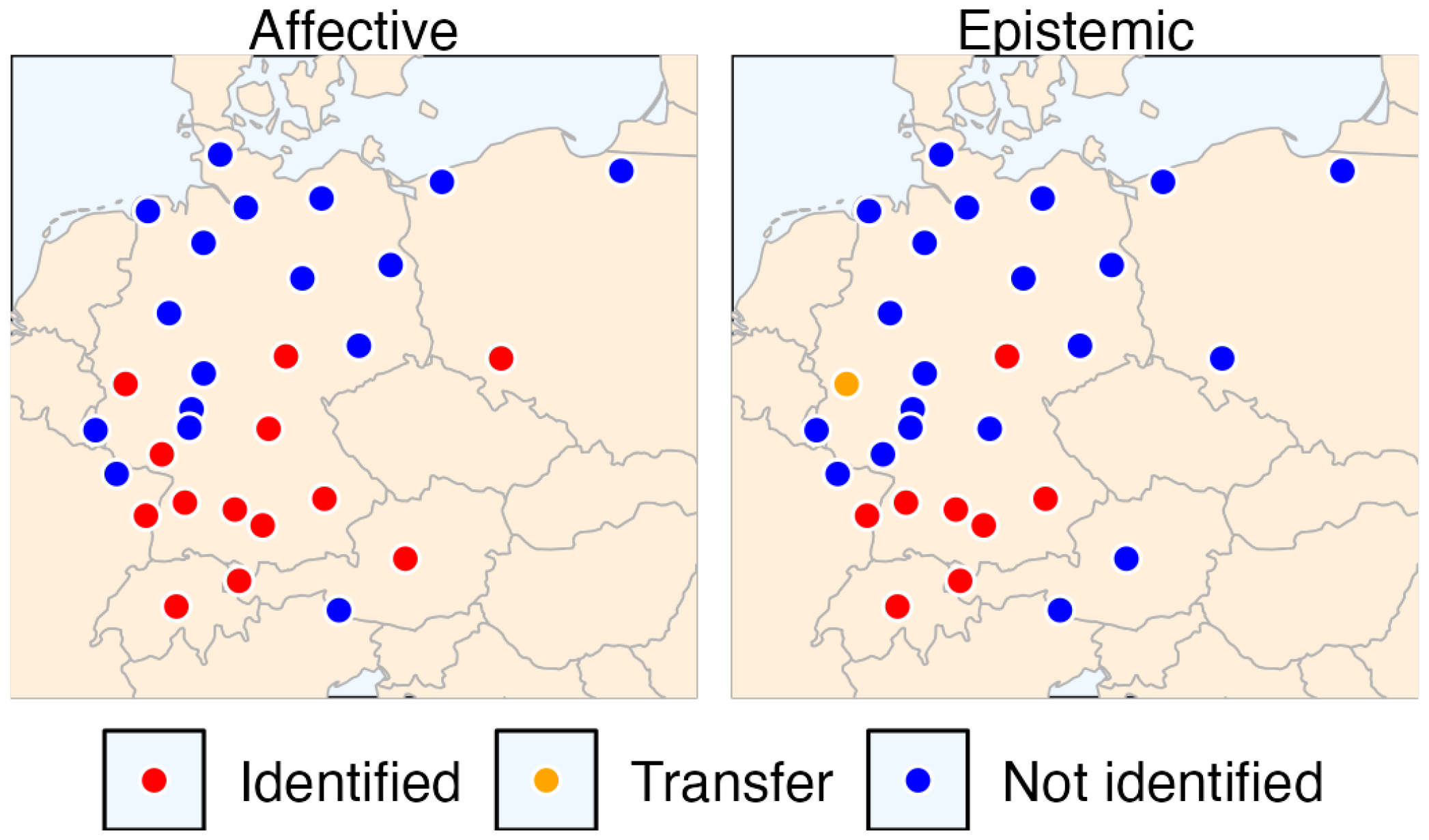
Both pathways presuppose olfactory semantics and stimulus-oriented construal. Affective extension draws on the automatic encoding of preference inherent in smell perception; epistemic extension draws on its inferential-evidential structure. Neither arises directly from gustatory meaning. This structural dependency is reflected in the areal distribution. As Figure 6 and Figure 8 show, affective and epistemic readings are geographically co-extensive with olfactory schmecken and absent in northern dialects where only gustatory meanings are preserved. The distribution thus provides areal evidence that these extensions require not merely the presence of olfactory meaning but its availability in stimulus-oriented construals, where the stimulus is foregrounded as a source of impression or object of assessment.

4.4. Semantic Construal Modes

We now test the predictions of the analytical schema by examining how the four construal modes—agentive, experiential, emissive, and evaluative—are instantiated across the dialect data (Figure 9). A finding of particular interest is that the agentive construal—as illustrated in example (12)—is attested across all dialect regions.
12.
schmeck när mol die gute Brüh! (oSächWb 4:105)
‘just try the delicious broth.’
This contrasts with Standard German, where the agentive construal is typically lexicalized by dedicated verbs such as kosten or probieren (Gamerschlag & Petersen, 2012, p. 4). Several dialects, by contrast, preserve a broader functional range for schmecken, while also retaining alternative agentive expressions. In this regard, the South Hessian examples in (13) and (14) show that dialectal usage does not enforce a strict functional separation between schmecken and more specialized tasting verbs. In example (13), the agentive function typically associated with probieren in Standard German remains available to schmecken alongside browere as a partially synonymous expressions in (14).8 Rather than forming a complementary distribution, the verbs occupy overlapping functional space.
13.
Schmeck mer nedd sou lang unn freß! (sHessW 5:512)
‘Don’t try it for so long, just eat!’
14.
Los mich emol browere wi das schmegd (sHessW 1:1126)
‘Let me try how it tastes.’
Figure 9 reveals a further structural insight: both gustatory and olfactory readings instantiate the full set of construal modes. This symmetry supports H2, which predicted that semantic extension is governed by constraints on construal orientation and mode rather than by the sensory domain itself. The data thus align with Viberg’s cross-linguistic finding that perception verbs exhibit stable event-type structures across modalities (Viberg, 2001), and with cognitive-semantic accounts emphasizing that metaphorical extension is primarily driven by construal shifts rather than modality boundaries (Johnson & Lakoff, 1980; Sweetser, 1990). Accordingly, no substantial regional differentiation emerges in the inventory of construal modes.

4.5. Polysemy and Regional Semantic Density

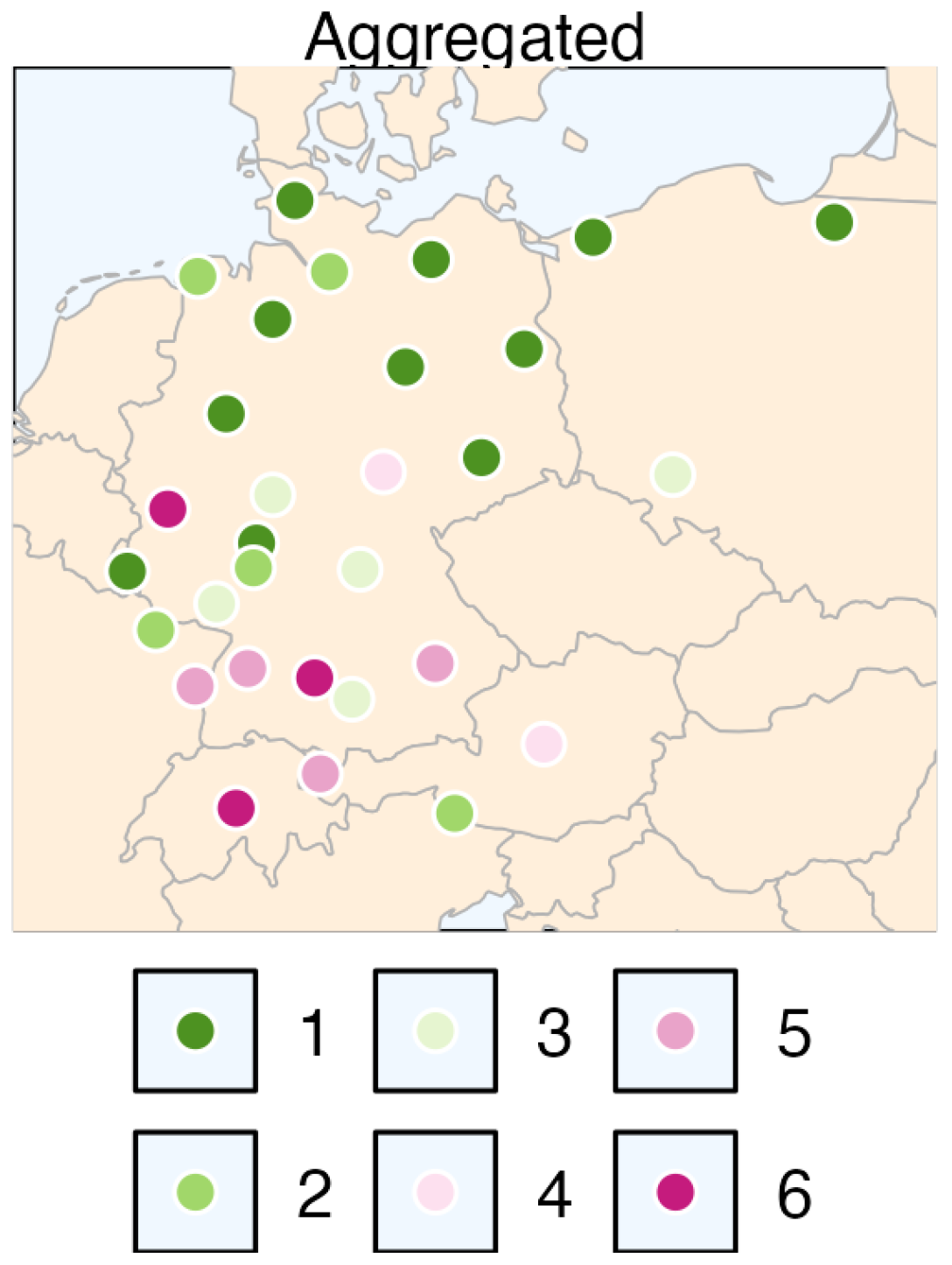
To obtain a comprehensive picture of regional semantic variation, the individual spatial patterns identified in the preceding sections were aggregated into a single polysemy map. To this end, Figure 10 summarizes the total number of gustatory and olfactory sensory domains and cross-modal extensions (tactile, visual, auditory, affective, epistemic) attested for schmecken in each dictionary. It thus integrates the information presented in Figure 6, Figure 7 and Figure 8. The resulting spatial distribution again exhibits the previously identified south–north decline of semantic diversification (H3). Regions with high polysemy—most prominently the Alemannic area (red shading)—display nearly the full range of sensory and evaluative extensions, even though the theoretical maximum of seven is not reached in any single region, alongside frequent realizations of all four construal modes (see Figure 9). By contrast, Low German and large parts of northern Central German show a markedly restricted semantic inventory dominated by gustatory meanings (green shading). The aggregated map therefore corroborates the broader theoretical claim that semantic complexity is regionally patterned and correlates with the availability and systematic combination of multiple construal modes.
Figure 10 thus does more than document the coexistence of multiple meanings. It reveals the internal architecture of schmecken’s polysemy as a structured semantic complex whose regional activation is systematically uneven. Semantic diversity is not the product of isolated local innovations but reflects the degree to which regional varieties engage the full range of construal modes and extension pathways. The Alemannic and broader Upper German area (red shading) activates nearly the complete network—both sensory domains in all four construal modes, combined with cross-modal, affective, and epistemic extensions—whereas Low German and northern Central German (green shading) selectively instantiate only the gustatory core.
This asymmetry gains further depth when read against the diachronic background outlined in Section 2.3. Regions with broader semantic repertoires preserve elements of the earlier gustatory–olfactory continuum; regions with narrower profiles reflect a more advanced stage of lexical differentiation. Crucially, historically inherited structures do not merely survive as fossils, but rather provide the conditions under which construal-dependent extension remains possible or becomes blocked. It is precisely where olfactory schmecken survives that stimulus-oriented construals unlock the affective and epistemic pathways documented in Section 4.3; their absence in the north forecloses these pathways entirely.
Semantic density is thus the cumulative outcome of embodied perceptual organization, systematic construal structure, and historically layered areal dynamics. That complexity clusters in the south and recedes northward reflects the geographically uneven progress of lexical differentiation within a domain where the boundary between taste and smell remains, in parts of the German-speaking area, permeable to this day.

4.6. Semantic Range

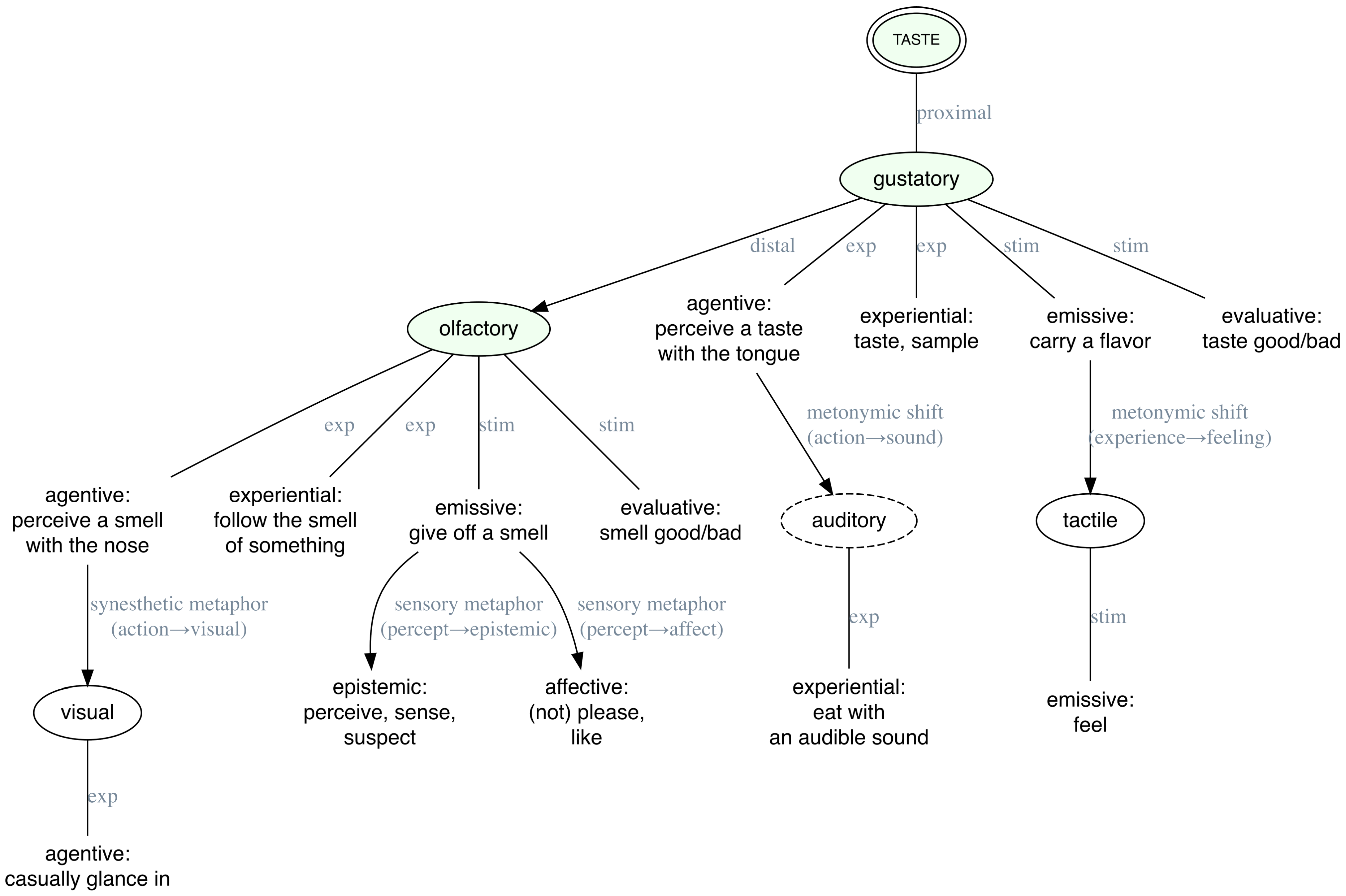
Based on the above findings, the semantic range of schmecken can now be summarized as a directed graph anchored in the gustatory domain and structured by systematic cross-modal, affective, and epistemic extensions (Figure 11). Construal orientation and mode provide the perspectival scaffolding for gustatory and olfactory meanings but do not, by themselves, account for the broader polysemy. Rather, the network reflects deeper cognitive principles of embodied perception and the gradual loosening of physical contact along the proximal–distal axis. This proximal–distal dimension of perception is a central organizing principle of the network. As highlighted in Figure 1 gustation is an inherently proximal sense. It requires bodily contact between perceiver and stimulus. Olfaction, by contrast, occupies an intermediate position, mediated through airborne particles and thus permitting perception at a slight distance. This gradient provides the conceptual backbone of the semantic range. Meanings that remain within the proximal zone—such as tactile or bodily-impact readings—preserve the immediacy of gustatory contact. Meanings that move toward the distal pole—such as olfactory, visual, or cognitive interpretation licensed by stimulus-based construal modes—encode a relaxation of physical engagement and therefore enable abstraction.
Within this framework, gustatory meaning constitutes the semantic center of the system, from which all other meanings can be systematically related within a cognitively grounded dependency structure, be it directly or indirectly. This is evident in Low German, where—apart from a single olfactory attestation in Hamburg—the gustatory core remains virtually the only meaning (Figure 12). By contrast, dialects of the Upper and southern Central German areas reveal a more advanced and internally differentiated semantic profile, which is congruent with Figure 11.
From the gustatory center in Figure 11, the most systematic cluster of extensions emerges in the olfactory domain. Constructions such as (1), (15), and (16) show that speakers conceptualize smell-dominant experiences through the syntactic and semantic frame of tasting. Emissive patterns are particularly conducive to this development because they foreground the stimulus and analogize gustatory contact with the detection of airborne properties.
15.
(Ein Mädchen) het g’schmöckt von Pummaden und Seipfen (schwId 9:884)
‘(a girl) smelled of pomade and soap’
16.
Der Graf … schmackt das Feur (schwWb 5:988)
‘The count smells the fire’
From the olfactory domain, the semantic network extends into affective and epistemic meanings, but only when olfactory perception is construed in stimulus-oriented modes. Both pathways foreground the stimulus rather than the experiencer. Affective readings such as (17) profile a person as evoking attraction or repulsion, epistemic readings such as (18) profile a situation as yielding inferential evidence. Both therefore presuppose the emissive construal mode as a critical prerequisite: only when the stimulus is foregrounded as the source of an impression rather than as the object of active perception are the conditions for metaphorical transfer in place. Affective uses exploit the inherent evaluative loading of olfactory perception; epistemic uses exploit its inferential-evidential structure, whereby the stimulus functions not as something perceived but as a cue to something beyond direct sensory access.
17.
er schmeckt ihm nicht (bbWb 3:1158)
‘he does not appeal to him’
18.
ar hot wos geschmeckt (thürWb 5:746)
‘he noticed something’
This structural dependency explains why affective and epistemic extensions are areally restricted. They require not merely the presence of olfactory meaning but its availability in stimulus-oriented construals. Where dialects preserve olfactory schmecken only in experiencer-oriented uses—for example, agentive (1b)—the conditions for metaphorical abstraction are not met. The north–south divide in semantic complexity (Figure 10) thus reflects not only the areal scope of olfactory meanings but also the range of construal modes through which those meanings are realized. The pathway
g u s t a t o r y o l f a c t o r y { a f f e c t i v e , e p i s t e m i c }
thus captures a cognitively motivated dependency structure. The first transition reflects the perceptual continuity of the chemical senses along the proximal–distal axis (Figure 1); the second is licensed specifically by the emissive construal mode. Only when the stimulus is foregrounded as the source of an impression do the requisite semantic properties become available for metaphorical transfer: the encoding of attraction and aversion (affective pathway) and the function as inferential evidence (epistemic pathway). Experiencer-oriented construals, by contrast, profile the perceiver’s activity and do not license these extensions. The directed structure of the graph reflects a systematic asymmetry that aligns with the cross-linguistically documented tendency for synesthetic and cross-modal mappings to proceed from more proximal and physiologically immediate source domains toward more distal and abstract targets, but not in the reverse direction (Winter & Strik-Lievers, 2025; Shen & Cohen, 1998).
Peripheral sensory links further enrich the semantic field. Tactile readings such as (5) arise from the re-analysis of bodily impact through gustatory schemas of pressure, resistance, or intensity. They do not constitute an autonomous tactile domain but exploit the embodied logic of eating to conceptualize physical endurance or imminent pain. Similarly, the attested auditory associations constitute a highly restricted metonymic development: schmecken can refer to “eating with an audible sound”, but this meaning remains anchored in the gustatory action itself. The verb never generalizes to mean ‘hear’; the sound is a by-product of eating, not an independent sensory target. The auditory path thus terminates within the proximal domain and illustrates the selective permeability of sensory boundaries.
Visual associations, by contrast, align with the distal pole. Dialectal uses approximating ‘take a look’ or ‘glance’, such as (6) and (7), arise not from gustatory structure but from parallels between olfactory and visual perception. Both allow for exploratory, distance-based appraisal. However, their marginal frequency is fully consistent with Viberg’s (2001, p. 1297) modality hierarchy
sight > hearing > touch , taste , smell
This hierarchy captures the cross-linguistic tendency for extensions to flow from more informative distal senses to less informative proximal senses. Vision, which provides the “most reliable” access to the external world (Viberg, 2001, p. 1306), is the prototypical source domain for epistemic extensions. The opposite direction—from taste or smell to vision—is typologically marked and rare. That visual readings of schmecken occur at all reflects the transfer function of olfaction, which shares with vision the property of distal, non-contact perception. The visual extension thus presupposes the prior establishment of olfactory meaning in the present case and remains geographically marginal (Figure 7), never achieving the systematicity of the affective or epistemic pathways.
Finally, peripheral sensory readings—except for tactile uses such as (5) or (19)—originate from the experiencer-oriented core of schmecken, not from its stimulus-oriented (emissive) pattern. This asymmetry suggests that cross-modal extension is grounded in the embodied experiential profile of gustation rather than in the stimulus-based encoding of flavor emission.
19.
der Pfaff muss schmöckhen meine Hend (schwId 9:902)
‘the pastor must taste my hands’
Viewed onomasiologically, the semantic field of schmecken interacts with the wider perceptual lexicon (see, hear, feel) to form the kind of multidimensional perceptual architecture described by Reichmann (2022). Within this architecture, schmecken exemplifies how embodied experience, sensory alignment, and systematic construal patterns organized by orientation and mode jointly structure lexical meaning across regional varieties of German.

5. Discussion

5.1. Reconstructing the Semantics of schmecken

The present study provides the first comprehensive reconstruction of the semantic potential of schmecken across the German dialect landscape. The analysis shows that the verb’s polysemy emerges from the interaction of three mutually reinforcing forces: (i) perspectival structuring encoded in construal orientation and realized through distinct construal modes, (ii) the embodied organization of the perceptual system, and (iii) regionally patterned configurations of semantic elaboration. Together, these factors demonstrate that lexical meaning does not arise as a set of discrete, independent senses but as a semantic network whose configuration reflects general cognitive principles as well as spatially differentiated linguistic communities.
The central finding—that the gustatory–olfactory axis constitutes the semantic backbone of schmecken—is both cognitively motivated and historically grounded (Rozin, 1982; Stevenson et al., 1999; Viberg, 1983, p. 160; Sweetser, 1990, p. 36) and finds parallels in the systematic direction of synesthetic mappings documented cross-linguistically (Winter & Strik-Lievers, 2025, p. 166). Other meanings of schmecken, such as affective, epistemic or visual, presuppose this core structure and are licensed specifically through emissive and agentive construal modes, following the proximal–distal continuum outlined in Figure 1. The dialectal distribution of meanings thus provides a privileged window into the semantic potentials that remain latent or are foregrounded in different regional varieties.
Although scholars such as Leibniz (1717) and Grimm and Grimm (1896) noted regional olfactory uses of schmecken, neither the full semantic range nor the structural principles governing its organization had previously been examined. The present study fills this gap by showing not only that gustation and olfaction form a tightly integrated semantic domain (i), but that this integration is geographically structured (ii) and that all higher-level elaborations—affective, epistemic, visual—depend on the underlying gustatory–olfactory architecture and the construal modes through which it is accessed (iii). In this respect, the findings complement Harm (2000, p. 220), who observes a diachronically stable set of construal modes, by extending this claim into the spatial domain. It should be noted, however, that H1 is confirmed with an important regional qualification: the gustatory–olfactory colexification that underlies the predicted extension pathways is preserved in Upper German but has receded in the north, where the gustatory core operates without the olfactory dimension that enables further abstraction.
Against this background, the Upper German data reveal a distinct organizational strategy. They integrate olfactory perception into the gustatory domain, forming a gustatory-olfactory cluster that is typologically rare but historically well motivated. The German dialect data therefore illustrate an alternative pattern of organizing proximal sensory experience, one that diverges from the dominant cross-linguistic tendency to maintain a lexical boundary between taste and smell yet remains grounded in their close perceptual interdependence.

5.2. Patterns of Cross-Modal Extension

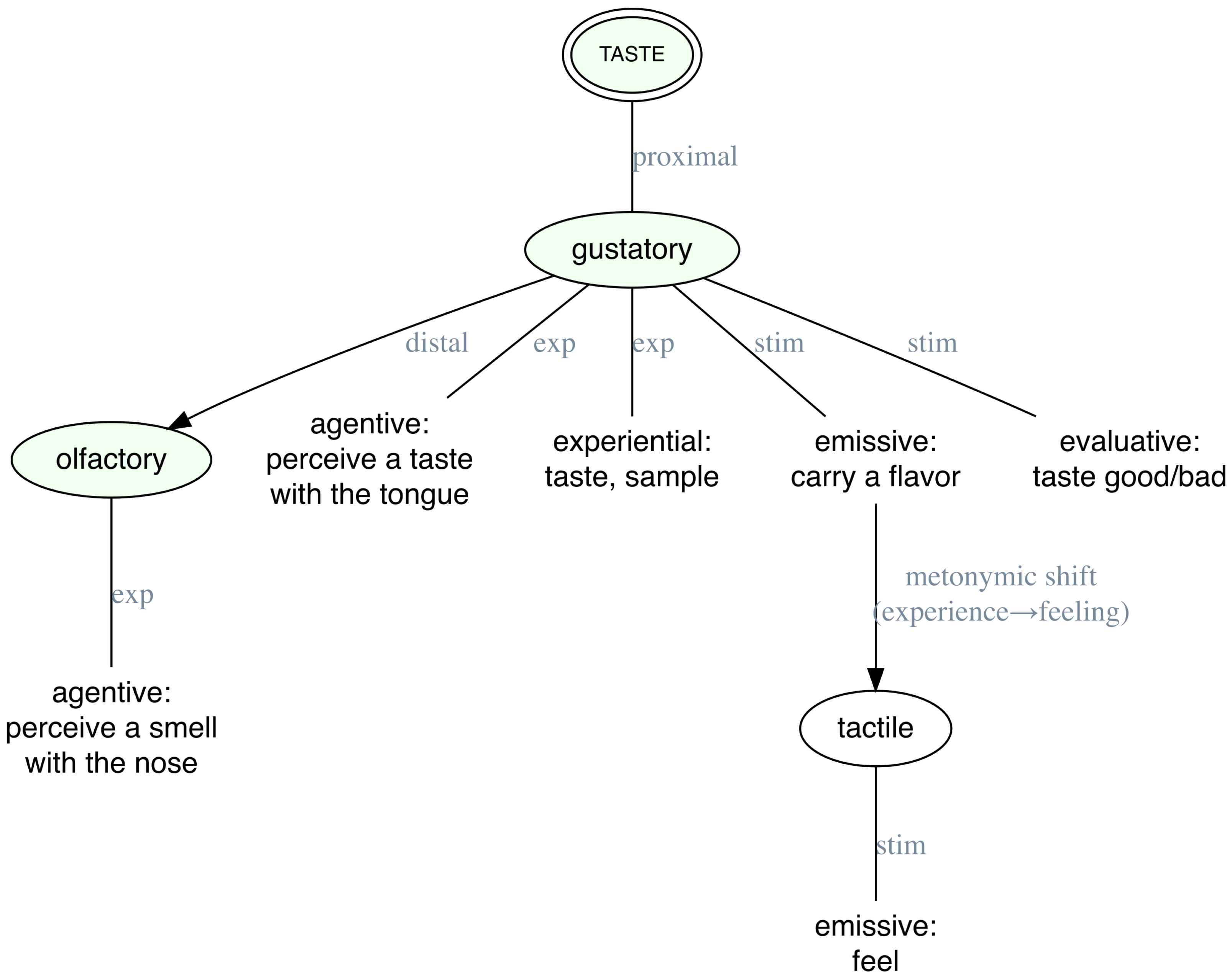
The reduced semantic graph in Figure 13 abstracts away from the full network in Figure 11 and highlights the principal structural dependencies that govern semantic behavior in schmecken. Crucially, it reveals that semantic extension is driven by construal mode rather than sensory modality alone, with the emissive construal licensing abstract affective and epistemic extensions and the agentive construal licensing visual reinterpretation (H2).
At the center of the network lie two clusters of construal modes. The experiencer-oriented cluster groups agentive and experiential readings, which foreground the experiencer’s bodily engagement with the stimulus. The stimulus-oriented cluster groups emissive and evaluative readings, which foreground the stimulus as the source of a property or target of a judgment. Both clusters are independently supplied by the gustatory and olfactory nodes, confirming that both sensory modalities instantiate the full set of construal modes. This structural symmetry is itself a significant finding as it confirms that construal modes operate independently of sensory modality, and that the availability of a full construal profile is a property of the lexeme’s semantic organization rather than of any particular sensory domain.
Read alongside Figure 11, the graph makes explicit that cross-modal and conceptual extensions are not licensed by sensory modality as such but emerge systematically from the distinction between experiencer- and stimulus-oriented construals. Stimulus-oriented construals—in particular the emissive mode—license tactile reinterpretations and provide the overarching framework for affective and epistemic extensions. Experiencer-oriented construals—above all the agentive mode—license visual reanalysis. The auditory reading attested in the Hesse-Nassau dictionary similarly originates in the experiencer-oriented construal—specifically the agentive mode—, as it encodes the audible by-product of active eating rather than auditory perception proper and thus remains anchored within the proximal gustatory domain.
In sum, construal modes function as bottlenecks through which all non-gustatory and non-olfactory elaborations are systematically channeled. This insight aligns with typological and cognitive-semantic work on perception verbs (e.g., Croft & Cruse, 2004; Winter, 2019; Galac, 2020), which similarly observe that perspectival framing exerts a decisive influence on patterns of semantic extension. The reduced graph thereby advances beyond descriptive semantic mapping. It demonstrates that the architecture of a lexeme’s polysemy can be derived from a small set of construal-based principles, offering a formally tractable account of semantic complexity in perception verbs.

5.3. Areal Structuring

The geographical distribution of meanings reveals a pronounced and systematic north–south divide. Gustatory readings occur throughout the German-speaking area, but olfactory, tactile, visual, affective, and epistemic uses are largely confined to Upper German and southern Central German dialects. Northern dialects remain semantically restricted by applying a system centered on the gustatory core.
This pattern is consistent with the cross-linguistic observation that smell has a comparatively low coding potential (Levinson & Majid, 2014; Majid et al., 2018; Zurbuchen & Vainik, 2024). Once specialized lexemes for olfactory perception (such as riechen) gain prominence, gustatory–olfactory colexification tends to recede. Against this typological background, the Upper German retention of olfactory schmecken represents a conservative development that preserves an earlier gustatory–olfactory continuum. At the same time, it highlights Upper German as a typologically exceptional case, one that has received no attention in the literature and among the contemporary languages in the study of Norcliffe and Majid (2024) only matches with Northern Yukaghir in Northeastern Siberia.
The typologically unusual feature of Upper German lies not in the presence of a proximal–distal mapping itself, but in the fact that this mapping is anchored in the gustatory–olfactory interface. While many languages exploit other sensory couplings (e.g., touchhear in Romance), Upper German relies on a rare lexical integration of taste and smell to realize the same conceptual gradient. By contrast, Low German and northern Central German dialects today conform to the cross-linguistically more common tendency to avoid colexifying taste and smell within a single lexical item. This convergence with the typological default is, however, the outcome of historical change. As discussed in Section 2.3 and Section 4.2, olfactory uses of schmecken were once attested in Middle Low German and have since receded northward.
On this basis, we can articulate more precisely what we understand as a geography of meaning: the spatially patterned organization of semantic structures within a linguistic domain. In the given case, such a geography captures the fact that regional varieties activate different subsets of a lexeme’s semantic potential, each with its own construal profile, its characteristic range of affective and epistemic elaborations, and its preferred pathways of semantic change. As the north–south contrast illustrates, semantic networks themselves are subject to spatial organization. Regions therefore differ not only in what schmecken can mean but also in how meanings relate to each other and which pathways of semantic extension they support.
It should be noted that the dialect dictionaries on which this study is based document regional lexical norms rather than individual usage. It should further be noted that the binary attestation data underlying the polysemy map (Figure 10) cannot distinguish between highly productive and marginally attested uses; the spatial patterns identified here therefore represent the outer boundaries of each region’s semantic potential rather than its typical usage. These patterns moreover represent aggregate outcomes of socially mediated semantic practices—shaped by factors such as age, social networks, and prestige—whose internal dynamics remain beyond the scope of the present analysis.

5.4. Theoretical Implications

For the typology of perception verbs, the study provides geographically differentiated evidence for extension pathways documented by Viberg (1983, 2001), Sweetser (1990) and Winter (2019). Viberg’s claim that perception verbs extend systematically across modalities and into cognition is borne out, but the present data reveal an important qualification. Whereas Viberg’s hierarchy positions vision as the prototypical source domain for epistemic extension, the dialect evidence shows that olfactory perception can independently license epistemic readings, provided it is realized in emissive construal. This constitutes a typologically marked but structurally motivated alternative pathway, whose conditions are documented here for the first time in dialect data. Sweetser’s observation that smell verbs encode detection and suspicion particularly effectively accounts for the specific epistemic profile documented here. Winter’s observation that taste and smell are inherently evaluative and affectively loaded accounts for the affective pathway, which is not central to Viberg’s or Sweetser’s frameworks but critical for understanding interpersonal extensions. The German dialect data thus illustrate how these three dimensions—Viberg’s event-type typology, Sweetser’s inferential account, and Winter’s affective grounding—jointly structure the semantic architecture of a perception verb. Moreover, the areal differentiation shows that whether a given extension is actualized depends on the regional availability of the requisite source domain (here, olfactory schmecken).
Only few studies have addressed the meaning of individual lexemes across dialect regions (e.g., Harmjanz et al., 1937, map 14; Post, 2019; Ruge & Schröder, 2019). From the perspective of dialect semantics and lexicography, the study shows that large-scale dialect dictionaries can be systematically integrated into an onomasiological framework that reveals macro-patterns of semantic organization (see Mederake et al. (in press) from a technical perspective). Far from serving only as repositories of regional vocabulary, such dictionaries constitute rich empirical corpora for modeling semantic networks and their spatial structuring (Reichmann, 2022).
For semantic cartography, the network perspective developed here advances semantic cartography by moving beyond plotting isolated senses toward representing the internal logic of their interrelations. By combining a construal-based semantic network with areal differentiation, the study demonstrates that semantic maps can capture not only where meanings occur but also how they are conceptually interconnected. This points the way toward a spatially informed approach to the study of lexical semantics.
Together, these contributions demonstrate that dialect data constitute a privileged empirical resource for semantic typology, one that connects the fine-grained geography of meaning to the broader architecture of human perceptual cognition.

6. Conclusions

Based on dialect data from the late nineteenth and early twentieth centuries, this study offered the first systematic reconstruction of a geography of meaning for a German perception verb. By integrating 30 major dialect dictionaries into an onomasiological framework, it showed that the semantic architecture of schmecken was shaped by the interaction of two fundamental principles: embodied sensory organization and construal based perspectivization, realized through grammatically encoded orientation and mode. The gustatory–olfactory axis formed the semantic core from which tactile, visual, affective, and epistemic readings were structurally related, and these extensions were spatially patterned in a consistent and typologically interpretable way.
With regard to RQ1 (Which meanings are attested?), the analysis identified gustatory and olfactory meanings as the dominant sensory domains and documented their systematic elaboration into cross-modal extensions—tactile, visual, and auditory—as well as affective and epistemic uses, each reflecting a principled position along the proximal–distal continuum. Addressing RQ2 (How are these meanings structurally related?), the study demonstrated that these meanings formed a coherent semantic network whose internal organization was governed by agentive, experiential, emissive, and evaluative construal modes. Finally, in answering RQ3 (How are these meanings geographically distributed?), the results revealed a robust north–south divide in semantic density, corroborating the hypothesis that pathways of semantic elaboration are regionally differentiated. This distribution reveals that regional varieties do not merely differ in their inventory of attested meanings but in the structural depth of their semantic systems, specifically, in whether the conditions for construal-dependent extension are historically preserved or have been foreclosed by lexical differentiation.
The findings thus strongly support all three hypotheses: semantic extensions of schmecken are compatible with cognitively motivated pathways, centered on the gustatory–olfactory axis (H1). Semantic extension is shaped by construal rather than sensory modality alone (H2). Semantic extensions exhibit a clear areal distribution, demonstrating that semantic potential is unevenly activated across dialect regions (H3).
The study also demonstrates the methodological potential of large dialect dictionaries for semantic research. When embedded in a construal-based framework and combined with spatial modeling, these resources reveal not only regional variation in attested senses but also the internal logic that organizes them. Mapping both meanings and their structural relations thereby enables an empirically grounded geography of meaning, one that captures not merely where meanings occur, but how lexical networks are structured, diversified, and take shape across space.
In this respect, schmecken stands as a paradigmatic case. It illustrates how embodied cognition, perspective, and areal dynamics jointly shape the semantic architecture of a verb, and how dialect data provide a uniquely rich perspective for reconstructing these interactions. The approach developed here thus opens new avenues for the spatial study of lexical semantics and for integrating dialectological evidence into broader theoretical models of meaning.

Author Contributions

Conceptualization, A.L. and M.H.; data collection, M.H. and A.L.; analyses, A.L.; writing—original draft preparation, A.L.; writing—review and editing, A.L.; visualization, A.L. All authors have read and agreed to the published version of the manuscript.

Funding

This research is supported by the Academy of Science and Literature Mainz (grant REDE 0404).

Data Availability Statement

The data presented in this paper are available on request.

Acknowledgments

We thank three anonymous reviewers for their careful reading and valuable comments. We are grateful to Tobias Streck (Freiburg/Br.) for his help in deciphering dialect attestations and to Hanna Fischer (Marburg) for insightful discussions of the overall approach. Finally, we thank the audiences at presentations of this work in Munich, Rostock, and Potsdam for helpful feedback.

Conflicts of Interest

The authors declare no conflicts of interest.

Abbreviations

The following abbreviations are used in this manuscript. They do not correspond to those chosen by the dictionaries themselves but were selected here for pragmatic reasons. In addition, the bibliographic information of the dictionaries is provided.
badWbBaden Dictionary
Badisches Wörterbuch (1925ff.). Founded by Ernst Ochs. Edited by Gerhard W. Baur, Karl Müller, Rudolf Post, Tobias Streck. Berlin/Boston: De Gruyter.
bayWbBavarian Dictionary
Bayerisches Wörterbuch (2002ff.). Edited by Felicitas Maria Erhard et al. Published by the Bavarian Academy of Sciences. Four vols. Munich: Oldenbourg.
bbWbBrandenburg Dictionary
Brandenburg-Berlinisches Wörterbuch (1976–2001). Founded by Anneliese Bretschneider, continued by Gerhard Ising and Joachim Wiese. Five vols. Berlin: Akademie-Verlag.
dibsDialectological Information System of Bavarian Swabia
Wildfeuer, Alfred (2017): Dialectological Information System of Bavarian Swabia (DIBS). Bavarian Academy of Sciences. Online database.
elsWbAlsatian Dictionary
Dictionary of Alsatian Dialects (1899–1907). Edited by Ernst Martin and Hans Lienhart. Two vols. Strasbourg: Trübner.
frfWbFrankfurt Dictionary
Brückner, Wolfgang (1971–1985): Frankfurter Wörterbuch. Six vols. Frankfurt am Main: Verlag Kramer.
hamWbHamburg Dictionary
Hamburgisches Wörterbuch (1985–2006). Edited by Beate Hennig, Jürgen Meier and Dieter Möhn. Five vols. Neumünster: Wachholtz.
hnWbHesse-Nassau Dictionary
Hessen-Nassauisches Volkswörterbuch (1943ff.). Begun by Luise Berthold; continued by Hans Friebertshäuser and Heinrich J. Dingeldein. Four vols. Marburg: N. G. Elwert.
krntWb   Carinthian Dictionary
Lexer, Matthias (1862): Kärntisches Wörterbuch. Leipzig: Hirzel.
lothWbDictionary of German Lorraine Dialects
Follmann, Michael Ferdinand (1909): Dictionary of the German Lorraine Dialects. Leipzig. Reprint 1971: Hildesheim/New York: Olms.
luxWbLuxembourgish Dictionary
Luxemburger Wörterbuch (1950–1977). Five vols. Luxembourg: Linden. Supplement: Dictionary of the Luxembourgish Dialect (1906).
mekWbMecklenburg Dictionary
Teuchert, Hermann/Wossidlo, Richard (1937–1992): Mecklenburgisches Wörterbuch. Eight vols. Neumünster: Wachholtz.
mElbWbCentral Elbian Dictionary
Mittelelbisches Wörterbuch (2002ff.). Founded by Karl Bischoff; edited by Gerhard Kettmann. Three vols. Berlin: Akademie Verlag.
nSächWbLow Saxon Dictionary
Niedersächsisches Wörterbuch (1953ff.). Edited by Wolfgang Jungandreas; continued by Dieter Stellmacher and Albert Busch. Ten vols. Neumünster: Wachholtz.
oSächWbUpper Saxon Dictionary
Dictionary of Upper Saxon Dialects (1994–2003). Founded by Theodor Frings and Rudolf Große. Four vols. Berlin: Akademie Verlag.
ofrkWbEast Franconian Dictionary
Franconian Dictionary (digital). Wagner, Eberhard et al. (2007): Hand Dictionary of Bavarian Franconia. Bamberg.
osfrsWbEast Frisian Dictionary
Byl, Jürgen (1992): East Frisian Dictionary. Leer: Schuster. Supplement: Buurmann, Otto (1963–1975): High German–Low German Dictionary based on East Frisian Dialect.
pflzWbPalatine Dictionary
Pfälzisches Wörterbuch (1965–1998). Founded by Ernst Christmann; continued by Julius Krämer; edited by Rudolf Post. Stuttgart: Steiner.
pomWbPomeranian Dictionary
Herrmann-Winter, Renate/Vollmer, Matthias (2007ff.). Two vols. Berlin: Akademie Verlag.
prsWbPrussian Dictionary
Preußisches Wörterbuch (1974–2005). Founded by Erhard Riemann; continued by Ulrich Tolksdorf; edited by Reinhard Goltz. Six vols. Neumünster: Wachholtz.
rhnWbRhenish Dictionary
Rheinisches Wörterbuch (1928–1971). Edited by Josef Müller et al. Nine vols. Bonn/Berlin: Fritz Klopp.
schlsWbSilesian Dictionary
Mitzka, Walther (1963–1965): Silesian Dictionary. Three vols. Berlin: De Gruyter.
schwWbSwabian Dictionary
Schwäbisches Wörterbuch (1901–1936). Edited by Hermann Fischer; completed by Wilhelm Pfleiderer. Tübingen: Laupp.
sHessWbSouth Hessian Dictionary
Südhessisches Wörterbuch (1965–2010). Founded by Friedrich Maurer; edited by Rudolf Mulch and Roland Mulch. Marburg: N. G. Elwert.
sHstWbSchleswig-Holstein Dictionary
Mensing, Otto (1927–1935): Schleswig-Holsteinisches Wörterbuch. Five vols. Neumünster: Wachholtz.
schwIdSwiss Idiotikon
Dictionary of the Swiss German Language (1881ff.). Frauenfeld: Huber/Basel: Schwabe.
thürWbThuringian Dictionary
Thuringian Dictionary (1966–2006). Published by the Saxon Academy of Sciences. Berlin/Boston: De Gruyter.
vabWbVorarlberg Dictionary incl. Liechtenstein
Jutz, Leo (1960, 1965): Vorarlbergisches Wörterbuch. Two vols. Vienna: Adolf Holzhausen.
wböAustrian Dictionary
Österreichisches Wörterbuch (2016). 43rd ed. Vienna: öbv.
wfälWb   Westphalian Dictionary
Niebaum, Hermann et al. (2011–2021): Westfälisches Wörterbuch. Five vols. Kiel et al.: Wachholtz.

Appendix A

Figure A1. Example of a dictionary entry for the lemma schmecken from sHessWb.
Languages 11 00056 g0a1

Notes

1
We use small capitals to indicate lexemes, italics for cited forms (or highlighting), and single quotation marks for meanings.
2
Sporadic or context-dependent overlaps in other languages remain unaffected by this.
3
“schmecken”, Duden online: https://www.duden.de/node/162546/revision/1284919 (accessed on 26 February 2026); see also “schmecken”, Digitales Wörterbuch der deutschen Sprache: https://www.dwds.de/wb/schmecken (accessed on 26 February 2026). There are no studies available on the current use of the meaning ‘to smell’.
4
Grimm and Grimm (1896, p. 961) assign a broad and unsubstantiated dating to the Late Old High German period. However, their attestations begin only in Middle High German. Harm (2000, p. 187) points out that the simplex sme(c)chen occurs in later Old High German in only a single source (Notker), where it is used exclusively in the gustatory sense. See also https://woerterbuchnetz.de/?sigle=DWB&lemid=S13306 (accessed on 26 February 2026).
5
In the Hesse-Nassau dictionary, only the meaning is reported, not a quotation or idiom.
6
In (9) schmecken is used for a perceptual event that is in fact olfactory rather than gustatory (air is smelled, not tasted). At the same time, its co-occurrence with rüückt shows that schmecken does not yet independently encode the olfactory meaning. The usage thus projects a gustatory perspective onto a smelling context without fully relinquishing it and can therefore be interpreted as a case of perspectival transfer between contact-based and distal chemical perception.
7
This is potentially accelerated by the influence of urban centers and the increasing prestige of standardized varieties. For example, the Frankfurt dictionary, which represents a nearby urban center, lacks an olfactory reading as well.
8
The expression is partially synonymous because example (14) contrasts, at the same time, experiencer-oriented probieren with stimulus-oriented schmecken.

References

  1. Ayabe-Kanamura, S., Schicker, I., Laska, M., Hudson, R., Distel, H., Kobayakawa, T., & Saito, S. (1998). Differences in perception of everyday odors: A Japanese-German cross-cultural study. Chemical Senses, 23(1), 31–38. [Google Scholar] [CrossRef] [PubMed]
  2. Bagli, M. (2021). Tastes we live by. De Gruyter Mouton. [Google Scholar] [CrossRef]
  3. Bieler, L. M., & Runte, M. (2010). Semantik der sinne. Lexicographica, 26(2010), 109–128. [Google Scholar] [CrossRef]
  4. Crecelius, W. (1899). Oberhessisches wörterbuch: Auf grund der vorarbeiten weigands, diefenbachs und hainebachs sowie eigener materialien (Vol. 2). Selbstverlag. [Google Scholar]
  5. Croft, W., & Cruse, D. A. (2004). Cognitive linguistics. Cambridge University Press. [Google Scholar]
  6. Derby, C. D., & Caprio, J. (2024). What are olfaction and gustation, and do all animals have them? Chemical Senses, 49, bjae009. [Google Scholar] [CrossRef] [PubMed]
  7. Enghels, R. (2007). Les modalités de perception visuelle et auditive. Max Niemeyer Verlag. [Google Scholar] [CrossRef]
  8. Enghels, R., & Jansegers, M. (2013). On the crosslinguistic equivalence of sentir(e) in Romance languages: A contrastive study in semantics. Linguistics, 51(5), 957–991. [Google Scholar] [CrossRef]
  9. Evans, N., & Wilkins, D. (2000). In the mind’s ear: The semantic extensions of perception verbs in Australian languages. Language, 76(3), 546–592. [Google Scholar] [CrossRef]
  10. Friebertshäuser, H. (1983). Die großlandschaftlichen wörterbücher der deutschen dialekte. Areale und lexikologische beschreibung. In W. Besch, U. Knoop, W. Putschke, & H. E. Wiegand (Eds.), Dialektologie ein handbuch zur Deutschen und allgemeinen dialektforschung. 2. Halbband (pp. 1283–1295). De Gruyter Mouton. [Google Scholar] [CrossRef]
  11. Galac, Á. (2020). Semantic change of basic perception verbs in English, German, French, Spanish, Italian, and Hungarian. Argumentum, 16, 125–146. [Google Scholar] [CrossRef]
  12. Gamerschlag, T., & Petersen, W. (2012). An analysis of the evidential use of German perception verbs. Selected Papers from UK-CLA Meetings, 1, 1–18. [Google Scholar]
  13. Geeraerts, D., Grondelaers, S., & Bakema, P. (1994). The structure of lexical variation: Meaning, naming, and context (No. 5). Walter de Gruyter. [Google Scholar]
  14. Gisborne, N. (2010). The event structure of perception verbs. Oxford University Press. [Google Scholar] [CrossRef]
  15. Grimm, J., & Grimm, W. (1896). Deutsches wörterbuch (Vol. 9). Hirzel. [Google Scholar]
  16. Harm, V. (2000). Regularitäten des semantischen wandels bei wahrnehmungsverben des Deutschen. Franz Steiner Verlag. [Google Scholar]
  17. Harmjanz, H., Röhr, E., & Forschungsgemeinschaft, D. (1937). Atlas der deutschen volkskunde. Hirzel. [Google Scholar]
  18. Harras, G. (1972). Semantische modelle diatopischer teilsysteme. Zur begriffs- und bezeichnungsstruktur lexikalischer teilparadigmen im ostlothringischen. Elwert. [Google Scholar]
  19. Herz, R. (2009). The scent of desire: Discovering our enigmatic sense of smell. Harper Collins. [Google Scholar]
  20. Ibarretxe-Antunano, B. I. (1999). Polysemy and metaphor in perception verbs: A cross-linguistic study [Doctoral dissertation, University of Edinburgh]. Available online: http://hdl.handle.net/1842/22334 (accessed on 26 February 2026).
  21. Johnson, M. (1987). The body in the mind: The bodily basis of meaning, imagination, and reason. University of Chicago press. [Google Scholar]
  22. Johnson, M., & Lakoff, G. (1980). Metaphors we live by (Vol. 1). University of Chicago press. [Google Scholar]
  23. Kehrein, J. (1891). Volkssprache und wörterbuch von Nassau. A. Lesimple. [Google Scholar]
  24. Lameli, A. (2021). Dialektwörterbücher zwischen web 0.0 und web 3.0. In O. Ehrismann, & I. Hardt (Eds.), Das sudetendeutsche wörterbuch: Bilanzen und perspektiven (pp. 45–70). Frank & Timme. Available online: https://www.frank-timme.de/de/programm/produkt/das_sudetendeutsche_woerterbuch?file=/site/assets/files/4536/sudetendeutsches_woerterbuch_oa.pdf (accessed on 26 February 2026).
  25. Leibniz, G. W. (1717). Godofr. Guilielmi leibnitii collectanea etymologica illustrationi linguarum, veteris celticae, germanicae, gallicae aliarumque inservientia. 1 (J. G. Eckhart, Ed.). Nicolai Förster. Available online: https://www.digitale-sammlungen.de/de/view/bsb10779663?q=%28Collectanea+etymologica+illustrationi+linguarum,+veteris+celticae,+germanicae,+gallicae+aliarumque+inservientia%29&page=321 (accessed on 26 February 2026).
  26. Lenz, A. N., & Stöckle, P. (2020). Germanistische dialektlexikographie zu beginn des 21. Jahrhunderts. Steiner. [Google Scholar] [CrossRef]
  27. Levinson, S. C., & Majid, A. (2014). Differential ineffability and the senses. Mind & Language, 29(4), 407–427. [Google Scholar] [CrossRef]
  28. Lötscher, A. (2017). Areale diversität und sprachwandel im dialektwortschatz untersuchungen anhand des sprachatlas der deutschen Schweiz. Steiner. [Google Scholar] [CrossRef]
  29. Lübben, A., & Walther, C. (1980). Mittelniederdeutsches handwörterbuch. Nachdruck der ausgabe: Norden und leipzig 1888. Wissenschaftliche Buchgesellschaft. [Google Scholar]
  30. Majid, A., & Levinson, S. C. (2011). The senses in language and culture. The Senses and Society, 6(1), 5–18. [Google Scholar] [CrossRef]
  31. Majid, A., Roberts, S. G., Cilissen, L., Emmorey, K., Nicodemus, B., O’Grady, L., Woll, B., LeLan, B., de Sousa, H., Cansler, B. L., Shayan, S., de Vos, C., Senft, G., Enfield, N. J., Razak, R. A., Fedden, S., Tufvesson, S., Dingemanse, M., Ozturk, O., … Levinson, S. C. (2018). Differential coding of perception in the world’s languages. Proceedings of the National Academy of Sciences, 115(45), 11369–11376. [Google Scholar] [CrossRef] [PubMed]
  32. Matisoff, J. A. (1978). Variational semantics in tibeto-burman. The ‘organic’ approach to linguistic comparison (Vol. VI). Institute for the Study of Human Issues. [Google Scholar]
  33. Mederake, N., Urbach, N., Fischer, H., & Lameli, A. (in press). Onomasiological sense alignment across dialect dictionaries. A taxonomy-constrained LLM classification. In Y. Scherrer, T. Jauhiainen, N. Ljubešić, P. Nakov, J. Tiedemann, & M. Zampieri (Eds.), Proceedings of the 13th workshop on nlp for similar languages, varieties and dialects. Association for Computational Linguistics.
  34. Moulin, C. (2010). Dialect dictionaries—Traditional and modern. In P. Auer, & J. E. Schmidt (Eds.), Language and space. An international handbook of linguistic variation. Volume 1 theories and methods (pp. 592–612). De Gruyter Mouton. [Google Scholar] [CrossRef]
  35. Norcliffe, E., & Majid, A. (2024). Verbs of perception: A quantitative typological study. Language, 100(1), 81–123. [Google Scholar] [CrossRef]
  36. Post, R. (2019). Die areale lexik im mitteldeutschen. In J. Herrgen, & J. E. Schmidt (Eds.), Sprache und raum—Ein internationales handbuch der sprachvariation. Volume 4 Deutsch (pp. 709–732). De Gruyter Mouton. [Google Scholar] [CrossRef]
  37. Reichmann, O. (2022). Dimensionen der wortbedeutung und historische lexikographie. In G. Diehl, & V. Harm (Eds.), Historische lexikographie des Deutschen. Perspektiven eines forschungsfeldes im digitalen zeitalter (pp. 229–254). De Gruyter. [Google Scholar] [CrossRef]
  38. Rozin, P. (1982). Taste-smell confusions and the duality of the olfactory sense. Perception & Psychophysics, 31(4), 397–401. [Google Scholar]
  39. Ruge, J., & Schröder, I. (2019). Die areale lexik im niederdeutschen. In J. Herrgen, & J. E. Schmidt (Eds.), Sprache und raum—Ein internationales handbuch der sprachvariation. Volume 4 Deutsch (pp. 733–756). De Gruyter Mouton. [Google Scholar] [CrossRef]
  40. Salzmann, K. (2014). Lexikalisierte synästhesien im sprachvergleich Italienisch-Deutsch. Studi e Saggi Linguistici, 52(1), 109–140. [Google Scholar]
  41. Shen, Y., & Aisenman, R. (2008). ‘Heard melodies are sweet, but those unheard are sweeter’: Synaesthetic metaphors and cognition. Language and Literature, 17(2), 107–121. [Google Scholar] [CrossRef]
  42. Shen, Y., & Cohen, M. (1998). How come silence is sweet but sweetness is not silent: A cognitive account of directionality in poetic synaesthesia. Language and Literature, 7(2), 123–140. [Google Scholar] [CrossRef]
  43. Stevenson, R. J., Prescott, J., & Boakes, R. A. (1999). Confusing tastes and smells: How odours can influence the perception of sweet and sour tastes. Chemical Senses, 24(6), 627–635. [Google Scholar] [CrossRef] [PubMed]
  44. Sweetser, E. (1990). From etymology to pragmatics: Metaphorical and cultural aspects of semantic structure. Cambridge University Press. [Google Scholar]
  45. Viberg, Å. (1983). The verbs of perception: A typological study. Linguistics, 21(1), 123–162. [Google Scholar] [CrossRef]
  46. Viberg, Å. (2001). Verbs of perception. In M. Haspelmath, E. König, W. Oesterreicher, & W. Raible (Eds.), Language typology and language universals 2.teilband (pp. 1294–1309). De Gruyter Mouton. [Google Scholar] [CrossRef]
  47. Viberg, Å. (2008). Swedish verbs of perception from a typological and contrastive perspective. In M. de los Ángeles Gómez González, J. L. Mackenzie, & E. M. G. Álvarez (Eds.), Languages and cultures in contrast and comparison (pp. 123–172). Benjamins. [Google Scholar] [CrossRef]
  48. Whitt, R. J. (2011). Evidentiality, polysemy, and the verbs of perception in English and German. In G. Diewald, & E. Smirnova (Eds.), Linguistic realization of evidentiality in european languages (pp. 249–278). De Gruyter Mouton. [Google Scholar] [CrossRef]
  49. Wilkins, D. P. (1996). Natural tendencies of semantic change and the search for cognates. In M. Durie, & M. Ross (Eds.), The comparative method reviewed: Regularity and irregularity in language change (pp. 264–305). Oxford University Press. [Google Scholar]
  50. Winter, B. (2016). Taste and smell words form an affectively loaded and emotionally flexible part of the English lexicon. Language, Cognition and Neuroscience, 31, 975–988. [Google Scholar] [CrossRef]
  51. Winter, B. (2019). Sensory linguistics. Benjamins. [Google Scholar]
  52. Winter, B., & Strik-Lievers, F. (2025). Linguistic synesthesia: A meta-analysis. Cambridge University Press. [Google Scholar] [CrossRef]
  53. Zurbuchen, K., & Vainik, E. (2024). Describing smell: A comparative analysis of active smell lexicon in Estonian and German. Open Linguistics, 10(1), 20220268. [Google Scholar] [CrossRef]
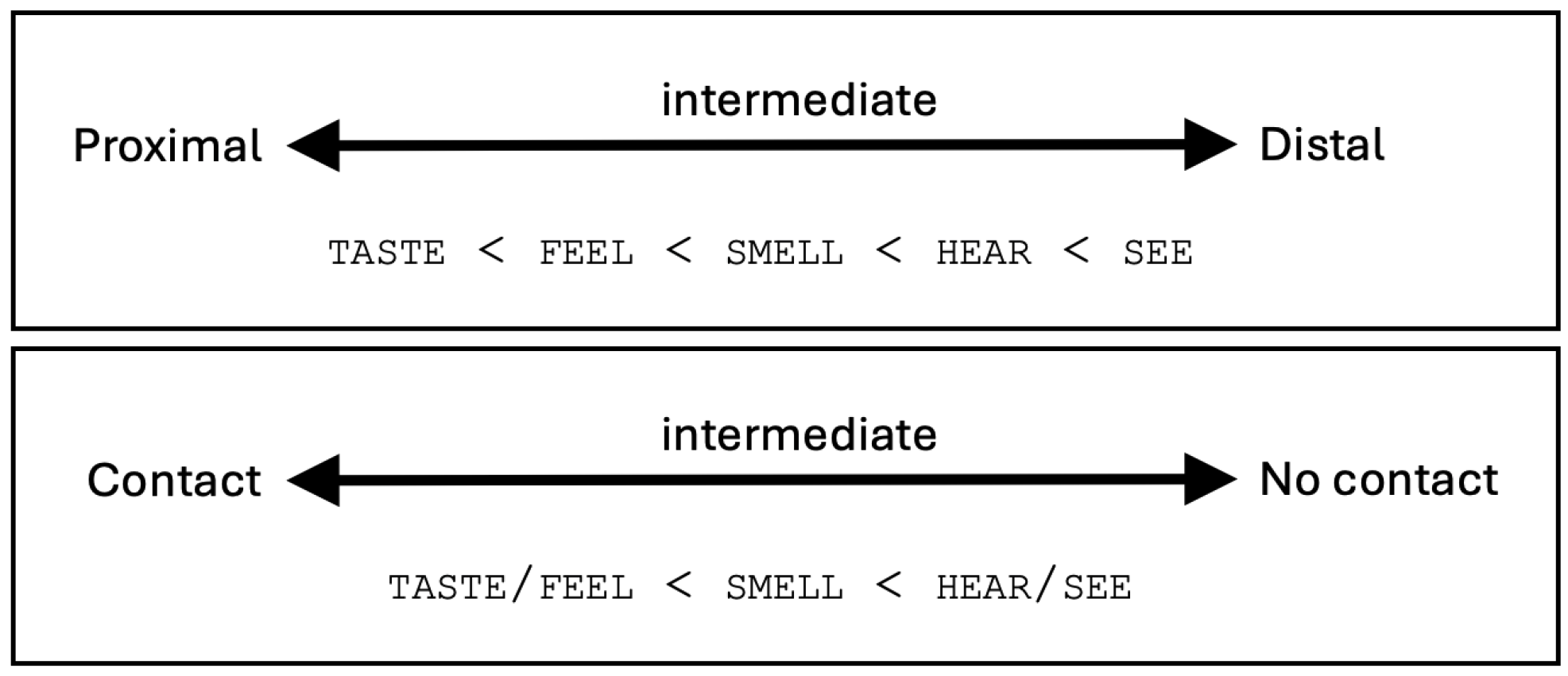
Figure 1. Schematic arrangement of sensory modalities along a proximal–distal and a contact–non-contact continuum.
Languages 11 00056 g001
Figure 2. Four-way analytical schema of construal modes, organized by experiencer- vs. stimulus-oriented construal orientation.
Languages 11 00056 g002
Figure 3. Regional dictionaries of German dialects following Friebertshäuser (1983, p. 1287).
Languages 11 00056 g003
Figure 4. Base map showing the geographical centroids of the 30 regional dictionaries included in the analysis.
Languages 11 00056 g004
Figure 5. Distribution of sensory domains attested for schmecken across the 30 regional dictionaries.
Languages 11 00056 g005
Figure 6. Regional distribution of gustatory and olfactory meanings of schmecken.
Languages 11 00056 g006
Figure 7. Regional distribution of tactile, visual and auditory meanings of schmecken (including transfer contexts).
Languages 11 00056 g007
Figure 8. Affective and epistemic readings of schmecken (including transfer contexts).
Languages 11 00056 g008
Figure 9. Semantic construal modes attested in the dialect data.
Languages 11 00056 g009
Figure 10. Aggregated overview of attested meaning domains and extensions of schmecken, by dictionary region. Numbers indicate the total count of distinct semantic domains attested per region.
Languages 11 00056 g010
Figure 11. Semantic range of schmecken according to dialect dictionaries. Nodes represent meaning categories; directed edges indicate construal-based dependency relations, with labels specifying the construal orientation (exp = experiencer-oriented, stim = stimulus-oriented) through which each extension is licensed.
Languages 11 00056 g011
Figure 12. Semantic range of schmecken according to Low German dictionaries. Nodes represent meaning categories; directed edges indicate construal-based dependency relations. Abbreviations: exp = experiencer-oriented, stim = stimulus-oriented.
Languages 11 00056 g012
Figure 13. Reduced semantic network of schmecken. Boxes group meaning categories by construal orientation and extension type; arrows indicate licensing relations between construal modes and the extensions they channel.
Languages 11 00056 g013
Disclaimer/Publisher’s Note: The statements, opinions and data contained in all publications are solely those of the individual author(s) and contributor(s) and not of MDPI and/or the editor(s). MDPI and/or the editor(s) disclaim responsibility for any injury to people or property resulting from any ideas, methods, instructions or products referred to in the content.