Article

Revising for Your Lay Audience: A Case Study of an L1 Expert and Three L2 Graduate Students

by
Alessandra Rossetti
1,*,† and
Luuk Van Waes
2,*,†
1
TechTransfer, Vrije Universiteit Brussel, 1050 Elsene, Belgium
2
Department of Management, University of Antwerp, 2000 Antwerp, Belgium
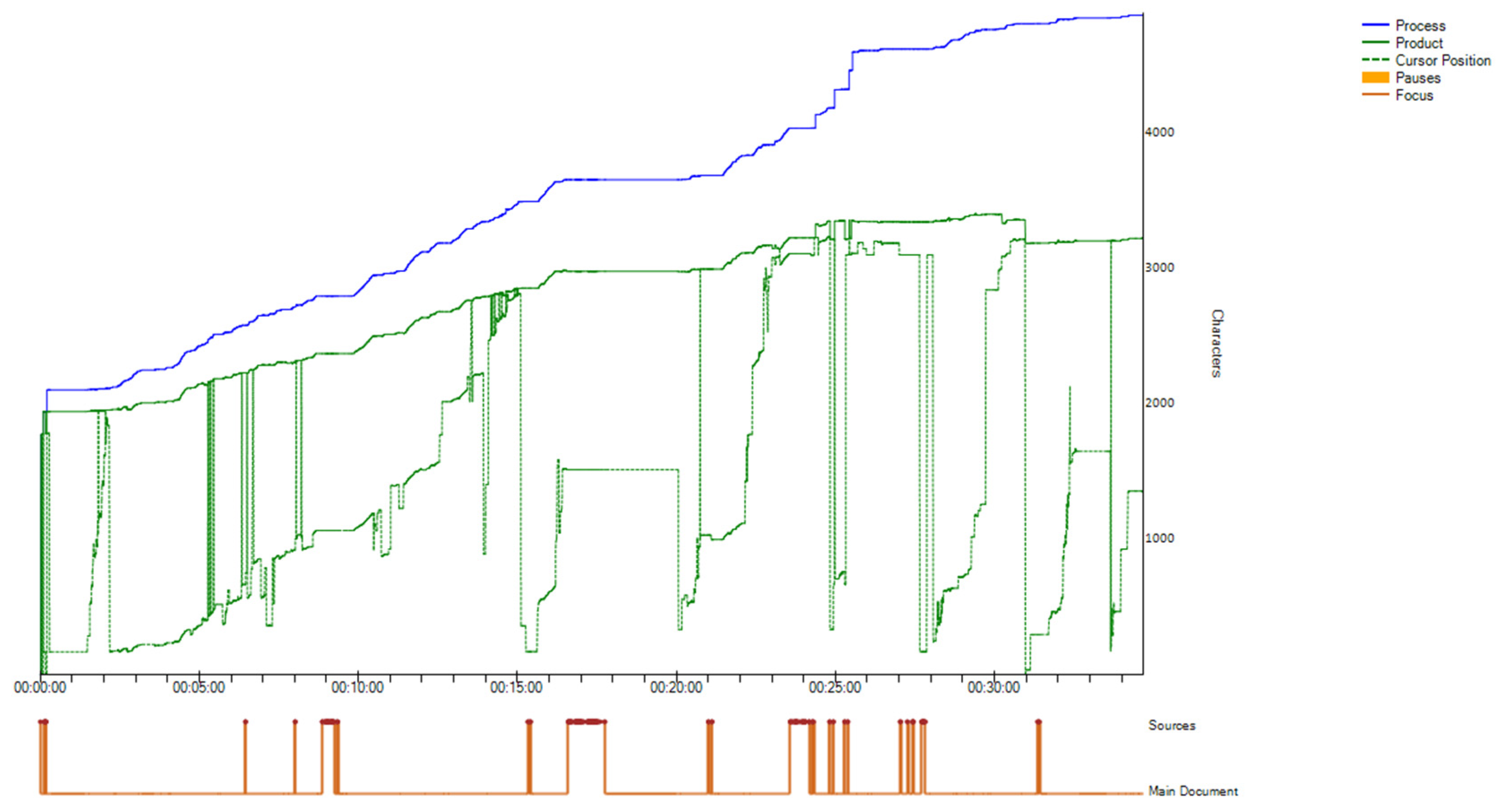
*
Authors to whom correspondence should be addressed.
These authors contributed equally to this work.
Languages 2026, 11(2), 30; https://doi.org/10.3390/languages11020030
Submission received: 7 October 2025 / Revised: 28 January 2026 / Accepted: 2 February 2026 / Published: 11 February 2026

Abstract

The ability to revise texts to meet the needs and expectations of the target audience requires sustained and deliberate practice. Revision becomes more complex when working on somebody’s else text and in a second language. Against this background, we conducted an exploratory and descriptive case study qualitatively shedding light on the characteristics of the processes and the products of revision. We collected data from three graduate students revising a business text in English (their second language) and from an experienced writer/editor, native English speaker, revising the same text in his first language. Using keystroke logging, screen recording, and text analysis, we observed an alternation between revision and rewriting, as well as a combination of expert features (e.g., inclusion of reader-oriented explanations) and less expert features (e.g., fewer rounds of revision) among graduate students. There were also differences between the students and the expert in the way in which they spatially organised their tasks. We interpreted these results within the context of cognitive and sociocultural models of writing, and especially the notion of agency.

1. Introduction

Revision is a complex act of designing, re-designing, and taking responsibility for meaning in a social context. It goes beyond the mere ‘fixing of sentences’ to encompass a broad range of macro- and micro-level decisions on the text. For this reason, learning the art of revision requires substantial time and practice. The cognitive effort that revision requires is likely to manifest in different types of workflows/processes, as well as in different text qualities. For instance, the texts of novice and experienced writers can be distinguished based on level of coherence, innovativeness, or reader-oriented focus, among others. In particular, the ability to fully consider and address the needs and expectations of the target audience when writing or revising texts is not innate, but rather requires sustained practice and fluent generation of language (Kellogg, 2008; Wirtz, 2025). The years of practice and the level of language proficiency can therefore influence the extent to which writers and revisers successfully meet the needs and expectations of their audiences.
In this paper, we present a case study of one expert reviser—with English as first language (L1)—and three semi-expert revisers—graduate students with English as second language (L2). Our participants revised a complex English business text on corporate social responsibility (CSR) with the aim of rendering it engaging and easy-to-read for lay customers seeking information online. Using a combination of keystroke logging, screen recording, and text analysis data, we conducted an exploratory and descriptive investigation of the key characteristics of the revision processes and products of an expert native writer and three semi-expert L2 graduate students.

2. Literature Review

2.1. The Expert’s Characteristics

Defining writing expertise is not easy because the activity tends to be highly complex and ill-structured (Kellogg, 2018), and because the outputs of such activity (i.e., the final texts) are highly heterogenous (Kellogg & Whiteford, 2012; Schriver, 2012). Furthermore, expertise in writing tends to be domain- and genre-specific. As such, expert writers (and experts, in general) do not always represent a homogeneous group, but rather have different specialisations (Kellogg & Whiteford, 2012). Despite the heterogeneity that characterises writing expertise, there is agreement that the problem-solving nature of writing also involves general cognitive abilities that are more prominent in experts. Compared with novices, expert writers have learnt and internalised procedures, strategies, and knowledge (such as, knowledge about vocabulary, topic, genre, audience, and so on (McCutchen, 2011, 2023)) by storing them in their long-term memory. This allows expert writers to apply their knowledge and expertise to different domains/genres of writing and to meet the cognitive demands of writing more effectively (Kellogg & Whiteford, 2012). Furthermore, by retrieving their stored knowledge from their long-term memory, expert writers are able to circumvent the constraints imposed by the limited working memory capacity (Y.-S. Kim, 2022). Therefore, expert writers can optimise the use of their working memory capacity, which enables them to focus on higher-level text characteristics (Olive, 2014).

2.1.1. The Development of Expertise

Regardless of the text genre, becoming an expert writer requires more than two decades of dedicated and extensive practice (Adler-Kassner & Wardle, 2022; Alamargot et al., 2010; Kellogg, 2008; Kellogg & Whiteford, 2012). Kellogg (2008) describes three subsequent stages in the development of writing expertise, namely: knowledge telling; knowledge transforming; and knowledge crafting. At the initial stage of knowledge telling, the author (e.g., a young student of 6 years of age) mainly focuses on what they know and on what they want to say (Kellogg, 2008). Furthermore, at this initial stage of writing development, the motor component of text production (namely, spelling and handwriting or typing) tends to be cognitively demanding, thus leaving fewer working memory resources available for the planning and revision components of writing (Limpo et al., 2020; McCutchen, 2011; Van Waes et al., 2021).
In the knowledge-transforming phase, the author is able to maintain a mental representation of the text while writing. This representation develops through re-readings of the text produced so far, which can result in revisions of form and content but also in the production and transcription of new ideas, in a circular way, until the author recognises that the text matches their intentions (Bereiter & Scardamalia, 1987). This knowledge-transforming phase is generally observable in adolescents and adults (Alamargot & Fayol, 2009). Through training and deliberate practice, some adults can further strengthen their writing expertise and reach the knowledge-crafting phase. In this phase too, writing proceeds through a circular interaction between planning, translating ideas into text, and revising the existing text. Additionally, the expert author in the knowledge-crafting phase is able to maintain and coordinate a representation of what they want to say, a representation of the text produced at any given time, and a representation of how the reader will interpret the text (Kellogg, 2008; Lindgren et al., 2011).
Empirical evidence supports the differences among the stages of development of writing and expertise. For example, Alamargot et al. (2010) conducted a case study with a 7th, a 9th, and a 12th grader, as well as with a graduate student and a professional writer. They gave participants the incipit of a story, asked them to continue writing the story as if they were the authors, and then they measured the number of (original) ideas in the text produced. Differently from the other participants (including the graduate student), the professional writer produced a text that was, at the same, creative and innovative but also coherent with the given incipit. In doing so, the “super expert” (i.e., professional author) seemed to put herself into the reader’s shoes. It is worth pointing out that in Alamargot et al.’s (2010) study, university students differed from professional writers/revisers, thus supporting the assumption that knowledge crafting does not come naturally with adulthood—although maturation is necessary—but instead requires extensive training and practice (Kellogg, 2008).

2.1.2. Text Revision and Expertise

Theoretical models of writing expertise include revision as an integral part of the writing process (Hayes et al., 1987; López et al., 2021). Revision can also be regarded as a specialised writing activity in itself since it involves planning a solution to a problem, translating and transcribing that solution into written language, and then checking and (if needed) editing the revision (Hayes, 2012). Furthermore, similar to writing, the processes and products of revision are also determined by the knowledge and the cognitive resources of the reviser. In their model of text revision, Butterfield et al. (1996) consider the role of the working memory in helping the reviser maintain a representation of the existing text and of rhetorical problems (e.g., topic and audience), while also identifying textual problems and considering strategies in order to address them.
The types of problems that motivate writers to revise can be varied—from a misspelling, to the text structure, to the overall text plan (Hayes et al., 1987; Fitzgerald, 1987; Lindgren & Sullivan, 2003; MacArthur, 2018). Novice writers/revisers mainly focus on writing conventions and revise at the surface level (e.g., fixing spelling, correcting grammatical errors, and replacing words), while more experienced writers and revisers approach the task by giving prominence to global features of the text, such as genre, medium, and intended reader. These global considerations motivate specific choices in terms of vocabulary, sentence structure, and content organisation (Chanquoy, 2001; Lindgren et al., 2011; McCutchen et al., 1997; Sawyer, 1991). Furthermore, experienced writers/revisers tend to see revision (and writing) as recursive processes (Becker, 2006).

2.1.3. Text Revision and Language Proficiency

Similar to expertise, proficiency in the language in which writing and revision are conducted influences the processes and the products of the tasks (Al-Saadi & Galbraith, 2021). Writing and revision in L1 are usually carried out more fluently than writing and revision in L2 (Tiryakioglu et al., 2019; Van Waes & Leijten, 2015). Writers with a lower proficiency level in L2 also focus more on surface characteristics (typography and form) (Barkaoui, 2016; Broekkamp & Van den Bergh, 1996). Furthermore, an increasing need to address the formal aspects of L2 means that fewer resources are available for writers/revisers to tackle high-level aspects of the texts, for example the level of clarity (Tiryakioglu et al., 2019). Similar results about the challenges linked with low-proficiency L2 writing have also been observed in other language production tasks, such as interlingual and intralingual translation. For these activities as well, higher expertise levels result in the ability to look for global issues of sense and coherence (Dragsted & Carl, 2013).
Despite evidence of novice (L2) writers mainly making surface corrections when revising, Hayes et al. (1987) point out that novices might also decide to rewrite local or global elements of a text (that is, to move away from its surface features, to take out its content, and to reformulate that content) if they do not know how to solve a specific problem. Graham (2018) expands on Hayes et al.’s (1987) cognitive model by considering the sociocultural factors that might also determine the extent to which writers and revisers can exert control over their texts and decide what/how to write.

2.2. Research Gap and Research Questions

This review of earlier work shows that both expertise and language proficiency influence the processes and the products of revision. However, previous research has mainly focused on participants drafting and revising their own texts (Mazgutova, 2020) in both their L1 and their L2 (Révész et al., 2019). There is a paucity of research on how texts produced by others are revised with a view to make them more accessible and engaging. Furthermore, data from experts tend to be compared with those of considerably younger and less experienced writers/revisers, whereas in our article we qualitatively examine differences and similarities between expertise and semi-expertise.
With this case study, we aim to shed light on some of the characteristics of (language) expertise and semi-expertise by conducting an exploratory and descriptive investigation of the revision processes and products of an expert L1 writer and of three graduate students with English as L2 when revising an already existing text in order to make it easier to comprehend and more engaging. The exploratory questions that we sought out to answer are: what are the key features of the revision processes of the observed expert writer (native speaker) and three semi-expert graduate students (non-native speakers), particularly in terms of task duration, task organisation, revision path, and external searches? What are the characteristics of the final texts produced by the expert and by the three graduate students? We treated the three graduate students in this study as semi-experts because they were all in the second decade of writing practice (finishing their master studies), and therefore between the knowledge-transforming and the knowledge-crafting stage (Kellogg, 2008). Furthermore, although they were not native speakers of English, their level of English was quite high (Section 3.1).

3. Materials and Methods

3.1. Participants

Four participants took part in this case study. Three of them (called here with the fictitious names of Tim, Linda, and Joanna) were graduate students enrolled in a master programme in multilingual professional communication at a Belgian university. These three graduate students were native speakers of Dutch but they were all proficient users of English since one of the requirements for enrolment in the master programme was to have reached the C1 level in English. The fourth participant (fictitiously named Simon) was a native speaker of English and a professional plain language writer and editor, with expertise in business communication (although he was not an expert in the specific topic of CSR). He had been working for a literacy agency in Ireland for three years and his responsibilities included editing content and providing training on plain English.

3.2. Our Module

In order to create conditions as comparable as possible between the three graduate students and the expert, we asked all four participants to take part in a module on plain language applied to CSR—the content of the text to be revised—before carrying out the revision task. This module (in English) focused on how to make CSR content easier to comprehend and more engaging for customers. It was hosted by the online writing centre Calliope1, where training materials were divided into: introduction; theory section; exercises; and a case, namely a writing exercise, including background and instructions for the authors (Van Waes et al., 2014).
A detailed description of the module is available in Rossetti and Van Waes (2022a). However, here it is worth mentioning that the theoretical section of the module revolved around three main topics: (1) the principles of accessible communication, a/nd specifically vocabulary, sentence length and structure, cohesion, relevance, and visual aspects; (2) CSR and the way it is communicated in corporate reports and corporate websites; (3) expertise in the revision process—specifically, we included a video showing how experts tackle a revision task in terms of planning, reading, and types of changes, in line with the principle of observational learning (Braaksma et al., 2004). For example, the video showed that experts revisers tend to read a text thoroughly before applying any changes.
Informed by previous research on the level of readability of CSR communications, we also used, on the one hand, corporate reports as examples of CSR communications that are difficult to read and mainly tailored to investors and, on the other hand, corporate websites as a source of information preferred by customers for their accessibility (Wei, 2020). Therefore, participants were given the concrete task of revising an extract from a report in order to make it accessible enough for publication on a corporate website. Content in the theoretical section was available both in textual and audio-visual format (as videos) in order to accommodate different learning preferences and styles.
The exercises in our module aimed to make the participants aware of the different features of CSR communication depending on the channel (i.e., reports vs websites), as well as to encourage reflection on how different target groups (e.g., customers vs investors) might need specific language and specific visual presentation of content. Finally, the case component contained the revision task which is the focus of our analysis, and which is discussed separately in the section below.

3.3. Tasks

The participants carried out the following tasks: (1) participation in our module on accessible CSR information (by reading/watching the theory and trying some of the exercises in their preferred order); (2) revision task (the focus of our analysis in the Results section); and (3) usability evaluation of the module (Rossetti & Van Waes, 2022a). We did not set a time limit. Therefore, the participants could spend as much time as needed looking at module materials and revising the text. It is also worth mentioning that this study took place in the period 2020–2021, before the use of Generative AI became widespread for text production. The characteristics of the text that they were asked to revise (e.g., length and readability) are reported in Section 4.2.
The revision task was located in the case section of our module. In this section, we started by providing the participants with some background information aimed to make the revision task as realistic as possible. Specifically, we asked them to imagine that they worked in the communication department of a tobacco company, with the fictitious name SmokIT. This company was trying to engage more with CSR by taking heed of consumers’ increasing preference for healthier smoke-free products. SmokIT’s financial reports already mentioned how the company was gradually investing in smoke-free products, but this information was still missing on the corporate website, which is the channel used most often by lay consumers.
Therefore, we gave participants an extract of a corporate report—taken from a real tobacco company and adapted for the purpose of this study—and we asked them to “convert it into an accessible and engaging post, with a catchy title, that will be published on the SmokIT website”. We encouraged participants to be creative and inventive with their revisions. In line with the flexibility that characterises our module, we also specified that they could consult the theory and make online searches as much as they needed. Tobacco and smoking are controversial topics, and companies in this field need to rely on excellent (written) communication skills in order to persuade the public of their intentions and establish trust. Therefore, the topic in itself would represent an extra layer of challenge for our participants.

3.4. Data Collection

Case studies allow researchers to address how and why questions of complex phenomena by triangulating different methods (Yazan, 2015). For this case study, we collected three types of data: (1) keystroke logging data via Inputlog (Leijten & Van Waes, 2013); (2) screen recording data; and (3) final texts produced by the four participants in Microsoft Word. Inputlog is a Windows-based keystroke logging tool designed to observe and reconstruct writing, revision, and translation processes unobtrusively and in natural settings. The tool can record, process, and analyze “process data” (keyboard, mouse, and speech activities), as well as character position, actual document length, and copy/paste/move actions. To this end, Inputlog consists of 5 modules (Record—Pre-process—Analyze—Post-process—Play) (Leijten & Van Waes, 2013). Simon (the expert) was the only participant who did not provide a screen recording of his task. Therefore, we reconstructed his actions based on his keystroke logging data, using both fine-grained General Analysis (i.e., an XML file where each row/line represents one logged input action, such as keystroke, mouse action, speech input, focus/window switches, inserts/replacements) and the aggregated Source Analysis provided by Inputlog, which reports on what “sources” a writer consults during a writing session and how they switch between them (based on Inputlog’s logged focus events—i.e., window/application changes). We analysed keystroke logging data and screen recording data to examine the revision processes of the four participants, while their final texts represented the basis of our product analysis (Section 4.2).
Due to the COVID-19 pandemic, data collection took place remotely. Therefore, the participants had to install Inputlog and the screen recorder on their computers, and start the recording as soon as they began the revision task. Because of this set-up, in this case study, we focus on the revision task as such and do not include the preparation cycle (viz, reading the online instruction module). However, we included source use (including module consultation) during the revision task. Also, the interpretation of long pauses—an issue inherent to keystroke logging and screen recording in general, but also certainly in the current setting (cf. Van Waes et al., 2014 regarding downtime)—was not the focus of this study due to the remote setting, which would not have allowed for reliable interpretation of long pauses. However, this set-up had the advantage of ensuring ecological validity since the participants were able to conduct the task in familiar environments (their own home offices) and using their own laptops (Dimitrova, 2010). To compensate for this lack of control and ensure that the participants took part in the module before carrying out the revision task, we also asked them follow-up questions on the usability of the module—results from these questions are reported in another paper (Rossetti & Van Waes, 2022b).

3.5. Data Analysis

In this study, we combined two perspectives to analyse the data, namely a process-oriented and a product-oriented perspective. For the process analysis, we describe the results of each participant individually, while for the product analysis we aggregate the results based on text characteristics.
As mentioned above, the analysis of the processes focused on keystroke logging and screen recorded data. The process-oriented approach involved focusing on each participant’s revision paths and strategies, pausing behaviour, time-on-task, and use of external resources. The process graphs obtained via Inputlog also allowed us to provide a holistic overview of the process organisation. The process graphs are visual representations of the writing process that report data on: length of a text (number of characters) at any given point (green line—z-axis); number of characters added/modified/deleted (blue line—z-axis); position of the cursor (dotted green line—z-axis); use of sources (orange interaction line below the graph); and overall task duration (x axis) (Rossetti & Van Waes, 2022b). A first example of a process graph is Figure 2.
Regarding revision paths, it is worth noting that we used different terms drawn from the literature to indicate different types of revision behaviour. Specifically, we use “narrow revision” to refer to revisions that maintain the content and the underlying structure of the text. With the term “redrafting”, we indicate episodes during which the writer not only chooses to abandon the given text and to start over, but they also rethink the overall structure and goals of the text (Hayes et al., 1987). Finally, the term “paraphrasing” is adopted to indicate when the reviser extracts the meaning or gist from sentences and then recasts them (Hayes et al., 1987). In the cases of “redrafting” and “paraphrasing”, we also consider these instances as “rewriting” since, despite being part of a larger revision task, they involve extensive production of new text.
For the product analysis, we adopted the computational tool Coh-Metrix (McNamara et al., 2014) and combined it with a manual analysis of pre-determined text characteristics which could not be measured automatically (e.g., relevance, visual aspects, and explanations of complex vocabulary). Coh-Metrix was used for the automatic analysis of text length, cohesion, sentence length/structure, and vocabulary.

4. Results

4.1. Processes

In this section, we discuss the process of each participant individually. For comparison purposes, Table 1 presents an overview of the main characteristics of their processes, which will be described in detail in the sections below.

4.1.1. Graduate Student Tim

Graduate student Tim begins by familiarising himself with the goal of the revision task, which is explained on the Calliope page containing the case (Section 3.2). Subsequently, he moves on to read the assigned text, and he alternates this reading with the re-checking of the instructions, possibly as a way of evaluating the text against the concrete criteria that we provided. At this stage, the reviser reads in order to understand the text, but also to evaluate it, and to define its problems (Hayes et al., 1987).
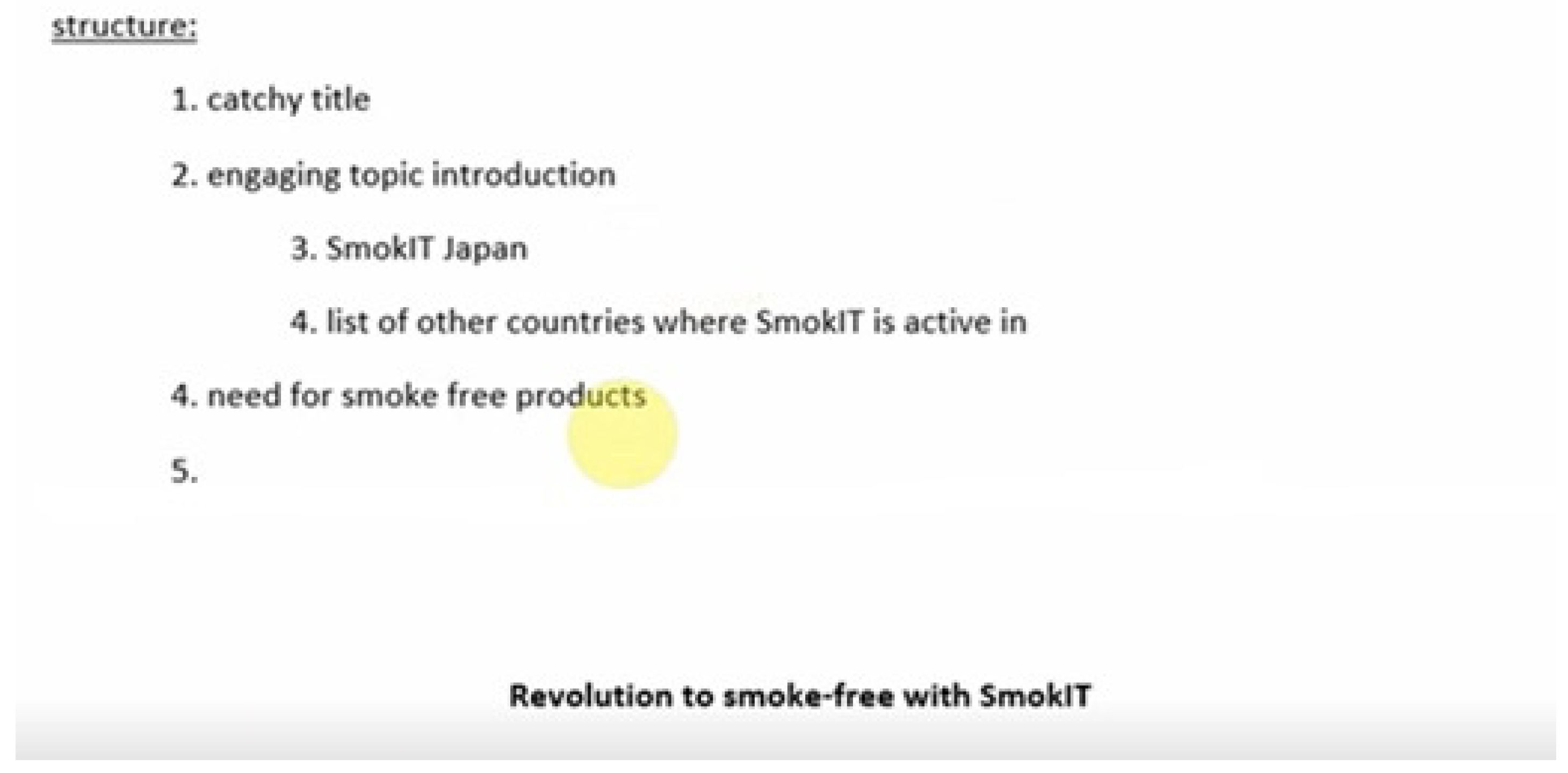
After this initial preparation, Tim creates a brief three-point outline which contains terms taken directly from the task instructions on the Calliope page (namely, “catchy” and “engaging”), as well as terms from the text to be revised (e.g., “SmokIT Japan”). In other words, his outline includes both formal and content features of the planned text. Such outlines are among the few visible products of a writer’s planning (Kellogg, 2008). After creating the outline, Tim goes back to re-reading the text provided in order to further strengthen his comprehension. As such, he highlights key concepts and ideas in yellow and he conducts topic-related searches—specifically, he googles “smoking prevalence” and “heated tobacco products”. This familiarisation with the task goals and with the text before starting revising is typical of what has been observed among more experienced writers.
Following the development of the outline and the reading of the given text, Tim begins the revision task. Rather than modifying the given text, he starts writing a new text from scratch. In other words, he interprets the revision task as a rewriting task. This decision might seem surprising when considering that the training materials in our Calliope module focused on revisions within an existing text (Section 3.2). The specific rewriting strategy chosen by Tim for the task has been classified as “redrafting”—with it, the writer not only chooses to abandon the given text and to start over, but they also rethink the overall structure and goals of the text, possibly because of their revision preferences or the way in which they have evaluated the quality of a text (Hayes et al., 1987). The first element that Tim writes in his new text is a title, which he centres and puts in bold, thus already showing a consideration of design and visual aspects that is required in professional communication (Schriver, 2012). After writing the title of his new text, Tim scrolls up to read again the text provided by us and, following this reading, he adds new items to his outline.
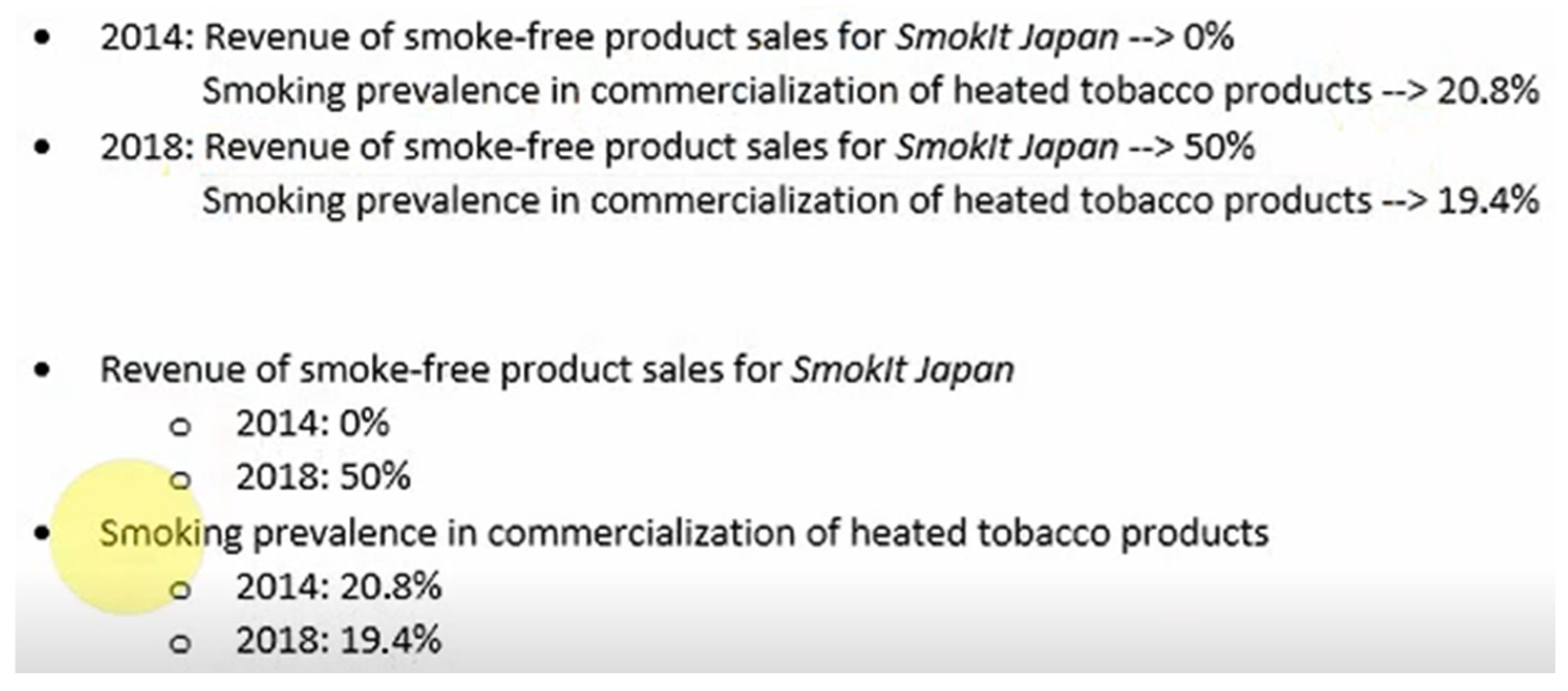
The screen recording shows that (Figure 1), at the moment of writing the body of his new text, Tim begins to use the text provided by us as a source. This behaviour—that is similar to what a translator would do (Dam-Jensen et al., 2019)—will characterize the entirety of his rewriting task (in fact, in his final text, none of the original sentences shows their original structure and content). Tim goes back and forth between reading the text that we gave him (henceforth “source text”) and working on his new text (henceforth “target text”). Overall, throughout the rewriting task, he scrolls up to read the source text 61 times. Each reading of the source text is followed by the production of new text (25 times), by revisions (i.e., deletions, replacements, or additions in previously written text) (27 times), by a new reading of the source text (8 times), or by an online search (once). This integration of source content into writing tends to be cognitively demanding and requires a switch between reader and writer role (Martínez et al., 2015; Vandermeulen et al., 2019). The frequency of consultations of the source text varies throughout the revision/rewriting task (which, in total, lasts one hour and 39 min). Towards the end of the task, Tim’s focus gradually switches from the source text to the target text.
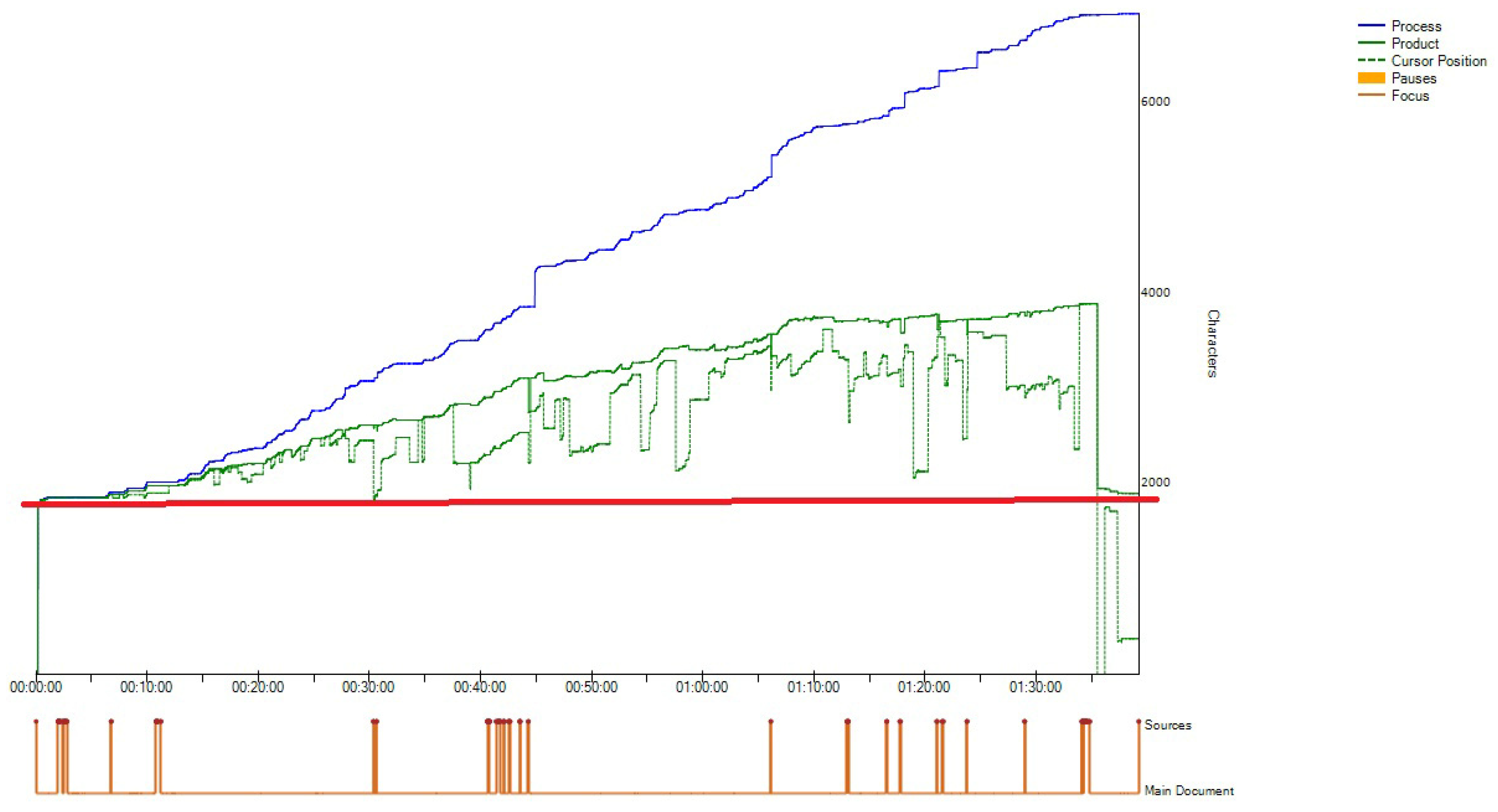
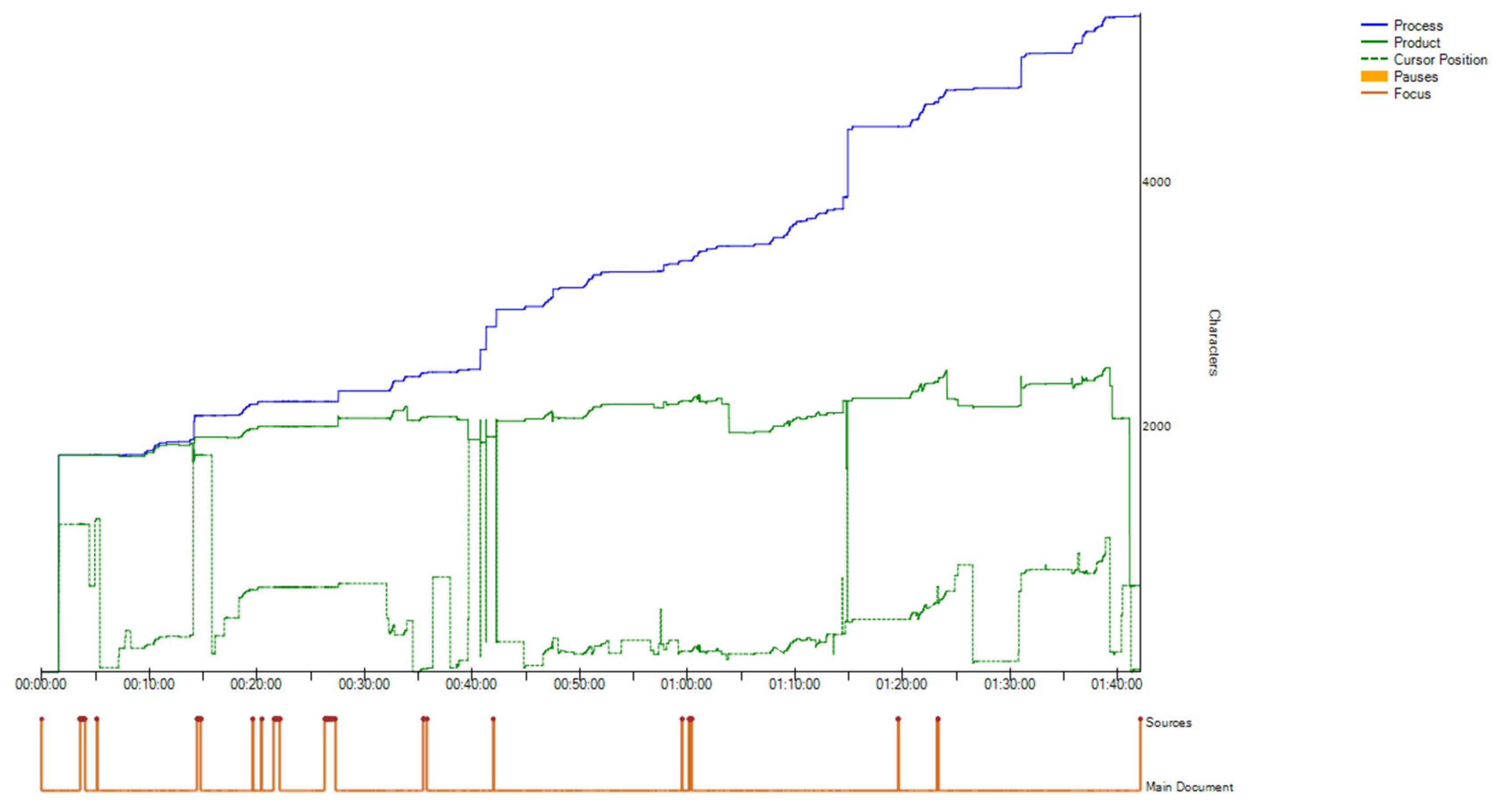
The Inputlog process graph below (Figure 2) visually shows that Tim wrote and edited a new text from scratch (above the red line), while the source text (below the red line) remained untouched up until the end of the task, when Tim selected it and deleted it. The process graph—and specifically the cursor position represented by the dotted green line—also shows that Tim carried out several rounds of revisions on his target text. However, when comparing Tim’s rounds of revisions with those of Simon (the expert), in this case study the graduate student seems to have a less systematic and more erratic revision behaviour—fewer rounds of revision from top to bottom of the text can be observed.
Figure 2. Graph representing Tim’s rewriting process.
Languages 11 00030 g002
The rounds of revision that Tim carries out do not just affect his target text, but also his planning for the text. For instance, about thirty minutes after the beginning of his rewriting task, Tim updates his outline by changing the order of the items. This ability to recursively check and, if needed, revise the plans for a specific text while it is being produced is typical of more experienced writers (Kellogg, 2008).
Compared with the expert, graduate student Tim takes almost three times the time to carry out his revision/rewriting task (see Table 1), possibly as a result of the frequent readings of the source text. However, this graduate student and the expert are similar in the way they divide their task between active writing time (about 40% of total time on task) and pause time (about 60% of total time on task).
With regard to external searches, we divided the entire task of Tim into three intervals of equal duration and we observed that it is during the second interval that graduate student Tim spends the most time carrying out topic-related searches. Furthermore, he combines these searches with active writing. Specifically, he consults an online page on smoke-free alternatives and he uses content from this page to fill out a section that he has previously created (titled “What is smoke free consumption?”). It is worth pointing out that the section “What is smoke free consumption?” was not present in the source text. In other words, the text that we assigned to the graduate students for revision presupposed readers’ knowledge of what smoke-free products are. By introducing this section from scratch in his rewriting, Tim shows a concern for and an awareness of less knowledgeable readers that are typical of expert writers at the knowledge-crafting stage (Kellogg, 2008).

4.1.2. Graduate Student Linda

Similar to Tim, graduate student Linda also begins her task by familiarising herself with the task instructions for the case on the Calliope page (Section 3.2). Subsequently, she moves on to read the source text provided. Linda also alternates between reading the task instructions and reading the source text. As explained when discussing graduate student Tim’s revision process, this familiarisation with the text and with the instructions is an important component of the revision process, and is often observed among expert writers (Hayes et al., 1987). It should also be remembered that, in the theoretical part our Calliope module, we had shown graduate students a video about expert revision, including a thorough initial reading of the text.
Following the reading of the source text, Linda seems to do some preparatory work. For instance, she selects the word “prevalence” and uses the online machine translation provider DeepL in order to translate this word from English into Dutch. This language-related search seems to indicate that she is trying to gain a better comprehension of the text. After this language-related search, Linda highlights three key passages of the source text with bold formatting. The visual revision strategy of using bold was also mentioned in the theoretical part of our module about visual aspects (Section 3.2).
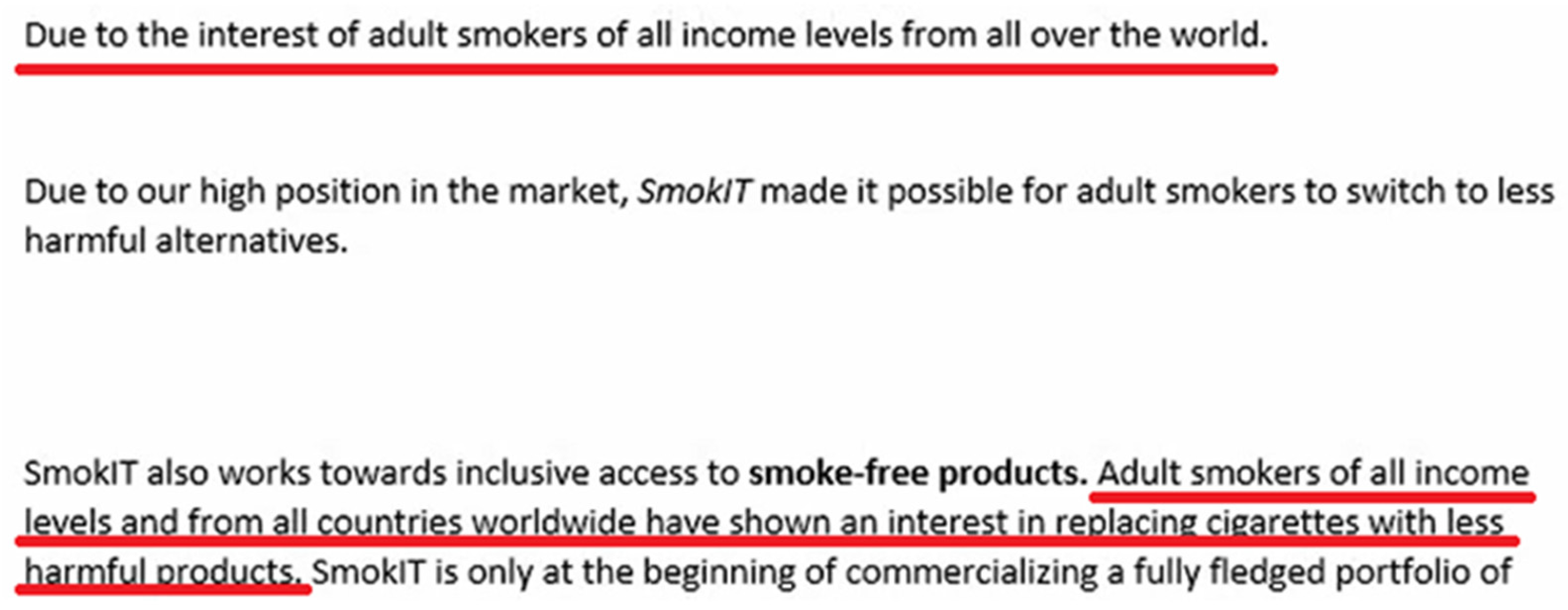
At this point, Linda begins her revision. The way in which she carries out her task shows greater variability when compared with Tim. Concretely, throughout the task, Linda alternates between: (1) revising (in a narrow sense) the source text provided; (2) rewriting parts of the source text from scratch; and (3) copying content from the source text and pasting it verbatim into her rewritten sentences, though more rarely. With regard to the first point—namely revision in a narrow sense—the changes that Linda makes to the source text are mainly stylistic and local (e.g., replacing a word or splitting a long sentence), and are in line with the principles of accessible communication in the theoretical section of our Calliope module. With regard to second point—rewriting—graduate student Linda produces her new target text above the source text, by manually copying selected parts of the source text, and her rewriting usually takes place at the sentence level. Figure 3 is an example of that. Linda has written the first underlined (and incomplete) sentence (i.e., “Due to the interest of adult smokers of all income levels from all over the world”) from scratch by using content from the sentence underlined in the third paragraph (belonging to the source text).
This type of rewriting has been categorized by Hayes et al. (1987) as “paraphrasing”. The reviser who is paraphrasing extracts the meaning or gist from sentences and then recasts them (Hayes et al., 1987). Occasionally, when rewriting/paraphrasing, Linda not only recasts the sentences in the source text, but she also gives them a different visual presentation. Figure 4 contains n example of that—the graduate student is comparing different bulleted lists to present the data on smoking prevalence contained in the source text.
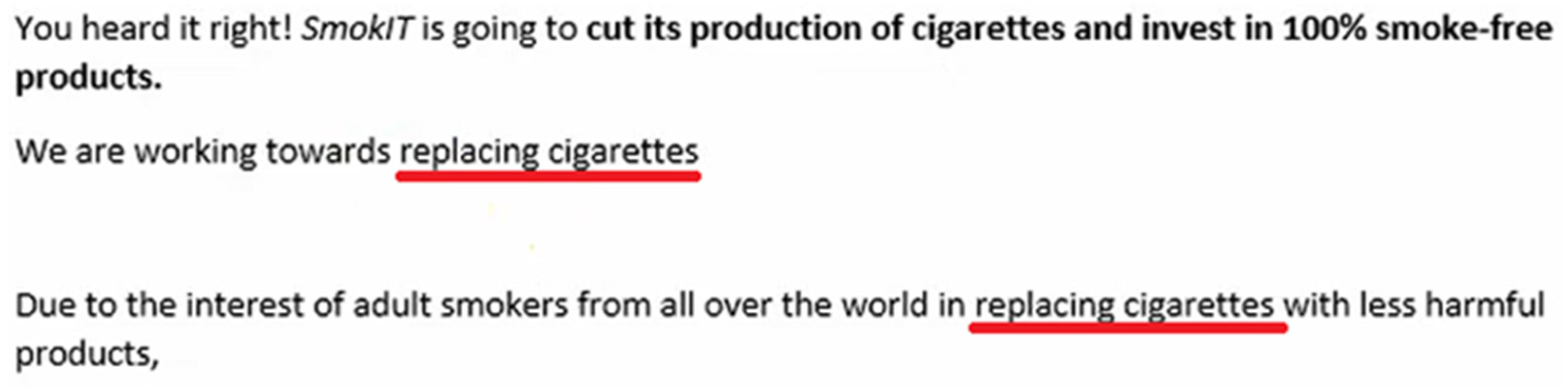
Interestingly, throughout the task, Linda uses the same rewriting strategy also with the sentences that she has written herself from scratch. As an example, Figure 5 shows that Linda is trying to rewrite (paraphrase) the sentence that she has previously written on the replacement of cigarettes. Eventually, in Linda’s text, only three (out of 24) sentences will still (partly) show their original structure and content.
The cursor position in the Inputlog process graph below (Figure 6) confirms what had already been observed through the screen recording, namely that Linda carries out her rewriting mainly in the upper part of the document (above the corresponding content in the source text). Similar to graduate student Tim (Figure 2), and differently from the expert, she seems to have an erratic revision behaviour and no clear rounds of revision from the start to the end of the text can be observed.
With regard to time on task and pausing behaviour, Linda is not only the participant who takes the longest time to complete her task (namely, one hour and 42 min), but she is also the participant with the highest proportion of pause time (i.e., about 88%) (see Table 1). Such a high percentage of pause time might be due to her lower proficiency in English as L2. Previous research with Dutch students has highlighted a decrease in fluency when writing in English as L2, as indicated by a longer pause length at the within-word and the between-word levels (Leijten et al., 2019). When examining Linda’s within- and between-word pauses with the pause analysis provided by Inputlog—and comparing them to the pauses of the other participants—we found that the average length of her pauses was higher2 (346 milliseconds for within-word pauses and 808 milliseconds for between-word pauses).
When dividing Linda’s entire task into three time intervals, we observed that the first interval (ending at minute 34) contains the highest number of linguistic searches and of readings of the source text and of theoretical content in our Calliope module. In particular, Linda’s searches focus on the theory about sentence length and structure (Section 3.2). The module mentioned two strategies, namely splitting a sentence and rewriting a sentence. As discussed above, Linda adopts both of these strategies in her revision task.

4.1.3. Graduate Student Joanna

Graduate student Joanna opens the Word document containing our source text right at the start of the recording and she spends about one minute on the file—supposedly reading or scanning it—before making her first revision. Similar to graduate student Tim, Joanna too begins her task by adding a title to the text, and she shows a consideration of visual aspects by using a different formatting for the title.
At this point, Joanna begins to write a new text from scratch, above our source text and by using—manually copying or merging—selected content from it, exactly like graduate student Linda had done in her rewriting. Figure 7 is an example of how Joanna sets up her task. She has written the first sentence (starting with “The main goal”) from scratch by using relevant content from our source text below (as shown by the red underline).
In other words, similar to Linda, Joanna too uses the rewriting strategy of paraphrasing, whereby the reviser extracts the meaning or gist from sentences and then recasts them (Hayes et al., 1987). In line with this revision path, in her final text, only 5 sentences (out of 24) still have the original structure or content. Furthermore, as we observed with Linda, Joanna too changes the visual presentation of the content during her rewriting. Figure 8 is an example as it shows that Joanna has taken content from the source text and converted it in a series of bulleted-list items.
Joanna uses the same rewriting/paraphrasing strategy consistently from the start of the first paragraph up to half of the third (and last) paragraph of the source text. However, once she reaches the middle of the third (and final) paragraph, she suddenly switches to a narrow revision strategy, whereby she makes changes to the given source text by replacing words or phrases (e.g., she replaces “a few upper-middle income countries, including” with “various countries such as”), splitting sentences, and deleting irrelevant information, in line with the guidelines mentioned in the theoretical section of our module (Section 3.2).
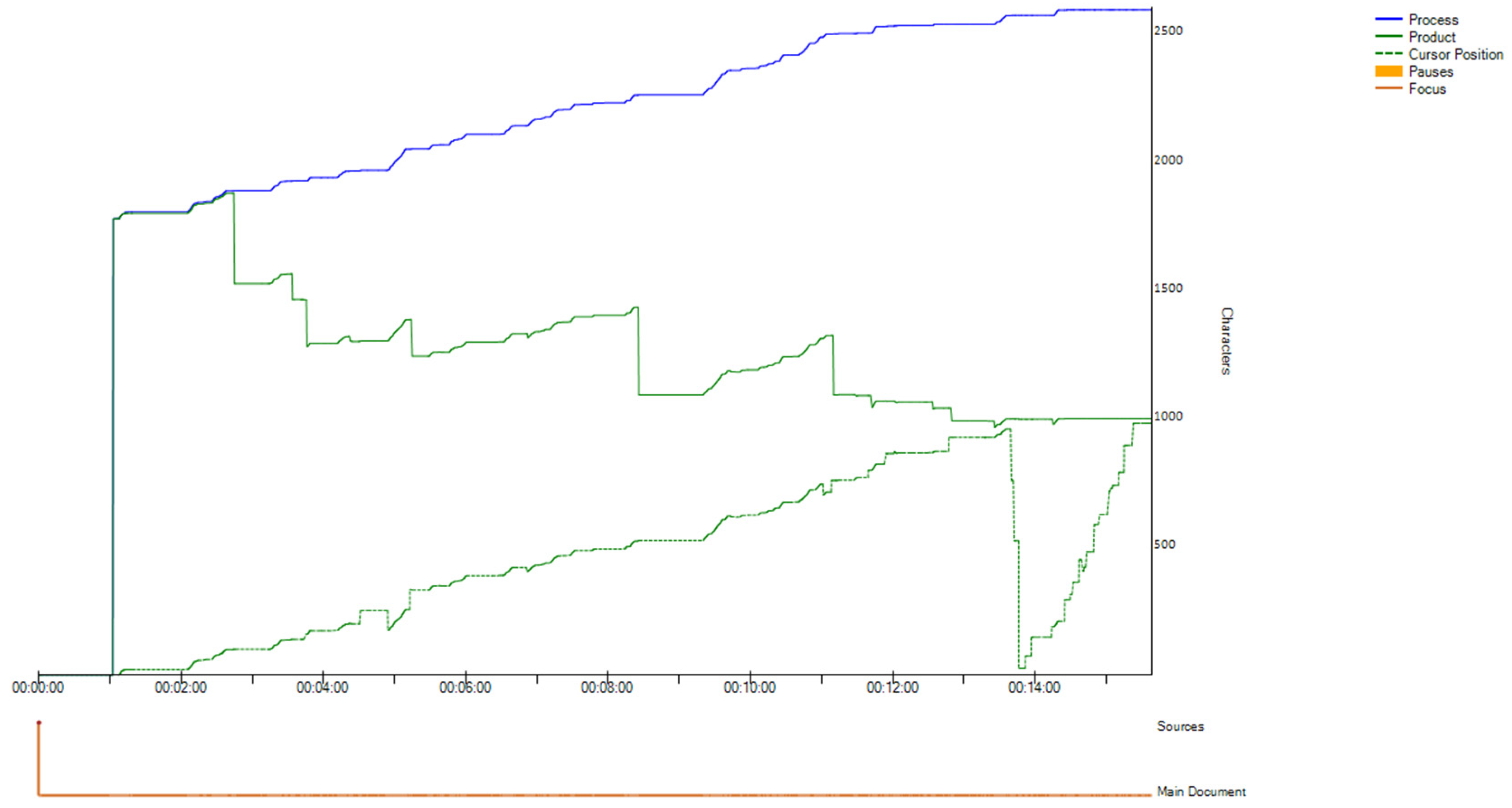
Joanna differs from the two other graduate students—and from the expert Simon—in the way she rewrites/revises linearly from the start to the end of the text, as shown by her cursor position in the process graph below (Figure 9). It is only after she has finished the first cycle of rewriting and revision (just before minute 14) that she re-checks her final text from top to bottom. The screen recording shows that, during this last round, she mainly implements formatting changes (namely, highlighting important words with bold formatting), with the exception of one minor wording edit (i.e., she replaces “also” with “in fact”).
Joanna is the participant who completes her task in the shortest amount of time (namely, 15 min) and her percentage of pause time is the second highest (73.08%) (see Table 1). Finally, in addition to the considerably shortest task time, Joanna also differs from the rest of the participants because she does not carry out any external searches.

4.1.4. Expert Simon

The expert, Simon, did not provide a screen recording of his revision task. However, the general analysis in Inputlog allowed us to collect detailed data on the actions that he carried out. After reading our instructions on the Calliope page (Section 3.2), Simon begins his task by copying and pasting the main instructions at the very start of the document. Specifically, he pastes the following passage: “She [your boss] has asked you to read the extract and to convert it into an accessible and engaging post, with a catchy title, that will be published on the SmokIT website”. The keystroke logging data show that he deleted this instruction from his text only five minutes before the end of his task. The prominence that Simon assigns to the definition of the task is in line with what would be expected from an experienced/professional writer who is concerned with the requests of clients (Hayes et al., 1987; Schriver, 2012). In addition to the instructions, Simon also familiarizes himself with the text provided. As the keystroke logging data show, for about two minutes at the start of the task, Simon moves from the beginning to the end of our text using the arrow keys on his keyboard. During this time, it is likely that he is reading the text—an assumption supported by the fact that, while going through the text, he also makes two minor spelling edits.
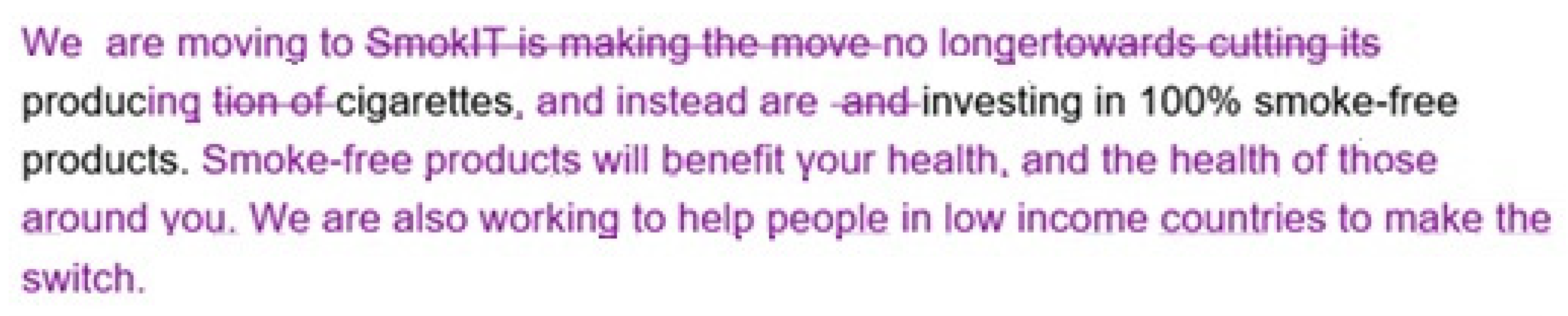
Expert Simon differs from the three graduate students because he does not create a new text above or below the source text, but rather makes his revisions in the source text provided using Track Changes in Microsoft Word. When looking at the changes in his final text, it can be observed that (similar to graduate student Linda and, partly, to graduate student Joanna) Simon alternates between revision in a narrow sense—namely, addressing an issue in the text while preserving as much of the source text as possible—and rewriting, during which he moves away from the structure (and, occasionally, even the content) of the source text in order to use his own words. He adopts the latter activity (i.e., rewriting) more frequently than narrow revision. An indication of this is the fact that, in his final text, only three sentences (out of 24) still (partly) show their original structure and content. This result is in line with what we observed with the graduate students. For the sake of illustration, Figure 10 below displays the third paragraph of Simon’s text. It can be observed that, while the first sentence (from “We are moving” to “100% smoke-free products”) is heavily revised, part of its original structure is still maintained and the main message of the sentence is not altered. The two following sentences are, however, added from scratch by Simon, with the third sentence being a summary of a message appearing later in the source text.
As in the case of graduate students Linda and Joanna, the rewriting carried out by the expert Simon seems to mainly fall under the category of paraphrasing since he tries to maintain the meaning/gist of the text but by changing the words and the surface structure.
In line with what has been observed for other professional writers (Lindgren et al., 2011; Van Waes et al., 2009), Simon too carries out different rounds of revision from the top to the bottom of the text, and with the rounds becoming gradually shorter, as shown by the cursor position in his Inputlog process graph (Figure 11). The Inputlog general analysis and linear analysis files show that each round of revision has one or two focal points, similarly to what has been observed in previous research with expert writers (Lindgren et al., 2011). In the first round (minutes 2–15), Simon makes high-level structural changes such as adding headings and sub-headings to the text. This is also the round during which he adds, revises, and rewrites most of the content. During the second round (minutes 15–25), Simon continues his revisions, but their number and scope decreases. He also starts to focus on formatting as he changes the visual appearance of his (sub-)headings. The attention to visual aspects continues in the third round of revisions (minutes 25–31), during which Simon repeatedly changes the position and the formatting of the take-away message at the end of his text (see Figure 12 below). The revisions that he makes during this round are again local and stylistic (e.g., he adds connectives and punctuation). These minor revisions continue in the last round (minutes 31–35).
Simon’s revision task lasts about 35 min. As such, it is shorter than Tim’s and Linda’s tasks, but longer than Joanna’s task. When looking at the proportion of active writing time, expert Simon spent more time actively writing compared with graduate students Linda and Joanna (see Table 1). Possible explanations for the generally higher proportion of active writing time shown by the expert might be his prior experience with plain language (which might have allowed him to internalize and quickly implement some revision strategies, cf. McCutchen, 2011) or the fact that he is a native speaker of English (the language of the task) and therefore needs less time and effort to consider word selection and spelling (Sasaki, 2000; Van Waes & Leijten, 2015).
With regard to online searches, Simon carries out topic-related searches in the third interval of his task. He consults an online page on smoke-free alternatives, and he uses content from this page to write a take-away message at the end of his text (Figure 12).
We will further focus on the characteristics of Simon’s text in the product analysis (Section 4.2). However, in relation to this final take-away message, it is worth mentioning that Simon seems to be putting himself in the shoes of a reader who wants to quickly understand the gist of a text and what implications the text has for them. This awareness of the reader is certainly typical of expert writers at the knowledge-crafting stage (Kellogg, 2008). Furthermore, the box and the larger font that he uses for this final take-away message show a deeper concern for the visual elements of the text, again, as would be expected from a professional writer (Schriver, 2012).

4.2. Products

In this section, we present the product analysis focusing on the characteristics of the texts written by the four participants. The analysis revolves around the textual characteristics related to accessibility that we discussed in our Calliope module—namely, vocabulary, sentence length/structure, cohesion, visual aspects, and relevance—as well as additional features that were found to be of interest during the analysis. Where appropriate, we combine the reporting of more than one textual feature. In the sections below, we will specify if a feature has been analysed manually or automatically. In Appendix A.1, Appendix A.2, Appendix A.3 and Appendix A.4, the texts produced by all the participants are available for comparison purposes.

4.2.1. Text Length and Visual Aspects

Table 2 provides an overview of the number of words and paragraphs in the source text and in the texts produced by the four participants, as reported by Coh-Metrix. Two of the texts (graduate student Tim’s and expert Simon’s texts) are longer than the source text, while graduate student Linda’s and graduate student Joanna’s texts are considerably shorter than the source text. Generally speaking, content on webpages should be succinct (Shepherd et al., 2001). Accordingly, at a first glance, it might seem that graduate student Tim and expert Simon might have failed to consider the medium in which their texts were going to appear. However, a closer manual analysis of their products shows that they were the only two participants who used sub-headings—five in the case of Simon and two in the case of Tim—to divide their texts into different sections, thus making them easily scannable. Scannability is also an important component of web writing since it allows web users to easily locate what they need (Redish, 2007).
Despite the similarities between Tim’s and Simon’s texts in terms of total length and number of paragraphs as shown in Table 2, the expert Simon produced a text with more sophisticated visual elements. Specifically, his text is the only one that includes level-one, level-two, and level-three headings (visually signalling hierarchical order), different font sizes depending on the level of the headings (enhancing contrast), and a final take-away message, graphically separated from the rest of the document and with a background of a different colour (see Figure 12 above).
The expert Simon is also the only participant who did not use bold formatting to highlight key words, and the only participant who did not include any bulleted list in his text. In contrast, all three graduate students relied on bold formatting and bulleted list—visual strategies that were mentioned in the theoretical part of our Calliope module. It is possible that the expert did not rely on bold and bulleted list because he had already used structural elements (i.e., sub-headings) in order to fully segment/group the content of his text so as to facilitate reading (Schriver, 2013).
Graduate student Linda and graduate student Joanna were, respectively, the participants with the longest and with the shortest task duration (see Table 1 in the process section). It is therefore somewhat surprising to see the similarities between their texts in terms of length. However, previous research has shown that characteristics of the writing process and of the writing product are not always related (Lindgren et al., 2011). Both graduate students produced texts that contained only one main heading (formatted differently from the rest of the text), bold formatting, bulleted lists, and a reduced amount of content (see relevance analysis below).

4.2.2. Cohesion

Referential cohesion indicates the extent to which words and ideas overlap across sentences and throughout the text (Graesser et al., 2014). Deep cohesion is determined by the presence of connectives (e.g., causal, logical, temporal) linking together the different parts of the text (Graesser et al., 2014.). We calculated these values automatically using the Coh-Metrix Common Core Text Ease and Readability Assessor (T.E.R.A.) (Jackson et al., 2016). For each text, T.E.R.A. provides a percentile score showing how each text compares with thousands of others in a reference corpus—the higher the score, the higher the level of cohesion. For instance, a score of 90 on deep cohesion means that the text has more explicit “deep” linking of ideas/events than about 90% of the texts in the comparison corpus. The results are shown in Table 3.
As far as referential cohesion is concerned, the texts produced by the three graduate students and by the expert in their revision/rewriting appear to be all less cohesive than the source text, with graduate student Linda’s text having by far the lowest level of referential cohesion. An examination of the type-token ratio in Linda’s text—provided by Coh-Metrix 3—shows that her text has the highest value compared with the others (89), indicating that the majority of words appear only once in her text and, accordingly, there is little word overlap (which is one of the components of referential cohesion) (McNamara et al., 2014). This result might be caused by the deletions of content made during the task. An indication of this assumption seems to be the fact that Linda and Joanna (i.e., the graduate students with the shortest text length) are also the participants whose texts have the lowest referential cohesion. The expert is the only participant who managed to maintain an average level of referential cohesion in his text, possibly because he did not create a new text above or below the source text, but rather made his revisions in the source text provided. This task set-up might have helped him ensure some level of word overlap across sentences.
Results on deep cohesion present a very different picture since all four texts show an increase compared with the source text (see Table 3). Interestingly, while Linda’s and Joanna’s texts had the lowest levels of referential cohesion, they scored the highest in terms of deep cohesion. A closer look at their texts shows that both graduate students relied on various connectives in order to link together the different parts of their texts, in line with what was indicated in the theoretical part of our Calliope module (Section 3.2).

4.2.3. Sentence Length and Structure

We used Coh-Metrix T.E.R.A. to automatically measure syntactic simplicity, which is determined by the extent to which sentences contain few words and simple (i.e., not structurally embedded) structures (Graesser et al., 2014). Using Coh-Metrix 3.0, we also collected data on the incidence of agentless passive voice forms and on the average number of words per sentence (McNamara et al., 2014). In Table 4, we report these scores.
Overall, the source text that we gave to our participants was syntactically very complex, as indicated by its high average number of words per sentence and its low syntactic simplicity score. All four participants were able to increase syntactic simplicity considerably by means of their revisions/rewriting, and they were all able to reduce the average number of words per sentence.
Contrary to expectations, it was graduate student Linda (and not the expert) who produced the most syntactically simple text and the shortest sentences on average. However, the expert Simon produced the text with the lowest incidence of passive voice. We found the highest incidence of passive voice in graduate student Joanna’s text. Examples of the passive constructions that she used are: “affordable and acceptable products that are globally accepted” and “our vaping devices are sold in various countries”. The use of passive constructions can of course be appropriate in certain rhetorical contexts. However, in business communications about CSR, passive voice might convey a sense of disconnect between the company and its activities, which might be regarded suspiciously by customers (Smeuninx et al., 2020).

4.2.4. Vocabulary and Explanations

We used Coh-Metrix 3.0 to analyse word frequency for content words and word length for all words. The results are reported in Table 5. First of all, graduate student Joanna produced the text whose average word frequency and average word length deviated the least from the source text. The differences are slight but these results indicate that Joanna’s text is likely to be the most difficult from a vocabulary point of view. Secondly, the expert is the participant whose text has both the lowest average word length score and the highest average word frequency score, pointing to the fact that he produced the most accessible text from a vocabulary point of view.
Among the graduate students, Linda produced the text with the highest average word frequency. When discussing her process, we hypothesized that Linda was the student with the lowest English proficiency, as indicated by her longer within- and between-word pauses. While beneficial for the accessibility of her text, the fact that she used more frequent content words (on average) could be explained by her attempts to write in a simple, accessible way or it might be a sign of her lower English proficiency. Previous research with L2 learners has shown that more proficient learners tend to use less frequent words (M. Kim et al., 2018).
When discussing accessible vocabulary in the theoretical section of our Calliope module, one of the strategies that we suggested was adding explanations for specialized words that might be difficult to understand. In this respect, expert Simon and graduate student Tim were the only two participants who added an explicit reader-oriented explanation in their texts, as emerged from our manual analysis of the texts. Interestingly, both participants included explanations on the same topic, namely the difference between smoke-free products and products that burn tobacco, such as cigarettes.

4.2.5. Relevance

We conducted the manual analysis of the relevant elements of the text manually and in two phases. During the first phase, both authors each read the source text and independently identified its main topics and sub-topics. Subsequently, they compared their notes and reached agreement on the topics, sub-topics, and their hierarchical structure, as shown in the list below:
a.
New goals of SmokIT production
i.
The case of Japan
ii.
New products offered by SmokIT
iii.
Evolution of smoking habits
b.
SmokIT’s inclusivity goals
i.
Geographical inclusivity
ii.
Financial inclusivity
During a second phase, the first author and a colleague not involved in this study independently reviewed each of the texts produced by the four participants in order to check which of the (sub-)topics listed above was present in the texts. Subsequently, the author and her colleague compared the results of their independent checks and reached agreement on the presence (and absence) of specific (sub-)topics in each text in 100% of cases following discussion. We assigned a score of 1 for each topic and a score of 0.5 for each sub-topic mentioned in the texts (maximum score possible would be 4.5). When the first author and her colleague identified a (sub-)topic that was not clearly addressed (for instance, when the language was ambiguous), we assigned a zero score. Table 6 below contains the results of this scoring.
Here again the differences are slight, which is surprising when considering that the texts varied considerably in length (see Table 2 above). However, it is possible to see similarities between, on the one hand, expert Simon and graduate student Tim and, on the other hand, graduate student Linda and graduate student Joanna. Linda and Joanna produced quite succinct texts. Therefore, it is not surprising to see that they regarded more (sub-)topics as irrelevant and excluded them from their texts. Interestingly, both graduate students excluded the sub-topics “The case of Japan” and “Evolution of smoking habits” from their texts. Both graduate students seem to have made a sensible choice since they removed sub-topics that did not directly address the main goal of the text (which was to inform customers that the company was going to produce more affordable smoke-free products).
The sub-topic “Evolution of smoking habits” is also absent from the text produced by the expert, while graduate student Tim did not explicitly mention the company’s focus on low- and middle-income countries (part of the sub-topic “Geographical inclusivity”). While it is difficult to know beforehand which topics customers might find (ir)relevant, we can hypothesize that the focus on low- and middle-income countries is an important component of corporate sustainability (Bick et al., 2018), and should therefore have been given more prominence in the text by graduate student Tim.

5. Discussion

In this case study, we examined the revision processes and products of three graduate students with English as L2 and one expert plain language writer (with English as L1) as they revised a business text on CSR (and specifically, on the controversial topic of smoking) in order to make it more accessible and engaging for customers. Prior to revising the text, all four participants took part in an online module on how to apply the principles of accessible communication to CSR content. Our goal with this case study was to conduct an exploratory and descriptive investigation of how these participants with different levels of expertise and language proficiency approached the revision task. We also investigated how the texts that they produced differed. In this section, we summarise and discuss the main findings.
First of all, despite belonging to the same graduate student cohort, Tim, Linda, and Joanna showed variability in how much time they devoted to the revision task and, within the task itself, how much time they spent writing vs. pausing. Tim’s and Linda’s tasks were the longest because of their searches and their preparatory work, while Joanna carried out the task in the shortest time. Despite these differences, one central finding from this case study is related to the spatial organisation of the revision task, which was similar among all three graduate students. We noticed a difference between the three graduate students and the expert in terms of how they approached the source text to be revised. Specifically, while the expert carried out his narrow revisions and rewriting mainly within the source text that we provided, the three graduate students showed an overwhelming tendency to gradually integrate and adapt the content and wording of the source text into a self-created target text—in the case of graduate student Tim, the target text was located under the source text, while in the case of graduate students Linda and Joanna, the target text was gradually created on top of the source text. Although at first sight this decision to start a new text might look like a superficial difference between expert and graduate students, the analyses showed that this choice affected the revision paths that the participants selected (namely narrow revision, rewriting as paraphrasing, rewriting as redrafting, or mere copying) and the way in which they organised the revision task. Interestingly, in creating their own texts, the graduate students seemed to approach the revision task as an (intralingual) translation task, whereby a source text is rewritten in order to create a target text that has the same language but a different function (Zethsen & Hill-Madsen, 2016).
Based on these observations, we contend that, although we cannot exclude that individual habits might play a role, the decision to rewrite a text from scratch should not be ignored. This decision might be symptomatic of the level of expertise and language proficiency of the reviser and, ultimately, of their need for control over the task, especially when dealing with controversial topics such as tobacco and smoking. Specifically, revising somebody’s else text (in L2) is a complex task since the reviser has to infer the author’s original plans, the extent to which the text is an accurate manifestation of those plans, and the appropriateness of the plans themselves (Hayes et al., 1987). Starting a new target text as separate from the assigned text—i.e., the predominant behaviour shown by the three graduate students in this case study—is certainly a resource-intensive strategy (Hayes et al., 1987). However, it might be a way for semi-experienced revisers at the knowledge-transforming stage of dealing with the cognitive complexity of the revision task by gaining stepwise control over the text and its plans (Kellogg, 2008).
Furthermore, while cognitive demands can certainly influence writing and revision, they are not the only factors at play. Sociocultural factors can also shape text production and determine the selection of specific revision paths (Graham, 2018). Specifically, revisers act within a sociocultural community that determines the amount of autonomy and power assigned to them and, ultimately, their actions (Graham, 2018). When trying to apply a sociocultural lens to interpret the findings of our case study, the theoretical concept of agency seems particularly appropriate to explain the revision behaviour manifested by the three graduate students.
Broadly speaking, agency can be defined as “the socioculturally mediated capacity to act” (Ahearn, 2001, p. 112), to design and redesign plans and ideas in text-related activities (Pinheiro, 2020), as our graduate students did by means of their rewriting activities. Agency is possible thanks to executive control processes that allow writers and revisers to set goals, to choose actions to achieve such goals, to monitor their actions, and to adapt them to the changing needs of a task (Graham, 2018). The graduate students in our case study might have felt encouraged to exert such control because the module in which they took part (Section 3.2) contained a video about an expert’s stepwise revision, showing that one of the features of an expert revision process is to exert control over a text by making substantial and structural revisions. Furthermore, our instructions did not specify the procedure which participants had to follow—they were only instructed to “convert it [the report extract] into an accessible and engaging post, with a catchy title” that would be published on a website—thus leaving participants free to set up the task as they saw fit. Additionally, the author of the text was unknown to them, so they did not feel deference towards the author (or the text) (Hayes et al., 1987). One important aspect that participants had to take in mind was, however, the reader of their texts. Throughout the theory and in the task instructions, we maintained a reader/customer-oriented focus. The study of students’ agency in revision has been gaining momentum recently, particularly in relation to AI-generated texts. A recent article by Jiang et al. (2026) identified three agentic patterns, namely compliance-oriented acceptance, form-oriented modification and content-oriented innovation, with the former being characterized by minor surface-level changed and the latter entailing deliberate, critical, and author-led decisions about what to text portions to retain, modify or delete. With the advancement of AI, we expect that more and more research on writers’ and revisers’ agency will be warranted for educational purposes.
Another key finding from this case study is related to the comparison between the expert and the three graduate students. The processes and the products of the three graduate students showed an interesting combination of expert and less expert features that situate these participants on different points on the expertise continuum. In terms of processes, there were several similarities between the expert and (some or all) of the graduate students: the familiarization with the instructions and the text before starting the revision; the use of support materials (i.e., an outline and task instructions); a similar division of active writing vs. pause time; and, overall, the ability to approach the revision task as a whole-text task—thus intervening on multiple aspects of the source text, from vocabulary to organization, content, and visual aspects (MacArthur, 2018). In terms of products, other similarities between the expert and (some or all) of the graduate students included the ability to improve the accessibility of the source text along several dimensions (e.g., syntactic simplicity, deep cohesion, visual presentation, and exclusion of irrelevant sub-topics) and the introduction of reader-oriented explanations. More precisely, the product of graduate student Tim showed the highest number of similarities with the product of the expert, while the text from Joanna appeared to differ the most. Interestingly, it was also possible to observe some “compensation” strategies. For instance, while the texts of Joanna and Linda had the lowest level of referential cohesion (word overlap), their texts had the highest deep cohesion, indicating that the graduate students relied on connectives to bridge the gaps between sentences and create cohesion. Another example: while expert Simon was the only participant to use hierarchical sub-headings to show the varying importance of different ideas, the graduate students relied on bold formatting and bullet points to give a structure to their texts. Overall, as would be expected, the data referring to the expert Simon reveal the reason why he is considered a professional: he uses different techniques with ease and performs best in the shortest amount of time.
Previous research has shown variability in the treatment of university students. Some studies treat members of this group as non-experts or novice writers (e.g., Cotos et al., 2020; Sommers, 1980), while others as experts (e.g., Van Waes & Schellens, 2003). In this case study, the expert certainly stands out for several aspects, such as his focused rounds of revisions and the more sophisticated, reader-oriented visual aspects of his text (such as the message in a box at the end of his text). However, the similarities with the three graduate students are somewhat surprising, especially when considering prior research. For example, in a case study comparing an experienced author with a graduate student, Alamargot et al. (2010) observed that the experienced author produced a more coherent and creative text. Since our case study did not involve a control group with no or alternative training, we cannot claim that participation in our Calliope module was the main factor that allowed the three graduate students to develop their revision expertise and to bridge the gap with the expert. However, these results are interesting because they problematize the inclusion of graduate students as novice writers, particularly after they have taken part in training (Hayes, 2012; Sasaki, 2000; Wallace et al., 1996).
A final (and related) finding from this case study is the observation that both the expert and the two graduate students changed their revision paths throughout the task, as they alternated between narrow revision and rewriting (paraphrasing) of the source text (MacArthur, 2018). Hayes et al. (1987, p. 232) had observed that “novices tend to choose one path and stick with it, whereas experts sometimes switch paths when necessary”. In our case study, we observed that students too had the ability to switch between revision paths according to their needs. This ability might be related to their status of semi-experts, having taken part in tailored online training or having already developed their writing/revision skills as part of their academic studies. However, as we will explain in the section below, larger empirical investigations are needed.
In summary, findings from this case study—though preliminary and exploratory—can be used to inform future research on writing/revision development, particularly on plain language training in the L2 context. While we cannot establish causal links based on these preliminary observations, we have highlighted the importance of considering the way in which expert and less expert revisers “spatially” set-up their tasks, as this decision might be linked to a need to exert agency over the text, and, in turn, to cognitive and sociocultural factors. We have also shown that university students (even when taken from the same cohort) represent a multifaceted group in terms of expertise, both from a process/path and a product perspective, and that their inclusion as a homogeneous non-expert cohort in research studies might be problematic.

6. Conclusions

This case study has certainly limitations. First of all, it was not possible to collect screen recording data from the expert Simon, which reduced the comparability of the results. Secondly, the remote data collection forced us to rely heavily on our own interpretation of the data, which decreases reliability. Thirdly, the limited number of participants allowed us to delve deeply into their revisions processes and products, but it restricted the generalizations that can be made. It could have been useful to include other experts, as well as a larger sample of students. Furthermore, a knowledge assessment test or a practical test on the Calliope module might have been applied to the students to gain more insights about the revision choices that they made. Despite these limitations, we hope that the observations from this exploratory case study will be helpful in designing future research with a larger number of (graduate) students and experts. Additionally, this case study took place before the use of Generative AI became widespread in both educational and professional settings. We expect future research to focus on the interplay between AI-supported writing, expertise, and language proficiency, as well as on how agency over the text can manifest when AI is involved (Xiao & Zhi, 2023). All four participants in our study took part in the same training on accessible communication of CSR content, a type of content that is increasingly sought out by customers. In order to empirically measure the amount of learning from the module (as well as the impact of observational learning), future work should include pre-testing and a control group. The collection of qualitative data (for instance, think-aloud protocols) could also complement keystroke logging data and help shed light on the reasons behind specific revision strategies. Future research might also investigate the extent to which L1 and L2 students exert their agency during writing and revision tasks. Finally, the scenario that we created for our case study did not include the challenges that professional writers in the workplace have to address, such as justifying their choices (Schriver, 2012). Future work in an organizational setting is therefore warranted.

Author Contributions

A.R. carried out the study setup, the data collection, and the data analysis. L.V.W. provided substantial advice and supervision for all these activities. All authors have read and agreed to the published version of the manuscript.

Funding

This project has received funding from the European Union’s Horizon 2020 research and innovation programme under the Marie Sklodowska-Curie grant agreement No 888918.

Institutional Review Board Statement

This study received approval from the Ethics Committee for the Social Sciences and Humanities at the University of Antwerp (approval code: SHW_20_87, dated 9 November 2020).

Informed Consent Statement

Informed consent was obtained from all subjects involved in the study.

Data Availability Statement

The data presented in this study are available on request from the corresponding author due to privacy restrictions (the screen recordings and the InputLog IDFX files contain participants’ personal information).

Acknowledgments

The authors would like to thank the participants of this case study for their time and effort.

Conflicts of Interest

The authors declare no conflicts of interest.

Appendix A

Appendix A.1. Text Produced by Student Joanna

The future of SmokIT
The main goal that we have at SmokIT is investing in 100% smoke-free products. We highly encourage adult smokers to switch to less harmful alternatives. Many of them are in fact interested in replacing cigarettes with these alternatives.
In addition, we also work towards inclusive access to smoke-free products. We do this by:
  • offering a variety of smoke-free products,
  • investing in affordable and acceptable products that are globally accepted,
  • developing platforms that will help achieving this goal.
In order to make sure that the smoke-free alternatives are available for everyone, we are creating solutions to aid the switch to these alternatives. These solutions range from temporarily lending our devices to promotional offers.
Today, our vaping devices are sold in various countries such as Guatemala, South Africa, and Kazakhstan. We also focus specifically on low and middle income countries since they play an important role in our vision for a smoke-free future.

Appendix A.2. Text Produced by Student Linda

Goodbye Cigarettes, Hello Vapes

You heard it right! SmokIT is going to cut its production of cigarettes and invest in 100% smoke-free products.
And that’s not all. For those who want to switch to smoke-free alternatives, there will be other solutions to reduce the financial barrier. Examples are:
  • Temporary lending of SmokIt-devices
  • Promotional offers (where permitted by local legislation)
We are currently aiming for the best smoke-free products that are both affordable and acceptable to our consumers of all income levels worldwide. To help achieve this goal, we started to focus more on low and middle income countries. Therefore they will also be included in our vision for a smoke-free future.

Appendix A.3. Text Produced by Student Tim

Smoke-free with SmokIT
Today there is a rising trend in healthier tobacco consumption. Customers worldwide move towards alternative and better ways to consume their tobacco. We at SmokIT understand this surge better than anyone and are proud to announce we are investing 100% in affordable smoke-free products, the future.
In Japan this revolution has been very tangible.
  • 2014: sales in Japan of our smoke-free products were nearly 0%
  • 2018: smoke-free products were more than 50% of our sales.
This is impressive because the overall percentage of adult smokers actually lowered during those years. Its key to succes is very simple: we offer you healthier ways of tobacco consumption, because we care.
What is smoke free consumption?
Smoke-free products don’t burn the tobacco, while old fashioned products, like cigarettes, do. Thanks to latest developments in the technologies the heating of the tobacco is done electronically. This allows for the same qualitative nicotine uptake as tobacco burning, but lowers the amount of harmful fumes. These fumes are less harmful to the people surrounding you, who will be more inclusive towards you.
By continuing to develop our products to fit your taste and healthier lifestyle we hope to add value to your relaxing moments, while keeping everything affordable.
Our products
Let’s face it, you’re thinking: ‘new ways of tobacco consumption, but at what cost?’ SmokeIT is set on lowering the cost of smoke-free alternatives by innovating in the ways of offering our products to you. You can already lend our highly desirable e-cigarrette and vaping devices at our retailers. Also, be on the look-out for our new competitive promotional offers.
We currently offer our products in:
  • Guatemala
  • Kazakhstan
  • South-Africa
  • Japan
… but our mission doesn’t stop there. We aim to expand our products to other countries worldwide fast. More information soon.

Appendix A.4. Text Produced by Expert Simon

Love smoking in a smokeless world
Did you know that you can now enjoy a SmokeIT smoke-free product in the same way you enjoy a cigarette but with less risk to your health?
SmokeIT is making it happen.
We are moving to no longer producing cigarettes, and instead are investing in 100% smoke-free products. Smoke-free products will benefit your health, and the health of those around you. We are also working to help people in low income countries to make the switch.
Never catch on, you say?
Well, did you know that in Japan, smoke-free products account for more than half of our total sales. In 2014 this was close to zero! We have helped a generation of Japanese people move to smoke-free products that will lead to better health outcomes for everyone.
How we are doing it
New products
SmokeIT has introduced smoke-free produccts that are less harmful than traditional cigarettes. Instead of inhaling toxic smoke and burning ash, you can choose smoke-free products and products that gently heat tabbacco like vaping.
New markets
We want people all around the world to make the switch from smoking cigarretes to using less harmful smoke-free products. We are looking to develop new products that are affordable and acceptable to consumers in different parts of the world.
We are looking to innovate in these areas which could mean people share our smoke-free products or we have responsible promotional offers.
What we have achieved so far
Today, we sell our products in a few upper-middle income countries, including Guatemala, South Africa, and Kazakhstan. And we have a team focusing on low and middle income countries so no-one is left behind.
Our advice
If you don’t smoke, don’t start. If you smoke, quit.
If you don’t quit, switch to SmokeIT smoke-free products today

Notes

1
The module is freely available at the following link: https://hosting.uantwerpen.be/calliope/plantra/ (accessed on 28 January 2026).
2
We are reporting the geometric mean and using a threshold of 200 milliseconds for the pause analysis.

References

  1. Adler-Kassner, L., & Wardle, E. (2022). Writing expertise: A research-based approach to writing and learning across disciplines. WAC Clearinghouse. [Google Scholar] [CrossRef]
  2. Ahearn, L. M. (2001). Language and agency. Annual Review of Anthropology, 30, 109–137. [Google Scholar] [CrossRef]
  3. Alamargot, D., & Fayol, M. (2009). Modelling the development of written composition. In R. Beard, D. Myhill, M. Nystrand, & J. Riley (Eds.), Handbook of writing development (pp. 23–47). Sage. [Google Scholar] [CrossRef]
  4. Alamargot, D., Plane, S., Lambert, E., & Chesnet, D. (2010). Using eye and pen movements to trace the development of writing expertise: Case studies of a 7th, 9th, and 12th grade student, graduate student, and professional writer. Reading and Writing, 23, 853–888. [Google Scholar] [CrossRef]
  5. Al-Saadi, Z., & Galbraith, D. (2021). Does revision process differ across language of writing (L1 vs. FL), FL language proficiency, and gender? Writing & Pedagogy, 12(1), 73–109. [Google Scholar] [CrossRef]
  6. Barkaoui, K. (2016). What and when second-language learners revise when responding to timed writing tasks on the computer: The roles of task type, second language proficiency, and keyboarding skills. The Modern Language Journal, 100(1), 320–340. [Google Scholar] [CrossRef]
  7. Becker, A. (2006). A review of writing model research based on cognitive processes. In A. Horning, & A. Becker (Eds.), Revision: History, theory, and practice (pp. 25–49). Parlor Press. [Google Scholar]
  8. Bereiter, C., & Scardamalia, M. (1987). The psychology of written composition. Lawrence Erlbaum Associates. [Google Scholar]
  9. Bick, R., Halsey, E., & Ekenga, C. C. (2018). The global environmental injustice of fast fashion. Environmental Health, 17, 92. [Google Scholar] [CrossRef]
  10. Braaksma, M., Rijlaarsdam, G., Van den Bergh, H., & Van Hout-Wolters, B. (2004). Observational learning and its effects on the orchestration of writing processes. Cognition and Instruction, 22(1), 1–36. [Google Scholar] [CrossRef]
  11. Broekkamp, H., & Van den Bergh, H. (1996). Attention strategies in revising a foreign language text. In G. Rijlaarsdam, H. van den Bergh, & M. Couzijn (Eds.), Theories, models and methodology in writing research (pp. 170–181). Amsterdam University Press. [Google Scholar]
  12. Butterfield, E. C., Hacker, D. J., & Albertson, L. R. (1996). Environmental, cognitive, and metacognitive influences on text revision: Assessing the evidence. Educational Psychology Review, 8(3), 239–297. [Google Scholar] [CrossRef]
  13. Chanquoy, L. (2001). How to make it easier for children to revise their writing: A study of text revision from 3rd to 5th grades. British Journal of Educational Psychology, 71(1), 15–41. [Google Scholar] [CrossRef]
  14. Cotos, E., Huffman, S., & Link, S. (2020). Understanding graduate writers’ interaction with and impact of the research writing tutor during revision. Journal of Writing Research, 12(1), 187–232. [Google Scholar] [CrossRef]
  15. Dam-Jensen, H., Heinen, C., & Schrijver, I. (2019). The nature of text production: Similarities and differences between writing and translation. Across Languages and Cultures, 20(2), 155–172. [Google Scholar] [CrossRef]
  16. Dimitrova, B. E. (2010). Translation process. In Y. Gambier, & L. van Doorslaer (Eds.), Handbook of translation studies (Vol. 1, pp. 406–411). John Benjamins. [Google Scholar] [CrossRef]
  17. Dragsted, B., & Carl, M. (2013). Towards a classification of translation styles based on eye-tracking and keylogging data. Journal of Writing Research, 5(1), 133–158. [Google Scholar] [CrossRef]
  18. Fitzgerald, J. (1987). Research on revision in writing. Review of Educational Research, 57(4), 481–506. [Google Scholar] [CrossRef]
  19. Graesser, A. C., McNamara, D. S., Cai, Z., Conley, M., Li, H., & Pennebaker, J. (2014). Coh-metrix measures text characteristics at multiple levels of language and discourse. The Elementary School Journal, 115(2), 210–229. [Google Scholar] [CrossRef]
  20. Graham, S. (2018). A revised writer(s)-within-community model of writing. Educational Psychologist, 53(4), 258–279. [Google Scholar] [CrossRef]
  21. Hayes, J. R. (2012). Modeling and remodeling writing. Written Communication, 29(3), 369–388. [Google Scholar] [CrossRef]
  22. Hayes, J. R., Flower, L., Schriver, K., Stratman, J., & Carey, L. (1987). Cognitive processes in revision. In S. Rosenberg (Ed.), Advances in applied psycholinguistics (Vol. 2, pp. 176–240). Cambridge University Press. [Google Scholar]
  23. Jackson, T. G., Allen, L. K., & McNamara, D. S. (2016). Common core TERA: Text ease and readability assessor. In S. A. Crossley, & D. S. McNamara (Eds.), Adaptive educational technologies for literacy instruction (pp. 49–68). Routledge. [Google Scholar] [CrossRef]
  24. Jiang, Y., Wu, Q., Yang, Y., Jian, C., & Zhao, J. (2026). Learner agency in revising GenAI-generated statements of purpose. British Journal of Educational Technology. Early view. [Google Scholar] [CrossRef]
  25. Kellogg, R. T. (2008). Training writing skills: A cognitive developmental perspective. Journal of Writing Research, 1(1), 1–26. [Google Scholar] [CrossRef]
  26. Kellogg, R. T. (2018). Professional writing expertise. In A. Ericsson, R. R. Hoffman, A. Kozbelt, & M. Williams (Eds.), The Cambridge handbook of expertise and expert performance (pp. 413–430). Cambridge University Press. [Google Scholar]
  27. Kellogg, R. T., & Whiteford, A. P. (2012). The development of writing expertise. In E. L. Grigorenko, E. Mambrino, & D. D. Preiss (Eds.), Writing: A mosaic of new perspectives (pp. 109–124). Psychology Press. [Google Scholar] [CrossRef]
  28. Kim, M., Crossley, S. A., & Kyle, K. (2018). Lexical sophistication as a multidimensional phenomenon: Relations to second language lexical proficiency, development, and writing quality. The Modern Language Journal, 102(1), 120–141. [Google Scholar] [CrossRef]
  29. Kim, Y.-S. (2022). Do written language bursts mediate the relations of language, cognitive, and transcription skills to writing quality? Written Communication, 39(2), 200–227. [Google Scholar] [CrossRef]
  30. Leijten, M., Van Horenbeeck, E., & Van Waes, L. (2019). Analysing keystroke logging data from a linguistic perspective. In E. Lindgren, & K. P. H. Sullivan (Eds.), Observing writing: Insights from keystroke logging and handwriting (pp. 71–95). Brill. [Google Scholar] [CrossRef]
  31. Leijten, M., & Van Waes, L. (2013). Keystroke logging in writing research: Using Inputlog to analyze and visualize writing processes. Written Communication, 30(3), 358–392. [Google Scholar] [CrossRef]
  32. Limpo, T., Vigário, V., Rocha, R., & Graham, S. (2020). Promoting transcription in third-grade classrooms: Effects on handwriting and spelling skills, composing, and motivation. Contemporary Educational Psychology, 61, 101856. [Google Scholar] [CrossRef]
  33. Lindgren, E., Leijten, M., & Van Waes, L. (2011). Adapting to the reader during writing. Written Language & Literacy, 14(2), 188–223. [Google Scholar] [CrossRef]
  34. Lindgren, E., & Sullivan, K. P. H. (2003). Stimulated recall as a trigger for increasing noticing and language awareness in the L2 writing classroom: A case study of two young female writers. Language Awareness, 12(3–4), 172–186. [Google Scholar] [CrossRef]
  35. López, P., Torrance, M., Rijlaarsdam, G., & Fidalgo, R. (2021). Evaluating effects of different forms of revision instruction in upper-primary students. Reading and Writing, 34(7), 1741–1767. [Google Scholar] [CrossRef]
  36. MacArthur, C. A. (2018). Evaluation and revision. In S. Graham, C. MacArthur, & M. Hebert (Eds.), Best practices in writing instruction (3rd ed., pp. 287–308). Guilford Press. [Google Scholar]
  37. Martínez, I., Del Mateos Sanz, M., Martín, E., & Rijlaarsdam, G. (2015). Learning history by composing synthesis texts: Effects of an instructional programme on learning, reading and writing processes, and text quality. Journal of Writing Research, 7(2), 275–302. [Google Scholar] [CrossRef]
  38. Mazgutova, D. (2020). Changes in revision behaviours of L2 writers in an intensive English for academic purposes program. International Journal of Educational Methodology, 6(4), 715–727. [Google Scholar] [CrossRef]
  39. McCutchen, D. (2011). From novice to expert: Implications of language skills and writing-relevant knowledge for memory during the development of writing skill. Journal of Writing Research, 3(1), 51–68. [Google Scholar] [CrossRef]
  40. McCutchen, D. (2023). A cognitive account of the development of writing skill: Cross-language evidence. In R. Beard, D. Myhill, J. Riley, & M. Nystrand (Eds.), The Routledge international handbook of research on writing (pp. 206–224). Routledge. [Google Scholar] [CrossRef]
  41. McCutchen, D., Francis, M., & Kerr, S. (1997). Revising for meaning: Effects of knowledge and strategy. Journal of Educational Psychology, 89(4), 667–676. [Google Scholar] [CrossRef]
  42. McNamara, D. S., Graesser, A. C., McCarthy, P. M., & Cai, Z. (2014). Automated evaluation of text and discourse with Coh-Metrix. Cambridge University Press. [Google Scholar] [CrossRef]
  43. Olive, T. (2014). Toward a parallel and cascading model of the writing system: A review of research on writing processes coordination. Journal of Writing Research, 6(2), 173–194. [Google Scholar] [CrossRef]
  44. Pinheiro, P. (2020). Text revision practices in an e-learning environment: Fostering the learning by design perspective. Innovation in Language Learning and Teaching, 14(1), 37–50. [Google Scholar] [CrossRef]
  45. Redish, J. (2007). Letting go of the words: Writing web content that works. Morgan Kaufmann. [Google Scholar]
  46. Révész, A., Michel, M., & Lee, M. (2019). Exploring second language writers’ pausing and revision behaviors: A mixed-methods study. Studies in Second Language Acquisition, 41(3), 605–631. [Google Scholar] [CrossRef]
  47. Rossetti, A., & Van Waes, L. (2022a). Accessible communication of CSR: Development and preliminary evaluation of an online module. Business and Professional Communication Quarterly, 85(1), 52–79. [Google Scholar] [CrossRef]
  48. Rossetti, A., & Van Waes, L. (2022b). It’s not just a phase: Investigating text simplification in a second language from a process and product perspective. Frontiers in Artificial Intelligence, 5, 983008. [Google Scholar] [CrossRef]
  49. Sasaki, M. (2000). Toward an empirical model of EFL writing processes: An exploratory study. Journal of Second Language Writing, 9(3), 259–291. [Google Scholar] [CrossRef]
  50. Sawyer, M. H. (1991). A review of research in revising instructional text. Journal of Reading Behavior, 23(3), 307–333. [Google Scholar] [CrossRef]
  51. Schriver, K. (2012). What we know about expertise in professional communication. In V. W. Berninger (Ed.), Past, present, and future contributions of cognitive writing research to cognitive psychology (pp. 275–312). Psychology Press. [Google Scholar]
  52. Schriver, K. (2013). What do technical communicators need to know about information design? In J. Johnson-Eilola, & S. A. Selber (Eds.), Solving problems in technical communication (pp. 386–427). University of Chicago Press. [Google Scholar]
  53. Shepherd, K., Abkowitz, M., & Cohen, M. A. (2001). Online corporate environmental reporting: Improvements and innovation to enhance stakeholder value. Corporate Environmental Strategy, 8(4), 307–315. [Google Scholar] [CrossRef]
  54. Smeuninx, N., De Clerck, B., & Aerts, W. (2020). Measuring the readability of sustainability reports: A corpus-based analysis through standard formulae and NLP. International Journal of Business Communication, 57(1), 52–85. [Google Scholar] [CrossRef]
  55. Sommers, N. (1980). Revision strategies of student writers and experienced adult writers. College Composition and Communication, 31(4), 378–388. [Google Scholar] [CrossRef]
  56. Tiryakioglu, G., Peters, E., & Verschaffel, L. (2019). The effect of L2 proficiency level on composing processes of EFL learners. In E. Lindgren, & K. P. H. Sullivan (Eds.), Observing writing: Insights from keystroke logging and handwriting (pp. 212–235). Brill. [Google Scholar] [CrossRef]
  57. Vandermeulen, N., Van den Broek, B., Van Steendam, E., & Rijlaarsdam, G. (2019). In search of an effective source use pattern for writing argumentative and informative synthesis texts. Reading and Writing, 33(2), 239–266. [Google Scholar] [CrossRef]
  58. Van Waes, L., & Leijten, M. (2015). Fluency in writing: A multidimensional perspective on writing fluency applied to L1 and L2. Computers and Composition, 38, 79–95. [Google Scholar] [CrossRef]
  59. Van Waes, L., Leijten, M., Roeser, J., Olive, T., & Grabowski, J. (2021). Measuring and assessing typing skills in writing research. Journal of Writing Research, 13(1), 107–153. [Google Scholar] [CrossRef]
  60. Van Waes, L., Leijten, M., & Van Weijen, D. (2009). Keystroke logging in writing research: Observing writing processes with Inputlog. GFL–German as a Foreign Language, 2/3, 41–64. [Google Scholar]
  61. Van Waes, L., & Schellens, P. J. (2003). Writing profiles: The effect of the writing mode on pausing and revision patterns of experienced writers. Journal of Pragmatics, 35, 829–853. [Google Scholar] [CrossRef]
  62. Van Waes, L., Van Weijen, D., & Leijten, M. (2014). Learning to write in an online writing center: The effect of learning styles on the writing process. Computers & Education, 73, 60–71. [Google Scholar] [CrossRef]
  63. Wallace, D. L., Hayes, J. R., Hatch, J. A., Miller, W., Moser, G., & Silk, C. M. (1996). Better revision in eight minutes? Prompting first-year college writers to revise globally. Journal of Educational Psychology, 88(4), 682–688. [Google Scholar] [CrossRef]
  64. Wei, L. (2020). Examining corporate communications of environmental responsibility on corporate websites. Journal of Promotion Management, 26(7), 1013–1037. [Google Scholar] [CrossRef]
  65. Wirtz, J. (2025). Written performance indicators from experienced creative writers. Journal of Writing Research, 16(3), 499–520. [Google Scholar] [CrossRef]
  66. Xiao, Y., & Zhi, Y. (2023). An exploratory study of EFL learners’ use of ChatGPT for language learning tasks. Languages, 8(3), 212. [Google Scholar] [CrossRef]
  67. Yazan, B. (2015). Three approaches to case study methods in education: Yin, Merriam, and Stake. The Qualitative Report, 20(2), 134–152. [Google Scholar] [CrossRef]
  68. Zethsen, K. K., & Hill-Madsen, A. (2016). Intralingual translation and its place within Translation Studies: A theoretical discussion. Meta: Translators’ Journal, 61(3), 692–708. Available online: https://id.erudit.org/iderudit/1039225ar (accessed on 28 January 2026). [CrossRef]
Figure 1. Graduate student Tim at the start of his rewriting task.
Languages 11 00030 g001
Figure 3. First example of rewriting carried out by graduate student Linda.
Languages 11 00030 g003
Figure 4. Second example of rewriting carried out by graduate student Linda.
Languages 11 00030 g004
Figure 5. Third example of rewriting carried out by graduate student Linda.
Languages 11 00030 g005
Figure 6. Graph representing Linda’s rewriting process.
Languages 11 00030 g006
Figure 7. First example of rewriting carried out by graduate student Joanna.
Languages 11 00030 g007
Figure 8. Second example of rewriting carried out by graduate student Joanna.
Languages 11 00030 g008
Figure 9. Graph representing Joanna’s rewriting process.
Languages 11 00030 g009
Figure 10. Examples of revisions made by expert Simon.
Languages 11 00030 g010
Figure 11. Graph representing Simon’s rewriting process.
Languages 11 00030 g011
Figure 12. Message at the end of Simon’s text.
Languages 11 00030 g012
Table 1. Overview of participants’ revision processes.
Tim (Student) Linda (Student) Joanna (Student) Simon (Expert)
Total task duration (hour, min)1:391:420:150:35
Active writing time (%)42%12%27%41%
Pause time (%)58%88%73%59%
Revision pathsRewriting (redrafting)Narrow revision + rewriting (paraphrasing) + copyingNarrow revision + rewriting (paraphrasing) + copyingNarrow revision + rewriting (paraphrasing)
Position of revised text (in relation to source text)BottomTopTopN/A (same text)
Guidance materials in the fileOwn outlineN/AN/ATask instructions
External searchesYesYesNoYes
Table 2. Length and structure of the texts.
Tim (Student) Linda (Student) Joanna (Student) Simon (Expert) Source Text
Total words298111155299 278
Total paragraphs7349 3
Table 3. Cohesion of the texts.
Tim (Student) Linda (Student) Joanna (Student) Simon (Expert) Source Text
Referential cohesion (%)2011836 50
Deep cohesion (%)39908951 18
Table 4. Syntactic characteristics of the texts.
Tim (Student) Linda (Student) Joanna (Student) Simon (Expert) Source Text
Syntactic simplicity (%)61937266 3
Average number of words per sentence11.110.612.312.5 28.7
Passive voice incidence6.68.912.93.3 3.6
Table 5. Vocabulary characteristics of the texts.
Tim (Student) Linda (Student) Joanna (Student) Simon (Expert) Source Text
Average word frequency for content words2.112.232.042.23 2.05
Average number of letters in all words5.135.155.314.77 5.27
Table 6. Relevance scores based on (sub-)topics mentioned in the texts.
Tim (Student) Linda (Student) Joanna (Student) Simon (Expert)
Presence of topics and sub-topics (out of 4.5)43.53.54
Disclaimer/Publisher’s Note: The statements, opinions and data contained in all publications are solely those of the individual author(s) and contributor(s) and not of MDPI and/or the editor(s). MDPI and/or the editor(s) disclaim responsibility for any injury to people or property resulting from any ideas, methods, instructions or products referred to in the content.