
Speech Variation in the Teaching of Italian as a Second/Foreign Language: A Critical Review

Abstract
1. Introduction
2. A Brief History of Spoken and Written Italian
3. Regional Variables Included in the Present Review
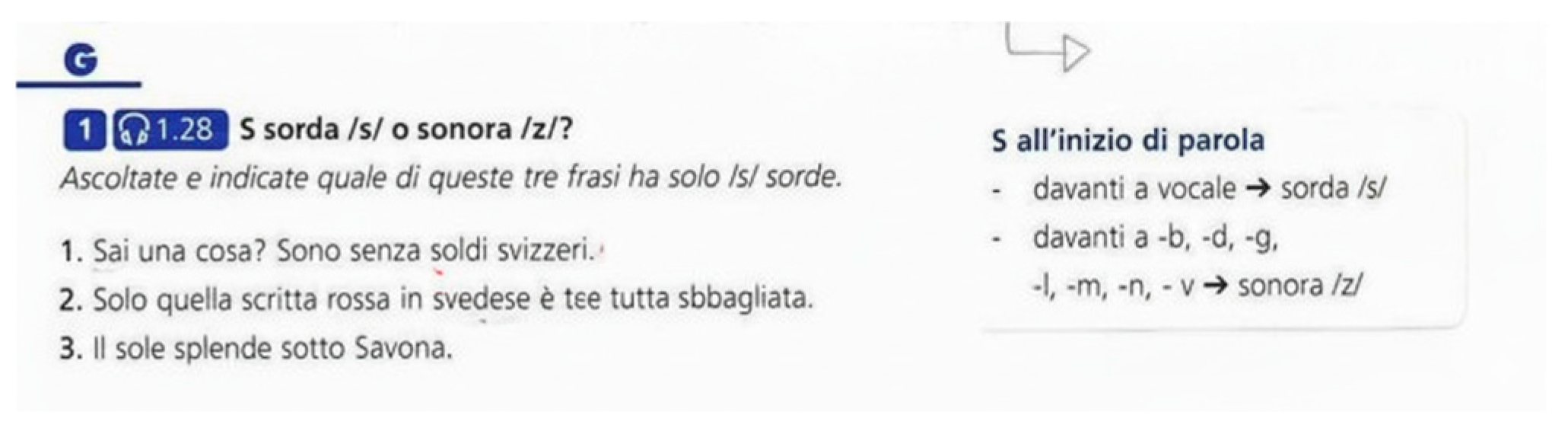
3.1. The /s/-/z/ Voicing Distinction
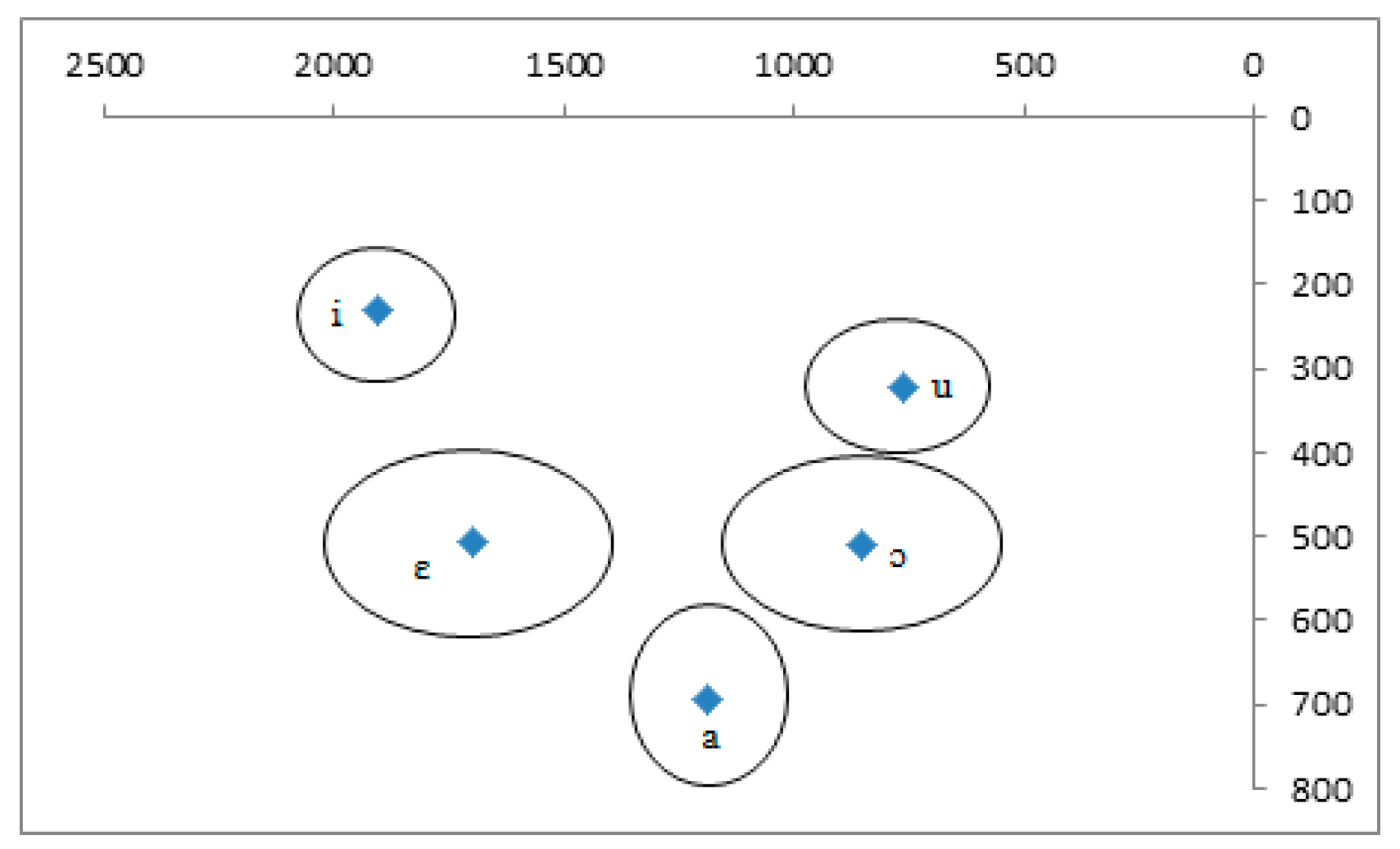
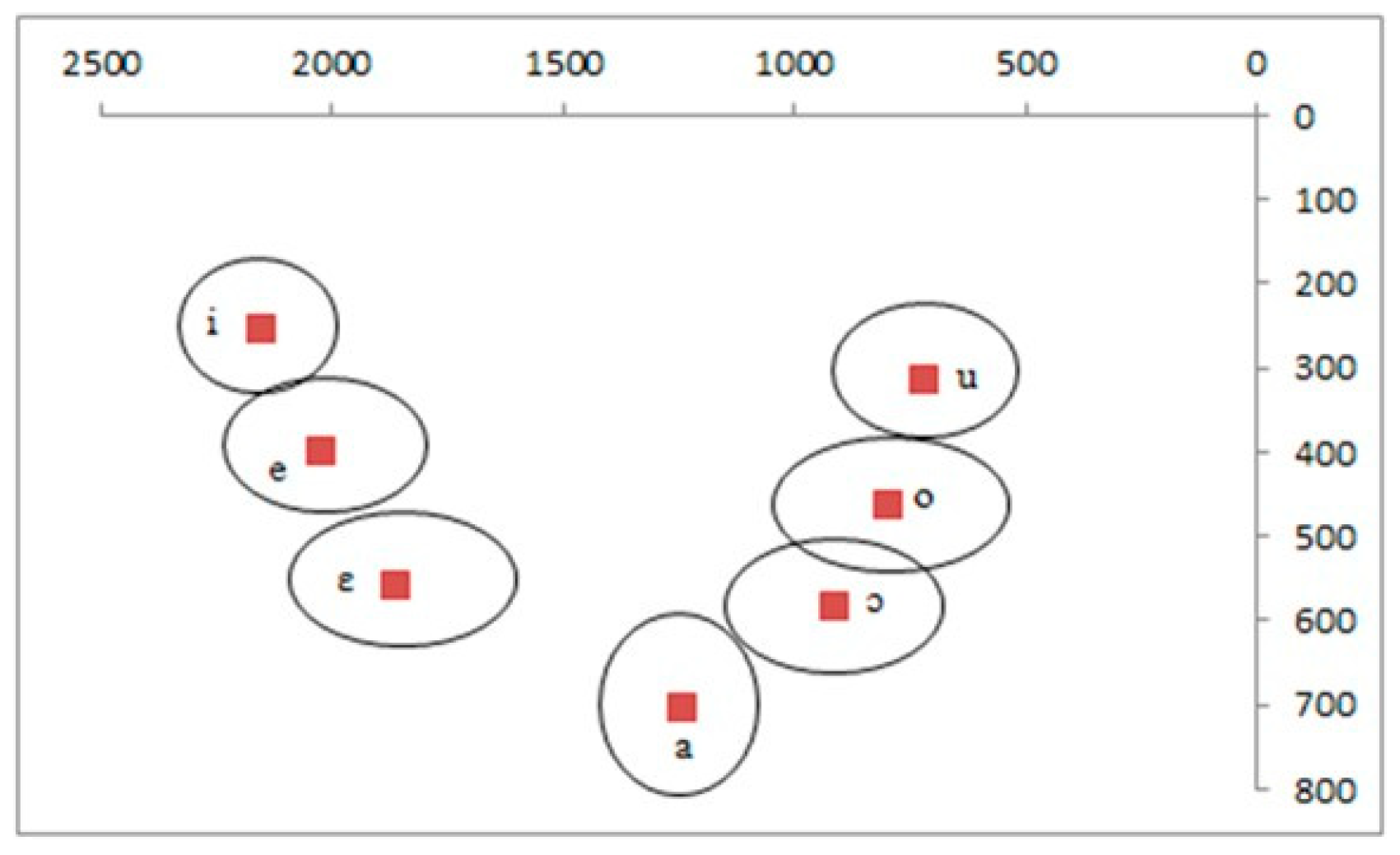
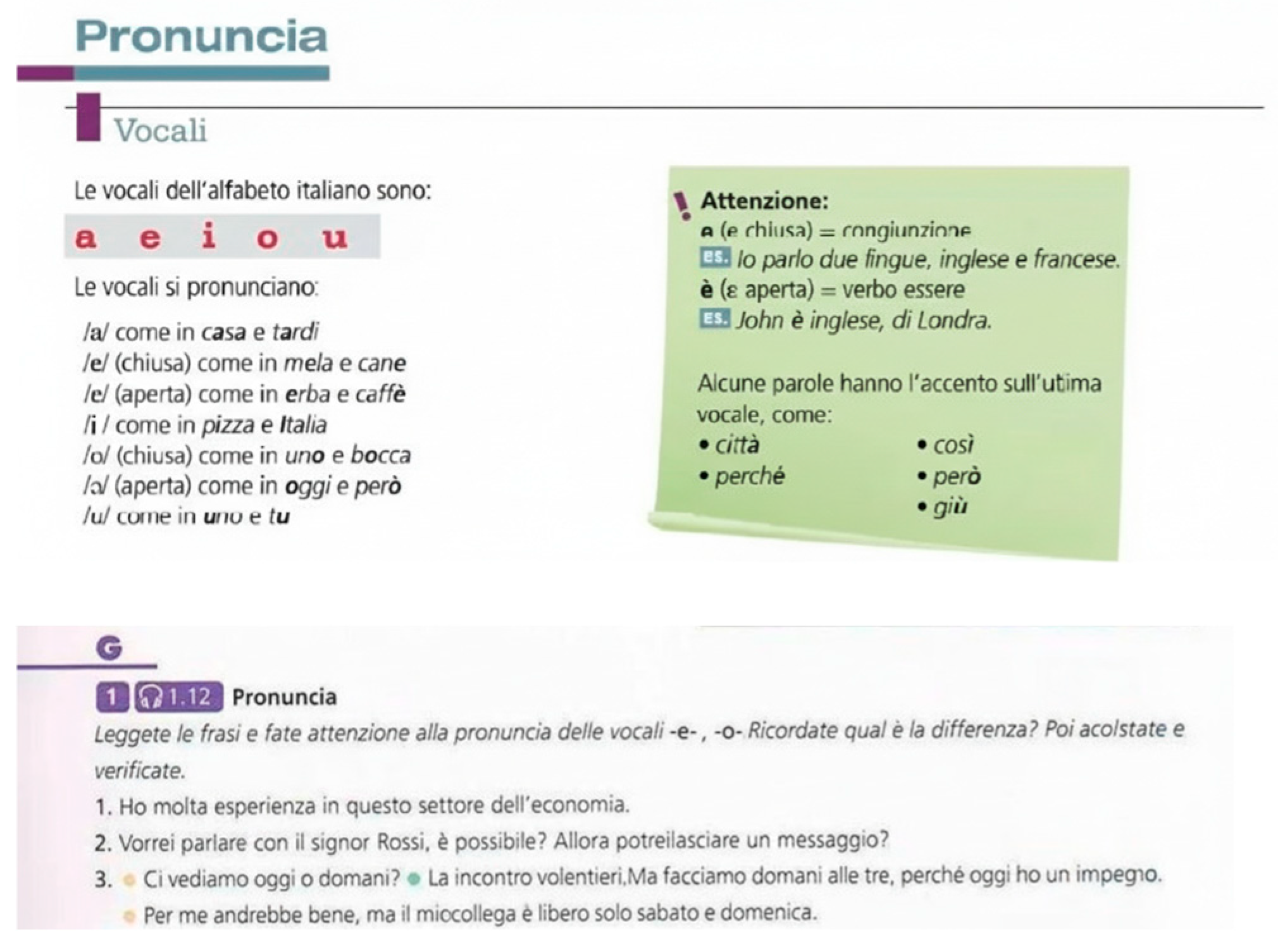
3.2. Stressed and Unstressed Vowels
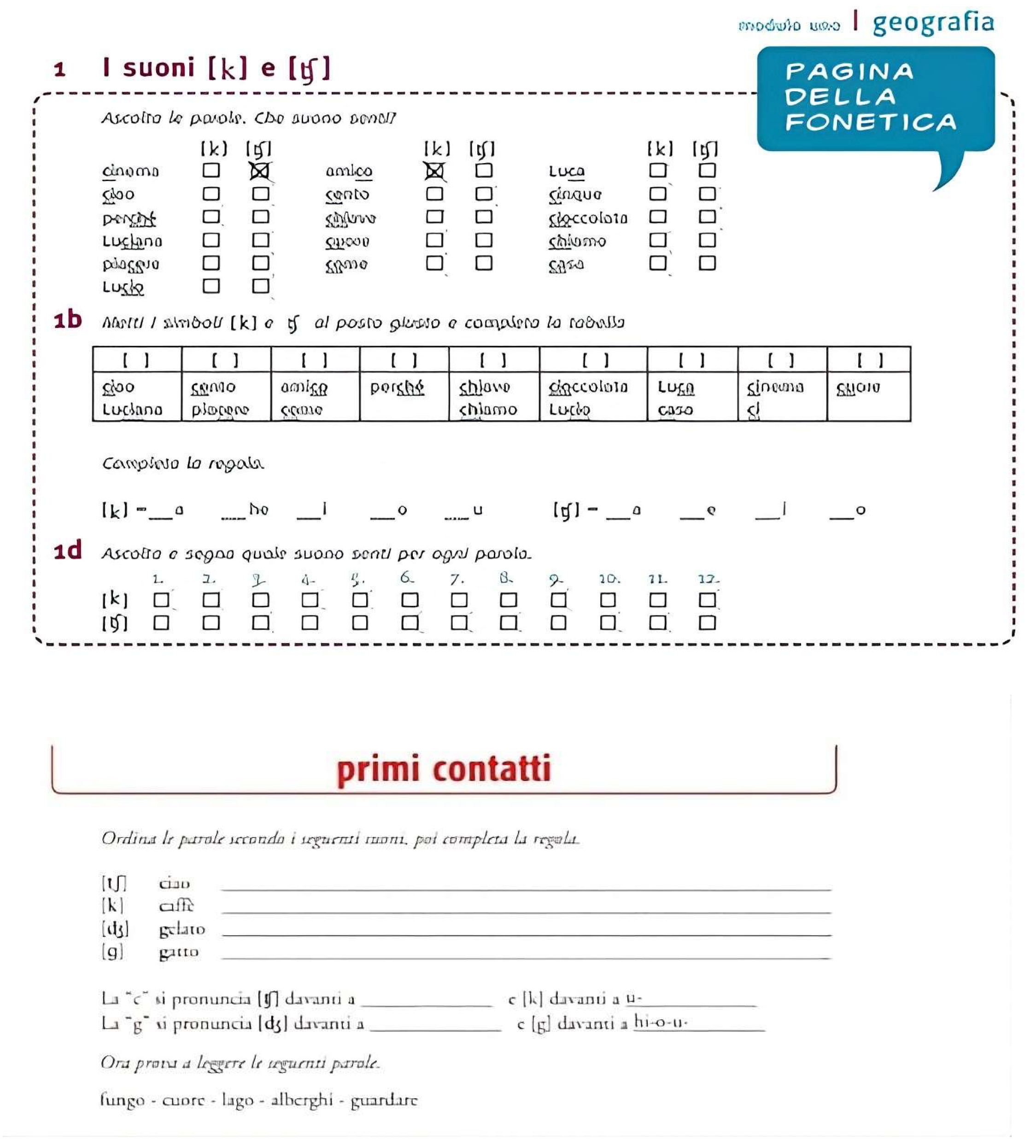
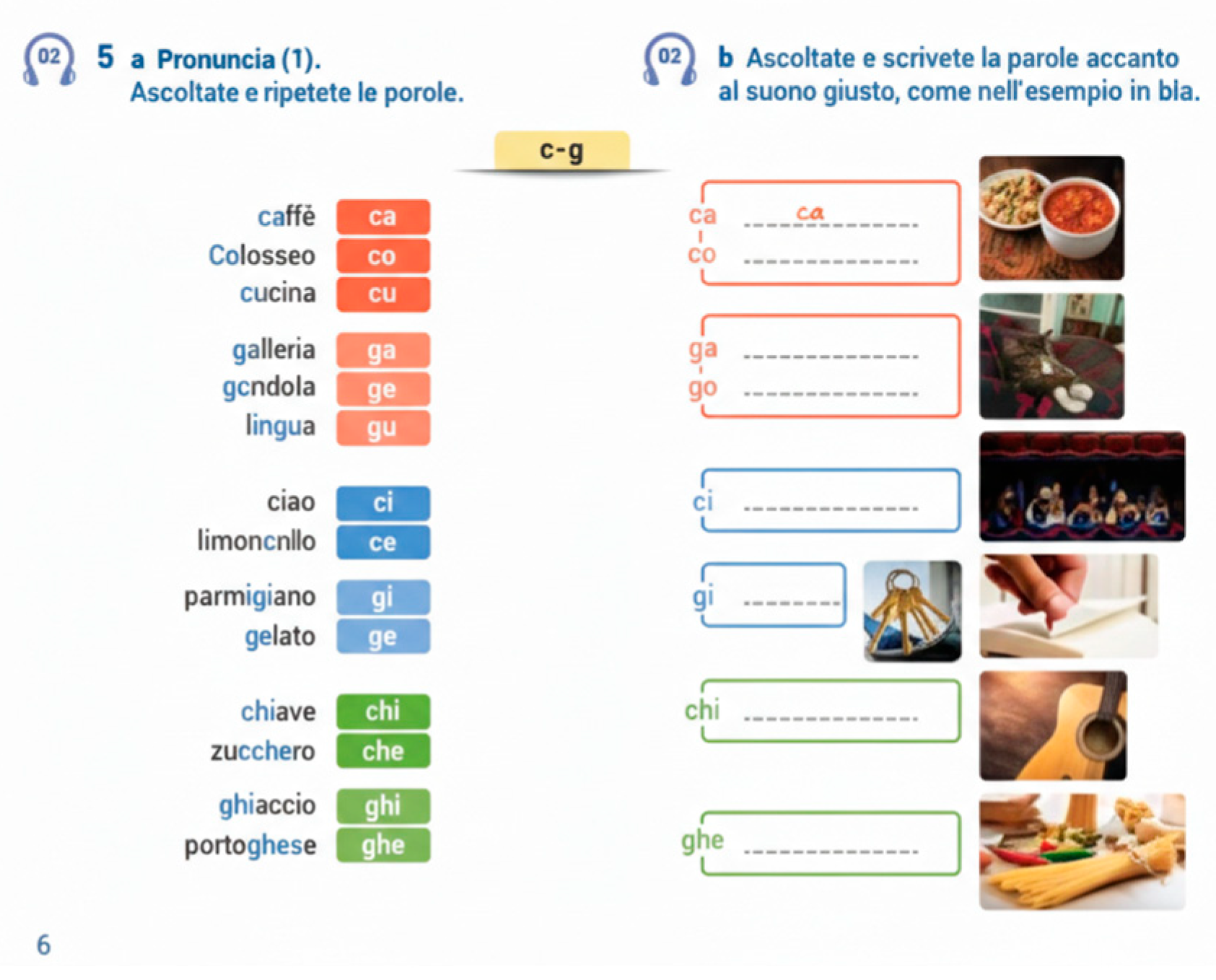
3.3. Alveolar Affricates
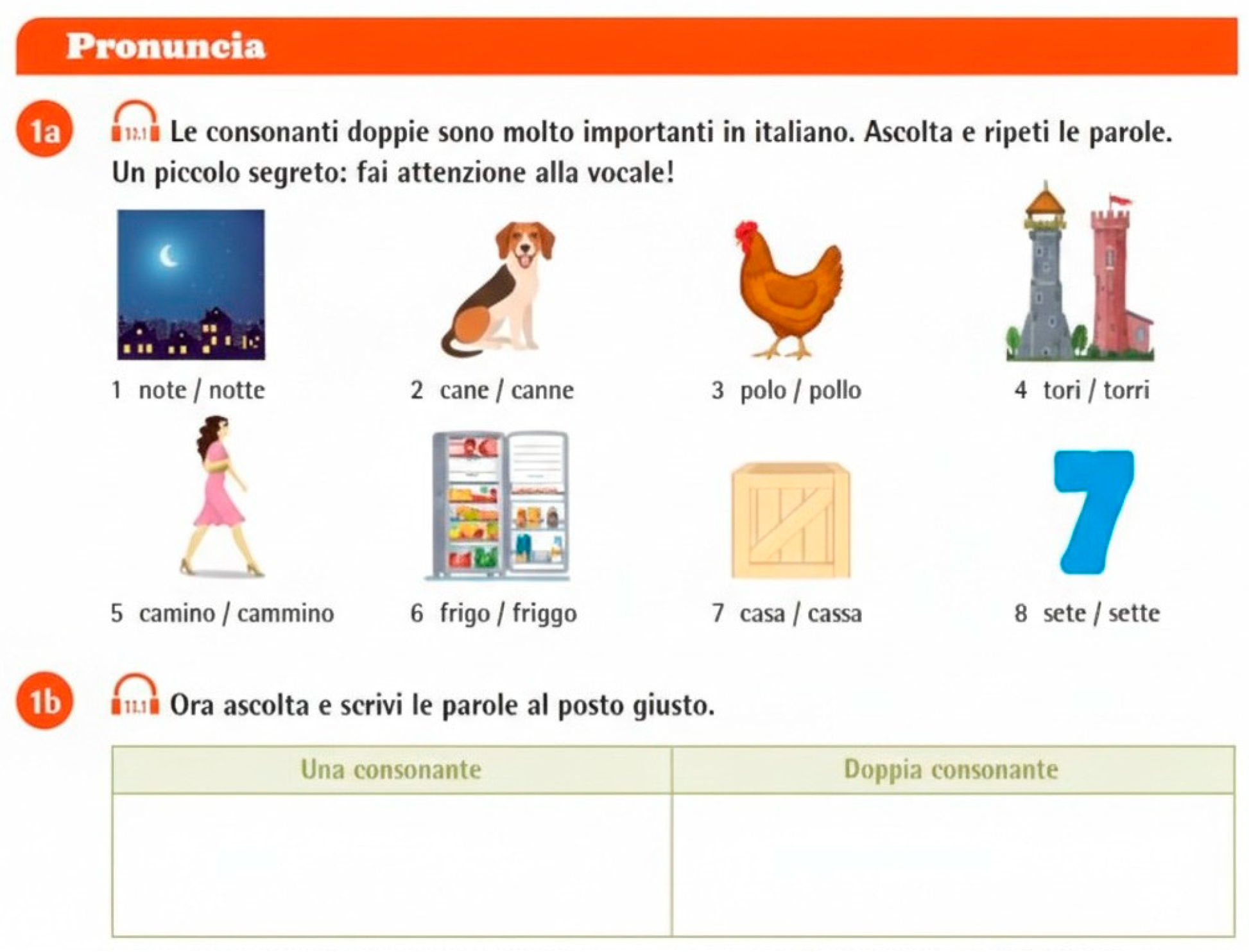
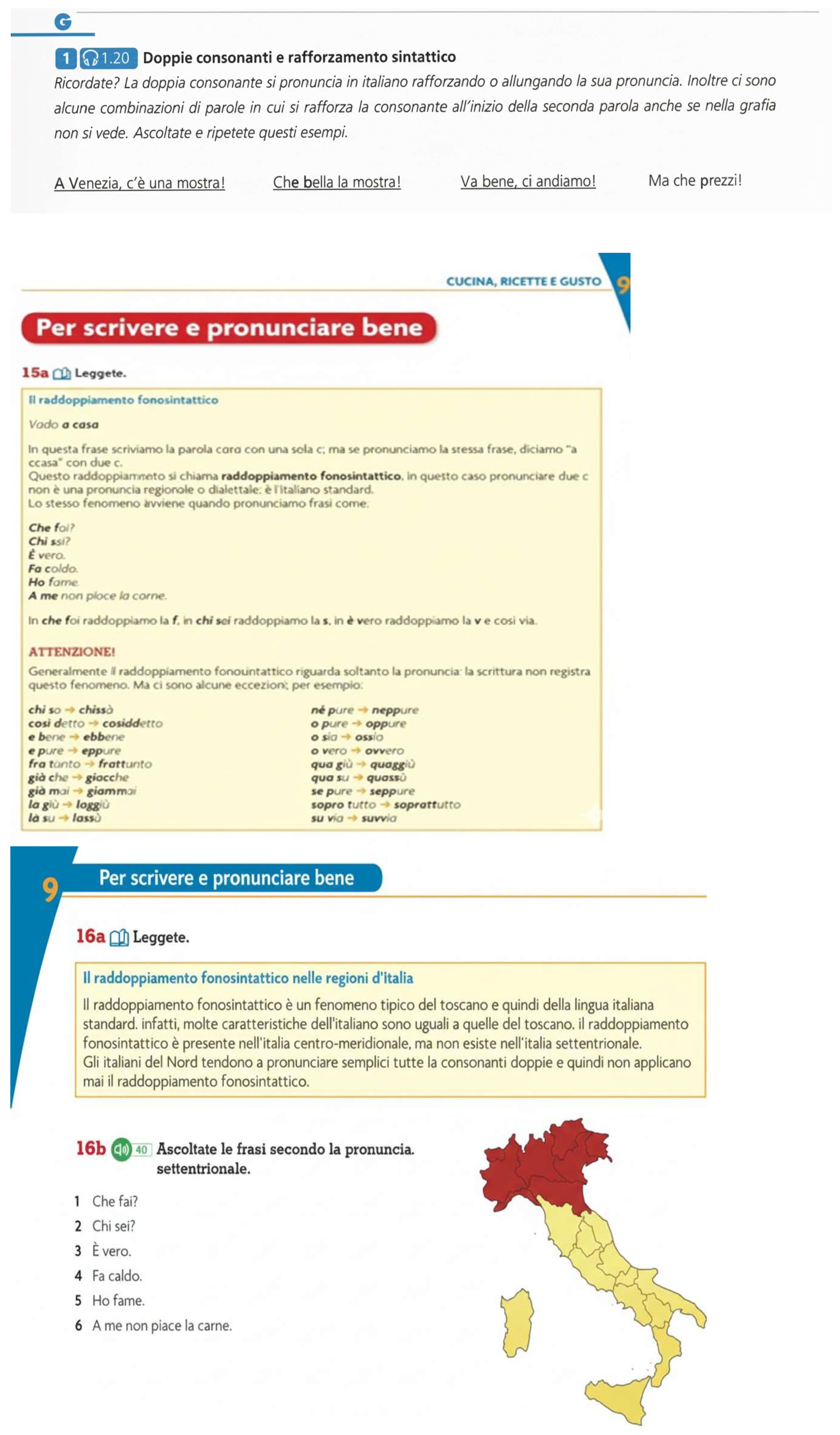
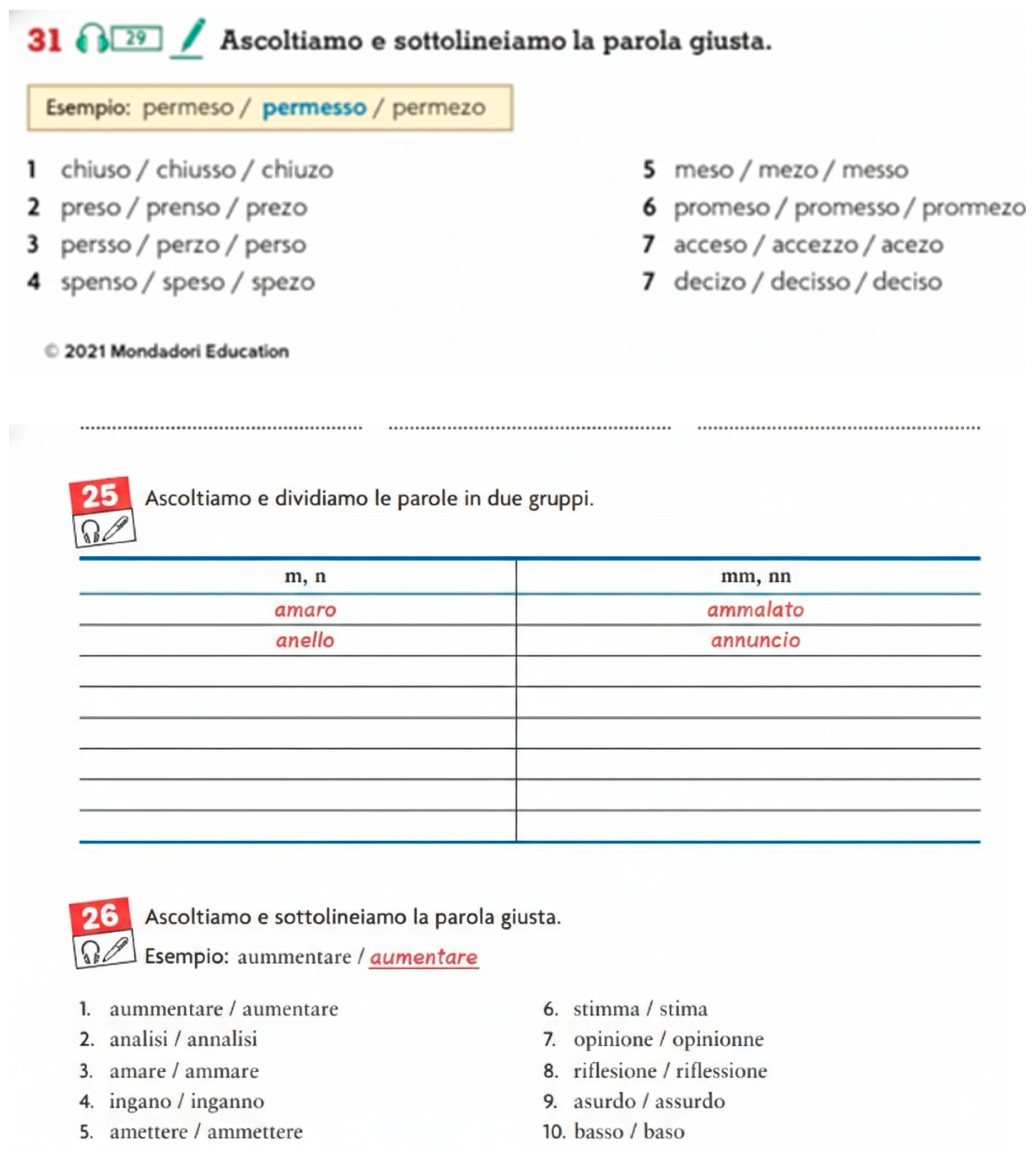
3.4. Consonant Length and Vowel Duration
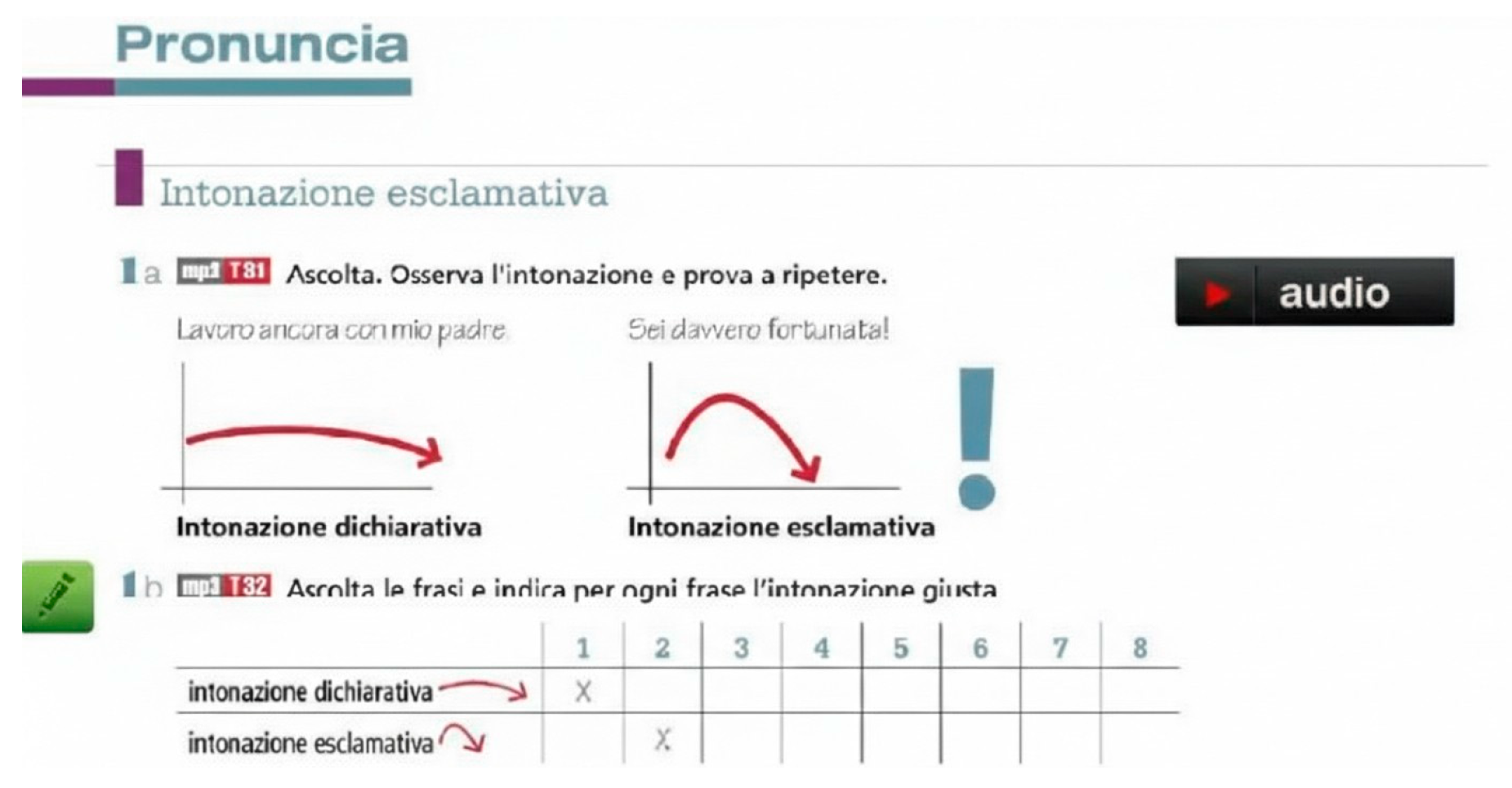
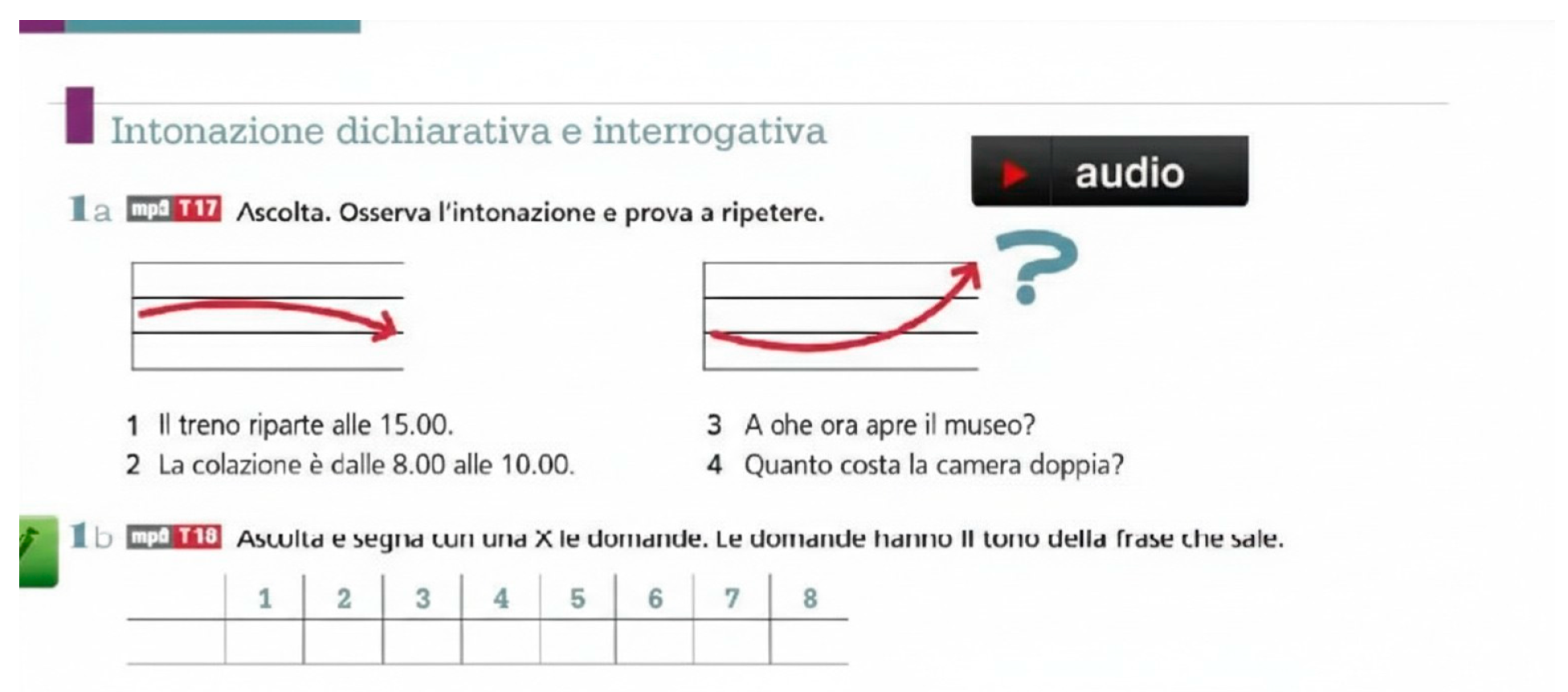
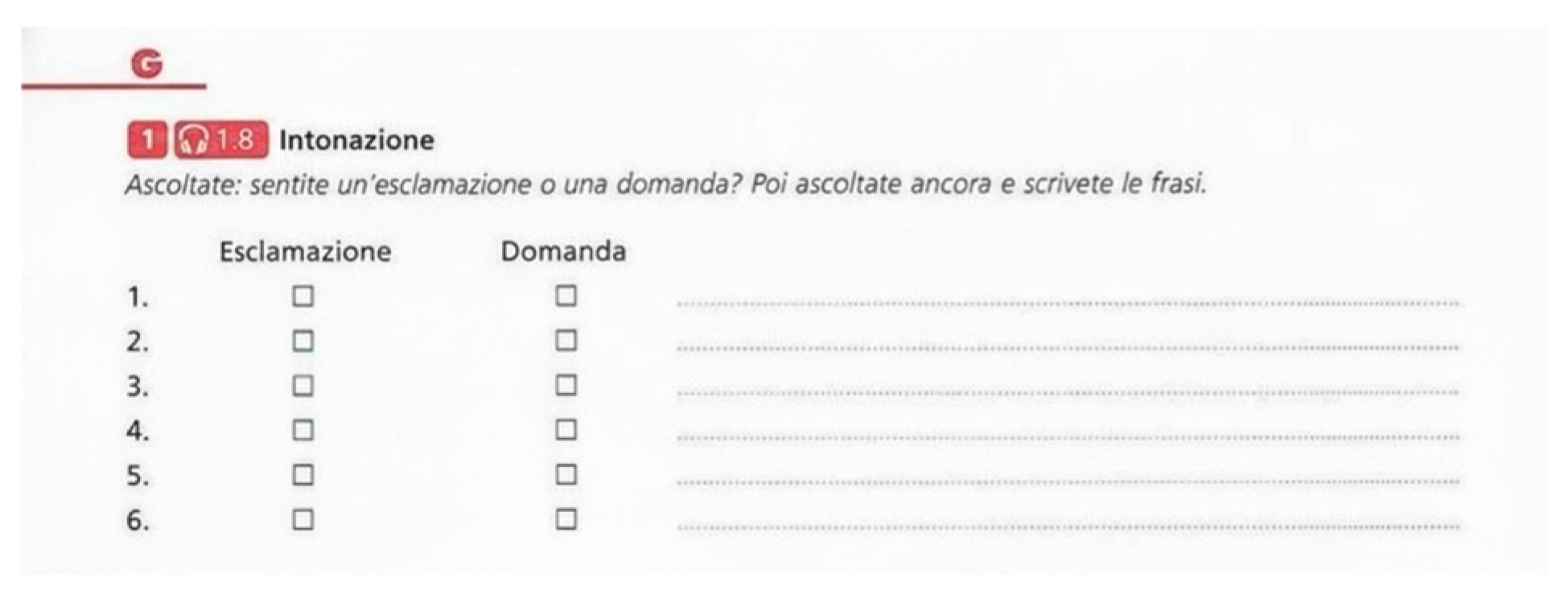
3.5. Rhythm and Intonation
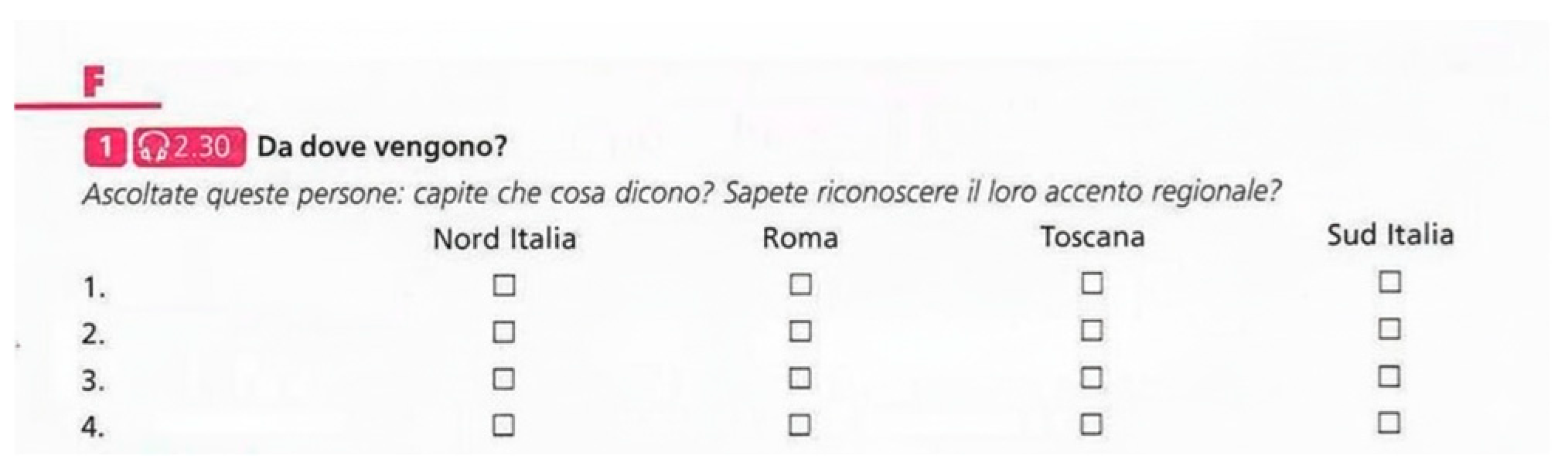
4. Textbooks for the Study of L2/FL Italian
5. A Critical Review
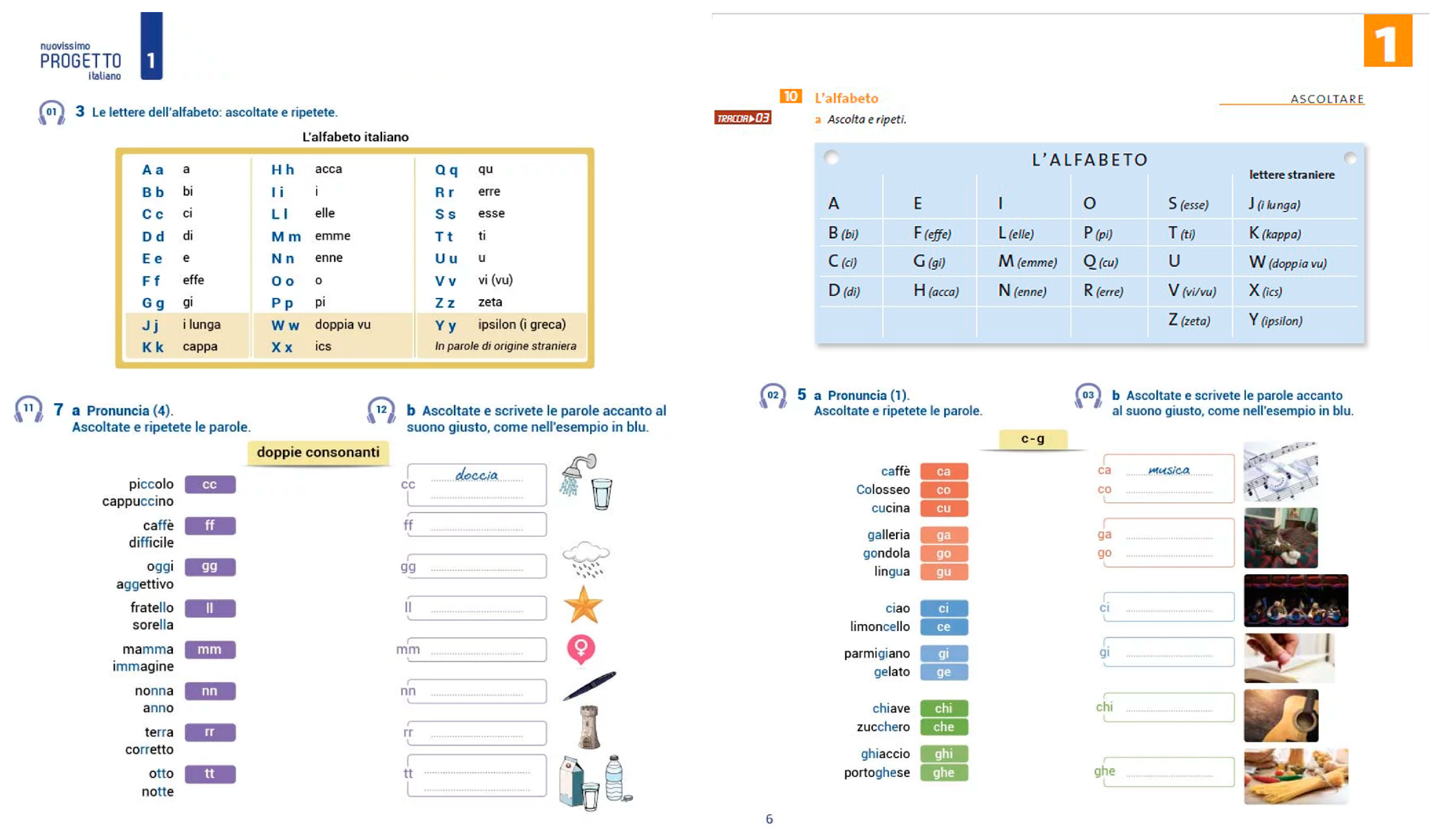
5.1. Textbook Sample
- The voicing of intervocalic /s/.
- The vowel inventory.
- The voicing and length of the affricates /ts dz/.
- Vowel and consonant durations.
- Rhythm and intonation.
5.2. Results
6. Discussion and Conclusions
Author Contributions
Funding
Data Availability Statement
Conflicts of Interest
| 1 | In the 2001 CEFR there was already a reference to phonetic level and intonation. In the 2018 revision, the phonetic–phonological aspect has been expanded and better organised. |
| 2 | Contrastive phonology is used only in academic teaching. See (De Dominicis, 2013; Romito, 2023). |
| 3 | In the academic field, there are some methods such as the verbotonal method (Guberina, 2013) or the articulatory approach (Underhill, 2005; Messum, 2012; Young, 2012) to teach pronunciation, but only in rare cases are these applied in schools for the teaching of L2 or FL. |
| 4 | |
| 5 | The 14th-century written language is based on the works of Dante, Petrarch, and Boccaccio. |
| 6 | Today, in Italy, an active restandardisation process of Italian can be noticed in the northern part of the country. |
| 7 | According to Salvi and Renzi (2010, pp. 713–715), it is not easy to periodise the Italian language (in contrast to French, German, and English). The authors propose three different historical periods identified in old Italian or old Florentine from 1211 to the 1400s, Middle Florentine from the beginning of the 1400s until the reform of Pietro Bembo in 1525, and modern Italian from the reforms of Bembo and Manzoni to the present day. Therefore, according to the authors, modern Italian would be a direct consequence of old Italian, whereas Middle Italian developed in the Florentine dialect (see Manni, 1979). |
| 8 | By spreading elementary education and the reading of sacred texts, the Protestant Reformation was important for all social classes in all regions of the German state on identical religious themes. |
| 9 | In 1923, Italianisation spread Italian culture, language, and identity. In the Royal Decree of 1 October 1923 (n. 2185, art. 4), it is written that teaching is given in the official language of the state in all the elementary schools of the kingdom. In municipalities where a different language is habitually spoken, this will be studied in additional hours. In other decrees, it is written not to publish articles, poems, or titles in dialects. Vernacular literature is not encouraged. |
| 10 | De Mauro (2017) recognises the northern variety, the Tuscan variety, the Roman variety, and the southern variety, each of which has some subvarieties. See also (Sobrero, 1988, pp. 732–733). |
| 11 | The term southern is very generic: for example, the Italian spoken in the city of Naples is characterised by a seven-vowel system. For more information, see (Romito, 2023). |
References
- Ammon, U. (1986). Explikation der begriffe ‘Standardvarietät’ und ‘Standardsprache’ auf normtheoretischer grundlage. In V. G. Holtus, & E. Radtke (Eds.), Sprach-licher substandard (Vol. 1, pp. 1–62). Niemeyer. [Google Scholar]
- Ammon, U. (2003). On the social forces that determine what is standard in a language and on conditions of successful implementation. Sociolinguistica, 17, 1–10. [Google Scholar] [CrossRef]
- Ascoli, G. I. (1880). L’Italia dialettale. Archivio Glottologico Italiano, 8, 98–128. [Google Scholar]
- Balboni, P. E. (2008). Fare educazione linguistica. Attività didattiche per l’italiano L1 e L2, lingue straniere e lingue classiche. UTET UNIVERSITÀ. [Google Scholar]
- Berruto, G. (2012). Sociolinguistica dell’italiano contemporaneo. La Nuova Italia Scientifica. [Google Scholar]
- Berruto, G. (2017a). Dinamiche nell’architettura delle varietà dell’italiano nel ventunesimo secolo. In G. Caprara, & M. Giorgia (Eds.), Italiano e dintorni. La realtà linguistica italiana: Approfondimenti di didattica, variazione e traduzione (pp. 7–31). Peter Lang Edition. [Google Scholar]
- Berruto, G. (2017b). What is changing in Italian today. In C. Massimo, C. Crocco, & S. Marzo (Eds.), Towards a new standard: Theoretical and empirical studies on the restandardization of Italian (pp. 31–60). Mouton de Gruyter. [Google Scholar]
- Bertinetto, P. M. (1981). Strutture prosodiche dell’Italiano (Studi di grammatica italiana). Accademia della Crusca. [Google Scholar]
- Bertinetto, P. M., & Loporcaro, M. (2005). The sound pattern of standard Italian, as compared with the varieties spoken in Florence, Milan and Rome. Journal of the International Phonetic Association, 35(2), 131–151. [Google Scholar] [CrossRef]
- Bosc, F. (2005). Quale italiano per vivere in Italia? La lingua per comunicare. In B. Iori (Ed.), L’italiano e le altre lingue. Apprendimento della seconda lingua e bilinguismo dei bambini e dei ragazzi immigrati (pp. 79–87). FrancoAngeli. [Google Scholar]
- Camilli, A. (1965). Pronuncia e grafia nell’italiano. Sansoni—Biblioteca di Lingua Nostra. [Google Scholar]
- CEFR. (2018). Common european framework of reference for languages. Council of Europe Publishing. [Google Scholar]
- Celata, C., & Kaeppeli, B. (2005). Affricazione e rafforzamento in italiano: Alcuni dati sperimentali. Quaderni del Laboratorio di Linguistica, 4, 43–59. [Google Scholar]
- Cerruti, M. (2018). Il parlato regionale oggi: Un italiano composito? LId’O Lingua Italiana d’oggi, 15, 15–31. [Google Scholar]
- Cerruti, M., Crocco, C., & Marzo, S. (2017). On the development of a new standard norm in Italian. In C. Massimo, C. Claudia, & M. Stefania (Eds.), Towards a new standard: Theoretical and empirical studies on the restandardization of Italian (pp. 3–28). De Gruyter. [Google Scholar]
- Cortelazzo, M. A. (2001). L’italiano e le sue varietà: Una situazione in movimento. Lingua e Stile, 36, 417–430. [Google Scholar]
- Crocco, C. (2017). Everyone has an accent: Standard Italian and regional pronunciation. In C. Massimo, C. Claudia, & M. Stefania (Eds.), Towards a new standard. Theoretical and empirical studies on the restandardization of Italian (pp. 89–116). De Gruyter. [Google Scholar]
- D’Achille, P. (2006). L’italiano contemporaneo. Il Mulino. [Google Scholar]
- De Dominicis, A. (2013). Fonologie comparate. Suoni e lingue d’Europa, cina e mondo arabo. Carocci. [Google Scholar]
- De Mauro, T. (2017). Storia linguistica d’Italia dall’Unità ad oggi. Laterza. [Google Scholar]
- De Pascale, S., Marzo, S., & Speelman, D. (2017). Evaluating regional variation in Italian: Towards a change in standard language ideology? In C. Massimo, C. Claudia, & M. Stefania (Eds.), Towards a new standard. Theoretical and empirical studies on the restandardization of Italian (pp. 118–141). De Gruyter. [Google Scholar]
- Diadori, P., Palermo, M., & Troncarelli, D. (2009). Manuale di didattica dell’italiano L2. Guerra Edizioni. [Google Scholar]
- Diadori, P., Palermo, M., & Troncarelli, D. (2015). Insegnare italiano come seconda lingua. Carocci Editore. [Google Scholar]
- Dian, A., Hajek, J., & Fletcher, J. (2024). Cross-regional patterns of obstruent voicing and gemination: The case of Roman and Veneto Italian. Languages, 9(12), 383. [Google Scholar] [CrossRef]
- Di Benedetto, M. G., Shattuck-Hufnagel, S., De Nardis, L., Budoni, S., Arango, J., Chan, I., & De Caprio, A. (2021). Lexical and syntactic gemination in Italian consonants—Does a geminate Italian consonant consist of a repeated or a strengthened consonant? The Journal of the Acoustical Society of America, 149, 3375–3386. [Google Scholar] [CrossRef] [PubMed]
- Esposito, A., & Di Benedetto, M. G. (1999). Acoustical and perceptual study of gemination in Italian stops. The Journal of the Acoustical Society of America, 106(4), 2051–2062. [Google Scholar] [CrossRef] [PubMed]
- Ferrero, G. (1979). L’identificazione della persona per mezzo della voce. ESA. [Google Scholar]
- Frascarelli, M. (2004). L’interpretazione del focus e la portata degli operatori sintattici [The interpretation of focus and the scope of syntactic operators]. In F. Albano Leoni, F. Cutugno, M. Pettorino, & R. Savy (Eds.), Il Parlato Italiano: Atti del convegno nazionale (Naples, 13–15 febbraio 2003) (CD-ROM B06). M. D’Auria Editore—CIRASS. [Google Scholar]
- Galli de’ Paratesi, N. (1977). La standardizzazione della pronuncia nell’italiano contemporaneo. Aspetti sociolinguistici dell’Italia contemporanea. In R. Simone, & G. Ruggiero (Eds.), Atti dell’VIII congresso internazionale di studi, Bressanone, Italy, May 31–June 2 (pp. 167–196). Bulzoni. [Google Scholar]
- Galli de’ Paratesi, N. (1984). Lingua toscana in bocca ambrosiana. Il Mulino. [Google Scholar]
- Gili Fivela, B., Avesani, C., Barone, M., Bocci, G., Crocco, C., D’Imperio, M., Giordano, R., Marotta, G., Savino, M., & Sorianello, P. (2015). Intonational phonology of the regional varieties of Italian. In S. Frota, & P. Prieto (Eds.), Intonation in romance (pp. 140–197). Oxford Univesity Press. [Google Scholar]
- Guberina, P. (2013). The verbotonal method (C. Roberge, Ed.). ARTRESOR NAKLADA. [Google Scholar]
- Lorenzetti, L. (2006). L’italiano contemporaneo. Carocci. [Google Scholar]
- Mairano, P., & De Iacovo, V. (2019). Gemination in northern versus central and southern varieties of Italian: A corpus-based investigation. Language and Speech, 63(3), 608–634. [Google Scholar] [CrossRef] [PubMed]
- Manni, P. (1979). Ricerche sui tratti fonetici e morfologici del fiorentino quattrocentesco. Studi di Grammatica Italiana, 8, 115–171. [Google Scholar]
- Messum, P. (2012). Teaching pronunciation without using imitation: Why and how. In J. Levis, & K. LeVelle (Eds.), Proceedings of the 3rd pronunciation in second language learning and teaching conference, Ames, IA, USA, September 16–17 (pp. 154–160). Iowa State University. [Google Scholar]
- Pellegrini, G. B. (1975). Saggi di linguistica italiana: Storia, struttura, società. Boringhieri. [Google Scholar]
- Pizzoli, L. (2004). Le grammatiche di italiano per inglesi (1550–1776). Un’analisi linguistica. Accademia della Crusca. [Google Scholar]
- Romito, L. (2003). Manuale di fonetica articolatoria, acustica e forense. Centro Editoriale e Libraio Università della Calabria. [Google Scholar]
- Romito, L. (2023). I suoni delle lingue. Manuale di fono-didattica. Italiano, spagnolo, francese, inglese e tedesco. AMON Edizioni. [Google Scholar]
- Sabatini, F. (1985). ‘L’italiano dell’uso medio’: Una realtà tra le varietà linguistiche italiane. In V. G. Holtus, & E. Radtke (Eds.), Gesprochenes Italienisch in geschichte und gegenwart (pp. 154–184). Narr. [Google Scholar]
- Salvi, G., & Renzi, L. (Eds.). (2010). Grammatica dell’italiano antico. Il Mulino. [Google Scholar]
- Słapek, D. (2016). Argomenti grammaticali e nei certificati d’italiano LS. Rivista Italiana di Linguistica Applicata (RILA), 49(1), 109–127. [Google Scholar]
- Sobrero, A. A. (1988). Italianisch: Regionale varianten/italiano regionale. In G. Holtus, M. Metzelin, & C. Schmitt (Eds.), Lexikon der Romanistishen Linguistik (LRL) (Vol. 4, pp. 732–748). Niemayer. [Google Scholar]
- Sorianello, P. (2006). Prosodia. Modelli e ricerca empirica, con CD-Rom multimediale. Carocci Editore. [Google Scholar]
- Trifone, P. (2007). Malalingua: L’italiano scorretto da Dante a oggi. Il Mulino. [Google Scholar]
- Trumper, J., & Romito, L. (1989). Un problema della coarticolazione: L’isocronia rivisitata. In Atti del XVII convegno nazionale dell’associazione Italiana di acustica (pp. 449–456). Tipolitografia Mattioli. [Google Scholar]
- Trumper, J., Romito, L., & Maddalon, M. (1991). Vowel systems and areas compared: Definitional problems. In P. Benincasa (Ed.), L’interfaccia tra fonologia e fonetica (Vol. 1, pp. 43–72). Unipress. [Google Scholar]
- Underhill, A. (2005). Sounds foundations. Learning and teaching pronunciation. Macmillan Education. [Google Scholar]
- Vietti, A. (2019). Phonological variation and change in Italian. In Oxford research encyclopedia of linguistics. Oxford University Press. [Google Scholar] [CrossRef]
- Young, R. (2012). Teaching pronunciation efficiently means not using ‘Listen and Repeat’. In Teaching times (Vol. 63, p. 18). TESOL. [Google Scholar]
- Zingaro, A. (2023). Quale italiano? Una proposta per l’insegnamento dell’italiano a stranieri tra standard e neostandard. University Press. [Google Scholar]
- Zmarich, C., & Gili Fivela, B. (2005). Consonanti scempie e geminate in italiano: Studio cinematico e percettivo dell’articolazione bilabiale e labiodentale. In P. Cosi (Ed.), Misura dei parametri, Atti del I convegno nazionale dell’associazione Italiana di scienze della voce, Padova, Italy, Decemeber 2–4 (pp. 429–448). EDK Editore. [Google Scholar]








| CS | CZ | RC | PD | NA | |
|---|---|---|---|---|---|
| cVcv | 187 | 167 | 121 | 131 | 249 |
| cVccv | 110 | 125 | 85 | 136 | 125 |
| cvcV | 80 | 145 | 130 |
| Singletons | Geminates | |||
|---|---|---|---|---|
| Voiceless | Voiced | Voiceless | Voiced | |
| M. | 163 | 104 | 291 | 261 |
| St.dev. | 33 | 23 | 62 | 38 |
| Analysed Levels | Levels with Pronunciation Sections | |
|---|---|---|
| EDILINGUA | ||
| Nuovo progetto Italiano | A1–C2 | A1–A2 |
| Nuovissimo progetto Italiano | A1–C2 | A1–A2 |
| Arrivederci | A1–B1+ | A1–A2 |
| Allegro | A1–B1 | A1–A2 |
| Nuovo allegro | A1 | A1 |
| L’italiano all’università | A1–B2 | A1 |
| Via del Corso | A1–B2 | A1 |
| ALMA EDIZIONI | ||
| Dieci. Lezioni di Italiano | A1–B2 | A1 |
| Nuovo magari | B2–C2 | |
| Nuovo espresso | A1–C2 | A1 |
| Chiaro! | A1–B1 | A1–A2 |
| Domani | A1–B1 | A1 |
| Italiano di base | (PRE)A1/A2–A2+/B1 | A1–A2 |
| Universitalia 2.0 | A1/A2–B1/B2 | A1–A2 |
| LOESCHER | ||
| Volentieri | A1–B2 | A1 |
| Un nuovo giorno in Italia | A1–B2 | A1 |
| Contatto | A1–B2 | A1 |
| Nuovo contatto | A1–C1 | A1–A2–B1 |
| Italiano plus | A1/A2–B1/B2 | A1–A2 |
| LE MONNIER | ||
| Affresco italiano | A1–C2 | A1–A2–B1–B2–C1–C2 |
| Il nuovo affresco italiano | A1–B2 | A1–A2–B1–B2 |
| Qui Italia.it | A1–B2 | A1 |
| Nuovo Qui Italia più | B2–C1 | |
| Uni.Italia | B1–C1 | |
| GUERRA EDIZIONI | ||
| Syllabus | BASE–B2 | BASE |
| Come va? | A1–B1 | A1 |
| Nuovo rete | A1–B1 | A1 |
| HOEPLI | ||
| Percorso Italia | A1/A2–B1/B2 | A1 |
| 1, 2, 3, italiano! | A1–B1 | A1–B1 |
| In italiano | A1/A2–C1 | A1–A2 |
| ELI | ||
| Caffè Italia | A1–B1 | A1–A2 |
| CDL EDIZIONI | ||
| Bravissimo | A1–B2 | A1 |
| Phonetic-Phonological Variables | Total N.32 |
|---|---|
| Five-vowel system | 30 |
| Seven-vowel system | 2 |
| Voicing of intervocalic /s/ | 7 |
| Voicing and length of the affricates /ts;dz/ | 24 |
| Vowel and consonant durations | 29 |
| Rhythm and intonation | 6 |
Disclaimer/Publisher’s Note: The statements, opinions and data contained in all publications are solely those of the individual author(s) and contributor(s) and not of MDPI and/or the editor(s). MDPI and/or the editor(s) disclaim responsibility for any injury to people or property resulting from any ideas, methods, instructions or products referred to in the content. |
© 2026 by the authors. Licensee MDPI, Basel, Switzerland. This article is an open access article distributed under the terms and conditions of the Creative Commons Attribution (CC BY) license.
Share and Cite
Romito, L.; Graziano, E. Speech Variation in the Teaching of Italian as a Second/Foreign Language: A Critical Review. Languages 2026, 11, 20. https://doi.org/10.3390/languages11020020
Romito L, Graziano E. Speech Variation in the Teaching of Italian as a Second/Foreign Language: A Critical Review. Languages. 2026; 11(2):20. https://doi.org/10.3390/languages11020020
Chicago/Turabian StyleRomito, Luciano, and Elvira Graziano. 2026. "Speech Variation in the Teaching of Italian as a Second/Foreign Language: A Critical Review" Languages 11, no. 2: 20. https://doi.org/10.3390/languages11020020
APA StyleRomito, L., & Graziano, E. (2026). Speech Variation in the Teaching of Italian as a Second/Foreign Language: A Critical Review. Languages, 11(2), 20. https://doi.org/10.3390/languages11020020