
Age Variation in First-Language Acquisition and Phonological Development: Discrimination and Repetition of Nonwords in a Group of Italian Preschoolers


Abstract
1. Introduction
- Studying the phonological development of Italian preschoolers in the production and discrimination of Italian consonants embedded in disyllabic nonwords by using two complementary tasks (i.e., an NWR and an NWD task).
- Investigating the relationship between production and discrimination abilities in the function of children’s chronological age.
2. Materials and Methods
2.1. Participants
2.2. Stimuli
- Choice of disyllabic nonwords of the type ˈCV.CV: the structure CV is the simplest and widespread among the world’s languages (Maddieson, 2008); children acquiring Italian as L2 are able to produce this type of syllable independently from the linguistic transfer (Carlisle, 2001). Item length is an important clinical parameter (see Dispaldro et al., 2013, among others) and is known to influence children’s performance in tasks of nonword discrimination and repetition (see Dollaghan & Campbell, 1998). In order to control for the test items’ length, we decided to include only disyllabic nonwords with a ˈCV.CV structure in our tasks. Additionally, this choice aligns with the Italian version of the MacArthur-Bates CDI (Caselli et al., 2015), where most syllables are CV (63%), and disyllables represent 39.4% of the total number of words (Zmarich et al., 2011).
- Combination of each of the 23 Italian consonants (C) with cardinal vowels (V) /a/ or /i/ (for a few items, the back vowel /u/ was used): the statistics available in the UPSID (UCLA Phonological Segment Inventory Database; Maddieson & Precoda, 1990) show that the vowel /a/ is present in 86.9% of world’s languages, /i/ is in 87.1%, and /u/ is in 81.8%. No consonant clusters are included.
- The presence of only 1 of the 12 target consonants in each nonword, either in word-initial or word-medial position.
- Every nonword is a nonword in Italian, as well as in the other target languages: native speakers of each target language have checked all the nonwords in order to exclude the presence of real lexical items and violations of the language’s phonotactic rules.2
2.3. The Nonword Repetition (NWR) Task
- Target stop consonants were preferred in word-initial position, followed either by /a/ or /i/ to also allow future computations of Voice Onset Time (VOT). Italian voiced consonants have a negative VOT; therefore, they are more difficult to utter, especially in word-initial position (cf. Ohala, 2011; for Italian, see also Zmarich et al., 2021). Our choice of placing target stops mostly in word-initial position made the items more challenging, avoiding the facilitation of [+voiced] stop consonants in word-medial and intervocalic positions.
- All other target consonants were preferred, as far as possible, in word-medial position with at least one target consonant followed by /a/ and one by /i/.
- Block 1 contained 24 nonwords with the following stop Cs in word-initial position: /p, b, t, d, k, g/. Each of these Cs appeared twice, followed by /a/ (e.g., /ˈbaʤa/, /ˈbaza/) and twice followed by /i/ (e.g., /ˈbizi/, /ˈbina/). Within this block, the C in word-medial position was one of the other non-stop Cs, with only one of the two consonants in the nonword belonging to those identified as targets.
- Block 2 contained 19 nonwords covering all the other non-stop Cs in word-initial and word-medial positions that were not included in block 1 (e.g., /ˈsiʧa/, /ˈlari/); this block also included 3 items for consonantal length (e.g., /ˈdaffi/, /ˈjalli/, /ˈbitti/), while /z/ is missing in word-initial position because of the phonotactic rules of Italian. Each target C has a minimum of two repetitions (one with /a/ and one with /i/).
- Block 3 contained 12 items and was intended as an optional block to address VOT production (not discussed in the present work). It reflects block 1 and adds additional items with word-initial stop Cs (i.e., 6 stop Cs followed by /a/ and 6 stop Cs followed by /i/).
2.4. The Nonword Discrimination (NWD) Task
- /ˈnala/ vs /ˈnaʎa/ for the target phoneme /ʎ/ contrasted with /l/, which differs for two features ([-compact], [+diffuse]).
- /ˈsita/ vs /ˈsiʧa/ for the target phoneme /ʧ/ contrasted with /t/, which differs for three features ([-compact], [+diffuse], [-strident]).
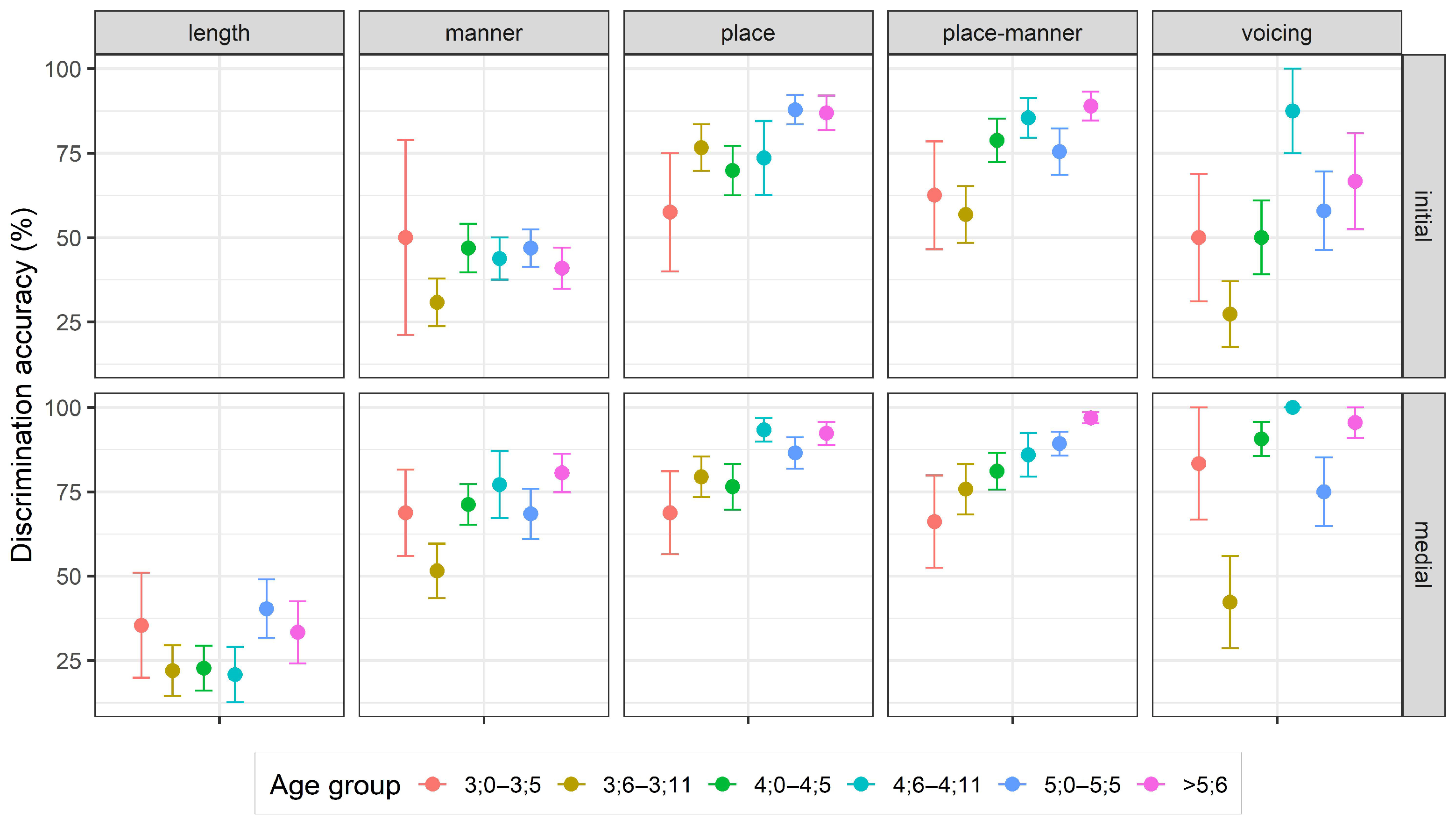
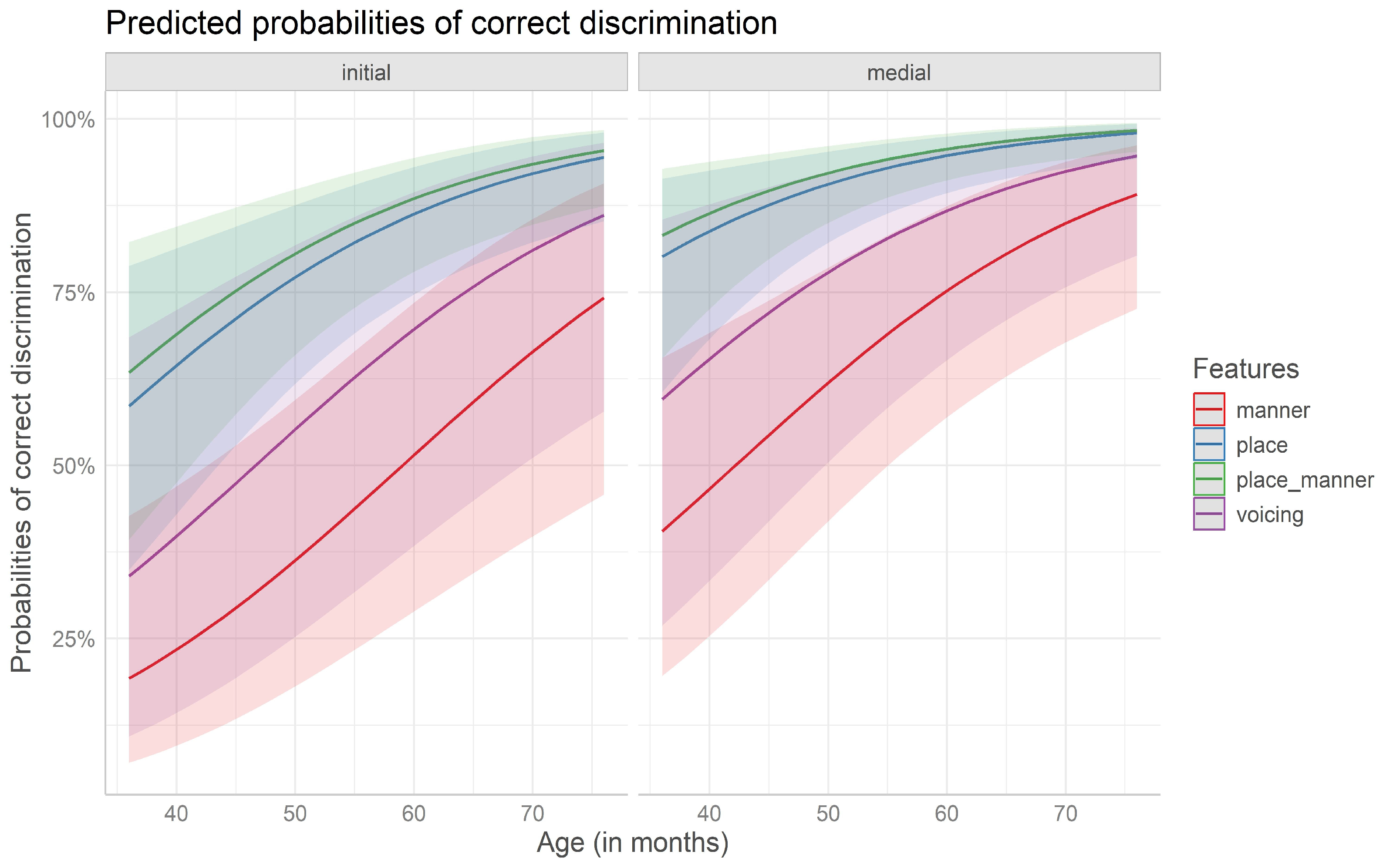
- The NWD task also includes nonword pairs contrasting for voicing (i.e., [±voice] as in /ˈsita/ vs /ˈsida/) and length (i.e., [±long] as in /ˈdaffi/ vs /ˈdafi/).3
2.5. Procedure
2.6. Transcription Criteria for the Productions from the NWR Task
2.7. Analysis of the Productions from the NWR Task
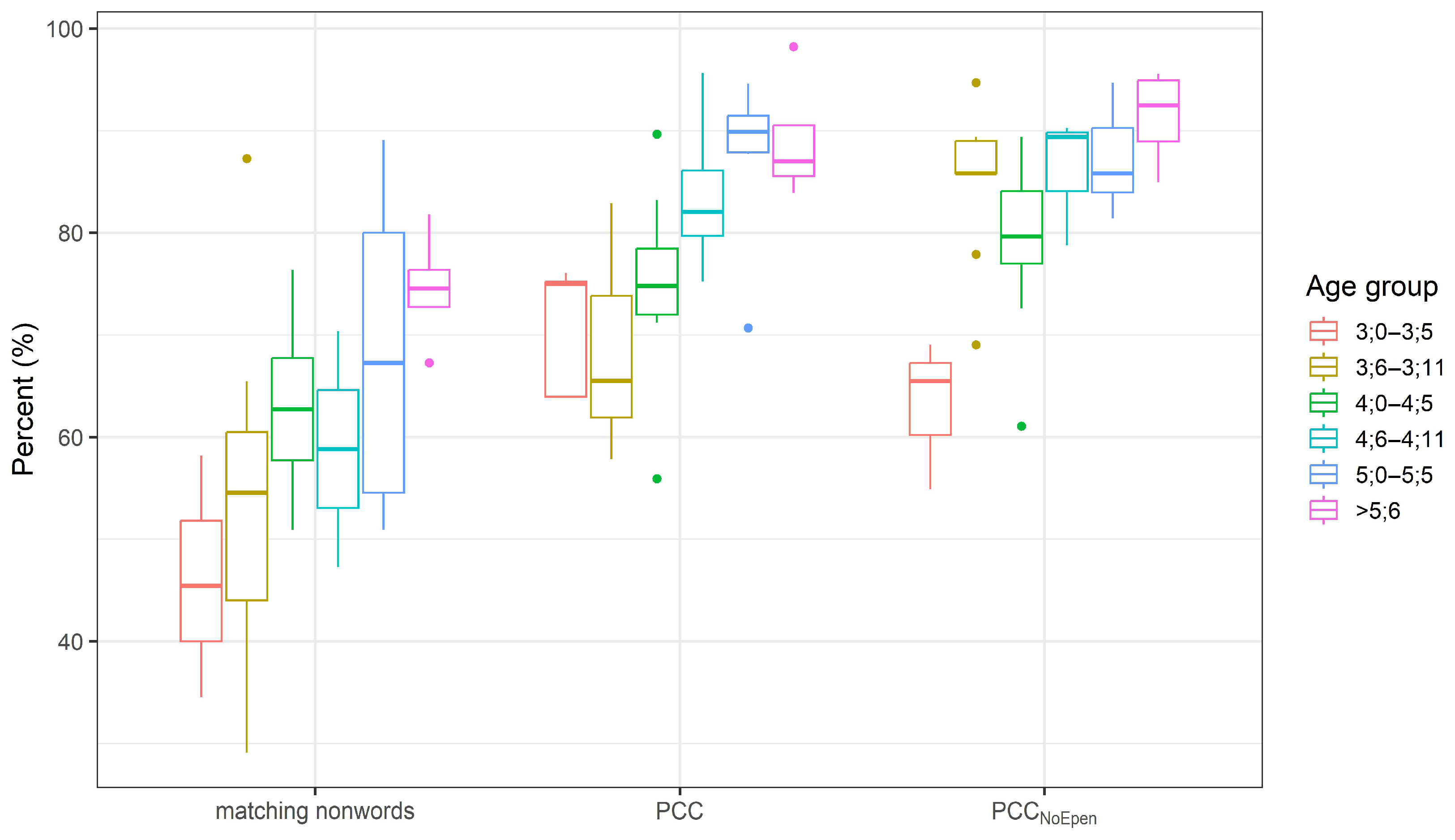
- Percent Consonants Correct (PCC), Percent Consonants Correct without epenthesis (PCCNoEpen), and number of deleted, substituted, and epenthesized phones; allophones, which had been marked as ‘distorted’ using PHON’s dedicated diacritic, were considered correct in the query setup window, while all other diacritics were ignored.
- Percent word match, i.e., the amount of nonwords produced that match the adult target; vowel quality, as well as all the diacritics, was not considered.
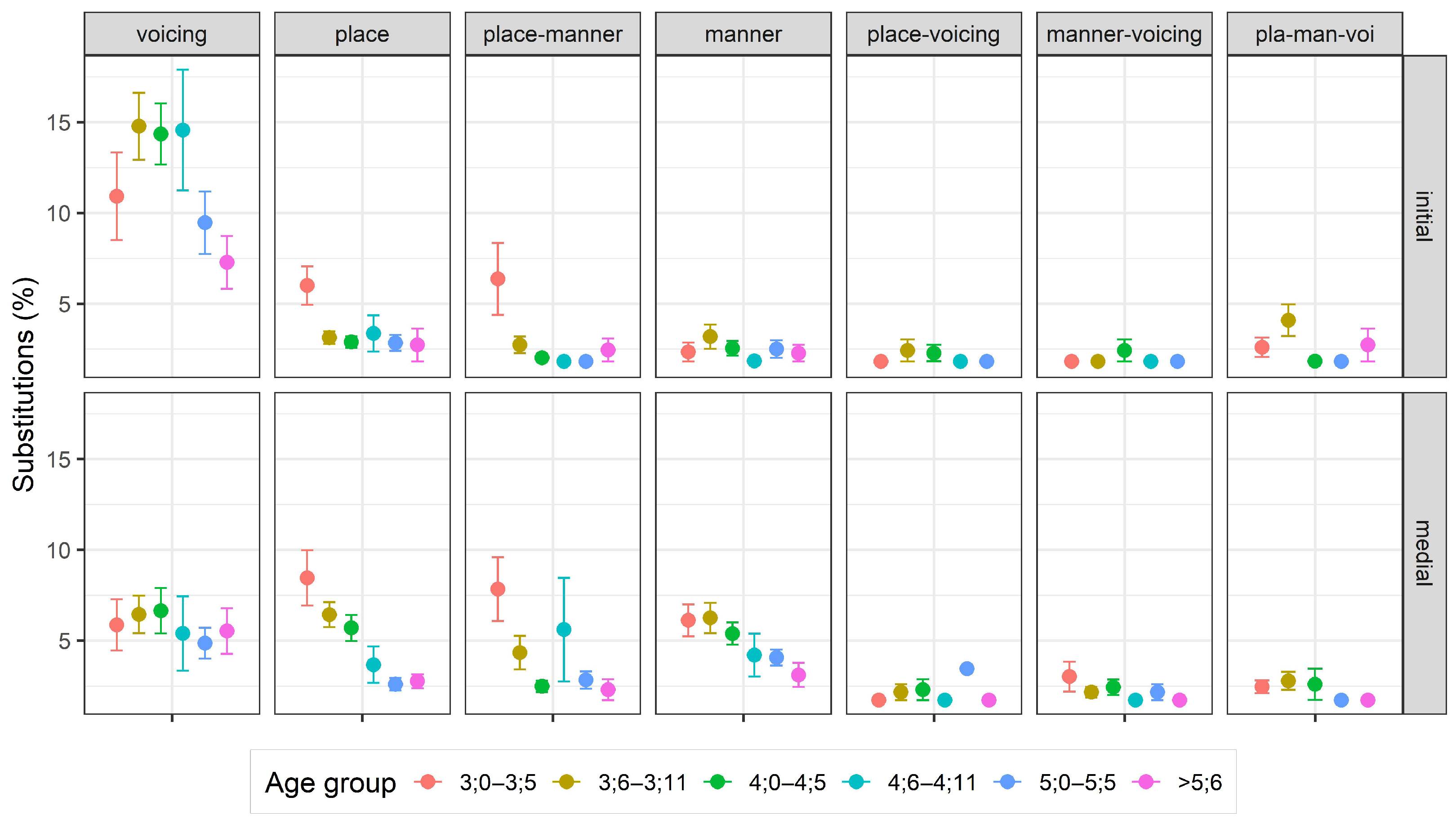
- Phone similarity, which “measures how similar two phones or strings of phones are within a target-actual aligned pair based on the number of descriptive phonological matchings divided by the maximal number of potential matches” (i.e., phone similarity (%) = nr. of matched features ÷ max[nr. of target features, nr. of actual features] × 100).6 This analysis allowed us to derive a featural categorization of all the consonants’ substitutions in terms of changes in manner, place, and voicing (along with possible combinations of these three terms), as well as correct productions without epentheses (i.e., PCCNoEpen)7 and deletions. For this analysis, substitutions are computed for each child with reference to the total amount of IPA targets, which corresponds to 113 for a complete NWR test session. Henceforth, we will use the term ‘featural analysis’ to account for this type of substitution categorization.
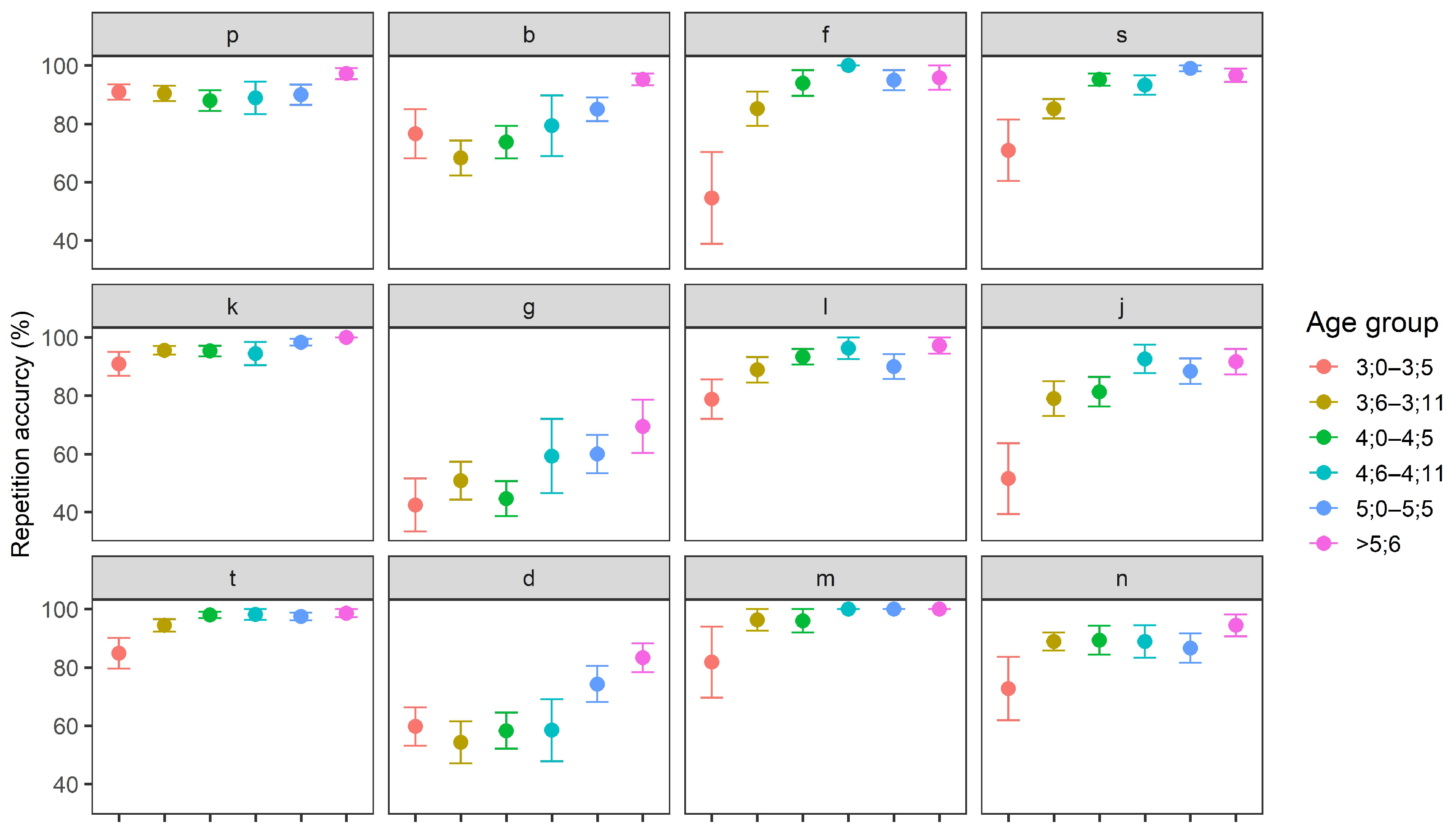
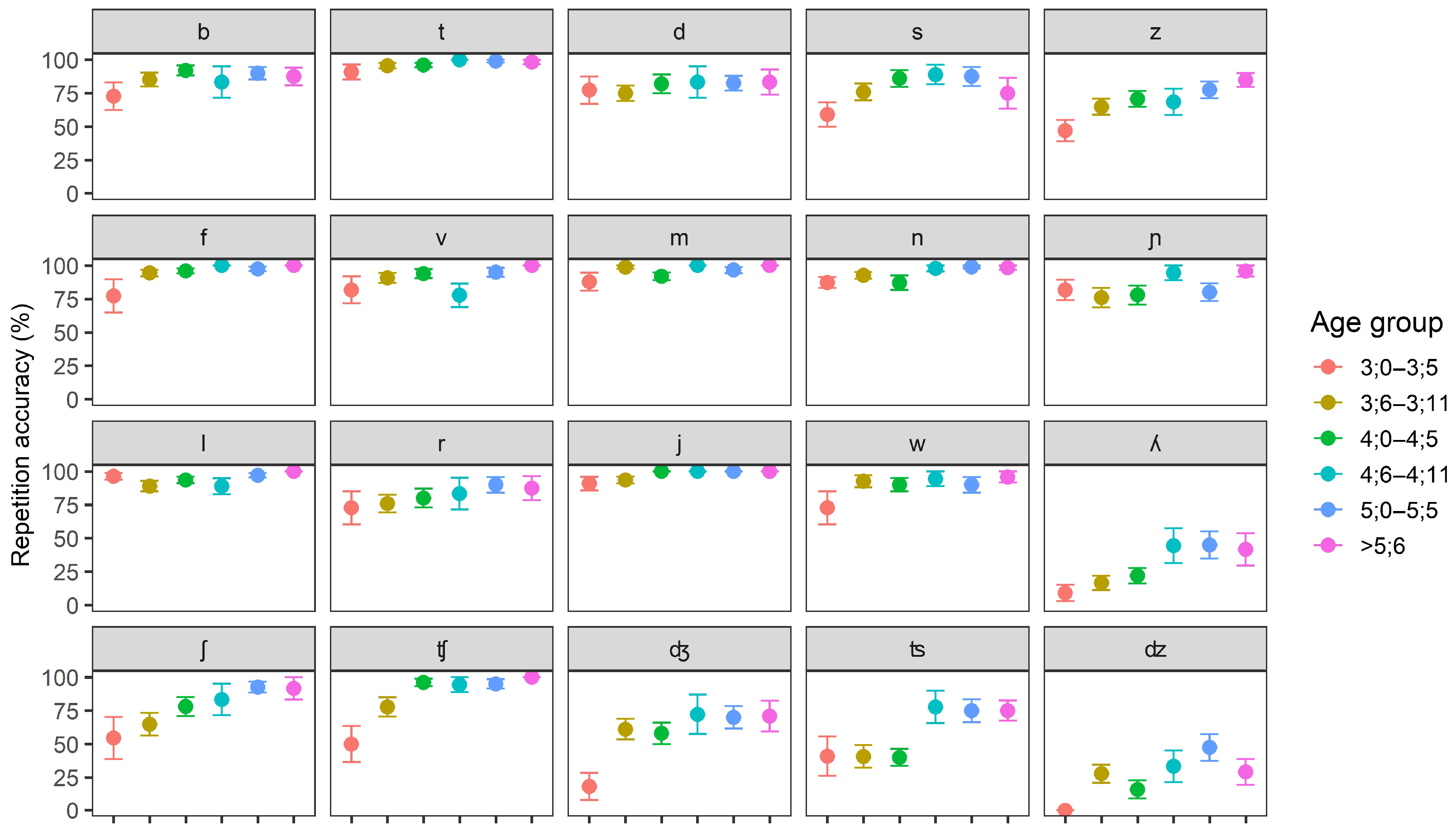
- Repetition accuracy, in order to verify the children’s ability to correctly repeat the target consonants proposed with the nonwords. The repetition accuracy for each IPA target (consonant) was computed separately for each participant, consonant, and word position (word-initial or word-medial). Specifically, for each participant and position, the repetition accuracy for each consonant was computed as the number of times that the consonant was correctly produced divided by the number of times the consonant was proposed in the NWR task, multiplied by 100, in order to account for unequal numbers of consonants in each position, thus mitigating potential biases due to unbalanced distributions. Finally, group-level means and standard errors were derived from these participant-level percentages to reflect individual variability and differences.
- Phonological processes, in order to account for the children’s behavior in modifying either (1) the phonological system or (2) the phonotactic structure (Ingram, 1976; Grunwell, 1987; Zanobini et al., 2012; Bernthal et al., 2017). Phonological processes affecting the phonological system include devoicing, voicing, fricative stopping, fricativization, lateralization, delateralization, liquid gliding, affrication, deaffrication, backing, and fronting. Phonological processes affecting the phonotactic structure include vowel epenthesis, vowel deletion, consonant epenthesis (including consonant lengthening, which was also searched separately), and consonant deletion (including degemination, which was also searched separately). These phonological processes were retrieved for each child through PHON’s ‘analysis composer’ function by means of specific queries and with reference to (a) the consonant’s position (word-initial, word-medial, and word-final) and (b) the number of targets that could potentially be affected by a certain process in the given position (a condition that makes the denominator change for each type of process; see Table A5 in Appendix B for further details).
2.8. Analysis of the Same–Different Responses from the NWD Task
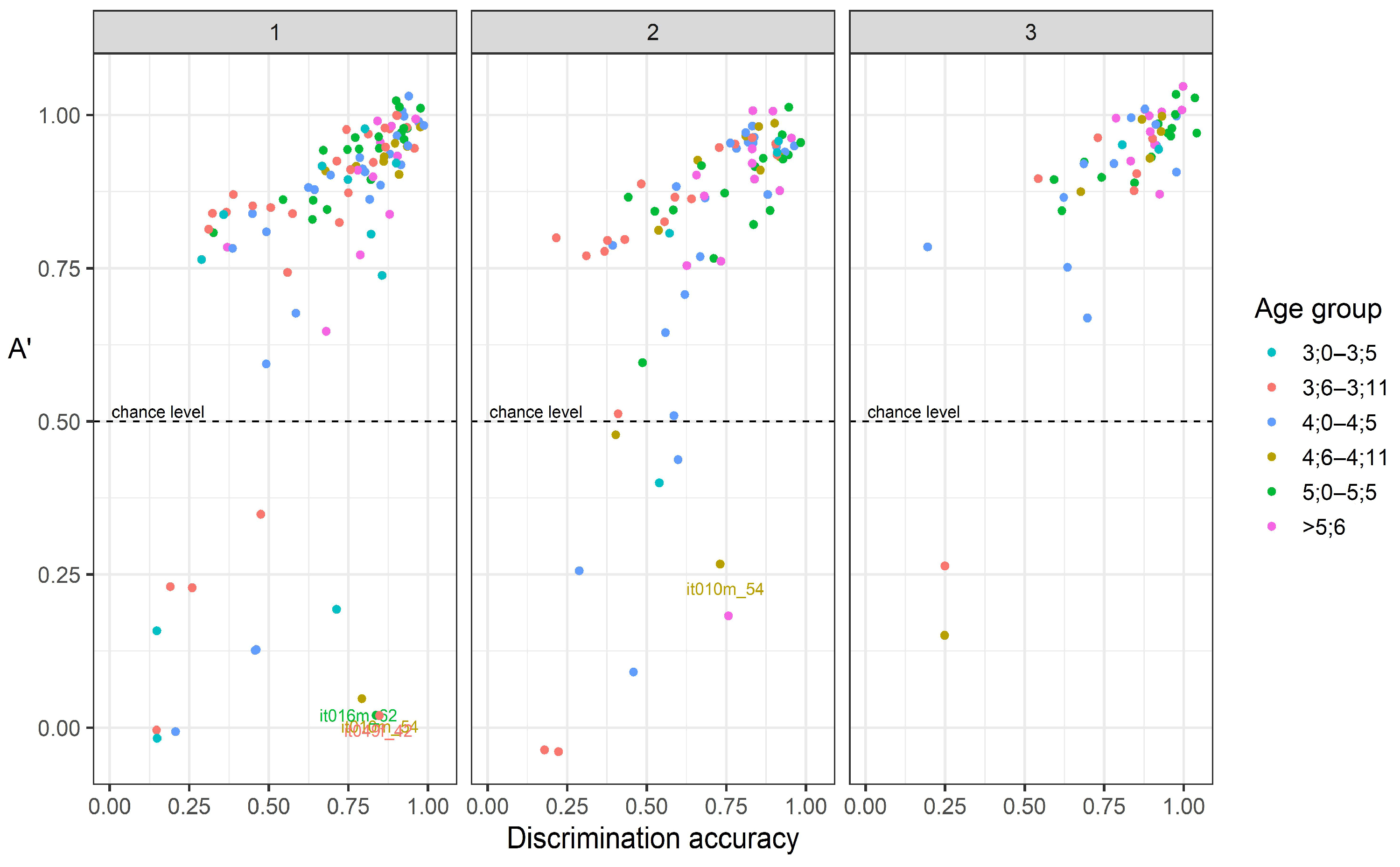
- A-prime (or A′)—a non-parametric index of discrimination performance (similar to d-prime), which allows a correction for response bias. It measures the sensitivity of a participant to correctly discriminate the test items in a task.
- d-prime (or d′)—a measure that provides an assessment of a participant’s performance while accounting for the listener’s response bias (i.e., how much the subject is responding based on the differences in the test items versus using a response strategy that does not mirror the test items’ differences, e.g., a participant who may prefer ‘same’ responses to ‘different’ responses, or vice versa).
- Hit, if a different target test pair was correctly identified by the child as being different.
- Miss, if a different target test pair was identified by the child as being same.
- False alarm, if a same distractor test pair was identified by the child as being different.
- Correct rejection, if a same distractor test pair was identified by the child as being same.
2.9. Statistical Analyses
3. Results
3.1. NWR Results
3.1.1. Repetition Accuracy
3.1.2. Featural Analysis
3.1.3. Phonological Processes Affecting the Phonological System
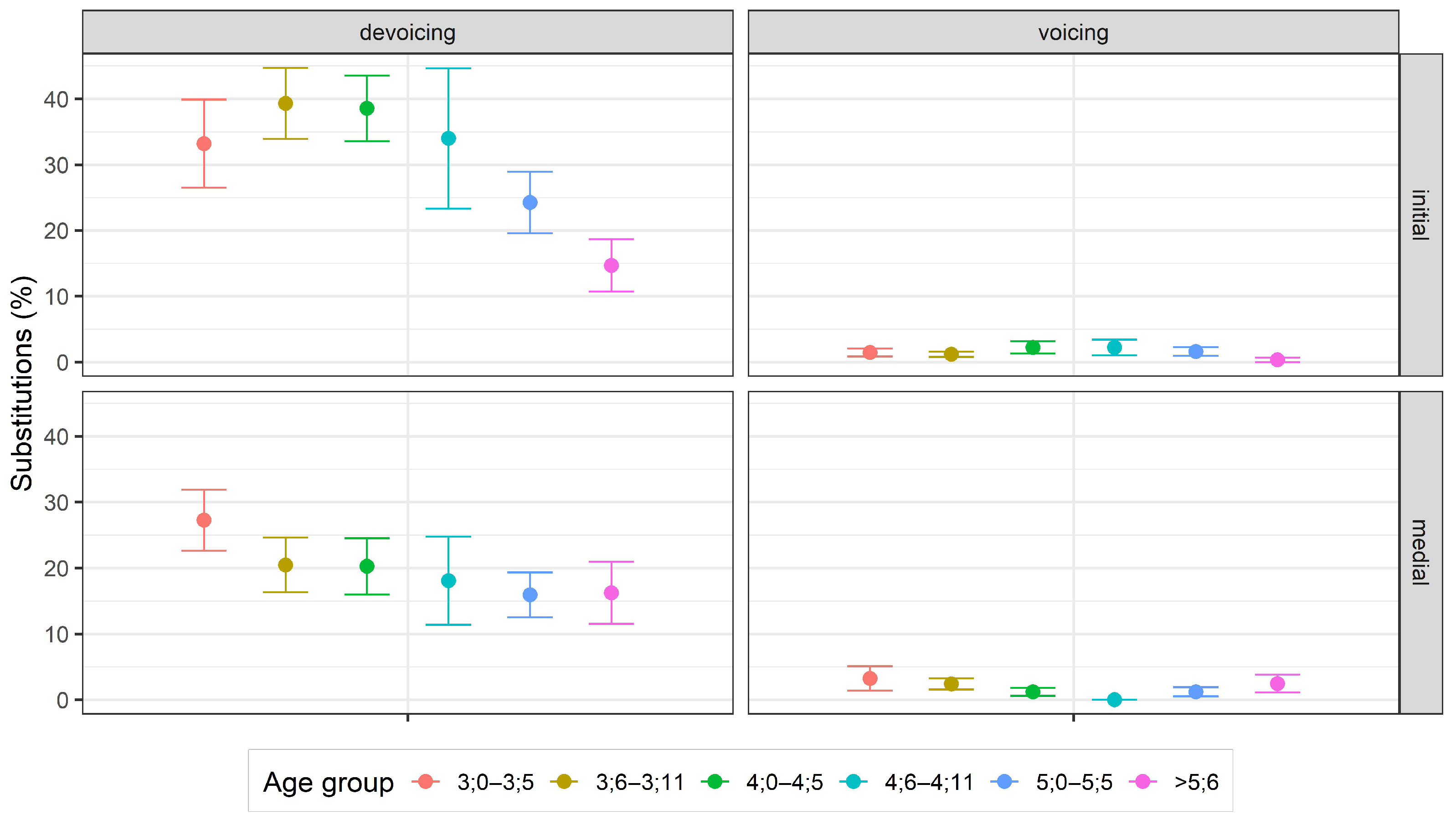
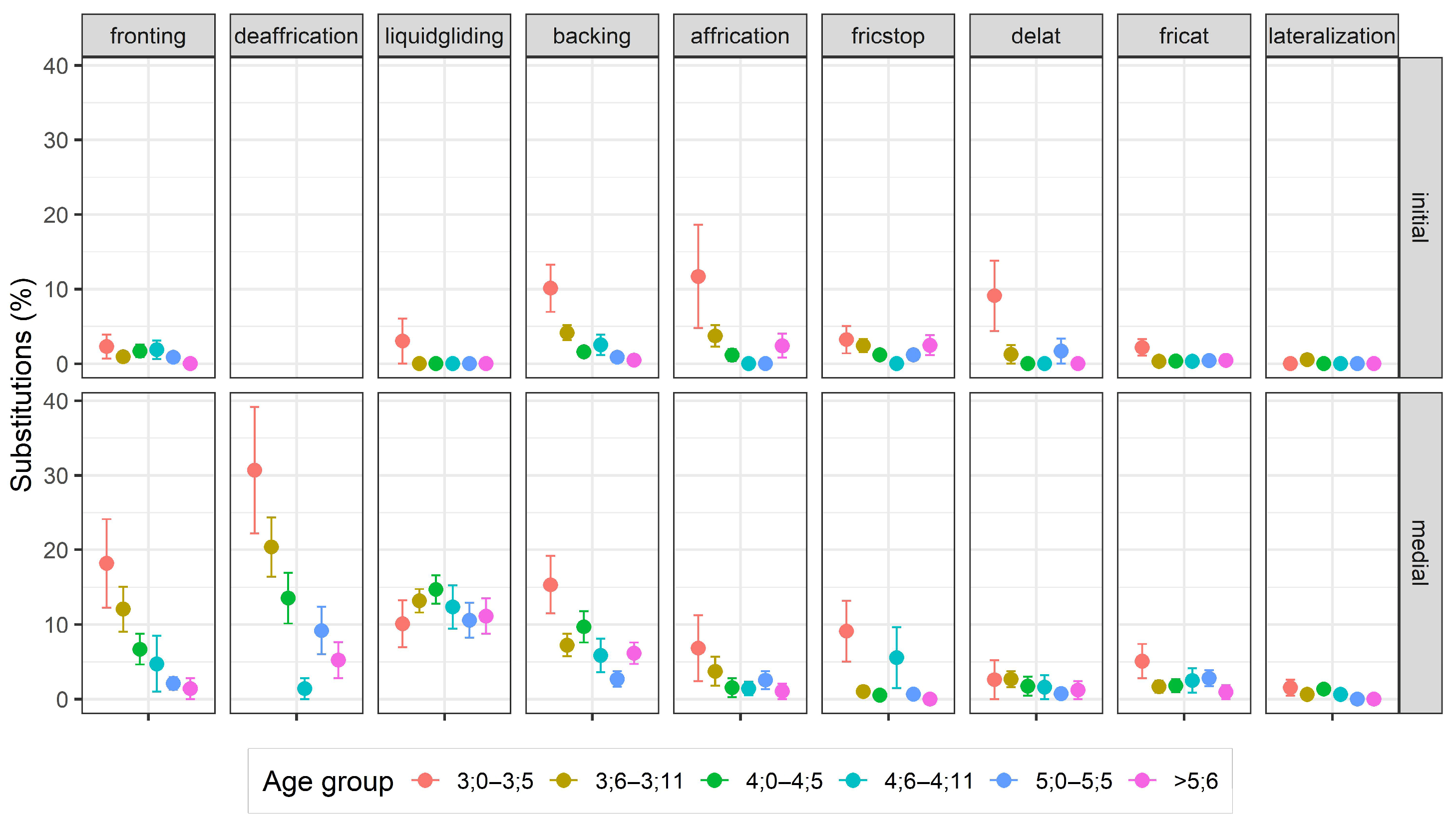
- Backing processes, which show great variability across age groups (overall mean = 7.55%, min = 0%, max = 42.11%, sd = 8.95%) and are negatively but not significantly correlated with age (rho = −0.27, p = n.s.).
- Fronting processes, which show a clear decrease as age increases: from a mean of 18.18% in the 3;0–3;5 age group (min = 0%, max = 50.00%, sd = 19.66%) to a mean of 1.39% in the >5;6 age group (min = 0%, max = 16.67%, sd = 4.81%). This trend is confirmed by a negative and significant association with age (rho = −0.37, p < 0.003).
3.1.4. Phonological Processes Affecting the Phonotactic Structure
3.2. NWD Results
3.3. NWD and NWR Comparison
4. Discussion
5. Conclusions
Author Contributions
Funding
Institutional Review Board Statement
Informed Consent Statement
Data Availability Statement
Acknowledgments
Conflicts of Interest
Appendix A
- Geminate (i.e., [+long] consonants are transcribed by reduplicating the phone symbol (e.g., [ˈbitti]) instead of using the chrono symbol (e.g., [ˈbitːi]). This was needed in order to be able to retrieve the degemination processes when importing the transcribed data into PHON. Additionally, geminate consonants were kept in the same TextGrid’s interval without splitting the phones apart: thus, in the case of perceived degemination, only one symbol was transcribed on the actual phones (and IPA) tier. Conversely, since intrinsic geminates do not give rise to phonological contrasts between singleton and geminated consonants in word-medial position, they were transcribed as singletons followed by the chrono symbol. Ambiguous segments not perceived as geminated in word-medial position were transcribed as singleton consonants. During the analysis of the transcriptions in PHON, this strategy allowed us to keep degemination processes separate from ambiguous intrinsic geminates: as a consequence, the first ones were considered errors (thus, analyzed broadly as consonant deletion processes or, more specifically, degemination processes resulting from geminate to singleton substitutions) and the second ones as allophonic and accepted realizations of intrinsic geminates (the diacritic was discarded in the analyses);
- Devoiced consonants and devoicing errors are marked using the homorganic voiceless symbol. In case devoicing was present due to the absence of vocal fold activity (e.g., whispered production), the corresponding diacritic (e.g., [ d̥ ]) was used instead; the same rule was established for whispered vowels (e.g., [ ḁ ]).
- Slightly interdental consonants are transcribed with a diacritic for advanced position, like in [ s̟ ].
- In general, diacritics for breathiness and creakiness are used when the phenomenon affects at least 50% of the segment’s duration. For word endings, if a phenomenon is not present in at least 50% of the last vowel, it is not even annotated in the voice quality tier (e.g., glottalized vowel at the very end, creakiness, etc.).
- If the child produced a sound between two sounds (e.g., [ v ] vs [ β ]) and no agreement could be found among the transcribers, the sound belonging to the Italian phonological system was preferred (e.g., [ v ]). It was also agreed that the chosen symbol could be further marked and modified with the use of specific diacritics in order not to penalize the child for slightly deviant productions with reference to the target nonword; examples include the symbol for weak articulation (e.g., [ m͉ ]), lowered (e.g., [ d̞ ]) or retracted (e.g., [ d̠ ]) phones.
- In case of multiple repetitions of the same item, only one was retained for the analyses, while the others were marked on the notes tier with the tag ‘exclude’.
- All cases of ambiguity or doubt for a given segment were marked on the notes tier with the label ‘check’ and were later recovered and discussed by two of the authors (V.G. and M.P.) until agreement was reached.
Appendix B

| Testing Block ID | Trial | Stimulus (Orthography) | Stimulus (IPA) | Stimulus (SAMPA) |
|---|---|---|---|---|
| 1 | 1 | tazi | /ˈtaʣːi/ | 090_tadzi |
| 2 | basa | /ˈbaza/ | 004_baza | |
| 3 | paiu | /ˈpaju/ | 069_paju | |
| 4 | tala | /ˈtala/ | 092_tala | |
| 5 | chila | /ˈkila/ | 046_kila | |
| 6 | pima | /ˈpima/ | 071_pima | |
| 7 | dafi | /ˈdafi/ | 012_dafi | |
| 8 | gaia | /ˈgaja/ | 030_gaja | |
| 9 | gana | /ˈgana/ | 031_gana | |
| 10 | ghisi | /ˈgizi/ | 034_gizi | |
| 11 | divi | /ˈdivi/ | 019_divi | |
| 12 | daza | /ˈdaʣːa/ | 010_dadza | |
| 13 | caza | /ˈkaʦːa/ | 044_katsa | |
| 14 | digi | /ˈdiʤi/ | 018_didZi | |
| 15 | bisi | /ˈbizi/ | 009_bizi | |
| 16 | caia | /ˈkaja/ | 041_kaja | |
| 17 | bagia | /ˈbaʤa/ | 002_badZa | |
| 18 | bina | /ˈbina/ | 006_bina | |
| 19 | chira | /ˈkira/ | 048_kira | |
| 20 | pafa | /ˈpafa/ | 068_pafa | |
| 21 | piba | /ˈpiba/ | 070_piba | |
| 22 | ghina | /ˈgina/ | 033_gina | |
| 23 | tisa | /ˈtisa/ | 097_tisa | |
| 24 | tigna | /ˈtiɲːa/ | 095_tiJa | |
| 2 | 1 | fisci | /ˈfiʃːi/ | 028_fiSi |
| 2 | sagliu | /ˈsaʎːu/ | 077_saLu | |
| 3 | lali | /ˈlali/ | 050_lali | |
| 4 | naua | /ˈnawa/ | 061_nawa | |
| 5 | liva | /ˈliva/ | 053_liva | |
| 6 | signi | /ˈsiɲːi/ | 086_siJi | |
| 7 | miscia | /ˈmiʃːa/ | 057_miSa | |
| 8 | lari | /ˈlari/ | 051_lari | |
| 9 | naglia | /ˈnaʎːa/ | 062_naLa | |
| 10 | iuzi | /ˈjuʦːi/ | 040_jutsi | |
| 11 | fisi | /ˈfisi/ | 027_fisi | |
| 12 | sicia | /ˈsiʧa/ | 088_sitSa | |
| 13 | iaui | /ˈjawi/ | 038_jawi | |
| 14 | sini | /ˈsini/ | 085_sini | |
| 15 | daffi | /ˈdaffi/ | 011_daffi | |
| 16 | ialli | /ˈjalli/ | 037_jalli | |
| 17 | bitti | /ˈbitti/ | 008_bitti | |
| 18 | simi | /ˈsimi/ | 083_simi | |
| 19 | nici | /ˈniʧi/ | 066_nitSi | |
| 3 | 1 | biti | /ˈbiti/ | 007_biti |
| 2 | disi | /ˈdizi/ | 020_dizi | |
| 3 | padi | /ˈpadi/ | 067_padi | |
| 4 | piti | /ˈpiti/ | 072_piti | |
| 5 | cata | /ˈkata/ | 043_kata | |
| 6 | baiu | /ˈbaju/ | 003_baju | |
| 7 | tasi | /ˈtazi/ | 093_tazi | |
| 8 | dasa | /ˈdaza/ | 016_daza | |
| 9 | gada | /ˈgada/ | 029_gada | |
| 10 | ghiba | /ˈgiba/ | 032_giba | |
| 11 | tina | /ˈtina/ | 094_tina | |
| 12 | chima | /ˈkima/ | 047_kima |
| Phoneme | Word-Initial | Word-Medial |
|---|---|---|
| p 1 | 6 | - |
| b | 7 | 2 |
| t | 6 | 3 |
| d | 7 | 2 |
| k | 6 | - |
| g 1 | 6 | - |
| f | 2 | 2 |
| v 1 | - | 2 |
| m | 1 | 3 |
| n | 3 | 5 |
| ɲ 1 | - | 2 |
| r 1 | - | 2 |
| l | 3 | 3 |
| ʎ 1 | - | 2 |
| j | 3 | 4 |
| w 1 | - | 2 |
| s | 5 | 2 |
| z | - | 6 |
| ʃ 1 | - | 2 |
| ʧ 1 | - | 2 |
| ʤ 1 | - | 2 |
| ʦ 1 | - | 2 |
| ʣ 1 | - | 2 |
| ff 2 | - | 1 |
| ll 2 | - | 1 |
| tt 2 | - | 1 |
| Testing Block ID | Trial | Stimuli Pairs (SAMPA) | Contrast (IPA) | Contrast Position | Contrast Diff. (# Acoustic Features) | Contrast Diff. (Features) |
|---|---|---|---|---|---|---|
| 1 | 1 | 011_daffi–012_dafi | ff–f | m | 1 | length |
| 2 | 017_didi–017_didi | control | - | - | control | |
| 3 | 017_didi–018_didZi | d–ʤ | m | 3 | place_manner | |
| 4 | 024_fafa–068_pafa | f–p | i | 2 | place_manner | |
| 5 | 029_gada–001_bada | g–b | i | 2 | place | |
| 6 | 036_jali–038_jawi | l–w | m | 4 | place_manner | |
| 7 | 044_katsa–043_kata | ʦ–t | m | 1 | manner | |
| 8 | 046_kila–048_kira | l–r | m | 1 | manner | |
| 9 | 053_liva–104_liza | v–z | m | 2 | place | |
| 10 | 056_misa–056_misa | control | - | - | control | |
| 11 | 057_miSa–056_misa | ʃ–s | m | 2 | place | |
| 12 | 058_nabi–058_nabi | control | - | - | control | |
| 13 | 060_nala–062_naLa | l–ʎ | m | 2 | place | |
| 14 | 074_sadza–078_saza | ʣ–z | m | 1 | manner | |
| 15 | 087_sita–088_sitSa | t–ʧ | m | 3 | place_manner | |
| 16 | 091_taka–014_daka | t–d | i | 1 | voicing | |
| 17 | 094_tina–095_tiJa | n–ɲ | m | 3 | place | |
| 2 | 1 | 005_biba–005_biba | control | - | - | control |
| 2 | 012_dafi–013_dZafi | d–ʤ | i | 3 | place_manner | |
| 3 | 021_dzaki–015_daki | ʣ–d | i | 1 | manner | |
| 4 | 026_fapa–024_fafa | p–f | m | 2 | place_manner | |
| 5 | 034_gizi–009_bizi | g–b | i | 2 | place | |
| 6 | 035_jabi–073_rabi | j–r | i | 3 | place_manner | |
| 7 | 039_jusi–039_jusi | control | - | - | control | |
| 8 | 047_kima–047_kima | control | - | - | control | |
| 9 | 050_lali–101_wali | l–w | i | 4 | place_manner | |
| 10 | 058_nabi–059_Jabi | n–ɲ | i | 3 | place | |
| 11 | 079_siba–099_tsiba | s–ʦ | i | 1 | manner | |
| 12 | 081_sika–082_Sika | s–ʃ | i | 2 | place | |
| 13 | 087_sita–080_sida | t–d | m | 1 | voicing | |
| 14 | 096_tSini–085_sini | ʧ–s | i | 3 | place_manner | |
| 15 | 097_tisa–098_tissa | s–ss | m | 1 | length | |
| 16 | 102_Laki–049_laki | ʎ–l | i | 2 | place | |
| 17 | 103_bama–100_vama | b–v | i | 2 | place_manner | |
| 3 | 1 | 004_baza–002_badZa | z–ʤ | m | 3 | place_manner |
| 2 | 007_biti–008_bitti | t–tt | m | 1 | length | |
| 3 | 020_dizi–019_divi | z–v | m | 2 | place | |
| 4 | 024_fafa–024_fafa | control | - | - | control | |
| 5 | 028_fiSi–027_fisi | ʃ–s | m | 2 | place | |
| 6 | 033_gina–006_bina | g–b | i | 2 | place | |
| 7 | 054_maja–055_mara | j–r | m | 3 | place_manner | |
| 8 | 060_nala–061_nawa | l–w | m | 4 | place_manner | |
| 9 | 065_nisi–066_nitSi | s–ʧ | m | 3 | place_manner | |
| 10 | 071_pima–047_kima | p–k | i | 2 | place | |
| 11 | 075_saju–077_saLu | j–ʎ | m | 4 | place | |
| 12 | 078_saza–076_sasa | z–s | m | 1 | voicing | |
| 13 | 079_siba–079_siba | control | - | - | control | |
| 14 | 085_sini–086_siJi | n–ɲ | m | 3 | place | |
| 15 | 089_sitsa–087_sita | ʦ–t | m | 1 | manner | |
| 16 | 090_tadzi–093_tazi | ʣ–z | m | 2 | manner | |
| 17 | 092_tala–092_tala | control | - | - | control |
| Age Group | n | Mean | Min | Max | sd |
|---|---|---|---|---|---|
| 3;0–3;5 | 3 | 77.8 | 72.6 | 82.8 | 5.1 |
| 3;6–3;11 | 5 | 82.3 | 69.8 | 91.1 | 10.1 |
| 4;0–4;5 | 4 | 81.3 | 73.8 | 87.1 | 5.9 |
| 4;6–4;11 | 4 | 89 | 87.1 | 92.2 | 2.3 |
| 5;0–5;5 | 3 | 88.8 | 88.2 | 89.1 | 0.5 |
| >5;6 | 2 | 85.4 | 82.9 | 87.9 | 3.6 |
| Type of Process | Phonological Process | Word-Initial Position | Word-Medial Position |
|---|---|---|---|
| Sound substitution | affrication | 7 | 16 |
| backing | 18 | 19 | |
| deaffrication | - 1 | 8 | |
| delateralization | 3 | 7 | |
| devoicing | 20 | 16 | |
| fricative stopping | 17 | 16 | |
| fricativization | 38 | 9 | |
| fronting | 12 | 12 | |
| lateralization | 7 | 18 | |
| liquid gliding | 3 | 9 | |
| voicing | 25 | 17 | |
| Modification of phonotactic structure | degemination | - | 3 |
| gemination | - | 52 | |
| consonant deletion | 55 | 58 | |
| consonant epenthesis | 113 2 | ||
| vowel deletion | 110 3 | ||
| vowel epenthesis | 110 2 | ||
| Age Group | Variable | Min | Max | Mean | Median | sd | Q1 | Q3 | IQR |
|---|---|---|---|---|---|---|---|---|---|
| 3;0–3;5 | matching nonwords | 29.09 | 58.18 | 46.45 | 45.45 | 10.07 | 39.09 | 55.45 | 16.36 |
| PCC | 53.45 | 76.03 | 66.85 | 66.09 | 7.66 | 62.52 | 75.10 | 12.59 | |
| PCCNoEpen | 54.87 | 81.42 | 70.24 | 69.03 | 7.68 | 66.38 | 77.44 | 11.06 | |
| substituted | 17.36 | 39.66 | 27.39 | 29.06 | 6.50 | 21.46 | 30.77 | 9.31 | |
| deleted | 0.00 | 4.31 | 0.93 | 0.84 | 1.19 | 0.40 | 0.85 | 0.45 | |
| epenthesized | 1.74 | 10.32 | 4.83 | 3.42 | 2.62 | 3.00 | 6.61 | 3.61 | |
| 3;6–3;11 | matching nonwords | 29.09 | 87.27 | 55.31 | 56.36 | 15.63 | 42.20 | 66.36 | 24.16 |
| PCC | 52.07 | 92.24 | 74.66 | 75.61 | 10.05 | 68.56 | 81.27 | 12.71 | |
| PCCNoEpen | 55.75 | 94.69 | 78.33 | 78.76 | 9.90 | 71.68 | 85.84 | 14.16 | |
| substituted | 4.31 | 39.67 | 19.74 | 19.69 | 8.76 | 13.39 | 23.69 | 10.30 | |
| deleted | 0.00 | 6.96 | 0.86 | 0.00 | 1.46 | 0.00 | 0.98 | 0.98 | |
| epenthesized | 0.00 | 11.02 | 4.75 | 5.04 | 2.69 | 2.59 | 6.61 | 4.02 | |
| 4;0–4;5 | matching nonwords | 33.33 | 80.00 | 59.01 | 60.00 | 11.61 | 50.91 | 65.45 | 14.54 |
| PCC | 55.93 | 89.66 | 77.09 | 78.07 | 8.10 | 72.50 | 81.36 | 8.86 | |
| PCCNoEpen | 59.46 | 92.04 | 80.75 | 80.53 | 8.07 | 78.76 | 85.84 | 7.08 | |
| substituted | 7.76 | 38.14 | 17.93 | 17.21 | 7.65 | 13.04 | 20.18 | 7.14 | |
| deleted | 0.00 | 2.40 | 0.44 | 0.00 | 0.64 | 0.00 | 0.86 | 0.86 | |
| epenthesized | 0.88 | 11.72 | 4.55 | 4.24 | 2.84 | 2.59 | 5.83 | 3.24 | |
| 4;6–4;11 | matching nonwords | 47.27 | 90.91 | 67.21 | 70.37 | 15.39 | 52.73 | 78.18 | 25.45 |
| PCC | 68.85 | 95.65 | 81.99 | 82.91 | 8.63 | 75.22 | 86.32 | 11.10 | |
| PCCNoEpen | 74.34 | 97.35 | 84.74 | 85.84 | 7.54 | 78.76 | 89.38 | 10.62 | |
| substituted | 2.61 | 23.77 | 14.47 | 13.68 | 6.82 | 10.26 | 19.51 | 9.25 | |
| deleted | 0.00 | 1.77 | 0.20 | 0.00 | 0.59 | 0.00 | 0.00 | 0.00 | |
| epenthesized | 0.00 | 8.13 | 3.35 | 3.42 | 2.84 | 1.74 | 3.42 | 1.68 | |
| 5;0–5;5 | matching nonwords | 49.09 | 89.09 | 71.69 | 73.63 | 13.19 | 60.00 | 82.27 | 22.27 |
| PCC | 70.59 | 94.59 | 83.94 | 85.35 | 7.97 | 78.05 | 91.34 | 13.29 | |
| PCCNoEpen | 72.57 | 94.69 | 87.33 | 89.38 | 7.17 | 82.08 | 94.00 | 11.92 | |
| substituted | 4.50 | 25.00 | 11.64 | 9.88 | 6.51 | 5.69 | 15.90 | 10.21 | |
| deleted | 0.00 | 1.72 | 0.47 | 0.00 | 0.58 | 0.00 | 0.85 | 0.85 | |
| epenthesized | 0.00 | 8.26 | 3.95 | 3.83 | 2.24 | 2.38 | 5.83 | 3.45 | |
| >5;6 | matching nonwords | 67.27 | 96.36 | 76.01 | 74.55 | 8.24 | 70.31 | 77.72 | 7.41 |
| PCC | 81.74 | 98.23 | 87.58 | 87.93 | 4.18 | 84.84 | 88.47 | 3.63 | |
| PCCNoEpen | 83.19 | 98.23 | 90.48 | 90.27 | 4.55 | 87.39 | 94.61 | 7.22 | |
| substituted | 1.77 | 15.65 | 9.05 | 9.48 | 4.44 | 4.95 | 12.13 | 7.18 | |
| deleted | 0.00 | 1.72 | 0.22 | 0.00 | 0.54 | 0.00 | 0.00 | 0.00 | |
| epenthesized | 0.00 | 9.02 | 3.16 | 2.59 | 2.69 | 1.52 | 4.44 | 2.92 |
| 1 | 2 | 3 | 4 | 5 | 6 | 7 | 8 | |
|---|---|---|---|---|---|---|---|---|
| age | ||||||||
| voicing | −0.203 | |||||||
| place | −0.534 *** | 0.043 | ||||||
| place-manner | −0.473 *** | 0.125 | 0.499 *** | |||||
| manner | −0.353 *** | 0.002 | 0.156 | 0.232 * | ||||
| place-manner-voicing | −0.343 *** | 0.238 * | 0.256 * | 0.391 *** | 0.264 * | |||
| deletion | −0.259 * | 0.157 | 0.166 | 0.385 *** | 0.309 ** | 0.397 *** | ||
| manner-voicing | −0.251 * | 0.508 *** | 0.087 | 0.178 | 0.148 | 0.363 *** | 0.298 ** | |
| place-voicing | −0.349 *** | 0.272 ** | 0.347 *** | 0.383 *** | 0.085 | 0.503 *** | 0.274 ** | 0.378 *** |
| 1 | 2 | 3 | 4 | 5 | 6 | 7 | 8 | 9 | 10 | 11 | 12 | 13 | |
|---|---|---|---|---|---|---|---|---|---|---|---|---|---|
| age | |||||||||||||
| affrication | −0.225 | ||||||||||||
| backing | −0.400 ** | 0.369 *** | |||||||||||
| consonant deletion | −0.178 | 0.225 | 0.287 * | ||||||||||
| consonant epenthesis | −0.222 | −0.142 | 0.079 | −0.120 | |||||||||
| delateralization | −0.183 | 0.061 | 0.045 | 0.152 | 0.141 | ||||||||
| devoicing | −0.290 * | 0.071 | −0.051 | 0.355 ** | −0.136 | 0.002 | |||||||
| fricative stopping | −0.101 | −0.06 | 0.134 | −0.031 | −0.012 | 0.113 | 0.076 | ||||||
| fricativization | −0.042 | 0.021 | 0.084 | 0.339 ** | −0.063 | 0.183 | 0.069 | −0.112 | |||||
| fronting | −0.097 | 0.045 | 0.143 | 0.226 | 0.015 | −0.081 | 0.100 | −0.180 | −0.035 | ||||
| lateralization | −0.072 | −0.037 | 0.113 | −0.058 | 0.177 | −0.022 | −0.160 | −0.049 | −0.039 | −0.036 | |||
| liquidgliding | −0.153 | −0.037 | 0.188 | −0.058 | 0.188 | 0.438 *** | −0.127 | 0.220 | 0.280 * | −0.036 | −0.010 | ||
| voicing | −0.075 | 0.027 | 0.196 | 0.303 * | 0.039 | 0.054 | −0.081 | 0.049 | 0.211 | 0.136 | −0.058 | 0.145 | |
| vowel epenthesis | −0.295 * | −0.13 | 0.193 | 0.129 | 0.175 | 0.063 | −0.019 | 0.093 | 0.159 | 0.189 | 0.298 * | 0.274 * | 0.135 |
| 1 | 2 | 3 | 4 | 5 | 6 | 7 | 8 | 9 | 10 | 11 | 12 | 13 | 14 | 15 | 16 | |
|---|---|---|---|---|---|---|---|---|---|---|---|---|---|---|---|---|
| age | ||||||||||||||||
| affrication | −0.189 | |||||||||||||||
| backing | −0.267 | 0.200 | ||||||||||||||
| consonant deletion | −0.200 | 0.042 | 0.009 | |||||||||||||
| consonant epenthesis | −0.257 | 0.027 | 0.232 | −0.056 | ||||||||||||
| deaffrication | −0.416 *** | 0.052 | 0.009 | 0.149 | 0.132 | |||||||||||
| degemination | −0.094 | −0.180 | −0.122 | 0.650 *** | −0.056 | 0.056 | ||||||||||
| delateralization | −0.097 | 0.036 | 0.192 | −0.117 | −0.011 | 0.036 | −0.124 | |||||||||
| devoicing | −0.143 | 0.219 | −0.033 | 0.079 | 0.152 | 0.087 | 0.094 | |||||||||
| fricative stopping | −0.222 | 0.080 | 0.272 | 0.236 | 0.059 | 0.092 | 0.102 | −0.126 | 0.062 | |||||||
| fricativization | −0.058 | 0.059 | −0.075 | −0.030 | −0.157 | 0.071 | 0.051 | 0.130 | 0.025 | 0.005 | ||||||
| fronting | −0.373 ** | 0.075 | 0.145 | 0.049 | 0.163 | 0.207 | 0.099 | 0.063 | 0.011 | 0.261 | −0.104 | |||||
| gemination | −0.008 | −0.083 | 0.148 | −0.165 | 0.661 *** | 0.012 | −0.100 | 0.139 | −0.049 | −0.120 | −0.224 | 0.001 | ||||
| lateralization | −0.200 | −0.020 | 0.308 * | 0.047 | 0.062 | −0.085 | −0.009 | −0.058 | −0.068 | 0.262 | −0.079 | 0.181 | 0.47 | |||
| liquid gliding | −0.001 | 0.090 | 0.065 | 0.180 | −0.100 | −0.073 | 0.250 | 0.302 * | 0.047 | 0.057 | −0.059 | 0.006 | 0.031 | −0.003 | ||
| voicing | −0.101 | 0.037 | 0.075 | 0.066 | 0.062 | 0.030 | −0.024 | −0.129 | 0.069 | −0.041 | −0.122 | 0.109 | 0.026 | 0.205 | −0.015 | |
| vowel epenthesis | −0.191 | 0.005 | 0.118 | 0.178 | 0.034 | 0.212 | 0.092 | −0.062 | 0.065 | 0.084 | 0.168 | 0.042 | −0.027 | −0.091 | 0.044 | 0.036 |
| Subject | Amount of Testing Blocks Completed | Unreliable Testing Block ID | A-Prime Score |
|---|---|---|---|
| it008f_46 | 1 | 1 | 0.00 |
| it010m_54 | 2 | 1 | 0.00 |
| it010m_54 | 2 | 2 | 0.23 |
| it016m_62 | 1 | 1 | 0.00 |
| it017f_46 | 3 | 3 | 0.22 |
| it023f_53 | 3 | 1 | 0.14 |
| it031m_49 | 2 | 2 | 0.47 |
| it032f_47 | 2 | 2 | 0.00 |
| it034f_42 | 1 | 1 | 0.23 |
| it035f_52 | 2 | 1 | 0.12 |
| it035f_52 | 2 | 2 | 0.30 |
| it039f_46 | 2 | 1 | 0.22 |
| it042m_48 | 1 | 1 | 0.00 |
| it047m_46 | 2 | 1 | 0.35 |
| it048m_49 | 2 | 2 | 0.12 |
| it049f_42 | 1 | 1 | 0.00 |
| it054m_56 | 3 | 3 | 0.19 |
| it062f_44 | 2 | 2 | 0.00 |
| it070f_49 | 2 | 2 | 0.47 |
| it073m_70 | 2 | 2 | 0.21 |
| it097m_40 | 1 | 1 | 0.00 |
| it107f_38 | 1 | 1 | 0.15 |
| it113m_38 | 1 | 1 | 0.21 |
| it122m_37 | 2 | 2 | 0.41 |
| Correct | |||
|---|---|---|---|
| Predictors | Log-Odds | CI | p |
| (Intercept) | −3.68 | −5.84–−1.51 | 0.001 |
| age | 0.06 | 0.03–0.10 | 0.001 |
| features [place] | 1.78 | 0.86–2.69 | <0.001 |
| features [place_manner] | 1.98 | 1.07–2.90 | <0.001 |
| features [voicing] | 0.77 | −0.59–2.13 | 0.267 |
| position [medial] | 1.05 | 0.37–1.73 | 0.002 |
| Random Effects | |||
| σ2 | 3.29 | ||
| τ00 id | 2.49 | ||
| τ00 stims | 0.93 | ||
| ICC | 0.51 | ||
| N id | 91 | ||
| N stims | 39 | ||
| Observations | 2665 | ||
| Marginal R2/Conditional R2 | 0.140/0.578 | ||
| Correct | |||
|---|---|---|---|
| Predictors | Log-Odds | CI | p |
| (Intercept) | −3.12 | −5.28–−0.95 | 0.005 |
| age | 0.06 | 0.03–0.10 | 0.001 |
| num features [2] | 1.09 | 0.14–2.04 | 0.024 |
| num features [3] | 1.67 | 0.66–2.68 | 0.001 |
| num features [4] | 1.12 | −0.24–2.48 | 0.106 |
| position [medial] | 0.81 | 0.07–1.56 | 0.033 |
| Random Effects | |||
| σ2 | 3.29 | ||
| τ00 id | 2.48 | ||
| τ00 stims | 1.15 | ||
| ICC | 0.52 | ||
| N id | 91 | ||
| N stims | 39 | ||
| Observations | 2665 | ||
| Marginal R2/Conditional R2 | 0.113/0.579 | ||
| 1 | The parental questionnaire investigated (a) the psycho-physical development and health status (e.g., birth and post-partum pathologies, health-related issues including otitis or ear infections, dentition problems, pacifier usage, etc.); (b) the linguistic development (e.g., pointing age, walking, first words age, etc.); (c) the household composition; and (d) parental personal and socio-economic-demographic information. |
| 2 | Items and syllables in the ˈCV.CV nonwords were not controlled for phonotactic probability, as at the time of study design (2010), no databases for Italian were available. Nevertheless, we acknowledge the subsequent work of Goslin et al. (2014), which provides detailed indices for single phones and single syllables (but not for their co-occurrences or position in the words). This limitation should be taken into account when drawing conclusions from the data presented here. |
| 3 | In many cases, it was not possible to test some target phonemes with others that differed for a smaller number of features because the contrasting phoneme was not present in one of the targeted mother tongue languages (for example, it was not possible to achieve the contrast in the stimuli pair between /ʧ/ and /ʃ/, between /ʧ/ and /ʦ/, or between /ʤ/ with /ʧ/ and /ʣ/). In these few cases, the closest phoneme with a higher number of features was chosen as contrast. |
| 4 | In AX testing designs, the number of “same” trials generally equals the number of “different” trials. However, after some preliminary piloting with younger children, and following McGuire’s suggestion (McGuire, 2010), we decided to reduce the number of “same” trials in each block in order to reduce both the task’s length and difficulty. |
| 5 | Similar cases where however very limited for both tests. |
| 6 | For additional information on how the phone similarity measure is computed, please refer to the online software manual: https://www.phon.ca/phon-manual/report/phones/phone_similarity_report.html?hl=similarity (accessed on 11 February 2024). This analysis was carried out on a derived copy of the corpus in which all diacritics have been removed (PHON’s analysis for phone similarity did not allow to exclude diacritics in the setup window); for example, IPA diacritics for “aspirated” and “voiceless”, in our case due to whispering, posed voicing issues that we did not want to consider as error; similarly, “lateral release” caused place errors, which we did not want to be classified as such and so on. Additionally, all rhotic sounds previously marked with the diacritic ’distorted’ to be accounted as allophonic realizations, due to the above limitation in PHON’s setup window, were replaced with a plain /r/ to avoid unwanted place or manner errors. |
| 7 | Consonant epenthesis is not captured in this analysis because the algorithm looks for all the IPA Target consonants to find a match in the IPA Actual; in the case of epenthesis, which is eventually annotated and present in the IPA Actual, no referent in the IPA Target is available. |
| 8 | “A value of d′ = 3 is close to perfect performance; a value of d′ = 0 is chance (“guessing”) performance.” (https://dictionary.apa.org/d-prime (accessed on 11 February 2024)). |
| 9 | A binomial family was chosen to fit the model because of the binary outcome of the responses in the NWD task (i.e., 0 and 1, where 1 represents the reference value for the dependent variable expressing success and indicating that the child correctly discriminated the stimuli in the proposed pair as being different, and 0 expresses failure to discriminate the pair). Control pairs were left out for this type of analysis, while length contrasts appearing only in word-medial position were analyzed with a separate model. |
| 10 | Even though this operation implied the loss of some information, it was necessary because of the characteristics of the features of the two tasks. In fact, for the NWR, the possible combinations between two or more features are derived from the substitutions produced by the children, whereas for the NWD, the set of features, as well as their combination, was determined by default by the contrasts included in the task. |
| 11 | Oral airflow leakage is an articulatory mechanism that developing or pathological subjects adopt in order to utter voiced plosive consonants in an isolated word-initial (or sentence-initial) position. Since voiced plosives require a sustained oscillation of the vocal folds starting before the articulation of the consonant itself, when the mouth is still closed (that is, they require a negative VOT), some subjects may need to slightly open the oral cavity in order to make the airflow pass from the trachea to the outside and make the vocal folds oscillate. They can do this either by lowering the velum, with the result of a nasal consonant epenthesis in word-initial position, or by opening their lips, with the result of a vowel epenthesis (generally the neutral sound [ ə ]) in word-initial position. In both cases, the listener’s perception of the insertions depends on their intensity and duration (see also Zmarich et al. (2021) for a quantitative analysis of atypical strategies to promote voicing in word-initial position used by a child recorded from 1;6 to 4;0 years of age). |
References
- Altvater-Mackensen, N., van der Feest, S. V., & Fikkert, P. (2014). Asymmetries in early word recognition: The case of stops and fricatives. Language Learning and Development, 10(2), 149–178. [Google Scholar] [CrossRef]
- Arjmandi, M. K., & Behroozmand, R. (2024). On the interplay between speech perception and production: Insights from research and theories. Frontiers in Neuroscience, 18, 1347614. [Google Scholar] [CrossRef] [PubMed]
- Baddeley, A., Gathercole, S., & Papagno, C. (1998). The phonological loop as a language learning device. Psychological Review, 105(1), 173–158. [Google Scholar] [CrossRef]
- Bates, D., Mächler, M., Bolker, B., & Walker, S. (2015). Fitting linear mixed-effects models usinglme4. Journal of Statistical Software, 67(1), 1–48. [Google Scholar] [CrossRef]
- Behroozmand, R., Phillip, L., Johari, K., Bonilha, L., Rorden, C., Hickok, G., & Fridriksson, J. (2018). Sensorimotor impairment of speech auditory feedback processing in aphasia. NeuroImage, 165, 102–111. [Google Scholar] [CrossRef]
- Benjamini, Y., & Hochberg, Y. (1995). Controlling the false discovery rate: A practical and powerful approach to multiple testing. Journal of the Royal Statistical Society Series B: Statistical Methodology, 57(1), 289–300. [Google Scholar] [CrossRef]
- Bernthal, J. E., Bankson, N. W., & Flipsen, P., Jr. (2017). Articulation and phonological disorders: Speech sound disorders in children (8th ed.). Pearson. [Google Scholar]
- Bertelli, B., & Bilancia, G. (2006). VAUMeLF. Batterie per la valutazione dell’attenzione uditiva e della memoria di lavoro fonologica nell’età evolutiva. Giunti O.S. [Google Scholar]
- Bertinetto, P. M., & Loporcaro, M. (2005). The sound pattern of standard Italian, as compared with the varieties spoken in Florence, Milan and Rome. Journal of the International Phonetic Association, 35(2), 131–151. [Google Scholar] [CrossRef]
- Best, C. T., Goldstein, L. M., Nam, H., & Tyler, M. D. (2016). Articulating what infants attune to in native speech. Ecological Psychology, 28(4), 216–261. [Google Scholar] [CrossRef] [PubMed]
- Best, C. T., McRoberts, G. W., & Sithole, N. M. (1988). Examination of perceptual reorganization for nonnative speech contrasts: Zulu click discrimination by English-speaking adults and infants. Journal of Experimental Psychology: Human Perception and Performance, 14(3), 345–360. [Google Scholar] [CrossRef]
- Beving, B., & Eblen, R. E. (1973). “Same” and “different” concepts and children’s performance on speech sound discrimination. Journal of Speech and Hearing Research, 16(3), 513–517. [Google Scholar] [CrossRef]
- Bisiacchi, P. S., Cendron, M., Gugliotta, M., Tressoldi, P. E., & Vio, C. (2005). BVN 5–11—Batteria di valutazione neuropsicologica per l’età evolutiva. Edizioni Erickson. [Google Scholar]
- Boersma, P., & Weenink, D. (2001). PRAAT, a system for doing phonetics by computer. Glot International, 5, 341–345. [Google Scholar]
- Brown, R. (1958). How shall a thing be called? Psychological Review, 65(1), 14–21. [Google Scholar] [CrossRef]
- Brown, R., & Berko, J. (1960). Word association and the acquisition of grammar. Child Development, 31(1). [Google Scholar] [CrossRef]
- Bruderer, A. G., Danielson, D. K., Kandhadai, P., & Werker, J. F. (2015). Sensorimotor influences on speech perception in infancy. Proceedings of the National Academy of Sciences, 112(44), 13531–13536. [Google Scholar] [CrossRef]
- Callan, D. E., Kent, R. D., Guenther, F. H., & Vorperian, H. K. (2000). An auditory-feedback-based neural network model of speech production that is robust to developmental changes in the size and shape of the articulatory system. Journal of Speech, Language, and Hearing Research, 43(3), 721–736. [Google Scholar] [CrossRef] [PubMed]
- Carlisle, R. S. (2001). Syllable structure universals and second language acquisition. International Journal of English Studies, 1(1), 1–19. [Google Scholar]
- Caselli, M. C., Bello, A., Rinaldi, P., Stefanini, S., & Pasqualetti, P. (2015). Il primo vocabolario del bambino: Gesti, parole e frasi. valori di riferimento fra 8 e 36 mesi delle forme complete e delle forme brevi del questionario MacArthur-Bates CDI. Strumenti per Il Lavoro Psico-Sociale Ed Educativo. Franco Angeli Edizioni. [Google Scholar]
- Choi, D., Bruderer, A. G., & Werker, J. F. (2019). Sensorimotor influences on speech perception in pre-babbling infants: Replication and extension of Bruderer et al. (2015). Psychonomic Bulletin & Review, 26(4), 1388–1399. [Google Scholar] [CrossRef] [PubMed]
- Choi, D., Dehaene-Lambertz, G., Peña, M., & Werker, J. F. (2021). Neural indicators of articulator-specific sensorimotor influences on infant speech perception. Proceedings of the National Academy of Sciences, 118(20), e2025043118. [Google Scholar] [CrossRef]
- Choi, D., Yeung, H. H., & Werker, J. F. (2023). Sensorimotor foundations of speech perception in infancy. Trends in Cognitive Sciences, 27(8), 773–784. [Google Scholar] [CrossRef]
- Cornoldi, C., Miato, L., Molin, A., & Poli, S. (2009). PRCR-2/2009: Prove di prerequisito per la diagnosi delle difficoltà di lettura e scrittura. Giunti O.S. [Google Scholar]
- Creel, S. C. (2022). Preschoolers have difficulty discriminating novel minimal-pair words. Journal of Speech, Language, and Hearing Research, 65(7), 2540–2553. [Google Scholar] [CrossRef]
- Crowe, K., & McLeod, S. (2020). Children’s English consonant acquisition in the United States: A review. American Journal of Speech-Language Pathology, 29(4), 2155–2169. [Google Scholar] [CrossRef] [PubMed]
- Davis, B. L., & MacNeilage, P. F. (1995). The articulatory basis of babbling. Journal of Speech, Language, and Hearing Research, 38(6), 1199–1211. [Google Scholar] [CrossRef]
- Dispaldro, M., Leonard, L. B., & Deevy, P. (2013). Real-word and nonword repetition in Italian-speaking children with specific language impairment: A study of diagnostic accuracy. Journal of Speech, Language, and Hearing Research, 56(1), 323–336. [Google Scholar] [CrossRef]
- Dollaghan, C., & Campbell, T. F. (1998). Nonword repetition and child language impairment. Journal of Speech, Language, and Hearing Research, 41(5), 1136–1146. [Google Scholar] [CrossRef]
- Edwards, J., Fox, R. A., & Rogers, C. L. (2002). Final consonant discrimination in children. Journal of Speech, Language, and Hearing Research, 45(2), 231–242. [Google Scholar] [CrossRef]
- Fabbro, F. (1999). Neurolinguistica e neuropsicologia dei disturbi specifici del linguaggio nel bambino: Proposta di un esame del linguaggio. Saggi. Neuropsicologia Infantile, Psicopedagogia, Riabilitazione, 25(1), 11–23. [Google Scholar]
- Flege, J. E., & Eefting, W. (1986). Linguistic and developmental effects on the production and perception of stop consonants. Phonetica, 43(4), 155–171. [Google Scholar] [CrossRef]
- Fox, J., & Weisberg, S. (2019). An R companion to applied regression (3rd ed). Sage. [Google Scholar]
- Fox-Boyer, A., Lavaggi, S., & Fricke, S. (2021). Phonological variations in typically-developing Italian-speaking children aged 3;0–4;11. Clinical Linguistics & Phonetics, 36(2–3), 241–259. [Google Scholar] [CrossRef]
- Funder, D. C., & Ozer, D. J. (2019). Evaluating effect size in psychological research: Sense and nonsense. Advances in Methods and Practices in Psychological Science, 2(2), 156–168. [Google Scholar] [CrossRef]
- Galatà, V., Angonese, G., & Zmarich, C. (2017). Italian as L2 in Romanian pre-schoolers: Evidence from a perception and production task. In Fattori sociali e biologici nella variazione fonetica (Vol. 3, pp. 257–280). Officinaventuno. Studi AISV. [Google Scholar] [CrossRef]
- Galatà, V., Meneguzzi, G., Conter, L., & Zmarich, C. (2012). Primi dati sull’acquisizione fonetico-fonologica dell’italiano L2 in prescolari rumeni. In M. Falcone, & A. Paoloni (Eds.), La voce nelle applicazioni (Vol. 8, pp. 35–50). Bulzoni Editore. [Google Scholar]
- Galatà, V., & Zmarich, C. (2011a). Le non-parole in uno studio sulla discriminazione e sulla produzione dei suoni consonantici dell’italiano da parte di bambini pre-scolari. In B. Gili Fivela, A. Stella, L. Garrapa, & M. Grimaldi (Eds.), Contesto comunicativo e variabilità nella produzione e percezione della lingua (Vol. 7, pp. 118–129). Bulzoni Editore. [Google Scholar]
- Galatà, V., & Zmarich, C. (2011b). Una proposta per valutare l’influenza fonetico-fonologica della lingua di origine dei bambini figli di immigrati sull’acquisizione dell’italiano. In G. C. Bruno, I. Caruso, M. Sanna, & I. Vellecco (Eds.), Percorsi migranti (pp. 301–317). McGraw-Hill Companies, Publishing Group Italia. [Google Scholar]
- Goffman, L. (2015). Effects of language on motor processes in development. In M. A. Redford (Ed.), The handbook of speech production (1st ed., pp. 555–577). Wiley. [Google Scholar] [CrossRef]
- Goldstein, L. (2003, August 3–9). Emergence of discrete gestures. 15th International Congress of Phonetic Sciences (pp. 85–88), Barcelona, Spain. [Google Scholar]
- Goldstein, L., & Fowler, C. A. (2003). Articulatory phonology: A phonology for public language use. In A. S. Meyer, & N. O. Schiller (Eds.), Phonetics and phonology in language comprehension and production: Differences and similarities (pp. 159–207). Mouton de Gruyter. [Google Scholar]
- Goslin, J., Galluzzi, C., & Romani, C. (2014). PhonItalia: A phonological lexicon for Italian. Behavior Research Methods, 46(3), 872–886. [Google Scholar] [CrossRef]
- Gósy, M., & Horváth, V. (2015). Speech processing in children with functional articulation disorders. Clinical Linguistics & Phonetics, 29(3), 185–200. [Google Scholar] [CrossRef]
- Graham, L. W., & House, A. S. (1971). Phonological oppositions in children: A perceptual study. The Journal of the Acoustical Society of America, 49(2B), 559–566. [Google Scholar] [CrossRef]
- Grier, J. B. (1971). Nonparametric indexes for sensitivity and bias: Computing formulas. Psychological Bulletin, 75(6), 424–429. [Google Scholar] [CrossRef]
- Grunwell, P. (1987). Clinical phonology (2nd ed.). Williams & Wilkins. [Google Scholar]
- Guenther, F. H. (2016). Neural control of speech. MIT Press. [Google Scholar] [CrossRef]
- Hartig, F. (2022). DHARMa: Residual diagnostics for hierarchical (multi-level/mixed) regression models. Available online: https://CRAN.R-project.org/package=DHARMa (accessed on 24 February 2024).
- Hearnshaw, S., Baker, E., & Munro, N. (2018). The speech perception skills of children with and without speech sound disorder. Journal of Communication Disorders, 71, 61–71. [Google Scholar] [CrossRef]
- Hearnshaw, S., Baker, E., & Munro, N. (2019). Speech perception skills of children with speech sound disorders: A systematic review and meta-analysis. Journal of Speech, Language, and Hearing Research, 62(10), 3771–3789. [Google Scholar] [CrossRef]
- Hearnshaw, S., Baker, E., Pomper, R., McGregor, K. K., Edwards, J., & Munro, N. (2023). The relationship between speech perception, speech production, and vocabulary abilities in children: Insights from by-group and continuous analyses. Journal of Speech, Language, and Hearing Research, 66(4), 1173–1191. [Google Scholar] [CrossRef]
- Hedlund, G., & Rose, Y. (2023). Phon 3.5.2. Available online: https://phon.ca (accessed on 4 October 2023).
- Howard, S. J., & Heselwood, B. C. (2002). Learning and teaching phonetic transcription for clinical purposes. Clinical Linguistics & Phonetics, 16(5), 371–401. [Google Scholar] [CrossRef]
- Howell, P., Sorger, C., Alsulaiman, R., Yoshikawa, K., Harris, J., & Tang, K. (2024). Factors affecting judgment accuracy when scoring children’s responses to non-word repetition stimuli in real time. International Journal of Language & Communication Disorders, 59(2), 678–697. [Google Scholar] [CrossRef]
- Ingram, D. (1976). Phonological disability in children. Edward Arnold. [Google Scholar]
- Jakobson, R. (1968). Child language, aphasia and phonological universals. De Gruyter Mouton. [Google Scholar] [CrossRef]
- Jakobson, R., Fant, G., & Halle, M. (1952). Preliminaries to speech analysis: The distinctive features and their correlates. The MIT Press. [Google Scholar]
- Kent, R. D. (1992). The biology of phonological development. In A. F. Charles, M. Lise, & S.-G. Carol (Eds.), Phonological development: Models, research, implications (pp. 65–90). York Press. [Google Scholar]
- Kent, R. D. (2024). The feel of speech: Multisystem and polymodal somatosensation in speech production. Journal of Speech, Language, and Hearing Research: JSLHR, 67(5), 1424–1460. [Google Scholar] [CrossRef]
- Kisler, T., Reichel, U., & Schiel, F. (2017). Multilingual processing of speech via web services. Computer Speech & Language, 45, 326–347. [Google Scholar] [CrossRef]
- Kuhl, P. K., Stevens, E., Hayashi, A., Deguchi, T., Kiritani, S., & Iverson, P. (2006). Infants show a facilitation effect for native language phonetic perception between 6 and 12 months. Developmental Science, 9(2), F13–F21. [Google Scholar] [CrossRef]
- Kunnari, S., Nakai, S., & Vihman, M. (2001). Cross-linguistic evidence for acquisition of geminates. Psychology of Language and Communication, 5, 13–24. [Google Scholar]
- Liberman, A. M., & Mattingly, I. G. (1985). The motor theory of speech perception revised. Cognition, 21(1), 1–36. [Google Scholar] [CrossRef]
- Locke, J. L. (1983). Phonological acquisition and change. Academic Press. [Google Scholar]
- Loporcaro, M. (2009). Profilo linguistico dei dialetti italiani (1st ed.). Manuali Laterza 275. GLF Editori Laterza. [Google Scholar]
- Lucarini, G., Bovo, R., Galatà, V., Pinton, A., & Zmarich, C. (2022). Speech perception and production abilities in a group of Italian preschoolers aged 72–78 months. Hearing, Balance and Communication, 20(3), 186–195. [Google Scholar] [CrossRef]
- Lüdecke, D. (2018). Ggeffects: Tidy data frames of marginal effects from regression models. Journal of Open Source Software, 3(26), 772. [Google Scholar] [CrossRef]
- Lüdecke, D. (2024). sjPlot: Data visualization for statistics in social science. Available online: https://CRAN.R-project.org/package=sjPlot (accessed on 28 February 2024).
- Lüdecke, D., Ben-Shachar, M. S., Patil, I., Waggoner, P., & Makowski, D. (2021). Performance: An R package for assessment, comparison and testing of statistical Models. The Journal of Open Source Software, 6(60), 3139. [Google Scholar] [CrossRef]
- Macmillan, N. A., & Creelman, C. D. (2005). Detection theory: A user’s guide (2nd ed.). Lawrence Erlbaum Associates. [Google Scholar]
- Maddieson, I. (2008). Syllable structure. In M. Haspelmath, M. S. Dryer, D. Gil, & B. Comrie (Eds.), The world atlas of language structures online. Max Planck Digital Library. [Google Scholar]
- Maddieson, I., & Precoda, K. (1990). Updating UPSID. The Journal of the Acoustical Society of America, 86(S1), S19. [Google Scholar] [CrossRef]
- Makowski, D. (2018). The psycho package: An efficient and publishing-oriented workflow for psychological science. The Journal of Open Source Software, 3(22), 470. [Google Scholar] [CrossRef]
- Makowski, D., Lüdecke, D., Patil, I., Thériault, R., Ben-Shachar, M. S., & Wiernik, B. M. (2023). Automated results reporting as a practical tool to improve reproducibility and methodological best practices adoption. CRAN. Available online: https://easystats.github.io/report/ (accessed on 20 February 2024).
- Marini, A., Marotta, L., Bulgheroni, S., & Fabbro, F. (2015). BVL_4–12. Batteria per la valutazione del linguaggio in bambini dai 4 ai 12 anni. Giunti O.S. [Google Scholar]
- Marotta, L., Ronchetti, C., Trasciani, M., & Vicari, S. (2008). Test CMF valutazione delle competenze metafonologiche. Edizioni Erickson. [Google Scholar]
- McAllister Byun, T. (2012). Bidirectional perception–production relations in phonological development: Evidence from positional neutralization. Clinical Linguistics & Phonetics, 26(5), 397–413. [Google Scholar] [CrossRef]
- McGuire, G. (2010). A brief primer on experimental designs for speech perception. Laboratory Report, 77(1), 2–19. [Google Scholar]
- McLeod, S., & Crowe, K. (2018). Children’s consonant acquisition in 27 languages: A cross-linguistic review. American Journal of Speech-Language Pathology, 27(4), 1546–1571. [Google Scholar] [CrossRef]
- McMurray, B., Tanenhaus, M. K., & Aslin, R. N. (2002). Gradient effects of within-category phonetic variation on lexical access. Cognition, 86(2), B33–B42. [Google Scholar] [CrossRef]
- Meier, A. M., & Guenther, F. H. (2023). Neurocomputational modeling of speech motor development. Journal of Child Language, 50(6), 1318–1335. [Google Scholar] [CrossRef]
- Mioni, A. (1983). Fonologia. In L. Croatto (Ed.), Trattato di foniatria e logopedia, aspetti linguistici della comunicazione (Vol. 2, pp. 51–87). La Garangola. [Google Scholar]
- Mioni, A. (1990). La standardizzazione fonetico-fonologica a Padova e a Bolzano (stile di lettura). In M. Cortelazzo, & A. Mioni (Eds.), L’italiano regionale (pp. 193–208). Bulzoni. [Google Scholar]
- Muljačić, Ž. (1972). Fonologia della lingua italiana. Il Mulino. [Google Scholar]
- Nakeva von Mentzer, C. (2020). Phonemic discrimination and reproduction in 4–5-year-old children: Relations to hearing. International Journal of Pediatric Otorhinolaryngology, 133, 109981. [Google Scholar] [CrossRef]
- Namasivayam, A. K., Coleman, D., O’dWyer, A., & van Lieshout, P. (2020). Speech sound disorders in children: An articulatory phonology perspective. Frontiers in Psychology, 10, 2998. [Google Scholar] [CrossRef]
- Narayan, C. R., Werker, J. F., & Beddor, P. S. (2010). The interaction between acoustic salience and language experience in developmental speech perception: Evidence from nasal place discrimination. Developmental Science, 13(3), 407–420. [Google Scholar] [CrossRef]
- Ohala, J. J. (2011). Accommodation to the aerodynamic voicing constraint and its phonological relevance. In W. S. Lee, & E. Zee (Eds.), Proceedings of the 17th International Congress of Phonetic Sciences (pp. 64–67). City University of Hong Kong. [Google Scholar]
- Oller, D. K., Wieman, L. A., Doyle, W. J., & Ross, C. (1976). Infant babbling and speech. Journal of Child Language, 3(1), 1–11. [Google Scholar] [CrossRef]
- Orso, E., Calegaro, M., Rapa, F., Bonifacio, S., & Zmarich, C. (2010). L’emergere della fonologia nei bambini dai 18 ai 27 mesi: Analisi statistica degli errori di sostituzione. In F. Cutugno, P. Maturi, R. Savy, G. Abete, & I. Alfano (Eds.), Parlare con le persone, parlare alle macchine: La dimensione interazionale della comunicazione verbale (Vol. 6, pp. 249–278). EDK. [Google Scholar]
- Pascoe, M., Rossouw, K., Fish, L., Jansen, C., Manley, N., Powell, M., & Rosen, L. (2016). Speech processing and production in two-year-old children acquiring isiXhosa: A tale of two children. South African Journal of Communication Disorders, 63(2), 15 pages. [Google Scholar] [CrossRef][Green Version]
- Peterson, B. G., & Carl, P. (2020). PerformanceAnalytics: Econometric tools for performance and risk analysis. Available online: https://CRAN.R-project.org/package=PerformanceAnalytics (accessed on 21 March 2024).
- Piazzalunga, S., Previtali, L., Pozzoli, R., Scarponi, L., & Schindler, A. (2018). An articulatory-based disyllabic and trisyllabic Non-Word Repetition test: Reliability and validity in Italian 3- to 7-year-old children. Clinical Linguistics & Phonetics, 33(5), 437–456. [Google Scholar] [CrossRef]
- Pinton, A., & Zanettin, F. (1998). Le abilità fonetiche e fonologiche in età prescolare: Un compito di discriminazione uditiva. In S. Frasson, L. Lena, & S. Menin (Eds.), Procedure e metodi di trattamento nei disordini della comunicazione (pp. 25–42). Edizioni del Cerro. [Google Scholar]
- Polka, L., Jusczyk, P. W., & Rvachew, S. (1995). Methods for studying speech perception in infants and children. In W. Strange (Ed.), Speech perception and linguistic experience: Issues in cross-language research (pp. 49–89). York Press. [Google Scholar]
- Posit Team. (2024). RStudio: Integrated development environment for R. Posit Software, PBC. Available online: http://www.posit.co/ (accessed on 11 February 2024).
- R Core Team. (2024). R: A language and environment for statistical computing. R Foundation for Statistical Computing. Available online: https://www.R-project.org/ (accessed on 11 February 2024).
- Roy, P., & Chiat, S. (2004). A prosodically controlled word and nonword repetition task for 2- to 4-year-olds. Journal of Speech, Language, and Hearing Research, 47(1), 223–234. [Google Scholar] [CrossRef] [PubMed]
- Rvachew, S., & Brosseau-Lapré, F. (2018). Developmental phonological disorders: Foundations of clinical practice (2nd ed.). Plural Publishing, Inc. [Google Scholar]
- Rvachew, S., Nowak, M., & Cloutier, G. (2004). Effect of phonemic perception training on the speech production and phonological awareness skills of children with expressive phonological delay. American Journal of Speech-Language Pathology, 13(3), 250–263. [Google Scholar] [CrossRef] [PubMed]
- Seidl, A., Brosseau-Lapré, F., & Goffman, L. (2018). The impact of brief restriction to articulation on children’s subsequent speech production. The Journal of the Acoustical Society of America, 143(2), 858–863. [Google Scholar] [CrossRef] [PubMed]
- Shriberg, L. D., & Lof, G. L. (1991). Reliability studies in broad and narrow phonetic transcription. Clinical Linguistics & Phonetics, 5(3), 225–279. [Google Scholar] [CrossRef]
- Singh, L., Rajendra, S. J., & Mazuka, R. (2022). Diversity and representation in studies of infant perceptual narrowing. Child Development Perspectives, 16(4), 191–199. [Google Scholar] [CrossRef]
- Stark, R. E. (1986). Prespeech segmental feature development. In P. Fletcher, & M. Garman (Eds.), Language acquisition (1st ed., pp. 149–173). Cambridge University Press. [Google Scholar] [CrossRef]
- Stokes, S. F., & Klee, T. (2009). The diagnostic accuracy of a new test of early nonword repetition for differentiating late talking and typically developing children. Journal of Speech, Language, and Hearing Research, 52(4), 872–882. [Google Scholar] [CrossRef] [PubMed]
- Studdert-Kennedy, M. (2000). Imitation and the emergence of segments. Phonetica, 57(2–4), 275–283. [Google Scholar] [CrossRef]
- Sussman, H. M., Hoemeke, K. A., & McCaffrey, H. A. (1992). Locus equations as an index of coarticulation for place of articulation distinctions in children. Journal of Speech, Language, and Hearing Research, 35(4), 769–781. [Google Scholar] [CrossRef]
- Swingley, D. (2021). Infants’ learning of speech sounds and word forms. In A. Papafragou, J. C. Trueswell, & L. R. Gleitman (Eds.), Oxford handbook of the mental lexicon. Oxford University Press. [Google Scholar]
- Telmon, T. (1993). Varietà regionali. In A. A. Sobrero (Ed.), Introduzione all’italiano contemporaneo. La variazione e gli usi (pp. 93–149). Editori Laterza. [Google Scholar]
- Tichko, P. (2021). Pipeline to calculate D-prime in R. Available online: https://ptichko.github.io/2021/02/27/Pipeline-To-Calculate-D-Prime-in-R.html (accessed on 28 March 2024).
- Tresoldi, M., Ambrogi, F., Favero, E., Colombo, A., Barillari, M. R., Velardi, P., & Schindler, A. (2015). Reliability, validity and normative data of a quick repetition test for Italian children. International Journal of Pediatric Otorhinolaryngology, 79(6), 888–894. [Google Scholar] [CrossRef]
- Tresoldi, M., Barillari, M. R., Ambrogi, F., Sai, E., Barillari, U., Tozzi, E., Scarponi, L., & Schindler, A. (2018). Normative and validation data of an articulation test for Italian-speaking children. International Journal of Pediatric Otorhinolaryngology, 110, 81–86. [Google Scholar] [CrossRef] [PubMed]
- Turner, A. C., McIntosh, D. N., & Moody, E. J. (2015). Don’t listen with your mouth full: The role of facial motor action in visual speech perception. Language and Speech, 58(2), 267–278. [Google Scholar] [CrossRef]
- Vicari, S. (2007). PROMEA, prove di memoria e apprendimento per l’età evolutiva. Giunti O.S. [Google Scholar]
- Vicari, S., Luigi, M., & Alessandra, L. (2007). TFL test fono-lessicale. Valutazione delle abilità lessicali in età prescolare. Edizioni Erickson. [Google Scholar]
- Vihman, M., Macken, M. M. A., Miller, R., Simmons, H., & Miller, J. (1985). From babbling to speech: A re-assessment of the continuity issue. Language, 61(2), 397–445. [Google Scholar] [CrossRef]
- Vihman, M., & Majorano, M. (2017). ‘The Role of geminates in infants’ early word production and word-form recognition’. Journal of Child Language, 44(1), 158–184. [Google Scholar] [CrossRef]
- Viterbori, P., Zanobini, M., & Cozzani, F. (2018). Phonological development in children with different lexical skills. First Language, 38(5), 538–559. [Google Scholar] [CrossRef]
- Wei, T., & Simko, V. (2021). R package “corrplot”: Visualization of a correlation matrix. Available online: https://github.com/taiyun/corrplot (accessed on 28 March 2024).
- Weismer, S. E., Tomblin, J. B., Zhang, X., Buckwalter, P., Chynoweth, J. G., & Jones, M. (2000). Nonword repetition performance in school-age children with and without language impairment. Journal of Speech, Language, and Hearing Research, 43(4), 865–878. Available online: http://www.ncbi.nlm.nih.gov/pubmed/11386474 (accessed on 28 March 2024). [CrossRef] [PubMed]
- Werker, J. F. (2018). Perceptual beginnings to language acquisition. Applied Psycholinguistics, 39(4), 703–728. [Google Scholar] [CrossRef]
- Werker, J. F. (2024). Phonetic perceptual reorganization across the first year of life: Looking back. Infant Behavior & Development, 75, 101935. [Google Scholar] [CrossRef]
- Werker, J. F., Shi, R., Desjardins, R. N., Pegg, J. E., Polka, L., & Patterson, M. L. (1998). Three methods for testing infant speech perception. In A. M. Slater (Ed.), Perceptual development: Visual, auditory, and speech perception in infancy (pp. 389–420). UCL Press. [Google Scholar]
- Werker, J. F., & Tees, R. C. (1984). Cross-language speech perception: Evidence for perceptual reorganization during the first year of life. Infant Behavior and Development, 7(1), 49–63. [Google Scholar] [CrossRef]
- Wickham, H. (2016). ggplot2: Elegant graphics for data analysis. Springer-Verlag New York. Available online: https://ggplot2.tidyverse.org (accessed on 11 February 2024).
- Zamboni, A. (1988). 270. ltalienisch: Areallinguistik IV. veneto. In G. Holtus, M. Metzeltin, & C. Schmitt (Eds.), Lexicon der romanistischen linguistik (pp. 517–538). Niemeyer. [Google Scholar]
- Zanobini, M., Viterbori, P., & Saraceno, F. (2012). Phonology and language development in Italian children: An analysis of production and accuracy. Journal of Speech, Language, and Hearing Research, 55(1), 16–31. [Google Scholar] [CrossRef] [PubMed]
- Zmarich, C. (2008). L’emergere dei suoni dell’italiano in una prospettiva interlinguistica. In G. Marotta, & L. Costamagna (Eds.), Acquisizione linguistica e teorie fonologiche (pp. 43–65). Pacini. [Google Scholar]
- Zmarich, C., Bonato, E., Bovo, R., Galatà, V., & Pinton, A. (2019). A new phonological discrimination test for children aged 48–72 months. In D. Piccardi, F. Ardolino, & S. Calamai (Eds.), Audio archives at the crossroads of speech sciences, digital humanities and digital heritage (Vol. 6, pp. 385–406). Officinaventuno. Studi AISV. [Google Scholar] [CrossRef]
- Zmarich, C., Bonichini, S., Motterle, M., Palmieri, M., Sanfelici, E., & Bonifacio, S. (2025). Test fonetico per la prima infanzia (TFPI): A new instrument to assess Italian toddlers’ phonetic development. Languages, 10(1), 15. [Google Scholar] [CrossRef]
- Zmarich, C., Bortone, E., Vayra, M., & Galatà, V. (2013). La coarticolazione e il VOT nello sviluppo fonetico: Studio sperimentale su bambini dai 42 ai 47 mesi d’età. In V. Galatà (Ed.), Multimodalità e multilingualità: La sfida più avanzata della comunicazione orale (Vol. 9, pp. 475–493). Bulzoni Editore. [Google Scholar]
- Zmarich, C., Condi, A., Bonifacio, S., Busà, M. G., Colavolpe, B., Gaiotto, M., & Olivucci, F. (2021). Coarticulation and VOT in an Italian child from 18 to 48 months of age. In C. Bernardasci, D. Dipino, D. Garassino, S. Negrinelli, E. Pellegrino, & S. Schmid (Eds.), L’individualità del parlante nelle scienze fonetiche: Applicazioni tecnologiche e forensi (Vol. 8, pp. 413–435). Officinaventuno. Studi AISV. [Google Scholar] [CrossRef]
- Zmarich, C., Dispaldro, M., Rinaldi, P., & Caselli, M. C. (2011). Caratteristiche fonetiche del “Primo Vocabolario del Bambino”. Psicologia Clinica dello Sviluppo, 15(1), 235–256. [Google Scholar]
- Zmarich, C., Fava, I., Monego, G., & Bonifacio, S. (2012). Verso un “Test fonetico per la prima infanzia”. In M. Falcone, & A. Paoloni (Eds.), La voce nelle applicazioni (Vol. 8, pp. 51–66). Bulzoni Editore. [Google Scholar]
- Zmarich, C., Pinton, A., & Lena, L. (2014). Lo sviluppo fonetico-fonologico nell’acquisizione di L1 e L2. In M. C. Caselli, & L. Marotta (Eds.), I disturbi di linguaggio: Caratteristiche, valutazione, trattamento (pp. 87–124). Edizioni Erickson. [Google Scholar]


| Age Group | Age Group (Months) | Gender | Subjects | Mean Age (Months) | Standard Deviation |
|---|---|---|---|---|---|
| 3;0–3;5 | 36–41 | f | 5 | 37.60 | 1.14 |
| m | 6 | 38.67 | 1.63 | ||
| 3;6–3;11 | 42–47 | f | 14 | 44.93 | 1.69 |
| m | 13 | 44.77 | 1.74 | ||
| 4;0–4;5 | 48–53 | f | 13 | 50.77 | 1.69 |
| m | 12 | 50.58 | 1.83 | ||
| 4;6–4;11 | 54–59 | f | 4 | 55.50 | 2.38 |
| m | 5 | 56.80 | 2.17 | ||
| 5;0–5;5 | 60–65 | f | 9 | 62.89 | 1.76 |
| m | 11 | 62.27 | 1.42 | ||
| >5;6 * | >66 | f | 5 | 68.40 | 3.36 |
| m | 7 | 70.14 | 3.44 | ||
| All | 104 | 52.77 | 9.79 |
| Chisq | Df | Pr (>Chisq) | |
|---|---|---|---|
| (Intercept) | 11.06 | 1 | 0.00088 *** |
| age | 11.41 | 1 | 0.00073 *** |
| features | 21.13 | 3 | 0.00010 *** |
| position | 9.15 | 1 | 0.00249 ** |
| Chisq | Df | Pr (>Chisq) | |
|---|---|---|---|
| (Intercept) | 7.97 | 1 | 0.00477 ** |
| age | 11.35 | 1 | 0.00076 *** |
| num_features | 10.73 | 3 | 0.01327 * |
| position | 4.54 | 1 | 0.03313 * |
| Age | Length NWD (%) | Manner NWD (%) | Voicing NWD (%) | Place NWD (%) | Place-Manner NWD (%) | Length NWR (%) | Manner NWR (%) | Place NWR (%) | Place-Manner NWR (%) | |
|---|---|---|---|---|---|---|---|---|---|---|
| age | ||||||||||
| length NWD (%) | −0.177 | |||||||||
| manner NWD (%) | −0.144 | 0.235 | ||||||||
| voicing NWD (%) | −0.315 * | 0.240 | 0.538 *** | |||||||
| place NWD (%) | −0.192 | 0.331 ** | 0.564 *** | 0.460 *** | ||||||
| place-manner NWD (%) | −0.286 * | 0.184 | 0.613 *** | 0.532 *** | 0.748 *** | |||||
| length NWR (%) | −0.068 | −0.060 | −0.010 | 0.117 | 0.021 | 0.022 | ||||
| manner NWR (%) | −0.387 ** | 0.173 | 0.264 * | 0.318 * | 0.213 | 0.279 * | 0.120 | |||
| place NWR (%) | −0.536 *** | −0.021 | 0.026 | 0.122 | 0.105 | 0.134 | 0.005 | 0.173 | ||
| place-manner NWR (%) | −0.441 *** | −0.153 | 0.126 | 0.225 | 0.170 | 0.202 | 0.026 | 0.243 | 0.483 *** | |
| voicing NWR (%) | −0.179 | 0.171 | 0.077 | 0.256 * | 0.140 | 0.151 | −0.026 | 0.062 | 0.081 | 0.096 |
Disclaimer/Publisher’s Note: The statements, opinions and data contained in all publications are solely those of the individual author(s) and contributor(s) and not of MDPI and/or the editor(s). MDPI and/or the editor(s) disclaim responsibility for any injury to people or property resulting from any ideas, methods, instructions or products referred to in the content. |
© 2025 by the authors. Licensee MDPI, Basel, Switzerland. This article is an open access article distributed under the terms and conditions of the Creative Commons Attribution (CC BY) license (https://creativecommons.org/licenses/by/4.0/).
Share and Cite
Galatà, V.; Lucarini, G.; Palmieri, M.; Zmarich, C. Age Variation in First-Language Acquisition and Phonological Development: Discrimination and Repetition of Nonwords in a Group of Italian Preschoolers. Languages 2025, 10, 249. https://doi.org/10.3390/languages10100249
Galatà V, Lucarini G, Palmieri M, Zmarich C. Age Variation in First-Language Acquisition and Phonological Development: Discrimination and Repetition of Nonwords in a Group of Italian Preschoolers. Languages. 2025; 10(10):249. https://doi.org/10.3390/languages10100249
Chicago/Turabian StyleGalatà, Vincenzo, Gaia Lucarini, Maria Palmieri, and Claudio Zmarich. 2025. "Age Variation in First-Language Acquisition and Phonological Development: Discrimination and Repetition of Nonwords in a Group of Italian Preschoolers" Languages 10, no. 10: 249. https://doi.org/10.3390/languages10100249
APA StyleGalatà, V., Lucarini, G., Palmieri, M., & Zmarich, C. (2025). Age Variation in First-Language Acquisition and Phonological Development: Discrimination and Repetition of Nonwords in a Group of Italian Preschoolers. Languages, 10(10), 249. https://doi.org/10.3390/languages10100249