
Comparison of Tethered Post-Capture System Models for Space Debris Removal

Abstract
1. Introduction
2. Dynamic Models of the Tethered System
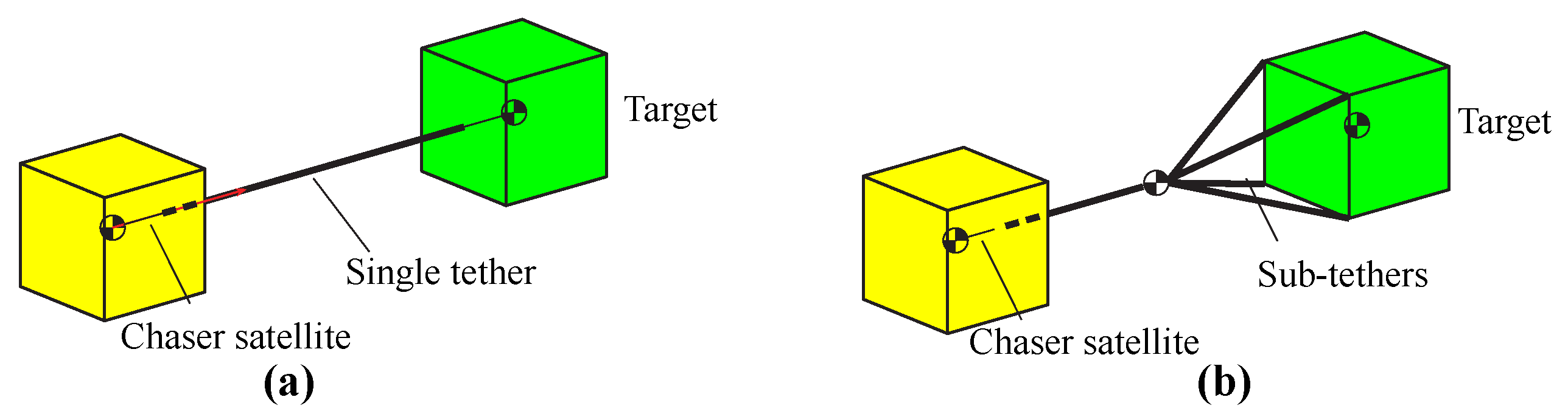
2.1. Configuration of Tethered System
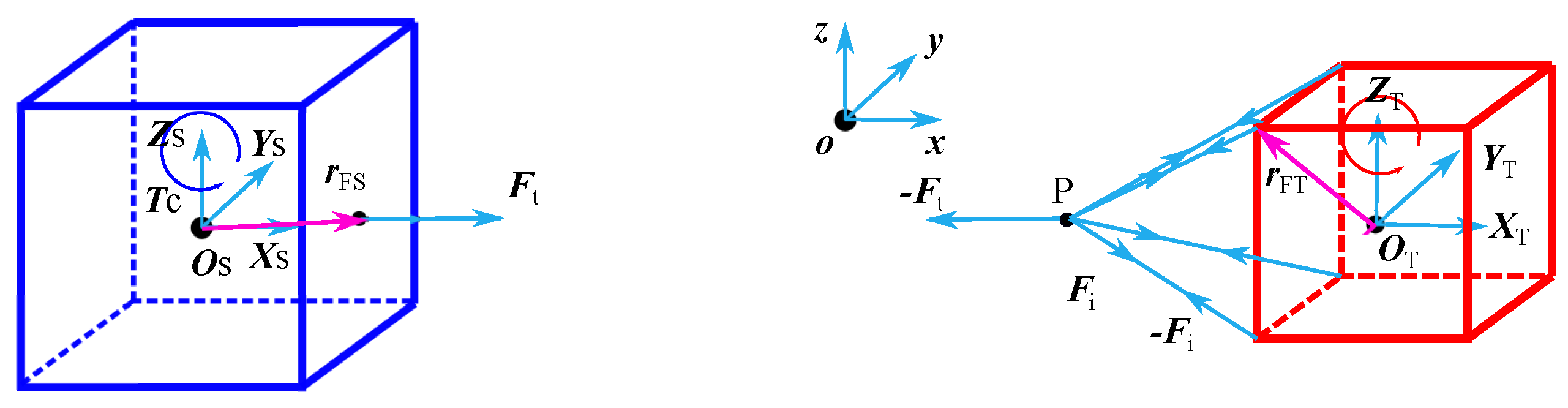
2.2. Modified Dumbbell Model
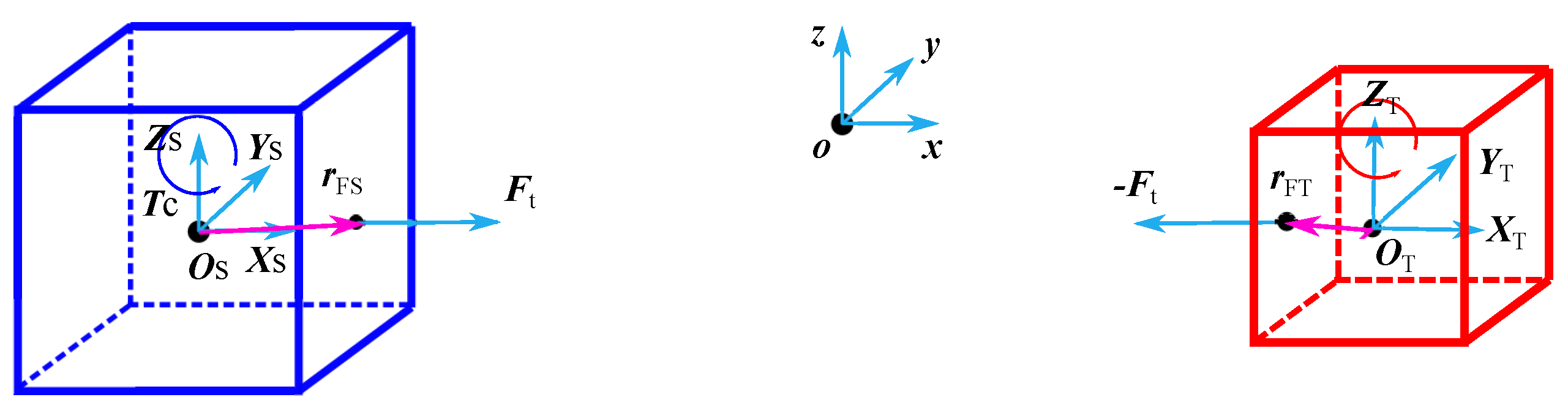
2.2.1. Single Tether Configuration
2.2.2. Sub-Tether Configuration
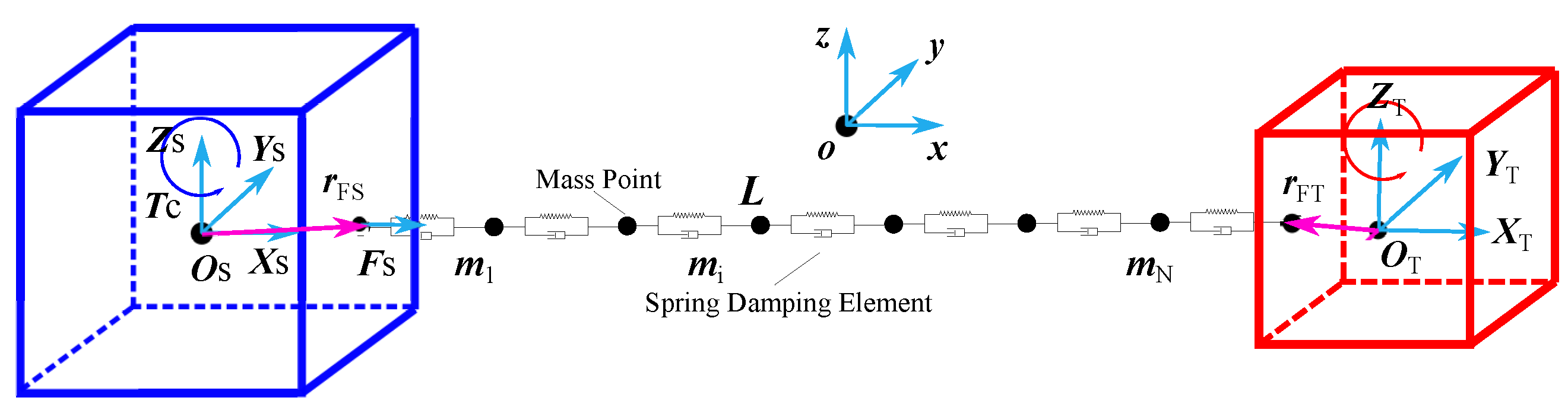
2.3. Lumped-Mass Model
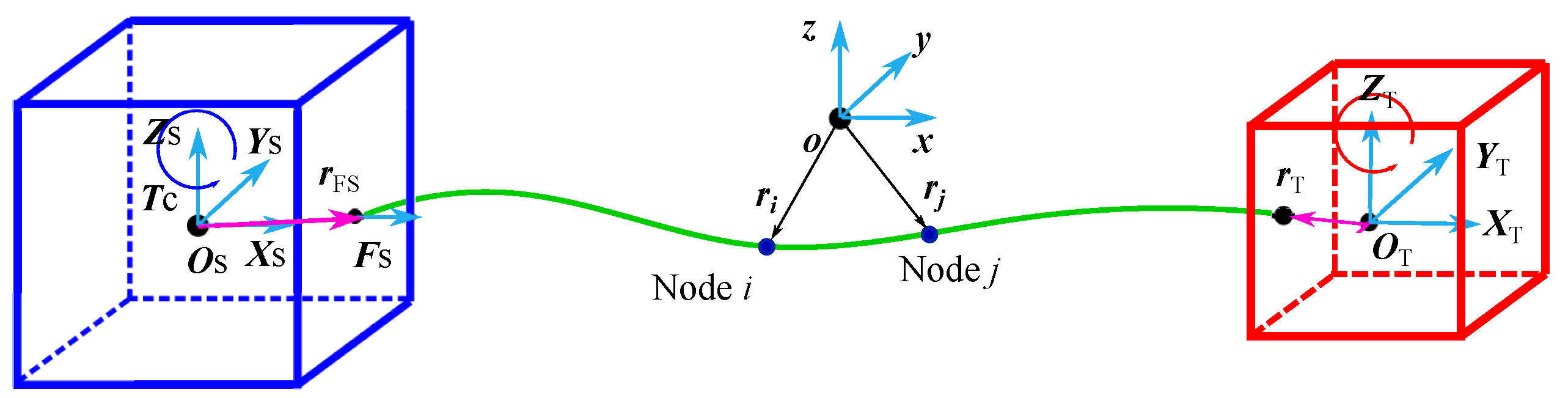
2.3.1. Single Tether Configuration
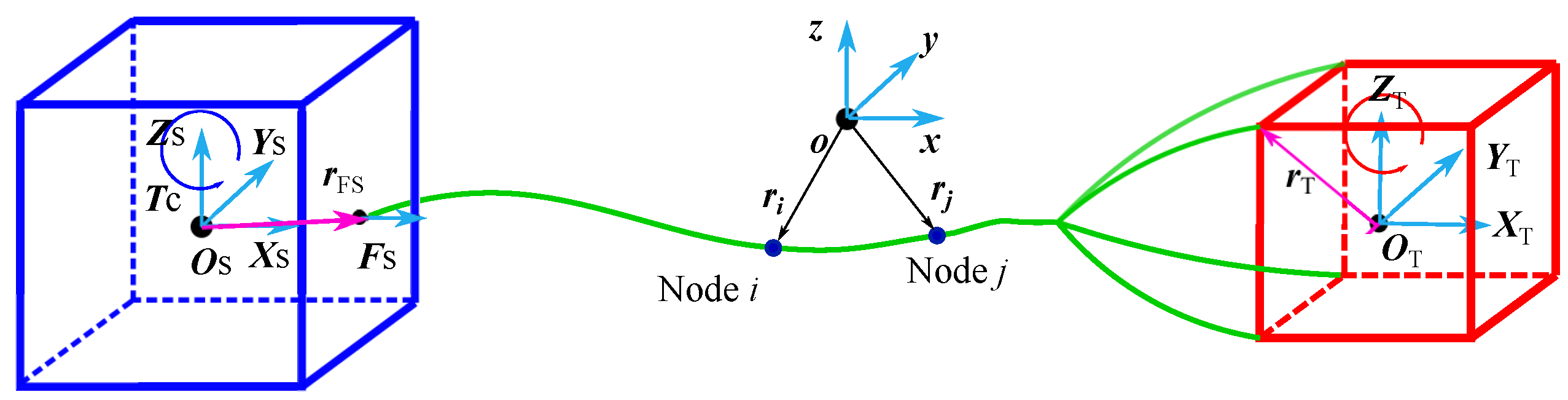
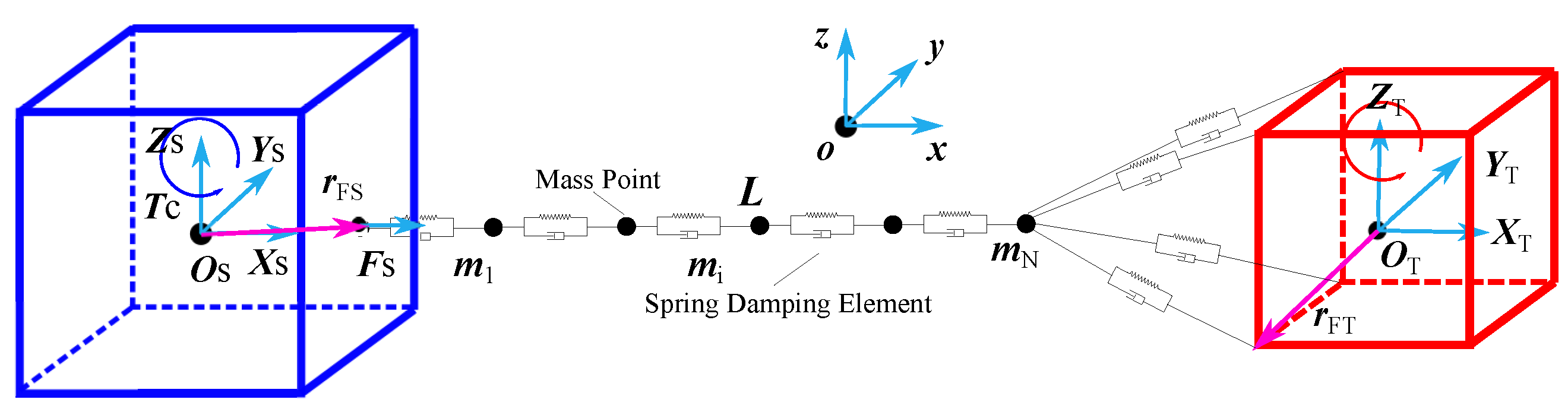
2.3.2. Sub-Tether Configuration
2.4. ANCF Model
2.4.1. Single Tether Configuration
2.4.2. Sub-Tether Configuration
3. Modal Analysis of Tethered System
3.1. Analytical Results
3.2. Modified Dumbbell Model
3.3. Lumped-Mass Model
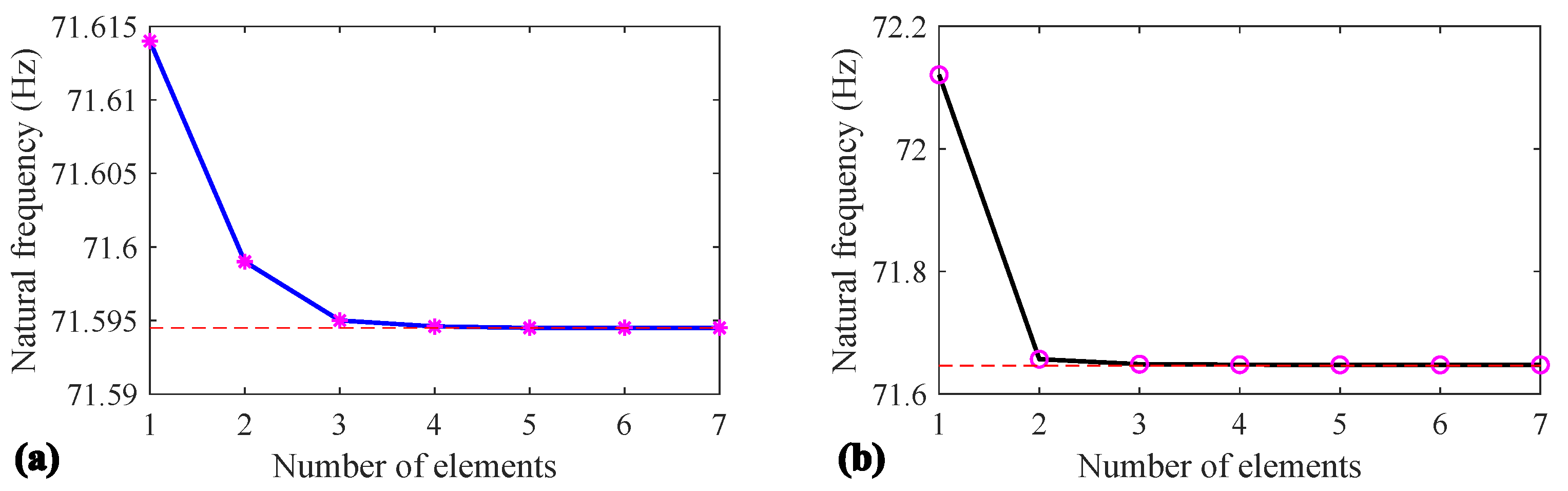
3.4. ANCF Model
4. Comparison of Three Models
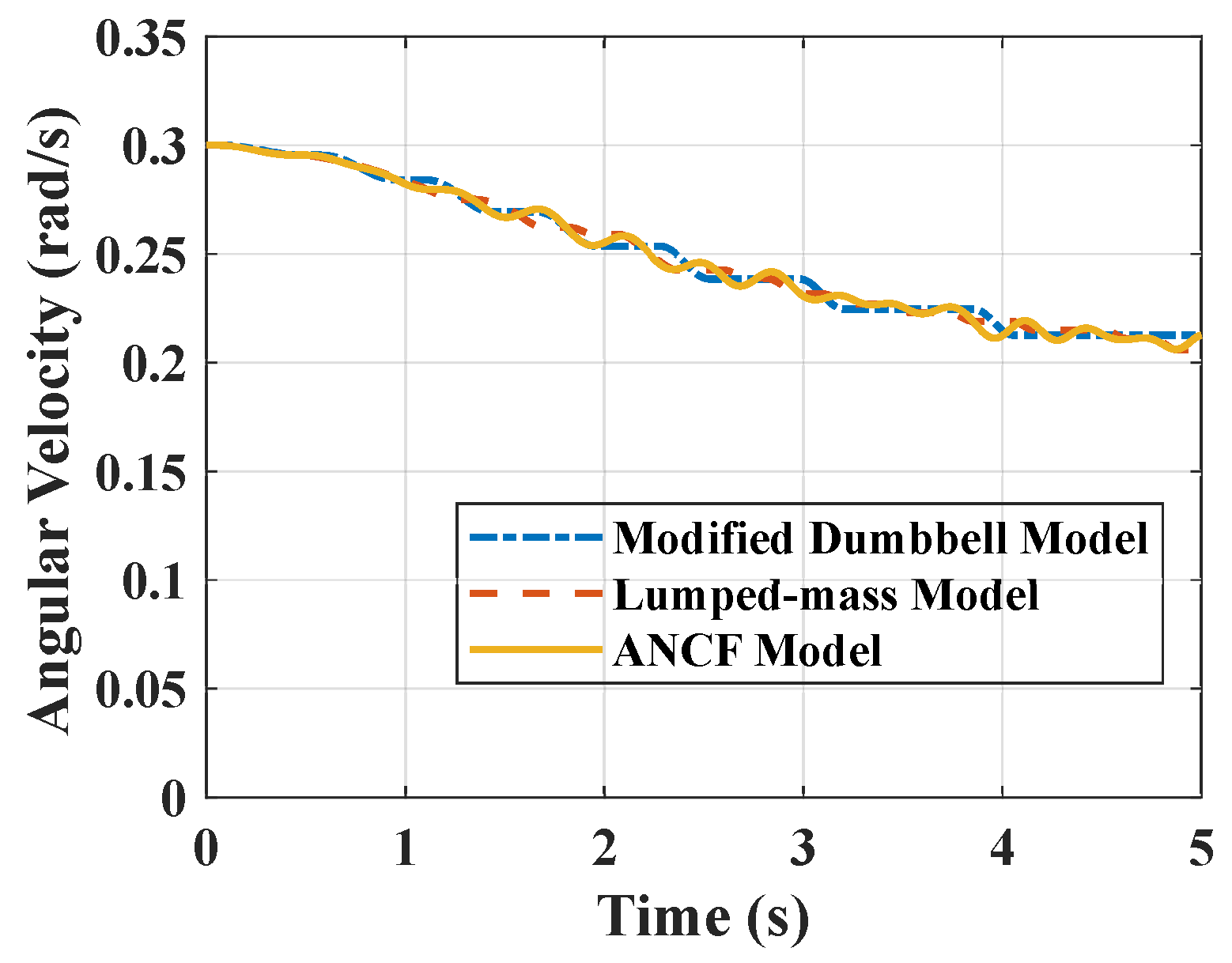
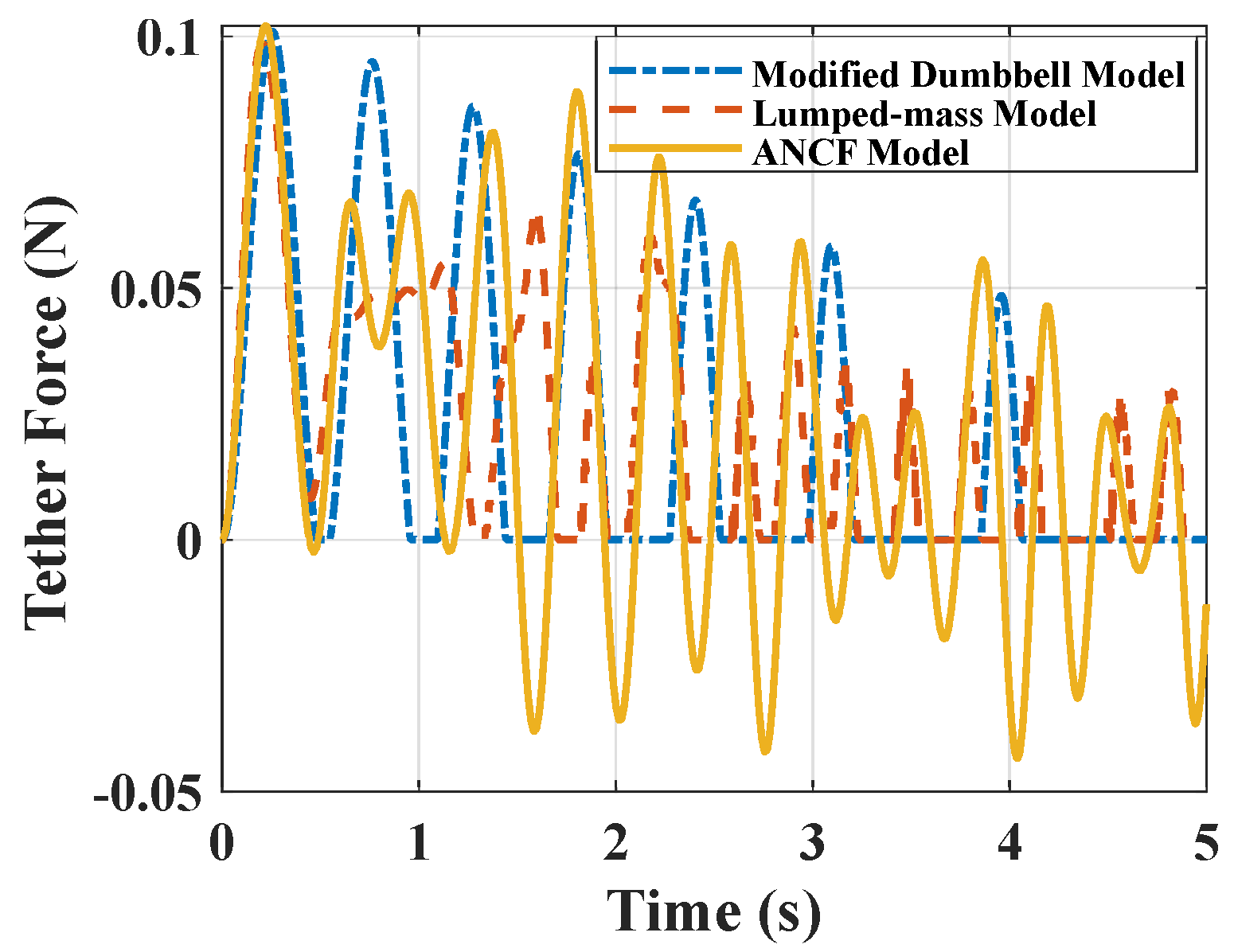
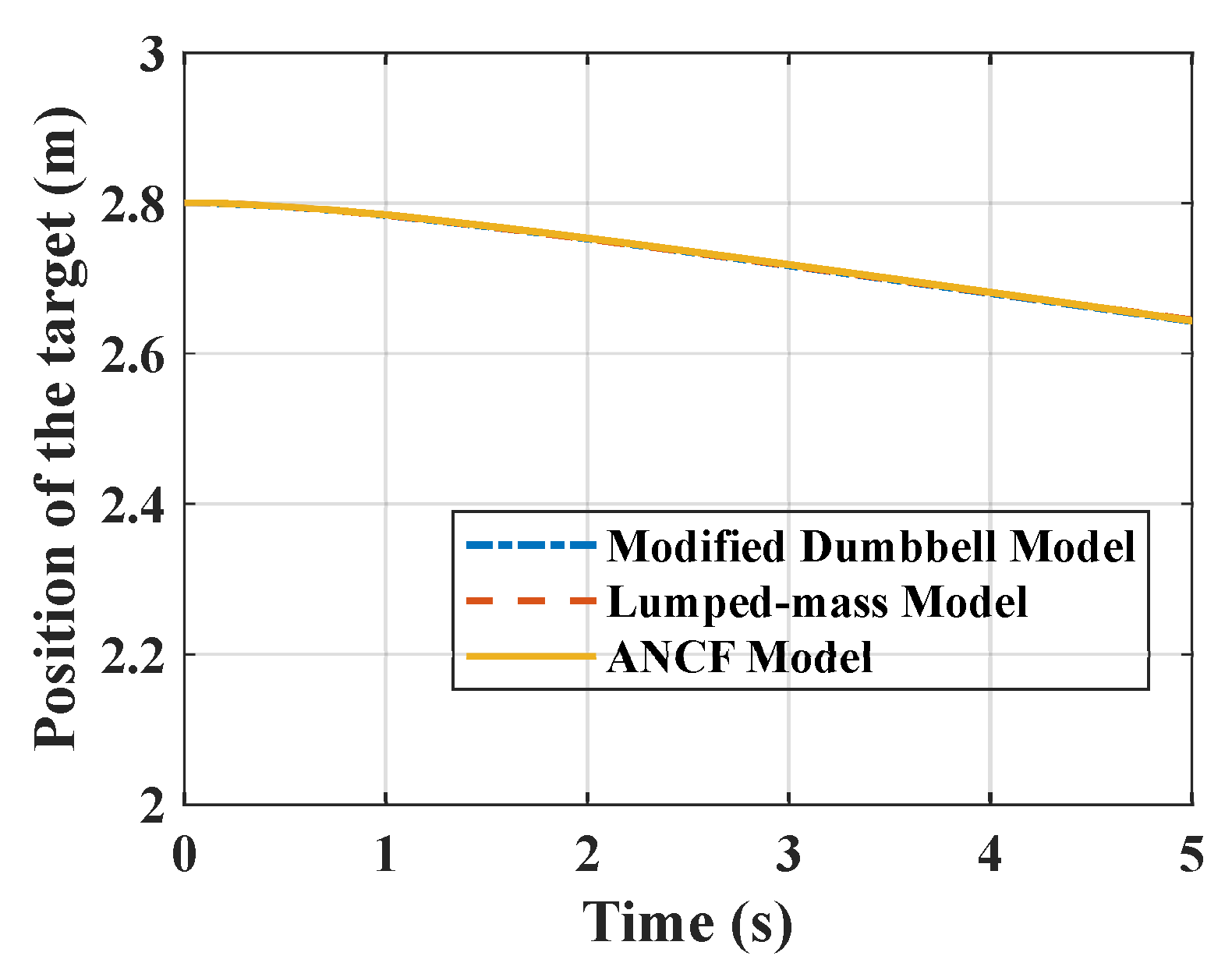
4.1. Single Tether Configuration
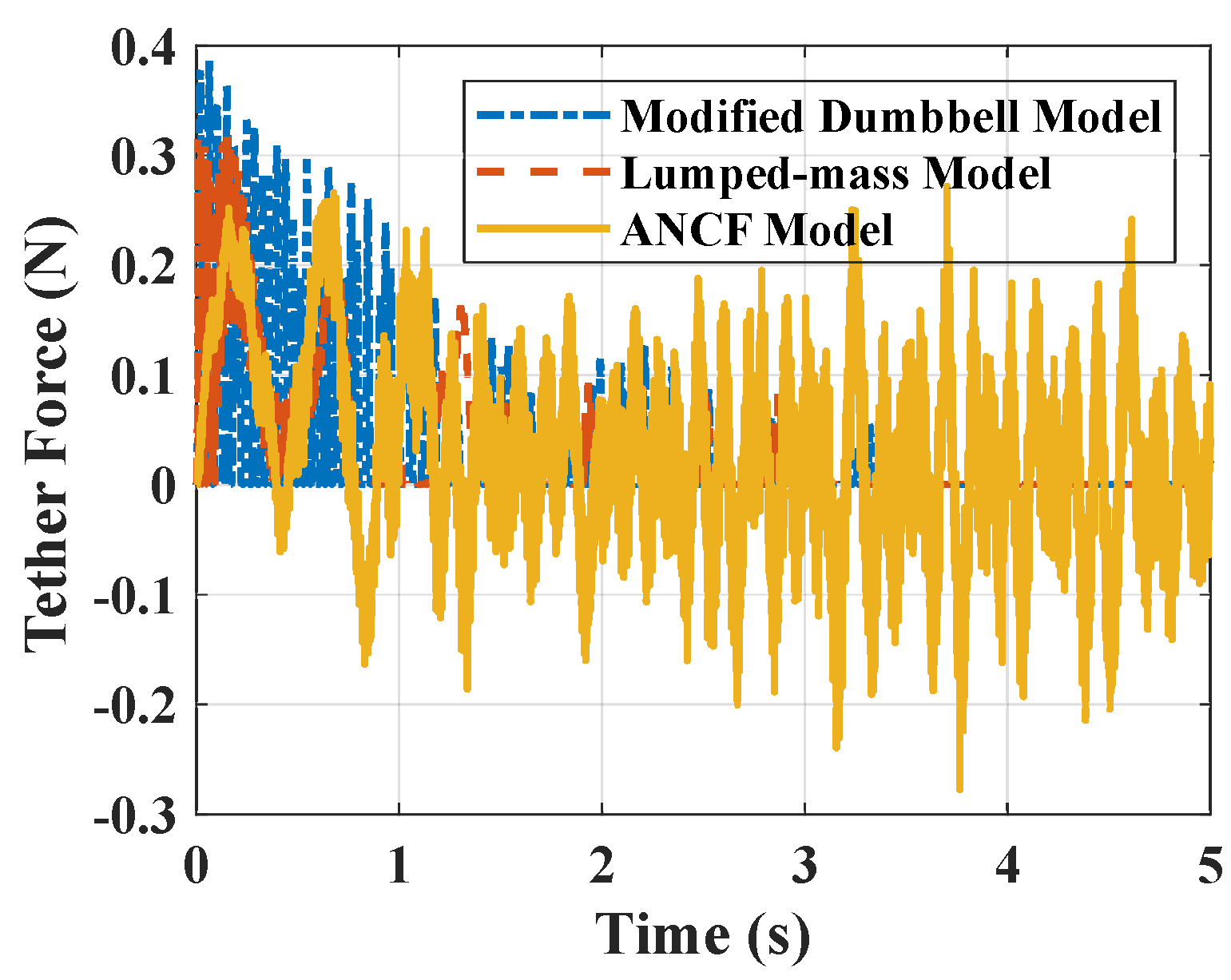
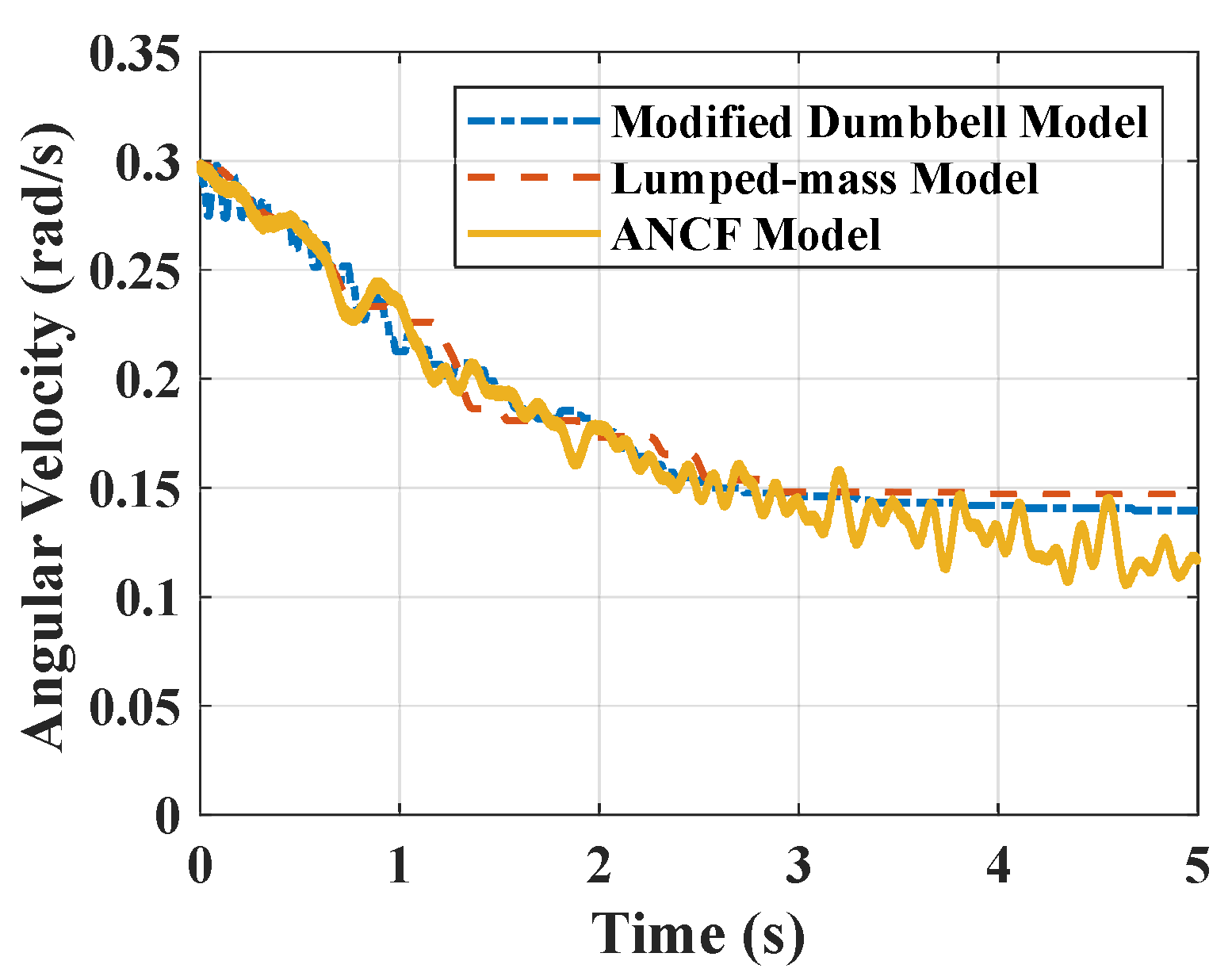
4.2. Sub-Tether Configuration
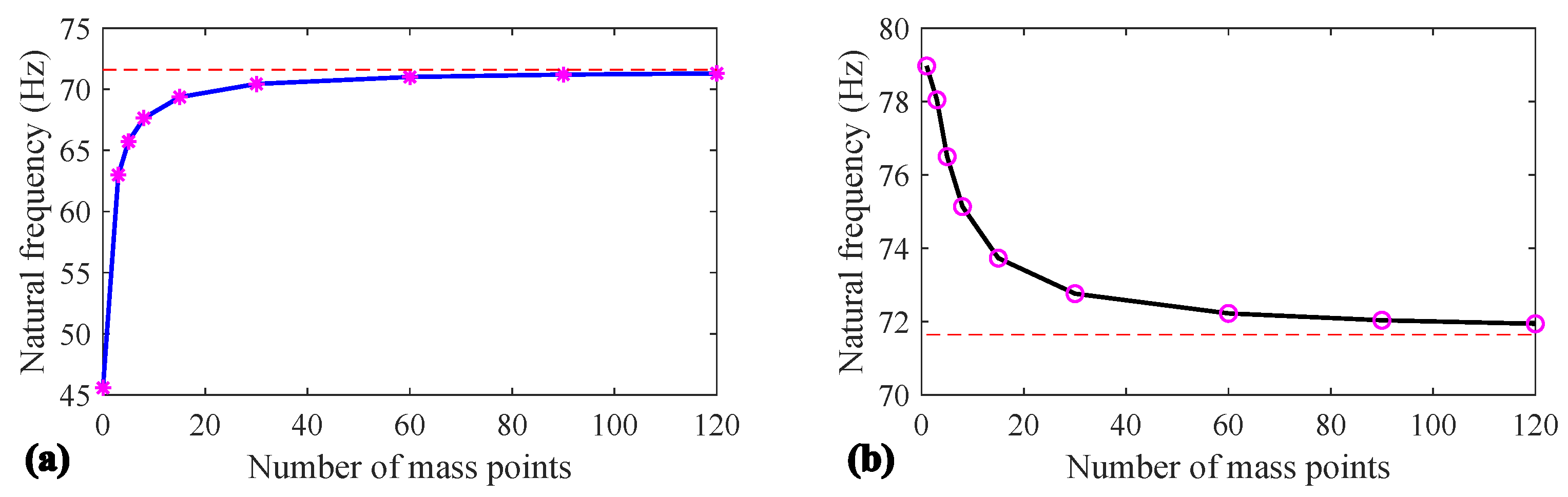
4.3. Comparison of Natural Frequency
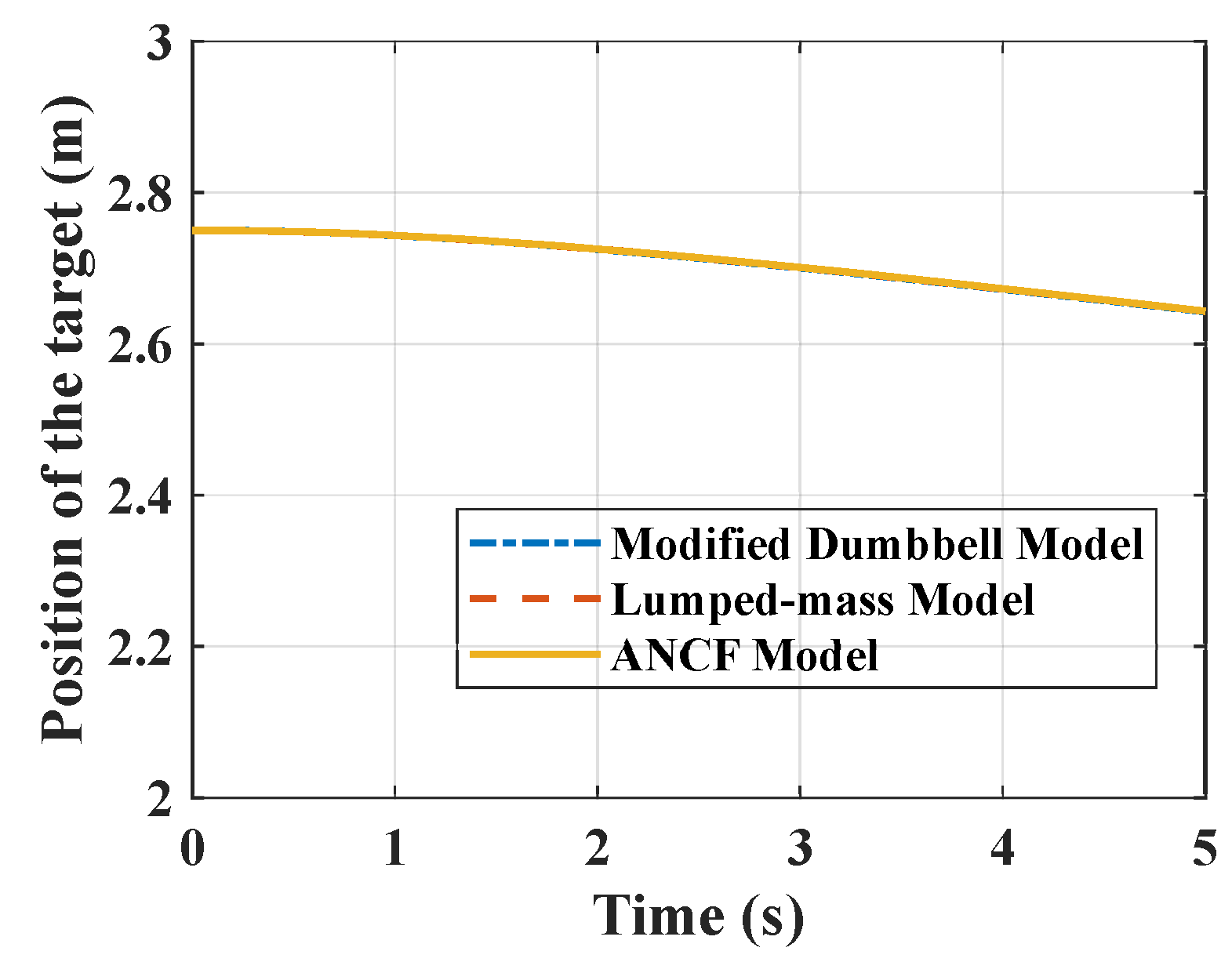
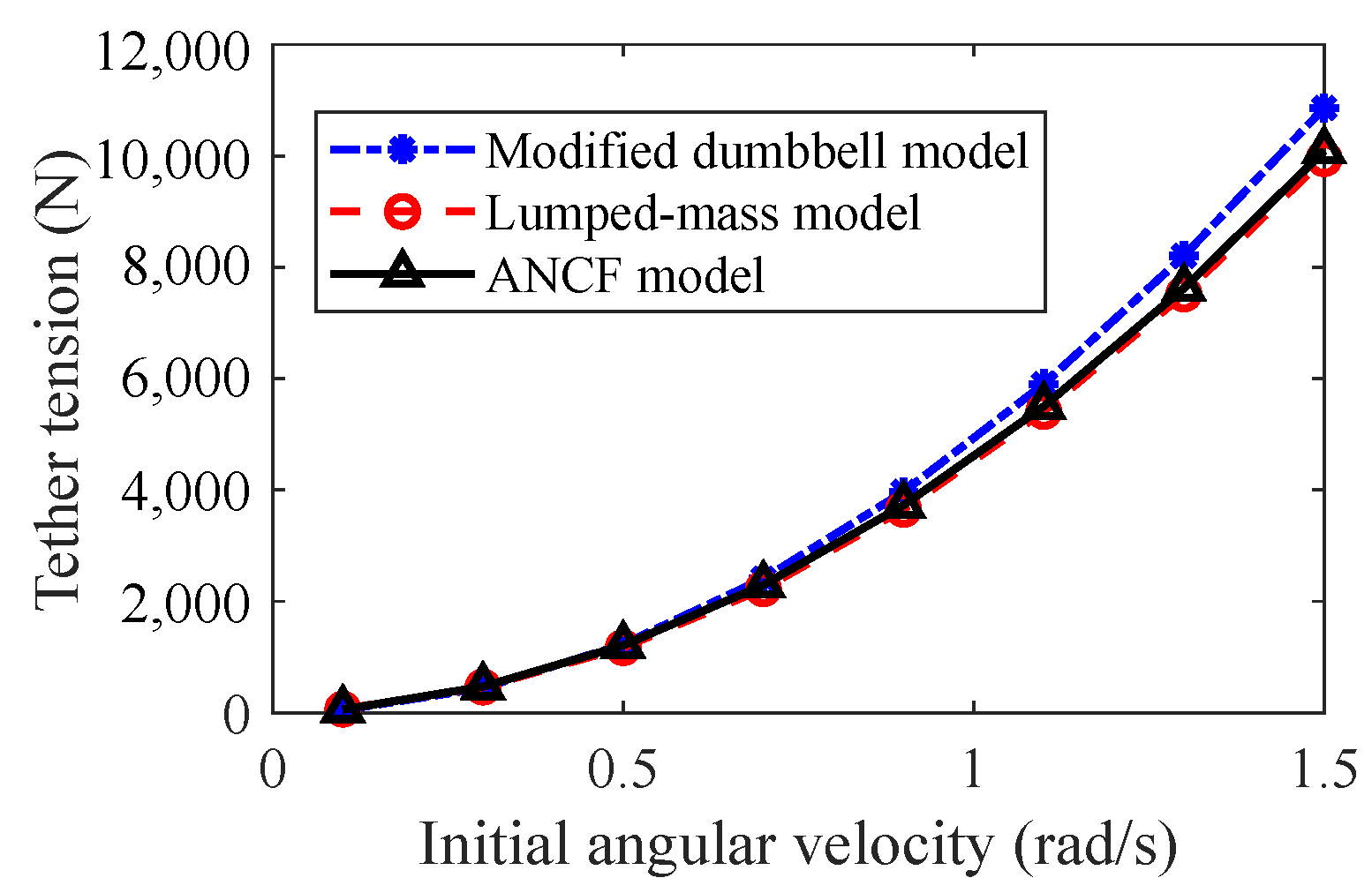
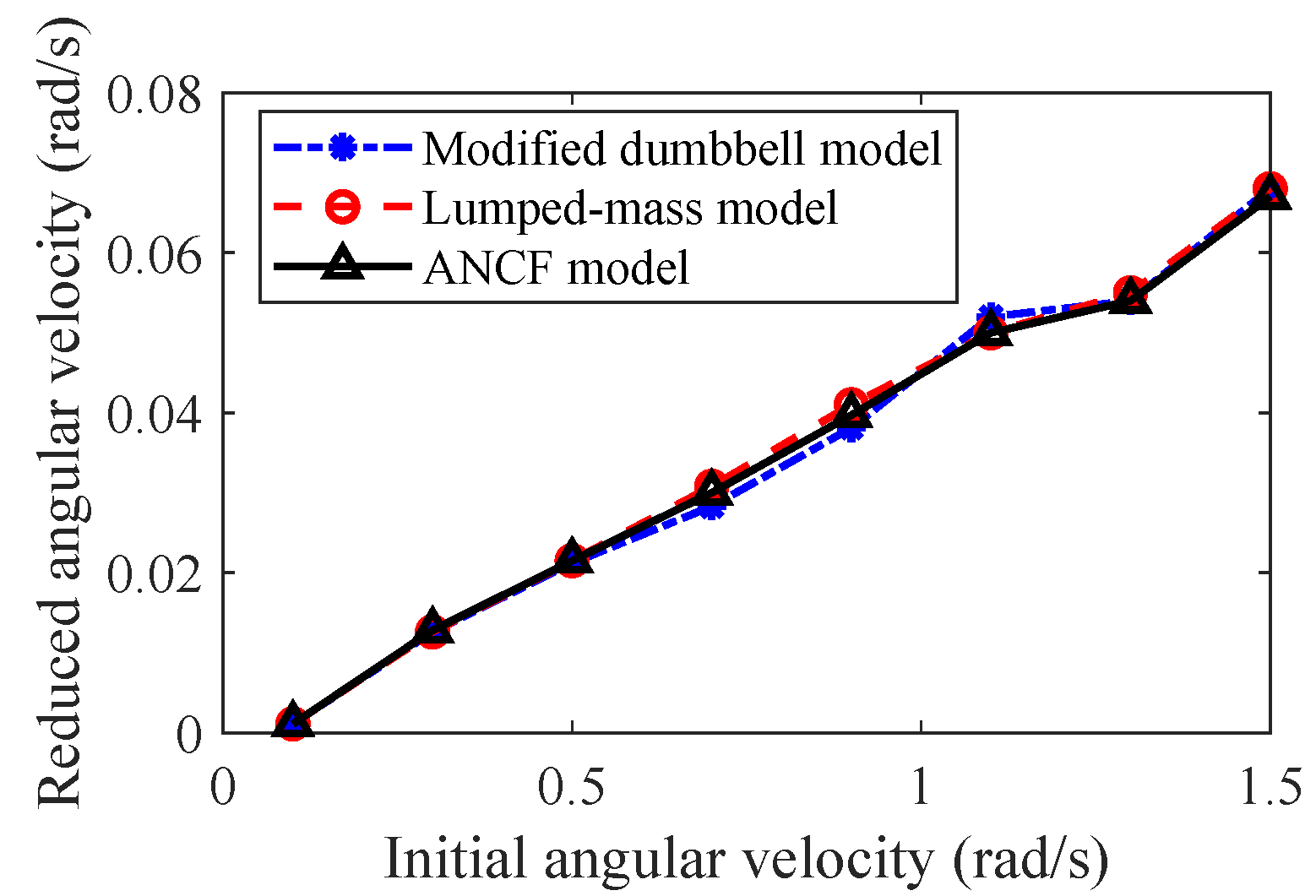
4.4. Influence by Initial Condition
5. Conclusions
Author Contributions
Funding
Institutional Review Board Statement
Informed Consent Statement
Conflicts of Interest
References
- NASA Orbital Debris Program Office. Orbital Debris Quaterly News; National Aeronautics and Space Administration: Washington, DC, USA, 2021; Volume 25, pp. 1–12. [Google Scholar]
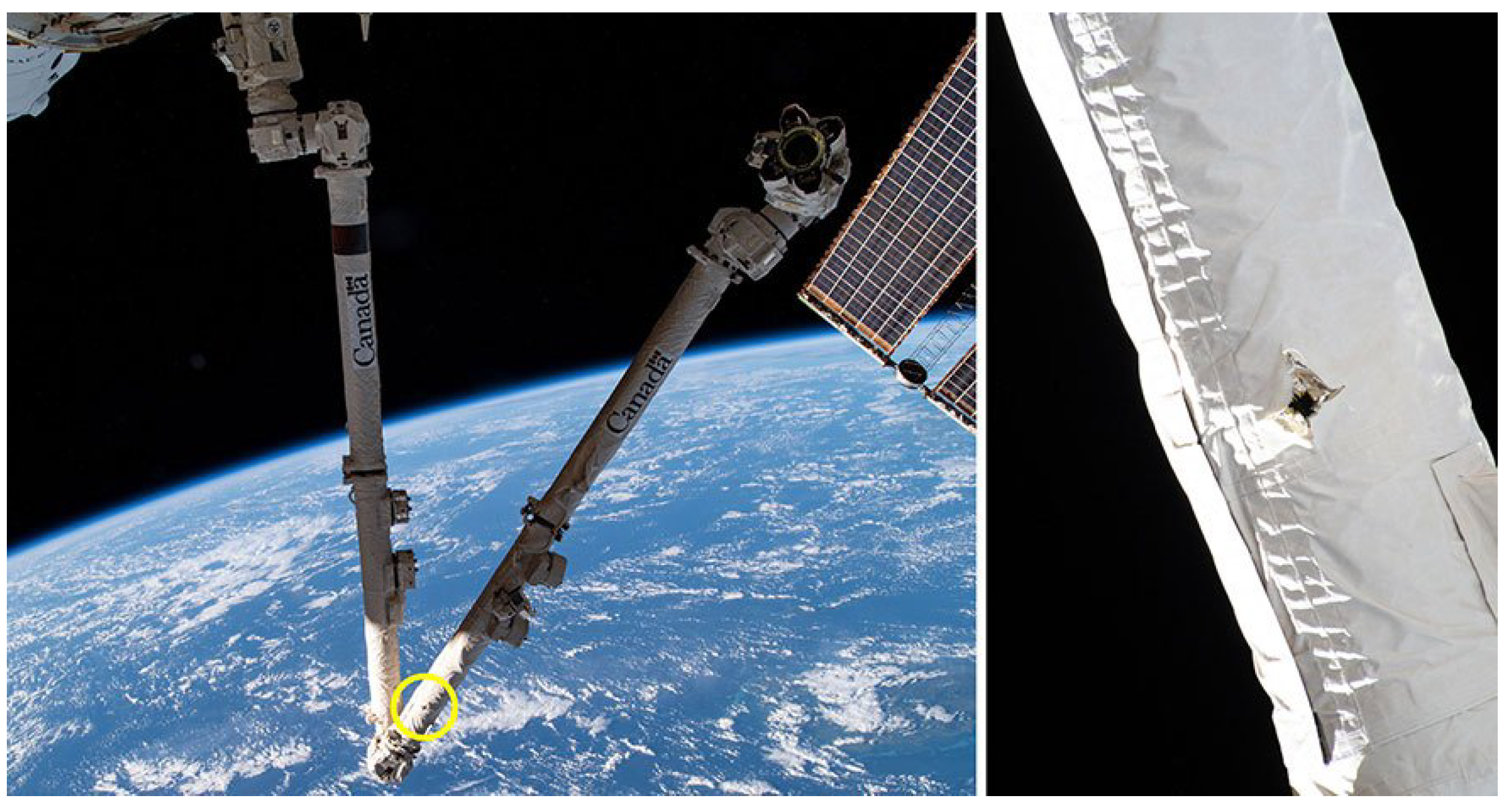
- GlobalNews. Damage on Canadarm. 2021. Available online: https://globalnews.ca/news/7913922/canadarm2-damaged-international-space-station-junk/ (accessed on 7 June 2021).
- Shan, M.; Guo, J.; Gill, E. Review and comparison of active space debris capturing and removal methods. Prog. Aerosp. Sci. 2016, 80, 18–32. [Google Scholar] [CrossRef] [Scilit]
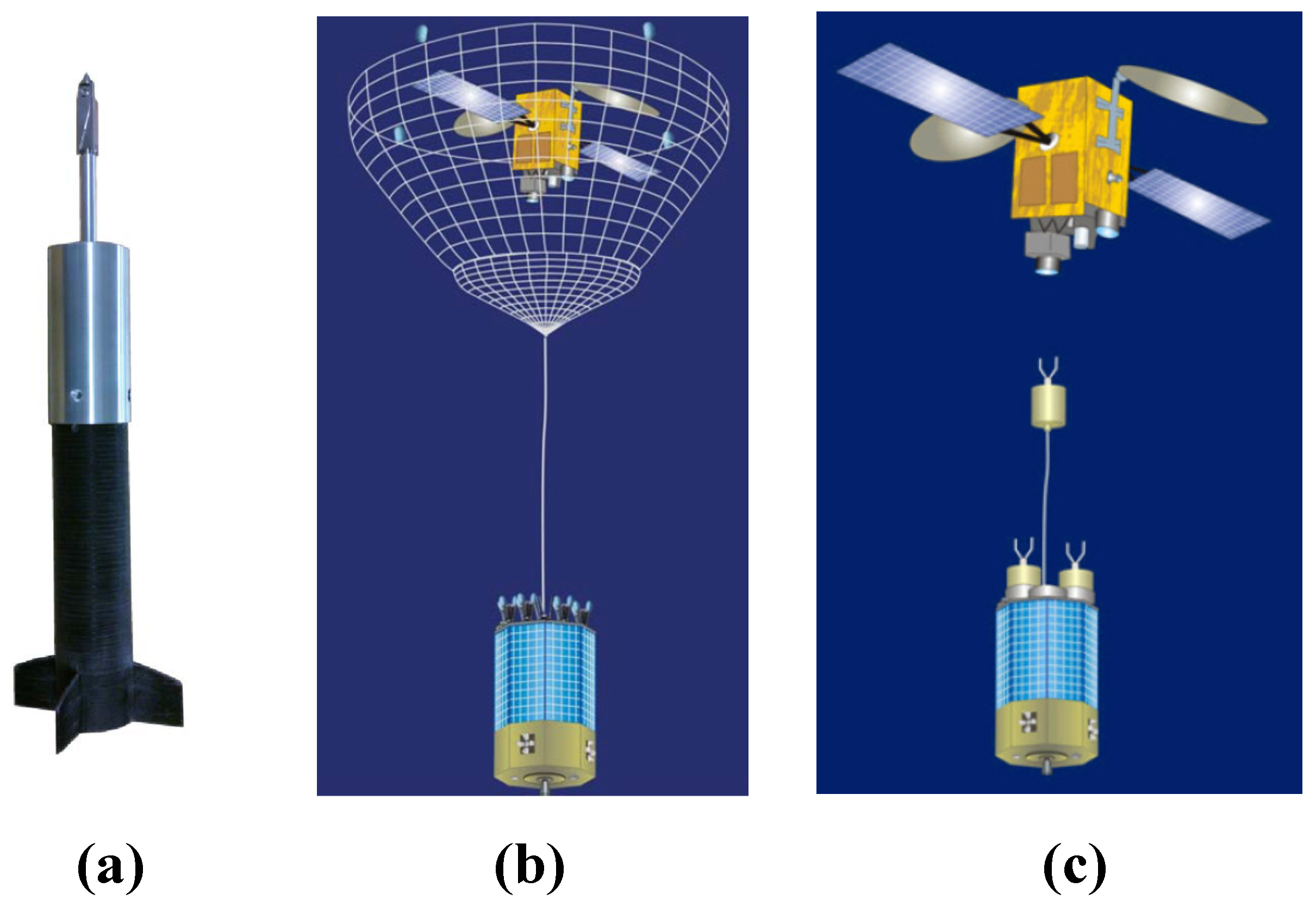
- Reed, J.; Barraclough, S. Development of harpoon system for capturing space debris. In Proceedings of the 6th European Conference on Space Debris, Darmstadt, Germany, 22–25 April 2013; Volume 723, p. 174. [Google Scholar]
- Bischof, B. ROGER-Robotic geostationary orbit restorer. In Proceedings of the 54th International Astronautical Congress of the International Astronautical Federation, Bremen, Germany, 29 September–3 October 2003. [Google Scholar]
- Tamaki, Y.; Tanaka, H. Penetration Characteristics of Metal Harpoons with Various Tip Shapes for Capturing Space Debris. In Proceedings of the 8th European Conference on Space Debris, Darmstadt, Germany, 20–23 April 2021. [Google Scholar]
- Sizov, D.A.; Aslanov, V.S. Space Debris Removal with Harpoon Assistance: Choice of Parameters and Optimization. J. Guid. Control. Dyn. 2020, 44, 767–778. [Google Scholar] [CrossRef] [Scilit]
- Cleary, S.; O’Connor, W.J. Control of space debris using an elastic tether and wave-based control. J. Guid. Control. Dyn. 2016, 39, 1392–1406. [Google Scholar] [CrossRef] [Scilit]
- Shan, M.; Guo, J.; Gill, E. Deployment Dynamics of Tethered-Net for Space Debris Removal. Acta Astronaut. 2017, 132, 293–302. [Google Scholar] [CrossRef] [Scilit]
- Botta, E.M.; Sharf, I.; Misra, A.K.; Teichmann, M. On the simulation of tether-nets for space debris capture with Vortex Dynamics. Acta Astronaut. 2016, 123, 91–102. [Google Scholar] [CrossRef] [Scilit]
- Benvenuto, R.; Salvi, S.; Lavagna, M. Dynamics analysis and GNC design of flexible systems for space debris active removal. Acta Astronaut. 2015, 110, 247–265. [Google Scholar] [CrossRef] [Scilit]
- Golebiowski, W.; Michalczyk, R.; Dyrek, M.; Battista, U.; Wormnes, K. Validated simulator for space debris removal with nets and other flexible tethers applications. Acta Astronaut. 2016, 129, 229–240. [Google Scholar] [CrossRef] [Scilit]
- Medina, A.; Cercós, L.; Stefanescu, R.M.; Benvenuto, R.; Pesce, V.; Marcon, M.; Lavagna, M.; González, I.; López, N.R.; Wormnes, K. Validation results of satellite mock-up capturing experiment using nets. Acta Astronaut. 2017, 134, 314–332. [Google Scholar] [CrossRef] [Scilit]
- Shan, M.; Guo, J.; Gill, E.; Golebiowski, W. Validation of Space Net Deployment Modeling Methods Using Parabolic Flight Experiment. J. Guid. Control. Dyn. 2017, 40, 3319–3327. [Google Scholar] [CrossRef] [Scilit]
- Aglietti, G.; Taylor, B.; Fellowes, S.; Ainley, S.; Tye, D.; Cox, C.; Zarkesh, A.; Mafficini, A.; Vinkoff, N.; Bashford, K.; et al. RemoveDEBRIS: An in-orbit demonstration of technologies for the removal of space debris. Aeronaut. J. 2020, 124, 1–23. [Google Scholar] [CrossRef] [Scilit]
- Benvenuto, R.; Lavagna, M.; Salvi, S. Multibody dynamics driving GNC and system design in tethered nets for active debris removal. Adv. Space Res. 2016, 58, 45–63. [Google Scholar] [CrossRef] [Scilit]
- Botta, E.M.; Sharf, I.; Misra, A.K. Contact Dynamics Modeling and Simulation of Tether Nets for Space-Debris Capture. J. Guid. Control. Dyn. 2016, 40, 110–123. [Google Scholar] [CrossRef] [Scilit]
- Zhang, F.; Huang, P. Releasing dynamics and stability control of maneuverable tethered space net. IEEE/ASME Trans. Mechatronics 2016, 22, 983–993. [Google Scholar] [CrossRef] [Scilit]
- Zhang, F.; Huang, P.; Meng, Z.; Zhang, Y.; Liu, Z. Dynamics analysis and controller design for maneuverable tethered space net robot. J. Guid. Control. Dyn. 2017, 40, 2828–2843. [Google Scholar] [CrossRef] [Scilit]
- Huang, P.; Wang, D.; Meng, Z.; Zhang, F.; Guo, J. Adaptive postcapture backstepping control for tumbling tethered space robot–target combination. J. Guid. Control. Dyn. 2015, 39, 150–156. [Google Scholar] [CrossRef] [Scilit]
- Pang, Z.; Yu, B.; Jin, D. Chaotic motion analysis of a rigid spacecraft dragging a satellite by an elastic tether. Acta Mech. 2015, 226, 2761–2771. [Google Scholar] [CrossRef] [Scilit]
- Forshaw, J.L.; Aglietti, G.S.; Fellowes, S.; Salmon, T.; Retat, I.; Hall, A.; Chabot, T.; Pisseloup, A.; Tye, D.; Bernal, C.; et al. The active space debris removal mission RemoveDebris. Part 1: From concept to launch. Acta Astronaut. 2020, 168, 293–309. [Google Scholar] [CrossRef] [Scilit]
- Aglietti, G.S.; Taylor, B.; Fellowes, S.; Salmon, T.; Retat, I.; Hall, A.; Chabot, T.; Pisseloup, A.; Cox, C.; Mafficini, A.; et al. The active space debris removal mission RemoveDebris. Part 2: In orbit operations. Acta Astronaut. 2020, 168, 310–322. [Google Scholar] [CrossRef] [Scilit]
- O’Connor, M.; Clearly, S.; Hayden, D. Debris de-tumbling and de-orbiting by elastic tether and wave-based control. In Proceedings of the 6th International Conference on Astrodynamics Tools and Techniques (ICATT), Darmstadt, Germany, 14–17 March 2016. [Google Scholar]
- Shan, M.; Shi, L. Post-capture control of a tumbling space debris via tether tension. Acta Astronaut. 2021, 180, 317–327. [Google Scholar] [CrossRef] [Scilit]
- Stadnyk, K.; Ulrich, S. Validating the Deployment of a Novel Tether Design for Orbital Debris Removal. J. Spacecr. Rocket. 2020, 57, 1335–1349. [Google Scholar] [CrossRef] [Scilit]
- Hovell, K.; Ulrich, S. Attitude stabilization of an uncooperative spacecraft in an orbital environment using visco-elastic tethers. In Proceedings of the AIAA Guidance, Navigation, and Control Conference, San Diego, CA, USA, 4–8 January 2016; p. 0641. [Google Scholar]
- Hovell, K.; Ulrich, S. Postcapture dynamics and experimental validation of subtethered space debris. J. Guid. Control. Dyn. 2018, 41, 519–525. [Google Scholar] [CrossRef] [Scilit]
- Misra, A.; Nixon, M.; Modi, V. Nonlinear dynamics of two-body tethered satellite systems: Constant length case. J. Astronaut. Sci. 2001, 49, 219–236. [Google Scholar] [CrossRef] [Scilit]
- Shabana, A.A. Flexible multibody dynamics: Review of past and recent developments. Multibody Syst. Dyn. 1997, 1, 189–222. [Google Scholar] [CrossRef] [Scilit]
- Berzeri, M.; Shabana, A. Development of simple models for the elastic forces in the absolute nodal co-ordinate formulation. J. Sound Vib. 2000, 235, 539–565. [Google Scholar] [CrossRef] [Scilit]







| Parameter | Value | |
|---|---|---|
| Service Satellite | Mass , (kg) | 10 |
| Dimensions −, (m) | 0.6 × 0.6 × 0.6 | |
| Target | Mass , (kg) | 3.5 |
| Dimensions −, (m) | 0.4 × 0.4 × 0.4 | |
| Tether | Main tether length L, (m) | 2.25 |
| Sub-tether length l, (m) | 0.4123 | |
| Tether diameter d, (mm) | 5 | |
| Damping coefficient c, (-) | 0.1 | |
| Young’s modulus E, (Pa) |
| Models | Screenshots of Animations |
|---|---|
| s s s | |
| Modified Dumbbell Model |  |
| Lumped-mass Model |  |
| ANCF Model |  |
| Models | Screenshots of Animations |
|---|---|
| s s s | |
| Modified Dumbbell Model |  |
| Lumped-mass Model |  |
| ANCF Model |  |
| Order | Analytical | Modified Dumbbell Model | Lumped-Mass Model | ANCF Model |
|---|---|---|---|---|
| 1 | 71.59 | 45.58 | 71.24 | 71.59 |
| 2 | 143.19 | - | 142.46 | 143.19 |
| 3 | 214.78 | - | 213.65 | 214.79 |
| 4 | 286.38 | - | 284.79 | 286.44 |
| 5 | 357.97 | - | 355.86 | 358.22 |
| Order | Analytical | Modified Dumbbell Model | Lumped-Mass Model | ANCF Model |
|---|---|---|---|---|
| 1 | 1.947 | 1.949 | 1.948 | 1.948 |
| 2 | 71.646 | - | 74.574 | 71.647 |
| 3 | 143.216 | - | 147.555 | 143.217 |
| 4 | 214.802 | - | 217.549 | 214.814 |
| 5 | 286.392 | - | 283.120 | 286.464 |
| Parameter | Value | |
|---|---|---|
| Service Satellite | Mass , (kg) | 500 |
| Dimensions −, (m) | 2.5 × 2.5 × 2.5 | |
| Target | Mass , (kg) | 8000 |
| Dimensions −, (m) | 5 × 5 × 5 | |
| Tether | Main tether length L, (m) | 100 |
| Tether diameter d, (mm) | 50 | |
| Damping coefficient c, (-) | 0.1 | |
| Young’s modulus E, (GPa) | 131 |
Publisher’s Note: MDPI stays neutral with regard to jurisdictional claims in published maps and institutional affiliations. |
© 2022 by the authors. Licensee MDPI, Basel, Switzerland. This article is an open access article distributed under the terms and conditions of the Creative Commons Attribution (CC BY) license (https://creativecommons.org/licenses/by/4.0/).
Share and Cite
Shan, M.; Shi, L. Comparison of Tethered Post-Capture System Models for Space Debris Removal. Aerospace 2022, 9, 33. https://doi.org/10.3390/aerospace9010033
Shan M, Shi L. Comparison of Tethered Post-Capture System Models for Space Debris Removal. Aerospace. 2022; 9(1):33. https://doi.org/10.3390/aerospace9010033
Chicago/Turabian StyleShan, Minghe, and Lingling Shi. 2022. "Comparison of Tethered Post-Capture System Models for Space Debris Removal" Aerospace 9, no. 1: 33. https://doi.org/10.3390/aerospace9010033
APA StyleShan, M., & Shi, L. (2022). Comparison of Tethered Post-Capture System Models for Space Debris Removal. Aerospace, 9(1), 33. https://doi.org/10.3390/aerospace9010033