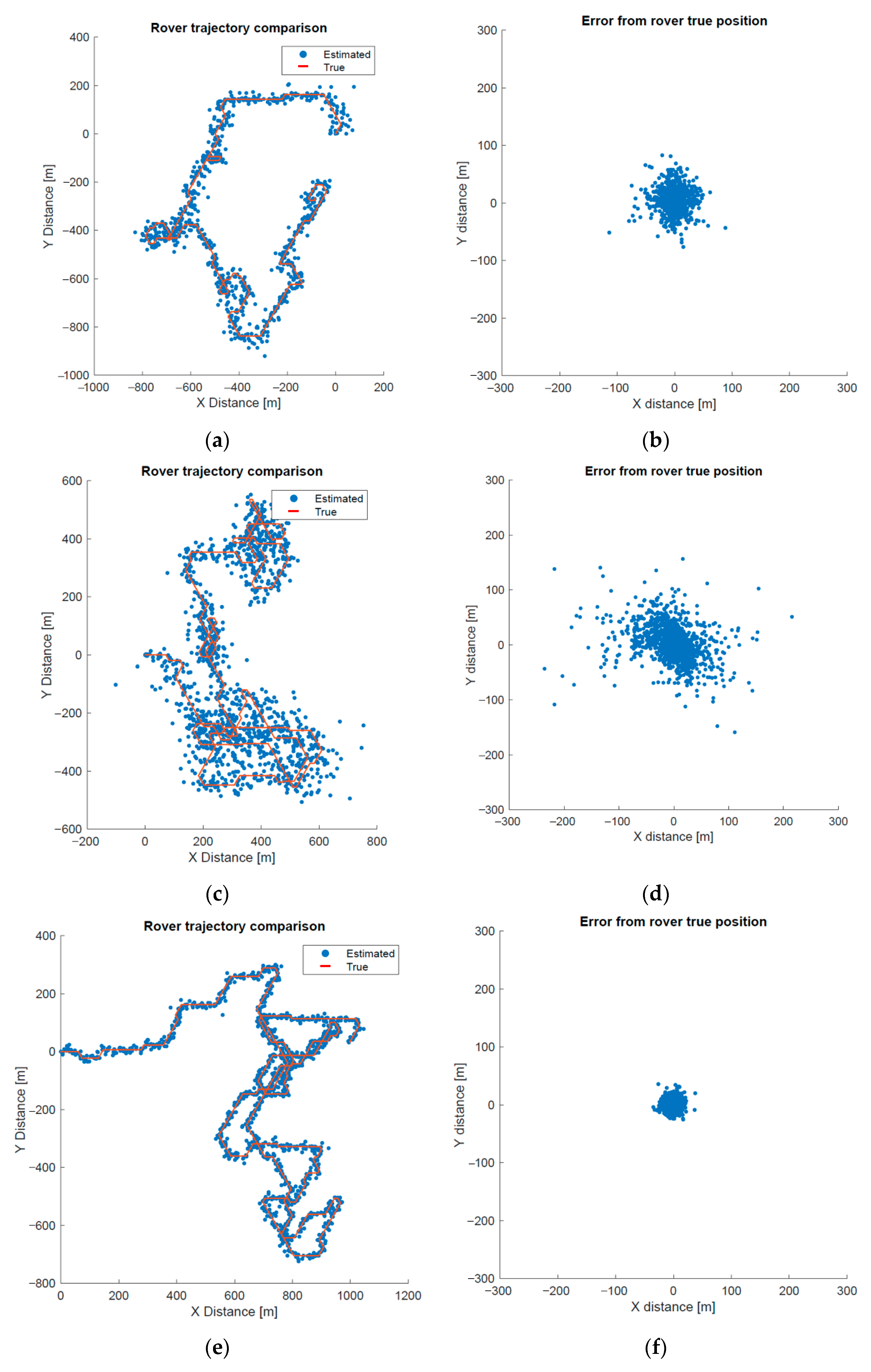
3.3. Multi-Epoch Double-Differenced Pseudorange Observation
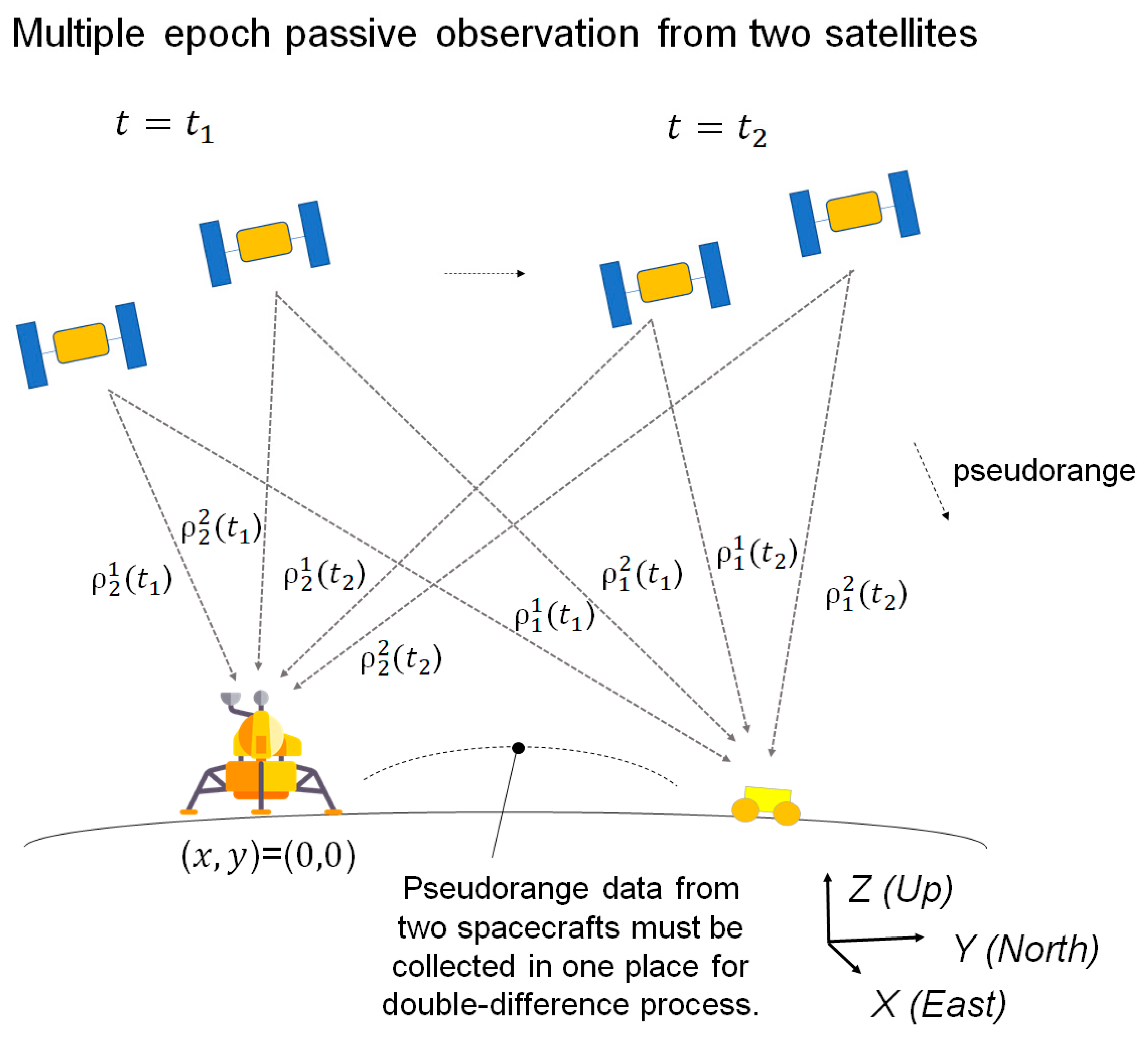
Multi-epoch double-differenced pseudorange observation (MDPO) is a multi-user, pseudorange-based navigation algorithm. Using multi-epoch double-differenced observations reduces the number of navigation satellites required from four to two, while dealing with the instability of the satellite clock at the same time, as shown in
Figure 1.
In this paper, we only explain important equations which are necessary to clarify the differences between the MDPO and other methods, while the complete formulation derivation of the MDPO can be found in our prior research [
18].
MDPO uses double-differenced pseudorange observations to eliminate the clock bias of the space segment and user segment as well as satellite orbit determination error, by subtracting four pseudorange measurements between two users (user1 and user2) and two satellites (satellite1 and satellite2) as shown in Equations (5)–(9):
where
is the double difference operator. In order to remove the satellite and user clock bias errors effectively from the double-differenced observations, time synchronization between the two receivers is essential. In the common GNSS systems, the time synchronization can be achieved in the position calculation process by estimating the user clock bias at the same time. However, the user clock bias is removed in the double-differenced observation and cannot be estimated. In our proposed method, the time synchronization is assumed to be achieved by the frame synchronization of the navigation message. As the maximum range rate of the pseudorange observation from the low lunar orbiting satellite is about 1.3 km/s, the resulting range error is no larger than 1.3 m if the time synchronization error is maintained under 1 ms. It is acceptable if the targeting navigation accuracy is tens of meters.
In the double difference method, user2 is used as a reference station whose position is fixed and known, and the position of user1 is estimated in relation to the position of user2; i.e., user2′s position is referenced as the origin of navigation (0,0,0). In a lunar navigation system, the lander can be used as a reference station (user2), and its geodetic position is used as the origin of navigation. The geodetic position of the lander must be obtained in advance of the start of the rover navigation by other means, such as identification by satellite image: this is proven technique such as the Lunar Reconnaissance Orbiter Camera (LROC) successfully identified the landing coordinates of China’s Chang’e 5 lander with a reported accuracy of ±20 m [
25]. Hereafter, the rover corresponds to user1, and the lander corresponds to user2.
In the MDPO method, multiple double-differenced pseudorange observations, i.e., , are obtained from multiple epochs, i.e., , where N is the number of observation epochs, and k is the epoch number at which the estimation starts. It is important to note that the rover position must be fixed in place during all multi-epoch observations taken, in order to keep the number of estimation parameters lower than the number of observation equations. Otherwise, the rover position cannot be identified deterministically by the MDPO, and the rover position accuracy changes depending on the quality of other navigation information used during multi-epoch observations. Hereafter, represents a fixed rover position during multi-epoch observations − .
The rover position can be estimated by solving the following Newton–Raphson equations iteratively. The following equations correspond to ‘2D MDPO’ in [
18], which calculates an estimated two-dimensional (X–Y) position by the Newton-Raphson equation and a rover altitude (Z) by using a lunar digital elevation model (DEM) as we discuss later. In 2D MDPO, the number of multi-epoch observations can be reduced to as low as 2 (
N = 2). The formulation for three-dimensional position calculation can be found in our previous paper [
18]. First, we define a new parameter
for
:
where
is the difference between the measured double-differenced pseudorange value, i.e.,
, and the calculated double-differenced range on an initial estimated value of the rover position
, i.e.,
. Then, the following equations can be derived:
where
in Equation (15) is called an observation matrix, which is equivalent to the Jacobian of
with regard to
.
By solving the least-square problem that minimizes the residual error
, an estimated value of
, defined as
, is obtained:
Then, a new estimated value
is given by Equation (17), which provides a better fit to the observation.
This estimation process continues until the number of iterations reaches the designed value
, i.e.,
, and then the final estimated value
is acquired.
In GNSS terminology,
is known as the dilution of precision (DOP) matrix, which is used to specify error propagation as a mathematical effect of the navigation satellite geometry on positional measurement precision. We define the DOP matrix as
where
is the elements of
. Using
, the achievable rover position error, i.e.,
, at a time of
can be obtained by
where
is the standard deviation of double-differenced receiver observation errors and
represents user position error, which is the distance between the rover’s true position and an estimated rover position. It is important to highlight that the standard deviation of MDPO’s double-differenced receiver observation errors, i.e.,
, is amplified from the standard deviation of the original receiver observation errors, i.e.,
, as a result of the double-differencing process, in particular
in Equation (9), and becomes as large as
assuming that the receiver observation errors follow a white Gaussian distribution. Further, by defining
as
Equation (19) can be written as
As mentioned in the previous section, we assume that the receiver observation errors follow a normal distribution with a zero mean (i.e., Gaussian white noise). As such,
also follows a 1D Gaussian distribution, and 95 percent of it lies inside the interval from
to
, where
is the standard deviation. As a performance index, this research uses
2drms (
or 95 percent confidence), which is commonly used in two-dimensional position estimation problems:
Moreover, considering that the
value, as well as the
value, changes over time according to the satellite positions relative to the rover, an indicator that represents the overall
over the course of the mission time is needed. For this purpose, the
is newly defined, along with the
, as below:
where
is the number of MDPO estimations over the course of the mission time.
is independent of time, and can be excluded from the square root without losing generality.
In the 2D MDPO, the rover altitude
is pre-estimated using a lunar digital elevation model (DEM). As shown in Equation (25), DEM is a function of longitude and latitude, which are not known at the start. The estimation of sequences proceeds in the following sequence: First,
is estimated using the rover position before its relocation, i.e.,
. Then, a new estimated rover position, i.e.,
, is estimated as
(
) by Equation (17).
is not updated at this moment. After that, the altitude of the rover is updated to
using
and
by Equation (25), i.e.,
= (
). The calculation continues until the number of iterations reaches the designed value, i.e.,
.
Here,
is a lunar DEM that is a function of latitude and longitude. According to Equation (25), as
changes along with
and
, errors in the X–Y position induce errors in the Z position, which ultimately induce errors in estimated
and
, and as a result, the
deteriorates stochastically. In our research, we did not apply the case in which the rover altitude changes too rapidly, such as the rover dropping off the cliff or roving on steep slopes. In that case, the
would not deteriorate too significantly, which was confirmed by numerical simulations in our prior research [
18].
3.4. Double-Differenced TOA–FOA
The conventional TDOA–FDOA approach uses single-differenced TOA observation and FOA observation to cope with the satellite clock bias or the user clock bias, but is not designed to cope with the satellite clock bias and the user clock bias at the same time [
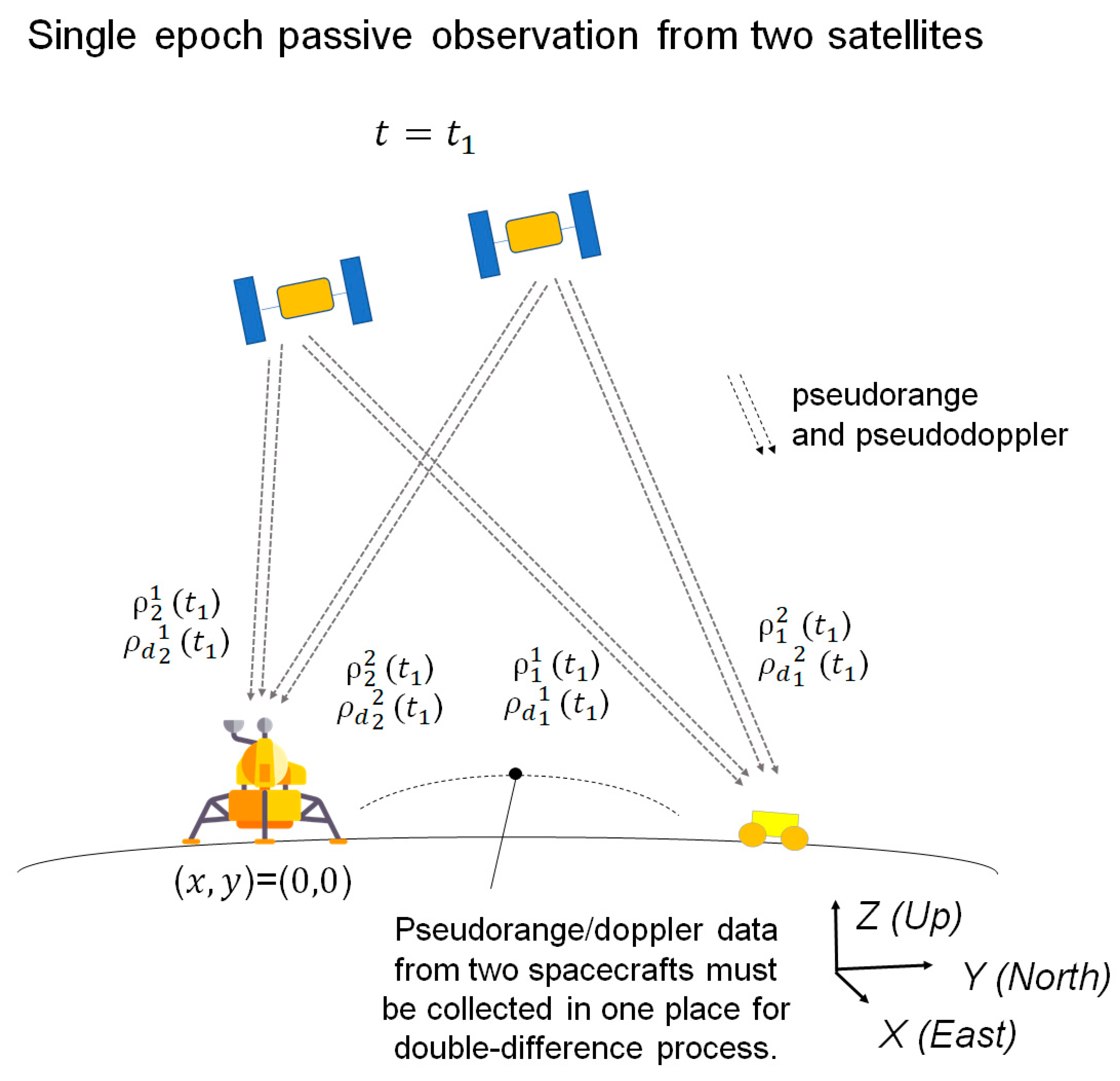
15]. Therefore, we updated the conventional TDOA–FDOA into a double-differenced form, the so-called double-differenced TOA–FOA. Double-differenced TOA–FOA can determine the user position using double-differenced pseudorange observations and pseudodoppler observations from a single epoch, as shown in
Figure 2.
Double-differenced TOA observations were formulated using Equations (5)–(9). Similarly, double-differenced FOA observations can be formulated:
In order to remove the satellite and user frequency bias errors effectively from the double-differenced observations, it is assumed that time synchronization is achieved by the frame synchronization of the navigation message as we discussed earlier.
Similar to the MDPO, we can use the Newton–Raphson method to solve the equations. First, we define new parameters
and
at
where
is the difference between the measured double-differenced pseudorange value, i.e.,
, and the calculated double-differenced range on an initial estimated value of the rover position
, i.e.,
; and
is the difference between the measured double-differenced pseudodoppler value, i.e.,
, and the calculated double-differenced Doppler on an initial estimated value of the rover position, i.e.,
. Then, the following equations can be derived:
The following process is same as the Equations (11), (13) and (15)–(25) with the exception that the double-differenced receiver observation error, i.e., , is amplified from the standard deviation of the original receiver observation errors, i.e., and , during the double-differencing process and becomes as large as where changes depending on the geometrical relationship between the satellites and receivers such as . Under the conditions used in this study, is small to negligible. It is also important to highlight that the above formulation corresponds to a DEM-aided form that calculates an estimated two-dimensional (X–Y) position using a rover altitude that is given by Equation (25).
3.5. Single-Differenced Two-Way Ranging
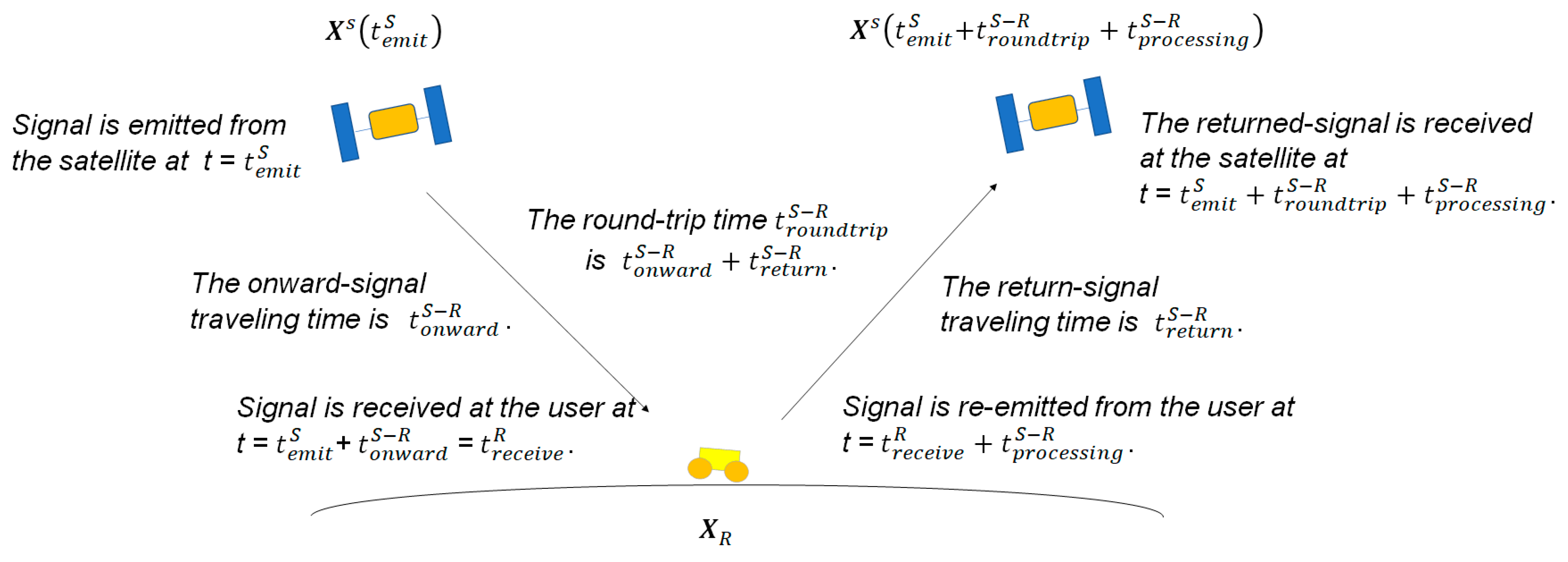
Two-way ranging method determines Time of Arrival (TOA) of radio signal in round trip and then calculates the distance between the nodes by multiplying the round-trip time by the speed of light.
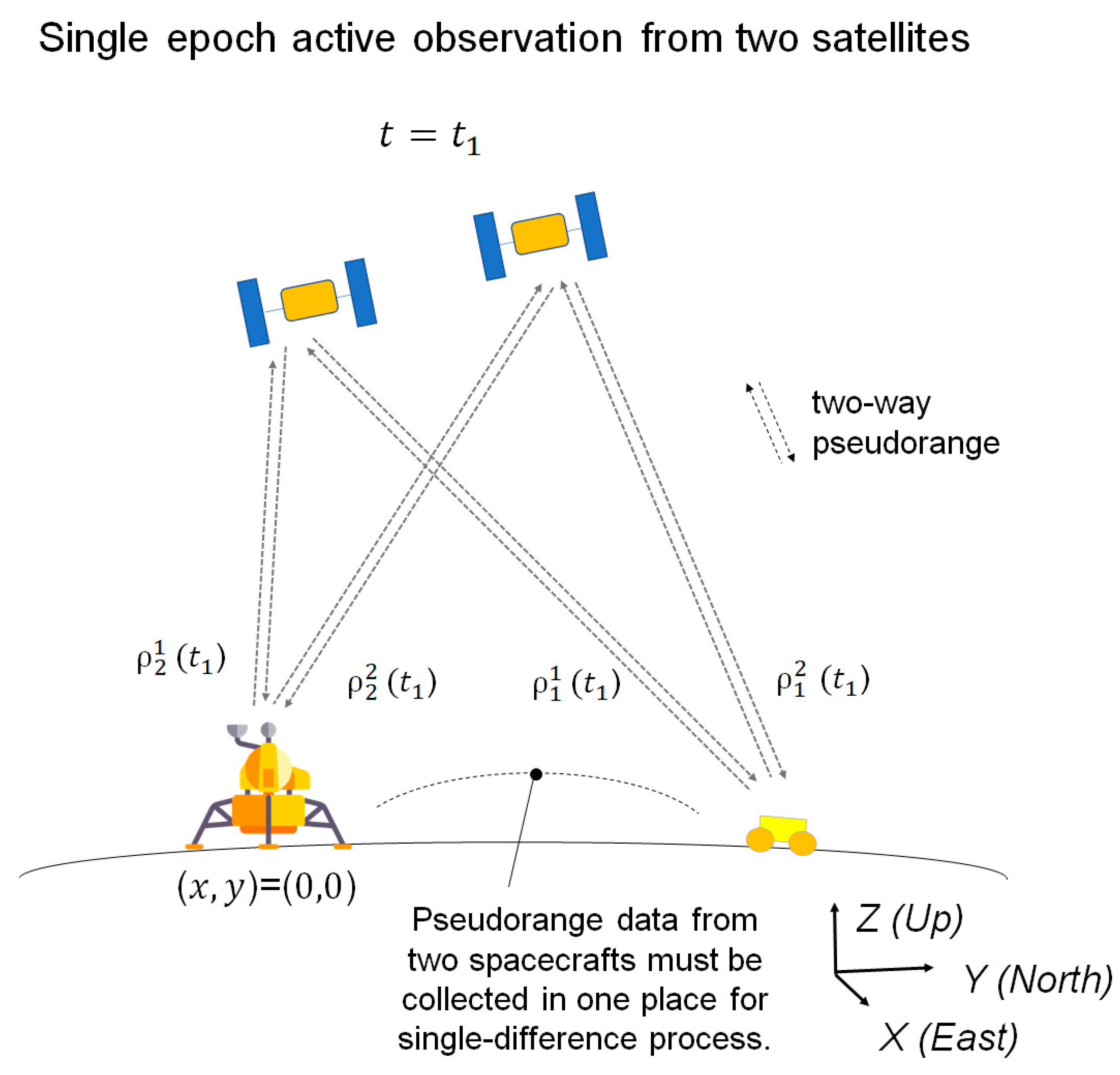
When the two-way ranging radio signal is initiated at the satellite side and the user is fixed on the lunar surface, as shown in
Figure 3, the pseudorange observation is presented as
where
is the time of signal emission at the satellite;
is the time of signal reception at the rover;
is a signal round-trip time that is the sum of the onward and return signal traveling time; and
is the time to process the signal and rebroadcast at the rover, which are also visually shown in
Figure 3.
and
are the range receiver observation error at the user and satellite, respectively. In this study, we assume that the range receiver observation error
and
follow a white Gaussian distribution.
In Equation (36), is written as a function of based on the fact that can be presented as a function of as long as the satellite orbit dynamics, orbital parameters, the signal processing time , as well as an estimate of the user position, are provided.
Two pseudorange observations between two users (user1, user2) and a satellite can be written as
where
corresponds to
of Equation (35) and
corresponds to
of Equation (35) assuming
and
follow a white Gaussian distribution and are independent of time. The standard deviation of
is defined as
.
A method called single difference is used to effectively remove the satellite orbit determination error, i.e.,
as we discuss in
Section 3.6, by subtracting two pseudorange observations between two users (user1, user2) and a satellite:
where
is the single difference operator.
To effectively remove the satellite orbit determination error at the moment of signal emission, i.e.,
, the clock
of two pseudoranges, i.e.,
and
, must be synchronized. This can be easily achieved, for instance, when pseudorange signals are initiated from satellite side at the request of the user. In that case, pseudorange observations are to be obtained at the satellite side, and then transferred to the user by telemetry: the so-called telemetry ranging [
26].
Furthermore, the timing of returned-signal reception at the satellite side, i.e., , slightly differs among four pseudorange observations due to the difference in user1 and user2 position, as well as their different signal processing delay times. In order for single difference to effectively remove the satellite orbit determination error at the moment of returned-signal reception, the difference among , , , and must be negligible. This assumption practically holds, unless the distance between user1 and user2 becomes largely apart, or their signal processing delay times are largely different, which holds at least under the simulated conditions of this research.
Single-differenced two-way ranging can determine the user position using single-differenced pseudorange observations from two satellites, i.e.,
, at a single epoch as shown in
Figure 4. Similar to the other two methods, we can use the Newton–Raphson method to solve the equation. First, we define a new parameter
at
:
where
is the difference between the measured single-differenced pseudorange value, i.e.,
, and the calculated single-differenced range of
s-th satellite on an initial estimated value of the rover position
, i.e.,
. Then,
and
are derived as follows:
The following process is the same as the Equations (11), (13) and (15)–(25), with the exception that the single-differenced receiver observation error, i.e., , is used instead of the double-differenced receiver observation error, i.e., . The standard deviation of single-differenced receiver observation errors, i.e., , is amplified from the standard deviation of the original receiver observation errors, i.e., , during the single-differencing process and becomes as large as assuming that the receiver observation errors follow a white Gaussian distribution. It is also important to highlight that the above formulation corresponds to a DEM-aided form that calculates an estimated two-dimensional (X–Y) position using a rover altitude that is given by Equation (25).
3.7. Design Parameters
3.7.1. DOP and Availability
The spatial position of two satellites is one of the most important design parameters that directly impacts the rover position accuracy. In order to acquire an accurate user position, a small DOP value is required.
In this analysis, we assume the satellite formation that has two satellites placed in the same orbital planes with a phase difference (i.e., the difference in argument of latitude of two satellites): this formation is the most desirable arrangement to keep the relative position of two satellites. In that case, to reduce the DOP value, a large phase difference is preferable. In comparison, to keep both satellites in the rover’s view for a long time, a small phase difference is desirable. As a result, these two requirements conflict with each other, and both impacts must be carefully considered to find the best compromise point in the satellite trajectory selection. In our comparative analysis, we used two performance index parameters, the and , where is the percentage of time at which both satellites are in the rover’s view to the total mission time.
The relationship between the
and
change depending on the navigation methods, as well as the satellite orbital parameters.
Table 2 and
Table 3 show the
and
comparisons among the three navigation methods under different orbital conditions: in this study, without losing generality, the rover/lander position were fixed to the south-pole (
deg latitude) and the satellite orbit inclination was fixed to 110 deg while the orbital attitudes of two satellites were changed (300 and 2100 km), and the phase differences between the two satellites were also changed (5, 10, 15, and 25 deg).
We found that single-differenced two-way ranging provided the smallest DOP. This is as single-differenced observation has a better quality by nature than double-differenced observation, due to fewer differencing processes. On the other hand, double-differenced TOA–FOA tends to result in the largest DOP due to the low quality of double-differenced pseudodoppler observations. Double-differenced TOA–FOA and single-difference two-way ranging have a larger than the MDPO, as they only require single-epoch observation, while the MDPO requires multiple-epoch observations. The and changes depending on the attitudes of the satellites, as well as the phase difference between the two satellites. In general, higher orbits provide a larger and , and larger phase differences provide a smaller and .
3.7.2. Satellite Orbital Parameters and Systematic Errors Related to DEM
As indicated by Equations (25) and (45), using DEM information in the estimation process induces errors in the X–Y position estimates. There is some correlation between the error and satellite positions: a larger elevation angle from the rover plane to the satellite position tends to lead to a larger X–Y position error: This can be explained by looking at Equation (2). Equation (2) can be reformatted as and when the elevation angle is large, becomes larger in relation to and and, consequently, the projection of the Z direction error on the X–Y plane is greater.
The mathematical process , and its converted form , indicates that the error in the estimates does not appear linearly with respect to the elevation angle, as the process takes the double-differenced or single-differenced form of pseudo-observations but multiplies them by the pseudo-inversed observation matrix, which is also a function of the satellite and user positions. However, we can exploit some useful findings with respect to the satellite orbital parameters: for instance, the higher the satellite altitude at the same orbit inclination, the larger the error. Again, the error cannot be analytically calculated, and we need to use a numerical simulation on a case-by-case basis.
Table 4 shows the user position error with different satellite altitudes, which was calculated using the same numerical simulation as in
Section 4.2. The satellite altitude was changed among 300, 600, 900, and 2100 km, while the other parameters were set the same as in
Section 4. In this section, satellite orbital positions were created without considering the precise cis-lunar dynamics, and the orbital parameters did not change due to perturbations from the initial set. The result indicates that the user position accuracy deteriorated immediately along with the satellite orbit altitude and that low lunar orbits are suitable for these DEM-aided radio-triangulation-based relative-positioning systems.