
Results of the H2Avia Project: Potential of Hydrogen for Global Aviation

 , , , , , , , , , , , and
  add
Show full author list
add
Show full author list
Abstract
1. Introduction
- •
- To what extent do hydrogen production pathways and infrastructure assumptions influence overall climate performance?
- •
- How do updated component weight penalties and integration constraints for LH2 affect overall aircraft performance?
- •
- How do operational uncertainties, particularly regarding aviation-induced cloudiness (AIC), affect the overarching LCA results?
- •
- Are LH2-powered aircraft economically competitive compared to SAF-powered alternatives?
2. Hydrogen Production and Logistics
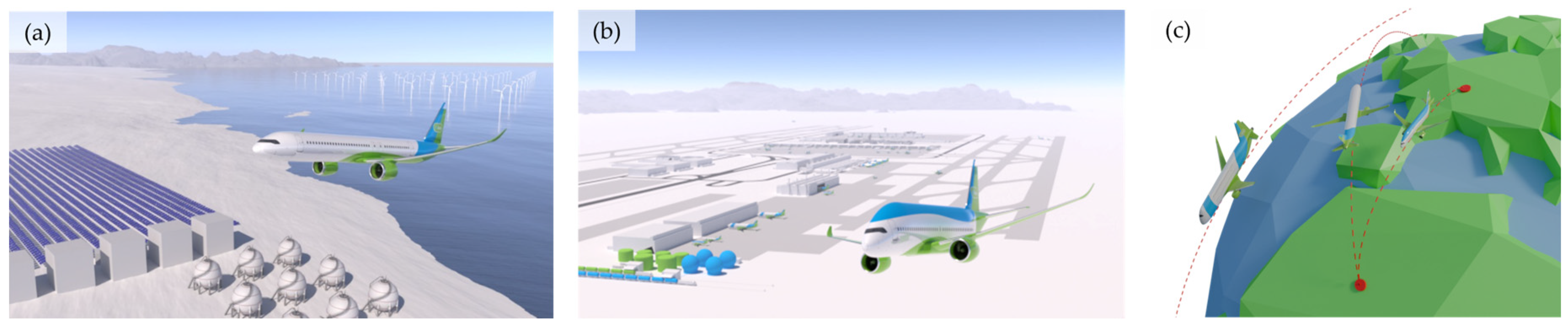
2.1. Hydrogen Production and Transport
2.2. Airport Logistics
3. Hydrogen Aircraft Technologies
3.1. Technology Assessment Scenario
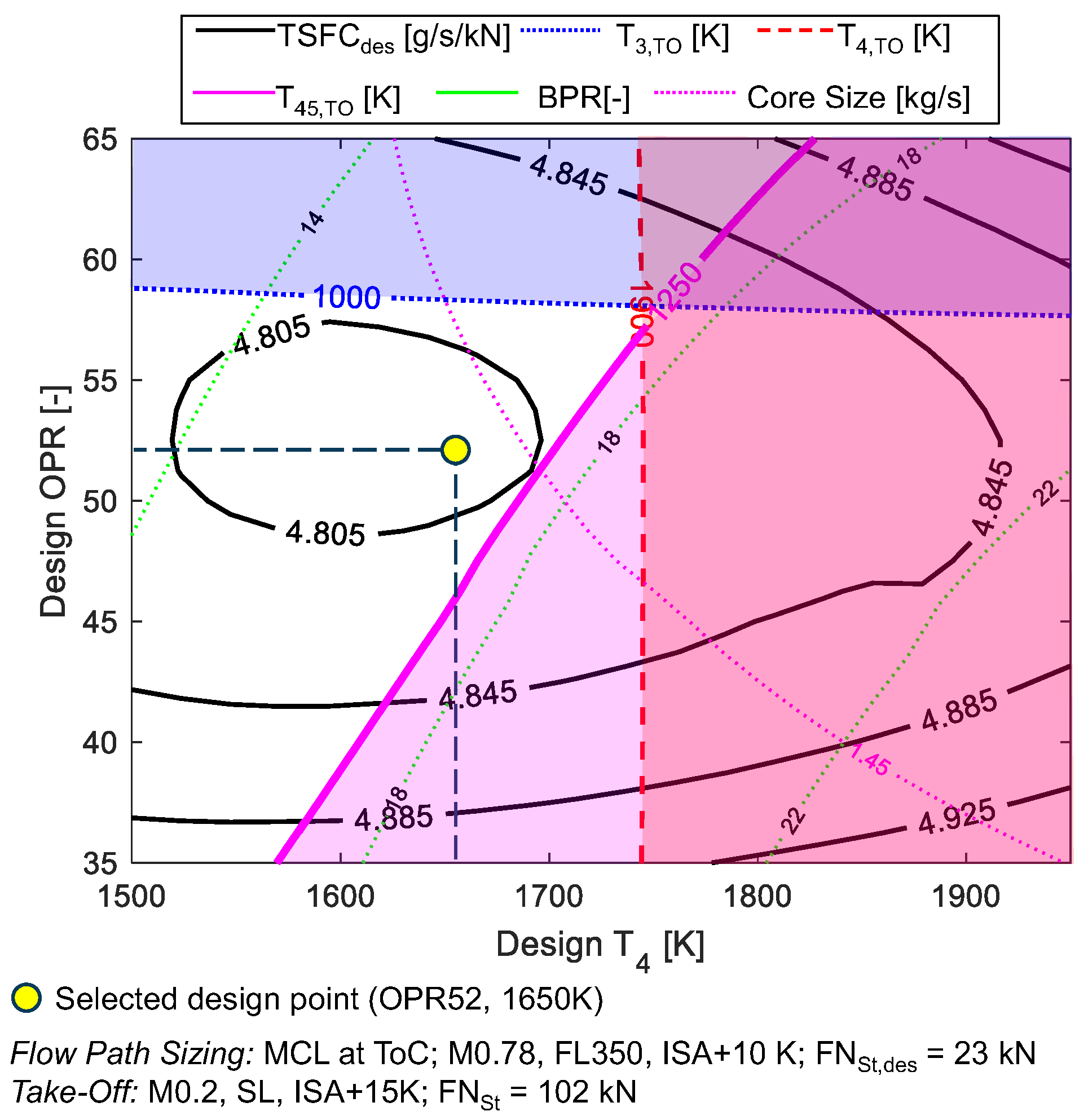
3.2. Propulsion
- •
- Kerosene: 42.77 MJ/kg;
- •
- Hydrogen: 120.07 MJ/kg.
3.3. Hydrogen Fuel System
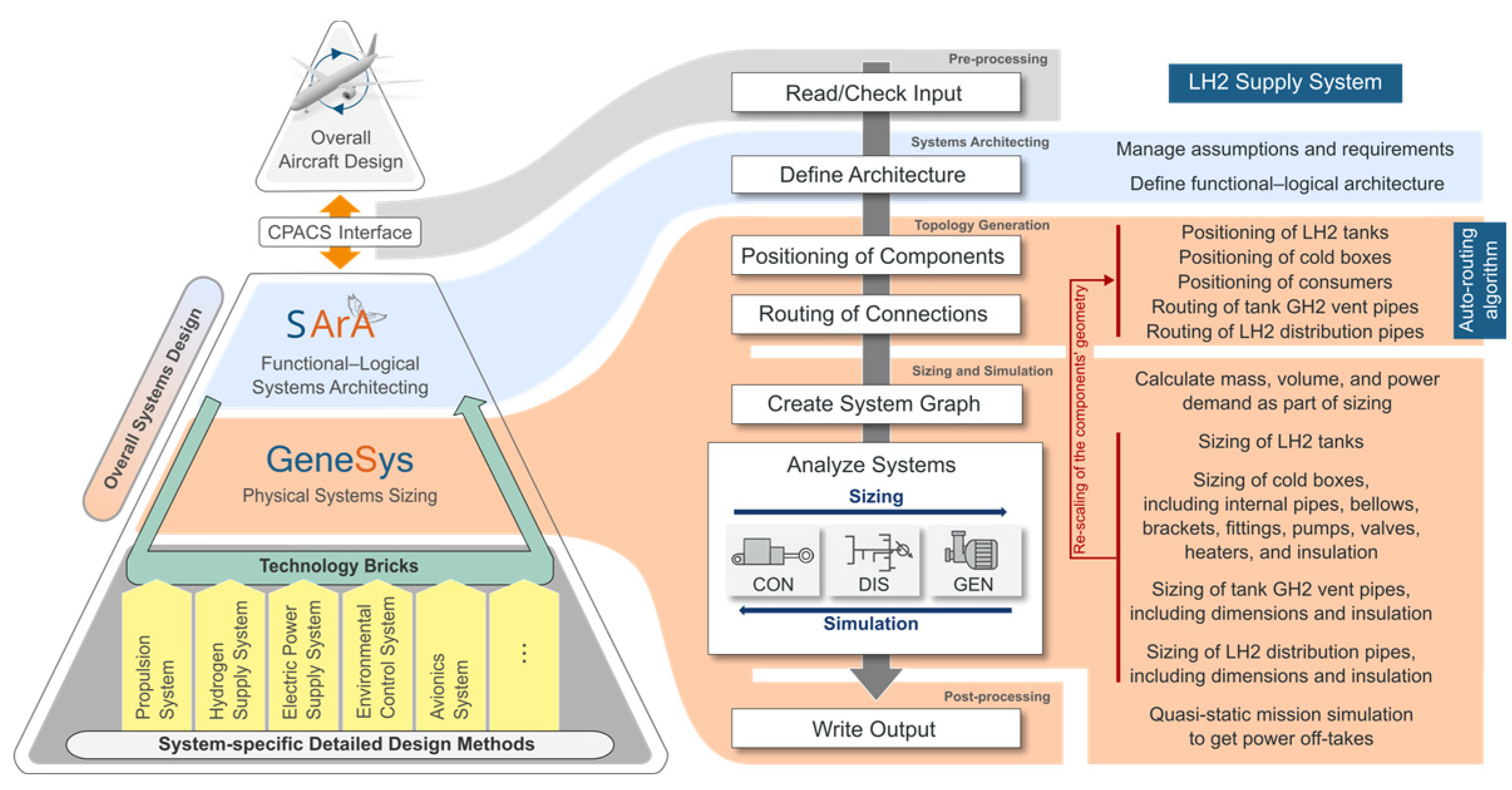
3.3.1. Conceptual Sizing and Evaluation Methodology
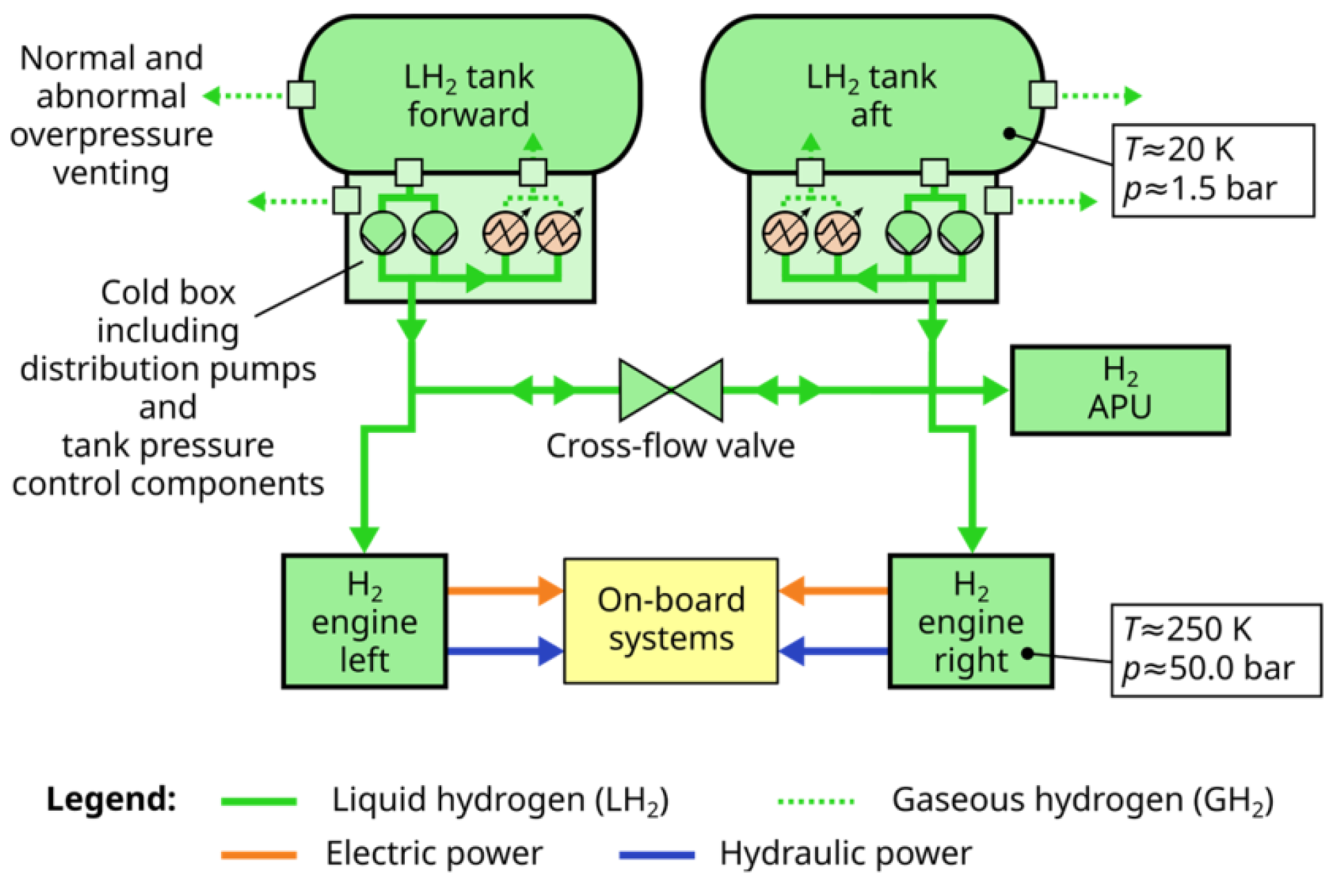
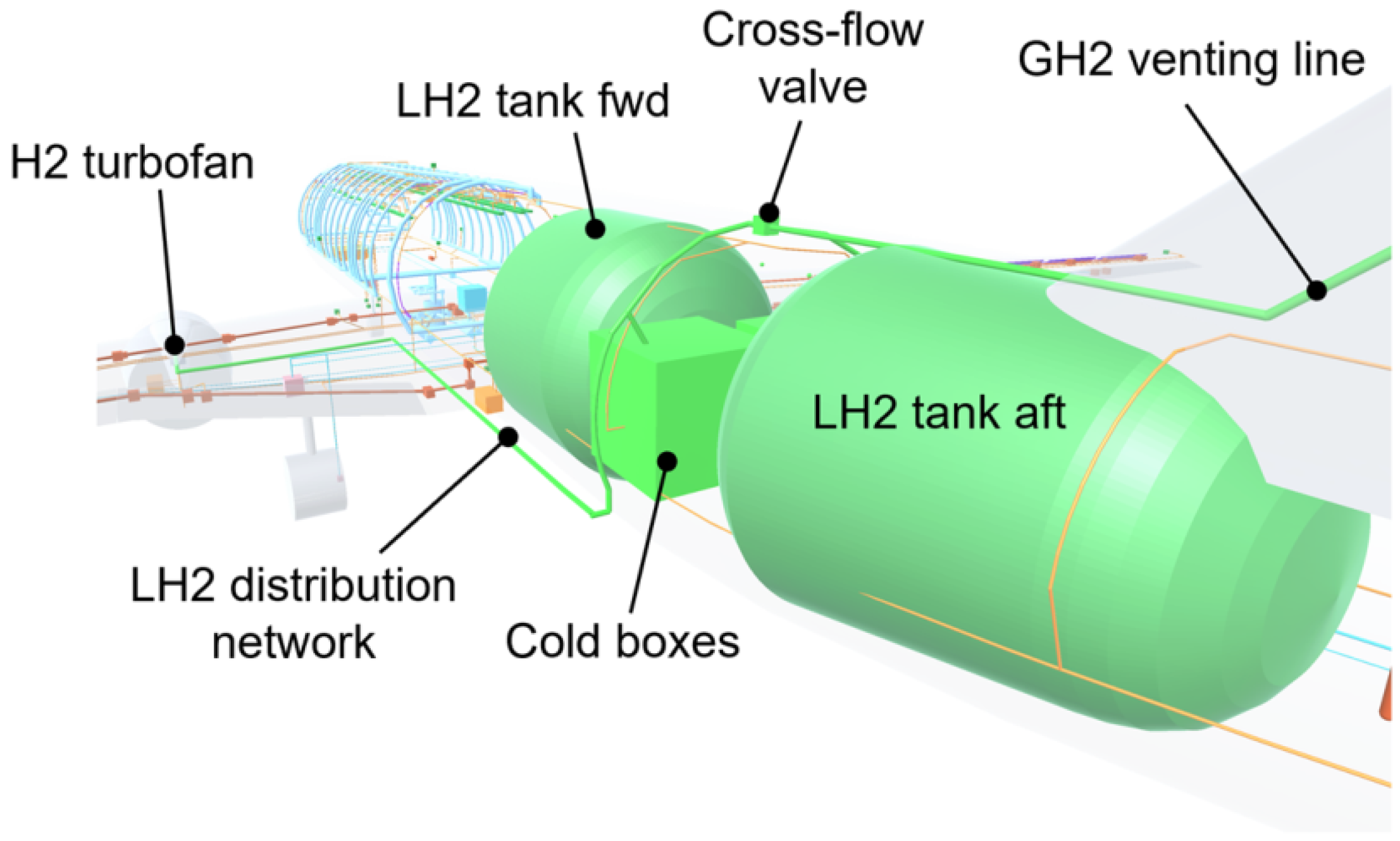
3.3.2. LH2 Fuel Line Routing Concept and System Topology
3.3.3. Conceptual Sizing Results of the LH2 Supply System
3.4. Fuselage Design and Hydrogen Tank Integration
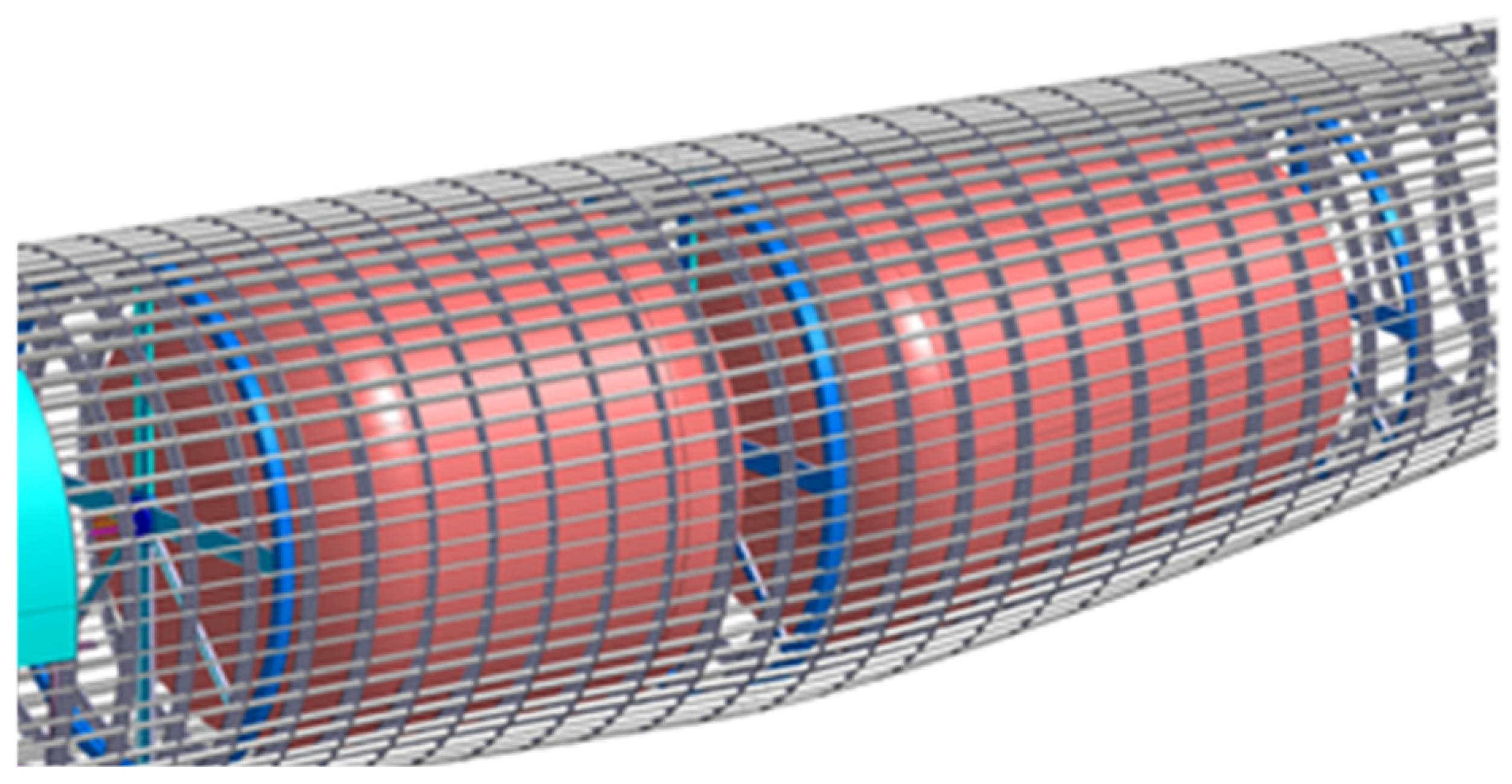
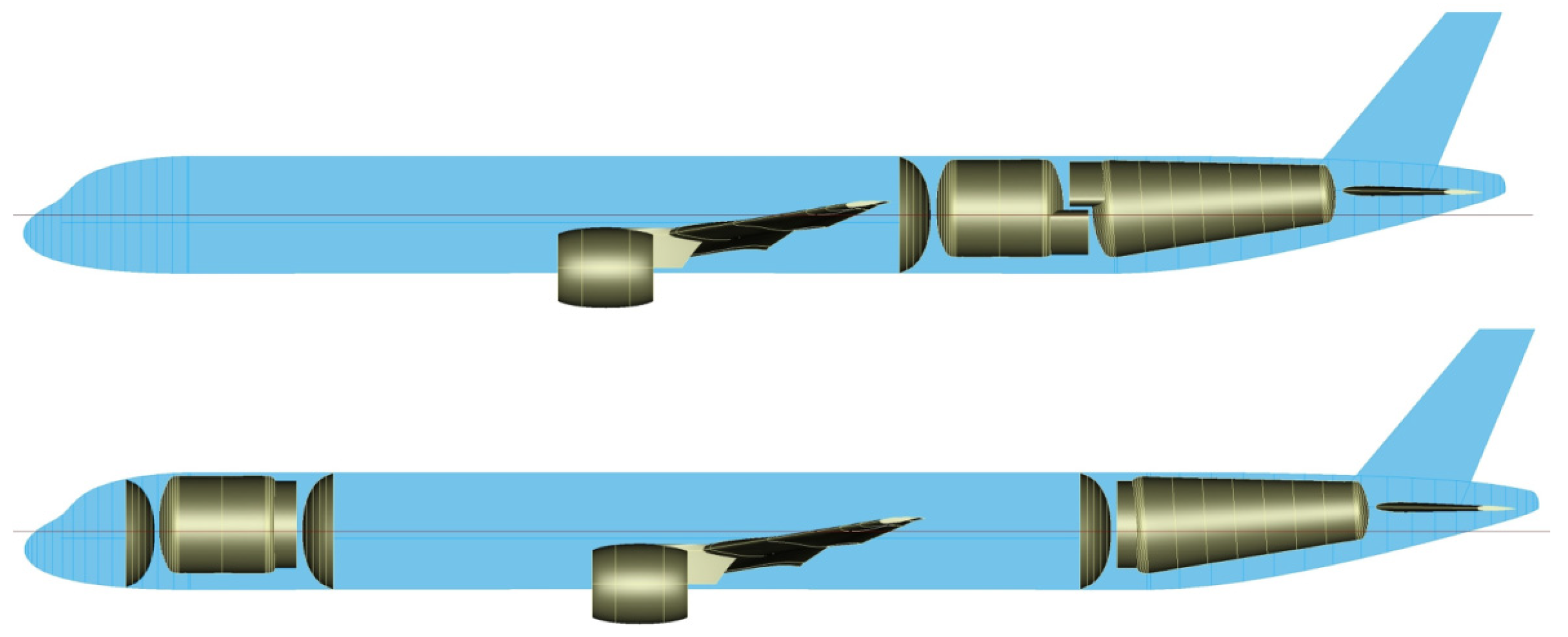
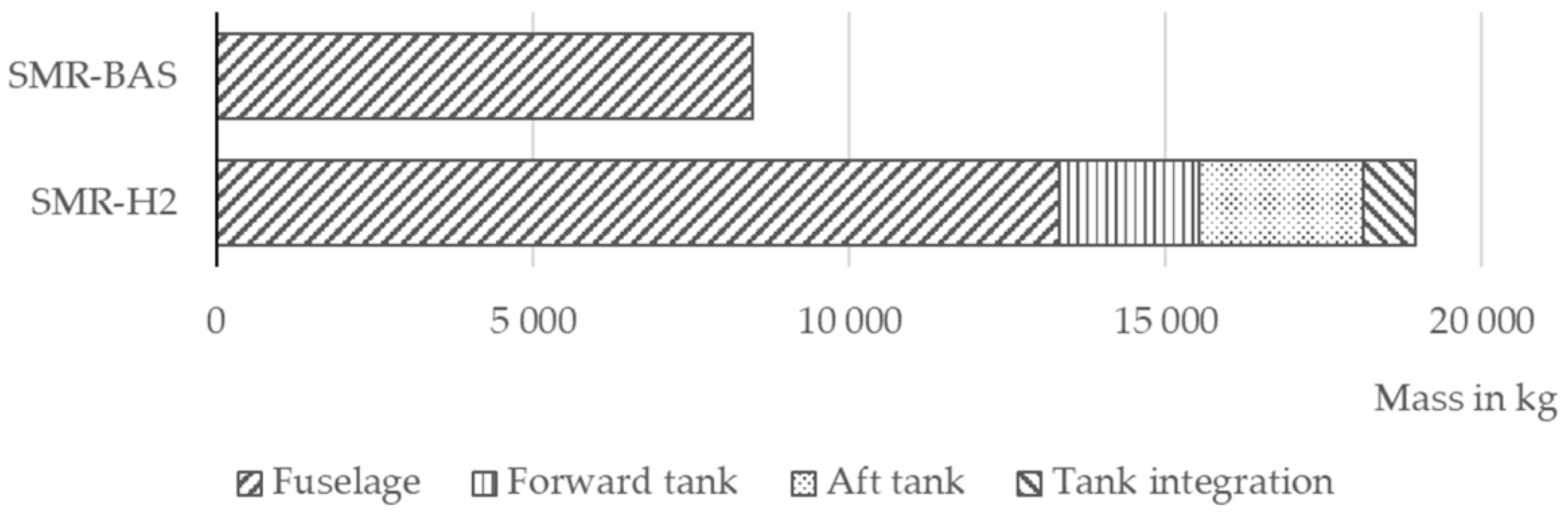
- Input: baseline fuselage geometry, mission fuel demand, candidate tank locations, design pressure assumptions, integration constraints, and structural allowables.
- Tank modeling: parametric tank sizing (geometry, structure, and insulation/thermal model), producing tank mass properties and performance indicators.
- Integration and fuselage structural design: geometry modification (tank bays/fairings), load-path definition, and structural sizing under representative load assumptions.
- Mass properties aggregation: component-level masses and CGs for fuselage structure and tank integration structures are combined into aircraft-level updates.
- Data exchange and visualization: results are exported to standardized exchange formats (e.g., CPACS) and can be visualized for plausibility using parametric aircraft geometry modeling tools (e.g., TiGL Viewer from DLR).
3.4.1. LH2 Tank Modeling in FLHYTE
3.4.2. Tank Integration and Fuselage Structural Design in FLHYTE
3.4.3. Data Exchange and Linking to the Overall Aircraft Design Loop
3.4.4. Structural Mass Effects of LH2 Tank Integration

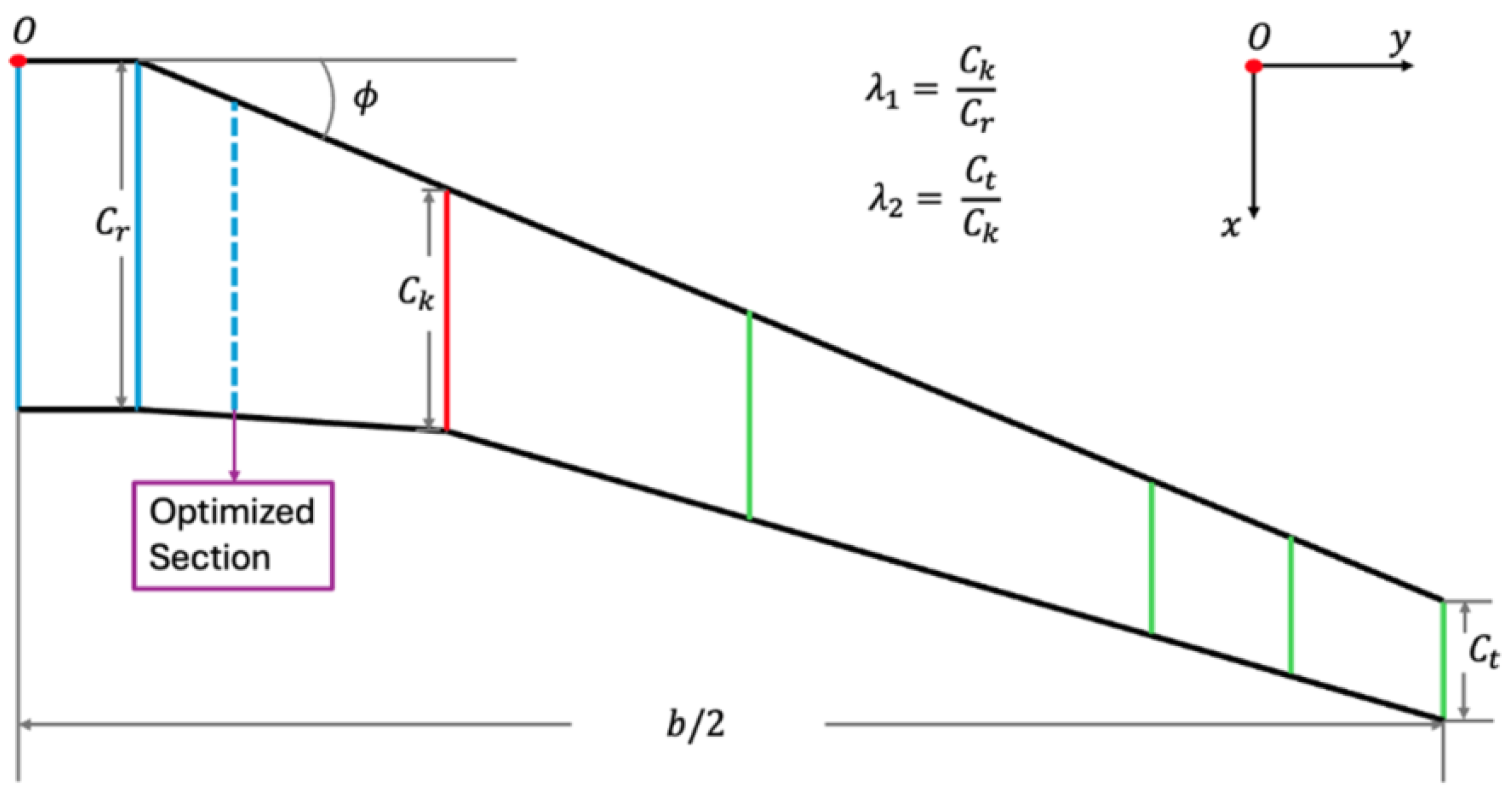
3.5. Wing
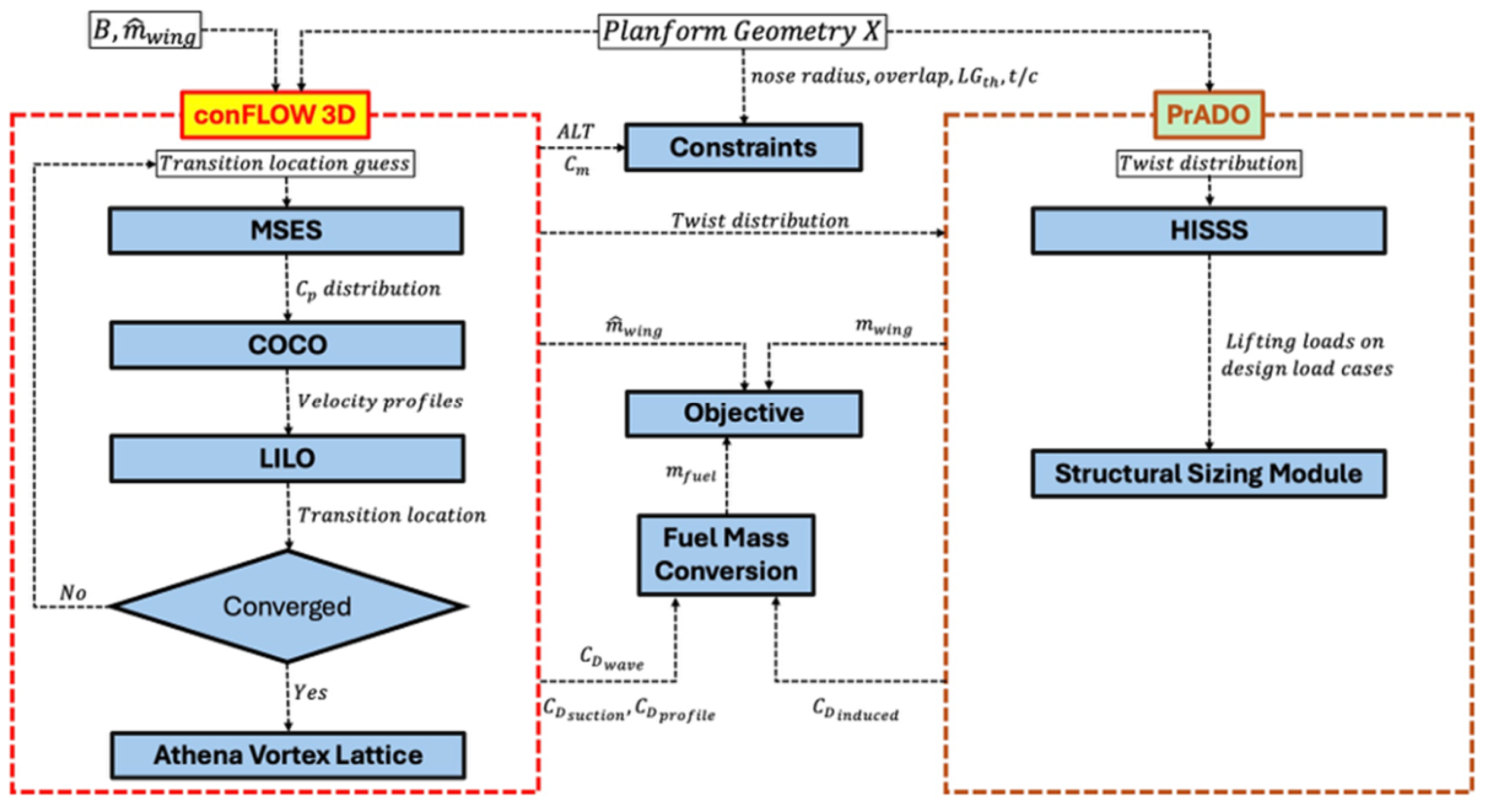
- •
- Objective: Minimization of
- ○
- Fuel mass + wing mass + penalty for aerostructural inconsistent wing mass.
- •
- Design Variables:
- ○
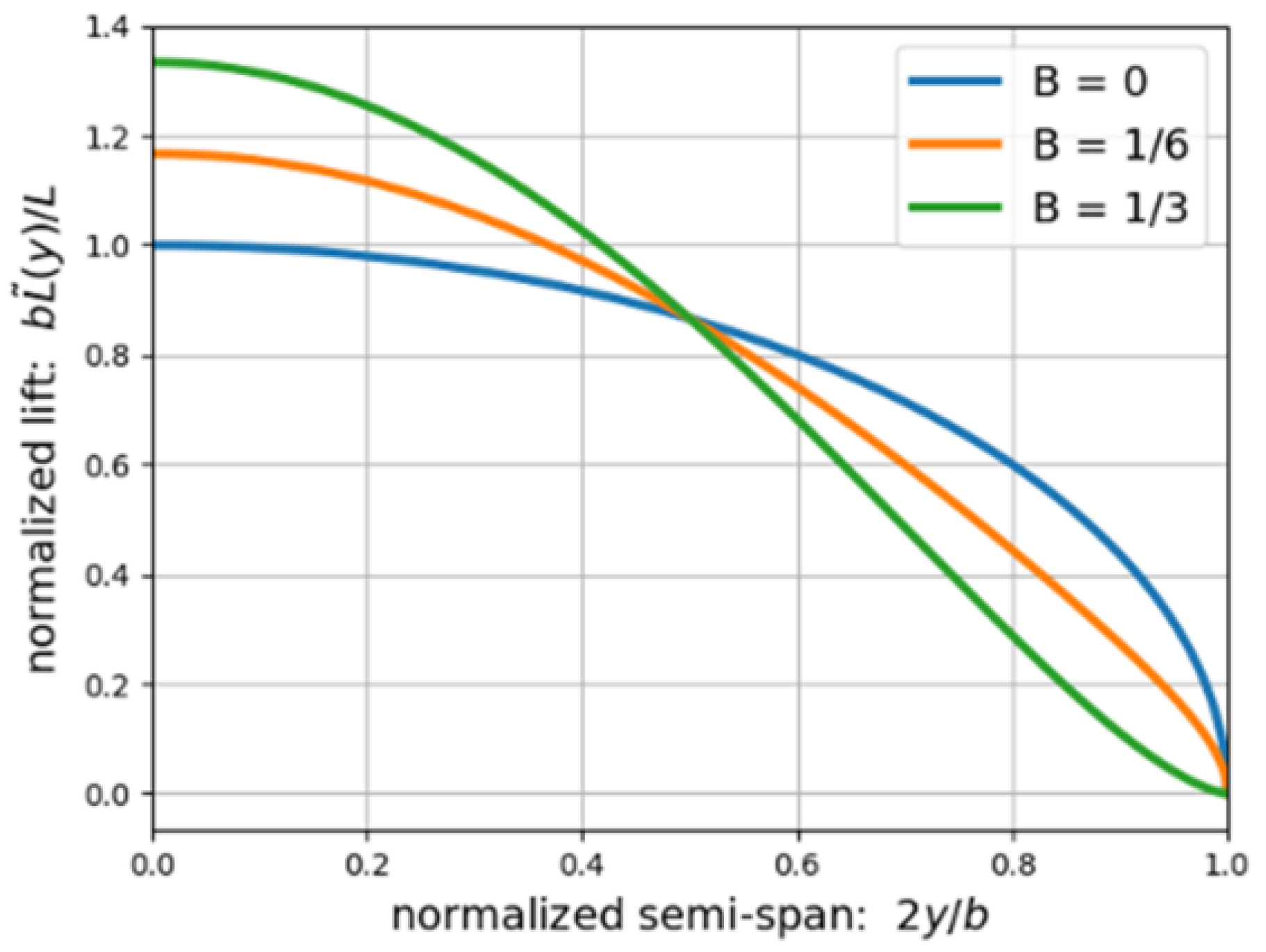
- Wing geometry (X), wing mass (mwing), and lift distribution parameter (B).
- •
- Subject to Constraints:
- ○
- Airfoil profile thickness-to-chord ratio is greater than a prescribed threshold of 14% at the design section;
- ○
- No negative volume/overlapping profile shape;
- ○
- Nose radius of the airfoil is greater than the prescribed threshold of 8 mm;
- ○
- Moment coefficient is greater than the prescribed threshold of −0.15;
- ○
- Minimum thickness to accommodate the landing gear.
4. Integrated Aircraft Design
4.1. Top-Level Aircraft Requirements
4.2. Technology Assumptions
4.3. Integration Strategy
4.3.1. Propulsion
4.3.2. Systems
4.3.3. Fuselage
4.3.4. Wing
4.4. Aircraft Performance
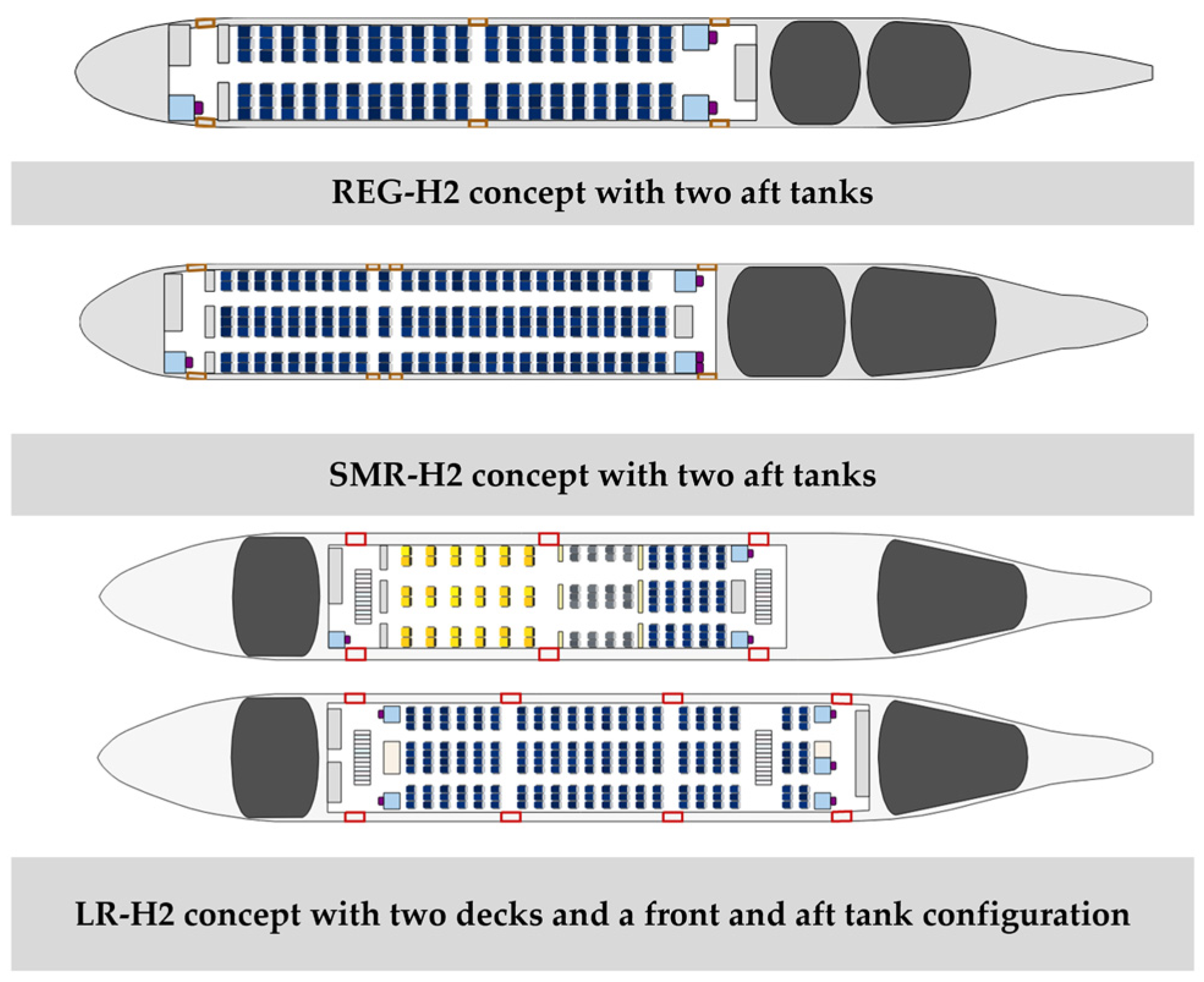
4.4.1. Fuselage and Seating Layout
4.4.2. Gravimetric Index
4.4.3. Aerodynamic Performance
4.4.4. Mass Properties
4.4.5. Energy Consumption
4.5. Mission Trajectories
4.6. Payload Range
5. Holistic Assessment
5.1. Climate Assessment from Aircraft Operations
5.2. Life-Cycle Assessment
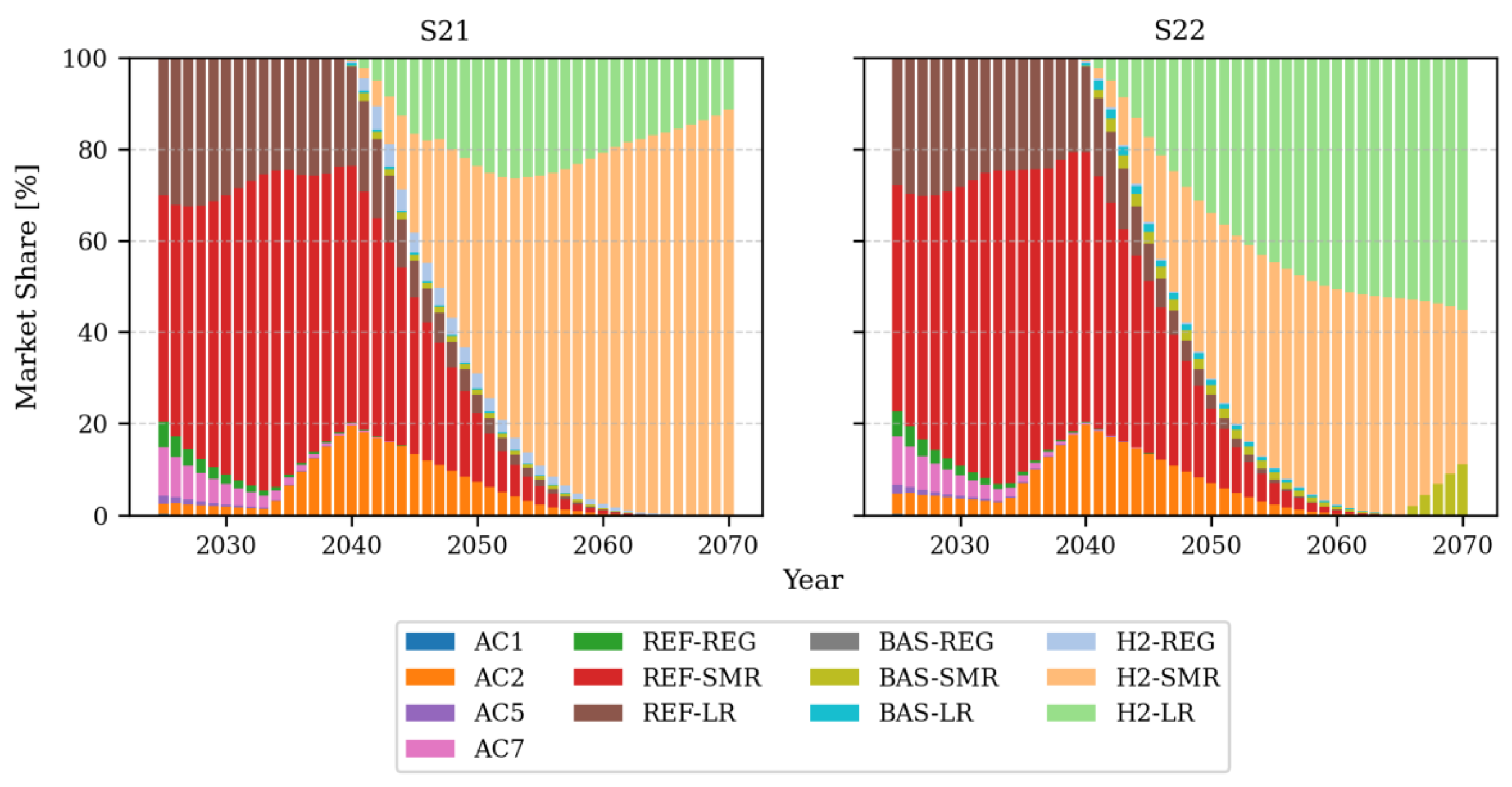
5.3. Global Fleet Assessment
- Determination of representative aviation scenarios;
- Provision of input data and key assumptions;
- Simulation of aviation scenarios.
6. Conclusions and Further Work
Author Contributions
Funding
Data Availability Statement
Acknowledgments
Conflicts of Interest
Abbreviations
| AIC | Aviation-Induced Cloudiness |
| APU | Auxiliary Power Unit |
| AtJ | Alcohol-to-Jet |
| ATR | Average Temperature Response |
| BLADE | Bauhaus Luftfahrt Aircraft Design Environment |
| BPR | Bypass Ratio |
| CAFE | Cabin and Fuselage Design Environment |
| CFRPs | Carbon Fiber Reinforced Plastics |
| CG | Center of Gravity |
| CPACS | Common Parametric Aircraft Configuration Schema |
| ECS | Environmental Control System |
| EIS | Entry Into Service |
| f-GWP | Efficacy-Weighted Global Warming Potential |
| FLHYTE | Fuselage Design and Hydrogen Tank Integration Tool Environment |
| FNST | Net Static Thrust |
| GH2 | Gaseous Hydrogen |
| GHI | Global Horizontal Irradiation |
| GI | Gravimetric Index |
| GWP | Global Warming Potential |
| HEFA | Hydroprocessed Esters And Fatty Acids |
| HyDRA | Hydrogen Tank Design Routine and Assessment |
| ISA | International Standard Atmosphere |
| L/D | Lift-to-Drag Ratio |
| LCA | Life-Cycle Assessment |
| LH2 | Liquid Hydrogen |
| LR-BAS | Long-Range Baseline Aircraft |
| LR-H2 | Long-Range Hydrogen Aircraft |
| LR-REF | Long-Range Reference Aircraft |
| MCL | Maximum Climb |
| MDO | Multi-Disciplinary Optimization |
| MTOM | Maximum Take-Off Mass |
| OAD | Overall Aircraft Design |
| OBSs | On-Board Systems |
| OME | Operating Mass Empty |
| OPR | Overall Pressure Ratio |
| OSD | Overall Systems Design |
| PrADO | Preliminary Aircraft Design and Optimisation Program |
| PtL | Power-to-Liquid |
| REG-BAS | Regional-Range Baseline Aircraft |
| REG-H2 | Regional-Range Hydrogen Aircraft |
| REG-REF | Regional-Range Reference Aircraft |
| RF | Radiative Forcing |
| SAF | Sustainable Aviation Fuel |
| SArA | Systems Architecting Assistant |
| SL | Sea Level |
| SMR-BAS | Short–Medium-Range Baseline Aircraft |
| SMR-H2 | Short–Medium-Range Hydrogen Aircraft |
| SMR-REF | Short–Medium-Range Reference Aircraft |
| T4 | Turbine Inlet Temperature |
| TLARs | Top-Level Aircraft Requirements |
| ToC | Top of Climb |
| TSFC | Thrust Specific Fuel Consumption |
| TSPC | Thrust Specific Power Consumption |
| UNICADO | University Conceptual Aircraft Design and Optimization |
References
- Peter, F.N. Verbundbeschreibung des Verbundvorhaben H2Avia—Hydrogen in Aviation: Förderantrag im Rahmen der Luftfahrtforschung und–Technologie LuFoVI-2; Bauhaus Luftfahrt: Taufkirchen, Germany, 2021. [Google Scholar]
- Peter, F.N.; Habersetzer, A.; Nickl, M.; Lüdemann, M.; Ebner, K.; Effing, T.; Badrya, C.; Haupt, M.; Jünemann, M.; Möbs, N. H2Avia—Project Description; Bauhaus Luftfahrt: Taufkirchen, Germany, 2023. [Google Scholar]
- Peter, F.N.; Xicohténcatl, R.B.; Engelmann, M.; Fikry, M.; Lüdemann, M.; Muslic, A.; Stephan, R.; Kakkar, S.; Maibach, T.; Moebs, N. The H2Avia Project—Goals and Aircraft Synthesis Strategy. In Proceedings of the 14th EASN International Conference on “Innovation in Aviation & Space for Opening New Horizons”, Thessaloniki, Greece, 8–11 October 2024; EASN (The European Aeronautics Science Network), Ed.; EASN: Brussels, Belgium, 2024. [Google Scholar]
- Sosounov, V.; Orlov, V. Experimental turbofan using liquid hydrogen and liquid natural gas as fuel. In Proceedings of the 26th Joint Propulsion Conference, Orlando, FL, USA, 16–18 July 1990; AIAA (The American Institute of Aeronautics and Astronautics), Ed.; American Institute of Aeronautics and Astronautics: Reston, VA, USA, 1990. [Google Scholar]
- Brewer, G.D. Hydrogen Aircraft Technology, 1st ed.; CRC Press: Boca Raton, FL, USA, 1991; ISBN 9781351439787. [Google Scholar]
- EU Research. Liquid Hydrogen Fuelled Aircraft—System Analysis: (Publishable Version); Final Technical Report Project No. G4RD-CT-2000-00192; EU: Brussels, Belgium, 2003. [Google Scholar]
- Huete, J.; Pilidis, P. Parametric study on tank integration for hydrogen civil aviation propulsion. Int. J. Hydrogen Energy 2021, 46, 37049–37062. [Google Scholar] [CrossRef]
- Onorato, G.; Proesmans, P.; Hoogreef, M.F.M. Assessment of hydrogen transport aircraft. CEAS Aeronaut. J. 2022, 13, 813–845. [Google Scholar] [CrossRef] [PubMed]
- Patrao, A.C.; Jonsson, I.; Xisto, C.; Lundbladh, A.; Grönstedt, T. Compact heat exchangers for hydrogen-fueled aero engine intercooling and recuperation. Appl. Therm. Eng. 2024, 243, 122538. [Google Scholar] [CrossRef]
- Ramm, J.; Rahn, A.; Silberhorn, D.; Wicke, K.; Wende, G.; Papantoni, V.; Linke, F.; Kühlen, M.; Dahlmann, K. Assessing the Feasibility of Hydrogen-Powered Aircraft: A Comparative Economic and Environmental Analysis. J. Aircr. 2024, 61, 1337–1353. [Google Scholar] [CrossRef]
- Airbus. ZEROe: Our Hydrogen-Powered Aircraft. Available online: https://www.airbus.com/en/innovation/energy-transition/hydrogen/zeroe-our-hydrogen-powered-aircraft (accessed on 22 May 2026).
- Fokker Next Gen. Fokker Next Gen: Engineering a New Aeronautical Experience. Available online: https://www.fokkernextgen.com/the-aircraft (accessed on 21 November 2025).
- Cole, J.; McClintock, W.; Powis, L. Market Forecast & Strategy; FlyZero FZO-CST-REP-0043; FlyZero: Bedford, UK, 2022. [Google Scholar]
- Moser, L.; Portner, B.W.; Penke, C.; Ebner, K.; Batteiger, V. Life-Cycle assessment of renewable fuel production via hydrothermal liquefaction of manure in Germany. Sustain. Energy Fuels 2023, 7, 4898. [Google Scholar] [CrossRef]
- Global Wind Atlas: Global Solaratlas, Energydata.info. Available online: https://globalwindatlas.info/en (accessed on 11 June 2024).
- Solargis. Global Solar Atlas. Available online: https://globalsolaratlas.info/map?c=30.387092,-7.174072,7&s=31.118794,-6.580811&m=site (accessed on 5 March 2026).
- Petra, I.; Thomas, L. Entwicklung der Spezifischen Treibhausgas-Emissionen des Deutschen Strommix in den Jahren 1990–2024; Umweltbundesamt: Dessau-Roßlau, Germany, 2025. [Google Scholar]
- Schloemer, S.; Bruckner, T.; Fulton, L.; Hertwich, E.; McKinnon, A.; Perczyk, D.; Roy, J.; Schaeffer, R.; Sims, R.; Smith, P.; et al. Annex III: Technology-specific cost and performance parameters. In Climate Change 2014: Mitigation of Climate Change: Contribution of Working Group III to the Fifth Assessment Report of the Intergovernmental Panel on Climate Change; Cambridge University Press: Cambridge, UK; New York, NY, USA, 2014; pp. 1329–1356. [Google Scholar]
- Micheli, M.; Moore, D.; Bach, V.; Finkbeiner, M. Life-Cycle Assessment of Power-to-Liquid Kerosene Produced from Renewable Electricity and CO2 from Direct Air Capture in Germany. Sustainability 2022, 14, 10658. [Google Scholar] [CrossRef]
- Rojas-Michaga, M.F.; Michailos, S.; Cardozo, E.; Akram, M.; Hughes, K.J.; Ingham, D.; Pourkashanian, M. Sustainable aviation fuel (SAF) production through power-to-liquid (PtL): A combined techno-economic and life cycle assessment. Energy Convers. Manag. 2023, 292, 117427. [Google Scholar] [CrossRef]
- Treyer, K.; Sacchi, R.; Bauer, C. Life Cycle Assessment of Synthetic Hydrocarbons for Use as Jet Fuel: “Power-to-Liquid” and “Sun-to-Liquid” Processes; Paul Scherrer Institute: Würenlingen, Switzerland, 2022. [Google Scholar]
- ICAO (The International Civil Aviation Organization). CORSIA Default Life Cycle Emissions Values for CORSIA Eligible Fuels; ICAO: Montreal, QC, Canada, 2025. [Google Scholar]
- Fesmire, J.E.; Swanger, A. Overview of the New LH2 Sphere at NASA Kennedy Space Center. Available online: https://www.energy.gov/sites/default/files/2021-10/new-lh2-sphere.pdf (accessed on 22 February 2023).
- Hoelzen, J.; Flohr, M.; Silberhorn, D.; Mangold, J.; Bensmann, A.; Hanke-Rauschenbach, R. H2-powered aviation at airports—Design and economics of LH2 refueling systems. Energy Convers. Manag. X 2022, 14, 100206. [Google Scholar] [CrossRef]
- Petitpas, G. Boil-off Losses Along LH2 Pathway; LLNL-TR-750685; Lawrence Livermore National Laboratory: Livermore, CA, USA, 2018. [Google Scholar] [CrossRef]
- Restelli, F.; Jiao, F.; Norris, B.; Trusler, J.M.; Siahvashi, A.; May, E.F.; Pellegrini, L.A.; Johns, M.; Al Ghafri, S.Z. Dynamic simulation of a liquefied hydrogen export terminal. Energy 2026, 342, 139715. [Google Scholar] [CrossRef]
- Zimmnau, M.; Schültke, F.; Stumpf, E. UNICADO: Multidisciplinary analysis in conceptual aircraft design. CEAS Aeronaut. J. 2023, 14, 75–89. [Google Scholar] [CrossRef]
- Barnert, M.; Schültke, F.; Stumpf, E. Design of a low-emission long-range aircraft using UNICADO. CEAS Aeronaut. J. 2026. [Google Scholar] [CrossRef]
- Risse, K.; Schäfer, K.; Schültke, F.; Stumpf, E. Central Reference Aircraft data System (CeRAS) for research community. CEAS Aeronaut. J. 2016, 7, 121–133. [Google Scholar] [CrossRef]
- Boundy, R.; Diegel, S.; Wright, L.; Davis, S. Biomass Energy Data Book, 4th ed.; U.S. Department of Energy: Washington, DC, USA, 2011.
- Mcbride, B.J.; Gordon, S. Computer Program for Calculation of Complex Chemical Equilibrium Compositions and Applications. Part 2: Users Manual and Program Description; NASA: Washington, DC, USA, 1976.
- Martin, S.; Sebastian, B. Overview on Fuel Flow Correlation Methods for the Calculation of NOx, CO and HC Emissions and Their Implementation into Aircraft Performance Software; Institut für Antriebstechnik: Cologne, Germany, 2013. [Google Scholar]
- Sáez Ortuño, M.Á.; Yin, F.; Gangoli Rao, A.; Vos, R.; Proesmans, P.-J. Climate Assessment of Hydrogen Combustion Aircraft: Towards a Green Aviation Sector. In AIAA SCITECH 2023 Forum; American Institute of Aeronautics and Astronautics: Reston, VA, USA, 2023. [Google Scholar]
- Seitz, A.; Schmitz, O.; Isikveren, A.T.; Hornung, M. Electrically Powered Propulsion: Comparison and Contrast to Gas Turbines. In Proceedings of the Deutscher Luft- und Raumfahrtkongress (DLRK), Berlin, Germany, 10–12 September 2012; DGLR (Deutsche Gesellschaft für Luft- und Raumfahrt), Ed.; DGLR: Bonn, Germany, 2012. [Google Scholar]
- Meissner, R.; Sieb, P.; Wollenhaupt, E.; Haberkorn, S.; Wicke, K.; Wende, G. Towards climate-neutral aviation: Assessment of maintenance requirements for airborne hydrogen storage and distribution systems. Int. J. Hydrogen Energy 2023, 48, 29367–29390. [Google Scholar] [CrossRef]
- Nils, K.; Jasmin, B.; Thimo, B.; Frank, T. Systems Architecting Assistant (SARA)—Enabling a Seamless Process Chain from Requirements to Overall Systems Design. In Proceedings of the 33rd Congress of the International Council of the Aeronautical Science, Stockholm, Sweden, 4–9 September 2022. [Google Scholar]
- Bielsky, T.; Kuelper, N.; Thielecke, F. Assessment of an auto-routing method for topology generation of aircraft power supply systems. CEAS Aeronaut. J. 2024, 15, 765–779. [Google Scholar] [CrossRef]
- Juenemann, M.; Kriewall, V.; Bielsky, T.; Thielecke, F. Overall Systems Design Method for Evaluation of Electro-Hydraulic Power Supply Concepts for Modern Mid-Range Aircraft. In Proceedings of the AIAA Aviation 2022 Forum, Chicago, IL, USA & Virtual, 27 June–1 July 2022; AIAA (The American Institute of Aeronautics and Astronautics): Reston, VA, USA, 2022. [Google Scholar]
- Thimo, B.; Nils, K.; Frank, T. Overall Parametric Design and Integration of On-Board Systems for a Hydrogen-Powered Concept Aircraft. In Proceedings of the Aerospace Europe Conference 2023; EUCASS: Brussels, Belgium, 2023. [Google Scholar]
- Alder, M.; Moerland, E.; Jepsen, J.; Nagel, B. Recent Advances in Establishing a Common Language for Aircraft Design with CPACS. In Proceedings of the Aerospace Europe Conference 2020; EUCASS: Brussels, Belgium, 2020. [Google Scholar]
- Burschyk, T.; Alder, M.; Mancini, A.; Bielsky, T.; Kriewall, V.; Thielecke, F.; Nagel, B. Introduction of a System Definition in the Common Parametric Aircraft Configuration Schema (CPACS). Aerospace 2025, 12, 373. [Google Scholar] [CrossRef]
- Bielsky, T.; Gossel, J.; Thielecke, F. Evaluation of Interdependencies between the Hydrogen Supply System and the Electrical Supply System for Aircraft Conceptual Design. In Proceedings of the Deutscher Luft- und Raumfahrtkongress 2023; DGLR: Bonn, Germany, 2024. [Google Scholar]
- Fesmire, J.E. Aerogel insulation systems for space launch applications. Cryogenics 2006, 46, 111–117. [Google Scholar] [CrossRef]
- Engelmann, M.; Lüdemann, M.; Peter, F.N. Cabin And Fuselage Design For The H2Avia Hydrogen Aircraft Concepts. In Proceedings of the 73. Deutscher Luft- und Raumfahrtkongress (DLRK), Hamburg, Germany, 30 September–2 October 2024; DGLR (Deutsche Gesellschaft für Luft- und Raumfahrt), Ed.; DGLR: Bonn, Germany, 2024. [Google Scholar]
- Lüdemann, M.; Engelmann, M.; Kellermann, H.; Maas, P.; Peter, F.; Hornung, M.; Troeltsch, F. BLADE: A Modular Environment for Traceable and Automated Aircraft Design. In Proceedings of the 13th EASN International Conference 2023, Salerno, Italy, 6 September 2023. [Google Scholar]
- Engelmann, M.; Hornung, M. Geometric optimization of hydrogen aircraft fuselages in preliminary design. In Proceedings of the 34th Congress of the International Council of the Aeronautical Sciences, Florence, Italy, 9–13 September 2024. [Google Scholar]
- American Bureau of Shipping. Guidance Notes on Strength Assessment of Independent Type C Tanks. Available online: https://ww2.eagle.org/content/dam/eagle/rules-and-guides/current/design_and_analysis/327_gn_type_C_tanks_2022/type-c-tanks-gn-jan22.pdf (accessed on 1 February 2026).
- Hellbrück, S.; Hesse, C.; Bielsky, T.; Thielecke, F.; Biedermann, J.; Nagel, B. Knowledge-based engineering methods for hydrogen tank and system integration in aircraft fuselage design. CEAS Aeronaut. J. 2026. [Google Scholar] [CrossRef]
- Ardema, M.D.; Chambers, M.C.; Patron, A.P. Analytical Fuselage and Wing Weight Estimation of Transport Aircraft; NASA Technical Memorandum No. 110392; NASA: Washington, DC, USA, 1996.
- Sudhi, A.; Radespiel, R.; Badrya, C. Design Exploration of Transonic Airfoils for Natural and Hybrid Laminar Flow Control Applications. J. Aircr. 2023, 60, 716–732. [Google Scholar] [CrossRef]
- Österheld, C.M. Physikalisch Begründete Analyseverfahren im Integrierten Multidisziplinären Flugzeugvorentwurf; Shaker: Aachen, Germany, 2004. [Google Scholar]
- Heinze, W.; Österheld, C.M.; Horst, P. Multidisziplinäres Flugzeugentwurfsverfahren PrADO—Programmentwurf und Anwendung im Rahmen von Flugzeug-Konzeptstudien. In Proceedings of the Deutscher Luft- und Raumfahrtkongress (DLRK), Bremen, Germany, 31 August–2 September 2021; DGLR (Deutsche Gesellschaft für Luft- und Raumfahrt), Ed.; DGLR: Bonn, Germany, 2021. [Google Scholar]
- Rieke, J. Bewertung von CFK-Strukturen in Einem Multidisziplinären Entwurfsansatz für Verkehrsflugzeuge; Cuvillier: Göttingen, Germany, 2013. [Google Scholar]
- Fornasier, L. HISSS—A higher-order subsonic/supersonic singularity method for calculating linearized potential flow. In Proceedings of the 17th Fluid Dynamics, Plasma Dynamics, and Lasers Conference, Snowmass, CO, USA, 25–27 June 1984; American Institute of Aeronautics and Astronautics, Ed.; American Institute of Aeronautics and Astronautics: Reston, VA, USA, 1984. [Google Scholar]
- Garnett, R. Bayesian Optimization; Cambridge University Press: Cambridge, UK, 2023. [Google Scholar]
- Kakkar, S.; Heinze, W.; Haupt, M.; Sudhi, A.; Badrya, C.; Radespiel, R. Aerostructural Optimisation of Dry Wings for Hydrogen Aircraft. In Proceedings of the 73. Deutscher Luft- und Raumfahrtkongress (DLRK), Hamburg, Germany, 30 September–2 October 2024; DGLR (Deutsche Gesellschaft für Luft- und Raumfahrt), Ed.; DGLR: Bonn, Germany, 2024. [Google Scholar]
- Phillips, W.F.; Hunsaker, D.F.; Joo, J.J. Minimizing Induced Drag with Lift Distribution and Wingspan. J. Aircr. 2019, 56, 431–441. [Google Scholar] [CrossRef]
- Airbus Canada Limited Partnership. Airbus A220 Aircraft Characteristics Publication ACP; BD500-3AB48-13800-00, Issue No. 001; Airbus: Leiden, The Netherlands, 2023. [Google Scholar]
- EASA (The European Union Aviaton Safety Agency). Type-Certificate Data Sheet, No. EASA.A.064 for AIRBUS A318–A319–A320–A321; Issue 60; EASA: Cologne, Germany, 2025.
- EASA (The European Union Aviaton Safety Agency). Type-Certificate Data Sheet for Airbus A350; TCDS EASA.A.151, Issue 32; EASA: Cologne, Germany, 2025.
- Catalano, P.; de Rosa, D.; Mele, B.; Tognaccini, R.; Moens, F. Performance Improvements of a Regional Aircraft by Riblets and Natural Laminar Flow. J. Aircr. 2020, 57, 29–40. [Google Scholar] [CrossRef]
- Weber, L.; Szöke-Erös, H.; Ratei, P.; Shiva Prakasha, P. A Technlogy Scouting and Roadmapping Approach of Future Commercial Passenger Aircraft. In Proceedings of the Deutscher Luft- und Raumfahrtkongress 2024; DGLR: Bonn, Germany, 2024. [Google Scholar]
- Niu, M.C.-Y. Airframe Structural Design: Practical Design Information and Data on Aircraft Structures, 2nd ed.; Conmilit Press: Hong Kong, China, 2002. [Google Scholar]
- Torenbeek, E. Development and Application of a Comprehensive, Design-Sensitive Weight Prediction Method for Wing Structures of Transport Category Aircraft; Report LR-693; Delft University of Technology: Delft, The Netherlands, 1992. [Google Scholar]
- Jenkinson, L.R.; Simpkin, P.; Rhodes, D. Civil Jet Aircraft Design; Arnold: London, UK, 1999. [Google Scholar]
- Kotzem, M.; Wöhler, S.; Burschyk, T.; Hesse, C.; Hellbrück, S.; Zill, T. Conceptual Aircraft Design of a Research Baseline with Direct Liquid Hydrogen Combustion. In Proceedings of the 34th Congress of the International Council of the Aeronautical Sciences, ICAS 2024; ICAS: Bonn, Germany, 2024. [Google Scholar]
- Turner, J.; Contaut, S. Cryogenic Hydrogen Fuel System and Storage Roadmap: FlyZero. FZO-PPN-COM-0027. 2022. Available online: https://www.ati.org.uk/wp-content/uploads/2022/03/FZO-PPN-COM-0027-Cryogenic-Hydrogen-Fuel-System-and-Storage-Roadmap-Report.pdf (accessed on 1 June 2026).
- Sausen, R.; Schumann, U. Estimates of the Climate Response to Aircraft Emissions Scenarios; Report No. 95; Institut fur Physik der Atmosphare: Weßling, Germany, 1998. [Google Scholar]
- Grewe, V.; Stenke, A. AirClim: An efficient tool for climate evaluation of aircraft technology. Atmos. Chem. Phys. 2008, 8, 4621–4639. [Google Scholar] [CrossRef]
- Dallara, E.S.; Kroo, I.M.; Waitz, I.A. Metric for Comparing Lifetime average Climate Impact of Aircraft. AIAA J. 2011, 49, 1600–1613. [Google Scholar] [CrossRef]
- Wiegand, M.; Koops, L.; Mailach, R.; Balderas-Xicohtencatl, R. Uncertainty Quantification in Aviation Climate Impact: A Stochastic Approach to CO2 and Non-CO2 Effects. Research Square 2026. [Google Scholar] [CrossRef]
- Lee, D.S.; Fahey, D.W.; Skowron, A.; Allen, M.R.; Burkhardt, U.; Chen, Q.; Doherty, S.J.; Freeman, S.; Forster, P.M.; Fuglestvedt, J.; et al. The contribution of global aviation to anthropogenic climate forcing for 2000 to 2018. Atmos. Environ. 2021, 244, 117834. [Google Scholar] [CrossRef]
- Bier, A.; Unterstrasser, S.; Zink, J.; Hillenbrand, D.; Jurkat-Witschas, T.; Lottermoser, A. Contrail formation on ambient aerosol particles for aircraft with hydrogen combustion: A box model trajectory study. Atmos. Chem. Phys. 2024, 24, 2319–2344. [Google Scholar] [CrossRef]
- Megaritis, T. Influence of Aviation Fuel Composition on the Formation and Lifetime of Contrails—A Literature Review; Concawe: Brussels, Belgium, 2024. [Google Scholar]
- Lottermoser, A.; Unterstraßer, S. High-resolution modeling of early contrail evolution from hydrogen-powered aircraft. Atmos. Chem. Phys. 2025, 25, 7903–7924. [Google Scholar] [CrossRef]
- Köhler, M.O.; Rädel, G.; Dessens, O.; Shine, K.P.; Rogers, H.L.; Wild, O.; Pyle, J.A. Impact of perturbations to nitrogen oxide emissions from global aviation. J. Geophys. Res. Atmos. 2008, 113. [Google Scholar] [CrossRef]
- Belobaba, P.P.; Odoni, A.; Barnhart, C. (Eds.) The Global Airline Industry, 1st ed.; John Wiley & Sons: New York, NY, USA, 2009. [Google Scholar]
- Muslić, A.; Erden, E.; Balderas-Xicohtencatl, R.; Peter, F.N.; Hornung, M. Fleet-Level Assessment of Hydrogen-Powered Aircraft Using Scenario-Based Modeling. Aerospace 2026, 13, 517. [Google Scholar] [CrossRef]
- EU. Regulation (EU) 2023/2405 of the European Parliament and of the Council of 18 October 2023 on Ensuring a Level Playing Field for Sustainable air Transport (ReFuelEU Aviation); ReFuelEU Aviation; EU: Brussels, Belgium, 2023. [Google Scholar]
- International Renewable Energy Agency. Accelerating Hydrogen Deployment in the G7-Recommendations for the Hydrogen Action Pact; International Renewable Energy Agency IRENA: Abu Dhabi, United Arab Emirates, 2022. [Google Scholar]
- van Velzen, A. Environmental and Economic Impacts of EU ETS and CORSIA Policy Scenarios for European Aviation: Report Prepared by TAKS for Transport and Environment (T&E) and Carbon Market Watch (CMW); Report nr: 22-11; TAKS: Utrecht, The Netherlands, 2022. [Google Scholar]
- Bauhaus Luftfahrt. Bauhaus Luftfahrt Yearbook 2025; Bauhaus Luftfahrt: Taufkirchen, Germany, 2026; Available online: https://www.bauhaus-luftfahrt.net/epdf/Bauhaus-Luftfahrt-E-Jahrbuch-2025/#0 (accessed on 1 June 2026).
- Seitz, A. Propulsion Technology Options for Climate-Compliant Aircraft Design; Bauhaus Luftfahrt: Taufkirchen, Germany, 2024. [Google Scholar]
- Seitz, A.; Nickl, M.; Troeltsch, F.; Ebner, K. Initial Assessment of a Fuel Cell—Gas Turbine Hybrid Propulsion Concept. Aerospace 2022, 9, 68. [Google Scholar] [CrossRef]







| Pathway | GWP Production [gCO2-eq/MJ] | CO2 Emissions During Combustion [gCO2/MJ] |
|---|---|---|
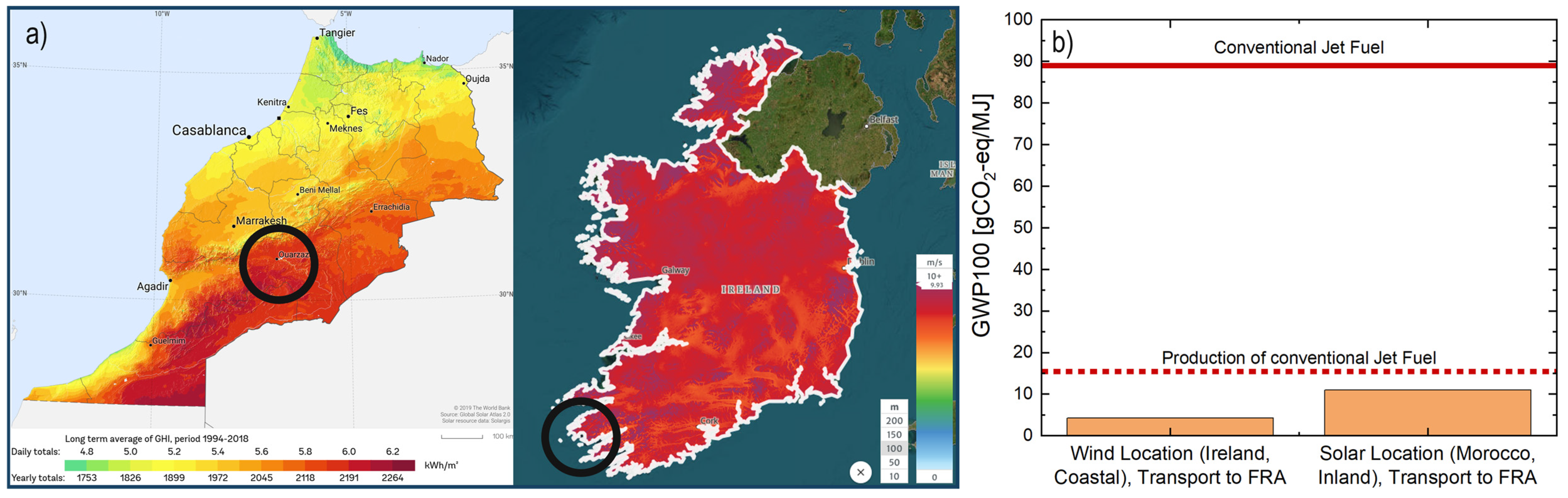
| LH2 this study | 4.3–11.0 | 0 |
| PtL (FT, [19,20,21]) | 5.0–21.4 | 0 |
| HEFA ([22]) | 13.9–47.4 | 0 |
| AtJ ([22]) | 23.8–65.7 | 0 |
| Conventional jet fuel ([22]) | 15.5 | 73.5 |
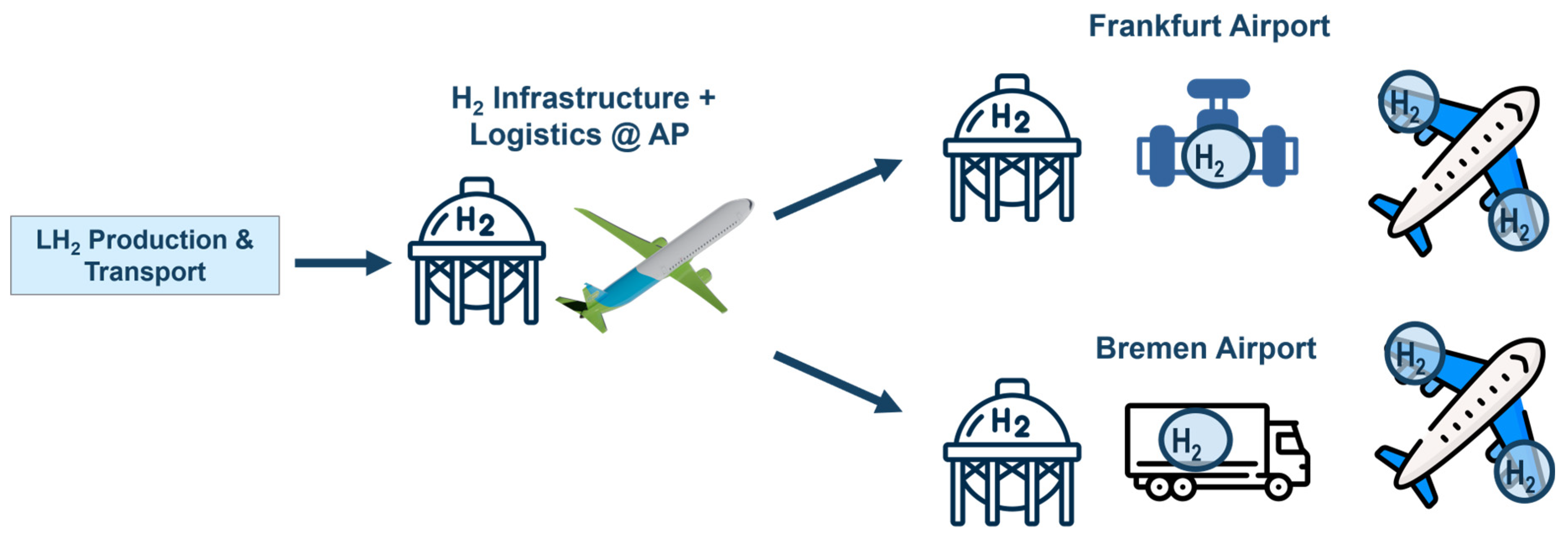
| Parameter | Unit | Frankfurt | Bremen |
|---|---|---|---|
| Number of aircraft per day | - | 504 | 15 |
| Assumed liquid hydrogen required | t/day | 2127 | 34 |
| Number of liquid hydrogen storage tanks | - | 8 | 1 |
| Total pipeline length | m | 1500 | - |
| Number of pipelines | - | 5 | - |
| Number of tank trucks | - | - | 3 |
| Unit | Take-Off | Top of Climb | Cruise | ||||
|---|---|---|---|---|---|---|---|
| REG | |||||||
| BAS | LH2 | BAS | LH2 | BAS | LH2 | ||
| Flight altitude | m | 0 | 0 | 10,668 | 10,668 | 10,668 | 10,668 |
| Mach number | - | 0.20 | 0.20 | 0.78 | 0.78 | 0.78 | 0.78 |
| ISA deviation | K | +15 | +15 | +10 | +10 | 0 | 0 |
| Thrust | kN | 88.7 | 88.7 | 20.0 | 20.0 | 18.0 | 18.0 |
| Bypass ratio | - | 14.0 | 15.1 | 14.7 | 15.9 | 15.1 | 16.3 |
| Overall pressure ratio | - | 43.4 | 43.2 | 50.0 | 50.0 | 47.1 | 47.0 |
| Thrust specific fuel consumption | g/(kNs) | 8.37 | 2.88 | 13.86 | 4.81 | 13.51 | 4.67 |
| Thrust specific power consumption | W/N | 358 | 353 | 593 | 578 | 578 | 561 |
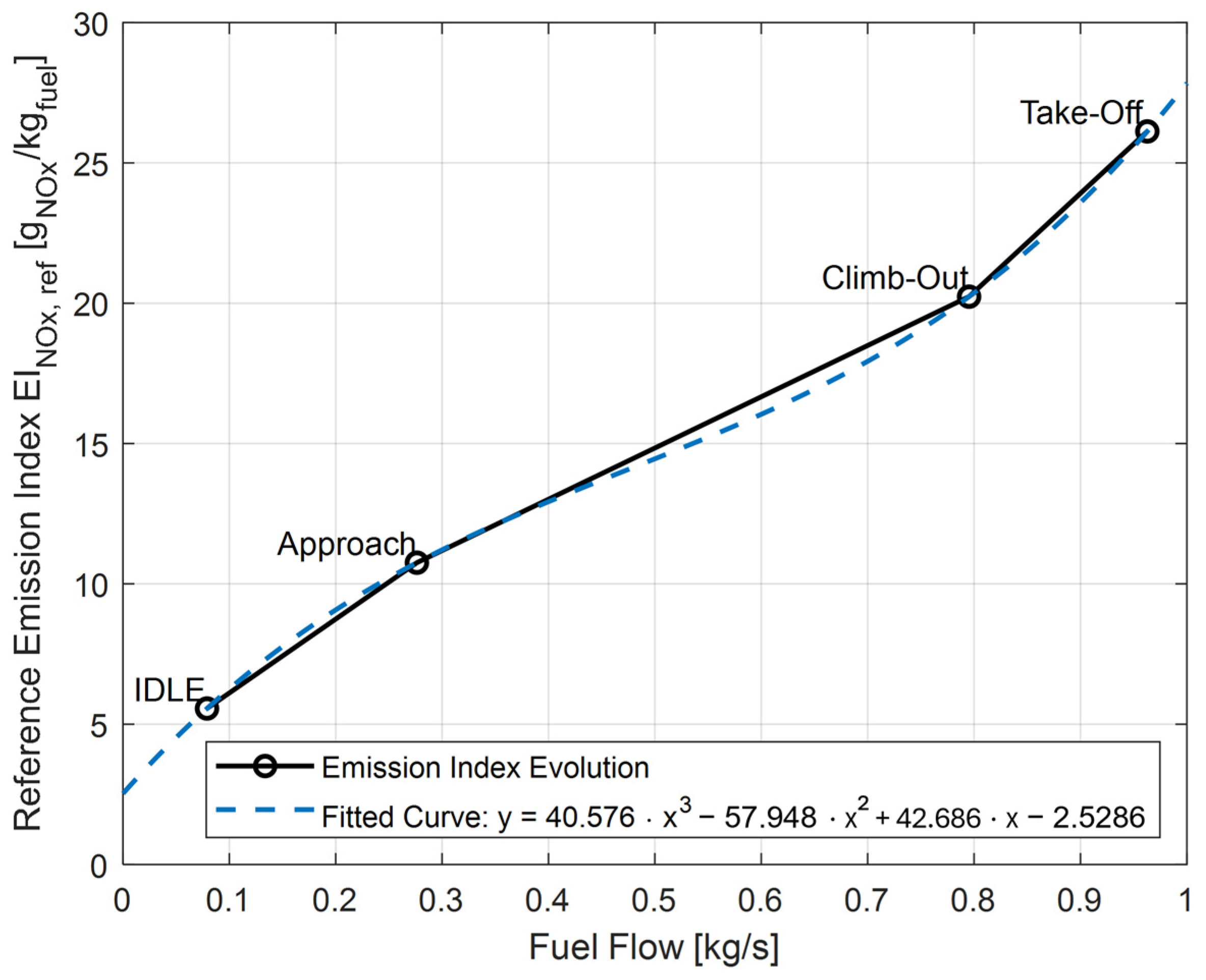
| NOx emission index | gNOx/kgfuel | 23.8 | 19.5 | 12.8 | 10.5 | 11.0 | 9.0 |
| NOx emissions | gNOx/s | 17.7 | 5.0 | 3.6 | 1.0 | 2.7 | 0.8 |
| SMR | |||||||
| BAS | LH2 | BAS | LH2 | BAS | LH2 | ||
| Flight altitude | m | 0 | 0 | 10,668 | 10,668 | 10,668 | 10,668 |
| Mach number | - | 0.20 | 0.20 | 0.78 | 0.78 | 0.78 | 0.78 |
| ISA deviation | K | +15 | +15 | +10 | +10 | 0 | 0 |
| Thrust | kN | 102.0 | 102.0 | 23.0 | 23.0 | 18.3 | 18.3 |
| Bypass ratio | - | 15.1 | 16.6 | 16.4 | 17.0 | 17.2 | 18.0 |
| Overall pressure ratio | - | 49.0 | 43.6 | 55.0 | 52.0 | 48.5 | 45.4 |
| Thrust specific fuel consumption | g/(kNs) | 8.62 | 2.76 | 13.82 | 4.78 | 13.42 | 4.75 |
| Thrust specific power consumption | W/N | 369 | 331 | 591 | 574 | 574 | 570 |
| NOx emission index | gNOx/kgfuel | 22.7 | 18.8 | 12.3 | 10.1 | 8.8 | 7.2 |
| NOx emissions | gNOx/s | 19.9 | 5.4 | 3.9 | 1.1 | 2.2 | 0.6 |
| LR | |||||||
| BAS | LH2 | BAS | LH2 | BAS | LH2 | ||
| Flight altitude | m | 0 | 0 | 10,668 | 10,668 | 10,668 | 10,668 |
| Mach number | - | 0.200 | 0.200 | 0.825 | 0.825 | 0.85 | 0.85 |
| ISA deviation | K | +15 | +15 | +10 | +10 | 0 | 0 |
| Thrust | kN | 333.0 | 333.0 | 75.0 | 75.0 | 60.0 | 60.0 |
| Bypass ratio | - | 12.2 | 13.3 | 12.3 | 13.4 | 12.6 | 13.7 |
| Overall pressure ratio | - | 53.5 | 53.3 | 60.0 | 60.0 | 52.4 | 52.2 |
| Thrust specific fuel consumption | g/(kNs) | 8.65 | 2.98 | 14.8 | 5.13 | 13.8 | 4.81 |
| Thrust specific power consumption | W/N | 370 | 358 | 631 | 616 | 590 | 577 |
| NOx emission index | gNOx/kgfuel | 47.9 | 39.3 | 30.0 | 24.6 | 17.7 | 14.9 |
| NOx emissions | gNOx/s | 138.0 | 39.0 | 33.6 | 9.6 | 14.8 | 4.2 |
| Parameter | Unit | Value | |
|---|---|---|---|
| Cold box | Internal temperature | K | 20 |
| Insulation type | - | Aerogel | |
| Insulation thickness | m | 0.1 | |
| Installation factor | - | 2 | |
| GH2 target temperature | K | 353 | |
| Distribution and venting pipes | LH2 max. mass flow rate per engine | kg/s | 0.3 |
| LH2 flow velocity | m/s | 9 | |
| GH2 flow velocity | m/s | 20 | |
| Distribution nominal pressure | bar | 3 | |
| Burst pressure safety factor | - | 1.5 | |
| Distribution pipe interspace filling | - | Vacuum | |
| Material inner pipe | - | Stainless steel | |
| Material outer pipe | - | Stainless steel | |
| Interspace pressure | bar | 1 × 10⁻⁸ | |
| Venting pipe interspace filling | - | Nitrogen |
| Parameter | Unit | Value | |
|---|---|---|---|
| 2 × cold box (forward and aft) | Electric power for LH2 pumps and tank pressure management (both) | kW | 25.3 |
| Outer diameter (each) | m | 1.5 | |
| Length (each) | m | 0.82 | |
| Volume (each) | m3 | 0.71 | |
| Mass (both) | kg | 554 | |
| Distribution pipes | Total length | m | 82 |
| Outer pipe diameter | mm | 70 | |
| Inner pipe diameter | mm | 30 | |
| Mass | kg | 557 | |
| Venting pipes | Total length | m | 23 |
| Outer pipe diameter | mm | 76 | |
| Inner pipe diameter | mm | 48 | |
| Mass | kg | 190 |
| Design Variable | Number of Dimensions |
|---|---|
| Airfoil profile geometry | 14 |
| Leading edge sweep angle φ | 1 |
| Taper ratios λ1, λ2 | 2 |
| Wingspan b | 1 |
| Lift distribution parameter B | 1 |
| Wing mass mwing | 1 |
| Total | 20 |
| Parameter | SMR-REF | SMR-BAS (OAD) |
|---|---|---|
| Lift coefficient | 0.58 | 0.58 |
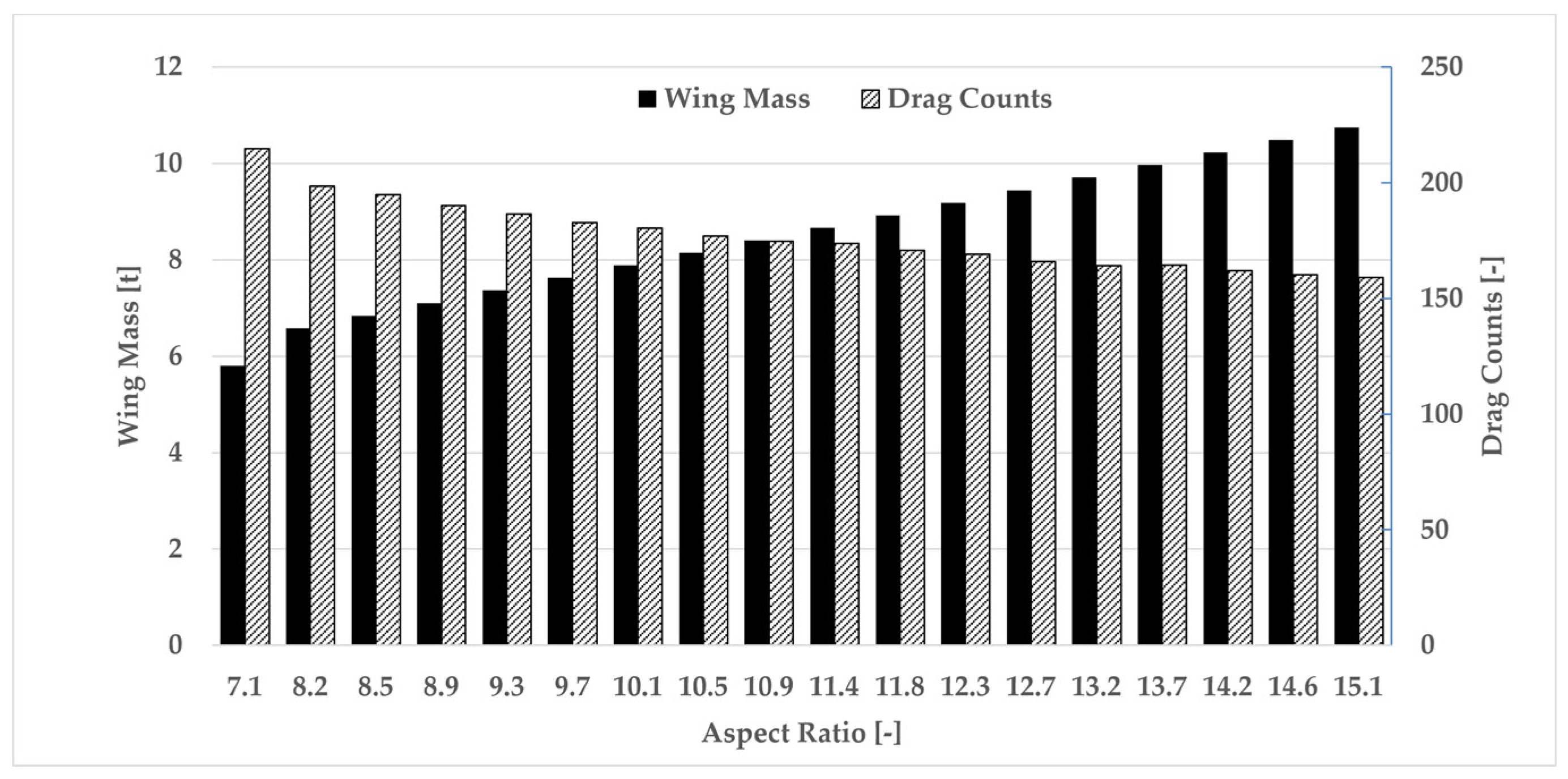
| Aspect ratio | 10.1 | 13.2 |
| Sweep angle [deg] | 27.0 | 28.2 |
| Wing area [m2] | 127 | 119 |
| Wing mass [kg] | 9399 | 9027 |
| Span [m] | 35.8 | 39.7 |
| Wave drag | 0.0023 | 0.0002 |
| Viscous drag | 0.0069 | 0.0067 |
| Induced drag | 0.0131 | 0.0105 |
| Total wing drag | 0.0223 | 0.0174 |
| Wing L/D | 26.0 | 33.3 |
| Requirement | Unit | REG | SMR | LR |
|---|---|---|---|---|
| Design/study payload | kg | 11,400 | 17,100 | 30,875 |
| Maximum payload | kg | 15,128 | 19,300 | 53,400 |
| Design passengers | - | 120 | 180 | 325 |
| Design range | NM | 2940 | 2943 | 8100 |
| Study range | NM | 800 | 800 | 4000 |
| Cruise Mach number | Ma | 0.78 | 0.78 | 0.85 |
| Maximum take-off field length | m | 1873 | 1951 | 2588 |
| Maximum landing field length | m | 1720 | 1880 | 1960 |
| Maximum approach speed | kts | 132 | 138 | 140 |
| Maximum operating altitude | ft | 38,500 | 40,000 | 43,100 |
| Maximum Mach number | Ma | 0.82 | 0.82 | 0.89 |
| Parameter | Value |
|---|---|
| Relative fuselage and wing viscous drag reduction due to riblets | 4.0% |
| Relative empennage mass reduction | 5.0% |
| Relative landing gear mass reduction | 5.0% |
| Relative dry wing mass increase | 4.8% |
| Parameter | Unit | REG-BAS | REG-H2 | SMR-BAS | SMR-H2 | LR-BAS | LR-H2 |
|---|---|---|---|---|---|---|---|
| Cabin seating | - | 2-3 | 3-3 | 3-3 | 2-3-2 | 3-3-3 | 2× 3-4-3 |
| Fuselage width | m | 3.51 | 3.95 | 3.95 | 4.96 | 5.96 | 7.14 |
| Fuselage height | m | 3.72 | 4.14 | 4.14 | 4.56 | 6.09 | 8.75 |
| Fuselage length | m | 35.0 | 43.24 | 37.57 | 48.88 | 65.27 | 69.61 |
| Span | m | 33.87 | 35.29 | 39.65 | 41.09 | 76.4 | 72.46 |
| Wing area | m2 | 104 | 113 | 119 | 128 | 449 | 404 |
| Aircraft L/Dcruise | - | 19.2 | 18.6 | 21.3 | 18.8 | 22.6 | 20.4 |
| Δ rel. | - | −3% | −12% | −10% | |||
| Wing mass | kg | 5810 | 6593 | 9027 | 9771 | 37,385 | 29,486 |
| Fuselage mass | kg | 6662 | 9550 | 8468 | 13,328 | 26,971 | 36,456 |
| Propulsion group mass | kg | 7533 | 8309 | 7750 | 8507 | 16,736 | 17,097 |
| Operating mass empty | kg | 33,863 | 45,338 | 43,038 | 56,464 | 129,287 | 158,081 |
| MTOM | kg | 56,423 | 61,260 | 74,105 | 79,526 | 247,344 | 222,598 |
| Δ rel. | - | +9% | +7% | –10% | |||
| Block energy design mission | GJ | 410 | 464 | 522 | 616 | 3229 | 3492 |
| Δ rel. | - | +13% | +18% | +8% | |||
| Block energy study mission | GJ | 121 | 143 | 157 | 188 | 1468 | 1697 |
| Δ rel. | - | +18% | +20% | +16% | |||
| Parameter | Unit | REG-H2 | SMR-H2 | LR-H2 |
|---|---|---|---|---|
| Tank diameter | m | 3.5 | 3.9 | 6.9 |
| Forward tank length | m | 3.7 | 4.8 | 7.2 |
| Aft tank length | m | 9.4 | 6.4 | 10.7 |
| Forward tank volume | m3 | 25.9 | 44.7 | 216.7 |
| Aft tank volume | m3 | 44.5 | 48.1 | 306.5 |
| Forward tank mass | kg | 1854 | 2965 | 11,953 |
| Aft tank mass | kg | 3722 | 3507 | 16,979 |
| Forward tank hydrogen mass | kg | 1735 | 2990 | 14,508 |
| Aft tank hydrogen mass | kg | 2980 | 3224 | 20,519 |
| Forward tank GI | - | 48% | 50% | 55% |
| Aft tank GI | - | 44% | 48% | 55% |
| Cold box mass | kg | 542 | 554 | 576 |
| Pipe and venting mass | kg | 658 | 747 | 907 |
| Scenario | S0 (Reference) | S1 (Baseline) | S21 and S22 (Hydrogen) |
|---|---|---|---|
| Aircraft technology | |||
| Baseline aircraft | – | 2040/rapid ramp-up | 2040/rapid ramp-up |
| Hydrogen aircraft | – | – | 2040/rapid ramp-up |
| Fuel cost assumptions | |||
| Jet A-1 | $ | $ | $ → $$$ |
| SAF | – | $$$ | $$$ → $$ |
| LH2 | – | – | $$$ → $ |
| Policy framework | |||
| ReFuelEU mandate | none | yes | yes |
| Carbon tax on Jet A-1 [80,81] | none | none | strong |
Disclaimer/Publisher’s Note: The statements, opinions and data contained in all publications are solely those of the individual author(s) and contributor(s) and not of MDPI and/or the editor(s). MDPI and/or the editor(s) disclaim responsibility for any injury to people or property resulting from any ideas, methods, instructions or products referred to in the content. |
© 2026 by the authors. Licensee MDPI, Basel, Switzerland. This article is an open access article distributed under the terms and conditions of the Creative Commons Attribution (CC BY) license.
Share and Cite
Peter, F.N.; Engelmann, M.; Fikry, M.; Lüdemann, M.; Moser, L.; Warsch, C.; Balderas-Xicohtencatl, R.; Muslić, A.; Erden, E.; Hornung, M.; et al. Results of the H2Avia Project: Potential of Hydrogen for Global Aviation. Aerospace 2026, 13, 550. https://doi.org/10.3390/aerospace13060550
Peter FN, Engelmann M, Fikry M, Lüdemann M, Moser L, Warsch C, Balderas-Xicohtencatl R, Muslić A, Erden E, Hornung M, et al. Results of the H2Avia Project: Potential of Hydrogen for Global Aviation. Aerospace. 2026; 13(6):550. https://doi.org/10.3390/aerospace13060550
Chicago/Turabian StylePeter, Fabian Nicolas, Marc Engelmann, Meriem Fikry, Michael Lüdemann, Leonard Moser, Christopher Warsch, Rafael Balderas-Xicohtencatl, Adnan Muslić, Elif Erden, Mirko Hornung, and et al. 2026. "Results of the H2Avia Project: Potential of Hydrogen for Global Aviation" Aerospace 13, no. 6: 550. https://doi.org/10.3390/aerospace13060550
APA StylePeter, F. N., Engelmann, M., Fikry, M., Lüdemann, M., Moser, L., Warsch, C., Balderas-Xicohtencatl, R., Muslić, A., Erden, E., Hornung, M., Welsch, T., Schültke, F., Stumpf, E., Kakkar, S., Heinze, W., Haupt, M., Radespiel, R., Kriewall Peters, V., Bielsky, T., ... Strohmayer, A. (2026). Results of the H2Avia Project: Potential of Hydrogen for Global Aviation. Aerospace, 13(6), 550. https://doi.org/10.3390/aerospace13060550