1. Introduction
Unprecedented progress in spaceflight technologies has rendered on-orbit deployment and separation of micro-spacecraft routine and large-scale operations, drawing extensive attention to their dynamic modeling and simulation analysis [
1,
2]. Typical missions and studies, such as the RemoveDEBRIS active debris removal mission and recent reviews on space robotics technologies for on-orbit servicing, indicate that on-orbit operations have rapidly expanded from conceptual research to engineering demonstrations involving deployment, separation, capture, docking, and servicing processes [
3,
4]. These missions show that future spacecraft systems will increasingly involve dynamic in-orbit operations with transient contact, deployment, ejection, capture, docking, and separation processes. However, such dynamic operations are highly sensitive to system imperfections and in-orbit parameter determination errors. In micro-spacecraft ejection and separation, small deviations in thrust direction, thrust application point, center-of-mass position, guide-rail/contact properties, friction coefficient, structural flexibility, initial attitude, and inertial measurement accuracy may produce non-negligible attitude disturbances after separation. These disturbances can degrade pointing accuracy, compromise subsequent autonomous flight or target-capture tasks, and even lead to mission failure [
5,
6]. Therefore, developing an efficient simulation approach that balances computational accuracy and efficiency, and revealing the underlying mechanisms of attitude disturbances, has become a critical issue in the aerospace engineering community.
Multi-rigid-body dynamic models dominate spacecraft separation dynamics analysis due to their unparalleled computational efficiency [
7], while high-fidelity rigid–flexible coupled simulations remain the authoritative approach for capturing complex contact–impact behaviors. However, a critical gap persists in micro-spacecraft ejection systems: neither approach can simultaneously meet the dual requirements of engineering practicality and reliable disturbance prediction. First, uncalibrated multi-rigid-body models have limited engineering applicability due to over-reliance on generic empirical contact parameters. Wang et al. [
8] showed that models neglecting flexible deformation fail to meet aerospace engineering accuracy requirements. Extensive parametric studies confirm separation responses are highly sensitive to contact parameters: Cui et al. [
9] identified contact stiffness and friction as the dominant factors affecting post-separation attitude disturbances and provided broad empirical ranges; Xie et al. [
10] and Zhang et al. [
11] further analyzed coupled effects of mass eccentricity, separation spring stiffness, and other design parameters. However, no targeted contact parameter calibration method exists for solid-thruster ejection systems, leading to inconsistent prediction across scenarios. Second, rigid–flexible coupled models provide highly reliable results but are limited to single-case verification due to prohibitive computational cost. Liu et al. [
12] showed that well-validated rigid–flexible finite element models can produce simulation results that closely match ground test measurements. Kim et al. [
13] adopted LS-DYNA to conduct a single implicit analysis on the drop impact of plate-type fuel assemblies. Its collision mechanism is similar to that of micro-spacecraft separation, and the entire analysis took 44.3 h, indicating low computational efficiency. Therefore, the computational burden makes large-scale parameter analysis difficult to implement. Third, existing research has not effectively bridged this methodological divide by establishing a calibrated multi-rigid-body framework. Despite fruitful advancements in contact modeling research, including the classic Hunt–Crossley collision model [
14,
15], the summarized continuous contact model proposed by Flores and Lankarani [
16], the low-restitution coefficient model validated by Xing et al. [
17], and the micro-payload ejection dynamic analysis completed by Tan et al. [
18], these theoretical developments have not been translated into a practical engineering workflow for solid-thruster-driven micro-spacecraft ejection systems. An urgent need exists for a calibration-based rapid modeling method that combines the efficiency of multi-rigid-body dynamics with the reliability of high-fidelity simulations.
In recent years, research has trended toward establishing multi-level simulation frameworks that integrate high-fidelity models with efficient multi-rigid-body dynamics. NASA [
19] proposed a toolchain methodology that adopts simulation models of varying fidelity at different design stages to achieve rapid prediction and design optimization for complex systems. Burger et al. [
20] introduced a multi-rigid-body dynamics-based separation dynamics analysis workflow for rapid iterative analysis of spacecraft launch and separation. Xu et al. [
21] conducted a high-fidelity LS-DYNA rigid–flexible coupled ejection dynamics simulation, which provides a reference for calibrating multi-rigid-body models. However, most existing studies focus either on improving contact model accuracy or establishing multi-level simulation architectures. Few have systematically calibrated multi-rigid-body models against high-fidelity rigid–flexible coupled simulation results and ground test data specifically for micro-spacecraft on-orbit ejection systems.
To address the unresolved trade-off between accuracy and efficiency in micro-spacecraft on-orbit ejection dynamics modeling and the lack of systematic quantification of key disturbance mechanisms, this paper presents a rapid modeling method based on contact parameter calibration, followed by multi-factor analysis and experimental validation. The remainder of this paper is structured to present our research systematically:
Section 2 first establishes a calibrated ADAMS multi-rigid-body simulation framework using high-fidelity LS-DYNA rigid–flexible coupled results as the benchmark, then details the consistency analysis between the two models, conducts contact parameter sensitivity analysis to evaluate model robustness, and describes the drop-tower ground microgravity test scheme for validating the practical reliability of the proposed method;
Section 3 applies this validated framework to systematically quantify the effects of three key disturbance factors (thrust misalignment angle, thrust eccentricity, and mass eccentricity) on ejection attitude disturbances through large-scale parametric simulations;
Section 4 summarizes the main research conclusions, points out the limitations of the current study, and outlines future research directions.
2. Materials and Methods
2.1. Dynamic Modeling
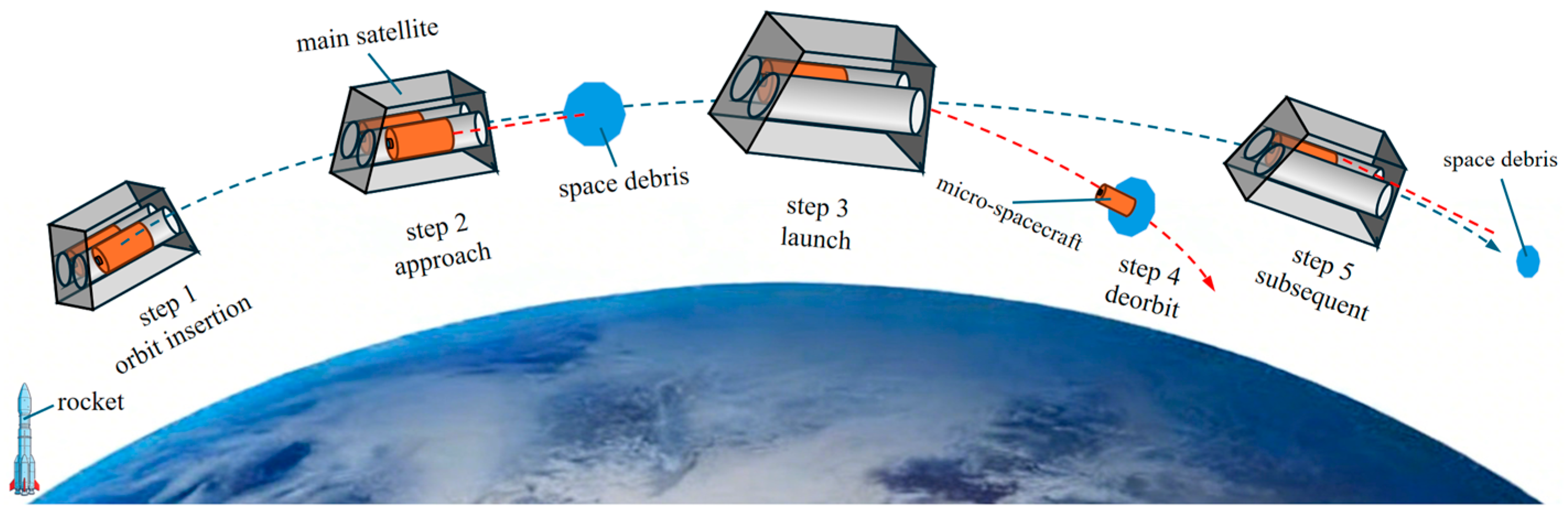
The solid-thruster-driven micro-spacecraft in this work offers an efficient solution for rapid space debris removal. The mission procedure for space debris cleanup is illustrated in
Figure 1 and carried out in five sequential steps:
Step 1 (Orbit Insertion): the carrier rocket first delivers the primary satellite carrying the micro-spacecraft into the predetermined orbit and releases it.
Step 2 (Approach): the primary satellite locates and tracks the target debris or defunct spacecraft and maneuvers to the preset position.
Step 3 (Launch): the primary satellite rapidly ejects and separates the micro-spacecraft via the solid thruster.
Step 4 (Deorbit): the micro-spacecraft penetrates and fastens the space debris using a flying anchor, and propels it out of the predetermined orbit with its own propulsion system.
Step 5 (Subsequent): it enters the cleanup process for the next piece of debris after finishing the removal of the first debris target.
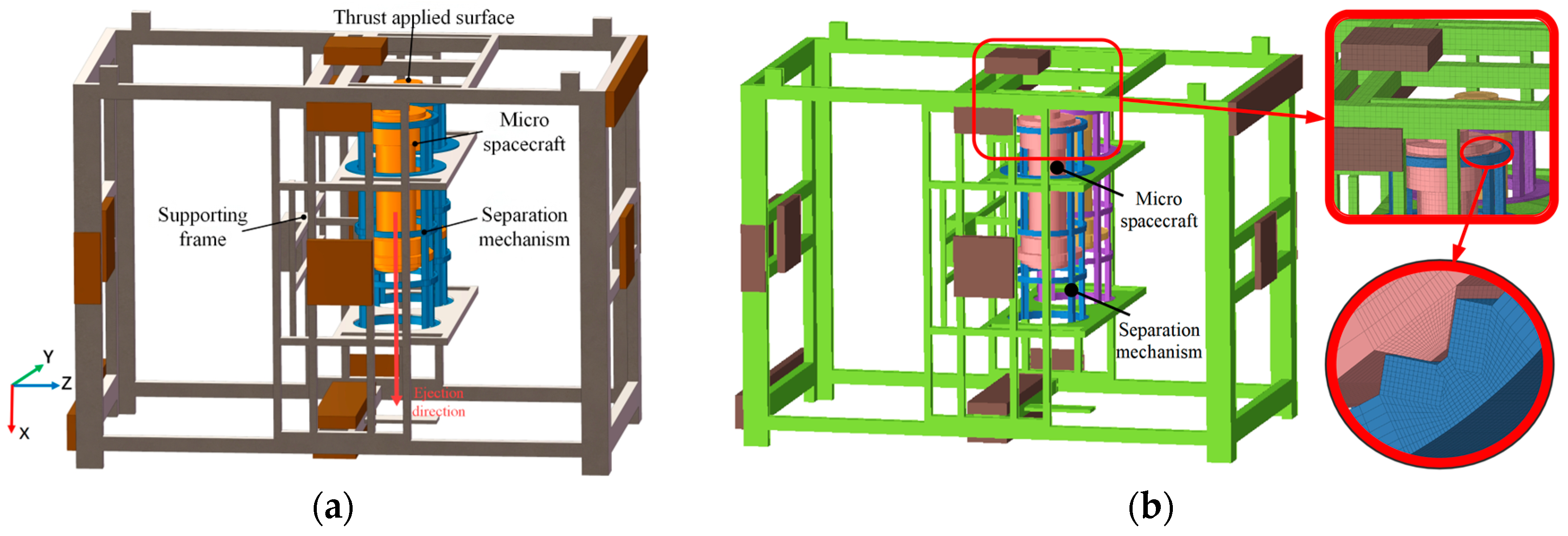
To investigate the dynamic characteristics and attitude disturbances induced by micro-spacecraft on-orbit ejection, and to realize ground simulation and verification, a ground test prototype with equivalent mass properties for the ejection process is designed and developed. The structural composition and layout of the prototype are shown in
Figure 2, consisting of three main components: the supporting frame, the micro-spacecraft, and the separation mechanism. In the defined coordinate system, the ejection direction is set as the positive
X-axis, and the micro-spacecraft is symmetrically mounted on the XOY plane relative to the centroid of the supporting frame. During the test, the entire mechanism is placed in a weightless state via free fall to simulate the space environment; the micro-spacecraft is unlocked, and the solid thruster ignites to generate instantaneous thrust on the thrust-applied surface, ejecting it from the separation mechanism to complete the separation and ejection process [
22].
A rapid multi-rigid-body ejection dynamics simulation model is established in ADAMS (2024) to systematically, efficiently, and accurately analyze the micro-spacecraft ejection process and post-separation attitude disturbances. Through parameter tuning, the simulation results are matched with those of the high-fidelity rigid–flexible coupled ejection dynamics model in LS-DYNA (2024). The finite element meshing of the model is illustrated in
Figure 2. To enhance computational accuracy, all components are discretized using high-quality structured hexahedral-dominated meshes, with local mesh refinement applied to critical impact and contact regions. The simulation adopts a surface-to-surface contact model, and the number of meshes is 4 million. In the LS-DYNA rigid–flexible coupling model, only the separation mechanism is modeled as a flexible body. The contact pair between the separation mechanism and the micro-spacecraft is assigned material properties of 7075 aluminum alloy, with a density of 2810 kg/m
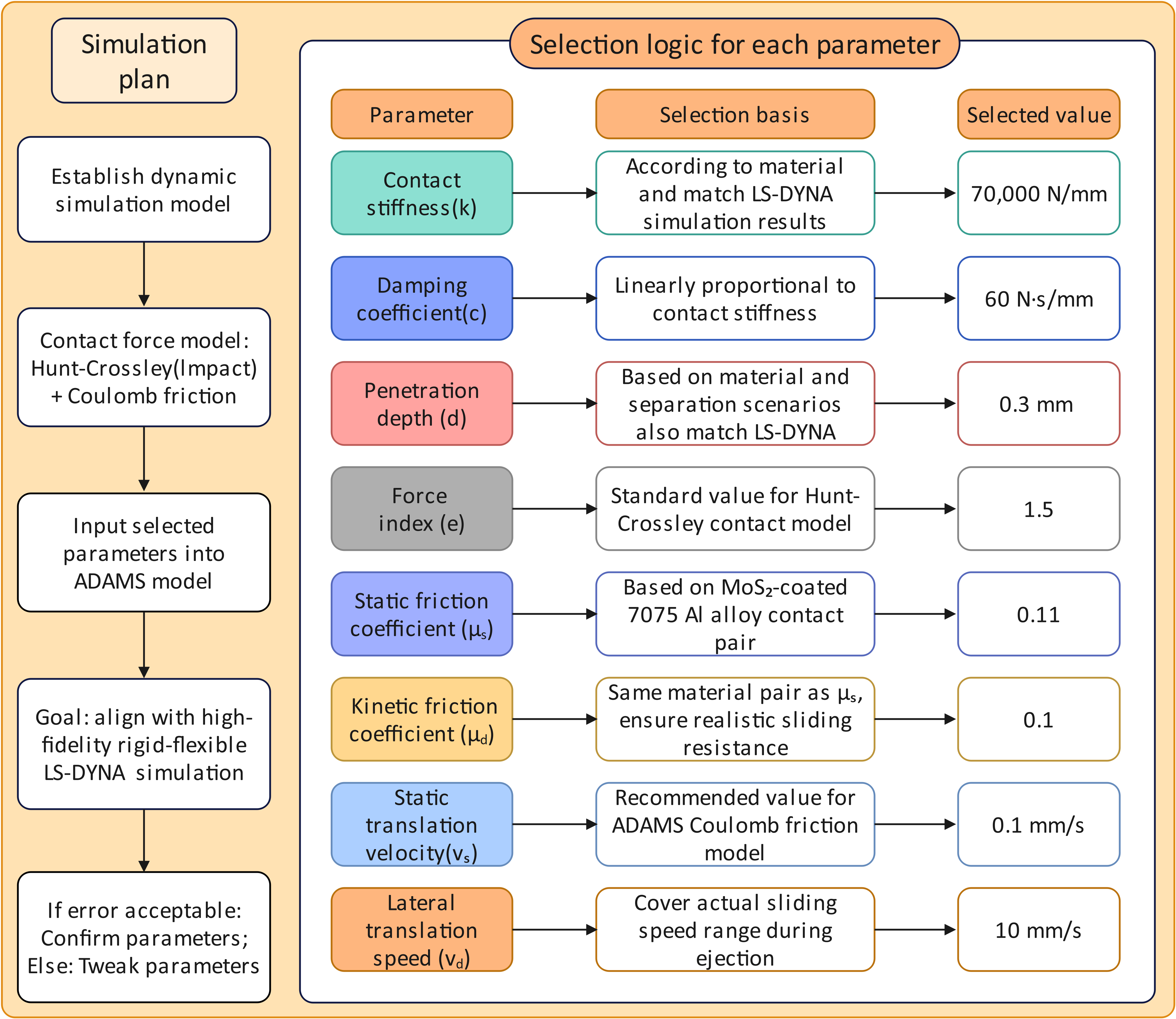
3, Young’s modulus of 72 GPa, and Poisson’s ratio of 0.33. The simulation plan, selection basis, and selected values of the contact parameters in Adams’ multi-rigid-body dynamics model are illustrated in
Figure 3.
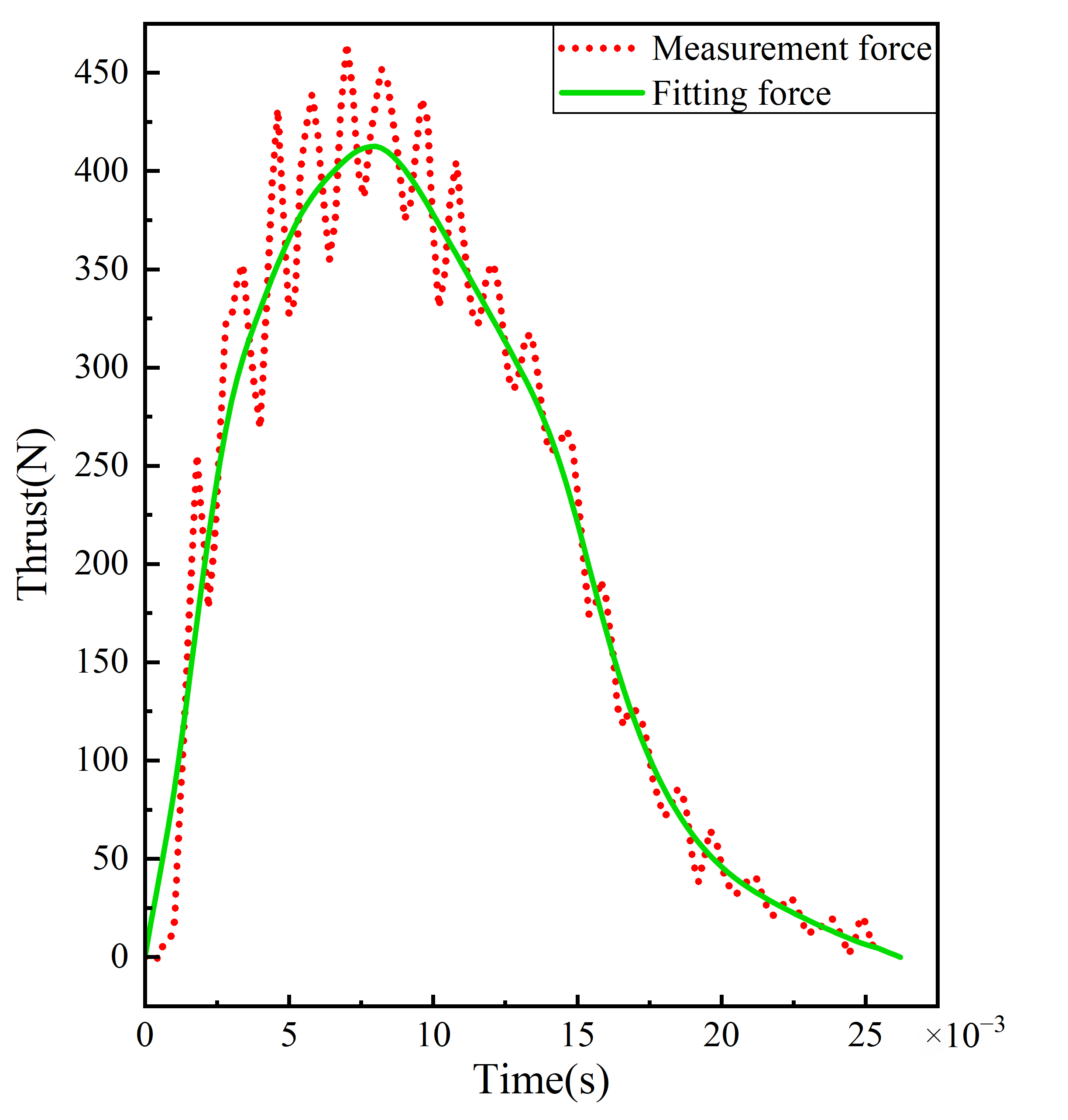
The micro-spacecraft ejection propulsion system adopts solid thrusters, which rapidly eject the micro-spacecraft from the carrier vehicle upon ignition. Thrust measurement tests are conducted by rigidly mounting the solid thrusters on a dedicated test stand, and high-precision dynamic force sensors are used to collect thrust data in real time. The Gaussian fitting results of thrust measurement data are shown in
Figure 4.
Figure 4.
Thrust measurement data fitting results.
Figure 4.
Thrust measurement data fitting results.
2.2. Consistency Analysis Between Calibrated Multi-Rigid-Body and Rigid–Flexible Coupled Models
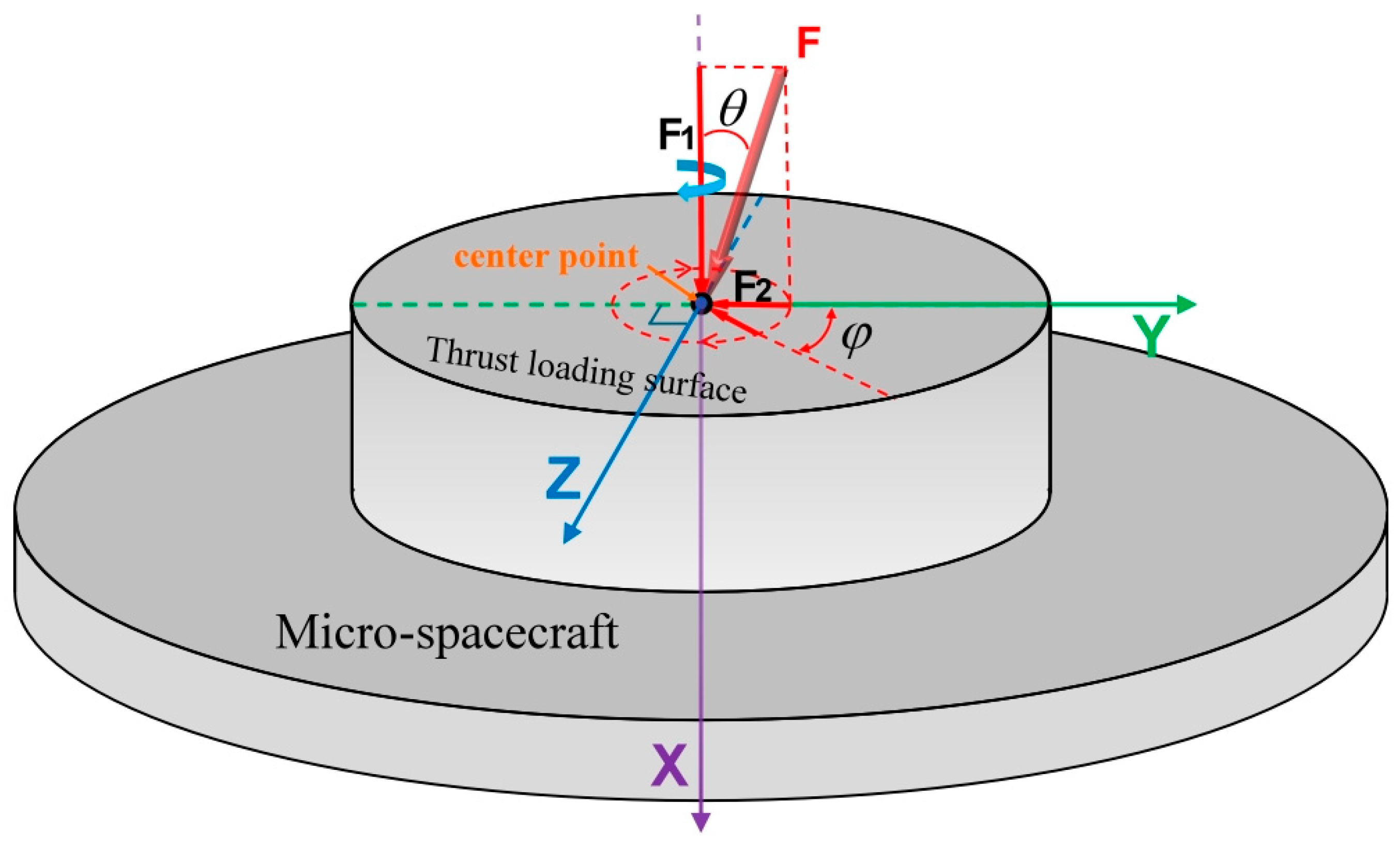
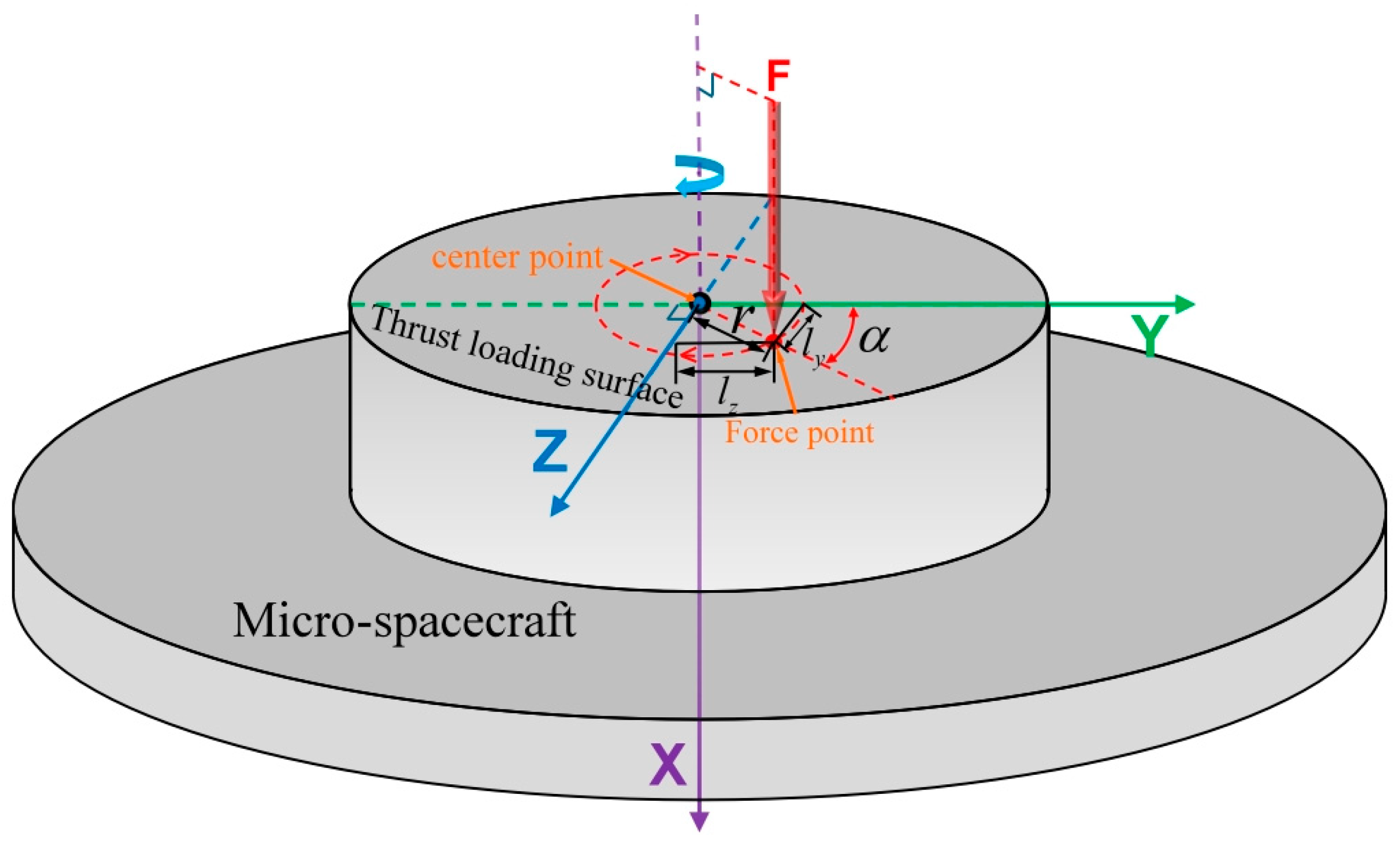
To simulate micro-spacecraft attitude disturbances during ejection under multiple operating conditions, the schematic of the thrust misalignment angle is shown in
Figure 5. This section focuses on analyzing the influences of thrust misalignment angles (axial misalignment angle
and radial misalignment angle
) on micro-spacecraft ejection attitude disturbances. The magnitudes of thrust decomposition along the
X-axis and in the YOZ plane at the force application point are, respectively:
and
.
Based on thrust test measurements, the axial misalignment angle is stabilized at 0.1° through experimental testing. The radial misalignment angle exhibits significant randomness and is difficult to obtain via direct precise measurement. Thus, five operating condition combinations in the first quadrant (0°~90°) of the YOZ plane are selected as representative cases for simulation analysis. The thrust misalignment angle condition groups are listed in
Table 1.
To comprehensively evaluate the dynamic response during micro-spacecraft separation, the velocity along the ejection
X-axis and the angular velocity responses about the
X,
Y, and
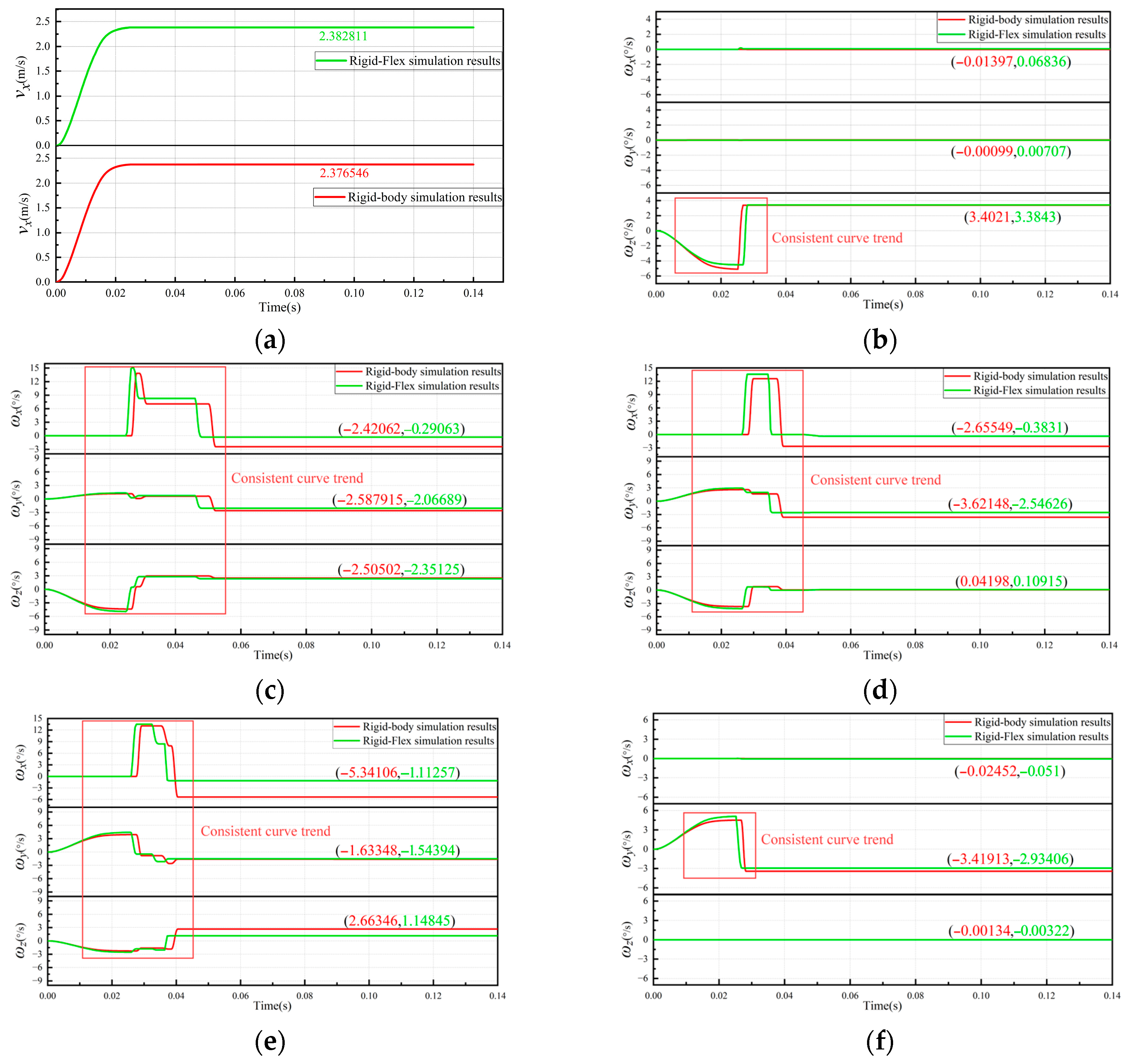
Z axes are analyzed based on the multi-rigid-body dynamics and rigid–flexible coupled dynamics simulation models, respectively. The comparative simulation results are presented in
Figure 6.
Simulation results demonstrate that the ADAMS multi-rigid-body model and the LS-DYNA rigid–flexible coupled model exhibit consistent trends in all key output metrics. The X-axis velocity response and the angular velocity variations about each axis of the micro-spacecraft show excellent agreement. These results confirm that the ADAMS multi-rigid-body model calibrated with equivalent contact parameters accurately captures the attitude disturbance trends during micro-spacecraft separation. Moreover, when run on the same Intel Core i7-13620H processor, a single ejection simulation using the calibrated ADAMS multi-rigid-body model can be completed in approximately 10 s, while the corresponding LS-DYNA rigid–flexible coupled simulation requires about 36 h, representing a computational efficiency improvement of approximately 12,000 times. This provides an efficient and reliable technical method for the rapid evaluation of ejection dynamics and the optimization of separation mechanism design.
2.3. Contact Parameter Sensitivity Analysis
In practical engineering applications, the contact parameters in the ADAMS multi-rigid-body model are inevitably affected by manufacturing tolerances, material property variations, and interface state changes. To assess the robustness of the calibrated model against parameter deviations, a single-parameter sensitivity analysis has been performed on contact stiffness (
), damping coefficient (
), and penetration depth (
), with the calibrated values from
Figure 3 serving as the reference baseline. All other parameters are directly determined based on the adopted Hunt–Crossley collision contact model and Coulomb friction model combined with general engineering experience.
For the sensitivity analysis, Conditions 2, 3, and 4 are selected as representative operating conditions, as Conditions 1 and 5 exhibit negligible angular velocity fluctuations and are thus less representative of general engineering scenarios (as shown in
Figure 6). The three-axis angular velocity results obtained under various parameter perturbations are summarized in
Table 2.
The analysis reveals that the model maintains good angular velocity consistency between ADAMS and LS-DYNA within the bounds of contact stiffness (±4000 N/mm), damping coefficient (±10 N·s/mm) and penetration depth (±0.05 mm). Exceeding these ranges noticeably impairs the curve matching between the two models. Among these parameters, contact stiffness exhibits high sensitivity to a 5% perturbation, whereas the other two parameters show moderate sensitivity at a 15% perturbation level.
Within the tested perturbation intervals, the maximum relative deviations of the three-axis angular velocities are found to be 2.73% for , 1.47% for , and 0.26% for (Conditions 2 and 4 only). For Condition 3, has an absolute deviation of only 0.006°/s. Since its nominal value is near zero, the relative deviation metric becomes meaningless, and this error is considered negligible for engineering purposes. All observed deviations fall well within the acceptable error range, confirming that the calibrated ADAMS multi-rigid-body model possesses strong engineering robustness.
2.4. Ground Test Validation for Micro-Spacecraft Launch
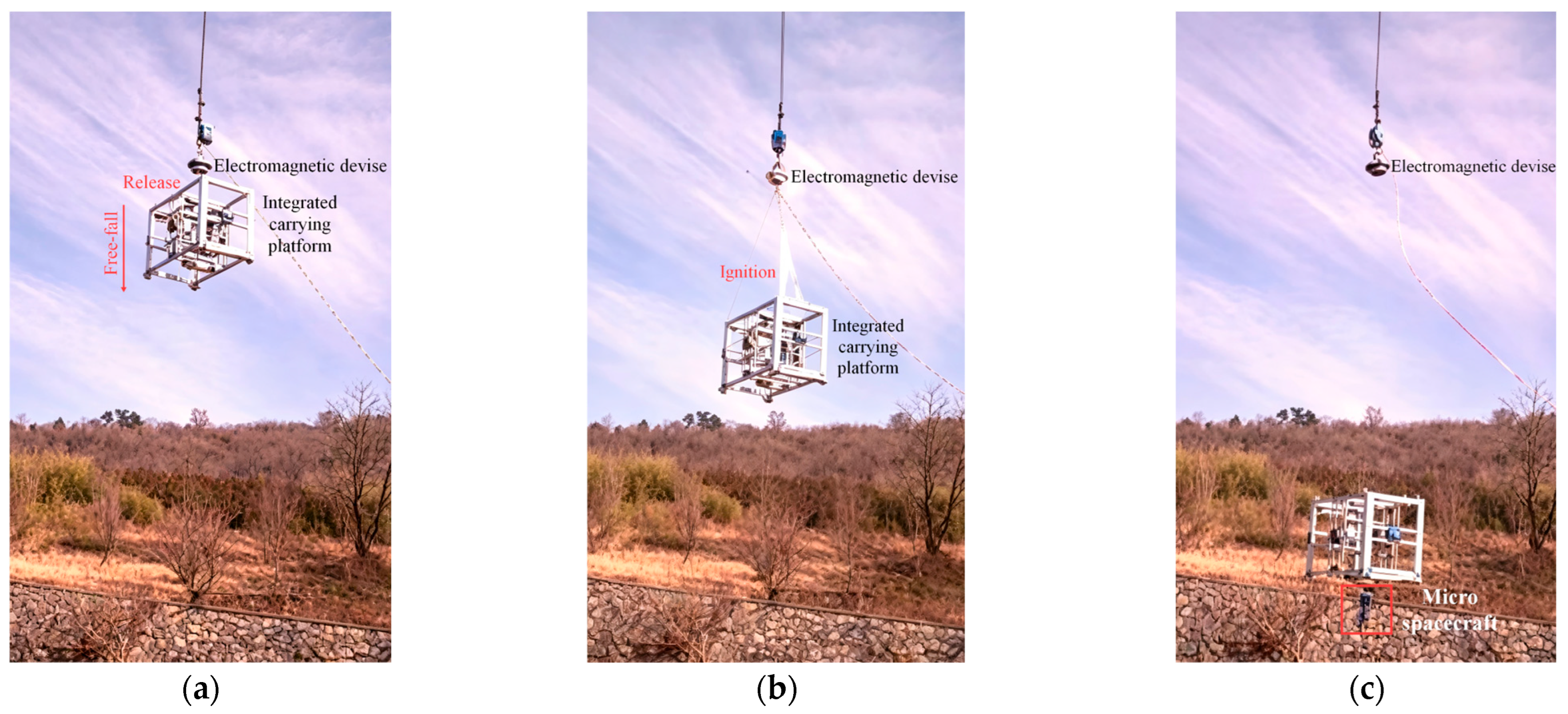
A ground test system based on the drop tower principle is established to simulate space weightless conditions and verify the post-deployment attitude of the micro-spacecraft in orbit. The system consists of a high-position hoist, an electromagnetic release mechanism, and an integrated carrying platform (as shown in the simulation model in
Figure 2). The platform integrates the separation mechanism, a power management module, and a multi-axis measurement unit. During the experiment, the hoist lifts the carrying platform to a predetermined height, and an inertial measurement unit (IMU) monitors the three-axis angular velocity in real time. Once the angular velocities about all axes stabilize within 0.5°/s and remain constant for a preset duration, the system automatically triggers separation. The electromagnetic device executes a millisecond-scale release, allowing the platform to enter free fall to simulate microgravity conditions. This design minimizes non-ideal factors such as initial suspension release disturbance and air resistance. Consequently, the experiment, conducted primarily for verification purposes, yields results with acceptable accuracy. Thereafter, the control unit sends an ignition signal to complete the deployment and separation of the micro-spacecraft. The key stages of the ground microgravity simulation ejection test are shown in
Figure 7.
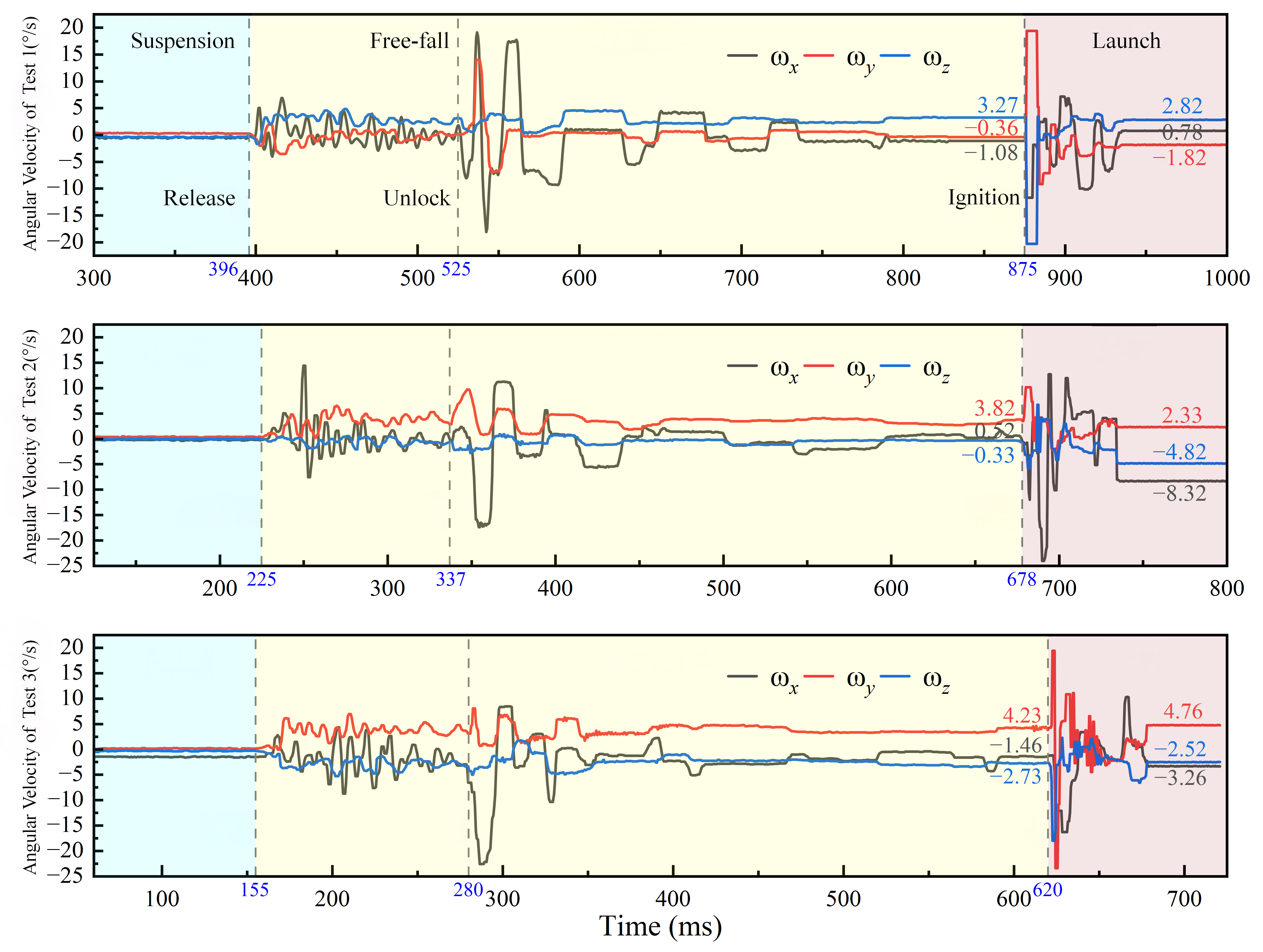
The angular velocity data captured from suspension release to ejection ignition are processed through calibration, error compensation, coordinate system unification, and filtering. The experimental measurement results of micro-spacecraft angular velocities from three tests are shown in
Figure 8. The influence of ejection ignition on angular velocity can be obtained by calculating the difference between the stabilized angular velocity after ignition and that at ignition.
Owing to the presence of various random factors including thrust misalignment angle, thrust eccentricity and mass eccentricity, direct comparison between the limited number of simulation results presented in
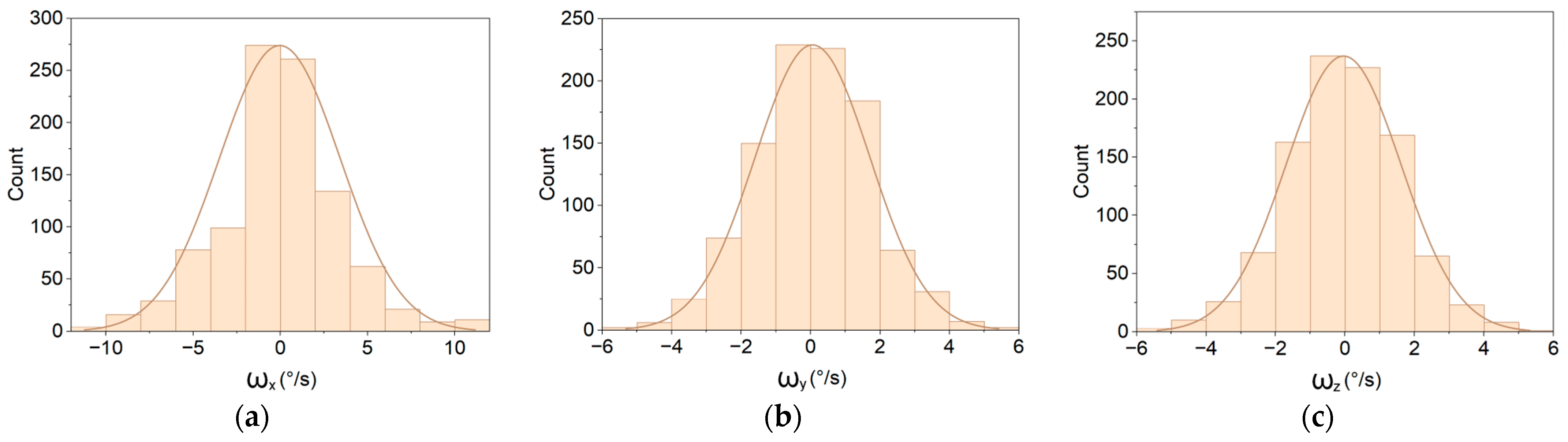
Figure 6 and the experimental measurements yields limited interpretive value. Therefore, 1000 sets of random Monte Carlo numerical simulations are performed for the above key random variables, with their value distribution modes and ranges determined in accordance with general engineering experience as specified in
Table 3. The frequency distribution results shown in
Figure 9 confirm that all experimental results fall within the statistical range of the simulation outputs, verifying the satisfactory reliability of the rapid simulation model established in this study. The specific effects of the aforementioned random factors will be individually investigated through detailed parametric simulations in the following section.
2.5. Proposed Rapid Modeling Framework
This paper presents a calibration-driven rapid modeling framework for solid-thruster-driven micro-spacecraft on-orbit ejection, resolving the critical accuracy-efficiency trade-off in separation dynamics. Its core logic is rooted in the industry consensus stated in the introduction and engineering practice: high-fidelity LS-DYNA rigid–flexible coupled simulation accurately captures complex contact–impact behaviors and meets aerospace accuracy requirements, thus serving as the calibration benchmark. An ADAMS multi-rigid-body model with the Hunt–Crossley contact model is calibrated by matching
X-axis velocity and three-axis angular velocity curves under five thrust misalignment conditions (
Figure 6). Finally, 1000 Monte Carlo simulations of key random variables confirm all drop-tower experimental results fall within the simulation statistical range, validating the framework’s reliability.
Compared with traditional methods, this framework overcomes two major limitations: uncalibrated multi-rigid-body models lack accuracy due to generic empirical contact parameters, while pure rigid–flexible simulations are computationally prohibitive (36 h per case). The calibrated ADAMS model achieves equivalent prediction accuracy but reduces single simulation time to 10 s (12,000× improvement), enabling large-scale parametric analysis. Sensitivity analysis further demonstrates excellent robustness, with attitude deviations below 2% under engineering-allowable parameter fluctuations. However, calibrated contact parameters are specific to 7075 aluminum alloy rail systems, requiring recalibration for other configurations.
3. Results
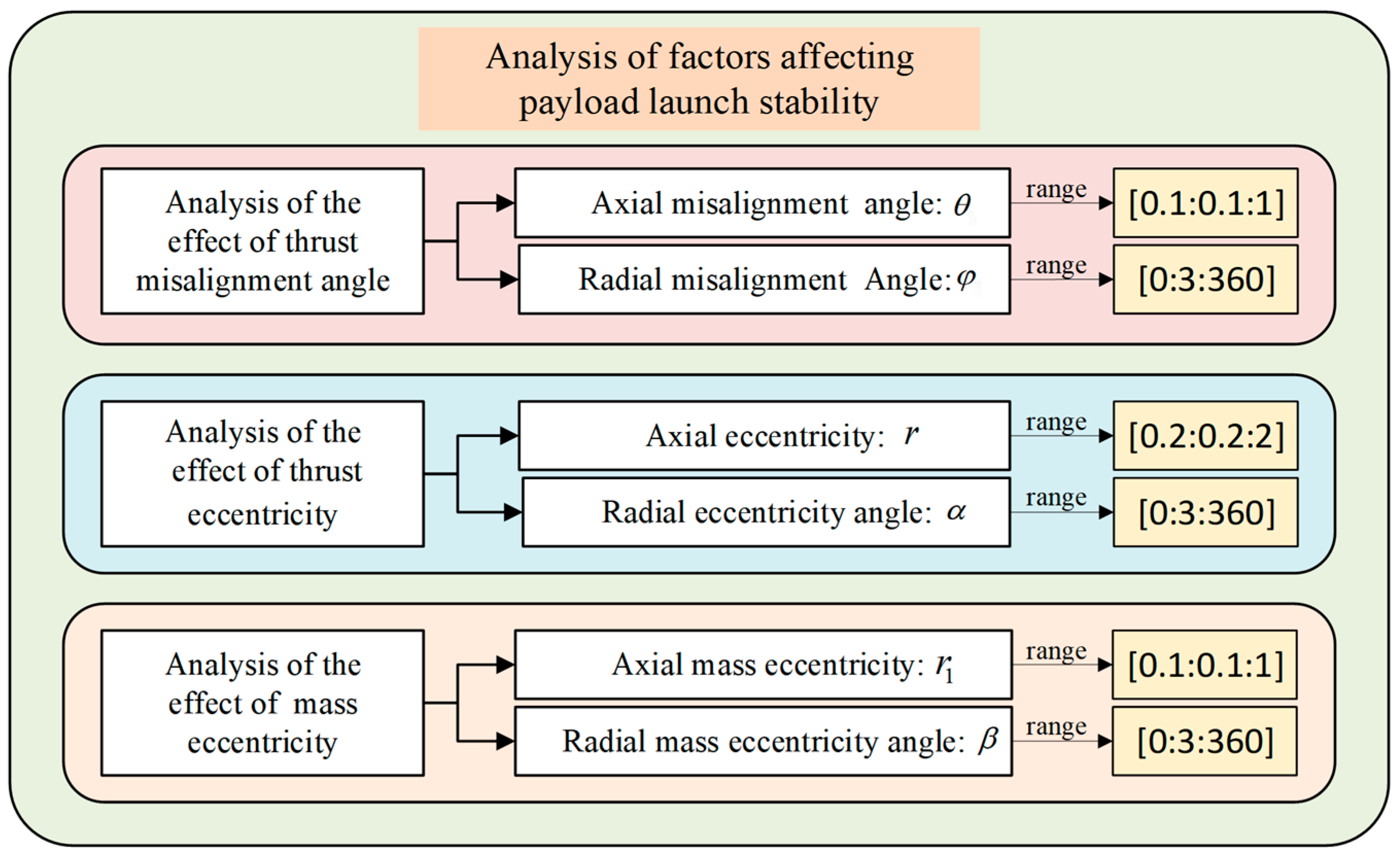
In practical engineering, the ejection dynamics of micro-spacecraft are affected by the coupling of multiple complex factors, leading to deviations from theoretical expectations. Beyond manufacturing and assembly tolerances, the primary disturbance sources include thrust misalignment angle, thrust eccentricity, and micro-spacecraft mass eccentricity. These factors collectively impose significant impacts on separation attitude accuracy and trajectory stability. Their influence mechanisms and sensitive parameter ranges are summarized in
Figure 10.
3.1. Analysis of the Effect of Thrust Misalignment Angle
Owing to the transient and non-uniform combustion characteristics of solid propellants, the thrust exerted on the micro-spacecraft inherently presents misalignment. To systematically investigate the influence of thrust misalignment angle on ejection dynamics, an analytical method is adopted as illustrated in
Figure 5, where the eccentric state of thrust force
is characterized by the axial misalignment angle
and radial misalignment angle
. Multiple scenarios are simulated by parametrically varying
(10 levels: 0.1–1.0° at 0.1° intervals) and
(120 levels: 0–360° at 3° intervals, as shown in
Figure 9), resulting in 1200 cases to evaluate their effects under various operating conditions.
The parametric study provides comprehensive insights into the influence of the thrust misalignment angle on attitude disturbance, separation trajectory deviation, and dynamic stability in micro-spacecraft ejection. This understanding offers a critical theoretical basis for refining thrust system design and devising precise attitude control strategies. The axial thrust components are expressed as
and
. The effects of thrust misalignment angle on the angular velocities of each axis are shown in
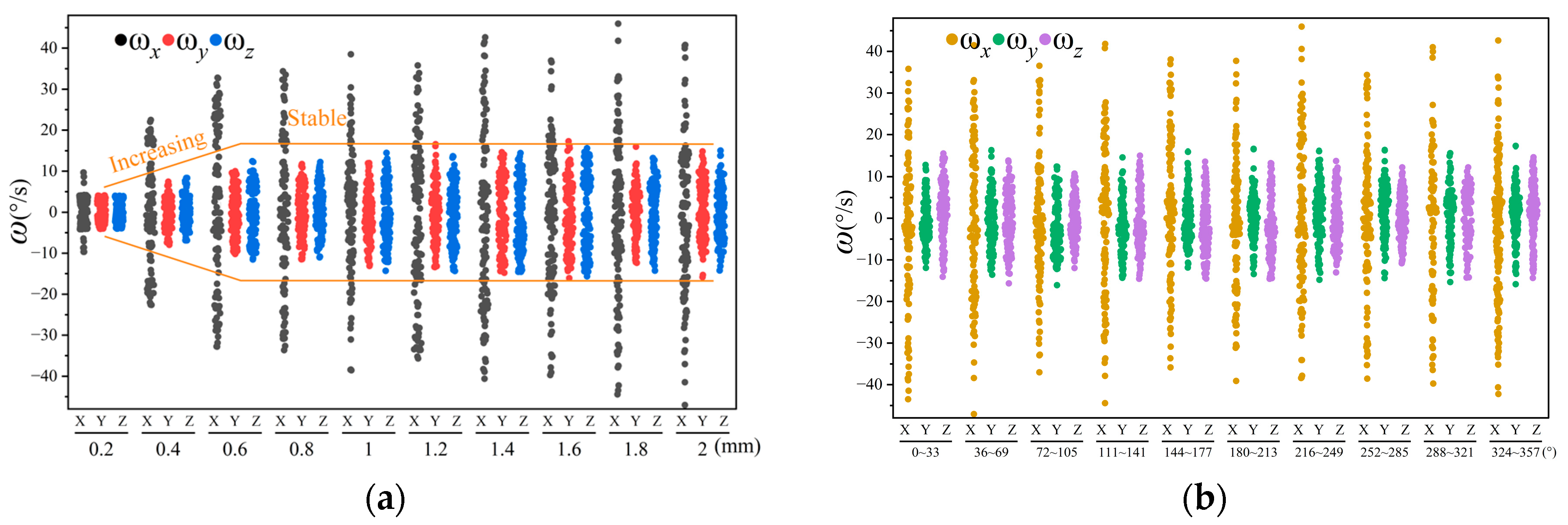
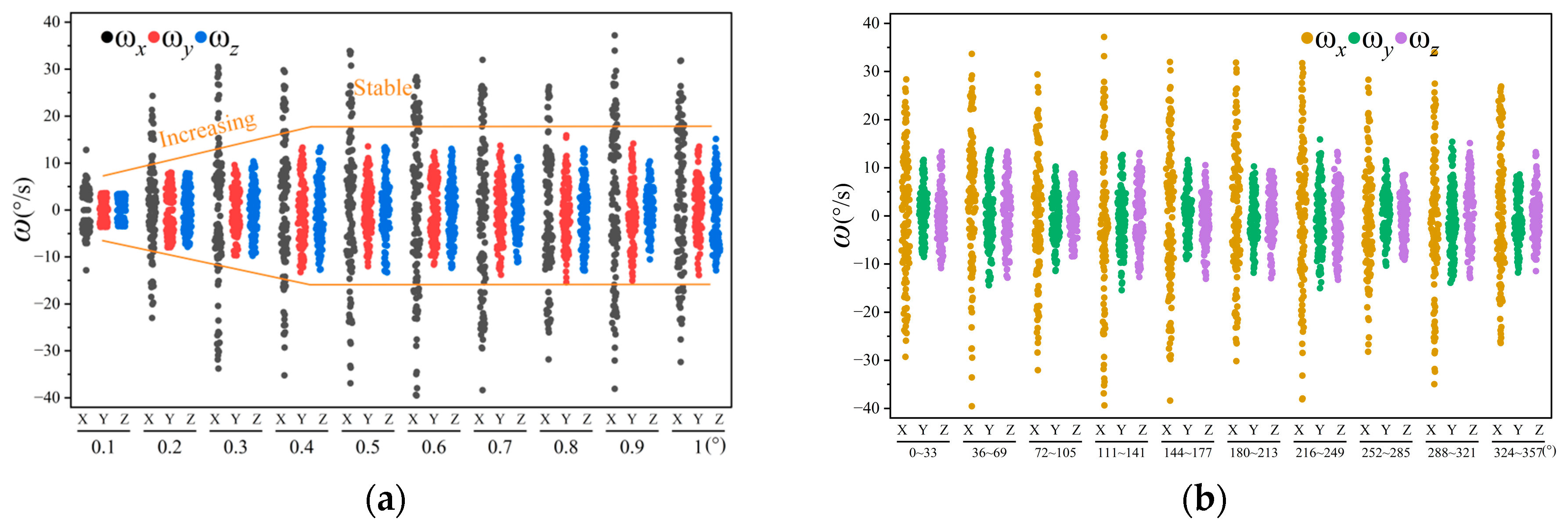
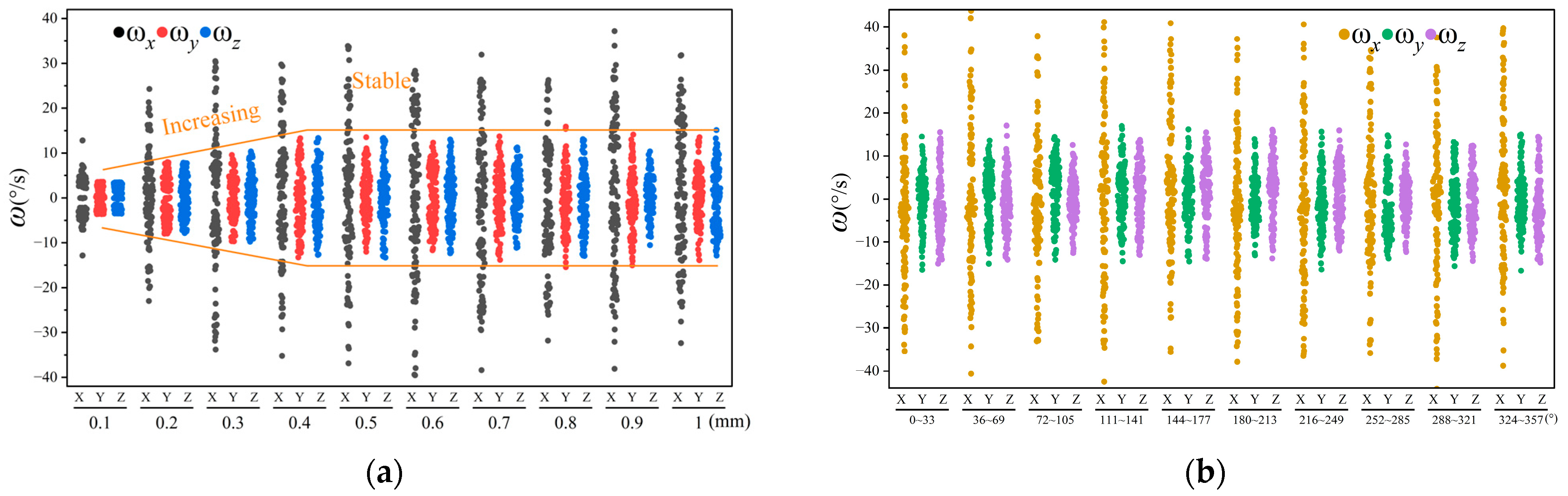
Figure 11. The horizontal axis represents the radial or axial deflection angle, and the vertical axis represents angular velocity. The three-color scatter plot illustrates the distribution of three-axis angular velocities. The key trends requiring attention are marked in the figure.
A systematic analysis of 1200 operating conditions under varying thrust misalignment angles reveals that thrust misalignment angle most significantly affects the roll angular velocity of the micro-spacecraft about the X-axis (ejection direction). The response shows significant randomness and dispersion, indicating deficiencies in roll angular velocity control in the current micro-spacecraft and separation mechanism design, which should be prioritized for improvement. The angular velocity variations along the Y-axis (pitch) and Z-axis (yaw) are more critical for attitude control and orbital insertion accuracy. Both exhibit similar sensitivity to thrust misalignment angle: within the axial misalignment angle range of 0.1° to 0.4°, the angular velocity amplitude increases with the angle and stabilizes beyond 0.4°. The radial misalignment angle shows overall fluctuating characteristics with relatively stable responses. Considering practical engineering constraints in structural fabrication and thrust calibration, it is recommended to control the axial thrust misalignment angle within 0.2°.
3.2. Analysis of the Effect of Thrust Eccentricity
As illustrated in the thrust eccentricity schematic (
Figure 12), both the axial eccentricity
and radial angle
of thrust force
can be adjusted independently, enabling parametric configuration of various eccentricity conditions in the simulation. The eccentricities decomposed along each axis are
and
. The effect of thrust eccentricity on micro-spacecraft attitude disturbance is depicted in
Figure 13.
A systematic analysis of 1200 operational cases on thrust eccentricity reveals consistent disturbance trends across all axes of the micro-spacecraft. The angular velocities of the Y-axis (pitch) and Z-axis (yaw) demonstrate similar sensitivity to thrust eccentricity: within an axial eccentricity range of 0.2 to 0.6 mm, the angular velocity amplitude increases with eccentricity distance and stabilizes beyond 0.6 mm, while radial eccentricity exerts a relatively minor influence. Considering practical engineering constraints in structural fabrication and thrust alignment, it is recommended to control the thrust axial eccentricity within 0.4 mm.
3.3. Analysis of the Effect of Mass Eccentricity
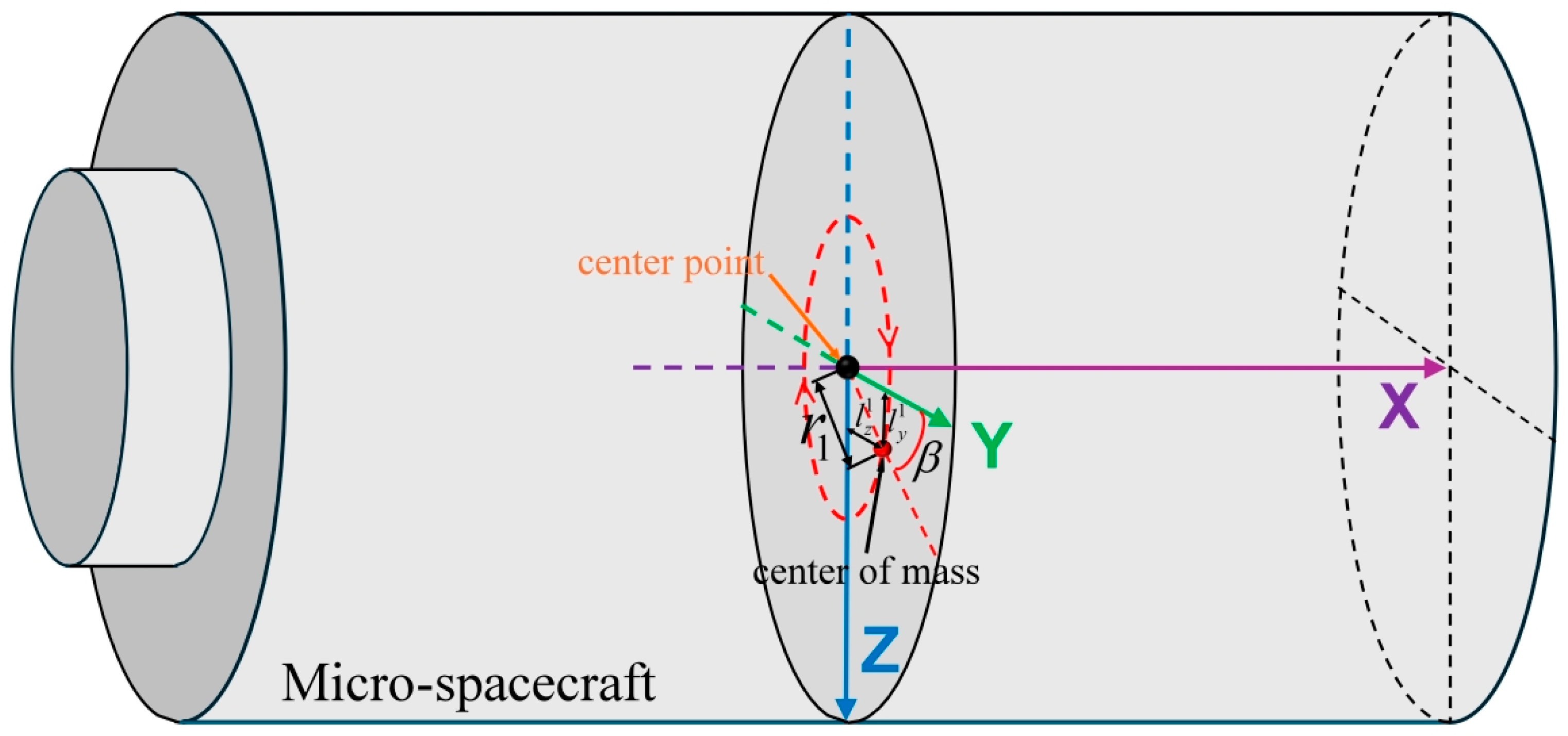
During micro-spacecraft assembly and integration, asymmetric mass distribution caused by the installation of additional equipment and structures can introduce a center-of-mass offset. Analyzing the influence of this mass imbalance on ejection attitude disturbance is essential to ensure design integrity and ejection-phase stability. A schematic of micro-spacecraft mass eccentricity is provided in
Figure 14. By adjusting two key parameters
and
to alter the offset distances
and
of the micro -spacecraft’s center of mass relative to each axis, the distances from the
Y-axis and
Z-axis are:
and
. The influence of mass imbalance on the angular velocity responses about the X, Y, and Z axes is investigated through comparative analysis of multiple operational cases. The detailed results of the effect of mass eccentricity on attitude disturbances are presented in
Figure 15.
A parametric study demonstrates that for a mass eccentricity of 0.1 to 0.4 mm, the angular velocities around the Y and Z axes increase with increasing eccentricity and converge to stable levels past 0.4 mm. The radial offset angle of mass eccentricity has a negligible effect. To uphold ejection precision, the axial mass eccentricity shall be controlled to within 0.2 mm.
4. Discussion
This paper establishes a multi-rigid-body dynamic simulation framework for micro-spacecraft on-orbit ejection using ADAMS. The contact parameters are calibrated against high-fidelity rigid–flexible coupled results from LS-DYNA, thereby developing a rapid calculation method for attitude disturbances of micro-spacecraft after ejection. Based on this method, the influence laws of thrust misalignment angle, thrust eccentricity, and mass eccentricity on attitude disturbances are investigated, with the main conclusions as follows:
The rapid calculation method for micro-spacecraft on-orbit ejection established in this paper achieves comparable prediction accuracy to high-fidelity rigid–flexible models and has been validated by ground disturbance tests. The single calculation efficiency is improved by 12,000 times, laying a foundation for subsequent large-scale computations.
Parametric studies based on 3600 sets of data indicate that axial thrust misalignment angle, axial thrust eccentricity, and axial mass eccentricity dominate the post-separation attitude disturbances. The angular velocities about the Y and Z axes rise significantly within the ranges of 0.1–0.4° for thrust misalignment, 0.2–0.6 mm for thrust eccentricity, and 0.1–0.4 mm for mass eccentricity, and then stabilize beyond these ranges.
For practical engineering applications, it is recommended that the axial thrust misalignment angle be limited to ≤0.2°, axial thrust eccentricity to ≤0.4 mm, and axial mass eccentricity to ≤0.2 mm to ensure stable attitude separation.
Limitations of this study include that the analysis is confined to the ejection phase of the separation process, using deterministic parameters and neglecting random disturbances such as orbital perturbations and thermal deformations that occur during the subsequent orbital flight and target impact phases. Future work will extend the model to cover the entire mission profile and incorporate stochastic analysis (e.g., Monte Carlo method) to quantify these uncertainties and further improve the fidelity of on-orbit ejection dynamics prediction.