Applications of Commercial-Grade Electronic Components in Space Projects: A Review

 ,
,  , , ,
, , ,  and
and 
Abstract
1. Introduction
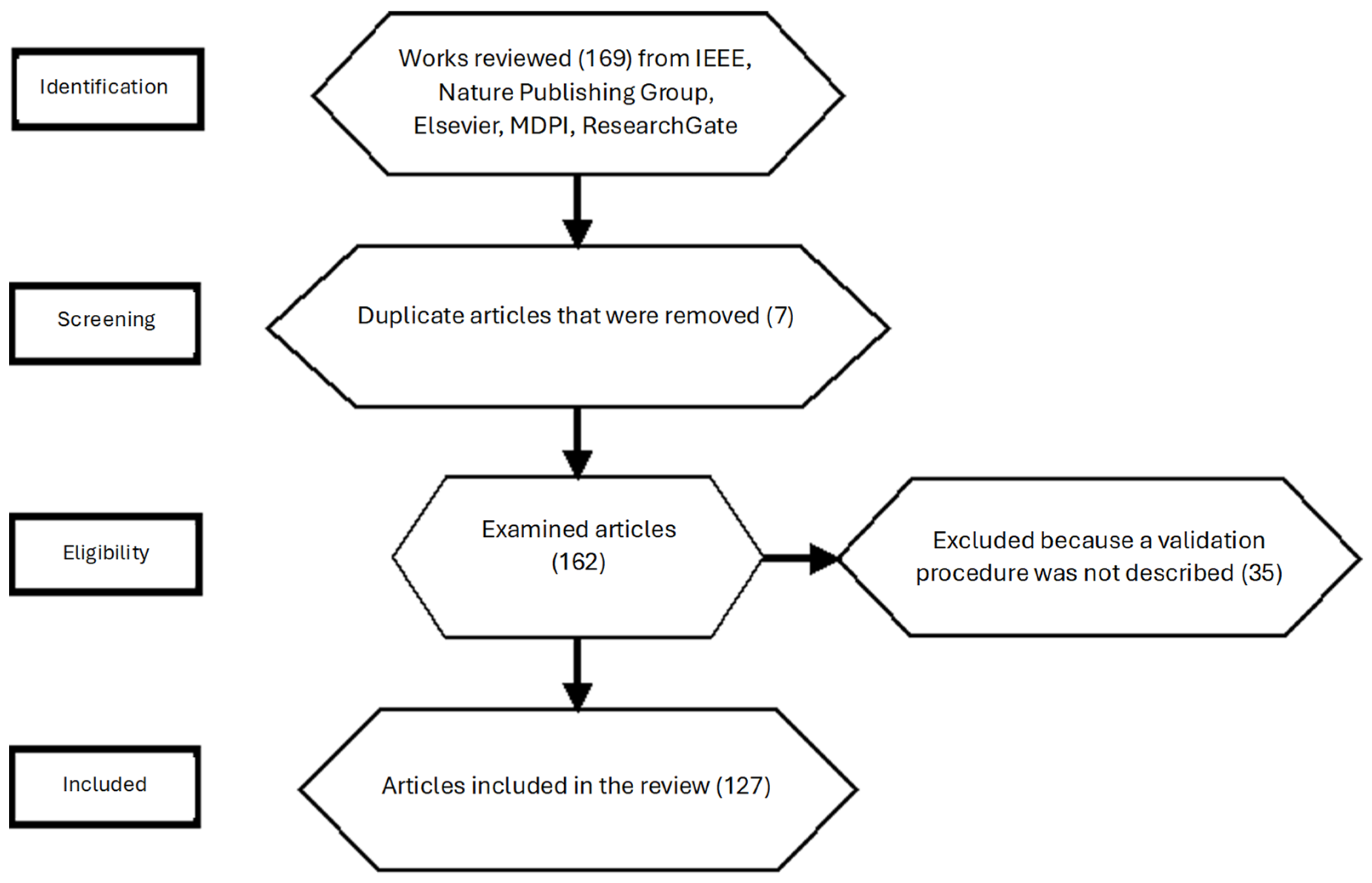
2. Materials and Methods
3. Results
3.1. COTS Effects on Aerospace Applications
3.1.1. Effects of Radiation
3.1.2. Effects of Mechanical Loading
3.1.3. Effects of Extreme Temperatures
3.2. COTS Methods in Aerospace Applications
3.2.1. Hardware and Software Systems for Error Detection and Correction
3.2.2. Fault Tolerance Testing
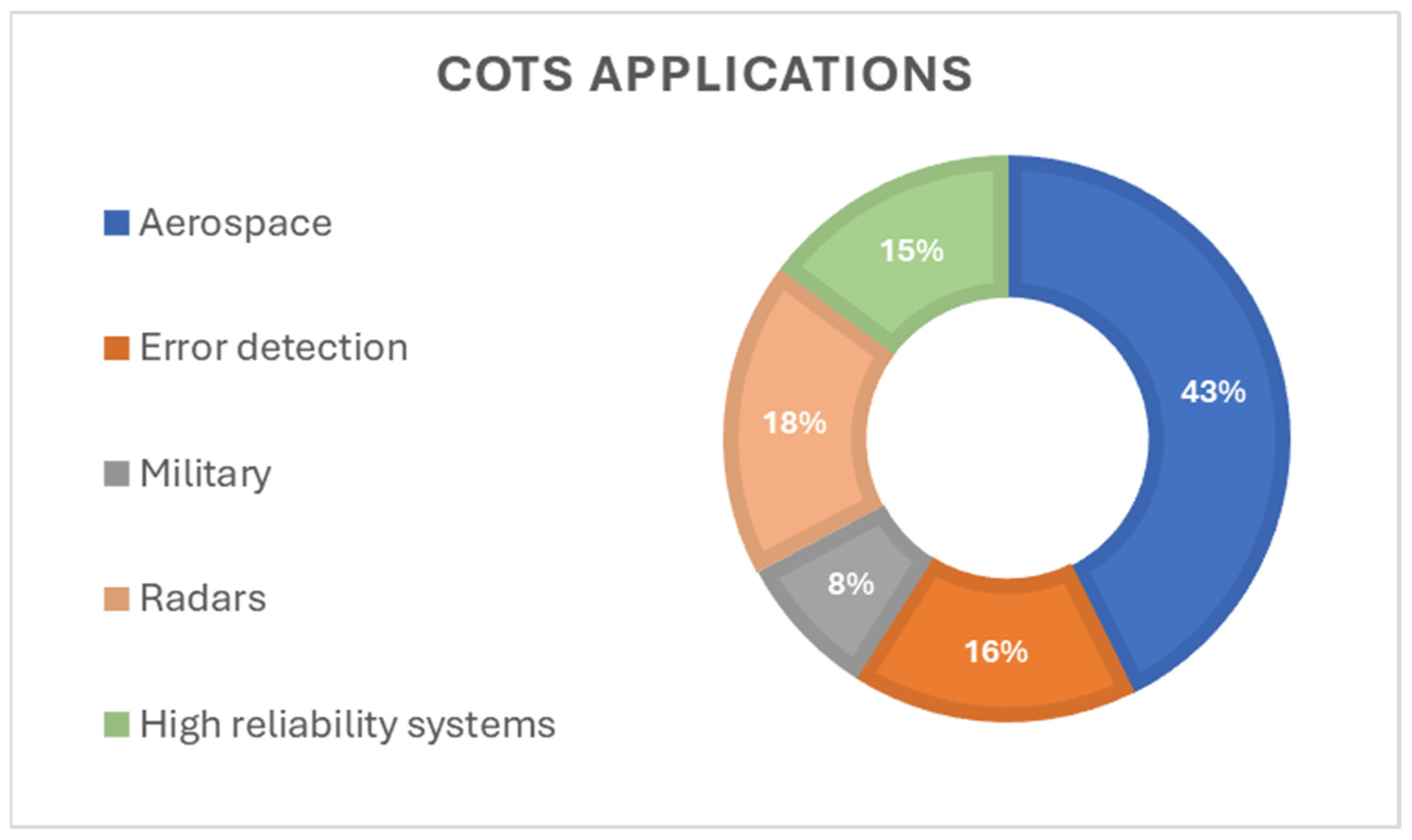
3.3. COTS Applications
3.3.1. Military
3.3.2. Aerospace Systems
3.3.3. Radar
3.3.4. Error Detection
3.3.5. High-Reliability Systems
- Physics of Failure (PoF) Analysis: To improve the accuracy of aging-related failure rates, PoF is now commonly applied, which involves digital modeling of the target system while incorporating real-time operating environment parameters.
- Model-Based Engineering (MBE): Tools like Maintenance Aware Design environment (MADe) are utilized to simulate the reliability of COTS components within systems, allowing for on-demand generation of FMEA (Failure Mode and Effects Analysis) and FMECA reports, as discussed in.
- Radiation Hardening by Design (RHBD): Rather than relying solely on hardening, modern techniques focus on architectural mitigation, such as using field-programmable gate arrays (FPGAs) to detect and correct transient faults caused by radiation.
- Testing Recommendations for Commercial Components.
- Parts-Level Qualification: NASA highlights that card-level, box-level, or system-level testing is insufficient; rigorous, accelerated parts-level screening under voltage, current, and temperature stress is necessary before integration.
- Environmental Stress Screening (ESS): COTS parts often have narrower temperature ratings (0 °C to 70 °C) compared to military-grade (−55 °C to 125 °C), necessitating detailed “uprating” procedures.
- Radiation Testing: Characterizing radiation hardness is critical for space applications.
- Application Recommendations for High-Reliability Systems.
- Suitability Assessment: COTS is most suitable when offering advanced technology not available in the traditional high-reliability portfolio.
- Mitigation Strategies: For high-criticality systems, designers should use up-screened COTS or fault-tolerant architectural designs, while rad-hard components are still suggested for long-duration missions.
- Modular Systems: The defense industry is moving toward “modular open systems approaches” to allow for easier replacement and upgrades of commercial components, as seen in.
4. Discussion
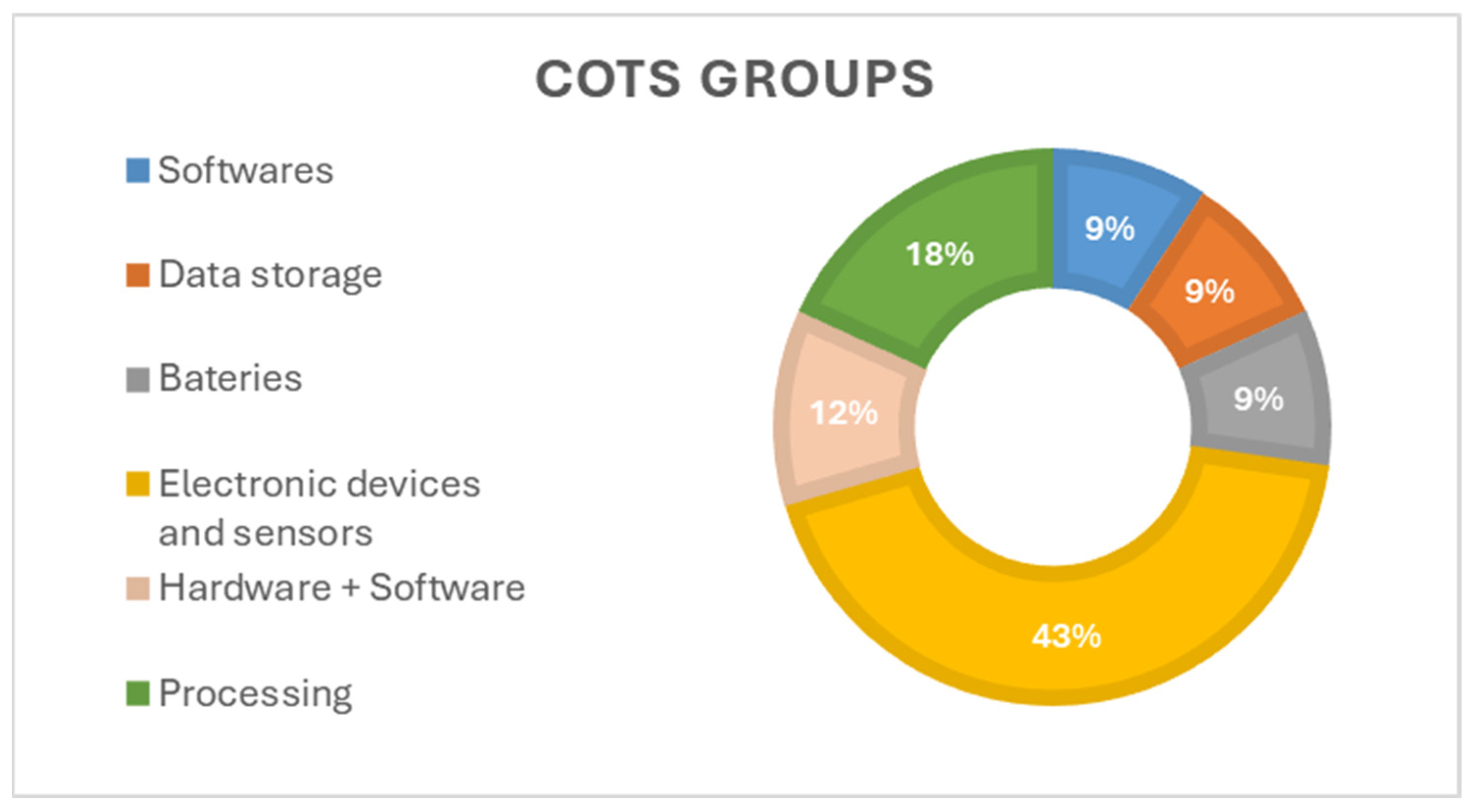
- Software: Error detection using machine learning and forecasting algorithms used in the space sector is included in the COTS software group [20]. Artificial Intelligence (AI) is also considered to be particularly focused on the use of Deep Neural Networks (DNN) on board a spacecraft [44]. Advances in space technology have enabled the miniaturisation of systems and cost reduction. NASA has conducted extensive research on neuromorphic computing as an innovative approach to on-board computing [101]. The software-based self-assessment technique proposed in [102] is another COTS software solution, which is being adopted within the Experimental CubeSat-type platform for technology testing Massively extended Modular Monitoring for Upper Stages (MaMMoTH-Up) project.
- Data storage: COTS-based storage devices include Dynamic random-access memory with a stacked three-dimensional architecture (3D DRAM) system with higher memory capacities [103,104], Micro Secure Digital (Micro-SD) and Static Random Access Memory (SRAM) with a wide range of radiation protection grades [105,106].
- Batteries: Ref. [107] proposes a type of lithium-ion battery based on COTS cells for small spacecraft on a LEO mission, and ref. [108] describes how the range of lithium-ion (Li-ion) batteries (ABSL) has identified multiple new cells for use in specific Space applications. In [109,110], the state of the art of the lithium-ion battery-based electrical power subsystem for Earth orbit satellites and launch vehicles for various mission applications is analyzed.
- Hardware-software techniques: Combinations of hardware and software strategies are proposed as COTS solutions. In [111], a technique is described that uses the On-Board Computer (OBC) and fault modelling to compare the effectiveness of fault tolerance techniques for SEU, which were implemented on an embedded Field-Programmable Gate Array (FPGA) System on Chip (SoC) platform. In [112], the development of a high-performance data acquisition, cloud screening, and compression computing system for space imaging spectrometers is proposed, targeting a COTS board based on an embedded FPGA-dual-core-processor SoC. In [113], a ground-space tracking system placed on a 3U CubeSat is presented, in which the PX4 drone operating system is used for the first time in conjunction with a 32-bit microcontroller (STM32) satellite-on-chip system. The main objective of PX4 is to use COTS drone components. In [114], the development of a minimized operating system with built-in redundancy is proposed to reduce dependence on flash memory, in particular with a custom bootloader using a Triple Modular Redundancy (TMR) partition and a Random Access Memory (RAM-based) file system available in the boot process. In [115], different modular redundancy schemes with different voter structures are compared for the qualification of a digital communications receiver, in which a space-grade, radiation-hardened Virtex-5QV (XQR5VFx130) is compared to the COTS Kintex-7 (KC7K325T). Triple modular redundancy with a single voter at the end is suggested, making the Virtex-5QV in this configuration almost as reliable as the Kintex-7 in an N modular redundancy configuration with a highly reliable external voter.
- Electronic devices and sensors: This group includes the development and application of electronic sensors, tests, devices, and systems, as well as power sources. Ref. [116] reports on the design of a low-cost long-wave infrared spectral sensor based on a low-mass, low-power hyperspectral thermal imager with an electronic architecture suitable for using COTS electronic components. The tested electronic components—microcontroller, dedicated flash memory, and camera module—are the main part of the imaging payload in the BIRDS-4 1U CubeSat constellation project in [117], where the in-orbit results are reported. The key functional modules of the Debris Removal and On-Orbit Maintenance Mission (DeBROOM) are implemented using COTS electronic components, whose feasibility is determined by the corresponding budgets [118]. Ref. [119] identifies the types of sensors required in emergency applications for femtosatellites and describes a study of the COTS sensor market, including high-performance, low-cost, and low-power sensors. Ref. [120] describes the use of a mini vector network analyzer as Ground Penetration Radar (GPR) in ultra-wideband radar applications based on COTS products, and the main conclusion is that it is possible to configure a functional ultra-wideband radar based on COTS elements and application-specific software design. Ref. [121] describes an approach to evaluating the reliability of a hardware system based on COTS components for space applications, analyzing the effect of uncertainty in failure rates and reliability estimation on the overall reliability of the system. In [122], multiple parameters that influence the performance of the most advanced low-cost aerosol sensors in measuring particles suspended in the spacecraft cabin are reviewed; these parameters and issues are studied with respect to a low-cost COTS-based aerosol sensor. Ref. [123] describes possible methods for characterizing and calibrating COTS sensors (magnetometer and MEMS gyroscope) on board a 2U-class nanosatellite. The Seeker project [124] is an ultra-low-cost approach to highly automated extravehicular inspection of manned and unmanned spacecraft, designed with extensive use of COTS components and built in-house at NASA’s Johnson Space Centre (JSC). According to [125], which describes the challenges of solar panel performance in deep-space missions, COTS solar cells available for space applications exhibit suboptimal performance under Low Irradiation and Low Temperature (LILT) operating conditions. In [126], a COTS silicon carbide (4H-SiC) ultraviolet (UV) photodiode was electrically characterized as a low-cost spectroscopic X-ray and gamma-ray photon counting detector. In [127], a lightweight, ultra-low-power proton fluence monitor is proposed as a COTS-based space proton sensor to detect the Non-Ionizing Energy Loss (NIEL) process affecting spacecraft onboard electronics. In [128], an experimental study is described that evaluates the COTS Microsoft Kinect v2 as an encounter and capture sensor for small satellites, which is proposed as a low-cost solution for in-orbit servicing and space debris removal. A critical component for adjusting the voltage and current values provided by the power distribution of a space mission is the DC-DC Point-of-Load (PoL) converter. The use of COTS for PoL converters enables significantly higher efficiencies, increased output current, reduced volume and mass, improved Electromagnetic Interference (EMI) performance, and lower costs [129]. In addition, COTS Gallium Nitride (GaN) switching devices have the advantage of fast switching with reliable radiation performance in a small physical space. Ref. [130] describes the design of an in-flight ambient temperature monitoring system for the Line Emission Mapper (LEM) Microcalorimeter Spectrometer, which is based on COTS electronic devices, namely three Warm Front-End Electronics (WFEE) boxes and six Digital Electronics and Event Processors (DEEP) boxes. The LEM mission is an X-ray survey mission designed to study the physics of galaxy formation. The development of the design, testing, and in-orbit operation of the UPMSat-2 solar sensor, composed of six COTS photodiodes, is described in [131], where the first solar sensor data results obtained during the mission have been validated with magnetometers and altitude control systems. The space applicability and reliability of an X-band solid-state power amplifier based on COTS GaN transistors with high electron mobility over a continuous year of operation in deep space are illustrated in [132]. In addition to the main instrumentation, ref. [133] recommends the development and acquisition of compact, low-cost, low-power sensor arrays focused on meteorology and space impacts for all future NASA missions, where possible, compact sensors are presented. In [134], the effects of radiation from Medium Earth Orbit (MEO) space flights on a COTS static RAM-based FPGA device within a digital system with a Triple Modular Redundancy (TMR) Technique are reported.
- Data processing units: This category considers COTS processing units that are suitable for meeting design criteria as solutions for microsatellite platforms in a wide range of missions. In [135], a test campaign is presented to identify one or more commercially available microprocessors with the latest technological innovations that meet a series of system criteria to be suitable as processors for microsatellite platforms for a wide range of missions. Ref. [136] describes a reconfigurable architecture for an embedded processor that is fully compatible with space requirements for critical space exploration systems, based on a dynamically reconfigurable multi-accelerator architecture. In [137], the design, implementation, and results of a set of IP processing cores that perform on-board hyperspectral image compression in compliance with the Consultative Committee for Space Data Systems (CCSDS) 123.0-B-1 lossless standard are described. In [138], a heterogeneous multi-core SoC processor is evaluated for use on board spacecraft to support digital signal processors and novel, computationally demanding AI functionalities. The applicability of integrated Graphics Processing Units (GPUs) in space is studied in [139] by analyzing current space application domains to identify software domains useful for space and integrated GPU domains to assess whether integrated GPUs can meet the necessary computing power and identify the challenges that need to be addressed for their adoption in space. The multiMIND processing system, based on the latest Multiprocessor on Chip (MPSoC) COTS Xilinx Zynq Ultrascale+, has been proposed by Thales Alenia Space in [140] as a highly flexible, multi-mission solution with a modular software framework. The main objective is to meet the processing requirements of modern NewSpace applications in computing tasks such as signal, image, and AI algorithms. In [141], a variety of algorithms trained on Earth or Mars images and standard deep learning models for image classification were evaluated using inference neural network models deployed on COTS Qualcomm Snapdragon and Movidius Myriad X processors hosted on Hewlett Packard Enterprise’s Spaceborne Computer-2 aboard the International Space Station. COTS electronic hardware and On Board Software (OBSW) are designed and implemented in the HERCCULES mission in [142] as an affordable, fast, simple, and reliable solution for the application of balloons in thermal modelling and analysis of stratospheric systems.
- Design Trade-offs: The core of the conflict is that high computational or transmission performance generally requires cutting-edge technologies (such as 7 nm chips) that are inherently more vulnerable to radiation and have less well-understood failure mechanisms than mature, robust technologies.
- Performance vs. Reliability: Commercial-Off-The-Shelf (COTS) components offer superior speeds at a fraction of the cost but lack the traceability and radiation tolerance of military-grade or space-grade components.
- Effectiveness: If one inexpensive satellite fails, the others cover its function. This enables high overall throughput and low per-unit costs.
5. Conclusions
Author Contributions
Funding
Data Availability Statement
Acknowledgments
Conflicts of Interest
Abbreviations
| 3D DRAM | Dynamic random-access memory with a stacked three-dimensional architecture |
| 2U | Two CubeSat standard units |
| 3U | Three CubeSat standard units |
| 4H-SiC | Silicon carbide |
| 6U | Six CubeSat standard units |
| ABSL | Range of lithium-ion (Li-ion) batteries |
| ACEDR | Automatic Compiler Error Detection and Recovery |
| AI | Artificial Intelligence |
| BIRDS-4 1U | A CubeSat from the BIRDS-4 program |
| BLDC | BrushLess Direct Current |
| CCSDS | Consultative Committee for Space Data Systems |
| CCSDS 123.0-B-1 | A lossless compression standard for space imagery defined by CCSDS |
| CO2 | Carbon dioxide |
| COTS | Commercial-Off-The-Shelf |
| CPU | Central Processing Unit |
| CubeSat | Standardized Miniaturized Cube Satellite |
| DC | Direct Current |
| DD | Displacement Damage |
| DeBROOM | Debris Removal and On-Orbit Maintenance Mission |
| DEEP | Digital Electronics and Event Processors |
| DNN | Deep Neural Networks |
| e-Cube | Experimental facility for testing and developing space technologies |
| EEE | Electrical, Electronic, and Electromechanical |
| EMI | Electromagnetic Interference |
| EPS | Electrical Power System |
| ESCC | European Space Components Coordination |
| FDIR | Fault Detection, Isolation, and Recovery |
| FMECA | Failure Mode, Effects, and Criticality Analysis |
| FPGA | Field-Programmable Gate Array |
| GaN | Gallium Nitride |
| GPR | Ground Penetration Radar |
| GPUs | Graphics Processing Unit |
| GSE | Ground Support Equipment |
| GSFC | Goddard Space Flight Centre |
| H2O | Water |
| IEEE | Institute of Electrical and Electronics Engineers |
| IMUs | Inertial Measurement Units |
| InSAR | Interferometric Synthetic Aperture Radar |
| ISS | International Space Station |
| IoT | Internet of Things |
| JSC | Johnson Space Centre |
| Kintex-7 (KC7K325T) | An FPGA device from the Kintex-7 family designed for high-performance, energy-efficient applications in advanced digital systems |
| LEM | Line Emission Mapper |
| LEO | Low Earth Orbit |
| LiDAR | Light Detection and Ranging |
| LILT | Low Irradiation and Low Temperature |
| MaMMoTH-Up | Massively extended Modular Monitoring for Upper Stages |
| MDPI | Multidisciplinary Digital Publishing Institute |
| MEMS | Microelectromechanical systems |
| MEO | Medium Earth Orbit |
| Micro-SD | Micro Secure Digital |
| Microsoft Kinect v2 COTS | A commercial depth and motion sensor used for capturing three-dimensional data. |
| MIL-STD | Military Standards |
| MOSFET | Metal-Oxide-Semiconductor Field-Effect Transistor |
| MPCS2017 | Micro propulsion and CubeSats |
| MPSoC | Multiprocessor on Chip |
| multiMIND | A multi-core processing platform for high-performance applications |
| NASA | National Aeronautics and Space Administration |
| NESC | NASA Engineering and Safety Centre |
| NIEL | Non-Ionizing Energy Loss |
| O2 | Molecular oxygen |
| OBC | On-Board Computer |
| OBSW | On Board Software |
| POD | Precision Orbit Determination and Knowledge |
| PoL | Point-of-Load |
| PRISMA | Preferred Reporting Items for Systematic Reviews and Meta-Analyses |
| PX4 | An open-source autopilot software platform used in drones and autonomous vehicles |
| RaCERS | Radar Cluster for Earth Remote Sensing |
| RAM | Random Access Memory |
| RF | Radio Frequency |
| RMF | Risk Management Framework |
| ROMEO | Radar Module for Earth Observation |
| SAR | Synthetic Aperture Radar |
| SEB | Single-Event Burnout |
| SEE | Single-Event Effects |
| SEFI | Single-Event Functional Interrupt |
| SEGR | Single-Event Gate Rupture |
| SEHE | Single-Event Hard Error or Stuck Bit |
| SEL | Single-Event Latch-up |
| SET | Single-Event Transient |
| SEU | Single-Event Upset or Soft Error |
| SIHFT | Software-Implemented Hardware Fault Tolerance |
| SoC | System-on-Chip |
| SRAM | Static Random Access Memory |
| STM32 | A family of 32-bit microcontrollers based on the ARM Cortex-M architecture, used in embedded systems for control, processing, and data acquisition |
| TCB | Telecom Module |
| TID | Total Ionizing Dose |
| TMR | Triple Modular Redundancy |
| UPMSat-2 | An experimental satellite developed by the Polytechnic University of Madrid. |
| UV | Ultraviolet |
| Virtex-5QV (XQR5VFx130) | Radiation-tolerant FPGA based on the Virtex-5 architecture, designed for space applications and high-reliability electronic systems |
| WFEE | Warm Front-End Electronics |
References
- Budroweit, J.; Patscheider, H. Risk assessment for the use of COTS devices in space systems under consideration of radiation effects. Electronics 2021, 10, 1008. [Google Scholar] [CrossRef]
- Gansler, J.S.; Lucyshyn, W. Commercial-Off-The-Shelf (COTS): Doing It Right. Acquisition Research Program. 2008. Available online: https://apps.dtic.mil/sti/html/tr/ADA494143/ (accessed on 2 September 2025).
- Herbert, E.; Sega, R.; McGraw, J.; Bradley, T. Risk Management for Commercial-Off-The-Shelf Parts Based Space Hardware. Syst. Eng. 2025, 28, 374–392. [Google Scholar] [CrossRef]
- Fontenelle, F.; Borsato, M. A morphological approach to reviewing the literature on evaluation and selection of Commercial-Off-The-Shelf equipment for Defense. Prod. Manag. Dev. 2023, 20, e20230007. [Google Scholar] [CrossRef]
- Hutton, B.; Catalá-López, F.; Moher, D. The extension of the PRISMA statement for systematic reviews incorporating network meta-analysis: PRISMA-NMA. Med. Clin. 2016, 147, 262–266. [Google Scholar] [CrossRef]
- Gutiérrez, O.; Prieto, M.; Perales-Eceiza, A.; Ravanbakhsh, A.; Basile, M.; Guzmán, D. Toward the use of electronic Commercial Off-The-Shelf devices in space: Assessment of the true radiation environment in low earth orbit (leo). Electronics 2023, 12, 4058. [Google Scholar] [CrossRef]
- Brunetti, G.; Campiti, G.; Tagliente, M.; Ciminelli, C. COTS devices for space missions in LEO. IEEE Access 2024, 12, 76478–76514. [Google Scholar] [CrossRef]
- Coronetti, A.; Manni, F.; Mekki, J.; Dangla, D.; Virmontois, C.; Kerboub, N.; Alia, R.G. Mixed-field radiation qualification of a COTS space on-board computer along with its CMOS camera payload. In 2019 19th European Conference on Radiation and Its Effects on Components and Systems (RADECS); IEEE: Piscataway, NJ, USA, 2019; pp. 1–8. [Google Scholar] [CrossRef]
- Allums, K.K.; ONeill, P.M.; Reddell, B.D.; Bailey, C.R.; Nguyen, K.V. Radiation test results on COTS and non-COTS electronic devices for NASA Johnson space center spaceflight projects. In 2012 IEEE Radiation Effects Data Workshop; IEEE: Piscataway, NJ, USA, 2012; pp. 1–9. [Google Scholar] [CrossRef]
- Davis, S.C.; Yarbrough, A.D.; Koga, R.; Wright, A.W.; Taggart, J.L.; Davis, B.N. The aerospace corporation’s compendium of recent radiation testing results. In 2021 IEEE Radiation Effects Data Workshop (REDW); IEEE: Piscataway, NJ, USA, 2021; pp. 1–8. [Google Scholar] [CrossRef]
- Xu, Y.; Liu, S.; He, C.; Wu, H.; Cheng, L.; Yan, G.; Huang, Q. Reliability of MEMS inertial devices in mechanical and thermal environments: A review. Heliyon 2024, 10, e27481. [Google Scholar] [CrossRef]
- Auchlin, M. New Reliability Assessment of MEMS Components Under Accumulative Testing for Space Applications. Doctoral Dissertation, EPFL, Lausanne, Switzerland, 2021. Available online: https://infoscience.epfl.ch/entities/publication/57524d27-21ae-4f32-bddc-045865dd4672 (accessed on 17 September 2025).
- Skogström, L.; Li, J.; Mattila, T.T.; Vuorinen, V. MEMS reliability. In Handbook of Silicon-Based MEMS Materials and Technologies; Elsevier: Amsterdam, The Netherlands, 2020; pp. 851–876. [Google Scholar] [CrossRef]
- Shea, H.R. Reliability of MEMS for space applications. In MOEMS-MEMS 2006 Micro and Nanofabrication; Tanner, D.M., Ramesham, R., Eds.; SPIE: San Jose, CA, USA, 2006; p. 61110A. [Google Scholar] [CrossRef]
- McLoughlin, I.V.; Gupta, V.; Sandhu, G.S.; Lim, S.; Bretschneider, T.R. Fault tolerance through redundant COTS components for satellite processing applications. In Proceedings of the Fourth International Conference on Information, Communications and Signal Processing, 2003, and the Fourth Pacific Rim Conference on Multimedia. Proceedings of the 2003 Joint, Singapore, 15–18 December 2003; IEEE: Piscataway, NJ, USA; Volume 1, pp. 296–299. [CrossRef]
- Shirvani, P.P.; Oh, N.; McCluskey, E.J.; Wood, D.L.; Lovellette, M.N.; Wood, K.S. Software-Implemented Hardware Fault Tolerance Experiments COTS in Space. 2000, p. 3. Available online: https://d1wqtxts1xzle7.cloudfront.net/48890584/Software-Implemented_Hardware_Fault_Tole20160916-7442-jvbmwa-libre.pdf?1474052041=&response-content-disposition=inline%3B+filename%3DSoftware_Implemented_Hardware_Fault_Tole.pdf&Expires=1764176904&Signature=bbYPLG2-kkk-RvR2m6ryD5nQSuzgN0ubWjp3MEiYoxG7HuJPx5hCzijW13HuHnFRzQg6qXGei3ebiANF2vhMc0LlwzZ-Gj~GL2NWcRY7tZZmXDDsMYaZDQLVkyP-yhzDOCptIjw1pN2r6yiAbdm6AajiTxYDz~gS-WLbCbcI2r401K2-ykxpJrF~sJNAUaes8hjiADIhHDVIuA5R14VkmSCB2kyqfR59s4BIkfSxTY~nmyTdTJEQWDX8NdVEmYb~jK-yfnWsB3NEvHt1di8cf3MWZSMFrJLQOQ444R00hu23IYHukXVgm9DgDaKVFvmF2OR9I6evXSdDKOi9QUMKvQ__&Key-Pair-Id=APKAJLOHF5GGSLRBV4ZA (accessed on 3 October 2025).
- Schiffel, U.; Schmitt, A.; Süßkraut, M.; Fetzer, C. Software-Implemented Hardware Error Detection: Costs and Gains. In Proceedings of the 2010 Third International Conference on Dependability, Venice, Italy, 18–25 July 2010; pp. 51–57. [Google Scholar] [CrossRef]
- Nezzari, Y.; Bridges, C.P. ACEDR: Automatic Compiler Error Detection and Recovery for COTS CPU and Caches. IEEE Trans. Rel. 2019, 68, 859–871. [Google Scholar] [CrossRef]
- Le, C.; Hensley, S. Using COTS Components for Real-Time Processing of SAR Systems. July 2008. Available online: https://www.researchgate.net/profile/Scott-Hensley/publication/237117829_Using_COTS_Components_for_Real-Time_Processing_of_SAR_Systems/links/54bc925d0cf253b50e2d3a8d/Using-COTS-Components-for-Real-Time-Processing-of-SAR-Systems.pdf (accessed on 10 October 2025).
- Murphy, J.; Ward, J.E.; Mac Namee, B. Machine Learning in Space: A Review of Machine Learning Algorithms and Hardware for Space Applications. AICS 2021, 3105, 72–83. [Google Scholar]
- Reghenzani, F.; Fornaciari, W. Towards certifiable software-implemented hardware fault tolerance. In 2024, IEEE 14th International Symposium on Industrial Embedded Systems (SIES); IEEE: Piscataway, NJ, USA, 2024; pp. 10–16. [Google Scholar] [CrossRef]
- Rabiei, E.; Huang, L.; Chien, H.Y.; Earthperson, A.; Diaconeasa, M.A.; Woo, J.; Iyer, S.; White, M.; Mosleh, A. Method and software platform for electronic COTS parts reliability estimation in space applications. Proc. Inst. Mech. Eng. Part O J. Risk Reliab. 2021, 235, 744–760. [Google Scholar] [CrossRef]
- Fowee, K.; Mathur, D.; Franks, N.; Alexeenko, A. Characterizing COTS IMU Performance in High Vacuum. In Proceedings of the 32nd Annual AIAA/USU Conference on Small Satellites, Logan, UT, USA, 4–9 August 2018; p. 13. Available online: https://digitalcommons.usu.edu/cgi/viewcontent.cgi?article=4242&context=smallsat (accessed on 5 November 2025).
- ECSS, European Cooperation for Space Standardization. 2017. Available online: http://ecss.nl/ (accessed on 5 November 2025).
- ESA. Single Event Effects Test Method and Guidelines; ESCC Basic Specification No. 25100; ESA/ESTEC: Noordwijk, The Netherlands, 2014. [Google Scholar]
- ESA. Total Dose Steady-State Irradiation Test Method; ESCC Basic Specification No. 22900; ESA/ESTEC: Noordwijk, The Netherlands, 2016. [Google Scholar]
- ESA. Recommendations on the Use of the ESCC Specification System for the Evaluation and Procurement of Unqualified Components; ESCC Basic Specification No. 23100; ESA/ESTEC: Noordwijk, The Netherlands, 2014. [Google Scholar]
- ECSS-Q-ST-60-13C; Commercial Electrical, Electronic, and Electromechanical (EEE) Components. ESA/ESTEC: Noordwijk, The Netherlands, 2013. Available online: https://ecss.nl/standard/ecss-q-st-60-13c-commercial-electrical-electronic-and-electromechanical-eee-components-21-october-2013/ (accessed on 20 January 2026).
- Samwel, S.W.; El-Aziz, E.A.; Garrett, H.B.; Hady, A.A.; Ibrahim, M.; Amin, M.Y. Space radiation impact on smallsats during maximum and minimum solar activity. Adv. Space Res. 2019, 64, 239–251. [Google Scholar] [CrossRef]
- Sedlmayr, H.-J.; Beyer, A.; Joehl, K.; Kunze, K.; Maier, M.; Obermeier, T. COTS for Deep Space Missions. In Radiation Effects on Integrated Circuits and Systems for Space Applications; Springer: Berlin/Heidelberg, Germany, 2019; pp. 381–401. [Google Scholar] [CrossRef]
- Ott, M.N.; Parvini, C.; Bontzos, A.; Thomes, W.J.; Switzer, R.; Matyseck, M.; Onuma, E. Space Flight Optoelectronics and Photonics Qualification. SAE Photonics Reliability Meeting. 2019; p. 39. Available online: https://ntrs.nasa.gov/api/citations/20190026990/downloads/20190026990.pdf (accessed on 3 February 2026).
- Majewicz, P.; Chen, Y. A Study of Lessons and Experiences of NASA Centers in the Use of Commercial-Off-The-Shelf (COTS) Electronics. In Presentation for Posting on Public Website. NASA Electronic Parts and Packaging (NEPP) Program. 2021. Available online: https://ntrs.nasa.gov/citations/20210015032 (accessed on 13 February 2026).
- Demko, E. Commercial-Off-The-Shelf (COTS): A challenge to military equipment reliability. In Proceedings of the 1996 Annual Reliability and Maintainability Symposium, Las Vegas, NV, USA, 22–25 January 1996; pp. 7–12. [Google Scholar] [CrossRef]
- Anderson, M.A.; Duron, C.M.; Farmer, T.A.; Hitt, M.A.; Klinner, M.G.; Lanz, G.E.; London, J.R., III; Ray, M.E.; Riebling, M.E.; Smith, S.L.; et al. Army Decade in Space. In Proceedings of the Small Satellite Conference, Logan, UT, USA, 1–6 August 2020; Available online: https://digitalcommons.usu.edu/smallsat/2020/all2020/110 (accessed on 27 February 2026).
- DeBusk, B.M. Managing the reliability of COTS-based military systems. In Proceedings of the Annual Reliability and Maintainability Symposium. 1998 Proceedings. International Symposium on Product Quality and Integrity, Anaheim, CA, USA, 19–22 January 1998; pp. 394–400. [Google Scholar] [CrossRef]
- Estela, J. COTS and the NewSpace. In Radiation Effects on Integrated Circuits and Systems for Space Applications; Springer: Berlin/Heidelberg, Germany, 2019; pp. 329–346. [Google Scholar] [CrossRef]
- Rudolph, D.; Wilson, C.; Stewart, J.; Gauvin, P.; George, A.; Lam, H.; Crum, G.; Wirthlin, M.; Wilson, A.; Stoddard, A. CSP: A Multifaceted Hybrid Architecture for Space Computing. 2014, p. 7. Available online: https://digitalcommons.usu.edu/smallsat/2014/AdvTechI/3/ (accessed on 4 March 2026).
- Ngo, D.; Harris, M. A reliable infrastructure based on COTS technology for affordable space application. In Proceedings of the 2001 IEEE Aerospace Conference Proceedings (Cat. No.01TH8542), Big Sky, MT, USA, 10–17 March 2001; pp. 2435–2441. [Google Scholar] [CrossRef]
- Vartanian, S.; Irom, F.; Allen, G.R.; Parker, W.P.; O’Connor, M.D. Single Event Latchup Results for COTS Devices Used on SmallSat Missions. In Proceedings of the 2020 IEEE Radiation Effects Data Workshop (in Conjunction with 2020 NSREC), Santa Fe, NM, USA, 30 November–30 December 2020; pp. 1–4. [Google Scholar] [CrossRef]
- Prentice, E.F.; Grøtte, M.E.; Sigernes, F.; Johansen, T.A. Design of a hyperspectral imager using COTS optics for small satellite applications. In Proceedings of the International Conference on Space Optics—ICSO 2020, Virtual, 30 March–2 April 2021; Volume 11852, pp. 2154–2171. [Google Scholar] [CrossRef]
- Cockrell, J.; Alena, R.; Mayer, D.; Sanchez, H.; Luzod, T.; Yost, B.; Klumpar, D. EDSN: A Large Swarm of Advanced Yet Very Affordable, COTS-based NanoSats that Enable Multipoint Physics and Open Source Apps. In Proceedings of the Small Satellite Conference, Ago, Logan, UT, USA, 13–16 August 2012; Available online: https://digitalcommons.usu.edu/smallsat/2012/all2012/89 (accessed on 16 March 2026).
- Tsigkanos, A.; Kranitis, N.; Theodoropoulos, D.; Paschalis, A. High-Performance COTS FPGA SoC for Parallel Hyperspectral Image Compression with CCSDS-123.0-B-1. IEEE Trans. VLSI Syst. 2020, 28, 2397–2409. [Google Scholar] [CrossRef]
- Cheek, N.; Daniel, N.; Lightsey, E.G.; Peet, S.; Smith, C.; Cavender, D. Development of a COTS-Based Propulsion System Controller for NASA’s Lunar Flashlight CubeSat Mission. In Proceedings of the Small Satellite Conference, Logan, UT, USA, 7–12 August 2021; Available online: https://digitalcommons.usu.edu/smallsat/2021/all2021/196/ (accessed on 27 March 2026).
- Furano, G.; Meoni, G.; Dunne, A.; Moloney, D.; Ferlet-Cavrois, V.; Tavoularis, A.; Byrne, J.; Buckley, L.; Psarakis, M.; Voss, K.O.; et al. Towards the Use of Artificial Intelligence on the Edge in Space Systems: Challenges and Opportunities. IEEE Aerosp. Electron. Syst. Mag. 2020, 35, 44–56. [Google Scholar] [CrossRef]
- Bokil, H. COTS Semiconductor Components for the New Space Industry. In Proceedings of the 2020 4th IEEE Electron Devices Technology & Manufacturing Conference (EDTM), Penang, Malaysia, 6–21 April 2020; pp. 1–4. [Google Scholar] [CrossRef]
- Manoudis, A.; Savvas, S.; Ramnalis, P. Feasibility Study of Low Power PPU with COTS Components and eGaN FETs. In Proceedings of the 2019 European Space Power Conference (ESPC), Juan-les-Pins, France, 30 September–4 October 2019; pp. 1–6. [Google Scholar] [CrossRef]
- Gutiérrez, O.; Prieto, M.; Sánchez-Reyes, A.; Gómez, A. TID characterization of COTS parts using radiotherapy linear accelerators. IEICE Electron. Express 2019, 16, 20190077. [Google Scholar] [CrossRef]
- Tsog, N. Space Computing Using COTS Heterogeneous Platforms: Intelligent On-Board Data Processing in Space Systems; Mälardalen University: Västerås, Sweden, 2021; Available online: https://www.proquest.com/openview/a28da16bb3517f435f7303e1e70c4a09/1?pq-origsite=gscholar&cbl=2026366&diss=y (accessed on 4 April 2026).
- Petrick, D.; Crum, G.; Geist, A.; Wilson, C. Spacecube Overview and Use of COTS Parts in Space. In Electronics Technology Workshop. 2020. Available online: https://ntrs.nasa.gov/citations/20205002774 (accessed on 10 April 2026).
- Colombo, C.; Scala, F.; Trisolini, M.; Gonzalo Gòmez, J.L.; Antonetti, S.; Di Tolle, F.; Radaelli, R.; Lisi, F.; Marrocchi, L.; Aliberti, M.; et al. The Environmental Cubesat Mission E.Cube for Low Earth Orbit Data Acquisition. 2021, p. 6. Available online: https://re.public.polimi.it/bitstream/11311/1186118/1/COLOC04-21.pdf (accessed on 17 April 2026).
- Levchenko, I.; Bazaka, K.; Ding, Y.; Raitses, Y.; Mazouffre, S.; Henning, T.; Klar, P.J.; Shinohara, S.; Schein, J.; Garrigues, L.; et al. Space micropropulsion systems for Cubesats and small satellites: From proximate targets to furthermost frontiers. Appl. Phys. Rev. 2018, 5, 011104. [Google Scholar] [CrossRef]
- Chin, J.; Coelho, R.; Foley, J.; Johnstone, A.; Nugent, R.; Pignatelli, D.; Pignatelli, S.; Powell, N.; Puig-Suari, J. CubeSat 101 Basic Concepts and Processes for First-Time CubeSat Developers. NASA CubeSat Launch Initiative, California Polytechnic State University, San Luis Obispo (Cal Poy) CubeSat Systems Engineering Lab. October 2017. Available online: https://www.nasa.gov/wp-content/uploads/2017/03/nasa_csli_cubesat_101_508.pdf (accessed on 27 March 2026).
- Silva, M.A.C.; Guerrieri, D.C.; Cervone, A.; Gill, E. A review of MEMS micropropulsion technologies for CubeSats and PocketQubes. Acta Astronaut. 2018, 143, 234–243. [Google Scholar] [CrossRef]
- Cheong, J.W.; Southwell, B.J.; Andrew, W.; Aboutanios, E.; Lam, C.; Croston, T.; Li, L.; Green, S.; Kroh, A.; Glennon, E.P.; et al. A Robust Framework for Low-Cost Cubesat Scientific Missions: In-Orbit Recovery, Results and Lessons Learned from UNSW-EC0. Space Sci. Rev. 2020, 216, 8. [Google Scholar] [CrossRef]
- Mane, S. Theoretical overview on CubeSat technology. Int. J. All Res. Educ. Sci. Methods 2024, 12, 1107–1113. [Google Scholar]
- Chin, K.B.; Brandon, E.J.; Bugga, R.V.; Smart, M.C.; Jones, S.C.; Krause, F.C.; West, W.C.; Bolotin, G.G. Energy storage technologies for small satellite applications. Proc. IEEE 2018, 106, 419–428. [Google Scholar] [CrossRef]
- Funase, R.; Ikari, S.; Suzumoto, R.; Sako, N.; Sanada, M.; Nakasuka, S. On-Orbit Operation Results of the World’s First CubeSat XI-IV—Lessons Learned from Its Successful 15-Year Space Flight. 2019, p. 8. Available online: https://digitalcommons.usu.edu/smallsat/2019/all2019/48/ (accessed on 18 February 2026).
- Acero, I.F.; Diaz, J.; Hurtado-Velasco, R.; Bautista, S.R.; Rincon, S.; Hernández, F.L.; Rodriguez-Ferreira, J.; Gonzalez-Llorente, J. A Method for Validating CubeSat Satellite EPS Through Power Budget Analysis Aligned with Mission Requirements. IEEE Access 2023, 11, 43316–43332. [Google Scholar] [CrossRef]
- Anger, M.; Niemelä, P.; Cheremetiev, K.; Clayhills, B.; Fetzer, A.; Lundén, V.; Hiltunen, M.; Kärkkäinen, T.; Mayank, M.; Turc, L.; et al. Foresail-2: Space Physics Mission in a Challenging Environment. Space Sci. Rev. 2023, 219, 66. [Google Scholar] [CrossRef]
- Bouzoukis, K.P.; Moraitis, G.; Kostopoulos, V.; Lappas, V. An Overview of CubeSat Missions and Applications. Aerospace 2025, 12, 550. [Google Scholar] [CrossRef]
- Peral, E.; Im, E.; Wye, L.; Lee, S.; Tanelli, S.; Rahmat-Samii, Y.; Horst, S.; Hoffman, J.; Yun, S.H.; Imken, T.; et al. Radar Technologies for Earth Remote Sensing From CubeSat Platforms. Proc. IEEE 2018, 106, 404–418. [Google Scholar] [CrossRef]
- NASA Official; Baynes, K. Synthetic Aperture Radar (SAR). EarthData, Site Last Updated: 2 July 2025, NASA. Available online: https://www.earthdata.nasa.gov/learn/earth-observation-data-basics/sar (accessed on 26 March 2026).
- Jylhä, J.; Tolkkinen, H.; Arajärvi, R.; Väilä, M.; Ruotsalainen, M. Synthetic Aperture Radar Imaging Using COTS Components. October 2019. Available online: https://trepo.tuni.fi/bitstream/handle/10024/215659/Jylha.pdf?sequence=1&isAllowed=y (accessed on 19 January 2026).
- Bergamasco, A.; Colombo, A.; Taiano, G.; Yunck, T.; Rosso, I.; Patelli, A.; Giusti, E.; Martorella, M.; Pirat, C. The radar cluster for Earth remote sensing (RaCERS) CubeSat mission. In Small Satellites Systems and Services Symposium (4S 2024); SPIE: San Jose, CA, USA, 2025; Volume 13546, pp. 888–902. [Google Scholar] [CrossRef]
- Gatza, B.; Hastings, A.; Roach, O.; Wegner, E.; Georges, M. A Subsystems Analysis of Two CubeSat Missions. International Foundation for Telemetering. 2024. Available online: http://hdl.handle.net/10150/675423 (accessed on 24 March 2026).
- Koch, R.; Rodosek, G.D. The role of COTS products for high security systems. In 2012 4th International Conference on Cyber Conflict (CYCON 2012); IEEE: Piscataway, NJ, USA, 2012; pp. 1–14. Available online: https://ieeexplore.ieee.org/abstract/document/6243989 (accessed on 19 February 2026).
- Underwood, C.I.; Oldfield, M.K. Observations on the reliability of COTS-device-based solid state data recorders operating in low-Earth orbit. In Proceedings of the 1999 Fifth European Conference on Radiation and Its Effects on Components and Systems. RADECS 99 (Cat. No.99TH8471), Fontevraud, France, 13–17 September 2000; pp. 387–393. [Google Scholar] [CrossRef]
- Monreal, R.M.; Alvarez, J.; Dennis, G.; Hollen, J.; Diaz, T. Impact of Single Event Effects on Key Electronic Components for COTS-based Satellite Systems. In Proceedings of the 2019 IEEE Radiation Effects Data Workshop, San Antonio, TX, USA, 8–12 July 2019; pp. 1–7. [Google Scholar] [CrossRef]
- Lim, J.; Nesathurai, A.; Nahill, B.; Vai, M.; Skowyra, R.; Bergevin, K.; Gogna, P. Assuring the Cybersecurity of COTS Processors in Space Systems. In 2024, IEEE Physical Assurance and Inspection of Electronics (PAINE); IEEE: Piscataway, NJ, USA, 2024; pp. 1–6. [Google Scholar] [CrossRef]
- Lovascio, A.; D’Orazio, A.; Centonze, V. Characterization of a COTS-Based RF Receiver for Cubesat Applications. Sensors 2020, 20, 776. [Google Scholar] [CrossRef]
- Roffe, S.; George, A.D. Evaluation of Algorithm-Based Fault Tolerance for Machine Learning and Computer Vision under Neutron Radiation. In Proceedings of the 2020 IEEE Aerospace Conference, Big Sky, MT, USA, 7–14 March 2020; pp. 1–9. [Google Scholar] [CrossRef]
- Tsounis, I.; Tsigkanos, A.; Vlagkoulis, V.; Psarakis, M.; Kranitis, N.; Paschalis, A. Analyzing the Resilience to SEUs of an Image Data Compression Core in a COTS SRAM FPGA. In Proceedings of the 2019 NASA/ESA Conference on Adaptive Hardware and Systems (AHS), Colchester, UK, 22–24 July 2019; pp. 17–24. [Google Scholar] [CrossRef]
- Moldwin, M.B.; Wilcox, E.; Zesta, E.; Bonalsky, T.M. Single-event effect testing of the PNI RM3100 magnetometer for space applications. Geosci. Instrum. Method. Data Syst. 2022, 11, 219–222. [Google Scholar] [CrossRef]
- Bazzano, G.; Ampollini, A.; Cardelli, F.; Fortini, F.; Nenzi, P.; Palmerini, G.B.; Picardi, L.; Piersanti, L.; Ronsivalle, C.; Surrenti, V.; et al. Radiation testing of a commercial 6-axis MEMS inertial navigation unit at ENEA Frascati proton linear accelerator. Adv. Space Res. 2021, 67, 1379–1391. [Google Scholar] [CrossRef]
- Menicucci, A.; Malatesta, F.; Di Capua, F.; Campajola, L.; Casolaro, P.; Furano, G.; Di Mascio, S.; Ottavi, M. Simplified Procedures for COTS TID Testing: A Comparison Between 90Sr and 60Co. In Proceedings of the 2018 IEEE Radiation Effects Data Workshop (REDW), Waikoloa Village, HI, USA, 16–20 July 2018; pp. 1–6. [Google Scholar] [CrossRef]
- Petersen, H.R.; Holm, R.; Mathisen, H.E.; Horntvedt, M. COTS for Space–Radiation Characterization of Gyro and IMUs for LEO Operations. 2019. Available online: https://digitalcommons.usu.edu/smallsat/2019/all2019/117/ (accessed on 3 April 2026).
- Schneidewind, N.F. Methods for assessing COTS reliability, maintainability, and availability. In Proceedings of the International Conference on Software Maintenance (Cat. No. 98CB36272), Bethesda, MD, USA, 16–19 November 1998; pp. 224–225. [Google Scholar] [CrossRef]
- Schofield, D. Design and Implementation of a COTS, GaN–based Power Converter for Spacecraft Applications. In Proceedings of the 2019 European Space Power Conference (ESPC), Juan-les-Pins, France, 30 September–4 October 2019; pp. 1–4. [Google Scholar] [CrossRef]
- Grillmayer, L.; Arnold, S. Integrating the CubeSat Space Protocol into GSOC’s Multi-Mission Environment. 2020, p. 11. Available online: https://digitalcommons.usu.edu/smallsat/2020/all2020/181/ (accessed on 22 March 2026).
- Ma, K.; Song, N.; Jin, J.; Zio, E.; He, J.; Wang, X.; Kong, L. Radiation-Induced Degradation Analysis and Reliability Modeling of COTS ADCs for Space-Borne Miniature Fiber-Optic Gyroscopes. IEEE Trans. Instrum. Meas. 2021, 70, 9505908. [Google Scholar] [CrossRef]
- Kuklewski, M.; Hanasz, S.; Kasprowicz, G.; Bieda, M.S. Universal COTS-Based SpaceVPX Payload Carrier for LEO Application. In Proceedings of the 2020 IEEE Aerospace Conference, Big Sky, MT, USA, 7–14 March 2020; pp. 1–7. [Google Scholar] [CrossRef]
- de Oliveira, J.C.; Manea, S. Methodology for the Selection of COTS Components in Small Satellite Projects and Short-Term Missions. Volume 7, No. 7. July 2020. Available online: https://ijaers.com/detail/methodology-for-the-selection-of-cots-components-in-small-satellite-projects-and-short-term-missions/ (accessed on 6 September 2022).
- Katz, T. Evaluation of COTS Hardware Assemblies for use in Risk Averse, Cost Constrained Space-based Systems. In Proceedings of the INCOSE International Symposium, Orlando, FL, USA, 20–25 July 2019; Volume 29, pp. 866–878. [Google Scholar] [CrossRef]
- Casini, S.; Fodde, I.; Engelen, S.; Monna, B.; Cervone, A.; Gill, E. Towards the Use of Commercial-Off-The-Shelf Small-Satellite Components for Deep-Space CubeSats: A Feasibility and Performance Analysis. 2020, p. 20. Available online: https://repository.tudelft.nl/file/File_53dea8ee-4881-48d6-86fc-c029d37c74cb?preview=1 (accessed on 20 February 2026).
- Adam, G.K.; Petrellis, N.; Garani, G.; Stylianos, T. COTS-based architectural framework for reliable real-time control applications in manufacturing. Appl. Sci. 2020, 10, 3228. [Google Scholar] [CrossRef]
- Zeng, Z.; Lin, C.; Peng, W.; Xu, M. The evolving paradigm of reliability engineering for complex systems: A review from an uncertainty control perspective. Aerospace 2026, 13, 183. [Google Scholar] [CrossRef]
- Embedded Computing Without Compromise. Use COTS or Not Use COTS in Space Applications? Addressing Concerns over This Growing Question. October 2017. Available online: https://data.militaryembedded.com/uploads/articles/whitepapers/7a44fc7a25bbd06a340d2a3a84520b3ce1a4e2f781d383b378b24eb0ac8228b7.pdf (accessed on 19 January 2026).
- Lindsey, N.J.; Alimardani, M.; Gallo, L.D. Reliability analysis of complex NASA systems with model-based engineering. In 2020 Annual Reliability and Maintainability Symposium (RAMS); IEEE: Piscataway, NJ, USA, 2020; pp. 1–8. Available online: https://ntrs.nasa.gov/api/citations/20200000582/downloads/20200000582.pdf (accessed on 6 February 2026).
- Lee, D.; Na, J. Methods for Analyzing Avionics Reliability Reflecting Atmospheric Radiation in the Preliminary Development Phase: An Integrated Failure Rate Analysis. Aerospace 2025, 12, 118. [Google Scholar] [CrossRef]
- Baugh, C.; Grenier, A. Predictions for the Space Industry in 2026. Analysys Mason. 19 December 2025. Available online: https://www.analysysmason.com/research/content/articles/space-predictions-2026-nsi139-nsi140-nsi141-nsi142-nsi146-nsi147-nsi148/ (accessed on 8 March 2026).
- Stanton, I.; Munir, K.; Ikram, A.; El-Bakry, M. Predictive maintenance analytics and implementation for aircraft: Challenges and opportunities. Syst. Eng. 2023, 26, 216–237. [Google Scholar] [CrossRef]
- Allied Market Research. An Overall Review of the Aerospace and Defense Industry in 2024. 2024. Available online: https://www.alliedmarketresearch.com/resource-center/trends-and-outlook/aerospace-and-defence/an-overall-review-of-the-aerospace-and-defense-industry-in-2024 (accessed on 12 February 2026).
- Leitner, J. A Brief History of COTS and MIL-SPEC Parts, Risk and Reliability. In 2024 Adapting Mission Assurance Workshop. 2024. Available online: https://aerospace.org/sites/default/files/2024-12/0915_Jesse_COTS-MIL-history-reliability.pdf (accessed on 12 February 2026).
- National Aeronautics and Space Administration (NASA). THE NESC. TECHNICAL UPDATE. COTS Components in Spacecraft Systems: Understanding the Risk (Page: 10, 11). 2014. Available online: https://www.nasa.gov/wp-content/uploads/2015/05/cots.pdf (accessed on 17 February 2026).
- Shah, P.; Lai, A. Cots in Space: From Novelty to Necessity. In Proceedings of the 35th Annual Small Satellite Conference, Logan, UT, USA, 7–12 August 2021; Available online: https://www.astutegroup.com/wp-content/uploads/2024/07/COTS-in-Space-from-Novelty-to-Necessity-White-Paper.pdf.pdf (accessed on 22 February 2026).
- Yarbrough, A.D.; Ashley, S.P.; Harzstark, L.I.; Mason, M. Got Reliability?: Off the Shelf (OTS) Electronic Parts for Resilient Space Systems. Paper: The Business of Space. 4 April 2019. Available online: https://csps.aerospace.org/papers/got-reliability-shelf-ots-electronic-parts-resilient-space-systems (accessed on 3 March 2026).
- Dowhan, B. How Aircraft Parts Are Selected for Commercial and Military Planes. Understanding the Process Behind Aircraft Component Selection for Safety and Efficiency. Writers. Creatd, Inc. 2026. Available online: https://vocal.media/writers/how-aircraft-parts-are-selected-for-commercial-and-military-planes (accessed on 1 December 2025).
- Susanin, V.; Kabashkin, I. W-Model Framework for Reliability-Centered Lifecycle Modification of Aircraft Components. Inventions 2025, 10, 68. [Google Scholar] [CrossRef]
- Hebert, P. Reducing Reliability Risks in Space Missions Starts with Component Selection. Consider Several Factors to Help Reduce Risk When Weighing COTS and Space-Qualified Component Options for Space Missions. Military & Aerospace Designline. 2021. Available online: https://www.eetimes.com/reducing-reliability-risks-in-space-missions-starts-with-component-selection/ (accessed on 26 November 2025).
- Real-Time Innovations. Aerospace & Defense Standards Simplified [Video]. YouTube. 24 May 2024. Available online: https://www.youtube.com/watch?v=9j44I25R2J0&t=452s (accessed on 22 November 2025).
- Yu, A.; Woo, S.; Ahn, H. Toward transforming space exploration with artificial intelligence neuromorphic computing. Eng. Appl. Artif. Intell. 2025, 154, 111055. [Google Scholar] [CrossRef]
- Cantoro, R.; Carbonara, S.; Floridia, A.; Sanchez, E.; Reorda, M.S.; Mess, J.-G. An analysis of test solutions for COTS-based systems in space applications. In Proceedings of the 2018 IFIP/IEEE International Conference on Very Large Scale Integration (VLSI-SoC), Verona, Italy, 8–10 October 2018; pp. 59–64. [Google Scholar] [CrossRef]
- Agnesina, A.; Yamaguchi, J.; Krutzik, C.; Carson, J.; Yang-Scharlotta, J.; Lim, S.K. Bringing 3D COTS DRAM Memory Cubes to Space. In Proceedings of the 2019 IEEE Aerospace Conference, Big Sky, MT, USA, 2–9 March 2019; pp. 1–11. [Google Scholar] [CrossRef]
- Shim, D.E.; Sidana, A.S.; Yamaguchi, J.S.; Krutzik, C.; Nakamura, D.; Lim, S.K. FLASHRAD: A Reliable 3D Rad Hard Flash Memory Cube Utilizing COTS for Space. In Proceedings of the 2019 IEEE Aerospace Conference, Big Sky, MT, USA, 2–9 March 2019; pp. 1–8. [Google Scholar] [CrossRef]
- Duhoon, A.; Dennison, J.; Lee, J.; Takemori, S.; Yatabe, T. Total Ionizing Dose Tolerance of Micro-SD Cards for Small Satellite Missions. In Proceedings of the Small Satellite Conference, Virtual, 7–12 August 2021; Available online: https://digitalcommons.usu.edu/smallsat/2021/all2021/261 (accessed on 12 November 2025).
- Alía, R.G.; Brugger, M.; Daly, E.; Danzeca, S.; Ferlet-Cavrois, V.; Gaillard, R.; Mekki, J.; Poivey, C.; Zadeh, A. Simplified SEE Sensitivity Screening for COTS Components in Space. IEEE Trans. Nucl. Sci. 2017, 64, 882–890. [Google Scholar] [CrossRef]
- Zaragoza-Asensio, J.A.; Pindado, S.; Pérez-Álvarez, J. Li-ion battery for space missions based on COTS cells: Mechanical analysis and design. Egypt. J. Remote Sens. Space Sci. 2021, 24, 311–317. [Google Scholar] [CrossRef]
- Clarke, A.; Buckle, R. Identification of COTS Cells to Meet Space Market Segment Requirements. In Proceedings of the 2019 European Space Power Conference (ESPC), Juan-les-Pins, France, 30 September–4 October 2019; pp. 1–4. [Google Scholar] [CrossRef]
- Dalton, P.J.; Klein, E.; Curzon, D.; Russell, S.P.; Chin, K.; Reuter, D.J.; Barrera, T.P. Earth-Orbiting Satellite Batteries. In Spacecraft Lithium-Ion Battery Power Systems; Barrera, T.P., Ed.; Wiley-IEEE Press: Hoboken, NJ, USA, 2023; eISBN: 9781119772163; Available online: https://books.google.com.mx/books?hl=es&lr=&id=oPScEAAAQBAJ&oi=fnd&pg=PA17&dq=T.+P.+Barrera,+%E2%80%9CSpacecraft+Lithium-Ion+Battery+Power+Systems%E2%80%9D,+P.+J.+Dalton,+et+al.,+Book+Chapter:+%E2%80%9CEarth-Orbiting+Satellite+Batteries%E2%80%9D,+Wiley-IEEE+Press,+2023,+eISBN:+9781119772163.+&ots=OwVlAYueKR&sig=L-owyK3vQoKuFt0W0VWJrfi9FDU&redir_esc=y#v=onepage&q&f=false (accessed on 28 October 2025).
- Barrera, T.P.; Wasz, M.L. Spacecraft Li-Ion Battery Power System State-of-Practice: A Critical Review. Presented at the 2018 International Energy Conversion Engineering Conference, Cincinnati, OH, USA, 9–11 July 2018. [Google Scholar] [CrossRef]
- Burlyaev, D.; van Leuken, R. System fault-tolerance analysis of COTS-based satellite on-board computers. Microelectron. J. 2014, 45, 1335–1341. [Google Scholar] [CrossRef]
- Keymeulen, D.; Shin, S.; Riddley, J.; Klimesh, M.; Kiely, A.; Liggett, E.; Sullivan, P.; Bernas, M.; Ghossemi, H.; Flesch, G.; et al. High Performance Space Computing with System-on-Chip Instrument Avionics for Space-based Next Generation Imaging Spectrometers (NGIS). In Proceedings of the 2018 NASA/ESA Conference on Adaptive Hardware and Systems (AHS), Edinburgh, UK, 6–9 August 2018; pp. 33–36. [Google Scholar] [CrossRef]
- Sayanju, S.; Silwal, J.; Pant, D.; Koirala, S.; Dhungana, B.; Maskey, A. Nepal’s Danfe Space Mission: Technology Demonstration Mission on a 3U CubeSat to Mitigate Glacial Lake Outburst Floods. In Proceedings of the Small Satellite Conference, Logan, UT, USA, 6–11 August 2022; Available online: https://digitalcommons.usu.edu/smallsat/2022/all2022/272 (accessed on 15 January 2026).
- Miller, E. Space-Operating Linux: An Operating System for High Performance AI Computation on Commercial-Grade Equipment in Low Earth Orbit. In Proceedings of the Small Satellite Conference, Ago, Logan, UT, USA, 6–11 August 2022; Available online: https://digitalcommons.usu.edu/smallsat/2022/all2022/278 (accessed on 28 September 2025).
- Glein, R.; Rittner, F.; Becher, A.; Ziener, D.; Frickel, J.; Teich, J.; Heuberger, A. Reliability of space-grade vs. COTS SRAM-based FPGA in N-modular redundancy. In Proceedings of the 2015 NASA/ESA Conference on Adaptive Hardware and Systems (AHS), Montreal, QC, Canada, 15–18 June 2015; pp. 1–8. [Google Scholar] [CrossRef]
- Crites, S.T.; Lucey, P.G.; Wright, R.; Garbeil, H.; Horton, K.A.; Wood, M. A low cost thermal infrared hyperspectral imager for small satellites. In Sensors and Systems for Space Applications V; SPIE: San Jose, CA, USA, 2012; Volume 8385, pp. 61–71. [Google Scholar] [CrossRef]
- Purio, M.A.; Maeda, G.; Kim, S.; Masui, H.; Yamauchi, T.; Cho, M. In-Orbit Results of a Commercial-Off-The-Shelf (COTS) Imaging Payload for Birds-4 1U CubeSat Constellation. In Proceedings of the IGARSS 2023—2023 IEEE International Geoscience and Remote Sensing Symposium, Pasadena, CA, USA, 16–21 July 2023; pp. 376–379. [Google Scholar] [CrossRef]
- Felicetti, L.; Basuiau, M.; Belshi, E.; Diener, N.; Kutyla, O.; Laing, C.; Noyon, L.; Owen, R.; Patayane, S.; Penney, J.; et al. Design of a Debris Removal & On-Orbit Maintenance Mission for Mega-Constellations. In Proceedings of the 2023 IEEE Aerospace Conference, Big Sky, MT, USA, 4–11 March 2023; pp. 1–11. [Google Scholar] [CrossRef]
- Izquierdo, L.; Tristancho, J. Next generation of sensors for femto-satellites based on commercial-Off-The-Shelf. In Proceedings of the 2011 IEEE/AIAA 30th Digital Avionics Systems Conference, Seattle, WA, USA, 16–20 October 2011; pp. 8A4-1–8A4-7. [Google Scholar] [CrossRef]
- Czerwinski, M.; Pasternak, M. Ultra-wideband radar based on COTS components. In Proceedings of the 2019 Signal Processing Symposium (SPSympo), Krakow, Poland, 17–19 September 2019; pp. 311–314. [Google Scholar] [CrossRef]
- Acharya, Y.B.; Goswami, V. Effect of Uncertainty in the Reliability of the COTS-Based Hardware System and its Sensitivity Analysis—ProQuest. Sens. Transducers J. 2009, 111, 1–9. [Google Scholar]
- Meyer, M.; Afshar-Mohajer, N.; Cross, E.; Mudgett, P. Feasibility of Using Low-Cost COTS Sensors for Particulate Monitoring in Space Missions. 2022. Available online: https://hdl.handle.net/2346/89764 (accessed on 6 October 2025).
- Singh, S.; Ravi, A.; Gosavi, S.; Gundecha, D.; Akhoury, A.; Shah, P.; Joshi, S.; Gavhane, N. Analysis and Comparison of Calibration Techniques for COTS Sensors Onboard a Nanosatellite. In Proceedings of the 2019 IEEE Aerospace Conference, Big Sky, MT, USA, 2–9 March 2019; pp. 1–11. [Google Scholar] [CrossRef]
- Pedrotty, S.; Sullivan, J.; Gambone, E.; Kirven, T. Seeker Free-Flying Inspector GNC System Overview. In Presented at the American Astronautical Society Annual Guidance and Control Conference (AAS GNC 2019); Breckenridge, CO, USA, 31 January–6 February 2019, Available online: https://ntrs.nasa.gov/citations/20190000668 (accessed on 8 September 2022).
- Boca, A.; MacFarland, C.; Kowalczyk, R. Solar Power for Deep-Space Applications: State of Art and Development. Presented at AIAA Propulsion and Energy 2019 Forum, Indianapolis, IN, USA, 19–22 August 2019. [Google Scholar] [CrossRef]
- Bodie, C.S.; Lioliou, G.; Barnett, A.M. Hard X-ray and γ-ray spectroscopy at high temperatures using a COTS SiC photodiode. Nucl. Instrum. Methods Phys. Res. Sect. A Accel. Spectrometers Detect. Assoc. Equip. 2021, 985, 164663. [Google Scholar] [CrossRef]
- Mukherjee, B.; Woda, C.; Mares, V. RAVI-2017: A Solar Proton Fluence Monitor for LEO Nanosatellite Missions Based on COTS Electronics. 2018. Available online: https://www.researchgate.net/publication/328576536_RAVI-2017_A_solar_proton_fluence_monitor_for_LEO_nanosatellite_missions_based_on_COTS_electronics (accessed on 28 October 2025).
- Wilde, M.; Blackwell, B.; Kish, B. Experimental Evaluation of a COTS Time-of-Flight Camera as Rendezvous Sensor for Small Satellites. In Proceedings of the 2020 IEEE Aerospace Conference, Big Sky, MT, USA, 7–14 March 2020; pp. 1–16. [Google Scholar] [CrossRef]
- Helbig, S.R.; Cook, T.; Boye, J.; Kozak, J.P.; Pham, C.; Katz, S.; Grainger, B.M. TID Testing of COTS-based, Two-Phase, Point-of-Load Converters for Aerospace Applications. In Proceedings of the 2023 IEEE Aerospace Conference, Big Sky, MT, USA, 4–11 March 2023; pp. 1–14. [Google Scholar] [CrossRef]
- Sakai, K.; Adams, J.S.; Bandler, S.R.; Chen, S.; Gonzalez, M.; Prêle, D.; Reintsema, C.D.; Schoenwald, A.J.; Smith, S.J.; Smith, T.M.; et al. Development of space-flight room-temperature electronics for the Line Emission Mapper Microcalorimeter Spectrometer. JATIS 2023, 9, 041004. [Google Scholar] [CrossRef]
- Porras-Hermoso, A.; Alfonso-Corcuera, D.; Piqueras, J.; Roibás-Millán, E.; Cubas, J.; Perez-Alvarez, J.; Pindado, S. Design, Ground Testing and On-Orbit Performance of a Sun Sensor Based on COTS Photodiodes for the UPMSat-2 Satellite. Sensors 2021, 21, 4905. [Google Scholar] [CrossRef] [PubMed]
- Kobayashi, Y.; Tomiki, A.; Kawasaki, S. Annual Deep-Space Flight Operation Verification of X-Band GaN SSPA. IEEE Trans. Aerosp. Electron. Syst. 2019, 55, 930–938. [Google Scholar] [CrossRef]
- Zheng, Y.; Xapsos, M.; Jun, I.; O’Brien, T.P.; Parker, L.; Kim, W.; Likar, J.; Minow, J.; Chen, T.; Rowland, D. Recommending Low-Cost Compact Space Environment and Space Weather Effects Sensor Suites for NASA Missions. arXiv 2023. [Google Scholar] [CrossRef]
- Bastos, R.P.; Picas, M.G.; Velazco, R. Medium-Earth-Orbit Spaceflight Radiation Effects in Triple Modular System on Programmable Device. IEEE Trans. Nucl. Sci. 2023, 70, 1783–1790. [Google Scholar] [CrossRef]
- Bernie, A.; Madle, P.; Bayley, J.; Paffett, J.; Ryden, K.; Clewer, B.; Hands, A.; Bridges, C. Results from Testing Low-Cost, High-Performance Terrestrial Processors for Use in Low-Cost High-Performance Space Missions. In Proceedings of the Small Satellite Conference, Virtual, 7–12 August 2021; Available online: https://digitalcommons.usu.edu/smallsat/2021/all2021/123 (accessed on 12 November 2025).
- Pérez, A.; Rodríguez, A.; Otero, A.; Arjona, D.G.; Jiménez-Peralo, Á.; Verdugo, M.Á.; De La Torre, E. Run-Time Reconfigurable MPSoC-Based On-Board Processor for Vision-Based Space Navigation. IEEE Access 2020, 8, 59891–59905. [Google Scholar] [CrossRef]
- Barrios, Y.; Sanchez, A.J.; Santos, L.; Sarmiento, R. SHyLoC 2.0: A Versatile Hardware Solution for On-Board Data and Hyperspectral Image Compression on Future Space Missions. IEEE Access 2020, 8, 54269–54287. [Google Scholar] [CrossRef]
- Leon, V.; Lentaris, G.; Petrongonas, E.; Soudris, D.; Furano, G.; Tavoularis, A.; Moloney, D. Improving Performance-Power-Programmability in Space Avionics with Edge Devices: VBN on Myriad2 SoC. ACM Trans. Embed. Comput. Syst. 2021, 20, 22:1–22:23. [Google Scholar] [CrossRef]
- Kosmidis, L.; Rodriguez, I.; Jover, A.; Alcaide, S.; Lachaize, J.; Abella, J.; Notebaert, O.; Cazorla, F.J.; Steenari, D. GPU4S: Embedded GPUs in space—Latest project updates. Microprocess. Microsyst. 2020, 77, 103143. [Google Scholar] [CrossRef]
- Pawlitzki, A.; Steinmetz, F. Multimind—High Performance Processing System for Robust Newspace Payloads|Thales Alenia Space Germany. 2021. Available online: https://www.researchgate.net/profile/Thales-Alenia-Space-Germany/publication/356718620_multiMIND_-_HIGH_PERFORMANCE_PROCESSING_SYSTEM_FOR_ROBUST_NEWSPACE_PAYLOADS_Thales_Alenia_Space_Germany/links/61a8bacd092e735ae2d3b5b2/multiMIND-HIGH-PERFORMANCE-PROCESSING-SYSTEM-FOR-ROBUST-NEWSPACE-PAYLOADS-Thales-Alenia-Space-Germany.pdf (accessed on 5 December 2025).
- Dunkel, E.; Swope, J.; Towfic, Z.; Chien, S.; Russell, D.; Sauvageau, J.; Sheldon, D.; Romero-Cañas, J.; Espinosa-Aranda, J.L.; Buckley, L.; et al. Benchmarking deep learning inference of remote sensing imagery on the Qualcomm Snapdragon and Intel Movidius Myriad X Processors onboard the International Space Station. In IEEE International Geoscience and Remote Sensing Symposium; IEEE: Piscataway, NJ, USA, 2022; p. 4. [Google Scholar] [CrossRef]
- Perez-Munoz, A.G.; Gamazo-Real, J.C.; González-Bárcena, D.; Zamorano, J. Design and implementation of a real-time onboard system for a stratospheric balloon mission using Commercial-Off-The-Shelf components and a model-based approach. Comput. Electr. Eng. 2023, 111, 108953. [Google Scholar] [CrossRef]
- National Aeronautics and Space Administration (NASA). Lessons Learned. NASA Lessons Learned Information System. 1999. Available online: https://llis.nasa.gov/lesson/697 (accessed on 8 January 2026).
- Kim, C.; Lee, D.; Na, J. A comparison of reliability and resource utilization of radiation fault tolerance mechanisms in spaceborne electronic systems. Aerospace 2025, 12, 152. [Google Scholar] [CrossRef]
- Ocampo, R.P. Limitations of Spacecraft Redundancy: A Case Study Analysis. In Proceedings of the 44th International Conference on Environmental Systems, Tucson, AZ, USA, 13–17 July 2014; Available online: http://hdl.handle.net/2346/59748 (accessed on 17 January 2026).
- MICROREL High-Reliability Parts. COTS Components in Space Systems: Benefits and Risks. 5 March 2026. Available online: https://www.microrel.com/components/cots-components-in-space-systems-benefits-and-risks/ (accessed on 25 March 2026).
- Simhony, Y.; Segal, A.; Amrani, O.; Etzion, E. High-end space electronics: Active shielding to mitigate catastrophic single-event effects. Aerosp. Sci. Technol. 2025, 169, 111344. [Google Scholar] [CrossRef]


Disclaimer/Publisher’s Note: The statements, opinions and data contained in all publications are solely those of the individual author(s) and contributor(s) and not of MDPI and/or the editor(s). MDPI and/or the editor(s) disclaim responsibility for any injury to people or property resulting from any ideas, methods, instructions or products referred to in the content. |
© 2026 by the authors. Licensee MDPI, Basel, Switzerland. This article is an open access article distributed under the terms and conditions of the Creative Commons Attribution (CC BY) license.
Share and Cite
García-Rodríguez, L.d.C.; Mendoza-Barcenas, M.A.; Díaz-Carmona, J.; Sancén-Plaza, A.; Chinea-Mujica, L.E.; Pérez-Pinal, F.J.; Espinosa-Calderón, A. Applications of Commercial-Grade Electronic Components in Space Projects: A Review. Aerospace 2026, 13, 495. https://doi.org/10.3390/aerospace13060495
García-Rodríguez LdC, Mendoza-Barcenas MA, Díaz-Carmona J, Sancén-Plaza A, Chinea-Mujica LE, Pérez-Pinal FJ, Espinosa-Calderón A. Applications of Commercial-Grade Electronic Components in Space Projects: A Review. Aerospace. 2026; 13(6):495. https://doi.org/10.3390/aerospace13060495
Chicago/Turabian StyleGarcía-Rodríguez, Luz del Carmen, Mario Alberto Mendoza-Barcenas, Javier Díaz-Carmona, Agustín Sancén-Plaza, Luis Enrique Chinea-Mujica, Francisco Javier Pérez-Pinal, and Alejandro Espinosa-Calderón. 2026. "Applications of Commercial-Grade Electronic Components in Space Projects: A Review" Aerospace 13, no. 6: 495. https://doi.org/10.3390/aerospace13060495
APA StyleGarcía-Rodríguez, L. d. C., Mendoza-Barcenas, M. A., Díaz-Carmona, J., Sancén-Plaza, A., Chinea-Mujica, L. E., Pérez-Pinal, F. J., & Espinosa-Calderón, A. (2026). Applications of Commercial-Grade Electronic Components in Space Projects: A Review. Aerospace, 13(6), 495. https://doi.org/10.3390/aerospace13060495