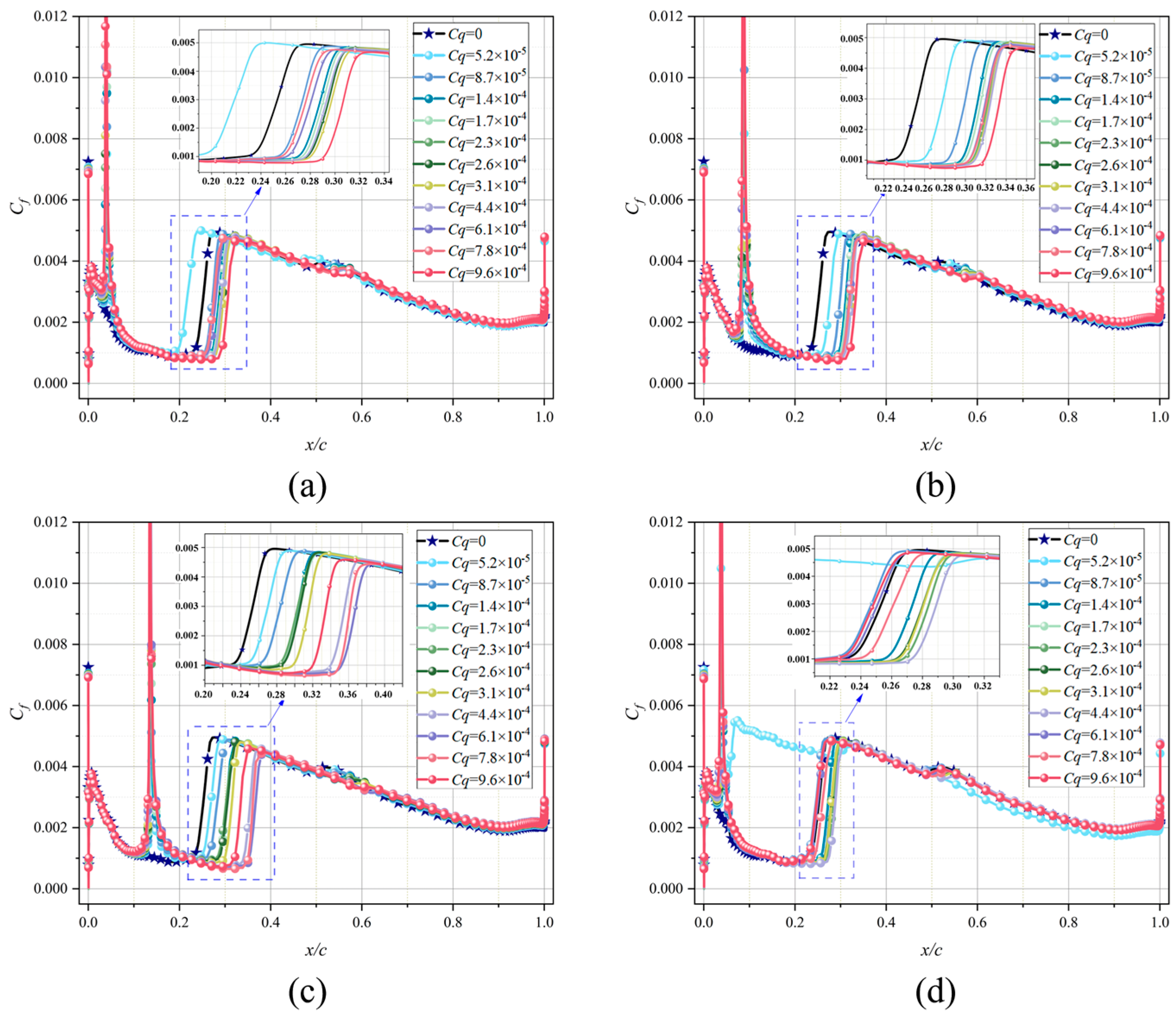
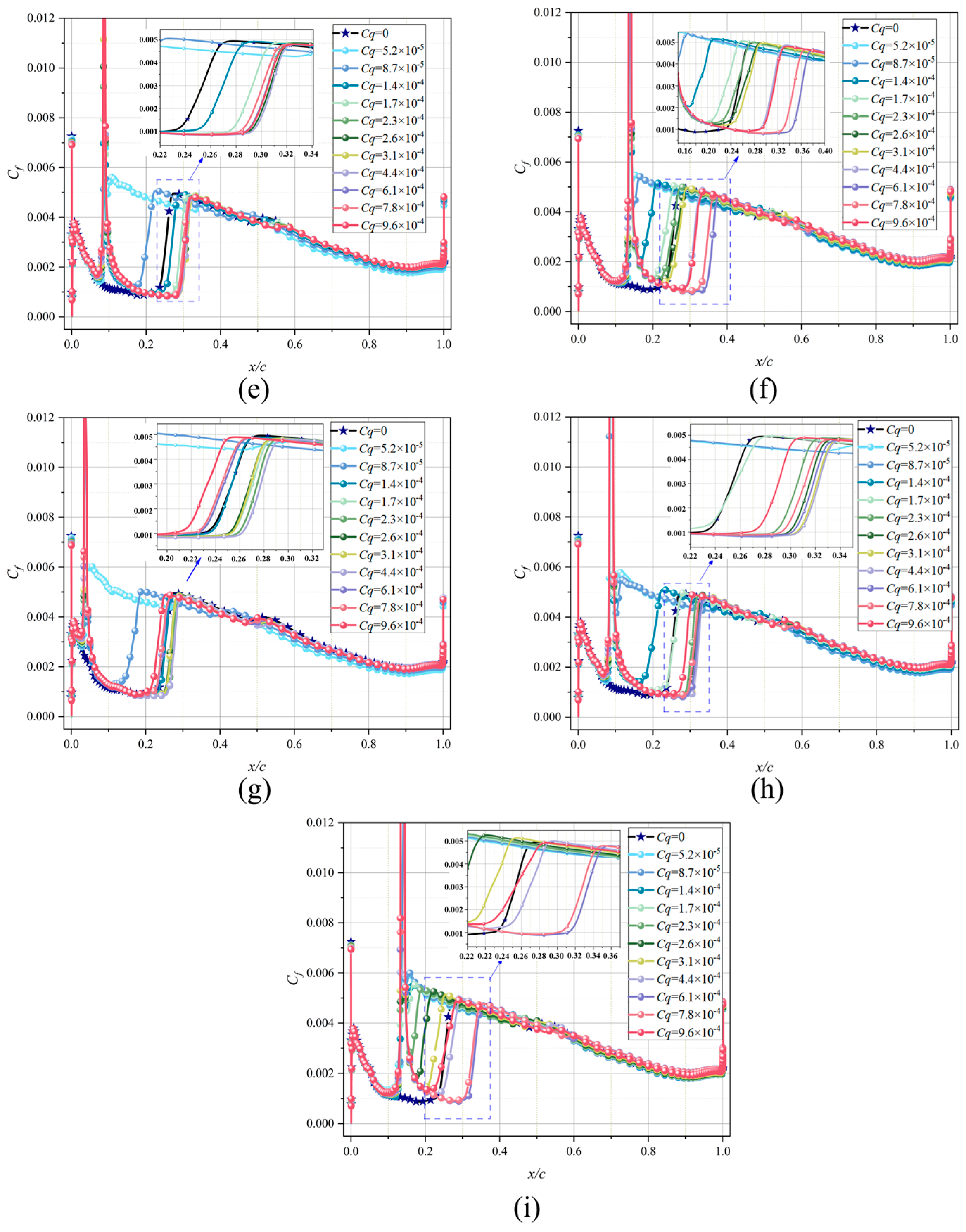
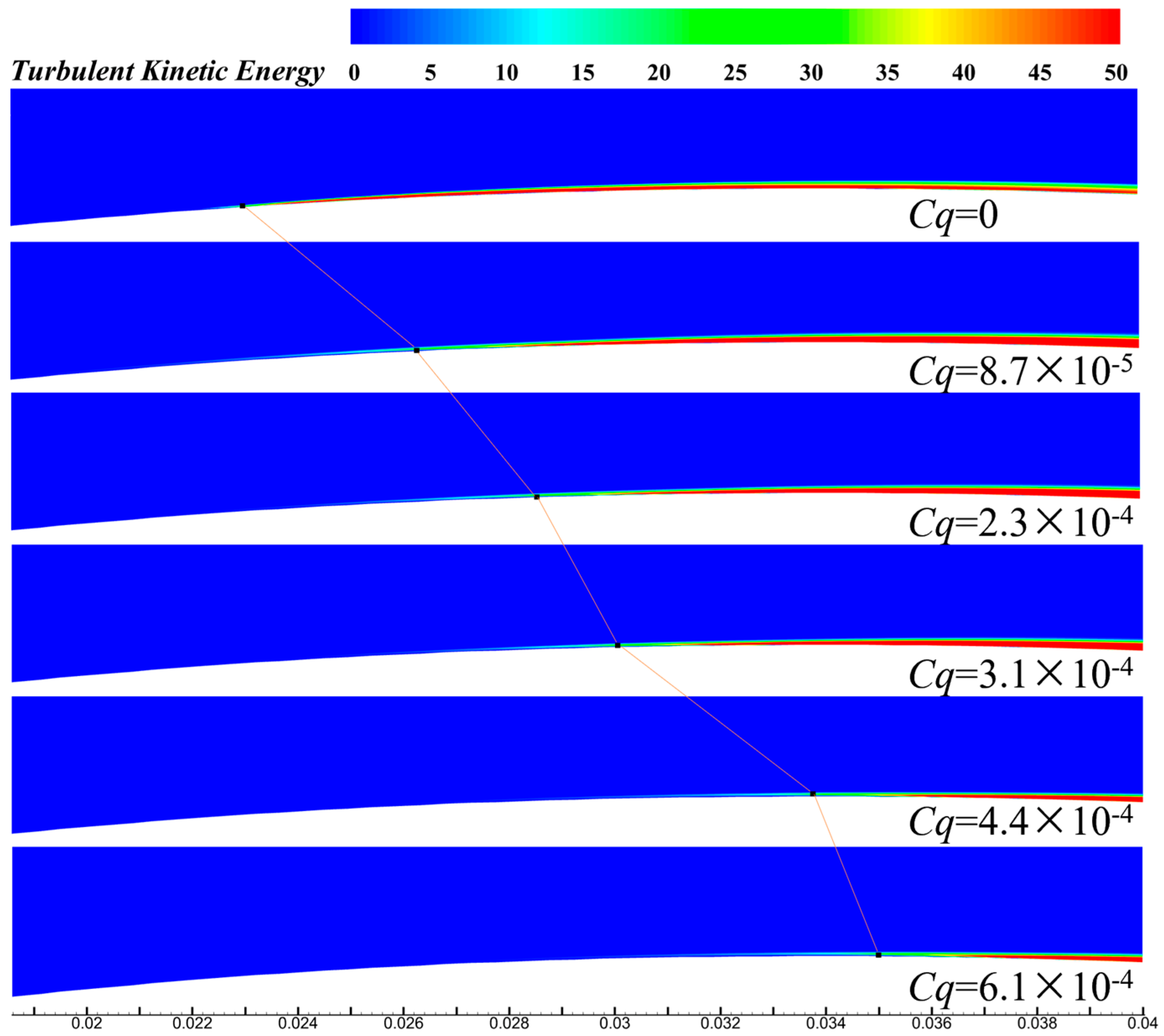
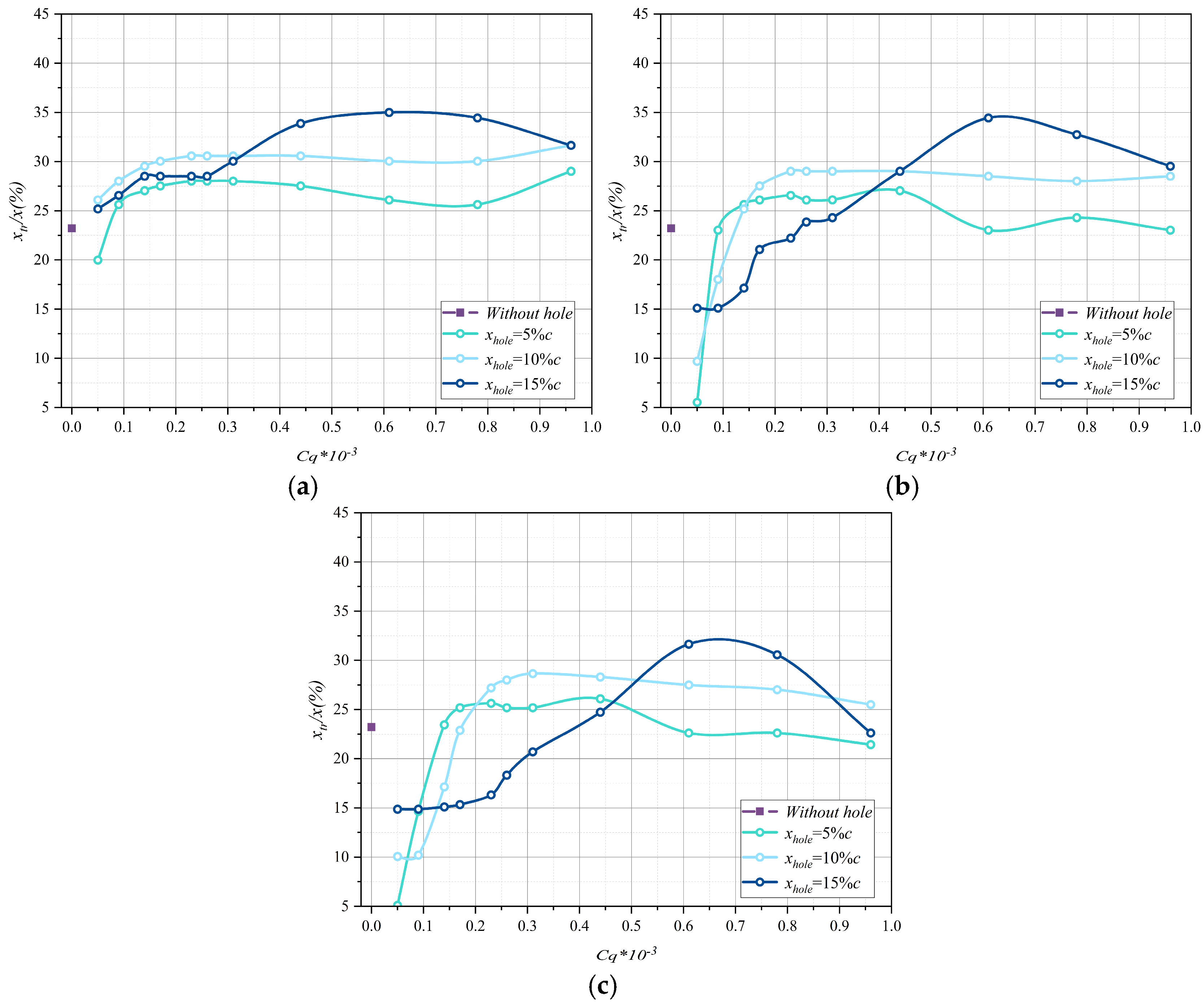
Study on the Influence of Suction Parameters on the Effectiveness of Hybrid Laminar Flow Control for Two-Dimensional Airfoils

 , ,
, ,
Abstract
1. Introduction
2. Materials and Methods
2.1. γ- Transition Model
2.2. Physical Model and Solution Method
2.3. Validation Cases
2.4. Suction Parameters
3. Results
3.1. Transition Characteristics of the Pristine Airfoil Under Suction-Free Conditions
3.2. Effects of Boundary Layer Suction Parameters on Transition Delay
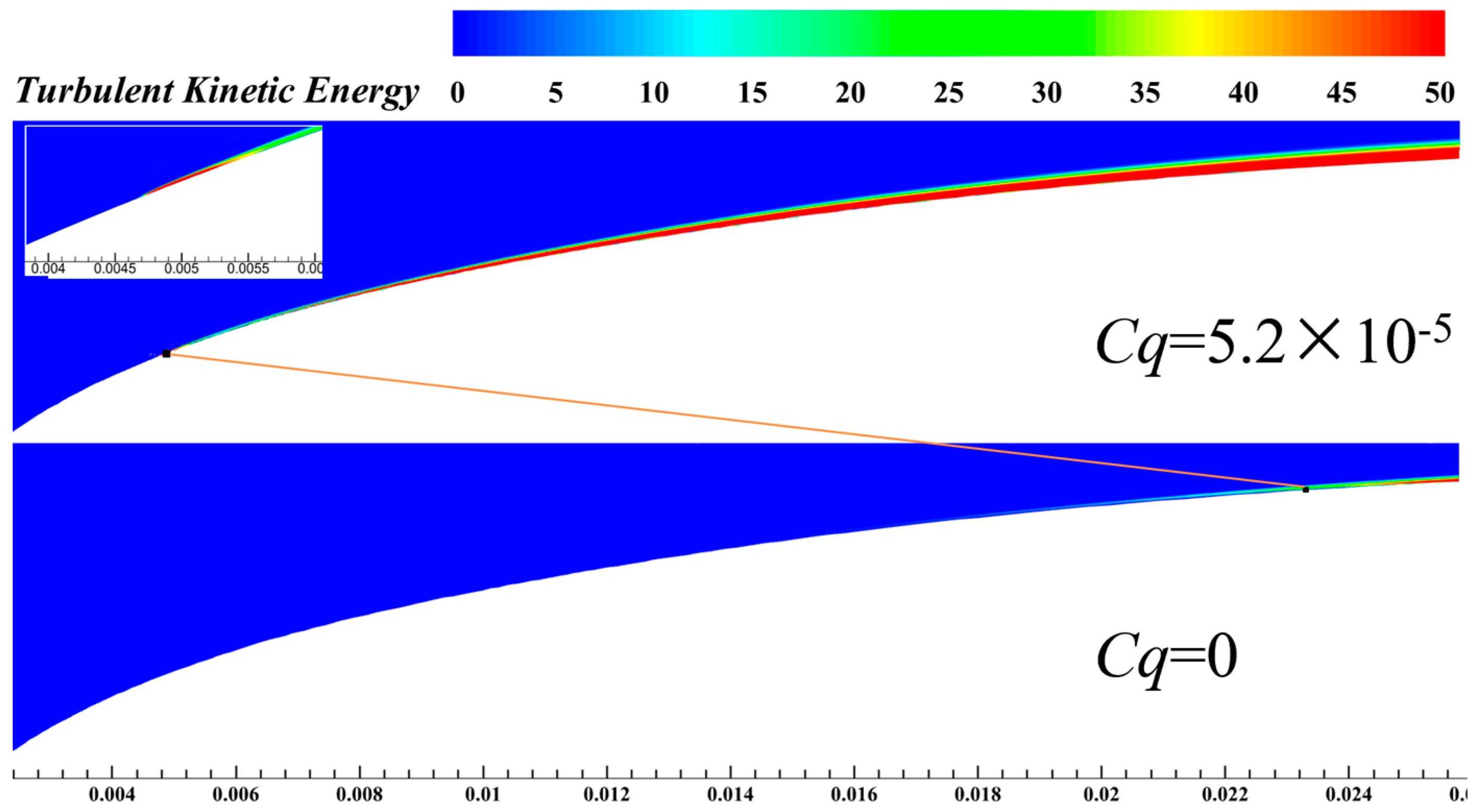
3.2.1. Influence of the Suction Coefficient
3.2.2. Effect of Suction Location
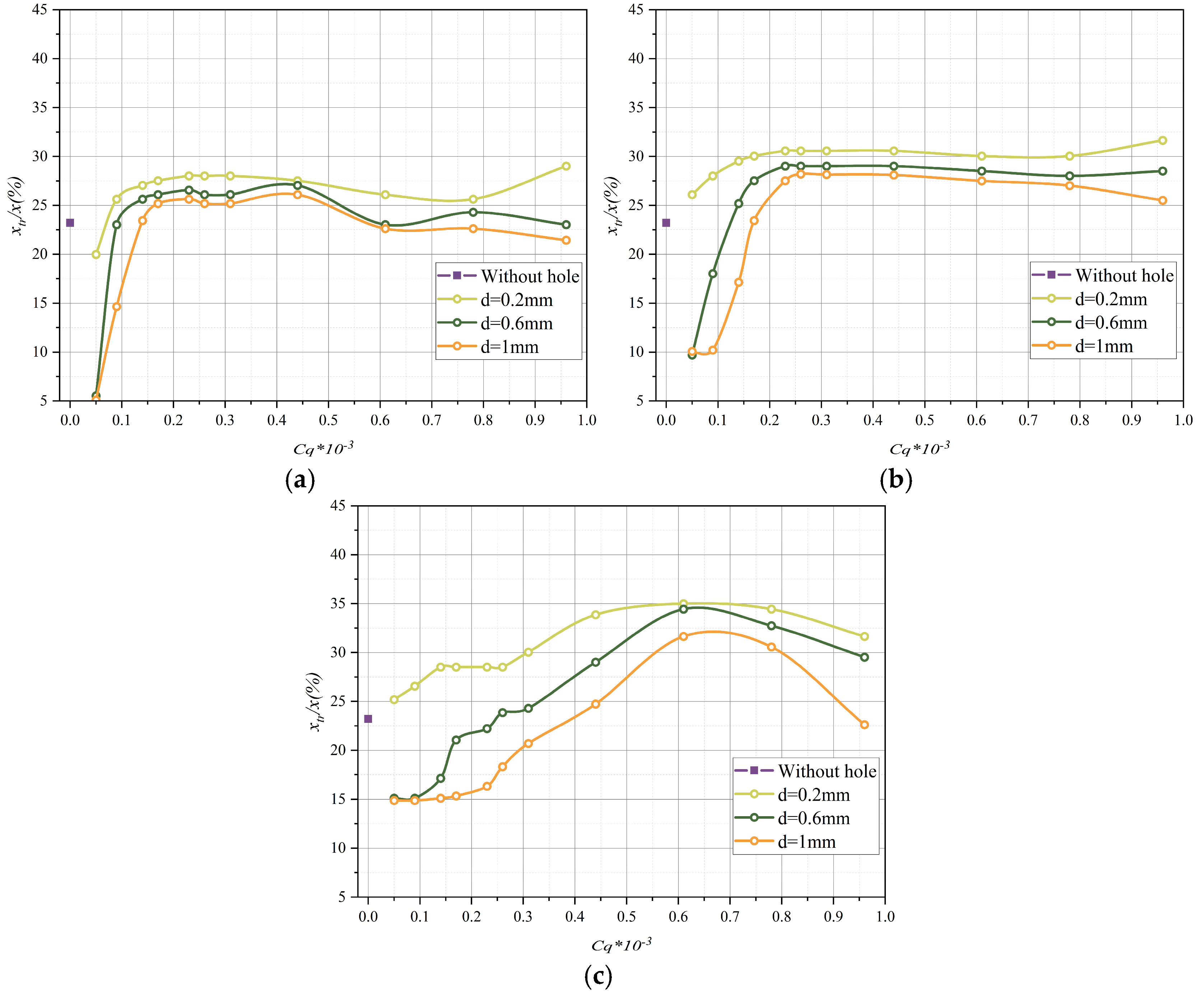
3.2.3. Effect of Suction Hole Diameter
3.3. Effect of Boundary Layer Suction Parameters on Airfoil Drag
3.3.1. Effect of Suction Coefficient
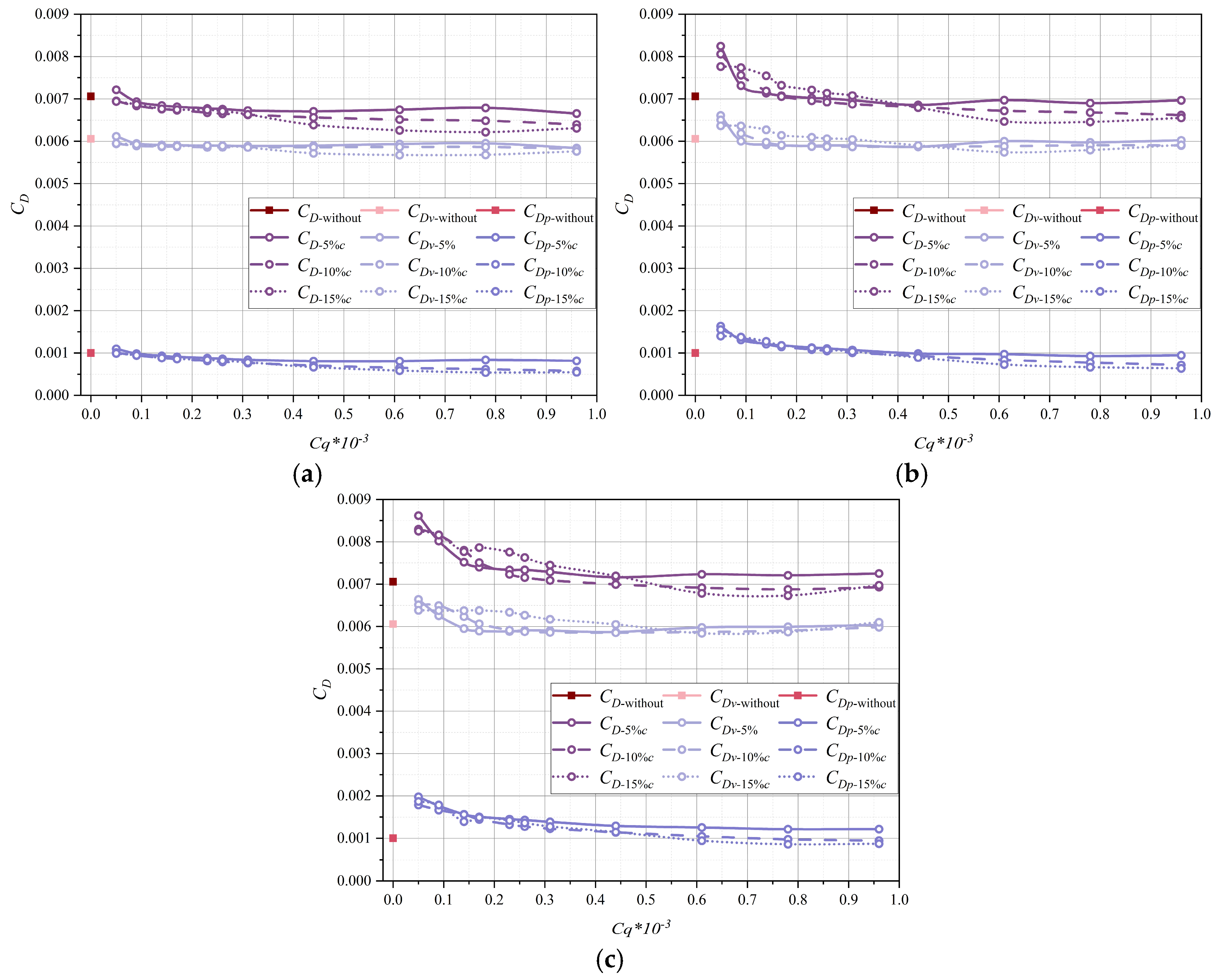
3.3.2. Effect of Suction Location
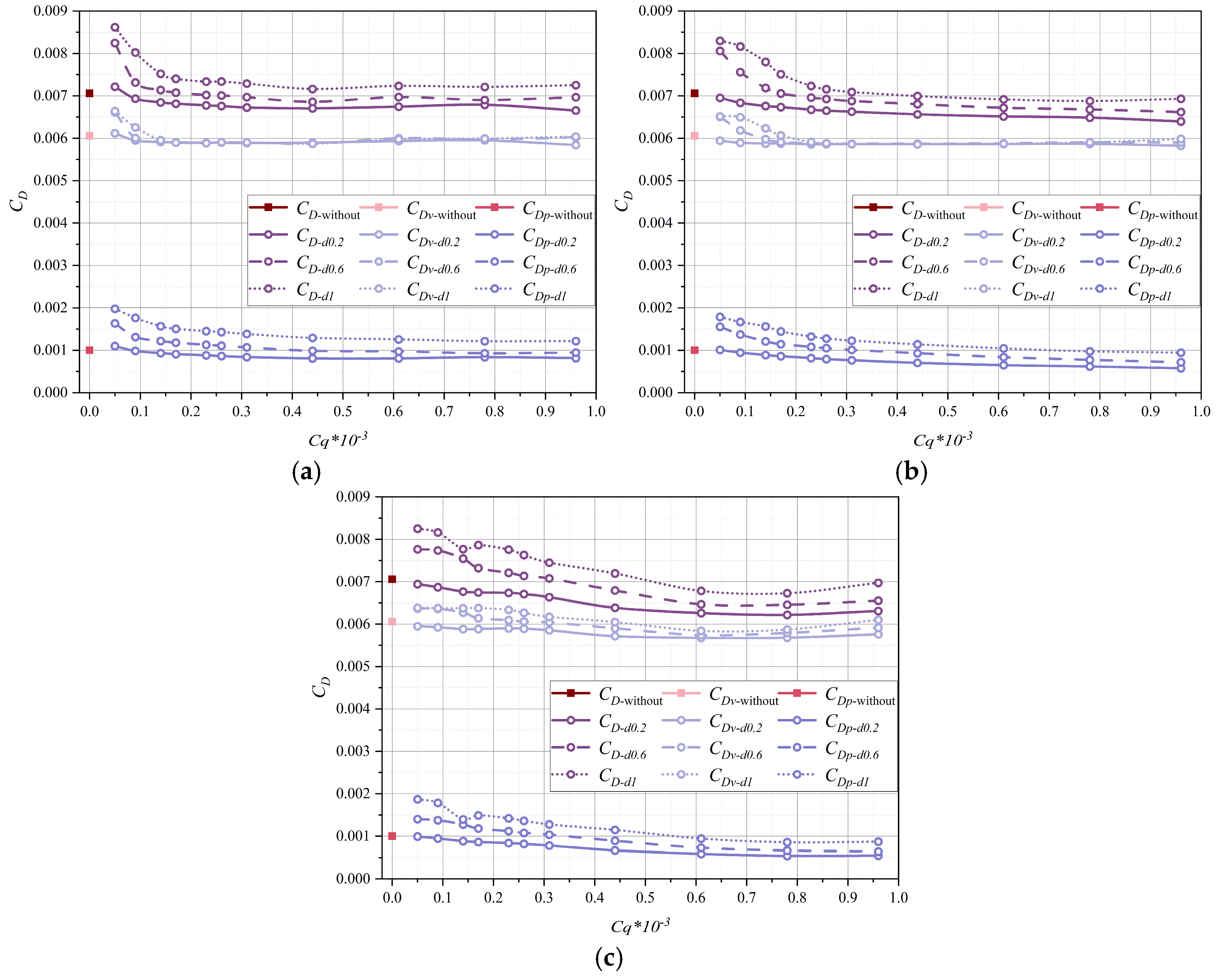
3.3.3. Effect of Suction Hole Diameter
4. Conclusions
Author Contributions
Funding
Data Availability Statement
Conflicts of Interest
Abbreviations
| HLFC | Hybrid Laminar Flow Control |
| NLF | Natural Laminar Flow |
| T-S | Tollmien–Schlichting |
| CFD | Computational Fluid Dynamics |
| TSSD | Tailored Skin Single Duct |
| CF | Cross Flow |
| RANS | Reynolds-Averaged Navier–Stokes |
| CD | Drag Coefficient |
| CDv | Viscous Drag Coefficient |
| CDp | Pressure Drag Coefficient |
| Cf | Skin Friction Coefficient |
References
- Jentys, M.; Breitsamter, C. Aerodynamic drag reduction through a hybrid laminar flow control and variable camber coupled wing. Aerosp. Sci. Technol. 2023, 142, 108652. [Google Scholar] [CrossRef]
- Zhang, J.; Zhang, T.; Yuan, J.; Zeng, Y. Design, simulation, and experimental validation of a HLFC system. J. Phys. Conf. Ser. 2025, 3078, 012048. [Google Scholar] [CrossRef]
- Fröhler, B.M.; Pohya, A.A.; Häßy, J.; Kilian, T.; Bismark, A.H.; Radestock, M.; Palacios, D.C. Performance and economic assessment of a wing-integrated hybrid laminar flow control system. Aeronaut. J. 2025, 129, 2103–2130. [Google Scholar] [CrossRef]
- Abbas, A.; de Vicente, J.; Valero, E. Aerodynamic technologies to improve aircraft performance. Aerosp. Sci. Technol. 2013, 28, 100–132. [Google Scholar] [CrossRef]
- European Commission; Directorate General for Research and Innovation. Directorate General for Mobility and Transport. In Flightpath 2050: Europe’s Vision for Aviation: Maintaining Global Leadership and Serving Society’s Needs; Publications Office: Luxembourg, 2011. [Google Scholar]
- Wahlich, M.; Bismark, A.; Radestock, M.; Menchel, K.; Milot, M.; Cruz, D. Hybrid laminar flow control activities within the frame of clean sky 2. In Proceedings of the AIAA SCITECH 2024 Forum, Orlando, FL, USA, 8–12 January 2024. [Google Scholar]
- Zhu, Z.; Ju, S.; Wu, Z. Active/passive control technology of laminar flow. Acta Aeronaut. Astronaut. Sin. 2016, 37, 2065–2090. (In Chinese) [Google Scholar]
- Prasannakumar, A.; Sudhi, A.; Seitz, A.; Badrya, C. Design of hybrid-laminar-flow-control wing and suction system for transonic midrange aircraft. J. Aircr. 2024, 61, 709–732. [Google Scholar] [CrossRef]
- Lobitz, L.; Traub, H.; Overbeck, M.; Bień, M.; Heimbs, S.; Hühne, C.; Friedrichs, J.; Horst, P. Aircraft wing design for extended hybrid laminar flow control. Aerospace 2023, 10, 938. [Google Scholar] [CrossRef]
- Chen, Y.; Rao, H.; Xiong, N.; Fan, J.; Shi, Y.; Yang, T. Adjoint-based robust optimization design of laminar flow airfoil under flight condition uncertainties. Aerosp. Sci. Technol. 2023, 140, 108465. [Google Scholar] [CrossRef]
- Zhu, Z.; Wu, Z.; Ding, J. Laminar flow control technology and application. Acta Aeronaut. Astronaut. Sin. 2011, 32, 765–784. (In Chinese) [Google Scholar]
- Wang, Y.; Lan, X.; Shi, Y.; Hua, J.; Bai, J.; Zhou, Z. Gradient optimization design of laminar airfoil considering suction effect. Acta Aeronaut. Astronaut. Sin. 2022, 43, 383–400. (In Chinese) [Google Scholar]
- Song, W.; Wu, M.; Zhu, Z.; Wu, T.; Nie, H.; Fan, T.; Han, Z. Study on transition prediction method for laminar drag reduction design. Acta Aerodyn. Sin. 2018, 36, 213–228. (In Chinese) [Google Scholar]
- Yang, T.; Bai, J.; Shi, Y.; Yang, Y.; Lu, L. Optimization design of HLFC wing considering the influence of suction distribution. Acta Aeronaut. Astronaut. Sin. 2017, 38, 6–20. (In Chinese) [Google Scholar]
- Jiang, L.; Rao, H.; Lan, X.; Yang, T.; Geng, J.; Bai, J. Aerodynamic design and comprehensive income impact of mixed laminar wing. Acta Aeronaut. Astronaut. Sin. 2022, 43, 311–330. (In Chinese) [Google Scholar]
- NASA. High Reynolds Number Hybrid Laminar Flow Control (HLFC) Flight Experiment: Suction System Design and Manufacture—Report 4; NASA: Washington, DC, USA, 1999.
- Schmitt, V.; Archambaud, J.P.; Horstmann, K.H.; Quast, A. Hybrid laminar fin investigations. In Proceedings of the ONERA/DLR Aerospace Symposium, Paris, France, 21–24 May 1999. [Google Scholar]
- Geng, Z.; Liu, S.; Wang, X.; Zhang, Y. Experimental study on drag reduction technology of two-dimensional airfoil mixed laminar flow control. J. Exp. Fluid Mech. 2010, 24, 46–50. (In Chinese) [Google Scholar]
- Wang, F.; Eriqitai; Wang, Q.; Guo, H.; Su, P. Experiment on mixed laminar flow control mechanism of swept wing. Acta Aerodyn. Sin. 2010, 25, 918–924. (In Chinese) [Google Scholar]
- Shi, Y.; Cao, T.; Yang, T.; Bai, J.; Qu, F.; Yang, Y. Estimation and analysis of hybrid laminar flow control on a transonic experiment. AIAA J. 2020, 58, 118–132. [Google Scholar] [CrossRef]
- Scholz, P.; Barklage, A.; van Rooijen, B.; Seitz, A.; Horn, M.; Badrya, C.; Radespiel, R. Large-scale wind tunnel testing of an advanced hybrid laminar flow control system. In Proceedings of the AIAA Aviation Forum, Chicago, IL, USA, 27 June–1 July 2022; p. 3371. [Google Scholar]
- Mery, F.; Piot, E.; Forte, M.; Aguilar, B.; Godard, J.L.; Bardoux, P. Hybrid laminar flow control investigation of microperforated skin with variable porosity suction device. In Proceedings of the AIAA SCITECH 2025 Forum, Orlando, FL, USA, 6–10 January 2025. [Google Scholar]
- Zhao, Y.; Duan, Z.; Ding, X.; Yang, T.; Wang, M. Optimization design of mixed laminar wing for flight test. Acta Aeronaut. Astronaut. Sin. 2022, 43, 157–170. (In Chinese) [Google Scholar]
- Zhu, Z. Prediction Method and Application of Transition Around Complex Shape of Aircraft [D]; Northwestern Polytechnical University: Xi’an, China, 2022. (In Chinese) [Google Scholar]
- Shi, Y.; Lan, X.; Yang, T. Hybrid laminar flow control optimizations for infinite swept wings. Int. J. Aerosp. Eng. 2023, 2023, 3455238. [Google Scholar] [CrossRef]
- Sudhi, A.; Radespiel, R.; Badrya, C. Design exploration of transonic airfoils for natural and hybrid laminar flow control applications. J. Aircr. 2023, 60, 1–15. [Google Scholar] [CrossRef]
- Langtry, R.B.; Menter, F.R. Correlation-based transition modeling for unstructured parallelized computational fluid dynamics codes. AIAA J. 2009, 47, 2894–2906. [Google Scholar] [CrossRef]
- Wright, M.C.M.; Nelson, P.A. Wind tunnel experiments on the optimization of distributed suction for laminar flow control. Proc. Inst. Mech. Eng. Part G J. Aerosp. Eng. 2001, 215, 343–354. [Google Scholar] [CrossRef]
- Keith, K.; Crawford, M.E. Convective Heat and Mass Transfer; Science Press: Beijing, China, 1986. (In Chinese) [Google Scholar]



| Author | Experimental/Numerical Conditions | Key Findings and Mechanisms |
|---|---|---|
| Schmitt et al. [17] | A320 Vertical Tail Flight Test | Validated the engineering feasibility of HLFC; maintained a large-scale laminar flow region on the vertical tail surface. |
| Geng et al. [18] | 2D Airfoil, Low-turbulence Wind Tunnel | Demonstrated that proper suction can delay transition from 40% to beyond 80% chord, achieving significant drag reduction. |
| Wong et al. [19] | Swept Wing Test | Found that standard suction delays transition to 80% chord; double suction maintains laminar flow up to 85% chord, verifying suppression of leading-edge disturbances. |
| Shi et al. [20] | Transonic Wind Tunnel Test | Calibrated equivalence between discrete-hole and continuous suction; verified RANS-eN method accuracy (error < 4% chord); analyzed CF vortex suppression. |
| Scholz et al. [21] | 1:0.7 Scale Vertical Tail, DNW-LLF Wind Tunnel | Verified Tailored Skin Single Duct (TSSD) system; solved scalability and maintainability issues of traditional suction systems. |
| Méry et al. [22] | High Aspect Ratio Wing, ONERA S1MA Tunnel | Validated variable-porosity micro-perforated skin; analyzed leading-edge attachment-line contamination characteristics. |
| This Study | NACA66012 and Target Airfoil, Numerical Simulation | 1. Parameter matching: identified optimal interval between location/coefficients; 2. Mechanism differentiation: location governs viscous drag, diameter governs pressure drag; 3. Design strategy: proposed small apertures with increasing suction rate toward trailing edge. |
| Suction Coefficient (Cq × 10−4) | Experimental Value Δxtr/(m) | Calculated Value Δxtr/(m) | Relative Error |
|---|---|---|---|
| 0.00 | 0.0201 | 0.0186 | −7.46% |
| 0.30 | 0.0792 | 0.0759 | −4.22% |
| 0.65 | 0.1773 | 0.1905 | 7.45% |
| 0.97 | 0.2892 | 0.2913 | 0.73% |
| 1.35 | 0.3806 | 0.3910 | 2.74% |
| 1.65 | 0.4661 | 0.4517 | −3.09% |
| 1.85 | 0.5225 | 0.4880 | −6.59% |
| 2.00 | 0.5545 | 0.5181 | −6.58% |
| 2.18 | 0.5739 | 0.5316 | −7.38% |
| AOA | Suction Coefficient (Cq × 10−4) | CD | Relative Error | |
|---|---|---|---|---|
| Experimental Value | Calculated Value | |||
| −1° | 0.00 | 0.2650 | 0.2894 | 9.21% |
| −1° | 0.30 | 0.2625 | 0.2771 | 5.56% |
| −1° | 0.65 | 0.2612 | 0.2404 | −7.97% |
| −1° | 0.97 | 0.2597 | 0.2542 | −2.12% |
| −1° | 1.35 | 0.2573 | 0.2479 | −3.63% |
| −1° | 1.65 | 0.2566 | 0.2669 | 4.04% |
| −1° | 1.85 | 0.2563 | 0.2762 | 7.76% |
| −1° | 2.00 | 0.2557 | 0.2750 | 7.55% |
| −1° | 2.18 | 0.2541 | 0.2763 | 8.74% |
| xhole | d/(mm) | Min Cq for Drag Reduction |
|---|---|---|
| 5% c | 0.2 | 8.7 × 10⁻⁵ |
| 10% c | 0.2 | 5.2 × 10⁻⁵ |
| 15% c | 0.2 | 5.2 × 10⁻⁵ |
| 5% c | 0.6 | 1.4 × 10⁻⁴ |
| 10% c | 0.6 | 1.4 × 10⁻⁴ |
| 15% c | 0.6 | 2.6 × 10⁻⁴ |
| 5% c | 1.0 | 1.4 × 10⁻⁴ |
| 10% c | 1.0 | 2.3 × 10⁻⁴ |
| 15% c | 1.0 | 4.4 × 10⁻⁴ |
| xhole | d/(mm) | Optimal Drag Reduction | |
|---|---|---|---|
| CD | Cq | ||
| 5% c | 0.2 | 0.00665 | 2.5 × 10⁻⁴~9.6 × 10⁻⁴ |
| 10% c | 0.2 | 0.00640 | 4.1 × 10⁻⁴~9.6 × 10⁻⁴ |
| 15% c | 0.2 | 0.00622 | 6.1 × 10⁻⁴~7.8 × 10⁻⁴ |
| 5% c | 0.6 | 0.00686 | 3.1 × 10⁻⁴~4.4 × 10⁻⁴ |
| 10% c | 0.6 | 0.00662 | 5.2 × 10⁻⁴~9.6 × 10⁻⁴ |
| 15% c | 0.6 | 0.00646 | 6.1 × 10⁻⁴~7.8 × 10⁻⁴ |
| 5% c | 1.0 | -(min: 0.00716) | -(min: 3.2 × 10⁻⁴~4.4 × 10⁻⁴) |
| 10% c | 1.0 | 0.00688 | 5.5 × 10⁻⁴~7.8 × 10⁻⁴ |
| 15% c | 1.0 | 0.00673 | 6.1 × 10⁻⁴~7.8 × 10⁻⁴ |
Disclaimer/Publisher’s Note: The statements, opinions and data contained in all publications are solely those of the individual author(s) and contributor(s) and not of MDPI and/or the editor(s). MDPI and/or the editor(s) disclaim responsibility for any injury to people or property resulting from any ideas, methods, instructions or products referred to in the content. |
© 2026 by the authors. Licensee MDPI, Basel, Switzerland. This article is an open access article distributed under the terms and conditions of the Creative Commons Attribution (CC BY) license.
Share and Cite
Zhang, C.; Wang, H.; Liao, D.; Liu, D.; Kou, X.; Gao, S.; Li, G.; Tao, Y. Study on the Influence of Suction Parameters on the Effectiveness of Hybrid Laminar Flow Control for Two-Dimensional Airfoils. Aerospace 2026, 13, 476. https://doi.org/10.3390/aerospace13050476
Zhang C, Wang H, Liao D, Liu D, Kou X, Gao S, Li G, Tao Y. Study on the Influence of Suction Parameters on the Effectiveness of Hybrid Laminar Flow Control for Two-Dimensional Airfoils. Aerospace. 2026; 13(5):476. https://doi.org/10.3390/aerospace13050476
Chicago/Turabian StyleZhang, Ce, Hexiang Wang, Daxin Liao, Dawei Liu, Xiping Kou, Siyuan Gao, Guoshuai Li, and Yang Tao. 2026. "Study on the Influence of Suction Parameters on the Effectiveness of Hybrid Laminar Flow Control for Two-Dimensional Airfoils" Aerospace 13, no. 5: 476. https://doi.org/10.3390/aerospace13050476
APA StyleZhang, C., Wang, H., Liao, D., Liu, D., Kou, X., Gao, S., Li, G., & Tao, Y. (2026). Study on the Influence of Suction Parameters on the Effectiveness of Hybrid Laminar Flow Control for Two-Dimensional Airfoils. Aerospace, 13(5), 476. https://doi.org/10.3390/aerospace13050476