Article

Assessment of the Energy Efficiency of a Hybrid Turboprop Power Plant of a Regional Aircraft Considering the Mission Profile


by
Evgeniy P. Filinov
*,
Andrey Yu. Tkachenko
,
Ivan A. Zubrilin
and
Vladislav K. Radomsky
Department of Aircraft Engine, Samara National Research University, Samara 443086, Russia
*
Author to whom correspondence should be addressed.
Aerospace 2026, 13(5), 470; https://doi.org/10.3390/aerospace13050470 (registering DOI)
Submission received: 25 March 2026 / Revised: 18 April 2026 / Accepted: 8 May 2026 / Published: 15 May 2026
(This article belongs to the Special Issue Advanced Modeling of Aero-Engine Complex Systems)

Abstract

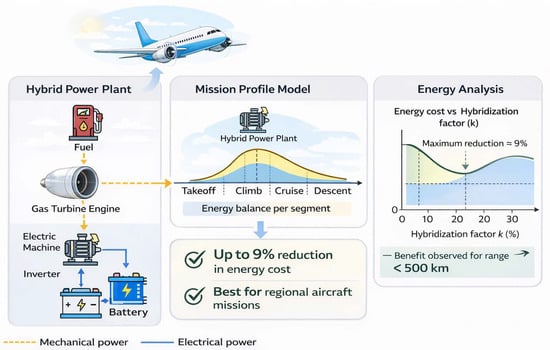
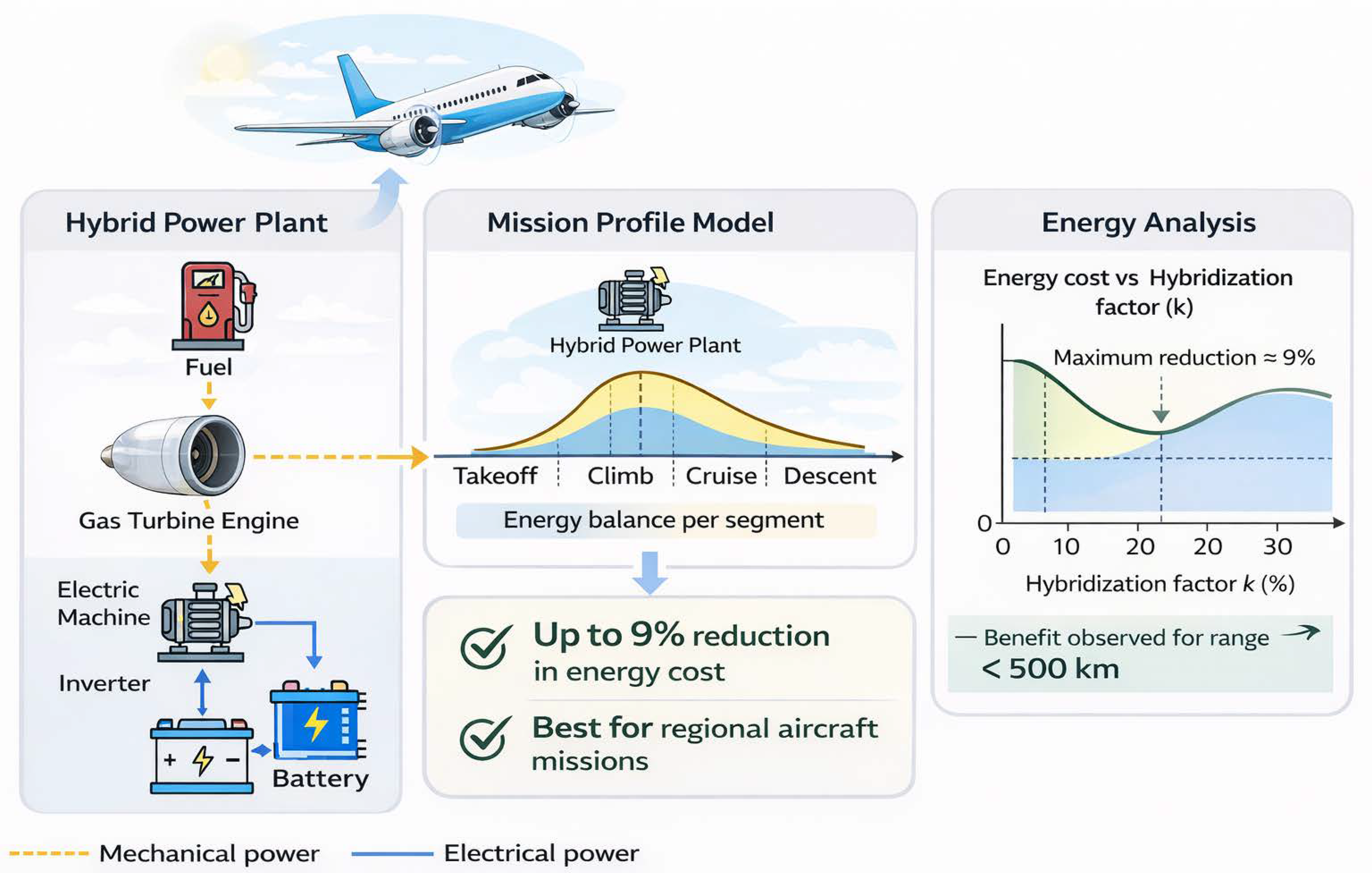
With the tightening of international environmental requirements for civil aviation and the implementation of initiatives aimed at reducing specific greenhouse gas emissions, the transition to hybrid power plants for regional aircraft is becoming increasingly relevant. This paper proposes an approach to the integrated energy assessment of a parallel hybrid turboprop power plant at the conceptual design stage while taking the aircraft mission profile into account. The considered power plant includes a gas turbine engine, a reversible electric machine located on the same shaft as the reduction gearbox and propeller, an electrical energy storage system, and power electronics. The mission profile is represented as a sequence of segments—takeoff, climb, cruise, descent, and approach/landing. For each segment, energy balances are formulated and allowable operating ranges for the gas turbine and electric subsystems are defined. The key parameter is the hybridization factor, which determines the share of power transmitted to the propeller from the electric machine in different mission segments. The primary integrated performance metric is the energy consumption per ton-kilometer of transported payload. The analysis shows that for ranges up to 500 km, the hybrid configuration reduces specific energy consumption per ton-kilometer by up to 9%.

Graphical Abstract

1. Introduction

International initiatives aimed at reducing greenhouse gas emissions from air transport, notably ICAO and European strategic aviation roadmaps, envisage a substantial decrease in specific carbon dioxide and other pollutant emissions by 2050 [1,2], posing serious challenges for aircraft engine and power plant developers. Traditional approaches to improving the thermodynamic efficiency of gas turbine engines are gradually exhausting their potential, particularly in the regional aviation segment, where mass, dimensional, and cost constraints largely determine the attainable level of power plant performance [3].
Under these circumstances, hybrid power plants (HPPs) combining a gas turbine circuit and an electrical subsystem are regarded as a promising avenue for enhancing energy efficiency while reducing local emissions and noise. A significant contribution to the theoretical foundations of hybrid-electric aircraft was made by Pornet and Isikveren [4], who introduced the hybridization factor as a metric for quantitatively assessing the influence of the electrical subsystem on the aircraft and power plant sizing. Brelje and Martins [3] provided a comprehensive review of electric, hybrid, and turboelectric configurations, demonstrating that the regional segment offers the greatest potential for reducing specific fuel consumption at moderate energy storage specific-energy requirements. Voskuijl, van Bogaert, and Rao [5] examined hybridization options for a regional turboprop aircraft and methods for evaluating fuel consumption benefits across different architectures. The practical effectiveness of hybridization is substantially governed by the specific energy and power of the energy storage system, as well as the losses and mass of electrical components, since these define the trade-off between mass increase and potential energy cost reduction [6,7,8]. Of particular interest are studies devoted to the analysis of hybrid architectures and the optimization of HPP working-process parameters considering the mission profile [9,10,11,12,13,14].
Significant results on regional aircraft hybridization have been obtained within large-scale international projects. The IMOTHEP project [15] demonstrated a fuel consumption reduction of approximately 10% for a regional aircraft with a parallel hybrid power plant at a hybridization factor of about 15% per flight. The FutPrInt50 project [16] developed a roadmap for a 50-seat hybrid aircraft entering service in 2035–2040, while the HE-ART project [17] targets up to a 30% reduction in greenhouse gas emissions through turboprop engine hybridization and power plant improvement. For the retrofitting of the regional ATR42-600 aircraft, researchers [18] showed that a significant reduction in CO2 emissions is achievable at a battery specific energy of approximately 1500 Wh/kg, whereas NASA studies on a parallel hybrid architecture based on the C-130H aircraft [19,20] demonstrate a fuel consumption reduction potential of 27–44% upon reaching projected 2030–2050 technology levels.
A number of studies address series, parallel, and distributed configurations, as well as the integration of electric machines and energy storage systems into the power plant and airframe [3,5,10,21,22]. Important contributions to the modeling and assessment of parallel hybrid turboprop configurations have been made within the journal Aerospace. Cameretti et al. [23] developed a detailed model of a parallel hybrid electric propulsion system for a regional aircraft by analyzing mission segments and battery sizing. Palaia et al. [24] proposed a mission-profile-based methodology for evaluating hybrid-electric regional aircraft performance, with a focus on power split strategies directly related to the hybridization factor concept used in the present study. Habermann et al. [25] investigated a regional turboprop with an electrically assisted turboshaft, demonstrating a 9.6% fuel burn reduction for a 200 nm mission, underscoring the potential of hybridization for short-range operations.
Nevertheless, a substantial portion of the literature focuses either on the individual engine and its thermodynamic cycle or on the overall aircraft architecture, without always ensuring a consistent link between the power plant working-process model, the integral mission-profile performance metrics, and the power split between the gas turbine engine (GTE) and the electric machine (EM) [2,22].
The objective of the present study is to develop an approach that enables, at the conceptual design stage, a quantitative assessment of the influence of key parameters of a parallel hybrid turboprop power plant on the integral metric of energy cost per ton-kilometer of transported payload while taking the regional aircraft mission profile into account [2,8,10,22].
Current research addresses the sizing of parallel hybrid-electric power plants for regional aircraft in detail [11]. Approaches to energy management of hybrid power plants are also being actively developed [12,13]. Furthermore, the analysis of architectural trade-offs (mass/efficiency/constraints) remains a key step in the configuration selection for regional hybrid aircraft [14].

2. Methods and Methodology

2.1. Structure of the Considered Power Plant

A parallel hybrid power plant for a regional turboprop aircraft is considered. It comprises a gas turbine engine with a reduction gearbox and propeller, a bidirectional electric machine (motor–generator) mechanically coupled to the gearbox shaft, an electrical energy storage system (battery pack), and power electronics (DC/AC converter and energy distribution control system) [3,5,6,7,8,10].
During takeoff and climb, the electric machine operates in motor mode, supplying additional power to the propeller shaft [3,5]. In the cruise segment, when the gas turbine engine has a power reserve, the electric machine is switched to generator mode, converting part of the mechanical power into electrical energy to recharge the batteries [2,12,22].
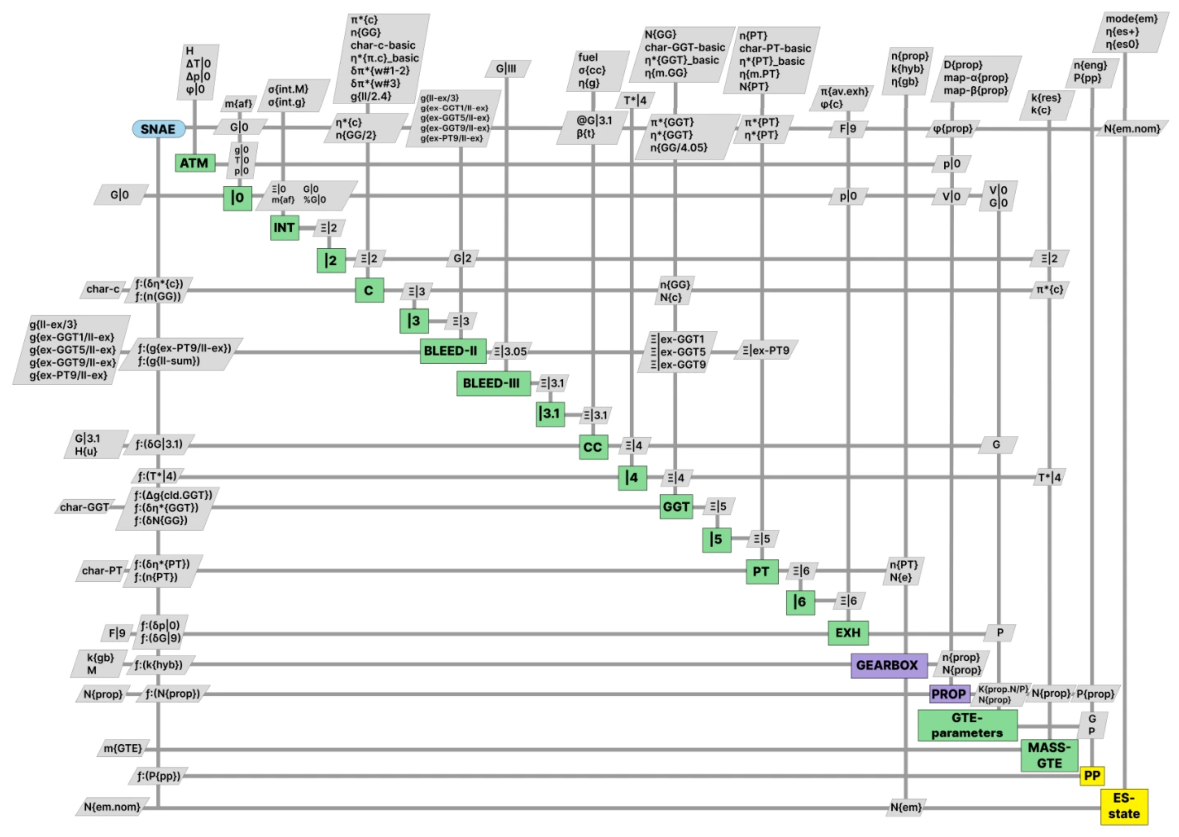
The mathematical model was developed in the ASTRA-GTE conceptual design environment [10] and is presented in the form of an XDSM diagram (Figure 1). ASTRA-GTE is a specialized cross-platform CAE system for conceptual modeling, developed at Samara National Research University (Academician S.P. Korolev Samara University) for the automated design, thermodynamic analysis and simulation of gas turbine engines. The system enables the creation of virtual prototypes of aircraft engines at the conceptual design stage. Its main capabilities include calculation and analysis of gas turbine engines, including modeling of combustors, compressors, turbines, and hybrid power plants; selection of standard engine layouts or construction of a custom multi-level model from individual modules; automatic residual formulation (if an output parameter is assigned a numerical value or linked to another parameter, a residual is created automatically); support for parallel computing (an unlimited number of instances, limited only by the computer configuration); and application at the stage of conceptual thermodynamic and gas-dynamic design, as well as analyzing component matching and preparing for the production of advanced engines.
The mathematical model combines three subsystems: the gas turbine engine (green blocks), the propeller with a reduction gearbox (purple blocks), and the electrical system (yellow blocks). The XDSM diagram in Figure 1 shows how these components are interconnected. This representation helps organize the model architecture, analyze energy and data flows, and improve the accuracy of performance predictions for the hybrid power plant.
In the considered configuration, the nominal power of the GTE ranges from 500 to 1500 kW, which corresponds to the class of regional turboprop aircraft (e.g., L-410 and ATR42). The electric machine is sized to deliver up to 30% of the shaft power—this defines the maximum hybridization factor considered in this study. The battery capacity is limited by the condition that its mass does not exceed 5% of the aircraft maximum takeoff mass; for the baseline aircraft this corresponds to a stored energy of up to 200 MJ. All calculations are performed while respecting the minimum battery state-of-charge constraint (not lower than 20% of the rated capacity).
Operating modes for each mission segment: For each flight segment (warm-up and taxi, takeoff roll, liftoff, climb, cruise, and descent, landing), the following operating modes of the GTE and the EM are defined:
Warm-up, taxi, takeoff roll, and liftoff: GTE at takeoff power and EM in motor mode (additional power to the propeller).
Climb: GTE at climb power and EM in motor mode.
Cruise: GTE at cruise power (n = 96% or 100% depending on the control law); EM switches to generator mode to recharge the battery if the current state of charge permits.
Descent: GTE at flight idle and EM off or charging from excess GTE power.
Landing and taxi-in: GTE at low power and EM off.
This segmentation allows correct modeling of the energy balance at each segment and accounts for changes in aircraft mass due to fuel burn and battery charge variation.

2.2. Performance Metrics and Input Parameters

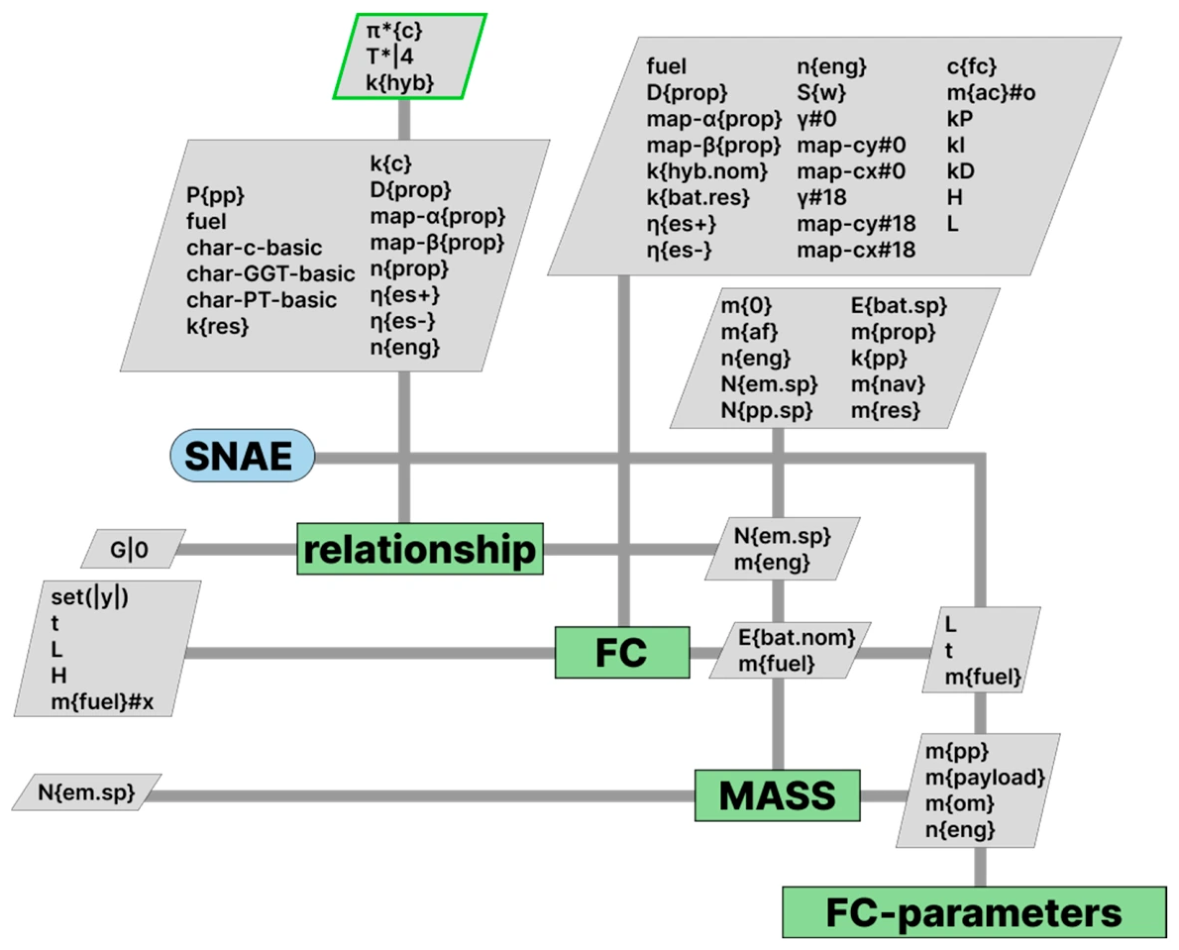
To evaluate the effectiveness of the hybrid power plant within the aircraft system, a model that integrates the mission profile calculation, mass characteristics, and energy balance is employed (Figure 2).
The block diagram consists of four main blocks. The "Relationship" block determines the rated power of the gas turbine engine and the electric machine, calculates engine characteristics, and estimates the total power plant mass. The "FC" block performs mission simulations across phases and determines the required battery capacity. The "MASS" block calculates the mass of all components based on the obtained data. The "FC-parameters" block outputs the mission cycle parameters (fuel consumption, battery charge variation, and flight time), which are used to compute the energy cost per ton-kilometer of payload.
The input parameters for calculating the HPP efficiency metrics in the aircraft system are listed in Table 1.
The output energy performance metrics are determined by the following expressions:
Electrical energy consumed during the flight:
E e l = E b a t .   s t a r t E b a t .   e n d ,   MJ
Fuel energy consumed during the flight:
E f u e l = m f u e l H u ,   MJ
Total energy consumed during the flight:
E t o t a l = E f u e l + E e l ,   MJ
Energy cost per ton-kilometer of transported payload:
E t · k m = E t o t a l / ( m p a y l o a d L ) ,   MJ / t · km   ( megajoules   per   ton-kilometer   of   payload )
The hybridization factor (by power) is defined as
k h y b = N e m . n o m   / N p p . n o m × 100 , %

2.3. Mission Profile Modeling

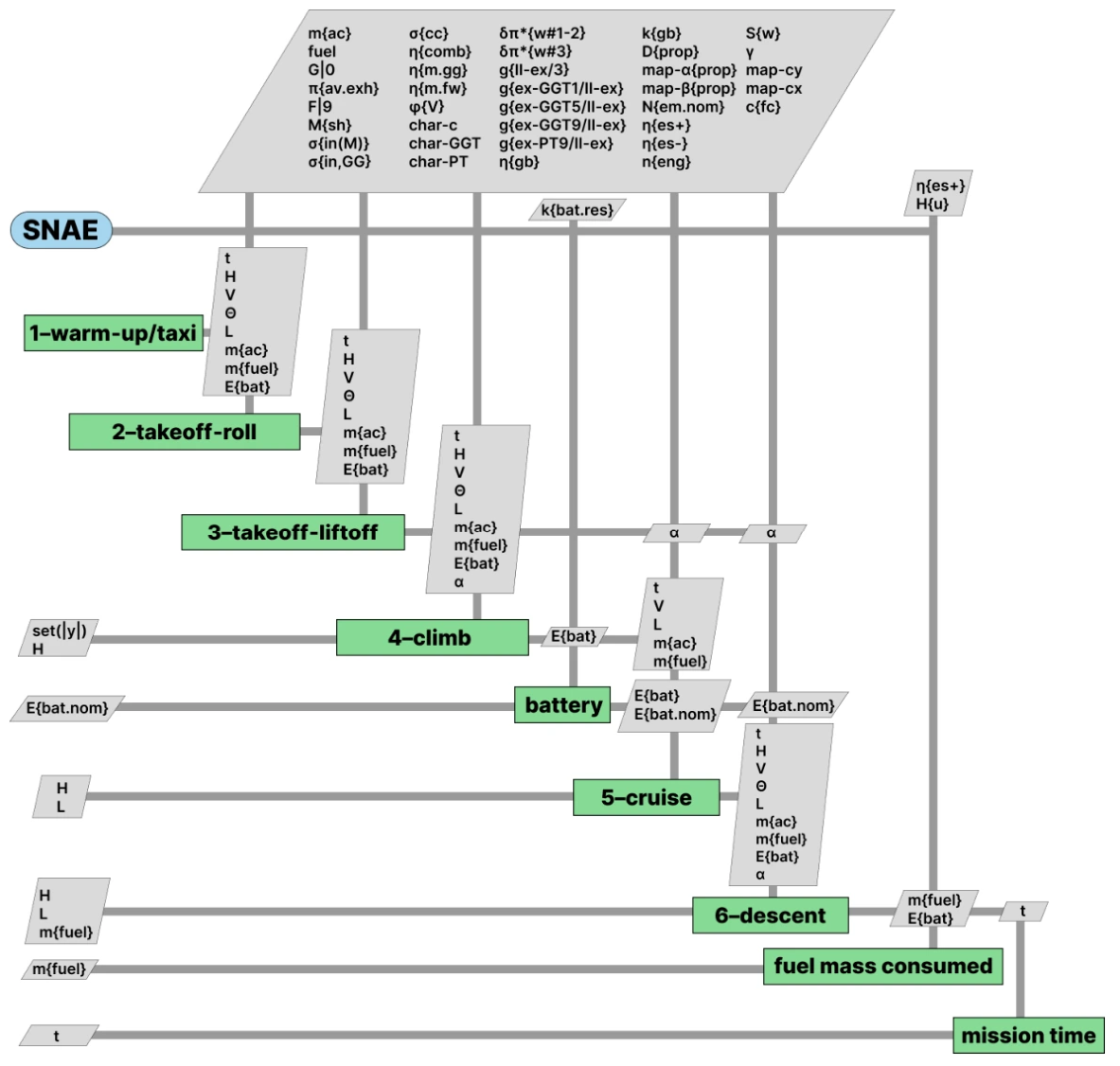
The mission profile is modeled stage by stage: the state parameters at the output of each stage serve as input data for the subsequent stage. The flight scheme of a passenger aircraft includes engine warm-up and taxiing on the runway (model “1–warm-up/taxi”), a takeoff roll (model “2–takeoff-roll”), liftoff (model “3–takeoff-liftoff”), climb (model “4–climb”), the cruise segment (model “5–cruise”), descent (model “6–descent”), and landing (Figure 3).
The input data include the aircraft mass characteristics (takeoff mass, airframe mass, power plant mass, payload mass, initial fuel mass and initial battery energy), aerodynamic parameters of the airframe, and flight conditions (altitude, Mach number, and range). At each phase, the current values of fuel mass, aircraft mass, speed, altitude and distance are calculated, as well as the battery state of charge (taking into account whether the electric machine operates in motor or generator mode). The output data are the total fuel consumption, the change in battery charge, the flight time, and the final mass characteristics, which allow the energy cost per ton-kilometer of payload to be computed.

2.4. Electrical Subsystem Parameters and Constraints

For the parametric analysis, specific parameters of the electrical components corresponding to the projected 2030 technology level were used, as given in Table 2.
The electrical subsystem model was verified by comparing the predicted round-trip efficiency (motor + generator) with data from the IMOTHEP project [15] and Cameretti et al. [23]. For a 200 kW electric machine operating at 90% of its rated power, the combined efficiency (battery-to-propeller efficiency in motor mode and propeller-to-battery efficiency in generator mode) was found to be 0.94, which is within 1% of the values reported in the literature for similar technology levels. The 20% minimum state-of-charge constraint is consistent with typical aviation battery rules and operational limits discussed in [18,26]. The scaling of component mass with power is based on the specific power values given in Table 2, which are typical of the projected 2030 technology level.
Two control laws for the cruise regime were selected for the investigation:
  • – Control law 1: gas generator speed n = 96%.
  • – Control law 2: gas generator speed n = 100%.
Control law 2 (n = 100%) is adopted in this study as an upper bound to assess the theoretical potential of hybridization. In real operation, continuous operation at maximum power is limited by the turbine creep life, exhaust gas temperature constraints, and maintenance schedules.
The battery energy level during the cruise segment was chosen as a constraint. The battery state of charge must not fall below 20% of the rated capacity.
The battery’s specific energy of approximately 1.8 MJ/kg (500 Wh/kg) adopted in the calculations corresponds to an optimistic estimate of solid-state battery technology at the cell level by the 2030 horizon. According to NASA studies [19,20], economically viable hybridization of a regional aircraft requires achieving a specific energy of 750–1000 Wh/kg, and results from the European IMOTHEP project [15] indicate the need for at least 600 Wh/kg for parity performance compared to the baseline 2035-horizon aircraft. Analysis of the ATR42-600 retrofitting [18] process shows that a noticeable reduction in CO2 emissions becomes possible at a specific energy of approximately 1500 Wh/kg, while industry forecasts for solid-state batteries [26] give an estimate of 400–500 Wh/kg by 2030. In this context, the chosen value of 500 Wh/kg can be regarded as a lower bound of the range at which hybridization provides a positive effect for a regional turboprop aircraft.

3. Results

3.1. Model Verification

To verify the adequacy of the developed model in the ASTRA-GTE environment, a comparative analysis of the calculated results against the official data of the LET L-410 UVP-E aircraft was performed (Table 3). Verification was performed for the static takeoff regime (maximum power) of the LET L-410 UVP-E aircraft with two M601D engines. The conditions were as follows: altitude: 0 m, ambient temperature: +15 °C, and pressure: 101.325 kPa. Official data were taken from the LET Aircraft Industries Flight Manual (document No. L-410-F-01, 2015 revision). All parameters in Table 3 correspond to this regime.
The discrepancies for all key parameters, including specific fuel consumption, engine mass, and fuel consumed during the flight, were less than 1%, which confirms the adequacy of the developed model.

3.2. Investigation of Energy Cost per Ton-Kilometer Versus the Hybridization Factor

An analysis of the dependence of the energy cost per ton-kilometer of transported payload ( E t k m ) on the hybridization factor helps identify optimal operating conditions for hybrid systems in order to minimize energy consumption.
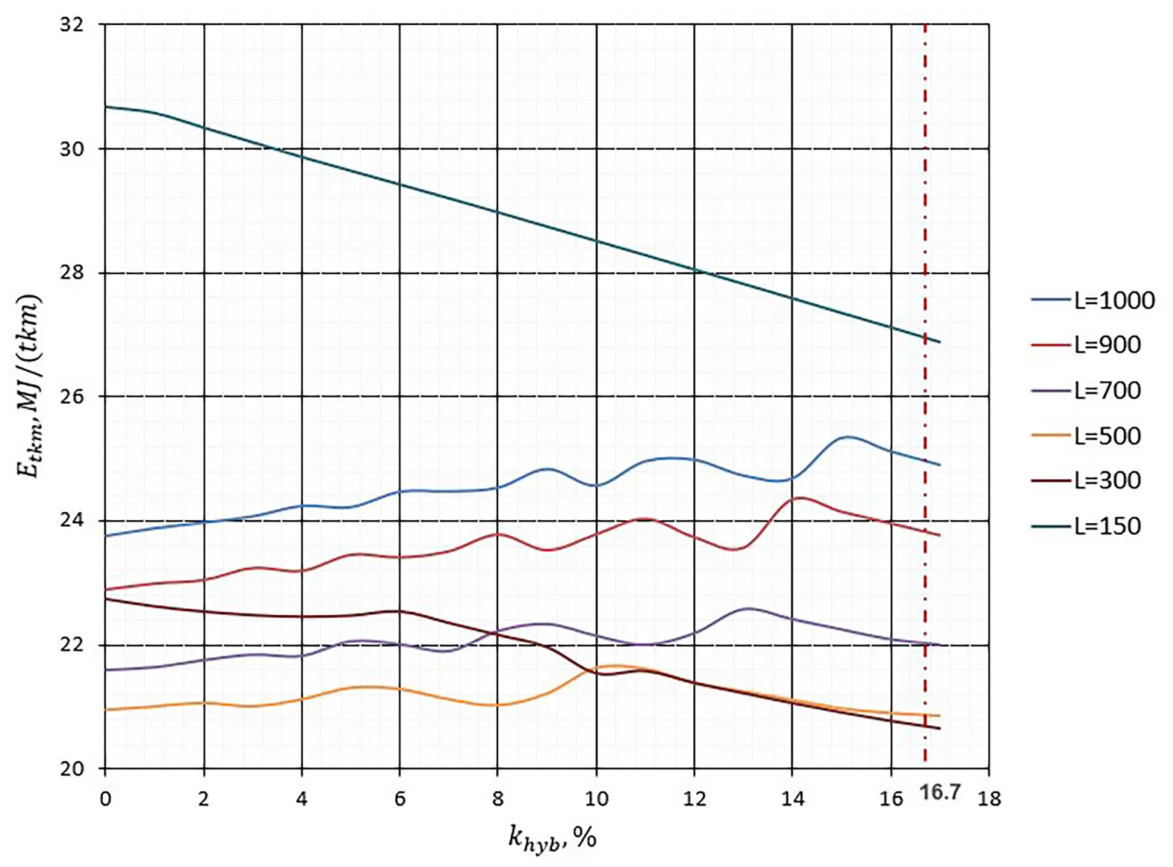
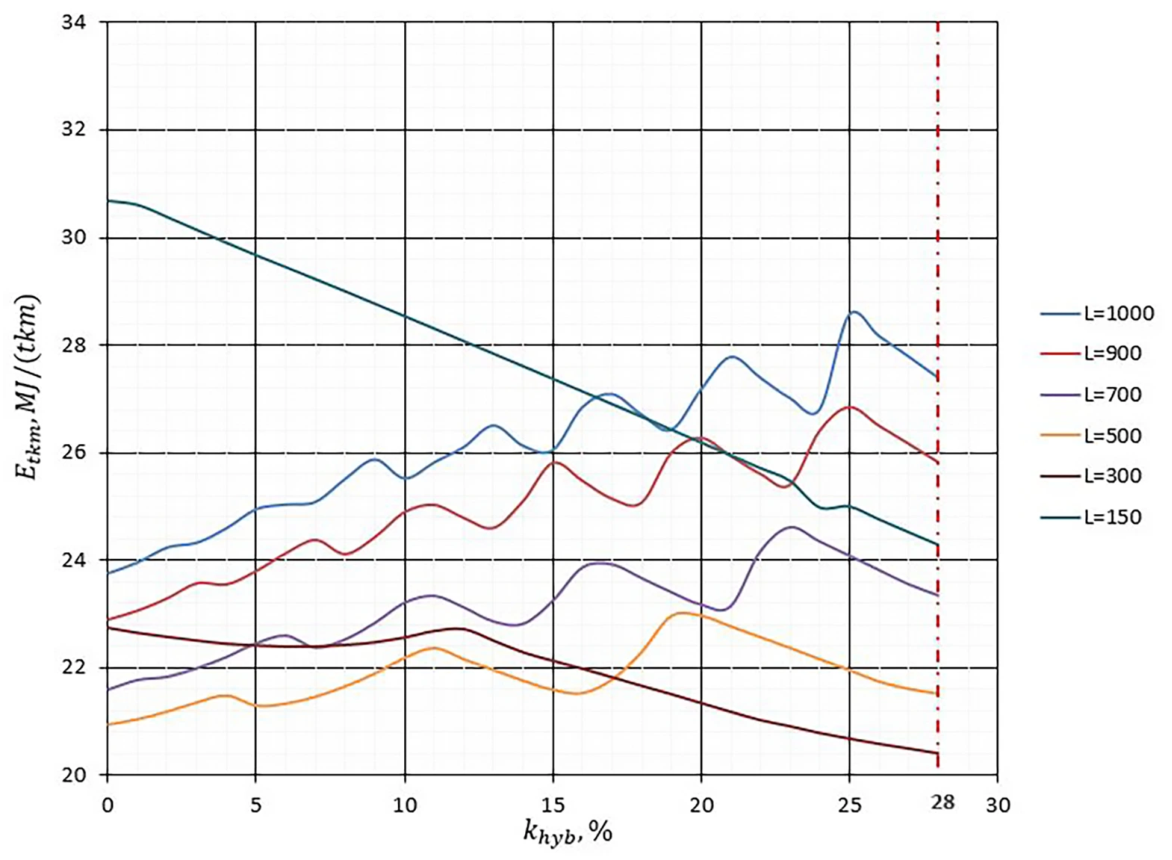
Figure 4 and Figure 5 present the dependencies of the energy cost per ton-kilometer of transported payload on the hybridization factor for two cruise-regime control laws. The flight range in the study was varied from 150 to 1000 km.
The step-wise fluctuations of the specific energy cost E t k m with varying hybridization-factor values (Figure 4 and Figure 5) are related to the discrete nature of electric machine control during the cruise segment. Each step of the cruise flight of fixed length is characterized by a constant operating mode of the electric machine (motor or generator). At the beginning of a step, the battery has its maximum charge (peak on the graph), while at the end of the step, if the electric machine operated in motor mode, the charge drops to the minimum permissible level (trough). Switching the mode at the next step causes a jump in power and, consequently, a change in energy consumption. When constructing the E t k m dependence on the hybridization factor with a discrete step of 1%, these step-wise switches appear as oscillations.
For ranges beyond 500 km, the benefit disappears because the mass of the batteries and electrical system outweighs the fuel savings. The maximum hybridization factor is limited by the 20% minimum state-of-charge constraint to 16.7% at n = 96% and 28% at n = 100%.
A comparison of the HPP control laws for the 2030 technology level (Figure 4 and Figure 5) shows that they differ primarily in the attainable maximum hybridization factor: under control law 1, the maximum permissible hybridization factor is 16.7%, whereas under control law 2, it can be increased to 28%, thereby extending the range of the investigated values. At the same time, a positive effect of the hybrid configuration is observed only for flight ranges up to 500 km.
The maximum reduction in specific energy cost amounts to approximately 9% compared with the baseline configuration without an electrical subsystem.

4. Discussion

The dependencies of specific energy cost per ton-kilometer on the hybridization factor obtained in this work show that the considered parallel hybrid power plant provides a positive effect (up to 9% in E t k m ) predominantly on routes up to 500 km in length; as the flight range increases, the growing mass of batteries and electrical components diminishes the benefit. This pattern is consistent with the results of the IMOTHEP project [15], which reported a positive hybridization effect for a regional aircraft of a similar class at ranges of about 700 km (9.6%), as well as with ATR42-600 retrofitting studies [18], which demonstrated a decline in the advantages of the hybrid configuration for route lengths exceeding 1000 km. A similar fuel consumption reduction of 9.6% for a 200 nm mission was reported by Habermann et al. [25] for a regional turboprop with an electrically assisted turboshaft, further confirming that hybrid benefits are most pronounced on short- to medium-range routes.
NASA studies on a parallel hybrid power plant based on the C-130H aircraft [19,20] demonstrate a comparable trend: the peak fuel savings are achieved on short- and medium-range missions at moderate hybridization factors and sufficiently high battery specific-energy values. Against this background, the 500 Wh/kg level adopted in the present study can be considered a lower bound of the range at which hybridization of a regional turboprop aircraft still yields a measurable benefit in energy cost.
It should be noted, however, that the presented model does not account for the mass and energy consumption of auxiliary cooling systems for electrical components, provides a simplified description of the electrical subsystem, and does not include constraints related to certification requirements for continued takeoff following a single-engine failure [11]. As shown in the literature, accounting for engine-failure scenarios may lead to an increase in required power plant output and a fuel consumption rise of 10–13%, which could reduce the hybridization benefit. Refinement of these aspects, as well as expanding the range of the investigated control laws and electrical subsystem parameters, represents a direction for further development of the proposed methodology.
Notwithstanding the above simplification regarding thermal management, a first-order estimate can be made based on literature data. For a parallel hybrid turboprop with an electric machine power of up to 30% of the shaft power, the thermal management system (TMS) typically adds 10–15% to the mass of the electrical subsystem and consumes 3–5% of the electric machine’s rated power as parasitic losses. Applying these corrections to the baseline case (500 km range and a hybridization factor of approximately 20%) reduces the calculated energy benefit from approximately 9% to approximately 7–8%. Hence, while the TMS penalty is not negligible, it does not alter the key qualitative conclusion: hybridization yields a measurable reduction in specific energy consumption for missions up to 500 km, and the net benefit remains positive at the 2030 technology level assumed in this study.

5. Conclusions

As a result of this work, a methodology for the energy assessment of a parallel hybrid turboprop power plant at the conceptual design stage was developed and verified. The main results and conclusions are as follows:
  • A comprehensive approach that integrates the GTE working-process model in the ASTRA-GTE environment, an electrical subsystem model with projected 2030 parameters, mass characteristic estimation, and an aircraft mission profile model has been proposed. The specific energy cost per ton-kilometer of transported payload was adopted as the key integral performance metric.
  • The developed model was verified using the LET L-410 UVP-E aircraft as a test case. The discrepancy between calculated data and official specifications did not exceed 1%, confirming the model’s adequacy and the correctness of the adopted assumptions.
  • parametric analysis of the influence of the hybridization factor on E t k m was performed for two cruise-regime control laws (n = 96% and n = 100%). It has been established that application of the hybrid power plant of the considered architecture enables a reduction in specific energy cost for flight ranges up to 500 km; at greater ranges, the positive effect diminishes due to the growing mass of electrical components.
  • It has been demonstrated that the choice of control law significantly affects the hybridization potential: the mode with n = 100% in the cruise segment allows the maximum permissible hybridization factor to be increased from 16.7% to 28%, thereby expanding the design space for rational configurations.
  • The proposed methodology and the obtained dependencies can be used at early design stages for a substantiated selection of parameters for both the gas turbine and electrical components of the power plant and for shaping the configuration of prospective regional aircraft with hybrid power plants.
It should be emphasized that the presented results were obtained under a number of assumptions regarding the electrical subsystem parameters and do not account for the mass and energy consumption of the cooling and conditioning systems for electrical components, nor for the possibility of engine failure, which limits the applicability of the quantitative estimates. Refinement of these factors and expansion of the investigated range of battery specific-energy values and HPP control laws constitute the subject of further research.

Author Contributions

Conceptualization, E.P.F. and V.K.R.; methodology, E.P.F., V.K.R. and A.Y.T.; software, V.K.R.; validation, E.P.F., I.A.Z. and A.Y.T.; formal analysis, V.K.R.; investigation, V.K.R.; resources, E.P.F.; data curation, V.K.R.; writing—original draft preparation, V.K.R.; writing—review and editing, E.P.F., A.Y.T. and I.A.Z.; visualization, V.K.R.; supervision, E.P.F.; project administration, E.P.F.; funding acquisition, E.P.F. All authors have read and agreed to the published version of the manuscript.

Funding

This research was carried out within the framework of the research project ‘Development and validation of advanced methods for design, manufacturing, and testing of low-power energy unit components’ (project code FSSS-2025-0002), implemented in 2025–2027 at Samara National Research University with the support of the Ministry of Science and Higher Education of the Russian Federation.

Data Availability Statement

The original contributions presented in this study are included in the article. Further inquiries can be directed to the corresponding author.

Conflicts of Interest

The authors declare no conflicts of interest.

Nomenclature

DesignationDescription 
SNAESystem of nonlinear algebraic equations
ATMAtmosphere
INTInlet
CCompressor
BLEED-IIBleed 2
BLEED-IIIBleed 3
CCCombustion chamber
GGTGas generator turbine
PTPower turbine
EXHExhaust
PPPower plant
ES-stateElectrical system state
G|0Relative gas flow at station 0 (free stream)
π{av.exh}Available expansion ratio of exhaust nozzle
F|9Thrust at nozzle exit (station 9)
M{sh}Flight Mach number
σ{in(M)}Total pressure recovery coefficient of intake 
σ{in,GG}Total pressure recovery at gas generator intake
σ{cc}Total pressure recovery coefficient of combustion chamber
η{comb}Combustion efficiency
η{m.fw}Mechanical efficiency of free turbine
φ{V}Velocity coefficient (nozzle or exhaust)
char-cCompressor performance map
char-GGTGas generator turbine performance map
char-PTPower turbine (free turbine) performance map
δπ*{w#1-2}Variation in pressure ratio between compressor stages 1 and 2
δπ*{w#3}Variation in pressure ratio at compressor stage 3
g{II-ex/3}Specific bleed air extraction after compressor stage 2 (to station 3)
g{ex-GGT1/II-ex}Specific cooling air for gas generator turbine stage 1
g{ex-GGT5/II-ex}Specific cooling air for gas generator turbine stage 5
g{ex-GGT9/II-ex}Specific cooling air for gas generator turbine stage 9
g{ex-PT9/II-ex}Specific cooling air for power turbine stage 9
η{gb}Gearbox efficiency
k{gb}Gearbox reduction ratio
N{em.nom}Nominal power of electric machine
S{w}Wing area
γFlap deflection angle (or flight path angle)
map-cyLift coefficient map
map-cxDrag coefficient map
c{fc}Specific fuel consumption coefficient (fuel flow per thrust/power)
tTime (mission phase duration)
VFlight speed
ΘFlight path angle
m{ac}Current aircraft mass
E{bat}Current battery energy
αAngle of attack
set(|y|)Absolute value of setpoint (controller target)
E{bat.nom}Nominal battery energy
HFlight altitude
LFlight range (distance)
m{fuel}Fuel mass consumed
k{bat.res}Battery capacity reserve coefficient
H{u}Fuel lower heating value
P{pp}Power plant thrust (total)
fuelFuel (generic fuel parameter)
char-c-basicBaseline compressor performance map
char-GGT-basicBaseline gas generator turbine map
char-PT-basicBaseline power turbine map
k{res}Reserve coefficient (e.g., fuel or power margin)
k{c}Coefficient (scheme-specific factor)
D{prop}Propeller diameter
map-α{prop}Propeller thrust coefficient map (α vs. advance ratio and pitch)
map-β{prop}Propeller power coefficient map (β vs. advance ratio and pitch)
n{prop}Propeller rotational speed
η{es+}Electrical system efficiency in motor mode
η{es-}Electrical system efficiency in generator mode
n{eng}Number of engines in the power plant
π*{c}Compressor total pressure ratio
T*|4Turbine inlet total temperature (station 4)
k{hyb}Hybridization factor
k{hyb.nom}Nominal hybridization factor
γ#0Relative flow parameter at zero flap deflection
map-cy#0Lift coefficient map for flaps at 0°
map-cx#0Drag coefficient map for flaps at 0°
γ#18Relative flow parameter at 18° flap deflection
map-cy#18Lift coefficient map for flaps at 18°
map-cx#18Drag coefficient map for flaps at 18°
m{ac}#oInitial aircraft mass (at start of mission)
kPProportional gain
kIIntegral gain
kDDerivative gain 
m{0}Takeoff mass
m{af}Airframe mass
N{em.sp}Specific power of the electric machine (per unit mass)
N{pp.sp}Specific power of the power plant (per unit mass)
E{bat.sp}Specific energy of the battery
m{prop}Propeller mass
k{pp}Coefficient for power plant mass increase (relative to engine mass)
m{nav}Navigation fuel reserve mass
m{res}Reserve fuel mass
m{pp}Power plant mass
m{payload}Payload mass
m{om}Crew, equipment and service load mass
m{eng}Engine mass (dry)
ΔT|0Ambient temperature deviation from standard
Δp|0Ambient pressure deviation from standard
φ|0Angle or coefficient at baseline condition
σ{int.M}Intake total pressure recovery
σ{int.g}Intake total pressure recovery for gas generator duct
n{GG}Gas generator rotor speed
η*{π.c}_basicBaseline polytropic efficiency of compressor
g{II/2.4}Specific bleed air after compressor stage 2.4
G|IIIGas flow at engine station III (after compressor)
σ{cc}Total pressure recovery in combustion chamber
η{g}Combustion efficiency
η*{GGT}_basicBaseline efficiency of gas generator turbine
η{m.GG}Mechanical efficiency of gas generator
n{PT}Power turbine (free turbine) rotor speed
η*{PT}_basicBaseline efficiency of power turbine
η{m.PT}Mechanical efficiency of power turbine
φ{c}Velocity coefficient (nozzle)–alternative
mode{em}Electric machine operating mode (motor/generator)
η{es0}Baseline electrical system efficiency
η*{c}Compressor efficiency (total-to-total)
n{GG/2}Corrected gas generator speed referred to station 2
G|3.1Corrected gas flow at station 3.1 (combustor inlet)
β{t}Blade angle or flow coefficient for turbine
π*{GGT}Gas generator turbine expansion ratio
η*{GGT}Gas generator turbine efficiency
n{GG/4.05}Corrected gas generator speed referred to station 4.05
π*{PT}Power turbine expansion ratio
η*{PT}Power turbine efficiency
φ{prop}Propeller blade pitch angle
N{c}Compressor power (power consumed by compressor)
Ξ|ex-GGT1Cooling air ratio for gas generator turbine stage 1
Ξ|ex-GGT5Cooling air ratio for gas generator turbine stage 5
Ξ|ex-GGT9Cooling air ratio for gas generator turbine stage 9
Ξ|ex-PT9Cooling air ratio for power turbine stage 9
ƒ:(δη*{c})Function: compressor efficiency variation
ƒ:(n(GG))Function: gas generator speed
ƒ:(g{ex-PT9/II-ex})Function: cooling flow for power turbine stage 9
ƒ:(g{II-sum})Function: total bleed and leakage flow
ƒ:(δG|3.1)Function: corrected flow variation at combustor inlet
ƒ:(T*|4)Function: turbine inlet temperature variation
ƒ:(Δg{cld.GGT})Function: cooling flow variation for gas generator turbine
ƒ:(δη*{GGT})Function: gas generator turbine efficiency variation
ƒ:(δN{GG})Function: gas generator power variation
ƒ:(δη*{PT})Function: power turbine efficiency variation
ƒ:(n{PT})Function: power turbine speed
ƒ:(δp|0)Function: ambient pressure deviation effect
ƒ:(δG|9)Function: gas flow variation at nozzle exit (station 9)
MFlight Mach number (simplified)
ƒ:(k{hyb})Function: hybridization factor effect
ƒ:(N{prop})Function: propeller shaft power
m{GTE}Gas turbine engine mass
ƒ:(P{pp})Function: power plant thrust

References

  1. ICAO. CORSIA: Carbon Offsetting and Reduction Scheme for International Aviation. Available online: https://www.icao.int/environmental-protection/Pages/default.aspx (accessed on 15 February 2025).
  2. Advisory Council for Aviation Research and Innovation in Europe. Flightpath 2050: Europe’s Vision for Aviation; European Commission: Brussels, Belgium, 2011. [Google Scholar]
  3. Brelje, B.J.; Martins, J.R.R.A. Electric, hybrid, and turboelectric fixed-wing aircraft: A review of concepts, models, and design approaches. Prog. Aerosp. Sci. 2019, 104, 1–19. [Google Scholar] [CrossRef]
  4. Pornet, C.; Isikveren, A.T. Conceptual design of hybrid-electric transport aircraft. Prog. Aerosp. Sci. 2015, 79, 114–135. [Google Scholar] [CrossRef]
  5. Voskuijl, M.; van Bogaert, J.; Rao, A.G. Analysis and design of hybrid electric regional turboprop aircraft. CEAS Aeronaut. J. 2018, 9, 15–25. [Google Scholar] [CrossRef]
  6. Misra, A. Energy storage for electrified aircraft: The need for better batteries, fuel cells, and supercapacitors. IEEE Electrif. Mag. 2018, 6, 54–61. [Google Scholar] [CrossRef]
  7. Buticchi, G.; Costa, L.F.; Barater, D.; Concari, C.; Liserre, M.; Amarillo-Piñeros, E. A quadruple active bridge converter for the storage integration on the more electric aircraft. IEEE Trans. Power Electron. 2018, 33, 8174–8186. [Google Scholar] [CrossRef]
  8. Henke, M.; Narjes, G.; Hoffmann, J.; Wohlers, C.; Urbanek, S.; Heister, C.; Steinbrink, J.; Canders, W.-R.; Ponick, B. Challenges and opportunities of very light high-performance electric drives for aviation. Energies 2018, 11, 344. [Google Scholar] [CrossRef]
  9. Radomskiy, V.K.; Tkachenko, A.; Filinov, E. Development of Methods and Conceptual Design Tools for Simulation of Trigeneration Systems on the Basis of Gas Turbine Engine. In Proceedings of the 2024 International Ural Conference on Electrical Power Engineering (UralCon), Magnitogorsk, Russian, 27–29 September 2024; IEEE: New York, NY, USA, 2024; pp. 11–15. [Google Scholar]
  10. Tkachenko, A.; Filinov, E.; Tremkina, O. Optimization of the Cycle of a Small-Sized Gas Turbine Plant Using the CAE-System ‘ASTRA’. In Proceedings of the 2025 International Ural Conference on Electrical Power Engineering (UralCon), Magnitogorsk, Russian, 25–28 September 2025; IEEE: New York, NY, USA, 2025; pp. 217–221. [Google Scholar]
  11. Quillet, D.; Boulanger, V.; Rancourt, D.; Freer, R.; Bertrand, P. Parallel hybrid-electric powertrain sizing on regional turboprop aircraft with consideration for certification performance requirements. In Proceedings of the AIAA AVIATION Forum, Virtual Event, 2–6 August 2021; AIAA: Reston, VA, USA, 2021. [Google Scholar] [CrossRef]
  12. Misley, A.A.; D’Arpino, M.; Ramesh, P.; Canova, M. A real-time energy management strategy for hybrid electric aircraft propulsion systems. In Proceedings of the AIAA Propulsion and Energy Forum, Virtual Event, 9–11 August 2021; AIAA: Reston, VA, USA, 2021. [Google Scholar] [CrossRef]
  13. Zhang, J.; Roumeliotis, I.; Zolotas, A. Model-based fully coupled propulsion-aerodynamics optimization for hybrid electric aircraft energy management strategy. Energy 2022, 245, 123239. [Google Scholar] [CrossRef]
  14. Balack, P.; Atanasov, G.; Zill, T. Architectural trade-offs for a hybrid-electric regional aircraft. In Proceedings of the Aerospace Europe Conference 2023 (10th EUCASS–9th CEAS), Lausanne, Switzerland, 9–13 July 2023. [Google Scholar] [CrossRef]
  15. IMOTHEP Consortium. Synthesis of Benefits of HEP for Regional and SMR Aircraft; Deliverable D1.9. 2024. Available online: https://www.imothep-project.eu/ (accessed on 8 March 2026).
  16. FutPrInt50 Consortium. Future Propulsion and Integration: Hybrid Electric Regional Aircraft Roadmap; H2020. 2020–2023. Available online: https://www.easa.europa.eu/en/research-projects/futprint50 (accessed on 8 March 2026).
  17. HE-ART Consortium. Hybrid Electric Propulsion System for Regional Aircraft (HE-ART); Clean Aviation. 2023–2026. Available online: https://www.sintef.no/en/projects/2023/he-art-hybrid-electric-propulsion-system-for-regional-aircraft/ (accessed on 8 March 2026).
  18. Quiben Figueroa, R.; Cavallaro, R.; Cini, A. Feasibility studies on regional aircraft retrofitted with hybrid-electric powertrains. Aerosp. Sci. Technol. 2024, 151, 109246. [Google Scholar] [CrossRef]
  19. Pham, D.D.V.; Listgarten, N.S.; Zilliac, G.G. Parametric modeling and mission performance analysis of a true parallel hybrid turboprop aircraft for freighter operations. In Proceedings of the AIAA Aviation Forum, Las Vegas, NV, USA, 29 July–2 August 2024; AIAA: Reston, VA, USA, 2024. [Google Scholar]
  20. Listgarten, N.S.; Pham, D.D.V.; Zilliac, G.G. Parallel hybrid turboprop performance modeling and optimization. In Proceedings of the AIAA SciTech Forum, Orlando, FL, USA, 6–10 January 2025; AIAA: Reston, VA, USA, 2025. [Google Scholar]
  21. Zubrilin, I.A.; Matveev, S.G.; Marrone, A.; Pastrone, D.G. Simulation of Pollutant Emissions in a Small-Size GTE Based on the Reactor Network Model. Bull. Lebedev Phys. Inst. 2018, 45, 308–310. [Google Scholar] [CrossRef]
  22. Varyukhin, A.N.; Zakharchenko, V.S.; Rakhmankulov, D.Y. Traditional, hybrid, and electric power plants of local air-line aircraft. Aviatsionnye Dvigateli 2022, 1, 19–32. (In Russian) [Google Scholar]
  23. Cameretti, M.C.; Del Pizzo, A.; Di Noia, L.P.; Ferrara, M.; Pascarella, C. Modeling and Investigation of a Turboprop Hybrid Electric Propulsion System. Aerospace 2018, 5, 123. [Google Scholar] [CrossRef]
  24. Palaia, G.; Abu Salem, K.; Cipolla, V.; Binante, V.; Zanetti, D. Mission Performance Analysis of Hybrid-Electric Regional Aircraft. Aerospace 2023, 10, 246. [Google Scholar] [CrossRef]
  25. Habermann, A.L.; Kolb, M.G.; Maas, P.; Kellermann, H.; Rischmüller, C.; Peter, F.; Seitz, A. Study of a Regional Turboprop Aircraft with Electrically Assisted Turboshaft. Aerospace 2023, 10, 529. [Google Scholar] [CrossRef]
  26. TrendForce. Solid-State Batteries to Propel Low-Altitude Aviation. 2024. Available online: https://greentechlead.com/power/solid-state-batteries-to-propel-low-altitude-aviation-trendforce-48454 (accessed on 8 March 2026).
Figure 1. XDSM diagram of the hybrid power plant mathematical model.
Aerospace 13 00470 g001
Figure 2. Efficiency model of the hybrid power plant in the aircraft system.
Aerospace 13 00470 g002
Figure 3. Structure of the mission profile model.
Aerospace 13 00470 g003
Figure 4. Energy cost per ton-kilometer of transported payload vs. the hybridization factor (control law 1, 2030 technology level).
Aerospace 13 00470 g004
Figure 5. Energy cost per ton-kilometer of transported payload vs. the hybridization factor (control law 2, 2030 technology level).
Aerospace 13 00470 g005
Table 1. Input parameters for calculating HPP efficiency metrics.
ParameterUnitDescription
H u kJ/kgHeat of combustion of fuel
E b a t .   s t a r t MJInitial battery energy
E b a t .   e n d MJFinal battery energy
m f u e l tFuel mass consumed during the flight
m p a y l o a d tPayload mass
L kmAircraft range
N e m . n o m   kWRated power of the electric machine
N p p . n o m kWRated total power of the power plant
Table 2. Main design data for the electrical subsystem.
ParameterDescriptionUnitProjected Value (2030)
N e m . s p Specific power of the electric machinekW/kg12
N p p . s p Specific power of the power electronicskW/kg30
E b a t .   s p Battery specific energyMJ/kg1.8
η e s + Electrical system efficiency in motor mode0.975
η e s Electrical system efficiency in generator mode0.975
δ E b a t . r e s Battery capacity reserve coefficient0.2
Table 3. Comparison of calculated results with official data (LET L-410 UVP-E, M601D engine).
ParameterDescriptionOfficial DataCalculated ValueDeviation
C e Equivalent specific fuel consumption395 g/(kW·h)394 g/(kW·h)0.25%
T 5 * Total temperature before power turbine983.2 K983.3 K0.01%
G a i r Air mass flow rate3.60 kg/s3.58 kg/s0.56%
m e n g Engine mass200 kg198.6 kg0.50%
R j e t GTE jet thrust1.0 kN0.99 kN1.00%
R t o t a l Total thrust (GTE + propeller)9.807 kN9.811 kN0.05%
m f u e l Fuel mass consumed during the flight800 kg795 kg0.63%
Disclaimer/Publisher’s Note: The statements, opinions and data contained in all publications are solely those of the individual author(s) and contributor(s) and not of MDPI and/or the editor(s). MDPI and/or the editor(s) disclaim responsibility for any injury to people or property resulting from any ideas, methods, instructions or products referred to in the content.