
Article

Vectoring Control of Bilateral Parallel Offset Jet: Flow Characteristics and Control Mechanism
1
China Ship Scientific Research Center, Wuxi 214082, China
2
Key Laboratory of Unsteady Aerodynamics and Flow Control, Ministry of Industry and Information Technology, Nanjing University of Aeronautics and Astronautics, Yudao Street 29, Nanjing 210016, China
3
High Speed Aerodynamics Institute, China Aerodynamics Research and Development Center, Mianyang 621000, China
*
Author to whom correspondence should be addressed.
Aerospace 2026, 13(5), 443; https://doi.org/10.3390/aerospace13050443
Submission received: 4 April 2026 / Revised: 1 May 2026 / Accepted: 5 May 2026 / Published: 9 May 2026
(This article belongs to the Special Issue Advanced Aircraft Technology (2nd Edition))

Abstract

We proposed a bilateral parallel offset jet model that enables jet vectoring control without the need for an active high-pressure secondary flow. Flow characteristics, including deflection force, wall pressure distribution, and flow structures, were investigated. The evolutions of key flow structures during jet deflection were investigated, including the passive secondary flow, the shear layer, the boundary layer, and the separation bubble. By analyzing the formation, dissipation, and interactions of the key flow structures, as well as their relationship with pressure characteristics, the mechanism of the jet deflection control was further deduced. The fundamental driving force of the jet deflection stems from the unbalanced pressure difference on either side of the jet, and the valve can control the flow rate of passive secondary flow, thereby altering the near-wall pressure on its side and further generating a pressure that propels the jet to deflect. For walls of different lengths, at a moderate wall length, where L* = 1.5, with the valve controlling the passive secondary flow, a maximum jet vectoring angle of 6.4° can be continuously achieved at a low Reynolds number. Within the range where 20% < δv < 100%, the nonlinear error of jet vectoring control is 5.7%. At a short wall length, where L* = 0.5, the driving force generated by the valve to deflect the jet is insufficient, and the maximum vector angle is 0.3°. For longer walls, the impact of the jet against the trailing edge of the wall obstructs jet deflection; therefore, extending the wall is not conducive to jet vectoring control. Featuring a non-expanding wall structure, the bilateral parallel offset jet model provides a new thrust vectoring control scheme characterized by a compact afterbody, no need for a high-pressure secondary air source, and a simple structure.

1. Introduction

Jet vectoring control, which can affect the jet flow direction as well as its cross-stream spreading and mixing [1], has been of considerable interest because of its relevance to various applications, including thrust vectoring control (TVC) [2,3], the reduction in thermal signature [4], and noise abatement [5]. Jet vectoring control methods can be divided into two groups, namely, the mechanical method and the fluidic method [6]. Mechanical thrust vectoring control (MTVC) uses movable solid parts, such as gimbals or hinges, to change the flow direction [7]. The disadvantages of the mechanical method are structural complexity, additional weight, and maintenance difficulty [8]. Fluidic thrust vectoring control (FTVC) employs an immovable nozzle and uses a flow control strategy to achieve jet vectoring control [9]. Representative FTVC includes shock vector control [10,11,12], dual throat control [13,14,15], counter-flow control [16,17], and co-flow control [18,19]. Without the complexity of movable mechanical components, the FTVC possesses the advantages of fast deflection, weight reduction, and high efficiency [20], prompting a strong research interest in this technology. Studies indicate that compared with MTVC, FTVC methods can achieve a 28~40% weight reduction, a 7~12% thrust-to-weight ratio improvement, and a 37~53% reduction in nozzle procurement and life cycle costs [21].
In most of the current studies of FTVC methods, an active high-pressure source is necessary to produce the secondary flow for jet vectoring control, which increases the system complexity as well as the thrust loss. Studies show that active FTVC methods require 1% of the main jet’s energy to produce a 3.3~5° vector angle, with a thrust coefficient of 0.86~0.97 [22]. In this study, we proposed a new passive FTVC method based on the Coanda effect: a bilateral parallel offset nozzle. With non-expansive parallel outlet profiles, this method allows for effective jet deflection control even in the absence of active high-pressure secondary flow. Compared to the MTVC method, our method offers the advantages of being lightweight and having a simple structure; compared to traditional active FTVC methods, our method offers the advantages of high vector deflection efficiency and low thrust loss. In general, our method relies on the Coanda effect to achieve jet deflection control.
The Coanda effect is a long-known phenomenon in fluid mechanics, which can be manifested by the tendency of jets to attach to solid surfaces [23]. It was first proposed by the Romanian inventor Coanda [24] in 1934. There are two main forms of jet attachment to solid walls [25,26]: the Chilowsky effect and the Teapot effect. The Chilowsky effect [27] refers to the fact that a jet that is not initially in contact with the wall will flow toward the wall and reattach to it. The Teapot effect [28] refers to the tendency of a jet to remain attached to a curved wall as it flows along the wall. Based on the Coanda effect, researchers have proposed many models of wall–jet interactions and carried out a number of studies on different types of jets, such as wall jets [29,30], curved wall jets [31], and parallel offset jets [32,33].
The wall jet was introduced by Glauert [34], which refers to the flow that develops when a jet impinges on a plane surface and spreads out over the surface. Bakke [35] investigated the velocity profiles and the width of a wall jet, and Schwarz [36] researched the velocity distribution of a two-dimensional turbulent wall jet; their results indicated that the velocity profiles of wall jets are self-similar. Newman [37] studied the three-dimensional wall jet and obtained the distribution characteristics of velocity and turbulent kinetic energy. The studies of other scholars [38,39,40,41] uncovered many properties of wall jets such as the surface friction coefficient, diffusivity, and turbulence characteristics.
Curved wall jets [42] and parallel offset jets [43] are structural variants of wall jets. In the case of wall jets, if the straight wall is replaced by a curved wall, the flow will become a curved wall jet [44]. Newman [45] found that the viscous drag causes the near-wall pressure to be lower than the ambient pressure, and this pressure difference is the main reason why the jet attaches to the wall. As the jet flows along the wall, the near-wall pressure gradually rises. When it equals the ambient pressure, the jet detaches from the wall. Patankar [46] studied three-dimensional curved wall jets, and the results show that the jet detachment angle increases with the radius of curvature of the wall. Neuendorf [47] researched the effect of curved walls on the development of flow structures in curved wall jets. Han [48] investigated the streamwise vortices in curved wall jets and found that the streamwise vortices can affect the jet detachment angle as well as the separation characteristics.
Based on the wall jets, parallel offset jets are formed by moving the wall away from the jet, creating an offset between the wall and the jet outlet [49]. Bourque and Newman [50] figured out that if the jet flows out of the nozzle and separates from the wall, the jet is able to bend and eventually reattach to the wall, provided that the wall is long enough and the deflection angle is small enough. When the jet reattaches to the wall, there will be a separation bubble near the wall. Sawyer [51] studied the size and pressure of the separation bubble of a parallel offset jet. Other studies of parallel offset jets [52,53,54,55] mainly focused on the pressure, velocity, and reattachment features of the jet. In addition, researchers have also focused on the interaction between parallel offset jets and other jets. Assoudi [56] studied the flow characteristics of a single offset jet and a dual jet. Nasr [57] comparatively investigated two parallel jets and one parallel offset jet, focusing on the differences in flow characteristics of the recirculation region. In general, the reason why parallel offset jets can reattach to the wall is that the shear layer entrainment forms a low pressure in the near-wall region, which drives the jet to deflect towards the wall.
The above studies of curved wall jets and parallel offset jets indicate that due to the presence of the wall, a pressure difference is created on both sides of the jet, resulting in the deflection of the jet. In this research, we proposed a bilateral parallel offset wall model, which sets two parallel offset walls symmetrically on either side of the jet. Based on the Coanda effect, this model can generate a controllable pressure difference on both sides of the jet, thus realizing jet vectoring control. Compared with the previously studied parallel offset jets, the bilateral parallel offset jet model in this research has the following unique features:
  • There are two parallel walls installed on both sides of the jet bilaterally, whereas previous studies only had a single wall;
  • The offset between the wall and the jet is designed to be a passive secondary flow channel, which can control the flow rate of the passive secondary flow;
  • The deflection process of the jet is investigated, while previous studies mainly focused on the static flow characteristics.
In addition, the traditional FTVC methods typically employ an expanding configuration, while the bilateral parallel offset jet model proposed in this study features a non-expanding configuration, which provides a new thrust vectoring control scheme characterized by a compact afterbody.
Focusing on the vectoring control of bilateral parallel offset jets, we studied the mechanical vector characteristics of the jet deflection process and the evolution process of key flow structures. The influence of the wall length on the flow characteristics and the mechanism of vectoring control was analyzed.
The remainder of the paper is structured as follows: Section 2 introduces the experimental facilities and model design parameters. Section 3 discusses the main results of this research. This section analyzes the flow characteristics and obtains the mechanism of vectoring control by analyzing the evolution of vectoring force, near-wall pressure, and flow structure. And finally, some concluding remarks are made in Section 4.

2. Experimental Approach

2.1. Test Facilities and Model

In this paper, a study on vectoring control of bilateral parallel offset jets was conducted on an electric jet propulsion system. Powered by a 144 mm electric ducted fan, this jet propulsion system is able to produce jets with velocities up to 60 m/s. The outlet of the jet propulsion system is a contraction section with an exit size of 250 mm × 50 mm. On the downstream side of the ducted fan, the diffuser section, the stabilizing section of the honeycomb diffuser, and the converging section can effectively stabilize the flow, and the turbulence intensity of the electric jet propulsion system at the outlet is 0.62%. The layout of the test facilities is shown in Figure 1.
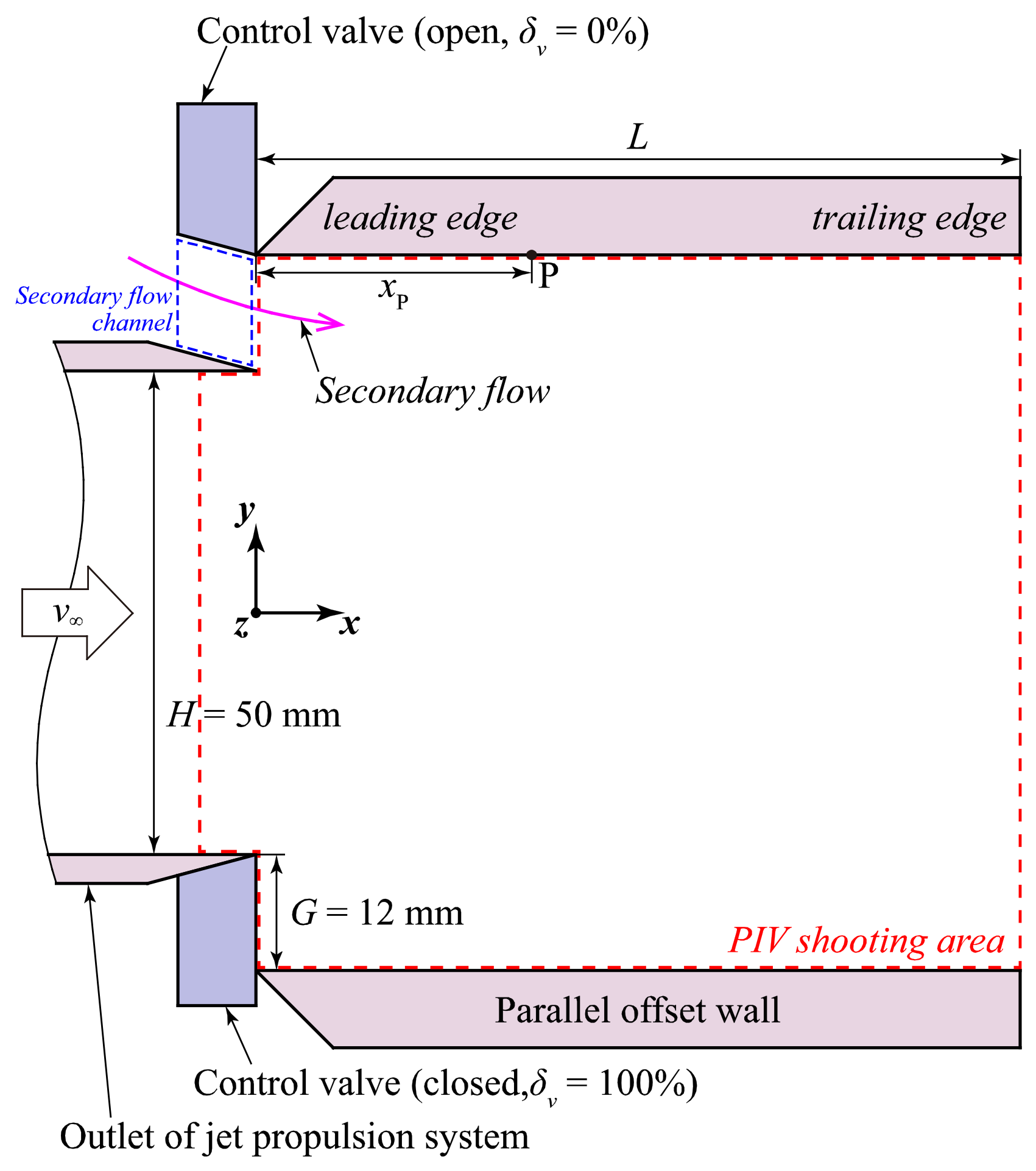
The bilateral parallel offset wall model is installed at the outlet of the jet propulsion system, as shown in Figure 1. The sketch of the model design variables, as well as the definition of the coordinates, are shown in Figure 2. The origin of the coordinate system is located at the geometric center of the jet outlet, the x-axis coincides with the axis of the jet and points downstream, the y-axis is in the opposite direction of gravity, and the z-axis is determined by the right-hand rule. The height of the jet at the outlet H is 50 mm. Two straight walls with finite length L are placed parallel to the x-axis on either side of the jet outlet, and the two walls are symmetrical about the x-axis. The distance between point P on the wall and the endpoint of the leading edge of the wall is denoted as xP. The width of the wall in the direction of the z-axis is 250 mm, which is the same as the width of the jet outlet. There are two sidewalls at the ends of the wall along the z-axis with coordinates of z = ±125 mm. In Figure 1, the sidewall at z = 125 mm is hidden. The leading edge endpoint of the wall coincides with the y-axis, and the offset G between the leading edge of the wall and the jet outlet is 12 mm. In our bilateral parallel offset wall model, the offset area is designed as a passive secondary flow channel, as illustrated by the blue dashed box in Figure 2. The ambient air can be entrained into the model through the channel, forming a secondary flow. There is a valve at the secondary flow channel to control the opening and closing of the channel. The closure percentage δv of the secondary flow valve is defined as:
δ v = S S m a x × 100 % ,
where Smax is the maximum flow area of the secondary flow channel, and S is the area blocked by the valve. Taking Figure 2 as an example, the control valve on the upper side is open (δv = 0%), and the control valve on the lower side is closed (δv = 100%).
In this research, the velocity of the jet at the outlet v is 30 m/s, and the Reynolds number (Re) is calculated by:
R e = v H μ ,
where μ is the kinematic viscosity of air.
The non-dimensional length of the parallel wall L* is defined as:
L * = L H .

2.2. PIV System

Figure 1 shows the layout of the PIV system. We employ the DANTEC particle image velocimetry (PIV) system to acquire the velocity characteristics inside the bilateral parallel offset wall model. A Beamtech Vlite-500 Nd: YAG laser (532 nm, max 500 mJ/Pause, manufacted by Beamtech Optronics Co., Ltd., Beijing, China) was employed to light the model area. A 29M Flowsense EO CCD camera (6600 × 4400 pixels, manufacted by Dantec Dynamics A/S, Copenhagen, Denmark) with an AF MICRO NIKKOR 105 mm lens (manufacted by Nikon, Tokyo, Japan) was employed on the CCD camera. The interrogation domain size of the PIV cross-correlation was 16 × 16 pixels. Using the particle generator, liquid DEHS tracer particles were atomized by a high-pressure air stream and dropped into the PIV shooting area. The atomized tracer particles were about 2 μm in diameter and had a good followability in the flow field. The measurement plane is the symmetry plane where z = 0. The PIV record area is shown in Figure 2.
In this study, the PIV integration window size is 16 × 16, and the range of the majority velocity vector size is 1~30 m/s. Based on a flow velocity of 30 m/s, the time taken for a particle to traverse the PIV integration window is
t p a r t i c a l = 16 6600 × S w v = 17.7   μ s ,
where Sw = 220 mm represents the actual width of the camera’s field of view. Studies have shown that limiting particle displacement to 1/3~1/4 [58,59] of the PIV integration window during the interval between two laser frames is beneficial for the recovery of displacement vectors. Therefore, the time between pulses in this study is set to 5 μs. To minimize measurement errors in the low-speed region near the wall, we averaged the results from 100 PIV frames to ensure a good signal-to-noise ratio.

2.3. Balance System

The six-component balance system was used to measure the thrust vectoring characteristics during jet deflection. The analog voltage signal that was directly output from the balance was amplified 300 times by the amplifier and then acquired by the DAQ system. The balance specifications are shown in Table 1; the balance axes are the same as those in the model in Figure 2.
According to the coordinate system defined in Figure 2, the thrust vectoring angle θT of the TVC technology can be calculated by [60]:
θ T = arctan T y T x ,
where Ty is the lateral thrust along the y-direction, and Tx is the axial thrust along the x-direction.

2.4. Pressure Measurement System

The pressure measurement system was used to acquire the pressure distribution on the parallel wall during jet vectoring control. The pressure measurement system consists of SM-5652 pressure transducers (manufactured by Silicon Microstructures Incorporated, USA), one NI PXI-6284 Multifunction I/O Module, and one NI PXIe-1078 computer (manufactured by National Instruments, TX, USA). The measurement range is 0.15 PSI, and the precision is 0.05% F.S. According to the feature of the differential pressure transducer, the pressure can be expressed in the following form:
P t e s t = P s P a t m ,
C p = P t e s t 1 2 ρ v 2 ,
where Ptest is the directly measured pressure, Ps is the static pressure, Patm is the atmospheric pressure, Cp is the pressure coefficient, ρ is the density of the air, and v is the velocity of the jet when it leaves the jet propulsion system.
The pressure measurement points are placed at the symmetry plane of the inclined wall, where z = 0. The non-dimensional coordinates of the pressure measurement points x P i * can be expressed as:
x P = x P L ,
x P i = 0.08 i 0.04 i = 1 ~ 12 ,
where xP is the distance to the leading edge of the wall in Figure 2, i is the number of pressure taps.

3. Results and Discussion

3.1. Two Main Flow Conditions During Jet Vectoring Control

We first analyze the key flow structures in the bilateral parallel offset jet. For a jet that is not deflected, we call it a non-vectored jet, and for a jet that is deflected at the maximum angle by the secondary flow control, we call it a vectored jet.

3.1.1. Non-Vectored Jet

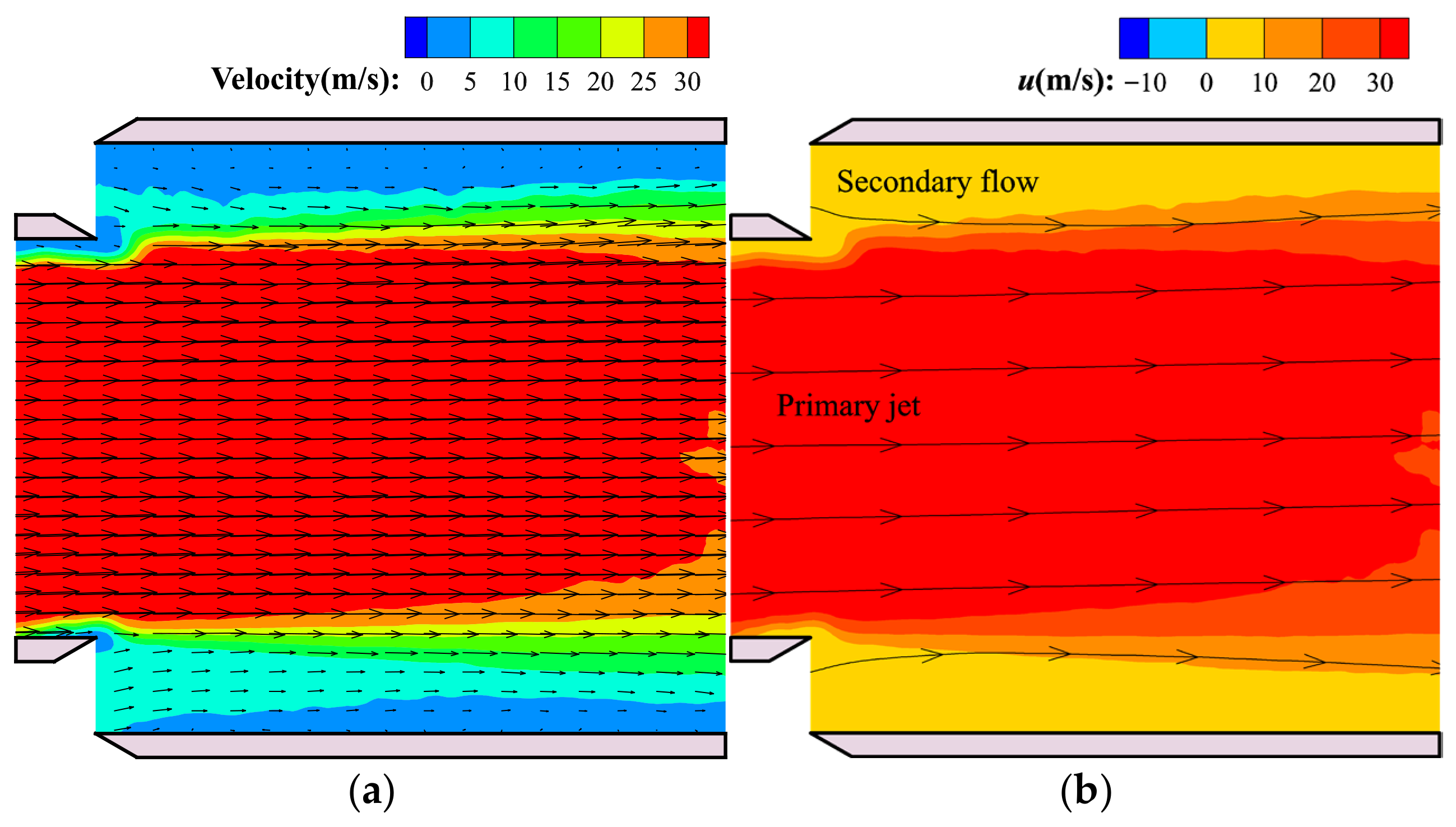
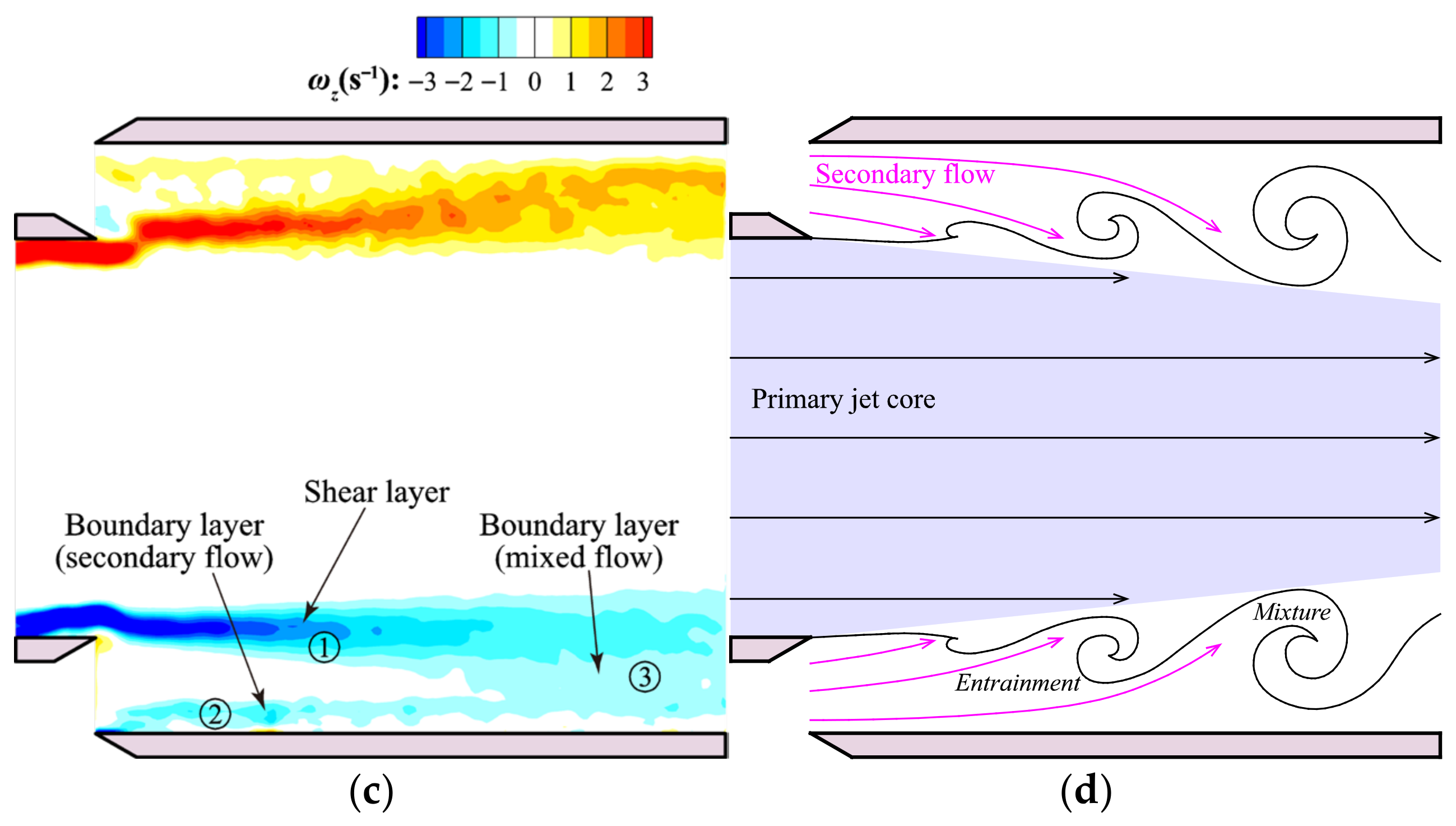
By opening both the upper and the lower control valves, the jet can be kept in the non-vectored mode. The flow characteristics of a non-vectored bilateral parallel offset jet acquired through the PIV test are shown in Figure 3a–c; the topological structures of the flow field are illustrated in Figure 3d.
The time-averaged velocity distribution shown in Figure 3a indicates that the velocity is uniform in the center region, which is the jet core region, and there is a large velocity gradient in the near-wall region. In Figure 3b, the velocity component u in the x-direction shows that in the flow field, the primary jet and the secondary flow both flow away from the nozzle, without any reverse flow. Due to the shear layer entrainment [61], the ambient air outside the model flows into the nozzle, forming a passive secondary flow. Figure 3c shows the vorticity contour for a more intuitive analysis of the unsteady flow structure in the flow field. The vorticity in the z-direction ωz can be calculated by:
ω z = v x u y .
In the vorticity contour, there are two main cases of large vorticity: shear layer and wall boundary layer, both of which have velocity gradients. In the primary jet core, the vorticity is very small. Between the primary jet and the secondary flow, the shear has a large vorticity value, as illustrated by area 1 in Figure 3c. As the jet flows downstream, the lateral width of the shear layer increases while the vorticity value decreases. Between the secondary flow and the wall, there exists a secondary flow boundary layer, as shown by area 2 in Figure 3. Due to the lower flow velocity of the secondary flow, the vorticity value of its boundary layer is much smaller than that of the shear layer. With the shear layer’s entrainment and mixture [62] phenomena, the secondary flow mixes with the shear layer, as shown in Figure 3d. From the vorticity contour, it can be noticed that the originally independent shear layer and secondary flow boundary layer merge with each other, forming a mixed flow boundary layer, as illustrated by area 3 in Figure 3c. It is worth noting that, unlike a free shear layer, the shear layer of a non-vectored bilateral parallel offset jet is wall-bound. On the one hand, the diffusion region of the shear layer is limited by the wall obstruction; on the other hand, a shear layer-secondary flow mixture will be formed. The flow structures are symmetric about the x-axis, while the vorticity values are opposite.
In general, for a non-vectored jet, the key flow structures include the primary jet core, wall-bound shear layer, and secondary flow. The key flow characteristics are the shear layer entrainment and the mixture.

3.1.2. Vectored Jet

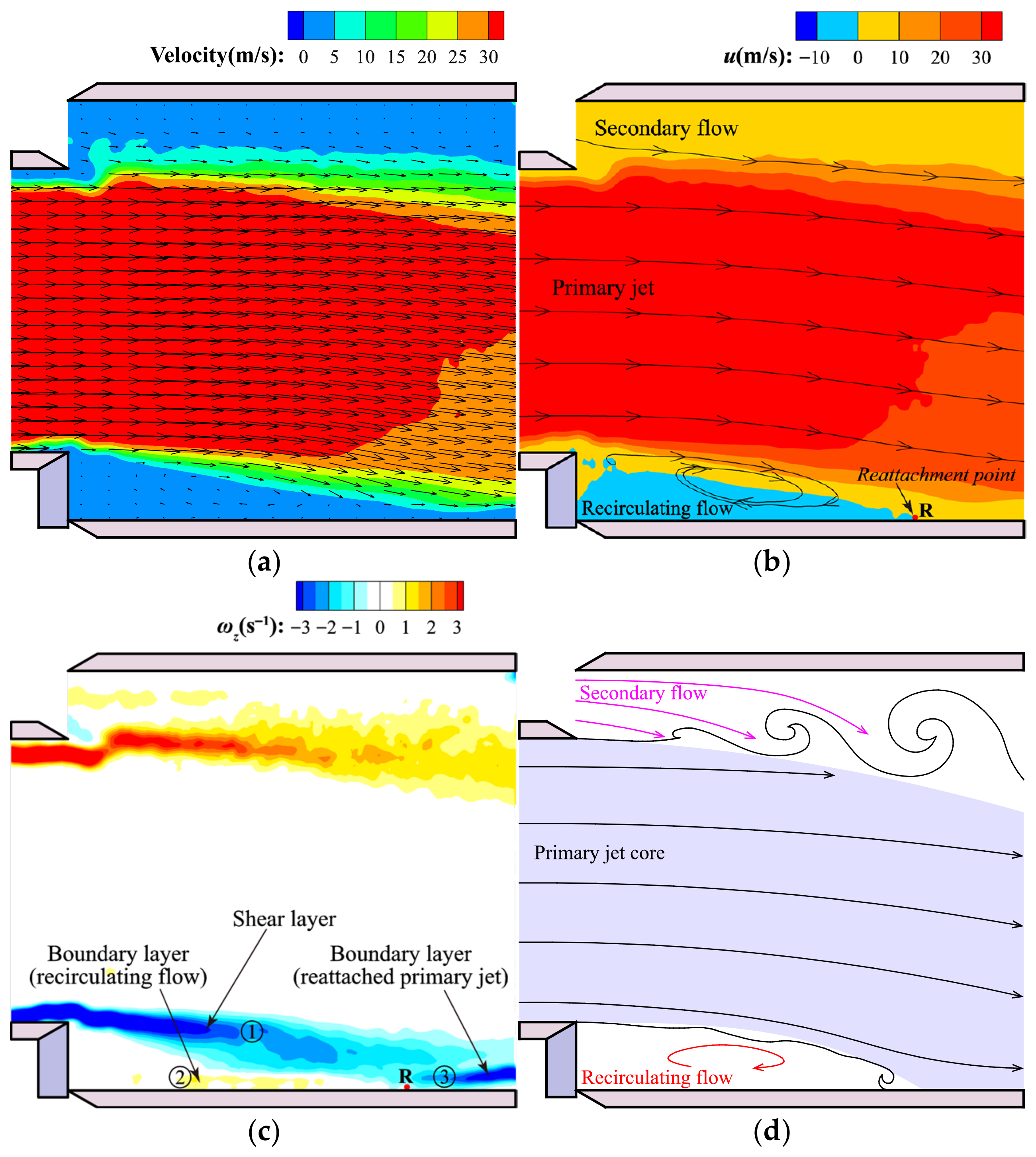
The second essential flow mode is a vectored jet. When one of the secondary flow valves is closed and the other is open, the jet will deflect towards the wall where the secondary flow channel is closed. Taking the case where the lower valve is closed, deflecting the jet to the lower wall as an example, the flow characteristics of a vectored bilateral parallel offset jet acquired through the PIV test are shown in Figure 4a–c, and the topological structures of the flow field are illustrated in Figure 4d.
Unlike the non-vectored jet, the flow field of the vectored jet is asymmetric, as shown in Figure 4a. The contour of the velocity component u is shown in Figure 4b, where the blue area represents u < 0 and its flow direction is in the opposite direction of the x-axis. The flow direction of the primary jet bends downward. The flow in the upper near-wall region is similar to that in Figure 3b and does not show a significant difference. New structures in the flow field appear in the lower near-wall area. Due to the closing of the secondary flow valve, a back-facing step is formed at the leading edge of the lower wall. After bypassing the step, the primary jet reattaches on the lower wall at point R, which is defined as the reattachment point [63], as shown in Figure 4b. In the near-wall region upstream of point R, there exists a separation bubble behind the back-facing step, with a recirculating flow inside.
Figure 4c gives the vorticity contour in the z-direction. The vorticity of the primary jet core, which is deflected downward, is small. The vorticity of the lower near-wall region exhibits different characteristics from the non-vectored jet. Firstly, the shear layer possesses a large and flow-decaying vorticity value, as shown by area 1 in Figure 4c. Secondly, there exists a boundary layer of the recirculating flow in the near-wall region, as illustrated by area 2 in Figure 4c. Since the recirculating flow and the secondary flow move in opposite directions, their boundary layer vorticities are opposite, see area 2 in Figure 3c and Figure 4c. Thirdly, due to the reattachment of the primary jet on the lower wall, there is a large vorticity volume region near the trailing edge of the lower wall, as shown by area 3 in Figure 4c, which is located downstream of the reattachment point R.
In general, for a vectored jet, the key flow characteristics include the primary jet core, the shear layer, the recirculating flow (separation bubble), and the primary jet reattachment.

3.2. Characteristics of Jet Vectoring Control

In this section, we study the vectoring control characteristics of the bilateral parallel offset jet, including force, pressure, and flow structure characteristics of jet deflection, thereby providing evidence that explains the vectoring control mechanism.

3.2.1. Mechanical Control Law of Jet Vectoring Angle

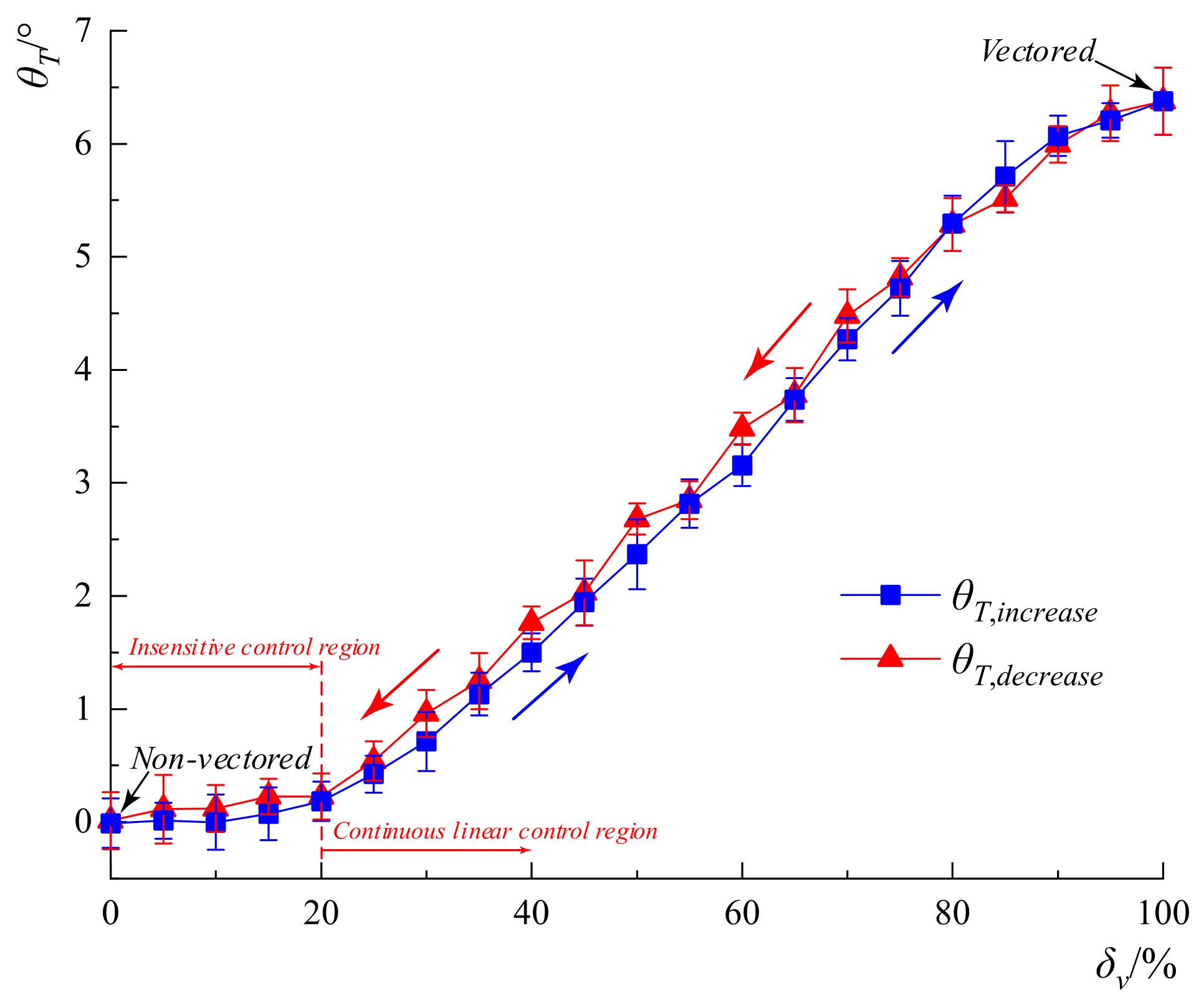
Figure 5 shows the mechanical control law of the thrust vectoring angle during the deflection process of the jet, and Table 2 shows part of the results of the balance measurements (corresponding to the blue curve in Figure 5). The type A evaluations of uncertainty uA can be calculated by:
u A = s x n = 1 n n 1 i = 1 n x i x ¯ 2 ,
where n = 9 is the number of tests, and s(x) is the standard deviation.
During the deflection process, the control valve on the upper side remains open, while the control valve on the lower side experiences the process from open to closed and then back to open. The interval for changes in valve closure percentage is 5%.
The control law of the thrust vectoring angle indicates that the jet deflection angle increases as the valve closes (blue square in Figure 5) and decreases as the valve opens (red triangle in Figure 5). The processes of increasing and decreasing the jet vectoring angle basically coincide without hysteresis, with a maximum thrust vectoring angle of 6.4°. There exists an insensitive control region when δv < 20%, where the variation in vectoring angle is small. This is because the valve has little effect on the secondary flow rate and cannot significantly affect the pressure in the near-wall region; consequently, the pressure difference across the jet remains relatively constant, making it impossible to induce an effective deflection of the jet.
When δv > 20%, the vectoring angle control law is continuous and linear. The linearity of a set of data can be evaluated by the nonlinear error γ:
γ = Δ Y m a x Y × 100 % ,
where |ΔY|max is the maximum difference between the actual data value and the ideal linear fitting value of this set of data, and Y is the total span of this set of data. Within the range where 20% < δv < 100%, the nonlinear error of jet vectoring control is 5.7%.

3.2.2. Evolution of Flow Structure Characteristics During Jet Deflection

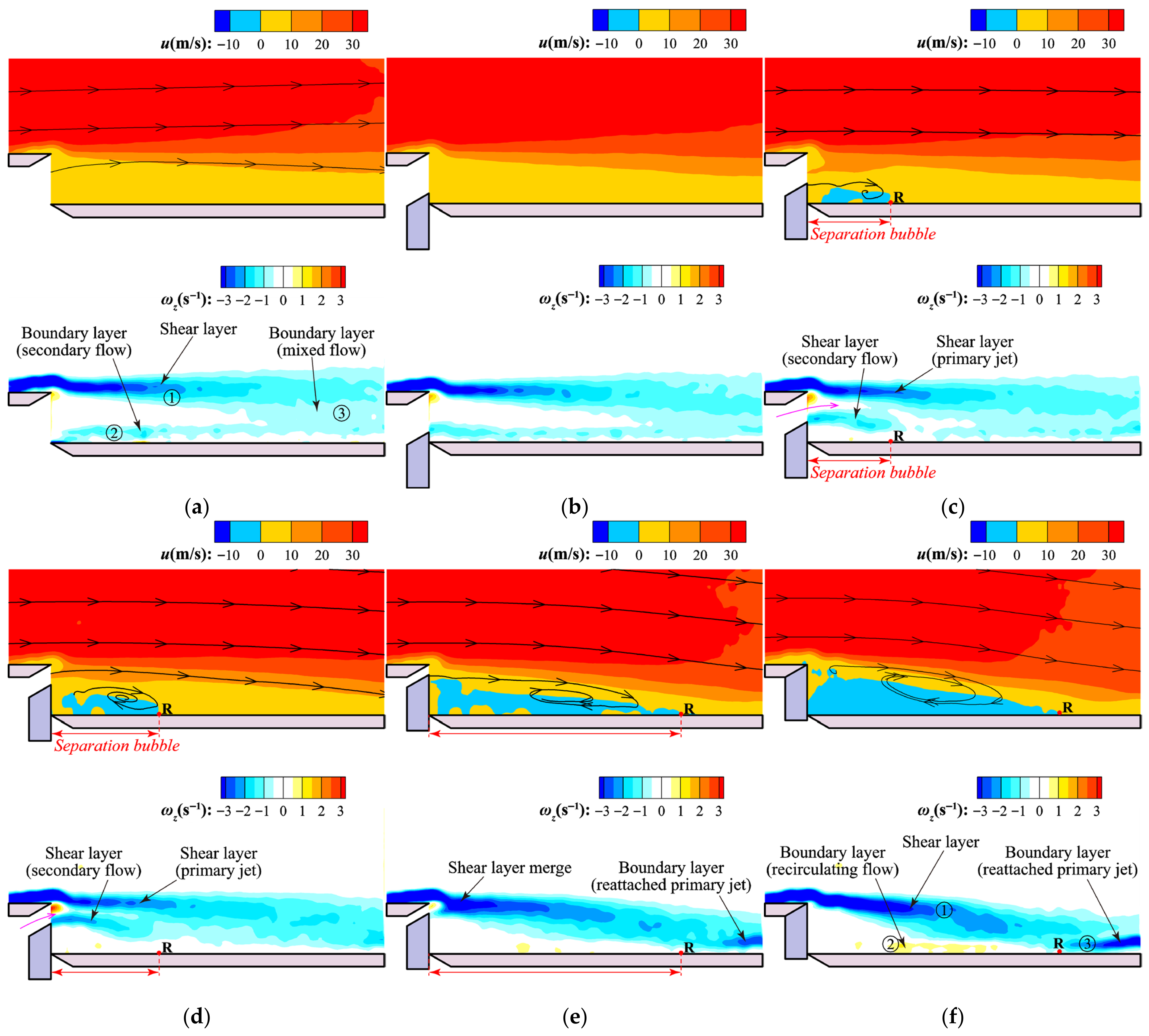
Figure 6 shows the variation process of flow structure during the downward deflection of the jet, including the velocity component u in the x-direction and the vorticity in the z-direction. In this process, there are two types of noteworthy flow phenomena: the formation of a near-wall separation bubble and the evolution of vortex structures formed by shear flows.
As the lower control valve gradually rises, it blocks the flow path of the secondary flow, and a backward-step cavity is gradually formed on the leeward side of the valve, as indicated by the velocity component u distribution shown in Figure 6b–d. In this backward-step cavity, there exists a separation bubble, where the upper layer flows downstream with the secondary flow, while the lower layer flows upstream against the wall, forming a recirculating flow. The closure percentage of the valve determines the height of the backward-step cavity; the higher the backward step, the larger the size of its leeward area. As the valve rises further until it is completely closed, the thickness and length of the separation bubble continue to increase, and the reattachment point of the primary jet also moves towards the trailing edge of the wall, as shown in Figure 6d–f.
During the jet deflection process, as the secondary flow undergoes a transition from presence to absence, the structure of the near-wall vortex system also changes significantly. Initially, the presence of the secondary flow led to two major shear phenomena: the primary jet–secondary flow shear layer (area 1), and the secondary flow–wall boundary layer (area 2), as indicated by the vorticity ωz distribution shown in Figure 6a. As the valve closes with the generation of its backward step, the secondary flow–wall boundary layer switches to a secondary flow shear layer, as shown in Figure 6b,c. In the meantime, the secondary flow shear layer rises and approaches the primary jet shear layer, and the thickness of the secondary flow decreases. As the valve closes further, the two shear layers continue to approach and eventually merge, as shown in Figure 6d,e, where the secondary flow is weak and the primary jet is close to fully deflected. When the valve is completely closed, the secondary flow and its shear layer disappear. There exists a recirculating flow–wall boundary layer in the near-wall separation bubble, as indicated by area 2 in Figure 6f. Through the cortex system evolution, it can be seen that the separation bubble is initially a weak separation bubble in the leeward region of the valve and eventually becomes a strong separation bubble directly sheared by the primary jet.

3.2.3. Evolution of Wall Pressure Characteristics During Jet Deflection

This section investigates the relationship between valve control and near-wall pressure characteristics to uncover the driving forces of jet deflection.
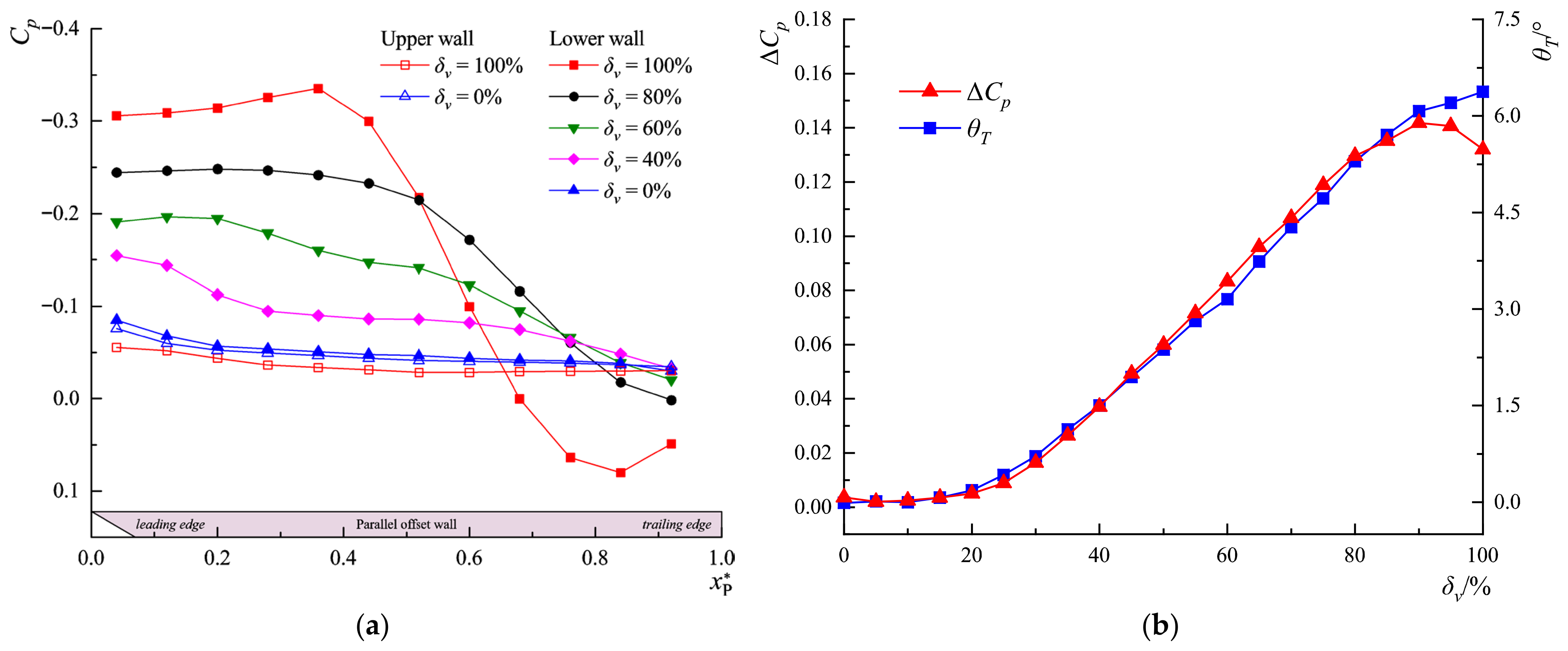
Figure 7 gives the evolution of wall pressure characteristics during jet downward deflection. When the jet deflects towards the lower wall, there is a slight increase in the upper wall pressure, as shown in Figure 7a. For the lower wall, during jet deflection, the pressure decreases near the leading edge of the wall and increases near the trailing edge. When the jet is fully deflected (δv = 100%), the pressure at the trailing edge becomes positive, corresponding to the boundary layer of the reattached primary jet in Figure 6f.
The differing pressure gradient trends between the upper and lower walls create a pressure difference between the two sides of the jet. The wall pressure difference between the upper and lower walls is defined as:
C p = C p , u p p e r C p , l o w e r .
Figure 7b shows the variation pattern of wall pressure difference during jet deflection and compares it with the thrust vectoring angle. The patterns of change in pressure difference ΔCp and thrust vectoring angle θT tend to align, which indicates that the valve’s actuation alters the near-wall flow characteristics, affecting the wall pressure difference, and ultimately causes the jet to deflect. When δv > 90%, the decrease in pressure difference ΔCp is due to the positive pressure generated when the reattached primary jet impacts the trailing edge of the wall.

3.3. Influence of Wall Length on Jet Vectoring Control

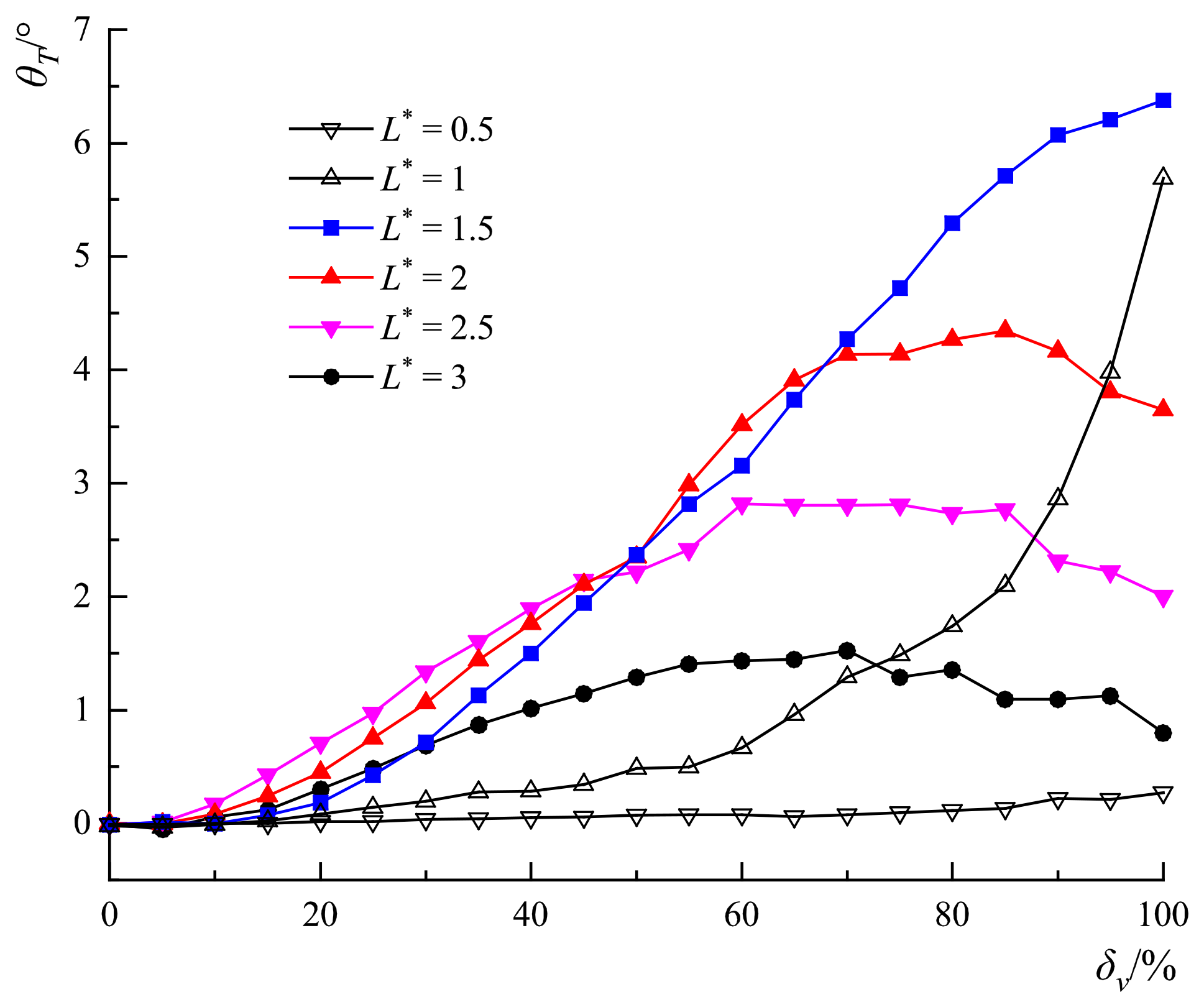
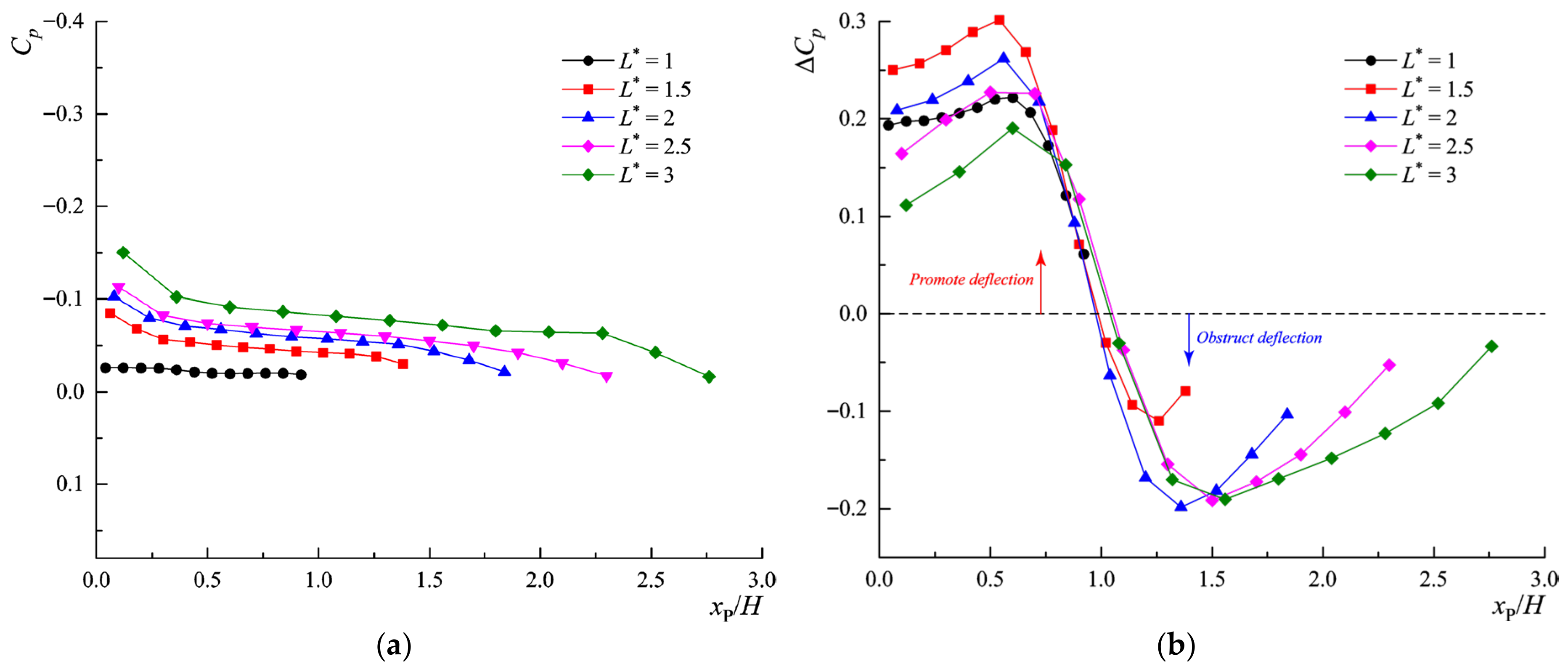
Figure 8 shows the control law of thrust vectoring angle at different wall lengths. Taking the case of L* = 1.5 as the reference standard, the jet deflection patterns of short walls and long walls exhibit distinct trends.
In the case of a short wall (L* = 1), the thrust vectoring angle increases slowly when δv < 60% and increases sharply when δv > 80%. In fact, the shorter the wall length, the weaker the constraint the wall exerts on the jet, and the more the jet’s flow resembles that of a free jet. Under the condition of an extremely short wall (L* = 0.5), the valve is no longer able to effectively deflect the jet.
In the cases of long walls (L* > 1.5), the longer wall corresponds to the smaller maximum jet vectoring angle. The maximum thrust vectoring angle for the long wall configuration does not occur at δv = 100%. Instead, the vectoring angle reaches its maximum value when the valve is not fully closed and decreases as the valve continues to close.
From the perspective of pressure characteristics, we analyze the reasons behind the aforementioned control patterns. Figure 9 shows the wall pressure characteristics at different wall lengths. The wall pressure of non-vectored jets decreases when the wall length increases, as shown in Figure 9a. When L* = 1, the wall pressure is nearly zero, which indicates that the negative pressure on both sides of the jet is relatively low. Figure 9b gives the distribution of the wall pressure difference (ΔCp), which is a key factor in jet deflection. When ΔCp > 0, the positive pressure difference promotes the jet’s downward deflection; when ΔCp < 0, the negative pressure difference obstructs the jet’s downward deflection. In the cases where L* > 1.5, the longer wall results in the following two features: first, the positive ΔCp near the leading edge decreases, and second, the size of the negative ΔCp area near the trailing edge lengthens. Both of these characteristics hinder the deflection of the jet, resulting in a smaller maximum vectoring angle for longer walls.
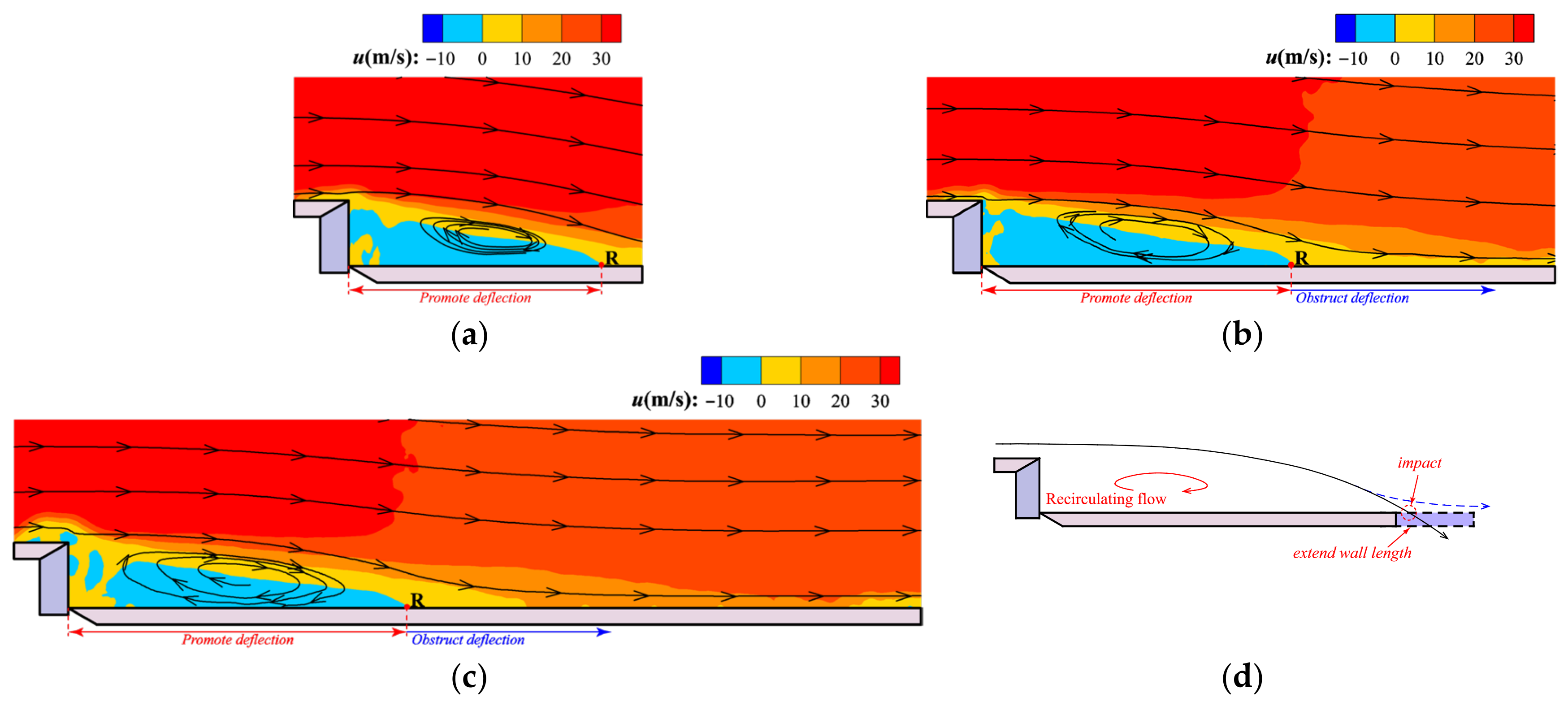
Figure 10 gives the influence of wall length variation on flow structures. When the valve is fully closed, the size of the near-wall separation bubble as well as the reattachment point R remains essentially consistent across different wall lengths. In Figure 10a, due to the short wall, the jet deviates around the separation bubble and exits the nozzle immediately. In Figure 10b,c, the long wall causes the jet to flow along the wall for a considerable distance after bypassing the separation bubble. The results show that the size of the separation bubble remains consistent under different wall lengths. When we compare the flow structures in Figure 10 with the pressure features in Figure 9b, it is observed that the region of the separation bubble with negative pressure promotes jet deflection, whereas the wall–jet region downstream of the reattachment point R obstructs it.
The topological structure of the flow shown in Figure 10d can explain the effect of the wall length on the maximum vector angle. When the wall is short, the jet flows around the separation bubble and forms a downward deflection angle as it passes the trailing edge of the wall. In such a case, if we extend the wall length, as shown by the blue dashed area in Figure 10d, the jet flow will impact the extended wall surface, and the flow direction recovers upward due to the obstruction of the wall surface. Therefore, an increase in wall length can lead to a decrease in the jet vectoring angle.

3.4. Mechanism of Jet Vectoring Control

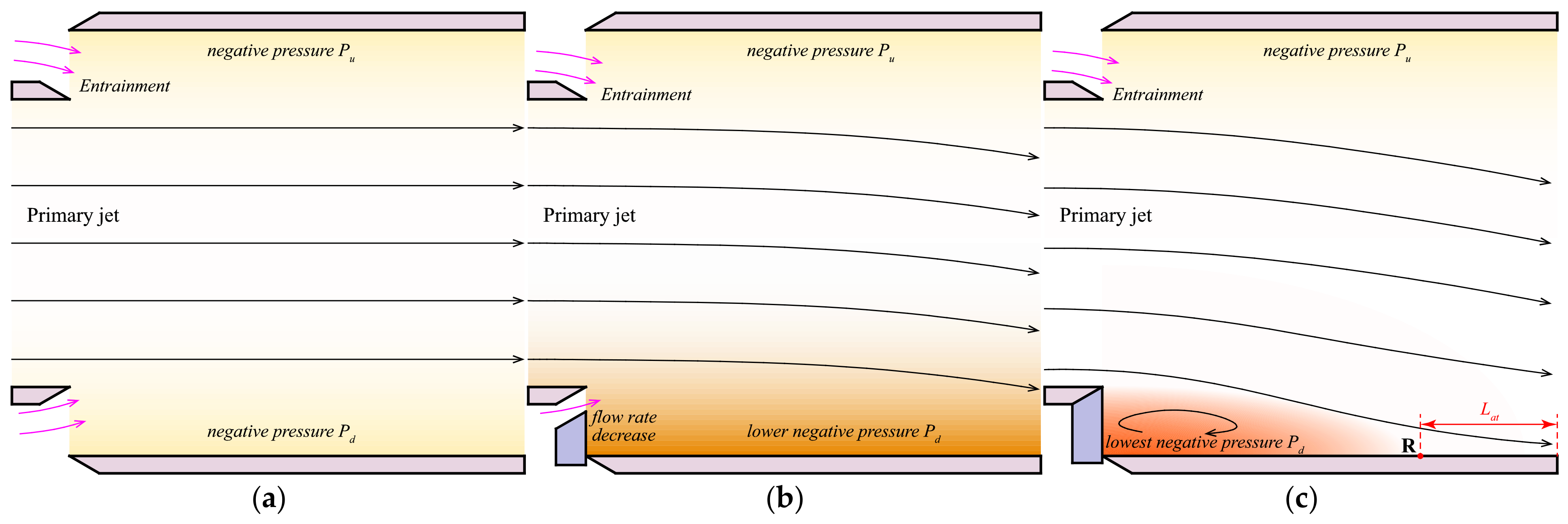
Starting with a free jet, we place two parallel walls on either side of the jet, with an unobstructed offset between the wall leading edge and the jet, as shown in Figure 11a. When the jet flows into this region, the velocity difference between the jet and the stationary fluid creates a shear layer, whose entrainment effect continuously carries away the surrounding fluid. This phenomenon creates a region of negative pressure between the primary jet and the wall, with the pressure on the upward and downward sides being essentially the same (Pu = Pd). Because the pressure of the near-wall region is lower than the ambient pressure, the external fluid enters the flow field through the upper and lower offset inlets, creating two passive secondary flows. The inflow of the secondary flow supplements the entrainment of the primary jet and establishes a pressure equilibrium of the non-vectored jet shown in Figure 11a.
When a valve is activated, it will cause changes in the flow and pressure characteristics. As shown in Figure 11b, the direct effect of the valve’s presence is a reduction in the width of the secondary flow channel on the downward side, which decreases the secondary flow rate. Meanwhile, the entrainment of the primary jet remains ongoing, causing a drop in pressure in the lower near-wall area. Furthermore, changes in pressure create a pressure difference between the upper and lower sides of the primary jet (Pu > Pd), driving the jet to deflect. Consequently, the activation of the valve can cause a pressure imbalance, which generates the driving force for jet deflection.
Finally, when the valve is completely closed, the primary jet reattaches the wall at point R and flows along the wall, as shown in Figure 11c. The pressure is lowest in the separation bubble near the leading edge of the wall, and the pressure difference (PuPd) reaches its maximum at this point. If the wall is longer, the length Lat over which the jet adheres is longer, thus reducing the angle of jet deflection.
In conclusion, the key principles of vectoring control for bilateral parallel offset jets can be summarized as the following two aspects:
  • The two parallel offset walls impose a bilateral symmetric constraint on the jet, generating equal negative pressure on both sides of the jet, which keeps the jet in the non-vectored state;
  • The valve can control the flow rate of the secondary flow, thereby altering the pressure in the near-wall region and creating a pressure difference on either side of the jet, which finally drives the jet to deflect.

4. Conclusions

In this research, we have outlined a new bilateral parallel offset jet model that provides concise and passive jet deflection control capabilities at a low Reynolds number. The flow characteristics, including deflection force, wall pressure distribution, and flow structures, were investigated. The study identified the key flow structures and their evolution during jet deflection, including passive secondary flow, shear layer, boundary layer, and separation bubble. During the jet deflection process, we observed the formation, dissipation, and interaction of the aforementioned flow structures, thereby elucidating the mechanism of jet vectoring control. In addition, the effect of the wall length on vectoring control characteristics was investigated. Our main findings are listed as follows:
  • For a moderate wall length L* = 1.5, the valve can provide effective and continuous deflection control of bilateral parallel offset jets with a maximum thrust vectoring angle of 6.4°.
  • The mechanism of jet vectoring control can be described as follows: The constraints imposed by the wall create equal negative pressure on both sides of the jet. The valve’s actuation alters the flow rate of the passive secondary flow and changes the pressure on its side, which results in a variation in the pressure difference, thereby driving the jet to deflect.
  • The length of the wall is directly proportional to its ability to constrain the jet. For a short wall length, the negative pressure in the near-wall area is not sufficiently low, limiting the valve’s ability to control the pressure difference, and the jet cannot be significantly deflected. For a long wall length, the impact of the jet against the trailing edge of the wall obstructs jet deflection; therefore, extending the wall is not conducive to jet vectoring control.
This research proposed the bilateral parallel offset jet model with a non-expanding configuration, which provides a new thrust vectoring control scheme characterized by a compact afterbody. However, this study mainly focused on the two-dimensional jet at a low Reynolds number and the jet with higher velocities, as well as the transverse flow characteristics, which require further investigation.

Author Contributions

Conceptualization, N.S. and Y.G.; methodology, N.S.; software, N.S. and G.L.; validation, G.L. and C.Z.; formal analysis, N.S. and Y.G.; investigation, N.S., Y.G., Y.Z. and J.G.; resources, T.X.; data curation, J.G.; writing—original draft preparation, N.S., Y.Z. and J.G.; writing—review and editing, Y.G., T.X. and C.Z.; visualization, N.S. and Y.Z.; supervision, T.X. and G.L.; project administration, Y.G.; funding acquisition, Y.G., T.X. and G.L. All authors have read and agreed to the published version of the manuscript.

Funding

The work was supported by the National Natural Science Foundation of China under Grant no. 12472274.

Data Availability Statement

The original contributions presented in this study are included in the article. Further inquiries can be directed to the corresponding author.

Conflicts of Interest

The authors declare no conflict of interest.

Nomenclature

u, v, wVelocity components in the x-, y-, and z-directions
uAType A evaluations of uncertainty
vVelocity of the jet at the outlet
x, y, zAxis of coordinates
xPDistance from point P to the leading edge of the wall
γNonlinear error
δvClosure percentage of the secondary flow valve
θTThrust vectoring angle
μKinematic viscosity of air
ρDensity of air
ωzVorticity in the z-direction
CpPressure coefficient
GOffset of the secondary flow channel
HHeight of the jet at the outlet
LLength of the parallel wall
L*Non-dimensional length of the parallel wall
Tx, TyThrust components in the x- and y-directions
WWidth of the parallel wall
ReReynolds number
CCDCharge-coupled device
DAQData acquisition
FTVCFluidic thrust vectoring control
Nd: YAGNeodymium-doped yttrium aluminum garnet
MTVCMechanical thrust vectoring control
PIVParticle image velocimetry
TVCThrust vectoring control

References

  1. Smith, B.L.; Glezer, A. Jet vectoring using synthetic jets. J. Fluid Mech. 2002, 458, 1–34. [Google Scholar] [CrossRef]
  2. Zhang, Y.Q.; Xu, J.L.; Cao, M.L.; Pan, R.F.; Huang, S. Numerical investigation of dynamic characteristics of dual throat nozzle and bypass dual throat nozzle in thrust vectoring starting process. Chin. J. Aeronaut. 2024, 37, 184–206. [Google Scholar] [CrossRef]
  3. Zhou, Y.H.; Gu, Y.S.; Li, L.K.; Wang, Y.; Shi, N.X.; Huang, Z. Research on fluidic thrust vector technology based on passive secondary flow with dual inclined walls under low subsonic speed. Exp. Therm. Fluid Sci. 2024, 155, 111200. [Google Scholar] [CrossRef]
  4. Gal-Or, B. Thrust vectoring for flight control & safety: A review. Int. J. Turbo Jet Engines 1994, 11, 119–138. [Google Scholar]
  5. Horinouchi, S. Noise reduction by thrust vectoring for supersonic business jet. ICAS 2008, 4, 1–8. [Google Scholar]
  6. Francis, M.S. Air vehicle management with integrated thrust-vector control. AIAA J. 2018, 56, 4741–4751. [Google Scholar] [CrossRef]
  7. Das, A.K.; Acharyya, K.; Mankodi, T.K.; Saha, U.K. Fluidic thrust vector control of aerospace vehicles: State-of-the-art review and future prospects. J. Fluids Eng. 2023, 145, 080801. [Google Scholar] [CrossRef]
  8. Xue, F.; Gu, Y.S.; Wang, Y.C.; Qin, H. Research on control effectiveness of fluidic thrust vectoring. Sci. Prog. 2021, 104, 1–17. [Google Scholar] [CrossRef] [PubMed]
  9. Shi, N.X.; Gu, Y.S.; Zhou, Y.H.; Wang, L.X.; Feng, C.; Li, L.K. Mechanism of hysteresis and uncontrolled deflection in jet vectoring control based on Coanda effect. Phys. Fluids 2022, 34, 084107. [Google Scholar] [CrossRef]
  10. Wu, K.X.; Zhu, A.Q.; Sethuraman, V.R.P.; Su, X.H. Hysteresis behaviors in shock-induced thrust vector control. Phys. Fluids 2025, 37, 036127. [Google Scholar] [CrossRef]
  11. Kaya, M.N. Shock-boundary layer interaction in transonic flows: Evaluation of grid resolution and turbulence modeling effects on numerical predictions. Comput. Model. Eng. Sci. 2025, 145, 327. [Google Scholar] [CrossRef]
  12. Younes, K.; Hickey, J.P. Fluidic thrust shock-vectoring control: A sensitivity analysis. AIAA J. 2020, 58, 1887–1890. [Google Scholar] [CrossRef]
  13. Xu, J.L.; Gu, R.; Huang, S. Exploring the impact of vector thrust on aircraft maneuverability utilizing bypass dual throat nozzle technology. Aerosp. Sci. Technol. 2025, 156, 109765. [Google Scholar] [CrossRef]
  14. Pan, R.F.; Xu, J.L.; Zhang, Y.Q.; Li, Y.; Huang, S. Numerical simulation and experiment of a bypass dual throat nozzle with tab modification. Aerosp. Sci. Technol. 2024, 144, 108816. [Google Scholar] [CrossRef]
  15. Zhang, Y.Q.; Xu, J.L.; Pan, R.F.; Li, Y.; Ma, Z.; Huang, S. Numerical investigation of short takeoff and landing exhaust system using bypass dual throat nozzle. Aerosp. Sci. Technol. 2023, 138, 108316. [Google Scholar] [CrossRef]
  16. Wu, K.X.; Kim, H.D.; Jin, Y.Z. Fluidic thrust vector control based on counter-flow concept. Proc. Inst. Mech. Eng. Part G 2018, 223, 1412–1422. [Google Scholar] [CrossRef]
  17. Wu, K.X.; Kim, T.H.; Kim, H.D. Sensitivity analysis of counterflow thrust vector control with a three-dimensional rectangular nozzle. J. Aerosp. Eng. 2021, 34, 04020107. [Google Scholar] [CrossRef]
  18. Wen, X.; Zhou, K.W.; Liu, P.C.; Zhu, H.J.; Wang, Q.; Liu, Y.Z. Schlieren visualization of coflow fluidic thrust vectoring using sweeping jets. AIAA J. 2022, 60, 435–444. [Google Scholar] [CrossRef]
  19. Banazadeh, A.; Saghafi, F. An investigation of empirical formulation and design optimization of co-flow fluidic thrust vectoring nozzles. Aeronaut. J. 2017, 121, 213–236. [Google Scholar] [CrossRef]
  20. Maruyama, Y.; Sakata, M.; Takahashi, Y. Performance analyses of fluidic thrust vector control system using dual throat nozzle. AIAA J. 2022, 60, 1730–1744. [Google Scholar] [CrossRef]
  21. Deere, K.A. Summary of fluidic thrust vectoring research at NASA Langley Research Center. In 21st AIAA Applied Aerodynamics Conference, Orlando, Florida; AIAA Paper 2003-3800; AIAA: Reston, VA, USA, 2003. [Google Scholar]
  22. Xiao, Z.Y.; Jiang, X.; Mou, B.; Chen, Z.B. Advances in fluidic thrust vectoring technique research. J. Exp. Fluid Mech. 2017, 31, 8–15. [Google Scholar]
  23. Panitz, T.; Wasan, D.T. Flow attachment to solid surfaces: The Coanda effect. AIChE J. 1972, 18, 51–57. [Google Scholar] [CrossRef]
  24. Coanda, H. Procédé de Propulsion Dans un Fluide; République Française: FR762688, 16 April 1934. Available online: https://data.inpi.fr/brevets/FR762688?q=Procede%20de%20propulsion%20dans%20un%20fluide#FR762688 (accessed on 4 May 2026). (In French)
  25. Bradshaw, P. Effects of Streamline Curvature on Turbulent Flow; AGARD-AG-169; STO: Brussels, Belgium, 1973. [Google Scholar]
  26. Cutbill, S. A Study of the Turbulent Flow of a High Speed Coanda Jet. Ph.D. Dissertation, Durham University, Durham, UK, 1998. [Google Scholar]
  27. Métral, A.; Zerner, F. L’effet Coanda. French Pub. Sci. et Tech. du Min. de 1′Air 218, 1948. Available online: https://wikimonde.com/article/Effet_Coand%C4%83 (accessed on 4 May 2026). (In French)
  28. Keller, J.B. Teapot Effect. J. Appl. Phys. 1957, 28, 859–864. [Google Scholar] [CrossRef]
  29. Dey, S.; Ali, S.Z. Scaling laws of turbulent wall-jet scour: Planar and circular wall jets. Phys. Fluids 2025, 37, 021401. [Google Scholar] [CrossRef]
  30. Djenidi, L.; Agrawal, A. Reappraisal of plane wall jet self-similarity. Phys. Fluids 2024, 36, 045126. [Google Scholar] [CrossRef]
  31. Yuan, W.W.; Huang, Y.; Zhang, H.Z. Study of the thickness of the liquid film formed by a round water jet impinging on a curved cylindrical wall. Phys. Fluids 2023, 35, 053602. [Google Scholar]
  32. Assoudi, A.; Habli, S.; Saïd, N.M.; Bournot, H.; Palec, G.L. Experimental and numerical study of an offset jet with different velocity and offset ratios. Eng. Appl. Comput. Fluid Mech. 2015, 9, 490–512. [Google Scholar] [CrossRef]
  33. Li, Z.W.; Xiao, Y.; Huai, W.X.; Ding, L.F. Velocity characteristics of a round offset jet with different offset ratios in a counterflow. Flow Turbul. Combust. 2021, 107, 81–104. [Google Scholar] [CrossRef]
  34. Glauert, M.B. The wall jet. J. Fluid Mech. 1956, 1, 625–643. [Google Scholar] [CrossRef]
  35. Bakke, P. An experimental investigation of a wall jet. J. Fluid Mech. 1957, 2, 467–472. [Google Scholar] [CrossRef]
  36. Schwarz, W.H.; Cosart, W.P. The two-dimensional turbulent wall-jet. J. Fluid Mech. 1961, 10, 481–495. [Google Scholar] [CrossRef]
  37. Newman, B.G.; Patel, R.P.; Savage, S.B.; Tjio, H.K. Three-dimensional wall jet originating from a circular orifice. Aeronaut. Q. 1971, 23, 188–200. [Google Scholar] [CrossRef]
  38. Kruka, V.; Eskinazi, S. The wall-jet in a moving stream. J. Fluid Mech. 1964, 20, 555–579. [Google Scholar] [CrossRef]
  39. Gartshore, I.S. The Streamwise Development of Two-Dimensional Wall Jets and Other Two-Dimensional Turbulent Shear Flows. Ph.D. Dissertation, McGill University, Montreal, QC, Canada, 1965. [Google Scholar]
  40. Irwin, H.P.A.H. Measurements in a self-preserving plane wall jet in a positive pressure gradient. J. Fluid Mech. 1973, 61, 33–63. [Google Scholar] [CrossRef]
  41. Ramaprian, B.R. Turbulence measurements in an ‘equilibrium’ axisymmetric wall jet. J. Fluid Mech. 1975, 71, 317–338. [Google Scholar] [CrossRef]
  42. Kim, M.; Kim, H.D.; Yeom, E.; Kim, K.C. Flow characteristics of 3D curved wall jets on a cylinder. J. Fluids Eng. 2018, 140, 041201. [Google Scholar] [CrossRef]
  43. Sawyer, R.A. The flow due to a two-dimensional jet issuing parallel to a flat plate. J. Fluid Mech. 1960, 9, 543–559. [Google Scholar] [CrossRef]
  44. Fekete, G.I. Coanda Flow of a Two-Dimensional Wall Jet on the Outside of a Circular Cylinder. Ph.D. Dissertation, McGill University, Montreal, QC, Canada, 1963. [Google Scholar]
  45. Newman, B.G. The deflection of plane jets by adjacent boundaries-Coanda effect. In Boundary Layer & Flow Control; Pergamon Press: Oxford, UK, 1961; pp. 232–264. [Google Scholar]
  46. Patankar, U.M.; Sridhar, K. Three-dimensional curved wall jets. J. Basic Eng. 1972, 94, 339–344. [Google Scholar] [CrossRef]
  47. Neuendorf, R.; Wygnanski, I. On a turbulent wall jet flowing over a circular cylinder. J. Fluid Mech. 1999, 381, 1–25. [Google Scholar] [CrossRef]
  48. Han, G.; Zhou, M.; Wygnanski, I. On streamwise vortices and their role in the development of a curved wall jet. Phys. Fluids 2006, 18, 095104. [Google Scholar] [CrossRef]
  49. Nozaki, T.; Hatta, K.; Nakashima, M.; Matsumura, H. Reattachment flow issuing from a finite width nozzle. Bull. JSME 1979, 22, 340–347. [Google Scholar] [CrossRef]
  50. Bourque, C.; Newman, B.G. Reattachment of a two-dimensional, incompressible jet to an adjacent flat plate. Aeronaut. Q. 1960, 11, 201–232. [Google Scholar] [CrossRef]
  51. Sawyer, R.A. Two-dimensional reattaching jet flows including the effects of curvature on entrainment. J. Fluid Mech. 1963, 17, 481–498. [Google Scholar] [CrossRef]
  52. Lund, T.S. Augmented thrust and mass flow associated with two-dimensional jet reattachment. AIAA J. 1986, 24, 1964–1970. [Google Scholar] [CrossRef]
  53. Yoon, S.H.; Kim, K.C.; Kim, D.S.; Chung, M.K. Comparative study of a turbulent wall-attaching offset jet and a plane wall jet. J. Mech. Sci. Technol. 1993, 7, 101–112. [Google Scholar] [CrossRef]
  54. Nasr, A.; Lai, J.C.S. A turbulent plane offset jet with small offset ratio. Exp. Fluids 1998, 24, 47–57. [Google Scholar] [CrossRef]
  55. Nyantekyi-Kwakye, B.; Clark, S.; Tachie, M.F.; Malenchak, J.; Muluye, G. Flow characteristics and structure of 3D turbulent offset jets. In Fluids Engineering Division Summer Meeting; American Society of Mechanical Engineers: New York, NY, USA, 2014. [Google Scholar]
  56. Assoudi, A.; Saïd, N.M.; Bournot, H.; Palec, G.L. Comparative study of flow characteristics of a single offset jet and a turbulent dual jet. Heat Mass Transf. 2019, 55, 1109–1131. [Google Scholar] [CrossRef]
  57. Nasr, A.; Lai, J.C.S. Comparison of flow characteristics in the near field of two parallel plane jets and an offset plane jet. Phys. Fluids 1997, 9, 2919–2931. [Google Scholar] [CrossRef]
  58. Willert, C.E.; Gharib, M. Digital particle image velocimetry. Exp. Fluids 1991, 10, 181–193. [Google Scholar] [CrossRef]
  59. Keane, R.D.; Adrian, R.J. Optimization of particle image velocimeters. Part I: Double pulsed systems. Meas. Sci. Technol. 1990, 1, 1202–1215. [Google Scholar] [CrossRef]
  60. Mason, M.S.; Crowther, W.J. Fluidic thrust vectoring for low observable air vehicles. In 2nd AIAA Flow Control Conference, Portland, Oregon; AIAA Paper 2004-2210; AIAA: Reston, VA, USA, 2004. [Google Scholar]
  61. Jahanbakhshi, R.; Madnia, C.K. Entrainment in a compressible turbulent shear layer. J. Fluid Mech. 2016, 797, 564–603. [Google Scholar] [CrossRef]
  62. Monti, P.; Querzoli, G.; Cenedese, A.; Piccinini, S. Mixing properties of a stably stratified parallel shear layer. Phys. Fluids 2007, 19, 085104. [Google Scholar] [CrossRef]
  63. Nicholls, C.J.; Tang, B.M.T.; Turner, J.; Bacic, M. An analytical model of the dynamics of reattaching jets. Phys. Fluids 2023, 35, 115134. [Google Scholar] [CrossRef]
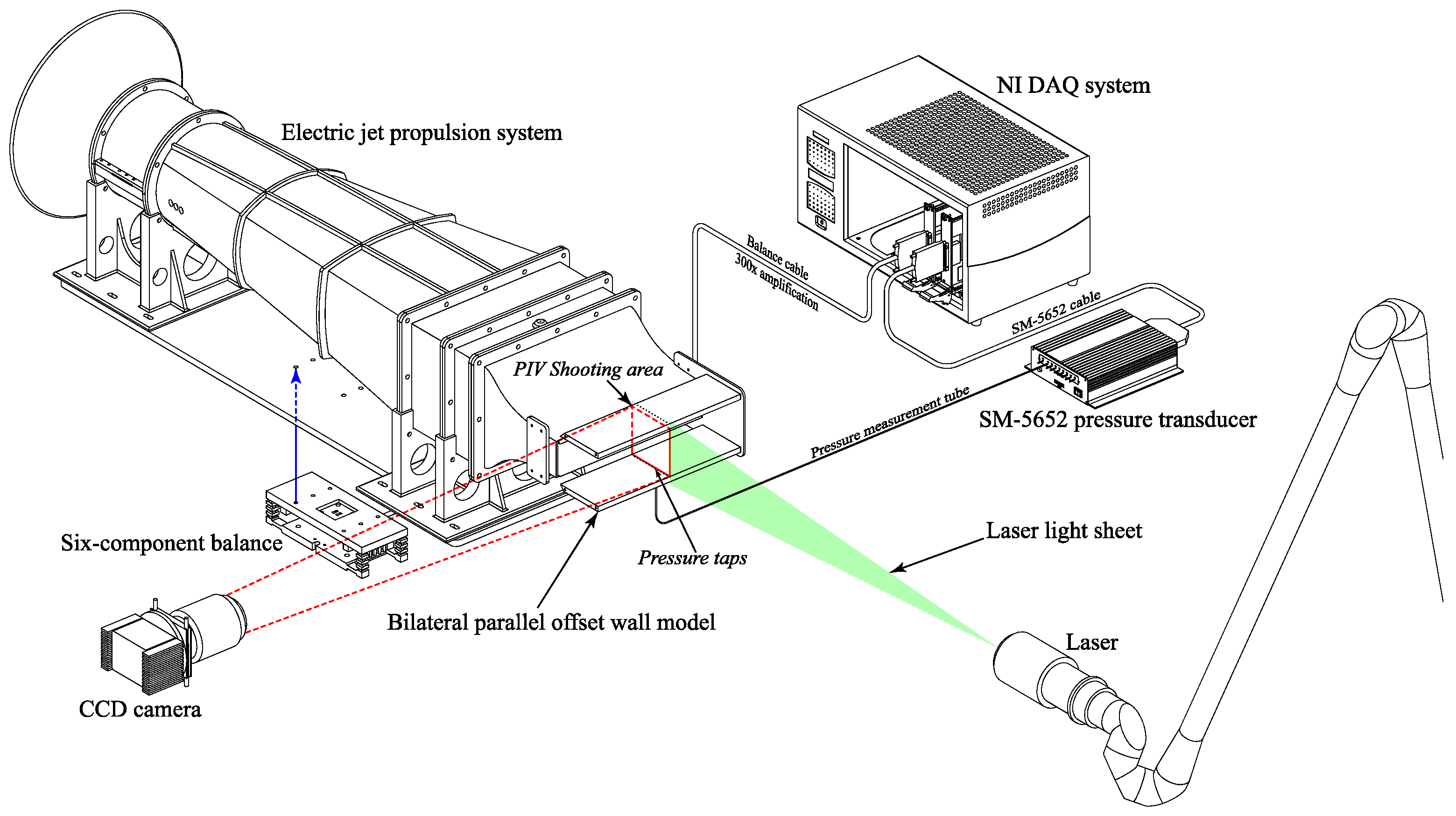
Figure 1. A schematic highlighting salient features of the experimental facility.
Aerospace 13 00443 g001
Figure 2. A sketch of the bilateral parallel offset wall model.
Aerospace 13 00443 g002
Figure 3. The flow characteristics of a non-vectored bilateral parallel offset jet. (a) The time-averaged velocity. (b) The time-averaged velocity component u in the x-direction. (c) The vorticity in the z-direction. (d) The topological structures of the flow field (v = 30 m/s, Re = 8.2 × 10⁴, and L* = 1.5).
Aerospace 13 00443 g003aAerospace 13 00443 g003b
Figure 4. The flow characteristics of a vectored bilateral parallel offset jet. (a) The time-averaged velocity. (b) The time-averaged velocity component u in the x-direction. (c) The vorticity in the z-direction. (d) The topological structures of the flow field (v = 30 m/s, Re = 8.2 × 10⁴, L* = 1.5).
Aerospace 13 00443 g004
Figure 5. The control law of thrust vectoring angle (v = 30 m/s, Re = 8.2 × 10⁴, and L* = 1.5).
Aerospace 13 00443 g005
Figure 6. The evolution of velocity component u in the x-direction and vorticity in the z-direction during jet deflection control. (a) δv = 0%. (b) δv = 20%. (c) δv = 40%. (d) δv = 60%. (e) δv = 80%. (f) δv = 100% (v = 30 m/s, Re = 8.2 × 10⁴, and L* = 1.5).
Aerospace 13 00443 g006
Figure 7. Evolution of the wall pressure characteristics during jet downward deflection. (a) Wall pressure distribution. (b) Wall pressure difference (v = 30 m/s, Re = 8.2 × 10⁴, and L* = 1.5).
Aerospace 13 00443 g007
Figure 8. The control law of the thrust vectoring angle at different wall lengths (v = 30 m/s and Re = 8.2 × 10⁴).
Aerospace 13 00443 g008
Figure 9. The wall pressure characteristics at different wall lengths. (a) The wall pressure distribution of a non-vectored jet (δv = 0%). (b) The wall pressure difference distribution of a vectored jet (δv = 100%) (v = 30 m/s and Re = 8.2 × 10⁴).
Aerospace 13 00443 g009
Figure 10. The distribution of velocity component u in the x-direction at different wall lengths. (a) L* = 1. (b) L* = 2. (c) L* = 3. (d) The topological structures of the flow field (v = 30 m/s and Re = 8.2 × 10⁴).
Aerospace 13 00443 g010
Figure 11. The flow patterns of vectoring control for a bilateral parallel offset jet. (a) The pressure equilibrium of a non-vectored jet. (b) The pressure imbalance caused by valve closure. (c) The pressure equilibrium of a vectored jet.
Aerospace 13 00443 g011
Table 1. The technical specifications of the six-component balance.
FxFyFzMxMyMz
Range (N, N∙m)32015112
Accuracy (%F.S.)0.440.170.320.380.260.42
Precision (%F.S.)0.180.080.070.120.090.10
Table 2. The results of the balance measurements (v = 30 m/s, Re = 8.2 × 10⁴, and L* = 1.5).
δv (%)0102030405060708090100
θT (°)0.450.460.631.141.872.673.424.465.416.156.43
uA (°)0.220.240.170.260.170.310.180.190.240.180.30
Tx (kg)−1.56−1.56−1.57−1.57−1.57−1.58−1.57−1.58−1.56−1.58−1.57
Ty (kg)0.010.010.020.030.050.070.090.120.150.170.18
Disclaimer/Publisher’s Note: The statements, opinions and data contained in all publications are solely those of the individual author(s) and contributor(s) and not of MDPI and/or the editor(s). MDPI and/or the editor(s) disclaim responsibility for any injury to people or property resulting from any ideas, methods, instructions or products referred to in the content.