1. Introduction
The problem of reaching a target point from a specified direction has been extensively studied over the past several decades. This research is primarily motivated by guidance requirements for spacecraft, reentry vehicles, and tactical interceptors, where the objective is typically to maximize the lethality of directional warheads or to minimize miss distances caused by navigation errors. Controlling the velocity vector orientation is not limited to the terminal phase of flight; effective midcourse guidance is often essential to satisfy terminal phase assumptions regarding small heading errors or to ensure precise waypoint tracking.
Because of its widespread use, this problem formulation is rooted in applications beyond aerospace [
1,
2]. Early guidance laws that addressed both intercept and impact angle requirements emerged from the optimal rendezvous problem [
3], which was later categorized as a form of trajectory shaping guidance [
4]. Another notable contribution was the explicit guidance framework originally derived for spacecraft landing [
5], which was later generalized to other guidance applications in [
6].
The study by Kim and Grider [
7] is widely regarded as the pioneering work in impact-angle guidance, in which the authors addressed vertical impact against stationary or slow-moving targets. This research was directly extended by the authors of [
8], who examined the effects of control system delays and angle of attack. Song et al. [
9] considered optimal guidance of a variable-speed pursuer against a maneuvering target. The resulting guidance law coefficients are formulated as functions of time-to-go and the constant describing the change in pursuer speed. A systematic classification of optimal impact-angle guidance laws was conducted by Ryoo et al. [
10], relying on the fact that all such methods are similar to linear-quadratic guidance laws. The contribution of their study is a procedure valid for arbitrary missile dynamics against stationary targets, with closed-form guidance solutions provided for both ideal and first-order autopilot models. The same authors generalized these methods in [
11] by minimizing a cost function equivalent to the one used in the explicit guidance formulation of [
6]. In [
12], an optimal guidance law for maneuvering targets based on linear-quadratic control and differential game theory was proposed. A similar methodology was employed in [
13], where the terminal attitude was considered instead of the final flight path angle.
Beyond spacecraft-specific methods, the nonlinear formulation of the optimal impact-angle guidance problem was first addressed in Refs. [
14,
15]. The specific parameters of the guidance law must be determined numerically by solving a system of three or four nonlinear equations involving elliptic integrals, with the optimal solution selected by comparing two candidate results. Although the optimality of proportional navigation for linearized kinematics was demonstrated in [
3], its relationship to nonlinear models was not explored in detail until the study on nonlinear optimal guidance by Lu and Chavez [
16]. However, the specific procedure for determining the unknown parameters of the guidance law was not provided. By solving the state-dependent Riccati equation, Ratnoo and Ghose [
17] proposed an optimal guidance law, requiring both time-to-go information and the selection of a navigation constant, for which a formal procedure was not given to determine its optimal value.
Over the past decade, the disciplines of guidance and control have undergone a paradigm shift towards computational guidance and control (CG&C) [
18], leading to substantial progress in many branches of aerospace science [
19]. Although computational methods have become increasingly efficient, their use is primarily justified when traditional optimization approaches do not meet real-time requirements. Solving the two-point boundary value problem (TPBVP) associated with indirect methods [
20] is often computationally prohibitive for high-speed guidance. However, if an indirect formulation can be simplified to allow for a rapid numerical solution, it remains highly favorable due to its high solution accuracy. For these reasons, traditional methods remain the subject of active research.
Chen and Shima [
21] addressed nonlinear optimal guidance against stationary targets, providing a procedure that reduces the problem to the numerical solution of a nonlinear equation involving elliptic integrals using the bisection method. A mixed cost function incorporating both control energy and flight time was used, as it was demonstrated that the classical formulation (minimizing only control energy) is ill-posed and lacks a global solution. However, this proof relies on the assumption that the range is not a monotonically increasing function, whereas real-world engagement scenarios naturally exclude such looping trajectories. In [
22], an optimal guidance law based on a nonlinear kinematic model was developed. This formulation generalizes several existing linear guidance laws, which are shown to be special cases under small-angle approximations. The resulting nonlinear guidance law is defined by two parameters selected to achieve the desired convergence rate toward the target direction. A recent study [
23] addressed 3-D optimal guidance against stationary targets without linearization. Efficiency is achieved by parameterizing the TPBVP states and costates using splines. Although the execution times reported were near 15 ms, reliance on polynomial approximations classifies it as a method that simplifies the original TPBVP.
Beyond optimal control theory, there are several robust impact-angle frameworks: biased proportional navigation [
24,
25,
26,
27], sliding mode control [
28,
29,
30], circular navigation guidance [
31], differential geometric guidance [
32], and LOS angle guidance [
33]. Despite their practical utility, these methods remain strictly non-optimal.
As established in the preceding review, achieving a purely optimal solution for the nonlinear guidance problem via traditional indirect methods remains a challenge. Although analytical approximations and computational simplifications exist, the original TPBVP has not yet been resolved to a degree that allows for reliable real-time implementation on resource-constrained embedded hardware without compromising optimality.
This paper addresses this gap by proposing a novel algorithm designed to solve the nonlinear optimal guidance problem directly, avoiding any form of linearization. In this work, optimality is defined in terms of minimizing the total control effort. In contrast to the majority of guidance laws that pursue this objective within a linearized framework, the proposed formulation is fully nonlinear and therefore remains valid without relying on small-heading-error approximations. Among approaches that also consider the nonlinear problem, several key distinctions arise. In contrast to Ref. [
21], which addresses interception without a prescribed terminal flight-path angle, the present formulation explicitly incorporates the impact-angle constraint. Compared to Refs. [
14,
15], where the optimal solution is obtained by solving a set of multiple nonlinear equations involving elliptic integrals, the proposed approach reduces the problem to the solution of a single nonlinear equation, thereby significantly simplifying the computational procedure. Furthermore, while Ref. [
16] derives a closed-form feedback structure for the optimal control, achieving both interception and a desired impact angle, it does not provide a practical method for computing the associated unknown parameters, particularly in real time. The present work addresses this limitation by introducing a deterministic and computationally efficient procedure for their evaluation. The primary contribution of this work therefore lies in its practical feasibility; the algorithm was deployed and tested on the actual hardware of operational flight vehicles. To demonstrate its real-time capability, execution times were measured under representative flight conditions. The proposed method underwent a comprehensive verification and validation process within high-fidelity simulation environments modeled after these operational systems.
The remainder of this paper is organized as follows.
Section 2 formulates the nonlinear optimal engagement problem and derives the optimal guidance law in a closed-feedback form.
Section 3 details the algorithm for determining the guidance parameters and identifies a special case where a closed-form solution exists. A comparative study between the proposed method and notable existing guidance laws is provided in
Section 4.
Section 5 addresses critical phenomena related to real-time implementation of the proposed algorithm. Finally,
Section 6 details the hardware implementation methodology, provides an analysis of execution times, and validates the algorithm via hardware-in-the-loop testing, followed by concluding remarks.
2. Statement of the Problem
Although significant contributions have been made in three-dimensional guidance, and several of the aforementioned laws are inherently spatial, many strategies still rely on multi-phase execution to reach the terminal state. Two main approaches can be distinguished in this context. One involves maneuvering the system into a specific plane containing the desired velocity vector, followed by planar guidance toward the target [
34]. The other, more traditional approach treats the three-dimensional problem by decomposing it into orthogonal planar components, typically horizontal and vertical, and solving two guidance problems. Such formulations are commonly realized through systems employing two independent guidance channels [
35,
36].
Within this framework, the planar formulation adopted in this work represents a natural building block for the design of spatial guidance. A three-dimensional guidance method can be synthesized as a vector combination of two planar guidance laws, typically defined in horizontal and vertical planes [
14]. Accordingly, the proposed method can be directly extended to three-dimensional engagements by applying the algorithm in two orthogonal planes and combining the resulting commands to obtain the full spatial guidance input.
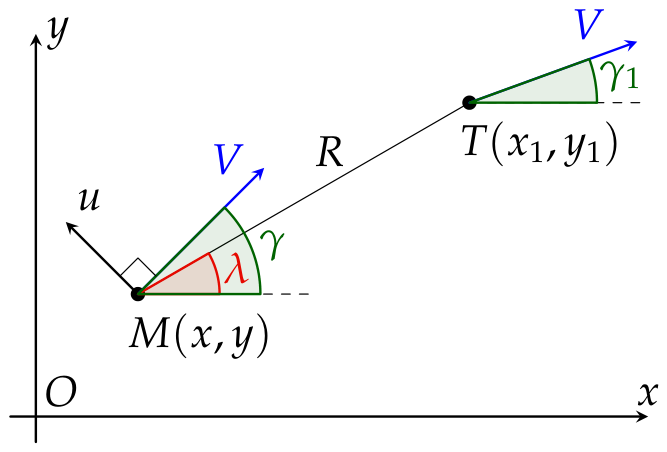
Therefore, the guidance problem is formulated using a classical planar point-mass model with constant velocity, as illustrated in
Figure 1. This assumption is widely adopted in guidance law design for tactical air vehicles, as the speed typically varies slowly and the terminal phase of the engagement is relatively short [
22]. The influence of realistic, time-varying velocity profiles is addressed in detail in
Section 5 and
Section 6.
The point M, with position coordinates , is required to reach a stationary target T located at with a prescribed terminal flight-path angle . The control variable u is defined as the lateral acceleration acting perpendicular to the velocity vector V, where a positive value corresponds to an increase in the flight-path angle . The coordinate frame is arbitrary; however, for analysis in the vertical plane, the total physical control effort must include a gravity compensation term, expressed as . The relative geometry between M and T is described by the range R and the line-of-sight (LOS) angle .
The equations of motion for this engagement problem are formulated as
with boundary conditions
The optimal control problem is to find
, subject to Equations (
1)–(
4), which minimize
where the final time
is free.
The problem is solved by applying Pontryagin’s minimum principle [
37]. The Hamiltonian is defined as
where
,
, and
are costate (adjoint) variables.
The costate equations are given by
The terminal transversality conditions are as follows:
where
, and
are Lagrange’s multipliers [
37].
Because both
and
are constant, Equations (
10) and (
11) imply that
and
.
Substituting the kinematic relations (
1) and (
2) into the costate equation (
9) and integrating from an arbitrary moment to an end yields
The extremal control is given by
From Equations (
13) and (
14), the control as a function of relative separation is expressed as
Since the final time is free, an additional transversality condition
is applied, on the basis of which
is determined:
Equation (
15) provides the optimal impact-angle guidance law in a closed-feedback form. A significant advantage of this formulation is that it relies solely on standard navigation data (position and velocity). However, to maintain a fully closed-loop implementation, the constants
,
, and
must be updated during each guidance cycle. The following section details a procedure for calculating them on the basis of instantaneous navigation information.
3. Computational Synthesis of the Guidance Law
In this section, the optimal control problem is solved by considering the system at an instantaneous state
, which represents the current feedback from the navigation computer. Consequently, Equation (
15) can be reformulated for the initial instant as
where
and
.
The unknown constants
and
in Equations (
17) and (
16) can be represented using new constants
r and
by
where
and
. On the basis of Equations (
10)–(
12) and (
14), the Hamiltonian takes the form
Because time does not appear explicitly in Equation (
6), the Hamiltonian is zero, and
can be expressed using the new constants as
A useful relation for subsequent phase trajectory analysis is obtained by combining Equations (
3), (
14), and (
20):
from which the following inequality holds:
Because
x increases monotonically in the scenario considered, the remaining variables can be expressed as functions of downrange. Dividing Equations (
2) and (
3) by Equation (
1) leads to
Substituting the square root of (
20) into Equation (
24) yields
The choice of sign in Equation (
25) is determined by the convexity of the trajectory. Because
is bounded within an interval of at most
according to (
22), it follows that
vanishes at most once. This implies that the trajectory can undergo at most one change in convexity. Consequently, four distinct cases for the sign of the flight path angle derivative may occur:
- (A)
along the entire trajectory;
- (B)
during the initial phase, followed by ;
- (C)
during the initial phase, followed by ;
- (D)
along the entire trajectory.
The relationship between
and
is obtained from Equation (
25), on the basis of which substitution into Equation (
23) yields a system of two equations:
This system must be solved to determine the two unknown quantities,
r and
, which then allow the calculation of
and
on the basis of Equation (
18). The specific solution for these variables depends on whether the convexity changes along the optimal trajectory, leading to the two cases described next.
3.1. Constant Convexity Trajectories
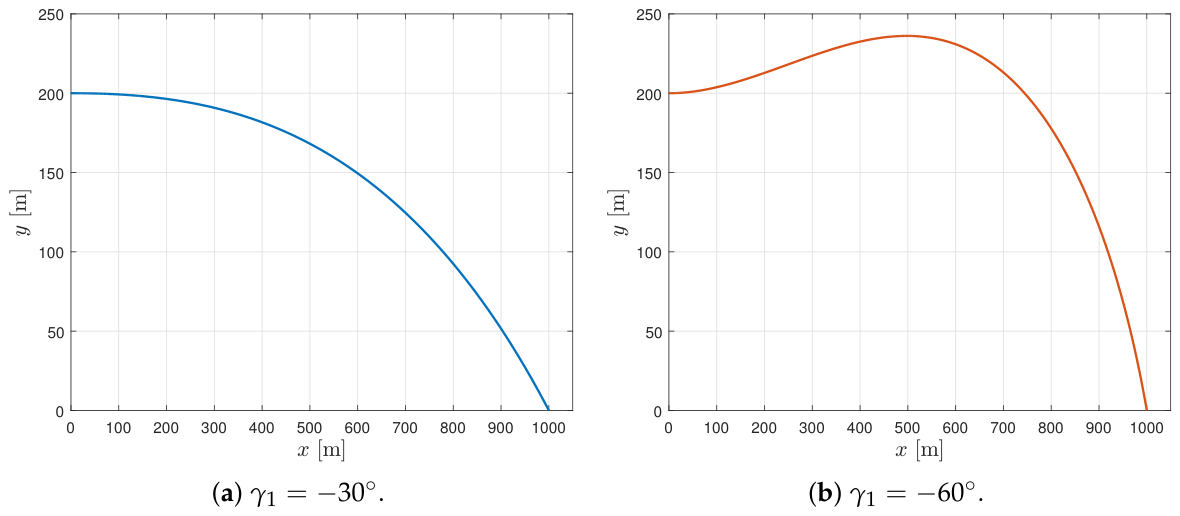
Case A implies a constant negative sign of the flight path angle derivative, corresponding to a monotonic altitude decrease. In
Figure 2a, a trajectory of this type is presented for boundary conditions representing the transition from the cruise phase to terminal guidance:
m,
m,
,
m,
m, and
, with a velocity of
m/s.
By integrating Equations (
26) and (
27), the following system is obtained:
The integrals in the preceding expressions are denoted by
and
, respectively. By introducing the change of variables
, these integrals are transformed into the following form:
In Equations (
30) and (
31), two fundamental integral types appear:
where the first one is identified as an incomplete elliptic integral of the second kind.
The final form of Equations (
30) and (
31) is expressed as
By dividing Equations (
28) and (
29), a single equation in the unknown
is obtained, defined as
, where
On the basis of the inequality (
22), the solution for
must be sought within the interval
where the maximum value of the flight path angle is used to determine the lower bound, and the minimum value is used for the upper bound
The function
is plotted over the interval defined in Equation (
38) in
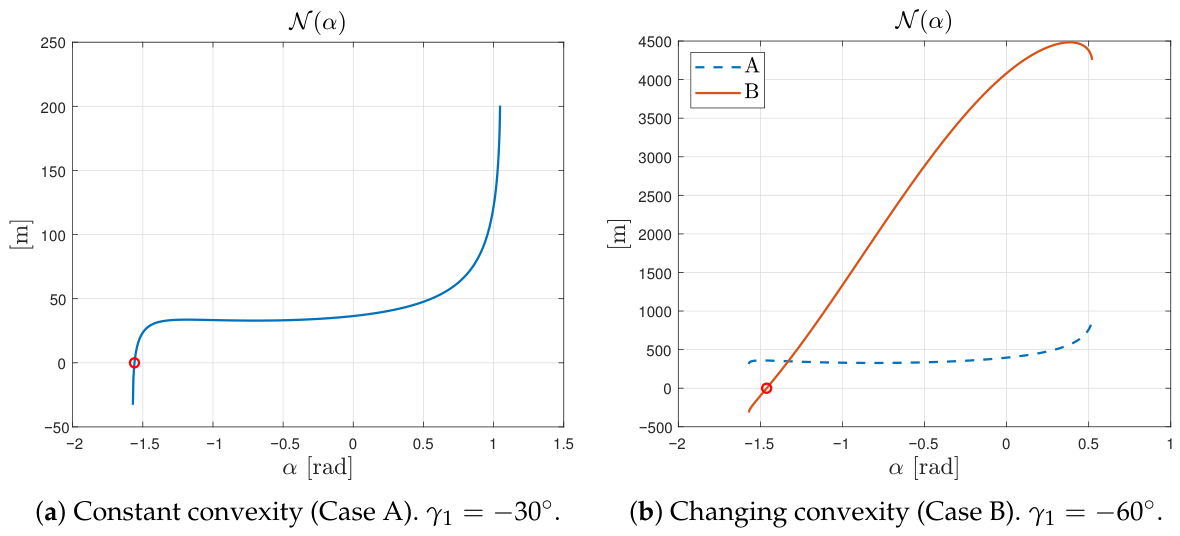
Figure 3a, corresponding to the engagement scenario previously illustrated in
Figure 2a. The zero-crossing, which identifies the numerical solution for the parameter
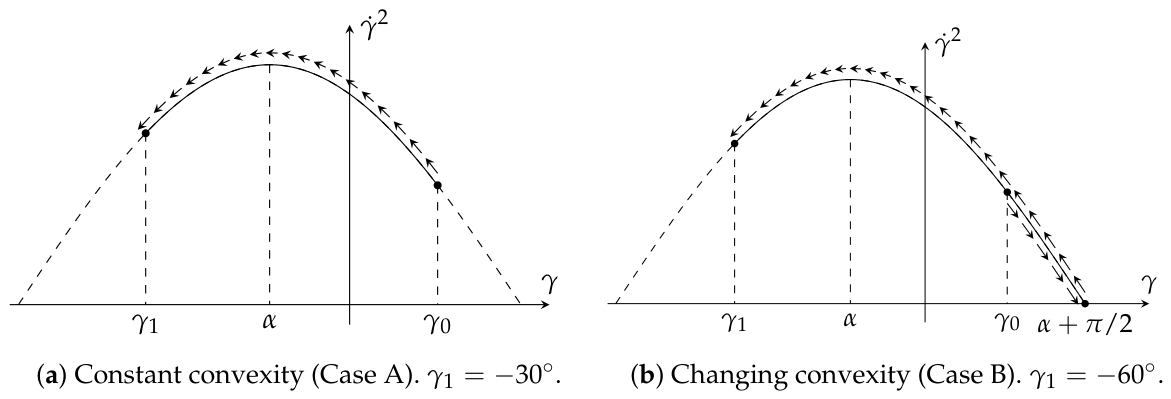
, is indicated by the red circle. A schematic representation of the phase trajectory, governed by Equation (
21), is provided in
Figure 4a.
Case D describes a constant increase in the flight path angle, representing a trajectory with fixed positive convexity. The resulting system of equations is identical to Equations (
28) and (
29), with the exception that a positive sign is applied. In the absence of a saddle point, the integrals
and
maintain the same form as in Case A. Consequently, the calculation procedure remains identical, and this case is not independently analyzed.
3.2. Changing Convexity Trajectories
This case involves an increase in the flight path angle during the initial portion of the trajectory until the saddle point is reached, after which the behavior reduces to that described in Case A. A representative trajectory of this type is presented in
Figure 2b, illustrating a transition from the cruise phase where an initial climb is required to satisfy the terminal constraints. The boundary conditions for this example are identical to those used in
Figure 2a, with the exception of the desired impact angle, which is set to
.
The schematic phase portrait, based on Equation (
21) and accounting for the existence of a saddle point where
, is shown in
Figure 4b. Because of the sign change of the derivative
along the trajectory at the point where
, the system of Equations (
26) and (
27) is expressed in the following integral form:
Following the procedure established for Case A, the same form for Equation (
36) is obtained, in which the integrals
and
are defined as
The function
for this specific scenario is illustrated in
Figure 3b, corresponding to the trajectory shown in
Figure 2b. The same function is also plotted using Equations (
34) and (
35) to demonstrate that an incorrect convexity assumption leads to no solution for
within the valid interval.
Similarly to Case B, Case C involves a change in trajectory convexity where the sign of the derivative reverses; however, this transition occurs at the point . By applying the same analytical procedure, expressions identical to those in Case B are derived, with the limit being replaced by . Because small impact angles are rarely required in practical applications, Case C is primarily encountered during trajectory corrections in the final stages of terminal guidance.
3.3. General Algorithm
A common requirement for all analyzed cases is the solution of the transcendental equation
to determine the parameter
. The various scenarios are distinguished by the specific forms of the integrals
and
, which are expressed in the following general form:
where
Once the value of
is determined, the parameter
r is calculated using either the first or second equation of the characteristic system, Equations (
28) and (
29) or Equations (
39) and (
40):
Subsequently, the parameters
and
are obtained on the basis of Equation (
18).
To complete the procedure for the closed-feedback guidance law in Equation (
17),
must be calculated using Equation (
16). This requires the prior determination of its sign. From Equations (
14) and (
12), it follows that the sign of
is governed by the trajectory convexity at the terminal moment. Consequently,
is positive for Case B and negative for Case C, whereas Case A requires further analysis.
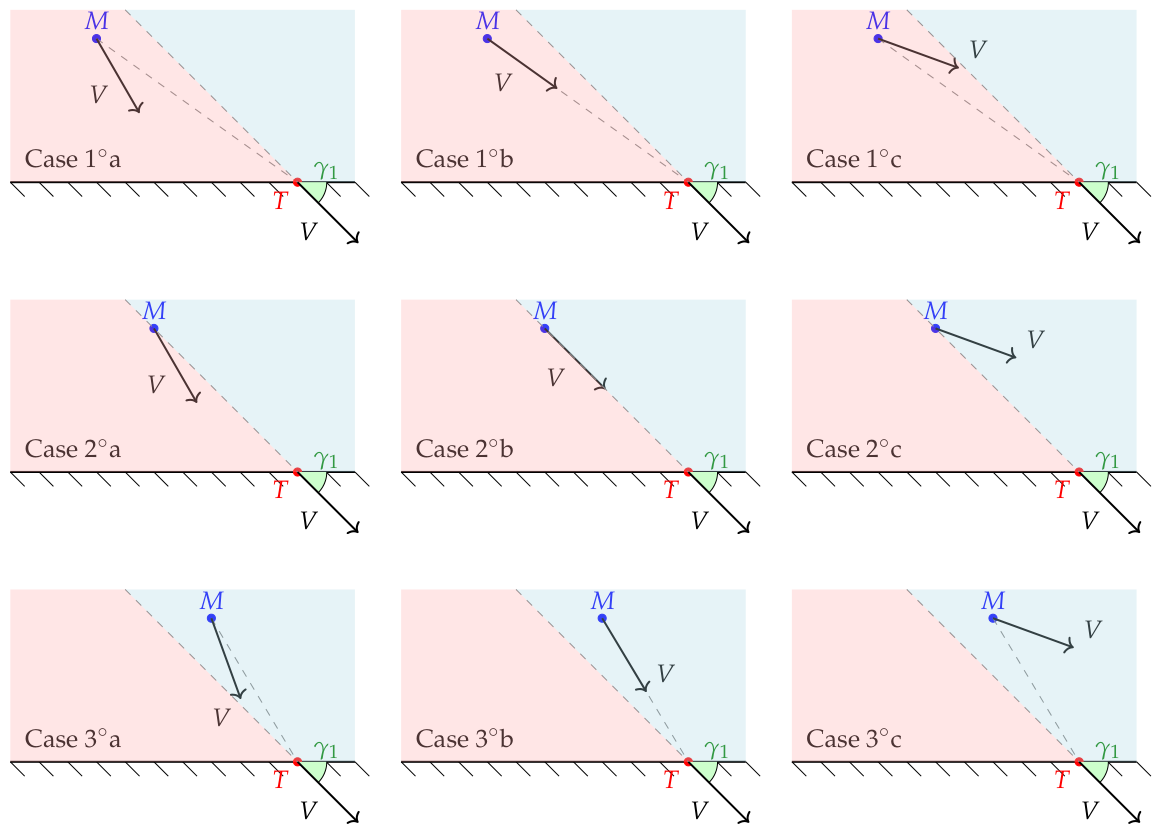
For this purpose, two characteristic regions of the engagement space are identified, leading to three distinct cases based on the relationship between
and
. The current position is categorized as being left of, right of, or directly on the line defined by the desired velocity vector at the target. These geometric configurations are illustrated in
Figure 5, where the corresponding cases are denoted as Cases
–
. The region to the left of the terminal velocity vector direction is shaded in red, while the region to the right is shaded in blue. Within each of these categories, three additional geometric subcases, denoted by a–c, are possible depending on the orientation of the initial velocity vector relative to the line of sight.
If the system is positioned along the line defined by the desired terminal velocity vector (Case ), the terminal constraints can be satisfied by a change in the convexity of the trajectory (Subcases a and c) or by a rectilinear path (Subcase b). Consequently, the procedure for Case A is not applicable in these instances, as it fundamentally assumes strictly constant convexity.
If the system is located to the left of the terminal velocity vector direction (Case
), Case A is feasible only for Subcase
c. In this scenario, the condition
is maintained throughout the engagement, which requires a positive sign for
. For example, the scenarios illustrated in
Figure 2a,b both correspond to Subcase
c; however, Case A remains valid only for the
instance. Similarly, for a system positioned to the right of the terminal velocity vector direction (Case
), Case A is applicable only for Subcase
a. Because
holds throughout the trajectory in this subcase, the sign of
must be negative.
The specific convexity case for a given engagement is generally not known a priori. As demonstrated in
Figure 3b, a solution does not exist if an invalid convexity assumption is applied. Therefore, Case A is initially assumed, and if the function
yields no solution within the specified interval, the algorithm proceeds to evaluate Case B and, if necessary, Case C.
The existence of a root is verified by evaluating the sign of
at the boundaries of the interval defined in Equation (
38). If the function maintains the same sign at both ends of the interval, the current convexity case is discarded and the next case is tested. Conversely, if a sign change is detected across the interval, the case is adopted as valid. Because the function
possesses a unique root within the considered interval, robust numerical methods such as bisection may be used to determine
. The additional computational overhead associated with testing multiple cases is negligible, as verifying the existence of a root requires only two function evaluations per case.
On the basis of this analysis, the general algorithm for calculating the optimal control is summarized next. For conciseness, the notation
with
is employed to denote the specific forms of the integrals
and
corresponding to each convexity case (Algorithm 1).
| Algorithm 1 Computation of the optimal control. |
- 1:
Input: - 2:
- 3:
- 4:
if then - 5:
Solve for - 6:
- 7:
if then - 8:
- 9:
else - 10:
- 11:
end if - 12:
else if then - 13:
Solve for - 14:
- 15:
- 16:
else if then - 17:
Solve for - 18:
- 19:
- 20:
else - 21:
- 22:
return u - 23:
end if - 24:
- 25:
- 26:
- 27:
- 28:
return u
|
3.4. Special Case: Climb Phase to Cruise Altitude
A special case of the previously defined problem is now considered, involving a specific terminal velocity vector orientation. This scenario is characteristic of an initial climb phase, followed by a transition to horizontal flight prior to cruising toward the target area where terminal guidance is eventually initiated.
The optimization problem is formulated similarly to the general case, but the boundary conditions are modified as follows:
The primary distinction from the initial optimization problem is the absence of a downrange constraint, meaning
is free and consequently
. Furthermore, because the vehicle transitions from a climb phase to horizontal flight, the final flight path angle is zero. Given that
, it follows from Equation (
16) that
is also zero.
Because of these conditions, Equation (
13) is reduced to a new form:
Consequently, Equation (
15) is modified to
To use Equation (
50) to determine the required control, both the unknown parameter
and the terminal downrange
must be identified.
Using the relationship (
49), Equation (
24) is integrated while accounting for the terminal condition of horizontal flight to obtain
By expressing
from Equation (
51), Equation (
23) is integrated to yield
By evaluating Equation (
51) at the initial condition
, the parameter
is expressed and substituted into Equation (
52) to obtain
where
Since the unknown parameters
and
are expressed in terms of the known values
,
,
, and
V, the optimal control
u is determined using Equation (
50):
By expressing the control at the initial point and omitting the index 0, the following closed-feedback form is obtained:
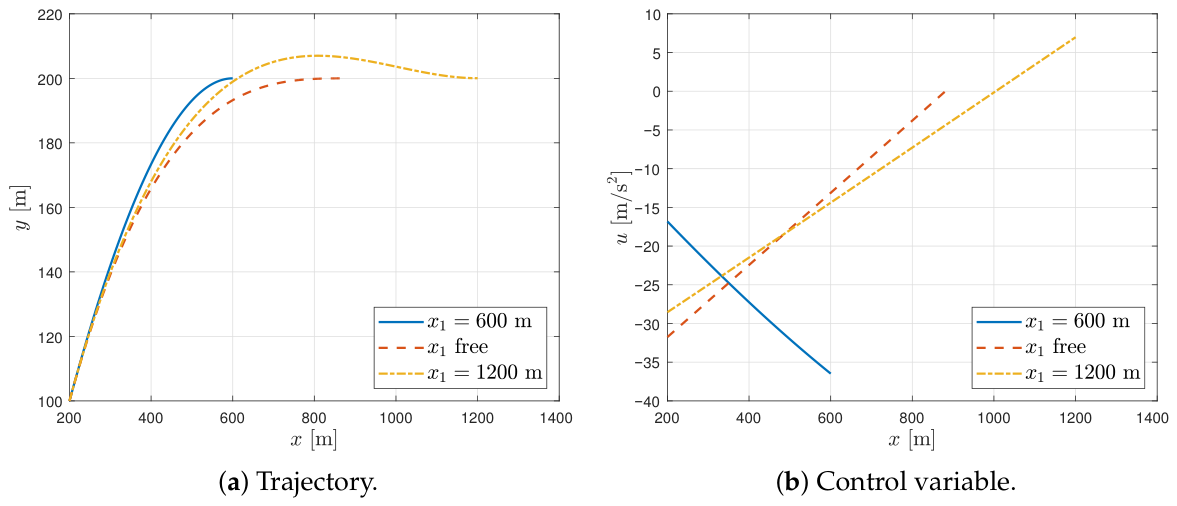
Naturally, the optimal climb problem can also be solved by applying the general Algorithm 1, although this requires an explicit specification of
. To compare these two approaches, the trajectories for fixed values of
m and
m are plotted alongside the trajectory where
is free in
Figure 6a, for a desired cruise altitude of 200 m. The values of other boundary conditions are
= 200 m,
= 100 m,
, and velocity is 160 m/s.
The comparison illustrates that for a specified
, the trajectory may exhibit variable convexity. It also reveals the interesting phenomenon that certain fixed-range cases can result in a lower control energy than the free-
case. The cost function (
5) for these examples yields the following values:
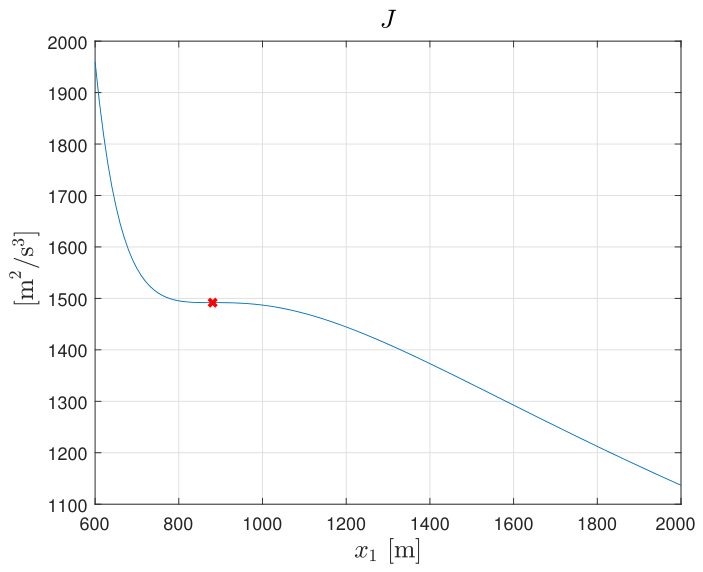
This result is expected, as a large maneuver is required to satisfy altitude and flight path angle constraints over short distances. The cost function continues a decreasing trend toward infinity, suggesting that the globally optimal trajectory is one where
is infinite, as depicted in
Figure 7. The red marker denotes the point corresponding to the free-final-range trajectory, which is situated at the saddle point of the
curve.
Consequently, the trajectories obtained using Equation (
56) satisfy the necessary conditions of optimality and therefore represent local extremals. However, they do not correspond to a global minimum of the cost
J with respect to
. Despite this, they exhibit properties that are advantageous from an implementation standpoint. In particular, when
is not pre-specified, the desired altitude is reached precisely at the instant when the control input vanishes, as illustrated in
Figure 6b, ensuring no further change in the flight-path angle. This enables a smooth transition from the climb phase to horizontal flight, avoids abrupt variations in normal acceleration, and prevents altitude overshoot.
4. Comparison with Existing Methods
In this section, a comparison is presented between the optimal trajectories obtained using the proposed Algorithm 1 and several notable existing impact angle guidance methods. The analysis uses a planar kinematic model illustrated in
Figure 1 and described by Equations (
1)–(
3). The simulation parameters, detailed in
Table 1, represent the terminal engagement of the ground target after the cruise phase. An impact angle of
is selected for this comparison, as it represents the most demanding scenario for highlighting the performance differences between the various methods.
For all methods, a fixed simulation step size of s is used. To mitigate potential numerical issues arising in the final phase of the simulation, the guidance laws are evaluated until the relative separation reaches 1 m, after which the last computed control input is held constant for the remaining steps. In addition, the control input is uniformly saturated at m/s2 for all guidance methods. These measures prevent nonphysical terminal spikes in normal acceleration as the range-to-go approaches zero, which would otherwise lead to disproportionate control effort. Consequently, the comparison reflects the representative portion of the trajectories, ensuring that no method is unfairly penalized due to terminal singularities.
Table 2 provides an overview of the notable guidance laws used for impact angle control, positioned alongside the guidance law proposed in this work (referred to as OPT). For each entry, the guidance law equation for a stationary target is presented as derived from its respective reference. Several of these guidance laws use tuning parameters such as
N and
M [
22],
,
, and
[
24], and
k [
27]. All other variables appearing in these equations are standard in engagement kinematics and are consistent with the definitions in
Figure 1.
It should be noted that many existing methods rely on time-to-go () information. When a specific computation was proposed in the original reference—particularly when demonstrated to outperform standard approximations—that formulation was adopted. For methods where no such computation was provided, the standard approximation based on range and closing velocity () is used. The same principle is applied to guidance-law parameters: parameter values are taken directly from the original references, without additional retuning, in order to reflect the intended performance of each method.
To focus solely on trajectory optimality in this part of the paper, a lag-free autopilot is assumed in this simulation. Under this assumption, all commanded inputs are realized without error, and therefore per-cycle updates of the guidance parameters are not required. Accordingly, the unknown parameters of the proposed method,
,
, and
, are computed only once at the beginning of the trajectory. Nevertheless, the guidance law itself is evaluated in closed-loop form throughout the simulation, as it depends on state variables that evolve along the trajectory, consistent with the implementation of the comparison methods. This setup ensures that the observed performance differences are attributable to trajectory optimality rather than to differences in feedback updating schemes. A detailed analysis of the real-time implementation, in which the parameters are updated at each guidance cycle to account for disturbances, is provided in
Section 5.
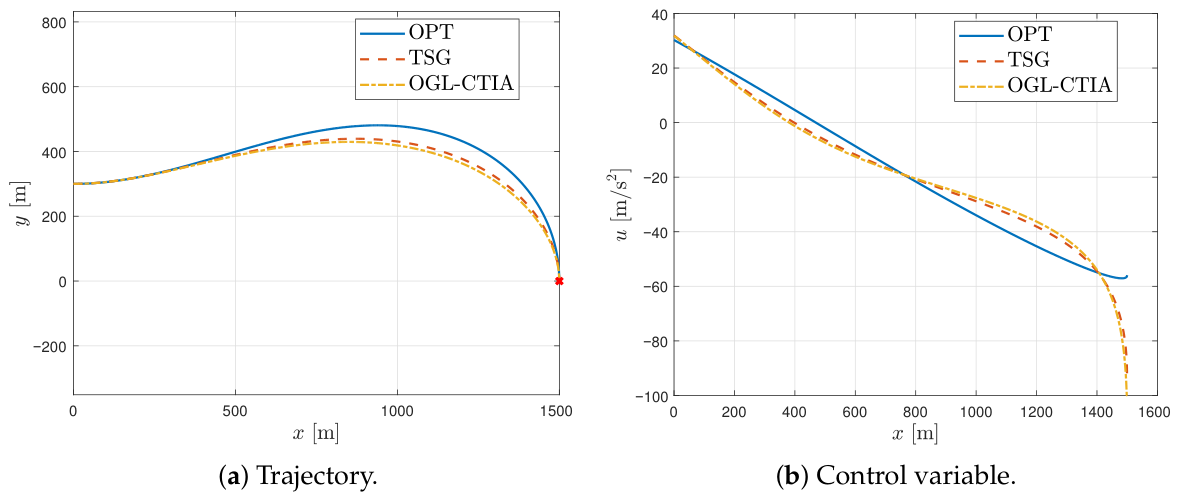
The first group of guidance laws for comparison includes optimal impact angle methods derived from linearized engagement geometry. The results of the widely used trajectory shaping guidance (TSG) [
4] are presented alongside the optimal guidance law with constrained terminal intercept angle (OGL-CTIA) [
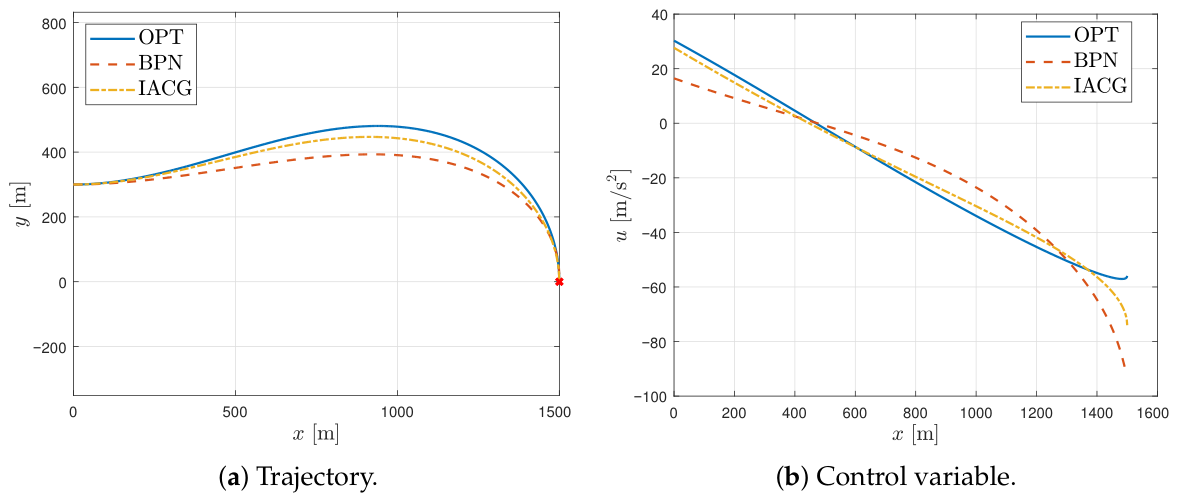
12], given their similar formulations. Both methods rely on time-to-go information, which was calculated using the range-to-closing-velocity ratio. As illustrated in
Figure 8, the two linear-based methods produce nearly identical results in both trajectory profiles and control variable histories. However, both deviate from the optimal guidance proposed in this work. The most prominent difference occurs near the target point; the linear methods exhibit a sharp increase in the control variable profile, leading to high maneuver demands and a larger total control effort in the terminal phase.
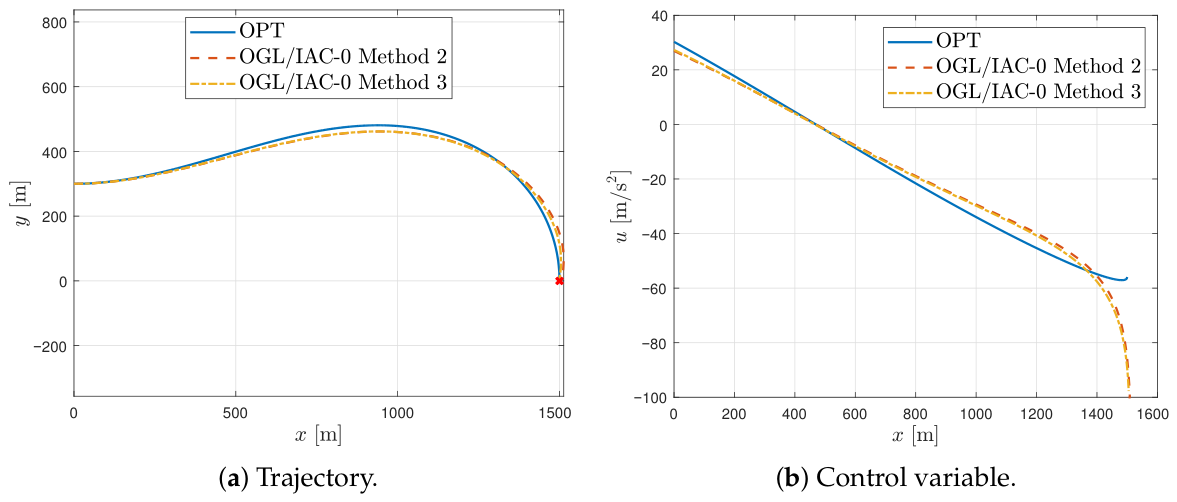
The second comparison involves the optimal guidance law for impact angle control (OGL/IAC-0) for a lag-free autopilot, as presented in Refs. [
10,
11]. The guidance law in [
11] represents a more general formulation that reduces to the same structure as in [
10] when the same cost function is applied. In this analysis, for time-to-go estimation, the first method uses Method 2 from [
10], whereas the second method implements the estimation presented in [
11] (here referred to as Method 3). The results are presented in
Figure 9. Unfortunately, both of these approximate
calculation methods lead to high commanded normal acceleration values as the range-to-go approaches zero.
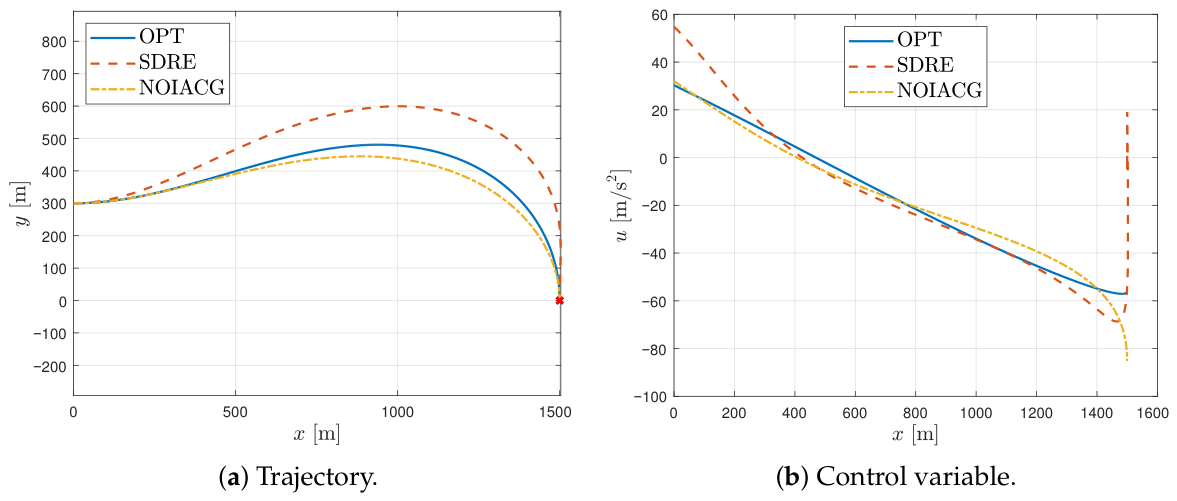
The first representative of nonlinear guidance laws selected for comparison is the state-dependent Riccati equation (SDRE) based guidance law proposed in Ref. [
17]. This method employs a segmented time-to-go calculation: the standard range-over-closing-velocity (
) is used when the closing velocity exceeds one-half of the vehicle speed; otherwise,
is approximated as the range divided by one-half of the vehicle speed. Although the original reference provides no specific procedure for selecting the navigation constant
N, a value of
is used for this comparison to remain consistent with the examples presented in the source paper.
As shown in
Figure 10, the resulting trajectory differs significantly from the optimal one proposed in this work. This discrepancy remains pronounced even at lower, less demanding impact angles.
In the same figure, results are presented for the nonlinear optimal impact-angle-constrained guidance (NOIACG) proposed in [
22]. Although the formulation of this guidance law in
Table 2 does not explicitly call for
, this quantity is implicitly embedded within the term
, where
represents the velocity lead angle. Because the cost function in this work is not weighted by time-to-go, the values of
and
were chosen for comparison.
Although non-optimal, biased proportional navigation (BPN) methods are simple to implement and computationally efficient, warranting a comparison with the proposed method. The first guidance law selected from this category is the method proposed in Ref. [
24], with guidance parameters
,
, and
, consistent with the values used in the original work. The comparative results are presented in
Figure 11. Interestingly, this method requires the least amount of normal acceleration during the initial phase of the terminal engagement; however, this is compensated for by significantly larger required maneuvers as the target is approached.
Another notable non-optimal approach is described in Ref. [
25], which employs a standard proportional navigation form with a variable navigation gain. This gain is switched at the instant a specific inequality involving the line-of-sight angle, flight path angle, and desired impact angle is satisfied. Unfortunately, as is common with switching-gain proportional navigation, large discontinuities in normal acceleration occur at the switching point. These jumps result in extreme maneuver demands to satisfy the impact angle constraint; consequently, a direct comparison with these types of methods is not presented here.
Among other notable works in the BPN category is Ref. [
26]; however, its implementation essentially functions as an open-loop control where the bias value is predetermined. In contrast, the interception angle control guidance (IACG) proposed in Ref. [
27] uses biased proportional navigation with error feedback. Because this method relies on time-to-go information, the specific estimation method provided in that reference was implemented for this comparison. The results for the IACG method are also included in
Figure 11.
Table 3 provides an overview of the total control effort, calculated using Equation (
5), for the previously analyzed guidance methods. Since all compared methods successfully achieve the mission objective, the analysis is focused exclusively on the total control effort, and no additional performance metrics (such as miss distance or impact-angle error) are reported. The proposed method yields the minimum control effort for the defined engagement model, as it is the direct solution to the underlying optimal control problem.
It should be noted that certain values in this table may appear disproportionately high. For example, the OGL/IAC-0 method, although generally efficient, incurs a large control effort primarily due to late-stage trajectory shaping, which leads to increased acceleration demand in the final phase of flight.
In addition, it is observed that some methods produce control-effort values relatively close to those obtained with the proposed approach. This behavior is scenario-dependent and reflects the fact that the considered engagement represents a single representative case (with a fixed initial range and a demanding impact angle of ). Different engagement geometries may lead to different ordering of total control effort values. However, even in cases where the numerical values are similar, important qualitative differences remain. In particular, the proposed method produces smoother control variable profiles, resulting in less aggressive maneuvering requirements. Furthermore, several of the compared methods rely on explicit time-to-go estimation for their implementation, whereas the proposed approach requires only standard navigation information (position and velocity). These aspects further distinguish the proposed method even in cases where the total control effort appears comparable.
In general, some methods could yield lower control-effort values if more accurate time-to-go estimation schemes or improved parameter–mission mappings were available. However, further refinement of existing methods is beyond the scope of this work, whose primary objective is to present and evaluate the proposed approach. Nevertheless, this comparative analysis clearly demonstrates that the trajectory obtained using Algorithm 1 is optimal and provides a unique performance profile among existing impact angle control methods.
5. Real-Time Application Analysis
This section analyzes topics related to the real-time implementation of the proposed Algorithm 1. The same planar engagement simulation from
Section 4 is used, but a first-order autopilot is now included with a time constant of
s.
Because the autopilot is no longer ideal, the optimal guidance command is recalculated every 16 ms guidance cycle. The nonlinear equation is solved using the bisection method. This robust brute force approach is chosen to demonstrate that the algorithm can run in real time even under the worst-case number of iterations.
All other simulation parameters are identical to those in
Section 4. Results for the full six-degrees-of-freedom simulation are provided later in
Section 6.2.
5.1. Numerical Solver Accuracy Requirements
This subsection defines the accuracy requirements for the numerical solution of the nonlinear equation . By establishing a relationship between the iteration count and desired guidance command accuracy, the computational load of the guidance loop can be strictly bounded.
The optimal control (
17) can be expressed as a function of
(where the dependence on flight parameters
is omitted for clarity):
By performing a Taylor series expansion of the control
u around the true solution
, we obtain
where
represents the numerical approximation derived from the iterative solution to
.
By neglecting higher-order terms, the relationship becomes
where
is the solution error.
The left side of this equation represents the error in the control variable. By bounding this with the allowable control error
, the upper bound for the solution error is established:
To determine the derivative
, Equation (
57) is written in expanded form using Equations (
16), (
18), and (
47):
The derivative is then derived as
When calculating the derivative
, the specific expressions for
corresponding to the trajectory convexity must be used. The relevant expressions for the derivative
are provided in
Appendix A.
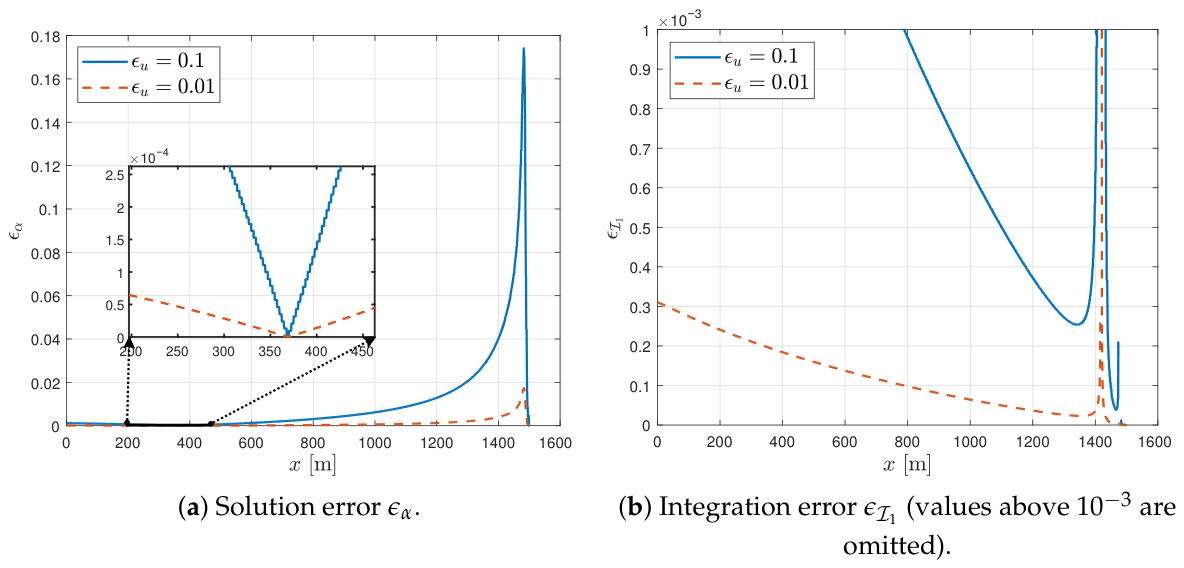
In
Figure 12a, the allowable error
, determined using Equations (
60) and (
62), is shown for a variable convexity trajectory with
. The error is plotted for two values of allowable control variable error,
.
Two characteristic zones on the graph exhibit low allowable error values. The first zone occurs at the very end of the flight. This is of little practical concern, as only drops to when the distance to the target is less than 0.5 m. The second zone occurs near the trajectory saddle point, where the allowable error tends toward zero. It should be noted that the duration within this second zone is very short. Furthermore, the minimum value of depends directly on the chosen ; for , the minimum error bound is , whereas for , it reaches .
The allowable error for the control variable should be selected on the basis of the control system capabilities. Because this algorithm is primarily intended for flight vehicles, requiring an accuracy of 0.01 m/s2 may be physically over-engineered. However, it is clear that regardless of the chosen , there exists a specific point on the trajectory where maximum accuracy for is required.
To ensure that the algorithm is robust for real-time use on hardware that may not support a floating point unit (FPU) and to maintain compatibility with single-precision formats (which offer 6–7 significant digits), a fixed absolute accuracy of is adopted for solving .
Although
Figure 12a shows that the allowable error is much larger than
for most of the flight, this worst-case accuracy for every guidance cycle is chosen to avoid the additional computational expense of recalculating the allowable error dynamically. The primary advantage of this approach is a fixed computational burden; once the algorithm is verified, it guarantees a predictable execution time. This deterministic behavior is highly favorable, ensuring the onboard computer can reliably perform its other flight-critical functions alongside the guidance logic.
Because the interval in which the solution is sought is at most
, as defined by Equation (
38), the expected number of iterations for the bisection method to obtain
accuracy is 22. Other nonlinear solving methods offering faster convergence [
38] may be employed because the derivative of
is available and provided in
Appendix A. It can be shown that with proper adaptive limits, which rely on the observation that the solution to
does not vary significantly between guidance cycles, these higher-order methods find the solution in only two iterations for the majority of the flight. The only exception is the saddle point, where the required number of iterations remains comparable to the bisection method due to the pathological behavior of the function
in that vicinity. Consequently, the analysis is continued using the bisection method; if it is demonstrated that the fixed-structure algorithm can operate in real time with this brute-force approach, compatibility with more efficient nonlinear solvers is guaranteed.
5.2. Numerical Integration Analysis
The function
incorporates the integral
defined in Equation (
32); therefore, this section analyzes the numerical procedure used to determine its value. The primary focus is the compromise between accuracy and computational effort, as this integral must be evaluated at least as many times as the function
itself during the bisection process.
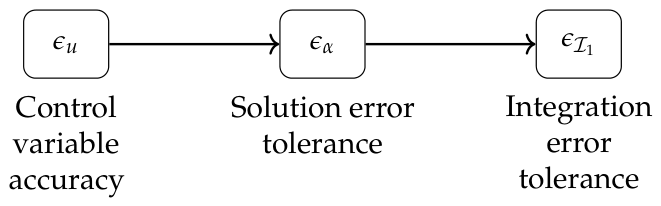
Similarly to the previous subsection, the ultimate accuracy requirement is derived from the allowable error in the control variable (
). This tolerance dictates the permissible error in the solution for
(
), which in turn defines the allowable error in the evaluation of Equation (
45), referred to as
. Because the integral
appears at most twice in Equation (
45), the relationship between the cumulative evaluation error and the individual integral error is established as
. This logical flow is illustrated schematically in
Figure 13.
To establish the required accuracy for the numerical integration, Equation (
36) is rewritten using the general form given by Equations (
43) and (
44) to explicitly show the dependence on
,
, and
:
Let
represent the function
calculated using an approximate value of the integral with error
. Expanding this around the true value yields
where the partial derivative is determined from Equation (
63) as
Defining
as the true zero of
and
as the zero of
and expanding
in a Taylor series around
gives
Since
is the true zero, the first term in Equation (
66) is approximated via Equation (
64) as
Because
is the true zero of the approximate function
, substituting the previous approximation into Equation (
66) yields
It can be shown that the derivative of the approximate function is
where the detailed procedure for determining
is provided in
Appendix A.
Substituting Equations (
65) and (
69) into Equation (
68) results in
Since the allowable error in the approximation of
is bounded by
, the following governing inequality must hold:
In
Figure 12b, the allowable integral calculation error based on inequality (
71) is presented for two different values of control variable accuracy, for a variable convexity trajectory with
.
In both cases, in the part of the trajectory where m, the allowable error is high. Low error values are most pronounced in the last 10 m for case and the in last 20 m for case , where the allowable error is approximately .
In accordance with the worst-case design philosophy adopted in this work, if a specific phase of the engagement requires maximum algorithmic complexity, such as the peak iteration count of an iterative procedure or the highest precision of an approximation, the algorithm is evaluated in this most demanding form across the entire trajectory. This ensures that the fixed-structure algorithm remains computationally viable even when maximum accuracy is required throughout the flight. By adopting this approach, deterministic timing and performance are guaranteed, which is critical for real-time validation on hardware with limited resources.
To evaluate the integral
from Equation (
32), a 10-node Gauss-Legendre quadrature formula, denoted as
, is adopted. This choice balances computational efficiency with the precision requirements established in the previous section. The numerical approximation over arbitrary limits
a and
b is given by
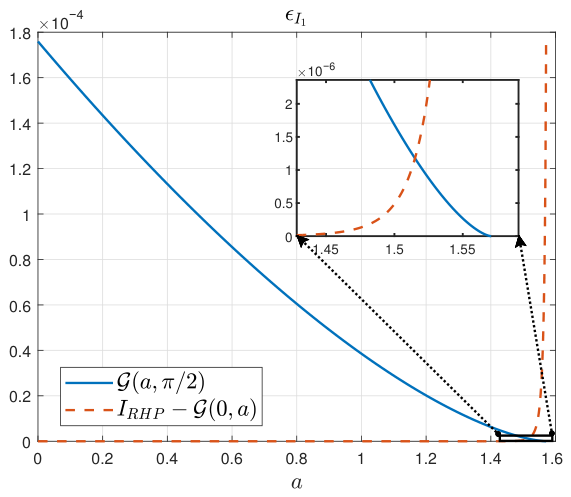
Error analysis can be simplified to a single half-plane on the basis of integrand parity. Because of the square-root singularity at the interval ends, quadrature errors increase rapidly as the integration interval approaches these boundaries. This is particularly evident in Case B, where the upper limit is fixed at . When the lower limit a is far from , the error accumulates; however, as a approaches zero, the exact integral value approaches the integral over the entire right-half-plane (), which can be pre-calculated with extremely high precision. To maintain accuracy, it is more effective to integrate directly when the lower limit is near and to use the complement ( minus the integral from 0 to a) when a is near zero.
In
Figure 14, the error obtained using these two approaches is compared. The intersection point, denoted as
, serves as the optimal switching threshold. For Case B, where the lower limit
a can also be negative, the general evaluation algorithm is defined as
For Case C, where the upper bound is fixed at
, the same logic is applied by leveraging symmetry:
Although the integration limits for Case A can be arbitrary, there is no guarantee that they will remain safely away from the problematic regions near
. Unlike Cases B and C, Case A requires only a single evaluation of
according to Equation (
45). However, because the integration interval can still be large, the same phenomenon of error accumulation persists.
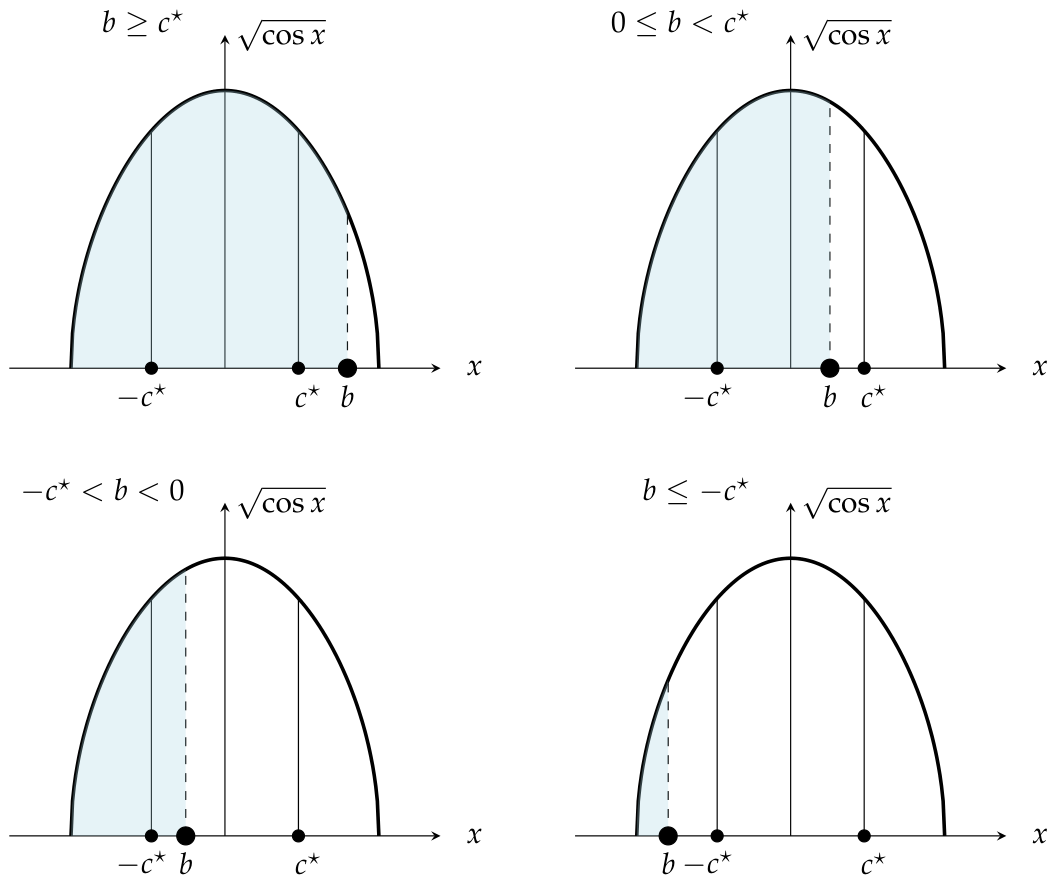
To address this, a similar logic to Case B is adopted for Case A. Although this expands the simplest case into a two-integral calculation, it ensures maximum accuracy regardless of the limits and, crucially, maintains a fixed algorithm structure. This uniformity guarantees constant computational burden across all convexity cases. The comprehensive procedure is summarized in Algorithm 2. To visualize the decision logic,
Figure 15 illustrates the possible positions of the upper limit
b relative to the threshold
and the corresponding domains for the lower limit
a.
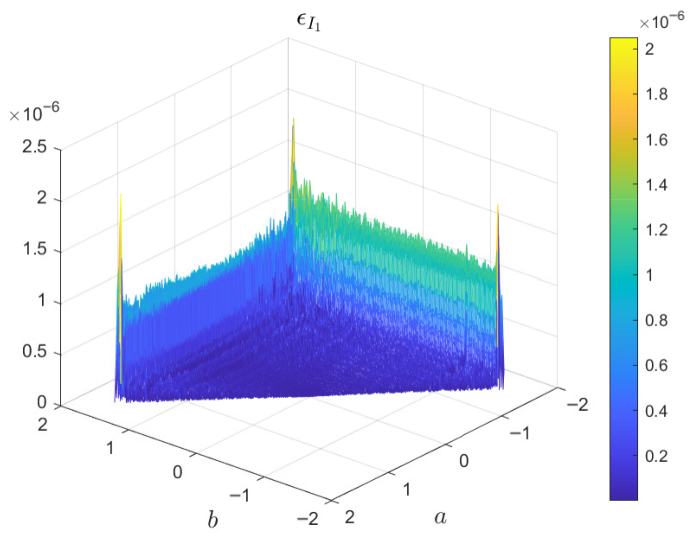
Finally,
Figure 16 illustrates the absolute error in the calculation of integral
using Algorithm 2 across the entire grid of possible integration limits. The calculations were performed in single-precision format, and the resulting error remains less than
for the majority of the grid. Small exceptions occur in regions where one limit lies to the left of
and the other to the right; in these instances, a doubling of the characteristic error at point
is observed. However, even in these regions, the error is less than
. In all other cases, the numerical error is several orders of magnitude lower than the required tolerance. This analysis confirms that the results obtained using Algorithm 2 are well within the allowable accuracy limits established previously.
A similar methodology is applied to evaluate the integral (
54) required for the optimal command during the climbing phase. Because the integrand is now
, a 10-node quadrature formula is denoted as
. The corresponding evaluation logic is detailed in Algorithm 3. In this case, the maximum error occurs at the intersection point
and is less than
.
| Algorithm 2 Calculation of , given by Equation (32) |
- 1:
if then - 2:
; return - 3:
end if - 4:
if then - 5:
; return - 6:
end if - 7:
- 8:
- 9:
if then - 10:
- 11:
if then - 12:
- 13:
- 14:
elseif then - 15:
- 16:
- 17:
elseif then - 18:
- 19:
- 20:
else - 21:
- 22:
- 23:
end if - 24:
elseif then - 25:
- 26:
if then - 27:
- 28:
- 29:
elseif then - 30:
- 31:
- 32:
else - 33:
- 34:
- 35:
end if - 36:
elseif then - 37:
- 38:
if then - 39:
- 40:
- 41:
else - 42:
- 43:
- 44:
end if - 45:
else - 46:
- 47:
- 48:
- 49:
end if
|
| Algorithm 3 Calculation of , given by Equation (54). |
- 1:
if then - 2:
; return - 3:
end if - 4:
- 5:
- 6:
if then - 7:
- 8:
else - 9:
- 10:
- 11:
end if
|
5.3. Influence of Delay in Updating Guidance Parameters
The optimal guidance command defined by Equation (
17) can be expressed in the compact form
, where
represents the state vector and
is the vector of optimal guidance parameters. This guidance law functions as a closed-loop feedback system on the basis of the states provided by the navigation system. Consequently, the optimal command can be calculated immediately as new navigation data become available. However, determining the parameters
requires finite computational time for the execution of Algorithm 1.
This computational overhead is modeled as a discrete delay
d, representing the number of navigation cycles elapsed prior to guidance parameters update. Guidance command is thus rewritten in discrete form:
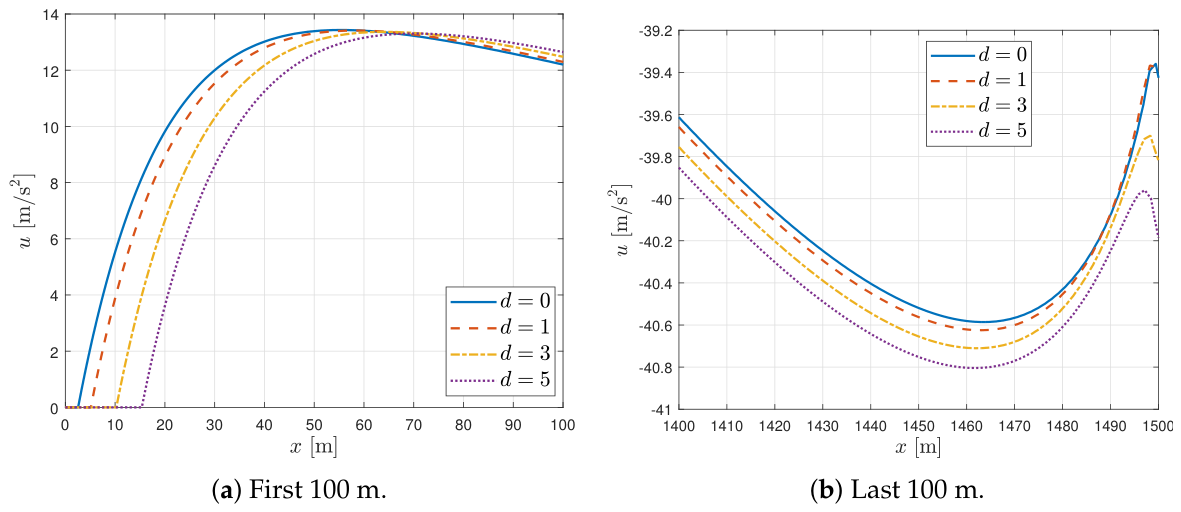
Figure 17 illustrates the performance for various delay levels
d for the previously studied scenario. As the trajectories showed no significant deviations, the analysis focuses on the control variable profile during the first and last 100 m of flight: intervals where sensitivity to parameter updates is expected to be highest.
The results indicate that even with a delay of five cycles, there is no substantial impact on the guidance performance. This robustness suggests that the autopilot time constant exerts a far greater influence than the minor latency in updating the guidance parameters, which remain relatively slow-changing throughout most engagement scenarios.
5.4. Influence of Variable Speed
Up to this point, the application of Algorithm 1 has been analyzed under the assumption of constant velocity. This assumption is widely adopted in guidance law design for tactical air vehicles, as the speed typically varies slowly and the terminal phase of the engagement is relatively short [
22]. Although this assumption underlies the derivation of the optimal guidance law (
17), it is rarely satisfied in practice. Since the objective of this work is to develop an algorithm capable of determining all guidance-law parameters in real time, variations in velocity do not violate the problem formulation. Each instant of flight—i.e., each guidance update—is treated as a new initial condition, resulting in a closed-loop guidance law expressed in terms of state variables available from the navigation system at every guidance cycle.
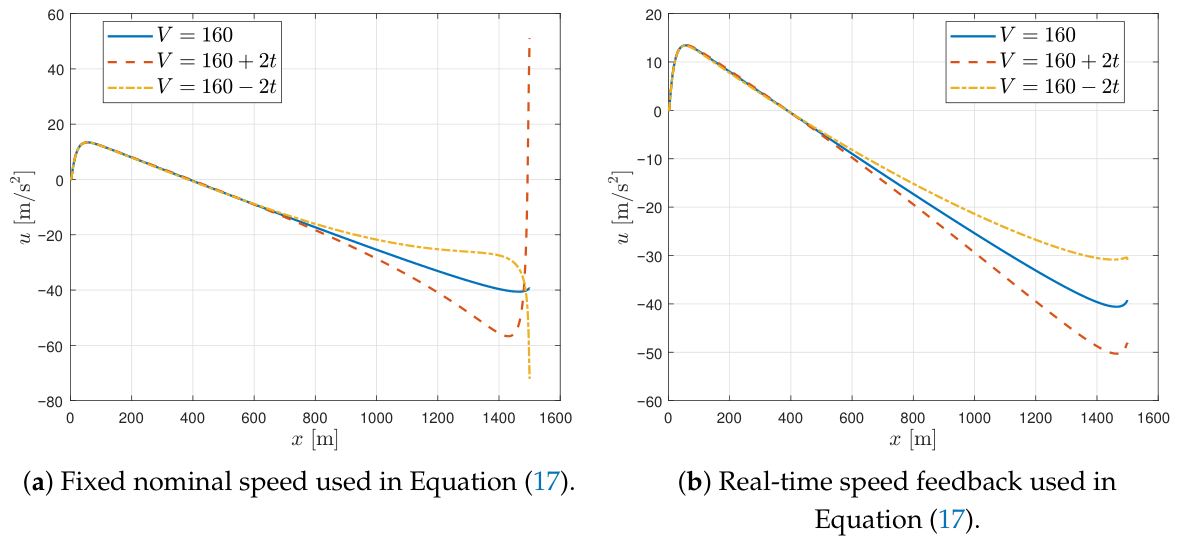
To assess the influence of variable speed, a linear time-varying velocity profile is introduced into the numerical simulation:
where 160 m/s represents the nominal value about which the variation is applied. This profile is selected solely for illustrative purposes; the analysis is not restricted to linear variations and remains valid for arbitrary time-varying velocity profiles. All other simulation parameters correspond to those given in
Table 1, except for the desired impact angle of
.
The time-varying velocity is applied only in the kinematic Equations (
1)–(
3), while two strategies are considered for the velocity term
V in the guidance law (
17). In the first approach, the nominal value
m/s is used in the guidance law despite the varying flight speed. The corresponding control profile is shown in
Figure 18a. In the second approach, the guidance command is computed using the actual time-varying velocity. The resulting control profile is shown in
Figure 18b. Because both approaches produce nearly identical trajectories, only the control input profiles are presented.
The comparison clearly indicates that, in the first case, significant increases in the control variable occur when the actual speed deviates from the nominal value, due to the mismatch between the assumed and true flight conditions. In contrast, incorporating the actual velocity into the guidance law yields a control profile consistent with the true dynamics and avoids excessive control effort. This effect is also reflected in the total control effort values summarized in
Table 4, where the use of an incorrect (nominal) speed results in consistently higher values.
Based on these results, it is concluded that the optimal guidance law should be implemented using the actual velocity, i.e., the value available from the navigation system at each guidance cycle.
6. Hardware-in-the-Loop Validation and Results
This final section addresses the practical implementation of the proposed guidance algorithm on flight hardware and its subsequent validation via high-fidelity six-degrees-of-freedom (6DOF) numerical simulations. To ensure that the results represent actual operational conditions, tests are conducted in a hardware-in-the-loop (HIL) laboratory environment.
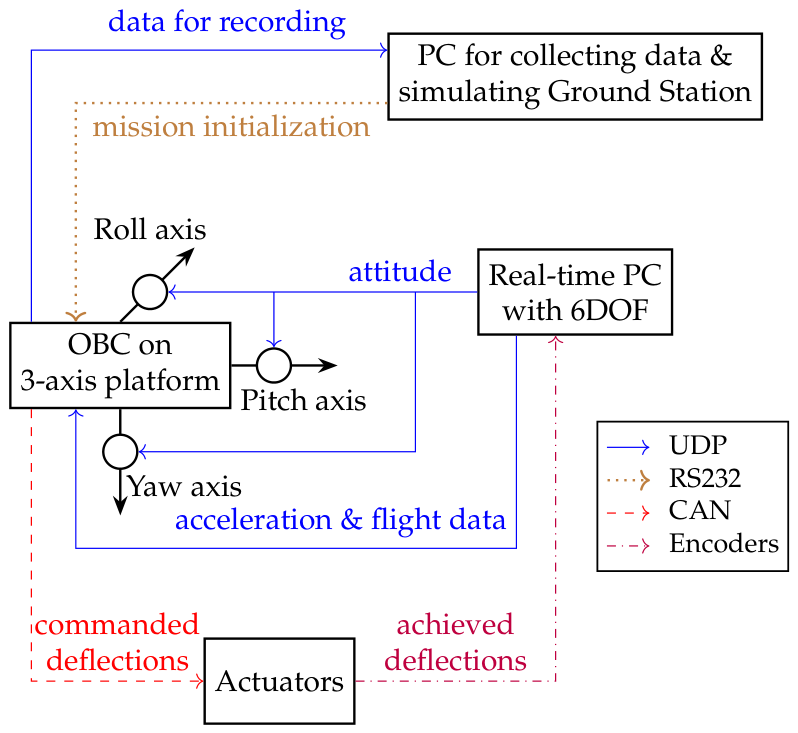
The HIL architecture, shown in
Figure 19, integrates the onboard computer (OBC) with a 6DOF real-time simulator and physical actuators. The OBC is mounted on a three-axis platform that receives attitude commands from the simulator via UDP. Initial mission parameters are uploaded via RS-232 from ground control station. Flight data and acceleration measurements are provided to the OBC over Ethernet. During flight, the OBC transmits control surface commands via the CAN protocol to real actuators. The resulting physical deflections, measured by high-resolution encoders, are fed back into the 6DOF simulation to close the control loop. All flight data are broadcast by the OBC via UDP for synchronized recording on a dedicated workstation.
The target onboard computer is a microcontroller based on the ARM Cortex-M3 architecture. By using the same production-grade environment for these tests, we can verify that the algorithm effectively manages the computational constraints of an embedded processor while maintaining the required guidance precision throughout the flight envelope.
6.1. Onboard Computer Integration and Performance
The navigation architecture of the target OBC follows the dual-rate structure described in [
39]. High-frequency tasks occur at 500 Hz basic step (2 ms period) to process IMU increments, whereas position and velocity updates are completed every eight steps at a base rate of 62.5 Hz (16 ms period). To ensure the guidance law uses the most recent state estimates, the guidance update cycle is synchronized with this 16 ms navigation interval.
As established in
Section 5.1, the worst-case scenario for the nonlinear solver requires 22 iterations. To maintain a fixed computational load and prevent CPU spikes, the solver is distributed across the 16 ms window. By executing three iterations per 2 ms basic step, the solution is guaranteed within less than eight full steps, thus leaving the initial step available for determining the trajectory convexity case.
The chronological flow around the
kth cycle is illustrated in
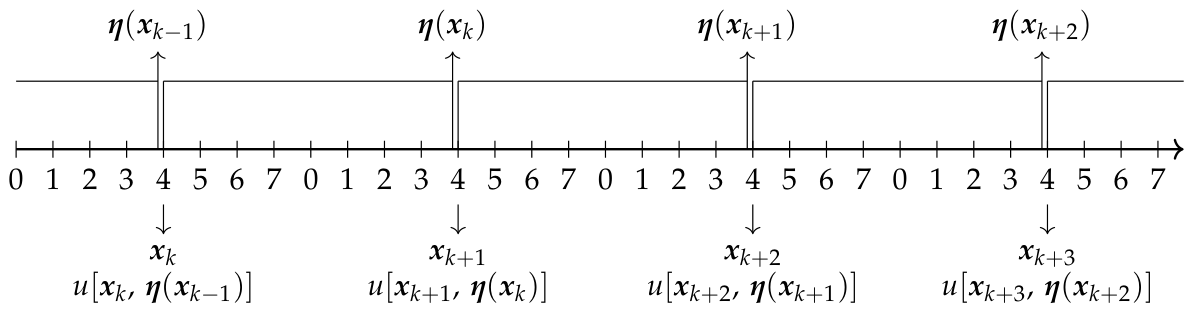
Figure 20. The horizontal time axis is divided into basic steps (indexed 0–7), each lasting 2 ms, forming the full 16 ms cycle. In this specific navigation architecture, fresh state data
become available at the fourth basic step. At this instant, the optimal command is immediately calculated using the most recent navigation information and the guidance parameters from the previous cycle:
. The process of determining the new parameters
then begins, using the remaining basic steps to ensure that they are ready prior to the next update. This maintains a deterministic lag of exactly one guidance cycle.
The execution time of the main algorithm was measured using the microcontroller’s internal timer during a HIL test involving engagement of a target at a range of km. Data was transmitted via Ethernet at 500 Hz for monitoring purposes; however, the transmission overhead was excluded from the measurements as it is not present in actual flight operations.
As shown in
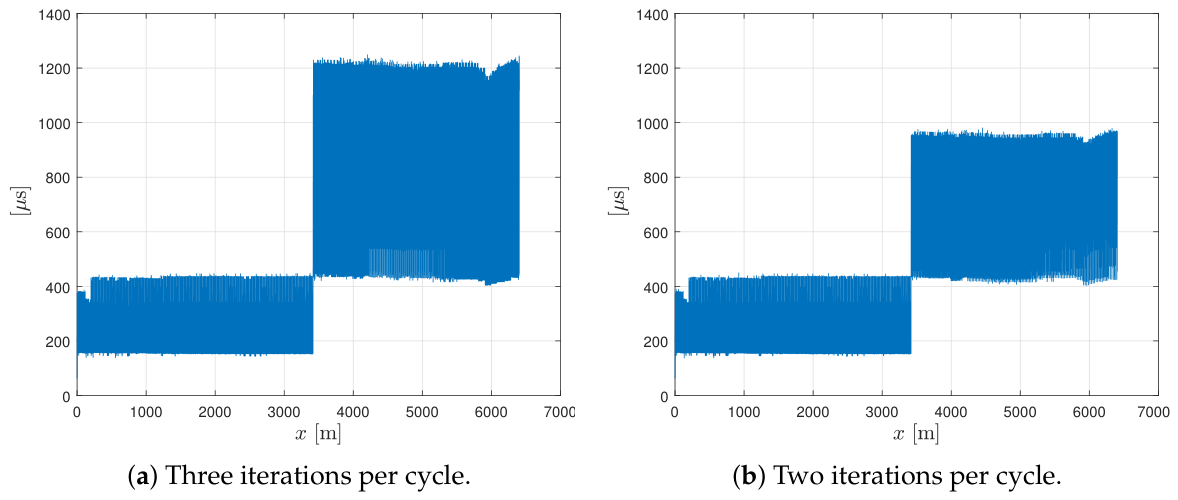
Figure 21a, prior to the terminal phase (which begins 3 km from the target), the baseline execution time is approximately 450 μs. This leaves a significant margin of
ms within each 2 ms basic step. Upon activating the proposed terminal guidance algorithm with three iterations per step, the total execution time rises to approximately 1200 μs. This confirms a healthy timing reserve of 800 μs for any additional background tasks.
Further CPU optimization can be achieved by reducing the number of iterations performed per basic step. Although this increases the total time required to solve the nonlinear equation
, it maximizes the instantaneous free time available in each cycle.
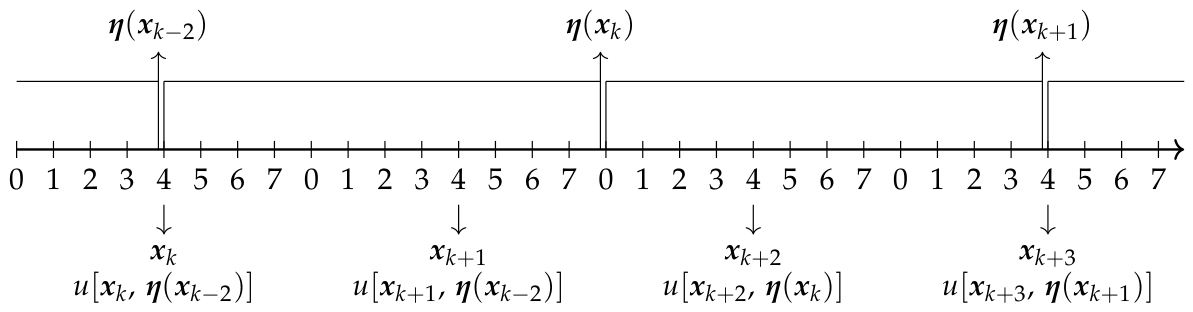
Figure 22 illustrates a modified flow using only two iterations per step. In this configuration, a solution is reached in twelve steps (including the convexity check). Consequently, the guidance parameters
are updated twice every three navigation cycles. This corresponds to a maximum delay of
in the guidance law (
75), which was shown in
Section 5.3 to have no significant impact on performance.
Figure 21b presents the execution times for this optimized two-iteration configuration. In this case, the peak execution time during the terminal phase is less than 1 ms, providing a safety margin equal to
of the 2 ms basic step. Such substantial timing margins suggest that the main algorithm frequency could potentially be doubled if required by more complex mission requirements.
In both configurations, the available timing margins can be utilized to extend the method to three-dimensional guidance by executing an additional instance of the same algorithm for a second, orthogonal plane. When using three iterations per basic step, this effectively doubles the computational load, resulting in near-full utilization of the 2 ms cycle while still meeting real-time constraints. In the two-iteration configuration, approximately 200 μs of timing margin remains available even after such an extension. Furthermore, if additional computational resources are required for other background tasks, the number of iterations per step can be further reduced. As previously demonstrated, the resulting delay in updating the guidance parameters does not significantly affect performance, provided that the navigation data remains sufficiently up to date.
An identical timing analysis was conducted on the OBC for a ballistic trajectory, using a similar task architecture with a 2 ms basic cycle. In this configuration, the baseline execution time is slightly less than 400 μs due to a reduced number of active subsystems and different guidance method. By integrating the proposed algorithm with two iterations per cycle, the total execution time increases to approximately 920 μs.
6.2. HIL Simulation Results
In this section, the results of high-fidelity 6DOF numerical simulations conducted in the HIL laboratory environment for both flight vehicles are presented. In all scenarios, the proposed optimal impact angle guidance is implemented in the vertical plane, whereas the original guidance methods are maintained for the horizontal plane.
The optimal guidance command
u given by Equation (
17) is supplemented with the gravity compensation term. After coordinate transformation, the commanded specific force in the vertical plane is expressed as
where
is the pitch angle provided by the navigation system. Because both flight vehicles use a conventional three-loop autopilot, the command is issued as a specific force to align with accelerometer measurements. To evaluate the true generated control effort (excluding gravity), the performance index is defined as the integral of the squared achieved specific force:
6.2.1. Cruise Mission Climb Phase
The first scenario validates the optimal climb guidance law (
56).
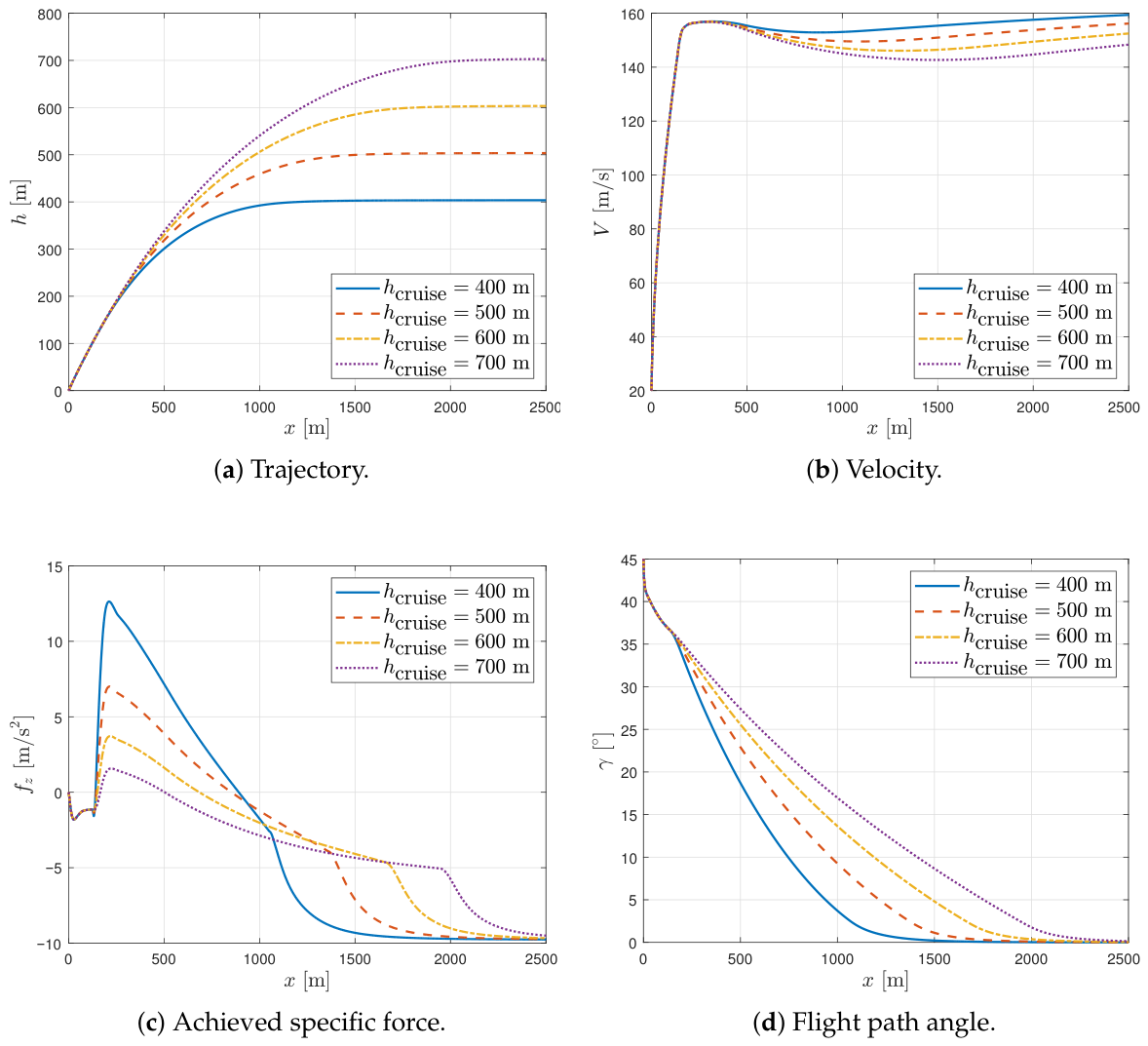
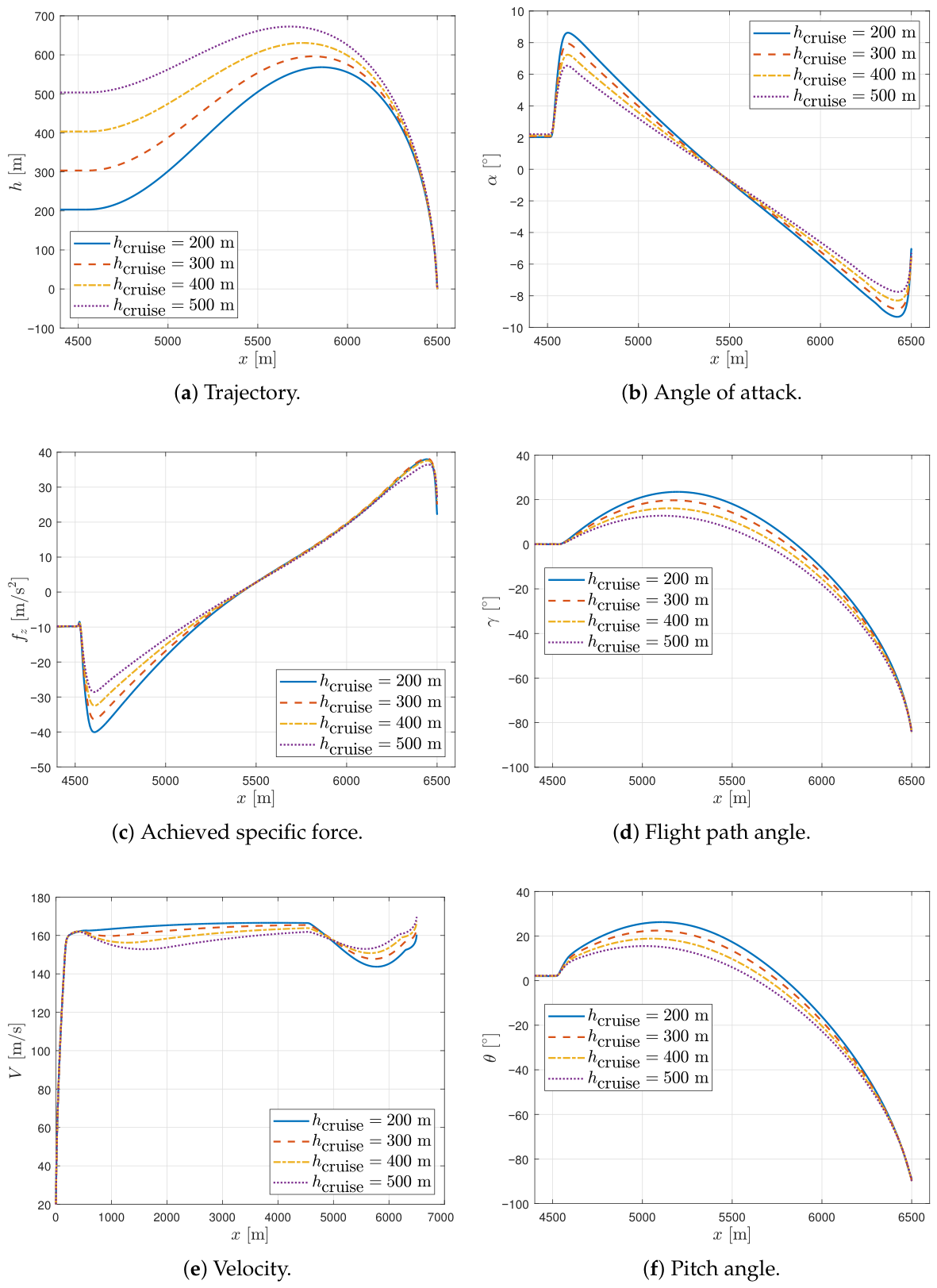
Figure 23 compares the trajectories for various desired cruise altitudes, starting from an initial pitch angle of
. To ensure system stability, the guidance law is engaged only after the altitude of 100 m is reached, allowing launch-related transients to settle.
The total control effort (
78) decreases as the cruise altitude increases:
This trend is physically consistent: an initial pitch of
requires significant maneuvering to level off at lower altitudes, whereas it is naturally more suited for reaching higher cruise altitudes with minimal correction, as shown in
Figure 23c.
Crucially, in all cases, the flight path angle
converges to the required zero value at the desired altitude, enabling a seamless transition to the trajectory-tracking cruise phase. Furthermore,
Figure 23b illustrates the velocity profiles. Although the guidance law was derived assuming constant velocity, its closed-loop feedback nature demonstrates excellent robustness, successfully meeting mission requirements despite the varying speed profiles typical of real flight.
It should be noted that the velocity profiles are presented over the entire flight segment, including the initial boost phase, to provide a complete view of how the speed evolves with respect to different cruise altitudes. However, the guidance law is not active during the low-speed portion of the trajectory, where aerodynamic control authority is limited. As previously stated, guidance is engaged only after the altitude of 100 m is reached, at which point sufficient velocity—and thus maneuverability—is attained. Consequently, the results reflect the influence of moderate, trajectory-dependent speed variations typical of real flight conditions, rather than the initial acceleration from launch to cruise speed.
6.2.2. Cruise Mission Terminal Phase
The terminal engagement performance was evaluated using Algorithms 1 and 2.
Figure 24 presents comparative results for engagements initiated 2 km from the target at various cruise altitudes, with a commanded impact angle of
. In all scenarios tested, a successful target intercept was achieved. As evidenced by the pitch angle profiles in
Figure 24f, a vertical attitude is achieved prior to impact. The velocity profiles in
Figure 24e further confirm the algorithm’s efficacy for variable-speed airframes, even in scenarios requiring a significant altitude increase relative to the cruise level to satisfy high-impact-angle constraints.
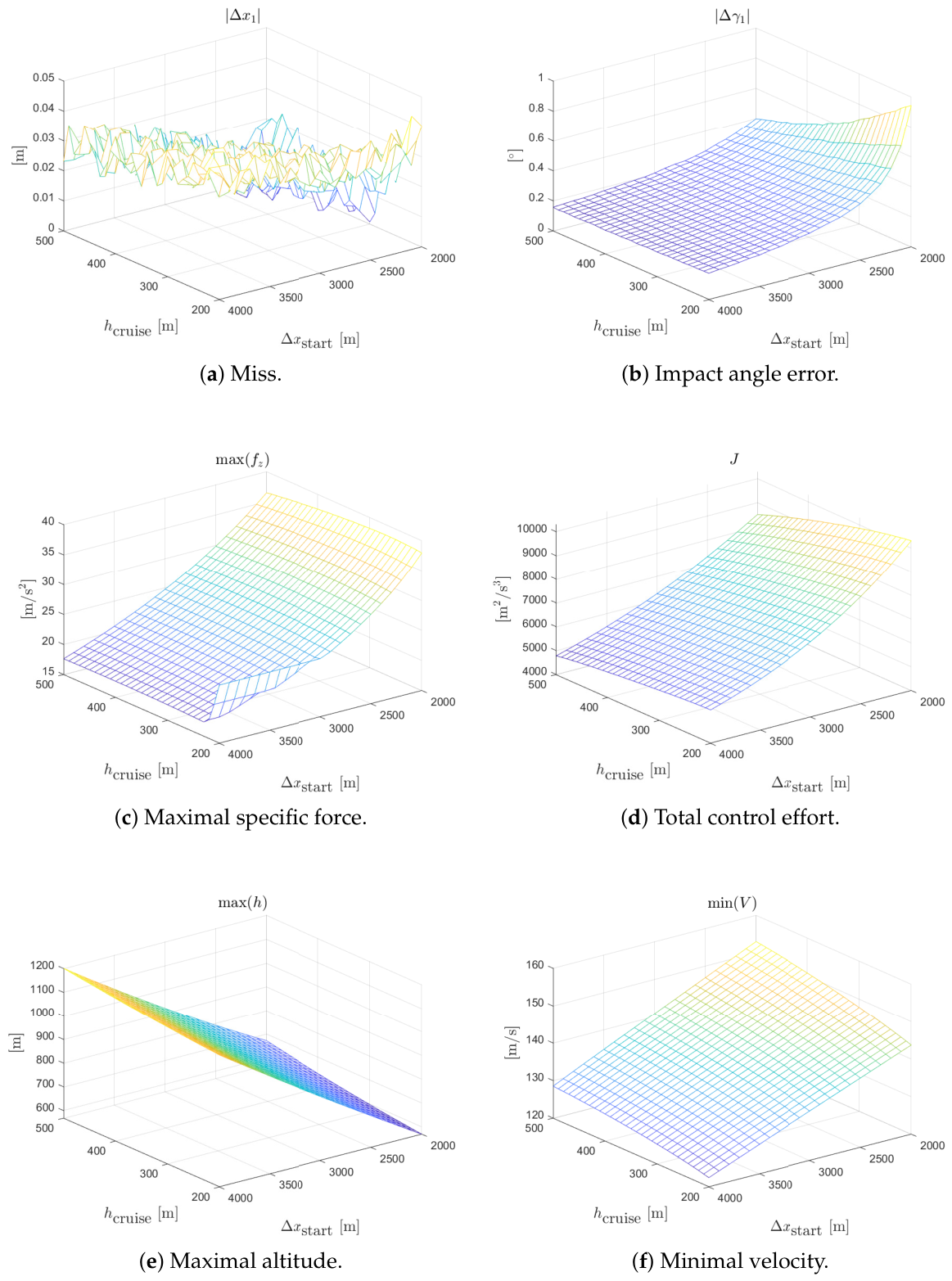
The selection of mission parameters, such as cruise altitude (
) and the terminal phase initiation distance (
), can be critical for operational success. These parameters are typically dictated by terrain constraints, obstacle avoidance, and counter-measure environments. A sensitivity analysis of these parameters is summarized in the performance surfaces of
Figure 25.
The results in
Figure 25a,b indicate that the target is consistently hit within the desired impact angle tolerances. The marginal increase in impact angle error at shorter initiation distances is a physical consequence of the maneuverability limits when attempting steep dives over short ranges; however, these errors remain negligible at less than
. Although
Figure 25c suggests that larger initiation distances reduce the peak specific force, the data from
Figure 25e,f show that this also results in higher peak altitudes and greater velocity loss. This drop in speed can ultimately degrade maneuverability in the final seconds of flight.
Although a multi-parameter optimization could be employed to determine the ideal and for a specific threat environment, such an analysis lies outside the scope of this paper. The primary objective, validating the real-time performance and precision of the proposed guidance algorithm, is successfully met by these HIL results.
6.2.3. Ballistic Trajectory
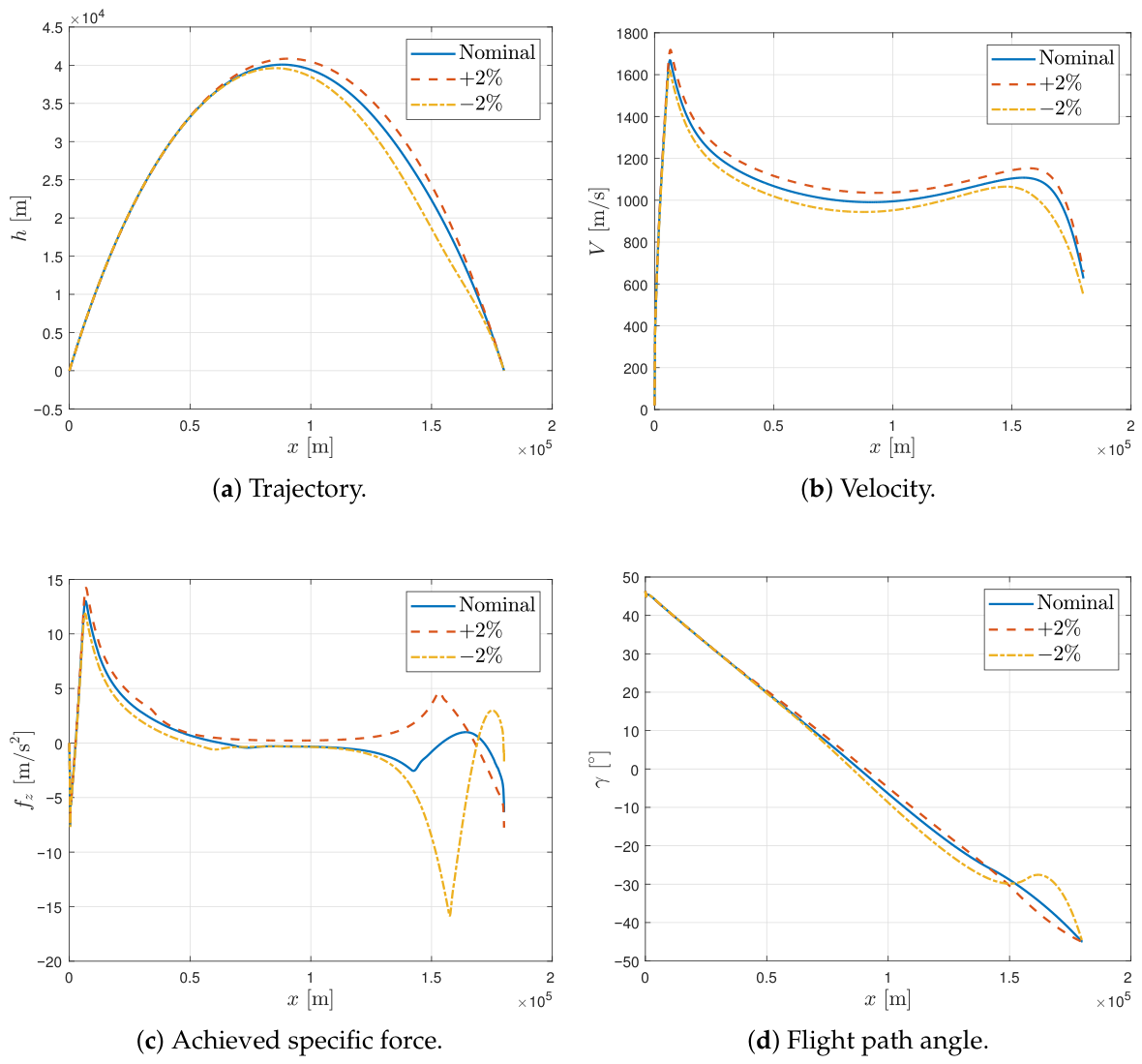
The final case study evaluates the algorithm’s performance in a short-range ballistic scenario. To demonstrate the robustness of the proposed method under extreme deviations from the nominal trajectory, the system was tested against a total impulse variation of .
The engagement involves a target at a range of 180 km with a commanded impact angle of , which corresponds to the nominal trajectory for an initial angle of . To mitigate rocket motor disturbances during the active phase and to compensate for low control effectiveness at high altitudes, optimal guidance is activated immediately after launch.
Figure 26 presents the HIL results for these scenarios. In all cases, a successful target hit was achieved. The most significant trajectory shaping occurs during the initial climb and the final reentry into denser atmospheric layers, as observed in the specific force profiles in
Figure 26c. For the
total impulse deviation, more maneuverability is required during the terminal phase to prolong the trajectory toward the target, as illustrated in
Figure 26a. Conversely, in the
case, the guidance performs more aggressive shaping during the early climb to manage excess energy. Despite these variations, the required specific force remains well within the maneuverability limits for all three cases. The flight path angle profiles illustrated in
Figure 26d confirm that, in addition to a precise target hit, the desired impact angle of
is successfully achieved in all cases.
The velocity profiles in
Figure 26b further illustrate that the closed-loop feedback structure of the proposed guidance method remains effective under highly variable speed conditions. Although the velocity is shown over the entire flight segment, the majority of guidance action occurs in the supersonic regime during both the powered and unpowered phases, where aerodynamic control authority is well established. The observed velocity variations, while significant and far from the constant-speed assumption, are therefore representative of typical supersonic climb and reentry conditions. This confirms that the algorithm maintains full functionality as the system transitions through the wide range of speeds and altitudes characteristic of ballistic trajectories.