Article

Transformer-Augmented MCTS for Aircraft Landing Problem
by
Jie Hu
1,2,
Shuai Zhang
3,
Xiaorong Feng
3,* and
Xinglong Wang
3
1
The 28th Research Institute of China Electronics Technology Group Corporation, Nanjing 210007, China
2
State Key Laboratory of Air Traffic Management System, Nanjing 210007, China
3
School of Air Traffic Management, Civil Aviation University of China, Tianjin 300300, China
*
Author to whom correspondence should be addressed.
Aerospace 2026, 13(5), 438; https://doi.org/10.3390/aerospace13050438

Submission received: 10 February 2026 / Revised: 14 April 2026 / Accepted: 1 May 2026 / Published: 8 May 2026
(This article belongs to the Special Issue AI, Machine Learning and Automation for Air Traffic Control (ATC))

Abstract

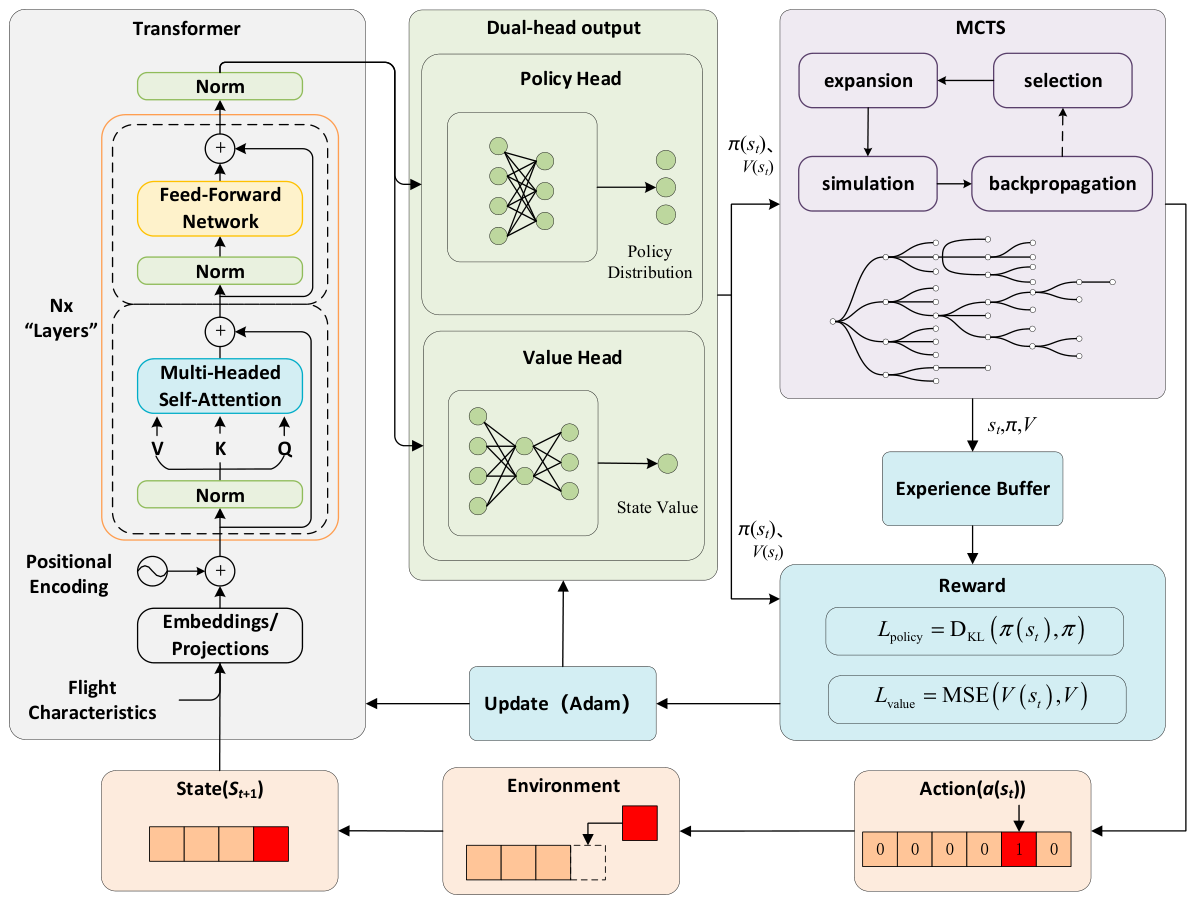
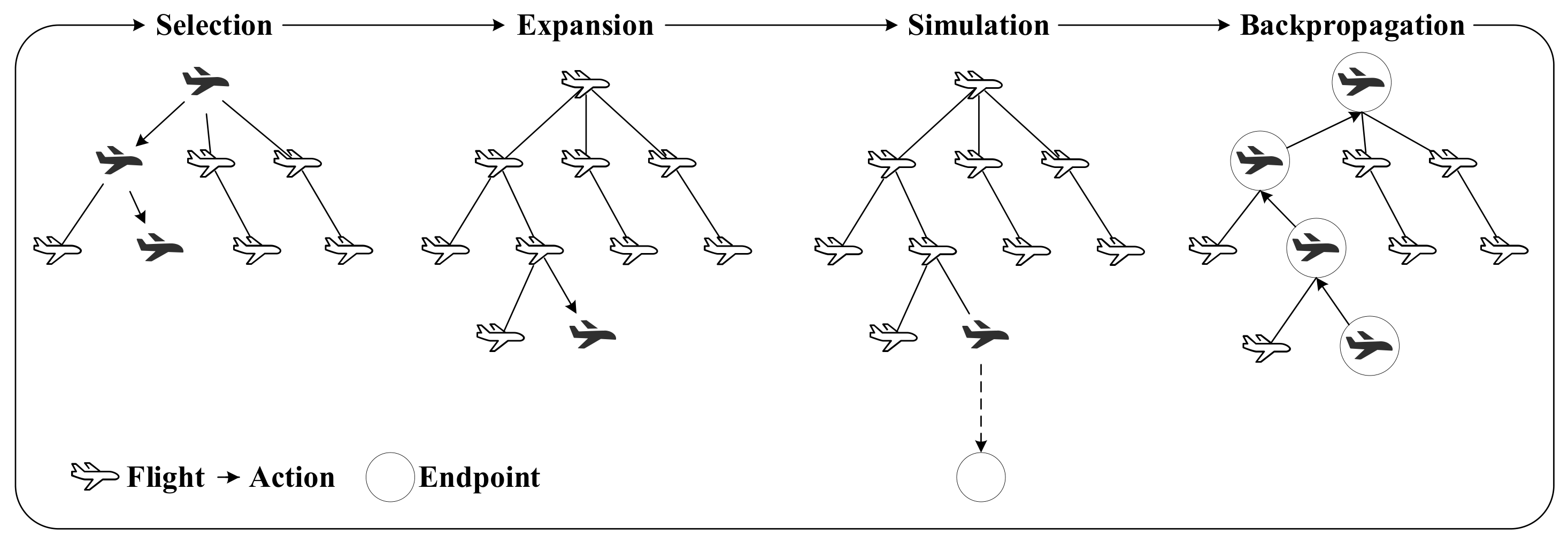
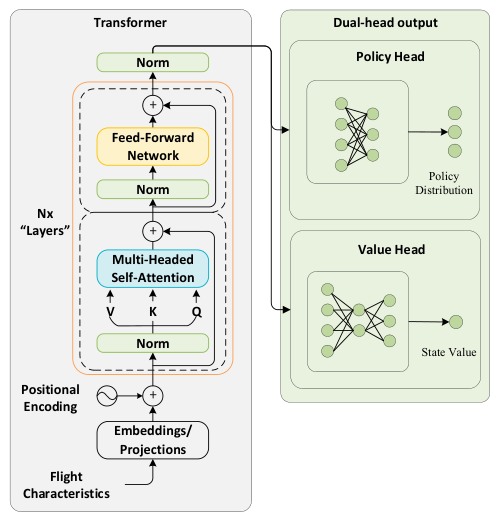
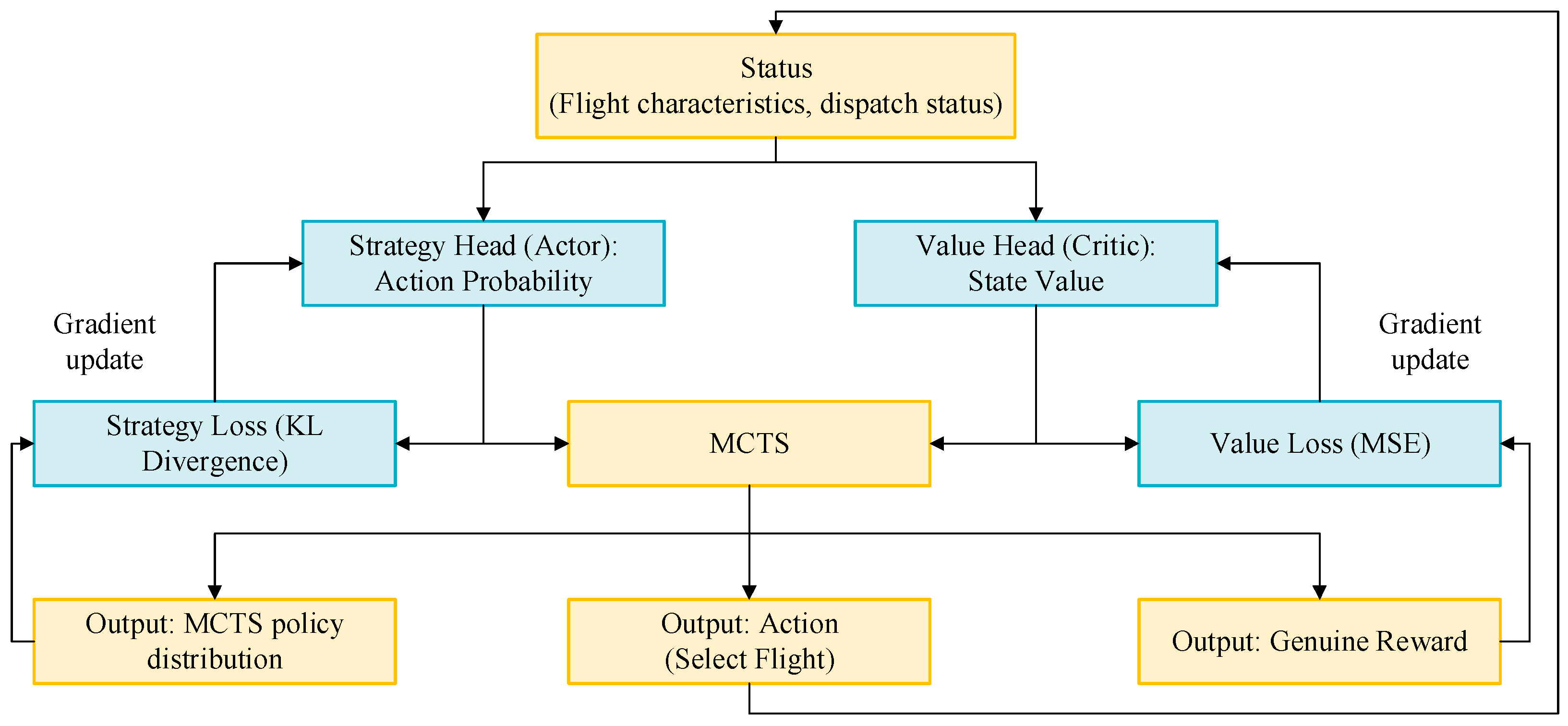
The aircraft landing problem (ALP) poses significant challenges for traditional Monte Carlo Tree Search (MCTS) due to its vast search space and reliance on inefficient random simulations. To overcome these limitations, this paper proposes a novel Transformer-Augmented Monte Carlo Tree Search (TMCTS) algorithm. Our approach integrates a reinforcement learning framework that incorporates key operational constraints, including wake turbulence separation and time windows, and employs a cost function aimed at minimizing both delay time and fuel consumption. A core innovation is the replacement of the conventional random simulation phase in MCTS with a Transformer-based value predictor. This leverages the Transformer’s superior ability to model sequences and capture global dependencies among flights, thereby dramatically accelerating search convergence. Specifically, we designed a two-head Transformer network (comprising policy and value heads) to provide informed prior knowledge, which effectively guides the selection and expansion steps of the MCTS tree. The model is trained within an Actor–Critic framework, utilizing behavior cloning for pre-training followed by reinforcement learning for fine-tuning. Experimental evaluations on the standard OR-Library benchmark demonstrate that our TMCTS method significantly reduces scheduling deviation compared to state-of-the-art baselines (including FCFS, DPALO+GA, DPALO+PSO, and CPLEX). Moreover, it achieves a 93.7% reduction in computation time relative to the CPLEX method, highlighting its superior efficiency and practical applicability for real-time scheduling.
Keywords: aircraft landing problem; time window constraints; dynamic programming; deep reinforcement learning; Monte Carlo Tree Search aircraft landing problem; time window constraints; dynamic programming; deep reinforcement learning; Monte Carlo Tree Search