1. Introduction
Aviation represents a steadily growing mobility sector with estimated contribution to global and European CO
2 emissions of around
and
respectively [
1]. When including its non-CO
2 effects, the sector is estimated to have caused around
of the anthropogenic contribution to climate change by the year 2019 [
2]. In this context, the European Commission has established a roadmap for achieving carbon neutrality of European aviation and the reduction of CO
2 and non-CO
2 effects by
until 2050 relative to the year 2000 [
3]. According to the document, the aims should go beyond solely technological advancements and represent a mix of measures concerning alternative fuels, fleet age, passenger convenience, and infrastructural adaptations such as intermodal mobility system-of-systems. This implies not only the accelerated entry into service of untested concepts but also their integration into a more sophisticated transport system. Hence, the search for complex technology synergies in novel air transportation concepts requires their consideration as early as the conceptual aircraft design phase by looking outside the conventional design scope and by systematically generating and assessing new ideas.
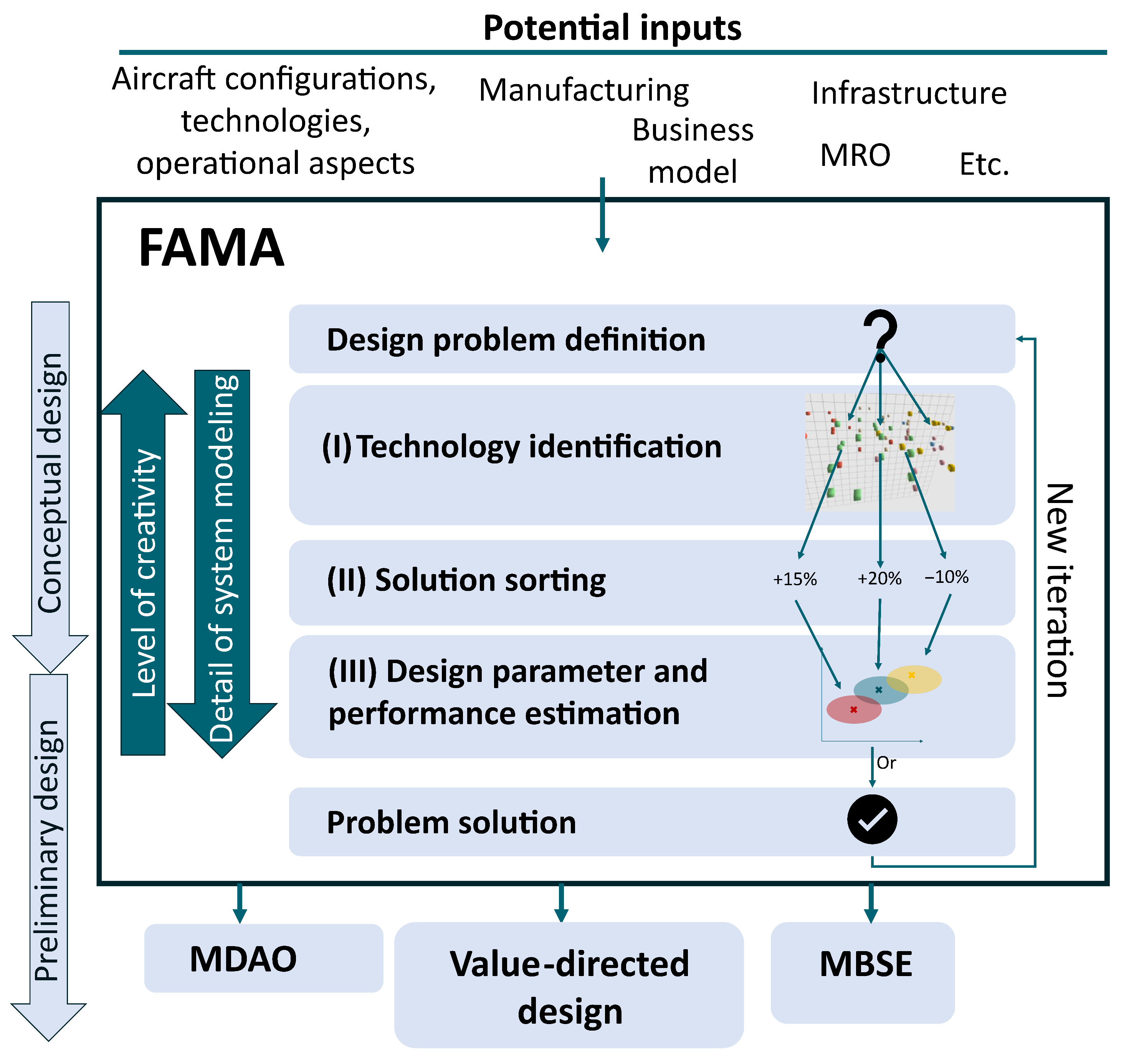
This is the main aim of the framework of the advanced morphological approach (FAMA). It is the result of multiple development iterations which considers uncertainty on various design levels in conceptual and preliminary aircraft design. The FAMA takes some established approaches in creative product design (e.g., system decomposition, divergent and convergent thinking) and adapts these to the design of complex engineering systems such as civil aircraft. This work studies the theoretical methods in design and applies these in aeronautics, not in a direct manner, but in a purposeful and application/industry-oriented approach. This aims for time and complexity reduction of the design tasks while focusing on efficient conduction and uncertainty quantification.
FAMA is based on the classical morphological analysis (MA), which implies the decomposition of a design problem, the analysis of its subproblems and the synthesis of design solutions [
4]. These steps can be used for different design purposes, allowing for different levels of creativity, parameter/uncertainty quantification, system modeling and design detail. Thus, the methodology represents an adjusted mix of qualitative and semi-quantitative tools aiming to achieve the mentioned balance. This article summarizes the FAMA methodology and demonstrates its application on two use cases for different design purposes.
The objectives of the current article are summarized as follows:
A third use case demonstrating the FAMA application for the probabilistic estimation of design parameters and its corresponding theoretical background will be presented in future work.
2. The Framework for the Advanced Morphological Approach
The FAMA represents a structured methodological framework for conceptual aircraft design and enhancement to preliminary aircraft design. It is a result of continuous and iterative development and testing, which focuses on unconventional concept generation and more reliable uncertainty modeling in aircraft design. This chapter outlines the general overview of the finalized FAMA—its aims, development milestones, and structure.
2.1. Aims of the Framework
The FAMA framework was developed to achieve the following aims:
Integration of creative tools in aircraft design, allowing for going beyond the designer’s “conventional” scope and generating novel concepts;
Defining a structure for the vague creative processes in the conceptual design phase;
Consideration and reliable modeling of uncertainties;
Addressing the lack of experimental data on novel technologies with probabilistic methods or expert knowledge elicitation;
Purposeful modeling of the flight system—either as a qualitative hierarchy or as a quantitative probabilistic Bayesian network (BN);
Instead of searching for a single optimum, the generation of a subset of promising designs and analysis of the solution space;
Give a transparent (“white box”) alternative to challenging or impossible optimization problems with non-metric parameters, conflicting design criteria, discontinuous or not differentiable cost functions;
Provide a flexible toolbox depending on the particular design purpose.
The framework development was driven not only by pure scientific interest. The focus was to test, adapt, and apply scientific tools according to the current needs of the civil aeronautical sector and industry: the accelerated study of the suitability of novel technologies, while increasing the efficiency of evaluation processes such as expert workshops, which can often be lengthy and vague.
2.2. Development Background
Since the FAMA core is based on the MA, it suggests the decomposition of a design task into functional attributes and their corresponding implementation alternatives (“options”) [
4]. These are placed in the so-called morphological matrix (MM). All possible option combinations allow the definition of a diverse solution space. Additionally, a cross-consistency assessment can be conducted in order to exclude incompatible option combinations [
5]. Rakov and Bardenhagen [
6] have extended this to the advanced morphological qpproach (AMA), which adds the qualitative and weighted option evaluations, thus allowing the calculation of criteria scores for the synthesized solutions. Furthermore, it compares these solutions regarding distance and similarity metrics such as the Hamming distance [
6,
7]. Along with its advantages, the AMA had its development potential: the consideration of design uncertainties, the integration of expert knowledge to evaluate the options, as well as the examination of solution space robustness [
7]. After comparing the AMA with similar design tools and approaches in Reference [
7], further enhancements have been introduced to present the finalized FAMA. These can be classified into the following categories:
Integration of the MA steps into a structured process, thus compensating for lacking technology data and considering uncertainties by avoiding black-box models;
Workshop concepts for the identification of the MM attributes and options, the system modeling, option evaluations, and solution synthesis;
Evaluation of the MM options via adapted structured expert judgment elicitation (SEJE) protocols [
8];
Fuzzy or probabilistic modeling of uncertainties [
9];
A possibility to use either simulations, expert knowledge or both for increased reliability of uncertainty modeling;
Alternative system modeling concepts: qualitative with the analytic hierarchy process (AHP) [
9] and semi-quantitative with BNs [
10];
Sensitivity analysis of solution criteria scores or figures of merit (FoMs) against changes of MM options or design parameters [
11];
A software platform for the use of the FAMA framework, developed from scratch;
Browser-based online platform for the option evaluation by experts;
Interactive visualization of the solution space.
2.3. Structure
In order to achieve all previously mentioned purposes, the FAMA framework represents an integration of multiple tools and approaches from four major domains:
aircraft design, creative product design, SEJE, multi-criteria decision-making (MCDM), and probabilistic inference (as a form of machine learning).
Figure 1 depicts an overview of the main AMA steps and how these address the current challenges in conceptual aircraft design. The main stages of the MA are adapted as a core layout for the novel aircraft design process with disruptive technologies—problem exploration and decomposition, solution of subproblems (also denoted as “analysis” in some sources), as well as the design solution synthesis by combining the sub-solutions. The first row of the figure shows these stages and their corresponding challenges associated with aircraft design involving unconventional technologies. The FAMA addresses each of these by offering a toolbox of adapted methods for various purposes. The main categories of these methods are assigned to the FAMA stages in
Figure 1. The approaches to decompose the problem, solve its subproblems, as well as synthesize solutions are explained in the following. The workflow follows a typical thinking pattern in creative design: the interchange of divergent thinking (the creation of large number of options without discrimination according to any criteria) and convergent thinking (the selection and concretisation of a limited number of concepts) [
12].
2.3.1. Problem Exploration and Decomposition
The main challenges concerning the search for more suitable design solutions are the identification of concepts which might be beyond the designer’s experience. The literature describes promising concepts and technologies for a cleaner aviation, such as the box-wing configuration [
15], distributed propulsion, hydrogen propulsion [
16,
17], etc.
This brings up the necessity of a structured method to generate novel, consistent ideas. Considering the abstract character of this task and the lack of historical data on novel technologies, the involvement of experts was selected as a source of unconventional ideas, which also requires careful planning, execution and integration into the overall workflow.
One of the approaches to increase creativity and expand the solution space diversity is the decomposition of the design problem. As the FAMA is based on MA and involves the composition of the MM, a missing step was the structured and transparent identification of the attributes and options of the MM. Considering the complexity of engineering products such as civil aircraft, the brainstorming method might not reflect all of its necessary aspects, even at the conceptual design stage. This complexity is not only expressed in the technical dimension, but is also reflected in the position of the system in its environment, as well as its interactions. For this purpose, two approaches have been selected and adapted for the FAMA framework: systems thinking integrated with stakeholder identification, as well as the work domain analysis (WDA).
Systems Thinking
This approach is based on systems thinking and stakeholder identification, but is also inspired by environmental analysis and its STEEP (social, technological, ecological, economic, political) dimensions. The concepts were not used as-is, but rather, separate aspects of each were adapted and integrated into the FAMA in a purposeful manner.
One of the main aspects of systems thinking is the consideration of different views and perspectives on the system of interest (SoI) [
18]. In general, these involve the outer view (consideration of input and output parameters of the SoI, viewed as a black box), the inner view (the change of input into output values inside the system—white box), and the time view (the temporal development of the SoI) [
18]. Perspectives on SoI are defined as the interests and requirements of stakeholders over time—e.g., users, manufacturers, buyers, politicians [
18,
19], etc. Apart from the time view, these notions have been adapted to aircraft design in order to include diverse aspects from multiple perspectives and to aid the development of integrated concepts, e.g., involving the aircraft, the infrastructure, the environment, etc. This gives a strong vector for the simultaneous addressing of multiple factors in the “Fly the Green Deal” document by the European Commission [
3]—in particular by combining these aspects as early as the conceptual design.
The identification of the MM attributes and criteria with this approach is achieved through a structured and moderated expert workshop, the steps of which are presented in the following:
Stakeholder identification
The process is initiated by the systematic identification of relevant stakeholders, based on the adapted system views. Three stakeholder groups are pre-defined: internal SoI view, external view in the aviation domain, as well as external view concerning global factors (this structure is also inspired by reference [
20]). The experts are asked to come up with any relevant stakeholders for each group.
The questions that the experts are asked are: “Which stakeholders can you identify for each group?”; “Who influences the SoI?”; “Who is influenced by the SoI?”
Definition of criteria and MM attributes
Next, the participants are encouraged to take perspectives of the stakeholders and think of characteristics and requirements on the SoI, which could be relevant for the stakeholders or could be influenced by them. Depending on the number of experts and their professional background, they could either each take up the role of a single stakeholder, be divided into groups, or do common brainstorming.
Example questions for the criteria derivation are: “What are the stakeholders’ requirements on/expectations from the system?”; “Which limitations could be imposed on the system by the stakeholders?”; “Which criteria/whose interests is the system subject to?”
Example questions for attribute derivation: “What leverages do the stakeholders could have to potentially influence the system?”; “How can the system concept/design be influenced by the stakeholders?”
Definition of MM options
Once the criteria and attributes are fixed, the experts are asked to find ways to fulfill the attribute functions, i.e., to derive MM options for the corresponding attributes. As the purpose of this step is to obtain a higher number of diverse options and components, this step should be subject of converging thinking. Therefore, the participants are encouraged to share even the most unconventional and abstract ideas that could be suitable, regardless of their technology readiness level or the common perception among peers of the general public.
Example questions: “How can the attribute functions be fulfilled?”; “Which technologies can fulfill the functions?”; “Which hybrids can be derived?”
Adapted Work Domain Analysis
In contrast to systems thinking, which aims to describe a certain system and its interactions with the environment, the next method focuses on the systematic extraction of expert knowledge for the design and analysis of work domains or complex systems. The WDA is a tool that falls into the methodology of cognitive task analysis [
21] and allows for describing a certain complex domain or system based on a structured expert knowledge elicitation technique. For that purpose, it uses the so-called abstraction–decomposition matrix (ADM), which introduces multiple levels of abstractions to the domain/system on its vertical axis. In the initial version of the method, these are typically system purposes, values and priorities, purpose-related functions, physical functions and effects, as well as physical objects and appearance [
21,
22]. The horizontal dimension of the ADM may represent the “levels of decomposition” of the domain/system, such as system, unit, component, and part. However, the labels and the meanings are sometimes adapted according to the task [
21]. A system can thus be described by filling the relevant ADM layout with entries that reflect the system’s functionality and description. “The intent is to express means-ends relations between the entries of adjacent levels, with lower levels showing how higher-level functions are met, and higher levels showing why lower-level forms and functions are necessary” [
21]. The matrix can be filled either by leaning on document/literature studies or by conducting expert knowledge elicitation individually or in groups.
WDA has been selected as one of the base approaches for the definition of the attributes and options of the MM, as well as for the criteria. This selection is justified with: the possibility to describe complex systems; the suitable involvement of experts; and the flexibility of the ADM. In contrast to that, other major tools for knowledge elicitation often have different purposes, e.g., the extraction of details of previous unusual cases (the critical decision method), or the concept mapping to reveal unknown domain areas [
21]. Such approaches are rather less appropriate for the exploration of unconventional technologies or the incorporation of evaluation criteria or system values.
2.3.2. Solution of Subproblems (Analysis)
The analysis of the separate subproblems, their interactions and integration is the task of the second major step in the FAMA framework. The main challenges in this regard are the lack of deterministic data from tests and operation of disruptive and unconventional technologies, as well as the early estimation of their potential synergetic benefit for the overall design. The unclear integration of non-tested and non-existing components represents a further difficulty for the designer to make a reliable decision-making during technology selection.
In this context, a suitable approach to system modeling is necessary, which would guide the experts towards the result. The output should allow the performance estimation of the synthesized solution considering its selected options, all of the (sub-)criteria and the potential interaction/synergy effect among the options. Furthermore, the possibility for programmatic implementation of the system model should be ensured as well.
Aggregation and Weighting of Expert Evaluations
Before applying any type of system modeling or MCDM algorithm, the expert evaluations should first be aggregated. In the best case, this aggregation should ideally account for any discrepancies in the professional background knowledge and experience of the participants—e.g., different levels of experience, lacking knowledge in a certain domain, or professional bias towards given technology. Reference [
23] distinguishes two main aggregation approaches: mathematical and behavioral (based on a group decision). This is a whole new domain to study the suitable aggregation method for different (engineering) use cases [
23,
24], which will be left to other work. Through the FAMA development, two approaches have been tested so far—the unweighted geometric mean [
25] and the domain-related expert calibration [
8]. The former allowed for the pure mathematical aggregation, but without considering the knowledge and expertise level in the respective domains. The domain-related expert calibration aimed to address this aspect but did not yield a significant difference from the non-calibrated answers [
8].
This work implements the weighted geometric mean, aiming to use mathematical aggregation to possibly reduce professional bias. This is achieved by asking the experts their certainty level for each evaluation. The certainty for a given option assessment is self-assessed on the scale—(1): relatively low, (2): average, (3): relatively high, (4): expert. These scales are used as the weights for the calculation of the geometric means of the interval evaluations for each question.
The described method is used for the qualitative evaluations applied with the AHP and was implemented for the use cases described in this article. Potential use cases with quantitative/probabilistic evaluations for BNs could use approaches such as Cooke’s classical model [
26,
27].
Analytical Hierarchy Process
For the systematic structuring and qualitative evaluation of options, subcriteria and global criteria, the AHP [
28] is adapted. It suggests the definition of a hierarchy structure, where the elements of a single hierarchy level are qualitatively compared pairwise according to each element of the upper level. The detailed integration and result verification of the AHP in the AMA is explained in detail in [
9,
11]. These previous works used fuzzy numbers for the uncertainty modeling. On the one hand, this was one of the approaches to represent uncertain qualitative evaluations with a suggested method [
29]. On the other hand, the authors’ experience showed that the additional uncertainty dimension offered by the membership grades between 0 and 1 can result in additional confusion among the participating experts—especially when the evaluation scale is qualitative itself. Furthermore, pairwise comparisons resulted in much longer questionnaires than evaluations of each single option, therefore reducing expert efficiency, involvement and concentration. For these reasons, a simpler uncertainty modeling is selected in this work—the interval bound, applied to each option separately. This still allows the fuzzy AHP calculation algorithm described in [
9] to remain intact, while the intervals are represented as simplified fuzzy numbers without their regions where the membership function is between 0 and 1.
The systems thinking and the WDA have both been adapted so that a smooth logical interface is possible to the AHP. The detailed application of AHP within the FAMA will be explained for one of the use cases in the following sections.
Bayesian Networks
Some special characteristics make BNs suitable for a more detailed system modeling by considering uncertainties of multiple parameters simultaneously. BNs are based on Bayesian inference, which implies the modeling of events (or parameter values) in a probabilistic manner rather than certain deterministic values [
30]. A system model could be constructed by connecting design parameters as nodes in a so-called directed acyclic graph. Each parameter could be represented as a probability distribution reflecting its uncertainty. By applying the Bayes’ rule to each node, one could propagate the uncertainty through the Bayesian network and therefore account for the uncertainties in the entire modeled system.
BNs have a certain flexibility concerning the source of the parameter distributions. These could be either prior (e.g., initial guess/estimate based on rich or poor experience) or observed (e.g., measurements, simulations, etc.). In this context, BNs allow fpr propagating system uncertainties based solely on prior distributions, or to update this prior knowledge based on observed distributions. In this manner, one could well integrate vague expert knowledge with simulation data for a more reliable quantification of propagated uncertainties.
A first example of using BNs in the AMA was described in [
10]. It was based on quantification and connecting multiple design variables and some simulation data as input. The BN allowed the definition of relevant variables as probability distributions, propagate these through the system model and output a solution space with visualized concept uncertainties for enhanced decision-making. While that first example demonstrated the BN advantages in aircraft design, an extensive use case applying BNs and the theory behind will be presented in future work.
2.3.3. Design Synthesis
The most important part of the design synthesis is the generation of the total criteria performance scores for the “assembled” design solutions, considering their respective options from the MM. These constitute the generated solution space, which is visualized in a diagram. Examples for the qualitatively evaluated solutions with AHP and the probabilistic evaluations with the BN can be found in [
8,
9] and [
10] respectively.
One of the main challenges of MA is dealing with the so-called “curse of dimensionality”, which implies the enlargement of the solution space as the MM grows bigger. This could eventually lead to enormous solution spaces, thus further hindering the identification of relevant solutions. Different approaches could be taken here, some of which are presented in previous publications [
8]. This article focuses on two other—density-based clustering and solution filtering, which are presented within the use cases. Both involve the conduction of workshops, where smaller groups of experts are tasked with the synthesis of a concept based on options dominating a certain region of the solution space.
2.4. Positioning of the Framework for the Advanced Morphological Approach
This section offers two presentations of the FAMA positioning. Its first part explains how FAMA can be used for aircraft design at different detail levels, while the second subsection positions the framework in regard to other aircraft design approaches.
2.4.1. Positioning in the Aircraft Design Process for Different Detail Levels
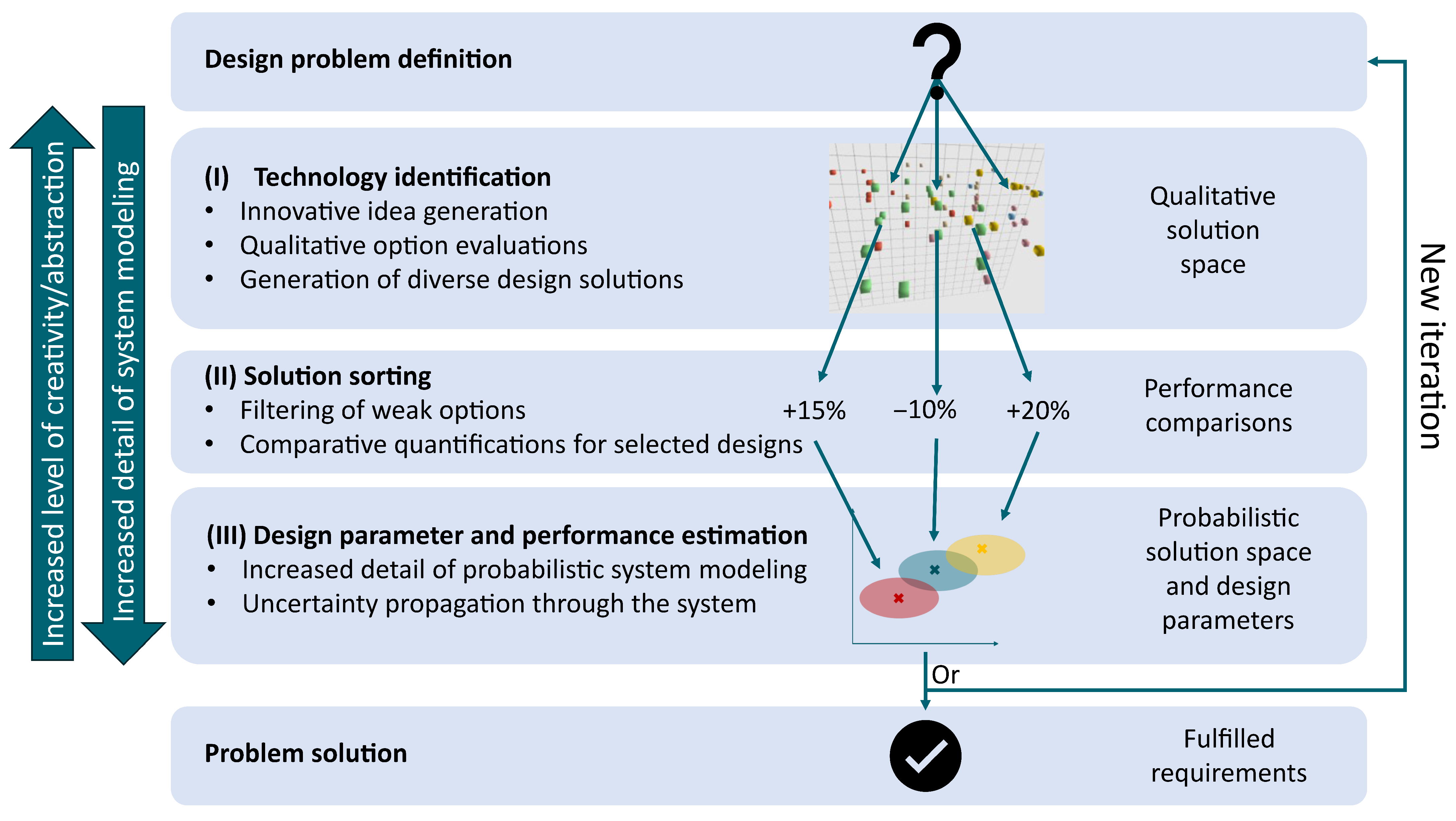
Previous development iterations of the AMA integrated qualitative estimates of option evaluations and solution space analysis. This allowed solely the relative comparison of the generated concepts without any rough quantification of particular design parameters. The extension towards FAMA has identified the use of novel methodology concepts aiming for different detail levels of resulting designs. Depending on the design task purpose and the data/expertise available, the design tasks addressable by the FAMA framework are summarized in
Figure 2. For each of the purposes, one can conduct the main FAMA steps from
Figure 1 by using the adapted tools and their defined interfaces in between. Additionally, a single use case can be studied by executing (a) all levels sequentially or (b) just one or (c) two levels.
Considering the creative and abstract nature of these early design steps, a single conduction of the FAMA steps does not guarantee the “fast” fulfillment of the design requirements the first time. Therefore, it could be applied as an iterative methodology, allowing for learning from the results and refining the design problem definition for the next iteration.
The methodological tools used in the respective design levels are summarized in
Table 1. The uppermost level deals with high-level conceptual questions, such as identification of technologies and components, as well as synthesizing general solutions. These represent only combinations of technologies/options and can be compared relatively on qualitative scales. For that purpose, the options, the relevant assessment criteria, and subcriteria are organized in a hierarchy and are evaluated qualitatively by experts. By applying the AHP, the technology evaluations according to the global criteria and the relative position of the design solutions in a qualitative solution space. The solution sorting purpose, representing the second task, extends the original process by offering the filtering of weak options and the assignment of semi-quantitative performance comparisons. Once there is more understanding of the design and increased detail is required (task III in
Figure 2), one could use the FAMA process to narrow down the problem and use probability distributions for the quantitative modeling of the design parameters. This allows the system to be modeled as a BN, which offers probabilistic inferences on FoMs and potentially their prediction for new values of design parameters.
2.4.2. Positioning Among Other Methods
The current work shows the application of FAMA on the conceptual aircraft design, rather focused on the aircraft as the SoI. However, the general character of the methodology allows the study of any product design use case, more or less, regardless of its domain. While the consideration of external factors (from the aviation domain as well as external ones) was introduced, these can be involved at a much larger scale, depending on the current focus. This is depicted in
Figure 3, which shows the positioning and potential interactions of the FAMA with other design methods.
The main focal points of the FAMA are the unconventional concept generation, the system modeling of abstract design, and the solution space analysis. This results in selected concepts, defined as a combination of certain components and technologies. The design solutions exhibit their performance according to qualitative criteria or quantitative FoMs—either as qualitative comparisons or probabilistic distributions. The main purpose is not to obtain a detailed design, but rather to yield a more reliable comparison (qualitative or quantitative) among a vast number of configurations. Hence, this can be used as a basis for further thorough sizing and more in-depth preliminary design estimations.
As shown in
Figure 3, the results of FAMA can be used as input for model-based systems engineering (MBSE) processes [
31] multidisciplinary aircraft optimization (MDAO) workflows [
32,
33] or value-directed design (VDD) approaches [
34]. This underlines the difference between the FAMA and other holistic aircraft design methods, such as the VDD. While the FAMA specializes in the structured innovative concept generation, abstract system modeling and uncertainty, typical VDD in aircraft design are focused on the value-centered comparison of such concepts [
34].
The qualitative system modeling via AHP also reflects the value estimation of configurations just as other MCDM methods used within VDD. However, the latter tend to be used for the more thorough comparison of designs with increased detail. Meanwhile, the use of AHP within FAMA aims to offer a solution for concept of higher abstraction and uncertainty, thus allowing the increased consideration of unconventional configurations.
3. Use Case for Level 1: Regional Air Transportation
The purpose of the first use case in this article is to demonstrate the application of the FAMA for the design task of technology identification as per
Figure 2 and
Table 1. It shows the generation of MM attributes, options, and criteria with adapted systems thinking. This step structures these in a hierarchy, suitable for the AHP and the subsequent generation of the solution space. The use case demonstrates the streamlining of the data and idea flow through several workshops, the final being the synthesis of solutions representing different regions of the solution space.
According to some estimations, the current perspectives of emission reduction on long-haul flights through some propulsion systems (e.g., full-electric or based on fuel cells) might be limited [
35,
36]. However, these remain the subject of intensive research for greener short and mid-haul routes. Simultaneously, one observes the increased competitiveness of railway transport on a regional scale. This resulted in political initiatives favoring high-speed trains over regional flights, thus aiming to reduce greenhouse gas emitted by commercial flying.
The banning of a certain portion of commercial domestic short-haul flights in France marks an unprecedented measure to limit the air transportation market in favor of the overall emission reduction. The decision of the French government is a part of the so-called “climate law” from 2021 [
37], which states the banning of commercial domestic flights on destinations reachable by public railroad services within 2.5 h [
38].
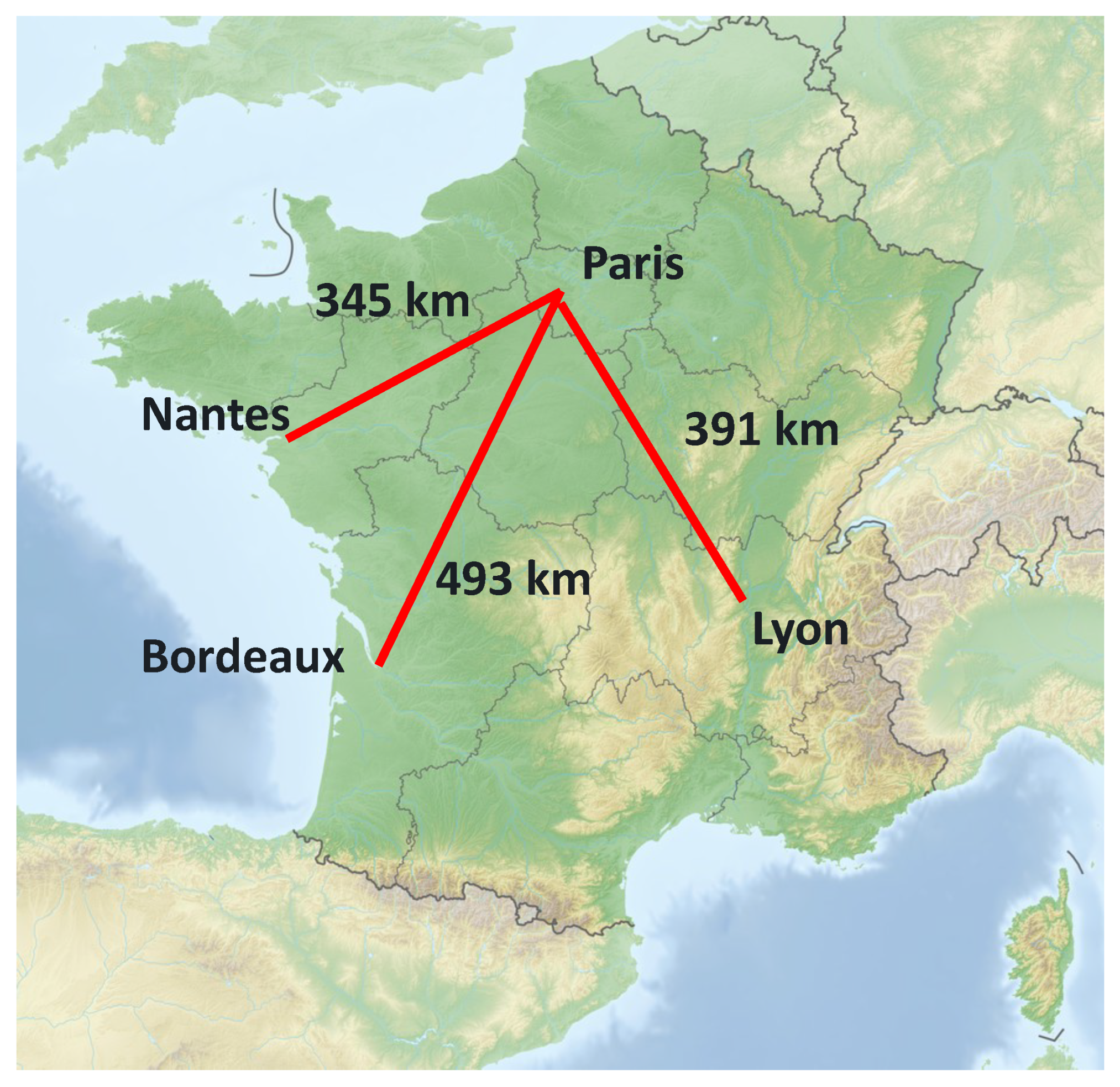
Considering the network of French high-speed railway services, trains can be seen as a suitable and comfortable means to connect distant major cities. In particular, the following popular flight routes might be excluded from the timetable as a result of the measure, as depicted in
Figure 4 with their corresponding great circle distances:
Paris Orly (ORY)–Nantes (NTE): 345 km
Paris Orly (ORY)–Bordeaux (BOD): 493 km
Paris Orly (ORY)–Lyon (LYS): 391 km
Although the train might be more preferred in regard to environmental friendliness, one should not completely neglect the advantages of air transportation in terms of travel (flight) time. Furthermore, such a step would be an additional burden to the existing railway capacity, which could potentially lead to increased service disruptions and require additional investments.
In this context, the use case studies the conceptual design of a regional aircraft in order to identify and evaluate the prospective technologies and suggest synthesized design solutions in a qualitative manner. The global top-level mission requirements (TLARs) were a design range of 500 km and the ability to travel this distance within 2.5 h, while minimizing CO2. emissions and increasing energy efficiency. The following subsections will describe the execution of the FAMA steps for this use case.
3.1. Step 1: Problem Exploration and Decomposition
Purposes: Identify relevant stakeholders; identify relevant technologies and operational concepts for regional aircraft
Adapted tools: Systems thinking, STEEP criteria, definition of an AHP hierarchy
Outputs: A MM and criteria based on STEEP aspects
The problem exploration and decomposition step is executed as a part of a live workshop, which involved nine experts from the fields of aircraft design and lightweight structures. The following describes the application of the theory derived in
Section 2.3.1.
3.1.1. Stakeholder Analysis
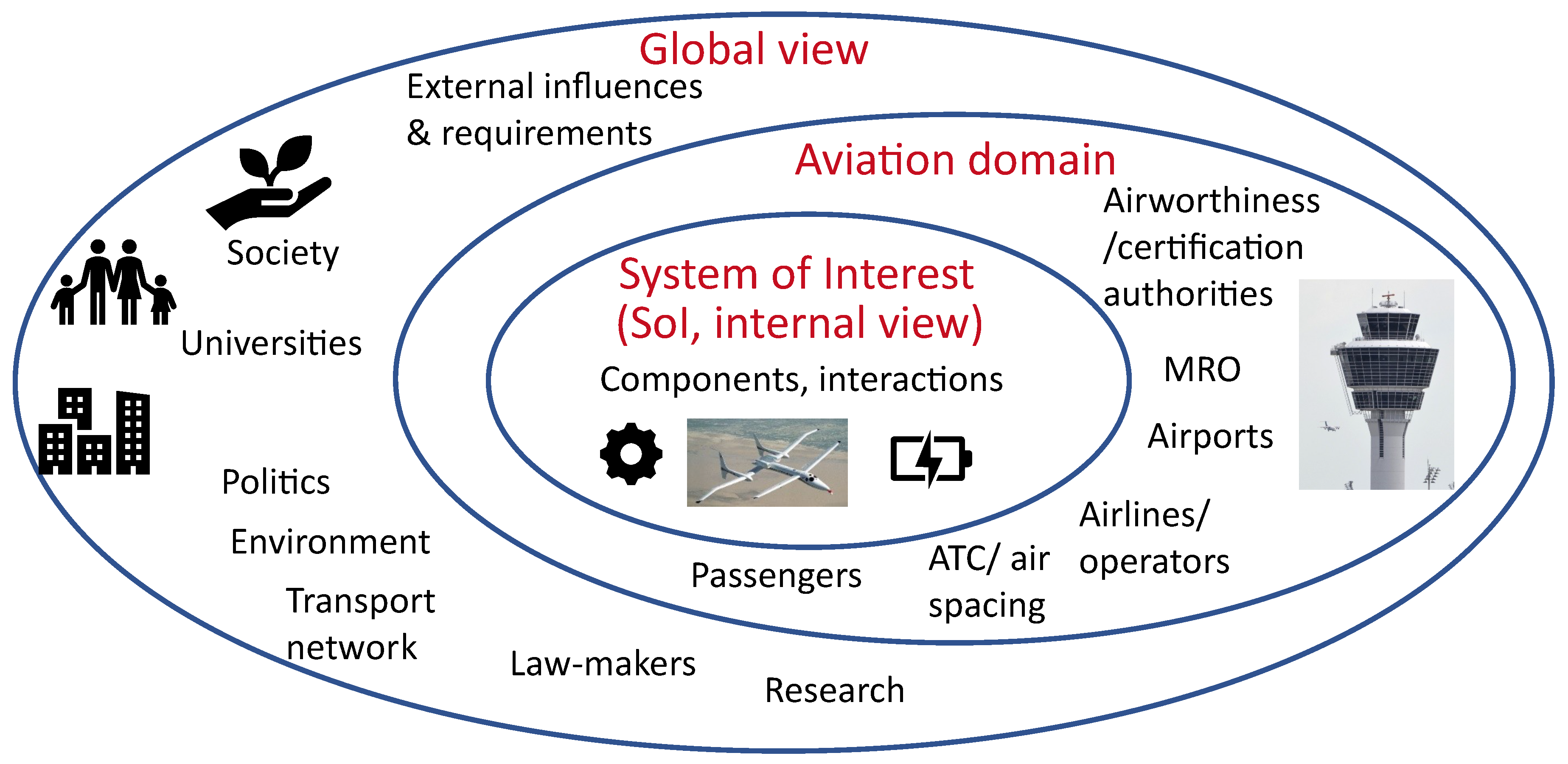
The stakeholder analysis is conducted by taking different views on the system as described in
Section 2.3.1, which will help derive influences and leverages of how the system design can be influenced. The experts were asked to come up with any subject or entity connected by any means to the aircraft to be designed, which is defined as the SoI. For this purpose, the main views on the SoI were shown to them in concentric circles—the SoI, the aviation domain and the global view. The questions that the experts were asked were formulated as follows: “Who influences the SoI? Who is influenced by the SoI?”. The task of the participants was to brainstorm and fill in the relevant subjects/entities in the corresponding views. The result is shown in
Figure 5.
3.1.2. Definition of Criteria and Attributes of the Morphological Matrix
After having defined the main stakeholders, the experts were tasked with deriving the evaluation criteria and the MM attributes from the stakeholders’ perspectives. The main question to be answered was
“Which criteria/expectations/limitations could be imposed on the system by each stakeholder?”. This part of the workshop was conducted collectively as well. The answers were written down by the moderator into a table, as shown in
Table 2. Since the workshop participants covered experience and knowledge related only to a limited number of the derived stakeholders, some of these were not further included. However, the results still allowed for a consistent execution of the methodology steps.
The MM attributes were found in a similar way. For this purpose, the experts had to decide upon the MM attributes—the main components or characteristics of the SoI in this early conceptual design stage. The questions they answered concerned the ways a system can be defined and change according to the stakeholders’ views: “What leverages on system design could the stakeholders have?”. The resulting MM attributes for the corresponding stakeholders are presented in
Table 3. Since the focus of the use case was rather on aircraft design, the majority of attributes were assigned to the aircraft manufacturer. At this point, it is important to underline the impossibility of encompassing the whole spectrum of stakeholders, criteria, etc., in a single use case. Hence, each user of FAMA has the liberty to define the focus of their task and the desired direction.
3.1.3. Options Definition of the Morphological Matrix
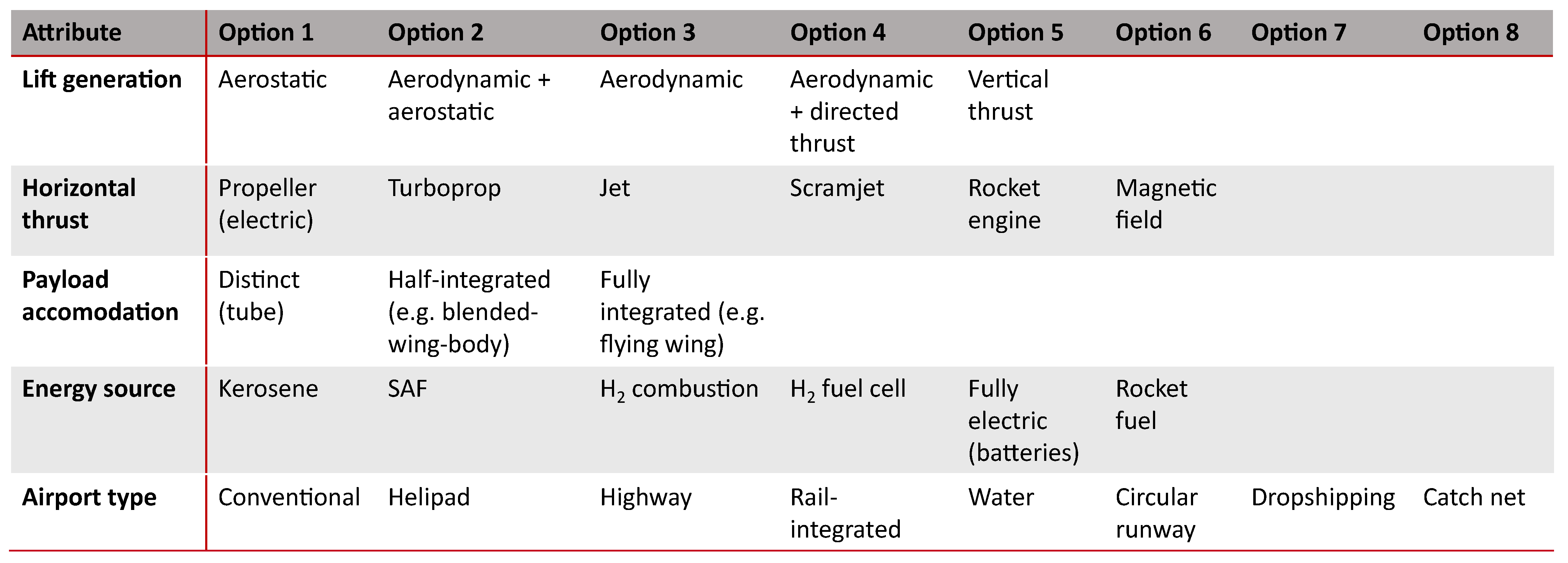
The defined MM attributes allowed the subsequent elaboration of the options—the alternative implementations of the SoI’s functions or answers to the stakeholders’ leverages. These are presented as a complete MM in
Figure 6. It can be considered a fruit of the creative tasks, which resulted in a wide variety of options/technologies.
3.2. Step 2: Analysis of Subproblems
Purposes: Elaboration of a system model based on the MM and criteria, as well as their evaluation.
Used tools: AHP, own online evaluation platform
Outputs: Expert evaluations of options and subcriteria, solution scores according to global criteria
3.2.1. System Modeling
The aim of this step is to obtain a hierarchical system modeling that would suit the adapted AHP method for AMA according to [
9,
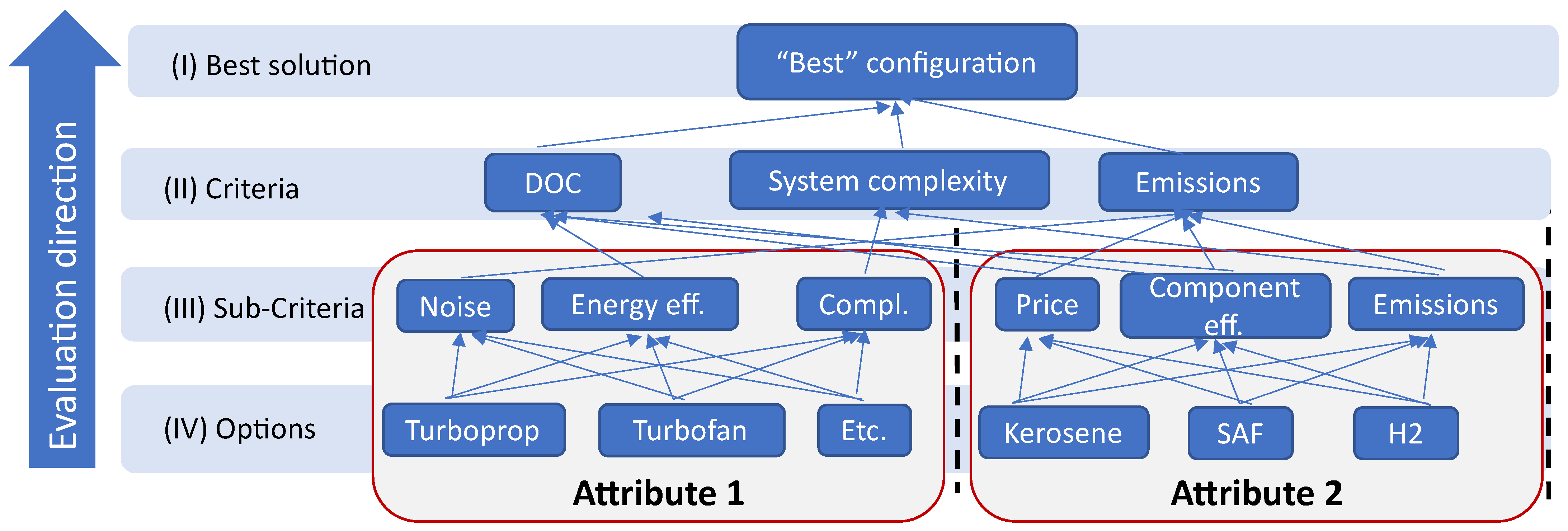
11]. In this context, the experts were tasked to organize the attributes, options and global criteria in a hierarchy. Since the global criteria have a rather general character, it is necessary to define subcriteria that would reflect the global ones but be more specific for the separate attributes and their options, as shown in
Figure 7. Experience from [
11] has shown that this is not only more intuitive for the option evaluation by the experts, but also yields more consistent results.
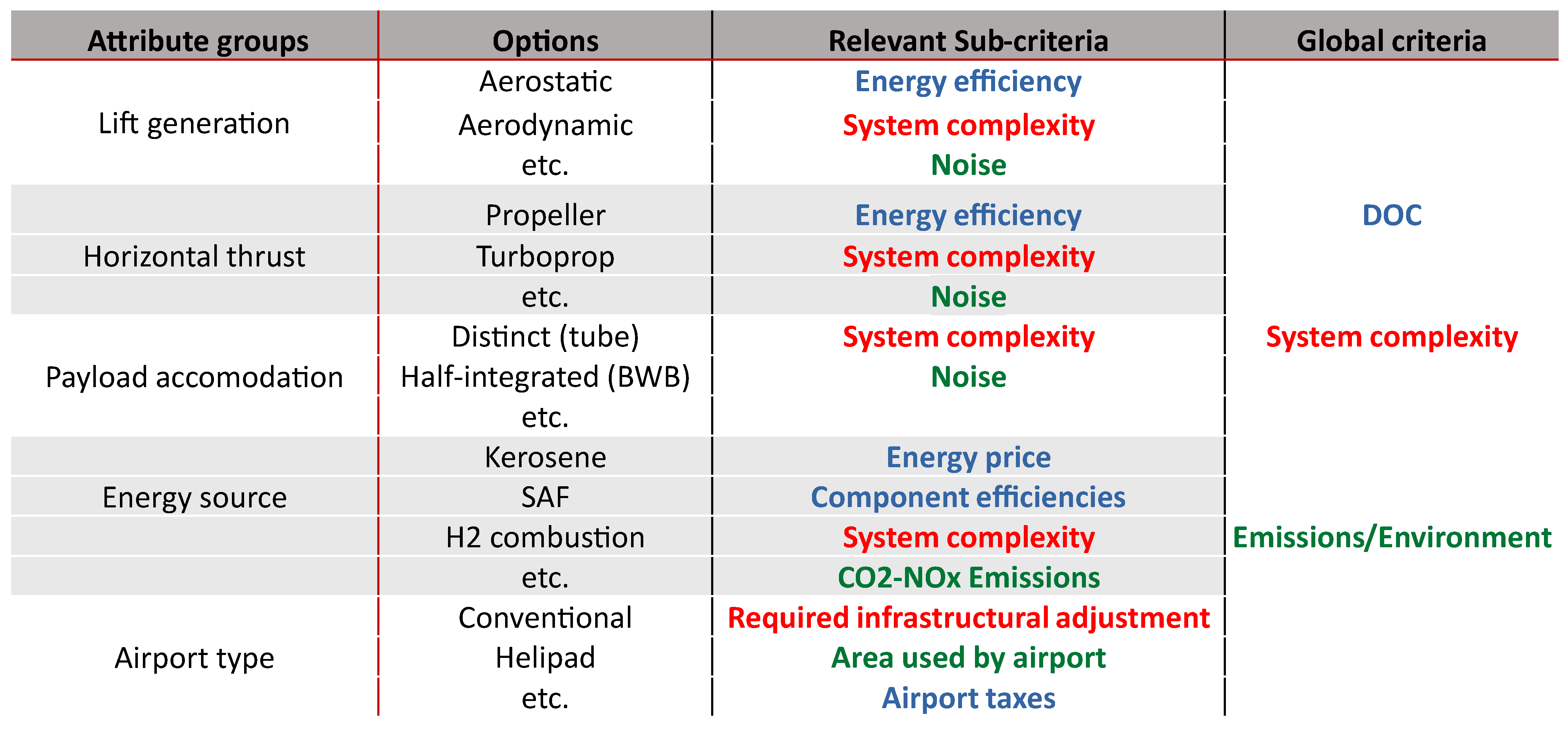
For this task, a general structure was given containing the attributes, their options and the global criteria. The experts had to connect the attributes with the global criteria by adding the relevant subcriteria. These results are shown in
Figure 8.
3.2.2. Option Evaluations
This structure allows the analysis of the subproblems, which correspond to the options in this use case. As defined in [
9], the hierarchy is used as a base for the evaluation of each of its elements according to their connected elements from the level above.
This is conducted in the next step outside of the workshop, where experts individually connect to the evaluation server and enter their qualitative assessments. In a first step, the options are evaluated according to the subcriteria, equivalent to the elements of level IV against level III in
Figure 7. Then, the subcriteria from level III are assessed according to the global criteria in level II. These two evaluation sets are used as input into the AHP algorithm, which calculates the scores of the options (level IV) against the global criteria (level II).
As stated in
Section 2.3.2, the current work tries to avoid the vagueness of the fuzzy numbers used for the pairwise option comparison previously in [
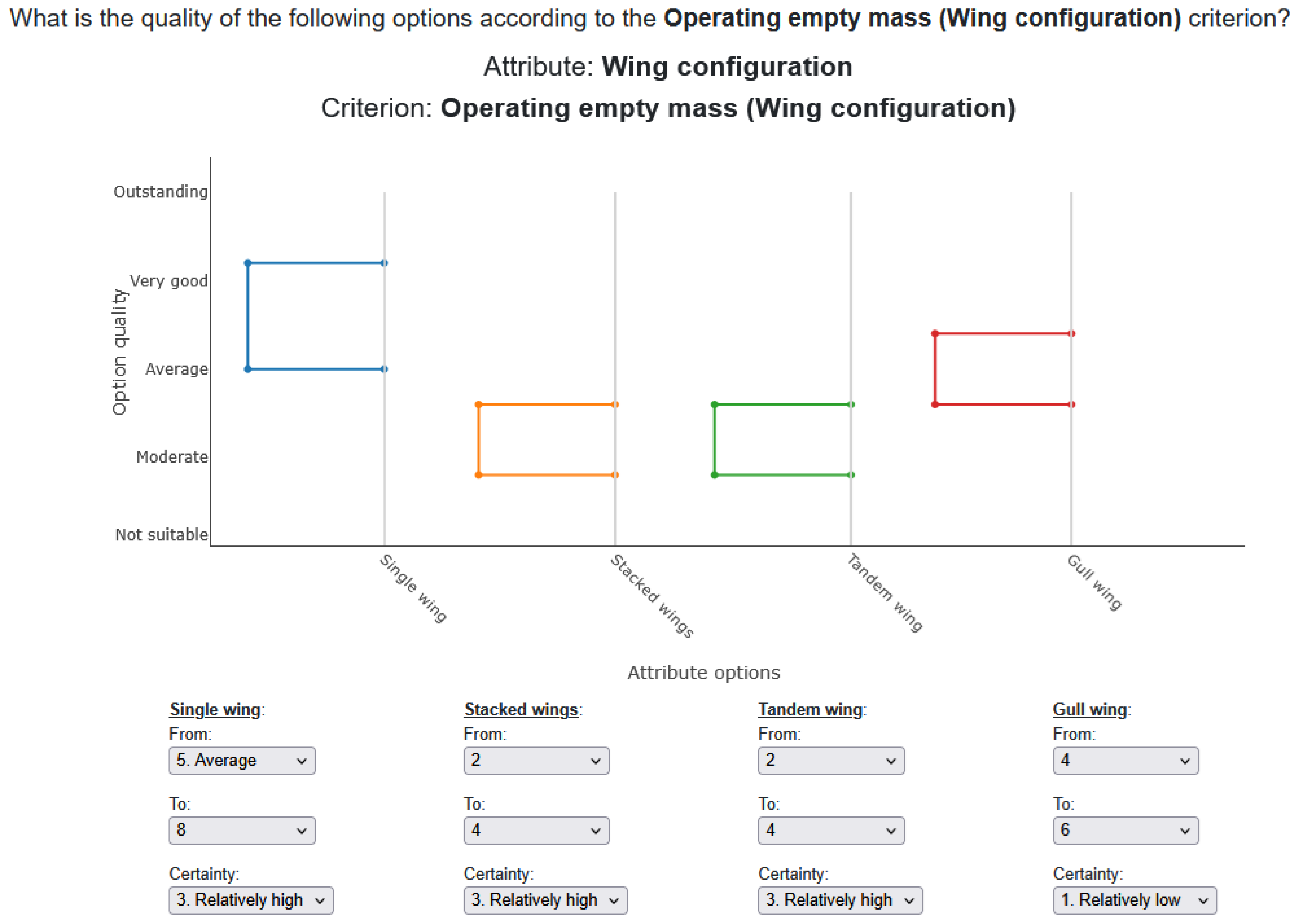
9]. Instead, interval uncertainty is selected for the evaluation of every single option or subcriterion on an updated qualitative scale. A dedicated online browser application has been developed, which allows the anonymous expert log-in and interactively select their evaluation, as depicted in
Figure 9. It shows the interface and a diagram with the evaluations of the options from the same attribute according to a single subcriterion. For each attribute, the experts enter the lower and upper bounds of their estimation for each option (on the
x-axis) according to the scale on the
y-axis. The scale represents a qualitative range of five evaluations of the option against the current subcriterion—extremely low, moderately low, average, very high, and extremely high. In addition, the participants enter their certainty on each estimation, which is used as a weight during the aggregation among all experts (see
Section 2.3.2).
The estimation of the option scores according to the global criteria is conducted by executing the fuzzy AHP as defined in [
9]. In order to use the same approach, the intervals are represented as fuzzy numbers with a single region where the membership function equals to 1. Since the fuzzy AHP requires inputs that represent pairwise comparisons and not separate option evaluations, these are calculated by converting the fuzzy numbers to their crisp versions (the average of the interval bounds) and getting their ratio.
3.2.3. Quality Check of the Expert Evaluations
In general, the usage of data obtained from expert knowledge elicitation requires a data quality check before proceeding. The qualitative character of the evaluations and the acknowledgment of bias presence make this step especially challenging. This is due to the fact that these qualitative estimations could not be calibrated or validated for many unconventional technologies due to a lack of literature sources or simulation data. This requires the adaptation of the data quality check to the existing data type by introducing the following checks: (1) analysis of the answer distributions across experts and (2) selection of evaluations that could be correlated with available technology data.
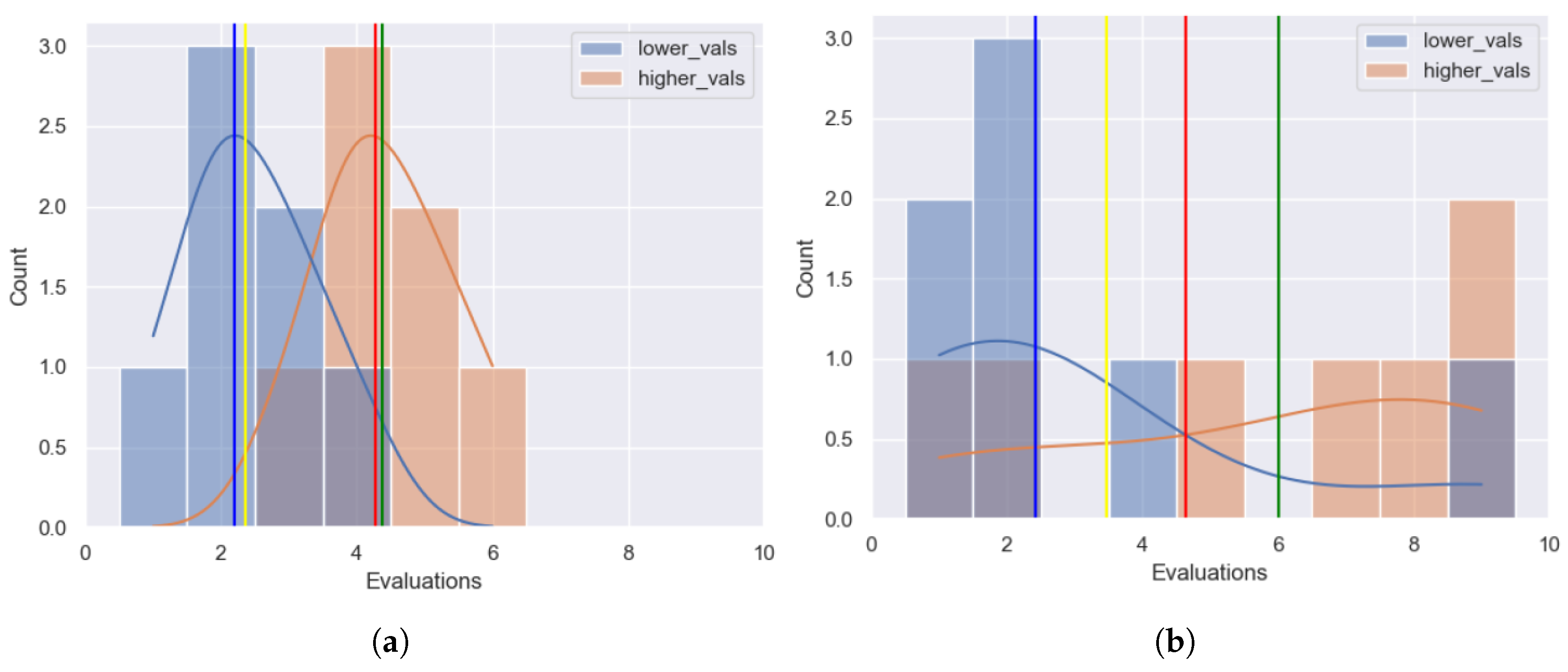
The analysis of the evaluation distributions consists of histogram visualizations as well as normality tests over the answers of each question—the lower and upper bounds of the interval assessments are checked separately. Two common histogram result patterns can be distinguished.
Figure 10a shows a small overlap and nearly normally distributed upper and lower interval bounds entered by the experts. This can be observed for questions concerning rather well-known technologies:
Figure 10a depicts the answers to the question on the quality of kerosene energy source according to its CO
2 and NOX emissions. Upper and lower bounds around 4 and 2 indicate “lower option quality”, i.e., higher emissions of kerosene. On the other hand,
Figure 10b shows the evaluations of a rocket engine for its system complexity. One observes significant overlap and distinct deviation from the normal distribution. The evaluation of the expert justifications and feedback revealed the ambiguity of some questions, especially concerning unusual technologies. In this case, some participants considered rocket propulsion to be overly complicated for a regional aircraft, while others considered rocket propulsion to be a less complex system than a typical turboprop or turbofan as a whole.
If one takes nearly normal distributions as a measure of the data quality with a p-value of , the number of normally distributed lower and upper interval bounds amounts to and , respectively, out of 102 evaluations in total. In the majority of cases, the normally distributed upper and lower bounds are observed for the same tasks. This evidence supports the suggestion that the answers are consistent for given tasks and more unclear for others. The threshold of p-value was selected higher than the conventional to account for subjective biases.
It is important to underline that the confidence in such qualitative evaluations can hardly be increased with a higher number of participants. Hence, this qualitative approach is not designed to be confirmed with a larger sample. The aim here is to involve experts with diverse knowledge, who would be able to cover a wider range of topics and result in a more fruitful simultaneous consideration of various factors.
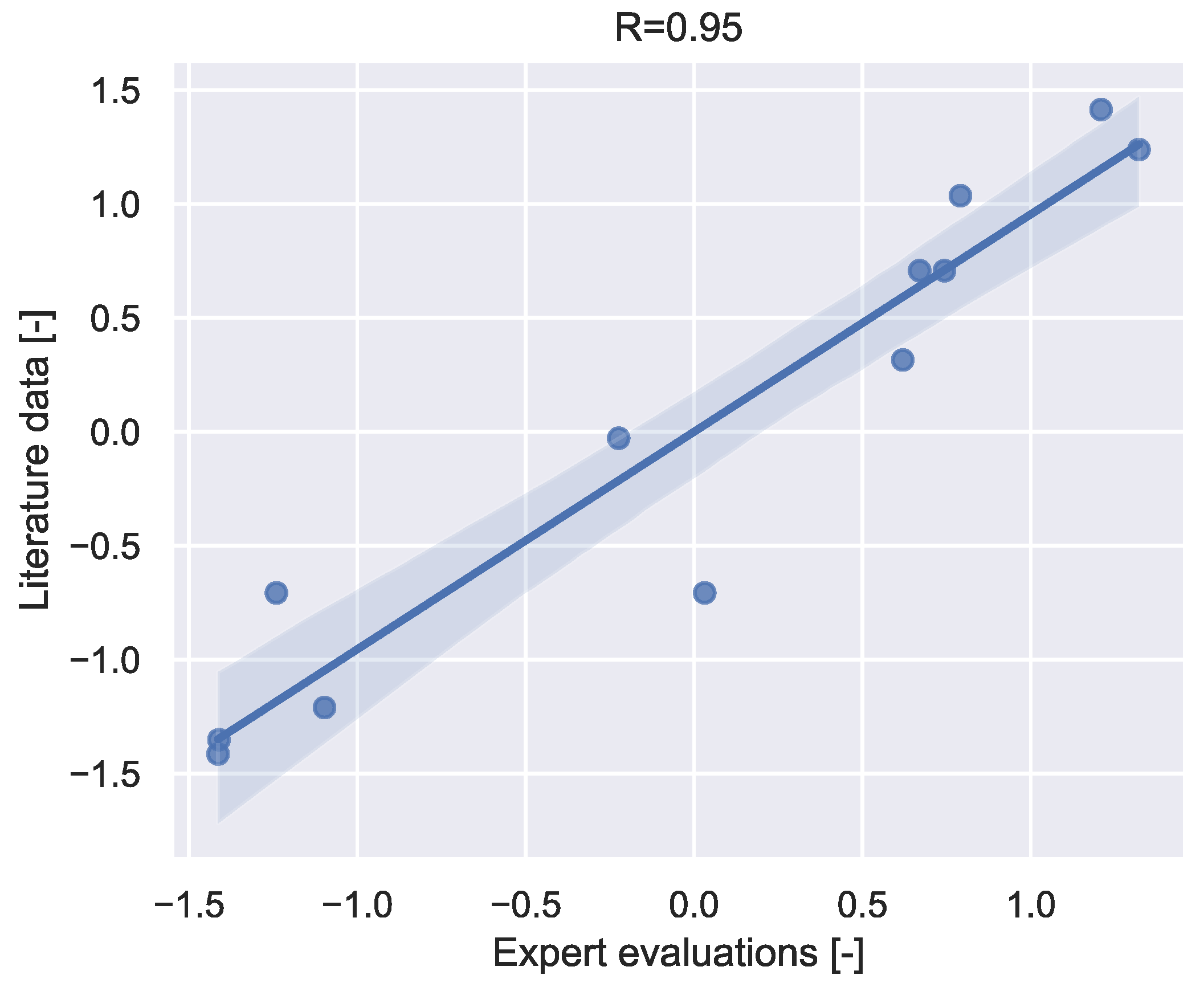
Two of the very few attributes that could be validated with available data are horizontal thrust and energy source. These were correlated with data on CO
2 emissions [gCO
2/kg], propulsion system total efficiency [-] and relative energy consumption [kWh/PAXkm].
Figure 11 presents the correlation of the data with averaged expert evaluations by considering the average of their upper and lower interval values. The data is extracted from the literature summaries of Sources [
41,
42]. Although the dataset of 12 data points might seem limited compared to other quantitative studies, the correlation coefficient of
still indicates a certain validity of the expert evaluations for these attributes, considering the qualitative character and the inevitable presence of biases. This cannot be considered a complete robustness analysis but rather a preliminary consistency check of the data.
3.3. Step 3: Design Synthesis
Purposes: Visualization of the solution space, elaboration of synthesized design solutions
Used tools: Own AMA software, own workshop concept for design synthesis
Outputs: Solution space, synthesized solutions
3.3.1. Solution Space Generation
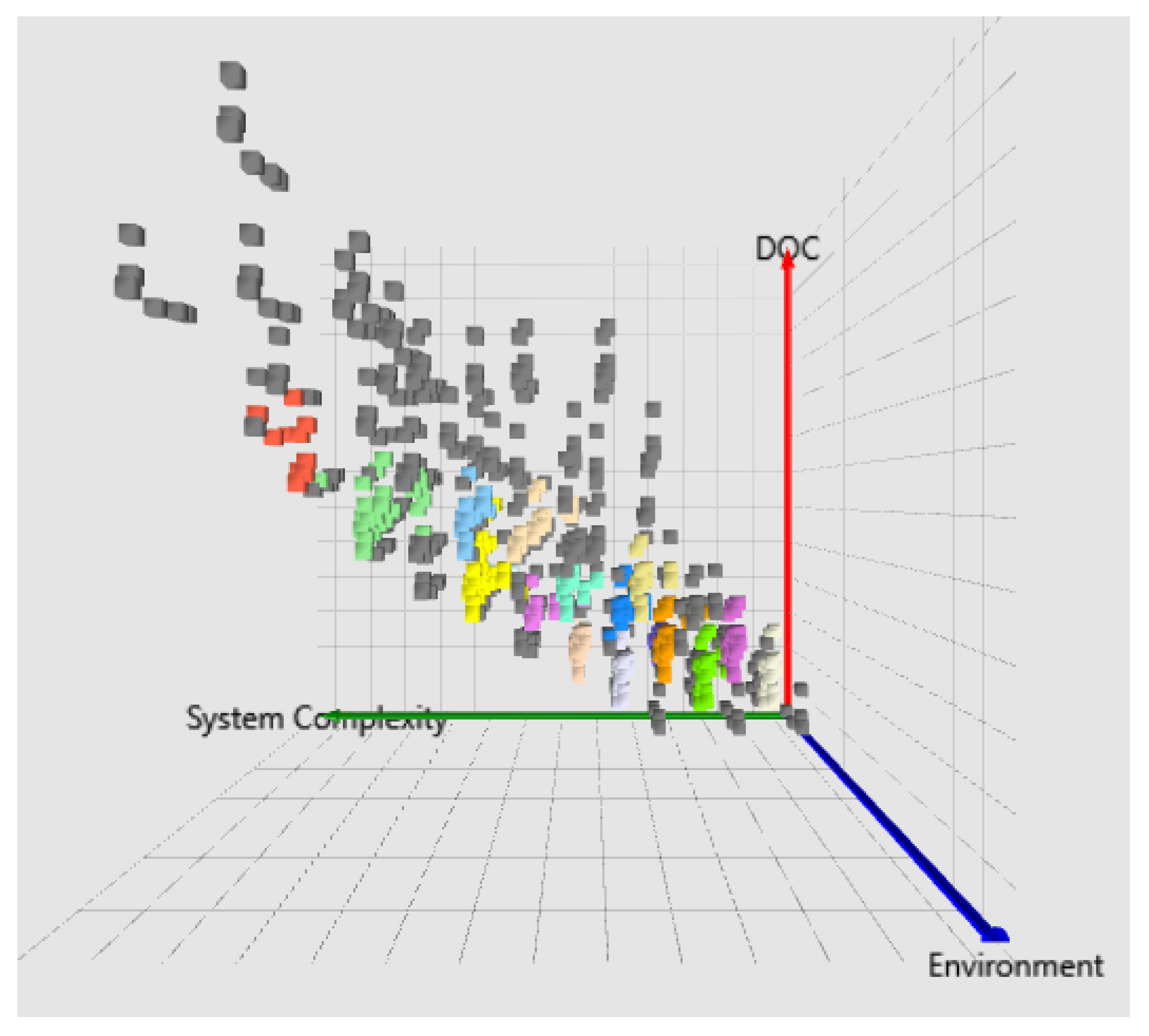
The option scores according to the global criteria obtained from the AHP allow the generation of the solution space, which is shown in
Figure 12. Each data point is a design solution, which represents a different combination of options from each attribute. The sum of their global criteria scores determines the solution placement along the axes of environment, system complexity and DOC. By applying cross-consistency check of the MM options, the solution space was reduced from 4320 (exhaustive) combinations to 819 possible concepts. Additionally, some qualitative option interaction impacts on the synthesized solutions have been considered as well, in the form of percentual addition or subtraction of the summed option scores.
The solution space is clustered with the OPTICS algorithm (ordering points To identify the clustering structure) [
43], which was implemented with the scikit-learn package [
44] for Python 3.7 and results in the solution coloring in
Figure 12. In contrast to the previously used partitional clustering K-Means algorithm [
8,
25], OPTICS is density-based, which categorizes only data points which fulfill certain density criteria, in this case—the minimum number of cluster members. This results in 18 clusters (colored) and 447 unclustered solutions (gray). The selection of density-based clustering is justified by the search of solutions which were closer to each other and therefore could represent a “stable” cluster of similar designs. Meanwhile, partial clustering solely divides the whole dataset space without rendering any particular meaning in the context of aircraft design solutions.
3.3.2. Design Synthesis
Previous works [
8,
25] observed the optimal points of the solution space along the different axes/criteria. In this case, the points on the Pareto front represent configurations with rather conventional options. The current focus of this step is the study of dense solution clusters to check whether these contain dominating options and how to synthesize representative solutions for one cluster.
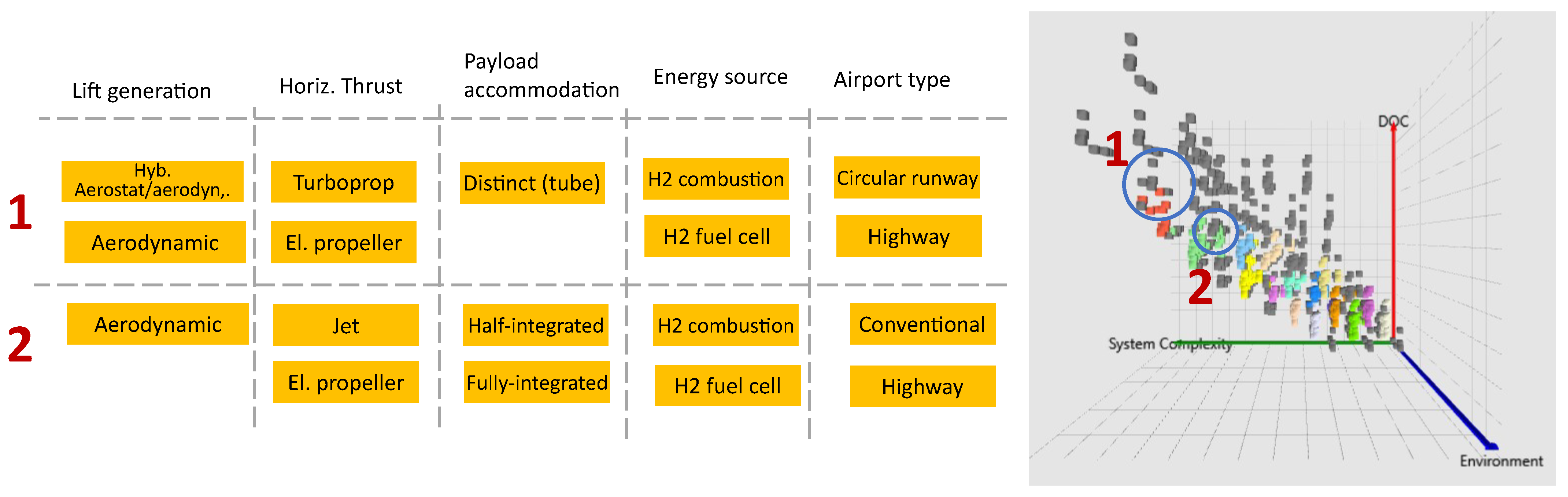
In this use case, the two clusters with highest average overall score (according to the three criteria) are select for this task. Each of them is studied within a small workshop of two experts each. The workshop steps are completed on predefined forms, which are structured as follows: configurations definitions, configuration details, design parameters/capabilities and requirements fulfillment. The first step is depicted in
Figure 13—the participants are first given two of the most prominent options (or a single one) for each attribute in the cluster. In a special field they should elaborate the trade-offs between these and come up with a suitable configuration which could best fulfill the requirements. They freeze the configuration by selecting only one option for each attribute.
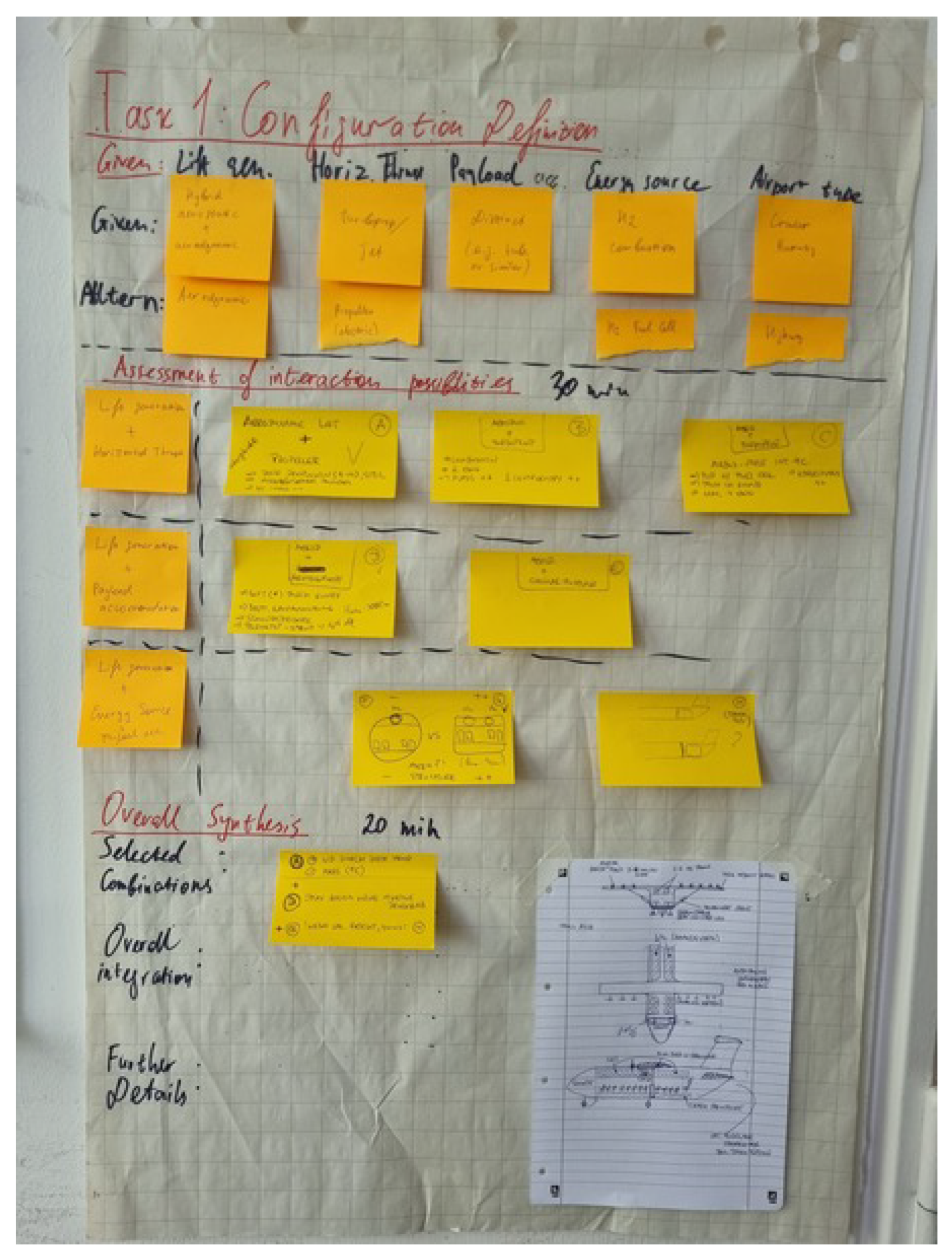
They should then give details to the option integration and provide the three-side view of the aircraft, an example of which is shown on one of the workshop worksheets in
Figure 14. The next step implies the definition of configuration details such as operational aspects, cabin layout, landing gear integration, etc. The workshop is finalized by checking whether the designed configuration fulfills the main requirements: in this case those are the design range of 500 km, the ability to cover it within two hours (aiming at competition with the rail transport from the context description), as well as the target of zero CO
2 emissions.
One of these small group workshops resulted in the design of a strut-braced hydrogen-powered regional aircraft with fuel cell. In this example, the participants designed an airstrip concept as a part of a highway (near an important highway junction) with the necessary infrastructure. This is followed by the estimation of design parameters such as cruise altitude, speed, runway length, wing span, etc. Another group expanded the details for a flying wing with hydrogen combustion which lands on a highway as well.
3.4. Discussion
The first use case in this paper demonstrated the use of the FAMA for the most general purpose in the beginning of each design process—the identification of components, technologies and their aspects, as well as suggestions for synthesized solutions. This design purpose bears purely qualitative character—from the technology evaluations by the experts up to the solution space. It does not aim to yield information on aircraft dimensions or design parameters, but rather help use structured creative techniques to go beyond the designer’s experience. For the elaboration of novel regional passenger aircraft concepts, this approach led to two configurations, one of them being a hydrogen-powered aircraft with a concept for highway landing including the corresponding infrastructure. This shows not only the consideration of technological aspects, but also of infrastructural and societal requirements and criteria, allowed by systems thinking and stakeholder analysis.
It is necessary to underline that this use case aimed to demonstrate the methodology and therefore considered only a limited amount of stakeholders, attributes and options due to the rapidly increased complexity otherwise. However, it shows the potential and the flexibility of the FAMA, which allows the users to focus on different aspects depending on their use case and design purpose.
A new way to handle the “explosion” of solution spaces due to the MM size was presented—the density-based clustering. It allowed the derivation of configurations representing their solution clusters with a given density criteria. This reduces the amount of solutions to be analyzed and streamlines the synthesis for different solution space regions.
4. Use Case for Level 2: The Conceptual Design of a Long-Range Energy-Efficient Aircraft
The second use case conducts the FAMA for the purpose of technology sorting and the solution synthesis based on the sorting. It was executed in collaboration with the UniSELECT project. The project’s aim is to derive guidelines for the design of future long-range aircraft concepts, using synergy potential between technologies, operational scenarios, and disruptive configurations to achieve an energy reduction of at least compared to today’s Airbus A350-like aircraft. For that purpose, the FAMA was applied in a relatively similar way as for the first use case, however demonstrating its application for a different purpose.
For the definition of the MM and the criteria the request was to define three separate FAMA contexts of use, focusing on aircraft configurations, operational scenarios, and technologies, which were executed independently in a first step. Subsequently, their results were combined in an expert workshop in order to obtain synthesized concepts containing aspects from all three use cases.
4.1. Step 1: Problem Exploration and Decomposition
In contrast to the first use case, the global and subcriteria, as well as the MM attributes and options were derived in a more brief process by adapting WDA to the hierarchy structure of the AHP (according to [
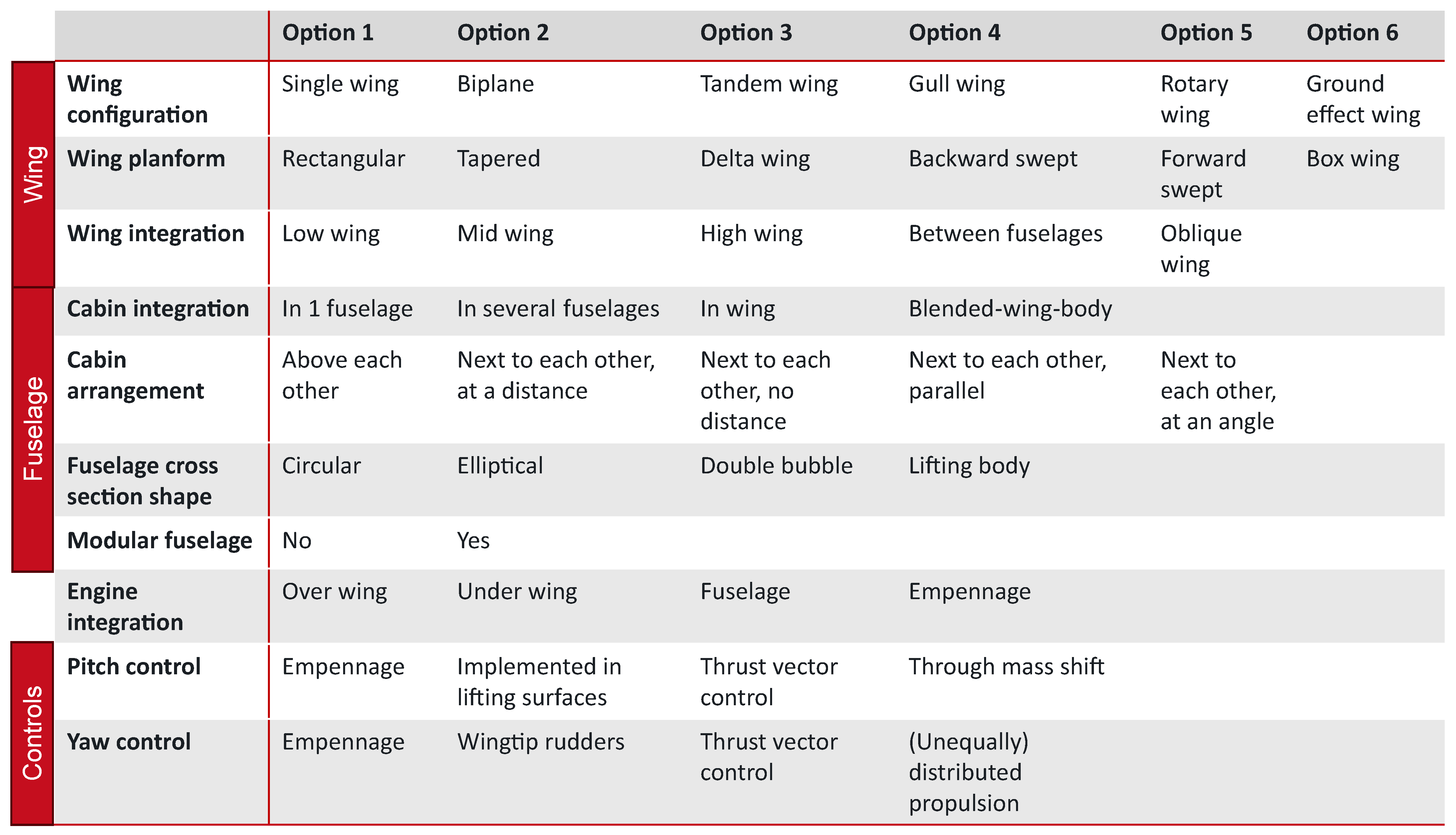
11]). For this purpose, the values from the WDA are translated as “criteria” to suit the AHP. The lower hierarchy levels were also predefined as attribute-specific subcriteria and options. Similarly to WDA, the experts were instructed to study each hierarchy level starting from the top, by executing the following steps: (1) brainstorming—add missing elements; (2) clarity check—make sure all elements are clearly defined and (3) connect the elements with the elements from the level above. Such hierarchies were elaborated for each use case separately. This resulted in vast MMs aiming to exhaust promising concepts—an example for the configurations context is presented in
Figure 15. The global criteria selected for each context are as follows:
Aircraft configurations—emissions, technological suitability (i.e., the suitability of a given configurational aspect for certain technologies, e.g., hydrogen propulsion), system complexity;
Operations—direct operating costs (DOCs), ecological impact, as well as necessary aircraft system adaptation (to suit the operational aspects);
Technologies—emissions and energy efficiency.
4.2. Step 2: Solution of Subproblems
Similarly to the first use case, the analysis of the subproblems represented the expert evaluation of options and subcriteria in an online browser application as described in
Section 3.2 and
Figure 9. Considering the immense amount of options and the extensive questionnaire, some additional functionalities were introduced, such as the possibility to save the entered evaluations and continue at a later time. Once the assessments of all options and subcriteria have been obtained, the AHP is used to calculate the option scores according to the global criteria, which allowed the computation of the total solution scores and locate these in the solution space in the next step.
4.3. Step 3: Design Synthesis
4.3.1. Solution Space Generation
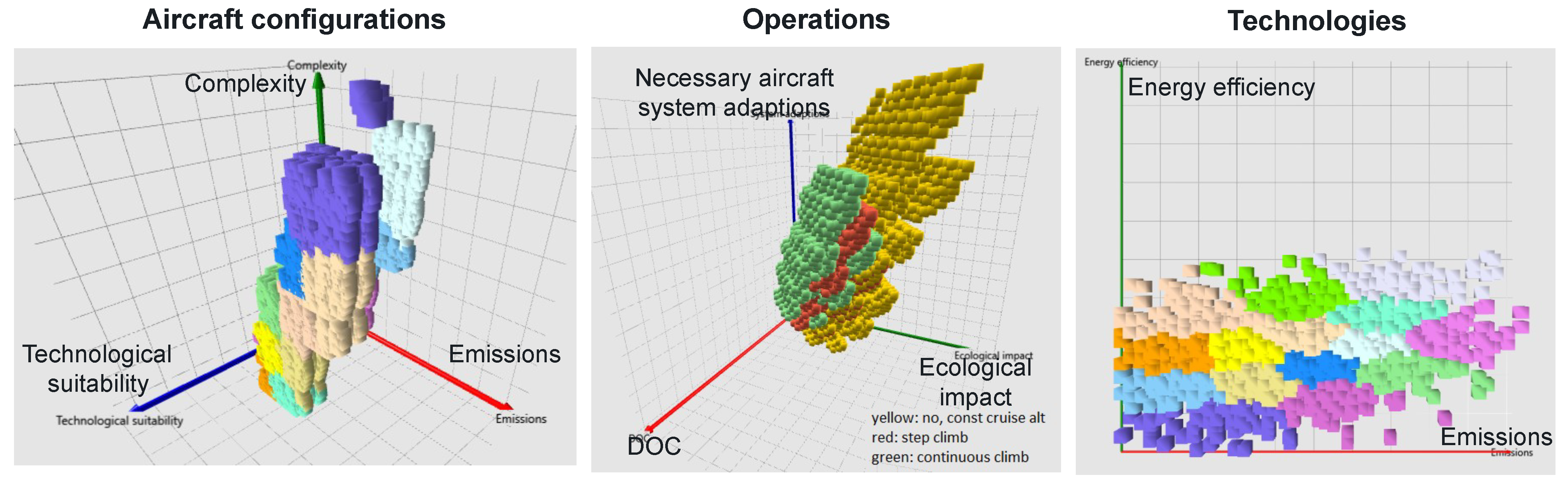
The generated solution spaces for the three use cases are visualized in
Figure 16. The diagram axes represent the corresponding global criteria as defined in Step 1. The large MMs resulted in expansive solution spaces, leading to the visualization of a selected number of best solutions in the figures. The morphological (exhaustive) solution space for the aircraft configurations use case constitutes 5,806,080 solutions, from which were deduced the impossible option combinations. The first diagram from the left in
Figure 16 shows merely the 8500 best configurations to show the relevant part of the data structure. This time, the K-Means clustering algorithm was used, since it rendered better separation of the obtained data than the OPTICS algorithm.
These solutions yielded a significant dominance of conventional options, such as single wing, a single elliptical fuselage, low or braced high wing, and engine integration of under or over wing. This indicates the presence of reference bias in the expert evaluations, when people tend to prefer or lean on familiar knowledge. For this reason, the solution spaces were used to filter out weak options for the next step.
4.3.2. Design Synthesis
The design synthesis step was conducted as a workshop in person involving nine experts from the industry and research. Its purpose was combination of the results of the separate context applications on aircraft configurations, operations, and technologies to reveal the most promising aircraft concepts in terms of energy reduction potential. The workshop concept leaned on the one described in
Section 3.3. By considering the main goal of energy efficiency, the participants decided to alter the concept in favor of sorting the options in each use case by assigning percentual variations of the energy efficiency referred to a reference long-range aircraft—in this case, an Airbus A350-like aircraft concept. For each of the use cases, the groups assigned percentage improvements of energy efficiency to the options.
In a last step, small groups derived three promising aircraft concepts based on the options with the highest energy efficiencies. Concept A integrates a tandem wing, open rotor fan engines over the wing, as well as a propulsive fuselage. It was estimated to increase energy efficiency by around compared to the baseline concept, with its potential improvements until 2050. The second concept (concept B) represents a blended-wing-body with room for liquid hydrogen tanks and cabins situated next to each other, which was estimated by the experts to be around more efficient than the reference. Finally, concept C integrated a single high-braced wing with open rotor engines on it, as well as a propulsive fuselage. Furthermore, higher aspect ratio, as well as gust and maneuver load alleviation, could be achieved by adding folding wing tips to concepts A and C. The participants suggested around efficiency gain for concept C against the reference.
4.4. Discussion
The application of the FAMA within the UniSELECT project has revealed multiple additional benefits of the developed design framework. Firstly and most importantly, this is the possibility to use the FAMA for a different design purpose. This encompasses not only purely qualitative technology identification and synthesis, but also for the filtering and sorting of technologies and design solutions based on semi-quantified performance comparisons.
Secondly, it demonstrated a more efficient definition of the MM elements and criteria by integrating an adapted version of the WDA. On the one hand, it does not include the consideration of different system views as the systems thinking approach. On the other hand, it allows a flexible way of explaining the workshop workflow to the experts so that they develop the hierarchy required by the AHP.
Thirdly, the alteration of the workshop concept by the experts represents a slight deviation from the initial plan, which, however, still falls into the main steps of the FAMA framework methodology. The experts decided to assign energy-efficiency gains in percentages, which still represents the analysis of the options as subproblems. This allowed the further solution synthesis based on the percentages. This could be considered as a certain way of external validation of the FAMA philosophy and demonstrates its flexibility and a novel way of its execution.
Finally, the slight alteration of the workshop concept by the experts has a further advantage, since the use case and the selected solutions encouraged the participants to contribute to the process in a solution-oriented manner based on their expertise and experience. This increases the value of their contribution by not blindly following the predefined concept, but also by co-designing an improvement possibility.
5. Conclusions
So far, there has been a limited number of aircraft design methodologies that would cover a wider spectrum of tasks and purposes. Those were either detailed, but specialized in conventional configurations, or very general ones [
7]. There was still the need to consider unconventional configurations and technology combinations with their uncertainties in a structured and comprehensible way.
To fill this gap, the continuous and iterative development of the FAMA methodology has resulted in a flexible toolbox offering design approaches to complex engineering solutions depending on (1) the design task; (2) the type and quantity of the available data; (3) the involvement of expert knowledge and (4) the desired design detail. It allows not only probabilistic design when more data and knowledge are available, but also the identification and the assessment of technologies early in the conceptual design. The FAMA can be used for three design tasks: technology identification, solution sorting/filtering and the probabilistic estimation of design parameters and performance. This paper presented a general overview of the FAMA framework and applied it to two use cases for the first two design tasks, while the generation of probabilistic solution spaces with Bayesian networks is left to a future publication.
The first use case demonstrates the identification of unconventional technologies and synthesized solutions for a new generation of regional passenger aircraft. It showed the elaboration of the criteria, MM attributes and options as a result of a structured application of systems thinking and hierarchical structure modeling in a workshop in person. A dedicated online assessment platform allowed the interactive evaluation of options and subcriteria by modeling the uncertainties as intervals. The further use of AHP allowed the consideration of attribute-specific subcriteria, which increases the reliability of the qualitative results by avoiding direct assessments against general and vague global criteria. Based on that, an immense solution space was generated. The challenge of its analysis was transformed into a benefit by identifying dense clusters of similar solutions. The informed synthesis based on these was conducted within smaller expert groups, which followed a structured creative process of convergent thinking in order to obtain promising configurations within the concept clusters.
The second use case had a similar structure, but showed the FAMA applicability for a different design purpose beyond the purely qualitative technology and solution identification. The encouraged creativity led to the assignment of percentual improvements of energy-efficiency to prominent technologies and the derivation of three promising concepts in that direction. The definition of the MM and criteria was smoother due to the replacement of stakeholder analysis with a modification of the WDA.
The defined process not only allows the identification of relevant technologies, but also the computational generation of the solution space and the synthesis of representative designs across unconventional solution clusters. The novelty of the whole framework goes beyond the adaptation and interfacing of different tools—it ensures the streamlining of the vague process of concept definition into the intuitive cycle of divergent and convergent thinking. It allows the structured integration of the conventional design process, expert creativity, consideration of uncertainties, computational generation of solution spaces, as well as aircraft design expertise. This approach guided the participants from a so-called “wicked problem” (which cannot be solved analytically) towards multiple aircraft configurations with unconventional components.
The consideration of multiple system views, as well as the identification of relevant stakeholders and their requirements, addresses the European guidelines on the development of carbon-neutral civil aviation until 2050 “Fly the Green Deal” [
3]. It states the consideration of aspects such as infrastructural adaptation, alternative fuels and passenger convenience.
The use cases presented in this work aimed for a qualitative technology identification and solution synthesis, which yields consistent designs, yet without any details on design parameters. It is suitable for the abstract, creative and yet guided search for concepts.
A future publication will demonstrate the use of the FAMA for the probabilistic estimation of design parameters by using BNs.
Author Contributions
Conceptualization, V.T.T., D.R. and A.B.; methodology, V.T.T. and D.R.; software, V.T.T.; validation, V.T.T. and A.B.; formal analysis, V.T.T.; investigation, V.T.T.; resources, D.R. and A.B.; data curation, V.T.T.; writing—original draft preparation, V.T.T.; writing—review and editing, D.R. and A.B.; visualization, V.T.T.; supervision, D.R. and A.B.; project administration, A.B.; funding acquisition, A.B. All authors have read and agreed to the published version of the manuscript.
Funding
This research was funded by Deutsche Forschungsgemeinschaft (DFG, German Research Foundation), grant number 443831887.
Institutional Review Board Statement
Not applicable.
Informed Consent Statement
Not applicable.
Data Availability Statement
Data can be made available on demand.
Acknowledgments
The use case on the long-range passenger aircraft was conducted in cooperation with the UniSELECT project, which was funded by the German Federal Ministry for Economic Affairs and Climate Action within the Luftfahrtforschungsprogramms VI-3 with number 20E2228. The funding of the rest of the work is indicated under “Funding”.
Conflicts of Interest
The authors declare no conflicts of interest.
Abbreviations
The following abbreviations are used in this manuscript:
| ADM | Abstraction–decomposition matrix |
| AHP | Analytical hierarchy process |
| AMA | Advanced morphological approach |
| ATC | Air traffic control |
| BN | Bayesian network |
| BWB | Blended-wing-body |
| DOC | Direct operating cost |
| FAMA | Framework for the advanced morphological approach |
| FoM | Figure of merit |
| H2 | hydrogen |
| MA | Morphological analysis |
| MBSE | Model-based systems engineering |
| MCDM | Multi-criteria decision-making |
| MM | Morphological matrix |
| MRO | Maintenance, repair and overhaul |
| OPTICS | Ordering points To identify the clustering structure |
| PAX | Passenger |
| SAF | Sustainable aviation fuel |
| SEJE | Structured expert judgment elicitation |
| SoI | System of interest |
| STEEP | Social, technological, ecological, economic, political |
| TLAR | Top-level aircraft requirement |
| VDD | Value-driven design |
| WDA | Work domain analysis |
References
- Royal Netherlands Aerospace Centre (NLR); SEO Amsterdam Economics. Destination 2050—A Route to Net Zero European Aviation; Technical Report NLR-CR-2020-510; NLR: Amsterdam, The Netherlands, 2021; Available online: https://www.destination2050.eu/wp-content/uploads/2021/03/Destination2050_Report.pdf (accessed on 8 January 2026).
- Dahlmann, K.; Matthes, S.; Plohr, M.; Niklaß, M.; Scheelhaase, J.; Wozny, F. Climate Impact of Aviation; German Environment Agency/Umweltbundesamt: Dessau-Roßlau, Germany, 2023; Available online: https://www.umweltbundesamt.de/sites/default/files/medien/479/publikationen/fb_climate_impact_of_aviation_0.pdf (accessed on 8 January 2026).
- European Commission; Directorate General for Research and Innovation. Fly the Green Deal: Europe’s Vision for Sustainable Aviation; Publications Office of the European Union: Luxembourg, 2022. [Google Scholar]
- Zwicky, F. Discovery, Invention, Research—Through the Morphological Approach; The Macmillan Company: Toronto, ON, Canada, 1969. [Google Scholar]
- Ritchey, T. General Morphological Analysis. A General Method for Non-Quantified Modelling; Swedish Morphological Society. 2002. Available online: https://www.swemorph.com/pdf/gma.pdf (accessed on 6 April 2021).
- Bardenhagen, A.; Rakov, D. Analysis and Synthesis of Aircraft Configurations During Conceptual Design Using an Advanced Morphological Approach; Deutsche Gesellschaft für Luft-und Raumfahrt: Bonn, Germany, 2019. [Google Scholar] [CrossRef]
- Todorov, V.T.; Rakov, D.; Bardenhagen, A. Creation of innovative concepts in Aerospace based on the Morphological Approach. IOP Conf. Ser. Mater. Sci. Eng. 2022, 1226, 012029. [Google Scholar] [CrossRef]
- Todorov, V.T.; Rakov, D.; Bardenhagen, A. Structured Expert Judgment Elicitation in Conceptual Aircraft Design. Aerospace 2023, 10, 287. [Google Scholar] [CrossRef]
- Todorov, V.T.; Rakov, D.; Bardenhagen, A. Enhancement Opportunities for Conceptual Design in Aerospace Based on the Advanced Morphological Approach. Aerospace 2022, 9, 78. [Google Scholar] [CrossRef]
- Todorov, V.T.; Rakov, D.; Bardenhagen, A. Solution Space Analysis for Robust Conceptual Design Solutions in Aeronautics. Eng. Proc. 2025, 90, 60. [Google Scholar] [CrossRef]
- Todorov, V.T.; Rakov, D.; Bardenhagen, A. Sensitivity Analysis and System Attribute Importance for Conceptual Aircraft Design with the Advanced Morphological Approach. Aerospace 2023, 10, 608. [Google Scholar] [CrossRef]
- Vidal, R.V.V. Creative and Participative Problem Solving—The Art and the Science; Informatics and Mathematical Modelling, Technical University of Denmark, DTU: Kongens Lyngby, Denmark, 2006. [Google Scholar]
- NASA; The Boeing Company. File: Boeing Advanced Blended Wing Body Concept 2011 (Cropped).jpg. Wikipedia. 2011. Available online: https://commons.wikimedia.org/wiki/File:Boeing_advanced_blended_wing_body_concept_2011_(cropped).jpg (accessed on 9 December 2024).
- Thomas, C.; NASA. Proteus EC03-0085-17: Proteus in Flight Over Rosamond Dry Lakebed, 2003. Available online: https://www.dfrc.nasa.gov/Gallery/Photo/Proteus/HTML/EC03-0085-17.html (accessed on 9 December 2024).
- Abu Salem, K.; Palaia, G.; Carrera, E. A discussion on benchmarking unconventional configurations with conventional aircraft: The box-wing study case. CEAS Aeronaut. J. 2024, 15, 1069–1090. [Google Scholar] [CrossRef]
- Farokhi, S. Future Propulsion Systems and Energy Sources in Sustainable Aviation; Aerospace Series; Wiley: Hoboken, NJ, USA, 2020. [Google Scholar]
- Bravo-Mosquera, P.D.; Catalano, F.M.; Zingg, D.W. Unconventional aircraft for civil aviation: A review of concepts and design methodologies. Prog. Aerosp. Sci. 2022, 131, 100813. [Google Scholar] [CrossRef]
- Gräßler, I.; Oleff, C. Systems Engineering: Verstehen und Industriell Umsetzen; Springer: Berlin, Germany, 2022. [Google Scholar]
- ISO/IEC/IEEE 15288:2015; Systems and Software Engineering—System Life Cycle Processes. International Organization for Standardization: Geneva, Switzerland, 2015.
- Randt, N.P. An approach to product development with scenario planning: The case of aircraft design. Futures 2015, 71, 11–28. [Google Scholar] [CrossRef]
- Hoffman, R.R.; Lintern, G. Eliciting and Representing the Knowledge of Experts. In The Cambridge Handbook of Expertise and Expert Performance, 1st ed.; Ericsson, K.A., Charness, N., Feltovich, P.J., Hoffman, R.R., Eds.; Cambridge University Press: Cambridge, UK, 2006; pp. 203–222. [Google Scholar] [CrossRef]
- Lintern, G. Tutorial: Work Domain Analysis. 2016. Available online: http://cognitivesystemsdesign.net/Tutorials/Work%20Domain%20Analysis%20Tutorial.pdf (accessed on 25 October 2023).
- Chytka, T.M. Development of an Aggregation Methodology for Risk Analysis in Aerospace Conceptual Vehicle Design. Ph.D. Thesis, Old Dominion University Libraries, Norfolk, VA, USA, 2003. [Google Scholar] [CrossRef]
- Liu, Y.; Eckert, C.M.; Earl, C. A review of fuzzy AHP methods for decision-making with subjective judgements. Expert Syst. Appl. 2020, 161, 113738. [Google Scholar] [CrossRef]
- Todorov, V.; Rakov, D.; Bardenhagen, A. Improvement and Testing of the Advanced Morphological Approach in the Domain of Conceptual Aircraft Design; Deutsche Gesellschaft für Luft-und Raumfahrt-Lilienthal-Oberth eV: Bonn, Germany, 2022. [Google Scholar] [CrossRef]
- Cooke, R.M. Experts in Uncertainty: Opinion and Subjective Probability in Science; Environmental Ethics and Science Policy Series; Oxford University Press: New York, NY, USA, 1991. [Google Scholar]
- Hanea, A.M.; Nane, G.F. An In-Depth Perspective on the Classical Model. In Expert Judgement in Risk and Decision Analysis; International Series in Operations Research & Management Science; Hanea, A.M., Nane, G.F., Bedford, T., French, S., Eds.; Springer International Publishing: Cham, Switzerland, 2021; Volume 293, pp. 225–256. [Google Scholar] [CrossRef]
- Saaty, T.L.; Vargas, L.G. Models, Methods, Concepts & Applications of the Analytic Hierarchy Process, 2nd ed.; Number 175 in International Series in Operations Research & Management Science; Springer: New York, NY, USA; Heidelberg, Germany, 2012. [Google Scholar]
- Chen, S.J.; Hwang, C.L.; Hwang, F.P. Fuzzy Multiple Attribute Decision Making: Methods and Applications; Number 375 in Lecture Notes in Economics and Mathematical Systems; Springer: Berlin, Germany; New York, NY, USA, 1992. [Google Scholar]
- Koski, T.; Noble, J.M. Bayesian Networks: An Introduction, 1st ed.; Wiley Series in Probability and Statistics; Wiley: Chichester, UK, 2009. [Google Scholar]
- Estefan, J.A. Survey of Model-Based Systems Engineering (MBSE) Methodologies; rev. B; INCOSE-TD-2007-003-02; International Council on Systems Engineering (INCOSE): Seattle, WA, USA, 2008; Available online: https://www.omgsysml.org/MBSE_Methodology_Survey_RevB.pdf (accessed on 7 April 2021).
- Garg, S.; Garcia Sanchez, R.; Bussemaker, J.H.; Boggero, L.; Nagel, B. Dynamic Formulation and Execution of MDAO Workflows for Architecture Optimization. In Proceedings of the AIAA Aviation Forum and Ascend 2024, Las Vegas, NV, USA, 29 July–2 August 2024. [Google Scholar] [CrossRef]
- Gray, J.S.; Hwang, J.T.; Martins, J.R.R.A.; Moore, K.T.; Naylor, B.A. OpenMDAO: An open-source framework for multidisciplinary design, analysis, and optimization. Struct. Multidiscip. Optim. 2019, 59, 1075–1104. [Google Scholar] [CrossRef]
- Donelli, G.; Boggero, L.; Nagel, B. Concurrent Value-Driven Decision-Making Process for the Aircraft, Supply Chain and Manufacturing Systems Design. Systems 2023, 11, 578. [Google Scholar] [CrossRef]
- Sain, C.; Kazula, S.; Enghardt, L. Electric Propulsion for Regional Aircraft—Critical Components and Challenges; Deutsche Gesellschaft für Luft-und Raumfahrt: Bonn, Germany, 2023. [Google Scholar] [CrossRef]
- Wolleswinkel, R.E.; De Vries, R.; Hoogreef, M.; Vos, R. A New Perspective on Battery-Electric Aviation, Part I: Reassessment of Achievable Range. In Proceedings of the AIAA Scitech 2024 Forum, Orlando, FL, USA, 8–12 January 2024. [Google Scholar] [CrossRef]
- Loi n° 2021–1104 du 22 août 2021 Portant lutte Contre le dérèGlement Climatique et Renforcement de la Résilience Face à ses Effets, 2021. Available online: https://www.legifrance.gouv.fr/eli/loi/2021/8/22/TREX2100379L/jo/texte (accessed on 16 February 2026).
- Lainé, L. France: La Suppression de Vols Intérieurs Courts Entre en Vigueur; L’Echo Touristique: Paris, France, 2023; Available online: https://www.lechotouristique.com/article/france-la-suppression-de-vols-interieurs-courts-entre-en-vigueur (accessed on 16 February 2026).
- Gaba, E. File: France Relief Location Map, 2008. Available online: https://commons.wikimedia.org/wiki/File:France_relief_location_map.jpg (accessed on 16 February 2026).
- High Contrast. File: Control Tower of Munich Airport.JPG, 2012. Available online: https://commons.wikimedia.org/wiki/File:Control_tower_of_Munich_Airport.JPG (accessed on 27 February 2026).
- Ekinci, O.T. Identifizierung, Analyse und Auswertung von Integrationsmöglichkeiten Neuartiger Technologien in Energieeffizienten Flugzeugkonfigurationen. Bachelor’s Thesis, Technische Universität Berlin, Berlin, Germany, 2023. [Google Scholar]
- Walter, C. Ermittlung und Auswertung von Wasserstoffantriebskonzepte für Neuartige Flugzeuggenerationen. Master’s Thesis, Technische Universität Berlin, Berlin, Germany, 2023. [Google Scholar]
- Ankerst, M.; Breunig, M.M.; Kriegel, H.P.; Sander, J. OPTICS: Ordering points to identify the clustering structure. ACM Sigmod Rec. 1999, 28, 49–60. [Google Scholar] [CrossRef]
- Pedregosa, F.; Varoquaux, G.; Gramfort, A.; Michel, V.; Thirion, B.; Grisel, O.; Blondel, M.; Prettenhofer, P.; Weiss, R.; Dubourg, V.; et al. Scikit-learn: Machine Learning in Python. J. Mach. Learn. Res. 2011, 12, 2825–2830. [Google Scholar]
Figure 1.
A schematic structure of the FAMA design framework, and the addressing of the main challenges in unconventional aircraft design in each step. The figure is extended from the one in Reference [
10]. Sources of the aircraft images: [
13,
14].
Figure 1.
A schematic structure of the FAMA design framework, and the addressing of the main challenges in unconventional aircraft design in each step. The figure is extended from the one in Reference [
10]. Sources of the aircraft images: [
13,
14].
Figure 2.
The defined design levels for the execution of the FAMA.
Figure 2.
The defined design levels for the execution of the FAMA.
Figure 3.
Positioning of the FAMA in aircraft design and potential interfaces to other design tools and domains.
Figure 3.
Positioning of the FAMA in aircraft design and potential interfaces to other design tools and domains.
Figure 4.
Some of the domestic routes in France with their great circle distances, on which flight bans are planned due to existing direct railway connections of under 2.5 h. Source of the map of France: [
39]. Own representation of the routes.
Figure 4.
Some of the domestic routes in France with their great circle distances, on which flight bans are planned due to existing direct railway connections of under 2.5 h. Source of the map of France: [
39]. Own representation of the routes.
Figure 5.
Views on the SoI adapted to aircraft design. Used abbreviations: MRO—maintenance, repair and overhaul; ATC—air traffic control. Sources of used images: [
14,
40].
Figure 5.
Views on the SoI adapted to aircraft design. Used abbreviations: MRO—maintenance, repair and overhaul; ATC—air traffic control. Sources of used images: [
14,
40].
Figure 6.
The MM for the conceptual design of a regional aircraft based on the stakeholder and technology identification conducted during the expert workshop.
Figure 6.
The MM for the conceptual design of a regional aircraft based on the stakeholder and technology identification conducted during the expert workshop.
Figure 7.
The general hierarchy structure aimed to be obtained during the workshop.
Figure 7.
The general hierarchy structure aimed to be obtained during the workshop.
Figure 8.
The results of the hierarchical system modeling by the experts for further use with AHP. The coloring of the global and subcriteria reflects their connections in the hierarchy.
Figure 8.
The results of the hierarchical system modeling by the experts for further use with AHP. The coloring of the global and subcriteria reflects their connections in the hierarchy.
Figure 9.
A screenshot of the developed online evaluation platform for a part of the options.
Figure 9.
A screenshot of the developed online evaluation platform for a part of the options.
Figure 10.
Histograms representing two typical answer distributions by the experts for the same evaluation, i.e., only one option according to one subcriterion. The red bars stand for the quantity of a certain evaluation given for the upper value of the interval and the blue ones show the lower bound: (a) small overlap, nearly normally distributed upper and lower bounds for more familiar technologies. Current question: evaluation of the kerosene energy source for its CO2 and NOX emissions. (b) Current question: evaluation of a rocket engine according to its system complexity.
Figure 10.
Histograms representing two typical answer distributions by the experts for the same evaluation, i.e., only one option according to one subcriterion. The red bars stand for the quantity of a certain evaluation given for the upper value of the interval and the blue ones show the lower bound: (a) small overlap, nearly normally distributed upper and lower bounds for more familiar technologies. Current question: evaluation of the kerosene energy source for its CO2 and NOX emissions. (b) Current question: evaluation of a rocket engine according to its system complexity.
Figure 11.
Correlation of normalized averaged expert evaluations and normalized data on some options from the attributes horizontal thrust and energy source.
Figure 11.
Correlation of normalized averaged expert evaluations and normalized data on some options from the attributes horizontal thrust and energy source.
Figure 12.
Clustered solution space for the conceptual design of a regional aircraft.
Figure 12.
Clustered solution space for the conceptual design of a regional aircraft.
Figure 13.
The most prominent options for each attribute in two clusters (numbered as 1 and 2) shown on the right.
Figure 13.
The most prominent options for each attribute in two clusters (numbered as 1 and 2) shown on the right.
Figure 14.
An example worksheet used during the solution synthesis workshop.
Figure 14.
An example worksheet used during the solution synthesis workshop.
Figure 15.
The MM for the configurations context.
Figure 15.
The MM for the configurations context.
Figure 16.
Visualizations of the solution spaces for the contexts of aircraft configuration, operations and technologies (from left to right).
Figure 16.
Visualizations of the solution spaces for the contexts of aircraft configuration, operations and technologies (from left to right).
Table 1.
Used tools at each methodological step of the FAMA for the different design task purposes.
Table 1.
Used tools at each methodological step of the FAMA for the different design task purposes.
| Purpose | Idea Generation | Uncertainty Modeling | System Modeling | Resulting Solution Space |
|---|
| Technology identification | MM | Qualitative intervals or fuzzy numbers | Qualitative, with AHP | Qualitative |
| Solution sorting | MM | Qualitative intervals or fuzzy numbers | Qualitative, with AHP | Qualitative |
| Design parameters and performance estimation | MM | Probability distributions | Probabilistic inference with Bayesian networks | Probabilistic |
Table 2.
Derivation of evaluation criteria for the different stakeholders.
Table 2.
Derivation of evaluation criteria for the different stakeholders.
| Inner View | Outer View |
|---|
|
SoI
|
Aviation Domain
|
Global View
|
|---|
|
Manufacturer
|
PAX
|
Airports
|
ATC
|
MRO
|
Operators
|
Society
|
Environment
|
|---|
| Aircraft development costs, aircraft development time | Ticket price, taxes, safety, speed, comfort, connections, availability, acceptability | Infrastructure, safety, security, noise | Speed, air spaces, separation | New technologies, system configuration | MRO costs, fuel, airport, crew, emission taxes, inventory, financing system complexity, market, turnaround | Acceptance | Emissions, sustainability, noise |
Table 3.
Derivation of the MM attributes for the different stakeholders.
Table 3.
Derivation of the MM attributes for the different stakeholders.
| Inner View | Outer View |
|---|
| SoI | Aviation Domain | Global View |
|---|
| Manufacturer | PAX | Airports | ATC | MRO | Operators | Society | Environment |
|---|
| Lift generation, horizontal thrust, payload accommodation, energy storage, energy source, ground movement | | Airport type | Airspace | | Business model, financing, autonomy level | | |
| Disclaimer/Publisher’s Note: The statements, opinions and data contained in all publications are solely those of the individual author(s) and contributor(s) and not of MDPI and/or the editor(s). MDPI and/or the editor(s) disclaim responsibility for any injury to people or property resulting from any ideas, methods, instructions or products referred to in the content. |