
Review

High-Resolution Thermal Mapping for Quantitative UAV–TIR Applications: A Methodological Review of Sensor Integration, Calibration, and Data Processing Decisions


1
Research Institute of Artificial Intelligent Diagnosis Technology for Multi-Scale Organic and Inorganic Structure, Kyungpook National University, Sangju 37224, Republic of Korea
2
Department of Location-Based Information System, Kyungpook National University, Sangju 37224, Republic of Korea
*
Author to whom correspondence should be addressed.
Aerospace 2026, 13(5), 430; https://doi.org/10.3390/aerospace13050430

Submission received: 21 March 2026 / Revised: 23 April 2026 / Accepted: 28 April 2026 / Published: 4 May 2026
(This article belongs to the Section Aeronautics)

Abstract

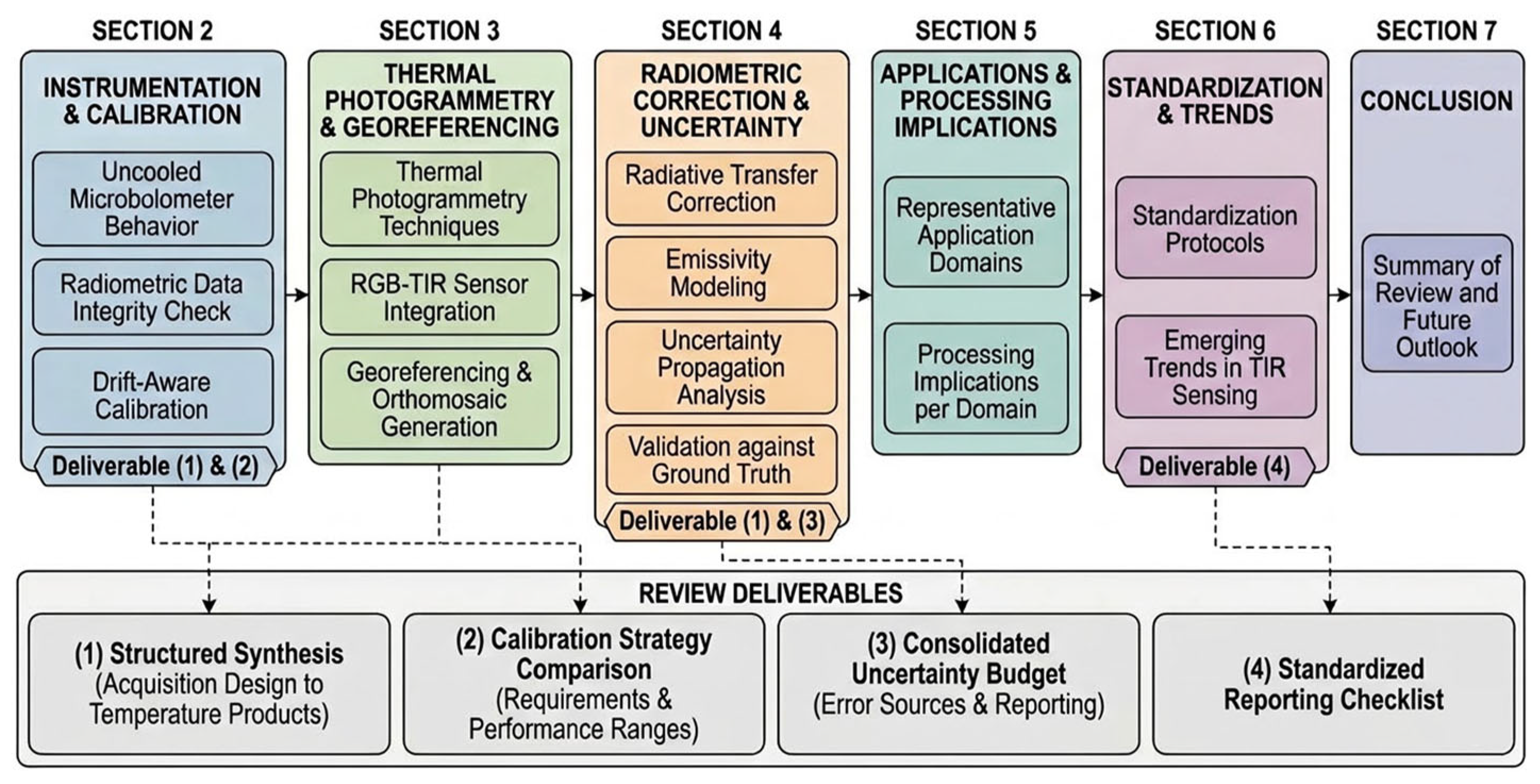
Unmanned aerial vehicle (UAV)-mounted thermal infrared (TIR) sensors occupy a useful middle ground between sparse in situ measurements, occasional aircraft-based campaigns, and coarse satellite products, enabling centimeter-scale thermal mapping under field conditions. Yet converting UAV thermal imagery into quantitative temperature products remains challenging because uncooled microbolometers are radiometrically drift-prone, thermal scenes often provide weak geometric texture, and surface temperature retrieval depends on scene-specific emissivity and atmospheric assumptions. This review focuses on quantitative UAV–TIR mapping rather than on the full range of drone thermal applications. It synthesizes the technical decisions that most strongly affect the reliability, comparability, and physical interpretability of UAV-derived temperature products, from radiometric data integrity and field calibration to RGB–TIR integration, physical correction, uncertainty propagation, and validation. We clarify the literature synthesis approach, compare field-deployable calibration and drift mitigation strategies, discuss application-specific uncertainty priorities, and derive a practical reporting checklist for reproducible studies. The review emphasizes how radiometric, geometric, and physical correction choices interact, and uses comparative tables to summarize recurring trade-offs, reporting gaps, and remaining research needs. Its aim is to clarify why UAV–TIR temperature products can differ across studies and which methodological details are needed for meaningful interpretation and comparison.
Keywords: unmanned aerial vehicle; thermal infrared; land surface temperature; radiometric calibration; uncooled microbolometer; photogrammetry unmanned aerial vehicle; thermal infrared; land surface temperature; radiometric calibration; uncooled microbolometer; photogrammetry