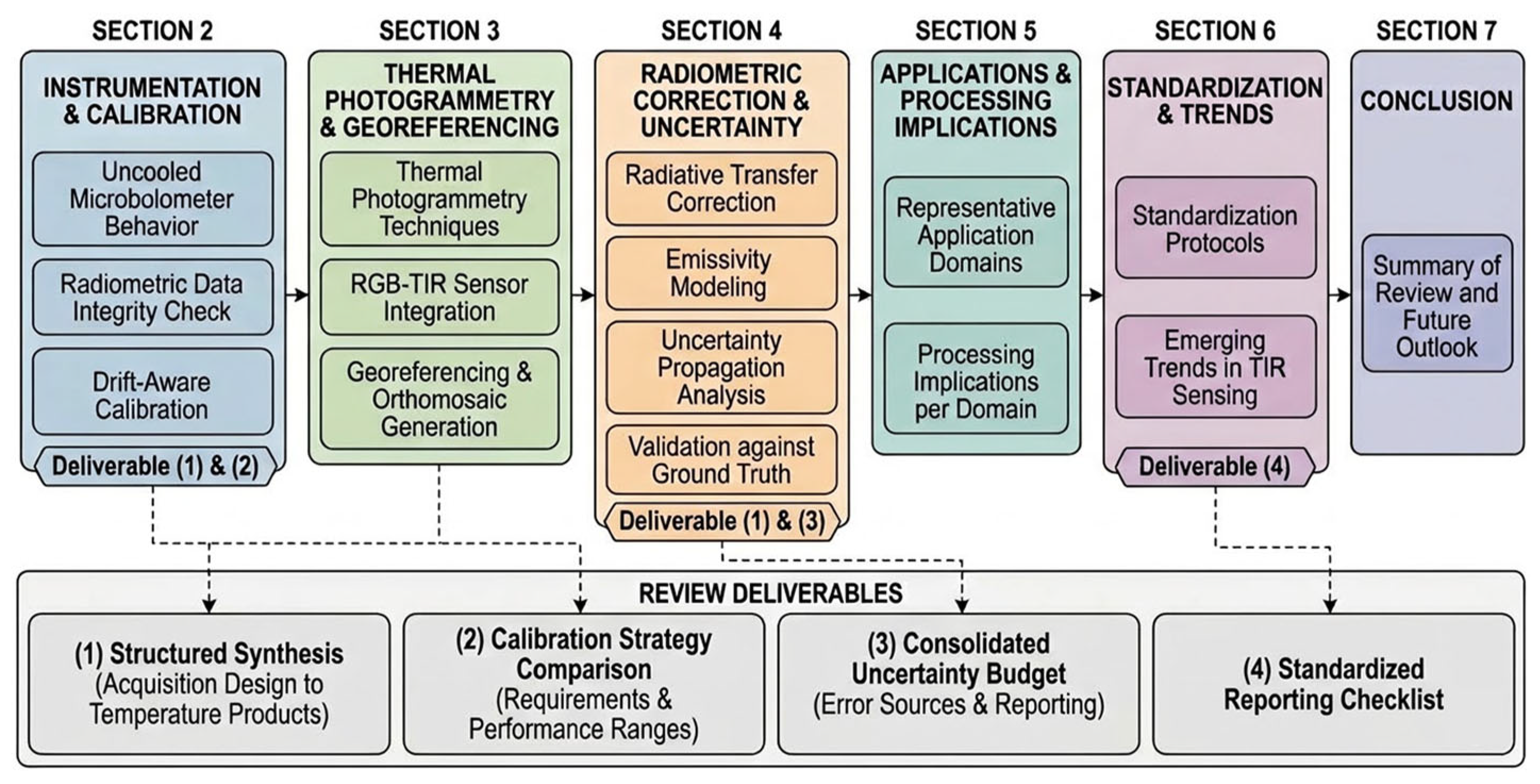

High-Resolution Thermal Mapping for Quantitative UAV–TIR Applications: A Methodological Review of Sensor Integration, Calibration, and Data Processing Decisions


Abstract
1. Introduction
1.1. Background and Motivation
1.2. Why UAV–TIR Is Different: The Quantitative Gap
1.3. Toward End-to-End Reproducibility
1.4. Positioning Relative to Existing Reviews
1.5. Contributions and Paper Structure
1.6. Scope and Terminology
1.7. Synthesis Approach and Limitations
2. UAV–TIR Sensor Technology and Radiometric Processing
2.1. Uncooled Microbolometers: Practical Implications for UAV Mapping
2.2. Measurement Chain
2.3. Radiometric Error Modes in UAV Operation
2.4. Radiometric Data Integrity and Pre-Processing
2.5. Stabilization and Logging: Acquisition as Part of the Calibration
2.6. Calibration and Drift Mitigation Strategies

| Strategy | Corrected Components | Absolute Anchor? | Minimum Field setup | Indicative Performance (Field) | Key Advantages | Common Cautions |
|---|---|---|---|---|---|---|
| Factory-only conversion baseline | DN to Tb | No | None | Absolute RMSE often 2–5 K; overlap ΔT 1–3 K | Simplest and fastest workflow | Drift dominates; poor cross-flight comparability; seam consistency often weak |
| Shutter NUC/FFC only | FPN + partial offset drift | No | None; shutter timing log if available | Absolute RMSE often 2–4 K; overlap ΔT 0.8–2 K | Improves fixed-pattern artifacts and visual quality | Step discontinuities at shutter events; lens and atmosphere effects remain |
| 1–2 target empirical line (per flight) | Global gain and offset | Yes | 1–2 high-emissivity targets plus traceable contact thermometer | Absolute RMSE often 1–2 K; overlap ΔT 0.5–1.5 K | Practical field anchor for absolute temperature scale | Extrapolation error if targets do not span scene temperatures; target emissivity error |
| Multi-target empirical line (≥3 targets) | Robust gain and offset | Yes | ≥3 targets (hot/ambient/cool when feasible) plus traceable sensors | Absolute RMSE often 0.5–1.5 K; overlap ΔT 0.4–1.0 K | Reduces extrapolation and improves repeatability | Higher field logistics burden; target placement, shading, and timing matter |
| Multi-point variants | Robust regression; optional scene stratification | Yes | Multiple reference points or targets | Absolute RMSE often ~0.5–1.5 K (case dependent) | Flexible in heterogeneous scenes | Complex design; risk of overfitting if references are not representative |
| Telemetry-informed drift model + anchors | Drift linked to internal temperature + periodic anchors | Yes (periodic) | Telemetry access plus 1–2 anchor observations | Absolute RMSE often 0.7–1.5 K; overlap ΔT 0.3–1.0 K | Reduces target burden and supports longer missions | Telemetry not always available; model mismatch under rapid transients |
| Overlap-informed normalization (relative only) | Inter-image offsets and optional gains | No | High-overlap dataset | Absolute RMSE not defined; overlap ΔT 0.2–0.8 K | Highly effective for seam and striping reduction | Can absorb true temporal dynamics such as moving shadows or wind-driven canopy change |
| Hybrid: empirical line + overlap normalization | Absolute anchoring + relative consistency | Yes | 2–3 targets plus high overlap | Absolute RMSE often 0.5–1.2 K; overlap ΔT 0.2–0.5 K | Often the best overall balance for mapped products | Implementation complexity; requires masking and diagnostics |
2.7. Recurring Field Practices in Quantitative UAV–TIR Studies
- Use radiometric outputs and document camera settings, including emissivity and atmospheric parameter settings, rather than relying on display imagery.
- Design reference targets with known emissivity and ensure they occupy sufficient pixels; measure target temperatures with traceable contact sensors and record the timing relative to image acquisition.
- Log shutter events and, where possible, internal temperatures; avoid mixing frames across major shutter boundaries without correction.
- Acquire high overlap and stable flight lines; avoid conditions that cause rapid scene temperature change or strong reflection effects on low-emissivity surfaces.
- Report both absolute accuracy against independent references and mosaic consistency measures in overlap regions.
3. Thermal Photogrammetry, RGB–TIR Fusion, and Georeferencing
3.1. Why Thermal SfM Is Fragile
3.2. When Thermal-Only Reconstruction Works and When It Does Not
3.3. RGB–TIR Fusion: Geometry-First Approaches
3.4. Flight Planning for Thermal Photogrammetry (Practical Ranges)
3.5. Georeferencing and Accuracy Assessment
3.6. Orthophoto, Seamlines, and Quality Assessment
3.7. Co-Registration Diagnostics and Common Pitfalls
4. Physical Correction and Uncertainty Quantification
4.1. Low-Altitude Radiative Transfer and Atmospheric Terms
4.2. Emissivity Estimation and Sensitivity
4.3. View Angle Effects and Directional Emissivity
4.4. Uncertainty Propagation: From Accuracy Claims to Uncertainty Products
| Uncertainty Source | Main Character | Where it Enters the Workflow | Main Consequence | Practical Mitigation | Minimum Reporting Item |
|---|---|---|---|---|---|
| Sensor warm-up and internal thermal drift | Mostly systematic and time dependent | Raw radiometric frames; frame-to-frame consistency | Within-flight bias that can reach Kelvin-level drift if stabilization is poor | Warm-up before acquisition; repeated reference checks; telemetry-informed correction where available | Warm-up duration, stabilization criterion, telemetry use, pre-/post-flight reference readings |
| Shutter/NUC/FFC events | Mixed; often step-like in time | Frame sequence; striping behavior; seam formation | Frame-to-frame discontinuities and local radiometric jumps | Record event timing, inspect pre/post behavior, apply segment-wise correction when needed | Shutter interval, handling method, residual diagnostic plots |
| Reference target design and contact measurement | Mostly systematic if poorly designed | Absolute calibration and validation | Biased anchoring if targets are small, unstable, shaded, or poorly spanning the scene range | Use high-emissivity targets, repeated measurements, traceable contact sensors, stable placement | Target material, emissivity assumption, size in pixels, placement, sensor type, measurement timing |
| Emissivity assignment | Strongly systematic | Ts/LST retrieval and cross-material comparison | Often the dominant LST uncertainty; small emissivity errors can produce Kelvin-level bias | Class-based emissivity assignment, sensitivity analysis, clear distinction between Tb and Ts | Emissivity source, assigned values by class, sensitivity range, whether Tb or Ts is reported |
| Atmospheric correction | Mostly systematic | Ts/LST retrieval and comparison across flights or dates | Bias in absolute temperature, especially under humid or thermally variable conditions | Report atmospheric inputs explicitly and apply a consistent correction scheme | Air temperature, humidity, path-length assumption, correction model, whether correction was applied |
| View angle and mixed-pixel effects | Spatially structured systematic uncertainty | Swath edges, oblique views, 3D surfaces, canopy/facet mixtures | Apparent temperature variation caused by geometry rather than surface state | Limit off-nadir use for 2D maps; apply facet-aware analysis for 3D scenes; mask problematic edge zones | Use of nadir/oblique imagery, angle limits, scene geometry notes, any view angle filtering |
| Geometric misregistration | Spatially structured | RGB–TIR fusion, small objects, sharp boundaries | False hot/cold edges, anomaly inflation or suppression, boundary leakage between materials | Geometry-first workflow, careful boresight estimation, checkpoint-based alignment assessment | Co-registration strategy, boresight method, pixel misregistration statistics, checkpoint summary |
| Scene change during acquisition | Real temporal variation plus sampling error | Overlap correction, mosaicking, and validation | Real thermal change may be mistaken for drift or correction failure | Keep flights short where possible; avoid unstable conditions; mask dynamic areas during normalization | Flight duration, wind/cloud notes, illumination stability, masked dynamic regions |
| Overlap-based normalization | Useful but can introduce systematic bias if over-applied | Mosaic balancing and seam correction | Improved seam consistency may be achieved at the cost of suppressing real dynamics | Use robust overlap selection, exclude dynamic zones, retain absolute anchors when possible | Residuals before/after normalization, masked areas, anchor use, normalization model |
| Validation design mismatch | Systematic plus sampling error | Accuracy reporting and interpretation | Over-optimistic agreement when footprint, timing, or target type do not match the thermal product | Synchronize measurements, match spatial support, separate calibration references from independent validation | Reference footprint, timing offset, number and distribution of validation sites, calibration/validation separation |
4.5. Validation: Reference Design and Metrics
4.6. Interpreting Temperature Products for Decisions
5. Applications and Representative Use Cases
5.1. Precision Agriculture and Plant Phenotyping
5.2. Hydrology, Rivers, and Groundwater–Surface Water Exchange
5.3. Urban Microclimate and Urban Heat Island Studies
5.4. Infrastructure, Building Energy, and Photovoltaic Inspection
5.5. Geoscience and Hazard Monitoring
5.6. Cross-Application Synthesis of Methodological Trade-Offs
| Application Domain | Mission Timing and Geometry | Preferred Calibration/Normalization | Physical Correction Priority | Dominant Uncertainty Controls | Validation Emphasis |
|---|---|---|---|---|---|
| Precision agriculture | Repeatable time of day; high overlap; short-to-moderate flights | Empirical or hybrid approach with repeated references for cross-date work | Canopy–soil separation; class-aware emissivity | Drift, canopy–soil mixing, emissivity, cross-date consistency | Canopy-scale references; synchronized physiological observations |
| Hydrology | Short flights; reflection-aware viewing geometry; shoreline masking | Empirical anchor with conservative normalization | Reflected sky radiance and atmospheric handling | Reflection, mixed pixels, temporal mismatch | Synchronized in situ water temperature |
| Urban/building | Geometry-first RGB–TIR; near nadir for 2D roofs; oblique only if 3D is needed | Empirical or hybrid approach with checkpointed co-registration | Material class emissivity; view angle control | Reflection, emissivity, edge misregistration | By material class; pixel shift diagnostics |
| Photovoltaic inspection | Stable irradiance; strict viewing angle; sharp-edge fidelity | Hybrid or anchor-supported relative consistency | Threshold interpretation with geometric control | View angle, irradiance change, panel edge leakage | Module/cell-scale hotspot confirmation |
| Hazard monitoring | Very short windows; saturation-aware planning | Robust anchoring where feasible; avoid aggressive normalization | Separate quick-look from quantitative product | Dynamic range, saturation, real temporal change | Conservative interpretation; clipped-area reporting |
6. Standardization and Future Trends
6.1. Reporting Gaps and Minimum Information for Cross-Study Comparability
| Processing Stage | Minimum Reporting (Must-Have) | Best Practice (Strongly Recommended) | Where to Place |
|---|---|---|---|
| Platform and sensor | UAV model; TIR camera model; spectral band; radiometric output type; bit depth | FPA resolution; lens field of view; NETD specification; whether raw DN, radiance, or temperature were stored | Materials and Methods (Sensor) |
| Stabilization | Warm-up protocol; shutter usage | Stabilization verification using a reference target or telemetry; criterion such as drift rate threshold | Methods plus diagnostics notes |
| Mission design | Altitude; speed; overlap; time of day; weather summary | Overlap at least 80/80% and higher for low-texture scenes; stable speed; record wind, humidity, clouds; avoid rapidly changing illumination | Materials and Methods (Acquisition) |
| Radiometric pre-processing | Bad-pixel handling; blur screening; shutter event handling | Vignette correction where applicable; quantify rejected frames; provide per-flight radiometric diagnostic plots | Methods plus Supplementary |
| Calibration (absolute) | Calibration approach; reference temperature traceability | Multiple targets spanning scene range; target size to avoid mixed pixels; repeated measurements through the flight; regression model form and coefficients | Methods plus calibration table |
| Drift mitigation | Whether drift was corrected and how | Telemetry-informed drift model; segment-based correction around shutter events; report residual drift statistics | Methods plus Results |
| Overlap-informed normalization | Whether overlap normalization was used | Robust overlap estimation; mask dynamic areas; report overlap residual statistics before and after correction | Methods plus Results |
| Geometry (SfM) | Software; camera model; georeferencing approach | RTK/PPK usage; GCP and checkpoint counts/distribution; horizontal and vertical accuracy summaries | Methods (Geometry) |
| RGB–TIR integration | Integration strategy; boresight estimation method | Boresight procedure; residual pixel misregistration statistics; synchronization assumptions and timing offsets | Methods (Integration) |
| Physical correction (Tb/Ts/LST) | Whether Tb or Ts/LST is reported; emissivity assumptions; atmospheric treatment | Class-based emissivity map; sensitivity analysis; atmospheric correction inputs; view angle constraints | Methods plus Discussion |
| Uncertainty | At least a scene-level error metric | Uncertainty propagation method; uncertainty budget table; uncertainty map statistics or region summaries | Results plus Discussion |
| Validation | Reference type; sampling timing | Independent validation targets; time synchronization; error metrics by material class | Results |
| Reproducibility | Software and parameters stated | Data/code availability statement; metadata template; processing diagram | Data Availability/Supplementary |
6.2. Deep Learning: Denoising, Fusion, and Super-Resolution
6.3. Real-Time Onboard Processing and Operational Mapping
6.4. Benchmark Datasets and Community Inter-Comparison
6.5. Open Challenges
7. Conclusions
Supplementary Materials
Author Contributions
Funding
Data Availability Statement
Conflicts of Interest
Abbreviations
| UAV | Unmanned aerial vehicle |
| TIR | Thermal infrared |
| LST | Land surface temperature |
| LWIR | Long-wave infrared |
| SfM | Structure-from-motion |
| Tb | Brightness (apparent) temperature |
| Ts | Surface temperature |
| NETD | Noise-equivalent temperature difference |
| DN | Digital count |
| NUC | Non-uniformity correction |
| FFC | Flat-field correction |
| FPN | Fixed-pattern noise |
| RTK | Real-time kinematic |
| PPK | Post-processed kinematic |
| RGB | Red, green, and blue |
| GNSS | Global navigation satellite system |
| IMU | Inertial measurement unit |
| GCP | Ground control point |
| RMSE | Root mean square error |
References
- Li, Z.-L.; Tang, B.-H.; Wu, H.; Ren, H.; Yan, G.; Wan, Z.; Trigo, I.F.; Sobrino, J.A. Satellite-derived land surface temperature: Current status and perspectives. Remote Sens. Environ. 2013, 131, 14–37. [Google Scholar] [CrossRef] [Scilit]
- Sobrino, J.A.; Jiménez-Muñoz, J.C.; Paolini, L. Land surface temperature retrieval from LANDSAT TM 5. Remote Sens. Environ. 2004, 90, 434–440. [Google Scholar] [CrossRef] [Scilit]
- Wan, Z.; Dozier, J. A generalized split-window algorithm for retrieving land-surface temperature from space. IEEE Trans. Geosci. Remote Sens. 1996, 34, 892–905. [Google Scholar] [CrossRef] [Scilit]
- Voogt, J.A.; Oke, T.R. Thermal remote sensing of urban climates. Remote Sens. Environ. 2003, 86, 370–384. [Google Scholar] [CrossRef] [Scilit]
- Yao, H.; Qin, R.; Chen, X. Unmanned Aerial Vehicle for Remote Sensing Applications—A Review. Remote Sens. 2019, 11, 1443. [Google Scholar] [CrossRef] [Scilit]
- Colomina, I.; Molina, P. Unmanned aerial systems for photogrammetry and remote sensing: A review. ISPRS J. Photogramm. Remote Sens. 2014, 92, 79–97. [Google Scholar] [CrossRef] [Scilit]
- Nex, F.; Remondino, F. UAV for 3D mapping applications: A review. Appl. Geomat. 2014, 6, 1–15. [Google Scholar] [CrossRef] [Scilit]
- Pajares, G. Overview and Current Status of Remote Sensing Applications Based on Unmanned Aerial Vehicles (UAVs). Photogramm. Eng. Remote Sens. 2015, 81, 281–330. [Google Scholar] [CrossRef] [Scilit]
- Tmušić, G.; Manfreda, S.; Aasen, H.; James, M.R.; Gonçalves, G.; Ben-Dor, E.; Brook, A.; Polinova, M.; Arranz, J.J.; Mészáros, J.; et al. Current Practices in UAS-based Environmental Monitoring. Remote Sens. 2020, 12, 1001. [Google Scholar] [CrossRef] [Scilit]
- Maes, W.H.; Steppe, K. Perspectives for Remote Sensing with Unmanned Aerial Vehicles in Precision Agriculture. Trends Plant Sci. 2019, 24, 152–164. [Google Scholar] [CrossRef] [Scilit]
- Xie, C.; Yang, C. A review on plant high-throughput phenotyping traits using UAV-based sensors. Comput. Electron. Agric. 2020, 178, 105731. [Google Scholar] [CrossRef] [Scilit]
- Guebsi, R.; Mami, S.; Chokmani, K. Drones in Precision Agriculture: A Comprehensive Review of Applications, Technologies, and Challenges. Drones 2024, 8, 686. [Google Scholar] [CrossRef] [Scilit]
- Mesas-Carrascosa, F.-J.; Pérez-Porras, F.; Meroño de Larriva, J.E.; Mena Frau, C.; Agüera-Vega, F.; Carvajal-Ramírez, F.; Martínez-Carricondo, P.; García-Ferrer, A. Drift Correction of Lightweight Microbolometer Thermal Sensors On-Board Unmanned Aerial Vehicles. Remote Sens. 2018, 10, 615. [Google Scholar] [CrossRef] [Scilit]
- Aragon, B.; Johansen, K.; Parkes, S.; Malbeteau, Y.; Al-Mashharawi, S.; Al-Amoudi, T.; Andrade, C.F.; Turner, D.; Lucieer, A.; McCabe, M.F. A Calibration Procedure for Field and UAV-Based Uncooled Thermal Infrared Instruments. Sensors 2020, 20, 3316. [Google Scholar] [CrossRef] [Scilit]
- Budzier, H.; Gerlach, G. Thermal Infrared Sensors: Theory, Optimisation and Practice; Wiley: Chichester, UK, 2011. [Google Scholar]
- Kelly, J.; Kljun, N.; Olsson, P.-O.; Mihai, L.; Liljeblad, B.; Weslien, P.; Klemedtsson, L.; Eklundh, L. Challenges and Best Practices for Deriving Temperature Data from an Uncalibrated UAV Thermal Infrared Camera. Remote Sens. 2019, 11, 567. [Google Scholar] [CrossRef] [Scilit]
- Maguire, M.S.; Neale, C.M.U.; Woldt, W.E. Improving Accuracy of Unmanned Aerial System Thermal Infrared Remote Sensing for Use in Energy Balance Models in Agriculture Applications. Remote Sens. 2021, 13, 1635. [Google Scholar] [CrossRef] [Scilit]
- Berk, A.; Hawes, F. Validation of MODTRAN®6 and its line-by-line algorithm. J. Quant. Spectrosc. Radiat. Transf. 2017, 203, 542–556. [Google Scholar] [CrossRef] [Scilit]
- Ndlovu, H.S.; Odindi, J.; Sibanda, M.; Mutanga, O. A systematic review on the application of UAV-based thermal remote sensing for assessing and monitoring crop water status in crop farming systems. Int. J. Remote Sens. 2024, 45, 4923–4960. [Google Scholar] [CrossRef] [Scilit]
- Anderson, K.; Gaston, K.J. Lightweight unmanned aerial vehicles will revolutionize spatial ecology. Front. Ecol. Environ. 2013, 11, 138–146. [Google Scholar] [CrossRef] [Scilit]
- Hardin, P.J.; Jensen, R.R. Small-Scale Unmanned Aerial Vehicles in Environmental Remote Sensing: Challenges and Opportunities. GISci. Remote Sens. 2011, 48, 99–111. [Google Scholar] [CrossRef] [Scilit]
- Torres-Rua, A. Vicarious Calibration of sUAS Microbolometer Temperature Imagery for Estimation of Radiometric Land Surface Temperature. Sensors 2017, 17, 1499. [Google Scholar] [CrossRef] [Scilit]
- Messina, G.; Modica, G. Applications of UAV Thermal Imagery in Precision Agriculture: State of the Art and Future Research Outlook. Remote Sens. 2020, 12, 1491. [Google Scholar] [CrossRef] [Scilit]
- Lee, K.; Lee, W.H. Temperature Accuracy Analysis by Land Cover According to the Angle of the Thermal Infrared Imaging Camera for Unmanned Aerial Vehicles. ISPRS Int. J. Geo-Inf. 2022, 11, 204. [Google Scholar] [CrossRef] [Scilit]
- Li, Z.-L.; Becker, F. Feasibility of land surface temperature and emissivity determination from AVHRR data. Remote Sens. Environ. 1993, 43, 67–85. [Google Scholar] [CrossRef] [Scilit]
- Norman, J.M.; Becker, F. Terminology in thermal infrared remote sensing of natural surfaces. Agric. For. Meteorol. 1995, 77, 153–166. [Google Scholar] [CrossRef] [Scilit]
- Norman, J.M.; Kustas, W.P.; Humes, K.S. A two-source approach for estimating soil and vegetation energy fluxes in observations of directional radiometric surface temperature. Agric. For. Meteorol. 1995, 77, 263–293. [Google Scholar] [CrossRef] [Scilit]
- Kustas, W.P.; Norman, J.M. Evaluation of soil and vegetation heat flux predictions using a simple two-source model with radiometric temperatures for partial canopy cover. Agric. For. Meteorol. 1999, 94, 13–29. [Google Scholar] [CrossRef] [Scilit]
- Aubrecht, D.M.; Helliker, B.R.; Goulden, M.L.; Roberts, D.A.; Still, C.J.; Richardson, A.D. Continuous, long-term, high-frequency thermal imaging of vegetation: Uncertainties and recommended best practices. Agric. For. Meteorol. 2016, 228–229, 315–326. [Google Scholar] [CrossRef] [Scilit]
- Elfarkh, J.; Johansen, K.; Angulo, V.; Camargo, O.L.; McCabe, M.F. Quantifying Within-Flight Variation in Land Surface Temperature from a UAV-Based Thermal Infrared Camera. Drones 2023, 7, 617. [Google Scholar] [CrossRef] [Scilit]
- Rogalski, A. Recent progress in infrared detector technologies. Infrared Phys. Technol. 2011, 54, 136–154. [Google Scholar] [CrossRef] [Scilit]
- Nugent, P.W.; Shaw, J.A.; Pust, N.J. Correcting for focal-plane-array temperature dependence in microbolometer infrared cameras lacking thermal stabilization. Opt. Eng. 2013, 52, 061304. [Google Scholar] [CrossRef] [Scilit]
- Budzier, H.; Gerlach, G. Calibration of uncooled thermal infrared cameras. J. Sens. Sens. Syst. 2015, 4, 187–197. [Google Scholar] [CrossRef] [Scilit]
- Schott, J.R. Remote Sensing: The Image Chain Approach; Oxford University Press: New York, NY, USA, 2007. [Google Scholar] [CrossRef] [Scilit]
- Rees, W.G. Physical Principles of Remote Sensing, 3rd ed.; Cambridge University Press: Cambridge, UK, 2013. [Google Scholar] [CrossRef] [Scilit]
- Slater, P.N. Remote Sensing: Optics and Optical Systems; Addison-Wesley Publishing Company: Reading, MA, USA, 1980. [Google Scholar]
- Han, X.; Thomasson, J.A.; Swaminathan, V.; Wang, T.; Siegfried, J.; Raman, R.; Rajan, N.; Neely, H. Field-Based Calibration of Unmanned Aerial Vehicle Thermal Infrared Imagery with Temperature-Controlled References. Sensors 2020, 20, 7098. [Google Scholar] [CrossRef] [Scilit]
- Acorsi, M.G.; Gimenez, L.M.; Martello, M. Assessing the Performance of a Low-Cost Thermal Camera in Proximal and Aerial Conditions. Remote Sens. 2020, 12, 3591. [Google Scholar] [CrossRef] [Scilit]
- Niwa, H. Comparison of the accuracy of two UAV-mounted uncooled thermal infrared sensors in predicting river water temperature. River Res. Appl. 2022, 38, 1660–1667. [Google Scholar] [CrossRef] [Scilit]
- Abràmoff, M.D.; Magalhães, P.J.; Ram, S.J. Image Processing with ImageJ. Biophotonics Int. 2004, 11, 36–42. [Google Scholar]
- Metsu, C.; Maes, W.H.; Ottoy, S.; Van Meerbeek, K. theRmalUAV: An R package to clean and correct thermal UAV data for accurate land surface temperatures. Methods Ecol. Evol. 2026, 17, 488–496. [Google Scholar] [CrossRef] [Scilit]
- FLIR Systems, Inc. FLIR Vue Pro and Vue Pro R User Guide; FLIR Systems, Inc.: Wilsonville, OR, USA, 2016. [Google Scholar]
- Ribeiro-Gomes, K.; Hernández-López, D.; Ballesteros, R.; Moreno, M.A. Approximate Georeferencing and Automatic Blurred Image Detection to Reduce the Costs of UAV Use in Environmental and Agricultural Applications. Biosyst. Eng. 2016, 151, 308–327. [Google Scholar] [CrossRef] [Scilit]
- Olbrycht, R.; Więcek, B.; De Mey, G. Thermal drift compensation method for microbolometer thermal cameras. Appl. Opt. 2012, 51, 1788–1794. [Google Scholar] [CrossRef] [Scilit]
- Tempelhahn, A.; Budzier, H.; Krause, V.; Gerlach, G. Shutter-less calibration of uncooled infrared cameras. J. Sens. Sens. Syst. 2016, 5, 9–16. [Google Scholar] [CrossRef] [Scilit]
- Kusnierek, K.; Korsaeth, A. Challenges in using an analog uncooled microbolometer thermal camera to measure crop temperature. Int. J. Agric. Biol. Eng. 2014, 7, 60–74. [Google Scholar] [CrossRef]
- Lin, D.; Maas, H.-G.; Westfeld, P.; Budzier, H.; Gerlach, G. An advanced radiometric calibration approach for uncooled thermal cameras. Photogramm. Rec. 2018, 33, 30–48. [Google Scholar] [CrossRef] [Scilit]
- Ribeiro-Gomes, K.; Hernández-López, D.; Ortega, J.F.; Ballesteros, R.; Poblete, T.; Moreno, M.A. Uncooled Thermal Camera Calibration and Optimization of the Photogrammetry Process for UAV Applications in Agriculture. Sensors 2017, 17, 2173. [Google Scholar] [CrossRef] [Scilit]
- Gerhards, M.; Schlerf, M.; Mallick, K.; Udelhoven, T. Challenges and Future Perspectives of Multi-/Hyperspectral Thermal Infrared Remote Sensing for Crop Water-Stress Detection: A Review. Remote Sens. 2019, 11, 1240. [Google Scholar] [CrossRef] [Scilit]
- Wan, Q.; Smigaj, M.; Brede, B.; Kooistra, L. Optimizing UAV-based uncooled thermal cameras in field conditions for precision agriculture. Int. J. Appl. Earth Obs. Geoinf. 2024, 134, 104184. [Google Scholar] [CrossRef] [Scilit]
- Chrzanowski, K. Influence of object-system distance on accuracy of remote temperature measurement with IR systems. Infrared Phys. Technol. 1995, 36, 703–713. [Google Scholar] [CrossRef] [Scilit]
- Zhang, Y.-C.; Chen, Y.-M.; Fu, X.-B.; Luo, C. A method for reducing the influence of measuring distance on infrared thermal imager temperature measurement accuracy. Appl. Therm. Eng. 2016, 100, 1095–1101. [Google Scholar] [CrossRef] [Scilit]
- Minkina, W.; Dudzik, S. Infrared Thermography: Errors and Uncertainties; John Wiley & Sons: Chichester, UK, 2009. [Google Scholar] [CrossRef] [Scilit]
- Westoby, M.J.; Brasington, J.; Glasser, N.F.; Hambrey, M.J.; Reynolds, J.M. ‘Structure-from-Motion’ photogrammetry: A low-cost, effective tool for geoscience applications. Geomorphology 2012, 179, 300–314. [Google Scholar] [CrossRef] [Scilit]
- Sona, G.; Pinto, L.; Pagliari, D.; Passoni, D.; Gini, R. Experimental analysis of different software packages for orientation and digital surface modelling from UAV images. Earth Sci. Inform. 2014, 7, 97–107. [Google Scholar] [CrossRef] [Scilit]
- Lowe, D.G. Distinctive Image Features from Scale-Invariant Keypoints. Int. J. Comput. Vis. 2004, 60, 91–110. [Google Scholar] [CrossRef] [Scilit]
- Schönberger, J.L.; Frahm, J.-M. Structure-From-Motion Revisited. In Proceedings of the IEEE Conference on Computer Vision and Pattern Recognition (CVPR), Las Vegas, NV, USA, 27–30 June 2016; pp. 4104–4113. [Google Scholar] [CrossRef] [Scilit]
- James, M.R.; Robson, S. Straightforward reconstruction of 3D surfaces and topography with a camera: Accuracy and geoscience application. J. Geophys. Res. Earth Surf. 2012, 117, F03017. [Google Scholar] [CrossRef] [Scilit]
- Smith, M.W.; Carrivick, J.L.; Quincey, D.J. Structure from Motion Photogrammetry in Physical Geography. Prog. Phys. Geogr. 2016, 40, 247–275. [Google Scholar] [CrossRef] [Scilit]
- Turner, D.; Lucieer, A.; Malenovský, Z.; King, D.H.; Robinson, S.A. Spatial Co-Registration of Ultra-High Resolution Visible, Multispectral and Thermal Images Acquired with a Micro-UAV over Antarctic Moss Beds. Remote Sens. 2014, 6, 4003–4024. [Google Scholar] [CrossRef] [Scilit]
- Yang, Y.; Lee, X. Four-band Thermal Mosaicking: A New Method to Process Infrared Thermal Imagery of Urban Landscapes from UAV Flights. Remote Sens. 2019, 11, 1365. [Google Scholar] [CrossRef] [Scilit]
- Szeliski, R. Image Alignment and Stitching: A Tutorial. Found. Trends Comput. Graph. Vis. 2006, 2, 1–104. [Google Scholar] [CrossRef] [Scilit]
- Honkavaara, E.; Rosnell, T.; Oliveira, R.; Tommaselli, A. Band registration of tuneable frame format hyperspectral UAV imagers in complex scenes. ISPRS J. Photogramm. Remote Sens. 2017, 134, 96–109. [Google Scholar] [CrossRef] [Scilit]
- Ghassemian, H. A review of remote sensing image fusion methods. Inf. Fusion 2016, 32, 75–89. [Google Scholar] [CrossRef] [Scilit]
- Eisenbeiß, H. UAV Photogrammetry. Ph.D. Thesis, ETH Zurich, Zurich, Switzerland, 2009. [Google Scholar]
- Jaud, M.; Passot, S.; Le Bivic, R.; Delacourt, C.; Grandjean, P.; Le Dantec, N. Assessing the Accuracy of High-Resolution Digital Surface Models Computed by PhotoScan and MicMac in Sub-Optimal Survey Conditions. Remote Sens. 2016, 8, 465. [Google Scholar] [CrossRef] [Scilit]
- Štroner, M.; Urban, R.; Línková, L. Photogrammetry Using UAV-Mounted GNSS RTK: Georeferencing Strategies without GCPs. Remote Sens. 2021, 13, 1336. [Google Scholar] [CrossRef] [Scilit]
- Liu, X.; Lian, X.; Yang, W.; Wang, F.; Han, Y.; Zhang, Y. Accuracy Assessment of a UAV Direct Georeferencing Method and Impact of the Configuration of Ground Control Points. Drones 2022, 6, 30. [Google Scholar] [CrossRef] [Scilit]
- Goldman, D.B. Vignette and Exposure Calibration and Compensation. IEEE Trans. Pattern Anal. Mach. Intell. 2010, 32, 2276–2288. [Google Scholar] [CrossRef] [Scilit]
- Wierzbicki, D.; Kedzierski, M.; Fryskowska, A. Assessment of the Influence of UAV Image Quality on the Orthophoto Production. Int. Arch. Photogramm. Remote Sens. Spat. Inf. Sci. 2015, XL-1/W4, 1–8. [Google Scholar] [CrossRef] [Scilit]
- American Society for Photogrammetry and Remote Sensing (ASPRS). ASPRS Positional Accuracy Standards for Digital Geospatial Data (Edition 1, Version 1.0—November 2014). Photogramm. Eng. Remote Sens. 2015, 81, A1–A26. [Google Scholar] [CrossRef] [Scilit]
- Whitehead, K.; Hugenholtz, C.H. Applying ASPRS Accuracy Standards to Surveys from Small Unmanned Aircraft Systems (UAS). Photogramm. Eng. Remote Sens. 2015, 81, 787–793. [Google Scholar] [CrossRef] [Scilit]
- Huang, Y.; Miyazaki, T.; Liu, X.; Omachi, S. Infrared Image Super-Resolution: Systematic Review, and Future Trends. arXiv 2022, arXiv:2212.12322. [Google Scholar] [CrossRef] [Scilit]
- Dash, P.; Göttsche, F.-M.; Olesen, F.-S.; Fischer, H. Land Surface Temperature and Emissivity Estimation from Passive Sensor Data: Theory and Practice-Current Trends. Int. J. Remote Sens. 2002, 23, 2563–2594. [Google Scholar] [CrossRef] [Scilit]
- Tardy, B.; Rivalland, V.; Huc, M.; Hagolle, O.; Marcq, S.; Boulet, G. A Software Tool for Atmospheric Correction and Surface Temperature Estimation of Landsat Infrared Thermal Data. Remote Sens. 2016, 8, 696. [Google Scholar] [CrossRef] [Scilit]
- Van de Griend, A.A.; Owe, M. On the Relationship between Thermal Emissivity and the Normalized Difference Vegetation Index for Natural Surfaces. Int. J. Remote Sens. 1993, 14, 1119–1131. [Google Scholar] [CrossRef] [Scilit]
- Gillespie, A.R.; Rokugawa, S.; Matsunaga, T.; Cothern, J.S.; Hook, S.J.; Kahle, A.B. A Temperature and Emissivity Separation Algorithm for Advanced Spaceborne Thermal Emission and Reflection Radiometer (ASTER) Images. IEEE Trans. Geosci. Remote Sens. 1998, 36, 1113–1126. [Google Scholar] [CrossRef] [Scilit]
- Salisbury, J.W.; D’Aria, D.M. Emissivity of Terrestrial Materials in the 8–14 μm Atmospheric Window. Remote Sens. Environ. 1992, 42, 83–106. [Google Scholar] [CrossRef] [Scilit]
- Kimes, D.S. Azimuthal Radiometric Temperature Measurements of Wheat Canopies. Appl. Opt. 1981, 20, 1119–1121. [Google Scholar] [CrossRef] [Scilit]
- JCGM 100:2008; Evaluation of Measurement Data—Guide to the Expression of Uncertainty in Measurement. JCGM: Sèvres, France, 2008. [CrossRef] [Scilit]
- Willmott, C.J.; Matsuura, K. Advantages of the mean absolute error (MAE) over the root mean square error (RMSE) in assessing average model performance. Clim. Res. 2005, 30, 79–82. [Google Scholar] [CrossRef] [Scilit]
- Possolo, A.; Iyer, H.K. Invited Article: Concepts and tools for the evaluation of measurement uncertainty. Rev. Sci. Instrum. 2017, 88, 011301. [Google Scholar] [CrossRef] [Scilit]
- Gardner, B.R.; Nielsen, D.C.; Shock, C.C. Infrared Thermometry and the Crop Water Stress Index. II. Sampling procedures and interpretation. J. Prod. Agric. 1992, 5, 466–475. [Google Scholar] [CrossRef] [Scilit]
- Farrance, I.; Frenkel, R. Uncertainty of Measurement: A Review of the Rules for Calculating Uncertainty Components through Functional Relationships. Clin. Biochem. Rev. 2012, 33, 49–75. [Google Scholar] [PubMed]
- Fokaides, P.A.; Kalogirou, S.A. Application of infrared thermography for the determination of the overall heat transfer coefficient (U-value) in building envelopes. Appl. Energy 2011, 88, 4358–4365. [Google Scholar] [CrossRef] [Scilit]
- Berni, J.A.J.; Zarco-Tejada, P.J.; Suárez, L.; Fereres, E. Thermal and Narrowband Multispectral Remote Sensing for Vegetation Monitoring from an Unmanned Aerial Vehicle. IEEE Trans. Geosci. Remote Sens. 2009, 47, 722–738. [Google Scholar] [CrossRef] [Scilit]
- Gago, J.; Douthe, C.; Coopman, R.E.; Gallego, P.P.; Ribas-Carbo, M.; Flexas, J.; Escalona, J.; Medrano, H. UAVs challenge to assess water stress for sustainable agriculture. Agric. Water Manag. 2015, 153, 9–19. [Google Scholar] [CrossRef] [Scilit]
- Idso, S.B.; Jackson, R.D.; Pinter, P.J.; Reginato, R.J.; Hatfield, J.L. Normalizing the stress-degree-day parameter for environmental variability. Agric. Meteorol. 1981, 24, 45–55. [Google Scholar] [CrossRef] [Scilit]
- Jackson, R.D.; Idso, S.B.; Reginato, R.J.; Pinter, P.J. Canopy temperature as a crop water stress indicator. Water Resour. Res. 1981, 17, 1133–1138. [Google Scholar] [CrossRef] [Scilit]
- Jones, H.G. Use of infrared thermometry for estimation of stomatal conductance as a possible aid to irrigation scheduling. Agric. For. Meteorol. 1999, 95, 139–149. [Google Scholar] [CrossRef] [Scilit]
- Bellvert, J.; Zarco-Tejada, P.J.; Girona, J.; Fereres, E. Mapping crop water stress index in a ‘Pinot-noir’ vineyard: Comparing ground measurements with thermal remote sensing imagery from an unmanned aerial vehicle. Precis. Agric. 2014, 15, 361–376. [Google Scholar] [CrossRef] [Scilit]
- Hoffmann, H.; Jensen, R.; Thomsen, A.; Nieto, H.; Rasmussen, J.; Friborg, T. Crop water stress maps for an entire growing season from visible and thermal UAV imagery. Biogeosciences 2016, 13, 6545–6563. [Google Scholar] [CrossRef] [Scilit]
- Romero, M.; Luo, Y.; Su, B.; Fuentes, S. Vineyard water status estimation using multispectral imagery from an UAV platform and machine learning algorithms for irrigation scheduling management. Comput. Electron. Agric. 2018, 147, 109–117. [Google Scholar] [CrossRef] [Scilit]
- Sishodia, R.P.; Ray, R.L.; Singh, S.K. Applications of Remote Sensing in Precision Agriculture: A Review. Remote Sens. 2020, 12, 3136. [Google Scholar] [CrossRef] [Scilit]
- Adão, T.; Hruška, J.; Pádua, L.; Bessa, J.; Peres, E.; Morais, R.; Sousa, J.J. Hyperspectral Imaging: A Review on UAV-Based Sensors, Data Processing and Applications for Agriculture and Forestry. Remote Sens. 2017, 9, 1110. [Google Scholar] [CrossRef] [Scilit]
- Aasen, H.; Honkavaara, E.; Lucieer, A.; Zarco-Tejada, P.J. Quantitative Remote Sensing at Ultra-High Resolution with UAV Spectroscopy: A Review of Sensor Technology, Measurement Procedures, and Data Correction Workflows. Remote Sens. 2018, 10, 1091. [Google Scholar] [CrossRef] [Scilit]
- Mesas-Carrascosa, F.J.; Verdú Santano, D.; Meroño, J.E.; Sánchez de la Orden, M.; García-Ferrer, A. Open source hardware to monitor environmental parameters in precision agriculture. Biosyst. Eng. 2015, 137, 73–83. [Google Scholar] [CrossRef] [Scilit]
- Dugdale, S.J.; Kelleher, C.A.; Malcolm, I.A.; Caldwell, S.; Hannah, D.M. Assessing the potential of drone-based thermal infrared imagery for quantifying river temperature heterogeneity. Hydrol. Process. 2019, 33, 1152–1163. [Google Scholar] [CrossRef] [Scilit]
- Torgersen, C.E.; Faux, R.N.; McIntosh, B.A.; Poage, N.J.; Norton, D.J. Airborne thermal remote sensing for water temperature assessment in rivers and streams. Remote Sens. Environ. 2001, 76, 386–398. [Google Scholar] [CrossRef] [Scilit]
- Handcock, R.N.; Gillespie, A.R.; Cherkauer, K.A.; Kay, J.E.; Burges, S.J.; Kampf, S.K. Accuracy and uncertainty of thermal-infrared remote sensing of stream temperatures at multiple spatial scales. Remote Sens. Environ. 2006, 100, 427–440. [Google Scholar] [CrossRef] [Scilit]
- Lewandowski, J.; Meinikmann, K.; Ruhtz, T.; Pöschke, F.; Kirillin, G. Localization of lacustrine groundwater discharge (LGD) by airborne measurement of thermal infrared radiation. Remote Sens. Environ. 2013, 138, 119–125. [Google Scholar] [CrossRef] [Scilit]
- Lee, E.; Yoon, H.; Hyun, S.P.; Burnett, W.C.; Koh, D.; Ha, K.; Kim, D.; Kim, Y.; Kang, K. Unmanned aerial vehicles (UAVs)-based thermal infrared (TIR) mapping, a novel approach to assess groundwater discharge into the coastal zone. Limnol. Oceanogr. Methods 2016, 14, 725–735. [Google Scholar] [CrossRef] [Scilit]
- Dugdale, S.J.; Hannah, D.M.; Malcolm, I.A. River temperature modelling: A review of process-based approaches and future directions. Earth-Sci. Rev. 2017, 175, 97–113. [Google Scholar] [CrossRef] [Scilit]
- Biggart, M.; Stocker, J.; Doherty, R.M.; Wild, O.; Carruthers, D.; Grimmond, S.; Han, Y.; Fu, P.; Kotthaus, S. Modelling spatiotemporal variations of the canopy layer urban heat island in Beijing at the neighbourhood scale. Atmos. Chem. Phys. 2021, 21, 13687–13711. [Google Scholar] [CrossRef] [Scilit]
- Crawford, B.; Grimmond, C.S.B.; Gabey, A.; Marconcini, M.; Ward, H.C.; Kent, C.W. Variability of urban surface temperatures and implications for aerodynamic energy exchange in unstable conditions. Q. J. R. Meteorol. Soc. 2018, 144, 1719–1741. [Google Scholar] [CrossRef] [Scilit]
- Oke, T.R. The energetic basis of the urban heat island. Q. J. R. Meteorol. Soc. 1982, 108, 1–24. [Google Scholar] [CrossRef] [Scilit]
- Weng, Q.; Lu, D.; Schubring, J. Estimation of land surface temperature–vegetation abundance relationship for urban heat island studies. Remote Sens. Environ. 2004, 89, 467–483. [Google Scholar] [CrossRef] [Scilit]
- Stewart, I.D.; Oke, T.R. Local Climate Zones for Urban Temperature Studies. Bull. Am. Meteorol. Soc. 2012, 93, 1879–1900. [Google Scholar] [CrossRef] [Scilit]
- Henn, K.A.; Peduzzi, A. Surface Heat Monitoring with High-Resolution UAV Thermal Imaging: Assessing Accuracy and Applications in Urban Environments. Remote Sens. 2024, 16, 930. [Google Scholar] [CrossRef] [Scilit]
- Zhang, D.; Zhan, C.; Chen, L.; Wang, Y.; Li, G. Review of unmanned aerial vehicle infrared thermography (UAV-IRT) applications in building thermal performance: Towards the thermal performance evaluation of building envelope. Quant. InfraRed Thermogr. J. 2025, 22, 266–296. [Google Scholar] [CrossRef] [Scilit]
- Balaras, C.A.; Argiriou, A.A. Infrared thermography for building diagnostics. Energy Build. 2002, 34, 171–183. [Google Scholar] [CrossRef] [Scilit]
- Tomita, K.; Chew, M.Y.L. A Review of Infrared Thermography for Delamination Detection on Infrastructures and Buildings. Sensors 2022, 22, 423. [Google Scholar] [CrossRef] [Scilit]
- Quater, P.B.; Grimaccia, F.; Leva, S.; Mussetta, M.; Aghaei, M. Light Unmanned Aerial Vehicles (UAVs) for Cooperative Inspection of PV Plants. IEEE J. Photovolt. 2014, 4, 1107–1113. [Google Scholar] [CrossRef] [Scilit]
- Omar, T.; Nehdi, M.L. Remote sensing of concrete bridge decks using unmanned aerial vehicle infrared thermography. Autom. Constr. 2017, 83, 360–371. [Google Scholar] [CrossRef] [Scilit]
- Sabry, A.H.; Bıyıkoğlu, A.; Camdali, U. A comprehensive review of unmanned aerial vehicle-based thermal imaging and deep learning for PV power plant anomaly detection and performance assessment. Eng. Appl. Artif. Intell. 2026, 163, 113070. [Google Scholar] [CrossRef] [Scilit]
- Thompson, J.; Giovanini, E.; Befus, K.; Marshall, E.; Allison, C. The use of UAV-based visible and multispectral thermal infrared data for active volcano monitoring and analysis: Test of a low-cost solution applied to the 2022 Meradalir eruption. Volcanica 2025, 8, 325–339. [Google Scholar] [CrossRef] [Scilit]
- Watts, A.C.; Ambrosia, V.G.; Hinkley, E.A. Unmanned Aircraft Systems in Remote Sensing and Scientific Research: Classification and Considerations of Use. Remote Sens. 2012, 4, 1671–1692. [Google Scholar] [CrossRef] [Scilit]
- Merino, L.; Caballero, F.; Martínez-de-Dios, J.R.; Maza, I.; Ollero, A. An Unmanned Aircraft System for Automatic Forest Fire Monitoring and Measurement. J. Intell. Robot. Syst. 2012, 65, 533–548. [Google Scholar] [CrossRef] [Scilit]
- Dugdale, S.J. A practitioner’s guide to thermal infrared remote sensing of rivers and streams: Recent advances, precautions and considerations. WIREs Water 2016, 3, 251–268. [Google Scholar] [CrossRef] [Scilit]
- Bagavathiappan, S.; Lahiri, B.B.; Saravanan, T.; Philip, J.; Jayakumar, T. Infrared thermography for condition monitoring—A review. Infrared Phys. Technol. 2013, 60, 35–55. [Google Scholar] [CrossRef] [Scilit]
- ISO 6781-3:2015; Performance of Buildings—Detection of Heat, Air and Moisture Irregularities in Buildings by Infrared Methods—Part 3: Qualifications of Equipment Operators, Data Analysts and Report Writers. International Organization for Standardization: Geneva, Switzerland, 2015.
- ASTM E1933-14; Standard Practice for Measuring and Compensating for Emissivity Using Infrared Imaging Radiometers. ASTM International: West Conshohocken, PA, USA, 2014. [CrossRef] [Scilit]
- Zhang, L.; Zhang, L.; Du, B. Deep Learning for Remote Sensing Data: A Technical Tutorial on the State of the Art. IEEE Geosci. Remote Sens. Mag. 2016, 4, 22–40. [Google Scholar] [CrossRef] [Scilit]
- Zhu, X.X.; Tuia, D.; Mou, L.; Xia, G.-S.; Zhang, L.; Xu, F.; Fraundorfer, F. Deep Learning in Remote Sensing: A Comprehensive Review and List of Resources. IEEE Geosci. Remote Sens. Mag. 2017, 5, 8–36. [Google Scholar] [CrossRef] [Scilit]
- Goodfellow, I.J.; Pouget-Abadie, J.; Mirza, M.; Xu, B.; Warde-Farley, D.; Ozair, S.; Courville, A.; Bengio, Y. Generative Adversarial Nets. In Advances in Neural Information Processing Systems 27 (NeurIPS 2014); Neural Information Processing Systems Foundation, Inc.: San Diego, CA, USA, 2014; pp. 2672–2680. [Google Scholar]
- Ledig, C.; Theis, L.; Huszár, F.; Caballero, J.; Cunningham, A.; Acosta, A.; Aitken, A.P.; Tejani, A.; Totz, J.; Wang, Z.; et al. Photo-Realistic Single Image Super-Resolution Using a Generative Adversarial Network. In Proceedings of the IEEE Conference on Computer Vision and Pattern Recognition (CVPR); IEEE: New York, NY, USA, 2017; pp. 4681–4690. [Google Scholar] [CrossRef] [Scilit]
- Dong, C.; Loy, C.C.; He, K.; Tang, X. Image Super-Resolution Using Deep Convolutional Networks. IEEE Trans. Pattern Anal. Mach. Intell. 2016, 38, 295–307. [Google Scholar] [CrossRef] [Scilit]
- Shi, W.; Caballero, J.; Huszár, F.; Totz, J.; Aitken, A.P.; Bishop, R.; Rueckert, D.; Wang, Z. Real-Time Single Image and Video Super-Resolution Using an Efficient Sub-Pixel Convolutional Neural Network. In Proceedings of the IEEE Conference on Computer Vision and Pattern Recognition (CVPR); IEEE: New York, NY, USA, 2016; pp. 1874–1883. [Google Scholar] [CrossRef] [Scilit]
- Mittal, S. A Survey on Optimized Implementation of Deep Learning Models on the NVIDIA Jetson Platform. J. Syst. Archit. 2019, 97, 428–442. [Google Scholar] [CrossRef] [Scilit]
- Redmon, J.; Farhadi, A. YOLOv3: An Incremental Improvement. arXiv 2018, arXiv:1804.02767. [Google Scholar] [CrossRef] [Scilit]
- Maes, W.H. Practical Guidelines for Performing UAV Mapping Flights with Snapshot Sensors. Remote Sens. 2025, 17, 606. [Google Scholar] [CrossRef] [Scilit]
- Wang, Z.; Zhou, J.; Ma, J.; Wang, Y.; Liu, S.; Ding, L.; Tang, W.; Pakezhamu, N.; Meng, L. Removing Temperature Drift and Temporal Variation in Thermal Infrared Images of a UAV Uncooled Thermal Infrared Imager. ISPRS J. Photogramm. Remote Sens. 2023, 203, 392–411. [Google Scholar] [CrossRef] [Scilit]
- Burke, C.; Rashman, M.F.; Wich, S.; Symons, A.; Theron, C.; Longmore, S. Optimizing Observing Strategies for Monitoring Animals Using Drone-Mounted Thermal Infrared Cameras. Int. J. Remote Sens. 2019, 40, 439–467. [Google Scholar] [CrossRef] [Scilit]

| Review Strand (Representative Sources) | Typical Emphasis | Common Limitations for Quantitative Temperature Products | Added Value of This Review |
|---|---|---|---|
| General UAV remote sensing and mapping [5,6,7,8] | Platforms, sensors, and mapping methods across applications | Thermal radiometry, emissivity, and LST physics addressed only briefly | Thermal-specific synthesis linking radiometry, geometry, physical correction, and uncertainty reporting |
| UAV environmental monitoring practices [9] | Operational considerations and monitoring use cases | Temperature uncertainty and traceability rarely formalized | Uncertainty budget and reporting checklist for reproducible products |
| UAV thermal sensing in precision agriculture [10,11,12] | Canopy temperature and stress indicators in applied contexts | Cross-flight comparability and drift handling often under-specified | Calibration trade-off summary and recommendations for consistent mapping through time |
| Thermal camera calibration and best practices [16,17,22] | Microbolometer limitations and vicarious referencing | Often not connected to SfM stabilization and co-registration constraints | Integration of calibration with RGB–TIR fusion, geometric control, and validation design |
| UAV–TIR LST retrieval review [19,23,24] | Retrieval approaches and error sources | Less emphasis on reporting structure and practical mosaic diagnostics | Standardized reporting checklist and practical guidance for defensible, comparable mapping |
| Open Challenge | Current Limitation | What is Missing | Possible Future Directions |
|---|---|---|---|
| Emissivity assignment in heterogeneous scenes | Class-level lookup values often ignore weathering, moisture change, sub-pixel mixtures, and directional behavior | Co-registered emissivity references and sensitivity-aware benchmark scenes | Build benchmark sites with material maps, reference emissivity measurements, and LST sensitivity tests |
| Normalization in dynamic scenes | Overlap correction can remove real thermal change together with drift | Joint drift-scene models with uncertainty accounting | Develop anchor-supported normalization methods for long flights and time series campaigns |
| Directional effects in 3D thermal mapping | 2D products often underrepresent anisotropy, occlusion, and facet dependence | Multi-angle acquisition and facet-aware validation | Design multi-angle surveys and evaluate geometry–radiometry coupling explicitly |
| Benchmark scarcity and uneven reporting | Methods remain difficult to compare across studies | Shared datasets with traceable metadata and validation targets | Establish community benchmark datasets and reporting templates |
Disclaimer/Publisher’s Note: The statements, opinions and data contained in all publications are solely those of the individual author(s) and contributor(s) and not of MDPI and/or the editor(s). MDPI and/or the editor(s) disclaim responsibility for any injury to people or property resulting from any ideas, methods, instructions or products referred to in the content. |
© 2026 by the authors. Licensee MDPI, Basel, Switzerland. This article is an open access article distributed under the terms and conditions of the Creative Commons Attribution (CC BY) license.
Share and Cite
Lee, K.; Lee, W. High-Resolution Thermal Mapping for Quantitative UAV–TIR Applications: A Methodological Review of Sensor Integration, Calibration, and Data Processing Decisions. Aerospace 2026, 13, 430. https://doi.org/10.3390/aerospace13050430
Lee K, Lee W. High-Resolution Thermal Mapping for Quantitative UAV–TIR Applications: A Methodological Review of Sensor Integration, Calibration, and Data Processing Decisions. Aerospace. 2026; 13(5):430. https://doi.org/10.3390/aerospace13050430
Chicago/Turabian StyleLee, Kirim, and Wonhee Lee. 2026. "High-Resolution Thermal Mapping for Quantitative UAV–TIR Applications: A Methodological Review of Sensor Integration, Calibration, and Data Processing Decisions" Aerospace 13, no. 5: 430. https://doi.org/10.3390/aerospace13050430
APA StyleLee, K., & Lee, W. (2026). High-Resolution Thermal Mapping for Quantitative UAV–TIR Applications: A Methodological Review of Sensor Integration, Calibration, and Data Processing Decisions. Aerospace, 13(5), 430. https://doi.org/10.3390/aerospace13050430