
Adaptive Spiking Gating Multi-Scale Liquid State Machine for Orbital Maneuver Detection

Abstract
1. Introduction
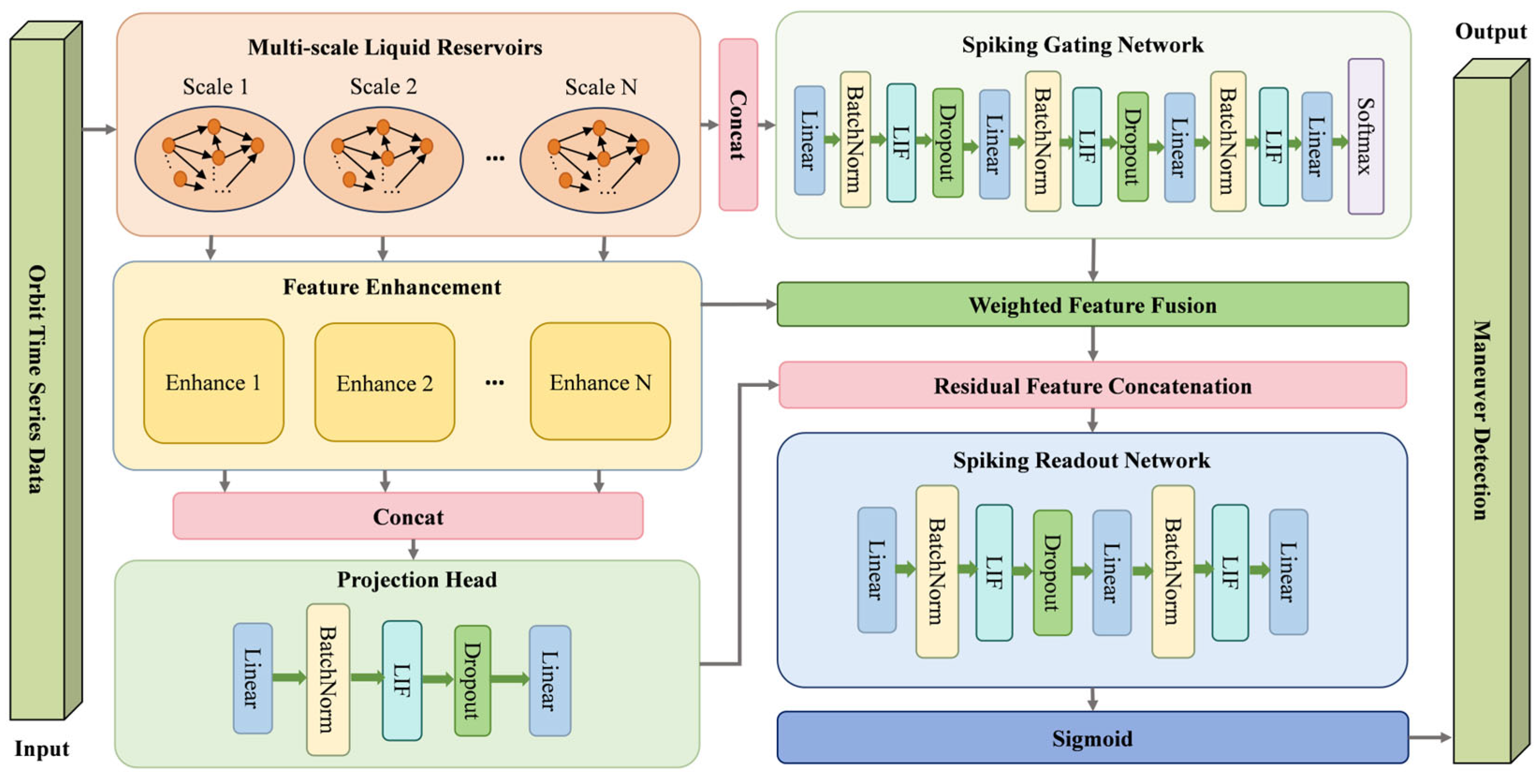
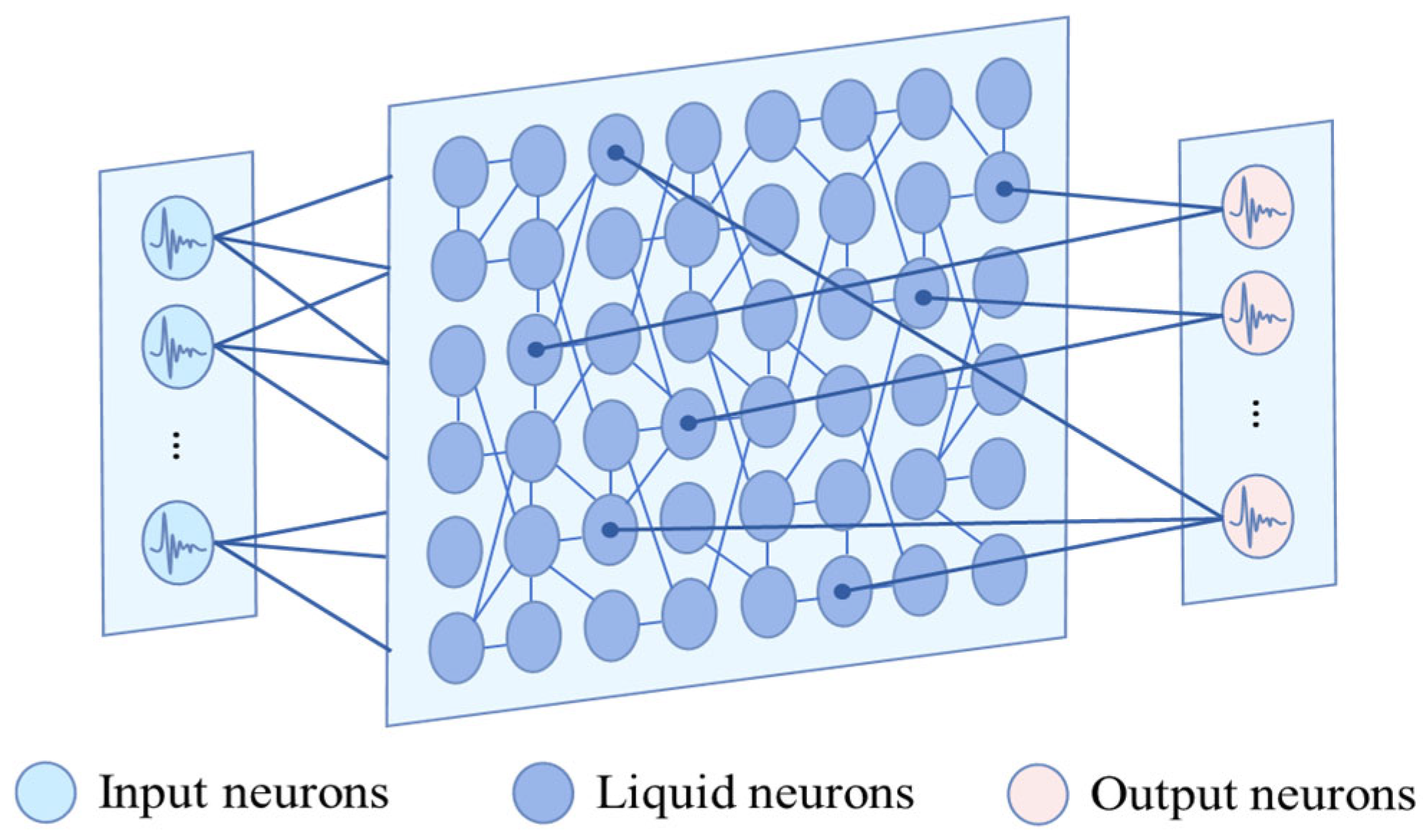
- Unlike conventional Liquid State Machines (LSMs) that rely on homogeneous reservoir dynamics, we design a multi-scale reservoir architecture with different scale-dependent decay factors. Parallel LSM modules explicitly capture temporal features at different scales—fast-scale reservoirs respond sensitively to abrupt orbital changes, while slow-scale reservoirs model long-term trends—thereby achieving more comprehensive multi-rate temporal dynamics modeling for satellite maneuver detection.
- A learnable spiking gating mechanism based on Leaky Integrate-and-Fire (LIF) neurons is implemented as a multi-layer LIF network that learns scale-specific fusion weights for multi-scale reservoir states through spike-driven computation. It replaces fixed equal-weight fusion and incorporates per-scale feature transformations with a projection-based residual pathway to enhance feature discrimination, achieving class-discriminative feature aggregation that emphasizes scale-specific patterns for maneuver and non-maneuver samples.
- To address the severe class imbalance in satellite maneuver detection, we employ a weighted binary cross-entropy loss, which ensures balanced optimization between the minority maneuver class and the majority non-maneuver class during training.
2. Related Work
2.1. Orbital Maneuver Detection Based on Two-Line Element and Observational Data
2.2. Orbital Maneuver Detection Based on Data-Driven Methods
3. Proposed Method
3.1. Overview
3.2. Multi-Scale Liquid State Machine
3.3. Feature Enhancement and Adaptive Gating Fusion
3.4. Classification Layer and Loss Function
| Algorithm 1 ASG-MSLSM Satellite Maneuver Detection | |
| Input: Orbital time-series dataset: Maneuver labels: Number of scales: Epochs: Batch size: Output: Trained model parameters: Prediction results: | |
| 1: Preprocess satellite data: | |
| 2: ←CreateFeatures() | ▷ Feature construction |
| 3: ←StandardScaler() 4: Split ( ) into ( ) | |
| 5: Define multi-scale decay factors 6: Initialize spiking reservoirs 7: Initialize feature enhancement networks 8: Initialize spiking gating network 9: Initialize projection head 10: Initialize readout network 11: for epoch = 1 to E do 12: for each mini-batch from do 13: Encode input sequence 14: for to do 15: for to do 16: | |
| ▷Update membrane potential | |
| 17: | ▷Generate spike |
| 18: end for | |
| 19: | ▷Reservoir state |
| 20: | ▷Feature enhancement |
| 21: end for | |
| 22: | ▷Construct raw multi-scale representation |
| 23: | ▷Compute gating weights |
| 24: | ▷Fuse enhanced features |
| 25: | ▷Concatenate enhanced features |
| 26: | ▷Projection feature |
| 27: | ▷Joint representation |
| 28: 29: WBCEWithLogits 30: 31: Backpropagate with surrogate gradients 32: Update parameters: 33: end for 34: Evaluate model on : 35: Adjust learning rate or apply early stopping 36: end for | |
4. Experiments
4.1. Dataset
- Orbital elements at the previous observation:
- 1.
- Target orbital elements number (previous observation)
- 2.
- Satellite ID (previous observation)
- 3.
- Epoch time (previous observation)
- 4.
- Orbital inclination (previous observation)
- 5.
- Right ascension of the ascending node—RAAN (previous observation)
- 6.
- Eccentricity (previous observation)
- 7.
- Argument of perigee (previous observation)
- 8.
- Mean anomaly (previous observation)
- 9.
- Mean motion (revolutions per day, previous observation)
- 10.
- Revolution number at epoch (previous observation)
- 11.
- Semi-major axis (previous observation)
- Orbital elements at the subsequent observation:
- 12.
- Target orbital elements number (subsequent observation)
- 13.
- Satellite ID (subsequent observation)
- 14.
- Epoch time (subsequent observation)
- 15.
- Orbital inclination (subsequent observation)
- 16.
- RAAN (subsequent observation)
- 17.
- Eccentricity (subsequent observation)
- 18.
- Argument of perigee (subsequent observation)
- 19.
- Mean anomaly (subsequent observation)
- 20.
- Mean motion (revolutions per day, subsequent observation)
- 21.
- Revolution number at epoch (subsequent observation)
- 22.
- Semi-major axis (subsequent observation)
- Derived features:
- 23.
- Change in semi-major axis (subsequent observation minus previous observation)
- 24.
- maneuver label (0 for non-maneuver, 1 for maneuver)
4.2. Parameter Configuration
4.3. Comparative Results
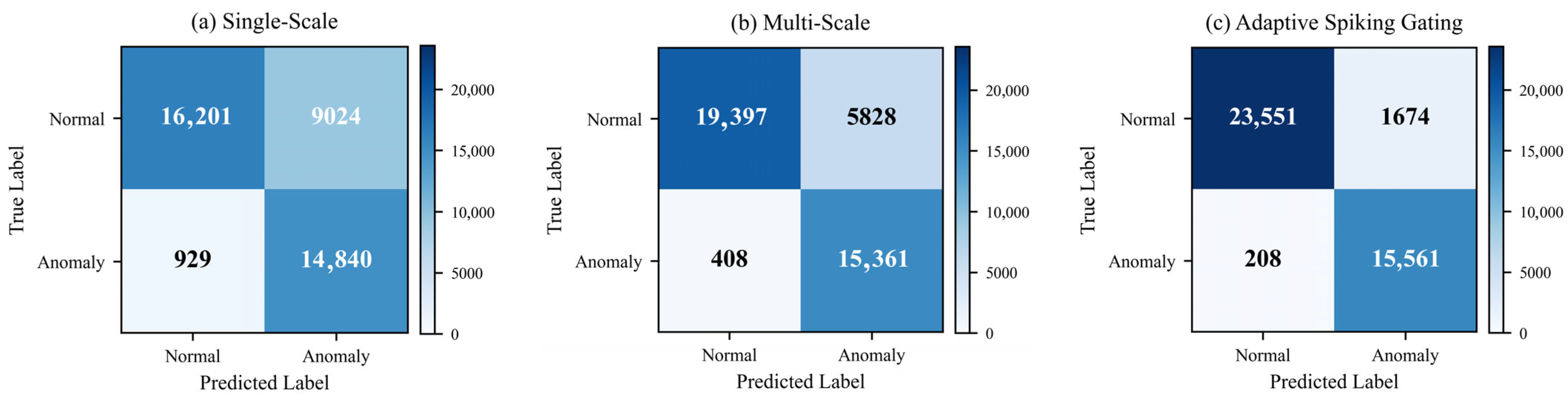
4.4. Ablation Study
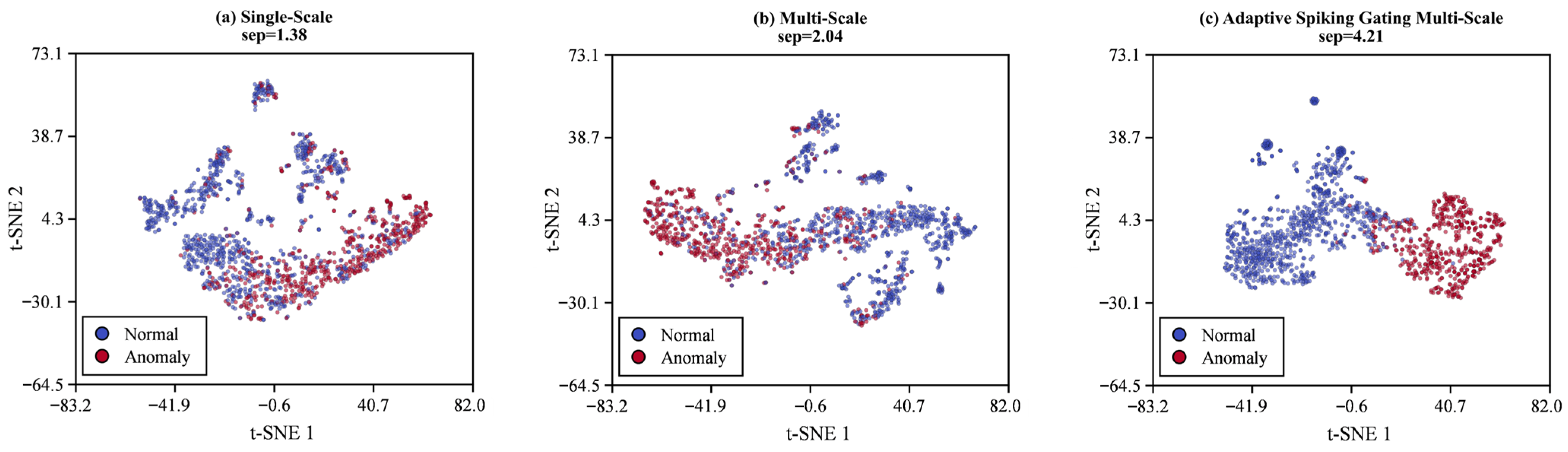
4.5. Analysis of Adaptive Scale Gating Mechanism
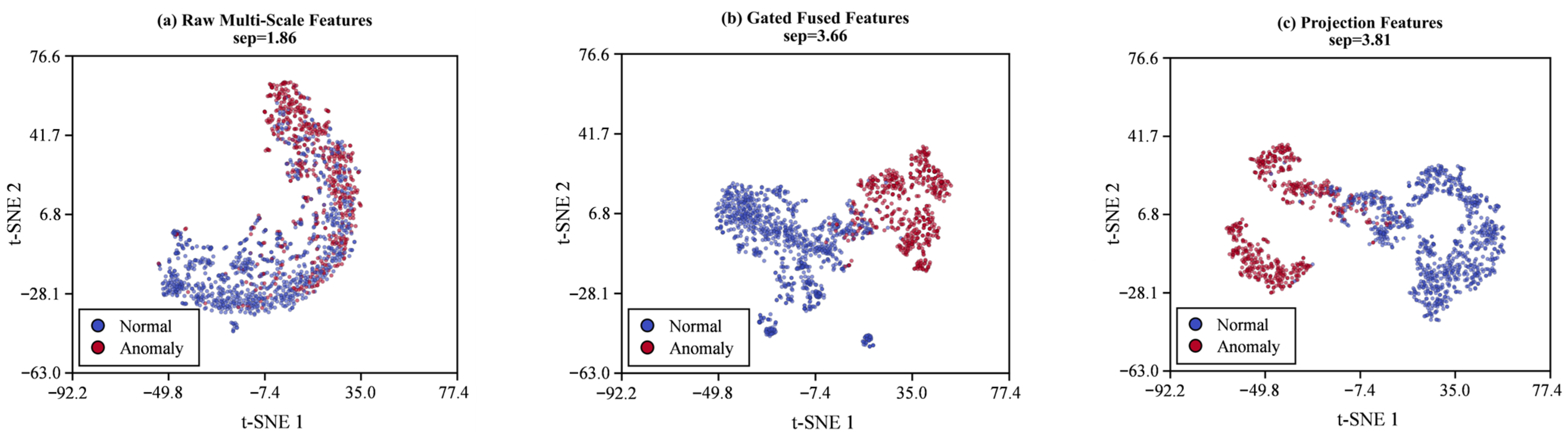
4.5.1. Feature Transformation Visualization
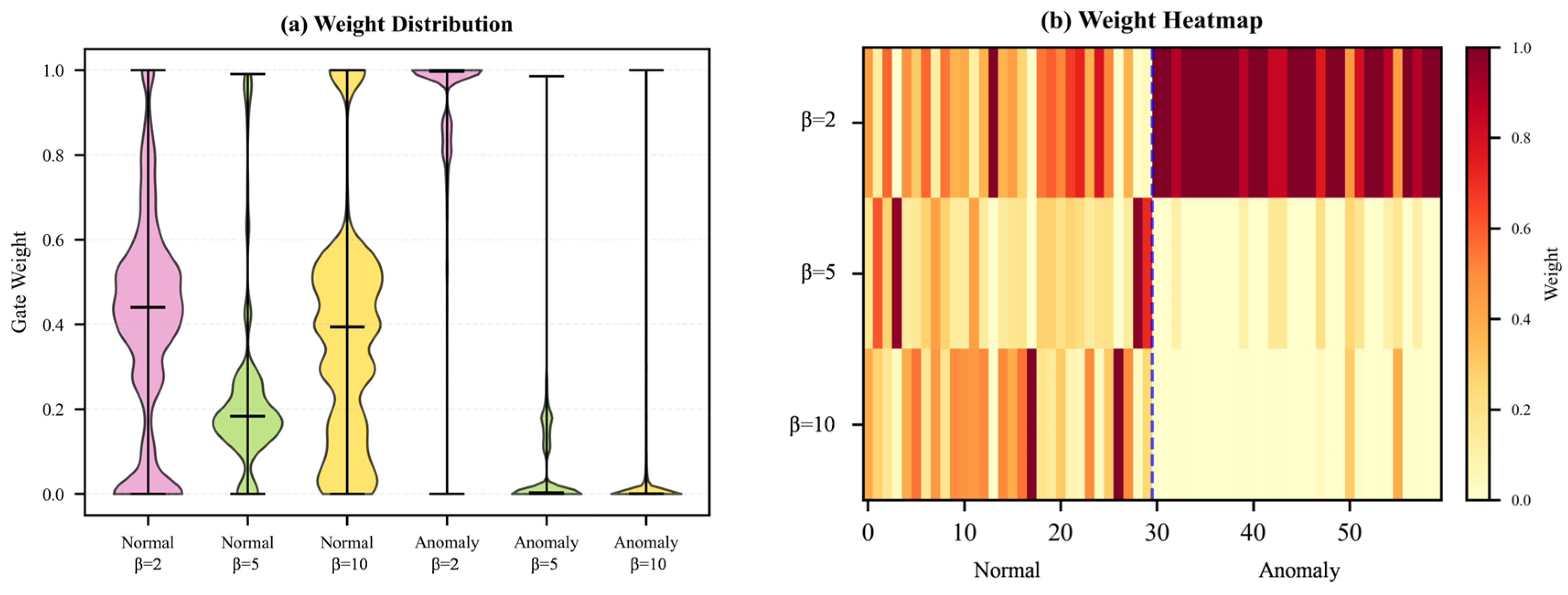
4.5.2. Gating Weight Analysis
5. Conclusions
Author Contributions
Funding
Data Availability Statement
Conflicts of Interest
References
- Cui, H.Z.; Liu, W.L.; Tang, G.S. Orbital Maneuver Detection of Non-Cooperative Space Targets Under Different Thrusts. J. Astronaut. 2016, 37, 253–261. [Google Scholar]
- Liu, Y.H.; Fu, L.; Wu, Z.W. A sliding window detection method for GEO satellite orbit maneuver based on polynomial fitting. In Proceedings of the 12th China Satellite Navigation Conference (CSNC 2021), Nanchang, China, 22–25 May 2021; Volume 5, pp. 155–159. [Google Scholar]
- Li, T.; Huang, H.; Chen, L. Method for Detecting Satellite Historical Orbit Maneuver Based on Distribution Fitting of Prediction Error. J. Natl. Univ. Def. Technol. 2020, 42, 114–120. [Google Scholar]
- Li, Z.Y.; Yang, Z.; Li, H.Y. Adaptive Reverse Moving Sliding Window Detection Method for Spacecraft Orbit Maneuver. J. Natl. Univ. Def. Technol. 2024, 46, 45–53. [Google Scholar]
- Xu, H.; Liao, J.; Luo, Y. A VMD-SVM Method for LEO Satellite Orbit Prediction with Space Weather Parameters. Remote Sens. 2025, 17, 746. [Google Scholar] [CrossRef]
- Roberts, T.G.; Solera, H.E.; Linares, R. Geosynchronous satellite behavior classification via unsupervised machine learning. In Proceedings of the 9th IAA Space Traffic Management Conference, Austin, TX, USA, 2–3 March 2023; pp. 1–10. [Google Scholar]
- Li, F.; Zhao, Y.; Zhang, J. A Station-Keeping Maneuver Detection Method of Non-Cooperative Geosynchronous Satellites. Adv. Space Res. 2024, 73, 160–169. [Google Scholar] [CrossRef]
- Cipollone, R.; Frueh, C.; Di Lizia, P. LSTM-Based Maneuver Detection for Resident Space Object Catalog Maintenance. Neural Comput. Appl. 2025, 37, 17341–17362. [Google Scholar] [CrossRef]
- Neftci, E.O.; Mostafa, H.; Zenke, F. Surrogate Gradient Learning in Spiking Neural Networks: Bringing the Power of Gradient-Based Optimization to Spiking Neural Networks. IEEE Signal Process. Mag. 2019, 36, 51–63. [Google Scholar] [CrossRef]
- Maass, W.; Natschläger, T.; Markram, H. Real-Time Computing Without Stable States: A New Framework for Neural Computation Based on Perturbations. Neural Comput. 2002, 14, 2531–2560. [Google Scholar] [CrossRef] [PubMed]
- Lemmens, S.; Krag, H. Two-Line-Elements-Based Maneuver Detection Methods for Satellites in Low Earth Orbit. J. Guid. Control Dyn. 2014, 37, 860–868. [Google Scholar] [CrossRef]
- Cui, W.; Guo, C.; Zhang, W. Spacecraft Maneuver Detection Method Based on TLE Two-Line Elements. Chin. J. Space Sci. 2024, 44, 151–158. [Google Scholar] [CrossRef]
- Kelecy, T.; Hall, D.; Hamada, K.; Stocker, D. Satellite maneuver detection using two-line element (TLE) data. In Proceedings of the Advanced Maui Optical and Space Surveillance Technologies Conference (AMOS), Maui, HI, USA, 12–15 September 2007; pp. 1–10. [Google Scholar]
- Shorten, D.P.; Humphries, M.; Maclean, J. Optimal Proposal Particle Filters for Detecting Anomalies and Manoeuvres from Two-Line Element Data. Acta Astronaut. 2025, 228, 709–723. [Google Scholar] [CrossRef]
- Liu, J.H.; Liu, L.; Du, J.L.; Sang, J.Z. TLE Outlier Detection Based on Expectation Maximization Algorithm. Adv. Space Res. 2021, 68, 2695–2712. [Google Scholar] [CrossRef]
- Zhong, W.C.; Deng, H.; Cui, B.J. Maneuver Detection and Situation Assessment of Geostationary Orbit Satellites Based on Discrete Data. Aerosp. Shanghai 2024, 41, 169–176. [Google Scholar]
- Perovich, N.; Folcik, Z.; Jaimes, R. Satellite Maneuver Detection Using Machine Learning and Neural Network Methods. In Proceedings of the IEEE Aerospace Conference (AERO 2022), Big Sky, MT, USA, 5–12 March 2022; pp. 1–19. [Google Scholar]
- Bai, X.; Liao, C.; Pan, X.; Xu, M. Mining Two-Line Element Data to Detect Orbital Maneuver for Satellite. IEEE Access 2019, 7, 129537–129550. [Google Scholar] [CrossRef]
- Ying, Y.; Ziyu, Z.; Qingrui, Z. Maneuver Detection of Cataloged Space Objects Based on Machine Learning. In Proceedings of the 43rd Chinese Control Conference (CCC 2024), Kunming, China, 28–31 July 2024; pp. 6038–6043. [Google Scholar]
- Long, X.; Yang, L.P.; Qiao, C.Y.; Huang, H. Adaptive Deep Learning Method for GEO Satellite Maneuver Recognition. J. Astronaut. 2025, 46, 51–67. [Google Scholar] [CrossRef]
- Wu, X.H.; Zhang, K.; Yuan, S. Research on satellite orbit prediction technology based on LSTM. J. Cyberspace Secur. 2024, 2, 18–28. [Google Scholar]
- Guan, H. Research on the Optimization of Liquid State Machine Based on Synaptic Plasticity. Master’s Thesis, Chongqing University, Chongqing, China, 2017. [Google Scholar]
- Yu, F.; Wu, Y.; Ma, S. Brain-Inspired Multimodal Hybrid Neural Network for Robot Place Recognition. Sci. Robot. 2023, 8, eabm6996. [Google Scholar] [CrossRef] [PubMed]
- Chen, H.; Pei, Z.; Wen, X.; Zhang, L.; Qiao, K.; Zhu, Z. Multi-Level Firing with Spiking Neural Network for Orbital Maneuver Detection. Aerospace 2025, 12, 991. [Google Scholar] [CrossRef]



| Parameter Category | Parameter Name | Value | Functional Description |
|---|---|---|---|
| Input | input_dims | 6 | Dimensionality of orbital element features for model input |
| Multi-Scale Reservoir | num_scales | 3 | Number of temporal scales (sub-reservoirs) |
| reservoir_size | 256 | Total number of neurons in multi-scale reservoir | |
| decay_factors | [2.0, 5.0, 10.0] | Scale-dependent decay factors used to characterize different temporal scales in the multi-scale reservoirs. | |
| sparsity | 0.1 | Sparsity ratio of recurrent reservoir connections | |
| Gating Network | gating_dims | [768, 256, 128, 3] | Network structure for generating adaptive gating weights |
| Feature Enhancement | enhancement_dim | 128 | Output dimension per scale for feature enhancement |
| Projection Head | projection_dims | [384, 256, 128] | Feature projection dimensions for discriminative representation |
| projection_head_activation | LIF | Activation function: LIF (ATan surrogate gradient) for hidden layers, linear (no activation) for output layer | |
| Readout Network | readout_dims | [192, 128, 64, 1] | Network structure concatenating fusion and projection features |
| readout_network_activation | LIF | Activation function: LIF (ATan surrogate gradient) for hidden layers, linear (no activation) for output layer | |
| dropout | 0.3 | Dropout rate for regularization | |
| Training Configuration | batch_size | 256 | Batch size for model training |
| epochs | 100 | Total number of training epochs | |
| optimizer | AdamW | Optimizer with weight decay regularization | |
| learning_rate | 0.001 | Initial learning rate | |
| weight_decay | 1 × 10⁻⁴ | Weight decay coefficient |
| Method | Accuracy (%) | Precision (%) | Recall (%) | F1 (%) | Sparsity (%) |
|---|---|---|---|---|---|
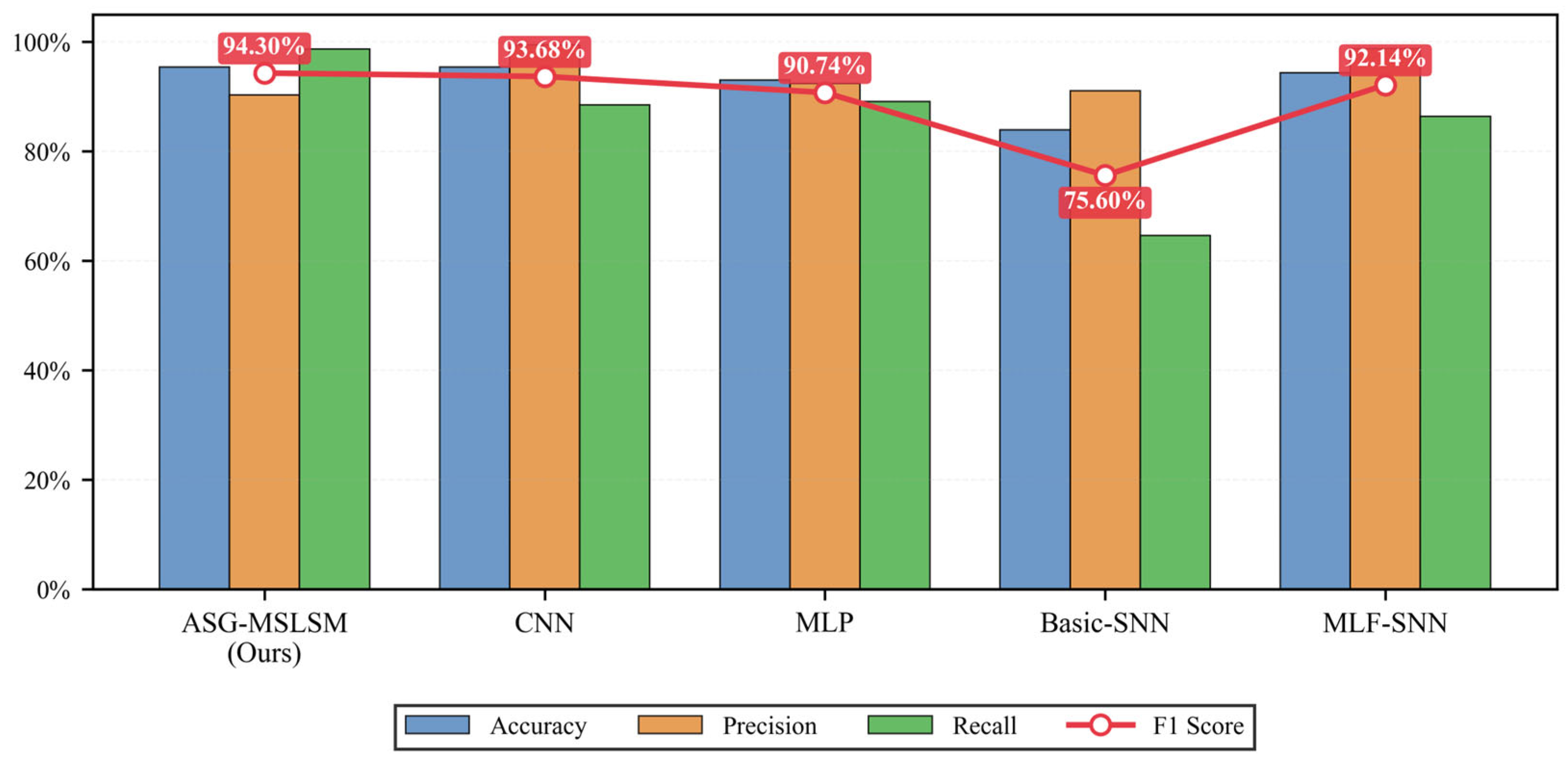
| ASG-MSLSM (Ours) | 95.41 | 90.29 | 98.68 | 94.30 | 89.43 |
| CNN | 95.41 | 99.43 | 88.57 | 93.68 | - |
| MLP | 93.00 | 92.41 | 89.12 | 90.74 | - |
| Basic-SNN | 83.95 | 91.07 | 64.62 | 75.60 | 85.46 |
| MLF-SNN | 94.36 | 98.74 | 86.37 | 92.14 | 84.38 |
| Variant | Accuracy (%) | Precision (%) | Recall (%) | F1 (%) | ΔF1 (%) | Sparsity (%) | ΔSparsity (%) |
|---|---|---|---|---|---|---|---|
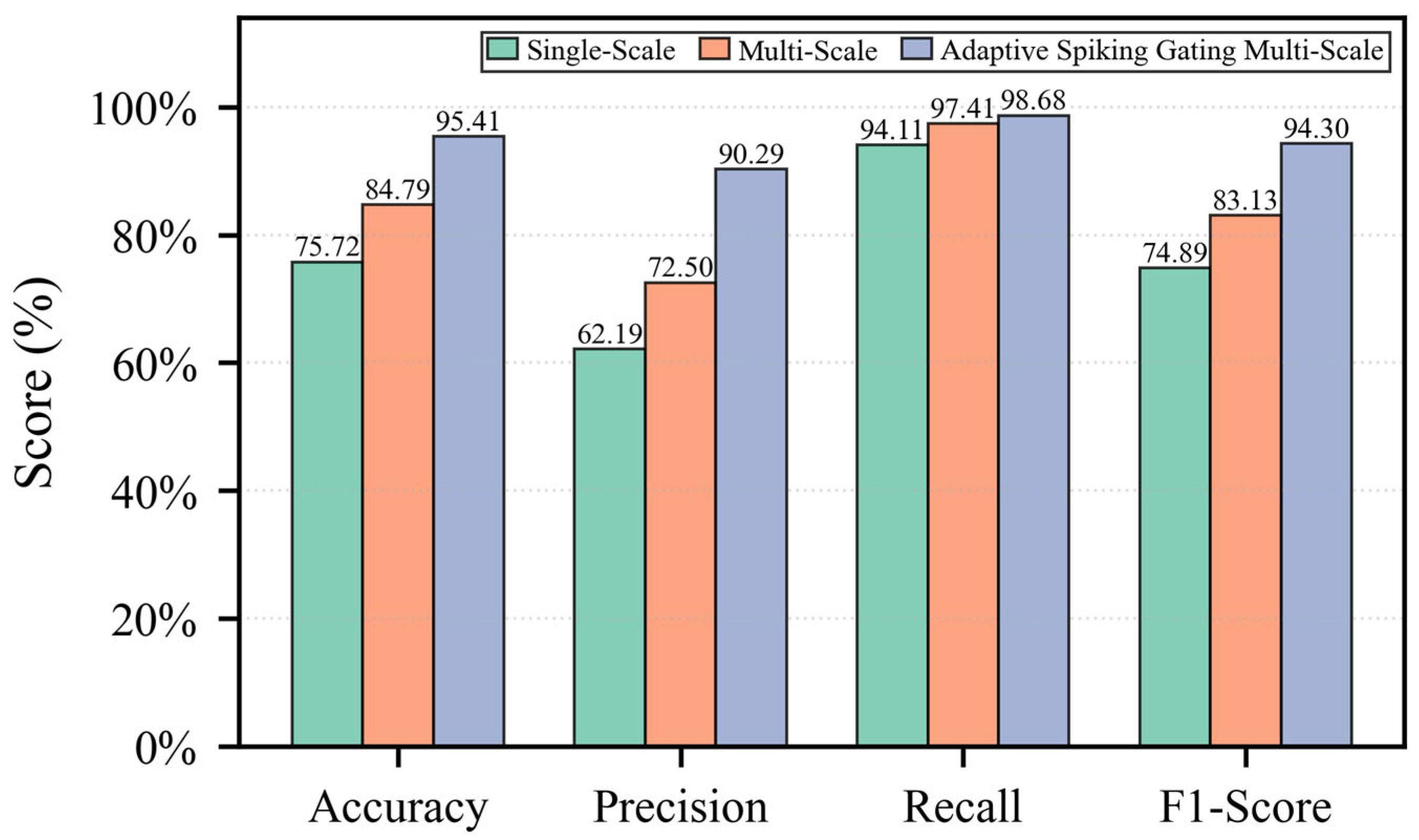
| Single-Scale | 75.72 | 62.19 | 94.11 | 74.89 | - | 93.79 | |
| Multi-Scale | 84.79 | 72.50 | 97.41 | 83.13 | +8.24 | 94.17 | +0.38 |
| Adaptive Spiking Gating Multi-Scale | 95.41 | 90.29 | 98.68 | 94.30 | +11.17 | 89.43 | −4.74 |
Disclaimer/Publisher’s Note: The statements, opinions and data contained in all publications are solely those of the individual author(s) and contributor(s) and not of MDPI and/or the editor(s). MDPI and/or the editor(s) disclaim responsibility for any injury to people or property resulting from any ideas, methods, instructions or products referred to in the content. |
© 2026 by the authors. Licensee MDPI, Basel, Switzerland. This article is an open access article distributed under the terms and conditions of the Creative Commons Attribution (CC BY) license.
Share and Cite
Shi, G.; Pei, Z.; Chen, H.; Wang, J.; Song, C.; Chen, Y. Adaptive Spiking Gating Multi-Scale Liquid State Machine for Orbital Maneuver Detection. Aerospace 2026, 13, 417. https://doi.org/10.3390/aerospace13050417
Shi G, Pei Z, Chen H, Wang J, Song C, Chen Y. Adaptive Spiking Gating Multi-Scale Liquid State Machine for Orbital Maneuver Detection. Aerospace. 2026; 13(5):417. https://doi.org/10.3390/aerospace13050417
Chicago/Turabian StyleShi, Guo, Zhongmin Pei, Hui Chen, Jiameng Wang, Chunyang Song, and Yongquan Chen. 2026. "Adaptive Spiking Gating Multi-Scale Liquid State Machine for Orbital Maneuver Detection" Aerospace 13, no. 5: 417. https://doi.org/10.3390/aerospace13050417
APA StyleShi, G., Pei, Z., Chen, H., Wang, J., Song, C., & Chen, Y. (2026). Adaptive Spiking Gating Multi-Scale Liquid State Machine for Orbital Maneuver Detection. Aerospace, 13(5), 417. https://doi.org/10.3390/aerospace13050417