1. Introduction
Hybrid rocket propulsion represents a promising alternative to conventional solid and liquid rocket engines, particularly for small-scale applications where safety, controllability, and manufacturability are critical constraints. The performance and feasibility of hybrid rocket engines are strongly influenced by the selection of the oxidizer, which governs thermodynamic efficiency, mass flow requirements, system complexity, and operational safety. This study addresses the oxidizer selection problem for a 1 kN-class hybrid rocket engine through a comparative, design-oriented analysis of nitrous oxide, gaseous oxygen, and liquid oxygen under identical thrust and boundary conditions. By combining equilibrium thermodynamic modelling with refined performance analysis tools, the work aims to provide a structured framework to support early-stage design decisions in academic and low-budget hybrid propulsion programs.
1.1. Hybrid Rocket Engines in Small-Scale Propulsion
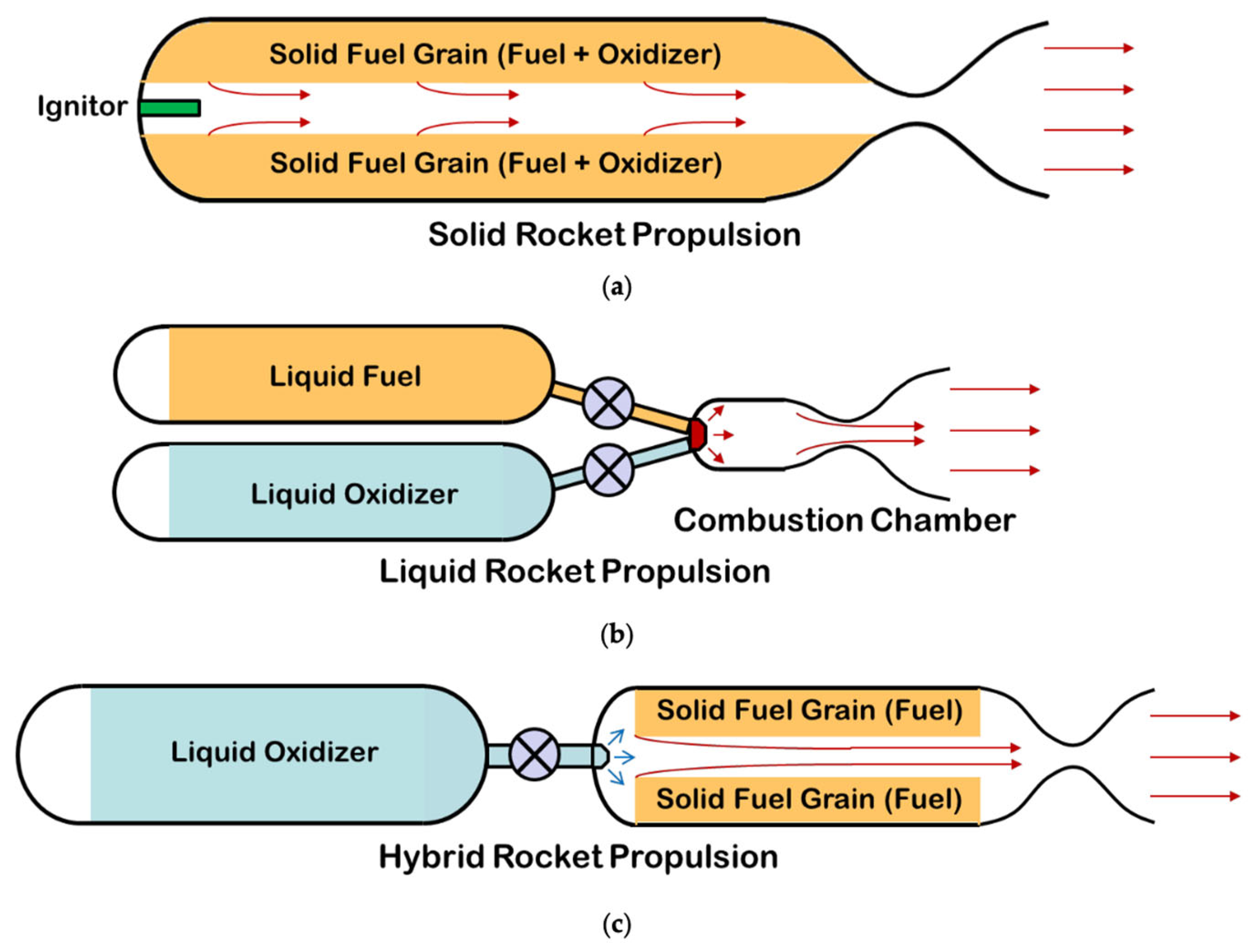
Hybrid rocket engines (HREs) combine a solid fuel grain with a separately supplied oxidizer, typically stored in liquid or gaseous form. This configuration places hybrid propulsion between solid rocket motors and liquid rocket engines in terms of performance, safety, and operational complexity (
Figure 1) [
1]. One of the principal advantages of hybrid systems is the physical separation of propellants, which reduces the risk of catastrophic failure and enables throttling and shutdown through oxidizer flow control [
2,
3].
Hybrid propulsion is particularly attractive for small-scale propulsion systems, typically defined as thrust levels below several kilonewtons, where safety, manufacturability, and operational simplicity are key design constraints [
4]. Many university research programs therefore employ hybrid engines as experimental platforms for injector development, regression-rate studies, and combustion characterization, since they can be constructed and tested with relatively accessible infrastructure compared with liquid bipropellant systems [
2,
5]. However, the achievable performance of hybrid rocket engines remains strongly dependent on the oxidizer–fuel combination, which governs combustion temperature, mixture ratio, mass-flow requirements, and overall system complexity. These effects become more pronounced at small scales, where regression-rate limitations, heat-transfer losses, and injector non-idealities can significantly reduce delivered performance [
3,
6]. Consequently, oxidizer selection represents a critical early-stage design decision, motivating the comparative analysis presented in this study.
1.2. Oxidizer Selection Problem in Hybrid Propulsion
The selection of an appropriate oxidizer in hybrid propulsion involves a multidimensional trade-off between thermodynamic performance, operational safety, availability, storage requirements, and system complexity. Among the oxidizers commonly considered for hybrid rocket engines, nitrous oxide (N
2O), gaseous oxygen (GOX-O
2), and liquid oxygen (LOX) represent three fundamentally different operational regimes with distinct advantages and constraints [
3].
Nitrous oxide has been widely adopted in academic and amateur hybrid rocket engines due to its self-pressurizing behaviour, relatively benign handling characteristics, and compatibility with polymeric fuels such as hydroxyl-terminated polybutadiene (HTPB), high-density polyethylene (HDPE), and paraffin-based formulations [
2,
5]. However, N
2O exhibits lower theoretical performance compared to oxygen (GOX and LOX) and often requires significantly higher mass flow rates to achieve a given thrust level, which can increase tank volume and system mass. Kuo and Chiaverini [
7] have summarized the performances of the common combinations of HRE propellants, which are included in
Table 1 [
3,
7].
Oxygen (GOX and LOX), in contrast, offer superior thermodynamic performance due to their higher oxidizing potential and favourable combustion temperatures. Gaseous oxygen enables simplified feeding architectures without cryogenic systems, while liquid oxygen provides the highest achievable specific impulse among the oxidizers considered in this study [
3,
4]. Nevertheless, both forms of oxygen introduce additional safety, handling, and infrastructure requirements, particularly in academic environments where cryogenic capabilities may be limited or unavailable [
7].
At the design thrust level of approximately 1 kN, these trade-offs become especially pronounced. The oxidizer choice directly influences the optimal oxidizer-to-fuel ratio (O/F), mass flow requirements, injector sizing, chamber pressure, and nozzle geometry, all of which must be balanced against manufacturability and operational feasibility. As a result, oxidizer selection cannot be based solely on ideal performance metrics, but must instead consider a broader system-level perspective [
7,
8].
1.3. Gaps in the Current Literature
The Existing literature on hybrid rocket propulsion predominantly focuses either on experimental demonstrations of specific engine configurations or on broad reviews of hybrid propulsion technologies. Several student-led and academic projects have reported successful operation of hybrid engines using N
2O- or LOX-based systems, often emphasizing experimental validation and structural optimization [
2,
5]. In parallel, recent review studies have summarized advances in hybrid propulsion, including developments in fuel formulations, injector concepts, and combustion stability mechanisms [
3,
9].
Despite these advances, relatively few studies perform systematic comparisons of multiple oxidizers under identical operating conditions, particularly for small-scale hybrid engines intended for academic or low-budget research environments. Many published investigations evaluate a single oxidizer–fuel combination, making direct performance comparisons difficult due to differences in chamber pressure, expansion ratio, or environmental assumptions.
Furthermore, although NASA Chemical Equilibrium with Applications (CEA) is widely used for ideal thermodynamic analysis, fewer studies explicitly combine equilibrium calculations with intermediate-fidelity performance tools such as Rocket Propulsion Analysis (RPA) in order to account for geometric effects and non-ideal nozzle behaviour [
10]. This limitation is particularly relevant for hybrid engines, where chamber geometry, finite combustion length, and injector-related losses can significantly influence delivered performance [
11].
Consequently, there remains a lack of design-oriented comparative studies that integrate equilibrium thermodynamics with refined performance modelling in order to evaluate oxidizer selection under consistent design constraints.
1.4. Objectives and Novelty of This Study
The objective of this study is to perform a comparative, design-oriented evaluation of three oxidizers—nitrous oxide (N2O), gaseous oxygen (GOX), and liquid oxygen (LOX)—for application in a 1 kN-class hybrid rocket engine intended for academic or low-budget propulsion research environments. The analysis is conducted under uniform thrust requirements and consistent ambient conditions representative of ground testing at moderate altitude. By maintaining identical boundary conditions across all cases, the observed differences in performance can be attributed primarily to the thermochemical and physical properties of the oxidizers.
The study determines the oxidizer-to-fuel ratios that maximize performance for each propellant combination and evaluates the resulting specific impulse, chamber temperature, and propellant mass flow rate. Ideal equilibrium predictions obtained using NASA CEA (RocketCEA v1.2.3) are subsequently refined using Rocket Propulsion Analysis (RPA), allowing geometric effects, finite combustion behaviour, and non-ideal nozzle expansion to be partially incorporated into the performance assessment.
While equilibrium performance comparisons between oxidizers are well documented, fewer studies evaluate how these differences translate into delivered performance when realistic chamber geometry and nozzle losses are included. This effect becomes particularly relevant for small hybrid engines where scale-dependent losses can significantly reduce theoretical performance margins.
2. Background and Related Work
Hybrid rocket propulsion occupies an intermediate position between solid and liquid rocket technologies, combining the structural simplicity and safety advantages of solid propellants with the throttling capability and operational flexibility of liquid engines. In hybrid systems, a solid fuel grain reacts with a separately supplied oxidizer, allowing combustion to be controlled through oxidizer flow regulation. This architecture has made hybrid propulsion particularly attractive for small-scale propulsion systems and academic research programs, where operational safety and manufacturing simplicity are important constraints [
1,
2,
3].
Despite these advantages, the performance of hybrid rocket engines is strongly influenced by the interaction between oxidizer injection, fuel regression, combustion thermochemistry, and nozzle expansion [
4,
5]. As a result, predicting achievable engine performance requires considering both thermodynamic limits and system-level operational constraints. In particular, oxidizer selection plays a central role because it directly affects combustion temperature, mixture ratio, achievable specific impulse, and feed-system complexity [
3,
6].
2.1. Oxidizer Properties and System-Level Trade-Offs
Among the oxidizers commonly considered for hybrid propulsion, nitrous oxide (N
2O), gaseous oxygen (GOX), and liquid oxygen (LOX) represent three distinct operational regimes. Nitrous oxide is widely used in experimental and academic hybrid engines due to its self-pressurizing behaviour and relatively simple feed-system architecture. However, its lower oxidizing potential results in reduced theoretical combustion temperature and specific impulse compared with oxygen (GOX and LOX) [
12].
Gaseous oxygen provides improved thermodynamic performance while avoiding the cryogenic storage requirements associated with liquid oxygen. Nevertheless, its low density requires high storage pressures or large tank volumes, which can introduce structural and safety constraints. Liquid oxygen offers the highest theoretical performance due to its high density and strong oxidizing capability, but its cryogenic handling requirements significantly increase operational complexity and infrastructure demands.
Consequently, oxidizer selection in hybrid propulsion cannot be based solely on theoretical performance metrics. Instead, it must be treated as a system-level trade-off between thermodynamic efficiency, operational safety, infrastructure complexity, and practical feasibility, particularly in small-scale or academic propulsion systems [
13].
2.2. Previous Experimental and Numerical Studies
A substantial body of experimental work has demonstrated the feasibility of hybrid rocket engines across a wide range of thrust classes. University-led programs have successfully developed and tested N
2O-based hybrid engines producing thrust levels from tens of newtons to several kilonewtons, confirming the suitability of hybrid propulsion for educational and research applications. For example, Heeg et al. reported hot-fire testing of a 2.3 kN N
2O/HTPB hybrid engine, demonstrating stable combustion and highlighting the influence of injector design and chamber pressure on delivered performance [
12,
13].
From a numerical perspective, equilibrium thermodynamic tools such as NASA Chemical Equilibrium with Applications (CEA) are widely used to evaluate ideal combustion properties and estimate theoretical propulsion performance. However, purely equilibrium-based predictions often overestimate achievable performance because they neglect finite combustion chamber effects, geometric constraints, and nozzle losses [
14]. To address these limitations, intermediate-fidelity tools such as Rocket Propulsion Analysis (RPA) incorporate finite chamber modelling and non-isentropic nozzle expansion, providing more realistic estimates of delivered engine performance [
13,
14,
15].
2.3. Identified Research Gap
Despite the extensive literature on hybrid rocket propulsion, relatively few studies perform systematic comparisons of different oxidizers under identical thrust targets, boundary conditions, and geometric assumptions. Many investigations focus on optimizing a single oxidizer–fuel combination, making direct comparisons between oxidizers difficult [
16].
Moreover, while equilibrium-based tools such as CEA are widely used for conceptual design, fewer studies explicitly combine equilibrium thermodynamic analysis with intermediate-fidelity performance modelling to assess how non-ideal effects influence comparative oxidizer performance.
Therefore, there remains a need for structured studies that evaluate multiple oxidizers under consistent design conditions while bridging the gap between ideal thermodynamic predictions and realistic engine performance. The present work addresses this need by combining CEA equilibrium analysis with RPA-based performance refinement to systematically compare N2O, GOX, and LOX for a 1 kN-class hybrid rocket engine.
3. Thermochemical and Propulsion Performance Modelling Framework
Early-stage hybrid rocket engine design requires balancing modelling fidelity and computational efficiency. High-fidelity reacting-flow simulations provide detailed insight, but are computationally expensive for parametric studies, whereas purely equilibrium thermodynamic models can overestimate achievable performance by neglecting geometric and flow-loss effects. To address this limitation, the present work adopts a two-level modelling approach combining NASA CEA and =RPA. CEA is first used to determine equilibrium combustion properties and the mixture ratios that maximize theoretical performance [
12,
17]. These results are subsequently refined using RPA, which incorporates finite combustion chamber geometry and nozzle expansion losses [
15,
18]. This combined CEA–RPA framework enables more realistic estimation of delivered propulsion performance for the 1 kN-class hybrid rocket engine analysed in this study.
3.1. Design Constraints and Assumptions
The analysis considers a 1 kN-class hybrid rocket engine, a thrust level representative of academic-scale propulsion systems while remaining experimentally feasible. All oxidizer configurations were evaluated under identical operating conditions to ensure a consistent comparison. The engine is assumed to operate at an ambient pressure of approximately 0.8 bar, representative of ground-test conditions in Bogotá, Colombia (altitude ≈ 2600 m). The nozzle expansion ratio was therefore selected to achieve near-optimal expansion at this pressure, minimizing pressure thrust contributions and allowing thrust to be dominated primarily by exhaust momentum [
12].
A bell-shaped nozzle configuration was assumed in order to reduce divergence losses while maintaining a compact geometry representative of small experimental propulsion systems. The expansion ratio and nozzle characteristics were kept constant across all oxidizer cases so that differences in predicted performance could be attributed primarily to oxidizer thermochemistry rather than geometric variations.
The combustion chamber was modelled as a cylindrical control volume sized to satisfy the characteristic length requirement commonly used in hybrid rocket design [
12]. For the purposes of the present analysis, the chamber was assumed to operate under steady operating conditions typical of short-duration experimental firings. The focus of the analysis is therefore on steady-state propulsion performance rather than detailed structural design.
HDPE was selected as the solid fuel due to its widespread use in experimental hybrid propulsion systems and its favourable properties, including low cost, machinability, and stable combustion behaviour [
13,
14,
15,
16]. Transient regression behaviour was not explicitly modelled; instead, the analysis focuses on steady-state thermochemical performance relevant to preliminary engine evaluation.
In the present study, the fuel composition was intentionally fixed as HDPE in order to isolate the effect of oxidizer selection on propulsion performance. While alternative hybrid fuels such as HTPB or paraffin can provide improved regression characteristics, maintaining a constant fuel composition enables a controlled comparison of oxidizer thermochemistry without introducing additional variability associated with fuel formulation.
3.2. Thermodynamic Modelling Using NASA CEA
Thermochemical equilibrium calculations were performed using the NASA Chemical Equilibrium with Applications (CEA) code, which is widely used for predicting combustion properties and theoretical rocket performance. The equilibrium composition and thermodynamic properties of the combustion products were computed following the formulation described in NASA RP-1311 [
17].
Parametric sweeps of the oxidizer-to-fuel ratio (O/F) were conducted for the N2O/HDPE, GOX/HDPE, and LOX/HDPE propellant combinations at a fixed chamber pressure. The resulting equilibrium dataset was used to identify the mixture ratio that maximizes specific impulse and to estimate the propellant mass flow rate required to achieve the target thrust using the classical relations and .
Because HDPE is not directly available in the CEA database, the fuel was approximated using an equivalent hydrocarbon species with the same elemental composition. The equilibrium predictions obtained from CEA provide the thermodynamic baseline for the subsequent performance refinement using Rocket Propulsion Analysis (RPA) described in
Section 3.3.
3.3. Performance Refinement Using Rocket Propulsion Analysis
While NASA CEA provides ideal equilibrium performance limits, it does not account for geometric effects, finite combustion chamber length, or non-isentropic flow losses. To incorporate these effects, the equilibrium results were refined using Rocket Propulsion Analysis (RPA), a propulsion analysis tool capable of modelling flow through finite combustion chambers and nozzles while including nozzle efficiency and optional frozen-flow chemistry [
18].
The equilibrium thermodynamic properties computed by CEA were used as input to the RPA model, which evaluates the resulting flow through the propulsion system geometry and accounts for acceleration losses upstream of the throat. The nozzle throat area was determined using the classical characteristic velocity relation
where
is the nozzle throat area,
is the total propellant mass flow rate,
is the characteristic velocity, and
is the chamber pressure.
RPA was subsequently used to generate the bell-shaped nozzle contour corresponding to the selected expansion ratio and to estimate the delivered propulsion performance under finite-geometry conditions. This performance-refinement procedure was applied independently to the three oxidizer configurations considered in this study (N2O/HDPE, GOX/HDPE, and LOX/HDPE) using the optimal oxidizer-to-fuel ratios obtained from the CEA parametric analysis.
3.4. Mass Flow Determination and Injector Sizing
Once the equilibrium-specific impulse
was obtained from the thermodynamic analysis, the effective exhaust velocity was determined using the classical relation
The following mass-flow determination procedure was applied to each oxidizer configuration (N2O/HDPE, GOX/HDPE, and LOX/HDPE) using the optimal oxidizer-to-fuel ratios identified in the CEA parametric analysis.
Assuming near-optimal nozzle expansion, the total propellant mass flow rate required to produce the target thrust was estimated from the momentum-dominated thrust relation
where
is the total propellant mass flow rate,
is the thrust, and
is the effective exhaust velocity.
Once the optimal oxidizer-to-fuel ratio was identified from the equilibrium analysis, the oxidizer and fuel mass flow rates were obtained from
where
and
represent the oxidizer and fuel mass flow rates, respectively. These relations allow the total propellant flow rate required to achieve the design thrust level to be distributed between oxidizer and fuel according to the optimal mixture ratio determined from the CEA analysis.
The resulting oxidizer and fuel mass flow rates for each propellant combination are reported in
Section 4 together with the propulsion performance predicted by the RPA model.
Injector Sizing
Injector pressure losses were approximated using a representative pressure drop equal to 20% of the chamber pressure, a commonly adopted assumption in preliminary rocket propulsion analyses [
12,
19,
20]. This simplified approach allows for the oxidizer mass-flow requirements derived from the thermodynamic analysis to be incorporated into the Rocket Propulsion Analysis (RPA) performance model without introducing injector-specific geometric parameters.
3.5. Assumptions, Uncertainties, and Limitations
Several simplifying assumptions were adopted to maintain the scope of the analysis within the bounds of early-stage propulsion design. Combustion was assumed to occur under steady-state conditions, and transient regression dynamics were not explicitly modelled. Heat transfer to chamber walls and the fuel grain was also neglected, which may lead to slightly optimistic estimates of chamber temperature and specific impulse.
Uncertainties arise primarily from equilibrium chemistry assumptions, injector discharge coefficient selection, and oxidizer property variations. Experimental studies of comparable hybrid propulsion systems report pressure measurement uncertainties on the order of ±0.25% and mass-flow uncertainties of approximately ±1–2% [
14,
19].
Despite these limitations, the combined CEA–RPA methodology provides a consistent and reproducible framework for comparative oxidizer analysis during early-stage hybrid rocket engine design.
4. Results
The results are presented in a comparative framework in order to highlight differences in thermodynamic behaviour, optimal mixture ratios, and delivered propulsion performance among the oxidizers considered in this study. Equilibrium predictions obtained using NASA CEA are first compared to determine the thermochemical trends associated with each oxidizer. These results are subsequently refined using Rocket Propulsion Analysis (RPA) in order to estimate the delivered propulsion performance of the 1 kN-class hybrid rocket engine.
4.1. Optimal Oxidizer-to-Fuel Ratios for Each Oxidizer
Equilibrium thermodynamic analysis was performed using the NASA Chemical Equilibrium with Applications (CEA) code to evaluate the combustion performance of the N
2O/HDPE, GOX/HDPE, and LOX/HDPE propellant combinations under the design conditions defined in
Section 3. The calculations assume chemical equilibrium within an infinite-area combustor, a chamber pressure of 35 bar, and a fixed nozzle expansion ratio of Ae/At = 5.88, corresponding to the 1 kN-class hybrid rocket engine configuration considered in this study. These assumptions represent the conventional upper-bound thermodynamic performance model commonly used in preliminary rocket propulsion design and provide a consistent baseline for comparing the thermochemical behaviour of the oxidizers [
20,
21,
22].
To ensure a consistent and controlled comparison between oxidizer configurations, the equilibrium thermodynamic analyses were performed using identical boundary conditions across all cases. The NASA CEA input parameters adopted for the N
2O/HDPE, GOX/HDPE, and LOX/HDPE propellant combinations are summarized in
Table 2. The problem type, chamber pressure, nozzle expansion ratio, fuel definition, and output variables were kept constant in order to isolate the effect of oxidizer thermochemistry on propulsion performance. The only parameters that differ between configurations are the oxidizer definition and the oxidizer-to-fuel (O/F) sweep range, which was selected in each case to capture the relevant combustion regimes, including fuel-rich, near-stoichiometric, and oxidizer-rich conditions. This unified formulation ensures that the differences observed in the subsequent analysis can be attributed primarily to the intrinsic properties of the oxidizers rather than to variations in modelling assumptions or operating conditions [
23,
24,
25,
26].
4.1.1. N2O/HDPE Configuration
The principal input parameters used for the equilibrium thermodynamic analysis of the N
2O/HDPE configuration are summarized in
Table 2. The table lists the chamber pressure, nozzle expansion ratio, oxidizer definition, and mixture-ratio sweep used in the CEA simulations. These parameters define the thermodynamic boundary conditions under which the combustion performance of the nitrous oxide–polyethylene propellant combination was evaluated and ensure consistency with the propulsion system design conditions described in
Section 3.
The equilibrium thermodynamic properties predicted by CEA for representative mixture ratios of the N
2O/HDPE configuration are summarized in
Table 3, which reports the thermodynamic state of the combustion products at the chamber, throat, and nozzle exit for selected oxidizer-to-fuel ratios [
26].
The corresponding equilibrium rocket performance parameters derived from the CEA solution are summarized in
Table 4, which provides the nozzle expansion conditions and propulsion parameters associated with the N
2O configuration [
27].
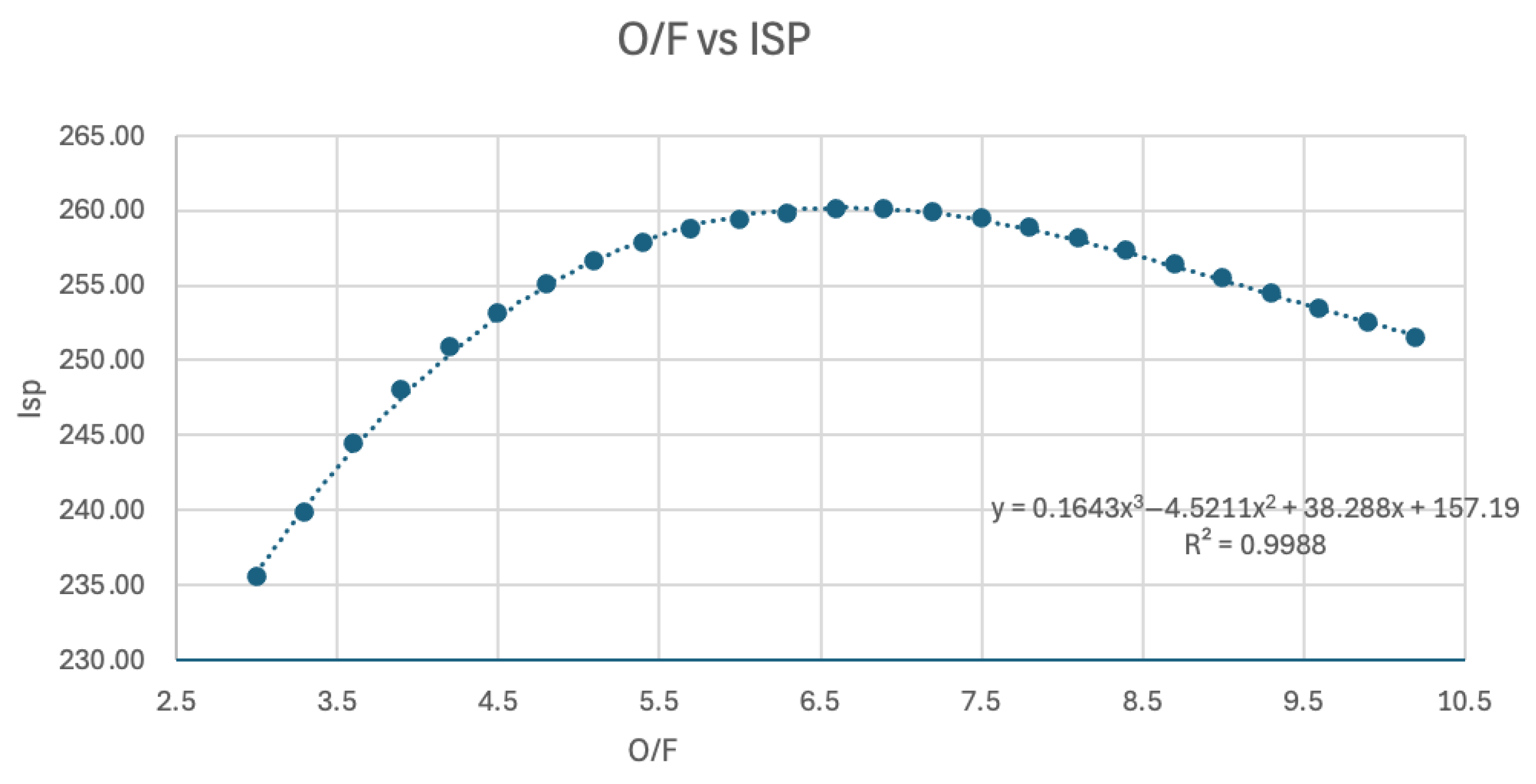
The variation in equilibrium-specific impulse with oxidizer-to-fuel ratio for the N
2O/HDPE configuration is shown in
Figure 2. As illustrated in the figure, the specific impulse increases from approximately 230 s at O/F ≈ 3 to a maximum value of approximately 260 s at O/F ≈ 6.6. Beyond this point, the specific impulse gradually decreases to approximately 250 s at O/F ≈ 10 as the mixture becomes increasingly oxidizer rich. Consequently, O/F ≈ 6.6 was selected as the optimal mixture ratio for the N
2O/HDPE configuration.
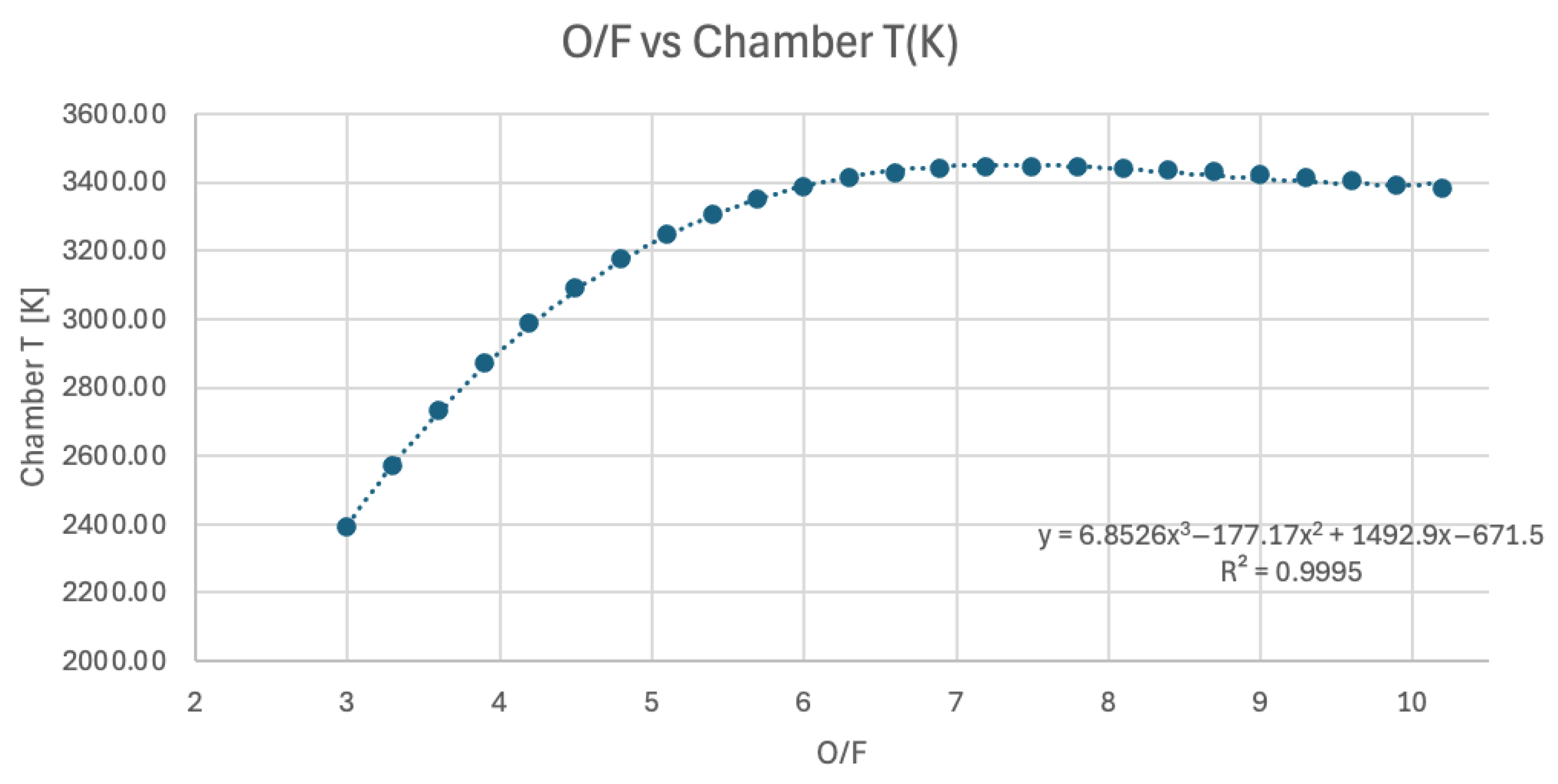
The variation of combustion chamber temperature with oxidizer-to-fuel ratio for the N
2O configuration is presented in
Figure 3. The chamber temperature increases from approximately 2400 K at O/F ≈ 3 to a maximum value of approximately 3440–3450 K near O/F ≈ 7, corresponding to near-stoichiometric combustion conditions. Beyond this mixture ratio, the temperature decreases slightly due to the presence of excess oxidizer.
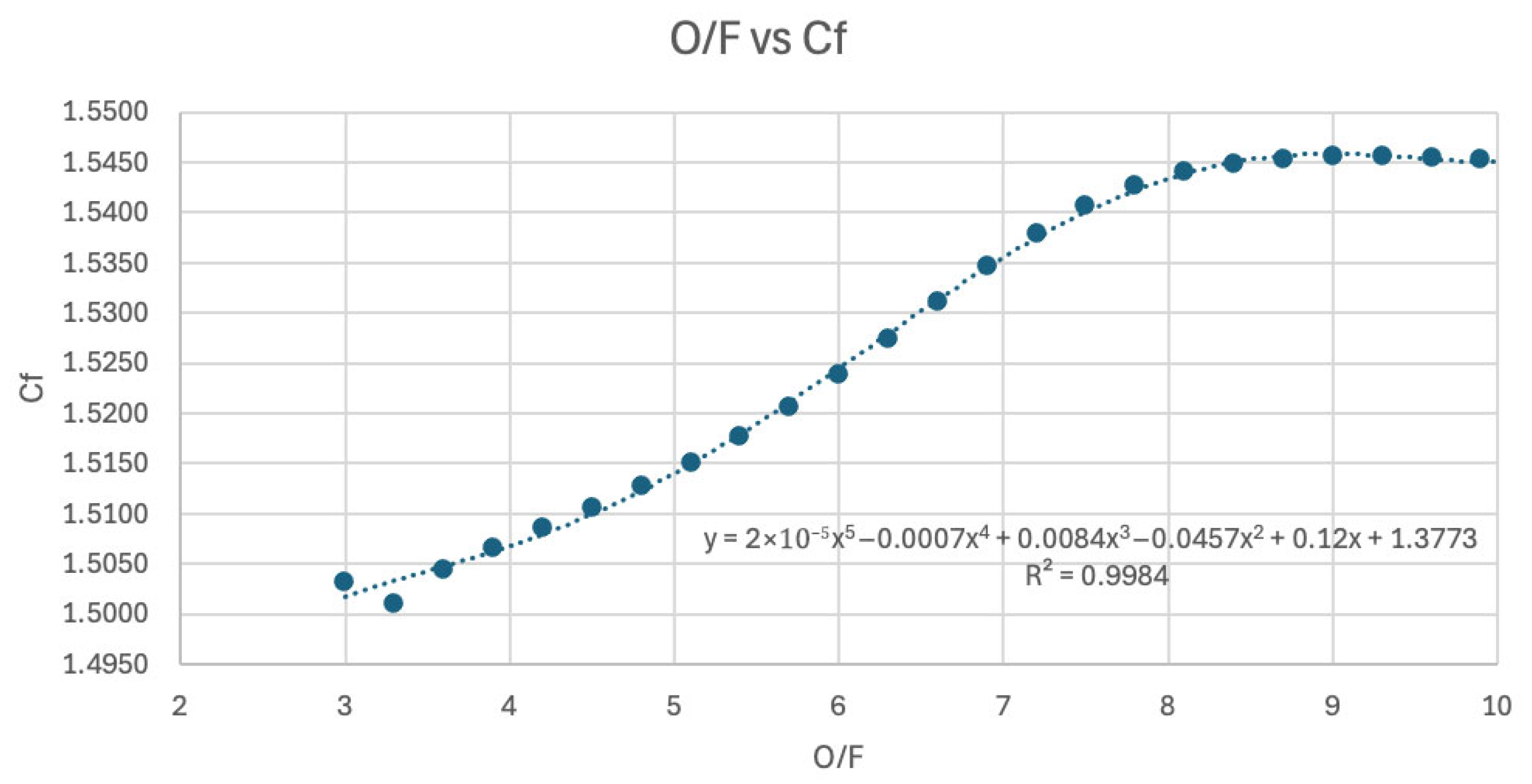
The variation in thrust coefficient with oxidizer-to-fuel ratio is shown in
Figure 4. The thrust coefficient increases gradually from approximately Cf ≈ 1.50 at O/F ≈ 3 to approximately Cf ≈ 1.54–1.55 for oxidizer-rich conditions, approaching a plateau as the mixture ratio increases.
4.1.2. GOX/HDPE Configuration
A similar equilibrium analysis was performed for the oxygen-based oxidizer using gaseous oxygen. The principal input parameters used for the GOX/HDPE thermodynamic analysis are summarized in
Table 2, where the oxidizer definition and mixture-ratio sweep range used in the simulations are reported. Maintaining identical operating conditions ensures that any differences in predicted propulsion performance arise primarily from the thermochemical properties of the oxidizer rather than variations in engine geometry or operating pressure.
The equilibrium thermodynamic properties predicted by CEA for the GOX/HDPE configuration are summarized in
Table 4, which reports the chamber, throat, and nozzle exit conditions for representative oxidizer-to-fuel ratios.
The corresponding equilibrium rocket performance parameters derived from the CEA solution are summarized in
Table 4, providing the propulsion parameters associated with the mixture ratio that maximizes equilibrium-specific impulse.
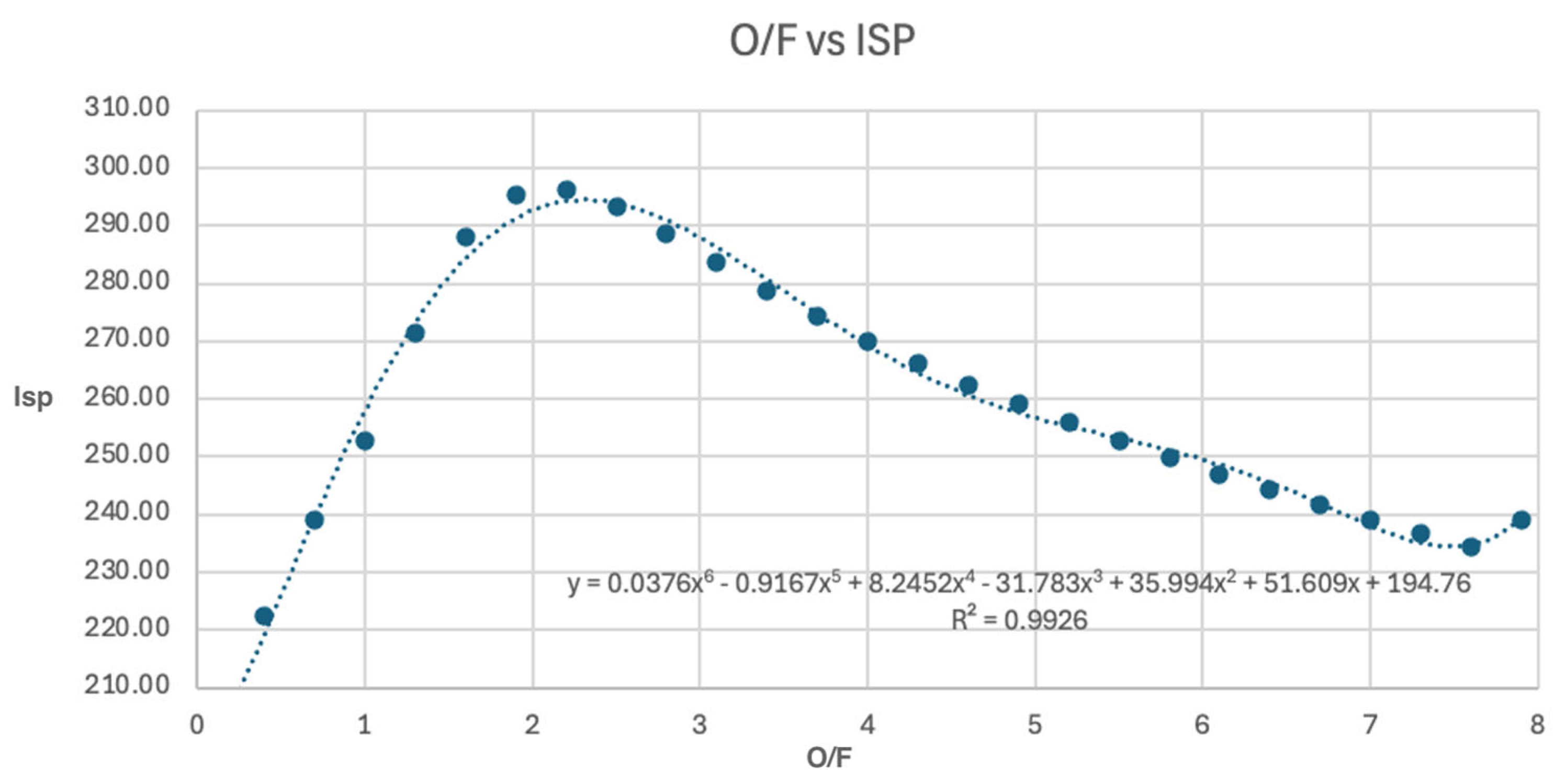
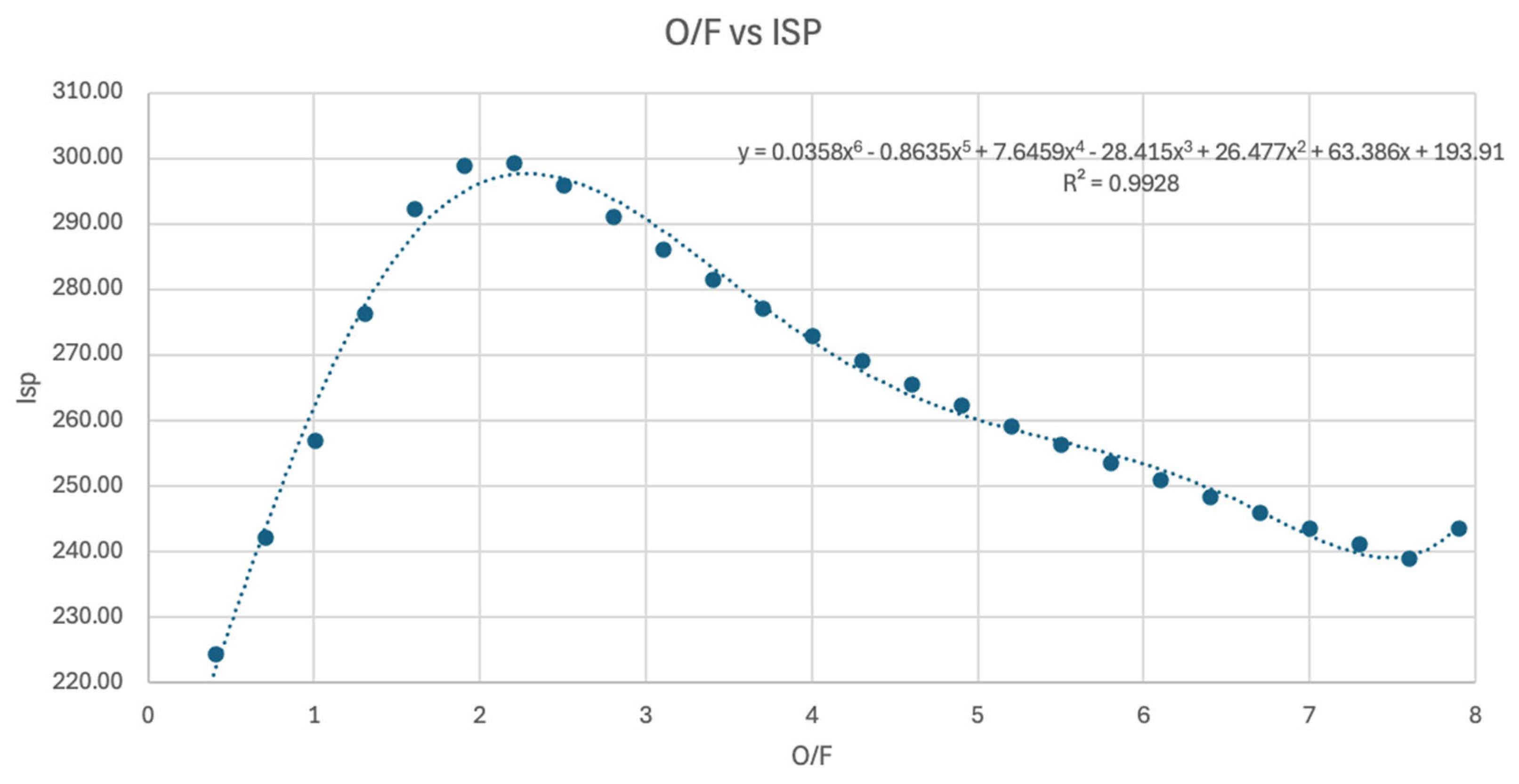
The variation in equilibrium-specific impulse with oxidizer-to-fuel ratio for the GOX/HDPE configuration is presented in
Figure 5. The results show that the specific impulse increases rapidly from approximately 240 s at O/F ≈ 0.7 to a maximum value of approximately 299 s near O/F ≈ 2.2. Beyond this point the specific impulse decreases gradually as the mixture becomes oxidizer rich.
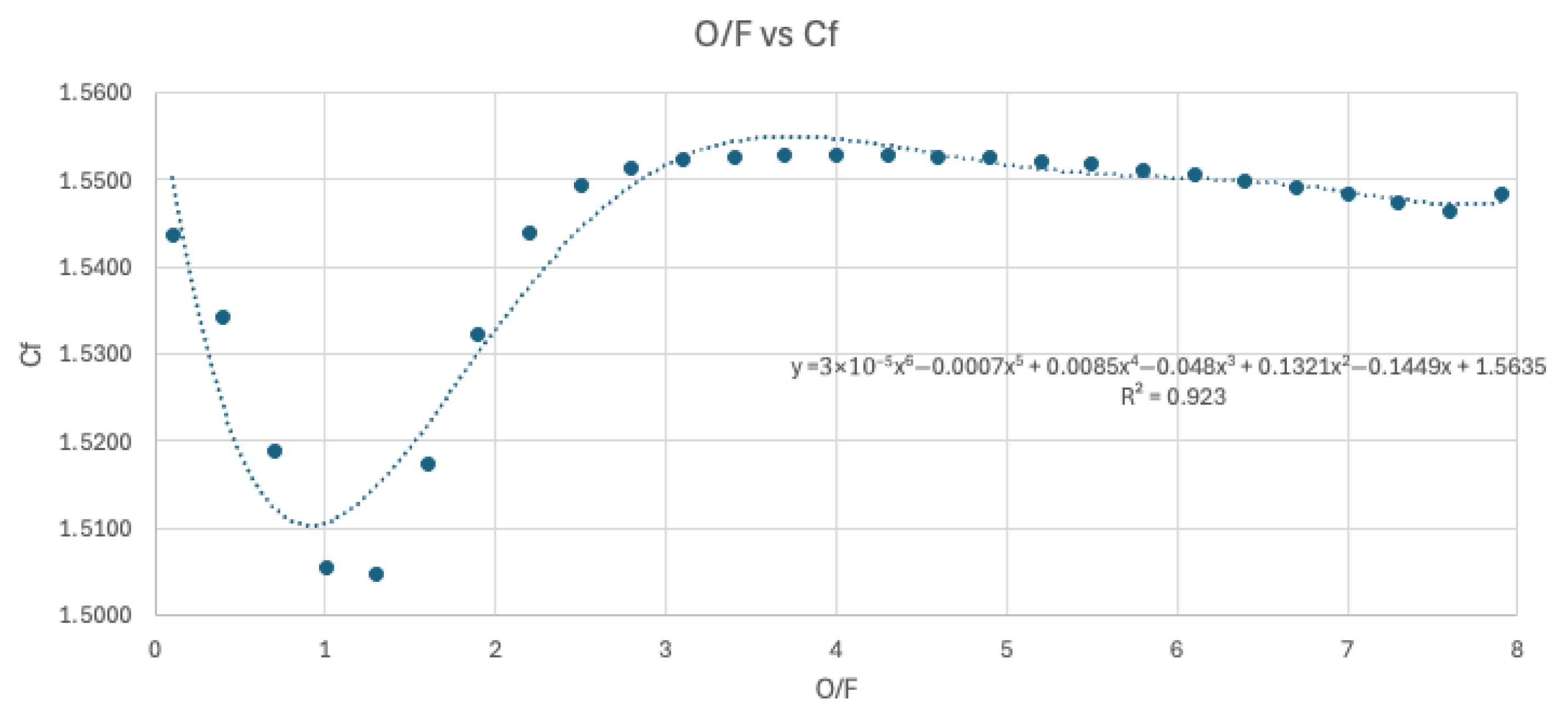
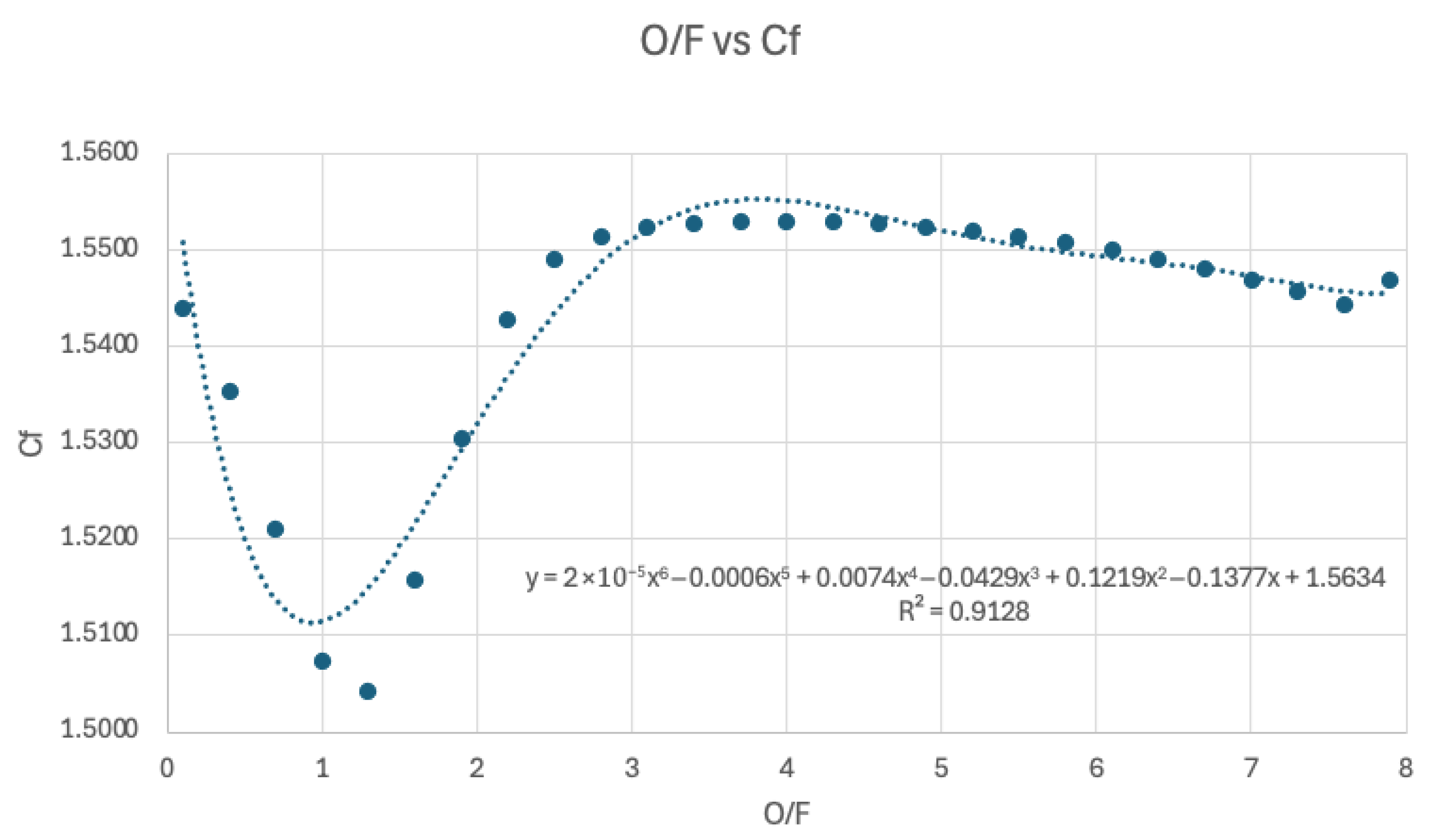
The variation in thrust coefficient for the GOX configuration is shown in
Figure 6, where values of approximately Cf ≈ 1.55 are reached for mixture ratios between O/F ≈ 2.5 and 4, indicating efficient conversion of chamber pressure into exhaust momentum.
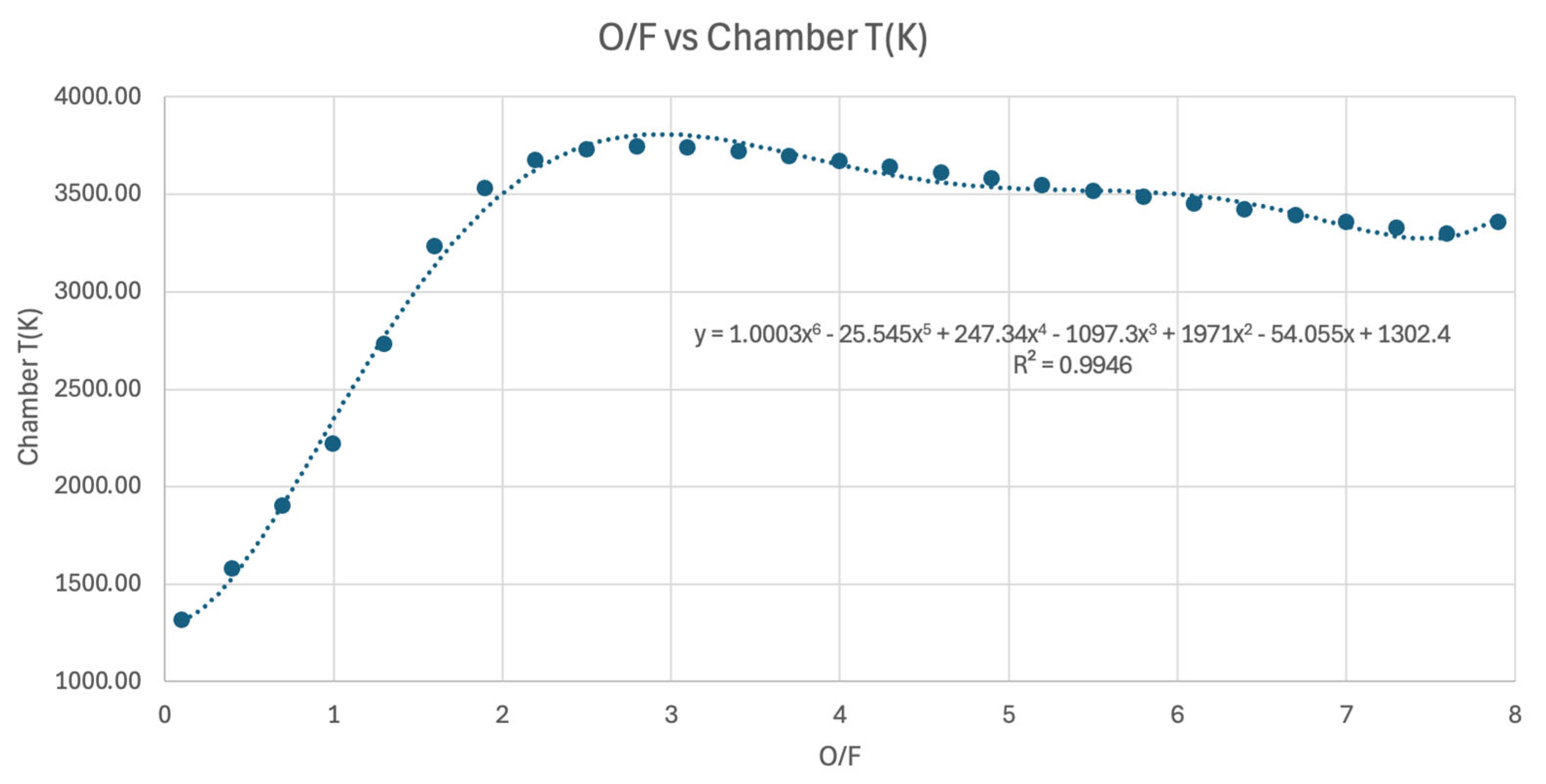
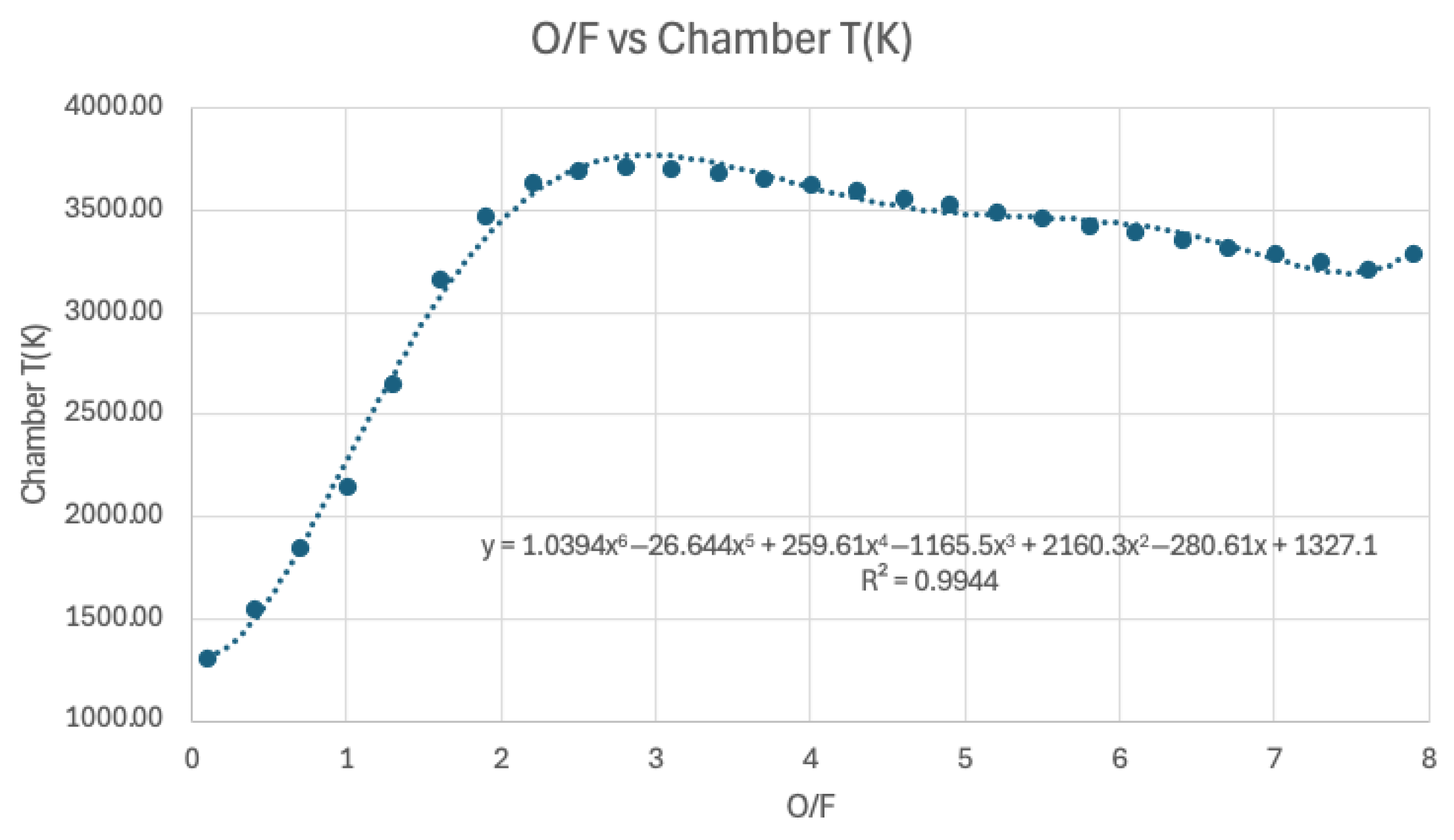
The combustion chamber temperature behaviour for the GOX/HDPE configuration is illustrated in
Figure 7. The chamber temperature increases rapidly from approximately 1900 K at O/F ≈ 0.7 to peak values between approximately 3700 K and 3800 K near O/F ≈ 2.5–3.0, corresponding to near-stoichiometric combustion conditions.
4.1.3. LOX/HDPE Configuration
A similar set of equilibrium simulations was conducted for the LOX/HDPE propellant combination. The input parameters used for the CEA calculations are summarized in
Table 2, which lists the oxidizer definition, mixture-ratio range, and thermodynamic variables computed during the analysis.
The equilibrium thermodynamic properties predicted for the LOX/HDPE configuration are summarized in
Table 5, which reports the thermodynamic state of the combustion products at representative oxidizer-to-fuel ratios.
The corresponding equilibrium rocket performance parameters derived from the CEA solution are summarized in
Table 5, providing the propulsion parameters associated with the mixture ratio that maximizes equilibrium-specific impulse for the LOX configuration.
The variation in equilibrium-specific impulse with oxidizer-to-fuel ratio for the LOX/HDPE configuration is shown in
Figure 8. The specific impulse increases from approximately 236 s at O/F ≈ 0.7 to a maximum value of approximately 296 s at O/F ≈ 2.2 before gradually decreasing as the mixture becomes oxidizer rich.
The variation in thrust coefficient with oxidizer-to-fuel ratio for the LOX configuration is presented in
Figure 9, where values of approximately Cf ≈ 1.55–1.56 are obtained for O/F ≥ 2.5.
The non-monotonic behaviour observed in
Figure 6 and
Figure 9 arises from the competing effects of combustion completeness, thermodynamic properties, and dissociation as the mixture transitions from fuel-rich to oxidizer-rich conditions. In oxygen-based systems (GOX and LOX), low O/F ratios produce incomplete combustion and heavier molecular products, resulting in reduced exhaust velocity and lower thrust coefficient. As the mixture approaches stoichiometric conditions, improved oxidation and higher chamber temperatures increase
. Beyond this point, dissociation effects and oxidizer dilution lead to a slight reduction in performance, producing the observed peak.
In contrast, the N
2O/HDPE system (
Figure 4) does not exhibit similar non-monotonic behaviour because nitrous oxide decomposition introduces significant nitrogen dilution, which smooths thermodynamic gradients and reduces sensitivity of
to mixture ratio. Additionally, the O/F range investigated for N
2O does not include strongly fuel-rich conditions, thereby excluding the region where the initial decrease in
would occur.
The corresponding variation in combustion chamber temperature is shown in
Figure 10, where peak temperatures of approximately 3700–3750 K occur near the stoichiometric mixture ratio.
4.1.4. Comparative Interpretation
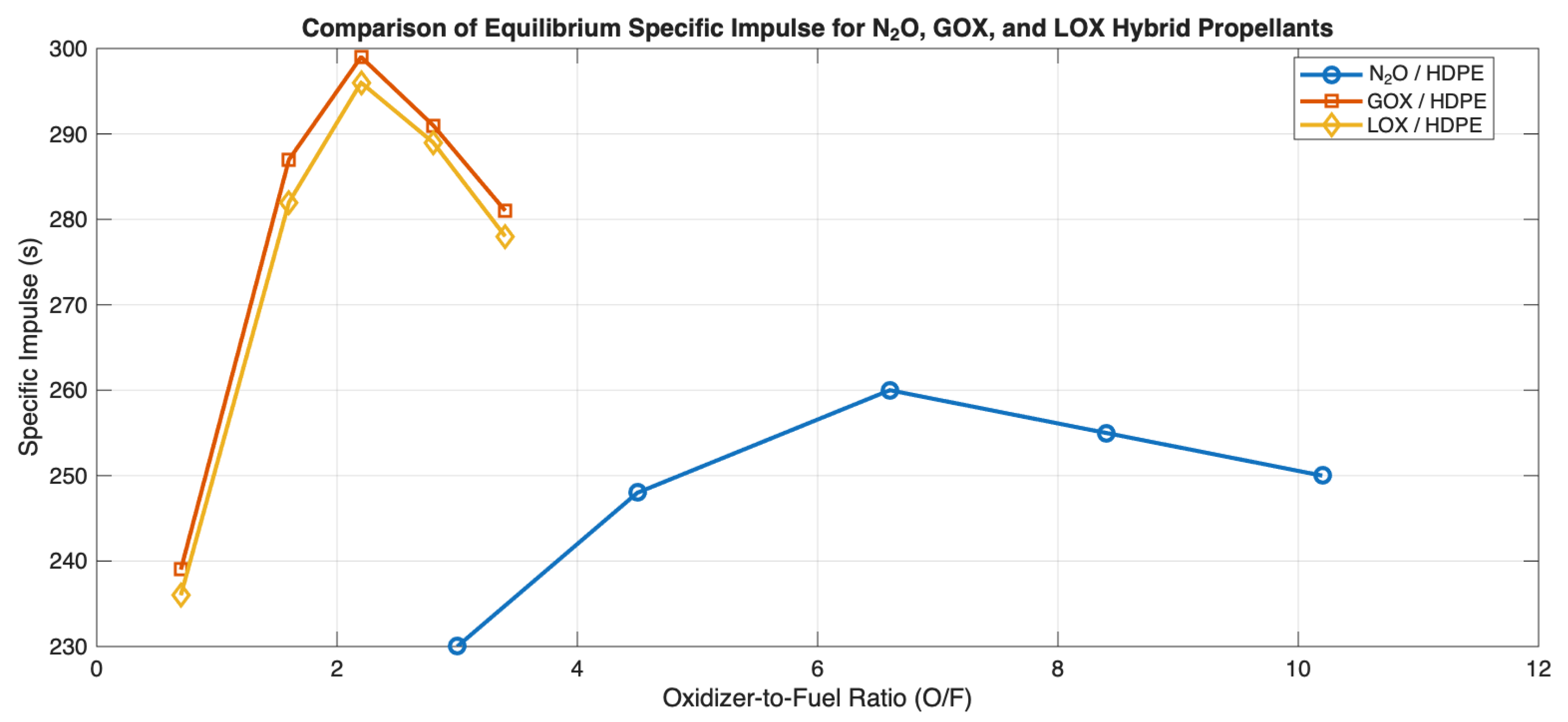
Overall, the equilibrium thermodynamic analysis demonstrates that oxygen (GOX and LOX) provides higher theoretical propulsion performance than nitrous oxide. Specifically, the maximum equilibrium-specific impulse predicted by CEA increases from approximately 260 s for N
2O/HDPE to approximately 299 s for GOX/HDPE and 296 s for LOX/HDPE, corresponding to an improvement of approximately 14–15% relative to the nitrous oxide system. However, these values represent idealized thermodynamic limits because the CEA model assumes chemical equilibrium and perfectly isentropic nozzle expansion. Consequently, these predictions do not account for geometric constraints or flow losses present in real propulsion systems. The equilibrium results presented in this section therefore serve as the thermodynamic baseline for the delivered performance analysis performed using Rocket Propulsion Analysis (RPA) in
Section 4.3.
4.2. Delivered Performance Estimation Using Finite-Geometry RPA Modelling
While the equilibrium thermodynamic analysis presented in
Section 4.1 provides an upper-bound estimate of propulsion performance, these predictions assume ideal chemical equilibrium and perfectly isentropic nozzle expansion. In practical propulsion systems, the presence of finite combustion chamber geometry, nozzle divergence losses, and viscous flow effects leads to reductions in delivered thrust and specific impulse relative to these ideal limits. To account for these effects, the equilibrium results obtained from the NASA CEA simulations were refined using the Rocket Propulsion Analysis (RPA) solver.
The RPA model incorporates finite combustion chamber geometry and the bell-shaped nozzle contour defined in
Section 3, allowing propulsion system performance to be evaluated under realistic operating conditions. The analysis was performed using the same boundary conditions adopted in the equilibrium calculations, namely a chamber pressure of 35 bar, a nozzle expansion ratio of
, and an ambient pressure of approximately 0.8 bar. Maintaining these operating constraints ensures consistency between the equilibrium thermodynamic predictions presented in
Table 2,
Table 3,
Table 4,
Table 5,
Table 6,
Table 7,
Table 8,
Table 9 and
Table 10 and the delivered performance estimates obtained from the RPA simulations.
The mixture ratios used in the RPA correspond to the optimal values identified in
Section 4.1 from the equilibrium CEA calculations. These operating points represent the mixture ratios that maximize theoretical specific impulse for each oxidizer system and therefore provide a suitable baseline for evaluating realistic propulsion performance once geometric losses are included.
4.2.1. GOX/HDPE Configuration: Mass-Flow Rate Validation and Delivered Performance
For the GOX configuration, the equilibrium analysis presented in
Section 4.1.2 indicates that the maximum specific impulse occurs near an oxidizer-to-fuel ratio of approximately
. When thrust coefficient behaviour and operational stability are considered simultaneously, operation at a slightly higher mixture ratio provides a favourable compromise between exhaust velocity and thrust generation efficiency. Consequently, an operating mixture ratio of
was selected for the RPA in order to obtain stable propulsion performance while maintaining high exhaust velocity.
Using this mixture ratio, the propellant mass-flow rates required to achieve the target thrust of 1 kN were determined and subsequently evaluated using the finite-geometry RPA model. The resulting propulsion performance parameters are summarized in
Table 6, which reports the predicted thrust, specific impulse, and propellant mass-flow rates for the optimized GOX/HDPE configuration.
The RPA predicts a total propellant mass flow rate of approximately 0.37 kg·s
−1, consisting of approximately 0.265 kg·s
−1 of oxidizer and 0.105 kg·s
−1 of fuel. Under optimal expansion conditions corresponding to the ambient pressure considered in this study, the configuration produces approximately 0.998 kN of thrust with a delivered specific impulse of approximately 275 s. The predicted vacuum specific impulse is approximately 305 s, reflecting the higher exhaust velocity achievable under vacuum conditions. These results demonstrate the influence of geometric losses and nozzle divergence effects, which reduce the delivered performance relative to the ideal equilibrium predictions presented in
Section 4.1.
4.2.2. LOX/HDPE Configuration: Mass-Flow Rate Validation and Delivered Performance
A similar performance refinement procedure was applied to the LOX/HDPE configuration. The RPA was performed using the same chamber pressure, nozzle expansion ratio, and thrust constraints used for the GOX case in order to maintain a consistent basis for comparison between oxidizers.
Using the mixture ratio identified in
Section 4.1.3 from the equilibrium thermodynamic analysis, the propellant mass-flow rates required to produce a thrust level of approximately 1 kN were calculated and subsequently evaluated using the RPA solver. The resulting propulsion performance parameters are summarized in
Table 7, which reports the delivered thrust, specific impulse, and propellant mass-flow rates for the LOX/HDPE propulsion system.
The RPA results predict a total propellant mass flow rate of approximately 0.374 kg·s−1, consisting of approximately 0.270 kg·s−1 of oxidizer and 0.105 kg·s−1 of fuel. Under optimal expansion conditions corresponding to the selected ambient pressure, the configuration produces approximately 0.998 kN of thrust with a delivered specific impulse of approximately 272 s, while the predicted vacuum specific impulse reaches approximately 302 s.
Although the LOX configuration produces slightly higher combustion temperatures than the GOX system under equilibrium conditions, the delivered specific impulse predicted by the finite-geometry RPA model remains comparable for the two oxygen (GOX and LOX). This behaviour indicates that once realistic nozzle losses and chamber geometry effects are considered, the difference in propulsion performance between gaseous and liquid oxygen systems becomes relatively small for the engine configuration examined in this study.
4.3. Comparative Performance Analysis of the Hybrid Propellant Systems
The equilibrium thermodynamic analysis presented in
Section 4.1 and the finite-geometry propulsion performance estimates obtained using Rocket Propulsion Analysis in
Section 4.2 allow a direct comparison of the hybrid propulsion systems considered in this study. By evaluating the thermodynamic behaviour of the N
2O/HDPE, GOX/HDPE, and LOX/HDPE propellant combinations under identical operating conditions, the influence of oxidizer selection on combustion temperature, exhaust velocity, and overall propulsion efficiency can be systematically assessed.
Figure 11 presents a direct comparison of the equilibrium-specific impulse predicted by NASA CEA as a function of oxidizer-to-fuel ratio for the three oxidizers. The results show that oxygen (GOX and LOX) provides significantly higher thermodynamic performance than nitrous oxide. The GOX/HDPE configuration reaches a peak equilibrium-specific impulse of approximately 299 s, while the LOX/HDPE configuration reaches approximately 296 s. In contrast, the N
2O/HDPE system achieves a maximum equilibrium-specific impulse of approximately 260 s near an oxidizer-to-fuel ratio of O/F ≈ 6.6. This difference corresponds to an improvement of approximately 14–15% for the oxygen (GOX and LOX) relative to the nitrous oxide configuration. The improved performance arises from the stronger oxidizing capability of molecular oxygen, which promotes more complete oxidation of the hydrocarbon fuel and produces combustion products with higher exhaust velocities.
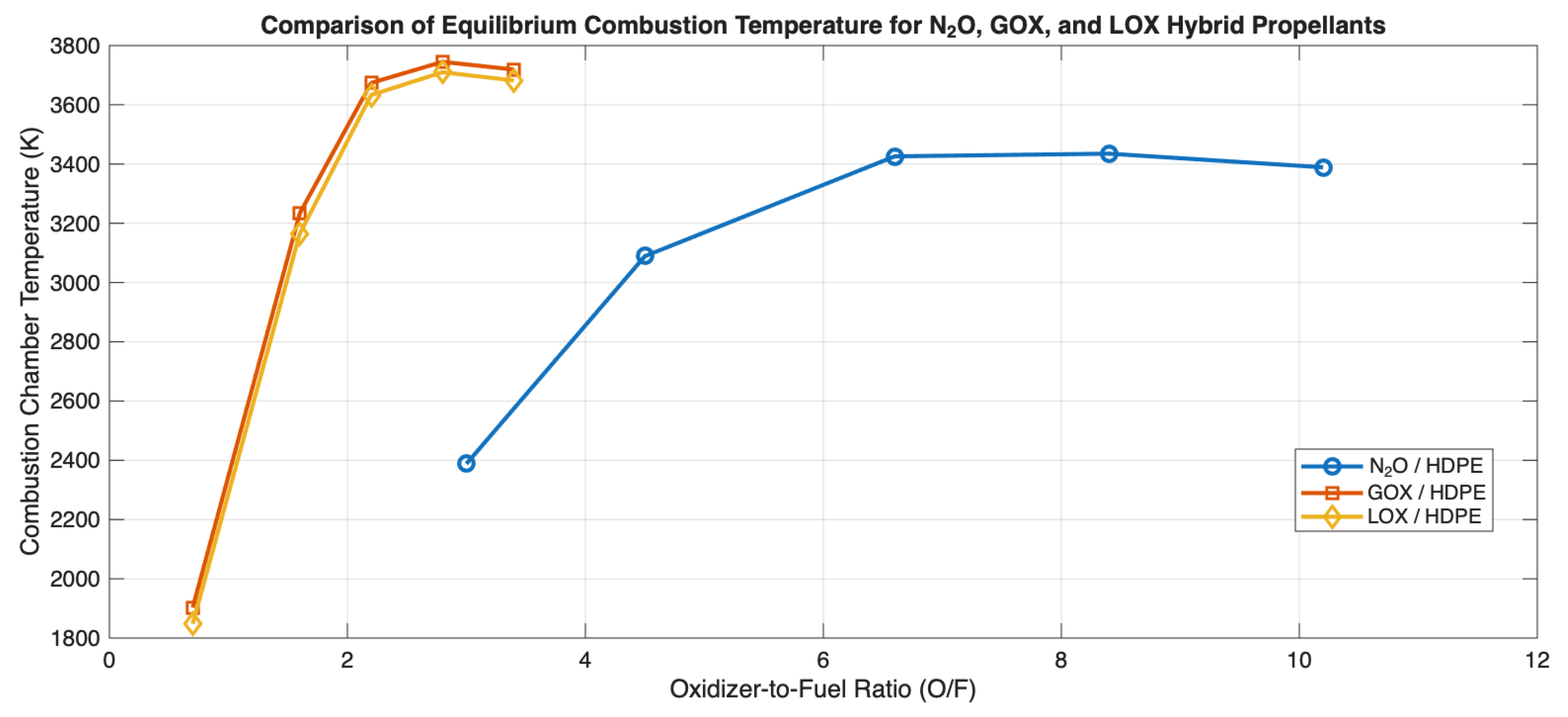
The combustion temperature trends for the three oxidizers are compared in
Figure 12. The N
2O/HDPE system produces peak chamber temperatures of approximately 3450 K, whereas the oxygen-based configurations reach temperatures between 3700 K and 3800 K near the stoichiometric mixture ratio. The higher combustion temperatures associated with the GOX and LOX systems increase the thermal energy released during combustion and contribute directly to the higher theoretical specific impulse observed in the equilibrium analysis.
Although combustion temperature and exhaust velocity vary significantly between oxidizers, the thrust coefficient remains relatively insensitive to oxidizer selection. As shown previously in
Section 4.1, all three propellant combinations converge toward values of Cf ≈ 1.55 under oxidizer-rich operating conditions. This behaviour reflects the fact that the thrust coefficient is primarily governed by nozzle expansion ratio and the thermodynamic properties of the exhaust gases rather than by combustion temperature alone.
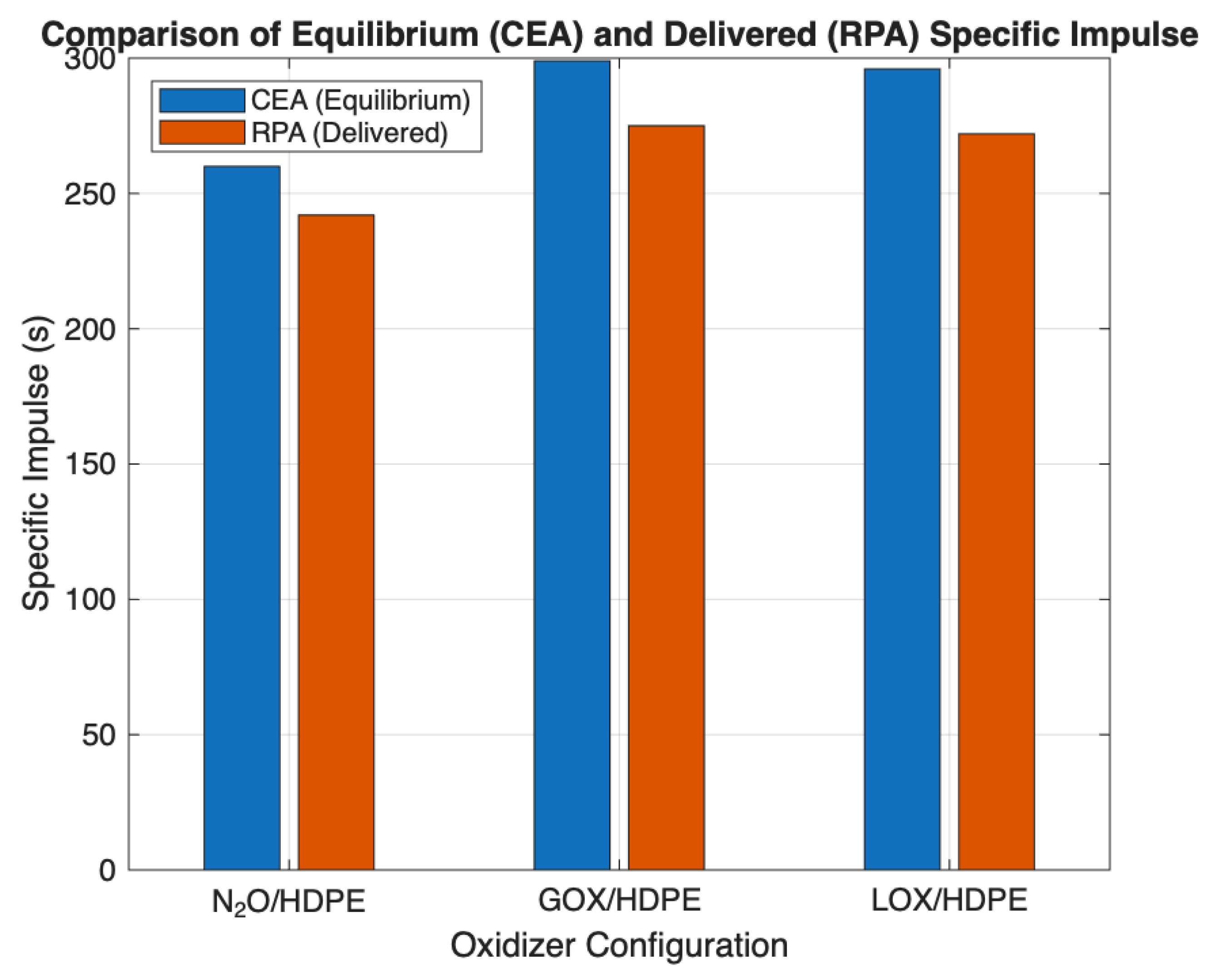
While equilibrium thermodynamic analysis provides an upper-bound estimate of propulsion performance, real engines experience losses associated with finite chamber geometry and non-ideal nozzle expansion. The comparison between theoretical and delivered propulsion performance is illustrated in
Figure 13, which contrasts the equilibrium-specific impulse predicted by NASA CEA with the delivered specific impulse obtained from the RPA simulations. The results show that finite-geometry and nozzle losses reduce the delivered specific impulse by approximately 5–8% for the oxidizers considered in this study.
The delivered propulsion performance predicted by the RPA simulations indicates that the difference between the GOX and LOX becomes significantly smaller once non-ideal flow effects are included. The GOX configuration produces a delivered specific impulse of approximately 275 s, while the LOX configuration produces approximately 272 s under optimal expansion conditions. Although both systems outperform the nitrous oxide configuration, the small difference between GOX and LOX suggests that their thermodynamic performance is nearly equivalent for the 1 kN-class hybrid rocket engine examined in this study.
From a propulsion system design perspective, these results indicate that oxygen (GOX and LOX) provides a clear thermodynamic advantage over nitrous oxide for hybrid rocket engines operating in the kilonewton thrust range. However, the relatively small difference in delivered performance between the GOX and LOX configurations implies that system-level considerations such as oxidizer storage, feed-system complexity, infrastructure requirements, and operational safety may ultimately have a greater influence on oxidizer selection than thermodynamic performance alone.
4.4. Figure of Merit Analysis for Oxidizer Selection
While the equilibrium and delivered performance analyses presented in
Section 4.1,
Section 4.2 and
Section 4.3 provide insight into the thermodynamic and propulsion characteristics of the three oxidizer systems, propulsion system design often requires a more integrated performance metric that accounts for both theoretical efficiency and practical engine behaviour. For this reason, Figure of Merit (FoM) was introduced in this study to provide a quantitative basis for comparing the overall propulsion effectiveness of the N
2O/HDPE, GOX/HDPE, and LOX/HDPE hybrid propellant combinations.
The FoM is defined as a normalized performance parameter that combines the delivered specific impulse obtained from the RPA simulations with the corresponding propellant mass-flow requirements required to achieve the target thrust level. This formulation allows the propulsion performance of each oxidizer configuration to be evaluated in terms of the efficiency with which propellant mass is converted into thrust under realistic operating conditions.
Using the delivered performance values summarized in
Table 1 and
Table 9, the LOX and GOX demonstrate superior propulsion efficiency compared with the N
2O configuration predicted by the equilibrium analysis in
Section 4.1. The GOX/HDPE configuration achieves a delivered specific impulse of approximately 275 s, while the LOX/HDPE configuration produces approximately 272 s under optimal expansion conditions. These values represent a significant improvement relative to the equilibrium performance limit of the N
2O/HDPE system illustrated in
Figure 2, which reaches a maximum specific impulse of approximately 260 s.
In addition to higher exhaust velocity, the GOX and LOX also produce significantly higher combustion temperatures, as shown in
Figure 7 and
Figure 10, where peak chamber temperatures exceed 3700 K. In contrast, the N
2O configuration shown in
Figure 3 reaches peak temperatures of approximately 3450 K. The higher thermal energy release associated with oxygen combustion therefore contributes directly to the improved propulsion efficiency reflected in the FoM metric.
Despite these thermodynamic advantages, the comparison between the two GOX and LOX indicates that the difference in delivered propulsion performance between GOX and LOX is relatively small when realistic nozzle losses and chamber geometry effects are considered. As demonstrated by the RPA results presented in
Table 11, the difference in delivered specific impulse between the two systems is only a few seconds. This suggests that system-level considerations such as oxidizer storage requirements, feed system complexity, and operational safety may ultimately have a greater impact on oxidizer selection than thermodynamic performance alone.
Thus, the Figure of Merit analysis confirms that GOX and LOX provide the highest propulsion efficiency for the hybrid rocket configuration considered in this study, while also demonstrating that the performance difference between gaseous and liquid oxygen systems remains relatively modest when finite-geometry effects are included. These results highlight the importance of evaluating propulsion performance using integrated system-level metrics rather than relying solely on ideal equilibrium predictions.
4.5. Implications for Hybrid Rocket Engine Design
The results presented in
Section 4.1,
Section 4.2,
Section 4.3 and
Section 4.4 provide several insights relevant to the design and optimization of hybrid rocket propulsion systems operating in the 1 kN thrust class. By combining equilibrium thermodynamic analysis with finite-geometry performance modelling, the study highlights how oxidizer selection influences both the theoretical and delivered performance of hybrid propulsion systems.
The equilibrium thermodynamic analysis summarized in
Table 3,
Table 4,
Table 5,
Table 6,
Table 7,
Table 8,
Table 9 and
Table 10 and illustrated in
Figure 2,
Figure 3,
Figure 4,
Figure 5,
Figure 6,
Figure 7,
Figure 8,
Figure 9 and
Figure 10 shows that GOX and LOX produce higher combustion temperatures and higher theoretical specific impulse than nitrous oxide. Peak chamber temperatures for the oxygen systems exceed 3700 K, as shown in
Figure 7 and
Figure 10, while the N
2O configuration reaches approximately 3450 K as illustrated in
Figure 3. These higher combustion temperatures contribute directly to the increased exhaust velocity and improved propulsion efficiency observed for the oxygen-based configurations.
However, the delivered propulsion performance obtained from the RPA simulations in
Table 11 indicates that the performance difference between gaseous and liquid oxygen becomes relatively small once realistic chamber geometry and nozzle losses are considered. The predicted delivered specific impulse differs by only a few seconds between the GOX and LOX configurations, suggesting that the thermodynamic advantage of cryogenic oxygen is partially offset by practical system constraints in small-scale propulsion systems.
From a system engineering perspective, this observation implies that oxidizer selection for hybrid rockets should not be based solely on theoretical propulsion performance. While LOX offers slightly higher equilibrium combustion temperatures and theoretical specific impulse, it requires cryogenic storage systems, thermal insulation, and more complex ground support infrastructure. In contrast, gaseous oxygen systems can often be implemented with simpler feed systems and reduced operational complexity, particularly in experimental or small-scale propulsion platforms.
Nitrous oxide, although thermodynamically less efficient, retains several advantages in terms of operational safety and system simplicity due to its self-pressurizing behaviour and ease of storage. For educational and experimental hybrid rocket programs, these operational benefits may outweigh the performance advantages offered by GOX and LOX
The combined equilibrium, delivered performance, and Figure of Merit analyses presented in this study indicate that GOX and LOX provide the highest propulsion efficiency for the hybrid rocket engine configuration considered, while also demonstrating that the difference between gaseous and liquid oxygen systems is relatively modest when realistic flow losses are considered. These findings highlight the importance of evaluating oxidizer selection within the broader context of propulsion system architecture, operational complexity, and mission requirements.
5. Discussion
This section interprets the CEA–RPA results from a system-level perspective relevant to small-scale hybrid rocket engines. Beyond equilibrium performance metrics, the analysis considers the effects of finite-geometry losses, scale-dependent efficiency penalties, safety requirements, and infrastructure constraints associated with N2O, GOX, and LOX. The discussion evaluates the trade-off between theoretical and delivered performance, assesses the suitability of each oxidizer for academic propulsion programs, and compares the predicted results with representative experimental engines reported in the literature. Together, these aspects provide a practical interpretation of the oxidizer selection trade space for 1 kN-class hybrid propulsion systems.
5.1. Thermochemical Behaviour of Hybrid Oxidizers
The equilibrium thermodynamic results obtained using NASA CEA reveal systematic differences in combustion behaviour between the oxidizers considered in this study. These differences arise primarily from variations in oxidizing strength, combustion temperature, and the composition of the combustion products, as reflected in
Table 3,
Table 5 and
Table 7 and in the trends shown in
Figure 2,
Figure 3,
Figure 5,
Figure 7,
Figure 8 and
Figure 10.
For the N
2O/HDPE configuration, the variation in specific impulse with mixture ratio (
Figure 2) and the corresponding thermodynamic states (
Table 3) indicate a gradual transition from fuel-rich to near-stoichiometric conditions. This behaviour is associated with a progressive increase in combustion temperature (
Figure 3) and exhaust velocity, followed by a decline in oxidizer-rich regimes due to product dilution. The relatively smooth variation observed in
Figure 4 further reflects the moderating effect of nitrogen generated during N
2O decomposition, which reduces sensitivity to mixture ratio.
A similar qualitative trend is observed for the molecular oxygen configurations (GOX and LOX), as shown in
Figure 5 and
Figure 8 and summarized in
Table 5 and
Table 7. However, in contrast to the N
2O system, the oxygen-based configurations exhibit sharper thermodynamic gradients near the optimal mixture ratio. The rapid increase in combustion temperature observed in
Figure 7 and
Figure 10 indicates a stronger response to mixture ratio variations, resulting from the higher reactivity of O
2 and its more efficient participation in hydrocarbon oxidation.
A key distinction between the oxidizers lies in the behaviour near stoichiometric conditions. For GOX and LOX, the elevated combustion temperatures are accompanied by increased dissociation effects, which influence the shape of the performance curves and contribute to the non-monotonic trends observed in the thrust coefficient (
Figure 6 and
Figure 9). In contrast, the N
2O system (
Figure 4) exhibits a more gradual variation due to nitrogen dilution, which moderates both peak temperature and dissociation intensity [
23].
Despite these differences, all propellant combinations exhibit the same fundamental thermodynamic behaviour: performance increases as the mixture approaches near-stoichiometric conditions and decreases in oxidizer-rich regimes due to the presence of excess oxidizer. This consistent trend is observed across
Figure 2,
Figure 5 and
Figure 8.
From a comparative perspective, the results indicate that molecular oxygen systems (GOX and LOX) achieve higher combustion temperatures and exhaust velocities than N
2O, as evidenced by the thermodynamic states reported in
Table 5 and
Table 7 relative to
Table 3. However, the close agreement between the GOX and LOX results in both tables and figures indicates that their differences are not driven by equilibrium chemistry, but rather by system-level factors associated with oxidizer storage and delivery, which are discussed in the following sections.
To facilitate a direct comparison, the principal equilibrium thermodynamic characteristics for all oxidizers are summarized in
Table 8.
5.2. Thermodynamic vs. Delivered Performance
Equilibrium thermodynamic analysis provides an upper-bound estimate of propulsion performance; however, the delivered performance of a real engine is influenced by geometric constraints and non-ideal flow effects. To assess these effects, the equilibrium predictions obtained using NASA Chemical Equilibrium with Applications (CEA) were compared with the finite-geometry propulsion performance predicted by Rocket Propulsion Analysis (RPA).
The comparison summarized in
Table 9 shows a consistent reduction in delivered specific impulse relative to the equilibrium predictions for all oxidizer configurations. This reduction reflects the impact of finite combustion chamber length and non-isentropic nozzle expansion, which are not captured in the idealized CEA formulation.
The discrepancy between equilibrium and delivered performance arises primarily from several coupled loss mechanisms. In practical engines, finite chamber geometry limits residence time and introduces acceleration losses upstream of the throat. Within the nozzle, divergence effects and boundary-layer growth reduce the effective conversion of thermal energy into directed momentum. Additionally, deviations from ideal expansion conditions and viscous effects further contribute to performance degradation [
24]. These mechanisms collectively account for the systematic reduction observed in
Table 9.
An important observation is that the performance reduction remains relatively consistent across all oxidizers. This indicates that, at the 1 kN scale considered in this study, geometric and viscous losses are primarily governed by engine configuration rather than oxidizer thermochemistry. As a result, differences in equilibrium performance between oxidizers are partially compressed when realistic flow effects are included.
Despite these losses, the total propellant mass flow rates required to achieve the target thrust remain close to those predicted by equilibrium analysis (
Table 9). This suggests that CEA-based thermodynamic modelling remains a reliable first-order design tool for estimating propulsion requirements, while intermediate-fidelity tools such as RPA are necessary to capture the performance penalties associated with finite geometry and non-ideal expansion.
5.3. GOX vs. LOX System-Level Behaviour
Under equilibrium thermodynamic conditions, NASA CEA does not predict a fundamental difference between gaseous oxygen (GOX) and liquid oxygen (LOX), since both oxidizers consist of molecular oxygen (O
2). As a result, the predicted combustion temperature, product composition, and theoretical performance are nearly identical for the GOX/HDPE and LOX/HDPE propellant combinations, as evidenced by the close agreement in
Table 5 and
Table 7 and the overlapping trends in
Figure 5 and
Figure 8.
In practical propulsion systems, however, differences between GOX and LOX arise primarily from system-level considerations rather than combustion chemistry. While LOX offers marginally higher thermodynamic performance, its cryogenic nature introduces additional operational complexity, including insulation requirements, boil-off management, and specialized ground support infrastructure. In contrast, GOX can be stored at ambient temperature, simplifying handling and system integration, but requiring higher storage pressures due to its significantly lower density [
25,
26,
27].
The delivered performance predicted using RPA (
Table 9) indicates that both oxygen configurations achieve comparable specific impulse at the 1 kN thrust scale. This suggests that the small thermodynamic differences between GOX and LOX are largely offset by geometric and viscous losses in compact propulsion systems, resulting in similar effective performance under realistic operating conditions.
From a design perspective, this implies that oxidizer selection for small hybrid rocket engines should be driven primarily by system-level trade-offs rather than equilibrium performance. Factors such as storage requirements, feed-system complexity, safety considerations, and infrastructure availability become dominant, particularly at low thrust scales where performance differences are modest.
A comparative summary of these system-level characteristics for gaseous and liquid oxygen is presented in
Table 10.
5.4. Performance vs. Operability Trade-Offs
The comparative CEA–RPA indicates that, under identical operating conditions, equilibrium thermodynamic predictions define a clear performance hierarchy among the oxidizers, with molecular oxygen systems exceeding nitrous oxide. However, as shown in
Table 9 and illustrated in
Figure 13, the inclusion of finite chamber geometry and non-ideal nozzle expansion leads to a systematic reduction in delivered performance across all configurations.
This reduction is associated with coupled loss mechanisms, including finite residence time in the combustion chamber, boundary-layer growth along the nozzle walls, and divergence losses during expansion. These effects become increasingly significant in compact, laboratory-scale engines, where geometric constraints limit the efficiency of energy conversion from thermal to kinetic form.
Figure 13 highlights the distinction between the thermodynamic performance limit and the practically achievable performance. The separation between the equilibrium and delivered curves represents the cumulative impact of non-ideal effects. Notably, while molecular oxygen configurations retain a theoretical advantage, the relative differences between LOX, GOX, and N
2O are reduced once realistic flow losses are considered.
A comparison with the LOX/HTPB hybrid engine reported by Bambauer and Brandl [
21] further illustrates the influence of scale. Their results demonstrate that larger hybrid engines can approach equilibrium performance more closely due to longer residence times, reduced relative viscous losses, and improved nozzle efficiency. In contrast, small-scale systems exhibit greater sensitivity to geometric limitations, resulting in more pronounced performance degradation.
From a system-level perspective, these results define a clear design trade-off. While LOX establishes the highest theoretical performance ceiling, its practical advantage over GOX and N2O becomes increasingly limited at small scales, where non-ideal effects dominate. Consequently, oxidizer selection for hybrid rocket engines cannot be based solely on equilibrium thermodynamic performance, but must also account for geometric efficiency and operational constraints.
The results suggest a scale-dependent interpretation of oxidizer selection. In larger systems, LOX-based configurations are better positioned to exploit their thermodynamic potential. In contrast, at the kilonewton scale, geometric and viscous losses compress performance differences, making GOX and N2O competitive alternatives when evaluated in terms of overall system simplicity and operability.
5.5. Safety and Infrastructure Implications
Beyond thermodynamic performance, the practical feasibility of oxidizers in small hybrid rocket engines is strongly influenced by safety requirements and ground infrastructure. For engines in the 1 kN class, laboratory constraints, personnel training, and facility capabilities often dominate system-level design decisions. Consequently, oxidizer selection cannot rely solely on specific impulse, but must also account for operational risk and infrastructure complexity.
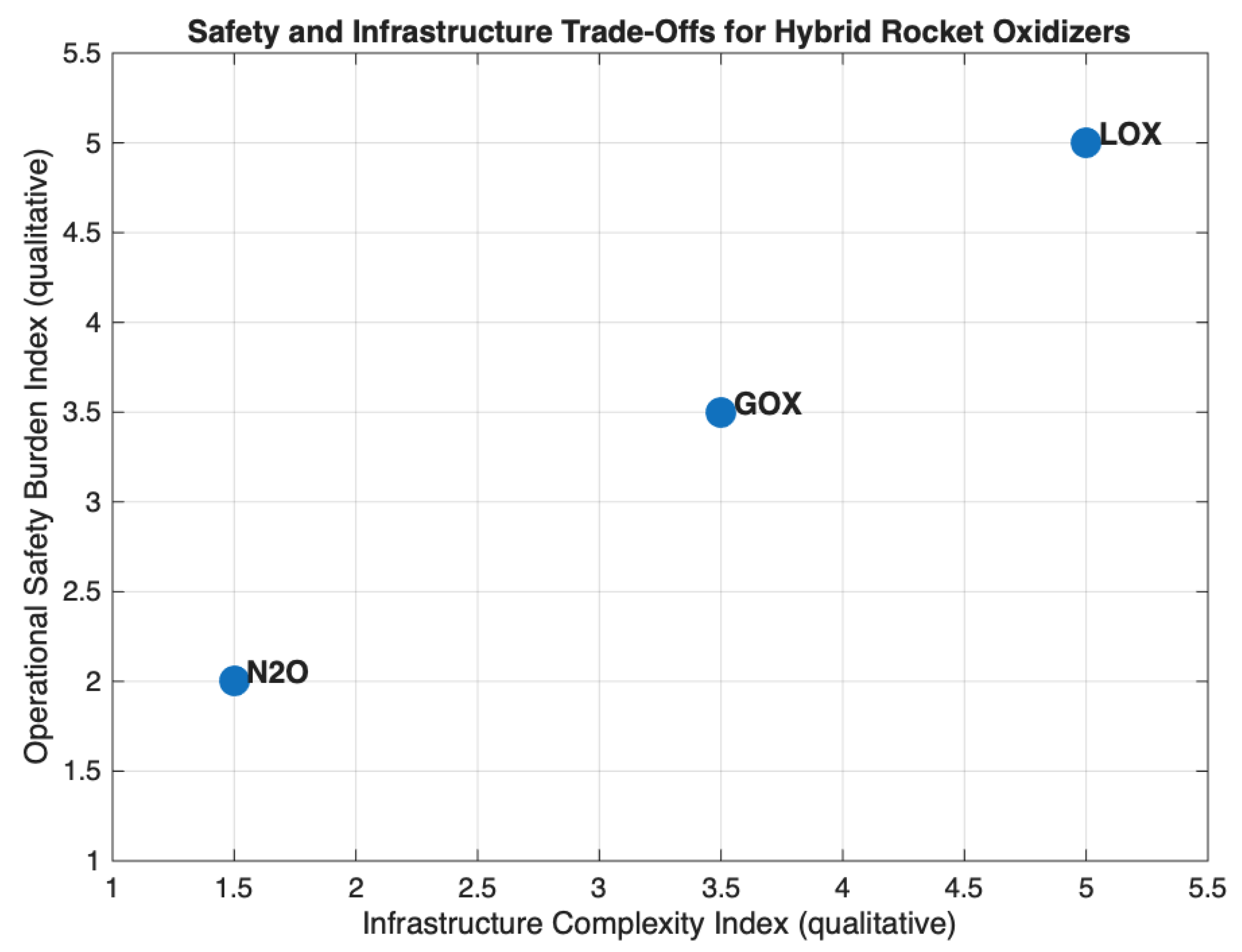
To illustrate this trade space,
Figure 14 presents a qualitative comparison of N
2O, GOX, and LOX in terms of infrastructure complexity and operational safety burden. Although the axes represent qualitative indices, the diagram synthesizes the principal engineering considerations discussed in this work and in the literature.
As shown in
Figure 14, LOX occupies the upper-right region, indicating both high infrastructure complexity and elevated safety requirements. Its cryogenic nature necessitates insulated storage, controlled transfer systems, boil-off management, oxygen-clean materials, and strict operational procedures. These requirements increase both cost and operational overhead, restricting LOX use to facilities where performance gains justify the associated complexity [
27,
30].
GOX occupies an intermediate position, reflecting moderate-to-high infrastructure and safety demands. While it eliminates cryogenic handling, GOX systems still require high-pressure storage, pressure regulation, oxygen-compatible materials, and leak detection systems. As discussed in [
27,
30], oxygen in gaseous form continues to impose stringent material compatibility and operational constraints.
In contrast, N
2O is located in the lower-left region, corresponding to reduced infrastructure complexity and a lower operational burden. Its self-pressurizing behaviour enables storage as a liquid at ambient temperature and simplifies the feed system by eliminating external pressurization hardware. This characteristic has made N
2O a common choice in academic hybrid rocket programs despite its lower theoretical performance [
30]. However, N
2O is not without risk; its potential for exothermic decomposition requires careful control of injector pressure drop, appropriate pressure margins, and the use of flow-isolation devices such as check valves [
30].
Overall, these trends define a clear system-level trade-off. LOX maximizes thermodynamic performance but also imposes the highest infrastructure and safety burden. GOX provides partial simplification while retaining high-pressure constraints, whereas N2O offers the lowest operational complexity at the expense of reduced performance. For 1 kN-class engines in academic environments, these considerations become primary design drivers, often outweighing differences in theoretical propulsion performance.
5.6. Suitability for Academic and Low-Budget Programs
Hybrid rocket propulsion is well suited for academic and low-budget programs because it combines mechanical simplicity with strong educational value, allowing for hands-on experience in propulsion design, manufacturing, and testing. However, for the 1 kN class considered in this study, oxidizer selection must balance performance with cost, safety, and facility constraints rather than relying solely on thermodynamic efficiency.
N
2O represents the most practical option for university environments. Its self-pressurizing behaviour simplifies the feed system and eliminates the need for cryogenic infrastructure, enabling repeated testing within typical university safety frameworks, as demonstrated by programs such as HYDRA [
27]. The present CEA–RPA results indicate that the delivered performance penalty relative to GOX and LOX remains moderate at this scale [
30].
GOX provides higher performance, but requires high-pressure storage and oxygen-compatible hardware, increasing system complexity. Liquid oxygen (LOX) offers the highest theoretical performance but introduces significant cryogenic handling requirements, which are often impractical for most university laboratories.
High-concentration hydrogen peroxide (HTP, ≈98%) represents an intermediate alternative. Successful demonstrations such as ILR-33 AMBER show that HTP systems can achieve high performance without cryogenic storage, although they require strict material compatibility and catalyst-based decomposition systems [
28,
30].
Thus, a staged development strategy is often most effective for academic programs: N2O for early experimentation, GOX or HTP for intermediate capability, and LOX only when cryogenic infrastructure is available.
5.7. Comparison with Reported Experimental Engines
The performance trends obtained in this study are consistent with experimental hybrid rocket engines reported in the literature. The equilibrium hierarchy observed here—where LOX-based systems provide the highest theoretical performance followed by H
2O
2 and N
2O—agrees with the parametric analysis of Conti Tarifa and Pizzuti [
29].
Experimental tests by Wei et al. [
28] using N
2O and Nytrox (N
2O/O
2 mixtures) reported sea-level specific impulse values of approximately 220–230 s, which fall within the expected range for N
2O-based hybrids once finite chamber length and nozzle losses are considered. Similarly, Okninski et al. [
2] demonstrated hybrid rocket engines using ~98% hydrogen peroxide (HTP) in the ILR-33 AMBER program, achieving combustion efficiencies close to 98% with successful ground and flight operation.
A comparison between representative experimental hybrid engines and the performance levels predicted in the present study is summarized in
Table 11. The reported experimental values confirm that while LOX-based systems retain the highest thermodynamic potential, oxidizers such as N
2O, Nytrox, and HTP provide a more practical compromise between achievable performance and system complexity for small hybrid rocket engines.
6. Conclusions
This study presented a systematic comparative assessment of N2O, GOX, and LOX as oxidizers for a 1 kN-class hybrid rocket engine using a combined NASA CEA equilibrium analysis and Rocket Propulsion Analysis (RPA) performance refinement framework. The objective was to evaluate oxidizer selection under consistent design constraints representative of academic-scale propulsion systems. The analysis demonstrates that oxidizer selection cannot be determined solely from equilibrium thermodynamic metrics, but instead requires consideration of scale effects, non-ideal flow losses, and system-level operational constraints.
The equilibrium thermodynamic analysis revealed clear differences in oxidizer behaviour. GOX and LOX exhibit significantly higher combustion temperatures and theoretical exhaust velocities than nitrous oxide due to their stronger oxidizing potential. The optimal mixture ratios predicted by CEA were approximately O/F ≈ 6.6 for N2O/HDPE and O/F ≈ 2.2 for both GOX/HDPE and LOX/HDPE, reflecting the more efficient oxidation of hydrocarbons by molecular oxygen. Under ideal equilibrium assumptions, the predicted maximum specific impulse reached approximately 260 s for N2O, 299 s for GOX, and 296 s for LOX, confirming the thermodynamic superiority of GOX and LOX.
However, when the equilibrium predictions were refined using the finite-geometry RPA model, the delivered propulsion performance decreased systematically for all oxidizers. The results indicate a 5–8% reduction in specific impulse relative to the CEA equilibrium predictions, primarily caused by chamber acceleration losses, nozzle divergence effects, and viscous boundary-layer growth within the nozzle expansion process. This result highlights the importance of accounting for geometric and flow-loss mechanisms when translating ideal thermodynamic predictions into realistic propulsion performance.
The RPA further demonstrated that the practical performance gap between oxidizers becomes significantly compressed at the 1 kN scale. While LOX retains the highest thermodynamic potential, its delivered specific impulse of approximately 272 s provides only a moderate improvement over GOX (~275 s) and N2O (~240–245 s) once finite-geometry effects are considered. Because all configurations experience comparable efficiency penalties, the relative advantage of LOX predicted by equilibrium analysis is reduced in small-scale propulsion systems.
Beyond propulsion efficiency, the study confirms that oxidizer selection represents a multidimensional system-level trade-off involving thermodynamic performance, thermal loading, operational safety, and infrastructure complexity. LOX-based systems impose the highest operational burden due to cryogenic storage requirements and oxygen-clean handling procedures. GOX eliminates cryogenic complexity but introduces high-pressure storage and oxygen-compatibility constraints. In contrast, N2O provides a simplified feed-system architecture through its self-pressurizing behaviour, reducing infrastructure requirements while maintaining acceptable propulsion performance.
From an engineering perspective, the results suggest that oxidizer selection should be scale dependent. At larger thrust levels, where longer chambers and higher-efficiency nozzles reduce geometric losses, LOX-based hybrids can exploit their thermodynamic advantage more effectively. In contrast, at the kilonewton scale typical of academic propulsion programs, geometric and efficiency penalties reduce the relative performance advantage of oxygen (GOX and LOX), making operational simplicity an increasingly dominant design factor.
The combined CEA–RPA methodology developed in this study provides a practical framework for evaluating oxidizer selection during early-stage hybrid rocket engine design. By integrating thermodynamic analysis with intermediate-fidelity propulsion modelling, the approach bridges the gap between ideal performance prediction and realistic engine behaviour. The results demonstrate that N2O offers a balanced compromise between achievable propulsion performance, manageable thermal loads, and minimal infrastructure requirements, making it particularly suitable for experimental hybrid rocket engines developed in university or low-budget research environments.
The present study focuses on early-stage oxidizer selection using thermodynamic and intermediate-fidelity modelling. Experimental validation and hardware testing are part of ongoing work and will be reported in future studies.
Future work should extend the present analysis through experimental validation of the predicted performance trends, including hot-fire testing of hybrid engines using the oxidizer configurations investigated in this study. Additional research should also examine the influence of fuel regression behaviour, injector mixing efficiency, and transient combustion dynamics, which may further affect the achievable performance of hybrid propulsion systems at small scales.
Author Contributions
Conceptualization, S.V. and Z.R.; methodology, S.V.; software, S.V.; validation, S.V., J.E.O. and Z.R.; formal analysis, S.V.; investigation, S.V.; resources, J.E.O.; data curation, S.V.; writing—original draft preparation, S.V.; writing—review and editing, S.V., J.E.O. and Z.R.; visualization, S.V.; supervision, J.E.O. and Z.R.; project administration, J.E.O. All authors have read and agreed to the published version of the manuscript.
Funding
The authors gratefully acknowledge that the Fundación Universitaria Los Libertadores provided financial support by covering the article’s publication processing fee.
Data Availability Statement
The data supporting the findings of this study are fully available within the article.
Acknowledgments
During the preparation of this manuscript, the authors used Grammarly v 14.1274.0 language refinement, and editorial assistance. The authors have reviewed, validated, and edited all generated content and take full responsibility for the final version of this publication.
Conflicts of Interest
The authors declare no conflicts of interest.
Abbreviations
The following abbreviations are used in this manuscript:
| CEA | Chemical Equilibrium with Applications |
| GOX | Gaseous Oxygen |
| HDPE | High-Density Polyethylene |
| RPA | Rocket Propulsion Analysis |
References
- Sutton, G.P.; Biblarz, O. Rocket Propulsion Elements, 9th ed.; John Wiley & Sons: Hoboken, NJ, USA, 2017. [Google Scholar]
- Okninski, A.; Surmacz, P.; Bartkowiak, B.; Mayer, T.; Sobczak, K.; Pakosz, M.; Kaniewski, D.; Matyszewski, J.; Rarata, G.; Wolanski, P. Development of Green Storable Hybrid Rocket Propulsion Technology Using 98% Hydrogen Peroxide as Oxidizer. Aerospace 2021, 8, 234. [Google Scholar] [CrossRef] [Scilit]
- Wei, S.-S.; Li, M.-C.; Lai, A.; Chou, T.-H.; Wu, J.-S. A Review of Recent Developments in Hybrid Rocket Propulsion and Its Applications. Aerospace 2024, 11, 739. [Google Scholar] [CrossRef] [Scilit]
- Sonka, I. Conceptual Design of a Hybrid Rocket Engine for a Rocket to Explore the Mesosphere. Master’s Thesis, Czech Technical University in Prague, Prague, Czech Republic, 2021. [Google Scholar]
- Heeg, F.; Kilzer, L.; Seitz, R.; Stoll, E. Design and Test of a Student Hybrid Rocket Engine with an External Carbon Fiber Composite Structure. Aerospace 2020, 7, 57. [Google Scholar] [CrossRef] [Scilit]
- Karabeyoglu, M.A.; De Zilwa, S.; Cantwell, B.; Zilliac, G. Modeling of Hybrid Rocket Low-Frequency Instabilities. J. Propuls. Power 2005, 21, 1106–1117. [Google Scholar] [CrossRef] [Scilit]
- Kamps, L.; Sakurai, K.; Saito, Y.; Nagata, H. Comprehensive Data Reduction for N2O/HDPE Hybrid Rocket Motor Performance Evaluation. Aerospace 2019, 6, 45. [Google Scholar] [CrossRef] [Scilit]
- Gontijo, M.S.; Shynkarenko, O.; Bertoldi, A.E.M. Droplet Vaporization/Combustion Stability-Based Design of Pre-Combustion Chambers for Hybrid Propellant Rocket Motors. Energies 2025, 18, 3123. [Google Scholar] [CrossRef] [Scilit]
- NASA Glenn Research Center. NASA CEA—Chemical Equilibrium with Applications. Cleveland, OH, USA. Available online: https://cearun.grc.nasa.gov (accessed on 14 January 2026).
- Bhadran, A.; Manathara, J.G.; Ramakrishna, P.A. Thrust Control of Lab-Scale Hybrid Rocket Motor with Wax-Aluminum Fuel and Air as Oxidizer. Aerospace 2022, 9, 474. [Google Scholar] [CrossRef] [Scilit]
- Carlotti, S.; Maggi, F. Evaluating New Liquid Storable Bipropellants: Safety and Performance Assessments. Aerospace 2022, 9, 561. [Google Scholar] [CrossRef] [Scilit]
- Bianchi, D.; Leccese, G.; Nasuti, F.; Onofri, M.; Carmicino, C. Modeling of High Density Polyethylene Regression Rate in the Simulation of Hybrid Rocket Flowfields. Aerospace 2019, 6, 88. [Google Scholar] [CrossRef] [Scilit]
- Yu, X.; Yu, H.; Zhang, W.; DeLuca, L.T.; Shen, R. Effect of Penetrative Combustion on Regression Rate of 3D Printed Hybrid Rocket Fuel. Aerospace 2022, 9, 696. [Google Scholar] [CrossRef] [Scilit]
- Liu, L.-L.; Li, B.-B.; Chen, Z.-X.; Hu, S.-Q. Fuel Grain Configuration Adaptation for High-Regression-Rate Hybrid Propulsion Applications. Aerospace 2025, 12, 652. [Google Scholar] [CrossRef] [Scilit]
- Tian, H.; Jiang, X.; Lu, Y.; Liang, Y.; Zhu, H.; Cai, G. Numerical Investigation on Hybrid Rocket Motors with Star-Segmented Rotation Grain. Aerospace 2022, 9, 585. [Google Scholar] [CrossRef] [Scilit]
- Humble, R.W.; Henry, G.N.; Larson, W.J. Space Propulsion Analysis and Design; McGraw-Hill: New York, NY, USA, 1995. [Google Scholar]
- McBride, B.J.; Gordon, S. Computer Program for Calculation of Complex Chemical Equilibrium Compositions and Applications (CEA): Analysis; NASA Reference Publication 1311; National Aeronautics and Space Administration: Cleveland, OH, USA, 1996.
- Pinalia, A.; Prianto, B.; Setyaningsih, H.; Dhewi, P.; Ratnawati, R. Design of propellant composite thermodynamic properties using rocket propulsion analysis (RPA) software. Reaktor 2022, 22, 1–6. [Google Scholar] [CrossRef] [Scilit]
- Meng, X.; Huang, H.; Chen, Y.; Yao, M.; Wang, J.; Tian, H. The Three-Dimensional Transient Simulation of Cross-Shaped Grains in Hybrid Rocket Motors. Aerospace 2025, 12, 429. [Google Scholar] [CrossRef] [Scilit]
- Tian, H.; Meng, X.; Zhu, H.; Li, C.; He, L.; Cai, G. Dynamic Numerical Simulation of Hybrid Rocket Motor with HTPB-Based Fuel with 58% Aluminum Additives. Aerospace 2022, 9, 727. [Google Scholar] [CrossRef] [Scilit]
- Bambauer, M.; Brandl, M. Development of a 10 kN LOX/HTPB Hybrid Rocket Engine through Successive Development and Testing of Scaled Prototypes. In Proceedings of the 7th European Conference for Aeronautics and Aerospace Sciences (EUCASS), Milan, Italy, 3–6 July 2017; EUCASS Association: Brussels, Belgium, 2017. [Google Scholar] [CrossRef]
- Casalino, L.; Ferrero, A.; Folcarelli, L.; Masseni, F.; Muscará, L.; Pastrone, D.; Frezzotti, M.L.; Cretella, A.; Pellegrini, R.C.; Cavallini, E. Multiphysics Modeling for Combustion Instability in Paraffin-Fueled Hybrid Rocket Engines. J. Spacecr. Rocket. 2024, 61, 674–690. [Google Scholar] [CrossRef] [Scilit]
- Genevieve, B.; Pitot de la Beaujardiere, J.F.; Brooks, M.J. A Computational Tool for Predicting Hybrid Rocket Motor Performance. R&D J. 2017, 33, 56–65. [Google Scholar]
- Glaser, C.; Hijlkema, J.; Anthoine, J. Bridging the Technology Gap: Strategies for Hybrid Rocket Engines. Aerospace 2023, 10, 901. [Google Scholar] [CrossRef] [Scilit]
- Franco, M.; Barato, F.; Paccagnella, E.; Santi, M.; Battiston, A.; Comazzetto, A.; Pavarin, D. Regression Rate Design Tailoring through Vortex Injection in Hybrid Rocket Motors. J. Spacecr. Rocket. 2020, 57, 278–290. [Google Scholar] [CrossRef] [Scilit]
- Meng, X.; Tian, H.; Niu, X.; Zhu, H.; Gao, J.; Cai, G. Long-Duration Dynamic Numerical Simulation of Combustion and Flow in Hybrid Rocket Motors Considering Nozzle Erosion. Aerospace 2024, 11, 318. [Google Scholar] [CrossRef] [Scilit]
- Whitmore, S.A. Nytrox as “Drop-in” Replacement for Gaseous Oxygen in SmallSat Hybrid Propulsion Systems. Aerospace 2020, 7, 43. [Google Scholar] [CrossRef] [Scilit]
- Wei, S.-S.; Hsu, J.-C.; Tso, H.-Y.; Wu, J.-S. Investigation of Performance Stability of a Nytrox Hybrid Rocket Propulsion System. Aerospace 2025, 12, 372. [Google Scholar] [CrossRef] [Scilit]
- Conti Tarifa, M.; Pizzuti, L. Theoretical Performance Analysis of Hybrid Rocket Propellants Aiming at the Design of a Test Bench and a Propulsive System. In Proceedings of the 8th European Conference for Aeronautics and Space Sciences (EUCASS), Madrid, Spain, 1–4 July 2019. [Google Scholar] [CrossRef]
- Wei, T.; Cai, G.; Tian, H.; Zhang, Y.; Li, C.; Meng, X. Experimental Research on Reconstruction Techniques for Instantaneous Regression Rate of Hybrid Rocket Motor with Single-Port Wagon Wheel Fuel Grain. Aerospace 2023, 10, 440. [Google Scholar] [CrossRef] [Scilit]
Figure 1.
Three types of bi-propellant rocket propulsion: (a) SRM, (b) LRE, and (c) HRE.
Figure 1.
Three types of bi-propellant rocket propulsion: (a) SRM, (b) LRE, and (c) HRE.
Figure 2.
Variation in equilibrium-specific impulse with oxidizer-to-fuel ratio for the N2O/HDPE configuration.
Figure 2.
Variation in equilibrium-specific impulse with oxidizer-to-fuel ratio for the N2O/HDPE configuration.
Figure 3.
Variation in equilibrium combustion chamber temperature with oxidizer-to-fuel ratio for the N2O/HDPE propellant combination obtained from NASA CEA equilibrium analysis.
Figure 3.
Variation in equilibrium combustion chamber temperature with oxidizer-to-fuel ratio for the N2O/HDPE propellant combination obtained from NASA CEA equilibrium analysis.
Figure 4.
Variation in thrust coefficient with oxidizer-to-fuel ratio for the N2O/HDPE propellant combination under the selected chamber pressure and nozzle expansion ratio.
Figure 4.
Variation in thrust coefficient with oxidizer-to-fuel ratio for the N2O/HDPE propellant combination under the selected chamber pressure and nozzle expansion ratio.
Figure 5.
Variation in equilibrium-specific impulse with oxidizer-to-fuel ratio for the GOX/HDPE configuration.
Figure 5.
Variation in equilibrium-specific impulse with oxidizer-to-fuel ratio for the GOX/HDPE configuration.
Figure 6.
Variation in thrust coefficient with oxidizer-to-fuel ratio for the GOX/HDPE propellant combination under the selected chamber pressure and nozzle expansion ratio.
Figure 6.
Variation in thrust coefficient with oxidizer-to-fuel ratio for the GOX/HDPE propellant combination under the selected chamber pressure and nozzle expansion ratio.
Figure 7.
Variation in equilibrium combustion chamber temperature with oxidizer-to-fuel ratio for the GOX/HDPE propellant combination obtained from NASA CEA equilibrium analysis.
Figure 7.
Variation in equilibrium combustion chamber temperature with oxidizer-to-fuel ratio for the GOX/HDPE propellant combination obtained from NASA CEA equilibrium analysis.
Figure 8.
Variation in equilibrium-specific impulse with oxidizer-to-fuel ratio for the LOX/HDPE configuration.
Figure 8.
Variation in equilibrium-specific impulse with oxidizer-to-fuel ratio for the LOX/HDPE configuration.
Figure 9.
Variation in thrust coefficient with oxidizer-to-fuel ratio for the LOX/HDPE propellant combination under the selected chamber pressure and nozzle expansion ratio.
Figure 9.
Variation in thrust coefficient with oxidizer-to-fuel ratio for the LOX/HDPE propellant combination under the selected chamber pressure and nozzle expansion ratio.
Figure 10.
Variation in equilibrium combustion chamber temperature with oxidizer-to-fuel ratio for the LOX/HDPE propellant combination obtained from NASA CEA equilibrium analysis.
Figure 10.
Variation in equilibrium combustion chamber temperature with oxidizer-to-fuel ratio for the LOX/HDPE propellant combination obtained from NASA CEA equilibrium analysis.
Figure 11.
Comparison of equilibrium-specific impulse vs. O/F.
Figure 11.
Comparison of equilibrium-specific impulse vs. O/F.
Figure 12.
Comparison of equilibrium combustion temperature vs. O/F.
Figure 12.
Comparison of equilibrium combustion temperature vs. O/F.
Figure 13.
Comparison between equilibrium (CEA) and delivered (RPA) specific impulses.
Figure 13.
Comparison between equilibrium (CEA) and delivered (RPA) specific impulses.
Figure 14.
Qualitative trade-off between infrastructure complexity and operational safety burden for N2O, GOX, and LOX in 1 kN-class hybrid rocket engines.
Figure 14.
Qualitative trade-off between infrastructure complexity and operational safety burden for N2O, GOX, and LOX in 1 kN-class hybrid rocket engines.
Table 1.
Performance of hybrid rocket propellants, Pc = 34.45 bar, Pe = 1 atm [
3,
7].
Table 1.
Performance of hybrid rocket propellants, Pc = 34.45 bar, Pe = 1 atm [
3,
7].
| Propellant Combination (Fuel + Oxidizer) | Optimum O/F | Sea Level Isp (s) | c* (m/s) | Type |
|---|
| Carbon, Air | 11.3 | 184 | 1224 | |
| Carbon, LOX | 1.9 | 249 | 1599 | Cryogenic |
| Carbon, N2O | 6.3 | 236 | 1522 | |
| Cellulose, GOX | 1.0 | 247 | 1572 | |
| CH4(s), LOX | 3 | 291 | 1871 | Cryogenic |
| CH4(s)/Be (36%), LOX | 1.3 | 306 | 1918 | Cryogenic |
| HTPB, F2 + LOX | 3.3 | 314 | 2045 | Cryogenic |
| HTPB, IRFNA | 4.3 | 247 | 1591 | |
| HTPB, LOX | 1.9 | 280 | 1820 | Cryogenic |
| HTPB, N2O | 7.1 | 247 | 1604 | |
| HTPB, N2O4 | 3.5 | 258 | 1663 | |
| HTPB/Al (40%), LOX | 1.1 | 274 | 1757 | Cryogenic |
| HTPB/Al (40%), N2O | 3.5 | 252 | 1637 | |
| HTPB/Al (40%), N2O4 | 1.7 | 261 | 1679 | |
| HTPB/Al (60%), F2 + LOX | 2.5 | 312 | 2006 | Cryogenic |
| Li/LiH/HTPB, F2 + LOX | 2.8 | 326 | 2118 | Cryogenic |
| NH3(s)/Be (26%), LOX | 0.47 | 307 | 1967 | Cryogenic |
| Paraffin, LOX | 2.5 | 281 | 1804 | Cryogenic |
| Paraffin, N2O | 8.0 | 248 | 1606 | |
| Paraffin, N2O4 | 4.0 | 259 | 1667 | |
| Pentance(s), LOX | 2.7 | 279 | 1789 | Cryogenic |
| PE, N2O | 8.0 | 247 | 1600 | |
| PE, LOX | 2.5 | 279 | 1791 | Cryogenic |
| PMMA, LOX | 1.5 | 259 | 1661 | Cryogenic |
| JP-4, AN | 17.0 | 216 | 1418 | Reverse HRE |
| JP-4, AP | 9.1 | 235 | 1526 | Reverse HRE |
| JP-4, NP | 3.6 | 259 | 1669 | Reverse HRE |
Table 2.
NASA CEA input parameters for all oxidizer configurations.
Table 2.
NASA CEA input parameters for all oxidizer configurations.
| Parameter | Common Value | N2O | GOX | LOX |
|---|
| Problem type | Rocket (IAC) | – | – | – |
| Chamber pressure | 35 bar | – | – | – |
| Ae/At | 5.88 | – | – | – |
| Fuel | C2H4 surrogate | – | – | – |
| Oxidizer | – | N2O | O2 (g) | O2 (l) |
| O/F range | – | 3–10.2 | 0.1–3.4 | 0.1–3.7 |
| # points | – | 25 | 11 | 13 |
Table 3.
Representative equilibrium thermodynamic properties obtained from NASA CEA for selected O/F ratios of the N2O/HDPE configuration.
Table 3.
Representative equilibrium thermodynamic properties obtained from NASA CEA for selected O/F ratios of the N2O/HDPE configuration.
| O/F | Station | Cf | Isp (s) | (γ) | P (bar) | (T) (K) | ρ (kg/m3) |
|---|
| 3.0 | Chamber | 0.00 | 0.0 | 1.28 | 35.0 | 2388 | 3.40 |
| Throat | 0.69 | 1067.5 | 1.25 | 19.43 | 2111 | 2.13 |
| Exit | 1.50 | 2304.5 | 1.20 | 0.80 | 1080 | 0.18 |
| 4.5 | Chamber | 0.00 | 0.0 | 1.23 | 35.0 | 3089 | 3.08 |
| Throat | 0.68 | 1117.0 | 1.22 | 19.60 | 3176 | 1.87 |
| Exit | 1.51 | 2478.0 | 1.23 | 0.80 | 1417 | 0.15 |
| 6.6 | Chamber | 0.00 | 0.0 | 1.16 | 35.0 | 3426 | 3.05 |
| Throat | 0.66 | 1060.5 | 1.16 | 20.03 | 3120 | 1.82 |
| Exit | 1.54 | 2602.0 | 1.16 | 0.80 | 947 | 0.13 |
| 8.4 | Chamber | 0.00 | 0.0 | 1.15 | 35.0 | 3435 | 3.24 |
| Throat | 0.66 | 1075.7 | 1.15 | 20.15 | 3234 | 1.95 |
| Exit | 1.54 | 2545.3 | 1.15 | 0.80 | 2244 | 0.11 |
| 10.2 | Chamber | 0.00 | 0.0 | 1.17 | 35.0 | 3389 | 3.38 |
| Throat | 0.66 | 1050.9 | 1.16 | 20.20 | 3221 | 2.02 |
| Exit | 1.53 | 2498.9 | 1.16 | 0.80 | 2241 | 0.12 |
Table 4.
Representative equilibrium thermodynamic properties obtained from NASA CEA for selected O/F ratios of the GOX/HDPE configuration.
Table 4.
Representative equilibrium thermodynamic properties obtained from NASA CEA for selected O/F ratios of the GOX/HDPE configuration.
| O/F | Station | Cf | Isp (s) | γ | P (bar) | T (K) | ρ (kg/m3) |
|---|
| 0.7 | Chamber | 0.00 | 0.0 | 1.25 | 35.0 | 1902.8 | 3.30 |
| Throat | 0.69 | 1086.7 | 1.25 | 19.40 | 1693.6 | 2.06 |
| Exit | 1.53 | 2388.7 | 1.15 | 0.80 | 1039.3 | 0.15 |
| 1.6 | Chamber | 0.00 | 0.0 | 1.16 | 35.0 | 3233.8 | 2.33 |
| Throat | 0.68 | 1282.4 | 1.20 | 19.72 | 2962.6 | 1.44 |
| Exit | 1.52 | 2867.9 | 1.27 | 0.80 | 1598.9 | 0.11 |
| 2.2 | Chamber | 0.00 | 0.0 | 1.15 | 35.0 | 3673.8 | 2.38 |
| Throat | 0.66 | 1251.9 | 1.14 | 20.16 | 3478.1 | 1.47 |
| Exit | 1.56 | 2971.1 | 1.18 | 0.80 | 2401.7 | 0.09 |
| 2.8 | Chamber | 0.00 | 0.0 | 1.13 | 35.0 | 3744.7 | 2.56 |
| Throat | 0.65 | 1203.2 | 1.13 | 20.26 | 3571.2 | 1.58 |
| Exit | 1.58 | 2905.3 | 1.11 | 0.80 | 2765.8 | 0.09 |
| 3.4 | Chamber | 0.00 | 0.0 | 1.13 | 35.0 | 3719.0 | 2.75 |
| Throat | 0.65 | 1160.2 | 1.13 | 20.28 | 3552.2 | 1.70 |
| Exit | 1.58 | 2811.1 | 1.10 | 0.80 | 2789.4 | 0.09 |
Table 5.
Representative equilibrium thermodynamic properties obtained from NASA CEA for selected O/F ratios of the LOX/HDPE configuration.
Table 5.
Representative equilibrium thermodynamic properties obtained from NASA CEA for selected O/F ratios of the LOX/HDPE configuration.
| O/F | Station | Cf | Isp (s) | γ | P (bar) | T (K) | ρ (kg/m3) |
|---|
| 0.7 | Chamber | 0.00 | 0.0 | 1.25 | 35.0 | 1848.3 | 3.40 |
| Throat | 0.69 | 1069.6 | 1.25 | 19.41 | 1646.4 | 2.12 |
| Exit | 1.53 | 2357.8 | 1.14 | 0.80 | 1030.6 | 0.15 |
| 1.6 | Chamber | 0.00 | 0.0 | 1.20 | 35.0 | 3165.2 | 2.39 |
| Throat | 0.68 | 1268.3 | 1.21 | 19.68 | 2889.8 | 1.48 |
| Exit | 1.52 | 2824.2 | 1.27 | 0.80 | 1543.0 | 0.11 |
| 2.2 | Chamber | 0.00 | 0.0 | 1.15 | 35.0 | 3632.5 | 2.43 |
| Throat | 0.66 | 1240.5 | 1.14 | 20.15 | 3436.2 | 1.50 |
| Exit | 1.56 | 2938.5 | 1.19 | 0.80 | 2333.2 | 0.09 |
| 2.8 | Chamber | 0.00 | 0.0 | 1.13 | 35.0 | 3709.8 | 2.61 |
| Throat | 0.65 | 1191.6 | 1.13 | 20.26 | 3538.4 | 1.61 |
| Exit | 1.58 | 2878.8 | 1.11 | 0.80 | 2735.3 | 0.09 |
| 3.4 | Chamber | 0.00 | 0.0 | 1.13 | 35.0 | 3682.4 | 2.81 |
| Throat | 0.65 | 1147.9 | 1.12 | 20.29 | 3518.1 | 1.73 |
| Exit | 1.58 | 2783.6 | 1.10 | 0.80 | 2762.9 | 0.09 |
Table 6.
Performance parameters obtained from Rocket Propulsion Analysis (RPA) for the optimized GOX/HDPE configuration (O/F = 4).
Table 6.
Performance parameters obtained from Rocket Propulsion Analysis (RPA) for the optimized GOX/HDPE configuration (O/F = 4).
| Parameter | Value | Units |
|---|
| Chamber thrust (vacuum) | 1.1075 | kN |
| Specific impulse (vacuum) | 305.32 | s |
| Chamber thrust (optimal expansion) | 0.9976 | kN |
| Specific impulse (optimal expansion) | 275.02 | s |
| Total propellant mass flow rate | 0.3699 | kg·s−1 |
| Oxidizer mass flow rate | 0.2652 | kg·s−1 |
| Fuel mass flow rate | 0.1047 | kg·s−1 |
| Thrust coefficient (vacuum) | 1.6948 | – |
| Divergence efficiency | 0.9916 | – |
| Drag efficiency | 0.9622 | – |
Table 7.
Performance parameters obtained from Rocket Propulsion Analysis (RPA) for the optimized LOX/HDPE configuration.
Table 7.
Performance parameters obtained from Rocket Propulsion Analysis (RPA) for the optimized LOX/HDPE configuration.
| Parameter | Value | Units |
|---|
| Chamber thrust (vacuum) | 1.1076 | kN |
| Specific impulse (vacuum) | 301.76 | s |
| Chamber thrust (optimal expansion) | 0.9976 | kN |
| Specific impulse (optimal expansion) | 271.81 | s |
| Total propellant mass flow rate | 0.3743 | kg·s−1 |
| Oxidizer mass flow rate | 0.2696 | kg·s−1 |
| Fuel mass flow rate | 0.1046 | kg·s−1 |
| Thrust coefficient (vacuum) | 1.6952 | – |
| Divergence efficiency | 0.9916 | – |
| Drag efficiency | 0.9622 | – |
Table 8.
Summary of equilibrium thermodynamic trends for the hybrid oxidizers analysed in this study.
Table 8.
Summary of equilibrium thermodynamic trends for the hybrid oxidizers analysed in this study.
| Oxidizer | Propellant Combination | Optimal O/F (CEA) | Peak Combustion Temperature (K) | Maximum Equilibrium Isp (s) | Key Thermochemical Characteristics |
|---|
| Nitrous Oxide | N2O/HDPE | ≈6.6 | ≈3440 | ≈260 | Higher optimal mixture ratio due to weaker oxidizing potential |
| Gaseous Oxygen | GOX/HDPE | ≈2.2 | ≈3700 | ≈299 | Strong oxidation increases combustion temperature and exhaust velocity |
| Liquid Oxygen | LOX/HDPE | ≈2.2 | ≈3650–3700 | ≈296 | Thermochemically similar to GOX; phase differences affect system design rather than equilibrium chemistry |
Table 9.
Comparison between equilibrium thermodynamic performance (CEA) and delivered propulsion performance (RPA) for the analysed oxidizer configurations.
Table 9.
Comparison between equilibrium thermodynamic performance (CEA) and delivered propulsion performance (RPA) for the analysed oxidizer configurations.
| Oxidizer | Propellant Combination | Optimal O/F (CEA) | Equilibrium Isp (CEA) (s) | Delivered Isp (RPA) (s) | Performance Reduction (%) | Total Mass Flow (kg·s−1) |
|---|
| Nitrous Oxide | N2O/HDPE | ≈6.6 | ≈260 | ≈240–245 | ≈6–8% | ≈0.42 |
| Gaseous Oxygen | GOX/HDPE | ≈2.2 | ≈299 | ≈275 | ≈7–8% | 0.3699 |
| Liquid Oxygen | LOX/HDPE | ≈2.2 | ≈296 | ≈271.8 | ≈7–8% | 0.3743 |
Table 10.
System-level comparison of gaseous and liquid oxygen for small hybrid rocket engines.
Table 10.
System-level comparison of gaseous and liquid oxygen for small hybrid rocket engines.
| Oxidizer | Storage State | Density (Approx.) | Delivered Isp (RPA) (s) | System Advantages | System Limitations |
|---|
| GOX | Compressed gas | Low (~1–5 kg/m3 at pressure) | ≈275 | Simpler handling, no cryogenic systems, easier test infrastructure | Large tanks or high pressure required |
| LOX | Cryogenic liquid | High (~1140 kg/m3) | ≈272 | High storage density, compact oxidizer tanks | Cryogenic handling, insulation, complex ground support |
Table 11.
Comparison of gaseous and liquid oxygen for small hybrid rocket engines within literature and this work.
Table 11.
Comparison of gaseous and liquid oxygen for small hybrid rocket engines within literature and this work.
| Reference | Oxidizer | Fuel | Approx. Thrust Class | Reported Isp (s) | Key Observations |
|---|
| Wei et al. [28] | N2O/Nytrox | Polymer fuel | ~0.4–0.5 kN | ~220–230 | Stable operation; blowdown system |
| Okninski et al. [2] (ILR-33 AMBER) | H2O2 (~98%) | Hybrid fuel grain | Suborbital vehicle class | High efficiency (~98% c*) | High-performance storable oxidizer |
| Conti Tarifa & Pizzuti [29] | LOX/N2O/H2O2 (parametric study) | Paraffin/HTPB/PMMA | Design study | LOX highest theoretical Isp | Equilibrium analysis comparison |
| Present study (CEA–RPA) | LOX/GOX/N2O | HDPE | ~1 kN | ~240–275 (delivered) | 5–8% loss relative to equilibrium |
| Disclaimer/Publisher’s Note: The statements, opinions and data contained in all publications are solely those of the individual author(s) and contributor(s) and not of MDPI and/or the editor(s). MDPI and/or the editor(s) disclaim responsibility for any injury to people or property resulting from any ideas, methods, instructions or products referred to in the content. |