1. Introduction
Canopy sampling refers to the collection of leaves, fruits, or branches for the assessment of plant health, nutritional status, and ecological functions. It provides an important scientific basis for agricultural production, forest management, and environmental monitoring [
1]. In addition, canopy sampling supports the investigation of plant responses to climate change, thereby contributing to sustainable development and ecological conservation. However, conventional manual canopy sampling is often constrained by several practical limitations, including the risk of falls during high-altitude operations, limited accessibility to samples located at the top of the canopy, and low operational efficiency. To overcome these drawbacks, aerial manipulators, which integrate rotorcraft platforms with robotic manipulators, have emerged as a safer and more efficient solution for canopy sampling in hazardous environments, with the potential to substantially improve both sampling quality and operational efficiency [
2]. In the proposed canopy-sampling framework, the 2-DOF robotic arm is introduced to accomplish the final-stage target interaction, including local reach adjustment, end-effector pose alignment, and leaf grasping/picking, whereas the quadrotor primarily provides aerial mobility and hovering support. Nevertheless, the effective deployment of aerial manipulators relies heavily on the design of a robust control system, which must address several critical challenges [
3,
4,
5]:
- (i)
The motion coupling between the rotorcraft and the manipulator results in strong dynamic interactions, whereby manipulator movements disturb the attitude and position of the aerial platform, leading to increased system nonlinearity and degraded stability.
- (ii)
The control performance of the aerial manipulator is highly susceptible to external disturbances, such as wind, airflow fluctuations, and environmental obstacles, which may compromise tracking accuracy and system stability.
- (iii)
Considering the limited endurance of the aerial system, fast and energy-efficient control is essential for improving task execution efficiency and prolonging operational time during canopy sampling.
Challenges (i) and (ii) can be collectively interpreted as lumped disturbances acting on the aerial manipulator, including internal coupling effects, modeling uncertainties, and external disturbances. In contrast, challenge (iii) emphasizes the performance requirements of canopy-sampling tasks, particularly the need for fast and stable control responses. To achieve rapid and accurate trajectory tracking in the presence of such lumped disturbances, a variety of control strategies have been investigated, including PID control [
6], neural networks [
7], adaptive control [
8], feedback linearization [
9], and sliding mode control (SMC) [
10]. Among these approaches, SMC has been widely adopted in robotic systems because of its simple structure, ease of implementation, and inherent robustness [
11]. However, conventional SMC generally suffers from chattering, which may deteriorate control performance and excite high-frequency unmodeled dynamics, thereby causing system oscillation or even instability [
12].
To address these drawbacks, a series of advanced sliding mode control schemes have been developed to accelerate state convergence and strengthen disturbance rejection, making them more suitable for complex robotic manipulation tasks. For instance, Zhang et al. [
13] and Zhong et al. [
14] proposed chattering-free integral terminal sliding mode control (ITSMC) methods for robot manipulators subject to parametric uncertainties and external disturbances, achieving global finite-time tracking stability, fast transient performance, and high steady-state accuracy. Nevertheless, ITSMC usually requires accurate initialization of the integral term to avoid undesired transients or instability, which imposes additional design constraints and weakens practical robustness. To reduce the sensitivity to initial conditions, disturbance observers and state observers have been incorporated into terminal sliding mode control (TSMC) in Refs. [
15,
16], thereby improving disturbance estimation and compensation performance. However, observer-based methods typically require relatively high bandwidth for accurate disturbance reconstruction, which may increase sensitivity to measurement noise.
Neural network (NN) techniques, owing to their powerful nonlinear approximation capability, provide an alternative means of compensating for system uncertainties and have therefore been widely combined with TSMC. For example, Shen et al. [
17] and Yao et al. [
18] employed NN-based approximation schemes to estimate system uncertainties, thereby improving joint-space trajectory tracking accuracy of aerial manipulators within the TSMC framework. Therefore, integrating NN-based uncertainty estimation into sliding mode control provides an effective way to accelerate state convergence and enhance suppression of lumped disturbances.
On the other hand, conventional SMC generally requires prior knowledge of the upper bound of disturbances, which often leads to the selection of a sufficiently large control gain for robustness. However, an excessively large gain may cause overactuation and impose substantial stress on the actuator [
19,
20]. This issue becomes even more pronounced when the disturbance upper bound is unavailable, as the resulting control design may further aggravate input saturation. Existing approaches for handling input saturation mainly include anti-windup strategies [
21], soft-saturation methods [
22], gain-adjustment techniques [
23], and robust control schemes [
24].
Barrier functions (BFs) provide an effective means of addressing this problem. A BF is a smooth function defined on an open set around the origin, whose value tends to infinity as the state approaches the boundary of the admissible region [
25,
26]. By exploiting this property, the controller can enforce input constraints while enhancing anti-saturation capability. In particular, the dynamic characteristics of BFs eliminate the need for explicit knowledge of the disturbance upper bound. Moreover, because the control gain can be adaptively reduced as the disturbance level decreases, BF-based designs help avoid excessive conservatism and mitigate overestimation of the control input.
Recent studies have demonstrated the effectiveness of combining BFs with sliding mode control for input-constrained mechanical systems. For example, Saleh et al. incorporated a BF-based mechanism into terminal sliding mode control (TSMC), enabling dynamic adjustment of the control magnitude near constraint boundaries and thereby improving the operational safety of robotic manipulators [
27]. Similarly, Mohammad et al. integrated BFs into integral sliding mode control (ISMC) for trajectory tracking of flexible robotic arms under unknown disturbances, and the simulation results verified the effectiveness of the proposed strategy [
28]. These studies indicate that BF-based designs can improve controller adaptability and promote smoother and safer joint motion in robotic manipulators.
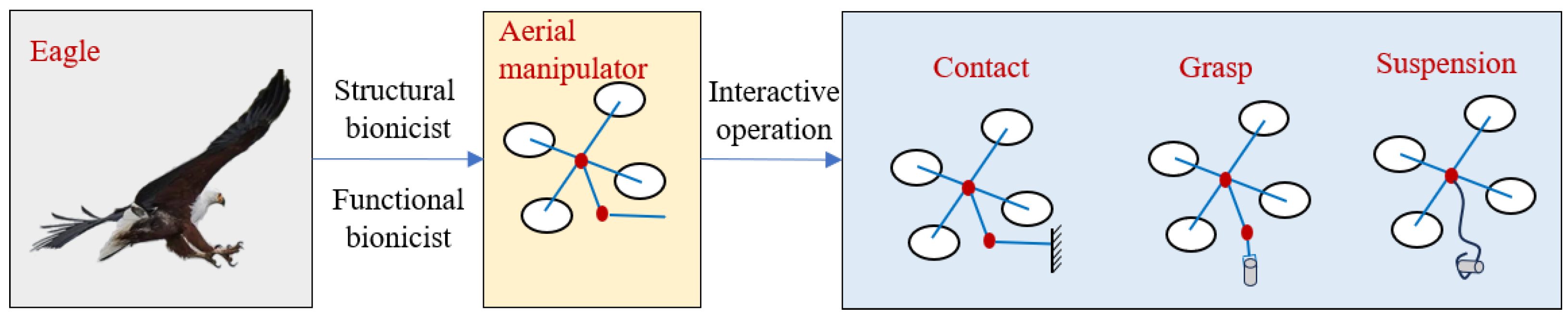
Motivated by the above discussion, this paper proposes an FNTSMC-based joint-space trajectory tracking control scheme for bionic aerial manipulators in canopy-sampling tasks, in which NNs and BFs are incorporated to compensate for lumped disturbances and handle input saturation, respectively. As shown in
Figure 1, inspired by the interaction constraints observed in eagle–environment interactions, the operational scenarios of bionic aerial manipulators can be broadly classified into three categories: contact, grasping, and suspension. In the canopy-sampling task investigated in this study, the system operates in the grasping mode. The main contributions of this paper are summarized as follows:
- (i)
A bionic aerial manipulator platform composed of a quadrotor UAV and a two-degree-of-freedom robotic arm is established for high-altitude canopy sampling. The proposed platform provides a safer and more efficient alternative to manual operation in hazardous environments.
- (ii)
An FNTSMC scheme is developed for joint-space trajectory tracking control of the aerial manipulator. By incorporating an RBF-NN into the control framework, the proposed method enables effective approximation and compensation of lumped disturbances, leading to improved robustness and tracking performance compared with [
29].
- (iii)
A BF-based anti-saturation mechanism is further embedded into the FNTSMC framework to handle actuator input constraints. Compared with [
30], the resulting controller can reduce excessive control input, enhance robustness against saturation effects, and achieve faster convergence and higher tracking accuracy for canopy-sampling tasks.
The remainder of this paper is organized as follows.
Section 2 presents the dynamic modeling of the aerial manipulator.
Section 3 details the controller design, and
Section 4 gives the stability analysis of the proposed method.
Section 5 presents two simulation examples to verify the effectiveness of the proposed approach. Finally,
Section 6 concludes the paper and discusses future research directions.
2. Dynamics Modeling
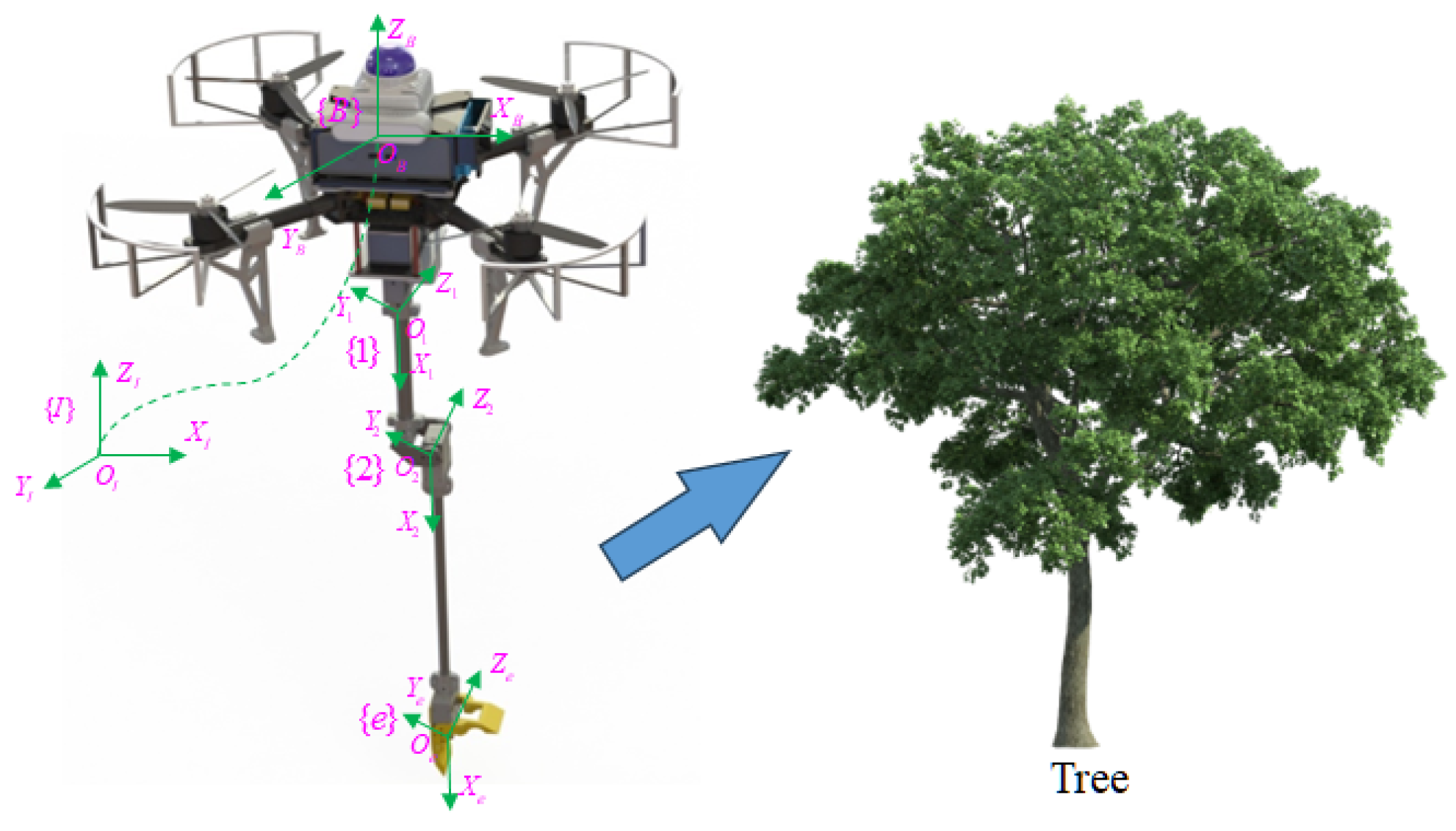
A conventional quadrotor is mainly composed of an X-shaped airframe, on which four brushless DC motors and their corresponding propellers are mounted. The free-body diagram of the quadrotor is illustrated in
Figure 2. Two coordinate frames are introduced: the inertial frame
and the body-fixed frame
. In the body-fixed frame,
represents the thrust generated by the
ith rotor, and
represents the corresponding reaction torque. On this basis, the following four control inputs are defined to establish the dynamic model of the system:
where
L denotes the distance between the center of mass of the quadrotor and the center of each rotor.
Remark 1.
This article considers the canopy-sampling task of a bionic aerial manipulator under hovering conditions. During operation, the quadrotor primarily acts as an aerial carrier, and its position and attitude variations are assumed to be sufficiently small. As a result, the influence of the quadrotor on the manipulator dynamics is regarded as an internal coupling effect and absorbed into the lumped disturbance term. Under this assumption, only the dynamic model of the two-degree-of-freedom manipulator is considered in the subsequent analysis [31]. The kinematic representation of the bionic aerial manipulator requires three categories of coordinate frames: the inertial frame
, the quadrotor body-fixed frame
, and the manipulator frames. The manipulator frames are further defined as the joint 1 frame
, the joint 2 frame
, and the end-effector frame
. Let
denote the position vector of the quadrotor UAV expressed in frame
, and let
denote the position vector of the manipulator end-effector expressed in frame
. Moreover, let
denote the rotation matrix describing the coordinate transformation between frames
and
, and let
and
denote the position and orientation of the end-effector relative to the quadrotor body frame, respectively. Accordingly, the following relationship holds [
32]:
where
,
, and
are Euler angles.
and
are abbreviations for
and
, respectively.
From Equations (
2)–(
4), the pose of the manipulator end-effector is derived through a sequence of coordinate transformations between adjacent link frames.
The geometric parameters of the manipulator are established according to the standard Denavit–Hartenberg (DH) convention [
33], as summarized in
Table 1.
Based on
Table 1, the forward kinematics model of the aerial manipulator
is derived as follows:
where
represents the homogeneous transformation matrix [
34]. Furthermore, the inverse kinematics equation of the manipulator can be derived analytically [
35].
Dynamics
According to Lagrange’s equation [
36,
37], the kinetic energy of link 1 is described as:
where
is the generalized coordinates of joint 1,
is the angular acceleration,
is the moment of inertia of link 1,
is the distance of the center of mass of link 1 from joint 1, and
is the mass of link 1.
Similarly, the kinetic energy of link 2 is given as:
where
is the generalized coordinates of joint 2,
is the angular acceleration,
is the moment of inertia of link 2,
is the distance of the center of mass of link 2 from joint 2, and
is the mass of link 1.
The kinetic energy of the end-effector is calculated as:
where
is the mass of the end-effector, and
and
are the length of the link 1 and link 2, respectively.
The total kinetic energy of the bionic aerial manipulator is determined by integrating the contributions from Equations (
6)–(
8), as follows:
Writing the above equation in compact form gives the kinetic energy equations for the manipulator:
where
,
, and
;
and
are the distance from the center of mass of link to joint; and
and
are the moment of inertia of the links.
The potential energy of the manipulator arises solely from gravitational forces. Denoting the gravitational potential energy of link 1 as
, link 2 as
, and the end-effector as
, the total potential energy of the system can be expressed as the sum of these individual components:
For each generalized coordinate
and
, the Lagrange equations [
38] are calculated by Equations (
10) and (
11) as:
The dynamical equation for the bionic aerial manipulator can be derived by associating the Lagrange equations with the two generalized coordinates, ensuring a systematic and rigorous formulation:
where
,
.
Remark 2.
In practical applications, joint friction in a manipulator generates frictional moments, which typically comprise static friction, viscous friction, and Coulomb friction [39]. According to Remark 2, the frictional moments can be described as:
where
is the coefficient of static friction,
is the Coulomb friction coefficient, and
is the coefficient of viscous friction.
Considering the intrinsic properties of the robotic manipulator, its dynamic model must adhere to the constraints defined by Equations (
13) and (
14), which can be reformulated as follows:
Remark 3.
The coupling effect between the manipulator and the quadrotor presents significant modeling challenges. As this study focuses solely on the motion control of the manipulator in the hovering state, this coupling effect is treated as an unmodeled dynamic within the lumped disturbances. Additionally, the lumped disturbances encompass other factors, including sensor noise, joint backlash, and external environmental influences [40]. To address the above lumped disturbances, a diagonal gain matrix
is introduced, allowing Equation (
15) to be reformulated as:
where
.
3. Controller Design
Taking Joint 1 as an example to illustrate the process of the proposed controller, the tracking error
for the joint angle, along with its first and second-order derivatives
and
, is expressed as follows:
A fast continuous non-singular terminal sliding mode surface is designed as:
where
is the hyperbolic tangent function ensuring smooth transitions during
switching, effectively suppressing chattering.
and
are the control parameters.
Deriving Equation (
18) and making
gives:
Using Equations (
17)–(
19), the following expression can be derived:
As noted in Remark 3, the lumped disturbances are unknown and cannot be directly utilized in designing the control law to address the tracking control problem for the aerial manipulator. To overcome this, the RBF-NN approximation technique is employed to reconstruct the lumped disturbances. The formulation is given as:
where
represents the unknown weight vector,
denotes the basis function satisfying
,
denotes the node number, and
is the bounded approximation error.
By combining Equations (
20) and (
21), the following equivalent control law can be obtained:
Remark 4.
In practical scenarios, the joint motors of the bionic aerial manipulator have an upper output limit. Exceeding this threshold can damage the motors, potentially causing uncontrolled or stuck joints, thereby compromising the system’s stability and accuracy.
According to Remark 4, an adaptive reaching law is proposed to address the actuator saturation problem, as follows:
where
is the adaptive control gain, which can be designed as:
where
and
are the control parameters to be tuned.
is the barrier function with the following form:
where
represents a very small region to which the tracking error ultimately converges, and
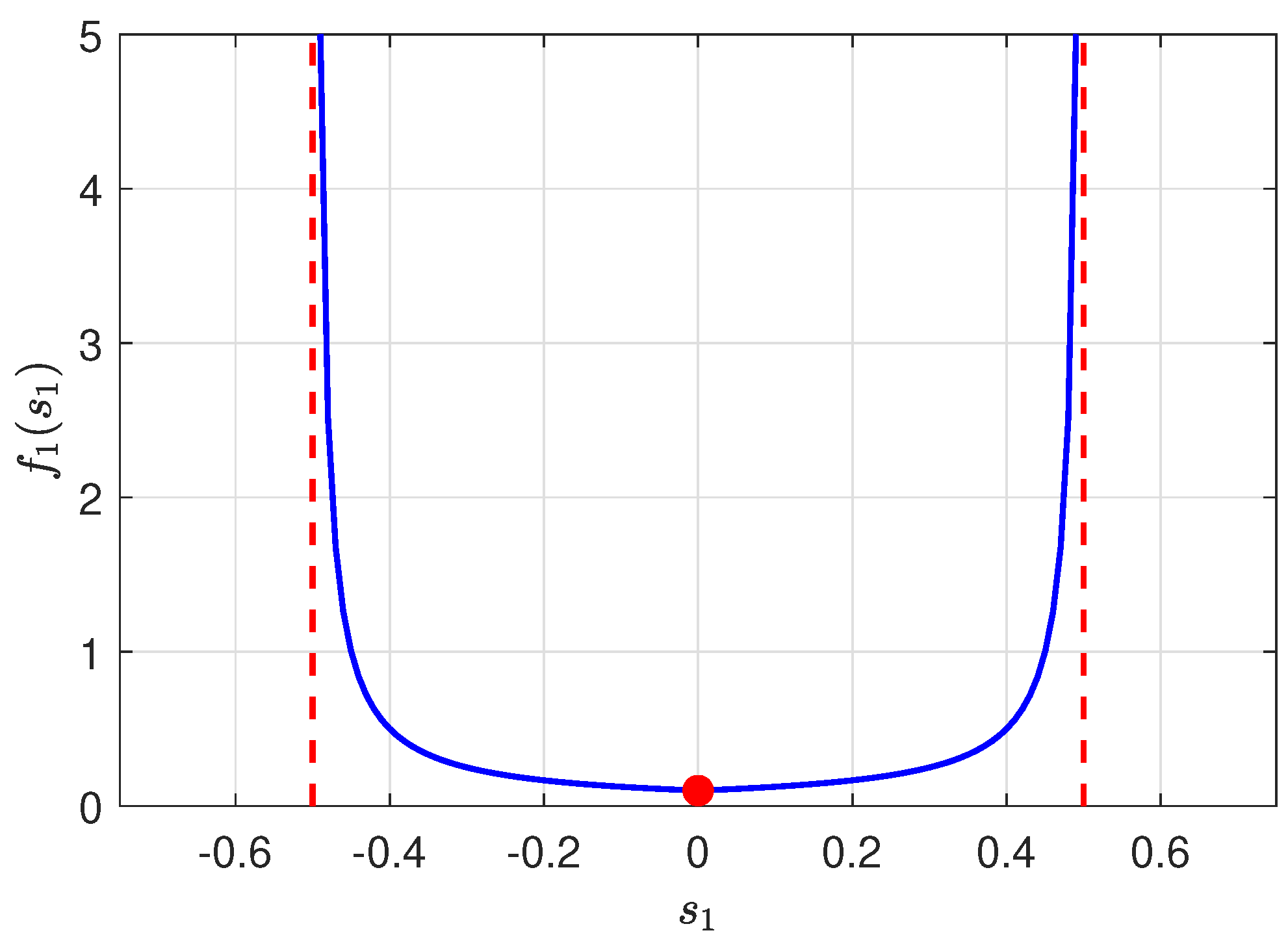
L is the gain. The mathematical representation of the barrier function (BF) is shown in
Figure 3, with
and
. As observed in the figure, when
approaches
or
,
tends toward infinity, significantly increasing the adaptive control gain
. This drives
back to the origin, effectively preventing excessively high control inputs.
The control torque for Joint 1, considering the couplings described in Equations (
19)–(
22), is expressed as follows:
Likewise, the control moment for joint 2 is derived as:
Finally,
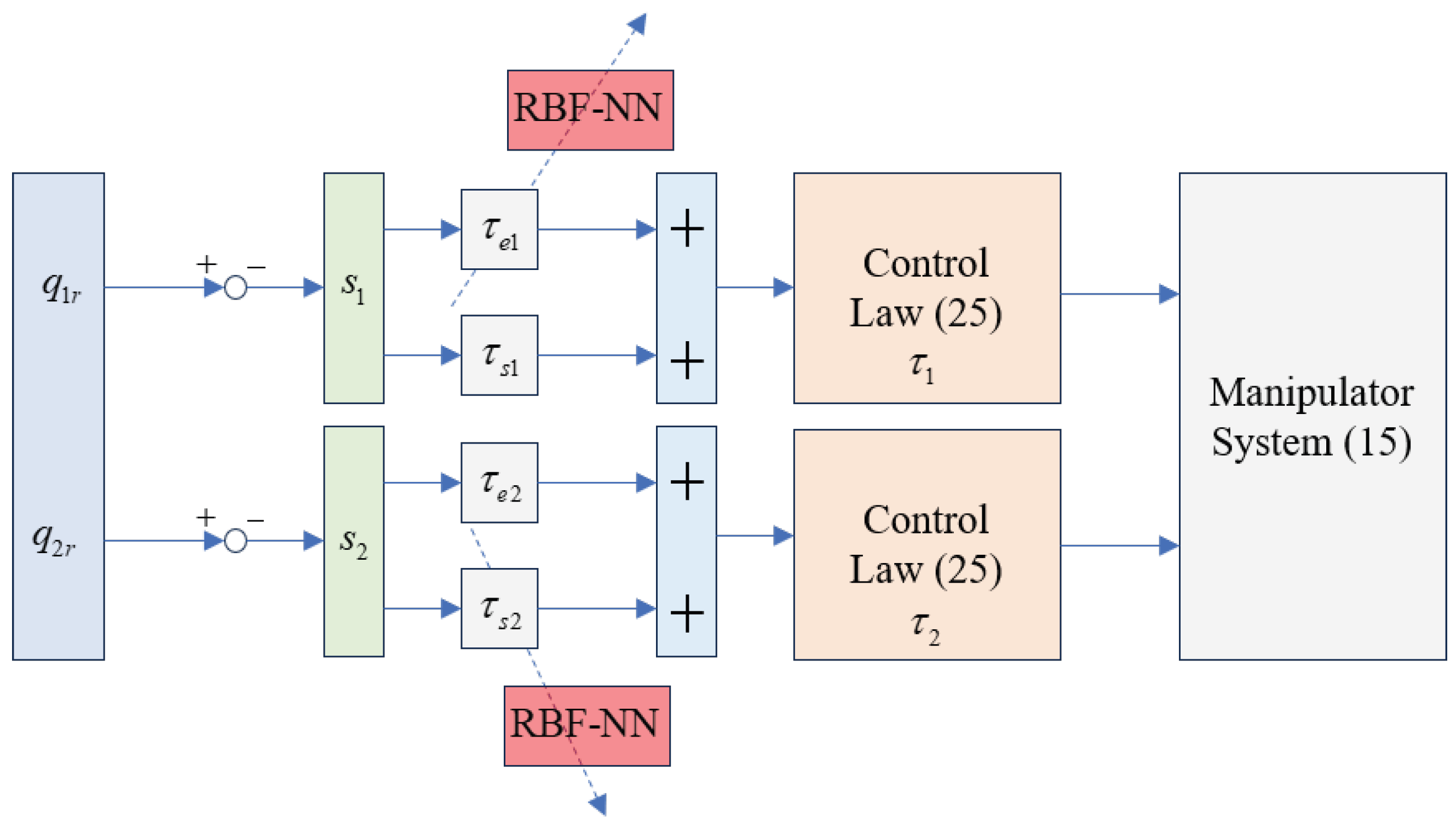
Figure 4 displays the control structure of the BFASMC-NN.
4. Stability Analysis
Similarly, Joint 1 is used as an example to demonstrate the stability of the proposed control strategy.
Theorem 1.
For the aerial manipulator system in Equation (15) under the control law (25) within the time interval , there exists a positive constant such that the adaptive control gain is bounded by [26]. Theorem 2.
Under the control law (26), the tracking error in (17) and sliding surface in (17) converge within a finite time to a predefined minimal threshold for any initial conditions, as follows: Taking the derivative of Equation (
18) yields:
When conducting stability analysis, it is necessary to consider the two scenarios described in the adaptive law of Equation (
24), namely
and
. The following parts will individually analyze the stability of each scenario.
(1) Scenario 1:
. Consider the following Lyapunov function:
where
denotes a positive number and
.
Taking the time derivative of Equation (
31) and substituting Equation (
30) into it yields:
Setting
and
, one gets:
Remark 5.
Since the lumped disturbances are low-frequency and disordered, in Equation (16) cannot equal zero. To simulate these disturbances, Gaussian white noise is included. Consequently, . Additionally, there always exists a positive constant ρ such that , leading to . With Remark 5,
in Equation (
32) satisfies the condition that
. Therefore, the control system is stability.
Theorem 3.
Consider the following first-order nonlinear inequality for a positive-definite Lyapunov function :where , . Given any initial condition , will converge to zero within a finite time , which is bounded by: Based on Theorem 1, the sliding mode surface
in Equation (
18) will converge to a neighborhood of zero within a finite time
, and the finite time satisfies the following condition:
and the trajectory tracking error
of the joint 1 will also converge to zero within the above finite time. Furthermore, the control torque in Equation (
26) can achieve bounded convergence within a finite time.
(2) Scenario 2:
. Consider the following Lyapunov function:
Differentiating the above equation and substituting Equation (
26) into Equation (
33) results in:
Similarly, setting
and
, we get:
Based on Theorem 1, the sliding mode surface
in Equation (
18) will converge to a neighborhood of zero within a finite time
, and the finite time satisfies the following condition:
and the trajectory tracking error
of the joint 2 will also converge to zero within the above finite time. The control torque in Equation (
27) is also boundedly convergent in finite time.
5. Simulation and Results
In the simulation cases, the parameters of the aerial manipulator are selected as: , , , , , , , , , and .
Simulation Case A: Sinusoidal trajectory tracking. The reference trajectories of the two joints are selected as
and
. The initial states are given by
. To examine the disturbance rejection performance, high-frequency Gaussian noise with an amplitude of
is added as the disturbance torque. The total simulation time is 15 s. For performance comparison, the proposed method is evaluated against the FNTSMC-LESO approach in [
41] and the LADRC approach in [
42]. The controller parameters are obtained through empirical tuning and are listed in
Table 2. In addition, this simulation case provides a feasible parameter set for the subsequent studies.
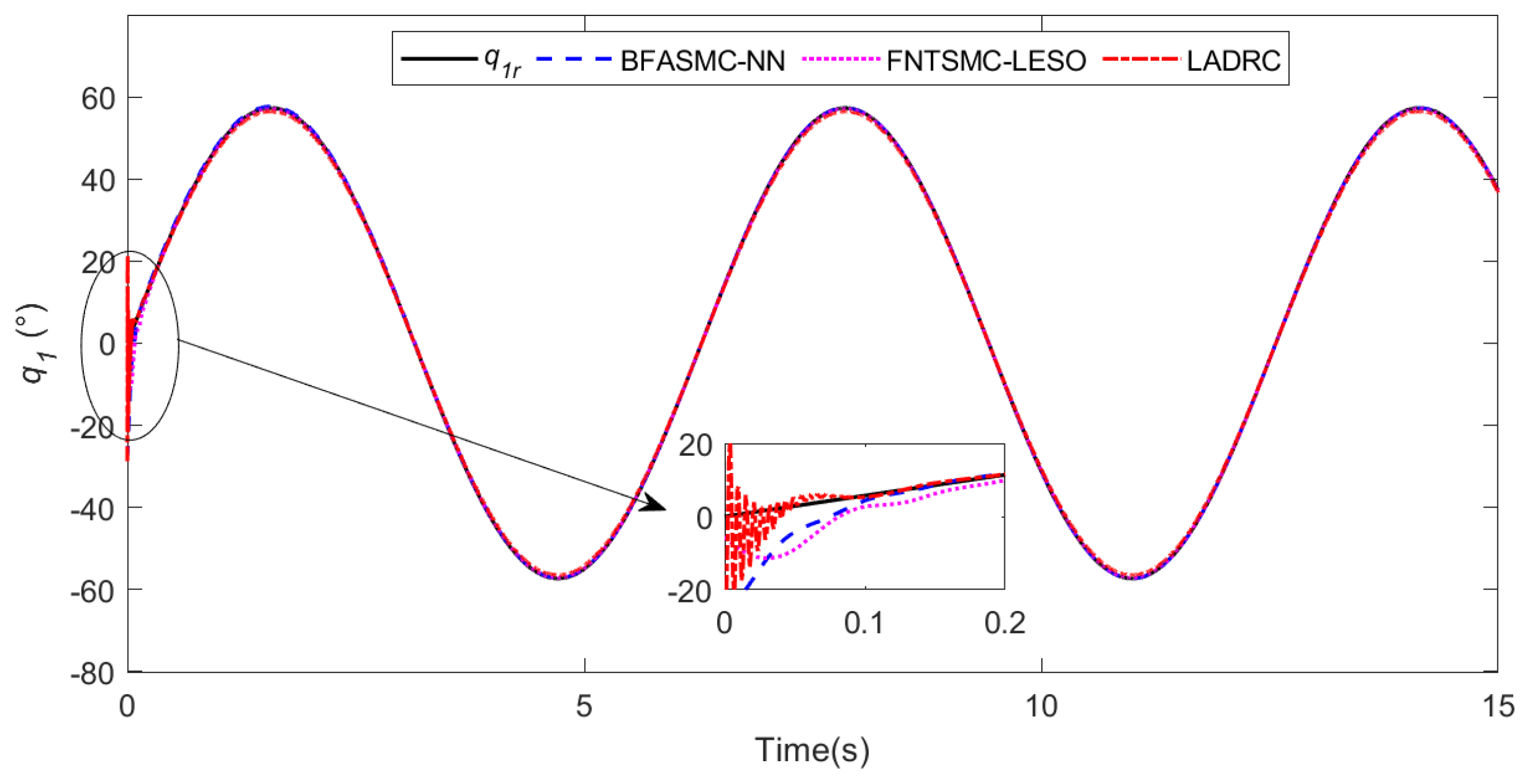
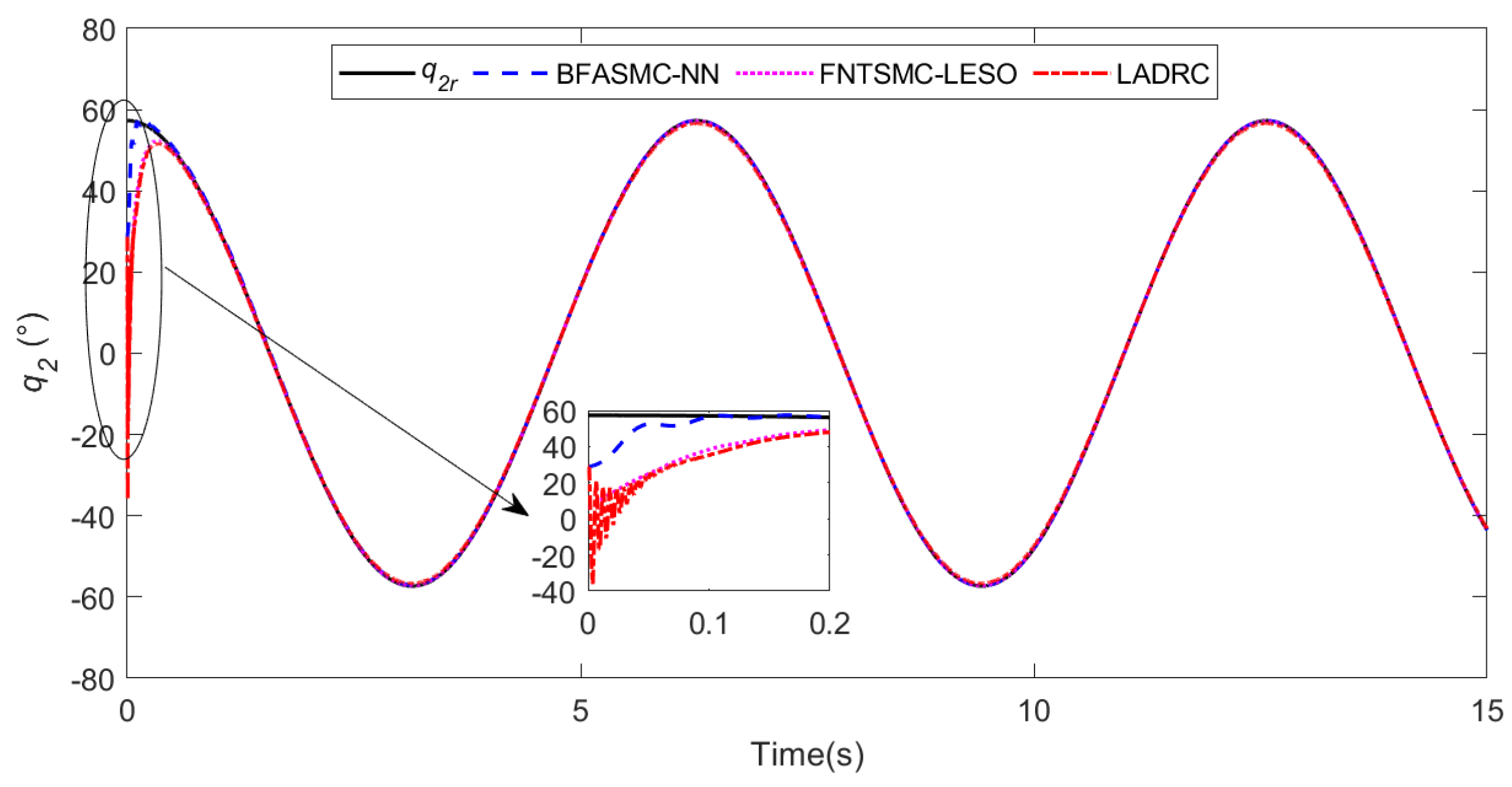
Figure 5 and
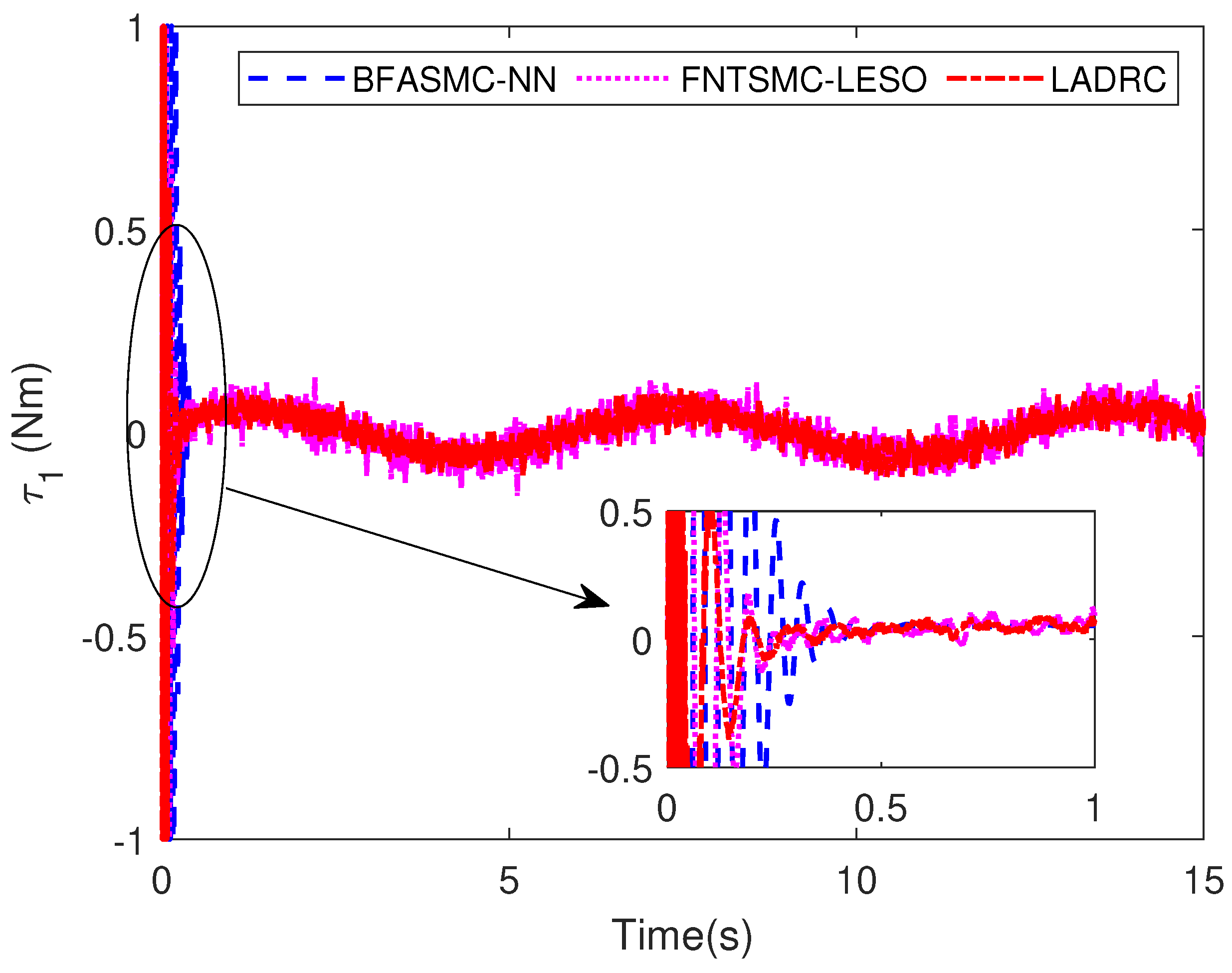
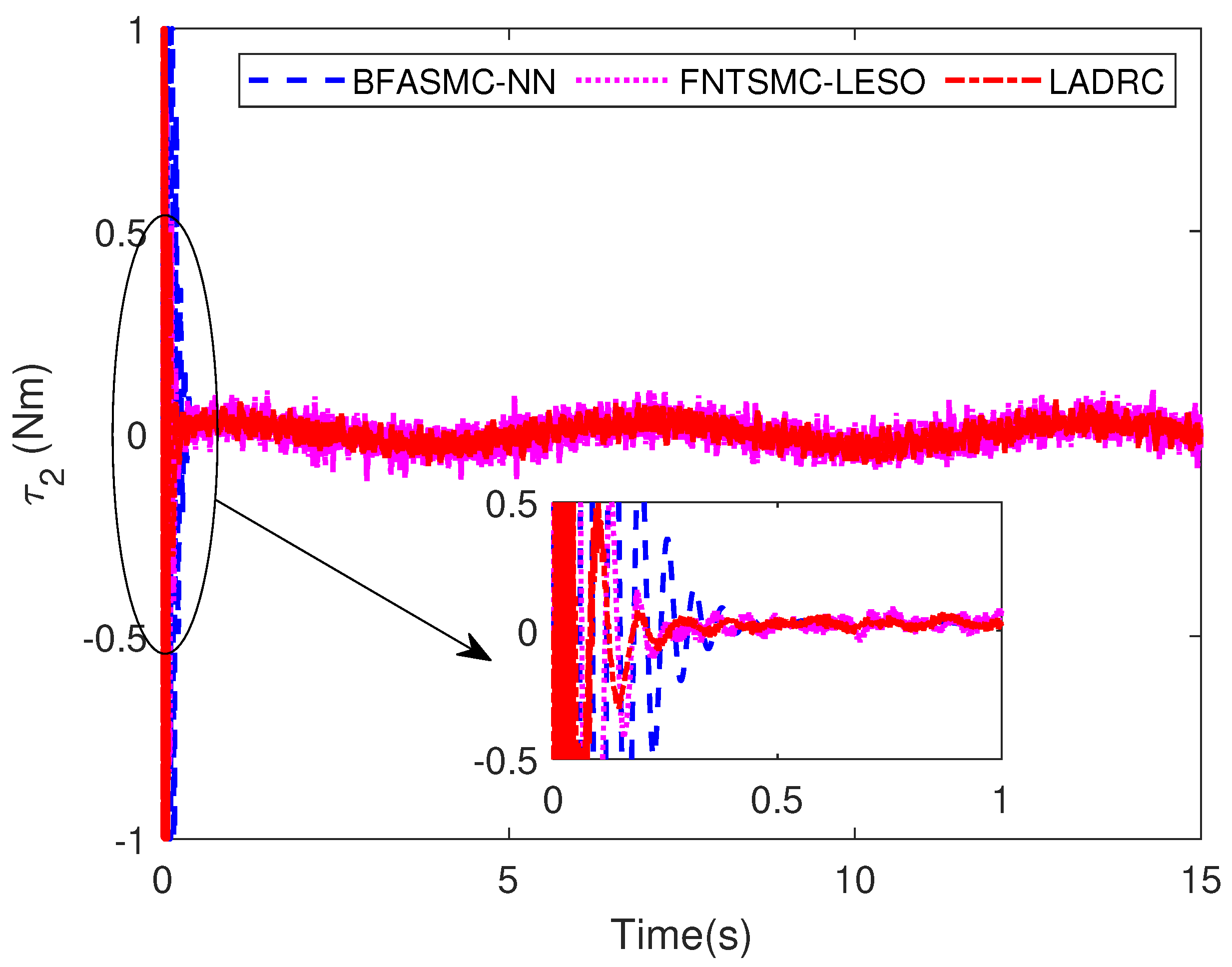
Figure 6 present the tracking responses of two joints under three control strategies. The results demonstrate that all three controllers effectively suppress lumped disturbances, achieving satisfactory system performance. During the transient phase, BFASMC-NN and FNTSMC-LESO deliver smoother responses with reduced chattering compared to LADRC, minimizing actuator impact and prolonging their lifespan. This also highlights the robustness of BFASMC-NN and FNTSMC-LESO, as they exhibit lower sensitivity to initial conditions. Furthermore, based on rise time and settling time metrics during the transient phase, BFASMC-NN outperforms FNTSMC-LESO, particularly in the response of Joint 2. These findings suggest that the incorporation of barrier functions and non-singular terminal sliding mode surfaces in the proposed controller effectively reduces output chattering, enhances control signal smoothness, and improves overall system performance.
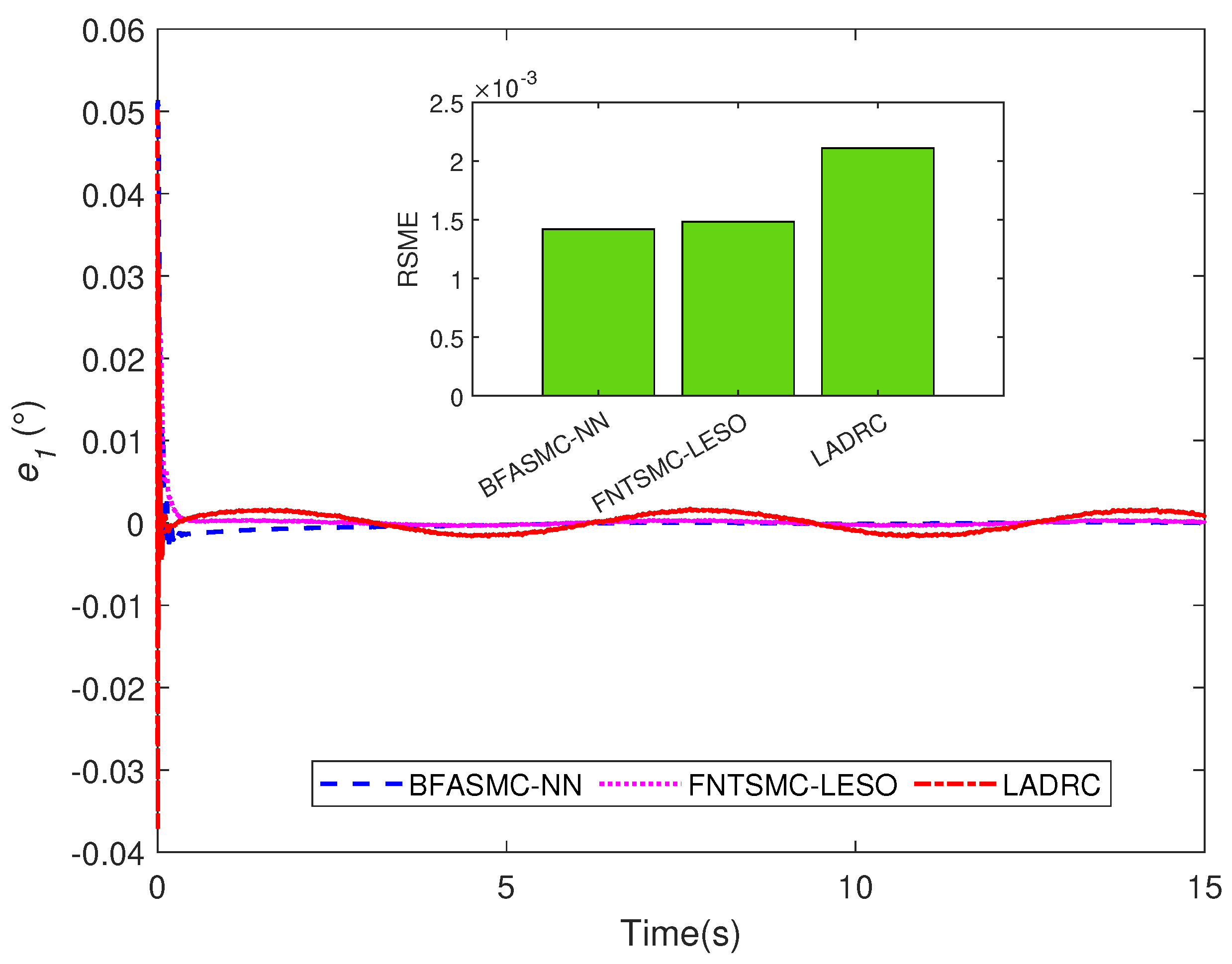
Figure 7 and
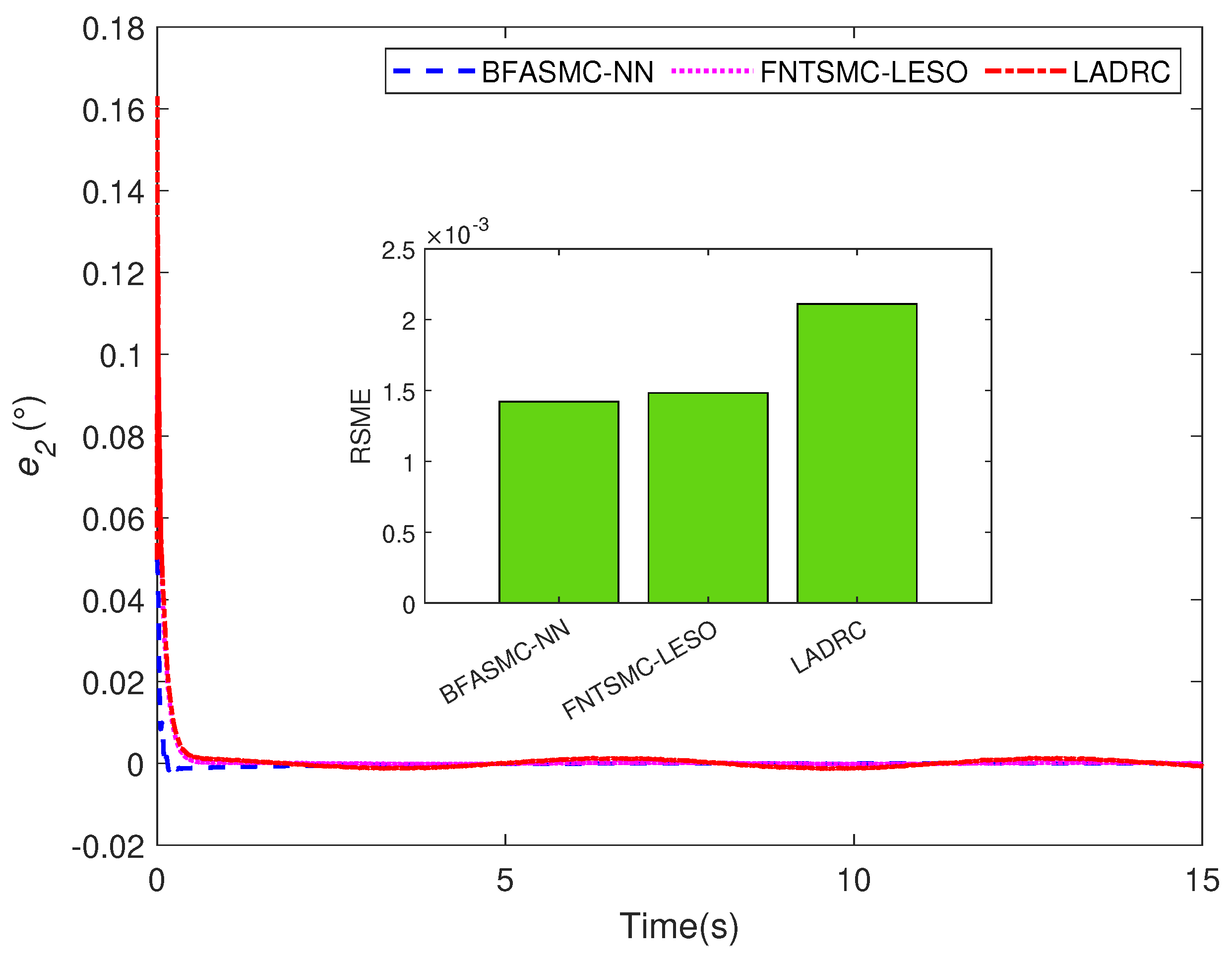
Figure 8 present the tracking error curves of Joint 1 and Joint 2 for the three controllers, thereby illustrating their steady-state performance. It is evident that LADRC, due to the absence of an anti-saturation mechanism, produces excessive actuator input in Joint 1. In comparison, BFASMC-NN exhibits the best tracking performance, which can be attributed to the neural network-based estimation and compensation of lumped disturbances. Quantitatively, with RMSE adopted as the performance index, BFASMC-NN yields an RMSE of 0.0014 for Joint 1, representing improvements of 6.7% and 30% over FNTSMC-LESO and LADRC, respectively. For Joint 2, the corresponding RMSE is reduced by 62.3% relative to FNTSMC-LESO and by 67.2% relative to LADRC. These results verify the superiority of the proposed controller in terms of tracking accuracy and disturbance rejection. Moreover, the results suggest that the tracking error of Joint 1 propagates to Joint 2 through inter-joint coupling, leading to amplified overall tracking errors. This issue deserves further investigation in future studies.
Figure 9 and
Figure 10 present the torque responses of the three controllers. It can be seen that BFASMC-NN yields smoother transient behavior and reaches the steady state faster than FNTSMC-LESO and LADRC. The reduced switching activity of the proposed control law alleviates actuator impact and is beneficial for actuator protection. In contrast, FNTSMC-LESO and LADRC exhibit more noticeable oscillations, suggesting relatively inferior robustness in the presence of high-frequency disturbances. In steady state, BFASMC-NN maintains the most stable torque response, with the smallest fluctuation around zero, indicating higher tracking accuracy and more effective lumped-disturbance compensation. Although FNTSMC-LESO also performs well, its steady-state torque variation is slightly larger. LADRC shows the most severe torque oscillation throughout the entire control process, which may adversely affect actuator longevity. Overall, these results confirm that BFASMC-NN provides superior robustness, smoother control action, and better steady-state performance.
Simulation Case B: Motion planning. The quadrotor is assumed to hover at a fixed position, with its center of mass located at
and its attitude specified as
. The target leaf sample is identified by the perception system at
, with an orientation of
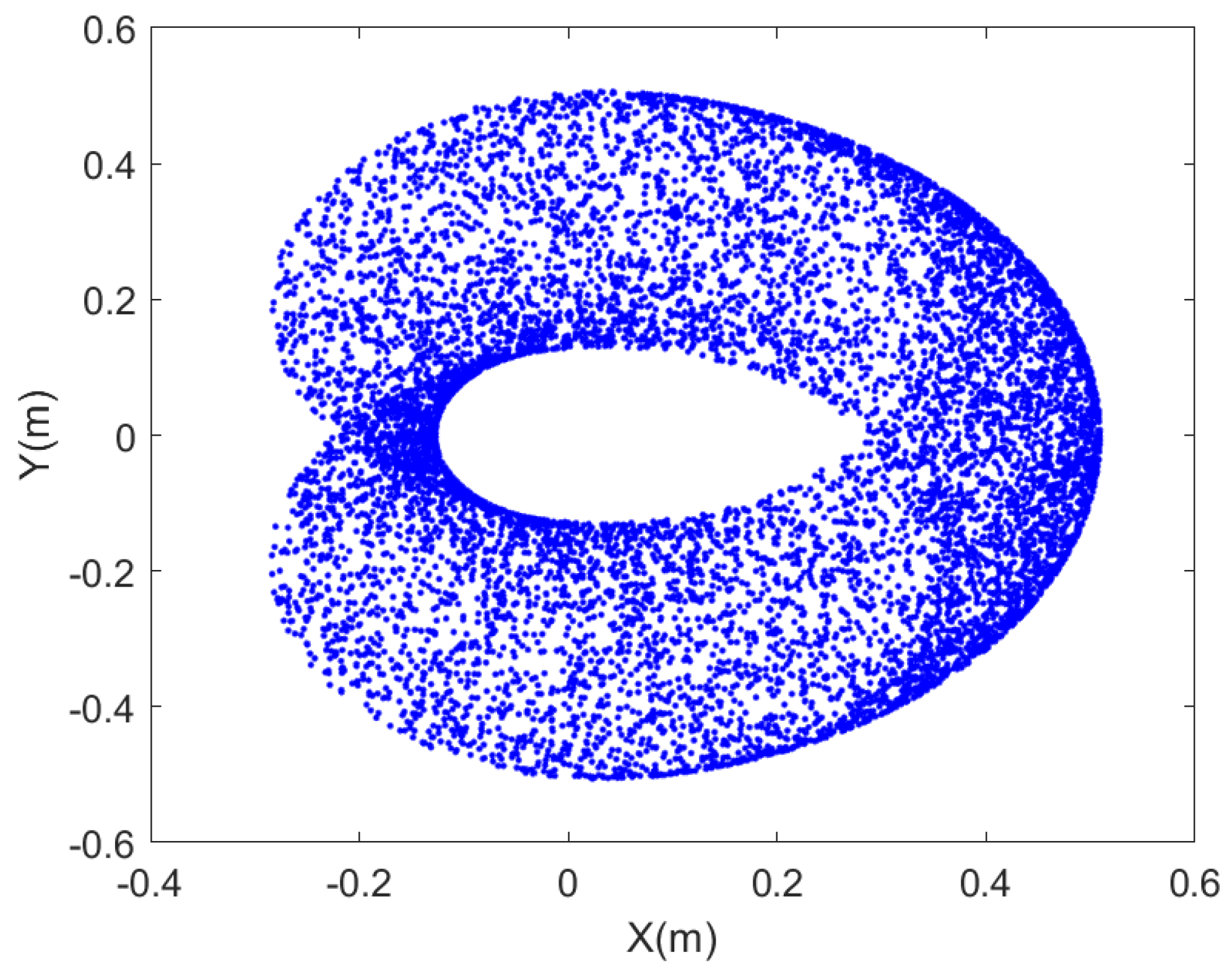
. The task is to control the manipulator end-effector to reach the target leaf and accomplish the picking operation within 5 s. To verify the reachability of the planned motion, the workspace of the aerial manipulator is evaluated using the Monte Carlo method [
43], according to Equation (
41), as shown in
Figure 11.
where
is a random function following a normal distribution.
and
represent the minimum and maximum joint angles, respectively. By substituting the generated random joint angles into the forward kinematics Equation (
4), the position of the aerial manipulator’s end-effector can be obtained. The potential trajectory of the end-effector when 10,000 points are sampled is shown in
Figure 10.
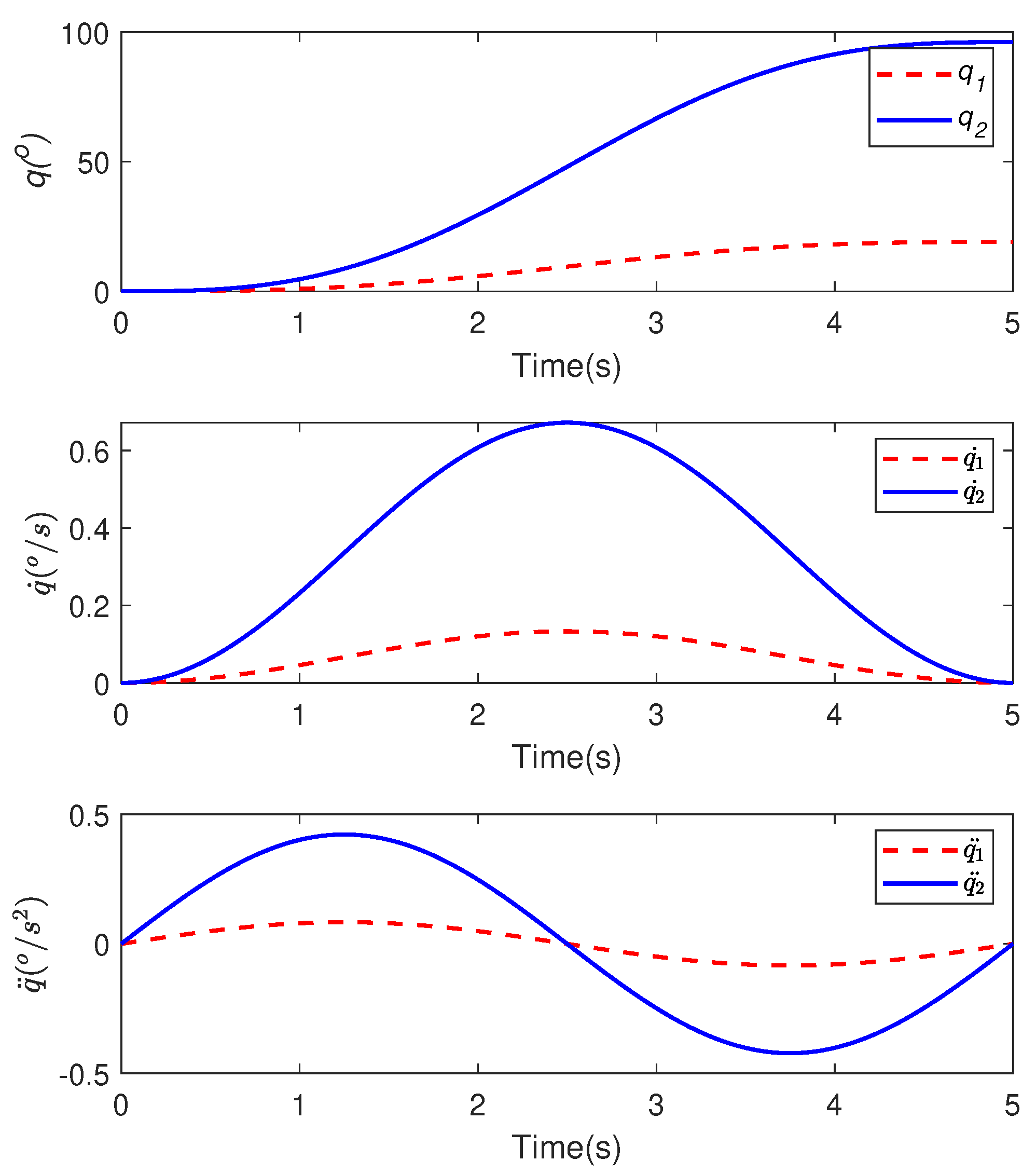
Furthermore, the inverse kinematics equations of the bionic aerial robotic arm are formulated analytically. The joint angles corresponding to the initial and target joint angles are determined. A Cycloidal curve expressed by Equation (
42) is then utilized to plan the sequence of joint angle transitions from the initial state to the final state.
where
denotes the initial joint angles,
denotes the target joint angles,
t represents the current time, and
denotes the total time.
Figure 12 presents the results of the trajectory planning. It should be noted that the Monte Carlo workspace in this study is used only to verify geometric reachability of the target point, rather than to guarantee singularity-free straight-line connectivity between arbitrary points in the workspace.
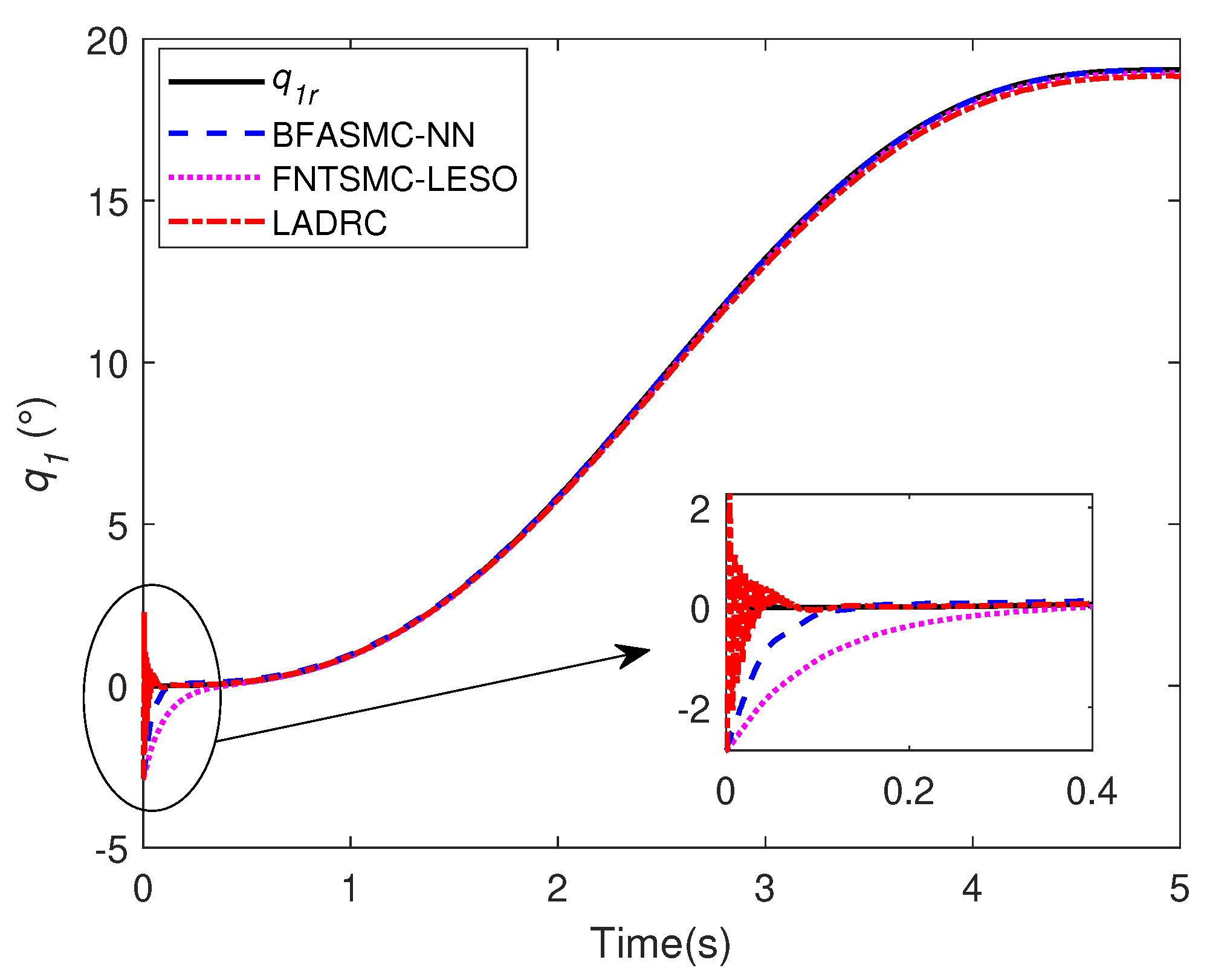
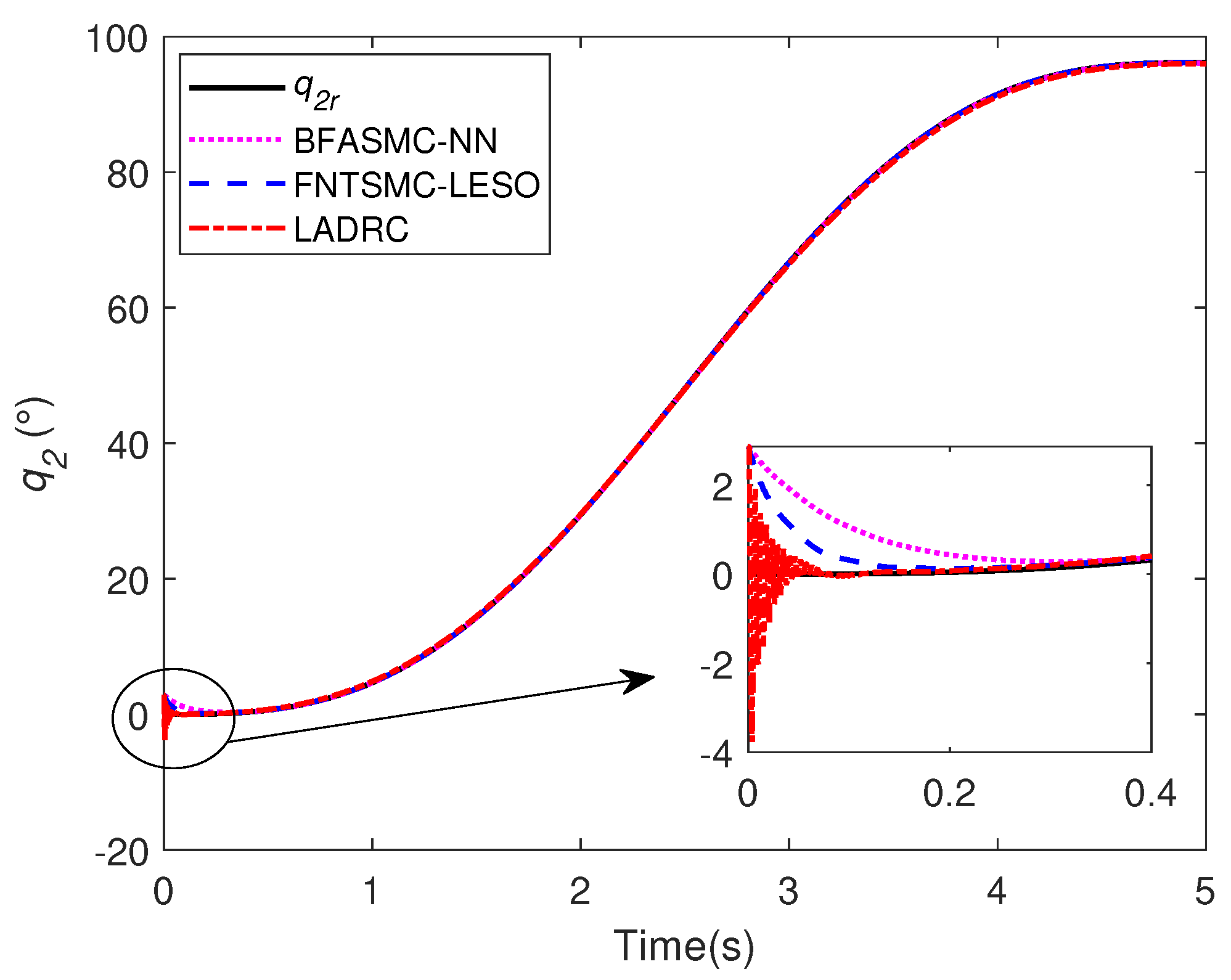
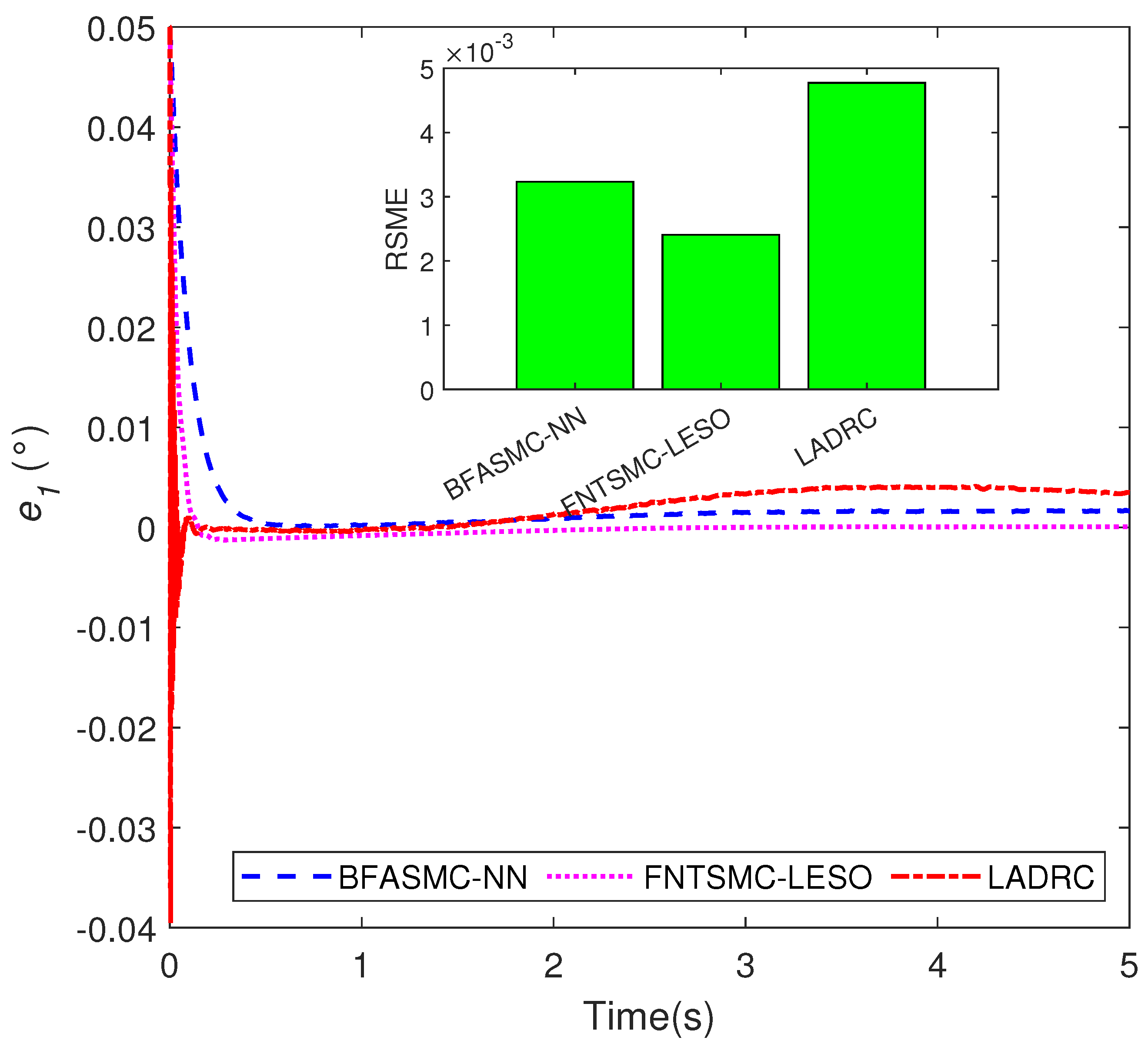
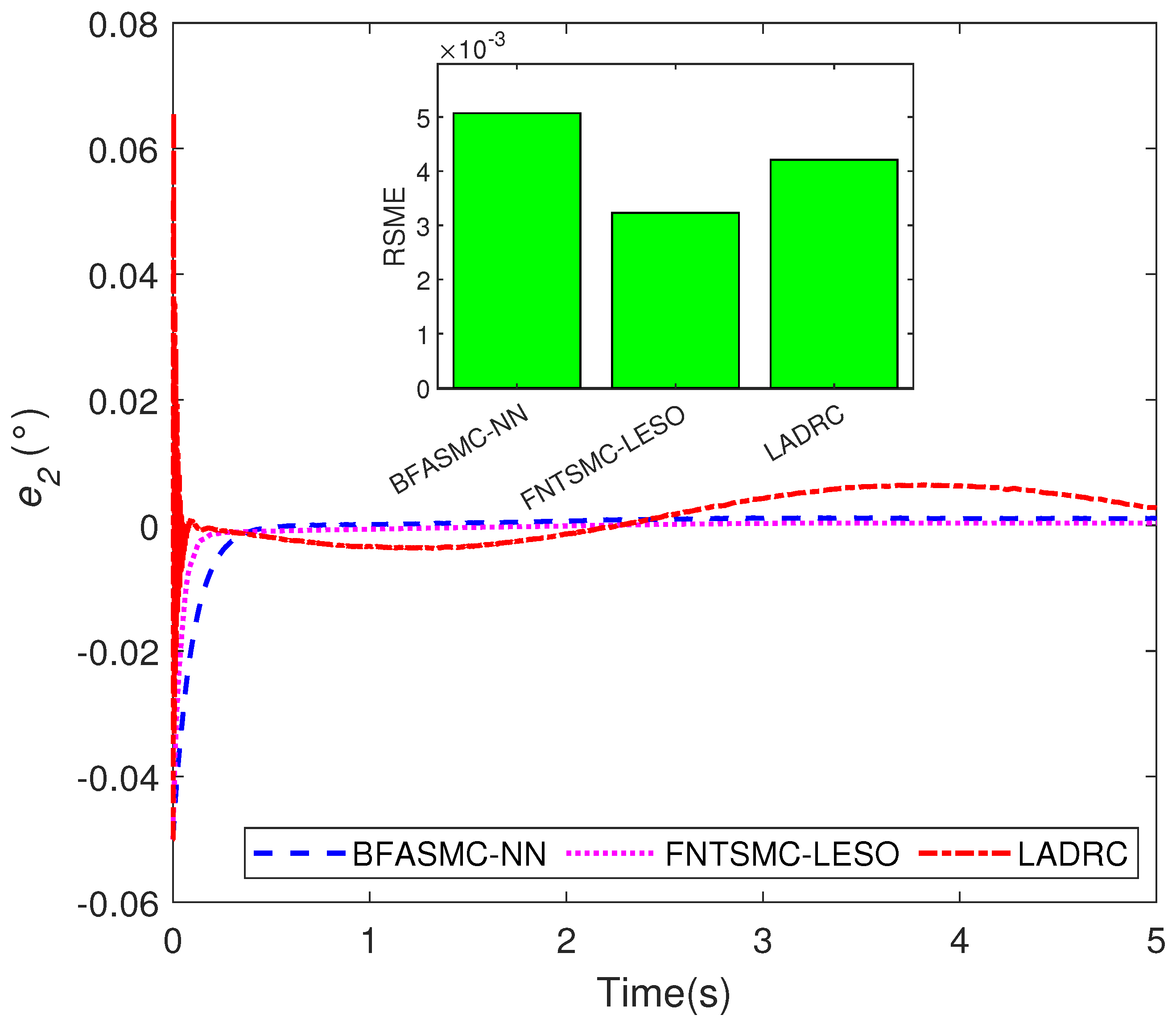
Subsequently, the three-dimensional model of the canopy-sampling aerial manipulator was imported into MATLAB/Simulink 2024b, and the three controllers presented in Case A were used to track the planned joint trajectories. The other initial conditions were the same as those in Case A, and the simulation time was 5 s. The results are shown in
Figure 13,
Figure 14,
Figure 15,
Figure 16,
Figure 17,
Figure 18 and
Figure 19.
Figure 13 and
Figure 14 show the joint angle responses of
and
in Case 2 under BFASMC-NN, FNTSMC-LESO, and LADRC. It can be observed that all three controllers can track the desired trajectories, but their transient performances differ significantly. BFASMC-NN and FNTSMC-LESO both achieve fast convergence for
and
, whereas BFASMC-NN exhibits smoother responses and less chattering, especially at the initial stage. In contrast, LADRC produces relatively larger oscillations during the transient process. The enlarged plots further confirm that BFASMC-NN suppresses tracking errors more effectively and reaches a stable state near zero more quickly. These results indicate that BFASMC-NN outperforms FNTSMC-LESO and LADRC in terms of convergence speed, overshoot reduction, chatter suppression, and overall smoothness of the tracking response.
Figure 15 and
Figure 16 show the tracking error responses in Case B under the three controllers. It can be seen that all methods achieve error convergence, whereas BFASMC-NN and FNTSMC-LESO exhibit smaller steady-state errors than LADRC. For Joint 1, FNTSMC-LESO yields the smallest RMSE, followed by BFASMC-NN and LADRC. For Joint 2, BFASMC-NN achieves the best tracking accuracy, with lower RMSE than both FNTSMC-LESO and LADRC. Overall, the results further confirm the effectiveness of the proposed controller in Case B, particularly in reducing the tracking error of Joint 2 while maintaining satisfactory performance for Joint 1.
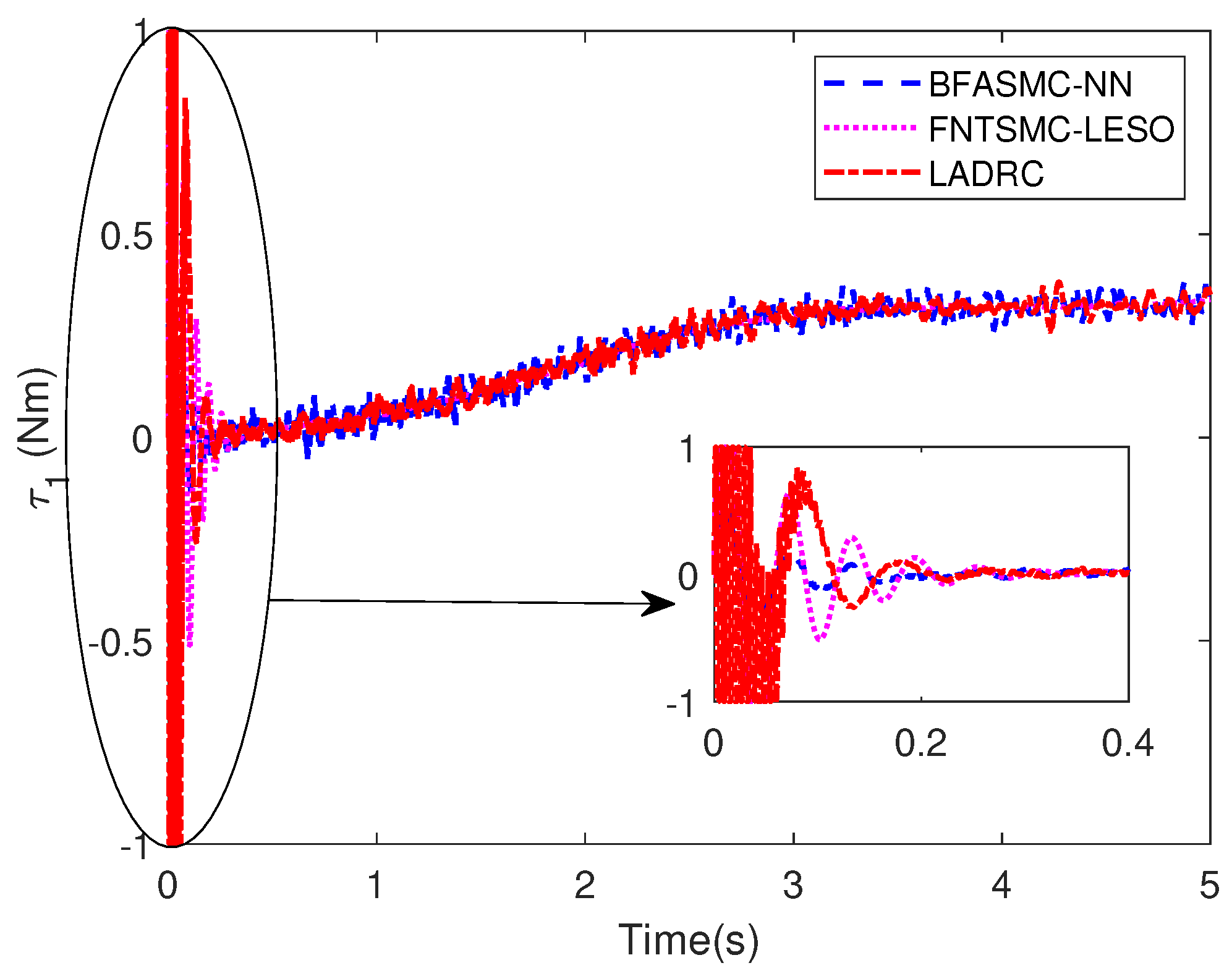
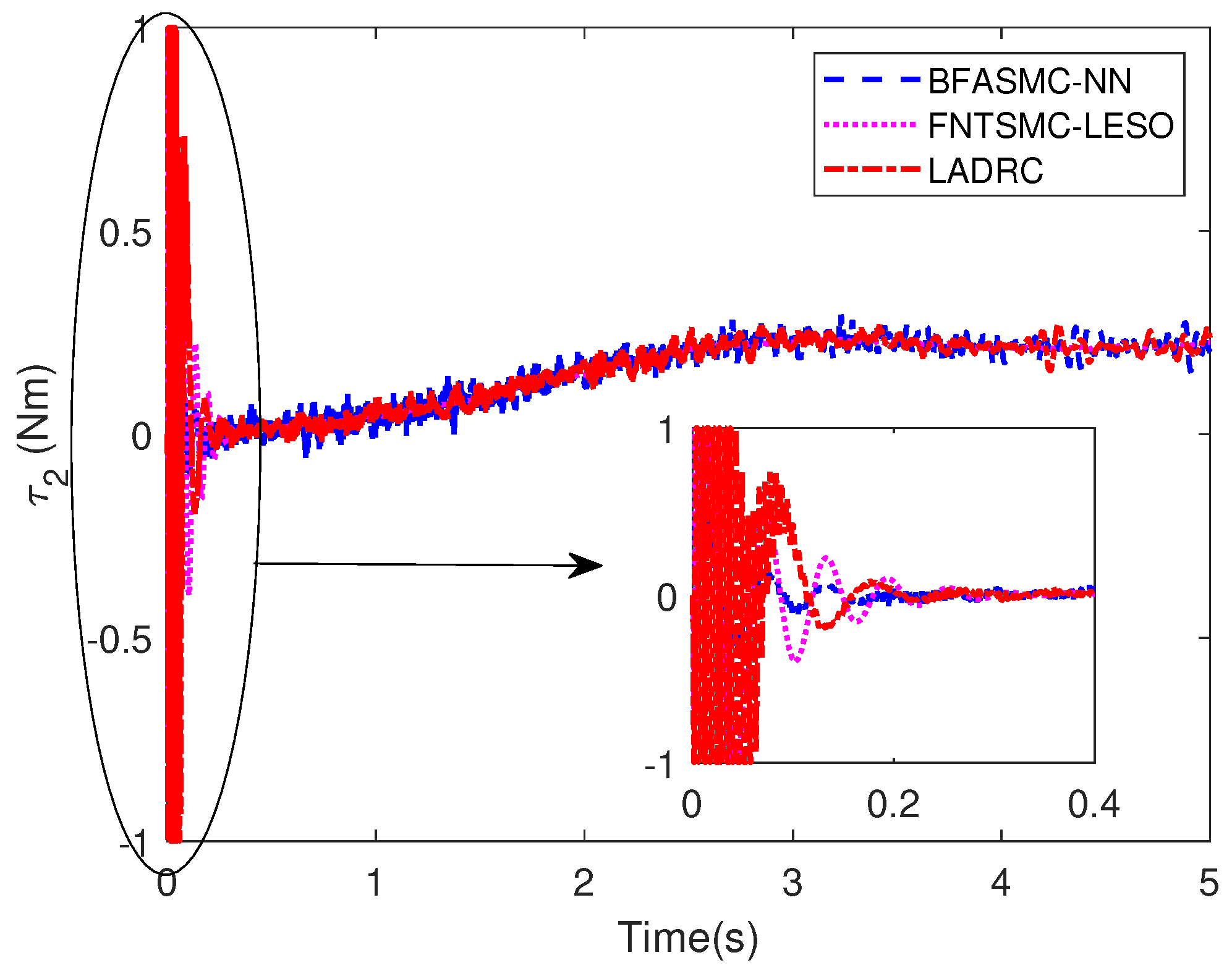
Figure 17 and
Figure 18 show the torque responses of the two joints. Compared with FNTSMC-LESO and LADRC, BFASMC-NN produces smoother torque profiles and reaches a stable state more rapidly, with smaller oscillations. The enlarged transient responses further confirm that BFASMC-NN has the least chattering among the three methods. By contrast, although LADRC preserves steady-state stability, it exhibits more noticeable oscillations during the transient phase, implying stronger sensitivity to initial disturbances. These results demonstrate that BFASMC-NN achieves the most stable torque output and the smoothest control performance for both joints.
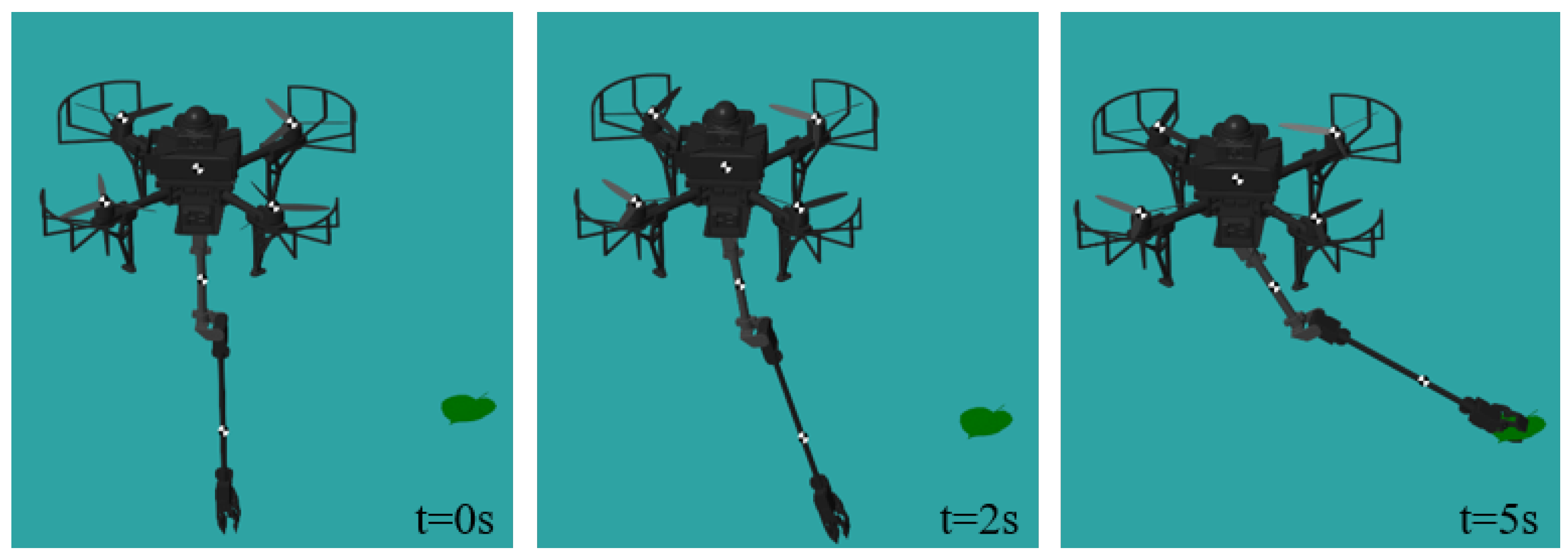
Figure 19 shows the visual simulation results of the canopy-sampling task carried out by the aerial manipulator. The snapshots at successive time instants clearly depict the process of approaching the target, performing grasping, and maintaining stable contact, which verifies the effectiveness of the proposed control strategy in achieving accurate motion execution within the specified time horizon.
6. Conclusions
This paper proposes a BF-enhanced fast continuous nonsingular terminal sliding mode control strategy for canopy sampling by bionic aerial manipulators. By integrating an RBF-NN-based lumped-disturbance estimator, a BF-based anti-saturation mechanism, and an FNTSMC framework, the proposed controller achieves finite-time convergence, improved disturbance rejection, and high-accuracy trajectory tracking. Comparative simulation results verify that the proposed method outperforms FNTSMC-LESO and LADRC in terms of convergence speed, tracking precision, and robustness. These results confirm the effectiveness of the proposed control scheme in addressing actuator saturation and disturbance suppression for canopy-sampling tasks.
Future research will concentrate on experimental implementation and validation of the proposed method on a physical bionic aerial manipulator platform. Meanwhile, environmental perception, dynamic trajectory planning, and impedance control will be further investigated to improve the adaptability, autonomy, and practical applicability of the system in real-world canopy-sampling operations.