Article

Potential Field-Based Topology Construction of Structured Grids Around an Aircraft

Department of Thermal Science and Energy Engineering, University of Science and Technology of China, Hefei 230027, China
*
Author to whom correspondence should be addressed.
Aerospace 2026, 13(4), 389; https://doi.org/10.3390/aerospace13040389

Submission received: 13 March 2026 / Revised: 11 April 2026 / Accepted: 15 April 2026 / Published: 20 April 2026

Abstract

Multi-block structured mesh is widely used for high-precision aerodynamic simulation, but mesh blocking usually requires substantial manual intervention, which is time-consuming and demands a high level of user expertise. In this study, a potential field-based blocking algorithm for mesh generation around an aircraft is proposed, and a corresponding multi-block grid generation workflow is established. First, the hyperbolic partial differential equation (PDE) method is used to march boundary layer grids from the body surface. Next, the potential field is solved on an unstructured background grid, and the grid topology is flexibly designed by adjusting boundary conditions. The gradient lines of the potential field are then determined and employed to partition the external domain into blocks. Finally, the elliptic PDE method is applied to generate structured grids within each sub-block. A low-aspect-ratio flying-wing configuration is adopted as the test case. Structured grids of both H-type and O-type topologies are generated and compared with the benchmark grid released by the China Aerodynamics Research and Development Center (CARDC). The grid quality analysis and aerodynamic calculation results demonstrate that the two generated grids possess good quality, and the computational results show satisfactory agreement with experimental data. The O-type mesh yields more accurate predictions for the lift coefficient and pitching moment coefficients. Furthermore, two test cases, namely a rocket sled and a V-tail aircraft, are presented to demonstrate that the proposed method can flexibly design either O-type or H-type topologies to accommodate different geometric characteristics. In summary, the proposed method enables efficient generation of high-quality multi-block structured grids for the configurations examined in this study.

1. Introduction

Mesh generation, as a preprocessing stage of CFD, accounts for up to almost 60% of the cost and is a principal bottleneck in the simulation workflow [1]. Compared to unstructured mesh, structured mesh requires less memory due to its regular connectivity and is the preferred choice for high-precision numerical simulation. Relevant experience has shown that the computational accuracy is higher on structured mesh, especially in viscous boundary layers [2,3,4]. The application of higher-order methods to structured grids has received widespread attention [5,6,7,8,9].
For aircraft with complex geometric configurations, multi-block structured meshes are widely used, as fully structured meshes can be tough to generate and are often very distorted. The generation of multi-block meshes is a two-staged process. First, the computational domain is divided into several blocks. Then, structured meshes are generated within each block. For complex geometric configurations, the design of block topology is usually time-consuming and demands a high level of user expertise. For example, as reported in the Reference [10], 27 professionals were invited to participate in a mesh generation competition using the grid generation software Pointwise (version 18.2R1), ICEM, and NNW-GridStar. The assigned configuration was a four-rudder missile with rudders arranged in an X-shaped distribution, and the task took approximately 10 h.
Several automatic blocking approaches have been proposed, primarily including media axis transform, paving/plastering, and cross-field/frame field [11,12,13,14,15,16,17,18,19,20,21,22,23]. The medial axis transform method first generates the medial axis and then connects the medial axis to the boundary nodes to divide the region [11,12,13,14]. The paving method fills cells layer by layer from the domain boundary inward, and generates multi-block structured grids directly, thereby constituting an implicit blocking approach. However, it tends to produce redundant singularities in complex geometries [15,16,17,18]. The cross-field/frame method first solves the frame field in the region and then partitions it by connecting the flow lines to singularities [19,20,21,22,23]. Ali et al. [24] evaluated various automatic and manual blocking methods using adjoint-based error analysis. It was found that, in general, the medial axis transform provides optimal blocking. However, in some cases, manual blocking performs better. The problem associated with automatic generation of three-dimensional block-structured mesh is rather complicated and remains a challenging research topic.
Grid topology has a substantial impact on the mesh quality and thus the performance in numerical simulations. Li Wei et al. [25] performed RANS simulations on the DLR-F6 wing–body configuration. They showed that an H-type topology grid performed better in simulation of the separation flow at the wing–body junction than the O-type topology. Gao Feifei et al. [26] compared C-type and O-type mesh on transonic flow field computations of the DLR-F6 wing–body configuration. It was found that the O-type mesh captured the shock wave position more accurately, whereas the C-type grid yielded higher suction peaks at the leading edge and a more aft shock position. Liu Yue et al. [27] compared H-type, C-type, and O-type mesh in the simulation of flow around a bluff body. It was indicated that the H-type mesh performed best in capturing high-frequency small-scale vortices, while the O-type mesh exhibited greater dissipation and thus the lowest accuracy. Syawitri et al. [28] investigated the effect of grid topology on the prediction of vertical axis wind turbines. It was found that power coefficient distributions computed with C-type grids were closer to experimental data than those with O-type mesh, which was primarily attributed to the higher mesh density achievable near the blade surface with the C-type topology. Ferfouri et al. [29] evaluated combinations of O-type and C-type topologies with various turbulence models in predicting the zero-yaw drag coefficient of an artillery projectile. Their results highlighted a synergistic effect between grid topology and turbulence model selection on computational accuracy. The combination of O-type mesh and realizable k-ε model performed best, yielding an average deviation of only 1.64%.
To enhance the efficiency and quality of structured grid blocking, this paper proposes a method for generating multi-block structured grids around an aircraft. Its core idea is to construct the block topology based on an imaginary potential field in the computational domain. The inherent orthogonality between equipotential surfaces and gradient lines contributes to high-quality block decomposition, which further ensures the overall orthogonality of the grid. Furthermore, different topological structures can be tailored to suit specific flow features by adjusting the boundary conditions in the potential field calculation. The workflow of mesh generation is as follows. First, the hyperbolic PDE method is used to march grids normal to the body surface, generating high-quality boundary layer meshes. Then, the potential field distribution in the domain is obtained by solving the potential function equation. Gradient lines are calculated along the direction of the potential gradient, serving as block boundaries and decomposing the computational domain. Finally, the elliptic PDE method is applied to generate structured grids within each block. In manual block topology partitioning, it is necessary to define block boundaries using interactive mesh generation software, which requires the input of a large number of parameters (e.g., the shape and position of block boundaries) and demands considerable expertise in mesh generation. These factors make mesh generation time highly dependent on geometric complexity and engineer skill, introducing substantial variability. In contrast, the method proposed in this paper use gradient lines to block the domain, which require fewer input parameters. Consequently, this approach achieves higher efficiency compared to manual mesh generation.
The low-aspect-ratio flying-wing configuration is a candidate for next-generation fighter aircraft, and its dynamic characteristics are particularly important. Numerical simulations can shorten prototype development cycles, reduce costs, and provide critical flow field information to guide design improvements [30]. The CHN-F1 model is a standard low-aspect-ratio flying-wing fighter model released by the China Aerodynamics Research and Development Center (CARDC). It is one of the core benchmark models in the CFD validation and verification database of the National Numerical Wind tunnel (NNW) project [31,32]. This model is primarily used for investigating the aerodynamic characteristics of blended wing–body fighters at low, transonic, and supersonic speeds, and for evaluating the capability of CFD software in simulating conventional aerodynamic forces for low-aspect-ratio aircraft. In this paper, CHN-F1 was chosen as the test case. Grids with H-type and O-type topologies were generated using the proposed method. They were compared with the CARDC benchmark grid to assess the method and to investigate the effects of grid topology on the simulation results. Different geometric features favor different grid topologies (e.g., O-type or H-type). To validate the proposed method on more configurations and to elucidate the basis for topology selection, the rocket sled and the V-tail aircraft were chosen as additional test cases. The rocket sled, with its smooth axisymmetric body, lends itself to O-type topology. Meanwhile, the V-tail aircraft, featuring sharp leading/trailing edges and outward-inclined twin vertical fins, is more amenable to H-type topology. The grid generation for these two cases illustrates how the potential field boundary conditions can be configured based on geometric features to flexibly produce suitable mesh topologies.

2. Mesh Generation Method

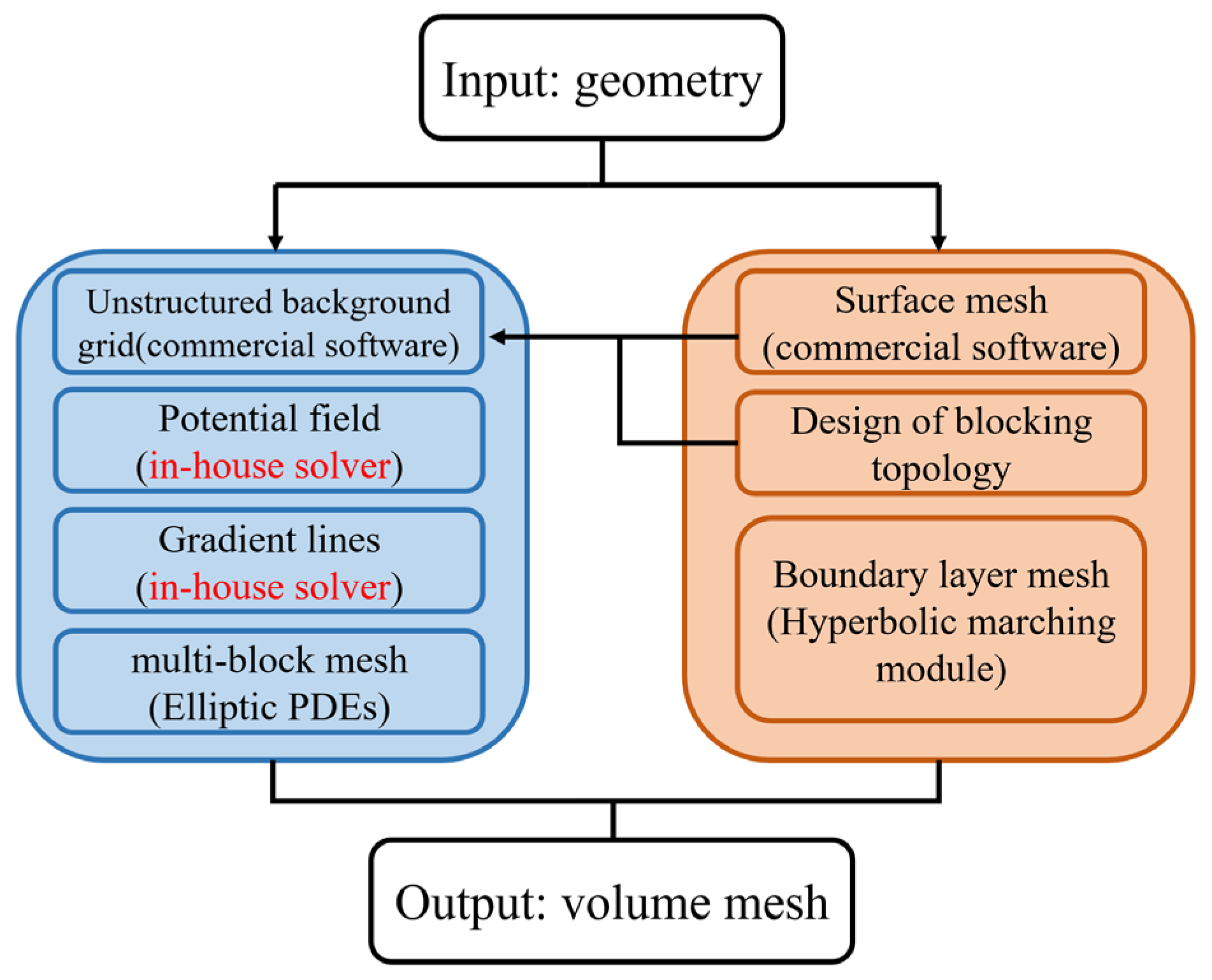
The workflow of the proposed method is illustrated in Figure 1. The overall process integrates commercial software tools with several self-developed algorithm modules, whose respective contributions are explicitly clarified below.
Step 1—Boundary layer mesh generation: The surface mesh is first generated using commercial software. This surface mesh is a block-structured grid, manually decomposed according to geometric features such as corners, edges, and curvature. Based on this surface mesh, a hyperbolic marching module is employed to advance in the direction normal to the surface, producing the boundary layer mesh. The key contribution of this step lies in the hyperbolic solver, which ensures high orthogonality and controlled spacing near walls.
Step 2—Potential function setup and solution: A topology is designed by defining the computational domain and boundary conditions for the potential function. An unstructured mesh is generated within this domain using commercial software. The potential function is then computed using a self-developed finite volume solver, which solves the Laplace equation on the unstructured mesh. This solver is one core contribution of this work, as it provides the potential field whose gradient lines are subsequently used for block partitioning.
Step 3—Gradient line computation and block partitioning: Another core contribution of this work is introduced in this step. Gradient lines originating from the vertices of the outermost boundary mesh layer are computed using a self-developed gradient tracing algorithm. These gradient lines are then used to partition the computational domain into multiple blocks.
Step 4—Structured grid generation within blocks: Finally, structured grids are generated within each block by combining hyperbolic and elliptic generation techniques. The hyperbolic method ensures orthogonal growth of the boundary layer mesh, while the elliptic solver improves mesh smoothness and orthogonality within each block.
In summary, the proposed workflow achieves integration of commercial tools or open-source software (for surface mesh, background unstructured mesh and hyperbolic boundary layer marching) with self-developed modules (for gradient line tracing, block partitioning, and combined hyperbolic-elliptic volume grid generation). The self-developed solvers play a distinct role in topology design and mesh quality improvement, thereby enhancing overall efficiency and robustness.

2.1. Boundary Layer Mesh Generation

Based on the geometric features of the model surface, a multi-block structured surface mesh was generated using the mesh generation software NNW-GridStar (version 2.14) [10]. For complex configurations, the gradient values of the potential function near concave regions can be very small, amplifying relative errors and potentially causing gradient directions to deviate from theoretical values, which may lead to spiraling gradient lines. To overcome this issue, boundary layer grids are generated beforehand, i.e., marched outward from the surface mesh in the direction normal to the wall.
The open-source software package pyHyp (version 2.6.2) [33] is employed for boundary layer mesh generation in this study. The governing equations for grid generation are hyperbolic PDEs based on orthogonality conditions and specified local cell volume [34,35,36]:
r ξ · r ζ = 0 r η · r ζ = 0 r ξ × r η · r ζ = V
where r = ( x , y , z ) is the position vector of a grid node, and ξ, η, ζ are the generalized coordinates in the three directions. ∆V represents the user-specified local cell volume. Equation (1) is linearized locally, yielding:
I + A δ ξ I + B δ η r l + 1 r l = C 0 1 e
where A = C 0 1 A 0 , B = C 0 1 B 0 , A 0 = r ζ 0 r η × r ζ 0 T , B 0 = 0 r ζ r ζ × r ξ 0 T , C 0 = r ξ r η r ξ × r η 0 T , e = 0 0 V 0 T . The subscript 0 denotes the initial grid layer, and I is the identity matrix. To ensure smoothness in the generated grid, artificial dissipation terms are added to Equation (2), and a finite difference method is applied, resulting in:
I + A δ ξ ε i ξ ξ I + B δ η ε i η η r l + 1 r l = C 0 1 e ε e ξ ξ + ε e η η r l
Using indices j , k , l corresponding to ξ , η , ζ , respectively, and taking the ξ direction as an example, δ ξ r = 0.5 · r j + 1 r j 1 , ξ r = r j + 1 2 r j + r j 1 . The coefficient ε i ξ controls the global smoothing effect, and its value is usually about twice that of ε e ξ . To account for the dissipation effect at different grid locations, ε e ξ is computed using the following formula:
ε e ξ = ε e R ξ N ξ
where ε e is a user-specified dissipation parameter, N ξ is a parameter reflecting the local grid scale, and R ξ adjusts the dissipation according to the local grid topology, with its specific formulation given in [35]. In practice, the selection of the local cell volume Δ V and the dissipation parameter ε e follows several well-established empirical guidelines.
First, the local cell volume is typically defined as Δ V = Δ s Δ A , where Δ A is the area of the surface element, and Δ s is the user-defined normal spacing. It is common to define Δ s using an exponential or hyperbolic tangent stretching function to refine the mesh near walls. For most aerodynamic applications, a stretching ratio of 1.1–1.2 is used. Additionally, averaging the volume in the ξ and η directions (e.g., using a smoothing coefficient of 0.16) can prevent excessive clustering of the initial surface mesh from propagating too far into the far field.
Regarding the dissipation parameter ε e , as suggested in [33], for most convex geometries, an explicit dissipation coefficient of ε e = 0.5 to 1.0 works well. However, for geometries with strong concave features, larger dissipation ( ε e 2 to 4) may be required to prevent grid line crossing. For sharp convex corners (e.g., trailing edges), a smaller dissipation ( ε e 0.1 to 0.3) helps preserve orthogonality near the wall. In practice, users may start with a moderate value (e.g., ε e = 0.5 ) and locally or globally increase the dissipation coefficient if negative-volume cells appear.
The choice of these parameters is somewhat case-dependent, but the high speed of the hyperbolic solver allows users to quickly adjust through trial and error. It should be noted that some level of expertise is still required to correctly interpret mesh quality checks (e.g., positive Jacobians, non-orthogonality).

2.2. Potential Field Solution Method

With the aircraft surface as the inner boundary and the outer boundary set as a sphere or cylinder, a potential field described by the potential function φ is constructed within the computational domain. The Laplace equation for the potential function φ is:
2 φ = 0
Boundary conditions can be of the Dirichlet or Neumann type:
φ = φ 1 φ = 0
An in-house solver is developed to solve Equation (4) using the finite volume method on an unstructured background mesh. The non-orthogonal correction method [37] is adopted in the calculation of the flux on the surface of the control volume to reduce the numerical error arising from grid non-orthogonality. The resulting linear equation system is solved using the AMGCL C++ library (version 1.3.99) [38]. The generation of unstructured mesh is much easier compared to structured mesh. The size of unstructured grid needs to be strictly controlled in concave areas to ensure the accuracy of gradient calculation. However, as the background mesh is used for the generation of the block, the requirement of grid density is generally less stringent than the structured grid used in aerodynamic simulation.
Next, the gradient field φ = ( φ x , φ y , φ z ) is calculated on each node. Assuming a linear variation in φ in the control volume, we have the formulation:
φ · r = φ
where r = ( x , y , z ) is the position vector. In tetrahedral meshes, each node connects to at least four neighboring nodes, resulting in an overdetermined system that is solved using the least squares method. The gradient ( φ ) P at grid node P can be calculated using Equation (6). Once the gradients at all grid nodes within the computational domain are obtained, the gradient at any point can be determined using the inverse distance interpolation method.
The most straightforward grid generation approach would be to compute gradient lines starting from each surface mesh node (referred to as seed points), take these gradient lines as the grid lines in the l-direction, and then construct the grid lines in the j and k directions on the equipotential surfaces orthogonal to the gradient lines. However, this method suffers from practical drawbacks. First, the traced gradient line paths may deviate due to the accumulation of numerical errors. Second, the background mesh size is typically larger than the target structured grid scale, which can lead to intersecting grid lines and distortions of grid surfaces. Therefore, this paper abandons the direct generation of grids via gradient and equipotential lines. Instead, gradient lines are used to partition the computational domain, and structured grids are then generated within each block. The specific procedure is as follows. Starting from the vertices of each quadrilateral on the outermost layer of the boundary layer mesh, gradient lines are traced point by point along the gradient direction until they reach the outer boundary. The tracing equation is:
r j + 1 = φ φ j · s + r j
where r j is the position vector of the upstream point, φ is the gradient at this point, r j + 1 is the position vector of the next point to be located, and s is the marching step. As the boundary layer mesh is typically very thin, the property of the body surface as an equipotential surface, orthogonal to gradient lines, is largely preserved, which benefits the orthogonality of the resulting blocks. In corner regions with discontinuous curvature, such as the junction between a wing and fuselage, the gradient lines tend to follow the angle bisector direction, still providing reasonable blocking results. However, in complex regions, appropriate manual adjustment of the direction of gradient lines is necessary to optimize the local block quality.

2.3. Block Decomposition and Mesh Generation

The entire computational domain is divided into several hexahedral blocks. The base of each hexahedral block corresponds to a single quadrilateral partition from the outermost boundary mesh layer. Its four side edges are defined by the four gradient lines emanating from the vertices of this quadrilateral. The top face is the corresponding quadrilateral partition on the outer boundary, formed by connecting the endpoints of the gradient lines on the outer boundary sequentially.
On the four side faces of a hexahedral block, surface grids are generated based on the discrete points along the gradient lines. To precisely control grid spacing near walls, a hyperbolic tangent distribution function is employed to discretize the gradient lines [39]. Subsequently, the surface grids on the side and top faces of the block are generated by solving elliptic PDEs [40]. The elliptic method is a classic technique in structured grid generation, producing smooth structured grids by mapping the distribution of boundary nodes from the physical domain to the computational domain.
After generating the surface grids, the elliptic PDE method is applied to generate the volume grid within each block.
In summary, this section presents a potential field-based blocking method for multi-block structured mesh generation. However, the current method generates the grid based solely on geometric information and cannot yet adapt the mesh according to flow field features. To integrate this method with adaptive mesh refinement (AMR), a Poisson equation, rather than the Laplace equation, may be used for the potential function, in which the source terms are prescribed based on the error indicators (e.g., gradients of pressure or Mach number) computed from the solution of the flow field using the original grids. Through iterative solution of the potential-field, dynamic block refinement or coarsening can be achieved. In this way, the mesh-density is influenced by both geometric configuration and flow characteristics. This direction represents our next research focus.

3. Mesh Generation Results

3.1. Geometric Model

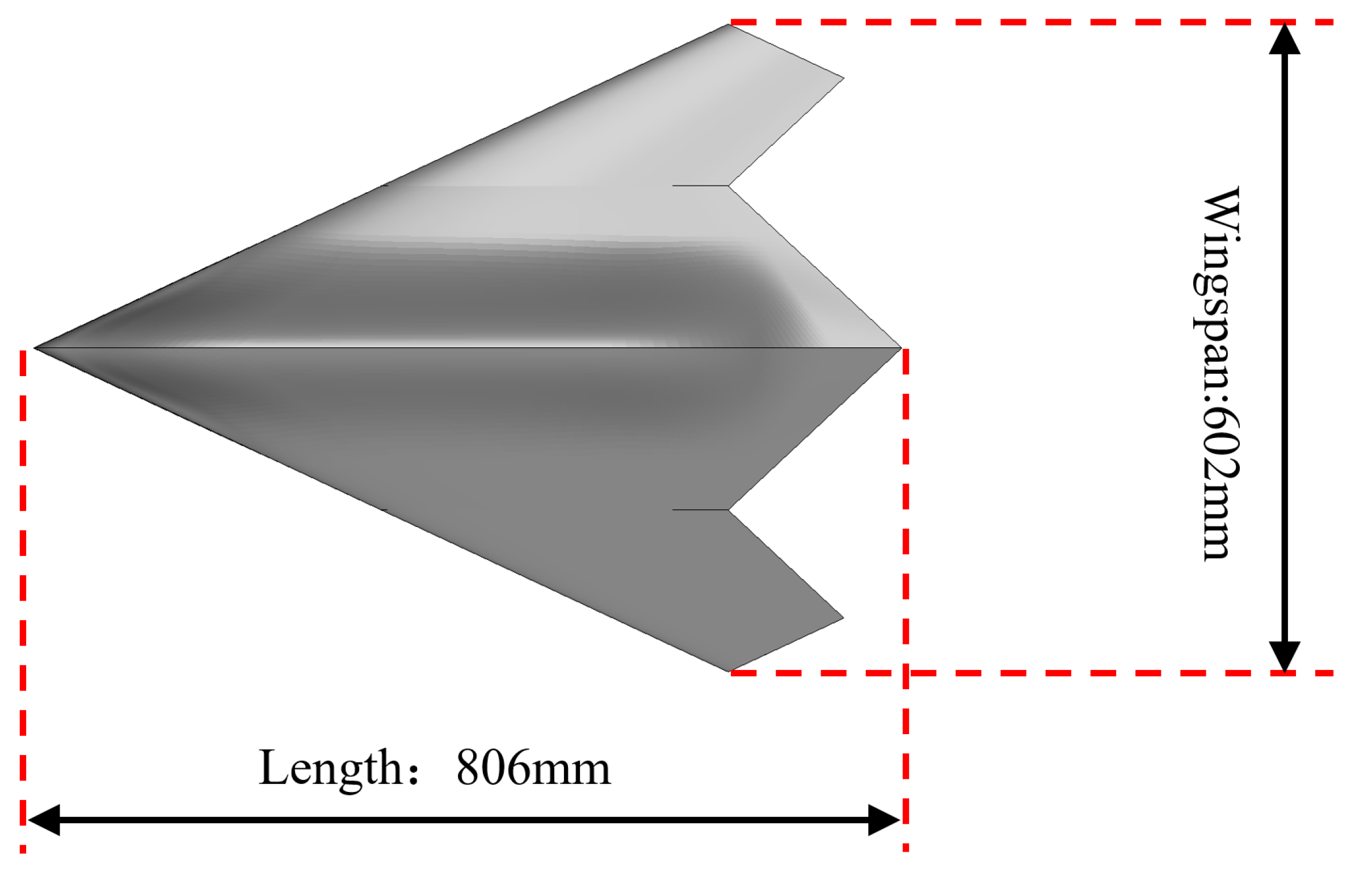
The CHN-F1 model features a flying-wing configuration, integrating the fuselage and wing into a single lifting surface. It is a “tailless all-wing” layout characterized by a large sweep angle, low aspect ratio, and the absence of horizontal and vertical tails. The model has a total length of 806 mm and a wingspan of 602 mm. Figure 2 presents a 3D schematic of the model.
CARDC has conducted force measurement tests on this model at Mach numbers of 0.6, 0.9, and 1.48, covering an angle of attack range from −2° to 28° with good repeatability. These tests provide a reliable benchmark for CFD validation and verification. Currently, the CHN-F1 model is widely used in CFD method validation studies. Its complete geometric data, grid files, and experimental results are publicly accessible to the research community through the National Space Science Data Center platform [41].

3.2. Mesh Generation

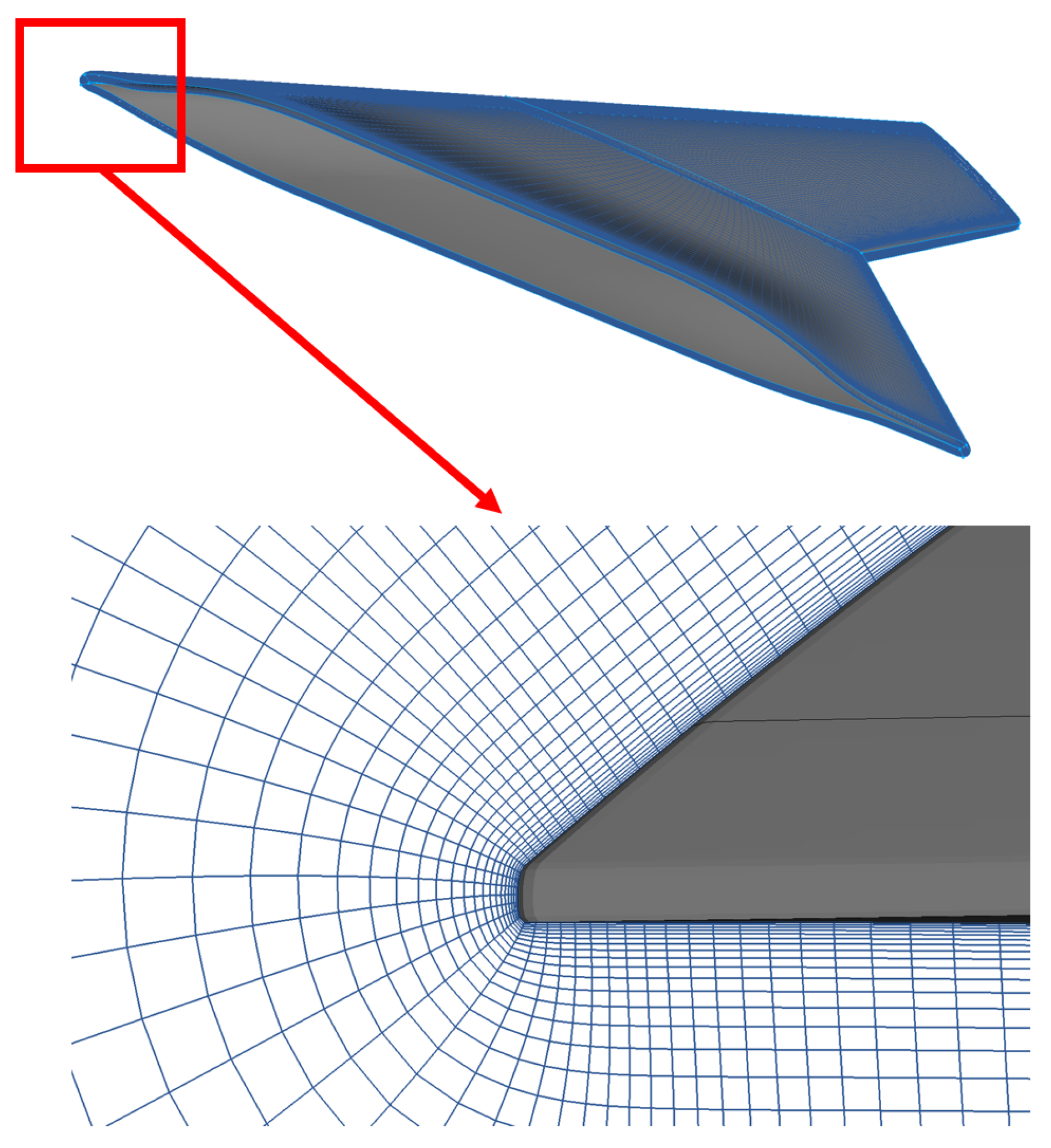
First, a structured surface mesh for the half-model is generated. The surface mesh uses the grid file released by CARDC, comprising 9 blocks with a total of 60,800 quadrilateral elements. The boundary layer mesh generated using the hyperbolic equation method is shown in Figure 3. A detailed view near the model’s nose shows that as the mesh propagates outward, the curvature gradually decreases and the grid lines become progressively smoother.
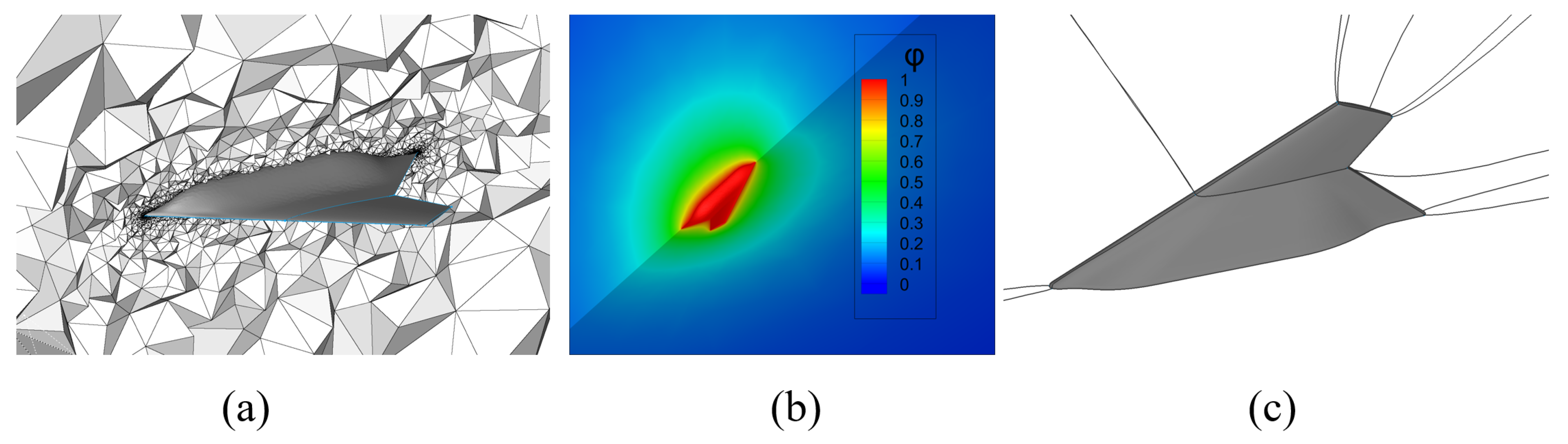
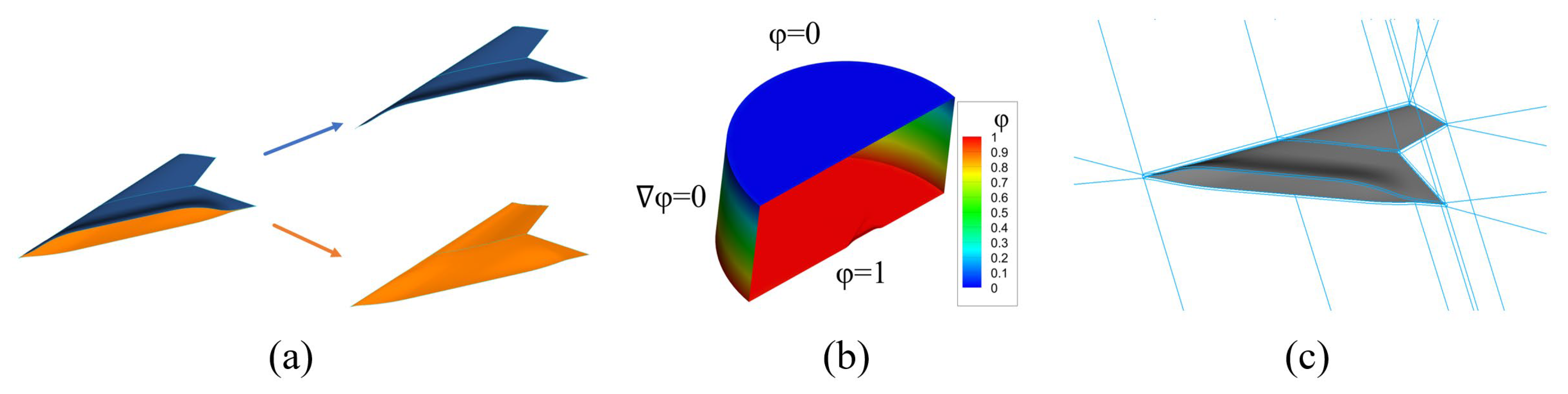
Next, the potential field is computed. By altering the boundary conditions in the potential field calculation, O-type and H-type topologies are designed, as illustrated in Figure 4 and Figure 5, respectively. Figure 4a displays the unstructured mesh used for the potential field calculation. For concave regions, a finer background mesh is required to ensure the accuracy of gradient computation. In this case, the background mesh size is approximately 10 2 m, which is still significantly larger than the first-layer height of the generated structured mesh ( 10 6 m). We found that the variation in the potential field over the scale of 10 2 m is negligible, and the adopted background mesh resolution is sufficient to accurately compute the gradient lines. Figure 4b shows a cut-view of the contours of potential function. The inner boundary (outermost layer of the boundary mesh) is set as an equipotential surface with φ 1 = 1 , and the outer boundary (sphere in the far-field) is set as φ 2 = 0 . The shapes of equipotential surfaces gradually smooth out from the inner boundary towards the spherical shape, creating grid layers that wrap around the body, thus forming an O-type mesh topology in the domain. Figure 4c illustrates the resulting gradient lines.
The computational domain and boundary conditions for the H-type topology are shown in Figure 5. The far-field outer boundary of the computational domain is defined as the surface of a large cylinder. Figure 5a shows that the aircraft surface is divided into upper (blue) and lower (yellow) parts by the central plane. Correspondingly, the computational domain is also split into two sections. Figure 5b illustrates the boundary conditions in the upper computational domain and the potential function contour. Dirichlet boundary conditions ( φ = 0 and φ = 1 ) are applied on the two bottom faces, while a zero-gradient Neumann condition ( φ = 0 ) is applied on the cylindrical lateral surface. Figure 5c displays the calculated gradient lines originating from the model surface and extending upwards to the top face of the cylinder.
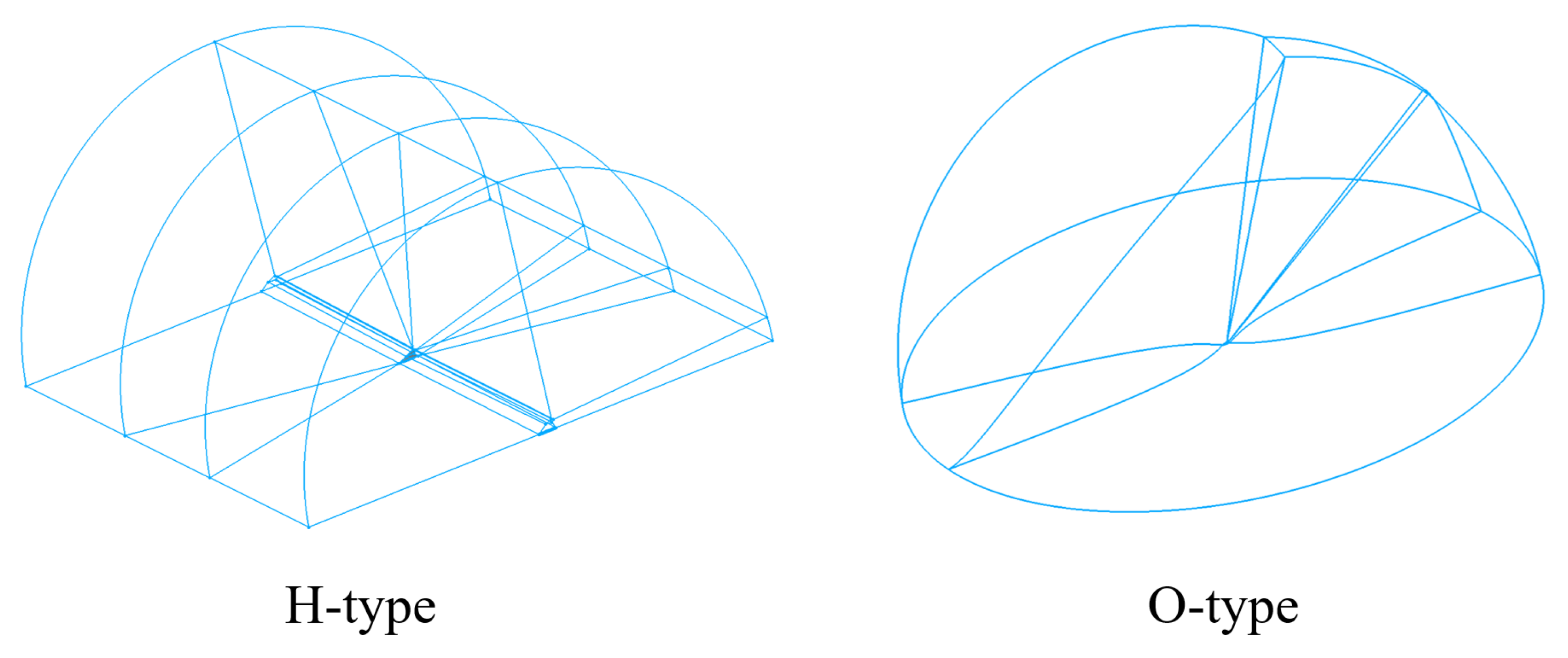
The O-type topology grid consists of 14 blocks, totaling 7,174,400 cells. The H-type topology grid comprises 22 blocks, totaling 7,047,360 cells. The first-layer grid height of both grids is 1.6 × 10⁻⁶ m. The benchmark grid released by CARDC is referred to as the comparison mesh. The comparison mesh employs an O-type topology with a total of 7,296,000 cells and a first-layer height of 1.6 × 10⁻⁶ m.
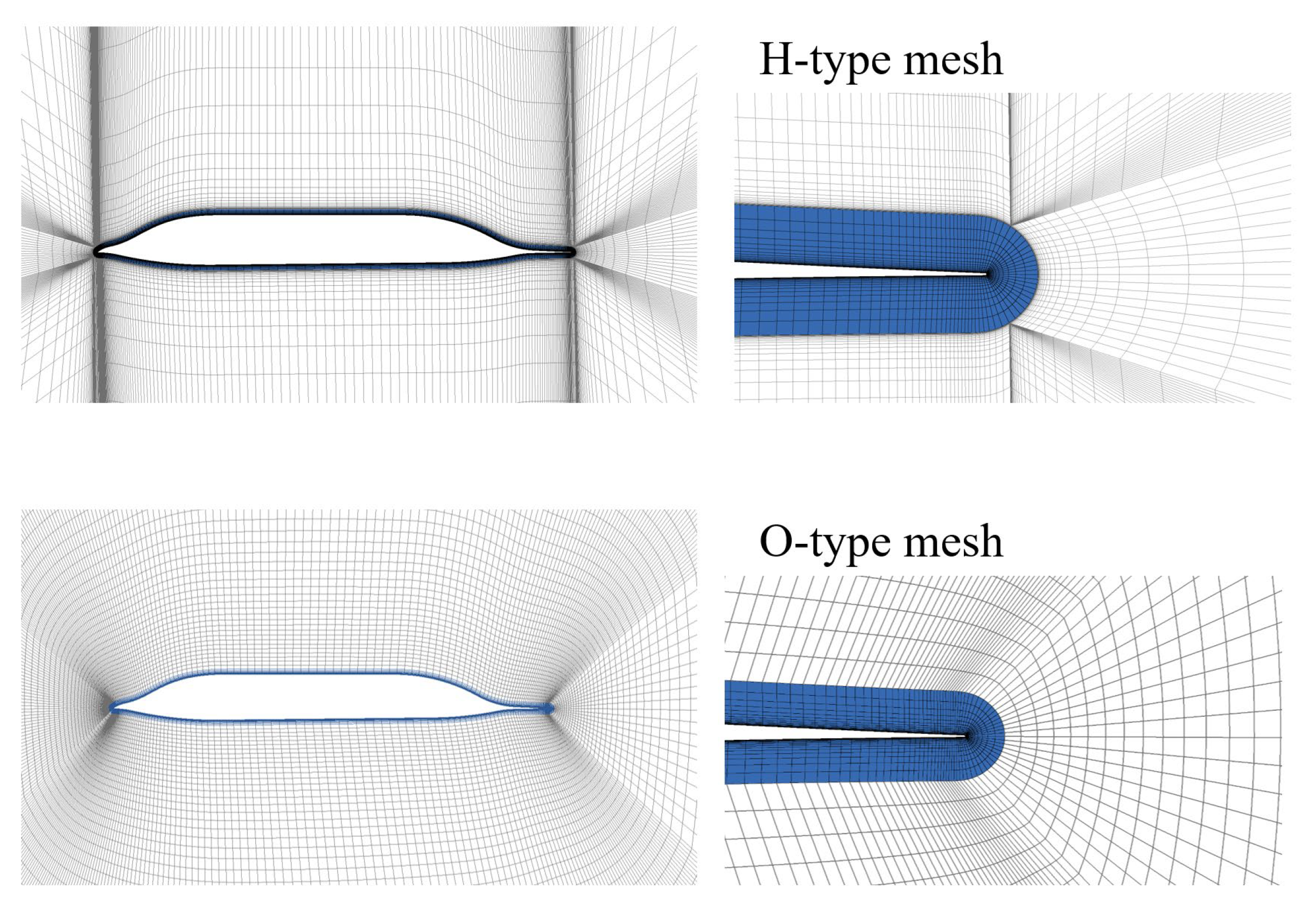
Figure 6 illustrates the topology of the two grids generated in this study. Figure 7 presents cross-sectional grid distributions and details near the trailing edge for both grids, with the boundary layer mesh shown in blue. The O-type mesh exhibits a fully O-type structure, whereas the H-type mesh features H-type meshing at the nose and trailing edge regions. Additionally, the mesh refinement near the boundary in an H-grid topology extends into the far field, potentially leading to unnecessary high aspect ratios in some cells. The O-type mesh avoids this drawback.

3.3. Mesh Quality Analysis

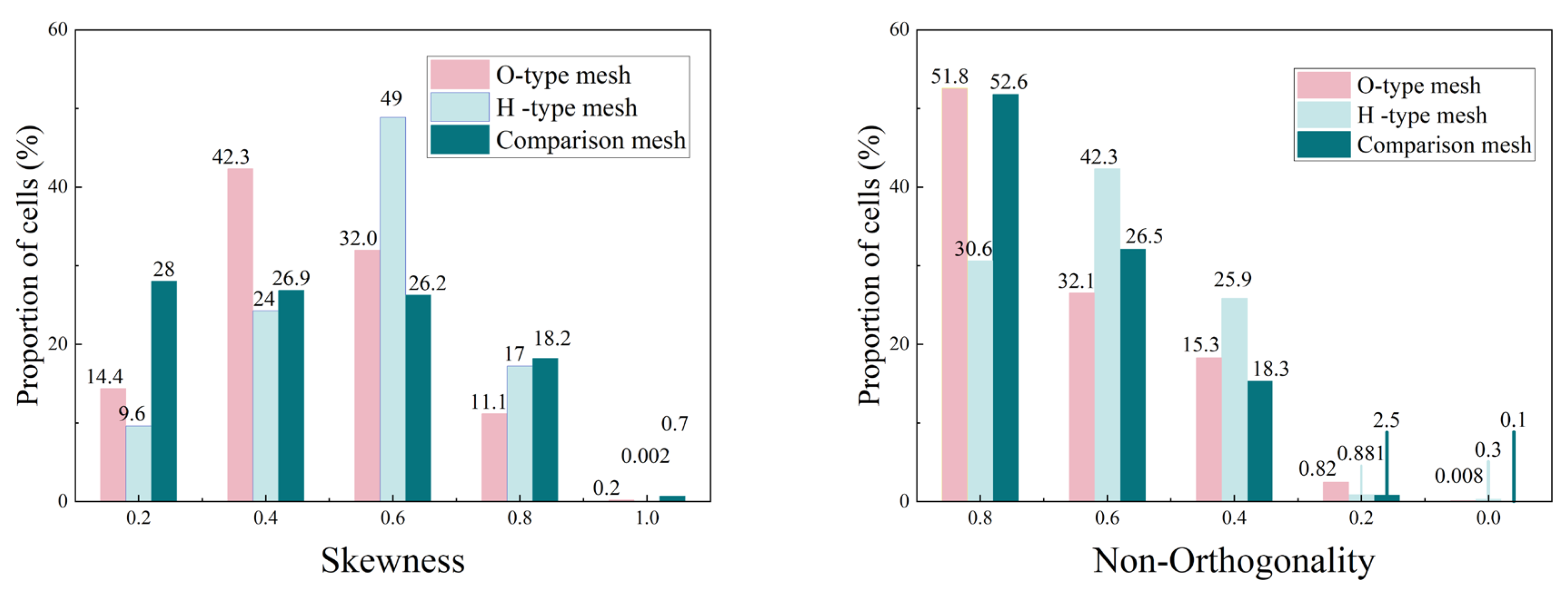
To evaluate grid quality, non-orthogonality and skewness are selected as quality metrics. Both parameters range from 0 to 1. For non-orthogonality, values closer to 0 typically indicate poorer quality, while for skewness, values closer to 1 indicate poorer quality.
The distributions of grid quality parameters are shown in Figure 8. Regarding the skewness distribution, the O-type mesh is primarily concentrated below 0.4, with the overall distribution skewed towards low skewness values, indicating regular cell shapes and high quality. The H-type mesh has the highest percentage of cells (48.86%) in the 0.4–0.6 skewness range, with its overall distribution shifted slightly towards higher skewness compared to the O-type mesh. The comparison mesh shows a more uniform skewness distribution, with a notably high percentage (28.03%) in the excellent 0–0.2 range, outperforming both O-type and H-type mesh in this category. However, its percentage in the poor 0.8–1.0 range (0.65%) is slightly higher than that of the O-type (0.23%) and H-type (0.002%) grids, indicating the presence of a few low-quality cells.
In terms of non-orthogonality quality, the O-grid exhibits the best performance. A significant 51.78% of its cells fall within the excellent 0–0.2 range, and 32.10% are in the 0.2–0.4 range, suggesting that the vast majority of cells possess good orthogonality. The H-type mesh has the largest proportion of cells (42.31%) in the 0.4–0.6 range, with the overall distribution shifted towards lower quality compared to the O-type mesh, indicating comparatively poorer orthogonality. The comparison mesh exhibits non-orthogonal quality comparable to the O-type mesh, with 52.57% in the 0–0.2 range and 26.52% in the 0.2–0.4 range. However, its 18.31% in the 0.4–0.6 range is slightly higher than the O-type mesh’s 15.30%.
In summary, the comparison mesh has a high proportion of elements in the low skewness range but contains a small number of highly skewed elements. The O-type mesh demonstrates consistently excellent quality in terms of skewness and non-orthogonality, particularly showing a clear advantage in non-orthogonal quality, benefiting from its fully O-type topology that ensures continuous grid lines wrapping around the body. The H-type mesh exhibits good overall quality but is slightly inferior to the O-type mesh in terms of orthogonality and skewness. Overall, all three grids meet the quality requirements for numerical computations.

4. Analysis of Computational Results

4.1. Numerical Methods

Numerical simulations were performed with Fluent software (version 18.0). The Reynolds-Averaged Navier–Stokes (RANS) approach was used to simulate the flow around the model, with the O-type, H-type, and comparison mesh, respectively. A pressure-based coupled solver was employed with a pseudo-transient formulation to accelerate convergence. The convection terms were discretized using a second-order upwind scheme, while the diffusion terms were handled with a central difference scheme, and gradients were evaluated using the node-based Green–Gauss method. The k ω S S T (Shear Stress Transport) turbulence model was selected to simulate turbulent effects, which activates the standard k ω formulation near walls via a blending function and automatically transitions to a k ε behavior in the outer boundary layer and free shear regions, ensuring both near-wall accuracy and far-field stability.
The far-field boundary condition is set as a pressure far-field. The freestream conditions are a Mach number of 0.6, static temperature of 300 K, static pressure of 92,872 Pa, and Reynolds number of R e   =   6.12 × 10 6 . The aircraft wall is modeled as a no-slip, adiabatic solid wall.

4.2. Grid Independence Validation

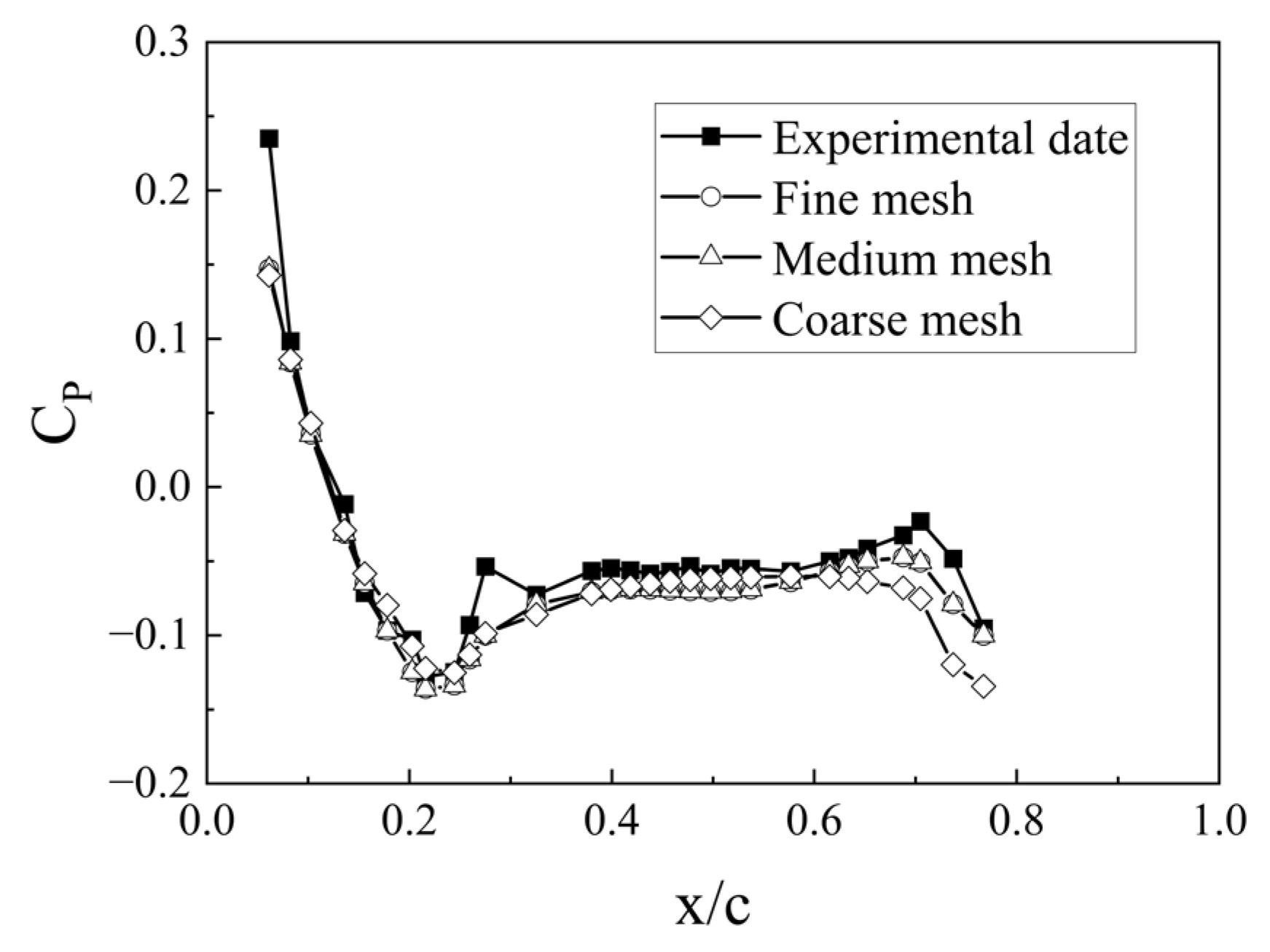
A grid independence study is first conducted. Three O-type meshes with cell counts of approximately 3.3 million, 7.1 million, and 15.0 million are generated. The corresponding first-layer heights are 1.6 × 10⁻⁵ m, 1.6 × 10⁻⁶ m, and 1.6 × 10⁻⁷ m, respectively. A typical operating condition of freestream Ma = 0.6 and angle of attack α = 0° is selected. The pressure coefficient distribution on the lower surface at the symmetry plane ( y = 0 ) is analyzed. Figure 9 presents the results. All three grids show good agreement with experimental data near the leading edge. Further downstream, the results from the medium and fine grids are very similar, while the coarse grid shows noticeable deviations. Based on this, the grid with a first-layer height of 1.6 × 10⁻⁶ m and approximately 7 million cells is selected for subsequent calculations.

4.3. Analysis of Pressure Coefficient Distributions

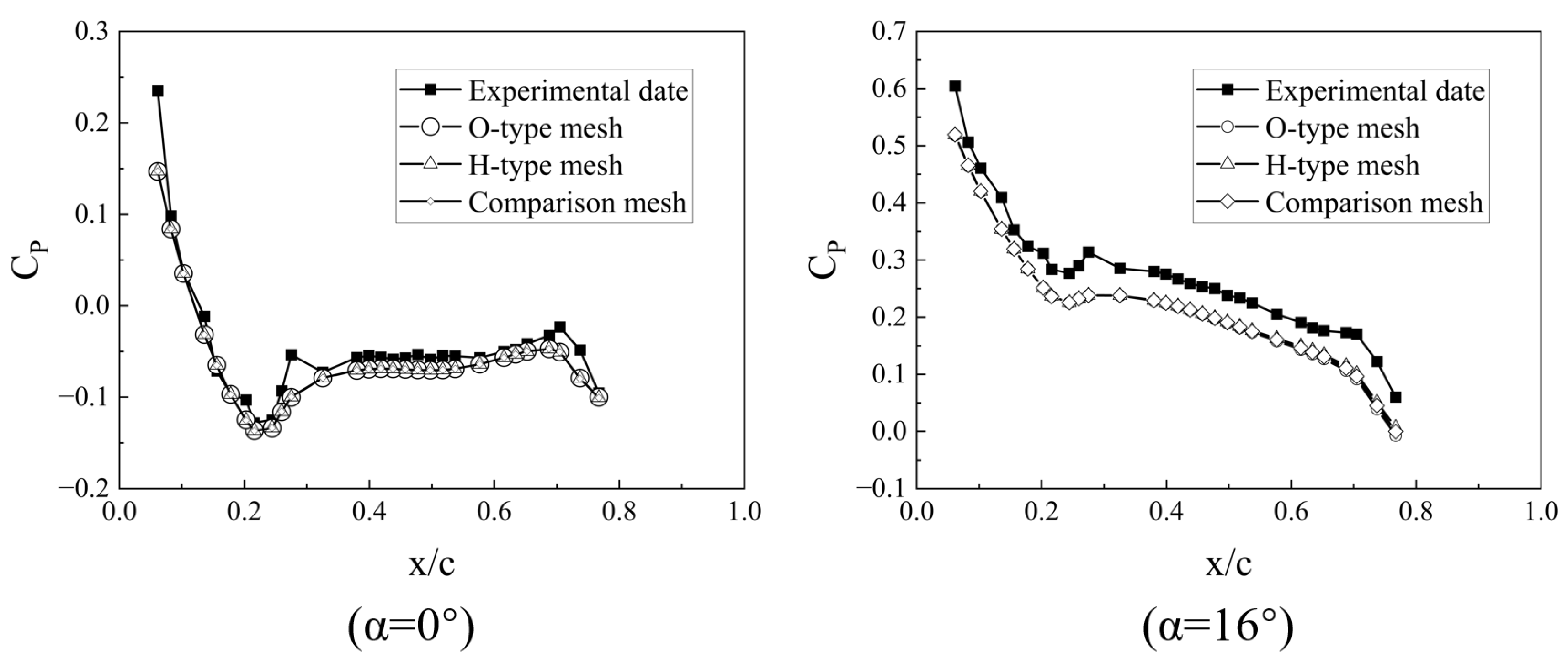
Figure 10 shows the pressure coefficient distributions on the lower surface at the symmetry plane ( y = 0 ) for angles of attack α = 0° and 16°. The x-coordinate is normalized by the chord length c . The computational results exhibit good consistency with experimental data in both magnitude and trend. Furthermore, the differences among the results obtained with the three grids are minimal, indicating that all three grids produce satisfactory aerodynamic predictions and that the results are not overly sensitive to the grid variations. A positive pressure peak appears near the leading edge ( x / c = 0.06 ), followed by a rapid decrease. The pressure becomes negative around x / c = 0.1 , reaching the first negative peak at x / c = 0.2 . Subsequently, the pressure recovers somewhat, approaching zero near x / c = 0.27 , and then decreases again towards the trailing edge. The overall trend shows positive pressure at the leading edge, near-zero pressure in the mid-chord region, and negative pressure aft. As the angle of attack increases to 16°, the pressure coefficient on the lower surface increases overall. The negative pressure in the aft region becomes positive, and the pressure peak at the leading edge rises from approximately 0.23 to 0.6, reflecting the increased loading characteristic at higher angles of attack.
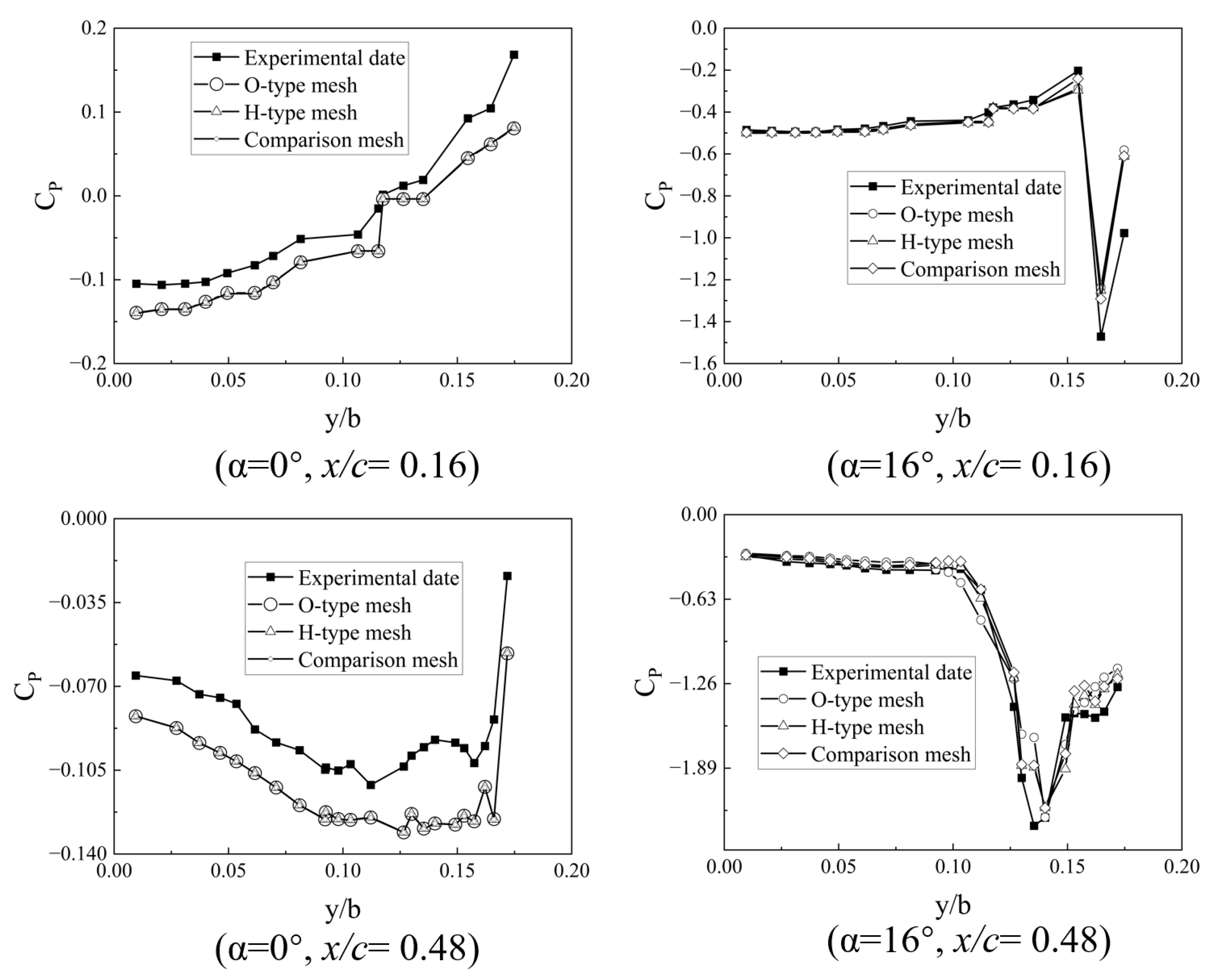
Figure 11 compares the pressure coefficient distributions obtained with the three grids against experimental data on the upper surface at streamwise locations x / c = 0.16 and x / c = 0.48 for α = 0° and 16°. The spanwise coordinate y is normalized by the semi-span b . Overall, the computational results agree well with the experimental data. At α = 0 ° and x / c = 0.16 , the maximum error is approximately 18%. Differences between the three grids are relatively small, with the maximum deviation observed at α = 16 ° and x / c = 0.48 .
The x / c = 0.16 section is located near the leading edge. At α = 0 ° , the pressure coefficient increases gradually along the span, displaying a smooth distribution without noticeable shock features. At α = 16 ° , the upper surface acts as a suction surface, with pressure coefficients below zero. They increase slowly along the span initially as the flow accelerates. Near the spanwise location y / b = 0.17 , the experimental pressure coefficient drops sharply from approximately −0.2 to −1.3, indicating a distinct separation vortex feature. This location corresponds to the leading edge of the wing–body junction, where high-velocity rotation occurs, leading to a sharp local increase in flow speed. Subsequently, the pressure coefficient recovers, and the flow speed decreases. The pressure coefficient distributions at x / c = 0.48 exhibit similar characteristics. Since this section is closer to the trailing edge, a clear shock wave (flow deceleration and pressure increase) is observable on the wing’s upper surface around y / b = 0.53 . At α = 16 ° , a separation vortex is also observed near y / b = 0.57 .
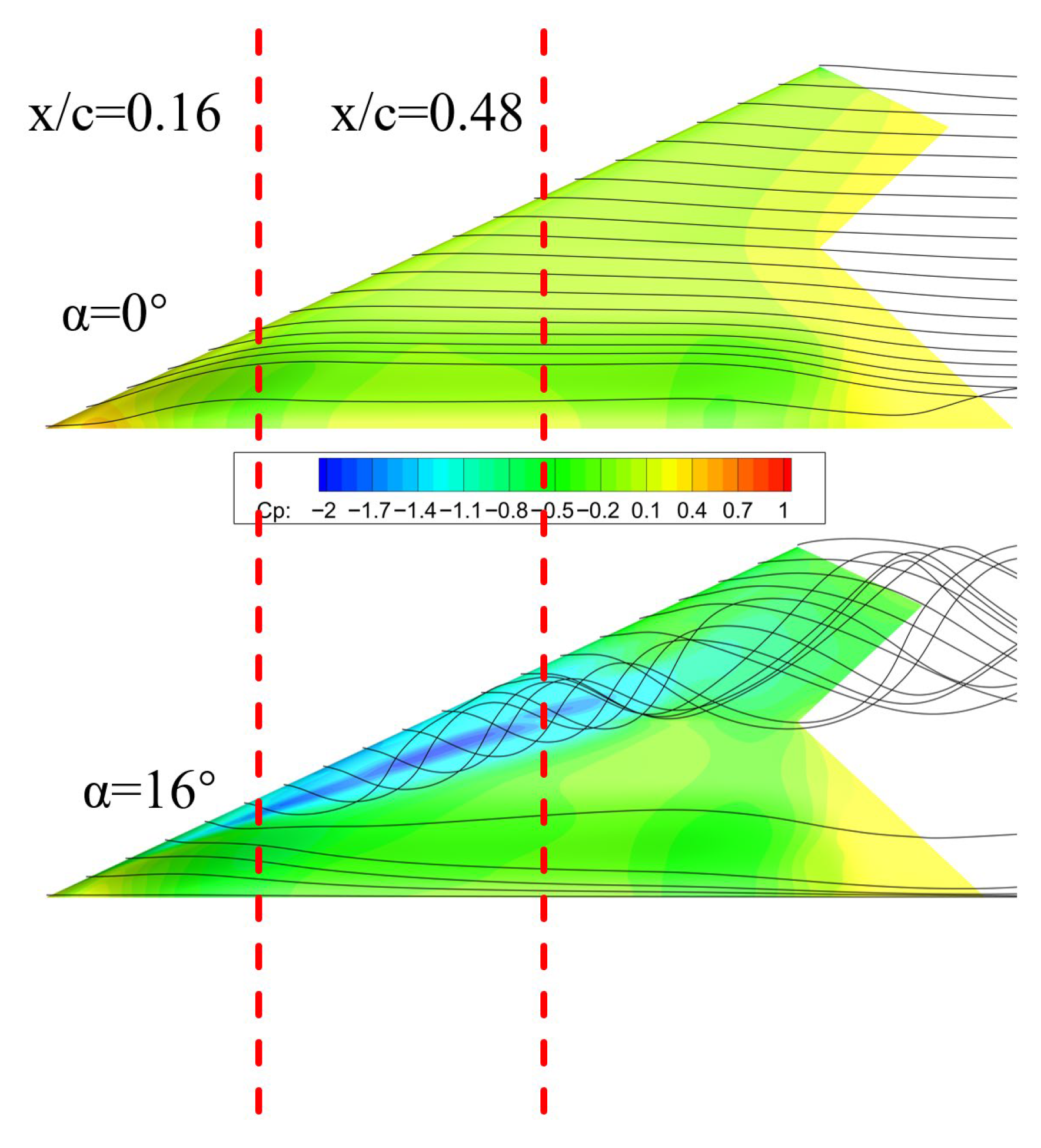
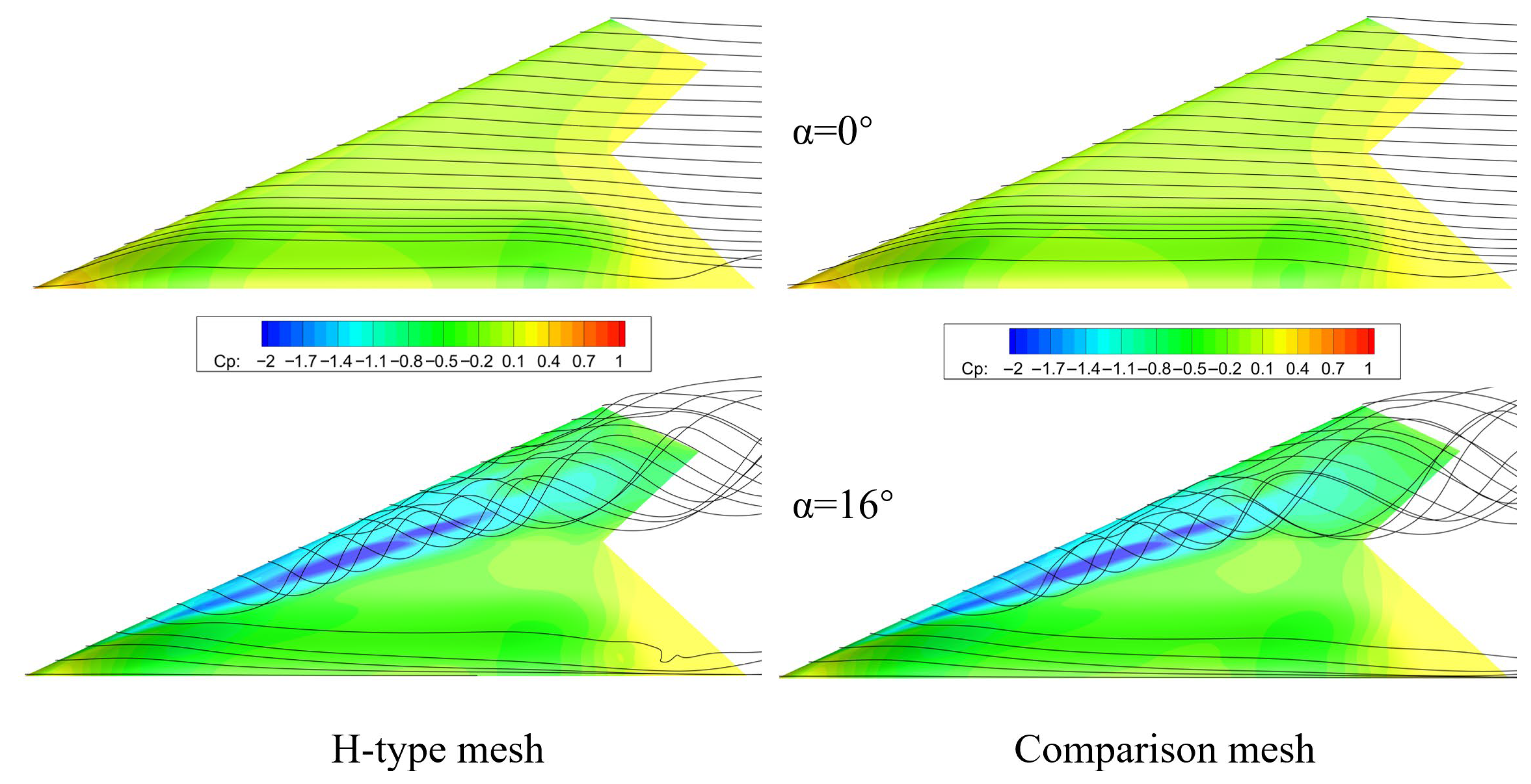
Figure 12 presents the pressure coefficient contours and streamlines computed using the O-type mesh. At α = 16 ° , a separation vortex originates near the apex of the model. It propagates downstream, becoming unstable and eventually breaking down, leading to a high-pressure region in the wake. The depicted vortex cores correspond well with the pressure drops observed at ( x / c = 0.16 , y / b = 0.17 ) and ( x / c = 0.48 , y / b = 0.57 ) in Figure 11. At α = 0 ° , separation is absent, and the pressure rise at x / c = 0.48 is primarily influenced by the shock wave. Figure 13 shows the pressure coefficient contours and streamlines for the H-type and comparison mesh. Both the values and trends are very similar to those obtained with the O-type mesh.
In summary, the computational results from all three grids show generally good agreement with experimental data. At α = 0 ° , the x / c = 0.48 section exhibits clear shock wave features. At α = 16 ° , distinct separation vortices are observable at both analyzed sections.

4.4. Analysis of Lift Coefficient and Pitching Moment Coefficient

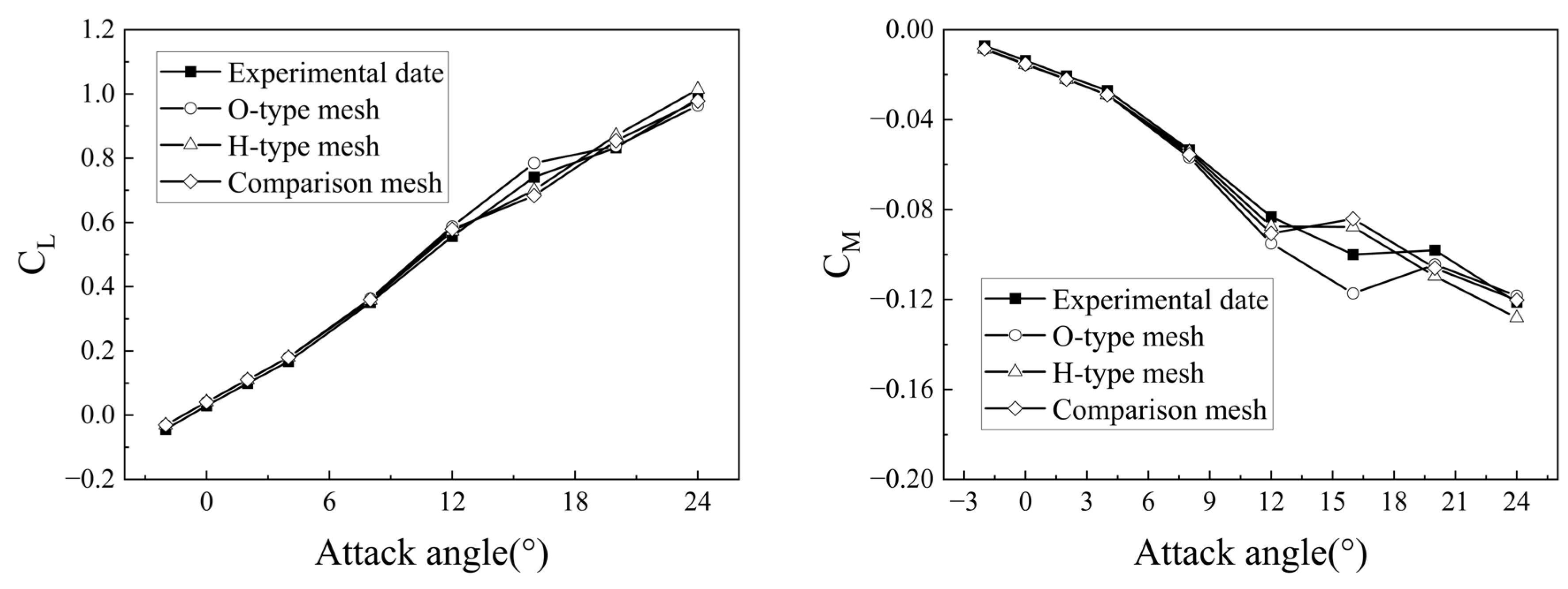
Figure 14 presents the variation in the lift coefficient ( C L ) and pitching moment coefficient ( C M ) with the angle of attack, as computed using the three grids and compared with experimental data. In the low angle of attack range (0° to 4°), C L increases linearly with α . The computational results from all three grids agree well with the experimental values, with a maximum deviation of approximately 0.013 (relative error 8%). As α increases from 4° to 12°, the growth rate of C L gradually decreases. This indicates the onset of separation vortices near the wing leading edge within this α range [42], leading to an enhanced nonlinear lift contribution. At α = 16 ° , the increase in C L becomes most gradual, suggesting that the separation vortices have begun to break down, increasing pressure on the aft portion of the wing and resulting in a lift decrease for the entire aircraft. Comparing the results from the three grids, the O-type mesh shows the closest agreement with the experimental data. The simulation was able to accurately capture the trend of slowed growth in the lift coefficient at a α = 16 ° . In contrast, both the H-type mesh and the comparison mesh predict the slowdown in lift increase at a slightly lower angle of attack than observed experimentally, indicating a somewhat premature prediction of separation vortex effects.
The variation in C M exhibits similar characteristics. In the linear range (0° to 4°), the moment coefficient changes linearly with α . At α = 16°, a distinct nonlinear upward turn occurs due to vortex breakdown. The computational results from the O-type mesh align well with the trend of the experimental data. However, the upward turn phenomenon predicted by the H-type and comparison mesh appears earlier than at 16°, further suggesting that these two grids tend to predict flow separation prematurely.

5. Rocket Sled and V-Tail Aircraft

Different geometric features favor different grid topologies. To validate the proposed method on more configurations and to elucidate the basis for topology selection, the rocket sled and the V-tail aircraft are chosen as additional test cases.
The rocket sled features a body of revolution with no complex concave regions, featuring a regular and smoothly continuous geometry. Its nose is a blunt body with a smoothly curved transition, where the curvature varies gently without sharp edges. These geometric characteristics make this configuration more suitable for O-type grids.
The V-tail configuration is of a blended wing–body type. It consists of a wedge-shaped nose, a mid-fuselage protrusion, a highly swept delta wing with clipped tips, and outward-inclined twin vertical tails. The leading edges, trailing edges, and wingtips are all sharp edges, and these geometric features are well-suited for H-type grids.

5.1. O-Type Topology on a Rocket Sled

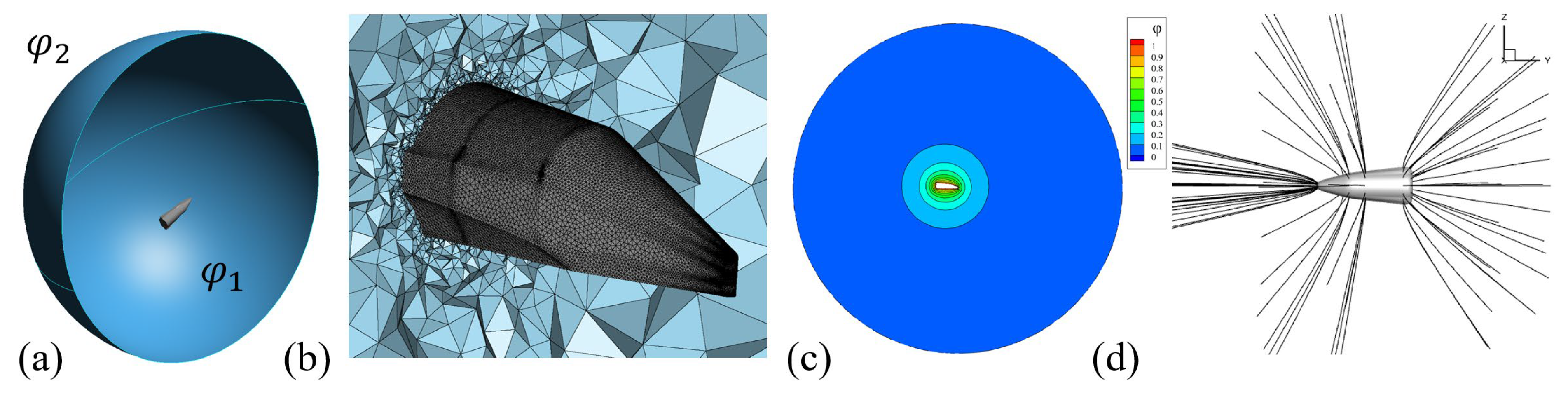
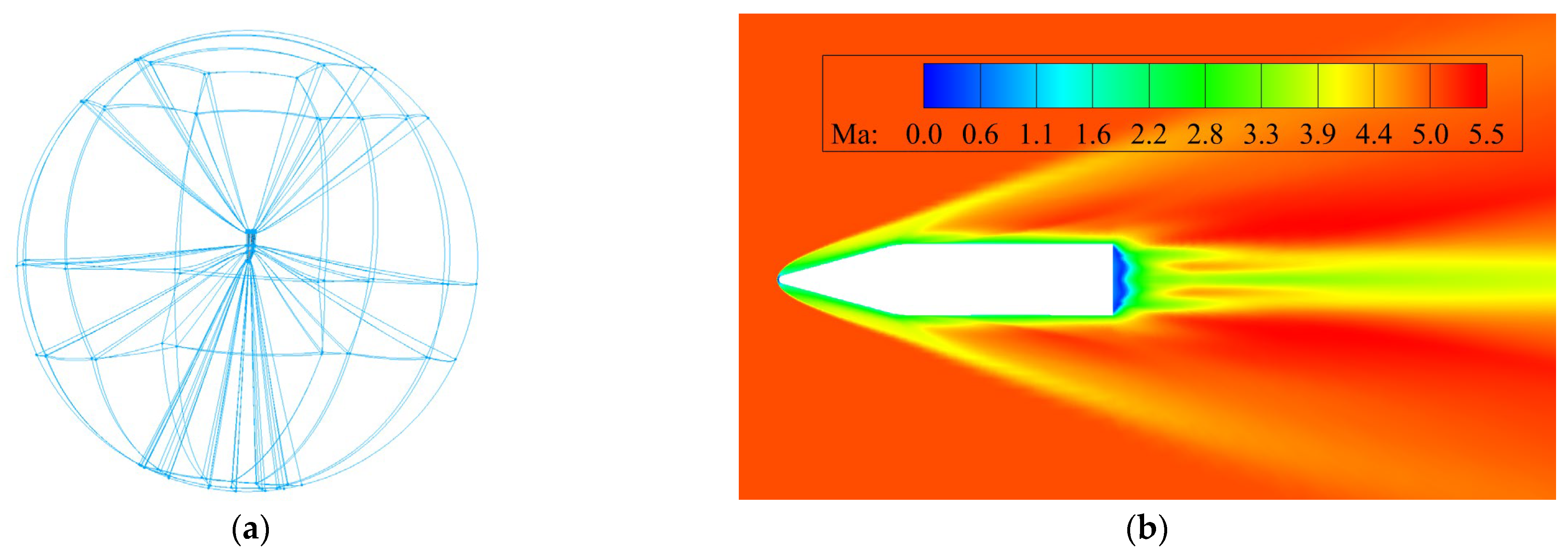
Figure 15 illustrates the block generation method. The computational domain and setup of the boundary conditions are shown in Figure 15a. The inner boundary (aircraft surface) is set as an equipotential surface φ 1 , and the outer boundary (spherical surface in the far field) is an equipotential surface φ 2 . Figure 15b shows a section view of unstructured background mesh for the calculation of the potential field. Figure 15c shows the contours of potential function in the central plane. Figure 15d gives the calculated gradient lines in the potential field. Figure 16 illustrates the mesh topology of the rocket sled model (left) and the Mach number contours on the central cross-section at a freestream Mach number of 5.0 (right).

5.2. H-Type Topology on a V-Tail Aircraft

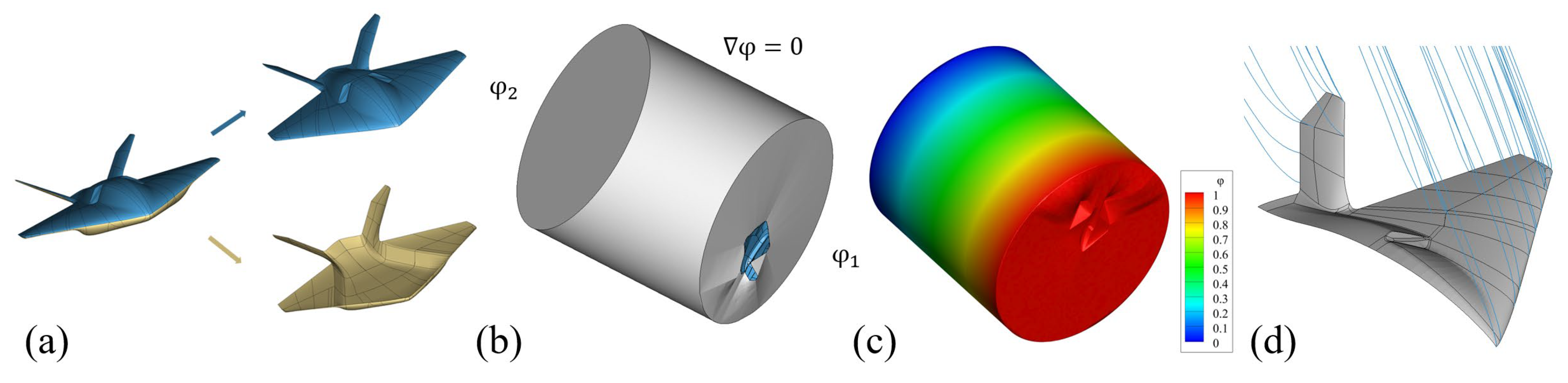
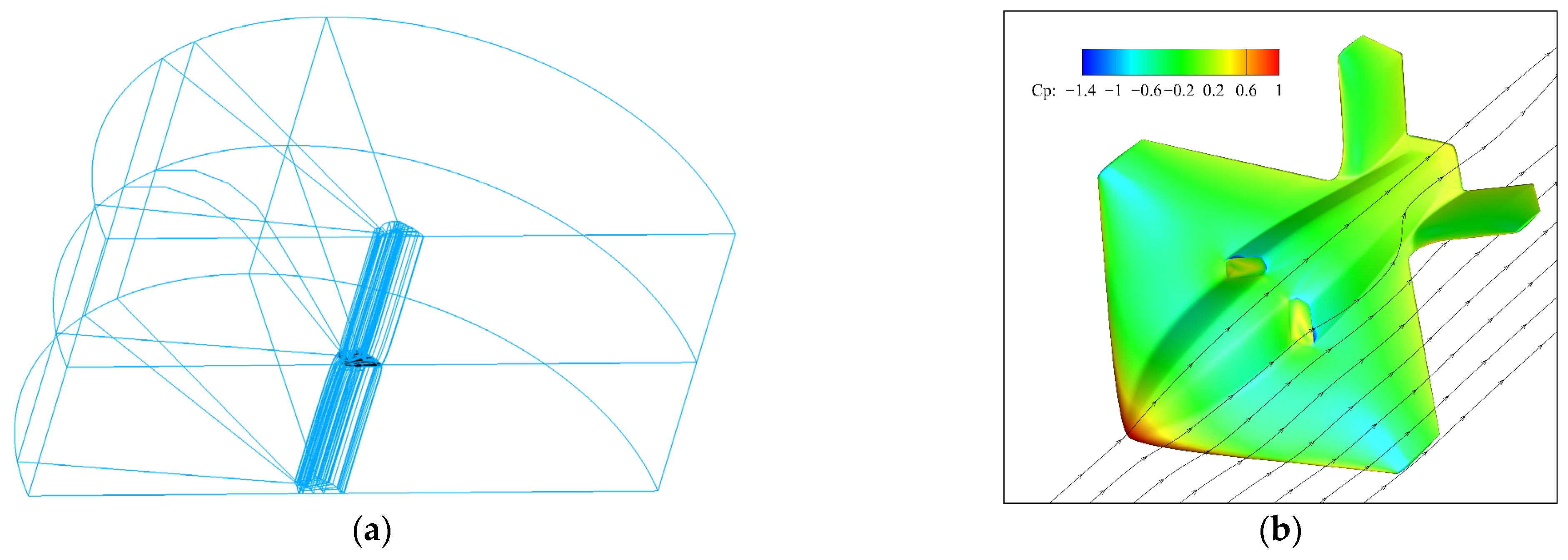
Figure 17 illustrates the generation method of the block topology. The outer boundary of the computational domain is defined as the surface of a large cylinder. Figure 17a shows that the aircraft surface is divided into upper (blue) and lower (yellow) parts by the central plane. Correspondingly, the computational domain is also split into two sections. Figure 17b illustrates the boundary conditions in the upper computational domain. Dirichlet boundary conditions are imposed on the top and bottom surfaces, with potential function values of φ 1 and φ 2 , respectively. On the lateral surface of the cylinder, the Neumann boundary condition with a zero gradient φ = 0 is employed. Figure 17c shows the distribution of the potential field in the upper computational domain by the contours of potential function. Figure 17d gives the local distribution of gradient lines on the upper surface of the aircraft, which are perpendicular to the configuration surface and extend upward to the outer boundary. Figure 18 shows the topology of the model and the contours of the surface pressure coefficient distribution on the aircraft at a freestream Mach number of 0.8.

6. Conclusions

This paper aims to improve the efficiency and quality of structured mesh generation for aircraft with complex configurations. A potential field-based block construction algorithm is proposed, and a corresponding multi-block grid generation workflow is established. The method generates high-quality boundary layer grids employing a hyperbolic PDE approach, computes gradient lines in the potential field to define block boundaries, and finally solves elliptic PDEs to generate smooth structured grids within each block. Both H- and O- type grids of the CHN-F1 flying-wing model are generated with this method, which are compared with the CARDC benchmark grid. In addition, O- and H-type grids are generated for a rocket sled and a V-tail aircraft, respectively. Through the analysis of mesh quality and simulation results, the following conclusions are drawn:
(1)
For the aircraft configurations considered in this study (flying-wing, rocket sled, and V-tail aircraft), the proposed method can reduce manual intervention and generate high-quality multi-block structured grids in a flexible and efficient manner. The claimed efficiency improvement is based on the reduction of user inputs and parameter settings, rather than on a specific time measurement.
(2)
The method can flexibly generate meshes of different topologies adapted to various geometric features. By adjusting the boundary conditions of the potential field, the block boundaries can be effectively controlled, enabling rational decomposition of the computational domain. This demonstrates the method’s flexibility for the configurations tested.
(3)
The meshes generated by this method exhibit good quality, which is attributed to the perpendicular relationship between the gradient lines and equipotential surfaces, thereby enhancing mesh orthogonality. The resulting O-type and H-type grids are of good overall quality and meet the requirements for numerical computations. In the CHN-F1 case, the O-type mesh demonstrates superior performance in terms of orthogonality and skewness compared to the H-type mesh.
(4)
The reliability and validity of the proposed method are further demonstrated by the numerical results obtained for CHN-F1. It is found that the generated grids (O-type and H-type), together with the comparison grid, yield surface pressure coefficient distributions, lift coefficients, and pitching moment coefficients that agree well with experimental data. The O-type mesh provides more accurate predictions for the nonlinear growth of the lift coefficient and the pitch-up of the pitching moment. The H-type and comparison mesh predict flow separation slightly prematurely, but the overall trends are consistent. The computational results for the rocket sled and V-tail aircraft are also reasonable.
However, the robustness of the proposed method has not yet been examined on more complex and realistic aircrafts, such as configurations that include engine nacelles, pylons, and horizontal/vertical tails (e.g., a transport aircraft or a fighter with external stores). And the selection between O-type and H-type topologies is still manually guided by geometric features, rather than being automatically determined based on geometric feature analysis (e.g., curvature, convexity/concavity, and aspect ratio of the bounding box).
Future work includes validation on more complete aircraft configurations, development of automated topology selection strategies via geometric feature analysis, and integration this method with AMR.

Author Contributions

Conceptualization, H.Z. and T.Y.; methodology, H.Z.; software, W.H.; validation, H.Z.; formal analysis, H.Z.; investigation, H.Z.; resources, T.Y.; data curation, H.Z.; writing—original draft preparation, H.Z.; writing—review and editing, M.Z.; visualization, H.Z. All authors have read and agreed to the published version of the manuscript.

Funding

This research received no external funding.

Data Availability Statement

The datasets presented in this article are not readily available because the data are part of an ongoing study. Requests to access the datasets should be directed to zhmm@ustc.edu.cn.

Conflicts of Interest

The authors declare no conflicts of interest.

Abbreviations

The following abbreviations are used in this manuscript:
CFDComputational Fluid Dynamics
PDEsPartial Differential Equations
AMRadaptive mesh refinement

References

  1. Zhang, L. Introduction. In Mesh Generation Techniques in Computational Fluid Dynamics; Springer: Beijing, China, 2017. [Google Scholar][Green Version]
  2. Baker, T.J. Mesh generation: Art or science? Prog. Aerosp. Sci. 2005, 41, 29–63. [Google Scholar] [CrossRef]
  3. Laflin, K.R.; Klausmeyer, S.M.; Zickuhr, T.; Vassberg, J.C.; Wahls, R.A.; Morrison, J.H.; Brodersen, O.P.; Rakowitz, M.E.; Tinoco, E.N.; Godard, J.-L. Data summary from second AIAA computational fluid dynamics drag prediction workshop. J. Aircr. 2005, 42, 1165–1178. [Google Scholar] [CrossRef]
  4. Juretić, F.; Gosman, A.D. Error analysis of the finite-volume method with respect to mesh type. Numer. Heat Transf. 2010, 57, 414–439. [Google Scholar] [CrossRef]
  5. Wang, Z.J.; Fidkowski, K.; Abgrall, R.; Bassi, F.; Caraeni, D.; Cary, A.; Deconinck, H.; Hartmann, R.; Hillewaert, K.; Huynh, H.T.; et al. High-order CFD methods: Current status and perspective. Int. J. Numer. Methods Fluids 2013, 72, 811–845. [Google Scholar] [CrossRef]
  6. Galbraith, M.C.; Karman, S.L. HLPW-4/GMGW-3: High-Order Discretization Technology Focus Group Workshop Summary. J. Aircr. 2023, 60, 13. [Google Scholar] [CrossRef]
  7. Deng, S.; Wang, Y.; Qin, N. Cross-Field Structured Adaptive Mesh Using Medial Axis Flow Feature Extraction. AIAA J. 2024, 62, 247–262. [Google Scholar] [CrossRef]
  8. Svärd, M.; Nordström, J. A stable high-order finite difference scheme for the compressible Navier–Stokes equations: No-slip wall boundary conditions. J. Comput. Phys. 2007, 225, 1020–1038. [Google Scholar] [CrossRef]
  9. Liu, X.; Wang, H.; Wang, G.N. Gridder-HO: Rapid and efficient parallel software for high-order curvilinear mesh generation. Adv. Eng. Softw. 2024, 197, 103739. [Google Scholar] [CrossRef]
  10. Lu, F.; Qi, L.; Jiang, X.; Liu, G.; Liu, Y.; Chen, B.; Pang, Y.; Hu, X. NNW-GridStar: Interactive structured mesh generation software for aircrafts. Adv. Eng. Softw. 2020, 145, 102803. [Google Scholar] [CrossRef]
  11. Tam, T.K.H.; Armstrong, C.G. 2D finite element mesh generation by medial axis subdivision. Adv. Eng. Softw. Workstn. 1991, 13, 313–324. [Google Scholar] [CrossRef]
  12. Zhang, S.; Xu, G.; Wu, H.; Gu, R.; Qi, L.; Pang, Y. Medial hex-meshing: High-quality all-hexahedral mesh generation based on medial mesh. Eng. Comput. 2024, 40, 2537–2557. [Google Scholar] [CrossRef]
  13. Putrayudanto, P.; Lai, J.-Y.; Song, P.-P.; Tsai, Y.-C. Automatic decomposition of protrusion volumes on thin-shell models for hexahedral mesh generation. Eng. Comput. 2024, 40, 3765–3799. [Google Scholar] [CrossRef]
  14. Ali, Z.; Tyacke, J.; Tucker, P.G.; Shahpar, S. Block topology generation for structured multi-block meshing with hierarchical geometry handling. Procedia Eng. 2016, 163, 212–224. [Google Scholar] [CrossRef]
  15. Zhou, J.M.; Shao, K.R.; Zhou, K.D.; Li, L.R. A new approach to automatic quadrilateral mesh generation. IEEE Trans. Magn. 1993, 29, 1910–1913. [Google Scholar] [CrossRef]
  16. Staten, M.L.; Owen, S.J.; Blacker, T.D. Unconstrained Paving & Plastering: A New Idea for All Hexahedral Mesh Generation. In Proceedings of the 14th International Meshing Roundtable; Hanks, B.W., Ed.; Springer: Berlin/Heidelberg, Germany, 2005. [Google Scholar]
  17. Armstrong, C.G.; Fogg, H.J.; Tierney, C.M.; Robinson, T.T. Common themes in multi-block structured quad/hex mesh generation. Procedia Eng. 2015, 124, 70–82. [Google Scholar] [CrossRef]
  18. Kowalski, N.; Ledoux, F.; Frey, P. Automatic domain partitioning for quadrilateral meshing with line constraints. Eng. Comput. 2015, 31, 405–421. [Google Scholar] [CrossRef]
  19. Lv, Y.; Jia, B.; Yan, Y.; Armstrong, C.G.; Robinson, T.T.; Sun, L. Enhanced block-structured quadrilateral mesh generation: Integrating cross-field and distance field for optimal domain decomposition. Eng. Comput. 2025, 41, 1293–1308. [Google Scholar] [CrossRef]
  20. Fogg, H.J.; Armstrong, C.G.; Robinson, T.T. Automatic generation of multiblock decompositions of surfaces. Int. J. Numer. Methods Eng. 2015, 101, 965–991. [Google Scholar] [CrossRef]
  21. Pietroni, N.; Campen, M.; Sheffer, A.; Cherchi, G.; Bommes, D.; Gao, X.; Scateni, R.; Ledoux, F.; Remacle, J.; Livesu, M. Hex-Mesh Generation and Processing: A Survey. ACM Trans. Graph. 2023, 42, 3554920. [Google Scholar] [CrossRef]
  22. Huang, J.; Tong, Y.; Wei, H.; Bao, H. Boundary aligned smooth 3D cross-frame field. Assoc. Comput. Mach. 2011, 30, 1–8. [Google Scholar]
  23. Kowalski, N.; Ledoux, F.; Frey, P. Block-structured hexahedral meshes for CAD models using 3d frame fields. Procedia Eng. 2014, 82, 59–71. [Google Scholar] [CrossRef][Green Version]
  24. Ali, Z.; Tucker, P.G.; Shahpar, S. Optimal mesh topology generation for CFD. Comput. Methods Appl. Mech. Eng. 2017, 317, 431–457. [Google Scholar] [CrossRef]
  25. Li, W.; Meng, D.; Hong, J.; Li, H. Effect of mesh topology on numerical simulation of DLR-F6 configuration. Acta Aeronaut. Astronaut. Sin. 2017, 38, 120177–120183. [Google Scholar]
  26. Gao, F.; Li, Z.; Cao, P.; Liang, Y. CFD Calculation Application Resarch of Transonic Flow Field Around DLR-F6 Wing Body Configuration. Sci. Technol. Eng. 2011, 11, 1671–1815. [Google Scholar]
  27. Liu, Y.; Chang, L.; Guan, X. Study on the influence of grid topology on the calculation of flow around a cylinder. Mach. Des. Manuf. Eng. 2024, 53, 118–122. [Google Scholar]
  28. Syawitri, T.P.; Yao, Y.; Yao, J.; Chandra, B. Assessment of stress-blended eddy simulation model for accurate performance prediction of vertical axis wind turbine. Int. J. Numer. Methods Heat Fluid Flow 2020, 31, 655–673. [Google Scholar] [CrossRef]
  29. Ferfouri, A.; Jerkovi, D.D.; Hristov, N.; Kari, A.V.; Allouche, T. Performance Analysis of Grid Topologies and RANS Turbulence Models in Predicting Aerodynamic Drag Coefficient at Zero-yaw for an Artillery Projectile. J. Appl. Fluid Mech. 2025, 18, 585–600. [Google Scholar] [CrossRef]
  30. Wang, F.; Xie, K.; Liu, J.; Song, Y.; Qin, H.; Chen, L. Unsteady flow and wing rock characteristics of low aspect ratio flying-wing. Acta Aeronaut. Astronaut. Sin. 2023, 44, 126449. [Google Scholar]
  31. Zhang, Y.; Zhou, N.; Chen, J. Numerical investigation of Reynolds number effects on a low-aspect-ratio flying-wing model. Acta Aerodyn. Sin. 2015, 33, 279–288. [Google Scholar]
  32. Li, Y.; Liu, H.; Huang, Y.; Zhong, S.; Su, J. Investigation on the correlation of high-speed force test results of flying-wing calibration model with low-aspect ratio. Acta Aerodyn. Sin. 2016, 34, 107–113,130. [Google Scholar]
  33. Secco, N.R.; Kenway, G.K.W.; He, P.; Mader, C.; Martins, J.R.R.A. Efficient Mesh Generation and Deformation for Aerodynamic Shape Optimization. AIAA J. 2020, 59, 2020. [Google Scholar] [CrossRef]
  34. Ye, H.; Liu, T.; Ni, H.; Chen, J. Robust full-layer prismatic mesh generation based on bijective mapping. J. Comput. Phys. 2025, 524, 113744. [Google Scholar] [CrossRef]
  35. Chan, W.M.; Steger, J.L. Enhancements of a three-dimensional hyperbolic grid generation scheme. Appl. Math. Comput. 1992, 51, 181–205. [Google Scholar] [CrossRef]
  36. Zhang, Q.; Youda, Y.E.; Jiang, Q.; Hao, T. Hyperbolic unstructured grid generation method of three-dimensional complex configuration. Acta Aerodyn. Sin. 2022, 40, 175–185. [Google Scholar]
  37. Noriega, H.; Guibault, F.; Reggio, M.; Magnan, R. A case-study in open-source CFD code verification. Part II: Boundary condition non-orthogonal correction. Math. Comput. Simul. 2018, 147, 172–193. [Google Scholar] [CrossRef]
  38. Demidov, D. AMGCL: An Efficient, Flexible, and Extensible Algebraic Multigrid Implementation. Lobachevskii J. Math. 2019, 40, 535–546. [Google Scholar] [CrossRef]
  39. Vinokur, M. On one-dimensional stretching functions for finite-difference calculations. J. Comput. Phys. 1980, 50, 215–234. [Google Scholar] [CrossRef]
  40. Thomas, P.D.; Middlecoff, J.F. Direct control of the grid point distribution in meshes generated by elliptic equations. AIAA J. 1980, 18, 652–656. [Google Scholar] [CrossRef]
  41. National Space Science Data Center. Available online: https://www.nssdc.ac.cn/ (accessed on 12 March 2026).
  42. Su, J.; Huang, Y.; Zhong, S.; Li, Y. Research on flow characteristics of low-aspect-ratio flying-wing at transonic speed. Acta Aerodyn. Sin. 2015, 33, 307–312. [Google Scholar]
Figure 1. Flowchart for generating a multi-block structured mesh.
Aerospace 13 00389 g001
Figure 2. Configuration of low-aspect-ratio flying-wing model.
Aerospace 13 00389 g002
Figure 3. Boundary layer mesh.
Aerospace 13 00389 g003
Figure 4. O-type block topology design: (a) unstructured mesh, (b) a cut-view of potential function contour, (c) the calculated gradient lines.
Aerospace 13 00389 g004
Figure 5. H-type block topology design, (a) model split, (b) boundary conditions and potential contour, (c) gradient lines.
Aerospace 13 00389 g005
Figure 6. Mesh topology diagram.
Aerospace 13 00389 g006
Figure 7. Cross-sectional grid distribution (top: H-type mesh, bottom: O-type mesh; boundary layer mesh is shown in blue).
Aerospace 13 00389 g007
Figure 8. Histograms of grid quality parameter distributions.
Aerospace 13 00389 g008
Figure 9. Grid independence validation and the comparison of experiment and simulation.
Aerospace 13 00389 g009
Figure 10. Pressure coefficient distribution at y = 0 section.
Aerospace 13 00389 g010
Figure 11. Pressure coefficient distribution at different x / c sections.
Aerospace 13 00389 g011
Figure 12. Pressure coefficient contours and streamlines (O-type mesh).
Aerospace 13 00389 g012
Figure 13. Pressure coefficient contours and streamlines (H-type and comparison mesh).
Aerospace 13 00389 g013
Figure 14. Lift coefficient and pitching moment coefficient vs. angle of attack.
Aerospace 13 00389 g014
Figure 15. Blocking of the rocket sled: (a) a cross-sectional view of the computational domain and boundary conditions, (b) a cross-sectional view of background unstructured grid, (c) the contours of potential function on the central plane, (d) the calculated gradient lines.
Aerospace 13 00389 g015
Figure 16. Application in simulating a rocket sled. (a) Mesh topology of the rocket sled. (b) Mach number contour.
Aerospace 13 00389 g016
Figure 17. Blocking of the V-tail aircraft. (a) Aircraft model (left), sectioned along the central plane into upper (blue) and lower (yellow) halves, (b) boundary conditions in the upper domain, (c) contours of the potential function in the upper domain, (d) computed local gradient lines in the upper domain.
Aerospace 13 00389 g017
Figure 18. Application in simulating a V-tail aircraft. (a) Mesh topology of the V-tail aircraft. (b) Pressure coefficient contour.
Aerospace 13 00389 g018
Disclaimer/Publisher’s Note: The statements, opinions and data contained in all publications are solely those of the individual author(s) and contributor(s) and not of MDPI and/or the editor(s). MDPI and/or the editor(s) disclaim responsibility for any injury to people or property resulting from any ideas, methods, instructions or products referred to in the content.