Editorial

Special Issue “Advanced Aircraft Structural Design and Applications”


1
School of Aeronautics, Northwestern Polytechnical University, Xi’an 710072, China
2
National Key Laboratory of Aircraft Configuration Design, Xi’an 710072, China
3
School of Aeronautics, Harbin Institute of Technology, Harbin 150001, China
*
Author to whom correspondence should be addressed.
Aerospace 2026, 13(4), 385; https://doi.org/10.3390/aerospace13040385
Submission received: 15 April 2026 / Accepted: 16 April 2026 / Published: 19 April 2026
(This article belongs to the Special Issue Advanced Aircraft Structural Design and Applications)
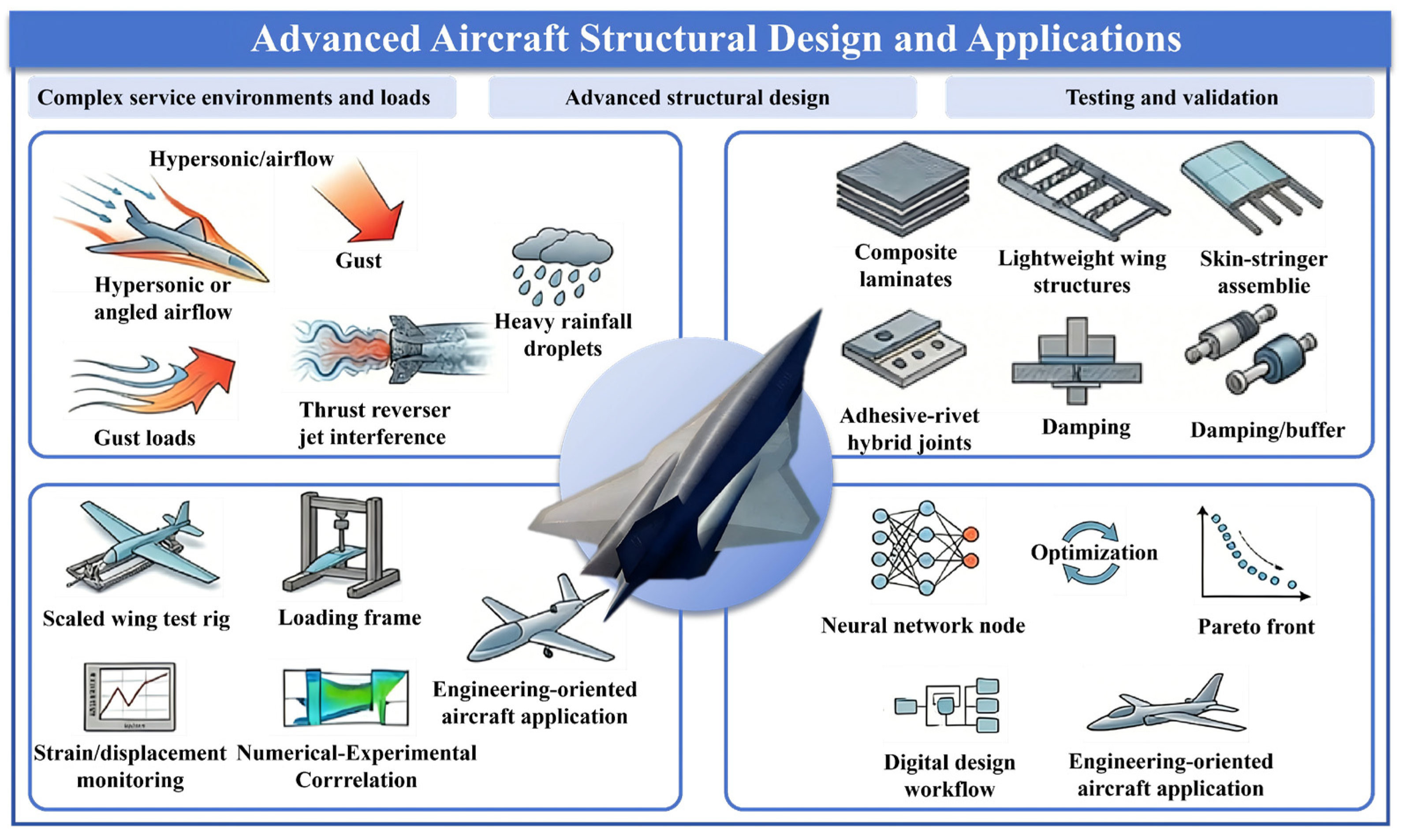
Aircraft structural design is undergoing a profound transformation driven by increasingly demanding requirements in lightweight construction [1], load-bearing efficiency [2], environmental adaptability [3], structural reliability [4], and rapid engineering validation [5]. In modern aerospace systems, structures are no longer treated merely as passive load-carrying components. Instead, they are becoming highly integrated carriers of aerodynamic performance, dynamic stability, mission robustness, and multidisciplinary optimization. This shift is particularly evident in advanced aircraft configurations, where structural design must simultaneously address complex service environments, coupled fluid–structure interactions, manufacturability, and application-oriented verification [6,7,8]. Against this background, this Special Issue, entitled “Advanced Aircraft Structural Design and Applications”, brings together ten contributions that collectively reflect recent progress in structural analysis, design methodology, experimental validation, and intelligent optimization for advanced aircraft systems (Figure 1).
A major theme emerging from this Special Issue is the extension of aircraft structural design toward increasingly complex loading and operating environments. Cao et al. investigated the flutter characteristics of composite laminates in hypersonic yawed flow and demonstrated how stacking sequence, thickness ratio, and fiber orientation affect critical dynamic pressure and limit-cycle oscillation amplitude, providing useful guidance for the structural design of composite panels operating in severe aeroelastic environments [9]. Wall et al. further emphasized the importance of load-environment awareness in structural sizing by studying how gust load design criteria influence the structural weight of a persistent surveillance platform, revealing the trade-off between turbulence robustness and lightweight design in high-altitude long-endurance aircraft [10]. Although approached from different perspectives, both studies highlight a common challenge in advanced aircraft structures: structural configurations must be designed not only for nominal loading conditions, but also for coupled and mission-dependent disturbances that directly affect safety margins and structural efficiency.
Another important direction represented in this collection concerns structural configuration design and joining technologies for practical aircraft applications. Tasdemir et al. examined skin–stringer assemblies made using adhesive bonding, riveting, and hybrid joining methods, showing that adhesive bonding improves initial strength, while rivets enhance residual load-carrying capacity after crack initiation, and that hybrid connections can improve overall structural durability [11]. This contribution is particularly relevant because aircraft structural design increasingly relies on integrated joining strategies to reduce weight, mitigate stress concentration, and improve damage tolerance. In parallel, Huang et al. combined finite-element modeling with a neural network method to predict the stiffness of rubber buffers in light aircraft, demonstrating that data-assisted prediction can improve the design efficiency of structural damping components under multivariable coupling conditions [12]. Together, these studies show that advanced aircraft structural design is expanding beyond primary load-bearing members to include joints, interfaces, and auxiliary structural elements whose performance strongly influences the reliability and functionality of the complete airframe system.
This Special Issue also underlines the growing importance of structural validation and application-oriented testing methodologies. Arhore et al. presented an experimental and numerical investigation of a test rig for structural testing of a full-scale aircraft wing, showing how similitude theory and scaled structural testing can improve feasibility while preserving predictive capability for large-scale structural response [13]. Such work is highly valuable for advanced aircraft development, where full-scale structural testing is often associated with substantial cost, long development cycles, and significant engineering risk. By linking structural similitude, finite-element analysis, and experimental verification, this study reflects a broader trend in the field: aircraft structural design is increasingly inseparable from the development of efficient and credible validation frameworks. In this sense, structural application is not only the final deployment of a design, but also the establishment of reliable testing pathways that connect theoretical design, numerical modeling, and engineering certification.
Several papers in this Special Issue further broaden the scope of aircraft structural design by examining how aerodynamic interference, propulsion integration, and environmental effects reshape structural application requirements. Xi et al. studied a propeller–wing combination configuration under heavy rainfall and quantified the resulting lift loss, drag increase, and moment variation, indicating that structural and configuration design for turboprop aircraft must account for complex meteorological conditions [14]. Jin et al. analyzed the effects of thrust reverser jet-induced interference on flight control surfaces during landing rollout, revealing nonlinear degradation in aerodynamic effectiveness and highlighting the need for robust configuration and structural compatibility in integrated aircraft systems [15]. Pour Razzaghi et al. proposed an aerodynamic–propulsion optimization framework for gas-powered fan VTOL systems, which, although centered on aerodynamic design, also has clear structural implications because integrated nacelle and propulsion configurations directly shape the packaging, weight distribution, and structural layout of VTOL aircraft [16]. These studies collectively remind us that advanced aircraft structural design can no longer be discussed in isolation from the surrounding aerodynamic and propulsion environment. Instead, structural applications increasingly depend on how well the airframe accommodates flow interference, environmental uncertainty, and integrated subsystem interactions.
A further noteworthy feature of this Special Issue is the incorporation of intelligent and optimization-based methods into structural and system design. Ruenruedeepan et al. developed an RBF-learning-based many-objective metaheuristic for robust fixed-structure heading autopilot design, demonstrating the potential of advanced optimization methods for complex aerospace systems [17]. Huang et al., as noted above, used neural-network-assisted prediction to improve the design process for rubber buffer stiffness [12]. Wang et al. reviewed recent progress in AI-based intelligent air confrontation technology test and verification frameworks, and although their focus lies at the system level, the work is still relevant to the broader theme of this Special Issue because advanced structural applications increasingly require intelligent testing, digital integration, and rapid verification platforms [18]. These contributions suggest that the future of aircraft structural design will not rely solely on improved materials or refined geometric layouts, but also on the growing fusion of physical modeling, data-driven prediction, and intelligent engineering workflows.
Overall, the papers collected in this Special Issue demonstrate that advanced aircraft structural design is evolving along three closely connected directions: first, toward higher fidelity in capturing structural behavior under complex aerodynamic, gust, and environmental loads; second, toward more application-oriented design of structural assemblies, interfaces, and supporting components; and third, toward tighter integration between design, validation, and intelligent optimization. Although the topics covered in this Special Issue range from hypersonic composite flutter and gust-driven structural sizing to wing-test similitude, hybrid joining, buffer stiffness prediction, rain-affected configurations, thrust-reverser interference, and intelligent optimization, they all contribute to a common objective: enabling aircraft structures to perform more efficiently, more reliably, and more adaptively in real engineering applications. It is hoped that this Special Issue will further stimulate research on the design methodologies, validation technologies, and application scenarios that define the next generation of advanced aircraft structures.

Author Contributions

Conceptualization, H.H., L.Y. and M.Z.; writing—original draft preparation, H.H.; writing—review and editing, H.H., L.Y. and M.Z.; supervision, H.H.; project administration, H.H. All authors have read and agreed to the published version of the manuscript.

Funding

This research received no external funding.

Data Availability Statement

No new data were created or analyzed in this study. Data sharing is not applicable to this article.

Acknowledgments

The Guest Editors would like to thank all the authors for their valuable contributions to this Special Issue. We also sincerely thank the reviewers for their careful evaluations and constructive comments, which helped to maintain the scientific quality of the published papers. In addition, we gratefully acknowledge the editorial office of Aerospace for its professional support throughout the editorial process.

Conflicts of Interest

The authors declare no conflicts of interest.

References

  1. Yan, J.; Dong, Z.; Jia, B.; Zhu, S.; Li, G.; Zheng, Y.; Huang, H. Thermal-Mechanical Coupling Performance of Heat-Resistant, High-Strength and Printable Al-Si Alloy Antisymmetric Lattice Structure. Adv. Sci. 2024, 11, 2407107. [Google Scholar] [CrossRef] [PubMed]
  2. Chen, J.; Dai, Y.; Jia, B.; Zheng, Y.; Huang, H. Effect of Forced Assembly Gap on the Fatigue Behavior of Aluminium Alloy Multi-Bolted Joints under Random Loading. Int. J. Fatigue 2026, 203, 109344. [Google Scholar] [CrossRef]
  3. Ren, X.; Dai, Y.; Dong, Z.; Jia, B.; Niu, M.; Zhao, M.; Huang, H. Investigation on Mechanical Behavior and Damage Mechanism of T1000/Bmi Composite Bolted Joints under Thermomechanical Cycling of −80 °C∼80 °C. Compos. Part B: Eng. 2026, 311, 113261. [Google Scholar] [CrossRef]
  4. Dong, Z.; Cheng, W.; He, Y.; Jia, B.; Wan, X.; Huang, H. A Janus-Like Bio-Inspired Strategy for 3d-Printed Bimetallic Metamaterials with Excellent Thermal-Protection and Load Bearing Capacity. Adv. Sci. 2026, 13, e24116. [Google Scholar] [CrossRef]
  5. Yan, J.; Gao, Y.; Xiang, S.; Zhan, J.; Jin, L.; Huang, H. A Strategy for 3d Printed Al-Based Bi-Material Lattice Optimization: Thermal-Mechanical Coupling Performance with Load-Bearing and Energy-Absorption. Adv. Funct. Mater. 2026, 36, e21424. [Google Scholar] [CrossRef]
  6. Huang, H.; Liu, Y.; Zhan, J.; Jia, B.; Dong, Z.; Zhao, M.; Liu, Y.; Li, B. Recent Progress of Ai in Cfrp: From Design and Manufacturing to Structural Health Monitoring. Thin-Walled Struct. 2026, 226, 114936. [Google Scholar] [CrossRef]
  7. Ren, X.; Dai, Y.; Dong, Z.; Jia, B.; Zhao, M.; Huang, H. Mechanical Property and Failure Characteristic of Cfrp Composite Bolted Structure Ranging from −55 °C to 150 °C. Thin-Walled Struct. 2025, 217, 113787. [Google Scholar] [CrossRef]
  8. Cao, E.; Dong, Z.; Jia, B.; Huang, H. Inverse Design of Isotropic Auxetic Metamaterials Via a Data-Driven Strategy. Mater. Horiz. 2025, 12, 4884–4900. [Google Scholar] [CrossRef] [PubMed]
  9. Cao, S.; Guo, T.; Wu, J.; Zhou, D.; Shen, E. Analysis of Flutter Characteristics for Composite Laminates in Hypersonic Yawed Flow. Aerospace 2025, 12, 174. [Google Scholar] [CrossRef]
  10. Wall, J.; Krawczyk, Z.; Paul, R. The Impact of Gust Load Design Criteria on Vehicle Structural Weight for a Persistent Surveillance Platform. Aerospace 2025, 12, 209. [Google Scholar] [CrossRef]
  11. Tasdemir, H.A.; Mirza, B.A.; Erkendirci, Y.H. Investigation of Skin–Stringer Assembly Made with Adhesive and Mechanical Methods on Aircraft. Aerospace 2025, 12, 383. [Google Scholar] [CrossRef]
  12. Huang, Z.; Xiong, X.; Zheng, S.; Ma, H. Integration of Finite Element Method and Neural Network for Enhanced Prediction of Rubber Buffer Stiffness in Light Aircraft. Aerospace 2025, 12, 253. [Google Scholar] [CrossRef]
  13. Arhore, E.G.; Ghasemnejad, H.; Dayyani, I.; Xu, Y.; Halliburton, R.; Hakon, I.; Beckwith, J.; Stanely, F.; Gaskell, J. Experimental and Numerical Analysis of a Test Rig for Structural Testing of a Full-Scale Aircraft Wing. Aerospace 2026, 13, 6. [Google Scholar] [CrossRef]
  14. Xi, L.; Yan, J.; Zuo, Y.; Zhao, M.; Huang, H. Investigation on Aerodynamic Characteristics of Propeller–Wing Combination Configuration under Heavy Rainfall. Aerospace 2025, 12, 975. [Google Scholar] [CrossRef]
  15. Jin, Y.; Yang, G.; Li, S.; Sun, X.; Gao, E.; Zhang, L. Nonlinear Aerodynamic Responses of Flight Control Surfaces to Thrust Reverser Jet-Induced Flow Interference. Aerospace 2025, 12, 705. [Google Scholar] [CrossRef]
  16. Razzaghi, P.; Javad, M.; Huang, G.; Zhu, Y. Integrated Aerodynamic–Propulsion Optimization for Gas-Powered Fan Vtol Systems Via Cfd and Genetic Algorithms. Aerospace 2026, 13, 184. [Google Scholar] [CrossRef]
  17. Ruenruedeepan, N.; Bureerat, S.; Panagant, N.; Pholdee, N. Rbf-Learning-Based Many-Objective Metaheuristic for Robust and Optimal Controller Design in Fixed-Structure Heading Autopilot. Aerospace 2025, 12, 461. [Google Scholar] [CrossRef]
  18. Wang, F.; Chen, B.; Wang, Y.; Pang, Z.; Shao, Z.; Liu, Y.; Huang, H. Recent Progress of Ai-Based Intelligent Air-Confrontation Technology Test and Verification Framework. Aerospace 2025, 12, 959. [Google Scholar] [CrossRef]
Figure 1. Advanced aircraft structural design and applications.
Aerospace 13 00385 g001
Disclaimer/Publisher’s Note: The statements, opinions and data contained in all publications are solely those of the individual author(s) and contributor(s) and not of MDPI and/or the editor(s). MDPI and/or the editor(s) disclaim responsibility for any injury to people or property resulting from any ideas, methods, instructions or products referred to in the content.