


Operational Modal Analysis of Aeronautical Structures via Tangential Interpolation



Abstract
1. Introduction
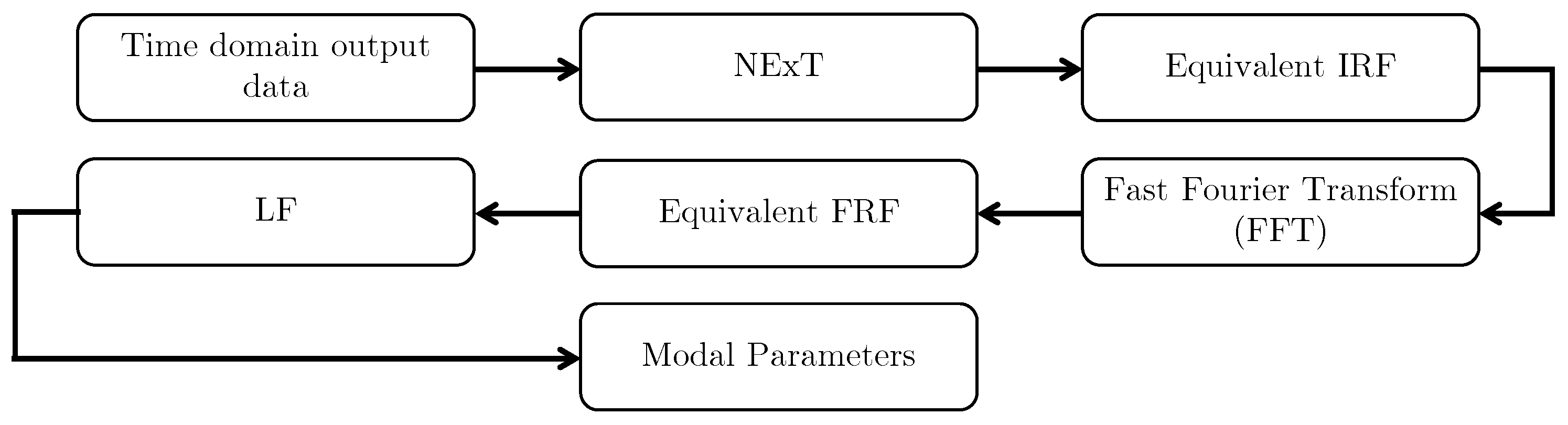
- Section 2 (Methodology) introduces the LF identification procedure, the output-only enabling method (NExT), and their coupling to reach NExT-LF;
- Section 3 (The eXperimental BeaRDS 2 Flexible Wing Spar Model) presents the XB-2 dataset and discusses the corresponding identification results;
- Section 4 (Airbus Helicopters H135 Bearingless Main Rotor Blade) reports the blade dataset and the associated modal identification outcomes;
- Section 5 (Discussion) discusses the main findings, limitations, and practical implications of applying NExT-LF to aeronautical structures;
- Section 6 (Conclusions) summarises the main conclusions and closes this article.
2. Methodology
2.1. Loewner Framework
2.2. Natural Excitation Technique
2.3. NExT-LF
3. The eXperimental BeaRDS 2 Flexible Wing Spar Model
4. Airbus Helicopters H135 Bearingless Main Rotor Blade
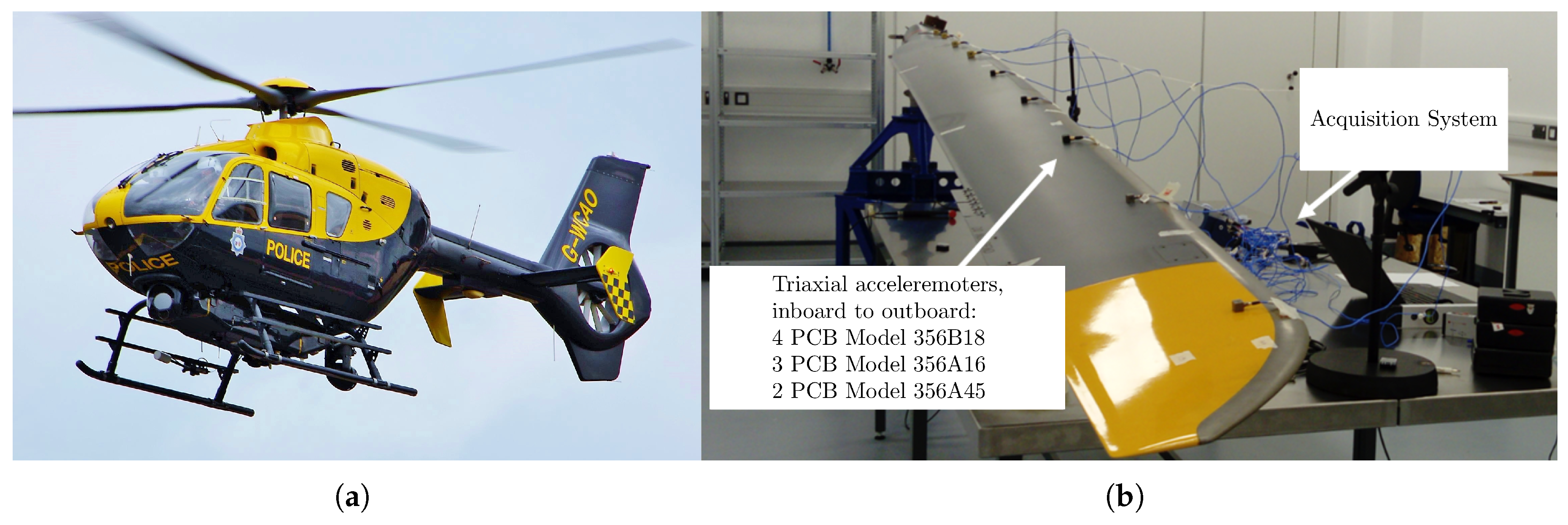
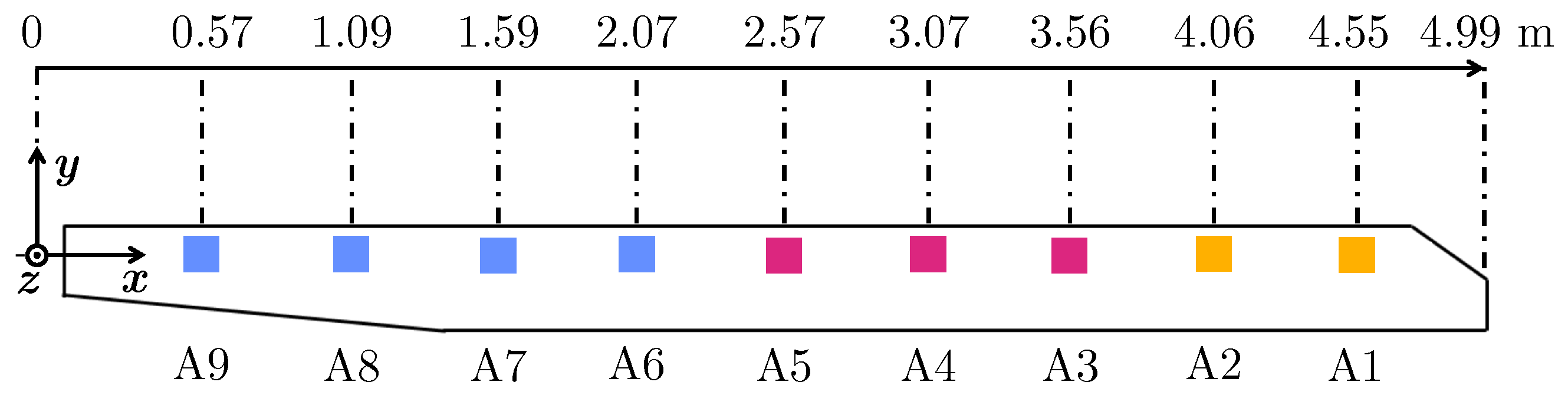
 highlights the 4 PCB Model 356B18 accelerometers used, while
  and
and  identify, respectively, the 3 PCB Model 356A16 and 2 PCB Model 356A45 accelerometers. The use of three different accelerometer models was driven by laboratory availability, rather than by a specific technical requirement; all three types provide adequate sensitivity for the low-amplitude ambient vibrations measured on this BMR blade across the frequency range of interest.
5. Discussion
6. Conclusions
- To the authors’ knowledge, this is the first time in the literature that NExT-LF has been applied for the OMA of aeronautically relevant systems;
- NExT-LF is applied for the OMA of the well-known eXperimental BeaRDS 2 Flexible Wing Spar Model and of an Airbus Helicopters H135 Bearingless Main Rotor Blade;
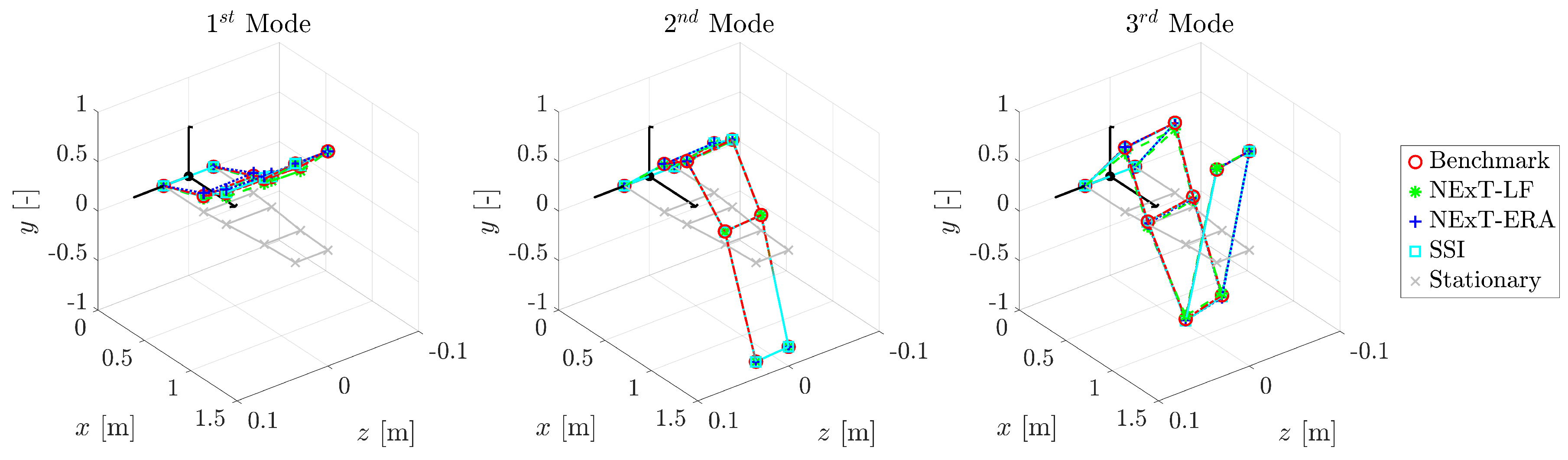
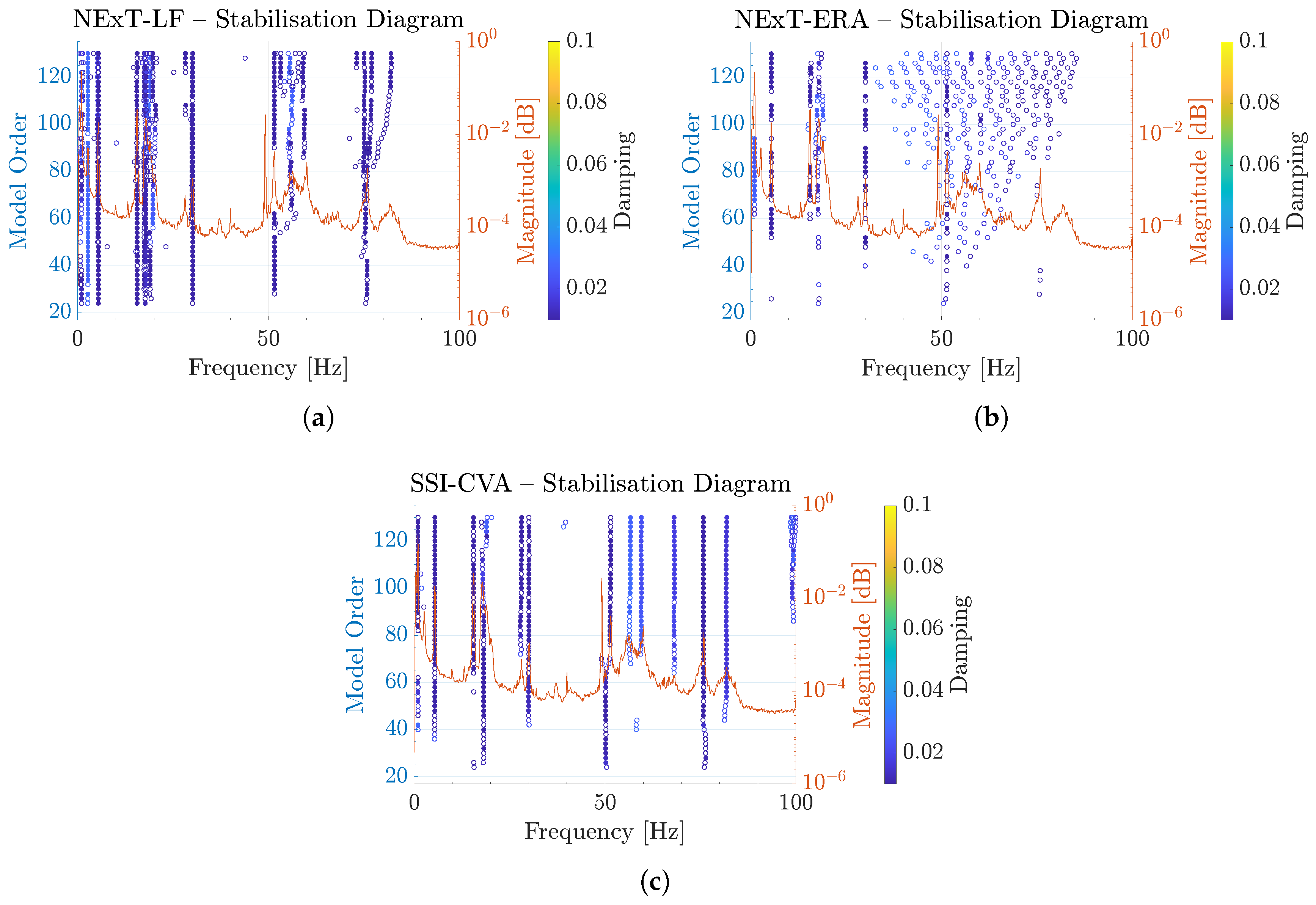
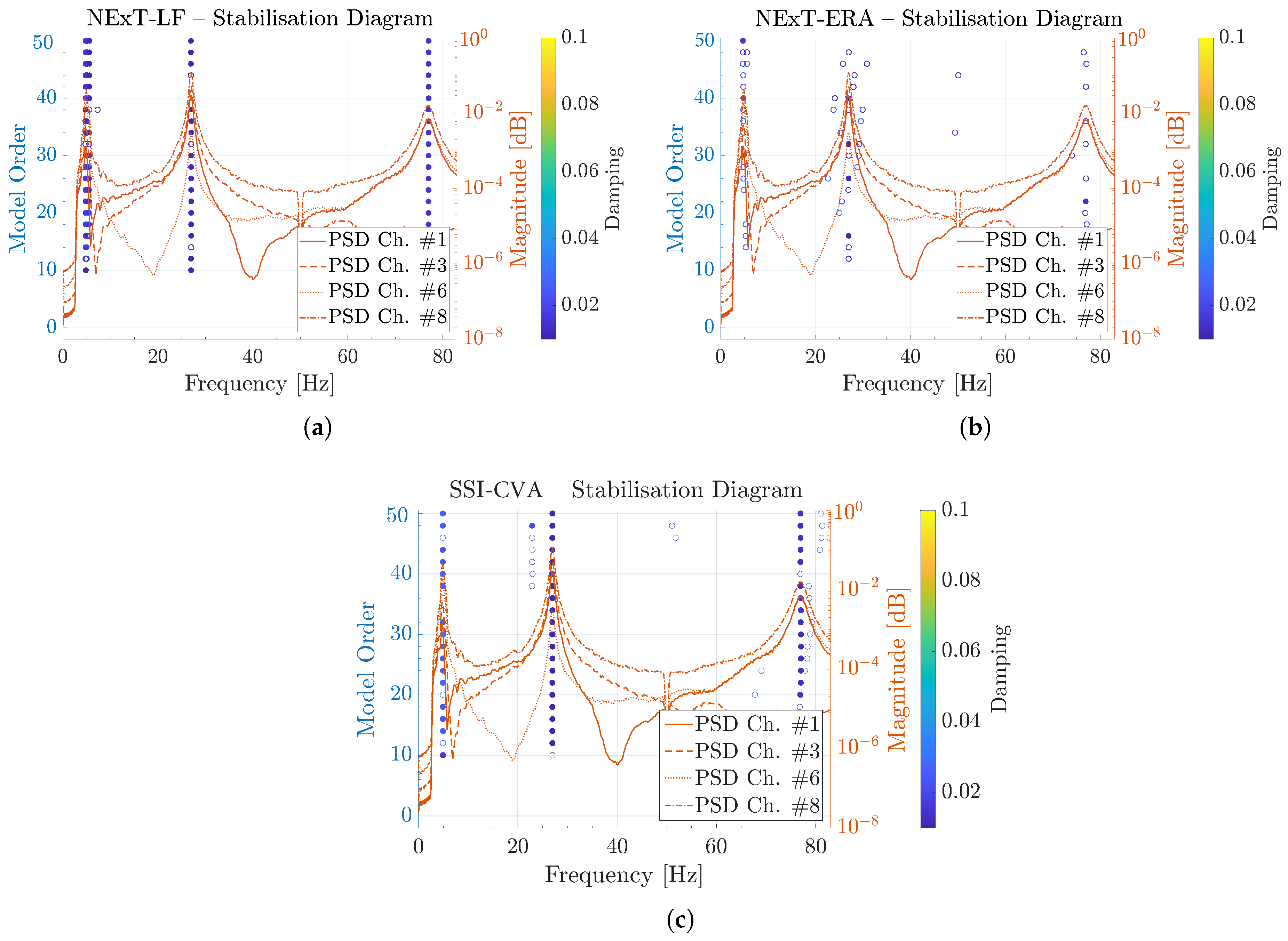
- The natural frequencies identified by NExT-LF are consistent with those obtained with two benchmark methods, NExT with the Eigensystem Realization Algorithm (NExT-ERA) and Stochastic Subspace Identification with Canonical Variate Analysis (SSI), and data;
- Damping ratio estimates exhibit a significantly larger inter-method dispersion than natural frequencies and mode shapes, attributed primarily to the sensitivity of the NExT-derived correlation estimates to record length and noise level;
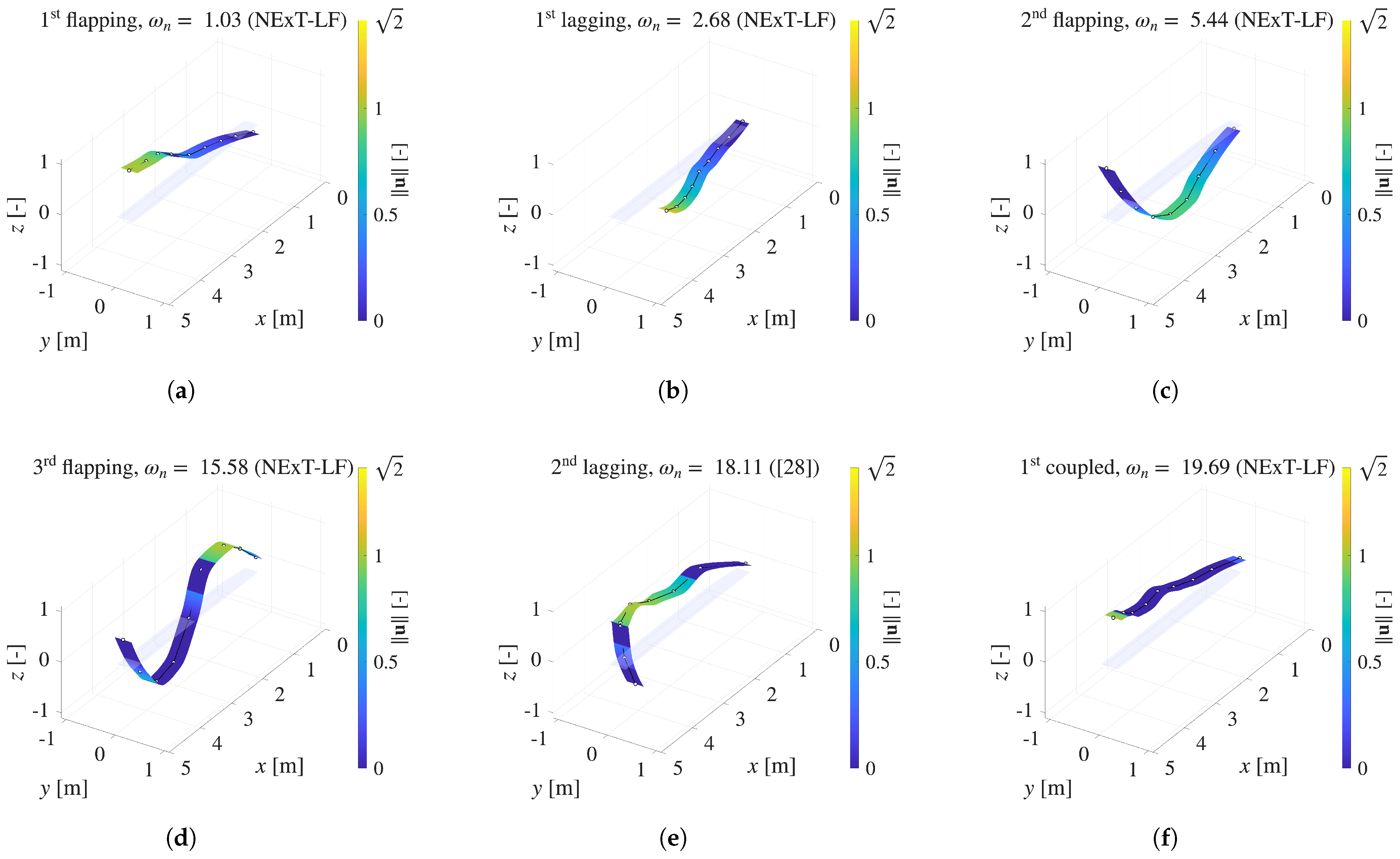
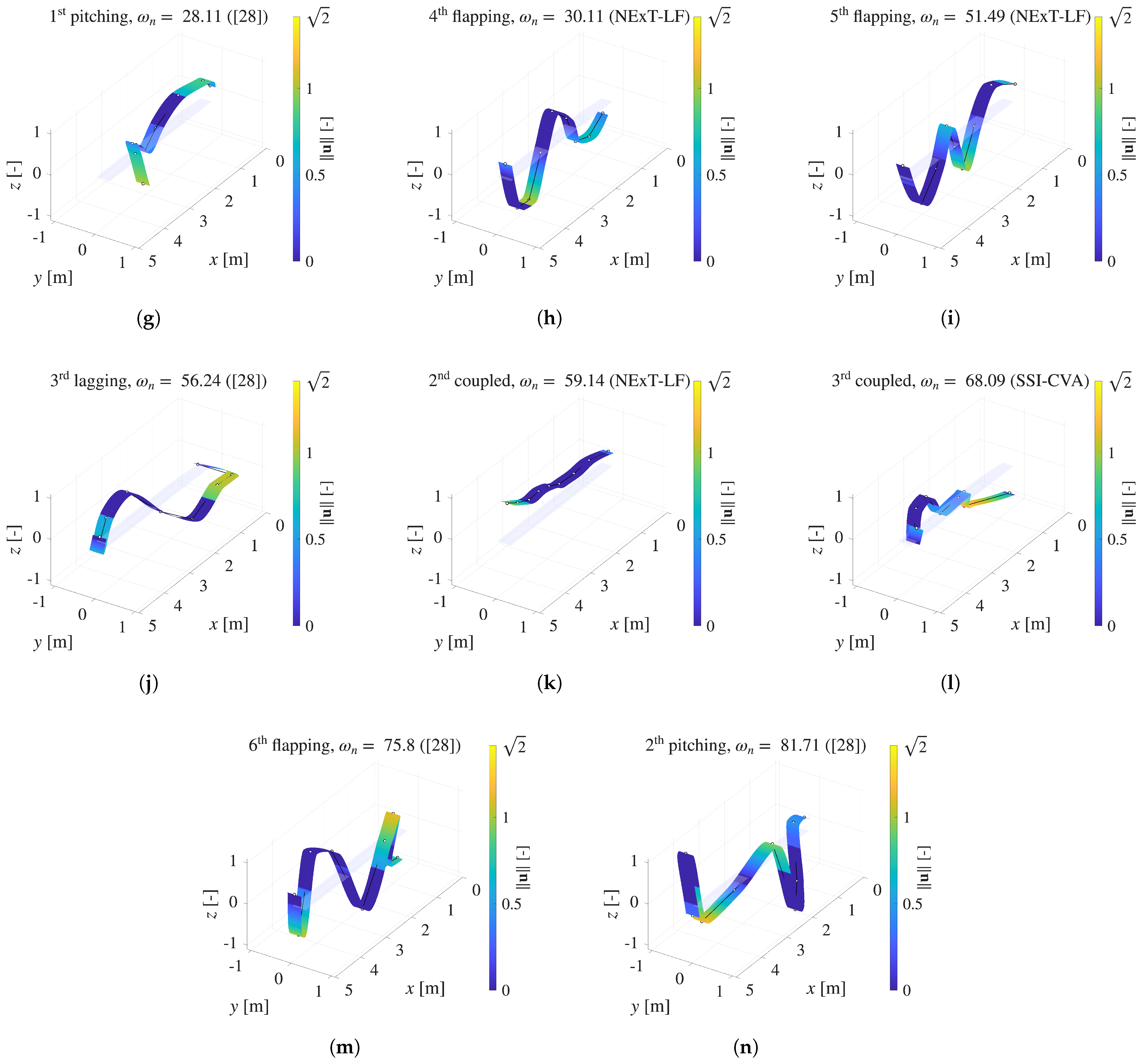
- The mode shapes retrieved in the lower and highly excited frequency band show a high (near 1) correlation (modal assurance criterion) with the reference data;
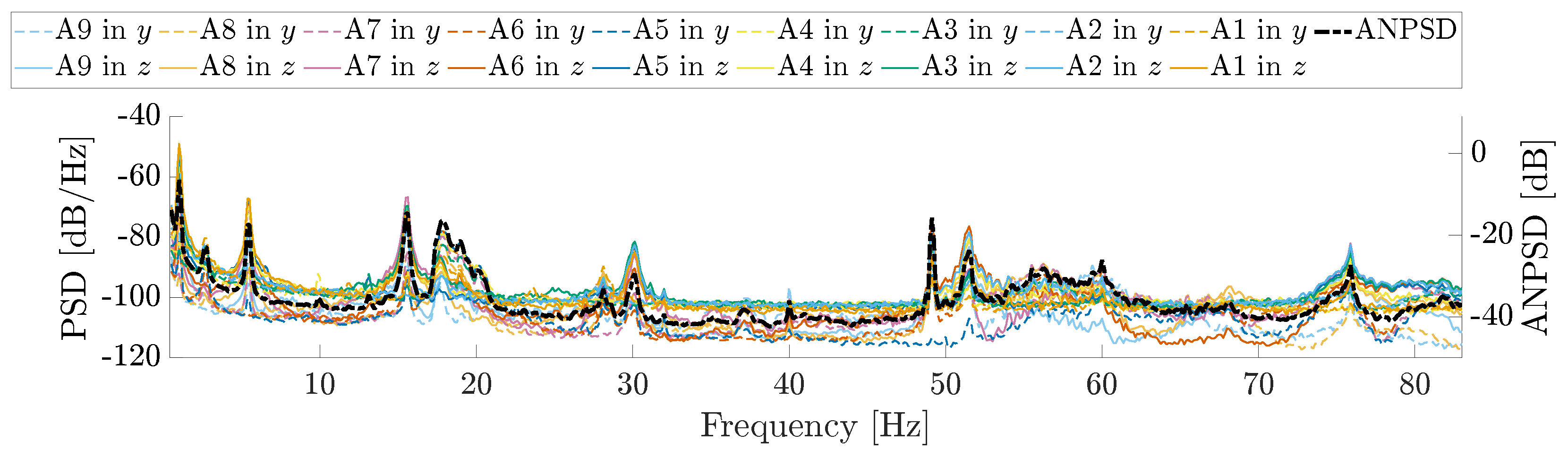
- Three further modes are found w.r.t. the benchmark results of the helicopter blade: Two by NExT-LF and one by SSI.
Author Contributions
Funding
Institutional Review Board Statement
Informed Consent Statement
Data Availability Statement
Conflicts of Interest
References
- Ewins, D.J. Modal Testing Theory, Practice and Application, 2nd ed.; Research Studies Press: Hertfordshire, UK, 2000; p. 562. [Google Scholar]
- Rainieri, C.; Fabbrocino, G. Operational Modal Analysis of Civil Engineering Structures; Springer: New York, NY, USA, 2014; pp. 1–131. [Google Scholar] [CrossRef]
- Reynders, E. System Identification Methods for (Operational) Modal Analysis: Review and Comparison. Arch. Comput. Methods Eng. 2012, 19, 51–124. [Google Scholar] [CrossRef]
- Fragonara, L.Z.; Boscato, G.; Ceravolo, R.; Russo, S.; Ientile, S.; Pecorelli, M.L.; Quattrone, A. Dynamic investigation on the Mirandola bell tower in post-earthquake scenarios. Bull. Earthq. Eng. 2017, 15, 313–337. [Google Scholar] [CrossRef]
- Cadoret, A.; Denimal-Goy, E.; Leroy, J.M.; Pfister, J.L.; Mevel, L. Damage detection and localization method for wind turbine rotor based on Operational Modal Analysis and anisotropy tracking. Mech. Syst. Signal Process. 2025, 224, 111982. [Google Scholar] [CrossRef]
- Jelicic, G.; Schwochow, J.; Govers, Y.; Hebler, A.; Böswald, M. Real-time assessment of flutter stability based on automated output-only modal analysis. In Proceedings of the ISMA 2014-International Conference on Noise and Vibration Engineering and USD 2014-International Conference on Uncertainty in Structural Dynamics, Leuven, Belgium, 15–17 September 2014; pp. 3633–3646. [Google Scholar]
- Sinske, J.; Govers, Y.; Jelicic, G.; Buchbach, R.; Schwochow, J.; Handojo, V.; Böswald, M.; Krüger, W.R. Flight testing using fast online aeroelastic identification techniques with DLR research aircraft HALO. In Proceedings of the 17th International Forum on Aeroelasticity and Structural Dynamics, IFASD 2017, Como, Italy, 25–28 June 2017. [Google Scholar]
- Akers, J.C.; Winkel, J.P.; Chin, A.W.; Parks, R.A.; Chandler, D.E.; Stasiunas, E.C.; Allen, M.S. Operational Modal Analysis of the Artemis I Dynamic Rollout Test and Wet Dress Rehearsal. In Sensors & Instrumentation and Aircraft/Aerospace Testing Techniques; Walber, C., Stefanski, M., Eds.; River Publishers: Aalborg, Denmark, 2025; Volume 8, pp. 91–112. [Google Scholar] [CrossRef]
- Eugeni, M.; Coppotelli, G.; Mastroddi, F.; Gaudenzi, P.; Muller, S.; Troclet, B. OMA analysis of a launcher under operational conditions with time-varying properties. Ceas Space J. 2018, 10, 381–406. [Google Scholar] [CrossRef]
- James, G.; Carne, T.; Edmunds, R. STARS missile–Modal analysis of first-flight data using the Natural Excitation Technique, NExT. In Proceedings of the 12th International Modal Analysis Conference; DeMichele, D.J., Ed.; Society for Experimental Mechanics: Bethel Island, CA, USA, 1994; Volume 2251. [Google Scholar] [CrossRef][Green Version]
- Ameri, N.; Grappasonni, C.; Coppotelli, G.; Ewins, D. Ground vibration tests of a helicopter structure using OMA techniques. Mech. Syst. Signal Process. 2013, 35, 35–51. [Google Scholar] [CrossRef]
- Sibille, L.; Civera, M.; Fragonara, L.Z.; Ceravolo, R. Automated Operational Modal Analysis of a Helicopter Blade with a Density-Based Cluster Algorithm. AIAA J. 2023, 61, 1411–1427. [Google Scholar] [CrossRef]
- Agneni, A.; Crema, L.B.; Coppotelli, G. Output-only analysis of structures with closely spaced poles. Mech. Syst. Signal Process. 2010, 24, 1240–1249. [Google Scholar] [CrossRef]
- III, G.H.J.; Carne, T.G.; Lauffer, J.P. The Natural Excitation Technique (NExT) for Modal Parameter Extraction From Operating Wind Turbines; Technical Report; Sandia National Laboratories: Livermore, CA, USA, 1993. [Google Scholar]
- Overschee, P.V.; Moor, B.D. Subspace Identification for Linear Systems; Springer: New York, NY, USA, 1996. [Google Scholar] [CrossRef]
- Brincker, R.; Zhang, L.; Andersen, P. Modal identification of output-only systems using frequency domain decomposition. Smart Mater. Struct. 2001, 10, 441–445. [Google Scholar] [CrossRef]
- O’Connell, B.J.; Rogers, T.J. A robust probabilistic approach to stochastic subspace identification. J. Sound Vib. 2024, 581, 118381. [Google Scholar] [CrossRef]
- O’Connell, B.J.; Champneys, M.D.; Rogers, T.J. A new perspective on Bayesian operational modal analysis. Mech. Syst. Signal Process. 2025, 236, 112949. [Google Scholar] [CrossRef]
- Amador, S.D.R.; Brincker, R. The new Subspace-based poly-reference Complex Frequency (S-pCF) for robust frequency-domain modal parameter estimation. Meas. J. Int. Meas. Confed. 2024, 225, 113995. [Google Scholar] [CrossRef]
- Lv, L.; Hua, C.; Yu, H.; Dong, D.; Gong, C. Automatic identification of operational modal parameters for train suspension systems based on an improved SSI-FCM. Eng. Struct. 2026, 349, 121868. [Google Scholar] [CrossRef]
- Tarinejad, R.; Amanzad, F. A novel approach for identifying system poles using multi-reference transmissibility functions based on frequency shifts. J. Sound Vib. 2026, 626, 119638. [Google Scholar] [CrossRef]
- Wu, C.; He, S.; Yuan, B.; Yang, Z. An improved NExT-DMD for efficient automated operational modal analysis. Appl. Math. Model. 2026, 156, 116823. [Google Scholar] [CrossRef]
- Saito, A.; Kuno, T. Data-driven experimental modal analysis by Dynamic Mode Decomposition. J. Sound Vib. 2020, 481, 115434. [Google Scholar] [CrossRef]
- Wu, C.; Yang, Z.; He, S. Efficient modal parameter identification using DMD-DBSCAN and rank stabilization diagrams. Aerosp. Sci. Technol. 2025, 161, 110112. [Google Scholar] [CrossRef]
- Schimid, P.J. Dynamic mode decomposition of numerical and experimental data. J. Fluid Mech. 2010, 656, 5–28. [Google Scholar] [CrossRef]
- Mugnaini, V.; Fragonara, L.Z.; Civera, M. A machine learning approach for automatic operational modal analysis. Mech. Syst. Signal Process. 2022, 170, 108813. [Google Scholar] [CrossRef]
- Neu, E.; Janser, F.; Khatibi, A.A.; Orifici, A.C. Fully Automated Operational Modal Analysis using multi-stage clustering. Mech. Syst. Signal Process. 2017, 84, 308–323. [Google Scholar] [CrossRef]
- de Almeida Cardoso, R.; Cury, A.; Barbosa, F. A clustering-based strategy for automated structural modal identification. Struct. Health Monit. 2018, 17, 201–217. [Google Scholar] [CrossRef]
- Mostafaei, H.; Ghamami, M. State of the Art in Automated Operational Modal Identification: Algorithms, Applications, and Future Perspectives. Machines 2025, 13, 39. [Google Scholar] [CrossRef]
- Dessena, G.; Civera, M.; Fragonara, L.Z.; Ignatyev, D.I.; Whidborne, J.F. A Loewner-Based System Identification and Structural Health Monitoring Approach for Mechanical Systems. Struct. Control Health Monit. 2023, 2023, 1891062. [Google Scholar] [CrossRef]
- Dessena, G.; Civera, M.; Yousefi, A.; Surace, C. NExT-LF: A Novel Operational Modal Analysis Method via Tangential Interpolation. Int. J. Mech. Syst. Dyn. 2025, 5, 401–414. [Google Scholar] [CrossRef]
- Dessena, G.; Ignatyev, D.I.; Whidborne, J.F.; Pontillo, A.; Fragonara, L.Z. Ground vibration testing of a flexible wing: A benchmark and case study. Aerospace 2022, 9, 438. [Google Scholar] [CrossRef]
- Weber, S.; Kissinger, T.; Chehura, E.; Staines, S.; Barrington, J.; Mullaney, K.; Fragonara, L.Z.; Petrunin, I.; James, S.; Lone, M.; et al. Application of fibre optic sensing systems to measure rotor blade structural dynamics. Mech. Syst. Signal Process. 2021, 158, 107758. [Google Scholar] [CrossRef]
- Lefteriu, S.; Antoulas, A.C. Modeling multi-port systems from frequency response data via tangential interpolation. In Proceedings of the 2009 IEEE Workshop on Signal Propagation on Interconnects, Strasbourg, France, 12–15 May 2009. [Google Scholar] [CrossRef]
- Quero, D.; Vuillemin, P.; Poussot-Vassal, C. A generalized state-space aeroservoelastic model based on tangential interpolation. Aerospace 2019, 6, 9. [Google Scholar] [CrossRef]
- Vojkovic, T.; Quero, D.; Poussot-Vassal, C.; Vuillemin, P. Low-Order Parametric State-Space Modeling of MIMO Systems in the Loewner Framework. SIAM J. Appl. Dyn. Syst. 2023, 22, 3130–3164. [Google Scholar] [CrossRef]
- Dessena, G.; Civera, M. Improved tangential interpolation-based multi-input multi-output modal analysis of a full aircraft. Eur. J. Mech. A/Solids 2025, 110, 105495. [Google Scholar] [CrossRef]
- Dessena, G.; Civera, M.; Marcos, A.; Chiaia, B.; Bonilla-Manrique, O.E. Multiple input tangential interpolation-driven damage detection of a jet trainer aircraft. Aerosp. Sci. Technol. 2026, 168, 111032. [Google Scholar] [CrossRef]
- Dessena, G.; Pontillo, A.; Civera, M.; Ignatyev, D.I.; Whidborne, J.F.; Fragonara, L.Z. Damping Identification Sensitivity in Flutter Speed Estimation. Vibration 2025, 8, 24. [Google Scholar] [CrossRef]
- Löwner, K. Über monotone matrixfunktionen. Math. Z. 1934, 38, 177–216. [Google Scholar] [CrossRef]
- Antoulas, A.C.; Lefteriu, S.; Ionita, A.C. A Tutorial Introduction to the Loewner Framework for Model Reduction. In Model Reduction and Approximation; Society for Industrial and Applied Mathematics: Philadelphia, PA, USA, 2017; pp. 335–376. [Google Scholar] [CrossRef]
- Mayo, A.; Antoulas, A. A framework for the solution of the generalized realization problem. Linear Algebra Its Appl. 2007, 425, 634–662. [Google Scholar] [CrossRef]
- Kramer, B.; Gugercin, S. Tangential interpolation-based eigensystem realization algorithm for MIMO systems. Math. Comput. Model. Dyn. Syst. 2016, 22, 282–306. [Google Scholar] [CrossRef]
- Lefteriu, S.; Antoulas, A.C. A new approach to modeling multiport systems from frequency-domain data. IEEE Trans. Comput. Aided Des. Integr. Circuits Syst. 2010, 29, 14–27. [Google Scholar] [CrossRef]
- Pontillo, A.; Hayes, D.; Dussart, G.X.; Matos, G.E.L.; Carrizales, M.A.; Yusuf, S.Y.; Lone, M.M. Flexible High Aspect Ratio Wing: Low Cost Experimental Model and Computational Framework. In Proceedings of the 2018 AIAA Atmospheric Flight Mechanics Conference. American Institute of Aeronautics and Astronautics, Kissimmee, FL, USA, 8–12 January 2018; pp. 1–15. [Google Scholar] [CrossRef]
- Yusuf, S.Y.; Hayes, D.; Pontillo, A.; Carrizales, M.A.; Dussart, G.X.; Lone, M.M. Aeroelastic Scaling for Flexible High Aspect Ratio Wings. In Proceedings of the AIAA Scitech 2019 Forum. American Institute of Aeronautics and Astronautics, San Diego, CA, USA, 7–11 January 2019; pp. 1–14. [Google Scholar] [CrossRef]
- Pontillo, A. High Aspect Ratio Wings on Commercial Aircraft: A Numerical and Experimental approach. Ph.D. Thesis, Centre for Aeronautics, Cranfield University, Cranfield, UK, 2020. [Google Scholar]
- Hayes, D.; Pontillo, A.; Yusuf, S.Y.; Lone, M.M.; Whidborne, J. High aspect ratio wing design using the minimum exergy destruction principle. In Proceedings of the AIAA Scitech 2019 Forum. American Institute of Aeronautics and Astronautics, San Diego, CA, USA, 7–11 January 2019; p. 21. [Google Scholar] [CrossRef]
- Dessena, G.; Civera, M.; Bonilla-Manrique, O.E. Tangential interpolation for the operational modal analysis of aeronautical structures. In Proceedings of the 15th EASN International Conference on “Innovation in Aviation & Space Towards Sustainability Today & Tomorrow”, Madrid, Spain, 14–17 October 2025. [Google Scholar]
- Dessena, G.; Pontillo, A.; Ignatyev, D.I.; Whidborne, J.F.; Fragonara, L.Z. Identification of Nonlinearity Sources in a Flexible Wing. J. Aerosp. Eng. 2025, 38, 04025060. [Google Scholar] [CrossRef]
- Bansemir, H.; Emmerling, S. Fatigue Substantiation and Damage Tolerance Evaluation of Fiber Composite Helicopter Components. In Proceedings of the RTO AVT Specialists’ Meeting on “Application of Damage Tolerance Principles for Improved Airworthiness of Rotorcraft”, NATO Research and Technology Organization, Corfu, Greece, 21–22 April 1999. [Google Scholar]
- Bansemir, H.; Müller, R. The EC135-Applied Advanced Technology. In Proceedings of the 53rd American Helicopter Society International Annual Forum 1997. American Helicopter Society International, Virginia Beach, Virginia, 29 April–1 May 1997; pp. 846–861. [Google Scholar]
- Kampa, K.; Enenkl, B.; Polz, G.; Roth, G. Aeromechanic Aspects in the Design of the EC135. J. Am. Helicopter Soc. 1999, 44, 83–93. [Google Scholar] [CrossRef]
- Felce, T. EC-135 – RIAT 2011. Flickr, Inc. Source Listed on Page: Flickr Photo ID 6199185182. Available online: https://www.flickr.com/photos/24874528@N04/6199185182/ (accessed on 1 March 2026).
- Caicedo, J. Practical Guidelines for the Natural Excitation Technique (NExT) and the Eigensystem Realization Algorithm (ERA) for Modal Identification Using Ambient Vibration. Exp. Tech. 2011, 35, 52–58. [Google Scholar] [CrossRef]
- Phani, A.S.; Woodhouse, J. Viscous damping identification in linear vibration. J. Sound Vib. 2007, 303, 475–500. [Google Scholar] [CrossRef]
- Zhu, R.; Wang, W.; Liu, Y.; Lei, M.; Fei, Q. Novel LMD-NExT Hybrid Method for Damping Ratio Identification Under Sweep-Frequency Excitation. AIAA J. 2025, 64, 1–8. [Google Scholar] [CrossRef]
- Brincker, R.; Ventura, C.E. Introduction to Operational Modal Analysis; Wiley: Hoboken, NJ, USA, 2015. [Google Scholar] [CrossRef]

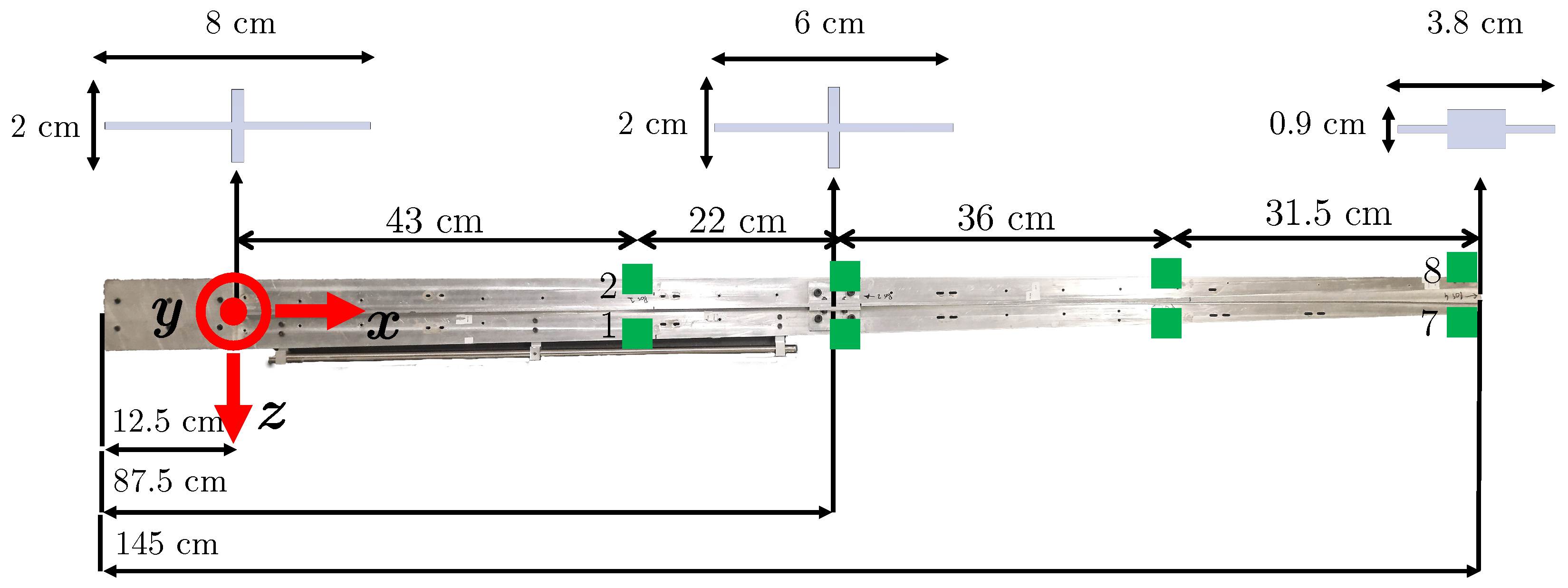
 ). The odd-numbered accelerometers are positioned on the positive z side, whereas the even-numbered sensors are mounted on the negative z side (retrieved from [49]).
). The odd-numbered accelerometers are positioned on the positive z side, whereas the even-numbered sensors are mounted on the negative z side (retrieved from [49]).
). The odd-numbered accelerometers are positioned on the positive z side, whereas the even-numbered sensors are mounted on the negative z side (retrieved from [49]).



 ), A5-3 PCB Model 356A16 (), and A2-1 PCB Model 356A45 (). Note that the z-axis is positive in the out-of-page direction.
), A5-3 PCB Model 356A16 (), and A2-1 PCB Model 356A45 (). Note that the z-axis is positive in the out-of-page direction.
), A5-3 PCB Model 356A16 (), and A2-1 PCB Model 356A45 (). Note that the z-axis is positive in the out-of-page direction.



| Natural Frequency [Hz] (Difference w.r.t. to Benchmark [%]) | ||||
|---|---|---|---|---|
| Mode # | Benchmark [32] | NExT-LF | NExT-ERA | SSI |
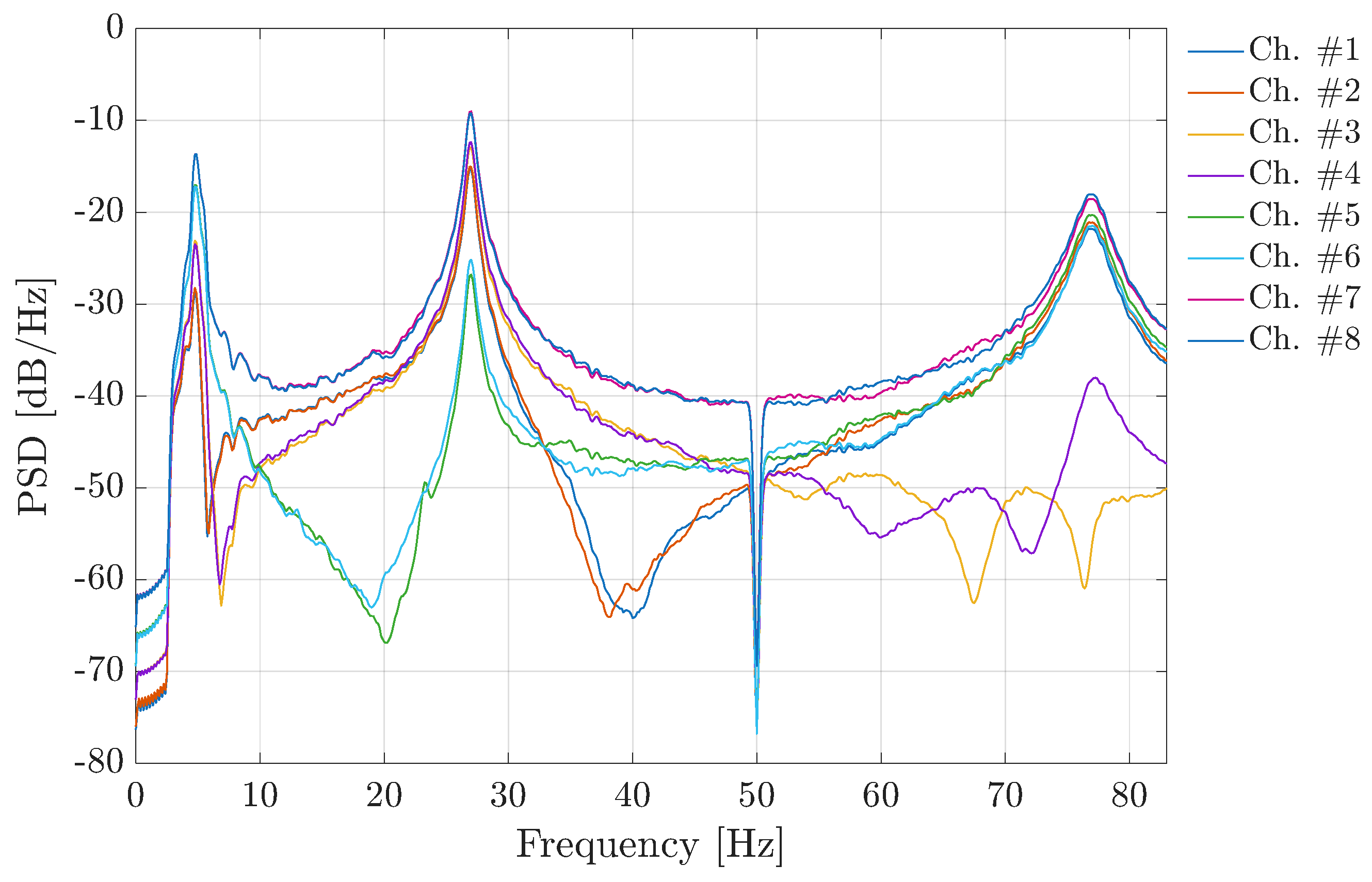
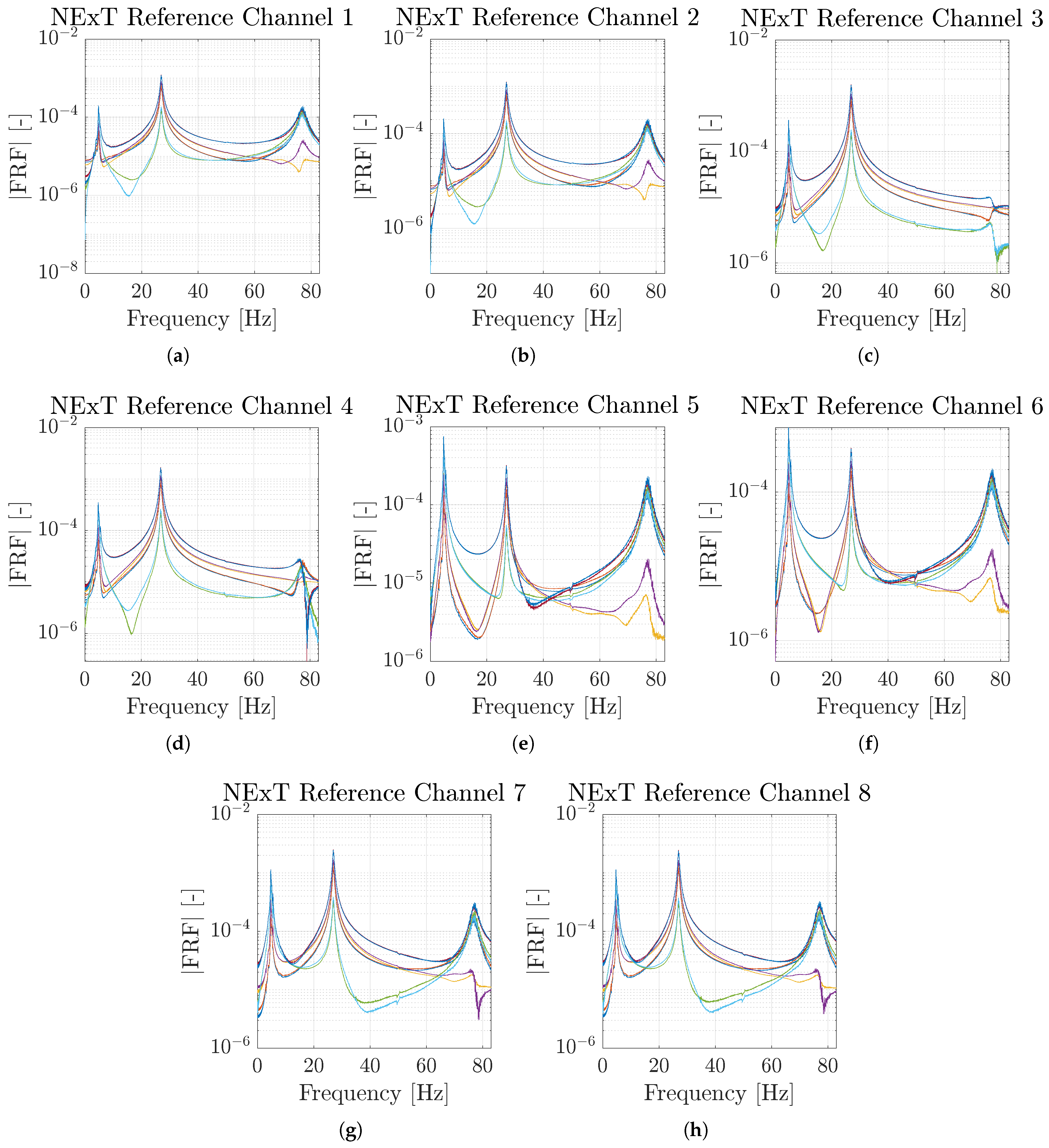
| 1 | 4.855 | 4.930 | 4.689 | 4.891 |
| (-) | (1.53) | (−3.42) | (0.73) | |
| 2 | 26.966 | 26.922 | 26.942 | 26.969 |
| (-) | (−0.16) | (−0.09) | (0.01) | |
| 3 | 76.851 | 77.011 | 76.923 | 76.940 |
| (-) | (0.21) | (0.09) | (0.12) | |
| Modal Damping Ratios [-] (Difference w.r.t. to Benchmark [%]) | ||||
|---|---|---|---|---|
| Mode # | Benchmark [32] | NExT-LF | NExT-ERA | SSI |
| 1 | 0.033 | 0.016 | 0.015 | 0.027 |
| (-) | (−51.17) | (−53.00) | (−17.01) | |
| 2 | 0.010 | 0.011 | 0.012 | 0.011 |
| (-) | (7.29) | (11.40) | (3.06) | |
| 3 | 0.014 | 0.015 | 0.013 | 0.014 |
| (-) | (7.35) | (−7.46) | (−3.17) | |
| Mode # | Natural Frequencies [Hz]–(Relative Difference w.r.t. [26] [%]) | Damping Ratio [%]–(Relative Difference w.r.t. [26] [%]) | |||||||||
|---|---|---|---|---|---|---|---|---|---|---|---|
| NExT-LF | NExT-ERA | SSI-CVA | AOMA [26] | Exp. [33] | FEM [33] | NExT-LF | NExT-ERA | SSI-CVA | AOMA [26] | Exp. [33] | |
| 1 - 1st flapping | 1.03 | 1.03 | 1.02 | 1.02 | 1.02 | 0.90 | 2.33 | 2.72 | 0.68 | 0.55 | 1.05 |
| (0.57) | (0.65) | (0.10) | (0.00) | (−11.76) | (324.22) | (394.53) | (23.07) | (90.91) | |||
| 2 - 1nd lagging | 2.68 | - | - | 2.71 | 2.60 | 3.41 | 2.76 | - | - | 0.70 | 5.50 |
| (−1.01) | (−4.06) | (25.83) | (293.86) | (685.71) | |||||||
| 3 - 2nd flapping | 5.44 | 5.44 | 5.44 | 5.43 | 5.39 | 4.98 | 0.55 | 0.60 | 0.76 | 0.50 | 1.13 |
| (0.18) | (0.13) | (0.15) | (−0.74) | (−8.29) | (10.43) | (19.06) | (51.41) | (126.00) | |||
| 4 - 3rd flapping | 15.58 | 15.57 | 15.55 | 15.55 | 15.44 | 15.28 | 0.47 | 0.34 | 0.35 | 0.30 | 0.97 |
| (0.18) | (0.16) | (0.03) | (−0.71) | (−1.74) | (55.93) | (13.85) | (17.93) | (223.33) | |||
| 5 - 2nd lagging | 17.83 | 17.90 | 17.93 | 18.11 | 18.68 | 22.72 | 1.91 | 1.49 | 1.48 | 1.12 | - |
| (−1.55) | (−1.18) | (−1.01) | (3.15) | (25.46) | (70.46) | (33.42) | (32.08) | ||||
| 6 - 1st coupled | 19.69 | 18.90 | 18.98 | - | - | - | 0.87 | 2.60 | 2.62 | - | - |
| 7 - 1st pitching | 28.20 | - | 28.14 | 28.11 | 27.39 | 28.59 | 0.46 | - | 0.67 | 0.66 | 3.22 |
| (0.31) | (0.09) | (−2.56) | (1.71) | (−31.03) | (1.70) | (387.88) | |||||
| 8 - 4th flapping | 30.11 | 30.08 | 30.06 | 30.07 | 29.98 | 29.98 | 0.42 | 0.45 | 0.45 | 0.41 | 0.61 |
| (0.15) | (0.02) | (−0.03) | (−0.30) | (6.65) | (1.49) | (10.90) | (9.01) | (48.78) | |||
| 9 - 5th flapping | 51.49 | 51.42 | 51.46 | 51.43 | 51.71 | 52.17 | 0.31 | 0.31 | 0.57 | 0.45 | 0.85 |
| (0.12) | (−0.03) | (0.05) | (0.54) | (73.50) | (−32.10) | (−31.94) | (26.72) | (88.89) | |||
| 10 - 3rd lagging | 55.65 | 57.78 | 56.65 | 56.24 | - | - | 2.64 | 1.58 | 2.68 | 2.52 | - |
| (−1.05) | (2.74) | (0.74) | (4.89) | (−37.35) | (6.20) | ||||||
| 11 - 2nd coupled | 59.14 | 60.27 | 59.50 | - | - | - | 1.08 | 1.13 | 2.34 | - | - |
| 12 - 3rd coupled | - | - | 68.09 | - | - | - | - | - | 1.65 | - | - |
| 13 - 6th flapping | 75.65 | - | 75.73 | 75.80 | 75.68 | 75.12 | 0.31 | - | 0.85 | 0.88 | 0.94 |
| (−0.20) | (−0.09) | (−0.16) | (−0.90) | (−65.30) | (−3.11) | (6.82) | |||||
| 14 - 2nd pitching | 82.05 | - | 81.86 | 81.71 | 81.63 | 81.80 | 1.04 | - | 1.60 | 1.82 | 1.50 |
| (0.42) | (0.19) | (−0.10) | (0.11) | (−42.63) | (−12.16) | (−17.58) | |||||
| Diagonal Terms of the MAC Value [-] Matrix | ||||||||||||||
|---|---|---|---|---|---|---|---|---|---|---|---|---|---|---|
| Mode | ||||||||||||||
| Method | 1 | 2 | 3 | 4 | 5 | 6 1 | 7 | 8 | 9 | 10 | 11 1 | 12 1 | 13 | 14 |
| NExT-LF | 0.97 | 0.93 | 1.00 | 1.00 | 0.77 | - | 0.44 | 0.97 | 1.00 | 0.16 | - | - | 0.70 | 0.09 |
| NExT-ERA | 1.00 | - | 1.00 | 1.00 | 0.99 | - | - | 0.99 | 1.00 | 0.06 | - | - | - | - |
| SSI-CVA | 1.00 | - | 1.00 | 1.00 | 0.93 | - | 0.99 | 1.00 | 1.00 | 0.97 | - | - | 0.98 | 1.00 |
Disclaimer/Publisher’s Note: The statements, opinions and data contained in all publications are solely those of the individual author(s) and contributor(s) and not of MDPI and/or the editor(s). MDPI and/or the editor(s) disclaim responsibility for any injury to people or property resulting from any ideas, methods, instructions or products referred to in the content. |
© 2026 by the authors. Licensee MDPI, Basel, Switzerland. This article is an open access article distributed under the terms and conditions of the Creative Commons Attribution (CC BY) license.
Share and Cite
Dessena, G.; Civera, M.; Bonilla-Manrique, O.E. Operational Modal Analysis of Aeronautical Structures via Tangential Interpolation. Aerospace 2026, 13, 378. https://doi.org/10.3390/aerospace13040378
Dessena G, Civera M, Bonilla-Manrique OE. Operational Modal Analysis of Aeronautical Structures via Tangential Interpolation. Aerospace. 2026; 13(4):378. https://doi.org/10.3390/aerospace13040378
Chicago/Turabian StyleDessena, Gabriele, Marco Civera, and Oscar E. Bonilla-Manrique. 2026. "Operational Modal Analysis of Aeronautical Structures via Tangential Interpolation" Aerospace 13, no. 4: 378. https://doi.org/10.3390/aerospace13040378
APA StyleDessena, G., Civera, M., & Bonilla-Manrique, O. E. (2026). Operational Modal Analysis of Aeronautical Structures via Tangential Interpolation. Aerospace, 13(4), 378. https://doi.org/10.3390/aerospace13040378